AB 1173: Employment: work hours: holiday season: overtime.
- Session Year: 2017-2018
- House: Assembly
- Latest Version Date: 2017-02-17
Existing law, with certain exceptions, establishes 8 hours as a days work and a 40-hour workweek, and requires payment of prescribed overtime compensation for additional hours worked. Existing law authorizes the adoption by 2/3 of employees in a work unit of alternative workweek schedules providing for workdays no longer than 10 hours within a 40-hour workweek.
This bill would establish an overtime exemption for an employee-selected holiday season flexible work schedule. The exemption would allow during the holiday season, as defined, at the request of an individual nonexempt employee working in the retail industry, and upon employer approval, an employee-selected flexible work schedule providing for workdays up to 10 hours per day within a 40-hour workweek. The employer would be obligated to pay overtime based on the employees regular rate of pay, as prescribed, for all hours worked over 40 hours in a workweek or over 10 hours in a workday, whichever is greater. The bill would establish requirements for the termination of an agreed-upon schedule. The bill would except from its provisions employees covered by collective bargaining and public employees, as specified. The bill would require the Division of Labor Standards Enforcement in the Department of Industrial Relations to enforce this provision and adopt or revise regulations as necessary.
(a)Eight hours of labor constitutes a days work. Any work in excess of eight hours in one workday and any work in excess of 40 hours in any one workweek and the first eight hours worked on the seventh day of work in any one workweek shall be compensated at the rate of no less than one and one-half times the regular rate of pay for an employee. Any work in excess of 12 hours in one day shall be compensated at the rate of no less than twice the regular rate of pay for an employee. In addition, any work in excess of eight hours on any seventh day of a workweek shall be compensated at the rate of no less than twice the regular rate of pay of an employee. Nothing in this section requires an employer to combine more than one rate of overtime compensation in order to calculate the amount to be paid to an employee for any hour of overtime work. The requirements of this section do not apply to the payment of overtime compensation to an employee working pursuant to any of the following:
(1)An alternative workweek schedule adopted pursuant to Section 511.
(2)A holiday season employee-selected flexible work schedule adopted pursuant to Section 511.3.
(2)(3)An alternative workweek schedule adopted pursuant to a collective bargaining agreement pursuant to Section 514.
(3)(4)An alternative workweek schedule to which this chapter is inapplicable pursuant to Section 554.
(b)Time spent commuting to and from the first place at which an employees presence is required by the employer shall not be considered to be a part of a days work, when the employee commutes in a vehicle that is owned, leased, or subsidized by the employer and is used for the purpose of ridesharing, as defined in Section 522 of the Vehicle Code.
(c)This section does not affect, change, or limit an employers liability under the workers compensation law.
SEC. 2.Section 511.3 is added to the Labor Code, to read:511.3.(a)As used in this section:
(1)Holiday season means the months of November to January, inclusive.
(2)Retail industry means ____.
(b)Notwithstanding Section 511 or any other law or order of the Industrial Welfare Commission, during the holiday season, an individual nonexempt employee working in the retail industry may work up to 10 hours per workday without any obligation on the part of the employer to pay an overtime rate of compensation, except as provided in subdivision (c), if the employee requests this schedule in writing and the employer approves the request. This shall be referred to as an overtime exemption for a holiday season employee-selected flexible work schedule.
(c)If a holiday season employee-selected flexible work schedule is adopted pursuant to subdivision (a), the employer shall pay overtime at one and one-half times the employees regular rate of pay for all hours worked over 40 hours in a workweek or over 10 hours in a workday, whichever is the greater number of hours. All work performed in excess of 12 hours per workday and in excess of eight hours on a fifth, sixth, or seventh day in the workweek shall be paid at double the employees regular rate of pay.
(d)The employer may inform its employees that it is willing to consider an employee request to work a holiday season employee-selected flexible work schedule, but shall not induce a request by promising an employment benefit or threatening an employment detriment.
(e)The employee or employer may discontinue the holiday season employee-selected flexible work schedule at any time by giving written notice to the other party. The request will be effective the first day of the next pay period or the fifth day after notice is given if there are fewer than five days before the start of the next pay period, unless otherwise agreed to by the employer and the employee.
(f)This section does not apply to any employee covered by a valid collective bargaining agreement or employed by the state, a city, county, city and county, district, municipality, or other public, quasi-public, or municipal corporation, or any political subdivision of this state.
(g)This section shall be liberally construed to accomplish its purposes.
(h)(1)The Division of Labor Standards Enforcement shall enforce this section and shall adopt or revise regulations in a manner necessary to conform and implement this section.
(2)This section shall prevail over any inconsistent provisions in any wage order of the Industrial Welfare Commission.
REVISIONS: HeadingLine 3.|
Date
|
Status
|
|---|---|
| Feb 1, 2018 | From committee: Filed with the Chief Clerk pursuant to Joint Rule 56. |
| Jan 31, 2018 | Died pursuant to Art. IV, Sec. 10(c) of the Constitution. |
| Jan 11, 2018 | In committee: Set, first hearing. Failed passage. Reconsideration granted. |
| Mar 28, 2017 | Coauthors revised. |
| Mar 16, 2017 | Coauthors revised. |
| Mar 9, 2017 | Referred to Com. on L. & E. |
| Feb 19, 2017 | From printer. May be heard in committee March 21. |
| Feb 17, 2017 | Read first time. To print. |
|
Date
|
Description
|
Location
|
Votes
|
|
|---|---|---|---|---|
| Jan 11, 2018 | Reconsideration. | Assembly Standing Committee on Labor and Employment |
Passed |
|
| Jan 11, 2018 | Do pass and be re-referred to the Committee on [Appropriations] | Assembly Standing Committee on Labor and Employment |
Failed |
This list shows positions taken on this bill by organizations on the date displayed, which is linked to the original source.
Positions by individuals are not included.
|
Organization
|
Position
|
Date
|
|---|---|---|
| American Petroleum and Convenience Store Association | ** Support | Jan 10, 2018 |
| Brea Chamber of Commerce | ** Support | Jan 10, 2018 |
| Broad and Gusman | * Against | Jan 11, 2018 |
| CA Conference Board of the Amalgamated Transit Union | ** Against | Jan 10, 2018 |
| CA Conference of Machinists | ** Against | Jan 10, 2018 |
| California Business Properties Association | ** Support | Jan 10, 2018 |
| California Chamber Of Commerce | * Support | Jan 11, 2018 |
| California Employment Lawyers Association | ** Against | Jan 10, 2018 |
| California Federation Of Teachers | * Against | Jan 11, 2018 |
| California Labor Federation | * Against | Jan 11, 2018 |
| California Nurses Association | * Against | Jan 11, 2018 |
| California Restaurant Association | * Support | Jan 11, 2018 |
| California Retailers Association | * Support | Jan 11, 2018 |
| California School Employees Association | * Against | Jan 11, 2018 |
| California Teamsters Public Affairs Council | ** Against | Jan 10, 2018 |
| Camarillo Chamber of Commerce | ** Support | Jan 10, 2018 |
| Consumer Attorneys Of California | ** Against | Jan 10, 2018 |
| Engineers & Scientists of CA, Local 20 | ** Against | Jan 10, 2018 |
| Family Business Association Of California | * Support | Jan 11, 2018 |
| International Longshore and Warehouse Union | ** Against | Jan 10, 2018 |
| North Orange County Chamber | ** Support | Jan 10, 2018 |
| Orange County Association of Realtors | ** Support | Jan 10, 2018 |
| Orange County Business Council | ** Support | Jan 10, 2018 |
| Professional & Technical Engineers, Local 21 | ** Against | Jan 10, 2018 |
| Rancho Cordova Chamber of Commerce | ** Support | Jan 10, 2018 |
| Southwest California Legislative Council | ** Support | Jan 10, 2018 |
| Torrance Area Chamber of Commerce | ** Support | Jan 10, 2018 |
| Unite Here | ** Against | Jan 10, 2018 |
| Utility Workers Union of America | ** Against | Jan 10, 2018 |
| VALLEY INDUSTRY AND COMMERCE ASSOCIATION | ** Support | Jan 10, 2018 |
Date of Hearing: January 11, 2018
ASSEMBLY COMMITTEE ON LABOR AND EMPLOYMENT
Tony Thurmond, Chair
ABPCA Bill Id:AB 1173 (
Author:Harper) – As Introduced Ver:February 17, 2017
SUBJECT: Employment: work hours: holiday season: overtime
SUMMARY: Establishes an overtime exemption for an employee-selected holiday season flexible work schedule. Specifically, this bill:
- Allows during the holiday season, November through January, at the request of an individual nonexempt employee working in the retail industry, and upon employer approval, an employee-selected flexible work schedule providing for workdays up to ten hours per day within a 40-hour workweek.
- Obligates an employer to pay overtime based on the employee’s regular rate of pay, as prescribed, for all hours worked over 40 hours in a workweek or over ten hours in a workday, whichever is greater.
- Establishes requirements for the termination of an agreed-upon schedule.
- Exempts from its provisions employees covered by collective bargaining and public employees, as specified.
- Requires the Division of Labor Standards Enforcement in the Department of Industrial Relations to enforce and adopt or revise regulations as necessary.
EXISTING LAW:
- Defines a day's work as eight hours of labor.
- Requires that any work in excess of eight hours day, in excess of 40 hours a week, and the first eight hours on the seventh day of work are to be compensated at no less than one and one-half times the regular rate of pay, and provides corresponding exemptions for certain classifications of employees.
- Requires that any work in excess of 12 hours a day and in excess of eight hours on the seventh day of work are to be compensated at no less than twice the regular rate of pay, and provides corresponding exemptions for certain classifications of employees.
- Allows employees of an employer to adopt a regularly scheduled alternative workweek that authorizes work by the affected employees for no longer than ten hours per day within a 40- hour workweek without the payment of overtime. Such alternative workweek schedules are permissible only if they receive approval in a secret ballot election by two-thirds of the affected employees.
- Permits an employee, upon written request, to make up lost work time during the same workweek without incurring daily overtime.
- Provides an exemption to the overtime and alternative workweek provisions of the law to an employee covered by a valid collective bargaining agreement if the agreement expressly provides for wages, hours of work, and working conditions of the employees, and if the agreement provides premium wage rates for all overtime hours worked and a regularly hourly rate of pay at least 30% above the state minimum wage.
FISCAL EFFECT: Unknown
COMMENTS: The author argues that this measure is needed to, “give working families, caregivers, students and others with scheduling conflicts the availability to choose an alternative work schedule.” The author further asserts that, “choosing a flexible work schedule of four, ten hour days can help families juggle the demands of a job and family during the holiday seasons.”
In support the Valley Industry Commerce Association (VICA) argues, “Giving employees the opportunity to work a flexible schedule during the holiday season will increase work life balance at one of the busiest times of the year. VICA continues, “Our current laws are outdated and ignore the clear need for a way for employers and individual employees to create a mutually beneficial schedule.
In opposition, the California Employment Lawyers Association writes, “Current law already ensures adequate flexibility for employers and employees while protecting the basic right to overtime for work over eight hours in a workday.” CELA asserts, “AB 1173 would provide no protection for workers who feel pressured to waive daily overtime, especially during the holiday season when workers are expected to work longer hours, because the workplace election would be replaced by a one-on-one discussion with the boss. The California Labor Federation writes, “This wholesale dismantling of overtime law for some of economy’s lowest-paid and most vulnerable workers is totally unnecessary and completely indefensible.”
History of Overtime Protections Under California Law
The California Industrial Welfare Commission (IWC) was established in 1913 by the California Legislature to regulate minimum wages, maximum hours of work, and standards for working conditions for women and minors. California was the ninth State to create a commission to protect the welfare of working women and minors. In 1916, the IWC issued its first wage order, setting the minimum wage rate at 16 cents an hour for the fruit and vegetable canning industry, with pay of one and a quarter of minimum after ten hours, a limit of 72 hours a week, and improved sanitary conditions. A few years later the IWC reduced the maximum hours to eight hours a day and 48 hours a week.
By the sixties, the IWC faced ongoing legal challenges to its Orders, especially over the issue of regulations only for women. In Rosenfield vs. Southern Company, the federal court ruled that Rosenfield had been denied a promotion due to the state’s laws limiting the hours of employment and the amount of weight a woman was allowed to lift. This ruling cited the Civil Rights Act of 1964. Similar findings led to the Legislature extending the IWC’s powers to include men in 1973.
Throughout the next decade orders received greater scrutiny and were often under contention, usually based on whether IWC procedures were properly followed. During the eighties and nineties the IWC faced conflicting issues over standard work weeks and daily overtime. In 1997 after the IWC changed from requiring overtime pay after eight hours in any day to overtime only after 40 hours in one week, the Legislature revoked funding for the IWC.
In 1999, the legislature passed and the Governor Davis signed AB 60 (Knox) Chapter 134, Statutes of 1999, which established a framework for the payment of daily overtime compensation. That framework included: time and one-half pay after eight hours of daily work; personal time off for a personal obligation of an employee which may be made up during a workweek without payment of overtime compensation within specified limits; and, the adoption through an employee election of an alternative work week schedule or menu of schedules offered by an employer. That year, the Governor also reinstated the IWC. The IWC remained in operation until July 2004, when its funding was again eliminated from the state budget. Though the IWC is currently not in operation, the Division of Labor Standards Enforcement continues to enforce the provisions of the wages orders issued by the IWC.
Scheduling Flexibility Under Current Law
As noted above, AB 60 contained several features related to flexibility in employee work schedules. First, it provided for the adoption of alternative workweek schedules pursuant to an employee election. The alternative workweek schedule may authorize the employees to work no more than ten hours per day within a 40-hour workweek without receiving overtime. Such an alternative schedule must be adopted in a secret ballot election by at least two-thirds of the affected employees.
Labor Code Section 511(a) also provides that, "The regularly scheduled alternative workweek proposed by an employer for adoption by employees may be a single work schedule that would become the standard schedule for workers in the work unit, or a menu of work schedule options, from which each employee in the unit would be entitled to choose."
Moreover, Section 3(C)(1) of the IWC Wage Orders states: "If the employer proposes a menu of work schedule options, the employee may, with the approval of the employer, move from one menu option to another."
Section 3(B)(1) of the IWC Wage Orders provides that, "Nothing in this section shall prohibit an employer, at the request of the employee, to substitute one day of work for another day of the same length in the shift provided by the alternative workweek agreement on an occasional basis to meet the personal needs of the employee without the payment of overtime."
Section 3(C)(2) of the IWC Wage Order also provides that the term "affected employees in the work unit" may include all employees in a readily identifiable work unit, such as a division, a department, a job classification, a shift, a separate physical location, or a recognized subdivision of any such work unit. A work unit may consist of an individual employee as long as the criteria for an identifiable work unit are met.
In addition, AB 60 allowed employees to take off time for a personal obligation and makeup that time during the same workweek without payment of daily overtime. Labor Code Section 513 provides that, if an employer approves a written request, an employee may makeup work time during the same workweek without incurring daily overtime, except for hours in excess of 11 in one workday.
Finally, AB 60 contained an overtime exemption for employees covered by a valid collective bargaining agreement if the agreement expressly provides for wages, hours of work, and working conditions of the employees, and if the agreement provides premium wage rates for all overtime hours worked and a regularly hourly rate of pay at least 30% above the state minimum wage.
Related and Prior Legislation:
AB 67 (Gonzales Fletcher) of 2016 would have enacted the Double Pay on the Holiday Act of 2016 requiring a grocery or retail store establishment employer to pay two times the regular rate of pay to an employee for work on Thanksgiving Day. That bill failed passage on the Assembly Floor on Concurrence in Senate Amendments.
AB 1038 (Jones) of 2015 would have authorized individual employees to request flexible work schedules, as specified and failed passage in this Committee.
AB 2448 (Jones) of 2014 was nearly identical to AB 1038 and failed passage in this Committee.
AB 907 (Conway) of 2014 was nearly identical to AB 1038 and failed passage in this Committee in January 2014.
SB 607 (Berryhill) of 2013 was nearly identical to AB 1038 and failed passage in the Senate Committee on Labor and Industrial Relations.
AB 830 (Olsen) of 2011 was nearly identical to AB 1038 and failed passage in the Assembly Committee on Labor and Employment.
SB 367 (Dutton) of 2011 would have permitted an individual nonexempt employee employed by an employer with 25 or fewer employees to request an employee-selected flexible work schedule providing for workdays up to ten hours per day within a 40-hour workweek, and would have allowed the employer to implement this schedule without any obligation to pay overtime compensation. SB 367 failed passage in the Senate Labor and Industrial Relations Committee.
SB 378 (Dutton) of 2011 would have provided that an alternative workweek schedule adopted pursuant to existing law may include a regularly scheduled alternative workweek that authorizes work by the affected employees for more than ten hours a day, as long as the employees are paid at the appropriate overtime rate. The bill further would have exempted from current law employers with five or fewer employees, but would have permitted such employers and their employees to voluntarily enter into a revocable written agreement setting forth an alternative workweek schedule that allows an employee to work up to ten hours a day, 40 hours a week, without the payment of overtime wages. Testimony was taken on SB 378 in the Senate Labor and Industrial Relations Committee, but a vote was never taken.
AB 60 (Knox), Chapter 134, Statutes of 1999. Established a framework for the payment of daily overtime compensation: time and one-half pay after eight hours of daily work; personal time off for a personal obligation of an employee which may be made up during a workweek without payment of overtime compensation within specified limits; and, the adoption through an employee election of an alternative work week schedule or menu of schedules offered by an employer.
REGISTERED SUPPORT / OPPOSITION:
Support
American Petroleum and Convenience Store Association
Brea Chamber of Commerce
California Business Properties Association
California Chamber of Commerce
California Restaurant Association
California Retailers Association
Camarillo Chamber of Commerce
Family Business Association
North Orange County Chamber
Orange County Association of Realtors
Orange County Business Council
Rancho Cordova Chamber of Commerce
Southwest California Legislative Council
Torrance Area Chamber of Commerce
Valley Industry and Commerce Association
Opposition
CA Conference Board of the Amalgamated Transit Union
CA Conference of Machinists
California Employment Lawyers Association
California Federation of Teachers
California Labor Federation, AFL-CIO
California Teamsters Public Affairs Council
Consumer Attorneys of California
Engineers & Scientists of CA, Local 20
International Longshore and Warehouse Union
Professional & Technical Engineers, Local 21
UNITE HERE
Utility Workers Union of America
Analysis Prepared by: Jennifer Richard / L. & E. /
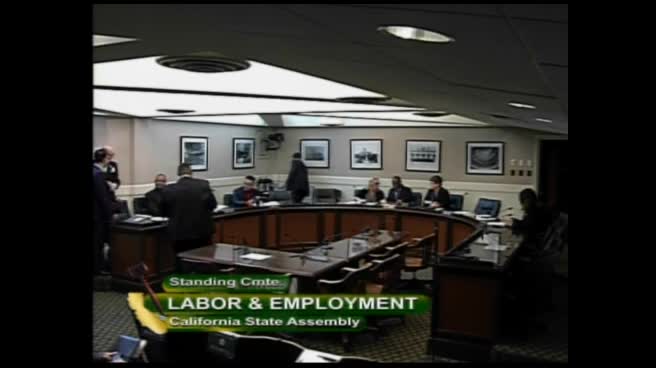
Discussed in Hearing
 22MIN
Assembly Standing Committee on Labor and Employment
Bill Author