AB 1301: Joint Legislative Committee on Climate Change Policies.
- Session Year: 2017-2018
- House: Assembly
- Latest Version Date: 2017-03-22
Existing law creates the Joint Legislative Committee on Climate Change Policies and requires the committee to ascertain facts and make recommendations to the Legislature and to committees of the Legislature concerning the states programs, policies, and investments related to climate change, as specified.
This bill would state the mission of the joint committee, as specified, and would require the chair of the State Air Resources Board to annually make a specified presentation to the joint committee on specified greenhouse gas emissions reduction measures that are being implemented or considered by the state board.
(a)The Joint Legislative Committee on Climate Change Policies is hereby created. The committee shall ascertain facts and make recommendations to the Legislature concerning the states programs, policies, and investments related to climate change. Those recommendations shall be shared with other appropriate legislative standing committees, including the Assembly Committee on Budget and the Senate Committee on Budget and Fiscal Review.
(b)The joint committee shall consist of at least three Members of the Senate and at least three Members of the Assembly who shall be selected in the manner provided for in the Joint Rules of the Senate and Assembly. The membership shall reflect the perspectives of multiple standing committees.
(c)The mission of the joint committee shall be to do all of the following:
(1)Evaluate the actions California, other states, and foreign nations are taking to reduce emissions of greenhouse gases and quantify the reduction in emissions from those jurisdictions over the prior year, if any.
(2)(A)Evaluate the impact that Californias climate policies have had on the price of gasoline, electricity, and other commodities identified by the joint committee. The evaluation shall include, but need not be limited to, whether there are regional differences in the impacts on prices. all of the following:
(i)Transportation fuels, including gasoline and diesel fuel, subject to a market-based compliance mechanism adopted by the State Air Resources Board pursuant to Part 5 (commencing with Section 38570) of Division 25.5 of the Health and Safety Code or the Low Carbon Fuel Standard regulations (Subarticle 7 (commencing with Section 95480) of Title 17 of the California Code of Regulations).
(ii)Electricity.
(iii)Other commodities identified by the joint committee.
(B)The evaluation required pursuant to this paragraph shall include, but need not be limited to, whether there are regional differences in the impacts on prices.
(3)Recommend to the Legislature how to prioritize allocating moneys in the Greenhouse Gas Reduction Fund, created pursuant to Section 16428.8, in order to achieve the greatest reductions of emissions of greenhouse gases for each dollar spent.
(4)Track changes in the cost-effectiveness of clean technologies based on the amount of emissions avoided.
(d)The chair of the State Air Resources Board shall annually appear before the joint committee to present both of the following:
(1)The State Air Resources Boards annual informational report on the reported emissions of greenhouse gases, criteria pollutants, and toxic air contaminants from all sectors covered by the scoping plan, as required pursuant to subdivision (b) of Section 38531 of the Health and Safety Code. This presentation may be done at a hearing that is held jointly with the relevant Assembly and Senate standing committees.
(2)The greenhouse gas emissions reduction measures identified in the scoping plan prepared pursuant to Section 38561 of the Health and Safety Code, that are being implemented or considered by the State Air Resources Board, including, but not limited to, all of the following:
(A)Estimated reductions in emissions.
(B)Estimated aggregate cost to regulated entities.
(C)Estimated cost per ton of reductions in greenhouse gas emissions.
(D)Technological feasibility of greenhouse gas emissions reduction measures.
(e)In recognition of the technical complexity involved in reviewing the states climate policies, the joint committee may establish a panel of experts to provide an independent analysis of the states policies to better inform the joint committees recommendations.
(a)The Joint Legislative Committee on Climate Change Policies is hereby created. The committee shall ascertain facts and make recommendations to the Legislature concerning the states programs, policies, and investments related to climate change. Those recommendations shall be shared with other appropriate legislative standing committees, including the Assembly Committee on Budget and the Senate Committee on Budget and Fiscal Review.
(b)The joint committee shall consist of at least three Members of the Senate and at least three Members of the Assembly who shall be selected in the manner provided for in the Joint Rules of the Senate and Assembly. The membership shall reflect the perspectives of multiple standing committees.
(c)The mission of the joint committee shall be to do all of the following:
(1)Evaluate the actions California, other states, and foreign nations are taking to reduce emissions of greenhouse gases and quantify the reduction in emissions from those jurisdictions over the prior year, if any.
(2)Evaluate the impact that Californias climate policies have had on the price of gasoline, electricity, and other commodities identified by the joint committee. The evaluation shall include, but need not be limited to, whether there are regional differences in the impacts on prices.
(3)Recommend to the Legislature how to prioritize allocating moneys in the Greenhouse Gas Reduction Fund, created pursuant to Section 16428.8, in order to achieve the greatest reductions of emissions for each dollar spent.
(4)Track changes in the cost-effectiveness of clean technologies based on the amount of emissions avoided.
(c)(d)The chair of the State Air Resources Board shall annually appear before the joint committee to present the state boards both of the following:
(1)The State Air Resources Boards annual informational report on the reported emissions of greenhouse gases, criteria pollutants, and toxic air contaminants from all sectors covered by the scoping plan, as required pursuant to subdivision (b) of Section 38531 of the Health and Safety Code. This presentation may be done at a hearing that is held jointly with the relevant Assembly and Senate standing committees.
(2)The greenhouse gas emissions reduction measures identified in the scoping plan prepared pursuant to Section 38561 of the Health and Safety Code, that are being implemented or considered by the State Air Resources Board, including, but not limited to, all of the following:
(A)Estimated reductions in emissions.
(B)Estimated aggregate cost to regulated entities.
(C)Estimated cost per ton of reductions in greenhouse gas emissions.
(D)Technological feasibility of greenhouse gas emissions reduction measures.
(d)(e)In recognition of the technical complexity involved in reviewing the states climate policies, the joint committee may establish a panel of experts to provide an independent analysis of the states policies to better inform the joint committees recommendations.
|
Date
|
Status
|
|---|---|
| Jun 5, 2017 | From committee: Without further action pursuant to Joint Rule 62(a). |
| Apr 24, 2017 | In committee: Set, first hearing. Failed passage. |
| Mar 23, 2017 | Re-referred to Com. on NAT. RES. |
| Mar 22, 2017 | From committee chair, with author's amendments: Amend, and re-refer to Com. on NAT. RES. Read second time and amended. |
| Mar 13, 2017 | Referred to Com. on NAT. RES. |
| Feb 19, 2017 | From printer. May be heard in committee March 21. |
| Feb 17, 2017 | Read first time. To print. |
|
Date
|
Description
|
Location
|
Votes
|
|
|---|---|---|---|---|
| Apr 24, 2017 | Do pass and be re-referred to the Committee on [Appropriations] | Assembly Standing Committee on Natural Resources |
Failed |
This list shows positions taken on this bill by organizations on the date displayed, which is linked to the original source.
Positions by individuals are not included.
|
Organization
|
Position
|
Date
|
|---|---|---|
| CA independent Oil Marketers PAC | * Support | Apr 24, 2017 |
| California Business Roundtable | ** Support | Apr 21, 2017 |
| California Cattlemen'S Association | ** Support | Apr 21, 2017 |
| California CattlemenS Association | ** Support | Apr 21, 2017 |
| California Chamber Of Commerce | ** Support | Apr 21, 2017 |
| California Farm Bureau Federation | ** Support | Apr 21, 2017 |
| California Independent Petroleum Association (Cipa) | * Support | Apr 24, 2017 |
| California Manufacturers And Technology Association | * Support | Apr 24, 2017 |
| National Federation Of Independent Business | * Support | Apr 24, 2017 |
| Sierra Club | * Against | Apr 24, 2017 |
| Western States Petroleum Association | * Support | Apr 24, 2017 |
Date of Hearing: April 24, 2017
ASSEMBLY COMMITTEE ON NATURAL RESOURCES
Cristina Garcia, Chair
ABPCA Bill Id:AB 1301 (
Author:Fong) – As Amended Ver:March 22, 2017
SUBJECT: Joint Legislative Committee on Climate Change Policies
SUMMARY: Establishes the mission of the Joint Legislative Committee on Climate Change Policies (JLCCCP), as specified, and requires the Chair of the Air Resources Board (ARB) to annually appear before the JLCCCP to report on cost and technological feasibility of greenhouse gas (GHG) reduction measures.
EXISTING LAW:
- Creates the JLCCCP, consisting of at least three Senators and three Assembly Members, and requires the committee to make recommendations concerning the state's programs, policies, and investments related to climate change.
- Authorizes the JLCCCP to establish a panel of experts to provide an independent analysis of the state policies.
- Requires the Chair of ARB to appear annually before the JLCCCP to present ARB's informational report on emissions of GHGs, criteria pollutants, and toxic air contaminants from all sectors covered by the AB 32 scoping plan.
THIS BILL:
- Requires the mission of the JLCCCP to be to do all of the following:
- Evaluate the actions California, other states, and foreign nations are taking to reduce GHG emissions and quantify the reduction in emissions from those jurisdictions over the prior year, if any.
- Evaluate the impact that California’s climate policies have had on the price of all of the following:
- Transportation fuels, including gasoline and diesel fuel, subject to a market-based compliance mechanism adopted by ARB or the Low Carbon Fuel Standard regulations.
- Electricity.
- Other commodities identified by the joint committee.
- Recommend to the Legislature how to prioritize allocating moneys in the Greenhouse Gas Reduction Fund, in order to achieve the greatest reductions of GHG emissions for each dollar spent.
- Track changes in the cost-effectiveness of clean technologies based on the amount of emissions avoided.
- Requires the Chair of ARB to annually appear before the JLCCCP to present the GHG emissions reduction measures that are being implemented or considered by ARB, including, but not limited to, all of the following:
- Estimated reductions in emissions.
- Estimated aggregate cost to regulated entities.
- Estimated cost per ton of reductions in GHG emissions.
- Technological feasibility of GHG emissions reduction measures.
FISCAL EFFECT: Unknown
COMMENTS:
- Background. The JLCCP was established by AB 197 (E. Garcia) in 2016. The Assembly and Senate members were recently appointed, and the committee has not held a hearing yet. Under AB 197, JLCCP has a broad charge: to make recommendations concerning the state's programs, policies, and investments related to climate change. JLCCCP is authorized to establish a panel of experts to provide an independent analysis of the state policies. The Chair of ARB is required to appear annually before the JLCCCP to present ARB's informational report on emissions of GHGs, criteria pollutants, and toxic air contaminants from all sectors covered by the AB 32 scoping plan.
- Author's statement:
AB 1301 will increase transparency and accountability at ARB by requiring the board to consider the economic costs and real world consequences of emissions regulations and its effects on families and businesses. SB 32 (2016) and its companion measure AB 197 did not include any requirements for measuring the economic impact of ARB regulations on families and businesses.
California’s major environmental policy, SB 32, requires the state to reduce its GHG emissions to 40% below 1990 levels by 2030. The Legislature granted ARB significant authority to issue regulations to meet this goal. However, SB 32 did not include any requirements for CARB to prepare fundamental economic assessments necessary to accurately measure the impacts of regulations on families and businesses.
In a recent article, the Los Angeles Times noted that achieving the goals of SB 32 will likely result in higher costs for basic necessities such as food, electricity, and gasoline. Housing prices are also expected to increase, exacerbating the state’s housing affordability crisis.
A NERA Economic Consulting study looked at the potential costs of ARB’s 2030 Scoping Plan proposal, examined the effects of the Low Carbon Fuel Standard and its effect on fuel prices and the economy overall, and the inclusion or exclusion of offsets in the cap-and-trade program. Using various scenarios, the study found that meeting the emissions reduction goals could cost California households an average of $3,000 annually, and result in the loss of at least 570,000 jobs by 2030.
The impact of the state’s climate goals on the price of fuel is also cause for concern. In a recent memo, the Legislative Analyst’s Office analyzed the potential impacts of the state’s cap-and-trade program on the price of gasoline. The LAO points out that cap-and-trade would raise gas prices by an estimated 63 cents per gallon in 2021, increasing to 73 cents per gallon in 2031.
It is clear that the economic costs of the state’s climate agenda will disproportionately impact low and middle income families already burdened with the state’s high cost of living. It is critical that the state conduct its climate agenda in a transparent manner. AB 1301 will provide the Legislature with increased oversight of ARB and is consistent with a February LAO report highlighting the need for robust evaluations of the overall statewide effects – including GHG reductions, costs, and co-benefits – of the state’s major climate policies and spending programs.
- 2030 Scoping Plan. In January 2017, ARB published a scoping plan update, Proposed Strategy for Achieving California's 2030 Greenhouse Gas Target,[1] which is scheduled for adoption by ARB in June. The scoping plan update proposes the following major elements:
- SB 350: Achieve 50% Renewables Portfolio Standard (RPS), and double energy efficiency savings, by 2030.
- Low Carbon Fuel Standard (LCFS): Increased stringency (reducing carbon intensity 18% by 2030, up from 10% in 2020).
- Mobile Source Strategy (Cleaner Technology and Fuels Scenario): Maintain existing GHG standards for light- and heavy-duty vehicles. Put 4.2 million zero-emission vehicles (ZEVs) on the roads. Increase ZEV buses, delivery and other trucks.
- Sustainable Freight Action Plan: Improve freight system efficiency. Maximize use of near-zero emission vehicles and equipment powered by renewable energy. Deploy over 100,000 zero-emission trucks and equipment by 2030.
- Short-Lived Climate Pollutant (SLCP) Reduction Strategy: Reduce emissions of methane and hydrofluorocarbons 40% below 2013 levels by 2030. Reduce emissions of black carbon 50% below 2013 levels by 2030.
- SB 375 Sustainable Communities Strategies: Increased stringency of 2035 targets.
- Post-2020 Cap-and-Trade Program. Declining caps, continued linkage with Québec, and linkage to Ontario, Canada. ARB will look for opportunities to strengthen the program to support more air quality co-benefits, including specific program design elements. In Fall 2016, ARB staff described potential future amendments, including reducing the offset usage limit, redesigning the allocation strategy to reduce free allocation to support increased technology and energy investment at covered entities and reducing allocation if the covered entity increases criteria or toxics emissions over some baseline. The scoping plan proposes a 20% reduction in GHG emissions from the refinery sector.
- By 2018, develop Integrated Natural and Working Lands Action Plan to secure California’s land base as a net carbon sink.
The scoping plan update includes a proposed scenario and four alternatives:
- Proposed Scenario: Continuing the Cap-and-Trade Program combined with an additional 20% reduction of GHG emissions in the refinery sector.
- Alternative 1: Direct regulations on a wide variety of sectors, such as specific required reductions for all large GHG sources, more renewables, etc.
- Alternative 2: A carbon tax to put a price on carbon, instead of the Cap-andTrade Program.
- Alternative 3: All Cap-and-Trade. This would remove the refinery measure and keep the LCFS at 10%.
- Alternative 4: Cap-and-Tax. This would place a declining cap on industry, and natural gas and fuel suppliers, while also requiring them to pay a tax on each ton of GHG emitted.
REGISTERED SUPPORT / OPPOSITION:
Support
California Business Roundtable
California Cattlemen’s Association
California Chamber of Commerce
California Farm Bureau Federation
California Independent Oil Marketing Association
California Independent petroleum Association
California Manufacturing and Technology Association
Western States Petroleum Association
Opposition
None on file
Analysis Prepared by: Lawrence Lingbloom / NAT. RES. /
https://www.arb.ca.gov/cc/scopingplan/2030sp_pp_final.pdf ↑
Discussed in Hearing
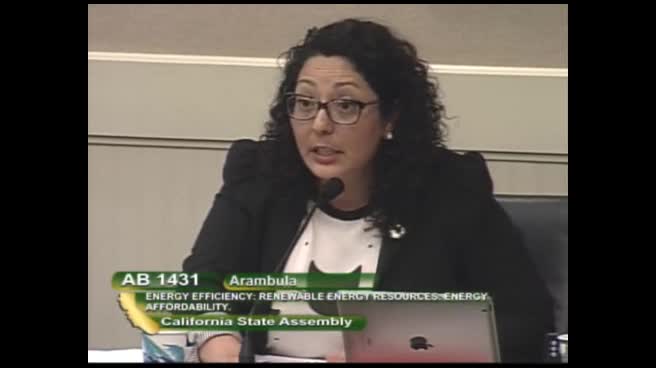 7MIN
Assembly Standing Committee on Natural Resources
Bill Author

Bill Co-Author(s):