AB 1500: Elders Living with Dignity, Empathy, Respect, and Support (ELDERS) Bond Act.
- Session Year: 2017-2018
- House: Assembly
- Latest Version Date: 2018-01-11
Existing state and federal law provides for various programs to provide services to elderly persons, as specified. Existing law provided for submission to the voters of the Senior Center Bond Act of 1984.
This bill would provide for submission to the voters of the Elders Living with Dignity, Empathy, Respect, and Support (ELDERS) Bond Act of ____. 2020. The bill would provide that, if enacted by the people, the state would be authorized to issue and sell general obligation bonds in the aggregate amount of $200,000,000. The proceeds of these bonds would be placed in a fund, which would be appropriated to the Controller, without regard to fiscal years, for allocation, at the request of the Treasurer. The bill would provide that money in the fund would be allocated to public or private nonprofit agencies or organizations for the purpose of acquiring, renovating, constructing, or purchasing equipment for, specialized day services centers for adults with complex chronic medical, cognitive, or behavioral health conditions, including, but not limited to, Alzheimers disease or related dementias, funding startup costs of eligible facilities, or program expansion of eligible facilities, as specified. The bill would make legislative findings and declarations relating to Californias senior population.
The bill would provide for submission of the bond act to the voters at the general statewide election occurring on ____. November 3, 2020.
This bill would declare that it is to take effect immediately as an urgency statute.
Existing state and federal law provides for various programs to provide services to elderly persons, as specified. Existing law provided for submission to the voters of the Senior Center Bond Act of 1984.
This bill would provide for submission to the voters of the Elders Living with Dignity, Empathy, Respect, and Serenity Support (ELDERS) Bond Act of 2018. ____. The bill would provide that, if enacted by the people, the state would be authorized to issue and sell general obligation bonds in the aggregate amount of $____. $200,000,000. The proceeds of these bonds would be placed in a fund, which would be appropriated to the Controller, without regard to fiscal years, for allocation, at the request of the Director of the California Department of Aging. Treasurer. The bill would provide that money in the fund would be allocated to public or private nonprofit agencies or organizations for the purposes purpose of acquiring, renovating, or constructing, or purchasing equipment for, specialized day services centers for dementia, adults with complex chronic medical, cognitive, or behavioral health conditions, including, but not limited to, Alzheimers disease or related dementias, funding startup costs of programs, eligible facilities, or program expansion of eligible facilities, as specified. The bill would make legislative findings and declarations relating to Californias senior population.
The bill would provide for submission of the bond act to the voters at the general statewide election occurring on November 6, 2018. ____.
This bill would declare that it is to take effect immediately as an urgency statute.
Existing state and federal law provides for various programs to provide services to elderly persons, as specified. Existing law provided for submission to the voters of the Senior Center Bond Act of 1984.
This bill would provide for submission to the voters of the Elders Living with Dignity, Empathy, Respect, and Serenity (ELDERS) Bond Act of 2018. The bill would provide that, if enacted by the people, the state would be authorized to issue and sell general obligation bonds in the aggregate amount of $____. The proceeds of these bonds would be placed in a fund, which would be appropriated to the Controller, without regard to fiscal years, for allocation, at the request of the Director of the California Department of Aging. The bill would provide that money in the fund would be allocated to public or private nonprofit agencies for the purposes of acquiring, renovating, or constructing, or purchasing equipment for, specialized day services centers for dementia, funding startup costs of programs, or program expansion of eligible facilities, as specified.
The bill would provide for submission of the bond act to the voters at the general statewide election occurring on November 6, 2018.
This bill would declare that it is to take effect immediately as an urgency statute.
This chapter shall be known, and may be cited, as the Elders Living with Dignity, Empathy, Respect, and Support (ELDERS) Bond Act of ____. 2020.
9611.The Legislature finds and declares all of the following:
(a)California supports the dignity and independence of seniors and persons with disabilities and their choice to live in the most integrated setting appropriate, in their own home or community-based setting, and to be free from unnecessary institutionalization.
(b)In 2016, the Legislative Analysts Office reported that seniors represented 13 percent of Californias population, but by 2060 seniors are projected to represent 24 percent, or one in four, of Californias population.
(c)Over this period, the senior population is projected to increase more than twofold, from 5.2 million to 12.2 million, while the population under 65 years of age is projected to grow only 17 percent, from 33.7 million to 39.5 million.
(d)The largest growth of seniors during this period is projected to occur among the population 85 years of age or older. That number is expected to increase over threefold, from about 700,000 in 2015 to over 2.5 million in 2060. Age is a factor in rates of disability, with persons 85 years of age or older experiencing higher rates of disability than persons 65 to 84 years of age, inclusive.
(e)By 2030, Californias senior population is projected to shift from being majority white to majority non-white. Rates of disability vary by race and this projected shift in demographics is likely to have an impact on the number of seniors with disabilities in California.
(f)More than 6 million adults in California provided informal care for a family member or a friend in 2009. The ratio of working-age Californians to seniors is projected to decrease roughly 50 percent from 2015 to 2060, impacting both formal and informal caregiving availability.
(g)Evidence indicates that informal caregivers face significant negative physical and emotional health outcomes and economic burdens.
(h)In contrast to the explosive growth of seniors and persons with disabilities, over the past decade, long-term services and supports (LTSS) programs and services have been eliminated, closed, or eroded, leaving a majority of California counties without community-based options.
(i)Today, California confronts a crisis of inadequate program capacity and insufficient infrastructure, requiring urgent action to meet the current demand and the projected growth in the population seeking alternatives to institutional care.
(j)It is in Californias interest to invest in a public-private partnership to promote the startup or expansion of person-centered, community-based day programs that serve the needs of a broad range of persons from low to upper-middle incomes, inclusive.
(k)Such investment supports consumer choice to receive services in his or her own neighborhood, improves quality of life and independence, blends public and personal funds, improves access to affordable care, and avoids significantly higher taxpayer costs associated with nursing home placement.
9612.For purposes of this chapter, the following definitions apply:
(a)Acquiring means obtaining ownership of an existing facility in fee simple or by lease for 10 years or more for use as an eligible facility.
(b)Bond means a state general obligation bond issued pursuant to this chapter adopting the provisions of the State General Obligation Bond Law (Chapter 4 (commencing with Section 16720) of Part 3 of Division 4 of Title 2 of the Government Code).
(c)Committee means the Elders Living with Dignity, Empathy, Respect, and Support (ELDERS) Finance Committee.
(d)Constructing means building a new facility, including the costs of land acquisition and architectural, local and state permitting or licensing fees, and engineering fees.
(e)Eligible facility means a licensed nonprofit facility, as described in paragraph (2) of subdivision (a) of Section 1502 of, or Chapter 3.3 (commencing with Section 1570) of Division 2 of, the Health and Safety Code, or Chapter 8.75 (commencing with Section 14591) of Part 3 of Division 9 of the Welfare and Institutions Code, that is developed to provide specialized day services for adults with complex chronic medical, cognitive, or behavioral health conditions, including, but not limited to, Alzheimers disease or related dementias.
(f)Equipment means tangible personal property having a useful life of more than two years.
(g)Fund means the Elders Living with Dignity, Empathy, Respect, and Support (ELDERS) Bond Act Fund.
(h)Nonprofit means a public agency, or an institution or organization that is owned and operated by one or more corporations or associations with no part of the net earnings benefiting any private shareholder or individual.
(i)Renovating means making modifications to an existing facility that are necessary for cost-effective use as an eligible facility, including restoration, repair, expansion, and all related physical improvements.
(j)Startup costs means a one-time capital outlay to fund programs in a newly constructed eligible facility, a one-time capital outlay to fund additional programs or services in an existing eligible facility, or initial service delivery costs for a period of up to two years.
9613.There is hereby created the Elders Living with Dignity, Empathy, Respect, and Serenity (ELDERS) Bond Act Fund, which is comprised of moneys collected pursuant to the issuance and sale of bonds pursuant to this chapter. The fund is hereby appropriated to the Controller, without regard to fiscal years, for allocation, upon the request of the Treasurer, for the purposes specified in this chapter.
9614.The Treasurer shall make awards from funds derived from this bond act to public or private nonprofit agencies or organizations for the purpose of acquiring, renovating, constructing, or purchasing equipment for, specialized day services centers for adults with complex chronic medical, cognitive, or behavioral health conditions, including, but not limited to, Alzheimers disease or related dementias, funding startup costs of eligible facilities, or program expansion of eligible facilities.
9615.Eligible applicants for funding under this chapter include local government entities or other nonprofit private agencies or organizations. Priority shall be given to qualified applicants in unserved or underserved geographic areas.
9616.(a)A recipient of a contract for the acquisition of a facility to be used for the purpose described in Section 9614 shall ensure to the Treasurer that the facility will be used for that purpose for at least 10 years from the date of acquisition.
(b)A recipient of a contract for the renovation of an existing facility to be used as an eligible facility shall ensure to the Treasurer that the facility will be used for that purpose for the following periods:
(1)Not less than three years from the date the contract terminates, where the amount of the award does not exceed five hundred thousand dollars ($500,000).
(2)If the award exceeds five hundred thousand dollars ($500,000), the fixed period of time shall increase one year for each additional five hundred thousand dollars ($500,000) or part thereof, to a maximum of ____.
(3)For awards that exceed ____, the fixed period of time shall not be less than 10 years.
(c)A recipient of a contract for the construction of a facility to be used for the purpose described in Section 9614 shall ensure to the Treasurer that the facility will be used for that purpose for at least 20 years after completion of construction.
(d)Construction and renovation projects paid for in whole or in part with funds from the bond issued under this chapter are public works for purposes of Chapter 1 (commencing with Section 1720) of Part 7 of Division 2 of the Labor Code.
9617.(a)The State of California shall be entitled to recapture a portion of state funds from the owner of a facility, if within 10 years after acquisition or 20 years after completion of construction, either of the following occurs:
(1)The owner of the facility ceases to be a public or private nonprofit agency or organization.
(2)The facility is no longer used for activities specified for eligible facilities.
(b)The amount to be recovered shall be that proportion of the current value of the facility equal to the proportion of state funds contributed to the original cost. The current value of the facility shall be determined by an agreement between the owner of the facility and the State of California, or by an action in the court in the jurisdiction in which the facility is located.
9618.The Treasurer shall seek the advice of stakeholders on the request for proposal and the criteria for reviewing and evaluating the responses.
9619.The Treasurer shall adopt policies and guidelines to carry out the purposes of this chapter, and the adoption thereof shall be subject to Chapter 3.5 (commencing with Section 11340) of Part 1 of Division 3 of Title 2 of the Government Code.
9620.The State General Obligation Bond Law (Chapter 4 (commencing with Section 16720) of Part 3 of Division 4 of Title 2 of the Government Code) is adopted for the purpose of the issuance, sale, and repayment of, and otherwise providing with respect to, the bonds authorized to be issued pursuant to this chapter, and the provisions of that law, except subdivisions (a) and (b) of Section 16727 of the Government Code, are included in this chapter as though set out in full in this chapter.
9621.(a)For the purpose of authorizing the issuance and sale, pursuant to the State General Obligation Bond Law (Chapter 4 (commencing with Section 16720) of Part 3 of Division 4 of Title 2 of the Government Code), of the bonds authorized in this chapter, the Elders Living with Dignity, Empathy, Respect, and Support (ELDERS) Finance Committee is hereby created. The committee consists of the Treasurer, the Controller, the Director of Finance, and a representative of the California Health and Human Services Agency.
(b)The committee is hereby authorized and empowered to create a debt or debts, liability or liabilities, of the State of California, in the aggregate amount of two hundred million dollars ($200,000,000), in the manner provided in this chapter. The debt or debts, liability or liabilities shall be created for the purpose of acquiring, renovating, constructing, or purchasing equipment for, specialized day services for adults with complex chronic medical, cognitive, or behavioral health conditions, including, but not limited to, Alzheimers disease or related dementias, funding startup costs of eligible facilities, or program expansion of eligible facilities.
(c)When sold, the bonds authorized by this chapter shall constitute valid and legally binding general obligations of the State of California, and the full faith and credit of the State of California is hereby pledged for the punctual payment of both principal and interest thereon.
(d)There shall be collected annually in the same manner and at the same time as other state revenue is collected such a sum, in addition to the ordinary revenues of the state, as shall be required to pay the interest and principal on the bonds maturing each year, and it is hereby made the duty of all officers charged by law with any duty in regard to the collection of the revenue to do and perform each and every act that shall be necessary to collect that additional sum.
(e)All money deposited in the fund that has been derived from premium and accrued interest on bonds sold shall be available for transfer to the General Fund as a credit to expenditures for bond interest.
(f)All money deposited in the fund pursuant to any provision of law requiring repayments to the state for assistance financed by the proceeds of the bonds authorized by this chapter shall be available for transfer to the General Fund. When transferred to the General Fund, this money shall be applied as a reimbursement to the General Fund on account of principal and interest on the bonds that have been paid from the General Fund.
9622.Notwithstanding Section 13340 of the Government Code, there is hereby appropriated from the General Fund in the State Treasury for the purpose of this chapter, such an amount as will be equal to the following:
(a)That sum annually as will be necessary to pay the principal of and the interest on the bonds issued and sold pursuant to the provisions of this chapter, as principal and interest become due and payable.
(b)That sum as is necessary to carry out the provisions of Section 9621, which sum is appropriated without regard to fiscal years.
9623.(a)For purposes of carrying out this chapter, the Director of Finance may by executive order authorize the withdrawal from the General Fund of an amount or amounts not to exceed the amount of the unsold bonds that the committee has by resolution authorized to be sold for the purpose of carrying out this chapter. Any amounts withdrawn shall be deposited in the fund and shall be disbursed by the department in accordance with this chapter. These withdrawals from the General Fund shall be returned to the General Fund with interest at the rate that would have otherwise been earned by these sums in the Pooled Money Investment Account.
(b)The committee may authorize the Treasurer to sell all or any part of the bonds authorized by this chapter at the time or times as may be fixed by the Treasurer.
(c)All proceeds from the sale of bonds, except those derived from premiums and accrued interest, shall be available for the purpose provided in Section 9613 but shall not be available for transfer to the General Fund to pay principal and interest on bonds. The money in the fund may be expended only as provided in this chapter.
SEC. 2.Section 1 of this act shall take effect upon the adoption by the voters of the Elders Living with Dignity, Empathy, Respect, and Support (ELDERS) Bond Act of ____, 2020, as set forth in that section.
SEC. 3.(a)Notwithstanding Section 9040, 9043, 9044, 9061, 9094, or 13115 of the Elections Code, or any other law, a ballot measure that sets forth Section 1 of this act shall be submitted to the voters at the ____ November 3, 2020, statewide general election.
(b)The Secretary of State shall ensure the placement of the ballot measure as set forth in Section 1 of this act on the ____ November 3, 2020, statewide general election ballot, in substantial compliance with any statutory time requirements applicable to the submission of statewide measures to the voters at a statewide election.
(c)The Secretary of State shall include, in the ballot pamphlet mailed pursuant to Section 9094 of the Elections Code, the information specified in Section 9084 of the Elections Code regarding the provisions contained in Section 1 of this act.
SEC. 4.This act is an urgency statute necessary for the immediate preservation of the public peace, health, or safety within the meaning of Article IV of the California Constitution and shall go into immediate effect. The facts constituting the necessity are:
In order that Section 1 of this act be included on the ____ November 3, 2020, statewide general election ballot for purposes of assisting adults with complex chronic medical, cognitive, or behavioral health conditions, including, but not limited to, Alzheimers disease or related dementias, at the earliest possible time, it is necessary that this act take effect immediately.
This chapter shall be known known, and may be cited cited, as the Elders Living with Dignity, Empathy, Respect, and Serenity Support (ELDERS) Bond Act of 2018. ____.
9611.The Legislature finds and declares all of the following:
(a)California supports the dignity and independence of seniors and persons with disabilities and their choice to live in the most integrated setting appropriate, in their own home or community-based setting, and to be free from unnecessary institutionalization.
(b)In 2016, the Legislative Analysts Office reported that seniors represented 13 percent of Californias population, but by 2060 seniors are projected to represent 24 percent, or one in four, of Californias population.
(c)Over this period, the senior population is projected to increase more than twofold, from 5.2 million to 12.2 million, while the population under 65 years of age is projected to grow only 17 percent, from 33.7 million to 39.5 million.
(d)The largest growth of seniors during this period is projected to occur among the population 85 years of age or older. That number is expected to increase over threefold, from about 700,000 in 2015 to over 2.5 million in 2060. Age is a factor in rates of disability, with persons 85 years of age or older experiencing higher rates of disability than persons 65 to 84 years of age, inclusive.
(e)By 2030, Californias senior population is projected to shift from being majority white to majority non-white. Rates of disability vary by race and this projected shift in demographics is likely to have an impact on the number of seniors with disabilities in California.
(f)More than 6 million adults in California provided informal care for a family member or a friend in 2009. The ratio of working-age Californians to seniors is projected to decrease roughly 50 percent from 2015 to 2060, impacting both formal and informal caregiving availability.
(g)Evidence indicates that informal caregivers face significant negative physical and emotional health outcomes and economic burdens.
(h)In contrast to the explosive growth of seniors and persons with disabilities, over the past decade, long-term services and supports (LTSS) programs and services have been eliminated, closed, or eroded, leaving a majority of California counties without community-based options.
(i)Today, California confronts a crisis of inadequate program capacity and insufficient infrastructure, requiring urgent action to meet the current demand and the projected growth in the population seeking alternatives to institutional care.
(j)It is in Californias interest to invest in a public-private partnership to promote the startup or expansion of person-centered, community-based day programs that serve the needs of a broad range of persons from low to upper-middle incomes, inclusive.
(k)Such investment supports consumer choice to receive services in his or her own neighborhood, improves quality of life and independence, blends public and personal funds, improves access to affordable care, and avoids significantly higher taxpayer costs associated with nursing home placement.
9611.9612.For purposes of this chapter: chapter, the following definitions apply:
(a)Acquiring means obtaining ownership of an existing facility in fee simple or by lease for 10 years or more for use as an eligible facility.
(b)Altering or renovating means making modifications to an existing facility which are necessary for cost-effective use as an eligible facility, including restoration, repair, expansion, and all related physical improvements.(c)(b)Bond means a state general obligation bond issued pursuant to this chapter adopting the provisions of the State General Obligation Bond Law (Chapter 4 (commencing with Section 16720) of Part 3 of Division 4 of Title 2 of the Government Code).
(c)Committee means the Elders Living with Dignity, Empathy, Respect, and Support (ELDERS) Finance Committee.
(d)Constructing means building a new facility, including the costs of land acquisition and architectural, local and state permitting or licensing fees, and engineering fees.
(e)Department means the California Department of Aging.(f)Director means the Director of the California Department of Aging.(g)Eligible facility means a nonprofit facility, as described by Section 9542, that is developed to provide a program of specialized day care for participants with moderate to severe dementia.(e)Eligible facility means a licensed nonprofit facility, as described in paragraph (2) of subdivision (a) of Section 1502 of, or Chapter 3.3 (commencing with Section 1570) of Division 2 of, the Health and Safety Code, or Chapter 8.75 (commencing with Section 14591) of Part 3 of Division 9 of the Welfare and Institutions Code, that is developed to provide specialized day services for adults with complex chronic medical, cognitive, or behavioral health conditions, including, but not limited to, Alzheimers disease or related dementias.
(h)(f)Equipment means tangible personal property having a useful life of more than two years.
(i)(g)Fund means the Elders Living with Dignity, Empathy, Respect, and Serenity Support (ELDERS) Bond Act Fund.
(j)(h)Nonprofit means a public agency, or an institution or organization that is owned and operated by one or more corporations or associations with no part of the net earnings benefiting any private shareholder or individual.
(i)Renovating means making modifications to an existing facility that are necessary for cost-effective use as an eligible facility, including restoration, repair, expansion, and all related physical improvements.
(k)(j)Startup costs means a one-time capital outlay to fund programs in a newly constructed eligible facility, a one-time capital outlay to fund additional programs or services in an existing eligible facility, or initial service delivery costs. costs for a period of up to two years.
9612.9613.There is hereby created the Elders Living with Dignity, Empathy, Respect, and Serenity (ELDERS) Bond Act Fund, which is comprised of moneys collected pursuant to the issuance and sale of bonds pursuant to this chapter. The fund is hereby appropriated to the Controller, without regard to fiscal years, for allocation, upon the request of the director, Treasurer, for the purposes specified in this chapter.
9613.9614.The department Treasurer shall make awards from funds derived from this bond act to public or private nonprofit agencies or organizations for the purpose of acquiring, renovating, and constructing, and or purchasing equipment for, specialized day services centers for dementia, adults with complex chronic medical, cognitive, or behavioral health conditions, including, but not limited to, Alzheimers disease or related dementias, funding startup costs of programs, eligible facilities, or program expansion of eligible facilities.
9614.9615.Eligible applicants for funding under this chapter include local government entities or other nonprofit private agencies or organizations. Priority shall be given to qualified applicants in unserved or underserved geographic areas.
9615.9616.(a)A recipient of a contract for the acquisition of a facility to be used as a specialized day services center for dementia for the purpose described in Section 9614 shall ensure to the department Treasurer that the facility will be used for that purpose for at least 10 years from the date of acquisition.
(b)A recipient of a contract for the renovation of an existing facility to be used as an eligible facility shall ensure to the department Treasurer that the facility will be used for that purpose for the following periods:
(1)Not less than three years from the date the contract terminates, where the amount of the award does not exceed ____. five hundred thousand dollars ($500,000).
(2)If the award exceeds ____, five hundred thousand dollars ($500,000), the fixed period of time shall increase one year for each additional ____ five hundred thousand dollars ($500,000) or part thereof, to a maximum of ____.
(3)For awards that exceed ____, the fixed period of time shall not be less than 10 years.
(c)A recipient of a contract for the construction of a facility to be used as a specialized day services center for dementia for the purpose described in Section 9614 shall ensure to the department Treasurer that the facility will be used for that purpose for at least 20 years after completion of construction.
9616. 9617.(a)The State of California shall be entitled to recapture a portion of state funds from the owner of a facility, if within 10 years after acquisition or 20 years after completion of construction, either of the following occurs:
(1)The owner of the facility ceases to be a public or private nonprofit agency. agency or organization.
(2)The facility is no longer used for activities specified for eligible facilities.
(b)The amount to be recovered shall be that proportion of the current value of the facility equal to the proportion of state funds contributed to the original cost. The current value of the facility shall be determined by an agreement between the owner of the facility and the State of California, or by an action in the court in the jurisdiction in which the facility is located.
9617. 9618.The department shall secure the advice of the Commission on Aging, area agencies on aging, and other service providers Treasurer shall seek the advice of stakeholders on the request for proposal and the criteria for reviewing and evaluating the responses.
9618. 9619.The department Treasurer shall adopt policies and guidelines to carry out the purposes of this section, chapter, and the adoption thereof shall be subject to Chapter 3.5 (commencing with Section 11340) of Part 1 of Division 3 of Title 2 of the Government Code.
9619.9620.The State General Obligation Bond Law (Chapter 4 (commencing with Section 16720) of Part 3 of Division 4 of Title 2 of the Government Code) is adopted for the purpose of the issuance, sale, and repayment of, and otherwise providing with respect to, the bonds authorized to be issued pursuant to this chapter, and the provisions of that law law, except subdivisions (a) and (b) of Section 16727 of the Government Code, are included in this chapter as though set out in full in this chapter.
9620.9621.(a)For the purpose of authorizing the issuance and sale, pursuant to the State General Obligation Bond Law (Chapter 4 (commencing with Section 16720) of Part 3 of Division 4 of Title 2 of the Government Code), of the bonds authorized in this chapter, the Older Californians Dignity and Independence Elders Living with Dignity, Empathy, Respect, and Support (ELDERS) Finance Committee is hereby created. The committee consists of the Treasurer, the Controller, the Director of Finance, and the Director of the California Department of Aging. a representative of the California Health and Human Services Agency.
(b)The committee is hereby authorized and empowered to create a debt or debts, liability or liabilities, of the State of California, in the aggregate amount of ____, two hundred million dollars ($200,000,000), in the manner provided in this chapter. The debt or debts, liability or liabilities shall be created for the purpose of acquiring, renovating and constructing specialized day services centers for dementia, purchasing of equipment, funding start-up costs of programs, or funding expansion of existing programs renovating, constructing, or purchasing equipment for, specialized day services for adults with complex chronic medical, cognitive, or behavioral health conditions, including, but not limited to, Alzheimers disease or related dementias, funding startup costs of eligible facilities, or program expansion of eligible facilities.
(c)When sold, the bonds authorized by this chapter shall constitute valid and legally binding general obligations of the State of California, and the full faith and credit of the State of California is hereby pledged for the punctual payment of both principal and interest thereon.
(d)There shall be collected annually in the same manner and at the same time as other state revenue is collected such a sum, in addition to the ordinary revenues of the state, as shall be required to pay the interest and principal on the bonds maturing each year, and it is hereby made the duty of all officers charged by law with any duty in regard to the collection of the revenue to do and perform each and every act which that shall be necessary to collect that additional sum.
(e)All money deposited in the fund which that has been derived from premium and accrued interest on bonds sold shall be available for transfer to the General Fund as a credit to expenditures for bond interest.
(f)All money deposited in the fund pursuant to any provision of law requiring repayments to the state for assistance financed by the proceeds of the bonds authorized by this chapter shall be available for transfer to the General Fund. When transferred to the General Fund, this money shall be applied as a reimbursement to the General Fund on account of principal and interest on the bonds which that have been paid from the General Fund.
9621.9622.Notwithstanding Section 13340 of the Government Code, there is hereby appropriated from the General Fund in the State Treasury for the purpose of this chapter, such an amount as will be equal to the following:
(a)That sum annually as will be necessary to pay the principal of and the interest on the bonds issued and sold pursuant to the provisions of this chapter, as principal and interest become due and payable.
(b)That sum as is necessary to carry out the provisions of Section 9620, 9621, which sum is appropriated without regard to fiscal years.
9622.9623.(a)For purposes of carrying out this chapter, the Director of Finance may by executive order authorize the withdrawal from the General Fund of an amount or amounts not to exceed the amount of the unsold bonds which that the committee has by resolution authorized to be sold for the purpose of carrying out this chapter. Any amounts withdrawn shall be deposited in the fund and shall be disbursed by the department in accordance with this chapter. These withdrawals from the General Fund shall be returned to the General Fund with interest at the rate which that would have otherwise been earned by these sums in the Pooled Money Investment Fund. Account.
(b)The committee may authorize the Treasurer to sell all or any part of the bonds authorized by this chapter at the time or times as may be fixed by the Treasurer.
(c)All proceeds from the sale of bonds, except those derived from premiums and accrued interest, shall be available for the purpose provided in Section 9612 9613 but shall not be available for transfer to the General Fund to pay principal and interest on bonds. The money in the fund may be expended only as provided in this chapter.
SEC. 2.Section 1 of this act shall take effect upon the adoption by the voters of the Elders Living with Dignity, Empathy, Respect, and Serenity Support (ELDERS) Bond Act of 2018, ____, as set forth in that section.
SEC. 3.(a)Notwithstanding Section 9040, 9043, 9044, 9061, 9094, or 13115 of the Elections Code, or any other law, a ballot measure that sets forth Section 1 of this act shall be submitted to the voters at the November 6, 2018, ____ statewide general election.
(b)The Secretary of State shall ensure the placement of the ballot measure as set forth in Section 1 of this act on the November 6, 2018, ____ statewide general election ballot, in substantial compliance with any statutory time requirements applicable to the submission of statewide measures to the voters at a statewide election.
(c)The Secretary of State shall include, in the ballot pamphlet mailed pursuant to Section 9094 of the Elections Code, the information specified in Section 9084 of the Elections Code regarding the provisions contained in Section 1 of this act.
SEC. 4.This act is an urgency statute necessary for the immediate preservation of the public peace, health, or safety within the meaning of Article IV of the California Constitution and shall go into immediate effect. The facts constituting the necessity are:
In order that Section 1 of this act be included on the November 6, 2018, ____ statewide general election ballot for purposes of assisting persons with dementia adults with complex chronic medical, cognitive, or behavioral health conditions, including, but not limited to, Alzheimers disease or related dementias, at the earliest possible time, it is necessary that this act take effect immediately.
This chapter shall be known and may be cited as the Elders Living with Dignity, Empathy, Respect, and Serenity (ELDERS) Bond Act of 2018.
9611.For purposes of this chapter:
(a)Acquiring means obtaining ownership of an existing facility in fee simple or by lease for 10 years or more for use as an eligible facility.
(b)Altering or renovating means making modifications to an existing facility which are necessary for cost-effective use as an eligible facility, including restoration, repair, expansion, and all related physical improvements.
(c)Bond means a state general obligation bond issued pursuant to this chapter adopting the provisions of the State General Obligation Bond Law (Chapter 4 (commencing with Section 16720) of Part 3 of Division 4 of Title 2 of the Government Code).
(d)Constructing means building a new facility, including the costs of land acquisition and architectural, local and state permitting or licensing fees, and engineering fees.
(e)Department means the California Department of Aging.
(f)Director means the Director of the California Department of Aging.
(g)Eligible facility means a nonprofit facility, as described by Section 9542, that is developed to provide a program of specialized day care for participants with moderate to severe dementia.
(h)Equipment means tangible personal property having a useful life of more than two years.
(i)Fund means the Elders Living with Dignity, Empathy, Respect, and Serenity (ELDERS) Bond Act Fund.
(j)Nonprofit means an institution or organization that is owned and operated by one or more corporations or associations with no part of the net earnings benefiting any private shareholder or individual.
(k)Startup costs means a one-time capital outlay to fund programs in a newly constructed eligible facility, a one-time capital outlay to fund additional programs or services in an existing eligible facility, or initial service delivery costs.
9612.There is hereby created the Elders Living with Dignity, Empathy, Respect, and Serenity (ELDERS) Bond Act Fund, which is comprised of moneys collected pursuant to the issuance and sale of bonds pursuant to this chapter. The fund is hereby appropriated to the Controller, without regard to fiscal years, for allocation, upon the request of the director, for the purposes specified in this chapter.
9613.The department shall make awards from funds derived from this bond act to public or private nonprofit agencies for the purpose of acquiring, renovating, and constructing, and purchasing equipment for, specialized day services centers for dementia, funding startup costs of programs, or program expansion of eligible facilities.
9614.Eligible applicants for funding under this chapter include local government entities or other nonprofit private agencies or organizations.
9615.(a)A recipient of a contract for the acquisition of a facility to be used as a specialized day services center for dementia shall ensure to the department that the facility will be used for that purpose for at least 10 years from the date of acquisition.
(b)A recipient of a contract for the renovation of an existing facility to be used as an eligible facility shall ensure to the department that the facility will be used for that purpose for the following periods:
(1)Not less than three years from the date the contract terminates, where the amount of the award does not exceed ____.
(2)If the award exceeds ____, the fixed period of time shall increase one year for each additional ____ or part thereof, to a maximum of ____.
(3)For awards that exceed ____, the fixed period of time shall not be less than 10 years.
(c)A recipient of a contract for the construction of a facility to be used as a specialized day services center for dementia shall ensure to the department that the facility will be used for that purpose for at least 20 years after completion of construction.
9616.(a)The State of California shall be entitled to recapture a portion of state funds from the owner of a facility, if within 10 years after acquisition or 20 years after completion of construction, either of the following occurs:
(1)The owner of the facility ceases to be a public or nonprofit agency.
(2)The facility is no longer used for activities specified for eligible facilities.
(b)The amount to be recovered shall be that proportion of the current value of the facility equal to the proportion of state funds contributed to the original cost. The current value of the facility shall be determined by an agreement between the owner of the facility and the State of California, or by an action in the court in the jurisdiction in which the facility is located.
9617.The department shall secure the advice of the Commission on Aging, area agencies on aging, and other service providers on the request for proposal and the criteria for reviewing and evaluating the responses.
9618.The department shall adopt policies and guidelines to carry out the purposes of this section, and the adoption thereof shall be subject to Chapter 3.5 (commencing with Section 11340) of Part 1 of Division 3 of Title 2 of the Government Code.
9619.The State General Obligation Bond Law (Chapter 4 (commencing with Section 16720) of Part 3 of Division 4 of Title 2 of the Government Code) is adopted for the purpose of the issuance, sale, and repayment of, and otherwise providing with respect to, the bonds authorized to be issued pursuant to this chapter, and the provisions of that law are included in this chapter as though set out in full in this chapter.
9620.(a)For the purpose of authorizing the issuance and sale, pursuant to the State General Obligation Bond Law (Chapter 4 (commencing with Section 16720) of Part 3 of Division 4 of Title 2 of the Government Code), of the bonds authorized in this chapter, the Older Californians Dignity and Independence Finance Committee is hereby created. The committee consists of the Treasurer, the Controller, the Director of Finance, and the Director of the California Department of Aging.
(b)The committee is hereby authorized and empowered to create a debt or debts, liability or liabilities, of the State of California, in the aggregate amount of ____, in the manner provided in this chapter. The debt or debts, liability or liabilities shall be created for the purpose of acquiring, renovating and constructing specialized day services centers for dementia, purchasing of equipment, funding start-up costs of programs, or funding expansion of existing programs of eligible facilities.
(c)When sold, the bonds authorized by this chapter shall constitute valid and legally binding general obligations of the State of California, and the full faith and credit of the State of California is hereby pledged for the punctual payment of both principal and interest thereon.
(d)There shall be collected annually in the same manner and at the same time as other state revenue is collected such a sum, in addition to the ordinary revenues of the state, as shall be required to pay the interest and principal on the bonds maturing each year, and it is hereby made the duty of all officers charged by law with any duty in regard to the collection of the revenue to do and perform each and every act which shall be necessary to collect that additional sum.
(e)All money deposited in the fund which has been derived from premium and accrued interest on bonds sold shall be available for transfer to the General Fund as a credit to expenditures for bond interest.
(f)All money deposited in the fund pursuant to any provision of law requiring repayments to the state for assistance financed by the proceeds of the bonds authorized by this chapter shall be available for transfer to the General Fund. When transferred to the General Fund, this money shall be applied as a reimbursement to the General Fund on account of principal and interest on the bonds which have been paid from the General Fund.
9621.Notwithstanding Section 13340 of the Government Code, there is hereby appropriated from the General Fund in the State Treasury for the purpose of this chapter, such an amount as will be equal to the following:
(a)That sum annually as will be necessary to pay the principal of and the interest on the bonds issued and sold pursuant to the provisions of this chapter, as principal and interest become due and payable.
(b)That sum as is necessary to carry out the provisions of Section 9620, which sum is appropriated without regard to fiscal years.
9622.(a)For purposes of carrying out this chapter, the Director of Finance may by executive order authorize the withdrawal from the General Fund of an amount or amounts not to exceed the amount of the unsold bonds which the committee has by resolution authorized to be sold for the purpose of carrying out this chapter. Any amounts withdrawn shall be deposited in the fund and shall be disbursed by the department in accordance with this chapter. These withdrawals from the General Fund shall be returned to the General Fund with interest at the rate which would have otherwise been earned by these sums in the Pooled Money Investment Fund.
(b)The committee may authorize the Treasurer to sell all or any part of the bonds authorized by this chapter at the time or times as may be fixed by the Treasurer.
(c)All proceeds from the sale of bonds, except those derived from premiums and accrued interest, shall be available for the purpose provided in Section 9612 but shall not be available for transfer to the General Fund to pay principal and interest on bonds. The money in the fund may be expended only as provided in this chapter.
SEC. 2.Section 1 of this act shall take effect upon the adoption by the voters of the Elders Living with Dignity, Empathy, Respect, and Serenity (ELDERS) Bond Act of 2018, as set forth in that section.
SEC. 3.(a)Notwithstanding Section 9040, 9043, 9044, 9061, 9094, or 13115 of the Elections Code, or any other law, a ballot measure that sets forth Section 1 of this act shall be submitted to the voters at the November 6, 2018, statewide general election.
(b)The Secretary of State shall ensure the placement of the ballot measure as set forth in Section 1 of this act on the November 6, 2018, statewide general election ballot, in substantial compliance with any statutory time requirements applicable to the submission of statewide measures to the voters at a statewide election.
(c)The Secretary of State shall include, in the ballot pamphlet mailed pursuant to Section 9094 of the Elections Code, the information specified in Section 9084 of the Elections Code regarding the provisions contained in Section 1 of this act.
SEC. 4.This act is an urgency statute necessary for the immediate preservation of the public peace, health, or safety within the meaning of Article IV of the California Constitution and shall go into immediate effect. The facts constituting the necessity are:
In order that Section 1 of this act be included on the November 6, 2018, statewide general election ballot for purposes of assisting persons with dementia at the earliest possible time, it is necessary that this act take effect immediately.
|
Date
|
Status
|
|---|---|
| Feb 1, 2018 | From committee: Filed with the Chief Clerk pursuant to Joint Rule 56. |
| Jan 31, 2018 | Died pursuant to Art. IV, Sec. 10(c) of the Constitution. |
| Jan 18, 2018 | In committee: Set, first hearing. Hearing canceled at the request of author. |
| Jan 12, 2018 | Re-referred to Com. on APPR. |
| Jan 11, 2018 | From committee chair, with author's amendments: Amend, and re-refer to Com. on APPR. Read second time and amended. |
| Jan 10, 2018 | From committee: Do pass and re-refer to Com. on APPR. (Ayes 7. Noes 0.) (January 9). Re-referred to Com. on APPR. |
| Jan 4, 2018 | Re-referred to Com. on AGING & L.T.C. |
| Jan 3, 2018 | From committee chair, with author's amendments: Amend, and re-refer to Com. on AGING & L.T.C. Read second time and amended. |
| Mar 16, 2017 | Referred to Com. on AGING & L.T.C. |
| Feb 19, 2017 | From printer. May be heard in committee March 21. |
| Feb 17, 2017 | Read first time. To print. |
|
Date
|
Description
|
Location
|
Votes
|
|
|---|---|---|---|---|
| Jan 9, 2018 | Do pass and be re-referred to the Committee on [Appropriations] | Assembly Standing Committee on Aging and Long-Term Care |
Passed |
This list shows positions taken on this bill by organizations on the date displayed, which is linked to the original source.
Positions by individuals are not included.
|
Organization
|
Position
|
Date
|
|---|---|---|
| Alzheimer's Association | * Support | Jan 9, 2018 |
| California Association For Adult Day Services | * Support | Jan 9, 2018 |
| California Association Of Area Agencies On Aging | * Support | Jan 9, 2018 |
| California Commission on Aging | ** Support | Jan 5, 2018 |
| Congress of California Seniors | * Support | Jan 9, 2018 |
| County Welfare Director's Association | * Support | Jan 9, 2018 |
| National Association Of Social Workers, California Chapter | ** Support | Jan 5, 2018 |
| National Associations of Social Workers | * Support | Jan 9, 2018 |
| Yolo Adult Day Health Center | * Support | Jan 9, 2018 |
Date of Hearing: January 9, 2018
ASSEMBLY COMMITTEE ON AGING AND LONG-TERM CARE
Ash Kalra, Chair
ABPCA Bill Id:AB 1500 (
Author:Maienschein) – As Amended Ver:January 3, 2018
SUBJECT: Elders Living with Dignity, Empathy, Respect, and Support (ELDERS) Bond Act.
SUMMARY: This bill would provide for submission to the voters, the Elders Living with Dignity, Empathy, Respect, and Support (ELDERS) Bond Act of ______ for allocation to organizations including Community-Based Adult Services (CBAS), Program for All-Inclusive Care for the Elderly (PACE) and Alzheimer’s Day Care Resource Centers (ADCRC). Specifically, this bill:
- Provides that, if enacted by the people, the state would be authorized to issue and sell general obligation bonds in the aggregate amount of $200,000,000.
- The proceeds of these bonds would be placed in a fund, which would be appropriated to the California State Controller, without regard to fiscal years, for allocation, at the request of
the California State Treasurer (Treasurer). - Provides that money in the fund would be allocated to public or private nonprofit agencies or organizations for the purpose of acquiring, renovating, constructing, or purchasing equipment for specialized day services center for adults with complex chronic medical, cognitive, or behavioral health conditions, including, but not limited to, Alzheimer’s disease or related dementias, funding startup costs of eligible facilities, or program expansion of eligible facilities.
- Priority shall be given to qualified applicants in unserved or underserved geographic areas.
- A recipient of a contract for the acquisition of a facility to be used for the purpose of the bond shall ensure the Treasurer that the facility will be used for that purpose for at least 10 years from the date of acquisition.
- A recipient of a contract for the construction of a facility to be used for the purpose of the bond shall ensure the Treasurer that the facility will be used for that purpose for at least 20 years after completion of construction.
- The State of California shall be entitled to recapture a portion of state funds from the owner of a facility, if within 10 years after acquisition or 20 years after completion of construction, either of the following occurs:
- The owner of the facility ceases to be a public or private nonprofit agency or organization; or,
- The facility is no longer used for activities specified for eligible facilities.
- The Treasurer shall adopt policies and guidelines to carry out the purposes of the bond and seek the advice of stakeholders on the request for proposal and the criteria for reviewing and evaluating the responses.
- Declares that it is to take effect immediately as an urgency statute.
EXISTING LAW:
- Authorizes the sale of General Obligation Bonds and deems facilities eligible that are developed to provide a program of specialized day care for participants with moderate to severe dementia, specialized day services for adults with complex chronic medical, cognitive or behavioral health conditions, and including, but not limited to, Alzheimer’s disease and related dementias.
- Existing state and federal law provides for various programs to distribute or furnish services to elderly persons, including those for adult day community service, Alzheimer’s Day Care Resource Centers, and the PACE Program.
FISCAL EFFECT: This bill has not yet been analyzed by a fiscal committee.
COMMENTS:
Author’s Statement: “The Department of Finance and the Legislative Analyst Office both project significant growth in California’s older adult population by the year 2025. With that growth comes increased rates of individual disability and cognitive impairment, as well as negative impacts on family caregivers and stress on fragile systems of care.
“In anticipation of this unprecedented demographic shift, California needs to plan now to expand capacity and build infrastructure to meet the consumer demand. Not only will advance planning benefit thousands of individuals and families, but also the State General Fund by offering more low-cost, community based options as alternatives to high cost institutional care.”
Note: The bill as currently written specifies the State Treasurer’s office as the entity to administer the program. The Treasurer’s office is responsible for the fiscal components of all GO bonds. The author needs to identify another state agency or entity to administer the program.
How General Obligation Bonds Work: General Obligation Bonds, which are also referred to as GOs, are municipal bonds which provide a way for the state to raise money for projects that may not generate a revenue stream directly. Examples of the types of projects funded by General Obligation Bonds are the construction of public schools and highway systems.
They are called “General Obligation” bonds because they are not backed by specific revenue producing project or asset. Instead, they are backed by the “full faith and credit” of the issuer. In simple terms that means the bonds are backed by the State’s ability to tax, and to raise taxes if necessary, in order to pay bondholders. GO bonds require voter approval.
The bond measure, as presented to the voters, specifies who will oversee and administer the program. This is referred to as the program component and must be a state department or entity. The fiscal components are administered by the Public Finance Division (PFD) of the Treasurer’s office. The PFD handles the sale of general obligation bonds and manages the State’s debt portfolio. PFD ensures that all standard provisions of all GO Bond Acts are met.
1984 Bond Measure: The Senior Center Bond Act of 1984 (Act), Proposition 30, pursuant to SB 1359 (John Garamendi, John Seymour) authorized a $50 million general obligation bond issue to provide funds for senior centers. The money raised by the bond sale was used to finance the purchase, construction, renovation, and expansion of senior centers. The funds were available for this purpose until they were spent; that is, the measure set no limit on the period of time during which the bond funds were available.
The measure specified how much of the bond funds would be allocated to each of the 33 planning and service areas in the state, as determined by local Area Agencies on Aging (AAAs).
It also provided for the reallocation of funds in the event an AAA was unable to use all of the funds initially allocated to it. Under the provisions of the Act, AAAs that wished to participate were required to submit proposals to the California Department of Aging (CDA) to fund senior centers in their planning and service areas.
BACKGROUND:
Community-Based Adult Services (CBAS): Community-Based Adult Services (CBAS) programs are licensed community-based day care programs providing a variety of health, therapeutic and social services. Under an interagency agreement, CBAS is administered between the Department of Health Care Services (DHCS), the California Department of Public Health (CDPH) and the California Department of Aging (CDA). CDPH licenses CBAS as Adult Day Health Care (ADHC) centers; CDA certifies them for participation in Medi-Cal.
Each CBAS center has a multidisciplinary team of health professionals who conduct a comprehensive assessment of each potential participant to determine and plan services needed to meet the individual’s health and social needs. Services include professional nursing services; physical, occupational and speech therapies; mental health services; therapeutic activities; social services; personal care; hot meals and nutritional counseling; and, transportation to and from the participant’s residence. CBAS seeks to restore or maintain optimal capacity for self-care to frail elderly persons and other adults with physical or mental disabilities and to delay or prevent institutionalization.
In 30 of California’s 58 counties, CBAS is provided as a Medi-Cal managed care benefit. In the remaining rural managed care counties, CBAS remains a fee-for-service benefit. There are 241 CBAS centers state-wide who currently serve 35,588 participants.
Program for All-Inclusive Care for the Elderly (PACE): PACE provides medical and supportive services to individuals who are age 55 or older, and who are certified to need nursing home care, but who are able to live safely in the community at the time of enrollment. The program is available in limited areas of the state, with services that include:
- Medical care provided by a PACE physician familiar with the history, needs and preferences of each participant;
- Adult day care that offers nursing; physical, occupational and recreational therapies; meals; nutritional counseling; social work and personal care;
- Home health care and personal care in the home;
- Prescription drugs;
- Social services;
- Medical specialty services; and,
- Hospital and nursing home care, when necessary.
An interdisciplinary team assesses participants’ needs, develops care plans, and delivers all services (including acute care services, and when necessary, nursing facility services). PACE provides social and medical services primarily in a CBAS center, supplemented by in-home and referral services in accordance with the participant’s needs. The PACE service package includes all Medicare and Medi-Cal covered services, and other services.
There are 11 PACE sponsoring organizations operating 37 centers or alternative care sites in 12 counties, serving about 7,000 beneficiaries as of July 2017. About 75 percent are dually eligible for Medicare and Medi-Cal, about 24 percent are eligible for Medi-Cal only and about 1 percent are Medicare only.
Alzheimer’s Day Care Resource Centers (ADCRC): The Alzheimer’s Day Care Resource Centers (ADCRC) is authorized under the Older Californians Act; however, there are no longer any federal or General Fund dollars supporting this program. To this end, the local Area Agencies on Aging determine whether, and to what extent, to fund the program. ADCRCs provide care for persons with Alzheimer’s disease and other dementia. The centers provide services that support the physical and psychosocial needs of persons with Alzheimer’s disease or related dementia.
Individual care plans are developed for each program participant with activities scheduled in accordance with these plans to maintain the highest level of functioning.
An additional unknown number of people are served within CBAS centers or Adult Day Programs.
Argument in Support: The California Association for Adult Day Services writes, “We are writing in support of your AB 1500. …the cost of starting up or renovating a facility suited to serving medically or cognitively complex and physically impaired elderly is prohibitive for most community-based non-profits. Access to capital is a major barrier to continuing or expanding these invaluable services. AB 1500 is a solution to a real and growing problem.
“…AB 1500 will also benefit working Californians, who include employees of all ages caring for aging parents or grandparents. We note that by increasing access to day services there will be lasting positive impact on the state because middle and low income working caregivers will have more care options, closer to home, for loved ones.”
Argument in Opposition: None.
REGISTERED SUPPORT / OPPOSITION:
Support
Alzheimer’s Association – Co-Sponsor
California Association for Adult Day Services (CAADS) – Co-Sponsor
California Association of Area Agencies on Aging (C4A)
California Commission on Aging (CCoA)
National Association of Social Workers, California Chapter (NASW-CA)
Opposition
None on file.
Analysis Prepared by: Barry Brewer / AGING & L.T.C. / (916) 319-3990
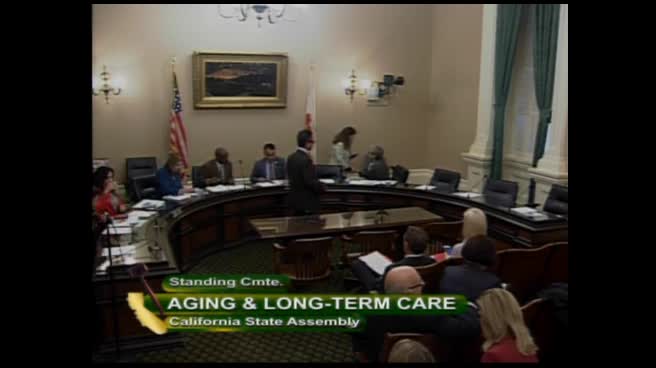
Discussed in Hearing
 27MIN
Assembly Standing Committee on Aging and Long-Term Care
Bill Author


