AB 1885: Undocumented workers: California Resident Worker Program and Economic Stabilization Act.
- Session Year: 2017-2018
- House: Assembly
- Latest Version Date: 2018-04-09
Existing provisions of federal law regulate immigration.
This bill would require the Employment Development Department and the Department of Food and Agriculture to determine the extent of labor shortages in the state agricultural and service industries and provide that information to specified federal government entities. The bill would require those departments to convene a working group to address the issues relating to a work permit program for undocumented persons who are agricultural or service industry employees to work and live in the state, and to serve as liaison to the United States Department of Homeland Security and the United States Department of Justice to ensure that state departments are not taking on responsibilities in matters dealing with immigration policy that are the jurisdiction of the federal government. The bill would require the working group to create and submit to the Legislature and the Governor a report expressing its recommendations, which would be required to incorporate specified provisions describing a model program. The bill would require the Governor, using the report, to make a formal request to the federal government to implement a program to provide undocumented persons who are agricultural or service industry employees with a permit to work and live in California. The bill would require the Governor to issue an explanation if the federal government proposes a program and the Governor disapproves of the proposed program. The bill would make the implementation of these requirements contingent on a determination by the Employment Development Department and the Department of Food and Agriculture that nonstate funds are available for the purposes of the bill. The bill would state the intent of the Legislature to enact necessary implementing legislation if the federal government approves or adopts a program to provide undocumented persons who are agricultural or service industry employees with a permit to work and live in California.
Existing provisions of federal law regulate immigration.
This bill would require the Employment Development Department and the Department of Food and Agriculture to convene a working group to address the issues relating to a work permit program for undocumented persons who are agricultural or service industry employees to work and live in the state state, and to serve as liaison to the United States Department of Homeland Security and the United States Department of Justice to ensure that state departments are not taking on responsibilities in matters dealing with immigration policy that are the jurisdiction of the federal government. The bill would require the working group to create and submit to the Legislature and the Governor a report expressing its recommendations, which would be required to incorporate specified provisions describing a model program. The bill would require the Governor, using the report, to either make a formal request to the federal government to implement a program to provide undocumented persons who are agricultural or service industry employees with a permit to work and live in California, or California. The bill would require the Governor to issue an explanation as to why a formal request was not made and make recommendations to the Legislature for how a program to provide undocumented persons who are agricultural or service industry employees with a permit to work and live in California should be structured. if the federal government proposes a program and the Governor disapproves of the proposed program. The bill would state the intent of the Legislature to enact necessary implementing legislation if the federal government approves or adopts a program to provide undocumented persons who are agricultural or service industry employees with a permit to work and live in California.
Existing provisions of federal law regulate immigration.
This bill would require the Employment Development Department and the Department of Food and Agriculture to convene a working group to address the issues relating to a work permit program for undocumented persons who are agricultural or service industry employees to work and live in the state and to serve as liaison to the United States Department of Homeland Security and the United States Department of Justice to ensure that state departments are not taking on responsibilities in matters dealing with immigration policy that are the jurisdiction of the federal government. The bill would require the working group to create and submit to the Legislature and Governor a report expressing its recommendations, which would be required to incorporate specified provisions describing a model program. The bill would require the Governor, using the report, to either make a formal request to the federal government to implement a program to provide undocumented persons who are agricultural or service industry employees with a permit to work and live in California, or issue an explanation as to why a formal request was not made and make recommendations to the Legislature for how a program to provide undocumented persons who are agricultural or service industry employees with a permit to work and live in California should be structured. The bill would state the intent of the Legislature to enact necessary implementing legislation if the federal government approves or adopts a program to provide undocumented persons who are agricultural or service industry employees with a permit to work and live in California.
This act shall be known, and may be cited, as the California Resident Worker Program and Economic Stabilization Act.
SEC. 2.The Legislature finds and declares the following:
(a)The California economy relies upon the agricultural and service industries.
(b)Since 2007, Californias farms and ranches continue to experience the highest agricultural output in the nation. In 2015, they generated an estimated $47 billion, which was 17 percent lower than in 2014, when they generated $54 billion. In 2013, they generated $51.3 billion. This is a substantial increase from the $36.3 billion in 2007 and $37.5 billion in 2010. Despite severe droughts and labor shortages, California continues to lead the nation in cash farm receipts. On a global scale, California ranks between 5th and 9th in the world, ahead of such countries as Canada, Mexico, Germany, and Spain. According to a study by the University of California, Davis, every dollar of value added (labor and property income and indirect business taxes) in farming and agricultural related farming- and agriculture-related industries generates an additional $1.27 in the state economy. For every 100 jobs in agriculture, there are 94 additional jobs created throughout the state.
(c)In the past decade, farming costs have increased an estimated 88 percent, due in part to new and expanding state and federal laws and regulations. Meanwhile, foreign-produced food is being imported at an accelerated pace, and at far lower costs. In todays global market, California farmers cannot simply pass their costs onto consumers. The high costs of doing business in the state have resulted in consolidation of land and a reduction in total farmed acreage, which is detrimental to the states economy.
(d)Californias agricultural industry is dependent on immigrant labor, as evidenced by the most recent National Agricultural Workers Survey, which found that most of the states agricultural workers were born in Mexico and that 60 percent of crop workers have been unauthorized for the last 10 years.
(e)A previous study of the status of 2,300 farmworkers in California in 13 counties suggested that 95 percent of California agricultural workers were born outside the United States and 91 percent in Mexico. On average, they have been in the United States 11.1 years. Twenty-two percent have been in the United States two years or less, 10 percent are United States citizens, 33 percent have a Green Card, officially known as a Permanent Resident Card, and 57 percent are unauthorized. Of the newcomers who have been here less than two years, 99 percent are unauthorized.
(f)The federal employment-based immigration programs for admitting foreign workers for temporary and permanent jobs are rigid, cumbersome, inefficient, do not respond very well to employers needs, and give almost no attention to adapting the number and characteristics of foreign workers to domestic labor shortages.
(g)Nevertheless, the United States Congress has repeatedly failed to pass comprehensive immigration reform, instead choosing to annually introduce primarily interior and border enforcement-only legislation and temporary worker proposals that ignore the socioeconomic profile of this essential workforce and do not account for the unique workforce needs of Californias diverse agricultural industry.
(h)Congress has also had strong advocacy for having the E-Verify program become mandatory for all employers in conjunction with the new guest worker program. The agricultural employer community throughout the United States believes the E-Verify program requirement, without a guest worker program, would eliminate a significant portion of the existing agricultural workforce with no certainty that these vacancies will be filled by United States citizens and legal residents.
(i)Due to the unworkable framework of the federal H-2A guest worker program, the absence of a suitable alternative program, and the potential for Congress to pass stand-alone E-verify legislation, agricultural interests in Oklahoma and Utah have introduced legislation creating state guest worker programs, while several other states are considering the introduction of similar state initiatives.
(j)Among Californias key economic industry sectors, the hospitality and tourism sector plays a central role in stimulating Californias sluggish economy. In 2011, the leisure and hospitality industry accounted for over $100 billion in travel-related spending. According to state records, more than two million employees, or 14 percent of all employees in California, work in leisure, hospitality, and other services. These workers serve as a foundational workforce for the states $1.8 trillion economy.
(k)Despite well-documented labor shortages, especially in agriculture where hourly wages have increased significantly and housing and health care services are being offered, United States-born citizens continue to avoid employment in agriculture.
(l)Recognizing the significant contributions that unauthorized workers make to Californias economy and the need to bring these workers out of the shadows in order to improve worker conditions and at the same time provide a legal workforce for the agricultural and service industries, it is imperative that a program be created for current unauthorized workers in these industries.
(m)It is the intent of the Legislature that the executive and legislative branches of the federal government give the highest priority to enacting legislation to create a guest worker program that would confer legal status to reside in the United States to persons who would participate in the program described in this act.
(n)It is the intent of the Legislature that the costs of the working group established pursuant to this act be covered by nonstate funding sources.
SEC. 3.Chapter 8 (commencing with Section 11050) is added to Part 1 of Division 3 of the Unemployment Insurance Code, to read:8.California Resident Worker Program1.General Provisions11050.As used in this chapter:
(a)Employee means an agricultural employee, as defined in Section 1140.4 of the Labor Code, and a person employed to provide domestic services, janitorial or building maintenance services, food preparation services, or housekeeping services.
(b)Employer means an agricultural employer, as defined in Section 1140.4 of the Labor Code, a farm labor contractor, and or a service industry employer.
(c)Farm labor contractor shall have the same meaning as in Section 1682 of the Labor Code.
(d)Farm labor organization means a labor organization, as defined in Section 1117 of the Labor Code, that represents employees rendering personal services in the production of agricultural products.
(e)Immediate family member means a spouse or child under 18 years of age or 18 years of age or older if the child is enrolled in an accredited program as described in paragraph (1) of subdivision (c) of Section 11056.
(f)Service industry employer means a person who is self-employed for the purpose of, or who employs others to, provide domestic services, janitorial or building maintenance services, food preparation services, or housekeeping services.
(g)Service labor organization means a labor organization, as defined in Section 1117 of the Labor Code, that represents employees rendering personal services in connection with the production of service industry products.
(h)Undocumented person means a person who is an unauthorized alien, as defined in Section 1324a(h)(3) of Title 8 of the United States Code.
11051.(a)No later than March 1, 2019, the Employment Development Department and the Department of Food and Agriculture shall determine the extent of labor shortages in the agricultural and service industries in the state. This information shall be provided not later than March 20, 2019, to the United States Department of Labor, the United States Department of Agriculture, and the United States Department of Homeland Security. The information shall also be provided to members of the California congressional delegation. Recognizing the short timeframe for this work, the Employment Development Department and the Department of Food and Agriculture are also requested to provide as much detail as possible associated with these labor shortages and the consequences to the states economy. Lastly, it is requested that the Employment Development Department and the Department of Food and Agriculture address whether there is a viable, available, and efficient workforce of United States-born workers in California or other states that would be able to fill these labor shortages.
(b)No later than April 1, 2019, the Employment Development Department and the Department of Food and Agriculture shall convene a working group to address the issues listed in subdivision (d) and serve as liaison to the United States Department of Homeland Security and the United States Department of Justice to ensure that state departments are not taking on responsibilities in matters dealing with immigration policy that are the jurisdiction of the federal government.
(c)The working group shall consist of representatives from the Employment Development Department, Department and the Department of Food and Agriculture, the California Attorney General, two Members of the Senate appointed by the Senate Committee on Rules, two Members of the Assembly appointed by the Speaker of the Assembly, and representatives of stakeholders, including, but not limited to, agricultural and service industry employers, farm labor contractors, farm and service labor organizations, academia, and policy experts in the field of immigration reform policy.
(d)Issues to be addressed by the working group shall include the following:
(1)Qualifying criteria for undocumented persons to apply for a permit to work and live in California.
(2)Documentation requirements for applicants.
(3)A determination of which agency will issue the permits.
(4)Ensuring security, including through the development of tamper-proof work authorization documentation or security procedures and protocols, or all of these methods.
(5)A determination of the process and the agency that should conduct background and security checks and the extent to which background and security checks should be required.
(6)A determination regarding the payment that should be required for to cover the costs of the submission and review of applications and background and security checks.
(7)Protocols regarding tracking of employees under the program.
(8)Consideration of a renewal process for the work permit.
(9)Consideration of the extent to which employees will be allowed to travel out of the country and the requirements for that travel.
(10)Determination of a fee structure to cover the costs of the program, including who will pay and how often the fee should be assessed to cover costs of the program.
(11)Determination of the costs involved in receiving, processing, and issuing work permits.
(12)Any other procedures and legal requirements associated with implementation of the program required by the federal government to ensure the proper role and responsibilities of the State of California.
(e)Notwithstanding Section 10231.5 of the Government Code, the working group, in compliance with Section 9795 of the Government Code, shall create a report expressing its recommendations, which shall incorporate the model program described in Article 2 (commencing with Section 11055). The working group shall make every attempt to reach unanimous agreement and this report shall be submitted to the Legislature and the Governor no later than July 1, 2019. If the working group fails to meet this deadline, the working group shall notify the Governor and the Legislature of its expected completion date.
(f)By August 1, 2019, or no later than 30 calendar days after receipt of the working groups report, whichever is later, the Governor, using the report described in subdivision (e), shall make a formal request to the federal government to implement a program to provide undocumented persons who are agricultural or service industry employees with a permit to work and live in California. The Governor shall issue an explanation if the federal government proposes a program and the Governor disapproves of the proposed program.
(g)If the federal government approves or adopts a program to provide undocumented persons who are agricultural or service industry employees with a permit to work and live in California, it is the intent of the Legislature to enact necessary implementing legislation.
11052.The requirements of Section 11051 shall be implemented only after the Employment Development Department and the Department of Food and Agriculture make a determination that nonstate funds in an amount sufficient to fully support the purposes of Section 11051 are available.
2.Model Program Requirements11055.(a)It is the intent of the Legislature that this article provide a model and framework for a program to provide undocumented persons who are agricultural or service industry employees with a permit to work and live in California.
(b)It is the further intent of the Legislature to recognize that, if the federal government enacts a guest worker program, it would preempt the state program.
11056.(a)The program shall be implemented based on the information gathered by the Employment Development Department and the Department of Food and Agriculture and provided to the federal government and members of the California congressional delegation pursuant to subdivision (a) of Section 11051.
(b)The program should be limited to undocumented persons who meet all of the following criteria:
(1)The undocumented person must be 18 years of age or older.
(2)The undocumented person must live in California.
(3)(A)The undocumented person must have performed agricultural or service industry employment in the United States for at least 863 hours or 150 workdays during the 24-month period ending on January 25, 2019, or earned at least seven thousand five hundred dollars ($7,500) from agricultural or service industry employment in the United States, and must have maintained agricultural or service industry employment for 431 hours or 75 workdays, or earned three thousand seven hundred fifty dollars ($3,750) from that employment, on an annual basis after receiving the permit.
(B)An undocumented person should be allowed to conclusively establish employment status by submitting any of the following records demonstrating the employment:
(i)Records maintained by the Social Security Administration, Internal Revenue Service, or any other federal, state, or local government agency, an employer, a labor organization, service labor organization, or day labor center.
(ii)Itemized wage statements issued to the employee pursuant to Section 226 of the Labor Code.
(C)An undocumented person who is unable to submit a document described in subparagraph (B) should be allowed to satisfy the requirement in subparagraph (A) by submitting at least two other types of reliable documents that provide evidence of employment, including any of the following:
(i)Bank records.
(ii)Business records.
(iii)Remittance records.
(D)The program should be implemented in a manner that recognizes and takes into account the difficulties encountered by an undocumented person in obtaining evidence of employment due to the persons undocumented status, including the crediting of work in cases in which an undocumented person has been employed under an assumed name.
(4)The undocumented person must submit to a fingerprinted criminal history background check.
(5)The undocumented person must never have been convicted of a felony, or three or more misdemeanors, as confirmed by the fingerprinted criminal history background check.
(6)The undocumented person must pay a fee to cover the costs of administering the program.
(c)The program should extend to an undocumented person who is an immediate family member of a person to whom a work permit has been issued. The immediate family member should be required to meet all of the following:
(1)The immediate family member must reside with the undocumented person to whom a permit was issued or be enrolled in an accredited two- or four-year college or graduate program in California.
(2)The immediate family member must submit to a fingerprinted criminal history background check.
(3)The immediate family member must never have been convicted of a felony, or three or more misdemeanors, as confirmed by the fingerprinted criminal history background check.
(4)The immediate family member must pay a fee to cover the costs of administering the program.
11057.Once the program becomes authorized and operational, the following requirements should apply:
(a)(1)An official or employee of the state government should not do any of the following:
(A)Use information furnished by an applicant for purposes of applying for a permit under the program or any information provided by an employer or former employer for any purpose other than to make a determination on the application.
(B)Make any publication in which the information furnished by any particular individual can be identified.
(C)Permit a person other than a sworn officer or employee of the state to examine individual applications.
(2)Information furnished by an applicant should be provided to both of the following:
(A)A duly recognized state law enforcement entity in connection with a criminal investigation or a prosecution, if the information is requested in writing by the entity.
(B)An official coroner, for purposes of affirmatively identifying a deceased individual, whether or not the death of the individual resulted from a crime.
(3)Any person who files an application under the program and knowingly and willfully falsifies, conceals, or covers up a material fact or makes any false, fictitious, or fraudulent statements or representations, or makes or uses any false writing or document knowing that it contains any false, fictitious, or fraudulent statement or entry should be disqualified from applying under the program.
(b)The entities administering the program should ensure that employers employing workers authorized under the program make each of the following assurances:
(1)That the job opportunity for which an employer employs an undocumented person authorized under the program is not vacant because a worker is involved in a strike, lockout, or because of a work stoppage in the course of a labor dispute involving the job opportunity at the same place of employment.
(2)That the wages and benefits provided to undocumented persons working under a permit issued under the program are comparable to the wages and benefits provided to legal residents who are United States citizens, but in no case less than the state minimum wage.
(3)That an employer participating in the program shall comply with all applicable federal, state, and local labor laws, including laws affecting migrant and seasonal agricultural workers, with respect to all United States workers and undocumented workers.
(c)An employer of a person permitted to work in this state under the program should provide a written record of employment, demonstrating the hours worked and wages paid, to the employee issued a permit, and provide a copy of the record to the state.
11058.(a)An employee permitted to work in this state under the program should be entitled to the same wage, hour, and working condition protections provided to an employee who is a legal resident of California.
(b)A permit issued under the program should not limit an employee to a single employer or occupation.
11059.Not later than three years after the program is implemented, the administering entities should prepare and transmit to the Assembly Committee on Labor and Employment and the Senate Standing Committee on Labor and Industrial Relations a report describing the results of a review of the implementation of, and compliance with, the requirements of the program. The report should address and provide information as to all the following:
(a)Whether the program ensured an adequate and timely supply of qualified, eligible workers at the time and place needed by employers.
(b)Whether the program ensured that undocumented persons authorized to work under the program did not displace eligible, qualified United States workers or diminished the wages and other terms and conditions of employment of eligible United States workers.
(c)Recommendations for improving the operation of the program for the benefit of participating employers, eligible United States workers, participating undocumented workers, and governmental agencies involved in the administration of the program.
(d)Recommendations for the continuation or termination of the program.
(e)Recommendations to increase funding and improve enforcement of state labor law protections for employees in the agricultural and service industries to provide greater assurances that employers are in compliance with state laws regarding these workers rights and worksite conditions are in compliance by employers. conditions.
(f)Recommendations for how local governments can improve their established processes for determining and providing local and regional affordable housing needs for farmworkers.
(g)Recommendations for how the individual employer, pool of employers, or countywide health care system can provide an essential package of comprehensive preventive primary health care services, including, but not limited to, mental health and dental care for farmworkers participating in this program.
This act shall be known, and may be cited, as the California Agricultural and Service Worker Resident Worker Program and Economic Stabilization Act.
SEC. 2.The Legislature finds and declares the following:
(a)The California economy relies upon the agricultural and service industries.
(a)
(b)Since 2007, Californias farms and ranches continue to experience the highest agricultural output in the nation. In 2015, they generated an estimated $47 billion, which was 17 percent lower than in 2014, when they generated $54 billion. In 2013, they generated $51.3 billion. This is a substantial increase from the $36.3 billion in 2007 and $37.5 billion in 2010. Despite severe droughts and labor shortages, California continues to lead the nation in cash farm receipts. On a global scale, California ranks between 5th and 9th in the world, ahead of such countries as Canada, Mexico, Germany, and Spain. According to a study by the University of California, Davis, every dollar of value added (labor and property income and indirect business taxes) in farming and agricultural related industries generates an additional $1.27 in the state economy. For every 100 jobs in agriculture, there are 94 additional jobs created throughout the state.
(c)In the past decade, farming costs have increased an estimated 88 percent, due in part to new and expanding state and federal laws and regulations. Meanwhile, foreign-produced food is being imported at an accelerated pace, and at far lower costs. In todays global market, California farmers cannot simply pass their costs onto consumers. The high costs of doing business in the state have resulted in consolidation of land and a reduction in total farmed acreage, which is detrimental to the states economy.
(b)(d)Californias agricultural industry is dependent on immigrant labor, as evidenced by the most recent National Agricultural Workers Survey, which found that most of the states agricultural workers were born in Mexico and that 60 percent of crop workers have been unauthorized for the last 10 years.
(c)(e)A previous study of the status of 2,300 farmworkers in California in 13 counties suggested that 95 percent of California agricultural workers were born outside the United States and 91 percent in Mexico. On average, they have been in the United States 11.1 years. Twenty-two percent have been in the United States two years or less, 10 percent are United States citizens, 33 percent have a Green Card, officially known as a Permanent Resident Card, and 57 percent are unauthorized. Of the newcomers who have been here less than two years, 99 percent are unauthorized.
(d)Immigration policies that seek to deport unauthorized farmworkers or force them to abandon their jobs in agriculture would wreak swift and substantial damage to the agricultural industry in California. California agriculture would lose much of its experienced work force that has made it the most productive agricultural area in the world. At the same time, these policies would impose a substantial human cost on hundreds of thousands of farmworkers and their children, most of whom are United States citizens.(e)The federal employment-based immigration system is broken. The programs for admitting foreign workers for temporary and permanent jobs are rigid, cumbersome, inefficient, do little to protect the wages and working conditions of foreign and domestic workers, do not respond very well to employers needs, and give almost no attention to adapting the number and characteristics of foreign workers to domestic labor shortages.(f)The federal employment-based immigration programs for admitting foreign workers for temporary and permanent jobs are rigid, cumbersome, inefficient, do not respond very well to employers needs, and give almost no attention to adapting the number and characteristics of foreign workers to domestic labor shortages.
(f)(g)Nevertheless, the United States Congress has repeatedly failed to pass comprehensive immigration reform, instead choosing to annually introduce primarily interior and border enforcement-only legislation and temporary worker proposals that ignore the socioeconomic profile of this essential workforce. workforce and do not account for the unique workforce needs of Californias diverse agricultural industry.
(g)(h)Congress has also had strong advocacy for having the E-Verify program become mandatory for all employers. employers in conjunction with the new guest worker program. The agricultural employer community throughout the United States believes the E-Verify program requirement requirement, without a guest worker program, would eliminate a significant portion of the existing agricultural workforce with no certainty that these vacancies will be filled by United States citizens and legal residents.
(h)Due to the absence of federal action on comprehensive immigration reform, the problematic and discriminatory results of E-Verify, and the unworkable framework of the federal H-2A guest worker program, agricultural interests in Oklahoma and Utah have introduced legislation creating state guest worker programs, while several other states are considering the introduction of similar state initiatives.(i)Due to the unworkable framework of the federal H-2A guest worker program, the absence of a suitable alternative program, and the potential for Congress to pass stand-alone E-verify legislation, agricultural interests in Oklahoma and Utah have introduced legislation creating state guest worker programs, while several other states are considering the introduction of similar state initiatives.
(i)(j)Among Californias key economic industry sectors, the hospitality and tourism sector plays a central role in stimulating Californias sluggish economy. In 2011, the leisure and hospitality industry accounted for over $100 billion in travel-related spending. According to state records, more than two million employees, or 14 percent of all employees in California, work in leisure, hospitality, and other services. These workers serve as a foundational workforce for the states $1.8 trillion economy.
(j)(k)Despite well-documented labor shortages, especially in agriculture where hourly wages have increased significantly and housing and health care services are being offered, United States-born citizens continue to avoid employment in agriculture. Observers have also begun to see the consequences to the health care of the current agricultural workforce in the state of the immigration enforcement activities of the United States Department of Homeland Security. These health care consequences have been well documented over a two-year study of agricultural workers and their healthcare profiles included in the longest running longitudinal birth cohort study based in a United States farmworker community, the Center for the Health Assessment of Mothers and Children of Salinas (CHAMACOS) Study. The two-year study found a clear link between the fear of deportations and multiple heart health risk factors in female farmworkers. The researchers at UC San Francisco and UC Berkeleys Center for Environmental Research and Childrens Health published this recent study in January 2018, further underscoring the vulnerability of the current agricultural workforce.
(k)(l)Recognizing the significant contributions that unauthorized workers make to Californias economy and the need to bring these workers out of the shadows in order to improve worker conditions and at the same time provide a legal workforce for the agricultural and service industries, it is imperative that a program be created for current unauthorized workers in these industries.
(l)(m)It is the intent of the Legislature that the executive and legislative branches of the federal government give the highest priority to enacting comprehensive immigration reform legislation to create a guest worker program that would confer legal status to reside in the United States to persons who would participate in the program described in this act.
(m)(n)It is the intent of the Legislature that the costs of the working group established pursuant to this act be covered by nonstate funding sources.
SEC. 3.Chapter 8 (commencing with Section 11050) is added to Part 1 of Division 3 of the Unemployment Insurance Code, to read:8.California Agricultural and Service Resident Worker Program1.General Provisions11050.As used in this chapter:
(a)Employee means an agricultural employee, as defined in Section 1140.4 of the Labor Code, and a person employed to provide domestic services, janitorial or building maintenance services, food preparation services, or housekeeping services.
(b)Employer means an agricultural employer, as defined in Section 1140.4 of the Labor Code, a farm labor contractor, and a service industry employer.
(c)Farm labor contractor shall have the same meaning as in Section 1682 of the Labor Code.
(d)Farm labor organization means a labor organization, as defined in Section 1117 of the Labor Code, that represents employees rendering personal services in the production of agricultural products.
(e)Immediate family member means a spouse or child under 18 years of age or 18 years of age or older if the child is enrolled in an accredited program as described in paragraph (1) of subdivision (c) of Section 11056.
(f)Service industry employer means a person who is self-employed for the purpose of, or who employs others to, provide domestic services, janitorial or building maintenance services, food preparation services, or housekeeping services.
(g)Service labor organization means a labor organization, as defined in Section 1117 of the Labor Code, that represents employees rendering personal services in connection with the production of service industry products.
(h)Undocumented person means a person who is an unauthorized alien, as defined in Section 1324a(h)(3) of Title 8 of the United States Code.
11051.(a)No later than March 1, 2019, the Employment Development Department and the Department of Food and Agriculture shall determine the extent of labor shortages in the agricultural and service industries in the state. This information shall be provided not later than March 20, 2019, to the United States Department of Labor, the United States Department of Agriculture, and the United States Department of Homeland Security. The information shall also be provided to members of the California congressional delegation. Recognizing the short timeframe for this work, the Employment Development Department and the Department of Food and Agriculture are also requested to provide as much detail as possible associated with these labor shortages and the consequences to the states economy. Lastly, it is requested that the Employment Development Department and the Department of Food and Agriculture address whether there is a viable, available, and efficient workforce of United States-born workers in California or other states that would be able to fill these labor shortages.
(b)No later than April 1, 2019, the Employment Development Department and the Department of Food and Agriculture shall convene a working group to address the issues listed in subdivision (d) and serve as liaison to the United States Department of Homeland Security and the United States Department of Justice to ensure that state departments are not taking on responsibilities in matters dealing with immigration policy that are the jurisdiction of the federal government.
(c)The working group shall consist of representatives from the Employment Development Department, the Department of Food and Agriculture, the California Attorney General, two Members of the Senate appointed by the Senate Committee on Rules, two Members of the Assembly appointed by the Speaker of the Assembly, and stakeholders, including, but not limited to, agricultural and service industry employers, farm labor contractors, farm and service labor organizations, academia, and policy experts in the field of immigration reform policy.
(d)Issues to be addressed by the working group shall include the following:
(1)Qualifying criteria for undocumented persons to apply for a permit to work and live in California.
(2)Documentation requirements for applicants.
(3)A determination of which agency will issue the permits.
(4)Ensuring security, including through the development of tamper-proof work authorization documentation or security procedures and protocols, or all of these methods.
(5)A determination of the process and the agency that should conduct background and security checks and the extent to which background and security checks should be required.
(6)A determination regarding the payment that should be required for the submission and review of applications and background and security checks.
(7)Protocols regarding tracking of employees under the program.
(8)Consideration of a renewal process for the work permit.
(9)Consideration of the extent to which employees will be allowed to travel out of the country and the requirements for that travel.
(10)Determination of a fee structure to cover the costs of the program, including who will pay and how often the fee should be assessed to cover costs of the program.
(11)Determination of the costs involved in receiving, processing, and issuing work permits.
(12)Any other procedures and legal requirements associated with implementation of the program required by the federal government to ensure the proper role and responsibilities of the State of California.
(e)Notwithstanding Section 10231.5 of the Government Code, the working group, in compliance with Section 9795 of the Government Code, shall create a report expressing its recommendations, which shall incorporate the model program described in Article 2 (commencing with Section 11055). This The working group shall make every attempt to reach unanimous agreement and this report shall be submitted to the Legislature and the Governor no later than July 1, 2019. If the working group fails to meet this deadline, the working group shall notify the Governor and the Legislature of its expected completion date.
(f)By August 1, 2019, or no later than 30 calendar days after receipt of the working groups report, whichever is later, the Governor, using the report described in subdivision (d), (e), shall either make a formal request to the federal government to implement a program to provide undocumented persons who are agricultural or service industry employees with a permit to work and live in California, or issue an explanation as to why a formal request was not made and make recommendations to the Legislature for how a program to provide undocumented persons who are agricultural or service industry employees with a permit to work and live in California should be structured. California. The Governor shall issue an explanation if the federal government proposes a program and the Governor disapproves of the proposed program.
(g)If the federal government approves or adopts a program to provide undocumented persons who are agricultural or service industry employees with a permit to work and live in California, it is the intent of the Legislature to enact necessary implementing legislation.
2.Model Program Requirements11055.(a)It is the intent of the Legislature that this article provide a model and framework for a program to provide undocumented persons who are agricultural or service industry employees with a permit to work and live in California.
(b)It is the further intent of the Legislature to recognize that, if the federal government enacts a guest worker program, it would preempt the state program.
11056.(a)The program shall be implemented based on the information gathered by the Employment Development Department and the Department of Food and Agriculture and provided to the federal government and members of the California congressional delegation pursuant to subdivision (a) of Section 11051.
(b)The program should be limited to undocumented persons who meet all of the following criteria:
(1)The undocumented person must be 18 years of age or older.
(2)The undocumented person must live in California.
(3)(A)The undocumented person must have performed agricultural or service industry employment in the United States for at least 863 hours or 150 workdays during the 24-month period ending on January 25, 2019, or earned at least seven thousand five hundred dollars ($7,500) from agricultural or service industry employment in the United States, and must have maintained agricultural or service industry employment for 431 hours or 75 workdays, or earned three thousand seven hundred fifty dollars ($3,750) from that employment, on an annual basis after receiving the permit.
(B)An undocumented person should be allowed to conclusively establish employment status by submitting any of the following records demonstrating the employment:
(i)Records maintained by the Social Security Administration, Internal Revenue Service, or any other federal, state, or local government agency, an employer, a labor organization, service labor organization, or day labor center.
(ii)Itemized wage statements issued to the employee pursuant to Section 226 of the Labor Code.
(C)An undocumented person who is unable to submit a document described in subparagraph (B) should be allowed to satisfy the requirement in subparagraph (A) by submitting at least two other types of reliable documents that provide evidence of employment, including any of the following:
(i)Bank records.
(ii)Business records.
(iii)Remittance records.
(D)The program should be implemented in a manner that recognizes and takes into account the difficulties encountered by an undocumented person in obtaining evidence of employment due to the persons undocumented status, including the crediting of work in cases in which an undocumented person has been employed under an assumed name.
(4)The undocumented person must submit to a fingerprinted criminal history background check.
(5)The undocumented person must never have been convicted of a felony, or three or more misdemeanors, as confirmed by the fingerprinted criminal history background check.
(6)The undocumented person must pay a fee to cover the costs of administering the program.
(c)The program should extend to an undocumented person who is an immediate family member of a person to whom a work permit has been issued. The immediate family member should be required to meet all of the following:
(1)The immediate family member must reside with the undocumented person to whom a permit was issued or be enrolled in an accredited two- or four-year college or graduate program in California.
(2)The immediate family member must submit to a fingerprinted criminal history background check.
(3)The immediate family member must never have been convicted of a felony, or three or more misdemeanors, as confirmed by the fingerprinted criminal history background check.
(4)The immediate family member must pay a fee to cover the costs of administering the program.
11057.Once the program becomes authorized and operational, the following requirements should apply:
(a)(1)An official or employee of the state government should not do any of the following:
(A)Use information furnished by an applicant for purposes of applying for a permit under the program or any information provided by an employer or former employer for any purpose other than to make a determination on the application.
(B)Make any publication in which the information furnished by any particular individual can be identified.
(C)Permit a person other than a sworn officer or employee of the state to examine individual applications.
(2)Information furnished by an applicant should be provided to both of the following:
(A)A duly recognized state law enforcement entity in connection with a criminal investigation or a prosecution, if the information is requested in writing by the entity.
(B)An official coroner, for purposes of affirmatively identifying a deceased individual, whether or not the death of the individual resulted from a crime.
(3)Any person who files an application under the program and knowingly and willfully falsifies, conceals, or covers up a material fact or makes any false, fictitious, or fraudulent statements or representations, or makes or uses any false writing or document knowing that it contains any false, fictitious, or fraudulent statement or entry should be disqualified from applying under the program.
(b)The entities administering the program should ensure that employers employing workers authorized under the program make each of the following assurances:
(1)That the job opportunity for which an employer employs an undocumented person authorized under the program is not vacant because a worker is involved in a strike, lockout, or because of a work stoppage in the course of a labor dispute involving the job opportunity at the same place of employment.
(2)That the wages and benefits provided to undocumented persons working under a permit issued under the program are comparable to the wages and benefits provided to legal residents who are United States citizens, but in no case less than the state minimum wage.
(3)That an employer participating in the program shall comply with all applicable federal, state, and local labor laws, including laws affecting migrant and seasonal agricultural workers, with respect to all United States workers and undocumented workers.
(c)An employer of a person permitted to work in this state under the program should provide a written record of employment, demonstrating the hours worked and wages paid, to the employee issued a permit, and provide a copy of the record to the state.
11058.(a)An employee permitted to work in this state under the program should be entitled to the same wage, hour, and working condition protections provided to an employee who is a legal resident of California.
(b)A permit issued under the program should not limit an employee to a single employer or occupation.
11059.Not later than three years after the program is implemented, the administering entities should prepare and transmit to the Assembly Committee on Labor and Employment and the Senate Standing Committee on Labor and Industrial Relations a report describing the results of a review of the implementation of, and compliance with, the requirements of the program. The report should address and provide information as to all the following:
(a)Whether the program ensured an adequate and timely supply of qualified, eligible workers at the time and place needed by employers.
(b)Whether the program ensured that undocumented persons authorized to work under the program did not displace eligible, qualified United States workers or diminished the wages and other terms and conditions of employment of eligible United States workers.
(c)Recommendations for improving the operation of the program for the benefit of participating employers, eligible United States workers, participating undocumented workers, and governmental agencies involved in the administration of the program.
(d)Recommendations for the continuation or termination of the program.
(e)Recommendations to increase funding and improve enforcement of state labor law protections for employees in the agricultural and service industry industries to provide greater assurances that these workers rights and worksite conditions are in compliance by employers.
(f)Recommendations for addressing the process how local governments can improve their established processes for determining and providing local and regional affordable housing needs for farmworkers.
(g)Recommendations for how the individual employer, pool of employers, or countywide health care system can provide an essential package of comprehensive preventive primary health care services, including, but not limited to, mental health and dental care for farmworkers participating in this program.
This act shall be known, and may be cited, as the California Agricultural and Service Worker Act.
SEC. 2.The Legislature finds and declares the following:
(a)Since 2007, Californias farms and ranches continue to experience the highest agricultural output in the nation. In 2015, they generated an estimated $47 billion, which was 17 percent lower than in 2014, when they generated $54 billion. In 2013, they generated $51.3 billion. This is a substantial increase from the $36.3 billion in 2007 and $37.5 billion in 2010. Despite severe droughts and labor shortages, California continues to lead the nation in cash farm receipts.
(b)Californias agricultural industry is dependent on immigrant labor, as evidenced by the most recent National Agricultural Workers Survey, which found that most of the states agricultural workers were born in Mexico and that 60 percent of crop workers have been unauthorized for the last 10 years.
(c)A previous study of the status of 2,300 farmworkers in California in 13 counties suggested that 95 percent of California agricultural workers were born outside the United States and 91 percent in Mexico. On average, they have been in the United States 11.1 years. Twenty-two percent have been in the United States two years or less, 10 percent are United States citizens, 33 percent have a Green Card, officially known as a Permanent Resident Card, and 57 percent are unauthorized. Of the newcomers who have been here less than two years, 99 percent are unauthorized.
(d)Immigration policies that seek to deport unauthorized farmworkers or force them to abandon their jobs in agriculture would wreak swift and substantial damage to the agricultural industry in California. California agriculture would lose much of its experienced work force that has made it the most productive agricultural area in the world. At the same time, these policies would impose a substantial human cost on hundreds of thousands of farmworkers and their children, most of whom are United States citizens.
(e)The federal employment-based immigration system is broken. The programs for admitting foreign workers for temporary and permanent jobs are rigid, cumbersome, inefficient, do little to protect the wages and working conditions of foreign and domestic workers, do not respond very well to employers needs, and give almost no attention to adapting the number and characteristics of foreign workers to domestic labor shortages.
(f)Nevertheless, the United States Congress has repeatedly failed to pass comprehensive immigration reform, instead choosing to annually introduce primarily interior and border enforcement-only legislation and temporary worker proposals that ignore the socioeconomic profile of this essential workforce.
(g)Congress has also had strong advocacy for having the E-Verify program become mandatory for all employers. The agricultural employer community throughout the United States believes the E-Verify program requirement would eliminate a significant portion of the existing agricultural workforce with no certainty that these vacancies will be filled by United States citizens and legal residents.
(h)Due to the absence of federal action on comprehensive immigration reform, the problematic and discriminatory results of E-Verify, and the unworkable framework of the federal H-2A guest worker program, agricultural interests in Oklahoma and Utah have introduced legislation creating state guest worker programs, while several other states are considering the introduction of similar state initiatives.
(i)Among Californias key economic industry sectors, the hospitality and tourism sector plays a central role in stimulating Californias sluggish economy. In 2011, the leisure and hospitality industry accounted for over $100 billion in travel-related spending. According to state records, more than two million employees, or 14 percent of all employees in California, work in leisure, hospitality, and other services. These workers serve as a foundational workforce for the states $1.8 trillion economy.
(j)Despite well-documented labor shortages, especially in agriculture where hourly wages have increased significantly and housing and health care services are being offered, United States-born citizens continue to avoid employment in agriculture. Observers have also begun to see the consequences to the health care of the current agricultural workforce in the state of the immigration enforcement activities of the United States Department of Homeland Security. These health care consequences have been well documented over a two-year study of agricultural workers and their healthcare profiles included in the longest running longitudinal birth cohort study based in a United States farmworker community, the Center for the Health Assessment of Mothers and Children of Salinas (CHAMACOS) Study. The two-year study found a clear link between the fear of deportations and multiple heart health risk factors in female farmworkers. The researchers at UC San Francisco and UC Berkeleys Center for Environmental Research and Childrens Health published this recent study in January 2018, further underscoring the vulnerability of the current agricultural workforce.
(k)Recognizing the significant contributions that unauthorized workers make to Californias economy and the need to bring these workers out of the shadows in order to improve worker conditions and at the same time provide a legal workforce for the agricultural and service industries, it is imperative that a program be created for current unauthorized workers in these industries.
(l)It is the intent of the Legislature that the executive and legislative branches of the federal government give the highest priority to enacting comprehensive immigration reform legislation that would confer legal status to reside in the United States to persons who would participate in the program described in this act.
(m)It is the intent of the Legislature that the costs of the working group established pursuant to this act be covered by nonstate funding sources.
SEC. 3.Chapter 8 (commencing with Section 11050) is added to Part 1 of Division 3 of the Unemployment Insurance Code, to read:8.California Agricultural and Service Worker Program1.General Provisions11050.As used in this chapter:
(a)Employee means an agricultural employee, as defined in Section 1140.4 of the Labor Code, and a person employed to provide domestic services, janitorial or building maintenance services, food preparation services, or housekeeping services.
(b)Employer means an agricultural employer, as defined in Section 1140.4 of the Labor Code, a farm labor contractor, and a service industry employer.
(c)Farm labor contractor shall have the same meaning as in Section 1682 of the Labor Code.
(d)Farm labor organization means a labor organization, as defined in Section 1117 of the Labor Code, that represents employees rendering personal services in the production of agricultural products.
(e)Immediate family member means a spouse or child under 18 years of age or 18 years of age or older if the child is enrolled in an accredited program as described in paragraph (1) of subdivision (c) of Section 11056.
(f)Service industry employer means a person who is self-employed for the purpose of, or who employs others to, provide domestic services, janitorial or building maintenance services, food preparation services, or housekeeping services.
(g)Service labor organization means a labor organization, as defined in Section 1117 of the Labor Code, that represents employees rendering personal services in connection with the production of service industry products.
(h)Undocumented person means a person who is an unauthorized alien, as defined in Section 1324a(h)(3) of Title 8 of the United States Code.
11051.(a)No later than March 1, 2019, the Employment Development Department and the Department of Food and Agriculture shall determine the extent of labor shortages in the agricultural and service industries in the state. This information shall be provided not later than March 20, 2019, to the United States Department of Labor, the United States Department of Agriculture, and the United States Department of Homeland Security. The information shall also be provided to members of the California congressional delegation. Recognizing the short timeframe for this work, the Employment Development Department and the Department of Food and Agriculture are also requested to provide as much detail as possible associated with these labor shortages and the consequences to the states economy. Lastly, it is requested that the Employment Development Department and the Department of Food and Agriculture address whether there is a viable, available, and efficient workforce of United States-born workers in California or other states that would be able to fill these labor shortages.
(b)No later than April 1, 2019, the Employment Development Department and the Department of Food and Agriculture shall convene a working group to address the issues listed in subdivision (d) and serve as liaison to the United States Department of Homeland Security and the United States Department of Justice to ensure that state departments are not taking on responsibilities in matters dealing with immigration policy that are the jurisdiction of the federal government.
(c)The working group shall consist of representatives from the Employment Development Department, the Department of Food and Agriculture, the California Attorney General, two Members of the Senate appointed by the Senate Committee on Rules, two Members of the Assembly appointed by the Speaker of the Assembly, and stakeholders, including, but not limited to, agricultural and service industry employers, farm labor contractors, farm and service labor organizations, academia, and policy experts in the field of immigration reform policy.
(d)Issues to be addressed by the working group shall include the following:
(1)Qualifying criteria for undocumented persons to apply for a permit to work and live in California.
(2)Documentation requirements for applicants.
(3)A determination of which agency will issue the permits.
(4)Ensuring security, including through the development of tamper-proof work authorization documentation or security procedures and protocols, or all of these methods.
(5)A determination of the process and the agency that should conduct background and security checks and the extent background and security checks should be required.
(6)A determination regarding the payment that should be required for the submission and review of applications and background and security checks.
(7)Protocols regarding tracking of employees under the program.
(8)Consideration of a renewal process for the work permit.
(9)Consideration of the extent to which employees will be allowed to travel out of the country and the requirements for that travel.
(10)Determination of a fee structure to cover the costs of the program, including who will pay and how often the fee should be assessed to cover costs of the program.
(11)Determination of the costs involved in receiving, processing, and issuing work permits.
(12)Any other procedures and legal requirements associated with implementation of the program required by the federal government to ensure the proper role and responsibilities of the State of California.
(e)Notwithstanding Section 10231.5 of the Government Code, the working group, in compliance with Section 9795 of the Government Code, shall create a report expressing its recommendations, which shall incorporate the model program described in Article 2 (commencing with Section 11055). This report shall be submitted to the Legislature and the Governor no later than July 1, 2019.
(f)By August 1, 2019, the Governor, using the report described in subdivision (d), shall either make a formal request to the federal government to implement a program to provide undocumented persons who are agricultural or service industry employees with a permit to work and live in California, or issue an explanation as to why a formal request was not made and make recommendations to the Legislature for how a program to provide undocumented persons who are agricultural or service industry employees with a permit to work and live in California should be structured.
(g)If the federal government approves or adopts a program to provide undocumented persons who are agricultural or service industry employees with a permit to work and live in California, it is the intent of the Legislature to enact necessary implementing legislation.
2.Model Program Requirements11055.It is the intent of the Legislature that this article provide a model and framework for a program to provide undocumented persons who are agricultural or service industry employees with a permit to work and live in California.
11056.(a)The program shall be implemented based on the information gathered by the Employment Development Department and the Department of Food and Agriculture and provided to the federal government and members of the California congressional delegation pursuant to subdivision (a) of Section 11051.
(b)The program should be limited to undocumented persons who meet all of the following criteria:
(1)The undocumented person must be 18 years of age or older.
(2)The undocumented person must live in California.
(3)(A)The undocumented person must have performed agricultural or service industry employment in the United States for at least 863 hours or 150 workdays during the 24-month period ending on January 25, 2019, or earned at least seven thousand five hundred dollars ($7,500) from agricultural or service industry employment in the United States, and must have maintained agricultural or service industry employment for 431 hours or 75 workdays, or earned three thousand seven hundred fifty dollars ($3,750) from that employment, on an annual basis after receiving the permit.
(B)An undocumented person should be allowed to conclusively establish employment status by submitting any of the following records demonstrating the employment:
(i)Records maintained by the Social Security Administration, Internal Revenue Service, or any other federal, state, or local government agency, an employer, a labor organization, service labor organization, or day labor center.
(ii)Itemized wage statements issued to the employee pursuant to Section 226 of the Labor Code.
(C)An undocumented person who is unable to submit a document described in subparagraph (B) should be allowed to satisfy the requirement in subparagraph (A) by submitting at least two other types of reliable documents that provide evidence of employment, including any of the following:
(i)Bank records.
(ii)Business records.
(iii)Remittance records.
(D)The program should be implemented in a manner that recognizes and takes into account the difficulties encountered by an undocumented person in obtaining evidence of employment due to the persons undocumented status, including the crediting of work in cases in which an undocumented person has been employed under an assumed name.
(4)The undocumented person must submit to a fingerprinted criminal history background check.
(5)The undocumented person must never have been convicted of a felony, or three or more misdemeanors, as confirmed by the fingerprinted criminal history background check.
(6)The undocumented person must pay a fee to cover the costs of administering the program.
(c)The program should extend to an undocumented person who is an immediate family member of a person to whom a work permit has been issued. The immediate family member should be required to meet all of the following:
(1)The immediate family member must reside with the undocumented person to whom a permit was issued or be enrolled in an accredited two- or four-year college or graduate program in California.
(2)The immediate family member must submit to a fingerprinted criminal history background check.
(3)The immediate family member must never have been convicted of a felony, or three or more misdemeanors, as confirmed by the fingerprinted criminal history background check.
(4)The immediate family member must pay a fee to cover the costs of administering the program.
11057.Once the program becomes authorized and operational, the following requirements should apply:
(a)(1)An official or employee of the state government should not do any of the following:
(A)Use information furnished by an applicant for purposes of applying for a permit under the program or any information provided by an employer or former employer for any purpose other than to make a determination on the application.
(B)Make any publication in which the information furnished by any particular individual can be identified.
(C)Permit a person other than a sworn officer or employee of the state to examine individual applications.
(2)Information furnished by an applicant should be provided to both of the following:
(A)A duly recognized state law enforcement entity in connection with a criminal investigation or a prosecution, if the information is requested in writing by the entity.
(B)An official coroner, for purposes of affirmatively identifying a deceased individual, whether or not the death of the individual resulted from a crime.
(3)Any person who files an application under the program and knowingly and willfully falsifies, conceals, or covers up a material fact or makes any false, fictitious, or fraudulent statements or representations, or makes or uses any false writing or document knowing that it contains any false, fictitious, or fraudulent statement or entry should be disqualified from applying under the program.
(b)The entities administering the program should ensure that employers employing workers authorized under the program make each of the following assurances:
(1)That the job opportunity for which an employer employs an undocumented person authorized under the program is not vacant because a worker is involved in a strike, lockout, or because of a work stoppage in the course of a labor dispute involving the job opportunity at the same place of employment.
(2)That the wages and benefits provided to undocumented persons working under a permit issued under the program are comparable to the wages and benefits provided to legal residents who are United States citizens, but in no case less than the state minimum wage.
(3)That an employer participating in the program shall comply with all applicable federal, state, and local labor laws, including laws affecting migrant and seasonal agricultural workers, with respect to all United States workers and undocumented workers.
(c)An employer of a person permitted to work in this state under the program should provide a written record of employment, demonstrating the hours worked and wages paid, to the employee issued a permit, and provide a copy of the record to the state.
11058.(a)An employee permitted to work in this state under the program should be entitled to the same wage, hour, and working condition protections provided to an employee who is a legal resident of California.
(b)A permit issued under the program should not limit an employee to a single employer or occupation.
11059.Not later than three years after the program is implemented, the administering entities should prepare and transmit to the Assembly Committee on Labor and Employment and the Senate Standing Committee on Labor and Industrial Relations a report describing the results of a review of the implementation of, and compliance with, the requirements of the program. The report should address and provide information as to all the following:
(a)Whether the program ensured an adequate and timely supply of qualified, eligible workers at the time and place needed by employers.
(b)Whether the program ensured that undocumented persons authorized to work under the program did not displace eligible, qualified United States workers or diminished the wages and other terms and conditions of employment of eligible United States workers.
(c)Recommendations for improving the operation of the program for the benefit of participating employers, eligible United States workers, participating undocumented workers, and governmental agencies involved in the administration of the program.
(d)Recommendations for the continuation or termination of the program.
(e)Recommendations to increase and improve enforcement of state labor law protections for employees in the agricultural and service industry to provide greater assurances that these workers rights and worksite conditions are in compliance by employers.
(f)Recommendations for addressing the process for determining and providing local and regional affordable housing needs for farmworkers.
(g)Recommendations for how the individual employer, pool of employers, or countywide health care system can provide an essential package of comprehensive preventive primary health care services, including, but not limited to, mental health and dental care for farmworkers participating in this program.
|
Date
|
Status
|
|---|---|
| Apr 25, 2018 | In committee: Hearing for testimony only. |
| Apr 10, 2018 | Re-referred to Com. on L. & E. |
| Apr 9, 2018 | From committee chair, with author's amendments: Amend, and re-refer to Com. on L. & E. Read second time and amended. |
| Mar 1, 2018 | Re-referred to Com. on L. & E. |
| Feb 28, 2018 | From committee chair, with author's amendments: Amend, and re-refer to Com. on L. & E. Read second time and amended. |
| Feb 5, 2018 | Referred to Com. on L. & E. |
| Jan 19, 2018 | From printer. May be heard in committee February 18. |
| Jan 18, 2018 | Read first time. To print. |
This list shows positions taken on this bill by organizations on the date displayed, which is linked to the original source.
Positions by individuals are not included.
Date of Hearing: April 25, 2018
ASSEMBLY COMMITTEE ON LABOR AND EMPLOYMENT
Tony Thurmond, Chair
ABPCA Bill Id:AB 1885 (
Author:Eduardo Garcia) – As Amended Ver:April 9, 2018
SUBJECT: Undocumented workers: California Resident Worker Program and Economic Stabilization Act
SUMMARY: Creates a working group to issue a report with recommendations regarding a work permit program for undocumented persons in the agricultural and service industries to submit to the Governor and Legislature and obligates the Governor to make a formal request to the federal government to implement the program. Specifically, this bill:
- Makes findings and declarations regarding California’s reliance on its agricultural industry and the degree that it is supported by a largely undocumented immigrant workforce.
- Requires the Employment Development Department (EDD) and the Department of Food and Agriculture (CDFA) to determine the extent of labor shortages in the state agricultural and service industries and provide that information to specified federal government entities.
- Requires the EDD and CDFA to convene a working group to address the issues relating to a work permit program for undocumented persons who are agricultural or service industry employees that would allow them to work and live in the state, and to serve as liaison to the United States Department of Homeland Security and the United States Department of Justice to ensure that state departments are not taking on responsibilities in immigration policy matters that are the jurisdiction of the federal government.
- Obligates the working group to create and submit to the Legislature and the Governor a report expressing its recommendations, which would be required to incorporate specified provisions describing a model work permit program including, but not limited to:
- A process for the applicant to establish employment status through the submission of government, employment, or financial records,
- A requirement that the applicant submit to a fingerprinted criminal history background check,
- A requirement that the applicant pay a fee to cover the costs of administering the program,
- Restrictions on how the information provided by the applicant is shared among state agencies and state employees, and
- A requirement that employers participating in the program comply with all applicable federal, state, and local labor laws.
- Requires the Governor, using the report, to make a formal request to the federal government to implement a program to provide undocumented persons who are agricultural or service industry employees with a permit to work and live in California.
- Requires the Governor to issue an explanation if the federal government proposes a program and the Governor disapproves of the proposed program.
- Makes the implementation of this program contingent on a determination by the EDD and the CDFA that non state funds are available for the purposes of the bill.
- States it is the intent of the Legislature to enact necessary implementing legislation if the federal government approves or adopts a program to provide undocumented persons who are agricultural or service industry employees with a permit to work and live in California.
- Requires that not later than three years after the program is implemented, the administering entities report to the Assembly Committee on Labor and Employment and the Senate Standing Committee on Labor and Industrial Relations the results of a review of the implementation of, and compliance with, the requirements of the program.
FISCAL EFFECT: Unknown
COMMENTS: According to the author, “This bill recognizes that the labor shortages are an economic problem that immigration policy can minimize and control. It underscores that there needs to be options for addressing this historical treatment of farm workers while recognizing the urgency and importance of protecting this workforce [that] is vital to the economic stability of the agricultural industry in California.”
Federal Guest Worker Programs
The United States currently has two guestworker programs for temporary work of less than one year: the H-2A program, for temporary agricultural work, and the H-2B program, for temporary nonagricultural work. H-2B visas are often granted to employers who have seasonal, peak demand, or intermittent needs for additional labor. These programs allow employers to obtain permission to hire foreign workers on temporary visas after engaging in recruitment in the U.S. and promising to meet certain requirements regarding recruitment, wages and working conditions. There has been much debate about the level of employer compliance with these program requirements.
The Question of Federal Preemption
Aside from policy rationale, a fundamental issue concerning this bill is whether the federal government would consider a work permit program developed for certain undocumented workers in California preempted by federal immigration law and refuse to engage with California in its implementation.
Under the Supremacy Clause of the United States Constitution (Article VI, Clause 2), federal law may either expressly or implicitly preempt state or local law. See Hillsborough County v. Automated Med. Labs., 471 U.S. 707, 713 (1985). In cases of express preemption, Congress “ma[kes] its intent known through explicit statutory language.” English v. Gen. Elec. Co., 496 U.S. 72, 78-79 (1990). Implied preemption, on the other hand, arises in one of two circumstances. Field preemption occurs when a state or municipality purports to “regulate conduct in a field that Congress intended the Federal Government to occupy exclusively.” Id. Conflict preemption can occur “where state law stands as an obstacle to the accomplishment and execution of the full purposes and objectives of Congress.” Id.
Federal preemption carries particular force in the context of immigration because regulation of immigration and immigrants, legal and illegal, is “unquestionably exclusively a federal power.” De Cana v. Bica, 424 U.S. 351, 354 (1976).
The United States Constitution states that “Congress shall have the Power… To regulate Commerce with foreign Nations, and among the several States, and with the Indian Tribes… To establish a uniform Rule of Naturalization…throughout the United States…” U.S. Const. Art. I § 8 cl. 3, 4. “This Constitution, and the Laws of the United States which shall be made in Pursuance thereof; and all Treaties made, or which shall be made, under the Authority of the United States, shall be the supreme Law of the Land; and the Judges in every State shall be bound thereby, any Thing in the Constitution or Laws of any State to the Contrary notwithstanding.” U.S. Const. Art. VI cl. 2.
In 1986, Congress passed the Immigration Reform and Control Act (IRCA) in order to make “combatting the employment of illegal aliens” the central approach to immigration policy. Hoffman Plastic Compounds, Inc. v. NLRB, 535 U.S. 137, 147 (2002). IRCA makes it unlawful for an employer to knowingly employ an unauthorized alien. 8 U.S.C. § 1324(a)(1) (2006). Section (h)(3) defines ‘unauthorized alien’ with respect to the employment of an alien to mean that “at a particular time, that the alien is not at that time either (A) an alien lawfully admitted for permanent residence, or (B) authorized to be so employed by this Act or by the Attorney General.” Section (h)(2) states that “ [T]he provisions of this section preempt any State or local law imposing civil or criminal sanctions … upon those who employ, or recruit or refer for a fee for employment, unauthorized aliens.”
In Plyer v. Doe, the US Supreme Court agreed that states “might have an interest in mitigating the potentially harsh economic effects of sudden shifts in population”, and thereby concluded that States sometimes do have the power to regulate rights afforded to undocumented aliens when these rights have “a discernible impact” on “traditional state concerns” 457 U.S. at 228 (1982). However, in the actual process of excluding or including undocumented aliens under the protection of U.S. laws, courts have consistently held that this remains the purview of the federal government. See State v. Patel, 770 P.2d 390, 393 (Ariz. Ct. App. 1989).
Over the last two decades, thirteen states have proposed measures to create some form of a work permit program for undocumented persons. The federal government has largely resisted these efforts, and in 2011 even threatened to sue the state of Utah for enacting legislation offering state work permits and deportation protection to undocumented immigrants.
Arguments in Support
AMG Ag Enterprise, Inc. argues in support, that the bill allows California to take the lead on addressing a serious agricultural labor shortage. They further contend, “We believe states have the right to address their own labor problems, and this bill will lay the groundwork for the state to issue green cards to unauthorized workers already living and working in the agricultural and service industries.”
California Citrus Mutual, also in support of the bill, argues that the bill “is a positive step toward engaging in the national conversation about the need for a guest worker program that brings our existing workforce out of the shadows and provides both the worker and the employer with certainty for the future.”
Arguments in Opposition
The United Farm Workers argue in opposition that this bill is unnecessary and could thwart collaborative efforts on a federal level to address immigration policy. They state, “The United Farm Workers and major grower associations have negotiated multiple federal agreements on agricultural labor legislation that have successfully passed the U.S. Senate and earned bipartisan support among the California congressional delegation. This bill would undermine those efforts.”
The California Teamsters Public Affairs Council, also in opposition, argues that, “although this measure is undoubtedly well-intentioned, given the Trump Administration’s efforts to undermine Dreamers and the alarming increase in indiscriminate ICE raids, we believe an exchange of information with the US Department of Justice would be misguided. Many undocumented workers fear deportation of their friends and family, or face retaliation by hostile employers.”
Prior and Related Legislation
AB 20 (Alejo) of 2015 was virtually identical to this bill but only covered undocumented persons in the agricultural industry. The bill died in the Senate Appropriations Committee.
AB 1544 (V. Manuel Perez) of 2012 also similar to this bill but did not provide for a working group and would have instead directed the EDD to issue work permits to undocumented persons to work in the agricultural and service industries who meet specified criteria. This bill was moved to the inactive file on the Assembly Floor.
AB 916 (V. Manuel Perez) of 2011 was virtually identical to this bill. It was held in the Senate Rules Committee.
REGISTERED SUPPORT / OPPOSITION:
Support
AMB Ag Enterprise, Inc.
AMB Ranch Management, Inc.
California Citrus Mutual
California Farm Bureau Federation
Comite Civico Del Valle
Council of Mexican Federations in North America
La Cooperativa Campesina de California
Labor Force Management, Inc.
Supervisor V. Manuel Perez, County of Riverside
TODEC Legal Center
Opposition
California Rural Legal Assistance Foundation
California Teamsters Public Affairs Council
United Farm Workers
Analysis Prepared by: Megan Lane / L. & E. /
Discussed in Hearing
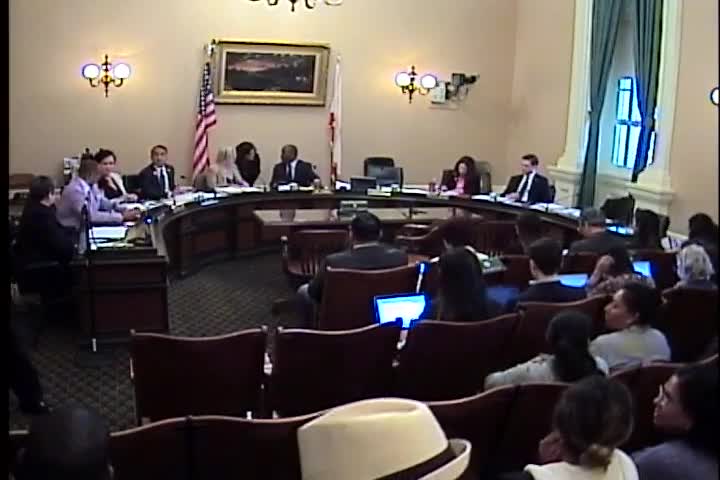 1H
Assembly Standing Committee on Labor and Employment



Bill Co-Author(s):