AB 2039: Personal income taxes: deductions: CalABLE contributions.
- Session Year: 2017-2018
- House: Assembly
- Latest Version Date: 2018-03-21
The Personal Income Tax Law, in modified conformity with federal income tax laws, allows various deductions from gross income in computing adjusted gross income under that law, including deductions for payments to individual retirement accounts, alimony payments, and interest on educational loans.
Existing federal law, the Stephen Beck, Jr., Achieving a Better Life Experience Act of 2014 (ABLE Act), encourages and assists individuals and families to save private funds for the purpose of supporting persons with disabilities to maintain their health, independence, and quality of life by excluding from gross income distributions used for qualified disability expenses by a beneficiary of a qualified ABLE program established and maintained by a state, as specified.
The Personal Income Tax Law conforms to these federal tax provisions.
This bill, for each taxable year beginning on or after January 1, 2018, and before January 1, 2023, would allow a deduction in computing adjusted gross income in an amount equal to the amount contributed by a taxpayer during the taxable year to a CalABLE account.
This bill would take effect immediately as a tax levy.
The Personal Income Tax Law, in modified conformity with federal income tax laws, allows various deductions from gross income in computing adjusted gross income under that law, including deductions for payments to individual retirement accounts, alimony payments, and interest on educational loans.
Existing federal law, the Stephen Beck, Jr., Achieving a Better Life Experience Act of 2014 (ABLE Act), encourages and assists individuals and families to save private funds for the purpose of supporting persons with disabilities to maintain their health, independence, and quality of life by excluding from gross income distributions used for qualified disability expenses by a beneficiary of a qualified ABLE program established and maintained by a state, as specified.
The Personal Income Tax Law conforms to these federal tax provisions.
This bill, for each taxable year beginning on or after January 1, 2018, would allow a deduction in computing adjusted gross income in an amount equal to the amount contributed by a taxpayer during the taxable year to a CalABLE account.
This bill would take effect immediately as a tax levy.
(a)Section 62 of the Internal Revenue Code, relating to adjusted gross income defined, shall apply, except as otherwise provided.
(b)Section 62(a)(2)(D) of the Internal Revenue Code, relating to certain expenses of elementary and secondary school teachers, shall not apply.
(c)Section 62(a)(21) of the Internal Revenue Code, relating to attorneys fees relating to awards to whistleblowers, shall not apply.
(d)For each taxable year beginning on or after January 1, 2018, and before January 1, 2023, Section 62(a) of the Internal Revenue Code, relating to general rule, is modified to provide that the deduction under Section 17208 shall be allowed in determining adjusted gross income.
SEC. 2.Section 17208 is added to the Revenue and Taxation Code, to read:17208.(a)For each taxable year beginning on or after January 1, 2018, and before January 1, 2023, there shall be allowed as a deduction an amount equal to the amount contributed during the taxable year by a taxpayer to a CalABLE account established pursuant to Chapter 15 (commencing with Section 4875) of Division 4.5 of the Welfare and Institutions Code.
(b)This section shall remain in effect only until December 1, 2023, and as of that date is repealed.
SEC. 3.This act provides for a tax levy within the meaning of Article IV of the California Constitution and shall go into immediate effect.
(a)Section 62 of the Internal Revenue Code, relating to adjusted gross income defined, shall apply, except as otherwise provided.
(b)Section 62(a)(2)(D) of the Internal Revenue Code, relating to certain expenses of elementary and secondary school teachers, shall not apply.
(c)Section 62(a)(21) of the Internal Revenue Code, relating to attorneys fees relating to awards to whistleblowers, shall not apply.
(d)Section 62(a) of the Internal Revenue Code, relating to general rule, is modified to provide that the deduction under Section 17208 shall be allowed in determining adjusted gross income.
SEC. 2.Section 17208 is added to the Revenue and Taxation Code, to read:17208.For each taxable year beginning on or after January 1, 2018, there shall be allowed as a deduction an amount equal to the amount contributed during the taxable year by a taxpayer to a CalABLE account established pursuant to Chapter 15 (commencing with Section 4875) of Division 4.5 of the Welfare and Institutions Code.
SEC. 3.This act provides for a tax levy within the meaning of Article IV of the California Constitution and shall go into immediate effect.
|
Date
|
Status
|
|---|---|
| May 25, 2018 | In committee: Held under submission. |
| Apr 4, 2018 | In committee: Set, first hearing. Referred to suspense file. |
| Mar 22, 2018 | Re-referred to Com. on APPR. |
| Mar 21, 2018 | Read second time and amended. |
| Mar 20, 2018 | From committee: Amend, and do pass as amended and re-refer to Com. on APPR. (Ayes 9. Noes 1.) (March 19). |
| Feb 16, 2018 | Referred to Com. on REV. & TAX. |
| Feb 7, 2018 | From printer. May be heard in committee March 9. |
| Feb 6, 2018 | Read first time. To print. |
|
Date
|
Description
|
Location
|
Votes
|
|
|---|---|---|---|---|
| Mar 19, 2018 | Do pass as amended and be re-referred to the Committee on [Appropriations] | Assembly Standing Committee on Revenue and Taxation |
Passed |
This list shows positions taken on this bill by organizations on the date displayed, which is linked to the original source.
Positions by individuals are not included.
|
Organization
|
Position
|
Date
|
|---|---|---|
| 65 individuals | ** Support | Mar 16, 2018 |
| Arc and United Cerebral Palsy California Collaboration | * Support | Mar 19, 2018 |
| Arc Of San Diego | ** Support | Mar 16, 2018 |
| Autism Business Association | ** Support | Mar 16, 2018 |
| Autism Society, San Francisco Bay Area | ** Support | Mar 16, 2018 |
| Autism Speaks | ** Support | Mar 16, 2018 |
| Bakersfield ARC | ** Support | Mar 16, 2018 |
| CalABLE Board | * Support | Mar 19, 2018 |
| California Disability Services Association | ** Support | Mar 16, 2018 |
| California Down Syndrome Advocacy Coalition | ** Support | Mar 16, 2018 |
| Center for Autism and Related Disorders | ** Support | Mar 16, 2018 |
| Club 21 South Bay Community Group | ** Support | Mar 16, 2018 |
| Disability Rights California | ** Support | Mar 16, 2018 |
| Down Syndrome Community | ** Support | Mar 16, 2018 |
| Down Syndrome Connection of the Bay Area | ** Support | Mar 16, 2018 |
| Easterseals Bay area | ** Support | Mar 16, 2018 |
| Exceptional Family Center | ** Support | Mar 16, 2018 |
| Hendrick Legal Solutions | ** Support | Mar 16, 2018 |
| Herself | * Support | Mar 19, 2018 |
| Independent Living Center of Kern County | ** Support | Mar 16, 2018 |
| kern down syndrome network | ** Support | Mar 16, 2018 |
| Mental Health America of California | ** Support | Mar 16, 2018 |
| National Down Syndrome Society | ** Support | Mar 16, 2018 |
| PathPoint | ** Support | Mar 16, 2018 |
| United Cerebral Palsy Of The North Bay | ** Support | Mar 16, 2018 |
Date of Hearing: April 4, 2018
ASSEMBLY COMMITTEE ON APPROPRIATIONS
Lorena Gonzalez Fletcher, Chair
ABPCA Bill Id:AB 2039
Author:(Fong) – As Amended Ver:March 21, 2018
Policy Committee: | Revenue and Taxation | Vote: | 9 - 1 |
|
| ||
|
|
Urgency: No State Mandated Local Program: No Reimbursable: No
SUMMARY:
This bill, for taxable years 2018 through 2022, creates a tax deduction for contributions made to a California Achieving a Better Life Experience (CalABLE) account.
FISCAL EFFECT:
Annual General Fund revenue loss of $5.2 million in 2018-19, $4.9 million in 2019-20, and $6.1 million in 2020-21.
COMMENTS:
- Background. The federal ABLE Act allows for tax-advantaged savings accounts for individuals with disabilities. These accounts aim to ease disabled individuals financial stress by allowing them to accrue savings without those savings jeopardizing their eligibility for programs like Supplementary Security Income (SSI) or Medicaid. Moreover, distributions from these accounts are not taxable if the money is used for qualified disability-related expenses. California’s program, CalABLE, will launch sometime after Spring 2018.
- Purpose. AB 2039 creates a tax deduction to encourage people to contribute funds into a CalABLE account on behalf of a beneficiary. The author notes that family members and friends of individuals with disabilities will be contributing a majority of the funds into these accounts, and this bill aims to support those efforts.
- Who benefits? AB 2039’s proposed deduction will be more beneficial to higher-income taxpayers because the deduction amount is based on a taxpayer’s marginal tax rate, which is higher for families with more income. Even without this bill, CalABLE accounts are likely to be used more often by higher-income families with the resources needed to set aside funds that can accrue tax-free over a long period of time. While people with disabilities across the income distribution may benefit from the ability to save money without that money disqualifying them from safety net programs, it is unclear how much can realistically be saved by those who face significant financial stress as a result of their disability.
- Fiscal implications of tax expenditures. Existing law allows for various tax expenditures such as credits, deductions, exclusions, and exemptions for particular taxpayer groups. These features of the tax code can result in significant state costs through foregone tax revenue and, in many cases, policymakers have little control over the revenue loss that occurs in any given year. As a result, many tax expenditure bills now include provisions designed to give the Legislature more control over costs. Examples of such provisions include placing a sunset date or making a bill’s provisions contingent upon a separate budget appropriation. AB 2309 includes a sunset date.
- Related legislation. AB 2253 (Irwin), of the 2017-18 Legislative Session, eliminates the $100,000 cap on savings that can accrue in a CalABLE account without counting towards any state or local means-tested program. AB 2253 is also being heard today by this committee.
Analysis Prepared by: Luke Reidenbach / APPR. / (916) 319-2081
Date of Hearing: March 19, 2018
ASSEMBLY COMMITTEE ON REVENUE AND TAXATION
Autumn R. Burke, Chairwoman
ABPCA Bill Id:AB 2039 (
Author:Fong) – As Introduced Ver:February 6, 2018
Majority vote. Tax levy. Fiscal committee.
SUBJECT: Personal income taxes: deductions: CalABLE contributions
SUMMARY: Provides an above-the-line deduction for contributions made to a California Achieving a Better Life Experience (ABLE) Act account. Specifically, this bill:
- Provides, beginning on or after January 1, 2018, a deduction equal to the amount contributed to an ABLE account during the taxable year by a taxpayer.
- Allows the deduction to determine adjusted gross income (AGI).
- Takes effect immediately as a tax levy.
EXISTING FEDERAL LAW:
- Enacts the Stephen Beck, Jr., ABLE Act, which assists individuals and families save private funds to support persons with disabilities, as specified, by excluding from gross income distributions used for qualified disability expenses by a beneficiary of a qualified ABLE program established and maintained by a state.
- Provides that contributions to an ABLE account are not deductible for federal income tax purposes, and aggregate contributions during a taxable year may not exceed the annual gift tax exclusion amount. For 2018, the annual gift tax exclusion amount is $15,000.
- Provides that distributions from an ABLE account are excludable from income to the extent the total distribution does not exceed the qualified disability expenses of the beneficiary during the taxable year.
- Provides that funds in an ABLE account, contributions to an ABLE account, and distributions from an ABLE account, shall be disregarded for certain federal means-tested programs. However, for Supplemental Security Income (SSI) purposes, an eligible individual cannot have more than $100,000 in their ABLE account. If funds exceed this amount, SSI benefits will be suspended but not terminated. Funds in excess of $100,000 have no impact on Medicaid eligibility or other federally means-tested programs.
- Defines "qualified disability expenses" as any expenses related to an individual's blindness or disability, including education, housing, transportation, employment training and support, assistive technology and personal support services, health, prevention and wellness, financial management and administrative services, legal fees, expenses for oversight and monitoring, funeral and burial expenses, and other approved expenses.
- Specifies that the qualified ABLE program must limit a designated beneficiary to one ABLE account.
- Defines an "eligible individual" as an individual who meets the requirements relating to blindness or disability under the SSI program. Generally, an individual must be blind or disabled prior to age 26.
EXISTING STATE LAW:
- Conforms to federal income tax law provisions relating to the ABLE Act under the Personal Income Tax (PIT) Law and the Corporation Tax (CT) Law, allowing the creation of ABLE accounts for beneficiaries in California and ensuring that ABLE account earnings and distributions for qualified disability expenses are not included in the eligible individual's income for state tax purposes.
- Provides that notwithstanding any other law, moneys in, contributions to, and any distribution for qualified disability expenses from, an ABLE account, not to exceed $100,000, shall not count toward determining eligibility for a state or local means-tested program.
FISCAL EFFECT: The Franchise Tax Board estimates General Fund revenue losses of $5.2 million in fiscal year (FY) 2018-19, $4.9 million in FY 2019-20, and $6.1 million in FY 2020-21.
COMMENTS:
- The author has provided the following statement in support of this bill:
One of the critical functions of our government is to help cultivate an environment to help those most in need, especially Californians with disabilities. CalABLE savings accounts allow these individuals to save up to $100,000 in total without losing their eligibility for federal assistance. Currently, family members and friends of individuals with disabilities are contributing the majority of funds into ABLE accounts. AB 2039 will provide a state tax deduction to individuals who contribute to these CalABLE savings accounts. This deduction will directly benefit individuals with disabilities and their families by supporting them in their efforts to save money and become more independent. Supporting Californians with disabilities is important to ensure that everyone has opportunities to thrive in our local communities.
- Proponents argue that, "[m]odeled after college savings accounts, ABLE accounts enable people with autism and their families to save for expenses related to their disability. AB 2039 will provide a state tax deduction to individuals who contribute to CalABLE savings accounts. It is critical that we offer incentives so that California residents can confidently contribute to the well-being of one of our most vulnerable populations."
- Committee Staff Comments:
- California ABLE Act: The California ABLE Act was created by the enactment of AB 449 (Irwin), Chapter 774, Statutes of 2015, and SB 324 (Pavley), Chapter 796, Statutes of 2015. The ABLE Act dramatically expands eligibility for federal and state welfare programs by excluding funds in an ABLE account from many means-tested welfare programs, allowing disabled individuals to save money for the future without jeopardizing SSI or Medicaid benefits. As an example, in order for an individual to obtain SSI, countable resources must be worth no more than $2,000 for an individual or $3,000 for a couple. The ABLE Act has increased countable assets for SSI benefits from $2,000 to $102,000 for disabled individuals seeking eligibility. The $100,000 cap in an ABLE account only applies to SSI benefits. Funds in ABLE accounts will not be counted for Medicaid purposes even if funds are in excess of $100,000. Furthermore, the program provides an alternative, but not necessarily a replacement, to more expensive and more complicated special needs trusts currently being used to shield assets.
- Earnings and Distributions Excluded from Income: The ABLE Act is modeled after 529 educational savings accounts. The primary benefit of 529 educational savings accounts is that funds placed in the account grow tax-free and distributions, when made for qualifying educational expenses, are federal and state income tax-free. The exclusion for earnings and distributions from taxes is the primary incentive for saving in a 529 educational account. ABLE accounts, although providing similar preferential tax treatment, do not provide similar results. As noted above, qualifying expenses under the ABLE Act include expenses related to housing, health, transportation, education, and personal support services. These types of expenses are immediate and ongoing. Unlike a 529 educational account, which can allow contributions to grow until the beneficiary is ready to enter college, funds in an ABLE account are needed immediately and are unlikely to remain in the account long enough to generate the same level of growth. Although there are no significant tax benefits because of how the ABLE Act program functions, the real benefit is the continued eligibility for valuable state and federal programs (e.g., SSI and Medicaid).
- Encouraging or Rewarding Behavior? This bill provides an above-the-line deduction to encourage individuals to contribute funds into an ABLE account for the benefit of the beneficiary. The beneficiary gets the benefit of having funds contributed to their account and the contributor gets to reduce their tax liability for the year. According to the author's office, "Family members and friends of individuals with disabilities are contributing the majority of funds into ABLE accounts." If true, the fact that most of the contributions come from friends and family members is not unusual. Most individuals who contribute to an ABLE account probably do so because of a desire to help a loved one who is living with a disability. In fact, it might be odd to have a complete stranger donate money to an ABLE account, even with an above-the-line deduction being made available. As such, it is unclear if this deduction would encourage people to give who are not already giving. Inevitably, part of this deduction, if enacted, will be used to subsidize existing contributions that would have been made irrespective of the deduction. However, it is also likely that individuals might contribute more than they would have because of the deduction.
- Benefits not Determined by Need: A broad group of disabled individuals qualify under the ABLE Act, and the needs of those individuals vary based on circumstances. This deduction, however, does not distribute benefits based on need. This bill distributes the benefits of the above-the-line deduction based on the willingness and ability of individuals to make contributions to an ABLE account on behalf of a beneficiary. As mentioned above, most of the individuals who currently make contributions are likely to be friends and family members of the beneficiary. Therefore, beneficiaries with a strong circle of friends and family will likely benefit the most, while those who have a smaller social circle or who come from more modest means may not necessarily receive a benefit.
- State Supplemental Program (SSP): Individuals with disabilities are provided a monthly case benefit via the SSI/SSP program to help them pay for basic living expenses, such as food, clothing, and shelter. The SSI portion of the benefit is federally funded and only provided through an approved application to the Social Security Administration, while the SSP portion is paid for with General Fund dollars, and a qualified SSI recipient is automatically qualified for SSP. The current SSI/SSP maximum grant levels for the most commonly used payment standard is $910.72 per month for an individual ($160.72 SSP) and $1,532.14 per month for couples ($407.14 SSP). If the goal of this bill is to help subsidize disabled individuals who qualify under the ABLE Act, a more direct approach may be to increase the State's SSP for disabled individuals who have an ABLE account. Directly appropriating funds would ensure that everyone with an ABLE account receives a benefit.
- Above-the-line deduction vs itemized deduction: An "above-the-line" deduction is used to derive a taxpayer's AGI, while a "below-the-line" deduction reduces California AGI to derive taxable income. "Above-the-line" deductions are more desirable than itemized deductions because they are generally not phased out or subject to a floor like many itemized deductions. Furthermore, they can be claimed even if the taxpayer does not itemize deductions. Finally, they lower the taxpayer's AGI, which can allow the taxpayer to qualify for more and/or larger deductions.
- The Value of a Tax Deduction: A deduction is generally more valuable to high-income taxpayers because the "value" of a deduction varies with the marginal tax rate (or tax bracket) of the taxpayer. For example, an individual taxpayer in a 10% tax bracket would receive a tax benefit of $10 on a $100 deduction. In contrast, a taxpayer in a 25% tax bracket would save $25 in tax out of every $100 deducted. Thus, assuming the same level of deductions, high-income taxpayers, presumably with a greater ability to pay taxes, would receive a greater tax benefit from the proposed deduction than the lower income taxpayer.
- How is a tax expenditure different from a direct expenditure? As the Department of Finance notes in its Tax Expenditure Report, there are several key differences between tax expenditures and direct expenditures. First, once put in place, tax expenditures are reviewed less frequently than direct expenditures. Although this creates greater certainty for taxpayers regarding the applicable tax laws (because the tax expenditure will remain on the books for longer periods of time), it may also result in arbitrary tax expenditures that do not serve a public benefit. Second, there is generally no control over the amount of revenue losses associated with any given tax expenditure. Finally, it should also be noted that once enacted, it takes a two-thirds vote to rescind an existing tax expenditure absent a sunset date. For this reason, the Committee may wish to include a five-year sunset date for this above-the-line deduction to provide the opportunity for future legislative review.
REGISTERED SUPPORT / OPPOSITION:
Support
Autism Business Association
Autism Society, San Francisco Bay Area
Autism Speaks
Arc of San Diego
Bakersfield ARC
California Disability Services Association
California Down Syndrome Advocacy Coalition
Center for Autism and Related Disorders
Club 21 South Bay Community Group
Disability Rights California
Down Syndrome Community
Down Syndrome Connection of the Bay Area
Easterseals Bay Area
Exceptional Family Center
Hendrick Legal Solutions
Independent Living Center of Kern County
Kern Down Syndrome Network
Mental health America of California
National Down Syndrome Society
PathPoint
United Cerebral Palsy of the North Bay
65 individuals
Opposition
None on file
Analysis Prepared by: Carlos Anguiano / REV. & TAX. / (916) 319-2098
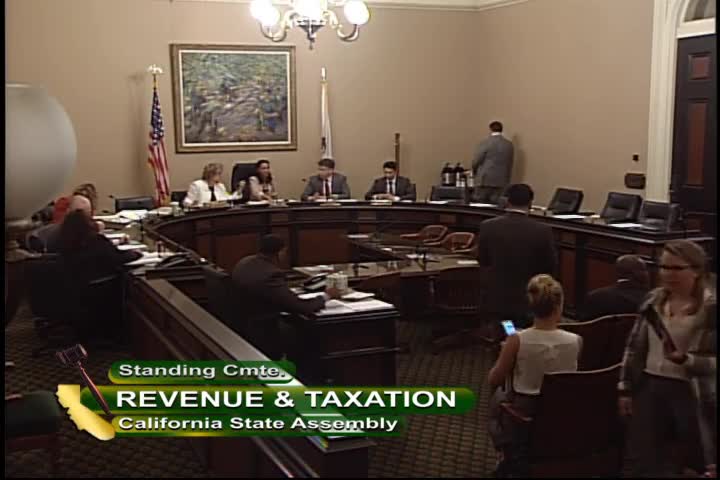
Discussed in Hearing
 9MIN
Assembly Standing Committee on Revenue and Taxation
Bill Author

Bill Co-Author(s):