AB 2253: Public social services programs: qualified ABLE Program accounts.
- Session Year: 2017-2018
- House: Assembly
- Latest Version Date: 2018-02-13
Existing federal law, the Stephen Beck, Jr., Achieving a Better Life Experience Act of 2014 (ABLE Act), encourages and assists individuals and families to save private funds in a tax-advantaged savings account for the purpose of supporting persons with disabilities to maintain their health, independence, and quality of life by excluding from gross income distributions used for qualified disability expenses by a beneficiary of a qualified ABLE program established and maintained by a state, as specified. Existing law establishes the Qualified ABLE Program, administered by the California ABLE Act Board, in this state for purposes of implementing the federal ABLE Act.
Existing law requires that an ABLE account only be established for a designated beneficiary who is a resident of the United States, and that the board market the program to residents of the United States to the extent funds are available. Existing law also provides that moneys in, contributions to, and any distribution for qualified disability expenses from, an ABLE account, not to exceed $100,000, do not count toward determining eligibility for a state or local means-tested program.
This bill would repeal the $100,000 limitation on moneys in, contributions to, and distributions for qualified disability expenses from, an ABLE account, for purposes of determining eligibility for a state or local means-tested program.
(a)Notwithstanding any other law, moneys in, contributions to, and any distribution for qualified disability expenses from, an ABLE account, not to exceed one hundred thousand dollars ($100,000), account shall not count toward determining eligibility for a state or local means-tested program.
(b)Notwithstanding subdivision (a), Section 103 of Division B of Public Law 113-295 and Sections 17140.4 and 23711.4 of the Revenue and Taxation Code shall apply.
(c)(1)Notwithstanding any other law, moneys in an ABLE account, not to exceed one hundred thousand dollars ($100,000), shall be exempt from enforcement of a money judgment without making a claim.
(2)A money judgment in favor of the State Department of Health Care Services shall not be subject to the exemption provided in paragraph (1) during any period of time in which federal law or guidance issued by the federal Centers for Medicare and Medicaid Services requires the department to recover funds from ABLE accounts for reimbursement of qualifying Medi-Cal expenditures.
(d)This section shall become operative on September 1, 2018.
|
Date
|
Status
|
|---|---|
| May 25, 2018 | In committee: Held under submission. |
| Apr 4, 2018 | In committee: Set, first hearing. Referred to suspense file. |
| Mar 20, 2018 | From committee: Do pass and re-refer to Com. on APPR. (Ayes 10. Noes 0.) (March 19). Re-referred to Com. on APPR. |
| Mar 1, 2018 | Referred to Com. on REV. & TAX. |
| Feb 14, 2018 | From printer. May be heard in committee March 16. |
| Feb 13, 2018 | Read first time. To print. |
|
Date
|
Description
|
Location
|
Votes
|
|
|---|---|---|---|---|
| Mar 19, 2018 | Do pass and be re-referred to the Committee on [Appropriations] | Assembly Standing Committee on Revenue and Taxation |
Passed |
This list shows positions taken on this bill by organizations on the date displayed, which is linked to the original source.
Positions by individuals are not included.
|
Organization
|
Position
|
Date
|
|---|---|---|
| Autism Business Association | * Support | Mar 19, 2018 |
| Autism Society California | * Support | Mar 19, 2018 |
| Autism Speaks | ** Support | Mar 16, 2018 |
| California Disability Rights | * Support | Mar 19, 2018 |
| California State Treasurer | ** Support | Mar 16, 2018 |
| Center For Autism Related Disorders | ** Support | Mar 16, 2018 |
| RQCP California Collaboration | * Support | Mar 19, 2018 |
Date of Hearing: April 4, 2018
ASSEMBLY COMMITTEE ON APPROPRIATIONS
Lorena Gonzalez Fletcher, Chair
ABPCA Bill Id:AB 2253
Author:(Irwin) – As Introduced Ver:February 13, 2018
Policy Committee: | Revenue and Taxation | Vote: | 10 - 0 |
|
| ||
|
|
Urgency: No State Mandated Local Program: No Reimbursable: No
SUMMARY:
This bill eliminates the $100,000 cap on the balance of a California Achieving a Better Life Experience (CalABLE) account that does not count toward determining eligibility for a state or local means-tested program.
FISCAL EFFECT:
Unknown, but likely significant, General Fund (GF) or special fund costs. While removing the $100,000 cap is unlikely to result in a significant uptick in participation in a state means-tested program like the California Work Opportunity and Responsibility to Kids (CalWORKS) program, it can be reasonably assumed that there will be additional participants compared to current law. For example, if just 75 additional families statewide participate in CalWORKS as a result of this bill, GF costs would be in excess of $230,000.
COMMENTS:
- ABLE Act. The federal ABLE Act allows for tax-free savings accounts for individuals with disabilities. These accounts aim to ease disabled individuals financial stress by allowing them to accrue savings without those savings jeopardizing their eligibility for programs like Supplementary Security Income (SSI) or Medicaid. California’s program, CalABLE, will launch sometime after Spring 2018.
- Means-tested programs. For many federal means-tested programs, a CalABLE account balance will not be considered at all when determining program eligibility. One exception is SSI, which will count any CalABLE account balance in excess of $100,000.
Under state law, any amount over $100,000 also will be counted when determining eligibility for any state or local means-tested program. According to the California Treasurer’s Office, the state program that this provision most clearly affects is CalWORKS.
- Purpose. According to supporters, AB 2253 will allow people with disabilities to save money for future disability-related costs without putting them at risk for losing their benefits.
- Related legislation. AB 2039 (Fong), of the 2017-18 Legislative Session, creates a tax deduction for contributions made to CalABLE Accounts. AB 2039 is also being heard today by this committee.
Analysis Prepared by: Luke Reidenbach / APPR. / (916) 319-2081
Date of Hearing: March 19, 2018
ASSEMBLY COMMITTEE ON REVENUE AND TAXATION
Autumn R. Burke, Chairwoman
ABPCA Bill Id:AB 2253 (
Author:Irwin) – As Introduced Ver:February 13, 2018
Majority vote. Fiscal committee.
SUBJECT: Public social services programs: qualified ABLE Program accounts
SUMMARY: Repeals the $100,000 limitation on moneys in an ABLE account for purposes of determining eligibility for a state or local means-tested program.
EXISTING FEDERAL LAW:
- Enacts the Stephen Beck, Jr., ABLE Act, which assists individuals and families save private funds to support persons with disabilities, as specified, by excluding from gross income distributions used for qualified disability expenses by a beneficiary of a qualified ABLE program established and maintained by a state.
- Provides that contributions to an ABLE account are not deductible for federal income tax purposes, and aggregate contributions during a taxable year may not exceed the annual gift tax exclusion amount. For 2018, the annual gift tax exclusion amount is $15,000.
- Provides that distributions from an ABLE account are excludable from income to the extent the total distribution does not exceed the qualified disability expenses of the beneficiary during the taxable year.
- Provides that funds in an ABLE account, contributions to an ABLE account, and distributions from an ABLE account, shall be disregarded for certain federal means-tested programs. However, for Supplemental Security Income (SSI) purposes, an eligible individual cannot have more than $100,000 in their ABLE account. If funds exceed this amount, SSI benefits will be suspended but not terminated. Funds in excess of $100,000 have no impact on Medicaid eligibility or other federal means-tested programs.
- Defines "qualified disability expenses" as any expenses related to an individual's blindness or disability, including education, housing, transportation, employment training and support, assistive technology and personal support services, health, prevention and wellness, financial management and administrative services, legal fees, expenses for oversight and monitoring, funeral and burial expenses, and other approved expenses.
- Specifies that the qualified ABLE program must limit a designated beneficiary to one ABLE account.
- Defines an "eligible individual" as an individual who meets the requirements relating to blindness or disability under the SSI program. Generally, an individual must be blind or disabled prior to age 26.
EXISTING STATE LAW:
- Conforms to federal income tax law provisions relating to the ABLE Act under the Personal Income Tax (PIT) Law and the Corporation Tax (CT) Law, allowing the creation of ABLE accounts for beneficiaries in California and ensuring that ABLE account earnings and distributions for qualified disability expenses are not included in the eligible individual's income for state tax purposes.
- Provides that notwithstanding any other law, moneys in, contributions to, and any distribution for qualified disability expenses from, an ABLE account, not to exceed $100,000, shall not count toward determining eligibility for a state or local means-tested program.
FISCAL EFFECT: Unknown
COMMENTS:
- The author has provided the following statement in support of this bill:
The California ABLE Act was signed into law by Governor Brown in late 2015 and provides people with disabilities a critical service by allowing them to save money for the future without jeopardizing their disability benefits. The State Treasurer has requested clarification of existing law to ensure that eligibility for any state or local public disability benefit is not affected by the savings in a CalABLE account. Currently, the CalABLE program allows for contributions of up to $14,000 per year, with the tax and eligibility exception for the first $100,000 in the tax-advantaged savings account. This bill would remove the $100,000 limit from CalABLE accounts for eligibility for all state and local means-tested programs. AB 2253 is clean-up language that will ensure the successful and effective implementation of the California ABLE Act.
- Proponents of this bill state "that costs and service needs for people with disabilities can be extensive. The elimination of the cap for state or local means-tested programs will allow people with disabilities to save enough money for their future disability related costs so they can live independently without jeopardizing their benefit eligibility for needed state only funded or local funded means-tested programs."
- Committee Staff Comments:
- California ABLE Act: The California ABLE Act was created by the enactment of AB 449 (Irwin), Chapter 774, Statutes of 2015, and SB 324 (Pavley), Chapter 796, Statutes of 2015. The ABLE Act dramatically expands eligibility for federal and state welfare programs by excluding funds in an ABLE account from many of the means-tested welfare programs, allowing disabled individuals to save money for the future without jeopardizing SSI or Medicaid benefits. As an example, in order for an individual to obtain SSI, countable resources must be worth no more than $2,000 for an individual or $3,000 for a couple. The ABLE Act has increased countable assets for SSI eligibility from $2,000 to $102,000 for disabled individuals. The $100,000 cap in an ABLE account only applies to SSI benefits. Funds in ABLE accounts will not be counted for Medicaid purposes or for other federal means-tested programs, even if funds are in excess of $100,000.
- Earnings and Distributions Excluded from Income: The ABLE Act is modeled after 529 educational savings accounts. The primary benefit of 529 educational savings accounts is that funds placed in the account grow tax-free and distributions, when made for qualifying educational expenses, are federal and state income tax-free. The exclusion for earnings and distributions from taxes is the primary incentive for saving in a 529 educational account. ABLE accounts, although providing similar preferential tax treatment, do not provide similar results. As noted above, qualifying expenses under the ABLE Act include expenses related to housing, health, transportation, education, and personal support services. These types of expenses are immediate and ongoing. Unlike a 529 educational account which can allow contributions to grow until the beneficiary is ready to enter college, funds in an ABLE account are generally needed immediately and are unlikely to remain in the account long enough to generate the same level of growth.
- Current ABLE Account Limit: The ABLE Act does not set a hard cap on the total amount of money that can be held in an ABLE account. Instead, the ABLE Act specifies that the amount of funds in an ABLE account cannot exceed the limitation set by states for their 529 educational savings accounts. California's Scholarshare program currently limits the total amount of money that can be held in a 529 education savings account at $475,000. The $475,000 limitation also applies to ABLE accounts since the two limitations are linked under federal law. Therefore, if the overall limit for 529 educational savings accounts is increased, the limitation on ABLE accounts is also increased. The limitation is not set by the Legislature. Instead, the authority to set minimum or maximum investment levels is held by the Scholarshare Investment Board (Board).
- Long-Term Savings Account: The ABLE Act also provides an alternative, but not necessarily a replacement, to more expensive and more complicated special needs trusts currently being used to shield assets from means-tested programs. A special needs trust is a specific type of trust that can be created by a parent or guardian to benefit a person with a disability. The goal of a special needs trust is to allow a person with a disability to benefit from funds placed in the trust while, at the same time, receiving public benefit. Unfortunately the ability to use ABLE accounts as a long-term savings vehicle is limited by the existing $100,000 federal cap on SSI benefits. Beneficiaries must weigh the costs and benefits of losing SSI in favor of having funds in excess of $100,000 in an ABLE account. Fortunately, even for those who choose to treat ABLE accounts as a fund for long-term savings, Medi-Cal and other federally funded means-tested programs are still available once the account balance exceeds the cap. If the provisions of this bill were to be enacted, beneficiaries with ABLE account balances in excess of $100,000 would still lose their SSI benefits.
- Means Tested Programs: In general, means testing is a way of determining eligibility for certain government programs based upon whether the recipient has the means to do without assistance. Almost all socially beneficial programs contain limitations based on income, assets, or both. Although it is possible to eliminate means testing from all government programs, limited state resources prevent governments from providing unfettered benefits. As such, governments have generally required means testing in order to allocate resources in a way that best targets a specified population. Historically, social programs have been geared to low-income individuals because this segment of the population would likely not be able to obtain vital services without government assistance.
This bill proposes to eliminate the $100,000 cap for purposes of means testing state and local programs. As such, it is entirely possible that at some point in the future a beneficiary with $475,000 in an ABLE account, or more depending on whether the maximum investment level has increased, will be able to avail themselves of state and local programs that are designed to provide benefits to low-income residents. The Committee may wish to consider whether it is appropriate to allow individuals with a large sum of money in an ABLE account to access resources that could be spent on indigent individuals. Setting a cap is not unique since the Federal Government has already decided to limit SSI benefits for beneficiaries that maintain an ABLE account balance in excess of $100,000.
- Judgement Claims: Although not within the purview of this Committee, the author may wish to consider removing the $100,000 limitation on the enforcement of a money judgement that is within this same code section since the cap was added, in part, because of the existing $100,000 limitation that this bill now intends to remove[1].
REGISTERED SUPPORT / OPPOSITION:
Support
California State Treasurer (Sponsor)
Autism Speaks
Center for Autism Related Disorders
Disability Rights California
Opposition
None on file
Analysis Prepared by: Carlos Anguiano / REV. & TAX. / (916) 319-2098
Welfare and Institutions Code Section 4880(c) ↑
Discussed in Hearing
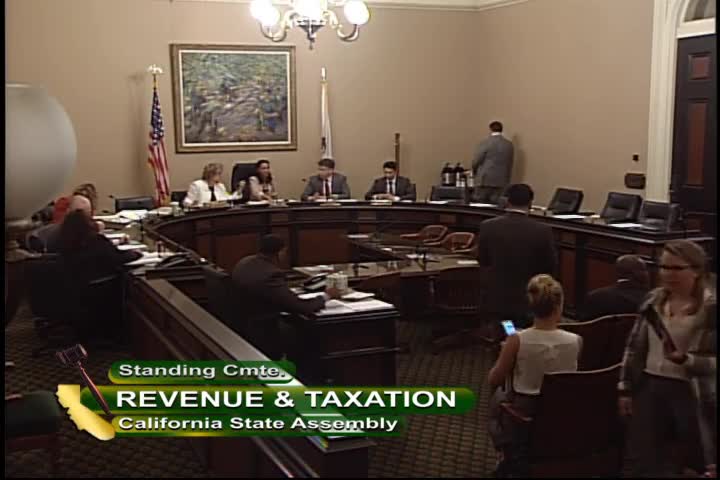 7MIN
Assembly Standing Committee on Revenue and Taxation
Bill Author

Bill Co-Author(s):