AB 2314: Private employment: domestic workers.
- Session Year: 2017-2018
- House: Assembly
- Latest Version Date: 2018-08-24
Existing law establishes the Department of Industrial Relations and creates the Division of Labor Standards Enforcement within it. Existing law commits to the division the general responsibility for enforcing provisions of the Labor Code not specifically vested in any other officer, board, or commission, which includes a variety of provisions relating to wages and hours of employment.
This bill would require the Division of Labor Standards Enforcement, upon appropriation of funds by the Legislature, to establish and maintain a Domestic Work Enforcement Pilot Program in collaboration with qualified organizations, as defined. The bill would require the program to increase the capacity and expertise of the division to improve education and enforcement of labor standards in the domestic work industry. Among other things, the program would be required to address the education of employees and employers regarding minimum wage, overtime, sick leave, recordkeeping, retaliation, and wage adjudication. The bill would require qualified organizations that collaborate with the division in connection with the program to issue reports and meet quarterly with the division to review the implementation and success of the program.
Existing law establishes the Department of Industrial Relations and creates the Division of Labor Standards Enforcement within it. Existing law commits to the division the general responsibility for enforcing provisions of the Labor Code not specifically vested in any other officer, board, or commission, which includes a variety of provisions relating to wages and hours of employment.
This bill would require the Division of Labor Standards Enforcement Enforcement, upon appropriation of funds by the Legislature, to establish and maintain a Domestic Work Enforcement Pilot Program in collaboration with qualified organizations, as defined. The bill would require the program to increase the capacity and expertise of the division to improve education and enforcement of labor standards in the domestic work industry. Among other things, the program would be required to address the education of employees and employers regarding minimum wage, overtime, sick leave, recordkeeping, retaliation, and wage adjudication, as well as the creation of enforcement positions that ensure education regarding, and compliance with, laws governing the domestic work industry. adjudication. The bill would require qualified organizations that collaborate with the division in connection with the program to issue reports and meet quarterly with the division to review the implementation and success of the program.
Existing law establishes the Department of Industrial Relations and creates the Occupational Safety and Health Standards Board Division of Labor Standards Enforcement within it. Existing law commits to the board division the general responsibility for enforcing all occupational safety and health standards, as specified. provisions of the Labor Code not specifically vested in any other officer, board, or commission, which includes a variety of provisions relating to wages and hours of employment.
This bill would state the intent of the Legislature to enact legislation relating to private employment require the Division of Labor Standards Enforcement to establish and maintain a Domestic Work Enforcement Pilot Program in collaboration with qualified organizations, as defined. The bill would require the program to increase the capacity and expertise of the division to improve education and enforcement of labor standards in the domestic work industry. Among other things, the program would be required to address the education of employees and employers regarding minimum wage, overtime, sick leave, recordkeeping, retaliation, wage adjudication, as well as the creation of enforcement positions that ensure education regarding, and compliance with, laws governing the domestic work industry. The bill would require qualified organizations that collaborate with the division in connection with the program to issue reports and meet quarterly with the division to review the implementation and success of the program.
Existing law establishes the Department of Industrial Relations and creates the Occupational Safety and Health Standards Board within it. Existing law commits to the board the responsibility for enforcing all occupational safety and health standards, as specified.
This bill would state the intent of the Legislature to enact legislation relating to private employment
The Legislature finds and declares all of the following:
(a)As recognized by the State of California in Resolution Chapter 119 of the Statutes of 2010, it is the policy of the state to encourage and protect the rights of domestic work employees.
(b)Domestic work has become a core part of Californians lives. Two million households in California rely on domestic workers to provide care for children, housecleaning, and support for seniors and people with disabilities. The vast majority of domestic workers are women of color and immigrants and are particularly vulnerable to unlawful employment practices.
(c)Because domestic workers care for the most important elements of their employers lives, their families and homes, it is in the interest of employees, employers, and the people of the State of California to ensure that the rights of domestic workers are respected, protected, and enforced.
(d)The domestic work industry is fractured and diverse, with employment arrangements ranging from single families that directly hire occasional house cleaners to caregivers employed full time through private home care agencies. Many domestic work employers do not research or seek advice regarding the standards to set for hours, pay, or benefits for their employees.
(e)Domestic work remains a low-wage and largely underregulated industry. Domestic workers usually work alone, behind closed doors, and out of the public eye, leaving them isolated, vulnerable to abuse and exploitation by some employers, and unable to advocate collectively for better working conditions. Four in ten employers pay low wages, which are defined as two-thirds of the median full-time wage in California. One in six domestic work employers fail to pay minimum wage. A substantial number of domestic workers do not complain about these violations because they are afraid they would lose their jobs. This fear has been augmented by the current national political climate and its focus on increased immigration enforcement, further exacerbating the challenges of enforcement of wage laws.
(f)The demand for domestic work will continue to grow due to the aging of the population and the increased reliance on home care. The number of personal care aides alone is expected to grow by 35.8 percent between 2014 and 2024, which is significantly faster than the growth rate for other occupations in California.
SEC. 2.Section 1455 is added to the Labor Code, to read:1455.(a)The Division of Labor Standards Enforcement shall, upon appropriation of funds to the division for purposes of this section, establish and maintain a Domestic Work Enforcement Pilot Program in collaboration with qualified organizations. The program shall increase the capacity and expertise of the division to improve education and enforcement of labor standards in the domestic work industry. The program shall include, but not be limited to, the following:
(1)Education and training for domestic work employees and employers addressing minimum wage, overtime, sick leave, recordkeeping, wage adjudication, and retaliation.
(2)Training for domestic worker leaders to provide peer-to-peer support and wraparound service referrals to domestic work employees who have elected to file wage claims or take other actions seeking remedy from employers.
(3)Development of core training curriculum to be used in the education and training of domestic work employees and employers.
(4)Provision of technical and legal assistance to domestic work employees through a statewide telephone help line and the promotion of the help line to domestic worker populations.
(5)Development of an online resource hub to provide information for employers on state labor laws and guidelines on fair employment.
(b)For the purposes of this section, qualified organization means:
(1)A nonprofit organization that has a minimum of five years of experience working with domestic work employees or employers.
(2)An organization that works with a nonprofit organization that has a minimum of five years of experience working with domestic work employees or employers.
(c)Qualified organizations that collaborate under subdivision (a) shall issue reports and meet quarterly with the Division of Labor Standards Enforcement to review the implementation and success of the program.
The Legislature finds and declares all of the following:
(a)As recognized by the State of California in Resolution Chapter 119 of the Statutes of 2010, it is the policy of the state to encourage and protect the rights of domestic work employees.
(b)Domestic work has become a core part of Californians lives. Two million households in California rely on domestic workers to provide care for children, housecleaning, and support for seniors and people with disabilities. The vast majority of domestic workers are women of color and immigrants and are particularly vulnerable to unlawful employment practices.
(c)Because domestic workers care for the most important elements of their employers lives, their families and homes, it is in the interest of employees, employers, and the people of the State of California to ensure that the rights of domestic workers are respected, protected, and enforced.
(d)The domestic work industry is fractured and diverse, with employment arrangements ranging from single families that directly hire occasional house cleaners to caregivers employed full time through private home care agencies. Many domestic work employers do not research or seek advice regarding the standards to set for hours, pay, or benefits for their employees.
(e)Domestic work remains a low-wage and largely underregulated industry. Domestic workers usually work alone, behind closed doors, and out of the public eye, leaving them isolated, vulnerable to abuse and exploitation by some employers, and unable to advocate collectively for better working conditions. Four in ten employers pay low wages, which are defined as two-thirds of the median full-time wage in California. One in six domestic work employers fail to pay minimum wage. A substantial number of domestic workers do not complain about these violations because they are afraid they would lose their jobs. This fear has been augmented by the current national political climate and its focus on increased immigration enforcement, further exacerbating the challenges of enforcement of wage laws.
(f)The demand for domestic work will continue to grow due to the aging of the population and the increased reliance on home care. The number of personal care aides alone is expected to grow by 35.8 percent between 2014 and 2024, which is significantly faster than the growth rate for other occupations in California.
SEC. 2.Section 1455 is added to the Labor Code, to read:1455.(a)The Division of Labor Standards Enforcement shall shall, upon appropriation of funds to the division for purposes of this section, establish and maintain a Domestic Work Enforcement Pilot Program in collaboration with qualified organizations. The program shall increase the capacity and expertise of the division to improve education and enforcement of labor standards in the domestic work industry. The program shall include, but not be limited to, the following:
(1)Education and training for domestic work employees and employers addressing minimum wage, overtime, sick leave, recordkeeping, wage adjudication, and retaliation.
(2)Training for domestic worker leaders to provide peer-to-peer support and wraparound service referrals to domestic work employees who have elected to file wage claims or take other actions seeking remedy from employers.
(3)Development of core training curriculum to be used in the education and training of domestic work employees and employers.
(4)Provision of technical and legal assistance to domestic work employees through a statewide telephone help line and the promotion of the help line to domestic worker populations.
(5)Development of an online resource hub to provide information for employers on state labor laws and guidelines on fair employment.
(6)Creation of enforcement positions that ensure education regarding, and compliance with, laws governing the domestic work industry and that promote higher standards in the industry(b)For the purposes of this section, qualified organization means:
(1)A nonprofit organization that has a minimum of five years of experience working with domestic work employees or employers.
(2)An organization that works with a nonprofit organization that has a minimum of five years of experience working with domestic work employees or employers.
(c)Qualified organizations that collaborate under subdivision (a) shall issue reports and meet quarterly with the Division of Labor Standards Enforcement to review the implementation and success of the program.
The Legislature finds and declares all of the following:
(a)As recognized by the State of California in Resolution Chapter 119 of the Statutes of 2010, it is the policy of the state to encourage and protect the rights of domestic work employees.
(b)Domestic work has become a core part of Californians lives. Two million households in California rely on domestic workers to provide care for children, housecleaning, and support for seniors and people with disabilities. The vast majority of domestic workers are women of color and immigrants and are particularly vulnerable to unlawful employment practices.
(c)Because domestic workers care for the most important elements of their employers lives, their families and homes, it is in the interest of employees, employers, and the people of the State of California to ensure that the rights of domestic workers are respected, protected, and enforced.
(d)The domestic work industry is fractured and diverse, with employment arrangements ranging from single families that directly hire occasional house cleaners to caregivers employed full time through private home care agencies. Many domestic work employers do not research or seek advice regarding the standards to set for hours, pay, or benefits for their employees.
(e)Domestic work remains a low-wage and largely underregulated industry. Domestic workers usually work alone, behind closed doors, and out of the public eye, leaving them isolated, vulnerable to abuse and exploitation by some employers, and unable to advocate collectively for better working conditions. Four in ten employers pay low wages, which are defined as two-thirds of the median full-time wage in California. One in six domestic work employers fail to pay minimum wage. A substantial number of domestic workers do not complain about these violations because they are afraid they would lose their jobs. This fear has been augmented by the current national political climate and its focus on increased immigration enforcement, further exacerbating the challenges of enforcement of wage laws.
(f)The demand for domestic work will continue to grow due to the aging of the population and the increased reliance on home care. The number of personal care aides alone is expected to grow by 35.8 percent between 2014 and 2024, which is significantly faster than the growth rate for other occupations in California.
SEC. 2.Section 1455 is added to the Labor Code, to read:1455.(a)The Division of Labor Standards Enforcement shall establish and maintain a Domestic Work Enforcement Pilot Program in collaboration with qualified organizations. The program shall increase the capacity and expertise of the division to improve education and enforcement of labor standards in the domestic work industry. The program shall include, but not be limited to, the following:
(1)Education and training for domestic work employees and employers addressing minimum wage, overtime, sick leave, recordkeeping, wage adjudication, and retaliation.
(2)Training for domestic worker leaders to provide peer-to-peer support and wraparound service referrals to domestic work employees who have elected to file wage claims or take other actions seeking remedy from employers.
(3)Development of core training curriculum to be used in the education and training of domestic work employees and employers.
(4)Provision of technical and legal assistance to domestic work employees through a statewide telephone help line and the promotion of the help line to domestic worker populations.
(5)Development of an online resource hub to provide information for employers on state labor laws and guidelines on fair employment.
(6)Creation of enforcement positions that ensure education regarding, and compliance with, laws governing the domestic work industry and that promote higher standards in the industry
(b)For the purposes of this section, qualified organization means:
(1)A nonprofit organization that has a minimum of five years of experience working with domestic work employees or employers.
(2)An organization that works with a nonprofit organization that has a minimum of five years of experience working with domestic work employees or employers.
(c)Qualified organizations that collaborate under subdivision (a) shall issue reports and meet quarterly with the Division of Labor Standards Enforcement to review the implementation and success of the program.
SECTION 1.It is the intent of the Legislature to enact legislation relating to private employment.It is the intent of the Legislature to enact legislation relating to private employment.
|
Date
|
Status
|
|---|---|
| Sep 22, 2018 | Vetoed by Governor. |
| Aug 28, 2018 | Enrolled and presented to the Governor at 3 p.m. |
| Aug 23, 2018 | In Assembly. Ordered to Engrossing and Enrolling. |
| Aug 23, 2018 | Read third time. Passed. Ordered to the Assembly. |
| Aug 17, 2018 | From committee: Do pass. (Ayes 5. Noes 2.) (August 16). |
| Jun 25, 2018 | In committee: Referred to APPR. suspense file. |
| Jun 13, 2018 | From committee: Do pass and re-refer to Com. on APPR. (Ayes 5. Noes 0.) (June 13). Re-referred to Com. on APPR. |
| Jun 7, 2018 | Referred to Com. on L. & I.R. |
| May 31, 2018 | In Senate. Read first time. To Com. on RLS. for assignment. |
| May 30, 2018 | Read third time. Passed. Ordered to the Senate. |
| May 29, 2018 | Read second time. Ordered to third reading. |
| May 25, 2018 | From committee: Amend, and do pass as amended. (Ayes 12. Noes 3.) (May 25). |
| May 2, 2018 | In committee: Set, first hearing. Referred to APPR. suspense file. |
| Apr 19, 2018 | From committee: Do pass and re-refer to Com. on APPR. (Ayes 6. Noes 0.) (April 18). Re-referred to Com. on APPR. |
| Mar 20, 2018 | Re-referred to Com. on L. & E. |
| Mar 19, 2018 | From committee chair, with author's amendments: Amend, and re-refer to Com. on L. & E. Read second time and amended. |
| Mar 19, 2018 | Referred to Com. on L. & E. |
| Feb 14, 2018 | From printer. May be heard in committee March 16. |
| Feb 13, 2018 | Read first time. To print. |
|
Date
|
Description
|
Location
|
Votes
|
|
|---|---|---|---|---|
| Aug 23, 2018 | Assembly 3rd Reading AB2314 Ting et al. By Leyva | Senate Floor |
Passed |
|
| Aug 16, 2018 | Do pass | Senate Standing Committee on Appropriations |
Passed |
|
| Jun 25, 2018 | Placed on suspense file | Senate Standing Committee on Appropriations |
Passed |
|
| Jun 13, 2018 | Do pass, but first be re-referred to the Committee on [Appropriations] | Senate Standing Committee on Labor and Industrial Relations |
Passed |
|
| May 30, 2018 | AB 2314 TING Assembly Third Reading | Assembly Floor |
Passed |
|
| May 25, 2018 | Do pass as amended. | Assembly Standing Committee on Appropriations |
Passed |
|
| Apr 18, 2018 | Do pass and be re-referred to the Committee on [Appropriations] | Assembly Standing Committee on Labor and Employment |
Passed |
This list shows positions taken on this bill by organizations on the date displayed, which is linked to the original source.
Positions by individuals are not included.
|
Organization
|
Position
|
Date
|
|---|---|---|
| 50-Individuals | ** Support | Aug 18, 2018 |
| A Stronger California Advocates Network | ** Support | Aug 18, 2018 |
| ACLU of California | ** Support | Aug 18, 2018 |
| California Alliance For Retired Americans | ** Support | Aug 18, 2018 |
| California Domestic Workers Coalition | ** Support | Aug 18, 2018 |
| California Employment Lawyers Association | ** Support | Aug 18, 2018 |
| California Immigrant Policy Center | ** Support | Apr 16, 2018 |
| California Latinas for Reproductive Justice | ** Support | Aug 18, 2018 |
| California Women's Law Center | ** Support | Aug 18, 2018 |
| City of Berkeley | ** Support | Aug 18, 2018 |
| CLEAN Carwash Campaign | ** Support | Apr 16, 2018 |
| Clean Carwash Campaign & Carwash Worker Center | ** Support | Aug 18, 2018 |
| Coalition for Humane Immigrant Rights | ** Support | Aug 18, 2018 |
| Coalition Of Labor Union Women, California Capital Chapter | ** Support | Aug 18, 2018 |
| Coalition Of Labor Union Women: California Capital Chapter | ** Support | Apr 16, 2018 |
| Consumer Attorney's of California | * Support | Jun 13, 2018 |
| EDW | * Support | Jun 13, 2018 |
| Equal Rights Advocates | ** Support | Aug 18, 2018 |
| Filipino Advocates for Justice | ** Support | Aug 18, 2018 |
| Garment Worker Center | ** Support | Aug 18, 2018 |
| Hand in Hand | * Support | Jun 13, 2018 |
| Hand In Hand Domestic Employers Network | ** Support | Apr 16, 2018 |
| Hand In Hand, The Domestic Employers Network | ** Support | Aug 18, 2018 |
| Herself | * Support | Jun 13, 2018 |
| Herself | * Support | Jun 13, 2018 |
| Home Care Association Of America | ** Support | Aug 18, 2018 |
| Jobs with Justice San Francisco | ** Support | Aug 18, 2018 |
| Koreatown Immigrant Workers Alliance | ** Support | Aug 18, 2018 |
| Los Angeles Worker Center Network | ** Support | Aug 18, 2018 |
| Maria Guillen | ** Support | Apr 16, 2018 |
| Mujeres Unidas Y Activas | ** Support | Aug 18, 2018 |
| National Coalition of Hispanic Organizations | * Support | Jun 13, 2018 |
| National Council of Jewish Women, California | ** Support | Aug 18, 2018 |
| Pilipino Worker Center Of Southern California | ** Support | Apr 16, 2018 |
| Pilipino Workers Center of Southern California | ** Support | Aug 18, 2018 |
| Public Counsel | ** Support | Aug 18, 2018 |
| San Francisco Women's Collective | * Support | Jun 13, 2018 |
| SEIU California | * Support | Jun 13, 2018 |
| Senior & Disability Action | ** Support | Aug 18, 2018 |
| Southern California Coalition for Occupational Safety & Health | ** Support | Aug 18, 2018 |
| The Women's Foundation of California | ** Support | Aug 18, 2018 |
| TradesWomen Inc. | ** Support | Aug 18, 2018 |
| United Domestic Workers of America-AFSCME Local 3930 | ** Support | Aug 18, 2018 |
GOVERNOR'S VETO
GV Bill Id:AB 2314
Author:(Ting and Gonzalez Fletcher)
As Enrolled Ver:August 28, 2018
2/3 vote
Committee | Votes | Ayes | Noes |
Labor | 6-0 | Thurmond, Flora, Gonzalez Fletcher, Jones-Sawyer, Kalra, McCarty | |
Appropriations | 12-3 | Gonzalez Fletcher, Bloom, Bonta, Calderon, Carrillo, Chau, Eggman, Friedman, Eduardo Garcia, Nazarian, Quirk, Reyes | Bigelow, Gallagher, Obernolte |
ASSEMBLY: | 62-13 | (May 30, 2018) | SENATE: | 26-12 | (August 23, 2018) |
SUMMARY: Requires the Division of Labor Standards Enforcement (DLSE), upon appropriation of funds, to create the Domestic Work Enforcement Pilot Program for the provision of resources, education, and training regarding labor standards in the domestic work industry for both employees and employers.
Specifically, this bill:
- Makes finding and declarations regarding the particular challenges faced by domestic workers including low pay, isolated working conditions, and vulnerability to abuse and exploitation by employers.
- Requires the DLSE, upon appropriation of funds, to establish and maintain a Domestic Work Enforcement Pilot Program (program) in collaboration with qualified organizations, as defined.
- Assigns the program the responsibility of increasing the capacity and expertise of the DLSE to improve education and enforcement of labor standards in the domestic work industry.
- Requires that the program provide education and training for domestic workers and employers on laws related to, among other things, minimum wage, overtime, and sick leave.
- Obligates the program to create a statewide telephone help line for workers to provide technical and legal assistance.
- Requires qualified organizations that collaborate with the DLSE in connection with the program to issue reports and meet quarterly with the division to review the implementation and success of the program.
EXISTING LAW:
- Establishes the Department of Industrial Relations and creates the DLSE within it.
- Assigns the DLSE the general responsibility for enforcing provisions of the labor code not specifically vested in any officer, board, or commission, which includes a variety of provisions relating to wages and hours of employment.
FISCAL EFFECT: According to the Assembly Appropriations Committee, one-time costs of up to $2.6 million and ongoing costs of to $2.2 million for DLSE to implement and enforce the provisions of this bill. Major cost drivers include additional staff for training and outreach, the establishment of an online resources hub and dedicated telephone helpline, additional worksite inspections, and a possible increase in wage and retaliation claims
COMMENTS: According to the author, the number of domestic workers is growing but the industry remains low-wage and largely unregulated. Citing a UCLA Labor Center report from 2016, the author states, "16% of households or 2 million households in California employ domestic workers to provide care for children, housecleaning, and support for seniors and people with disabilities. By 2022, the number of personal care aides in California will have increased by 52% to over half a million workers."
The author argues this bill is necessary because domestic workers are subject to "frequent violations of wage and hour laws and [there] is a strong trend of under-reporting of violations among workers due to fear. Further, because of a history of exclusion of domestic workers from the labor code and the enduring reality that domestic work is often not seen as 'real work,' many workers remain unaware of their labor rights and employers remain unaware of their obligations."
This bill has no known opposition.
Prior and Related Legislation
AB 241 (Ammiano), Chapter 374, Statutes of 2013, enacted the Domestic Worker Bill of Rights that granted overtime compensation to specified domestic workers after working nine hours in one day and 45 hours in a workweek.
SB 1015 (Leyva), Chapter 315, Statutes of 2016, granted domestic workers the permanent right to overtime pay.
This bill would create a Domestic Work Enforcement Pilot Program in an effort to provide resources, education and training regarding labor standards in the domestic work industry for both employees and employers.
The author of this measure added a provision to the 2018-19 Budget Act that requires the Division of Labor Standards Enforcement to provide a report, by July 1, 2019, on the labor enforcement actions that have been taken by the Division to date, what barriers exist that may prevent greater enforcement, and to provide recommendations on improving employer compliance through outreach and education. Given the wide variety of domestic work and the sparse information available, I believe the legislature should wait for the findings of this report, and then conduct thorough and thoughtful hearings on how families can take care of their loved ones in a fair and affordable manner.
Keeping a family member out of a nursing home and in a place where they have lived for years is a profoundly moral and social good. I urge the legislature to tread carefully when adding more enforcement rules or costly mandates on ordinary families trying to do their best for their infirmed or aging loved ones.
Analysis Prepared by: Megan Lane / L. & E. / (916) 319-2091 FN: 0005272
Office of Senate Floor Analyses (916) 651-1520 Fax: (916) 327-4478 | AB |
THIRD READING
Bill No: AB 2314
:
SENATE LABOR & IND. REL. COMMITTEE: 4-1, 6/13/18
AYES: Lara, Jackson, Mitchell, Wieckowski
NOES: Stone
SENATE APPROPRIATIONS COMMITTEE: 5-2, 8/16/18
AYES: Portantino, Beall, Bradford, Hill, Wiener
NOES: Bates, Nielsen
ASSEMBLY FLOOR: 62-13, 5/30/18 - See last page for vote
SOURCE: California Domestic Workers Coalition
DIGEST:
This bill requires that the Department of Industrial Relations’ (DIR’s) Division of Labor Standards Enforcement (DLSE) create a Domestic Work Enforcement Pilot Program, in collaboration with qualified organizations, to provide resources, education, and training regarding labor standards in the domestic work industry for both employees and employers.
Existing law:
- Provides, under the Domestic Worker Bill of Rights, a domestic worker who is employed as a personal attendant is entitled to overtime compensation for work in excess of 9 hours in any workday or more than 45 hours in any workweek shall be compensated at the rate of 1 ½ times the regular rate of pay. (Labor Code §1454)
- Defines “personal attendant” as a person employed by a private householder, or by any third-party employer, as specified, to supervise, feed, or dress a child, or a person who by reason of advanced age, physical disability, or mental deficiency needs supervision, as specified. [Labor Code §1451(d)]
- Defines “domestic work employee” as an individual performing domestic work and includes live-in employees and personal attendants, but does not include any of the following [Labor Code §1451(b)]:
- A person performing services through the IHHS program;
- Specified family members and casual babysitters;
- A person employed by a licensed health facility, as defined.
- A person providing support services to the developmentally disabled employed by a regional center or the State Department of Developmental Services;
- A person providing child care for someone receiving services under the Child Care and Development Services Act or the CA Work Opportunity and Responsibility to Kids Act.
- Establishes the DLSE with the mission of ensuring a just day’s pay in every workplace in the state and promote economic justice through robust enforcement of labor laws. (Labor Code §§79-107)
This bill:
- Requires the DLSE, upon appropriation of funds for this purpose, to establish and maintain the Domestic Work Enforcement Pilot Program (Pilot Program) in collaboration with qualified organizations, as defined, to increase the capacity and expertise of the DLSE and improve education and enforcement of labor standards in the domestic work industry.
- Requires the Pilot Program to include, but is not limited to, the following:
- Education and training for domestic work employees and employers on laws related to, among others, minimum wage, overtime, sick leave and retaliation.
- Training for domestic worker leaders to provide peer-to-peer support and service referrals to domestic work employees who have filed wage claims or seeking remedy from employers.
- Development of core training curriculum to be used in the education and training of domestic work employees and employers.
- Creation and promotion of a statewide telephone help line to provide technical and legal assistance to domestic work employees.
- Development of an online resource hub to provide information for employers on state labor laws and guidelines on fair employment.
- Requires qualified organizations that collaborate with the DLSE in connection with the Pilot Program to issue reports and meet quarterly with the division to review the implementation and success of the program.
- Makes findings and declarations regarding the particular challenges faced by domestic workers including low pay, isolated working conditions, and vulnerability to abuse and exploitation by employers.
Background
According to a University of California, Los Angeles Labor Center report, “Our survey found that 16% of all households in the state hire for housecleaning, childcare or homecare support. We estimate therefore that as many as two million households in California hire domestic workers. About two-thirds (63%) reside in Southern California, 26% in the Northern part of the state and 11% in Central California.” (UCLA Labor Center, Profiles, Practices and Needs of California’s Domestic Work Employers, 2016) Based on labor market information from the Employment Development Department, the report finds that by 2022, the number of personal care aides in California will have increased by 52% to over half a million workers.
Need for this bill?
According to the author, domestic work remains a low-wage and largely under-regulated industry comprised primary of immigrant workers and despite the extension of new protections, domestic workers continue to experience substandard working conditions and domestic employers are often not aware of the labor laws that govern their homes. The author believes this bill is necessary to provide resources and tools to employers who seek to uphold fairness and dignified labor standards in their homes. This bill establishes a Domestic Work Enforcement Program to provide resources, education and training regarding labor standards in the domestic work industry for both employees and employers.
Related/Prior Legislation
SB 1015 (Leyva, Chapter 315, Statutes of 2016) repealed the sunset date (below) making the domestic workers overtime compensation requirement permanent.
AB 241 (Ammiano, Chapter 374, Statutes of 2013) enacted the Domestic Worker Bill of Rights granting overtime compensation, until January 1, 2017, to specified domestic workers after 9 hours in one day and 45 hours a week.
FISCAL EFFECT: Appropriation: Fiscal Com.: Local:
According to the Senate Appropriations Committee, DIR
indicates that it would incur first-year costs of $1.9 million, and annual costs of $1.5 million thereafter, to implement the provisions of the bill.
California Domestic Workers Coalition (source)
A Stronger California Advocates Network
ACLU of California
California Alliance for Retired Americans
California Employment Lawyers Association
California Latinas for Reproductive Justice
California Women’s Law Center
City and County of San Francisco, Board of Supervisors
City of Berkeley
Clean Carwash Campaign & Carwash Worker Center
Coalition for Humane Immigrant Rights
Coalition of Labor Union Women, California Capital Chapter
Equal Rights Advocates
Filipino Advocates for Justice
Garment Worker Center
Hand in Hand, the Domestic Employers Network
Home Care Association of America
Jobs with Justice San Francisco
Koreatown Immigrant Workers Alliance
Los Angeles Worker Center Network
Mujeres Unidas y Activas
National Council of Jewish Women, California
Pilipino Workers Center of Southern California
Public Counsel
Senior & Disability Action
Southern California Coalition for Occupational Safety & Health
The Women’s Foundation of California
Tradeswomen Inc.
United Domestic Workers of America-AFSCME Local 3930
50-individuals
OPPOSITION: (Verified 8/16/18)
None received
ARGUMENTS IN SUPPORT: According to the bill’s sponsor, the unique and isolated nature of domestic work renders many workers unaware of their labor rights and many employers uninformed about their obligations. They believe that this bill is crucial to provide clarity to both workers and employers, particularly at a time when nationwide attacks on immigrants have created a culture of fear that can deter immigrant workers from exercising their basic labor rights.
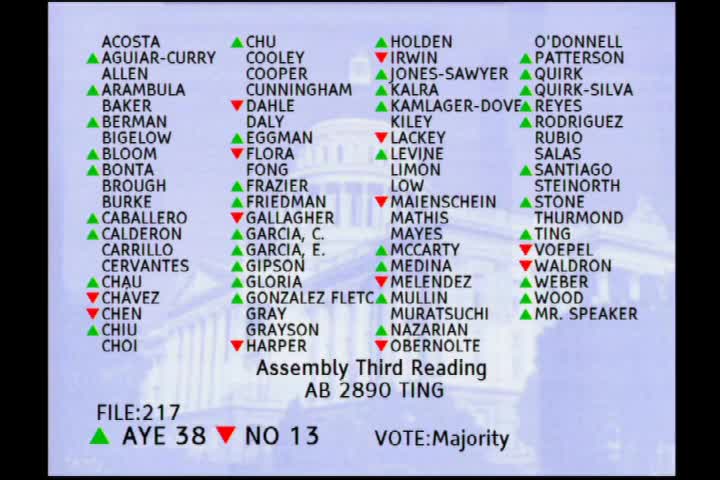
ASSEMBLY FLOOR: 62-13, 5/30/18
AYES: Acosta, Aguiar-Curry, Arambula, Baker, Berman, Bloom, Bonta, Burke, Caballero, Calderon, Carrillo, Cervantes, Chau, Chen, Chiu, Chu, Cooley, Cooper, Cunningham, Daly, Eggman, Flora, Frazier, Friedman, Cristina Garcia, Eduardo Garcia, Gipson, Gloria, Gonzalez Fletcher, Gray, Grayson, Holden, Irwin, Jones-Sawyer, Kalra, Kamlager-Dove, Lackey, Levine, Limón, Low, Maienschein, McCarty, Medina, Mullin, Muratsuchi, Nazarian, O'Donnell, Quirk, Quirk-Silva, Reyes, Rodriguez, Rubio, Salas, Santiago, Steinorth, Mark Stone, Thurmond, Ting, Waldron, Weber, Wood, Rendon
NOES: Travis Allen, Bigelow, Brough, Chávez, Choi, Dahle, Fong, Gallagher, Harper, Kiley, Mathis, Melendez, Obernolte
NO VOTE RECORDED: Mayes, Patterson, Voepel
8/18/18 14:31:25
**** END ****
SENATE COMMITTEE ON APPROPRIATIONS
Senator Anthony Portantino, Chair
2017 - 2018 Regular Session
AB 2314 (Ting) - Private employment: domestic workers
Version: May 25, 2018 | Policy Vote: L. & I.R. 5 - 0 |
Urgency: No | Mandate: No |
Hearing Date: June 25, 2018 | Consultant: Robert Ingenito |
This bill meets the criteria for referral to the Suspense File.
Bill Summary:
AB 2314 would require that the Department of Industrial Relations’ (DIR’s) Division of Labor Standards Enforcement (DLSE) create a Domestic Work Enforcement Pilot Program to provide resources, education, and training regarding labor standards in the domestic work industry for both employees and employers.
Fiscal Impact:
DIR indicates that it would incur first-year costs of $1.9 million, and annual costs of $1.5 million thereafter, to implement the provisions of the bill (Labor Enforcement and Compliance Fund).
Background:
In 1938, federal law established the forty-hour work week, minimum wage and overtime protections for workers. However, certain labor categories, including domestic workers and farmworkers, were excluded. "Domestic workers" or "household workers" are generally comprised of housekeepers, nannies and caregivers of children and others, including the disabled and elderly, who work in private households to care for the health, safety and well-being of those under their care. One recent UCLA report concludes that as many as two million households in the State hire domestic workers, for housecleaning, childcare or homecare support.
Until very recently, domestic workers in California were excluded from the employer requirement of overtime for hours worked beyond the state minimum of eight hours a day or 40 hours a week. AB 241 (Ammiano, 2013) extended overtime compensation, meal and rest periods and uninterrupted sleep to domestic workers. The provisions of AB 241 included a sunset date of January 1, 2017; however, SB 1015 (Leyva, 2016) repealed the sunset date making these provisions permanent.
Proposed Law:
This bill would, among other things, do the following:
- Require DLSE, upon appropriation of funds for this purpose, to establish and maintain the Domestic Work Enforcement Pilot Program (Pilot Program) in collaboration with a qualified organization, as defined, to (1) increase the capacity and expertise of DLSE, and (2) improve education and enforcement of labor standards in the domestic work industry.
- Require the Pilot Program to include, but not be limited to, the following: (1) education and training for domestic work employees and employers on laws related to, among others, minimum wage, overtime, sick leave and retaliation, (2) training for domestic worker leaders to provide peer-to-peer support and service referrals to domestic work employees who have filed wage claims or seeking remedy from employers, (3) development of core training curriculum to be used in the education and training of domestic work employees and employers, (4) creation and promotion of a statewide telephone help line to provide technical and legal assistance to domestic work employees, and (5) development of an online resource hub to provide information for employers on state labor laws and guidelines on fair employment.
- Require qualified organizations that collaborate with DLSE in connection with the Pilot Program to issue reports and meet quarterly with the division to review the implementation and success of the program.
Related Legislation:
AB 241 (Ammiano, Chapter 374, Statutes of 2013) enacted the Domestic Worker Bill of Rights, which entitles a domestic work employee who is employed as a personal attendant to overtime compensation, if the employee works in excess of 9 hours in any workday or more than 45 hours in any workweek, to be compensated at the rate of 1 ½ times the regular rate of pay. These provisions of law were set to sunset on January 1, 2017, but SB 1015 (Leyva, Chapter 315, Statutes of 2016), removed the sunset and made the provisions permanent.
Staff Comments:
DIR’s fiscal estimate of the bill reflects additional staff to provide the specified training and outreach and staff the resources hub. The hub is anticipated to result in additional inquiries by phone and email from both employees and employers. Thus, DLSE would also require resources to develop the required training, establish the online resource hub, and establish a dedicated telephone helpline.
-- END --
SENATE COMMITTEE ON LABOR AND INDUSTRIAL RELATIONS
Senator Ricardo Lara, Chair
2017 - 2018 Regular
Bill No: AB 2314 Hearing Date: June 13, 2018
Author: | Ting | ||
Version: | May 25, 2018 | ||
Urgency: | No | Fiscal: | Yes |
Consultant: | Alma Perez-Schwab | ||
Subject: Private employment: domestic workers
KEY ISSUE
Should the Legislature require that the Division of Labor Standards Enforcement create a Domestic Work Enforcement Pilot Program to provide resources, education, and training regarding labor standards in the domestic work industry for both employees and employers?
ANALYSIS
Existing law:
- Under the Domestic Worker Bill of Rights, a domestic worker who is employed as a personal attendant is entitled to overtime compensation, as follows (Labor Code §1454):
- Work in excess of 9 hours in any workday or more than 45 hours in any workweek shall be compensated at the rate of 1 ½ times the regular rate of pay.
- Defines “domestic work” as services related to the care of persons in private households or maintenance of private households or their premises. Domestic work occupations include childcare providers, caregivers of people with disabilities, sick, convalescing, or elderly persons, house cleaners, housekeepers, maids, and other household occupations. However, excludes care of persons in specified facilities, such as residential care facilities for the elderly. [Labor Code §1451(a)]
- Defines “domestic work employee” as an individual performing domestic work and includes live-in employees and personal attendants, but does not include any of the following [Labor Code §1451(b)]:
- A person performing services through the In-Home Supportive Services program;
- Specified family members and casual babysitters;
- A person employed by a licensed health facility, as defined.
- A person providing support services to the developmentally disabled employed by a regional center or the State Department of Developmental Services;
- A person providing child care for someone receiving services pursuant to programs authorized under the Child Care and Development Services Act or the CA Work Opportunity and Responsibility to Kids Act.
- Defines “personal attendant” as a person employed by a private householder, or by any third-party employer, as specified, to supervise, feed, or dress a child, or a person who by reason of advanced age, physical disability, or mental deficiency needs supervision, as specified. [Labor Code §1451(d)]
- Establishes the Division of Labor Standards Enforcement (DLSE), within the Department of Industrial Relations, with the mission of ensuring a just day’s pay in every workplace in the state and promote economic justice through robust enforcement of labor laws. (Labor Code §§79-107)
This Bill:
- Requires the Division of Labor Standards Enforcement, upon appropriation of funds for this purpose, to establish and maintain the Domestic Work Enforcement Pilot Program (Pilot Program) in collaboration with a qualified organization, as defined, to increase the capacity and expertise of the DLSE and improve education and enforcement of labor standards in the domestic work industry.
- Requires the Pilot Program to include, but not limited to, the following:
- Education and training for domestic work employees and employers on laws related to, among others, minimum wage, overtime, sick leave and retaliation.
- Training for domestic worker leaders to provide peer-to-peer support and service referrals to domestic work employees who have filed wage claims or seeking remedy from employers.
- Development of core training curriculum to be used in the education and training of domestic work employees and employers.
- Creation and promotion of a statewide telephone help line to provide technical and legal assistance to domestic work employees.
- Development of an online resource hub to provide information for employers on state labor laws and guidelines on fair employment.
- Requires qualified organizations that collaborate with the DLSE in connection with the Pilot Program to issue reports and meet quarterly with the division to review the implementation and success of the program.
- Makes findings and declarations regarding the particular challenges faced by domestic workers including low pay, isolated working conditions, and vulnerability to abuse and exploitation by employers.
COMMENTS
1. Background on Domestic Workers:
In 1938, the U.S. Congress enacted the Fair Labor Standards Act introducing the forty-hour work week and establishing minimum wage and overtime protections for workers, with some exceptions including domestic workers and farmworkers. "Domestic workers" or "household workers" are generally comprised of housekeepers, nannies and caregivers of children and others, including the disabled and elderly, who work in private households to care for the health, safety and well-being of those under their care. According to a University of California, Los Angeles Labor Center report, “Our survey found that 16% of all households in the state hire for housecleaning, childcare or homecare support. We estimate therefore that as many as two million households in California hire domestic workers. About two-thirds (63%) reside in Southern California, 26% in the Northern part of the state and 11% in Central California.” (UCLA Labor Center, Profiles, Practices and Needs of California’s Domestic Work Employers, 2016) Based on labor market information from the Employment Development Department, the report finds that by 2022, the number of personal care aides in California will have increased by 52% to over half a million workers.
Until very recently, domestic workers in California were excluded from the employer requirement of overtime for hours worked beyond the state minimum of 8 hours a day or 40 hours a week. In 2012, through AB 889(Ammiano), a grassroots effort began to extend some of the most fundamental labor protections to domestic workers. Among other things, the bill sought to extend overtime compensation, meal and rest periods and uninterrupted sleep to domestic workers. AB 889 was vetoed by Governor Brown. In 2013, AB 241(Ammiano) was introduced to again attempt to extend these labor protections to domestic workers. The measure, which passed and was signed by Governor Brown, enacted the Domestic Worker Bill of Rights extending overtime compensation rights to domestic workers who are personal attendants after 9 hours of work in one day and 45 hours a week. The provisions of AB 241 included a sunset date of January 1, 2017. SB 1015 (Leyva) of 2016 repealed the sunset date making these provisions permanent.
2. Need for this bill?
Given the high cost of living nowadays, many family members are forced to work multiple jobs, work outside the home, and work longer hours leaving families in dire need of help at home. Domestic workers fill gap by providing much needed help with childcare, adult homecare and housecleaning. This need will be even more critical in the coming years as the aging baby boomer generation creates a rise in demand for domestic workers.
According to the author, domestic work remains a low-wage and largely under-regulated industry comprised primary of immigrant workers and despite the extension of new protections, domestic workers continue to experience substandard working conditions and domestic employers are often not aware of the labor laws that govern their homes. The author believes this bill is necessary to provide resources and tools to employers who seek to uphold fairness and dignified labor standards in their homes. This bill would establish a Domestic Work Enforcement Program to provide resources, education and training regarding labor standards in the domestic work industry for both employees and employers.
3. Proponent Arguments:
According to bill’s sponsor, the California Domestic Workers Coalition, domestic workers, many of whom are immigrants, deserve dignity and to have their rights respected and upheld. They state that in California, there are over 300,000 domestic workers working as house cleaners, nannies, and in-home care providers in private homes. They argue that the unique and isolated nature of domestic work renders many workers unaware of their labor rights and many employers uninformed about their obligations. Proponents believe that this bill is crucial to provide clarity to both workers and to employers, particularly at a time when nationwide attacks on immigrants have created a culture of fear that can deter immigrant workers from exercising their basic labor rights.
According to Hand in Hand, a national network of domestic employers, many of their members go to them because they want to be fair employers but they don’t know where to start, due to the general lack of guidance that exists in the industry. They believe this bill would help fill in the gaps, extending information and education to employers about how they can follow the law and create dignified working conditions for their employees.
4. Opponent Arguments:
None received.
5. Staff Comment:
On page 3 of the bill, line 26, lists the following among the tasks of the Pilot Program:
(2) Training for domestic worker leaders to provide peer-to-peer support and wraparound service referrals to domestic work employees who have elected to file wage claims or take other actions seeking remedy from employers.
The author may wish to revise the language to provide clarity on the term “wraparound service referrals.”
6. Prior Legislation:
SB 1188(Stone) of 2018, proposed to allow domestic work employees, as specified, to enter into a mutual written agreement with their employer to exclude a regularly scheduled sleeping period from hours worked for the purposes of determining pay. This bill was heard and failed passage in this Committee in April.
SB 1015 (Leyva), Chapter 315, Statutes of 2016, repealed the sunset date on the Domestic Worker Bill of Rights provisions making the overtime compensation requirement permanent.
AB 241(Ammiano), Chapter 374, Statutes of 2013 enacted the Domestic Worker Bill of Rights granting overtime compensation, until January 1, 2017, to specified domestic workers after 9 hours in one day and 45 hours a week.
AB 889(Ammiano) vetoed in 2012 would have required the adoption of regulations governing specified working conditions of domestic workers.
SUPPORT
California Domestic Workers Coalition (Sponsor)
A Stronger California Advocates Network
ACLU of California
California Alliance for Retired Americans
California Employment Lawyers Association
California Latinas for Reproductive Justice
California Women’s Law Center
Clean Carwash Campaign & Carwash Worker Center
Coalition for Humane Immigrant Rights
Coalition of Labor Union Women, California Capital Chapter
Equal Rights Advocates
Filipino Advocates for Justice
Garment Worker Center
Hand in Hand, the Domestic Employers Network
Jobs with Justice San Francisco
Koreatown Immigrant Workers Alliance
Los Angeles Worker Center Network
Mujeres Unidas y Activas
National Council of Jewish Women, California
Pilipino Workers Center of Southern California
Public Counsel
Senior & Disability Action
Southern California Coalition for Occupational Safety & Health
The Women’s Foundation of California
Tradeswomen Inc.
United Domestic Workers of America-AFSCME Local 3930
50-individuals
OPPOSITION
None received
-- END --
ASSEMBLY THIRD READING
ATR Bill Id:AB 2314
Author:(Ting and Gonzalez Fletcher)
As Amended Ver:May 25, 2018
Majority vote
Committee | Votes | Ayes | Noes |
Labor | 6-0 | Thurmond, Flora, Gonzalez Fletcher, Jones-Sawyer, Kalra, McCarty | |
Appropriations | 12-3 | Gonzalez Fletcher, Bloom, Bonta, Calderon, Carrillo, Chau, Eggman, Friedman, Eduardo Garcia, Nazarian, Quirk, Reyes | Bigelow, Gallagher, Obernolte |
SUMMARY: Requires the Division of Labor Standards Enforcement (DLSE), upon appropriation of funds, to create the Domestic Work Enforcement Pilot Program for the provision of resources, education, and training regarding labor standards in the domestic work industry for both employees and employers.
Specifically, this bill:
- Makes finding and declarations regarding the particular challenges faced by domestic workers including low pay, isolated working conditions, and vulnerability to abuse and exploitation by employers.
- Requires the DLSE, upon appropriation of funds, to establish and maintain a Domestic Work Enforcement Pilot Program (program) in collaboration with qualified organizations, as defined.
- Assigns the program the responsibility of increasing the capacity and expertise of the DLSE to improve education and enforcement of labor standards in the domestic work industry.
- Requires that the program provide education and training for domestic workers and employers on laws related to, among other things, minimum wage, overtime, and sick leave.
- Obligates the program to create a statewide telephone help line for workers to provide technical and legal assistance.
- Requires qualified organizations that collaborate with the DLSE in connection with the program to issue reports and meet quarterly with the division to review the implementation and success of the program.
EXISTING LAW:
- Establishes the Department of Industrial Relations and creates the DLSE within it.
- Assigns the DLSE the general responsibility for enforcing provisions of the labor code not specifically vested in any officer, board, or commission, which includes a variety of provisions relating to wages and hours of employment.
FISCAL EFFECT: According to the Assembly Appropriations Committee, one-time costs of up to $2.6 million and ongoing costs of to $2.2 million for DLSE to implement and enforce the provisions of this bill. Major cost drivers include additional staff for training and outreach, the establishment of an online resources hub and dedicated telephone helpline, additional worksite inspections, and a possible increase in wage and retaliation claims
COMMENTS: According to the author, the number of domestic workers is growing but the industry remains low-wage and largely unregulated. Citing a UCLA Labor Center report from 2016, the author states, "16% of households or 2 million households in California employ domestic workers to provide care for children, housecleaning, and support for seniors and people with disabilities. By 2022, the number of personal care aides in California will have increased by 52% to over half a million workers."
The author argues this bill is necessary because domestic workers are subject to "frequent violations of wage and hour laws and [there] is a strong trend of under-reporting of violations among workers due to fear. Further, because of a history of exclusion of domestic workers from the labor code and the enduring reality that domestic work is often not seen as 'real work,' many workers remain unaware of their labor rights and employers remain unaware of their obligations."
This bill has no known opposition.
Prior and Related Legislation
AB 241 (Ammiano), Chapter 374, Statutes of 2013, enacted the Domestic Worker Bill of Rights that granted overtime compensation to specified domestic workers after working nine hours in one day and 45 hours in a workweek.
SB 1015 (Leyva), Chapter 315, Statutes of 2016, granted domestic workers the permanent right to overtime pay.
Analysis Prepared by: Megan Lane / L. & E. / (916) 319-2091 FN: 0003144
Date of Hearing: May 2, 2018
ASSEMBLY COMMITTEE ON APPROPRIATIONS
Lorena Gonzalez Fletcher, Chair
ABPCA Bill Id:AB 2314
Author:(Ting) – As Amended Ver:March 19, 2018
Policy Committee: | Labor and Employment | Vote: | 6 - 0 |
|
| ||
|
|
Urgency: No State Mandated Local Program: No Reimbursable: No
SUMMARY:
This bill creates the Domestic Work Enforcement Pilot Program (Pilot Program) through the Division of Labor Standards Enforcement (DLSE). Specifically, this bill:
- Requires DLSE to establish and maintain the Pilot Program in collaboration with a qualified organization, as defined, to improve education and enforcement of labor standards in the domestic work industry.
- Lists goals and tasks for the Pilot Program related to education and training, technical and legal assistance, and information accessibility.
- Requires qualified organizations to report to and meet quarterly with DLSE to review implantation and success of the Pilot Program.
FISCAL EFFECT:
One-time costs of $2.6 million and ongoing costs of $2.2 million for DLSE to implement and enforce the provisions of this bill. Major cost drivers include additional staff for training and outreach, the establishment of an online resources hub and dedicated telephone helpline, additional worksite inspections, and a possible increase in wage and retaliation claims.
COMMENTS:
- Purpose. According to the author, AB 2314 is necessary because domestic workers tend to under-report wage and hour violations due to the workers being afraid or unaware of their rights. The bill’s sponsor, the California Domestic Workers Coalition, argues that domestic workers, many of whom are immigrants, deserve to have their rights respected and upheld.
- Prior legislation. AB 241(Ammiano), Chapter 374, Statutes of 2013, enacted the Domestic Worker Bill of Rights. This law entitles a domestic work employee who is employed as a personal attendant to overtime compensation, if the employee works in excess of 9 hours in any workday or more than 45 hours in any workweek, to be compensated at the rate of 1 ½ times the regular rate of pay. These provisions of law were set to sunset on January 1, 2017, but SB 1015 (Leyva), Chapter 315, Statutes of 2016, removed the sunset and made the provisions permanent.
- Size of the workforce. According to a University of California, Los Angeles Labor Center report, approximately 2 million California households employ domestic workers to provide care for children, housecleaning, and support for seniors and people with disabilities.
Analysis Prepared by: Luke Reidenbach / APPR. / (916) 319-2081
Date of Hearing: April 18, 2018
ASSEMBLY COMMITTEE ON LABOR AND EMPLOYMENT
Tony Thurmond, Chair
ABPCA Bill Id:AB 2314 (
Author:Ting) – As Amended Ver:March 19, 2018
SUBJECT: Private employment: domestic workers
SUMMARY: Creates a Domestic Work Enforcement Pilot Program through the Division of Labor Standards Enforcement (DLSE) to provide resources, education, and training regarding labor standards in the domestic work industry for both employees and employers.
Specifically, this bill:
- Makes finding and declarations regarding the particular challenges faced by domestic workers including low pay, isolated working conditions, and vulnerability to abuse and exploitation by employers.
- Requires the DLSE to establish and maintain a Domestic Work Enforcement Pilot Program (program) in collaboration with qualified organizations, as defined.
- Assigns the program the responsibility of increasing the capacity and expertise of the DLSE to improve education and enforcement of labor standards in the domestic work industry.
- Requires that the program provide education and training for domestic workers and employers on laws related to, among other things, minimum wage, overtime, and sick leave.
- Obligates the program to create a statewide telephone help line for workers to provide technical and legal assistance.
- Augments enforcement positions that ensure education regarding, and compliance with, laws governing the domestic work industry and that promote higher industry standards.
- Requires qualified organizations that collaborate with the DLSE in connection with the program to issue reports and meet quarterly with the division to review the implementation and success of the program.
EXISTING LAW:
- Establishes the Department of Industrial Relations and creates the DLSE within it.
- Assigns the DLSE the general responsibility for enforcing provisions of the labor code not specifically vested in any officer, board, or commission, which includes a variety of provisions relating to wages and hours of employment.
FISCAL EFFECT: Unknown
COMMENTS: According to the author, the number of domestic workers is growing but the industry remains low-wage and largely unregulated. Citing a UCLA Labor Center report from 2016, the author states, “16% of households or 2 million households in California employ domestic workers to provide care for children, housecleaning, and support for seniors and people with disabilities. By 2022, the number of personal care aides in California will have increased by 52% to over half a million workers.”
The author argues this bill is necessary because domestic workers are subject to “frequent violations of wage and hour laws and [there] is a strong trend of under-reporting of violations among workers due to fear. Further, because of a history of exclusion of domestic workers from the labor code and the enduring reality that domestic work is often not seen as ‘real work,’ many workers remain unaware of their labor rights and employers remain unaware of their obligations.”
The bill’s sponsor, the California Domestic Workers Coalition, argues in support, “domestic workers, many of whom are immigrants, deserve dignity and to have their rights respected and upheld.” A Stronger California Network, a coalition of labor organizations, women’s rights groups, and legal aid associations, also argues in support, “California is leading the way to protect all of our workers and to defend our values as a sanctuary state. In this critical moment, AB 2314 will uplift and protect the hard-working and often overlooked immigrant workforce that ‘does the work that makes all other work possible.’”
Prior and Related Legislation
AB 241 (Ammiano), Chapter 374, Statutes of 2013 enacted the Domestic Worker Bill of Rights that granted overtime compensation to specified domestic workers after working nine hours in one day and 45 hours in a workweek.
SB 1015 (Leyva), Chapter 315, Statutes of 2016 granted domestic workers the permanent right to overtime pay.
REGISTERED SUPPORT / OPPOSITION:
Support
ACLU Center for Advocacy and Policy
California Employment Lawyers Association
California Immigrant Policy Center
California Latinas for Reproductive Justice
California Women's Law Center
CLEAN Carwash Campaign
Coalition of Labor Union Women: California Capital Chapter
CHIRLA: Coalition for Humane Immigrant Rights
Equal Rights Advocates
Filipino Advocates for Justice
Garment Workers Center
Hand in Hand Domestic Employers Network
Jobs with Justice San Francisco
Koreatown Immigrant Workers Alliance
Los Angeles Worker Center Network
National Council of Jewish Women
Numerous Individuals
Maria Guillen
Mujeres Unidas y Activas
Pilipino Worker Center of Southern California
Public Counsel
SEIU California
Senior & Disability Action
Stronger California Advocates Network, et al.
The Southern California Coalition for Occupational Safety and Health
Tradeswomen Inc.
Women's Foundation of California
Opposition
None on file.
Analysis Prepared by: Megan Lane / L. & E. /
Discussed in Hearing
 5MIN
Senate Floor
 1H
Senate Standing Committee on Appropriations
 13MIN
Senate Standing Committee on Labor and Industrial Relations
 2MIN
Assembly Floor
 24MIN






