AB 2722: Student financial aid: California Military Department GI Bill Award Program.
- Session Year: 2017-2018
- House: Assembly
- Latest Version Date: 2018-09-19
Existing law establishes various student financial aid programs under the administration of the Student Aid Commission, and establishes eligibility requirements for the receipt of awards under those programs for participating students attending qualifying institutions. Existing law establishes the Military Department, which includes the California National Guard, the California State Military Reserve, and the Naval Militia, to perform various duties regarding the state militia.
Existing law establishes the California National Guard Education Assistance Award Program on behalf of qualifying members of the California National Guard, the California State Military Reserve, and the Naval Militia under the administration of the commission. Existing law requires the Student Aid Commission to report annually to the Legislature regarding program participation and also requires the Legislative Analyst, on or before January 1, 2016, to prepare and submit to the Legislature a report on the program. Existing law further provides that the program becomes operative only if funds are appropriated for the purposes of the program. The program becomes inoperative on July 1, 2019, and is repealed on January 1, 2020.
This bill would change the name of the program to the California Military Department GI Bill Award Program. The bill would provide that the award could be used to obtain one baccalaureate, graduate, or doctoral degree or a certificate, degree, or diploma that leads to a baccalaureate, graduate, or doctoral degree if the person agrees to serve 2 years in the California National Guard, the Naval Militia, or the California State Military Reserve, as specified. The bill would delete the obsolete provision requiring the submission of a report by the Legislative Analyst. The bill would also delete the provision rendering the program inoperative on July 1, 2019, and repealing the program on January 1, 2020, thereby extending the program indefinitely.
Existing law establishes various student financial aid programs under the administration of the Student Aid Commission, and establishes eligibility requirements for the receipt of awards under those programs for participating students attending qualifying institutions. Existing law establishes the Military Department, which includes the California National Guard, the California State Military Reserve, and the Naval Militia, to perform various duties regarding the state militia.
Existing law establishes the California National Guard Education Assistance Award Program on behalf of qualifying members of the California National Guard, the California State Military Reserve, and the Naval Militia under the administration of the commission. Existing law requires the Student Aid Commission to report annually to the Legislature regarding program participation and also requires the Legislative Analyst, on or before January 1, 2016, to prepare and submit to the Legislature a report on the program. Existing law further provides that the program becomes operative only if funds are appropriated for the purposes of the program. The program becomes inoperative on July 1, 2019, and is repealed on January 1, 2020.
This bill would change the name of the program to the California Military Department GI Bill Award Program. The bill would provide that the award could be used to obtain one baccalaureate, graduate, or doctoral degree or a certificate, degree, or diploma that leads to a baccalaureate, graduate, or doctoral degree if the person agrees to serve 2 years in the California National Guard Guard, the Naval Militia, or the California State Military Reserve, as specified. The bill would delete the obsolete provision requiring the submission of a report by the Legislative Analyst. The bill would also delete the provision rendering the program inoperative on July 1, 2019, and repealing the program on January 1, 2020, thereby extending the program indefinitely.
Existing law establishes various student financial aid programs under the administration of the Student Aid Commission, and establishes eligibility requirements for the receipt of awards under those programs for participating students attending qualifying institutions. Existing law establishes the Military Department, which includes the California National Guard, the California State Military Reserve, and the Naval Militia, to perform various duties regarding the state militia.
Existing law establishes the California National Guard Education Assistance Award Program on behalf of qualifying members of the California National Guard, the California State Military Reserve, and the Naval Militia under the administration of the commission. Existing law requires the Student Aid Commission to report annually to the Legislature regarding program participation and also requires the Legislative Analyst, on or before January 1, 2016, to prepare and submit to the Legislature a report on the program. Existing law further provides that the program becomes operative only if funds are appropriated for the purposes of the program. The program becomes inoperative on July 1, 2019, and is repealed on January 1, 2020.
This bill would change the name of the program to the California Military Department GI Bill Award Program. The bill would provide that the award could be used to obtain one baccalaureate, graduate, or doctoral degree if the person agrees to serve 2 years in the California National Guard or the California State Military Reserve, as specified. The bill would delete the obsolete provision requiring the submission of a report by the Legislative Analyst. The bill would also delete the provision rendering the program inoperative on July 1, 2019, and repealing the program on January 1, 2020, thereby extending the program indefinitely.
This article shall be known, and may be cited, as the California Military Department GI Bill.
SEC. 3.Section 69999.12 of the Education Code is amended to read:69999.12.There is hereby established the California Military Department GI Bill Award Program.
SEC. 4.Section 69999.14 of the Education Code is amended to read:69999.14.The Legislature finds and declares all of the following:
(a)The California Military Department exists to provide a military organization in California with the capability to protect the lives and property of the people of the state during periods of natural disaster and civil disturbances, and to perform other functions required by the Military and Veterans Code or as directed by the Governor.
(b)The California Military Department performs an essential public purpose in protecting the health, safety, and property of Californias citizens and, in order to fulfill its objectives, it is necessary for the California Military Department to have sufficient service members to deal with natural or human-caused disasters and emergencies.
(c)The state-sponsored education benefit is an important tool used to ensure that the California Military Department attracts and retains highly competent and capable service members who stand ready to immediately respond to the states call.
(d)The California Military Department GI Bill is an investment in the men and women who serve California faithfully. This incentive ensures that members of the California National Guard and the California State Military Reserve are not placed at an educational disadvantage when compared to their active duty or reserve component counterparts.
(e)The Legislature and the California Military Department believe that every service member who takes the oath to serve this great state needs to be afforded the best opportunity to achieve a higher education.
SEC. 5.Section 69999.16 of the Education Code is amended to read:69999.16.(a)Commencing January 1 of the 200910 academic year, and each academic year thereafter, any qualifying member of the California National Guard, the State Military Reserve, or the Naval Militia may apply for an award under the California Military Department GI Bill.
(b)(1)A qualifying member shall meet all of the following conditions to be eligible to receive a California Military Department GI Bill award:
(A)The person is a resident within the meaning of Section 68017.
(B)The person is an active member of the California National Guard, the State Military Reserve, or the Naval Militia.
(C)The person has been accepted or registered at, or enrolled in, a qualifying institution, as defined in subdivision (l) of Section 69432.7.
(D)The person agrees to use the award to obtain a certificate, degree, or diploma that he or she does not hold at the time he or she applies for the award, and enrolls in at least three academic units per semester, or the equivalent thereof. The award may be used to obtain one baccalaureate, graduate, or doctoral degree. The award may be used for a certificate, degree, or diploma that leads to a baccalaureate, graduate, or doctoral degree.
(E)The person agrees to serve two years in the California National Guard, the Naval Militia, or the California State Military Reserve upon completion of the last academic period that he or she uses educational assistance under this program.
(F)The person agrees to complete his or her course of study within 10 years of the persons initial acceptance into the program. If a person is unable to complete his or her course of study in the 10-year period due to federal military activation or other unexpected circumstance, the Adjutant General of the California Military Department may extend that persons participation in the program for a period of up to five additional years.
(G)The person has submitted the Free Application for Federal Student Aid (FAFSA) to the United States Department of Education.
(2)To be eligible for an award for a summer session term, a qualifying member who meets the conditions in paragraph (1) shall submit a letter from his or her unit commander that states that the members enrollment in that summer session will not adversely impact the members attendance at mandatory military training.
(c)Each person applying for a California Military Department GI Bill award shall submit an application for an award to the Adjutant General.
(d)The Adjutant General shall do all of the following:
(1)Annually identify the skills most needed by the California National Guard to retain members who possess, or seek to possess, those identified skills.
(2)Prioritize those applicants who qualify for an award pursuant to subdivision (b) based on the skills most needed by the California National Guard, as identified pursuant to paragraph (1).
(3)Select award recipients from among eligible applicants pursuant to subdivision (e).
(4) Certify the eligibility of applicants to the Student Aid Commission.
(5)Notify recipients of their selection for an award.
(e)The Adjutant General shall select recipients who have been judged by the Adjutant General to have outstanding ability on the basis of criteria that may include, but shall not be limited to, any of the following:
(1)The Military Occupational Specialty Code or the Air Force Specialty Code.
(2)An annual noncommissioned officer evaluation report or officer evaluation report of the preceding two years.
(3)A memorandum from the applicants commander recommending the applicant for the award.
(4)Commendations the applicant has received.
(5)An essay, written by the applicant, explaining why education is important to the applicant.
(f)The number of awards issued by the Student Aid Commission in any fiscal year shall be limited to the number authorized in the annual Budget Act for that year, but in no event shall exceed 1,000 in any fiscal year.
(g)The Student Aid Commission shall issue the awards in accordance with Section 69999.18.
SEC. 6.Section 69999.18 of the Education Code is amended to read:69999.18.(a)The Student Aid Commission is responsible for issuing awards authorized by Section 69999.16, upon receipt of a certificate from the Adjutant General verifying that the applicant meets the eligibility requirements of this article. The commission shall provide any information to the Military Department that is necessary to meet the reporting requirements of Section 69999.24.
(b)The amount of an award issued pursuant to this article shall be as follows:
(1)For a recipient attending the University of California or the California State University, the maximum amount of the Cal Grant A award, pursuant to Section 66021.2, as adjusted in the annual Budget Act.
(2)For a recipient attending a community college, the maximum amount of the Cal Grant B award, pursuant to Section 66021.2, as adjusted in the annual Budget Act.
(3)For a recipient attending a nonpublic institution, the maximum amount of a Cal Grant A award for a student attending the University of California pursuant to Section 66021.2, as adjusted in the annual Budget Act.
(c)An award used for graduate studies shall not exceed the maximum amount of a Cal Grant A award, as specified in paragraph (1) of subdivision (b).
(d)The award amount under subdivisions (b) and (c) shall not exceed the difference between the recipients cost of attendance and any other student financial aid and educational benefits pursuant to the federal Montgomery GI Bill (38 U.S.C. Sec. 3001 et seq.) or any other federal educational benefits program for veterans.
(e)California Military Department GI Bill awards may be renewed for each new academic year, for a maximum of the greater of either (1) four years of full-time equivalent enrollment or (2) the duration for which the qualifying member would otherwise be eligible pursuant to the Cal Grant Program (Chapter 1.7 (commencing with Section 69430)), if the Adjutant General certifies the qualifying members eligibility and the qualifying member maintains at least a 2.0 cumulative grade point average.
SEC. 7.Section 69999.20 of the Education Code is amended to read:69999.20.Qualifying members shall not receive both a California Military Department GI Bill award and any Cal Grant award for the same academic year. A qualifying member under this article who is also eligible for a Cal Grant award may elect between an award under this article and any Cal Grant award for the same academic year.
SEC. 8.Section 69999.24 of the Education Code is amended to read:69999.24.The Student Aid Commission shall report annually to the Legislature regarding program participation, including, but not necessarily limited to, both of the following, as categorized on the basis of age, ethnicity, and gender:
(a)The total number of participants in the program established by this article.
(b)The number of participants who receive a California Military Department GI Bill award, classified by academic year.
SEC. 9.Section 69999.26 of the Education Code is repealed.SEC. 10.Section 69999.30 of the Education Code is repealed.This article shall be known, and may be cited, as the California Military Department GI Bill.
SEC. 3.Section 69999.12 of the Education Code is amended to read:69999.12.There is hereby established the California Military Department GI Bill Award Program.
SEC. 4.Section 69999.14 of the Education Code is amended to read:69999.14.The Legislature finds and declares all of the following:
(a)The California Military Department exists to provide a military organization in California with the capability to protect the lives and property of the people of the state during periods of natural disaster and civil disturbances, and to perform other functions required by the Military and Veterans Code or as directed by the Governor.
(b)The California Military Department performs an essential public purpose in protecting the health, safety, and property of Californias citizens and, in order to fulfill its objectives, it is necessary for the California Military Department to have sufficient service members to deal with natural or human-caused disasters and emergencies.
(c)The state-sponsored education benefit is an important tool used to ensure that the California Military Department attracts and retains highly competent and capable service members who stand ready to immediately respond to the states call.
(d)The California Military Department GI Bill is an investment in the men and women who serve California faithfully. This incentive ensures that members of the California National Guard and the California State Military Reserve are not placed at an educational disadvantage when compared to their active duty or reserve component counterparts.
(e)The Legislature and the California Military Department believe that every service member who takes the oath to serve this great state needs to be afforded the best opportunity to achieve a higher education.
SEC. 5.Section 69999.16 of the Education Code is amended to read:69999.16.(a)Commencing January 1 of the 200910 academic year, and each academic year thereafter, any qualifying member of the California National Guard, the State Military Reserve, or the Naval Militia may apply for an award under the California Military Department GI Bill.
(b)(1)A qualifying member shall meet all of the following conditions to be eligible to receive a California Military Department GI Bill award:
(A)The person is a resident within the meaning of Section 68017.
(B)The person is an active member of the California National Guard, the State Military Reserve, or the Naval Militia.
(C)The person has been accepted or registered at, or enrolled in, a qualifying institution, as defined in subdivision (l) of Section 69432.7.
(D)The person agrees to use the award to obtain a certificate, degree, or diploma that he or she does not hold at the time he or she applies for the award, and enrolls in at least three academic units per semester, or the equivalent thereof. The award may be used to obtain one baccalaureate, graduate, or doctoral degree. Achievement of lower level certificates and diplomas do not impact an applicants ability to use the award toward an advanced level degree. The award may be used for a certificate, degree, or diploma that leads to a baccalaureate, graduate, or doctoral degree.
(E)The person agrees to serve two years in the California National Guard Guard, the Naval Militia, or the California State Military Reserve upon completion of the last academic period that he or she uses educational assistance under this program.
(F)The person agrees to complete his or her course of study within 10 years of the persons initial acceptance into the program. If a person is unable to complete his or her course of study in the 10-year period due to federal military activation of or other unexpected circumstance, the Adjutant General of the California Military Department may extend that persons participation in the program for a period of up to five additional years.
(G)The person has submitted the Free Application for Federal Student Aid (FAFSA) to the United States Department of Education.
(2)To be eligible for an award for a summer session term, a qualifying member who meets the conditions in paragraph (1) shall submit a letter from his or her unit commander that states that the members enrollment in that summer session will not adversely impact the members attendance at mandatory military training.
(c)Each person applying for a California Military Department GI Bill award shall submit an application for an award to the Adjutant General.
(d)The Adjutant General shall do all of the following:
(1)Annually identify the skills most needed by the California National Guard to retain members who possess, or seek to possess, those identified skills.
(2)Prioritize those applicants who qualify for an award pursuant to subdivision (b) based on the skills most needed by the California National Guard, as identified pursuant to paragraph (1).
(3)Select award recipients from among eligible applicants pursuant to subdivision (e).
(4) Certify the eligibility of applicants to the Student Aid Commission.
(5)Notify recipients of their selection for an award.
(e)The Adjutant General shall select recipients who have been judged by the Adjutant General to have outstanding ability on the basis of criteria that may include, but shall not be limited to, any of the following:
(1)The Military Occupational Specialty Code or the Air Force Specialty Code.
(2)An annual noncommissioned officer evaluation report or officer evaluation report of the preceding two years.
(3)A memorandum from the applicants commander recommending the applicant for the award.
(4)Commendations the applicant has received.
(5)An essay, written by the applicant, explaining why education is important to the applicant.
(f)The number of awards issued by the Student Aid Commission in any fiscal year shall be limited to the number authorized in the annual Budget Act for that year, but in no event shall exceed 1,000 in any fiscal year.
(g)The Student Aid Commission shall issue the awards in accordance with Section 69999.18.
SEC. 6.Section 69999.18 of the Education Code is amended to read:69999.18.(a)The Student Aid Commission is responsible for issuing awards authorized by Section 69999.16, upon receipt of a certificate from the Adjutant General verifying that the applicant meets the eligibility requirements of this article. The commission shall provide any information to the Military Department that is necessary to meet the reporting requirements of Section 69999.24.
(b)The amount of an award issued pursuant to this article shall be as follows:
(1)For a recipient attending the University of California or the California State University, the maximum amount of the Cal Grant A award, pursuant to Section 66021.2, as adjusted in the annual Budget Act.
(2)For a recipient attending a community college, the maximum amount of the Cal Grant B award, pursuant to Section 66021.2, as adjusted in the annual Budget Act.
(3)For a recipient attending a nonpublic institution, the maximum amount of a Cal Grant A award for a student attending the University of California pursuant to Section 66021.2, as adjusted in the annual Budget Act.
(c)An award used for graduate studies shall not exceed the maximum amount of a Cal Grant A award, as specified in paragraph (1) of subdivision (b).
(d)The award amount under subdivisions (b) and (c) shall not exceed the difference between the recipients cost of attendance and any other student financial aid and educational benefits pursuant to the federal Montgomery GI Bill (38 U.S.C. Sec. 3001 et seq.) or any other federal educational benefits program for veterans.
(e)California Military Department GI Bill awards may be renewed for each new academic year, for a maximum of the greater of either (1) four years of full-time equivalent enrollment or (2) the duration for which the qualifying member would otherwise be eligible pursuant to the Cal Grant Program (Chapter 1.7 (commencing with Section 69430)), if the Adjutant General certifies the qualifying members eligibility and the qualifying member maintains at least a 2.0 cumulative grade point average.
SEC. 7.Section 69999.20 of the Education Code is amended to read:69999.20.Qualifying members shall not receive both a California Military Department GI Bill award and any Cal Grant award for the same academic year. A qualifying member under this article who is also eligible for a Cal Grant award may elect between an award under this article and any Cal Grant award for the same academic year.
SEC. 8.Section 69999.24 of the Education Code is amended to read:69999.24.The Student Aid Commission shall report annually to the Legislature regarding program participation, including, but not necessarily limited to, both of the following, as categorized on the basis of age, ethnicity, and gender:
(a)The total number of participants in the program established by this article.
(b)The number of participants who receive a California Military Department GI Bill award, classified by academic year.
SEC. 9.Section 69999.26 of the Education Code is repealed.SEC. 10.Section 69999.30 of the Education Code is repealed.This article shall be known, and may be cited, as the California Military Department GI Bill.
SEC. 3.Section 69999.12 of the Education Code is amended to read:69999.12.There is hereby established the California Military Department GI Bill Award Program.
SEC. 4.Section 69999.14 of the Education Code is amended to read:69999.14.The Legislature finds and declares all of the following:
(a)The California Military Department exists to provide a military organization in California with the capability to protect the lives and property of the people of the state during periods of natural disaster and civil disturbances, and to perform other functions required by the Military and Veterans Code or as directed by the Governor.
(b)The California Military Department performs an essential public purpose in protecting the health, safety, and property of Californias citizens and, in order to fulfill its objectives, it is necessary for the California Military Department to have sufficient service members to deal with natural or human-caused disasters and emergencies.
(c)The state-sponsored education benefit is an important tool used to ensure that the California Military Department attracts and retains highly competent and capable service members who stand ready to immediately respond to the states call.
(d)The California Military Department GI Bill is an investment in the men and women who serve California faithfully. This incentive ensures that members of the California National Guard and the California State Military Reserve are not placed at an educational disadvantage when compared to their active duty or reserve component counterparts.
(e)The Legislature and the California Military Department believe that every service member who takes the oath to serve this great state needs to be afforded the best opportunity to achieve a higher education.
SEC. 5.Section 69999.16 of the Education Code is amended to read:69999.16.(a)Commencing January 1 of the 200910 academic year, and each academic year thereafter, any qualifying member of the California National Guard, the State Military Reserve, or the Naval Militia may apply for an award under the California Military Department GI Bill.
(b)(1)A qualifying member shall meet all of the following conditions to be eligible to receive a California Military Department GI Bill award:
(A)The person is a resident within the meaning of Section 68017.
(B)The person is an active member of, and has served two years in, of the California National Guard, the State Military Reserve, or the Naval Militia.
(C)The person has been accepted or registered at, or enrolled in, a qualifying institution, as defined in subdivision (l) of Section 69432.7.
(D)The person agrees to use the award to obtain a certificate, degree, or diploma that he or she does not hold at the time he or she applies for the award, and enrolls in at least three academic units per semester, or the equivalent thereof. The award may be used to obtain one baccalaureate, graduate, or doctoral degree. Achievement of lower level certificates and diplomas do not impact an applicants ability to use the award toward an advanced level degree.
(E)The person agrees to serve two years in the California National Guard or the California State Military Reserve upon completion of the last academic period that he or she uses educational assistance under this program.
(F)The person agrees to complete his or her course of study within 10 years of the persons initial acceptance into the program. If a person is unable to complete his or her course of study in the 10-year period due to federal military activation of other unexpected circumstance, the Adjutant General of the California Military Department may extend that persons participation in the program for a period of up to five additional years.
(G)The person has submitted the Free Application for Federal Student Aid (FAFSA) to the United States Department of Education.
(2)To be eligible for an award for a summer session term, a qualifying member who meets the conditions in paragraph (1) shall submit a letter from his or her unit commander that states that the members enrollment in that summer session will not adversely impact the members attendance at mandatory military training.
(c)Each person applying for a California Military Department GI Bill award shall submit an application for an award to the Adjutant General.
(d)The Adjutant General shall do all of the following:
(1)Annually identify the skills most needed by the California National Guard to retain members who possess, or seek to possess, those identified skills.
(2)Prioritize those applicants who qualify for an award pursuant to subdivision (b) based on the skills most needed by the California National Guard, as identified pursuant to paragraph (1).
(3)Select award recipients from among eligible applicants pursuant to subdivision (e).
(4) Certify the eligibility of applicants to the Student Aid Commission.
(5)Notify recipients of their selection for an award.
(e)The Adjutant General shall select recipients who have been judged by the Adjutant General to have outstanding ability on the basis of criteria that may include, but shall not be limited to, any of the following:
(1)The Military Occupational Specialty Code or the Air Force Specialty Code.
(2)An annual noncommissioned officer evaluation report or officer evaluation report of the preceding two years.
(3)A memorandum from the applicants commander recommending the applicant for the award.
(4)Commendations the applicant has received.
(5)An essay, written by the applicant, explaining why education is important to the applicant.
(f)The number of awards issued by the Student Aid Commission in any fiscal year shall be limited to the number authorized in the annual Budget Act for that year, but in no event shall exceed 1,000 in any fiscal year.
(g)The Student Aid Commission shall issue the awards in accordance with Section 69999.18.
SEC. 6.Section 69999.18 of the Education Code is amended to read:69999.18.(a)The Student Aid Commission is responsible for issuing awards authorized by Section 69999.16, upon receipt of a certificate from the Adjutant General verifying that the applicant meets the eligibility requirements of this article. The commission shall provide any information to the Military Department that is necessary to meet the reporting requirements of Section 69999.24.
(b)The amount of an award issued pursuant to this article shall be as follows:
(1)For a recipient attending the University of California or the California State University, the maximum amount of the Cal Grant A award, pursuant to Section 66021.2, as adjusted in the annual Budget Act.
(2)For a recipient attending a community college, the maximum amount of the Cal Grant B award, pursuant to Section 66021.2, as adjusted in the annual Budget Act.
(3)For a recipient attending a nonpublic institution, the maximum amount of a Cal Grant A award for a student attending the University of California pursuant to Section 66021.2, as adjusted in the annual Budget Act.
(c)An award used for graduate studies shall not exceed the maximum amount of a Cal Grant A award, as specified in paragraph (1) of subdivision (b).
(d)The award amount under subdivisions (b) and (c) shall not exceed the difference between the recipients cost of attendance and any other student financial aid and educational benefits pursuant to the federal Montgomery GI Bill (38 U.S.C. Sec. 3001 et seq.) or any other federal educational benefits program for veterans.
(e)California Military Department GI Bill awards may be renewed for each new academic year, for a maximum of the greater of either (1) four years of full-time equivalent enrollment or (2) the duration for which the qualifying member would otherwise be eligible pursuant to the Cal Grant Program (Chapter 1.7 (commencing with Section 69430)), if the Adjutant General certifies the qualifying members eligibility and the qualifying member maintains at least a 2.0 cumulative grade point average.
SEC. 7.Section 69999.20 of the Education Code is amended to read:69999.20.Qualifying members shall not receive both a California Military Department GI Bill award and any Cal Grant award for the same academic year. A qualifying member under this article who is also eligible for a Cal Grant award may elect between an award under this article and any Cal Grant award for the same academic year.
SEC. 8.Section 69999.24 of the Education Code is amended to read:69999.24.The Student Aid Commission shall report annually to the Legislature regarding program participation, including, but not necessarily limited to, both of the following, as categorized on the basis of age, ethnicity, and gender:
(a)The total number of participants in the program established by this article.
(b)The number of participants who receive a California Military Department GI Bill award, classified by academic year.
SEC. 9.Section 69999.26 of the Education Code is repealed.SEC. 10.Section 69999.30 of the Education Code is repealed.This article shall be known, and may be cited, as the California National Guard Education Assistance Award Program. Military Department GI Bill.
SEC. 3.Section 69999.12 of the Education Code is amended to read:69999.12.There is hereby established the California National Guard Education Assistance Military Department GI Bill Award Program.
SEC. 4.Section 69999.14 of the Education Code is amended to read:69999.14.(a)The Legislature finds and declares all of the following:
(1)(a)The California National Guard Military Department exists to provide a military organization in California with the capability to protect the lives and property of the people of the state during periods of natural disaster and civil disturbances, and to perform other functions required by the Military and Veterans Code or as directed by the Governor.
(2)(b)The California National Guard Military Department performs an essential public purpose in protecting the health, safety, and property of Californias citizens and, in order to fulfill its objectives, it is necessary for the California National Guard Military Department to have sufficient human resources service members to deal with natural or human-caused disasters and emergencies.
(3)An educational assistance award program for members of the California National Guard would enhance retention rates within the California National Guard. Similar educational assistance programs have been highly successful in other states and have resulted in substantially higher retention rates.(b)(1)As citizen soldiers, members of the California National Guard represent Californias labor force, which is a diverse workforce comprised of skilled and talented workers from all regions of the state. Education assistance awards have the added benefit of improving the skills, competencies, and abilities of the servicemen and servicewomen in the California National Guard who make significant contributions to our economy and are a vital component of the civilian workforce. It is the intent of the Legislature that members of the California National Guard use this education assistance program to enhance the states highly skilled and highly trained civilian labor force.(2)It is the intent of the Legislature to ensure that the California National Guard has the ability to retain its most competent and capable members, both in the present and in the future. The Legislature recognizes that every member of the California National Guard represents additional federal funding to the State of California annually. Increasing the strength of the California National Guard through higher retention rates would augment the total federal revenue to the state, leading to additional money flowing into the General Fund as tax revenue.(c)It is, therefore, the intent of the Legislature that, in order to fulfill the public program of maintaining required strength in the California National Guard, an inducement be provided to members of the California National Guard by making education assistance awards available to California National Guard members seeking to improve themselves through higher education. It is the intent of the Legislature that these assistance awards be available to California National Guard members who serve the state faithfully.(c)The state-sponsored education benefit is an important tool used to ensure that the California Military Department attracts and retains highly competent and capable service members who stand ready to immediately respond to the states call.
(d)The California Military Department GI Bill is an investment in the men and women who serve California faithfully. This incentive ensures that members of the California National Guard and the California State Military Reserve are not placed at an educational disadvantage when compared to their active duty or reserve component counterparts.
(e)The Legislature and the California Military Department believe that every service member who takes the oath to serve this great state needs to be afforded the best opportunity to achieve a higher education.
SEC. 5.Section 69999.16 of the Education Code is amended to read:69999.16.(a)Commencing January 1 of the 200910 academic year, and each academic year thereafter, any qualifying member of the California National Guard, the State Military Reserve, or the Naval Militia may apply for a California National Guard Education Assistance Award. an award under the California Military Department GI Bill.
(b)(1)A qualifying member shall meet all of the following conditions to be eligible to receive a California National Guard Education Assistance Award: Military Department GI Bill award:
(A)The person is a resident within the meaning of Section 68017.
(B)The person is an active member of, and has served two years in, the California National Guard, the State Military Reserve, or the Naval Militia.
(C)The person has been accepted or registered at, or enrolled in, a qualifying institution, as defined in subdivision (l) of Section 69432.7.
(D)The person agrees to use the award to obtain a certificate, degree, or diploma that he or she does not hold at the time he or she applies for the award, and enrolls in at least three academic units per semester, or the equivalent thereof. The award may be used to obtain one baccalaureate, graduate, or doctoral degree. Achievement of lower level certificates and diplomas do not impact an applicants ability to use the award toward an advanced level degree.
(E)The person agrees to serve two years in the California National Guard or the California State Military Reserve upon completion of the last academic period that he or she uses educational assistance under this program.
(F)The person agrees to complete his or her course of study within 10 years of the persons initial acceptance into the program. If a person is unable to complete his or her course of study in the 10-year period due to federal military activation of other unexpected circumstance, the Adjutant General of the California Military Department may extend that persons participation in the program for a period of up to five additional years.
(E)(G)The person has submitted the Free Application for Federal Student Aid (FAFSA) to the United States Department of Education.
(2)To be eligible for an award for a summer session term, a qualifying member who meets the conditions in paragraph (1) shall submit a letter from his or her unit commander that states that the members enrollment in that summer session will not adversely impact the members attendance at mandatory military training.
(c)Each person applying for a California National Guard Education Assistance Award Military Department GI Bill award shall submit an application for an award to the Adjutant General.
(d)The Adjutant General shall do all of the following:
(1)Annually identify the skills most needed by the California National Guard to retain members who possess, or seek to possess, those identified skills.
(2)Prioritize those applicants who qualify for an award pursuant to subdivision (b) based on the skills most needed by the California National Guard, as identified pursuant to paragraph (1).
(3)Select award recipients from among eligible applicants pursuant to subdivision (e).
(4) Certify the eligibility of applicants to the Student Aid Commission.
(5)Notify recipients of their selection for an award.
(e)The Adjutant General shall select recipients who have been judged by the Adjutant General to have outstanding ability on the basis of criteria that may include, but shall not be limited to, any of the following:
(1)The Military Occupational Specialty Code or the Air Force Specialty Code.
(2)An annual noncommissioned officer evaluation report or officer evaluation report of the preceding two years.
(3)A memorandum from the applicants commander recommending the applicant for the award.
(4)Commendations the applicant has received.
(5)An essay, written by the applicant, explaining why education is important to the applicant.
(f)The number of awards issued by the Student Aid Commission in any fiscal year shall be limited to the number authorized in the annual Budget Act for that year, but in no event shall exceed 1,000 in any fiscal year.
(g)The Student Aid Commission shall issue the awards in accordance with Section 69999.18.
SEC. 6.Section 69999.18 of the Education Code is amended to read:69999.18.(a)The Student Aid Commission is responsible for issuing awards authorized by Section 69999.16, upon receipt of a certificate from the Adjutant General verifying that the applicant meets the eligibility requirements of this article. The commission shall provide any information to the Military Department that is necessary to meet the reporting requirements of Section 69999.24.
(b)The amount of an award issued pursuant to this article shall be as follows:
(1)For a recipient attending the University of California or the California State University, the maximum amount of the Cal Grant A award, pursuant to Section 66021.2, as adjusted in the annual Budget Act.
(2)For a recipient attending a community college, the maximum amount of the Cal Grant B award, pursuant to Section 66021.2, as adjusted in the annual Budget Act.
(3)For a recipient attending a nonpublic institution, the maximum amount of a Cal Grant A award for a student attending the University of California pursuant to Section 66021.2, as adjusted in the annual Budget Act.
(c)An award used for graduate studies shall not exceed the maximum amount of a Cal Grant A award, as specified in paragraph (1) of subdivision (b), plus five hundred dollars ($500) for books and supplies. (b).
(d)The award amount under subdivisions (b) and (c) shall not exceed the difference between the recipients cost of attendance and any other student financial aid and educational benefits pursuant to the federal Montgomery GI Bill (38 U.S.C. Sec. 3001 et seq.) or any other federal educational benefits program for veterans.
(e)California National Guard Education Assistance Military Department GI Bill awards may be renewed for each new academic year, for a maximum of the greater of either (1) four years of full-time equivalent enrollment or (2) the duration for which the qualifying member would otherwise be eligible pursuant to the Cal Grant Program (Chapter 1.7 (commencing with Section 69430)), if the Adjutant General certifies the qualifying members eligibility and the qualifying member maintains at least a 2.0 cumulative grade point average.
SEC. 7.Section 69999.20 of the Education Code is amended to read:69999.20.Qualifying members shall not receive both a California National Guard Education Assistance Military Department GI Bill award and any Cal Grant award for the same academic year. A qualifying member under this article who is also eligible for a Cal Grant award may elect between an award under this article and any Cal Grant award for the same academic year.
SEC. 8.Section 69999.24 of the Education Code is amended to read:69999.24.The Student Aid Commission shall report annually to the Legislature regarding program participation, including, but not necessarily limited to, both of the following, as categorized on the basis of age, ethnicity, and gender:
(a)The total number of participants in the program established by this article.
(b)The number of participants who receive a California National Guard Education Assistance Award, Military Department GI Bill award, classified by academic year.
SEC. 9.Section 69999.26 of the Education Code is repealed.69999.26.The Legislative Analyst shall, on or before January 1, 2016, prepare and submit to the Legislature a report on the program established in this article. The report may include recommendations for modifying or extending this article.SEC. 10.Section 69999.30 of the Education Code is repealed.69999.30.This article shall become inoperative on July 1, 2019, and, as of January 1, 2020, is repealed, unless a later enacted statute, that becomes operative on or before January 1, 2020, deletes or extends the dates on which it becomes inoperative and is repealed.|
Date
|
Status
|
|---|---|
| Sep 19, 2018 | Chaptered by Secretary of State - Chapter 547, Statutes of 2018. |
| Sep 19, 2018 | Approved by the Governor. |
| Sep 7, 2018 | Enrolled and presented to the Governor at 2:30 p.m. |
| Aug 29, 2018 | Senate amendments concurred in. To Engrossing and Enrolling. |
| Aug 24, 2018 | In Assembly. Concurrence in Senate amendments pending. May be considered on or after August 26 pursuant to Assembly Rule 77. |
| Aug 24, 2018 | Read third time. Passed. Ordered to the Assembly. |
| Aug 21, 2018 | Ordered to special consent calendar. |
| Aug 17, 2018 | From committee: Do pass. (Ayes 7. Noes 0.) (August 16). |
| Aug 6, 2018 | In committee: Referred to APPR. suspense file. |
| Jun 26, 2018 | From committee: Do pass and re-refer to Com. on APPR. with recommendation: To Consent Calendar. (Ayes 6. Noes 0.) (June 26). Re-referred to Com. on APPR. |
| Jun 20, 2018 | Read second time and amended. Re-referred to Com. on V.A. |
| Jun 19, 2018 | From committee: Amend, and do pass as amended and re-refer to Com. on V.A. with recommendation: To Consent Calendar. (Ayes 7. Noes 0.) (June 13). |
| Jun 7, 2018 | Referred to Coms. on ED. and V.A. |
| May 31, 2018 | In Senate. Read first time. To Com. on RLS. for assignment. |
| May 30, 2018 | Read third time. Passed. Ordered to the Senate. |
| May 25, 2018 | From committee: Do pass. (Ayes 16. Noes 0.) (May 25). |
| May 16, 2018 | In committee: Set, first hearing. Referred to APPR. suspense file. |
| Apr 25, 2018 | From committee: Do pass and re-refer to Com. on APPR. (Ayes 10. Noes 0.) (April 24). Re-referred to Com. on APPR. |
| Apr 9, 2018 | Re-referred to Com. on V.A. |
| Apr 5, 2018 | Read second time and amended. |
| Apr 4, 2018 | From committee: Amend, and do pass as amended and re-refer to Com. on V.A. (Ayes 13. Noes 0.) (April 3). |
| Mar 8, 2018 | Referred to Coms. on HIGHER ED. and V.A. |
| Feb 16, 2018 | From printer. May be heard in committee March 18. |
| Feb 15, 2018 | Read first time. To print. |
|
Date
|
Description
|
Location
|
Votes
|
|
|---|---|---|---|---|
| Aug 29, 2018 | AB 2722 MEDINA Concurrence in Senate Amendments | Assembly Floor |
Passed |
|
| Aug 24, 2018 | Special Consent AB2722 | Senate Floor |
Passed |
|
| Aug 16, 2018 | Do pass | Senate Standing Committee on Appropriations |
Passed |
|
| Aug 6, 2018 | Placed on suspense file | Senate Standing Committee on Appropriations |
Passed |
|
| Jun 26, 2018 | Do pass, but first be re-referred to the Committee on [Appropriations] with the recommendation: To Consent Calendar | Senate Standing Committee on Veterans Affairs |
Passed |
|
| Jun 13, 2018 | Do pass as amended, but first amend, and re-refer to the Committee on [Veterans Affairs] with the recommendation: To Consent Calendar | Senate Standing Committee on Education |
Passed |
|
| May 30, 2018 | AB 2722 MEDINA Assembly Third Reading | Assembly Floor |
Passed |
|
| May 25, 2018 | Do pass. | Assembly Standing Committee on Appropriations |
Passed |
|
| Apr 24, 2018 | Do pass and be re-referred to the Committee on [Appropriations] | Assembly Standing Committee on Veterans Affairs |
Passed |
|
| Apr 3, 2018 | Do pass as amended and be re-referred to the Committee on [Veterans Affairs] | Assembly Standing Committee on Higher Education |
Passed |
This list shows positions taken on this bill by organizations on the date displayed, which is linked to the original source.
Positions by individuals are not included.
|
Organization
|
Position
|
Date
|
|---|---|---|
| American Legion-Department of California | ** Support | Aug 18, 2018 |
| AMVETS Department of California | ** Support | Aug 18, 2018 |
| An individual | ** Support | Aug 18, 2018 |
| California Association Of County Veterans Service Officers | ** Support | Aug 18, 2018 |
| California State Commanders Veterans Council | ** Support | Aug 18, 2018 |
| California Student Aid Commission | ** Support | Apr 25, 2018 |
| Greater Riverside Chambers of Commerce | ** Support | Aug 18, 2018 |
| Military Officers Association of America-California Council of Chapters | ** Support | Aug 18, 2018 |
| Reeb Government Relations | * Support | Apr 24, 2018 |
| Sergeants Major Association | ** Support | Aug 18, 2018 |
| Sergeants Major Association Of California | ** Support | Apr 25, 2018 |
| Vietnam Veterans of America | * Support | Apr 24, 2018 |
CONCURRENCE IN SENATE AMENDMENTS
CSA1 Bill Id:AB 2722
Author:(Medina)
As Amended Ver:June 20, 2018
Majority vote
ASSEMBLY: | 78-0 | (May 30, 2018) | SENATE: | 39-0 | (August 24, 2018) |
Original Committee Reference: HIGHER ED.
SUMMARY: Redesignates the California National Guard (CNG) Education Assistance Award Program (EAAP) as the California Military Department (CMD) GI Bill Award Program . Specifically, this bill:
- Changes the name of the program to the CMD GI Bill Award Program.
- Specifies that the award could be used to obtain one baccalaureate, graduate, or doctoral degree if the person agrees to serve two years in the California National Guard, Naval Militia, or the California State Military Reserve (CSMR), as specified.
- Clarifies that he award may be used for a certificate, degree, or diploma that leads to a baccalaureate, graduate, or doctoral degree.
- Makes technical and clarifying changes to existing law.
- Deletes the provision rendering the program inoperative on July 1, 2019, and repealing the program on January 1, 2020, thereby extending the program indefinitely.
- Eliminates a $500 book stipend for graduate students.
- Finds and declares that:
- The state-sponsored education benefit is an important tool used to ensure that the CMD attracts and retains highly competent and capable service members who stand ready to immediately respond to the state's call;
- The CMD GI Bill is an investment in the men and women who serve California faithfully. This incentive ensures that members of the CNG and the CSMR are not placed at an educational disadvantage when compared to their active duty or reserve component counterparts; and,
- The Legislature and the CMD believe that every service member who takes the oath to serve this great state needs to be afforded the best opportunity to achieve a higher education.
The Senate amendments added eligibility for members of the Naval Militia, and clarified that the award can be used for certificate, degree, or diploma that leads to a baccalaureate, graduate, or doctoral degree.
FISCAL EFFECT: The Assembly Committee on Appropriations identified ongoing General Fund costs of $2.6 million annually. Of this, $2.4 million is for financial aid awards and $115,000 is for administrative costs at the CMD and CSAC
COMMENTS: Need for the bill. According to the author, "The CMD continues to be one of the most-tasked National Guard forces in the nation, routinely supporting the state Office of Emergency Services for fires, floods, and search and rescue missions. To continue to improve the effectiveness of the CNG and CSMR in these and other state support mission areas, California must continue to increase the skills and education of our Servicemembers by providing a tangible educational benefit."
The author continues, "…the federal Montgomery GI Bill is unavailable to most newly-enlisted servicemembers, as they do not accrue education benefits while serving in their state status. When they are activated to respond to our state emergencies, our state Servicemembers don't leave their 'state' status – thus, the only way for them to earn federal education benefits is to go to war. The CNG EAAP program has provided an important state-level benefit over the last decade, and I believe the CMD GI Bill will provide the continuity and clarity to ensure that our servicemembers will have access to a great education for decades to come."
Background. The CNG EAAP is a state-funded grant program for up to 1,000 Servicemembers in the CNG or the CSMR, or as many participants as the annual budget appropriation will provide for. The CNG EAAP authorizes CSAC to make payments to eligible program participants. Participants can receive up to the amount of the Cal Grant A award for attending the University of California or the California State University, up to the Cal Grant B award for attending a community college, or up to the University of California Cal Grant A amount for attending a non-public institution. Graduate students may receive an additional $500 for books and supplies.
Since the program's inception in 2009, over 1,300 CNG and CSMR Soldiers and Airmen have pursued their educational goals with the assistance of the CNG EAAP. The CMD indicates that this program is the key tool in enticing Servicemembers to join and remain in the forces of the State. Should this program be eliminated, California would be one of the only states and territories that do not provide any sort of state-sponsored education benefit to their National Guard. Current program participants would lose the ability to continue their educational pursuits.
Federal education assistance. Some California Army National Guard members are currently eligible for college assistance under the federal Tuition Assistance program; however, benefits under this program are not guaranteed and available funding varies from year to year.
Federal law also provides education benefits through the Montgomery G.I. Bill for National Guard Soldiers and Airmen who are fulfilling specific military obligations; however, many of California's Guard members are ineligible for this program.
Legislative Analyst's Office (LAO) report. The LAO was required to report to the Legislature on the CNG EAAP on or before January 1, 2016. The LAO found that the CNG EAAP was not meeting its stated goal of serving to "…improve retention within the [CNG] and [CSMR]," and recommended letting the program sunset.
In the event that the Legislature wanted to maintain the award program, the LAO made several recommendations to include: clarifying the program's objectives, adding a reenlistment requirement, making the selection process more competitive, factoring in the relevance of training, revising eligibility requirements, changing study limits, and adjusting award amounts. This bill addresses many of these recommendations.
Program objectives. CNG members are disadvantaged with regard to access to federal education benefits when compared to their active duty counterparts. The majority of newly enlisted Servicemembers do not have access to federal education opportunities, as their service is Title 32, United States Code (state military status) versus Title 10 (federal military status). For a National Guard member to accrue full benefits under the Post 9/11 GI bill, they must have at least 36 months of Title 10 active duty service. The only way to accrue Title 10 active duty service is to be deployed for overseas contingency operations.
Servicemembers who have been deployed in California to support emergency response operations under Title 32 do not accrue service time necessary to qualify for the Post 9/11 GI bill. The CMD GI Bill ensures that California's Servicemembers have an opportunity to access education benefits similar to their active duty counterparts. Language has been added to the findings and declarations of this bill to clarify that "…this incentive ensures that members of the CNG and the CSMR are not placed at an educational disadvantage when compared to their active duty or reserve component counterparts.
Required service commitment. Currently there is no service requirement associated with the use of the CNG EAAP program. Several other states use a service requirement to ensure they retain Servicemembers who have achieved high levels of education through the state's education benefit program. These service requirements/commitments typically range from two to six years after the completion of the last academic period in which an award was received. This legislation proposes a two year service commitment that could be served in any component of the CMD (Army National Guard, Air National Guard, State Military Reserve) upon completion of the last academic period that the participant uses educational assistance.
Graduate studies book stipend. Current law provides $500 stipend for books and supplies to graduate students, but not to undergraduate students. According to the CMD, this fall there are 92 graduate participants. Over the academic year, these book stipends could total up to $46,000. Under Cal Grant payouts for 17-18 academic year, $46,000 could send 27 participants to a California Community College, eight participants to a California State University, or three participants to a University of California or private institution. Removing the graduate studies book stipend allows more funding to be directed towards additional grants to Servicemembers.
Sunset elimination. This bill would eliminate sunset and reporting requirements on the CMD GI Bill Award Program. Committee staff notes that this legislation takes extensive steps to address points raised by the LAO, and as noted above, the CMD has already taken steps to make the program more competitive. The sunset of this educational benefit would deny many servicemembers an opportunity to access higher education funding.
Prior legislation. AB 1781 (Linder), Chapter 207, Statutes of 2014, required participants utilizing the CNG EAAP desiring to use an award at a summer session term to submit a letter from their unit commander, stating that the participant's enrollment in summer session will not adversely impact their attendance at mandatory military training.
AB 1862 (Melendez) of 2014, would have removed the July 1, 2019, sunset date for the CNG EAAP, extending the program indefinitely. The author amended the legislation, removing content regarding the CNG EAAP.
AB 12 X4 (Evans), Chapter 12, Statutes of 2009-10, Fourth Extraordinary Session, established the CNG EAAP with the intent to provide the California National Guard with the tools necessary to retain the most qualified and experienced Servicemembers.
Analysis Prepared by: Kevin J. Powers / HIGHER ED. / (916) 319-3960 FN: 0004441
Office of Senate Floor Analyses (916) 651-1520 Fax: (916) 327-4478 | AB |
THIRD READING
Bill No: AB 2722
:
SENATE EDUCATION COMMITTEE: 7-0, 6/13/18
AYES: Allen, Wilk, Galgiani, Leyva, McGuire, Pan, Vidak
SENATE VETERANS AFFAIRS COMMITTEE: 6-0, 6/26/18
AYES: Roth, Nielsen, Dodd, Hueso, Nguyen, Wilk
SENATE APPROPRIATIONS COMMITTEE: 7-0, 8/16/18
AYES: Portantino, Bates, Beall, Bradford, Hill, Nielsen, Wiener
ASSEMBLY FLOOR: 78-0, 5/30/18 - See last page for vote
DIGEST:
This bill changes the name of the “California National Guard Education Assistance Award Program” to the “Military Department GI Bill Award Program,” adds eligibility criteria, provides that an award may be used to obtain a baccalaureate, graduate or doctoral degree, and removes the sunset on this program.
Existing law:
- Establishes the California National Guard Education Assistance Award Program on behalf of qualifying members of the California National Guard, the State Military Reserve, and the Naval Militia under the administration of the California Student Aid Commission. (Education Code § 69999.10 et seq)
- Requires a qualifying member to meet all of the following conditions to be eligible to receive a California National Guard Education Assistance Award:
- Be a resident (defined as a student who has residence in the state for more than one year immediately preceding the residence determination date.)
- Be an active member of, and has served two years in, the California National Guard, State Military Reserve, or the Naval Militia.
- Been accepted or registered at, or enrolled in, a qualifying institution.
- Agree to use the award to obtain a certificate, degree, or diploma that he or she does not hold at the time of application, and enrolls in at least three academic units per semester, or the equivalent thereof.
- Submitted the Free Application for Federal Student Aid to the United States Department of Education. (EC § 69999.16)
- Be a resident (defined as a student who has residence in the state for more than one year immediately preceding the residence determination date.)
- Limits the number of awards issued by California Student Aid Commission (CSAC) in any fiscal year to the number authorized in the annual Budget Act, but in no event is to exceed 1,000 awards in any fiscal year. (EC § 69999.16)
- Establishes grant amounts as follows:
- The maximum amount of a Cal Grant A award for recipients attending the University of California (UC) or the California State University (CSU).
- The maximum amount of the Cal Grant B award for recipients attending a community college.
- The maximum amount of a Cal Grant A award for a student attending the UC, for a recipient attending a private institution.
(EC § 69999.18)
- The maximum amount of a Cal Grant A award for recipients attending the University of California (UC) or the California State University (CSU).
- Establishes the grant amount for graduate studies as up to the maximum amount of a Cal Grant A award, plus $500 for books and supplies. (EC § 69999.18)
- Authorizes awards to be renewed for each new academic year, for a maximum of the greater of four years of full-time equivalent enrollment or the duration for which the person would otherwise be eligible for the Cal Grant Program. (EC § 69999.18)
- Requires CSAC to report annually to the Legislature regarding program participation, including the total number of participants in the program, and the number of participants who receive a California National Guard Education Assistance Award, classified by academic year. (EC § 69999.24)
- Requires the Legislative Analyst’s Office to prepare and submit to the Legislature a report on the program by January 1, 2016. (EC § 69999.26)
- Provides that the program becomes operative only if funds are appropriated for those purposes. (EC § 69999.28)
- Sunsets the program on July 1, 2019.
This bill:
- Renames the “California National Guard Education Assistance Award Program” as the “Military Department GI Bill.”
- Adds as eligibility criteria that the person agrees to complete his or her course of study within 10 years of the person’s initial acceptance into the program. This bill authorizes the Adjutant General of the California Military Department to extend a person’s participation for a period of up to five additional years if the person is unable to complete the course of study within 10 years due to federal military activation or other unexpected circumstance.
- Modifies eligibility criteria to require a person to serve two years in the California National Guard, the Naval Militia, or the California State Military Reserve upon completion of the last academic period that he or she uses educational assistance under the Military Department GI Bill Award Program (rather than require the person to have already served two years prior to applying to the program; see # 4 below).
- Deletes from eligibility criteria that the active member of the California National Guard, State Military Reserve, or the Naval Militia has served for two years.
- Provides that an award may be used to obtain one baccalaureate, graduate, or doctoral degree, and clarifies that the award may be used for a certificate, degree, or diploma that leads to a baccalaureate, graduate, or doctoral degree.
- Deletes the existing authority for a grant award for graduate studies to exceed the amount of a Cal Grant A by $500 (to be used for books and supplies).
- Deletes the July 1, 2019 sunset date, thereby extending this program into perpetuity.
- Deletes an obsolete provision that requires the Legislative Analyst’s Office to report on the California National Guard Education Assistance Award Program, which was due by January 1, 2016.
- Makes conforming and technical changes, such as changing references from the “California National Guard” to the “California Military Department” and from “human resources” to “service members.”
- Modifies legislative findings and declarations to update terminology and references to the name change proposed by this bill.
Comments
Federal education assistance. Some California Army National Guard members are currently eligible for college assistance under the federal Tuition Assistance program; however, benefits under this program are not guaranteed and available funding varies from year to year.
Federal law also provides education benefits through the Montgomery G.I. Bill for National Guard Soldiers and Airmen who are fulfilling specific military obligations; however, many of California's Guard members are ineligible for this program (federal tuition assistance is not granted universally, eligibility depends on how long the Servicemember has been on active duty, etc). As a result, California National Guard members are disadvantaged with regard to access to federal education benefits when compared to their active duty counterparts. The majority of newly enlisted Servicemembers do not have access to federal education opportunities, as their service is Title 32, United States Code (state military status) versus Title 10 (federal military status). For a National Guard member to accrue full benefits under the Post 9/11 GI bill, they must have at least 36 months of Title 10 active duty service. The only way to accrue Title 10 active duty service is to be deployed for overseas contingency operations.
Legislative Analyst's Office (LAO) report. A September 2016 LAO report on the California National Guard Education Assistance Award program found that the program was not meeting its stated goal of serving to "…improve retention within the California National Guard and California State Military Reserve," and recommended letting the program sunset.
The LAO made several recommendations In the event that the Legislature chooses to maintain the award program, including: clarifying the program's objectives, adding a reenlistment requirement, making the selection process more competitive, factoring in the relevance of training, revising eligibility requirements, changing study limits, and adjusting award amounts. This bill addresses many of these recommendations. [http://www.lao.ca.gov/reports/2016/3501/National-Guard-Educ-Award-Prog-092716.pdf]
Book and supply stipend. This bill deletes the existing allowance of a $500 book and supplies stipend for graduate students, which is in addition to the award of up to the maximum amount of a Cal Grant A. This book and supplies allowance is being eliminated because of a lack of rationale for awarding a higher amount of state financial aid to participants in the National Guard Education Assistance Award Program than what is afforded to Cal Grant recipients. In addition, according to the California Military Department, there were 92 graduate participants in Fall 2017. Over the academic year, these book stipends could total up to $46,000. Under Cal Grant payouts for the 17-18 academic year, $46,000 could send 27 participants to a California Community College, eight participants to a CSU, or three participants to a UC or private institution. Removing the graduate studies book stipend allows more funding to be directed towards additional grants to Servicemembers.
Eligibility criteria. Currently, there is no service requirement associated with the use of the California National Guard Education Assistance Award program. Several other states use a service requirement to ensure they retain Servicemembers who have achieved high levels of education through the state’s education benefit program. These service requirements/commitments typically range from two to six years after the completion of the last academic period in which an award was received.
This bill modifies the eligibility criteria to require the applicant to agree to serve two years in the California National Guard or the California State Militia upon completion of the last academic period of the award, and deletes the requirement that the active member has served for two years prior to applying for the award (the inclusion of this requirement was a drafting error).
Sunset date. This bill deletes the existing sunset date of July 1, 2019, on the California National Guard Education Assistance Award Program because of the high value of the educational benefit provided to Servicemembers. Since the program's inception in 2009, over 1,300 California National Guard and California State Military Reserve Soldiers and Airmen have pursued their educational goals with the assistance of this program. The California Military Department indicates that this program is a key tool in enticing Servicemembers to join and remain in the forces of the State. Should this program be eliminated, California would be one of the only states and territories that do not provide any sort of state-sponsored education benefit to their National Guard. Current program participants would lose the ability to continue their educational pursuits.
FISCAL EFFECT: Appropriation: Fiscal Com.: Local:
According to the Senate Appropriations Committee, by removing the program’s sunset date, this bill would result in ongoing General Fund costs of approximately $2.6 million for the continued operation of the program. Of this amount, $2.4 million is for grant awards and $115,000 is for administrative costs at the California Military Department and the CSAC.
American Legion-Department of California
AMVETS Department of California
California Association of County Veterans Service Officers
California Enlisted Association of the National Guard of the United States
California State Commanders Veterans Council
Greater Riverside Chambers of Commerce
Military Officers Association of America-California Council of Chapters
Sergeants Major Association
An individual
OPPOSITION: (Verified 8/13/18)
None received
ASSEMBLY FLOOR: 78-0, 5/30/18
AYES: Acosta, Aguiar-Curry, Travis Allen, Arambula, Baker, Berman, Bigelow, Bloom, Bonta, Brough, Burke, Caballero, Calderon, Carrillo, Cervantes, Chau, Chávez, Chen, Chiu, Choi, Chu, Cooley, Cooper, Cunningham, Dahle, Daly, Eggman, Flora, Fong, Frazier, Friedman, Gallagher, Cristina Garcia, Eduardo Garcia, Gipson, Gloria, Gonzalez Fletcher, Gray, Grayson, Harper, Holden, Irwin, Jones-Sawyer, Kalra, Kamlager-Dove, Kiley, Lackey, Levine, Limón, Low, Maienschein, Mathis, Mayes, McCarty, Medina, Melendez, Mullin, Muratsuchi, Nazarian, Obernolte, O'Donnell, Patterson, Quirk, Quirk-Silva, Reyes, Rodriguez, Rubio, Salas, Santiago, Steinorth, Mark Stone, Thurmond, Ting, Voepel, Waldron, Weber, Wood, Rendon
8/18/18 14:48:41
**** END ****
SENATE COMMITTEE ON EDUCATION
Senator Benjamin Allen, Chair
2017 - 2018 Regular
Bill No: Hearing Date: June 13, 2018
Author: | Medina | ||
Version: |
| ||
Urgency: | Fiscal: | ||
Consultant: | |||
Subject:
NOTE: This bill has been referred to the Committees on Education and Veterans Affairs. A "do pass" motion should include referral to the Committee on Veterans Affairs.
SUMMARY
This bill changes the name of the “California National Guard Education Assistance Award Program” to the “Military Department GI Bill Award Program,” adds eligibility criteria, provides that an award may be used to obtain a baccalaureate, graduate or doctoral degree, and removes the sunset on this program.
BACKGROUND
Existing law:
- Establishes the California National Guard Education Assistance Award Program on behalf of qualifying members of the California National Guard, the State Military Reserve, and the Naval Militia under the administration of the California Student Aid Commission. (Education Code § 69999.10 et seq)
- Requires a qualifying member to meet all of the following conditions to be eligible to receive a California National Guard Education Assistance Award:
- Be a resident (defined as a student who has residence in the state for more than one year immediately preceding the residence determination date.)
- Be an active member of, and has served two years in, the California National Guard, State Military Reserve, or the Naval Militia.
- Been accepted or registered at, or enrolled in, a qualifying institution.
- Agree to use the award to obtain a certificate, degree, or diploma that he or she does not hold at the time of application, and enrolls in at least three academic units per semester, or the equivalent thereof.
- Submitted the Free Application for Federal Student Aid to the United States Department of Education. (EC § 69999.16)
- Be a resident (defined as a student who has residence in the state for more than one year immediately preceding the residence determination date.)
- Limits the number of awards issued by California Student Aid Commission (CSAC) in any fiscal year to the number authorized in the annual Budget Act, but in no event is to exceed 1,000 awards in any fiscal year. (EC § 69999.16)
- Establishes grant amounts as follows:
- The maximum amount of a Cal Grant A award for recipients attending the University of California (UC) or the California State University (CSU).
- The maximum amount of the Cal Grant B award for recipients attending a community college.
- The maximum amount of a Cal Grant A award for a student attending the UC, for a recipient attending a private institution. (EC § 69999.18)
- The maximum amount of a Cal Grant A award for recipients attending the University of California (UC) or the California State University (CSU).
- Establishes the grant amount for graduate studies as up to the maximum amount of a Cal Grant A award, plus $500 for books and supplies. (EC § 69999.18)
- Authorizes awards to be renewed for each new academic year, for a maximum of the greater of four years of full-time equivalent enrollment or the duration for which the person would otherwise be eligible for the Cal Grant Program.
(EC § 69999.18) - Requires CSAC to report annually to the Legislature regarding program participation, including the total number of participants in the program, and the number of participants who receive a California National Guard Education Assistance Award, classified by academic year. (EC § 69999.24)
- Requires the Legislative Analyst’s Office to prepare and submit to the Legislature a report on the program by January 1, 2016. (EC § 69999.26)
- Provides that the program becomes operative only if funds are appropriated for those purposes. (EC § 69999.28)
- Sunsets the program on July 1, 2019.
ANALYSIS
This bill changes the name of the “California National Guard Education Assistance Award Program” to the “Military Department GI Bill Award Program,” adds eligibility criteria, provides that an award may be used to obtain a baccalaureate, graduate or doctoral degree, and removes the sunset on this program. Specifically, this bill:
- Renames the “California National Guard Education Assistance Award Program” as the “Military Department GI Bill.”
- Adds as eligibility criteria that the person agrees to complete his or her course of study within 10 years of the person’s initial acceptance into the program. This bill authorizes the Adjutant General of the California Military Department to extend a person’s participation for a period of up to five additional years if the person is unable to complete the course of study within 10 years due to federal military activation or other unexpected circumstance.
- Modifies eligibility criteria to require a person to serve two years in the California National Guard or the California State Military Reserve upon completion of the last academic period that he or she uses educational assistance under the Military Department GI Bill Award Program (rather than require the person to have already served two years prior to applying to the program; see # 4 below).
- Deletes from eligibility criteria that the active member of the California National Guard, State Military Reserve, or the Naval Militia has served for two years.
- Provides that an award may be used to obtain one baccalaureate, graduate, or doctoral degree, and clarifies that achievement of lower level certificates and diplomas do not impact an applicant’s ability to use the award toward an advanced level degree.
- Deletes the existing authority for a grant award for graduate studies to exceed the amount of a Cal Grant A by $500 (to be used for books and supplies).
- Deletes the July 1, 2019 sunset date, thereby extending this program into perpetuity.
- Deletes an obsolete provision that requires the Legislative Analyst’s Office to report on the California National Guard Education Assistance Award Program, which was due by January 1, 2016.
- Makes conforming and technical changes, such as changing references from the “California National Guard” to the “California Military Department” and from “human resources” to “service members.”
- Modifies legislative findings and declarations to update terminology and references to the name change proposed by this bill.
STAFF COMMENTS
- Need for the bill. According to the author, “AB 2722 will reauthorize the California National Guard Education Assistance and Award Program and reconstitute it as the California Military Department GI Bill. This bill addresses several recommendations made by the Legislative Analyst’s Office to improve the program. Changes include clarifying the program’s objectives, adding a reenlistment requirement, making the selection process more competitive, factoring in the relevance of training, revising eligibility requirements, changing study limits, and adjusting award amounts. This bill also removes the sunset date indefinitely. Should the sunset date not be removed and the program is eliminated, California would be one of the only states that does not provide any sort of state-sponsored education benefit to their National Guard.”
- Federal education assistance. Some California Army National Guard members are currently eligible for college assistance under the federal Tuition Assistance program; however, benefits under this program are not guaranteed and available funding varies from year to year.
Federal law also provides education benefits through the Montgomery G.I. Bill for National Guard Soldiers and Airmen who are fulfilling specific military obligations; however, many of California's Guard members are ineligible for this program (federal tuition assistance is not granted universally, eligibility depends on how long the Servicemember has been on active duty, etc). As a result, California National Guard members are disadvantaged with regard to access to federal education benefits when compared to their active duty counterparts. The majority of newly enlisted Servicemembers do not have access to federal education opportunities, as their service is Title 32, United States Code (state military status) versus Title 10 (federal military status). For a National Guard member to accrue full benefits under the Post 9/11 GI bill, they must have at least 36 months of Title 10 active duty service. The only way to accrue Title 10 active duty service is to be deployed for overseas contingency operations. - Legislative Analyst's Office (LAO) report. A September 2016 LAO report on the California National Guard Education Assistance Award program found that the program was not meeting its stated goal of serving to "…improve retention within the California National Guard and California State Military Reserve," and recommended letting the program sunset.
The LAO made several recommendations In the event that the Legislature chooses to maintain the award program, including: clarifying the program's objectives, adding a reenlistment requirement, making the selection process more competitive, factoring in the relevance of training, revising eligibility requirements, changing study limits, and adjusting award amounts. This bill addresses many of these recommendations. http://www.lao.ca.gov/reports/2016/3501/National-Guard-Educ-Award-Prog-092716.pdf - Book and supply stipend. This bill deletes the existing allowance of a $500 book and supplies stipend for graduate students, which is in addition to the award of up to the maximum amount of a Cal Grant A. This book and supplies allowance is being eliminated because of a lack of rationale for awarding a higher amount of state financial aid to participants in the National Guard Education Assistance Award Program than what is afforded to Cal Grant recipients. In addition, according to the California Military Department, there were 92 graduate participants in Fall 2017. Over the academic year, these book stipends could total up to $46,000. Under Cal Grant payouts for the 17-18 academic year, $46,000 could send 27 participants to a California Community College, eight participants to a California State University, or three participants to a University of California or private institution. Removing the graduate studies book stipend allows more funding to be directed towards additional grants to Servicemembers.
- Eligibility criteria. Currently, there is no service requirement associated with the use of the California National Guard Education Assistance Award program. Several other states use a service requirement to ensure they retain Servicemembers who have achieved high levels of education through the state’s education benefit program. These service requirements/commitments typically range from two to six years after the completion of the last academic period in which an award was received.
This bill modifies the eligibility criteria to require the applicant to agree to serve two years in the California National Guard or the California State Militia upon completion of the last academic period of the award, and deletes the requirement that the active member has served for two years prior to applying for the award (the inclusion of this requirement was a drafting error). - Degree but not certificate or diploma? Existing law includes as eligibility criteria that the person agrees to use the award to obtain a certificate, degree, or diploma that he or she does not hold at the time of applying for the award. This bill specifies that an award may be used to obtain one baccalaureate, graduate, or doctoral degree. Staff recommends an amendment to ensure that awardees may use the award to earn a certificate or associate degree.
On page 4, lines 4-11: D) The person agrees to use the award to obtain a certificate, degree, or diploma that he or she does not hold at the time he or she applies for the award, and enrolls in at least three academic units per semester, or the equivalent thereof. The award may be used to obtain one baccalaureate, graduate, or doctoral degree. The award may be used for a certificate, degree, or diploma that leads to a baccalaureate, graduate, or doctoral degree.Achievement of lower level certificates and diplomas do not impact an applicant’s ability to use the award toward an advanced level degree. - Sunset date. This bill deletes the existing sunset date of July 1, 2019, on the California National Guard Education Assistance Award Program because of the high value of the educational benefit provided to Servicemembers. Since the program's inception in 2009, over 1,300 California National Guard and California State Military Reserve Soldiers and Airmen have pursued their educational goals with the assistance of this program. The California Military Department indicates that this program is a key tool in enticing Servicemembers to join and remain in the forces of the State. Should this program be eliminated, California would be one of the only states and territories that do not provide any sort of state-sponsored education benefit to their National Guard. Current program participants would lose the ability to continue their educational pursuits.
- Technical amendments. On page 4, lines 12 - 15: (E) The person agrees to serve two years in the California National Guard, Naval Militia, or the California State Military Reserve upon completion of the last academic period that he or she uses educational assistance under this program.
On page 4, line 19, strike “of” and insert “or.”
- Fiscal impact. According to the Assembly Committee on Appropriations, this bill would impose ongoing General Fund costs of $2.6 million annually. Of this, $2.4 million is for financial aid awards and $115,000 is for administrative costs at the California Military Department and California Student Aid Commission.
SUPPORT
American Legion-Department of California
AMVETS Department of California
California Association of County Veterans Service Officers
California Enlisted Association of the National Guard of the United States
California State Commanders Veterans Council
Greater Riverside Chambers of Commerce
Military Officers Association of America-California Council of Chapters
Sergeants Major Association
An individual
OPPOSITION
None received
-- END --
SENATE COMMITTEE ON APPROPRIATIONS
Senator Anthony Portantino, Chair
2017 - 2018 Regular Session
AB 2722 (Medina) - Student financial aid: California Military Department GI Bill Award Program
Version: June 20, 2018 | Policy Vote: ED. 7 - 0, V.A. 6 - 0 |
Urgency: No | Mandate: No |
Hearing Date: August 6, 2018 | Consultant: Lenin Del Castillo |
This bill meets the criteria for referral to the Suspense File.
Bill Summary:
This bill changes the name of the “California National Guard Education Assistance Award Program” (CNG EAAP) to the “Military Department GI Bill Award Program.” This bill also adds eligibility criteria, provides that an award may be used to obtain a baccalaureate, graduate or doctoral degree, and removes the sunset on this program.
Fiscal Impact:
By removing the program’s sunset date, this bill would result in ongoing General Fund costs of approximately $2.6 million for the continued operation of the program. Of this amount, $2.4 million is for grant awards and $115,000 is for administrative costs at the California Military Department and the California Student Aid Commission (CSAC).
Background:
AB4X 12 (Evans, Chapter 12, Statutes of 2009) established the CNG EEAP, under the administration of the CSAC, to provide financial aid to members of the California National Guard and State Military Reserve (SMR). The CNG EAAP was created as a part of the 2009-2010 budget package to support the retention efforts of the CNG and SMR and the educational goals of its members. The program issues educational awards to up to 1,000 eligible members of the CNG or the SMR, or more depending on the annual budget appropriation. Every year, 600 to 900 members have applied to the program. Unlike most other state financial aid programs, this program does not require award recipients to have financial need as a part of their eligibility.
Existing law requires a qualifying member to meet all of the following conditions to be eligible to receive an award:
- Be a resident (defined as a student who has residence in the state for more than one year immediately preceding the residence determination date).
- Be an active member of, and has served two years in, the CNG, SMR, or the Naval Militia.
- Been accepted or registered at, or enrolled in, a qualifying institution.
- Agree to use the award to obtain a certificate, degree, or diploma that he or she does not hold at the time of application, and enrolls in at least three academic units per semester, or the equivalent thereof.
- Submitted the Free Application for Federal Student Aid to the United States Department of Education.
Existing law limits the number of awards issued by CSAC in any fiscal year to the number authorized in the annual Budget Act, but in no event is to exceed 1,000 awards in any fiscal year.
Existing law establishes the grant amounts as follows:
- The maximum amount of a Cal Grant A award for recipients attending the University of California (UC) or the California State University (CSU).
- The maximum amount of the Cal Grant B award for recipients attending a community college.
- The maximum amount of a Cal Grant A award for a student attending the UC, for a recipient attending a private institution.
Existing law provides that the grant amount for graduate studies is up to the maximum amount of a Cal Grant A award, plus $500 for books and supplies.
The program is scheduled to sunset on July 1, 2019.
Proposed Law:
This bill renames the program as the “Military Department GI Bill” and deletes the July 1, 2019 sunset date, thereby extending this program in perpetuity.
This bill adds as eligibility criteria that the person agrees to complete his or her course of study within 10 years of the person’s initial acceptance into the program. This bill authorizes the Adjutant General of the California Military Department to extend a person’s participation for a period of up to five additional years if the person is unable to complete the course of study within 10 years due to federal military activation or other unexpected circumstance.
This bill modifies eligibility criteria to require a person to serve two years in the CNG or SMR upon completion of the last academic period that he or she uses educational assistance under the Military Department GI Bill Award Program and delete the requirement that the active member of the CNG, SMR, or Naval Militia already has served for two years.
This bill provides that an award may be used to obtain one baccalaureate, graduate, or doctoral degree, and a certificate, degree, or diploma that leads to a baccalaureate, graduate, or doctoral degree. This bill also deletes the existing authority for a grant award for graduate studies to exceed the amount of a Cal Grant A by $500 (to be used for books and supplies).
-- END --
SENATE COMMITTEE ON VETERANS AFFAIRS
Senator Richard Roth, Chair
2017 - 2018 Regular
Bill No: AB 2722 Hearing Date: 6/26/18
Author: | |||
Version: | 6/20/18 Amended | ||
Urgency: | No | Fiscal: | Yes |
Consultant: | Wade Teasdale | ||
Subject: Student financial aid: California Military Department GI Bill Award Program
DESCRIPTION
Summary:
This bill changes the name of the “California National Guard Education Assistance Award Program” (CNG EAAP) to the “Military Department GI Bill Award Program,” adds eligibility criteria, provides that an award may be used to obtain a baccalaureate, graduate or doctoral degree, and removes the sunset on this program.
Existing law:
- Establishes the CNG EEAP on behalf of qualifying members of the California National Guard (CNG), State Military Reserve (SMR), and Naval Militia under the administration of the California Student Aid Commission.
- Requires a qualifying member to meet all of the following conditions to be eligible to receive a California National Guard Education Assistance Award:
- Be a resident (defined as a student who has residence in the state for more than one year immediately preceding the residence determination date.
- Be an active member of, and has served two years in, the CNG, SMR, or the Naval Militia.
- Been accepted or registered at, or enrolled in, a qualifying institution.
- Agree to use the award to obtain a certificate, degree, or diploma that he or she does not hold at the time of application, and enrolls in at least three academic units per semester, or the equivalent thereof.
- Submitted the Free Application for Federal Student Aid to the United States Department of Education (FAFSA).
- Limits the number of awards issued by California Student Aid Commission (CSAC) in any fiscal year to the number authorized in the annual Budget Act, but in no event is to exceed 1,000 awards in any fiscal year.
- Establishes grant amounts as follows:
- The maximum amount of a Cal Grant A award for recipients attending the University of California (UC) or the California State University (CSU).
- The maximum amount of the Cal Grant B award for recipients attending a community college.
- The maximum amount of a Cal Grant A award for a student attending the UC, for a recipient attending a private institution.
- Establishes the grant amount for graduate studies up to the maximum amount of a Cal Grant A award, plus $500 for books and supplies.
- Authorizes awards to be renewed for each new academic year, for a maximum of either the greater of four years of full-time equivalent enrollment or the duration for which the person would otherwise be eligible for the Cal Grant Program.
- Requires CSAC to report annually to the Legislature regarding program participation, including the total number of participants in the program, and the number of participants who receive a California National Guard Education Assistance Award, classified by academic year.
- Requires the Legislative Analyst’s Office (LAO) to prepare and submit to the Legislature a report on the program by January 1, 2016.
- Provides that the program becomes operative only if funds are appropriated for those purposes.
- Sunsets the CNG EEAP on July 1, 2019.
This bill:
- Renames the CNG EEAP program to become the “Military Department GI Bill.”
- Deletes the July 1, 2019 sunset date, thereby extending this program in perpetuity.
- Adds as eligibility criteria that the person agrees to complete his or her course of study within 10 years of the person’s initial acceptance into the program. This bill authorizes the Adjutant General of the California Military Department to extend a person’s participation for a period of up to five additional years if the person is unable to complete the course of study within 10 years due to federal military activation or other unexpected circumstance.
- Modifies eligibility criteria as follows:
- Requires a person to serve two years in the CNG or SMR upon completion of the last academic period that he or she uses educational assistance under the Military Department GI Bill Award Program.
- Deletes the requirement that the active member of the CNG, SMR, or Naval Militia already has served for two years.)
- Provides that an award may be used:
- To obtain one baccalaureate, graduate, or doctoral degree, and
- For a certificate, degree, or diploma that leads to a baccalaureate, graduate, or doctoral degree.
- Deletes the existing authority for a grant award for graduate studies to exceed the amount of a Cal Grant A by $500 (to be used for books and supplies).
- Deletes an obsolete provision that requires the LAO to report on the CNG EEAP, which was due by January 1, 2016.
- Makes conforming and technical changes, such as changing references from the “California National Guard” to the “California Military Department” and from “human resources” to “service members.”
- Modifies legislative findings and declarations to update terminology and references to the name change proposed by this bill.
BACKGROUND
California Military Department (CMD). The CMD is a state department located within the executive branch. The CMD’s eclectic personnel mix includes both paid employees and volunteers, uniformed military and civilian workers, both full-time and part-time, and both federally-funded and state-funded. All uniformed employees are subject to military law, either federal or state, depending upon their category and current status.
The CMD’s two largest components are the CNG, approximately 21,000 members, and the SMR, approximately 1,230 members.
The CNG is under both federal and state control, alternating between the two statuses. The CNG is paid, equipped and primarily trained by the federal government in support of its federal military contributions as part of the United States Army and United States Air Force. CNG units and members are subject to being called onto active federal duty by the President to help defend national security interests. When not on federal duty, CNG units and members are subject to being called onto active state duty by the Governor to help protect the state from natural and man-made disasters. Whether on federal or state active duty or during inactive duty training (IDT) weekend drills, CNG members are always paid, either by the federal or state governments.
The SMR is an all-volunteer strategic force that provides an adequately trained and organized state military reserve force under the exclusive control of the Governor. The SMR is capable of accomplishing those State emergency responsibilities normally assigned to the CNG when the CNG is federalized or otherwise not available for emerging state missions.
Members of the SMR generally receive no compensation for their work; though in some cases, they are eligible for some reimbursement for travel. In the event of a state emergency, members of the SMR, like their CNG counterparts, can be ordered to Emergency State Active Duty by the Governor or The Adjutant General.
California National Guard Education Assistance Award Program. The CNG EAAP was created as a part of the 2009-2010 budget package to support the retention efforts of the CNG and CSMR and the educational goals of its members. The program issues educational awards to up to 1,000 eligible members of the CNG or the CSMR, or more depending on the annual budget appropriation. Every year, 600 to 900 members have applied to the program. Unlike most other state financial aid programs, this program does not require award recipients to have financial need as a part of their eligibility. Currently, eligibility for the program is determined by these components:
- The individual applying must have lived in California for at least a year.
- Served in CNG or CSMR for at least two years.
- Submitted a FAFSA application.
- Enroll at a Cal Grant-eligible postsecondary institution for at least three units per term.
- Must be pursuing a certificate or degree that they do not already hold.
- Be in active status and not facing disciplinary action, as determined by CMD.
CNG EAAP is administered by the CMD and authorizes the California Student Aid Commission to make payments to eligible program participants. Through this state grant, participants can receive up to the amount of the Cal Grant A award for attending the University of California or the California State University, up to the Cal Grant B award for attending a community college, or up to the University of California Cal Grant A amount for attending a non-public institution. Currently, graduates may receive an additional $500 for books and supplies. The program is set to become inoperative on July 1, 2019, and is repealed on January 1, 2020.
When the CNG EAAP was established in 2009, the LAO was required to prepare and submit a report to the Legislature on or before January 1, 2016. Published in September 2016, the report was meant to assess the program and include recommendations for modifying or extending the program. The report found that approximately three percent of all CNG and CSMR members apply to the program; all eligible members applying on time get accepted on a first come, first served basis. In addition, it was found that the program was likely not improving CNG or CSMR member retention. For instance, the annual reenlistment average for CNG members not participating in the program is 62%, while members in the program have a 59% reenlistment average. The LAO made several recommendations, such as allowing the program to sunset. It also noted that the program may be more successful by clarifying the program’s objectives, adding a reenlistment requirement, making the selection process more competitive, factoring in the relevance of training, revising eligibility requirements, changing study limits, and adjusting award amounts.
Federal Education Benefits Available for Military Members and Veterans. CNG and CSMR members have access to various federal educational aid programs if they meet the applicable eligibility criteria:
- The Post-9/11 G.I. Bill is available for military members, veterans, and National Guard members who have served on active duty for at least 90 days after September 11th, 2001. This benefit covers full tuition and fees at public schools or covers $23,672 at a private school, with a monthly housing allowance and a stipend for books for up to 3 years.
- The Montgomery G.I. Bill is available for military members, veterans, and National Guard members who served on active duty for at least two years after June 30th, 1985. This benefit provides up to $21,468 per year for tuition and fees for up to 3 years. A benefit by the same name is available for Military and National Guard members who serve on reserve with a six-year enlistment; they can be eligible for $4,416 per year for up to 3 years.
- The eligibility for the Military Tuition Assistance Program varies by military branch, but provides up to $4,500 per year in tuition and fees with a lifetime limit of a certain number of credits for undergraduate and graduate work; the beneficiary must remain in service during their coursework to qualify.
Members of the CNG are not automatically eligible for these programs based solely on their enlistment in the National Guard. They can be eligible, however, if they meet additional eligibility criteria, which primarily rely on having met qualifying active federal service requirements under Title 10, United States Code.
Members of CSMR are not eligible for any of these federal programs unless they have separate qualifying service as members of the federal military.
COMMENT
Committee Analytical Comment:
A September 2016 LAO report on the CNG EEAP found that the program was not meeting its stated goal of serving to "…improve retention within the California National Guard and California State Military Reserve," and recommended letting the program sunset.
The LAO made several recommendations In the event that the Legislature chooses to maintain the award program, including: clarifying the program's objectives, adding a reenlistment requirement, making the selection process more competitive, factoring in the relevance of training, revising eligibility requirements, changing study limits, and adjusting award amounts. This bill addresses many of these recommendations.
Related/Prior Legislation:
AB 1781 (Linder, Chapter 207, Statutes of 2014) requires participants utilizing the CNG EAAP desiring to use an award at a summer session term to submit a letter from their unit commander, stating that the participant’s enrollment in summer session will not adversely impact their attendance at mandatory military training.
AB 1862 (Melendez, 2014) would have removed the July 1, 2019 sunset date for the CNG EAAP program and extended the program indefinitely. Ultimately, the author gut-and-amended the bill into a completely difference subject matter and Code.
ABX4 12 (Evans, Chapter 12, Statutes of 2009-10 Fourth Extraordinary Session) established the CNG EAAP program to provide qualifying members of the CNG, SMR, and Naval Militia with the tools necessary to retain the most qualified and experienced Service members.
POSITIONS
Sponsor: Author.
Support:
American Legion-Department of California
AMVETS Department of California
California Association of County Veterans Service Officers
California State Commanders Veterans Council
Military Officers Association of America-California Council of Chapters
Oppose: None received.
-- END --
ASSEMBLY THIRD READING
ATR Bill Id:
Author:(Medina)
As Amended Ver:April 5, 2018
Majority vote
Committee | Votes | Ayes | Noes |
Higher Education | 13-0 | Medina, Baker, Arambula, Bloom, Chávez, Irwin, Kiley, Mark Stone, Low, Patterson, Quirk-Silva, Santiago, Weber | |
Veterans Affairs | 10-0 | Irwin, Voepel, Chávez, Daly, Frazier, Gloria, Mathis, Muratsuchi, Quirk-Silva, Salas | |
Appropriations | 16-0 | Gonzalez Fletcher, Bigelow, Bloom, Bonta, Calderon, Carrillo, Chau, Eggman, Fong, Friedman, Gallagher, Eduardo Garcia, Nazarian, Obernolte, Quirk, Reyes |
|
SUMMARY: Redesignates the California National Guard (CNG) Education Assistance Award Program (EAAP) as the California Military Department (CMD) GI Bill Award Program . Specifically, this bill:
- Changes the name of the program to the CMD GI Bill Award Program.
- Specifies that the award could be used to obtain one baccalaureate, graduate, or doctoral degree if the person agrees to serve two years in the CMD or the California State Military Reserve (CSMR), as specified.
- Makes technical and clarifying changes to existing law.
- Deletes the provision rendering the program inoperative on July 1, 2019, and repealing the program on January 1, 2020, thereby extending the program indefinitely.
- Eliminates a $500 book stipend for graduate students.
- Finds and declares that:
- The state-sponsored education benefit is an important tool used to ensure that the CMD attracts and retains highly competent and capable service members who stand ready to immediately respond to the state's call;
- The CMD GI Bill is an investment in the men and women who serve California faithfully. This incentive ensures that members of the CNG and the CSMR are not placed at an educational disadvantage when compared to their active duty or reserve component counterparts; and,
- The Legislature and the CMD believe that every service member who takes the oath to serve this great state needs to be afforded the best opportunity to achieve a higher education.
FISCAL EFFECT: The Assembly Committee on Appropriations identified ongoing General Fund costs of $2.6 million annually. Of this, $2.4 million is for financial aid awards and $115,000 is for administrative costs at the CMD and CSAC
COMMENTS: Need for the bill. According to the author, "The CMD continues to be one of the most-tasked National Guard forces in the nation, routinely supporting the state Office of Emergency Services for fires, floods, and search and rescue missions. To continue to improve the effectiveness of the CNG and CSMR in these and other state support mission areas, California must continue to increase the skills and education of our Servicemembers by providing a tangible educational benefit."
The author continues, "…the federal Montgomery GI Bill is unavailable to most newly-enlisted servicemembers, as they do not accrue education benefits while serving in their state status. When they are activated to respond to our state emergencies, our state Servicemembers don't leave their 'state' status – thus, the only way for them to earn federal education benefits is to go to war. The CNG EAAP program has provided an important state-level benefit over the last decade, and I believe the CMD GI Bill will provide the continuity and clarity to ensure that our servicemembers will have access to a great education for decades to come."
Background. The CNG EAAP is a state-funded grant program for up to 1,000 Servicemembers in the CNG or the CSMR, or as many participants as the annual budget appropriation will provide for. The CNG EAAP authorizes CSAC to make payments to eligible program participants. Participants can receive up to the amount of the Cal Grant A award for attending the University of California or the California State University, up to the Cal Grant B award for attending a community college, or up to the University of California Cal Grant A amount for attending a non-public institution. Graduate students may receive an additional $500 for books and supplies.
Since the program's inception in 2009, over 1,300 CNG and CSMR Soldiers and Airmen have pursued their educational goals with the assistance of the CNG EAAP. The CMD indicates that this program is the key tool in enticing Servicemembers to join and remain in the forces of the State. Should this program be eliminated, California would be one of the only states and territories that do not provide any sort of state-sponsored education benefit to their National Guard. Current program participants would lose the ability to continue their educational pursuits.
Federal education assistance. Some California Army National Guard members are currently eligible for college assistance under the federal Tuition Assistance program; however, benefits under this program are not guaranteed and available funding varies from year to year.
Federal law also provides education benefits through the Montgomery G.I. Bill for National Guard Soldiers and Airmen who are fulfilling specific military obligations; however, many of California's Guard members are ineligible for this program.
Legislative Analyst's Office (LAO) report. The LAO was required to report to the Legislature on the CNG EAAP on or before January 1, 2016. The LAO found that the CNG EAAP was not meeting its stated goal of serving to "…improve retention within the [CNG] and [CSMR]," and recommended letting the program sunset.
In the event that the Legislature wanted to maintain the award program, the LAO made several recommendations to include: clarifying the program's objectives, adding a reenlistment requirement, making the selection process more competitive, factoring in the relevance of training, revising eligibility requirements, changing study limits, and adjusting award amounts. This bill addresses many of these recommendations.
Program objectives. CNG members are disadvantaged with regard to access to federal education benefits when compared to their active duty counterparts. The majority of newly enlisted Servicemembers do not have access to federal education opportunities, as their service is Title 32, United States Code (state military status) versus Title 10 (federal military status). For a National Guard member to accrue full benefits under the Post 9/11 GI bill, they must have at least 36 months of Title 10 active duty service. The only way to accrue Title 10 active duty service is to be deployed for overseas contingency operations.
Servicemembers who have been deployed in California to support emergency response operations under Title 32 do not accrue service time necessary to qualify for the Post 9/11 GI bill. The CMD GI Bill ensures that California's Servicemembers have an opportunity to access education benefits similar to their active duty counterparts. Language has been added to the findings and declarations of this bill to clarify that "…this incentive ensures that members of the CNG and the CSMR are not placed at an educational disadvantage when compared to their active duty or reserve component counterparts.
Required service commitment. Currently there is no service requirement associated with the use of the CNG EAAP program. Several other states use a service requirement to ensure they retain Servicemembers who have achieved high levels of education through the state's education benefit program. These service requirements/commitments typically range from two to six years after the completion of the last academic period in which an award was received. This legislation proposes a two year service commitment that could be served in any component of the CMD (Army National Guard, Air National Guard, State Military Reserve) upon completion of the last academic period that the participant uses educational assistance.
Graduate studies book stipend. Current law provides $500 stipend for books and supplies to graduate students, but not to undergraduate students. According to the CMD, this fall there are 92 graduate participants. Over the academic year, these book stipends could total up to $46,000. Under Cal Grant payouts for 17-18 academic year, $46,000 could send 27 participants to a California Community College, eight participants to a California State University, or three participants to a University of California or private institution. Removing the graduate studies book stipend allows more funding to be directed towards additional grants to Servicemembers.
Sunset elimination. This bill would eliminate sunset and reporting requirements on the CMD GI Bill Award Program. Committee staff notes that this legislation takes extensive steps to address points raised by the LAO, and as noted above, the CMD has already taken steps to make the program more competitive. The sunset of this educational benefit would deny many servicemembers an opportunity to access higher education funding.
Prior legislation. AB 1781 (Linder), Chapter 207, Statutes of 2014, required participants utilizing the CNG EAAP desiring to use an award at a summer session term to submit a letter from their unit commander, stating that the participant's enrollment in summer session will not adversely impact their attendance at mandatory military training.
AB 1862 (Melendez), of 2014, would have removed the July 1, 2019 sunset date for the CNG EAAP, extending the program indefinitely. The author amended the legislation, removing content regarding the CNG EAAP.
AB 12 X4 (Evans), Chapter 12, Statutes of 2009-10, Fourth Extraordinary Session, established the CNG EAAP with the intent to provide the California National Guard with the tools necessary to retain the most qualified and experienced Servicemembers.
Analysis Prepared by: Kevin J. Powers / HIGHER ED. / (916) 319-3960 FN: 0003215
Date of Hearing: May 16, 2018
ASSEMBLY COMMITTEE ON APPROPRIATIONS
Lorena Gonzalez Fletcher, Chair
ABPCA Bill Id:AB 2722
Author:(Medina) – As Amended Ver:April 5, 2018
Policy Committee: | Higher Education | Vote: | 13 - 0 |
Veterans Affairs | 10 - 0 | ||
|
|
Urgency: No State Mandated Local Program: No Reimbursable: No
SUMMARY: This bill extends indefinitely the California National Guard (CNG) Education Assistance Award Program (EAAP) and renames the program as the California Military Department (CMD) GI Bill Award Program. The program is jointly administered by the state CMD and the California Student Aid Commission (CSAC) and provides financial aid to members of the CNG and the State Military Reserve (SMR) to pay for postsecondary education. This bill makes several modifications to the existing program. For example, it requires recipients to commit to serving two years in the CMD or the SMR after completing their degree and it eliminates a $500 book stipend for graduate students.
FISCAL EFFECT:
Ongoing GF costs of $2.6 million annually. Of this, $2.4 million is for financial aid awards and $115,000 is for administrative costs at the CMD and CSAC.
COMMENTS:
- Purpose. According to the author, CNG members are disadvantaged with regard to access to federal education benefits when compared to their active-duty counterparts. The majority of newly enlisted CNG and SMR servicemembers do not have access to federal education opportunities, as they are considered under state military status rather than federal military status. The author indicates this bill will ensure California’s servicemembers have an opportunity to access education benefits similar to their active duty counterparts.
- National Guard and State Military Reserve. The National Guard for each state serves as a reserve force for the United States Army and the United States Air Force. During times of war or national emergency, the federal government can call up, or “activate,” a state National Guard for federal duty. When a state National Guard is not activated for federal duty, the state can activate it for its own purposes. The SMR is similar to the National Guard, but under exclusive state control. Its primary mission is to support the CNG, including by responding to state emergencies when the CNG is under federal control or otherwise unavailable.
- Required Service Commitment. Current law places no service requirement on program grant recipients. Other states with similar programs tend to require a service component as a condition of receiving aid to ensure they retain servicemembers after they complete their postsecondary education. This bill proposes a two-year service commitment that could be served in any component of the CMD (Army National Guard, Air National Guard, SMR) upon completion of the last academic period in which the participant uses educational assistance.
- Program Background. AB4X 12 (Evans), Chapter 12, Statutes of 2009, created the CNG EAAP, which provides financial aid to members of the CNG and SMR. Unlike most other state financial aid programs, state law does not require award recipients to have financial need. Among applicants meeting the program’s minimum eligibility criteria, state law requires the CMD to prioritize awards based on the skills it most needs. State law sets maximum award amounts similar to Cal Grant awards and it allows recipients to use their awards to pay for any postsecondary education expense. (Cal Grants awards generally cover the cost of tuition at public universities for students demonstrating financial need. In some cases they provide stipends for nontuition expenses.) Between 600 and 900 members apply to the program each year. This is 3% to 4% of all CNG and SMR servicemembers. Applicants are accepted on a first-come, first-served basis until the department exhausts available funding. Each year since the program’s inception, all renewal applicants and new applicants who apply by the CMD’s priority deadline receive grants.
- Graduate Book Stipend. Current law provides $500 stipend for books and supplies to graduate students. In 2017-18 academic year, 92 graduate students received book stipends, totaling $46,000 over the academic year. This bill eliminates the book stipend and instead allows this funding to be used for other financial aid awards.
- Legislative Analyst’s Office (LAO) Program Evaluation. The Legislature required LAO to evaluate the CNG EAAP by January 1, 2016. The LAO found that the CNG EAAP was not meeting its stated goal of improving retention within CNG and CSMR and recommended letting the program sunset. In the event the Legislature wanted to maintain the program, the LAO made several recommendations to improve it, including a clarification of program objectives, the addition of a reenlistment requirement, a revision of eligibility requirements, and adjustments to award amounts. This bill addresses several of these recommendations.
Analysis Prepared by: Natasha Collins / APPR. / (916) 319-2081
Date of Hearing: April 24, 2018
ASSEMBLY COMMITTEE ON VETERANS AFFAIRS
Jacqui Irwin, Chair
ABPCA Bill Id:AB 2722 (
Author:Medina) – As Introduced Ver:February 15, 2018
SUBJECT: Student financial aid: California Military Department GI Bill Award Program
SUMMARY: Re-designates the California National Guard (CNG) Education Assistance Award Program (EAAP) as the California Military Department (CMD) GI Bill Award Program. Specifically, this bill:
- Changes the name of the program to the CMD GI Bill Award Program.
- Specifies that the award could be used to obtain one baccalaureate, graduate, or doctoral degree if the person agrees to serve two years in the CMD or the California State Military Reserve (CSMR), as specified.
- Limits the duration of program eligibility to ten years, with a possible five year extension due to unexpected circumstances.
- Adds a two year service requirement in the CMD or the California State Military Reserve (CSMR) upon completion of the last academic period.
- Deletes the provision rendering the program inoperative on July 1, 2019, and repealing the program on January 1, 2020, thereby extending the program indefinitely.
- Eliminates a five hundred dollar book stipend for graduate students.
- Finds and declares that:
- The state-sponsored education benefit is an important tool used to ensure that the CMD attracts and retains highly competent and capable service members who stand ready to immediately respond to the state’s call;
- The CMD GI Bill is an investment in the men and women who serve California faithfully. This incentive ensures that members of the CNG and the CSMR are not placed at an educational disadvantage when compared to their active duty or reserve component counterparts; and,
- The Legislature and the CMD believe that every service member who takes the oath to serve this great state needs to be afforded the best opportunity to achieve a higher education.
EXISTING LAW:
- Establishes various student financial aid programs under the administration of the Student Aid Commission (CSAC), and establishes eligibility requirements for the receipt of awards under those programs for participating students attending qualifying institutions. (Education Code (EC) Sections 6900, et seq.)
- Establishes the Military Department, which includes the California National Guard, the California State Military Reserve, and the Naval Militia, to perform various duties regarding the state militia. (Military and Veterans Code (MVC) Sections 120, et seq.)
- Establishes the California National Guard Education Assistance Award Program on behalf of qualifying members of the California National Guard, the California State Military Reserve, and the Naval Militia under the administration of the commission. (EC Section 69999.16)
- Existing law requires CSAC to report annually to the Legislature regarding program participation (EC Sections 69999.24, et seq.), and:
- Requires the LAO, on or before January 1, 2016, to prepare and submit to the Legislature a report on the program;
- Provides that the program becomes operative only if funds are appropriated for the purposes of the program; and,
- Stipulates that the program becomes inoperative on July 1, 2019, and is repealed on January 1, 2020.
FISCAL EFFECT: Unknown.
COMMENTS:
The California National Guard and the California State Military Reserve:
The California Military Department is composed of the California Army National Guard, the California Air National Guard, the California State Military Reserve, and the California Youth Programs. The California National Guard (CNG) is made up of both the California Army National Guard and the California Air National Guard. The California Army organizes, trains, equips and provides resources for community based land forces. The California Air National Guard organizes, trains, and equips airmen to provide air, space, and cyberspace support. Both mobilize to support the state and the nation, especially in times of crisis. For example, in 2017, the CNG conducted a total of 195 missions, including the Oroville Dam Spillway, Hurricane Harvey, and the Southern California Fires. The California State Military Reserve (CSMR) is a volunteer operational force upon which the California National Guard depends, but its members are subject to state active duty solely by the Governor of California. The CSMR is meant to be capable of accomplishing those State emergency responsibilities normally assigned to the National Guard in the event that the Guard is federalized or not available. California statute states that the active militia of the state consists of the National Guard, State Military Reserve and the Naval Militia.
The California National Guard Education Assistance Award Program (CNG EAAP):
The CNG EAAP was created as a part of the 2009-2010 budget package to support the retention efforts of the CNG and CSMR and the educational goals of its members. The program issues educational awards to up to 1,000 eligible members of the CNG or the CSMR, or more depending on the annual budget appropriation. Every year, 600 to 900 members have applied to the program. Unlike most other state financial aid programs, this program does not require award recipients to have financial need as a part of their eligibility. Currently, eligibility for the program is determined by these components:
- The individual applying must have lived in California for at least a year
- Served in CNG or CSMR for at least two years
- Submitted a Free Application for Federal Student Aid (FAFSA)
- Enroll at a Cal Grant-eligible postsecondary institution for at least three units per term
- Must be pursuing a certificate or degree that they do not already hold
- Be in active status and not facing disciplinary action, as determined by CMD
CNG EAAP is administered by the CMD and authorizes the California Student Aid Commission to make payments to eligible program participants. Through this state grant, participants can receive up to the amount of the Cal Grant A award for attending the University of California or the California State University, up to the Cal Grant B award for attending a community college, or up to the University of California Cal Grant A amount for attending a non-public institution. Currently, graduates may receive an additional $500 for books and supplies. The program is set to become inoperative on July 1, 2019, and is repealed on January 1, 2020.
The LAO Report:
When the CNG EAAP was established in 2009, the Legislative Analyst’s Office (LAO) was required to prepare and submit a report to the Legislature on or before January 1, 2016. Published in September 2016, the report was meant to assess the program and include recommendations for modifying or extending the program. The report found that approximately three percent of all CNG and CSMR members apply to the program; all eligible members applying on time get accepted on a first come, first served basis. In addition, it was found that the program was likely not improving CNG or CSMR member retention. For instance, the annual reenlistment average for CNG members not participating in the program is 62%, while members in the program have a 59% reenlistment average. The LAO made several recommendations, such as allowing the program to sunset. It also noted that the program may be more successful by clarifying the program’s objectives, adding a reenlistment requirement, making the selection process more competitive, factoring in the relevance of training, revising eligibility requirements, changing study limits, and adjusting award amounts.
Other States and Education Benefit Programs:
The most recent National Guard Almanac and Education Guide, a 2014-2015 publication that details the various state education benefits, found that every state and territory provides some form of a state-sponsored education benefit to members of their National Guard, with the exception of Idaho, Oregon, Washington, and Guam.
Federal Education Benefits Available for Military Members and Veterans:
CNG and CSMR members have access to various federal educational aid programs if they meet the applicable eligibility criteria:
- The Post-9/11 G.I. Bill is available for military members, veterans, and National Guard members who have served on active duty for at least 90 days after September 11th, 2001. This benefit covers full tuition and fees at public schools or covers $21,971 at a private school, with a monthly housing allowance and a stipend for books for up to 3 years.
- The Montgomery G.I. Bill is available for military members, veterans, and National Guard members who served on active duty for at least two years after June 30th, 1985. This benefit provides up to $21,468 per year for tuition and fees for up to 3 years. A benefit by the same name is available for Military and National Guard members who serve on reserve with a six-year enlistment; they can be eligible for $4,416 per year for up to 3 years.
- The eligibility for the Military Tuition Assistance Program varies by military branch, but provides up to $4,500 per year in tuition and fees with a lifetime limit of a certain number of credits for undergraduate and graduate work; the beneficiary must remain in service during their coursework to qualify.
Members of the CNG are not automatically eligible for these programs based solely on their enlistment in the National Guard. They can be eligible, however, if they meet supplemental eligibility criteria. Members of CSMR are not eligible for any of these programs unless they have other qualifying experience in the federal military.
Prior Legislation:
AB 1781 (Linder), Chapter 207, Statutes of 2014, required participants utilizing the CNG EAAP desiring to use an award at a summer session term to submit a letter from their unit commander, stating that the participant’s enrollment in summer session will not adversely impact their attendance at mandatory military training.
AB 1862 (Melendez), of 2014, would have removed the July 1, 2019 sunset date for the CNG EAAP, extending the program indefinitely. The author amended the legislation, removing content regarding the CNG EAAP.
ABX4 12 (Evans), Chapter 12, Statutes of 2009-10 Fourth Extraordinary Session, established the CNG EAAP with the intent to provide the California National Guard with the tools necessary to retain the most qualified and experienced Service members.
The bill’s author has provided the following statement:
“The California National Guard (CNG) continues to be one of the most-tasked National Guard forces in the nation, routinely supporting the state Office of Emergency Services for fires, floods, and search and rescue missions. To continue to improve the effectiveness of the CNG in these and other state support mission areas, we must continue to increase the skills and education of our Service members.
If no state educational benefit is available to our Guard members, then the only way to receive benefits under the federal Post 9/11 G.I. Bill is to go to war. The Post 9/11 G.I. Bill creates a competitive disadvantage for the CNG to retain members. Individuals considering joining the military for education assistance will be inclined to enlist with the Active Duty or another state’s National Guard in order to quickly qualify for college assistance.”
REGISTERED SUPPORT / OPPOSITION:
Support
California Enlisted Association of the National Guard of the United States
California Student Aid Commission
Sergeants Major Association of California
Opposition
None on file.
Analysis Prepared by: Christian Burkin / Lucia Saldivar / V.A. / (916) 319-3550
Date of Hearing: April 3, 2018
ASSEMBLY COMMITTEE ON HIGHER EDUCATION
Jose Medina, Chair
ABPCA Bill Id:AB 2722 (
Author:Medina) – As Introduced Ver:February 15, 2018
[Note: This bill is doubled referred to the Assembly Committee on Veterans Affairs and will be heard by that Committee as it relates to issues under its jurisdiction.]
SUBJECT: Student financial aid: California Military Department GI Bill Award Program
SUMMARY: Redesignates the California National Guard (CNG) Education Assistance Award Program (EAAP) as the California Military Department (CMD) GI Bill Award Program. Specifically, this bill:
- Changes the name of the program to the CMD GI Bill Award Program.
- Specifies that the award could be used to obtain one baccalaureate, graduate, or doctoral degree if the person agrees to serve 2 years in the CMD or the California State Military Reserve (CSMR), as specified.
- Makes technical and clarifying changes to existing law.
- Deletes the provision rendering the program inoperative on July 1, 2019, and repealing the program on January 1, 2020, thereby extending the program indefinitely.
- Eliminates a five hundred dollar book stipend for graduate students.
- Finds and declares that:
- The state-sponsored education benefit is an important tool used to ensure that the CMD attracts and retains highly competent and capable service members who stand ready to immediately respond to the state’s call;
- The CMD GI Bill is an investment in the men and women who serve California faithfully. This incentive ensures that members of the CNG and the CSMR are not placed at an educational disadvantage when compared to their active duty or reserve component counterparts; and,
- The Legislature and the CMD believe that every service member who takes the oath to serve this great state needs to be afforded the best opportunity to achieve a higher education.
EXISTING LAW:
- Establishes various student financial aid programs under the administration of the Student Aid Commission (CSAC), and establishes eligibility requirements for the receipt of awards under those programs for participating students attending qualifying institutions. (Education Code (EC) Sections 6900, et seq.)
- Establishes the Military Department, which includes the California National Guard, the California State Military Reserve, and the Naval Militia, to perform various duties regarding the state militia. (Military and Veterans Code (MVC) Sections 120, et seq.)
- Establishes the California National Guard Education Assistance Award Program on behalf of qualifying members of the California National Guard, the California State Military Reserve, and the Naval Militia under the administration of the commission. (EC Section 69999.16)
- Existing law requires CSAC to report annually to the Legislature regarding program participation (EC Sections 69999.24, et seq.), and:
- Requires the LAO, on or before January 1, 2016, to prepare and submit to the Legislature a report on the program;
- Provides that the program becomes operative only if funds are appropriated for the purposes of the program; and,
- Stipulates that the program becomes inoperative on July 1, 2019, and is repealed on January 1, 2020.
FISCAL EFFECT: Unknown.
COMMENTS: Need for the bill. According to the author, “The CMD continues to be one of the most-tasked National Guard forces in the nation, routinely supporting the state Office of Emergency Services for fires, floods, and search and rescue missions. To continue to improve the effectiveness of the CNG and CSMR in these and other state support mission areas, California must continue to increase the skills and education of our Servicemembers by providing a tangible educational benefit.”
The author continues, “…the federal Montgomery GI Bill is unavailable to most newly-enlisted servicemembers, as they do not accrue education benefits while serving in their state status. When they are activated to respond to our state emergencies, our state Servicemembers don’t leave their ‘state’ status – thus, the only way for them to earn federal education benefits is to go to war. The CNG EAAP program has provided an important state-level benefit over the last decade, and I believe the CMD GI Bill will provide the continuity and clarity to ensure that our servicemembers will have access to a great education for decades to come.”
Background. The CNG EAAP is a state-funded grant program for up to 1,000 Servicemembers in the CNG or the CSMR, or as many participants as the annual budget appropriation will provide for. The CNG EAAP authorizes CSAC to make payments to eligible program participants. Participants can receive up to the amount of the Cal Grant A award for attending the University of California or the California State University, up to the Cal Grant B award for attending a community college, or up to the University of California Cal Grant A amount for attending a non-public institution. Graduate students may receive an additional $500 for books and supplies.
Since the program’s inception in 2009, over 1,300 CNG and CSMR Soldiers and Airmen have pursued their educational goals with the assistance of the CNG EAAP. The CMD indicates that this program is the key tool in enticing Servicemembers to join and remain in the forces of the State. Should this program be eliminated, California would be one of the only states and territories that do not provide any sort of state-sponsored education benefit to their National Guard. Current program participants would lose the ability to continue their educational pursuits.
Federal education assistance. Some California Army National Guard members are currently eligible for college assistance under the federal Tuition Assistance program; however, benefits under this program are not guaranteed and available funding varies from year to year.
Federal law also provides education benefits through the Montgomery G.I. Bill for National Guard Soldiers and Airmen who are fulfilling specific military obligations; however, many of California’s Guard members are ineligible for this program.
LAO report. The LAO was required to report to the Legislature on the CNG EAAP on or before January 1, 2016. The LAO found that the CNG EAAP was not meeting its stated goal of serving to “…improve retention within the [CNG] and [CSMR],” and recommended letting the program sunset.
In the event that the Legislature wanted to maintain the award program, the LAO made several recommendations to include: clarifying the program’s objectives, adding a reenlistment requirement, making the selection process more competitive, factoring in the relevance of training, revising eligibility requirements, changing study limits, and adjusting award amounts. AB 2722 addresses many of these recommendations.
Program objectives. CNG members are disadvantaged with regard to access to federal education benefits when compared to their active duty counterparts. The majority of newly enlisted Servicemembers do not have access to federal education opportunities, as their service is Title 32, US code (state military status) versus Title 10 (federal military status). For a National Guard member to accrue full benefits under the Post 9/11 GI bill, they must have at least 36 months of Title 10 active duty service. The only way to accrue Title 10 active duty service is to be deployed for overseas contingency operations.
Servicemembers who have been deployed in California to support emergency response operations under Title 32 do not accrue service time necessary to qualify for the Post 9/11 GI bill. The CMD GI Bill ensures that California’s Servicemembers have an opportunity to access education benefits similar to their active duty counterparts. Language has been added to the findings and declarations of this bill to clarify that “…this incentive ensures that members of the CNG and the CSMR are not placed at an educational disadvantage when compared to their active duty or reserve component counterparts.
Required service commitment. Currently there is no service requirement associated with the use of the CNG EAAP program. Several other states use a service requirement to ensure they retain Servicemembers who have achieved high levels of education through the state’s education benefit program. These service requirements/commitments typically range from two to six years after the completion of the last academic period in which an award was received. This legislation proposes a two year service commitment that could be served in any component of the CMD (Army National Guard, Air National Guard, State Military Reserve) upon completion of the last academic period that the participant uses educational assistance.
Graduate studies book stipend. Current law provides $500 stipend for books and supplies to graduate students, but not to undergraduate students. According to the CMD, this fall there are 92 graduate participants. Over the academic year, these book stipends could total up to $46,000. Under Cal Grant payouts for 17-18 academic year, $46,000 could send 27 participants to a California Community College, eight participants to a California State University, or three participants to a University of California or private institution. Removing the graduate studies book stipend allows more funding to be directed towards additional grants to Servicemembers.
Sunset elimination. AB 2722 would eliminate sunset and reporting requirements on the CMD GI Bill Award Program. Committee staff notes that this legislation takes extensive steps to address points raised by the LAO, and as noted above, the CMD has already taken steps to make the program more competitive. The sunset of this educational benefit would deny many servicemembers an opportunity to access higher education funding.
Amendments. The author has requested amendments to remove an existing two year service requirement for members of the CNG and CSMR. EC Section 69999.16(b)(1)(B) will be amended to read:
(B) The person is an active member of, and has served two years in, the California National Guard, the State Military Reserve, or the Naval Militia.
Committee staff notes that this change would, consistent with the revised findings and declarations, remove an educational disadvantage when compared to their active duty or reserve component counterparts.
Prior legislation. AB 1781 (Linder), Chapter 207, Statutes of 2014, required participants utilizing the CNG EAAP desiring to use an award at a summer session term to submit a letter from their unit commander, stating that the participant’s enrollment in summer session will not adversely impact their attendance at mandatory military training.
AB 1862 (Melendez), of 2014, would have removed the July 1, 2019 sunset date for the CNG EAAP, extending the program indefinitely. The author amended the legislation, removing content regarding the CNG EAAP.
ABX4 12 (Evans), Chapter 12, Statutes of 2009-10 Fourth Extraordinary Session, established the CNG EAAP with the intent to provide the California National Guard with the tools necessary to retain the most qualified and experienced Servicemembers.
REGISTERED SUPPORT / OPPOSITION:
Support
California Enlisted Association of the National Guard of the United States
California Student Aid Commission
Sergeants Major Association of California
Opposition
None on file
Analysis Prepared by: Kevin J. Powers / HIGHER ED. / (916) 319-3960
Discussed in Hearing
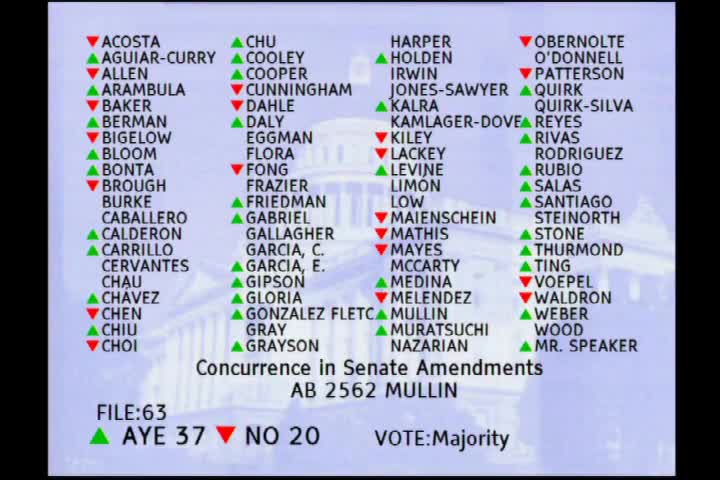 1MIN
Assembly Floor
 1H
Senate Standing Committee on Appropriations
 1MIN
Assembly Floor
 4MIN
Assembly Standing Committee on Veterans Affairs
Bill Author

Bill Co-Author(s):
