AB 2751: Agricultural labor relations.
- Session Year: 2017-2018
- House: Assembly
- Latest Version Date: 2018-09-23
Existing law, the Alatorre-Zenovich-Dunlap-Berman Agricultural Labor Relations Act of 1975, grants agricultural employees the right to form and join labor organizations and engage in collective bargaining with respect to wages, terms of employment, and other employment conditions. The act creates the Agricultural Labor Relations Board (ALRB).
The act prohibits agricultural employers and labor organizations from engaging in unfair labor practices, as defined, and empowers the ALRB to prevent any person from engaging in those practices.
This bill would require the ALRB to process to final board order, within one year, all decisions concerning make-whole awards, backpay, and other monetary awards to employees, or any board order finding liability for an award, unless the ALRB makes a specified certification to the parties.
Existing law authorizes an agricultural employer or a labor organization certified as the exclusive bargaining agent of a bargaining unit of agricultural employees to file with the board, at specified times, a declaration that the parties have failed to reach a collective bargaining agreement and a request that the board issue an order directing the parties to mandatory mediation and conciliation of their issues. Existing law requires the mediator to file a report with the board that may become a final order of the board, or the board may determine the issues and issue a final order of the board, as specified.
Existing law authorizes either party or the board to file an action to enforce the order of the board in the superior court for the County of Sacramento or in the county where either partys principal place of business is located; however, the law prohibits enforcement of a pending board order unless the court makes specified findings.
This bill would, instead, require immediate implementation of the board order during the pendency of any challenge, appeal, writ of review, or other action seeking to modify or overturn a board order, unless the court makes specified findings. The bill would require at the conclusion of any review proceedings commenced under these provisions in which the boards order is affirmed, and the terms set forth in the boards order are not implemented or effective, the agricultural employer and the labor organization to immediately implement the boards order.
The bill would specify a procedure for either the agricultural employer or labor organization to file a request with the board for referral to mandatory mediation and conciliation if a collective bargaining agreement in a mediators report adopted as a final board order includes a duration provision setting a term for the agreement that has since expired during the course of any review proceedings, or other provisions that have become outdated or otherwise moot as a result of the passage of time during the course of review proceedings.
Existing regulatory law, applicable to all outdoor places of employment, among other things, requires that employees have access to potable water and be encouraged to drink water frequently, that the employer have and maintain one or more areas with shade at all times while employees are present that are either open to the air or provided with ventilation or cooling, and that the employer implement high-heat procedures when the temperature equals or exceeds 95 degrees Fahrenheit, as specified.
This bill would authorize the requirements described above to be known and cited as the Maria Isabel Vasquez Jimenez heat illness standard.
Existing law, the Alatorre-Zenovich-Dunlap-Berman Agricultural Labor Relations Act of 1975, grants agricultural employees the right to form and join labor organizations and engage in collective bargaining with respect to wages, terms of employment, and other employment conditions. The act creates the Agricultural Labor Relations Board. Board (ALRB).
The act provides a mediation procedure applicable to specified agricultural employers and a labor organization certified as the exclusive bargaining agent of a bargaining unit of agricultural employees. Under the act, either party is permitted to file with the board, following a specified period, a declaration that the parties have failed to reach a collective bargaining agreement. The act requires the board, upon receipt of a declaration pursuant to this procedure, to immediately issue an order directing the parties to mandatory mediation and conciliation with an appointed mediator of the issues for a specified period.The act requires the mediator, if the parties do not resolve the issues to their mutual satisfaction, to certify that the mediation process has been exhausted and requires the mediator to file a report with the board that resolves all issues between the parties and establishes the final terms of a collective bargaining agreement. The act permits either party, within a specified period, to petition the board to review the mediators report, and requires the mediators report to become the final order of the board, unless the board accepts the petition for review.The act prohibits agricultural employers and labor organizations from engaging in unfair labor practices, as defined, and empowers the ALRB to prevent any person from engaging in those practices.
This bill would require the board to conduct and complete an expedited study by January 31, 2019, on how to eliminate delays and expedite the implementation of collective bargaining agreements ordered by the board after the completion of the mandatory mediation procedures and would require the board to provide for recommendations and adopt regulations to implement any recommendations by June 1, 2019. ALRB to process to final board order, within one year, all decisions concerning make-whole awards, backpay, and other monetary awards to employees, or any board order finding liability for an award, unless the ALRB makes a specified certification to the parties.
Existing law, the Alatorre-Zenovich-Dunlap-Berman Agricultural Labor Relations Act of 1975, grants agricultural employees the right to form and join labor organizations and engage in collective bargaining with respect to wages, terms of employment, and other employment conditions. The act creates the Agricultural Labor Relations Board.
The act provides a mediation procedure applicable to specified agricultural employers and a labor organization certified as the exclusive bargaining agent of a bargaining unit of agricultural employees. Under the act, either party is permitted to file with the board, following a specified period, a declaration that the parties have failed to reach a collective bargaining agreement. The act requires the board, upon receipt of a declaration pursuant to this procedure, to immediately issue an order directing the parties to mandatory mediation and conciliation with an appointed mediator of the issues for a specified period.
The act requires the mediator, if the parties do not resolve the issues to their mutual satisfaction, to certify that the mediation process has been exhausted and requires the mediator to file a report with the board that resolves all issues between the parties and establishes the final terms of a collective bargaining agreement. The act permits either party, within a specified period, to petition the board to review the mediators report, and requires the mediators report to become the final order of the board, unless the board accepts the petition for review.
This bill would require the board to conduct and complete an expedited study by January 31, 2019, on how to eliminate delays and expedite the implementation of collective bargaining agreements ordered by the board after the completion of the mandatory mediation procedures and would require the board to provide for recommendations and adopt regulations to implement any recommendations by June 1, 2019.
Existing law, the Alatorre-Zenovich-Dunlap-Berman Agricultural Labor Relations Act of 1975, affords agricultural employees the right to self-organization and to form, join, or assist labor organizations.This bill would state the intent of the Legislature to enact legislation to amend that act to protect the rights of agricultural employees.Existing law, the Alatorre-Zenovich-Dunlap-Berman Agricultural Labor Relations Act of 1975, affords agricultural employees the right to self-organization and to form, join, or assist labor organizations.
This bill would state the intent of the Legislature to enact legislation to amend that act to protect the rights of agricultural employees.
(a)The board shall process to final board order all decisions concerning make-whole awards, backpay, and other monetary awards to employees, within one year of any board order finding liability for that award, unless the board certifies to the parties that there is good cause for exceeding this time limit and provides a reasoned explanation for the assertion of good cause.
(b)If the board has already made a finding that an employer is liable for a make-whole, backpay, or other monetary award to an employee or employees, and a compliance proceeding is necessary to determine the specific amount owed by the employer, the board shall process to final board order a decision concerning the amount or amounts owed within one year of the time that a final decision on employer liability has been made by the board, unless the board certifies to the parties that there is good cause for exceeding this time limit and provides a reasoned explanation for the assertion of good cause. For purposes of this subdivision, final decision on employer liability means either the date when a board order concerning liability becomes final because no appeal was sought or the date when a reviewing court dismisses an employers appeal or decides in favor of the board concerning the employers liability.
(c)If an employers liability and compliance proceedings are consolidated, the board shall act reasonably and without delay in reaching a final decision concerning the liability and amounts owed to workers, and shall explain to the parties any good cause for delay.
SEC. 2.Section 1164.3 of the Labor Code is amended to read:1164.3.(a)Either party, within seven days of the filing of the report by the mediator, may petition the board for review of the report. The petitioning party shall, in the petition, specify the particular provisions of the mediators report for which it is seeking review by the board and shall specify the specific grounds authorizing review by the board. The board, within 10 days of receipt of a petition, may accept for review those portions of the petition for which a prima facie case has been established that (1) a provision of the collective bargaining agreement set forth in the mediators report is unrelated to wages, hours, or other conditions of employment within the meaning of Section 1155.2, (2) a provision of the collective bargaining agreement set forth in the mediators report is based on clearly erroneous findings of material fact, or (3) a provision of the collective bargaining agreement set forth in the mediators report is arbitrary or capricious in light of the mediators findings of fact.
(b)If it finds grounds exist to grant review within the meaning of subdivision (a), the board shall order the provisions of the report that are not the subject of the petition for review into effect as a final order of the board. If the board does not accept a petition for review or no petition for review is filed, then the mediators report shall become a final order of the board.
(c)The board shall issue a decision concerning the petition and if it determines that a provision of the collective bargaining agreement contained in the mediators report violates the provisions of subdivision (a), it shall, within 21 days, issue an order requiring the mediator to modify the terms of the collective bargaining agreement. The mediator shall meet with the parties for additional mediation for a period not to exceed 30 days. At the expiration of this mediation period, the mediator shall prepare a second report resolving any outstanding issues. The second report shall be filed with the board.
(d)Either party, within seven days of the filing of the mediators second report, may petition the board for a review of the mediators second report pursuant to the procedures specified in subdivision (a). If no petition is filed, the mediators report shall take immediate effect as a final order of the board. If a petition is filed, the board shall issue an order confirming the mediators report and order it into immediate effect, unless it finds that the report is subject to review for any of the grounds specified in subdivision (a), in which case the board shall determine the issues and shall issue a final order of the board.
(e)Either party, within seven days of the filing of the report by the mediator, may petition the board to set aside the report if a prima facie case is established that any of the following have occurred: (1) the mediators report was procured by corruption, fraud, or other undue means, (2) there was corruption in the mediator, or (3) the rights of the petitioning party were substantially prejudiced by the misconduct of the mediator. For the sole purpose of interpreting the terms of paragraphs (1), (2), and (3), case law that interprets similar terms used in Section 1286.2 of the Code of Civil Procedure shall apply. If the board finds that any of these grounds exist, the board shall within 10 days vacate the report of the mediator and shall order the selection and appointment of a new mediator, and an additional mediation period of 30 days, pursuant to Section 1164.
(f)(1)Notwithstanding Section 1164.9, within 60 days after the order of the board takes effect, even if a party seeks to challenge, appeal, overturn, modify, or stay in any manner any order of the board under these provisions, either party or the board may file an action to enforce the order of the board, in the superior court for the County of Sacramento or in the county where either partys principal place of business is located.
(2)To the extent that the boards decision in Ace Tomato Co., Inc. (2012) 38 ALRB No. 8, states that a party cannot enforce a board order while an appeal or challenge to the board order in any form is pending, this section abrogates that decision. During the pendency of any challenge, appeal, writ of review, or other action seeking to modify or overturn a board order, the parties shall be required to implement the terms of the boards order immediately upon issuance of the order.
(3)No final order of the board shall be stayed during any review under this chapter unless the court finds and states in its findings that (1) the appellant or petitioner has demonstrated, by clear and convincing evidence, that he or she will be irreparably harmed by the implementation of the boards order, and (2) the appellant or petitioner has demonstrated, by clear and convincing evidence, a likelihood of success on appeal. For purposes of this section, the court deciding the stay shall provide written findings and analysis supporting the decision to grant a stay.
SEC. 3.Section 1164.10 is added to the Labor Code, to read:1164.10.(a)At the conclusion of any review proceedings commenced under this chapter in which the boards order is affirmed, and the terms set forth in the boards order are not implemented or effective, the agricultural employer and the labor organization shall immediately implement the boards order if the order has not already been implemented.
(b)If a collective bargaining agreement in a mediators report adopted as a final board order includes a duration provision setting a term for the agreement that has since expired during the course of any review proceedings, or other provisions that have become outdated or otherwise moot as a result of the passage of time during the course of review proceedings, either the agricultural employer or labor organization may file a request with the board for referral to mandatory mediation and conciliation with the original mediator that decided the disputed issues for purposes of updating those specific provisions. If that mediator is unavailable, the parties may agree to another mediator or the board shall request a list of mediators in accordance with subdivision (b) of Section 1164, and the parties shall be required to select a mediator within 48 hours of receipt of the mediator list, exclusive of weekends or holidays. Any request for referral to mediation shall be filed within 15 days after any judicial review proceedings become final. Any supplemental mandatory mediation and conciliation proceedings provided for in this section shall not extend to any other issues.
(c)Mandatory mediation and conciliation proceedings ordered by the board under subdivision (b) shall be in accordance with the provisions of this chapter, as applicable, except as provided in this subdivision. The mediation under this section shall be scheduled within seven days of the selection or reselection of the mediator. For purposes of complying with this seven-day period, the mediation may occur by telephone if so ordered by the mediator and the parties may submit their written positions and evidence electronically to the mediator. The mediator shall have 10 days to issue an order on the issues in dispute. The review provisions contained in Sections 1164.3 and 1164.5 shall apply.
SEC. 4.Section 6721 is added to the Labor Code, to read:6721.The heat illness prevention standards set forth in Section 3395 of Title 8 of the California Code of Regulations shall be known, and may be cited, as the Maria Isabel Vasquez Jimenez heat illness standard.
(a)The board shall process to final board order all decisions concerning make-whole awards, backpay, and other monetary awards to employees, within one year of any board order finding liability for that award, unless the board certifies to the parties that there is good cause for exceeding this time limit and provides a reasoned explanation for the assertion of good cause.
(b)If the board has already made a finding that an employer is liable for a make-whole, backpay, or other monetary award to an employee or employees, and a compliance proceeding is necessary to determine the specific amount owed by the employer, the board shall process to final board order a decision concerning the amount or amounts owed within one year of the time that a final decision on employer liability has been made by the board, unless the board certifies to the parties that there is good cause for exceeding this time limit and provides a reasoned explanation for the assertion of good cause. For purposes of this subdivision, final decision on employer liability means either the date when a board order concerning liability becomes final because no appeal was sought or the date when a reviewing court dismisses an employers appeal or decides in favor of the board concerning the employers liability.
(c)If an employers liability and compliance proceedings are consolidated, the board shall act reasonably and without delay in reaching a final decision concerning the liability and amounts owed to workers, and shall explain to the parties any good cause for delay.
SEC. 2.Section 1164.3 of the Labor Code is amended to read:1164.3.(a)Either party, within seven days of the filing of the report by the mediator, may petition the board for review of the report. The petitioning party shall, in the petition, specify the particular provisions of the mediators report for which it is seeking review by the board and shall specify the specific grounds authorizing review by the board. The board, within 10 days of receipt of a petition, may accept for review those portions of the petition for which a prima facie case has been established that (1) a provision of the collective bargaining agreement set forth in the mediators report is unrelated to wages, hours, or other conditions of employment within the meaning of Section 1155.2, (2) a provision of the collective bargaining agreement set forth in the mediators report is based on clearly erroneous findings of material fact, or (3) a provision of the collective bargaining agreement set forth in the mediators report is arbitrary or capricious in light of the mediators findings of fact.
(b)If it finds grounds exist to grant review within the meaning of subdivision (a), the board shall order the provisions of the report that are not the subject of the petition for review into effect as a final order of the board. If the board does not accept a petition for review or no petition for review is filed, then the mediators report shall become a final order of the board.
(c)The board shall issue a decision concerning the petition and if it determines that a provision of the collective bargaining agreement contained in the mediators report violates the provisions of subdivision (a), it shall, within 21 days, issue an order requiring the mediator to modify the terms of the collective bargaining agreement. The mediator shall meet with the parties for additional mediation for a period not to exceed 30 days. At the expiration of this mediation period, the mediator shall prepare a second report resolving any outstanding issues. The second report shall be filed with the board.
(d)Either party, within seven days of the filing of the mediators second report, may petition the board for a review of the mediators second report pursuant to the procedures specified in subdivision (a). If no petition is filed, the mediators report shall take immediate effect as a final order of the board. If a petition is filed, the board shall issue an order confirming the mediators report and order it into immediate effect, unless it finds that the report is subject to review for any of the grounds specified in subdivision (a), in which case the board shall determine the issues and shall issue a final order of the board.
(e)Either party, within seven days of the filing of the report by the mediator, may petition the board to set aside the report if a prima facie case is established that any of the following have occurred: (1) the mediators report was procured by corruption, fraud, or other undue means, (2) there was corruption in the mediator, or (3) the rights of the petitioning party were substantially prejudiced by the misconduct of the mediator. For the sole purpose of interpreting the terms of paragraphs (1), (2), and (3), case law that interprets similar terms used in Section 1286.2 of the Code of Civil Procedure shall apply. If the board finds that any of these grounds exist, the board shall within 10 days vacate the report of the mediator and shall order the selection and appointment of a new mediator, and an additional mediation period of 30 days, pursuant to Section 1164.
(f)Within (1)Notwithstanding Section 1164.9, within 60 days after the order of the board takes effect, even if a party seeks to challenge, appeal, overturn, modify, or stay in any manner any order of the board under these provisions, either party or the board may file an action to enforce the order of the board, in the superior court for the County of Sacramento or in the county where either partys principal place of business is located. To
(2)To the extent that the boards decision in Ace Tomato Co., Inc. (2012) 38 ALRB No. 8, states that a party cannot enforce a board order while an appeal or challenge to the board order in any form is pending, this section abrogates that decision. During the pendency of any challenge, appeal, writ of review, or other action seeking to modify or overturn a board order, the parties shall be required to implement the terms of the boards order immediately upon issuance of the order. No
(3)No final order of the board shall be stayed during any appeal review under this section, chapter unless the court finds and states in its findings that (1) the appellant or petitioner has demonstrated, by clear and convincing evidence, that he or she will be irreparably harmed by the implementation of the boards order, and (2) the appellant has demonstrated or petitioner has demonstrated, by clear and convincing evidence, a likelihood of success on appeal. For purposes of this section, the court deciding the stay shall provide written findings and analysis supporting the decision to grant a stay.
SEC. 3.Section 1164.10 is added to the Labor Code, to read:1164.10.(a)At the conclusion of any review proceedings commenced under this chapter in which the boards order is affirmed, and the terms set forth in the boards order are not implemented or effective, the agricultural employer and the labor organization shall immediately implement the boards order if the order has not already been implemented.
(b)If a collective bargaining agreement in a mediators report adopted as a final board order includes a duration provision setting a term for the agreement that has since expired during the course of any review proceedings, or other provisions that have become outdated or otherwise moot as a result of the passage of time during the course of review proceedings, either the agricultural employer or labor organization may file a request with the board for referral to mandatory mediation and conciliation with the original mediator that decided the disputed issues for purposes of updating those specific provisions. If that mediator is unavailable, the parties may agree to another mediator or the board shall request a list of mediators in accordance with subdivision (b) of Section 1164, and the parties shall be required to select a mediator within 48 hours of receipt of the mediator list, exclusive of weekends or holidays. Any request for referral to mediation shall be filed within 15 days after any judicial review proceedings become final. Any supplemental mandatory mediation and conciliation proceedings provided for in this section shall not extend to any other issues.
(c)Mandatory mediation and conciliation proceedings ordered by the board under subdivision (b) shall be in accordance with the provisions of this chapter, as applicable, except as provided in this subdivision. The mediation under this section shall be scheduled within seven days of the selection or reselection of the mediator. For purposes of complying with this seven-day period, the mediation may occur by telephone if so ordered by the mediator and the parties may submit their written positions and evidence electronically to the mediator. The mediator shall have 10 days to issue an order on the issues in dispute. The review provisions contained in Sections 1164.3 and 1164.5 shall apply.
SEC. 4.Section 6721 is added to the Labor Code, to read:6721.The heat illness prevention standards set forth in Section 3395 of Title 8 of the California Code of Regulations shall be known, and may be cited, as the Maria Isabel Vasquez Jimenez heat illness standard.
(a)The board shall process to final board order all decisions concerning make-whole awards, backpay, and other monetary awards to employees, within one year of any board order finding liability for that award, unless the board certifies to the parties that there is good cause for exceeding this time limit and provides a reasoned explanation for the assertion of good cause.
(b)If the board has already made a finding that an employer is liable for a make-whole, backpay, or other monetary award to an employee or employees, and a compliance proceeding is necessary to determine the specific amount owed by the employer, the board shall process to final board order a decision concerning the amount or amounts owed within one year of the time that a final decision on employer liability has been made by the board, unless the board certifies to the parties that there is good cause for exceeding this time limit and provides a reasoned explanation for the assertion of good cause. For purposes of this subdivision, final decision on employer liability means either the date when a board order concerning liability becomes final because no appeal was sought or the date when a reviewing court dismisses an employers appeal or decides in favor of the board concerning the employers liability.
(c)If an employers liability and compliance proceedings are consolidated, the board shall act reasonably and without delay in reaching a final decision concerning the liability and amounts owed to workers, and shall explain to the parties any good cause for delay.
SECTION 1.Section 1150.5 is added to the Labor Code, to read:1150.5.The board shall conduct and complete an expedited study by January 31, 2019, on how to eliminate delays and expedite the implementation of collective bargaining agreements ordered by the board after the completion of the mandatory mediation and conciliation procedures in Chapter 6.5 (commencing with Section 1164). The board shall provide for recommendations and adopt regulations to implement any recommendations by June 1, 2019.The board shall conduct and complete an expedited study by January 31, 2019, on how to eliminate delays and expedite the implementation of collective bargaining agreements ordered by the board after the completion of the mandatory mediation and conciliation procedures in Chapter 6.5 (commencing with Section 1164). The board shall provide for recommendations and adopt regulations to implement any recommendations by June 1, 2019.
SECTION 1.It is the intent of the Legislature to enact legislation to amend the Alatorre-Zenovich-Dunlap-Berman Agricultural Labor Relations Act of 1975 (Part 3.5 (commencing with Section 1140) of Division 2 of the Labor Code) to protect the rights of agricultural employees.It is the intent of the Legislature to enact legislation to amend the Alatorre-Zenovich-Dunlap-Berman Agricultural Labor Relations Act of 1975 (Part 3.5 (commencing with Section 1140) of Division 2 of the Labor Code) to protect the rights of agricultural employees.
|
Date
|
Status
|
|---|---|
| Sep 23, 2018 | Chaptered by Secretary of State - Chapter 718, Statutes of 2018. |
| Sep 23, 2018 | Approved by the Governor. |
| Sep 7, 2018 | Enrolled and presented to the Governor at 2:30 p.m. |
| Aug 29, 2018 | Senate amendments concurred in. To Engrossing and Enrolling. |
| Aug 24, 2018 | In Assembly. Concurrence in Senate amendments pending. May be considered on or after August 26 pursuant to Assembly Rule 77. |
| Aug 24, 2018 | Read third time. Passed. Ordered to the Assembly. |
| Aug 20, 2018 | Read second time. Ordered to third reading. |
| Aug 17, 2018 | Read second time and amended. Ordered returned to second reading. |
| Jul 2, 2018 | In committee: Referred to APPR. suspense file. |
| Jun 19, 2018 | From committee: Do pass and re-refer to Com. on APPR. (Ayes 4. Noes 1.) (June 19). Re-referred to Com. on APPR. |
| Jun 13, 2018 | Referred to Com. on L. & I.R. |
| Jun 4, 2018 | In Senate. Read first time. To Com. on RLS. for assignment. |
| May 31, 2018 | Read third time. Passed. Ordered to the Senate. |
| May 29, 2018 | Read second time. Ordered to third reading. |
| May 25, 2018 | From committee: Amend, and do pass as amended. (Ayes 12. Noes 4.) (May 25). |
| May 2, 2018 | In committee: Set, first hearing. Referred to APPR. suspense file. |
| Apr 19, 2018 | From committee: Do pass and re-refer to Com. on APPR. (Ayes 5. Noes 2.) (April 18). Re-referred to Com. on APPR. |
| Apr 2, 2018 | Re-referred to Com. on L. & E. |
| Mar 22, 2018 | Referred to Com. on L. & E. |
| Feb 17, 2018 | From printer. May be heard in committee March 19. |
| Feb 16, 2018 | Read first time. To print. |
|
Date
|
Description
|
Location
|
Votes
|
|
|---|---|---|---|---|
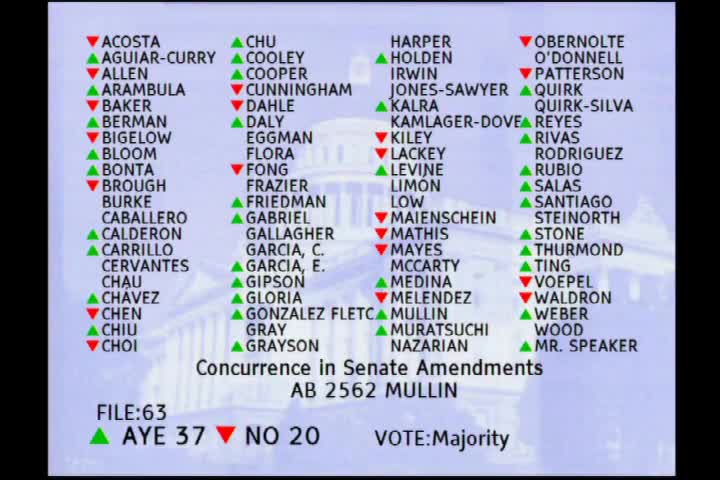
| Aug 29, 2018 | AB 2751 STONE Concurrence in Senate Amendments | Assembly Floor |
Passed |
|
| Aug 24, 2018 | Assembly 3rd Reading AB2751 Mark Stone By Monning | Senate Floor |
Passed |
|
| Aug 16, 2018 | Do pass as amended | Senate Standing Committee on Appropriations |
Passed |
|
| Jul 2, 2018 | Placed on suspense file | Senate Standing Committee on Appropriations |
Passed |
|
| Jun 19, 2018 | Do pass, but first be re-referred to the Committee on [Appropriations] | Senate Standing Committee on Labor and Industrial Relations |
Passed |
|
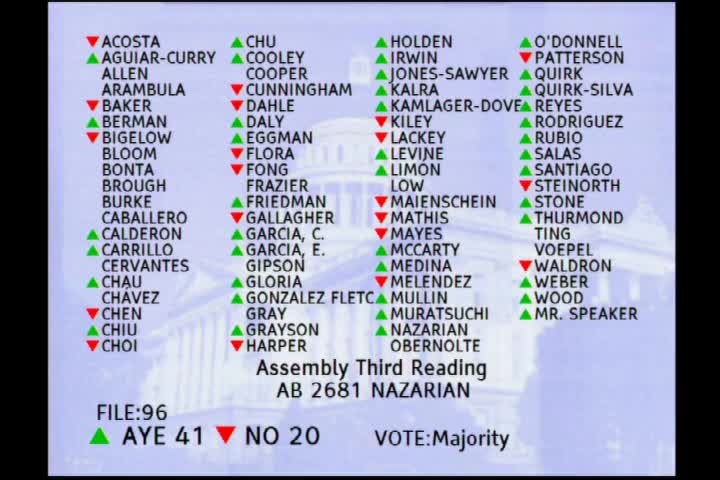
| May 31, 2018 | AB 2751 STONE Assembly Third Reading | Assembly Floor |
Passed |
|
| May 25, 2018 | Do pass as amended. | Assembly Standing Committee on Appropriations |
Passed |
|
| Apr 18, 2018 | Do pass and be re-referred to the Committee on [Appropriations] | Assembly Standing Committee on Labor and Employment |
Passed |
This list shows positions taken on this bill by organizations on the date displayed, which is linked to the original source.
Positions by individuals are not included.
|
Organization
|
Position
|
Date
|
|---|---|---|
| Alrb Has Made A Final Ruling. | ** Against | Aug 19, 2018 |
| California Citrus Mutual | ** Against | Aug 19, 2018 |
| California Farm Bureau Federation | ** Against | Aug 19, 2018 |
| California Fresh Fruit Association | ** Against | Aug 19, 2018 |
| California Rural Legal Assistance Foundation | * Support | Apr 18, 2018 |
| California Teamsters | ** Support | Aug 19, 2018 |
| Growers And Shippers Association Of Central California | ** Against | Aug 19, 2018 |
| United Farm Workers | ** Support | Aug 19, 2018 |
| Ventura County Agricultural Association | ** Against | Aug 19, 2018 |
| Western Growers | ** Against | Aug 19, 2018 |
CONCURRENCE IN SENATE AMENDMENTS
CSA1 Bill Id:AB 2751
Author:(Mark Stone)
As Amended Ver:August 17, 2018
Majority vote
ASSEMBLY: | 53-25 | (May 31, 2018) | SENATE: | 22-12 | (August 24, 2018) |
Original Committee Reference: L. & E.
SUMMARY: Requires the Agricultural Labor Relations Board (ALRB) to process to final board order all decisions with monetary remedies owed to employees, including those with compliance proceedings, within one year of a finding of liability. Also requires immediate implementation of a final board order resulting from mandatory mediation and provides a process to request mandatory mediation if specified provisions of a previously mediated agreement have expired.
The Senate amendments:
- Provide that within 60 days of an ALRB order adopting the collective bargaining provisions in a mediator's report, either party or the board may file an action for enforcement despite any pending legal challenge, appeal, or writ of review.
- Require immediate implementation of an ALRB order adopting a mediator's report by the parties regardless of any pending legal challenge, appeal, or writ of review.
- Require, in an action to stay a final ALRB order, a finding of clear and convincing evidence of success on appeal and irreparable harm to either an appellant or a petitioner.
- Establish a procedure for either party to request a referral to mandatory mediation and conciliation if a collective bargaining agreement set forth in a mediator's report and adopted as a final ALRB order has expired, become outdated, or is otherwise moot as a result of the passage of time.
EXISTING LAW:
- Grants to agricultural employees the right to form and join labor organizations and engage in collective bargaining with respect to wages, terms of employment, and other employment conditions.
- Prohibits agricultural employers and labor organizations from engaging in unfair labor practices, as defined.
- Empowers the ALRB to issue certain remedies in the event that an agricultural employer or a labor organization commits an unfair labor practice.
- Establishes conditions under which a certified labor organization or an agricultural employer may file a declaration with the ALRB stating that the parties have failed to reach a collective bargaining agreement, thus triggering a board order for mandatory mediation.
- Requires the mediator to file a report with the board that resolves all of the issues between the parties and establishes the final terms of a collective bargaining agreement which may become the final order of the board.
FISCAL EFFECT: According to the Senate Appropriations Committee, the ALRB indicates that it would incur annual costs of $249,000 to implement the provisions of this bill (General Fund).
COMMENTS: According to the author, the need for this bill stems from extreme delays in the enforcement of certain ALRB decisions. He cites a series of cases, known as Ace Tomato, [1] as an example. In this long-standing dispute, the United Farm Workers (UFW) was certified in 1992 to represent the employees in bargaining but the employer refused to negotiate a contract. It wasn't until 21 years later that the parties reached a partial settlement to have the employer pay penalties for lost wages to the workers.
Analysis Prepared by: Megan Lane / L. & E. /(916) 319-2091 FN: 0004560
The UFW sued Ace Tomato Company Inc. numerous times for failure to bargain and follow orders of the board starting in 1993 (20 ALRB No. 7). ↑
Office of Senate Floor Analyses (916) 651-1520 Fax: (916) 327-4478 | AB |
THIRD READING
Bill No: AB 2751
Amended: 8/17/18 in Senate
SENATE LABOR & IND. REL. COMMITTEE: 4-1, 6/19/18
AYES: Lara, Jackson, Mitchell, Wieckowski
NOES: Stone
SENATE APPROPRIATIONS COMMITTEE: 5-2, 8/16/18
AYES: Portantino, Beall, Bradford, Hill, Wiener
NOES: Bates, Nielsen
ASSEMBLY FLOOR: 53-25, 5/31/18 - See last page for vote
DIGEST:
This bill requires that the Agricultural Labor Relations Board (ALRB), within one year of a finding of liability, process all decisions concerning monetary awards owed to agricultural employees, unless the ALRB certifies that there is good cause for a delay. This bill also creates new mediation and conciliation timeline requirements for appealing or disputing a final decision of the ALRB.
Existing law:
- Provides agricultural employees with the right to self-organization, to form, join, or assist labor organizations, to bargain collectively through representatives of their own choosing, and to engage in other concerted activities for the purpose of collective bargaining or other mutual aid or protection. Existing law also provides the right to refrain from any or all of such activities, as specified. (Labor Code §1152)
- Provides for a secret ballot election process for agricultural workers where a petition has been submitted, as specified, asking for the opportunity for workers to decide whether to select a particular union as their collective bargaining representative. (Labor Code §§1140 to 1166.3)
- Provides that it is an unfair labor practice for an agricultural employer to do any of the following:
- To interfere with, restrain, or coerce agricultural employees in the exercise of the rights described above.
- To dominate or interfere with the formation or administration of any labor organization or contribute financial or other support to it.
- By discrimination in regard to the hiring or tenure of employment, or any term or condition of employment, to encourage or discourage membership in any labor organization.
- To discharge or otherwise discriminate against an agricultural employee because he has filed charges or given testimony under this part.
- To refuse to bargain collectively in good faith with labor organizations certified pursuant to the Agricultural Labor Relations Act (ALRA).
- To recognize, bargain with, or sign a collective-bargaining agreement with any labor organization not certified pursuant to the provisions of this part. (Labor Code §1152)
- Provides that, whenever it is charged that any person has engaged in or is engaging in any such unfair labor practice, the ALRB has the power to issue and cause to be served upon such person a complaint stating the charges in that respect, and containing a notice of hearing before the ALRB not less than five days after the serving of such complaint. (Labor Code §1160.2)
- Provides that, if upon the preponderance of the testimony taken, the ALRB finds that any person named in the complaint has engaged in or is engaging in any such unfair labor practice, issue an order requiring such person to cease and desist from such unfair labor practice, to take affirmative action, including reinstatement of employees with or without backpay, and making employees whole, when the ALRB deems such relief appropriate. (Labor Code §1160.3)
- Provides that no court of this state, except the court of appeal or the Supreme Court, to the extent specified in the law, has jurisdiction to review, reverse, correct, or annul any order or decision of the board to suspend or delay the execution or operation thereof, or to enjoin, restrain, or interfere with the board in the performance of its official duties, as provided by law and the rules of court. (Labor Code §1164.9)
This bill:
- Requires that, board shall process to final board order all decisions concerning make-whole awards, backpay, and other monetary awards to employees, within one year of any board order finding liability for that award, unless the board certifies to the parties that there is good cause for exceeding this time limit and provides a reasoned explanation for the assertion of good cause.
- Provides that, if the ALRB has already made a finding that an employer is liable for a make-whole, backpay, or other monetary award to an employee or employees, and a compliance proceeding is necessary to determine the specific amount owed by the employer, the ALRB must process to final ALRB order a decision concerning the amount or amounts owed within one year of the time that a final decision on employer liability has been made by the ALRB , unless the board certifies to the parties that there is good cause for exceeding this time limit and provides a reasoned explanation for the assertion of good cause.
- Defines “final decision on employer liability” as either the date when an ALRB order concerning liability becomes final because no appeal was sought or the date when a reviewing court dismisses an employer’s appeal or decides in favor of the board concerning the employer’s liability.
- Provides that, if an employer’s liability and compliance proceedings are consolidated, the ALRB must act reasonably and without delay in reaching a final decision concerning the liability and amounts owed to workers, and shall explain to the parties any good cause for delay.
- Provides that, even if a party seeks to challenge, appeal, modify, or stay a decision of the ALRB, the decision must go into effect within 60 days.
- Abrogates the ALRB decision in Ace Tomato Company (2012) 38 ALRB No.8 to the degree that the decision states that a party cannot enforce a board order while an appeal or challenge to the ALRB order is pending.
- Requires that, at the conclusion of a judicial review where the ALRB’s decision is affirmed, the must immediately implement the ALRB order if the order has not already been implemented.
- Provides that, if a collective bargaining agreement in a mediator’s report adopted as a final ALRB agreement includes a duration provision, and that duration provision has elapsed, or other provisions have been rendered moot by the passage of time, either party can request a referral by the ALRB to mandatory mediation and conciliation with the original mediator for the purposes of updating those specific provisions.
- Provides that, if the original mediator is unavailable, the parties may agree to another mediator or the parties can select another mediator from a list of mediators supplied by the ALRB. The selection of the mediator must occur within 48 hours.
- Requires that any request for mediation described above be filed within 15 days of the judicial review proceedings becoming final, and that the mediation not extend to any other issues.
- Requires that mandatory mediation and conciliation proceedings described above must be in accordance with existing law, as applicable, except:
- Mediation must be scheduled within 7 days of the selection or reselection of the mediator;
- For purposes of complying with the 7 day period, mediation may occur by telephone is so ordered by the mediator, and the parties may submit written positions and evidence electronically to the mediator.
- The mediator shall have 10 days to issue an order on the issues in dispute.
- Requires that the heat illness prevention standards created by regulations must be cited as the Maria Isabel Vasquez Jimenez heat illness standard.
Comments
- A Brief Word on Mandatory Mediation
One of the more controversial aspects of agricultural worker collective bargaining has been the mandatory mediation process. The mandatory mediation process was created by two bills, SB 1156 (Burton) and AB 2596 (Wesson) in 2002. While the provisions of the mediation process have undergone some minor tweaks, the mediation process provided under existing law remains largely unchanged. Principally, the limitations on when an agricultural employer or a labor organization can ask for the mandatory mediation process remain the same.
They are:
- The parties have failed to reach agreement for at least one year after the date on which the labor organization made its initial request to bargain;
- The employer has committed an unfair labor practice, and
- The parties have not previously had a binding contract between them.
Assuming the above-requirements are met and the above-discussed timelines are past, a request for mandatory mediation triggers a specific process. The ALRB must immediately issue an order directing both parties to meditation and asks the California State Mediation and Conciliation Service for a list of nine mediators who have experience in labor mediation. Both parties select a mediator from the list; if they cannot agree, they strike names from the list until a mediator is selected by the process of elimination. The costs of the mediation process are borne equally by both parties.
Upon appointment, the mediator schedules a 30-day period for mediation, which can be extended if necessary. If issues are outstanding after the 30 day period, the mediation process is considered exhausted. Within 21 days, the mediator issues the final terms of a collective bargaining agreement, including issues in dispute by the parties. If the mediator decides issues in dispute, the mediator must explain the basis for his or her ruling. Within seven days of the ruling, either party may appeal a mediator’s decision to the ALRB. The ALRB may only review the mediators decision if:
- The mediator’s decision goes beyond wages, hours, and working conditions of employment;
- The mediator’s decision is based on clearly erroneous findings of material fact; or
- The mediator’s report is arbitrary or capricious.
If neither of the above conditions exists, the mediator’s report becomes the final order of the ALRB. If one or more of the above conditions exists, then the mediator mediates the process again. If, after issuing a new decision, a party believes that the mediator is corrupt, then a new mediator would be called in. Finally, either party could ask for a stay from a court. A stay would be granted if the court believed that the mediator’s decision would cause irreparable economic harm and the appeal had a strong chance for success.
Related/Prior Legislation
SB 126 (Steinberg, Chapter 697, Statutes of 2011) reformed the Agricultural Labor Relations Act to provide explicit authority to the ALRB for bargaining orders, to provide explicit timelines for election challenges and to strengthen mandatory mediation requirements.
FISCAL EFFECT: Appropriation: Fiscal Com.: Local:
According to the Senate Appropriations Committee, the ALRB indicates that it would incur annual costs of $249,000 to implement the provisions of the bill (General Fund).
United Farm Workers (source)
California Teamsters
OPPOSITION: (Verified 8/17/18)
California Citrus Mutual
California Farm Bureau Federation
California Fresh Fruit Association
Growers and Shippers Association of Central California
Ventura County Agricultural Association
Western Growers
ARGUMENTS IN SUPPORT: United Farm Workers, the sponsor of this bill, argues the following in support:
AB 2751 helps to expedite the process for farm workers to recover their fair wages and benefits by requiring the Agricultural Labor Relations Board (ALRB) to reach a compliance decision within one year of the ALRB finding liability for such wages and benefits.
Farm workers deserve to receive their wages and benefits within a reasonable time.
AB 2751 honors the results of farm worker elections, and applies only after the
ALRB has made a final ruling.
ARGUMENTS IN OPPOSITION: A group of organizations, including California Citrus Mutual and Western Growers, oppose this bill, arguing:
AB 2751, as written, introduces vague terminology which may well serve to undermine its intended goal of speeding up the process of enforcing ALRB Board orders involving monetary remedies. For example, in addition to its references to make-whole and backpay awards, the bill refers to “any other monetary award.” Long-time practitioners before the ALRB are not aware of “any other monetary award” that the ALRB is empowered to order, and the concern is whether the bill seeks to suggest ALRB authority where none exists…
We question its narrow focus on awards solely against employers when there can be awards against unions under the ALRA… There is absolutely no reason for the bill to be written in such a biased manner given its stated goals.
The bill ignores the complexity of situations where ongoing court challenges of ALRB decisions or related matters are active. For example, there may be monetary awards resulting from bad faith bargaining while a related case involving the same parties which is still pending may result in there being no duty to bargain in the first place. We believe such situations, if not accounted for, will lead to the denial of due process and fail to address the concerns identified by Governor Brown in his veto message of AB 561…
For these reasons we ask for you to oppose AB 2751.
ASSEMBLY FLOOR: 53-25, 5/31/18
AYES: Aguiar-Curry, Arambula, Berman, Bloom, Bonta, Burke, Caballero, Calderon, Carrillo, Cervantes, Chau, Chiu, Chu, Cooley, Cooper, Daly, Eggman, Frazier, Friedman, Cristina Garcia, Eduardo Garcia, Gipson, Gloria, Gonzalez Fletcher, Gray, Grayson, Holden, Irwin, Jones-Sawyer, Kalra, Kamlager-Dove, Levine, Limón, Low, McCarty, Medina, Mullin, Muratsuchi, Nazarian, O'Donnell, Quirk, Quirk-Silva, Reyes, Rodriguez, Rubio, Salas, Santiago, Mark Stone, Thurmond, Ting, Weber, Wood, Rendon
NOES: Acosta, Travis Allen, Baker, Bigelow, Brough, Chávez, Chen, Choi, Cunningham, Dahle, Flora, Fong, Gallagher, Harper, Kiley, Lackey, Maienschein, Mathis, Mayes, Melendez, Obernolte, Patterson, Steinorth, Voepel, Waldron
8/19/18 13:34:20
SENATE COMMITTEE ON
Senator Anthony Portantino, Chair
2017 - 2018 Regular Session
AB 2751 (Mark Stone) - Agricultural labor relations
Version: | Policy Vote: |
Urgency: | Mandate: |
Hearing Date: | Consultant: |
Bill Summary:
AB 2751 would require that the Agricultural Labor Relations Board (ALRB), within one year of a finding of liability, process all decisions concerning monetary awards owed to agricultural employees, unless the ALRB certifies that there is good cause for a delay.
*********** ANALYSIS ADDENDUM – SUSPENSE FILE ***********
The following information is revised to reflect amendments
adopted by the committee on August 16, 2018
Fiscal Impact:
ALRB indicates that it would incur annual costs of $249,000 to implement the provisions of the bill (General Fund).
Author Amendments:
Among other things, specify that, 60 days after ALRB issues an order, any party can file an action to enforce it
-- END --
SENATE COMMITTEE ON
Senator Anthony Portantino, Chair
2017 - 2018 Regular Session
AB 2751 (Mark Stone) - Agricultural labor relations
Version: | Policy Vote: |
Urgency: | Mandate: |
Hearing Date: | Consultant: |
This bill meets the criteria for referral to the Suspense File.
Bill Summary:
AB 2751 would require that the Agricultural Labor Relations Board (ALRB), within one year of a finding of liability, process all decisions concerning monetary awards owed to agricultural employees, unless the ALRB certifies that there is good cause for a delay.
Fiscal Impact:
ALRB indicates that it would incur annual costs of $249,000 to implement the provisions of the bill (General Fund).
Background:
Current law establishes the Agricultural Labor Relations Act (ALRA), which delineates the rights of California farm workers. The ALRA states it is the policy of the State to (1) protect the right of farm workers to act together to help themselves, (2) engage in union organizational activity, and (3) select their own representatives for the purpose of bargaining with their employer for a contract covering their wages, hours, and working conditions. The ALRA is enforced by ALRB.
Specifically, ALRB was established in 1975 to address labor disputes in the agricultural industry. Current law provides that it is an unfair labor practice for an agricultural employer to take specified actions, including (1) To interfere with, restrain, or coerce agricultural employees in the exercise of the their rights, as defined, (2) to dominate or interfere with the formation or administration of any labor organization or contribute financial or other support to it, and (3) to discriminate in regard to the hiring or tenure of employment, or any term or condition of employment, to encourage or discourage membership in any labor organization. ALRB typically delegates cases related to unfair labor practices to an administrative law judges, who take evidence and make initial recommendations in the form of written decision. SB 1156 (Burton Chapter 1145, Statutes of 2002) and AB 2596 (Wesson, Chapter 1146, Statutes of 2002) established a mandatory mediation and conciliation process. This process aims to bring employers to the bargaining table once an election has occurred and to correct bad faith bargaining.
Proposed Law:
This bill would do the following:
- Require that ALRB shall process to final board order all decisions concerning make-whole awards, backpay, and other monetary awards to employees, within one year of any board order finding liability for that award, unless it certifies to the parties that there is good cause for exceeding this time limit and provides a reasoned explanation for the assertion of good cause.
- Provide that, if the ALRB has already made a finding that an employer is liable for a make-whole, backpay, or other monetary award to an employee or employees, and a compliance proceeding is necessary to determine the specific amount owed by the employer, the ALRB must process to final ALRB order a decision concerning the amount or amounts owed within one year of the time that a final decision on employer liability has been made by the ALRB , unless the board certifies to the parties that there is good cause for exceeding this time limit and provides a reasoned explanation for the assertion of good cause.
- Define “final decision on employer liability” as either (1) the date when an ALRB order concerning liability becomes final because no appeal was sought, or (2) the date when a reviewing court dismisses an employer’s appeal or decides in favor of the board concerning the employer’s liability.
- Provides that, if an employer’s liability and compliance proceedings are consolidated, ALRB must act reasonably and without delay in reaching a final decision concerning the liability and amounts owed to workers, and shall explain to the parties any good cause for delay.
Related Legislation:
SB 126 (Steinberg, Chapter 697, Statutes of 2011) reforms the Agricultural Labor Relations Act to provide explicit authority to the ALRB for bargaining orders, to provide explicit timelines for election challenges and to strengthen mandatory mediation requirements.
Staff Comments:
ALRB’s mediation process can result in significant delays for a decision to become binding. As an example, a court can stay the mediation indefinitely without explanation, and parties are not required to follow the terms of the mediation while the appeal is pending. This bill would establish timelines for the board to process final board orders. ALRB anticipates requiring $249,000 and two positions to comply with the bill’s requirements.
-- END --
SENATE COMMITTEE ON LABOR AND INDUSTRIAL RELATIONS
Senator Ricardo Lara, Chair
2017 - 2018 Regular
Bill No: AB 2751 Hearing Date: June 19, 2018
Author: | Mark Stone | ||
Version: | May 25, 2018 | ||
Urgency: | No | Fiscal: | Yes |
Consultant: | Gideon Baum | ||
Subject: Agricultural labor relations
KEY ISSUE
Should the Legislature require that the Agricultural Labor Relations Board (ALRB), within one year of a finding of liability, process all decisions concerning monetary awards owed to agricultural employees, unless the ALRB certifies that there is good cause for a delay?
ANALYSIS
Existing law:
- Provides agricultural employees with the right to self-organization, to form, join, or assist labor organizations, to bargain collectively through representatives of their own choosing, and to engage in other concerted activities for the purpose of collective bargaining or other mutual aid or protection. Existing law also provides the right to refrain from any or all of such activities, as specified. (Labor Code §1152)
- Provides for a secret ballot election process for agricultural workers where a petition has been submitted, as specified, asking for the opportunity for workers to decide whether to select a particular union as their collective bargaining representative.
(Labor Code §§1140 to 1166.3)
- Provides that it is an unfair labor practice for an agricultural employer to do any of the following:
- To interfere with, restrain, or coerce agricultural employees in the exercise of the rights described above.
- To dominate or interfere with the formation or administration of any labor organization or contribute financial or other support to it.
- By discrimination in regard to the hiring or tenure of employment, or any term or condition of employment, to encourage or discourage membership in any labor organization.
- To discharge or otherwise discriminate against an agricultural employee because he has filed charges or given testimony under this part.
- To refuse to bargain collectively in good faith with labor organizations certified pursuant to the Agricultural Labor Relations Act (ALRA).
- To recognize, bargain with, or sign a collective-bargaining agreement with any labor organization not certified pursuant to the provisions of this part.
(Labor Code §1152)
- Provides that, whenever it is charged that any person has engaged in or is engaging in any such unfair labor practice, the ALRB has the power to issue and cause to be served upon such person a complaint stating the charges in that respect, and containing a notice of hearing before the ALRB not less than five days after the serving of such complaint. (Labor Code §1160.2)
- Provides that, if upon the preponderance of the testimony taken, the ALRB finds that any person named in the complaint has engaged in or is engaging in any such unfair labor practice, issue an order requiring such person to cease and desist from such unfair labor practice, to take affirmative action, including reinstatement of employees with or without backpay, and making employees whole, when the ALRB deems such relief appropriate. (Labor Code §1160.3)
This bill:
- Requires that, board shall process to final board order all decisions concerning make-whole awards, backpay, and other monetary awards to employees, within one year of any board order finding liability for that award, unless the board certifies to the parties that there is good cause for exceeding this time limit and provides a reasoned explanation for the assertion of good cause.
- Provides that, if the ALRB has already made a finding that an employer is liable for a make-whole, backpay, or other monetary award to an employee or employees, and a compliance proceeding is necessary to determine the specific amount owed by the employer, the ALRB must process to final ALRB order a decision concerning the amount or amounts owed within one year of the time that a final decision on employer liability has been made by the ALRB , unless the board certifies to the parties that there is good cause for exceeding this time limit and provides a reasoned explanation for the assertion of good cause.
- Defines “final decision on employer liability” as either the date when an ALRB order concerning liability becomes final because no appeal was sought or the date when a reviewing court dismisses an employer’s appeal or decides in favor of the board concerning the employer’s liability.
- Provides that, if an employer’s liability and compliance proceedings are consolidated, the ALRB must act reasonably and without delay in reaching a final decision concerning the liability and amounts owed to workers, and shall explain to the parties any good cause for delay.
COMMENTS
1. A Brief Word on Mandatory Mediation
One of the more controversial aspects of agricultural worker collective bargaining has been the mandatory mediation process. The mandatory mediation process was created by two bills, SB 1156 (Burton) and AB 2596 (Wesson) in 2002. While the provisions of the mediation process have undergone some minor tweaks, the mediation process provided under existing law remains largely unchanged. Principally, the limitations on when an agricultural employer or a labor organization can ask for the mandatory mediation process remain the same.
They are:
- The parties have failed to reach agreement for at least one year after the date on which the labor organization made its initial request to bargain;
- The employer has committed an unfair labor practice, and
- The parties have not previously had a binding contract between them.
Assuming the above-requirements are met and the above-discussed timelines are past, a request for mandatory mediation triggers a specific process. The Agricultural Labor Relations Board (ALRB) must immediately issue an order directing both parties to meditation and asks the California State Mediation and Conciliation Service for a list of nine mediators who have experience in labor mediation. Both parties select a mediator from the list; if they cannot agree, they strike names from the list until a mediator is selected by the process of elimination. The costs of the mediation process are borne equally by both parties.
Upon appointment, the mediator schedules a 30 day period for mediation, which can be extended if necessary. If issues are outstanding after the 30 day period, the mediation process is considered exhausted. Within 21 days, the mediator issues the final terms of a collective bargaining agreement, including issues in dispute by the parties. If the mediator decides issues in dispute, the mediator must explain the basis for his or her ruling. Within 7 days of the ruling, either party may appeal a mediator’s decision to the ALRB. The ALRB may only review the mediators decision if:
- The mediator’s decision goes beyond wages, hours, and working conditions of employment;
- The mediator’s decision is based on clearly erroneous findings of material fact; or
- The mediator’s report is arbitrary or capricious.
If neither of the above conditions exists, the mediator’s report becomes the final order of the ALRB. If one or more of the above conditions exists, then the mediator mediates the process again. If, after issuing a new decision, a party believes that the mediator is corrupt, then a new mediator would be called in. Finally, either party could ask for a stay from a court. A stay would be granted if the court believed that the mediator’s decision would cause irreparable economic harm and the appeal had a strong chance for success.
2. Proponent Arguments:
United Farm Workers (UFW), the sponsor of this bill, argues the following in support:
“AB 2751 helps to expedite the process for farm workers to recover their fair wages and benefits by requiring the Agricultural Labor Relations Board (ALRB) to reach a compliance decision within one year of the ALRB finding liability for such wages and benefits.
Farm workers deserve to receive their wages and benefits within a reasonable time.
AB 2751 honors the results of farm worker elections, and applies only after the
ALRB has made a final ruling.”
3. Opponent Arguments:
None on file.
4. Prior Legislation:
SB 126 (Steinberg), Chapter 697, Statutes of 2011, reforms the Agricultural Labor Relations Act to provide explicit authority to the ALRB for bargaining orders, to provide explicit timelines for election challenges and to strengthen mandatory mediation requirements.
SUPPORT
United Farm Workers (Sponsor)
OPPOSITION
None on file.
-- END --
ASSEMBLY THIRD READING
ATR Bill Id:AB 2751
Author:(Mark Stone)
As Amended Ver:
Majority vote
Committee | Votes | Ayes | Noes |
Labor | 5-2 | Thurmond, Gonzalez Fletcher, Jones-Sawyer, Kalra, McCarty | Flora, Mathis |
Appropriations | 12-4 | Gonzalez Fletcher, Bloom, Bonta, Calderon, Carrillo, Chau, Eggman, Friedman, Eduardo Garcia, Nazarian, Quirk, Reyes | Bigelow, Fong, Gallagher, Obernolte |
SUMMARY: Requires the Agricultural Labor Relations Board (ALRB) to process to final board order all decisions with monetary remedies owed to employees, including those requiring a compliance proceeding, within one year of a finding of liability for that award, unless the board makes a specified certification to the parties to extend the time limit. Specifically, this bill:
- Requires the ALRB to process to final board order all decisions with make-whole awards, backpay, and other monetary awards owed to employees, within one year of any board order finding liability for that award, unless the board certifies to the parties that there is good cause for extending the time limit.
- Requires the ALRB to process to final board order all decisions with make-whole awards, backpay, and other monetary awards owed to employees, which require a compliance proceeding to determine the amount of the award, within one year of the date of the final decision on employer liability, as defined, unless the board certifies there is good cause for extending the time limit.
- Provides that the ALRB shall act reasonably and without delay in reaching a final decision on liability and monetary remedies owed to employees if the employer's liability and compliance proceedings are consolidated.
EXISTING LAW:
- Grants to agricultural employees the right to form and join labor organizations and engage in collective bargaining with respect to wages, terms of employment, and other employment conditions.
- Authorizes the ALRB to administer and enforce the Agriculture Labor Relations Act (ALRA) and to conduct and certify elections.
- Prohibits agricultural employers and labor organizations from engaging in unfair labor practices, as defined.
- Empowers the ALRB to issue certain remedies in the event that an agricultural employer or a labor organization commits an unfair labor practice.
FISCAL EFFECT: According to the Assembly Appropriations Committee, unknown, but potentially significant, costs for ALRB to meet the timelines required by this bill. ALRB may need additional staff, which could result in special fund costs in excess of $400,000.
COMMENTS: In support of the bill, the author references the Ace Tomato[1] series of cases as an example of extreme delay in the enforcement of an ALRB decision. In this dispute, the United Farm Workers (UFW) were certified in 1992 to represent the employees in bargaining but the employer refused to negotiate a contract. It wasn't until 21 years later that the parties reached a partial settlement to have the employer pay penalties for lost wages to the workers.
There is no known opposition to this measure.
Analysis Prepared by: Megan Lane / L. & E. / (916) 319-2091 FN: 0003219
The UFW sued Ace Tomato Company Inc. numerous times for failure to bargain and follow orders of the board starting in 1993 (20 ALRB No. 7). ↑
Date of Hearing: May 2, 2018
ASSEMBLY COMMITTEE ON APPROPRIATIONS
Lorena Gonzalez Fletcher, Chair
ABPCA Bill Id:AB 2751
Author:(Mark Stone) – As Amended Ver:March 22, 2018
Policy Committee: | Labor and Employment | Vote: | 5 - 2 |
|
| ||
|
|
Urgency: No State Mandated Local Program: No Reimbursable: No
SUMMARY:
This bill requires the Agricultural Labor Relations Board (ALRB) to study, by January 31, 2019, how to eliminate delays and expedite the implementation of bargaining agreements ordered by the ALRB after mandatory mediation. ALRB must provide recommendations and adopt regulations to implement those recommendations by June 1, 2019.
FISCAL EFFECT:
Unknown costs for ALRB to conduct the research required by this bill. ALRB would not be able to conduct the research on the proposed timeline.
COMMENTS:
Background and purpose. The ALRB was created in 1975 to address labor disputes in the agricultural industry. The ALRB typically delegates cases related to unfair labor practices to an administrative law judges, who take evidence and make initial recommendations in the form of written decision. SB 1156 (Burton) Chapter 1145, Statutes of 2002, and AB 2596 (Wesson), Chapter 1146, Statutes of 2002, established a mandatory mediation and conciliation process. This process aims to bring employers to the bargaining table once an election has occurred and to correct bad faith bargaining.
According to supporters of AB 2751, enforcement loopholes in the mediation process result in significant delays for a mediation decision to become binding. The author notes that a court can stay the mediation indefinitely without explanation, and parties are not required to follow the terms of the mediation while the appeal is pending. This bill requires study of these delays.
Analysis Prepared by: Luke Reidenbach / APPR. / (916) 319-2081
Date of Hearing: April 18, 2018
ASSEMBLY COMMITTEE ON LABOR AND EMPLOYMENT
Tony Thurmond, Chair
ABPCA Bill Id:AB 2751 (
Author:Mark Stone) – As Amended Ver:March 22, 2018
SUBJECT: Agricultural labor relations: collective bargaining: mediation
SUMMARY: Requires the Agricultural Labor Relations Board (ALRB) to study how to eliminate delays and expedite the implementation of bargaining agreements ordered by the ALRB after mandatory mediation and provide recommendations and adopt regulations to implement any recommendations by a time specified. Specifically, this bill:
- Requires the ALRB to conduct and complete an expedited study by January 31, 2019, on how to eliminate delays and expedite the implementation of collective bargaining agreements ordered by the board after the completion of mandatory mediation procedures.
- Requires the ALRB to provide recommendations and adopt regulations to implement these recommendations by June 1, 2019.
EXISTING LAW:
- Grants to agricultural employees the right to form and join labor organizations and engage in collective bargaining with respect to wages, terms of employment, and other employment conditions.
- Authorizes the ALRB to administer and enforce the Agriculture Labor Relations Act (ALRA) and to conduct and certify elections.
- Provides a mediation procedure for collective bargaining disputes between specified agricultural employers and the exclusive bargaining representative of the employees.
- Provides, as part of the collective bargaining process, that either party is permitted to file with the board, following a specified period, a declaration that the parties have failed to reach an agreement.
- Requires the ALRB, upon receipt of such declaration, to immediately issue an order directing the parties to mandatory mediation and conciliation with a mediator agreed to by the parties on disputed issues for a specified period.
- Requires that, in the event the parties do not resolve their issues to their mutual satisfaction, the mediator shall certify that the mediation process has been exhausted and file a report with the board that resolves all outstanding issues and establishes the final terms of a collective bargaining agreement.
- Provides that either party, within a specified period, may petition the board to review the mediator’s report and requires that the report become the final order of the board, unless the board accepts a petition for review.
FISCAL EFFECT: Unknown
COMMENTS: According to the author, “The length of time it takes for a mediation decision to become binding can be the result of legal maneuvering and delay by some employers as well as the result of ALRB enforcement loopholes. While the process between the mediator and the ALRB is straightforward under the mandatory mediation law, a court can stay the mediation indefinitely without explaining the reasoning or without an evidentiary process that establishes that a party would suffer irreparable harm. Additionally, parties are not required to follow the terms of the mediation while the appeal is pending.”
The author references the Ace Tomato[1] series of cases as an example of extreme delay in the enforcement of a mandatory mediation order. In this dispute, the United Farm Workers (UFW) were certified in 1992 to represent the employees in bargaining but the employer refused to negotiate a contract. It wasn’t until 21 years later that the parties reached a partial settlement to have the employer pay penalties for lost wages to the workers.
Arguments in Support
The UFW argues in support that “the ALRB has identified an enforcement loophole in the 2002 mandatory mediation law that needs to be closed. Continued study of delays and concrete recommendations are needed to ensure farm workers’ rights, afforded under the law, are honored and respected.”
Related and Prior Legislation
SB 25 (Steinberg) of 2014 would have permitted an agricultural employer or labor organization to file to enforce a mandatory mediation order from the ALRB even if a party seeks appellate review of the decision. The bill was vetoed by Governor Brown.
SB 126 (Steinberg), Chapter 697, Statutes of 2011 reformed the ALRA to provide explicit authority to the ALRB for bargaining orders, to provide explicit timelines for election challenges and to strengthen mandatory mediation requirements.
SB 1156 (Burton), Chapter 1145, Statutes of 2002 and AB 2596 (Wesson), Chapter 1146, Statutes of 2002, established the mandatory mediation and conciliation process.
REGISTERED SUPPORT / OPPOSITION:
Support
California Rural Legal Assistance Foundation
California Teamsters Public Affairs Council
United Farm Workers
Opposition
>
Analysis Prepared by: Megan Lane / L. & E. /
The UFW sued Ace Tomato Company Inc. numerous times for failure to bargain and follow orders of the board starting in 1993 (20 ALRB No. 7). ↑
Discussed in Hearing
 1MIN
Assembly Floor
 3MIN
Senate Floor
 1H
Senate Standing Committee on Appropriations
 1MIN
Senate Standing Committee on Labor and Industrial Relations
 1MIN
Assembly Floor
 5MIN
Assembly Standing Committee on Labor and Employment
Bill Author

Bill Co-Author(s):