AB 284: Department of Justice: officer-involved shootings: report.
- Session Year: 2017-2018
- House: Assembly
- Latest Version Date: 2017-07-03
Existing law authorizes a peace officer who has reasonable cause to believe that a person to be arrested has committed a public offense to use reasonable force to effect the arrest, to prevent escape, or to overcome resistance.
Existing law requires each law enforcement agency to annually furnish to the Department of Justice, in a manner defined and prescribed by the Attorney General, a report of all instances when a peace officer employed by that agency is involved in any of specified incidents, including an incident involving the shooting of a civilian by a peace officer or an incident involving the shooting of a peace officer by a civilian.
This bill would, contingent upon the appropriation of funding by the Legislature, require the Department of Justice to conduct a study of all or a sample of peace officer-involved shootings resulting in death or serious injury that occurred in California between January 1, 2015, and December 31, 2016. The bill would require the department to prepare a written report describing its findings and recommendations and make the report available to the public.
Existing law authorizes a peace officer who has reasonable cause to believe that a person to be arrested has committed a public offense to use reasonable force to effect the arrest, to prevent escape, or to overcome resistance.Existing law requires each law enforcement agency to annually furnish to the Department of Justice, in a manner defined and prescribed by the Attorney General, a report of all instances when a peace officer employed by that agency is involved in any of specified incidents, including an incident involving the shooting of a civilian by a peace officer or an incident involving the shooting of a peace officer by a civilian.This bill would require the Department of Justice to create an independent review unit, to be known as the Statewide Officer-Involved Shooting Investigation Team, within the office to investigate officer-involved shootings, but only to the extent that the Legislature appropriates funding for that purpose. The unit would consist of 3 teams located in 3 regions of the state. The bill would require the unit, upon request from a local law enforcement agency or the district attorney, to investigate and gather facts in incidents involving officer-involved shootings and to prepare and submit a written report, as specified. The bill would also require the Attorney General to post and maintain on the Department of Justices Internet Web site each written report prepared by the Statewide Officer-Involved Shooting Investigation Team unless information in the report is required by law to be kept confidential.Existing law authorizes a peace officer who has reasonable cause to believe that a person to be arrested has committed a public offense to use reasonable force to effect the arrest, to prevent escape, or to overcome resistance.
Existing law requires each law enforcement agency to annually furnish to the Department of Justice, in a manner defined and prescribed by the Attorney General, a report of all instances when a peace officer employed by that agency is involved in any of specified incidents, including an incident involving the shooting of a civilian by a peace officer or an incident involving the shooting of a peace officer by a civilian.
This bill would require the Department of Justice to establish a pilot program creating create an independent review unit, to be known as the Statewide Officer-Involved Shooting Investigation Team, within the office to investigate officer-involved shootings, but only to the extent that the Legislature appropriates funding for that purpose. The unit would consist of 3 teams located in 3 regions of the state. The bill would require the unit, upon request from a local law enforcement agency or the district attorney, to investigate and gather facts in incidents involving officer-involved shootings and to prepare and submit a written report, as specified. The bill would also require the Attorney General to post and maintain on the Department of Justices Internet Web site each written report prepared by the Statewide Officer-Involved Shooting Investigation Team unless information in the report is required by law to be kept confidential.
Existing law authorizes a peace officer who has reasonable cause to believe that a person to be arrested has committed a public offense to use reasonable force to effect the arrest, to prevent escape, or to overcome resistance.
Existing law sets forth provisions governing body-worn cameras worn by peace officers. Existing law requires a law enforcement agency to consider specified best practices when establishing policies and procedures for the implementation and operation of a body-worn camera system, including, among others, in the case of an incident involving the use of force by an officer, an officer-involved shooting, or other serious incident, and if the data storage system does not have automatic downloading capability, that the officers supervisor should take immediate physical custody of the camera and should be responsible for downloading the data.This bill would state the intent of the Legislature to enact legislation that increases public trust and transparency in an incident involving a peace officer-involved shooting or other uses of force by a peace officer resulting in the death of a civilian.Existing law requires each law enforcement agency to annually furnish to the Department of Justice, in a manner defined and prescribed by the Attorney General, a report of all instances when a peace officer employed by that agency is involved in any of specified incidents, including an incident involving the shooting of a civilian by a peace officer or an incident involving the shooting of a peace officer by a civilian.
This bill would require the Department of Justice to establish a pilot program creating an independent review unit, to be known as the Statewide Officer-Involved Shooting Investigation Team, within the office to investigate officer-involved shootings, but only to the extent that the Legislature appropriates funding for that purpose. The unit would consist of 3 teams located in 3 regions of the state. The bill would require the unit, upon request from a local law enforcement agency or the district attorney, to investigate and gather facts in incidents involving officer-involved shootings and to prepare and submit a written report, as specified. The bill would also require the Attorney General to post and maintain on the Department of Justices Internet Web site each written report prepared by the Statewide Officer-Involved Shooting Investigation Team unless information in the report is required by law to be kept confidential.
Existing law authorizes a peace officer who has reasonable cause to believe that a person to be arrested has committed a public offense to use reasonable force to effect the arrest, to prevent escape, or to overcome resistance.
Existing law sets forth provisions governing body-worn cameras worn by peace officers. Existing law requires a law enforcement agency to consider specified best practices when establishing policies and procedures for the implementation and operation of a body-worn camera system, including, among others, in the case of an incident involving the use of force by an officer, an officer-involved shooting, or other serious incident, and if the data storage system does not have automatic downloading capability, that the officers supervisor should take immediate physical custody of the camera and should be responsible for downloading the data.
This bill would state the intent of the Legislature to enact legislation that increases public trust and transparency in an incident involving a peace officer-involved shooting or other uses of force by a peace officer resulting in the death of a civilian.
(a)Pursuant to Article 2 (commencing with Section 11180) of Chapter 2 of Part 1 of Division 3 of Title 2, the Department of Justice shall conduct a study of all or a sample of peace officer-involved shootings resulting in death or serious injury that occurred in California between January 1, 2015, and December 31, 2016. The department shall conduct a study of all or a sample of those incidences that includes, but is not limited to, all of the following:
(1)The nature and the circumstances of each incident and the characteristics of the individuals involved.
(2)The policies, procedures, and training of the agency that employed the peace officer.
(3)The oversight and investigation of peace officer-involved shootings and serious uses of force.
(b)By April 1, 2018, the department shall confer with stakeholders, as determined by the department, regarding officer-involved shootings and serious uses of force.
(c)By July 1, 2019, or within 18 months of the receipt of funding pursuant to subdivision (e), whichever is later, the department shall prepare a written report describing its findings and recommendations and make that report available to the public.
(d)The study conducted pursuant to this section does not constitute a civil or criminal investigation and does not take the place of all appropriate internal affairs investigations or criminal investigations.
(e)The department shall implement the requirements of this section only to the extent that the Legislature appropriates funding for that purpose.
SECTION 1.Section 12525.3 is added to the Government Code, to read:12525.3.(a)The Department of Justice shall create an independent review unit within the office to investigate officer-involved shootings in accordance with this section.(b)The unit created pursuant to subdivision (a) shall be known as the Statewide Officer-Involved Shooting Investigation Team. The unit shall consist of three separate teams: one team located in northern California, one team in central California, and one team in southern California.(c)The unit created pursuant to this section shall do all of the following:(1)Upon request from a local law enforcement agency or the district attorney, investigate and gather facts in incidents involving officer-involved shootings.(2)Upon conclusion of the independent review, submit the findings of the independent review and recommendations regarding whether to pursue criminal charges to the entity requesting the independent review.(3)Prepare and submit a written report to the entity requesting the independent review, and to the district attorney and the law enforcement agency where the incident occurred, if one or both of those entities did not request the review. The written report shall include, at a minimum, the following information:(A)A statement of the facts.(B)A detailed analysis and conclusion for each investigatory issue.(C)Recommendations to modify the policies and practices of the law enforcement agency that employed the peace officer who was subject to investigation pursuant to this section, if appropriate.(d)The Attorney General shall post and maintain on the Department of Justices Internet Web site each written report prepared by the Statewide Officer-Involved Shooting Investigation Team pursuant to this section, unless information in the report is required by law to be kept confidential.(e)The Department of Justice shall implement the requirements of this section only to the extent that the Legislature appropriates funding for that purpose.(a)The Department of Justice shall establish a pilot program creating create an independent review unit within the office to investigate officer-involved shootings in accordance with this section.
(b)The unit created pursuant to subdivision (a) shall be known as the Statewide Officer-Involved Shooting Investigation Team. The unit shall consist of three separate teams: one team located in northern California, one team in central California, and one team in southern California.
(c)The unit created pursuant to this section shall do all of the following:
(1)Upon request from a local law enforcement agency or the district attorney, investigate and gather facts in incidents involving officer-involved shootings.
(2)Upon conclusion of the independent review, submit the findings of the independent review and recommendations regarding whether to pursue criminal charges to the entity requesting the independent review.
(3)Prepare and submit a written report to the entity requesting the independent review, and to the district attorney and the law enforcement agency of the county in which where the incident occurred, if one or both of those entities did not request the review. The written report shall include, at a minimum, the following information:
(A)A statement of the facts.
(B)A detailed analysis and conclusion for each investigatory issue.
(C)Recommendation Recommendations to modify the policies and practices of the law enforcement agency that employed the peace officer who was subject to investigation pursuant to this section. section, if appropriate.
(d)The Attorney General shall post and maintain on the Department of Justices Internet Web site each written report prepared by the Statewide Officer-Involved Shooting Investigation Team pursuant to this section, unless information in the report is required by law to be kept confidential.
(e)The Department of Justice shall implement the requirements of this section only to the extent that the Legislature appropriates funding for that purpose.
(a)The Department of Justice shall establish a pilot program creating an independent review unit within the office to investigate officer-involved shootings in accordance with this section.
(b)The unit created pursuant to subdivision (a) shall be known as the Statewide Officer-Involved Shooting Investigation Team. The unit shall consist of three separate teams: one team located in northern California, one team in central California, and one team in southern California.
(c)The unit created pursuant to this section shall do all of the following:
(1)Upon request from a local law enforcement agency or the district attorney, investigate and gather facts in incidents involving officer-involved shootings.
(2)Upon conclusion of the independent review, submit the findings of the independent review and recommendations regarding whether to pursue criminal charges to the entity requesting the independent review.
(3)Prepare and submit a written report to the entity requesting the independent review, and to the district attorney and the law enforcement agency of the county in which the incident occurred, if one or both of those entities did not request the review. The written report shall include, at a minimum, the following information:
(A)A statement of the facts.
(B)A detailed analysis and conclusion for each investigatory issue.
(C)Recommendation to modify the policies and practices of the law enforcement agency that employed the peace officer who was subject to investigation pursuant to this section.
(d)The Attorney General shall post and maintain on the Department of Justices Internet Web site each written report prepared by the Statewide Officer-Involved Shooting Investigation Team pursuant to this section, unless information in the report is required by law to be kept confidential.
(e)The Department of Justice shall implement the requirements of this section only to the extent that the Legislature appropriates funding for that purpose.
SECTION 1.It is the intent of the Legislature to enact legislation that increases public trust and transparency in an incident involving a peace officer-involved shooting or other uses of force by a peace officer resulting in the death of a civilian.It is the intent of the Legislature to enact legislation that increases public trust and transparency in an incident involving a peace officer-involved shooting or other uses of force by a peace officer resulting in the death of a civilian.
|
Date
|
Status
|
|---|---|
| Sep 1, 2017 | In committee: Held under submission. |
| Aug 21, 2017 | In committee: Referred to APPR. suspense file. |
| Jul 12, 2017 | From committee: Do pass and re-refer to Com. on APPR. (Ayes 5. Noes 2.) (July 11). Re-referred to Com. on APPR. |
| Jul 3, 2017 | From committee chair, with author's amendments: Amend, and re-refer to committee. Read second time, amended, and re-referred to Com. on PUB. S. |
| Jun 14, 2017 | Referred to Com. on PUB. S. |
| Jun 5, 2017 | In Senate. Read first time. To Com. on RLS. for assignment. |
| Jun 1, 2017 | Read third time. Passed. Ordered to the Senate. (Ayes 45. Noes 29. Page 2050.) |
| May 30, 2017 | Read second time. Ordered to third reading. |
| May 26, 2017 | From committee: Do pass. (Ayes 12. Noes 0.) (May 26). |
| May 10, 2017 | In committee: Set, first hearing. Referred to APPR. suspense file. |
| Apr 19, 2017 | From committee: Do pass and re-refer to Com. on APPR. (Ayes 6. Noes 0.) (April 18). Re-referred to Com. on APPR. |
| Apr 18, 2017 | Re-referred to Com. on PUB. S. |
| Apr 17, 2017 | From committee chair, with author's amendments: Amend, and re-refer to Com. on PUB. S. Read second time and amended. |
| Mar 27, 2017 | Re-referred to Com. on PUB. S. |
| Mar 23, 2017 | From committee chair, with author's amendments: Amend, and re-refer to Com. on PUB. S. Read second time and amended. |
| Mar 23, 2017 | Referred to Com. on PUB. S. |
| Feb 3, 2017 | From printer. May be heard in committee March 5. |
| Feb 2, 2017 | Read first time. To print. |
|
Date
|
Description
|
Location
|
Votes
|
|
|---|---|---|---|---|
| Aug 21, 2017 | Placed on suspense file | Senate Standing Committee on Appropriations |
Passed |
|
| Jul 11, 2017 | Do pass, but first be re-referred to the Committee on [Appropriations] | Senate Standing Committee on Public Safety |
Passed |
|
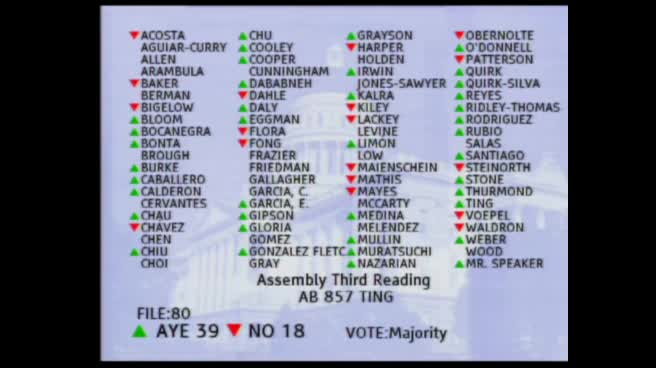
| Jun 1, 2017 | AB 284 MCCARTY Assembly Third Reading | Assembly Floor |
Passed |
|
| May 26, 2017 | Do pass. | Assembly Standing Committee on Appropriations |
Passed |
|
| Apr 18, 2017 | Do pass and be re-referred to the Committee on [Appropriations] | Assembly Standing Committee on Public Safety |
Passed |
This list shows positions taken on this bill by organizations on the date displayed, which is linked to the original source.
Positions by individuals are not included.
|
Organization
|
Position
|
Date
|
|---|---|---|
| 1. Need For This Bill | ** Against | Jul 10, 2017 |
| 2. Models In Other U.S. States | ** Against | Jul 10, 2017 |
| 4. Argument In Support | ** Against | Jul 10, 2017 |
| 5. Argument In Opposition | ** Against | Jul 10, 2017 |
| According To The Fraternal Order Of Police: | ** Against | Jul 10, 2017 |
| American Civil Liberties Union of California | ** Support | Apr 17, 2017 |
| Assembly Floor Vote: 45 - 29 | ** Against | Jul 10, 2017 |
| Association Of Orange County Deputy Sheriffs | ** Against | Apr 17, 2017 |
| California Immigrant Policy Center | ** Support | Apr 17, 2017 |
| California State Sheriffs Association | ** Against | Apr 17, 2017 |
| California State Sheriffs' Association | ** Against | Apr 17, 2017 |
| California Statewide Law Enforcement Association | ** Against | Apr 17, 2017 |
| Long Beach Police Officers Association | ** Against | Apr 17, 2017 |
| NAACP Sacramento Branch | * Support | Jul 11, 2017 |
| National Action Network | * Support | Jul 11, 2017 |
| Peace Officers Research Association Of California | ** Against | Apr 17, 2017 |
| PURPOSE | ** Against | Jul 10, 2017 |
| Sacramento County Deputy Sheriffs Association | ** Against | Apr 17, 2017 |
| Sacramento County Deputy Sheriffs' Association | ** Against | Apr 17, 2017 |
| Stanford Law Center | * Support | Apr 18, 2017 |
SENATE COMMITTEE ON APPROPRIATIONS
Senator Ricardo Lara, Chair
2017 - 2018 Regular Session
AB 284 (McCarty) - Department of Justice: officer-involved shootings: report
Version: July 3, 2017 | Policy Vote: PUB. S. 5 - 2 |
Urgency: No | Mandate: No |
Hearing Date: August 21, 2017 | Consultant: Shaun Naidu |
This bill meets the criteria for referral to the Suspense File.
Bill Summary:
AB 284 would require the Department of Justice (DOJ), upon appropriation, to conduct a study of peace officer-involved shootings resulting in death or serious injury within a specified two-year period.
Fiscal Impact:
Personnel, contracting, and equipment costs of approximately $3.5 million (General Fund) to DOJ for the first year and of approximately $1.9 million (General Fund) for the second year.
Background:
Existing law authorizes a peace officer who has reasonable cause to believe that a person to be arrested has committed a public offense to use reasonable force to effect the arrest, to prevent escape, or to overcome resistance. Additionally, each law enforcement agency is required to submit annually to DOJ, in a manner defined and prescribed by the Attorney General, a report of all instances when a peace officer employed by that agency is involved in any of specified incidents, including an incident involving the shooting of a civilian by a peace officer or an incident involving the shooting of a peace officer by a civilian.
Proposed Law:
This bill would, contingent upon the appropriation of funding by the Legislature, require DOJ to conduct a study of all or a sample of peace officer-involved shootings resulting in death or serious injury that occurred in California between January 1, 2015 and December 31, 2016. It would require the department to prepare a written report describing its findings and recommendations and make the report available to the public by a specified date.
Related Legislation:
AB 1024 (Kiley) would require a court to disclose a grand jury proceeding transcript, as specified, if the grand jury does not return an indictment related to an incident of a peace officer-involved shooting or use of excessive force that led to the death of the person being detained or arrested. AB 1024 is pending a concurrence vote on the Assembly Floor.
AB 1428 (Low) would reform current notification processes related to investigations into complaints by members of the public against peace officers and would require the investigating district attorney’s office to report its findings, as specified. AB 1428 is pending in this Committee.
Staff Comments:
According to data from DOJ’s OpenJustice initiative, between 2005 and 2014, 76 percent of 1,202 arrest-related deaths in California were homicides by law enforcement officers or staff. Focusing on the 149 arrest-related deaths in the state in 2014, the most recent year for which data is available, eighty-two were categorized as law enforcement-related homicides, twenty-six accidental, twenty-six pending investigation, seven suicides, four due to natural causes, and four due to other reasons. Additionally, during the same year, there were 130 booking and pre-trial-related deaths in the state. Of these deaths, fifty-nine were due to natural causes, thirty-five suicides, twenty-four accidental, six pending investigation, three inmate-related homicides, and three due to other reasons.
If AB 284 were enacted into law, the Civil Rights Enforcement section of DOJ predicts that it would review 100 cases, representing agencies across the state, during the applicable two-year period. The department anticipates that this increase in workload would require the additional staffing of one Supervising Deputy Attorney General, four Deputy Attorneys General, two Senior Legal Analysts with bilingual pay, and three Legal Secretaries. As this bill requires a study (with an accompanying report) of two specific years only, personnel costs associated with this measure would be on a term-limited basis. Additionally, DOJ expects to incur additional contracting expenses with expert witnesses in the approximate amounts of $1.4 million during the first fiscal year and $150,000 for the second fiscal year to assist staff with their policy research in order to make the recommendations required by this bill.
-- END --
SENATE COMMITTEE ON PUBLIC SAFETY
Senator Nancy Skinner, Chair
2017 - 2018 Regular
Bill No: AB 284 Hearing Date: July 11, 2017
Author: | McCarty | ||
Version: | July 3, 2017 | ||
Urgency: | No | Fiscal: | Yes |
Consultant: | GC | ||
Subject: Department of Justice: Officer-Involved Shootings: Report
HISTORY
Source: California Attorney General’s Office
Prior Legislation: AB 86 (McCarty), 2015, failed in Assembly Appropriation.
SB 227 (Mitchell), Ch. 175, Stats. of 2015
Support: American Civil Liberties Union; California Civil Liberties Advocacy; California Immigrant Policy Center; National Action Network San Diego & Imperial Counties
Opposition: Association of Orange County Deputy Sheriffs; California State Sheriffs’ Association; California Statewide Law; Enforcement Association; Fraternal Order of Police; Long Beach Police Officers Association; Peace Officers Research Association of California; Sacramento County Deputy Sheriffs’ Association
Assembly Floor Vote: 45 - 29
PURPOSE
The purpose of this bill is to require the Department of Justice to collect information regarding peace officer-involved shootings resulting in death or serious injury between the dates of January 1, 2015 and December 31, 2016.
Existing law specifies that subject to the powers and duties of the Governor, the Attorney General shall be the chief law officer of the State. (Cal. Const., Art. 5, § 13.)
Existing law states that it shall be the duty of the Attorney General to see that the laws of the State are uniformly and adequately enforced. (Cal. Const., Art. 5, § 13.)
Existing law provides that the Attorney General shall have direct supervision over every district attorney and sheriff and over such other law enforcement officers as may be designated by law, in all matters pertaining to the duties of their respective offices, and may require any of said officers to make reports concerning the investigation, detection, prosecution, and punishment of crime in their perspective jurisdictions as to the Attorney General may seem advisable. (Cal. Const., Art. 5, § 13.)
Existing law states that whenever in the opinion of the Attorney General any law of the State is not being adequately enforced in any county, it shall be the duty of the Attorney General to prosecute any violation of law of which the superior court shall have jurisdiction, and in such cases the Attorney General shall have all the powers of a district attorney. When required by the public interest or directed by the Governor, the Attorney General shall assist any district attorney in the discharge of the duties of that office. (Cal. Const., Art. 5, § 13.)
Existing law specifies that the Attorney General has direct supervision over the district attorneys of the several counties of the State and may require of them written reports as to the condition of public business entrusted to their charge. (Gov. Code, § 12550.)
Existing law provides that when the Attorney General deems it advisable or necessary in the public interest, or when directed to do so by the Governor, he shall assist any district attorney in the discharge of his duties, and may, where he deems it necessary, take full charge of any investigation or prosecution of violations of law of which the superior court has jurisdiction. In this respect he has all the powers of a district attorney, including the power to issue or cause to be issued subpoenas or other process. (Gov. Code, § 12550.)
Existing law states that if a district attorney is disqualified to conduct any criminal prosecution within the county, the Attorney General may employ special counsel to conduct the prosecution. The attorney's fee in such case is a legal charge against the state. (Gov. Code, § 12550.)
Existing law states that if a district attorney is disqualified to conduct any criminal prosecution within the county, the Attorney General may employ special counsel to conduct the prosecution. The attorney's fee in such case is a legal charge against the State. (Gov. Code, § 12553.)
Existing law states that when requested to do so by the grand jury of any county, the Attorney General may employ special counsel and special investigators, whose duty it shall be to investigate and present the evidence in such investigation to such grand jury. (Pen. Code, § 936.)
Existing law provides that when a grand jury request special counsel, services of such special counsel and special investigators shall be a count charge of such county. (Pen. Code, § 936.)
Existing law specifies that the district attorney is the public prosecutor, except as otherwise provided by law. (Gov. Code, § 25600.)
Existing law states that a public prosecutor shall attend the courts, and within his or her discretion shall initiate and conduct on behalf of the people all prosecutions for public offenses. (Gov. Code, § 25600.)
Existing law requires each department or agency in this state that employs peace officers to establish a procedure to investigate complaints by members of the public against the personnel of these departments or agencies, and shall make a written description of the procedure available to the public. (Pen. Code, § 832.5, subd. (a)(1).)
Existing law allows each department or agency that employs custodial officers, to establish a procedure to investigate complaints by members of the public against those custodial officers employed by these departments or agencies, provided however, that any procedure so established shall comply with the provisions of this section and with other provisions, as specified. (Pen. Code, § 832.5, subd. (a)(2).)
Existing law requires complaints and any reports or findings relating to these complaints be retained for a period of at least five years. (Pen. Code, § 832.5, subd. (b).)
Existing law specifies that all complaints retained may be maintained either in the peace or custodial officer's general personnel file or in a separate file designated by the department or agency as provided by department or agency policy, in accordance with all applicable requirements of law. (Pen. Code, § 832.5, subd. (b).)
Existing law prohibits complaints by members of the public that are determined by the peace or custodial officer's employing agency to be frivolous, or unfounded or exonerated, or any portion of a complaint that is determined to be frivolous, unfounded, or exonerated, from being maintained in that officer's general personnel file. However, these complaints shall be retained in other, separate files that shall be deemed personnel records for purposes of the California Public Records Act. (Pen. Code, § 832.5, subd. (c).)
Existing law allows a department or agency that employs peace or custodial officers to release factual information concerning a disciplinary investigation if the officer who is the subject of the disciplinary investigation, or the officer's agent or representative, publicly makes a statement he or she knows to be false concerning the investigation or the imposition of disciplinary action. (Pen. Code, § 832.7, subd. (d).)
Existing law requires the department or agency to provide written notification to the complaining party of the disposition of the complaint within 30 days of the disposition. (Pen. Code, § 832.7, subd. (e)(1).)
This bill provides that the Department of Justice (DOJ) shall collect information regarding peace officer-involved shootings resulting in death or serious injury between the dates of January 1, 2015 and December 31, 2016. The comprehensive study shall review the following:
- The nature and the circumstances of each incident and the characteristics of the individuals involved.
- The policies, procedures, and training of the agency that employed the peace officer.
- The oversight and investigation of peace officer-involved shootings and serious uses of force.
This bill specifies that by April 1, 2018, as specified, the DOJ shall confer with stakeholders, and prepare a written report describing its findings and recommendations and make that report available to the public.
This bill specifies that the study conducted pursuant to this section does not constitute a civil or criminal investigation and does not take the place of all other appropriate investigations.
COMMENTS
1. Need for This Bill
According to the author:
The aftermath of high profile cases of Michael Brown and Eric Garner have led to a public outcry for an increased level of independent oversight of officer involved shootings. In July 2016, Joseph Mann was shot 18 times by Sacramento police officers in an incident that was captured by video and made public. The local district attorney found that the officers involved acted lawfully.
There is a growing skepticism and a perceived conflict of interest, of the current process of local district attorneys investigating local police. There is a growing appetite, both at the national and local level, to create a better and more transparent system for officer involved shootings that is fair to police, families, and the community in order to restore public trust.
In March 2015, the “President’s Task Force on 21st Century Policing,” released a report with recommendations and action items in order to strengthen community policing and trust among law enforcement and the communities they serve. The report calls for increasing transparency and eliminating or minimizing bias for law enforcement agencies. Key recommendations:
• 2.2.3 ACTION ITEM: The task force encourages policies that mandate the use of external and independent prosecutors in cases of police use of force resulting in death, officer involved shootings resulting in injury or death, or in-custody deaths.
• 2.3 RECOMMENDATION: Law enforcement agencies are encouraged to implement nonpunitive peer review of critical incidents separate from criminal and administrative investigations.
Further in a 2016 a Stanford Law School study, “At Arm’s Length: Improving Criminal Investigations of Police Shootings,” opined that police departments and district attorneys lack the independence and incentive to investigate one of their own for OIS. Citing several cases throughout the country and accounts from law enforcement officials, the study questions the ability of police to conduct their own OIS investigations.
To better understand the circumstances of office involved shootings, AB 284 requires the Department of Justice to conduct a study of all or a sample of peace officer-involved shootings resulting in death or serious injury that occurred in California between January 1, 2015, and December 31, 2016. In addition, this bill requires the department to prepare a report describing its findings, provide recommendations, and make the report available to the public.
2. Models in Other U.S. States
In 2012, Connecticut passed a statute governing the procedure for the investigation of the use of deadly force by a police officer. The statute provided for the appointment of an individual to conduct the investigation, other than prosecutorial official from the judicial district where the incident occurred. Upon the conclusion of the investigation of the incident, a report must be filed that contains the following: (1) The circumstances of the incident, (2) a determination of whether the use of deadly physical force by the peace officer was appropriate, and (3) any future action to the taken by the Division of Criminal Justice as a result of the incident. (CT Gen Stat § 51-277 (2012).)
In Wisconsin, AB 409 was signed into law by Gov. Walker in April 2014. That law requires that an investigation must be performed by an independent review panel when a police officer is involved in the death of a civilian. The panel must consist of two individuals from outside of the police agency involved. In addition, the family of the victim must be informed of their legal rights.
3. President’s Task Force on 21st Century Policing (2015)
The Task Force was Co-Chaired by Charles Ramsey, Commissioner, Philadelphia Police Department and Laurie Robinson, Professor, George Mason University. The nine members of the task force included individuals from law enforcement and civil rights communities. The stated goal of the task force was “. . . to strengthen community policing and trust among law enforcement officers and the communities they served, especially in light of recent events around the county that have underscored the need for and importance of lasting collaborative
relationships between local police and the public.” (Final Report of the President’s Task Force on 21st Century Policing (2015), p. v.) Based on based on their investigation, the Task Force provided thoughts and recommendations on a variety of issues related to police practices.
One of the areas explored by the Task Force was oversight. The Task Force developed the following actions items (among others) in connection with cases that involved police use of force resulting in a death, or police shootings resulting in death or injury:
2.2.2 Action Item: These policies should also mandate external and independent criminal investigation in cases of police use of force resulting in death, officer-involved shooting resulting in injury or death, or in-custody deaths.
One way this can be accomplished is by the creation of multi-agency force investigation task forces comprising state and local investigators. Other ways to structure this investigative process include referring to neighboring jurisdictions or to the next higher levels of government (many small departments may already have state agencies handle investigations), but in order to restore and maintain trust, this independence is crucial.
In written testimony to the task force, James Palmer of the Wisconsin Professional Police Association offered an example in that state’s statutes requiring that agency written policies “require an investigation that is conducted by at least two investigators . . . neither of whom is employed by a law enforcement agency that employs a law enforcement officer involved in the officer – involved death.” Furthermore, in order to establish and maintain internal legitimacy and procedural justice, these investigations should be performed by law enforcement agencies with adequate training, knowledge, and experience investigating police use of force. (Interim Report of the President’s Task Force on 21st Century Policing (2015), p. 21.)
2.2.3 Action Item: The task force encourages policies that mandate the use of external and independent prosecutors in cases of police use of force resulting in death, officer-involved shootings resulting in injury of death, or in- custody deaths.
Strong systems and policies that encourage use of an independent prosecutor for reviewing police uses of force and for prosecution in cases of inappropriate deadly force and in-custody death will demonstrate the transparency to the public that can lead to mutual trust between community and law enforcement. (Interim Report of the President’s Task Force on 21st Century Policing (2015, p. 22.)
2.2.5 Action Item: Polices on use of force should clearly state what types of information will be released, when, and in what situation, to maintain transparency.
This should also include procedures on the release of a summary statement regarding the circumstances of the incident by the department as soon as possible and within 24 hours. The intent of this directive should be to share as much information as possible without compromising the integrity of the investigation or anyone’s rights. (Interim Report of the President’s Task Force on 21st Century Policing (2015, p. 22.)
4. Argument in Support
According to the American Civil Liberties Union of California:
Currently, officer-involved shooting by local law enforcement are investigated by local district attorneys. As police officers who shoot and kill civilians continue to evade prosecution, including incidents captured by video and made public, the perceived conflict of interest between officers and district attorneys has resulted in growing skepticism. There is a growing appetite, both at the national and local level, to create a better and more transparent system for OIS that is fair to families, communities, and the police in order to restore public trust.
In a 2016, a report of the Stanford Criminal Justice Center concluded that police departments and district attorneys lack the independence and incentive to investigate one of their own for OIS, recommending that DOJ or another unconnected law enforcement agency conduct the bulk of the criminal investigation. Likewise, the Obama Administration’s ‘Task Force on 21st Century Policing’ recommend ‘policies that mandate the use of external and independent prosecutions’ in cases of officer-involved civilian death.
AB 284 would be a positive step towards achieving these recommendations by requiring the DOJ to establish a pilot independent review unit to investigate police shootings.
5. Argument in Opposition
According to the Fraternal Order of Police:
Law enforcement agencies have taken dramatic steps within the past few years to increase police transparency, especially when tragically dealing with officer-involved shootings at the local level. Further, many agencies are creating local policies, working internally and within their communities. For these reason, AB 284 is duplicative and is an unnecessary use of public resources.
-- END –
ASSEMBLY THIRD READING
ATR Bill Id:AB 284
Author:(McCarty)
As Amended Ver:April 17, 2017
Majority vote
Committee | Votes | Ayes | Noes |
Public Safety | 6-0 | Jones-Sawyer, Lackey, Gonzalez Fletcher, Quirk, Rubio, Santiago | |
Appropriations | 12-0 | Gonzalez Fletcher, Bloom, Bocanegra, Bonta, Calderon, McCarty, Quirk, Friedman, Eduardo Garcia, Gray, Muratsuchi, Reyes |
|
SUMMARY: Requires the Department of Justice (DOJ) to create independent review unit, to be known as the Statewide Officer-Involved Shooting Investigation Team, within the office to investigate officer-involved shootings, but only to the extent that the Legislature appropriates funding for that purpose. Specifically, this bill:
- Requires DOJ to create an independent review unit within the office to investigate officer-involved shootings.
- Specifies that the review unit shall be known as the Statewide Officer-Involved Shooting Investigation Team.
- States that the review unit shall consist of three separate teams: one team located in northern California, one team in central California, and one team in southern California.
- States that the review unit shall do all of the following:
- Upon request from a local law enforcement agency or the district attorney, investigate and gather facts in incidents involving officer-involved shootings;
- Upon conclusion of the independent review, submit the findings of the independent review and recommendations regarding whether to pursue criminal charges to the entity requesting the independent review; and
- Prepare and submit a written report to the entity requesting the independent review, and to the district attorney and the law enforcement agency of the county where the incident occurred, if one or both of those entities did not request the review.
- States that the written report shall include, at a minimum, the following information:
- A statement of the facts;
- A detailed analysis and conclusion for each investigatory issue; and
- Recommendations to modify the policies and practices of the law enforcement agency that employed the peace officer who was subject to investigation, if appropriate.
- Requires the Attorney General to post and maintain on the DOJ's Internet Web site each written report prepared by the Statewide Officer-Involved Shooting Investigation Team, unless information in the report is required by law to be kept confidential.
- States that DOJ shall only implement the requirements of this bill to the extent that the Legislature appropriates funding for that purpose.
EXISTING LAW:
- Specifies that subject to the powers and duties of the Governor, the Attorney General shall be the chief law officer of the State.
- States that it shall be the duty of the Attorney General to see that the laws of the State are uniformly and adequately enforced.
- Provides that the Attorney General shall have direct supervision over every district attorney and sheriff and over such other law enforcement officers as may be designated by law, in all matters pertaining to the duties of their respective offices, and may require any of said officers to make reports concerning the investigation, detection, prosecution, and punishment of crime in their perspective jurisdictions as to the Attorney General may seem advisable.
- States that whenever in the opinion of the Attorney General any law of the State is not being adequately enforced in any county, it shall be the duty of the Attorney General to prosecute any violation of law of which the superior court shall have jurisdiction, and in such cases the Attorney General shall have all the powers of a district attorney. When required by the public interest or directed by the Governor, the Attorney General shall assist any district attorney in the discharge of the duties of that office.
- Specifies that the Attorney General has direct supervision over the district attorneys of the several counties of the State and may require of them written reports as to the condition of public business entrusted to their charge.
- Provides that when the Attorney General deems it advisable or necessary in the public interest, or when directed to do so by the Governor, he shall assist any district attorney in the discharge of his duties, and may, where he deems it necessary, take full charge of any investigation or prosecution of violations of law of which the superior court has jurisdiction. In this respect he has all the powers of a district attorney, including the power to issue or cause to be issued subpoenas or other process.
- States that if a district attorney is disqualified to conduct any criminal prosecution within the county, the Attorney General may employ special counsel to conduct the prosecution. The attorney's fee in such case is a legal charge against the state.
- States that if a district attorney is disqualified to conduct any criminal prosecution within the county, the Attorney General may employ special counsel to conduct the prosecution. The attorney's fee in such case is a legal charge against the State.
- States that when requested to do so by the grand jury of any county, the Attorney General may employ special counsel and special investigators, whose duty it shall be to investigate and present the evidence in such investigation to such grand jury.
- Provides that when a grand jury request special counsel, services of such special counsel and special investigators shall be a count charge of such county.
- Specifies that the district attorney is the public prosecutor, except as otherwise provided by law.
- States that a public prosecutor shall attend the courts, and within his or her discretion shall initiate and conduct on behalf of the people all prosecutions for public offenses.
- Requires each department or agency in this state that employs peace officers to establish a procedure to investigate complaints by members of the public against the personnel of these departments or agencies, and shall make a written description of the procedure available to the public.
- Allows each department or agency that employs custodial officers, to establish a procedure to investigate complaints by members of the public against those custodial officers employed by these departments or agencies, provided however, that any procedure so established shall comply with the provisions of this section and with other provisions, as specified.
- Requires complaints and any reports or findings relating to these complaints be retained for a period of at least five years.
- Specifies that all complaints retained may be maintained either in the peace or custodial officer's general personnel file or in a separate file designated by the department or agency as provided by department or agency policy, in accordance with all applicable requirements of law.
- Prohibits complaints by members of the public that are determined by the peace or custodial officer's employing agency to be frivolous, or unfounded or exonerated, or any portion of a complaint that is determined to be frivolous, unfounded, or exonerated, from being maintained in that officer's general personnel file. However, these complaints shall be retained in other, separate files that shall be deemed personnel records for purposes of the California Public Records Act
- Allows a department or agency that employs peace or custodial officers to release factual information concerning a disciplinary investigation if the officer who is the subject of the disciplinary investigation, or the officer's agent or representative, publicly makes a statement he or she knows to be false concerning the investigation or the imposition of disciplinary action.
- Requires the department or agency to provide written notification to the complaining party of the disposition of the complaint within 30 days of the disposition.
FISCAL EFFECT:
According to the Assembly Appropriations Committee, annual cost pressures to DOJ in the range of $8.5 to $10 million, to fund 37 positions statewide, for the three regional Teams. DOJ anticipates having to review 75 cases per year. However, this bill would only be implemented to the extent the Legislature appropriates the necessary funding.
COMMENTS:
According to the author, "There is a growing appetite, both at the national and local level, to create a better and more transparent system regarding police shootings that is fair to police, families, and the community in order to restore public trust. For far too long, there has been distrust surrounding police shootings and the decisions by local D.A.’s that work closely with police officers.
"To build public trust, AB 284 requires the DOJ to establish a pilot independent review unit to investigate police shootings. This unit, upon the request of a local law enforcement agency or district attorney, will investigate, gather facts, and provide a recommendation to the entity requesting the review."
Analysis Prepared by: David Billingsley / PUB. S. / (926) 319-3744 FN: 0000561
Date of Hearing: May 10, 2017
ASSEMBLY COMMITTEE ON APPROPRIATIONS
Lorena Gonzalez Fletcher, Chair
ABPCA Bill Id:AB 284
Author:(McCarty) – As Amended Ver:April 17, 2017
Policy Committee: | Public Safety | Vote: | 6 - 0 |
|
| ||
|
|
Urgency: No State Mandated Local Program: No Reimbursable: No
SUMMARY:
This bill requires the Department of Justice (DOJ) to create an independent review unit, (comprised of three teams) to be known as the Statewide Officer-Involved Shooting Investigation Team (Team), within DOJ to investigate officer-involved shootings, but only to the extent that the Legislature appropriates funding for that purpose. The unit, upon request from a local law enforcement agency or the district attorney, is required to investigate and gather facts in incidents involving officer-involved shootings and to prepare and submit a written report, as specified. The bill also requires the Attorney General (AG) to post and maintain on the DOJ’s Internet Web site each written report prepared by the Team, unless information in the report is required by law to be kept confidential.
FISCAL EFFECT:
Annual cost pressures to DOJ in the range of $8.5 to $10 million, to fund 37 positions statewide, for the three regional Teams. DOJ anticipates having to review 75 cases per year. However, AB 284 would only be implemented to the extent the Legislature appropriates the necessary funding.
COMMENTS:
- Purpose, According to the author, "For far too long, there has been distrust surrounding police shootings and the decisions by local D.A.’s that work closely with police officers.” This bill requires the DOJ to establish an independent review unit to investigate police shootings. Upon request of a local law enforcement agency or district attorney, this Team will investigate, gather facts, and provide a recommendation to the entity requesting the review.
- Background. Under current law, when the AG deems it advisable or necessary in the public interest, or when directed to do so by the Governor, the AG is required to assist any district attorney in the discharge of his/her duties, and may, where he/she deems it necessary, take full charge of any investigation or prosecution of violations of law of which the superior court has jurisdiction. In this respect the AG has all the powers of a district attorney, including the power to issue or cause to be issued subpoenas or other process. Current law also provides that if a district attorney is disqualified to conduct any criminal prosecution within the county, the Attorney General may employ special counsel to conduct the prosecution. The attorney's fee in such case is a legal charge against the state.
The stated goal of the President Obama’s Task Force on 21st Century Policing was “. . . to strengthen community policing and trust among law enforcement officers and the communities they served, especially in light of recent events around the county that have underscored the need for and importance of lasting collaborative relationships between local police and the public.” Based on their investigation, the Task Force provided thoughts and recommendations on a variety of issues involved with community policing.
One of the areas of police practices explored by the Task Force was oversight. The Task Force developed the following actions items (among others) in connection with cases that involved police use of force resulting in a death, or police shootings resulting in death or injury:
- 2.2.2 Action Item: These policies should also mandate external and independent criminal investigation in cases of police use of force resulting in death, officer-involved shooting resulting in injury or death, or in-custody deaths.
In Wisconsin, AB 4 was signed into law by Gov. Walker in April 2014. That law requires that an investigation must be performed by an independent review panel when a police officer is involved in the death of a civilian. The panel must consist of two individuals from outside of the police agency involved. In addition, the family of the victim must be informed of their legal rights.
- Related Legislation. AB 1024 (Kiley) requires a court to disclose a grand jury indictment proceeding, as specified, if the grand jury decides not to return an indictment in a grand jury inquiry into an offense that involves a shooting or use of excessive force by a peace officer, as defined, that led to the death of a person being detained or arrested by the peace officer. AB 1024 is awaiting a referral in the Senate.
AB 1428 (Low) requires each county district attorney’s office that conducts an investigation into an incident involving the shooting of a civilian by a peace officer to report the findings of that investigation on a publicly accessible Internet Web site within 30 days of the conclusion of the investigation. AB 1428 is awaiting a hearing in this Committee.
- Prior Legislation. AB 86 McCarty, of the 2015-2016 Legislative Session, would have required the Attorney General to appoint a special prosecutor to direct an independent investigation if a peace officer, in the performance of his or her duties, uses deadly physical force upon another person and that person dies as a result of the use of that deadly physical force. AB 86 was held in this Committee on Suspense.
SB 227 (Mitchell), Chapter 175, Statutes of 2015, would have prohibited a grand jury from inquiring into an offense or misconduct that involves a shooting or use of excessive force by a peace officer, as specified, that led to the death of a person being detained or arrested by the peace officer. SB 227 was held unconstitutional by the Third Appellate District Court of Appeal.
Analysis Prepared by: Pedro Reyes / APPR. / (916) 319-2081
Date of Hearing:
Counsel: David Billingsley
ASSEMBLY COMMITTEE ON PUBLIC SAFETY
Reginald Byron Jones-Sawyer, Sr., Chair
ABPCA Bill Id:AB 284
Author:(McCarty) – As Amended Ver:March 23, 2017
SUMMARY:
Requires the Department of Justice (DOJ) to create independent review unit, to be known as the Statewide Officer-Involved Shooting Investigation Team, within the office to investigate officer-involved shootings, but only to the extent that the Legislature appropriates funding for that purpose. Specifically, this bill:
- Requires DOJ to create an independent review unit within the office to investigate officer-involved shootings.
- Specifies that the review unit shall be known as the Statewide Officer-Involved Shooting Investigation Team.
- States that the review unit shall consist of three separate teams: one team located in northern California, one team in central California, and one team in southern California.
- States that the review unit shall do all of the following:
- Upon request from a local law enforcement agency or the district attorney, investigate and gather facts in incidents involving officer-involved shootings;
- Upon conclusion of the independent review, submit the findings of the independent review and recommendations regarding whether to pursue criminal charges to the entity requesting the independent review; and
- Prepare and submit a written report to the entity requesting the independent review, and to the district attorney and the law enforcement agency of the county where the incident occurred, if one or both of those entities did not request the review.
- States that the written report shall include, at a minimum, the following information:
- A statement of the facts;
- A detailed analysis and conclusion for each investigatory issue; and
- Recommendations to modify the policies and practices of the law enforcement agency that employed the peace officer who was subject to investigation, if appropriate.
- A statement of the facts;
- Upon request from a local law enforcement agency or the district attorney, investigate and gather facts in incidents involving officer-involved shootings;
- Requires the Attorney General to post and maintain on the DOJ’s Internet Web site each written report prepared by the Statewide Officer-Involved Shooting Investigation Team, unless information in the report is required by law to be kept confidential.
- States that DOJ shall only implement the requirements of this bill to the extent that the Legislature appropriates funding for that purpose.
EXISTING LAW:
- Specifies that subject to the powers and duties of the Governor, the Attorney General shall be the chief law officer of the State. (Cal. Const., Art. 5, § 13.)
- States that it shall be the duty of the Attorney General to see that the laws of the State are uniformly and adequately enforced. (Cal. Const., Art. 5, § 13.)
- Provides that the Attorney General shall have direct supervision over every district attorney and sheriff and over such other law enforcement officers as may be designated by law, in all matters pertaining to the duties of their respective offices, and may require any of said officers to make reports concerning the investigation, detection, prosecution, and punishment of crime in their perspective jurisdictions as to the Attorney General may seem advisable. (Cal. Const., Art. 5, § 13.)
- States that whenever in the opinion of the Attorney General any law of the State is not being adequately enforced in any county, it shall be the duty of the Attorney General to prosecute any violation of law of which the superior court shall have jurisdiction, and in such cases the Attorney General shall have all the powers of a district attorney. When required by the public interest or directed by the Governor, the Attorney General shall assist any district attorney in the discharge of the duties of that office. (Cal. Const., Art. 5, § 13.)
- Specifies that the Attorney General has direct supervision over the district attorneys of the several counties of the State and may require of them written reports as to the condition of public business entrusted to their charge. (Gov. Code, § 12550.)
- Provides that when the Attorney General deems it advisable or necessary in the public interest, or when directed to do so by the Governor, he shall assist any district attorney in the discharge of his duties, and may, where he deems it necessary, take full charge of any investigation or prosecution of violations of law of which the superior court has jurisdiction. In this respect he has all the powers of a district attorney, including the power to issue or cause to be issued subpoenas or other process. (Gov. Code, § 12550.)
- States that if a district attorney is disqualified to conduct any criminal prosecution within the county, the Attorney General may employ special counsel to conduct the prosecution. The attorney's fee in such case is a legal charge against the state. (Gov. Code, § 12550.)
- States that if a district attorney is disqualified to conduct any criminal prosecution within the county, the Attorney General may employ special counsel to conduct the prosecution. The attorney's fee in such case is a legal charge against the State. (Gov. Code, § 12553.)
- States that when requested to do so by the grand jury of any county, the Attorney General may employ special counsel and special investigators, whose duty it shall be to investigate and present the evidence in such investigation to such grand jury. (Pen. Code, § 936.)
- Provides that when a grand jury request special counsel, services of such special counsel and special investigators shall be a count charge of such county. (Pen. Code, § 936.)
- Specifies that the district attorney is the public prosecutor, except as otherwise provided by law. (Gov. Code, § 25600.)
- States that a public prosecutor shall attend the courts, and within his or her discretion shall initiate and conduct on behalf of the people all prosecutions for public offenses. (Gov. Code, § 25600.)
- Requires each department or agency in this state that employs peace officers to establish a procedure to investigate complaints by members of the public against the personnel of these departments or agencies, and shall make a written description of the procedure available to the public. (Pen. Code, § 832.5, subd. (a)(1).)
- Allows each department or agency that employs custodial officers, to establish a procedure to investigate complaints by members of the public against those custodial officers employed by these departments or agencies, provided however, that any procedure so established shall comply with the provisions of this section and with other provisions, as specified. (Pen. Code, § 832.5, subd. (a)(2).)
- Requires complaints and any reports or findings relating to these complaints be retained for a period of at least five years. (Pen. Code, § 832.5, subd. (b).)
- Specifies that all complaints retained may be maintained either in the peace or custodial officer's general personnel file or in a separate file designated by the department or agency as provided by department or agency policy, in accordance with all applicable requirements of law. (Pen. Code, § 832.5, subd. (b).)
- Prohibits complaints by members of the public that are determined by the peace or custodial officer's employing agency to be frivolous, or unfounded or exonerated, or any portion of a complaint that is determined to be frivolous, unfounded, or exonerated, from being maintained in that officer's general personnel file. However, these complaints shall be retained in other, separate files that shall be deemed personnel records for purposes of the California Public Records Act (Pen. Code, § 832.5, subd. (c).)
- Allows a department or agency that employs peace or custodial officers to release factual information concerning a disciplinary investigation if the officer who is the subject of the disciplinary investigation, or the officer's agent or representative, publicly makes a statement he or she knows to be false concerning the investigation or the imposition of disciplinary action. (Pen. Code, § 832.7, subd. (d).)
- Requires the department or agency to provide written notification to the complaining party of the disposition of the complaint within 30 days of the disposition. (Pen. Code, § 832.7, subd. (e)(1).)
FISCAL EFFECT:
Unknown
COMMENTS:
- Author's Statement: According to the author, "There is a growing appetite, both at the national and local level, to create a better and more transparent system regarding police shootings that is fair to police, families, and the community in order to restore public trust. For far too long, there has been distrust surrounding police shootings and the decisions by local D.A.’s that work closely with police officers.
“To build public trust, AB 284 requires the DOJ to establish a pilot independent review unit to investigate police shootings. This unit, upon the request of a local law enforcement agency or district attorney, will investigate, gather facts, and provide a recommendation to the entity requesting the review.” - Connecticut and Wisconsin Laws Require Independent Investigations When There is Use of Deadly Force by a Police Officer: In 2012, Connecticut passed a statute governing the procedure for the investigation of the use of deadly force by a police officer. The statute provided for the appointment of an individual to conduct the investigation, other than prosecutorial official from the judicial district where the incident occurred. Upon the conclusion of the investigation of the incident, a report must be filed that contains the following: (1) The circumstances of the incident, (2) a determination of whether the use of deadly physical force by the peace officer was appropriate, and (3) any future action to the taken by the Division of Criminal Justice as a result of the incident. (CT Gen Stat § 51-277 (2012).)
AB 409 in Wisconsin was signed into law by Gov. Walker in April 2014. That law requires that an investigation must be performed by an independent review panel when a police officer is involved in the death of a civilian. The panel must consist of two individuals from outside of the police agency involved. In addition, the family of the victim must be informed of their legal rights. - Final Report of the President’s Task Force on 21st Century Policing (2015): The Task Force was Co-Chaired by Charles Ramsey, Commissioner, Philadelphia Police Department and Laurie Robinson, Professor, George Mason University. The nine members of the task force included individuals from law enforcement and civil rights communities. The stated goal of the task force was “. . . to strengthen community policing and trust among law enforcement officers and the communities they served, especially in light of recent events around the county that have underscored the need for and importance of lasting collaborative relationships between local police and the public.” (Final Report of the President’s Task Force on 21st Century Policing (2015), p. v.) Based on based on their investigation, the Task Force provided thoughts and recommendations on a variety of issues related to police practices.
One of the areas explored by the Task Force was oversight. The Task Force developed the following actions items (among others) in connection with cases that involved police use of force resulting in a death, or police shootings resulting in death or injury:
2.2.2 Action Item: These policies should also mandate external and independent criminal investigation in cases of police use of force resulting in death, officer-involved shooting resulting in injury or death, or in-custody deaths.
One way this can be accomplished is by the creation of multi-agency force investigation task forces comprising state and local investigators. Other ways to structure this investigative process include referring to neighboring jurisdictions or to the next higher levels of government (many small departments may already have state agencies handle investigations), but in order to restore and maintain trust, this independence is crucial.
In written testimony to the task force, James Palmer of the Wisconsin Professional Police Association offered an example in that state’s statutes requiring that agency written policies “require an investigation that is conducted by at least two investigators . . . neither of whom is employed by a law enforcement agency that employs a law enforcement officer involved in the officer – involved death.” Furthermore, in order to establish and maintain internal legitimacy and procedural justice, these investigations should be performed by law enforcement agencies with adequate training, knowledge, and experience investigating police use of force. (Interim Report of the President’s Task Force on 21st Century Policing (2015), p. 21.)
2.2.3 Action Item: The task force encourages policies that mandate the use of external and independent prosecutors in cases of police use of force resulting in death, officer-involved shootings resulting in injury of death, or in- custody deaths.
Strong systems and policies that encourage use of an independent prosecutor for reviewing police uses of force and for prosecution in cases of inappropriate deadly force and in-custody death will demonstrate the transparency to the public that can lead to mutual trust between community and law enforcement. (Interim Report of the President’s Task Force on 21st Century Policing (2015, p. 22.)
2.2.5 Action Item: Polices on use of force should clearly state what types of information will be released, when, and in what situation, to maintain transparency.
This should also include procedures on the release of a summary statement regarding the circumstances of the incident by the department as soon as possible and within 24 hours. The intent of this directive should be to share as much information as possible without compromising the integrity of the investigation or anyone’s rights. (Interim Report of the President’s Task Force on 21st Century Policing (2015, p. 22.) - Argument in Support: According to the American Civil Liberties Union of California, “Currently, officer-involved shooting by local law enforcement are investigated by local district attorneys. As police officers who shoot and kill civilians continue to evade prosecution, including incidents captured by video and made public, the perceived conflict of interest between officers and district attorneys has resulted in growing skepticism. There is a growing appetite, both at the national and local level, to create a better and more transparent system for OIS that is fair to families, communities, and the police in order to restore public trust.
“In a 2016, a report of the Stanford Criminal Justice Center concluded that police departments and district attorneys lack the independence and incentive to investigate one of their own for OIS, recommending that DOJ or another unconnected law enforcement agency conduct the bulk of the criminal investigation. Likewise, the Obama Administration’s ‘Task Force on 21st Century Policing’ recommend ‘policies that mandate the use of external and independent prosecutions’ in cases of officer-involved civilian death.
“AB 284 would be a positive step towards achieving these recommendations by requiring the DOJ to establish a pilot independent review unit to investigate police shootings.” - Argument in Opposition: According to the Fraternal Order of Police, “Law enforcement agencies have taken dramatic steps within the past few years to increase police transparency, especially when tragically dealing with officer-involved shootings at the local level. Further, many agencies are creating local policies, working internally and within their communities. For these reason, AB 284 is duplicative and is an unnecessary use of public resources.”
- Related Legislation:
- AB 1024 (Kiley), would require a court to disclose a grand jury indictment proceeding, as specified, if the grand jury decides not to return an indictment in a grand jury inquiry into an offense that involves a shooting or use of excessive force by a peace officer, as defined, that led to the death of a person being detained or arrested by the peace officer. AB 1024 is awaiting hearing in the Assembly Appropriations Committee.
- AB 1428 (Low), would require each county district attorney’s office that conducts an investigation into an incident involving the shooting of a civilian by a peace officer to report the findings of that investigation on a publicly accessible Internet Web site within 30 days of the conclusion of the investigation. AB 1428 is set for hearing in the Assembly Public Safety Committee on April 18, 2017.
- AB 1024 (Kiley), would require a court to disclose a grand jury indictment proceeding, as specified, if the grand jury decides not to return an indictment in a grand jury inquiry into an offense that involves a shooting or use of excessive force by a peace officer, as defined, that led to the death of a person being detained or arrested by the peace officer. AB 1024 is awaiting hearing in the Assembly Appropriations Committee.
- Prior Legislation:
- AB 86 McCarty, of the 2015-2016 Legislative Session, would have required the Attorney General to appoint a special prosecutor to direct an independent investigation if a peace officer, in the performance of his or her duties, uses deadly physical force upon another person and that person dies as a result of the use of that deadly physical force. AB 86 was held on the Assembly Appropriations Suspense File.
- SB 227 (Mitchell), Chapter 175, Statutes of 2015, would prohibit a grand jury from inquiring into an offense or misconduct that involves a shooting or use of excessive force by a peace officer, as specified, that led to the death of a person being detained or arrested by the peace officer. SB 227 is pending a vote on the Senate floor. SB 227 was held unconstitutional by the Third Appellate District Court of Appeal.
- AB 86 McCarty, of the 2015-2016 Legislative Session, would have required the Attorney General to appoint a special prosecutor to direct an independent investigation if a peace officer, in the performance of his or her duties, uses deadly physical force upon another person and that person dies as a result of the use of that deadly physical force. AB 86 was held on the Assembly Appropriations Suspense File.
REGISTERED SUPPORT / OPPOSITION:
Support
American Civil Liberties Union of California
California Immigrant Policy Center
Opposition
Association of Orange County Deputy Sheriffs
California State Sheriffs’ Association
California Statewide Law Enforcement Association
Fraternal Order of Police
Long Beach Police Officers Association
Peace Officers Research Association of California
Sacramento County Deputy Sheriffs’ Association
Analysis Prepared by:
David Billingsley / PUB. S. /
Discussed in Hearing
 14MIN
Senate Standing Committee on Public Safety
 3MIN
Assembly Floor
 1H
Assembly Standing Committee on Appropriations
 13MIN