AB 2881: Recall elections.
- Session Year: 2017-2018
- House: Assembly
- Latest Version Date: 2018-02-16
The California Constitution enables electors to initiate a recall of state officers by gathering sufficient signatures within a 160-day period. Existing law requires the Secretary of State to notify a county elections official that a petition received a sufficient number of signatures to initiate a recall election. After this notice has been provided, existing law provides for a period of 30 business days in which voters who signed the petition may withdraw their signatures. Existing law requires local elections officials to submit signatures gathered by proponents of a recall to the Secretary of State at least every 30 days, and it also requires the examination and verification of each signature filed.
Under existing law, if a sufficient number of signatures are submitted to initiate a recall election, the Department of Finance, in consultation with the affected election officials and the Secretary of State, is required to estimate the costs of the recall election, as specified. Existing law also requires the Joint Legislative Budget Committee to review and comment on the estimate.
This bill would remove the provisions requiring the examination and verification of each signature filed and would instead provide for signatures to be verified according to specified procedures, including the use of a random sampling technique. The bill would also remove the obligations on the Department of Finance and the Joint Legislative Budget Committee with respect to estimating the costs of the recall election.
(a)The elections official, 30 days after a recall has been initiated and every 30 days thereafter, or more frequently at the discretion of the elections official, shall report to the Secretary of State all of the following:
(1)The number of signatures submitted on the recall petition sections for the period ending five days previously, excluding Saturdays, Sundays, and holidays.
(2)The cumulative total of all signatures received since the time the recall was initiated and through the period ending five days previously, excluding Saturdays, Sundays, and holidays.
(3)The number of valid signatures, verified pursuant to subdivision (b), submitted during the previous reporting period, and of valid signatures verified during the current reporting period.
(4)The cumulative total of all valid signatures received since the time the recall was initiated and ending five days previously, excluding Saturdays, Sundays, and holidays.
(b)Signatures shall be verified in the same manner set forth in subdivision (b) of subdivisions (b), (c), (d), (e), (f), and (g) of Section 9030, and in Section 9031.
(c)The elections official, at the end of each 30-day period, shall attach to the petition a form provided by the Secretary of State, properly dated, that includes the information required by subdivision (a), and submit a copy of the petition, except as to the signatures appended thereto, to the Secretary of State and file a copy of the form in his or her office.
(d)Notwithstanding subdivisions (a) and (b), and Section 11106, the elections official shall not be required to verify signatures on a recall petition until the signatures submitted equal at least 10 percent of the total signatures required to qualify the recall for the ballot, as determined by the Secretary of State.
SEC. 2.Section 11105 is added to the Elections Code, to read:11105.Upon each submission, if fewer than 500 signatures are submitted to the elections official, he or she shall count the number of signatures and submit those results to the Secretary of State. If 500 or more signatures are submitted, the elections official may verify, using a random sampling technique, either 3 percent of the signatures submitted, or 500, whichever is greater. The random sample of signatures to be verified shall be drawn in a manner that every signature filed with the elections official shall be given an equal opportunity to be included in the sample. Upon completion of the signature verification, the elections official shall report the results to the Secretary of State pursuant to Section 11104.
SEC. 3.Section 11106 of the Elections Code is amended to read:11106.Immediately after the deadline for submission of all signatures, the elections official shall verify any remaining signatures in the same manner set forth in subdivision (b) of subdivisions (b), (c), (d), (e), (f), and (g) of Section 9030, and in Section 9031. This verification shall apply to all signatures submitted to each county elections official.
SEC. 4.Section 11108 of the Elections Code is amended to read:11108.(a)When the Secretary of State has received from one or more county elections officials a petition certified to have been signed by a sufficient the stated number of registered voters to initiate a recall election, voters, he or she shall, within 10 days, notify transmit to each county elections official of that fact. a certificate showing that fact, and showing the total number of signatures collected by the proponents. The county elections official shall file the certificate in his or her office.
(b)Notwithstanding any other law, any voter who has signed a recall petition under this chapter shall have his or her signature withdrawn from the petition upon the voter filing a written request that includes the voters name, residence address, and signature with the elections official within 30 business days of the Secretary of States notice provided by subdivision (a).(c)No later than 10 business days after the withdrawal period provided by subdivision (b), the elections officials shall report to the Secretary of State the total number of signatures that have been withdrawn pursuant to subdivision (b). The Secretary of State shall promptly make a second preliminary determination of whether the petitions have been signed by the sufficient number of registered voters to initiate a recall election. If the petitions have not been signed by a sufficient number of registered voters, the Secretary of State shall notify the county elections officials to continue to verify signatures pursuant to Section 11104. The Secretary of State and elections officials shall continue to make the notifications and reports required by this section until such time as the Secretary of State determines that there is a sufficient number of verified signatures, not including withdrawn signatures, to initiate a recall election.(d)Upon receipt of the notification from the Secretary of State required in subdivision (c) that there is a sufficient number of verified signatures, not including withdrawn signatures, to initiate a recall election, the Department of Finance shall, in consultation with the affected elections officials and the Secretary of State, estimate the costs of the recall election, including expenses for verifying signatures, printing ballots and voter information guides, and operating polling places. The Department shall estimate the costs that would be incurred if (1) the recall election is held as a special election and (2) the recall election is consolidated with the next regularly scheduled election pursuant to subdivision (b) of Section 15 of Article II of the California Constitution. Within 30 business days of receipt of the Secretary of States notice of sufficient signatures to initiate a recall required by subdivision (c), the Department of Finance shall submit the estimate to the Governor, the Secretary of State, and the Chairperson of the Joint Legislative Budget Committee.(e)Notwithstanding any other law, the Secretary of State shall not certify the sufficiency of the signatures under Section 11109 until the Joint Legislative Budget Committee has had 30 days to review and comment on the estimate submitted by the Department of Finance pursuant to subdivision (d).(f)The Secretary of State shall publish a copy of the estimate submitted by the Department of Finance on the Secretary of States public Internet Web site no later than 21 business days after the time for the Joint Legislative Budget Committee to review the estimate has expired.(g)After the time for the Joint Legislative Budget Committee to review the estimate has expired, the Director of Finance, or his or her designee, shall direct the Controller to remit to the elections official from those funds designated for that purpose in any budget act or other measure an amount that takes into consideration the amount of funds available for the purpose, the number of elections officials expected to conduct state recall elections held in that fiscal year, the Department of Finances estimates of the costs of each elections official to conduct each state recall election, and the amount reasonably necessary to conduct such recall election.SEC. 5.Section 11324 of the Elections Code is amended to read:11324.(a)The official responsible for preparing the ballot shall, at least 10 days before the recall election, mail a voter information guide to each registered voter of the electoral jurisdiction of the officer sought to be recalled.
(b)In the case of a recall of a state officer, the official responsible for preparing the voter information guide pursuant to subdivision (a) shall include in the voter information guide the report of estimated costs of the recall prepared by the Department of Finance pursuant to subdivision (d) of Section 11108. REVISIONS: HeadingLine 2.|
Date
|
Status
|
|---|---|
| May 23, 2018 | From committee: Without further action pursuant to Joint Rule 62(a). |
| Apr 25, 2018 | In committee: Set, first hearing. Failed passage. |
| Mar 15, 2018 | Coauthors revised. |
| Mar 8, 2018 | Referred to Com. on E. & R. |
| Feb 17, 2018 | From printer. May be heard in committee March 19. |
| Feb 16, 2018 | Read first time. To print. |
|
Date
|
Description
|
Location
|
Votes
|
|
|---|---|---|---|---|
| Apr 25, 2018 | Do pass and be re-referred to the Committee on [Appropriations] | Assembly Standing Committee on Elections and Redistricting |
Failed |
This list shows positions taken on this bill by organizations on the date displayed, which is linked to the original source.
Positions by individuals are not included.
|
Organization
|
Position
|
Date
|
|---|---|---|
| California Taxpayers Association Howard Jarvis Taxpayers Association | * Support | Apr 25, 2018 |
Date of Hearing: April 25, 2018
ASSEMBLY COMMITTEE ON ELECTIONS AND REDISTRICTING
Marc Berman, Chair
ABPCA Bill Id:AB 2881 (
Author:Harper) – As Introduced Ver:February 16, 2018
SUBJECT: Recall elections.
SUMMARY: Repeals recently enacted changes to state law governing recall elections. Specifically, this bill:
- Repeals a requirement that county elections officials check the validity of every signature included on a petition for the recall of an elected state officer, and instead permits elections officials to use a random sampling technique provided for in existing law to verify signatures. Permits the elections official, if 500 or more signatures are submitted on a petition for the recall of an elected state officer, to verify the greater of three percent of the signatures submitted or 500 signatures. Requires every signature filed with the elections official to be given equal opportunity to be included in the sample.
- Eliminates the ability of a voter who has signed a petition for the recall of an elected state officer to have his or her signature withdrawn from the petition, as specified, during a 30-business day period after the Secretary of State (SOS) notifies county elections officials that the petition has been signed by a sufficient number of registered voters to initiate a recall election. Repeals corresponding provisions of law that establish procedures and timelines for county elections officials to report the number of signatures that were withdrawn, and for county elections officials to resume verifying signatures on the recall petition if the number of withdrawn signatures results in the petition not having a sufficient number of registered voters for the recall to qualify.
- Repeals a requirement that the Department of Finance (DOF) prepare an estimate of the costs of the recall election if there is a sufficient number of verified signatures, not including withdrawn signatures, to initiate a recall election against an elected state officer. Repeals a provision of law that prohibits the SOS from certifying the sufficiency of signatures on a petition for the recall of an elected state officer until the Joint Legislative Budget Committee (JLBC) has had 30 days to review and comment on the cost estimate prepared by DOF.
- Repeals a requirement for the DOF to direct the Controller to remit to elections officials, from funds designated for that purpose, an amount reasonably necessary to conduct a recall election against an elected state officer that has qualified.
- Repeals a requirement that the voter information guide for an election that includes the recall of a state officer must include the report of estimated costs of the recall election prepared by the DOF.
- Makes corresponding and technical changes.
EXISTING LAW:
- Permits voters to remove an elective officer from state or local office before the end of the term of office, as specified, by recall.
- Requires proponents to collect the following number of valid signatures on a petition within 160 days for a recall to qualify for the ballot:
- In the case of a recall of a statewide officer, 12 percent of the last vote for the office, with signatures from each of five counties equal in number to one percent of the last vote for the office in the county.
- In the case of a recall of a Senator, member of the Assembly, member of the Board of Equalization, or judges of a court of appeal or a trial court, 20 percent of the last vote for the office.
- In the case of a recall of a statewide officer, 12 percent of the last vote for the office, with signatures from each of five counties equal in number to one percent of the last vote for the office in the county.
- Requires an election to determine whether to recall an officer and, if appropriate, to elect a successor, to be called by the Governor and held not less than 60 days nor more than 80 days from the date of certification of sufficient signatures. Provides that a recall election may be held up to 180 days from the date of certification of sufficient signatures in order that the election may be consolidated with the next regularly scheduled election occurring wholly or partially within the same jurisdiction in which the recall election is held, if the number of voters eligible to vote at that next regularly scheduled election equal at least 50 percent of all the voters eligible to vote at the recall election.
- Provides that an officer is removed from office if a majority of votes cast on the question vote in favor of the recall. Provides that the candidate who receives a plurality of votes in the election to succeed the recalled officer is elected.
- Requires a section of a petition for the recall of a state officer to be filed with the elections official of the county for which it was circulated.
- Requires county elections officials to check the validity of every signature included on a petition for the recall of an elected state officer.
- Permits a voter who signed a petition for the recall of an elected state officer to withdraw that signature during a 30-business day period after the SOS determines that a sufficient number of voters signed the petition to initiate a recall election, as specified.
- Requires the DOF, within 30 business days of receipt of a notice from the SOS that a sufficient number of voters signed a petition to initiate a recall election against a state officer, to estimate the costs of the recall election, as specified, and to submit the estimate to the Governor, the SOS, and the Chairperson of the JLBC. Prohibits the SOS from certifying the sufficiency of the signatures on the recall petition until after the JLBC has had 30 days to review and comment on the estimate prepared by DOF.
- Requires the DOF to direct the controller to remit to elections officials, from funds designated for that purpose, an amount reasonably necessary to conduct a recall election against an elected state officer that has qualified.
- Requires the voter information guide for an election that includes the recall of a state officer to include the report of estimated costs of the recall election, as prepared by the DOF.
- Permits elections officials to use a random sampling procedure for verifying signatures on state and local initiative and referendum petitions and local recall petitions if more than 500 names have been signed on sections of the petition filed with the official, as specified. Provides that a measure is deemed to have qualified if the examination of signatures based on the random sampling procedure projects that more than 110 percent of the number of required voters signed the petition. Provides that a measure is deemed to have failed to qualify if the examination of signatures based on the random sampling procedure projects that less than 95 percent of the number of required voters signed the petition (or 90 percent of the number of required voters in the case of local recall petitions). Requires elections officials to check the validity of every signature if the random sampling procedure shows that the number of valid signatures is within 95 (90 in the case of local recall petitions) to 110 percent of the number of signatures of qualified voters needed to declare the petition sufficient.
FISCAL EFFECT: Unknown
COMMENTS:
- Purpose of the Bill: According to the author:
The power to recall elected officials is one of three powers reserved by the People under the California Constitution, along with the power of initiative, which allows voters to pass laws, and the power of referendum, which allows voters to repeal laws. This Constitutional provision was intended to give the People a speedy process to remove and replace elected officials for misconduct, without having to wait until the next election cycle. The California Constitution specifically provides that once the requisite number of signatures on a recall petition has been presented and certified, the recall election must then be held within 60-80 days.
But despite the California Constitution’s requirement for a speedy recall procedure, in 2017 the Legislature passed and the Governor signed Senate Bill 117, which created a delay of many months in the certification of a recall election, by: (1) eliminating the ability of county elections officials to quickly count petition signatures using a random sample method, and instead requiring a time-consuming hand verification of every signature; (2) adding a nearly two-month delay during which voters who signed the petition can withdraw their signatures; (3) adding a six-week delay for the Governor’s Department of Finance to estimate the costs of the recall election (even though the cost of the election is irrelevant to the determination of whether a sufficient number of voters signed the recall petition); and (4) adding another one-month delay for the Joint Legislative Budget Committee to review and comment on the Department’s irrelevant election cost estimate.
The recall of State Senator Josh Newman is the first recall attempt to be considered under these new rules. Although proponents had turned in a sufficient number of signatures by June 30, 2017 to trigger a recall election, the subsequent enactment of SB 117 guaranteed that the constitutional right of Sen. Newman’s constituents to vote on his recall or retention is delayed almost one year, until the June 5, 2018 statewide primary election. By contrast, under prior law, the recall election would have been held in October or November, 2017.
Moreover, during this time, only 846 out of the 70,678 voters who signed the petition to recall Senator Newman withdrew their signatures. This was just one percent of the total number of signatures on the recall petition, and it did not affect the sufficiency of the signatures that had been submitted to initiate a recall election. And because of the additional procedures enacted by SB 117, the Secretary of State did not certify the sufficiency of the signatures on the recall petitions until January 5, 2018, more than six months after proponents had submitted their final petitions, with the result that the election will be delayed until June 5, 2018.
Therefore, as a result of the unnecessary delays imposed by SB 117, the voters of 29th Senate District were unjustifiably and unconstitutionally deprived of their right to a speedy election in which they could decide whether or not to recall and replace their representative.
AB 2881 will safeguard the Constitutional right of Californians to a speedy election to consider removing elected officials accused of wrongdoing, by repealing the additional, burdensome and unnecessary procedures enacted by SB 117, and restoring the prior law that was repealed by SB 117.
- Recall Process and Previous Legislation: As detailed above, the California Constitution allows electors to initiate a recall of state officers by gathering sufficient signatures within a 160-day period. Upon certification by the SOS that this requirement has been met, the California Constitution authorizes the Governor to call a recall election within 60 to 80 days, or to consolidate it with a regularly scheduled election that is within 180 days of the certification of the signatures if certain conditions are met. The California Constitution requires the Legislature to establish procedures for recall elections, including providing for the circulation, filing, and certification of petitions, the nomination of candidates, and conduct of the recall election itself.
Last year, the Legislature approved and the Governor signed SB 117 (Committee on Budget and Fiscal Review), Chapter 180, Statutes of 2017, a budget trailer bill that made statutory changes to provisions of elections law related to the 2017-18 budget. Among other provisions, SB 117 enacted the changes to the recall process that this bill seeks to undo. Specifically, SB 117 made the following notable changes to the recall process:- Withdrawal of Signatures: Prior to the passage of SB 117, state law generally allowed a voter to withdraw his or her signature from an initiative, referendum, or recall petition by filing a written request with the elections official prior to the day that the petition section bearing the voter’s signature was filed with the elections official.
Because state law has different rules governing the submission of recall petitions for state officers than the rules that apply to the submission of state initiative and referendum petitions, however, voters who signed a recall petition typically had a much shorter period of time to withdraw their signature from a recall petition. Specifically, state law requires all the sections of a petition that were circulated in a county for a state initiative or referendum petition to be submitted at the same time, which means that proponents of state initiatives and referenda do not submit those petition sections until they have finished signature gathering activities. Similarly, state law requires all petition sections for local initiatives, referenda, and recalls to be submitted at the same time. Sections of a petition for the recall of a state officer, however, can be submitted on an ongoing basis. There is no limit on the number of times that proponents can submit petition sections, nor is there a minimum number of signatures that must appear on petition sections before the proponents can submit those sections. As a result, proponents of an effort to recall a state official could prevent voters from having their signatures withdrawn from petitions by regularly turning in petition sections shortly after the signatures on those sections were collected. Prior to the enactment of SB 117, a voter could not withdraw his or her signature from a section of a petition after that section was submitted to the elections official.
SB 117 specifically created a new period during which voters could withdraw their signatures from a petition for the recall of a state officer. That withdrawal period begins once the total number of verified signatures on recall petitions that have been submitted exceeds the number of valid signatures needed for the recall to qualify for the ballot, and lasts for 30 business days. If the number of withdrawn signatures results in the recall petitions having an insufficient number of valid signatures for the recall to qualify, elections officials continue verifying signatures that are submitted on sections of the recall petition to determine whether the recall will qualify.
This bill repeals the signature withdrawal period that was created by SB 117, and instead reverts to the prior provisions of state law that require a withdrawal request to be submitted to the elections official before the section of the petition containing the voter’s signature is submitted to the elections official. As a result, in the situation where a section of a recall petition is turned in very shortly after signatures were collected on that petition, a voter may not have a meaningful opportunity to withdraw his or her signature from the recall petition. - Verification of Signatures: Prior to the adoption of SB 117, state law generally permitted elections officials to use a random sampling technique when verifying the signatures on petitions in certain situations where officials are presented with petitions with large numbers of signatures. Under this technique, officials select a specified number of signatures from the petition at random, check the validity of those signatures, and based on that check of a small number of signatures, project the total number of valid signatures on the petition. Because this technique only provides a projection of the number of valid signatures on the petition, rather than an actual hard count of the number of valid signatures, state law generally provides that the results of a random sample of signatures can only be substituted for a full verification of all signatures on the petition when the projected number of signatures is either significantly above or significantly below the number of signatures needed. If the number of signatures that are projected to be valid is neither significantly more nor significantly less than the number of signatures required on the petition in question, elections officials generally are required to determine the validity of each signature on the petition before making a final determination whether the petition contains a sufficient number of signatures. In situations where the random sampling technique projects that the number of signatures on the petition is significantly higher than the number of signatures required on the petition, the petition is deemed to have a sufficient number of signatures without the need for a full examination, and if the random sampling results in projection that the number of signatures is significantly lower than the number needed, the petition is deemed to have an insufficient number of signatures without the need for a full examination. By avoiding the need to examine every signature on every petition filed with an elections official, the random sampling technique can reduce the time and expense associated with verifying signatures on petitions.
SB 117 repealed provisions of law that allowed elections officials to use a random sampling technique when verifying signatures on petitions for the recall of state officers, and instead required elections officials to check the validity of every signature on such a petition. This bill reinstates the ability of elections officials to use the sampling technique for state recall petitions. - Cost Estimate of Recall Election: SB 117 additionally required the DOF, once a recall petition was found to have sufficient signatures for the recall to qualify for the ballot, to prepare an estimate of the costs of conducting the election, including an estimate of the costs if the recall election was held as a standalone special election and an estimate of the costs if the recall election was consolidated with the next regularly scheduled election. Once DOF produces that estimate, the JLBC has 30 days to review and comment on the estimate before the SOS can certify the sufficiency of the recall election. When the time for JLBC to review and comment on the estimate has expired, DOF is required to direct the Controller to pay counties for the costs of the recall election, as specified. SB 117 also requires the report of the estimated costs of conducting the recall election to be included in the voter information guide for the recall election. This bill repeals the provisions of SB 117 regarding the preparation of a cost estimate and the payment to counties of the costs associated with holding the recall election.
- Withdrawal of Signatures: Prior to the passage of SB 117, state law generally allowed a voter to withdraw his or her signature from an initiative, referendum, or recall petition by filing a written request with the elections official prior to the day that the petition section bearing the voter’s signature was filed with the elections official.
- Arguments in Support: In support of this bill, the Howard Jarvis Taxpayers Association writes:
This bill restores the rights of Californians to exercise their right to speedy recall elections to remove elected officials. It is the right of voters to act on their disapproval of elected officials in a timely manner. Reinstating the random sample method for signature verification is not only more efficient but also saves taxpayers additional expense of County Registrars verifying every petition signature. The delay caused by the requirement for the Governor’s Department of Finance to estimate the cost of the recall election and the requirement of review of the Joint Legislative Budget Committee is also unnecessary and a stalling tactic meant to delay the will of the people to timely vote in a recall election for which tens of thousands of signatures had already been gathered.
REGISTERED SUPPORT / OPPOSITION:
Support
Howard Jarvis Taxpayers Association
Opposition
None on file.
Analysis Prepared by: Ethan Jones / E. & R. / (916) 319-2094
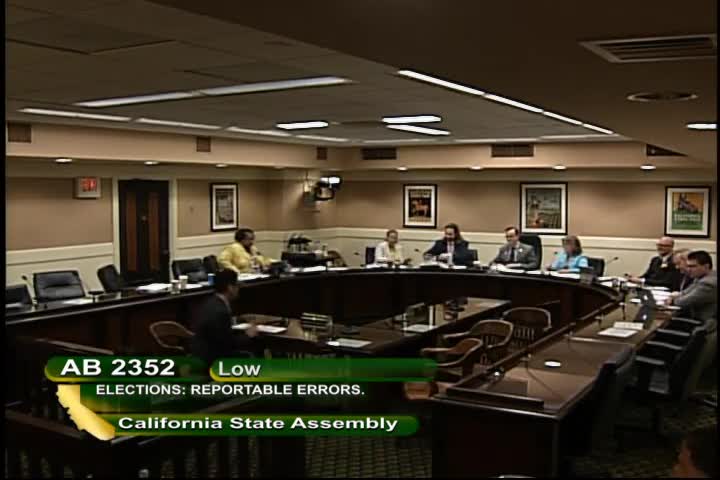
Discussed in Hearing
 5MIN
Assembly Standing Committee on Elections and Redistricting
Bill Author



