AB 3118: Sexual assault: investigations.
- Session Year: 2017-2018
- House: Assembly
- Latest Version Date: 2018-09-30
Existing law establishes the Sexual Assault Victims DNA Bill of Rights which prescribes requirements for law enforcement agencies and crime labs regarding the processing of forensic evidence in sexual assault cases and requires certain notifications to be made to the victim.
This bill would require all law enforcement agencies, medical facilities, crime laboratories, and any other facilities that receive, maintain, store, or preserve sexual assault evidence kits to conduct an audit of all untested sexual assault evidence kits in their possession and report certain data to the Department of Justice by no later than July 1, 2019.
The bill would also require the Department of Justice to prepare and submit a report to the Legislature regarding the results of these audits by no later than July 1, 2020.
By requiring local government entities to complete an audit and submit a report, this bill would impose a state-mandated local program.
The California Constitution requires the state to reimburse local agencies and school districts for certain costs mandated by the state. Statutory provisions establish procedures for making that reimbursement.
This bill would provide that, if the Commission on State Mandates determines that the bill contains costs mandated by the state, reimbursement for those costs shall be made pursuant to the statutory provisions noted above.
Existing law establishes the Sexual Assault Victims DNA Bill of Rights which prescribes requirements for law enforcement agencies and crime labs regarding the processing of forensic evidence in sexual assault cases and requires certain notifications to be made to the victim.
This bill would require all law enforcement agencies, medical facilities, crime laboratories, and any other facilities that receive, maintain, store, or preserve sexual assault evidence kits to conduct an audit of all sexual assault evidence kits in their possession and report certain data to the Department of Justice by no later than July 1, 2019.
The bill would also require the Department of Justice to prepare and submit a report to the Legislature regarding the results of these audits by no later than July 1, 2020.
By requiring local government entities to complete an audit and submit a report, this bill would impose a state-mandated local program.
The California Constitution requires the state to reimburse local agencies and school districts for certain costs mandated by the state. Statutory provisions establish procedures for making that reimbursement.
This bill would provide that, if the Commission on State Mandates determines that the bill contains costs mandated by the state, reimbursement for those costs shall be made pursuant to the statutory provisions noted above.
(a)Each law enforcement agency, medical facility, crime laboratory, and any other facility that receives, maintains, stores, or preserves sexual assault evidence kits shall conduct an audit of all untested sexual assault kits in their possession and shall, no later than July 1, 2019, submit a report to the Department of Justice containing the following information:
(1)The total number of untested sexual assault kits in their possession.
(2)For each kit, the following information:
(A)Whether or not the assault was reported to a law enforcement agency.
(B)For kits other than those described in subparagraph (C), the following data, as applicable:
(i)The date the kit was collected.
(ii)The date the kit was picked up by a law enforcement agency, for each law enforcement agency that has taken custody of the kit.
(iii)The date the kit was delivered to a crime laboratory.
(iv)The reason the kit has not been tested, if applicable.
(C)For kits where the victim has chosen not to pursue prosecution at the time of the audit, only the number of kits.
(b)The Department of Justice shall, by no later than July 1, 2020, prepare and submit a report to the Legislature summarizing the information received pursuant to subdivision (a).
(c)The report required by subdivision (b) shall be submitted in compliance with Section 9795 of the Government Code.
(d)Pursuant to Section 10231.5 of the Government Code, this section is repealed on July 1, 2024.
SEC. 2.If the Commission on State Mandates determines that this act contains costs mandated by the state, reimbursement to local agencies and school districts for those costs shall be made pursuant to Part 7 (commencing with Section 17500) of Division 4 of Title 2 of the Government Code.
(a)Each law enforcement agency, medical facility, crime laboratory, and any other facility that receives, maintains, stores, or preserves sexual assault evidence kits shall conduct an audit of all untested sexual assault kits in their possession and shall, no later than July 1, 2019, submit a report to the Department of Justice containing the following information:
(1)The total number of untested sexual assault kits in their possession.
(2)For each kit, the following information:
(A)Whether or not the assault was reported to a law enforcement agency.
(B)The For kits other than those described in subparagraph (C), the following dates, data, as applicable:
(i)The date the kit was collected.
(ii)The date the kit was picked up by a law enforcement agency, for each law enforcement agency that has taken custody of the kit.
(iii)The date the kit was delivered to a crime laboratory.
(C)(iv)The reason the kit has not been tested, if applicable.
(C)For kits where the victim has chosen not to pursue prosecution at the time of the audit, only the number of kits.
(b)The Department of Justice shall, no later than July 1, 2020, prepare and submit a report to the Legislature summarizing the information received pursuant to subdivision (a).
(c)The report required by subdivision (b) shall be submitted in compliance with Section 9795 of the Government Code.
(d)Pursuant to Section 10231.5 of the Government Code, this section is repealed on July 1, 2024.
SEC. 2.If the Commission on State Mandates determines that this act contains costs mandated by the state, reimbursement to local agencies and school districts for those costs shall be made pursuant to Part 7 (commencing with Section 17500) of Division 4 of Title 2 of the Government Code.
(a)Each law enforcement agency, medical facility, crime laboratory, and any other facility that receives, maintains, stores, or preserves sexual assault evidence kits shall conduct an audit of all such evidence untested sexual assault kits in their possession and shall, no later than July 1, 2019, submit a report to the Department of Justice containing the following information:
(1)The total number of untested sexual assault kits in their possession.
(2)For each kit, the following information:
(A)Whether or not the assault was reported to a law enforcement agency.
(B)The following dates, as applicable:
(i)The date the kit was collected.
(ii)The date the kit was reported to a law enforcement agency, for each law enforcement agency notified.(iii)(ii)The date the kit was picked up by a law enforcement agency, for each law enforcement agency that has taken custody of the kit.
(iv)(iii)The date the kit was delivered to a crime laboratory.
(v)The date the kit was tested by a crime laboratory.(vi)The date the information resulting from the test was entered into CODIS and any other relevant state or local DNA database.(C)The reason the kit has not been tested, if applicable.
(3)The total number of kits destroyed in the past year and the reason for destruction.(b)The Department of Justice shall, no later than July 1, 2020, prepare and submit a report to the Legislature summarizing the information received pursuant to subdivision (a).
(c)The report required by subdivision (b) shall be submitted in compliance with Section 9795 of the Government Code.
(d)Pursuant to Section 10231.5 of the Government Code, this section is repealed on July 1, 2024.
SEC. 2.If the Commission on State Mandates determines that this act contains costs mandated by the state, reimbursement to local agencies and school districts for those costs shall be made pursuant to Part 7 (commencing with Section 17500) of Division 4 of Title 2 of the Government Code.
(a)Each law enforcement agency, medical facility, crime laboratory, and any other facility that receives, maintains, stores, or preserves sexual assault evidence kits shall conduct an audit of all such evidence in their possession and shall, no later than July 1, 2019, submit a report to the Department of Justice containing the following information:
(1)The total number of kits in their possession.
(2)For each kit, the following information:
(A)Whether or not the assault was reported to a law enforcement agency.
(B)The following dates, as applicable:
(i)The date the kit was collected.
(ii)The date the kit was reported to a law enforcement agency, for each law enforcement agency notified.
(iii)The date the kit was picked up by a law enforcement agency, for each law enforcement agency that has taken custody of the kit.
(iv)The date the kit was delivered to a crime laboratory.
(v)The date the kit was tested by a crime laboratory.
(vi)The date the information resulting from the test was entered into CODIS and any other relevant state or local DNA database.
(C)The reason the kit has not been tested, if applicable.
(3)The total number of kits destroyed in the past year and the reason for destruction.
(b)The Department of Justice shall, no later than July 1, 2020, prepare and submit a report to the Legislature summarizing the information received pursuant to subdivision (a).
(c)The report required by subdivision (b) shall be submitted in compliance with Section 9795 of the Government Code.
(d)Pursuant to Section 10231.5 of the Government Code, this section is repealed on July 1, 2024.
SEC. 2.If the Commission on State Mandates determines that this act contains costs mandated by the state, reimbursement to local agencies and school districts for those costs shall be made pursuant to Part 7 (commencing with Section 17500) of Division 4 of Title 2 of the Government Code.
REVISIONS: HeadingLine 2.|
Date
|
Status
|
|---|---|
| Sep 30, 2018 | Chaptered by Secretary of State - Chapter 950, Statutes of 2018. |
| Sep 30, 2018 | Approved by the Governor. |
| Sep 5, 2018 | Enrolled and presented to the Governor at 3 p.m. |
| Aug 27, 2018 | Senate amendments concurred in. To Engrossing and Enrolling. |
| Aug 23, 2018 | In Assembly. Concurrence in Senate amendments pending. May be considered on or after August 25 pursuant to Assembly Rule 77. |
| Aug 23, 2018 | Read third time. Passed. Ordered to the Assembly. |
| Aug 20, 2018 | Read second time. Ordered to third reading. |
| Aug 17, 2018 | From committee: Amend, and do pass as amended. (Ayes 7. Noes 0.) (August 16). |
| Aug 6, 2018 | In committee: Referred to APPR. suspense file. |
| Jul 5, 2018 | Read second time and amended. Re-referred to Com. on APPR. |
| Jul 3, 2018 | From committee: Amend, and do pass as amended and re-refer to Com. on APPR. (Ayes 7. Noes 0.) (June 26). |
| Jun 13, 2018 | Referred to Com. on PUB. S. |
| May 31, 2018 | In Senate. Read first time. To Com. on RLS. for assignment. |
| May 30, 2018 | Read third time. Passed. Ordered to the Senate. |
| May 29, 2018 | Read second time. Ordered to third reading. |
| May 25, 2018 | From committee: Amend, and do pass as amended. (Ayes 16. Noes 0.) (May 25). |
| May 9, 2018 | In committee: Set, first hearing. Referred to APPR. suspense file. |
| Apr 10, 2018 | Coauthors revised. |
| Mar 12, 2018 | Referred to Com. on PUB. S. |
| Feb 17, 2018 | From printer. May be heard in committee March 19. |
| Feb 16, 2018 | Read first time. To print. |
|
Date
|
Description
|
Location
|
Votes
|
|
|---|---|---|---|---|
| Aug 27, 2018 | AB 3118 CHIU Concurrence in Senate Amendments | Assembly Floor |
Passed |
|
| Aug 23, 2018 | Assembly 3rd Reading AB3118 Chiu et al. By Leyva | Senate Floor |
Passed |
|
| Aug 16, 2018 | Do pass as amended | Senate Standing Committee on Appropriations |
Passed |
|
| Aug 6, 2018 | Placed on suspense file | Senate Standing Committee on Appropriations |
Passed |
|
| Jun 26, 2018 | Do pass as amended, but first amend, and re-refer to the Committee on [Appropriations] | Senate Standing Committee on Public Safety |
Passed |
|
| May 30, 2018 | AB 3118 CHIU Assembly Third Reading | Assembly Floor |
Passed |
|
| May 25, 2018 | Do pass as amended. | Assembly Standing Committee on Appropriations |
Passed |
|
| Apr 10, 2018 | Do pass and be re-referred to the Committee on [Appropriations] | Assembly Standing Committee on Public Safety |
Passed |
This list shows positions taken on this bill by organizations on the date displayed, which is linked to the original source.
Positions by individuals are not included.
|
Organization
|
Position
|
Date
|
|---|---|---|
| Alameda County District Attorney | ** Support | Aug 20, 2018 |
| Assembly Floor Vote: 77 - 0 | ** Against | Jun 25, 2018 |
| California Association Of Crime Lab Directors | ** Against | Aug 20, 2018 |
| California Association Of Crime Laboratory Directors | * Against | Jun 26, 2018 |
| California District Attorneys Association | ** Support | Aug 20, 2018 |
| California National Organization For Women | ** Support | Aug 20, 2018 |
| California Protective Parents Association | * Support | Jun 26, 2018 |
| California Statewide Law Enforcement Association | ** Support | Aug 20, 2018 |
| California's District Attorney | * Support | Apr 10, 2018 |
| Center for Community Solutions | ** Support | Aug 20, 2018 |
| City and County of San Francisco | ** Support | Aug 20, 2018 |
| City of West Hollywood | ** Support | Aug 20, 2018 |
| Congressman Adam Schiff | ** Support | Aug 20, 2018 |
| Congressman Alan Lowenthal | ** Support | Aug 20, 2018 |
| Congressman Brad Sherman | ** Support | Aug 20, 2018 |
| Congressman Ed Royce | ** Support | Aug 20, 2018 |
| Congressman Eric Swalwell | ** Support | Aug 20, 2018 |
| Congressman Jimmy Gomez | ** Support | Aug 20, 2018 |
| Congressman John Garamendi | ** Support | Aug 20, 2018 |
| Congressman Mark Desaulnier | ** Support | Aug 20, 2018 |
| Congressman Mark Takano | ** Support | Aug 20, 2018 |
| Congressman Mike Thompson | ** Support | Aug 20, 2018 |
| Congressman Norma Torres | ** Support | Aug 20, 2018 |
| Congressman Ro Kahanna | ** Support | Aug 20, 2018 |
| Congressman Steve Knight | ** Support | Aug 20, 2018 |
| Congressman Ted Lieu | ** Support | Aug 20, 2018 |
| Congressman Tony Cardenas | ** Support | Aug 20, 2018 |
| Congresswoman Anna Eschoo | ** Support | Aug 20, 2018 |
| Congresswoman Grace Napolitano | ** Support | Aug 20, 2018 |
| Congresswoman Jackie Speier | ** Support | Aug 20, 2018 |
| Congresswoman Judy Chu | ** Support | Aug 20, 2018 |
| Congresswoman Julia Brownley | ** Support | Aug 20, 2018 |
| Congresswoman Karen Bass | ** Support | Aug 20, 2018 |
| Congresswoman Lucille Roybal-Allard | ** Support | Aug 20, 2018 |
| Congresswoman Mimi Walters | ** Support | Aug 20, 2018 |
| Congresswoman Zoe Lofgren | ** Support | Aug 20, 2018 |
| Courage Campaign | ** Support | Aug 20, 2018 |
| Crime Victims United Of California | ** Support | Aug 20, 2018 |
| Equal Rights Advocates | ** Support | Aug 20, 2018 |
| Fiona Ma, Member, State Board Of Equalization | ** Support | Aug 20, 2018 |
| Human Rights Watch | ** Support | Aug 20, 2018 |
| Investigative Lead | ** Support | Aug 20, 2018 |
| Joyful Heart Foundation | ** Support | Aug 20, 2018 |
| National Council Of Jewish Women San Francisco | ** Support | Aug 20, 2018 |
| Peace Officers Research Association | ** Support | Aug 20, 2018 |
| Peace Over Violence | ** Support | Aug 20, 2018 |
| Riverside Sheriff's Association | * Support | Apr 10, 2018 |
| San Diego County District Attorney | ** Support | Aug 20, 2018 |
| San Francisco Department on the Status of Women | ** Support | Aug 20, 2018 |
| Santa Barbara Women's Political Committee | ** Support | Aug 20, 2018 |
| Santa Monica Rape Treatment Center | * Support | Jun 26, 2018 |
| U.S. Senator Diane Feinstein | ** Support | Aug 20, 2018 |
| Village Family Services | ** Support | Aug 20, 2018 |
| Women's Foundation of California | ** Support | Aug 20, 2018 |
kCONCURRENCE IN SENATE AMENDMENTS
CSA1 Bill Id:AB 3118
Author:(Chiu and Gonzalez Fletcher)
As Amended Ver:August 17, 2018
Majority vote
ASSEMBLY: | 77-0 | (May 30, 2018) | SENATE: | 39-0 | (August 23, 2018) |
Original Committee Reference: PUB. S.
SUMMARY: Requires each law enforcement agency, crime lab, medical facility, or any other facility that possesses sexual assault evidence kits to conduct an audit of all untested kits in their possession and report the findings to the Department of Justice (DOJ), as specified.
The Senate amendments provide that for those kits not tested because the victim has opted not to prosecute, the only data that needs to be reported is the number of kits.
EXISTING LAW:
- Establishes the Sexual Assault Victims' Bill of Rights, which provides victims of sexual assault the following rights:
- To be informed whether or not a deoxyribonucleic acid (DNA) profile of the assailant was obtained from the testing of forensic evidence in their case;
- To be informed whether or not the DNA profile of the assailant that was developed from forensic evidence has been entered into the DOJ Data Bank of case evidence; and
- To be informed about a match occurring between the DNA profile of the assailant, as it was developed from forensic evidence testing, and a DNA profile contained in the DOJ's Convicted Offender DNA Data Base, provided that informing the victim would not impede or compromise an ongoing conviction.
- Requires an adult arrested for or charged with a felony and a juvenile adjudicated for a felony to submit DNA samples.
- Encourages law enforcement agencies to submit sexual assault forensic evidence within 20 days of booking it into evidence, or to establish a rapid DNA turnaround program which would ensure that sexual assault evidence collected at a medical facility goes directly to a crime lab within five days.
- Encourages a crime lab, upon receiving sexual assault evidence, to process such evidence and upload it into Combined DNA Index System (CODIS) no later than 120 days after receiving it, or to transmit such evidence to another crime lab within 20 days of receiving it.
- Requires law enforcement agencies to report information regarding rape kit evidence, within 120 days of the collection of the kit, to the DOJ's Sexual Assault Forensic Evidence Tracking (SAFE-T) database. Specifies that information shall include, among other things:
- If biological evidence samples were submitted to a DNA laboratory for analysis;
- If a probative DNA profile was generated; and,
- If evidence was not submitted, the reasons for not submitting the kit for processing.
- Provides that, if a public DNA laboratory does not process a sexual assault kit within 120 days, it must explain the reasons for the status in the SAFE-T database, as specified.
- States that a law enforcement agency shall give a victim of a specified sexual assault offense written notification if the agency intends to discard a sexual assault kit. Law enforcement agencies are prohibited from discarding forensic evidence from unsolved sexual assault cases for 20 years, or if the victim was under 18 at the time of the offense, before the victim's 40th birthday.
- Provides that a victim must be given written notification at least 60 days prior to the forensic evidence being discarded.
- Requires the DOJ, in consultation with law enforcement agencies and crime victims groups, to establish a process to inform victims of sexual assault regarding the location and information about their sexual assault kits upon the victim making an inquiry.
- States, notwithstanding any other limitation of time described, prosecution for a specified felony sex offense shall be commenced within 10 years after the commission of the offense.
- States that, six months prior to the applicable statute of limitations ending, a law enforcement agency that has not analyzed DNA evidence must inform the sexual assault victim that the statute of limitations deadline is going to end.
AS PASSED BY THE ASSEMBLY, this bill:
- Provided that each law enforcement agency, crime lab, medical facility, or other facility that receives or stores sexual assault kit evidence must conduct an audit of all untested kits in their possession and, by July 1, 2019, report to the DOJ all of the following:
- The total number of untested kits in their possession; and,
- For each kit, the following information:
- Whether or not the assault had been reported to a law enforcement agency;
- The date the kit was collected;
- The date a law enforcement agency picked the kit up, for each agency which has taken custody of the kit;
- The date the kit was delivered to a crime lab; and,
- The reason the kit has not been tested.
- Required the DOJ to submit a report to the Legislature summarizing the above information by July 1, 2020.
FISCAL EFFECT: According to the Senate Appropriations Committee:
- Unknown, potentially-significant one-time costs likely in the hundreds of thousands of dollars in the aggregate to local law enforcement agencies alone to audit how many untested kits they maintain, why they were not tested, and collect other required information. There are over 500 local law enforcement agencies in the state. If half of those agencies were required to conduct an audit, and each audit cost $1,000, local costs to comply with this measure would be $250,000. These costs likely would be reimbursable by the state, the extent of which would be determined by the Commission on State Mandates. (General Fund, local funds)
- DOJ has indicated the need of 1.0 limited-term Information Technology Specialist I position at a total cost (including wages, benefits, equipment, and operating expenses) of $192,000 for one year to manage the anticipated large amount of data received from law enforcement agencies, medical facilities, crime labs, and all other affected facilities. This staff would be responsible for organizing the information to submit the required report to the Legislature. (Special fund*)
*DNA Identification Fund – structurally unsound
COMMENTS: According to the author, ''When tested, DNA evidence can be an incredibly powerful tool to solve and prevent crime. It can identify an unknown assailant and confirm the presence of a known suspect. It can affirm the survivor's account of the attack and discredit the suspect. It can connect the suspect to other crime scenes. It can exonerate innocent suspects.
''However, as we've seen over the past few years, there has been widespread mismanagement of DNA evidence in sexual assault cases in many jurisdictions. Survivors of sexual assault who are submitting sexual assault evidence kits aren't getting the answers they need and deserve.
''To take advantage of any of the benefits mentioned earlier, rape kits must be tested. Right now, some kits are analyzed but the vast majority are not. Currently, there is no comprehensive data on the number of rape kits that have been collected and the reasons why kits were not tested.
''In California, we know there is partial count of our backlog with at minimum over 13,000 kits – but we don’t know how long they've been sitting on the shelf, or if there were or were not legitimate reasons why they were not tested. To get at the crux of the backlog problem, we need to know how many kits are sitting untested on shelves across the state.
''AB 3118 solves this problem by directing local agencies to audit the sexual assault evidence kits they have sitting on their shelves and report the data to DOJ.''
Analysis Prepared by: Sandy Uribe / Mureed Rasool / PUB. S. / (916) 319-3744 FN: 0004436
Office of Senate Floor Analyses (916) 651-1520 Fax: (916) 327-4478 | AB |
THIRD READING
Bill No: AB 3118
Amended: 8/17/18 in Senate
SENATE PUBLIC SAFETY COMMITTEE: 7-0, 6/26/18
AYES: Skinner, Anderson, Bradford, Jackson, Mitchell, Stone, Wiener
SENATE APPROPRIATIONS COMMITTEE: 7-0, 8/16/18
AYES: Portantino, Bates, Beall, Bradford, Hill, Nielsen, Wiener
ASSEMBLY FLOOR: 77-0, 5/30/18 - See last page for vote
SOURCE: Alameda County District Attorney
Joyful Heart Foundation
DIGEST:
This bill requires each law enforcement agency, crime lab, medical facility, or any other facility that possesses sexual assault evidence kits to conduct an audit of all kits in their possession and report the findings to the Department of Justice (DOJ), as specified.
Existing law:
- Establishes the Sexual Assault Victims’ Bill of Rights, which provides victims of sexual assault the following rights:
- To be informed whether or not a deoxyribonucleic acid (DNA) profile of the assailant was obtained from the testing of forensic evidence in their case;
- To be informed whether or not the DNA profile of the assailant that was developed from forensic evidence has been entered into the DOJ Data Bank of case evidence; and
- To be informed about a match occurring between the DNA profile of the assailant, as it was developed from forensic evidence testing, and a DNA profile contained in the DOJ’s Convicted Offender DNA Data Base, provided that informing the victim would not impede or compromise an ongoing conviction. (Penal Code § 680 (c)(2).)
- Requires an adult arrested for or charged with a felony and a juvenile adjudicated for a felony to submit DNA samples. (Penal Code § 296.)
- Requires law enforcement officers or medical providers to provide a sexual assault victim with a card, as developed by the applicable local law enforcement agency, which comprehensibly explains the victim’s rights. (Penal Code § 680.2.)
- Encourages law enforcement agencies to submit sexual assault forensic evidence within 20 days of booking it into evidence, or to establish a rapid DNA turnaround program which would ensure that sexual assault evidence collected at a medical facility goes directly to a crime lab within 5 days. (Penal Code § 680 (b)(7)(A).)
- Encourages a crime lab, upon receiving sexual assault evidence, to process such evidence and upload it into CODIS no later than 120 days after receiving it, or to transmit such evidence to another crime lab within 20 days of receiving it. (Penal Code § 680 (b)(7)(B).)
- Requires law enforcement agencies to report information regarding rape kit evidence, within 120 days of the collection of the kit, to the DOJ’s Sexual Assault Forensic Evidence Tracking (SAFE-T) database. Specifies that information shall include, among other things:
- If biological evidence samples were submitted to a DNA laboratory for analysis;
- If a probative DNA profile was generated; and,
- If evidence was not submitted, the reasons for not submitting the kit for processing. (Penal Code § 680.3 (a).)
- Provides that, if a public DNA laboratory does not process a sexual assault kit within 120 days, it must explain the reasons for the status in the SAFE-T database, as specified. (Penal Code § 680.3 (b).)
- States that a law enforcement agency shall give a victim of a specified sexual assault offense written notification if the agency intends to discard a sexual assault kit. Law enforcement agencies are prohibited from discarding forensic evidence from unsolved sexual assault cases for 20 years, or if the victim was under 18 at the time of the offense, before the victim’s 40th birthday. (Penal Code § 680 (e).)
- Provides that a victim must be given written notification at least 60 days prior to the forensic evidence being discarded. (Penal Code § 680 (f).)
- Requires the DOJ, in consultation with law enforcement agencies and crime victims groups, to establish a process to inform victims of sexual assault regarding the location and information about their sexual assault kits upon the victim making an inquiry. (Penal Code § 680.1.)
- States, notwithstanding any other limitation of time described, prosecution for a specified felony sex offense shall be commenced within 10 years after the commission of the offense. (Penal Code § 801.1 (b).)
- States that, six months prior to the applicable statute of limitations ending, a law enforcement agency that has not analyzed DNA evidence must inform the sexual assault victim that the statute of limitations deadline is going to end. (Penal Code § 680 (d).)
This bill:
- Provides that each law enforcement agency, crime lab, medical facility, or other facility that receives or stores sexual assault kit evidence must conduct an audit of all untested kits in their possession and, by July 1, 2019, report to the DOJ all of the following:
- The total number of untested kits in their possession.
- For each kit reported, the following information, as applicable:
- Whether or not the assault had been reported to a law enforcement agency.
- The date the kit was collected.
- The date a law enforcement agency had picked the kit up, for each agency which has taken custody of the kit.
- The date the kit was delivered to a crime lab.
- The reason a kit has not been tested, if applicable
- Whether or not the assault had been reported to a law enforcement agency.
- Requires the DOJ to submit a report to the Legislature summarizing the above information by July 1, 2020.
Background
California law does not require any agency to send a sexual assault kit to a crime lab, although recently, legislation has been enacted that encourages such transfers. (Penal Code § 680 (b)(7)(A).) The California Legislature has recently enacted a statute requiring law enforcement agencies to submit information regarding sexual assault kits into the SAFE-T database. Such information includes: if forensic evidence samples were sent to a crime lab, whether such evidence generated a probative DNA profile, and, if forensic evidence was not submitted to a crime lab, the reason(s) for not submitting the kit for processing. (Penal Code, § 680.3 (a).) However, that statute is not retroactive and does not cover kits gathered prior to the law becoming operative.
There are a number of reasons why law enforcement authorities do not submit a kit to a crime lab. A reason might be the fact that the issue may have been consent rather than not knowing the identity of the suspect, or that the charges might have been dropped, or a guilty plea entered. (U.S. DOJ’s National Institute of Justice. (2011). The Road Ahead: Unanalyzed Evidence in Sexual Assault Cases. <https://www.ncjrs.gov/pdffiles1/nij/233279.pdf [Apr. 5, 2018].) A victim may also request that the kit not be submitted to law enforcement.
A 2014 report by the California State Auditor found that law enforcement agencies rarely document reasons for not analyzing sexual assault evidence kits. (California State Auditor. (2014) Sexual Assault Evidence Kits. <https://www.bsa.ca.gov/pdfs/reports/2014-109.pdf [Apr. 5, 2018].) Specifically, the report found that “[i]n 45 cases . . . reviewed in which investigators at the three agencies we visited did not request a kit analysis, the investigators rarely documented their decisions. As a result, we often could not determine with certainty why investigators decided that kit analysis was not needed.”
Upon a more in-depth review of the individual cases, the report found that analysis of the kits would not have been likely to further the investigation of those cases. The “decisions not to request sexual assault evidence kit analysis in the individual cases we reviewed appeared reasonable because kit analysis would be unlikely to further the investigation of those cases. We reviewed specific cases at each agency in which investigators did not request analysis. Our review included 15 cases from each of the three agencies we visited with offenses that occurred from 2011 through 2013, for a total of 45 cases. In those cases, we did not identify any negative effects on the investigations as a result of decisions not to request analysis. We based our conclusions on the circumstances present in the individual cases we reviewed, as documented in the files for the 45 cases and as discussed with the investigative supervisors.” (Id.)
Although the audit found the explanations for not submitting the sexual assault kits as reasonable, testing those kits may have identified offenders who had committed another crime for which they were never previously identified. The National Institute of Justice funded Detroit, Michigan and Houston, Texas to test their unsubmitted sexual assault kits. The results revealed that testing unsubmitted kits can lead to convicting hundreds to thousands of serial offenders; such testing identified over 400 serial rapists in Detroit alone. (National Institute of Justice. (2016). National Sexual Assault Kit Initiative (SAKI): FY 2017 Competitive Grant Announcement. <https://www.bja.gov/funding/SAKI17.pdf [Apr. 5, 2018].)
California, which passed Proposition 69 in 2004, requires all persons arrested or charged of a felony to submit DNA samples and thus testing an untested kit may result in a match. (Penal Code § 296) However, for cases where a kit is not tested because a person is in custody or convicted for the offense, under Proposition 69 that person’s DNA will already have been collected and submitted a DNA sample to the data bank so matches to other offenses where the kit was tested could be connected through that sample.
This bill will collect data on untested kits. Having this information will help determine what the reason for untested kits is as well as where funding should be directed to address any backlog. Why a kit has not been tested is very relevant in this discussion. A kit that has not been tested because the victim has opted not to prosecute or where the suspect is in known is very different than a kit that has not been tested in a timely manner because of a shortage of lab resources or other issue. This bill should give us that information.
FISCAL EFFECT: Appropriation: Fiscal Com.: Local:
According to the Senate Appropriations Committee:
- Unknown, potentially-significant one-time costs likely in the hundreds of thousands of dollars in the aggregate to local law enforcement agencies alone to audit how many untested kits they maintain, why they were not tested, and collect other required information. There are over 500 local law enforcement agencies in the state. If half of those agencies were required to conduct an audit, and each audit cost $1,000, local costs to comply with this measure would be $250,000. These costs likely would be reimbursable by the state, the extent of which would be determined by the Commission on State Mandates. (General Fund, local funds)
- DOJ has indicated the need of 1.0 limited-term Information Technology Specialist I position at a total cost (including wages, benefits, equipment, and operating expenses) of $192,000 for one year to manage the anticipated large amount of data received from law enforcement agencies, medical facilities, crime labs, and all other affected facilities. This staff would be responsible for organizing the information to submit the required report to the Legislature. (Special fund*)
*DNA Identification Fund—structurally unsound
Alameda County District Attorney (co-source)
Joyful Heart Foundation (co-source)
California District Attorneys Association
California National Organization for Women
California Statewide Law Enforcement Association
Center for Community Solutions
City and County of San Francisco
City of West Hollywood
Congressman Adam Schiff
Congressman Alan Lowenthal
Congressman Brad Sherman
Congressman Ed Royce
Congressman Eric Swalwell
Congressman Jimmy Gomez
Congressman John Garamendi
Congressman Mark DeSaulnier
Congressman Mark Takano
Congressman Mike Thompson
Congressman Norma Torres
Congressman Ro Kahanna
Congressman Steve Knight
Congressman Ted Lieu
Congressman Tony Cardenas
Congresswoman Anna Eschoo
Congresswoman Grace Napolitano
Congresswoman Jackie Speier
Congresswoman Judy Chu
Congresswoman Julia Brownley
Congresswoman Karen Bass
Congresswoman Lucille Roybal-Allard
Congresswoman Mimi Walters
Congresswoman Zoe Lofgren
Courage Campaign
Crime Victims United of California
Equal Rights Advocates
Fiona Ma, Member, State Board of Equalization
Human Rights Watch
Investigative Lead
National Council of Jewish Women San Francisco
Peace Officers Research Association
Peace over Violence
San Diego County District Attorney
San Francisco Department on the Status of Women
Santa Barbara Women’s Political Committee
U.S. Senator Diane Feinstein
Village Family Services
Women’s Foundation of California
OPPOSITION: (Verified 8/16/18)
California Association of Crime Lab Directors
ASSEMBLY FLOOR: 77-0, 5/30/18
AYES: Acosta, Travis Allen, Arambula, Baker, Berman, Bigelow, Bloom, Bonta, Brough, Burke, Caballero, Calderon, Carrillo, Cervantes, Chau, Chávez, Chen, Chiu, Choi, Chu, Cooley, Cooper, Cunningham, Dahle, Daly, Eggman, Flora, Fong, Frazier, Friedman, Gallagher, Cristina Garcia, Eduardo Garcia, Gipson, Gloria, Gonzalez Fletcher, Gray, Grayson, Harper, Holden, Irwin, Jones-Sawyer, Kalra, Kamlager-Dove, Kiley, Lackey, Levine, Limón, Low, Maienschein, Mathis, Mayes, McCarty, Medina, Melendez, Mullin, Muratsuchi, Nazarian, Obernolte, O'Donnell, Patterson, Quirk, Quirk-Silva, Reyes, Rodriguez, Rubio, Salas, Santiago, Steinorth, Mark Stone, Thurmond, Ting, Voepel, Waldron, Weber, Wood, Rendon
NO VOTE RECORDED: Aguiar-Curry
8/20/18 9:55:44
**** END ****
SENATE COMMITTEE ON APPROPRIATIONS
Senator Anthony Portantino, Chair
2017 - 2018 Regular Session
AB 3118 (Chiu) - Sexual assault: investigations
Version: July 5, 2018 | Policy Vote: PUB. S. 7 - 0 |
Urgency: No | Mandate: Yes |
Hearing Date: August 16, 2018 | Consultant: Shaun Naidu |
*********** ANALYSIS ADDENDUM – SUSPENSE FILE ***********
The following information is revised to reflect amendments
adopted by the committee on August 16, 2018
Bill Summary:
AB 3118 would require all law enforcement agencies, medical facilities, crime laboratories, and any other facilities that receive, maintain, store, or preserve sexual assault evidence kits to conduct an audit of all untested kits in their possession and report certain data to the Department of Justice, which in turn would report the results of the audits to the Legislature.
Fiscal Impact:
- Unknown, potentially-significant one-time costs likely in the hundreds of thousands of dollars in the aggregate to local law enforcement agencies alone to audit how many untested kits they maintain, why they were not tested, and collect other required information. There are over 500 local law enforcement agencies in the state. If half of those agencies were required to conduct an audit, and each audit cost $1,000, local costs to comply with this measure would be $250,000. These costs likely would be reimbursable by the state, the extent of which would be determined by the Commission on State Mandates. (General Fund, local funds)
- The Department of Justice has indicated the need of 1.0 limited-term Information Technology Specialist I position at a total cost (including wages, benefits, equipment, and operating expenses) of $192,000 for one year to manage the anticipated large amount of data received from law enforcement agencies, medical facilities, crime labs, and all other affected facilities. This staff would be responsible for organizing the information to submit the required report to the Legislature. (Special fund*)
*DNA Identification Fund—structurally unsound
Committee Amendments:
Add a coauthor.
-- END --
SENATE COMMITTEE ON
Senator Anthony Portantino, Chair
2017 - 2018 Regular Session
AB 3118 (Chiu) - Sexual assault: investigations
Version: | Policy Vote: |
Urgency: | Mandate: |
Hearing Date: | Consultant: |
This bill meets the criteria for referral to the Suspense File.
Bill Summary:
AB 3118 would require all law enforcement agencies, medical facilities, crime laboratories, and any other facilities that receive, maintain, store, or preserve sexual assault evidence kits to conduct an audit of all untested kits in their possession and report certain data to the Department of Justice (DOJ), which in turn would report the results of the audits to the Legislature.
Fiscal Impact:
- Unknown, potentially-significant one-time costs likely in the hundreds of thousands of dollars in the aggregate to local law enforcement agencies alone to audit how many untested kits they maintain, why they were not tested, and collect other required information. There are over 500 local law enforcement agencies in the state. If half of those agencies were required to conduct an audit, and each audit cost $1,000, local costs to comply with this measure would be $250,000. These costs likely would be reimbursable by the state, the extent of which would be determined by the Commission on State Mandates. (General Fund, local funds)
- The Department of Justice has indicated the need of 1.0 limited-term Information Technology Specialist I position at a total cost (including wages, benefits, equipment, and operating expenses) of $192,000 for one year to manage the anticipated large amount of data received from law enforcement agencies, medical facilities, crime labs, and all other affected facilities. This staff would be responsible for organizing the information to submit the required report to the Legislature. (Special fund*)
*DNA Identification Fund—structurally unsound
Background:
California established the Sexual Assault Victims' Bill of Rights in 2003. In passing that law, the Legislature found and declared that "[l]aw enforcement agencies have an obligation to victims of sexual assaults in the proper handling, retention and timely DNA testing of rape kit evidence or other crime scene evidence and to be responsive to victims concerning the developments of forensic testing and the investigation of their cases." Upon the request of the survivor, law enforcement agencies investigating the sexual assault may inform the survivor of the status of the DNA testing. Specifically, the California DNA Bill of Rights provides that subject to sufficient resources to respond to requests, survivors have a right to be informed whether the assailant's DNA profile was developed from the evidence, whether that profile was uploaded to the DNA database, and whether a hit resulted from the upload.
The Sexual Assault Victims' Bill of Rights was amended in 2014. Those amendments encouraged law enforcement and crime labs to handle and process sexual assault forensic evidence within specific time frame. Specifically, law enforcement agencies should either submit sexual assault forensic evidence to a crime lab within twenty days after it is booked into evidence or insure that a rapid turnaround DNA program is in place.
Existing law also encourages a crime lab that receives sexual assault forensic evidence to either process the evidence, create DNA profiles, and upload qualifying DNA profiles into the national database or transmit the sexual assault forensic evidence to another crime lab as soon as practically possible but no later than thirty days after receiving the evidence.
Proposed Law:
This bill would require each law enforcement agency, medical facility, crime laboratory, and any other facility that receives, maintains, stores, or preserves sexual assault evidence kits to conduct an audit of all untested sexual assault kits in its possession. The entity then must submit a report to DOJ, by July 1, 2019, of the number of untested kits in its possession; if the assault was reported to law enforcement for each kit; and, for kits where the victim did choose to prosecute, the date the kit was collected, picked up by law enforcement, delivered to a crime lab, and the reason it has not been tested, if applicable.
Upon receiving the audit information, DOJ would be required to prepare and submit a report to the Legislature, by July 1, 2020, that summarizes the information about the untested kits.
Related Legislation:
SB 1449 (Leyva, 2018) would require a law enforcement agency to submit sexual assault forensic evidence to a crime lab, as specified, and would require the lab to process the evidence and upload DNA profiles into a national DNA database, as specified. SB 1449 is pending in the Assembly Committee on Appropriations.
AB 41 (Chiu, Ch. 694, Stats. 2017) requires law enforcement agencies to report specified information, and update such information, regarding the collection and processing of sexual assault forensic evidence, as specified. AB 1848 (Chiu, 2016) was substantially similar to AB 41 and was held on the Suspense File of this Committee.
AB 1517 (Skinner, Ch. 874, Stats. 2014) set the recommended timelines, that are the subject of this bill, within which both law enforcement agencies and crime laboratories are to perform DNA testing of sexual assault forensic evidence, as specified.
Staff Comments:
This staff DOJ anticipates that it would need to comply with this measure would be funded from the DNA Identification Fund, which has experienced significant revenue decreases in recent years. From 2013-14 to 2016-17, revenue has decreased by approximately 23 percent. To fully fund the position, another funding source likely will be needed to supplement the DNA Identification Fund, thereby creating pressure on the General Fund to backfill any shortage.
-- END --
SENATE COMMITTEE ON PUBLIC SAFETY
Senator Nancy Skinner, Chair
2017 - 2018 Regular
Bill No: AB 3118 Hearing Date: June 26, 2018
Author: | Chiu | ||
Version: | May 25, 2018 | ||
Urgency: | No | Fiscal: | Yes |
Consultant: | MK | ||
Subject: Sexual Assault: Investigations
HISTORY
Source: Alameda County District Attorney
Joyful Heart Foundation
Prior Legislation: AB 41 (Chiu), Chapter 694, Stats. 2017
AB 1312 (Gonzalez Fletcher) Chapter 692, Stats. 2017
AB 1848 (Chiu) Held Senate Appropriations 2016
AB 1517 (Skinner), Chapter 874, Stats. 2014
AB 322 (Portantino) Vetoed 2011
AB 558 (Portantino) Vetoed 2010
AB 1017 (Portantino) Vetoed 2009
Support: California District Attorneys Association; California National Organization for Women; California Statewide Law Enforcement Association; Center for Community Solutions; City and County of San Francisco, the San Francisco Department on the Status of Women; Courage Campaign; Crime Victims United of California; Equal Rights Advocates; Human Rights Watch; Investigative Lead; NCJWSF; Peace over Violence; Santa Barbara Women’s Political Committee; the Village Family Services; the Women’s Foundation of California; Senator Diane Feinstein; Congresswoman Karen Bass; Congresswoman Julia Brownley; Congressman Tony Cardenas; Congresswoman Judy Chu; Congressman Mark DeSaulnier; Congresswoman Anna Eschoo; Congressman John Garamendi; Congressman Jimmy Gomez; Congressman Ro Kahanna; Congressman Steve Knight; Congressman Ted Lieu; Congresswoman Zoe Lofgren; Congressman Alan Lowenthal; Congresswoman Grace Napolitano; Congresswoman Lucille Roybal-Allard; Congressman Ed Royce; Congressman Adam Schiff; Congressman Brad Sherman; Congresswoman Jackie Speier; Congressman Eric Swalwell; Congressman Mark Takano; Congressman Mike Thompson; Congressman Norma Torres; Congresswoman Mimi Walters; Fiona Ma, State Board of Equalization
Opposition: California Association of Crime Lab Directors
Assembly Floor Vote: 77 - 0
PURPOSE
The purpose of this bill is to require each law enforcement agency, crime lab, medical facility, or any other facility that possesses sexual assault evidence kits to conduct an audit of all kits in their possession and report the findings to the Department of Justice (DOJ), as specified
Existing law establishes the Sexual Assault Victims’ Bill of Rights, which provides victims of sexual assault the following rights:
- To be informed whether or not a deoxyribonucleic acid (DNA) profile of the assailant was obtained from the testing of forensic evidence in their case;
- To be informed whether or not the DNA profile of the assailant that was developed from forensic evidence has been entered into the DOJ Data Bank of case evidence; and
- To be informed about a match occurring between the DNA profile of the assailant, as it was developed from forensic evidence testing, and a DNA profile contained in the DOJ’s Convicted Offender DNA Data Base, provided that informing the victim would not impede or compromise an ongoing conviction. (Penal Code § 680 (c)(2).)
Existing law requires an adult arrested for or charged with a felony and a juvenile adjudicated for a felony to submit DNA samples. (Penal Code § 296.)
Existing law requires law enforcement officers or medical providers to provide a sexual assault victim with a card, as developed by the applicable local law enforcement agency, which comprehensibly explains the victim’s rights. (Penal Code § 680.2.)
Existing law encourages law enforcement agencies to submit sexual assault forensic evidence within 20 days of booking it into evidence, or to establish a rapid DNA turnaround program which would ensure that sexual assault evidence collected at a medical facility goes directly to a crime lab within 5 days. (Penal Code § 680 (b)(7)(A).)
Existing law encourages a crime lab, upon receiving sexual assault evidence, to process such evidence and upload it into CODIS no later than 120 days after receiving it, or to transmit such evidence to another crime lab within 20 days of receiving it. (Penal Code § 680 (b)(7)(B).)
Existing law requires law enforcement agencies to report information regarding rape kit evidence, within 120 days of the collection of the kit, to the DOJ’s Sexual Assault Forensic Evidence Tracking (SAFE-T) database. Specifies that information shall include, among other things:
- If biological evidence samples were submitted to a DNA laboratory for analysis;
- If a probative DNA profile was generated; and,
- If evidence was not submitted, the reasons for not submitting the kit for processing. (Penal Code § 680.3 (a).)
Existing law provides that, if a public DNA laboratory does not process a sexual assault kit within 120 days, it must explain the reasons for the status in the SAFE-T database, as specified. (Penal Code § 680.3 (b).)
Existing law states that a law enforcement agency shall give a victim of a specified sexual assault offense written notification if the agency intends to discard a sexual assault kit. Law enforcement agencies are prohibited from discarding forensic evidence from unsolved sexual assault cases for 20 years, or if the victim was under 18 at the time of the offense, before the victim’s 40th birthday. (Penal Code § 680 (e).)
Existing law provides that a victim must be given written notification at least 60 days prior to the forensic evidence being discarded. (Penal Code § 680 (f).)
Existing law requires the DOJ, in consultation with law enforcement agencies and crime victims groups, to establish a process to inform victims of sexual assault regarding the location and information about their sexual assault kits upon the victim making an inquiry. (Penal Code § 680.1.)
Existing law states, notwithstanding any other limitation of time described, prosecution for a specified felony sex offense shall be commenced within 10 years after the commission of the offense. (Penal Code § 801.1 (b).)
Existing law states that, six months prior to the applicable statute of limitations ending, a law enforcement agency that has not analyzed DNA evidence must inform the sexual assault victim that the statute of limitations deadline is going to end. (Penal Code § 680 (d).)
This bill provides that each law enforcement agency, crime lab, medical facility, or other facility that receives or stores sexual assault kit evidence must conduct an audit of all untested kits in their possession and, by July 1, 2019, report to the DOJ all of the following:
- The total number of untested kits in their possession.
- For each kit reported, the following information, as applicable:
- Whether or not the assault had been reported to a law enforcement agency.
- The date the kit was collected.
- The date a law enforcement agency had picked the kit up, for each agency which has taken custody of the kit.
- The date the kit was delivered to a crime lab.
- The reason a kit has not been tested, if applicable
This bill requires the DOJ to submit a report to the Legislature summarizing the above information by July 1, 2020.
COMMENTS
1. Need for This Bill
According to the author:
In recent years, the federal government identified hundreds of thousands of rape kits that have gone unanalyzed, commonly referred to as the “rape kit backlog.” Because most jurisdictions do not have systems for tracking or counting rape kits, we do not know the total number.
In many cases, survivors of sexual assault experience re-traumatization when undergoing the forensic evidence collection process. The neglect of these kits with no explanation why they were not analyzed simply adds to the trauma ensured by the survivors seeking justice.
In California, we know there is partial count of our backlog with a minimum of over 13,00 kits- but we don’t know how long they’ve been sitting on the shelf, or if there were or were not legitimate reasons why they were not tested. To get at the crux of the backlog problem, we need to know how many kits are sitting untested on shelves across the state.
Last year, the legislature passed an Governor Brown signed AB 41 (Chiu) which requires local agencies to track all rape kits collected from survivors on or after January 1, 2018.
While this was an important step moving forward, there is still an unmown number of existing untested kits sitting on shelves across the state.
Additionally, in 2014, the federal government created the Sexual Assault Kit Initiative (SAK), a Department of Justice program that provides local communities with the resources to test backlogged kits in their police storage facilities. Congress has thus far approved $131 million for this unique program, and the FY18 budget includes an additional $5 million.
There is ample federal funding available to address backlogged kits. To apply for those funds, local jurisdictions should know the number of kits they have sitting on their shelves.
AB 3118 would require all agencies and facilities that receive, maintain, store, or preserve sexual assault evidence kits to conduct an audit of all kits in their possession and report the data to DOJ. DOJ would then be required to prepare and submit a report on the submitted data to the legislature.
2. Unsubmitted Sexual Assault Kits
California law does not require any agency to send a sexual assault kit to a crime lab, although recently, legislation has been enacted that encourages such transfers. (Penal Code § 680 (b)(7)(A).) The California Legislature has recently enacted a statute requiring law enforcement agencies to submit information regarding sexual assault kits into the state Department of Justice’s Sexual Assault Forensic Evidence Tracking (SAFE-T) database. Such information includes: if forensic evidence samples were sent to a crime lab, whether such evidence generated a probative DNA profile, and, if forensic evidence was not submitted to a crime lab, the reason(s) for not submitting the kit for processing. (Penal Code, § 680.3 (a).) However, that statute is not retroactive and does not cover kits gathered prior to the law becoming operative.
There are a number of reasons why law enforcement authorities do not submit a kit to a crime lab. A reason might be the fact that the issue may have been consent rather than not knowing the identity of the suspect, or that the charges might have been dropped, or a guilty plea entered. (U.S. DOJ’s National Institute of Justice. (2011). The Road Ahead: Unanalyzed Evidence in Sexual Assault Cases. <https://www.ncjrs.gov/pdffiles1/nij/233279.pdf> [Apr. 5, 2018].) A victim may also request that the kit not be submitted to law enforcement.
A 2014 report by the California State Auditor found that law enforcement agencies rarely document reasons for not analyzing sexual assault evidence kits. (California State Auditor. (2014) Sexual Assault Evidence Kits. <https://www.bsa.ca.gov/pdfs/reports/2014-109.pdf> [Apr. 5, 2018].) Specifically, the report found that “[i]n 45 cases . . . reviewed in which investigators at the three agencies we visited did not request a kit analysis, the investigators rarely documented their decisions. As a result, we often could not determine with certainty why investigators decided that kit analysis was not needed.”
Upon a more in-depth review of the individual cases, the report found that analysis of the kits would not have been likely to further the investigation of those cases. The “decisions not to request sexual assault evidence kit analysis in the individual cases we reviewed appeared reasonable because kit analysis would be unlikely to further the investigation of those cases. We reviewed specific cases at each agency in which investigators did not request analysis. Our review included 15 cases from each of the three agencies we visited with offenses that occurred from 2011 through 2013, for a total of 45 cases. In those cases, we did not identify any negative effects on the investigations as a result of decisions not to request analysis. We based our conclusions on the circumstances present in the individual cases we reviewed, as documented in the files for the 45 cases and as discussed with the investigative supervisors.” (Id.)
Although the audit found the explanations for not submitting the sexual assault kits as reasonable, testing those kits may have identified offenders who had committed another crime for which they were never previously identified. The National Institute of Justice funded Detroit, Michigan and Houston, Texas to test their unsubmitted sexual assault kits. The results revealed that testing unsubmitted kits can lead to convicting hundreds to thousands of serial offenders; such testing identified over 400 serial rapists in Detroit alone. (National Institute of Justice. (2016). National Sexual Assault Kit Initiative (SAKI): FY 2017 Competitive Grant Announcement. <https://www.bja.gov/funding/SAKI17.pdf> [Apr. 5, 2018].)
California, which passed Proposition 69 in 2004, requires all persons arrested or charged of a felony to submit DNA samples and thus testing an untested kit may result in a match. (Penal Code § 296) However, for cases where a kit is not tested because a person is in custody or convicted for the offense, under Proposition 69 that person’s DNA will already have been collected and submitted a DNA sample to the data bank so matches to other offenses where the kit was tested could be connected through that sample.
3. Data on untested kit
This bill would collect data on untested kits. Having this information will help determine what the reason for untested kits is as well as where funding should be directed to address any backlog. Why a kit has not been tested is very relevant in this discussion. A kit that has not been tested because the victim has opted not to prosecute or where the suspect is in known is very different than a kit that has not been tested in a timely manner because of a shortage of lab resources or other issue. This bill should give us that information.
4. Author’s Amendments to be Offered in Committee
In some response to some concerns raised about giving information on kits when the victim has chosen not to prosecute the author is taking the following amendments:
a) Each law enforcement agency, medical facility, crime laboratory, and any other facility that receives, maintains, stores, or preserves sexual assault evidence kits shall conduct an audit of all untested sexual assault kits in their possession and shall, no later than July 1, 2019, submit a report to the Department of Justice containing the following information:
(1) The total number of untested sexual assault kits in their possession.
(2) For each kit, the following information:
(A) Whether or not the assault was reported to a law enforcement agency.
(B) For kits where the victim has expressed an interest in pursuing prosecution, the following dates, as applicable:
(i) The date the kit was collected.
(ii) The date the kit was picked up by a law enforcement agency, for each law enforcement agency that has taken custody of the kit.
(iii) The date the kit was delivered to a crime laboratory.
(iv) The reason the kit has not been tested, if applicable.
(C) For kits where the victim has chosen not to pursue prosecution at the time of the audit, only the number of kits need be disclosed.
(b) The Department of Justice shall, no later than July 1, 2020, prepare and submit a report to the Legislature summarizing the information received pursuant to subdivision (a).
(c) The report required by subdivision (b) shall be submitted in compliance with Section 9795 of the Government Code.
(d) Pursuant to Section 10231.5 of the Government Code, this section is repealed on July 1, 2024.
5. Argument in Support
According to the Alameda County District Attorney:
In my own county, several years back I embarked on the task of identifying all untested SAKs. We discovered that 1,900 untested SAKs sitting in police evidence rooms. Today, there are no untested SAKs, including the 1,900. Many of those SAKs produced a DNA profile linked to the perpetrator which has now been uploaded into the California database and CODIS.
Clearly, this was not just an Alameda County issue. Nationally, it has been estimated that as many as 500,000 SAKs were untested, sitting in police evidence rooms across the country. I am proud to have been instrumental in securing more than $180 million in federal dollars, including in the current budget, for law enforcement across the country to test those previously untested SAKs. However, the first step to determining the number of untested SAKs is to conduct an inventory of SAKs. California has never conducted an audit. We cannot address the problem if we don’t know the extent of it.
Why test SAKs? Victim/Survivors consent to an intrusive post sexual assault forensic examination. A sexual assault kit is completed as part of the exam and any potential forensic evidence, such as body fluid of the perpetrator(s), is captured and placed in the SAK for later scientific examination. After undergoing this intrusive examination, Victim/Survivors fully expect that the SAKs will be tested. DNA is an amazing forensic tool allowing law enforcement. Through testing of the SAKs across America, sexual assault crimes have been solved and offenders removed from society. Serial offenders and serial crimes are linked. And, DNA has exonerated those wrongfully convicted or identified. However, across California, too many sexual assault survivors are not receiving equal access to justice.
6. Argument in Opposition
According to the California Association of Crime Lab Directors:
On behalf of the California Association of Crime Laboratory Directors (CACLD), we must respectfully continue to oppose Assembly Bill 3118, unless amended. This bill mandates an audit to be submitted to the legislature by the Department of Justice (DOJ) of untested kits, while collecting superfluous data which law enforcement agencies, medical facilities, and forensic laboratories may or may not have.
-- END –
ASSEMBLY THIRD READING
ATR Bill Id:
Author:(Chiu)
As Introduced Ver:
Majority vote
Committee | Votes | Ayes | Noes |
Public Safety | 7-0 | Jones-Sawyer, Lackey, Carrillo, Gonzalez Fletcher, Kiley, Quirk, Santiago | |
Appropriations | 16-0 | Gonzalez Fletcher, Bigelow, Bloom, Bonta, Calderon, Carrillo, Chau, Eggman, Fong, Friedman, Gallagher, Eduardo Garcia, Nazarian, Obernolte, Quirk, Reyes |
|
SUMMARY: Requires each law enforcement agency, crime lab, medical facility, or any other facility that possesses sexual assault evidence kits to conduct an audit of all untested kits in their possession and report the findings to the Department of Justice (DOJ), as specified. Specifically, this bill:
- Provides that each law enforcement agency, crime lab, medical facility, or other facility that receives or stores sexual assault kit evidence must conduct an audit of all untested kits in their possession and, by July 1, 2019, report to the DOJ all of the following:
- The total number of untested kits in their possession; and,
- For each kit, the following information:
- Whether or not the assault had been reported to a law enforcement agency;
- The date the kit was collected;
- The date a law enforcement agency picked the kit up, for each agency which has taken custody of the kit;
- The date the kit was delivered to a crime lab; and,
- The reason the kit has not been tested.
- Requires the DOJ to submit a report to the Legislature summarizing the above information by July 1, 2020.
EXISTING LAW:
- Establishes the Sexual Assault Victims' Bill of Rights, which provides victims of sexual assault the following rights:
- To be informed whether or not a deoxyribonucleic acid (DNA) profile of the assailant was obtained from the testing of forensic evidence in their case;
- To be informed whether or not the DNA profile of the assailant that was developed from forensic evidence has been entered into the DOJ Data Bank of case evidence; and
- To be informed about a match occurring between the DNA profile of the assailant, as it was developed from forensic evidence testing, and a DNA profile contained in the DOJ's Convicted Offender DNA Data Base, provided that informing the victim would not impede or compromise an ongoing conviction.
- Requires an adult arrested for or charged with a felony and a juvenile adjudicated for a felony to submit DNA samples.
- Encourages law enforcement agencies to submit sexual assault forensic evidence within 20 days of booking it into evidence, or to establish a rapid DNA turnaround program which would ensure that sexual assault evidence collected at a medical facility goes directly to a crime lab within five days.
- Encourages a crime lab, upon receiving sexual assault evidence, to process such evidence and upload it into Combined DNA Index System (CODIS) no later than 120 days after receiving it, or to transmit such evidence to another crime lab within 20 days of receiving it.
- Requires law enforcement agencies to report information regarding rape kit evidence, within 120 days of the collection of the kit, to the DOJ's Sexual Assault Forensic Evidence Tracking (SAFE-T) database. Specifies that information shall include, among other things:
- If biological evidence samples were submitted to a DNA laboratory for analysis;
- If a probative DNA profile was generated; and,
- If evidence was not submitted, the reasons for not submitting the kit for processing.
- Provides that, if a public DNA laboratory does not process a sexual assault kit within 120 days, it must explain the reasons for the status in the SAFE-T database, as specified.
- States that a law enforcement agency shall give a victim of a specified sexual assault offense written notification if the agency intends to discard a sexual assault kit. Law enforcement agencies are prohibited from discarding forensic evidence from unsolved sexual assault cases for 20 years, or if the victim was under 18 at the time of the offense, before the victim's 40th birthday.
- Provides that a victim must be given written notification at least 60 days prior to the forensic evidence being discarded.
- Requires the DOJ, in consultation with law enforcement agencies and crime victims groups, to establish a process to inform victims of sexual assault regarding the location and information about their sexual assault kits upon the victim making an inquiry.
- States, notwithstanding any other limitation of time described, prosecution for a specified felony sex offense shall be commenced within 10 years after the commission of the offense.
- States that, six months prior to the applicable statute of limitations ending, a law enforcement agency that has not analyzed DNA evidence must inform the sexual assault victim that the statute of limitations deadline is going to end.
FISCAL EFFECT: According to the Assembly Appropriations Committee:
- Significant onetime costs (DNA ID Fund), in the hundreds of thousands of dollars, for DOJ to compile information on untested sexual assault kits and prepare the report to the Legislature. For example, DOJ reports costs of $106,000 in 2018-19 and $180,000 in 2019-20.
- Unknown, potentially significant state-mandated local costs, likely in the tens of thousands of dollars, primarily for local law enforcement agencies to conduct an audit of the number of sexual assault kits in their possession. Actual costs will depend on the number of sexual assault kits in the possession of each agency.
COMMENTS: According to the author, ''When tested, DNA evidence can be an incredibly powerful tool to solve and prevent crime. It can identify an unknown assailant and confirm the presence of a known suspect. It can affirm the survivor's account of the attack and discredit the suspect. It can connect the suspect to other crime scenes. It can exonerate innocent suspects.
''However, as we've seen over the past few years, there has been widespread mismanagement of DNA evidence in sexual assault cases in many jurisdictions. Survivors of sexual assault who are submitting sexual assault evidence kits aren't getting the answers they need and deserve.
''To take advantage of any of the benefits mentioned earlier, rape kits must be tested. Right now, some kits are analyzed but the vast majority are not. Currently, there is no comprehensive data on the number of rape kits that have been collected and the reasons why kits were not tested.
''In California, we know there is partial count of our backlog with at minimum over 13,000 kits – but we don’t know how long they've been sitting on the shelf, or if there were or were not legitimate reasons why they were not tested. To get at the crux of the backlog problem, we need to know how many kits are sitting untested on shelves across the state.
''AB 3118 solves this problem by directing local agencies to audit the sexual assault evidence kits they have sitting on their shelves and report the data to DOJ.''
Please see the policy committee analysis for a full discussion of this bill.
Analysis Prepared by: Sandy Uribe / Mureed Rasool / PUB. S. / (916) 319-3744 FN: 0003231
Date of Hearing: May 9, 2018
ASSEMBLY COMMITTEE ON APPROPRIATIONS
Lorena Gonzalez Fletcher, Chair
ABPCA Bill Id:AB 3118
Author:(Chiu) – As Introduced Ver:February 16, 2018
Policy Committee: | Public Safety | Vote: | 7 - 0 |
|
| ||
|
|
Urgency: No State Mandated Local Program: Yes Reimbursable: Yes
SUMMARY:
This bill requires each law enforcement agency, crime lab, medical facility, or any other facility that possesses sexual assault evidence kits to conduct an audit of all kits in its possession and report specified findings to the Department of Justice (DOJ) by July 1, 2019. This bill requires DOJ to submit a report to the Legislature based on the information reported to DOJ from the sexual assault evidence kit audits.
FISCAL EFFECT:
- Significant onetime costs (DNA ID Fund), in the hundreds of thousands of dollars, for DOJ to compile information on untested sexual assault kits and prepare the report to the Legislature. For example, DOJ reports costs of $106,000 in 2018-19 and $180,000 in 2019-20.
- Unknown, potentially significant state-mandated local costs, likely in the tens of thousands of dollars, primarily for local law enforcement agencies to conduct an audit of the number of sexual assault kits in their possession. Actual costs will depend on the number of sexual assault kits in the possession of each agency.
COMMENTS:
Background and purpose. After a sexual assault has occurred, victims of the crime may choose to be seen by a medical professional, who then conducts an examination to collect any possible biological evidence left by the perpetrator. To collect forensic evidence, many jurisdictions provide what is called a “sexual assault kit.” Sexual assault kits often contain a range of scientific instruments designed to collect forensic evidence such as swabs, test tubes, microscopic slides, and evidence collection envelopes for hairs and fibers.
California law does not require an agency to send a sexual assault kit to a crime lab, although recently, legislation has been enacted that encourages such transfers. In addition, recently enacted law requires law enforcement agencies to submit information regarding sexual assault kits into DOJ’s Sexual Assault Forensic Evidence Tracking (SAFE-T) database. Such information includes an indication of whether forensic evidence samples were sent to a crime lab, whether such evidence generated a probative DNA profile, and, if forensic evidence was not submitted to a crime lab, the reasons for not submitting the kit for processing. However, the statute is not retroactive and does not cover kits gathered prior to the law becoming operative. This bill will require an audit of all untested sexual assault kits so the backlog of untested kits is known.
Analysis Prepared by: Jessica Peters / APPR. / (916) 319-2081
Date of Hearing:
Consultant: Mureed Rasool
ASSEMBLY COMMITTEE ON PUBLIC SAFETY
Reginald Byron Jones-Sawyer, Sr., Chair
ABPCA Bill Id:AB 3118
Author:(Chiu) – As Introduced Ver:
SUMMARY:
Requires each law enforcement agency, crime lab, medical facility, or any other facility that possesses sexual assault evidence kits to conduct an audit of all kits in their possession and report the findings to the Department of Justice (DOJ), as specified. Specifically, this bill:
- Provides that each law enforcement agency, crime lab, medical facility, or other facility that receives or stores sexual assault kit evidence must conduct an audit of all kits in their possession and, by July 1, 2019, report to the DOJ all of the following:
- The total number of kits in their possession; and
- For each kit reported, the following information, as applicable:
- Whether or not the assault had been reported to a law enforcement agency.
- The date the kit was collected.
- The date it was reported to a law enforcement agency, for each agency notified.
- The date a law enforcement agency had picked the kit up, for each agency which has taken custody of the kit.
- The date the kit was delivered to a crime lab.
- The date the crime lab tested the kit.
- The date any information resulting from the test was entered into CODIS and any other DNA database.
- The reason a kit has not been tested.
- The total number of kits destroyed in the past year and the reason for destruction.
- Whether or not the assault had been reported to a law enforcement agency.
- The total number of kits in their possession; and
- Requires the DOJ to submit a report to the Legislature summarizing the above information by July 1, 2020.
EXISTING LAW:
- Establishes the Sexual Assault Victims’ Bill of Rights, which provides victims of sexual assault the following rights:
- To be informed whether or not a deoxyribonucleic acid (DNA) profile of the assailant was obtained from the testing of forensic evidence in their case;
- To be informed whether or not the DNA profile of the assailant that was developed from forensic evidence has been entered into the DOJ Data Bank of case evidence; and
- To be informed about a match occurring between the DNA profile of the assailant, as it was developed from forensic evidence testing, and a DNA profile contained in the DOJ’s Convicted Offender DNA Data Base, provided that informing the victim would not impede or compromise an ongoing conviction. (Pen. Code, § 680, subd. (c)(2).)
- To be informed whether or not a deoxyribonucleic acid (DNA) profile of the assailant was obtained from the testing of forensic evidence in their case;
- Requires an adult arrested for or charged with a felony and a juvenile adjudicated for a felony to submit DNA samples. (Pen. Code, § 296.)
- Requires law enforcement officers or medical providers to provide a sexual assault victim with a card, as developed by the applicable local law enforcement agency, which comprehensibly explains the victim’s rights. (Pen. Code, § 680.2.)
- Encourages law enforcement agencies to submit sexual assault forensic evidence within 20 days of booking it into evidence, or to establish a rapid DNA turnaround program which would ensure that sexual assault evidence collected at a medical facility goes directly to a crime lab within 5 days. (Pen. Code, § 680, subd. (b)(7)(A).)
- Encourages a crime lab, upon receiving sexual assault evidence, to process such evidence and upload it into CODIS no later than 120 days after receiving it, or to transmit such evidence to another crime lab within 20 days of receiving it. (Pen. Cod, § 680, subd. (b)(7)(B).)
- Requires law enforcement agencies to report information regarding rape kit evidence, within 120 days of the collection of the kit, to the DOJ’s Sexual Assault Forensic Evidence Tracking (SAFE-T) database. Specifies that information shall include, among other things:
- If biological evidence samples were submitted to a DNA laboratory for analysis;
- If a probative DNA profile was generated; and,
- If evidence was not submitted, the reasons for not submitting the kit for processing. (Pen. Code, § 680.3, subd. (a).)
- If biological evidence samples were submitted to a DNA laboratory for analysis;
- Provides that, if a public DNA laboratory does not process a sexual assault kit within 120 days, it must explain the reasons for the status in the SAFE-T database, as specified. (Pen. Code, § 680.3, subd. (b).)
- States that a law enforcement agency shall give a victim of a specified sexual assault offense written notification if the agency intends to discard a sexual assault kit. Law enforcement agencies are prohibited from discarding forensic evidence from unsolved sexual assault cases for 20 years, or if the victim was under 18 at the time of the offense, before the victim’s 40th birthday. (Pen. Code, § 680, subd. (e).)
- Provides that a victim must be given written notification at least 60 days prior to the forensic evidence being discarded. (Pen. Code, § 680, subd. (f).)
- Requires the DOJ, in consultation with law enforcement agencies and crime victims groups, to establish a process to inform victims of sexual assault regarding the location and information about their sexual assault kits upon the victim making an inquiry. (Pen. Code, § 680.1.)
- States, notwithstanding any other limitation of time described, prosecution for a specified felony sex offense shall be commenced within 10 years after the commission of the offense. (Pen. Code, § 801.1, subd. (b).)
- States that, six months prior to the applicable statute of limitations ending, a law enforcement agency that has not analyzed DNA evidence must inform the sexual assault victim that the statute of limitations deadline is going to end. (Pen. Code, § 680, subd. (d).)
FISCAL EFFECT:
Unknown
COMMENTS:
- Author's Statement: According to the author, “When tested, DNA evidence can be an incredibly powerful tool to solve and prevent crime. It can identify an unknown assailant and confirm the presence of a known suspect. It can affirm the survivor’s account of the attack and discredit the suspect. It can connect the suspect to other crime scenes. It can exonerate innocent suspects.
“However, as we’ve seen over the past few years, there has been widespread mismanagement of DNA evidence in sexual assault cases in many jurisdictions. Survivors of sexual assault who are submitting sexual assault evidence kits aren’t getting the answers they need and deserve.
“To take advantage of any of the benefits mentioned earlier, rape kits must be tested. Right now, some kits are analyzed but the vast majority are not. Currently, there is no comprehensive data on the number of rape kits that have been collected and the reasons why kits were not tested.
“In California, we know there is partial count of our backlog with at minimum over 13,000 kits – but we don’t know how long they’ve been sitting on the shelf, or if there were or were not legitimate reasons why they were not tested. To get at the crux of the backlog problem, we need to know how many kits are sitting untested on shelves across the state.
“AB 3118 solves this problem by directing local agencies to audit the sexual assault evidence kits they have sitting on their shelves and report the data to DOJ.” - Sexual Assault Kits: After a sexual assault has occurred, victims of the crime may choose to be seen by a medical professional, who then conducts an examination to collect any possible biological evidence left by the perpetrator. To collect forensic evidence, many jurisdictions provide what is called a “sexual assault kit.” Sexual assault kits often contain a range of scientific instruments designed to collect forensic evidence such as swabs, test tubes, microscopic slides, and evidence collection envelopes for hairs and fibers. (U.S. DOJ’s National Institute of Justice. (2015). Sexual Assault Kits: Using Science to Find Solutions. <https://nij.gov/unsubmitted-kits/Pages/default.aspx> [Apr. 5, 2018].)
The composition of sexual assault kits vary depending on jurisdiction. For example, the police and sheriff’s department in Los Angeles use identically arranged sexual assault kits, however, the rest of California does not. (U.S. DOJ’s National Institute of Justice. (2011). The Road Ahead: Unanalyzed Evidence in Sexual Assault Cases. <https://www.ncjrs.gov/pdffiles1/nij/233279.pdf> [Apr. 5, 2018].) - Combined DNA Index System (CODIS): Analyzing forensic evidence from sexual assault kits assists in linking the perpetrator to the sexual assault. Generally, once a hospital or clinic has conducted a sexual assault kit examination, it transfers the kit to a local law enforcement agency. From here, the law enforcement agency may send the kit to a forensic laboratory. Evidence collected from a kit can be analyzed by crime laboratories and could provide the DNA profile of the offender. Once law enforcement authorities have that genetic profile, they could then upload the information onto CODIS.
Created by the FBI in 1990, CODIS is a national database that stores the genetic profiles of sexual assault offenders onto a software program. By exchanging, testing, and comparing genetic profiles through CODIS, law enforcement agencies can discover the name of an unknown suspect who was in the system or link together cases that still have an unknown offender. The efficacy of CODIS depends on the volume of genetic profiles that law enforcement agencies submit. (FBI. Combined DNA Index System (CODIS). <https://www.fbi.gov/services/laboratory/biometric-analysis/codis> [Apr. 5, 2018].)
At present, more than 190 law enforcement agencies use CODIS. (Id.) However, not all of those agencies consistently submit the sexual assault kit to a crime lab for forensic analysis. - Unsubmitted Sexual Assault Kits: California law does not require any agency to send a sexual assault kit to a crime lab, although recently, legislation has been enacted that encourages such transfers. (Pen. Code, § 680, subd. (b)(7)(A).) The California Legislature has recently enacted a statute requiring law enforcement agencies to submit information regarding sexual assault kits into the state Department of Justice’s Sexual Assault Forensic Evidence Tracking (SAFE-T) database. Such information includes: if forensic evidence samples were sent to a crime lab, whether such evidence generated a probative DNA profile, and, if forensic evidence was not submitted to a crime lab, the reason(s) for not submitting the kit for processing. (Pen. Code, § 680.3, subd. (a).) However, that statute is not retroactive and does not cover kits gathered prior to the law becoming operative.
There are a number of reasons why law enforcement authorities do not submit a kit to a crime lab. A reason might be the fact that the issue may have been consent rather than not knowing the identity of the suspect, or that the charges might have been dropped, or a guilty plea entered. (U.S. DOJ’s National Institute of Justice. (2011). The Road Ahead: Unanalyzed Evidence in Sexual Assault Cases. <https://www.ncjrs.gov/pdffiles1/nij/233279.pdf> [Apr. 5, 2018].)
A recent report by the California State Auditor found that law enforcement agencies rarely document reasons for not analyzing sexual assault evidence kits. (California State Auditor. (2014) Sexual Assault Evidence Kits. <https://www.bsa.ca.gov/pdfs/reports/2014-109.pdf> [Apr. 5, 2018].) Specifically, the report found that “[i]n 45 cases . . . reviewed in which investigators at the three agencies we visited did not request a kit analysis, the investigators rarely documented their decisions. As a result, we often could not determine with certainty why investigators decided that kit analysis was not needed.”
Upon a more in-depth review of the individual cases, the report found that analysis of the kits would not have been likely to further the investigation of those cases. The “decisions not to request sexual assault evidence kit analysis in the individual cases we reviewed appeared reasonable because kit analysis would be unlikely to further the investigation of those cases. We reviewed specific cases at each agency in which investigators did not request analysis. Our review included 15 cases from each of the three agencies we visited with offenses that occurred from 2011 through 2013, for a total of 45 cases. In those cases, we did not identify any negative effects on the investigations as a result of decisions not to request analysis. We based our conclusions on the circumstances present in the individual cases we reviewed, as documented in the files for the 45 cases and as discussed with the investigative supervisors.” (Id.)
Although the audit found the explanations for not submitting the sexual assault kits as reasonable, testing those kits may have identified offenders who had committed another crime for which they were never previously identified. The National Institute of Justice funded Detroit, Michigan and Houston, Texas to test their unsubmitted sexual assault kits. The results revealed that testing unsubmitted kits can lead to convicting hundreds to thousands of serial offenders; such testing identified over 400 serial rapists in Detroit alone. (National Institute of Justice. (2016). National Sexual Assault Kit Initiative (SAKI): FY 2017 Competitive Grant Announcement. <https://www.bja.gov/funding/SAKI17.pdf> [Apr. 5, 2018].)
Testing unsubmitted kits may be particularly effective in California, which passed Proposition 69 in 2004, requiring all persons arrested or charged of a felony to submit DNA samples. (Pen. Code, § 296.) For example, a serial offender is currently “awaiting trial in Alameda County Superior Court for sexual assaults against five women ranging in age from 15 to 46, and for the 2015 killing of one rape victim, Randhir Kaur, who was a UCSF dental student. All of the cases are linked by DNA evidence.” In one of his earlier cases from 2008, the law enforcement agency did not get the sexual assault kit tested, which, if they had, could have identified him as he was in the national DNA database for a 2005 felony gun conviction. (San Francisco Chronicle. (2018). Efforts to Clear California’s Rape Kit Testing Backlog Fall Short. <https://www.sfchronicle.com/news/article/Efforts-to-clear-California-s-rape-kit-testing-12760627.php> [Apr. 5, 2018].) - Statewide Audit of Sexual Assault Kits: To test unsubmitted sexual assault kits, there must first be an audit to determine how many kits California currently has. At present, the United States Bureau of Justice Assistance is administering the Sexual Assault Kit Initiative, which is a grant funding program designed to address the large number of unsubmitted kits throughout the country. One of the key elements needed to receive funding is to:
“Inventory all unsubmitted SAKs [Sexual Assault Kits] in the jurisdiction’s possession (as defined above) regardless of where they are stored (police evidence facility, hospital, and other relevant locations). Track their progress from testing through final adjudication. Partially tested SAKs (as defined above) must be included in the inventory. It is important for sites to capture all SAKs in their jurisdiction that have never been subjected to testing with CODIS-eligible DNA methodologies.” (Bureau of Justice Statistics. (2018). National Sexual Assault Kit Initiative (SAKI) FY 2018 Competitive Grant Announcement. <https://www.bja.gov/Funding/SAKI18.pdf> [Apr. 5, 2018].)
This bill would conduct such a comprehensive audit and create potential funding opportunities for local law enforcement authorities to be able to test unsubmitted sexual assault kits. - Argument in Support: According to the Alameda County District Attorney, “In my own county, several years back I embarked on the task of identifying all untested SAKs. We discovered that 1,900 untested SAKs sitting in police evidence rooms. Today, there are no untested SAKs, including the 1,900. Many of those SAKs produced a DNA profile linked to the perpetrator which has now been uploaded into the California database and CODIS.
“Clearly, this was not just an Alameda County issue. Nationally, it has been estimated that as many as 500,000 SAKs were untested, sitting in police evidence rooms across the country. I am proud to have been instrumental in securing more than $180 million in federal dollars, including in the current budget, for law enforcement across the country to test those previously untested SAKs. However, the first step to determining the number of untested SAKs is to conduct an inventory of SAKs. California has never conducted an audit. We cannot address the problem if we don’t know the extent of it.
“Why test SAKs? Victim/Survivors consent to an intrusive post sexual assault forensic examination. A sexual assault kit is completed as part of the exam and any potential forensic evidence, such as body fluid of the perpetrator(s), is captured and placed in the SAK for later scientific examination. After undergoing this intrusive examination, Victim/Survivors fully expect that the SAKs will be tested. DNA is an amazing forensic tool allowing law enforcement. Through testing of the SAKs across America, sexual assault crimes have been solved and offenders removed from society. Serial offenders and serial crimes are linked. And, DNA has exonerated those wrongfully convicted or identified. However, across California, too many sexual assault survivors are not receiving equal access to justice.” - Argument in Opposition: According to the California Association of Crime Laboratory Directors (CACLO), “We appreciate the legislature’s continued efforts to seek ways to implement best practices related to analysis and storage of rape kits. However, an audit of previously tested kits, as proposed by AB 3118, is inconsequential. Collecting information on kits that have already been analyzed, and where the case has reached a conclusion, is very arduous and of very little practical value to improving the process for rape survivors and their recovery.
“For these reasons, CACLD must respectfully oppose AB 3118 unless amended to simply request law enforcement agencies and crime labs to report only the number of untested rape kits in their possession.” - Related Legislation: SB 1449 (Leyva), would require law enforcement agencies to submit any sexual assault forensic evidence they acquire within 20 days after booking it into evidence. It would require crime laboratories to process sexual assault forensic evidence and upload it into CODIS within 120 days after receipt, or transmit the evidence to another crime lab, as specified. It would also appropriate $2 million from the General Fund to assist local law enforcement agents in complying with the requirements. SB 1449 is pending hearing in the Senate Appropriations Committee.
- Prior Legislation:
- AB 41 (Chiu), Chapter 694, Statutes of 2017, requires all local law enforcement agencies investigating a case involving sexual assault to input specified information relating to the administration of a sexual assault kit into the DOJ’s SAFE-T database within 120 days of collection. It also required public laboratories to input an explanation onto SAFE-T if they had not completed DNA testing of a sexual assault kit within 120 days of acquiring the kit.
- AB 1312 (Gonzalez Fletcher), Chapter 692, Statutes of 2017, requires law enforcement and medical professionals to provide victims of sexual assault with written notification of their rights. Provides additional rights to sexual assault victims, and mandates law enforcement and crime labs to complete tasks related to rape kit evidence.
- AB 1848 (Chiu), of the 2015-2016 Legislative Session, would have required local law enforcement agencies to conduct an audit of sexual assault kits collected during a period of time, as specified by the DOJ, and to submit data regarding the total number of kits, the amount of kits submitted for DNA testing, the amount not submitted and other information, as specified. AB 1848 was held in the Senate Appropriations Committee.
- AB 2499 (Maienschein), Chapter 884, Statutes of 2016, requires the DOJ to, in consultation with law enforcement agencies and crime victims groups, establish a process giving location and other information to victims of sexual assault upon inquiry.
- SB 1079 (Glazer), of the 2015-2016 Legislative Session, would have required the DOJ to maintain a restricted access repository for tracking DNA database hits that local law enforcement agencies could use to share investigative information. SB 1079 was held in the Senate Appropriations Committee.
- AB 1517 (Skinner), Chapter 874, Statutes of 2014, provides preferred timelines that law enforcement agencies and crime labs should follow when dealing with sexual assault forensic evidence.
- AB 322 (Salt), of the 2011-2012 Legislative Session, would have established a pilot project administered by the DOJ. The project would have required ten counties to open and test all rape kits collected from July 1, 2012, to December 31, 2014. AB 322 was vetoed by the Governor.
- AB 41 (Chiu), Chapter 694, Statutes of 2017, requires all local law enforcement agencies investigating a case involving sexual assault to input specified information relating to the administration of a sexual assault kit into the DOJ’s SAFE-T database within 120 days of collection. It also required public laboratories to input an explanation onto SAFE-T if they had not completed DNA testing of a sexual assault kit within 120 days of acquiring the kit.
REGISTERED SUPPORT / OPPOSITION:
Support
Alameda County District Attorney (Sponsor)
Joyful Heart Foundation (Co-Sponsor)
Chairwoman Fiona Ma, State Board of Equalization, District 2
Crime Victims United of California
San Diego County District Attorney
California District Attorneys Association
Courage Campaign
Opposition
California Association of Crime Laboratory Directors
Analysis Prepared by:
Mureed Rasool / PUB. S. / (916) 319-3744
Discussed in Hearing
 1MIN
Assembly Floor
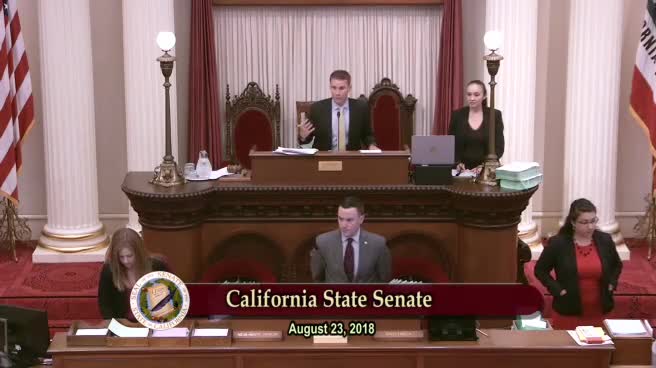 2MIN
Senate Floor
 1H
Senate Standing Committee on Appropriations
 12MIN
Senate Standing Committee on Public Safety
 2MIN
Assembly Floor
 8MIN






