AB 3136: Special education funding.
- Session Year: 2017-2018
- House: Assembly
- Latest Version Date: 2018-06-26
Existing law establishes a public school financing system that requires state funding for county superintendents of schools, school districts, and charter schools to be calculated pursuant to a local control funding formula. Existing law requires the Superintendent of Public Instruction to determine the amount of funding to be provided for each special education local plan area in accordance with specified calculations. Existing law requires the Superintendent, for the 201314 fiscal year, to compute an equalization adjustment for each special education local plan area for purposes of increasing the funding rates for special education local plan areas with funding rates below the 90th percentile, as specified.
This bill would increase that percentile to the 95th percentile and would require the Superintendent to compute that equalization adjustment commencing with the first fiscal year after funds are apportioned pursuant to a specified formula and for each fiscal year thereafter in which an equalization appropriation is made, as specified. The bill would require the Superintendent to make certain computations following each year in which an equalization appropriation is made.
The bill would establish the high-cost service allowance for the purpose of providing supplemental funding to a special education local plan area on the basis of the number of pupils with severe disabilities and the number pupils with both deafness and blindness, traumatic brain injury, or multiple disabilities, and would require the Superintendent to make specified computations that would determine the high-cost service allowance for each special education local plan area.
The bill would require, commencing with the first fiscal year after funds are apportioned pursuant to a specified formula, a special education local plan area that reports serving children 3 or 4 years of age who meet the definition of an individual with exceptional needs to count 3 times all units of average daily attendance generated by children enrolled in kindergarten less those children eligible for transitional kindergarten, for purposes of calculating units of average daily attendance, except as provided. By adding to the duties of special education local plan areas, the bill would impose a state-mandated local program.
Existing law defines average daily attendance reported for the special education local plan area for purposes of these and other provisions to mean the total number of units of average daily attendance reported in the school district or districts and in the county office of education or offices, county offices of education, or portion of an office, a county office of education that is a part of more than one special education local plan area, as specified.
The bill would revise that definition to mean the total number of units of average daily attendance reported for the current school year or the prior school year, whichever is greater, in those same entities, as specified.
The California Constitution requires the state to reimburse local agencies and school districts for certain costs mandated by the state. Statutory provisions establish procedures for making that reimbursement.
This bill would provide that, if the Commission on State Mandates determines that the bill contains costs mandated by the state, reimbursement for those costs shall be made pursuant to the statutory provisions noted above.
Existing law establishes a public school financing system that requires state funding for county superintendents of schools, school districts, and charter schools to be calculated pursuant to a local control funding formula. Existing law requires the Superintendent of Public Instruction to determine the amount of funding to be provided for each special education local plan area in accordance with specified calculations. Existing law requires the Superintendent, for the 201314 fiscal year, to compute an equalization adjustment for each special education local plan area for purposes of increasing the funding rates for special education local plan areas with funding rates below the 90th percentile, as specified.
This bill would increase that percentile to the 95th percentile and would require the Superintendent to compute that equalization adjustment commencing with the first fiscal year after funds are apportioned pursuant to a specified formula and for each fiscal year thereafter in which an equalization appropriation is made, as specified. The bill would require the Superintendent to make certain computations following each year in which an equalization appropriation is made.
The bill would establish the high cost high-cost service allowance for the purpose of providing supplemental funding to a special education local plan area on the basis of the number of pupils with severe disabilities and the number pupils with both deafness and blindness, traumatic brain injury, or multiple disabilities, and would require the Superintendent to make specified computations that would determine the high cost high-cost service allowance for each special education local plan area.
The bill would require, commencing with the first fiscal year after funds are apportioned pursuant to a specified formula, a special education local plan area that reports serving children 3 or 4 years of age who meet the definition of an individual with exceptional needs to count 3 times all units of average daily attendance generated by children enrolled in kindergarten less those children eligible for transitional kindergarten, for purposes of calculating units of average daily attendance. attendance, except as provided. By adding to the duties of special education local plan areas, the bill would impose a state-mandated local program.
Existing law defines average daily attendance reported for the special education local plan area for purposes of these and other provisions to mean the total number of units of average daily attendance reported in the school district or districts and in the county office or offices, or portion of an office, as specified.
The bill would revise that definition to mean the total number of units of average daily attendance reported for the current school year or the prior school year, whichever is greater, in those same entities, as specified.
The California Constitution requires the state to reimburse local agencies and school districts for certain costs mandated by the state. Statutory provisions establish procedures for making that reimbursement.
This bill would provide that, if the Commission on State Mandates determines that the bill contains costs mandated by the state, reimbursement for those costs shall be made pursuant to the statutory provisions noted above.
Existing law establishes a public school financing system that requires state funding for county superintendents of schools, school districts, and charter schools to be calculated pursuant to a local control funding formula. Existing law requires the Superintendent of Public Instruction to determine the amount of funding to be provided for each special education local plan area in accordance with specified calculations. Existing law requires the Superintendent, for the 201314 fiscal year, to compute an equalization adjustment for each special education local plan area for purposes of increasing the funding rates for special education local plan areas with funding rates below the 90th percentile, as specified.
This bill would increase that percentile to the 95th percentile and would require the Superintendent to compute that equalization adjustment commencing with the first fiscal year after funds are apportioned pursuant to a specified formula and for each fiscal year thereafter in which an equalization appropriation is made, as specified. The bill would require the Superintendent to make certain computations following each year in which an equalization appropriation is made.
The bill would establish the high cost service allowance for the purpose of providing supplemental funding to a special education local plan area on the basis of the number of pupils with severe disabilities and the number pupils with both deafness and blindness, traumatic brain injury, or multiple disabilities, and would require the Superintendent to make specified computations that would determine the high cost service allowance for each special education local plan area.
The bill would require, commencing with the first fiscal year after funds are apportioned pursuant to a specified formula, a special education local plan area that reports serving children 3 or 4 years of age who meet the definition of an individual with exceptional needs to count 3 times all units of average daily attendance generated by children enrolled in kindergarten less those children eligible for transitional kindergarten, for purposes of calculating units of average daily attendance. By adding to the duties of special education local plan areas, the bill would impose a state-mandated local program.
Existing law defines average daily attendance reported for the special education local plan area for purposes of these and other provisions to mean the total number of units of average daily attendance reported in the school district or districts and in the county office or offices, or portion of an office, as specified.
The bill would revise that definition to mean the total number of units of average daily attendance reported for the current school year or the prior school year, whichever is greater, in those same entities, as specified.
The California Constitution requires the state to reimburse local agencies and school districts for certain costs mandated by the state. Statutory provisions establish procedures for making that reimbursement.
This bill would provide that, if the Commission on State Mandates determines that the bill contains costs mandated by the state, reimbursement for those costs shall be made pursuant to the statutory provisions noted above.
Existing law states that the Legislature finds and declares that all individuals with exceptional needs have a right to participate in free appropriate public education and that special educational instruction and services for these persons are needed in order to ensure the right to an appropriate educational opportunity to meet their unique needs.This bill would state the intent of the Legislature to enact future legislation relating to the provision of special education instruction and services.Existing law states that the Legislature finds and declares that all individuals with exceptional needs have a right to participate in free appropriate public education and that special educational instruction and services for these persons are needed in order to ensure the right to an appropriate educational opportunity to meet their unique needs.
This bill would state the intent of the Legislature to enact future legislation relating to the provision of special education instruction and services.
The Legislature finds and declares all of the following:
(a)Special education is a federal- and state-mandated educational program that entitles children with disabilities to receive a free appropriate public education in the least restrictive environment.
(b)In 2015, the Statewide Special Education Task Force was established by the State Board of Education for the purpose of outlining distinct reforms necessary for a successful special education system, which included a call for additional state funding earmarked for services required by the federal Individuals with Disabilities Education Act (20 U.S.C. Sec. 1400 et seq.).
(c)The findings contained in the Statewide Special Education Task Force report acknowledge several policy and fiscal challenges faced by local educational agencies (LEAs) and provide recommendations and detail actions to improve the system and pupil outcomes. The report includes all of the following findings:
(1)Special education is underfunded.
(2)The special education local plan area (SELPA) base rates established by Assembly Bill 602 of the 199798 Regular Session (Chapter 854 of the Statutes of 1997) (AB 602) are not equitable throughout the state.
(3)The state needs to better support local infant and preschool special education programs.
(4)The census-based funding model of AB 602 has been successful in avoiding incentives to place special education pupils in restrictive educational placements.
(d)The growth in funding for special education does not reflect the actual growth in enrollment of special education pupils.
(e)There is widespread agreement among LEAs that the state should adopt the following recommendations contained in the Statewide Special Education Task Force report:
(1)Retain the AB 602 census-based funding model.
(2)Level up the AB 602 SELPA funding base rates.
(3)Increase state funding for preschoolers with disabilities.
(4)Provide an adequate funding set-aside to assist pupils with severe disabilities.
(5)Adjust the enrollment growth calculation to reflect the actual growth in special education enrollment.
SEC. 2.It is the intent of the Legislature that the funding required to implement the provisions in this act be provided over the course of five years.
SEC. 3.Section 56836.06 of the Education Code is amended to read:56836.06.For purposes of this article, the following definitions apply, unless the context clearly requires otherwise:
(a)Average daily attendance reported for the special education local plan area means the total of the following:
(1)The total number of units of average daily attendance reported for the second principal apportionment pursuant to Section 41601, for the current school year or the prior school year, whichever is greater, for all pupils enrolled in the district or districts that are a part of the special education local plan area.
(2)The total number of units of average daily attendance reported pursuant to subdivisions (a) and (b) of Section 41601, for the current school year or the prior school year, whichever is greater, for all pupils enrolled in schools operated by the county office or offices that compose the special education local plan area, or for those county offices that are a part of more than one special education local plan area, that portion of the average daily attendance of pupils enrolled in the schools operated by the county office that are under the jurisdiction of the special education local plan area.
(b)For purposes of computing apportionments pursuant to this chapter for the special education local plan area identified as the Los Angeles County Juvenile Court and Community School/Division of Alternative Education Special Education Local Plan Area, the term average daily attendance means the total number of units of average daily attendance reported for the second principal apportionment pursuant to subdivisions (a) and (b) of Section 41601 for all pupils enrolled in districts within Los Angeles County and all schools operated by the Los Angeles County Office of Education and the districts within Los Angeles County.
(c)Special education local plan area includes the school district or districts and county office or offices of education composing the special education local plan area.
(d)The fiscal year in which equalization among special education local plan areas has been achieved means the first fiscal year in which each special education local plan area is funded at or above the statewide target amount per unit of average daily attendance, as computed pursuant to Section 56836.11.
(e)For a charter school deemed a local educational agency for purposes of special education, an amount equal to the amount computed pursuant to Section 56836.08 for the special education local plan area in which the charter school is included shall be apportioned by the department pursuant to the local allocation plan developed pursuant to subdivision (i) of Section 56195.7 or 56836.05, or both. If the charter school is a participant in a local plan that only includes other charter schools pursuant to subdivision (f) of Section 56195.1, the amount computed pursuant to Section 56836.11 shall be apportioned by the department for each unit of average daily attendance reported pursuant to subdivision (a).
SEC. 4.Section 56836.11 of the Education Code is amended to read:56836.11.(a)For the purpose of computing the equalization adjustment for special education local plan areas for the 199899 fiscal year, the Superintendent shall make the following computations to determine the statewide target amount per unit of average daily attendance for special education local plan areas:
(1)Total the amount of funding computed for each special education local plan area exclusive of the amount of funding computed for the special education local plan area identified as the Los Angeles County Juvenile Court and Community School/Division of Alternative Education Special Education Local Plan Area, pursuant to Section 56836.09 for the 199798 fiscal year.
(2)Total the number of units of average daily attendance reported for each special education local plan area for the 199798 fiscal year, exclusive of average daily attendance for absences excused pursuant to subdivision (b) of Section 46010, as that section read on July 1, 1996, and exclusive of the units of average daily attendance computed for the special education local plan area identified as the Los Angeles County Juvenile Court and Community School/Division of Alternative Education Special Education Local Plan Area.
(3)Divide the sum computed in paragraph (1) by the sum computed in paragraph (2) to determine the statewide target amount for the 199798 fiscal year.
(4)Add the amount computed in paragraph (3) to the inflation adjustment computed pursuant to subdivision (d) of Section 56836.08 for the 199899 fiscal year to determine the statewide target amount for the 199899 fiscal year.
(b)Commencing with the 19992000 fiscal year to the 200405 fiscal year, inclusive, to determine the statewide target amount per unit of average daily attendance for special education local plan areas, the Superintendent shall multiply the statewide target amount per unit of average daily attendance computed for the prior fiscal year pursuant to this section by one plus the inflation factor computed pursuant to subdivision (b) of Section 42238.1 for the fiscal year in which the computation is made.
(c)For the 200506 fiscal year, the Superintendent shall make the following computation to determine the statewide target amount per unit of average daily attendance to determine the inflation adjustment pursuant to paragraph (2) of subdivision (d) of Section 56836.08 and growth pursuant to subdivision (c) of Section 56836.15, as follows:
(1)The 200405 fiscal year statewide target amount per unit of average daily attendance less the sum of the 200405 fiscal year total amount of federal funds apportioned pursuant to Schedule (1) in Item 6110-161-0890 of Section 2.00 of the Budget Act of 2004 for purposes of special education for individuals with exceptional needs enrolled in kindergarten and grades 1 to 12, inclusive, divided by the total average daily attendance computed for the 200405 fiscal year.
(2)Multiply the amount computed in paragraph (1) by the inflation factor computed pursuant to subdivision (b) of Section 42238.1 for the fiscal year in which the computation is made.
(3)Add the amounts computed in paragraphs (1) and (2).
(d)Commencing with the 200607 fiscal year and continuing through the 201213 fiscal year, inclusive, the Superintendent shall make the following computation to determine the statewide target amount per unit of average daily attendance for special education local plan areas for the purpose of computing the inflation adjustment pursuant to paragraph (2) of subdivision (d) of Section 56836.08 and growth pursuant to subdivision (c) of Section 56836.15:
(1)The statewide target amount per unit of average daily attendance computed for the prior fiscal year pursuant to this section.
(2)Multiply the amount computed in paragraph (1) by the inflation factor computed pursuant to subdivision (b) of Section 42238.1 for the fiscal year in which the computation is made.
(3)Add the amounts computed in paragraphs (1) and (2).
(e)For the 201314 fiscal year, the Superintendent shall make the following computations to determine the statewide target amount per unit of average daily attendance to determine the inflation adjustment pursuant to subdivision (f) of Section 56836.08 and growth pursuant to subdivision (c) of Section 56836.15, as follows:
(1)Total the amount of funding computed for each special education local plan area pursuant to the amount computed in subdivision (b) of Section 56836.08, including the amount of funds appropriated pursuant to Provision 22 of Item 6110-161-0001 of Section 2.00 of the Budget Act of 2013, and excluding the amount of funding computed for the special education local plan area identified as the Los Angeles County Juvenile Court and Community School/Division of Alternative Education Special Education Local Plan Area, for the 201314 fiscal year.
(2)Total the number of units of average daily attendance reported for each special education local plan area for the 201213 fiscal year, exclusive of the units of average daily attendance computed for the special education local plan area identified as the Los Angeles County Juvenile Court and Community School/Division of Alternative Education Special Education Local Plan Area.
(3)Divide the sum computed in paragraph (1) by the sum computed in paragraph (2).
(f)Commencing with the 201415 fiscal year and continuing each fiscal year thereafter, the Superintendent shall make the following computations to determine the statewide target amount per unit of average daily attendance for special education local plan areas for the purpose of computing the inflation adjustment pursuant to subdivision (f) of Section 56836.08 and growth pursuant to subdivision (c) of Section 56836.15:
(1)The statewide target amount per unit of average daily attendance computed for the prior fiscal year pursuant to this section.
(2)Multiply the amount computed in paragraph (1) by the inflation factor computed pursuant to Section 42238.1, as that section read on January 1, 2013, or any successor section of law enacted by the Legislature that specifies the inflation factor contained in Section 42238.1, as that section read on January 1, 2013, for application to the 201415 fiscal year and each fiscal year thereafter.
(3)Add the amounts computed in paragraphs (1) and (2).
(g)Following each year in which an equalization appropriation is made pursuant to Section 56836.145, the Superintendent shall make the following computations to determine the statewide target amount per unit of average daily attendance to determine the inflation adjustment pursuant to subdivision (f) of Section 56836.08 and growth pursuant to subdivision (c) of Section 56836.15, as follows:
(1)Total the amount of funding computed for each special education local plan area pursuant to the amount computed in subdivision (b) of Section 56836.08, including the amount of funds appropriated pursuant to Provision 22 of Item 6110-161-0001 of Section 2.00 of the most recent Budget Act, and excluding the amount of funding computed for the special education local plan area identified as the Los Angeles County Juvenile Court and Community School/Division of Alternative Education Special Education Local Plan Area, for the fiscal year in which the equalization appropriation has been made.
(2)Total the number of units of average daily attendance reported for each special education local plan area for the fiscal year preceding the equalization appropriation, exclusive of the units of average daily attendance computed for the special education local plan area identified as the Los Angeles County Juvenile Court and Community School/Division of Alternative Education Special Education Local Plan Area.
(3)Divide the sum computed in paragraph (1) by the sum computed in paragraph (2).
SEC. 5.Section 56836.12 is added to the Education Code, to read:56836.12.(a)The high-cost service allowance is hereby established for the purpose of providing supplemental funding to a special education local plan area on the basis of the number of pupils with severe disabilities, as defined in Section 56030.5, and the number of pupils with both deafness and blindness, traumatic brain injury, or multiple disabilities.
(b)For the 201819 fiscal year, the Superintendent shall make the following computations to determine the high-cost service allowance for each special education local plan area:
(1)From the December 2017 pupil count, the number of pupils who have a severe disability, as defined in Section 56030.5, plus the number of pupils with both deafness and blindness, traumatic brain injury, or multiple disabilities.
(2)Multiply the amount computed in paragraph (1) by the statewide target amount per unit of average daily attendance for the 201819 fiscal year.
(c)For the 201920 fiscal year and each fiscal year thereafter, the Superintendent shall make the following computations to determine the high-cost service allowance for each special education local plan area for the fiscal year in which the computation is made:
(1)From the prior school years December pupil count, the number of pupils who have a severe disability, as defined in Section 56030.5, plus the number of pupils with both deafness and blindness, traumatic brain injury, or multiple disabilities.
(2)Multiply the amount computed in paragraph (1) by the statewide target amount per unit of average daily attendance for the fiscal year in which the computation is made.
SEC. 6.Section 56836.145 of the Education Code is amended to read:56836.145.(a)Commencing with the first fiscal year after funds are apportioned pursuant to subdivision (g) of Section 42238.03, and for each fiscal year thereafter in which an appropriation is made for purposes of this section, the Superintendent shall compute an equalization adjustment for each special education local plan area, exclusive of the special education local plan area identified as the Los Angeles County Juvenile Court and Community School/Division of Alternative Education Special Education Local Plan Area, so that the special education funding rate per unit of average daily attendance calculated pursuant to subdivision (c) of Section 56836.10 of a special education local plan area is not less than the special education funding rate per unit of average daily attendance calculated pursuant to subdivision (c) of Section 56836.10 that does not fall below more than 10 percent of the total statewide units of average daily attendance for each special education local plan area.
(b)The Superintendent shall compute an equalization adjustment for each special education local plan areas special education funding rate per unit of average daily attendance, exclusive of the special education local plan area identified as the Los Angeles County Juvenile Court and Community School/Division of Alternative Education Special Education Local Plan Area, as follows:
(1)Multiply the amount computed for each special education local plan area pursuant to subdivision (a) by the average daily attendance used to calculate the special education local plan areas special education funding for the fiscal year in which an appropriation is made for purposes of this section.
(2)Divide the amount appropriated for purposes of this section for the fiscal year in which an appropriation is made by the statewide sum of the amount computed pursuant to paragraph (1).
(3)Multiply the amount computed for the special education local plan area pursuant to subdivision (a) by the amount computed pursuant to paragraph (2).
(c)For purposes of this section, the statewide 95th percentile special education funding rate determined pursuant to subdivision (a), and the fraction computed pursuant to paragraph (2) of subdivision (b) for the second principal apportionment of the fiscal year preceding any appropriation made for purposes of this section, shall be final, and shall not be recalculated at subsequent apportionments. The fraction computed pursuant to paragraph (2) of subdivision (b) shall not exceed 1.00.
SEC. 7.Section 56836.146 is added to the Education Code, immediately following Section 56836.145, to read:56836.146.(a)In order to provide funding for preschool-aged children with special exceptional needs, commencing with the first fiscal year after funds are apportioned pursuant to subdivision (g) of Section 42238.03, a special education local plan area that reports serving children three or four years of age who meet the definition in Section 56026, except for a special education local plan area that, as of December 1, 2017, reported exclusively serving children three or four years of age in transitional kindergarten or kindergarten, shall, for purposes of calculating units of average daily attendance, count three times all units of average daily attendance generated by children enrolled in kindergarten less those children eligible for transitional kindergarten as defined in subdivision (d) of Section 48000.
(b)Any growth in average daily attendance generated by the adjustment described in subdivision (a) shall be funded at the prevailing statewide target rate, as calculated by subdivision (f) of Section 56836.11.
SEC. 8.If the Commission on State Mandates determines that this act contains costs mandated by the state, reimbursement to local agencies and school districts for those costs shall be made pursuant to Part 7 (commencing with Section 17500) of Division 4 of Title 2 of the Government Code.
The Legislature finds and declares all of the following:
(a)Special education is a federal- and state-mandated educational program that entitles children with disabilities to receive a free appropriate public education in the least restrictive environment.
(b)In 2015, the Statewide Special Education Task Force was established by the State Board of Education for the purpose of outlining distinct reforms necessary for a successful special education system, which included a call for additional state funding earmarked for services required by the federal Individuals with Disabilities Education Act (20 U.S.C. Sec. 1400 et seq.).
(c)The findings contained in the Statewide Special Education Task Force report acknowledge several policy and fiscal challenges faced by local educational agencies (LEAs) and provide recommendations and detail actions to improve the system and pupil outcomes. The report includes all of the following findings:
(1)Special education is underfunded.
(2)The special education local plan area (SELPA) base rates established by Assembly Bill 602 of the 199798 Regular Session (Chapter 854 of the Statutes of 1997) (AB 602) are not equitable throughout the state.
(3)The state needs to better support local infant and preschool special education programs.
(4)The census-based funding model of AB 602 has been successful in avoiding incentives to place special education pupils in restrictive educational placements.
(d)The growth in funding for special education does not reflect the actual growth in enrollment of special education pupils.
(e)There is widespread agreement among LEAs that the state should adopt the following recommendations contained in the Statewide Special Education Task Force report:
(1)Retain the AB 602 census-based funding model.
(2)Level up the AB 602 SELPA funding base rates.
(3)Increase state funding for preschoolers with disabilities.
(4)Provide an adequate funding set-aside to assist pupils with severe disabilities.
(5)Adjust the enrollment growth calculation to reflect the actual growth in special education enrollment.
SEC. 2.It is the intent of the Legislature that the funding required to implement the provisions in this act be provided over the course of five years.
SEC. 3.Section 56836.06 of the Education Code is amended to read:56836.06.For purposes of this article, the following definitions apply, unless the context clearly requires otherwise:
(a)Average daily attendance reported for the special education local plan area means the total of the following:
(1)The total number of units of average daily attendance reported for the second principal apportionment pursuant to Section 41601, for the current school year or the prior school year, whichever is greater, for all pupils enrolled in the district or districts that are a part of the special education local plan area.
(2)The total number of units of average daily attendance reported pursuant to subdivisions (a) and (b) of Section 41601, for the current school year or the prior school year, whichever is greater, for all pupils enrolled in schools operated by the county office or offices that compose the special education local plan area, or for those county offices that are a part of more than one special education local plan area, that portion of the average daily attendance of pupils enrolled in the schools operated by the county office that are under the jurisdiction of the special education local plan area.
(b)For purposes of computing apportionments pursuant to this chapter for the special education local plan area identified as the Los Angeles County Juvenile Court and Community School/Division of Alternative Education Special Education Local Plan Area, the term average daily attendance means the total number of units of average daily attendance reported for the second principal apportionment pursuant to subdivisions (a) and (b) of Section 41601 for all pupils enrolled in districts within Los Angeles County and all schools operated by the Los Angeles County Office of Education and the districts within Los Angeles County.
(c)Special education local plan area includes the school district or districts and county office or offices of education composing the special education local plan area.
(d)The fiscal year in which equalization among special education local plan areas has been achieved means the first fiscal year in which each special education local plan area is funded at or above the statewide target amount per unit of average daily attendance, as computed pursuant to Section 56836.11.
(e)For a charter school deemed a local educational agency for purposes of special education, an amount equal to the amount computed pursuant to Section 56836.08 for the special education local plan area in which the charter school is included shall be apportioned by the department pursuant to the local allocation plan developed pursuant to subdivision (i) of Section 56195.7 or 56836.05, or both. If the charter school is a participant in a local plan that only includes other charter schools pursuant to subdivision (f) of Section 56195.1, the amount computed pursuant to Section 56836.11 shall be apportioned by the department for each unit of average daily attendance reported pursuant to subdivision (a).
SEC. 4.Section 56836.11 of the Education Code is amended to read:56836.11.(a)For the purpose of computing the equalization adjustment for special education local plan areas for the 199899 fiscal year, the Superintendent shall make the following computations to determine the statewide target amount per unit of average daily attendance for special education local plan areas:
(1)Total the amount of funding computed for each special education local plan area exclusive of the amount of funding computed for the special education local plan area identified as the Los Angeles County Juvenile Court and Community School/Division of Alternative Education Special Education Local Plan Area, pursuant to Section 56836.09 for the 199798 fiscal year.
(2)Total the number of units of average daily attendance reported for each special education local plan area for the 199798 fiscal year, exclusive of average daily attendance for absences excused pursuant to subdivision (b) of Section 46010, as that section read on July 1, 1996, and exclusive of the units of average daily attendance computed for the special education local plan area identified as the Los Angeles County Juvenile Court and Community School/Division of Alternative Education Special Education Local Plan Area.
(3)Divide the sum computed in paragraph (1) by the sum computed in paragraph (2) to determine the statewide target amount for the 199798 fiscal year.
(4)Add the amount computed in paragraph (3) to the inflation adjustment computed pursuant to subdivision (d) of Section 56836.08 for the 199899 fiscal year to determine the statewide target amount for the 199899 fiscal year.
(b)Commencing with the 19992000 fiscal year to the 200405 fiscal year, inclusive, to determine the statewide target amount per unit of average daily attendance for special education local plan areas, the Superintendent shall multiply the statewide target amount per unit of average daily attendance computed for the prior fiscal year pursuant to this section by one plus the inflation factor computed pursuant to subdivision (b) of Section 42238.1 for the fiscal year in which the computation is made.
(c)For the 200506 fiscal year, the Superintendent shall make the following computation to determine the statewide target amount per unit of average daily attendance to determine the inflation adjustment pursuant to paragraph (2) of subdivision (d) of Section 56836.08 and growth pursuant to subdivision (c) of Section 56836.15, as follows:
(1)The 200405 fiscal year statewide target amount per unit of average daily attendance less the sum of the 200405 fiscal year total amount of federal funds apportioned pursuant to Schedule (1) in Item 6110-161-0890 of Section 2.00 of the Budget Act of 2004 for purposes of special education for individuals with exceptional needs enrolled in kindergarten and grades 1 to 12, inclusive, divided by the total average daily attendance computed for the 200405 fiscal year.
(2)Multiply the amount computed in paragraph (1) by the inflation factor computed pursuant to subdivision (b) of Section 42238.1 for the fiscal year in which the computation is made.
(3)Add the amounts computed in paragraphs (1) and (2).
(d)Commencing with the 200607 fiscal year and continuing through the 201213 fiscal year, inclusive, the Superintendent shall make the following computation to determine the statewide target amount per unit of average daily attendance for special education local plan areas for the purpose of computing the inflation adjustment pursuant to paragraph (2) of subdivision (d) of Section 56836.08 and growth pursuant to subdivision (c) of Section 56836.15:
(1)The statewide target amount per unit of average daily attendance computed for the prior fiscal year pursuant to this section.
(2)Multiply the amount computed in paragraph (1) by the inflation factor computed pursuant to subdivision (b) of Section 42238.1 for the fiscal year in which the computation is made.
(3)Add the amounts computed in paragraphs (1) and (2).
(e)For the 201314 fiscal year, the Superintendent shall make the following computations to determine the statewide target amount per unit of average daily attendance to determine the inflation adjustment pursuant to subdivision (f) of Section 56836.08 and growth pursuant to subdivision (c) of Section 56836.15, as follows:
(1)Total the amount of funding computed for each special education local plan area pursuant to the amount computed in subdivision (b) of Section 56836.08, including the amount of funds appropriated pursuant to Provision 22 of Item 6110-161-0001 of Section 2.00 of the Budget Act of 2013, and excluding the amount of funding computed for the special education local plan area identified as the Los Angeles County Juvenile Court and Community School/Division of Alternative Education Special Education Local Plan Area, for the 201314 fiscal year.
(2)Total the number of units of average daily attendance reported for each special education local plan area for the 201213 fiscal year, exclusive of the units of average daily attendance computed for the special education local plan area identified as the Los Angeles County Juvenile Court and Community School/Division of Alternative Education Special Education Local Plan Area.
(3)Divide the sum computed in paragraph (1) by the sum computed in paragraph (2).
(f)Commencing with the 201415 fiscal year and continuing each fiscal year thereafter, the Superintendent shall make the following computations to determine the statewide target amount per unit of average daily attendance for special education local plan areas for the purpose of computing the inflation adjustment pursuant to subdivision (f) of Section 56836.08 and growth pursuant to subdivision (c) of Section 56836.15:
(1)The statewide target amount per unit of average daily attendance computed for the prior fiscal year pursuant to this section.
(2)Multiply the amount computed in paragraph (1) by the inflation factor computed pursuant to Section 42238.1, as that section read on January 1, 2013, or any successor section of law enacted by the Legislature that specifies the inflation factor contained in Section 42238.1, as that section read on January 1, 2013, for application to the 201415 fiscal year and each fiscal year thereafter.
(3)Add the amounts computed in paragraphs (1) and (2).
(g)Following each year in which an equalization appropriation is made pursuant to Section 56836.145, the Superintendent shall make the following computations to determine the statewide target amount per unit of average daily attendance to determine the inflation adjustment pursuant to subdivision (f) of Section 56836.08 and growth pursuant to subdivision (c) of Section 56836.15, as follows:
(1)Total the amount of funding computed for each special education local plan area pursuant to the amount computed in subdivision (b) of Section 56836.08, including the amount of funds appropriated pursuant to Provision 22 of Item 6110-161-0001 of Section 2.00 of the most recent Budget Act, and excluding the amount of funding computed for the special education local plan area identified as the Los Angeles County Juvenile Court and Community School/Division of Alternative Education Special Education Local Plan Area, for the fiscal year in which the equalization appropriation has been made.
(2)Total the number of units of average daily attendance reported for each special education local plan area for the fiscal year preceding the equalization appropriation, exclusive of the units of average daily attendance computed for the special education local plan area identified as the Los Angeles County Juvenile Court and Community School/Division of Alternative Education Special Education Local Plan Area.
(3)Divide the sum computed in paragraph (1) by the sum computed in paragraph (2).
SEC. 5.Section 56836.12 is added to the Education Code, to read:56836.12.(a)The high cost high-cost service allowance is hereby established for the purpose of providing supplemental funding to a special education local plan area on the basis of the number of pupils with severe disabilities, as defined in Section 56030.5, and the number of pupils with both deafness and blindness, traumatic brain injury, or multiple disabilities.
(b)For the 201819 fiscal year, the Superintendent shall make the following computations to determine the high cost high-cost service allowance for each special education local plan area:
(1)From the December 2017 pupil count, the number of pupils who have a severe disability, as defined in Section 56030.5, plus the number of pupils with both deafness and blindness, traumatic brain injury, or multiple disabilities.
(2)Multiply the amount computed in paragraph (1) by the statewide target amount per unit of average daily attendance for the 201819 fiscal year.
(c)For the 201920 fiscal year and each fiscal year thereafter, the Superintendent shall make the following computations to determine the high cost high-cost service allowance for each special education local plan area for the fiscal year in which the computation is made:
(1)From the prior school years December pupil count, the number of pupils who have a severe disability, as defined in Section 56030.5, plus the number of pupils with both deafness and blindness, traumatic brain injury, or multiple disabilities.
(2)Multiply the amount computed in paragraph (1) by the statewide target amount per unit of average daily attendance for the fiscal year in which the computation is made.
SEC. 6.Section 56836.145 of the Education Code is amended to read:56836.145.(a)Commencing with the first fiscal year after funds are apportioned pursuant to subdivision (g) of Section 42238.03, and for each fiscal year thereafter in which an appropriation is made for purposes of this section, the Superintendent shall compute an equalization adjustment for each special education local plan area, exclusive of the special education local plan area identified as the Los Angeles County Juvenile Court and Community School/Division of Alternative Education Special Education Local Plan Area, so that the special education funding rate per unit of average daily attendance calculated pursuant to subdivision (c) of Section 56836.10 of a special education local plan area is not less than the special education funding rate per unit of average daily attendance calculated pursuant to subdivision (c) of Section 56836.10 that does not fall below more than 10 percent of the total statewide units of average daily attendance for each special education local plan area.
(b)The Superintendent shall compute an equalization adjustment for each special education local plan areas special education funding rate per unit of average daily attendance, exclusive of the special education local plan area identified as the Los Angeles County Juvenile Court and Community School/Division of Alternative Education Special Education Local Plan Area, as follows:
(1)Multiply the amount computed for each special education local plan area pursuant to subdivision (a) by the average daily attendance used to calculate the special education local plan areas special education funding for the fiscal year in which an appropriation is made for purposes of this section.
(2)Divide the amount appropriated for purposes of this section for the fiscal year in which an appropriation is made by the statewide sum of the amount computed pursuant to paragraph (1).
(3)Multiply the amount computed for the special education local plan area pursuant to subdivision (a) by the amount computed pursuant to paragraph (2).
(c)For purposes of this section, the statewide 95th percentile special education funding rate determined pursuant to subdivision (a), and the fraction computed pursuant to paragraph (2) of subdivision (b) for the second principal apportionment of the fiscal year preceding any appropriation made for purposes of this section, shall be final, and shall not be recalculated at subsequent apportionments. The fraction computed pursuant to paragraph (2) of subdivision (b) shall not exceed 1.00.
SEC. 7.Section 56836.146 is added to the Education Code, immediately following Section 56836.145, to read:56836.146.(a)In order to provide funding for preschool-aged children with special needs, commencing with the first fiscal year after funds are apportioned pursuant to subdivision (g) of Section 42238.03, a special education local plan area that reports serving children three or four years of age who meet the definition in Section 56026 56026, except for a special education local plan area that, as of December 1, 2017, reported exclusively serving children three or four years of age in transitional kindergarten or kindergarten, shall, for purposes of calculating units of average daily attendance, count three times all units of average daily attendance generated by children enrolled in kindergarten less those children eligible for transitional kindergarten as defined in subdivision (d) of Section 48000.
(b)Any growth in average daily attendance generated by the adjustment described in subdivision (a) shall be funded at the prevailing statewide target rate, as calculated by subdivision (f) of Section 56836.11.
SEC. 8.If the Commission on State Mandates determines that this act contains costs mandated by the state, reimbursement to local agencies and school districts for those costs shall be made pursuant to Part 7 (commencing with Section 17500) of Division 4 of Title 2 of the Government Code.
REVISIONS: HeadingLine 3.The Legislature finds and declares all of the following:
(a)Special education is a federal- and state-mandated educational program that entitles children with disabilities to receive a free appropriate public education in the least restrictive environment.
(b)In 2015, the Statewide Special Education Task Force was established by the State Board of Education for the purpose of outlining distinct reforms necessary for a successful special education system, which included a call for additional state funding earmarked for services required by the federal Individuals with Disabilities Education Act (20 U.S.C. Sec. 1400 et seq.).
(c)The findings contained in the Statewide Special Education Task Force report acknowledge several policy and fiscal challenges faced by local educational agencies (LEAs) and provide recommendations and detail actions to improve the system and pupil outcomes. The report includes all of the following findings:
(1)Special education is underfunded.
(2)The special education local plan area (SELPA) base rates established by Assembly Bill 602 of the 199798 Regular Session (Chapter 854 of the Statutes of 1997) (AB 602) are not equitable throughout the state.
(3)The state needs to better support local infant and preschool special education programs.
(4)The census-based funding model of AB 602 has been successful in avoiding incentives to place special education pupils in restrictive educational placements.
(d)The growth in funding for special education does not reflect the actual growth in enrollment of special education pupils.
(e)There is widespread agreement among LEAs that the state should adopt the following recommendations contained in the Statewide Special Education Task Force report:
(1)Retain the AB 602 census-based funding model.
(2)Level up the AB 602 SELPA funding base rates.
(3)Increase state funding for preschoolers with disabilities.
(4)Provide an adequate funding set-aside to assist pupils with severe disabilities.
(5)Adjust the enrollment growth calculation to reflect the actual growth in special education enrollment.
SEC. 2.It is the intent of the Legislature that the funding required to implement the provisions in this act be provided over the course of five years.
SEC. 3.Section 56836.06 of the Education Code is amended to read:56836.06.For purposes of this article, the following terms or phrases have the following meanings, definitions apply, unless the context clearly requires otherwise:
(a)Average daily attendance reported for the special education local plan area means the total of the following:
(1)The total number of units of average daily attendance reported for the second principal apportionment pursuant to Section 41601 41601, for the current school year or the prior school year, whichever is greater, for all pupils enrolled in the district or districts that are a part of the special education local plan area.
(2)The total number of units of average daily attendance reported pursuant to subdivisions (a) and (b) of Section 41601 41601, for the current school year or the prior school year, whichever is greater, for all pupils enrolled in schools operated by the county office or offices that compose the special education local plan area, or for those county offices that are a part of more than one special education local plan area, that portion of the average daily attendance of pupils enrolled in the schools operated by the county office that are under the jurisdiction of the special education local plan area.
(b)For purposes of computing apportionments pursuant to this chapter for the special education local plan area identified as the Los Angeles County Juvenile Court and Community School/Division of Alternative Education Special Education Local Plan Area, the term average daily attendance means the total number of units of average daily attendance reported for the second principal apportionment pursuant to subdivisions (a) and (b) of Section 41601 for all pupils enrolled in districts within Los Angeles County and all schools operated by the Los Angeles County Office of Education and the districts within Los Angeles County.
(c)Special education local plan area includes the school district or districts and county office or offices of education composing the special education local plan area.
(d)The fiscal year in which equalization among special education local plan areas has been achieved means the first fiscal year in which each special education local plan area is funded at or above the statewide target amount per unit of average daily attendance, as computed pursuant to Section 56836.11.
(e)For a charter school deemed a local educational agency for purposes of special education, an amount equal to the amount computed pursuant to Section 56836.08 for the special education local plan area in which the charter school is included shall be apportioned by the department pursuant to the local allocation plan developed pursuant to subdivision (i) of Section 56195.7 or 56836.05, or both. If the charter school is a participant in a local plan that only includes other charter schools pursuant to subdivision (f) of Section 56195.1, the amount computed pursuant to Section 56836.11 shall be apportioned by the department pursuant for each unit of average daily attendance reported pursuant to subdivision (a).
SEC. 4.Section 56836.11 of the Education Code is amended to read:56836.11.(a)For the purpose of computing the equalization adjustment for special education local plan areas for the 199899 fiscal year, the Superintendent shall make the following computations to determine the statewide target amount per unit of average daily attendance for special education local plan areas:
(1)Total the amount of funding computed for each special education local plan area exclusive of the amount of funding computed for the special education local plan area identified as the Los Angeles County Juvenile Court and Community School/Division of Alternative Education Special Education Local Plan Area, pursuant to Section 56836.09 for the 199798 fiscal year.
(2)Total the number of units of average daily attendance reported for each special education local plan area for the 199798 fiscal year, exclusive of average daily attendance for absences excused pursuant to subdivision (b) of Section 46010 46010, as that section read on July 1, 1996, and exclusive of the units of average daily attendance computed for the special education local plan area identified as the Los Angeles County Juvenile Court and Community School/Division of Alternative Education Special Education Local Plan Area.
(3)Divide the sum computed in paragraph (1) by the sum computed in paragraph (2) to determine the statewide target amount for the 199798 fiscal year.
(4)Add the amount computed in paragraph (3) to the inflation adjustment computed pursuant to subdivision (d) of Section 56836.08 for the 199899 fiscal year to determine the statewide target amount for the 199899 fiscal year.
(b)Commencing with the 19992000 fiscal year to the 200405 fiscal year, inclusive, to determine the statewide target amount per unit of average daily attendance for special education local plan areas, the Superintendent shall multiply the statewide target amount per unit of average daily attendance computed for the prior fiscal year pursuant to this section by one plus the inflation factor computed pursuant to subdivision (b) of Section 42238.1 for the fiscal year in which the computation is made.
(c)For the 200506 fiscal year, the Superintendent shall make the following computation to determine the statewide target amount per unit of average daily attendance to determine the inflation adjustment pursuant to paragraph (2) of subdivision (d) of Section 56836.08 and growth pursuant to subdivision (c) of Section 56836.15, as follows:
(1)The 200405 fiscal year statewide target amount per unit of average daily attendance less the sum of the 200405 fiscal year total amount of federal funds apportioned pursuant to Schedule (1) in Item 6110-161-0890 of Section 2.00 of the Budget Act of 2004 for purposes of special education for individuals with exceptional needs enrolled in kindergarten and grades 1 to 12, inclusive, divided by the total average daily attendance computed for the 200405 fiscal year.
(2)Multiply the amount computed in paragraph (1) by the inflation factor computed pursuant to subdivision (b) of Section 42238.1 for the fiscal year in which the computation is made.
(3)Add the amounts computed in paragraphs (1) and (2).
(d)Commencing with the 200607 fiscal year and continuing through the 201213 fiscal year, inclusive, the Superintendent shall make the following computation to determine the statewide target amount per unit of average daily attendance for special education local plan areas for the purpose of computing the inflation adjustment pursuant to paragraph (2) of subdivision (d) of Section 56836.08 and growth pursuant to subdivision (c) of Section 56836.15:
(1)The statewide target amount per unit of average daily attendance computed for the prior fiscal year pursuant to this section.
(2)Multiply the amount computed in paragraph (1) by the inflation factor computed pursuant to subdivision (b) of Section 42238.1 for the fiscal year in which the computation is made.
(3)Add the amounts computed in paragraphs (1) and (2).
(e)For the 201314 fiscal year, the Superintendent shall make the following computations to determine the statewide target amount per unit of average daily attendance to determine the inflation adjustment pursuant to subdivision (f) of Section 56836.08 and growth pursuant to subdivision (c) of Section 56836.15, as follows:
(1)Total the amount of funding computed for each special education local plan area pursuant to the amount computed in subdivision (b) of Section 56836.08, including the amount of funds appropriated pursuant to Provision 22 of Item 6110-161-0001 of Section 2.00 of the Budget Act of 2013, and excluding the amount of funding computed for the special education local plan area identified as the Los Angeles County Juvenile Court and Community School/Division of Alternative Education Special Education Local Plan Area, for the 201314 fiscal year.
(2)Total the number of units of average daily attendance reported for each special education local plan area for the 201213 fiscal year, exclusive of the units of average daily attendance computed for the special education local plan area identified as the Los Angeles County Juvenile Court and Community School/Division of Alternative Education Special Education Local Plan Area.
(3)Divide the sum computed in paragraph (1) by the sum computed in paragraph (2).
(f)Commencing with the 201415 fiscal year and continuing each fiscal year thereafter, the Superintendent shall make the following computations to determine the statewide target amount per unit of average daily attendance for special education local plan areas for the purpose of computing the inflation adjustment pursuant to subdivision (f) of Section 56836.08 and growth pursuant to subdivision (c) of Section 56836.15:
(1)The statewide target amount per unit of average daily attendance computed for the prior fiscal year pursuant to this section.
(2)Multiply the amount computed in paragraph (1) by the inflation factor computed pursuant to Section 42238.1, as that section read on January 1, 2013, or any successor section of law enacted by the Legislature that specifies the inflation factor contained in Section 42238.1, as that section read on January 1, 2013, for application to the 201415 fiscal year and each fiscal year thereafter.
(3)Add the amounts computed in paragraphs (1) and (2).
(g)Following each year in which an equalization appropriation is made pursuant to Section 56836.145, the Superintendent shall make the following computations to determine the statewide target amount per unit of average daily attendance to determine the inflation adjustment pursuant to subdivision (f) of Section 56836.08 and growth pursuant to subdivision (c) of Section 56836.15, as follows:
(1)Total the amount of funding computed for each special education local plan area pursuant to the amount computed in subdivision (b) of Section 56836.08, including the amount of funds appropriated pursuant to Provision 22 of Item 6110-161-0001 of Section 2.00 of the most recent Budget Act, and excluding the amount of funding computed for the special education local plan area identified as the Los Angeles County Juvenile Court and Community School/Division of Alternative Education Special Education Local Plan Area, for the fiscal year in which the equalization appropriation has been made.
(2)Total the number of units of average daily attendance reported for each special education local plan area for the fiscal year preceding the equalization appropriation, exclusive of the units of average daily attendance computed for the special education local plan area identified as the Los Angeles County Juvenile Court and Community School/Division of Alternative Education Special Education Local Plan Area.
(3)Divide the sum computed in paragraph (1) by the sum computed in paragraph (2).
SEC. 5.Section 56836.12 is added to the Education Code, to read:56836.12.(a)The high cost service allowance is hereby established for the purpose of providing supplemental funding to a special education local plan area on the basis of the number of pupils with severe disabilities, as defined in Section 56030.5, and the number of pupils with both deafness and blindness, traumatic brain injury, or multiple disabilities.
(b)For the 201819 fiscal year, the Superintendent shall make the following computations to determine the high cost service allowance for each special education local plan area:
(1)From the December 2017 pupil count, the number of pupils who have a severe disability, as defined in Section 56030.5, plus the number of pupils with both deafness and blindness, traumatic brain injury, or multiple disabilities.
(2)Multiply the amount computed in paragraph (1) by the statewide target amount per unit of average daily attendance for the 201819 fiscal year.
(c)For the 201920 fiscal year and each fiscal year thereafter, the Superintendent shall make the following computations to determine the high cost service allowance for each special education local plan area for the fiscal year in which the computation made:
(1)From the prior school years December pupil count, the number of pupils who have a severe disability, as defined in Section 56030.5, plus the number of pupils with both deafness and blindness, traumatic brain injury, or multiple disabilities.
(2)Multiply the amount computed in paragraph (1) by the statewide target amount per unit of average daily attendance for the fiscal year in which the computation is made.
SEC. 6.Section 56836.145 of the Education Code is amended to read:56836.145.(a)For the 201314 fiscal year, Commencing with the first fiscal year after funds are apportioned pursuant to subdivision (g) of Section 42238.03, and for each fiscal year thereafter in which an appropriation is made for purposes of this section, the Superintendent shall compute an equalization adjustment for each special education local plan area, exclusive of the special education local plan area identified as the Los Angeles County Juvenile Court and Community School/Division of Alternative Education Special Education Local Plan Area, so that the special education funding rate per unit of average daily attendance calculated pursuant to subdivision (c) of Section 56836.10 of a special education local plan area is not less than the special education funding rate per unit of average daily attendance calculated pursuant to subdivision (c) of Section 56836.10 that does not fall below more than 10 percent of the total statewide units of average daily attendance for each special education local plan area.
(b)The Superintendent shall compute an equalization adjustment for each special education local plan areas special education funding rate per unit of average daily attendance, exclusive of the special education local plan area identified as the Los Angeles County Juvenile Court and Community School/Division of Alternative Education Special Education Local Plan Area, as follows:
(1)Multiply the amount computed for each special education local plan area pursuant to subdivision (a) by the average daily attendance used to calculate the special education local plan areas special education funding for the 201314 fiscal year. year in which an appropriation is made for purposes of this section.
(2)Divide the amount appropriated for purposes of this section for the 201314 fiscal year in which an appropriation is made by the statewide sum of the amount computed pursuant to paragraph (1).
(3)Multiply the amount computed for the special education local plan area pursuant to subdivision (a) by the amount computed pursuant to paragraph (2).
(c)For purposes of this section, the statewide 90th 95th percentile special education funding rate determined pursuant to subdivision (a), and the fraction computed pursuant to paragraph (2) of subdivision (b) for the 201213 second principal apportionment, apportionment of the fiscal year preceding any appropriation made for purposes of this section, shall be final, and shall not be recalculated at subsequent apportionments. The fraction computed pursuant to paragraph (2) of subdivision (b) shall not exceed 1.00.
SEC. 7.Section 56836.146 is added to the Education Code, immediately following Section 56836.145, to read:56836.146.(a)In order to provide funding for preschool-aged children with special needs, commencing with the first fiscal year after funds are apportioned pursuant to subdivision (g) of Section 42238.03, a special education local plan area that reports serving children three or four years of age who meet the definition in Section 56026 shall, for purposes of calculating units of average daily attendance, count three times all units of average daily attendance generated by children enrolled in kindergarten less those children eligible for transitional kindergarten as defined in subdivision (d) of Section 48000.
(b)Any growth in average daily attendance generated by the adjustment described in subdivision (a) shall be funded at the prevailing statewide target rate, as calculated by subdivision (f) of Section 56836.11.
SEC. 8.If the Commission on State Mandates determines that this act contains costs mandated by the state, reimbursement to local agencies and school districts for those costs shall be made pursuant to Part 7 (commencing with Section 17500) of Division 4 of Title 2 of the Government Code.
SECTION 1.It is the intent of the Legislature to enact future legislation relating to the provision of special education instruction and services.It is the intent of the Legislature to enact future legislation relating to the provision of special education instruction and services.
|
Date
|
Status
|
|---|---|
| Aug 16, 2018 | In committee: Held under submission. |
| Jul 2, 2018 | In committee: Referred to APPR. suspense file. |
| Jun 26, 2018 | From committee chair, with author's amendments: Amend, and re-refer to committee. Read second time, amended, and re-referred to Com. on APPR. |
| Jun 20, 2018 | From committee: Do pass and re-refer to Com. on APPR. (Ayes 7. Noes 0.) (June 20). Re-referred to Com. on APPR. |
| Jun 13, 2018 | Referred to Com. on ED. |
| May 31, 2018 | In Senate. Read first time. To Com. on RLS. for assignment. |
| May 30, 2018 | Read third time. Passed. Ordered to the Senate. |
| May 25, 2018 | Read second time. Ordered to third reading. |
| May 2, 2018 | In committee: Set, first hearing. Referred to APPR. suspense file. |
| Apr 24, 2018 | Re-referred to Com. on APPR. |
| Apr 23, 2018 | Read second time and amended. |
| Apr 19, 2018 | From committee: Amend, and do pass as amended and re-refer to Com. on APPR. (Ayes 6. Noes 0.) (April 11). |
| Apr 2, 2018 | Re-referred to Com. on ED. |
| Mar 22, 2018 | Referred to Com. on ED. |
| Feb 17, 2018 | From printer. May be heard in committee March 19. |
| Feb 16, 2018 | Read first time. To print. |
|
Date
|
Description
|
Location
|
Votes
|
|
|---|---|---|---|---|
| Jul 2, 2018 | Placed on suspense file | Senate Standing Committee on Appropriations |
Passed |
|
| Jun 20, 2018 | Do pass, but first be re-referred to the Committee on [Appropriations] | Senate Standing Committee on Education |
Passed |
|
| May 30, 2018 | AB 3136 O'DONNELL Assembly Third Reading | Assembly Floor |
Passed |
|
| May 25, 2018 | Do pass. | Assembly Standing Committee on Appropriations |
Passed |
|
| Apr 11, 2018 | Do pass as amended and be re-referred to the Committee on [Appropriations] | Assembly Standing Committee on Education |
Passed |
This list shows positions taken on this bill by organizations on the date displayed, which is linked to the original source.
Positions by individuals are not included.
|
Organization
|
Position
|
Date
|
|---|---|---|
| 33rd District PTA | * Support | Apr 11, 2018 |
| ACSA | * Support | Jun 20, 2018 |
| Acton-Agua Dulce Unified School District | ** Support | Jun 19, 2018 |
| Alameda County Office Of Education | * Indeterminate | Jun 20, 2018 |
| Albany Unified School District | ** Support | Jun 19, 2018 |
| anaheim SELPA | * Support | Apr 11, 2018 |
| Antelope Valley SELPA | ** Support | Jun 19, 2018 |
| antelope valley SELPA | * Support | Apr 11, 2018 |
| Antelope Valley Union High School District | ** Support | Jun 19, 2018 |
| Arcata School District Board Of Trustees | ** Support | Jun 19, 2018 |
| Association Of California School Administrators | ** Support | Jun 19, 2018 |
| Atascadero Unified School District | ** Support | Jun 19, 2018 |
| Berkeley Unified School District | ** Support | Jun 19, 2018 |
| Big Sur Unified School District | ** Support | Jun 19, 2018 |
| Bonsall Unified School District | ** Support | Jun 19, 2018 |
| Cabrillo Unified School District | ** Support | Jun 19, 2018 |
| Cajon Valley Union School District | ** Support | Jun 19, 2018 |
| Calaveras County Office Of Education | ** Support | Jun 19, 2018 |
| Calaveras County Selpa | ** Support | Jun 19, 2018 |
| California Association Of Private Special Education Schools (Capses) | * Support | Jun 20, 2018 |
| California Association Of Private Special Education Schools (Capses) | * Support | Apr 11, 2018 |
| California Association Of Professors Of Special Education | ** Support | Jun 19, 2018 |
| California Association Of School Psychologists | * Support | Jun 20, 2018 |
| California Association Of Suburban School Districts | * Support | Jun 20, 2018 |
| California Council Of Administrators Of Special Education | ** Support | Jun 19, 2018 |
| California Federation Of Teachers | * Support | Jun 20, 2018 |
| California School Board Assocation | * Support | Jun 20, 2018 |
| California School Employees Association | * Support | Jun 20, 2018 |
| California School Funding Coalition | ** Support | Jun 19, 2018 |
| California SELPA Organization | * Support | Apr 11, 2018 |
| California State PTA | * Support | Jun 20, 2018 |
| California Teacher's Association | * Support | Jun 20, 2018 |
| Cardiff School District | ** Support | Jun 19, 2018 |
| CASBO | * Support | Jun 20, 2018 |
| Castaic Union School District | ** Support | Jun 19, 2018 |
| Cayucos Elementary School District | ** Support | Jun 19, 2018 |
| Cchat Center | ** Support | Jun 19, 2018 |
| Cec Teacher Education Division | ** Support | Jun 19, 2018 |
| Center for Early Intervention on Deafness | ** Support | Jun 19, 2018 |
| Central School District | ** Support | Jun 19, 2018 |
| Chula Vista Elementary School District | ** Support | Jun 19, 2018 |
| Chula Vista PTA | * Support | Apr 11, 2018 |
| Clovis Unified School District | ** Support | Jun 19, 2018 |
| Coalinga-Huron Unified School District | ** Support | Jun 19, 2018 |
| Coalition For Adequate Funding For Special Education | * Support | Jun 20, 2018 |
| Compton Unified School District | * Support | Jun 20, 2018 |
| Contra Costa Selpa | ** Support | Jun 19, 2018 |
| Cupertino Union School District | ** Support | Jun 19, 2018 |
| Davis Joint Unified School District | ** Support | Jun 19, 2018 |
| Del Mar Union School District | ** Support | Jun 19, 2018 |
| Dixon Unified School District | ** Support | Jun 19, 2018 |
| East County Selpa | ** Support | Jun 19, 2018 |
| East San Gabriel Valley Selpa Superintendents' Council | ** Support | Jun 19, 2018 |
| Eastside Union School District | ** Support | Jun 19, 2018 |
| El Dorado Charter Selpa | ** Support | Jun 19, 2018 |
| El Dorado County Office of Education | * Support | Jun 20, 2018 |
| El Dorado County SELPA | ** Support | Jun 19, 2018 |
| El Segundo Unified School District | ** Support | Jun 19, 2018 |
| Encinitas Union School District | ** Support | Jun 19, 2018 |
| Escondido Union High School District | ** Support | Jun 19, 2018 |
| Etiwanda School District | ** Support | Jun 19, 2018 |
| Eureka City Schools | ** Support | Jun 19, 2018 |
| Fairfield-Suisun Unified School District | ** Support | Jun 19, 2018 |
| Firebaugh-Las Deltas Unified School District | ** Support | Jun 19, 2018 |
| Fortuna Elementary School District | ** Support | Jun 19, 2018 |
| Fortuna Union High School District | ** Support | Jun 19, 2018 |
| Fresno County Charter Selpa | ** Support | Jun 19, 2018 |
| fresno county SELPA | * Support | Apr 11, 2018 |
| Fresno Unified School District | ** Support | Jun 19, 2018 |
| Gorman Joint School District | ** Support | Jun 19, 2018 |
| Greater Anaheim SELPA | ** Support | Jun 19, 2018 |
| Greater Ontario Democratic Club | ** Against | Jun 19, 2018 |
| Grossmont Union High School District | ** Support | Jun 19, 2018 |
| Happy Valley Union Elementary School District | ** Support | Jun 19, 2018 |
| Hawthorne School District | ** Support | Jun 19, 2018 |
| Hueneme Elementary School District | ** Support | Jun 19, 2018 |
| Hughes Elizabeth Lakes Union School District | ** Support | Jun 19, 2018 |
| Humboldt County Office Of Education | ** Support | Jun 19, 2018 |
| Humboldt County Selpa | ** Support | Jun 19, 2018 |
| Humboldt-Del Norte Selpa Director, Mindy Fattig | ** Support | Jun 19, 2018 |
| Inland Empire Latino Coalition | ** Against | Jun 19, 2018 |
| Jamul-Dulzura Union School District | ** Support | Jun 19, 2018 |
| John Tracy Clinic | ** Support | Jun 19, 2018 |
| Junction Elementary School District | ** Support | Jun 19, 2018 |
| Keppel Union School District | ** Support | Jun 19, 2018 |
| Kerman Unified School District | ** Support | Jun 19, 2018 |
| Kern County School Districts | * Support | Apr 11, 2018 |
| Kern County Superintendent Of Schools | ** Support | Jun 19, 2018 |
| Kingsburg Joint Union High School District | ** Support | Jun 19, 2018 |
| Lakeside Union School District | ** Support | Jun 19, 2018 |
| Lancaster School District | ** Support | Jun 19, 2018 |
| Lawndale Elementary School District Superintendent, Betsy Hamilton | ** Support | Jun 19, 2018 |
| Lemon Grove School District | ** Support | Jun 19, 2018 |
| Los Angeles County Charter Selpa | ** Support | Jun 19, 2018 |
| Los Angeles County Office Of Education | * Support | Jun 20, 2018 |
| Los Gatos-Saratoga Joint Union High School District | ** Support | Jun 19, 2018 |
| Lucia Mar Unified School District | ** Support | Jun 19, 2018 |
| Merced County Office Of Education | * Support | Jun 20, 2018 |
| Mid-Alameda County SELPA | ** Support | Jun 19, 2018 |
| Milpitas Unified School District | ** Support | Jun 19, 2018 |
| Moreland School District | ** Support | Jun 19, 2018 |
| Morongo Unified School district | ** Support | Jun 19, 2018 |
| Mt. Diablo Unified School District | ** Support | Jun 19, 2018 |
| Mupu Elementary School District | ** Support | Jun 19, 2018 |
| Napa County SELPA | ** Support | Jun 19, 2018 |
| Napa County SELPA | * Support | Apr 11, 2018 |
| National School District | ** Support | Jun 19, 2018 |
| North Coast Consortium For Special Education | ** Support | Jun 19, 2018 |
| North Coastal Consortium For Special Education Advisory Committee | ** Support | Jun 19, 2018 |
| North Region SELPA | ** Support | Jun 19, 2018 |
| Oak Grove School District | ** Support | Jun 19, 2018 |
| Oakland Unified School District | ** Support | Jun 19, 2018 |
| Ocean View School District | ** Support | Jun 19, 2018 |
| Oceanside Unified School District | ** Support | Jun 19, 2018 |
| orchard school district | ** Support | Jun 19, 2018 |
| Pacific Union School District | ** Support | Jun 19, 2018 |
| Palmdale School District | ** Support | Jun 19, 2018 |
| Paso Robles Joint Unified School District | ** Support | Jun 19, 2018 |
| Piedmont Unified School District | ** Support | Jun 19, 2018 |
| Poway Unified School District | ** Support | Jun 19, 2018 |
| Presence Learning | ** Support | Jun 19, 2018 |
| Puente Hills Selpa | ** Support | Jun 19, 2018 |
| Rancho Santa Fe School District | ** Support | Jun 19, 2018 |
| Redondo Beach Unified School District | ** Support | Jun 19, 2018 |
| Riverdale Joint Unified School District | ** Support | Jun 19, 2018 |
| Riverside County Superintendent of Schools | * Support | Jun 20, 2018 |
| Sacramento City Unified School District | * Support | Jun 20, 2018 |
| Salinas Valley Federation of Teachers | * Support | Jun 20, 2018 |
| San Antonio Union School District | ** Support | Jun 19, 2018 |
| San Bernadino County District Advocates for Better Schools | * Support | Jun 20, 2018 |
| San Diego County Office Of Education | * Support | Jun 20, 2018 |
| San Diego PTA | * Support | Apr 11, 2018 |
| San Diego South County SELPA | ** Support | Jun 19, 2018 |
| San Dieguito Union High School District | ** Support | Jun 19, 2018 |
| San Francisco Second District PTA | * Support | Apr 11, 2018 |
| San Joaquin County Office Of Education | * Support | Jun 20, 2018 |
| San Luis Obispo County Office Of Education | ** Support | Jun 19, 2018 |
| San Luis Obispo Selpa | ** Support | Jun 19, 2018 |
| San Mateo County SELPA | ** Support | Jun 19, 2018 |
| San Mateo County SELPA | * Support | Apr 11, 2018 |
| San Ysidro School District | ** Support | Jun 19, 2018 |
| Santa Clara County Office Of Education | * Support | Jun 20, 2018 |
| Santa Clara Selpa Areas I-Iv And Vii | ** Support | Jun 19, 2018 |
| Santa Clara Unified School District, Selpa Vii | ** Support | Jun 19, 2018 |
| Santa Clarita Valley SELPA | ** Support | Jun 19, 2018 |
| Santa Rita Union School District | ** Support | Jun 19, 2018 |
| SELPA Administrators of California | * Support | Apr 11, 2018 |
| Several individuals | ** Support | Apr 9, 2018 |
| Shasta County Selpa | ** Support | Jun 19, 2018 |
| Small School Districts Association | * Support | Jun 20, 2018 |
| Solana Beach School District | ** Support | Jun 19, 2018 |
| Solano County Selpa | ** Support | Jun 19, 2018 |
| Solano County Special Education | * Support | Apr 11, 2018 |
| Sonora Union High School District | ** Support | Jun 19, 2018 |
| Soul Charter School | ** Support | Jun 19, 2018 |
| South Bay Union School District | ** Support | Jun 19, 2018 |
| South Monterey County Joint Union High School District | ** Support | Jun 19, 2018 |
| South Orange County Selpa | ** Support | Jun 19, 2018 |
| Southern Humboldt Unified School District | ** Support | Jun 19, 2018 |
| Southwest Selpa | ** Support | Jun 19, 2018 |
| Special Education Local Plan Area Administrators of California | * Support | Jun 20, 2018 |
| Spectrum Center | ** Support | Jun 19, 2018 |
| Statewide Special Education Task Force | * Support | Jun 20, 2018 |
| stockton SELPA | * Support | Apr 11, 2018 |
| Stockton Unified School District | ** Support | Jun 19, 2018 |
| Sutter County | * Support | Apr 11, 2018 |
| Sweetwater Union High School District | ** Support | Jun 19, 2018 |
| Tehama County SELPA | ** Support | Jun 19, 2018 |
| The Arc and UCP California Collaboration | * Support | Jun 20, 2018 |
| The Special Education Advocate Leaders | ** Against | Jun 19, 2018 |
| Torrance Unified School District | * Support | Jun 20, 2018 |
| Travis Unified School District | ** Support | Jun 19, 2018 |
| Tuolumne County SELPA | ** Support | Jun 19, 2018 |
| Twin Rivers Unified School District | ** Support | Jun 19, 2018 |
| Upland Unified School District | ** Support | Jun 19, 2018 |
| Upland Unified School District Parents | ** Against | Jun 19, 2018 |
| Vacaville Unified School District | ** Support | Jun 19, 2018 |
| Vallecitos School District | ** Support | Jun 19, 2018 |
| Ventura County Office of Education | ** Support | Jun 19, 2018 |
| Ventura County SELPA | ** Support | Jun 19, 2018 |
| ventura county SELPA | * Support | Jun 20, 2018 |
| Vista Unified School District | ** Support | Jun 19, 2018 |
| weingarten children's center | ** Support | Jun 19, 2018 |
| West Contra Costa Unified School District | ** Support | Jun 19, 2018 |
| West End SELPA | ** Support | Jun 19, 2018 |
| Westside Union School District | ** Support | Jun 19, 2018 |
| Wilsona School District | ** Support | Jun 19, 2018 |
| Winters Joint Unified School District | ** Support | Jun 19, 2018 |
| Wiseburn Unified School District | ** Support | Jun 19, 2018 |
| Woodland Joint Unified School District | ** Support | Jun 19, 2018 |
| Yolo County Office of Education | ** Support | Jun 19, 2018 |
| Yolo County SELPA | ** Support | Jun 19, 2018 |
| Yuba County Selpa | ** Support | Jun 19, 2018 |
SENATE COMMITTEE ON
Senator Anthony Portantino, Chair
2017 - 2018 Regular Session
AB 3136 (O'Donnell) - Special education funding
Version: | Policy Vote: |
Urgency: | Mandate: |
Hearing Date: | Consultant: |
This bill meets the criteria for referral to the Suspense File.
Bill Summary:
This bill requires that special education funding rates to be equalized to the 95th percentile after the Local Control Funding Formula (LCFF) is fully funded and makes other special education funding changes.
Fiscal Impact:
- The California Department of Education (CDE) estimates ongoing Proposition General Fund costs of about $310 million to equalize special education funding rates to the 95th percentile. There would be an additional $8.5 million to account for growth (in ADA) and cost-of-living adjustment (COLA) adjustments after the statewide target rates are equalized. If the bill’s requirements were to be phased in over a five-year period, the cost would be about $64 million per year.
- CDE also estimates ongoing Proposition 98 General Fund costs of approximately $262 million to fund special education in preschool, or $95 million per year if it were to be phased in over five years. There would be an additional $24.5 million to provide supplemental funding for students with severe disabilities, or $5 million over a five-year period.
Background:
The state has funded SELPAs based on their overall student attendance, regardless of how many students they serve in special education, the specific disabilities of those students, or what types of services those students receive. This census-based approach was intended to eliminate the complexity and perverse incentives of the former J-50 system.
When the AB 602 system was first introduced, the state set each SELPA’s per-student funding rate equal to its total funding in the last year under the J-50 system divided by its total student population in that year. Because funding rates varied notably under the J-50 system, the new rates established under AB 602 also varied. The state established a statewide target rate equal to the average special education per-student funding rate and allocated funding in the late 1990s and early 2000s to bring SELPAs below the statewide target rate up to the target. However, the state has provided no additional funding to equalize per-student rates since 2000-01.
Although funding rates remain unequal, AB 602 has largely realized the state’s original goals of simplifying funding and encouraging instructional innovation. Regarding simplicity, schools no longer complete complicated paperwork based on intricate formulas before they receive state funding. Regarding innovation, the proportion of students with severe disabilities being served in mainstream settings has doubled since the late 1990’s (from 15 to 30 percent).
State law defines students who are deaf, hard of hearing, visually impaired, or orthopedically impaired as having “low-incidence” disabilities. Students with these disabilities typically account for roughly 0.5 percent of all K-12 students. Students with low-incidence disabilities often require relatively expensive support. To help SELPAs cover the higher costs of serving these students, the state has allocated some funding based on the number of students with low-incidence disabilities since 1985-86. These funds can be spent on either materials or services for these students.
State and federal law require LEAs to provide services for preschool-age students with exceptional needs. Dedicated support for costs of providing special education services for preschool age students comes from federal and local funds, but funding is not specifically provided for these students through AB 602.
Proposed Law:
This bill requires that special education funding rates be equalized to the 95th percentile after the LCFF is fully funded. This bill states the intent of the Legislature that the requirements of the act be implemented over the course of five years and specifies the method for calculating this equalization adjustments.
This bill requires the SPI, in each year following an equalization adjustment, to perform the following computations to determine the statewide target amount per unit of ADA in order to determine the inflation adjustment and growth adjustment: total the amount of funding computed for each SELPA; total the number of units of ADA reported for each SELPA for the fiscal year preceding the equalization appropriation; and divide the total funding by the total ADA.
This bill requires that, for the purpose of providing funding for preschool-aged children with exceptional needs, commencing with the first fiscal year after the full funding of LCFF, a SELPA that reports serving children three or four years of age who meet the definition in Section 56026, except for a special education local plan area that, as of December 1, 2017, reported exclusively serving children three or four years of age in transitional kindergarten or kindergarten, for purposes of calculating units of average daily attendance, count three times all units of ADA generated by children enrolled in kindergarten, less those children eligible for transitional kindergarten.
This bill also requires that any growth in average daily attendance generated by the preschool adjustment be funded at the prevailing statewide target rate, and establishes a high cost service allowance for the purpose of providing supplemental funding to a SELPA on the basis of the number of pupils with severe disabilities, defined as autism, blindness, deafness, severe orthopedic impairments, serious emotional disturbances, severe intellectual disability, both deafness and blindness, traumatic brain injury, and multiple disabilities.
For the 2018–19 fiscal year, this bill requires the Superintendent of Public Instruction (SPI) to make computations to determine the high-cost service allowance for each SELPA, as specified.
This bill modifies the definition of ADA for the purpose of calculating growth funding, to mean the total number of units of ADA of the districts or county offices which make up the SELPA, for the current or prior school year, whichever is greater, thereby allowing declining enrollment adjustments to be made on the basis of changes in district, rather than SELPA enrollment.
Staff Comments: Special education is funded through a combination of state, federal and local resources which totaled approximately $13.2 billion in 2015-16. Typically about 30 percent of SPED funding comes from state funds each year. Of these state funds, approximately 85 percent are categorical funds known as “AB 602” funding and are provided to SELPAs using a census-based method that allocates the funds based on the total number of students attending the schools within those specific areas, not the total number of students with disabilities. AB 602 was based on the assumption that students with disabilities are equally distributed throughout the student population and that providing funding based on overall enrollment would remove fiscal incentives for over identifying students with disabilities.
AB 602 funding rates vary widely across SELPAs,ranging from $480 to $925 per unit of ADA. These inequities reflect the state’s previous funding system for special education which based the funding levels in part on a survey of special education expenditures in 1979-80.
This bill requires that special education funding rates be equalized to the 95th percentile after the LCFF is full funded (the 2018-19 proposed budget includes full funding for the LCFF). This bill also proposes a new high-cost allowance to provide supplemental funding to SELPAs for students with severe disabilities such as autism, blindness, deafness and serious emotional disturbances, which are significantly more expensive. The allowance would be equal to the average base rate, which is about $533. Further, this bill proposes funding for preschool students by adding an estimate of preschool ADA to the AB 602 funding formula.
-- END --
SENATE COMMITTEE ON EDUCATION
Senator Benjamin Allen, Chair
2017 - 2018 Regular
Bill No: AB 3136 Hearing Date: June 20, 2018
Author: | O'Donnell, et al. | ||
Version: | April 23, 2018 | ||
Urgency: | No | Fiscal: | Yes |
Consultant: | Ian Johnson | ||
Subject: Special education funding.
SUMMARY
This bill requires that special education funding rates to be equalized to the 95th percentile after the Local Control Funding Formula (LCFF) is fully funded and makes other various special education funding changes.
BACKGROUND
Existing law:
- Establishes, commencing with the 1998-99 fiscal year, a “census based” funding system for the allocation of state special education funds, providing most funding appropriated for support of special education programs on the basis of the average daily attendance (ADA) of special education students enrolled in the prior year, multiplied by a funding rate unique to each Special Education Local Plan Areas (SELPA).
- Establishes a calculation for determining a statewide target rate of funding used for the purpose of calculating the funding rate of ADA growth in each SELPA.
- Requires, in specified fiscal years, equalization adjustments to be made to increase the funding rates of SELPAs with rates below the 90th percentile.
- Establishes an extraordinary cost pool for the extraordinary costs associated with single placements in nonpublic, nonsectarian schools.
- Establishes a low incidence disability fund for costs associated with the education of students who are visually impaired, hearing impaired, and severely orthopedically impaired, and any combination thereof.
- Requires, through state and federal law, that children with exceptional needs between the ages of three and five be provided with a free and appropriate education.
ANALYSIS
This bill requires that special education funding rates to be equalized to the 95th percentile after the LCFF is fully funded and makes other various special education funding changes. Specifically, this bill:
- States the intent of the Legislature that the requirements of the act be implemented over the course of five years.
- Requires that, in the first fiscal year following the full funding of the Local Control Funding Formula (LCFF), the Superintendent of Public Instruction (SPI) compute an equalization adjustment for each Special Education Local Plan Areas (SELPA), and sets the target equalization rate at 95th percentile of statewide funding rates.
- Specifies the method for calculating this equalization adjustment as follows:
- Multiply the amount computed for each SELPA by the average daily attendance (ADA) used to calculate its funding for the year in which an appropriation is made for equalization.
- Divide the amount appropriated for purposes an equalization adjustment by the statewide sum of the amount computed above.
- Multiply the amount computed for the SELPA by the amount computed above.
- Requires the SPI, in each year following an equalization adjustment, to perform the following computations to determine the statewide target amount per unit of ADA in order to determine the inflation adjustment and growth adjustment:
- Total the amount of funding computed for each SELPA.
- Total the number of units of ADA reported for each SELPA for the fiscal year preceding the equalization appropriation.
- Divide the total funding by the total ADA.
- Requires that, for the purpose of providing funding for preschool-aged children with special needs, commencing with the first fiscal year after the full funding of LCFF, a SELPA that reports serving children three or four years of age who meet the definition in Section 56026, except for a special education local plan area that, as of December 1, 2017, reported exclusively serving children three or four years of age in transitional kindergarten or kindergarten, for purposes of calculating units of average daily attendance, count three times all units of ADA generated by children enrolled in kindergarten, less those children eligible for transitional kindergarten.
- Requires that any growth in average daily attendance generated by the preschool adjustment be funded at the prevailing statewide target rate.
- Establishes a high cost service allowance for the purpose of providing supplemental funding to a SELPA on the basis of the number of pupils with severe disabilities, defined as autism, blindness, deafness, severe orthopedic impairments, serious emotional disturbances, severe intellectual disability, both deafness and blindness, traumatic brain injury, and multiple disabilities.
- For the 2018–19 fiscal year, requires the Superintendent of Public Instruction (SPI) to make the following computations to determine the high-cost service allowance for each Special Education Local Plan Areas (SELPA):
- From the December 2017 pupil count, the number of pupils who have a severe disability, as defined.
- Multiply this amount by the statewide target amount per unit of average daily attendance for the 2018–19 fiscal year.
- Requires the SPI, for the 2019–20 fiscal year and each fiscal year thereafter, to make the same adjustment as required for the 2018-19 fiscal year, using a pupil count from December of the prior year.
- Changes the definition of average daily attendance for the purpose of calculating growth funding, to mean the total number of units of average daily attendance (ADA) of the districts or county offices which make up the SELPA, for the current or prior school year, whichever is greater, thereby allowing declining enrollment adjustments to be made on the basis of changes in district, rather than SELPA enrollment.
STAFF COMMENTS
- Need for the bill. According to the author, “All of California’s students deserve an education worthy of their potential. This is no less true for our students with disabilities as it is for any others.
But for decades the state has underinvested in our special education system, allowing unequal rates to disadvantage students in some regions for no reason, providing disincentives to invest early in the education of our students - when the return is greatest, and failing to provide additional resources to support students who require a higher level of service to succeed.
Multiple reports over the years have argued for targeted investments to fix our special education finance system and better support our special education students. One such report, the 2015 report of the California Special Education Task Force (convened by the State Board of Education, the Superintendent of Public Instruction, and the Commission on Teacher Credentialing) set out a goal of one coherent system that serves all students, with a vision that special education students would be viewed as general education students first.”
“AB 3136 would remedy several long standing deficiencies in our special education finance system, providing resources to help our students with disabilities reach their full potential.”
- Special education funding history. In 1975, California developed its Master Plan for Special Education, which expanded the types of services schools were required to provide students with disabilities. In that same year, Congress passed the Individuals with Disabilities Education Act. The Master Plan also required all districts to join Special Education Local Plan Areas responsible for coordinating special education among its member districts. Lastly, the Master Plan introduced a simplified funding system (J-50 system) based on the following three types of special education services: (1) special day classes attended only by students with disabilities, (2) resource specialists providing pull-out instructional support, and (3) designated instruction and services supplementing general instruction.
Under the J-50 funding system, schools received one rate for each special day class they operated, another rate for each resource specialist, and another for each employee providing designated instruction and services. Each Special Education Local Plan Areas (SELPA’s) rates were set based on a statewide survey of special education costs in 1979-80, which no longer reflected the full range of services offered by the mid-1990s. In response, the state adopted a new special education system based on overall attendance (AB 602 system) which is still used today.
- Current special education funding system. Since 1998, the state has funded SELPAs based on their overall student attendance, regardless of how many students they serve in special education, the specific disabilities of those students, or what types of services those students receive. This census-based approach was intended to eliminate the complexity and perverse incentives of the former J-50 system.
When the AB 602 system was first introduced, the state set each SELPA’s per-student funding rate equal to its total funding in the last year under the J-50 system divided by its total student population in that year. Because funding rates varied notably under the J-50 system, the new rates established under AB 602 also varied notably. The state established a statewide target rate equal to the average special education per-student funding rate and allocated funding in the late 1990s and early 2000s to bring SELPAs below the statewide target rate up to the target. However, the state has provided no additional funding to equalize per-student rates since 2000-01.
Although funding rates remain unequal, AB 602 has largely realized the state’s original goals of simplifying funding and encouraging instructional innovation. Regarding simplicity, schools no longer complete complicated paperwork based on intricate formulas before they receive state funding. Regarding innovation, the proportion of students with severe disabilities being served in mainstream settings has doubled since the late 1990’s (from 15 to 30 percent).
- Low incidence disabilities. State law defines students who are deaf, hard of hearing, visually impaired, or orthopedically impaired as having “low-incidence” disabilities. Students with these disabilities typically account for roughly 0.5 percent of all K-12 students. Students with low-incidence disabilities often require relatively expensive support. To help SELPAs cover the higher costs of serving these students, the state has allocated some funding based on the number of students with low-incidence disabilities since 1985-86. These funds can be spent on either materials or services for these students.
This bill proposes a new high cost service allowance for the purpose of providing supplemental funding to Special Education Local Plan Areas (SELPAs) based on the number of pupils with severe disabilities, defined as autism, blindness, deafness, severe orthopedic impairments, serious emotional disturbances, severe intellectual disability, both deafness and blindness, traumatic brain injury, and multiple disabilities. The allowance would be equal to the average base rate, which is about $533.
- Special education preschool funding. State and federal law require local educational agencies to provide services for preschool-age students with exceptional needs. Dedicated support for costs of providing special education services for preschool age students comes from federal and local funds, but funding is not specifically provided for these students through AB 602. According to the author, LEAs spent approximately $500 million in 2014-15 for special education preschool services.
- Declining enrollment adjustment. Under current law, special education funding is based on the greater of current or prior year average daily attendance (ADA) at the SELPA-level. To calculate ADA at the SELPA level, ADA from all districts within a SELPA is combined. Critics of this approach argue that combing the ADA of each district within a SELPA, then applying the greater of current or prior year, masks the declining enrollment of certain districts within a SELPA if other districts within the SELPA are growing.
This bill specifies that each district shall first take the greater of current or prior year ADA, then combine the ADA of each district within a SELPA. The effect of this provision could be that when students transfer districts within the same SELPA, the SELPA would be double-funded for the transferring students even though the SELPA would not be serving any more students.
SUPPORT
Coalition for Adequate Funding for Special Education (co-sponsor)
California Association of School Business Officials (co-sponsor)
Acton-Agua Dulce Unified School District
Albany Unified School District
Antelope Valley SELPA
Antelope Valley Union High School District
Arcata School District Board of Trustees
Association of California School Administrators
Atascadero Unified School District
Berkeley Unified School District
Big Sur Unified School District
Bonsall Unified School District
Cabrillo Unified School District
Cajon Valley Union School District
Calaveras County Office of Education
Calaveras County SELPA
California Association of Private Special Education Schools & Agencies
California Association of Professors of Special Education/CEC Teacher Education Division
California Association of School Psychologists
California Council of Administrators of Special Education
California School Boards Association
California School Funding Coalition
California School Employees Association
California State PTA
California Teachers Association
Cardiff School District
Castaic Union School District
Cayucos Elementary School District
CCHAT Center
Center for Early Intervention on Deafness
Central School District
Chula Vista Elementary School District
Clovis Unified School District
Coalinga-Huron Unified School District
Contra Costa SELPA
Cupertino Union School District
Davis Joint Unified School District
Del Mar Union School District
Dixon Unified School District
East County SELPA
East San Gabriel Valley SELPA Superintendents' Council
Eastside Union School District
El Dorado Charter SELPA
El Dorado County SELPA
El Segundo Unified School District
Encinitas Union School District
Escondido Union High School District
Etiwanda School District
Eureka City Schools
Fairfield-Suisun Unified School District
Firebaugh-Las Deltas Unified School District
Fortuna Elementary School District
Fortuna Union High School District
Fresno County Charter SELPA
Fresno Unified School District
Gorman Joint School District
Greater Anaheim SELPA
Grossmont Union High School District
Happy Valley Union Elementary School District
Hawthorne School District
Hueneme Elementary School District
Hughes Elizabeth Lakes Union School District
Humboldt County Office of Education
Humboldt County SELPA
Humboldt-Del Norte SELPA director, Mindy Fattig
Jamul-Dulzura Union School District
John Tracy Clinic
Junction Elementary School District
Keppel Union School District
Kerman Unified School District
Kern County Superintendent of Schools
Kingsburg Joint Union High School District
Lakeside Union School District
Lancaster School District
Lawndale Elementary School District Superintendent, Betsy Hamilton
Lemon Grove School District
Los Angeles County Charter SELPA
Los Angeles County Office of Education
Los Gatos-Saratoga Joint Union High School District
Lucia Mar Unified School District
Mid-Alameda County SELPA
Milpitas Unified School District
Moreland School District
Morongo Unified School District
Mt. Diablo Unified School District
Mupu Elementary School District
Napa County SELPA
National School District
North Coast Consortium for Special Education
North Coastal Consortium for Special Education Advisory Committee
North Region SELPA
Oak Grove School District
Oakland Unified School District
Ocean View School District
Oceanside Unified School District
Orchard School District
Pacific Union School District
Palmdale School District
Paso Robles Joint Unified School District
Piedmont Unified School District
Poway Unified School District
Presence Learning
Puente Hills SELPA
Rancho Santa Fe School District
Redondo Beach Unified School District
Riverdale Joint Unified School District
Riverside County Superintendent of Schools
Sacramento City Unified School District
San Antonio Union School District
San Diego South County SELPA
San Dieguito Union High School District
San Joaquin County Office of Education
San Luis Obispo County Office of Education
San Luis Obispo SELPA
San Mateo County SELPA
San Ysidro School District
Santa Clara County Office of Education
Santa Clara SELPA Areas I-IV and VII
Santa Clara Unified School District, SELPA VII
Santa Clarita Valley SELPA
Santa Rita Union School District
SELPA Administrators Association of California
Shasta County SELPA
Solana Beach School District
Solano County SELPA
Sonora Union High School District
SOUL Charter School
South Bay Union School District
South Monterey County Joint Union High School District
South Orange County SELPA
Southern Humboldt Unified School District
Southwest SELPA
Spectrum Center
Statewide Special Education Task Force
Stockton Unified School District
Sweetwater Union High School District
Tehama County SELPA
Torrance Unified School District
Travis Unified School District
Tuolumne County SELPA
Twin Rivers Unified School District
Upland Unified School District
Vacaville Unified School District
Vallecitos School District
Ventura County Office of Education
Ventura County SELPA
Vista Unified School District
Weingarten Children's Center
West Contra Costa Unified School District
West End SELPA
Westside Union School District
Wilsona School District
Winters Joint Unified School District
Wiseburn Unified School District
Woodland Joint Unified School District
Yolo County Office of Education
Yolo County SELPA
Yuba County SELPA
Various individuals
OPPOSITION
Greater Ontario Democratic Club
Inland Empire Latino Coalition
The Special Education Advocate Leaders
Upland Unified School District Parents
-- END --
ASSEMBLY THIRD READING
ATR Bill Id:AB 3136
Author:()
As Amended Ver:
Majority vote
Committee | Votes | Ayes | Noes |
Education | 6-0 | O'Donnell, Kiley, Kalra, McCarty, Thurmond, Weber | |
Appropriations | 16-0 | Gonzalez Fletcher, Bigelow, Bloom, Bonta, Calderon, Carrillo, Chau, Eggman, Fong, Friedman, Gallagher, Eduardo Garcia, Nazarian, Obernolte, Quirk, Reyes |
|
SUMMARY: Requires that special education funding rates be equalized to the 95th percentile after the Local Control Funding Formula (LCFF) is fully funded, creates a funding mechanism for state support of special education preschool, establishes a high cost service allowance to provide supplemental funding on the basis of the number of students with severe disabilities, and changes the calculation of the declining enrollment adjustment that it is based on school district, rather than Special Education Local Plan Area (SELPA), enrollment. Specifically, this bill:
- States the intent of the Legislature that the requirements of the act be implemented over the course of five years.
- Requires that, in the first fiscal year following the full funding of the LCFF, the Superintendent of Public Instruction (SPI) compute an equalization adjustment for each SELPA, and sets the target equalization rate at 95th percentile of statewide funding rates.
- Specifies the method for calculating this equalization adjustment as follows:
- Multiply the amount computed for each SELPA by the average daily attendance (ADA) used to calculate its funding for the year in which an appropriation is made for equalization.
- Divide the amount appropriated for purposes an equalization adjustment by the statewide sum of the amount computed above.
- Multiply the amount computed for the SELPA by the amount computed above.
- Requires the SPI, in each year following an equalization adjustment, to perform the following computations to determine the statewide target amount per unit of ADA in order to determine the inflation adjustment and growth adjustment:
- Total the amount of funding computed for each SELPA
- Total the number of units of ADA reported for each SELPA for the fiscal year preceding the equalization appropriation
- Divide the total funding by the total ADA
- Requires that, for the purpose of providing funding for preschool-aged children with special needs, commencing with the first fiscal year after the full funding of LCFF, a SELPA that reports serving children three or four years of age who meet the definition in Section 56026, except for a special education local plan area that, as of December 1, 2017, reported exclusively serving children three or four years of age in transitional kindergarten or kindergarten, for purposes of calculating units of average daily attendance, count three times all units of ADA generated by children enrolled in kindergarten, less those children eligible for transitional kindergarten.
- Requires that any growth in average daily attendance generated by the preschool adjustment be funded at the prevailing statewide target rate.
- Establishes a high cost service allowance for the purpose of providing supplemental funding to a SELPA on the basis of the number of pupils with severe disabilities, defined as autism, blindness, deafness, severe orthopedic impairments, serious emotional disturbances, severe intellectual disability, both deafness and blindness, traumatic brain injury, and multiple disabilities.
- For the 2018–19 fiscal year, requires the SPI to make the following computations to determine the high cost service allowance for each SELPA:
- From the December 2017 pupil count, the number of pupils who have a severe disability, as defined.
- Multiply this amount by the statewide target amount per unit of average daily attendance for the 2018–19 fiscal year.
- Requires the SPI, for the 2019–20 fiscal year and each fiscal year thereafter, to make the same adjustment as required for the 2018-19 fiscal year, using a pupil count from December of the prior year.
- Changes the definition of average daily attendance for the purpose of calculating growth funding, to mean the total number of units of ADA of the districts or county offices which make up the SELPA, for the current or prior school year, whichever is greater, thereby allowing declining enrollment adjustments to be made on the basis of changes in district, rather than SELPA enrollment.
FISCAL EFFECT: According to the Assembly Appropriations Committee:
- Ongoing Proposition 98 General Fund (GF) costs of about $750 million to equalize special education funding rates to the 95th percentile. (If this bill were to be implemented in equal increments over a five-year period, annual increases of about $150 million.) The first year of implementation would depend on what year LCFF is fully funded.
- Ongoing Proposition 98 GF costs of about $475 million to fund special education in preschool. (If this bill were to be implemented in equal increments over a five-year period, annual increases of about $95 million.)
- Ongoing Proposition 98 GF costs of about $110 million to provide supplemental funding for students with severe disabilities. (If this bill were to be implemented in equal increments over a five-year period, annual increases of about $22 million.)
- Ongoing Proposition 98 GF costs potentially in the low millions of dollars to provide funding to adjust how SELPAs and member school districts calculate declining enrollment. (If this bill were to be implemented in equal increments over a five-year period, annual increases of about $1 million dollars.) The state would need to reimburse SELPAs and school districts for the costs of adjusting the calculation of declining enrollment, if the Commission on State Mandates determines the bill’s requirements to be a reimbursable state mandate.
COMMENTS:
Need for the bill. The author states: "All of California’s students deserve an education worthy of their potential. This is no less true for our students with disabilities as it is for any others.
But for decades the state has underinvested in our special education system, allowing unequal rates to disadvantage students in some regions for no reason, providing disincentives to invest early in the education of our students - when the return is greatest, and failing to provide additional resources to support students who require a higher level of service to succeed.
Multiple reports over the years have argued for targeted investments to fix our special education finance system and better support our special education students. One such report, the 2015 report of the California Special Education Task Force (convened by the State Board of Education, the Superintendent of Public Instruction, and the Commission on Teacher Credentialing) set out a goal of one coherent system that serves all students, and a vision that special education students would be viewed as general education students first.
The Task Force report acknowledged the significant special education fiscal challenges faced by schools and recommended a number of steps to improve the system and student outcomes. This bill addresses several of their recommendations. AB 3136 would:
- Equalize base AB 602 (Poochigian), Chapter 854, Statutes of 1997, funding rates to the 95th percentile
- Provide funding within AB 602 for programs serving preschoolers with disabilities
- Create a high cost service allowance to provide additional funding for students with significant high-cost disabilities
- Allow school districts to calculate a declining enrollment adjustment based on individual school district average daily attendance (ADA) instead of aggregated SELPA ADA
AB 3136 would remedy several long standing deficiencies in our special education finance system, providing resources to help our students with disabilities reach their full potential."
Inequities in special education funding are a legacy of an informal survey conducted in 1979. As shown in the chart provided by the LAO below, AB 602 special education funding rates vary widely across SELPAs, ranging from $480 to $925 per unit of average daily attendance (ADA) in the districts comprising the SELPA. These inequities are a relic of the prior funding system.
From 1980, when the Master Plan for Special Education was enacted, until 1998 when AB 602 was enacted, state special education funding was allocated based on a model known as J-50. Under J-50 the state provided funding in unequal amounts to SELPAs based in part on an informal survey of special education expenditures in 1979–80. According to this Committee’s analysis of AB 602 in 1997, "reporting practices throughout the state were erratic and the reliability and accuracy of the information obtained from them [were] suspect." In addition, school districts were required to contribute money from their local general fund at the same rate that was reported in 1979-80, and as a result local contributions varied widely.
The J-5- system was based on Instructional Service Personnel Units (IPSUs), which largely represented the cost of teachers. J-50 provided greater levels of funding to SELPAs that identified a larger proportion of students for special education and served students in more expensive settings, which often meant more restrictive placements. This system raised concerns that schools had a fiscal incentive to place students in more restrictive settings, potentially violating students’ rights to an education in the least restrictive environment under federal and state law.
When AB 602 was enacted in 1998, the state determined the new allocations by dividing the prior year funding received by total average daily attendance (ADA), effectively locking in the rate at which SELPAs were funded in that year. In the early years of AB 602, two rounds of equalization funds were allocated. In the 2013-14 budget the Legislature included $30 million for equalization, but this funding was vetoed.
The state funds enrollment growth in special education at a target rate which represents the statewide average ($530 per student in 2014–15), so that in a low funded SELPA growth is funded at a slightly higher rate per student. However, the Legislative Analyst's Office (LAO) notes, statewide attendance has been virtually flat over the last 10 years, so this approach has had little effect on funding inequities. Nearly 40 years after the Master Plan for Special Education, and twenty years after AB 602, significant funding disparities remain.
Special education preschool funding. State and federal law require LEAs to provide services for preschool-age students with exceptional needs. Dedicated support for costs of providing special education services for preschool age students comes from federal and local funds, but funding is not specifically provided for these students through AB 602. According to the author, LEAs spent approximately $500 million in 2014-15 for special education preschool services.
Federal funds are provided from two sources: Preschool-Local Assistance and Federal Preschool, totaling $97 million in 2014-15. State Preschool, which serves students with and without disabilities, was funded at $884 million in 2015-16. Full day state preschool provides an adjustment factor of 1.2 to the reimbursement rate for children with exceptional needs, with a rate of 1.5 for students with severe disabilities. The 2015 Budget Act added 2,500 part-day preschool slots, with priority for contractors who intended to use them to increase access for children with exceptional needs. Costs not covered by federal and other funds are covered by local funds.
Preschool enrollment increasing rapidly, particularly enrollment of children with Autism Spectrum Disability. According to CDE data, in 2005-06 there were 38,563 preschool age students with exceptional needs. In 2015 there were 46,596 such children - an increase of 21% over 10 years. The increase in special education enrollment among children of other ages was 7% over the same time period.
Between 2005-06 and 2015-16 the number of preschool age children identified with Autism Spectrum Disability (ASD) increased from 4,845 to 10,688 – an increase of 121%. The next highest increase in that time period was among students identified as having Other Health Impairments, who increased from 1,270 to 1,913, a 51% increase. In 2005-06 children identified with ASD comprised 13% of preschool enrollment; in 2015-16 children with ASD represented nearly 23% of all preschoolers with exceptional needs.
Low incidence disabilities. This bill proposes a new high cost service allowance for the purpose of providing supplemental funding to a SELPA on the basis of the number of pupils with severe disabilities, defined as autism, blindness, deafness, severe orthopedic impairments, serious emotional disturbances, severe intellectual disability, both deafness and blindness, traumatic brain injury, and multiple disabilities. The calculation of the allowance would be based on prior year counts of those students, and adjusted annually for prior year enrollment. The allowance would be equal to the average base rate, which is about $533. In total the allowance is estimated to require $107 million in funding, which is similar to the prior low incidence disability adjustment (SDA), which totaled $74 million before it was eliminated.
Declining enrollment adjustment. Under current law, and similar to the manner in which declining enrollment is addressed for school district ADA, a SELPA may choose the greater of current or prior year for apportionment purposes. This allows a SELPA to "cushion" declines in enrollment. To calculate ADA at the SELPA level, ADA from all districts within a SELPA is combined. So if a SELPAs overall ADA is in decline, it can cushion the reduction in funding by choosing the prior year ADA. Increases in the ADA of some districts within a SELPA, however, may mask a decline in others, when aggregated at the SELPA level. This bill locates the choice or current or prior of year at the level which would allow districts with declining enrollment to make use of the adjustment.
Analysis Prepared by: Tanya Lieberman / ED. / (916) 319-2087 FN: 0003253
Date of Hearing: May 2, 2018
ASSEMBLY COMMITTEE ON APPROPRIATIONS
Lorena Gonzalez Fletcher, Chair
ABPCA Bill Id:AB 3136
Author:(O'Donnell) – As Amended Ver:April 23, 2018
Policy Committee: | Education | Vote: | 6 - 0 |
Urgency: No State Mandated Local Program: Yes Reimbursable: Yes
SUMMARY: This bill requires that special education funding rates be equalized to the 95th percentile the year after the Local Control Funding Formula (LCFF) is fully funded, creates a funding mechanism for state support of special education preschool, establishes a high cost service allowance to provide supplemental funding on the basis of the number of students with severe disabilities, and changes the calculation of the declining enrollment adjustment to be based on school district enrollment, rather than Special Education Local Plan Area (SELPA) enrollment. The bill also states intent to implement its provisions over a five-year period.
FISCAL EFFECT:
- Ongoing Proposition 98 General Fund (GF) costs of about $750 million to equalize special education funding rates to the 95th percentile. (If this bill were to be implemented in equal increments over a five-year period, annual increases of about $150 million.) The first year of implementation would depend on what year LCFF is fully funded.
- Ongoing Proposition 98 GF costs of about $475 million to fund special education in preschool. (If this bill were to be implemented in equal increments over a five-year period, annual increases of about $95 million.)
- Ongoing Proposition 98 GF costs of about $110 million to provide supplemental funding for students with severe disabilities. (If this bill were to be implemented in equal increments over a five-year period, annual increases of about $22 million.)
- Ongoing Proposition 98 GF costs potentially in the low millions of dollars to provide funding to adjust how SELPAs and member school districts calculate declining enrollment. (If this bill were to be implemented in equal increments over a five-year period, annual increases of about $1 million dollars.) The state would need to reimburse SELPAs and school districts for the costs of adjusting the calculation of declining enrollment, if the Commission on State Mandates determines the bill’s requirements to be a reimbursable state mandate.
COMMENTS:
- Current Law. Federal law—the Individuals with Disabilities Education Act (IDEA)—and corresponding state law require students with exceptional needs aged birth to 22 be provided a free and appropriate public education in the least restrictive environment.
- Special Education in California. According to the California Department of Education (CDE), in 2016 there were about 750,000 children aged birth to 22 who were identified as having exceptional needs. About 680,000 of these children were enrolled in grades K-12, representing roughly 11% of K-12 enrollment.
- Special Education Funding. Special education is funded through a combination of federal, state, and local funds, totaling $13.2 billion in 2015-16. Of this amount, about 60% comes from local funds, 30% comes from state funds, and 10% comes from federal funds. State law requires funding be allocated to SELPAs, which are either a collection of local educational agencies (LEAs), single school districts, or a collection of charter schools. SELPAs develop allocation plans and disburse funding to LEAs to serve students.
About 85% of state special education funding is provided as categorical funds known as “AB 602.” AB 602 provides funding to a SELPA using a census-based method that allocates funds based on the total number of students attending school within its area, not the total number of students with disabilities in its area. AB 602 was based on the assumption that students with disabilities are fairly equally distributed in the student population and that providing funding based on overall enrollment would remove fiscal incentives to over identify students with disabilities.
- Special Education Funding Equalization. AB 602 special education funding rates vary widely across SELPAs, ranging from $480 to $925 per unit of average daily attendance (ADA). These inequities are a relic of the state’s prior funding system, which provided funding in unequal amounts to SELPAs based in part on a survey of special education expenditures in 1979-80.
This bill requires, after the first full fiscal year after full LCFF implementation, CDE compute an equalization adjustment for each SELPA, setting the target equalization rate at the 95th percentile of statewide funding rates. (The Governor’s Budget proposes to fully fund LCFF in 2018-19.)
- Special Education High-Cost Allowance. As described above, AB 602 provides census-based funding to disincentivize schools from over identifying students as having disabilities. However, students with severe disabilities, which include autism, blindness, deafness, severe orthopedic impairments, serious emotional disturbances, and severe intellectual disability, are more expensive to serve.
This bill proposes a new high-cost allowance for the purpose of providing supplemental funding to a SELPA on the basis of the number of pupils it serves with severe disabilities. The bill proposes to use prior year counts of students with severe disabilities to award funding to SELPAs, meaning it would be difficult for schools to over-identify students in year one. In addition, the amount of per-pupil funding this bill provides is quite low (about $530) relative to actual costs (often in the tens of thousands per student) and therefore is unlikely to drive overidentification.
- Special Education Funding for Preschool. State law and federal law require all schools to serve all three- and four-year-olds with special needs, but the state provides no categorical funding for this population. Consequently, school districts tend to fund most of these services by diverting LCFF funds, although preschool-aged children do not generate LCFF for the district. According to the author, LEAs spent approximately $500 million in 2014-15 for special education preschool services.
This bill would provide AB 602 funding specifically for special education for preschool students by adding an estimate of preschool ADA to the AB 602 funding formula. The state has no count of preschool-age ADA. Instead, this bill uses a proxy for preschool population based on kindergarten ADA.
This bill would not directly increase or improve the services offered to this population, but would likely free up a significant amount of LCFF for schools to use for other purposes.
- Adjustment to the Calculation of Declining Enrollment. Under current law, a SELPA may choose the greater of current-year or prior-year ADA for apportionment purposes. To calculate ADA at the SELPA level, ADA from all districts within a SELPA are combined. This means, if a SELPA’s ADA is in decline in the current year, it can cushion the reduction in funding by choosing the prior year’s ADA. This approach, however, can result in funding disadvantages to certain districts in the SELPA. For example, a district might individually benefit from using their current-year ADA, but the SELPA might benefit from using its member district’s prior-year ADA.
To address this imbalance, this bill modifies the calculation of declining enrollment adjustments by allowing an individual school district, rather than a SELPA, to decide whether it would like to be funded at their current-year or prior-year ADA.
Analysis Prepared by: Natasha Collins / APPR. / (916) 319-2081
Date of Hearing: April 11, 2018
ASSEMBLY COMMITTEE ON EDUCATION
Patrick O'Donnell, Chair
ABPCA Bill Id:AB 3136 (
Author:O'Donnell) – As Amended Ver:March 22, 2018
SUBJECT: Special education funding
SUMMARY: Requires that special education funding rates be equalized to the 95th percentile after the Local Control Funding Formula (LCFF) is fully funded, creates a funding mechanism for state support of special education preschool, establishes a high cost service allowance to provide supplemental funding on the basis of the number of students with severe disabilities, and changes the calculation of the declining enrollment adjustment that it is based on school district, rather than Special Education Local Plan Area (SELPA), enrollment. Specifically, this bill:
- States the intent of the Legislature that the requirements of the act be implemented over the course of five years.
- Requires that, in the first fiscal year following the full funding of the LCFF, the Superintendent of Public Instruction (SPI) compute an equalization adjustment for each SELPA, and sets the target equalization rate at 95th percentile of statewide funding rates.
- Specifies the method for calculating this equalization adjustment as follows:
- Multiply the amount computed for each SELPA by the ADA used to calculate its funding for the year in which an appropriation is made for equalization.
- Divide the amount appropriated for purposes an equalization adjustment by the statewide sum of the amount computed above.
- Multiply the amount computed for the SELPA by the amount computed above.
- Requires the SPI, in each year following an equalization adjustment, to perform the following computations to determine the statewide target amount per unit of ADA in order to determine the inflation adjustment and growth adjustment:
- Total the amount of funding computed for each SELPA
- Total the number of units of ADA reported for each SELPA for the fiscal year preceding the equalization appropriation
- Divide the total funding by the total ADA
- Requires that, for the purpose of providing funding for preschool-aged children with special needs, commencing with the first fiscal year after the full funding of LCFF, a SELPA that reports serving children three or four years of age who meet the definition in Section 56026, for purposes of calculating units of average daily attendance, count three times all units of ADA generated by children enrolled in kindergarten, less those children eligible for transitional kindergarten.
- Requires that any growth in average daily attendance generated by the preschool adjustment be funded at the prevailing statewide target rate.
- Establishes a high cost service allowance for the purpose of providing supplemental funding to a SELPA on the basis of the number of pupils with severe disabilities, defined as autism, blindness, deafness, severe orthopedic impairments, serious emotional disturbances, severe intellectual disability, both deafness and blindness, traumatic brain injury, and multiple disabilities.
- For the 2018–19 fiscal year, requires the SPI to make the following computations to determine the high cost service allowance for each SELPA:
- From the December 2017 pupil count, the number of pupils who have a severe disability, as defined.
- Multiply this amount by the statewide target amount per unit of average daily attendance for the 2018–19 fiscal year.
- Requires the SPI, for the 2019–20 fiscal year and each fiscal year thereafter, to make the same adjustment as required for the 2018-19 fiscal year, using a pupil count from December of the prior year.
- Changes the definition of average daily attendance for the purpose of calculating growth funding, to mean the total number of units of ADA of the districts or county offices which make up the SELPA, for the current or prior school year, whichever is greater, thereby allowing declining enrollment adjustments to be made on the basis of changes in district, rather than SELPA enrollment.
EXISTING LAW:
- Establishes, commencing with the 1998-99 fiscal year, a “census based” funding system for the allocation of state special education funds, providing most funding appropriated for support of special education programs on the basis of the ADA of special education students enrolled in the prior year, multiplied by a funding rate unique to each SELPA. (EC 56836)
- Establishes a calculation for determining a statewide target rate of funding used for the purpose of calculating the funding rate of ADA growth in each SELPA. (EC 56836.11)
- Requires, in specified fiscal years, equalization adjustments to be made to increase the funding rates of SELPAs with rates below the 90th percentile.
- Establishes an extraordinary cost pool for the extraordinary costs associated with single placements in nonpublic, nonsectarian schools. (EC 56836.21)
- Establishes a low incidence disability fund for costs associated with the education of students who are visually impaired, hearing impaired, and severely orthopedically impaired, and any combination thereof. (EC 56838.22)
- Requires, through state and federal law, that children with exceptional needs between the ages of three and five be provided with a free and appropriate education. (EC 56026)
FISCAL EFFECT: The Office of Legislative Counsel has keyed this bill as a state mandated local program.
COMMENTS:
Need for the bill. The author states: “All of California’s students deserve an education worthy of their potential. This is no less true for our students with disabilities as it is for any others.
But for decades the state has underinvested in our special education system, allowing unequal rates to disadvantage students in some regions for no reason, providing disincentives to invest early in the education of our students - when the return is greatest, and failing to provide additional resources to support students who require a higher level of service to succeed.
Multiple reports over the years have argued for targeted investments to fix our special education finance system and better support our special education students. One such report, the 2015 report of the California Special Education Task Force (convened by the State Board of Education, the Superintendent of Public Instruction, and the Commission on Teacher Credentialing) set out a goal of one coherent system that serves all students, with a vision that special education students would be viewed as general education students first.
The Task Force report acknowledged the significant special education fiscal challenges faced by schools and recommended a number of steps to improve the system and student outcomes. This bill addresses several of their recommendations. AB 3136 would:
- Equalize base AB 602 funding rates to the 95th percentile
- Establish a funding formula within AB 602 for programs serving preschoolers with disabilities
- Create a high cost service allowance to provide additional funding for students with significant high-cost disabilities
- Allow school districts to calculate a declining enrollment adjustment based on individual school district average daily attendance (ADA) instead of aggregated SELPA ADA
AB 3136 would remedy several long standing deficiencies in our special education finance system, providing resources to help our students with disabilities reach their full potential.”
Recent reports and Governor’s Budget Statement. This analysis cites the following recent reports and recommendations frequently:
- Special Education Task Force (Task Force) report. In 2015, the Statewide Task Force of Special Education, convened the State Board of Education, the Superintendent of Public Instruction, and the Commission on Teacher Credentialing, issued a comprehensive report titled “One System: Reforming Education to Serve ALL Students.” This report made a number of recommendations regarding special education finance.
- Legislative Analyst’s Office (LAO) analysis. The LAO has for several years recommended that funding be appropriated to equalize special education funding rates. The LAO also provides much of the background information about special education finance which informs this analysis.
- Public Policy Institute of California (PPIC) report. In 2016 the Public Policy Institute of California issued a report titled, “Special Education Finance in California,” which analyzed California’s special education finance system in light of the principles that underlie the Local Control Funding Formula (LCFF): local control and accountability, transparency, and equity. In 2009 PPIC also released a report which looked broadly at special education finance ten years after the enactment of AB 602.
- Governor’s Budget Statement. In his 2017-18 Governor’s Budget Summary the Governor committed to engaging in stakeholder meetings throughout the spring budget process to solicit feedback on the current special education finance system. He stated that central to these discussions would be principles which are consistent with the LCFF and apply to all students, including students with disabilities. He stated that school funding mechanisms should be equitable, transparent, easy to understand, focused on the needs of students, and that general purpose funding should cover the full range of costs to educate all students.
Special education in California. Federal law, the federal Individuals with Disabilities Education Act (IDEA), and corresponding state law requires that students with exceptional needs aged birth to 22 be provided a free and appropriate public education in the least restrictive environment. IDEA was established in 1975 and was most recently reauthorized in 2004.
According to the CDE, in 2016 there were 754,000 children aged birth to 22 who were identified as having exceptional needs. 680,000 of these children were enrolled in grades K-12, representing roughly 11% of K-12 enrollment.
The most common disabilities among students are specific learning disabilities, speech and language impairments, and other health impairments, which together constituted about 73% of all students with exceptional needs in 2015. While the prevalence of students with Autism Spectrum Disability (ASD) is relatively rare (affecting about 1.5 percent of California students), the number of students diagnosed with ASD has increased notably over the last decade, from 2% of all disabilities in 2002 to 13% in 2015 (see chart below).
Viewed as a whole, there is a significant achievement gap between students with disabilities and their peers. The LAO notes that while performance on standardized tests (including those specifically designed for students with disabilities) has improved over the past several years, a majority of students with disabilities still fail to meet state and federal achievement expectations, and that 60 percent of these students graduate on time with a high school diploma and about two–thirds of are engaged productively after high school (with about half enrolled in an institute of higher education and 15 percent competitively employed within one year after high school).
Special education finance in California. Special education in California is funded with a combination of federal, state, and local revenues, totaling $13.2 billion in 2015-16. In 2015-16 local general purpose funds covered the largest share of these costs ($8.2 billion, or 62 percent), followed by state special education categorical funds ($3.8 billion, or 43 percent), combined with federal special education funds ($1.2 billion, or 9 percent).
State law requires that funding be allocated to Special Education Local Plan Areas (SELPAs), which are either a collection of local educational agencies (LEAs), single school districts, or a collection of charter schools. The SELPAs develop allocation plans and disburse funding to LEAs to serve students.
About 85% of state special education funding is provided as categorical funds known as “AB 602” (Chapter 854, Statutes of 1997). This allocation method provides funding using a census–based method that allocates special education funds to SELPAs based on the total number of students attending school within the area. AB 602 was based on the assumption that students with disabilities are fairly equally distributed in the student population. The intent of AB 602 funding was to remove fiscal incentives to over-identify students with disabilities that existed under the prior J-50 model. AB 602 also included a “special disabilities adjustment” which accounted for variation in the enrollment of students with more severe disabilities. This adjustment was eliminated in 2011-12, and at the time totaled $74 million.
Local funds covering an increasing share of special education costs. In recent years local general fund dollars have been covering an increasing share of special education costs.
As shown in the adjacent chart, provided by the LAO, in the last ten years the local share of special education funding has increased from 48% to 62%. This is a result of a number of factors:
- As discussed below, the growth formula for AB 602 is based on overall student growth and not on growth in special education, and overall student growth has been flat while special education enrollment has increased significantly. The result has been a flat level of state funding for a growing student population.
- Federal special education funding has declined since 2013-14 due to sequestration and any adjustments have not kept pace with increasing costs. As noted above, the federal share of cost has declined from 14% in 2005-06 to 9% in 2015-16.
- Two compensation-related factors contribute to this increased local share: 1) since special education personnel are paid on the same salary schedules as general education personnel, any negotiated increases in compensation raise special education costs, and 2) in recent years the state has required LEAs to provide an increased share of contributions to the state teachers’ retirement system (CalSTRS).
There has been a marked increase in special education placements which require a higher level of service (such as ASD), and a decline in placements requiring a lower level of service (such as Specific Learning Disability).
- Dedicated funding for higher cost placements, already small in proportion to overall funding, has either declined or remained flat, depending upon the source.
Districts with a large number of fiscally independent charter schools which enroll less than a proportionate share of students with severe disabilities may find that district special education costs increase as their severely disabled students comprise a larger share of their special education enrollment. Data presented to the board of one large school district, for example, show that the district serves three times as many severely disabled students than the charter schools within the district.
- SELPAs report that 1) funding cuts during the recession reduced the provision of early intervention services which reduce the need for later, more costly services, and 2) some programs are providing a higher level of service for the same placements, as understanding of effective practices evolves.
Inequities in special education funding are a legacy of an informal survey conducted in 1979. As shown in the chart provided by the LAO below, AB 602 special education funding rates vary widely across SELPAs, ranging from $480 to $925 per unit of average daily attendance (ADA) in the districts comprising the SELPA. These inequities are a relic of the prior funding system.
From 1980, when the Master Plan for Special Education was enacted, until 1998 when AB 602 was enacted, state special education funding was allocated based on a model known as J-50. Under J-50 the state provided funding in unequal amounts to SELPAs based in part on an informal survey of special education expenditures in 1979–80. According to this Committee’s analysis of AB 602 in 1997, “reporting practices throughout the state were erratic and the reliability and accuracy of the information obtained from them [were] suspect.” In addition, school districts were required to contribute money from their local general fund at the same rate that was reported in 1979-80, and as a result local contributions varied widely.
The J-5- system was based on Instructional Service Personnel Units (IPSUs), which largely represented the cost of teachers. J-50 provided greater levels of funding to SELPAs that identified a larger proportion of students for special education and served students in more expensive settings, which often meant more restrictive placements. This system raised concerns that schools had a fiscal incentive to place students in more restrictive settings, potentially violating students’ rights to an education in the least restrictive environment under federal and state law.
When AB 602 was enacted in 1998, the state determined the new allocations by dividing the prior year funding received by total average daily attendance (ADA), effectively locking in the rate at which SELPAs were funded in that year. In the early years of AB 602, two rounds of equalization funds were allocated. In the 2013-14 budget the Legislature included $30 million for equalization, but this funding was vetoed.
The state funds enrollment growth in special education at a target rate which represents the statewide average ($530 per student in 2014–15), so that in a low funded SELPA growth is funded at a slightly higher rate per student. However, the LAO notes, statewide attendance has been virtually flat over the last 10 years, so this approach has had little effect on funding inequities. Nearly forty years after the Master Plan for Special Education, and twenty years after AB 602, significant funding disparities remain.
To understand the effect of these differences in rates on expenditures per special education pupil, it may be useful to consider the adjacent table, which was included in the Task Force report.
Recommendations for equalization of special education funding rates. For decades, reports have recommended that the state equalize special education funding rates. Some of the recent recommendations for equalization are shown below:
- For several years the LAO has recommended that the state equalize AB 602 rates to the 90th percentile. The LAO notes that since 2013–14 the state has dedicated billions of new dollars toward implementing LCFF which, among other things, equalizes funding rates across districts by allocating based on a “gap” approach, such that districts receive additional funding based on the difference (or gap) between their prior–year funding level and their target LCFF funding level, but that because special education funding was not shifted into LCFF special education funding rates remain unequal.
- In 2015 the Task Force recommended that all SELPAs be funded at a new statewide target rate (90% of the current statewide average), that no SELPA would receive less funding than it did the year prior, and that the amount be adjusted in future years to reflect cost of living adjustments. It also recommended increasing the statewide target to $665 within five years.
- In 2016, PPIC recommended that the state equalize to the 90th percentile. Alternatively, they recommended equalizing to the 2007 per-ADA rate, the peak year per ADA. Finally, they offered the option of increasing funding to recognize the higher costs generated by rising caseloads relative to ADA and the shift towards more severe disabilities, while equalizing by withholding funding from districts at the top of the distribution.
This bill’s approach to funding special education equalization. This bill requires that, for the first full fiscal year after LCFF funding targets have been met, the SPI compute an equalization adjustment for each SELPA, setting the target equalization rate at the 95th percentile of statewide funding rates. The Governor’s Budget for 2018-19 proposes to fully fund the LCFF targets, and 2019-20 is expected to be the first full year after full funding of LCFF. Equalization to the 95th percentile is estimated to cost $787 million.
Special education preschool funding. State and federal law require LEAs to provide services for preschool-age students with exceptional needs. Dedicated support for costs of providing special education services for preschool age students comes from federal and local funds, but funding is not specifically provided for these students through AB 602. According to the author, LEAs spent approximately $500 million in 2014-15 for special education preschool services.
Federal funds are provided from two sources: Preschool-Local Assistance and Federal Preschool, totaling $97 million in 2014-15. State Preschool, which serves students with and without disabilities, was funded at $884 million in 2015-16. Full day state preschool provides an adjustment factor of 1.2 to the reimbursement rate for children with exceptional needs, with a rate of 1.5 for students with severe disabilities. The 2015 Budget Act added 2,500 part-day preschool slots, with priority for contractors who intended to use them to increase access for children with exceptional needs. Costs not covered by federal and other funds are covered by local funds.
Special education preschool services as an investment in later school success and in reduced costs. The Task Force notes that many children who receive interventions as infants and preschoolers make significant gains and are able to be educated in general education with their peers with little or no special education support as they enter the primary grades. They also note that early intervention efforts in recent years have contributed to reducing the number of preschoolers with milder disabilities who are in need of intensive special education services once they reach the primary grades, and that at the same time, the incidence of preschoolers with more significant disabilities such as ASD, requiring intensive and more costly services, has increased significantly. Finally, the Task Force notes that there is a severe shortage of general education preschool options which would provide these students with services in the least restrictive environment with their typically developing peers.
Preschool enrollment increasing rapidly, particularly enrollment of children with Autism Spectrum Disability. According to CDE data, in 2005-06 there were 38,563 preschool age students with exceptional needs. In 2015 there were 46,596 such children - an increase of 21% over ten years. The increase in special education enrollment among children of other ages was 7% over the same time period.
Between 2005-06 and 2015-16 the number of preschool age children identified with Autism Spectrum Disability (ASD) increased from 4,845 to 10,688 – an increase of 121%. The next highest increase in that time period was among students identified as having Other Health Impairments, who increased from 1,270 to 1,913, a 51% increase. In 2005-06 children identified with ASD comprised 13% of preschool enrollment; in 2015-16 children with ASD represented nearly 23% of all preschoolers with exceptional needs.
Recommendations for providing state support for preschool special education. Several reports have recommended that the state provide support for preschoolers with exceptional needs:
- The Task Force recommended that an additional $150 million dollars be provided for preschool children with disabilities, equating to approximately $3,000 for each preschool identified as needing special education services, with a cap so that funding would not exceed 11% of kindergarten and first grade enrollment. The Task Force also recommended that the state provide additional funds for facility modifications, professional learning opportunities for preschool staff, and increase the availability of “slots” in Least Restrictive Environments.
- In 2016 PPIC also supported providing state funding for special education preschool, offering the idea of counting preschool attendance toward school and district average daily attendance (ADA). Alternatively they suggested boosting incentives to serve special education children by increasing the supplemental funding state preschool programs receive for special education students. They noted that one problem with this proposal is that districts in more affluent areas do not operate state preschool programs, but suggested that this option might reduce the emphasis on separate classes for special education preschool students.
This bill’s approach to providing state support for preschool special education. This bill provides funding for special education preschool by adding an estimate of preschool ADA to the AB 602 funding formula.
AB 602 provides funding on a census basis, allocating an amount per pupil enrolled in schools within each SELPA. Because the state has no count of average daily attendance or enrollment of preschool age students, there is no pupil count to use as the basis for a census-based allocation for preschool age children.
In light of that, this bill uses a proxy for preschool population based on Kindergarten average daily attendance. This bill adds two additional years of Kindergarten ADA to AB 602, as a proxy for preschool special education enrollment. This is expected to require $457 million in funding. This approach allows preschool funding to be provided in a manner consistent with AB 602, without the creation of a new categorical program within special education, and without establishing a base year which would have to be periodically updated.
Growth funding for special education does not reflect actual growth. Though AB 602 is funded as a separate categorical program, growth in the overall program is funded at the same rate as the overall student population.
This method of funding special education growth would seem to conflate the separate issues of the distribution of disabilities and the incidence of them. In other words, disabilities may generally be evenly distributed across the state, but the incidence of disability may not move in tandem with the overall student population. For example, special education identification may increase at the same time that general education enrollment may be flat or declining.
This is indeed what has been happening in recent years, as the chart above (provided by the LAO) shows. Overall ADA has been flat (and in many areas declining since 2005-06), growing by only 6,000, but special education enrollment has increased by 51,000. The result has been flat funding for AB 602 in spite of growth in special education enrollment.
Declining enrollment adjustment. One way in which this bill addresses growth is in the way it would modify the calculation of declining enrollment adjustments. This bill allows the “current or prior” decision to occur at the district level, prior to rolling up the totals to the SELPA level, locating the choice of where it reflects actual growth or decline.
Under current law, and similar to the manner in which declining enrollment is addressed for school district ADA, a SELPA may choose the greater of current or prior year for apportionment purposes. This allows a SELPA to “cushion” declines in enrollment. To calculate ADA at the SELPA level, ADA from all districts within a SELPA is combined. So if a SELPAs overall ADA is in decline, it can cushion the reduction in funding by choosing the prior year ADA.
But what is good in the aggregate may not be good for individual districts. To use a simple and highly exaggerated example: A SELPA has three constituent districts. Two of them have 5 ADA and one has ten. The two smaller districts grow from 5 to 10 ADA. The larger district declines from 10 to 5 ADA. The combined total for the SELPA in the prior year would be 20 and the total in the second would be 25 ADA. The SELPA would then choose the current year because the total is higher. But this disadvantages the district which the adjustment is supposed to help, because that district would have benefitted by choosing the prior year. And if the increase/decline were reversed, with two districts declining and one growing, it’s possible that the decline in two districts could be masked at the SELPA level by high growth in another, eliminating the opportunity to use the declining enrollment adjustment at all.
Low incidence disabilities. This bill proposes a new high cost service allowance for the purpose of providing supplemental funding to a SELPA on the basis of the number of pupils with severe disabilities, defined as autism, blindness, deafness, severe orthopedic impairments, serious emotional disturbances, severe intellectual disability, both deafness and blindness, traumatic brain injury, and multiple disabilities. The calculation of the allowance would be based on prior year counts of those students, and adjusted annually for prior year enrollment. The allowance would be equal to the average base rate, which is about $533. In total the allowance is estimated to require $107 million in funding, which is similar to the prior low incidence disability adjustment (SDA), which totaled $74 million before it was eliminated.
Recent history illustrates why creating a pupil-count based allocation for special education is challenging, and requires careful consideration.
California’s experience moving from a model based on funding services tied to the identification of pupils (J-50) to a census-based model (AB 602) provides one illustration of the need for caution. As noted earlier, AB 602 markedly decreased the segregation of students with severe disabilities. PPIC found that the enactment of AB 602, and a similar policy change in the 1997 reauthorization of the IDEA, diminished the fiscal incentive to identify additional students as a means of increasing funding, and found evidence that the same pattern occurred in other states which adopted census-based models. For students with severe disabilities the effect was dramatic: according to the LAO, since AB 602 was passed, the proportion of students with severe disabilities served in mainstream classrooms has doubled from 15 percent to 30 percent.
The fate of the Special Disabilities Adjustment (described above) provides further evidence of the need for caution. As noted above, this adjustment was an original part of AB 602, designed to support SELPAs which had a greater share of higher cost placements. But when the time came to adjust the allocation based on changing local costs, conflict over who would lose and receive the funding made it impossible to re-allocate. After years of inability to resolve the issue and at least seven bills to extend the SDA for one or more years, the Legislature allowed the SDA to sunset.
This bill’s approach to a low incidence disability adjustment. In proposing a high cost service allowance, this bill attempts to 1) address concerns about overidentification and incentives to place students in restrictive placements, 2) get funding to SELPAs which are experiencing higher costs, 3) allow for adjustments over time.
This bill would provide the high cost service allowance based on pupil counts of severe disabilities, including ASD, which is the disability category experiencing the highest growth. This bill proposes to use prior year counts of students with severe disabilities, making the initial year “ungameable.” The amount of funding provided is quite low (approximately $533) relative to actual costs (often in the tens of thousands per student), and as a result is unlikely to drive overidentification. And the bill does not propose to tie funding to placements, as was the case with J-50.
The only scenario under which a district might be able to game the system would be, for a student with multiple disabilities, to elevate a severe disability as their primary disability. However, this would likely require the consent of the IEP team for each student, in some cases a medical diagnosis, and potentially modifications to the services provided. The additional funding would not be received until at least a year later, since the allowance is based on prior year enrollment. These factors would almost certainly outweigh the $533 adjustment received.
Recommended amendment. Staff recommends that the bill be amended to clarify that SELPAs serving 3 or 4 year olds only in Transitional Kindergarten or Kindergarten (in other words, not in preschool) are not eligible for the preschool adjustment.
Related and prior legislation. AB 312 (O’Donnell) of this Session would have required that special education funding rates be equalized to the 90th percentile and creates a funding mechanism for state support of special education preschool, after the LCFF is fully funded.
AB 1449 (Muratsuchi) of this Session would create a supplemental grant within the LCFF for students with severe disabilities, as defined, as a percentage of LCFF base grants.
SB 1071 (Allen) of the 2015-16 Session would have required, upon an appropriation in the Budget Act, a permanent one-time adjustment to the base funding calculation for each special education local plan area to support special education and related services for three and four year old preschool children with exceptional needs.
REGISTERED SUPPORT / OPPOSITION:
Support
Coalition for Adequate Funding for Special Education (co-sponsor)
California Association of School Business Officials (co-sponsor)
Albany Unified School District
Antelope Valley SELPA
Antelope Valley Union High School District
Arcata School District Board of Trustees
Atascadero Unified School District
Berkeley Unified School District
Big Sur Unified School District
Bonsall Unified School District
Cabrillo Unified School District
Cajon Valley Union School District
Calaveras County Office of Education
Calaveras County SELPA
California Association of Private Special Education Schools & Agencies
California Association of School Psychologists
California Council of Administrators of Special Education
California School Funding Coalition
California School Employees Association
California State PTA
Cardiff School District
Castaic Union School District
Cayucos Elementary School District
CCHAT Center
Center for Early Intervention on Deafness
Central School District
Chula Vista Elementary School District
Clovis Unified School District
Coalinga-Huron Unified School District
Contra Costa SELPA
Cupertino Union School District
Del Mar Union School District
Dixon Unified School District
East County SELPA
East San Gabriel Valley SELPA Superintendents' Council
Eastside Union School District
El Dorado Charter SELPA
El Dorado County SELPA
El Segundo Unified School District
Encinitas Union School District
Escondido Union High School District
Etiwanda School District
Eureka City Schools
Fairfield-Suisun Unified School District
Fortuna Elementary School District
Fortuna Union High School District
Fresno County Charter SELPA
Greater Anaheim SELPA
Grossmont Union High School District
Happy Valley Union Elementary School District
Hawthorne School District
Hueneme Elementary School District
Hughes Elizabeth Lakes Union School District
Humboldt County Office of Education
Humboldt County SELPA
Humboldt-Del Norte SELPA director, Mindy Fattig
Jamul-Dulzura Union School District
John Tracy Clinic
Junction Elementary School District
Kerman Unified School District
Kern County Superintendent of Schools
Kingsburg Joint Union High School District
Lakeside Union School District
Lancaster School District
Lawndale Elementary School District Superintendent, Betsy Hamilton
Lemon Grove School District
Los Angeles County Charter SELPA
Los Gatos-Saratoga Joint Union High School District
Lucia Mar Unified School District
Mid-Alameda County SELPA
Milpitas Unified School District
Moreland School District
Morongo Unified School District
Mt. Diablo Unified School District
Mupu Elementary School District
Napa County SELPA
National School District
North Coast Consortium for Special Education
North Coastal Consortium for Special Education Advisory Committee
North Region SELPA
Oak Grove School District
Ocean View School District
Oceanside Unified School District
Orchard School District
Paso Robles Joint Unified School District
Poway Unified School District
Presence Learning
Puente Hills SELPA
Rancho Santa Fe School District
Redondo Beach Unified School District
Riverside County Superintendent of Schools
San Antonio Union School District
San Diego South County SELPA
San Dieguito Union High School District
San Joaquin County Office of Education
San Luis Obispo County Office of Education
San Luis Obispo SELPA
San Mateo County SELPA
San Ysidro School District
Santa Clara County Office of Education
Santa Clara SELPA Areas I-IV and VII
Santa Clara Unified School District, SELPA VII
Santa Clarita Valley SELPA
SELPA Administrators Association of California
Shasta County SELPA
Solana Beach School District
Solano County SELPA
Sonora Union High School District
SOUL Charter School
South Bay Union School District
South Monterey County Joint Union High School District
South Orange County SELPA
Southwest SELPA
Spectrum Center
Statewide Special Education Task Force
Stockton Unified School District
Sweetwater Union High School District
Tehama County SELPA
Torrance Unified School District
Travis Unified School District
Tuolumne County SELPA
Twin Rivers Unified School District
Upland Unified School District
Vacaville Unified School District
Vallecitos School District
Ventura County Office of Education
Ventura County SELPA
Vista Unified School District
Weingarten Children's Center
Westside Union School District
West End SELPA
Wilsona School District
Winters Joint Unified School District
Woodland Joint Unified School District
Yolo County Office of Education
Yolo County SELPA
Yuba County SELPA
Several individuals
Opposition
None on file
Analysis Prepared by: Tanya Lieberman / ED. / (916) 319-2087
Discussed in Hearing
 1H
Senate Standing Committee on Appropriations
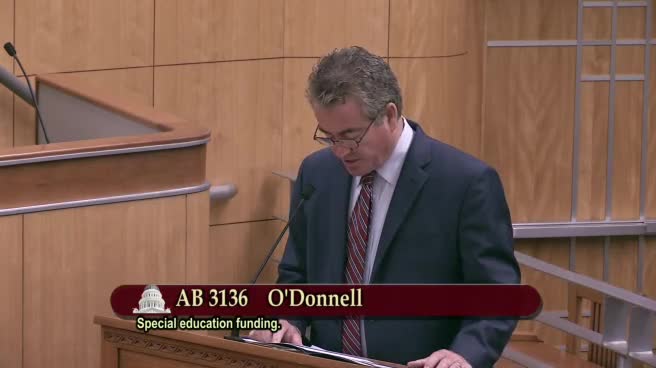 15MIN
Senate Standing Committee on Education
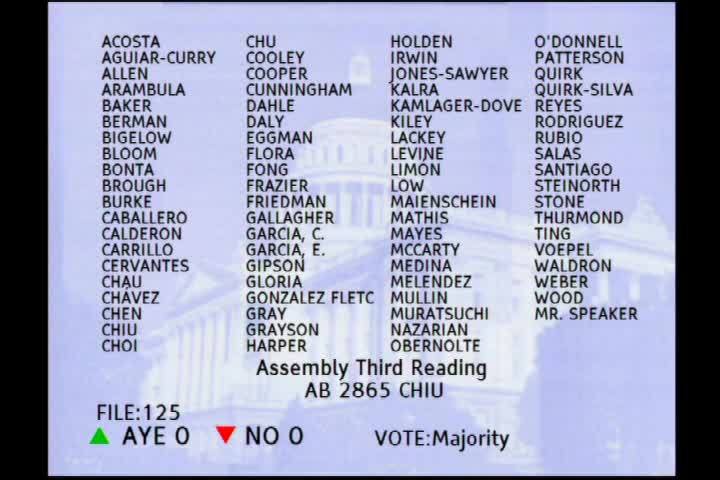 2MIN
Assembly Floor
 14MIN