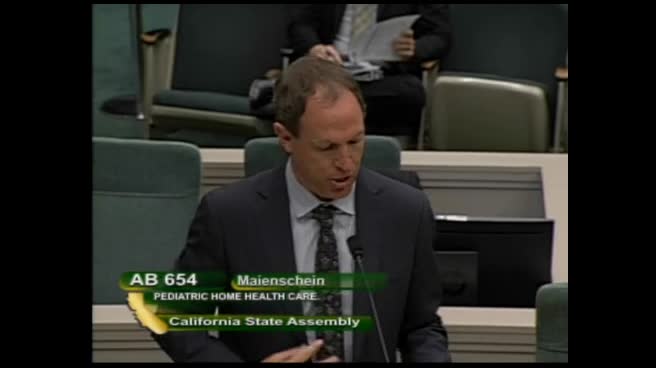
AB 654: Pediatric home health care.
- Session Year: 2017-2018
- House: Assembly
- Latest Version Date: 2017-03-13
Existing law provides for the licensure and regulation of home health agencies by the State Department of Public Health. Existing law requires all private or public organizations that provide or arrange for skilled nursing services to patients in the home to obtain a home health agency license. Existing law also provides for the Medi-Cal program, which is administered by the State Department of Health Care Services, under which qualified low-income individuals receive health care services. Existing law provides that home health care services are covered Medi-Cal benefits, subject to utilization controls.
This bill would require the department, on or before January 1, 2018, to establish an incentive-based, supplemental payment program, as defined, which would apply to licensed home health agencies that treat children who are receiving continuous nursing care or private duty nursing services through the Medi-Cal program. The purpose of the program would be to increase access to quality in-home nursing services and encouraging additional home health agencies to participate in nursing care for children receiving Medi-Cal services. The bill would require the department to collaborate with designated stakeholders in establishing the payments, and would authorize the department to establish reasonable provider eligibility standards, as specified. The supplemental payment program would be implemented only to the extent that federal financial participation is available and would require the department to submit any necessary applications to the federal Centers for Medicare and Medicaid Services to implement the supplemental payment program. The bill would require the department to submit a report evaluating the effectiveness of the supplemental payment program to specified committees of the Legislature on or before July 1, 2021. The bill would become inoperative on December 31, 2021, and would be repealed on January 1, 2022. remain in effect until January 1, 2022, and as of that date would be repealed.
Existing law provides for the licensure and regulation of home health agencies by the State Department of Public Health. Existing law requires all private or public organizations that provide or arrange for skilled nursing services to patients in the home to obtain a home health agency license. Existing law also provides for the Medi-Cal program, which is administered by the State Department of Health Care Services, under which qualified low-income individuals receive health care services. Existing law provides that home health care services are covered Medi-Cal benefits, subject to utilization controls.
This bill would require the department, on or before January 1, 2018, to establish an incentive-based, supplemental payment program, as defined, which would apply to licensed home health agencies that treat children who are receiving continuous nursing care or private nursing services through the Medi-Cal program. The purpose of the program would be to increase access to quality in-home nursing services and encouraging additional home health agencies to participate in nursing care for children receiving Medi-Cal services. The bill would require the department to collaborate with designated stakeholders in establishing the payments, and would authorize the department to establish reasonable provider standards, as specified. The supplemental payment program would be implemented only to the extent that federal financial participation is available and would require the department to submit any necessary applications to the federal Centers for Medicare and Medicaid Services to implement the supplemental payment program. The bill would require the department to submit a report evaluating the effectiveness of the supplemental payment program to specified committees of the Legislature on or before July 1, 2021. The bill would become inoperative on December 31, 2021, and would be repealed on January 1, 2022.
(a)(1) On or before July 1, 2018, the department shall establish an incentive-based, supplemental payment program applicable to licensed home health agencies that treat children who are receiving continuous nursing care or private duty nursing services through the Medi-Cal program.
(2)The program established pursuant to paragraph (1) shall create a supplemental payment designed to increase access to quality in-home nursing services and encourage additional home health agencies to participate in nursing care for children receiving Medi-Cal services.
(3)In establishing these payments, the department shall collaborate with Medi-Cal certified home health agencies, hospitals, pediatric physicians, and nurses, as well as other stakeholders. Supplemental payments may be provided for purposes including, but not limited to, the following:
(A) Improving completion of weekly nursing shifts for approved hours.(B)(A)Completing a higher percentage of nursing shifts consistent with the patients plan of care.
(C) Accepting additional(B)Actively servicing additional patients from area hospitals within a time frame timeframe specified by the department.
(D)(C) Developing higher reimbursement rates for patients with higher acuity and complex needs, night, or weekend nursing shifts.
(E)(D) Using a blended nursing rate for registered nurses and licensed vocational nurses hourly shifts.
(F)(E) Developing a rural reimbursement rate.
(4)For the purposes of this section, supplemental payment means a payment made to a home health agency for continuous nursing or private duty nursing services that would be in addition to the states regular Medi-Cal fee schedule for home health agencies. The level of supplemental payment shall be determined by the department, taking into consideration a reasonable cost basis to reduce the risk of home health agencies continuing to leave the private duty nursing segment of the Medi-Cal program. The supplemental payment may be paid on a quarterly basis after the department has verified that the program requirements have been met.
(b)This section shall be implemented only to the extent that federal financial participation is available. The department shall submit any necessary application to the federal Centers for Medicare and Medicaid Services for a state plan amendment, waiver, or amendment to a waiver to implement the supplemental payment program described in this section.
(c)The department may establish reasonable provider eligibility standards and participation requirements for the supplemental payment program, including, but not limited to, home health agencies in good standing with the State Department of Public Health, and agencies that are currently participating in the Medi-Cal program, and agencies that are accredited by the Accreditation Commission for Health Care or a similar independent accrediting organization. program.
(d)On or before July 1, 2021, the department shall submit a report evaluating the effectiveness of the supplemental payment program to the Senate Committee on Health, the Assembly Committee on Health, the Senate Committee on Budget and Fiscal Review, and the Assembly Committee on Budget.
(1)In order to compare access to necessary and approved services before and after the establishment of the supplemental payment program, the department may request participating home health agencies to report on key access to care indicators identified by the department, the participating agencies, and referring hospitals. The key access to care indicators shall include, but need not be limited to, the following:
(A)The increase or decrease in hospital discharges to home health agencies.
(B)The number of nursing hours filled, as compared to the number of hours that have been approved.
(C)The number of available licensed home health agencies that accept pediatric patients. actively service pediatric patients by providing private duty nursing services.
(D)The number of patients able to receive private duty nursing services.
(E)The number of beneficiaries unable to receive private duty nursing services due to the lack of an available provider.
(2)In evaluating the effectiveness of the supplemental payment program, the department shall cooperate with, and consider input from, home health agencies, consumer groups, hospitals, and other provider associations.
(e)This section shall become inoperative on December 31, 2021, and as of January 1, 2022, is repealed.(e)This section shall remain in effect only until January 1, 2022, and as of that date is repealed.
REVISIONS: HeadingLine 3.(a)(1) On or before July 1, 2018, the department shall establish an incentive-based, supplemental payment program applicable to licensed home health agencies that treat children who are receiving continuous nursing care or private nursing services through the Medi-Cal program.
(2)The program established pursuant to paragraph (1) shall create a supplemental payment designed to increase access to quality in-home nursing services and encourage additional home health agencies to participate in nursing care for children receiving Medi-Cal services.
(3)In establishing these payments, the department shall collaborate with Medi-Cal certified home health agencies, hospitals, pediatric physicians, and nurses, as well as other stakeholders. Supplemental payments may be provided for purposes including, but not limited to, the following:
(A) Improving completion of weekly nursing shifts for approved hours.
(B) Completing a higher percentage of nursing shifts consistent with the patients plan of care.
(C) Accepting additional patients from area hospitals within a time frame specified by the department.
(D) Developing higher reimbursement rates for patients with higher acuity and complex needs, night, or weekend nursing shifts.
(E) Using a blended nursing rate for registered nurses and licensed vocational nurses hourly shifts.
(F) Developing a rural reimbursement rate.
(4)For the purposes of this section, supplemental payment means a payment made to a home health agency for continuous nursing or private duty nursing services that would be in addition to the states Medi-Cal fee schedule for home health agencies. The level of supplemental payment shall be determined by the department, taking into consideration a reasonable cost basis to reduce the risk of home health agencies continuing to leave the private duty nursing segment of the Medi-Cal program. The supplemental payment may be paid on a quarterly basis after the department has verified that the program requirements have been met.
(b)This section shall be implemented only to the extent that federal financial participation is available. The department shall submit any necessary application to the federal Centers for Medicare and Medicaid Services for a state plan amendment, waiver, or amendment to a waiver to implement the supplemental payment program described in this section.
(c)The department may establish reasonable provider eligibility standards and participation requirements for the supplemental payment program, including, but not limited to, home health agencies in good standing with the State Department of Public Health, agencies that are currently participating in the Medi-Cal program, and agencies that are accredited by the Accreditation Commission for Health Care or a similar independent accrediting organization.
(d)On or before July 1, 2021, the department shall submit a report evaluating the effectiveness of the supplemental payment program to the Senate Committee on Health, the Assembly Committee on Health, the Senate Committee on Budget and Fiscal Review, and the Assembly Committee on Budget.
(1)In order to compare access to necessary and approved services before and after the establishment of the supplemental payment program, the department may request participating home health agencies to report on key access to care indicators identified by the department, the participating agencies, and referring hospitals. The key access to care indicators shall include, but need not be limited to, the following:
(A)The increase or decrease in hospital discharges to home health agencies.
(B)The number of nursing hours filled, as compared to the number of hours that have been approved.
(C)The number of available licensed home health agencies that accept pediatric patients.
(2)In evaluating the effectiveness of the supplemental payment program, the department shall cooperate with, and consider input from, home health agencies, consumer groups, hospitals, and other provider associations.
(e)This section shall become inoperative on December 31, 2021, and as of January 1, 2022, is repealed.
|
Date
|
Status
|
|---|---|
| Feb 1, 2018 | From committee: Filed with the Chief Clerk pursuant to Joint Rule 56. |
| Jan 31, 2018 | Died pursuant to Art. IV, Sec. 10(c) of the Constitution. |
| Jun 20, 2017 | Coauthors revised. |
| May 26, 2017 | In committee: Held under submission. |
| Apr 26, 2017 | In committee: Set, first hearing. Referred to APPR. suspense file. |
| Apr 5, 2017 | From committee: Do pass and re-refer to Com. on APPR. (Ayes 15. Noes 0.) (April 4). Re-referred to Com. on APPR. |
| Mar 14, 2017 | Re-referred to Com. on HEALTH. |
| Mar 13, 2017 | From committee chair, with author's amendments: Amend, and re-refer to Com. on HEALTH. Read second time and amended. |
| Mar 2, 2017 | Referred to Com. on HEALTH. |
| Feb 15, 2017 | From printer. May be heard in committee March 17. |
| Feb 14, 2017 | Read first time. To print. |
|
Date
|
Description
|
Location
|
Votes
|
|
|---|---|---|---|---|
| Apr 4, 2017 | Do pass and be re-referred to the Committee on [Appropriations] | Assembly Standing Committee on Health |
Passed |
This list shows positions taken on this bill by organizations on the date displayed, which is linked to the original source.
Positions by individuals are not included.
|
Organization
|
Position
|
Date
|
|---|---|---|
| ACT Home Health | ** Support | Mar 31, 2017 |
| Always Home | ** Support | Mar 31, 2017 |
| American Academy of Pediatrics | ** Support | Mar 31, 2017 |
| California Association For Health Services At Home | ** Support | Mar 31, 2017 |
| California Children'S Hospital Association | ** Support | Mar 31, 2017 |
| California ChildrenS Hospital Association | ** Support | Mar 31, 2017 |
| Children'S Specialty Care Coalition | ** Support | Mar 31, 2017 |
| ChildrenS Specialty Care Coalition | ** Support | Mar 31, 2017 |
| Home Health | ** Support | Mar 31, 2017 |
| Maxim Healthcare Services | ** Support | Mar 31, 2017 |
| Premier Healthcare Services | ** Support | Mar 31, 2017 |
Date of Hearing: April 26, 2017
ASSEMBLY COMMITTEE ON APPROPRIATIONS
Lorena Gonzalez Fletcher, Chair
ABPCA Bill Id:AB 654
Author:(Maienschein) – As Amended Ver:March 13, 2017
Policy Committee: | Health | Vote: | 15 - 0 |
|
|
Urgency: No State Mandated Local Program: No Reimbursable: No
SUMMARY:
This bill establishes a three-year Medi-Cal supplemental payment incentive program for providers who provide in-home nursing service to eligible children, and requires a program evaluation report.
The bill stipulates supplemental payments are designed to increase access, establishes criteria for the payments, and gives the Department of Health Care Services (DHCS) discretion to design the supplemental payment program in consultation with stakeholders.
FISCAL EFFECT:
- One-time costs, in the range of $100,000 to DHCS, for pre-implementation activities to develop the program and participation criteria and seek federal approval (GF/federal).
- Annual staff costs of $130,000 per year to DHCS for three years for program oversight and monitoring (GF/federal).
- One-time contract costs in the range of $100,000 for the Department to contract for a final evaluation of the pilot project (GF/federal).
- Unknown, significant supplemental payment amounts. Supplemental payments could easily exceed $20 million (GF/federal) for services already being provided. The bill provides DHCS discretion to create the payment design in order to increase access. Providers indicate significant rate increases could be necessary to induce more providers and better access.
- Unknown, likely significant increase in Medi-Cal payments for higher utilization of pediatric in-home nursing care services, to the extent the bill increases access and there is unmet demand for in-home nursing care. Though the effect size is unknown, a small increase could cost millions (GF/federal).
- Unknown potential cost savings, if better access to in-home nursing services avoids more costly institutional care (GF/federal). According to DHCS, children commonly transfer to in-home nursing care from Neonatal Intensive Care Units, neonatal nurseries, and pediatric care units, so to the extent improved access to in-home care allowed for shortened hospital stays, the state could realize significant cost savings.
COMMENTS:
- Purpose. According to the author, children with severe long-term, complex, and catastrophic health needs eligible for Medi-Cal who need in-home nursing care have difficulty finding such care due to a lack of providers. This difficulty, the author asserts, is a result of low Medi-Cal rates. The author indicates access problems lead to longer hospital stays, frequent hospital readmissions, waiting lists, and even to a complete inability to access in-home nursing care. This bill attempts to provide targeted supplemental funding designed to increase access.
- Home health services. Home health agencies (HHAs) are licensed by the California Department of Public Health to provide in-home medical care, largely comprised of nursing care by licensed vocational nurses and registered nurses. Medi-Cal coverage of home health agency (HHA) services must be prescribed by a physician. The number of hours is based on patient need, and authorized hours can be as high as 100 hours per week. Close to 4,000 children currently receive these services statewide, more than 90% of which are enrolled in the California Childrens' Services (CCS) program, which serves medically fragile children who meet financial and medical eligibility criteria. Although most children eligible for Medi-Cal and CCS are served through managed care plans, most children in CCS have historically been served outside of managed care through the fee-for-service Medi-Cal program. This means the state-established Medi-Cal rates, not managed care contracts, dictate provider payments for these services.
HHA rates were reduced by 1% in 2009 but HHAs were not subject to 10% rate reduction required by AB 97 (Committee on Budget), Chapter 3, Statutes of 2011, because of potential access concerns. A report commissioned by Maxim, an HHA, in 2015 indicated HHAs have turned away from Medi-Cal business. The report found low acceptance of Medi-Cal patients, inability of HHAs to staff all of the authorized hours, and stagnant utilization of HHA services among the Medi-Cal population despite increasing Medi-Cal enrollment. The availability of pediatric HHA services was noted as declining. - Prior Legislation. SB 1401 (McGuire), of the 2015-16 Legislative Session, was similar to this bill. It provided for a 20% rate increase across-the-board but only in certain counties on a pilot basis. SB 1401 was held on the Senate Appropriations Committee's Suspense File.
Analysis Prepared by: Lisa Murawski / APPR. / (916) 319-2081
Date of Hearing: April 4, 2017
ASSEMBLY COMMITTEE ON HEALTH
Jim Wood, Chair
ABPCA Bill Id:AB 654
Author:(Maienschein) – As Amended Ver:March 13, 2017
SUBJECT: Pediatric home health care.
SUMMARY: Requires the Department of Health Care Services (DHCS), on or before July 1, 2018, to establish an incentive-based, supplemental payment program (SPP) for licensed home health agencies (HHAs) that treat children who are receiving continuous nursing care or private duty nursing services through the Medi-Cal program. Specifically, this bill:
- Specifies that the SPP is designed to increase access to quality in-home nursing services and encourage additional HHAs to participate in nursing care for children receiving Medi-Cal services.
- Requires DHCS to collaborate with Medi-Cal certified HHAs, hospitals, pediatric physicians and nurses, and other stakeholders.
- Authorizes supplemental payments to include the following purposes:
- Completing a higher percentage of nursing shifts consistent with the patient’s plan of care;
- Actively servicing additional patients from area hospitals, as specified;
- Developing higher reimbursement rates for patients with higher acuity and complex needs and for night or weekend nursing shifts;
- Using blended nursing rate for registered nurses’ and licensed vocational nurses’ hourly shifts; and,
- Developing a rural reimbursement rate.
- Defines supplemental payment as payment made to a HHA for continuous nursing or private duty nursing services that would be in addition to the state’s regular Medi-Cal fee schedule for HHAs. Requires the level of supplemental payment to be determined by DHCS, taking into consideration a reasonable cost basis to reduce the risk of HHAs continuing to leave the private duty nursing segment of the Medi-Cal program. Authorizes the supplemental payment to be paid on a quarterly basis after DHCS has verified that the program requirements have been met.
- Provides that this bill will be implemented only to the extent that federal financial participation is available. Requires DHCS to submit any necessary application to the federal Centers for Medicare and Medicaid Services for a state plan amendment, waiver, or amendment to a waiver to implement the SPP.
- Authorizes DHCS to establish reasonable provider eligibility standards and participation requirements for the SPP, including, but not limited to, HHAs in good standing with the Department of Public Health, and agencies that are currently participating in the Medi-Cal program.
- Requires DHCS, on or before July 1, 2021, to submit a report evaluating the effectiveness of the SPP to specified committees of the Legislature.
- Specifies that in order to compare access to necessary and approved services before and after the establishment of the SPP, DHCS may request participating HHAs to report on key access to care indicators identified by DHCS, the participating agencies, and referring hospitals. Requires the key access to care indicators to include, but need not be limited to, the following:
- The increase or decrease in hospital discharges to HHAs;
- The number of nursing hours filled, as compared to the number of hours that have been approved;
- The number of available licensed HHAs that actively service pediatric patients by providing private duty nursing services;
- The number of patients able to receive private duty nursing services; and,
- The number of beneficiaries unable to receive private duty nursing services due to the lack of an available provider.
- Requires DHCS to cooperate with and consider input from home health agencies, consumer groups, hospitals, and other provider associations.
- Sunsets the provisions of this bill on January 1, 2022.
EXISTING LAW:
- Establishes the Medi-Cal program, administered by DHCS, under which qualified low-income individuals receive health care services.
- Establishes a schedule of benefits under the Medi-Cal program, including Early and Periodic Diagnosis, Screening and Treatment for individuals under 21 years of age, consistent with federal Medicaid requirements.
- Includes home health services as reimbursable services under the Medi-Cal program, when prescribed by a physician and provided at the recipient’s home in accordance with a written treatment plan.
- Establishes the California Children’s Services Program (CCS) to provide specified medical care and therapy services to children with CCS-eligible conditions.
FISCAL EFFECT: This bill has not yet been analyzed by a fiscal committee.
COMMENTS:
- PURPOSE OF THIS BILL. According to the author, there are nearly 4,400 children statewide with severe long-term, complex, and catastrophic health needs that are eligible for Medi-Cal in-home nursing care. Most of these children have CCS eligible conditions and are in the state’s fee-for-service Medi-Cal system. In-home skilled nursing care allows these children to be safely discharged from expensive intensive care unit (ICU) level hospitals and back into their homes at a fraction of the cost to the state.
However, in the last decade, barriers to accessing quality in-home nursing care for these children have increased. Out-of-date reimbursement models and difficulty recruiting nurses with the appropriate skill set at common Medi-Cal pay rates have resulted in longer hospital stays, frequent hospital readmissions, waiting lists, and even no access to in-home nursing care at all. Without the access to skilled in-home nursing, the state is unnecessarily spending limited resources and preventing children from being at home with their families.
The author also points out that the Medi-Cal reimbursement rate is significantly below what surrounding states pay and more than 60% below the average commercial rate making it increasingly difficult to find affordable care for these families because HHAs increasingly do not accept Medi-Cal patients. Additionally there are fewer agencies with less time to serve Medi-Cal patients. - BACKGROUND.
- Home health services. Medi-Cal coverage of HHA services must be prescribed by a physician and the patient must have a medical condition requiring skilled care to prevent further disability and/or promote improvement. The recipient must be reasonably responsive to the prescribed service. A physician must review a treatment plan every 60 days, and the plan must indicate a need for one or more specific services, including skilled nursing services, in-home medical care services, physical, occupation or speech therapy and medical supplies.
HHA rates were reduced by 1% in 2009 but HHAs were not subject to the rate reduction required by AB 97 (Committee on Budget), Chapter 3, Statutes of 2011, because of potential access concerns. HHA rates were last increased in 2001. - Study on home health access under Medi-Cal. A 2015 study by Leavitt Partners funded by Maxim Healthcare Services (a HHA) entitled “Analysis of California Home Health Care: Decreasing Access for Medi-Cal Patients” found that while the total capacity of the home health care market is growing, services available for Medi-Cal patients have remained stagnant since 2002. The study points out that HHAs have shifted their resources away from providing care to Medi-Cal patients in favor of providing more services to commercially insured patients. The key findings of the study are as follows:
- Although the Medi-Cal population has grown by 39% in seven years, the number of home health visits provided to Medi-Cal patients has remained relatively stable during the same period;
- Fewer HHAs are treating Medi-Cal patients (78% in 2002 to 44% in 2013). HHAs providing Medi-Cal pediatric services declined from 45% in 2002 to 27% in 2013;
- HHAs are more likely to accept new patients if privately insured than if they are on Medi-Cal;
- Sixty percent of all the HHAs treating Medi-Cal patients are only able to provide less than 25% of the approved hours;
- Seventeen percent of all agencies have a cap on the number of Medi-Cal patients they will accept; and,
- By 2018, it is projected that only four in 10 Medi-Cal certified agencies will actually accept Medi-Cal patients in a given year.
- Home health services. Medi-Cal coverage of HHA services must be prescribed by a physician and the patient must have a medical condition requiring skilled care to prevent further disability and/or promote improvement. The recipient must be reasonably responsive to the prescribed service. A physician must review a treatment plan every 60 days, and the plan must indicate a need for one or more specific services, including skilled nursing services, in-home medical care services, physical, occupation or speech therapy and medical supplies.
In conclusion, the study notes: (1) growth in the home health care market has not increased access to care for Medi-Cal patients as expected; (2) when entering the home health market, new agencies are less likely to provide services to Medi-Cal patients; and, (3) access-to-care problems are exacerbated for certain sub-populations, such as high-needs pediatric patients.
- SUPPORT. The Children’s Specialty Care Coalition states that children should be cared for in the least restrictive setting but due to low and stagnant reimbursement rates, children are staying in the hospital longer than necessary. According to Always Home, a HHA, in-home skilled nursing care allows children with complex and severe long-term health needs to spend significantly less time in ICU-level hospitals, and more time receiving their health care from the comfort of their homes for a fraction of the cost to the state.
- PREVIOUS LEGISLATION. SB 1401 (McGuire) of 2016 would have required DHCS to develop at least three regional pilot projects in the San Francisco Bay Area, the Central Valley, and Los Angeles County to increase access for children receiving Medi-Cal or CCS benefits who are eligible for in-home, shift nursing care services by increasing private duty nursing reimbursement rates by 20% for participating licensed home health agencies. SB 1401 was held on the Senate Appropriations suspense file.
REGISTERED SUPPORT / OPPOSITION:
Support
ACT Home Health
Always Home
American Academy of Pediatrics
California Association for Health Services at Home
California Children’s Hospital Association
Children’s Specialty Care Coalition
Home Health
Maxim Healthcare Services
Premier Healthcare Services
Opposition
None on file.
Analysis Prepared by: Rosielyn Pulmano / HEALTH / (916)319-2097
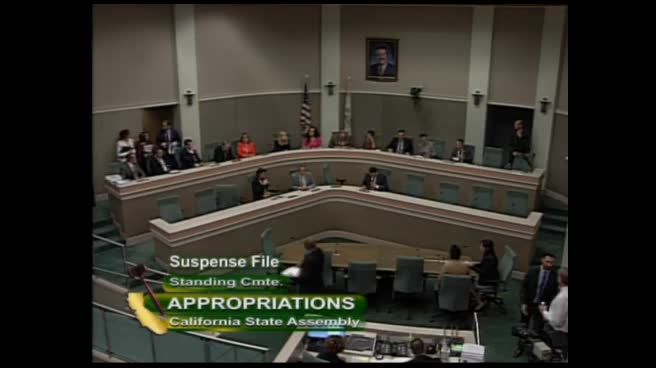
Discussed in Hearing
 1H
Assembly Standing Committee on Appropriations
 10MIN
Assembly Standing Committee on Health
Bill Author