AB 658: Clinical laboratories.
- Session Year: 2017-2018
- House: Assembly
- Latest Version Date: 2017-09-28
Existing federal law, the Clinical Laboratory Improvement Amendments of 1988 (CLIA), requires the federal Centers for Medicare and Medicaid Services to certify and regulate clinical laboratories that perform testing on humans. Existing law also provides for the licensure and regulation of clinical laboratories and various clinical laboratory personnel by the State Department of Public Health. Under existing law, the department inspects clinical laboratories and assesses a fee for licensure of those facilities.
This bill would temporarily suspend the annual renewal fee for clinical laboratory licenses until January 1, 2020.
(a)The application and renewal fees for clinical laboratory licenses specified in Section 1300 shall be adjusted annually in the manner specified in Section 100450 of the Health and Safety Code. The adjustments shall be rounded off to the nearest whole dollar amount.
(b)The annual renewal fee for clinical laboratory licenses specified in subdivision (g) of Section 1300 shall be suspended for the years 2018 and 2019.
(c)This section shall remain in effect only until January 1, 2020, and as of that date is repealed, unless a later enacted statute that is enacted before January 1, 2020, deletes or extends that date.
SEC. 2.Section 1300.1 is added to the Business and Professions Code, to read:1300.1.(a)The application and renewal fees for clinical laboratory licenses specified in Section 1300 shall be adjusted annually in the manner specified in Section 100450 of the Health and Safety Code. The adjustments shall be rounded off to the nearest whole dollar amount.
(b)This section shall become operative on January 1, 2020.
(a)The application and renewal fees for clinical laboratory licenses specified in Section 1300 shall be adjusted annually in the manner specified in Section 100450 of the Health and Safety Code. The adjustments shall be rounded off to the nearest whole dollar amount.
(b)The annual renewal fee for clinical laboratory licenses specified in Section 1300 shall be suspended for the years 2018 and 2019.
(c)This section shall remain in effect only until January 1, 2020, and as of that date is repealed, unless a later enacted statute that is enacted before January 1, 2020, deletes or extends that date.
SEC. 2.Section 1300.1 is added to the Business and Professions Code, to read:1300.1.(a)The application and renewal fees for clinical laboratory licenses specified in Section 1300 shall be adjusted annually in the manner specified in Section 100450 of the Health and Safety Code. The adjustments shall be rounded off to the nearest whole dollar amount.
(b)This section shall become operative on January 1, 2020.
|
Date
|
Status
|
|---|---|
| Sep 28, 2017 | Chaptered by Secretary of State - Chapter 345, Statutes of 2017. |
| Sep 28, 2017 | Approved by the Governor. |
| Sep 20, 2017 | Enrolled and presented to the Governor at 4:30 p.m. |
| Sep 11, 2017 | In Assembly. Ordered to Engrossing and Enrolling. |
| Sep 11, 2017 | Read third time. Passed. Ordered to the Assembly. |
| Sep 5, 2017 | Read second time. Ordered to third reading. |
| Sep 1, 2017 | From committee: Do pass. (Ayes 7. Noes 0.) (September 1). |
| Jun 26, 2017 | In committee: Referred to suspense file. |
| Jun 5, 2017 | From committee: Do pass and re-refer to Com. on APPR. with recommendation: To Consent Calendar. (Ayes 9. Noes 0.) (June 5). Re-referred to Com. on APPR. |
| May 10, 2017 | Referred to Com. on B., P. & E.D. |
| Apr 20, 2017 | In Senate. Read first time. To Com. on RLS. for assignment. |
| Apr 20, 2017 | Read third time. Passed. Ordered to the Senate. (Ayes 74. Noes 0. Page 1146.) |
| Apr 17, 2017 | Read second time. Ordered to Consent Calendar. |
| Apr 6, 2017 | Read second time and amended. Ordered returned to second reading. |
| Apr 5, 2017 | From committee: Amend, and do pass as amended. To Consent Calendar. (Ayes 17. Noes 0.) (April 5). |
| Mar 22, 2017 | From committee: Do pass and re-refer to Com. on APPR. (Ayes 15. Noes 0.) (March 21). Re-referred to Com. on APPR. |
| Mar 2, 2017 | Referred to Com. on HEALTH. |
| Feb 15, 2017 | From printer. May be heard in committee March 17. |
| Feb 14, 2017 | Read first time. To print. |
|
Date
|
Description
|
Location
|
Votes
|
|
|---|---|---|---|---|
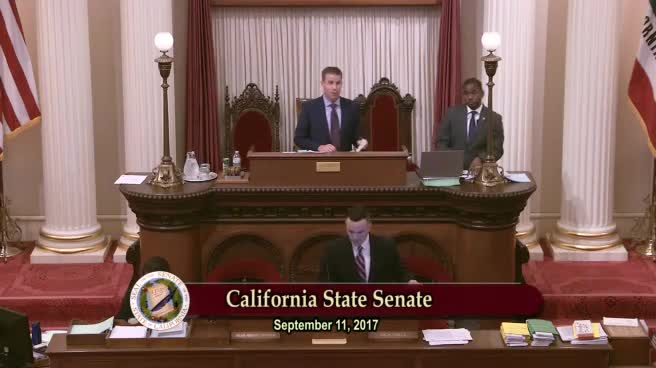
| Sep 11, 2017 | Assembly 3rd Reading AB658 Waldron By Hernandez | Senate Floor |
Passed |
|
| Sep 1, 2017 | Do pass | Senate Standing Committee on Appropriations |
Passed |
|
| Jun 26, 2017 | Placed on suspense file | Senate Standing Committee on Appropriations |
Passed |
|
| Jun 5, 2017 | Do pass, but first be re-referred to the Committee on [Appropriations] with the recommendation: To Consent Calendar | Senate Standing Committee on Business, Professions and Economic Development |
Passed |
|
| Apr 20, 2017 | Favorable With Amendment(s) (Ways & Means Committee) | Assembly Floor |
Passed |
|
| Apr 5, 2017 | Do pass as amended. To Consent Calendar. | Assembly Standing Committee on Appropriations |
Passed |
|
| Mar 21, 2017 | Do pass and be re-referred to the Committee on [Appropriations] | Assembly Standing Committee on Health |
Passed |
This list shows positions taken on this bill by organizations on the date displayed, which is linked to the original source.
Positions by individuals are not included.
|
Organization
|
Position
|
Date
|
|---|---|---|
| California Clinical Laboratory Association | ** Support | Sep 4, 2017 |
| California Society Of Pathologists | * Support | Mar 21, 2017 |
| Labcorp | ** Support | Sep 4, 2017 |
| Lilly Usa | * Support | Mar 21, 2017 |
| prometheus laboratories, inc. | ** Support | Sep 4, 2017 |
| Quest Diagnostics | ** Support | Sep 4, 2017 |
| Spectra Laboratories | ** Support | Sep 4, 2017 |
Office of Senate Floor Analyses (916) 651-1520 Fax: (916) 327-4478 | AB |
THIRD READING
Bill No: AB 658
:
SENATE BUS., PROF. & ECON. DEV. COMMITTEE: 9-0, 6/5/17
AYES: Hill, Fuller, Dodd, Galgiani, Glazer, Hernandez, Newman, Pan, Wilk
SENATE APPROPRIATIONS COMMITTEE: 7-0, 9/1/17
AYES: Lara, Bates, Beall, Bradford, Hill, Nielsen, Wiener
ASSEMBLY FLOOR: 74-0, 4/20/17 (Consent) - See last page for vote
SOURCE: California Clinical Laboratory Association
DIGEST:
This bill directs the California Department of Public Health to suspend the clinical laboratory license renewal fee for two years and annually adjust all licensing fees thereafter according to existing law.
Existing law:
- Provides for the licensure, registration, and regulation of clinical laboratories and various clinical laboratory personnel by the California Department of Public Health (DPH). (Business and Professions Code §§ 1200-1327)
- Requires clinical laboratory and personnel license fees to be adjusted annually, as specified, and requires DPH to publish a list of adjusted charges. (Health and Safety Code § 100450)
This bill:
- Suspends the annual renewal fee for clinical laboratory licenses for the years 2018 and 2019.
- Requires the application and renewal fees for clinical laboratory licenses be adjusted annually in the manner specified in existing law. The adjustments shall be rounded off to the nearest whole dollar amount.
- Sunsets this bill on January 1, 2020.
Background
The DPH regulates clinical laboratories that analyze human specimens such as blood, tissue and urine through Laboratory Field Services (LFS). The mission of LFS is to “ensure quality standards in clinical and public health laboratories and laboratory scientists through licensing, examination, inspection, education, and proficiency testing.”
However, the California State Auditor has found LFS’s mission orientation lacking in audits reported in 2008 and 2015. The 2015 audit concluded the following:
[LFS] has not fully implemented many of the recommendations from our September 2008 audit report. [LFS] still only inspects approximately half of California labs and it does not have a process to ensure that it is aware, in a timely manner, when out-of-state labs that are licensed in California fail required proficiency testing. [LFS] also continues to not investigate all the complaints it receives and has issued only a small number of sanctions in the past seven years even though it is responsible for overseeing more than 22,100 labs. Moreover, we found that [LFS] made an unauthorized fee increase in January 2014 that has resulted in labs overpaying it more than $1 million in fees, and since 2008 it has collected more than $12 million in lab fees that it has not spent. Finally, [LFS] has missed opportunities to more effectively use its limited personnel by partnering with other organizations that could help it meet its workload obligations under state law.
…. In fact, we believe [LFS’] oversight of lab facilities largely duplicates federal oversight with no meaningful benefit to consumers. State law and CLIA are nearly equivalent in their mandates, and the oversight required is redundant: Both [LFS] and CMS collect fees from labs to perform inspections, monitor proficiency testing, investigate complaints, and issue sanctions. The Legislature should repeal state law requiring that lab facilities be licensed by the State, thus reducing the regulatory and financial burden on lab facilities while continuing to enforce the State’s requirements for laboratory personnel.
This bill merely suspends the collection of laboratory renewal license fees for two years and directs DPH to follow existing law and adjust all licensing fees annually thereafter.
FISCAL EFFECT: Appropriation: Fiscal Com.: Local:
According to the Senate Appropriations Committee, there will be a one-time reduction in fee revenues of $8.8 million over two years to the Clinical Laboratory Improvement Fund.
California Clinical Laboratory Association (source)
LabCorp
Prometheus Laboratories, Inc.
Quest Diagnostics
Spectra Laboratories
None received
ARGUMENTS IN SUPPORT: California Clinical Laboratory Association supports this bill because it will “allow DPH to spend down the surplus in funds to an appropriate operating level.”
Quest Diagnostics supports this bill and also acknowledges that the previous audits “identified numerous issues that should still be addressed.”
ASSEMBLY FLOOR: 74-0, 4/20/17
AYES: Acosta, Aguiar-Curry, Travis Allen, Arambula, Baker, Berman, Bigelow, Bloom, Bocanegra, Bonta, Burke, Caballero, Calderon, Cervantes, Chau, Chávez, Chen, Chiu, Chu, Cooley, Cooper, Cunningham, Dababneh, Dahle, Daly, Eggman, Flora, Fong, Frazier, Friedman, Cristina Garcia, Eduardo Garcia, Gipson, Gloria, Gomez, Gonzalez Fletcher, Gray, Grayson, Harper, Holden, Irwin, Jones-Sawyer, Kalra, Kiley, Lackey, Levine, Limón, Low, Maienschein, Mayes, McCarty, Medina, Melendez, Mullin, Muratsuchi, Nazarian, Obernolte, O'Donnell, Quirk, Quirk-Silva, Reyes, Rodriguez, Rubio, Salas, Santiago, Steinorth, Mark Stone, Thurmond, Ting, Voepel, Waldron, Weber, Wood, Rendon
NO VOTE RECORDED: Brough, Choi, Gallagher, Mathis, Patterson, Ridley-Thomas
9/4/17 12:19:17
**** END ****
SENATE COMMITTEE ON APPROPRIATIONS
Senator Ricardo Lara, Chair
2017 - 2018 Regular Session
AB 658 (Waldron) - Clinical laboratories
Version: April 6, 2017 | Policy Vote: B., P. & E.D. 9 - 0 |
Urgency: No | Mandate: No |
Hearing Date: June 26, 2017 | Consultant: Brendan McCarthy |
This bill meets the criteria for referral to the Suspense File.
Bill Summary:
AB 658 would suspend clinical laboratory license renewal fees paid to the Department of Public Health for two years.
Fiscal Impact:
One-time reduction in fee revenues of $8.8 million over two years (Clinical Laboratory Improvement Fund).
Background:
Under current law, clinical laboratories and certain clinical laboratory personnel are licensed and regulated by the Department of Public Health. Clinical laboratories that perform moderate to high-complexity testing must be licensed by the Department, while clinical laboratories performing simpler tests must register with the Department. There are about 2,800 licensed laboratories in the state and about 19,300 registered laboratories.
Clinical laboratories are also subject to regulation by the federal government.
Proposed Law:
AB 658 would suspend clinical laboratory license renewal fees paid to the Department of Public Health for the years of 2018 and 2019.
Related Legislation:
AB 1774 (Bonilla, 2016) would have repealed state licensure and registration of clinical laboratories. That bill was held on the Assembly Appropriations Committee’s Suspense File.
Staff Comments:
The Bureau of State Audits conducted audits of the Department of Public Health’s clinical laboratory licensing program in 2008 and 2015. The Bureau found that the Department inspects only about half of the licensed laboratories, the Department does not investigate all complaints it receives, and the Department has issued a small number of citations in recent years. The Bureau also found that the Department inappropriately raised license fees and in recent years the Department has collected more than $12 million in license fees that it has not spent on its regulatory program.
The Bureau of State Audits found that state oversight of clinical laboratories is duplicative of federal regulation and provides no additional benefit to the public. The Bureau recommended the Legislature repeal current law requiring clinical laboratories to be licensed by the state.
The Clinical Laboratory Improvement Fund is projected to have a fund balance at the end of 2017-18 of over $22 million, with projected annual expenditures of about $12 million per year. Therefore, the balance in the Fund should be sufficient to accommodate the suspension of renewal fees proposed in this bill without requiring a reduction in the Department’s current regulatory program.
-- END --
SENATE COMMITTEE ON
BUSINESS, PROFESSIONS AND ECONOMIC DEVELOPMENT
Senator Jerry Hill, Chair
2017 - 2018 Regular
Bill No: AB 658 Hearing Date: June 5, 2017
Author: | Waldron | ||
Version: |
| ||
Urgency: | Fiscal: | ||
Consultant: | |||
Subject: Clinical laboratories
SUMMARY:
Directs the California Department of Public Health to suspend the clinical laboratory license renewal fee for two years and annually adjust all licensing fees thereafter according to existing law.
Existing law:
- Provides for the licensure, registration, and regulation of clinical laboratories and various clinical laboratory personnel by the California Department of Public Health (DPH). (Business and Professions Code §§ 1200-1327)
- Requires clinical laboratory and personnel license fees to be adjusted annually, as specified, and requires DPH to publish a list of adjusted charges. (Health and Safety Code § 100450)
This bill:
- Suspends the annual renewal fee for clinical laboratory licenses for the years 2018 and 2019.
- Requires the application and renewal fees for clinical laboratory licenses be adjusted annually in the manner specified in existing law. The adjustments shall be rounded off to the nearest whole dollar amount.
- Sunsets this bill on January 1, 2020.
FISCAL EFFECT:
This bill is keyed fiscal by Legislative Counsel. According to the Assembly Committee on Appropriations dated April 5, 2017, this bill is projected to result in revenue loss of $4.4 million per year, or $8.8 million total over two years, to the Clinical Laboratory Improvement Fund but the analysis notes that there is a projected reserve of $22 million in the fund, which is adequate to fund program needs despite a two-year suspension in fee collection.
COMMENTS:
- Purpose. This bill is sponsored by the California Clinical Laboratory Association. According to the Author’s office, “Every clinical laboratory operating in California must obtain a license from DPH and must pay an annual licensure fee to cover the cost of the licensure and regulation of clinical laboratories. Fees cannot exceed the cost of running the program. Since 2008, DPH has collected more than $12 million in laboratory fees that it has not spent, and the current CLIF reserve exceeds
$22 million.
“Under existing law, the DPH has the authority to change its licensing fees, but the adjustment in fees is limited. Fees are based on current fiscal year appropriations. Current law does not give DPH the statutory authority to issue a temporary fee suspension because the current fiscal year appropriations would never be zero since it is assumed that operational costs are never zero.”
- Background. The DPH regulates clinical laboratories that analyze human specimens such as blood, tissue and urine through Laboratory Field Services (LFS). The mission of LFS is to “ensure quality standards in clinical and public health laboratories and laboratory scientists through licensing, examination, inspection, education, and proficiency testing.”
However, the California State Auditor has found LFS’s mission orientation lacking in audits reported in 2008 and 2015. The 2015 audit concluded the following:
[LFS] has not fully implemented many of the recommendations from our September 2008 audit report. [LFS] still only inspects approximately half of California labs and it does not have a process to ensure that it is aware, in a timely manner, when out-of-state labs that are licensed in California fail required proficiency testing. [LFS] also continues to not investigate all the complaints it receives and has issued only a small number of sanctions in the past seven years even though it is responsible for overseeing more than 22,100 labs. Moreover, we found that [LFS] made an unauthorized fee increase in January 2014 that has resulted in labs overpaying it more than $1 million in fees, and since 2008 it has collected more than $12 million in lab fees that it has not spent. Finally, [LFS] has missed opportunities to more effectively use its limited personnel by partnering with other organizations that could help it meet its workload obligations under state law.
…. In fact, we believe [LFS’] oversight of lab facilities largely duplicates federal oversight with no meaningful benefit to consumers. State law and CLIA are nearly equivalent in their mandates, and the oversight required is redundant: Both [LFS] and CMS collect fees from labs to perform inspections, monitor proficiency testing, investigate complaints, and issue sanctions. The Legislature should repeal state law requiring that lab facilities be licensed by the State, thus reducing the regulatory and financial burden on lab facilities while continuing to enforce the State’s requirements for laboratory personnel.
This bill merely suspends the collection of laboratory renewal license fees for two years and directs DPH to follow existing law and adjust all licensing fees annually thereafter.
- Related Legislation This Year. AB 613 (Nazarian, 2017) authorizes, until January 1, 2020, a person who meets specified criteria to perform a total protein refractometer test using digital refractometer in a licensed plasma collection facility in this state. (Status: The bill is also pending in this committee.)
- Prior Related Legislation. AB 1174 (Bonilla, 2016) would have repealed state licensure and registration requirements for clinical laboratories, including laboratory inspections, issuance of licenses and registration, and associated fees. (Status: The bill was held in the Assembly Committee on Appropriations.)
- Arguments in Support. California Clinical Laboratory Association supports this bill because it will “allow DPH to spend down the surplus in funds to an appropriate operating level.”
Quest Diagnostics supports this bill and also acknowledges that the previous audits “identified numerous issues that should still be addressed.”
SUPPORT AND OPPOSITION:
Support:
California Clinical Laboratory Association (Sponsor)
LabCorp
Prometheus Laboratories, Inc.
Quest Diagnostics
Spectra Laboratories
Opposition:
None on file as of May 30, 2017
-- END --
Date of Hearing: April 5, 2017
ASSEMBLY COMMITTEE ON APPROPRIATIONS
Lorena Gonzalez Fletcher, Chair
ABPCA Bill Id:AB 658
Author:(Waldron) – As Introduced Ver:February 14, 2017
Policy Committee: | Health | Vote: | 15 - 0 |
Urgency: No State Mandated Local Program: No Reimbursable: No
SUMMARY:
As proposed to be amended, this bill temporarily suspends clinical laboratories (labs) licensing renewal fees for two years, 2018 and 2019.
FISCAL EFFECT:
Revenue loss of $4.4 million per year, or $8.8 million total over two years, to the Clinical Laboratory Improvement Fund. The majority of lab licensure fee revenue is renewal fees, while the remainder is new application fees. This bill applies only to renewal fees.
There is a projected reserve of $22 million in the fund, which is adequate to fund program needs despite a two-year suspension in fee collection.
COMMENTS:
- Purpose. This bill suspends fees for two years, consistent with a 2015 California State Auditor's report that noted an exceptionally high reserve, and recommended the state address it simply and expeditiously. By suspending fee collection, this bill would allow draw the reserve.
- Background. Overseen by the California Department of Public Health, Laboratory Field Services (CDPH LFS), labs analyze human specimens such as blood, tissue, and urine so that medical professionals can make diagnoses, prescribe treatment, and perform research. Labs performing moderate- to high-complexity testing are required to be licensed, while other labs performing simpler tests must register with the department. To cover the cost of carrying out these responsibilities, LFS collects fees from the labs it oversees. There are approximately 2,800 licensed labs, and approximately 19,300 registered labs. Labs are also governed by federal law, and LFS is authorized to enforce both state and federal law.
- State Audit Findings. The California State Auditor found in 2008, and again in September 2015, severe deficiencies plaguing CDPH's laboratory oversight. Audits found the state consistently failed to perform mandated workload, among other significant findings. The 2015 audit noted much of state law is duplicative of federal law, and given the multitude of problems at LFS, recommended the Legislature repeal state licensure and registration as well as the associated fees.
Specific to the high reserve in the Clinical Laboratory Improvement Fund, the audit noted: "With such a high reserve, the labs that pay fees to Laboratory Services may reasonably question the State as to the fairness and appropriateness of those fees in relation to the actual expense incurred for oversight…Our legal counsel has advised that Laboratory Services lacks the authority to reduce its fees when its revenues exceed its costs…[When] fee revenue greatly exceeds costs, it is prudent for the State to achieve equilibrium in the most expeditious and administratively simple way possible."
- Prior Legislation. AB 1774 (Bonilla) of the 2015-16 Legislative Session was a major repeal effort, which repealed state licensure and registration requirements for labs, including laboratory inspections, issuance of licenses and registration, and associated fees. AB 1774 was held in this committee.
- Clarifying Amendment. Business and Professions Code (BCP) section 1300 specifies a number of lab-related fees. To ensure clarity on which fee is suspended, staff recommends the proposed section BPC 1300.1 (b) be amended to read: "The annual renewal fee for clinical laboratory licenses specified in Section 1300 (g) shall be suspended for the years 2018 and 2019."
Analysis Prepared by: Lisa Murawski / APPR. / (916) 319-2081
Date of Hearing: March 21, 2017
ASSEMBLY COMMITTEE ON HEALTH
Jim Wood, Chair
ABPCA Bill Id:AB 658
Author:(Waldron) – As Introduced Ver:February 14, 2017
SUBJECT: Clinical laboratories.
SUMMARY: Suspends the annual renewal fee for clinical laboratory licenses for years 2018 and 2019. Sunsets this provision on January 1, 2020.
EXISTING LAW:
- Provides for the licensure and regulation of clinical laboratories (labs) and laboratory personnel (lab personnel) by the Department of Public Health (DPH).
- Establishes the Clinical Laboratory Improvement Fund (CLIF) in the State Treasury.
- Specifies the application and renewal fees for labs and lab personnel. Determines fees for labs based on specific tests offered and number of tests performed. Adjusts fees annually based on changes in the CLIF, as specified in the Budget Act. Limits the total laboratory fees collected to the costs incurred by DPH for the licensing, certification, inspection, or other activities relating to their regulation of labs and lab personnel.
FISCAL EFFECT: This bill has not yet been analyzed by a fiscal committee.
COMMENTS:
- PURPOSE OF THIS BILL. According to the author, this bill is necessary to address the excessive surplus in the CLIF. The author states that DPH has collected more than $12 million in laboratory fees since 2008, which it has not spent, and that the current CLIF reserve exceeds $22 million. The two-year suspension of renewal fees is intended to reduce the surplus to appropriate levels.
- BACKGROUND. Labs analyze human specimens such as blood, tissue, and urine so medical professionals can make diagnoses and prescribe treatment. DPH’s Laboratory Field Services (Laboratory Services) is responsible for licensing, registering, and overseeing labs. Laboratory Services is required to inspect licensed labs and verify the reliability and accuracy of their tests through a process known as proficiency testing. It also investigates complaints it receives against licensed or registered labs and can sanction labs that fail to correct deficiencies. To cover the cost of carrying out these responsibilities, Laboratory Services collects fees from the labs it oversees.
- STATE AUDITOR REPORT. The California State Auditor (CSA) released audits of Laboratory Services in 2008 and again in September 2015. In its most recent audit, CSA reported that Laboratory Services continued to be inadequately managed. CSA found that Laboratory Services had overcharged labs more than $1 million since January 2014, and continued to charge incorrect fees. Furthermore, from fiscal years 2008–09 through 2013–14, Laboratory Services collected $12.6 million more in revenue from license and registration fees than it needed for the level of oversight it provided. Of particular relevance to this bill is the following passage from pages 27-29 of the September 2015 CSA audit:
“Although we would expect Laboratory Services to maintain a prudent reserve, such as an amount equaling 5 percent of its annual expenditures or about $420,000, Laboratory
Services’ reserve exceeded $18 million as of June 30, 2014. With such a high reserve, the labs that pay fees to Laboratory Services may reasonably question the State as to the fairness and appropriateness of those fees in relation to the actual expense incurred for oversight. However, resolving Laboratory Services’ excessive reserve may prove difficult. A gap exists in state law such that Laboratory Services lacks the authority to ensure that its lab fees are consistent with the costs of oversight. On one hand, according to statute, Laboratory Services may charge only the amounts needed to cover its costs; the law states that total fees collected shall not exceed the costs incurred for licensing, certification, inspection, or other activities relating to the regulation of labs. On the other hand, the Legislature currently uses the budget act to annually prescribe license and registration fee adjustments. Consequently, our legal counsel has advised that Laboratory Services lacks the authority to reduce its fees when its revenues exceed its costs. Based on its high fund balance at the end of fiscal year 2013–14, we estimate that Laboratory Services could suspend lab fee collection for the next three years and still have money remaining in its fund. Nevertheless, it is unclear what steps Laboratory Services can take to better align revenue with costs, such as lowering its fees or temporarily suspending them. We believe that the fees a regulated community pays should align with actual costs. Further, when fee revenue greatly exceeds costs, it is prudent for the State to achieve equilibrium in the most expeditious and administratively simple way possible.”
- OTHER AUDIT FINDINGS AND RECOMMENDATIONS. CSA also found that Laboratory Services continued to inadequately oversee labs, both in and out-of-state and had not improved its information technology services to adequately support its activities. Given that the State’s requirements for oversight of labs largely duplicate mandates at the federal level and that processes in place at the federal level ensure federal mandates are effectively administered, CSA questioned whether a separate state approach is needed, and recommended that the Legislature repeal state law requiring that lab facilities be licensed by the State, which would reduce the regulatory and financial burden on lab facilities while continuing to enforce the State’s requirements for laboratory personnel.
- SUPPORT. The California Clinical Laboratory Association sponsors this bill because it addresses the problem of overfunding the CLIF by appropriately suspending laboratory renewal fees and allowing DPH to spend down the surplus.
REGISTERED SUPPORT / OPPOSITION:
Support
California Clinical Laboratory Association (sponsor)
Opposition
None on file.
Analysis Prepared by: John Gilman / HEALTH / (916) 319-2097
Discussed in Hearing
 2MIN
Senate Floor
 1H
Senate Standing Committee on Appropriations
 4MIN
Assembly Standing Committee on Health
Bill Author

Bill Co-Author(s):