AB 705: Seymour-Campbell Student Success Act of 2012: matriculation: assessment.
- Session Year: 2017-2018
- House: Assembly
- Latest Version Date: 2017-10-13
(1)Existing law establishes the California Community Colleges, under the administration of the Board of Governors of the California Community Colleges, as one of the segments of public postsecondary education in this state. Existing law, the Seymour-Campbell Student Success Act of 2012, provides that the purpose of the act is to increase California community college student access and success by providing effective core matriculation services of orientation, assessment and placement, counseling, and other education planning services, and academic interventions. Existing law prohibits a community college district or college from using any assessment instrument for the purposes of these provisions without the authorization of the board of governors.
This bill would require a community college district or college to maximize the probability that the student will enter and complete transfer-level coursework in English and mathematics within a one-year timeframe, and use, in the placement of students into English and mathematics courses in order to achieve this goal, one or more of the following: high school coursework, high school grades, and high school grade point average. The bill would authorize the board of governors to establish regulations governing the use of measures, instruments, and placement models to ensure that these measures, instruments, and placement models achieve the goal of maximizing the probability that a student will enter and complete transfer-level coursework in English and mathematics within a one-year timeframe, and that a student enrolled in English-as-a-second-language (ESL) instruction will enter and complete degree and transfer requirements in English within a timeframe of 3 years. The bill would also authorize the board of governors to establish regulations that ensure that, for students who seek a goal other than transfer, and who are in certificate or degree programs with specific requirements that are not met with transfer-level coursework, a community college maximizes the probability that a student will enter and complete the required college-level coursework in English and mathematics within a one-year timeframe.
The bill would prohibit a community college district or college from requiring students to enroll in remedial English or mathematics coursework that lengthens their time to complete a degree unless placement research that includes consideration of high school grade point average and coursework shows that those students are highly unlikely to succeed in transfer-level coursework in English and mathematics. The bill would authorize a community college district or college to require students to enroll in additional concurrent support, including additional language support for ESL students, during the same semester that they take the transfer-level English or mathematics course, but only if it is determined that the support will increase their likelihood of passing the transfer-level English or mathematics course.
To the extent the bill would impose additional duties on community college districts and colleges, the bill would impose a state-mandated local program.
(2)The California Constitution requires the state to reimburse local agencies and school districts for certain costs mandated by the state. Statutory provisions establish procedures for making that reimbursement.
This bill would provide that, if the Commission on State Mandates determines that the bill contains costs mandated by the state, reimbursement for those costs shall be made pursuant to the statutory provisions noted above.
(1)Existing law establishes the California Community Colleges, under the administration of the Board of Governors of the California Community Colleges, as one of the segments of public postsecondary education in this state. Existing law, the Seymour-Campbell Student Success Act of 2012, provides that the purpose of the act is to increase California community college student access and success by providing effective core matriculation services of orientation, assessment and placement, counseling, and other education planning services, and academic interventions. Existing law prohibits a community college district or college from using any assessment instrument for the purposes of these provisions without the authorization of the board of governors.
This bill would require a community college district or college to maximize the probability that the student will enter and complete transfer-level coursework in English and mathematics within a one-year timeframe, and use, in the placement of students into English and mathematics courses in order to achieve this goal, one or more of the following: high school coursework, high school grades, and high school grade point average. The bill would authorize the board of governors to establish regulations governing the use of measures, instruments, and placement models to ensure that these measures, instruments, and placement models achieve the goal of maximizing the probability that a student will enter and complete transfer-level coursework in English and mathematics within a one-year timeframe, and that a student enrolled in English-as-a-second-language (ESL) instruction will enter and complete degree and transfer requirements in English within a timeframe of 3 years. The bill would also authorize the board of governors to establish regulations that ensure that, for students who seek a goal other than transfer, and who are in certificate or degree programs with specific requirements that are not met with transfer-level coursework, a community college maximizes the probability that a student will enter and complete the required college-level coursework in English and mathematics within a one-year timeframe.
The bill would prohibit a community college district or college from requiring students to enroll in remedial English or mathematics coursework that lengthens their time to complete a degree unless placement research that includes consideration of high school grade point average and coursework shows that those students are highly unlikely to succeed in transfer-level coursework. coursework in English and mathematics. The bill would authorize a community college district or college to require students to enroll in additional concurrent support, including additional language support for ESL students, during the same semester that they take the transfer-level English or mathematics course, but only if it is determined that the support will increase their likelihood of passing the transfer-level English or mathematics course.
To the extent the bill would impose additional duties on community college districts and colleges, the bill would impose a state-mandated local program.
(2)The California Constitution requires the state to reimburse local agencies and school districts for certain costs mandated by the state. Statutory provisions establish procedures for making that reimbursement.
This bill would provide that, if the Commission on State Mandates determines that the bill contains costs mandated by the state, reimbursement for those costs shall be made pursuant to the statutory provisions noted above.
(1)Existing law establishes the California Community Colleges, under the administration of the Board of Governors of the California Community Colleges, as one of the segments of public postsecondary education in this state. Existing law, the Seymour-Campbell Student Success Act of 2012, provides that the purpose of the act is to increase California community college student access and success by providing effective core matriculation services of orientation, assessment and placement, counseling, and other education planning services, and academic interventions. Existing law prohibits a community college district or college from using any assessment instrument for the purposes of these provisions without the authorization of the board of governors.
This bill would require a community college district or college to maximize the probability that the student will enter and complete transfer-level coursework in English and mathematics within a one-year timeframe, and use, in the placement of students into English and mathematics courses in order to achieve this goal, one or more of the following: high school coursework, high school grades, and high school grade point average. The bill would authorize the board of governors to establish regulations governing the use of measures, instruments, and placement models to ensure that these measures, instruments, and placement models achieve the goal of maximizing the probability that a student will enter and complete transfer-level coursework in English and mathematics within a one-year timeframe. timeframe, and that a student enrolled in English-as-a-second-language (ESL) instruction will enter and complete degree and transfer requirements in English within a timeframe of 3 years. The bill would also authorize the board of governors to establish regulations that ensure that, for students who seek a goal other than transfer, and who are in certificate or degree programs with specific requirements that are not met with transfer-level coursework, a community college maximizes the probability that a student will enter and complete the required college-level coursework in English and mathematics within a one-year timeframe.
The bill would prohibit a community college district or college from requiring students to enroll in remedial English or mathematics coursework that lengthens their time to complete a degree unless placement research that includes consideration of high school grade point average and coursework shows that those students are highly unlikely to succeed in transfer-level coursework. The bill would authorize a community college district or college to require students to enroll in additional concurrent support support, including additional language support for ESL students, during the same semester that they take the transfer-level English or mathematics course, but only if it is determined that the support will increase their likelihood of passing the transfer-level English or mathematics course.
To the extent the bill would impose additional duties on community college districts and colleges, the bill would impose a state-mandated local program.
(2)The California Constitution requires the state to reimburse local agencies and school districts for certain costs mandated by the state. Statutory provisions establish procedures for making that reimbursement.
This bill would provide that, if the Commission on State Mandates determines that the bill contains costs mandated by the state, reimbursement for those costs shall be made pursuant to the statutory provisions noted above.
(1)Existing law establishes the California Community Colleges, under the administration of the Board of Governors of the California Community Colleges, as one of the segments of public postsecondary education in this state. Existing law, the Seymour-Campbell Student Success Act of 2012, provides that the purpose of the act is to increase California community college student access and success by providing effective core matriculation services of orientation, assessment and placement, counseling, and other education planning services, and academic interventions. Existing law prohibits a community college district or college from using any assessment instrument for the purposes of these provisions without the authorization of the board of governors.
This bill would require a community college district or college to maximize the probability that the student will enter and complete transfer-level coursework in English and mathematics within a one-year timeframe, and use, in the placement of students into English and mathematics courses in order to achieve this goal, one or more of the following: high school coursework, high school grades, and high school grade point average. The bill would authorize the board of governors to establish regulations governing the use of measures, instruments, and placement models to ensure that these measures, instruments, and placement models achieve the goal of maximizing the probability that a student will enter and complete transfer-level coursework in English and mathematics within a one-year timeframe.
The bill would prohibit a community college district or college from requiring students to enroll in remedial coursework that lengthens their time to complete a degree unless placement research that includes consideration of high school grade point average and coursework shows that those students are highly unlikely to succeed in college-level transfer-level coursework. The bill would authorize a community college district or college to require students to enroll in additional concurrent support during the same semester that they take the transfer-level English or mathematics course, but only if it is determined that the support will increase their likelihood of passing the transfer-level English or mathematics course.
To the extent the bill would impose additional duties on community college districts and colleges, the bill would impose a state-mandated local program.
(2)The California Constitution requires the state to reimburse local agencies and school districts for certain costs mandated by the state. Statutory provisions establish procedures for making that reimbursement.
This bill would provide that, if the Commission on State Mandates determines that the bill contains costs mandated by the state, reimbursement for those costs shall be made pursuant to the statutory provisions noted above.
(1)Existing law establishes the California Community Colleges, under the administration of the Board of Governors of the California Community Colleges, as one of the segments of public postsecondary education in this state. Existing law, the Seymour-Campbell Student Success Act of 2012, provides that the purpose of the act is to increase California community college student access and success by providing effective core matriculation services of orientation, assessment and placement, counseling, and other education planning services, and academic interventions. Existing law prohibits a community college district or college from using any assessment instrument for the purposes of these provisions without the authorization of the board of governors.
This bill would require a community college district or college to maximize the probability that the student will enter and complete college-level transfer-level coursework in English and mathematics within a one-year timeframe, and utilize use, in the placement of students into English and mathematics courses in order to achieve this goal, one or more of the following: high school coursework, self-reported high school grades, and high school grade point average, and grades or guided self-placement to guide English and mathematics placement to achieve this goal. The average.
The bill would prohibit a community college district or college from requiring students to enroll in remedial coursework that lengthens their time to complete a degree unless placement research that includes consideration of high school grade point average and coursework shows that those students are highly unlikely to succeed in college-level coursework. The bill would authorize a community college district or college to require students to enroll in additional corequisite courses concurrent support during the same semester that they take the college-level transfer-level English or mathematics course, but only if it is determined that the support will be essential to the students success in the college-level English or mathematics course and that the support constitutes no more than 1/2 of the units required for the college-level course. To increase their likelihood of passing the transfer-level English or mathematics course.
To the extent the bill would impose additional duties on community college districts and colleges, the bill would impose a state-mandated local program.
The(2)The California Constitution requires the state to reimburse local agencies and school districts for certain costs mandated by the state. Statutory provisions establish procedures for making that reimbursement.
This bill would provide that, if the Commission on State Mandates determines that the bill contains costs mandated by the state, reimbursement for those costs shall be made pursuant to the statutory provisions noted above.
Existing law establishes the California Community Colleges, under the administration of the Board of Governors of the California Community Colleges, as one of the segments of public postsecondary education in this state. Existing law, the Seymour-Campbell Student Success Act of 2012, provides that the purpose of the act is to increase California community college student access and success by providing effective core matriculation services of orientation, assessment and placement, counseling, and other education planning services, and academic interventions. Existing law prohibits a community college district or college from using any assessment instrument for the purposes of these provisions without the authorization of the board of governors.
This bill would require a community college district or college to maximize the probability that the student will enter and complete college-level coursework in English and mathematics within a one-year timeframe, and utilize high school coursework, self-reported grade point average, and grades or guided self-placement to guide English and mathematics placement to achieve this goal. The bill would prohibit a community college district or college from requiring students to enroll in remedial coursework that lengthens their time to complete a degree unless placement research that includes consideration of high school grade point average and coursework shows that those students are highly unlikely to succeed in college-level coursework. The bill would authorize a community college district or college to require students to enroll in additional corequisite courses during the same semester that they take the college-level English or mathematics course, but only if it is determined that the support will be essential to the students success in the college-level English or mathematics course and that the support constitutes no more than 1/2 of the units required for the college-level course. To the extent the bill would impose additional duties on community college districts and colleges, the bill would impose a state-mandated local program.
The California Constitution requires the state to reimburse local agencies and school districts for certain costs mandated by the state. Statutory provisions establish procedures for making that reimbursement.
This bill would provide that, if the Commission on State Mandates determines that the bill contains costs mandated by the state, reimbursement for those costs shall be made pursuant to the statutory provisions noted above.
Existing law establishes the California Community Colleges, under the administration of the Board of Governors of the California Community Colleges, as one of the segments of public postsecondary education in this state. Existing law, the Seymour-Campbell Student Success Act of 2012, provides that the purpose of the act is to increase California community college student access and success by providing effective core matriculation services of orientation, assessment and placement, counseling, and other education planning services, and academic interventions. Existing law prohibits a community college district or college from using any assessment instrument for the purposes of these provisions without the authorization of the board of governors.
This bill would, notwithstanding that provision, require, by August 1, 2018, would require a community college district or college to use high school transcript data in the assessment and subsequent assignment of students to English and mathematics coursework in order to maximize the probability that the student will enter and complete college-level coursework in English and mathematics within a one-year timeframe. timeframe, and utilize high school coursework, self-reported grade point average, and grades or guided self-placement to guide English and mathematics placement to achieve this goal. The bill would prohibit a community college district or college from requiring students to enroll in remedial coursework that lengthens their time to complete a degree unless research shows that those students are highly unlikely to succeed in college-level coursework. The bill would authorize a community college district or college to require students to enroll in additional concurrent support corequisite courses during the same semester that they take the college-level English or mathematics course, but only if it is determined that the support will be essential to the students success in the college-level English or mathematics course and that the support constitutes no more than 1/2 of the units required for the college-level course. To the extent the bill would impose additional duties on community college districts and colleges, the bill would impose a state-mandated local program.
The California Constitution requires the state to reimburse local agencies and school districts for certain costs mandated by the state. Statutory provisions establish procedures for making that reimbursement.
This bill would provide that, if the Commission on State Mandates determines that the bill contains costs mandated by the state, reimbursement for those costs shall be made pursuant to the statutory provisions noted above.
Existing law establishes the California Community Colleges, under the administration of the Board of Governors of the California Community Colleges, as one of the segments of public postsecondary education in this state. Existing law, the Seymour-Campbell Student Success Act of 2012, provides that the purpose of the act is to increase California community college student access and success by providing effective core matriculation services of orientation, assessment and placement, counseling, and other education planning services, and academic interventions. Existing law prohibits a community college district or college from using any assessment instrument for the purposes of these provisions without the authorization of the board of governors.
This bill would, notwithstanding that provision, require, by August 1, 2018, a community college district or college to use high school transcript data in the assessment and subsequent assignment of students to English and mathematics coursework in order to maximize the probability that the student will complete college-level coursework in English and mathematics within a one-year timeframe. The bill would prohibit a community college district or college from requiring students to enroll in remedial coursework that lengthens their time to complete a degree unless research shows that those students are highly unlikely to succeed in college-level coursework. The bill would authorize a community college district or college to require students to enroll in additional concurrent support during the same semester that they take the college-level English or mathematics course, but only if it is determined that the support will be essential to the students success in the college-level English or mathematics course and that the support constitutes no more than 1/2 of the units required for the college-level course. To the extent the bill would impose additional duties on community college districts and colleges, the bill would impose a state-mandated local program.
The California Constitution requires the state to reimburse local agencies and school districts for certain costs mandated by the state. Statutory provisions establish procedures for making that reimbursement.
This bill would provide that, if the Commission on State Mandates determines that the bill contains costs mandated by the state, reimbursement for those costs shall be made pursuant to the statutory provisions noted above.
(a)The Legislature finds and declares all of the following:
(1)The California community college system is the nations largest system of higher education, and a critical entry point to higher education and opportunities for upward mobility.
(2)Californias community colleges identify more than 75 percent of its students as underprepared, and refer this overwhelming majority of students to remedial courses.
(3)The choice of assessment instruments and placement policies has serious implications for equity, since students of color are more likely to be placed into remedial courses.
(4)There are serious adverse consequences to a college incorrectly assigning a prepared student to remediation. These adverse consequences include discouraging some students from pursuing a postsecondary education, as well as burdening other students with higher educational costs and delaying their degree plans.
(5)Students placed into remediation are much less likely to reach their educational goals. According to the Student Success Scorecard, just 40 percent go on to complete a degree, certificate, or transfer outcome in six years, compared to 70 percent for students allowed to enroll directly in college-level courses.
(6)Numerous reputable studies suggest that community colleges are placing too many students into remediation and that many more students would complete transfer requirements in math and English if allowed to bypass remedial prerequisite courses and enroll directly in transfer-level English and math courses.
(7)Instruction in English as a second language (ESL) is distinct from remediation in English. Students enrolled in ESL credit coursework are foreign language learners who require additional language training in English, require support to successfully complete degree and transfer requirements in English, or require both of the above.
(8)The Board of Governors of the California Community Colleges has established rules to protect students from being excluded from courses in which they can be successful. This was in response to a Mexican American Legal Defense and Education Fund lawsuit that was settled in 1991 and was driven by concerns that assessment tests disproportionately placed Latino students into remedial prerequisite courses.
(9)Community colleges are prohibited from requiring students to take a prerequisite course unless they are highly unlikely to succeed in a higher-level course without it pursuant to Section 55003 of Title 5 of the California Code of Regulations, but this policy is not followed in practice. In math, broad exceptions allow community colleges to block students from courses in which they can be successful in the service of four-year university transfer policies.
(10)Colleges are also required to use multiple measures in determining course placement pursuant to Section 55522 of Title 5 of the California Code of Regulations, but Title 5 of the California Code of Regulations does not provide enough guidance in the use of multiple measures to ensure that students are not excluded from courses in which they can be successful.
(11)A 2016 report by the Public Policy Institute of California found that California community colleges still use placement tests extensively, and that the use of other student achievement measures for placement was sparse and unsystematic.
(12)There is evidence that when used as the primary criterion for placement, these tests tend to underplace studentsleading colleges to assign students to remedial courses when those students could have succeeded in college-level courses. The reliance of test scores as the determinant factor for high-stakes placement decisions runs contrary to testing industry norms.
(13)Research shows that a students high school performance is a much stronger predictor of success in transfer-level courses than standardized placement tests.
(14)The community college system is in a good position to improve placement practices. The systems Multiple Measures Assessment Project and Common Assessment Initiative have conducted deep and research-driven work on the use of high school performance to greatly improve the accuracy of the placement process.
(15)The Legislature has made significant investments to improve student assessment and placement. These investments most recently include the Community College Basic Skills and Student Outcomes Transformation Program grants, which are providing selected colleges with funding to redesign remedial assessment and placement, as well as curriculum and career pathways.
(16)The goal of this act is to ensure that students are not placed into remedial courses that may delay or deter their educational progress unless evidence suggests they are highly unlikely to succeed in the college-level course.
(b)It is the intent of the Legislature that the State Department of Education and the Chancellors Office of the California Community Colleges work collaboratively to ensure timely access to data regarding high school performance for purposes of community college student placement.
SEC. 2.Section 78213 of the Education Code is amended to read:78213.(a)No community college district or college may use any assessment instrument for the purposes of this article without the authorization of the board of governors. The board of governors may adopt a list of authorized assessment instruments pursuant to the policies and procedures developed pursuant to this section and the intent of this article. The board of governors may waive this requirement as to any assessment instrument pending evaluation.
(b)The board of governors shall review all assessment instruments to ensure that they meet all of the following requirements:
(1)Assessment instruments shall be sensitive to cultural and language differences between students, and shall be adapted as necessary to accommodate students with disabilities.
(2)Assessment instruments shall be used as an advisory tool to assist students in the selection of appropriate courses.
(3)Assessment instruments shall not be used to exclude students from admission to community colleges.
(c)The board of governors shall establish an advisory committee to review and make recommendations concerning all assessment instruments used by districts and colleges pursuant to this article.
(d)(1)(A)A community college district or college shall maximize the probability that a student will enter and complete transfer-level coursework in English and mathematics within a one-year timeframe, and use, in the placement of students into English and mathematics courses in order to achieve this goal, one or more of the following measures:
(i)High school coursework.
(ii)High school grades.
(iii)High school grade point average.
(B)Colleges shall use evidence-based multiple measures for placing students into English-as-a-second-language (ESL) coursework. For those students placed into credit ESL coursework, their placement should maximize the probability that they will complete degree and transfer requirements in English within three years.
(C)Multiple measures shall apply in the placement of all students in such a manner so that either of the following may occur:
(i)Low performance on one measure may be offset by high performance on another measure.
(ii)The student can demonstrate preparedness and thus bypass remediation based on any one measure.
(D)When high school transcript data is difficult to obtain, logistically problematic to use, or not available, a community college district or community college may use self-reported high school information or guided placement, including self-placement for students.
(E)The board of governors may establish regulations governing the use of these and other measures, instruments, and placement models to ensure that the measures, instruments, and placement models selected by a community college demonstrate that they guide English and mathematics placements to achieve the goal of maximizing the probability that a student will enter and complete transfer-level coursework in English and mathematics within a one-year timeframe and credit ESL students will complete transfer-level coursework in English within a timeframe of three years. The regulations should ensure that, for students who seek a goal other than transfer, and who are in certificate or degree programs with specific requirements that are not met with transfer-level coursework, a community college district or college maximizes the probability that a student will enter and complete the required college-level coursework in English and mathematics within a one-year timeframe.
(2)Notwithstanding Section 78218 or any other law, a community college district or college shall not require students to enroll in remedial English or mathematics coursework that lengthens their time to complete a degree unless placement research that includes consideration of high school grade point average and coursework shows that those students are highly unlikely to succeed in transfer-level coursework in English and mathematics. A community college district or college may require students to enroll in additional concurrent support, including additional language support for ESL students, during the same semester that they take a transfer-level English or mathematics course, but only if it is determined that the support will increase their likelihood of passing the transfer-level English or mathematics course. The community college district or college shall minimize the impact on student financial aid and unit requirements for the degree by exploring embedded support and low or noncredit support options.
(e)For purposes of this section, assessment means the process of gathering information about a student regarding the students study skills, English language proficiency, computational skills, aptitudes, goals, learning skills, career aspirations, academic performance, and need for special services. Assessment methods may include, but not necessarily be limited to, interviews, standardized tests, attitude surveys, vocational or career aptitude and interest inventories, high school or postsecondary transcripts, specialized certificates or licenses, educational histories, and other measures of performance.
SEC. 3.If the Commission on State Mandates determines that this act contains costs mandated by the state, reimbursement to local agencies and school districts for those costs shall be made pursuant to Part 7 (commencing with Section 17500) of Division 4 of Title 2 of the Government Code.
(a)The Legislature finds and declares all of the following:
(1)The California community college system is the nations largest system of higher education, and a critical entry point to higher education and opportunities for upward mobility.
(2)Californias community colleges identify more than 75 percent of its students as underprepared, and refer this overwhelming majority of students to remedial courses.
(3)The choice of assessment instruments and placement policies has serious implications for equity, since students of color are more likely to be placed into remedial courses.
(4)There are serious adverse consequences to a college incorrectly assigning a prepared student to remediation. These adverse consequences include discouraging some students from pursuing a postsecondary education, as well as burdening other students with higher educational costs and delaying their degree plans.
(5)Students placed into remediation are much less likely to reach their educational goals. According to the Student Success Scorecard, just 40 percent go on to complete a degree, certificate, or transfer outcome in six years, compared to 70 percent for students allowed to enroll directly in college-level courses.
(6)Numerous reputable studies suggest that community colleges are placing too many students into remediation and that many more students would complete transfer requirements in math and English if allowed to bypass remedial prerequisite courses and enroll directly in transfer-level English and math courses.
(7)Instruction in English as a second language (ESL) is distinct from remediation in English. Students enrolled in ESL credit coursework are foreign language learners who require additional language training in English, require support to successfully complete degree and transfer requirements in English, or require both of the above.
(8)The Board of Governors of the California Community Colleges has established rules to protect students from being excluded from courses in which they can be successful. This was in response to a Mexican American Legal Defense and Education Fund lawsuit that was settled in 1991 and was driven by concerns that assessment tests disproportionately placed Latino students into remedial prerequisite courses.
(9)Community colleges are prohibited from requiring students to take a prerequisite course unless they are highly unlikely to succeed in a higher-level course without it pursuant to Section 55003 of Title 5 of the California Code of Regulations, but this policy is not followed in practice. In math, broad exceptions allow community colleges to block students from courses in which they can be successful in the service of four-year university transfer policies.
(10)Colleges are also required to use multiple measures in determining course placement pursuant to Section 55522 of Title 5 of the California Code of Regulations, but Title 5 of the California Code of Regulations does not provide enough guidance in the use of multiple measures to ensure that students are not excluded from courses in which they can be successful.
(11)A 2016 report by the Public Policy Institute of California found that California community colleges still use placement tests extensively, and that the use of other student achievement measures for placement was sparse and unsystematic.
(12)There is evidence that when used as the primary criterion for placement, these tests tend to underplace studentsleading colleges to assign students to remedial courses when those students could have succeeded in college-level courses. The reliance of test scores as the determinant factor for high-stakes placement decisions runs contrary to testing industry norms.
(13)Research shows that a students high school performance is a much stronger predictor of success in transfer-level courses than standardized placement tests.
(14)The community college system is in a good position to improve placement practices. The systems Multiple Measures Assessment Project and Common Assessment Initiative have conducted deep and research-driven work on the use of high school performance to greatly improve the accuracy of the placement process.
(15)The Legislature has made significant investments to improve student assessment and placement. These investments most recently include the Community College Basic Skills and Student Outcomes Transformation Program grants, which are providing selected colleges with funding to redesign remedial assessment and placement, as well as curriculum and career pathways.
(16)The goal of this act is to ensure that students are not placed into remedial courses that may delay or deter their educational progress unless evidence suggests they are highly unlikely to succeed in the college-level course.
(b)It is the intent of the Legislature that the State Department of Education and the Chancellors Office of the California Community Colleges work collaboratively to ensure timely access to data regarding high school performance for purposes of community college student placement.
SEC. 2.Section 78213 of the Education Code is amended to read:78213.(a)No community college district or college may use any assessment instrument for the purposes of this article without the authorization of the board of governors. The board of governors may adopt a list of authorized assessment instruments pursuant to the policies and procedures developed pursuant to this section and the intent of this article. The board of governors may waive this requirement as to any assessment instrument pending evaluation.
(b)The board of governors shall review all assessment instruments to ensure that they meet all of the following requirements:
(1)Assessment instruments shall be sensitive to cultural and language differences between students, and shall be adapted as necessary to accommodate students with disabilities.
(2)Assessment instruments shall be used as an advisory tool to assist students in the selection of appropriate courses.
(3)Assessment instruments shall not be used to exclude students from admission to community colleges.
(c)The board of governors shall establish an advisory committee to review and make recommendations concerning all assessment instruments used by districts and colleges pursuant to this article.
(d)(1)(A)A community college district or college shall maximize the probability that a student will enter and complete transfer-level coursework in English and mathematics within a one-year timeframe, and use, in the placement of students into English and mathematics courses in order to achieve this goal, one or more of the following measures:
(i)High school coursework.
(ii)High school grades.
(iii)High school grade point average.
(B)Colleges shall use evidence-based multiple measures for placing students into English-as-a-second-language (ESL) course. coursework. For those students placed into credit ESL coursework, their placement should maximize the probability that they will complete degree and transfer requirements in English within three years.
(C)Multiple measures shall apply in the placement of all students in such a manner so that either of the following may occur:
(i)Low performance on one measure may be offset by high performance on another measure.
(ii)The student can demonstrate preparedness and thus bypass remediation based on any one measure.
(D)When high school transcript data is difficult to obtain, logistically problematic to use, or not available, a community college district or community college may use self-reported high school information or guided self-placement. placement, including self-placement for students.
(E)The board of governors may establish regulations governing the use of these and other measures, instruments, and placement models to ensure that the measures, instruments, and placement models selected by a community college demonstrate that they guide English and mathematics placements to achieve the goal of maximizing the probability that a student will enter and complete transfer-level coursework in English and mathematics within a one-year timeframe and credit ESL students will complete transfer-level coursework in English within a timeframe of three years. The regulations should ensure that, for students who seek a goal other than transfer, and who are in certificate or degree programs with specific requirements that are not met with transfer-level coursework, a community college district or college maximizes the probability that a student will enter and complete the required college-level coursework in English and mathematics within a one-year timeframe.
(2)Notwithstanding Section 78218 or any other law, a community college district or college shall not require students to enroll in remedial English or mathematics coursework that lengthens their time to complete a degree unless placement research that includes consideration of high school grade point average and coursework shows that those students are highly unlikely to succeed in transfer-level coursework. coursework in English and mathematics. A community college district or college may require students to enroll in additional concurrent support, including additional language support for ESL students, during the same semester that they take a transfer-level English or mathematics course, but only if it is determined that the support will increase their likelihood of passing the transfer-level English or mathematics course. The community college district or college shall minimize the impact on student financial aid and unit requirements for the degree by exploring embedded support and low or noncredit support options.
(e)For purposes of this section, assessment means the process of gathering information about a student regarding the students study skills, English language proficiency, computational skills, aptitudes, goals, learning skills, career aspirations, academic performance, and need for special services. Assessment methods may include, but not necessarily be limited to, interviews, standardized tests, attitude surveys, vocational or career aptitude and interest inventories, high school or postsecondary transcripts, specialized certificates or licenses, educational histories, and other measures of performance.
SEC. 3.If the Commission on State Mandates determines that this act contains costs mandated by the state, reimbursement to local agencies and school districts for those costs shall be made pursuant to Part 7 (commencing with Section 17500) of Division 4 of Title 2 of the Government Code.
(a)The Legislature finds and declares all of the following:
(1)The California community college system is the nations largest system of higher education, and a critical entry point to higher education and opportunities for upward mobility.
(2)Californias community colleges identify more than 75 percent of its students as underprepared, and refer this overwhelming majority of students to remedial courses.
(3)The choice of assessment instruments and placement policies has serious implications for equity, since students of color are more likely to be placed into remedial courses.
(4)There are serious adverse consequences to a college incorrectly assigning a prepared student to remediation. These adverse consequences include discouraging some students from pursuing a postsecondary education, as well as burdening other students with higher educational costs and delaying their degree plans.
(5)Students placed into remediation are much less likely to reach their educational goals. According to the Student Success Scorecard, just 40 percent go on to complete a degree, certificate, or transfer outcome in six years, compared to 70 percent for students allowed to enroll directly in college-level courses.
(6)Numerous reputable studies suggest that community colleges are placing too many students into remediation and that many more students would complete transfer requirements in math and English if allowed to bypass remedial prerequisite courses and enroll directly in transfer-level English and math courses.
(7)Instruction in English as a second language (ESL) is distinct from remediation in English. Students enrolled in ESL credit coursework are foreign language learners who require additional language training in English, require support to successfully complete degree and transfer requirements in English, or require both of the above.
(7)(8)The Board of Governors of the California Community Colleges has established rules to protect students from being excluded from courses in which they can be successful. This was in response to a Mexican American Legal Defense and Education Fund lawsuit that was settled in 1991 and was driven by concerns that assessment tests disproportionately placed Latino students into remedial prerequisite courses.
(8)(9)Community colleges are prohibited from requiring students to take a prerequisite course unless they are highly unlikely to succeed in a higher-level course without it pursuant to Section 55003 of Title 5 of the California Code of Regulations, but this policy is not followed in practice. In math, broad exceptions allow community colleges to block students from courses in which they can be successful in the service of four-year university transfer policies.
(9)(10)Colleges are also required to use multiple measures in determining course placement pursuant to Section 55522 of Title 5 of the California Code of Regulations, but Title 5 of the California Code of Regulations does not provide enough guidance in the use of multiple measures to ensure that students are not excluded from courses in which they can be successful.
(10)(11)A 2016 report by the Public Policy Institute of California found that California community colleges still use placement tests extensively, and that the use of other student achievement measures for placement was sparse and unsystematic.
(11)(12)There is evidence that when used as the primary criterion for placement, these tests tend to underplace studentsleading colleges to assign students to remedial courses when those students could have succeeded in college-level courses. The reliance of test scores as the determinant factor for high-stakes placement decisions runs contrary to testing industry norms.
(12)(13)Research shows that a students high school performance is a much stronger predictor of success in transfer-level courses than standardized placement tests.
(13)(14)The community college system is in a good position to improve placement practices. The systems Multiple Measures Assessment Project and Common Assessment Initiative have conducted deep and research-driven work on the use of high school performance to greatly improve the accuracy of the placement process.
(14)(15)The Legislature has made significant investments to improve student assessment and placement. These investments most recently include the Community College Basic Skills and Student Outcomes Transformation Program grants, which are providing selected colleges with funding to redesign remedial assessment and placement, as well as curriculum and career pathways.
(15)(16)The goal of this act is to ensure that students are not placed into remedial courses that may delay or deter their educational progress unless evidence suggests they are highly unlikely to succeed in the college-level course.
(b)It is the intent of the Legislature that the State Department of Education and the Chancellors Office of the California Community Colleges work collaboratively to ensure timely access to data regarding high school performance for purposes of community college student placement.
SEC. 2.Section 78213 of the Education Code is amended to read:78213.(a)No community college district or college may use any assessment instrument for the purposes of this article without the authorization of the board of governors. The board of governors may adopt a list of authorized assessment instruments pursuant to the policies and procedures developed pursuant to this section and the intent of this article. The board of governors may waive this requirement as to any assessment instrument pending evaluation.
(b)The board of governors shall review all assessment instruments to ensure that they meet all of the following requirements:
(1)Assessment instruments shall be sensitive to cultural and language differences between students, and shall be adapted as necessary to accommodate students with disabilities.
(2)Assessment instruments shall be used as an advisory tool to assist students in the selection of appropriate courses.
(3)Assessment instruments shall not be used to exclude students from admission to community colleges.
(c)The board of governors shall establish an advisory committee to review and make recommendations concerning all assessment instruments used by districts and colleges pursuant to this article.
(d)(1)(A)A community college district or college shall maximize the probability that a student will enter and complete transfer-level coursework in English and mathematics within a one-year timeframe, and use, in the placement of students into English and mathematics courses in order to achieve this goal, one or more of the following measures:
(i)High school coursework.
(ii)High school grades.
(iii)High school grade point average.
(B)Colleges shall use evidence-based multiple measures for placing students into English-as-a-second-language (ESL) course. For those students placed into credit ESL coursework, their placement should maximize the probability that they will complete degree and transfer requirements in English within three years.
(B)(C)Multiple measures shall apply in the placement of all students in such a manner so that either of the following may occur:
(i)Low performance on one measure may be offset by high performance on another measure.
(ii)The student can demonstrate preparedness and thus bypass remediation based on any one measure.
(C)(D)When high school transcript data is difficult to obtain, logistically problematic to use, or not available, a community college district or community college may use self-reported high school information or guided self-placement.
(D)(E)The board of governors may establish regulations governing the use of these and other measures, instruments, and placement models to ensure that the measures, instruments, and placement models selected by a community college demonstrate that they guide English and mathematics placements to achieve the goal of maximizing the probability that a student will enter and complete transfer-level coursework in English and mathematics within a one-year timeframe. timeframe and credit ESL students will complete transfer-level coursework in English within a timeframe of three years. The regulations should ensure that, for students who seek a goal other than transfer, and who are in certificate or degree programs with specific requirements that are not met with transfer-level coursework, a community college district or college maximizes the probability that a student will enter and complete the required college-level coursework in English and mathematics within a one-year timeframe.
(2)Notwithstanding Section 78218 or any other law, a community college district or college shall not require students to enroll in remedial English or mathematics coursework that lengthens their time to complete a degree unless placement research that includes consideration of high school grade point average and coursework shows that those students are highly unlikely to succeed in transfer-level coursework. A community college district or college may require students to enroll in additional concurrent support support, including additional language support for ESL students, during the same semester that they take a transfer-level English or mathematics course, but only if it is determined that the support will increase their likelihood of passing the transfer-level English or mathematics course. The community college district or college shall minimize the impact on student financial aid and unit requirements for the degree by exploring embedded support and low or noncredit support options.
(e)For purposes of this section, assessment means the process of gathering information about a student regarding the students study skills, English language proficiency, computational skills, aptitudes, goals, learning skills, career aspirations, academic performance, and need for special services. Assessment methods may include, but not necessarily be limited to, interviews, standardized tests, attitude surveys, vocational or career aptitude and interest inventories, high school or postsecondary transcripts, specialized certificates or licenses, educational histories, and other measures of performance.
SEC. 3.If the Commission on State Mandates determines that this act contains costs mandated by the state, reimbursement to local agencies and school districts for those costs shall be made pursuant to Part 7 (commencing with Section 17500) of Division 4 of Title 2 of the Government Code.
(a)The Legislature finds and declares all of the following:
(1)The California community college system is the nations largest system of higher education, and a critical entry point to higher education and opportunities for upward mobility.
(2)Californias community colleges identify more than 75 percent of its students as underprepared, and refer this overwhelming majority of students to remedial courses.
(3)The choice of assessment instruments and placement policies has serious implications for equity, since students of color are more likely to be placed into remedial courses.
(4)There are serious adverse consequences to a college incorrectly assigning a prepared student to remediation. These adverse consequences include discouraging some students from pursuing a postsecondary education, as well as burdening other students with higher educational costs and delaying their degree plans.
(5)Students placed into remediation are much less likely to reach their educational goals. According to the Student Success Scorecard, just 40 percent go on to complete a degree, certificate, or transfer outcome in six years, compared to 70 percent for students allowed to enroll directly in college-level courses.
(6)Numerous reputable studies suggest that community colleges are placing too many students into remediation and that many more students would complete transfer requirements in math and English if allowed to bypass remedial prerequisite courses and enroll directly in transfer-level English and math courses.
(7)The Board of Governors of the California Community Colleges has established rules to protect students from being excluded from courses in which they can be successful. This was in response to a Mexican American Legal Defense and Education Fund lawsuit that was settled in 1991 and was driven by concerns that assessment tests disproportionately placed Latino students into remedial prerequisite courses.
(8)Community colleges are prohibited from requiring students to take a prerequisite course unless they are highly unlikely to succeed in a higher-level course without it pursuant to Section 55003 of Title 5 of the California Code of Regulations, but this policy is not followed in practice. In math, broad exceptions allow community colleges to block students from courses in which they can be successful in the service of four-year university transfer policies.
(9)Colleges are also required to use multiple measures in determining course placement pursuant to Section 55522 of Title 5 of the California Code of Regulations, but Title 5 of the California Code of Regulations does not provide enough guidance in the use of multiple measures to ensure that students are not excluded from courses in which they can be successful.
(10)A 2016 report by the Public Policy Institute of California found that California community colleges still use placement tests extensively, and that the use of other student achievement measures for placement was sparse and unsystematic.
(11)There is evidence that when used as the primary criterion for placement, these tests tend to underplace studentsleading colleges to assign students to remedial courses when those students could have succeeded in college-level courses. The reliance of test scores as the determinant factor for high-stakes placement decisions runs contrary to testing industry norms.
(12)Research shows that a students high school transcript performance is a much stronger predictor of success in college-level transfer-level courses than standardized placement tests.
(13)The community college system is in a good position to improve placement practices. The systems Multiple Measures Assessment Project and Common Assessment Initiative have conducted deep and research-driven work on the use of high school transcripts performance to greatly improve the accuracy of the placement process.
(14)The Legislature has made significant investments to improve student assessment and placement. These investments most recently include the Community College Basic Skills and Student Outcomes Transformation Program grants, which are providing selected colleges with funding to redesign remedial assessment and placement, as well as curriculum and career pathways.
(15)The goal of this act is to ensure that students are not placed into remedial courses that may delay or deter their educational progress unless evidence suggests they are highly unlikely to succeed in the college-level course.
(b)It is the intent of the Legislature that all school districts share their pupils transcript data with community colleges the State Department of Education and the Chancellors Office of the California Community Colleges work collaboratively to ensure timely access to data regarding high school performance for purposes of community college student placement.
SEC. 2.Section 78213 of the Education Code is amended to read:78213.(a)No community college district or college may use any assessment instrument for the purposes of this article without the authorization of the board of governors. The board of governors may adopt a list of authorized assessment instruments pursuant to the policies and procedures developed pursuant to this section and the intent of this article. The board of governors may waive this requirement as to any assessment instrument pending evaluation.
(b)The board of governors shall review all assessment instruments to ensure that they meet all of the following requirements:
(1)Assessment instruments shall be sensitive to cultural and language differences between students, and shall be adapted as necessary to accommodate students with disabilities.
(2)Assessment instruments shall be used as an advisory tool to assist students in the selection of appropriate courses.
(3)Assessment instruments shall not be used to exclude students from admission to community colleges.
(c)The board of governors shall establish an advisory committee to review and make recommendations concerning all assessment instruments used by districts and colleges pursuant to this article.
(d)(1)(A)A community college district or college shall maximize the probability that a student will enter and complete transfer-level coursework in English and mathematics within a one-year timeframe, and use, in the placement of students into English and mathematics courses in order to achieve this goal, one or more of the following measures:
(i)High school coursework.
(ii)High school grades.
(iii)High school grade point average.
(B)Multiple measures shall apply in the placement of all students in such a manner so that either of the following may occur:
(i)Low performance on one measure may be offset by high performance on another measure.
(ii)The student can demonstrate preparedness and thus bypass remediation based on any one measure.
(C)When high school transcript data is difficult to obtain, logistically problematic to use, or not available, a community college district or community college may use self-reported high school information or guided self-placement.
(D)The board of governors may establish regulations governing the use of these and other measures, instruments, and placement models to ensure that the measures, instruments, and placement models selected by a community college demonstrate that they guide English and mathematics placements to achieve the goal of maximizing the probability that a student will enter and complete transfer-level coursework in English and mathematics within a one-year timeframe.
(2)Notwithstanding Section 78218 or any other law, a community college district or college shall not require students to enroll in remedial coursework that lengthens their time to complete a degree unless placement research that includes consideration of high school grade point average and coursework shows that those students are highly unlikely to succeed in college-level transfer-level coursework. A community college district or college may require students to enroll in additional concurrent support during the same semester that they take a transfer-level English or mathematics course, but only if it is determined that the support will increase their likelihood of passing the transfer-level English or mathematics course. The community college district or college shall minimize the impact on student financial aid and unit requirements for the degree by exploring embedded support and low or noncredit support options.
(e)For purposes of this section, assessment means the process of gathering information about a student regarding the students study skills, English language proficiency, computational skills, aptitudes, goals, learning skills, career aspirations, academic performance, and need for special services. Assessment methods may include, but not necessarily be limited to, interviews, standardized tests, attitude surveys, vocational or career aptitude and interest inventories, high school or postsecondary transcripts, specialized certificates or licenses, educational histories, and other measures of performance.
SEC. 3.If the Commission on State Mandates determines that this act contains costs mandated by the state, reimbursement to local agencies and school districts for those costs shall be made pursuant to Part 7 (commencing with Section 17500) of Division 4 of Title 2 of the Government Code.
(a)The Legislature finds and declares all of the following:
(1)The California community college system is the nations largest system of higher education, and a critical entry point to higher education and opportunities for upward mobility.
(2)Californias community colleges identify more than 75 percent of its students as underprepared, and refer this overwhelming majority of students to remedial courses.
(3)The choice of assessment instruments and placement policies has serious implications for equity, since students of color are more likely to be placed into remedial courses.
(4)There are serious adverse consequences to a college incorrectly assigning a prepared student to remediation. These adverse consequences include discouraging some students from pursuing a postsecondary education, as well as burdening other students with higher educational costs and delaying their degree plans.
(5)Students placed into remediation are much less likely to reach their educational goals. According to the Student Success Scorecard, just 40 percent go on to complete a degree, certificate, or transfer outcome in six years, compared to 70 percent for students allowed to enroll directly in college-level courses.
(6)Numerous reputable studies suggest that community colleges are placing too many students into remediation and that many more students would complete transfer requirements in math and English if allowed to bypass remedial prerequisite courses and enroll directly in transfer-level English and math courses.
(7)The Board of Governors of the California Community Colleges has established rules to protect students from being excluded from courses in which they can be successful. This was in response to a Mexican American Legal Defense and Education Fund lawsuit that was settled in 1991 and was driven by concerns that assessment tests disproportionately placed Latino students into remedial prerequisite courses.
(8)Community colleges are prohibited from requiring students to take a prerequisite course unless they are highly unlikely to succeed in a higher-level course without it pursuant to Section 55003 of Title 5 of the California Code of Regulations, but this policy is not followed in practice. In math, broad exceptions allow community colleges to block students from courses in which they can be successful in the service of four-year university transfer policies.
(9)Colleges are also required to use multiple measures in determining course placement pursuant to Section 55522 of Title 5 of the California Code of Regulations, but Title 5 of the California Code of Regulations does not provide enough guidance in the use of multiple measures to ensure that students are not excluded from courses in which they can be successful.
(10)A 2016 report by the Public Policy Institute of California found that California community colleges still use placement tests extensively, and that the use of other student achievement measures for placement was sparse and unsystematic.
(11)There is evidence that when used as the primary criterion for placement, these tests tend to underplace studentsleading colleges to assign students to remedial courses when those students could have succeeded in college-level courses. The reliance of test scores as the determinant factor for high-stakes placement decisions runs contrary to testing industry norms.
(12)Research shows that a students high school transcript is a much stronger predictor of success in college-level courses than standardized placement tests.
(13)The community college system is in a good position to improve placement practices. The systems Multiple Measures Assessment Project and Common Assessment Initiative have conducted deep and research-driven work on the use of high school transcripts to greatly improve the accuracy of the placement process.
(14)The Legislature has made significant investments to improve student assessment and placement. These investments most recently include the Community College Basic Skills and Student Outcomes Transformation Program grants, which are providing selected colleges with funding to redesign remedial assessment and placement, as well as curriculum and career pathways.
(15)The goal of this act is to ensure that students are not placed into remedial courses that may delay or deter their educational progress unless evidence suggests they are highly unlikely to succeed in the college-level course.
(b)It is the intent of the Legislature that all school districts share their pupils transcript data with community colleges for purposes of community college student placement.
SEC. 2.Section 78213 of the Education Code is amended to read:78213.(a)No community college district or college may use any assessment instrument for the purposes of this article without the authorization of the board of governors. The board of governors may adopt a list of authorized assessment instruments pursuant to the policies and procedures developed pursuant to this section and the intent of this article. The board of governors may waive this requirement as to any assessment instrument pending evaluation.
(b)The board of governors shall review all assessment instruments to ensure that they meet all of the following requirements:
(1)Assessment instruments shall be sensitive to cultural and language differences between students, and shall be adapted as necessary to accommodate students with disabilities.
(2)Assessment instruments shall be used as an advisory tool to assist students in the selection of appropriate courses.
(3)Assessment instruments shall not be used to exclude students from admission to community colleges.
(c)The board of governors shall establish an advisory committee to review and make recommendations concerning all assessment instruments used by districts and colleges pursuant to this article.
(d)(1)(A)A community college district or college shall maximize the probability that a student will enter and complete college-level coursework in English and mathematics within a one-year timeframe, and utilize high school coursework, self-reported grade point average, and grades or guided self-placement to guide English and mathematics placement to achieve this goal. transfer-level coursework in English and mathematics within a one-year timeframe, and use, in the placement of students into English and mathematics courses in order to achieve this goal, one or more of the following measures:
(i)High school coursework.
(ii)High school grades.
(iii)High school grade point average.
(B)Multiple measures shall apply in the placement of all students in such a manner so that either of the following may occur:
(i)Low performance on one measure may be offset by high performance on another measure.
(ii)The student can demonstrate preparedness and thus bypass remediation based on any one measure.
(C)When high school transcript data is difficult to obtain, logistically problematic to use, or not available, a community college district or community college may use self-reported high school information or guided self-placement.
(2)Notwithstanding Section 78218 or any other law, a community college district or college shall not require students to enroll in remedial coursework that lengthens their time to complete a degree unless placement research that includes consideration of high school grade point average and coursework shows that those students are highly unlikely to succeed in college-level coursework. A community college district or college may require students to enroll in additional corequisite courses concurrent support during the same semester that they take the college-level a transfer-level English or mathematics course, but only if it is determined that the support will be essential to the students success in the college-level English or mathematics course and that the support constitutes no more than one-half of the units required for the college-level course. increase their likelihood of passing the transfer-level English or mathematics course. The community college district or college shall minimize the impact on student financial aid and unit requirements for the degree by exploring embedded support and low or noncredit support options.
(e)For purposes of this section, assessment means the process of gathering information about a student regarding the students study skills, English language proficiency, computational skills, aptitudes, goals, learning skills, career aspirations, academic performance, and need for special services. Assessment methods may include, but not necessarily be limited to, interviews, standardized tests, attitude surveys, vocational or career aptitude and interest inventories, high school or postsecondary transcripts, specialized certificates or licenses, educational histories, and other measures of performance.
SEC. 3.If the Commission on State Mandates determines that this act contains costs mandated by the state, reimbursement to local agencies and school districts for those costs shall be made pursuant to Part 7 (commencing with Section 17500) of Division 4 of Title 2 of the Government Code.
(a)The Legislature finds and declares all of the following:
(1)The California community college system is the nations largest system of higher education, and a critical entry point to higher education and opportunities for upward mobility.
(2)Californias community colleges identify more than 75 percent of its students as underprepared, and refer this overwhelming majority of students to remedial courses.
(3)The choice of assessment instruments and placement policies has serious implications for equity, since students of color are more likely to be placed into remedial courses.
(4)There are serious adverse consequences to a college incorrectly assigning a prepared student to remediation. These adverse consequences include discouraging some students from pursuing a postsecondary education, as well as burdening other students with higher educational costs and delaying their degree plans.
(5)Students placed into remediation are much less likely to reach their educational goals. According to the Student Success Scorecard, just 40 percent go on to complete a degree, certificate, or transfer outcome in six years, compared to 70 percent for students allowed to enroll directly in college-level courses.
(6)Numerous reputable studies suggest that community colleges are placing too many students into remediation and that many more students would complete transfer requirements in math and English if allowed to bypass remedial prerequisite courses and enroll directly in transfer-level English and math courses.
(7)The Board of Governors of the California Community Colleges has established rules to protect students from being excluded from courses in which they can be successful. This was in response to a Mexican American Legal Defense and Education Fund lawsuit that was settled in 1991 and was driven by concerns that assessment tests disproportionately placed Latino students into remedial prerequisite courses.
(8)Community colleges are prohibited from requiring students to take a prerequisite course unless they are highly unlikely to succeed in a higher-level course without it pursuant to Section 55003 of Title 5 of the California Code of Regulations, but this policy is not followed in practice. In math, broad exceptions allow community colleges to block students from courses in which they can be successful in the service of four-year university transfer policies.
(9)Colleges are also required to use multiple measures in determining course placement pursuant to Section 55522 of Title 5 of the California Code of Regulations, but Title 5 of the California Code of Regulations does not provide enough guidance in the use of multiple measures to ensure that students are not excluded from courses in which they can be successful.
(10)A 2016 report by the Public Policy Institute of California found that California community colleges still use placement tests extensively, and that the use of other student achievement measures for placement was sparse and unsystematic.
(11)There is evidence that when used as the primary criterion for placement, these tests tend to underplace studentsleading colleges to assign students to remedial courses when those students could have succeeded in college-level courses. The reliance of test scores as the determinant factor for high-stakes placement decisions runs contrary to testing industry norms.
(12)Research shows that a students high school transcript is a much stronger predictor of success in college-level courses than standardized placement tests.
(13)The community college system is in a good position to improve placement practices. The systems Multiple Measures Assessment Project and Common Assessment Initiative have conducted deep and research-driven work on the use of high school transcripts to greatly improve the accuracy of the placement process.
(14)The Legislature has made significant investments to improve student assessment and placement. These investments most recently include the Community College Basic Skills and Student Outcomes Transformation Program grants, which are providing selected colleges with funding to redesign remedial assessment and placement, as well as curriculum and career pathways.
(15)The goal of this act is to ensure that students are not placed into remedial courses that may delay or deter their educational progress unless evidence suggests they are highly unlikely to succeed in the college-level course.
(b)It is the intent of the Legislature that all school districts share their pupils transcript data with community colleges for purposes of community college student placement.
SEC. 2.Section 78213 of the Education Code is amended to read:78213.(a)No community college district or college may use any assessment instrument for the purposes of this article without the authorization of the board of governors. The board of governors may adopt a list of authorized assessment instruments pursuant to the policies and procedures developed pursuant to this section and the intent of this article. The board of governors may waive this requirement as to any assessment instrument pending evaluation.
(b)The board of governors shall review all assessment instruments to ensure that they meet all of the following requirements:
(1)Assessment instruments shall be sensitive to cultural and language differences between students, and shall be adapted as necessary to accommodate students with disabilities.
(2)Assessment instruments shall be used as an advisory tool to assist students in the selection of appropriate courses.
(3)Assessment instruments shall not be used to exclude students from admission to community colleges.
(c)The board of governors shall establish an advisory committee to review and make recommendations concerning all assessment instruments used by districts and colleges pursuant to this article.
(d)(1)A community college district or college shall maximize the probability that a student will enter and complete college-level coursework in English and mathematics within a one-year timeframe, and utilize high school coursework, self-reported grade point average, and grades or guided self-placement to guide English and mathematics placement to achieve this goal.
(2)Notwithstanding Section 78218 or any other law, a community college district or college shall not require students to enroll in remedial coursework that lengthens their time to complete a degree unless placement research that includes consideration of high school grade point average and coursework shows that those students are highly unlikely to succeed in college-level coursework. A community college district or college may require students to enroll in additional corequisite courses during the same semester that they take the college-level English or mathematics course, but only if it is determined that the support will be essential to the students success in the college-level English or mathematics course and that the support constitutes no more than one-half of the units required for the college-level course.
(e)For purposes of this section, assessment means the process of gathering information about a student regarding the students study skills, English language proficiency, computational skills, aptitudes, goals, learning skills, career aspirations, academic performance, and need for special services. Assessment methods may include, but not necessarily be limited to, interviews, standardized tests, attitude surveys, vocational or career aptitude and interest inventories, high school or postsecondary transcripts, specialized certificates or licenses, educational histories, and other measures of performance.
SEC. 3.If the Commission on State Mandates determines that this act contains costs mandated by the state, reimbursement to local agencies and school districts for those costs shall be made pursuant to Part 7 (commencing with Section 17500) of Division 4 of Title 2 of the Government Code.
(a)The Legislature finds and declares all of the following:
(a)(1)The California community college system is the nations largest system of higher education, and a critical entry point to higher education and opportunities for upward mobility.
(b)(2)Californias community colleges identify more than 75 percent of its students as underprepared, and refer this overwhelming majority of students to remedial courses.
(c)(3)The choice of assessment instruments and placement policies has serious implications for equity, since students of color are more likely to be placed into remedial courses.
(d)(4)There are serious adverse consequences to a college incorrectly assigning a prepared student to remediation. These adverse consequences include discouraging some students from pursuing a postsecondary education, as well as burdening other students with higher educational costs and delaying their degree plans.
(e)(5)Students placed into remediation are much less likely to reach their educational goals. According to the Student Success Scorecard, just 40 percent go on to complete a degree, certificate, or transfer outcome in six years, compared to 70 percent for students allowed to enroll directly in college-level courses.
(f)(6)Numerous reputable studies suggest that community colleges are placing too many students into remediation and that many more students would complete transfer requirements in math and English if allowed to bypass remedial prerequisite courses and enroll directly in transfer-level English and math courses.
(g)(7)The Board of Governors of the California Community Colleges has established rules to protect students from being excluded from courses in which they can be successful. This was in response to a Mexican American Legal Defense and Education Fund lawsuit that was settled in 1991 and was driven by concerns that assessment tests disproportionately placed Latino students into remedial prerequisite courses.
(h)(8)Community colleges are prohibited from requiring students to take a prerequisite course unless they are highly unlikely to succeed in a higher-level course without it pursuant to Section 55003 of Title 5 of the California Code of Regulations, but this policy is not followed in practice. In math, broad exceptions allow community colleges to block students from courses in which they can be successful in the service of four-year university transfer policies.
(i)(9)Colleges are also required to use multiple measures in determining course placement pursuant to Section 55522 of Title 5 of the California Code of Regulations, but Title 5 of the California Code of Regulations does not provide enough guidance in the use of multiple measures to ensure that students are not excluded from courses in which they can be successful.
(j)(10)A 2016 report by the Public Policy Institute of California found that California community colleges still use placement tests extensively, and that the use of other student achievement measures for placement was sparse and unsystematic.
(k)(11)There is evidence that when used as the primary criterion for placement, these tests tend to underplace studentsleading colleges to assign students to remedial courses when those students could have succeeded in college-level courses. The reliance of test scores as the determinant factor for high-stakes placement decisions runs contrary to testing industry norms.
(l)(12)Research shows that a students high school transcript is a much stronger predictor of success in college-level courses than standardized placement tests.
(m)(13)The community college system is in a good position to improve placement practices. The systems Multiple Measures Assessment Project and Common Assessment Initiative have conducted deep and research-driven work on the use of high school transcripts to greatly improve the accuracy of the placement process.
(n)(14)The Legislature has made significant investments to improve student assessment and placement. These investments most recently include the Community College Basic Skills and Student Outcomes Transformation Program grants, which are providing selected colleges with funding to redesign remedial assessment and placement, as well as curriculum and career pathways.
(o)(15)The goal of this act is to ensure that students are not placed into remedial courses that may delay or deter their educational progress unless evidence suggests they are highly unlikely to succeed in the college-level course.
(b)It is the intent of the Legislature that all school districts share their pupils transcript data with community colleges for purposes of community college student placement.
SEC. 2.Section 78213 of the Education Code is amended to read:78213.(a)No community college district or college may use any assessment instrument for the purposes of this article without the authorization of the board of governors. The board of governors may adopt a list of authorized assessment instruments pursuant to the policies and procedures developed pursuant to this section and the intent of this article. The board of governors may waive this requirement as to any assessment instrument pending evaluation.
(b)The board of governors shall review all assessment instruments to ensure that they meet all of the following requirements:
(1)Assessment instruments shall be sensitive to cultural and language differences between students, and shall be adapted as necessary to accommodate students with disabilities.
(2)Assessment instruments shall be used as an advisory tool to assist students in the selection of appropriate courses.
(3)Assessment instruments shall not be used to exclude students from admission to community colleges.
(c)The board of governors shall establish an advisory committee to review and make recommendations concerning all assessment instruments used by districts and colleges pursuant to this article.
(d)(1)Notwithstanding subdivision (a), Section 78218, or any other law, by August 1, 2018, a A community college district or college shall use high school transcript data in the assessment and subsequent assignment of students to English and mathematics coursework in order to maximize the probability that the a student will enter and complete college-level coursework in English and mathematics within a one-year timeframe. timeframe, and utilize high school coursework, self-reported grade point average, and grades or guided self-placement to guide English and mathematics placement to achieve this goal.
(2)(A)Notwithstanding Section 78218 or any other law, a community college district or college shall not require students to enroll in remedial coursework that lengthens their time to complete a degree unless research shows that those students are highly unlikely to succeed in college-level coursework. A community college district or college may require students to enroll in additional concurrent support corequisite courses during the same semester that they take the college-level English or mathematics course, but only if it is determined that the support will be essential to the students success in the college-level English or mathematics course and that the support constitutes no more than one-half of the units required for the college-level course.
(e)For purposes of this section, assessment means the process of gathering information about a student regarding the students study skills, English language proficiency, computational skills, aptitudes, goals, learning skills, career aspirations, academic performance, and need for special services. Assessment methods may include, but not necessarily be limited to, interviews, standardized tests, attitude surveys, vocational or career aptitude and interest inventories, high school or postsecondary transcripts, specialized certificates or licenses, educational histories, and other measures of performance.
SEC. 3.If the Commission on State Mandates determines that this act contains costs mandated by the state, reimbursement to local agencies and school districts for those costs shall be made pursuant to Part 7 (commencing with Section 17500) of Division 4 of Title 2 of the Government Code.
The Legislature finds and declares all of the following:
(a)The California community college system is the nations largest system of higher education, and a critical entry point to higher education and opportunities for upward mobility.
(b)Californias community colleges identify more than 75 percent of its students as underprepared, and refer this overwhelming majority of students to remedial courses.
(c)The choice of assessment instruments and placement policies has serious implications for equity, since students of color are more likely to be placed into remedial courses.
(d)There are serious adverse consequences to a college incorrectly assigning a prepared student to remediation. These adverse consequences include discouraging some students from pursuing a postsecondary education, as well as burdening other students with higher educational costs and delaying their degree plans.
(e)Students placed into remediation are much less likely to reach their educational goals. According to the Student Success Scorecard, just 40 percent go on to complete a degree, certificate, or transfer outcome in six years, compared to 70 percent for students allowed to enroll directly in college-level courses.
(f)Numerous reputable studies suggest that community colleges are placing too many students into remediation and that many more students would complete transfer requirements in math and English if allowed to bypass remedial prerequisite courses and enroll directly in transfer-level English and math courses.
(g)The Board of Governors of the California Community Colleges has established rules to protect students from being excluded from courses in which they can be successful. This was in response to a Mexican American Legal Defense and Education Fund lawsuit that was settled in 1991 and was driven by concerns that assessment tests disproportionately placed Latino students into remedial prerequisite courses.
(h)Community colleges are prohibited from requiring students to take a prerequisite course unless they are highly unlikely to succeed in a higher-level course without it pursuant to Section 55003 of Title 5 of the California Code of Regulations, but this policy is not followed in practice. In math, broad exceptions allow community colleges to block students from courses in which they can be successful in the service of four-year university transfer policies.
(i)Colleges are also required to use multiple measures in determining course placement pursuant to Section 55522 of Title 5 of the California Code of Regulations, but Title 5 of the California Code of Regulations does not provide enough guidance in the use of multiple measures to ensure that students are not excluded from courses in which they can be successful.
(j)A 2016 report by the Public Policy Institute of California found that California community colleges still use placement tests extensively, and that the use of other student achievement measures for placement was sparse and unsystematic.
(k)There is evidence that when used as the primary criterion for placement, these tests tend to underplace studentsleading colleges to assign students to remedial courses when those students could have succeeded in college-level courses. The reliance of test scores as the determinant factor for high-stakes placement decisions runs contrary to testing industry norms.
(l)Research shows that a students high school transcript is a much stronger predictor of success in college-level courses than standardized placement tests.
(m)The community college system is in a good position to improve placement practices. The systems Multiple Measures Assessment Project and Common Assessment Initiative have conducted deep and research-driven work on the use of high school transcripts to greatly improve the accuracy of the placement process.
(n)The Legislature has made significant investments to improve student assessment and placement. These investments most recently include the Community College Basic Skills and Student Outcomes Transformation Program grants, which are providing selected colleges with funding to redesign remedial assessment and placement, as well as curriculum and career pathways.
(o)The goal of this act is to ensure that students are not placed into remedial courses that may delay or deter their educational progress unless evidence suggests they are highly unlikely to succeed in the college-level course.
SEC. 2.Section 78213 of the Education Code is amended to read:78213.(a)No community college district or college may use any assessment instrument for the purposes of this article without the authorization of the board of governors. The board of governors may adopt a list of authorized assessment instruments pursuant to the policies and procedures developed pursuant to this section and the intent of this article. The board of governors may waive this requirement as to any assessment instrument pending evaluation.
(b)The board of governors shall review all assessment instruments to ensure that they meet all of the following requirements:
(1)Assessment instruments shall be sensitive to cultural and language differences between students, and shall be adapted as necessary to accommodate students with disabilities.
(2)Assessment instruments shall be used as an advisory tool to assist students in the selection of appropriate courses.
(3)Assessment instruments shall not be used to exclude students from admission to community colleges.
(c)The board of governors shall establish an advisory committee to review and make recommendations concerning all assessment instruments used by districts and colleges pursuant to this article.
(d)(1)Notwithstanding subdivision (a), Section 78218, or any other law, by August 1, 2018, a community college district or college shall use high school transcript data in the assessment and subsequent assignment of students to English and mathematics coursework in order to maximize the probability that the student will complete college-level coursework in English and mathematics within a one-year timeframe.
(2)(A)Notwithstanding Section 78218 or any other law, a community college district or college shall not require students to enroll in remedial coursework that lengthens their time to complete a degree unless research shows that those students are highly unlikely to succeed in college-level coursework. A community college district or college may require students to enroll in additional concurrent support during the same semester that they take the college-level English or mathematics course, but only if it is determined that the support will be essential to the students success in the college-level English or mathematics course and that the support constitutes no more than one-half of the units required for the college-level course.
(d)(e)For purposes of this section, assessment means the process of gathering information about a student regarding the students study skills, English language proficiency, computational skills, aptitudes, goals, learning skills, career aspirations, academic performance, and need for special services. Assessment methods may include, but not necessarily be limited to, interviews, standardized tests, attitude surveys, vocational or career aptitude and interest inventories, high school or postsecondary transcripts, specialized certificates or licenses, educational histories, and other measures of performance.
SEC. 3.If the Commission on State Mandates determines that this act contains costs mandated by the state, reimbursement to local agencies and school districts for those costs shall be made pursuant to Part 7 (commencing with Section 17500) of Division 4 of Title 2 of the Government Code.
|
Date
|
Status
|
|---|---|
| Oct 13, 2017 | Chaptered by Secretary of State - Chapter 745, Statutes of 2017. |
| Oct 13, 2017 | Approved by the Governor. |
| Sep 25, 2017 | Enrolled and presented to the Governor at 12 p.m. |
| Sep 14, 2017 | Senate amendments concurred in. To Engrossing and Enrolling. |
| Sep 14, 2017 | In Assembly. Concurrence in Senate amendments pending. |
| Sep 14, 2017 | Read third time. Passed. Ordered to the Assembly. |
| Sep 12, 2017 | Ordered to special consent calendar. |
| Sep 11, 2017 | Read second time. Ordered to third reading. |
| Sep 8, 2017 | Read third time and amended. Ordered to second reading. |
| Sep 5, 2017 | Read second time. Ordered to third reading. |
| Sep 1, 2017 | From committee: Do pass. (Ayes 7. Noes 0.) (September 1). |
| Aug 21, 2017 | In committee: Referred to APPR. suspense file. |
| Jul 19, 2017 | Read second time and amended. Re-referred to Com. on APPR. |
| Jul 18, 2017 | From committee: Amend, and do pass as amended and re-refer to Com. on APPR. (Ayes 7. Noes 0.) (July 12). |
| Jun 20, 2017 | In committee: Set, first hearing. Hearing canceled at the request of author. |
| Jun 14, 2017 | Referred to Com. on ED. |
| Jun 1, 2017 | In Senate. Read first time. To Com. on RLS. for assignment. |
| May 31, 2017 | Read third time. Passed. Ordered to the Senate. (Ayes 76. Noes 0. Page 1961.) |
| May 30, 2017 | Read second time and amended. Ordered returned to second reading. |
| May 26, 2017 | From committee: Amend, and do pass as amended. (Ayes 13. Noes 0.) (May 26). |
| May 10, 2017 | In committee: Set, first hearing. Referred to APPR. suspense file. |
| May 4, 2017 | Re-referred to Com. on APPR. |
| May 3, 2017 | From committee chair, with author's amendments: Amend, and re-refer to Com. on APPR. Read second time and amended. |
| Apr 24, 2017 | Re-referred to Com. on APPR. |
| Apr 20, 2017 | Read second time and amended. |
| Apr 19, 2017 | From committee: Amend, and do pass as amended and re-refer to Com. on APPR. (Ayes 13. Noes 0.) (April 18). |
| Apr 5, 2017 | Re-referred to Com. on HIGHER ED. |
| Apr 4, 2017 | From committee chair, with author's amendments: Amend, and re-refer to Com. on HIGHER ED. Read second time and amended. |
| Mar 2, 2017 | Referred to Com. on HIGHER ED. |
| Feb 16, 2017 | From printer. May be heard in committee March 18. |
| Feb 15, 2017 | Read first time. To print. |
|
Date
|
Description
|
Location
|
Votes
|
|
|---|---|---|---|---|
| Sep 14, 2017 | AB 705 Irwin Special Consent Calendar 1st Day Regular Session | Assembly Floor |
Passed |
|
| Sep 14, 2017 | Special Consent Calendar # AB705 | Senate Floor |
Passed |
|
| Sep 1, 2017 | Do pass | Senate Standing Committee on Appropriations |
Passed |
|
| Aug 21, 2017 | Placed on suspense file | Senate Standing Committee on Appropriations |
Passed |
|
| Jul 12, 2017 | Do pass as amended, but first amend, and re-refer to the Committee on [Appropriations] | Senate Standing Committee on Education |
Passed |
|
| May 31, 2017 | AB 705 IRWIN Assembly Third Reading | Assembly Floor |
Passed |
|
| May 26, 2017 | Do pass as amended. | Assembly Standing Committee on Appropriations |
Passed |
|
| Apr 18, 2017 | Do pass as amended and be re-referred to the Committee on [Appropriations] | Assembly Standing Committee on Higher Education |
Passed |
This list shows positions taken on this bill by organizations on the date displayed, which is linked to the original source.
Positions by individuals are not included.
|
Organization
|
Position
|
Date
|
|---|---|---|
| A Place Called Home | ** Support | Sep 11, 2017 |
| Academic Senate for California Community Colleges | * Neutral | Apr 18, 2017 |
| Alliance College-Ready Public Schools | ** Support | Apr 17, 2017 |
| Alliance for Boys and Men of Color | ** Support | Sep 11, 2017 |
| Asian Americans Advancing Justice | ** Support | Sep 11, 2017 |
| Avid Center | ** Support | Sep 11, 2017 |
| California Acceleration Project | ** Support | Apr 17, 2017 |
| California Association Of Teachers Of English To Speakers Of Other Languages | * Support | Jul 12, 2017 |
| California Community College of Cosumnes River College | * Support | Apr 18, 2017 |
| California Community Colleges | * Support | Jul 12, 2017 |
| california community colleges chancellor eloy ortiz oakley | ** Support | Sep 11, 2017 |
| California EDGE Coalition | ** Support | Sep 11, 2017 |
| California Latino Leadership Network | ** Support | Apr 17, 2017 |
| California Teachers Association | ** Against | Apr 17, 2017 |
| Campaign For College Opportunity | ** Support | Sep 11, 2017 |
| Center for Urban Education | ** Support | Apr 17, 2017 |
| Central Valley Higher Education Consortium | ** Support | Sep 11, 2017 |
| College for All Coalition | ** Support | Sep 11, 2017 |
| College of the Canyons | * Support | May 10, 2017 |
| Community College League of California | ** Support | Sep 11, 2017 |
| Contra Costa College | ** Support | Sep 11, 2017 |
| Imperial Valley College | ** Support | Apr 17, 2017 |
| Irvine Valley College | ** Support | Sep 11, 2017 |
| Las Positas College | * Support | Apr 18, 2017 |
| League Of Women Voters Of California | ** Support | Sep 11, 2017 |
| los angeles regional coalition for linked learning | ** Support | Sep 11, 2017 |
| Los Angeles Urban League | ** Support | Sep 11, 2017 |
| Los Medanos College | * Support | Apr 18, 2017 |
| Mexican American Legal Defense Educational Fund | * Support | Apr 18, 2017 |
| Parent Institute for Quality Education | ** Support | Sep 11, 2017 |
| Riverside County Superintendent of Schools | ** Support | Sep 11, 2017 |
| Sacramento City College | * Support | Jul 12, 2017 |
| Sacramento State University | * Support | Jul 12, 2017 |
| Solano College | * Support | Jul 12, 2017 |
| Student Senate for California Community Colleges | ** Support | Sep 11, 2017 |
| The Education Trust-West | ** Support | Sep 11, 2017 |
| The Institute for College Access and Success | ** Support | Sep 11, 2017 |
| United Way of Greater Los Angeles | ** Support | Sep 11, 2017 |
| Women's Foundation of California | ** Support | Sep 11, 2017 |
| Youth Policy Institute | ** Support | Sep 11, 2017 |
CONCURRENCE IN SENATE AMENDMENTS
CSA1 Bill Id:AB 705
Author:(Irwin)
As Amended Ver:September 8, 2017
Majority vote
ASSEMBLY: | 76-0 | (May 31, 2017) | SENATE: | 40-0 | (September 14, 2017) |
Original Committee Reference: HIGHER ED.
SUMMARY: Requires community college districts (CCD) to maximize the probability that a student will enter and complete coursework in math and English within a one-year timeframe by utilizing multiple measures to achieve this goal.
The Senate amendments:
- Require California Community Colleges (CCC) to use evidence-based multiple measures for placing students into English-as-a-second-language (ESL) coursework.
- Specify for students placed into credit ESL coursework, their placement should maximize the probability that they will complete degree and transfer requirements in English within three years.
- Authorize the CCC Board of Governors (BOG), when establishing regulations governing the use of multiple measures for assessment, to make sure that the regulations ensure that for students who seek a goal other than transfer, and who are in certificate or degree programs with specific requirements that are not met with transfer-level coursework, a CCD or CCC maximizes the probability that a student will enter and complete the required college-level coursework in English and math within a one-year timeframe.
- Provide technical and clarifying changes.
EXISTING LAW:
- Establishes the CCC, a postsecondary education system consisting of community college districts and the BOG of the CCC (Education Code (EC) Section 70900).
- Requires the CCC BOG to provide leadership and direction in the continuing development of the CCC as an integral and effective element in the structure of public higher education in the state. The work of the BOG shall at all times be directed to maintaining and continuing, to the maximum degree permissible, local authority and control in the administration of the CCC (EC Section 70901).
- Prohibits a community college district or college from using any assessment instrument for specified purposes, without the authorization of the BOG. Requires the BOG to review all assessment instruments to ensure that they meet all of the following requirements: a) are sensitive to cultural and language differences between students, and are adapted as necessary to accommodate students with disabilities; b) used as an advisory tool to assist students in the selection of appropriate courses; and, c) not used to exclude students from admission to community colleges. Defines "assessment" as the process of gathering information about a student regarding the student’s study skills, English language proficiency, computational skills, aptitudes, goals, learning skills, career aspirations, academic performance, and need for special services. Specifies that assessment methods may include, but not necessarily be limited to, interviews, standardized tests, attitude surveys, vocational or career aptitude and interest inventories, high school or postsecondary transcripts, specialized certificates or licenses, educational histories, and other measures of performance (EC Section 78213).
FISCAL EFFECT: According to the Senate Appropriations Committee:
- Some community colleges are already implementing a multiple measures assessment and placement policies that are consistent with this bill's requirements (e.g. Long Beach and College of the Canyons). However, these activities may now be determined by the Commission on State Mandates to be reimbursable by the state resulting in unknown Proposition 98 General Fund costs, potentially in the low millions of dollars. Additionally, while many colleges have efforts underway to expand transfer-level courses, there will be significant costs to scale such programs across the community college system. These costs may also be eligible for reimbursement by the state.
- The CCC Chancellor’s Office (CCCCO) estimates there could be potential cost pressure of approximately $500,000 General Fund to establish a system-wide data solution to support using high school transcript data. These costs could be lower to the extent that the CCCCO and community college districts are able to access student course and grade data through the California Longitudinal Pupil Achievement Data System within their existing data-sharing agreement with the California Department of Education.
COMMENTS: Background. Two November 2016 reports by the Public Policy Institute of California (PPIC) entitled, "Determining College Readiness in California's Community Colleges – A Survey of Assessment and Placement Policies" and "Preparing Students for Success in California's Community Colleges" found, in part, that one in every five community college students in the country is in California.
The vast majority (80%) of students entering a California community college enroll in at least one basic skills/remediation course in math, English, or both during their college journey. Students placed into developmental math take an average of 2.5 terms to complete the sequence, while developmental English students take an average of 1.9 terms. To note, these courses cannot be applied toward a degree.
Additionally, PPIC found that underrepresented student groups are overrepresented in developmental courses; 87% of both Latino and Black students enroll in developmental education, compared to 70%t of Asian American and 74% of White students. And 86% of low-income students enroll in developmental coursework.
The PPIC also found that community colleges vary in how they identify college-ready students. Colleges use different assessment tests, and in cases whereby colleges may use the same test, in many cases they apply different rules for the minimum scores that qualify as college ready. According to the PPIC, over half of the colleges reported using the Accuplacer test to assess college readiness in math. Cut scores ranged from 25 to 96 out of a possible 120. A student with a score of 58 on the test would be deemed college-ready at only half of the participating colleges.
PPIC found that the wide variation may be particularly challenging for the 40% of students who eventually enroll in more than one community college campus. To note, students of color, were found to be more likely to attend colleges that set higher math cut scores, leaving them to have more restrictive access to transfer-level math courses.
Multiple measures. The PPIC suggests that colleges should be more consistent in the use of multiple measures. Community colleges are to use measures in addition to assessment tests to inform placement. Research shows that measures such as high school achievement data do a comparable or better job at predicting college success than just utilizing an assessment exam.
Some colleges use multiple measures in a systematic way, while others only use multiple measures if students request it or challenge their placement. With multiple measures not being implemented evenly across the 72 districts, inequities may continue to grow, if students with cultural and social capital are more likely to take advantage of multiple measures.
Need for this measure. According to the author, a few deficiencies in law currently exist. First, although multiple measures are supposed to be used to assess students, many colleges are not implementing them with the intended purpose to increase student success. The author contends, "Colleges are given flexibility in how they choose to use multiple measures, and while I believe flexibility is usually beneficial for individual colleges to create programs that cater to their specific circumstances, not enough has been done to ensure students are benefitting." In fact, much research shows that while students may be prepared for college-level classes, they are still placed in many remedial classes even after the implementation of certain multiple measures.
Common Assessment Initiative (CAI). The CAI was established to support more efficient and effective assessment of incoming students at the CCC. The goals of the CAI include developing a common assessment instrument for each curricular area of math, English, and English as a second language and assisting colleges in providing more students with in-depth and effective assessment and placement tools.
Committee staff understands that originally, the CAI was scheduled for a Fall 2016 rollout of the common assessment, known as CCCAssess. However, CAI is now working towards a Fall 2017 pilot of the Comment Assessments in Math, English and English as a Second Language.
To note, as this measure is currently drafted, Committee staff understands that it would not affect the implementation of the CAI.
Prior legislation. AB 743 (Block), Chapter 615, Statutes of 2011, which required BOG to establish a common assessment system to be used for the purposes of CCC placement and advisement.
Analysis Prepared by: Jeanice Warden / HIGHER ED. / (916) 319-3960 FN: 0002188
Office of Senate Floor Analyses (916) 651-1520 Fax: (916) 327-4478 | AB |
THIRD READING
Bill No: AB 705
Amended: 9/8/17 in Senate
SENATE EDUCATION COMMITTEE: 7-0, 7/12/17
AYES: Allen, Wilk, Galgiani, Leyva, Mendoza, Pan, Vidak
SENATE APPROPRIATIONS COMMITTEE: 7-0, 9/1/17
AYES: Lara, Bates, Beall, Bradford, Hill, Nielsen, Wiener
ASSEMBLY FLOOR: 76-0, 5/31/17 - See last page for vote
DIGEST:
This bill requires community college districts to maximize the probability that a student will enter and complete transfer-level coursework in math and English within a one-year timeframe through the use of multiple measures to achieve this goal.
Senate Floor Amendments of 9/8/17 clarify and broaden the term “guided self-placement,” used in the placement of students into English and mathematics coursework to include both placement that is guided and self-placement by a student. The amendments also make other clarifying and non- substantive changes.
Existing law:
- Establishes the California Community Colleges (CCC), a postsecondary education system consisting of community college districts and the Board of Governors (BOG) of the CCC (Education Code (EC) § 70900).
- Requires the CCC BOG to provide leadership and direction in the continuing development of the CCC as an integral and effective element in the structure of public higher education in the state. The work of the BOG shall at all times be directed to maintaining and continuing, to the maximum degree permissible, local authority and control in the administration of the CCC (EC § 70901).
- Prohibits, under state regulations, a community college from requiring students to take prerequisite courses unless they are highly unlikely to receive a satisfactory grade in the course (or at least one course within the program) for which the prerequisite is being established. (California Code of Regulations § 55003)
- Prohibits a community college district or college from using any assessment instrument for specified purposes, without the authorization of the BOG.
- Requires the BOG to review all assessment instruments to ensure that they meet all of the following requirements:
- Are sensitive to cultural and language differences between students, and are adapted as necessary to accommodate students with disabilities.
- Used as an advisory tool to assist students in the selection of appropriate courses.
- Not used to exclude students from admission to community colleges.
- Defines "assessment" as the process of gathering information about a student regarding the student’s study skills, English language proficiency, computational skills, aptitudes, goals, learning skills, career aspirations, academic performance, and need for special services.
- Specifies that assessment methods may include, but not necessarily be limited to, interviews, standardized tests, attitude surveys, vocational or career aptitude and interest inventories, high school or postsecondary transcripts, specialized certificates or licenses, educational histories, and other measures of performance (EC § 78213).
This bill:
- Requires a community college district to maximize the probability that a student will enter and complete transfer-level coursework in English and mathematics within a one-year timeframe, and use, in the placement of students into English and mathematics courses in order to achieve this goal one or more of the following measures:
- High School coursework.
- High School grades.
- High School grade point average.
- Requires that colleges use evidence-based multiple measures for placing students into English-as-a-second language (ESL) coursework. For those students placed into credit ESL coursework, their placement should maximize the probability that they will complete degree and transfer requirements in English within three years.
- Requires the application of multiple measures in placement of all students in such a manner so that either of the following may occur:
- Low performance on one measure may be offset by high performance on another measure.
- The student can demonstrate preparedness and thus bypass remediation based on any one measure.
- Provides that when high school transcript data is difficult to obtain, logistically problematic to use, or not available, a community college district or community college may use self-reported high school information or guided placement, including self-placement for students.
- Authorizes the BOG to establish regulations governing the use of these and other measures, instruments, and placement models to ensure that the measures, instruments, and placement models selected by a community college demonstrate that they guide English and mathematics placements to achieve the goal of maximizing the probability that a student will enter and complete transfer-level coursework in English and mathematics within a one-year timeframe and credit ESL students will complete transfer-level coursework in English within a timeframe of three years.
- Specifies the regulations established by the BOG should ensure that, for students who seek a goal other than transfer, and who are in certificate or degree programs with specific requirements that are not met with transfer-level coursework, a community college district or college maximizes the probability that a student will enter and complete the required college-level coursework in English and mathematics within a one-year timeframe.
- Prohibits a community college district or college from requiring students to enroll in remedial coursework that lengthens their time to complete a degree unless placement research that includes consideration of high school grade point average and coursework show that those students are highly unlikely to succeed in transfer-level coursework in English and mathematics.
- Provides that a community college district or college may require students to enroll in additional concurrent support during the same semester that they take a transfer-level English or mathematics course, including additional language support for ESL students, but only if it is determined that the support will increase their likelihood of passing the transfer-level English or mathematics course.
- Requires the community college district or college to minimize that impact on student financial aid and unit requirements for the degree by exploring embedded support and low or noncredit support options.
- Declares the Legislature’s intent that the California Department of Education (CDE) and the Chancellor’s Office of the CCCs work collaboratively to ensure timely access to data regarding high school performance for purposes of community college student placement.
- States various legislative findings and declarations relative to the overwhelming majority of students referred to remedial courses, the adverse consequences to a college incorrectly assigning a prepared student to remediation, research that supports that a student’s high school performance is a much stronger predictor of success in transfer-level course than standardized placement tests and the need to improve placement practices at community colleges.
Comments
- Need for the bill. Under current state regulations, community colleges are prohibited from requiring students to take a pre-requisite course unless they are highly unlikely to succeed in a higher-level course without it. According to the author, “this policy is not often followed and many colleges rely overwhelmingly on the assessment test. A different evidence-based approach calls for the use of multiple measures, beyond just traditional placement test scores, in assessment and placement policies. However, while colleges are currently being encouraged to use multiple measures of assessment, including high school grades there is still a wide variance in how colleges are using this key indicator of student success in college-level work.”
This bill seeks to codify the use of key student success indicators based on high school grades, coursework, and grade point average to maximize the probability that students complete transfer-level coursework in English and math within a one-year period or for certain English Language Learners within a three-year period. This bill also aims to prevent colleges from enrolling students in remedial education unless placement research proves that those students are deemed highly unlikely to succeed in transfer-level coursework. This bill also provides that for students who seek a goal other than transfer (i.e. certificate or degree programs) a community college district or college maximizes the probability that a student will enter and complete the required college-level coursework rather than transfer-level coursework within a one-year timeframe.
- Remedial education. Remedial education is intended to help students who are assessed as “unprepared” to succeed in college-level work. The term remedial education is typically used interchangeably with development education, foundational skills and known as basic skills in community colleges. Basic skills courses provide those foundational skills in reading, writing, mathematics, and ESL, as well as learning skills and study skills, which are necessary for students to succeed in college-level work. The traditional approach to remedial education is based on placement test scores. Colleges place a student who underperforms on placement tests into a sequence of developmental/college-prep courses prior to that student enrolling in college-level English and math courses. Concerns have been raised that this approach results in college-ready students being misplaced into remedial courses and extends time in school. According to the Campaign for College Opportunity, a growing body of research is finding that students are not nearly as “unprepared” for college-level work as believed and that the reliance solely on placement tests is a weak predictor of student success. A better way to assess college readiness is to use multiple measures, where student placement is determined by high school grades and other measures — not just a single test score.
- Basic skills reforms. In an effort to transform the delivery of basic skills instruction and help improve student outcomes, SB 81(Committee on Budget and Fiscal Review, Chapter 22, Statutes of 2015) established the Community College Basic Skills and Student Outcomes Transformation program. As a condition of receipt of funding, community college districts are required to adopt or expand the use of evidence-based models for basic skills assessment, placement, instruction, and student support that may include multiple measures of student performance, including grades in high school courses, especially overall grade point average, results from the common assessment system, and input from counselors. SB 81 also established the Basic Skills Partnership Pilot Program to promote collaboration in basic skills instruction between high schools, community colleges, and California State University campuses.
- CCC students assessed as underprepared. On March 1, 2017, the Senate Education Committee convened an oversight hearing on remedial education in California. The background paper provided by the Legislative Analyst’s Office for the hearing noted that 75 percent of first-time CCC students are assessed as unprepared. The paper also stated that unprepared students are less likely to graduate with a 30 percentage point difference in graduation rates between incoming students assessed as college-ready versus not college-ready. Additionally, representatives from the Campaign for College Opportunity and the Acceleration Project presented research that highlighted the benefits to using other readiness indictors beyond a high stakes assessment test and ensuring students reach transfer-level math or English within three semesters.
- Multiple measures. Under current regulations, CCCs are required to use multiple measures in their assessment processes. Despite the requirement implementation of multiple measures by colleges faces challenges. The Public Policy Institute of California suggests that colleges should be more consistent in the use of multiple measures. Community colleges are to use measures in addition to assessment tests to inform placement. Research shows that measures such as high school achievement data do a comparable or better job at predicting college success than just utilizing an assessment exam.
Some colleges use multiple measures in a systematic way, while others only use multiple measures if students request it or challenge their placement. With multiple measures not being implemented evenly across the 72 districts, inequities may continue to grow, if students with cultural and social capital are more likely to take advantage of multiple measures. This bill seeks to ensure the use of multiple measures in the placement of students into English and Math courses in order to achieve the goal that a student will enter and complete transfer level coursework within one year. This bill further requires colleges to use at least one of these measures, high school coursework, high school grades or high school grade point averages in the placement of students.
- What if high school data is not available? In the event that high school data is not available as may be the case for many adult learners, under the provisions of this bill a community college district or community may use self-reported high school information or guided self-placement.
FISCAL EFFECT: Appropriation: Fiscal Com.: Local:
According to the Senate Appropriations Committee:
- Some community colleges are already implementing a multiple measures assessment and placement policies that are consistent with this bill’s requirements (e.g. Long Beach and College of the Canyons). However, these activities may now be determined by the Commission on State Mandates to be reimbursable by the state resulting in unknown Proposition 98 General Fund costs, potentially in the low millions of dollars. Additionally, while many colleges have efforts underway to expand transfer-level courses, there will be significant costs to scale such programs across the community college system. These costs may also be eligible for reimbursement by the state.
- The Chancellor’s Office estimates there could be potential cost pressure of approximately $500,000 General Fund to establish a system-wide data solution to support using high school transcript data. These costs could be lower to the extent that the Chancellor’s Office and community college districts are able to access student course and grade data through the California Longitudinal Pupil Achievement Data System within their existing data-sharing agreement with the CDE.
A Place Called Home
Alliance for Boys and Men of Color
Asian Americans Advancing Justice
AVID Center
California Community Colleges Chancellor Eloy Ortiz Oakley
California Edge Coalition
California EDGE Coalition
Campaign for College Opportunity
Central Valley Higher Education Consortium
College for All Coalition
Community College League of California
Contra Costa College
Cuyamaca College
Irvine Valley College
League of Women Voters of California
Los Angeles Regional Coalition for Linked Learning
Los Angeles Urban League
Parent Institute for Quality Education
Riverside County Superintendent of Schools
Student Senate for California Community Colleges
The Education Trust-West
The Institute for College Access and Success
United Way of Greater Los Angeles
Women’s Foundation of California
Youth Policy Institute
ASSEMBLY FLOOR: 76-0, 5/31/17
AYES: Acosta, Aguiar-Curry, Travis Allen, Arambula, Baker, Berman, Bigelow, Bloom, Bocanegra, Bonta, Brough, Burke, Caballero, Calderon, Cervantes, Chau, Chávez, Chiu, Chu, Cooley, Cooper, Cunningham, Dababneh, Dahle, Daly, Flora, Fong, Frazier, Friedman, Gallagher, Cristina Garcia, Eduardo Garcia, Gipson, Gloria, Gomez, Gonzalez Fletcher, Gray, Grayson, Harper, Holden, Irwin, Jones-Sawyer, Kalra, Kiley, Lackey, Levine, Limón, Low, Maienschein, Mathis, Mayes, McCarty, Medina, Mullin, Muratsuchi, Nazarian, Obernolte, O'Donnell, Patterson, Quirk, Quirk-Silva, Reyes, Ridley-Thomas, Rodriguez, Rubio, Salas, Santiago, Steinorth, Mark Stone, Thurmond, Ting, Voepel, Waldron, Weber, Wood, Rendon
NO VOTE RECORDED: Chen, Choi, Eggman, Melendez
9/11/17 9:09:24
**** END ****
Office of Senate Floor Analyses (916) 651-1520 Fax: (916) 327-4478 | AB |
THIRD READING
Bill No: AB 705
:
SENATE EDUCATION COMMITTEE: 7-0, 7/12/17
AYES: Allen, Wilk, Galgiani, Leyva, Mendoza, Pan, Vidak
SENATE APPROPRIATIONS COMMITTEE: 7-0, 9/1/17
AYES: Lara, Bates, Beall, Bradford, Hill, Nielsen, Wiener
ASSEMBLY FLOOR: 76-0, 5/31/17 - See last page for vote
DIGEST:
This bill requires community college districts to maximize the probability that a student will enter and complete transfer-level coursework in math and English within a one-year timeframe through the use of multiple measures to achieve this goal.
Existing law:
- Establishes the California Community Colleges (CCC), a postsecondary education system consisting of community college districts and the Board of Governors (BOG) of the CCC (Education Code (EC) § 70900).
- Requires the CCC BOG to provide leadership and direction in the continuing development of the CCC as an integral and effective element in the structure of public higher education in the state. The work of the BOG shall at all times be directed to maintaining and continuing, to the maximum degree permissible, local authority and control in the administration of the CCC (EC § 70901).
- Prohibits, under state regulations, a community college from requiring students to take prerequisite courses unless they are highly unlikely to receive a satisfactory grade in the course (or at least one course within the program) for which the prerequisite is being established. (California Code of Regulations § 55003)
- Prohibits a community college district or college from using any assessment instrument for specified purposes, without the authorization of the BOG.
- Requires the BOG to review all assessment instruments to ensure that they meet all of the following requirements:
- Are sensitive to cultural and language differences between students, and are adapted as necessary to accommodate students with disabilities.
- Used as an advisory tool to assist students in the selection of appropriate courses.
- Not used to exclude students from admission to community colleges.
- Defines "assessment" as the process of gathering information about a student regarding the student’s study skills, English language proficiency, computational skills, aptitudes, goals, learning skills, career aspirations, academic performance, and need for special services.
- Specifies that assessment methods may include, but not necessarily be limited to, interviews, standardized tests, attitude surveys, vocational or career aptitude and interest inventories, high school or postsecondary transcripts, specialized certificates or licenses, educational histories, and other measures of performance (EC § 78213).
This bill:
- Requires a community college district to maximize the probability that a student will enter and complete transfer-level coursework in English and mathematics within a one-year timeframe, and use, in the placement of students into English and mathematics courses in order to achieve this goal one or more of the following measures:
- High School coursework.
- High School grades.
- High School grade point average.
- Requires that colleges use evidence-based multiple measures for placing students into English-as-a-second language (ESL) courses. For those students placed into credit ESL coursework, their placement should maximize the probability that they will complete degree and transfer requirements in English within three years.
- Requires the application of multiple measures in placement of all students in such a manner so that either of the following may occur:
- Low performance on one measure may be offset by high performance on another measure.
- The student can demonstrate preparedness and thus bypass remediation based on any one measure.
- Provides that when high school transcript data is difficult to obtain, logistically problematic to use, or not available, a community college district or community college may use self-reported high school information or guided-self placement.
- Authorizes the BOG to establish regulations governing the use of these and other measures, instruments, and placement models to ensure that the measures, instruments, and placement models selected by a community college demonstrate that they guide English and mathematics placements to achieve the goal of maximizing the probability that a student will enter and complete transfer-level coursework in English and mathematics within a one-year timeframe and credit ESL students will complete transfer-level coursework in English within a timeframe of three years.
- Specifies the regulations established by the BOG should ensure that, for students who seek a goal other than transfer, and who are in certificate or degree programs with specific requirements that are not met with transfer-level coursework, a community college district or college maximizes the probability that a student will enter and complete the required college-level coursework in English and mathematics within a one-year timeframe.
- Prohibits a community college district or college from requiring students to enroll in remedial coursework that lengthens their time to complete a degree unless placement research that includes consideration of high school grade point average and coursework show that those students are highly unlikely to succeed in transfer-level coursework.
- Provides that a community college district or college may require students to enroll in additional concurrent support during the same semester that they take a transfer-level English or mathematics course, including additional language support for ESL students, but only if it is determined that the support will increase their likelihood of passing the transfer-level English or mathematics course.
- Requires the community college district or college to minimize that impact on student financial aid and unit requirements for the degree by exploring embedded support and low or noncredit support options.
- Declares the Legislature’s intent that the California Department of Education (CDE) and the Chancellor’s Office of the CCCs work collaboratively to ensure timely access to data regarding high school performance for purposes of community college student placement.
- States various legislative findings and declarations relative to the overwhelming majority of students referred to remedial courses, the adverse consequences to a college incorrectly assigning a prepared student to remediation, research that supports that a student’s high school performance is a much stronger predictor of success in transfer-level course than standardized placement tests and the need to improve placement practices at community colleges.
Comments
- Need for the bill. Under current state regulations, community colleges are prohibited from requiring students to take a pre-requisite course unless they are highly unlikely to succeed in a higher-level course without it. According to the author, “this policy is not often followed and many colleges rely overwhelmingly on the assessment test. A different evidence-based approach calls for the use of multiple measures, beyond just traditional placement test scores, in assessment and placement policies. However, while colleges are currently being encouraged to use multiple measures of assessment, including high school grades there is still a wide variance in how colleges are using this key indicator of student success in college-level work.”
This bill seeks to codify the use of key student success indicators based on high school grades, coursework, and grade point average to maximize the probability that students complete transfer-level coursework in English and math within a one-year period or for certain English Language Learners within a three-year period. This bill also aims to prevent colleges from enrolling students in remedial education unless placement research proves that those students are deemed highly unlikely to succeed in transfer-level coursework. This bill also provides that for students who seek a goal other than transfer (i.e. certificate or degree programs) a community college district or college maximizes the probability that a student will enter and complete the required college-level coursework rather than transfer-level coursework within a one-year timeframe.
- Remedial education. Remedial education is intended to help students who are assessed as “unprepared” to succeed in college-level work. The term remedial education is typically used interchangeably with development education, foundational skills and known as basic skills in community colleges. Basic skills courses provide those foundational skills in reading, writing, mathematics, and ESL, as well as learning skills and study skills, which are necessary for students to succeed in college-level work. The traditional approach to remedial education is based on placement test scores. Colleges place a student who underperforms on placement tests into a sequence of developmental/college-prep courses prior to that student enrolling in college-level English and math courses. Concerns have been raised that this approach results in college-ready students being misplaced into remedial courses and extends time in school. According to the Campaign for College Opportunity, a growing body of research is finding that students are not nearly as “unprepared” for college-level work as believed and that the reliance solely on placement tests is a weak predictor of student success. A better way to assess college readiness is to use multiple measures, where student placement is determined by high school grades and other measures — not just a single test score.
- Basic skills reforms. In an effort to transform the delivery of basic skills instruction and help improve student outcomes, SB 81(Committee on Budget and Fiscal Review, Chapter 22, Statutes of 2015) established the Community College Basic Skills and Student Outcomes Transformation program. As a condition of receipt of funding, community college districts are required to adopt or expand the use of evidence-based models for basic skills assessment, placement, instruction, and student support that may include multiple measures of student performance, including grades in high school courses, especially overall grade point average, results from the common assessment system, and input from counselors. SB 81 also established the Basic Skills Partnership Pilot Program to promote collaboration in basic skills instruction between high schools, community colleges, and California State University campuses.
- CCC students assessed as underprepared. On March 1, 2017, the Senate Education Committee convened an oversight hearing on remedial education in California. The background paper provided by the Legislative Analyst’s Office for the hearing noted that 75 percent of first-time CCC students are assessed as unprepared. The paper also stated that unprepared students are less likely to graduate with a 30 percentage point difference in graduation rates between incoming students assessed as college-ready versus not college-ready. Additionally, representatives from the Campaign for College Opportunity and the Acceleration Project presented research that highlighted the benefits to using other readiness indictors beyond a high stakes assessment test and ensuring students reach transfer-level math or English within three semesters.
- Multiple measures. Under current regulations, CCCs are required to use multiple measures in their assessment processes. Despite the requirement implementation of multiple measures by colleges faces challenges. The Public Policy Institute of California suggests that colleges should be more consistent in the use of multiple measures. Community colleges are to use measures in addition to assessment tests to inform placement. Research shows that measures such as high school achievement data do a comparable or better job at predicting college success than just utilizing an assessment exam.
Some colleges use multiple measures in a systematic way, while others only use multiple measures if students request it or challenge their placement. With multiple measures not being implemented evenly across the 72 districts, inequities may continue to grow, if students with cultural and social capital are more likely to take advantage of multiple measures. This bill seeks to ensure the use of multiple measures in the placement of students into English and Math courses in order to achieve the goal that a student will enter and complete transfer level coursework within one year. This bill further requires colleges to use at least one of these measures, high school coursework, high school grades or high school grade point averages in the placement of students.
- What if high school data is not available? In the event that high school data is not available as may be the case for many adult learners, under the provisions of this bill a community college district or community may use self-reported high school information or guided self-placement.
FISCAL EFFECT: Appropriation: Fiscal Com.: Local:
According to the Senate Appropriations Committee:
- Some community colleges are already implementing a multiple measures assessment and placement policies that are consistent with this bill’s requirements (e.g. Long Beach and College of the Canyons). However, these activities may now be determined by the Commission on State Mandates to be reimbursable by the state resulting in unknown Proposition 98 General Fund costs, potentially in the low millions of dollars. Additionally, while many colleges have efforts underway to expand transfer-level courses, there will be significant costs to scale such programs across the community college system. These costs may also be eligible for reimbursement by the state.
- The Chancellor’s Office estimates there could be potential cost pressure of approximately $500,000 General Fund to establish a system-wide data solution to support using high school transcript data. These costs could be lower to the extent that the Chancellor’s Office and community college districts are able to access student course and grade data through the California Longitudinal Pupil Achievement Data System within their existing data-sharing agreement with the CDE.
A Place Called Home
Alliance for Boys and Men of Color
Asian Americans Advancing Justice
AVID Center
California Community Colleges Chancellor Eloy Ortiz Oakley
California Edge Coalition
California EDGE Coalition
Campaign for College Opportunity
Central Valley Higher Education Consortium
College for All Coalition
Community College League of California
Contra Costa College
Cuyamaca College
Irvine Valley College
League of Women Voters of California
Los Angeles Regional Coalition for Linked Learning
Los Angeles Urban League
Parent Institute for Quality Education
Riverside County Superintendent of Schools
Student Senate for California Community Colleges
The Education Trust-West
The Institute for College Access and Success
United Way of Greater Los Angeles
Women’s Foundation of California
Youth Policy Institute
None received
ASSEMBLY FLOOR: 76-0, 5/31/17
AYES: Acosta, Aguiar-Curry, Travis Allen, Arambula, Baker, Berman, Bigelow, Bloom, Bocanegra, Bonta, Brough, Burke, Caballero, Calderon, Cervantes, Chau, Chávez, Chiu, Chu, Cooley, Cooper, Cunningham, Dababneh, Dahle, Daly, Flora, Fong, Frazier, Friedman, Gallagher, Cristina Garcia, Eduardo Garcia, Gipson, Gloria, Gomez, Gonzalez Fletcher, Gray, Grayson, Harper, Holden, Irwin, Jones-Sawyer, Kalra, Kiley, Lackey, Levine, Limón, Low, Maienschein, Mathis, Mayes, McCarty, Medina, Mullin, Muratsuchi, Nazarian, Obernolte, O'Donnell, Patterson, Quirk, Quirk-Silva, Reyes, Ridley-Thomas, Rodriguez, Rubio, Salas, Santiago, Steinorth, Mark Stone, Thurmond, Ting, Voepel, Waldron, Weber, Wood, Rendon
NO VOTE RECORDED: Chen, Choi, Eggman, Melendez
9/4/17 13:03:00**** END ****
SENATE COMMITTEE ON
Senator Ricardo Lara, Chair
2017 - 2018 Regular Session
AB 705 (Irwin) - Seymour-Campbell Student Success Act of 2012: matriculation: assessment
Version: | Policy Vote: |
Urgency: | Mandate: |
Hearing Date: | Consultant: |
This bill meets the criteria for referral to the Suspense File.
Bill Summary:
This bill requires community college districts to maximize the probability that a student will enter and complete transfer-level coursework in math and English within a one-year timeframe through the use of multiple measures to achieve this goal.
Fiscal Impact:
- Some community colleges are already implementing a multiple measures assessment and placement policies that are consistent with the bill’s requirements (e.g. Long Beach and College of the Canyons). However, these activities may now be determined by the Commission on State Mandates to be reimbursable by the state resulting in unknown Proposition 98 General Fund costs, potentially in the low millions of dollars. Additionally, while many colleges have efforts underway to expand transfer-level courses, there will be significant costs to scale such programs across the community college system. These costs may also be eligible for reimbursement by the state.
- The Chancellor’s Office estimates there could be potential cost pressure of approximately $500,000 General Fund to establish a system-wide data solution to support using high school transcript data. These costs could be lower to the extent that the Chancellor’s Office and community college districts are able to access student course and grade data through the California Longitudinal Pupil Achievement Data System (CALPADS) within their existing data-sharing agreement with the California Department of Education.
Background:
Existing law establishes the California Community Colleges, a postsecondary education system consisting of community college districts and the Board of Governors. Community colleges are prohibited from requiring students to take prerequisite courses unless they are highly unlikely to receive a satisfactory grade in the course (or at least one course within the program) for which the prerequisite is being established.
Further, a community college district or college is prohibited from using any assessment instrument for specified purposes, without the authorization of the BOG. Existing law requires the BOG to review all assessment instruments to ensure that they meet all of the following requirements:
- Are sensitive to cultural and language differences between students, and are adapted as necessary to accommodate students with disabilities.
- Used as an advisory tool to assist students in the selection of appropriate courses.
- Not used to exclude students from admission to community colleges.
Existing law defines "assessment" as the process of gathering information about a student regarding the student’s study skills, English language proficiency, computational skills, aptitudes, goals, learning skills, career aspirations, academic performance, and need for special services. It also specifies that assessment methods may include, but not necessarily be limited to, interviews, standardized tests, attitude surveys, vocational or career aptitude and interest inventories, high school or postsecondary transcripts, specialized certificates or licenses, educational histories, and other measures of performance.
Proposed Law:
This bill requires a community college district to maximize the probability that a student will enter and complete transfer-level coursework in English and mathematics within a one-year timeframe, and use, in the placement of students into English and mathematics courses in order to achieve this goal one or more of the following measures: high school coursework, high school grades, and high school grade point average.
This bill provides that colleges shall use evidence-based multiple measures for placing students into English-as-a-second language (ESL) courses. For those students placed into credit ESL coursework, their placement should maximize the probability that they will complete degree and transfer requirements in English within three years.
This bill requires the application of multiple measures in placement of all students in such a manner so that either of the following may occur:
- Low performance on one measure may be offset by high performance on another measure.
- The student can demonstrate preparedness and thus bypass remediation based on any one measure.
Further, the bill provides that when high school transcript data is difficult to obtain, logistically problematic to use, or not available, a community college district or community college may use self-reported high school information or guided-self placement.
This bill authorizes the BOG to establish regulations governing the use of these and other measures, instruments, and placement models to ensure that the measures, instruments, and placement models selected by a community college demonstrate that they guide English and mathematics placements to achieve the goal of maximizing the probability that a student will enter and complete transfer-level coursework in English and mathematics within a one-year timeframe and credit ESL students will complete transfer-level coursework in English within a timeframe of three years. The regulations should ensure that, for students who seek a goal other than transfer, and who are in certificate or degree programs with specific requirements that are not met with transfer-level coursework, a community college district or college maximizes the probability that a student will enter and complete the required college-level coursework in English and math within a one-year timeframe.
This bill also prohibits a community college district or college from requiring students to enroll in remedial coursework that lengthens their time to complete a degree unless placement research that includes consideration of high school grade point average and coursework show that those students are highly unlikely to succeed in transfer-level coursework. A community college district or college may require students to enroll in additional concurrent support during the same semester that they take a transfer-level English or mathematics course, including additional language support for ESL students, but only if it is determined that the support will increase their likelihood of passing the transfer-level English or mathematics course.
This bill requires the community college district or college to minimize that impact on student financial aid and unit requirements for the degree by exploring embedded support and low or noncredit support options.
This bill declares the Legislature’s intent that the California Department of Education and the Chancellor’s Office of the California Community Colleges work collaboratively to ensure timely access to data regarding high school performance for purposes of community college student placement. It also states various legislative findings and declarations relative to the overwhelming majority of students referred to remedial courses, the adverse consequences to a college incorrectly assigning a prepared student to remediation, research that supports that a student’s high school performance is a much stronger predictor of success in transfer-level course than standardized placement tests and the need to improve placement practices at community colleges.
-- END --
SENATE COMMITTEE ON EDUCATION
Senator Benjamin Allen, Chair
2017 - 2018 Regular
Bill No: Hearing Date: July 12, 2017
Author: | Irwin | ||
Version: |
| ||
Urgency: | Fiscal: | ||
Consultant: | |||
Subject:
SUMMARY
This bill requires community college districts to maximize the probability that a student will enter and complete transfer-level coursework in math and English within a one-year timeframe through the use of multiple measures to achieve this goal.
BACKGROUND
Existing law:
- Establishes the California Community Colleges (CCC), a postsecondary education system consisting of community college districts and the Board of Governors (BOG) of the CCC (Education Code (EC) § 70900).
- Requires the CCC BOG to provide leadership and direction in the continuing development of the CCC as an integral and effective element in the structure of public higher education in the state. The work of the BOG shall at all times be directed to maintaining and continuing, to the maximum degree permissible, local authority and control in the administration of the CCC (EC § 70901).
- Under state regulations, prohibits a community college from requiring students to take prerequisite courses unless they are highly unlikely to receive a satisfactory grade in the course (or at least one course within the program) for which the prerequisite is being established. (California Code of Regulations § 55003)
- Prohibits a community college district or college from using any assessment instrument for specified purposes, without the authorization of the BOG.
- Requires the BOG to review all assessment instruments to ensure that they meet all of the following requirements:
- Are sensitive to cultural and language differences between students, and are adapted as necessary to accommodate students with disabilities.
- Used as an advisory tool to assist students in the selection of appropriate courses.
- Not used to exclude students from admission to community colleges.
5) Defines "assessment" as the process of gathering information about a student
regarding the student’s study skills, English language proficiency, computational skills, aptitudes, goals, learning skills, career aspirations, academic performance, and need for special services.
- Specifies that assessment methods may include, but not necessarily be limited to, interviews, standardized tests, attitude surveys, vocational or career aptitude and interest inventories, high school or postsecondary transcripts, specialized certificates or licenses, educational histories, and other measures of performance (EC § 78213).
ANALYSIS
This bill:
- Requires a community college district to maximize the probability that a student will enter and complete transfer-level coursework in English and mathematics within a one-year timeframe, and use, in the placement of students into English and mathematics courses in order to achieve this goal one or more of the following measures:
- High School coursework.
- High School grades.
- High School grade point average.
- Requires the application of multiple measures in placement of all students in such a manner so that either of the following may occur:
- Low performance on one measure may be offset by high performance on
another measure.
- The student can demonstrate preparedness and thus bypass remediation
based on any one measure.
- Provides that when high school transcript data is difficult to obtain, logistically problematic to use, or not available, a community college district or community college may use self-reported high school information or guided-self placement.
- Authorizes the board of governors to establish regulations governing the use of these and other measures, instruments, and placement models to ensure that the measures, instruments, and placement models selected by a community college demonstrate that they guide English and mathematics placements to achieve the goal of maximizing the probability that a student will enter and complete transfer-level coursework in English and mathematics within a one-year timeframe.
- Prohibits a community college district or college from requiring students to enroll in remedial coursework that lengthens their time to complete a degree unless placement research that includes consideration of high school grade point average and coursework show that those students are highly unlikely to succeed in transfer-level coursework.
- Provides that a community college district or college may require students to enroll in additional concurrent support during the same semester that they take a transfer-level English or mathematics course, but only if it is determined that the support will increase their likelihood of passing the transfer-level English or mathematics course.
- Requires the Community college district or college to minimize that impact on student financial aid and unit requirements for the degree by exploring embedded support and low or noncredit support options.
- Declares the Legislature’s intent that the California Department of Education and the Chancellor’s Office of the California Community Colleges work collaboratively to ensure timely access to data regarding high school performance for purposes of community college student placement.
- State various legislative findings and declarations relative to the overwhelming majority of students referred to remedial courses, the adverse consequences to a college incorrectly assigning a prepared student to remediation, research that supports that a student’s high school performance is a much stronger predictor of success in transfer-level course than standardized placement tests and the need to improve placement practices at Community Colleges.
STAFF COMMENTS
- Need for the bill. Under current state regulations, community colleges are prohibited from requiring students to take a pre-requisite course unless they are highly unlikely to succeed in a higher-level course without it. According to the author, “this policy is not often followed and many colleges rely overwhelmingly on the assessment test. A different evidence-based approach calls for the use of multiple measures, beyond just traditional placement test scores, in assessment and placement policies. However, while colleges are currently being encouraged to use multiple measures of assessment, including high school grades there is still a wide variance in how colleges are using this key indicator of student success in college-level work.” This bill seeks to codify the use of key student success indicators based on high school grades, coursework, and grade point average to maximize the probability that students complete transfer-level coursework in English and math within a one-year period. This measure also aims to prevent colleges from enrolling students in remedial education unless placement research proves that those students are deemed highly unlikely to succeed in transfer-level coursework.
- Remedial education. Remedial education is intended to help students who are assessed as “unprepared” to succeed in college-level work. The term remedial education is typically used interchangeably with development education, foundational skills and known as basic skills in community colleges. Basic skills courses provide those foundational skills in reading, writing, mathematics, and English as a Second Language, as well as learning skills and study skills, which are necessary for students to succeed in college-level work. The traditional approach to remedial education is based on placement test scores. Colleges place a student who underperforms on placement tests into a sequence of developmental/college-prep courses prior to that student enrolling in college-level English and math courses. Concerns have been raised that this approach results in college-ready students being misplaced into remedial courses and extends time in school. According to the Campaign for College Opportunity, a growing body of research is finding that students are not nearly as “unprepared” for college-level work as believed and that the reliance solely on placement tests is a weak predictor of student success. A better way to assess college readiness is to use multiple measures, where student placement is determined by high school grades and other measures — not just a single test score.
- Basic skills reforms. In an effort to transform the delivery of basic skills instruction and help improve student outcomes, Senate Bill 81(Committee on Budget and Fiscal Review, Chapter 22, Statutes of 2015) established the Community College Basic Skills and Student Outcomes Transformation program. As a condition of receipt of funding, community college districts are required to adopt or expand the use of evidence-based models for basic skills assessment, placement, instruction, and student support that may include multiple measures of student performance, including grades in high school courses, especially overall grade point average, results from the common assessment system, and input from counselors. SB 81 also established the Basic Skills Partnership Pilot program to promote collaboration in basic skills instruction between high schools, community colleges, and California State University campuses.
- CCC students assessed as underprepared. On March 1, 2017, the Senate Education Committee convened an oversight hearing on remedial education in California. The background paper provided by the Legislative Analyst’s Office for the hearing noted that 75 percent of first-time California Community College (CCC) students are assessed as unprepared. The paper also stated that unprepared students are less likely to graduate with a 30 percentage point difference in graduation rates between incoming students assessed as college-ready versus not college-ready. Additionally, representatives from the Campaign for College Opportunity and the Acceleration Project presented research that highlighted the benefits to using other readiness indictors beyond a high stakes assessment test and ensuring students reach transfer-level math or English within three semesters.
- Multiple measures. Under current regulations, CCCs are required to use multiple measures in their assessment processes. Despite the requirement implementation of multiple measures by colleges faces challenges. The Public Policy Institute of California suggests that colleges should be more consistent in the use of multiple measures. Community colleges are to use measures in addition to assessment tests to inform placement. Research shows that measures such as high school achievement data do a comparable or better job at predicting college success than just utilizing an assessment exam.
Some colleges use multiple measures in a systematic way, while others only use multiple measures if students request it or challenge their placement. With multiple measures not being implemented evenly across the 72 districts, inequities may continue to grow, if students with cultural and social capital are more likely to take advantage of multiple measures. This bill seeks to ensure the use of multiple measures in the placement of students into English and Math courses in order to achieve the goal that a student will enter and complete transfer level coursework within one year. The bill further requires colleges to use at least one of these measures, high school coursework, high school grades or high school grade point averages in the placement of students.
- What if high school data is not available? In the event that high school data is not available as may be the case for many adult learners, under the provisions of this bill a community college district or community may use self-reported high school information or guided self-placement.
- English Language Learner and Certificated program. Concerns have been raised that the one-year goal of the attainment of “transfer-level” coursework does not recognize the needs of a student who may not wish to transfer but instead seek a certificate or associate degree. Additionally, others contend that the bill as currently drafted does not recognize the unique needs of English Language Learners and should not have the same timelines for academic progress.
In response to those concerns and consistent with the author’s request, staff recommends the bill be amended to distinguish the unique needs of ESL and require colleges to maximize the probability that an ESL will complete degree and transfer requirements in English within 3 years and authorize the board of governors to establish regulations for this purpose.
Consistent with the author’s request, staff also recommends the bill be amended to authorize the board of governors to establish regulations to ensure that, for students who seek a goal other than transfer and who are in certificate or degree programs with specific requirements that are not met with transfer-level coursework a community college district or college maximize the probability that a student will enter and complete the required college-level coursework in English and mathematics within a one-year timeframe.
SUPPORT
A Place Called Home
Alliance for Boys and Men of Color
Asian Americans Advancing Justice
AVID Center
California Community Colleges Chancellor Eloy Ortiz Oakley
California Edge Coalition
California EDGE Coalition
Campaign for College Opportunity
Central Valley Higher Education Consortium
College for All Coalition
Community College League of California
Contra Costa College
Cuyamaca College
Institute for College Access & Success
Irvine Valley College
Los Angeles Regional Coalition for Linked Learning
Los Angeles Urban League
Parent Institute for Quality Education
Riverside County Superintendent of Schools
Student Senate for California Community Colleges
The Education Trust-West
United Way of Greater Los Angeles
Women’s Foundation of California
Youth Policy Institute
OPPOSITION
None received
-- END --
ASSEMBLY THIRD READING
ATR Bill Id:AB 705
Author:(Irwin)
As Amended Ver:May 30, 2017
Majority vote
Committee | Votes | Ayes | Noes |
Higher Education | 13-0 | Medina, Baker, Arambula, Bloom, Chávez, Choi, Irwin, Kiley, Levine, Low, Quirk-Silva, Santiago, Weber | |
Appropriations | 13-0 | Gonzalez Fletcher, Bloom, Bocanegra, Bonta, Calderon, McCarty, Quirk, Fong, Friedman, Eduardo Garcia, Gray, Muratsuchi, Reyes |
|
SUMMARY: Requires community college districts (CCD) to maximize the probability that a student will enter and complete coursework in math and English within a one-year timeframe by utilizing multiple measures to achieve this goal.
EXISTING LAW:
- Establishes the California Community Colleges (CCC), a postsecondary education system consisting of community college districts and the Board of Governors (BOG) of the CCC (Education Code (EC) Section 70900).
- Requires the CCC BOG to provide leadership and direction in the continuing development of the CCC as an integral and effective element in the structure of public higher education in the state. The work of the BOG shall at all times be directed to maintaining and continuing, to the maximum degree permissible, local authority and control in the administration of the CCC (EC Section 70901).
- Prohibits a community college district or college from using any assessment instrument for specified purposes, without the authorization of the BOG. Requires the BOG to review all assessment instruments to ensure that they meet all of the following requirements: a) are sensitive to cultural and language differences between students, and are adapted as necessary to accommodate students with disabilities; b) used as an advisory tool to assist students in the selection of appropriate courses; and, c) not used to exclude students from admission to community colleges. Defines "assessment" as the process of gathering information about a student regarding the student’s study skills, English language proficiency, computational skills, aptitudes, goals, learning skills, career aspirations, academic performance, and need for special services. Specifies that assessment methods may include, but not necessarily be limited to, interviews, standardized tests, attitude surveys, vocational or career aptitude and interest inventories, high school or postsecondary transcripts, specialized certificates or licenses, educational histories, and other measures of performance (EC Section 78213).
FISCAL EFFECT: According to the Assembly Appropriations Committee, minor and absorbable cost to the CCDs. The CCC are currently implementing multiple assessment policies that appear to comply with the requirements of this section. For example, Long Beach Community College and College of the Canyons, have been implementing multiple measures with no additional funding provided by the state for this specific purpose.
COMMENTS: Background. Two November 2016 reports by the Public Policy Institute of California (PPIC) entitled, "Determining College Readiness in California's Community Colleges – A Survey of Assessment and Placement Policies" and "Preparing Students for Success in California's Community Colleges" found, in part, that one in every five community college students in the country is in California.
The vast majority (80%) of students entering a California community college enroll in at least one basic skills/remediation course in math, English, or both during their college journey. Students placed into developmental math take an average of 2.5 terms to complete the sequence, while developmental English students take an average of 1.9 terms. To note, these courses cannot be applied toward a degree.
Additionally, PPIC found that underrepresented student groups are overrepresented in developmental courses; 87% of both Latino and Black students enroll in developmental education, compared to 70%t of Asian American and 74% of White students. And 86% of low-income students enroll in developmental coursework.
The PPIC also found that community colleges vary in how they identify college-ready students. Colleges use different assessment tests, and in cases whereby colleges may use the same test, in many cases they apply different rules for the minimum scores that qualify as college ready. According to the PPIC, over half of the colleges reported using the Accuplacer test to assess college readiness in math. Cut scores ranged from 25 to 96 out of a possible 120. A student with a score of 58 on the test would be deemed college-ready at only half of the participating colleges.
PPIC found that the wide variation may be particularly challenging for the 40% of students who eventually enroll in more than one community college campus. To note, students of color, were found to be more likely to attend colleges that set higher math cut scores, leaving them to have more restrictive access to transfer-level math courses.
Multiple measures. The PPIC suggests that colleges should be more consistent in the use of multiple measures. Community colleges are to use measures in addition to assessment tests to inform placement. Research shows that measures such as high school achievement data do a comparable or better job at predicting college success than just utilizing an assessment exam.
Some colleges use multiple measures in a systematic way, while others only use multiple measures if students request it or challenge their placement. With multiple measures not being implemented evenly across the 72 districts, inequities may continue to grow, if students with cultural and social capital are more likely to take advantage of multiple measures.
Need for this measure. According to the author, a few deficiencies in law currently exist. First, although multiple measures are supposed to be used to assess students, many colleges are not implementing them with the intended purpose to increase student success. The author contends, "Colleges are given flexibility in how they choose to use multiple measures, and while I believe flexibility is usually beneficial for individual colleges to create programs that cater to their specific circumstances, not enough has been done to ensure students are benefitting." In fact, much research shows that while students may be prepared for college-level classes, they are still placed in many remedial classes even after the implementation of certain multiple measures.
Common Assessment Initiative (CAI). The CAI was established to support more efficient and effective assessment of incoming students at the CCC. The goals of the CAI include developing a common assessment instrument for each curricular area of math, English, and English as a second language and assisting colleges in providing more students with in-depth and effective assessment and placement tools.
Committee staff understands that originally, the CAI was scheduled for a Fall 2016 rollout of the common assessment, known as CCCAssess. However, CAI is now working towards a Fall 2017 pilot of the Comment Assessments in Math, English and English as a Second Language.
To note, as this measure is currently drafted, Committee staff understands that it would not affect the implementation of the CAI.
Prior legislation. AB 743 (Block), Chapter 615, Statutes of 2011, which required BOG to establish a common assessment system to be used for the purposes of CCC placement and advisement.
Analysis Prepared by: Jeanice Warden / HIGHER ED. / (916) 319-3960 FN: 0000816
Date of Hearing: May 10, 2017
ASSEMBLY COMMITTEE ON APPROPRIATIONS
Lorena Gonzalez Fletcher, Chair
ABPCA Bill Id:AB 705
Author:(Irwin) – As Amended Ver:May 3, 2017
Policy Committee: | Higher Education | Vote: | 13 - 0 |
|
| ||
|
|
Urgency: No State Mandated Local Program: Yes Reimbursable: No
SUMMARY:
This bill requires a community college district (CCD’s) or college to maximize the probability that a student will enter and complete transfer-level coursework in math and English within a one-year timeframe by utilizing multiple measures to achieve this goal. Specifically, this bill:
- Requires CCD’s to use multiple measures including high school coursework, high school grades, and high school grade point average, in order to determine math and English placement, and establishes criteria to offset low performance or the unavailability of high school transcripts.
- Stipulates that a community college district or college may not require students to enroll in remedial coursework that lengthens their time to complete a degree, unless placement research includes consideration of high school grade point average and coursework shows that those students are highly unlikely to succeed in college-level coursework.
- Authorizes a CCD to require students to enroll in concurrent support during the same semester that they take a transfer level English or mathematics course, but only if it is determined that the support will increase their likelihood of passing the transfer-level math or English course. The CCD is also required to minimize the impact on student financial aid and unit requirements for the degree by exploring embedded support and low or noncredit support options.
FISCAL EFFECT:
Approximately $1 million General Fund to the California Community Colleges (CCCs) to establish a system-wide data solution to support using high school transcript data and redesign basic skills courses as transfer-level courses. While some CCCs are currently implementing multiple measures assessment policies that appear to comply with the requirements of this section, for example, Long Beach and College of the Canyons, these have been implemented with no additional funding provided by the state for this specific purpose. Additionally, while many colleges have efforts underway to expand transfer-level courses, there will be significant costs to scale such programs across the CCC system.
COMMENTS:
- Background and Purpose. Existing law requires the CCC Board of Governors (BOG) to provide leadership and direction in the continuing development of the CCC as an integral and effective element in the structure of public higher education in the state. State law also prohibits a CCD or college from using any assessment instrument for specified purposes, without the authorization of the BOG. The BOG reviews all assessment instruments to ensure that they meet all of the following requirements: a) are sensitive to cultural and language differences between students, and are adapted as necessary to accommodate students with disabilities; b) used as an advisory tool to assist students in the selection of appropriate courses; and, c) not used to exclude students from admission to community colleges.
A report by Public Policy Institute of California released November 2016, found that the vast majority (80 percent) of students entering a CCC enroll in at least one basic skills/remediation course in math, English, or both during their college journey. Students placed into developmental math take an average of 2.5 terms to complete the sequence, while developmental English students take an average of 1.9 terms. These courses cannot be applied toward a degree. According to the author, a few deficiencies in law currently exist. First, although multiple measures are supposed to be used to assess students, many colleges are not implementing them with the intended purpose to increase student success. The author contends, "Colleges are given flexibility in how they choose to use multiple measures, and while I believe flexibility is usually beneficial for individual colleges to create programs that cater to their specific circumstances, not enough has been done to ensure students are benefitting." In fact, much research shows that while students may be prepared for college-level classes, they are still placed in many remedial classes even after the implementation of certain multiple measures. The author argues that, "High school GPA have been proven to be the best indicator of whether a student will fare well in college."
- Prior legislation. AB 743 (Block), Chapter 615, Statutes of 2011, required BOG to establish a common assessment system to be used for the purposes of CCC placement and advisement.
Analysis Prepared by: Daisy Gonzales / APPR. / (916) 319-2081
Date of Hearing: April 18, 2017
ASSEMBLY COMMITTEE ON HIGHER EDUCATION
Jose Medina, Chair
ABPCA Bill Id:AB 705 (
Author:Irwin) – As Amended Ver:April 4, 2017
SUBJECT: Seymour-Campbell Student Success Act of 2012: matriculation: assessment.
SUMMARY: Requires a community college district or college to maximize the probability that a student will enter and complete college-level coursework in math and English within a one-year timeframe, utilizing high school coursework, self-reported grade point average (GPA), and grades or guided self-placement to assist in math and English placement in order to achieve this goal. Specifically, this bill:
- Finds and declares, among others, that it is the intent of the Legislature that all school districts share their pupils' transcript data with community colleges for purposes of community college student placement.
- Requires a community college district or college, in order to maximize the probability that a student will enter and complete college-level coursework in math and English within a one-year timeframe, to utilize high school coursework, self-reported GPA, and grades or guided self-placement to guide math and English placement to achieve this goal.
- Stipulates that a community college district or college shall not require students to enroll in remedial coursework that lengthens their time to complete a degree unless research shows that those students are highly unlikely to succeed in college-level coursework.
- Authorizes a community college district or college to require students to enroll in additional corequisite courses during the same semester that they take the college-level English or math course, but only if it is determined that the support will be essential to the student’s success in the college-level English or math course and that the support constitutes no more than one-half of the units required for the college-level course.
EXISTING LAW:
- Establishes the California Community Colleges (CCC), a postsecondary education system consisting of community college districts and the Board of Governors (BOG) of the CCC (Education Code (EC) Section 70900).
- Requires the CCC BOG to provide leadership and direction in the continuing development of the CCC as an integral and effective element in the structure of public higher education in the state. The work of the BOG shall at all times be directed to maintaining and continuing, to the maximum degree permissible, local authority and control in the administration of the CCC (EC Section 70901).
- Prohibits a community college district or college from using any assessment instrument for specified purposes, without the authorization of the BOG. Requires the BOG to review all assessment instruments to ensure that they meet all of the following requirements: a) are sensitive to cultural and language differences between students, and are adapted as necessary to accommodate students with disabilities; b) used as an advisory tool to assist students in the selection of appropriate courses; and, c) not used to exclude students from admission to community colleges. Defines "assessment" as the process of gathering information about a student regarding the student’s study skills, English language proficiency, computational skills, aptitudes, goals, learning skills, career aspirations, academic performance, and need for special services. Specifies that assessment methods may include, but not necessarily be limited to, interviews, standardized tests, attitude surveys, vocational or career aptitude and interest inventories, high school or postsecondary transcripts, specialized certificates or licenses, educational histories, and other measures of performance (EC Section 78213).
FISCAL EFFECT: Unknown.
COMMENTS: Background. Two November 2016 reports by the Public Policy Institute of California (PPIC) entitled, "Determining College Readiness in California's Community Colleges – A Survey of Assessment and Placement Policies" and "Preparing Students for Success in California's Community Colleges" found, in part, that one in every five community college students in the country is in California.
The vast majority (80 percent) of students entering a California community college enroll in at least one basic skills/remediation course in math, English, or both during their college journey. Students placed into developmental math take an average of 2.5 terms to complete the sequence, while developmental English students take an average of 1.9 terms. To note, these courses cannot be applied toward a degree.
Additionally, PPIC found that underrepresented student groups are overrepresented in developmental courses; 87 percent of both Latino and Black students enroll in developmental education, compared to 70 percent of Asian American and 74 percent of White students. And 86 percent of low-income students enroll in developmental coursework.
The PPIC also found that community colleges vary in how they identify college-ready students. Colleges use different assessment tests, and in cases whereby colleges may use the same test, in many cases they apply different rules for the minimum scores that qualify as college ready. According to the PPIC, over half of the colleges reported using the Accuplacer test to assess college readiness in math. Cut scores ranged from 25 to 96 out of a possible 120. A student with a score of 58 on the test would be deemed college-ready at only half of the participating colleges.
PPIC found that the wide variation may be particularly challenging for the 40 percent of students who eventually enroll in more than one community college campus. To note, students of color, were found to be more likely to attend colleges that set higher math cut scores, leaving them to have more restrictive access to transfer-level math courses.
Multiple measures. The PPIC suggests that colleges should be more consistent in the use of multiple measures. Community colleges are to use measures in addition to assessment tests to inform placement. Research shows that measures such as high school achievement data do a comparable or better job at predicting college success than just utilizing an assessment exam.
Some colleges use multiple measures in a systematic way, while others only use multiple measures if students request it or challenge their placement. With multiple measures not being implemented evenly across the 72 districts, inequities may continue to grow, if students with cultural and social capital are more likely to take advantage of multiple measures.
Need for this measure. According to the author, a few deficiencies in law currently exist. First, although multiple measures are supposed to be used to assess students, many colleges are not implementing them with the intended purpose to increase student success. The author contends, "Colleges are given flexibility in how they choose to use multiple measures, and while I believe flexibility is usually beneficial for individual colleges to create programs that cater to their specific circumstances, not enough has been done to ensure students are benefitting." In fact, much research shows that while students may be prepared for college-level classes, they are still placed in many remedial classes even after the implementation of certain multiple measures.
The author argues that, "High school GPA have been proven to be the best indicator of whether a student will fare well in college."
This bill requires colleges to use high school transcript data, including GPA, when determining a student’s readiness for college-level English and math.
Common Assessment Initiative (CAI). The CAI was established to support more efficient and effective assessment of incoming students at the CCC. The goals of the CAI include developing a common assessment instrument for each curricular area of math, English, and English as a second language and assisting colleges in providing more students with in-depth and effective assessment and placement tools.
Committee staff understands that originally, the CAI was scheduled for a Fall 2016 rollout of the common assessment, known as CCCAssess. However, CAI is now working towards a Fall 2017 pilot of the Comment Assessments in Math, English and English as a Second Language.
To note, as this measure is currently drafted, Committee staff understands that it would not affect the implementation of the CAI.
Policy considerations. As presently drafted, the measure specifies that a community college district or college shall not require students to enroll in remedial coursework that lengthens their time to complete a degree unless research shows that those students are highly unlikely to succeed in a college-level course. It is unclear as to what research a district or college would need to use.
Committee staff recommends, and the author has agreed to accept, the following amendment:
Section 78213 (2) Notwithstanding Section 78218 or any other law, a community college district or college shall not require students to enroll in remedial coursework that lengthens their time to complete a degree unless placement research that includes high school GPA and course-taking shows that those students are highly unlikely to succeed in college-level coursework. A community college district or college may require students to enroll in additional corequisite courses during the same semester that they take the college-level English or mathematics course, but only if it is determined that the support will be essential to the student’s success in the college-level English or mathematics course and that the support constitutes no more than one-half of the units required for the college-level course.
Additionally, Committee staff understands that the CCC Chancellor's Office (CCCCO) continues to work with the Common Assessment Initiative and that some districts have significantly reduced the number of students entering into basic skills, due, in part, to utilizing multiple measures. However, this is not consistent across the 72 districts and 113 colleges that comprise the CCC. Committee staff also understands that some concern exists as to students being able to "self-report"; however, Committee staff also understands that self-reporting may be the only way that significantly at-risk populations, like homeless students and former foster students may be able to increase their likelihood of not being placed into basic skills courses.
Moving forward, the author may wish to examine the feasibility of tasking the CCCCO to create a standard definition of multiple measures, and create a timetable by which all districts shall utilize multiple measures when placing students in courses. Additionally, the author may wish to continue to work with the CCCCO and other stakeholders in determining if self-reporting should be included in the multiple measures process.
Prior legislation. AB 743 (Block), Chapter 615, Statutes of 2011, which required BOG to establish a common assessment system to be used for the purposes of CCC placement and advisement.
REGISTERED SUPPORT / OPPOSITION:
Support
Alliance College-Ready Public Schools
Alliance for Boys and Men of Color
A Place Called Home
Asian Americans Advancing Justice-Los Angeles
California Acceleration Project
California Latino Leadership Network
Campaign for College Opportunity
Center for Urban Education
Central Valley Higher Education Consortium
College for All Coalition
Education Trust-West
Imperial Valley College
Student Senate for California Community Colleges, Region III
The Institute for College Access & Success
United Way of Greater Los Angeles
Women's Foundation of California
Youth Policy Institute
3 Individuals
Opposition
California Teachers Association
Analysis Prepared by: Jeanice Warden / HIGHER ED. / (916) 319-3960
Discussed in Hearing
 1H
Senate Standing Committee on Appropriations
 8MIN
Senate Standing Committee on Education
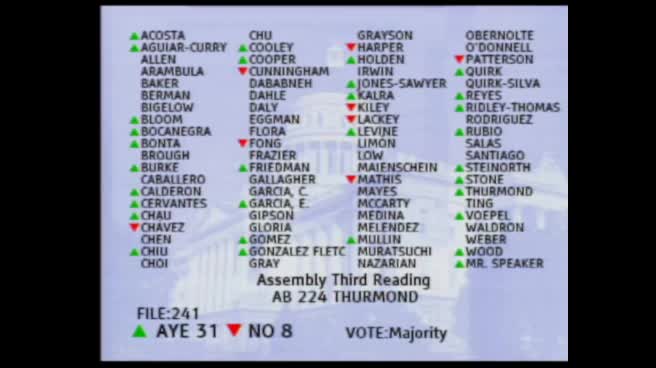 1MIN
Assembly Floor
 1H
Assembly Standing Committee on Appropriations
 3MIN
Assembly Standing Committee on Appropriations
 13MIN
Assembly Standing Committee on Higher Education
Bill Author

Bill Co-Author(s):