AB 935: Juvenile proceedings: competency.
- Session Year: 2017-2018
- House: Assembly
- Latest Version Date: 2017-09-15
Existing law authorizes, during the pendency of any juvenile proceeding, the minors counsel or the court to express a doubt as to the minors competency. Existing law requires proceedings to be suspended if the court finds substantial evidence raises a doubt as to the minors competency. Upon suspension of proceedings, existing law requires the court to order that the question of the minors competence be determined at a hearing. Existing law requires the court to appoint an expert, as specified, to evaluate whether the minor suffers from a mental disorder, developmental disability, developmental immaturity, or other condition and, if so, whether the condition or conditions impair the minors competency.
This bill would revise and recast these provisions to, among other things, expand upon the duties imposed upon the expert during his or her evaluation of a minor whose competency is in doubt, as specified. The bill would authorize the district attorney or minors counsel to retain or seek the appointment of additional qualified experts with regard to determining competency, as specified. The bill would require the Judicial Council to adopt a rule of court relating to the qualifications of those experts, as specified. The bill would require the minors competency to be determined at an evidentiary hearing, except as specified, and establish a presumption of competency, unless it is proven by a preponderance of the evidence that he or she is incompetent. If the minor is found incompetent and the petition contains only misdemeanor offenses, the bill would require the petition to be dismissed. The bill would require the court, upon a finding of incompetency, to refer the minor to services designed to help the minor attain competency. If the court finds that the minor will not achieve competency within 6 months, the bill would require the court to dismiss the petition. The bill would authorize the court to invite specified persons and agencies to discuss any services that may be available to the minor after the courts jurisdiction is terminated, and would require the court to make certain referrals for the minor. The bill would require, among others, the presiding judge of a juvenile court, the probation department, and the county mental health department to develop a written protocol describing the competency process and a program to ensure that minors who are found incompetent receive appropriate remediation services. The bill would prohibit secure confinement from extending beyond 6 months from the finding of incompetence, however, under specified conditions, the bill would authorize the court to order secure confinement for an additional 6 months, not exceeding one year. The bill would prohibit the total remediation period from exceeding one year from the finding of incompetence. By imposing additional duties on local officials, this bill would impose a state-mandated local program.
The California Constitution requires the state to reimburse local agencies and school districts for certain costs mandated by the state. Statutory provisions establish procedures for making that reimbursement.
This bill would provide that with regard to certain mandates no reimbursement is required by this act for a specified reason.
With regard to any other mandates, this bill would provide that, if the Commission on State Mandates determines that the bill contains costs so mandated by the state, reimbursement for those costs shall be made pursuant to the statutory provisions noted above.
Existing law authorizes, during the pendency of any juvenile proceeding, the minors counsel or the court to express a doubt as to the minors competency. Existing law requires proceedings to be suspended if the court finds substantial evidence raises a doubt as to the minors competency. Upon suspension of proceedings, existing law requires the court to order that the question of the minors competence be determined at a hearing. Existing law requires the court to appoint an expert, as specified, to evaluate whether the minor suffers from a mental disorder, developmental disability, developmental immaturity, or other condition and, if so, whether the condition or conditions impair the minors competency.
This bill would revise and recast these provisions to, among other things, expand upon the duties imposed upon the expert during his or her evaluation of a minor whose competency is in doubt, as specified. The bill would authorize the district attorney or minors counsel to retain or seek the appointment of additional qualified experts with regard to determining competency, as specified. The bill would require the Judicial Council to adopt a rule of court relating to the qualifications of those experts, as specified. The bill would require the minors competency to be determined at an evidentiary hearing, except as specified, and establish a presumption of competency, unless it is proven by a preponderance of the evidence that he or she is incompetent. If the minor is found incompetent and the petition contains only misdemeanor offenses, the bill would require the petition to be dismissed. The bill would require the court, upon a finding of incompetency, to refer the minor to services designed to help the minor attain competency and would require the county mental health department to provide those services or to contract with an outside provider, thereby imposing a state-mandated local program. competency. If the court finds that the minor will not achieve competency within 6 months, the bill would require the court to dismiss the petition. The bill would authorize the court to invite specified persons and agencies to discuss any services that may be available to the minor after the courts jurisdiction is terminated, and would require the court to make certain referrals for the minor. The bill would require, among others, the presiding judge of a juvenile court, the probation department, and the county mental health department to develop a written protocol describing the competency process and a program to ensure that minors who are found incompetent receive appropriate remediation services. The bill would prohibit secure confinement from extending beyond 6 months from the finding of incompetence and incompetence, however, under specified conditions, the bill would authorize the court to order secure confinement for an additional 6 months, not exceeding one year. The bill would prohibit the total remediation period from exceeding one year from the finding of incompetence. By imposing additional duties on local officials, this bill would impose a state-mandated local program.
The California Constitution requires the state to reimburse local agencies and school districts for certain costs mandated by the state. Statutory provisions establish procedures for making that reimbursement.
This bill would provide that with regard to certain mandates no reimbursement is required by this act for a specified reason.
With regard to any other mandates, this bill would provide that, if the Commission on State Mandates determines that the bill contains costs so mandated by the state, reimbursement for those costs shall be made pursuant to the statutory provisions noted above.
Existing law authorizes, during the pendency of any juvenile proceeding, the minors counsel or the court to express a doubt as to the minors competency. Existing law requires proceedings to be suspended if the court finds substantial evidence raises a doubt as to the minors competency. Upon suspension of proceedings, existing law requires the court to order that the question of the minors competence be determined at a hearing. Existing law requires the court to appoint an expert, as specified, to evaluate whether the minor suffers from a mental disorder, developmental disability, developmental immaturity, or other condition and, if so, whether the condition or conditions impair the minors competency.
This bill would revise and recast these provisions to, among other things, expand upon the duties imposed upon the expert during his or her evaluation of a minor whose competency is in doubt, as specified. The bill would authorize the district attorney or minors counsel to retain or seek the appointment of additional qualified experts with regard to determining competency, as specified. The bill would require the Judicial Council to adopt a rule of court relating to the qualifications of those experts, as specified. The bill would require the minors competency to be determined at an evidentiary hearing, except as specified, and establish a presumption of competency, unless it is proven by a preponderance of the evidence that he or she is incompetent. If the minor is found incompetent and the petition contains only misdemeanor offenses, the bill would require the petition to be dismissed. The bill would require the court, upon a finding of incompetency, to refer the minor to services designed to help the minor attain competency and would require the county mental health department to provide those services or to contract with an outside provider, thereby imposing a state-mandated local program. If the court finds that the minor will not achieve competency within 6 months, the bill would require the court to dismiss the petition. The bill would authorize the court to invite specified persons and agencies to discuss any services that may be available to the minor after the courts jurisdiction is terminated, and would require the court to make certain referrals for the minor. The bill would require, among others, the presiding judge of a juvenile court, the probation department, and the county mental health department to develop a written protocol describing the competency process and a program to ensure that minors who are found incompetent receive appropriate remediation services. The bill would prohibit secure confinement from extending beyond 6 months from the finding of incompetence and would prohibit the total remediation period from exceeding one year from the finding of incompetence. By imposing additional duties on local officials, this bill would impose a state-mandated local program.
The California Constitution requires the state to reimburse local agencies and school districts for certain costs mandated by the state. Statutory provisions establish procedures for making that reimbursement.This bill would provide that, if the Commission on State Mandates determines that the bill contains costs mandated by the state, reimbursement for those costs shall be made pursuant to the statutory provisions noted above.The California Constitution requires the state to reimburse local agencies and school districts for certain costs mandated by the state. Statutory provisions establish procedures for making that reimbursement.
This bill would provide that with regard to certain mandates no reimbursement is required by this act for a specified reason.
With regard to any other mandates, this bill would provide that, if the Commission on State Mandates determines that the bill contains costs so mandated by the state, reimbursement for those costs shall be made pursuant to the statutory provisions noted above.
Existing law authorizes, during the pendency of any juvenile proceeding, the minors counsel or the court to express a doubt as to the minors competency. Existing law requires proceedings to be suspended if the court finds substantial evidence raises a doubt as to the minors competency. Upon suspension of proceedings, existing law requires the court to order that the question of the minors competence be determined at a hearing. Existing law requires the court to appoint an expert, as specified, to evaluate whether the minor suffers from a mental disorder, developmental disability, developmental immaturity, or other condition and, if so, whether the condition or conditions impair the minors competency.
This bill would revise and recast these provisions to, among other things, expand upon the duties imposed upon the expert during his or her evaluation of a minor whose competency is in doubt, as specified. The bill would authorize the district attorney or minors counsel to retain or seek the appointment of additional qualified experts with regard to determining competency, as specified. The bill would require the Judicial Council to adopt a rule of court relating to the qualifications of those experts, as specified. The bill would require the minors competency to be determined at an evidentiary hearing, except as specified, and establish a presumption of competency, unless it is proven by a preponderance of the evidence that he or she is incompetent. If the minor is found incompetent and the petition contains only misdemeanor offenses, the bill would require the petition to be dismissed. The bill would require the court, upon a finding of incompetency, to refer the minor to services designed to help the minor attain competency and would require the county mental health department to provide those services or to contract with an outside provider, thereby imposing a state-mandated local program. If the court finds that the minor will not achieve competency within 6 months, the bill would require the court to dismiss the petition. The bill would authorize the court to invite specified persons and agencies to discuss any services that may be available to the minor after the courts jurisdiction is terminated, and would require the court to make certain referrals for the minor. The bill would require, among others, the presiding judge of a juvenile court, the probation department, and the county mental health department to develop a written protocol describing the competency process and a program to ensure that minors who are found incompetent receive appropriate remediation services. The bill would prohibit secure confinement from extending beyond 6 months from the finding of incompetence and would prohibit the total remediation period from exceeding one year from the finding of incompetence. By imposing additional duties on local officials, this bill would impose a state-mandated local program.
The California Constitution requires the state to reimburse local agencies and school districts for certain costs mandated by the state. Statutory provisions establish procedures for making that reimbursement.
This bill would provide that, if the Commission on State Mandates determines that the bill contains costs mandated by the state, reimbursement for those costs shall be made pursuant to the statutory provisions noted above.
Existing law authorizes, during the pendency of any juvenile proceeding, the minors counsel or the court to express a doubt as to the minors competency. Existing law requires proceedings to be suspended if the court finds substantial evidence raises a doubt as to the minors competency. Upon suspension of proceedings, existing law requires the court to order that the question of the minors competence be determined at a hearing. Existing law requires the court to appoint an expert, as specified, to evaluate whether the minor suffers from a mental disorder, developmental disability, developmental immaturity, or other condition and, if so, whether the condition or conditions impair the minors competency.
This bill would revise and recast these provisions to, among other things, expand upon the duties imposed upon the expert during his or her evaluation of a minor whose competency is in doubt, as specified. The bill would authorize the district attorney or minors counsel to retain or seek the appointment of additional qualified experts with regard to determining competency, as specified. The bill would require the Judicial Council to adopt a rule of court relating to the qualifications of those experts, as specified. The bill would require the minors competency to be determined at an evidentiary hearing, except as specified, and establish a presumption of competency, unless it is proven by a preponderance of the evidence that he or she is incompetent. If the minor is found incompetent and the petition contains only misdemeanor offenses, the bill would require the petition to be dismissed. The bill would require the court, upon a finding of incompetency, to refer the minor to services designed to help the minor attain competency and would require the county mental health department to provide those services, services or to contract with an outside provider, thereby imposing a state-mandated local program. If the court finds that the minor will not achieve competency within 6 months, the bill would require the court to dismiss the petition. The bill would authorize the court to invite specified persons and agencies to discuss any services that may be available to the minor after the courts jurisdiction is terminated, and would require the court to make certain referrals for the minor. The bill would require, among others, the presiding judge of a juvenile court, the probation department, and the county mental health department to develop a written protocol describing the competency process and a program to ensure that minors who are found incompetent receive appropriate remediation services. The bill would prohibit secure confinement from extending beyond 6 months from the finding of incompetence and would prohibit the total remediation period from exceeding one year from the finding of incompetence. By imposing additional duties on local officials, this bill would impose a state-mandated local program.
The California Constitution requires the state to reimburse local agencies and school districts for certain costs mandated by the state. Statutory provisions establish procedures for making that reimbursement.
This bill would provide that, if the Commission on State Mandates determines that the bill contains costs mandated by the state, reimbursement for those costs shall be made pursuant to the statutory provisions noted above.
Existing law authorizes, during the pendency of any juvenile proceeding, the minors counsel or the court to express a doubt as to the minors competency. Existing law requires proceedings to be suspended if the court finds substantial evidence raises a doubt as to the minors competency. Upon suspension of proceedings, existing law requires the court to order that the question of the minors competence be determined at a hearing. Existing law requires the court to appoint an expert, as specified, to evaluate whether the minor suffers from a mental disorder, developmental disability, developmental immaturity, or other condition and, if so, whether the condition or conditions impair the minors competency.
This bill would revise and recast these provisions to, among other things, expand upon the duties imposed upon the expert during his or her evaluation of a minor whose competency is in doubt, as specified. The bill would authorize the district attorney or minors counsel to retain or seek the appointment of additional qualified experts with regard to determining competency, as specified. The bill would require the Judicial Council to adopt a rule of court relating to the qualifications of those experts, as specified. The bill would require the minors competency to be determined at an evidentiary hearing, except as specified, and establish a presumption of competency, unless it is proven by a preponderance of the evidence that he or she is incompetent. If the minor is found incompetent and the petition contains only misdemeanor offenses, the bill would require the petition to be dismissed. The bill would require the court, upon a finding of incompetency, to refer the minor to services designed to help the minor attain competency and would require the county mental health department to provide those services, thereby imposing a state-mandated local program. If the court finds that the minor will not achieve competency within 6 months, the bill would require the court to dismiss the petition. The bill would authorize the court to invite specified persons and agencies to discuss any services that may be available to the minor after the courts jurisdiction is terminated, and would require the court to make certain referrals for the minor. The bill would require, among others, the presiding judge of a juvenile court, the probation department, and the county mental health department to develop a written protocol describing the competency process and a program to ensure that minors who are found incompetent receive appropriate remediation services. The bill would prohibit secure confinement from extending beyond 6 months from the finding of incompetence. incompetence and would prohibit the total remediation period from exceeding one year from the finding of incompetence. By imposing additional duties on local officials, this bill would impose a state-mandated local program.
The California Constitution requires the state to reimburse local agencies and school districts for certain costs mandated by the state. Statutory provisions establish procedures for making that reimbursement.
This bill would provide that, if the Commission on State Mandates determines that the bill contains costs mandated by the state, reimbursement for those costs shall be made pursuant to the statutory provisions noted above.
Existing law authorizes, during the pendency of any juvenile proceeding, the minors counsel or the court to express a doubt as to the minors competency. Existing law requires proceedings to be suspended if the court finds substantial evidence raises a doubt as to the minors competency. Upon suspension of proceedings, existing law requires the court to order that the question of the minors competence be determined at a hearing. Existing law requires the court to appoint an expert, as specified, to evaluate whether the minor suffers from a mental disorder, developmental disability, developmental immaturity, or other condition and, if so, whether the condition or conditions impair the minors competency.
This bill would revise and recast these provisions to, among other things, expand upon the duties imposed upon the expert during his or her evaluation of a minor whose competency is in doubt, as specified. The bill would authorize the district attorney or minors counsel to retain or seek the appointment of additional qualified experts with regard to determining competency, as specified. The bill would require the Judicial Council to adopt a rule of court relating to the qualifications of those experts, as specified. The bill would require the minors competency to be determined at an evidentiary hearing, except as specified, and establish a presumption of competency, unless it is proven by a preponderance of the evidence that he or she is incompetent. If the minor is found incompetent and the petition contains only misdemeanor offenses, the bill would require the petition to be dismissed. The bill would require the court, upon a finding of incompetency, to refer the minor to services designed to help the minor attain competency and would require the county mental health department to provide those services, thereby imposing a state-mandated local program. If the court finds that the minor will not achieve competency within 6 months, the bill would require the court to dismiss the petition. The bill would authorize the court to invite specified persons and agencies to discuss any services that may be available to the minor after the courts jurisdiction is terminated, and would require the court to make certain referrals for the minor. The bill would require, among others, the presiding judge of a juvenile court, the probation department, and the county mental health department to develop a written protocol describing the competency process and a program to ensure that minors who are found incompetent receive appropriate remediation services. The bill would prohibit secure confinement from extending beyond 6 months from the finding of incompetence. By imposing additional duties on local officials, this bill would impose a state-mandated local program.
The California Constitution requires the state to reimburse local agencies and school districts for certain costs mandated by the state. Statutory provisions establish procedures for making that reimbursement.
This bill would provide that, if the Commission on State Mandates determines that the bill contains costs mandated by the state, reimbursement for those costs shall be made pursuant to the statutory provisions noted above.
Existing law authorizes, during the pendency of any juvenile proceeding, the minors counsel or the court to express a doubt as to the minors competency. Existing law requires proceedings to be suspended if the court finds substantial evidence raises a doubt as to the minors competency. Upon suspension of proceedings, existing law requires the court to order that the question of the minors competence be determined at a hearing. Existing law requires the court to appoint an expert, as specified, to evaluate whether the minor suffers from a mental disorder, developmental disability, developmental immaturity, or other condition and, if so, whether the condition or conditions impair the minors competency.
This bill would make technical, nonsubstantive changes to those provisions.This bill would revise and recast these provisions to, among other things, expand upon the duties imposed upon the expert during his or her evaluation of a minor whose competency is in doubt, as specified. The bill would authorize the district attorney or minors counsel to retain or seek the appointment of additional qualified experts with regard to determining competency, as specified. The bill would require the Judicial Council to adopt a rule of court relating to the qualifications of those experts, as specified. The bill would require the minors competency to be determined at an evidentiary hearing, except as specified, and establish a presumption of competency, unless it is proven by a preponderance of the evidence that he or she is incompetent. If the minor is found incompetent and the petition contains only misdemeanor offenses, the bill would require the petition to be dismissed. The bill would require the court, upon a finding of incompetency, to refer the minor to services designed to help the minor attain competency and would require the county mental health department to provide those services, thereby imposing a state-mandated local program. If the court finds that the minor will not achieve competency within 6 months, the bill would require the court to dismiss the petition. The bill would authorize the court to invite specified persons and agencies to discuss any services that may be available to the minor after the courts jurisdiction is terminated, and would require the court to make certain referrals for the minor. The bill would require, among others, the presiding judge of a juvenile court, the probation department, and the county mental health department to develop a written protocol describing the competency process and a program to ensure that minors who are found incompetent receive appropriate remediation services. The bill would prohibit secure confinement from extending beyond 6 months from the finding of incompetence. By imposing additional duties on local officials, this bill would impose a state-mandated local program.
The California Constitution requires the state to reimburse local agencies and school districts for certain costs mandated by the state. Statutory provisions establish procedures for making that reimbursement.
This bill would provide that, if the Commission on State Mandates determines that the bill contains costs mandated by the state, reimbursement for those costs shall be made pursuant to the statutory provisions noted above.
Existing law authorizes, during the pendency of any juvenile proceeding, the minors counsel or the court to express a doubt as to the minors competency. Existing law requires proceedings to be suspended if the court finds substantial evidence raises a doubt as to the minors competency. Upon suspension of proceedings, existing law requires the court to order that the question of the minors competence be determined at a hearing. Existing law requires the court to appoint an expert, as specified, to evaluate whether the minor suffers from a mental disorder, developmental disability, developmental immaturity, or other condition and, if so, whether the condition or conditions impair the minors competency.
This bill would make technical, nonsubstantive changes to those provisions.
(a)(1)Whenever the court has a doubt that a minor who is subject to any juvenile proceedings is mentally competent, the court shall suspend all proceedings and proceed pursuant to this section.
(2)A minor is mentally incompetent for purposes of this section if he or she is unable to understand the nature of the proceedings, including his or her role in the proceedings, or unable to assist counsel in conducting a defense in a rational manner, including a lack of a rational and factual understanding of the nature of the charges or proceedings. Incompetency may result from the presence of any condition or conditions, including, but not limited to, mental illness, mental disorder, developmental disability, or developmental immaturity. Except as specifically provided otherwise, this section applies to a minor who is alleged to come within the jurisdiction of the court pursuant to Section 601 or 602.
(3)Notwithstanding paragraph (1), during the pendency of any juvenile proceeding, the court may receive information from any source regarding the minors ability to understand the proceedings. The minors counsel or the court may express a doubt as to the minors competency. The receipt of information or the expression of doubt of the minors counsel does not automatically require the suspension of proceedings. If the court has a doubt as to the minors competency, the court shall suspend the proceedings.
(b)(1)Unless the parties stipulate to a finding that the minor lacks competency, or the parties are willing to submit on the issue of the minors lack of competency, the court shall appoint an expert to evaluate the minor and determine whether the minor suffers from a mental illness, mental disorder, developmental disability, developmental immaturity, or other condition affecting competency and, if so, whether the minor is incompetent as defined in paragraph (2) of subdivision (a).
(2)The expert shall have expertise in child and adolescent development and forensic evaluation of juveniles for purposes of adjudicating competency, shall be familiar with competency standards and accepted criteria used in evaluating juvenile competency, shall have received training in conducting juvenile competency evaluations, and shall be familiar with competency remediation for the condition or conditions affecting competence in the particular case.
(3)The expert shall personally interview the minor and review all of the available records provided, including, but not limited to, medical, education, special education, probation, child welfare, mental health, regional center, and court records, and any other relevant information that is available. The expert shall consult with the minors counsel and any other person who has provided information to the court regarding the minors lack of competency. The expert shall gather a developmental history of the minor. If any information is unavailable to the expert, he or she shall note in the report the efforts to obtain that information. The expert shall administer age-appropriate testing specific to the issue of competency unless the facts of the particular case render testing unnecessary or inappropriate. The expert shall be proficient in the language preferred by the minor, or, if that is not feasible, the expert shall employ the services of a certified interpreter and use assessment tools that are linguistically and culturally appropriate for the minor. In a written report, the expert shall opine whether the minor has the sufficient present ability to consult with his or her counsel with a reasonable degree of rational understanding and whether he or she has a rational and factual understanding of the proceedings against him or her. The expert shall also state the basis for these conclusions. If the expert concludes that the minor lacks competency, the expert shall give his or her opinion on whether the minor is likely to attain competency in the foreseeable future, and, if so, make recommendations regarding the type of remediation services that would be effective in assisting the minor in attaining competency.
(4)The Judicial Council, in conjunction with groups or individuals representing judges, defense counsel, district attorneys, chief probation officers, counties, advocates for people with developmental and mental disabilities, experts in special education testing, psychologists and psychiatrists specializing in adolescents, professional associations and accredited bodies for psychologists and psychiatrists, and other interested stakeholders, shall adopt a rule of court identifying the training and experience needed for an expert to be competent in forensic evaluations of juveniles. The Judicial Council shall develop and adopt rules for the implementation of the other requirements in this subdivision.
(5)Statements made to the appointed expert during the minors competency evaluation and statements made by the minor to mental health professionals during the remediation proceedings shall not be used in any other hearing against the minor in either juvenile or adult court.
(6)The district attorney or minors counsel may retain or seek the appointment of additional qualified experts who may testify during the competency hearing. The experts report and qualifications shall be disclosed to the opposing party within a reasonable time before, but no later than five court days before, the hearing. If disclosure is not made in accordance with this paragraph, the court may make any order necessary to enforce the provisions of this paragraph, including, but not limited to, immediate disclosure, contempt proceedings, delaying or prohibiting the testimony of the expert or consideration of the experts report upon a showing of good cause, or any other lawful order. If, after disclosure of the report, the opposing party requests a continuance in order to further prepare for the hearing and shows good cause for the continuance, the court shall grant a continuance for a reasonable period of time.
(7)If the expert believes the minor is developmentally disabled, the court shall appoint the director of a regional center for developmentally disabled individuals described in Article 1 (commencing with Section 4620) of Chapter 5 of Division 4.5, or his or her designee, to evaluate the minor. The director of the regional center, or his or her designee, shall determine whether the minor is eligible for services under the Lanterman Developmental Disabilities Services Act (Division 4.5 (commencing with Section 4500)), and shall provide the court with a written report informing the court of his or her determination. The courts appointment of the director of the regional center for determination of eligibility for services shall not delay the courts proceedings for determination of competency.
(8)An experts opinion that a minor is developmentally disabled does not supersede an independent determination by the regional center whether the minor is eligible for services under the Lanterman Developmental Disabilities Services Act (Division 4.5 (commencing with Section 4500)).
(9)This section shall not be interpreted to authorize or require either of the following:
(A)The placement of a minor who is incompetent in a developmental center or community facility operated by the State Department of Developmental Services without a determination by a regional center director, or his or her designee, that the minor has a developmental disability and is eligible for services under the Lanterman Developmental Disabilities Services Act (Division 4.5 (commencing with Section 4500)).
(B)Determinations regarding the competency of a minor by the director of the regional center or his or her designee.
(c)The question of the minors competency shall be determined at an evidentiary hearing unless there is a stipulation or submission by the parties on the findings of the expert. It shall be presumed that the minor is mentally competent, unless it is proven by a preponderance of the evidence that the minor is mentally incompetent. With respect to a minor under 14 years of age at the time of the commission of the alleged offense, the court shall make a determination as to the minors capacity pursuant to Section 26 of the Penal Code prior to deciding the issue of competency.
(d)If the court finds the minor to be competent, the court shall reinstate proceedings and proceed commensurate with the courts jurisdiction.
(e)If the court finds, by a preponderance of evidence, that the minor is incompetent, all proceedings shall remain suspended for a period of time that is no longer than reasonably necessary to determine whether there is a substantial probability that the minor will attain competency in the foreseeable future, or the court no longer retains jurisdiction and the case must be dismissed. Prior to a dismissal, the court may make orders that it deems appropriate for services. Further, the court may rule on motions that do not require the participation of the minor in the preparation of the motions. These motions include, but are not limited to, all of the following:
(1)Motions to dismiss.
(2)Motions regarding a change in the placement of the minor.
(3)Detention hearings.
(4)Demurrers.
(f)If the minor is found to be incompetent and the petition contains only misdemeanor offenses, the petition shall be dismissed.
(g)Upon a finding of incompetency, the court shall refer the minor to services designed to help the minor attain competency, including, but not limited to, mental health services, treatment for trauma, medically supervised medication, behavioral counseling, curriculum-based legal education, or training in socialization skills, consistent with any laws requiring consent. Service providers and evaluators shall adhere to the standards stated in this section and the California Rules of Court. Services shall be provided in the least restrictive environment consistent with public safety, as determined by the court. Service providers shall determine the likelihood of the minor attaining competency within the foreseeable future, and if the opinion is that the minor will not attain competency within six months, the minor shall be returned to court at the earliest possible date. The court shall review remediation services at least every 30 calendar days for minors in custody and every 45 calendar days for minors out of custody prior to the expiration of the total remediation period specified in paragraph (3) of subdivision (h). If the minor is in custody, the county mental health department shall provide the court with suitable alternatives for the continued delivery of remediation services upon release from custody as part of the courts review of remediation services. The court may make any orders necessary to assist with the delivery of remediation services in an alternative setting to secure confinement.
(h)(1)Upon receipt of the recommendation by the designated person or entity, the court shall hold an evidentiary hearing on whether the minor is remediated or is able to be remediated unless the parties stipulate to, or agree to the recommendation of, the remediation program. If the recommendation is that the minor has attained competency, and if the minor disputes that recommendation, the burden is on the minor to prove by a preponderance of evidence that he or she remains incompetent. If the recommendation is that the minor is unable to be remediated and if the prosecutor disputes that recommendation, the burden is on the prosecutor to prove by a preponderance of evidence that the minor is remediable. If the prosecution contests the evaluation of continued incompetence, the minor shall be presumed incompetent and the prosecution shall have the burden to prove by a preponderance of evidence that the minor is competent. The provisions of subdivision (c) shall apply at this stage of the proceedings.
(2)If the court finds that the minor has been remediated, the court shall reinstate the proceedings.
(3)If the court finds that the minor has not yet been remediated, but is likely to be remediated within six months, the court shall order the minor to return to the remediation program. However, the total remediation period shall not exceed one year from the finding of incompetency.
(4)If the court finds that the minor will not achieve competency within six months, the court shall dismiss the petition. The court may invite persons and agencies with information about the minor, including, but not limited to, the minor and his or her attorney, the probation department, parents, guardians, or relative caregivers, mental health treatment professionals, the public guardian, educational rights holders, education providers, and social services agencies, to the dismissal hearing to discuss any services that may be available to the minor after jurisdiction is terminated. If appropriate, the court shall refer the minor for evaluation pursuant to Article 6 (commencing with Section 5300) of Chapter 2 of Part 1 of Division 5 or Article 3 (commencing with Section 6550) of Chapter 2 of Part 2 of Division 6.
(5)(A)Secure confinement shall not extend beyond six months from the finding of incompetence, except as provided in this section. Only in cases when the petition involves an offense listed in subdivision (b) of Section 707, may the court consider whether it is necessary and in the best interest of the minor and the publics safety to order secure confinement of a minor for up to an additional six months, not to exceed one year. In making that determination, the court shall consider all of the following:
(i)Where will the minor have the best chance of obtaining competence.
(ii)Whether the placement is the least restrictive setting appropriate for the minor.
(iii)Whether alternatives to secure confinement have been identified and pursued and why alternatives are not available or appropriate.
(iv)Whether the placement is necessary for the safety of the minor or others.
(B)If the court determines, upon consideration of these factors, that it is in the best interest of the minor and the publics safety for the minor to remain in secure confinement, the court shall state the reasons on the record.
(i)The presiding judge of the juvenile court, the probation department, the county mental health department, the public defender and other entity that provides representation for minors, the district attorney, the regional center, if appropriate, and any other participants that the presiding judge shall designate, shall develop a written protocol describing the competency process and a program to ensure that minors who are found incompetent receive appropriate remediation services.
SEC. 2.To the extent that this act has an overall effect of increasing certain costs already borne by a local agency for programs or levels of service mandated by the 2011 Realignment Legislation within the meaning of Section 36 of Article XIII of the California Constitution, it shall apply to local agencies only to the extent that the state provides annual funding for the cost increase. Any new program or higher level of service provided by a local agency pursuant to this act above the level for which funding has been provided shall not require a subvention of funds by the state or otherwise be subject to Section 6 of Article XIIIB of the California Constitution.
However, if the Commission on State Mandates determines that this act contains other costs mandated by the state, reimbursement to local agencies and school districts for those costs shall be made pursuant to Part 7 (commencing with Section 17500) of Division 4 of Title 2 of the Government Code.
(a)(1)Whenever the court has a doubt that a minor who is subject to any juvenile proceedings is mentally competent, the court shall suspend all proceedings and proceed pursuant to this section.
(2)A minor is mentally incompetent for purposes of this section if he or she is unable to understand the nature of the proceedings, including his or her role in the proceedings, or unable to assist counsel in conducting a defense in a rational manner, including a lack of a rational and factual understanding of the nature of the charges or proceedings. Incompetency may result from the presence of any condition or conditions, including, but not limited to, mental illness, mental disorder, developmental disability, or developmental immaturity. Except as specifically provided otherwise, this section applies to a minor who is alleged to come within the jurisdiction of the court pursuant to Section 601 or 602.
(3)Notwithstanding paragraph (1), during the pendency of any juvenile proceeding, the court may receive information from any source regarding the minors ability to understand the proceedings. The minors counsel or the court may express a doubt as to the minors competency. The receipt of information or the expression of doubt of the minors counsel does not automatically require the suspension of proceedings. If the court has a doubt as to the minors competency, the court shall suspend the proceedings.
(b)(1)Unless the parties stipulate to a finding that the minor lacks competency, or the parties are willing to submit on the issue of the minors lack of competency, the court shall appoint an expert to evaluate the minor and determine whether the minor suffers from a mental illness, mental disorder, developmental disability, developmental immaturity, or other condition affecting competency and, if so, whether the minor is incompetent as defined in paragraph (2) of subdivision (a).
(2)The expert shall have expertise in child and adolescent development and forensic evaluation of juveniles for purposes of adjudicating competency, shall be familiar with competency standards and accepted criteria used in evaluating juvenile competency, shall have received training in conducting juvenile competency evaluations, and shall be familiar with competency remediation for the condition or conditions affecting competence in the particular case.
(3)The expert shall personally interview the minor and review all of the available records provided, including, but not limited to, medical, education, special education, probation, child welfare, mental health, regional center, and court records, and any other relevant information that is available. The expert shall consult with the minors counsel and any other person who has provided information to the court regarding the minors lack of competency. The expert shall gather a developmental history of the minor. If any information is unavailable to the expert, he or she shall note in the report the efforts to obtain that information. The expert shall administer age-appropriate testing specific to the issue of competency unless the facts of the particular case render testing unnecessary or inappropriate. The expert shall be proficient in the language preferred by the minor, or, if that is not feasible, the expert shall employ the services of a certified interpreter and use assessment tools that are linguistically and culturally appropriate for the minor. In a written report, the expert shall opine whether the minor has the sufficient present ability to consult with his or her counsel with a reasonable degree of rational understanding and whether he or she has a rational and factual understanding of the proceedings against him or her. The expert shall also state the basis for these conclusions. If the expert concludes that the minor lacks competency, the expert shall give his or her opinion on whether the minor is likely to attain competency in the foreseeable future, and, if so, make recommendations regarding the type of remediation services that would be effective in assisting the minor in attaining competency.
(4)The Judicial Council, in conjunction with groups or individuals representing judges, defense counsel, district attorneys, chief probation officers, counties, advocates for people with developmental and mental disabilities, experts in special education testing, psychologists and psychiatrists specializing in adolescents, professional associations and accredited bodies for psychologists and psychiatrists, and other interested stakeholders, shall adopt a rule of court identifying the training and experience needed for an expert to be competent in forensic evaluations of juveniles. The Judicial Council shall develop and adopt rules for the implementation of the other requirements in this subdivision.
(5)Statements made to the appointed expert during the minors competency evaluation and statements made by the minor to mental health professionals during the remediation proceedings shall not be used in any other hearing against the minor in either juvenile or adult court.
(6)The district attorney or minors counsel may retain or seek the appointment of additional qualified experts who may testify during the competency hearing. The experts report and qualifications shall be disclosed to the opposing party within a reasonable time before, but no later than five court days before, the hearing. If disclosure is not made in accordance with this paragraph, the court may make any order necessary to enforce the provisions of this paragraph, including, but not limited to, immediate disclosure, contempt proceedings, delaying or prohibiting the testimony of the expert or consideration of the experts report upon a showing of good cause, or any other lawful order. If, after disclosure of the report, the opposing party requests a continuance in order to further prepare for the hearing and shows good cause for the continuance, the court shall grant a continuance for a reasonable period of time.
(7)If the expert believes the minor is developmentally disabled, the court shall appoint the director of a regional center for developmentally disabled individuals described in Article 1 (commencing with Section 4620) of Chapter 5 of Division 4.5, or his or her designee, to evaluate the minor. The director of the regional center, or his or her designee, shall determine whether the minor is eligible for services under the Lanterman Developmental Disabilities Services Act (Division 4.5 (commencing with Section 4500)), and shall provide the court with a written report informing the court of his or her determination. The courts appointment of the director of the regional center for determination of eligibility for services shall not delay the courts proceedings for determination of competency.
(8)An experts opinion that a minor is developmentally disabled does not supersede an independent determination by the regional center whether the minor is eligible for services under the Lanterman Developmental Disabilities Services Act (Division 4.5 (commencing with Section 4500)).
(9)This section shall not be interpreted to authorize or require either of the following:
(A)The placement of a minor who is incompetent in a developmental center or community facility operated by the State Department of Developmental Services without a determination by a regional center director, or his or her designee, that the minor has a developmental disability and is eligible for services under the Lanterman Developmental Disabilities Services Act (Division 4.5 (commencing with Section 4500)).
(B)Determinations regarding the competency of a minor by the director of the regional center or his or her designee.
(c)The question of the minors competency shall be determined at an evidentiary hearing unless there is a stipulation or submission by the parties on the findings of the expert. It shall be presumed that the minor is mentally competent, unless it is proven by a preponderance of the evidence that the minor is mentally incompetent. With respect to a minor under 14 years of age at the time of the commission of the alleged offense, the court shall make a determination as to the minors capacity pursuant to Section 26 of the Penal Code prior to deciding the issue of competency.
(d)If the court finds the minor to be competent, the court shall reinstate proceedings and proceed commensurate with the courts jurisdiction.
(e)If the court finds, by a preponderance of evidence, that the minor is incompetent, all proceedings shall remain suspended for a period of time that is no longer than reasonably necessary to determine whether there is a substantial probability that the minor will attain competency in the foreseeable future, or the court no longer retains jurisdiction and the case must be dismissed. Prior to a dismissal, the court may make orders that it deems appropriate for services. Further, the court may rule on motions that do not require the participation of the minor in the preparation of the motions. These motions include, but are not limited to, all of the following:
(1)Motions to dismiss.
(2)Motions regarding a change in the placement of the minor.
(3)Detention hearings.
(4)Demurrers.
(f)If the minor is found to be incompetent and the petition contains only misdemeanor offenses, the petition shall be dismissed.
(g)Upon a finding of incompetency, the court shall refer the minor to services designed to help the minor attain competency, including, but not limited to, mental health services, treatment for trauma, medically supervised medication, behavioral counseling, curriculum-based legal education, or training in socialization skills, consistent with any laws requiring consent. The services shall be provided by the county mental health department, which may contract with an outside provider. Service providers and evaluators shall adhere to the standards stated in this section and the California Rules of Court. Services shall be provided in the least restrictive environment consistent with public safety, as determined by the court. Service providers shall promptly determine the likelihood of the minor attaining competency within the foreseeable future, and if the opinion is that the minor will not attain competency within six months, the minor shall be returned to court at the earliest possible date. The court shall review remediation services at least every 30 calendar days for minors in custody and every 45 calendar days for minors out of custody prior to the expiration of the total remediation period specified in paragraph (3) of subdivision (h). If the minor is in custody, the county mental health department shall provide the court with suitable alternatives for the continued delivery of remediation services upon release from custody as part of the courts review of remediation services. The court may make any orders necessary to assist with the delivery of remediation services in an alternative setting to secure confinement.
(h)(1)Upon receipt of the recommendation by the designated person or entity, the court shall hold an evidentiary hearing on whether the minor is remediated or is able to be remediated unless the parties stipulate to, or agree to the recommendation of, the remediation program. If the recommendation is that the minor has attained competency, and if the minor disputes that recommendation, the burden is on the minor to prove by a preponderance of evidence that he or she remains incompetent. If the recommendation is that the minor is unable to be remediated and if the prosecutor disputes that recommendation, the burden is on the prosecutor to prove by a preponderance of evidence that the minor is remediable. If the prosecution contests the evaluation of continued incompetence, the minor shall be presumed incompetent and the prosecution shall have the burden to prove by a preponderance of evidence that the minor is competent. The provisions of subdivision (c) shall apply at this stage of the proceedings.
(2)If the court finds that the minor has been remediated, the court shall reinstate the proceedings.
(3)If the court finds that the minor has not yet been remediated, but is likely to be remediated within six months, the court shall order the minor to return to the remediation program. However, the total remediation period shall not exceed one year from the finding of incompetency.
(4)If the court finds that the minor will not achieve competency within six months, the court shall dismiss the petition. The court may invite persons and agencies with information about the minor, including, but not limited to, the minor and his or her attorney, the probation department, parents, guardians, or relative caregivers, mental health treatment professionals, the public guardian, educational rights holders, education providers, and social services agencies, to the dismissal hearing to discuss any services that may be available to the minor after jurisdiction is terminated. If appropriate, the court shall refer the minor for evaluation pursuant to Article 6 (commencing with Section 5300) of Chapter 2 of Part 1 of Division 5 or Article 3 (commencing with Section 6550) of Chapter 2 of Part 2 of Division 6.
(5)In no case will secure confinement extend beyond six months from the finding of incompetence.(5)(A)Secure confinement shall not extend beyond six months from the finding of incompetence, except as provided in this section. Only in cases when the petition involves an offense listed in subdivision (b) of Section 707, may the court consider whether it is necessary and in the best interest of the minor and the publics safety to order secure confinement of a minor for up to an additional six months, not to exceed one year. In making that determination, the court shall consider all of the following:
(i)Where will the minor have the best chance of obtaining competence.
(ii)Whether the placement is the least restrictive setting appropriate for the minor.
(iii)Whether alternatives to secure confinement have been identified and pursued and why alternatives are not available or appropriate.
(iv)Whether the placement is necessary for the safety of the minor or others.
(B)If the court determines, upon consideration of these factors, that it is in the best interest of the minor and the publics safety for the minor to remain in secure confinement, the court shall state the reasons on the record.
(i)The presiding judge of the juvenile court, the probation department, the county mental health department, the public defender and other entity that provides representation for minors, the district attorney, the regional center, if appropriate, and any other participants that the presiding judge shall designate, shall develop a written protocol describing the competency process and a program to ensure that minors who are found incompetent receive appropriate remediation services.
SEC. 2.To the extent that this act has an overall effect of increasing certain costs already borne by a local agency for programs or levels of service mandated by the 2011 Realignment Legislation within the meaning of Section 36 of Article XIII of the California Constitution, it shall apply to local agencies only to the extent that the state provides annual funding for the cost increase. Any new program or higher level of service provided by a local agency pursuant to this act above the level for which funding has been provided shall not require a subvention of funds by the state or otherwise be subject to Section 6 of Article XIIIB of the California Constitution.
However, if the Commission on State Mandates determines that this act contains other costs mandated by the state, reimbursement to local agencies and school districts for those costs shall be made pursuant to Part 7 (commencing with Section 17500) of Division 4 of Title 2 of the Government Code.
(a)(1)Whenever the court has a doubt that a minor who is subject to any juvenile proceedings is mentally competent, the court shall suspend all proceedings and proceed pursuant to this section.
(2)A minor is mentally incompetent for purposes of this section if he or she is unable to understand the nature of the proceedings, including his or her role in the proceedings, or unable to assist counsel in conducting a defense in a rational manner, including a lack of a rational and factual understanding of the nature of the charges or proceedings. Incompetency may result from the presence of any condition or conditions, including, but not limited to, mental illness, mental disorder, developmental disability, or developmental immaturity. Except as specifically provided otherwise, this section applies to a minor who is alleged to come within the jurisdiction of the court pursuant to Section 601 or 602.
(3)Notwithstanding paragraph (1), during the pendency of any juvenile proceeding, the court may receive information from any source regarding the minors ability to understand the proceedings. The minors counsel or the court may express a doubt as to the minors competency. The receipt of information or the expression of doubt of the minors counsel does not automatically require the suspension of proceedings. If the court has a doubt as to the minors competency, the court shall suspend the proceedings.
(b)(1)Unless the parties stipulate to a finding that the minor lacks competency, or the parties are willing to submit on the issue of the minors lack of competency, the court shall appoint an expert to evaluate the minor and determine whether the minor suffers from a mental illness, mental disorder, developmental disability, developmental immaturity, or other condition affecting competency and, if so, whether the minor is incompetent as defined in paragraph (2) of subdivision (a).
(2)The expert shall have expertise in child and adolescent development and forensic evaluation of juveniles for purposes of adjudicating competency, shall be familiar with competency standards and accepted criteria used in evaluating juvenile competency, shall have received training in conducting juvenile competency evaluations, and shall be familiar with competency remediation for the condition or conditions affecting competence in the particular case.
(3)The expert shall personally interview the minor and review all of the available records provided, including, but not limited to, medical, education, special education, probation, child welfare, mental health, regional center, and court records, and any other relevant information that is available. The expert shall consult with the minors counsel and any other person who has provided information to the court regarding the minors lack of competency. The expert shall gather a developmental history of the minor. If any information is unavailable to the expert, he or she shall note in the report the efforts to obtain that information. The expert shall administer age-appropriate testing specific to the issue of competency unless the facts of the particular case render testing unnecessary or inappropriate. The expert shall be proficient in the language preferred by the minor, or, if that is not feasible, the expert shall employ the services of a certified interpreter and use assessment tools that are linguistically and culturally appropriate for the minor. In a written report, the expert shall opine whether the minor has the sufficient present ability to consult with his or her counsel with a reasonable degree of rational understanding and whether he or she has a rational and factual understanding of the proceedings against him or her. The expert shall also state the basis for these conclusions. If the expert concludes that the minor lacks competency, the expert shall give his or her opinion on whether the minor is likely to attain competency in the foreseeable future, and, if so, make recommendations regarding the type of remediation services that would be effective in assisting the minor in attaining competency.
(4)The Judicial Council, in conjunction with groups or individuals representing judges, defense counsel, district attorneys, chief probation officers, counties, advocates for people with developmental and mental disabilities, experts in special education testing, psychologists and psychiatrists specializing in adolescents, professional associations and accredited bodies for psychologists and psychiatrists, and other interested stakeholders, shall adopt a rule of court identifying the training and experience needed for an expert to be competent in forensic evaluations of juveniles. The Judicial Council shall develop and adopt rules for the implementation of the other requirements in this subdivision.
(5)Statements made to the appointed expert during the minors competency evaluation and statements made by the minor to mental health professionals during the remediation proceedings shall not be used in any other hearing against the minor in either juvenile or adult court.
(6)The district attorney or minors counsel may retain or seek the appointment of additional qualified experts who may testify during the competency hearing. The experts report and qualifications shall be disclosed to the opposing party within a reasonable time before, but no later than five court days before, the hearing. If disclosure is not made in accordance with this paragraph, the court may make any order necessary to enforce the provisions of this paragraph, including, but not limited to, immediate disclosure, contempt proceedings, delaying or prohibiting the testimony of the expert or consideration of the experts report upon a showing of good cause, or any other lawful order. If, after disclosure of the report, the opposing party requests a continuance in order to further prepare for the hearing and shows good cause for the continuance, the court shall grant a continuance for a reasonable period of time.
(7)If the expert believes the minor is developmentally disabled, the court shall appoint the director of a regional center for developmentally disabled individuals described in Article 1 (commencing with Section 4620) of Chapter 5 of Division 4.5, or his or her designee, to evaluate the minor. The director of the regional center, or his or her designee, shall determine whether the minor is eligible for services under the Lanterman Developmental Disabilities Services Act (Division 4.5 (commencing with Section 4500)), and shall provide the court with a written report informing the court of his or her determination. The courts appointment of the director of the regional center for determination of eligibility for services shall not delay the courts proceedings for determination of competency.
(8)An experts opinion that a minor is developmentally disabled does not supersede an independent determination by the regional center whether the minor is eligible for services under the Lanterman Developmental Disabilities Services Act (Division 4.5 (commencing with Section 4500)).
(9)This section shall not be interpreted to authorize or require either of the following:
(A)The placement of a minor who is incompetent in a developmental center or community facility operated by the State Department of Developmental Services without a determination by a regional center director, or his or her designee, that the minor has a developmental disability and is eligible for services under the Lanterman Developmental Disabilities Services Act (Division 4.5 (commencing with Section 4500)).
(B)Determinations regarding the competency of a minor by the director of the regional center or his or her designee.
(c)The question of the minors competency shall be determined at an evidentiary hearing unless there is a stipulation or submission by the parties on the findings of the expert. It shall be presumed that the minor is mentally competent, unless it is proven by a preponderance of the evidence that the minor is mentally incompetent. With respect to a minor under 14 years of age at the time of the commission of the alleged offense, the court shall make a determination as to the minors capacity pursuant to Section 26 of the Penal Code prior to deciding the issue of competency.
(d)If the court finds the minor to be competent, the court shall reinstate proceedings and proceed commensurate with the courts jurisdiction.
(e)If the court finds, by a preponderance of evidence, that the minor is incompetent, all proceedings shall remain suspended for a period of time that is no longer than reasonably necessary to determine whether there is a substantial probability that the minor will attain competency in the foreseeable future, or the court no longer retains jurisdiction and the case must be dismissed. Prior to a dismissal, the court may make orders that it deems appropriate for services. Further, the court may rule on motions that do not require the participation of the minor in the preparation of the motions. These motions include, but are not limited to, all of the following:
(1)Motions to dismiss.
(2)Motions regarding a change in the placement of the minor.
(3)Detention hearings.
(4)Demurrers.
(f)If the minor is found to be incompetent and the petition contains only misdemeanor offenses, the petition shall be dismissed.
(g)Upon a finding of incompetency, the court shall refer the minor to services designed to help the minor attain competency, including, but not limited to, mental health services, treatment for trauma, medically supervised medication, behavioral counseling, curriculum-based legal education, or training in socialization skills, consistent with any laws requiring consent. The services shall be provided by the county mental health department, which may contract with an outside provider. Service providers and evaluators shall adhere to the standards stated in this section and the California Rules of Court. Services shall be provided in the least restrictive environment consistent with public safety, as determined by the court. Service providers shall promptly determine the likelihood of the minor attaining competency within the foreseeable future, and if the opinion is that the minor will not attain competency within six months, the minor shall be returned to court at the earliest possible date. The court shall review remediation services at least every 30 calendar days for minors in custody and every 45 calendar days for minors out of custody prior to the expiration of the total remediation period specified in paragraph (3) of subdivision (h). If the minor is in custody, the county mental health department shall provide the court with suitable alternatives for the continued delivery of remediation services upon release from custody as part of the courts review of remediation services. The court may make any orders necessary to assist with the delivery of remediation services in an alternative setting to secure confinement.
(h)(1)Upon receipt of the recommendation by the designated person or entity, the court shall hold an evidentiary hearing on whether the minor is remediated or is able to be remediated unless the parties stipulate to, or agree to the recommendation of, the remediation program. If the recommendation is that the minor has attained competency, and if the minor disputes that recommendation, the burden is on the minor to prove by a preponderance of evidence that he or she remains incompetent. If the recommendation is that the minor is unable to be remediated and if the prosecutor disputes that recommendation, the burden is on the prosecutor to prove by a preponderance of evidence that the minor is remediable. If the prosecution contests the evaluation of continued incompetence, the minor shall be presumed incompetent and the prosecution shall have the burden to prove by a preponderance of evidence that the minor is competent. The provisions of subdivision (c) shall apply at this stage of the proceedings.
(2)If the court finds that the minor has been remediated, the court shall reinstate the proceedings.
(3)If the court finds that the minor has not yet been remediated, but is likely to be remediated within six months, the court shall order the minor to return to the remediation program. However, the total remediation period shall not exceed one year from the finding of incompetency.
(4)If the court finds that the minor will not achieve competency within six months, the court shall dismiss the petition. The court may invite persons and agencies with information about the minor, including, but not limited to, the minor and his or her attorney, the probation department, parents, guardians, or relative caregivers, mental health treatment professionals, the public guardian, educational rights holders, education providers, and social services agencies, to the dismissal hearing to discuss any services that may be available to the minor after jurisdiction is terminated. If appropriate, the court shall refer the minor for evaluation pursuant to Article 6 (commencing with Section 5300) of Chapter 2 of Part 1 of Division 5 or Article 3 (commencing with Section 6550) of Chapter 2 of Part 2 of Division 6.
(5)In no case will secure confinement extend beyond six months from the finding of incompetence.
(i)The presiding judge of the juvenile court, the probation department, the county mental health department, the public defender and other entity that provides representation for minors, the district attorney, the regional center, if appropriate, and any other participants that the presiding judge shall designate, shall develop a written protocol describing the competency process and a program to ensure that minors who are found incompetent receive appropriate remediation services.
SEC. 2.If the Commission on State Mandates determines that this act contains costs mandated by the state, reimbursement to local agencies and school districts for those costs shall be made pursuant to Part 7 (commencing with Section 17500) of Division 4 of Title 2 of the Government Code.SEC. 2.To the extent that this act has an overall effect of increasing certain costs already borne by a local agency for programs or levels of service mandated by the 2011 Realignment Legislation within the meaning of Section 36 of Article XIII of the California Constitution, it shall apply to local agencies only to the extent that the state provides annual funding for the cost increase. Any new program or higher level of service provided by a local agency pursuant to this act above the level for which funding has been provided shall not require a subvention of funds by the state or otherwise be subject to Section 6 of Article XIIIB of the California Constitution.
However, if the Commission on State Mandates determines that this act contains other costs mandated by the state, reimbursement to local agencies and school districts for those costs shall be made pursuant to Part 7 (commencing with Section 17500) of Division 4 of Title 2 of the Government Code.
(a)(1)Whenever the court has a doubt that a minor who is subject to any juvenile proceedings is mentally competent, the court shall suspend all proceedings and proceed pursuant to this section.
(2)A minor is mentally incompetent for purposes of this section if he or she is unable to understand the nature of the proceedings, including his or her role in the proceedings, or unable to assist counsel in conducting a defense in a rational manner, including a lack of a rational and factual understanding of the nature of the charges or proceedings. Incompetency may result from the presence of any condition or conditions, including, but not limited to, mental illness, mental disorder, developmental disability, or developmental immaturity. Except as specifically provided otherwise, this section applies to a minor who is alleged to come within the jurisdiction of the court pursuant to Section 601 or 602.
(3)Notwithstanding paragraph (1), during the pendency of any juvenile proceeding, the court may receive information from any source regarding the minors ability to understand the proceedings. The minors counsel or the court may express a doubt as to the minors competency. The receipt of information or the expression of doubt of the minors counsel does not automatically require the suspension of proceedings. If the court has a doubt as to the minors competency, the court shall suspend the proceedings.
(b)(1)Unless the parties stipulate to a finding that the minor lacks competency, or the parties are willing to submit on the issue of the minors lack of competency, the court shall appoint an expert to evaluate the minor and determine whether the minor suffers from a mental illness, mental disorder, developmental disability, developmental immaturity, or other condition affecting competency and, if so, whether the minor is incompetent as defined in paragraph (2) of subdivision (a).
(2)The expert shall have expertise in child and adolescent development and forensic evaluation of juveniles for purposes of adjudicating competency, shall be familiar with competency standards and accepted criteria used in evaluating juvenile competency, shall have received training in conducting juvenile competency evaluations, and shall be familiar with competency remediation for the condition or conditions affecting competence in the particular case.
(3)The expert shall personally interview the minor and review all of the available records provided, including, but not limited to, medical, education, special education, probation, child welfare, mental health, regional center, and court records, and any other relevant information that is available. The expert shall consult with the minors counsel and any other person who has provided information to the court regarding the minors lack of competency. The expert shall gather a developmental history of the minor. If any information is unavailable to the expert, he or she shall note in the report the efforts to obtain that information. The expert shall administer age-appropriate testing specific to the issue of competency unless the facts of the particular case render testing unnecessary or inappropriate. The expert shall be proficient in the language preferred by the minor, or, if that is not feasible, the expert shall employ the services of a certified interpreter and use assessment tools that are linguistically and culturally appropriate for the minor. In a written report, the expert shall opine whether the minor has the sufficient present ability to consult with his or her counsel with a reasonable degree of rational understanding and whether he or she has a rational and factual understanding of the proceedings against him or her. The expert shall also state the basis for these conclusions. If the expert concludes that the minor lacks competency, the expert shall give his or her opinion on whether the minor is likely to attain competency in the foreseeable future, and, if so, make recommendations regarding the type of remediation services that would be effective in assisting the minor in attaining competency.
(4)The Judicial Council, in conjunction with groups or individuals representing judges, defense counsel, district attorneys, chief probation officers, counties, advocates for people with developmental and mental disabilities, experts in special education testing, psychologists and psychiatrists specializing in adolescents, professional associations and accredited bodies for psychologists and psychiatrists, and other interested stakeholders, shall adopt a rule of court identifying the training and experience needed for an expert to be competent in forensic evaluations of juveniles. The Judicial Council shall develop and adopt rules for the implementation of the other requirements in this subdivision.
(5)Statements made to the appointed expert during the minors competency evaluation and statements made by the minor to mental health professionals during the remediation proceedings shall not be used in any other hearing against the minor in either juvenile or adult court.
(6)The district attorney or minors counsel may retain or seek the appointment of additional qualified experts who may testify during the competency hearing. The experts report and qualifications shall be disclosed to the opposing party within a reasonable time before, but no later than five court days before, the hearing. If disclosure is not made in accordance with this paragraph, the court may make any order necessary to enforce the provisions of this paragraph, including, but not limited to, immediate disclosure, contempt proceedings, delaying or prohibiting the testimony of the expert or consideration of the experts report upon a showing of good cause, or any other lawful order. If, after disclosure of the report, the opposing party requests a continuance in order to further prepare for the hearing and shows good cause for the continuance, the court shall grant a continuance for a reasonable period of time.
(7)If the expert believes the minor is developmentally disabled, the court shall appoint the director of a regional center for developmentally disabled individuals described in Article 1 (commencing with Section 4620) of Chapter 5 of Division 4.5, or his or her designee, to evaluate the minor. The director of the regional center, or his or her designee, shall determine whether the minor is eligible for services under the Lanterman Developmental Disabilities Services Act (Division 4.5 (commencing with Section 4500)), and shall provide the court with a written report informing the court of his or her determination. The courts appointment of the director of the regional center for determination of eligibility for services shall not delay the courts proceedings for determination of competency.
(8)An experts opinion that a minor is developmentally disabled does not supersede an independent determination by the regional center whether the minor is eligible for services under the Lanterman Developmental Disabilities Services Act (Division 4.5 (commencing with Section 4500)).
(9)This section shall not be interpreted to authorize or require either of the following:
(A)The placement of a minor who is incompetent in a developmental center or community facility operated by the State Department of Developmental Services without a determination by a regional center director, or his or her designee, that the minor has a developmental disability and is eligible for services under the Lanterman Developmental Disabilities Services Act (Division 4.5 (commencing with Section 4500)).
(B)Determinations regarding the competency of a minor by the director of the regional center or his or her designee.
(c)The question of the minors competency shall be determined at an evidentiary hearing unless there is a stipulation or submission by the parties on the findings of the expert. It shall be presumed that the minor is mentally competent, unless it is proven by a preponderance of the evidence that the minor is mentally incompetent. With respect to a minor under 14 years of age at the time of the commission of the alleged offense, the court shall make a determination as to the minors capacity pursuant to Section 26 of the Penal Code prior to deciding the issue of competency.
(d)If the court finds the minor to be competent, the court shall reinstate proceedings and proceed commensurate with the courts jurisdiction.
(e)If the court finds, by a preponderance of evidence, that the minor is incompetent, all proceedings shall remain suspended for a period of time that is no longer than reasonably necessary to determine whether there is a substantial probability that the minor will attain competency in the foreseeable future, or the court no longer retains jurisdiction and the case must be dismissed. During this time, Prior to a dismissal, the court may make orders that it deems appropriate for services. Further, the court may rule on motions that do not require the participation of the minor in the preparation of the motions. These motions include, but are not limited to, all of the following:
(1)Motions to dismiss.
(2)Motions regarding a change in the placement of the minor.
(3)Detention hearings.
(4)Demurrers.
(f)If the minor is found to be incompetent and the petition contains only misdemeanor offenses, the petition shall be dismissed.
(g)Upon a finding of incompetency, the court shall refer the minor to services designed to help the minor attain competency, including, but not limited to, mental health services, treatment for trauma, medically supervised medication, behavioral counseling, curriculum-based legal education, or training in socialization skills, consistent with any laws requiring consent. The services shall be provided by the county mental health department, which may contract with an outside provider. Service providers and evaluators shall adhere to the standards stated in this section and the California Rules of Court. Services shall be provided in the least restrictive environment consistent with public safety, as determined by the court. Service providers shall promptly determine the likelihood of the minor attaining competency within the foreseeable future, and if the opinion is that the minor will not attain competency within six months, the minor shall be returned to court at the earliest possible date. The court shall review remediation services at least every 30 calendar days for minors in custody and every 45 calendar days for minors out of custody prior to the expiration of the maximum period of a secure confinement specified in paragraph (5) of subdivision (h). total remediation period specified in paragraph (3) of subdivision (h). If the minor is in custody, the county mental health department shall provide the court with suitable alternatives for the continued delivery of remediation services upon release from custody as part of the courts review of remediation services. The court may make any orders necessary to assist with the delivery of remediation services in an alternative setting to secure confinement.
(h)(1)Upon receipt of the recommendation by the designated person or entity, the court shall hold an evidentiary hearing on whether the minor is remediated or is able to be remediated unless the parties stipulate to, or agree to the recommendation of, the remediation program. If the recommendation is that the minor has attained competency, and if the minor disputes that recommendation, the burden is on the minor to prove by a preponderance of evidence that he or she remains incompetent. If the recommendation is that the minor is unable to be remediated and if the prosecutor disputes that recommendation, the burden is on the prosecutor to prove by a preponderance of evidence that the minor is remediable. If the prosecution contests the evaluation of continued incompetence, the minor shall be presumed incompetent and the prosecution shall have the burden to prove by a preponderance of evidence that the minor is competent. The provisions of subdivision (c) shall apply at this stage of the proceedings.
(2)If the court finds that the minor has been remediated, the court shall reinstate the proceedings.
(3)If the court finds that the minor has not yet been remediated, but is likely to be remediated within six months, the court shall order the minor to return to the remediation program. However, the total remediation period shall not exceed one year from the finding of incompetency.
(4)If the court finds that the minor will not achieve competency within six months, the court shall dismiss the petition. The court may invite persons and agencies with information about the minor, including, but not limited to, the minor and his or her attorney, the probation department, parents, guardians, or relative caregivers, mental health treatment professionals, the public guardian, educational rights holders, education providers, and social services agencies, to the dismissal hearing to discuss any services that may be available to the minor after jurisdiction is terminated. If appropriate, the court shall refer the minor for evaluation pursuant to Article 6 (commencing with Section 5300) of Chapter 2 of Part 1 of Division 5 or Article 3 (commencing with Section 6550) of Chapter 2 of Part 2 of Division 6.
(5)In no case will secure confinement extend beyond six months from the finding of incompetence.
(i)The presiding judge of the juvenile court, the probation department, the county mental health department, the public defender and other entity that provides representation for minors, the district attorney, the regional center, if appropriate, and any other participants that the presiding judge shall designate, shall develop a written protocol describing the competency process and a program to ensure that minors who are found incompetent receive appropriate remediation services.
SEC. 2.If the Commission on State Mandates determines that this act contains costs mandated by the state, reimbursement to local agencies and school districts for those costs shall be made pursuant to Part 7 (commencing with Section 17500) of Division 4 of Title 2 of the Government Code.
(a)(1)Whenever the court has a doubt that a minor who is subject to any juvenile proceedings is mentally competent, the court shall suspend all proceedings and proceed pursuant to this section.
(2)A minor is mentally incompetent for purposes of this section if he or she is unable to understand the nature of the proceedings, including his or her role in the proceedings, or unable to assist counsel in conducting a defense in a rational manner, including a lack of a rational and factual understanding of the nature of the charges or proceedings. Incompetency may result from the presence of any condition or conditions, including, but not limited to, mental illness, mental disorder, developmental disability, or developmental immaturity. Except as specifically provided otherwise, this section applies to a minor who is alleged to come within the jurisdiction of the court pursuant to Section 601 or 602.
(3)Notwithstanding paragraph (1), during the pendency of any juvenile proceeding, the court may receive information from any source regarding the minors ability to understand the proceedings. The minors counsel or the court may express a doubt as to the minors competency. The receipt of information or the expression of doubt of the minors counsel does not automatically require the suspension of proceedings. If the court has a doubt as to the minors competency, the court shall suspend the proceedings.
(b)(1)Unless the parties stipulate to a finding that the minor lacks competency, or the parties are willing to submit on the issue of the minors lack of competency, the court shall appoint an expert to evaluate the minor and determine whether the minor suffers from a mental illness, mental disorder, developmental disability, developmental immaturity, or other condition affecting competency and, if so, whether the minor is incompetent as defined in paragraph (2) of subdivision (a).
(2)The expert shall have expertise in child and adolescent development and forensic evaluation of juveniles for purposes of adjudicating competency, shall be familiar with competency standards and accepted criteria used in evaluating juvenile competency, and shall have received training in conducting juvenile competency evaluations. evaluations, and shall be familiar with competency remediation for the condition or conditions affecting competence in the particular case.
(3)The expert shall personally interview the minor and review all of the available records provided, including, but not limited to, medical, education, special education, probation, child welfare, mental health, regional center, and court records, and any other relevant information that is available. The expert shall consult with the minors counsel and any other person who has provided information to the court regarding the minors lack of competency. The expert shall gather a developmental history of the minor. If any information is unavailable to the expert, he or she shall note in the report the efforts to obtain that information. The expert shall administer age-appropriate testing specific to the issue of competency unless the facts of the particular case render testing unnecessary or inappropriate. The expert shall be proficient in the language preferred by the minor, or, if that is not feasible, the expert shall employ the services of a certified interpreter and use assessment tools that are linguistically and culturally appropriate for the minor. In a written report, the expert shall opine whether the minor has the sufficient present ability to consult with his or her counsel with a reasonable degree of rational understanding and whether he or she has a rational and factual understanding of the proceedings against him or her. The expert shall also state the basis for these conclusions. If the expert concludes that the minor lacks competency, the expert shall give his or her opinion on whether the minor is likely to attain competency in the foreseeable future, and, if so, make recommendations regarding the type of remediation services that would be effective in assisting the minor in attaining competency.
(4)The Judicial Council, in conjunction with groups or individuals representing judges, defense counsel, district attorneys, chief probation officers, counties, advocates for people with developmental and mental disabilities, experts in special education testing, psychologists and psychiatrists specializing in adolescents, professional associations and accredited bodies for psychologists and psychiatrists, and other interested stakeholders, shall adopt a rule of court identifying the training and experience needed for an expert to be competent in forensic evaluations of juveniles. The Judicial Council shall develop and adopt rules for the implementation of the other requirements in this subdivision.
(5)Statements made to the appointed expert during the minors competency evaluation and statements made by the minor to mental health professionals during the remediation proceedings shall not be used in any other hearing against the minor in either juvenile or adult court.
(6)The district attorney or minors counsel may retain or seek the appointment of additional qualified experts who may testify during the competency hearing. The experts report and qualifications shall be disclosed to the opposing party within a reasonable time before, but no later than five court days before, the hearing. If disclosure is not made in accordance with this paragraph, the court may make any order necessary to enforce the provisions of this paragraph, including, but not limited to, immediate disclosure, contempt proceedings, delaying or prohibiting the testimony of the expert or consideration of the experts report upon a showing of good cause, or any other lawful order. If, after disclosure of the report, the opposing party requests a continuance in order to further prepare for the hearing and shows good cause for the continuance, the court shall grant a continuance for a reasonable period of time.
(7)If the expert believes the minor is developmentally disabled, the court shall appoint the director of a regional center for developmentally disabled individuals described in Article 1 (commencing with Section 4620) of Chapter 5 of Division 4.5, or his or her designee, to evaluate the minor. The director of the regional center, or his or her designee, shall determine whether the minor is eligible for services under the Lanterman Developmental Disabilities Services Act (Division 4.5 (commencing with Section 4500)), and shall provide the court with a written report informing the court of his or her determination. The courts appointment of the director of the regional center for determination of eligibility for services shall not delay the courts proceedings for determination of competency.
(8)An experts opinion that a minor is developmentally disabled does not supersede an independent determination by the regional center whether the minor is eligible for services under the Lanterman Developmental Disabilities Services Act (Division 4.5 (commencing with Section 4500)).
(9)This section shall not be interpreted to authorize or require either of the following:
(A)The placement of a minor who is incompetent in a developmental center or community facility operated by the State Department of Developmental Services without a determination by a regional center director, or his or her designee, that the minor has a developmental disability and is eligible for services under the Lanterman Developmental Disabilities Services Act (Division 4.5 (commencing with Section 4500)).
(B)Determinations regarding the competency of a minor by the director of the regional center or his or her designee.
(c)The question of the minors competency shall be determined at an evidentiary hearing unless there is a stipulation or submission by the parties on the findings of the expert. It shall be presumed that the minor is mentally competent, unless it is proven by a preponderance of the evidence that the minor is mentally incompetent. With respect to a minor under 14 years of age at the time of the commission of the alleged offense, the court shall make a determination as to the minors capacity pursuant to Section 26 of the Penal Code prior to deciding the issue of competency.
(d)If the court finds the minor to be competent, the court shall reinstate proceedings and proceed commensurate with the courts jurisdiction.
(e)If the court finds, by a preponderance of evidence, that the minor is incompetent, all proceedings shall remain suspended for a period of time that is no longer than reasonably necessary to determine whether there is a substantial probability that the minor will attain competency in the foreseeable future, or the court no longer retains jurisdiction and the case must be dismissed. During this time, the court may make orders that it deems appropriate for services. Further, the court may rule on motions that do not require the participation of the minor in the preparation of the motions. These motions include, but are not limited to, all of the following:
(1)Motions to dismiss.
(2)Motions regarding a change in the placement of the minor.
(3)Detention hearings.
(4)Demurrers.
(f)If the minor is found to be incompetent and the petition contains only misdemeanor offenses, the petition shall be dismissed.
(g)Upon a finding of incompetency, the court shall refer the minor to services designed to help the minor attain competency, including, but not limited to, mental health services, treatment for trauma, medically supervised medication, behavioral counseling, curriculum-based legal education, or training in socialization skills, consistent with any laws requiring consent. The services shall be provided by the county mental health department. department, which may contract with an outside provider. Service providers and evaluators shall adhere to the standards stated in this section and the California Rules of Court. Services shall be provided in the least restrictive environment consistent with public safety. safety, as determined by the court. Service providers shall promptly determine the likelihood of the minor attaining competency within the foreseeable future, and if the opinion is that the minor will not attain competency within six months, the minor shall be returned to court at the earliest possible date. The court shall review remediation services at least every 30 calendar days for minors in custody and every 45 calendar days for minors out of custody. custody prior to the expiration of the maximum period of a secure confinement specified in paragraph (5) of subdivision (h). If the minor is in custody, the county mental health department shall provide the court with suitable alternatives for the continued delivery of remediation services out of upon release from custody as part of the courts review of remediation services, prior to the expiration of the maximum period of a secure commitment specified in paragraph (5) of subdivision (h). services. The court may make any orders necessary to assist with the delivery of remediation services in an alternative setting to secure confinement.
(h)(1) Upon receipt of the recommendation by the designated person or entity, the court shall hold an evidentiary hearing on whether the minor is remediated or is able to be remediated unless the parties stipulate to, or agree to the recommendation of, the remediation program. If the recommendation is that the minor has attained competency, and if the minor disputes that recommendation, the burden is on the minor to prove by a preponderance of evidence that he or she remains incompetent. If the recommendation is that the minor is unable to be remediated and if the prosecutor disputes that recommendation, the burden is on the prosecutor to prove by a preponderance of evidence that the minor is remediable. If the prosecution contests the evaluation of continued incompetence, the minor shall be presumed incompetent and the prosecution shall have the burden to prove by a preponderance of evidence that the minor is competent. The provisions of subdivision (c) shall apply at this stage of the proceedings.
(2)If the court finds that the minor has been remediated, the court shall reinstate the proceedings.
(3)If the court finds that the minor has not yet been remediated, but is likely to be remediated within six months, the court shall order the minor to return to the remediation program. However, the total remediation period shall not exceed one year from the finding of incompetency.
(4)If the court finds that the minor will not achieve competency within six months, the court shall dismiss the petition. The court may invite persons and agencies with information about the minor, including, but not limited to, the minor and his or her attorney, the probation department, parents, guardians, or relative caregivers, mental health treatment professionals, the public guardian, educational rights holders, education providers, and social services agencies, to the dismissal hearing to discuss any services that may be available to the minor after jurisdiction is terminated. If appropriate, the court shall refer the minor for evaluation pursuant to Article 6 (commencing with Section 5300) of Chapter 2 of Part 1 of Division 5 or Article 3 (commencing with Section 6550) of Chapter 2 of Part 2 of Division 6.
(5)In no case will secure confinement extend beyond six months from the finding of incompetence.
(i)The presiding judge of the juvenile court, the probation department, the county mental health department, the public defender and other entity that provides representation for minors, the district attorney, the regional center, if appropriate, and any other participants that the presiding judge shall designate, shall develop a written protocol describing the competency process and a program to ensure that minors who are found incompetent receive appropriate remediation services.
SEC. 2.If the Commission on State Mandates determines that this act contains costs mandated by the state, reimbursement to local agencies and school districts for those costs shall be made pursuant to Part 7 (commencing with Section 17500) of Division 4 of Title 2 of the Government Code.
(a)(1)Whenever the court has a doubt that a minor who is subject to any juvenile proceedings is mentally competent, the court shall suspend all proceedings and proceed pursuant to this section.
(2)A minor is mentally incompetent for purposes of this section if he or she is unable to understand the nature of the proceedings, including his or her role in the proceedings, or unable to assist counsel in conducting a defense in a rational manner, including a lack of a rational and factual understanding of the nature of the charges or proceedings. Incompetency may result from the presence of any condition or conditions, including, but not limited to, mental illness, mental disorder, developmental disability, or developmental immaturity. Except as specifically provided otherwise, this section applies to a minor who is alleged to come within the jurisdiction of the court pursuant to Section 601 or 602.
(3)Notwithstanding paragraph (1), during the pendency of any juvenile proceeding, the court may receive information from any source regarding the minors ability to understand the proceedings. The minors counsel or the court may express a doubt as to the minors competency. The receipt of information or the expression of doubt of the minors counsel does not automatically require the suspension of proceedings. If the court has a doubt as to the minors competency, the court shall suspend the proceedings.
(b)(1) Unless the parties stipulate to a finding that the minor lacks competency, or the parties are willing to submit on the issue of the minors lack of competency, the court shall appoint an expert to evaluate the minor and determine whether the minor suffers from a mental illness, mental disorder, developmental disability, developmental immaturity, or other condition affecting competency and, if so, whether the minor is incompetent as defined in paragraph (2) of subdivision (a).
(2)The expert shall have expertise in child and adolescent development and forensic evaluation of juveniles for purposes of adjudicating competency, shall be familiar with competency standards and accepted criteria used in evaluating juvenile competency, and shall have received training in conducting juvenile competency evaluations.
(3)The expert shall personally interview the minor and review all of the available records provided, including, but not limited to, medical, education, special education, probation, child welfare, mental health, regional center, and court records, and any other relevant information that is available. The expert shall consult with the minors counsel and any other person who has provided information to the court regarding the minors lack of competency. The expert shall gather a developmental history of the minor. If any information is unavailable to the expert, he or she shall note in the report the efforts to obtain that information. The expert shall administer age-appropriate testing specific to the issue of competency unless the facts of the particular case render testing unnecessary or inappropriate. The expert shall be proficient in the language preferred by the minor, or, if that is not feasible, the expert shall employ the services of a certified interpreter and use assessment tools that are linguistically and culturally appropriate for the minor. In a written report, the expert shall opine whether the minor has the sufficient present ability to consult with his or her counsel with a reasonable degree of rational understanding and whether he or she has a rational and factual understanding of the proceedings against him or her. The expert shall also state the basis for these conclusions. If the expert concludes that the minor lacks competency, the expert shall give his or her opinion on whether the minor is likely to attain competency in the foreseeable future, and, if so, make recommendations regarding the type of remediation services that would be effective in assisting the minor in attaining competency.
(4)The Judicial Council, in conjunction with groups or individuals representing judges, defense counsel, district attorneys, counties, advocates for people with developmental and mental disabilities, experts in special education testing, psychologists and psychiatrists specializing in adolescents, professional associations and accredited bodies for psychologists and psychiatrists, and other interested stakeholders, shall adopt a rule of court identifying the training and experience needed for an expert to be competent in forensic evaluations of juveniles. The Judicial Council shall develop and adopt rules for the implementation of the other requirements in this subdivision.
(5)Statements made to the appointed expert during the minors competency evaluation and statements made by the minor to mental health professionals during the remediation proceedings shall not be used in any other hearing against the minor in either juvenile or adult court.
(6)The district attorney or minors counsel may retain or seek the appointment of additional qualified experts who may testify during the competency hearing. The experts report and qualifications shall be disclosed to the opposing party within a reasonable time before, but no later than five court days before, the hearing. If disclosure is not made in accordance with this paragraph, the court may make any order necessary to enforce the provisions of this paragraph, including, but not limited to, immediate disclosure, contempt proceedings, delaying or prohibiting the testimony of the expert or consideration of the experts report upon a showing of good cause, or any other lawful order. If, after disclosure of the report, the opposing party requests a continuance in order to further prepare for the hearing and shows good cause for the continuance, the court shall grant a continuance for a reasonable period of time.
(7)If the expert believes the minor is developmentally disabled, the court shall appoint the director of a regional center for developmentally disabled individuals described in Article 1 (commencing with Section 4620) of Chapter 5 of Division 4.5, or his or her designee, to evaluate the minor. The director of the regional center, or his or her designee, shall determine whether the minor is eligible for services under the Lanterman Developmental Disabilities Services Act (Division 4.5 (commencing with Section 4500)), and shall provide the court with a written report informing the court of his or her determination. The courts appointment of the director of the regional center for determination of eligibility for services shall not delay the courts proceedings for determination of competency.
(8)An experts opinion that a minor is developmentally disabled does not supersede an independent determination by the regional center whether the minor is eligible for services under the Lanterman Developmental Disabilities Services Act (Division 4.5 (commencing with Section 4500)).
(9)This section shall not be interpreted to authorize or require either of the following:
(A)The placement of a minor who is incompetent in a developmental center or community facility operated by the State Department of Developmental Services without a determination by a regional center director, or his or her designee, that the minor has a developmental disability and is eligible for services under the Lanterman Developmental Disabilities Services Act (Division 4.5 (commencing with Section 4500)).
(B)Determinations regarding the competency of a minor by the director of the regional center or his or her designee.
(c)The question of the minors competency shall be determined at an evidentiary hearing unless there is a stipulation or submission by the parties on the findings of the expert. It shall be presumed that the minor is mentally competent, unless it is proven by a preponderance of the evidence that the minor is mentally incompetent. With respect to a minor under 14 years of age at the time of the commission of the alleged offense, the court shall make a determination as to the minors capacity pursuant to Section 26 of the Penal Code prior to deciding the issue of competency.
(d)If the court finds the minor to be competent, the court shall reinstate proceedings and proceed commensurate with the courts jurisdiction.
(e)If the court finds, by a preponderance of evidence, that the minor is incompetent, all proceedings shall remain suspended for a period of time that is no longer than reasonably necessary to determine whether there is a substantial probability that the minor will attain competency in the foreseeable future, or the court no longer retains jurisdiction and the case must be dismissed. During this time, the court may make orders that it deems appropriate for services. Further, the court may rule on motions that do not require the participation of the minor in the preparation of the motions. These motions include, but are not limited to, all of the following:
(1)Motions to dismiss.
(2)Motions regarding a change in the placement of the minor.
(3)Detention hearings.
(4)Demurrers.
(f)If the minor is found to be incompetent and the petition contains only misdemeanor offenses, the petition shall be dismissed.
(g)Upon a finding of incompetency, the court shall refer the minor to services designed to help the minor attain competency, including, but not limited to, mental health services, treatment for trauma, medically supervised medication, behavioral counseling, curriculum-based legal education, or training in socialization skills, consistent with any laws requiring consent. The services shall be provided by the county mental health department. Service providers and evaluators shall adhere to the standards stated in this section and the California Rules of Court. Services shall be provided in the least restrictive environment consistent with public safety. Service providers shall promptly determine the likelihood of the minor attaining competency within the foreseeable future, and if the opinion is that the minor will not attain competency within six months, the minor shall be returned to court at the earliest possible date. The court shall review remediation services at least every 30 calendar days for minors in custody and every 45 calendar days for minors out of custody. If the minor is in custody, the county mental health department shall provide the court with suitable alternatives for the delivery of remediation services out of custody as part of the courts review of remediation services, prior to the expiration of the maximum period of a secure commitment specified in paragraph (5) of subdivision (h). The court may make any orders necessary to assist with the delivery of remediation services in an alternative setting to secure confinement.
(h)(1) Upon receipt of the recommendation by the designated person or entity, the court shall hold an evidentiary hearing on whether the minor is remediated or is able to be remediated unless the parties stipulate to, or agree to the recommendation of, the remediation program. If the recommendation is that the minor has attained competency, and if the minor disputes that recommendation, the burden is on the minor to prove by a preponderance of evidence that he or she remains incompetent. If the recommendation is that the minor is unable to be remediated and if the prosecutor disputes that recommendation, the burden is on the prosecutor to prove by a preponderance of evidence that the minor is remediable. If the prosecution contests the evaluation of continued incompetence, the minor shall be presumed incompetent and the prosecution shall have the burden to prove by a preponderance of evidence that the minor is competent. The provisions of subdivision (c) shall apply at this stage of the proceedings.
(2)If the court finds that the minor has been remediated, the court shall reinstate the proceedings.
(3)If the court finds that the minor has not yet been remediated, but is likely to be remediated within six months, the court shall order the minor to return to the remediation program. However, the total remediation period shall not exceed one year from the finding of incompetency.
(4)If the court finds that the minor will not achieve competency within six months, the court shall dismiss the petition. The court may invite persons and agencies with information about the minor, including, but not limited to, the minor and his or her attorney, the probation department, parents, guardians, or relative caregivers, mental health treatment professionals, the public guardian, educational rights holders, education providers, and social services agencies, to the dismissal hearing to discuss any services that may be available to the minor after jurisdiction is terminated. If appropriate, the court shall refer the minor for evaluation pursuant to Article 6 (commencing with Section 5300) of Chapter 2 of Part 1 of Division 5 or Article 3 (commencing with Section 6550) of Chapter 2 of Part 2 of Division 6.
(5)In no case will secure confinement extend beyond six months from the finding of incompetence.
(i)The presiding judge of the juvenile court, the probation department, the county mental health department, the public defender and other entity that provides representation for minors, the district attorney, the regional center, if appropriate, and any other participants that the presiding judge shall designate, shall develop a written protocol describing the competency process and a program to ensure that minors who are found incompetent receive appropriate remediation services.
SEC. 2.If the Commission on State Mandates determines that this act contains costs mandated by the state, reimbursement to local agencies and school districts for those costs shall be made pursuant to Part 7 (commencing with Section 17500) of Division 4 of Title 2 of the Government Code.
(a)(1)Whenever the court has a doubt that a minor who is subject to any juvenile proceedings is mentally competent, the court shall suspend all proceedings and proceed pursuant to this section.
(2)A minor is mentally incompetent for purposes of this section if he or she is unable to understand the nature of the proceedings, including his or her role in the proceedings, or unable to assist counsel in conducting a defense in a rational manner, including a lack of a rational and factual understanding of the nature of the charges or proceedings. Incompetency may result from the presence of any condition or conditions, including, but not limited to, mental illness, mental disorder, developmental disability, or developmental immaturity. Except as specifically provided otherwise, this section applies to a minor who is alleged to come within the jurisdiction of the court pursuant to Section 601 or 602.
(3)Notwithstanding paragraph (1), during the pendency of any juvenile proceeding, the court may receive information from any source regarding the minors ability to understand the proceedings. The minors counsel or the court may express a doubt as to the minors competency. The receipt of information or the expression of doubt of the minors counsel does not automatically require the suspension of proceedings. If the court has a doubt as to the minors competency, the court shall suspend the proceedings.
(b)(1) Unless the parties stipulate to a finding that the minor lacks competency, or the parties are willing to submit on the issue of the minors lack of competency, the court shall appoint an expert to evaluate the minor and determine whether the minor suffers from a mental illness, mental disorder, developmental disability, developmental immaturity, or other condition affecting competency and, if so, whether the minor is incompetent as defined in paragraph (2) of subdivision (a).
(2)The expert shall have expertise in child and adolescent development and forensic evaluation of juveniles for purposes of adjudicating competency, shall be familiar with competency standards and accepted criteria used in evaluating juvenile competency, and shall have received training in conducting juvenile competency evaluations.
(3)The expert shall personally interview the minor and review all of the available records provided, including, but not limited to, medical, education, special education, probation, child welfare, mental health, regional center, and court records, and any other relevant information that is available. The expert shall consult with the minors counsel and any other person who has provided information to the court regarding the minors lack of competency. The expert shall gather a developmental history of the minor. If any information is unavailable to the expert, he or she shall note in the report the efforts to obtain that information. The expert shall administer age-appropriate testing specific to the issue of competency unless the facts of the particular case render testing unnecessary or inappropriate. The expert shall be proficient in the language preferred by the minor, or, if that is not feasible, the expert shall employ the services of a certified interpreter and use assessment tools that are linguistically and culturally appropriate for the minor. In a written report, the expert shall opine whether the minor has the sufficient present ability to consult with his or her counsel with a reasonable degree of rational understanding and whether he or she has a rational and factual understanding of the proceedings against him or her. The expert shall also state the basis for these conclusions. If the expert concludes that the minor lacks competency, the expert shall give his or her opinion on whether the minor is likely to attain competency in the foreseeable future, and, if so, make recommendations regarding the type of remediation services that would be effective in assisting the minor in attaining competency.
(4)The Judicial Council, in conjunction with groups or individuals representing judges, defense counsel, district attorneys, counties, advocates for people with developmental and mental disabilities, experts in special education testing, psychologists and psychiatrists specializing in adolescents, professional associations and accredited bodies for psychologists and psychiatrists, and other interested stakeholders, shall adopt a rule of court identifying the training and experience needed for an expert to be competent in forensic evaluations of juveniles. The Judicial Council shall develop and adopt rules for the implementation of the other requirements in this subdivision.
(5)Statements made to the appointed expert during the minors competency evaluation and statements made by the minor to mental health professionals during the remediation proceedings shall not be used in any other hearing against the minor in either juvenile or adult court.
(6)The district attorney or minors counsel may retain or seek the appointment of additional qualified experts who may testify during the competency hearing. The experts report and qualifications shall be disclosed to the opposing party within a reasonable time before, but no later than five court days before, the hearing. If disclosure is not made in accordance with this paragraph, the expert shall not be allowed to testify, and the experts report shall not be considered by the court unless the court finds good cause to consider the experts report and testimony. the court may make any order necessary to enforce the provisions of this paragraph, including, but not limited to, immediate disclosure, contempt proceedings, delaying or prohibiting the testimony of the expert or consideration of the experts report upon a showing of good cause, or any other lawful order. If, after disclosure of the report, the opposing party requests a continuance in order to further prepare for the hearing and shows good cause for the continuance, the court shall grant a continuance for a reasonable period of time.
(7)If the expert believes the minor is developmentally disabled, the court shall appoint the director of a regional center for developmentally disabled individuals described in Article 1 (commencing with Section 4620) of Chapter 5 of Division 4.5, or his or her designee, to evaluate the minor. The director of the regional center, or his or her designee, shall determine whether the minor is eligible for services under the Lanterman Developmental Disabilities Services Act (Division 4.5 (commencing with Section 4500)), and shall provide the court with a written report informing the court of his or her determination. The courts appointment of the director of the regional center for determination of eligibility for services shall not delay the courts proceedings for determination of competency.
(8)An experts opinion that a minor is developmentally disabled does not supersede an independent determination by the regional center whether the minor is eligible for services under the Lanterman Developmental Disabilities Services Act (Division 4.5 (commencing with Section 4500)).
(9)This section shall not be interpreted to authorize or require either of the following:
(A)The placement of a minor who is incompetent in a developmental center or community facility operated by the State Department of Developmental Services without a determination by a regional center director, or his or her designee, that the minor has a developmental disability and is eligible for services under the Lanterman Developmental Disabilities Services Act (Division 4.5 (commencing with Section 4500)).
(B)Determinations regarding the competency of a minor by the director of the regional center or his or her designee.
(c)The question of the minors competency shall be determined at an evidentiary hearing unless there is a stipulation or submission by the parties on the findings of the expert. It shall be presumed that the minor is mentally competent, unless it is proven by a preponderance of the evidence that the minor is mentally incompetent. With respect to a minor under 14 years of age at the time of the commission of the alleged offense, the court shall make a determination as to the minors capacity pursuant to Section 26 of the Penal Code prior to deciding the issue of competency.
(d)If the court finds the minor to be competent, the court shall reinstate proceedings and proceed commensurate with the courts jurisdiction.
(e)If the court finds, by a preponderance of evidence, that the minor is incompetent, all proceedings shall remain suspended for a period of time that is no longer than reasonably necessary to determine whether there is a substantial probability that the minor will attain competency in the foreseeable future, or the court no longer retains jurisdiction and the case must be dismissed. During this time, the court may make orders that it deems appropriate for services. Further, the court may rule on motions that do not require the participation of the minor in the preparation of the motions. These motions include, but are not limited to, all of the following:
(1)Motions to dismiss.
(2)Motions regarding a change in the placement of the minor.
(3)Detention hearings.
(4)Demurrers.
(f)If the minor is found to be incompetent and the petition contains only misdemeanor offenses, the petition shall be dismissed.
(g)Upon a finding of incompetency, the court shall refer the minor to services designed to help the minor attain competency, including, but not limited to, mental health services, treatment for trauma, medically supervised medication, behavioral counseling, curriculum-based legal education, or training in socialization skills, consistent with any laws requiring consent. The services shall be provided by the county mental health department. Service providers and evaluators shall adhere to the standards stated in this section and the California Rules of Court. Services shall be provided in the least restrictive environment consistent with public safety. Service providers shall promptly determine the likelihood of the minor attaining competency within the foreseeable future, and if the opinion is that the minor will not attain competency within six months, the minor shall be returned to court at the earliest possible date. The court shall review remediation services at least every 30 calendar days for minors in custody and every 45 calendar days for minors out of custody.
(h)(1) Upon receipt of the recommendation by the designated person or entity, the court shall hold an evidentiary hearing on whether the minor is remediated or is able to be remediated unless the parties stipulate to, or agree to the recommendation of, the remediation program. If the recommendation is that the minor has attained competency, and if the minor disputes that recommendation, the burden is on the minor to prove by a preponderance of evidence that he or she remains incompetent. If the recommendation is that the minor is unable to be remediated and if the prosecutor disputes that recommendation, the burden is on the prosecutor to prove by a preponderance of evidence that the minor is remediable. If the prosecution contests the evaluation of continued incompetence, the minor shall be presumed incompetent and the prosecution shall have the burden to prove by a preponderance of evidence that the minor is competent. The provisions of subdivision (c) shall apply at this stage of the proceedings.
(2)If the court finds that the minor has been remediated, the court shall reinstate the proceedings.
(3)If the court finds that the minor has not yet been remediated, but is likely to be remediated within six months, the court shall order the minor to return to the remediation program.
(4)If the court finds that the minor will not achieve competency within six months, the court shall dismiss the petition. The court may invite persons and agencies with information about the minor, including, but not limited to, the minor and his or her attorney, the probation department, parents, guardians, or relative caregivers, mental health treatment professionals, the public guardian, educational rights holders, education providers, and social services agencies, to the dismissal hearing to discuss any services that may be available to the minor after jurisdiction is terminated. If appropriate, the court shall refer the minor for evaluation pursuant to Article 6 (commencing with Section 5300) of Chapter 2 of Part 1 of Division 5 or Article 3 (commencing with Section 6550) of Chapter 2 of Part 2 of Division 6.
(5)In no case will secure confinement extend beyond six months from the finding of incompetence.
(i)The presiding judge of the juvenile court, the probation department, the county mental health department, the public defender and other entity that provides representation for minors, the district attorney, the regional center, if appropriate, and any other participants that the presiding judge shall designate, shall develop a written protocol describing the competency process and a program to ensure that minors who are found incompetent receive appropriate remediation services.
SEC. 2.If the Commission on State Mandates determines that this act contains costs mandated by the state, reimbursement to local agencies and school districts for those costs shall be made pursuant to Part 7 (commencing with Section 17500) of Division 4 of Title 2 of the Government Code.
(a)(1)Whenever the court has a doubt that a minor who is subject to any juvenile proceedings is mentally competent, the court shall suspend all proceedings and proceed pursuant to this section.
(2)A minor is mentally incompetent for purposes of this section if he or she is unable to understand the nature of the proceedings, including his or her role in the proceedings, or unable to assist counsel in conducting a defense in a rational manner, including a lack of a rational and factual understanding of the nature of the charges or proceedings. Incompetency may result from the presence of any condition or conditions, including, but not limited to, mental illness, mental disorder, developmental disability, or developmental immaturity. Except as specifically provided otherwise, this section applies to a minor who is alleged to come within the jurisdiction of the court pursuant to Section 601 or 602.
(3)Notwithstanding paragraph (1), during the pendency of any juvenile proceeding, the court may receive information from any source regarding the minors ability to understand the proceedings. The minors counsel or the court may express a doubt as to the minors competency. The receipt of information or the expression of doubt of the minors counsel does not automatically require the suspension of proceedings. If the court has a doubt as to the minors competency, the court shall suspend the proceedings.
(b)(1) Unless the parties stipulate to a finding that the minor lacks competency, or the parties are willing to submit on the issue of the minors lack of competency, the court shall appoint an expert to evaluate the minor and determine whether the minor suffers from a mental illness, mental disorder, developmental disability, developmental immaturity, or other condition affecting competency and, if so, whether the minor is incompetent as defined in paragraph (2) of subdivision (a).
(2)The expert shall have expertise in child and adolescent development and forensic evaluation of juveniles for purposes of adjudicating competency, shall be familiar with competency standards and accepted criteria used in evaluating juvenile competency, and shall have received training in conducting juvenile competency evaluations.
(3)The expert shall personally interview the minor and review all of the available records provided, including, but not limited to, medical, education, special education, probation, child welfare, mental health, regional center, and court records, and any other relevant information that is available. The expert shall consult with the minors counsel and any other person who has provided information to the court regarding the minors lack of competency. The expert shall gather a developmental history of the minor. If any information is unavailable to the expert, he or she shall note in the report the efforts to obtain that information. The expert shall administer age-appropriate testing specific to the issue of competency unless the facts of the particular case render testing unnecessary or inappropriate. The expert shall be proficient in the language preferred by the minor, or, if that is not feasible, the expert shall employ the services of a certified interpreter and use assessment tools that are linguistically and culturally appropriate for the minor. In a written report, the expert shall opine whether the minor has the sufficient present ability to consult with his or her counsel with a reasonable degree of rational understanding and whether he or she has a rational and factual understanding of the proceedings against him or her. The expert shall also state the basis for these conclusions. If the expert concludes that the minor lacks competency, the expert shall give his or her opinion on whether the minor is likely to attain competency in the foreseeable future, and, if so, make recommendations regarding the type of remediation services that would be effective in assisting the minor in attaining competency.
(4)The Judicial Council, in conjunction with groups or individuals representing judges, defense counsel, district attorneys, counties, advocates for people with developmental and mental disabilities, disabilities, experts in special education testing, psychologists and psychiatrists specializing in adolescents, professional associations and accredited bodies for psychologists and psychiatrists, and other interested stakeholders, shall adopt a rule of court identifying the training and experience needed for an expert to be competent in forensic evaluations of juveniles. The Judicial Council shall develop and adopt rules for the implementation of the other requirements in this subdivision.
(5)Statements made to the appointed expert during the minors competency evaluation and statements made by the minor to mental health professionals during the remediation proceedings shall not be used in any other hearing against the minor in either juvenile or adult court.
(6)The district attorney or minors counsel may retain or seek the appointment of additional qualified experts who may testify during the competency hearing. The experts report and qualifications shall be disclosed to the opposing party within a reasonable time before, but no later than five court days before, the hearing. If disclosure is not made in accordance with this paragraph, the expert shall not be allowed to testify, and the experts report shall not be considered by the court unless the court finds good cause to consider the experts report and testimony. If, after disclosure of the report, the opposing party requests a continuance in order to further prepare for the hearing and shows good cause for the continuance, the court shall grant a continuance for a reasonable period of time.
(7)If the expert believes the minor is developmentally disabled, the court shall appoint the director of a regional center for developmentally disabled individuals described in Article 1 (commencing with Section 4620) of Chapter 5 of Division 4.5, or his or her designee, to evaluate the minor. The director of the regional center, or his or her designee, shall determine whether the minor is eligible for services under the Lanterman Developmental Disabilities Services Act (Division 4.5 (commencing with Section 4500)), and shall provide the court with a written report informing the court of his or her determination. The courts appointment of the director of the regional center for determination of eligibility for services shall not delay the courts proceedings for determination of competency.
(8)An experts opinion that a minor is developmentally disabled does not supersede an independent determination by the regional center whether the minor is eligible for services under the Lanterman Developmental Disabilities Services Act (Division 4.5 (commencing with Section 4500)).
(9)This section shall not be interpreted to authorize or require either of the following:
(A)The placement of a minor who is incompetent in a developmental center or community facility operated by the State Department of Developmental Services without a determination by a regional center director, or his or her designee, that the minor has a developmental disability and is eligible for services under the Lanterman Developmental Disabilities Services Act (Division 4.5 (commencing with Section 4500)).
(B)Determinations regarding the competency of a minor by the director of the regional center or his or her designee.
(c)The question of the minors competency shall be determined at an evidentiary hearing unless there is a stipulation or submission by the parties on the findings of the expert. It shall be presumed that the minor is mentally competent, unless it is proven by a preponderance of the evidence that the minor is mentally incompetent.
(d)If the court finds the minor to be competent, the court shall reinstate proceedings and proceed commensurate with the courts jurisdiction.
(e)If the court finds, by a preponderance of evidence, that the minor is incompetent, all proceedings shall remain suspended for a period of time that is no longer than reasonably necessary to determine whether there is a substantial probability that the minor will attain competency in the foreseeable future, or the court no longer retains jurisdiction and the case must be dismissed. During this time, the court may make orders that it deems appropriate for services. Further, the court may rule on motions that do not require the participation of the minor in the preparation of the motions. These motions include, but are not limited to, all of the following:
(1)Motions to dismiss.
(2)Motions regarding a change in the placement of the minor.
(3)Detention hearings.
(4)Demurrers.
(f)If the minor is found to be incompetent and the petition contains only misdemeanor offenses, the petition shall be dismissed.
(g)Upon a finding of incompetency, the court shall refer the minor to services designed to help the minor attain competency, including, but not limited to, mental health services, treatment for trauma, medically supervised medication, behavioral counseling, curriculum-based legal education, or training in socialization skills, consistent with any laws requiring consent. The services shall be provided by the county mental health department. Service providers and evaluators shall adhere to the standards stated in this section and the California Rules of Court. Services shall be provided in the least restrictive environment consistent with public safety. Service providers shall promptly determine the likelihood of the minor attaining competency within the foreseeable future, and if the opinion is that the minor will not attain competency within six months, the minor shall be returned to court at the earliest possible date. The court shall review remediation services at least every 30 calendar days for minors in custody and every 45 calendar days for minors out of custody.
(h)(1) Upon receipt of the recommendation by the designated person or entity, the court shall hold an evidentiary hearing on whether the minor is remediated or is able to be remediated unless the parties stipulate to, or agree to the recommendation of, the remediation program. If the recommendation is that the minor has attained competency, and if the minor disputes that recommendation, the burden is on the minor to prove by a preponderance of evidence that he or she remains incompetent. If the recommendation is that the minor is unable to be remediated and if the prosecutor disputes that recommendation, the burden is on the prosecutor to prove by a preponderance of evidence that the minor is remediable. If the prosecution contests the evaluation of continued incompetence, the minor shall be presumed incompetent and the prosecution shall have the burden to prove by a preponderance of evidence that the minor is competent. The provisions of subdivision (c) shall apply at this stage of the proceedings.
(2)If the court finds that the minor has been remediated, the court shall reinstate the proceedings.
(3)If the court finds that the minor has not yet been remediated, but is likely to be remediated within six months, the court shall order the minor to return to the remediation program.
(4)If the court finds that the minor will not achieve competency within six months, the court shall dismiss the petition. The court may invite persons and agencies with information about the minor, including, but not limited to, the minor and his or her attorney, the probation department, parents, guardians, or relative caregivers, mental health treatment professionals, the public guardian, educational rights holders, education providers, and social services agencies, to the dismissal hearing to discuss any services that may be available to the minor after jurisdiction is terminated. If appropriate, the court shall refer the minor for evaluation pursuant to Article 6 (commencing with Section 5300) of Chapter 2 of Part 1 of Division 5 or Article 3 (commencing with Section 6550) of Chapter 2 of Part 2 of Division 6.
(5)In no case will secure confinement extend beyond six months from the finding of incompetence.
(i)The presiding judge of the juvenile court, the probation department, the county mental health department, the public defender and other entity that provides representation for minors, the district attorney, the regional center, if appropriate, and any other participants that the presiding judge shall designate, shall develop a written protocol describing the competency process and a program to ensure that minors who are found incompetent receive appropriate remediation services.
SEC. 2.If the Commission on State Mandates determines that this act contains costs mandated by the state, reimbursement to local agencies and school districts for those costs shall be made pursuant to Part 7 (commencing with Section 17500) of Division 4 of Title 2 of the Government Code.
(a)(1)Whenever the court has a doubt that a minor who is subject to any juvenile proceedings is mentally competent, the court shall suspend all proceedings and proceed pursuant to this section.
(2)A minor is mentally incompetent for purposes of this section if he or she is unable to understand the nature of the proceedings, including his or her role in the proceedings, or unable to assist counsel in conducting a defense in a rational manner, including a lack of a rational and factual understanding of the nature of the charges or proceedings. Incompetency may result from the presence of any condition or conditions, including, but not limited to, mental illness, mental disorder, developmental disability, or developmental immaturity. Except as specifically provided otherwise, this section applies to a minor who is alleged to come within the jurisdiction of the court pursuant to Section 601 or 602.
(3)Notwithstanding paragraph (1), during the pendency of any juvenile proceeding, the court may receive information from any source regarding the minors ability to understand the proceedings. The minors counsel or the court may express a doubt as to the minors competency. The receipt of information or the expression of doubt of the minors counsel does not automatically require the suspension of proceedings. If the court has a doubt as to the minors competency, the court shall suspend the proceedings.
(b)(1) Unless the parties stipulate to a finding that the minor lacks competency, or the parties are willing to submit on the issue of the minors lack of competency, the court shall appoint an expert to evaluate the minor and determine whether the minor suffers from a mental illness, mental disorder, developmental disability, developmental immaturity, or other condition affecting competency and, if so, whether the minor is incompetent as defined in paragraph (2) of subdivision (a).
(2)The expert shall have expertise in child and adolescent development and forensic evaluation of juveniles for purposes of adjudicating competency, shall be familiar with competency standards and accepted criteria used in evaluating juvenile competency, and shall have received training in conducting juvenile competency evaluations.
(3)The expert shall personally interview the minor and review all of the available records provided, including, but not limited to, medical, education, special education, probation, child welfare, mental health, regional center, and court records, and any other relevant information that is available. The expert shall consult with the minors counsel and any other person who has provided information to the court regarding the minors lack of competency. The expert shall gather a developmental history of the minor. If any information is unavailable to the expert, he or she shall note in the report the efforts to obtain that information. The expert shall administer age-appropriate testing specific to the issue of competency unless the facts of the particular case render testing unnecessary or inappropriate. In a written report, the expert shall opine whether the minor has the sufficient present ability to consult with his or her counsel with a reasonable degree of rational understanding and whether he or she has a rational and factual understanding of the proceedings against him or her. The expert shall also state the basis for these conclusions. If the expert concludes that the minor lacks competency, the expert shall give his or her opinion on whether the minor is likely to attain competency in the foreseeable future, and, if so, make recommendations regarding the type of remediation services that would be effective in assisting the minor in attaining competency.
(4)The Judicial Council, in conjunction with groups or individuals representing judges, defense counsel, district attorneys, counties, advocates for people with developmental and mental disabilities, psychologists and psychiatrists specializing in adolescents, professional associations and accredited bodies for psychologists and psychiatrists, and other interested stakeholders, shall adopt a rule of court identifying the training and experience needed for an expert to be competent in forensic evaluations of juveniles. The Judicial Council shall develop and adopt rules for the implementation of the other requirements in this subdivision.
(5)Statements made to the appointed expert during the minors competency evaluation and statements made by the minor to mental health professionals during the remediation proceedings shall not be used in any other hearing against the minor in either juvenile or adult court.
(6)The district attorney or minors counsel may retain or seek the appointment of additional qualified experts who may testify during the competency hearing. The experts report and qualifications shall be disclosed to the opposing party within a reasonable time before, but no later than five court days before, the hearing. If disclosure is not made in accordance with this paragraph, the expert shall not be allowed to testify, and the experts report shall not be considered by the court unless the court finds good cause to consider the experts report and testimony. If, after disclosure of the report, the opposing party requests a continuance in order to further prepare for the hearing and shows good cause for the continuance, the court shall grant a continuance for a reasonable period of time.
(f)(7)If the expert believes the minor is developmentally disabled, the court shall appoint the director of a regional center for developmentally disabled individuals described in Article 1 (commencing with Section 4620) of Chapter 5 of Division 4.5, or his or her designee, to evaluate the minor. The director of the regional center, or his or her designee, shall determine whether the minor is eligible for services under the Lanterman Developmental Disabilities Services Act (Division 4.5 (commencing with Section 4500)), and shall provide the court with a written report informing the court of his or her determination. The courts appointment of the director of the regional center for determination of eligibility for services shall not delay the courts proceedings for determination of competency.
(g)(8)An experts opinion that a minor is developmentally disabled does not supersede an independent determination by the regional center whether the minor is eligible for services under the Lanterman Developmental Disabilities Services Act (Division 4.5 (commencing with Section 4500)).
(h)(9)This section shall not be interpreted to authorize or require either of the following:
(1)The court to place a(A)The placement of a minor who is incompetent in a developmental center or community facility operated by the State Department of Developmental Services without a determination by a regional center director, or his or her designee, that the minor has a developmental disability and is eligible for services under the Lanterman Developmental Disabilities Services Act (Division 4.5 (commencing with Section 4500)).
(2)The director of the regional center, or his or her designee, to make determinations regarding the competency of a minor.(B)Determinations regarding the competency of a minor by the director of the regional center or his or her designee.
(c)The question of the minors competency shall be determined at an evidentiary hearing unless there is a stipulation or submission by the parties on the findings of the expert. It shall be presumed that the minor is mentally competent, unless it is proven by a preponderance of the evidence that the minor is mentally incompetent.
(d)If the court finds the minor to be competent, the court shall reinstate proceedings and proceed commensurate with the courts jurisdiction.
(e)If the court finds, by a preponderance of evidence, that the minor is incompetent, all proceedings shall remain suspended for a period of time that is no longer than reasonably necessary to determine whether there is a substantial probability that the minor will attain competency in the foreseeable future, or the court no longer retains jurisdiction and the case must be dismissed. During this time, the court may make orders that it deems appropriate for services. Further, the court may rule on motions that do not require the participation of the minor in the preparation of the motions. These motions include, but are not limited to, all of the following:
(1)Motions to dismiss.
(2)Motions regarding a change in the placement of the minor.
(3)Detention hearings.
(4)Demurrers.
(f)If the minor is found to be incompetent and the petition contains only misdemeanor offenses, the petition shall be dismissed.
(g)Upon a finding of incompetency, the court shall refer the minor to services designed to help the minor attain competency, including, but not limited to, mental health services, treatment for trauma, medically supervised medication, behavioral counseling, curriculum-based legal education, or training in socialization skills, consistent with any laws requiring consent. The services shall be provided by the county mental health department. Service providers and evaluators shall adhere to the standards stated in this section and the California Rules of Court. Services shall be provided in the least restrictive environment consistent with public safety. Service providers shall determine the likelihood of the minor attaining competency within the foreseeable future, and if the opinion is that the minor will not attain competency within six months, the minor shall be returned to court at the earliest possible date. The court shall review remediation services at least every 30 calendar days for minors in custody and every 45 calendar days for minors out of custody.
(h)(1) Upon receipt of the recommendation by the designated person or entity, the court shall hold an evidentiary hearing on whether the minor is remediated or is able to be remediated unless the parties stipulate to, or agree to the recommendation of, the remediation program. If the recommendation is that the minor has attained competency, and if the minor disputes that recommendation, the burden is on the minor to prove by a preponderance of evidence that he or she remains incompetent. If the recommendation is that the minor is unable to be remediated and if the prosecutor disputes that recommendation, the burden is on the prosecutor to prove by a preponderance of evidence that the minor is remediable. If the prosecution contests the evaluation of continued incompetence, the minor shall be presumed incompetent and the prosecution shall have the burden to prove by a preponderance of evidence that the minor is competent. The provisions of subdivision (c) shall apply at this stage of the proceedings.
(2)If the court finds that the minor has been remediated, the court shall reinstate the proceedings.
(3)If the court finds that the minor has not yet been remediated, but is likely to be remediated within six months, the court shall order the minor to return to the remediation program.
(4)If the court finds that the minor will not achieve competency within six months, the court shall dismiss the petition. The court may invite persons and agencies with information about the minor, including, but not limited to, the minor and his or her attorney, the probation department, parents, guardians, or relative caregivers, mental health treatment professionals, the public guardian, educational rights holders, education providers, and social services agencies, to the dismissal hearing to discuss any services that may be available to the minor after jurisdiction is terminated. If appropriate, the court shall refer the minor for evaluation pursuant to Article 6 (commencing with Section 5300) of Chapter 2 of Part 1 of Division 5 or Article 3 (commencing with Section 6550) of Chapter 2 of Part 2 of Division 6.
(5)In no case will secure confinement extend beyond six months from the finding of incompetence.
(i)The presiding judge of the juvenile court, the probation department, the county mental health department, the public defender and other entity that provides representation for minors, the district attorney, the regional center, if appropriate, and any other participants that the presiding judge shall designate, shall develop a written protocol describing the competency process and a program to ensure that minors who are found incompetent receive appropriate remediation services.
SEC. 2.If the Commission on State Mandates determines that this act contains costs mandated by the state, reimbursement to local agencies and school districts for those costs shall be made pursuant to Part 7 (commencing with Section 17500) of Division 4 of Title 2 of the Government Code.
(a)During the pendency of any a juvenile proceeding, the minors counsel or the court may express a doubt as to the minors competency. A minor is incompetent to proceed if he or she lacks sufficient present ability to consult with counsel and assist in preparing his or her defense with a reasonable degree of rational understanding, or lacks a rational as well as and factual understanding, of the nature of the charges or proceedings against him or her. If the court finds substantial evidence raises a doubt as to the minors competency, the proceedings shall be suspended.
(b)Upon suspension of proceedings, the court shall order that the question of the minors competence be determined at a hearing. The court shall appoint an expert to evaluate whether the minor suffers from a mental disorder, developmental disability, developmental immaturity, or other condition and, if so, whether the condition or conditions impair the minors competency. The expert shall have expertise in child and adolescent development, and training in the forensic evaluation of juveniles, and shall be familiar familiarity with competency standards and accepted criteria used in evaluating competence. The Judicial Council shall develop and adopt rules for the implementation of these requirements.
(c)If the minor is found to be incompetent by a preponderance of the evidence, all proceedings shall remain suspended for a period of time that is no longer than reasonably necessary to determine whether there is a substantial probability that the minor will attain competency in the foreseeable future, or the court no longer retains jurisdiction. During this time, the court may make orders that it deems appropriate for services, subject to subdivision (h), that may assist the minor in attaining competency. Further, the court may rule on motions that do not require the participation of the minor in the preparation of the motions. These motions include, but are not limited to, the following:
(1)Motions to dismiss.
(2)Motions by the defense regarding a change in the placement of the minor.
(3)Detention hearings.
(4)Demurrers.
(d)If the minor is found to be competent, the court may proceed commensurate with the courts jurisdiction.
(e)This section applies to a minor who is alleged to come within the jurisdiction of the court pursuant to Section 601 or 602.
(f)If the expert believes the minor is developmentally disabled, the court shall appoint the director of a regional center for developmentally disabled individuals described in Article 1 (commencing with Section 4620) of Chapter 5 of Division 4.5, or his or her designee, to evaluate the minor. The director of the regional center, or his or her designee, shall determine whether the minor is eligible for services under the Lanterman Developmental Disabilities Services Act (Division 4.5 (commencing with Section 4500)), and shall provide the court with a written report informing the court of his or her determination. The courts appointment of the director of the regional center for determination of eligibility for services shall not delay the courts proceedings for determination of competency.
(g)An experts opinion that a minor is developmentally disabled does not supersede an independent determination by the regional center whether the minor is eligible for services under the Lanterman Developmental Disabilities Services Act (Division 4.5 (commencing with Section 4500)).
(h)Nothing in this This section shall not be interpreted to authorize or require the following:
(1)The court to place a minor who is incompetent in a developmental center or community facility operated by the State Department of Developmental Services without a determination by a regional center director, or his or her designee, that the minor has a developmental disability and is eligible for services under the Lanterman Developmental Disabilities Services Act (Division 4.5 (commencing with Section 4500)).
(2)The director of the regional center, or his or her designee, to make determinations regarding the competency of a minor.
|
Date
|
Status
|
|---|---|
| Jan 12, 2018 | Stricken from file. |
| Jan 3, 2018 | Consideration of Governor's veto pending. |
| Oct 13, 2017 | Vetoed by Governor. |
| Sep 20, 2017 | Enrolled and presented to the Governor at 4:30 p.m. |
| Sep 13, 2017 | Assembly Rule 77(a) suspended. |
| Sep 13, 2017 | In Assembly. Concurrence in Senate amendments pending. May be considered on or after September 15 pursuant to Assembly Rule 77. |
| Sep 12, 2017 | Read third time. Passed. Ordered to the Assembly. |
| Sep 11, 2017 | Read second time. Ordered to third reading. |
| Sep 8, 2017 | Read third time and amended. Ordered to second reading. |
| Sep 5, 2017 | Read second time. Ordered to third reading. |
| Sep 1, 2017 | From committee: Amend, and do pass as amended. (Ayes 5. Noes 2.) (September 1). |
| Aug 21, 2017 | In committee: Referred to APPR. suspense file. |
| Jul 13, 2017 | Read second time and amended. Re-referred to Com. on APPR. |
| Jul 12, 2017 | From committee: Amend, and do pass as amended and re-refer to Com. on APPR. (Ayes 5. Noes 0.) (July 11). |
| Jun 26, 2017 | From committee chair, with author's amendments: Amend, and re-refer to committee. Read second time, amended, and re-referred to Com. on PUB. S. |
| Jun 14, 2017 | Referred to Com. on PUB. S. |
| Jun 1, 2017 | In Senate. Read first time. To Com. on RLS. for assignment. |
| May 31, 2017 | Read third time. Passed. Ordered to the Senate. (Ayes 68. Noes 1. Page 1964.) |
| May 30, 2017 | Read second time. Ordered to third reading. |
| May 26, 2017 | From committee: Amend, and do pass as amended. (Ayes 11. Noes 0.) (May 26). |
| May 10, 2017 | In committee: Set, first hearing. Referred to APPR. suspense file. |
| May 2, 2017 | Re-referred to Com. on APPR. |
| May 1, 2017 | Read second time and amended. |
| Apr 27, 2017 | From committee: Amend, and do pass as amended and re-refer to Com. on APPR. (Ayes 7. Noes 0.) (April 25). |
| Apr 17, 2017 | Re-referred to Com. on PUB. S. |
| Apr 6, 2017 | From committee chair, with author's amendments: Amend, and re-refer to Com. on PUB. S. Read second time and amended. |
| Mar 29, 2017 | Re-referred to Com. on PUB. S. |
| Mar 28, 2017 | From committee chair, with author's amendments: Amend, and re-refer to Com. on PUB. S. Read second time and amended. |
| Mar 27, 2017 | Referred to Com. on PUB. S. |
| Feb 17, 2017 | From printer. May be heard in committee March 19. |
| Feb 16, 2017 | Read first time. To print. |
|
Date
|
Description
|
Location
|
Votes
|
|
|---|---|---|---|---|
| Sep 13, 2017 | AB 935 Mark Stone Concurrence in Senate Amendments | Assembly Floor |
Passed |
|
| Sep 12, 2017 | Assembly 3rd Reading AB935 Mark Stone By Mitchell | Senate Floor |
Passed |
|
| Sep 1, 2017 | Do pass as amended | Senate Standing Committee on Appropriations |
Passed |
|
| Aug 21, 2017 | Placed on suspense file | Senate Standing Committee on Appropriations |
Passed |
|
| Jul 11, 2017 | Do pass as amended, but first amend, and re-refer to the Committee on [Appropriations] | Senate Standing Committee on Public Safety |
Passed |
|
| May 31, 2017 | AB 935 STONE Assembly Third Reading | Assembly Floor |
Passed |
|
| May 26, 2017 | Do pass as amended. | Assembly Standing Committee on Appropriations |
Passed |
|
| Apr 25, 2017 | Do pass as amended and be re-referred to the Committee on [Appropriations] | Assembly Standing Committee on Public Safety |
Passed |
This list shows positions taken on this bill by organizations on the date displayed, which is linked to the original source.
Positions by individuals are not included.
|
Organization
|
Position
|
Date
|
|---|---|---|
| Assembly Floor Vote: 68 - 1 | ** Against | Jul 10, 2017 |
| California Attorneys For Criminal Justice | ** Support | Sep 9, 2017 |
| California District Attorneys Association | ** Against | Sep 9, 2017 |
| California Probation Officers Of California | ** Support | Sep 9, 2017 |
| California Public Defenders Association | ** Support | Sep 9, 2017 |
| Chief Probation Officers Of California | * Support | Jul 11, 2017 |
| Juvenile Court Judges of California | ** Support | Sep 9, 2017 |
| Pacific Juvenile Defender Center | ** Support | Sep 9, 2017 |
| PURPOSE | ** Against | Jul 10, 2017 |
| San Diego District Attorney's Office | ** Against | Sep 9, 2017 |
| san francisco juvenile probation department | * Support | Jul 11, 2017 |
| Santa Clara County Board of Supervisors | ** Support | Sep 9, 2017 |
GOVERNOR'S VETO
GV Bill Id:AB 935
Author:(Mark Stone)
As Enrolled Ver:September 15, 2017
2/3 vote
ASSEMBLY: | 68-1 | (May 31, 2017) | SENATE: | 33-6 | (September 12, 2017) |
ASSEMBLY: | 70-2 | (September 13, 2017) |
Original Committee Reference: PUB. S.
SUMMARY: Revises the procedure to determine the mental competence of a juvenile charged with a crime.
The Senate amendments:
- Require that the expert evaluating the mental competence of the juvenile be familiar with competency remediation for the condition or conditions affecting competence in that particular case.
- Add chief probation officers to the groups working with Judicial Council to develop a rule of court identifying the training and experience needed for an expert to be competent in forensic evaluations of juveniles.
- Delete the requirement that services for incompetent minors be provided by the county mental health department.
- Allow secure confinement of incompetent minors for up one year when the minor is charged with specified serious offenses.
- Clarify that the court shall review the remediation services on a specified schedule prior to the expiration of the maximum period for remediation.
- Make technical changes.
EXISTING LAW:
- States that during any juvenile proceeding, the minor's counsel or the court may express a doubt as to the minor's competency.
- Specifies that a minor is incompetent to proceed if he or she lacks sufficient present ability to consult with counsel and assist in preparing his or her defense with a reasonable degree of rational understanding, or lacks a rational as well as factual understanding, of the nature of the charges or proceedings against him or her.
- If the court finds substantial evidence raises a doubt as to the minor's competency, the proceedings shall be suspended.
- States that upon suspension of proceedings, the court shall order that the question of the minor's competence be determined at a hearing.
- Requires the court to appoint an expert to evaluate whether the minor suffers from a mental disorder, developmental disability, developmental immaturity, or other condition and, if so, whether the condition or conditions impair the minor's competency.
- Requires the expert to have expertise in child and adolescent development, and training in the forensic evaluation of juveniles, and shall be familiar with competency standards and accepted criteria used in evaluating competence.
- States that the Judicial Council shall develop and adopt rules for the implementation of these requirements.
Specifies that if the minor is found to be incompetent by a preponderance of the evidence, all proceedings shall remain suspended for a period of time that is no longer than reasonably necessary to determine whether there is a substantial probability that the minor will attain competency in the foreseeable future, or the court no longer retains jurisdiction.
- Provides that during the time proceedings are suspended, the court may make orders that it deems appropriate for services that may assist the minor in attaining competency. Further, the court may rule on motions that do not require the participation of the minor in the preparation of specified motions
- States that if the minor is found to be competent, the court may proceed commensurate with the court's jurisdiction.
- Specifies that if the expert believes the minor is developmentally disabled, the court shall appoint the director of a regional center for developmentally disabled individuals, as specified, to evaluate the minor.
- Specifies that the director of the regional center, or his or her designee, shall determine whether the minor is eligible for services under the Lanterman Developmental Disabilities Services Act, and shall provide the court with a written report informing the court of his or her determination.
- States that an expert's opinion that a minor is developmentally disabled does not supersede an independent determination by the regional center whether the minor is eligible for services under the Lanterman Developmental Disabilities Services Act.
AS PASSED BY THE ASSEMBLY, this bill:
- Stated that whenever the court has a doubt that a minor who is subject to any juvenile proceedings is mentally competent, the court shall suspend all proceedings and make a determination of competence.
- Specified that a minor is mentally incompetent if he or she is unable to understand the nature of the proceedings, including his or her role in the proceedings, or unable to assist counsel in conducting a defense in a rational manner, including a lack of a rational and factual understanding of the nature of the charges or proceedings.
- Stated that incompetency may result from the presence of any condition or conditions, including, but not limited to, mental illness, mental disorder, developmental disability, or developmental immaturity.
- Allowed the court to receive information from any source regarding the minor's ability to understand the proceedings.
- Stated that the minor's counsel or the court may express a doubt as to the minor's competency, but the receipt of information or the expression of doubt of the minor's counsel does not automatically require the suspension of proceedings.
- Provided that if the court has a doubt as to the minor's competency, the court shall suspend the proceedings.
- Stated that unless the parties stipulate to a finding that the minor lacks competency, or the parties are willing to submit on the issue of the minor's lack of competency, the court shall appoint an expert to evaluate the minor to determine if the minor is competent.
- Required the expert to have expertise in child and adolescent development and forensic evaluation of juveniles for purposes of adjudicating competency, to be familiar with competency standards and accepted criteria used in evaluating juvenile competency, and to have received training in conducting juvenile competency evaluations.
- Required the expert to personally interview the minor and review all of the available records provided, including, but not limited to, medical, education, special education, probation, child welfare, mental health, regional center, and court records, and any other relevant information that is available.
- Required the expert to consult with the minor's counsel and any other person who has provided information to the court regarding the minor's lack of competency, to gather a developmental history of the minor, to administer age-appropriate testing specific to the issue of competency, unless the facts of the particular case render testing unnecessary or inappropriate.
- Specified that in a written report, the expert shall opine whether the minor has the sufficient present ability to consult with his or her counsel with a reasonable degree of rational understanding and whether he or she has a rational and factual understanding of the proceedings against him or her.
- Specified that if the expert concludes that the minor lacks competency, the expert shall give his or her opinion on whether the minor is likely to attain competency in the foreseeable future, and if so, make recommendations regarding the type of services that would be effective in assisting the minor in attaining competency.
- Required the Judicial Council, in conjunction with specified groups or individuals, to adopt a rule of court identifying the training and experience needed for an expert to be competent in forensic evaluations of juveniles, and shall develop and adopt rules for the implementation of the other requirements in this subdivision.
- Specified that statements made to the appointed expert during the minor's competency evaluation, statements made by the minor to mental health professionals during the remediation proceedings, and any fruits of those statements shall not be used in any other hearing against the minor in either juvenile or adult court.
- Allowed the district attorney or minor's counsel to retain or seek the appointment of additional qualified experts who may testify during the competency hearing.
- Required an expert's report and qualifications to be disclosed to the opposing party within a reasonable time before, but no later than five court days before, the hearing, or sanctions may be imposed.
- Stated that the question of the minor's competency shall be determined at an evidentiary hearing unless there is a stipulation or submission by the parties on the findings of the expert.
- Specified that it shall be presumed that the minor is mentally competent, unless it is proven by a preponderance of the evidence that the minor is mentally incompetent.
- Specified that if the minor is under 14 years old at the time of the commission of the alleged offense the court shall make a determination as to the minor's capacity prior to deciding the issue of competency.
- Provided that if the court finds, by a preponderance of evidence, that the minor is incompetent, all proceedings shall remain suspended for a period of time that is no longer than reasonably necessary to determine whether there is a substantial probability that the minor will attain competency in the foreseeable future.
- Stated that while the minor is deemed incompetent, court may rule on motions that do not require the participation of the minor in the preparation of the motions. These motions include, but are not limited to, all of the following:
- Motions to dismiss;
- Motions regarding a change in the placement of the minor;
- Detention hearings; and
- Demurrers.
- If the minor is found to be incompetent and the petition contains only misdemeanor offenses, the petition shall be dismissed.
- Provided that if the court finds the minor to be competent, the court shall reinstate proceedings.
- Required the court upon a finding of incompetency, to immediately refer the minor to services designed to help the minor attain competency, including, but not limited to, mental health services, treatment for trauma, medically supervised medication, behavioral counseling, curriculum-based legal education, or training in socialization skills, consistent with any laws requiring consent.
- Specified that such services shall be provided by the county mental health department and shall be provided in the least restrictive environment consistent with public safety.
- Stated that service providers shall promptly determine the likelihood of the minor attaining competency within the foreseeable future, and if the opinion is that the minor will not attain competency within six months, the minor shall be returned to court at the earliest possible date.
- Provided that the court shall review remediation services at least every 30 calendar days for minors in custody and every 45 calendar days for minors out of custody.
- Specified that upon receipt of the recommendation by the designated person or entity, the court shall hold an evidentiary hearing on whether the minor is remediated or is able to be remediated unless the parties stipulate to, or agree to the recommendation of, the remediation program.
- Stated that if the recommendation is that the minor has attained competency, and if the minor disputes that recommendation, the burden is on the minor to prove by a preponderance of evidence that he or she remains incompetent.
- Stated that if the recommendation is that the minor is unable to be remediated and if the prosecutor disputes that recommendation, the burden is on the prosecutor to prove by a preponderance of evidence that the minor is remediable. If the prosecution contests the evaluation of continued incompetence, the minor shall be presumed incompetent and the prosecution shall have the burden to prove by a preponderance of evidence that the minor is competent.
- Provided that if the court finds that the minor has been remediated, the court shall reinstate the proceedings.
- Specified that if the court finds that the minor has not yet been remediated, but is likely to be remediated within six months, the court shall order the minor to return to the remediation program.
- Stated that if the court finds that the minor will not achieve competency within six months, the court shall dismiss the petition.
- Stated that the total remediation period shall not exceed one year from the finding of incompetency.
- Allowed the court to invite persons and agencies with information about the minor, including, but not limited to, the minor and his or her attorney, the probation department, parents, guardians, or relative caregivers, mental health treatment professionals, the public guardian, educational rights holders, education providers, and social services agencies, to the dismissal hearing to discuss any services that may be available to the minor after jurisdiction is terminated.
- Stated that in no case will secure confinement extend beyond six months from the finding of incompetence.
- Specified that if a minor is in custody, the county mental health department shall provide the court with alternatives for the remediation services out of custody prior to the expiration of six month limit for in custody remediation.
- Stated that the presiding judge of the juvenile court, the probation department, the county mental health department, the public defender and other entity that provides representation for minors, the district attorney, the regional center, if appropriate, and any other participants that the presiding judge shall designate, shall develop a written protocol describing the competency process and a program to ensure that minors who are found incompetent receive appropriate remediation services.
FISCAL EFFECT: According to the Senate Appropriations Committee:
- Remediation services: Unknown, potentially-significant costs in the hundreds of thousands of dollars (local funds*) to county mental health departments to provide, or contract out for, new or a higher level of remediation services to minors as specified in this bill. If, in any given year, county mental health departments are providing, or contracting for, remediation services to 500 minors for one month with a cost of $1,900 per child, the costs of this bill would be $950,000.
- Court: Minor and absorbable costs (General Fund**) to the court to determine a minor's competency under the revised procedures. Minor and absorbable costs to the Judicial Council to establish a new Rule of Court.
*Proposition 30 (2012) exempts the state from mandate reimbursement for realigned responsibilities for "Public Safety Services" including the managing of local jails and the provision of services for and supervision of minor and adult offenders. The constitutional amendment, however, provides that legislation enacted after September 30, 2012 that has an overall effect of increasing the costs already borne by a local agency for public safety services transferred by the 2011 Realignment Legislation apply to local agencies only to the extent that the state provides annual funding for the costs increase. If the local costs resulting from this measure are determined to be included within the scope of Proposition 30, the local agency would not be obligated to provide the level of service required by this bill above the level for which funding is provided by the state. The provisions of this bill may lead to the additional subvention of funds to obtain local compliance, resulting cost pressure on the General Fund.
**Trial Court Trust Fund
COMMENTS: According to the author, "AB 935 would establish timelines and processes relating to the determination of competency in court proceedings and the evaluation and delivery of remediation services. While existing law establishes juvenile competency and sets forth guidelines for these proceedings, there remain some operational ambiguities among practitioners relative to the types of remediation services to be delivered, who is the appropriate entity to deliver them, and where a youth will receive those services and for how long. This bill seeks to provide additional guidance around these questions.
"The practical impact is that there are times in which juveniles are remaining in the hall without clear timelines governing the length of remediation services. It is important that not only do these vulnerable kids receive appropriate services, but that they do so within a reasonable time frame in order to get them out of the hall and in proper placement and care going forward."
This bill revises the procedure to determine the mental competence of a juvenile charged with a crime, and limits the time a juvenile who is found to be incompetent can be incarcerated.
I applaud the author for addressing a subject that is in need of review, and I support finding a solution to address any gaps in the procedures for juveniles who are found not to be competent to face court proceedings.
I am concerned, however, with the rare instances in which youth are accused of very serious crimes. I encourage further review as to how these situations may be accounted for while preserving the author's underlying intent.
Analysis Prepared by: David Billingsley / PUB. S. / (916) 319-3744 FN: 0002456
CONCURRENCE IN SENATE AMENDMENTS
CSA1 Bill Id:AB 935
Author:(Mark Stone)
As Amended Ver:September 8, 2017
Majority vote
ASSEMBLY: | 68-1 | (May 31, 2017) | SENATE: | 33-6 | (September 12, 2017) |
Original Committee Reference: PUB. S.
SUMMARY: Revises the procedure to determine the mental competence of a juvenile charged with a crime.
The Senate amendments:
- Require that the expert evaluating the mental competence of the juvenile be familiar with competency remediation for the condition or conditions affecting competence in that particular case.
- Add chief probation officers to the groups working with Judicial Council to develop a rule of court identifying the training and experience needed for an expert to be competent in forensic evaluations of juveniles.
- Delete the requirement that services for incompetent minors be provided by the county mental health department.
- Allow secure confinement of incompetent minors for up one year when the minor is charged with specified serious offenses.
- Clarify that the court shall review the remediation services on a specified schedule prior to the expiration of the maximum period for remediation.
- Make technical changes.
EXISTING LAW:
- States that during any juvenile proceeding, the minor's counsel or the court may express a doubt as to the minor's competency.
- Specifies that a minor is incompetent to proceed if he or she lacks sufficient present ability to consult with counsel and assist in preparing his or her defense with a reasonable degree of rational understanding, or lacks a rational as well as factual understanding, of the nature of the charges or proceedings against him or her.
- If the court finds substantial evidence raises a doubt as to the minor's competency, the proceedings shall be suspended.
- States that upon suspension of proceedings, the court shall order that the question of the minor's competence be determined at a hearing.
- Requires the court to appoint an expert to evaluate whether the minor suffers from a mental disorder, developmental disability, developmental immaturity, or other condition and, if so, whether the condition or conditions impair the minor's competency.
- Requires the expert to have expertise in child and adolescent development, and training in the forensic evaluation of juveniles, and shall be familiar with competency standards and accepted criteria used in evaluating competence.
- States that the Judicial Council shall develop and adopt rules for the implementation of these requirements.
- Specifies that if the minor is found to be incompetent by a preponderance of the evidence, all proceedings shall remain suspended for a period of time that is no longer than reasonably necessary to determine whether there is a substantial probability that the minor will attain competency in the foreseeable future, or the court no longer retains jurisdiction.
- Provides that during the time proceedings are suspended, the court may make orders that it deems appropriate for services that may assist the minor in attaining competency. Further, the court may rule on motions that do not require the participation of the minor in the preparation of specified motions
- States that if the minor is found to be competent, the court may proceed commensurate with the court's jurisdiction.
- Specifies that if the expert believes the minor is developmentally disabled, the court shall appoint the director of a regional center for developmentally disabled individuals, as specified, to evaluate the minor.
- Specifies that the director of the regional center, or his or her designee, shall determine whether the minor is eligible for services under the Lanterman Developmental Disabilities Services Act, and shall provide the court with a written report informing the court of his or her determination.
- States that an expert's opinion that a minor is developmentally disabled does not supersede an independent determination by the regional center whether the minor is eligible for services under the Lanterman Developmental Disabilities Services Act.
AS PASSED BY THE ASSEMBLY, this bill:
- Stated that whenever the court has a doubt that a minor who is subject to any juvenile proceedings is mentally competent, the court shall suspend all proceedings and make a determination of competence.
- Specified that a minor is mentally incompetent if he or she is unable to understand the nature of the proceedings, including his or her role in the proceedings, or unable to assist counsel in conducting a defense in a rational manner, including a lack of a rational and factual understanding of the nature of the charges or proceedings.
- Stated that incompetency may result from the presence of any condition or conditions, including, but not limited to, mental illness, mental disorder, developmental disability, or developmental immaturity.
- Allowed the court to receive information from any source regarding the minor's ability to understand the proceedings.
- Stated that the minor's counsel or the court may express a doubt as to the minor's competency, but the receipt of information or the expression of doubt of the minor's counsel does not automatically require the suspension of proceedings.
- Provided that if the court has a doubt as to the minor's competency, the court shall suspend the proceedings.
- Stated that unless the parties stipulate to a finding that the minor lacks competency, or the parties are willing to submit on the issue of the minor's lack of competency, the court shall appoint an expert to evaluate the minor to determine if the minor is competent.
- Required the expert to have expertise in child and adolescent development and forensic evaluation of juveniles for purposes of adjudicating competency, to be familiar with competency standards and accepted criteria used in evaluating juvenile competency, and to have received training in conducting juvenile competency evaluations.
- Required the expert to personally interview the minor and review all of the available records provided, including, but not limited to, medical, education, special education, probation, child welfare, mental health, regional center, and court records, and any other relevant information that is available.
- Required the expert to consult with the minor's counsel and any other person who has provided information to the court regarding the minor's lack of competency, to gather a developmental history of the minor, to administer age-appropriate testing specific to the issue of competency, unless the facts of the particular case render testing unnecessary or inappropriate.
- Specified that in a written report, the expert shall opine whether the minor has the sufficient present ability to consult with his or her counsel with a reasonable degree of rational understanding and whether he or she has a rational and factual understanding of the proceedings against him or her.
- Specified that if the expert concludes that the minor lacks competency, the expert shall give his or her opinion on whether the minor is likely to attain competency in the foreseeable future, and if so, make recommendations regarding the type of services that would be effective in assisting the minor in attaining competency.
- Required the Judicial Council, in conjunction with specified groups or individuals, to adopt a rule of court identifying the training and experience needed for an expert to be competent in forensic evaluations of juveniles, and shall develop and adopt rules for the implementation of the other requirements in this subdivision.
- Specified that statements made to the appointed expert during the minor's competency evaluation, statements made by the minor to mental health professionals during the remediation proceedings, and any fruits of those statements shall not be used in any other hearing against the minor in either juvenile or adult court.
- Allowed the district attorney or minor's counsel to retain or seek the appointment of additional qualified experts who may testify during the competency hearing.
- Required an expert's report and qualifications to be disclosed to the opposing party within a reasonable time before, but no later than five court days before, the hearing, or sanctions may be imposed.
- Stated that the question of the minor's competency shall be determined at an evidentiary hearing unless there is a stipulation or submission by the parties on the findings of the expert.
- Specified that it shall be presumed that the minor is mentally competent, unless it is proven by a preponderance of the evidence that the minor is mentally incompetent.
- Specified that if the minor is under 14 years old at the time of the commission of the alleged offense the court shall make a determination as to the minor's capacity prior to deciding the issue of competency.
- Provided that if the court finds, by a preponderance of evidence, that the minor is incompetent, all proceedings shall remain suspended for a period of time that is no longer than reasonably necessary to determine whether there is a substantial probability that the minor will attain competency in the foreseeable future.
- Stated that while the minor is deemed incompetent, court may rule on motions that do not require the participation of the minor in the preparation of the motions. These motions include, but are not limited to, all of the following:
- Motions to dismiss;
- Motions regarding a change in the placement of the minor;
- Detention hearings; and
- Demurrers.
- If the minor is found to be incompetent and the petition contains only misdemeanor offenses, the petition shall be dismissed.
- Provided that if the court finds the minor to be competent, the court shall reinstate proceedings.
- Required the court upon a finding of incompetency, to immediately refer the minor to services designed to help the minor attain competency, including, but not limited to, mental health services, treatment for trauma, medically supervised medication, behavioral counseling, curriculum-based legal education, or training in socialization skills, consistent with any laws requiring consent.
- Specified that such services shall be provided by the county mental health department and shall be provided in the least restrictive environment consistent with public safety.
- Stated that service providers shall promptly determine the likelihood of the minor attaining competency within the foreseeable future, and if the opinion is that the minor will not attain competency within six months, the minor shall be returned to court at the earliest possible date.
- Provided that the court shall review remediation services at least every 30 calendar days for minors in custody and every 45 calendar days for minors out of custody.
- Specified that upon receipt of the recommendation by the designated person or entity, the court shall hold an evidentiary hearing on whether the minor is remediated or is able to be remediated unless the parties stipulate to, or agree to the recommendation of, the remediation program.
- Stated that if the recommendation is that the minor has attained competency, and if the minor disputes that recommendation, the burden is on the minor to prove by a preponderance of evidence that he or she remains incompetent.
- Stated that if the recommendation is that the minor is unable to be remediated and if the prosecutor disputes that recommendation, the burden is on the prosecutor to prove by a preponderance of evidence that the minor is remediable. If the prosecution contests the evaluation of continued incompetence, the minor shall be presumed incompetent and the prosecution shall have the burden to prove by a preponderance of evidence that the minor is competent.
- Provided that if the court finds that the minor has been remediated, the court shall reinstate the proceedings.
- Specified that if the court finds that the minor has not yet been remediated, but is likely to be remediated within six months, the court shall order the minor to return to the remediation program.
- Stated that if the court finds that the minor will not achieve competency within six months, the court shall dismiss the petition.
- Stated that the total remediation period shall not exceed one year from the finding of incompetency.
- Allowed the court to invite persons and agencies with information about the minor, including, but not limited to, the minor and his or her attorney, the probation department, parents, guardians, or relative caregivers, mental health treatment professionals, the public guardian, educational rights holders, education providers, and social services agencies, to the dismissal hearing to discuss any services that may be available to the minor after jurisdiction is terminated.
- Stated that in no case will secure confinement extend beyond six months from the finding of incompetence.
- Specified that if a minor is in custody, the county mental health department shall provide the court with alternatives for the remediation services out of custody prior to the expiration of six month limit for in custody remediation.
- Stated that the presiding judge of the juvenile court, the probation department, the county mental health department, the public defender and other entity that provides representation for minors, the district attorney, the regional center, if appropriate, and any other participants that the presiding judge shall designate, shall develop a written protocol describing the competency process and a program to ensure that minors who are found incompetent receive appropriate remediation services.
FISCAL EFFECT: According to the Senate Appropriations Committee:
- Remediation services: Unknown, potentially-significant costs in the hundreds of thousands of dollars (local funds*) to county mental health departments to provide, or contract out for, new or a higher level of remediation services to minors as specified in this bill. If, in any given year, county mental health departments are providing, or contracting for, remediation services to 500 minors for one month with a cost of $1,900 per child, the costs of this bill would be $950,000.
- Court: Minor and absorbable costs (General Fund**) to the court to determine a minor's competency under the revised procedures. Minor and absorbable costs to the Judicial Council to establish a new Rule of Court.
*Proposition 30 (2012) exempts the state from mandate reimbursement for realigned responsibilities for “Public Safety Services” including the managing of local jails and the provision of services for and supervision of minor and adult offenders. The constitutional amendment, however, provides that legislation enacted after September 30, 2012 that has an overall effect of increasing the costs already borne by a local agency for public safety services transferred by the 2011 Realignment Legislation apply to local agencies only to the extent that the state provides annual funding for the costs increase. If the local costs resulting from this measure are determined to be included within the scope of Proposition 30, the local agency would not be obligated to provide the level of service required by this bill above the level for which funding is provided by the state. The provisions of this bill may lead to the additional subvention of funds to obtain local compliance, resulting cost pressure on the General Fund.
**Trial Court Trust Fund
COMMENTS: According to the author, "AB 935 would establish timelines and processes relating to the determination of competency in court proceedings and the evaluation and delivery of remediation services. While existing law establishes juvenile competency and sets forth guidelines for these proceedings, there remain some operational ambiguities among practitioners relative to the types of remediation services to be delivered, who is the appropriate entity to deliver them, and where a youth will receive those services and for how long. This bill seeks to provide additional guidance around these questions.
"The practical impact is that there are times in which juveniles are remaining in the hall without clear timelines governing the length of remediation services. It is important that not only do these vulnerable kids receive appropriate services, but that they do so within a reasonable time frame in order to get them out of the hall and in proper placement and care going forward."
Analysis Prepared by: David Billingsley / PUB. S. / (916) 319-3744 FN: 0002260
Office of Senate Floor Analyses (916) 651-1520 Fax: (916) 327-4478 | AB |
THIRD READING
Bill No: AB 935
Amended: 9/8/17 in Senate
SENATE PUBLIC SAFETY COMMITTEE: 5-0, 7/11/17
AYES: Skinner, Anderson, Bradford, Mitchell, Wiener
NO VOTE RECORDED: Jackson, Stone
SENATE APPROPRIATIONS COMMITTEE: 5-2, 9/1/17
AYES: Lara, Beall, Bradford, Hill, Wiener
NOES: Bates, Nielsen
ASSEMBLY FLOOR: 68-1, 5/31/17 - See last page for vote
SOURCE: California Probation Officers of California
DIGEST:
This bill revises the procedure used to determine the mental competence of a juvenile charged with a crime.
Senate Floor Amendments of 9/8/17 allow a court to confine a minor found to be incompetent for an additional 6 months, not to exceed one year, in cases involving a Welfare and Institutions Code (WIC) section 707(b) offense; specify what the court must consider when making a decision about extending an incompetent minor’s confinement in WIC section 707(b) cases; and eliminate a provision creating a state-mandated local program.
Existing law:
- Provides that during any juvenile proceeding, the minor’s counsel or the court may express a doubt as to the minor’s competency. (Welf. & Inst. Code, § 709, subd. (a).)
- Specifies that a minor is incompetent to proceed if he or she lacks sufficient present ability to consult with counsel and assist in preparing his or her defense with a reasonable degree of rational understanding, or lacks a rational as well as factual understanding, of the nature of the charges or proceedings against him or her. If the court finds substantial evidence that raises a doubt as to the minor’s competency, the proceedings shall be suspended. (Welf. & Inst. Code, § 709, subd. (a).)
- Provides that upon suspension of proceedings, the court shall order that the question of the minor’s competence be determined at a hearing. (Welf. & Inst. Code, § 709, subd. (b).)
- Requires the court to appoint an expert to evaluate whether the minor suffers from a mental disorder, developmental disability, developmental immaturity, or other condition and, if so, whether the condition or conditions impair the minor’s competency. The expert is required to have expertise in child and adolescent development, and training in the forensic evaluation of juveniles, and to be familiar with competency standards and accepted criteria used in evaluating competence. The Judicial Council is required to develop and adopt rules for the implementation of these requirements. (Welf. & Inst. Code, § 709, subd. (b).)
- Requires that if the minor is found to be incompetent by a preponderance of the evidence, all proceedings are to remain suspended for a period of time that is no longer than reasonably necessary to determine whether there is a substantial probability that the minor will attain competency in the foreseeable future, or the court no longer retains jurisdiction. (Welf. & Inst. Code, § 709, subd. (c).)
- Provides that during the time proceedings are suspended, the court may make orders that it deems appropriate for services that may assist the minor in attaining competency. The court may rule on motions that do not require the participation of the minor in the preparation of specified motions (Welf. & Inst. Code, § 709, subd. (c).)
- Provides that if the minor is found to be competent, the court may proceed commensurate with the court’s jurisdiction. (Welf. & Inst., § 709, subd. (d).)
- Requires the court to appoint the director of a regional center for developmentally disabled individuals to evaluate the minor if the expert believes the minor is developmentally disabled. The director of the regional center, or his or her designee, is required to determine whether the minor is eligible for services under the Lanterman Developmental Disabilities Services Act, and to provide the court with a written report informing the court of his or her determination. (Welf. & Inst., § 709, subd. (f).)
- States that an expert’s opinion that a minor is developmentally disabled does not supersede an independent determination by the regional center whether the minor is eligible for services under the Lanterman Developmental Disabilities Services Act. (Welf. & Inst., § 709, subd. (g).)
This bill:
- Requires the court to suspend all proceedings and make a determination of competence whenever the court has a doubt that a minor who is subject to any juvenile proceedings is mentally competent.
- Specifies that a minor is mentally incompetent if he or she is unable to understand the nature of the proceedings, including his or her role in the proceedings, or unable to assist counsel in conducting a defense in a rational manner, including a lack of a rational and factual understanding of the nature of the charges or proceedings. Incompetency may result from the presence of any condition or conditions, including, but not limited to, mental illness, mental disorder, developmental disability, or developmental immaturity.
- Allows the court to receive information from any source regarding the minor’s ability to understand the proceedings. The minor’s counsel or the court may express a doubt as to the minor’s competency, but the receipt of information or the expression of doubt of the minor’s counsel does not automatically require the suspension of proceedings.
- Requires the court to suspend the proceedings if the court has a doubt as to the minor’s competency.
- Requires the court to appoint an expert to evaluate the minor to determine if the minor is competent unless the parties stipulate to a finding that the minor lacks competency, or the parties are willing to submit on the issue of the minor’s lack of competency.
- Requires the expert to have expertise in child and adolescent development and forensic evaluation of juveniles for purposes of adjudicating competency, to be familiar with competency standards and accepted criteria used in evaluating juvenile competency, and to be familiar with competency remediation for the condition or conditions affecting competency in the particular case.
- Requires the expert to personally interview the minor and review all of the available records provided, as specified. The expert is required to consult with the minor’s counsel and any other person who has provided information to the court regarding the minor’s lack of competency, to gather a developmental history of the minor, to administer age-appropriate testing specific to the issue of competency, unless the facts of the particular case render testing unnecessary or inappropriate. The expert is required to submit a written report that provides an opinion on whether the minor has the sufficient present ability to consult with his or her counsel with a reasonable degree of rational understanding and whether he or she has a rational and factual understanding of the proceedings against him or her. The expert is required to state the basis for these conclusions.
- Provides that if the expert concludes that the minor lacks competency, the expert is required to give his or her opinion on whether the minor is likely to attain competency in the foreseeable future, and if so, make recommendations regarding the type of services that would be effective in assisting the minor in attaining competency.
- Requires the Judicial Council, in conjunction with specified stakeholders, to adopt a rule of court identifying the training and experience needed for an expert to be competent in forensic evaluations of juveniles. The Judicial Council is also required to develop and adopt rules for the implementation of the other requirements involving the minor’s competency.
- Prohibits the use of statements made to the appointed expert during the minor’s competency evaluation and statements made by the minor to mental health professionals during the remediation proceedings in any other hearing against the minor in either juvenile or adult court.
- Allows the district attorney or minor’s counsel to retain or seek the appointment of additional qualified experts who may testify during the competency hearing. The expert’s report and qualifications are required to be disclosed to be disclosed to the opposing party within a reasonable time before, but no later than five court days before, the hearing, or sanctions may be imposed.
- Requires that the question of the minor’s competency be determined at an evidentiary hearing unless there is a stipulation or submission by the parties on the findings of the expert. It shall be presumed that the minor is mentally competent, unless it is proven by a preponderance of the evidence that the minor is mentally incompetent. If the minor is under 14 years old at the time of the commission of the alleged offense, the court shall make a determination as to the minor’s capacity prior to deciding the issue of competency.
- Provides that if the court finds, by a preponderance of evidence, that the minor is incompetent, all proceedings are to remain suspended for a period of time that is no longer than reasonably necessary to determine whether there is a substantial probability that the minor will attain competency in the foreseeable future, or the court no longer has jurisdiction and the case must be dismissed.
- Provides that if the minor is found to be incompetent and the petition contains only misdemeanor offenses, the petition shall be dismissed.
- Requires the court upon a finding of incompetency, to refer the minor to services designed to help the minor attain competency, including, but not limited to, mental health services, treatment for trauma, medically supervised medication, behavioral counseling, curriculum-based legal education, or training in socialization skills, consistent with any laws requiring consent. Such services are to be provided by the county mental health department and to be provided in the least restrictive environment consistent with public safety.
- Requires that service providers promptly determine the likelihood of the minor attaining competency within the foreseeable future, and to return the minor to court at the earliest possible date if the opinion is that the minor will not attain competency within six months.
- Requires the court to review remediation services at least every 30 calendar days for minors in custody and every 45 calendar days for minors out of custody prior to the expiration of the total remediation period (i.e., one year from the finding of incompetency).
- Requires the county mental health department to provide the court with suitable alternatives for the continued delivery of remediation services upon release from custody as part of the court’s review of remediation services if the minor is in custody. The court may make any orders necessary to assist with the delivery of remediation services in an alternative setting to secure confinement.
- Requires the court, upon receipt of the recommendation by the designated person or entity, to hold an evidentiary hearing on whether the minor is remediated or is able to be remediated unless the parties stipulate to, or agree to the recommendation of, the remediation program.
- Provides that if the recommendation is that the minor has attained competency, and if the minor disputes that recommendation, the burden is on the minor to prove by a preponderance of evidence that he or she remains incompetent.
- Provides that if the recommendation is that the minor is unable to be remediated and if the prosecutor disputes that recommendation, the burden is on the prosecutor to prove by a preponderance of evidence that the minor is remediable. If the prosecution contests the evaluation of continued incompetence, the minor shall be presumed incompetent and the prosecution shall have the burden to prove by a preponderance of evidence that the minor is competent.
- Provides that if the court finds that the minor has been remediated, the court shall reinstate the proceedings.
- Specifies that if the court finds that the minor has not yet been remediated, but is likely to be remediated within six months, the court shall order the minor to return to the remediation program. The total remediation period shall not exceed one year from the finding of incompetency.
- States that if the court finds that the minor will not achieve competency within six months, the court shall dismiss the petition. The court is permitted to invite persons and agencies with information about the minor, including, but not limited to, the minor and his or her attorney, the probation department, parents, guardians, or relative caregivers, mental health treatment professionals, the public guardian, educational rights holders, education providers, and social services agencies, to the dismissal hearing to discuss any services that may be available to the minor after jurisdiction is terminated. If appropriate, the court shall refer the minor for evaluation as an imminently dangerous person or person with other mental health disorder.
- Prohibits secure confinement beyond six months from the finding of incompetence.
- Provides that the presiding judge of the juvenile court, the probation department, the county mental health department, the public defender and other entity that provides representation for minors, the district attorney, the regional center, if appropriate, and any other participants that the presiding judge shall designate, shall develop a written protocol describing the competency process and a program to ensure that minors who are found incompetent receive appropriate remediation services.
Background
The Due Process Clause of the U.S. Constitution prohibits the criminal prosecution of a defendant who is not mentally competent to stand trial. An adult is mentally incompetent if “as a result of mental disorder or developmental disability, the defendant is unable to understand the nature of the criminal proceedings or to assist counsel in the conduct of a defense in a rational manner.” (Pen. Code, § 1367, subd. (a).) While those same factors are considered in evaluating the competency of a minor, a minor’s developmental maturity is also considered when determining whether he or she is competent. Unlike an adult, a minor may be found to be incompetent based on developmental immaturity alone. (See Timothy J. v. Superior Court (2007) 150 Cal.App.4th 847.)
In 2010, California enacted AB 2212 (Fuentes, Chapter 671) which created the existing procedure and standards for handling incompetent minors before the juvenile court. The language of that statute created some procedural gaps regarding how a juvenile should be treated if found to be incompetent.
FISCAL EFFECT: Appropriation: Fiscal Com.: Local:
According to the Senate Appropriations Committee:
- Remediation services: Unknown, potentially-significant costs in the hundreds of thousands of dollars (local funds*) to county mental health departments to provide, or contract out for, new or a higher level of remediation services to minors as specified in this bill. If, in any given year, county mental health departments are providing, or contracting for, remediation services to 500 minors for one month with a cost of $1,900 per child, the costs of this bill would be $950,000.
- Court: Minor and absorbable costs (General Fund**) to the court to determine a minor’s competency under the revised procedures. Minor and absorbable costs to the Judicial Council to establish a new Rule of Court.
*Proposition 30 (2012) exempts the state from mandate reimbursement for realigned responsibilities for “Public Safety Services” including the managing of local jails and the provision of services for and supervision of minor and adult offenders. The constitutional amendment, however, provides that legislation enacted after September 30, 2012 that has an overall effect of increasing the costs already borne by a local agency for public safety services transferred by the 2011 Realignment Legislation apply to local agencies only to the extent that the state provides annual funding for the costs increase. If the local costs resulting from this measure are determined to be included within the scope of Proposition 30, the local agency would not be obligated to provide the level of service required by this bill above the level for which funding is provided by the state. The provisions of this bill may lead to the additional subvention of funds to obtain local compliance, resulting cost pressure on the General Fund.
**Trial Court Trust Fund
California Probation Officers of California (source)
California Attorneys for Criminal Justice
California Public Defenders Association
Juvenile Court Judges of California
Pacific Juvenile Defender Center
Santa Clara County Board of Supervisors
California District Attorneys Association
San Diego District Attorney’s Office
ASSEMBLY FLOOR: 68-1, 5/31/17
AYES: Acosta, Aguiar-Curry, Arambula, Baker, Berman, Bloom, Bocanegra, Bonta, Brough, Burke, Caballero, Calderon, Cervantes, Chau, Chávez, Chiu, Chu, Cooley, Cunningham, Dababneh, Dahle, Daly, Flora, Fong, Frazier, Friedman, Cristina Garcia, Eduardo Garcia, Gipson, Gloria, Gomez, Gonzalez Fletcher, Gray, Grayson, Harper, Holden, Irwin, Jones-Sawyer, Kalra, Lackey, Levine, Limón, Low, Maienschein, Mathis, Mayes, McCarty, Medina, Mullin, Nazarian, O'Donnell, Quirk, Quirk-Silva, Reyes, Ridley-Thomas, Rodriguez, Rubio, Salas, Santiago, Steinorth, Mark Stone, Thurmond, Ting, Voepel, Waldron, Weber, Wood, Rendon
NOES: Travis Allen
NO VOTE RECORDED: Bigelow, Chen, Choi, Cooper, Eggman, Gallagher, Kiley, Melendez, Muratsuchi, Obernolte, Patterson
Prepared by: Stephanie Jordan / PUB. S. /
9/9/17 15:38:44
**** END ****
Office of Senate Floor Analyses (916) 651-1520 Fax: (916) 327-4478 | AB |
THIRD READING
Bill No: AB 935
Amended: 9/1/17 in Senate
SENATE PUBLIC SAFETY COMMITTEE: 5-0, 7/11/17
AYES: Skinner, Anderson, Bradford, Mitchell, Wiener
NO VOTE RECORDED: Jackson, Stone
SENATE APPROPRIATIONS COMMITTEE: 5-2, 9/1/17
AYES: Lara, Beall, Bradford, Hill, Wiener
NOES: Bates, Nielsen
ASSEMBLY FLOOR: 68-1, 5/31/17 - See last page for vote
SOURCE: California Probation Officers of California
DIGEST:
This bill revises the procedure used to determine the mental competence of a juvenile charged with a crime.
Existing law:
- Provides that during any juvenile proceeding, the minor’s counsel or the court may express a doubt as to the minor’s competency. (Welf. & Inst. Code, § 709, subd. (a).)
- Specifies that a minor is incompetent to proceed if he or she lacks sufficient present ability to consult with counsel and assist in preparing his or her defense with a reasonable degree of rational understanding, or lacks a rational as well as factual understanding, of the nature of the charges or proceedings against him or her. If the court finds substantial evidence that raises a doubt as to the minor’s competency, the proceedings shall be suspended. (Welf. & Inst. Code, § 709, subd. (a).)
- Provides that upon suspension of proceedings, the court shall order that the question of the minor’s competence be determined at a hearing. (Welf. & Inst. Code, § 709, subd. (b).)
- Requires the court to appoint an expert to evaluate whether the minor suffers from a mental disorder, developmental disability, developmental immaturity, or other condition and, if so, whether the condition or conditions impair the minor’s competency. The expert is required to have expertise in child and adolescent development, and training in the forensic evaluation of juveniles, and to be familiar with competency standards and accepted criteria used in evaluating competence. The Judicial Council is required to develop and adopt rules for the implementation of these requirements. (Welf. & Inst. Code, § 709, subd. (b).)
- Requires that if the minor is found to be incompetent by a preponderance of the evidence, all proceedings are to remain suspended for a period of time that is no longer than reasonably necessary to determine whether there is a substantial probability that the minor will attain competency in the foreseeable future, or the court no longer retains jurisdiction. (Welf. & Inst. Code, § 709, subd. (c).)
- Provides that during the time proceedings are suspended, the court may make orders that it deems appropriate for services that may assist the minor in attaining competency. The court may rule on motions that do not require the participation of the minor in the preparation of specified motions (Welf. & Inst. Code, § 709, subd. (c).)
- Provides that if the minor is found to be competent, the court may proceed commensurate with the court’s jurisdiction. (Welf. & Inst., § 709, subd. (d).)
- Requires the court to appoint the director of a regional center for developmentally disabled individuals to evaluate the minor if the expert believes the minor is developmentally disabled. The director of the regional center, or his or her designee, is required to determine whether the minor is eligible for services under the Lanterman Developmental Disabilities Services Act, and to provide the court with a written report informing the court of his or her determination. (Welf. & Inst., § 709, subd. (f).)
- States that an expert’s opinion that a minor is developmentally disabled does not supersede an independent determination by the regional center whether the minor is eligible for services under the Lanterman Developmental Disabilities Services Act. (Welf. & Inst., § 709, subd. (g).)
This bill:
- Requires the court to suspend all proceedings and make a determination of competence whenever the court has a doubt that a minor who is subject to any juvenile proceedings is mentally competent.
- Specifies that a minor is mentally incompetent if he or she is unable to understand the nature of the proceedings, including his or her role in the proceedings, or unable to assist counsel in conducting a defense in a rational manner, including a lack of a rational and factual understanding of the nature of the charges or proceedings. Incompetency may result from the presence of any condition or conditions, including, but not limited to, mental illness, mental disorder, developmental disability, or developmental immaturity.
- Allows the court to receive information from any source regarding the minor’s ability to understand the proceedings. The minor’s counsel or the court may express a doubt as to the minor’s competency, but the receipt of information or the expression of doubt of the minor’s counsel does not automatically require the suspension of proceedings.
- Requires the court to suspend the proceedings if the court has a doubt as to the minor’s competency.
- Requires the court to appoint an expert to evaluate the minor to determine if the minor is competent unless the parties stipulate to a finding that the minor lacks competency, or the parties are willing to submit on the issue of the minor’s lack of competency.
- Requires the expert to have expertise in child and adolescent development and forensic evaluation of juveniles for purposes of adjudicating competency, to be familiar with competency standards and accepted criteria used in evaluating juvenile competency, and to be familiar with competency remediation for the condition or conditions affecting competency in the particular case.
- Requires the expert to personally interview the minor and review all of the available records provided, as specified. The expert is required to consult with the minor’s counsel and any other person who has provided information to the court regarding the minor’s lack of competency, to gather a developmental history of the minor, to administer age-appropriate testing specific to the issue of competency, unless the facts of the particular case render testing unnecessary or inappropriate. The expert is required to submit a written report that provides an opinion on whether the minor has the sufficient present ability to consult with his or her counsel with a reasonable degree of rational understanding and whether he or she has a rational and factual understanding of the proceedings against him or her. The expert is required to state the basis for these conclusions.
- Provides that if the expert concludes that the minor lacks competency, the expert is required to give his or her opinion on whether the minor is likely to attain competency in the foreseeable future, and if so, make recommendations regarding the type of services that would be effective in assisting the minor in attaining competency.
- Requires the Judicial Council, in conjunction with specified stakeholders, to adopt a rule of court identifying the training and experience needed for an expert to be competent in forensic evaluations of juveniles. The Judicial Council is also required to develop and adopt rules for the implementation of the other requirements involving the minor’s competency.
- Prohibits the use of statements made to the appointed expert during the minor’s competency evaluation and statements made by the minor to mental health professionals during the remediation proceedings in any other hearing against the minor in either juvenile or adult court.
- Allows the district attorney or minor’s counsel to retain or seek the appointment of additional qualified experts who may testify during the competency hearing. The expert’s report and qualifications are required to be disclosed to be disclosed to the opposing party within a reasonable time before, but no later than five court days before, the hearing, or sanctions may be imposed.
- Requires that the question of the minor’s competency be determined at an evidentiary hearing unless there is a stipulation or submission by the parties on the findings of the expert. It shall be presumed that the minor is mentally competent, unless it is proven by a preponderance of the evidence that the minor is mentally incompetent. If the minor is under 14 years old at the time of the commission of the alleged offense, the court shall make a determination as to the minor’s capacity prior to deciding the issue of competency.
- Provides that if the court finds, by a preponderance of evidence, that the minor is incompetent, all proceedings are to remain suspended for a period of time that is no longer than reasonably necessary to determine whether there is a substantial probability that the minor will attain competency in the foreseeable future, or the court no longer has jurisdiction and the case must be dismissed.
- Provides that if the minor is found to be incompetent and the petition contains only misdemeanor offenses, the petition shall be dismissed.
- Requires the court upon a finding of incompetency, to refer the minor to services designed to help the minor attain competency, including, but not limited to, mental health services, treatment for trauma, medically supervised medication, behavioral counseling, curriculum-based legal education, or training in socialization skills, consistent with any laws requiring consent. Such services are to be provided by the county mental health department and to be provided in the least restrictive environment consistent with public safety.
- Requires that service providers promptly determine the likelihood of the minor attaining competency within the foreseeable future, and to return the minor to court at the earliest possible date if the opinion is that the minor will not attain competency within six months.
- Requires the court to review remediation services at least every 30 calendar days for minors in custody and every 45 calendar days for minors out of custody prior to the expiration of the total remediation period (i.e., one year from the finding of incompetency).
- Requires the county mental health department to provide the court with suitable alternatives for the continued delivery of remediation services upon release from custody as part of the court’s review of remediation services if the minor is in custody. The court may make any orders necessary to assist with the delivery of remediation services in an alternative setting to secure confinement.
- Requires the court, upon receipt of the recommendation by the designated person or entity, to hold an evidentiary hearing on whether the minor is remediated or is able to be remediated unless the parties stipulate to, or agree to the recommendation of, the remediation program.
- Provides that if the recommendation is that the minor has attained competency, and if the minor disputes that recommendation, the burden is on the minor to prove by a preponderance of evidence that he or she remains incompetent.
- Provides that if the recommendation is that the minor is unable to be remediated and if the prosecutor disputes that recommendation, the burden is on the prosecutor to prove by a preponderance of evidence that the minor is remediable. If the prosecution contests the evaluation of continued incompetence, the minor shall be presumed incompetent and the prosecution shall have the burden to prove by a preponderance of evidence that the minor is competent.
- Provides that if the court finds that the minor has been remediated, the court shall reinstate the proceedings.
- Specifies that if the court finds that the minor has not yet been remediated, but is likely to be remediated within six months, the court shall order the minor to return to the remediation program. The total remediation period shall not exceed one year from the finding of incompetency.
- States that if the court finds that the minor will not achieve competency within six months, the court shall dismiss the petition. The court is permitted to invite persons and agencies with information about the minor, including, but not limited to, the minor and his or her attorney, the probation department, parents, guardians, or relative caregivers, mental health treatment professionals, the public guardian, educational rights holders, education providers, and social services agencies, to the dismissal hearing to discuss any services that may be available to the minor after jurisdiction is terminated. If appropriate, the court shall refer the minor for evaluation as an imminently dangerous person or person with other mental health disorder.
- Prohibits secure confinement beyond six months from the finding of incompetence.
- Provides that the presiding judge of the juvenile court, the probation department, the county mental health department, the public defender and other entity that provides representation for minors, the district attorney, the regional center, if appropriate, and any other participants that the presiding judge shall designate, shall develop a written protocol describing the competency process and a program to ensure that minors who are found incompetent receive appropriate remediation services.
Background
The Due Process Clause of the U.S. Constitution prohibits the criminal prosecution of a defendant who is not mentally competent to stand trial. An adult is mentally incompetent if “as a result of mental disorder or developmental disability, the defendant is unable to understand the nature of the criminal proceedings or to assist counsel in the conduct of a defense in a rational manner.” (Pen. Code, § 1367, subd. (a).) While those same factors are considered in evaluating the competency of a minor, a minor’s developmental maturity is also considered when determining whether he or she is competent. Unlike an adult, a minor may be found to be incompetent based on developmental immaturity alone. (See Timothy J. v. Superior Court (2007) 150 Cal.App.4th 847.)
In 2010, California enacted AB 2212 (Fuentes, Chapter 671) which created the existing procedure and standards for handling incompetent minors before the juvenile court. The language of that statute created some procedural gaps regarding how a juvenile should be treated if found to be incompetent.
FISCAL EFFECT: Appropriation: Fiscal Com.: Local:
According to the Senate Appropriations Committee:
- Remediation services: Unknown, potentially-significant costs in the hundreds of thousands of dollars (local funds*) to county mental health departments to provide, or contract out for, new or a higher level of remediation services to minors as specified in this bill. If, in any given year, county mental health departments are providing, or contracting for, remediation services to 500 minors for one month with a cost of $1,900 per child, the costs of this bill would be $950,000.
- Court: Minor and absorbable costs (General Fund**) to the court to determine a minor’s competency under the revised procedures. Minor and absorbable costs to the Judicial Council to establish a new Rule of Court.
*Proposition 30 (2012) exempts the state from mandate reimbursement for realigned responsibilities for “Public Safety Services” including the managing of local jails and the provision of services for and supervision of minor and adult offenders. The constitutional amendment, however, provides that legislation enacted after September 30, 2012 that has an overall effect of increasing the costs already borne by a local agency for public safety services transferred by the 2011 Realignment Legislation apply to local agencies only to the extent that the state provides annual funding for the costs increase. If the local costs resulting from this measure are determined to be included within the scope of Proposition 30, the local agency would not be obligated to provide the level of service required by this bill above the level for which funding is provided by the state. The provisions of this bill may lead to the additional subvention of funds to obtain local compliance, resulting cost pressure on the General Fund.
**Trial Court Trust Fund
California Probation Officers of California (source)
California Attorneys for Criminal Justice
California Public Defenders Association
Juvenile Court Judges of California
Pacific Juvenile Defender Center
Santa Clara County Board of Supervisors
California District Attorneys Association
San Diego District Attorney’s Office
ASSEMBLY FLOOR: 68-1, 5/31/17
AYES: Acosta, Aguiar-Curry, Arambula, Baker, Berman, Bloom, Bocanegra, Bonta, Brough, Burke, Caballero, Calderon, Cervantes, Chau, Chávez, Chiu, Chu, Cooley, Cunningham, Dababneh, Dahle, Daly, Flora, Fong, Frazier, Friedman, Cristina Garcia, Eduardo Garcia, Gipson, Gloria, Gomez, Gonzalez Fletcher, Gray, Grayson, Harper, Holden, Irwin, Jones-Sawyer, Kalra, Lackey, Levine, Limón, Low, Maienschein, Mathis, Mayes, McCarty, Medina, Mullin, Nazarian, O'Donnell, Quirk, Quirk-Silva, Reyes, Ridley-Thomas, Rodriguez, Rubio, Salas, Santiago, Steinorth, Mark Stone, Thurmond, Ting, Voepel, Waldron, Weber, Wood, Rendon
NOES: Travis Allen
NO VOTE RECORDED: Bigelow, Chen, Choi, Cooper, Eggman, Gallagher, Kiley, Melendez, Muratsuchi, Obernolte, Patterson
9/3/17 17:41:14
**** END ****
SENATE COMMITTEE ON
Senator Ricardo Lara, Chair
2017 - 2018 Regular Session
AB 935 (Mark Stone) - Juvenile proceedings: competency
Version: | Policy Vote: |
Urgency: | Mandate: |
Hearing Date: | Consultant: |
Bill Summary:
AB 935 would revise the procedures related to mental competency determination and remediation with respect to minors who are charged with a crime.
*********** ANALYSIS ADDENDUM – SUSPENSE FILE ***********
The following information is revised to reflect amendments
adopted by the committee on September 1, 2017
Fiscal Impact:
- Remediation services: Unknown, potentially-significant costs in the hundreds of thousands of dollars (local funds*) to county mental health departments to provide, or contract out for, new or a higher level of remediation services to minors as specified in this bill. If, in any given year, county mental health departments are providing, or contracting for, remediation services to 500 minors for one month with a cost of $1,900 per child, the costs of this bill would be $950,000.
- Court: Minor and absorbable costs (General Fund**) to the court to determine a minor’s competency under the revised procedures. Minor and absorbable costs to the Judicial Council to establish a new Rule of Court.
*Proposition 30 (2012) exempts the state from mandate reimbursement for realigned responsibilities for “Public Safety Services” including the managing of local jails and the provision of services for and supervision of minor and adult offenders. The constitutional amendment, however, provides that legislation enacted after September 30, 2012 that has an overall effect of increasing the costs already borne by a local agency for public safety services transferred by the 2011 Realignment Legislation apply to local agencies only to the extent that the state provides annual funding for the costs increase. If the local costs resulting from this measure are determined to be included within the scope of Proposition 30, the local agency would not be obligated to provide the level of service required by this bill above the level for which funding is provided by the state. The provisions of this bill may lead to the additional subvention of funds to obtain local compliance, resulting cost pressure on the General Fund.
**Trial Court Trust Fund
Author Amendments:
Replace the state-mandated local program reimbursement language with the advisement regarding local responsibilities related to services and programs covered by Proposition 30.
-- END --
SENATE COMMITTEE ON APPROPRIATIONS
Senator Ricardo Lara, Chair
2017 - 2018 Regular Session
AB 935 (Mark Stone) - Juvenile proceedings: competency
Version: July 13, 2017 | Policy Vote: PUB. S. 5 - 0 |
Urgency: No | Mandate: Yes |
Hearing Date: August 21, 2017 | Consultant: Shaun Naidu |
This bill meets the criteria for referral to the Suspense File.
Bill Summary:
AB 935 would revise the procedures related to mental competency determination and remediation with respect to minors who are charged with a crime.
Fiscal Impact:
- Remediation services: Unknown, potentially-significant costs in the hundreds of thousands of dollars (local funds/General Fund) to county mental health departments to provide, or contract out for, new or a higher level of remediation services to minors as specified in this bill. If, in any given year, county mental health departments are providing, or contracting for, remediation services to 500 minors for one month with a cost of $1,900 per child, the costs of this bill would be $950,000. To the extent that the Commission on State Mandates determines that this bill imposes a new or higher level of service required of local agencies, the state would be required to reimburse those costs from the General Fund.
- Court: Minor and absorbable costs (General Fund*) to the court to determine a minor’s competency under the revised procedures. Minor and absorbable costs to the Judicial Council to establish a new Rule of Court.
*Trial Court Trust Fund
Background:
Existing law authorizes, during the pendency of any juvenile proceeding, the minor’s counsel or the court to express a doubt as to the minor’s competency. The proceedings are to be suspended if the court finds substantial evidence raises a doubt as to the minor’s competency. Upon suspension of proceedings, the court is required to order that the question of the minor’s competence be determined at a hearing and to appoint an expert, as specified, to evaluate whether the minor suffers from a mental disorder, developmental disability, developmental immaturity, or other condition and, if so, whether the condition or conditions impair the minor’s competency.
Proposed Law:
This bill would:
- Revise and recast competency determination provisions to, among other things, expand upon the duties imposed upon the expert during his or her evaluation of a minor whose competency is in doubt, as specified.
- Allow the district attorney or minor’s counsel to retain or seek the appointment of additional qualified experts with regard to determining competency, as specified.
- Require the Judicial Council to adopt a rule of court relating to the qualifications of those experts, as specified.
- Require the minor’s competency to be determined at an evidentiary hearing, except as specified, and establish a presumption of competency, unless it is proven by a preponderance of the evidence that he or she is incompetent.
- Require the petition (charge) be dismissed if the minor is found incompetent and the petition contains only misdemeanor offenses.
- Require the court, upon a finding of incompetency, to refer the minor to services designed to help the minor attain competency and would require the county mental health department to provide those services or to contract with an outside provider. If the court finds that the minor will not achieve competency within six months, the bill would require the court to dismiss the petition.
- Allow the court to invite specified persons and agencies to discuss any services that may be available to the minor after the court’s jurisdiction is terminated and would require the court to make certain referrals for the minor.
- Require, among others, the presiding judge of a juvenile court, the probation department, and the county mental health department to develop a written protocol describing the competency process and a program to ensure that minors who are found incompetent receive appropriate remediation services.
- Prohibit secure confinement from extending beyond six months from the finding of incompetence and would prohibit the total remediation period from exceeding one year from the finding of incompetence.
Related Legislation:
AB 689 (Obernolte, 2017) would have revised the procedure to determine the mental competence of a minor charged with a crime. AB 689 was held on the Suspense File of the Assembly Committee on Appropriations.
-- END --
SENATE COMMITTEE ON PUBLIC SAFETY
Senator Nancy Skinner, Chair
2017 - 2018 Regular
Bill No: AB 935 Hearing Date: July 11, 2017
Author: | Mark Stone | ||
Version: | June 26, 2017 | ||
Urgency: | No | Fiscal: | Yes |
Consultant: | SJ | ||
Subject: Juvenile Proceedings: Competency
HISTORY
Source: California Probation Officers of California
Prior Legislation: AB 2695 (Obernolte) Held in Assembly Appropriations 2016
SB 368 (Liu) Ch. 471, Stats. of 2011
AB 2212 (Fuentes) Ch. 671, Stats. of 2010
Support: California Attorneys for Criminal Justice; California Public Defenders Association; Pacific Juvenile Defender Center; Santa Clara County Board of Supervisors
Opposition: California District Attorneys Association; San Diego District Attorney’s Office
Assembly Floor Vote: 68 - 1
PURPOSE
The purpose of this bill is to revise the procedure used to determine the mental competence of a juvenile charged with a crime.
Existing law provides that during any juvenile proceeding, the minor’s counsel or the court may express a doubt as to the minor’s competency. (Welf. & Inst. Code, § 709, subd. (a).)
Existing law specifies that a minor is incompetent to proceed if he or she lacks sufficient present ability to consult with counsel and assist in preparing his or her defense with a reasonable degree of rational understanding, or lacks a rational as well as factual understanding, of the nature of the charges or proceedings against him or her. If the court finds substantial evidence that raises a doubt as to the minor’s competency, the proceedings shall be suspended. (Welf. & Inst. Code, § 709, subd. (a).)
Existing law provides that upon suspension of proceedings, the court shall order that the question of the minor’s competence be determined at a hearing. (Welf. & Inst. Code, § 709, subd. (b).)
Existing law requires the court to appoint an expert to evaluate whether the minor suffers from a mental disorder, developmental disability, developmental immaturity, or other condition and, if so, whether the condition or conditions impair the minor’s competency. The expert is required to have expertise in child and adolescent development, and training in the forensic evaluation of juveniles, and to be familiar with competency standards and accepted criteria used in evaluating competence. The Judicial Council is required to develop and adopt rules for the implementation of these requirements. (Welf. & Inst. Code, § 709, subd. (b).)
Existing law requires that if the minor is found to be incompetent by a preponderance of the evidence, all proceedings are to remain suspended for a period of time that is no longer than reasonably necessary to determine whether there is a substantial probability that the minor will attain competency in the foreseeable future, or the court no longer retains jurisdiction. (Welf. & Inst. Code, § 709, subd. (c).)
Existing law provides that during the time proceedings are suspended, the court may make orders that it deems appropriate for services that may assist the minor in attaining competency. The court may rule on motions that do not require the participation of the minor in the preparation of specified motions (Welf. & Inst. Code, § 709, subd. (c).)
Existing law provides that if the minor is found to be competent, the court may proceed commensurate with the court’s jurisdiction. (Welf. & Inst., § 709, subd. (d).)
Existing law requires the court to appoint the director of a regional center for developmentally disabled individuals to evaluate the minor if the expert believes the minor is developmentally disabled. The director of the regional center, or his or her designee, is required to determine whether the minor is eligible for services under the Lanterman Developmental Disabilities Services Act, and to provide the court with a written report informing the court of his or her determination. (Welf. & Inst., § 709, subd. (f).)
Existing law states that an expert’s opinion that a minor is developmentally disabled does not supersede an independent determination by the regional center whether the minor is eligible for services under the Lanterman Developmental Disabilities Services Act. (Welf. & Inst., § 709, subd. (g).)
This bill requires the court to suspend all proceedings and make a determination of competence whenever the court has a doubt that a minor who is subject to any juvenile proceedings is mentally competent.
This bill specifies that a minor is mentally incompetent if he or she is unable to understand the nature of the proceedings, including his or her role in the proceedings, or unable to assist counsel in conducting a defense in a rational manner, including a lack of a rational and factual understanding of the nature of the charges or proceedings. Incompetency may result from the presence of any condition or conditions, including, but not limited to, mental illness, mental disorder, developmental disability, or developmental immaturity.
This bill allows the court to receive information from any source regarding the minor’s ability to understand the proceedings. The minor’s counsel or the court may express a doubt as to the minor’s competency, but the receipt of information or the expression of doubt of the minor’s counsel does not automatically require the suspension of proceedings.
This bill requires the court to suspend the proceedings if the court has a doubt as to the minor’s competency.
This bill requires the court to appoint an expert to evaluate the minor to determine if the minor is competent unless the parties stipulate to a finding that the minor lacks competency, or the parties are willing to submit on the issue of the minor’s lack of competency.
This bill requires the expert to have expertise in child and adolescent development and forensic evaluation of juveniles for purposes of adjudicating competency, to be familiar with competency standards and accepted criteria used in evaluating juvenile competency, and to be familiar with competency remediation for the condition or conditions affecting competency in the particular case.
This bill requires the expert to personally interview the minor and review all of the available records provided, as specified. The expert is required to consult with the minor’s counsel and any other person who has provided information to the court regarding the minor’s lack of competency, to gather a developmental history of the minor, to administer age-appropriate testing specific to the issue of competency, unless the facts of the particular case render testing unnecessary or inappropriate. The expert is required to submit a written report that provides an opinion on whether the minor has the sufficient present ability to consult with his or her counsel with a reasonable degree of rational understanding and whether he or she has a rational and factual understanding of the proceedings against him or her. The expert is required to state the basis for these conclusions.
This bill provides that if the expert concludes that the minor lacks competency, the expert is required to give his or her opinion on whether the minor is likely to attain competency in the foreseeable future, and if so, make recommendations regarding the type of services that would be effective in assisting the minor in attaining competency.
This bill requires the Judicial Council, in conjunction with specified stakeholders, to adopt a rule of court identifying the training and experience needed for an expert to be competent in forensic evaluations of juveniles. The Judicial Council is also required to develop and adopt rules for the implementation of the other requirements involving the minor’s competency.
This bill prohibits the use of statements made to the appointed expert during the minor’s competency evaluation and statements made by the minor to mental health professionals during the remediation proceedings in any other hearing against the minor in either juvenile or adult court.
This bill allows the district attorney or minor’s counsel to retain or seek the appointment of additional qualified experts who may testify during the competency hearing. The expert’s report and qualifications are required to be disclosed to be disclosed to the opposing party within a reasonable time before, but no later than five court days before, the hearing, or sanctions may be imposed.
This bill requires that the question of the minor’s competency be determined at an evidentiary hearing unless there is a stipulation or submission by the parties on the findings of the expert. It shall be presumed that the minor is mentally competent, unless it is proven by a preponderance of the evidence that the minor is mentally incompetent. If the minor is under 14 years old at the time of the commission of the alleged offense, the court shall make a determination as to the minor’s capacity prior to deciding the issue of competency.
This bill provides that if the court finds, by a preponderance of evidence, that the minor is incompetent, all proceedings are to remain suspended for a period of time that is no longer than reasonably necessary to determine whether there is a substantial probability that the minor will attain competency in the foreseeable future, or the court no longer has jurisdiction and the case must be dismissed.
This bill provides that if the minor is found to be incompetent and the petition contains only misdemeanor offenses, the petition shall be dismissed.
This bill requires the court upon a finding of incompetency, to refer the minor to services designed to help the minor attain competency, including, but not limited to, mental health services, treatment for trauma, medically supervised medication, behavioral counseling, curriculum-based legal education, or training in socialization skills, consistent with any laws requiring consent. Such services are to be provided by the county mental health department and to be provided in the least restrictive environment consistent with public safety.
This bill requires that service providers promptly determine the likelihood of the minor attaining competency within the foreseeable future, and to return the minor to court at the earliest possible date if the opinion is that the minor will not attain competency within six months.
This bill requires the court to review remediation services at least every 30 calendar days for minors in custody and every 45 calendar days for minors out of custody prior to the maximum period of secure confinement.
This bill requires the county mental health department to provide the court with suitable alternatives for the continued delivery of remediation services upon release from custody as part of the court’s review of remediation services if the minor is in custody. The court may make any orders necessary to assist with the delivery of remediation services in an alternative setting to secure confinement.
This bill requires the court, upon receipt of the recommendation by the designated person or entity, to hold an evidentiary hearing on whether the minor is remediated or is able to be remediated unless the parties stipulate to, or agree to the recommendation of, the remediation program.
This bill provides that if the recommendation is that the minor has attained competency, and if the minor disputes that recommendation, the burden is on the minor to prove by a preponderance of evidence that he or she remains incompetent.
This bill provides that if the recommendation is that the minor is unable to be remediated and if the prosecutor disputes that recommendation, the burden is on the prosecutor to prove by a preponderance of evidence that the minor is remediable. If the prosecution contests the evaluation of continued incompetence, the minor shall be presumed incompetent and the prosecution shall have the burden to prove by a preponderance of evidence that the minor is competent.
This bill provides that if the court finds that the minor has been remediated, the court shall reinstate the proceedings.
This bill specifies that if the court finds that the minor has not yet been remediated, but is likely to be remediated within six months, the court shall order the minor to return to the remediation program. The total remediation period shall not exceed one year from the finding of incompetency.
This bill states that if the court finds that the minor will not achieve competency within six months, the court shall dismiss the petition. The court is permitted to invite persons and agencies with information about the minor, including, but not limited to, the minor and his or her attorney, the probation department, parents, guardians, or relative caregivers, mental health treatment professionals, the public guardian, educational rights holders, education providers, and social services agencies, to the dismissal hearing to discuss any services that may be available to the minor after jurisdiction is terminated. If appropriate, the court shall refer the minor for evaluation as an imminently dangerous person or person with other mental health disorder.
This bill prohibits secure confinement beyond six months from the finding of incompetence.
This bill provides that the presiding judge of the juvenile court, the probation department, the county mental health department, the public defender and other entity that provides representation for minors, the district attorney, the regional center, if appropriate, and any other participants that the presiding judge shall designate, shall develop a written protocol describing the competency process and a program to ensure that minors who are found incompetent receive appropriate remediation services.
COMMENTS
1. Need for This Bill
According to the author:
While existing Welfare and Institutions Code 709 establishes juvenile competency and sets forth guidelines for these proceedings, there remain some operational ambiguities among practitioners relative to the types of remediation services to be delivered, who is the appropriate entity to deliver them, and where a youth will receive those services and for how long. This bill seeks to provide additional guidance around these questions.
The practical impact is that there are times in which juveniles are remaining in the hall without clear timelines governing the length of remediation services. It is important that not only do these minors receive appropriate services, but that they do so within a reasonable time frame in order to get them out of the hall and in proper placement and care going forward.
2. Current Juvenile Competency Standards and Procedures
The Due Process Clause of the U.S. Constitution prohibits the criminal prosecution of a defendant who is not mentally competent to stand trial. An adult is mentally incompetent if “as a result of mental disorder or developmental disability, the defendant is unable to understand the nature of the criminal proceedings or to assist counsel in the conduct of a defense in a rational manner.” (Pen. Code, § 1367, subd. (a).) While those same factors are considered in evaluating the competency of a minor, a minor’s developmental maturity is also considered when determining whether he or she is competent. Unlike an adult, a minor may be found to be incompetent based on developmental immaturity alone. (See Timothy J. v. Superior Court (2007) 150 Cal.App.4th 847.)
In 2010, California enacted AB 2212 (Fuentes, Chapter 671) which created the existing procedure and standards for handling incompetent minors before the juvenile court. The language of that statute created some procedural gaps regarding how a juvenile should be treated if they are found to be incompetent.
3. Differences Between Adults and Juveniles With Respect to Cognitive Abilities
Researchers in the science of human development generally agree that adolescents differ from adults. “The evidence now is strong that the brain does not cease to mature until the early 20s in those relevant parts that govern impulsivity, judgment, planning for the future, foresight of consequences, and other characteristics that make people morally culpable . . . Indeed, age 21 or 22 would be closer to the ‘biological’ age of maturity.” (Adolescent Brain Development and Legal Culpability, American Bar Assn. Criminal Justice Section, Juvenile Justice Center (Winter 2003).)
The difference between juveniles and adults with respect to cognitive ability is at the heart of the Timothy J. decision, supra. In that case, the Court stated:
As a matter of law and logic, an adult’s incompetence to stand trial must arise from a mental disorder or developmental disability that limits his or her ability to understand the nature of the proceedings and to assist counsel. (internal citation omitted.) The same may not be said of a young child whose developmental immaturity may result in trial incompetence despite the absence of any underlying mental or developmental abnormality.
Dr. Edwards testified that minors are different from adults because their brains are still developing and as myelination occurs during puberty, the minor develops the ability to think logically and abstractly. Both experts concluded that because of his age, [the minor’s] brain has not fully developed and he was unable to think in those ways.
Their conclusions are supported by the literature, which indicates that there is a relationship between age and competency to stand trial and that an adolescent’s cognitive, psychological, social, and moral development has a significant biological basis. (Steinberg, Juveniles on Trial: MacArthur Foundation Study Calls Competency into Question (2003) 18 Crim. Just. supra, 20, 21.) While many factors affect a minor’s competency to stand trial, “the younger the juvenile defendant, the less likely he or she will be to manifest the type of cognitive understanding sufficient to satisfy the requirements of the Dusky standard.” (internal citation omitted.)
4. Proposed Amendment
The author intends to make two amendments. The first is a technical amendment.
709 (e) “If the court finds, by a preponderance of evidence, that the minor is incompetent…or the court no longer retains jurisdiction and the case must be dismissed. During this timePrior to a dismissal, the court may make orders that it deems appropriate for services. Further, the court may rule on motions that do not require the participation of the minor in the preparation of the motions.
The second amendment more clearly reflects the intent of that provision.
709 (g) “… The court shall review remediation services at least every 30 calendar days in custody and every 45 calendar days for minors out of custody prior to the expiration of the maximum period of a secure confinement specified in paragraph (5) of subdivision (h) prior to the expiration of the total remediation period specified in paragraph (3) of subdivision (h)….”
5. Related Legislation
AB 689 (Obernolte) is another bill from this legislative session that would have revised the procedures to determine the mental competence of a juvenile charged with a crime. AB 689 differed from AB 935 in that AB 689 did not place any definitive limits on the amount of time a juvenile can be remediated. AB 689 was held in the Assembly Appropriations Committee.
6. Argument in Support
The Chief Probation Officers of California, the bill’s sponsor, writes:
The California Legislature enacted juvenile competency proceedings in 2010 by the passage of AB 2212 (Fuentes, Statutes of 2010, Chapter 671). Prior to the passage of this bill, the only guidance for determining legal competency for juveniles was found in California Rules of Court and case law.
Under this new law, minors may be deemed incompetent to participate in their court proceedings as a result of a mental disorder, developmental disability, developmental immaturity, or other conditions that result in the inability to meaningfully understand the proceedings, the charges against them, or work with counsel in their defense. The law also set forth processes for the provision of remediation services upon a determination of incompetency.
Although the prior legislation represented a giant step forward, there are still ambiguities as to the types of remediation services to be delivered, who will deliver them, and where a youth will receive those services and for how long. Absent clear timelines governing the process, vulnerable children will languish in juvenile halls longer than appropriate in an effort to provide remediation services.
AB 935 builds upon existing juvenile competency statute by identifying the types of remediation services provided to juveniles, the delivery system protocols, and establishes a maximum six month timeline for a juvenile to remain in the juvenile hall during the delivery of restoration and remediation services, after which time it would allow for arranging alternative mental health treatment and remediation services administered by County Mental Health Departments. Finally, this legislation sets forth the dismissal of misdemeanor cases for youth determined to be incompetent.
7. Argument in Opposition
The California District Attorneys Association writes:
AB 935, a court would be required to dismiss any petition in which only misdemeanors are alleged, simply upon an initial determination of incompetence. There are already counties within the state that typically do not detain such individuals and, in fact, several counties have established Restoration of Competency programs for out-of-custody minors accused of misdemeanors. Although we understand the desire to release such individuals from custody, we believe that mandatory dismissal of the charges goes too far.
Further, the court is required to dismiss felony charges if a service provider opines that a minor is unlikely to be restored within six months. We do not believe that this is in the interest of public safety, as nothing in the bill limits the types of felonies to which this would apply. Thus, an individual who is charged with a violent felony like rape or murder could have his or her charges dropped in a relatively short time. This does not give adequate consideration to victims, the defendant’s family, or public safety in general.
If the defense alleges that a minor is incompetent before a Fitness Hearing occurs, the proceedings are stayed and as written, a potentially dangerous minor would be released to the public within six months. AB 935 states that, “in no case will secure confinement extend beyond six months from the finding of incompetence.” As written, AB 935 requires that an incompetent minor accused of murder, and who has undergone only one year of treatment, immediately be placed somewhere besides Juvenile Hall. However, there is no Murphy Conservatorship available to juveniles who are pending felony charges and are determined to be dangerous to others, as there are for similarly situated adults. Where and under what authority, once criminal charges are dismissed, will this dangerous juvenile be placed? What happens if a bed is not available (especially a bed in a secure facility for a dangerous and violent minor)? We are unaware of any locked residential facilities in California. Many counties place violent juveniles, who might be restored in the foreseeable future, in secure residential facilities out-of-state.
In addition to these policy concerns, the lack of resources in the bill also raises a red flag. AB 935 provides no funding mechanism for probation, county mental health, or Regional Centers to ensure that treatment and facilities are available to chronically mentally ill minors after their criminal cases are dismissed. Instead, it is probable that some violent and dangerous juveniles would merely be sent home. It is unclear how such a process would enhance public safety.
-- END --
ASSEMBLY THIRD READING
ATR Bill Id:AB 935
Author:(Mark Stone)
As Amended Ver:May 30, 2017
Majority vote
Committee | Votes | Ayes | Noes |
Public Safety | 7-0 | Jones-Sawyer, Lackey, Flora, Gonzalez Fletcher, Quirk, Rubio, Santiago | |
Appropriations | 11-0 | Gonzalez Fletcher, Bloom, Bocanegra, Bonta, Calderon, McCarty, Quirk, Friedman, Eduardo Garcia, Gray, Reyes |
|
SUMMARY: Revises the procedure to determine the mental competence of a juvenile charged with a crime. Specifically, this bill:
- States that whenever the court has a doubt that a minor who is subject to any juvenile proceedings is mentally competent, the court shall suspend all proceedings and make a determination of competence.
- Specifies that a minor is mentally incompetent if he or she is unable to understand the nature of the proceedings, including his or her role in the proceedings, or unable to assist counsel in conducting a defense in a rational manner, including a lack of a rational and factual understanding of the nature of the charges or proceedings.
- States that incompetency may result from the presence of any condition or conditions, including, but not limited to, mental illness, mental disorder, developmental disability, or developmental immaturity.
- Allows the court to receive information from any source regarding the minor's ability to understand the proceedings.
- States that the minor's counsel or the court may express a doubt as to the minor's competency, but the receipt of information or the expression of doubt of the minor's counsel does not automatically require the suspension of proceedings.
- Provides that if the court has a doubt as to the minor's competency, the court shall suspend the proceedings.
- States that unless the parties stipulate to a finding that the minor lacks competency, or the parties are willing to submit on the issue of the minor's lack of competency, the court shall appoint an expert to evaluate the minor to determine if the minor is competent.
- Requires the expert to have expertise in child and adolescent development and forensic evaluation of juveniles for purposes of adjudicating competency, to be familiar with competency standards and accepted criteria used in evaluating juvenile competency, and to have received training in conducting juvenile competency evaluations.
- Requires the expert to personally interview the minor and review all of the available records provided, including, but not limited to, medical, education, special education, probation, child welfare, mental health, regional center, and court records, and any other relevant information that is available.
- Requires the expert to consult with the minor's counsel and any other person who has provided information to the court regarding the minor's lack of competency, to gather a developmental history of the minor, to administer age-appropriate testing specific to the issue of competency, unless the facts of the particular case render testing unnecessary or inappropriate.
- Specifies that in a written report, the expert shall opine whether the minor has the sufficient present ability to consult with his or her counsel with a reasonable degree of rational understanding and whether he or she has a rational and factual understanding of the proceedings against him or her.
- Specifies that if the expert concludes that the minor lacks competency, the expert shall give his or her opinion on whether the minor is likely to attain competency in the foreseeable future, and if so, make recommendations regarding the type of services that would be effective in assisting the minor in attaining competency.
- Requires the Judicial Council, in conjunction with specified groups or individuals, to adopt a rule of court identifying the training and experience needed for an expert to be competent in forensic evaluations of juveniles, and shall develop and adopt rules for the implementation of the other requirements in this subdivision.
- Specifies that statements made to the appointed expert during the minor's competency evaluation, statements made by the minor to mental health professionals during the remediation proceedings, and any fruits of those statements shall not be used in any other hearing against the minor in either juvenile or adult court.
- Allows the district attorney or minor's counsel to retain or seek the appointment of additional qualified experts who may testify during the competency hearing.
- Requires an expert's report and qualifications to be disclosed to the opposing party within a reasonable time before, but no later than five court days before, the hearing, or sanctions may be imposed.
- States that the question of the minor's competency shall be determined at an evidentiary hearing unless there is a stipulation or submission by the parties on the findings of the expert.
- Specifies that it shall be presumed that the minor is mentally competent, unless it is proven by a preponderance of the evidence that the minor is mentally incompetent.
- Specifies that if the minor is under 14 years old at the time of the commission of the alleged offense the court shall make a determination as to the minor's capacity prior to deciding the issue of competency.
- Provides that if the court finds, by a preponderance of evidence, that the minor is incompetent, all proceedings shall remain suspended for a period of time that is no longer than reasonably necessary to determine whether there is a substantial probability that the minor will attain competency in the foreseeable future.
- States that while the minor is deemed incompetent, court may rule on motions that do not require the participation of the minor in the preparation of the motions. These motions include, but are not limited to, all of the following:
- Motions to dismiss;
- Motions regarding a change in the placement of the minor;
- Detention hearings; and
- Demurrers.
- If the minor is found to be incompetent and the petition contains only misdemeanor offenses, the petition shall be dismissed.
- Provides that if the court finds the minor to be competent, the court shall reinstate proceedings.
- Requires the court upon a finding of incompetency, to immediately refer the minor to services designed to help the minor attain competency, including, but not limited to, mental health services, treatment for trauma, medically supervised medication, behavioral counseling, curriculum-based legal education, or training in socialization skills, consistent with any laws requiring consent.
- Specifies that such services shall be provided by the county mental health department and shall be provided in the least restrictive environment consistent with public safety.
- States that service providers shall promptly determine the likelihood of the minor attaining competency within the foreseeable future, and if the opinion is that the minor will not attain competency within six months, the minor shall be returned to court at the earliest possible date.
- Provides that the court shall review remediation services at least every 30 calendar days for minors in custody and every 45 calendar days for minors out of custody.
- Specifies that upon receipt of the recommendation by the designated person or entity, the court shall hold an evidentiary hearing on whether the minor is remediated or is able to be remediated unless the parties stipulate to, or agree to the recommendation of, the remediation program.
- States that if the recommendation is that the minor has attained competency, and if the minor disputes that recommendation, the burden is on the minor to prove by a preponderance of evidence that he or she remains incompetent.
- States that if the recommendation is that the minor is unable to be remediated and if the prosecutor disputes that recommendation, the burden is on the prosecutor to prove by a preponderance of evidence that the minor is remediable. If the prosecution contests the evaluation of continued incompetence, the minor shall be presumed incompetent and the prosecution shall have the burden to prove by a preponderance of evidence that the minor is competent.
- Provides that if the court finds that the minor has been remediated, the court shall reinstate the proceedings.
- Specifies that if the court finds that the minor has not yet been remediated, but is likely to be remediated within six months, the court shall order the minor to return to the remediation program.
- States that if the court finds that the minor will not achieve competency within six months, the court shall dismiss the petition.
- States that the total remediation period shall not exceed one year from the finding of incompetency.
- Allows the court to invite persons and agencies with information about the minor, including, but not limited to, the minor and his or her attorney, the probation department, parents, guardians, or relative caregivers, mental health treatment professionals, the public guardian, educational rights holders, education providers, and social services agencies, to the dismissal hearing to discuss any services that may be available to the minor after jurisdiction is terminated.
- States that in no case will secure confinement extend beyond six months from the finding of incompetence.
- Specifies that if a minor is in custody, the county mental health department shall provide the court with alternatives for the remediation services out of custody prior to the expiration of six month limit for in custody remediation.
- States that the presiding judge of the juvenile court, the probation department, the county mental health department, the public defender and other entity that provides representation for minors, the district attorney, the regional center, if appropriate, and any other participants that the presiding judge shall designate, shall develop a written protocol describing the competency process and a program to ensure that minors who are found incompetent receive appropriate remediation services.
EXISTING LAW:
- States that during any juvenile proceeding, the minor's counsel or the court may express a doubt as to the minor's competency.
- Specifies that a minor is incompetent to proceed if he or she lacks sufficient present ability to consult with counsel and assist in preparing his or her defense with a reasonable degree of rational understanding, or lacks a rational as well as factual understanding, of the nature of the charges or proceedings against him or her.
- If the court finds substantial evidence raises a doubt as to the minor's competency, the proceedings shall be suspended.
- States that upon suspension of proceedings, the court shall order that the question of the minor's competence be determined at a hearing.
- Requires the court to appoint an expert to evaluate whether the minor suffers from a mental disorder, developmental disability, developmental immaturity, or other condition and, if so, whether the condition or conditions impair the minor's competency.
- Requires the expert to have expertise in child and adolescent development, and training in the forensic evaluation of juveniles, and shall be familiar with competency standards and accepted criteria used in evaluating competence.
- States that the Judicial Council shall develop and adopt rules for the implementation of these requirements.
- Specifies that if the minor is found to be incompetent by a preponderance of the evidence, all proceedings shall remain suspended for a period of time that is no longer than reasonably necessary to determine whether there is a substantial probability that the minor will attain competency in the foreseeable future, or the court no longer retains jurisdiction.
- Provides that during the time proceedings are suspended, the court may make orders that it deems appropriate for services that may assist the minor in attaining competency. Further, the court may rule on motions that do not require the participation of the minor in the preparation of specified motions
- States that if the minor is found to be competent, the court may proceed commensurate with the court's jurisdiction.
- Specifies that if the expert believes the minor is developmentally disabled, the court shall appoint the director of a regional center for developmentally disabled individuals, as specified, to evaluate the minor.
- Specifies that the director of the regional center, or his or her designee, shall determine whether the minor is eligible for services under the Lanterman Developmental Disabilities Services Act, and shall provide the court with a written report informing the court of his or her determination.
- States that an expert's opinion that a minor is developmentally disabled does not supersede an independent determination by the regional center whether the minor is eligible for services under the Lanterman Developmental Disabilities Services Act.
FISCAL EFFECT: According to the Assembly Appropriations Committee:
- Unknown, but likely in the low hundreds of thousands of dollars, reimbursable mandated costs (General Fund) for county probation departments to provide a higher level of remediation services to minors. If 500 minors are housed for an additional five days and the cost for the higher level of services is an additional $100 per day, the annual cost would be $250,000. However, pursuant to Proposition 30 (November 2012) any legislation enacted after September 30, 2012, that has an overall effect of increasing the costs already borne by a local agency for programs or levels of service mandated by realignment only apply to local agencies to the extent that the state provides annual funding for the cost increase.
- Minor absorbable costs for the Judicial Council to establish a new Rule of Court.
- Minor and absorbable costs to the courts.
COMMENTS: According to the author, "AB 935 would establish timelines and processes relating to the determination of competency in court proceedings and the evaluation and delivery of remediation services. While existing law establishes juvenile competency and sets forth guidelines for these proceedings, there remain some operational ambiguities among practitioners relative to the types of remediation services to be delivered, who is the appropriate entity to deliver them, and where a youth will receive those services and for how long. This bill seeks to provide additional guidance around these questions.
"The practical impact is that there are times in which juveniles are remaining in the hall without clear timelines governing the length of remediation services. It is important that not only do these vulnerable kids receive appropriate services, but that they do so within a reasonable time frame in order to get them out of the hall and in proper placement and care going forward."
Analysis Prepared by: David Billingsley / PUB. S. / (916) 319-3744 FN: 0000597
Date of Hearing: May 10, 2017
ASSEMBLY COMMITTEE ON APPROPRIATIONS
Lorena Gonzalez Fletcher, Chair
ABPCA Bill Id:AB 935
Author:(Mark Stone) – As Amended Ver:May 1, 2017
Policy Committee: | Public Safety | Vote: | 7 - 0 |
|
| ||
|
|
Urgency: No State Mandated Local Program: Yes Reimbursable: Yes
SUMMARY:
This bill revises the procedure to determine the mental competence of a juvenile charged with a crime.
FISCAL EFFECT:
- Unknown, but likely in the low hundreds of thousands of dollars, reimbursable mandated costs (GF) for county probation departments to provide a higher level of remediation services to minors. If 500 minors are housed for an additional five days and the cost for the higher level of services is an additional $100 per day, the annual cost would be $250,000. However, pursuant to Proposition 30 (November 2012) any legislation enacted after September 30, 2012, that has an overall effect of increasing the costs already borne by a local agency for programs or levels of service mandated by realignment only apply to local agencies to the extent that the state provides annual funding for the cost increase.
- Minor absorbable costs for the Judicial Council to establish a new Rule of Court.
- Minor and absorbable costs to the courts.
COMMENTS:
- Background and Purpose. The current statute governing juvenile competency procedures was put in place in 2010. [AB 2212 (Fuentes), Chapter 671, Statutes of 2010]. The language of that statute created some procedural gaps regarding how a juvenile should be treated if they are found to be incompetent. That statute also does not provide thorough guidelines regarding the experts responsible for evaluating the minor.
AB 935 creates consistency statewide in conducting competency hearings for minors by establishing timelines and processes relating to the determination of competency in court proceedings and the evaluation and delivery of remediation services.
- Support. The Chief Probation Officers of California point out that under AB 935, minors may be deemed incompetent to participate in their court proceedings as a result of a mental disorder, developmental disability, developmental immaturity, or other conditions that result in the inability to meaningfully understand the proceedings, the charges against them, or work with counsel in their defense.
- Opposition. According to the Bonnie Dumanis, San Diego County District Attorney, “AB 935 allows the court to immediately dismiss any and all misdemeanor charges filed against a minor who has been found incompetent to stand trial. In San Diego, we do not routinely detain such individuals. We are one of several counties that have established a Restoration of Competency program for out-of-custody minors accused of misdemeanors. Mandatory dismissal of the charges, rather than simply releasing those charged from custody, goes too far particularly where there are victims who are deserving of restitution.”
- Related Legislation. AB 689 (Obernolte) revises the procedure to determine the mental competence of a juvenile charged with a crime. AB 689 is currently in this Committee on Suspense.
- Prior Legislation. AB 2695 (Obernolte) of the 2015-2016 Legislative Session, would have revised the procedure to determine the mental competence of a juvenile charged with a crime. AB 2695 was held in this Committee on Suspense.
SB 368 (Liu), Chapter 471, Statutes of 2011, requires the court to appoint an expert, as specified, to evaluate whether the minor suffers from a developmental disability.
Analysis Prepared by: Pedro Reyes / APPR. / (916) 319-2081
Date of Hearing: April 25, 2017
Counsel: David Billingsley
ASSEMBLY COMMITTEE ON
Reginald Byron Jones-Sawyer, Sr., Chair
ABPCA Bill Id:
Author:() – As Ver:
As Proposed to be Amended in Committee
SUMMARY:
Revises the procedure to determine the mental competence of a juvenile charged with a crime. Specifically, this bill:
- States that whenever the court has a doubt that a minor who is subject to any juvenile proceedings is mentally competent, the court shall suspend all proceedings and make a determination of competence.
- Specifies that a minor is mentally incompetent if he or she is unable to understand the nature of the proceedings, including his or her role in the proceedings, or unable to assist counsel in conducting a defense in a rational manner, including a lack of a rational and factual understanding of the nature of the charges or proceedings.
- States that incompetency may result from the presence of any condition or conditions, including, but not limited to, mental illness, mental disorder, developmental disability, or developmental immaturity.
- Allows the court to receive information from any source regarding the minor’s ability to understand the proceedings.
- States that the minor’s counsel or the court may express a doubt as to the minor’s competency, but the receipt of information or the expression of doubt of the minor’s counsel does not automatically require the suspension of proceedings.
- Provides that if the court has a doubt as to the minor’s competency, the court shall suspend the proceedings.
- States that unless the parties stipulate to a finding that the minor lacks competency, or the parties are willing to submit on the issue of the minor’s lack of competency, the court shall appoint an expert to evaluate the minor to determine if the minor is competent.
- Requires the expert to have expertise in child and adolescent development and forensic evaluation of juveniles for purposes of adjudicating competency, to be familiar with competency standards and accepted criteria used in evaluating juvenile competency, and to have received training in conducting juvenile competency evaluations.
- Requires the expert to personally interview the minor and review all of the available records provided, including, but not limited to, medical, education, special education, probation, child welfare, mental health, regional center, and court records, and any other relevant information that is available.
- Requires the expert to consult with the minor’s counsel and any other person who has provided information to the court regarding the minor’s lack of competency, to gather a developmental history of the minor, to administer age-appropriate testing specific to the issue of competency, unless the facts of the particular case render testing unnecessary or inappropriate.
- Specifies that in a written report, the expert shall opine whether the minor has the sufficient present ability to consult with his or her counsel with a reasonable degree of rational understanding and whether he or she has a rational and factual understanding of the proceedings against him or her.
- Specifies that if the expert concludes that the minor lacks competency, the expert shall give his or her opinion on whether the minor is likely to attain competency in the foreseeable future, and if so, make recommendations regarding the type of services that would be effective in assisting the minor in attaining competency.
- Requires the Judicial Council, in conjunction with specified groups or individuals, to adopt a rule of court identifying the training and experience needed for an expert to be competent in forensic evaluations of juveniles, and shall develop and adopt rules for the implementation of the other requirements in this subdivision.
- Specifies that statements made to the appointed expert during the minor’s competency evaluation, statements made by the minor to mental health professionals during the remediation proceedings, and any fruits of those statements shall not be used in any other hearing against the minor in either juvenile or adult court.
- Allows the district attorney or minor’s counsel to retain or seek the appointment of additional qualified experts who may testify during the competency hearing.
- Requires an expert’s report and qualifications to be disclosed to the opposing party within a reasonable time before, but no later than five court days before, the hearing, or sanctions may be imposed.
- States that the question of the minor’s competency shall be determined at an evidentiary hearing unless there is a stipulation or submission by the parties on the findings of the expert.
- Specifies that it shall be presumed that the minor is mentally competent, unless it is proven by a preponderance of the evidence that the minor is mentally incompetent.
- Specifies that if the minor is under 14 years old at the time of the commission of the alleged offense the court shall make a determination as to the minor’s capacity prior to deciding the issue of competency.
- Provides that if the court finds, by a preponderance of evidence, that the minor is incompetent, all proceedings shall remain suspended for a period of time that is no longer than reasonably necessary to determine whether there is a substantial probability that the minor will attain competency in the foreseeable future.
- States that while the minor is deemed incompetent, court may rule on motions that do not require the participation of the minor in the preparation of the motions. These motions include, but are not limited to, all of the following:
- Motions to dismiss;
- Motions regarding a change in the placement of the minor;
- Detention hearings; and
- Demurrers.
- Motions to dismiss;
- If the minor is found to be incompetent and the petition contains only misdemeanor offenses, the petition shall be dismissed.
- Provides that if the court finds the minor to be competent, the court shall reinstate proceedings.
- Requires the court upon a finding of incompetency, to immediately refer the minor to services designed to help the minor attain competency, including, but not limited to, mental health services, treatment for trauma, medically supervised medication, behavioral counseling, curriculum-based legal education, or training in socialization skills, consistent with any laws requiring consent.
- Specifies that such services shall be provided by the county mental health department and shall be provided in the least restrictive environment consistent with public safety.
- States that service providers shall promptly determine the likelihood of the minor attaining competency within the foreseeable future, and if the opinion is that the minor will not attain competency within six months, the minor shall be returned to court at the earliest possible date.
- Provides that the court shall review remediation services at least every 30 calendar days for minors in custody and every 45 calendar days for minors out of custody.
- Specifies that upon receipt of the recommendation by the designated person or entity, the court shall hold an evidentiary hearing on whether the minor is remediated or is able to be remediated unless the parties stipulate to, or agree to the recommendation of, the remediation program.
- States that if the recommendation is that the minor has attained competency, and if the minor disputes that recommendation, the burden is on the minor to prove by a preponderance of evidence that he or she remains incompetent.
- States that if the recommendation is that the minor is unable to be remediated and if the prosecutor disputes that recommendation, the burden is on the prosecutor to prove by a preponderance of evidence that the minor is remediable. If the prosecution contests the evaluation of continued incompetence, the minor shall be presumed incompetent and the prosecution shall have the burden to prove by a preponderance of evidence that the minor is competent.
- Provides that if the court finds that the minor has been remediated, the court shall reinstate the proceedings.
- Specifies that if the court finds that the minor has not yet been remediated, but is likely to be remediated within six months, the court shall order the minor to return to the remediation program.
- States that if the court finds that the minor will not achieve competency within six months, the court shall dismiss the petition.
- Allows the court to invite persons and agencies with information about the minor, including, but not limited to, the minor and his or her attorney, the probation department, parents, guardians, or relative caregivers, mental health treatment professionals, the public guardian, educational rights holders, education providers, and social services agencies, to the dismissal hearing to discuss any services that may be available to the minor after jurisdiction is terminated.
- States that in no case will secure confinement extend beyond six months from the finding of incompetence.
- States that the presiding judge of the juvenile court, the probation department, the county mental health department, the public defender and other entity that provides representation for minors, the district attorney, the regional center, if appropriate, and any other participants that the presiding judge shall designate, shall develop a written protocol describing the competency process and a program to ensure that minors who are found incompetent receive appropriate remediation services.
EXISTING LAW:
- States that during any juvenile proceeding, the minor's counsel or the court may express a doubt as to the minor's competency. (Welf. & Inst., § 709, subd. (a).)
- Specifies that a minor is incompetent to proceed if he or she lacks sufficient present ability to consult with counsel and assist in preparing his or her defense with a reasonable degree of rational understanding, or lacks a rational as well as factual understanding, of the nature of the charges or proceedings against him or her. (Welf. & Inst., § 709, subd. (a).)
- If the court finds substantial evidence raises a doubt as to the minor's competency, the proceedings shall be suspended. (Welf. & Inst., § 709, subd. (a).)
- States that upon suspension of proceedings, the court shall order that the question of the minor's competence be determined at a hearing. (Welf. & Inst., § 709, subd. (b).)
- Requires the court to appoint an expert to evaluate whether the minor suffers from a mental disorder, developmental disability, developmental immaturity, or other condition and, if so, whether the condition or conditions impair the minor's competency. (Welf. & Inst., § 709, subd. (b).)
- Requires the expert to have expertise in child and adolescent development, and training in the forensic evaluation of juveniles, and shall be familiar with competency standards and accepted criteria used in evaluating competence. (Welf. & Inst., § 709, subd. (b).)
- States that the Judicial Council shall develop and adopt rules for the implementation of these requirements. (Welf. & Inst., § 709, subd. (b).)
- Specifies that if the minor is found to be incompetent by a preponderance of the evidence, all proceedings shall remain suspended for a period of time that is no longer than reasonably necessary to determine whether there is a substantial probability that the minor will attain competency in the foreseeable future, or the court no longer retains jurisdiction. (Welf. & Inst., § 709, subd. (c)(1).)
- Provides that during the time proceedings are suspended, the court may make orders that it deems appropriate for services that may assist the minor in attaining competency. Further, the court may rule on motions that do not require the participation of the minor in the preparation of specified motions (Welf. & Inst., § 709, subd. (c)(1).)
- States that if the minor is found to be competent, the court may proceed commensurate with the court's jurisdiction. (Welf. & Inst., § 709, subd. (d).)
- Specifies that if the expert believes the minor is developmentally disabled, the court shall appoint the director of a regional center for developmentally disabled individuals, as specified, to evaluate the minor. (Welf. & Inst., § 709, subd. (f).)
- Specifies that the director of the regional center, or his or her designee, shall determine whether the minor is eligible for services under the Lanterman Developmental Disabilities Services Act, and shall provide the court with a written report informing the court of his or her determination. (Welf. & Inst., § 709, subd. (f).)
- States that an expert's opinion that a minor is developmentally disabled does not supersede an independent determination by the regional center whether the minor is eligible for services under the Lanterman Developmental Disabilities Services Act. (Welf. & Inst., § 709, subd. (g).)
- Specifies that if a doubt arises in the mind of the judge as to the mental competence of an adult defendant, he or she shall state that doubt in the record and inquire of the attorney for the defendant whether, in the opinion of the attorney, the defendant is mentally competent. (Pen. Code, § 1368, subd. (a).)
- Provides that if counsel informs the court that he or she believes the adult defendant is or may be mentally incompetent, the court shall order that the question of the defendant's mental competence is to be determined in a hearing. (Pen. Code, § 1368, subd. (b).)
- In any case where the adult defendant or the defendant's counsel informs the court that the defendant is not seeking a finding of mental incompetence, the court shall appoint two psychiatrists, licensed psychologists, or a combination thereof; (Pen. Code, § 1369, subd. (a).)
- Allows one of the psychiatrists or licensed psychologists to be named by the defense and one to be named by the prosecution, when two experts are appointed. (Pen. Code, § 1369, subd. (a).)
- States a presumption that the defendant is mentally competent unless it is proved by a preponderance of the evidence that the defendant is mentally incompetent. (Pen. Code, § 1369, subd. (f).)
- States that at the end of three years from the date of commitment or a period of commitment equal to the maximum term of imprisonment, as specified, whichever is shorter, but no later than 90 days prior to the expiration of the defendant's term of commitment, a defendant who has not recovered mental competence shall be returned to the committing court. (Pen. Code, § 1370, subd. (c)(1).)
- States that if, at the end of one year from the date of commitment or a period of commitment equal to the maximum term of imprisonment provided by law for the most serious offense charged in the misdemeanor complaint, whichever is shorter, the defendant has not recovered mental competence, the defendant shall be returned to the committing court. (Pen. Code, § 1370.01, subd. (c)(1).)
FISCAL EFFECT:
Unknown
COMMENTS:
- Author's Statement: According to the author, “AB 935 would establish timelines and processes relating to the determination of competency in court proceedings and the evaluation and delivery of remediation services. While existing law establishes juvenile competency and sets forth guidelines for these proceedings, there remain some operational ambiguities among practitioners relative to the types of remediation services to be delivered, who is the appropriate entity to deliver them, and where a youth will receive those services and for how long. This bill seeks to provide additional guidance around these questions.
“The practical impact is that there are times in which juveniles are remaining in the hall without clear timelines governing the length of remediation services. It is important that not only do these vulnerable kids receive appropriate services, but that they do so within a reasonable time frame in order to get them out of the hall and in proper placement and care going forward.” - Current Juvenile Competency Standards and Procedures: Adult mental incompetency is currently defined as lacking sufficient present ability to consult with counsel and assist in preparing a defense with a reasonable degree of rational understanding or lacking a rational as well as factual understanding of the nature of the charges or proceedings. While those same factors would be considered in evaluating the competency of a minor, the court would also consider the minors developmental maturity. Unlike an adult, a minor may be determined to be incompetent based on developmental immaturity alone (Timothy J. v. Superior Court, 150 Cal.App.4th 847 (2007)).
The current statute governing juvenile competency procedures was put in place in 2010. (AB 2212 (Fuentes), Chapter 671, Statutes of 2010.) The language of that statute created some procedural gaps regarding how a juvenile should be treated if they are found to be incompetent. That statute also does not provide thorough guidelines regarding the experts responsible for evaluating the minor. - Adults and Juveniles Have Different Cognitive Abilities: Researchers in the science of human development, however, generally agree that from a developmental standpoint an adolescent is not an adult.
"The evidence now is strong that the brain does not cease to mature until the early 20s in those relevant parts that govern impulsivity, judgment, planning for the future, foresight of consequences, and other characteristics that make people morally culpable . . . Indeed, age 21 or 22 would be closer to the 'biological' age of maturity." [Adolescent Brain Development and Legal Culpability, American Bar Assn. Criminal Justice Section, Juvenile Justice Center (Winter 2003).]
Lack of culpability is at the heart of the Court of Appeal decision in Timothy J., supra, holding that developmental immaturity is grounds for a finding of not competent. The Court stated:
"As a matter of law and logic, an adult's incompetence to stand trial must arise from a mental disorder or developmental disability that limits his or her ability to understand the nature of the proceedings and to assist counsel (internal citation omitted.) The same may not be said of a young child whose developmental immaturity may result in trial incompetence despite the absence of any underlying mental or developmental abnormality. Dr. Edwards testified that minors are different from adults because their brains are still developing and as myelination occurs during puberty, the minor develops the ability to think logically and abstractly. Both experts concluded that because of his age, [the minor's] brain has not fully developed and he was unable to think in those ways.
"Their conclusions are supported by the literature, which indicates that there is a relationship between age and competency to stand trial and that an adolescent's cognitive, psychological, social, and moral development has a significant biological basis. [Steinberg, Juveniles on Trial: MacArthur Foundation Study Calls Competency into Question (2003) 18 Crim. Just. supra, 20, 21.]
"While many factors affect a minor's competency to stand trial, 'the younger the juvenile defendant, the less likely he or she will be to manifest the type of cognitive understanding sufficient to satisfy the requirements of the Dusky standard'.” (Internal citation omitted.) According to Steinberg, the frontal lobes oversee high-level cognitive tasks such as hypothetical thinking, logical reasoning, long-range planning, and complex decision-making. During puberty, that area of the brain matures as the myelination process takes place. (Steinberg, supra, 18 Criminal Justice, at p. 20.)
"The research indicates that such factors as age, intelligence level, mental health history and severity of diagnosis, history of remedial education, and prior arrest or justice system history are relevant in determining a minor's trial competency (internal citation omitted.) One researcher found that 30 percent of the 11 to 13 year olds, and 19 percent of the 14 and 15 year olds, performed at the level of mentally ill adults who have been found incompetent to stand trial in matters of understanding and reason" (internal citation omitted.) - Differences of This Bill With AB 689 (Obernolte): AB 689 (Obernolte) is another bill from this legislative session that would revise the procedures to determine the mental competence of a juvenile charged with a crime. AB 689 was passed out of the Assembly Public Safety Committee earlier this year and is awaiting hearing in the Assembly Appropriations Committee. This bill has many elements which are similar to AB 689.
A significant difference between AB 689 (Obernolte) and this bill relates to the length of time allowed to re-establish the competence of a juvenile. The process/treatment to reestablish competence is referred to as “remediation.” AB 689 does not place any definitive limits on the amount of time a juvenile can be remediated. AB 689 states that a court can continue to order remediation if the court finds that the minor is “likely to be remediated within a reasonable period of time.” This bill places stricter limits on the length of time for which a court can order remediation and the circumstances under which remediation can be ordered. This bill only allows remediation to be ordered when the juvenile faces a petition that includes a felony charge. This bill requires a prompt determination of the likelihood of the minor attaining competency within the foreseeable future. If the expert is of the opinion that the minor will not attain competency within six months, the minor shall be returned to court at the earliest possible date. This bill requires a court to find that minor is likely to be restored to competence within six months to continue remediation, otherwise the court must dismiss the case. This bill would prohibit secure confinement of the minor beyond six months from the finding of incompetence.
In situations in which the juvenile criminal court dismisses a case against a juvenile because the juvenile is not able to be remediated within the limits placed by this bill, a juvenile can be referred for mental health treatment through the civil commitment system (Lanterman-Petris-Short Act) if the minor is a danger to self or others, or is gravely disabled. In addition, dismissal of the court case would not prevent a minor from continuing to receive any other mental health treatment, otherwise available to the minor. - Proposed Amendments to be Adopted in Committee:
- Specify that if an expert’s report is not disclosed in a timely fashion, a court may impose a range of sanctions that include, but are not limited to, immediate disclosure, contempt proceedings, delaying or prohibiting the testimony of the expert or consideration of the expert’s report upon a showing of good cause.
- Require the court to make a determination as to the minor’s capacity (minor’s ability to understand the wrongfulness of their actions) prior to deciding the issue of competency if the minor was under 14 years of age at the time of the commission of the alleged offense,
- Specify that if an expert’s report is not disclosed in a timely fashion, a court may impose a range of sanctions that include, but are not limited to, immediate disclosure, contempt proceedings, delaying or prohibiting the testimony of the expert or consideration of the expert’s report upon a showing of good cause.
- Argument in Support: According to the Chief Probation Officers of California, “The California Legislature enacted juvenile competency proceedings in 2010 by the passage of AB 2212 (Fuentes, Statutes of 2010, Chapter 671). Prior to the passage of this bill, the only guidance for determining legal competency for juveniles was found in California Rules of Court and case law.
“Under this new law, minors may be deemed incompetent to participate in their court proceedings as a result of a mental disorder, developmental disability, developmental immaturity, or other conditions that result in the inability to meaningfully understand the proceedings, the charges against them, or work with counsel in their defense. The law also set forth processes for the provision of remediation services upon a determination of incompetency.
“Although the prior legislation represented a giant step forward, there are still ambiguities as to the types of remediation services to be delivered, who will deliver them, and where a youth will receive those services and for how long. Absent clear timelines governing the process, vulnerable children will languish in juvenile halls longer than appropriate in an effort to provide remediation services.
“AB 935 builds upon existing juvenile competency statute by identifying the types of remediation services provided to juveniles, the delivery system protocols, and establishes a maximum six month timeline for a juvenile to remain in the juvenile hall during the delivery of restoration and remediation services. After which time it would allow for arranging alternative mental health treatment and remediation services administered by County Mental Health Departments. Finally, this legislation sets forth the dismissal of misdemeanor cases for youth determined to be incompetent.” - Argument in Opposition: According to the Bonnie Dumanis, San Diego County District Attorney, “AB 935 allows the court to immediately dismiss any and all misdemeanor charges filed against a minor who has been found incompetent to stand trial. In San Diego, we do not routinely detain such individuals. We are one of several counties that have established a Restoration of Competency program for out-of-custody minors accused of misdemeanors. Mandatory dismissal of the charges, rather than simply releasing those charged from custody, goes too far particularly where there are victims who are deserving of restitution. Further. AB 935 also allows a judge to immediately dismiss all felony charges brought against a minor who has not been restored to competency within six months. This “bright line” does not serve the mentally ill minor or the safety of the public. There are no provisions to narrow the list of felonies that can be dismissed. As drafted, AB 935 would allow for the dismissal of such violent felonies as murder, rape, sodomy and attempted murder, etc.; the crimes that, before Proposition 57 could have been directly filed in adult court. If the defense alleges that a minor is incompetent before a Fitness hearing occurs, the proceedings are stayed and as written, a potentially dangerous minor would be released to the public within six months. AB 935 states that, ‘in no case will secure confinement extend beyond six months from the finding of incompetence.’ As written, AB 935 requires that an incompetent minor accused of murder, and who has undergone only six months of treatment, immediately be placed somewhere besides Juvenile Hall. However, there is no Murphy Conservatorship available to juveniles who are pending felony charges and are determined to be dangerous to others, as there are for similarly situated adults. Under what authority, once criminal charges are dismissed, and where will this dangerous juvenile be placed? What happens if a bed is not available (especially a bed in a secure facility for a dangerous and violent minor)? Currently, there are no locked residential facilities in California that are known to us. We place violent juveniles, who might be restored in the foreseeable future in secure residential facilities out-of-state.
“Finally, Ab 935 provides no funding mechanism for probation, county mental health or Regional Centers to ensure that treatment and facilities are available to chronically mentally ill minors after their criminal cases are dismissed. Instead these violent and dangerous juveniles very potentially would merely be sent home.” - Related Legislation: AB 689 (Obernolte), would revise the procedure to determine the mental competence of a juvenile charged with a crime. AB 689 is awaiting hearing in the Assembly Appropriations Committee.
- Prior Legislation:
- AB 2695 (Obernolte), of the 2015-2016 Legislative Session, would have revised the procedure to determine the mental competence of a juvenile charged with a crime. AB 2695 was held in the Assembly Appropriations Committee.
- SB 368 (Liu), Chapter 471, Statutes of 2011, requires that the court appoint an expert, as specified, to evaluate whether the minor suffers from a developmental disability. Requires the court to appoint the director of a regional center for developmentally disabled individuals, or his or her designee, to evaluate the minor if the expert believes the minor is developmentally disabled.
- AB 2212 (Fuentes), Chapter 671, Statutes of 2010, provides that a minor is incompetent to proceed if he or she lacks sufficient present ability to consult with counsel and assist in preparing his or her defense with a reasonable degree of rational understanding, or lacks a rational as well as factual understanding, of the nature of the charges or proceedings against him or her. Requires proceedings to be suspended if the court finds substantial evidence raises a doubt as to the minor’s competency.
- AB 2695 (Obernolte), of the 2015-2016 Legislative Session, would have revised the procedure to determine the mental competence of a juvenile charged with a crime. AB 2695 was held in the Assembly Appropriations Committee.
REGISTERED SUPPORT / OPPOSITION:
Support
Chief Probation Officers of California (Sponsor)
California Attorneys for Criminal Justice
Pacific Juvenile Defender Center
Opposition
Office of the San Diego County District Attorney
Analysis Prepared by:
Discussed in Hearing
 1MIN
Assembly Floor
 2MIN
Senate Floor
 1H
Senate Standing Committee on Appropriations
 15MIN
Senate Standing Committee on Public Safety
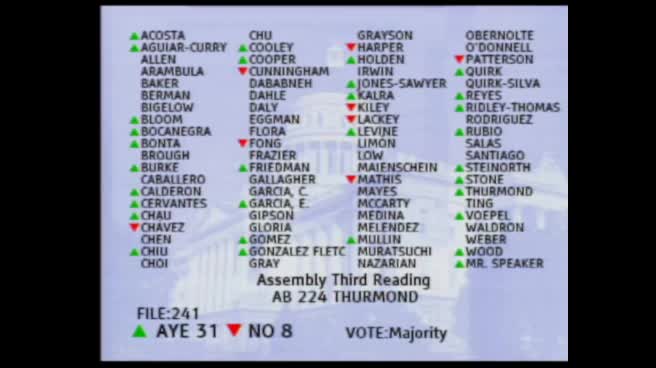 1MIN
Assembly Floor
 1H
Assembly Standing Committee on Appropriations
 4MIN
Assembly Standing Committee on Public Safety
Bill Author

Bill Co-Author(s):