SB 1279: Sentencing: double the base term.
- Session Year: 2017-2018
- House: Senate
- Latest Version Date: 2018-05-25
Existing law requires a person convicted of 2 or more felonies to be sentenced to an aggregate term of imprisonment for all convictions at a sum of the principal term, the subordinate term, and any additional term imposed for applicable enhancements, prior convictions, and prior prison terms. Under existing law, a principal term consists of the greatest term of imprisonment imposed by the court for any of the crimes, including any term imposed for applicable enhancements. Under existing law the subordinate term for each consecutive offense is 1/3 of the middle term of imprisonment prescribed for each other felony conviction for which a consecutive term of imprisonment is imposed, including 1/3 of the term imposed for any specific enhancements applicable to those subordinate offenses.
This bill would, with exceptions, as specified, limit the maximum term of imprisonment to twice the number of years imposed by the trial court as the base term.
Existing law establishes the Prison Industry Board within the Department of Corrections and Rehabilitation and specifies the 11 members of the board. Existing law authorizes the Speaker of the Assembly and the Senate Committee on Rules to appoint 2 members each to the board, respectively, to represent the general public.This bill would encourage the Speaker of the Assembly and the Senate Committee on Rules, in considering individuals to appoint to the board, to give particular consideration to individuals who were previously incarcerated in a state prison and who, following their initial release, have not been subsequently arrested or charged with any additional crimes, and who have clearly demonstrated their ability to comply with state and federal law.Existing law establishes the Prison Industry Board within the Department of Corrections and Rehabilitation and specifies the 11 members of the board. Existing law authorizes the Speaker of the Assembly and the Senate Committee on Rules to appoint 2 members each to the board, respectively, to represent the general public.
This bill would encourage the Speaker of the Assembly and the Senate Committee on Rules, in considering individuals to appoint to the board, to give particular consideration to individuals who were previously incarcerated in a state prison and who, following their initial release, have not been subsequently arrested or charged with any additional crimes, and who have clearly demonstrated their ability to comply with state and federal law.
(a)The Legislature finds and declares all of the following:
(1)California has a complicated sentencing scheme that includes principle terms, subordinate terms, concurrent sentences, consecutive sentences, determinate sentences, indeterminate sentences, and sentence enhancements.
(2)Californias sentence enhancement laws are extraordinarily complex. Some enhancements give courts the discretion to choose one of three possible terms. Some enhancements are imposed due to the prior criminal history of a defendant. Other enhancements are imposed because of the circumstances of the offense committed. The Legislature and the courts have authorized several limitations related to sentence enhancements.
(3)In 1977, California adopted subdivision (f) of Section 1170.1 of the Penal Code, commonly referred to as the double the base term limitation, which limited, with certain exceptions, consecutive determinate terms to twice the base term imposed by the court.
(4)Over the next decade, consistent with tough on crime practices, the double the base term limitation was riddled with exceptions.
(5)By 1986, the California Supreme Court in People v. Magill (1986) 41 Cal.3d 777 concluded that the Legislature intended to completely eliminate the double the base term limitation if any exception to the limitation was found to be true. The result of this holding was that the presence of a single enhancement, such as former Section 12022.6 of the Penal Code, taking property of great monetary value, would make the twice the base term limitation entirely inapplicable.
(6)In 1997, the Legislature enacted Senate Bill 721 (Chapter 750 of the Statutes of 1997) that repealed the double the base term limitation. The sponsor of Senate Bill 721 stated, ...the primary goal of this bill is not about sentence increases. In fact, the number of increased terms under this proposal would not be great at all. (Senate Committee on Public Safety Analysis for April 15, 1997 1997, hearing).
(7)On June 30, 2011, 31 percent of inmates had an enhancement as part of his or her sentence. Two years later, on June 30, 2013, 34.7 percent of inmates had an enhancement as part of his or her sentence.
(8)On February 10, 2014, a federal court ordered California to reduce its in-state adult institution population to 137.5 percent of design capacity by February 28, 2016.
(9)In fiscal year 201617, the 201617 fiscal year, the Department of Corrections and Rehabilitation recorded more than 5,000 enhancements associated with offenders admitted to serve a determinate sentence.
(10)The department continues to house inmates in numbers beyond its maximum capacity at an average of 130 percent of capacity. As of February 14, 2018, 113,939 inmates were housed in the states 34 adult institutions and 4,211 inmates were housed in out-of-state facilities.
(b)It is the intent of the Legislature to reenact the double the base term limitation to ensure that prison terms for specified enhancements will not be confined by the double the base term limitation, and to clarify that the existence of an exception does not render sentencing enhancements limitless. It is the intent of the Legislature that the holding of People v. Magill (1986) 41 Cal.3d 777 not be applied to the double the base term limitation as reenacted by this act.
SEC. 2.Section 1170.1 of the Penal Code, as amended by Section 7 of Chapter 887 of the Statutes of 2016, is amended to read:1170.1.(a)Except as otherwise provided by law, and subject to Section 654, when any person is convicted of two or more felonies, whether in the same proceeding or court or in different proceedings or courts, and whether by judgment rendered by the same or by a different court, and a consecutive term of imprisonment is imposed under Sections 669 and 1170, the aggregate term of imprisonment for all these convictions shall be the sum of the principal term, the subordinate term, and any additional term imposed for applicable enhancements for prior convictions, prior prison terms, and Section 12022.1. The principal term shall consist of the greatest term of imprisonment imposed by the court for any of the crimes, including any term imposed for applicable specific enhancements. The subordinate term for each consecutive offense shall consist of one-third of the middle term of imprisonment prescribed for each other felony conviction for which a consecutive term of imprisonment is imposed, and shall include one-third of the term imposed for any specific enhancements applicable to those subordinate offenses. Whenever a court imposes a term of imprisonment in the state prison, whether the term is a principal or subordinate term, the aggregate term shall be served in the state prison, regardless as to whether or not one of the terms specifies imprisonment in a county jail pursuant to subdivision (h) of Section 1170.
(b)If a person is convicted of two or more violations of kidnapping, as defined in Section 207, involving separate victims, the subordinate term for each consecutive offense of kidnapping shall consist of the full middle term and shall include the full term imposed for specific enhancements applicable to those subordinate offenses.
(c)In the case of any person convicted of one or more felonies committed while the person is confined in the state prison or is subject to reimprisonment for escape from custody and the law either requires the terms to be served consecutively or the court imposes consecutive terms, the term of imprisonment for all the convictions that the person is required to serve consecutively shall commence from the time the person would otherwise have been released from prison. If the new offenses are consecutive with each other, the principal and subordinate terms shall be calculated as provided in subdivision (a). This subdivision shall be applicable in cases of convictions of more than one offense in the same or different proceedings.
(d)When the court imposes a sentence for a felony pursuant to Section 1170 or subdivision (b) of Section 1168, the court shall also impose, in addition and consecutive to the offense of which the person has been convicted, the additional terms provided for any applicable enhancements. If an enhancement is punishable by one of three terms, the court shall, in its discretion, impose the term that best serves the interest of justice, and state the reasons for its sentence choice on the record at the time of sentencing. The court shall also impose any other additional term that the court determines in its discretion or as required by law shall run consecutive to the term imposed under Section 1170 or subdivision (b) of Section 1168. In considering the imposition of the additional term, the court shall apply the sentencing rules of the Judicial Council.
(e)All enhancements shall be alleged in the accusatory pleading and either admitted by the defendant in open court or found to be true by the trier of fact.
(f)When two or more enhancements may be imposed for being armed with or using a dangerous or deadly weapon or a firearm in the commission of a single offense, only the greatest of those enhancements shall be imposed for that offense. This subdivision shall not limit the imposition of any other enhancements applicable to that offense, including an enhancement for the infliction of great bodily injury.
(g)When two or more enhancements may be imposed for the infliction of great bodily injury on the same victim in the commission of a single offense, only the greatest of those enhancements shall be imposed for that offense. This subdivision shall not limit the imposition of any other enhancements applicable to that offense, including an enhancement for being armed with or using a dangerous or deadly weapon or a firearm.
(h)For any violation of an offense specified in Section 667.6, the number of enhancements that may be imposed shall not be limited, regardless of whether the enhancements are pursuant to this section, Section 667.6, or some other provision of law. Each of the enhancements shall be a full and separately served term.
(i)(1)The maximum term of imprisonment imposed pursuant to this section shall not exceed twice the number of years imposed by the trial court as the base term pursuant to subdivision (b) of Section 1170, and may include a portion of an applicable enhancement or enhancements, except as specified in paragraph (2).
(2)The limitation on the maximum term specified in paragraph (1) shall not apply to reduce that portion of a sentence required by an enhancement or additional and consecutive term imposed pursuant to Sections 186.22, 186.33, 236.4, 269, 288.3, 667, 667.5, 667.51, 667.6, 667.61, 667.85, 1170.12, 12022.75, and 12022.9.(2)The portion of a sentence required by an enhancement, alternative sentence, or additional and consecutive term imposed pursuant to Sections 186.22, 186.33, 236.4, 269, 288.3, 667, 667.5, 667.51, 667.6, 667.61, 667.85, 1170.12, 12022.75, and 12022.9 is not subject to the limitation on the maximum term specified in paragraph (1).
(3)Notwithstanding the imposition of a sentence for an enhancement enhancement, alternative sentence, or additional and consecutive term specified in paragraph (2), the double the base term limitation specified in paragraph (1) is applicable to all portions of a sentence not imposed pursuant to a code section specified in paragraph (2).
(j)This section shall remain in effect only until January 1, 2022, and as of that date is repealed, unless a later enacted statute, that is enacted before January 1, 2022, deletes or extends that date.
SEC. 3.Section 1170.1 of the Penal Code, as amended by Section 8 of Chapter 887 of the Statutes of 2016, is amended to read:1170.1.(a)Except as otherwise provided by law, and subject to Section 654, when any person is convicted of two or more felonies, whether in the same proceeding or court or in different proceedings or courts, and whether by judgment rendered by the same or by a different court, and a consecutive term of imprisonment is imposed under Sections 669 and 1170, the aggregate term of imprisonment for all these convictions shall be the sum of the principal term, the subordinate term, and any additional term imposed for applicable enhancements for prior convictions, prior prison terms, and Section 12022.1. The principal term shall consist of the greatest term of imprisonment imposed by the court for any of the crimes, including any term imposed for applicable specific enhancements. The subordinate term for each consecutive offense shall consist of one-third of the middle term of imprisonment prescribed for each other felony conviction for which a consecutive term of imprisonment is imposed, and shall include one-third of the term imposed for any specific enhancements applicable to those subordinate offenses. Whenever a court imposes a term of imprisonment in the state prison, whether the term is a principal or subordinate term, the aggregate term shall be served in the state prison, regardless as to whether or not one of the terms specifies imprisonment in a county jail pursuant to subdivision (h) of Section 1170.
(b)If a person is convicted of two or more violations of kidnapping, as defined in Section 207, involving separate victims, the subordinate term for each consecutive offense of kidnapping shall consist of the full middle term and shall include the full term imposed for specific enhancements applicable to those subordinate offenses.
(c)In the case of any person convicted of one or more felonies committed while the person is confined in the state prison or is subject to reimprisonment for escape from custody and the law either requires the terms to be served consecutively or the court imposes consecutive terms, the term of imprisonment for all the convictions that the person is required to serve consecutively shall commence from the time the person would otherwise have been released from prison. If the new offenses are consecutive with each other, the principal and subordinate terms shall be calculated as provided in subdivision (a). This subdivision shall be applicable in cases of convictions of more than one offense in the same or different proceedings.
(d)When the court imposes a sentence for a felony pursuant to Section 1170 or subdivision (b) of Section 1168, the court shall also impose, in addition and consecutive to the offense of which the person has been convicted, the additional terms provided for any applicable enhancements. If an enhancement is punishable by one of three terms, the court shall impose the middle term unless there are circumstances in aggravation or mitigation, and state the reasons for its sentence choice, other than the middle term, on the record at the time of sentencing. The court shall also impose any other additional term that the court determines in its discretion or as required by law shall run consecutive to the term imposed under Section 1170 or subdivision (b) of Section 1168. In considering the imposition of the additional term, the court shall apply the sentencing rules of the Judicial Council.
(e)All enhancements shall be alleged in the accusatory pleading and either admitted by the defendant in open court or found to be true by the trier of fact.
(f)When two or more enhancements may be imposed for being armed with or using a dangerous or deadly weapon or a firearm in the commission of a single offense, only the greatest of those enhancements shall be imposed for that offense. This subdivision shall not limit the imposition of any other enhancements applicable to that offense, including an enhancement for the infliction of great bodily injury.
(g)When two or more enhancements may be imposed for the infliction of great bodily injury on the same victim in the commission of a single offense, only the greatest of those enhancements shall be imposed for that offense. This subdivision shall not limit the imposition of any other enhancements applicable to that offense, including an enhancement for being armed with or using a dangerous or deadly weapon or a firearm.
(h)For any violation of an offense specified in Section 667.6, the number of enhancements that may be imposed shall not be limited, regardless of whether the enhancements are pursuant to this section, Section 667.6, or some other provision of law. Each of the enhancements shall be a full and separately served term.
(i)(1)The maximum term of imprisonment imposed pursuant to this section shall not exceed twice the number of years imposed by the trial court as the base term pursuant to subdivision (b) of Section 1170, and may include a portion of an applicable enhancement or enhancements, except as specified in paragraph (2).
(2)The limitation on the maximum term specified in paragraph (1) shall not apply to reduce that portion of a sentence required by an enhancement or additional and consecutive term imposed pursuant to Sections 186.22, 186.33, 236.4, 269, 288.3, 667, 667.5, 667.51, 667.6, 667.61, 667.85, 1170.12, 12022.75, and 12022.9.(2)The portion of a sentence required by an enhancement, alternative sentence, or additional and consecutive term imposed pursuant to Sections 186.22, 186.33, 236.4, 269, 288.3, 667, 667.5, 667.51, 667.6, 667.61, 667.85, 1170.12, 12022.75, and 12022.9 is not subject to the limitation on the maximum term specified in paragraph (1).
(3)Notwithstanding the imposition of a sentence for an enhancement enhancement, alternative sentence, or additional and consecutive term specified in paragraph (2), the double the base term limitation specified in paragraph (1) is applicable to all portions of a sentence not imposed pursuant to a code section specified in paragraph (2).
(j)This section shall become operative on January 1, 2022.
REVISIONS: HeadingLine 3.(a)The Legislature finds and declares all of the following:
(1)California has a complicated sentencing scheme that includes principle terms, subordinate terms, concurrent sentences, consecutive sentences, determinate sentences, indeterminate sentences, and sentence enhancements.
(2)Californias sentence enhancement laws are extraordinarily complex. Some enhancements give courts the discretion to choose one of three possible terms. Some enhancements are imposed due to the prior criminal history of a defendant. Other enhancements are imposed because of the circumstances of the offense committed. The Legislature and the courts have authorized several limitations related to sentence enhancements.
(3)In 1977, California adopted subdivision (f) of Section 1170.1 of the Penal Code, commonly referred to as the double the base term limitation, which limited, with certain exceptions, consecutive determinate terms to twice the base term imposed by the court.
(4)Over the next decade, consistent with tough on crime practices, the double the base term limitation was riddled with exceptions.
(5)By 1986, the California Supreme Court in People v. Magill (1986) 41 Cal.3d 777 concluded that the Legislature intended to completely eliminate the double the base term limitation if any exception to the limitation was found to be true. The result of this holding was that the presence of a single enhancement, such as former Section 12022.6 of the Penal Code, taking property of great monetary value, would make the twice the base term limitation entirely inapplicable.
(6)In 1997, the Legislature enacted Senate Bill 721 (Chapter 750 of the Statutes of 1997) that repealed the double the base term limitation. The sponsor of Senate Bill 721 stated, ...the primary goal of this bill is not about sentence increases. In fact, the number of increased terms under this proposal would not be great at all. (Senate Committee on Public Safety Analysis for April 15, 1997 hearing).
(7)On June 30, 2011, 31 percent of inmates had an enhancement as part of his or her sentence. Two years later, on June 30, 2013, 34.7 percent of inmates had an enhancement as part of his or her sentence.
(8)On February 10, 2014, a federal court ordered California to reduce its in-state adult institution population to 137.5 percent of design capacity by February 28, 2016.
(9)In fiscal year 201617, the Department of Corrections and Rehabilitation recorded more than 5,000 enhancements associated with offenders admitted to serve a determinate sentence.
(10)The department continues to house inmates in numbers beyond its maximum capacity at an average of 130 percent of capacity. As of February 14, 2018, 113,939 inmates were housed in the states 34 adult institutions and 4,211 inmates were housed in out-of-state facilities.
(b)It is the intent of the Legislature to reenact the double the base term limitation to ensure that prison terms for specified enhancements will not be confined by the double the base term limitation, and to clarify that the existence of an exception does not render sentencing enhancements limitless. It is the intent of the Legislature that the holding of People v. Magill (1986) 41 Cal.3d 777 not be applied to the double the base term limitation as reenacted by this act.
SEC. 2.Section 1170.1 of the Penal Code, as amended by Section 7 of Chapter 887 of the Statutes of 2016, is amended to read:1170.1.(a)Except as otherwise provided by law, and subject to Section 654, when any person is convicted of two or more felonies, whether in the same proceeding or court or in different proceedings or courts, and whether by judgment rendered by the same or by a different court, and a consecutive term of imprisonment is imposed under Sections 669 and 1170, the aggregate term of imprisonment for all these convictions shall be the sum of the principal term, the subordinate term, and any additional term imposed for applicable enhancements for prior convictions, prior prison terms, and Section 12022.1. The principal term shall consist of the greatest term of imprisonment imposed by the court for any of the crimes, including any term imposed for applicable specific enhancements. The subordinate term for each consecutive offense shall consist of one-third of the middle term of imprisonment prescribed for each other felony conviction for which a consecutive term of imprisonment is imposed, and shall include one-third of the term imposed for any specific enhancements applicable to those subordinate offenses. Whenever a court imposes a term of imprisonment in the state prison, whether the term is a principal or subordinate term, the aggregate term shall be served in the state prison, regardless as to whether or not one of the terms specifies imprisonment in a county jail pursuant to subdivision (h) of Section 1170.
(b)If a person is convicted of two or more violations of kidnapping, as defined in Section 207, involving separate victims, the subordinate term for each consecutive offense of kidnapping shall consist of the full middle term and shall include the full term imposed for specific enhancements applicable to those subordinate offenses.
(c)In the case of any person convicted of one or more felonies committed while the person is confined in the state prison or is subject to reimprisonment for escape from custody and the law either requires the terms to be served consecutively or the court imposes consecutive terms, the term of imprisonment for all the convictions that the person is required to serve consecutively shall commence from the time the person would otherwise have been released from prison. If the new offenses are consecutive with each other, the principal and subordinate terms shall be calculated as provided in subdivision (a). This subdivision shall be applicable in cases of convictions of more than one offense in the same or different proceedings.
(d)When the court imposes a sentence for a felony pursuant to Section 1170 or subdivision (b) of Section 1168, the court shall also impose, in addition and consecutive to the offense of which the person has been convicted, the additional terms provided for any applicable enhancements. If an enhancement is punishable by one of three terms, the court shall, in its discretion, impose the term that best serves the interest of justice, and state the reasons for its sentence choice on the record at the time of sentencing. The court shall also impose any other additional term that the court determines in its discretion or as required by law shall run consecutive to the term imposed under Section 1170 or subdivision (b) of Section 1168. In considering the imposition of the additional term, the court shall apply the sentencing rules of the Judicial Council.
(e)All enhancements shall be alleged in the accusatory pleading and either admitted by the defendant in open court or found to be true by the trier of fact.
(f)When two or more enhancements may be imposed for being armed with or using a dangerous or deadly weapon or a firearm in the commission of a single offense, only the greatest of those enhancements shall be imposed for that offense. This subdivision shall not limit the imposition of any other enhancements applicable to that offense, including an enhancement for the infliction of great bodily injury.
(g)When two or more enhancements may be imposed for the infliction of great bodily injury on the same victim in the commission of a single offense, only the greatest of those enhancements shall be imposed for that offense. This subdivision shall not limit the imposition of any other enhancements applicable to that offense, including an enhancement for being armed with or using a dangerous or deadly weapon or a firearm.
(h)For any violation of an offense specified in Section 667.6, the number of enhancements that may be imposed shall not be limited, regardless of whether the enhancements are pursuant to this section, Section 667.6, or some other provision of law. Each of the enhancements shall be a full and separately served term.
(i)(1)The maximum term of imprisonment imposed pursuant to this section shall not exceed twice the number of years imposed by the trial court as the base term pursuant to subdivision (b) of Section 1170, except as specified in paragraph (2).
(2)The limitation on the maximum term specified in paragraph (1) shall not apply to reduce that portion of a sentence required by an enhancement or additional and consecutive term imposed pursuant to Sections 186.22, 186.33, 236.4, 269, 288.3, 667, 667.5, 667.51, 667.6, 667.61, 667.85, 1170.12, 12022.75, and 12022.9.
(3)Notwithstanding the imposition of a sentence for an enhancement or additional and consecutive term specified in paragraph (2), the double the base term limitation specified in paragraph (1) is applicable to all portions of a sentence not imposed pursuant to a code section specified in paragraph (2).
(i)(j)This section shall remain in effect only until January 1, 2022, and as of that date is repealed, unless a later enacted statute, that is enacted before January 1, 2022, deletes or extends that date.
SEC. 3.Section 1170.1 of the Penal Code, as amended by Section 8 of Chapter 887 of the Statutes of 2016, is amended to read:1170.1.(a)Except as otherwise provided by law, and subject to Section 654, when any person is convicted of two or more felonies, whether in the same proceeding or court or in different proceedings or courts, and whether by judgment rendered by the same or by a different court, and a consecutive term of imprisonment is imposed under Sections 669 and 1170, the aggregate term of imprisonment for all these convictions shall be the sum of the principal term, the subordinate term, and any additional term imposed for applicable enhancements for prior convictions, prior prison terms, and Section 12022.1. The principal term shall consist of the greatest term of imprisonment imposed by the court for any of the crimes, including any term imposed for applicable specific enhancements. The subordinate term for each consecutive offense shall consist of one-third of the middle term of imprisonment prescribed for each other felony conviction for which a consecutive term of imprisonment is imposed, and shall include one-third of the term imposed for any specific enhancements applicable to those subordinate offenses. Whenever a court imposes a term of imprisonment in the state prison, whether the term is a principal or subordinate term, the aggregate term shall be served in the state prison, regardless as to whether or not one of the terms specifies imprisonment in a county jail pursuant to subdivision (h) of Section 1170.
(b)If a person is convicted of two or more violations of kidnapping, as defined in Section 207, involving separate victims, the subordinate term for each consecutive offense of kidnapping shall consist of the full middle term and shall include the full term imposed for specific enhancements applicable to those subordinate offenses.
(c)In the case of any person convicted of one or more felonies committed while the person is confined in the state prison or is subject to reimprisonment for escape from custody and the law either requires the terms to be served consecutively or the court imposes consecutive terms, the term of imprisonment for all the convictions that the person is required to serve consecutively shall commence from the time the person would otherwise have been released from prison. If the new offenses are consecutive with each other, the principal and subordinate terms shall be calculated as provided in subdivision (a). This subdivision shall be applicable in cases of convictions of more than one offense in the same or different proceedings.
(d)When the court imposes a sentence for a felony pursuant to Section 1170 or subdivision (b) of Section 1168, the court shall also impose, in addition and consecutive to the offense of which the person has been convicted, the additional terms provided for any applicable enhancements. If an enhancement is punishable by one of three terms, the court shall impose the middle term unless there are circumstances in aggravation or mitigation, and state the reasons for its sentence choice, other than the middle term, on the record at the time of sentencing. The court shall also impose any other additional term that the court determines in its discretion or as required by law shall run consecutive to the term imposed under Section 1170 or subdivision (b) of Section 1168. In considering the imposition of the additional term, the court shall apply the sentencing rules of the Judicial Council.
(e)All enhancements shall be alleged in the accusatory pleading and either admitted by the defendant in open court or found to be true by the trier of fact.
(f)When two or more enhancements may be imposed for being armed with or using a dangerous or deadly weapon or a firearm in the commission of a single offense, only the greatest of those enhancements shall be imposed for that offense. This subdivision shall not limit the imposition of any other enhancements applicable to that offense, including an enhancement for the infliction of great bodily injury.
(g)When two or more enhancements may be imposed for the infliction of great bodily injury on the same victim in the commission of a single offense, only the greatest of those enhancements shall be imposed for that offense. This subdivision shall not limit the imposition of any other enhancements applicable to that offense, including an enhancement for being armed with or using a dangerous or deadly weapon or a firearm.
(h)For any violation of an offense specified in Section 667.6, the number of enhancements that may be imposed shall not be limited, regardless of whether the enhancements are pursuant to this section, Section 667.6, or some other provision of law. Each of the enhancements shall be a full and separately served term.
(i)(1)The maximum term of imprisonment imposed pursuant to this section shall not exceed twice the number of years imposed by the trial court as the base term pursuant to subdivision (b) of Section 1170, except as specified in paragraph (2).
(2)The limitation on the maximum term specified in paragraph (1) shall not apply to reduce that portion of a sentence required by an enhancement or additional and consecutive term imposed pursuant to Sections 186.22, 186.33, 236.4, 269, 288.3, 667, 667.5, 667.51, 667.6, 667.61, 667.85, 1170.12, 12022.75, and 12022.9.
(3)Notwithstanding the imposition of a sentence for an enhancement or additional and consecutive term specified in paragraph (2), the double the base term limitation specified in paragraph (1) is applicable to all portions of a sentence not imposed pursuant to a code section specified in paragraph (2).
(i)(j)This section shall become operative on January 1, 2022.
SECTION 1.Section 2802 of the Penal Code is amended to read:2802.(a)Commencing July 1, 2005, there is hereby continued in existence within the Department of Corrections and Rehabilitation a Prison Industry Board. The board shall consist of the following 11 members:(1)The Secretary of the Department of Corrections and Rehabilitation, or his or her designee.(2)The Director of the Department of General Services, or his or her designee.(3)The Secretary of Transportation, or his or her designee.(4)The Speaker of the Assembly shall appoint two members to represent the general public.(5)The Senate Committee on Rules shall appoint two members to represent the general public.(6)The Governor shall appoint four members. Of these, two shall be representatives of organized labor, and two shall be representatives of industry. The initial term of one of the members appointed by the Speaker of the Assembly shall be two years, and the initial term of the other shall be three years. The initial term of one of the members appointed by the Senate Committee on Rules shall be two years, and the initial term of the other shall be three years. The initial terms of the four members appointed by the Governor shall be four years. All subsequent terms of all members shall be for four years. Each members term shall continue until the appointment and qualification of his or her successor.(b)The Speaker of the Assembly and the Senate Committee on Rules, in considering individuals to appoint to the board, are encouraged to give particular consideration to individuals who were previously incarcerated in a state prison and who, following their initial release, have not been subsequently arrested or charged with any additional crimes, and who have clearly demonstrated their ability to comply with state and federal law.(a)Commencing July 1, 2005, there is hereby continued in existence within the Department of Corrections and Rehabilitation a Prison Industry Board. The board shall consist of the following 11 members:
(a)(1)The Secretary of the Department of Corrections and Rehabilitation, or his or her designee.
(b)(2)The Director of the Department of General Services, or his or her designee.
(c)(3)The Secretary of Transportation, or his or her designee.
(d)(4)The Speaker of the Assembly shall appoint two members to represent the general public.
(e)(5)The Senate Committee on Rules shall appoint two members to represent the general public.
(f)(6)The Governor shall appoint four members. Of these, two shall be representatives of organized labor, and two shall be representatives of industry. The initial term of one of the members appointed by the Speaker of the Assembly shall be two years, and the initial term of the other shall be three years. The initial term of one of the members appointed by the Senate Committee on Rules shall be two years, and the initial term of the other shall be three years. The initial terms of the four members appointed by the Governor shall be four years. All subsequent terms of all members shall be for four years. Each members term shall continue until the appointment and qualification of his or her successor.
(b)The Speaker of the Assembly and the Senate Committee on Rules, in considering individuals to appoint to the board, are encouraged to give particular consideration to individuals who were previously incarcerated in a state prison and who, following their initial release, have not been subsequently arrested or charged with any additional crimes, and who have clearly demonstrated their ability to comply with state and federal law.
|
Date
|
Status
|
|---|---|
| Aug 31, 2018 | From Assembly without further action. |
| Aug 31, 2018 | Read third time. Refused passage. |
| Aug 20, 2018 | Read second time. Ordered to third reading. |
| Aug 16, 2018 | From committee: Do pass. (Ayes 11. Noes 5.) (August 16). |
| Aug 8, 2018 | August 8 set for first hearing. Placed on suspense file. |
| Jun 19, 2018 | Coauthors revised. |
| Jun 7, 2018 | Referred to Com. on PUB. S. |
| May 31, 2018 | In Assembly. Read first time. Held at Desk. |
| May 30, 2018 | Read third time. Passed. (Ayes 22. Noes 14.) Ordered to the Assembly. |
| May 29, 2018 | Read second time. Ordered to third reading. |
| May 25, 2018 | From committee: Do pass as amended. (Ayes 5. Noes 2.) (May 25). |
| May 18, 2018 | Set for hearing May 25. |
| Apr 30, 2018 | April 30 hearing: Placed on APPR. suspense file. |
| Apr 20, 2018 | Set for hearing April 30. |
| Apr 17, 2018 | From committee: Do pass and re-refer to Com. on APPR. (Ayes 5. Noes 2.) (April 17). Re-referred to Com. on APPR. |
| Apr 5, 2018 | Set for hearing April 17. |
| Apr 4, 2018 | Re-referred to Com. on PUB. S. |
| Apr 2, 2018 | From committee with author's amendments. Read second time and amended. Re-referred to Com. on RLS. |
| Mar 1, 2018 | Referred to Com. on RLS. |
| Feb 20, 2018 | From printer. May be acted upon on or after March 22. |
| Feb 16, 2018 | Introduced. Read first time. To Com. on RLS. for assignment. To print. |
|
Date
|
Description
|
Location
|
Votes
|
|
|---|---|---|---|---|
| Aug 31, 2018 | SB 1279 Bradford Senate Third Reading By CHIU | Assembly Floor |
Failed |
|
| Aug 16, 2018 | Do pass. | Assembly Standing Committee on Appropriations |
Passed |
|
| Jun 19, 2018 | Do pass and be re-referred to the Committee on [Appropriations] | Assembly Standing Committee on Public Safety |
Passed |
|
| May 30, 2018 | Senate 3rd Reading SB1279 Bradford et al. | Senate Floor |
Passed |
|
| May 25, 2018 | Do pass as amended | Senate Standing Committee on Appropriations |
Passed |
|
| Apr 30, 2018 | Placed on suspense file | Senate Standing Committee on Appropriations |
Passed |
|
| Apr 17, 2018 | Do pass, but first be re-referred to the Committee on [Appropriations] | Senate Standing Committee on Public Safety |
Passed |
This list shows positions taken on this bill by organizations on the date displayed, which is linked to the original source.
Positions by individuals are not included.
|
Organization
|
Position
|
Date
|
|---|---|---|
| ACLU of California | * Support | Jun 19, 2018 |
| Alliance for Boys and Men of Color | * Support | Apr 17, 2018 |
| Angels for Justice | * Support | Apr 17, 2018 |
| Anti-police Terror Project | * Support | Apr 17, 2018 |
| Anti-Recidivism Coalition | ** Support | Jun 18, 2018 |
| Black Lives Matter | * Support | Apr 17, 2018 |
| California Attorneys For Criminal Justice | ** Support | Jun 18, 2018 |
| California District Attorney's Association | * Against | Jun 19, 2018 |
| California Police Association | * Against | Jun 19, 2018 |
| California Police Chiefs Association | ** Against | Jun 18, 2018 |
| California Public Defenders Association | ** Support | Jun 18, 2018 |
| California State Sheriff's Association | * Against | Jun 19, 2018 |
| Californians for Safety and Justice | ** Support | Jun 18, 2018 |
| Cares for Youth | * Support | Apr 17, 2018 |
| Central Alameda Neighborhood Council | * Support | Apr 17, 2018 |
| Communities United for Restorative Youth Justice | * Support | Apr 17, 2018 |
| Democratic Socialists of America | * Support | Apr 17, 2018 |
| Drug Policy Alliance | * Support | Apr 17, 2018 |
| Ella Baker Center For Human Rights | ** Support | Jun 18, 2018 |
| Fair Chance Project | ** Support | Jun 18, 2018 |
| Friends Committee On Legislation Of California | ** Support | Jun 18, 2018 |
| Justice for James | * Support | Apr 17, 2018 |
| Los Angeles County District Attorney | * Against | Jun 19, 2018 |
| Love Not Blood Campaign | * Support | Apr 17, 2018 |
| Martin Luther King Coalition | * Support | Apr 17, 2018 |
| National Association of Social Workers | * Support | Apr 17, 2018 |
| PACT: People Acting in Community Together | * Support | Apr 17, 2018 |
| PURPOSE | ** Against | Apr 16, 2018 |
| Silicon Valley De-Bug | * Support | Apr 17, 2018 |
| The Advocacy Fund | ** Support | Jun 18, 2018 |
| UC Berekely Law School | * Support | Jun 19, 2018 |
| UC Berkeley School of Law | * Support | Apr 17, 2018 |
| White People for Black Lives | * Support | Apr 17, 2018 |
| Youth Justice Coalition | ** Support | Jun 18, 2018 |
SENATE THIRD READING
STR Bill Id:SB 1279
Author:(Bradford)
As Amended Ver:May 25, 2018
Majority vote
SENATE VOTE: 22-14
Committee | Votes | Ayes | Noes |
Public Safety | 5-2 | Jones-Sawyer, Carrillo, Kamlager-Dove, Quirk, Santiago | Lackey, Kiley |
Appropriations | 11-5 | Gonzalez Fletcher, Bloom, Bonta, Carrillo, Chau, Eggman, Friedman, Eduardo Garcia, Nazarian, Quirk, Reyes | Bigelow, Brough, Fong, Gallagher, Obernolte |
SUMMARY: Imposes a limit on the use of the double the base term (longest prison term for a single offense, excluding enhancements) when a person is sentenced to prison. Provides exceptions to the double the base term limit for specified prior convictions, enhancements, or alternative sentences. Specifically, this bill:
- States that the maximum term of imprisonment imposed pursuant to California's sentencing scheme shall not exceed twice the number of years imposed by the trial court as the base term, as specified, and may include a portion of an applicable enhancement or enhancements.
- Specifies that the portion of a sentence required by an enhancement, alternative sentence, or additional and consecutive term, imposed pursuant to specified sections of the penal code, is not subject to the limitation of twice the base term.
- Specifies that gang enhancements, specified sex crimes, prior convictions for serious or violent felonies (strikes) are among the enhancements, alternative sentences, and additional terms excluded from the limit of double the base term.
- States that the limit of double the base term applies to any portion of a sentence that is not specifically excluded from the limit under the provisions of this bill.
EXISTING LAW:
- Provides, except as otherwise provided by law and subject to the prohibition against multiple punishment for the same act, when a person is convicted of two or more felonies, as specified, the aggregate term of imprisonment for all these convictions shall be the sum of the principal term, the subordinate term, and any additional term imposed for applicable enhancements.
- States that the principal term shall consist of the greatest term of imprisonment imposed by the court for any of the crimes, including any term imposed for applicable specific enhancements.
- States that the subordinate term for each consecutive offense shall consist of one-third of the middle term of imprisonment prescribed for each other felony conviction for which a consecutive term of imprisonment is imposed, and shall include one-third of the term imposed for any specific enhancements applicable to those subordinate offenses.
- Provides that for any violation of a specified sex offense specified in Penal Code Section There is no limit to the number of enhancements which may be imposed.
- Requires mandatory full-term stacking for specified sex offenses if the crimes involve separate victims or involve the same victim on separate occasions.
- Allows a court to impose full-term consecutive sentences when a defendant is convicted of specified sex crimes against the same victim on the same occasion.
FISCAL EFFECT: According to the Assembly Appropriations Committee:
- General Fund (GF) costs to the California Department of Corrections and Rehabilitation (CDCR) of about $175,000, including $125,000 to train staff on how to accurately evaluate sentences and calculate release dates, and $50,000 to update an information technology system.
- Unknown GF savings for CDCR in the long-run from some inmates having shorter sentences. Savings are likely to be in the millions to tens of millions of dollars.
COMMENTS: According to the author, "California has one of, if not the most, complex sentencing structures in the nation. So convoluted, even judges are often uncertain with the interplay between various sentencing schemes – base terms, principal terms, subordinate terms, aggregate terms, special circumstances – and not to mention, over 150 sentence enhancements under existing law. To make matters worse, beyond the complexity of sentencing law lies the question of whether or not the policies we have enacted effectively serve their intended purpose and appropriately sanction individuals for the crimes they were convicted of.
''SB 1279 will help simplify California's intricate and confusing web of sentencing laws by ensuring that a full term of imprisonment does not exceed double the number of years imposed by the trial court as the base term for the offense. This rule would not apply to the most heinous, violent and sex crimes in current law. Ultimately, this bill will maximize the public safety purpose of sentencing and restore greater proportionality in sentencing.''
Please see the policy committee analysis for a full discussion of this bill.
Analysis Prepared by: David Billingsley / PUB. S. / (916) 319-3744 FN: 0004083
Date of Hearing: August 8, 2018
ASSEMBLY COMMITTEE ON APPROPRIATIONS
Lorena Gonzalez Fletcher, Chair
SBPCA Bill Id:SB 1279
Author:(Bradford) – As Amended Ver:May 25, 2018
Policy Committee: | Public Safety | Vote: | 5 - 2 |
|
| ||
|
|
Urgency: No State Mandated Local Program: No Reimbursable: No
SUMMARY:
This bill imposes a double-the-base term limit (longest prison term for a single offense, excluding enhancements) when a person is sentenced to prison. Provides exceptions to the double-the-base term limit for specified prior convictions, enhancements, or alternative sentences. Specifically, this bill:
- States that the maximum term of imprisonment imposed pursuant to California’s sentencing scheme may not exceed twice the number of years imposed by the trial court as the base term, as specified, and may include a portion of an applicable enhancement or enhancements.
- Specifies that the portion of a sentence required by an enhancement, alternative sentence, or additional and consecutive term, imposed pursuant to specified sections of the penal code, is not subject to the limitation of twice the base term.
- Specifies that gang enhancements, specified sex crimes, prior convictions for serious or violent felonies (strikes) are among the enhancements, alternative sentences, and additional terms excluded from the limit of double the base term.
- States that the limit of double the base term applies to any portion of a sentence that is not specifically excluded from the limit under the provisions of this bill.
FISCAL EFFECT:
- GF costs to the California Department of Corrections and Rehabilitation (CDCR) of about $175,000, including $125,000 to train staff on how to accurately evaluate sentences and calculate release dates, and $50,000 to update an information technology system.
- Unknown GF savings for CDCR in the long-run from some inmates having shorter sentences. Savings are likely to be in the millions to tens of millions of dollars.
COMMENTS:
- Background. A double-the-base term limitation was enacted in 1976. The effect of this limitation was that when a defendant was sentenced consecutively for multiple felonies or enhancements, the total prison sentence could not exceed twice the base term selected by the court for the principal offense, unless the defendant was convicted of a violent felony or other specified enhancements applied. After a Supreme Court ruling limited the application of the double-the-base term rule it was repealed entirely by SB 721 (Lockyer), Chapter 750, Statutes of 1997.
- Purpose. This bill would reinstate the sentencing limitation of double the base term, but reduce some of the exceptions to the limitation that existed in 1997. According to the author:
SB 1279 will help simplify California’s intricate and confusing web of sentencing laws by ensuring that a full term of imprisonment does not exceed double the number of years imposed by the trial court as the base term for the offense. This rule would not apply to the most heinous, violent and sex crimes in current law. Ultimately, this bill will maximize the public safety purpose of sentencing and restore greater proportionality in sentencing.
Analysis Prepared by: Jessica Peters / APPR. / (916) 319-2081
Date of Hearing: June 19, 2018
Counsel: David Billingsley
ASSEMBLY COMMITTEE ON PUBLIC SAFETY
Reginald Byron Jones-Sawyer, Sr., Chair
SBPCA Bill Id:SB 1279
Author:(Bradford) – As Amended Ver:May 25, 2018
SUMMARY: Imposes a limit on the use of the double the base term (longest prison term for a single offense, excluding enhancements) when a person is sentenced to prison. Provides exceptions to the double the base term limit for specified prior convictions, enhancements, or alternative sentences. Specifically, this bill:
- States that the maximum term of imprisonment imposed pursuant to California’s sentencing scheme shall not exceed twice the number of years imposed by the trial court as the base term, as specified, and may include a portion of an applicable enhancement or enhancements.
- Specifies that the portion of a sentence required by an enhancement, alternative sentence, or additional and consecutive term, imposed pursuant to specified sections of the penal code, is not subject to the limitation of twice the base term.
- Specifies that gang enhancements, specified sex crimes, prior convictions for serious or violent felonies (strikes) are among the enhancements, alternative sentences, and additional terms excluded from the limit of double the base term.
- States that the limit of double the base term applies to any portion of a sentence that is not specifically excluded from the limit under the provisions of this bill.
EXISTING LAW:
- Provides, except as otherwise provided by law and subject to the prohibition against multiple punishment for the same act, when a person is convicted of two or more felonies, as specified, the aggregate term of imprisonment for all these convictions shall be the sum of the principal term, the subordinate term, and any additional term imposed for applicable enhancements. (Pen. Code § 1170.1, subd. (a).)
- States that the principal term shall consist of the greatest term of imprisonment imposed by the court for any of the crimes, including any term imposed for applicable specific enhancements. (Pen. Code § 1170.1, subd. (a).)
- States that the subordinate term for each consecutive offense shall consist of one-third of the middle term of imprisonment prescribed for each other felony conviction for which a consecutive term of imprisonment is imposed, and shall include one-third of the term imposed for any specific enhancements applicable to those subordinate offenses. (Pen. Code § 1170.1, subd. (a).)
- Provides that for any violation of a specified sex offense specified in Penal Code Section There is no limit to the number of enhancements which may be imposed. (Pen. Code § 1170.1, subd. (h).)
- Requires mandatory full-term stacking for specified sex offenses if the crimes involve separate victims or involve the same victim on separate occasions. (Pen. Code §, 667.6, subd. (d).)
- Allows a court to impose full-term consecutive sentences when a defendant is convicted of specified sex crimes against the same victim on the same occasion. (Pen. Code §, 667.6, subd. (e).)
FISCAL EFFECT: Unknown
COMMENTS:
- Author's Statement: According to the author, "California has one of, if not the most, complex sentencing structures in the nation. So convoluted, even judges are often uncertain with the interplay between various sentencing schemes – base terms, principal terms, subordinate terms, aggregate terms, special circumstances – and not to mention, over 150 sentence enhancements under existing law. To make matters worse, beyond the complexity of sentencing law lies the question of whether or not the policies we have enacted effectively serve their intended purpose and appropriately sanction individuals for the crimes they were convicted of.
“SB 1279 will help simplify California’s intricate and confusing web of sentencing laws by ensuring that a full term of imprisonment does not exceed double the number of years imposed by the trial court as the base term for the offense. This rule would not apply to the most heinous, violent and sex crimes in current law. Ultimately, this bill will maximize the public safety purpose of sentencing and restore greater proportionality in sentencing.” - Legislative History Regarding the Double the Base Term Limitation: A double the base term limitation was enacted in 1976. The effect of this limitation was that when a defendant was sentenced consecutively for multiple felonies or enhancements, the total prison sentence could not exceed twice the base term selected by the court for the principal offense, unless the defendant was convicted of a violent felony or other specified enhancements applied.
In People v. Magill (1986), 41 Cal.3d 777, the California Supreme Court held that “the presence of any of the specified enhancements makes the double-base term limitation entirely inapplicable.” (Id. at p. 780.) Essentially, the ruling meant that if any of the listed exceptions applied to a defendant, the double-the-base-term limitation did not apply to the defendant’s sentence at all.
In 1997, this limitation was repealed. (SB 721 (Lockyer), Chapter 750, Statutes of 1997.) This bill would reinstate the sentencing limitation of double the base term, but reduce some of the exceptions to the limitation that existed in 1997. - California’s Sentencing Scheme: Under California’s sentencing laws, courts must make sentencing decisions on a number of different levels. Most offenses in California have determinate terms and give the court discretion to sentence the defendant to one of three terms. At the judge’s discretion, the judge will impose the low, middle, or upper term as prescribed by the legislature for the crime on which the defendant has been convicted. That term is referred to as the “base term.” If the defendant has any enhancements (such a being armed with a weapon, having certain prior convictions, etc.) the period of time dictated by the enhancement or enhancements are added to the base term to create the principle term.
If a defendant has convictions for multiple offenses, the longest term (base term + enhancement) will be the principle term. In addition to the principle term, the court will sentence the defendant on any other convictions and enhancements suffered by the defendant. The additional convictions (and enhancements) are referred to as subordinate terms. Generally, a court can sentence a defendant on the subordinate terms concurrently or consecutively. A concurrent sentence would run at the same time as the principal term (effectively not adding any time to the defendant’s overall sentence) or it would be imposed consecutively (to be served after the defendant had finished his or her principal term. Subordinate terms are imposed at a rate of 1/3 the middle term + 1/3 of any enhancements connected with the additional counts.
Currently, there is no limit on the amount of time that can be imposed for subordinate terms. This bill would place a limit on most felony sentences of twice the base term. Sentences involving prior convictions for serious and violent felonies (strikes) would not be subject to the double the base term limitation. Sex crimes which are eligible for mandatory or discretionary full term stacking would not be subject to the limitation. Sentences involving specified enhancements would not be subject to that limitation. Included within the enhancements that are not subject to the twice the base term limitation, are gang enhancements, kidnap of a child under 14, administration of a controlled substance against a victim’s will during the commission of a felony, and commission of a felony against a pregnant woman that result in termination of the pregnancy. The bill provides other specified exceptions to the double the base term limit.
This bill would limit the exceptions to the double the base term maximum beyond what was in effect in 1997. The language of the limit that was in place in 1997 excepted from the double the base term limit situations when the defendant was convicted of a violent felony, when the defendant used a firearm during the commission of a crime, the defendant committed great bodily injury, the defendant engaged in drug trafficking crimes with amounts in excess of one kilogram of drugs. This bill would not reinstate those exceptions to the double the base term limit. Certain enhancements such as use of a firearm during a crime carry prison terms that can be significantly longer than the maximum term for the underlying crime. This bill will result in a decrease in sentencing exposure for certain enhancements that carry significant prison terms.
- Prison Overcrowding: On February 10, 2014, the federal court ordered California to reduce its in-state adult institution population to 137.5% of design capacity by February 28, 2016, as follows:
- 143% of design bed capacity by June 30, 2014;
- 141.5% of design bed capacity by February 28, 2015; and,
- 137.5% of design bed capacity by February 28, 2016.
- 143% of design bed capacity by June 30, 2014;
California has enacted a series of policy changes intended to reduce the number of adults incarcerated in state prisons and boost investment in rehabilitation. These changes include Realignment, Proposition 47, and Proposition 57.
The California Budget and Policy Center published a report on California’s criminal sentencing scheme in December, 2015, entitled “Sentencing in California: Moving Toward a Smarter, More Cost-Effective Approach.” That report noted that sentencing changes enacted by California had helped the state comply with the federal court orders to reduce prison overcrowding. But the report pointed out that it was not clear that the changes would be enough to maintain the requisite reductions over the long term and that even at the levels ordered by the federal court, the state prisons are still extremely overcrowded. (http://calbudgetcenter.org/resources/sentencing-in-california-moving-toward-a-smarter-more-cost-effective-approach/)
The report stated that an important question for policymakers is whether sentence lengths are appropriate and reflect an efficient use of public resources. The report raised that question in light of the fact that longer prison terms have been a key driver of prison populations and costs and ultimately recommended cutting the length of prison terms as one way to tackle prison costs.
State corrections spending remains stubbornly high in California despite recent criminal justice reforms and the substantial drop in the number of people involved with the state correctional system. Cutting the length of prison terms would further reduce the number of incarcerated adults and thereby allow the state to close prisons and other correctional facilities, generating substantial ongoing savings that could be redirected to other public services and systems. To achieve this outcome – a smaller state prison system – policymakers would have to reduce the length of imprisonment for a broad range of crimes, not simply for nonviolent offenses. Experts note that reducing prison lengths of stay has little to no impact on either crime rates or recidivism. (http://calbudgetcenter.org/resources/sentencing-in-california-moving-toward-a-smarter-more-cost-effective-approach/)
- Sentencing Enhancements and Prison Overcrowding: Existing law contains a variety of enhancements that can be used to increase the term of imprisonment a defendant will serve. Multiple enhancements can be imposed in a single case. Enhancements can range from adding a specified number of years to a person’s sentence, or doubling a person’s sentence or even converting a determinate sentence into a life sentence.
According to a recent Public Policy Institute of California (PPIC) publication on enhancements, as of September 2016, 79.9% of prisoners in institutions operated by the California Department of Corrections and Rehabilitation (CDCR) had some kind of sentence enhancement; 25.5% had three or more. (Sentence Enhancements: Next Target of Corrections Reform, PPIC (Sept. 2017)
By establishing a limit on felony sentences of twice the base term, this bill would limit the imposition of some existing enhancements. - Argument in Support: According to California Attorneys for Criminal Justice, “For the past 25 years California’s felony sentencing scheme has expanded exponentially in scope and depth which has resulted in a Byzantine network of laws that overlap, conflict, are redundant and give rise to confusion and un-certainty in judicial proceedings. Our court system is overburdened in part because our criminal statutes have made felony cases unwieldy and inefficient to resolve. We know firsthand that many cases would settle much earlier in the judicial process if greater clarity and certainty can be infused into our laws. SB 1279 is a significant step in the right direction.
“In felony cases prosecutors are faced with a wide range of charging options that can be overlapping, in conflict and awkwardly applied to a set of facts. The uncertainty in sentencing implications makes settlement difficult for prosecutors and defense alike. SB 1279 brings some predictability and clarity to potential felony sentences that will help all parties involved determine whether to settle a case early in the pro process. Decades ago California chose to move away from indeterminate sentencing as a means to streamline the judicial process and prevent overcrowding prisons. Yet, California finds itself amid an era where taxpayer spending on prisons far exceeds investment in education and other vital services. This has occurred at a time when crime rates are historically low.
“SB 1279 simply crafts a very specific and predictable calculation for felony sentences when multiple charges or cases are involved. Prosecutors, judges, defense counsel and all parties will be more easily determine sentencing outcomes. This will streamline our court system and improve management of our prisons.” - Argument in Opposition: According to the California District Attorneys Association, “As you know, under existing law, when a person is convicted of multiple crimes, he or she is sentenced to a principal term (the longest term imposed by the court for any one conviction) and all other subordinate terms are served at 1/3 of the middle term sentence. The practical effect of SB 1279 is to give a volume discount to criminals who victimize four or more individuals, or those who would otherwise be subject to a significant enhancement.
“For example, consider someone convicted of human trafficking with six victims. Let’s assume that the judge imposed the lower term of five years for the principal term and sentenced the defendant consecutively for the other five victims (32 months each) for a total sentence of 18 years, 4 months. Under SB 1279, the maximum sentence for this defendant would be capped at double the base term, or ten years. That’s almost a 50% sentence reduction, and effectively gives the defendant three ‘free’ victims.
“Another example would be a defendant convicted of robbery who received the middle term of six years, and was found to have discharged a firearm resulting in great bodily injury or death in the commission of that robbery. Under existing law, the enhancement provided by Penal Code section 12022.53 provides for an enhancement of 25 to life (if the judge chooses to impose it). If SB 1279 becomes law, that enhancement would be limited to six years so that the total sentence did not exceed double the base term.
“It should go without saying that violent offenders are the most likely to benefit from this giveaway to criminals, as non-violent offenders are already eligible for parole under Proposition 57 after serving just their principal term. SB 1279 tramples on the rights of crime victims to receive justice and jeopardizes the safety of our communities.”
- Related Legislation:
- SB 1392 (Mitchell), would eliminate the sentencing enhancement which imposes an additional one-year of imprisonment term for each prior separate prison term or county jail felony term. SB 1392 failed passage on the Senate Floor.
- SB 1393 (Mitchell), would allow a judge discretion to strike a prior serious felony conviction, in furtherance of justice, to avoid the imposition of the 5-year prison enhancement when the defendant has been convicted on a serious felony. SB 1393 is awaiting hearing in the Assembly Appropriations Committee.
- SB 1025 (Skinner), would permit a court to grant probation for specified drug offenses. SB 1025 is set for hearing in the Assembly Public Safety Committee on June 19, 2018.
- SB 1392 (Mitchell), would eliminate the sentencing enhancement which imposes an additional one-year of imprisonment term for each prior separate prison term or county jail felony term. SB 1392 failed passage on the Senate Floor.
- Prior Legislation:
- SB 180 (Mitchell), Chapter 677, Statutes of 2017, limits the three year enhancement for a prior conviction related to the sale or possession for sale of specified controlled substance to convictions for a controlled substance offense where a minor was used or employed in the commission of the offense.
- SB 620 (Bradford), Chapter 682, Statutes of 2017, allows a court, in the interest of justice, to strike or dismiss a firearm enhancement which otherwise adds a state prison term of three, four, or 10 years, or five, six, or 10 years, depending on the firearm, or a state prison term of 10 years, 20 years, or 25-years-to-life depending on the underlying offense and manner of use.
- SB 966 (Mitchell), of the 2015-2016 Legislative Session, would have limited the three year enhancement for prior conviction of specified controlled substance offenses to convictions for the manufacture of a controlled substance, or using or employing a minor in the commission of specified controlled substance offenses. SB 966 failed passage in Assembly Public Safety Committee.
- SB 721 (Lockyer), Chapter 750, Statutes of 1997, repealed the twice the base term limit on sentencing.
- SB 180 (Mitchell), Chapter 677, Statutes of 2017, limits the three year enhancement for a prior conviction related to the sale or possession for sale of specified controlled substance to convictions for a controlled substance offense where a minor was used or employed in the commission of the offense.
REGISTERED SUPPORT / OPPOSITION:
Support
American Civil Liberties Union of California (Co-Sponsor)
Anti-Recidivism Coalition (Co-Sponsor)
California Attorneys for Criminal Justice
California Public Defenders Association
Californians for Safety and Justice
Ella Baker Center for Human Rights
Fair Chance Project
Friends Committee on Legislation of California
The Advocacy Fund
Youth Justice Coalition
Opposition
California District Attorneys Association
California Police Chiefs Association
California State Sheriffs’ Association
Los Angeles County District Attorney’s Office
Analysis Prepared by: David Billingsley / PUB. S. / (916) 319-3744
Office of Senate Floor Analyses (916) 651-1520 Fax: (916) 327-4478 | SB |
THIRD READING
Bill No: SB 1279
:
SENATE PUBLIC SAFETY COMMITTEE: 5-2, 4/17/18
AYES: Skinner, Bradford, Jackson, Mitchell, Wiener
NOES: Anderson, Stone
SENATE APPROPRIATIONS COMMITTEE: 5-2, 5/25/18
AYES: Lara, Beall, Bradford, Hill, Wiener
NOES: Bates, Nielsen
SUBJECT: Sentencing: double the base term
SOURCE: American Civil Liberties Union of California
Anti-Recidivism Coalition
DIGEST:
This bill reinstates the double-the-base-term limitation on consecutive terms of imprisonment, with specified exceptions, which was repealed in 1997.
Existing law:
- Provides, except as otherwise provided by law and subject to the prohibition against multiple punishment for the same act, when a person is convicted of two or more felonies, as specified, the aggregate term of imprisonment for all these convictions shall be the sum of the principal term, the subordinate term, and any additional term imposed for applicable enhancements. (Pen. Code § 1170.1, subd. (a).)
- States that the principal term shall consist of the greatest term of imprisonment imposed by the court for any of the crimes, including any term imposed for applicable specific enhancements. (Id.)
- States that the subordinate term for each consecutive offense shall consist of one-third of the middle term of imprisonment prescribed for each other felony conviction for which a consecutive term of imprisonment is imposed, and shall include one-third of the term imposed for any specific enhancements applicable to those subordinate offenses. (Id.)
- Provides that for any violation of an offense specified in Penal Code Section 667.6, the number shall not be limited and shall be a fully and separately served term. (Pen. Code § 1170.1, subd. (h).)
This bill:
- States that the maximum term of imprisonment that may be imposed on a person convicted of two or more felonies for consecutive terms of imprisonment shall not exceed twice the number of years imposed by the trial court as the base term and may include a portion of an applicable enhancement or enhancements, except as specified.
- Specifies that the portion of a sentence required by an enhancement, alternative sentence, or additional and consecutive term imposed pursuant to violations of the crimes listed below is not subject to the double-the-base term limitation:
- Crimes committed for the benefit of a gang;
- Enhancement on a conviction for a failure to register on the gang registry;
- Enhancements applicable to human trafficking offenses;
- Aggravated sexual assault of a child under the age of 14;
- Communicating with a minor for the purpose of engaging in lewd and lascivious acts;
- Three strikes enhancements;
- Enhancements for prior sex offenses;
- One-strike sex offenses;
- Enhancement for kidnapping to permanently deprive the parent of custody of child;
- Enhancement for the administration of a controlled substance against a victim’s will; and,
- Enhancement where injury to the victim results in termination of pregnancy.
- Provides that, notwithstanding the imposition of a sentence for an enhancement, alternative sentence, or additional and consecutive term specified as excluded, the double the base term limitation is applicable to all portions of a sentence not including the specified exclusions.
- States that it is the intent of the Legislature to reenact the double the base term limitation to ensure that prison terms for specified enhancements will not be confined by the double the base term limitation, and to clarify that the existence of an exception does not render sentencing enhancements limitless and to clarify that the holding of People v. Magill (1986) 41 Cal.3d 777 not be applied to the double the base term limitation as reenacted by this act.
FISCAL EFFECT: Appropriation: Fiscal Com.: Local:
According to the Senate Appropriations Committee:
- Costs: One-time significant costs of up to $125,000 to the Department of Corrections and Rehabilitation (CDCR) to train staff department-wide on the new sentencing restrictions and how to calculate release dates; additional costs of approximately $50,000 to upgrade the department’s relevant information technology system (SOMS) to reflect the new sentencing change. (General Fund)
- Savings: Undeterminable but potentially-major out-year savings in reduced incarceration costs to CDCR and counties (for jail sentences pursuant to the 2011 Realignment Legislation). The proposed 2018-19 per capita cost to house a person in a state prison is $80,729 annually, with an annual marginal rate per inmate of between $10,000 and $12,000. The average contract-prison rate cost per inmate is over $30,000 annually. (General Fund, local funds)
The actual savings would depend on how many individuals would have their sentences capped at double the base term for the primary offense and would not already be released on parole or post-release community supervision through the sentencing changes made by Proposition 57 (2016). If 20 individuals are sentenced to a maximum of double the term of their primary offenses, but absent SB 1279 would have been sentenced to a longer term of incarceration and are either ineligible for or denied parole through Proposition 57 after serving the base term for their principal offense, every year of avoided incarceration would save CDCR about $1.6 million (if using the proposed 2018-19 per capita rate).
American Civil Liberties Union of California (co-source)
Anti-Recidivism Coalition (co-source)
California Public Defenders Association
Californians for Safety and Justice
Ella Baker Center for Human Rights
Friends Committee on Legislation of California
The Advocacy Fund
OPPOSITION: (Verified 5/25/18)
California District Attorneys Association
5/29/18 11:05:05
**** END ****
SENATE COMMITTEE ON APPROPRIATIONS
Senator Ricardo Lara, Chair
2017 - 2018 Regular Session
SB 1279 (Bradford) - Sentencing: double the base term
Version: April 2, 2018 | Policy Vote: PUB. S. 5 - 2 |
Urgency: No | Mandate: No |
Hearing Date: May 25, 2018 | Consultant: Shaun Naidu |
*********** ANALYSIS ADDENDUM – SUSPENSE FILE ***********
The following information is revised to reflect amendments
adopted by the committee on May 25, 2018
Bill Summary:
SB 1279 would reinstate the double-base term limitation on consecutive terms of imprisonment, except as specified.
Fiscal Impact:
- Costs: One-time significant costs of up to $125,000 to the Department of Corrections and Rehabilitation (CDCR) to train staff department-wide on the new sentencing restrictions and how to calculate release dates; additional costs of approximately $50,000 to upgrade the department’s relevant IT system (SOMS) to reflect the new sentencing change. (General Fund)
- Savings: Undeterminable but potentially-major out-year savings in reduced incarceration costs to CDCR and counties (for jail sentences pursuant to the 2011 Realignment Legislation). The proposed 2018-19 per capita cost to house a person in a state prison is $80,729 annually, with an annual marginal rate per inmate of between $10,000 and $12,000. The average contract-prison rate cost per inmate is over $30,000 annually. (General Fund, local funds)
The actual savings would depend on how many individuals would have their sentences capped at double the base term for the primary offense and would not already be released on parole or post-release community supervision through the sentencing changes made by Proposition 57 (2016). If twenty individuals are sentenced to a maximum of double the term of their primary offenses, but absent SB 1279 would have been sentenced to a longer term of incarceration and are either ineligible for or denied parole through Proposition 57 after serving the base term for their principal offense, every year of avoided incarceration would save CDCR about $1.6 million (if using the proposed 2018-19 per capita rate).
Author Amendments:
Recast provisions and specify that the limitation applies to alternative sentences.
-- END --
SENATE COMMITTEE ON APPROPRIATIONS
Senator Ricardo Lara, Chair
2017 - 2018 Regular Session
SB 1279 (Bradford) - Sentencing: double the base term
Version: April 2, 2018 | Policy Vote: PUB. S. 5 - 2 |
Urgency: No | Mandate: No |
Hearing Date: April 30, 2018 | Consultant: Shaun Naidu |
This bill meets the criteria for referral to the Suspense File.
Bill Summary:
SB 1279 would reinstate the double-base term limitation on consecutive terms of imprisonment, except as specified.
Fiscal Impact:
- Costs: One-time significant costs of up to $125,000 to the Department of Corrections and Rehabilitation (CDCR) to train staff department-wide on the new sentencing restrictions and how to calculate release dates; additional costs of approximately $50,000 to upgrade the department’s relevant IT system (SOMS) to reflect the new sentencing change. (General Fund)
- Savings: Undeterminable but potentially-major out-year savings in reduced incarceration costs to CDCR and counties (for jail sentences pursuant to the 2011 Realignment Legislation). The proposed 2018-19 per capita cost to house a person in a state prison is $80,729 annually, with an annual marginal rate per inmate of between $10,000 and $12,000. The average contract-prison rate cost per inmate is over $30,000 annually. (General Fund, local funds)
The actual savings would depend on how many individuals would have their sentences capped at double the base term for the primary offense and would not already be released on parole or post-release community supervision through the sentencing changes made by Proposition 57 (2016). If twenty individuals are sentenced to a maximum of double the term of their primary offenses, but absent SB 1279 would have been sentenced to a longer term of incarceration and are either ineligible for or denied parole through Proposition 57 after serving the base term for their principal offense, every year of avoided incarceration would save CDCR about $1.6 million (if using the proposed 2018-19 per capita rate).
Background:
According to the analysis of this bill by the Senate Committee on Public Safety:
Under California’s Determinate Sentencing Law, most felony offenses carry a specified base term, also known as a triad. Specially, a statute will provide three possible terms – the low, middle, or high term – from which a court has discretion to choose the most appropriate term (Pen. Code, § 1170, subd. (b)). For example, first degree burglary is punishable by two, four, or six years in prison.
If the defendant is convicted of multiple crimes, the court must first decide whether the proscription against multiple punishments (Penal Code Section 654) requires a stay of imposition of sentence on any count. For counts not subject to Penal Code Section 654, in most instances, the judge has discretion to order that the terms be served either concurrently or consecutively. (Pen. Code §§ 669 and 1170.1, subd. (a).) However, in some instances, consecutive terms are statutorily mandated. If the court chooses to impose consecutive sentences, the total term or aggregate sentence includes the sum of the principal term, which is the longest term imposed for any of the crimes calculated by the base term (either low, middle or high term) plus any applicable conduct specific enhancements, and each consecutive offense calculated at one-third the middle term plus one-third the term specified for any specific conduct enhancements applicable to that count, plus any enhancements for prior convictions.
The double-base term limitation was enacted originally in 1976 with the effect of capping the total prison sentence that a defendant could be sentenced to consecutively for multiple felonies or enhancements to twice the base term selected by the court for the principal offense. This limitation did not apply to a conviction for a violent felony or specified enhancements.
In 1986, the California Supreme Court ruled that the sentence of any specified enhancement made the double-base term limitation inapplicable to the entire term of incarceration. Subsequently, in 1997, the Legislature repealed the double-base term limitation altogether.
In 2016, the voters passed Proposition 57, The Public Safety and Rehabilitation Act of 2016. Among other things, Proposition 57 changed the California Constitution to allow individuals who are convicted of “nonviolent felony” offenses the opportunity for parole consideration after they have served the full prison term for their principal offense.
Proposed Law:
This bill would, with specified exceptions, limit the maximum term of imprisonment to twice the number of years imposed by the court as the base term for a person who is convicted of two or more felonies. It would exclude the following crimes and enhancements from this maximum-term limitation:
- Crimes committed for the benefit of a gang;
- Enhancement on a conviction for a failure to register on the gang registry;
- Enhancements applicable to human trafficking offenses;
- Aggravated sexual assault of a child under the age of 14;
- Communicating with a minor for the purpose of engaging in lewd and lascivious acts;
- Three strikes enhancements;
- Enhancements for prior sex offenses;
- One-strike sex offenses;
- Enhancement for kidnapping to permanently deprive a parent of custody of a child;
- Enhancement for the administration of a controlled substance against a victim’s will; and,
- Enhancement where injury to the victim results in the termination of a pregnancy.
Additionally, this bill would make specified legislative findings and declarations related to the sentencing and the prison population. It also would specify that it is the intent of the Legislature in reenacting the double-base term limitation to ensure that prison terms for specified enhancements will not be confined by the double-base term limitation and to clarify that (1) the existence of an exception does not render sentencing enhancements limitless and (2) the holding of People v. Magill should not be applied to the double-base term limitation reenacted by this measure.
Related Legislation:
SB 721 (Lockyer, Ch. 750, Stats. 1997) repealed the double-base term sentence limitation.
Staff Comments:
California is subject to a federal court order to reduce its in-state adult institution population to 137.5 percent of design capacity. The state has undertaken efforts to implement a durable remedy to reduce and avoid prison overcrowding. On April 18, 2018, 114,543 inmates were housed in the state’s thirty-five adult institutions, 6,403 were housed in in-state contract beds, and 3,523 inmates were housed in out-of-state facilities. The prison population changes daily as new inmates are admitted and others are released, but, on that date, the state’s prison population was approximately 134.6 percent of design capacity. By decreasing the length of incarceration, this bill could result in a decrease of the inmate population in in-state institutions and help lessen overcrowding.
-- END --
SENATE COMMITTEE ON PUBLIC SAFETY
Senator Nancy Skinner, Chair
2017 - 2018 Regular
Bill No: SB 1279 Hearing Date: April 17, 2018
Author: | Bradford | ||
Version: | April 2, 2018 | ||
Urgency: | No | Fiscal: | Yes |
Consultant: | SC | ||
Subject: Sentencing: Double the Base Term
HISTORY
Source: American Civil Liberties Union of California
Anti-Recidivism Coalition
Prior Legislation: SB 721 (Lockyer), Ch. 750, Stats. 1997
Ch. 1139, Stats. 1976
Support: The Advocacy Fund; California Public Defenders Association; Californians for Safety and Justice; Ella Baker Center for Human Rights; Friends Committee on Legislation of California
Opposition: California District Attorneys Association
PURPOSE
The purpose of this bill is to reinstate the double-the-base-term limitation on consecutive terms of imprisonment, with specified exceptions, which was repealed in 1997.
Existing law provides, except as otherwise provided by law and subject to the prohibition against multiple punishment for the same act, when a person is convicted of two or more felonies, as specified, the aggregate term of imprisonment for all these convictions shall be the sum of the principal term, the subordinate term, and any additional term imposed for applicable enhancements. (Pen. Code, § 1170.1, subd. (a).)
Existing law states that the principal term shall consist of the greatest term of imprisonment imposed by the court for any of the crimes, including any term imposed for applicable specific enhancements. (Id.)
Existing law states that the subordinate term for each consecutive offense shall consist of one-third of the middle term of imprisonment prescribed for each other felony conviction for which a consecutive term of imprisonment is imposed, and shall include one-third of the term imposed for any specific enhancements applicable to those subordinate offenses. (Id.)
Existing law provides that for any violation of an offense specified in 667.6, the number shall not be limited and shall be a fully and separately served term. (Pen. Code, § 1170.1, subd. (h).)
This bill states that the maximum term of imprisonment that may be imposed on a person convicted of two or more felonies for consecutive terms of imprisonment shall not exceed twice the number of years imposed by the trial court as the base term, except as specified.
This bill excludes from the maximum term limitation the following crimes:
- Crimes committed for the benefit of a gang;
- Enhancement on a conviction for a failure to register on the gang registry;
- Enhancements applicable to human trafficking offenses;
- Aggravated sexual assault of a child under the age of 14;
- Communicating with a minor for the purpose of engaging in lewd and lascivious acts;
- Three strikes enhancements;
- Enhancements for prior sex offenses;
- One-strike sex offenses;
- Enhancement for kidnapping to permanently deprive the parent of custody of child;
- Enhancement for the administration of a controlled substance against a victim’s will; and,
- Enhancement where injury to the victim results in termination of pregnancy.
This bill provides that, notwithstanding the imposition of a sentence for an enhancement or additional and consecutive term specified as excluded, the double the base term limitation is applicable to all portions of a sentence not including the above exclusions.
This bill states that it is the intent of the Legislature to reenact the double the base term limitation to ensure that prison terms for specified enhancements will not be confined by the double the base term limitation, and to clarify that the existence of an exception does not render sentencing enhancements limitless and to clarify that the holding of People v. Magill (1986) 41 Cal.3d 777 not be applied to the double the base term limitation as reenacted by this act.
COMMENTS
1. Need for This Bill
According to the author of this bill:
California has one of, if not the most, complex sentencing structures in the nation. So convoluted, even judges are often uncertain with the interplay between various sentencing schemes – base terms, principal terms, subordinate terms, aggregate terms, special circumstances – and not to mention, over 150 sentence enhancements under existing law. To make matters worse, beyond the complexity of sentencing law lies the question of whether or not the policies we have enacted effectively serve their intended purpose and appropriately sanction individuals for the crimes they were convicted of.
SB 1279 will help simplify California’s intricate and confusing web of sentencing laws by ensuring that a full term of imprisonment does not exceed double the number of years imposed by the trial court as the base term for the offense. This rule would not apply to the most heinous, violent and sex crimes in current law. Ultimately, this bill will maximize the public safety purpose of sentencing and restore greater proportionality in sentencing.
2. Background on Sentencing
Under California’s Determinate Sentencing Law, most felony offenses carry a specified base term, also known as a triad. Specially, a statute will provide three possible terms – the low, middle, or high term – from which a court has discretion to choose the most appropriate term (Pen. Code, § 1170, subd. (b)). For example, first degree burglary is punishable by two, four, or six years in prison.
If the defendant is convicted of multiple crimes, the court must first decide whether the proscription against multiple punishments (Penal Code Section 654) requires a stay of imposition of sentence on any count. For counts not subject to Penal Code Section 654, in most instances, the judge has discretion to order that the terms be served either concurrently or consecutively. (Pen. Code §§ 669 and 1170.1, subd. (a).) However, in some instances, consecutive terms are statutorily mandated. If the court chooses to impose consecutive sentences, the total term or aggregate sentence includes the sum of the principal term, which is the longest term imposed for any of the crimes calculated by the base term (either low, middle or high term) plus any applicable conduct specific enhancements, and each consecutive offense calculated at one-third the middle term plus one-third the term specified for any specific conduct enhancements applicable to that count, plus any enhancements for prior convictions.
3. Legislative History
The double-the-base-term limitation was enacted in 1976. (Ch. 1139, Stats. 1976.) The effect of this limitation was that when a defendant was sentenced consecutively for multiple felonies or enhancements, the total prison sentence may not exceed twice the base term selected by the court for the principal offense, unless the defendant was convicted of a violent felony or other specified enhancements applied.
In People v. Magill (1986) 41 Cal.3d 777, the California Supreme Court held that “the presence of any of the specified enhancements makes the double-base term limitation entirely inapplicable.” (Id. at p. 780.) Essentially, the ruling meant that if any of the listed exceptions applied to a defendant, the double-the-base-term limitation did not apply to the defendant’s sentence at all.
In 1997, this limitation was repealed. (SB 721 (Lockyer) Ch. 750, Stats. 1997.) According to a committee analysis on SB 721, “Statutory and judicial exceptions to the "twice base" lid are numerous. (See Penal Code Sections 1170.1(g), 1170.95; People v. Prather (1990) 50 Cal.3d 428; People v. Pieters, (1991) 52 Cal.3d 894).” (Sen. Comm. on Public Safety, Analysis of Sen. Bill No. 721 (1997-1998 Reg.Sess.) as introduced Feb. 25, 1997.) According to the analysis, “As noted above, the rules that are proposed to be eliminated already have numerous exceptions. Generally, the defendants to whom the rules still apply are the less serious offenders.” (Id.)
When SB 721 was being considered, prosecutors and the defense bar disagreed about whether elimination of the double-the-base-term limit would greatly increase sentences. (Id.) In Magill, the court acknowledged defendant’s argument that it is possible that the court’s interpretation of 1170.1 may, in certain cases, lead to harsh results possibly not contemplated by the Legislature, and thus invited the Legislature to investigate this claim amend the statute if it determines that to be necessary or desirable. (People v. Magill, supra, 41 Cal.3d at 781, fn. 4.)
4. Ongoing Prison Population Concerns
In January 2010, a three-judge panel issued a ruling ordering the State of California to reduce its prison population to 137.5% of design capacity because overcrowding was the primary reason that CDCR was unable to provide inmates with constitutionally adequate healthcare. (Coleman/Plata vs. Schwarzenegger (2010) No. Civ S-90-0520 LKK JFM P/NO. C01-1351 THE.) The United State Supreme Court upheld the decision, declaring that “without a reduction in overcrowding, there will be no efficacious remedy for the unconstitutional care of the sick and mentally ill” inmates in California’s prisons. (Brown v. Plata (2011) 131 S.Ct. 1910, 1939; 179 L.Ed.2d 969, 999.)
After continued litigation, on February 10, 2014, the federal court ordered California to reduce its in-state adult institution population to 137.5% of design capacity by February 28, 2016, as follows: 143% of design bed capacity by June 30, 2014; 141.5% of design bed capacity by February 28, 2015; and, 137.5% of design bed capacity by February 28, 2016.
The court also ordered California to implement the following population reduction measures in its prisons:
- Increase prospective credit earnings for non‑violent second‑strike inmates as well as minimum custody inmates.
- Allow non‑violent second‑strike inmates who have reached 50 percent of their total sentence to be referred to the Board of Parole Hearings (BPH) for parole consideration.
- Release inmates who have been granted parole by BPH but have future parole dates.
- Expand the CDCR’s medical parole program.
- Allow inmates age 60 and over who have served at least 25 years of incarceration to be considered for parole.
- Increase its use of reentry services and alternative custody programs.
(Opinion Re: Order Granting in Part and Denying in Part Defendants’ Request For Extension of December 31, 2013 Deadline, NO. 2:90-cv-0520 LKK DAD (PC), 3-Judge Court, Coleman v. Brown, Plata v. Brown (2-10-14).) Following the implementation of these measures along with the passage of Proposition 47, approved by California voters in November 2014, California met the federal court’s population cap in December 2015. (Defendants’ December 2015 Status Report in Response to February 10, 2014 Order, 2:90-cv-00520 KJM DAD PC, 3-Judge Court, Coleman v. Brown, Plata v. Brown.) CDCR’s February 2018 monthly report on the prison population notes that the in-state adult institution population is currently 113,975 inmates, which amounts to approximately 134% of design capacity. This represents a marginal .1% improvement from February of last year. Additionally, there are still 3,823 prisoners being housed out of state. (CDCR, Office of Research, Weekly Population Report for April 4, 2018, <https://www.cdcr.ca.gov/Reports_Research/Offender_Information_Services_Branch/WeeklyWed/TPOP1A/TPOP1Ad180404.pdf>.)
Thus, while CDCR is currently in compliance with the three-judge panel’s order on the prison population, the state needs to maintain a “durable solution” to prison overcrowding “consistently demanded” by the court. (Opinion Re: Order Granting in Part and Denying in Part Defendants’ Request For Extension of December 31, 2013 Deadline, NO. 2:90-cv-0520 LKK DAD (PC), 3-Judge Court, Coleman v. Brown, Plata v. Brown (2-10-14).)
Addressing the impact of enhancements is one approach to maintain a durable solution to prison overcrowding. According to findings and declarations in this bill:
On June 30, 2011, 31 percent of inmates had an enhancement as part of his or her sentence. Two years later, on June 30, 2013, 34.7 percent of inmates had an enhancement as part of his or her sentence.
On February 10, 2014, a federal court ordered California to reduce its in-state adult institution population to 137.5 percent of design capacity by February 28, 2016.
In fiscal year 2016–17, CDCR recorded more than 5,000 enhancements associated with offenders admitted to serve a determinate sentence.
CDCR continues to house inmates in numbers beyond its maximum capacity at an average of 130 percent of capacity. As of February 14, 2018, 113,939 inmates were housed in the state’s 34 adult institutions and 4,211 inmates were housed in out-of-state facilities.
This bill will reenact the double-the-base-term limitation and specify certain exceptions to the rule. This bill will also state the intent of the Legislature that the holding of Magill not be applied to the double-the-base-term limitation as reenacted by this act.
5. Argument in Support
According to Anti-Recidivism Coalition, a co-sponsor of this bill:
The “double the base term” limitation was developed with the understanding that individuals can be held accountable for their crimes without being imprisoned for unreasonably long sentences due to seemingly limitless sentence enhancements. Unfortunately, during the “tough on crime” era the double the base term limitation became riddled with exceptions that led to an explosion in California’s prison population and undermined California’s commitment to accountability. In 2013, over one-third of incarcerated Californians were serving a sentence that was lengthened by a sentence enhancement.
SB 1279 will help return California to a common sense and effective sentencing scheme by requiring that the maximum term of imprisonment imposed shall not exceed twice the number of years imposed by the trial court as the base term. Important, yet limited, exceptions will remain. Still, under a reinstated double the base term limitation, jurisdictions in California will still be able to maintain safe communities, hold individuals accountable for breaking the law, while helping California reduce its unsafe and unconstitutionally large prison population.
6. Arguments in Opposition
The California District Attorneys Association writes:
As you know, under existing law, when a person is convicted of multiple crimes, he or she is sentenced to a principal term (the longest term imposed by the court for any one conviction) and all other subordinate terms are served at 1/3 of the middle term sentence. The practical effect of SB 1279 is to give a volume discount to criminals who victimize four or more individuals, or those who would otherwise be subject to a significant enhancement.
-- END –
Discussed in Hearing
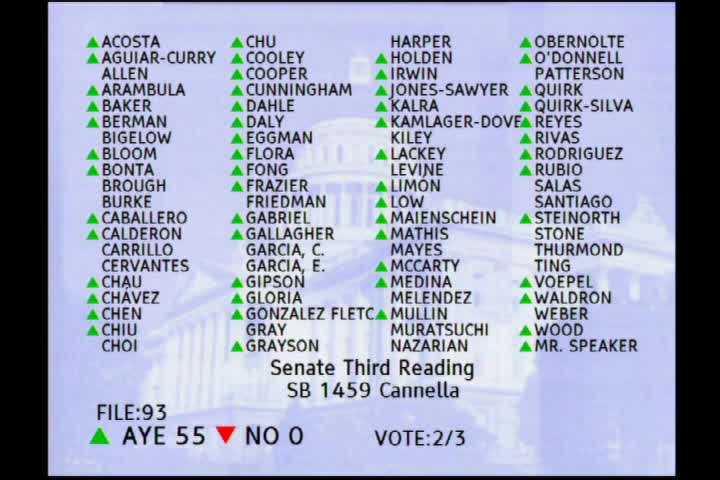 18MIN
Assembly Floor
 1H
Assembly Standing Committee on Appropriations
 32MIN
Assembly Standing Committee on Public Safety
 8MIN
Senate Floor
 9MIN
Senate Standing Committee on Public Safety
 22MIN
Senate Standing Committee on Public Safety
Bill Author

Bill Co-Author(s):






