SB 1391: Juveniles: fitness for juvenile court.
- Session Year: 2017-2018
- House: Senate
- Latest Version Date: 2018-09-30
Existing law, the Public Safety and Rehabilitation Act of 2016, as enacted by Proposition 57 at the November 8, 2016, statewide general election, allows the district attorney to make a motion to transfer a minor from juvenile court to a court of criminal jurisdiction in a case in which a minor is alleged to have committed a felony when he or she was 16 years of age or older or in a case in which a specified serious offense is alleged to have been committed by a minor when he or she was 14 or 15 years of age. The existing Public Safety and Rehabilitation Act of 2016 may be amended by a majority vote of the members of each house of the Legislature if the amendments are consistent with and further the intent of the act.
This bill would repeal the authority of a district attorney to make a motion to transfer a minor from juvenile court to a court of criminal jurisdiction in a case in which a minor is alleged to have committed a specified serious offense when he or she was 14 or 15 years of age, unless the individual was not apprehended prior to the end of juvenile court jurisdiction, thereby amending Proposition 57. By increasing the number of minors retained under the jurisdiction of the juvenile court, this bill would impose a state-mandated local program.
The California Constitution requires the state to reimburse local agencies and school districts for certain costs mandated by the state. Statutory provisions establish procedures for making that reimbursement.
This bill would provide that, if the Commission on State Mandates determines that the bill contains costs mandated by the state, reimbursement for those costs shall be made pursuant to the statutory provisions noted above.
This bill would declare that its provisions are consistent with and further the intent of Proposition 57.
Existing law, the Public Safety and Rehabilitation Act of 2016, as enacted by Proposition 57 at the November 8, 2016, statewide general election, allows the district attorney to make a motion to transfer a minor from juvenile court to a court of criminal jurisdiction in a case in which a minor is alleged to have committed a felony when he or she was 16 years of age or older or in a case in which a specified serious offense is alleged to have been committed by a minor when he or she was 14 or 15 years of age. The existing Public Safety and Rehabilitation Act of 2016 allows this provision to may be amended by a majority vote of the members of each house of the Legislature if the amendments are consistent with and further the intent of the act.
This bill would repeal the authority of a district attorney to make a motion to transfer a minor from juvenile court to a court of criminal jurisdiction in a case in which a minor is alleged to have committed a specified serious offense when he or she was 14 or 15 years of age, thereby amending Proposition 57. By increasing the number of minors retained under the jurisdiction of the juvenile court, this bill would impose a state-mandated local program.
The California Constitution requires the state to reimburse local agencies and school districts for certain costs mandated by the state. Statutory provisions establish procedures for making that reimbursement.
This bill would provide that, if the Commission on State Mandates determines that the bill contains costs mandated by the state, reimbursement for those costs shall be made pursuant to the statutory provisions noted above.
This bill would declare that its provisions are consistent with and further the intent of Proposition 57.
Existing law, the Public Safety and Rehabilitation Act of 2016, as enacted by Proposition 57 at the November 8, 2016, statewide general election, allows the district attorney to make a motion to transfer a minor from juvenile court to a court of criminal jurisdiction in a case in which a minor is alleged to have committed a felony when he or she was 16 years of age or older or in a case in which a specified serious offense is alleged to have been committed by a minor when he or she was 14 or 15 years of age. The Public Safety and Rehabilitation Act of 2016 allows this provision to be amended by a majority vote of the members of each house of the Legislature if the amendments are consistent with and further the intent of the act.
This bill would repeal the authority of a district attorney to make a motion to transfer a minor from juvenile court to a court of criminal jurisdiction in a case in which a minor is alleged to have committed a specified serious offense when he or she was 14 or 15 years of age, thereby amending Proposition 57. By increasing the number of minors retained under the jurisdiction of the juvenile court, this bill would impose a state-mandated local program.
The California Constitution requires the state to reimburse local agencies and school districts for certain costs mandated by the state. Statutory provisions establish procedures for making that reimbursement.
This bill would provide that, if the Commission on State Mandates determines that the bill contains costs mandated by the state, reimbursement for those costs shall be made pursuant to the statutory provisions noted above.
This bill would declare that its provisions are consistent with and further the intent of Proposition 57.
(a)(1)In any case in which a minor is alleged to be a person described in Section 602 by reason of the violation, when he or she was 16 years of age or older, of any offense listed in subdivision (b) or any other felony criminal statute, the district attorney or other appropriate prosecuting officer may make a motion to transfer the minor from juvenile court to a court of criminal jurisdiction. The motion shall be made prior to the attachment of jeopardy. Upon the motion, the juvenile court shall order the probation officer to submit a report on the behavioral patterns and social history of the minor. The report shall include any written or oral statement offered by the victim pursuant to Section 656.2.
(2)In any case in which an individual is alleged to be a person described in Section 602 by reason of the violation, when he or she was 14 or 15 years of age, of any offense listed in subdivision (b), but was not apprehended prior to the end of juvenile court jurisdiction, the district attorney or other appropriate prosecuting officer may make a motion to transfer the individual from juvenile court to a court of criminal jurisdiction. The motion shall be made prior to the attachment of jeopardy. Upon the motion, the juvenile court shall order the probation officer to submit a report on the behavioral patterns and social history of the individual. The report shall include any written or oral statement offered by the victim pursuant to Section 656.2.
(3)Following submission and consideration of the report, and of any other relevant evidence that the petitioner or the minor may wish to submit, the juvenile court shall decide whether the minor should be transferred to a court of criminal jurisdiction. In making its decision, the court shall consider the criteria specified in subparagraphs (A) to (E), inclusive. If the court orders a transfer of jurisdiction, the court shall recite the basis for its decision in an order entered upon the minutes. In any case in which a hearing has been noticed pursuant to this section, the court shall postpone the taking of a plea to the petition until the conclusion of the transfer hearing, and a plea that has been entered already shall not constitute evidence at the hearing.
(A)(i)The degree of criminal sophistication exhibited by the minor.
(ii)When evaluating the criterion specified in clause (i), the juvenile court may give weight to any relevant factor, including, but not limited to, the minors age, maturity, intellectual capacity, and physical, mental, and emotional health at the time of the alleged offense, the minors impetuosity or failure to appreciate risks and consequences of criminal behavior, the effect of familial, adult, or peer pressure on the minors actions, and the effect of the minors family and community environment and childhood trauma on the minors criminal sophistication.
(B)(i)Whether the minor can be rehabilitated prior to the expiration of the juvenile courts jurisdiction.
(ii)When evaluating the criterion specified in clause (i), the juvenile court may give weight to any relevant factor, including, but not limited to, the minors potential to grow and mature.
(C)(i)The minors previous delinquent history.
(ii)When evaluating the criterion specified in clause (i), the juvenile court may give weight to any relevant factor, including, but not limited to, the seriousness of the minors previous delinquent history and the effect of the minors family and community environment and childhood trauma on the minors previous delinquent behavior.
(D)(i)Success of previous attempts by the juvenile court to rehabilitate the minor.
(ii)When evaluating the criterion specified in clause (i), the juvenile court may give weight to any relevant factor, including, but not limited to, the adequacy of the services previously provided to address the minors needs.
(E)(i)The circumstances and gravity of the offense alleged in the petition to have been committed by the minor.
(ii)When evaluating the criterion specified in clause (i), the juvenile court may give weight to any relevant factor, including, but not limited to, the actual behavior of the person, the mental state of the person, the persons degree of involvement in the crime, the level of harm actually caused by the person, and the persons mental and emotional development.
(b)This subdivision is applicable to any case in which a minor is alleged to be a person described in Section 602 by reason of the violation of one of the following offenses:
(1)Murder.
(2)Arson, as provided in subdivision (a) or (b) of Section 451 of the Penal Code.
(3)Robbery.
(4)Rape with force, violence, or threat of great bodily harm.
(5)Sodomy by force, violence, duress, menace, or threat of great bodily harm.
(6)A lewd or lascivious act as provided in subdivision (b) of Section 288 of the Penal Code.
(7)Oral copulation by force, violence, duress, menace, or threat of great bodily harm.
(8)An offense specified in subdivision (a) of Section 289 of the Penal Code.
(9)Kidnapping for ransom.
(10)Kidnapping for purposes of robbery.
(11)Kidnapping with bodily harm.
(12)Attempted murder.
(13)Assault with a firearm or destructive device.
(14)Assault by any means of force likely to produce great bodily injury.
(15)Discharge of a firearm into an inhabited or occupied building.
(16)An offense described in Section 1203.09 of the Penal Code.
(17)An offense described in Section 12022.5 or 12022.53 of the Penal Code.
(18)A felony offense in which the minor personally used a weapon described in any provision listed in Section 16590 of the Penal Code.
(19)A felony offense described in Section 136.1 or 137 of the Penal Code.
(20)Manufacturing, compounding, or selling one-half ounce or more of a salt or solution of a controlled substance specified in subdivision (e) of Section 11055 of the Health and Safety Code.
(21)A violent felony, as defined in subdivision (c) of Section 667.5 of the Penal Code, which also would constitute a felony violation of subdivision (b) of Section 186.22 of the Penal Code.
(22)Escape, by the use of force or violence, from a county juvenile hall, home, ranch, camp, or forestry camp in violation of subdivision (b) of Section 871 if great bodily injury is intentionally inflicted upon an employee of the juvenile facility during the commission of the escape.
(23)Torture as described in Sections 206 and 206.1 of the Penal Code.
(24)Aggravated mayhem, as described in Section 205 of the Penal Code.
(25)Carjacking, as described in Section 215 of the Penal Code, while armed with a dangerous or deadly weapon.
(26)Kidnapping for purposes of sexual assault, as punishable in subdivision (b) of Section 209 of the Penal Code.
(27)Kidnapping as punishable in Section 209.5 of the Penal Code.
(28)The offense described in subdivision (c) of Section 26100 of the Penal Code.
(29)The offense described in Section 18745 of the Penal Code.
(30)Voluntary manslaughter, as described in subdivision (a) of Section 192 of the Penal Code.
SEC. 2.If the Commission on State Mandates determines that this act contains costs mandated by the state, reimbursement to local agencies and school districts for those costs shall be made pursuant to Part 7 (commencing with Section 17500) of Division 4 of Title 2 of the Government Code.
SEC. 3.The Legislature finds and declares that this act is consistent with and furthers the intent of Proposition 57, as enacted at the November 8, 2016, statewide general election.
(a)(1)In any case in which a minor is alleged to be a person described in Section 602 by reason of the violation, when he or she was 16 years of age or older, of any offense listed in subdivision (b) or any other felony criminal statute, the district attorney or other appropriate prosecuting officer may make a motion to transfer the minor from juvenile court to a court of criminal jurisdiction. The motion shall be made prior to the attachment of jeopardy. Upon the motion, the juvenile court shall order the probation officer to submit a report on the behavioral patterns and social history of the minor. The report shall include any written or oral statement offered by the victim pursuant to Section 656.2.
(2)In any case in which an individual is alleged to be a person described in Section 602 by reason of the violation, when he or she was 14 or 15 years of age, of any offense listed in subdivision (b), but was not apprehended prior to the end of juvenile court jurisdiction, the district attorney or other appropriate prosecuting officer may make a motion to transfer the individual from juvenile court to a court of criminal jurisdiction. The motion shall be made prior to the attachment of jeopardy. Upon the motion, the juvenile court shall order the probation officer to submit a report on the behavioral patterns and social history of the individual. The report shall include any written or oral statement offered by the victim pursuant to Section 656.2.
(2)(3)Following submission and consideration of the report, and of any other relevant evidence that the petitioner or the minor may wish to submit, the juvenile court shall decide whether the minor should be transferred to a court of criminal jurisdiction. In making its decision, the court shall consider the criteria specified in subparagraphs (A) to (E). (E), inclusive. If the court orders a transfer of jurisdiction, the court shall recite the basis for its decision in an order entered upon the minutes. In any case in which a hearing has been noticed pursuant to this section, the court shall postpone the taking of a plea to the petition until the conclusion of the transfer hearing, and a plea that has been entered already shall not constitute evidence at the hearing.
(A)(i)The degree of criminal sophistication exhibited by the minor.
(ii)When evaluating the criterion specified in clause (i), the juvenile court may give weight to any relevant factor, including, but not limited to, the minors age, maturity, intellectual capacity, and physical, mental, and emotional health at the time of the alleged offense, the minors impetuosity or failure to appreciate risks and consequences of criminal behavior, the effect of familial, adult, or peer pressure on the minors actions, and the effect of the minors family and community environment and childhood trauma on the minors criminal sophistication.
(B)(i)Whether the minor can be rehabilitated prior to the expiration of the juvenile courts jurisdiction.
(ii)When evaluating the criterion specified in clause (i), the juvenile court may give weight to any relevant factor, including, but not limited to, the minors potential to grow and mature.
(C)(i)The minors previous delinquent history.
(ii)When evaluating the criterion specified in clause (i), the juvenile court may give weight to any relevant factor, including, but not limited to, the seriousness of the minors previous delinquent history and the effect of the minors family and community environment and childhood trauma on the minors previous delinquent behavior.
(D)(i)Success of previous attempts by the juvenile court to rehabilitate the minor.
(ii)When evaluating the criterion specified in clause (i), the juvenile court may give weight to any relevant factor, including, but not limited to, the adequacy of the services previously provided to address the minors needs.
(E)(i)The circumstances and gravity of the offense alleged in the petition to have been committed by the minor.
(ii)When evaluating the criterion specified in clause (i), the juvenile court may give weight to any relevant factor, including including, but not limited to, the actual behavior of the person, the mental state of the person, the persons degree of involvement in the crime, the level of harm actually caused by the person, and the persons mental and emotional development.
(b)This subdivision is applicable to any case in which a minor is alleged to be a person described in Section 602 by reason of the violation of one of the following offenses:
(1)Murder.
(2)Arson, as provided in subdivision (a) or (b) of Section 451 of the Penal Code.
(3)Robbery.
(4)Rape with force, violence, or threat of great bodily harm.
(5)Sodomy by force, violence, duress, menace, or threat of great bodily harm.
(6)A lewd or lascivious act as provided in subdivision (b) of Section 288 of the Penal Code.
(7)Oral copulation by force, violence, duress, menace, or threat of great bodily harm.
(8)An offense specified in subdivision (a) of Section 289 of the Penal Code.
(9)Kidnapping for ransom.
(10)Kidnapping for purposes of robbery.
(11)Kidnapping with bodily harm.
(12)Attempted murder.
(13)Assault with a firearm or destructive device.
(14)Assault by any means of force likely to produce great bodily injury.
(15)Discharge of a firearm into an inhabited or occupied building.
(16)An offense described in Section 1203.09 of the Penal Code.
(17)An offense described in Section 12022.5 or 12022.53 of the Penal Code.
(18)A felony offense in which the minor personally used a weapon described in any provision listed in Section 16590 of the Penal Code.
(19)A felony offense described in Section 136.1 or 137 of the Penal Code.
(20)Manufacturing, compounding, or selling one-half ounce or more of a salt or solution of a controlled substance specified in subdivision (e) of Section 11055 of the Health and Safety Code.
(21)A violent felony, as defined in subdivision (c) of Section 667.5 of the Penal Code, which also would constitute a felony violation of subdivision (b) of Section 186.22 of the Penal Code.
(22)Escape, by the use of force or violence, from a county juvenile hall, home, ranch, camp, or forestry camp in violation of subdivision (b) of Section 871 if great bodily injury is intentionally inflicted upon an employee of the juvenile facility during the commission of the escape.
(23)Torture as described in Sections 206 and 206.1 of the Penal Code.
(24)Aggravated mayhem, as described in Section 205 of the Penal Code.
(25)Carjacking, as described in Section 215 of the Penal Code, while armed with a dangerous or deadly weapon.
(26)Kidnapping for purposes of sexual assault, as punishable in subdivision (b) of Section 209 of the Penal Code.
(27)Kidnapping as punishable in Section 209.5 of the Penal Code.
(28)The offense described in subdivision (c) of Section 26100 of the Penal Code.
(29)The offense described in Section 18745 of the Penal Code.
(30)Voluntary manslaughter, as described in subdivision (a) of Section 192 of the Penal Code.
SEC. 2.If the Commission on State Mandates determines that this act contains costs mandated by the state, reimbursement to local agencies and school districts for those costs shall be made pursuant to Part 7 (commencing with Section 17500) of Division 4 of Title 2 of the Government Code.
SEC. 3.The Legislature finds and declares that this act is consistent with and furthers the intent of Proposition 57, as enacted at the November 8, 2016, statewide general election.
(a)(1)In any case in which a minor is alleged to be a person described in Section 602 by reason of the violation, when he or she was 16 years of age or older, of any offense listed in subdivision (b) or any other felony criminal statute, the district attorney or other appropriate prosecuting officer may make a motion to transfer the minor from juvenile court to a court of criminal jurisdiction. The motion shall be made prior to the attachment of jeopardy. Upon the motion, the juvenile court shall order the probation officer to submit a report on the behavioral patterns and social history of the minor. The report shall include any written or oral statement offered by the victim pursuant to Section 656.2.
(2)Following submission and consideration of the report, and of any other relevant evidence that the petitioner or the minor may wish to submit, the juvenile court shall decide whether the minor should be transferred to a court of criminal jurisdiction. In making its decision, the court shall consider the criteria specified in subparagraphs (A) to (E). If the court orders a transfer of jurisdiction, the court shall recite the basis for its decision in an order entered upon the minutes. In any case in which a hearing has been noticed pursuant to this section, the court shall postpone the taking of a plea to the petition until the conclusion of the transfer hearing, and a plea that has been entered already shall not constitute evidence at the hearing.
(A)(i)The degree of criminal sophistication exhibited by the minor.
(ii)When evaluating the criterion specified in clause (i), the juvenile court may give weight to any relevant factor, including, but not limited to, the minors age, maturity, intellectual capacity, and physical, mental, and emotional health at the time of the alleged offense, the minors impetuosity or failure to appreciate risks and consequences of criminal behavior, the effect of familial, adult, or peer pressure on the minors actions, and the effect of the minors family and community environment and childhood trauma on the minors criminal sophistication.
(B)(i)Whether the minor can be rehabilitated prior to the expiration of the juvenile courts jurisdiction.
(ii)When evaluating the criterion specified in clause (i), the juvenile court may give weight to any relevant factor, including, but not limited to, the minors potential to grow and mature.
(C)(i)The minors previous delinquent history.
(ii)When evaluating the criterion specified in clause (i), the juvenile court may give weight to any relevant factor, including, but not limited to, the seriousness of the minors previous delinquent history and the effect of the minors family and community environment and childhood trauma on the minors previous delinquent behavior.
(D)(i)Success of previous attempts by the juvenile court to rehabilitate the minor.
(ii)When evaluating the criterion specified in clause (i), the juvenile court may give weight to any relevant factor, including, but not limited to, the adequacy of the services previously provided to address the minors needs.
(E)(i)The circumstances and gravity of the offense alleged in the petition to have been committed by the minor.
(ii)When evaluating the criterion specified in clause (i), the juvenile court may give weight to any relevant factor, including but not limited to, the actual behavior of the person, the mental state of the person, the persons degree of involvement in the crime, the level of harm actually caused by the person, and the persons mental and emotional development.
(b)This subdivision is applicable in to any case in which a minor is alleged to be a person described in Section 602 by reason of the violation of one of the following offenses:
(1)Murder.
(2)Arson, as provided in subdivision (a) or (b) of Section 451 of the Penal Code.
(3)Robbery.
(4)Rape with force, violence, or threat of great bodily harm.
(5)Sodomy by force, violence, duress, menace, or threat of great bodily harm.
(6)A lewd or lascivious act as provided in subdivision (b) of Section 288 of the Penal Code.
(7)Oral copulation by force, violence, duress, menace, or threat of great bodily harm.
(8)An offense specified in subdivision (a) of Section 289 of the Penal Code.
(9)Kidnapping for ransom.
(10)Kidnapping for purposes of robbery.
(11)Kidnapping with bodily harm.
(12)Attempted murder.
(13)Assault with a firearm or destructive device.
(14)Assault by any means of force likely to produce great bodily injury.
(15)Discharge of a firearm into an inhabited or occupied building.
(16)An offense described in Section 1203.09 of the Penal Code.
(17)An offense described in Section 12022.5 or 12022.53 of the Penal Code.
(18)A felony offense in which the minor personally used a weapon described in any provision listed in Section 16590 of the Penal Code.
(19)A felony offense described in Section 136.1 or 137 of the Penal Code.
(20)Manufacturing, compounding, or selling one-half ounce or more of a salt or solution of a controlled substance specified in subdivision (e) of Section 11055 of the Health and Safety Code.
(21)A violent felony, as defined in subdivision (c) of Section 667.5 of the Penal Code, which also would constitute a felony violation of subdivision (b) of Section 186.22 of the Penal Code.
(22)Escape, by the use of force or violence, from a county juvenile hall, home, ranch, camp, or forestry camp in violation of subdivision (b) of Section 871 if great bodily injury is intentionally inflicted upon an employee of the juvenile facility during the commission of the escape.
(23)Torture as described in Sections 206 and 206.1 of the Penal Code.
(24)Aggravated mayhem, as described in Section 205 of the Penal Code.
(25)Carjacking, as described in Section 215 of the Penal Code, while armed with a dangerous or deadly weapon.
(26)Kidnapping for purposes of sexual assault, as punishable in subdivision (b) of Section 209 of the Penal Code.
(27)Kidnapping as punishable in Section 209.5 of the Penal Code.
(28)The offense described in subdivision (c) of Section 26100 of the Penal Code.
(29)The offense described in Section 18745 of the Penal Code.
(30)Voluntary manslaughter, as described in subdivision (a) of Section 192 of the Penal Code.
SEC. 2.If the Commission on State Mandates determines that this act contains costs mandated by the state, reimbursement to local agencies and school districts for those costs shall be made pursuant to Part 7 (commencing with Section 17500) of Division 4 of Title 2 of the Government Code.
SEC. 3.The Legislature finds and declares that this act is consistent with and furthers the intent of Proposition 57, as enacted at the November 8, 2016, statewide general election.
(a)(1)In any case in which a minor is alleged to be a person described in Section 602 by reason of the violation, when he or she was 16 years of age or older, of any offense listed in subdivision (b) or any other felony criminal statute, or of an offense listed in subdivision (b) when he or she was 14 or 15 years of age, the district attorney or other appropriate prosecuting officer may make a motion to transfer the minor from juvenile court to a court of criminal jurisdiction. The motion must shall be made prior to the attachment of jeopardy. Upon such the motion, the juvenile court shall order the probation officer to submit a report on the behavioral patterns and social history of the minor. The report shall include any written or oral statement offered by the victim pursuant to Section 656.2.
(2)Following submission and consideration of the report, and of any other relevant evidence that the petitioner or the minor may wish to submit, the juvenile court shall decide whether the minor should be transferred to a court of criminal jurisdiction. In making its decision, the court shall consider the criteria specified in subparagraphs (A) to (E). If the court orders a transfer of jurisdiction, the court shall recite the basis for its decision in an order entered upon the minutes. In any case in which a hearing has been noticed pursuant to this section, the court shall postpone the taking of a plea to the petition until the conclusion of the transfer hearing, and no a plea that may have has been entered already shall not constitute evidence at the hearing.
(A)(i)The degree of criminal sophistication exhibited by the minor.
(ii)When evaluating the criterion specified in clause (i), the juvenile court may give weight to any relevant factor, including, but not limited to, the minors age, maturity, intellectual capacity, and physical, mental, and emotional health at the time of the alleged offense, the minors impetuosity or failure to appreciate risks and consequences of criminal behavior, the effect of familial, adult, or peer pressure on the minors actions, and the effect of the minors family and community environment and childhood trauma on the minors criminal sophistication.
(B)(i)Whether the minor can be rehabilitated prior to the expiration of the juvenile courts jurisdiction.
(ii)When evaluating the criterion specified in clause (i), the juvenile court may give weight to any relevant factor, including, but not limited to, the minors potential to grow and mature.
(C)(i)The minors previous delinquent history.
(ii)When evaluating the criterion specified in clause (i), the juvenile court may give weight to any relevant factor, including, but not limited to, the seriousness of the minors previous delinquent history and the effect of the minors family and community environment and childhood trauma on the minors previous delinquent behavior.
(D)(i)Success of previous attempts by the juvenile court to rehabilitate the minor.
(ii)When evaluating the criterion specified in clause (i), the juvenile court may give weight to any relevant factor, including, but not limited to, the adequacy of the services previously provided to address the minors needs.
(E)(i)The circumstances and gravity of the offense alleged in the petition to have been committed by the minor.
(ii)When evaluating the criterion specified in clause (i), the juvenile court may give weight to any relevant factor, including but not limited to, the actual behavior of the person, the mental state of the person, the persons degree of involvement in the crime, the level of harm actually caused by the person, and the persons mental and emotional development.
(b)Subdivision (a) shall be This subdivision is applicable in any case in which a minor is alleged to be a person described in Section 602 by reason of the violation of one of the following offenses when he or she was 14 or 15 years of age: offenses:
(1)Murder.
(2)Arson, as provided in subdivision (a) or (b) of Section 451 of the Penal Code.
(3)Robbery.
(4)Rape with force, violence, or threat of great bodily harm.
(5)Sodomy by force, violence, duress, menace, or threat of great bodily harm.
(6)A lewd or lascivious act as provided in subdivision (b) of Section 288 of the Penal Code.
(7)Oral copulation by force, violence, duress, menace, or threat of great bodily harm.
(8)An offense specified in subdivision (a) of Section 289 of the Penal Code.
(9)Kidnapping for ransom.
(10)Kidnapping for purposes of robbery.
(11)Kidnapping with bodily harm.
(12)Attempted murder.
(13)Assault with a firearm or destructive device.
(14)Assault by any means of force likely to produce great bodily injury.
(15)Discharge of a firearm into an inhabited or occupied building.
(16)An offense described in Section 1203.09 of the Penal Code.
(17)An offense described in Section 12022.5 or 12022.53 of the Penal Code.
(18)A felony offense in which the minor personally used a weapon described in any provision listed in Section 16590 of the Penal Code.
(19)A felony offense described in Section 136.1 or 137 of the Penal Code.
(20)Manufacturing, compounding, or selling one-half ounce or more of a salt or solution of a controlled substance specified in subdivision (e) of Section 11055 of the Health and Safety Code.
(21)A violent felony, as defined in subdivision (c) of Section 667.5 of the Penal Code, which also would constitute a felony violation of subdivision (b) of Section 186.22 of the Penal Code.
(22)Escape, by the use of force or violence, from a county juvenile hall, home, ranch, camp, or forestry camp in violation of subdivision (b) of Section 871 if great bodily injury is intentionally inflicted upon an employee of the juvenile facility during the commission of the escape.
(23)Torture as described in Sections 206 and 206.1 of the Penal Code.
(24)Aggravated mayhem, as described in Section 205 of the Penal Code.
(25)Carjacking, as described in Section 215 of the Penal Code, while armed with a dangerous or deadly weapon.
(26)Kidnapping for purposes of sexual assault, as punishable in subdivision (b) of Section 209 of the Penal Code.
(27)Kidnapping as punishable in Section 209.5 of the Penal Code.
(28)The offense described in subdivision (c) of Section 26100 of the Penal Code.
(29)The offense described in Section 18745 of the Penal Code.
(30)Voluntary manslaughter, as described in subdivision (a) of Section 192 of the Penal Code.
SEC. 2.If the Commission on State Mandates determines that this act contains costs mandated by the state, reimbursement to local agencies and school districts for those costs shall be made pursuant to Part 7 (commencing with Section 17500) of Division 4 of Title 2 of the Government Code.
SEC. 3.The Legislature finds and declares that this act is consistent with and furthers the intent of Proposition 57, as enacted at the November 8, 2016, statewide general election.
|
Date
|
Status
|
|---|---|
| Sep 30, 2018 | Chaptered by Secretary of State. Chapter 1012, Statutes of 2018. |
| Sep 30, 2018 | Approved by the Governor. |
| Sep 7, 2018 | Enrolled and presented to the Governor at 4 p.m. |
| Aug 30, 2018 | Assembly amendments concurred in. (Ayes 22. Noes 15.) Ordered to engrossing and enrolling. |
| Aug 29, 2018 | In Senate. Concurrence in Assembly amendments pending. |
| Aug 29, 2018 | Read third time. Passed. Ordered to the Senate. |
| Aug 21, 2018 | Read second time. Ordered to third reading. |
| Aug 20, 2018 | Read second time and amended. Ordered to second reading. |
| Aug 16, 2018 | From committee: Do pass as amended. (Ayes 12. Noes 0.) (August 16). |
| Aug 8, 2018 | August 8 set for first hearing. Placed on suspense file. |
| Jun 26, 2018 | From committee: Do pass and re-refer to Com. on APPR. (Ayes 5. Noes 2.) (June 26). Re-referred to Com. on APPR. |
| Jun 11, 2018 | Referred to Com. on PUB. S. |
| May 31, 2018 | In Assembly. Read first time. Held at Desk. |
| May 30, 2018 | Read third time. Passed. (Ayes 23. Noes 15.) Ordered to the Assembly. |
| May 29, 2018 | Read second time. Ordered to third reading. |
| May 25, 2018 | From committee: Do pass as amended. (Ayes 5. Noes 2.) (May 25). |
| May 18, 2018 | Set for hearing May 25. |
| Apr 23, 2018 | April 23 hearing: Placed on APPR. suspense file. |
| Apr 13, 2018 | Set for hearing April 23. |
| Apr 11, 2018 | April 16 set for first hearing canceled at the request of author. |
| Apr 9, 2018 | Set for hearing April 16. |
| Apr 3, 2018 | From committee: Do pass and re-refer to Com. on APPR. (Ayes 5. Noes 1.) (April 3). Re-referred to Com. on APPR. |
| Mar 14, 2018 | Set for hearing April 3. |
| Mar 8, 2018 | Referred to Com. on PUB. S. |
| Feb 20, 2018 | From printer. May be acted upon on or after March 22. |
| Feb 16, 2018 | Introduced. Read first time. To Com. on RLS. for assignment. To print. |
|
Date
|
Description
|
Location
|
Votes
|
|
|---|---|---|---|---|
| Aug 30, 2018 | Unfinished Business SB1391 Lara et al. Concurrence | Senate Floor |
Passed |
|
| Aug 29, 2018 | SB 1391 Lara Senate Third Reading By CHIU | Assembly Floor |
Passed |
|
| Aug 16, 2018 | Do pass as amended. | Assembly Standing Committee on Appropriations |
Passed |
|
| Jun 26, 2018 | Do pass and be re-referred to the Committee on [Appropriations] | Assembly Standing Committee on Public Safety |
Passed |
|
| May 30, 2018 | Senate 3rd Reading SB1391 Lara et al. | Senate Floor |
Passed |
|
| May 25, 2018 | Do pass as amended | Senate Standing Committee on Appropriations |
Passed |
|
| Apr 23, 2018 | Placed on suspense file | Senate Standing Committee on Appropriations |
Passed |
|
| Apr 3, 2018 | Do pass, but first be re-referred to the Committee on [Appropriations] | Senate Standing Committee on Public Safety |
Passed |
This list shows positions taken on this bill by organizations on the date displayed, which is linked to the original source.
Positions by individuals are not included.
|
Organization
|
Position
|
Date
|
|---|---|---|
| #cut50 | ** Support | Aug 30, 2018 |
| A.L. Costa Community Development Center | ** Support | Aug 30, 2018 |
| Aclu Of California, Center For Advocacy And Policy | ** Support | Aug 30, 2018 |
| Advocate for Justice | * Support | Jun 26, 2018 |
| Al Wooten Jr. Heritage Center | ** Support | Jun 25, 2018 |
| All Saints Church Foster Care Project | ** Support | Jun 25, 2018 |
| Alliance for Boys and Men of Color | * Support | Apr 3, 2018 |
| Alternate Public Defender'S Office, Los Angeles | ** Support | Jun 25, 2018 |
| American Academy of Pediatrics | ** Support | Aug 30, 2018 |
| Anti-police Terror Project | * Support | Jun 26, 2018 |
| Anti-Recidivism Coalition | ** Support | Aug 30, 2018 |
| Arts for Incarcerated Youth Network | ** Support | Jun 25, 2018 |
| Asian Americans Advancing Justice | * Support | Jun 26, 2018 |
| Asian Law Alliance | ** Support | Aug 30, 2018 |
| Association For Los Angeles Deputy Sheriffs | ** Against | Aug 30, 2018 |
| Association of Deputy District Attorneys | * Against | Jun 26, 2018 |
| Berkeley Organizing Congregations For Action | ** Support | Aug 30, 2018 |
| Berkeley Underground Scholars | ** Support | Aug 30, 2018 |
| Beyond The Stats At Uc Davis | ** Support | Aug 30, 2018 |
| Beyond The Status | ** Support | Jun 25, 2018 |
| Building Opportunities for Self-Sufficiency | ** Support | Aug 30, 2018 |
| California Academy of Child and Adolescent Psychiatry | * Support | Jun 26, 2018 |
| California Alliance for Youth and Community Justice | ** Support | Apr 3, 2018 |
| California Attorney's for Criminal Justice | * Support | Apr 3, 2018 |
| California Catholic Conference | ** Support | Aug 30, 2018 |
| California Civil Liberties Advocacy | ** Support | Aug 30, 2018 |
| California Coalition for Women Prisoners | * Support | Jun 26, 2018 |
| California District Attorneys Association | ** Against | Aug 30, 2018 |
| California Institute of Integral Studies | ** Support | Jun 25, 2018 |
| California Police Chiefs Association | ** Against | Aug 30, 2018 |
| California Public Defenders Association | ** Support | Aug 30, 2018 |
| California School-Based Heath Alliance | ** Support | Jun 25, 2018 |
| California State Conference of the NAACP | ** Support | Aug 30, 2018 |
| California State PTA | ** Support | Jun 25, 2018 |
| California State Sheriffs' Association | ** Against | Aug 30, 2018 |
| Californians for Safety and Justice | * Support | Jun 26, 2018 |
| Californians United for a Responsible Budget | ** Support | Aug 30, 2018 |
| Campaign for Youth Justice | ** Support | Aug 30, 2018 |
| Cares for Youth | * Support | Jun 26, 2018 |
| Center For Juvenile Law And Policy | ** Support | Aug 30, 2018 |
| Center on Juvenile and Criminal Justice | ** Support | Aug 30, 2018 |
| Centro Cha | ** Support | Aug 30, 2018 |
| Children's Advocacy Institute | ** Support | Aug 30, 2018 |
| Children's Defense Fund- California | ** Support | Aug 30, 2018 |
| Children'S Law Center Of California | ** Support | Aug 30, 2018 |
| Coalition for Justice and Accountability | ** Support | Aug 30, 2018 |
| Code 50 | * Support | Jun 26, 2018 |
| Coleman advocates for Children & Youth | ** Support | Aug 30, 2018 |
| Commonweal Juvenile Justice Program | ** Support | Jun 25, 2018 |
| Community Agency For Resources | ** Support | Jun 25, 2018 |
| Community Agency For Resources Advocacy And Services | ** Support | Aug 30, 2018 |
| Community Agency for Resources, Advocacy, and Services | * Support | Jun 26, 2018 |
| Community Development Technologies Center | ** Support | Aug 30, 2018 |
| Connecticut Juvenile Justice Alliance | ** Support | Aug 30, 2018 |
| Courage Campaign | ** Support | Aug 30, 2018 |
| Digging in Power Now | * Support | Jun 26, 2018 |
| Drug Policy Alliance | * Support | Apr 3, 2018 |
| East Bay Community Law Center | ** Support | Jun 25, 2018 |
| Ella Baker Center For Human Rights | ** Support | Aug 30, 2018 |
| Everychild Foundation | ** Support | Jun 25, 2018 |
| Fair Chance Project | ** Support | Jun 25, 2018 |
| Fathers and Families of San Joaquin | ** Support | Jun 25, 2018 |
| Felony Murder Elimination Act | ** Support | Aug 30, 2018 |
| Felony Murder Elimination Project | * Support | Jun 26, 2018 |
| Foster Care Project | ** Support | Jun 25, 2018 |
| Freedom for Youth | * Support | Jun 26, 2018 |
| Friends Committee On Legislation Of California | ** Support | Aug 30, 2018 |
| Healing Dialogue and Action | ** Support | Aug 30, 2018 |
| Hermanos Macehual | ** Support | Aug 30, 2018 |
| Human Rights Watch | ** Support | Aug 30, 2018 |
| Insideout | ** Support | Jun 25, 2018 |
| Jeff Adachi, San Francisco Public Defender | * Support | Apr 3, 2018 |
| Jesuit Restoration Justice Institution | * Support | Apr 3, 2018 |
| Just Detention International | ** Support | Jun 25, 2018 |
| Justice Coalition | * Support | Jun 26, 2018 |
| Justice Policy Institute | ** Support | Aug 30, 2018 |
| Juvenile Justice Initiative | ** Support | Aug 30, 2018 |
| juvenile law center | ** Support | Aug 30, 2018 |
| LA County Public Defender | * Support | Jun 26, 2018 |
| Labor Community Strategy Center | ** Support | Jun 25, 2018 |
| Law Offices Of Donald R. Hammond | ** Support | Jun 25, 2018 |
| League Of Women Voters Of California | ** Support | Jun 25, 2018 |
| Legal Services for Children | ** Support | Aug 30, 2018 |
| Legal Services for Prisoners with Children | ** Support | Aug 30, 2018 |
| Los Angeles County District Attorney | * Against | Jun 26, 2018 |
| Los Angeles District Attorney | ** Against | Jun 25, 2018 |
| Los Angeles Police Protective League | ** Against | Aug 30, 2018 |
| Louisiana Center For Children'S Rights | ** Support | Aug 30, 2018 |
| Minor Differences | ** Support | Aug 30, 2018 |
| Motivated Individual Leadership for Public Advancement | * Support | Jun 26, 2018 |
| Motivating Individual Leadership for Public Advancement | ** Support | Aug 30, 2018 |
| National Association for Social Workers, California Chapter | * Support | Apr 3, 2018 |
| National Association of Social Workers | ** Support | Jun 25, 2018 |
| National Center for Lesbian Rights | ** Support | Aug 30, 2018 |
| National Center for Youth Law | ** Support | Aug 30, 2018 |
| National Compadres Network | ** Support | Jun 25, 2018 |
| National Juvenile Justice Network | ** Support | Aug 30, 2018 |
| National Youth Law | * Support | Apr 3, 2018 |
| Oakland Unified School District | * Support | Jun 26, 2018 |
| Pacific Juvenile Defender Center | ** Support | Aug 30, 2018 |
| PACT: People Acting in Community Together | * Support | Jun 26, 2018 |
| Pillars of the Community | * Support | Apr 3, 2018 |
| Prison Law Office | ** Support | Aug 30, 2018 |
| Progressive Christians Uniting | ** Support | Aug 30, 2018 |
| Project Rebound | ** Support | Aug 30, 2018 |
| Public Counsel | ** Support | Jun 25, 2018 |
| PURPOSE | ** Against | Apr 2, 2018 |
| Reentry Solutions Group | ** Support | Aug 30, 2018 |
| Resilience Orange County | ** Support | Jun 25, 2018 |
| Restore Justice | * Support | Jun 26, 2018 |
| Riverside Sheriffs' Association | * Against | Jun 26, 2018 |
| Root and Rebound | ** Support | Aug 30, 2018 |
| Sacramento Area Youth Speaks | ** Support | Aug 30, 2018 |
| Sacramento State University | * Support | Apr 3, 2018 |
| San Francisco California | * Support | Jun 26, 2018 |
| San Francisco Public Defenders Office | ** Support | Aug 30, 2018 |
| Santa Clara County | * Support | Jun 26, 2018 |
| SAR | * Support | Jun 26, 2018 |
| Services, Immigrant Rights and Education Network | ** Support | Aug 30, 2018 |
| Several individuals | ** Support | Aug 30, 2018 |
| Silicon Valley De-Bug | ** Support | Aug 30, 2018 |
| Silicon Valley Diva | * Support | Jun 26, 2018 |
| Sillicon Valley De-Bug | ** Support | Jun 25, 2018 |
| Spirit Awakening Foundation | ** Support | Jun 25, 2018 |
| Texas Criminal Justice Coalition | ** Support | Aug 30, 2018 |
| The Advocacy Fund | ** Support | Aug 30, 2018 |
| The Burns Institute | * Support | Jun 26, 2018 |
| The Burns Institute | * Support | Jun 26, 2018 |
| The Campaign For The Fair Sentencing Of Youth | ** Support | Aug 30, 2018 |
| the children's initiative | ** Support | Aug 30, 2018 |
| The New Jersey Parent'S Caucus | ** Support | Aug 30, 2018 |
| The Sentencing Project | ** Support | Aug 30, 2018 |
| Twenty Three Private Individual | ** Support | Jun 25, 2018 |
| UC Davis | * Support | Apr 3, 2018 |
| UC Riverside | * Support | Apr 3, 2018 |
| Uncommon Law | ** Support | Jun 25, 2018 |
| Underground Scholars Initiative | * Support | Apr 3, 2018 |
| Urban Peace Institute | ** Support | Jun 25, 2018 |
| USC | * Support | Apr 3, 2018 |
| Usc Gould School Of Law Post-Conviction Justice Project | ** Support | Aug 30, 2018 |
| W. Hayward Burns Institute | * Support | Jun 26, 2018 |
| W. Haywood Burns Institute | ** Support | Aug 30, 2018 |
| W. Haywood Burns Institute | * Support | Apr 3, 2018 |
| Welcome Home La Reentry | ** Support | Jun 25, 2018 |
| Women's Foundation of California | ** Support | Jun 25, 2018 |
| women's leadership project | ** Support | Jun 25, 2018 |
| Yerba Mate Co. | * Support | Apr 3, 2018 |
| YJC | * Support | Jun 26, 2018 |
| Yolo County Public Defender's Office | * Support | Jun 26, 2018 |
| Young Minds Advocacy | ** Support | Aug 30, 2018 |
| Young Women's Freedom Center | ** Support | Aug 30, 2018 |
| Youth ALIVE! | ** Support | Aug 30, 2018 |
| Youth Justice Coalition | ** Support | Aug 30, 2018 |
| Youth Law Center | ** Support | Aug 30, 2018 |
| Youth Social Justice Coalition | * Support | Jun 26, 2018 |
| Youth United for Community Action | ** Support | Jun 25, 2018 |
Office of Senate Floor Analyses (916) 651-1520 Fax: (916) 327-4478 | SB |
UNFINISHED BUSINESS
Bill No: SB 1391
Amended:
SENATE PUBLIC SAFETY COMMITTEE: 5-1, 4/3/18
AYES: Skinner, Bradford, Jackson, Mitchell, Wiener
NOES: Stone
NO VOTE RECORDED: Anderson
SENATE APPROPRIATIONS COMMITTEE: 5-2, 5/25/18
AYES: Lara, Beall, Bradford, Hill, Wiener
NOES: Bates, Nielsen
SENATE FLOOR: 23-15, 5/30/18
AYES: Allen, Atkins, Beall, Bradford, De León, Dodd, Hernandez, Hertzberg, Hill, Hueso, Jackson, Lara, Leyva, McGuire, Mitchell, Monning, Pan, Portantino, Roth, Skinner, Stern, Wieckowski, Wiener
NOES: Anderson, Bates, Berryhill, Cannella, Fuller, Gaines, Galgiani, Glazer, Moorlach, Morrell, Nguyen, Nielsen, Stone, Vidak, Wilk
NO VOTE RECORDED: Newman
ASSEMBLY FLOOR: 41-23, 8/29/18 - See last page for vote
SUBJECT: Juveniles: fitness for juvenile court
SOURCE: Anti-Recidivism Coalition
Human Rights Watch
National Center for Youth Law
Pacific Juvenile Defender Center
Silicon Valley De-Bug
W. Haywood Burns Institute
DIGEST:
This bill repeals the authority of a prosecutor to make a motion to transfer a minor from juvenile court to adult criminal court if the minor was alleged to have committed certain serious offenses when he or she was 14 or 15 years old.
Assembly Amendments permit a prosecutor to make a motion to transfer a minor from juvenile court to adult criminal court in a case in which a minor is alleged to have committed a specified serious offense when he or she was 14 or 15 years of age if the individual was not apprehended prior to the end of juvenile court jurisdiction.
Existing law:
- Provides, generally, that any person under 18 years of age who commits a crime is within the jurisdiction of the juvenile court, which may adjudge that person to be a ward of the court, except as specified. (Welf. and Inst. Code § 602.)
- Permits the district attorney to make a motion to transfer the minor from juvenile court to a court of criminal jurisdiction in a case in which a minor is alleged to have committed a felony when he or she was 16 years of age or older or in a case in which a specified serious offense is alleged to have been committed by a minor when he or she was 14 or 15 years of age. (Welf. & Inst. Code § 707, subd. (a)(1).)
- Provides that upon the district attorney’s motion to transfer the minor from juvenile court to a court of criminal jurisdiction, the juvenile court is required to order the probation officer to submit a report on the behavioral patterns and social history of the minor. (Welf. & Inst. Code § 707, subd. (a)(1).)
- Provides that following submission and consideration of the report, and of any other relevant evidence that the petitioner or the minor may wish to submit, the juvenile court is required to decide whether the minor should be transferred to a court of criminal jurisdiction. In making its decision, the court is required to consider the following:
- The degree of criminal sophistication exhibited by the minor. The juvenile court may give weight to any relevant factor, including, but not limited to, the minor’s age, maturity, intellectual capacity, and physical, mental, and emotional health at the time of the alleged offense, the minor’s impetuosity or failure to appreciate risks and consequences of criminal behavior, the effect of familial, adult, or peer pressure on the minor’s actions, and the effect of the minor’s family and community environment and childhood trauma on the minor’s criminal sophistication.
- Whether the minor can be rehabilitated prior to the expiration of the juvenile court’s jurisdiction. The juvenile court may give weight to any relevant factor, including, but not limited to, the minor’s potential to grow and mature.
- The minor’s previous delinquent history. The juvenile court may give weight to any relevant factor, including, but not limited to, the seriousness of the minor’s previous delinquent history and the effect of the minor’s family and community environment and childhood trauma on the minor’s previous delinquent behavior.
- Success of previous attempts by the juvenile court to rehabilitate the minor. The juvenile court may give weight to any relevant factor, including, but not limited to, the adequacy of the services previously provided to address the minor’s needs.
- The circumstances and gravity of the offense alleged in the petition to have been committed by the minor. The juvenile court may give weight to any relevant factor, including but not limited to, the actual behavior of the person, the mental state of the person, the person’s degree of involvement in the crime, the level of harm actually caused by the person, and the person’s mental and emotional development. (Welf. & Inst. Code § 707, subd. (a)(2), criteria (A)-(E).)
- Provides that if the court orders a transfer of jurisdiction, it is required to recite the basis for its decision in an order entered upon the minutes. (Welf. & Inst. Code § 707, subd. (a)(2).)
This bill repeals the authority of a district attorney to make a motion to transfer a minor from juvenile court to a court of criminal jurisdiction in a case in which a minor is alleged to have committed a specified serious offense when he or she was 14 or 15 years of age, unless the individual was not apprehended prior to the end of juvenile court jurisdiction.
Background
History of the juvenile transfer process
The Arnold-Kennick Juvenile Court Act, enacted in 1961, established 16 as the minimum age for which a minor could be transferred from juvenile court to adult criminal court. Over 30 years later, AB 560 (Peace, Chapter 453, Statutes of 1994) lowered the age at which a minor could be transferred to adult criminal court from 16 to 14 years of age. According to the author statement included in the Senate Judiciary Committee’s analysis of AB 560:
The public is legitimately concerned that crimes of violence committed by juveniles are increasing in number and in terms of the level of violence….There is a finite number of juveniles who are under 16 who do not belong in the juvenile court system and need to be dealt with in the adult court….AB 560 takes a 707(a) approach to certain 707(b) crimes. This approach is one that juvenile court judges in San Diego County support as they feel that there are a finite number of 14 to 16 year olds who do not belong in the juvenile court and are infecting other juveniles….AB 560 is a rational response to the legitimate public desire to address what is a serious problem….AB 560 attempts to protect the public and those youngsters who we can save…. (Sen. Com. on Judiciary, Analysis of Assem. Bill 560 (1993-1994 Reg. Sess.) as amended April 21, 1994, p. 4.)
In response to the perception that juvenile crime was on the rise and more dangerous than the delinquency of earlier decades, Proposition 21 was passed by the voters on March 7, 2000. Among other things, Proposition 21 increased sentences for specified gang-related crimes, authorized a prosecutor to file charges against a juvenile offender directly in criminal court for specified felonies, prohibited the sealing of juvenile records involving Welfare and Institutions Code section 707(b) offenses, and designated additional crimes as violent and serious felonies. (Ballot Pamp., Prim. Elec. (Mar. 7, 2000), text of Prop. 21, p. 45 et seq.)
Court cases on juvenile offenders and subsequent reform efforts
Over the last several years, there have been a series of U.S. Supreme Court cases involving juvenile defendants that have recognized the inherent difference between juveniles and adults for purposes of sentencing, relying in part on research on brain and adolescent development. (See Roper v. Simmons (2005) 543 U.S. 551 [125 S.Ct. 1138, 161 L.Ed. 2d]; Graham v. Florida (2010) 560 U.S. 48 [130 S.Ct. 2011, 176 L.Ed. 825]; J.D.B. v. North Carolina (2011) 564 U.S. 261 [131 S. Ct. 2394, 180 L.Ed. 310 ]; Miller v. Alabama (2012) 567 U.S. 460 [132 S.Ct. 2455, 183 L.Ed. 2d 407].) The Court summarized those differences in Miller:
Roper and Graham establish that children are constitutionally different from adults for purposes of sentencing. Because juveniles have diminished culpability and greater prospects for reform, we explained, “they are less deserving of the most severe punishments.” Graham, 560 U.S., at 68, 130 S.Ct. 2011, 176 L.Ed. 2d 825. Those cases relied on three significant gaps between juveniles and adults. First, children have a “ ‘lack of maturity and an underdeveloped sense of responsibility,’ ” leading to recklessness, impulsivity, and heedless risk-taking. Roper, 543 U.S., at 569, 125 S.Ct. 1183, 161 L.Ed. 2d 1. Second, children “are more vulnerable . . . to negative influences and outside pressures,” including from their family and peers; they have limited “contro[l] over their own environment” and lack the ability to extricate themselves from horrific, crime-producing settings. Ibid. And third, a child’s character is not as “well formed” as an adult’s; his traits are “less fixed” and his actions less likely to be “evidence of irretrievabl[e] deprav[ity].” (567 U.S. 460, 570 [125 S.Ct. 1183, 161 L. Ed. 2d 1].)
This body of case law and the research relied upon in these cases prompted the passage of several recent juvenile justice reform measures, including SB 9 (Yee, Chapter 828, Statutes of 2012, SB 260 (Hancock, Chapter 312, Statutes of 2013), SB 261 (Hancock, Chapter 471, Statutes of 2015), AB 1308 (Stone, Chapter 675, Statutes of 2017), SB 394 (Lara, Chapter 684, Statutes of 2017), and SB 395 (Lara, Chapter 681, Statutes of 2017). In addition, the voters passed Proposition 57 on November 8, 2016, which among other things, eliminated the ability of a prosecutor to file charges against a juvenile offender directly in criminal court.
Current transfer process
Prior to the passage of Proposition 21 in 2000, a minor could be transferred from juvenile court to adult criminal court only after a judicial hearing. Proposition 21 amended Welfare and Institutions Code section 707 to give prosecutors the discretion to file cases against minors 14 and older, depending upon their age, alleged offense and offense history, in juvenile or adult criminal court. Proposition 21 also amended Welfare and Institutions Code section 602 to require the prosecution of minors 14 years of age or older in adult criminal court who were alleged to have committed special circumstances first-degree murder and specified sex offenses.
Proposition 57 repealed both of the above provisions, eliminating a prosecutor’s ability to file charges against a minor directly in adult criminal court. Currently, a minor can only be transferred to adult criminal court from juvenile court after a fitness hearing. Upon the prosecutor filing a motion to transfer the minor from juvenile court to adult criminal court, the juvenile court orders the probation officer to submit a report on the behavioral patterns and social history of the minor. The prosecutor and the minor may submit additional relevant information to aid the court in evaluating a juvenile’s fitness to remain in juvenile court.
In making a decision about whether to transfer a minor to adult criminal court, the court is required to consider the following criteria:
- The degree of criminal sophistication exhibited by the minor.
- Whether the minor can be rehabilitated prior to the expiration of the juvenile court’s jurisdiction.
- The minor’s previous delinquent history.
- Success of previous attempts by the juvenile court to rehabilitate the minor.
- The circumstances and gravity of the offense alleged in the petition to have been committed by the minor.
Welfare and Institutions Code Section 707(a) provides additional information for the court to consider when evaluating the transfer criteria. Finally, the prosecutor bears the burden of showing that a minor is unfit for juvenile court by a preponderance of the evidence. (Calif. Rules of Court, rule 5.770.)
FISCAL EFFECT: Appropriation: Fiscal Com.: Local:
According to the Assembly Appropriations Committee:
- Unknown potentially significant GF costs for the Division of Juvenile Justice (DJJ) to house youths from age 18 up to age 25 who would have otherwise been transferred to a California Department of Corrections and Rehabilitation adult prison at the age of 18. For example, if five youths annually remain in DJJ from age 18 to age 25, rather than being transferred to an adult prison at age 18, costs will be about $1.1 million the first year assuming the average cost of $303,160 for DJJ and $80,729 for an adult prison. In this example, costs will rise by $1.1 million annually until reaching roughly $7.7 million in the seventh year of implementation and will continue at $7.7 million annually.
- Potential long-term savings of an unknown amount by preventing youths from receiving extremely long sentences if adjudicated as an adult.
- Potential savings of an unknown amount to the extent that keeping youth in juvenile court and facilities designed to rehabilitate juveniles reduces recidivism.
Anti-Recidivism Coalition (co-source)
Human Rights Watch (co-source)
National Center for Youth Law (co-source)
Pacific Juvenile Defender Center (co-source)
Silicon Valley De-Bug (co-source)
W. Haywood Burns Institute (co-source)
#cut50
A.L. Costa Community Development Center
ACLU of California, Center for Advocacy and Policy
American Academy of Pediatrics
Asian Law Alliance
Berkeley Organizing Congregations for Action
Berkeley Underground Scholars
Beyond the Stats at UC Davis
Building Opportunities for Self-Sufficiency
California Catholic Conference
California Civil Liberties Advocacy
California Public Defenders Association
California State Conference of the NAACP
Californians United for a Responsible Budget
Campaign for Youth Justice
Center for Juvenile Law and Policy
Center on Juvenile and Criminal Justice
Centro CHA
Children’s Advocacy Institute
Children’s Defense Fund- California
Children’s Law Center of California
Coalition for Justice and Accountability
Coleman Advocates for Children & Youth
Community Agency for Resources Advocacy and Services
Community Development Technologies Center
Connecticut Juvenile Justice Alliance
Courage Campaign
Ella Baker Center for Human Rights
Felony Murder Elimination Act
Friends Committee on Legislation of California
Healing Dialogue and Action
Hermanos Macehual
Human Rights Watch
Justice Policy Institute
Juvenile Justice Initiative
Juvenile Law Center
Legal Services for Children
Legal Services for Prisoners with Children
Louisiana Center for Children’s Rights
Minor Differences
Motivating Individual Leadership for Public Advancement
National Center for Lesbian Rights
National Juvenile Justice Network
Pacific Juvenile Defender Center
Prison Law Office
Progressive Christians Uniting
Project Rebound
Reentry Solutions Group
Root and Rebound
Sacramento Area Youth Speaks
San Francisco Public Defenders Office
Services, Immigrant Rights and Education Network
Texas Criminal Justice Coalition
The Advocacy Fund
The Campaign for the Fair Sentencing of Youth
The Children’s Initiative
The New Jersey Parent’s Caucus
The Sentencing Project
USC Gould School of Law Post-Conviction Justice Project
USF School of Law Criminal & Juvenile Justice Clinic
Young Minds Advocacy
Young Women’s Freedom Center
Youth Alive!
Youth Justice Coalition
Youth Law Center
Several individuals
OPPOSITION: (Verified 8/27/18)
Association for Los Angeles Deputy Sheriffs
California District Attorneys Association
California Police Chiefs Association
California State Sheriffs’ Association
Los Angeles Police Protective League
ASSEMBLY FLOOR: 41-23, 8/29/18
AYES: Berman, Bloom, Bonta, Burke, Carrillo, Chávez, Chiu, Chu, Eggman, Frazier, Friedman, Gabriel, Cristina Garcia, Eduardo Garcia, Gipson, Gloria, Gonzalez Fletcher, Grayson, Holden, Jones-Sawyer, Kalra, Kamlager-Dove, Levine, Limón, Low, McCarty, Medina, Mullin, Nazarian, O'Donnell, Quirk, Reyes, Rivas, Rubio, Santiago, Mark Stone, Thurmond, Ting, Weber, Wood, Rendon
NOES: Acosta, Travis Allen, Baker, Bigelow, Brough, Caballero, Chen, Choi, Cunningham, Dahle, Flora, Fong, Gallagher, Harper, Kiley, Lackey, Melendez, Obernolte, Patterson, Quirk-Silva, Salas, Steinorth, Voepel
NO VOTE RECORDED: Aguiar-Curry, Arambula, Calderon, Cervantes, Chau, Cooley, Cooper, Daly, Gray, Irwin, Maienschein, Mathis, Mayes, Muratsuchi, Rodriguez, Waldron
8/30/18 9:16:58
**** END ****
SENATE THIRD READING
STR Bill Id:SB 1391
Author:(Lara and Mitchell)
As Amended Ver:August 20, 2018
Majority vote
SENATE VOTE: 23-15
Committee | Votes | Ayes | Noes |
Public Safety | 5-2 | Jones-Sawyer, Carrillo, Kamlager-Dove, Quirk, Santiago | Lackey, Kiley |
Appropriations | 12-0 | Gonzalez Fletcher, Bloom, Bonta, Calderon, Carrillo, Chau, Eggman, Friedman, Eduardo Garcia, Nazarian, Quirk, Reyes |
|
SUMMARY: Repeals the authority of a prosecutor to make a motion to transfer a minor from juvenile court to adult criminal court in a case in which a minor is alleged to have committed a specified serious offense when he or she was 14 or 15 years of age, unless the individual was not apprehended prior to the end of juvenile court jurisdiction.
EXISTING LAW:
- Provides that any person under 18 years of age who commits a crime is within the jurisdiction of the juvenile court, which may adjudge that person to be a ward of the court.
- Permits the district attorney to make a motion to transfer a minor from juvenile court to a court of criminal jurisdiction in a case in which a minor is alleged to have committed a felony when he or she was 16 years of age or older or in a case in which a specified serious offense is alleged to have been committed by a minor when he or she was 14 or 15 years of age. These specified serious offenses include:
- Murder;
- Arson;
- Robbery;
- Rape with force, violence, or threat of great bodily harm;
- Sodomy by force, violence, duress, menace, or threat of great bodily harm;
- A lewd or lascivious act;
- Oral copulation by force, violence, duress, menace, or threat of great bodily harm;
- An offense specified in Penal Code Section 289 subdivision (a);
- Attempted murder;
- Assault with a firearm or destructive device;
- Assault by any means of force likely to produce great bodily injury;
- Discharge of a firearm into an inhabited or occupied building;
- Burglary;
- Carjacking;
- Assault with intent to commit rape or sodomy;
- Personally using a firearm in the commission of a felony or attempted felony;
- A felony offense in which the minor personally used a weapon;
- Using force the threat of force or violence, on a witness or victim or any third person or the property of any victim, witness, or any third person;
- Manufacturing, compounding, or selling one-half ounce or more of a salt or solution of a controlled substance;
- A violent felony, as specified;
- Escape, by the use of force or violence, from a county juvenile hall, home, ranch, camp, or forestry camp, if great bodily injury is intentionally inflicted upon an employee of the juvenile facility during the commission of the escape;
- Torture;
- Aggravated mayhem;
- Carjacking, while armed with a dangerous or deadly weapon;
- Kidnapping;
- Discharging a firearm from a motor vehicle at another person;
- Exploding, igniting, or attempting to explode or ignite any destructive device or any explosive with intent to commit murder, and;
- Voluntary manslaughter.
- Provides that, upon the district attorney's motion to transfer the minor from juvenile court to a court of criminal jurisdiction, the juvenile court must order the probation officer to submit a report on the behavioral patterns and social history of the minor.
- Requires, after the submission and consideration of the probation officer's report and any other relevant evidence that the petitioner or the minor may wish to submit, the juvenile court to decide whether the minor should be transferred to a court of criminal jurisdiction. In making its decision, the court is required to consider the following:
- The degree of criminal sophistication exhibited by the minor. The juvenile court may give weight to any relevant factor, including, but not limited to, the minor's age, maturity, intellectual capacity, and physical, mental, and emotional health at the time of the alleged offense, the minor's impetuosity or failure to appreciate risks and consequences of criminal behavior, the effect of familial, adult, or peer pressure on the minor's actions, and the effect of the minor's family and community environment and childhood trauma on the minor's criminal sophistication;
- Whether the minor can be rehabilitated prior to the expiration of the juvenile court's jurisdiction. The juvenile court may give weight to any relevant factor, including, but not limited to, the minor's potential to grow and mature;
- The minor's previous delinquent history. The juvenile court may give weight to any relevant factor, including, but not limited to, the seriousness of the minor's previous delinquent history and the effect of the minor's family and community environment and childhood trauma on the minor's previous delinquent behavior;
- Success of previous attempts by the juvenile court to rehabilitate the minor. The juvenile court may give weight to any relevant factor, including, but not limited to, the adequacy of the services previously provided to address the minor's needs; and,
- The circumstances and gravity of the offense alleged in the petition to have been committed by the minor. The juvenile court may give weight to any relevant factor, including but not limited to, the actual behavior of the person, the mental state of the person, the person's degree of involvement in the crime, the level of harm actually caused by the person, and the person's mental and emotional development.
- States that if the court orders a transfer of jurisdiction, it is required to recite the basis for its decision in an order entered upon the minutes.
FISCAL EFFECT: According to the Assembly Appropriations Committee:
- Unknown potentially significant General Fund (GF) costs for the Division of Juvenile Justice (DJJ) to house youths from age 18 up to age 25 who would have otherwise been transferred to a California Department of Corrections and Rehabilitation (CDCR) adult prison at the age of 18. For example, if five youths annually remain in DJJ from age 18 to age 25, rather than being transferred to an adult prison at age 18, costs will be about $1.1 million the first year assuming the average cost of $303,160 for DJJ and $80,729 for an adult prison. In this example, costs will rise by $1.1 million annually until reaching roughly $7.7 million in the seventh year of implementation and will continue at $7.7 million annually.
- Potential long-term savings of an unknown amount by preventing youths from receiving extremely long sentences if adjudicated as an adult.
- Potential savings of an unknown amount to the extent that keeping youth in juvenile court and facilities designed to rehabilitate juveniles reduces recidivism.
COMMENTS: According to the author, "SB 1391 will prohibit children ages 14 and 15 from being tried as adults in criminal court and subsequently sent to adult prison. Currently, in California, youth ages 14 and 15 who commit crimes can be tried as adults and sentenced to adult prison. This practice was started in the 90's, a time in California history where the state was getting "tough on crime," but not smart on crime. Back then, society believed that young people were fully developed at around age 14. Now, research has debunked that myth and cognitive science has proven that children and youth who commit crimes are very capable of change. The Supreme Court has also upheld this notion, ruling in Miller v. Alabama that youth have diminished culpability due to their lack of maturity and greater prospects for reform.
"We know that sending youth to adult prison does not help our youth and it does not make our communities safer. In fact, this practice has disproportionately affected Black and Latino youth. Just over the past 10 years, 50% of Latino youth and 60% of Black youth were sent to adult court after a transfer hearing, compared to only 10% of White youth for similar crimes. Some youth sentenced to adult prison may have committed very serious crimes, but they are not the majority. In 2015, about 72% of youth under age 16 were sent to adult court for crimes such as burglary, robbery and assault.
"The youngest teens in our justice system need to be held accountable for their actions, but they also require age-appropriate services and programs to rehabilitate and grow into healthy, mature adults. Keeping youth in the juvenile system does not mean they get off with a slap on the wrist. This bill still maintains that youth who commit serious crimes deserve punishment. Keeping youth in the juvenile justice system means they will be punished, but they will also be required to be in treatment, counseling, and rehabilitative programming and education. People in the adult system are not required to be in rehabilitative programs, and many young people sentenced to adult prison don't even have access to services until further into their sentences, if at all. Youth who commit crimes fare much better in the juvenile system than in the adult system because they benefit from the rehabilitative services, and are also less likely to commit crimes in the future than youth in the adult system. This bill prioritizes public safety by providing age-appropriate resources and education to vulnerable youth."
Please see the policy committee analysis for a full discussion of this bill.
Analysis Prepared by: Liah Burnley / PUB. S. / (916) 319-3744 FN: 0004104
Date of Hearing: August 8, 2018
ASSEMBLY COMMITTEE ON APPROPRIATIONS
Lorena Gonzalez Fletcher, Chair
SBPCA Bill Id:SB 1391
Author:(Lara) – As Amended Ver:May 25, 2018
Policy Committee: | Public Safety | Vote: | 5 - 2 |
|
| ||
|
|
Urgency: No State Mandated Local Program: Yes Reimbursable: No
SUMMARY:
This bill repeals the authority of a prosecutor to make a motion to transfer a minor from juvenile court to adult criminal court in a case in which a minor is alleged to have committed a specified serious offense when the minor was 14 or 15 years old.
FISCAL EFFECT:
- Unknown potentially significant GF costs for the Division of Juvenile Justice (DJJ) to house youths from age 18 up to age 25 who would have otherwise been transferred to a California Department of Corrections and Rehabilitation (CDCR) adult prison at the age of 18. For example, if five youths annually remain in DJJ from age 18 to age 25, rather than being transferred to an adult prison at age 18, costs will be about $1.1 million the first year assuming the average cost of $303,160 for DJJ and $80,729 for an adult prison. In this example, costs will rise by $1.1 million annually until reaching roughly $7.7 million in the seventh year of implementation and will continue at $7.7 million annually.
- Potential long-term savings of an unknown amount by preventing youths from receiving extremely long sentences if adjudicated as an adult.
- Potential savings of an unknown amount to the extent that keeping youth in juvenile court and facilities designed to rehabilitate juveniles reduces recidivism.
COMMENTS:
Background and purpose. The number of juvenile cases that are transferred to adult criminal court is generally small and the subset of those cases involving a juvenile who is 14 or 15 years old is even smaller. In 2017, a total of 255 fitness hearings for juveniles of all ages were reported statewide to determine whether juveniles should have their cases remain in juvenile court or be transferred to adult criminal court. Roughly two-thirds of these cases were transferred to adult criminal court. According to the sponsors of this bill only 15 of the fitness hearings in 2017 were for juveniles age 14 or 15 and none of those cases were transferred to adult criminal court. According to the author:
SB 1391 will prohibit children ages 14 and 15 from being tried as adults in criminal court and subsequently sent to adult prison. Currently, in California, youth ages 14 and 15 who commit crimes can be tried as adults and sentenced to adult prison.
Analysis Prepared by: Jessica Peters / APPR. / (916) 319-2081
Date of Hearing: June 26, 2018
Counsel: Liah Burnley
ASSEMBLY COMMITTEE ON PUBLIC SAFETY
Reginald Byron Jones-Sawyer, Sr., Chair
SBPCA Bill Id:SB 1391
Author:(Lara) – As Amended Ver:May 25, 2018
SUMMARY: Repeals the authority of a prosecutor to make a motion to transfer a minor from juvenile court to adult criminal court in a case in which a minor is alleged to have committed a specified serious offense when he or she was 14 or 15 years of age.
EXISTING LAW:
- Provides that any person under 18 years of age who commits a crime is within the jurisdiction of the juvenile court, which may adjudge that person to be a ward of the court. (Welf. and Inst. Code § 602.)
- Permits the district attorney to make a motion to transfer a minor from juvenile court to a court of criminal jurisdiction in a case in which a minor is alleged to have committed a felony when he or she was 16 years of age or older or in a case in which a specified serious offense is alleged to have been committed by a minor when he or she was 14 or 15 years of age. These specified serious offenses include:
- Murder;
- Arson;
- Robbery;
- Rape with force, violence, or threat of great bodily harm;
- Sodomy by force, violence, duress, menace, or threat of great bodily harm;
- A lewd or lascivious act;
- Oral copulation by force, violence, duress, menace, or threat of great bodily harm;
- An offense specified in subdivision (a) of Section 289 of the Penal Code;
- Attempted murder;
- Assault with a firearm or destructive device;
- Assault by any means of force likely to produce great bodily injury;
- Discharge of a firearm into an inhabited or occupied building;
- Burglary;
- Carjacking;
- Assault with intent to commit rape or sodomy;
- Personally using a firearm in the commission of a felony or attempted felony;
- A felony offense in which the minor personally used a weapon;
- Using force the threat of force or violence, on a witness or victim or any third person or the property of any victim, witness, or any third person;
- Manufacturing, compounding, or selling one-half ounce or more of a salt or solution of a controlled substance;
- A violent felony, as specified;
- Escape, by the use of force or violence, from a county juvenile hall, home, ranch, camp, or forestry camp, if great bodily injury is intentionally inflicted upon an employee of the juvenile facility during the commission of the escape;
- Torture;
- Aggravated mayhem;
- Carjacking, while armed with a dangerous or deadly weapon;
- Kidnapping;
- Discharging a firearm from a motor vehicle at another person;
- Exploding, igniting, or attempting to explode or ignite any destructive device or any explosive with intent to commit murder, and;
- Voluntary manslaughter. (Welf. & Inst. Code §§ 707, subd. (a)(1), 707 subd. (b).)
- Provides that, upon the district attorney’s motion to transfer the minor from juvenile court to a court of criminal jurisdiction, the juvenile court must order the probation officer to submit a report on the behavioral patterns and social history of the minor. (Welf. & Inst. Code § 707, subd. (a)(1).)
- Requires, after the submission and consideration of the probation officer’s report and any other relevant evidence that the petitioner or the minor may wish to submit, the juvenile court to decide whether the minor should be transferred to a court of criminal jurisdiction. In making its decision, the court is required to consider the following:
- The degree of criminal sophistication exhibited by the minor. The juvenile court may give weight to any relevant factor, including, but not limited to, the minor’s age, maturity, intellectual capacity, and physical, mental, and emotional health at the time of the alleged offense, the minor’s impetuosity or failure to appreciate risks and consequences of criminal behavior, the effect of familial, adult, or peer pressure on the minor’s actions, and the effect of the minor’s family and community environment and childhood trauma on the minor’s criminal sophistication;
- Whether the minor can be rehabilitated prior to the expiration of the juvenile court’s jurisdiction. The juvenile court may give weight to any relevant factor, including, but not limited to, the minor’s potential to grow and mature;
- The minor’s previous delinquent history. The juvenile court may give weight to any relevant factor, including, but not limited to, the seriousness of the minor’s previous delinquent history and the effect of the minor’s family and community environment and childhood trauma on the minor’s previous delinquent behavior;
- Success of previous attempts by the juvenile court to rehabilitate the minor. The juvenile court may give weight to any relevant factor, including, but not limited to, the adequacy of the services previously provided to address the minor’s needs; and,
- The circumstances and gravity of the offense alleged in the petition to have been committed by the minor. The juvenile court may give weight to any relevant factor, including but not limited to, the actual behavior of the person, the mental state of the person, the person’s degree of involvement in the crime, the level of harm actually caused by the person, and the person’s mental and emotional development. (Welf. & Inst. Code § 707, subd. (a)(2).)
- The degree of criminal sophistication exhibited by the minor. The juvenile court may give weight to any relevant factor, including, but not limited to, the minor’s age, maturity, intellectual capacity, and physical, mental, and emotional health at the time of the alleged offense, the minor’s impetuosity or failure to appreciate risks and consequences of criminal behavior, the effect of familial, adult, or peer pressure on the minor’s actions, and the effect of the minor’s family and community environment and childhood trauma on the minor’s criminal sophistication;
- States that if the court orders a transfer of jurisdiction, it is required to recite the basis for its decision in an order entered upon the minutes. (Welf. & Inst. Code § 707, subd. (a)(2).)
FISCAL EFFECT: Unknown.
COMMENTS:
- Author’s Statement: According to the author, “SB 1391 will prohibit children ages 14 and 15 from being tried as adults in criminal court and subsequently sent to adult prison. Currently, in California, youth ages 14 and 15 who commit crimes can be tried as adults and sentenced to adult prison. This practice was started in the 90’s, a time in California history where the state was getting “tough on crime,” but not smart on crime. Back then, society believed that young people were fully developed at around age 14. Now, research has debunked that myth and cognitive science has proven that children and youth who commit crimes are very capable of change. The Supreme Court has also upheld this notion, ruling in Miller v. Alabama that youth have diminished culpability due to their lack of maturity and greater prospects for reform.
“We know that sending youth to adult prison does not help our youth and it does not make our communities safer. In fact, this practice has disproportionately affected Black and Latino youth. Just over the past 10 years, 50 percent of Latino youth and 60 percent of Black youth were sent to adult court after a transfer hearing, compared to only 10 percent of White youth for similar crimes. Some youth sentenced to adult prison may have committed very serious crimes, but they are not the majority. In 2015, about 72 percent of youth under age 16 were sent to adult court for crimes such as burglary, robbery and assault.
“The youngest teens in our justice system need to be held accountable for their actions, but they also require age-appropriate services and programs to rehabilitate and grow into healthy, mature adults. Keeping youth in the juvenile system does not mean they get off with a slap on the wrist. This bill still maintains that youth who commit serious crimes deserve punishment. Keeping youth in the juvenile justice system means they will be punished, but they will also be required to be in treatment, counseling, and rehabilitative programming and education. People in the adult system are not required to be in rehabilitative programs, and many young people sentenced to adult prison don’t even have access to services until further into their sentences, if at all. Youth who commit crimes fare much better in the juvenile system than in the adult system because they benefit from the rehabilitative services, and are also less likely to commit crimes in the future than youth in the adult system. This bill prioritizes public safety by providing age-appropriate resources and education to vulnerable youth.”
- Need for the Bill: This bill would repeal the authority of a district attorney to make a motion to transfer a minor from juvenile court to a court of criminal jurisdiction in a case in which a minor is alleged to have committed a specified serious offense when he or she was 14 or 15 years of age.
The goal of the juvenile justice system is to rehabilitate, not punish, juvenile offenders. The juvenile system is designed to “promote community restoration, family ties, and accountability to victims, and to produce youth who become law-abiding and productive members of society. (Welf. & Inst. Code, § 1710 subd. (b)(2).) Staff at juvenile justice facilities, unlike staff at adult facilities, are trained to address needs particular to youth and the juvenile system requires youth to receive the same compulsory education provided to all children in the state. This is important because most youth in juvenile detention have experienced at least one traumatic experience within the past year including witnessing violence. (See U.S. Department of Justice (2013) PTSD, Trauma, and Comorbid Psychiatric Disorders in Detained Youth.) When youth are given age-appropriate services and education that are available in the juvenile justice system, they are less likely to recidivate. (Feierman, J. Mordecao, K. & Schwartz, R.G., (2010) Juvenile Law Center, Ten Strategies to Reduce Juvenile Length of Stay.) Keeping 14 and 15 year olds in the juvenile justice system will help to ensure that youth receive treatment, counseling, and education they need to develop into healthy, law abiding adults.
Critics of this bill claim that it is a significant shift in criminal justice policy considering the massive changes that have taken place in the criminal justice system recently and that serious offenses should be dealt with regardless of age. Historically, California has handled offences committed by youth under age 16 in the juvenile system. However, in 1995, California significantly shifted its policies to allow youth age 14 and 15 to be tried in adult criminal courts. The departure from traditionally handling young teenagers’ cases in juvenile court was fueled by media’s portrayal of youth as “super-predators,” consistent with the era’s tough on crime attitude. (http://articles.latimes.com/1995-05-11/news/mn-65086_1_adult-court .) Even in 1995, “juvenile-crime experts believe[d] 14- and 15-year-olds are simply too young to face adult consequences for their actions, no matter how serious.” (Id.) In 2000, Proposition 21 again dramatically shifted California’s criminal justice policies. Amongst other extreme punishments, such as gang registration and making gang offences a strike, Proposition 21“require[d] adult trial for juveniles 14 or older charged with murder or violent sex offenses.” (See, Voter information Guide for 2000.) In 2016, Proposition 57 changed the requirement that juveniles 14 or older charged with certain serious offences are to be tried in adult court. Now, current law requires youth age 14 or 15 to have a hearing in juvenile court before they can be transferred to adult court. (See, Voter Information Guide for 2016.)
Opponents also argue that 14 and 15 year olds should be permitted to be prosecuted in an adult court on a case-by-case basis, and are concerned that this bill would not allow 14 and 15 year olds to be held responsible and accountable for certain crimes in cases where it can be proven that the youth know and understood the nature and consequences of his or her actions. The current case-by-case approach allows the state to make assumptions about a 14 or 15 year old’s potential to change based on its opinion of the youth’s cognitive abilities and opportunities for rehabilitation based on the circumstances at the time of the crime. As the stated by the Supreme Court, “it does not follow that courts taking a case-by-case proportionality approach could with sufficient accuracy distinguish the few incorrigible juvenile offenders from the many that have the capacity for change.” (Graham v. Florida (2010) 560 U.S. 48, 77.) Further, this bill does not prevent older youth, age 16 and up, to be tried in adult criminal court, if the specified requirements are met. (Welf. & Inst. Code § 707.) Additionally, when youth are accused of serious crimes, the juvenile court may retain jurisdiction over the youth, and the youth can remain incarcerated in the Division of Juvenile Justice, until he or she is 25 years old, the age that most people tend to no longer offend. (https://www.sagepub.com/sites/default/files/upm-binaries/60294_Chapter_23.pdf.)
Moreover, science and the law now recognize the impact of brain development on youth and adolescent behavior. A report by the Coalition for Juvenile Justice revealed that:
“During adolescence, the brain begins its final stages of maturation and continues to rapidly develop well into a person’s early 20s, concluding around the age of 25. The prefrontal cortex, which governs the executive functions of reasoning, advanced thought and impulse control, is the final area of the human brain to mature. Adolescents generally seek greater risks for various social, emotional and physical reasons, including changes in the brain’s neurotransmitters, such as dopamine, which influence memory, concentration, problem-solving and other mental functions. Dopamine is not yet at its most effective level in adolescence. Adolescents commonly experience reward-deficiency syndrome, which means they are no longer stimulated by activities that thrilled them as younger children. Thus, they often engage in activities of greater risk and higher stimulation in efforts to achieve similar levels of excitement. Adolescents must rely heavily on the parts of the brain that house the emotional centers when making decisions, because the frontal regions of their brains are not fully developed.” (Coalition for Juvenile Justice, (2006) What Are the Implications of Adolescent Brain Development for Juvenile Justice?.)
Taken together, the fact that youth age 14 and 15 are still neurologically developing, and the fact that most youth in the juvenile justice system have experienced trauma and violence, should inform how we treat youth offenders. As society progresses and continues to understand of the role that brain development plays in both adolescent and adult decision-making and behavior, so too should our understanding of punishment and rehabilitation.
- Arguments in Support:
- According to the California Public Defender’s Association, “The mechanisms and justification for transfer is to meet out retribution in the form of punishment and in some cases to serve as a deterrence to future criminality, to those individuals with a heighten sense of culpability. The same cannot be said to be justified when considering younger children, and as a general manner, adult prosecution and punishment should be ‘uncommon.’
“Developmental knowledge indicates that punishing juveniles as adults is not likely to reduce recidivism and is likely to increase the social cost of juvenile crime. Prisons have been characterized as developmentally toxic settings for adolescents; they contain none of the attributes of social environments that are likely to facilitate youthful progress toward completion of the developmental tasks that are important to functioning as law-abiding adults.
“The harmful effects of the prison experience and of a criminal record are likely to have a lasting negative effect on psychosocial development and to make the transition to noncriminal adult life extremely difficult if not impossible.”
- According to the California Academy of Child Adolescent Psychiatry, “Prior to 1994, California tried all youth under the age of 16 as juveniles; however, since the prevailing belief at the time was that the human brain was fully developed at age 12 or 13, California decided to allow youth as young as 14 years old to be tried as adults. Current cognitive science has demonstrated that the braid continues to develop into the mid-twenties and does not achieve full development in the areas responsible for decision-making and self-control until the age of 25. The juvenile system provides aged-appropriate treatment, services, counseling, and education that are not as widely available or mandatory in the adult criminal system.”
- According to the California Academy of Child Adolescent Psychiatry, “Prior to 1994, California tried all youth under the age of 16 as juveniles; however, since the prevailing belief at the time was that the human brain was fully developed at age 12 or 13, California decided to allow youth as young as 14 years old to be tried as adults. Current cognitive science has demonstrated that the braid continues to develop into the mid-twenties and does not achieve full development in the areas responsible for decision-making and self-control until the age of 25. The juvenile system provides aged-appropriate treatment, services, counseling, and education that are not as widely available or mandatory in the adult criminal system.”
- Arguments in Oppositions:
- According to the California State Sheriff’s Association, “Under certain circumstances, a district attorney should have the ability to charge a juvenile as an adult, especially in a case where it can be proven that, irrespective of his or her age, the person knew an understood the nature and consequences of his or her actions, which appropriately is part of the decision making process as to the propriety of an adult prosecution. This allows for a juvenile to be held responsible and accountable for crimes such as murder, kidnapping, or rape. This is the system as recently modified by Proposition 57, and we not only disagree with the underlying policy change contemplated by this bill, but urge you to reconsider this significant shift in criminal justice policy given the massive changes that have taken place in the criminal justice system over the last few years.
- According to the California Police Chief’s Association, “Under SB 1391, the defendants in these cases would have been tried as minors thus receiving sentences appropriate for minors, not adults. Serious offenses, such as the ones described above, should be dealt with accordingly regardless of age. CPCA strongly believes that district attorneys should be able to utilize this motion at their discretion, as they see fit, to keep violent offenders behind bars and away from communities.”
- Related Legislation:
- AB 2659 (Cooley), of the 2017-2018 Legislative Session, would authorize a prosecutor or criminal defense attorney to petition the criminal court to release information in juvenile child dependency case files, if such information is material to a criminal prosecution. AB 2659 was held in the Assembly Appropriations Committee.
- SB 439 (Mitchell), of the 2017-2018 Legislative Session, would prohibits the prosecution of a minor under the age of 12. SB 439 is pending hearing in the Assembly Appropriations Committee.
- SB 1106 (Hill), of the 2017-2018 Legislative Session, would establish a pilot program in specified counties to operate a deferred entry of judgment pilot program for eligible youth defendants. SB 1106 pending hearing in the Assembly Appropriations Committee.
- Prior Legislation:
- AB 560 (Peace), Chapter 453, Statutes of 1994, lowered the age from 16 to 14 in which a juvenile could be transferred to adult criminal court and be tried as an adult for committing certain crimes.
- SB 1038 (Leno), Chapter 249, Statutes of 2014 created an automatic sealing procedure for non-serious and non-violent offenses for which the juvenile completed an informal program of supervision or a term of probation.
- SB 382 (Lara), Chapter 234, Statues of 2015, enumerated the five criteria taken into consideration during a hearing to transfer a youth from juvenile to adult criminal court.
- SB 625 (Atkins), Chapter 683, Statues of 2017, reestablished the honorable discharge program for juvenile offenders who have completed supervision and have demonstrated an ability to be successful.
- SB 395 (Lara), Chapter 681, Statutes of 2017, required youth 15 years of age and under accused of a crime, to consult with legal counsel before they waive their constitutional Miranda rights.
- SB 312 (Skinner), Chapter 679, Statutes of 2017, authorized a sealing procedure for juveniles convicted of a serious or violent felony and allowed for access by the prosecutor in order to determine whether he or she has a disclosure obligation similar to the provisions proposed by this bill.
- AB 560 (Peace), Chapter 453, Statutes of 1994, lowered the age from 16 to 14 in which a juvenile could be transferred to adult criminal court and be tried as an adult for committing certain crimes.
REGISTERED SUPPORT / OPPOSITION:
Support
Anti-Recidivism Coalition (Co-Sponsor)
Human Rights Watch (Co-Sponsor)
Pacific Juvenile Defender Center (Co-Sponsor)
W. Haywood Burns Institute (Co-Sponsor)
Al Wooten Jr. Heritage Center
All of Us or None
All Saints Church Foster Care Project
Alternate Public Defender's Office, Los Angeles
American Academy of Pediatrics
American Civil Liberties Union
Arts for Incarcerated Youth Network
Asian Law Alliance
Beyond the Status
Building Opportunities for Self-Sufficiency
California Academy of Child and Adolescent Psychiatry
California Catholic Conference
California Institute of Integral Studies
California Public Defender’s Association
California School-Based Heath Alliance
California State Conference of the NAACP
California State PTA
Californians United for a Responsible Budget
Campaign for Youth Justice
Campaign for the Fair Sentencing of Youth
Center of Juvenile and Criminal Justice
Center for Juvenile Law and Policy
Children’s Defense Fund-California
Children’s Law Center of California
Coalition for Justice and Accountability
Coleman Advocates for Children and Youth
Commonweal Juvenile Justice Program
Community Agency for Resources
Courage Campaign
East Bay Community Law Center
Ella Baker Center for Human Rights
Everychild Foundation
Fair Chance Project
Fathers and Families of San Joaquin
Felony Murder Elimination Project
Foster Care Project
Friends Committee on Legislation
Human Rights Watch
InsideOUT
Just Detention International
Juvenile Justice Initiative
Labor Community Strategy Center
Law Offices of Donald R. Hammond
League of Women Voters of California
Legal Services for Prisoners with Children
Motivating Individual Leadership for Public Advancement
National Association of Social Workers
National Center for Lesbian Rights
National Center for Youth Law
National Compadres Network
Pacific Juvenile Defender Center
Prison Law Office
Project Rebound: Expanded
Public Counsel
Resilience Orange County
Restore Justice
Root & Rebound
Services, Immigrant Rights, and Education Network (SIREN)
Sillicon Valley De-Bug
Spirit Awakening Foundation
UnCommon Law
Urban Peace Institute
W. Haywood Burns Institute
Welcome Home LA Reentry
Women's Foundation of California
Women’s Leadership Project
Youth Alive!
Youth Justice Coalition
Youth Law Center
Youth United for Community Action
#Cut50
Twenty three private individual
Opposition
California District Attorneys Association
California Police Chiefs Association
California State Sheriff’s Association
Los Angeles District Attorney
Analysis Prepared by: Liah Burnley / PUB. S. / (916) 319-3744
Office of Senate Floor Analyses (916) 651-1520 Fax: (916) 327-4478 | SB |
THIRD READING
Bill No: SB 1391
Amended:
SENATE PUBLIC SAFETY COMMITTEE: 5-1, 4/3/18
AYES: Skinner, Bradford, Jackson, Mitchell, Wiener
NOES: Stone
NO VOTE RECORDED: Anderson
SENATE APPROPRIATIONS COMMITTEE: 5-2, 5/25/18
AYES: Lara, Beall, Bradford, Hill, Wiener
NOES: Bates, Nielsen
SOURCE: Anti-Recidivism Coalition
Human Rights Watch
National Center for Youth Law
Pacific Juvenile Defender Center
Silicon Valley De-Bug
W. Haywood Burns Institute
DIGEST:
This bill repeals the authority of a prosecutor to make a motion to transfer a minor from juvenile court to adult criminal court if the minor was alleged to have committed certain serious offenses when he or she was 14 or 15 years old.
Existing law:
- Provides, generally, that any person under 18 years of age who commits a crime is within the jurisdiction of the juvenile court, which may adjudge that person to be a ward of the court, except as specified. (Welf. and Inst. Code § 602.)
- Permits the district attorney to make a motion to transfer the minor from juvenile court to a court of criminal jurisdiction in a case in which a minor is alleged to have committed a felony when he or she was 16 years of age or older or in a case in which a specified serious offense is alleged to have been committed by a minor when he or she was 14 or 15 years of age. (Welf. & Inst. Code § 707, subd. (a)(1).)
- Provides that upon the district attorney’s motion to transfer the minor from juvenile court to a court of criminal jurisdiction, the juvenile court is required to order the probation officer to submit a report on the behavioral patterns and social history of the minor. (Welf. & Inst. Code § 707, subd. (a)(1).)
- Provides that following submission and consideration of the report, and of any other relevant evidence that the petitioner or the minor may wish to submit, the juvenile court is required to decide whether the minor should be transferred to a court of criminal jurisdiction. In making its decision, the court is required to consider the following:
- The degree of criminal sophistication exhibited by the minor. The juvenile court may give weight to any relevant factor, including, but not limited to, the minor’s age, maturity, intellectual capacity, and physical, mental, and emotional health at the time of the alleged offense, the minor’s impetuosity or failure to appreciate risks and consequences of criminal behavior, the effect of familial, adult, or peer pressure on the minor’s actions, and the effect of the minor’s family and community environment and childhood trauma on the minor’s criminal sophistication.
- Whether the minor can be rehabilitated prior to the expiration of the juvenile court’s jurisdiction. The juvenile court may give weight to any relevant factor, including, but not limited to, the minor’s potential to grow and mature.
- The minor’s previous delinquent history. The juvenile court may give weight to any relevant factor, including, but not limited to, the seriousness of the minor’s previous delinquent history and the effect of the minor’s family and community environment and childhood trauma on the minor’s previous delinquent behavior.
- Success of previous attempts by the juvenile court to rehabilitate the minor. The juvenile court may give weight to any relevant factor, including, but not limited to, the adequacy of the services previously provided to address the minor’s needs.
- The circumstances and gravity of the offense alleged in the petition to have been committed by the minor. The juvenile court may give weight to any relevant factor, including but not limited to, the actual behavior of the person, the mental state of the person, the person’s degree of involvement in the crime, the level of harm actually caused by the person, and the person’s mental and emotional development. (Welf. & Inst. Code § 707, subd. (a)(2), criteria (A)-(E).)
- Provides that if the court orders a transfer of jurisdiction, it is required to recite the basis for its decision in an order entered upon the minutes. (Welf. & Inst. Code § 707, subd. (a)(2).)
This bill repeals the authority of a district attorney to make a motion to transfer a minor from juvenile court to a court of criminal jurisdiction in a case in which a minor is alleged to have committed a specified serious offense when he or she was 14 or 15 years of age.
Background
History of the juvenile transfer process
The Arnold-Kennick Juvenile Court Act, enacted in 1961, established 16 as the minimum age for which a minor could be transferred from juvenile court to adult criminal court. Over 30 years later, AB 560 (Peace, Chapter 453, Statutes of 1994) lowered the age at which a minor could be transferred to adult criminal court from 16 to 14 years of age. According to the author statement included in the Senate Judiciary Committee’s analysis of AB 560:
The public is legitimately concerned that crimes of violence committed by juveniles are increasing in number and in terms of the level of violence….There is a finite number of juveniles who are under 16 who do not belong in the juvenile court system and need to be dealt with in the adult court….AB 560 takes a 707(a) approach to certain 707(b) crimes. This approach is one that juvenile court judges in San Diego County support as they feel that there are a finite number of 14 to 16 year olds who do not belong in the juvenile court and are infecting other juveniles….AB 560 is a rational response to the legitimate public desire to address what is a serious problem….AB 560 attempts to protect the public and those youngsters who we can save…. (Sen. Com. on Judiciary, Analysis of Assem. Bill 560 (1993-1994 Reg. Sess.) as amended April 21, 1994, p. 4.)
In response to the perception that juvenile crime was on the rise and more dangerous than the delinquency of earlier decades, Proposition 21 was passed by the voters on March 7, 2000. Among other things, Proposition 21 increased sentences for specified gang-related crimes, authorized a prosecutor to file charges against a juvenile offender directly in criminal court for specified felonies, prohibited the sealing of juvenile records involving Welfare and Institutions Code section 707(b) offenses, and designated additional crimes as violent and serious felonies. (Ballot Pamp., Prim. Elec. (Mar. 7, 2000), text of Prop. 21, p. 45 et seq.)
Court cases on juvenile offenders and subsequent reform efforts
Over the last several years, there have been a series of U.S. Supreme Court cases involving juvenile defendants that have recognized the inherent difference between juveniles and adults for purposes of sentencing, relying in part on research on brain and adolescent development. (See Roper v. Simmons (2005) 543 U.S. 551 [125 S.Ct. 1138, 161 L.Ed. 2d]; Graham v. Florida (2010) 560 U.S. 48 [130 S.Ct. 2011, 176 L.Ed. 825]; J.D.B. v. North Carolina (2011) 564 U.S. 261 [131 S. Ct. 2394, 180 L.Ed. 310 ]; Miller v. Alabama (2012) 567 U.S. 460 [132 S.Ct. 2455, 183 L.Ed. 2d 407].) The Court summarized those differences in Miller:
Roper and Graham establish that children are constitutionally different from adults for purposes of sentencing. Because juveniles have diminished culpability and greater prospects for reform, we explained, “they are less deserving of the most severe punishments.” Graham, 560 U.S., at 68, 130 S.Ct. 2011, 176 L.Ed. 2d 825. Those cases relied on three significant gaps between juveniles and adults. First, children have a “ ‘lack of maturity and an underdeveloped sense of responsibility,’ ” leading to recklessness, impulsivity, and heedless risk-taking. Roper, 543 U.S., at 569, 125 S.Ct. 1183, 161 L.Ed. 2d 1. Second, children “are more vulnerable . . . to negative influences and outside pressures,” including from their family and peers; they have limited “contro[l] over their own environment” and lack the ability to extricate themselves from horrific, crime-producing settings. Ibid. And third, a child’s character is not as “well formed” as an adult’s; his traits are “less fixed” and his actions less likely to be “evidence of irretrievabl[e] deprav[ity].” (567 U.S. 460, 570 [125 S.Ct. 1183, 161 L. Ed. 2d 1].)
This body of case law and the research relied upon in these cases prompted the passage of several recent juvenile justice reform measures, including SB 9 (Yee, Chapter 828, Statutes of 2012, SB 260 (Hancock, Chapter 312, Statutes of 2013), SB 261 (Hancock, Chapter 471, Statutes of 2015), AB 1308 (Stone, Chapter 675, Statutes of 2017), SB 394 (Lara, Chapter 684, Statutes of 2017), and SB 395 (Lara, Chapter 681, Statutes of 2017). In addition, the voters passed Proposition 57 on November 8, 2016, which among other things, eliminated the ability of a prosecutor to file charges against a juvenile offender directly in criminal court.
Current transfer process
Prior to the passage of Proposition 21 in 2000, a minor could be transferred from juvenile court to adult criminal court only after a judicial hearing. Proposition 21 amended Welfare and Institutions Code section 707 to give prosecutors the discretion to file cases against minors 14 and older, depending upon their age, alleged offense and offense history, in juvenile or adult criminal court. Proposition 21 also amended Welfare and Institutions Code section 602 to require the prosecution of minors 14 years of age or older in adult criminal court who were alleged to have committed special circumstances first-degree murder and specified sex offenses.
Proposition 57 repealed both of the above provisions, eliminating a prosecutor’s ability to file charges against a minor directly in adult criminal court. Currently, a minor can only be transferred to adult criminal court from juvenile court after a fitness hearing. Upon the prosecutor filing a motion to transfer the minor from juvenile court to adult criminal court, the juvenile court orders the probation officer to submit a report on the behavioral patterns and social history of the minor. The prosecutor and the minor may submit additional relevant information to aid the court in evaluating a juvenile’s fitness to remain in juvenile court.
In making a decision about whether to transfer a minor to adult criminal court, the court is required to consider the following criteria:
- The degree of criminal sophistication exhibited by the minor.
- Whether the minor can be rehabilitated prior to the expiration of the juvenile court’s jurisdiction.
- The minor’s previous delinquent history.
- Success of previous attempts by the juvenile court to rehabilitate the minor.
- The circumstances and gravity of the offense alleged in the petition to have been committed by the minor.
Welfare and Institutions Code section 707(a) provides additional information for the court to consider when evaluating the transfer criteria. Finally, the prosecutor bears the burden of showing that a minor is unfit for juvenile court by a preponderance of the evidence. (Calif. Rules of Court, rule 5.770.)
FISCAL EFFECT: Appropriation: Fiscal Com.: Local:
According to the Senate Appropriations Committee:
- State custody: Unknown, potentially-major costs in the millions of dollars (General Fund) annually to house the individuals who are the subject of this bill from 18 years of age to 23 years of age in a Division of Juvenile Justice (DJJ) facility instead of a state prison. SB 1391 would have a cost-neutral impact from the time that the sentence is imposed until the youth reaches the age of 18, as he or she would be confined to a DJJ facility under, both, existing law and this bill to the extent that custodial responsibility is placed with the state.
Costs would be offset, in part, in reduced parole supervision costs for those individuals who would be supervised by county probation departments after release from DJJ custody and by county contributions for DJJ commitments. Additional out-year savings could be realized as well for persons released from DJJ who otherwise would be incarcerated for a longer period in state prison. When these averted admissions are compounded, the savings could reach into the millions of dollars annually.
- Local custody and supervision: Unknown, potentially-significant costs (local funds, General Fund) for probation departments to supervise additional individuals after their release from DJJ custody and unknown incarceration costs for those individuals who the court places in local facilities.
- Court: Minor and absorbable impact to the court to comply with the provisions of this measure.
Anti-Recidivism Coalition (co-source)
Human Rights Watch (co-source)
National Center for Youth Law (co-source)
Pacific Juvenile Defender Center (co-source)
Silicon Valley De-Bug (co-source)
W. Haywood Burns Institute (co-source)
The Advocacy Fund
American Academy of Pediatrics
ACLU of California, Center for Advocacy and Policy
A.L. Costa Community Development Center
Asian Law Alliance
Berkeley Organizing Congregations for Action
Berkeley Underground Scholars
Beyond the Stats at UC Davis
Building Opportunities for Self-Sufficiency
California Catholic Conference
California Civil Liberties Advocacy
California Public Defenders Association
California State Conference of the NAACP
Californians United for a Responsible Budget
The Campaign for the Fair Sentencing of Youth
Campaign for Youth Justice
Center for Juvenile Law and Policy
Center on Juvenile and Criminal Justice
Children’s Advocacy Institute
Children’s Defense Fund- California
The Children’s Initiative
Children’s Law Center of California
Coalition for Justice and Accountability
Coleman Advocates for Children & Youth
Community Agency for Resources Advocacy and Services
Community Development Technologies Center
Connecticut Juvenile Justice Alliance
Courage Campaign
#cut50
Ella Baker Center for Human Rights
Felony Murder Elimination Act
Friends Committee on Legislation of California
Healing Dialogue and Action
Hermanos Macehual
Human Rights Watch
Justice Policy Institute
Juvenile Justice Initiative
Juvenile Law Center
Legal Services for Children
Legal Services for Prisoners with Children
Louisiana Center for Children’s Rights
Minor Differences
Motivating Individual Leadership for Public Advancement
National Center for Lesbian Rights
National Juvenile Justice Network
The New Jersey Parent’s Caucus
Pacific Juvenile Defender Center
Prison Law Office
Progressive Christians Uniting
Project Rebound
Reentry Solutions Group
Root and Rebound
Sacramento Area Youth Speaks
San Francisco Public Defenders Office
The Sentencing Project
Services, Immigrant Rights and Education Network
Texas Criminal Justice Coalition
USC Gould School of Law Post-Conviction Justice Project
USF School of Law Criminal & Juvenile Justice Clinic
Young Minds Advocacy
Young Women’s Freedom Center
Youth Alive!
Youth Justice Coalition
Youth Law Center
Several individuals
OPPOSITION: (Verified 5/25/18)
Association for Los Angeles Deputy Sheriffs
California District Attorneys Association
California Police Chiefs Association
California State Sheriffs’ Association
Los Angeles Police Protective League
Prepared by: Stephanie Jordan / PUB. S. /
5/29/18 19:12:08
**** END ****
SENATE COMMITTEE ON APPROPRIATIONS
Senator Ricardo Lara, Chair
2017 - 2018 Regular Session
SB 1391 (Lara) - Juveniles: fitness for juvenile court
Version: February 16, 2018 | Policy Vote: PUB. S. 5 - 1 |
Urgency: No | Mandate: Yes |
Hearing Date: May 25, 2018 | Consultant: Shaun Naidu |
*********** ANALYSIS ADDENDUM – SUSPENSE FILE ***********
The following information is revised to reflect amendments
adopted by the committee on May 25, 2018
Bill Summary:
SB 1391 would repeal the ability of the court to transfer 14- and 15-year-old youths charged with specified crimes from juvenile court to criminal court.
Fiscal Impact:
- State custody: Unknown, potentially-major costs in the millions of dollars (General Fund) annually to house the individuals who are the subject of this bill from 18 years of age to 23 years of age in a Division of Juvenile Justice (DJJ) facility instead of a state prison. SB 1391 would have a cost-neutral impact from the time that the sentence is imposed until the youth reaches the age of 18, as he or she would be confined to a DJJ facility under, both, existing law and this bill to the extent that custodial responsibility is placed with the state.
Costs would be offset, in part, in reduced parole supervision costs for those individuals who would be supervised by county probation departments after release from DJJ custody and by county contributions for DJJ commitments. Additional out-year savings could be realized as well for persons released from DJJ who otherwise would be incarcerated for a longer period in state prison. When these averted admissions are compounded, the savings could reach into the millions of dollars annually.
- Local custody and supervision: Unknown, potentially-significant costs (local funds, General Fund*) for probation departments to supervise additional individuals after their release from DJJ custody and unknown incarceration costs for those individuals who the court places in local facilities.
- Court: Minor and absorbable impact to the court to comply with the provisions of this measure.
*Proposition 30 (2012) exempts the state from mandate reimbursement for realigned responsibilities for “Public Safety Services” including the managing of local jails and the provision of services for and supervision of youth and adults. The constitutional amendment, however, provides that legislation enacted after September 30, 2012 that has an overall effect of increasing the costs already borne by a local agency for public safety services transferred by the 2011 Realignment Legislation apply to local agencies only to the extent that the state provides annual funding for the costs increase. If the local costs resulting from this measure are determined to be included within the scope of Proposition 30, the local agency would not be obligated to provide the level of service required by this bill above the level for which funding is provided by the state. The provisions of this bill may lead to the additional subvention of funds to obtain local compliance, resulting in cost pressure to the General Fund.
Author Amendments:
Make technical, non-substantive changes.
-- END --
SENATE COMMITTEE ON APPROPRIATIONS
Senator Ricardo Lara, Chair
2017 - 2018 Regular Session
SB 1391 (Lara) - Juveniles: fitness for juvenile court
Version: February 16, 2018 | Policy Vote: PUB. S. 5 - 1 |
Urgency: No | Mandate: Yes |
Hearing Date: April 23, 2018 | Consultant: Shaun Naidu |
This bill meets the criteria for referral to the Suspense File.
Bill Summary:
SB 1391 would repeal the ability of the court to transfer 14- and 15-year-old youths charged with specified crimes from juvenile court to criminal court.
Fiscal Impact:
- State custody: Unknown, potentially-major costs in the millions of dollars (General Fund) annually to house the individuals who are the subject of this bill from 18 years of age to 23 years of age in a Division of Juvenile Justice (DJJ) facility instead of a state prison. SB 1391 would have a cost-neutral impact from the time that the sentence is imposed until the youth reaches the age of 18, as he or she would be confined to a DJJ facility under, both, existing law and this bill to the extent that custodial responsibility is placed with the state.
Costs would be offset, in part, in reduced parole supervision costs for those individuals who would be supervised by county probation departments after release from DJJ custody and by county contributions for DJJ commitments. Additional out-year savings could be realized as well for persons released from DJJ who otherwise would be incarcerated for a longer period in state prison. When these averted admissions are compounded, the savings could reach into the millions of dollars annually.
- Local custody and supervision: Unknown, potentially-significant costs (local funds, General Fund*) for probation departments to supervise additional individuals after their release from DJJ custody and unknown incarceration costs for those individuals who the court places in local facilities.
- Court: Minor and absorbable impact to the court to comply with the provisions of this measure.
*Proposition 30 (2012) exempts the state from mandate reimbursement for realigned responsibilities for “Public Safety Services” including the managing of local jails and the provision of services for and supervision of youth and adults. The constitutional amendment, however, provides that legislation enacted after September 30, 2012 that has an overall effect of increasing the costs already borne by a local agency for public safety services transferred by the 2011 Realignment Legislation apply to local agencies only to the extent that the state provides annual funding for the costs increase. If the local costs resulting from this measure are determined to be included within the scope of Proposition 30, the local agency would not be obligated to provide the level of service required by this bill above the level for which funding is provided by the state. The provisions of this bill may lead to the additional subvention of funds to obtain local compliance, resulting in cost pressure to the General Fund.
Background:
Individuals who are accused of committing crimes when they were less than 18 years of age generally are tried in juvenile court. In certain circumstances, however, they can be tried in criminal court (i.e., tried and sentenced as adults). The processes, punishments, and purposes of the juvenile and criminal (or adult) justice systems are different. For example, the purpose of sentencing in the criminal justice system is public safety achieved through punishment, rehabilitation, and restorative justice. In juvenile court, the goal is treatment and rehabilitation of the youth. Additionally, juvenile court judges do not sentence a youth to a set term in prison or jail. The judge instead determines the appropriate placement and rehabilitative treatment (e.g., drug treatment) for the youth based on factors such as the youth’s offense and criminal history.
Generally, counties are responsible for the youths placed by juvenile courts, such as placement in county juvenile facilities. If the court finds that the youth committed certain serious crimes enumerated in statute (e.g., murder, arson, kidnapping, robbery, and certain sex offenses), the judge can place him or her in a state juvenile facility. State law requires that counties generally pay a portion of the cost of housing youths in these state facilities. After release from a state juvenile facility, youths generally are supervised by county probation officers.
Proposed Law:
This bill would repeal the authority of a district attorney to make a motion to transfer a minor from juvenile court to a court of criminal jurisdiction in a case in which a minor is alleged to have committed a specified serious offense when he or she was 14 or 15 years of age.
Related Legislation:
SB 439 (Mitchell, 2017) would establish 12 years of age as the minimum age for which the juvenile court has jurisdiction and may adjudge a person a ward of the court. SB 439 is pending in the Assembly Committee on Public Safety.
Staff Comments:
In 2016, the most recent year for which data is available, there were over 40,000 petitions (cases) filed in juvenile court. Of these cases, the prosecutor asked the court to transfer nine of these matters to criminal court where the accused youth was 14 or 15 years of age at the time of arrest. The court found six of these cases fit for transfer. In the same year, the prosecution directly filed twenty-nine cases in criminal (adult) court where the accused youth was aged 14 or 15 at the time of arrest. This option is no longer available after the voter enactment of Proposition 57 (2016), which abolished the direct filing of charges against minors in criminal court. Consequently, it is presumed that had these cased been brought after the passage of Proposition 57, the prosecution would have requested the court to move the case from juvenile court to criminal court.
It is difficult to determine the actual fiscal impact of this bill, as it would be dependent on a number of factors, including the unknown number of defendants who would be sentenced to state prison and the length of incarceration that would have been imposed absent this measure and the program classification of those sentenced to a DJJ facility (as each living unit has a different staffing package and a limit on the number of wards who can be housed in them). Using 2016 data, however, may be able to provide some guidance as to potential costs. Out of the cases that were decided in adult court in 2016—which include matters that were initiated in prior years—with defendants aged 14 or 15 at the time of the offense, there were forty-five convictions, of which twenty-two defendants were sentenced to a term in prison. Borrowing this 2016 figure, we can assume that given that the 2017-18 per capita cost to house an inmate in state prison is $75,560 annually, it would cost almost $1.66 million in total institutional costs to incarcerate those twenty-two individuals in state prison for one year (presuming that they all were at least 18 years of age at the time of sentencing). By contrast, the 2017-18 per capita cost for housing a minor in a DJJ facility is $266,071. If these same twenty-two individuals were sentenced to DJJ for that same one-year period, the cost to the state would be about $5.85 million. This amount would be offset in part by the $24,000 amount each county must pay the state for each person from that county who is committed to or under the supervision of DJJ on an annual basis. In this scenario, the offset would be $528,000. Additionally, the state could realize incarceration savings to the extent that a person who, absent this measure, would be incarcerated in state prison beyond the age of 23 but is released from DJJ custody at that age 23. Those savings, however, would be in the out years.
-- END --
SENATE COMMITTEE ON PUBLIC SAFETY
Senator Nancy Skinner, Chair
2017 - 2018 Regular
Bill No: SB 1391 Hearing Date: April 3, 2018
Author: | Lara | ||
Version: | February 16, 2018 | ||
Urgency: | No | Fiscal: | Yes |
Consultant: | SJ | ||
Subject: Juveniles: Fitness for Juvenile Court
HISTORY
Source: Anti-Recidivism Coalition
Human Rights Watch
National Center for Youth Law
Pacific Juvenile Defender Center
Silicon Valley De-Bug
W. Haywood Burns Institute
Prior Legislation: Proposition 57, as approved by the voters on November 8, 2016
SB 382 (Lara), Ch. 234, Stats. of 2015
Proposition 21, as approved by the voters on March 7, 2000
AB 560 (Peace), Ch. 453, Stats. of 1994
SB 332, Ch. 1616, Stats. of 1961
Support: ACLU of California; American Academy of Pediatrics; Asian Law Alliance; Berkeley Organizing Congregations for Action; Berkeley Underground Scholars; Beyond the Stats at UC Davis; Building Opportunities for Self-Sufficiency; California Catholic Conference; California Public Defenders Association; California State Conference of the NAACP; Californians United for a Responsible Budget; The Campaign for the Fair Sentencing of Youth; Campaign for Youth Justice; Center for Juvenile Law and Policy; Center on Juvenile and Criminal Justice; Children’s Advocacy Institute; Children’s Defense Fund- California; The Children’s Initiative; Children’s Law Center of California; Coalition for Justice and Accountability; Coleman Advocates for Children & Youth; Community Agency for Resources Advocacy and Services; Community Development Technologies Center; Connecticut Juvenile Justice Alliance; Courage Campaign; #cut50; Ella Baker Center for Human Rights; Felony Murder Elimination Act; Friends Committee on Legislation of California; Healing Dialogue and Action; Hermanos Macehual; Human Rights Watch; Justice Policy Institute; Juvenile Justice Initiative; Juvenile Law Center; Legal Services for Children; Legal Services for Prisoners with Children; Louisiana Center for Children’s Rights; Minor Differences; Motivating Individual Leadership for Public Advancement; National Center for Lesbian Rights; National Juvenile Justice Network; The New Jersey Parent’s Caucus; Pacific Juvenile Defender Center; Prison Law Office; Progressive Christians Uniting; Project Rebound; Reentry Solutions Group; Root and Rebound; Sacramento Area Youth Speaks; San Francisco Public Defenders Office; The Sentencing Project; Services, Immigrant Rights and Education Network; Texas Criminal Justice Coalition; USC Gould School of Law Post-Conviction Justice Project; USF School of Law Criminal & Juvenile Justice Clinic; Young Women’s Freedom Center; Youth Alive!; Youth Justice Coalition; Youth Law Center; several individuals
Opposition: Association for Los Angeles Deputy Sheriffs; California District Attorneys Association; California State Sheriffs’ Association; Los Angeles Police Protective League
PURPOSE
The purpose of this bill is to repeal the authority of a prosecutor to make a motion to transfer a minor from juvenile court to adult criminal court if the minor was alleged to have committed certain serious offenses when he or she was 14 or 15 years old.
Existing law generally provides that any person under 18 years of age who commits a crime is within the jurisdiction of the juvenile court, which may adjudge that person to be a ward of the court, except as specified. (Welf. and Inst. Code § 602.)
Existing law, the Public Safety and Rehabilitation Act of 2016, as enacted by Proposition 57, permits the district attorney to make a motion to transfer the minor from juvenile court to a court of criminal jurisdiction in a case in which a minor is alleged to have committed a felony when he or she was 16 years of age or older or in a case in which a specified serious offense is alleged to have been committed by a minor when he or she was 14 or 15 years of age. (Welf. & Inst. Code § 707, subd. (a)(1).)
Existing law provides that upon the district attorney’s motion to transfer the minor from juvenile court to a court of criminal jurisdiction, the juvenile court is required to order the probation officer to submit a report on the behavioral patterns and social history of the minor. (Id.)
Existing law provides that following submission and consideration of the report, and of any other relevant evidence that the petitioner or the minor may wish to submit, the juvenile court is required to decide whether the minor should be transferred to a court of criminal jurisdiction. In making its decision, the court is required to consider the following:
- The degree of criminal sophistication exhibited by the minor. The juvenile court may give weight to any relevant factor, including, but not limited to, the minor’s age, maturity, intellectual capacity, and physical, mental, and emotional health at the time of the alleged offense, the minor’s impetuosity or failure to appreciate risks and consequences of criminal behavior, the effect of familial, adult, or peer pressure on the minor’s actions, and the effect of the minor’s family and community environment and childhood trauma on the minor’s criminal sophistication.
- Whether the minor can be rehabilitated prior to the expiration of the juvenile court’s jurisdiction. The juvenile court may give weight to any relevant factor, including, but not limited to, the minor’s potential to grow and mature.
- The minor’s previous delinquent history. The juvenile court may give weight to any relevant factor, including, but not limited to, the seriousness of the minor’s previous delinquent history and the effect of the minor’s family and community environment and childhood trauma on the minor’s previous delinquent behavior.
- Success of previous attempts by the juvenile court to rehabilitate the minor. The juvenile court may give weight to any relevant factor, including, but not limited to, the adequacy of the services previously provided to address the minor’s needs.
- The circumstances and gravity of the offense alleged in the petition to have been committed by the minor. The juvenile court may give weight to any relevant factor, including but not limited to, the actual behavior of the person, the mental state of the person, the person’s degree of involvement in the crime, the level of harm actually caused by the person, and the person’s mental and emotional development. (Welf. & Inst. Code § 707, subd. (a)(2), criteria (A)-(E).)
Existing law provides that if the court orders a transfer of jurisdiction, it is required to recite the basis for its decision in an order entered upon the minutes. (Welf. & Inst. Code § 707, subd. (a)(2).)
This bill repeals the authority of a district attorney to make a motion to transfer a minor from juvenile court to a court of criminal jurisdiction in a case in which a minor is alleged to have committed a specified serious offense when he or she was 14 or 15 years of age.
COMMENTS
1. Need for This Bill
Prior to 1994, California did not try 14 and 15-year-olds as adults. Instead, youth under age 16 who committed a crime were always dealt with in the juvenile justice system. In response to what turned out to be unfounded predictions about youth crime in the 1990s, California lowered the age at which youth could be tried as adults. Now, youth as young as 14 years old can be tried as adults.
When 14- and 15-year-olds were first tried as adults, society believed that the human brain was fully developed at age 12 or 13, and that young people engaged in criminal activity would always be criminals. Now, cognitive science has demonstrated youth continue to develop into their mid-twenties and do not achieve full brain development in the area needed for decision-making and self-control until age 25.
Many young people involved with the criminal justice system have also experienced trauma that can result in slowed development, and likewise creates an additional barrier that inhibits their decision-making. Additionally, experts estimate that as many as 70 percent of youth who enter the justice system have a mental health disorder or learning disability. These factors compound one another and make young teens especially vulnerable to negative influences. Those factors also mean that with treatment and services, youth can grow, mature, and become successful, productive adults in our society. The juvenile system is far better equipped than the adult system to help people who committed crimes at age 14 or 15 years old.
The juvenile system is very different from the adult system. The juvenile system provides age-appropriate treatment, services, counseling, and education, and a youth’s participation in these programs is mandatory. The adult system has no age-appropriate services, participation in rehabilitation programs is voluntary, and in many prisons, programs are oversubscribed with long waiting lists. In addition, over the past few years, the Division of Juvenile Justice has implemented dramatic changes to its care of youth, now relying on evidenced-based programs designed to reduce recidivism, including the Integrated Behavior Treatment Model, which provides collaborative services and programs that develop youths’ skills for success.
The decision to try a young person as an adult is irrevocably life-altering and effects youth differently according to race and place of residence. Since the decision rests on a judge appointed by a locality, there are vast disparities in who gets sent to adult court instead of juvenile court for the same crimes.
Some localities send many youth to the adult system while others rely more heavily on the resources and tools available in the juvenile system. There are also disparities amongst the youth sent to adult court based on race. Youth of color make up nearly 92 percent of youth sent to the adult system. Latino and African American youth are more likely to be sentenced to a state-level institution (prison or Department of Juvenile Justice) than are white youth, who are more likely to receive probation or other lighter sanctions. Once within the adult system, youth fare much worse than their peers in the juvenile system.
Extensive research has established that youth tried as adults are more likely to commit new crimes in the future than their peers treated in the juvenile system. Most youth will eventually be released from prison and in the interest of protecting public safety, we need to ensure they get the treatment and tools they need to succeed when they return to society.
2. Background
The Arnold-Kennick Juvenile Court Act, enacted in 1961, established 16 as the minimum age for which a minor could be transferred from juvenile court to adult criminal court. Over 30 years later, AB 560 (Peace), Chapter 453, Statutes of 1994, lowered the age at which a minor could be transferred to adult criminal court from 16 to 14 years of age. According to the author statement included in the Senate Judiciary Committee’s analysis of AB 560:
The public is legitimately concerned that crimes of violence committed by juveniles are increasing in number and in terms of the level of violence….There is a finite number of juveniles who are under 16 who do not belong in the juvenile court system and need to be dealt with in the adult court….AB 560 takes a 707(a) approach to certain 707(b) crimes. This approach is one that juvenile court judges in San Diego County support as they feel that there are a finite number of 14 to 16 year olds who do not belong in the juvenile court and are infecting other juveniles….AB 560 is a rational response to the legitimate public desire to address what is a serious problem….AB 560 attempts to protect the public and those youngsters who we can save…. (Sen. Com. on Judiciary, Analysis of Assem. Bill 560 (1993-1994 Reg. Sess.) as amended April 21, 1994, p. 4.)
During a news conference when then-Governor Pete Wilson signed AB 560, he stated, “When young violent offenders kill, rape or rob, they must be given the same penalty as adults, because it doesn’t matter to their victims how old they are.” (<http://articles.latimes.com/1994-09-10/news/mn-36915_1_violent-crimes> [as of Mar. 23, 2018].)
In response to the perception that juvenile crime was on the rise and more dangerous than the delinquency of earlier decades, Proposition 21 was passed by the voters on March 7, 2000. Among other things, Proposition 21 increased sentences for specified gang-related crimes, authorized a prosecutor to file charges against a juvenile offender directly in criminal court for specified felonies, prohibited the sealing of juvenile records involving Welfare and Institutions Code section 707(b) offenses, and designated additional crimes as violent and serious felonies. (Ballot Pamp., Prim. Elec. (Mar. 7, 2000), text of Prop. 21, p. 45 et seq.)
Over the last several years, there have been a series of U.S. Supreme Court cases involving juvenile defendants that have recognized the inherent difference between juveniles and adults for purposes of sentencing, relying in part on research on brain and adolescent development. (See Roper v. Simmons (2005) 543 U.S. 551 [125 S.Ct. 1138, 161 L.Ed. 2d]; Graham v. Florida (2010) 560 U.S. 48 [130 S.Ct. 2011, 176 L.Ed. 825]; J.D.B. v. North Carolina (2011) 564 U.S. 261 [131 S. Ct. 2394, 180 L.Ed. 310 ]; Miller v. Alabama (2012) 567 U.S. 460 [132 S.Ct. 2455, 183 L.Ed. 2d 407].) The Court summarized those differences in Miller:
Roper and Graham establish that children are constitutionally different from adults for purposes of sentencing. Because juveniles have diminished culpability and greater prospects for reform, we explained, “they are less deserving of the most severe punishments.” Graham, 560 U.S., at 68, 130 S.Ct. 2011, 176 L.Ed. 2d 825. Those cases relied on three significant gaps between juveniles and adults. First, children have a “ ‘lack of maturity and an underdeveloped sense of responsibility,’ ” leading to recklessness, impulsivity, and heedless risk-taking. Roper, 543 U.S., at 569, 125 S.Ct. 1183, 161 L.Ed. 2d 1. Second, children “are more vulnerable . . . to negative influences and outside pressures,” including from their family and peers; they have limited “contro[l] over their own environment” and lack the ability to extricate themselves from horrific, crime-producing settings. Ibid. And third, a child’s character is not as “well formed” as an adult’s; his traits are “less fixed” and his actions less likely to be “evidence of irretrievabl[e] deprav[ity].” (567 U.S. 460, 570 [125 S.Ct. 1183, 161 L. Ed. 2d 1].)
This body of case law and the research relied upon in these cases prompted the passage of several recent juvenile justice reform measures, including SB 9 (Yee), Ch. 828, Stats. of 2012, SB 260 (Hancock), Ch. 312, Stats. of 2013, SB 261 (Hancock), Ch. 471, Stats. of 2015, AB 1308 (Stone), Ch. 675, Stats. of 2017, SB 394 (Lara), Ch. 684, Stats. of 2017, and SB 395 (Lara), Ch. 681, Stats. of 2017. In addition, the voters passed Proposition 57 on November 8, 2016, which among other things, eliminated the ability of a prosecutor to file charges against a juvenile offender directly in criminal court.
3. Transfer Process
Prior to the passage of Proposition 21 in 2000, a minor could be transferred from juvenile court to adult criminal court only after a judicial hearing. Proposition 21 amended Welfare and Institutions Code section 707 to give prosecutors the discretion to file cases against minors 14 and older, depending upon their age, alleged offense and offense history, in juvenile or adult criminal court. Proposition 21 also amended Welfare and Institutions Code section 602 to require the prosecution of minors 14 years of age or older in adult criminal court who were alleged to have committed special circumstances first-degree murder and specified sex offenses.
Proposition 57 repealed both of the above provisions, eliminating a prosecutor’s ability to file charges against a minor directly in adult criminal court. Currently, a minor can only be transferred to adult criminal court from juvenile court after a fitness hearing. Upon the prosecutor filing a motion to transfer the minor from juvenile court to adult criminal court, the juvenile court orders the probation officer to submit a report on the behavioral patterns and social history of the minor. The prosecutor and the minor may submit additional relevant information to aid the court in evaluating a juvenile’s fitness to remain in juvenile court.
In making a decision about whether to transfer a minor to adult criminal court, the court is required to consider the following criteria:
- The degree of criminal sophistication exhibited by the minor.
- Whether the minor can be rehabilitated prior to the expiration of the juvenile court’s jurisdiction.
- The minor’s previous delinquent history.
- Success of previous attempts by the juvenile court to rehabilitate the minor.
- The circumstances and gravity of the offense alleged in the petition to have been committed by the minor.
Welfare and Institutions Code section 707(a) provides additional information for the court to consider when evaluating the transfer criteria. Finally, the prosecutor bears the burden of showing that a minor is unfit for juvenile court by a preponderance of the evidence. (Calif. Rules of Court, rule 5.770.)
4. Data on Transfers
The California Department of Justice (DOJ) publishes an annual report on juvenile justice in the state, including the number of arrests, referrals to probation departments, petitions filed, and transfers from juvenile to adult criminal court. The most recent report includes data from 2015, prior to the passage of Proposition 57, during a time when charges against minors could be filed directly in adult criminal court. The data indicates that charges were filed directly in adult criminal court against a relatively small number of 14 and 15 year olds, and that a large percentage 14 and 15 year olds for whom charges were not filed directly in adult criminal court were found to be fit to remain in the juvenile justice system. In 2015, charges against 492 minors were directly filed in adult criminal court. (<https://oag.ca.gov/sites/all/files/agweb/pdfs/cjsc/publications/misc/jj15/jj15.pdf> [as of Mar. 26, 2018].) Three percent (15 individuals) were 14 years of age, and 10.6 percent (52 individuals) were 15 years of age. (Id. at 27) In cases in which charges were not filed directly in adult criminal court, juveniles aged 14 and 15 were found to be fit to remain in the juvenile justice system at a higher percentage than all other age groups. (Id. at 41) The data also indicates that there are racial disparities in the filing of charges directly in adult court. Of the 492 direct files to adult court, 10.4 percent (51 individuals) were white, 60.8 percent (299 individuals) were Hispanic, 25.2 percent (124 individuals) were black, and 3.7 percent (18 individuals) were categorized as “other” racial or ethnic groups. (Id.)
Although 2017 data on transfers of minors from juvenile to adult criminal court is not yet available, a recently published study sheds additional light on transfer practices prior to Proposition 57. The report indicates that although youth arrests for serious felonies declined 66 percent between 2006 and 2015, the number of youths prosecuted in adult criminal court decreased overall by 38 percent and fell 48 percent in direct file cases. (<http://www.cjcj.org/uploads/cjcj/documents/youth_prosecuted_as_adults_in_california.pdf> [as of Mar. 26, 2018].) The report notes a 31 percent decline in direct files from 2015 to 2016, in part due to the passage of Proposition 57. A key finding of the report was the variation in the use of judicial transfer and direct file based on the county of arrest:
From 2010 to 2016, nine California counties had no reported cases of direct file or transfer to adult criminal court, while five counties reported rates of adult prosecution (direct file cases plus transfer hearings resulting in adult court) that were more than three times the state average….Across a seven-year period, from 2010 to 2016, many large counties relied heavily or exclusively on direct file, systematically denying youth access to a judicial transfer hearing. During this time, six California counties relied on direct file alone as a method for securing adult criminal prosecution, while an additional 30 counties direct filed at least half of the cases for which DAs sought criminal court prosecution.
The report also found that even when transfer hearings were held, minors were often transferred to adult criminal court. (Id.) The report acknowledged that SB 382 (Lara), Chapter 234, Statutes of 2015, may impact the percentage of youth who are transferred to adult criminal court. (Id. [SB 382 was intended to provide additional guidance to juvenile courts in evaluating the transfer criteria. The language of SB 382 was preserved in Proposition 57’s rewrite of Welfare and Institutions Code section 707].) Finally, the report concluded that while it is well documented that youth of color are significantly more likely than white youth to have their cases filed in adult criminal court, youth of color were also more likely than white youth to be transferred to adult criminal court. (Id.)
Although the data shared above is based on pre-Proposition 57 practices, the data remains relevant because it suggests that there are counties that are more likely to file a motion to transfer a juvenile and that concerns about racial disparities remain even under a judicial transfer system.
5. Effect of This Bill
This bill seeks to repeal the authority of a prosecutor to make a motion to transfer a minor from juvenile court to adult criminal court if the minor was alleged to have committed certain serious offenses when he or she was 14 or 15 years old. Because this group of offenders would no longer be eligible for transfer to adult criminal court, they would remain under the jurisdiction of the juvenile court and would complete their sentences at DJJ. In 2012, the age of jurisdiction for youths sent to DJJ was lowered from 25 to 23. This change applied to individuals committed to DJJ on or after July 1, 2012. As such, for a newly filed petition against a minor, DJJ is only authorized to house the person until he or she turns 23, unless an order for further detention has been made by the committing court pursuant to Welfare and Institutions Code section 1800. Notably, the Governor’s 2018-2019 budget proposes to increase the age of jurisdiction for youths sent to DJJ from 23 to 25. (<http://www.ebudget.ca.gov/2018-19/pdf/BudgetSummary/PublicSafety.pdf> [as of Mar. 26, 2018].)
6. Argument in Support
The Pacific Juvenile Defender Center, a co-sponsor of the bill, writes:
The transfer of 14 and 15 year-olds to adult court represents a small blip in juvenile court history coinciding with now defunct and discredited “get tough” mentality of the 1980s and 1990s. When the Arnold Kennick Juvenile Court Act was adopted in 1961, the Legislature placed the minimum age for transfer at age 16, and that remained solidly in place for decades.
Then, toward the end of the century, a “get tough” era in California’s policies toward juvenile coincided with crime rate spikes and public perception about juvenile crime….
...The culmination of the “get tough” era arrived in 2000, when the voters enacted Proposition 21, the Gang Violence and Juvenile Crime Prevention Act, making dozens of changes to juvenile and criminal laws, and expanding provisions for transfer of children 14 years or older. There was never an evidence-based reason supporting the transfer of 14 and 15-year olds; it was simply a function of the generalized desire to “get tough” with juveniles.
By the time the voters enacted Proposition 21, juvenile crime had already been dropping for several years, and this trend continued….
In the years since the laws permitting transfer of 14 and 15-year olds were enacted, our knowledge about adolescent and brain development has advanced exponentially…These adolescent development principles were crystallized in Miller v. Alabama. The Court noted that only a small proportion of adolescents who engage in illegal activity develop entrenched patterns of problem behavior even if they committed very serious crimes….
The Legislature has responded with a series of enactments that recognize these differences between adults and juveniles, and has consciously crafted solutions that are more developmentally appropriate. …
What the Legislature has recognized with respect to all juveniles is especially true for younger children. In allowing 14 and 15 years old children to be tried in adult court, we are condemning children who are not even out of middle school to potentially serve decades of punishment in state prison….
…In our experience, most younger children involved in juvenile court cases have suffered serious abuse and trauma. They have overwhelmingly been brought up in circumstances in which the adults in their lives as well as the agencies whose duty it is to serve them failed. Most are youth of color, and from poor or struggling families. Despite the many obstacles they face, so many of these youth are resilient and ready to change their lives. There is little to facilitate that in adult prison….
We know now that the human brain is not fully mature until age 25, and that many researchers consider the age span between 10 and 24 years as adolescence….Thus, in targeting the transfer of 14 and 15 year-olds, we are really just addressing the youth who are the most immature, and the most in need of services that address their developmental stage….
In sum, the reasons for lowering the age of transfer to 14 were the product of fears and perception that were not true then, and which have long since been repudiated. More importantly, our concern for public safety calls for interventions that are age appropriate and likely to produce success. Those interventions are best provided in the juvenile court system.
7. Argument in Opposition
The Association for Los Angeles Deputy Sheriffs writes:
Under existing law, 14 and 15-year-olds who are charged with offenses listed in Welfare & Institutions Code section 707(b) may be prosecuted in the adult system if a court finds them unfit for the juvenile system. This is not a decision that a prosecutor can make unilaterally….[A] judge must make that decision only after carefully evaluating many factors related to the age and development of the juvenile offender.
The offenses that would trigger a fitness hearing are among the most serious offenses in our Penal Code. Murder, attempted murder, voluntary manslaughter, forcible rape, forcible sodomy, forcible oral copulation, arson, kidnapping for ransom, kidnapping for purposes of robbery, kidnapping with bodily harm, kidnapping for purposes of sexual assault, assault with a firearm, torture, and carjacking are just some of the offenses that would even make it possible for a court to entertain the possibility of transferring a juvenile into the adult system.
Under SB 1391, a 14 or 15-year-old who commits one more of these offenses could not, under any circumstances, be prosecuted as an adult. While the juvenile system may be the appropriate way to handle some of these offenders, we do not believe that it is in every case. That determination should continue to be made on a case by case basis.
-- END --
Discussed in Hearing
 7MIN
Senate Floor
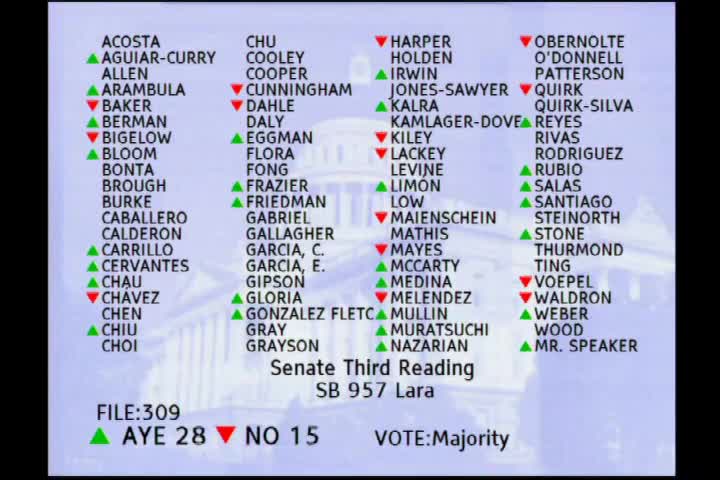 34MIN
Assembly Floor
 1H
Assembly Standing Committee on Appropriations
 32MIN
Assembly Standing Committee on Public Safety
 10MIN
Senate Floor
 43MIN
Senate Standing Committee on Public Safety


Bill Co-Author(s):
