SB 964: Public Employees’ Retirement Fund and Teachers’ Retirement Fund: investments: climate-related financial risk.
- Session Year: 2017-2018
- House: Senate
- Latest Version Date: 2018-09-23
The California Constitution requires members of the retirement board of a public pension or retirement system to discharge their duties with respect to the system solely in the interest of, and for the exclusive purposes of providing benefits to, participants and their beneficiaries, minimizing employer contributions thereto, and defraying reasonable expenses of administering the system. Existing statutory law establishes various public employee retirement systems and provides for the administration of the State Teachers Retirement System by the Teachers Retirement Board and for the administration of the Public Employees Retirement System, among other public employee retirement systems, by the Board of Administration of the Public Employees Retirement System.
This bill would, until January 31, 2035, require climate-related financial risk, as defined, to be analyzed to the extent the boards identify the risk as a material risk to the Public Employees Retirement Fund or the Teachers Retirement Fund. The bill, by January 1, 2020, and every 3 years thereafter, would require each board to publicly report on the climate-related financial risk of its public market portfolio, including alignment of the Public Employees Retirement Fund and the Teachers Retirement Fund with a specified climate agreement and California climate policy goals and the exposure of the fund to long-term risks, as specified. The bill would provide that it does not require either board to take action unless the board determines in good faith that the action is consistent with its fiduciary responsibilities. The bill would make related legislative findings and declarations.
The California Constitution requires members of the retirement board of a public pension or retirement system to discharge their duties with respect to the system solely in the interest of, and for the exclusive purposes of providing benefits to, participants and their beneficiaries, minimizing employer contributions thereto, and defraying reasonable expenses of administering the system. Existing statutory law establishes various public employee retirement systems and provides for the administration of the State Teachers Retirement System by the Teachers Retirement Board and for the administration of the Public Employees Retirement System, among other public employee retirement systems, by the Board of Administration of the Public Employees Retirement System.
This bill would, until January 1, 2035, require climate-related financial risk, as defined, to be analyzed to the extent the boards identify the risk as a material risk to the Public Employees Retirement Fund or the Teachers Retirement Fund. The bill, by January 1, 2020, and every 3 years thereafter, would require each board to publicly report on the climate-related financial risk of its public market portfolio, including alignment of the Public Employees Retirement Fund and the Teachers Retirement Fund with a specified climate agreement and California climate policy goals and the exposure of the fund to long-term risks, as specified. The bill would provide that it does not require either board to take action unless the board determines in good faith that the action is consistent with its fiduciary responsibilities. The bill would make related legislative findings and declarations.
The Political Reform Act of 1974 requires the Secretary of State to conspicuously post on his or her Internet Web site hyperlinks to the Internet Web site of any local government agency that contains publicly disclosed campaign finance information and to update these hyperlinks accordingly no later than December 31 of each year.This bill would instead require that the hyperlinks be updated before December 31 of each year.The Political Reform Act of 1974, an initiative measure, provides that the Legislature may amend the act to further the acts purposes upon a 2/3 vote of each house of the Legislature and compliance with specified procedural requirements.This bill would declare that it furthers the purposes of the act.The Political Reform Act of 1974 requires the Secretary of State to conspicuously post on his or her Internet Web site hyperlinks to the Internet Web site of any local government agency that contains publicly disclosed campaign finance information and to update these hyperlinks accordingly no later than December 31 of each year.
This bill would instead require that the hyperlinks be updated before December 31 of each year.
The Political Reform Act of 1974, an initiative measure, provides that the Legislature may amend the act to further the acts purposes upon a 2/3 vote of each house of the Legislature and compliance with specified procedural requirements.
This bill would declare that it furthers the purposes of the act.
The Legislature finds and declares as follows:
(a)Climate change is a long-term problem that will affect our environment, health, and economy for decades to come.
(b)Effects of global climate change that scientists predicted in the past are already occurringsea ice has been lost, sea levels are rising at accelerated rates, and longer, more intense heat waves and extreme weather events are occurring.
(c)As global temperatures continue to rise, these effects will likely accelerate. Heat waves, droughts, and hurricanes are all projected to grow in both frequency and intensity as climate change progresses.
(d)The financial sector is not insulated from the adverse effects of climate change.
(e)California is a global leader in addressing climate change and has consistently striven to protect the physical, social, and economic resources of all Californians, as most recently exemplified by the passage of Senate Bills 32 and 350 of the 201516 Regular Session.
(f)Climate change presents an array of material financial risks, including transition risk, physical risk, and litigation risk, that reasonable investors must take into account when making investment decisions. Failure to acknowledge and address these risks will result in exposure to subsequent liabilities and financial risk.
(g)If global temperature rise is to be limited to no more than 2 degrees Celsius, or the aspirational target of 1.5 degrees proposed in the COP 21 agreement now in effect, governments must act to limit warming and hasten the transition to a low-carbon economy by halting the extraction and development of carbon reserves. This regulatory risk will affect major sectors of the global economy.
(h)In the retirement system context, these risks are especially salient. Retirement boards have the fiduciary duty to administer retirement funds solely in the interest of system participants and their beneficiaries. In order to meet this requirement and ensure sufficient funding of both current and future retirees financial benefits, retirement boards must consider both short-term and long-term effects and risks of retirement fund investments.
(i)If climate change and carbon emissions continue on their current trajectories, both acute and chronic weather-related activity will greatly compromise the ability of businesses that do not account for these changes to reliably generate returns. Pension funds influence in the markets can induce firms to accurately report their carbon risk to the public.
(j)Given the potentially catastrophic consequences of climate change, the documented social and economic cost of carbon, and the emerging body of literature on the material financial risks of climate change, retirement boards simply cannot disregard financial climate risks.
(k)Governance directives of Californias largest pension funds, the California Public Employees Retirement System (CalPERS) and the California State Teachers Retirement System (CalSTRS), advise the funds boards to take climate risk, among other risks, into account when making investment decisions. These directives include CalPERS Investment Belief 9 and CalSTRS Environmental Risk Factor.
(l)This bill would ensure that the public is informed whether future boards will continue to consider climate-related financial risk in investment decisions.
SEC. 2.Section 7510.5 is added to the Government Code, to read:7510.5.(a)For purposes of this section, the following definitions apply:
(1)Board means the Board of Administration of the Public Employees Retirement System or the Teachers Retirement Board.
(2)Climate-related financial risk means risk that may include material financial risk posed to the fund by the effects of the changing climate, such as intense storms, rising sea levels, higher global temperatures, economic damages from carbon emissions, and other financial and transition risks due to public policies to address climate change, shifting consumer attitudes, changing economics of traditional carbon-intense industries.
(3)Fund means the Public Employees Retirement Fund described in Section 20062 or the Teachers Retirement Fund described in Section 22167 of the Education Code.
(b)To the extent the board identifies climate-related financial risk as a material risk to the fund, that risk shall be analyzed.
(c)By January 1, 2020, and every three years thereafter, the board shall publicly report on its analysis of the climate-related financial risk of its public market portfolio, including the alignment of the fund with the Paris climate agreement and California climate policy goals and the exposure of the fund to long-term risks.
(d)The board shall include in the reports pursuant to subdivision (c) the methods and results of the boards engagement related to climate-related financial risk with publicly traded companies that are the most carbon intense, such as utilities, oil, and gas producers, within the fund. This component of the reports shall include both of the following:
(1)A summary of climate-related financial risk-related engagement activities undertaken.
(2)A description of additional action taken, or planned to be taken, by the board to address climate-related financial risk, including a list of proxy votes and shareholder proposals initiated by the board.
(e)Nothing in this section shall require the board to take action as described in this section unless the board determines in good faith that the action described in this section is consistent with the fiduciary responsibilities of the board as described in Section 17 of Article XVI of the California Constitution.
(f) This section shall remain in effect only until January 31, 2035, and as of that date is repealed.
SECTION 1.Section 84602.3 of the Government Code is amended to read:84602.3.The Secretary of State shall conspicuously post on his or her Internet Web site hyperlinks to the Internet Web site of any local government agency that contains publically-disclosed campaign finance information. The Secretary of State shall update these hyperlinks before December 31 of each year.SEC. 2.The Legislature finds and declares that this bill furthers the purposes of the Political Reform Act of 1974 within the meaning of subdivision (a) of Section 81012 of the Government Code. REVISIONS: HeadingLine 3.The Secretary of State shall conspicuously post on his or her Internet Web site hyperlinks to the Internet Web site of any local government agency that contains publically-disclosed campaign finance information. The Secretary of State shall update these hyperlinks no later than before December 31 of each year.
SEC. 2.The Legislature finds and declares that this bill furthers the purposes of the Political Reform Act of 1974 within the meaning of subdivision (a) of Section 81012 of the Government Code.
|
Date
|
Status
|
|---|---|
| Sep 23, 2018 | Chaptered by Secretary of State. Chapter 731, Statutes of 2018. |
| Sep 23, 2018 | Approved by the Governor. |
| Sep 6, 2018 | Enrolled and presented to the Governor at 4 p.m. |
| Aug 30, 2018 | In Senate. Ordered to engrossing and enrolling. |
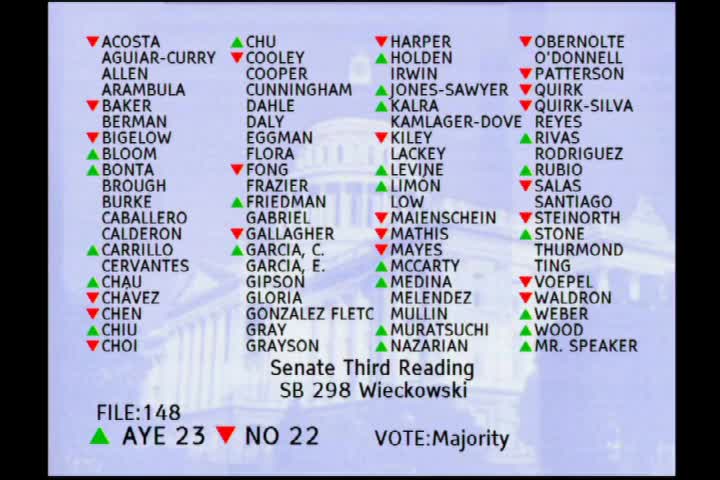
| Aug 30, 2018 | Read third time. Passed. Ordered to the Senate. |
| Aug 20, 2018 | Read second time. Ordered to third reading. |
| Aug 16, 2018 | From committee: Do pass. (Ayes 12. Noes 5.) (August 16). |
| Aug 8, 2018 | August 8 set for first hearing. Placed on suspense file. |
| Jun 20, 2018 | From committee: Do pass and re-refer to Com. on APPR. (Ayes 4. Noes 1.) (June 20). Re-referred to Com. on APPR. |
| Jun 11, 2018 | Referred to Com. on P.E., R., & S.S. |
| May 29, 2018 | In Assembly. Read first time. Held at Desk. |
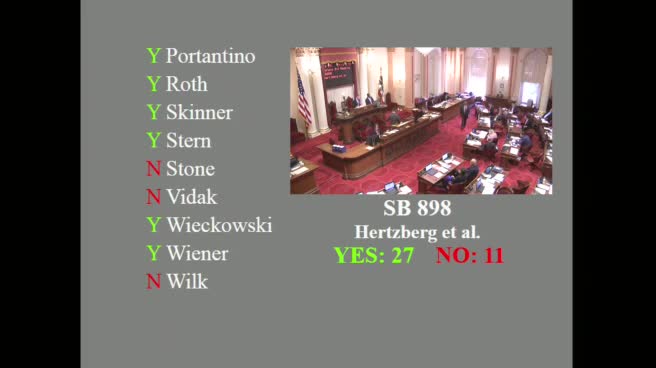
| May 29, 2018 | Read third time. Passed. (Ayes 27. Noes 11.) Ordered to the Assembly. |
| May 25, 2018 | From committee: Do pass. (Ayes 5. Noes 2.) (May 25). |
| May 18, 2018 | Set for hearing May 25. |
| Apr 16, 2018 | April 16 hearing: Placed on APPR. suspense file. |
| Apr 11, 2018 | Set for hearing April 16. |
| Apr 10, 2018 | From committee: Do pass and re-refer to Com. on APPR. (Ayes 3. Noes 2.) (April 9). Re-referred to Com. on APPR. |
| Mar 23, 2018 | Set for hearing April 9. |
| Mar 21, 2018 | Re-referred to Com. on P.E. & R. |
| Mar 14, 2018 | From committee with author's amendments. Read second time and amended. Re-referred to Com. on RLS. |
| Feb 8, 2018 | Referred to Com. on RLS. |
| Feb 1, 2018 | From printer. May be acted upon on or after March 3. |
| Jan 31, 2018 | Introduced. Read first time. To Com. on RLS. for assignment. To print. |
|
Date
|
Description
|
Location
|
Votes
|
|
|---|---|---|---|---|
| Aug 30, 2018 | SB 964 Allen Senate Third Reading By KALRA | Assembly Floor |
Passed |
|
| Aug 16, 2018 | Do pass. | Assembly Standing Committee on Appropriations |
Passed |
|
| Jun 20, 2018 | Do pass and be re-referred to the Committee on [Appropriations] | Assembly Standing Committee on Public Employees, Retirement, and Social Security |
Passed |
|
| May 29, 2018 | Senate 3rd Reading SB964 Allen | Senate Floor |
Passed |
|
| May 25, 2018 | Do pass | Senate Standing Committee on Appropriations |
Passed |
|
| Apr 16, 2018 | Placed on suspense file | Senate Standing Committee on Appropriations |
Passed |
|
| Apr 9, 2018 | Do pass, but first be re-referred to the Committee on [Appropriations] | Senate Standing Committee on Public Employment and Retirement |
Passed |
This list shows positions taken on this bill by organizations on the date displayed, which is linked to the original source.
Positions by individuals are not included.
|
Organization
|
Position
|
Date
|
|---|---|---|
| 1 Individual Letter | ** Support | Apr 5, 2018 |
| 350 Conejo | ** Support | Jun 19, 2018 |
| 350 Long Beach | ** Support | Jun 19, 2018 |
| 350 Riverside | ** Support | Jun 19, 2018 |
| 350 Sacramento | ** Support | Jun 19, 2018 |
| 350 San Diego | ** Support | Jun 19, 2018 |
| 350 Silicon Valley | ** Support | Jun 19, 2018 |
| 350 South Bay, Los Angeles | ** Support | Jun 19, 2018 |
| asian pacific environment network | ** Support | Jun 19, 2018 |
| California Teacher's Association | * Support | Jun 20, 2018 |
| Center for International Environmental Law | ** Support | Jun 19, 2018 |
| Democracy Wins | * Support | Apr 9, 2018 |
| Elders Climate Action, Northern California Chapter | ** Support | Jun 19, 2018 |
| Environment California | * Support | Jun 20, 2018 |
| Environmental Law | ** Support | May 26, 2018 |
| Fossil Free California | ** Support | Jun 19, 2018 |
| Friends Committee On Legislation Of California | ** Support | Jun 19, 2018 |
| Friends Of The Earth - U.S. | ** Support | Jun 19, 2018 |
| Glendale Environmental Coalition | ** Support | Jun 19, 2018 |
| Green River Sustainable Financial Services | ** Support | Jun 19, 2018 |
| Indivisible Marin | ** Support | Jun 19, 2018 |
| international union of operating engineers, california-nevada conference | ** Against | Jun 19, 2018 |
| mill valley community action network | ** Support | Jun 19, 2018 |
| Numerous individuals | ** Support | Jun 19, 2018 |
| peninsula interfaith climate action | ** Support | Jun 19, 2018 |
| San Diego 350 | ** Support | May 26, 2018 |
| San Fernando Valley | ** Support | Jun 19, 2018 |
| Service Employees International Union, California | ** Support | Jun 19, 2018 |
| Sierra Club, California | ** Support | Jun 19, 2018 |
| SoCal350 Climate Action | ** Support | Jun 19, 2018 |
| Sustainable Marin | ** Support | Jun 19, 2018 |
| The California League of Conservation Voters | * Support | Jun 20, 2018 |
| UC Berkeley | * Support | Apr 9, 2018 |
| Union Of Concerned Scientists | ** Support | Jun 19, 2018 |
| UPSTREAM | ** Support | Jun 19, 2018 |
SENATE THIRD READING
STR Bill Id:SB 964
Author:(Allen)
As Amended Ver:March 14, 2018
Majority vote
SENATE VOTE: 27-11
Committee | Votes | Ayes | Noes |
Public Employees | 4-1 | Rodriguez, Cervantes, Cooley, O'Donnell | Brough |
Appropriations | 12-5 | Gonzalez Fletcher, Bloom, Bonta, Calderon, Carrillo, Chau, Eggman, Friedman, Eduardo Garcia, Nazarian, Quirk, Reyes | Bigelow, Brough, Fong, Gallagher, Obernolte |
SUMMARY: Requires the California Public Employees' Retirement System (CalPERS) and California State Teachers' Retirement System (CalSTRS) to analyze climate-related financial risk to the extent that the respective pension boards identify climate-related financial risk as a material risk to their respective funds. Specifically, this bill:
- Requires the CalPERS and CalSTRS boards to analyze climate-related financial risk to the extent the two pension systems identify such risk as a material risk to their respective funds.
- Requires CalPERS and CalSTRS to publicly report by January 1, 2020, and every three years thereafter, on each board's respective analysis of the climate-related financial risk of its public market portfolio, including the alignment of the fund with the Paris climate agreement and California climate policy goals and the exposure of the fund to long-term risks.
- Specifies that the required report include the methods and results of the board's engagement related to climate-related financial risk with publicly traded companies that are the most carbon intense, such as utilities, oil, and gas producers, within the fund. The report must also include a summary of the board's climate-related financial risk-related engagement activities and a description of additional board action taken, or planned, to address climate-related financial risk, including a list of proxy votes and board-initiated shareholder proposals.
- Provides that nothing in the bill requires the board to take action unless the board determines in good faith that the action is consistent with the fiduciary responsibilities of the board, as described in the California Constitution, Article XVI, Section 17.
- Makes several legislative findings and declarations, contains a sunset provision of January 31, 2035, and is repealed thereafter.
EXISTING LAW:
1) The California Constitution provides that:
a) The respective boards of California's public retirement systems have "plenary authority and fiduciary responsibility for investment of monies and administration of the system."
b) The Legislature retains its authority "to prohibit certain investments by a retirement board where it is in the public interest to do so, and provided that the prohibition satisfies the standards of fiduciary care and loyalty required of a retirement board pursuant to this section."
c) The members of the retirement board of a public pension or retirement system shall discharge their duties with respect to the system solely in the interest of, and for the exclusive purposes of providing benefits to, participants and their beneficiaries, minimizing employer contributions thereto, and defraying reasonable expenses of administering the system.
2) Requires CalPERS and CalSTRS to not invest in certain companies, or to report on engagement with those businesses in efforts to achieve goals related to conditions in Northern Ireland, Sudan, and Iran, provided that such requirements conform to the systems' fiduciary duties.
3) Requires CalPERS and CalSTRS not to invest in thermal coal companies and to report on engagement with those businesses in efforts to achieve goals related to transitioning from thermal coal to cleaner forms of energy production, provided that such requirements conform to the systems' fiduciary duties.
FISCAL EFFECT: According to the Assembly Appropriations Committee, this bill would result in "[t]riennial administrative costs of $320,000 for CalPERS and $480,000 for CalSTRS to compile required information and to prepare the report."
COMMENTS: According to the author, "[c]limate change poses an unprecedented risk to the global economy, as well as to our planet and way of life that depends on a stable and healthy environment. Senate Bill 964 codifies that climate-related risks are material financial risks, which must be considered by the pension boards when managing their funds and asks the boards to report on this risk in their comprehensive financial report.
"Climate change poses four different types of risk to fund assets. These include physical risks, transition risks, stranded asset risks, and litigation risks. Globally, these risks and how to account for them are being taken very seriously. France and the European Parliament have both taken action to ensure that climate change-related risks are considered when making investment decisions.
"Senate Bill 964 affirms the commitment of CalPERS and CalSTRS to address the material financial risks posed by climate change and asks the boards to report on that risk beginning in 2020. Senate Bill 964 is another opportunity for California to the lead the way on addressing the risks associated with climate change."
Please see the policy committee analysis for a full discussion of this bill.
Analysis Prepared by: Michael Bolden / P.E.,R., & S.S. / (916) 319-3957 FN: 0004087
Date of Hearing: August 8, 2018
ASSEMBLY COMMITTEE ON APPROPRIATIONS
Lorena Gonzalez Fletcher, Chair
SBPCA Bill Id:SB 964
Author:(Allen) – As Amended Ver:March 14, 2018
Policy Committee: | Public Employees, Retirement, and Social Security | Vote: | 4 - 1 |
|
| ||
|
|
Urgency: No State Mandated Local Program: No Reimbursable: No
SUMMARY:
This bill requires the California Public Employees’ Retirement System (CalPERS) and the California State Teachers’ Retirement System (CalSTRS), by January 1, 2020, and every three years thereafter until January 31, 2035, to analyze climate-related financial risk. As part of the report, CalPERS and CalSTRS must include the methods and results of the boards’ climate-related financial risk-related engagement activities.
FISCAL EFFECT:
Triennial administrative costs of $320,000 for CalPERS and $480,000 for CalSTRS to compile required information and to prepare the report.
COMMENTS:
- Background. The California Constitution grants CalPERS and CalSTRS plenary authority and fiduciary responsibility over the investment of retirement plan assets. The two systems are required to discharge their duties solely in the interests of the members and the beneficiaries for the exclusive purpose of providing benefits. The California Constitution also allows the Legislature to, by statute, prohibit certain investments by a retirement board when it is in the public interest to do so, provided that this prohibition satisfies the standards of fiduciary care and loyalty required.
- Engagement versus divestment. In recent years, a number of proposals requesting or requiring CalPERS and CalSTRS to divest or modify investment strategies with certain companies have been introduced. This has resulted in an ongoing debate over the effectiveness of divestment strategies in achieving political and social goals and whether alternative strategies can achieve the same goals without undermining the retirement systems’ fiduciary duty to retirees. The retirement boards point to engagement as an alternative. Under engagement, aligned interests work together to influence capital market change. CalSTRS points to an example where CalSTRS targeted 100 companies that lacked sufficient disclosure of energy water use management, resulting in some companies considering alternative approaches. One example of an “engagement” bill in this legislative session is AB 20 (Kalra), Chapter 575, Statutes of 2017, which requires CalPERS and CalSTRS to report on its engagement activities with companies involved in the construction and management of the Dakota Access Pipeline.
- Purpose. According to the author, SB 964 codifies that climate-related risks are material financial risks which must be considered by CalPERS and CalSTRS when managing their funds. The author points to four types of risks to the value of public pension fund assets that should be considered: a) physical impact risks to the environment and infrastructure, b) carbon asset risks as fossil fuel companies become unable to fully develop and use the carbon reserves they hold, c) the cost of transitioning to a low-carbon economy, and d) the costs of litigation amid changing laws and rising climate change risks.
- Related legislation. In addition to the aforementioned AB 20, a number of bills this Legislative Session ask the retirement systems to consider, or change, investment strategies in order to achieve some type of policy goal.
SJR 24 (Jackson), which asks CalPERS to engage with companies that produce or sell firearms to determine a reasonable method for those companies to withdraw from the production and sale of firearms or to produce a plan to divest from those companies, is pending in the Assembly Committee on Public Employees, Retirement, and Social Security (Assembly policy committee). SB 459 (Portantino), which requires CalPERS and CalSTRS to divest from retailers or wholesalers of banned weapons if certain engagement efforts are unsuccessful, is pending in Assembly policy committee. AB 946 (Ting), which required CalPERS and CalSTRS to divest from companies that contracts or subcontracts to build, maintain, or provide material for President Trump’s border wall, died in Assembly policy committee. AB 1597 (Nazarian), which prohibits CalPERS and CalSTRS from investing in any investment vehicle issued by, owned, controlled, or managed by the government of Turkey, is pending in the Senate Appropriations Committee.
Analysis Prepared by: Luke Reidenbach / APPR. / (916) 319-2081
Date of Hearing: June 20, 2018
ASSEMBLY COMMITTEE ON PUBLIC EMPLOYEES, RETIREMENT, AND SOCIAL SECURITY
Freddie Rodriguez, Chair
SBPCA Bill Id:SB 964
Author:(Allen) – As Amended Ver:March 14, 2018
SENATE VOTE: 27-11
SUBJECT: Public Employees’ Retirement Fund and Teachers’ Retirement Fund: investments: climate-related financial risk
SUMMARY: Requires the California Public Employees’ Retirement System (CalPERS) and California State Teachers’ Retirement System (CalSTRS) to analyze climate-related financial risk to the extent that the respective pension boards identify climate-related financial risk as a material risk to their respective funds. Specifically, this bill:
- Requires the CalPERS and CalSTRS boards to analyze climate-related financial risk, as specified, to the extent the two pension systems identify such risk as a material risk to their respective funds.
- Defines the following terms:
a) “Climate-related financial risk” as risk that may include material financial risk posed to the fund by the effects of the changing climate, such as intense storms, rising sea levels, higher global temperatures, economic damages from carbon emissions, and other financial and transition risks due to public policies to address climate change, shifting consumer attitudes, and changing economics of traditional carbon-intense industries.
b) “Board” to mean CalPERS or CalSTRS.
c) “Fund” to mean the Public Employees’ Retirement Fund or the Teachers’ Retirement Fund.
- Requires CalPERS and CalSTRS to publicly report by January 1, 2020, and every three years thereafter, on each board’s respective analysis of the climate-related financial risk of its public market portfolio, including the alignment of the fund with the Paris climate agreement and California climate policy goals and the exposure of the fund to long-term risks.
- Specifies that the required report include the methods and results of the board’s engagement related to climate-related financial risk with publicly traded companies that are the most carbon intense, such as utilities, oil, and gas producers, within the fund. The report must also include a summary of the board’s climate-related financial risk-related engagement activities and a description of additional board action taken, or planned, to address climate-related financial risk, including a list of proxy votes and board-initiated shareholder proposals.
- Clarifies that nothing in the bill shall require the board to take action unless the board determines in good faith that the action is consistent with the fiduciary responsibilities of the board as described in Section 17 of Article XVI of the California Constitution.
- Contains a sunset provision of January 31, 2035.
- Makes several legislative findings and declarations, including:
- Climate change presents an array of material financial risks, including transition risk, physical risk, and litigation risk, that reasonable investors must take into account when making investment decisions. Failure to acknowledge and address these risks will result in exposure to subsequent liabilities and financial risk.
- Retirement boards have the fiduciary duty to administer retirement funds solely in the interest of system participants and their beneficiaries. In order to meet this requirement and ensure sufficient funding of both current and future retirees’ financial benefits, retirement boards must consider both short-term and long-term effects and risks of retirement fund investments.
- If climate change and carbon emissions continue on their current trajectories, both acute and chronic weather-related activity will greatly compromise the ability of businesses that do not account for these changes to reliably generate returns. Pension funds’ influence in the markets can induce firms to accurately report their carbon risk to the public.
- Governance directives of California’s largest pension funds, CalPERS and CalSTRS, advise the funds’ boards to take climate risk, among other risks, into account when making investment decisions. These directives include CalPERS Investment Belief 9 and CalSTRS “Environmental” Risk Factor.
EXISTING LAW:
1) The California Constitution provides that:
a) The respective boards of California's public retirement systems have "plenary authority and fiduciary responsibility for investment of monies and administration of the system."
b) The Legislature retains its authority "to prohibit certain investments by a retirement board where it is in the public interest to do so, and provided that the prohibition satisfies the standards of fiduciary care and loyalty required of a retirement board pursuant to this section."
c) The members of the retirement board of a public pension or retirement system shall discharge their duties with respect to the system solely in the interest of, and for the exclusive purposes of providing benefits to, participants and their beneficiaries, minimizing employer contributions thereto, and defraying reasonable expenses of administering the system."
- Requires CalPERS and CalSTRS to not invest in certain companies, as specified, or to report on engagement with those businesses in efforts to achieve goals related to conditions in Northern Ireland, Sudan, and Iran, as specified, provided that such requirements conform to the systems’ fiduciary duties.
- Requires CalPERS and CalSTRS not to invest in thermal coal companies and to report on engagement with those businesses in efforts to achieve goals related to transitioning from thermal coal to cleaner forms of energy production, as specified, provided that such requirements conform to the systems’ fiduciary duties.
FISCAL EFFECT: According to the Senate Appropriations Committee:
1) CalSTRS would incur triennial administrative costs, likely in the low hundreds of thousands of dollars (special fund), for staff (a) to report on the climate-related financial risk of investments, and (b) to employ an outside consultant to assess alignment with the Paris climate agreement and California climate policy goals.
2) CalPERS preliminarily indicates that it would incur a minimum annual cost of $165,000 (special fund) to implement the provisions of the bill, related to data collection and subscriptions. Additionally, the bill’s reporting requirements would result in costs of $320,000 every three years to compile information and prepare the report.
COMMENTS: According to the author, “[c]limate change poses an unprecedented risk to the global economy, as well as to our planet and way of life that depends on a stable and healthy environment. Senate Bill 964 codifies that climate-related risks are material financial risks, which must be considered by the pension boards when managing their funds and asks the boards to report on this risk in their comprehensive financial report.
‘Climate change poses four different types of risk to fund assets. These include physical risks, transition risks, stranded asset risks, and litigation risks. Globally, these risks and how to account for them are being taken very seriously. France and the European Parliament have both taken action to ensure that climate change-related risks are considered when making investment decisions.
‘Senate Bill 964 affirms the commitment of CalPERS and CalSTRS to address the material financial risks posed by climate change and asks the boards to report on that risk beginning in 2020. Senate Bill 964 is another opportunity for California to the lead the way on addressing the risks associated with climate change.”
The author notes that the aforementioned four different types of risk to the value of public pension fund assets that should to be considered by fund fiduciaries are:
- Physical impact risks to the environment and infrastructure, e.g., sea level rise, severe storms, extreme weather events such as droughts, wildfires, and heat waves that may impact assets and global economic trends.
- Carbon asset risk -- As regulations tighten, fossil fuel companies may not be able to fully develop and use the carbon reserves they hold, resulting in billions of dollars in “stranded assets.”
- Transition risk -- The cost of transitioning to a low-carbon economy will negatively affect certain companies and investments while advantaging others.
- Litigation risk -- Under changing laws and increasing climate change risks, a company may be sued as a result of its contribution to climate change, and consequently lose market value.
1) Brief Comparison of Two Bills On This Subject
This bill is substantially similar to Senate Bill 560 (Allen, 2017) which was held in the Senate Appropriations Committee. Senate Bill 964 is different in comparison to Senate Bill 560 since it provides that the climate-related financial risk report be done triennially rather than annually; that its provisions sunset January 31, 2035; and that CalPERS and CalSTRS have greater discretion to determine what actions they would need to take to report on climate-related financial risk.
In particular, SB 964 clarifies that it does not require the board to take action unless the board determines in good faith that the action is consistent with the fiduciary responsibilities of the board as described in Section 17 of Article XVI of the California Constitution.
2) Legislating Pension Fund Investments
Pursuant to the California Constitution, as discussed under “Existing Law” supra, the Legislature retains authority to prohibit certain investments by a retirement board where it is in the public interest to do so, provided that the prohibition satisfies the standards of fiduciary care required of a retirement board.
Historically, legislation affecting pension fund investments have been intended to effect change from offending activity inimical to California’s values in extraordinary circumstances. However, when compared to years prior, since 2011, the number and frequency of legislative proposals introduced that affect CalPERS’ and CalSTRS’ investments have significantly increased. This does not include the independent action of the systems regarding investments, as well as communications from members of Congress requesting certain action.
Numerous legislative proposals affecting the investments of CalPERS and CalSTRS have been heard by this committee, enacted by the Legislature, and signed by the Governor. Many of those well-intentioned proposals include statements that are declarative of existing law consistent with the need to balance legislative authority and the fiduciary duties of the systems, including the current measure. Nevertheless, custom and practice consistently have demonstrated through statements in the findings, declarations, or intent of those measures, the ultimate desire by the Legislature and need for CalPERS and CalSTRS to take certain actions.
3) Prior/Related Legislation
SB 560 (Allen, 2017) would have required CalPERS and CalSTRS to consider financial climate risk in their management of their respective funds, including when making decisions about asset allocation, investment levels in individual companies or commingled funds, or in hiring external asset managers. As previously stated, this bill was held in the Senate Appropriations Committee.
Chapter 249, Statutes of 2015 (SB 32, Pavley) requires the Air Resources Board (ARB) to ensure that statewide greenhouse gas (GHG) emissions are reduced to at least 40 percent below the 1990 level by 2030.
Chapter 605, Statutes of 2015 (SB 185, (De León) prohibits CalPERS and CalSTRS from investing in thermal coal companies, as specified.
Chapter 547, Statutes of 2015 (SB 350, De León) established targets to increase retail sales of renewable electricity to 50 percent by 2030 and double the energy efficiency savings in electricity and natural gas end uses by 2030.
REGISTERED SUPPORT / OPPOSITION:
Support
Environment California (Co-sponsor)
Fossil Free California (Co-sponsor)
Asian Pacific Environment Network
California League of Conservation Voters
California Teachers Association
Center for International Environmental Law
Cool Planet Working Group of First Presbyterian Church of Palo Alto
Elders Climate Action, Northern California Chapter
Friends Committee on Legislation of California
Friends of the Earth – U.S.
Glendale Environmental Coalition
Green River Sustainable Financial Services
Indivisible Marin
Mill Valley Community Action Network
Peninsula Interfaith Climate Action
Service Employees International Union, California
Sierra Club, California
SoCal350 Climate Action
Sustainable Marin
Union of Concerned Scientists
Upstream
350 Bay Area, including East Bay, Marin, San Francisco and Sonoma
350 Conejo/San Fernando Valley
350 Long Beach
350 Riverside
350 Sacramento
350 San Diego
350 Silicon Valley
350 South Bay, Los Angeles
Numerous individuals
Opposition
International Union of Operating Engineers, California-Nevada Conference
Analysis Prepared by: Michael Bolden / P.E.,R., & S.S. / (916) 319-3957
Office of Senate Floor Analyses (916) 651-1520 Fax: (916) 327-4478 | SB |
THIRD READING
Bill No: SB 964
: in Senate
SENATE PUBLIC EMP. & RET. COMMITTEE: 3-2, 4/9/18
AYES: Pan, Leyva, Portantino
NOES: Morrell, Moorlach
SENATE APPROPRIATIONS COMMITTEE: 5-2, 5/25/18
AYES: Lara, Beall, Bradford, Hill, Wiener
NOES: Bates, Nielsen
SOURCE: Environment California
Fossil Free California
DIGEST:
This bill requires the California Public Employees’ Retirement System (CalPERS) and California State Teachers’ Retirement System (CalSTRS) to analyze climate-related financial risk to the extent that the respective pension boards identify climate-related financial risk as a material risk to their respective funds.
ANALYSIS:
Existing law:
- Provides that, pursuant to the California Constitution:
- The respective boards of California's public retirement systems have "plenary authority and fiduciary responsibility for investment of monies and administration of the system."
- The Legislature retains its authority "to prohibit certain investments by a retirement board where it is in the public interest to do so, and provided that the prohibition satisfies the standards of fiduciary care and loyalty required of a retirement board pursuant to this section."
- The members of the retirement board of a public pension or retirement system shall discharge their duties with respect to the system solely in the interest of, and for the exclusive purposes of providing benefits to, participants and their beneficiaries, minimizing employer contributions thereto, and defraying reasonable expenses of administering the system."
- Requires CalPERS and CalSTRS to not invest in certain companies, as specified, or to report on engagement with those busineses in efforts to achieve goals related to conditions in Northern Ireland, Sudan, and Iran, as specified, provided that such requirements conform to the systems’ fiduciary duties.
- Requires CalPERS and CalSTRS not to invest in thermal coal companies and to report on engagement with those businesses in efforts to achieve goals related to transitioning from thermal coal to cleaner forms of energy production, as specified, provided that such requirements conform to the systems’ fiduciary duties.
This bill:
- Requires the CalPERS and CalSTRS boards to analyze climate-related financial risk, as specified, to the extent the two pension systems identify such risk as a material risk to their respective funds.
- Defines “climate-related financial risk” as risk that may include material financial risk posed to the fund by the effects of the changing climate, such as intense storms, rising sea levels, higher global temperatures, economic damages from carbon emissions, and other financial and transition risks due to public policies to address climate change, shifting consumer attitudes, changing economics of traditional carbon-intense industries.
- Requires CalPERS and CalSTRS to publicly report by January 1, 2020, and every three years thereafter, on each board’s respective analysis of the climate-related financial risk of its public market portfolio, including the alignment of the fund with the Paris climate agreement and California climate policy goals and the exposure of the fund to long-term risks.
- Specifies that the required report include the methods and results of the board’s engagement related to climate-related financial risk with publicly traded companies that are the most carbon intense, such as utilities, oil, and gas producers, within the fund. The report must also include a summary of the board’s climate-related financial risk-related engagement activities and a description of additional board action taken, or planned, to address climate-related financial risk, including a list of proxy votes and board initiated shareholder proposals.
- Clarifies that nothing in the bill shall require the board to take action unless the board determines in good faith that the action is consistent with the fiduciary responsibilities of the board as described in Section 17 of Article XVI of the California Constitution.
- Contains a sunset provision of January 31, 2035.
- Makes several legislative findings and declarations, including:
- Climate change presents an array of material financial risks, including transition risk, physical risk, and litigation risk, that reasonable investors must take into account when making investment decisions. Failure to acknowledge and address these risks will result in exposure to subsequent liabilities and financial risk.
- Retirement boards have the fiduciary duty to administer retirement funds solely in the interest of system participants and their beneficiaries. In order to meet this requirement and ensure sufficient funding of both current and future retirees’ financial benefits, retirement boards must consider both short-term and long-term effects and risks of retirement fund investments.
- If climate change and carbon emissions continue on their current trajectories, both acute and chronic weather-related activity will greatly compromise the ability of businesses that do not account for these changes to reliably generate returns. Pension funds’ influence in the markets can induce firms to accurately report their carbon risk to the public.
- Governance directives of California’s largest pension funds, the CalPERS and CalSTRS, advise the funds’ boards to take climate risk, among other risks, into account when making investment decisions. These directives include CalPERS Investment Belief 9 and CalSTRS “Environmental” Risk Factor.
Background
This bill is substantially similar to SB 560 from last year except that this bill provides that the climate-related financial risk report be done triennially rather than annually; that its provisions sunset January 31, 2035; and that CalPERS and CalSTRS have greater discretion to determine what actions they would need to take to report on climate-related financial risk. In particular, the bill now clarifies that it does not require the board to take action unless the board determines in good faith that the action is consistent with the fiduciary responsibilities of the board as described in Section 17 of Article XVI of the California Constitution.
Comments
The author notes that global climate change poses four different types of risk to the value of public pension fund assets that should to be considered by fund fiduciaries. These include:
- Physical impact risks to the environment and infrastructure -- e.g., sea level rise, severe storms, extreme weather events such as droughts, wildfires, and heat waves that may impact assets and global economic trends.
- Carbon asset risk -- As regulations tighten, fossil fuel companies may not be able to fully develop and use the carbon reserves they hold, resulting in billions of dollars in “stranded assets.”
- Transition risk -- The cost of transitioning to a low-carbon economy will negatively affect certain companies and investments while advantaging others.
- Litigation risk -- Under changing laws and increasing climate change risks, a company may be sued as a result of its contribution to climate change, and consequently lose market value.
According to the author, while CalPERS Investment Belief 9 and the CalSTRS “Environmental” Risk Factor call on these public pension funds to account for climate risk, there is no statutory recognition of this risk and neither system reports this risk publically.
Related/Prior Legislation
SB 560 (Allen, 2017) would have required CalPERS and CalSTRS to consider financial climate risk in their management of their respective funds, including when making decisions about asset allocation, investment levels in individual companies or commingled funds, or in hiring external asset managers. The bill died in the Senate Appropriations Committee.
SB 32 (Pavley, Chapter 249, Statutes of 2015) required the Air Resources Board to ensure that statewide greenhouse gas emissions are reduced to at least 40 percent below the 1990 level by 2030.
SB 185 (De León, Chapter 605, Statutes of 2015) prohibited CalPERS and CalSTRS from investing in thermal coal companies, as specified.
SB 350 (De León, Chapter 547, Statutes of 2015) established targets to increase retail sales of renewable electricity to 50 percent by 2030 and double the energy efficiency savings in electricity and natural gas end uses by 2030.
FISCAL EFFECT: Appropriation: Fiscal Com.: Local:
According to Senate Appropriations Committee:
- CalSTRS would incur triennial administrative costs, likely in the low hundreds of thousands of dollars (special fund), for staff (1) to report on the climate-related financial risk of investments, and (2) to employ an outside consultant to assess alignment with the Paris climate agreement and California climate policy goals.
- CalPERS preliminarily indicates that it would incur a minimum annual cost of $165,000 (special fund) to implement the provisions of the bill, related to data collection and subscriptions. Additionally, the bill’s reporting requirements would result in costs of $320,000 every three years to compile information and prepare the report.
Environment California (co-source)
Fossil Free California (co-source)
350 Bay Area
350 Conejo
350.Org
Asian Pacific Environmental Network
California League of Conservation Voters
California Teachers Association
Center for International Environmental Law
Cool Planet Working Group of First Presbyterian Church of Palo Alto
Environmental Law
Friends of the Earth – U.S.
Green River Sustainable Financial Services
Long Beach 350
Peninsula Interfaith Climate Action
San Diego 350
Sierra Club California
SoCal350 Climate Action
One individual
OPPOSITION: (Verified 5/25/18)
None received
ARGUMENTS IN SUPPORT: According to the author, “A transition to a low-carbon economy, along with the anticipated impacts of climate change, will have significant, material financial consequences for long-term investors such as public pension funds. Because climate-related risk will likely have greater impacts on future beneficiaries than on current fund members and retirees, failure to consider long-term climate-related risks when investing today could be viewed in the future as an unreasonable bias favoring short-term gain over long-term stability and growth. This bias, and failure to appreciate and account for these impacts, is likely to be seen in the future as a breach of fiduciary duty, subjecting fund fiduciaries to liability.”
According to the sponsors, “While both funds have guidance on the books that advise them to take climate risk, among other risks, into account when making investment decisions, SB 964 assures that future boards will not weaken or dilute these directives and that the funds’ assets will be protected.”
5/26/18 15:20:27
SENATE COMMITTEE ON
Senator Ricardo Lara, Chair
2017 - 2018 Regular Session
SB 964 (Allen) - Public Employees’ Retirement Fund and Teachers’ Retirement Fund: investments: climate-related financial risk
Version: | Policy Vote: |
Urgency: | Mandate: |
Hearing Date: | Consultant: |
This bill meets the criteria for referral to the Suspense File.
Bill Summary:
SB 964 would require the California Public Employees’ Retirement System (CalPERS) and California State Teachers’ Retirement System (CalSTRS) to analyze climate-related financial risk to the extent that the respective pension boards identify it as a material risk to their respective funds.
Fiscal Impact:
- CalSTRS would incur triennial administrative costs, likely in the low hundreds of thousands of dollars (special fund), for staff (1) to report on the climate-related financial risk of investments, and (2) to employ an outside consultant to assess alignment with the Paris climate agreement and California climate policy goals.
- CalPERS preliminarily indicates that it would incur a minimum annual cost of $165,000 (special fund) to implement the provisions of the bill, related to data collection and subscriptions. Additionally, the bill’s reporting requirements would result in costs of $320,000 every three years to compile information and prepare the report.
Background:
Under existing provisions of Section 17 of Article XVI of the California Constitution, as amended by Proposition 162 of 1992, the CalSTRS board and CalPERS board have plenary authority and fiduciary responsibility over the investment of retirement plan assets and are required to discharge their duties solely in the interests of the members and beneficiaries for the exclusive purpose of providing benefits. The boards must invest the assets of the plan with care, skill and diligence of a prudent person engaged in a similar enterprise so as to maximize the investments and minimize the risk of loss. The Constitution does allow the Legislature by statute to prohibit certain investments by a retirement board when it is in the public interest to do so and provided the prohibition satisfies the standards of fiduciary care and loyalty required of the retirement board.
Other measures have been enacted by the Legislature to prohibit certain investments by public pension funds. For instance, AB 221 (Anderson, Chapter 671, Statutes of 2007) prohibits CalPERS and CalSTRS from investing in companies that have specified energy or defense-related operations in Iran, and AB 2941 (Koretz, Chapter 442, Statutes of 2006) prohibits CalPERS and CalSTRS from investing public employee retirement funds in a company with business operations in the Sudan, as specified.
Proposed Law:
This bill would, among other things, do the following:
- Require the CalPERS and CalSTRS boards to analyze climate-related financial risk, as specified, to the extent the two pension systems identify such risk as a material risk to their respective funds.
- Define “Climate-related financial risk” as risk that may include material financial risk posed to the fund by the effects of the changing climate, such as intense storms, rising sea levels, higher global temperatures, economic damages from carbon emissions, and other financial and transition risks due to public policies to address climate change, shifting consumer attitudes, changing economics of traditional carbon-intense industries.
- Require CalPERS and CalSTRS to publicly report by January 1, 2020, and triennially thereafter, on their respective analysis of the climate-related financial risk of its public market portfolio, including the alignment of the fund with the Paris climate agreement and California climate policy goals and the exposure of the fund to long-term risks.
- Specify that the required report include the methods and results of the board’s engagement related to climate-related financial risk with publicly traded companies that are the most carbon intense, such as utilities, oil, and gas producers, within the fund, as well as other specified, summarized information.
- Clarify that nothing in the bill shall require the boards to take action unless they determine in good faith that the action is consistent with the fiduciary responsibilities of the board as described in Section 17 of Article XVI of the California Constitution.
- Sunset on January 31, 2035.
Related Legislation:
- SB 560 (Allen, 2017) would have required CalPERS and CalSTRS to consider financial climate risk in their management of their respective funds, including when making decisions about asset allocation, investment levels in individual companies or commingled funds, or in hiring external asset managers. The bill was held under submission on the Suspense File of this committee..
- SB 32 (Pavley, Chapter 249, Statutes of 2015), requires the Air Resources Board (ARB) to ensure that statewide greenhouse gas (GHG) emissions are reduced to at least 40 percent below the 1990 level by 2030.
- SB 185 (De León, Chapter 605, Statutes of 2015), prohibits CalPERS and CalSTRS from investing in thermal coal companies, as specified.
- SB 350 (De León, Chapter 547, Statutes of 2015), established targets to increase retail sales of renewable electricity to 50 percent by 2030 and double the energy efficiency savings in electricity and natural gas end uses by 2030.
Staff Comments:
CalSTRS notes that no other state has enacted legislation requiring their pension funds to consider financial climate risk, but notes that the European Parliament enacted legislation that requires retirement fund managers to take into account environmental, social and governance (ESG) risks. Moreover, France enacted Article 173, which requires a wide range of investors to report on how they integrate ESG, and specifically climate change, factors in assessing risk.
As noted above, this bill is substantially similar to SB 560 from 2017, except that this bill (1) provides that the climate-related financial risk report be done triennially rather than annually, (2) its provisions sunset January 31, 2035, and (3) CalPERS and CalSTRS have greater discretion to determine what actions they would need to take to report on climate-related financial risk. The author notes that, while CalPERS Investment Belief 9 and the CalSTRS “Environmental” Risk Factor call on these public pension funds to account for climate risk, there is no statutory recognition of this risk and neither system reports this risk publically.
CalPERS has historically viewed climate change as an investment issue, adopted investment beliefs and principles in that regard, and consistently engages companies, other institutional investors, governments, and non-governmental organizations to formulate strategies to address the risks and opportunities posed by climate change and transition to low- and no-carbon energy sources.
-- END --
SENATE COMMITTEE ON
PUBLIC EMPLOYMENT AND RETIREMENT
Dr. Richard Pan, Chair
2017 - 2018 Regular
Bill No: SB 964 Hearing Date: 4/9/18
Author: | Allen | ||
Version: | 3/14/18 As introduced | ||
Urgency: | No | Fiscal: | Yes |
Consultant: | Glenn Miles | ||
Subject: Public Employees’ Retirement Fund and Teachers’ Retirement Fund: investments: climate-related financial risk
SOURCE: Environment California
Fossil Free California
DIGEST: This bill requires California Public Employees’ Retirement System (CalPERS) and California State Teachers’ Retirement System (CalSTRS) to analyze climate-related financial risk to the extent that the respective pension boards identify climate-related financial risk as a material risk to their respective funds.
ANALYSIS:
Existing law:
- Pursuant to the California Constitution provides that:
- The respective boards of California's public retirement systems have "plenary authority and fiduciary responsibility for investment of monies and administration of the system."
- The Legislature retains its authority "to prohibit certain investments by a retirement board where it is in the public interest to do so, and provided that the prohibition satisfies the standards of fiduciary care and loyalty required of a retirement board pursuant to this section."
- The members of the retirement board of a public pension or retirement system shall discharge their duties with respect to the system solely in the interest of, and for the exclusive purposes of providing benefits to, participants and their beneficiaries, minimizing employer contributions thereto, and defraying reasonable expenses of administering the system."
- Requires CalPERS and CalSTRS to not invest in certain companies, as specified, or to report on engagement with those busineses in efforts to achieve goals related to conditions in Northern Ireland, Sudan, and Iran, as specified, provided that such requirements conform to the systems’ fiduciary duties.
- Requires CalPERS and CalSTRS not to invest in thermal coal companies and to report on engagement with those businesses in efforts to achieve goals related to transitioning from thermal coal to cleaner forms of energy production, as specified, provided that such requirements conform to the systems’ fiduciary duties.
This bill:
- Requires the CalPERS and CalSTRS boards to analyze climate-related financial risk, as specified, to the extent the two pension systems identify such risk as a material risk to their respective funds.
- Defines “Climate-related financial risk” as risk that may include material financial risk posed to the fund by the effects of the changing climate, such as intense storms, rising sea levels, higher global temperatures, economic damages from carbon emissions, and other financial and transition risks due to public policies to address climate change, shifting consumer attitudes, changing economics of traditional carbon-intense industries.
- Requires CalPERS and CalSTRS to publicly report by January 1, 2020, and every three years thereafter, on each board’s respective analysis of the climate-related financial risk of its public market portfolio, including the alignment of the fund with the Paris climate agreement and California climate policy goals and the exposure of the fund to long-term risks.
- Specifies that the required report include the methods and results of the board’s engagement related to climate-related financial risk with publicly traded companies that are the most carbon intense, such as utilities, oil, and gas producers, within the fund. The report must also include a summary of the board’s climate-related financial risk-related engagement activities and a description of additional board action taken, or planned, to address climate-related financial risk, including a list of proxy votes and board initiated shareholder proposals.
- Clarifies that nothing in the bill shall require the board to take action unless the board determines in good faith that the action is consistent with the fiduciary responsibilities of the board as described in Section 17 of Article XVI of the California Constitution.
- Contains a sunset provision of January 31, 2035.
- Makes several Legislative findings and declarations, including:
- Climate change presents an array of material financial risks, including transition risk, physical risk, and litigation risk, that reasonable investors must take into account when making investment decisions. Failure to acknowledge and address these risks will result in exposure to subsequent liabilities and financial risk.
- Retirement boards have the fiduciary duty to administer retirement funds solely in the interest of system participants and their beneficiaries. In order to meet this requirement and ensure sufficient funding of both current and future retirees’ financial benefits, retirement boards must consider both short-term and long-term effects and risks of retirement fund investments.
- If climate change and carbon emissions continue on their current trajectories, both acute and chronic weather-related activity will greatly compromise the ability of businesses that do not account for these changes to reliably generate returns. Pension funds’ influence in the markets can induce firms to accurately report their carbon risk to the public.
- Governance directives of California’s largest pension funds, the California Public Employees’ Retirement System (CalPERS) and the California State Teachers’ Retirement System (CalSTRS), advise the funds’ boards to take climate risk, among other risks, into account when making investment decisions. These directives include CalPERS Investment Belief 9 and CalSTRS “Environmental” Risk Factor.
Background
This bill is substantially similar to SB 560 from last year except that this bill provides that the climate-related financial risk report be done triennially rather than annually; that its provisions sunset January 31, 2035; and that CalPERS and CalSTRS have greater discretion to determine what actions they would need to take to report on climate-related financial risk. In particular, the bill now clarifies that it does not require the board to take action unless the board determines in good faith that the action is consistent with the fiduciary responsibilities of the board as described in Section 17 of Article XVI of the California Constitution.
The author notes that global climate change poses four different types of risk to the value of public pension fund assets that should to be considered by fund fiduciaries. These include:
- Physical impact risks to the environment and infrastructure -- e.g., sea level rise, severe storms, extreme weather events such as droughts, wildfires, and heat waves that may impact assets and global economic trends.
- Carbon asset risk -- As regulations tighten, fossil fuel companies may not be able to fully develop and use the carbon reserves they hold, resulting in billions of dollars in “stranded assets.”
- Transition risk -- The cost of transitioning to a low-carbon economy will negatively affect certain companies and investments while advantaging others.
- Litigation risk -- Under changing laws and increasing climate change risks, a company may be sued as a result of its contribution to climate change, and consequently lose market value.
According to the author, while CalPERS Investment Belief 9 and the CalSTRS “Environmental” Risk Factor call on these public pension funds to account for climate risk, there is no statutory recognition of this risk and neither system reports this risk publically.
Related/Prior Legislation
SB 560 (Allen, 2017), which died in Senate Appropriations Committee, would have required CalPERS and CalSTRS to consider financial climate risk in their management of their respective funds, including when making decisions about asset allocation, investment levels in individual companies or commingled funds, or in hiring external asset managers. The bill died in the Senate Appropriations Committee.
SB 32 (Pavley, Chapter 249, Statutes of 2015), requires the Air Resources Board (ARB) to ensure that statewide greenhouse gas (GHG) emissions are reduced to at least 40 percent below the 1990 level by 2030.
SB 185 (De León, Chapter 605, Statutes of 2015), prohibits CalPERS and CalSTRS from investing in thermal coal companies, as specified.
SB 350 (De León, Chapter 547, Statutes of 2015), established targets to increase retail sales of renewable electricity to 50 percent by 2030 and double the energy efficiency savings in electricity and natural gas end uses by 2030.
FISCAL EFFECT: Appropriation: No Fiscal Com.: Yes Local: No
SUPPORT:
Environment California (co-source)
Fossil Free California (co-source)
350 Bay Area
350 Conejo
350.Org
Asian Pacific Environmental Network
California League of Conservation Voters
Center for International Environmental Law
Cool Planet Working Group of First Presbyterian Church of Palo Alto
Environmental Law
Friends of the Earth – U.S.
Green River Sustainable Financial Services
Long Beach 350
Peninsula Interfaith Climate Action
San Diego 350
Sierra Club California
SoCal350 Climate Action
1 Individual Letter
OPPOSITION:
None received.
ARGUMENTS IN SUPPORT:
According to the author,
A transition to a low-carbon economy, along with the anticipated impacts of climate change, will have significant, material financial consequences for long-term investors such as public pension funds. Because climate-related risk will likely have greater impacts on future beneficiaries than on current fund members and retirees, failure to consider long-term climate-related risks when investing today could be viewed in the future as an unreasonable bias favoring short-term gain over long-term stability and growth. This bias, and failure to appreciate and account for these impacts, is likely to be seen in the future as a breach of fiduciary duty, subjecting fund fiduciaries to liability.
According to the sponsors,
While both funds have guidance on the books that advise them to take climate risk, among other risks, into account when making investment decisions, SB 964 assures that future boards will not weaken or dilute these directives and that the funds’ assets will be protected.
Discussed in Hearing
 2MIN
Assembly Floor
 1H
Assembly Standing Committee on Appropriations
 9MIN
Assembly Standing Committee on Public Employees, Retirement, and Social Security
 3MIN
Senate Floor
 17MIN
Senate Standing Committee on Public Employment and Retirement
Bill Author





