AB 1066: Property taxation: exemption: low-value properties.
- Session Year: 2023-2024
- House: Assembly
- Latest Version Date: 2023-04-27
Current Status:
Failed
(2024-02-01: From committee: Filed with the Chief Clerk pursuant to Joint Rule 56.)
Introduced
In Committee
First Chamber
In Committee
Second Chamber
Enacted
The California Constitution authorizes the Legislature, with the approval of 2/3 of the membership of each legislative house, to allow a county board of supervisors to exempt from property taxation those properties having a full value too low to justify the costs of assessment and collection. Existing property tax law implementing this authority generally limits any exemption granted under this constitutional provision by a county board of supervisors to real property with a total base year value, as adjusted annually for inflation, or personal property with a full value, not exceeding $10,000. The annual inflation adjustment applied to real property total base year value for this purpose is limited to no more than 2% per year. Existing property tax law also limits any exemption for new construction to situations where the new total base year value of the property, as adjusted for inflation, including the new construction, is $10,000 or less.
This bill would raise these maximum exemption amounts to $15,000. $15,000 for the lien dates occurring on or after January 1, 2024, and before January 1, 2029. The bill would apply the inflation adjustment factor commencing on January 1, 2025, for calculating the maximum exemption value to both the total base year value of real property and the full value of personal property. The bill would also eliminate the 2% limitation to the inflation adjustment for the purpose of calculating the exemption for a property having a full value too low to justify the costs of assessment and collection.
Existing law requires any bill authorizing a new tax expenditure to contain, among other things, specific goals, purposes, and objectives that the tax exemption will achieve, detailed performance indicators, and data collection requirements.
This bill would make specified findings detailing the goal, purpose, and objective of the above-described expansion of a tax exemption, performance indicators for determining whether the expanded exemption meets that goal, purpose, and objective, and data collection requirements.
Existing law requires the state to reimburse local agencies annually for certain property tax revenues lost as a result of any exemption or classification of property for purposes of ad valorem property taxation.
This bill would provide that, notwithstanding those provisions, no appropriation is made and the state shall not reimburse local agencies for property tax revenues lost by them pursuant to the bill.
This bill would take effect immediately as a tax levy.
The California Constitution authorizes the Legislature, with the approval of 2/3 of the membership of each legislative house, to allow a county board of supervisors to exempt from property taxation those properties having a full value too low to justify the costs of assessment and collection. Existing property tax law implementing this authority generally limits any exemption granted under this constitutional provision by a county board of supervisors to real property with a total base year value, as adjusted annually for inflation, or personal property with a full value, not exceeding $10,000. The annual inflation adjustment applied to real property total base year value for this purpose is limited to no more than 2% per year. Existing property tax law also limits any exemption for new construction to situations where the new total base year value of the property, as adjusted for inflation, including the new construction, is $10,000 or less.
This bill would raise these maximum exemption amounts to $15,000. The bill would apply the inflation adjustment factor for calculating the maximum exemption value to both the total base year value of real property and the full value of personal property. The bill would also eliminate the 2% limitation to the inflation adjustment for the purpose of calculating this exemption. the exemption for a property having a full value too low to justify the costs of assessment and collection.
Existing law requires the state to reimburse local agencies annually for certain property tax revenues lost as a result of any exemption or classification of property for purposes of ad valorem property taxation.
This bill would provide that, notwithstanding those provisions, no appropriation is made and the state shall not reimburse local agencies for property tax revenues lost by them pursuant to the bill.
This bill would take effect immediately as a tax levy.
The California Constitution authorizes the Legislature, with the approval of 2/3 of the membership of each legislative house, to allow a county board of supervisors to exempt from property taxation those properties having a full value too low to justify the costs of assessment and collection. Existing property tax law implementing this authority generally limits any exemption granted under this constitutional provision by a county board of supervisors to real property with a total base year value, as adjusted annually for inflation, or personal property with a full value, not exceeding $10,000. The annual inflation adjustment applied to real property total base year value for this purpose is limited to no more than 2% per year. Existing property tax law also limits any exemption for new construction to situations where the new total base year value of the property, as adjusted for inflation, including the new construction, is $10,000 or less.
This bill would raise these maximum exemption amounts to $15,000. The bill would apply the inflation adjustment factor for calculating the maximum exemption value to both the total base year value of real property and the full value of personal property. The bill would also eliminate the 2% limitation to the inflation adjustment for the purpose of calculating this exemption.
Existing law requires the state to reimburse local agencies annually for certain property tax revenues lost as a result of any exemption or classification of property for purposes of ad valorem property taxation.
This bill would provide that, notwithstanding those provisions, no appropriation is made and the state shall not reimburse local agencies for property tax revenues lost by them pursuant to the bill.
This bill would take effect immediately as a tax levy.
The Personal Income Tax Law imposes taxes based upon taxable income at specified rates.This bill would make nonsubstantive changes to that provision.The Personal Income Tax Law imposes taxes based upon taxable income at specified rates.
This bill would make nonsubstantive changes to that provision.
(a)Subject to the limitations listed in subdivisions (b), (c), (d), and (e), a county board of supervisors may exempt from property tax all real property with a base year value (as determined pursuant to Chapter 1 (commencing with Section 50) of Part 0.5) as adjusted by an annual inflation factor commencing on January 1, 2025, determined as provided in subdivision (a) of Section 51, and personal property with a full value so low that, if not exempt, the total taxes, special assessments, and applicable subventions on the property would amount to less than the cost of assessing and collecting them.
(b)(1)(A)The board of supervisors shall have no authority to exempt property with a total base year value or full value of more than fifteen ten thousand dollars ($15,000), ($10,000), as adjusted by an annual inflation factor commencing on January 1, 2025, determined as provided in subdivision (a) of Section 51, without regard to subparagraph (D) of paragraph (1) thereof, except as otherwise provided in subparagraph (B).
(B)The limitation specified in subparagraph (A) on the amount of the exemption authorized by this section shall be increased as follows:
(i)For lien dates occurring on or after January 1, 2020, and before January 1, 2025, the limitation is increased to fifty thousand dollars ($50,000) in the case of a possessory interest.
(ii)For lien dates occurring on or after January 1, 2025, the limitation is increased to fifty thousand dollars ($50,000) in the case of a possessory interest, for a temporary and transitory use, in a publicly owned fairground, fairground facility, convention facility, or cultural facility. For purposes of this paragraph, publicly owned convention or cultural facility means a publicly owned convention center, civic auditorium, theater, assembly hall, museum, or other civic building that is used primarily for staging any of the following:
(I)Conventions, trade and consumer shows, or civic and community events.
(II)Live theater, dance, or musical productions.
(III)Artistic, historic, technological, or educational exhibits.
(iii)For lien dates occurring on or after January 1, 2024, and before January 1, 2029, the limitation is increased to fifteen thousand dollars ($15,000) in the case of property other than a possessory interest described in clause (i) or (ii), as applicable.
(2)In determining the level of the exemption, the board of supervisors shall determine at what level of exemption the costs of assessing the property and collecting taxes, assessments, and subventions on the property exceeds exceed the proceeds to be collected. The board of supervisors shall establish the exemption level uniformly for different classes of property. In making this determination, the board of supervisors may consider the total taxes, special assessments, and applicable subventions for the year of assessment only or for the year of assessment and succeeding years where cumulative revenues will not exceed the cost of assessments and collections.
(3)In administering the exemption authorized by this section, the assessor may opt either to not enroll the property on the assessment roll or to enroll the property and apply the exemption.
(c)This section does not apply to those real or personal properties enumerated in Section 52.
(d)The exemption authorized by this section shall be adopted by the board of supervisors on or before the lien date for the fiscal year to which the exemption is to apply and may, at the option of the board of supervisors, continue in effect for succeeding fiscal years. Any revision or rescission of the exemption shall be adopted by the board of supervisors on or before the lien date for the fiscal year to which that revision or rescission is to apply.
(e)Nothing in this section shall authorize a county board of supervisors to exempt new construction, unless the new total base year value, as adjusted by an annual inflation factor commencing on January 1, 2025, determined as provided in subdivision (a) of Section 51, without regard to subparagraph (D) of paragraph (1) thereof, of the property, including this new construction, is fifteen thousand dollars ($15,000) or less. equal to or less than the applicable of the following amounts:
(1)For lien dates occurring before January 1, 2024, or on or after January 1, 2029, ten thousand dollars ($10,000).
(2)For lien dates occurring on or after January 1, 2024, and before January 1, 2029, fifteen thousand dollars ($15,000).
(f)(1)It is the intent of the Legislature to apply the requirements of Section 41 to the maximum exemption amount and inflation adjustment factor pursuant to subdivisions (a), (b), and (e).
(2)The goal, purpose, and objective of the act adding this subdivision are to provide individuals relief from the increased tax burden due to rising property values over the past 13 years.
(3)The performance indicators for the Legislature to use when measuring whether the act meets its goal, purpose, and objective shall be the amount of additional assessed value exempted and the number and type of taxpayers granted this expanded exemption.
(4)(A)To assist the Legislature in determining whether the expanded exemption allowed by the act fulfills the goal, purpose, and objective as described in paragraph (2), the State Board of Equalization shall, to the extent data is available from county assessors, annually collect and report to the Legislature, pursuant to subparagraph (B), data from county assessors to quantify the additional amount of assessed value exempted and the number and type of taxpayers granted this expanded exemption.
(B)On or before June 1, 2025, and every June 1 thereafter until June 1, 2028, the State Board of Equalization shall report this information to the Legislature.
(C)A report submitted pursuant to subparagraph (B) shall be submitted in compliance with Section 9795 of the Government Code.
(D)The requirement for submitting a report imposed under subparagraph (B) is inoperative on January 1, 2029, pursuant to Section 10231.5 of the Government Code.
SEC. 2.Notwithstanding Section 2229 of the Revenue and Taxation Code, no appropriation is made by this act and the state shall not reimburse any local agency for any property tax revenues lost by it pursuant to this act.
SEC. 3.This act provides for a tax levy within the meaning of Article IV of the California Constitution and shall go into immediate effect.
(a)Subject to the limitations listed in subdivisions (b), (c), (d), and (e), a county board of supervisors may exempt from property tax all real property with a base year value (as determined pursuant to Chapter 1 (commencing with Section 50) of Part 0.5) as adjusted by an annual inflation factor determined as provided in subdivision (a) of Section 51, without regard to subparagraph (D) of paragraph (1) thereof, and personal property with a full value so low that, if not exempt, the total taxes, special assessments, and applicable subventions on the property would amount to less than the cost of assessing and collecting them.
(b)(1)(A)The board of supervisors shall have no authority to exempt property with a total base year value or full value of more than fifteen thousand dollars ($15,000), as adjusted by an annual inflation factor determined as provided in subdivision (a) of Section 51, without regard to subparagraph (D) of paragraph (1) thereof, except as otherwise provided in subparagraph (B).
(B)The limitation specified in subparagraph (A) on the amount of the exemption authorized by this section shall be increased as follows:
(i)For lien dates occurring on or after January 1, 2020, and before January 1, 2025, the limitation is increased to fifty thousand dollars ($50,000) in the case of a possessory interest.
(ii)For lien dates occurring on or after January 1, 2025, the limitation is increased to fifty thousand dollars ($50,000) in the case of a possessory interest, for a temporary and transitory use, in a publicly owned fairground, fairground facility, convention facility, or cultural facility. For purposes of this paragraph, publicly owned convention or cultural facility means a publicly owned convention center, civic auditorium, theater, assembly hall, museum, or other civic building that is used primarily for staging any of the following:
(I)Conventions, trade and consumer shows, or civic and community events.
(II)Live theater, dance, or musical productions.
(III)Artistic, historic, technological, or educational exhibits.
(2)In determining the level of the exemption, the board of supervisors shall determine at what level of exemption the costs of assessing the property and collecting taxes, assessments, and subventions on the property exceeds the proceeds to be collected. The board of supervisors shall establish the exemption level uniformly for different classes of property. In making this determination, the board of supervisors may consider the total taxes, special assessments, and applicable subventions for the year of assessment only or for the year of assessment and succeeding years where cumulative revenues will not exceed the cost of assessments and collections.
(3)In administering the exemption authorized by this section, the assessor may opt either to not enroll the property on the assessment roll or to enroll the property and apply the exemption.
(c)This section does not apply to those real or personal properties enumerated in Section 52.
(d)The exemption authorized by this section shall be adopted by the board of supervisors on or before the lien date for the fiscal year to which the exemption is to apply and may, at the option of the board of supervisors, continue in effect for succeeding fiscal years. Any revision or rescission of the exemption shall be adopted by the board of supervisors on or before the lien date for the fiscal year to which that revision or rescission is to apply.
(e)Nothing in this section shall authorize a county board of supervisors to exempt new construction, unless the new total base year value, as adjusted by an annual inflation factor determined as provided in subdivision (a) of Section 51, without regard to subparagraph (D) of paragraph (1) thereof, of the property, including this new construction, is fifteen thousand dollars ($15,000) or less.
SEC. 2.Notwithstanding Section 2229 of the Revenue and Taxation Code, no appropriation is made by this act and the state shall not reimburse any local agency for any property tax revenues lost by it pursuant to this act.
SEC. 3.This act provides for a tax levy within the meaning of Article IV of the California Constitution and shall go into immediate effect.
(a)Subject to the limitations listed in subdivisions (b), (c), (d), and (e), a county board of supervisors may exempt from property tax all real property with a base year value (as determined pursuant to Chapter 1 (commencing with Section 50) of Part 0.5) as adjusted by an annual inflation factor pursuant to subdivision (f) of Section 110.1, determined as provided in subdivision (a) of Section 51, without regard to subparagraph (D) of paragraph (1) thereof, and personal property with a full value so low that, if not exempt, the total taxes, special assessments, and applicable subventions on the property would amount to less than the cost of assessing and collecting them.
(b)(1)(A)The board of supervisors shall have no authority to exempt property with a total base year value, as adjusted by an annual inflation factor pursuant to subdivision (f) of Section 110.1, value or full value of more than ten fifteen thousand dollars ($10,000), ($15,000), as adjusted by an annual inflation determined as provided in subdivision (a) of Section 51, without regard to subparagraph (D) of paragraph (1) thereof, except as otherwise provided in subparagraph (B).
(B)The limitation specified in subparagraph (A) on the amount of the exemption authorized by this section shall be increased as follows:
(i)For lien dates occurring on or after January 1, 2020, and before January 1, 2025, the limitation is increased to fifty thousand dollars ($50,000) in the case of a possessory interest.
(ii)For lien dates occurring on or after January 1, 2025, the limitation is increased to fifty thousand dollars ($50,000) in the case of a possessory interest, for a temporary and transitory use, in a publicly owned fairground, fairground facility, convention facility, or cultural facility. For purposes of this paragraph, publicly owned convention or cultural facility means a publicly owned convention center, civic auditorium, theater, assembly hall, museum, or other civic building that is used primarily for staging any of the following:
(I)Conventions, trade and consumer shows, or civic and community events.
(II)Live theater, dance, or musical productions.
(III)Artistic, historic, technological, or educational exhibits.
(2)In determining the level of the exemption, the board of supervisors shall determine at what level of exemption the costs of assessing the property and collecting taxes, assessments, and subventions on the property exceeds the proceeds to be collected. The board of supervisors shall establish the exemption level uniformly for different classes of property. In making this determination, the board of supervisors may consider the total taxes, special assessments, and applicable subventions for the year of assessment only or for the year of assessment and succeeding years where cumulative revenues will not exceed the cost of assessments and collections.
(3)In administering the exemption authorized by this section, the assessor may opt either to not enroll the property on the assessment roll or to enroll the property and apply the exemption.
(c)This section does not apply to those real or personal properties enumerated in Section 52.
(d)The exemption authorized by this section shall be adopted by the board of supervisors on or before the lien date for the fiscal year to which the exemption is to apply and may, at the option of the board of supervisors, continue in effect for succeeding fiscal years. Any revision or rescission of the exemption shall be adopted by the board of supervisors on or before the lien date for the fiscal year to which that revision or rescission is to apply.
(e)Nothing in this section shall authorize a county board of supervisors to exempt new construction, unless the new total base year value, as adjusted by an annual inflation factor pursuant to subdivision (f) of Section 110.1, determined as provided in subdivision (a) of Section 51, without regard to subparagraph (D) of paragraph (1) thereof, of the property, including this new construction, is ten fifteen thousand dollars ($10,000) ($15,000) or less.
SEC. 2.Notwithstanding Section 2229 of the Revenue and Taxation Code, no appropriation is made by this act and the state shall not reimburse any local agency for any property tax revenues lost by it pursuant to this act.
SEC. 3.This act provides for a tax levy within the meaning of Article IV of the California Constitution and shall go into immediate effect.
SECTION 1.Section 17041 of the Revenue and Taxation Code is amended to read:17041.(a)There shall be imposed for each taxable year upon the entire taxable income of every resident of this state who is not a part-year resident, except the head of a household, as defined in Section 17042, taxes in the following amounts and at the following rates upon the amount of taxable income computed for the taxable year as if the resident were a resident of this state for the entire taxable year and for all prior taxable years for any carryover items, deferred income, suspended losses, or suspended deductions:If the taxable income is:The tax is:Not over $3,6501% of the taxable incomeOver $3,650 but notover $8,650$36.50 plus 2% of the excessover $3,650Over $8,650 but notover $13,650$136.50 plus 4% of the excessover $8,650Over $13,650 but notover $18,950$336.50 plus 6% of the excessover $13,650Over $18,950 but notover $23,950$654.50 plus 8% of the excessover $18,950Over $23,950$1,054.50 plus 9.3% of the excessover $23,950(b)(1)There shall be imposed for each taxable year upon the taxable income of every nonresident or part-year resident, except the head of a household as defined in Section 17042, a tax as calculated in paragraph (2).(2)The tax imposed under paragraph (1) shall be calculated by multiplying the taxable income of a nonresident or part-year resident, as defined in subdivision (i), by a rate (expressed as a percentage) equal to the tax computed under subdivision (a) on the entire taxable income of the nonresident or part-year resident as if the nonresident or part-year resident were a resident of this state for the taxable year and as if the nonresident or part-year resident were a resident of this state for all prior taxable years for any carryover items, deferred income, suspended losses, or suspended deductions, divided by the amount of that income.(c)There shall be imposed for each taxable year upon the entire taxable income of every resident of this state who is not a part-year resident for that taxable year, when the resident is the head of a household, as defined in Section 17042, taxes in the following amounts and at the following rates upon the amount of taxable income computed for the taxable year as if the resident were a resident of the state for the entire taxable year and for all prior taxable years for carryover items, deferred income, suspended losses, or suspended deductions:If the taxable income is:The tax is:Not over $7,3001% of the taxable incomeOver $7,300 but notover $17,300$73 plus 2% of the excessover $7,300Over $17,300 but notover $22,300$273 plus 4% of the excessover $17,300Over $22,300 but notover $27,600$473 plus 6% of the excessover $22,300Over $27,600 but notover $32,600$791 plus 8% of the excessover $27,600Over $32,600$1,191 plus 9.3% of the excessover $32,600(d)(1)There shall be imposed for each taxable year upon the taxable income of every nonresident or part-year resident when the nonresident or part-year resident is the head of a household, as defined in Section 17042, a tax as calculated in paragraph (2).(2)The tax imposed under paragraph (1) shall be calculated by multiplying the taxable income of a nonresident or part-year resident, as defined in subdivision (i), by a rate (expressed as a percentage) equal to the tax computed under subdivision (c) on the entire taxable income of the nonresident or part-year resident as if the nonresident or part-year resident were a resident of this state for the taxable year and as if the nonresident or part-year resident were a resident of this state for all prior taxable years for any carryover items, deferred income, suspended losses, or suspended deductions, divided by the amount of that income.(e)There shall be imposed for each taxable year upon the taxable income of every estate, trust, or common trust fund taxes equal to the amount computed under subdivision (a) for an individual having the same amount of taxable income.(f)The tax imposed by this part is not a surtax.(g)(1)Section 1(g) of the Internal Revenue Code, relating to certain unearned income of children taxed as if parents income, shall apply, except as otherwise provided.(2)Section 1(g)(7)(B)(ii)(II) of the Internal Revenue Code is modified, for purposes of this part, by substituting 1 percent for 10 percent.(h)For each taxable year beginning on or after January 1, 1988, the Franchise Tax Board shall recompute the income tax brackets prescribed in subdivisions (a) and (c). That computation shall be made as follows:(1)The Department of Industrial Relations shall transmit annually to the Franchise Tax Board the percentage change in the California Consumer Price Index for all items from June of the prior calendar year to June of the current calendar year, no later than August 1 of the current calendar year.(2)The Franchise Tax Board shall do both of the following:(A)Compute an inflation adjustment factor by adding 100 percent to the percentage change figure that is furnished pursuant to paragraph (1) and dividing the result by 100.(B)Multiply the preceding taxable year income tax brackets by the inflation adjustment factor determined in subparagraph (A) and round off the resulting products to the nearest one dollar ($1).(i)(1)For purposes of this part, the term taxable income of a nonresident or part-year resident includes each of the following:(A)For any part of the taxable year during which the taxpayer was a resident of this state, as defined by Section 17014, all items of gross income and all deductions, regardless of source.(B)For any part of the taxable year during which the taxpayer was not a resident of this state, gross income and deductions derived from sources within this state, determined in accordance with Article 9 of Chapter 3 (commencing with Section 17301) and Chapter 11 (commencing with Section 17951).(2)For purposes of computing taxable income of a nonresident or part-year resident under paragraph (1), the amount of any net operating loss sustained in any taxable year during any part of which the taxpayer was not a resident of this state shall be limited to the sum of the following:(A)The amount of the loss attributable to the part of the taxable year in which the taxpayer was a resident.(B)The amount of the loss which, during the part of the taxable year the taxpayer is not a resident, is attributable to California source income and deductions allowable in arriving at taxable income of a nonresident or part-year resident.(3)For purposes of computing taxable income of a nonresident or part-year resident under paragraph (1), any carryover items, deferred income, suspended losses, or suspended deductions shall only be includable or allowable to the extent that the carryover item, deferred income, suspended loss, or suspended deduction was derived from sources within this state, calculated as if the nonresident or part-year resident, for the portion of the year the person was a nonresident, had been a nonresident for all prior years.(a)(1)There shall be imposed for each taxable year upon the entire taxable income of every resident of this state who is not a part-year resident, except the head of a household household, as defined in Section 17042, taxes in the following amounts and at the following rates upon the amount of taxable income computed for the taxable year as if the resident were a resident of this state for the entire taxable year and for all prior taxable years for any carryover items, deferred income, suspended losses, or suspended deductions:
If the taxable income is: | The tax is: |
Not over $3,650 | 1% of the taxable income |
Over $3,650 but not over $8,650 |
|
Over $8,650 but not over $13,650 |
|
Over $13,650 but not over $18,950 |
|
Over $18,950 but not over $23,950 |
|
Over $23,950 | $1,054.50 plus 9.3% of the excess |
(b)(1)There shall be imposed for each taxable year upon the taxable income of every nonresident or part-year resident, except the head of a household as defined in Section 17042, a tax as calculated in paragraph (2).
(2)The tax imposed under paragraph (1) shall be calculated by multiplying the taxable income of a nonresident or part-year resident, as defined in subdivision (i), by a rate (expressed as a percentage) equal to the tax computed under subdivision (a) on the entire taxable income of the nonresident or part-year resident as if the nonresident or part-year resident were a resident of this state for the taxable year and as if the nonresident or part-year resident were a resident of this state for all prior taxable years for any carryover items, deferred income, suspended losses, or suspended deductions, divided by the amount of that income.
(c)(1)There shall be imposed for each taxable year upon the entire taxable income of every resident of this state who is not a part-year resident for that taxable year, when the resident is the head of a household, as defined in Section 17042, taxes in the following amounts and at the following rates upon the amount of taxable income computed for the taxable year as if the resident were a resident of the state for the entire taxable year and for all prior taxable years for carryover items, deferred income, suspended losses, or suspended deductions:
If the taxable income is: | The tax is: |
Not over $7,300 | 1% of the taxable income |
Over $7,300 but not over $17,300 |
|
Over $17,300 but not over $22,300 |
|
Over $22,300 but not over $27,600 |
|
Over $27,600 but not over $32,600 |
|
Over $32,600 | $1,191 plus 9.3% of the excess |
(d)(1)There shall be imposed for each taxable year upon the taxable income of every nonresident or part-year resident when the nonresident or part-year resident is the head of a household, as defined in Section 17042, a tax as calculated in paragraph (2).
(2)The tax imposed under paragraph (1) shall be calculated by multiplying the taxable income of a nonresident or part-year resident, as defined in subdivision (i), by a rate (expressed as a percentage) equal to the tax computed under subdivision (c) on the entire taxable income of the nonresident or part-year resident as if the nonresident or part-year resident were a resident of this state for the taxable year and as if the nonresident or part-year resident were a resident of this state for all prior taxable years for any carryover items, deferred income, suspended losses, or suspended deductions, divided by the amount of that income.
(e)There shall be imposed for each taxable year upon the taxable income of every estate, trust, or common trust fund taxes equal to the amount computed under subdivision (a) for an individual having the same amount of taxable income.
(f)The tax imposed by this part is not a surtax.
(g)(1)Section 1(g) of the Internal Revenue Code, relating to certain unearned income of children taxed as if parents income, shall apply, except as otherwise provided.
(2)Section 1(g)(7)(B)(ii)(II) of the Internal Revenue Code is modified, for purposes of this part, by substituting 1 percent for 10 percent.
(h)For each taxable year beginning on or after January 1, 1988, the Franchise Tax Board shall recompute the income tax brackets prescribed in subdivisions (a) and (c). That computation shall be made as follows:
(1)The California Department of Industrial Relations shall transmit annually to the Franchise Tax Board the percentage change in the California Consumer Price Index for all items from June of the prior calendar year to June of the current calendar year, no later than August 1 of the current calendar year.
(2)The Franchise Tax Board shall do both of the following:
(A)Compute an inflation adjustment factor by adding 100 percent to the percentage change figure that is furnished pursuant to paragraph (1) and dividing the result by 100.
(B)Multiply the preceding taxable year income tax brackets by the inflation adjustment factor determined in subparagraph (A) and round off the resulting products to the nearest one dollar ($1).
(i)(1)For purposes of this part, the term taxable income of a nonresident or part-year resident includes each of the following:
(A)For any part of the taxable year during which the taxpayer was a resident of this state (as state, as defined by Section 17014), 17014, all items of gross income and all deductions, regardless of source.
(B)For any part of the taxable year during which the taxpayer was not a resident of this state, gross income and deductions derived from sources within this state, determined in accordance with Article 9 of Chapter 3 (commencing with Section 17301) and Chapter 11 (commencing with Section 17951).
(2)For purposes of computing taxable income of a nonresident or part-year resident under paragraph (1), the amount of any net operating loss sustained in any taxable year during any part of which the taxpayer was not a resident of this state shall be limited to the sum of the following:
(A)The amount of the loss attributable to the part of the taxable year in which the taxpayer was a resident.
(B)The amount of the loss which, during the part of the taxable year the taxpayer is not a resident, is attributable to California source income and deductions allowable in arriving at taxable income of a nonresident or part-year resident.
(3)For purposes of computing taxable income of a nonresident or part-year resident under paragraph (1), any carryover items, deferred income, suspended losses, or suspended deductions shall only be includable or allowable to the extent that the carryover item, deferred income, suspended loss, or suspended deduction was derived from sources within this state, calculated as if the nonresident or part-year resident, for the portion of the year he or she the person was a nonresident, had been a nonresident for all prior years.
|
Date
|
Status
|
|---|---|
| Feb 1, 2024 | From committee: Filed with the Chief Clerk pursuant to Joint Rule 56. |
| Jan 31, 2024 | Died pursuant to Art. IV, Sec. 10(c) of the Constitution. |
| May 18, 2023 | In committee: Held under submission. |
| May 18, 2023 | Joint Rule 62(a), file notice suspended. (Page 1580.) |
| May 17, 2023 | In committee: Set, first hearing. Referred to APPR. suspense file. |
| May 2, 2023 | From committee: Do pass and re-refer to Com. on APPR. (Ayes 11. Noes 0.) (May 1). Re-referred to Com. on APPR. |
| May 1, 2023 | Re-referred to Com. on REV. & TAX. |
| Apr 27, 2023 | From committee chair, with author's amendments: Amend, and re-refer to Com. on REV. & TAX. Read second time and amended. |
| Apr 25, 2023 | Re-referred to Com. on REV. & TAX. |
| Apr 24, 2023 | From committee chair, with author's amendments: Amend, and re-refer to Com. on REV. & TAX. Read second time and amended. |
| Apr 11, 2023 | In committee: Set, first hearing. Referred to REV. & TAX. suspense file. |
| Mar 27, 2023 | Re-referred to Com. on REV. & TAX. |
| Mar 23, 2023 | From committee chair, with author's amendments: Amend, and re-refer to Com. on REV. & TAX. Read second time and amended. |
| Mar 23, 2023 | Referred to Com. on REV. & TAX. |
| Feb 16, 2023 | From printer. May be heard in committee March 18. |
| Feb 15, 2023 | Read first time. To print. |
|
Date
|
Description
|
Location
|
Votes
|
|
|---|---|---|---|---|
| May 1, 2023 | Do pass and be re-referred to the Committee on [Appropriations] | Assembly Standing Committee on Revenue and Taxation |
Passed |
This list shows positions taken on this bill by organizations on the date displayed, which is linked to the original source.
Positions by individuals are not included.
|
Organization
|
Position
|
Date
|
|---|---|---|
| El Dorado County | * Support | Apr 10, 2023 |
Date of Hearing: May 17, 2023
ASSEMBLY COMMITTEE ON APPROPRIATIONS
Chris Holden, Chair
ABPCA Bill Id:AB 1066
Author:(Joe Patterson) – As Amended Ver:April 27, 2023
Policy Committee: | Revenue and Taxation | Vote: | 11 - 0 |
|
| ||
|
|
Urgency: No State Mandated Local Program: No Reimbursable: No
SUMMARY:
This bill increases, for lien dates occurring on or after January 1, 2024, and before January 1, 2029, the maximum low-value property tax exemption amount from $10,000 to $15,000.
This bill applies, beginning January 1, 2025, an inflation adjustment factor no longer limited to 2% per year when calculating the maximum exemption value for both the total base year value of real property and the full value of personal property. This bill declares the goals and performance indicators of the increased exemption and requires, by June 1, 2025, the state Board of Equalization (BOE) to annually report specified available data from county assessors to the Legislature.
FISCAL EFFECT:
- Annual property tax revenue loss of $765,000, if 28 counties increase their low-value ordinance to approve a maximum $15,000 exemption. Actual revenue loss depends on the number of counties that adopt such ordinances. Although property tax is a local government revenue source and this bill specifies that the state shall not reimburse any local agency for lost property tax revenues, reductions in property tax revenues increase Proposition 98 General Fund (GF) spending by up to roughly 50 percent (the exact amount depends on the specific amount of the annual Proposition 98 guarantee).
- GF costs of approximately $3,400 in fiscal year 2023-24 and $5,500 annually thereafter to BOE to update informational materials and provide the specified report.
COMMENTS:
- Purpose. According to the author:
It takes more time and local government resources to assess low value property items than the amount of revenue that can be collected. AB 1066 provides flexibility to local governments to exempt those assessments that take too many staff resources only after the local government does a fee study. This bill provides locals with an option to save money.
- Low-value Ordinance Exemption. Historically, it was common practice for county assessors to not assess certain real property interests when the administrative costs would outweigh the revenue proceeds derived from taxing the property. Proposition 8 (1974) established the low-value ordinance exemption, granting county boards of supervisors explicit authority to set a low-value threshold by ordinance. Different thresholds can be set for different types of property.
The maximum limit for the low-value ordinance exemption has been raised numerous times, generally adjusted upwards every 10 to 15 years. The limit was increased from $5,000 to $10,000 in 2009. Accounting for inflation, the current $10,000 limit would equal nearly $14,000 today. This bill increases the maximum low-value exemption limit for real property and personal property a county board of supervisors may adopt to $15,000 and applies an ongoing inflation adjustment factor to the threshold limit.
- Prior Legislation. AB 608 (Petrie-Norris), Chapter 92, Statutes of 2019, expanded the higher low-value ordinance exemption threshold limit of $50,000 for certain possessory interests to include all possessory interests.
Analysis Prepared by: Irene Ho / APPR. / (916) 319-2081
Date of Hearing: May 1, 2023
ASSEMBLY COMMITTEE ON REVENUE AND TAXATION
Jacqui Irwin, Chair
ABPCA Bill Id:AB 1066 (
Author:Joe Patterson) – As Amended Ver:April 27, 2023
SUSPENSE
2/3 vote. Tax levy. Fiscal committee.
SUBJECT: Property taxation: exemption: low-value properties
SUMMARY: Increases, for lien dates occurring on or after January 1, 2024, and before January 1, 2029, the low-value property tax exemption cap from $10,000 to $15,000, among other provisions. Specifically, this bill:
- Increases the maximum value of property that may be exempt from property taxation due to its low-value from $10,000 to $15,000, for lien dates occurring on or after January 1, 2024, and before January 1, 2029.
- Applies an annual adjustment for inflation to the exemption threshold.
- Provides that it is the intent of the Legislature to apply the requirements of Revenue and Taxation Code (R&TC) Section 41 to this bill's provisions.
- Provides that the goal, purpose, and objective of this bill is to provide individuals relief from the increased tax burden due to rising property values over the past 13 years. The performance indicators the Legislature may use when measuring whether this bill meets the stated goal, purpose, and objective is the amount of additional assessed value exempted and the number and type of taxpayers granted this expanded exemption. The State Board of Equalization must, to the extent data are available from county assessors, annually collect and report to the Legislature, as specified, data from county assessors to quantify the additional amount of assessed value exempted and the number and type of taxpayers granted this expanded exemption. The annual report must comply with reporting requirements under existing law.
- Provides that no appropriation is made by this bill and that the state shall not reimburse any local agency for any property tax revenue losses resulting from this bill.
- Takes immediate effect as a tax levy.
EXISTING LAW:
- Provides that all property is taxable unless otherwise provided by the California Constitution or the laws of the United States. (California Constitution, Article XIII, Section 1.)
- Authorizes the Legislature, by a two-thirds vote, to exempt personal property from taxation. (California Constitution, Article XIII, Section 2.)
- Authorizes the Legislature, by a two-thirds vote, to permit county boards of supervisors to exempt real property having a full value so low that, if not exempt, the total taxes on the property would amount to less than the cost of assessing and collecting them. This exemption is commonly referred to as the "low value ordinance exemption", because the board of supervisors must enact a county ordinance and determine the value threshold appropriate for the county. (California Constitution, Article XIII, Section 7.)
- Implements the Legislature's constitutional authority to authorize a low value ordinance exemption by limiting the base year value of real property, or the full value of personal property, to $10,000. Counties are required to undertake a study to evaluate the appropriate level for the value of the exemption, subject to the maximum limit. (R&TC Section 155.20)
- Requires that the state reimburse any classification or exemption of property for purposes of ad valorem property taxation. (R&TC Section 2229.)
FISCAL EFFECT: Unknown
COMMENTS:
- The author has provided the following statement in support of this bill:
It takes more time and local government resources to asses low value property items than the amount of revenue that can be collected. AB 1066 provides flexibility to local governments to exempt those assessments that take too many staff resources only after the local government does a fee study. This bill provides locals with an option to save money.
- Committee Staff Comments:
- The Low Value Ordinance Exemption: In November of 1974, Proposition 8 established the low value ordinance exemption authorization by adding Section 7 to Article XIII of the California Constitution, which incorporated recommendations made by the Constitution Revision Commission (Commission). The contemporary practice by assessors was to not assess certain real property interests when the administrative costs would outweigh the revenue proceeds derived from taxing that real property. In essence, making the assessment was not prudent from an administrative perspective, and the Commission sought to ensure that assessors had legal authority for this practice. County boards of supervisors now have explicit authority to set a low value threshold by ordinance; correspondingly, thresholds may be set at different levels for different property types.
- What does this bill do? As currently drafted, this bill has two main components. The first is increasing the maximum limit that a county board of supervisors may adopt as the threshold for a low value ordinance exemption from $10,000 to $15,000, for five years. The second is to apply an inflation adjustment factor to the maximum limit for personal property.
The maximum limit for the low value ordinance exemption has been raised numerous times over the course of the exemption's history, being adjusted upwards approximately every 10 to 15 years. The last time this amount was increased was in 2009. Accounting for inflation, the $10,000 limit set in 2009 would be equal to nearly $14,000 today.
- Inflation nation: Recently, inflation, which is the rate of increase in prices over a given period of time, has risen significantly. From February 2022 to February 2023, inflation rose at an average rate of 6%. This bill would increase the exemption threshold by inflation for both personal, and real, property.
- Proposition 98: In 1988, voters established a minimum funding requirement for schools and community colleges, commonly referred to as the "minimum guarantee", by approving Proposition 98. The guarantee is calculated through a series of formulas stipulated in the Constitution, and encompasses state General Fund (GF) and local property tax revenues. In any given year, the inputs used to calculate the minimum guarantee may vary. The state determines which inputs to use based on the formulas in the Constitution or "tests". Depending on certain inputs, such as GF revenue and changes in student attendance, the state determines the test that will be operative, and that test sets the minimum guarantee for that year. Thus, the amount of property tax revenue that schools and community colleges receive impacts the minimum guarantee calculation. However, the extent of that impact varies based on the type of test used. In Test 1 years, the minimum guarantee equals a fixed percentage of state GF revenues, plus any amount of property tax revenues that the schools and community colleges receive in that year. Fluctuations in property tax revenue have a dollar-for-dollar effect on school funding in Test 1 years. In years where the other tests are operative, changes in property tax revenues do not affect the minimum guarantee or overall school funding, but do impact the amount of GF the state must allocate to meet the guarantee[1]. The LAO predicts that Test 1 is likely to remain operative for the next three years of the budget period[2]. This bill could result in a reduction of local property tax revenues by increasing the maximum amount under the low value ordinance exemption.
- What is a "tax expenditure"? Existing law provides various credits, deductions, exclusions, and exemptions for particular taxpayer groups. In the late 1960s, United States Treasury officials began arguing that these features of the tax law should be referred to as "expenditures" since they are generally enacted to accomplish some governmental purpose and there is a determinable cost associated with each of them, in the form of forgone revenues. This bill would increase the maximum amount that a county may exempt from property taxation due to the costs of assessment and collection outweighing revenues, thereby constituting a tax expenditure.
- Committee's tax expenditure policy: SB 1335 (Leno), Chapter 845, Statutes of 2014, added R&TC Section 41, which recognized that the Legislature should apply the same level of review used for government spending programs to tax credits introduced on or after January 1, 2015. AB 263 (Burke), Chapter 743, Statutes of 2019, extended the requirements in R&TC Section 41 to all tax expenditure measures under the Personal Income Tax Law, the Corporation Tax Law, and the Sales and Use Tax Law introduced on or after January 1, 2020. While R&TC Section 41 does not apply to proposals related to property taxation, this Committee treats all tax expenditures in a similar manner and applies the requirements of R&TC Section 41 to bills that confer a property tax expenditure. A tax expenditure proposal must outline specific goals, purposes, and objectives that the tax expenditure will achieve, along with detailed performance indicators for the Legislature to use when measuring whether the tax expenditure meets those stated goals, purposes, and objectives. In addition to the R&TC Section 41 requirements, this Committee's policy also requires that all tax expenditure proposals contain an appropriate sunset provision to be eligible for a vote[3]. Sunsets are required because eliminating a tax expenditure generally requires a two-thirds vote. These requirements must be satisfied before a bill can receive a vote in this Committee. This bill complies with R&TC Section 41 and includes an appropriate five-year sunset.
- Previous legislation:
- AB 608 (Petrie-Norris), Chapter 92, Statutes of 2019, expanded the higher limit low value ordinance exemption of $50,000 for certain possessory interests to include all possessory interests.
- SB 822 (Committee on Revenue and Taxation), Chapter 204, Statutes of 2009, increased the general low value ordinance exemption limit from $5,000 to $10,000.
- SB 33 (Maddy), Chapter 106, Statutes of 1997, expanded the higher low value ordinance exemption limit of $50,000 to include possessory interests in fairgrounds or fairground facilities.
- SB 1737 (Alquist), Chapter 570, Statutes of 1996, created a higher low value ordinance exemption limit of $50,000 for taxable possessory interests in publicly owned convention or cultural facilities.
- SB 722 (Committee on Revenue and Taxation), Chapter 497, Statutes of 1995, increased the general low value ordinance exemption limit from $2,000 to $5,000.
- SB 367 (Craven), Chapter 441, Statutes of 1991, created a higher low value ordinance exemption limit of $5,000 for mobilehome accessories.
REGISTERED SUPPORT / OPPOSITION:
Support
None on file
Opposition
None on file
Analysis Prepared by: Harrison Bowlby / REV. & TAX. / (916) 319-2098
LAO, Excess ERAF: A Review of the Calculations Affecting School Funding (2020) <https://lao.ca.gov/Publications/Report/4193> accessed March 2023. ↑
LAO, Proposition 98 Overview and K-12 Spending Plan (2023) <https://lao.ca.gov/Publications/Report/4670> accessed March 2023. ↑
An "appropriate sunset provision" shall mean five years, except in the case of a tax expenditure measure providing relief to California veterans, in which case "appropriate sunset provision" shall mean 10 years. ↑
Date of Hearing: April 10, 2023
ASSEMBLY COMMITTEE ON REVENUE AND TAXATION
Jacqui Irwin, Chair
ABPCA Bill Id:AB 1066 (
Author:Joe Patterson) – As Amended Ver:March 23, 2023
2/3 vote. Tax levy. Fiscal committee.
SUBJECT: Property taxation: exemption: low-value properties
SUMMARY: Increases the low-value property tax exemption from $10,000 to $15,000, among other provisions. Specifically, this bill:
- Increases the maximum value of property that may be exempt from property taxation due to its low-value from $10,000 to $15,000.
- Applies an annual adjustment for inflation to personal property.
- Eliminates the existing 2% limitation to the annual adjustment for inflation on real property.
- Provides that no appropriation is made by this bill and that the state shall not reimburse any local agency for any property tax revenue losses resulting from this bill.
- Takes immediate effect as a tax levy.
EXISTING LAW:
- Provides that all property is taxable unless otherwise provided by the California Constitution or the laws of the United States. (California Constitution, Article XIII, Section 1.)
- Authorizes the Legislature, by a two-thirds vote, to exempt personal property from taxation. (California Constitution, Article XIII, Section 2.)
- Authorizes the Legislature, by a two-thirds vote, to permit county boards of supervisors to exempt real property having a full value so low that, if not exempt, the total taxes on the property would amount to less than the cost of assessing and collecting them. This exemption is commonly referred to as the "low value ordinance exemption", because the board of supervisors must enact a county ordinance and determine the value threshold appropriate for the county. (California Constitution, Article XIII, Section 7.)
- Implements the Legislature's constitutional authority to authorize a low value ordinance exemption by limiting the base year value of real property, or the full value of personal property, to $10,000. In the case of real property, existing statute allows an adjustment for inflation of the base year value not to exceed 2% annually. Counties are required to undertake a study to evaluate the appropriate level for the value of the exemption, subject to the maximum limit. (Revenue and Taxation Code (R&TC) Section 155.20)
- Requires that the state reimburse any classification or exemption of property for purposes of ad valorem property taxation. (R&TC Section 2229.)
FISCAL EFFECT: Unknown
COMMENTS:
- The author has provided the following statement in support of this bill:
It takes more time and local government resources to asses low value property items than the amount of revenue that can be collected. AB 1066 provides flexibility to local governments to exempt those assessments that take too many staff resources only after the local government does a fee study. This bill provides locals with an option to save money.
- Committee Staff Comments:
- The Low Value Ordinance Exemption: In November of 1974, Proposition 8 established the low value ordinance exemption authorization by adding Section 7 to Article XIII of the California Constitution, which incorporated recommendations made by the Constitution Revision Commission (Commission). The contemporary practice by assessors was to not assess certain real property interests when the administrative costs would outweigh the revenue proceeds derived from taxing that real property. In essence, making the assessment was not prudent from an administrative perspective, and the Commission sought to ensure that assessors had legal authority for this practice. County boards of supervisors now have explicit authority to set a low value threshold by ordinance; correspondingly, thresholds may be set at different levels for different property types. When implementing this Constitutional authorization, the Legislature distinguished between real property and personal property by providing an inflationary adjustment factor on the maximum base year value for real property, up to 2% annually.
- What does this bill do? As currently drafted, this bill has three main components. The first is increasing the maximum limit that a county board of supervisors may adopt as the threshold for a low value ordinance exemption from $10,000 to $15,000. The second is to apply an inflation adjustment factor to the maximum limit for personal property. The third is to remove any cap on the inflation adjustment factor for all amounts.
The maximum limit for the low value ordinance exemption has been raised numerous times over the course of the exemption's history, being adjusted upwards approximately every 10 to 15 years. The last time this amount was increased was in 2009. Accounting for inflation, the $10,000 limit set in 2009 would be equal to nearly $14,000 today.
- Inflation nation: Recently, inflation, which is the rate of increase in prices over a given period of time, has risen significantly. From February 2022 to February 2023, inflation rose at an average rate of 6%.
While applying and adjustment inflation adjustment factor for the maximum limit for the low value ordinance exemption would benefit taxpayers, as the maximum amount that a county may exempt would annually increase with inflation, removing the existing 2% cap on the inflation adjustment for the base year value of real property would likely negatively impact taxpayers because the base year value of the property could increase at a faster rate than under existing law, which would likely result in the value of the property surpassing the maximum limit sooner than with the cap. The author has indicated that this is not the intent, and the author and Committee may wish to amend this bill to reinstate the cap on the inflation adjustment factor to the base year value of the property that may be exempt.
- Proposition 98: In 1988, voters established a minimum funding requirement for schools and community colleges, commonly referred to as the "minimum guarantee", by approving Proposition 98. The guarantee is calculated through a series of formulas stipulated in the Constitution, and encompasses state General Fund (GF) and local property tax revenues. In any given year, the inputs used to calculate the minimum guarantee may vary. The state determines which inputs to use based on the formulas in the Constitution or "tests". Depending on certain inputs, such as GF revenue and changes in student attendance, the state determines the test that will be operative, and that test sets the minimum guarantee for that year. Thus, the amount of property tax revenue that schools and community colleges receive impacts the minimum guarantee calculation. However, the extent of that impact varies based on the type of test used. In Test 1 years, the minimum guarantee equals a fixed percentage of state GF revenues, plus any amount of property tax revenues that the schools and community colleges receive in that year. Fluctuations in property tax revenue have a dollar-for-dollar effect on school funding in Test 1 years. In years where the other tests are operative, changes in property tax revenues do not affect the minimum guarantee or overall school funding, but do impact the amount of GF the state must allocate to meet the guarantee[1]. The LAO predicts that Test 1 is likely to remain operative for the next three years of the budget period[2]. This bill could result in a reduction of local property tax revenues by increasing the maximum amount under the low value ordinance exemption.
- Drafting concern: This bill's current drafting is unclear. While the intent is to apply an inflation adjustment factor to this bill's maximum limit for the low value ordinance exemption, this bill is not clear on that application. The author and Committee may wish to consider amending this bill as follows:
- On Page 2, Line 18, delete the phrase "($15,000) as adjusted by an annual inflation"; and
- On Page 2, Line 18, insert, "($15,000). This figure shall be adjusted by an inflation factor equivalent to the annual inflation adjustment"
- What is a "tax expenditure"? Existing law provides various credits, deductions, exclusions, and exemptions for particular taxpayer groups. In the late 1960s, United States Treasury officials began arguing that these features of the tax law should be referred to as "expenditures" since they are generally enacted to accomplish some governmental purpose and there is a determinable cost associated with each of them, in the form of forgone revenues. This bill would increase the maximum amount that a county may exempt from property taxation due to the costs of assessment and collection outweighing revenues, thereby constituting a tax expenditure.
- Committee's tax expenditure policy: SB 1335 (Leno), Chapter 845, Statutes of 2014, added R&TC Section 41, which recognized that the Legislature should apply the same level of review used for government spending programs to tax credits introduced on or after January 1, 2015. AB 263 (Burke), Chapter 743, Statutes of 2019, extended the requirements in R&TC Section 41 to all tax expenditure measures under the Personal Income Tax Law, the Corporation Tax Law, and the Sales and Use Tax Law introduced on or after January 1, 2020. While R&TC Section 41 does not apply to proposals related to property taxation, this Committee treats all tax expenditures in a similar manner and applies the requirements of R&TC Section 41 to bills that confer a property tax expenditure. A tax expenditure proposal must outline specific goals, purposes, and objectives that the tax expenditure will achieve, along with detailed performance indicators for the Legislature to use when measuring whether the tax expenditure meets those stated goals, purposes, and objectives. In addition to the R&TC Section 41 requirements, this Committee's policy also requires that all tax expenditure proposals contain an appropriate sunset provision to be eligible for a vote[3]. Sunsets are required because eliminating a tax expenditure generally requires a two-thirds vote. These requirements must be satisfied before a bill can receive a vote in this Committee. This bill does not comply with R&TC Section 41 and does not include an appropriate five-year sunset.
- Previous legislation:
- AB 608 (Petrie-Norris), Chapter 92, Statutes of 2019, expanded the higher limit low value ordinance exemption of $50,000 for certain possessory interests to include all possessory interests.
- SB 822 (Committee on Revenue and Taxation), Chapter 204, Statutes of 2009, increased the general low value ordinance exemption limit from $5,000 to $10,000.
- SB 33 (Maddy), Chapter 106, Statutes of 1997, expanded the higher low value ordinance exemption limit of $50,000 to include possessory interests in fairgrounds or fairground facilities.
- SB 1737 (Alquist), Chapter 570, Statutes of 1996, created a higher low value ordinance exemption limit of $50,000 for taxable possessory interests in publicly owned convention or cultural facilities.
- SB 722 (Committee on Revenue and Taxation), Chapter 497, Statutes of 1995, increased the general low value ordinance exemption limit from $2,000 to $5,000.
- SB 367 (Craven), Chapter 441, Statutes of 1991, created a higher low value ordinance exemption limit of $5,000 for mobilehome accessories.
REGISTERED SUPPORT / OPPOSITION:
Support
None on file
Opposition
None on file
Analysis Prepared by: Harrison Bowlby / REV. & TAX. / (916) 319-2098
LAO, Excess ERAF: A Review of the Calculations Affecting School Funding (2020) <https://lao.ca.gov/Publications/Report/4193> accessed March 2023. ↑
LAO, Proposition 98 Overview and K-12 Spending Plan (2023) <https://lao.ca.gov/Publications/Report/4670> accessed March 2023. ↑
An "appropriate sunset provision" shall mean five years, except in the case of a tax expenditure measure providing relief to California veterans, in which case "appropriate sunset provision" shall mean 10 years. ↑
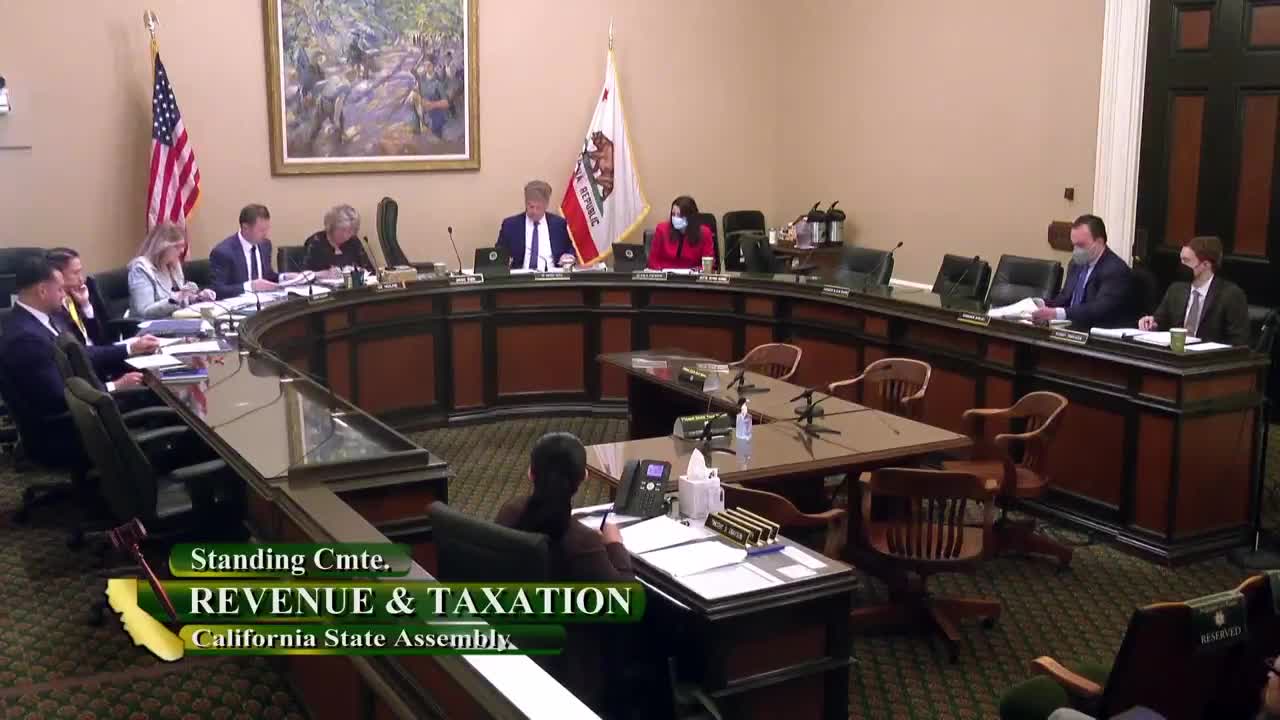
Discussed in Hearing
 5MIN
Assembly Standing Committee on Revenue and Taxation
Bill Author

Bill Co-Author(s):