AB 1190: Community colleges: part-time faculty: office hours.
- Session Year: 2023-2024
- House: Assembly
- Latest Version Date: 2023-03-28
Current Status:
Failed
(2024-02-01: From committee: Filed with the Chief Clerk pursuant to Joint Rule 56.)
Introduced
In Committee
First Chamber
In Committee
Second Chamber
Enacted
What does this bill do?
The bill requires California community college districts to negotiate with part‑time faculty representatives and provide paid office hours, along with rules on reemployment preference and regular evaluations for part‑time, temporary instructors. It sets minimum office‑hour pay of at least one paid hour for every two classes (or 40% of a full‑time load) and one‑half paid hour per class (or 20% of a full‑time load), and requires reopening any existing collective bargaining agreements that conflict with these terms.
The summary is provided by generative AI which can make mistakes. For original language, please view the details in the table below.
Existing law establishes the California Community Colleges under the administration of the Board of Governors of the California Community Colleges. Existing law authorizes the establishment of community college districts under the administration of community college governing boards, and authorizes these districts to provide instruction at community college campuses throughout the state. Existing law authorizes these districts to establish compensation levels for academic employees, as provided.
Existing law requires community college districts, as a condition of receiving funding allocated for the Student Success and Support Program, to negotiate in good faith with the exclusive representatives for part-time, temporary faculty, the terms of reemployment preference for part-time, temporary faculty assignments based on minimum standards up to the range of 60% to 67% of a full-time equivalent load and a regular evaluation process for part-time, temporary faculty, as specified.
This bill would require community college districts, as a condition of receiving funds allocated for the Student Success and Support Program, to commence negotiating the terms of compensation for office hours for part-time employees, as specified, and the terms governing reemployment preferences and evaluation processes, no later than the expiration of any negotiated agreement in effect on January 1, 2024, and for any community college district that does not have a collective bargaining agreement in effect as of January 1, 2024, on January 1, 2024.
Existing law establishes the Community College Part-Time Faculty Office Hours Program to provide community college students equal access to academic advice and assistance and to encourage community college districts to provide opportunities by compensating part-time faculty who hold office hours related to their teaching load. Existing law authorizes community college districts to compensate part-time faculty at an amount equal to at least one paid office hour for every 2 classes or more taught each week by the part-time faculty member or 40% of a full-time load as defined by the local community college district. Existing law requires the governing board of a community college district that establishes such a program to negotiate, or meet and confer, to establish a program to provide part-time faculty office hours. Existing law establishes the Part-Time Faculty Office Hours Program Fund in the State Treasury to provide funding for up to 50% of the costs to community college districts for the program as verified by the district, as specified. This bill would repeal the provisions establishing the Community College Part-Time Faculty Office Hours Program and the Part-Time Faculty Office Hours Program Fund. The bill would instead require the governing board of a community college district, on and after July 1, 2024, to provide compensation for office hours to part-time faculty at an amount equal to one paid office hour for every 2 classes or more taught per week by the part-time faculty member or 40% of a full-time load, and 12 paid office hour for every class or 20% of a full-time load. If these provisions conflict with the terms of a collective bargaining agreement in effect before January 1, 2024, the bill would require the collective bargaining agreement to be reopened for negotiations, as specified. By imposing new duties on community college districts, the bill would establish a state-mandated local program.The California Constitution requires the state to reimburse local agencies and school districts for certain costs mandated by the state. Statutory provisions establish procedures for making that reimbursement.This bill would provide that, if the Commission on State Mandates determines that the bill contains costs mandated by the state, reimbursement for those costs shall be made pursuant to the statutory provisions noted above.Existing law establishes the Community College Part-Time Faculty Office Hours Program to provide community college students equal access to academic advice and assistance and to encourage community college districts to provide opportunities by compensating part-time faculty who hold office hours related to their teaching load. Existing law authorizes community college districts to compensate part-time faculty at an amount equal to at least one paid office hour for every 2 classes or more taught each week by the part-time faculty member or 40% of a full-time load as defined by the local community college district. Existing law requires the governing board of a community college district that establishes such a program to negotiate, or meet and confer, to establish a program to provide part-time faculty office hours. Existing law establishes the Part-Time Faculty Office Hours Program Fund in the State Treasury to provide funding for up to 50% of the costs to community college districts for the program as verified by the district, as specified.
This bill would repeal the provisions establishing the Community College Part-Time Faculty Office Hours Program and the Part-Time Faculty Office Hours Program Fund. The bill would instead require the governing board of a community college district, on and after July 1, 2024, to provide compensation for office hours to part-time faculty at an amount equal to one paid office hour for every 2 classes or more taught per week by the part-time faculty member or 40% of a full-time load, and 12 paid office hour for every class or 20% of a full-time load. If these provisions conflict with the terms of a collective bargaining agreement in effect before January 1, 2024, the bill would require the collective bargaining agreement to be reopened for negotiations, as specified. By imposing new duties on community college districts, the bill would establish a state-mandated local program.
The California Constitution requires the state to reimburse local agencies and school districts for certain costs mandated by the state. Statutory provisions establish procedures for making that reimbursement.
This bill would provide that, if the Commission on State Mandates determines that the bill contains costs mandated by the state, reimbursement for those costs shall be made pursuant to the statutory provisions noted above.
(a)(1)As a condition of receiving funds allocated for the Student Success and Support Program in the annual Budget Act, on or after July 1, 2017, community college districts that do not have a collective bargaining agreement with part-time, temporary faculty in effect as of January 1, 2017, shall commence negotiations shall negotiate with the exclusive bargaining representatives for part-time, temporary faculty regarding the terms and conditions required by subdivision (b). The parties shall negotiate these rights for part-time, temporary faculty. (b) as follows:
(A)A community college district that does not have a collective bargaining agreement with part-time, temporary faculty in effect as of January 1, 2024, shall commence negotiations on January 1, 2024.
(B)A community college district that has a collective bargaining agreement with part-time, temporary faculty in effect as of January 1, 2024, shall commence negotiations no later than the expiration date of the collective bargaining agreement.
(2)It is the intent of the Legislature that both of the following shall occur:
(A)The adoption of provisions in compliance with subdivision (b) shall be included as part of the usual and customary negotiations between the community college district and the exclusive representative for part-time, temporary faculty.
(B)(i)A community college district shall establish minimum standards for the terms of reemployment preference for part-time, temporary faculty assignments through the negotiation process between the community college district and the exclusive representative for part-time, temporary faculty. These standards shall include all of the following:
(I)The length of time part-time, temporary faculty have served at the community college or district.
(II)The number of courses part-time, temporary faculty have taught at the community college or district.
(III)The evaluations of temporary faculty conducted pursuant to Section 87663 and other related methods of evaluation that can reliably be used to assess educational impact of temporary faculty as it relates to student success.
(IV)The availability, willingness, and expertise of part-time, temporary faculty to teach specific classes or take on specific assignments that are necessary for student instruction or services.
(ii)Additional standards may be considered and established through the negotiation process, as necessary.
(iii)Standards established pursuant to clause (ii) shall reflect the processes and procedures for both of the following:
(I)Assigning part-time, temporary faculty to teach courses or staff nonclassroom assignments.
(II)Evaluating part-time, temporary faculty.
(b)As a condition of receiving funds allocated for the Student Success and Support Program in the annual Budget Act and except as provided in subdivision (d), a community college district described in subparagraph (A) or (B) of paragraph (1) of subdivision (a) and the exclusive representative of the part-time, temporary faculty shall negotiate in good faith all of the following:
(1)The terms of reemployment preference for part-time, temporary faculty assignments based on the minimum standards up to the range of 60 to 67 percent of a full-time equivalent load. These terms shall also contain policies for termination, including, but not limited to, the evaluation process negotiated pursuant to paragraph (2).
(2)A regular evaluation process for part-time, temporary faculty pursuant to the requirements of Section 87663.
(3)(A)Adoption of terms of compensation that persons who are employed to teach adult or community college classes for fewer than the hours per week considered a full-time assignment for regular employees shall be compensated for office hours in at least an amount that bears the same ratio to the amount provided to full-time employees as the time actually served by those part-time employees bears to the time actually served in providing office hours by full-time employees.
(B)Any office hours negotiated under this program shall not be applied toward the maximum percentage-of-hours limitation for part-time faculty as specified in Section 87482.5. These hours shall not be counted towards the hours per week of teaching adult or community college classes for purposes of requiring eligibility for tenure or for purposes of fulfilling any probationary hour requirements.
(c)A community college district that has a collective bargaining agreement in effect as of July 1, 2017, 2024, that has satisfied the requirements of subdivision (b), and that executes a signed written agreement with the exclusive representative of the part-time, temporary faculty acknowledging implementation of subdivision (b), shall be deemed to be in compliance with this section while the bargaining agreement is in effect.
(d)In all cases, part-time faculty assignments shall be temporary in nature, contingent on enrollment and funding, and subject to program changes, and no part-time faculty member shall have reasonable assurance of continued employment at any point, irrespective of the status, length of service, or reemployment preference of that part-time, temporary faculty member.
SECTION 1.Section 87881 of the Education Code is repealed.SEC. 2.Section 87883 of the Education Code is amended to read:87883.(a)The governing board of a community college district may provide compensation for office hours to part-time faculty.(b)The compensation paid to part-time faculty under this article shall equal at least one paid office hour for every two classes or more taught each week or 40 percent of a full-time load as defined by the community college district.(c)Nothing in this section precludes compensation under this program for paid office time for each 20 percent of a full-time load, or fraction thereof, as defined by the community college district.(d)The change made to subdivision (c) during the 1999 portion of the 19992000 Regular Session of the Legislature shall be operative in any fiscal year only if funds are appropriated for purposes of that change in the annual Budget Act or in another measure. If the amount appropriated in the annual Budget Act or in another measure for purposes of this section is insufficient to fully fund that change for the fiscal year, the chancellor shall prorate the funds among the community college districts affected by this section. (e)This section shall become inoperative on July 1, 2024, and, as of January 1, 2025, is repealed.SEC. 3.Section 87883 is added to the Education Code, to read:87883.(a)On and after July 1, 2024, the governing board of a community college district shall provide compensation for office hours to part-time faculty.(b)The compensation paid to part-time faculty under this article shall equal at least one paid office hour for every two classes or more taught each week or 40 percent of a full-time load, and one-half paid office hour for every class or 20 percent of a full-time load.(c)This section shall become operative on July 1, 2024.SEC. 4.Section 87884 of the Education Code is amended to read:87884.(a)The governing board of each community college district shall negotiate with the exclusive bargaining representative, or in instances where there is no bargaining unit shall meet and confer with the faculty, to establish a program to provide part-time faculty office hours.(b)Any hours negotiated under this program shall not be applied toward the maximum percentage-of-hours limitation for part-time faculty as specified in Section 87882. These hours shall not be counted towards the hours per week of teaching adult or community college classes for purposes of acquiring eligibility for tenure or for purposes of fulfilling any probationary hour requirements.(c)On or before June 1 of each year, each community college district participating in the program shall send a verification to the Chancellor of the California Community Colleges specifying the total costs of the compensation paid for office hours of part-time faculty.(d)If the provisions of this article conflict with the terms of a collective bargaining agreement in effect before January 1, 2024, the collective bargaining agreement shall be reopened for negotiations pursuant to this section.SEC. 5.Section 87885 of the Education Code is repealed.SEC. 6.If the Commission on State Mandates determines that this act contains costs mandated by the state, reimbursement to local agencies and school districts for those costs shall be made pursuant to Part 7 (commencing with Section 17500) of Division 4 of Title 2 of the Government Code.(a)The governing board of a community college district may provide compensation for office hours to part-time faculty.
(b)The compensation paid to part-time faculty under this article shall equal at least one paid office hour for every two classes or more taught each week or 40 percent of a full-time load as defined by the community college district.
(c)Nothing in this section precludes compensation under this program for paid office time for each 20 percent of a full-time load, or fraction thereof, as defined by the community college district.(d)The change made to subdivision (c) during the 1999 portion of the 19992000 Regular Session of the Legislature shall be operative in any fiscal year only if funds are appropriated for purposes of that change in the annual Budget Act or in another measure. If the amount appropriated in the annual Budget Act or in another measure for purposes of this section is insufficient to fully fund that change for the fiscal year, the chancellor shall prorate the funds among the community college districts affected by this section.(e)This section shall become inoperative on July 1, 2024, and, as of January 1, 2025, is repealed.
SEC. 3.Section 87883 is added to the Education Code, to read:87883.(a)On and after July 1, 2024, the governing board of a community college district shall provide compensation for office hours to part-time faculty.
(b)The compensation paid to part-time faculty under this article shall equal at least one paid office hour for every two classes or more taught each week or 40 percent of a full-time load, and one-half paid office hour for every class or 20 percent of a full-time load.
(c)This section shall become operative on July 1, 2024.
SEC. 4.Section 87884 of the Education Code is amended to read:87884.(a)The governing board of each community college district that establishes a program pursuant to this article shall negotiate with the exclusive bargaining representative, or in instances where there is no bargaining unit shall meet and confer with the faculty, to establish a program to provide part-time faculty office hours.
(b)Any hours negotiated under this program shall not be applied toward the maximum percentage-of-hours limitation for part-time faculty as specified in Section 87882. These hours shall not be counted towards the hours per week of teaching adult or community college classes for purposes of acquiring eligibility for tenure or for purposes of fulfilling any probationary hour requirements.
(c)On or before June 1 of each year, each community college district participating in the program shall send a verification to the Chancellor of the California Community Colleges specifying the total costs of the compensation paid for office hours of part-time faculty participating in the program. faculty.
(d)Any changes made by this section to the Community College Part-Time Faculty Office Hours Program shall not affect any part-time faculty office hours program in effect on January 1, 2000.(d)If the provisions of this article conflict with the terms of a collective bargaining agreement in effect before January 1, 2024, the collective bargaining agreement shall be reopened for negotiations pursuant to this section.
SEC. 5.Section 87885 of the Education Code is repealed.87885.(a)The Part-Time Faculty Office Hours Program Fund is hereby established in the State Treasury.(b)On or before June 15 of each year, the Chancellor of the California Community Colleges shall apportion to each community college district that establishes a program pursuant to this article an amount of up to 50 percent of the total costs of compensation paid for office hours of part-time faculty, as defined in Section 87882. The chancellor shall distribute funds that are appropriated in the annual Budget Act specifically for this purpose proportionally based on each districts total costs for office hours of part-time faculty pursuant to the verification submitted by the community college district in accordance with subdivision (c) of Section 87884 for that fiscal year. In no event, however, shall the allocation to any district in a fiscal year exceed 50 percent of the total costs of the compensation paid for office hours of part-time faculty pursuant to this article.(c)It is the intent of the Legislature that funding for the purposes of this article be included in the annual Budget Act.SEC. 6.If the Commission on State Mandates determines that this act contains costs mandated by the state, reimbursement to local agencies and school districts for those costs shall be made pursuant to Part 7 (commencing with Section 17500) of Division 4 of Title 2 of the Government Code.
|
Date
|
Status
|
|---|---|
| Feb 1, 2024 | From committee: Filed with the Chief Clerk pursuant to Joint Rule 56. |
| Jan 31, 2024 | Died pursuant to Art. IV, Sec. 10(c) of the Constitution. |
| May 18, 2023 | In committee: Held under submission. |
| May 3, 2023 | In committee: Set, first hearing. Referred to APPR. suspense file. |
| Apr 19, 2023 | From committee: Do pass and re-refer to Com. on APPR. (Ayes 12. Noes 0.) (April 18). Re-referred to Com. on APPR. |
| Mar 29, 2023 | Re-referred to Com. on HIGHER ED. |
| Mar 28, 2023 | From committee chair, with author's amendments: Amend, and re-refer to Com. on HIGHER ED. Read second time and amended. |
| Mar 2, 2023 | Referred to Com. on HIGHER ED. |
| Feb 17, 2023 | From printer. May be heard in committee March 19. |
| Feb 16, 2023 | Read first time. To print. |
|
Date
|
Description
|
Location
|
Votes
|
|
|---|---|---|---|---|
| Apr 18, 2023 | Do pass and be re-referred to the Committee on [Appropriations] | Assembly Standing Committee on Higher Education |
Passed |
This list shows positions taken on this bill by organizations on the date displayed, which is linked to the original source.
Positions by individuals are not included.
|
Organization
|
Position
|
Date
|
|---|---|---|
| Faculty Association of California Community Colleges | * Support | Apr 18, 2023 |
| Association Of California Community College Administrators | * Indeterminate | Apr 18, 2023 |
| California Community College Independence | * Support | Apr 18, 2023 |
| California Federation of Teachers, AFL-CIO | ** Support | |
| California Teachers Association | ** Support | |
| Community College Association | * Support | Apr 18, 2023 |
| Community College League of California | * Indeterminate | Apr 18, 2023 |
| Student Senate for California Community Colleges | ** Support | |
| W Strategies LLC. | * Support | Apr 18, 2023 |
Date of Hearing: May 3, 2023
ASSEMBLY COMMITTEE ON APPROPRIATIONS
Chris Holden, Chair
ABPCA Bill Id:AB 1190
Author:(Irwin) – As Amended Ver:March 28, 2023
Policy Committee: | Higher Education | Vote: | 12 - 0 |
|
| ||
|
|
Urgency: No State Mandated Local Program: No Reimbursable: No
SUMMARY:
This bill requires each California Community College (CCC) district to begin negotiations with part-time, temporary faculty members by January 1, 2024, for the purposes of adopting terms of compensation for part-time, temporary faculty member office hours. The bill requires part-time faculty members to be compensated for the office hours they complete at the same rate per hour as full-time faculty members are compensated.
In addition, the bill specifies any office hours negotiated under this bill are not to be applied toward the maximum percentage-of-hours limitation for part-time faculty members. This bill would make a CCC district’s receipt of Student Success and Support Program (SSSP) funds contingent on implementing its provisions.
FISCAL EFFECT:
- Ongoing Proposition 98 General Fund costs, potentially in the tens of millions of dollars to hundreds of millions of dollar annually, to compensate part-time, temporary faculty members for offices hours. Costs would depend on the number of office hours a part-time faculty member works, the number of part-time faculty members offering office hours, and the hourly rate negotiated with the CCC district for those hours. In addition, to the extent CCC districts already have collective bargaining agreements in place that compensate part-time faculty members for office hours, costs could be less.
If all of the state’s 37,000 part-time faculty members provided three hours of office hours weekly for 35 weeks at an hourly rate of $75 per hour, costs would be $486 million annually. If half of those staff provided three hours of office hours weekly for 35 weeks at an hourly rate of $30, costs would be $50 million annually. Costs could be offset by reimbursements from the Community College Part-Time Faculty Office Hours Program, described in Comment 2. The program provides up to 50% reimbursement for part-time faculty member office hours.
- One-time Proposition 98 General Fund costs, totaling between about $85,000 and $205,000, for 72 CCC districts to update their collective bargaining agreements with part-time faculty members to include compensation for office hours consistent with specified guidelines. The CCC Chancellor’s Office estimates costs to be between $1,172 and $2,862 per CCC district.
COMMENTS:
- Purpose. According to the author:
Students deserve to have access to direct support from their professors, regardless if they are full-time or part-time. Although they are not currently compensated for office hours, many part-time faculty meet with students on their own time to support their students. Many though are unable to meet with students because they are racing from campus to campus to earn a living wage. AB 1190 would require community college districts to pay their part-time faculty for their time spent in office hours, giving students the support they need to succeed in college and create more equitable wages for professors.
- Background. Full-time CCC faculty members receive a salary based on seniority, teaching load, prep time for classes they will teach, grading, curriculum development, program review and development, office hours, and committee work. Compensation is negotiated through collective bargaining with each CCC district. According to the CCC Chancellor’s Office, the average salary for tenured and tenure track faculty members in fall 2021 was $108,326 annually. Full-time faculty members generally receive 12.5% of their annual salary for holding a minimum of five office hours per week for 35 weeks. This equates to an average hourly rate for full-time faculty member office hours of $77.37.
Part-time, temporary CCC faculty member pay is largely based on the number of units a faculty member teaches, though a member may also receive additional hourly pay for office hours, flex time, or committee work. Part-time, temporary faculty member compensation is negotiated through collective bargaining with each CCC district. Part-time, temporary faculty members can teach at a CCC district for 67% of the hours a full-time CCC faculty member at a CCC district can teach and still be considered a part-time, temporary faculty member. CCCs employ about 37,000 part-time, temporary faculty members.
.
Community College Part-Time Faculty Office Hours Program. The Community College Part-Time Faculty Office Hours Program provides funding to CCCs to incentivize them to compensate part-time faculty members who hold office hours. To participate in the program, a CCC district must negotiate with the exclusive bargaining representative or with faculty members, if there is no bargaining unit. The CCC district must compensate part-time faculty members participating in the program for at least one office hour for every two or more classes taught per week or 40% of the district-defined full-time load. In addition, a participating part-time faculty member may receive office time compensation for each 20% of the district-defined full-time faculty member workload. The Community College Part-Time Faculty Office Hours Program then provides a reimbursement to participating CCC districts for up to 50% of the total costs of the program. According to the CCC Chancellor’s Office 57 CCC districts participate in the program.
The 2020-21 budget provided $102 million for the program, the 2021-22 budget provided $22 million, and the 2022-23 budget provided $24 million. Based on the data provided by districts for the Part-Time Faculty Office Hours Program for the 2021-22 fiscal year, 30,746 part-time faculty member provided 789,587 office hours.
Student Success and Support Program. SSSP program was established to provide ongoing funding to CCCs for student support in admissions, orientation, assessment, counseling and student follow up. In 2018, this program and the Student Success for Basic Skills program were consolidated into the new Student Equity and Achievement Program (SEAP). The 2022-23 budget provides $524 million for SEAP.
- Related Legislation. AB 260 (Santiago) of this legislative session amends the same section of the Education Code as this bill to establish a minimum level of compensation for part-time, temporary California Community College (CCC) faculty members. The bill is pending in this committee.
- Prior Legislation. AB 1752 (Santiago), of the 2021-2022 Legislative Session, would have established a minimum level of compensation for part-time, temporary CCC faculty members. AB 1752 was held in this committee.
AB 1856 (Medina), of the 2021-22 Legislative Session, would have increased the number of minimum hours a part-time faculty member can teach as compared to a full-time faculty member at a CCC district from 67% to 85%. The bill was vetoed.
Analysis Prepared by: Natasha Collins / APPR. / (916) 319-2081
Date of Hearing: April 18, 2023
ASSEMBLY COMMITTEE ON HIGHER EDUCATION
Mike Fong, Chair
ABPCA Bill Id:AB 1190 (
Author:Irwin) – As Amended Ver:March 28, 2023
SUBJECT: Community colleges: part-time faculty: office hours
SUMMARY: Requires a California Community College district (CCD) to begin negotiations with part-time faculty by January 1, 2024, for the purposes of adopting terms of compensation for part-time faculty office hours. Specifically, this bill:
- Updates existing provisions regarding collective bargaining agreements CCDs must enter into with community college part-time faculty in order to receive funds from the Student Success and Support Program (SSSP). Specifically, if a CCD does not have a collective bargaining agreement in place by January 1, 2024, they will begin negotiations on January 1, 2024; but, if the community college district has a current collective bargaining agreement in place, the district will begin negotiations once the existing collective bargaining agreement has expired.
- Updates the minimum standards for collective bargaining agreements entered into by CCDs in (1) to include an additional condition regarding the compensation of part-time faculty. Specifically, part-time faculty will be compensated for office hours in at least an amount that bears the same ratio to the amount provided to full-time faculty employees as the time actually served by those part-time faculty bears to the time actually served in office hours by full-time faculty.
- Requires any office hours negotiated will not be applied toward the maximum percentage of hours limitation for part-time faculty as specified in Education Code (EDC) Section 87482.5. The hours will not count towards the hours per week of teaching for purposes of requiring eligibility for tenure or for purposes of fulfilling any probationary hour requirements.
- Specifies that a CCD that has a collective bargaining agreement in effect as of July 1, 2024, that has satisfied the requirements of (2), and executes a signed written agreement with the exclusive representative of the part-time, temporary faculty acknowledging implementation of (2), will be deemed in compliance with the provisions while the bargaining agreement is in effect.
EXISTING LAW:
- Establishes the California Community Colleges (CCC) under the administration of the Board of Governors of the CCC, as one of the segments of public postsecondary education in this state. The CCC shall be comprised of community college districts (EDC Section 70900).
- Establishes that CCC districts are under the control of a board of trustees, known as the governing board, who has the authority to establish, maintain, operate, and govern one or more community colleges, within its district as specified (EDC Section 70902).
- Establishes the Student Success and Support Program for the purpose of encouraging the matriculation of students towards their educational goals. Specifically funding allocated through the program to districts is to be used for the following:
- Orientation services designed to provide students with information on campus procedures, academic expectations, financial assistance, and other matters the district deems appropriate;
- Assessment before course registration as defined in Section 78213;
- Counseling and other educational planning services including, but not limited to:
- Assisting students in the exploring educational and career interests, identifying educational objectives including degree obtainment;
- Developing an educational plan leading to course selection that lead to the conferral of a degree or certificate that is aligned with the student’s educational goal;
- Referrals to special support services, including but not limited to financial aid, health services, foster youth services, and disabled student services; and,
- Evaluation of each student’s progress and referrals for academic interventions, as defined (EDC Section 78212).
- Defines faculty as employees of a community college district who are employed in an academic position that is not designated as supervisory or management, as defined. Faculty include, but are not limited to, instructors, librarians, counselors, community college health services professionals, handicapped student programs and services professionals, extended opportunity programs, and service professionals, and people employed in a position prior to July 1, 1990 that required nonsupervisory, nonmanagement community college certification qualifications (EDC Section 87003 (a)).
- Requires that a person in an academic position who serves less than a full school year will receive a salary compensation equal to the amount that bears the ratio to the established annual salary for the position as the number of working days they served or were required to be present by the governing board. Notwithstanding any other provision, a person in an academic position who serves a complete semester will receive no less than one-half of the established annual salary for the position. In the event the person dies during the school year, their state will be entitled to receive the salary that bears the same ratio to the established annual salary for the position as the number of working days the person served plus any dates the governing board required them to be present, minus any salary paid prior to the person’s death (EDC Section 87815).
- Conditions the receipt of funds from the SSSP by July 1, 2017, upon the requirement that if a CCD does not have a collective bargaining agreement with part-time faculty, the CCD must enter into negotiations with the exclusive representatives for part-time, temporary faculty and must agree to specified terms and conditions (see (7).
- Specifies, it is the intent of the Legislature for the collective bargaining agreements established in (6) will have the following:
- Provision regarding the salary conditions for part-time faculty as described in (7);
- Provisions pertaining to the minimum standards for the term of reemployment preferences for part-time faculty assignments. If the aforementioned standards are negotiated then they will include:
- The length of time part-time, temporary faculty have served at the college or district;
- The length of time part-time, temporary faculty have taught at a college or district;
- The evaluations of temporary faculty conducted in accordance with Education Code (EDC) Section 87663 and other related methods of evaluation that can be used to assess the educational impact of the faculty member as it relates to student success; and,
- The availability, willingness, and expertise of part-time faculty to teach specific classes or take on specific assignments that are necessary for student instruction or services.
- Any additional standards that are established through the negotiations between the CCD and part-time faculty representatives; and,
- Standards that reflect the process and procedures for the following:
- Assigning part-time faculty to teach courses or staff nonclassroom assignments.
- Evaluating part-time faculty.
- Specifies, it is the intent of the Legislature for the collective bargaining agreements established in (6) will have the following:
- Sets the minimum conditions for terms of a collective bargaining agreement as established in (6) to include:
- Terms of reemployment preference for part-time faculty assigned based on the minimum standards up to the range of 60 to 67% of a full-time equivalent load. These terms will include policies for termination including but not limited to the evaluation process established below (b).
- A regular evaluation process for part-time faculty pursuant to the requirements in EDC section 87663.
- Authorizes that if a CCD has a collective bargaining agreement in effect as of July 1, 2017, and is in full compliance with (7), and executes a signed written agreement with the exclusive representation of part-time faculty acknowledging the implementation of the above then the CCD will be in compliance with the provision while the bargaining agreement is in effect.
- Clarifies in all cases, part-time faculty will be temporary in nature, contingent on enrollment and funding, and are subject to program changes. No part-time faculty member will have reasonable assurance of continued employment, irrespective of the status, length of service or reemployment preferences of the part-time faculty member (EDC Section 87482.3).
- Provides that a person who is employed to teach adult or community college classes for at the most 67% of hours per week of a full-time faculty having comparable duties will be classified as a temporary employee and not a contract employee. If the provisions of this section are in conflict with the terms of a collective bargaining agreement in effect before January 1, 2009, the provisions of the section will govern the employees subject to the agreement upon the expiration of the agreement. Service as a substitute on a day-to-day basis by persons by part-time faculty will not be used for purposes of calculating eligibility for contract or for regular status and services in professional ancillary activities, as defined, will not be used for purposes of calculating eligibility for contract or regular status unless otherwise provided for in a collective bargaining agreement (EDC Section 87482.5).
FISCAL EFFECT: Unknown
COMMENTS: Need for the measure. As contended by the author, “students deserve to have access to direct support from their professors, regardless if they are full-time or part-time. Although they are not currently compensated for office hours, many part-time faculty meet with students on their own time to support their students. Many though are unable to meet with students because they are racing from campus to campus to earn a living wage. AB 1190 would require community college districts to pay their part-time faculty for their time spent in office hours, giving students the support they need to succeed in college and create more equitable wages for professors.”
Part-time faculty at the CCC. The CCC is the largest two-year system in the United States and educates 1.8 million students between 116 campuses located throughout the state. There is at least one community college in each of the 58 counties in California. 115 college campuses are divided into 72 districts governed by local governing boards with locally elected trustees. The final college, Calbright is governed by the Board of Governors, which is the statewide governing board for all 116 colleges and 73 districts. Each of the local governing boards employs both part-time and full-time faculty to fulfill the academic duties of the colleges within the geographical boundary of its district.
According to the CCC Chancellor’s Office Management Information System DataMart, in fall of 2022, the CCC system employed 17,616 full-time faculty and 36,121 part-time faculty. Part-time faculty comprised of 67.2% of the academic workforce employed by the CCC system. According to annual reports compiled by the Chancellor’s Office, full-time faculty (tenured or tenure track) received an average compensation of $114,630 in 2022. Committee staff will note data regarding part-time faculty salaries was not available from faculty compensation reports compiled by the Chancellor’s Office. However, in a recent audit conducted by the California State Auditor on part-time and full-time faculty, it was found that part-time faculty on average made $45,000.
A part-time faculty at the CCC system is an academic individual who meets the minimum education requirements to teach a specific subject and has a course load that is 60 to 67 percent of what is considered the course load of a full-time faculty at the college. Unlike the course load which determines whether a student is full-time, the number of courses to determine whether a faculty is considered full-time is not dictated by the Education Code nor is it explained by the California Code of Regulations. Instead, each district determines the definition of full-time workload through collective bargaining agreements.
According to the Chronicle for Higher Education article entitled “Community College FAQ: You Teach How Many Classes?” on average a community college professor teaches a course load of 10 courses in a year or five for each semester. Therefore, one could postulate that based on the requirements in code, a part-time professor at a CCC, would be permitted to teach up to six courses in an academic year or three per semester.
An audit conducted by the California State Auditor in February 2023 entitled “California Community College, Increasing Full-time Faculty and Diversity Remains a Challenge” explored the differences between part-time and full-time faculty. Part-time faculty are given fewer responsibilities, for example, part-time faculty are not required to hold office hours nor are they required to be available to students outside of class time. The audit found that many part-time faculty teach at multiple locations and therefore are unable to participate in academic or campus community activities beyond the required hours in the classroom. By comparison, full-time faculty are required to hold office hours, and are required to participate in committees that improve the college’s quality of education as they are seen as a permanent part of the campus community. AB 1190 (Irwin) seeks to rectify this disparity by requiring districts to pay part-time faculty for office hours at the same rate as full-time faculty, but prorated by the ratio of office hours required for part-time faculty as compared to the office hours required of full-time faculty.
Collective bargaining agreements. As previously mentioned, local governing boards of CCDs enter into collective bargaining agreements with faculty and staff for the duties required for the operation of a community college district. A collective bargaining agreement by definition is a legal document with terms and conditions set forth by the two parties who enter into the agreement. In the case of community college faculty agreements, the parties entering into the agreement are the union representatives of the community college faculty and the local governing board of the community college. According to the Chancellor’s Office of the CCC, each of the 73 districts have collective bargaining agreements with part-time faculty. Furthermore, as part of the annual Student Equity and Achievement Program submissions (including the SSSP), districts are required to self-certify if they are complying with all relevant statutes to receive funding which includes having a collective bargaining agreement with part-time faculty. Some colleges such as Los Rios and Los Angeles CCDs have collective bargaining agreements with part-time faculty that are combined with full-time faculty. Others such as Allan Hancock and State Center CCDs have separate collective bargaining agreements with just part-time faculty. Committee staff examined multiple collective bargaining agreements and each included specified information such as what is contained in personnel records, compensation schedules, the workload for faculty, and the requirements of each class size.
Part-time faculty compensation is typically based on the number of units they teach. Depending on the collective bargaining agreement, part-time faculty may also be paid for professional development, professional time (grading, classroom preparation, curriculum writing, and/or answering student emails), and committee work. However, this is entirely based on the negotiations resulting in a collective bargaining agreement and it may not be scaled to represent the ratio of work required of the part-time faculty when compared to the salary paid to full-time faculty for the type of work.
Office hours for part-time faculty. Confined within the Education Code, is the CCC Part-Time Faculty Office Hours Program (FOHP), which is dependent on funding from the annual Budget Act. The FOHP provides a financial incentive for CCDs to provide compensation for part-time faculty to engage in office hours related to their course load by reimbursing the district up to 50% of the cost associated with the part-time faculty office hours. In order to participate in the program a CCD must:
- Enter into a collective bargaining agreement with their part-time faculty and include office hours as part of the negotiations;
- Part-time faculty must be paid for at least one office hour for every two classes or more taught each week or 40% of a full-time faculty course load. Part-time faculty may also receive compensation for office hours if they teach a course load that is less than 20% of the district-defined course load for full-time faculty; and,
- Submit an annual report to the Chancellor’s Office on the number of eligible part-time faculty, the number of eligible office hours, and the total compensation for office hours.
For the last three Budget Acts the allocated for the FOHP was as follows: $102.2 million in 2020-2020, $22.2 million in 2021-2022, and $23.6 million in 2022-2023. According to the 2021-2022 Recalculation Apportionment payments issued on February 28, 2023, by the Chancellor’s Office, all but 15 CCDs received compensation from the FOHP program for part-time faculty office hours. The lack of FOHP funds appropriated to the 15 CCDs does not imply they do not require and compensate for part-time faculty’s office hours. At least one of the CCDs had compensation terms for office hours in their collective bargaining agreement and another left it up to the part-time faculty to determine whether they wished to offer and be compensated for office hours.
According to the Chancellor’s Office, of the funds allocated in the 2021 Budget Act, $90 million remain unencumbered, and of the funds appropriated in the 2018 Budget Act, $4.1 million remain available for CCDs. Therefore, there are ample funds available for all CCDs to compensate their part-time faculty at the same rate as their full-time faculty reduced by the number of office hours required of part-time faculty as compared to the required office hours for full-time faculty.
Arguments in support. As enumerated by the California Community College Independents, “full-time tenured faculty are required to hold office hours for students and are compensated for this work. But too many part-time faculty are not paid for holding office hours and are not required to be available to students. Despite this inequity, many part-time faculty meet with students on their own time without being compensated for this essential work.”
California Community College Independents further expounds on the merits of the bill noting, “community college students should not be penalized for enrolling in classes taught by part-time faculty, and should not be inhibited from meeting with their instructors; regardless of whether their instructor teach full-time or part-time.”
Arguments in opposition. As explained by the Association of California Community College Administrators, who opposed the bill as introduced, however the bill has since been amended, “AB 1190 would encroach on the local autonomy of CCDs by mandating office hour payments to part-time staff, which is an issue that should be handled during the collective bargaining process. Districts could also bear significant costs if this bill were to be signed into law, as it mandates payments for part-time faculty hours without providing any funding for districts for implementation.”
Committee comments. AB 1190 (Irwin) seeks to provide parity between part-time and full-time faculty by making sure part-time faculty are compensated for the office hours they complete at the same rate per hour as full-time faculty.
The Legislature, Governor, and the Chancellor of the CCC have all taken significant strides in improving student success at community colleges over the past decade. The previous Chancellor of the CCC, Chancellor Eloy Oakley, implemented the Vision for Success with the sole purpose of increasing degree or certificate attainment and reducing time to degree. The Governor has invested millions of dollars in part-time faculty office hours, part-time faculty health benefits, funding for student success programs through the Student Equity and Achievement Program (SEAP), and funding for CCDs to increase the number of full-time faculty. The Legislature has passed equity-focused bills such as AB 705 (Irwin), Chapter 745, Statute of 2017 and AB 1705 (Irwin), Chapter 926, Statute of 2022 to improve degree attainment by ensuring students have access and the resources necessary to pass transfer-level math and English. AB 1190 (Irwin) builds upon these successes by providing minimum standards for compensation for office hours so students can have access to their part-time professors after hours for additional assistance in their course of study.
While AB 1190 (Irwin) seeks to provide pay parity between part-and full-time faculty, the measure does not stipulate the minimum number of hours a district must require a part-time faculty to complete. This requirement remains open to negotiations between the CCD and the exclusive bargaining representatives for part-time faculty.
Moving forward, the author may wish to provide a minimum standard for the minimum requirements for office hours as part of the conditions dictated in the Education Code for the part-time faculty collective bargaining agreements.
Finally, the SSSP provides ongoing funding to CCDs for student support services such as multiple measures for placement into transfer-level math and English, orientation, counseling, and student follow-up. AB 1809, Chapter 33, Statutes of 2019 consolidated the SSSP and another program the Student Success for Basic Skills, into a block grant, known as the Student Equity and Achievement Program (SEAP). In the 2022-2023 budget year, the SEAP received $534.9 million in state funding.
Moving forward, the author should consider changing the requirement for part-time collective bargaining agreements to be in place before funds from the SSSP are allocated and instead require the agreements to be in place before the funds from the SAEP are allocated as SSSP is now a part of SEAP.
Similar and previous legislation.
AB 260 (Santiago), heard on April 18 in the Assembly Committee on Higher Education, would require a CCD to begin negotiations with part-time faculty by January 1, 2024, for the purposes of adopting terms of compensation for part-time faculty of at least the same ratio to full-time faculty for comparable duties to ensure pay parity for part-time faculty.
AB 1752 (Santiago, 2022), held in the Assembly Committee on Appropriations, is identical to this bill's proposed language.
AB 1856 (Medina, 2022), vetoed by the Governor, would have increased the number of minimum hours a part-time faculty member can teach at a CCD from 67% to 85%. In his veto message, the Governor expressed:
This bill amends statute relating to part-time faculty at the California Community Colleges, including redefining a community college part-time faculty course load as not to exceed 85 percent of the hours of a full-time assignment, rather than not to exceed 67 percent.
As part of my veto message last year for Assembly Bill 375, I made a commitment to supporting community college part-time faculty in the Governor's Budget. This commitment is reflected in the 2022 Budget Act that provides $200 million in ongoing funding to incentivize community colleges to provide health insurance for part-time faculty at the community colleges.
The bill is premature as it is unknown how many community college part-time faculty will benefit from the $200 million now available to districts, which will have a direct impact on the fiscal estimate of this proposed policy change. The bill is estimated to create $26 million to an excess of $150 million of Proposition 98 General Fund cost pressures not reflected in the state's current fiscal plan. For these reasons, I am returning this bill without my signature.
AB 1269 (C. Garcia), held in Assembly Committee on Appropriations, would have required the CCCCO, by July 1, 2023, to conduct a comprehensive study of part-time faculty.
REGISTERED SUPPORT / OPPOSITION:
Support
California Community College Independents
California Federation of Teachers AFL-CIO
California Teachers Association
Faculty Association of California Community Colleges
Individual Letters (11)
Student Senate for California Community Colleges
Oppose
Association of California Community College Administrators
Analysis Prepared by: Ellen Cesaretti-Monroy / HIGHER ED. / (916) 319-3960
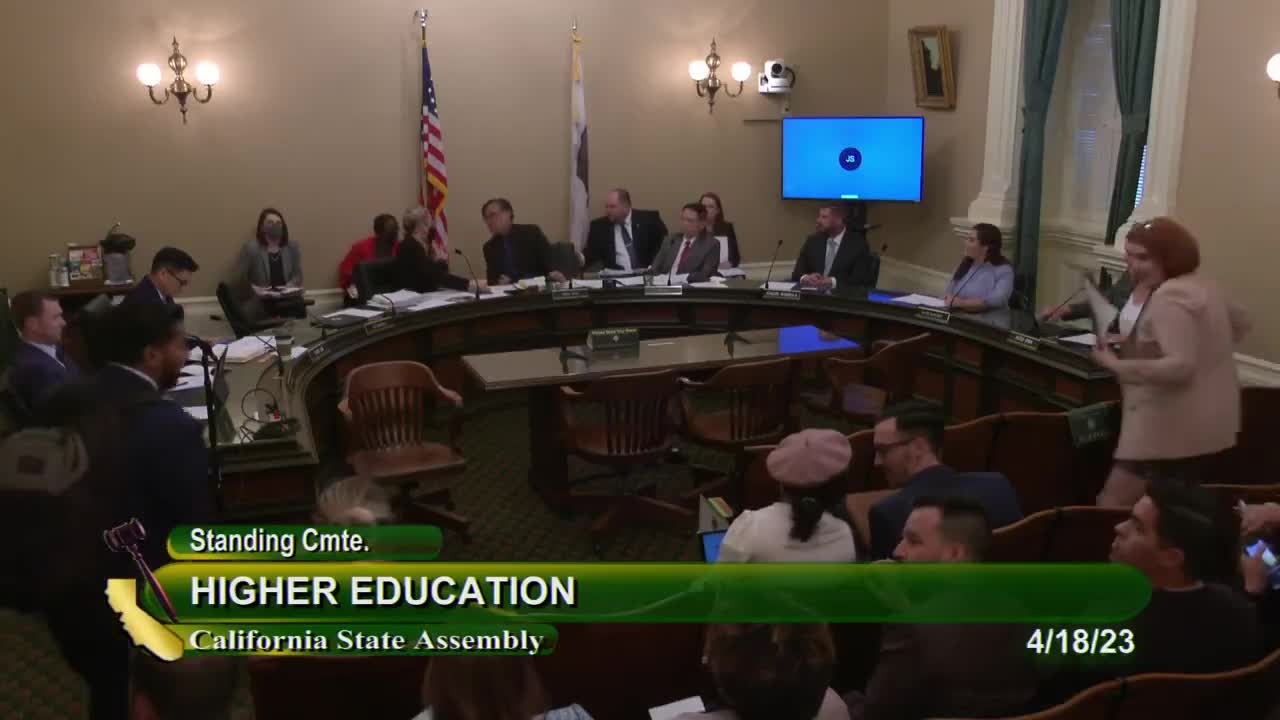
Discussed in Hearing
 6MIN
Assembly Standing Committee on Higher Education
Bill Author

Bill Co-Author(s):