AB 1522: Foster Care: LGBTQ youth.
- Session Year: 2023-2024
- House: Assembly
- Latest Version Date: 2023-03-23
Current Status:
Failed
(2024-02-01: From committee: Filed with the Chief Clerk pursuant to Joint Rule 56.)
Introduced
In Committee
First Chamber
In Committee
Second Chamber
Enacted
What does this bill do?
This bill requires the state Department of Social Services to form a workgroup and produce a report with recommendations to prevent housing instability for LGBTQ youth in foster care. The workgroup must examine whether stronger case management and services for young people leaving foster care would reduce that housing instability.
The summary is provided by generative AI which can make mistakes. For original language, please view the details in the table below.
Existing law generally provides for the placement of foster youth in various placement settings and governs the provision of child welfare services, which is defined to mean public social services that are directed toward the accomplishment of specified purposes, including protecting and promoting the welfare of all children, preventing the unnecessary separation of children from their families, and restoring to their families children who have been removed. Existing law requires the State Department of Social Services, in consultation with county child welfare agencies and other specified entities, to implement a unified, family friendly, and child-centered resource family approval process to replace the existing multiple processes for licensing foster family homes, certifying foster homes by licensed foster family agencies, approving relatives and nonrelative extended family members as foster care providers, and approving guardians and adoptive families.
This bill would require the department to convene a workgroup to create a report with recommendations to prevent housing instability among LGBTQ youth in foster care. The bill would require the workgroup to submit that report on or before January 1, 2025, as specified.
Existing law vests in the State Department of Developmental Services jurisdiction over various state hospitals, referred to as developmental centers, for the provision of care to persons with developmental disabilities. Existing law requires each developmental center to have a developmental center advisory board, and specifies that the boards are advisory to the department and the Legislature, with the power of visitation and advice with respect to, among other things, the conduct of the developmental centers.This bill would make technical, nonsubstantive changes to those provisions.Existing law vests in the State Department of Developmental Services jurisdiction over various state hospitals, referred to as developmental centers, for the provision of care to persons with developmental disabilities. Existing law requires each developmental center to have a developmental center advisory board, and specifies that the boards are advisory to the department and the Legislature, with the power of visitation and advice with respect to, among other things, the conduct of the developmental centers.
This bill would make technical, nonsubstantive changes to those provisions.
(a)(1)The department shall convene a workgroup to create a report with recommendations to prevent housing instability among LGBTQ youth in foster care.
(2)The workgroup established pursuant to subdivision (a) shall address whether strengthening case management and services for those transitioning from foster care would eliminate housing instability among LGBTQ youth.
(3)The report required pursuant to paragraph (1) shall be submitted on or before January 1, 2025.
(b)(1)A report to be submitted pursuant to subdivision (a) shall be submitted in compliance with Section 9795 of the Government Code.
(2)Pursuant to Section 10231.5 of the Government Code, this section is repealed on January 1, 2027.
SECTION 1.Section 4477 of the Welfare and Institutions Code is amended to read:4477.(a)The advisory boards of the developmental centers are advisory to the State Department of Developmental Services and the Legislature with power of visitation and advice with respect to the conduct of the developmental centers and coordination with community mental health programs or regional programs for persons with developmental disabilities.(b)The members of the boards shall serve without compensation other than necessary expenses incurred in the performance of duty. They shall organize and elect a chairperson. They shall meet at least once every three months and at any other time they are called by the chairperson, by the medical director, by the Director of Developmental Services, or by a majority of the board. No expenses shall be allowed except in connection with those meetings.(c)The advisory board or boards of each developmental center or state hospital and developmental center may make a written report on its activities.(a)The advisory boards of the several state developmental centers are advisory to the State Department of Developmental Services and the Legislature with power of visitation and advice with respect to the conduct of the developmental centers and coordination with community mental health programs or regional programs for persons with developmental disabilities. The
(b)The members of the boards shall serve without compensation other than necessary expenses incurred in the performance of duty. They shall organize and elect a chairperson. They shall meet at least once every three months and at any other times time they are called by the chairperson, by the medical director, by the head of the department, Director of Developmental Services, or by a majority of the board. No expenses shall be allowed except in connection with meetings so held. The those meetings.
(c)The advisory board or boards of each developmental center or state hospital and developmental center may make a written report on its activities.
|
Date
|
Status
|
|---|---|
| Feb 1, 2024 | From committee: Filed with the Chief Clerk pursuant to Joint Rule 56. |
| Jan 31, 2024 | Died pursuant to Art. IV, Sec. 10(c) of the Constitution. |
| May 18, 2023 | In committee: Held under submission. |
| May 18, 2023 | Joint Rule 62(a), file notice suspended. (Page 1580.) |
| May 17, 2023 | In committee: Set, first hearing. Referred to APPR. suspense file. |
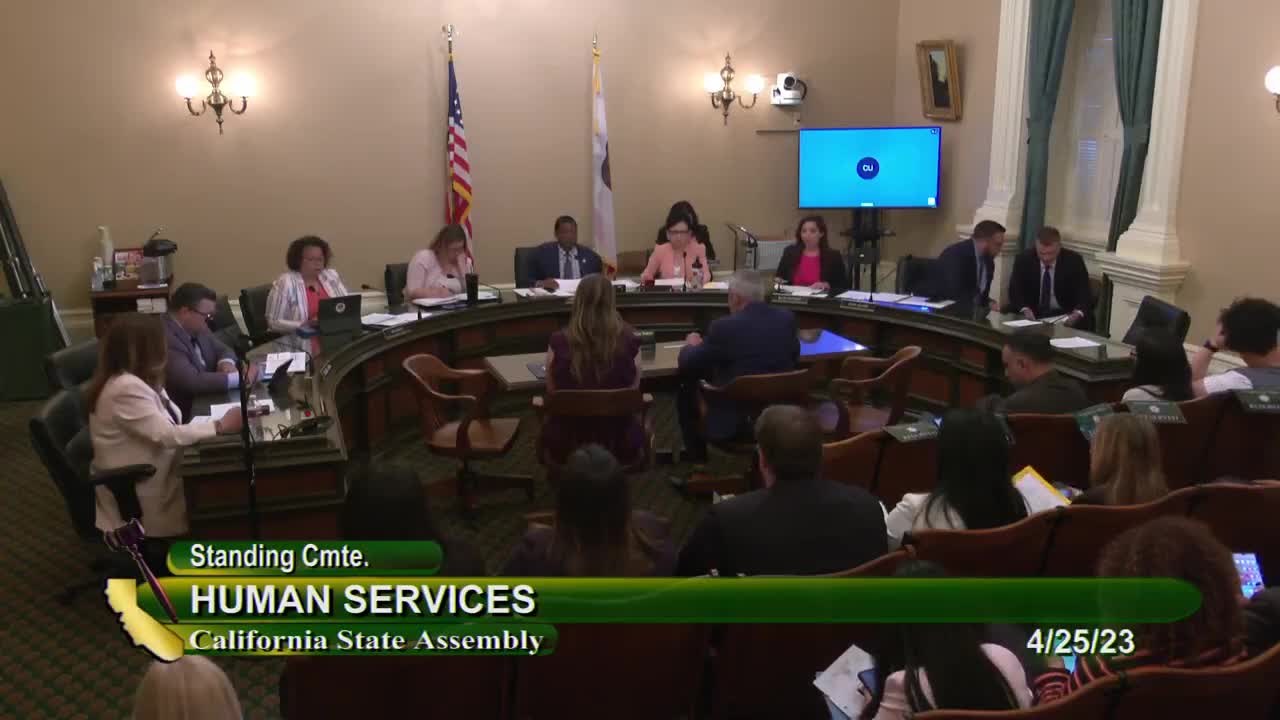
| Apr 26, 2023 | From committee: Do pass and re-refer to Com. on APPR. (Ayes 6. Noes 0.) (April 25). Re-referred to Com. on APPR. |
| Apr 18, 2023 | In committee: Set, first hearing. Hearing canceled at the request of author. |
| Mar 27, 2023 | Re-referred to Com. on HUM. S. |
| Mar 23, 2023 | From committee chair, with author's amendments: Amend, and re-refer to Com. on HUM. S. Read second time and amended. |
| Mar 23, 2023 | Referred to Com. on HUM. S. |
| Feb 18, 2023 | From printer. May be heard in committee March 20. |
| Feb 17, 2023 | Read first time. To print. |
|
Date
|
Description
|
Location
|
Votes
|
|
|---|---|---|---|---|
| Apr 25, 2023 | Do pass and be re-referred to the Committee on [Appropriations] | Assembly Standing Committee on Human Services |
Passed |
This list shows positions taken on this bill by organizations on the date displayed, which is linked to the original source.
Positions by individuals are not included.
|
Organization
|
Position
|
Date
|
|---|---|---|
| California Alliance of Behavioral Health Agencies | * Support | Apr 25, 2023 |
| Equality California | * Support | Apr 25, 2023 |
Date of Hearing: May 17, 2023
ASSEMBLY COMMITTEE ON APPROPRIATIONS
Chris Holden, Chair
ABPCA Bill Id:AB 1522
Author:(Cervantes) – As Amended Ver:March 23, 2023
Policy Committee: | Human Services | Vote: | 6 - 0 |
|
| ||
|
|
Urgency: No State Mandated Local Program: No Reimbursable: No
SUMMARY:
This bill requires the California Department of Social Services (CDSS) to convene a workgroup and produce a report with recommendations for preventing housing instability among lesbian, gay, bisexual, transgender and queer/questioning (LGBTQ) youth in foster care. This bill requires the workgroup to address whether strengthening case management services for youth transitioning from foster care would eliminate housing instability among LGBTQ youth. The bill requires the report to be submitted by January 1, 2025. The bill sunsets the work group on January 1, 2027.
FISCAL EFFECT:
Estimated one-time General Fund costs to CDSS of approximately $150,000 to $250,000 for one limited-term staff position to facilitate and oversee the workgroup and produce a report.
COMMENTS:
- Purpose. The author of this bill seeks to ensure the housing needs of LGBTQ youth in the child welfare system are met in an effort to reduce housing instability among this population. According to the author:
LGBTQ+ youth are overrepresented in unstable housing and foster care; in fact, LGBTQ+ foster youth in unstable housing and homelessness have poorer school outcomes, higher substance use, and poorer mental health, especially as they become transition age youth versus heterosexual youth in unstable housing and foster care. [This bill] seeks to remedy and heighten the need for protections for LGBTQ+ youth in case and care that is affirming of their sexual orientation and gender identity. It seeks to ensure that we make the necessary steps for accountability measures and how we provide needed oversight for the support and resources LGBTQ+ foster youth receive in order to implement best practices to prevent housing instability and homelessness about LGBTQ+ youth in foster care.
- Youth Homelessness. The 2022 point-in-time count conducted by the U.S. Department of Housing and Urban Development (HUD) reported, on a single night in 2022, there were 9,590 unaccompanied youth under the age of 25 experiencing homelessness in California. This is the largest number of unaccompanied youth in any state and accounts for more than a third of all unaccompanied youth nationally. California also accounted for 52% (6,752 people) of all unsheltered unaccompanied youth. Youth who age out of the foster care system are at high risk of becoming homeless. A 2013 study published in the Journal of Public Health found between 31% and 46% of former foster youth had been homeless at least once by age 26.
LGBTQ youth experiencing homelessness reported higher rates of mental health challenges, compared to their stably housed LGBTQ peers, according to a recent study conducted by the Trevor Project on homelessness and housing instability among LGBTQ youth. The study also found that, overall, 28% of LGBTQ youth reported experiencing homelessness or housing instability at some point in their lives, and LGBTQ youth who reported experiencing homelessness or housing instability had higher rates of victimization, being in foster care, and food insecurity, compared to their stably housed LGBTQ peers. Additionally, the study found that lesbian, gay, and bisexual youth experiencing homelessness report higher rates of depression, post-traumatic stress disorder (PTSD), self-harm, suicidal ideation, or suicide attempts than their straight, cisgender peers experiencing homelessness.
This bill requires CDSS to convene a working group to create a report with recommendations to prevent housing instability among LGBTQ youth in foster care, and, further, requires the report to address whether strengthening case management and services for those transitioning from foster care would eliminate housing instability among LGBTQ youth.
- Related Legislation. AB 589 (Boerner Horvath) requires the California Department of Housing and Community Development (HCD) to establish a five-year pilot program in three counties to provide emergency transitional housing for LGBTQ+ youth experiencing homelessness due to family rejection. AB 589 is pending in this Committee.
SB 407 (Wiener) requires, among other things, resource families to demonstrate an understanding of the unique needs of LGBTQ+ and gender-expansive youth and the capacity and willingness to meet those needs. SB 407 is pending in the Senate Appropriations Committee.
Analysis Prepared by: Jennifer Swenson / APPR. / (916) 319-2081
Date of Hearing: April 25, 2023
ASSEMBLY COMMITTEE ON HUMAN SERVICES
Corey A. Jackson, Chair
ABPCA Bill Id:AB 1522 (
Author:Cervantes) – As Amended Ver:March 23, 2023
SUBJECT: Foster Care: LGBTQ youth
SUMMARY: Requires the California Department of Social Services (CDSS) to convene a workgroup to create a report with recommendations to prevent housing instability among lesbian, gay, bisexual, transgender and queer/questioning (LGBTQ) youth in foster care; Requires the workgroup to address whether strengthening case management services for those transitioning from foster care would eliminate housing instability among LGBTQ youth; requires the report to be submitted no later than January 1, 2025; and, sunsets this work group on January 1, 2027.
EXISTING LAW:
- Establishes a state and local system of child welfare services, including foster care, for children who have been adjudged by the court to be at risk of abuse and neglect or to have been abused or neglected, as specified. (Welfare and Institutions Code Section [WIC] 202)
- States that the purpose of foster care law is to provide maximum safety and protection for children who are currently being physically, sexually, emotionally abused, neglected, or exploited, and to ensure the safety, protection, and physical and emotional well-being of children who are at risk of harm. (WIC 300.2)
- States the intent of the Legislature to preserve and strengthen a child’s family ties whenever possible and to reunify a foster youth with their biological family whenever possible, or to provide a permanent placement alternative, such as adoption or guardianship. (WIC 16000)
- Requires out-of-home placement of a child in foster care to be based upon the selection of a safe setting that is the least restrictive family setting that promotes normal childhood experiences and the most appropriate setting that meets the child’s individual needs and is available, in proximity to the parent’s home, in proximity to the child’s school, consistent with the selection of the environment best suited to meet the child’s special needs and best interests. (WIC 16501.1(d)(1))
- Provides that it is the policy of this state that all persons engaged in providing care and services to foster children, including, but not limited to, foster parents, adoptive parents, relative caregivers, and other caregivers contracting with a county welfare department, shall have fair and equal access to all available programs, services, benefits, and licensing processes, and shall not be subjected to discrimination or harassment on the basis of their clients’ or their own actual or perceived race, ethnic group identification, ancestry, national origin, color, religion, sex, sexual orientation, gender identity, mental or physical disability, or HIV status. Further, clarifies that these provisions shall not be interpreted to create or modify existing preferences for foster parents or to limit the local placement agency’s ability to make placement decisions for a child based on the child’s best interest. (WIC 16013)
- Specifies when placing foster children, the placing agency shall not decline to place a child with a resource family because of a resource family parent’s actual or perceived sexual orientation, gender identity, or gender expression. (WIC 16518.5)
FISCAL EFFECT: Unknown, this bill has not been analyzed by a fiscal committee.
COMMENTS:
Background Child Welfare Services (CWS) System. The goal of California’s CWS system is ultimately to protect children from abuse and neglect, and provide for their health, safety, and overall wellbeing. When a child is identified as being at risk of abuse or neglect, county juvenile courts hold legal jurisdiction and the CWS system appoints a social worker in order to ensure the needs of the child are met. Through the CWS system, multiple opportunities arise for the judicial system to evaluate, review, and determine the custody of the child, or determine the best out-of-home placement for the youth. Together, the judicial system and the child’s social worker work to ensure that the best possible services are provided to the child. The CWS system, when appropriate, also works to reunite children who have been removed from the custody of their parents or guardians with individuals they consider to be family in order to maintain familial bonds wherever possible. As of January 1, 2023, there were 52,265 youth in the CWS system.
Youth homelessness. The federal government defines homeless youth as minors younger than 18 or young adults between 18 and 24 years old who live independently without shelter. In 2022, the United State Department of Housing and Urban Development (HUD) submitted its Annual Homeless Assessment Report, which found that 9,950 unaccompanied youth – 32% of the nationwide total – resided in California. At 52% (6,762 people), California also had the largest share of unsheltered unaccompanied youth. Youth who experience homelessness are also at a greater risk for poorer health outcomes, such as influenza, hepatitis, sexually transmitted infections, diabetes, and dental problems, among others; concerns related to confidentiality, lack of health insurance, and fears of police or social services involvement exacerbate these issues for youth experiencing homeless. Due to increased stress levels resulting from living on the streets, homeless youth also experience mental health issues such as post-traumatic stress, depression, anxiety, and psychosis; studies demonstrate that the presence of psychiatric disorders is twice as high among homeless youth as it is among youth who are stably housed. Research also indicates that alcohol consumption and drug use among homeless youth is prevalent; studies indicate that between 70-90% of homeless youth engage in substance use. Youth who are experiencing homelessness are also more vulnerable to violence and exploitation, and there is a significant overlap between homelessness and commercial sexual exploitation. The term “survival sex” refers to trading sexual activity in exchange for shelter and food, and studies indicate that nearly 1 in 5 homeless youth have participated in survival sex activities.
LGBTQ youth. A 2018 article by the Child Welfare League of America discussing the experiences of LGBTQ youth in the CWS system states,
“Youth who are LGBTQ are likely to experience multiple placement while in the CWS system and to be placed in congregate care settings. Congregate care settings are often unsafe for youth who are LGBTQ, whereby there are susceptible to victimization. Youth in congregate care are also less likely to achieve placement permanency. In effect, multiple placements and experiences of instability may contribute to some youth who are LGBTQ to run away from child welfare systems or to now have a place to stay when they age out of care. Notably, youth who are transgender and/or gender-expansive often have a difficult time in child welfare systems. Violence enacted upon people who are LGBTQ is often not because they are ‘out’ as LGBTQ, but because service providers, caretakers, and peers are policing the youth’s gender behaviors. Heterosexism and other biases against children who are LGBTQ and are in foster homes can lead to youth experiencing multiple placements and being placed in group homes or residential facilities. Youth who are LGBTQ may choose the ‘safety’ of the streets over foster homes and other placements.”
LGBTQ youth experiencing homelessness reported higher rates of mental health challenges, compared to their stably housed LGBTQ peers, according to a recent study conducted by the Trevor Project on homelessness and housing instability among LGBTQ youth. The study also found that, overall, 28% of LGBTQ youth reported experiencing homelessness or housing instability at some point in their lives, and LGBTQ youth who reported experiencing homelessness or housing instability had higher rates of victimization, being in foster care, and food insecurity, compared to their stably housed LGBTQ peers. Additionally, the study found that lesbian, gay, and bisexual youth experiencing homelessness report higher rates of depression, post-traumatic stress disorder (PTSD), self-harm, suicidal ideation, or suicide attempts than their straight, cisgender peers experiencing homelessness.
Author’s Statement: According to the author, “LGBTQ+ youth are overrepresented in unstable housing and foster care; in fact, LGBTQ+ foster youth in unstable housing and homelessness have poorer school outcomes, higher substance use, and poorer mental health, especially as they become transition age youth versus heterosexual youth in unstable housing and foster care.
“[This bill] seeks to remedy and heighten the need for protections for LGBTQ+ youth in case and care that is affirming of their sexual orientation and gender identity. It seeks to ensure that we make the necessary steps for accountability measures and how we provide needed oversight for the support and resources LGBTQ+ foster youth receive in order to implement best practices to prevent housing instability and homelessness about LGBTQ+ youth in foster care.
“Due to the exorbitant rate of homelessness among youth involved in the child welfare system, our state policies should reflect the importance of developing independent living skills for all youth in the child welfare system before they prepare to exit care. Our child welfare systems and homeless service providers should be able to properly coordinate their services to break the pattern of homelessness and help youth aging out of foster care find stable housing. [This bill] will require that CDSS convene a workgroup to create a report with recommendations to prevent housing instability among LGBTQ+ youth in foster care.”
Need for this bill: The provisions of this bill seek to ensure that the housing needs of LGBTQ youth in the CWS system are met in an effort to reduce housing instability among this population. Specifically, this bill would require CDSS to convene a working group to create a report with recommendations to prevent housing instability among LGBTQ youth in foster care, and, further, requires the report to address whether strengthening case management and services for those transitioning from foster care would eliminate housing instability among LGBTQ youth.
Equity Implications: According the 2022 the Annual Homeless Assessment Report, the largest share of unaccompanied youth experiencing homelessness is in California, and, as previously discussed, young people who experience homelessness face significant challenges both during their time on the streets, but also later in life. For youth experiencing homelessness who are LGBTQ, homelessness can include increased rates of victimization, substance use, self-harm, depression, and suicidal ideation. Finally, youth who are involved in the CWS-system face worse education, health, and mental health outcomes than their non-system-involved peers. The provisions of this bill focus on the nexus of these three populations: youth who are LGBTQ, who are in the CWS system, and who experience, or may experience housing instability. By requiring CDSS to convene a workgroup to create a report with recommendations to prevent housing instability among LGBTQ youth in foster care, this bill seeks to address issues of equity by ensuring better outcomes for a particularly vulnerable population.
RELATED AND PRIOR LEGISLATION:
AB 589 (Boerner Horvath) of the current legislative session, requires, subject to an appropriation, the California Department of Housing and Community Development (HCD) to establish a five-year pilot program in three counties to provide emergency transitional housing for LGBTQ+ youth experiencing homelessness due to family rejection. AB 589 is scheduled to be heard on April 25, 2023, in this Committee.
SB 407 (Wiener) of the current legislative session, requires, among other things, resource families to demonstrate an understanding of the unique needs of LGBTQ+ and gender-expansive youth and the capacity and willingness to meet those needs, includes the rights of LGBTQ+ and gender-expansive youth among those rights of which an applicant is required to demonstrate an understanding, and requires CDSS to ensure county-approved resource families are upholding the rights of a child in foster care, as specified. SB 407 is set to be heard by the Senate Judiciary Committee on April 25, 2023.
AB 2466 (Cervantes), Chapter 967, Statutes of 2022, provided additional protections to resource families by prohibiting, when placing foster children, the placing agency from declining to place a child with a resource family because of a resource family parent’s actual or perceived sexual orientation, gender identity, or gender expression.
AB 2663 (Ramos) of 2022, would have required CDSS to establish a five-year pilot program to increase permanency outcomes for LGBTQ+ and gender-expansive youth and their families no later than July 1, 2023. AB 2663 was vetoed by Governor Newsom.
REGISTERED SUPPORT / OPPOSITION:
Support
None on file
Opposition
None on file
Analysis Prepared by: Alexandria Smith/ HUM. S. / (916) 319-2089
Discussed in Hearing
 7MIN
Assembly Standing Committee on Human Services
Bill Author

Bill Co-Author(s):