AB 1710: Electrical corporations: rates.
- Session Year: 2023-2024
- House: Assembly
- Latest Version Date: 2023-05-01
Current Status:
Failed
(2024-02-01: From committee: Filed with the Chief Clerk pursuant to Joint Rule 56.)
Introduced
In Committee
First Chamber
In Committee
Second Chamber
Enacted
What does this bill do?
The bill bars electric companies from proposing systemwide rate increases above the rate of inflation (the California Consumer Price Index, adjusted annually) during a general rate case. It allows the California Public Utilities Commission to approve above‑inflation increases only when the extra costs are directly tied to safety improvements and modernization, or to higher commodity or fuel costs.
The summary is provided by generative AI which can make mistakes. For original language, please view the details in the table below.
Existing law vests the Public Utilities Commission with regulatory authority over public utilities, including electrical corporations. Existing law authorizes the commission to fix the rates and charges for every public utility and requires that those rates and charges be just and reasonable.
This bill would prohibit an electrical corporation from proposing a rate increase above the rate of inflation, as specified, except with the support of a majority of the electrical corporations voting customers in an election conducted according to specified requirements. approval of the commission. The bill would prohibit the commission from approving, modifying, or denying a request to increase rates above the rate of inflation without prior approval by the electrical corporations customers, except authorize the commission may to approve a rate increase above the rate of inflation if the commission determines that those costs are directly related to safety enhancements and modernization, or higher commodity or fuel costs.
Under existing law, a violation of the Public Utilities Act or any order, decision, rule, direction, demand, or requirement of the commission is a crime.
Because the above-described requirements would be a part of the act, and because a violation of an action of the commission implementing the above-described prohibition would be a crime, the bill would impose a state-mandated local program.
The California Constitution requires the state to reimburse local agencies and school districts for certain costs mandated by the state. Statutory provisions establish procedures for making that reimbursement.
This bill would provide that no reimbursement is required by this act for a specified reason.
Existing law vests the Public Utilities Commission with regulatory authority over public utilities, including electrical corporations. Existing law authorizes the commission to fix the rates and charges for every public utility and requires that those rates and charges be just and reasonable.
This bill would prohibit an electrical corporation from proposing a rate increase above the rate of inflation, as specified, except with the support of a majority of the electrical corporations voting customers in an election conducted according to specified requirements. The bill would prohibit the commission from approving, modifying, or denying a request to increase rates above the rate of inflation without prior approval by the electrical corporations customers, except the commission may approve a rate increase above the rate of inflation if the commission determines that those costs are directly related to safety enhancements and modernization, or higher commodity or fuel costs.
Under existing law, a violation of the Public Utilities Act or any order, decision, rule, direction, demand, or requirement of the commission is a crime.
Because the above-described requirements would be a part of the act, and because a violation of an action of the commission implementing the above-described prohibition would be a crime, the bill would impose a state-mandated local program.
The California Constitution requires the state to reimburse local agencies and school districts for certain costs mandated by the state. Statutory provisions establish procedures for making that reimbursement.
This bill would provide that no reimbursement is required by this act for a specified reason.
Existing law vests the Public Utilities Commission with regulatory authority over public utilities, including electrical corporations and gas corporations. Existing law authorizes the commission to fix the rates and charges for every public utility and requires that those rates and charges be just and reasonable. Existing law requires the commission to direct each gas corporation and electrical corporation that, for some portion of residential customers, employs every-other-month meter reading and estimates bills for months when the customers meter is not read to include in its tariffs the methodology it employs to estimate bills for those months.This bill would make a nonsubstantive change to the latter provision.Existing law vests the Public Utilities Commission with regulatory authority over public utilities, including electrical corporations and gas corporations. Existing law authorizes the commission to fix the rates and charges for every public utility and requires that those rates and charges be just and reasonable. Existing law requires the commission to direct each gas corporation and electrical corporation that, for some portion of residential customers, employs every-other-month meter reading and estimates bills for months when the customers meter is not read to include in its tariffs the methodology it employs to estimate bills for those months.
This bill would make a nonsubstantive change to the latter provision.
(a)An For purposes of this section, rate of inflation means the California Consumer Price Index, adjusted annually.
(b)An electrical corporation shall not propose a rate increase above the rate of inflation, as a systemwide average, for any given general rate case cycle.
(b)(c)Notwithstanding subdivision (a), (b), an electrical corporation may propose a rate increase above the rate of inflation subject to approval by a majority of the electrical corporations voting customers through an election conducted in accordance with all of the following: the commission.
(1)The electrical corporation shall provide each customer with one ballot.(2)The electrical corporation shall provide each customer with information regarding the proposed rate increase.(3)The commission may set additional procedures and rules for the election.(4)The cost of conducting an election shall be borne exclusively by the shareholders of the electrical corporation.(5)An electrical corporation may propose as many rate plans as necessary until one receives the support of a majority of voting customers.(6)The commission shall determine an interim rate plan, not to exceed the rate of inflation, until an electrical corporations proposed rate plan is approved.(c)The commission shall not approve, modify, or deny a request to increase rates above the rate of inflation without prior approval by the electrical corporations customers based on the results of an election conducted pursuant to subdivision (b).(d)The commission may approve a rate increase above the rate of inflation if the commission determines that those costs are directly related to safety enhancements and modernization, or higher commodity or fuel costs.
SEC. 2.No reimbursement is required by this act pursuant to Section 6 of Article XIIIB of the California Constitution because the only costs that may be incurred by a local agency or school district will be incurred because this act creates a new crime or infraction, eliminates a crime or infraction, or changes the penalty for a crime or infraction, within the meaning of Section 17556 of the Government Code, or changes the definition of a crime within the meaning of Section 6 of Article XIIIB of the California Constitution.
REVISIONS: HeadingLine 2.(a)An electrical corporation shall not propose a rate increase above the rate of inflation, as a systemwide average, for any given general rate case cycle.
(b)Notwithstanding subdivision (a), an electrical corporation may propose a rate increase above the rate of inflation subject to approval by a majority of the electrical corporations voting customers through an election conducted in accordance with all of the following:
(1)The electrical corporation shall provide each customer with one ballot.
(2)The electrical corporation shall provide each customer with information regarding the proposed rate increase.
(3)The commission may set additional procedures and rules for the election.
(4)The cost of conducting an election shall be borne exclusively by the shareholders of the electrical corporation.
(5)An electrical corporation may propose as many rate plans as necessary until one receives the support of a majority of voting customers.
(6)The commission shall determine an interim rate plan, not to exceed the rate of inflation, until an electrical corporations proposed rate plan is approved.
(c)The commission shall not approve, modify, or deny a request to increase rates above the rate of inflation without prior approval by the electrical corporations customers based on the results of an election conducted pursuant to subdivision (b).
(d)The commission may approve a rate increase above the rate of inflation if the commission determines that those costs are directly related to safety enhancements and modernization, or higher commodity or fuel costs.
SEC. 2.No reimbursement is required by this act pursuant to Section 6 of Article XIIIB of the California Constitution because the only costs that may be incurred by a local agency or school district will be incurred because this act creates a new crime or infraction, eliminates a crime or infraction, or changes the penalty for a crime or infraction, within the meaning of Section 17556 of the Government Code, or changes the definition of a crime within the meaning of Section 6 of Article XIIIB of the California Constitution.
SECTION 1.Section 739.11 of the Public Utilities Code is amended to read:739.11.(a)For bills issued to customers of gas corporations and electrical corporations in which usage is estimated, it is the intent of the Legislature that, to the extent practicable, the methodology for estimation be simple, transparent, and cost effective to the customer, and produce reasonably accurate results.(b)For each gas corporation and electrical corporation that, for some portion of residential customers, employs every-other-month meter reading and estimates bills for months when the customers meter is not read, the commission shall direct the gas corporation or electrical corporation to include in its tariffs the methodology it employs to estimate bills for those months when the meter is not read.(a)For bills issued to customers of gas corporations and electrical corporations in which usage is estimated, it is the intent of the Legislature that, to the extent practicable, the methodology for estimation be simple, transparent, and cost effective to the customer, and produce reasonably accurate results.
(b)For each gas corporation and electrical corporation that, for some portion of residential customers, employs every-other-month meter reading and estimates bills for months when the customers meter is not read, the commission shall direct the gas corporation or electrical corporation to include in its tariffs the methodology it employs to estimate bills for those months during which when the meter is not read.
|
Date
|
Status
|
|---|---|
| Feb 1, 2024 | From committee: Filed with the Chief Clerk pursuant to Joint Rule 56. |
| Jan 31, 2024 | Died pursuant to Art. IV, Sec. 10(c) of the Constitution. |
| May 18, 2023 | Coauthors revised. |
| May 18, 2023 | In committee: Held under submission. |
| May 18, 2023 | Joint Rule 62(a), file notice suspended. (Page 1580.) |
| May 17, 2023 | In committee: Set, first hearing. Referred to APPR. suspense file. |
| May 10, 2023 | In committee: Hearing postponed by committee. |
| May 2, 2023 | Re-referred to Com. on APPR. |
| May 1, 2023 | Read second time and amended. |
| Apr 27, 2023 | From committee: Amend, and do pass as amended and re-refer to Com. on APPR. (Ayes 10. Noes 0.) (April 26). |
| Mar 27, 2023 | Re-referred to Com. on U. & E. |
| Mar 23, 2023 | From committee chair, with author's amendments: Amend, and re-refer to Com. on U. & E. Read second time and amended. |
| Mar 23, 2023 | Referred to Com. on U. & E. |
| Feb 18, 2023 | From printer. May be heard in committee March 20. |
| Feb 17, 2023 | Read first time. To print. |
|
Date
|
Description
|
Location
|
Votes
|
|
|---|---|---|---|---|
| Apr 26, 2023 | Do pass as amended and be re-referred to the Committee on [Appropriations] | Assembly Standing Committee on Utilities and Energy |
Passed |
This list shows positions taken on this bill by organizations on the date displayed, which is linked to the original source.
Positions by individuals are not included.
|
Organization
|
Position
|
Date
|
|---|---|---|
| Bear Valley Electric Service | ** Against | |
| California Edison | * Against | Apr 26, 2023 |
| Liberty Utilities | ** Against | |
| Pacific Corp | * Against | Apr 26, 2023 |
| Pacific Gas & Electric Company | ** Against | |
| Pacific Power, a division of Pacificorp | ** Against | |
| San Diego Gas & Electric | * Against | Apr 26, 2023 |
| The Utility Reform Network (TURN) | * Support | Apr 26, 2023 |
Date of Hearing: May 17, 2023
ASSEMBLY COMMITTEE ON APPROPRIATIONS
Chris Holden, Chair
ABPCA Bill Id:AB 1710
Author:(Ta) – As Amended Ver:May 1, 2023
Policy Committee: | Utilities and Energy | Vote: | 10 - 0 |
|
| ||
|
|
Urgency: No State Mandated Local Program: Yes Reimbursable: No
SUMMARY:
This bill prohibits an electrical corporation from proposing a rate increase above the rate of inflation, as a systemwide average, for any given general rate case cycle.
This general prohibition notwithstanding, the bill allows an electrical corporation to propose a rate increase above the rate of inflation subject to approval by the California Public Utilities Commission (CPUC), and the bill allows the CPUC to approve a rate increase above the rate of inflation if it determines those costs are directly related to safety enhancements and modernization, or to higher commodity or fuel costs.
FISCAL EFFECT:
Currently, the CPUC does not evaluate investor-owned utility (IOU) request for rate increases that exceed the rate of inflation to determine if, and to what extent, those increases are the result of safety enhancements and modernization, or higher commodity or fuel costs. Under this bill, the CPUC would conduct such evaluations. The CPUC estimates costs of approximately $514,000 for two attorneys to complete this work (Public Utilities Reimbursement Account.)
COMMENTS:
- Purpose. The author intends this bill to provide “price relief” to customers of the state’s IOUs. The author asserts:
Section 747 of the Public Utilities Code declares it is the intent of the Legislature that the California Public Utilities Commission lower electricity and natural gas rates to the lowest amount possible. Despite this, Investor Owned Utilities (IOUs) have, since 2013, consistently increased energy prices above the inflation rate, forcing California residents to make difficult decisions about energy usage. IOUs function as state-sanctioned monopolies, resulting in California residents having no choice but to pay regressive and exceptionally high energy bills or suffer during extreme weather. AB 1710 would provide California residents the price relief they need and protect them against future rate hikes by restricting IOUs' authority to increase rates above inflation on average unless they obtain support from a majority of customers through a customer election.
- Background. The California Constitution establishes the CPUC to, among other things, fix rates, establish rules, examine records, issue subpoenas, administer oaths, take testimony, punish for contempt and prescribe a uniform system of accounts for all public utilities subject to its jurisdiction. Such public utilities are commonly referred to as IOUs.
Existing state law—section 451 of the Public Resources Code—makes the requirements of charges, such as rates, charged by an IOU:
- All charges demanded or received by any public utility, or by any two or more public utilities, for any product or commodity furnished or to be furnished or any service rendered or to be rendered shall be just and reasonable. Every unjust or unreasonable charge demanded or received for such product or commodity or service is unlawful.
- Every public utility shall furnish and maintain such adequate, efficient, just, and reasonable service, instrumentalities, equipment, and facilities, including telephone facilities, as defined in Section 54.1 of the Civil Code, as are necessary to promote the safety, health, comfort, and convenience of its patrons, employees, and the public.
- All rules made by a public utility affecting or pertaining to its charges or service to the public shall be just and reasonable.
It is the CPUC’s job to authorize an IOU to collect only those rates for service that are just and reasonable.
Nonetheless, as the author notes, rates of the state’s IOUs, as approved by the CPUC, in recent years, have increased at pace beyond the rate of inflation. And increases in IOU rates are expected continue to outpace inflation in the coming years.
Implicit to this bill is the conclusion that IOU rate increases that outpace the rate of inflation are inherently unjust and unreasonable. The bill, however, acknowledges, that there are some categories of costs that might increase out of proportion to inflation and, yet, may still be just and reasonable. For this reason, the bill wisely allows the CPUC to approve a rate increase above the rate of inflation if it determines the increase is to pay for costs directly related to safety enhancements and modernization, or to higher commodity or fuel costs. This makes sense, given that much of the recent increases in IOU rates were driven by efforts by the IOUs to keep their equipment from exploding or from sparking wildfires. And those safety-related efforts continue. Similarly, IOU rates have increased as the utilities have modernized their systems to accommodate increasingly sophisticated information technology features and a more dynamic distribution system.
It seems likely to there are other types of legitimate or desirable IOU costs that may outpace inflation. If the CPUC is doing its job, those costs will appear in IOU rates only to the extent they are just and reasonable.
Analysis Prepared by: Jay Dickenson / APPR. / (916) 319-2081
Date of Hearing: April 26, 2023
ASSEMBLY COMMITTEE ON UTILITIES AND ENERGY
Eduardo Garcia, Chair
ABPCA Bill Id:AB 1710 (
Author:Ta) – As Amended Ver:March 23, 2023
SUBJECT: Electrical corporations: rates
SUMMARY: Prohibits an investor-owned utility (IOU) from proposing a rate increase above the rate of inflation, unless the utility holds an election of its customers, as specified, and the majority of voting customers approve the rate increase; or the California Public Utilities Commission (CPUC) approves the rate increase pending the CPUC’s determination that the costs leading to the increase are directly related to safety enhancements, modernization, or higher commodity or fuel costs.
EXISTING LAW:
- Requires that all charges demanded or received by any public utility for any product, commodity or service be just and reasonable, and that every unjust or unreasonable charge is unlawful. (Public Utilities Code § 451)
- Requires the CPUC to establish rates using cost allocation principles that fairly and reasonably assign to different customer classes the costs of providing service to those customers, consistent with the policies of affordability and conservation. (Public Utilities Code § 739.6)
- Requires the CPUC to ensure that any errors in estimates of demand elasticity or sales do not result in over or undercollections by the IOUs. (Public Utilities Code § 739.10)
- Mandates the CPUC develop a definition of energy affordability, and use the definition to assess the impact of proposed rate increases on different types of residential customers, among other requirements. (Public Utilities Code § 739.13)
- Declares the legislative intent that the CPUC reduce rates for electricity and natural gas to the lowest amount possible. (Public Utilities Code § 747)
FISCAL EFFECT: Unknown. This bill is keyed fiscal and will be referred to the Committee on Appropriations for its review.
BACKGROUND:
Heading Towards Unaffordability: Trends in Electricity Rates Over the Last Decade. Across all three large Californian IOUs,[1] electric rates have increased since 2013.[2] The growth in rates can be largely attributed to increases from infrastructure projects.[3] The utilities have also made major financial commitments to wildfire mitigation and transportation electrification, but these costs only began to be reflected in rates starting around 2021.[4]
As shown in Figure 1, for almost the last decade the electricity rates[5] of the utilities have not tracked with inflation. Beginning in 2009, SDG&E’s rates have risen above the Consumer Price Index, while SCE’s and PG&E’s have vacillated above and below. Comparing rates to inflation is a common metric of energy affordability. Household incomes are generally expected to increase at the rate of inflation, so rates outpacing inflation suggests energy bills will become less affordable over time.
Figure 1 - Electric Total System Average Rates (2005-2020)[6]
This historical increase in average rates persists even when broken into each customer class. For all three IOUs, each customer class shows the same upward trend as the system average rate over this period, with residential and small business customers generally bearing the greatest impact of this increase.[7]
More concerning, the historical increase in rates relative to inflation is projected to worsen rapidly. As shown in Figure 2, starting around 2020 rate increases across the large IOUs steeply increased and are projected to remain at sustained or growing levels. Figure 2 demonstrates that by 2025 the average residential rate is forecast to be higher by approximately 60% for PG&E, 25% for SCE, and 70% for SDG&E than they would have been if 2013 rates for each IOU had grown at the rate of inflation.[8] This calculation was performed using a 2021 inflation projection for 2023-2025 of 2.4%; however, the last two years have shown an annual inflation rate between 4.5% and 8%,[9] which would lead to the projected electric rate diverging less from the inflation-adjusted rate.
Figure 2: Bundled Residential Average Rates, Nominal Historical and Projected with Inflation-Adjusted Comparison ($/kWh) – PG&E (top left, red); SCE (top right, blue); SDG&E (bottom middle, green)[10]
Nevertheless, while understanding rates is important, tracking actual bills is a better measure of affordability. California bills have typically been lower than most of the country, due to our mild weather (in parts) and energy efficiency measures creating less usage, but those trends are changing too. In 2019, both PG&E and SCE saw their bundled residential average monthly bill rise in nationwide rankings of 200 IOUs. SDG&E was the exception, with its monthly bill ranking lower, even though its rate is persistently among the top 20 highest.[11]
While the current high electric bills experienced by California customers raise concern, the projection of future rate impacts on bills are more troubling. By 2030, bundled residential rates are forecasted by the CPUC to be much higher than they would have been if 2020 rates had grown at the rate of inflation.[12] These forecasts largely attribute this increase to capital expenditures (infrastructure build) and wildfire mitigation. However, these forecasts rely on fairly conservative assumptions about future utility expenditures that could underestimate the actual rate increases expected in the future.[13]
As of January 2023, all three IOUs had seen increases to their electric rates, supporting the trends predicted in the forecasts: an approximately 3% increase for PG&E, 7% increase for SCE, and 15% increase for SDG&E.[14] Much of these increases are attributed to ballooning natural gas commodity prices;[15] however a portion of these increases arose from FERC approved transmission costs and wildfire mitigation expenses.
The projected growth in electricity costs over the next decade suggests that many Californian households may struggle with energy affordability. These high rates might make it more expensive for a business to produce goods or discourage adoption of electric vehicles and electric appliances. For customers most acutely impacted by changes to their electricity bills—such as low-income customers, customers in hot climate zones, medically vulnerable customers, or customers in public housing—these higher costs can have dire consequences. Failure to pay electricity bills and the resulting potential for disconnections can lead to critical medical equipment shutting off, the potential for heatstroke during a heatwave, or even the loss to the state of custody of children. Energy shutoffs in California increased by over 50% from 2010-2017.[16] During the first two years of the COVID-19 pandemic, disconnections were suspended; but they have recently been reinstated. In the 2021 and 2022 budgets, the Legislature authorized over $2 billion (combined) in energy debt relief in order to prevent some of these potential disconnections,[17] yet customer debt was only partially covered by these funds.
COMMENTS:
- Author’s Statement. According to the author, “Section 747 of the Public Utilities Code declares it is the intent of the Legislature that the California Public Utilities Commission lower electricity and natural gas rates to the lowest amount possible. Despite this, Investor Owned Utilities (IOUs) have, since 2013, consistently increased energy prices above the inflation rate, forcing California residents to make difficult decisions about energy usage. IOUs function as state-sanctioned monopolies, resulting in California residents having no choice but to pay regressive and exceptionally high energy bills or suffer during extreme weather. AB 1710 would provide California residents the price relief they need and protect them against future rate hikes by restricting IOUs' authority to increase rates above inflation on average unless they obtain support from a majority of customers through a customer election.”
- Outweighed Electoral Power. This bill raises the important conversation about electricity affordability, which as demonstrated above, has been trending in a troubling direction in the state. However, it approaches the solution to electricity affordability in an unconventional way: by prohibiting a utility from requesting a rate increase greater than the rate of inflation unless approved by a vote of their customers. Such a structure of requiring direct democracy in rate making is highly unusual, if not unheard of, and potentially violates federal takings law[18] and the basic principle of ratemaking[19]—that is, utilities are authorized a rate which will permit the utility to recover its costs and expenses plus a reasonable return.
While unconventional, the election proposal in this bill doubly suffers by being impractical in implementation. The joint IOUs, in opposing this bill, have raised concerns about the elections called for under this bill, calling them incredibly expensive and equating their costs to statewide special elections which run into the hundreds of millions of dollars to conduct. While it is laudable the joint utilities foresee any customer election as occurring so comprehensively, no such elections process is required under this bill. Rather, the IOU is required to provide each customer with one ballot and information regarding the proposed rate increase. The rate increase is authorized if a majority of the IOU’s voting customers approve the increase. The adjective “voting” is critical in this phrasing, because the bill is not requiring a majority of the IOU customers to approve a rate increase, but a majority of those customers that voted.
Typically, IOUs outreach to their customers in a number of media—from television, radio, and internet advertisements to community engagement events (like booths at a local fair) to physical bill inserts or emails. Historically, customer response rates to physical bill inserts or emails is staggeringly low. For PG&E, which serves approximately 16 million people, with 5.5 million distinct electric customer accounts,[20] the utility has received 9 customer responses to physical bill inserts over the last 4 years. Their customer response rate to email hovers around 2% per month.[21] This bill does not provide the method for IOUs to contact customers when holding an election. The IOUs could send ballots as physical bill inserts to customers, potentially hear back from 4 individuals, and if the majority of those 4 individuals support the rate increase it would be authorized. Presumably, basic ethics would prevent the utility from conducting any required election in such a manner—or the CPUC itself which may set additional rules for the election, per the bill. Nevertheless, such a scenario is possible under this bill, and raises fundamental questions about implementation. While allowing customers a more decisive voice in determining their rates is commendable, the proposal raises fundamental concerns. As such, the author and committee should consider an amendment striking subdivision (b) of the bill, removing any requirement of customer elections.
- Inflation Adjustments. This bill sets a ceiling to any proposed IOU rate increase to the inflation-adjusted rate. However the bill does not define which metric of inflation would be used. Many measures of inflation exist, and range based on the baseline under observation, from the retail price index to the consumer price index to the wholesale price index, and many more. While the appropriate inflation metric would be best considered by the Banking and Finance Committee, for the purposes of this bill which is intended as an affordability measure, the California Consumer Price Index (CPI) could provide a reasonable reference.[22] The CPUC in general rate cases dating back to 2003 and more recently in 2019[23] has rejected the CPI as an appropriate measure of price changes faced by an electric utility, noting on multiple occasions that CPI does not reflect how “utilities incur costs.”[24] However, such a rejection is based on utility costs broadly; and as expanded in the next section, this bill offers broad exceptions to utility spending in an attempt to capture the unique nature of utility cost drivers. So for the purposes of identifying a metric, the CPI seems appropriate as the CPUC uses this index when evaluating IOU rate growth relative to inflation-adjusted rates.[25] The author and committee may therefore wish to specify the California Consumer Price Index as the inflation metric used under this bill.
- Blanket Exceptions. The joint IOUs have identified a number of concerns with this bill, chief among them the disconnect between traditional drivers of inflation increases in business—such as labor, purchasing, and borrowing cost, which as they increase statewide or nationally, likely also increase for a specific business—and how utilities typically incur costs for both capital and operational expenditures. The joint IOUs point to the fact that their business model does not track such a linear rate of change. Instead, transitional moments in the utility industry can cause rapid spending—and thus needed rate increases to meet goals—while being out-of-step with the rest of the economy. In recent years, these transitional moments have included renewables procurement and wildfire spending; likely the next transitional moment will be preparing the grid for economy-wide electrification.
Yet this bill acknowledges these moments where utility spending behavior exceeds a rate of change tied to inflation. Subdivision (d) of the bill authorizes the CPUC to approve a rate increase above the rate of inflation for costs directly related to safety enhancements, modernization, or higher commodity or fuel costs. These blanket exceptions seem to capture many of the drivers to unique utility spending patterns, such as wildfire costs (safety); renewables procurement (modernization); inflation of utility equipment being 50-100% over the last few years, far in excess of national inflation[26] (commodity costs); infrastructure to ready the grid for building and transportation electrification (modernization); and recent exorbitant natural gas prices (fuel costs). These exceptions appear to allow the utility to receive a return on the actual costs needed to operate the utility safely and reliably, while holding all standard costs to the rate of inflation.
If anything, these exceptions may be so liberally applied as to encompass all utility spending, or so narrowly applied as to exclude many fundamental utility functions. The distinction is up to the CPUC to draw, which creates enormous uncertainty for the regulated IOUs, and as a result, even greater uncertainty to their shareholders and bondholders. Such regulatory uncertainty has driven up borrowing costs for the utilities in recent years,[27] and should raise caution when considering attempts to constrain utility spending that do not provide exacting guidance, such as this bill.
- Related Legislation.
AB 982 (Villapudua, 2023) eliminates from electric IOU rates the costs of various programs, except for utility bill discount programs for low-income customers, and instead establishes a Public Utilities Public Purpose Programs Fund (PUPPP Fund) in the State Treasury to fund the programs. Status: pending hearing in the Assembly Committee on Appropriations after passage in this committee on March 22, 2023 by a 14-0-1 vote.
AB 1434 (Sanchez, 2023) prohibits the annual salary paid to each public utility commissioner from being funded with revenues collected from a charge imposed on ratepayers. Status: pending hearing in the Assembly Committee on Appropriations after passage in this committee on April 12, 2023 by a 15-0-0 vote.
- Prior Legislation.
AB 2765 (Santiago, 2022) proposed to eliminate funding for certain public purpose programs from the rates paid by customers of the state’s IOUs, except for funding for specific programs to subsidize costs borne by low-income ratepayers. Status: Died – Assembly Committee on Appropriations.
AB 205 (Committee on Budget) among its many provisions, provided an additional $1.2 billion to cover outstanding energy utility arrears accrued during the COVID-19 pandemic, and made other programmatic changes. Additionally mandated the CPUC to establish an income-graduated fixed charge for default residential rates by July 1, 2024, with no fewer than three income thresholds, so that low-income ratepayers would realize lower average monthly bills. Status: Chapter 61, Statutes of 2022.
AB 135 (Committee on Budget) among its many provisions, established the California Arrearage Payment Program and appropriated almost $1 billion to cover outstanding energy utility arrears accrued during the COVID-19 pandemic. Status: Chapter 85, Statutes of 2021.
REGISTERED SUPPORT / OPPOSITION:
Support
None on file.
Opposition
Bear Valley Electric Service
Liberty Utilities
Pacific Gas & Electric Company
Pacific Power, a division of Pacificorp
San Diego Gas & Electric
Southern California Edison
Analysis Prepared by: Laura Shybut / U. & E. / (916) 319-2083
Pacific Gas & Electric (PG&E), Southern California Edison (SCE), and San Diego Gas & Electric (SDG&E) ↑
Bundled system average rate; by 37% for PG&E, 6% for SCE, and 48% for SDG&E. Pg. 7; “Utility Costs and Affordability of the Grid of the Future: An Evaluation of Electric Costs, Rates, and Equity Issues Pursuant to P.U. Code Section 913.1,” CPUC, February 2021. ↑
transmission by PG&E and distribution by SCE and SDG&E; Ibid. ↑
Pg. 13, CPUC, 2022 Senate Bill 695 Report, May 2022 ↑
Total System Average Rates, which reflect total authorized revenue requirement and total forecasted sales for both bundled and unbundled customers. ↑
Pg. 9, CPUC “2020 California Electric and Gas Utility Costs Report – AB 67 Annual Report to the Governor and Legislature,” April 2021. ↑
Pg. 14-16, “Utility Costs and Affordability of the Grid of the Future : An Evaluation of Electric Costs, Rates, and Equity Issues Pursuant to P.U. Code Section 913.1,” CPUC, February 2021 ↑
Inflation calculation performed in mid-2022, using projected rate inflators from US Congressional Budget Office’s “Update to the Budget and Economic Outlook: 2021 to 2031” (July 2021, pg. 4), consumer price index for all urban consumers. ↑
April 20, 2023; Statista Research Department; https://www.statista.com/statistics/244983/projected-inflation-rate-in-the-united-states/ ↑
Pg. 14-15, CPUC, 2022 Senate Bill 695 Report, May 2022 ↑
Pg. 11, “Utility Costs and Affordability of the Grid of the Future: An Evaluation of Electric Costs, Rates, and Equity Issues Pursuant to P.U. Code Section 913.1,” CPUC, February 2021. ↑
approximately 12 percent higher for PG&E, 10 percent for SCE, and 20 percent for SDG&E. Pg. 43, “Utility Costs and Affordability of the Grid of the Future : An Evaluation of Electric Costs, Rates, and Equity Issues Pursuant to P.U. Code Section 913.1,” CPUC, February 2021. ↑
“…the forecasts generally incorporate known program changes and assume a small escalation factor for remaining activities…”pg. 57, “Utility Costs and Affordability of the Grid of the Future : An Evaluation of Electric Costs, Rates, and Equity Issues Pursuant to P.U. Code Section 913.1,” CPUC, February 2021. ↑
CPUC Factsheets on IOU electric rates in 2023; received January 12, 2023. ↑
Natural gas commodity prices impact electricity rates by driving up natural gas electric generation costs. ↑
TURN, “Living Without Power: Health Impacts of Utility Shutoffs in California,” May 2018, http://www.turn.org/wp-content/uploads/2018/05/2018_TURN_Shut-Off-Report_FINAL.pdf ↑
AB 135, Committee on Budget, Chapter 85, Statutes of 2021 and AB 205, Committee on Budget, Chapter 61, Statutes of 2022. ↑
The Takings Clause of the Fifth Amendment to the United States Constitution: “nor shall private property be taken for public use, without just compensation” ↑
As held in Federal Power Commission et al. v. Hope Natural Gas Co., 320 U.S. 591, 603 (1944) and Bluefield Water Works and Improvement Co. v. Public Service Commission of West Virginia (“Bluefield”), 262 U.S. 679 (1923) ↑
PG&E Company profile webpage; https://www.pge.com/en_US/about-pge/company-information/profile/profile.page; accessed April 20, 2023. ↑
Data request to committee by PG&E, April 20, 2023. ↑
As determined annually by the California Department of Industrial Relations; https://www.dir.ca.gov/oprl/cpi/entireccpi.pdf ↑
D. 19-09-051 ↑
D. 19-09-051, D. 15-11-021 ↑
See Figure 2 and its citation above. ↑
As reported in the Joint IOU opposition letter filed with this committee on April 10, 2023. ↑
Largely due to uncertainty in how the CPUC would treat ballooning wildfire costs prior to clarifying legislation to provide guidance ↑
Discussed in Hearing
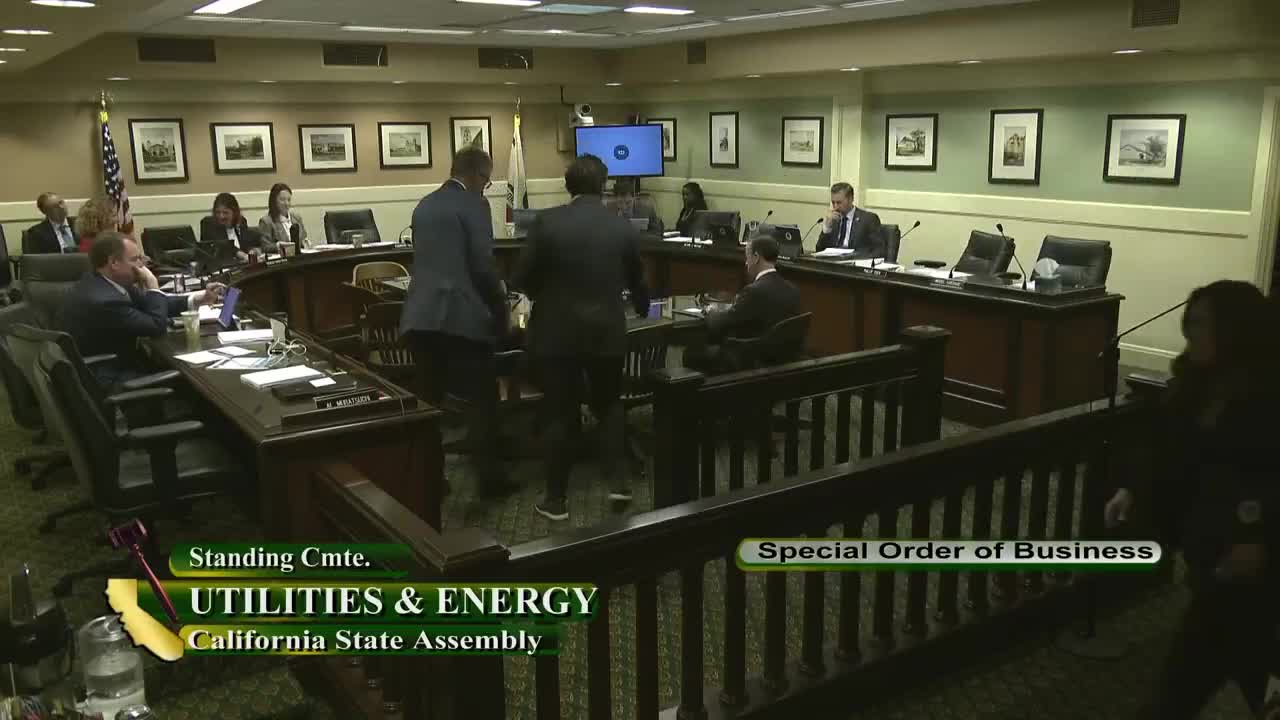 15MIN
Assembly Standing Committee on Utilities and Energy
Bill Author