AB 1859: Coroners: duties.
- Session Year: 2023-2024
- House: Assembly
- Latest Version Date: 2024-09-27
Current Status:
Passed
(2024-09-27: Chaptered by Secretary of State - Chapter 684, Statutes of 2024.)
Introduced
In Committee
First Chamber
In Committee
Second Chamber
Enacted
Existing law requires a county coroner to inquire into and determine the circumstances, manner, and cause of certain deaths. Existing law either requires or authorizes a county coroner, under certain circumstances, to perform, or cause to be performed, an autopsy on a decedent. Existing law imposes certain requirements on a coroner conducting a postmortem examination or autopsy on an unidentified body or human remains. Existing law requires a coroner to investigate deaths that occurred under specified conditions, including without medical attendance, to ascertain as many of the facts as possible.
This bill would authorize a coroner to test the bodily fluid of a deceased person for the presence of xylazine if the coroner reasonably suspects the person died from an accidental or intentional opioid overdose or if the person was administered an overdose intervention drug prior to death and was unresponsive to the drug. If the testing is conducted, the bill would require the coroner to report a positive result to the Overdose Detection Mapping Application Program and provide the State Department of Public Health with a quarterly report on positive results, as specified. The bill would require the department to post specified information, including, among other things, the total number of xylazine-positive results reported to the department, on the California Overdose Surveillance Dashboard located on the departments internet website.
Existing law requires a county coroner to inquire into and determine the circumstances, manner, and cause of certain deaths. Existing law either requires or authorizes a county coroner, under certain circumstances, to perform, or cause to be performed, an autopsy on a decedent. Existing law imposes certain requirements on a coroner conducting a postmortem examination or autopsy on an unidentified body or human remains. Existing law requires a coroner to investigate deaths that occurred under specified conditions, including without medical attendance, to ascertain as many of the facts as possible.
This bill would require authorize a coroner to test the bodily fluid of a deceased person for the presence of xylazine if the coroner reasonably suspects the person died from an accidental or intentional opioid overdose or if the person was administered an overdose intervention drug prior to death and was unresponsive to the drug. The bill would also If the testing is conducted, the bill would require the coroner to report a positive result to the Overdose Detection Mapping Application Program and provide the State Department of Public Health with a quarterly report on positive results, as specified. The bill would require the department to post specified information, including, among other things, the total number of xylazine-positive results by county, reported to the department, on the California Overdose Surveillance Dashboard located on the departments internet website. By imposing additional duties upon local officials, the bill would impose a state-mandated local program.
The California Constitution requires the state to reimburse local agencies and school districts for certain costs mandated by the state. Statutory provisions establish procedures for making that reimbursement.This bill would provide that, if the Commission on State Mandates determines that the bill contains costs mandated by the state, reimbursement for those costs shall be made pursuant to the statutory provisions noted above.Existing law requires a county coroner to inquire into and determine the circumstances, manner, and cause of certain deaths. Existing law either requires or authorizes a county coroner, under certain circumstances, to perform, or cause to be performed, an autopsy on a decedent. Existing law imposes certain requirements on a coroner conducting a postmortem examination or autopsy on an unidentified body or human remains. Existing law requires a coroner to investigate deaths that occurred under specified conditions, including without medical attendance, to ascertain as many of the facts as possible.
This bill would require a coroner to test the bodily fluid of a deceased person for the presence of xylazine if the coroner reasonably suspects the person died from an accidental or intentional opioid overdose or if the person was administered an overdose intervention drug prior to death and was unresponsive to the drug. The bill would also require the coroner to report a positive result to the State Department of Public Health and the Overdose Detection Mapping Application Program. Program and provide the State Department of Public Health with a quarterly report on positive results, as specified. The bill would require the department to post the number of positive results specified information, including, among other things, the total number of xylazine-positive results by county, on the California Overdose Surveillance Dashboard located on the departments internet website. By imposing additional duties upon local officials, the bill would impose a state-mandated local program.
The California Constitution requires the state to reimburse local agencies and school districts for certain costs mandated by the state. Statutory provisions establish procedures for making that reimbursement.
This bill would provide that, if the Commission on State Mandates determines that the bill contains costs mandated by the state, reimbursement for those costs shall be made pursuant to the statutory provisions noted above.
Existing law requires a county coroner to inquire into and determine the circumstances, manner, and cause of certain deaths. Existing law either requires or authorizes a county coroner, under certain circumstances, to perform, or cause to be performed, an autopsy on a decedent. Existing law imposes certain requirements on a coroner conducting a postmortem examination or autopsy on an unidentified body or human remains. Existing law requires a coroner to investigate deaths that occurred under specified conditions, including without medical attendance, to ascertain as many of the facts as possible.
This bill would require a coroner to test the bodily fluid of a deceased person for the presence of xylazine if the coroner reasonably suspects the person died from an accidental or intentional opioid overdose or if the person was administered an overdose intervention drug prior to death and was unresponsive to the drug. The bill would also require the coroner to report a positive result to the State Department of Public Health and the Overdose Detection Mapping Application Program. The bill would require the department to post the number of positive results on the California Overdose Surveillance Dashboard located on the departments internet website. By imposing additional duties upon local officials, the bill would impose a state-mandated local program.
The California Constitution requires the state to reimburse local agencies and school districts for certain costs mandated by the state. Statutory provisions establish procedures for making that reimbursement.
This bill would provide that, if the Commission on State Mandates determines that the bill contains costs mandated by the state, reimbursement for those costs shall be made pursuant to the statutory provisions noted above.
(a)A coroner may test the bodily fluid extracted during the autopsy of a deceased person to determine if any amount, including a trace amount, of xylazine was present at the time of the persons death in either of the following circumstances:
(1)The coroner reasonably suspects that the cause of the persons death was an accidental or intentional overdose of an opioid.
(2)The person was administered an overdose intervention drug prior to death and was unresponsive to the overdose intervention drug.
(b)If the coroner conducts a test pursuant to subdivision (a), the coroner shall report a positive result indicating the presence of xylazine to the Overdose Detection Mapping Application Program managed by the Washington/Baltimore High Intensity Drug Trafficking Area program and provide the State Department of Public Health with a quarterly report on positive results that includes the total number of tests performed and the State File Number from the death certificate of each positive case.
(c)The department shall post the following information on the California Overdose Surveillance Dashboard located on the departments internet website:
(1)The total number of xylazine-positive results reported to the department.
(2)The number of xylazine-positive results by county.
(3)The number of xylazine-positive overdose deaths, per 100,000 population.
(a)A coroner may test the bodily fluid extracted during the autopsy of a deceased person to determine if any amount, including a trace amount, of xylazine was present at the time of the persons death in either of the following circumstances:
(1)The coroner reasonably suspects that the cause of the persons death was an accidental or intentional overdose of an opioid.
(2)The person was administered an overdose intervention drug prior to death and was unresponsive to the overdose intervention drug.
(b)If the coroner conducts a test pursuant to subdivision (a), the coroner shall report a positive result indicating the presence of xylazine to the Overdose Detection Mapping Application Program managed by the Washington/Baltimore High Intensity Drug Trafficking Area program and provide the State Department of Public Health with a quarterly report on positive results that includes the total number of tests performed and the Secretary of State file number State File Number from the death certificate of each positive case.
(c)The department shall post the following information on the California Overdose Surveillance Dashboard located on the departments internet website:
(1)The total number of xylazine-positive results reported to the department.
(2)The number of xylazine-positive results by county.
(3)The number of xylazine-positive overdose deaths, per 100,000 population.
(a)A coroner shall may test the bodily fluid extracted during the autopsy of a deceased person to determine if any amount, including a trace amount, of xylazine was present at the time of the persons death in either of the following circumstances:
(1)The coroner reasonably suspects that the cause of the persons death was an accidental or intentional overdose of an opioid.
(2)The person was administered an overdose intervention drug prior to death and was unresponsive to the overdose intervention drug.
(b)The If the coroner conducts a test pursuant to subdivision (a), the coroner shall report a positive result indicating the presence of xylazine to the Overdose Detection Mapping Application Program managed by the Washington/Baltimore High Intensity Drug Trafficking Area program and provide the State Department of Public Health with a quarterly report on positive results that includes the total number of tests performed and the Secretary of State file number from the death certificate of each positive case.
(c)The department shall post the following information on the California Overdose Surveillance Dashboard located on the departments internet website:
(1)The total number of xylazine-positive results reported to the department.
(2)The number of xylazine-positive results by county.
(3)The number of xylazine-positive overdose deaths, per 100,000 population.
SEC. 2.If the Commission on State Mandates determines that this act contains costs mandated by the state, reimbursement to local agencies and school districts for those costs shall be made pursuant to Part 7 (commencing with Section 17500) of Division 4 of Title 2 of the Government Code.(a)A coroner shall test the bodily fluid extracted during the autopsy of a deceased person to determine if any amount, including a trace amount, of xylazine was present at the time of the persons death in either of the following circumstances:
(1)The coroner reasonably suspects that the cause of the persons death was an accidental or intentional overdose of an opioid.
(2)The person was administered an overdose intervention drug prior to death and was unresponsive to the overdose intervention drug.
(b)The coroner shall report a positive result indicating the presence of xylazine to the Overdose Detection Mapping Application Program managed by the Washington/Baltimore High Intensity Drug Trafficking Area program and provide the State Department of Public Health with a quarterly report on positive results that includes the total number of tests performed and the Secretary of State file number from the death certificate of each positive case.
(c)The department shall post the following information on the California Overdose Surveillance Dashboard located on the departments internet website:
(1)The total number of xylazine-positive results reported to the department.
(2)The number of xylazine-positive results by county.
(3)The number of xylazine-positive overdose deaths, per 100,000 population.
SEC. 2.If the Commission on State Mandates determines that this act contains costs mandated by the state, reimbursement to local agencies and school districts for those costs shall be made pursuant to Part 7 (commencing with Section 17500) of Division 4 of Title 2 of the Government Code.
(a)A coroner shall test bodily fluid extracted during an autopsy of a deceased person to determine whether the bodily fluid contained any amount, including a trace amount, of xylazine at the time of the persons death if either of the following occur:
(1)The coroner reasonably suspects the cause of a persons death to be the accidental or intentional overdose of an opioid.
(2)The person was administered an overdose intervention drug prior to death and was unresponsive to the overdose intervention drug.
(b)The coroner shall report a positive result indicating the presence of xylazine to the State Department of Public Health and the Overdose Detection Mapping Application Program managed by the Washington/Baltimore High Intensity Drug Trafficking Area program.
(c)The department shall post the number of positive results on the California Overdose Surveillance Dashboard located on the departments internet website.
SEC. 2.If the Commission on State Mandates determines that this act contains costs mandated by the state, reimbursement to local agencies and school districts for those costs shall be made pursuant to Part 7 (commencing with Section 17500) of Division 4 of Title 2 of the Government Code.
|
Date
|
Status
|
|---|---|
| Sep 27, 2024 | Chaptered by Secretary of State - Chapter 684, Statutes of 2024. |
| Sep 27, 2024 | Approved by the Governor. |
| Sep 11, 2024 | Enrolled and presented to the Governor at 4 p.m. |
| Aug 30, 2024 | Senate amendments concurred in. To Engrossing and Enrolling. (Ayes 77. Noes 0.). |
| Aug 30, 2024 | In Assembly. Concurrence in Senate amendments pending. |
| Aug 29, 2024 | Read third time. Passed. Ordered to the Assembly. (Ayes 40. Noes 0.). |
| Aug 21, 2024 | Read second time. Ordered to third reading. |
| Aug 20, 2024 | Read third time and amended. Ordered to second reading. |
| Aug 19, 2024 | Read second time. Ordered to third reading. |
| Aug 15, 2024 | Read second time and amended. Ordered returned to second reading. |
| Aug 15, 2024 | From committee: Amend, and do pass as amended. (Ayes 7. Noes 0.) (August 15). |
| Aug 12, 2024 | In committee: Referred to APPR suspense file. |
| Aug 5, 2024 | From committee chair, with author's amendments: Amend, and re-refer to committee. Read second time, amended, and re-referred to Com. on APPR. |
| Jul 29, 2024 | In committee: Hearing postponed by committee. |
| Jun 26, 2024 | From committee: Do pass and re-refer to Com. on APPR with recommendation: To Consent Calendar. (Ayes 11. Noes 0.) (June 26). Re-referred to Com. on APPR. |
| Jun 18, 2024 | From committee: Do pass and re-refer to Com. on HEALTH with recommendation: To Consent Calendar. (Ayes 5. Noes 0.) (June 18). Re-referred to Com. on HEALTH. |
| Jun 5, 2024 | Referred to Coms. on PUB S. and HEALTH. |
| May 24, 2024 | In Senate. Read first time. To Com. on RLS. for assignment. |
| May 23, 2024 | Read third time. Passed. Ordered to the Senate. (Ayes 72. Noes 0. Page 5619.) |
| May 20, 2024 | Read second time. Ordered to third reading. |
| May 16, 2024 | From committee: Do pass. (Ayes 15. Noes 0.) (May 16). |
| Mar 20, 2024 | In committee: Set, first hearing. Referred to APPR. suspense file. |
| Feb 27, 2024 | From committee: Do pass and re-refer to Com. on APPR. with recommendation: To Consent Calendar. (Ayes 8. Noes 0.) (February 27). Re-referred to Com. on APPR. |
| Jan 29, 2024 | Referred to Com. on PUB. S. |
| Jan 19, 2024 | From printer. May be heard in committee February 18. |
| Jan 18, 2024 | Read first time. To print. |
|
Date
|
Description
|
Location
|
Votes
|
|
|---|---|---|---|---|
| Aug 30, 2024 | AB 1859 Alanis Concurrence in Senate Amendments | Assembly Floor |
Passed |
|
| Aug 29, 2024 | Assembly 3rd Reading AB1859 Alanis By Seyarto | Senate Floor |
Passed |
|
| Aug 15, 2024 | Do pass as amended | Senate Standing Committee on Appropriations |
Passed |
|
| Aug 12, 2024 | Placed on suspense file | Senate Standing Committee on Appropriations |
Passed |
|
| Jun 26, 2024 | Do pass, but first be re-referred to the Committee on [Appropriations] with the recommendation: To Consent Calendar | Senate Standing Committee on Health |
Passed |
|
| Jun 18, 2024 | Do pass, but first be re-referred to the Committee on [Health] with the recommendation: To Consent Calendar | Senate Standing Committee on Public Safety |
Passed |
|
| May 23, 2024 | AB 1859 Alanis Assembly Third Reading | Assembly Floor |
Passed |
|
| May 16, 2024 | Do pass. | Assembly Standing Committee on Appropriations |
Passed |
|
| Feb 27, 2024 | Do pass and be re-referred to the Committee on [Appropriations] with recommendation: To Consent Calendar | Assembly Standing Committee on Public Safety |
Passed |
This list shows positions taken on this bill by organizations on the date displayed, which is linked to the original source.
Positions by individuals are not included.
|
Organization
|
Position
|
Date
|
|---|---|---|
| California Hospital Association | ** Support | |
| Los Angeles County District AttorneyS Office | ** Support | |
| Peace Officers Research Association Of California | ** Support | |
| Shasta Substance Use Coalition | ** Support |
CONCURRENCE IN SENATE AMENDMENTS
CSA1 Bill Id:AB 1859
Author:(Alanis)
As Amended Ver:August 20, 2024
Majority vote
SUMMARY
Authorizes coroners to test deceased persons for xylazine in certain circumstances; and requires coroners, if they do test for xylazine, to report positive results indicating the presence of xylazine to the Overdose Detection Mapping Application Program (ODMAP) and the California Department of Public Health (DPH).
Senate Amendments
- Make permissive, rather than mandatory, the testing of bodily fluid extracted during an autopsy of a deceased person for xylazine.
- Require any coroner that tests the bodily fluid extracted during an autopsy for xylazine, in addition to reporting to ODMAP a positive result indicating the presence of xylazine, to provide DPH with a quarterly report on positive results indicating the presence of xylazine that includes the total number of tests performed and the State File Number from the death certificate of each positive case.
- Require DPH to post, in addition to the number of xylazine-positive results, the number of xylazine-positive results by county and the number of xylazine-positive overdose deaths per 100,000 population on the California Overdose Surveillance Dashboard on DPH’s website.
- Make technical changes.
COMMENTS
As passed by the Assembly, this bill:
- Required a coroner to test bodily fluid extracted during an autopsy to determine whether the decedent's bodily fluid contained any amount of xylazine in either of the following situations:
- The coroner reasonably suspects the cause of a person's death to be the accidental or intentional overdose of an opiod; or
- The person was given an overdose intervention drug before death and was unresponsive to the drug.
- Required the coroner to report a positive result indicating the presence of xylazine to both DPH and the ODMAP managed by the Washington/Baltimore High Intensity Drug Trafficking Area program.
- Required DPH to post the number of positive results on its Overdose Surveillance Dashboard located on the DPH website.
According to the Author
"California's most rural and poor communities are being ravaged by Fentanyl and Tranq. Just recently, there have been three xylazine related overdose deaths detected in Stanislaus County. By establishing a centralized tracking system for the presence of xylazine in fatalities associated with opioid overdoses, we can help law enforcement and our medical community focus their resources and skills to better respond and treat these overdoses and addictions. It will also serve and a critical data point for the legislature in our effort to better protect our constituents."
Arguments in Support
According to the Peace Officers' Research Association of California, "The ability to accurately track overdose deaths is very important and valuable. Those statistics help law enforcement and California understand the extent of various drug crises."
Arguments in Opposition
None submitted at this time.
FISCAL COMMENTS
According to the Assembly Appropriations Committee:
- Possibly reimbursable costs (local funds, General Fund) of an unknown but potentially significant amount to counties for coroners to comply with the bill's requirements. According to the latest annual data available from CDPH, there were 7,385 deaths related to opioid overdoses in California in 2022. Under this bill, a coroner would be required to conduct a xylazine test for each suspected opioid overdose death and report positive test results to CDPH and the ODMAP, resulting in county costs for testing and staffing. Actual costs will depend on the number of tests performed, the cost of each test, and staff time needed for testing and reporting as required by the bill. General Fund costs will depend on whether the duties imposed by this bill constitute a reimbursable state mandate, as determined by the Commission on State Mandates.
- Costs (General Fund) to CDPH, likely in the hundreds of thousands of dollars annually. CDPH reports costs of approximately $690,000 for the first three years of implementation and $200,000 annually thereafter for a contractor to modify the Overdose Surveillance Dashboard to publish the new data and for staffing to process county xylazine test data, analyze the data, and populate the Overdose Surveillance Dashboard.
According to the Legislative Analyst's Office, the General Fund faces a structural deficit in the tens of billions of dollars over the next several fiscal years.
VOTES:
ASM PUBLIC SAFETY: 8-0-0
YES: McCarty, Alanis, Lackey, Stephanie Nguyen, Reyes, Ting, Wilson, Zbur
ASM APPROPRIATIONS: 15-0-0
YES: Wicks, Sanchez, Arambula, Bryan, Calderon, Wendy Carrillo, Dixon, Mike Fong, Grayson, Haney, Hart, Jim Patterson, Pellerin, Ta, Villapudua
ASSEMBLY FLOOR: 72-0-8
YES: Addis, Aguiar-Curry, Alanis, Alvarez, Arambula, Bains, Bauer-Kahan, Bennett, Berman, Boerner, Bonta, Bryan, Calderon, Juan Carrillo, Wendy Carrillo, Chen, Connolly, Davies, Dixon, Flora, Mike Fong, Vince Fong, Friedman, Gabriel, Gallagher, Garcia, Gipson, Grayson, Haney, Hart, Hoover, Irwin, Jackson, Jones-Sawyer, Kalra, Lackey, Lee, Low, Lowenthal, Maienschein, McCarty, McKinnor, Muratsuchi, Stephanie Nguyen, Ortega, Pacheco, Papan, Jim Patterson, Joe Patterson, Pellerin, Petrie-Norris, Quirk-Silva, Ramos, Rendon, Reyes, Rodriguez, Sanchez, Santiago, Schiavo, Soria, Ta, Ting, Valencia, Villapudua, Waldron, Wallis, Ward, Weber, Wilson, Wood, Zbur, Robert Rivas
ABS, ABST OR NV: Cervantes, Megan Dahle, Essayli, Holden, Mathis, Luz Rivas, Blanca Rubio, Wicks
SENATE FLOOR: 40-0-0
YES: Allen, Alvarado-Gil, Archuleta, Ashby, Atkins, Becker, Blakespear, Bradford, Caballero, Cortese, Dahle, Dodd, Durazo, Eggman, Glazer, Gonzalez, Grove, Hurtado, Jones, Laird, Limón, McGuire, Menjivar, Min, Newman, Nguyen, Niello, Ochoa Bogh, Padilla, Portantino, Roth, Rubio, Seyarto, Skinner, Smallwood-Cuevas, Stern, Umberg, Wahab, Wiener, Wilk
UPDATED
VERSION: August 5, 2024
CONSULTANT: Andrew Ironside/Sandy Uribe / PUB. S. / (916) 319-3744 FN: 0005024
SENATE RULES COMMITTEE Office of Senate Floor Analyses (916) 651-1520 Fax: (916) 327-4478 | AB 1859 |
THIRD READING
Bill No: AB 1859
Author: Alanis (R)
Amended: 8/20/24 in Senate
Vote: 21
SENATE PUBLIC SAFETY COMMITTEE: 5-0, 6/18/24
AYES: Wahab, Seyarto, Bradford, Skinner, Wiener
SENATE HEALTH COMMITTEE: 11-0, 6/26/24
AYES: Roth, Nguyen, Glazer, Gonzalez, Grove, Hurtado, Limón, Menjivar, Rubio, Smallwood-Cuevas, Wiener
SENATE APPROPRIATIONS COMMITTEE: 7-0, 8/15/24
AYES: Caballero, Jones, Ashby, Becker, Bradford, Seyarto, Wahab
ASSEMBLY FLOOR: 72-0, 5/23/24 - See last page for vote
SUBJECT: Coroners: duties
SOURCE: Author
DIGEST:
This bill requires coroners to report to the State Department of Public Health and to the Overdose Detection Mapping Application Program whether an autopsy, if the coroner elects to perform one, revealed the presence of xylazine at the time of a person’s death.
Senate Floor Amendments of 8/20/24 clarify what information regarding positive xylazine results must be reported to the Department of Public Health.
ANALYSIS:
Existing law:
- Requires coroners to determine the manner, circumstances and cause of death in specified circumstances. (Gov. Code, § 27491.)
- Requires the coroner or a deputy to sign the certificate of death when they perform a mandatory inquiry. (Gov. Code, § 27491, subd. (a).)
- Allows the coroner or medical examiner discretion when determining the extent of the inquiry required to determine the manner, circumstances and cause of death. (Gov. Code, § 27491, subd. (b).)
- Provides that in all cases in which a person has died under circumstances that afford a reasonable ground to suspect that the person’s death has been occasioned by the act of another by criminal means, the coroner, upon determining that those reasonable grounds exist, shall immediately notify the law enforcement agency having jurisdiction over the criminal investigation, as specified. (Gov. Code, § 27491.1)
- Provides that the cause of death appearing on a certificate of death signed by the coroner shall be in conformity with facts ascertained from inquiry, autopsy and other scientific findings, and prohibits the coroner from finally excluding crime, suicide or accident as a cause of death because of lack of evidence. (Gov. Code, § 27491.5.)
- Requires the coroner or medical examiner to conduct an autopsy at the request of the surviving spouse or other specified persons when an autopsy has not already been performed. (Gov. Code, § 27520, subd. (a).)
- Allows the coroner or medical examiner discretion to conduct an autopsy at the request of the surviving spouse or other specified persons when an autopsy has already been performed. (Gov. Code, § 27520, subd. (b).)
- States that the content of a death certificate must include, among other things, personal data of the decedent, date of death, place of death, disease or conditions leading directly to death and antecedent causes, accident and injury information, and information regarding pregnancy. (Health & Saf. Code, § 102875.)
- Requires a physician and surgeon, physician assistant, funeral director, or other person to notify the coroner when they have knowledge that a death occurred, or if they have charge of a body in which death occurred under any of several specified circumstances, among others. . (Health & Saf. Code, § 102850.)
- Provides that the coroner shall state on the certificate of death the disease or condition directly leading to death, antecedent causes, other significant conditions contributing to death and other medical and health section data as may be required on the certificate, and the hour and day on which death occurred. (Health & Saf. Code, § 102860.)
- Requires the California Department of Public Health (DPH) to establish an Internet-based electronic death registration system for the creation, storage, and transfer of death registration information. (Health & Saf. Code, § 102778.)
- Requires a coroner or medical examiner who evaluates an individual who died, in their expert opinion, as the result of an overdose as a contributing factor, to report the incident to the Overdose Detection Mapping Application Program managed by the Washington/Baltimore High Intensity Drug Trafficking Area program, as specified. (Health & Saf. Code, § 11758.04, subd. (a).)
This bill:
- Authorizes a coroner to test bodily fluid extracted during an autopsy of a deceased person to determine whether the bodily fluid contained any amount, including a trace amount, of xylazine at the time of the person’s death if either of the following occur:
- The coroner reasonably suspects the cause of a person’s death to be the accidental or intentional overdose of an opioid.
- The person was administered an overdose intervention drug prior to death and was unresponsive to the overdose intervention drug.
- If an autopsy was conducted pursuant to the above, requires a coroner to report a positive result indicating the presence of xylazine to the State Department of Public Health and the Overdose Detection Mapping Application Program (ODMAP) managed by the Washington/Baltimore High Intensity Drug Trafficking Area program.
- Requires the Department of Public Health to post the number of positive results on the California Overdose Surveillance Dashboard located on the department’s internet website.
Comments
According to the Author, “I am proud to join the fight against California’s opioid crisis by introducing Bill 1859. AB 1859 will establish a centralized tracking system for the presence of xylazine in fatalities associated with suspected accidental or intentional opioid overdoses, as well as instances where an individual, administered an overdose intervention drug, remains unresponsive. This crucial legislation stands as a crucial tool in identifying patterns, optimizing resource allocation, safeguarding public health, formulating evidence-driven interventions, and adeptly addressing the complexities arising from the misuse of Tranq.”
Under existing law, it is the duty of the county coroner to inquire into and determine the circumstances, manner and cause of deaths that occur within their jurisdiction, including violent, sudden or unusual deaths, unattended deaths, known or suspected homicide, suicide or accidental poisoning, deaths from or related to injury or accident, and death in whole or in part occasioned by criminal means, among others. Existing law also authorizes the coroner to perform an autopsy upon any victim of sudden, unexpected, or unexplained death or any death known or suspected of resulting from an accident, suicide, or apparent criminal means. The coroner is required to perform an autopsy if the surviving spouse requests them to do so in writing. If there is no surviving spouse, that right devolves to a surviving parent or child, and subsequently, if there is no surviving parent or child, to the next of kin.
Coroners are also authorized to conduct inquests, or more formal investigations into the cause of a death, of their own volition, and are required to conduct them if requested to do so by the Attorney General, district attorney, sheriff, city prosecutor, city attorney or chief of police in their jurisdiction. Autopsies are usually, but not always, a central component of inquests, if they had not been conducted prior to the commencement of the inquest. Pursuant to their statutory duties, coroners are responsible for the production and completion of various records and documents regarding a particular death under investigation. Centrally, coroners are generally responsible for signing death certificates, which indicate the manner of death. If an autopsy is performed, existing law requires coroners to take certain photograph and produce specific documentation regarding the procedure.
This bill authorizes coroners to test bodily fluid extracted during an autopsy of a deceased person to determine whether the bodily fluid contained xylazine at the time of the person’s death, but only if the coroner reasonably expects the cause of death to be opioid overdose-related or if the person was administered an overdose prevention drug prior to death but was unresponsive to that drug. Further, if an elective autopsy was performed pursuant to the above, the bill requires the coroner to report any positive result to the Department of Public Health as well as the Overdose Detection Mapping Application Program (ODMAP) managed by the Washington/Baltimore High Intensity Drug Trafficking Area (HIDTA) program. The Department of Public Health must then post these results on the overdose dashboard mentioned above.
FISCAL EFFECT: Appropriation: No Fiscal Com.: Yes Local: No
According to the Senate Appropriations Committee, CDPH estimates ongoing, annual state costs (General Fund) of $200,000 and an additional one-time costs of $88,000 in fiscal year 2025-26. This cost will cover a full-time equivalent staff position to process and analyze the data received, as well as a contractor to modify the dashboard to accommodate the new data received from coroners.
SUPPORT: (Verified 8/20/24)
California Hospital Association
Los Angeles County District Attorneys Office
Peace Officers Research Association of California (PORAC)
Shasta Substance Use Coalition
OPPOSITION: (Verified 8/20/24)
None received
ASSEMBLY FLOOR: 72-0, 5/23/24
AYES: Addis, Aguiar-Curry, Alanis, Alvarez, Arambula, Bains, Bauer-Kahan, Bennett, Berman, Boerner, Bonta, Bryan, Calderon, Juan Carrillo, Wendy Carrillo, Chen, Connolly, Davies, Dixon, Flora, Mike Fong, Vince Fong, Friedman, Gabriel, Gallagher, Garcia, Gipson, Grayson, Haney, Hart, Hoover, Irwin, Jackson, Jones-Sawyer, Kalra, Lackey, Lee, Low, Lowenthal, Maienschein, McCarty, McKinnor, Muratsuchi, Stephanie Nguyen, Ortega, Pacheco, Papan, Jim Patterson, Joe Patterson, Pellerin, Petrie-Norris, Quirk-Silva, Ramos, Rendon, Reyes, Rodriguez, Sanchez, Santiago, Schiavo, Soria, Ta, Ting, Valencia, Villapudua, Waldron, Wallis, Ward, Weber, Wilson, Wood, Zbur, Robert Rivas
NO VOTE RECORDED: Cervantes, Megan Dahle, Essayli, Holden, Mathis, Luz Rivas, Blanca Rubio, Wicks
Prepared by: Alex Barnett / PUB. S. /
8/21/24 16:12:24
**** END ****
SENATE RULES COMMITTEE Office of Senate Floor Analyses (916) 651-1520 Fax: (916) 327-4478 | AB 1859 |
THIRD READING
Bill No: AB 1859
Author: Alanis (R)
Amended: 8/15/24 in Senate
Vote: 21
SENATE PUBLIC SAFETY COMMITTEE: 5-0, 6/18/24
AYES: Wahab, Seyarto, Bradford, Skinner, Wiener
SENATE HEALTH COMMITTEE: 11-0, 6/26/24
AYES: Roth, Nguyen, Glazer, Gonzalez, Grove, Hurtado, Limón, Menjivar, Rubio, Smallwood-Cuevas, Wiener
SENATE APPROPRIATIONS COMMITTEE: 7-0, 8/15/24
AYES: Caballero, Jones, Ashby, Becker, Bradford, Seyarto, Wahab
ASSEMBLY FLOOR: 72-0, 5/23/24 - See last page for vote
SUBJECT: Coroners: duties
SOURCE: Author
DIGEST:
This bill requires coroners to report to the State Department of Public Health and to the Overdose Detection Mapping Application Program whether an autopsy, if the coroner elects to perform one, revealed the presence of xylazine at the time of a person’s death.
ANALYSIS:
Existing law:
- Requires coroners to determine the manner, circumstances and cause of death in specified circumstances. (Gov. Code, § 27491.)
- Requires the coroner or a deputy to sign the certificate of death when they perform a mandatory inquiry. (Gov. Code, § 27491, subd. (a).)
- Allows the coroner or medical examiner discretion when determining the extent of the inquiry required to determine the manner, circumstances and cause of death. (Gov. Code, § 27491, subd. (b).)
- Provides that in all cases in which a person has died under circumstances that afford a reasonable ground to suspect that the person’s death has been occasioned by the act of another by criminal means, the coroner, upon determining that those reasonable grounds exist, shall immediately notify the law enforcement agency having jurisdiction over the criminal investigation, as specified. (Gov. Code, § 27491.1)
- Provides that the cause of death appearing on a certificate of death signed by the coroner shall be in conformity with facts ascertained from inquiry, autopsy and other scientific findings, and prohibits the coroner from finally excluding crime, suicide or accident as a cause of death because of lack of evidence. (Gov. Code, § 27491.5.)
- Requires the coroner or medical examiner to conduct an autopsy at the request of the surviving spouse or other specified persons when an autopsy has not already been performed. (Gov. Code, § 27520, subd. (a).)
- Allows the coroner or medical examiner discretion to conduct an autopsy at the request of the surviving spouse or other specified persons when an autopsy has already been performed. (Gov. Code, § 27520, subd. (b).)
- States that the content of a death certificate must include, among other things, personal data of the decedent, date of death, place of death, disease or conditions leading directly to death and antecedent causes, accident and injury information, and information regarding pregnancy. (Health & Saf. Code, § 102875.)
- Requires a physician and surgeon, physician assistant, funeral director, or other person to notify the coroner when they have knowledge that a death occurred, or if they have charge of a body in which death occurred under any of several specified circumstances, among others. . (Health & Saf. Code, § 102850.)
- Provides that the coroner shall state on the certificate of death the disease or condition directly leading to death, antecedent causes, other significant conditions contributing to death and other medical and health section data as may be required on the certificate, and the hour and day on which death occurred. (Health & Saf. Code, § 102860.)
- Requires the California Department of Public Health (DPH) to establish an Internet-based electronic death registration system for the creation, storage, and transfer of death registration information. (Health & Saf. Code, § 102778.)
- Requires a coroner or medical examiner who evaluates an individual who died, in their expert opinion, as the result of an overdose as a contributing factor, to report the incident to the Overdose Detection Mapping Application Program managed by the Washington/Baltimore High Intensity Drug Trafficking Area program, as specified. (Health & Saf. Code, § 11758.04, subd. (a).)
This bill:
- Authorizes a coroner to test bodily fluid extracted during an autopsy of a deceased person to determine whether the bodily fluid contained any amount, including a trace amount, of xylazine at the time of the person’s death if either of the following occur:
- The coroner reasonably suspects the cause of a person’s death to be the accidental or intentional overdose of an opioid.
- The person was administered an overdose intervention drug prior to death and was unresponsive to the overdose intervention drug.
- If an autopsy was conducted pursuant to the above, requires a coroner to report a positive result indicating the presence of xylazine to the State Department of Public Health and the Overdose Detection Mapping Application Program (ODMAP) managed by the Washington/Baltimore High Intensity Drug Trafficking Area program.
- Requires the Department of Public Health to post the number of positive results on the California Overdose Surveillance Dashboard located on the department’s internet website.
Comments
According to the Author, “I am proud to join the fight against California’s opioid crisis by introducing Bill 1859. AB 1859 will establish a centralized tracking system for the presence of xylazine in fatalities associated with suspected accidental or intentional opioid overdoses, as well as instances where an individual, administered an overdose intervention drug, remains unresponsive. This crucial legislation stands as a crucial tool in identifying patterns, optimizing resource allocation, safeguarding public health, formulating evidence-driven interventions, and adeptly addressing the complexities arising from the misuse of Tranq.”
Under existing law, it is the duty of the county coroner to inquire into and determine the circumstances, manner and cause of deaths that occur within their jurisdiction, including violent, sudden or unusual deaths, unattended deaths, known or suspected homicide, suicide or accidental poisoning, deaths from or related to injury or accident, and death in whole or in part occasioned by criminal means, among others. Existing law also authorizes the coroner to perform an autopsy upon any victim of sudden, unexpected, or unexplained death or any death known or suspected of resulting from an accident, suicide, or apparent criminal means. The coroner is required to perform an autopsy if the surviving spouse requests them to do so in writing. If there is no surviving spouse, that right devolves to a surviving parent or child, and subsequently, if there is no surviving parent or child, to the next of kin.
Coroners are also authorized to conduct inquests, or more formal investigations into the cause of a death, of their own volition, and are required to conduct them if requested to do so by the Attorney General, district attorney, sheriff, city prosecutor, city attorney or chief of police in their jurisdiction. Autopsies are usually, but not always, a central component of inquests, if they had not been conducted prior to the commencement of the inquest. Pursuant to their statutory duties, coroners are responsible for the production and completion of various records and documents regarding a particular death under investigation. Centrally, coroners are generally responsible for signing death certificates, which indicate the manner of death. If an autopsy is performed, existing law requires coroners to take certain photograph and produce specific documentation regarding the procedure.
This bill authorizes coroners to test bodily fluid extracted during an autopsy of a deceased person to determine whether the bodily fluid contained xylazine at the time of the person’s death, but only if the coroner reasonably expects the cause of death to be opioid overdose-related or if the person was administered an overdose prevention drug prior to death but was unresponsive to that drug. Further, if an elective autopsy was performed pursuant to the above, the bill requires the coroner to report any positive result to the Department of Public Health as well as the Overdose Detection Mapping Application Program (ODMAP) managed by the Washington/Baltimore High Intensity Drug Trafficking Area (HIDTA) program. The Department of Public Health must then post these results on the overdose dashboard mentioned above.
FISCAL EFFECT: Appropriation: No Fiscal Com.: Yes Local: No
According to the Senate Appropriations Committee, CDPH estimates ongoing, annual state costs (General Fund) of $200,000 and an additional one-time costs of $88,000 in fiscal year 2025-26. This cost will cover a full-time equivalent staff position to process and analyze the data received, as well as a contractor to modify the dashboard to accommodate the new data received from coroners.
SUPPORT: (Verified 8/14/24)
California Hospital Association
Los Angeles County District Attorneys Office
Peace Officers Research Association of California (PORAC)
Shasta Substance Use Coalition
OPPOSITION: (Verified 8/14/24)
None received
ASSEMBLY FLOOR: 72-0, 5/23/24
AYES: Addis, Aguiar-Curry, Alanis, Alvarez, Arambula, Bains, Bauer-Kahan, Bennett, Berman, Boerner, Bonta, Bryan, Calderon, Juan Carrillo, Wendy Carrillo, Chen, Connolly, Davies, Dixon, Flora, Mike Fong, Vince Fong, Friedman, Gabriel, Gallagher, Garcia, Gipson, Grayson, Haney, Hart, Hoover, Irwin, Jackson, Jones-Sawyer, Kalra, Lackey, Lee, Low, Lowenthal, Maienschein, McCarty, McKinnor, Muratsuchi, Stephanie Nguyen, Ortega, Pacheco, Papan, Jim Patterson, Joe Patterson, Pellerin, Petrie-Norris, Quirk-Silva, Ramos, Rendon, Reyes, Rodriguez, Sanchez, Santiago, Schiavo, Soria, Ta, Ting, Valencia, Villapudua, Waldron, Wallis, Ward, Weber, Wilson, Wood, Zbur, Robert Rivas
NO VOTE RECORDED: Cervantes, Megan Dahle, Essayli, Holden, Mathis, Luz Rivas, Blanca Rubio, Wicks
Prepared by: Alex Barnett / PUB. S. /
8/18/24 8:51:02
**** END ****
SENATE COMMITTEE ON
Senator Anna Caballero, Chair
2023 - 2024 Regular Session
AB 1859 (Alanis) - Coroners: duties
Version: | Policy Vote: |
Urgency: | Mandate: |
Hearing Date: | Consultant: |
Bill Summary:
AB 1859 authorizes coroners to report to the State Department of Public Health (CDPH) and to the Overdose Detection Mapping Application Program (ODMAP) whether an autopsy revealed the presence of xylazine at the time of a person’s death.
*********** ANALYSIS ADDENDUM – SUSPENSE FILE ***********
The following information is revised to reflect amendments
adopted by the committee on August 15, 2024
Fiscal Impact:
CDPH estimates ongoing, annual state costs (General Fund) of $200,000 and an additional one-time costs of $88,000 in fiscal year 2025-26. This cost will cover a full-time equivalent staff position to process and analyze the data received, as well as a contractor to modify the dashboard to accommodate the new data received from coroners.
Committee Amendments:
The amendments allow, instead of require, coroners to report to CDPH.
-- END --
SENATE COMMITTEE ON APPROPRIATIONS
Senator Anna Caballero, Chair
2023 - 2024 Regular Session
AB 1859 (Alanis) - Coroners: duties
Version: August 5, 2024 | Policy Vote: PUB. S. 5 - 0, HEALTH 11 - 0 |
Urgency: No | Mandate: Yes |
Hearing Date: August 12, 2024 | Consultant: Liah Burnley |
Bill Summary:
AB 1859 requires coroners to report to the State Department of Public Health (DPH) and to the Overdose Detection Mapping Application Program (ODMAP) whether an autopsy revealed the presence of xylazine at the time of a person’s death.
Fiscal Impact:
- CDPH estimates ongoing, annual state costs (General Fund) of $200,000 and an additional one-time costs of $88,000 in fiscal year 2025-26. This cost will cover a full-time equivalent staff position to process and analyze the data received, as well as a contractor to modify the dashboard to accommodate the new data received from coroners.
- Possibly reimbursable costs (local funds, General Fund) of an unknown but potentially significant amount to counties for coroners to comply with the bill’s requirements. According to the latest annual data available from CDPH, there were 7,385 deaths related to opioid overdoses in California in 2022. Under this bill, a coroner would be required to conduct a xylazine test for each suspected opioid overdose death and report positive test results to CDPH and the ODMAP, resulting in county costs for testing and staffing. Actual costs will depend on the number of tests performed, the cost of each test, and staff time needed for testing and reporting as required by the bill. General Fund costs will depend on whether the duties imposed by this bill constitute a reimbursable state mandate, as determined by the Commission on State Mandates.
Background:
Xylazine, also known as “tranq,” is a non-opiate sedative, analgesic, and muscle relaxant only authorized in the U.S. for veterinary use by the FDA. People are most frequently exposed to xylazine while using illegal drugs, such as cocaine, heroin, and fentanyl, which are sometimes mixed with xylazine to enhance the effects of the drug it is being mixed with or to increase the price of the drug by increasing its weight.
As part of DPH's Opioid Prevention Initiative, DPH maintains the California Overdose Surveillance Dashboard (dashboard). The Dashboard tracks deaths related to any opioid overdose, deaths related specifically to fentanyl, emergency department visits related to any opioid overdose, and the number of prescriptions issued for opioids in California. However, there is a time lag due to the source data for this information.
ODMAP is an overdose mapping tool that allows first responders to log an overdose in real time into a centralized database in order to support public safety and public health efforts to mobilize an immediate response to a sudden increase, or spike, in overdose events.[1]
Last year, SB 67 (Seyarto, Ch. 859, Stats. of 2023) was enacted, which requires coroners to report overdose information to ODMAP, but the bill did not specify or limit the types of controlled substances which must be reported, simply that the overdose occurred.
Proposed Law:
This bill requires coroners to test bodily fluid extracted during an autopsy of a deceased person to determine whether the bodily fluid contained xylazine at the time of the person’s death, only if: (1) the coroner reasonably expects the cause of death to be opioid overdose-related; or (2) if the person was administered an overdose prevention drug prior to death but was unresponsive to that drug.
The bill requires the coroner to report any positive result to DPH and ODMAP. DPH must then post these results on the California Overdose Surveillance Dashboard on a quarterly basis.
Related Legislation:
SB 67 (Seyarto, Ch. 859, Stats. of 2023) requires coroners to report overdose information to ODMAP.
-- END --
SENATE COMMITTEE ON HEALTH
Senator Richard Roth, Chair
BILL NO: AB 1859
AUTHOR: | Alanis | ||
VERSION: | January 18, 2024 | ||
HEARING DATE: | June 26, 2024 | ||
CONSULTANT: | Reyes Diaz | ||
SUBJECT: Coroners: duties
SUMMARY:
Requires a coroner to test bodily fluid extracted during an autopsy to determine whether it contained any amount, including a trace amount, of xylazine. Requires the coroner to report a positive result for xylazine to the California Department of Public Health (CDPH) and a national overdose detection program. Requires CDPH to post the number of positive results on its overdose surveillance dashboard.
Existing law:
- Establishes CDPH to be vested with all the duties, powers, purposes, functions, responsibilities, and jurisdiction as they relate to public health, including administering the Substance and Addiction Prevention Branch (SAPB), which focuses on alcohol use research and harms prevention; problem gambling education, prevention, and treatment; overdose surveillance and prevention; and, cannabis surveillance and youth cannabis prevention. [HSC §131050]
- Requires a coroner to inquire into and determine the circumstances, manner, and cause of certain deaths, including all violent, sudden, or unusual deaths, and deaths due to drug addiction, among other types of deaths. [GOV §27491]
- Requires a coroner whose duty it is to investigate deaths to ascertain as many as possible of the facts. Requires a coroner to state on the death certificate the disease or condition directly leading to death, antecedent causes, other significant conditions contributing to death, other medical and health data, and the hour and day on which death occurred. [HSC §102855, 102860]
- Requires a coroner or medical examiner who evaluates an individual, who died, in their expert opinion, as the result of an overdose as a contributing factor, to report the incident to the Overdose Detection Mapping Application Program (ODMAP) managed by the Washington/Baltimore High Intensity Drug Trafficking Area program. [HSC §11758.04]
- States the intent of the Legislature that fatal drug overdose information be used for the purpose of making decisions regarding the allocation of public health and educational resources to communities adversely impacted by the use of drugs that lead to overdoses. [HSC §11758.02]
This bill:
- Requires a coroner to test bodily fluid extracted during an autopsy to determine whether it contained any amount, including a trace amount, of xylazine at the time of the person’s death if either the coroner reasonably suspects the cause of a person’s death to be the accidental or intentional overdose of an opioid, or the person was administered an overdose intervention drug prior to death and was unresponsive to the overdose intervention drug.
- Requires the coroner to report a positive result for xylazine to CDPH and ODMAP.
- Requires CDPH to post the number of positive results on the California Overdose Surveillance Dashboard (OSD) on its website.
FISCAL EFFECT:
According to the Assembly Appropriations Committee:
- Possibly reimbursable costs (local funds, General Fund) of an unknown but potentially significant amount to counties for coroners to comply with the bill's requirements. According to the latest annual data available from CDPH, there were 7,385 deaths related to opioid overdoses in California in 2022. Under this bill, a coroner would be required to conduct a xylazine test for each suspected opioid overdose death and report positive test results to CDPH and the ODMAP, resulting in county costs for testing and staffing. Actual costs will depend on the number of tests performed, the cost of each test, and staff time needed for testing and reporting as required by the bill. General Fund costs will depend on whether the duties imposed by this bill constitute a reimbursable state mandate, as determined by the Commission on State Mandates.
- Costs (General Fund) to CDPH likely in the hundreds of thousands of dollars annually. CDPH reports costs of approximately $690,000 for the first three years of implementation and $200,000 annually thereafter for a contractor to modify the Overdose Surveillance Dashboard to publish the new data and for staffing to process county xylazine test data, analyze the data, and populate the Overdose Surveillance Dashboard.
PRIOR VOTES:
Senate Public Safety Committee: Assembly Floor: | 5 - 0 72 - 0 |
Assembly Appropriations Committee: | 15 - 0 |
Assembly Public Safety Committee: | 8 - 0 |
COMMENTS:
- Author’s statement. According to the author, they are proud to join the fight against California’s opioid crisis by introducing this bill, which will establish a centralized tracking system for the presence of xylazine in fatalities associated with suspected accidental or intentional opioid overdoses, as well as instances where an individual, administered an overdose intervention drug, remains unresponsive. This crucial legislation stands as an important tool in identifying patterns, optimizing resource allocation, safeguarding public health, formulating evidence-driven interventions, and adeptly addressing the complexities arising from the misuse of tranq.
- Xylazine. Xylazine, also known as “tranq,” is a non-opiate sedative, analgesic, and muscle relaxant only authorized in the U.S. for veterinary use by the federal Food and Drug Administration. It is not included in the federal controlled substances schedules, and it is not approved for consumption by humans. In legal sales for veterinary use, xylazine is available in liquid form and sold in vials or preloaded syringes, with solutions prepared at a concentration appropriate for administration by injection based on the general size and weight of the species. Xylazine is legitimately sold directly through pharmaceutical distributors and websites catering to veterinarians. Xylazine can be injected, sniffed, or consumed orally. People are most frequently exposed to xylazine while using illegal drugs, such as cocaine, heroin, and fentanyl, which are sometimes mixed with xylazine to enhance the effects of the drug it is being mixed with or to increase the price of the drug by increasing its weight.
On April 26, 2024, the Drug Enforcement Agency (DEA) updated its statement on xylazine, saying it first warned the public of a sharp increase in fentanyl seizures containing xylazine in its March 2023 Public Safety Alert. Since that time, xylazine’s growing prevalence in the fentanyl supply has continued to make the deadliest drug threat facing this country even deadlier. In 2023, 30% of the fentanyl powder seized by the DEA contained xylazine, up from 25% in 2022. The percentage of fentanyl pills testing positive for xylazine decreased slightly from 7% in 2022 to 6% in 2023. In total, the DEA seized 12,000 pounds of fentanyl powder and 79.5 million fentanyl pills in 2023. In April 2023, the White House Office of National Drug Control Policy designated fentanyl adulterated with xylazine as an emerging drug threat, indicating people who ingest fentanyl mixed with xylazine are at a higher risk of suffering a fatal drug poisoning. The DEA stated in its April 2024 update that it was publicly updating its xylazine information as part of their commitment to saving lives by keeping the American public informed of drug threats as they encounter them.
- What else is California doing? According to CDPH, xylazine is still a new and emerging issue in California, and to this day, CDPH contends there is no evidence to suggest that xylazine is common in California’s drug supply. However, the U.S. illicit drug supply is unpredictable and experts are concerned that xylazine may eventually penetrate the California drug supply, increasing instances of fatal overdose and serious skin infections. CDPH states it continues to monitor the issue and make updates to this webpage as more information becomes available. CDPH’s Substance and Addiction Prevention Branch (SAPB) works with many partners throughout the state to monitor and address current trends at the statewide and local level, and also works closely with local health departments, coalitions, and other local-level partners to support local prevention and intervention efforts. Working closely with these entities allows CDPH to support local prevention and intervention efforts that address the specific and unique trends and needs of California’s communities
CDPH also provides data on state and local level drug-related overdose outcomes for California, including deaths, emergency department visits, and opioid and select other drug prescription data through its OSD. As of April 2024, the OSD reports that in 2022, there were 7,385 deaths related to any opioid overdose; 6,473 deaths related to fentanyl overdose; 21,316 emergency department visits related to any opioid overdose; and, 13,640,794 prescriptions for opioids.
Additionally, xylazine test strips (XTS) have recently been developed and are available through BTNX Inc. CDPH has not evaluated the sensitivity or specificity of the XTS; however, the Center for Forensic Science Research & Education has evaluated the XTS available through BTNX and determined that the test strips are appropriate for drug checking purposes.
- ODMAP. In 1988, Congress created the High Intensity Drug Trafficking Areas (HIDTA) program to provide assistance to federal, state, local, and tribal law enforcement agencies operating in areas determined to be critical drug-trafficking regions of the U.S. There are currently 33 HIDTAs, including four in California: Central Valley, Northern California, Los Angeles, and San Diego/Imperial Valley. In January of 2017, the Washington/Baltimore HIDTA launched ODMAP as a response to the lack of a consistent methodology to track overdoses, which limited the ability to understand and mobilize against the crisis. According to the Washington/Baltimore HIDTA, ODMAP is an overdose-mapping tool that allows first responders to log an overdose in real time into a centralized database in order to support public safety and public health efforts to mobilize an immediate response to a sudden increase, or spike, in overdose events. ODMAP is only available to government agencies serving the interest of public safety and health, and each agency wishing to use the system must sign a participation agreement designed to protect the data within the system, which currently serves more than 5,000 agencies with more than 33,500 users in all 50 states, and has logged 2.42 million suspected overdoses.
- Double referral. This bill was heard in the Senate Public Safety Committee on June 18, 2024, and passed with a 5-0 vote.
- Related legislation. SB 908 (Cortese) requires CDPH to use best efforts to utilize all of its relevant data regarding current trends of fentanyl-related deaths of children up to five years of age. SB 908 is pending in the Assembly Appropriations Committee.
AB 2871 (Maienschein) permits a county to establish an interagency overdose fatality review team to assist local agencies in identifying and reviewing overdose fatalities, facilitate communication among persons and agencies involved in overdose fatalities, and integrate local overdose prevention efforts through strategic planning, data dissemination, and community collaboration. AB 2871 set for hearing on July 3, 2024, in this Committee.
- Prior legislation. SB 67 (Seyarto, Chapter 859, Statutes of 2023), among other things, implemented the law requiring a coroner or medical examiner to report deaths that are a result of an overdose to ODMAP.
- Support. The California Hospital Association (CHA) says that, every day, hospitals see firsthand the devastation wrought by drugs and overdoses. In March 2023, Tomás J. Aragón, Director of CDPH and State Public Health Officer, issued an alert to public health officers about the presence of xylazine in illicit fentanyl—making the use of opioids even more deadly and medically complex. The state’s alert says routine screening for xylazine in post-mortem toxicology may be an effective way to monitor population trends locally and across the state. CHA further states this bill would make it possible for California to more actively examine the public health dangers of xylazine in the illicit drug supply and put efforts in place to protect the health of Californians.
SUPPORT AND OPPOSITION:
Support: California Hospital Association
Peace Officers’ Research Association of California
Shasta Substance Use Coalition
Oppose: None received
-- END --
SENATE COMMITTEE ON PUBLIC SAFETY
Senator Aisha Wahab, Chair
2023 - 2024 Regular
Bill No: AB 1859 Hearing Date: June 18, 2024
Author: | Alanis | ||
Version: | January 18, 2024 | ||
Urgency: | No | Fiscal: | Yes |
Consultant: | AB | ||
Subject: Coroners: duties
HISTORY
Source: Author
Prior Legislation: SB 67 (Seyarto, Ch. 859, Stats. of 2023)
AB 1351 (Haney, 2023), held in Assembly Appropriations
SB 1695 (Escutia, Ch. 678, Stats. of 2002)
Support: Peace Officers Research Association of California (PORAC); Shasta Substance Use Coalition
Opposition: None known
Assembly Floor Vote: 72 - 0
PURPOSE
The purpose of this bill is to require coroners to report to the State Department of Public Health and to the Overdose Detection Mapping Application Program whether an autopsy revealed the presence of xylazine at the time of a person’s death.
Existing law requires coroners to determine the manner, circumstances and cause of death in the following circumstances:
- Violent, sudden or unusual deaths;
- Unattended deaths;
- When the deceased was not attended by a physician, or registered nurse who is part of a hospice care interdisciplinary team, in the 20 days before death;
- When the death is related to known or suspected self-induced or criminal abortion;
- Known or suspected homicide, suicide or accidental poisoning;
- Deaths suspected as a result of an accident or injury either old or recent;
- Drowning, fire, hanging, gunshot, stabbing, cutting, exposure, starvation, acute alcoholism, drug addiction, strangulation, aspiration, or sudden infant death syndrome;
- Deaths in whole or in part occasioned by criminal means;
- Deaths associated with a known or alleged rape or crime against nature;
- Deaths in prison or while under sentence;
- Deaths known or suspected as due to contagious disease and constituting a public hazard;
- Deaths from occupational diseases or occupational hazards;
- Deaths of patients in state mental hospitals operated by the State Department of State Hospitals;
- Deaths of patients in state hospitals serving the developmentally disabled operated by the State Department of Development Services;
- Deaths where a reasonable ground exists to suspect the death was caused by the criminal act of another; and,
- Deaths reported for inquiry by physicians and other persons having knowledge of the death. (Gov. Code, § 27491.)
- Violent, sudden or unusual deaths;
Existing law requires the coroner or a deputy to sign the certificate of death when they perform a mandatory inquiry. (Gov. Code, § 27491, subd. (a).)
Existing law allows the coroner or medical examiner discretion when determining the extent of the inquiry required to determine the manner, circumstances and cause of death. (Gov. Code, § 27491, subd. (b).)
Existing law provides that in all cases in which a person has died under circumstances that afford a reasonable ground to suspect that the person’s death has been occasioned by the act of another by criminal means, the coroner, upon determining that those reasonable grounds exist, shall immediately notify the law enforcement agency having jurisdiction over the criminal investigation, as specified. (Gov. Code, § 27491.1)
Existing law provides that the cause of death appearing on a certificate of death signed by the coroner shall be in conformity with facts ascertained from inquiry, autopsy and other scientific findings, and prohibits the coroner from finally excluding crime, suicide or accident as a cause of death because of lack of evidence. (Gov. Code, § 27491.5.)
Existing law requires the coroner or medical examiner to conduct an autopsy at the request of the surviving spouse or other specified persons when an autopsy has not already been performed. (Gov. Code, § 27520, subd. (a).)
Existing law allows the coroner or medical examiner discretion to conduct an autopsy at the request of the surviving spouse or other specified persons when an autopsy has already been performed. (Gov. Code, § 27520, subd. (b).)
Existing law states that the content of a death certificate must include, among other things, personal data of the decedent, date of death, place of death, disease or conditions leading directly to death and antecedent causes, accident and injury information, and information regarding pregnancy. (Health & Saf. Code, § 102875.)
Existing law requires a physician and surgeon, physician assistant, funeral director, or other person to notify the coroner when they have knowledge that a death occurred, or if they have charge of a body in which death occurred under any of the following, among others:
- Without medical attendance;
- During continued absence of attending physician and surgeon;
- Where attending physician and surgeon, or physician assistant is unable to state cause of death; and,
- Reasonable suspicion to suspect death was caused by criminal act. (Health & Saf. Code, § 102850.)
- Without medical attendance;
Existing law provides that the coroner shall state on the certificate of death the disease or condition directly leading to death, antecedent causes, other significant conditions contributing to death and other medical and health section data as may be required on the certificate, and the hour and day on which death occurred. (Health & Saf. Code, § 102860.)
Existing law requires the California Department of Public Health (DPH) to establish an Internet-based electronic death registration system for the creation, storage, and transfer of death registration information. (Health & Saf. Code, § 102778.)
Existing law requires a coroner or medical examiner who evaluates an individual who died, in their expert opinion, as the result of an overdose as a contributing factor, to report the incident to the Overdose Detection Mapping Application Program managed by the Washington/Baltimore High Intensity Drug Trafficking Area program, as specified. (Health & Saf. Code, § 11758.04, subd. (a).)
This bill requires a coroner to test bodily fluid extracted during an autopsy of a deceased person to determine whether the bodily fluid contained any amount, including a trace amount, of xylazine at the time of the person’s death if either of the following occur:
- The coroner reasonably suspects the cause of a person’s death to be the accidental or intentional overdose of an opioid.
- The person was administered an overdose intervention drug prior to death and was unresponsive to the overdose intervention drug.
This bill requires a coroner to report a positive result indicating the presence of xylazine to the State Department of Public Health and the Overdose Detection Mapping Application Program (ODMAP) managed by the Washington/Baltimore High Intensity Drug Trafficking Area program.
This bill requires the Department of Public Health to post the number of positive results on the California Overdose Surveillance Dashboard located on the department’s internet website.
COMMENTS
- Need for This Bill
According to the Author:
I am proud to join the fight against California’s opioid crisis by introducing Bill 1859. AB 1859 will establish a centralized tracking system for the presence of xylazine in fatalities associated with suspected accidental or intentional opioid overdoses, as well as instances where an individual, administered an overdose intervention drug, remains unresponsive. This crucial legislation stands as a crucial tool in identifying patterns, optimizing resource allocation, safeguarding public health, formulating evidence-driven interventions, and adeptly addressing the complexities arising from the misuse of Tranq.
- Xylazine
Xylazine, also known as “tranq,” is a non-opiate sedative, analgesic, and muscle relaxant only authorized in the U.S. for veterinary use by the FDA. It is not included in the federal controlled substances schedules, and it is not approved for consumption by humans. In legal sales for veterinary use, xylazine is available in liquid form and sold in vials or preloaded syringes, with solutions prepared at a concentration appropriate for administration by injection based on the general size and weight of the species. Xylazine is legitimately sold directly through pharmaceutical distributors and websites catering to veterinarians.[1]
Xylazine can be injected, sniffed, or consumed orally. People are most frequently exposed to xylazine while using illegal drugs, such as cocaine, heroin, and fentanyl, which are sometimes mixed with xylazine to enhance the effects of the drug it is being mixed with or to increase the price of the drug by increasing its weight.[2] The DEA reports that it has seized xylazine and fentanyl mixtures in almost all 50 states, and between 2020 and 2021, DEA lab results found a 112% increase in the presence of xylazine in drug seizures in the Western region of the country. Additionally, those results showed that approximately 23% of fentanyl powder and 7% of fentanyl pills seized by the DEA in 2022 contained xylazine.[3] Xylazine can cause respiratory depression similar to that of an opioid overdose which may increase the potential for a fatal outcome at a time when opioid overdose deaths remain high. Due to the impact of xylazine on the opioid crisis, the White House last year designated fentanyl combined with xylazine as an emerging threat to the United States.[4]
- Department of Public Health Opioid Prevention Initiative
California’s Overdose Prevention Initiative (OPI) collects and shares data on fatal and non-fatal drug related overdoses, overdose risk factors, prescriptions, and substance use. The OPI works with local and state partners to address the complex and evolving nature of the drug overdose epidemic by data collection and analysis, prevention programs, public awareness and education campaigns, and safe prescribing and treatment practices. One of the five recommendations it makes to local and statewide partners is to improve rapid identification of drug overdose outbreaks by partnering with coroner and medical examiner offices, healthcare facilities, and emergency medical services to obtain overdose data to form a timely response.[5]
As part of DPH's Opioid Prevention Initiative, DPH maintains the California Overdose Surveillance Dashboard (dashboard). The Dashboard tracks deaths related to any opioid overdose, deaths related specifically to fentanyl, emergency department visits related to any opioid overdose, and the number of prescriptions issued for opioids in California. The data for deaths comes from death certificate data from DPH's Center for Health Statistics and Informatics, both preliminary quarterly data and the Comprehensive Master Death File that is filed annually. The data for emergency department visits and hospitalizations comes from annual hospital Emergency Care Data Record reports and hospital discharge data reports collected and maintained by the Department of Health Care Access and Information. However, due to the time lag of the source data for this information, the overdose data available on the dashboard for both deaths and emergency department visits/hospitalizations is only finalized for 2022, with preliminary data available through the third quarter of 2023. According to the Dashboard, there were 7,385 deaths related to opioids (6,473 involved fentanyl), and 21,316 emergency department visits for opioid overdoses, for the year 2022.[6]
- Coroner Duties and Effect of This Bill
Under existing law, it is the duty of the county coroner to inquire into and determine the circumstances, manner and cause of deaths that occur within their jurisdiction, including violent, sudden or unusual deaths, unattended deaths, known or suspected homicide, suicide or accidental poisoning, deaths from or related to injury or accident, and death in whole or in part occasioned by criminal means, among others.[7] Existing law also authorizes the coroner to perform an autopsy upon any victim of sudden, unexpected, or unexplained death or any death known or suspected of resulting from an accident, suicide, or apparent criminal means.[8] The coroner is required to perform an autopsy if the surviving spouse requests them to do so in writing. If there is no surviving spouse, that right devolves to a surviving parent or child, and subsequently, if there is no surviving parent or child, to the next of kin.[9]
Coroners are also authorized to conduct inquests, or more formal investigations into the cause of a death, of their own volition, and are required to conduct them if requested to do so by the Attorney General, district attorney, sheriff, city prosecutor, city attorney or chief of police in their jurisdiction.[10] Autopsies are usually, but not always, a central component of inquests, if they had not been conducted prior to the commencement of the inquest. Pursuant to their statutory duties, coroners are responsible for the production and completion of various records and documents regarding a particular death under investigation. Centrally, coroners are generally responsible for signing death certificates, which indicate the manner of death. If an autopsy is performed, existing law requires coroners to take certain photograph and produce specific documentation regarding the procedure.[11]
This bill requires coroners to test bodily fluid extracted during an autopsy of a deceased person to determine whether the bodily fluid contained xylazine at the time of the person’s death, but only if the coroner reasonably expects the cause of death to be opioid overdose-related or if the person was administered an overdose prevention drug prior to death but was unresponsive to that drug. Further, the bill requires the coroner to report any positive result to the Department of Public Health as well as the Overdose Detection Mapping Application Program (ODMAP) managed by the Washington/Baltimore High Intensity Drug Trafficking Area (HIDTA) program.[12] The Department of Public Health must then post these results on the overdose dashboard mentioned above.
- Recent Legislation
Last year, SB 67 (Seyarto, Ch. 859, Stats. of 2023) was enacted, which requires coroners to report overdose information to ODMAP, but did not specify or limit the types of controlled substances which must be reported, simply that the overdose occurred.
- Related Legislation
SB 1502 (Ashby) would add xylazine – including its salts, isomers, salts of its isomers, and any substance that contains it – to the list of Schedule III controlled substances[13] in the State of California. At the time this analysis was finalized, SB 1502 was awaiting a hearing in the Assembly Committee on Public Safety. It passed out of this committee by a vote of 5-0.
-- END –
U.S. Department of Justice and Drug Enforcement Administration, DEA Joint Intelligence Report: The Growing Threat of Xylazine and its Mixture with Illicit Drugs (Oct. 2022), p. 1, The Growing Threat of Xylazine and its Mixture with Illicit Drugs (dea.gov) ↑
“What You Should Know About Xylazine.” Centers For Disease Control. What You Should Know About Xylazine | Overdose Prevention | CDC ↑
Ibid. ↑
The White House, Office of the Press Secretary (Apr. 12, 2023) Biden-Harris Administration designates fentanyl combined with xylazine as an emerging threat to the United States. Biden-Harris Administration Designates Fentanyl Combined with Xylazine as an Emerging Threat to the United States | ONDCP | The White House ↑
Govt. Code §27491, (a), (b), §§ 27491.2, 27491.5 ↑
Govt. Code §§ 27491.4(c), 27491.43(c). ↑
Govt. Code §27520. ↑
Govt. Code § 27491.6. ↑
Govt. Code §27521(c). ↑
ODMAP is an overdose mapping tool that allows first responders to log an overdose in real time into a centralized database in order to support public safety and public health efforts to mobilize an immediate response to a sudden increase, or spike, in overdose events. For more on ODMAP, see Overdose Detection Mapping Application Program - (odmap.org), for more on HIDTAs, see Homepage - High Intensity Drug Trafficking Areas (hidta.org) ↑
Schedule III controlled substances have a currently accepted medical use, potential for abuse leading to moderate physical dependence. Examples of Schedule III controlled substances include ketamine and anabolic steroids. ↑
ASSEMBLY THIRD READING
ATR Bill Id:AB 1859
Author:(Alanis)
As Introduced Ver:January 18, 2024
Majority vote
SUMMARY
Requires coroners to report to the State Department of Public Health (DPH) and to the Overdose Detection Mapping Application Program (ODMAP) whether an autopsy revealed the presence of xylazine at the time of a person's death.
Major Provisions
- Requires a coroner to test bodily fluid extracted during an autopsy to determine whether the decedent's bodily fluid contained any amount of xylazine in either of the following situations:
- The coroner reasonably suspects the cause of a person's death to be the accidental or intentional overdose of an opiod; or
- The person was given an overdose intervention drug before death and was unresponsive to the drug.
- Requires the coroner to report a positive result indicating the presence of xylazine to both DPH and the ODMAP managed by the Washington/Baltimore High Intensity Drug Trafficking Area program.
- Requires DPH to post the number of positive results on its Overdose Surveillance Dashboard located on the DPH website.
COMMENTS
Department of Public Health Overdose Dashboard: As part of DPH's Opioid Prevention Initiative, DPH maintains the California Overdose Surveillance Dashboard (dashboard). The Dashboard tracks deaths related to any opioid overdose, deaths related specifically to fentanyl, emergency department visits related to any opioid overdose, and the number of prescriptions issued for opioids in California. The data for deaths comes from death certificate data from DPH's Center for Health Statistics and Informatics, both preliminary quarterly data and the Comprehensive Master Death File that is filed annually. The data for emergency department visits and hospitalizations comes from annual hospital Emergency Care Data Record reports and hospital discharge data reports collected and maintained by the Department of Health Care Access and Information. However, due to the time lag of the source data for this information, the overdose data available on the dashboard for both deaths and emergency department visits/hospitalizations is only finalized for 2021, with preliminary data available through the second quarter of 2022. According to the Dashboard, there were 7,385 deaths related to opioids (6,473 involved fentanyl), and 21,316 emergency department visits for opioid overdoses, for the year 2022. (CA Overdose Dashboard [as of February 20, 2024].)
This bill would require a coroner to report to DPH any death in which the presence of xylazine is detected in the decedent's body. This bill would also require DPH to reflect this information on its dashboard.
According to the Author
According to the author, "California's most rural and poor communities are being ravaged by Fentanyl and Tranq. Just recently, there have been three xylazine related overdose deaths detected in Stanislaus County. By establishing a centralized tracking system for the presence of xylazine in fatalities associated with opioid overdoses, we can help law enforcement and our medical community focus their resources and skills to better respond and treat these overdoses and addictions. It will also serve and a critical data point for the legislature in our effort to better protect our constituents."
Arguments in Support
According to the Peace Officers' Research Association of California, "The ability to accurately track overdose deaths is very important and valuable. Those statistics help law enforcement and California understand the extent of various drug crises."
Arguments in Opposition
None submitted at this time.
FISCAL COMMENTS
According to the Assembly Appropriations Committee:
- Possibly reimbursable costs (local funds, General Fund) of an unknown but potentially significant amount to counties for coroners to comply with the bill's requirements. According to the latest annual data available from CDPH, there were 7,385 deaths related to opioid overdoses in California in 2022. Under this bill, a coroner would be required to conduct a xylazine test for each suspected opioid overdose death and report positive test results to CDPH and the ODMAP, resulting in county costs for testing and staffing. Actual costs will depend on the number of tests performed, the cost of each test, and staff time needed for testing and reporting as required by the bill. General Fund costs will depend on whether the duties imposed by this bill constitute a reimbursable state mandate, as determined by the Commission on State Mandates.
- Costs (General Fund) to CDPH, likely in the hundreds of thousands of dollars annually. CDPH reports costs of approximately $690,000 for the first three years of implementation and $200,000 annually thereafter for a contractor to modify the Overdose Surveillance Dashboard to publish the new data and for staffing to process county xylazine test data, analyze the data, and populate the Overdose Surveillance Dashboard.
According to the Legislative Analyst's Office, the General Fund faces a structural deficit in the tens of billions of dollars over the next several fiscal years.
VOTES
ASM PUBLIC SAFETY: 8-0-0
YES: McCarty, Alanis, Lackey, Stephanie Nguyen, Reyes, Ting, Wilson, Zbur
ASM APPROPRIATIONS: 15-0-0
YES: Wicks, Sanchez, Arambula, Bryan, Calderon, Wendy Carrillo, Dixon, Mike Fong, Grayson, Haney, Hart, Jim Patterson, Pellerin, Ta, Villapudua
UPDATED
VERSION: January 18, 2024
CONSULTANT: Sandy Uribe / PUB. S. / (916) 319-3744 FN: 0003107
Date of Hearing: March 20, 2024
ASSEMBLY COMMITTEE ON APPROPRIATIONS
Buffy Wicks, Chair
ABPCA Bill Id:AB 1859
Author:(Alanis) – As Introduced Ver:January 18, 2024
Policy Committee: | Public Safety | Vote: | 8 - 0 |
|
| ||
|
|
Urgency: No State Mandated Local Program: Yes Reimbursable: Yes
SUMMARY:
This bill requires a coroner conducting an autopsy to test a body for the presence of xylazine in specified circumstances and report a positive test result to the California Department of Public Health (CDPH) and the Overdose Detection Mapping Application Program (ODMAP). The bill also requires CDPH to post the number of positive xylazine test results on its online Overdose Surveillance Dashboard.
FISCAL EFFECT:
- Possibly reimbursable costs (local funds, General Fund) of an unknown but potentially significant amount to counties for coroners to comply with the bill’s requirements. According to the latest annual data available from CDPH, there were 7,385 deaths related to opioid overdoses in California in 2022. Under this bill, a coroner would be required to conduct a xylazine test for each suspected opioid overdose death and report positive test results to CDPH and the ODMAP, resulting in county costs for testing and staffing. Actual costs will depend on the number of tests performed, the cost of each test, and staff time needed for testing and reporting as required by the bill. General Fund costs will depend on whether the duties imposed by this bill constitute a reimbursable state mandate, as determined by the Commission on State Mandates.
- Costs (General Fund) to CDPH, likely in the hundreds of thousands of dollars annually. CDPH reports costs of approximately $690,000 for the first three years of implementation and $200,000 annually thereafter for a contractor to modify the Overdose Surveillance Dashboard to publish the new data and for staffing to process county xylazine test data, analyze the data, and populate the Overdose Surveillance Dashboard.
According to the Legislative Analyst’s Office, the General Fund faces a structural deficit in the tens of billions of dollars over the next several fiscal years.
COMMENTS:
1) Purpose. According to the author:
California’s most rural and poor communities are being ravaged by Fentanyl and Tranq. Just recently, there have been three xylazine related overdose deaths detected in Stanislaus County. By establishing a centralized tracking system for the presence of xylazine in fatalities associated with opioid overdoses, we can help law enforcement and our medical community focus their resources and skills to better respond and treat these overdoses and addictions. It will also serve and a critical data point for the legislature in our effort to better protect our constituents.
- Background. Coroners and medical examiners are responsible for conducting inquiries into the manner and cause of a person’s death, including testing to determine whether the deceased person had drugs or alcohol in their system at the time of death. Existing law requires a coroner to report a death resulting from a drug overdose to ODMAP, a nationwide mapping tool that collects information from participating government agencies about fatal and nonfatal drug overdoses. The goal of ODMAP is to collect real-time data so governments can track sudden increases in overdoses and make law enforcement and public health decisions accordingly.
This bill requires a coroner to test, during an autopsy, for the presence of xylazine if the coroner reasonably suspects the cause of the person’s death was an overdose of an opioid or if the person was administered an overdose intervention drug prior to their death and was unresponsive to that drug. If an autopsy test indicates the presence of xylazine in the deceased person’s body, the coroner must report that result to CDPH and ODMAP. The bill also requires CDPH to post the number of positive xylazine test results on its Overdose Surveillance Dashboard, which tracks information about state and local drug overdoses, including deaths, emergency department visits, and hospitalizations.
- Xylazine. According to CDPH, xylazine (also known as “tranq”) is a non-opioid animal tranquilizer that has been connected to an increasing number of overdose deaths nationwide. Some users intentionally take xylazine simultaneously with fentanyl or other drugs; in other circumstances, drug sellers cut fentanyl or heroin with xylazine to extend their product without disclosing the adulterant.
The extent to which xylazine has proliferated in California drug markets is unclear. In 2022, the Drug Enforcement Administration (DEA) reported that its identification of xylazine-positive overdose deaths in the western United States increased by 750% in recent years, from four such deaths in 2020 to 34 in 2021. However, the DEA also noted comprehensive data on xylazine-related deaths is not available because xylazine is not routinely included in postmortem testing or data reporting in all jurisdictions. In April 2023, based in part on the DEA’s report, the White House Office of National Drug Control Policy designated fentanyl mixed with xylazine as an emerging threat, recognizing its “growing role in overdose deaths in every region in the United States.” On the other hand, in November 2023 in a letter to California health care facilities, CDPH described xylazine as “present” in California, but noted that the drug had not penetrated the state’s drug supply as extensively as it has in other regions.
Analysis Prepared by: Annika Carlson / APPR. / (916) 319-2081
Date of Hearing:
Chief Counsel: Sandy Uribe
ASSEMBLY COMMITTEE ON PUBLIC SAFETY
Kevin McCarty, Chair
ABPCA Bill Id:AB 1859
Author:(Alanis) – As Introduced Ver:January 18, 2024
SUMMARY:
Requires coroners to report to the State Department of Public Health (DPH) and to the Overdose Detection Mapping Application Program (ODMAP) whether an autopsy revealed the presence of xylazine at the time of a person’s death. Specifically, this bill:
- Requires a coroner to test bodily fluid extracted during an autopsy to determine whether the decedent’s bodily fluid contained any amount of xylazine in either of the following situations:
- The coroner reasonably suspects the cause of a person’s death to be the accidental or intentional overdose of an opiod; or
- The person was given an overdose intervention drug before death and was unresponsive to the drug.
- The coroner reasonably suspects the cause of a person’s death to be the accidental or intentional overdose of an opiod; or
- Requires the coroner to report a positive result indicating the presence of xylazine to both DPH and the ODMAP managed by the Washington/Baltimore High Intensity Drug Trafficking Area program.
- Requires DPH to post the number of positive results on its Overdose Surveillance Dashboard located on the DPH website.
EXISTING LAW:
- Requires coroners to determine the manner, circumstances, and cause of death in the following circumstances:
- Violent, sudden, or unusual deaths;
- Unattended deaths;
- Known or suspected homicide, suicide, or accidental poisoning;
- Drowning, fire, hanging, gunshot, stabbing, cutting, exposure, starvation, acute alcoholism, drug addiction, strangulation, aspiration, or sudden infant death syndrome;
- Deaths in whole or in part occasioned by criminal means;
- Deaths known or suspected as due to contagious disease and constituting a public hazard;
- Deaths from occupational diseases or occupational hazards;
- Deaths where a reasonable ground exists to suspect the death was caused by the criminal act of another; and,
- Deaths reported for inquiry by physicians and other persons having knowledge of the death. (Gov. Code, § 27491.)
- Violent, sudden, or unusual deaths;
- Requires the coroner to sign the certificate of death if they perform a mandatory inquiry. (Gov. Code, § 27491, subd. (a).)
- Gives the coroner discretion when determining the extent of the inquiry required to determine the manner, circumstances and cause of death. (Gov. Code, § 27491, subd. (b).)
- States that the content of a death certificate must include, among other things, personal data of the decedent, date of death, place of death, disease or conditions leading directly to death and antecedent causes, accident and injury information, and information regarding pregnancy. (Health & Saf. Code, § 102875.)
- Requires a physician and surgeon, physician assistant, funeral director, or other person to notify the coroner when they have knowledge that a death occurred, or if they have charge of a body in which death occurred under any of the following, among others:
- Without medical attendance;
- During continued absence of attending physician and surgeon;
- Where attending physician and surgeon, or physician assistant is unable to state cause of death; and,
- Reasonable suspicion to suspect death was caused by criminal act. (Health & Saf. Code, § 102850.)
- Without medical attendance;
- Requires the California Department of Public Health (DPH) to establish an Internet-based electronic death registration system for the creation, storage, and transfer of death registration information. (Health & Saf. Code, § 102778.)
- Requires DPH to track data on pregnancy-related deaths and publish such data at least once every three years, as specified. (Health & Saf. Code, § 123630.4.)
FISCAL EFFECT:
Unknown
COMMENTS:
- Author's Statement: According to the author, “California’s most rural and poor communities are being ravaged by Fentanyl and Tranq. Just recently, there have been three xylazine related overdose deaths detected in Stanislaus County. By establishing a centralized tracking system for the presence of xylazine in fatalities associated with opioid overdoses, we can help law enforcement and our medical community focus their resources and skills to better respond and treat these overdoses and addictions. It will also serve and a critical data point for the legislature in our effort to better protect our constituents.”
- Reporting Drug Overdoses: California’s Overdose Prevention Initiative (OPI) collects and shares data on fatal and non-fatal drug related overdoses, overdose risk factors, prescriptions, and substance use. (<https://www.cdph.ca.gov/Programs/CCDPHP/sapb/Pages/OPI-landing.aspx> [as of February 20, 2024].) The OPI works with local and state partners to address the complex and evolving nature of the drug overdose epidemic by data collection and analysis, prevention programs, public awareness and education campaigns, and safe prescribing and treatment practices. (DPH Drug Overdose Response Partner Recommendations, <https://www.cdph.ca.gov/Programs/CCDPHP/sapb/Pages/Drug-Overdose-Response.aspx> [as of Feb. 20, 2024].) One of the five recommendations it makes to local and statewide partners is to improve rapid identification of drug overdose outbreaks by partnering with coroner and medical examiner offices, healthcare facilities, and emergency medical services to obtain overdose data to form a timely response. (Ibid.)
- Department of Public Health Overdose Dashboard: As part of DPH's Opioid Prevention Initiative, DPH maintains the California Overdose Surveillance Dashboard (dashboard). The Dashboard tracks deaths related to any opioid overdose, deaths related specifically to fentanyl, emergency department visits related to any opioid overdose, and the number of prescriptions issued for opioids in California. The data for deaths comes from death certificate data from DPH's Center for Health Statistics and Informatics, both preliminary quarterly data and the Comprehensive Master Death File that is filed annually. The data for emergency department visits and hospitalizations comes from annual hospital Emergency Care Data Record reports and hospital discharge data reports collected and maintained by the Department of Health Care Access and Information. However, due to the time lag of the source data for this information, the overdose data available on the dashboard for both deaths and emergency department visits/hospitalizations is only finalized for 2021, with preliminary data available through the second quarter of 2022. According to the Dashboard, there were 7,385 deaths related to opioids (6,473 involved fentanyl), and 21,316 emergency department visits for opioid overdoses, for the year 2022. (CA Overdose Dashboard [as of February 20, 2024].)
This bill would require a coroner to report to DPH any death in which the presence of xylazine is detected in the decedent’s body. This bill would also require DPH to reflect this information on its dashboard. - Background on ODMAP: In 1988, Congress created the High Intensity Drug Trafficking Areas (HIDTA) program to provide assistance to federal, state, local, and tribal law enforcement agencies operating in areas determined to be critical drug-trafficking regions of the United States. There are currently 33 HIDTAs, including four in California: Central Valley, Northern California, Los Angeles, and San Diego/Imperial Valley.
In January of 2017, the Washington/Baltimore HIDTA launched ODMAP as a response to the lack of a consistent methodology to track overdoses, which limited the ability to understand and mobilize against the crisis. According to the Washington/Baltimore HIDTA, ODMAP is an overdose mapping tool that allows first responders to log an overdose in real time into a centralized database in order to support public safety and public health efforts to mobilize an immediate response to a sudden increase, or spike, in overdose events. ODMAP is only available to government agencies serving the interest of public safety and health, and each agency wishing to use the system must sign a participation agreement designed to protect the data within the system. The system currently serves more than 3,700 agencies with more than 28,000 users in all 50 states, and has logged 850,000 overdose events. According to the Washington/Baltimore HIDTA, there are seventeen states with statewide implementation strategies, including several with legislation requiring reporting to ODMAP. (https://www.hidta.org/odmap/)
The ODMAP Outreach Coordinator has informed this committee that ODMAP requires four mandatory inputs which include: location (geocoded and is not saved), date and time of incident, outcome of incident (non-fatal or fatal) and if naloxone was administered and if so, the dosage. When entering data, there is an option to input the primary suspected drug, as well as additional suspected drugs, if any. When clicking on a data point on the map ODMAP will show the drug/drugs involved of non-fatal and fatal overdose, if that information was entered.
This bill would require a coroner to report to ODMAP any death in which the presence of xylazine is detected in the decedent’s body.
Last year SB 67 (Seyarto), Chapter 859, Statutes of 2023, was enacted and requires coroners to report overdose information to ODMAP. (See Health and Saf. Code, § 11758.04.) SB 67 did not specify or limit the types of controlled substances which could be involved in the overdose. Should this bill be amended to require a coroner to also report the presence of fentanyl? - Argument in Support: According to the Peace Officers’ Research Association of California, “The ability to accurately track overdose deaths is very important and valuable. Those statistics help law enforcement and California understand the extent of various drug crises.”
- Related Legislation: AB 2871 (Maienschein), would authorize a county to establish an interagency overdose fatality review team to assist local agencies in identifying and reviewing overdose fatalities. AB 2871 is pending referral.
- Prior Legislation:
- SB 67 (Seyarto), Chapter 859, Statutes of 2023, requires a coroner or medical examiner to report deaths that are a result of a drug overdose to the Overdose Detection Mapping Application Program managed by the Washington/Baltimore High Intensity Drug Trafficking Area program.
- AB 1351 (Haney), of the 2023-2024 Legislative Session, would have required all coroners or medical examiners to submit quarterly reports to the DPH on deaths caused by, or involving, overdoses of any drugs. AB 1351 was held by the Assembly Appropriations Committee.
- SB 1695 (Escutia), Chapter 678, Statutes of 2002, among other things, requires DPH to create a webpage on drug overdose trends in California, including death rates, in order to ascertain changes in the cause or rate of fatal and nonfatal drug overdoses.
- SB 67 (Seyarto), Chapter 859, Statutes of 2023, requires a coroner or medical examiner to report deaths that are a result of a drug overdose to the Overdose Detection Mapping Application Program managed by the Washington/Baltimore High Intensity Drug Trafficking Area program.
REGISTERED SUPPORT / OPPOSITION:
Support
Peace Officers’ Research Association of California
Opposition
None submitted
Analysis Prepared by:
Sandy Uribe / PUB. S. / (916) 319-3744
Discussed in Hearing
 1MIN
Assembly Floor
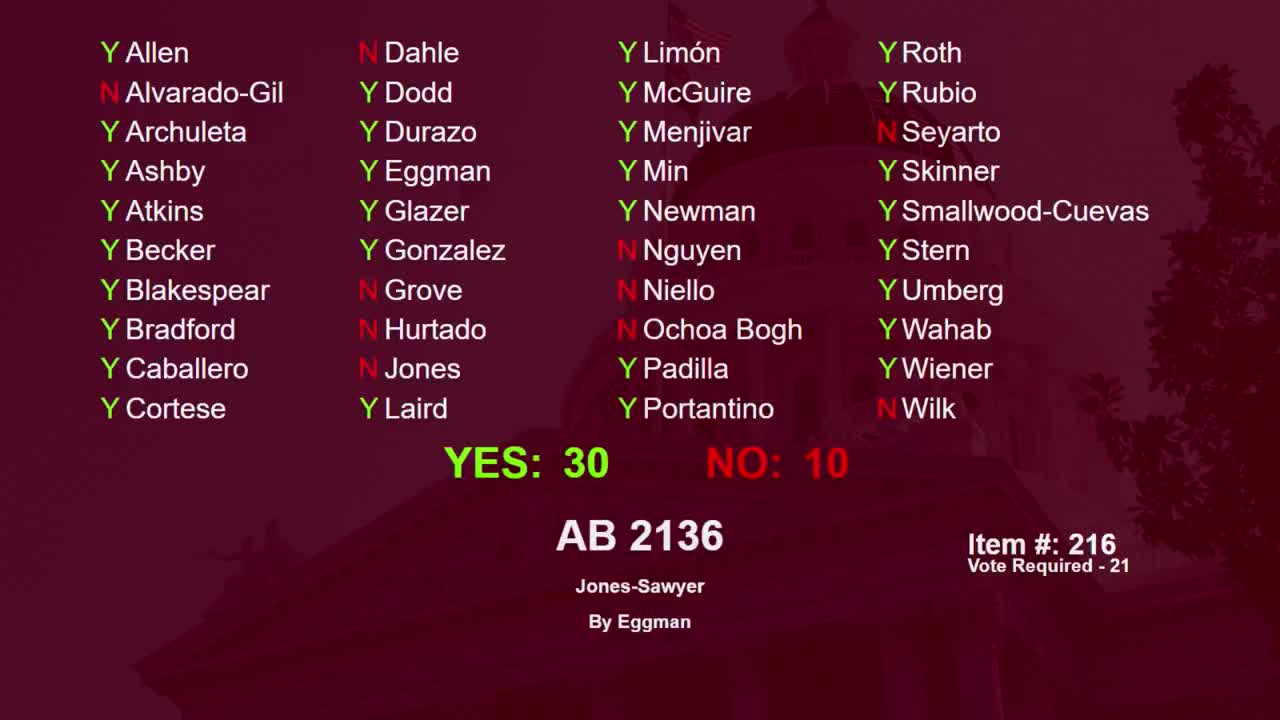 47SEC
Senate Floor
 1MIN
Senate Standing Committee on Appropriations
 1MIN
Assembly Floor
Bill Author

Bill Co-Author(s):