AB 1892: Interception of electronic communications.
- Session Year: 2023-2024
- House: Assembly
- Latest Version Date: 2024-09-22
Current Status:
Passed
(2024-09-22: Chaptered by Secretary of State - Chapter 363, Statutes of 2024.)
Introduced
In Committee
First Chamber
In Committee
Second Chamber
Enacted
What does this bill do?
The bill adds felony distribution of obscene material showing a person under 18 as an offense that can justify a judge-authorized wiretap or electronic interception. That change affects law enforcement investigations and people suspected of those crimes.
The summary is provided by generative AI which can make mistakes. For original language, please view the details in the table below.
Existing law, until January 1, 2030, requires an application for an order authorizing the interception of wire or electronic communications to be made in writing upon the personal oath or affirmation of the Attorney General, Chief Deputy Attorney General, or Chief Assistant Attorney General, Criminal Law Division, or of a district attorney or person designated to act as district attorney. Until January 1, 2030, existing law authorizes a court to issue an order authorizing interception of wire or electronic communications if the judge finds, among other things, that there is probable cause to believe an individual is committing, has committed, or is about to commit one of several specified offenses, including murder or possession or sale of controlled substances.
This bill would additionally authorize a court to issue an order authorizing interception of wire or electronic communications if the judge finds that there is probable cause to believe an individual is committing, has committed, or is about to commit a felony violation of specified statutes relating to the distribution of obscene matter depicting a person under 18 years of age.
Upon application made under Section 629.50, the judge may enter an ex parte order, as requested or modified, authorizing interception of wire or electronic communications initially intercepted within the territorial jurisdiction of the court in which the judge is sitting, if the judge determines, on the basis of the facts submitted by the applicant, all of the following:
(a)There is probable cause to believe that an individual is committing, has committed, or is about to commit, one of the following offenses:
(1)Importation, possession for sale, transportation, manufacture, or sale of controlled substances in violation of Section 11351, 11351.5, 11352, 11370.6, 11378, 11378.5, 11379, 11379.5, or 11379.6 of the Health and Safety Code with respect to a substance containing heroin, cocaine, PCP, methamphetamine, fentanyl, or their precursors or analogs where the substance exceeds 10 gallons by liquid volume or three pounds of solid substance by weight.
(2)Murder, solicitation to commit murder, a violation of Section 209, or the commission of a felony involving a destructive device in violation of Section 18710, 18715, 18720, 18725, 18730, 18740, 18745, 18750, or 18755.
(3)A felony violation of Section 186.22.
(4)A felony violation of Section 11418, relating to weapons of mass destruction, Section 11418.5, relating to threats to use weapons of mass destruction, or Section 11419, relating to restricted biological agents.
(5)A violation of Section 236.1.
(6)A felony violation of subdivision (b) or (d) of Section 311.2 or subdivision (b) or (c) of Section 311.4.
(7)An attempt or conspiracy to commit any of the above-mentioned crimes.
(b)There is probable cause to believe that particular communications concerning the illegal activities will be obtained through that interception, including, but not limited to, communications that may be utilized for locating or rescuing a kidnap victim.
(c)There is probable cause to believe that the facilities from which, or the place where, the wire or electronic communications are to be intercepted are being used, or are about to be used, in connection with the commission of the offense, or are leased to, listed in the name of, or commonly used by the person whose communications are to be intercepted.
(d)Normal investigative procedures have been tried and have failed or reasonably appear either unlikely to succeed if tried or too dangerous.
(e)Notwithstanding any other provision in this section, no magistrate shall enter an ex parte order authorizing interception of wire or electronic communications for the purpose of investigating or recovering evidence of a prohibited violation, as defined in Section 629.51.
Upon application made under Section 629.50, the judge may enter an ex parte order, as requested or modified, authorizing interception of wire or electronic communications initially intercepted within the territorial jurisdiction of the court in which the judge is sitting, if the judge determines, on the basis of the facts submitted by the applicant, all of the following:
(a)There is probable cause to believe that an individual is committing, has committed, or is about to commit, one of the following offenses:
(1)Importation, possession for sale, transportation, manufacture, or sale of controlled substances in violation of Section 11351, 11351.5, 11352, 11370.6, 11378, 11378.5, 11379, 11379.5, or 11379.6 of the Health and Safety Code with respect to a substance containing heroin, cocaine, PCP, methamphetamine, fentanyl, or their precursors or analogs where the substance exceeds 10 gallons by liquid volume or three pounds of solid substance by weight.
(2)Murder, solicitation to commit murder, a violation of Section 209, or the commission of a felony involving a destructive device in violation of Section 18710, 18715, 18720, 18725, 18730, 18740, 18745, 18750, or 18755.
(3)A felony violation of Section 186.22.
(4)A felony violation of Section 11418, relating to weapons of mass destruction, Section 11418.5, relating to threats to use weapons of mass destruction, or Section 11419, relating to restricted biological agents.
(5)A violation of Section 236.1.
(6)A felony violation of Section 311.1, subdivision (b), (c), or (d) of Section 311.2, Section 311.3, Section 311.4, Section 311.10, or Section 311.11. subdivision (b) or (d) of Section 311.2 or subdivision (b) or (c) of Section 311.4.
(7)An attempt or conspiracy to commit any of the above-mentioned crimes.
(b)There is probable cause to believe that particular communications concerning the illegal activities will be obtained through that interception, including, but not limited to, communications that may be utilized for locating or rescuing a kidnap victim.
(c)There is probable cause to believe that the facilities from which, or the place where, the wire or electronic communications are to be intercepted are being used, or are about to be used, in connection with the commission of the offense, or are leased to, listed in the name of, or commonly used by the person whose communications are to be intercepted.
(d)Normal investigative procedures have been tried and have failed or reasonably appear either unlikely to succeed if tried or too dangerous.
(e)Notwithstanding any other provision in this section, no magistrate shall enter an ex parte order authorizing interception of wire or electronic communications for the purpose of investigating or recovering evidence of a prohibited violation, as defined in Section 629.51.
Upon application made under Section 629.50, the judge may enter an ex parte order, as requested or modified, authorizing interception of wire or electronic communications initially intercepted within the territorial jurisdiction of the court in which the judge is sitting, if the judge determines, on the basis of the facts submitted by the applicant, all of the following:
(a)There is probable cause to believe that an individual is committing, has committed, or is about to commit, one of the following offenses:
(1)Importation, possession for sale, transportation, manufacture, or sale of controlled substances in violation of Section 11351, 11351.5, 11352, 11370.6, 11378, 11378.5, 11379, 11379.5, or 11379.6 of the Health and Safety Code with respect to a substance containing heroin, cocaine, PCP, methamphetamine, fentanyl, or their precursors or analogs where the substance exceeds 10 gallons by liquid volume or three pounds of solid substance by weight.
(2)Murder, solicitation to commit murder, a violation of Section 209, or the commission of a felony involving a destructive device in violation of Section 18710, 18715, 18720, 18725, 18730, 18740, 18745, 18750, or 18755.
(3)A felony violation of Section 186.22.
(4)A felony violation of Section 11418, relating to weapons of mass destruction, Section 11418.5, relating to threats to use weapons of mass destruction, or Section 11419, relating to restricted biological agents.
(5)A violation of Section 236.1.
(6)A felony violation of Section 311.1, subdivision (b), (c), or (d) of Section 311.2, Section 311.3, Section 311.4, Section 311.10, or Section 311.11.
(6)(7)An attempt or conspiracy to commit any of the above-mentioned crimes.
(b)There is probable cause to believe that particular communications concerning the illegal activities will be obtained through that interception, including, but not limited to, communications that may be utilized for locating or rescuing a kidnap victim.
(c)There is probable cause to believe that the facilities from which, or the place where, the wire or electronic communications are to be intercepted are being used, or are about to be used, in connection with the commission of the offense, or are leased to, listed in the name of, or commonly used by the person whose communications are to be intercepted.
(d)Normal investigative procedures have been tried and have failed or reasonably appear either unlikely to succeed if tried or too dangerous.
(e)Notwithstanding any other provision in this section, no magistrate shall enter an ex parte order authorizing interception of wire or electronic communications for the purpose of investigating or recovering evidence of a prohibited violation, as defined in Section 629.51.
|
Date
|
Status
|
|---|---|
| Sep 22, 2024 | Chaptered by Secretary of State - Chapter 363, Statutes of 2024. |
| Sep 22, 2024 | Approved by the Governor. |
| Sep 10, 2024 | Enrolled and presented to the Governor at 4:30 p.m. |
| Aug 28, 2024 | In Assembly. Ordered to Engrossing and Enrolling. |
| Aug 27, 2024 | Read third time. Passed. Ordered to the Assembly. (Ayes 40. Noes 0.). |
| Jun 26, 2024 | Read second time. Ordered to third reading. |
| Jun 25, 2024 | From committee: Do pass. (Ayes 5. Noes 0.) (June 25). |
| May 29, 2024 | Referred to Com. on PUB S. |
| May 22, 2024 | In Senate. Read first time. To Com. on RLS. for assignment. |
| May 21, 2024 | Read third time. Passed. Ordered to the Senate. (Ayes 69. Noes 0. Page 5400.) |
| May 20, 2024 | Read second time. Ordered to third reading. |
| May 16, 2024 | From committee: Do pass. (Ayes 15. Noes 0.) (May 16). |
| Apr 10, 2024 | In committee: Set, first hearing. Referred to APPR. suspense file. |
| Mar 20, 2024 | Re-referred to Com. on APPR. |
| Mar 19, 2024 | Read second time and amended. |
| Mar 18, 2024 | From committee: Amend, and do pass as amended and re-refer to Com. on APPR. (Ayes 8. Noes 0.) (March 12). |
| Feb 20, 2024 | Referred to Com. on PUB. S. |
| Jan 23, 2024 | From printer. May be heard in committee February 22. |
| Jan 22, 2024 | Read first time. To print. |
|
Date
|
Description
|
Location
|
Votes
|
|
|---|---|---|---|---|
| Aug 27, 2024 | Assembly 3rd Reading AB1892 Flora et al. By Seyarto | Senate Floor |
Passed |
|
| Jun 25, 2024 | Do pass | Senate Standing Committee on Public Safety |
Passed |
|
| May 21, 2024 | AB 1892 Flora Assembly Third Reading | Assembly Floor |
Passed |
|
| May 16, 2024 | Do pass. | Assembly Standing Committee on Appropriations |
Passed |
|
| Mar 12, 2024 | Do pass as amended and be re-referred to the Committee on [Appropriations] | Assembly Standing Committee on Public Safety |
Passed |
This list shows positions taken on this bill by organizations on the date displayed, which is linked to the original source.
Positions by individuals are not included.
|
Organization
|
Position
|
Date
|
|---|---|---|
| California Association Of Highway Patrolmen | ** Support | |
| California Attorneys For Criminal Justice | ** Against | |
| California State Sheriffs' Association | ** Support | |
| Oakland Privacy | ** Against | |
| Peace Officers Research Association Of California | ** Support | |
| Sacramento County Sheriff | ** Support |
SENATE RULES COMMITTEE Office of Senate Floor Analyses (916) 651-1520 Fax: (916) 327-4478 | AB 1892 |
THIRD READING
Bill No: AB 1892
Author: Flora (R), et al.
Amended: 3/19/24 in Assembly
Vote: 21
SENATE PUBLIC SAFETY COMMITTEE: 5-0, 6/25/24
AYES: Wahab, Seyarto, Bradford, Skinner, Wiener
ASSEMBLY FLOOR: 69-0, 5/21/24 - See last page for vote
SUBJECT: Interception of electronic communications
SOURCE: Sacramento County Sheriff
DIGEST:
This bill adds specified felony offenses related to obscene materials involving minors to the list of crimes for which law enforcement may obtain an ex parte order for a wiretap.
ANALYSIS:
Existing law:
- Authorizes the Attorney General, chief deputy attorney general, chief assistant attorney general, district attorney or the district attorney’s designee to apply to the presiding judge of the superior court for an order authorizing the interception of wire or electronic communications under specified circumstances. (Penal Code §§ 629.50 et. seq.)
- Provides that the court may grant oral approval for an emergency interception of wire, electronic pager or electronic cellular telephone communications without an order as specified. Approval for an oral interception shall be conditioned upon filing with the court, within 48 hours of the oral approval, a written application for an order. Approval of the ex parte order shall be conditioned upon filing with the judge within 48 hours of the oral approval. (Penal Code § 629.56.)
- Provides that no order entered under this chapter shall authorize the interception of any wire, electronic pager or electronic cellular telephone or electronic communication for any period longer than is necessary to achieve the objective of the authorization, nor in any event longer than 30 days. (Penal Code §629.58.)
- Requires that written reports showing what progress has been made toward the achievement of the authorized objective, including the number of intercepted communications, be submitted at least every 10 days to the judge who issued the order allowing the interception. (Penal Code § 629.60.)
- Requires the Attorney General to prepare and submit an annual report to the Legislature, the Judicial Council and the Director of the Administrative Office of the United States Court on interceptions conducted under the authority of the wiretap provisions and specifies what the report shall include. (Penal Code § 629.62.)
- Provides that applications made and orders granted shall be sealed by the judge. Custody of the applications and orders shall be where the judge orders. The applications and orders shall be disclosed only upon a showing of good cause before a judge and shall not be destroyed except on order of the issuing or denying judge, and in any event shall be kept for 10 years. (Penal Code § 629.66.)
- Provides that a defendant shall be notified that he or she was identified as the result of an interception prior to the entry of a plea of guilty or nolo contendere, or at least 10 days, prior to any trial, hearing or proceedings in the case other than an arraignment or grand jury proceeding. Within 10 days prior to trial, hearing or proceeding the prosecution shall provide to the defendant a copy of all recorded interceptions from which evidence against the defendant was derived, including a copy of the court order, accompanying application and monitory logs. (Penal Code § 629.70.)
- Provides that any person may move to suppress intercepted communications on the basis that the contents or evidence were obtained in violation of the Fourth Amendment to the United States Constitution or of California electronic surveillance provisions. (Penal Code § 629.72.)
- Provides that the Attorney General, any deputy attorney general, district attorney or deputy district attorney or any peace officer who, by any means authorized by this chapter has obtained knowledge of the contents of any wire, electronic pager, or electronic communication or evidence derived therefrom, may disclose the contents to one of the individuals referred to in this section and to any investigative or law enforcement officer as defined in subdivision (7) of Section 2510 of Title 18 of the United State Code to the extent that the disclosure is permitted pursuant to Section 629.82 and is appropriate to the proper performance of the official duties of the individual making or receiving the disclosure. No other disclosure, except to a grand jury, of intercepted information is permitted prior to a public court hearing by any person regardless of how the person may have come into possession thereof. (Penal Code § 629.74.)
- Provides that if a law enforcement officer overhears a communication relating to a crime that is not specified in the wiretap order, but is a crime for which a wiretap order could have been issued, the officer may only disclose the information and thereafter use the evidence, if, as soon as practical, he or she applies to the court for permission to use the information. If an officer overhears a communication relating to a crime that is not specified in the order, and not one for which a wiretap order could have been issued or any violent felony, the information may not be disclosed or used except to prevent the commission of a crime. No evidence derived from the wiretap can be used unless the officers can establish that the evidence was obtained through an independent source or inevitably would have been discovered. In all instances, the court may only authorize use of the information if it reviews the procedures used and determines that the interception was in accordance with state wiretap laws. (Penal Code § 629.82 (b).)
- Specifies the crimes for which an interception order may be sought: murder, kidnapping, bombing, criminal gangs, and possession for sale, sale, transportation, or manufacturing of more than three pounds of cocaine, heroin, PCP, methamphetamine, fentanyl or its precursors, possession of a destructive device, weapons of mass destruction, restricted biological agents or human trafficking. (Penal Code § 629.52.)
- Makes it a felony to knowingly send or cause to be sent or brings or causes to be brought, into this state for sale or distribution, or possesses, prepares, publishes, etc. any film, disc, computer hardware etc. with the intent to distribute any image containing any obscene matter knowing that it depicts a person under the age of 18 years personally engaging in or personally simulating sexual conduct. (Penal Code § 311.2 (b))
- Makes it a felony to knowingly sends or cause to be sent, or brings or causes to be brought, into this state for sale or distribution or in this state possesses, prepares etc. any film, disc, computer image etc. with the intent to distribute or exhibit to a person under the age of 18 any matter that depicts a person under the age 18 years personally engaging in or personally simulating conduct. (Penal Code § (d))
This bill further authorizes a judge, upon receipt of a valid application to issue an ex parte order authorizing interception of wire or electronic communications initially intercepted within the territorial jurisdiction of the judge’s court if there is probable cause to believe that an individual is committing, has committed, or is about to commit a felony related to child pornography.
Background
Under existing law, the Attorney General or a district attorney may make an application to a judge of the superior court for an application authorizing the interception of a wire, electronic pager or electronic cellular telephone. The law regulates the issuance, duration and monitoring of these orders and imposes safeguards to protect the public from unreasonable interceptions. The law also limits which crimes for which an interception may be sought to the following:
- Importation, possession for sale, transportation or sale of controlled substances;
- Murder or solicitation of murder or commission of a felony involving a destructive device;
- A felony in violation of prohibitions on criminal street gangs;
- Possession or use of a weapon of mass destruction;
- A violation of human trafficking and,
- An attempt or conspiracy to commit any of the above.
This bill expands wiretap provisions to include felony violations of obscenity involving a minor, including the sale, production, distribution, or exhibition of child pornography; sexual exploitation of a child; employment of a minor in the sale or distribution of child pornography; advertising obscene matters depicting minors; and possession or control of child pornography.
FISCAL EFFECT: Appropriation: No Fiscal Com.: No Local: No
SUPPORT: (Verified 6/25/24)
Sacramento County Sheriff (source)
California Association of Highway Patrolmen
California State Sheriffs' Association
Peace Officers Research Association of California (PORAC)
OPPOSITION: (Verified 6/25/24)
Oakland Privacy
ARGUMENTS IN SUPPORT: Sacramento Sheriff supports this bill stating:
The number of crimes against children are unprecedented and growing. Predators prey on our children and gain access to them through their smart devices or computers, often using social media or web-based platforms. In fact, our Internet Crimes Against Children Task Force has seen a dramatic increase in child pornography on the internet and are anticipating with Artificial Intelligence the number of images will only be increasing. The production and proliferation of these images normalizes and validates the sexual exploitation of children in our communities. Studies have shown individuals who are creating and purchasing child pornography grow increasingly aggressive with their sexually motivated thoughts and behaviors greatly increasing the risk of victimization of children. This bill would give law enforcement an additional tool to assist them in catching these predators before they commit these unspeakable acts on our children.
ARGUMENTS IN OPPOSITION: .Oakland Privacy opposes this bill stating:
While we agree with the author that these offenses are terrible, this bill proposes to significantly expand the ability for law enforcement to intercept communications. Due to the nature of this type of surveillance - which captures communications far beyond the initial target - it is a type of dragnet surveillance that not only poses significant threats to privacy but is incredibly resource intensive and ripe for abuse.
According to the California Association of Highway Patrolmen “investigating such criminal activities can be slow, inefficient, and resource intensive”.1 AB 1892 will exacerbate these problems by lowering the threshold required to issue a wiretap, while needlessly violating the privacy of many others who may not be involved in the commission of these crimes. In 2016, 3,168 wiretaps were authorized across the nation. California alone, constituted 35% of all wiretap applications approved by state judges.2 The 569 wiretaps conducted in California in 2016 intercepted 7.8 million communications from 181,000 people, with less than a fifth of these communications being incriminating, convicting just 27 people for their alleged crimes, and at a cost of almost $30 million.3
Historically, law enforcement has been shown time and time again to have violated search warrant and other privacy laws. for example, a law enforcement department admitted in court-filed pleadings that it never obtained a warrant to use a cell site simulator (essentially a wiretap) despite a warrant requirement and it has no records of having obtained any other kind of court order authorizing the use. 4 Another agency deceptively obtained a “pen register” court order without disclosing the true nature of the surveillance for which it was sought.5 Last year, the Homeland Security Inspector General reported that many law enforcement agencies often conducted invasive searches without obtaining the appropriate search warrants.6 Loosening the requirements to obtain a wiretap will inevitably lead to an increase in wiretaps along with an increase in costs for resource intensive activities which have historically not yielded a high rate of convictions.
If passed, AB 1892 will facilitate the collection of communications of not only of the intended target, but will scoop up the private communications of many others in communication with the target - despite the fact that those third parties are not suspected of possessing obscene matter of minors under the age of 18 as defined in the CA Penal Code § 311.1. This can include very private communications between a person and their doctor, their employer, family and others.
While wiretaps can be a tool of last resort in addressing violent crimes when there is acute potential for immediate loss of life, we believe their use is appropriately limited. We suggest that additional resources be allocated to other law enforcement tools to address obscenity which are already proving to be more effective, efficient and less invasive of innocent third parties' privacy.
ASSEMBLY FLOOR: 69-0, 5/21/24
AYES: Addis, Aguiar-Curry, Alanis, Alvarez, Arambula, Bains, Bauer-Kahan, Bennett, Berman, Boerner, Bonta, Calderon, Juan Carrillo, Wendy Carrillo, Chen, Connolly, Davies, Dixon, Flora, Mike Fong, Vince Fong, Gallagher, Garcia, Gipson, Grayson, Haney, Hart, Hoover, Irwin, Kalra, Lackey, Lee, Low, Lowenthal, Maienschein, McCarty, McKinnor, Muratsuchi, Stephanie Nguyen, Ortega, Pacheco, Papan, Jim Patterson, Joe Patterson, Pellerin, Petrie-Norris, Quirk-Silva, Ramos, Rendon, Reyes, Rodriguez, Blanca Rubio, Sanchez, Santiago, Schiavo, Soria, Ta, Ting, Valencia, Villapudua, Waldron, Wallis, Ward, Weber, Wicks, Wilson, Wood, Zbur, Robert Rivas
NO VOTE RECORDED: Bryan, Cervantes, Megan Dahle, Essayli, Friedman, Gabriel, Holden, Jackson, Jones-Sawyer, Mathis, Luz Rivas
Prepared by: Mary Kennedy / PUB. S. /
6/26/24 13:53:45
**** END ****
SENATE COMMITTEE ON PUBLIC SAFETY
Senator Aisha Wahab, Chair
2023 - 2024 Regular
Bill No: AB 1892 Hearing Date: June 25, 2024
Author: | Flora | ||
Version: | March 19, 2024 | ||
Urgency: | No | Fiscal: | No |
Consultant: | MK | ||
Subject: Interception of electronic communications
HISTORY
Source: Sacramento County Sheriff
Prior Legislation: AB 1948 (Jones-Sawyer) Chapter 29. Stats. 2018
SB 955 (Mitchell) Chapter 712, Stats. 2014
SB 61 (Pavley) – Ch. 663, Stats. 2011
SB 1428 (Pavley) – Ch. 707 Stats. 2010
AB 569 (Portantino) – Ch. 307, Stats. 2007
AB 74 (Washington) – Ch. 605, Stats. 2002
Proposition 21 – approved March 7, 2000
SB 1016 (Boatwright) – Ch. 971, Stats. 1995
SB 800 (Presley) – Ch. 548, Stats. 1993
SB 1120 (Presley) – 1991
SB 83 – amended out in part and chaptered in part as SB 1499 (1988)
SB 1499 – Ch. 111, Stats. 1988
Support: California Association of Highway Patrolmen; California State Sheriffs’ Association; Peace Officers Research Association of California (PORAC); 3 individuals
Opposition: Oakland Privacy (oppose unless amended)
Assembly Floor Vote: 69 - 0
PURPOSE
The purpose of this bill is to add specified felony offenses related to obscene materials involving minors to the list of crimes for which law enforcement may obtain an ex parte order for a wiretap.
Existing law authorizes the Attorney General, chief deputy attorney general, chief assistant attorney general, district attorney or the district attorney’s designee to apply to the presiding judge of the superior court for an order authorizing the interception of wire or electronic communications under specified circumstances. (Penal Code §§ 629.50 et. seq.)
Existing law provides that the court may grant oral approval for an emergency interception of wire, electronic pager or electronic cellular telephone communications without an order as specified. Approval for an oral interception shall be conditioned upon filing with the court, within 48 hours of the oral approval, a written application for an order. Approval of the ex parte order shall be conditioned upon filing with the judge within 48 hours of the oral approval. (Penal Code § 629.56.)
Existing law provides that no order entered under this chapter shall authorize the interception of any wire, electronic pager or electronic cellular telephone or electronic communication for any period longer than is necessary to achieve the objective of the authorization, nor in any event longer than 30 days. (Penal Code §629.58.)
Existing law requires that written reports showing what progress has been made toward the achievement of the authorized objective, including the number of intercepted communications, be submitted at least every 10 days to the judge who issued the order allowing the interception. (Penal Code § 629.60.)
Existing law requires the Attorney General to prepare and submit an annual report to the Legislature, the Judicial Council and the Director of the Administrative Office of the United States Court on interceptions conducted under the authority of the wiretap provisions and specifies what the report shall include. (Penal Code § 629.62.)
Existing law provides that applications made and orders granted shall be sealed by the judge. Custody of the applications and orders shall be where the judge orders. The applications and orders shall be disclosed only upon a showing of good cause before a judge and shall not be destroyed except on order of the issuing or denying judge, and in any event shall be kept for 10 years. (Penal Code § 629.66.)
Existing law provides that a defendant shall be notified that he or she was identified as the result of an interception prior to the entry of a plea of guilty or nolo contendere, or at least 10 days, prior to any trial, hearing or proceedings in the case other than an arraignment or grand jury proceeding. Within 10 days prior to trial, hearing or proceeding the prosecution shall provide to the defendant a copy of all recorded interceptions from which evidence against the defendant was derived, including a copy of the court order, accompanying application and monitory logs. (Penal Code § 629.70.)
Existing law provides that any person may move to suppress intercepted communications on the basis that the contents or evidence were obtained in violation of the Fourth Amendment to the United States Constitution or of California electronic surveillance provisions. (Penal Code § 629.72.)
Existing law provides that the Attorney General, any deputy attorney general, district attorney or deputy district attorney or any peace officer who, by any means authorized by this chapter has obtained knowledge of the contents of any wire, electronic pager, or electronic communication or evidence derived therefrom, may disclose the contents to one of the individuals referred to in this section and to any investigative or law enforcement officer as defined in subdivision (7) of Section 2510 of Title 18 of the United State Code to the extent that the disclosure is permitted pursuant to Section 629.82 and is appropriate to the proper performance of the official duties of the individual making or receiving the disclosure. No other disclosure, except to a grand jury, of intercepted information is permitted prior to a public court hearing by any person regardless of how the person may have come into possession thereof. (Penal Code § 629.74.)
Existing law provides that if a law enforcement officer overhears a communication relating to a crime that is not specified in the wiretap order, but is a crime for which a wiretap order could have been issued, the officer may only disclose the information and thereafter use the evidence, if, as soon as practical, he or she applies to the court for permission to use the information. If an officer overhears a communication relating to a crime that is not specified in the order, and not one for which a wiretap order could have been issued or any violent felony, the information may not be disclosed or used except to prevent the commission of a crime. No evidence derived from the wiretap can be used unless the officers can establish that the evidence was obtained through an independent source or inevitably would have been discovered. In all instances, the court may only authorize use of the information if it reviews the procedures used and determines that the interception was in accordance with state wiretap laws. (Penal Code § 629.82 (b).)
Existing law specifies the crimes for which an interception order may be sought: murder, kidnapping, bombing, criminal gangs, and possession for sale, sale, transportation, or manufacturing of more than three pounds of cocaine, heroin, PCP, methamphetamine, fentanyl or its precursors, possession of a destructive device, weapons of mass destruction, restricted biological agents or human trafficking. (Penal Code § 629.52.)
Existing law makes it a felony to knowingly send or cause to be sent or brings or causes to be brought, into this state for sale or distribution, or possesses, prepares, publishes, etc. any film, disc, computer hardware etc. with the intent to distribute any image containing any obscene matter knowing that it depicts a person under the age of 18 years personally engaging in or personally simulating sexual conduct. (Penal Code § 311.2 (b))
Existing law makes it a felony to knowingly sends or cause to be sent, or brings or causes to be brought, into this state for sale or distribution or in this state possesses, prepares etc. any film, disc, computer image etc. with the intent to distribute or exhibit to a person under the age of 18 any matter that depicts a person under the age 18 years personally engaging in or personally simulating conduct. (Penal Code § (d))
This bill further authorizes a judge, upon receipt of a valid application to issue an ex parte order authorizing interception of wire or electronic communications initially intercepted within the territorial jurisdiction of the judge’s court if there is probable cause to believe that an individual is committing, has committed, or is about to commit a felony related to child pornography.
COMMENTS
1. Need for This Bill
According to the author:
Child pornography offenses are insidious and inflict devastating psychological harms on the victim. Existing law does not allow law enforcement agencies to use wiretapping or interception of electronic communication to combat it. That needs to change. Law enforcement needs to use all available legal means to investigate and prosecute these crimes. These tools will allow faster detection that these crimes are occurring and identify more guilty offenders. If we can use these warrants to solve drug and gang crimes, we should be just as willing to use them to prevent sexual exploitation of children.
2. Federal Wiretapping Law
- The Fourth Amendment Protects Telephone Communications
The United States Supreme Court ruled in Katz v. United States (1967) 389 U.S. 347, 88 S.CT. 507, 19 L.ED.2D 576, that telephone conversations were protected by the Fourth Amendment to the United States Constitution. Intercepting a conversation is a search and seizure similar to the search of a citizen’s home. Thus, law enforcement is constitutionally required to obtain a warrant based on probable cause and to give notice and inventory of the search.
b) Title III Allows Wiretapping Under Strict Conditions
In 1968, Congress authorized wiretapping by enacting Title III of the Omnibus Crime Control and Safe Streets Act. (See 18 USC Section 2510 et seq.) Out of concern that telephonic interceptions do not limit the search and seizure to only the party named in the warrant, federal law prohibits electronic surveillance except under carefully defined circumstances. The procedural steps provided in the Act require “strict adherence.” (United States v. Kalustian, 529 F.2d 585, 588 (9th Cir. 1976)), and “utmost scrutiny must be exercised to determine whether wiretap orders conform to Title III.”) Several of the relevant statutory requirements may be summarized as follows:
i. Unlawfully intercepted communications or non-conformity with the order of authorization may result in the suppression of evidence.
ii. Civil and criminal penalties for statutory violations.
iii. Wiretapping is limited to enumerated serious felonies.
iv. Only the highest ranking prosecutor may apply for a wiretap order.
v. Notice and inventory of a wiretap shall be served on specified persons within a reasonable time but not later than 90 days after the expiration of the order or denial of the application.
vi. Judges are required to report each individual interception. Prosecutors are required to report interceptions and statistics to allow public monitoring of government wiretapping.
c) The Necessity Requirement – Have Other Investigative Techniques Been Tried Before Applying to the Court for a Wiretap Order?
3. Wire or Electronic Communication
Under existing law, the Attorney General or a district attorney may make an application to a judge of the superior court for an application authorizing the interception of a wire, electronic pager or electronic cellular telephone. The law regulates the issuance, duration and monitoring of these orders and imposes safeguards to protect the public from unreasonable interceptions. The law also limits which crimes for which an interception may be sought to the following:
- Importation, possession for sale, transportation or sale of controlled substances;
- Murder or solicitation of murder or commission of a felony involving a destructive device;
- A felony in violation of prohibitions on criminal street gangs;
- Possession or use of a weapon of mass destruction;
- A violation of human trafficking and,
- An attempt or conspiracy to commit any of the above.
4. Addition of felony child pornography to wiretap provisions
This bill expands wiretap provisions to include felony violations of obscenity involving a minor, including the sale, production, distribution, or exhibition of child pornography; sexual exploitation of a child; employment of a minor in the sale or distribution of child pornography; advertising obscene matters depicting minors; and possession or control of child pornography.
5. Argument in Support
Sacramento Sheriff supports this bill stating:
The number of crimes against children are unprecedented and growing. Predators prey on our children and gain access to them through their smart devices or computers, often using social media or web-based platforms. In fact, our Internet Crimes Against Children Task Force has seen a dramatic increase in child pornography on the internet and are anticipating with Artificial Intelligence the number of images will only be increasing. The production and proliferation of these images normalizes and validates the sexual exploitation of children in our communities. Studies have shown individuals who are creating and purchasing child pornography grow increasingly aggressive with their sexually motivated thoughts and behaviors greatly increasing the risk of victimization of children. This bill would give law enforcement an additional tool to assist them in catching these predators before they commit these unspeakable acts on our children.
6. Oppose (unless amended)
Oakland Privacy opposes this bill stating:
While we agree with the author that these offenses are terrible, this bill proposes to significantly expand the ability for law enforcement to intercept communications. Due to the nature of this type of surveillance - which captures communications far beyond the initial target - it is a type of dragnet surveillance that not only poses significant threats to privacy but is incredibly resource intensive and ripe for abuse.
According to the California Association of Highway Patrolmen “investigating such criminal activities can be slow, inefficient, and resource intensive”.1 AB 1892 will exacerbate these problems by lowering the threshold required to issue a wiretap, while needlessly violating the privacy of many others who may not be involved in the commission of these crimes. In 2016, 3,168 wiretaps were authorized across the nation. California alone, constituted 35% of all wiretap applications approved by state judges.2 The 569 wiretaps conducted in California in 2016 intercepted 7.8 million communications from 181,000 people, with less than a fifth of these communications being incriminating, convicting just 27 people for their alleged crimes, and at a cost of almost $30 million.3
Historically, law enforcement has been shown time and time again to have violated search
warrant and other privacy laws. for example, a law enforcement department admitted in court-filed pleadings that it never obtained a warrant to use a cell site simulator (essentially a wiretap) despite a warrant requirement and it has no records of having obtained any other kind of court order authorizing the use. 4 Another agency deceptively obtained a “pen register” court order without disclosing the true nature of the surveillance for which it was sought.5 Last year, the Homeland Security Inspector General reported that many law enforcement agencies often conducted invasive searches without obtaining the appropriate search warrants.6 Loosening the requirements to obtain a wiretap will inevitably lead to an increase in wiretaps along with an increase in costs for resource intensive activities which have historically not yielded a high rate of convictions.
If passed, AB 1892 will facilitate the collection of communications of not only of the intended target, but will scoop up the private communications of many others in communication with the target - despite the fact that those third parties are not suspected of possessing obscene matter of minors under the age of 18 as defined in the CA Penal Code § 311.1. This can include very private communications between a person and their doctor, their employer, family and others.
While wiretaps can be a tool of last resort in addressing violent crimes when there is acute potential for immediate loss of life, we believe their use is appropriately limited. We suggest that additional resources be allocated to other law enforcement tools to address obscenity which are already proving to be more effective, efficient and less invasive of innocent third parties' privacy.
-- END –
ASSEMBLY THIRD READING
ATR Bill Id:AB 1892
Author:(Flora)
As Amended Ver:March 19, 2024
Majority vote
SUMMARY
Adds specified offenses related to obscene materials involving minors to the list of crimes for which law enforcement may obtain an ex parte order for a wiretap. Specifically, this bill: Authorizes a judge, upon receipt of a valid application to issue an ex parte order authorizing interception of wire or electronic communications initially intercepted within the territorial jurisdiction of the judge's court if there is probable cause to believe that an individual is committing, has committed, or is about to commit a felony related to child pornography.
Major Provisions
COMMENTS
- Effect of the Bill: Under existing law, a judge may issue an ex parte order for the interception of wire and electronic communications if there is probable cause to believe that 1) an individual has committed, is committing, or is going to commit a specified crime; 2) the communication relates to the illegal activity; 3) the communication device will be used by the person whose communications are to be intercepted; and, 4) normal investigative procedures have been tried and failed or reasonably appear to be unlikely to succeed or be too dangerous. (Penal Code, Section 629.52; People v. Leon (2007) 40 Cal.4th 376, 384.)] The crimes for which a wiretap may be obtained include drug trafficking offenses, murder or solicitation to commit murder, a felony involving a destructive device or weapons of mass destruction, human trafficking, active participation in a street gang, and attempt or conspiracy to commit any of these crimes. (Penal Code, Section 629.52, subd. (a)(1)-(6).)
This bill would expand the statute to include crimes of obscenity involving a minor, including the sale, production, distribution, or exhibition of child pornography; sexual exploitation of a child; employment of a minor in the sale or distribution of child pornography; advertising obscene matters depicting minors; and possession or control of child pornography.
- Ex Parte Orders for Interception of Wire and Electronic Communications: Electronic intercepts are legally sanctioned surveillance of electronic and wire communications for law enforcement purposes. According to the Department of Justice (DOJ), court-authorized electronic interceptions are a vital law enforcement tool. (DOJ, California Electronic Interceptions Report: Annual Report 2022, <https://oag.ca.gov/system/files/media/annual-rept-legislature-2022.pdf> [as of Mar. 4, 2024] at p. 1.) Due to the fact that dangerous individuals and criminal entities, such as drug trafficking organizations and criminal street gangs frequently use telecommunications to advance their criminal objectives, electronic interceptions are critical in identifying, disrupting, and preventing crimes. (Ibid.) In 2022, California judges approved 468 interception orders out of 468 applications submitted, a roughly 13 percent increase from the previous year and the most since 2017 (Id. at pp. 1-2) Authorized interceptions led to 250 total arrests; these arrests were predominantly for murder (151), narcotics offenses (89), and gang-related offenses (6). (Id. at 2.) The interceptions resulted in only 15 convictions, 12 of which were for gang-related offenses.[1] (Id. at p. 6.)
An ex parte order is a limited order that a court may issue without providing the subject of the order the usual notice prescribed by law. Such orders are justified on the grounds that informing the targeted individual of law enforcement efforts to monitor their communications would jeopardize law enforcement's investigation—the individual could simply cease communicating specifically about the suspect criminal activity or use an alternate means of communication. (Cf. People v. Roberts (2010) 184 Cal.App.4th 1149, 1160.)
In interpreting a state wiretap scheme, the courts may look for guidance to cases under the Federal Wiretap Act of 1968, which "provides a 'comprehensive scheme for the regulation of wiretapping and electronic surveillance.'" (People v. Otto (1992) 2 Cal.4th 1088, 1097.) "The [Federal Wiretap Act], in effect, establishes minimum standards for the admissibility of evidence procured through electronic surveillance; state law cannot be less protective of privacy than the federal Act." (Id. at p. 1098.) California law generally is stricter than federal law, with a presumption that wiretapping is prohibited. (People v. Leon (2007) 40 Cal.4th 376, 383.) "California's wiretap law subjects the authorization of electronic surveillance to a much higher degree of scrutiny than a conventional search warrant." (People v. Roberts, 184 Cal. App. 4th 1149, 1166.) The purpose of the state's wiretap laws is to protect the privacy of wire and oral communications and to delineate a uniform basis of the circumstances and conditions under which the interception of wire and oral communications may be authorized. (Halpin v. Superior Court (1972) 6 Cal.3d 885, 898.)
Existing state law authorizes ex parte orders for the interception and recording of wire an electronic communications in limited circumstances. (See Penal Code, Section 629.52.) Unlike a search warrant, the application for authorization to intercept wire or electronic communications must come from the Attorney General, Chief Deputy Attorney General, or Chief Assistant Attorney General, Criminal Law Division, or of a district attorney. (Penal Code, Section 629.50, subd. (a).) The application must attest to the facts and circumstance justifying the application, including the details of the offense being investigated; the investigative techniques employed by law enforcement and why those techniques are unlikely to be successful; the nature and location of the facilities or place where the communication is to be intercepted; a description of the communications law enforcement expects to intercept; and the identity, if known, of the person being investigated and whose communications are to be intercepted. (Penal Code, Section 629.50, subd. (a)(4).) The application must also specify the period of time it will maintain the interception. (Penal Code, Section 629.50, subd. (a)(5).) And, an extension of the period of time for intercepting communications requires a request for an extension of the order. (Penal Code, Section 629.58.)
Nevertheless, the potential for abuse exists despite these safeguards. As a one court recently observed:
"In 2014, a single Riverside County Superior Court judge signed 602 orders authorizing wiretaps. To put that in perspective, all other judges in the state authorized 245 wiretaps that year. And the 602 wiretaps that year comprised approximately 17 percent of all the wiretaps authorized by all the state and federal courts in the nation. The next year, that same judge and one other authorized 640 wiretaps, the rest of the state authorized 505, and the 640 wiretaps comprised roughly 15 percent of all wiretaps in the country…
In 2014 and 2015, two Riverside County judges authorized over 1,200 wiretaps that have since been the subject of public scrutiny and consternation. One federal judge has stated that 'the sheer volume of wiretaps applied for and approved in Riverside County suggests that constitutional requirements cannot have been met…' (U.S. Mattingly (W.D.Ky. 2016) 2016 U.S. Dist. Lexis 86489, p. 27), and journalists have reported that the wiretaps 'allowed investigators… to intercept more than 2 million conversations involving 44,000 people' (Heath and Kelman, Justice officials fear nation's biggest wiretap operation my not be legal, USA Today (Nov. 11, 2015) https://www.usatoday.com/story/news/2015/11/11/dea-wiretap-operation-riverside-california/75484076/ [as of Oct. 21, 2020]; see also Ibid. [reporting that federal prosecutors 'have mostly refused to use the results in federal court because they have concluded the state court's eavesdropping orders are unlikely to withstand a legal challenge'].)"
(Guerrero v. Hestrin (2020) 56 Cal.App.5th 172, 181.)
According to the Author
"Child pornography offenses are insidious and inflict devastating psychological harms on the victim. Existing law does not allow law enforcement agencies to use wiretapping or interception of electronic communication to combat it. That needs to change. Law enforcement needs to use all available legal means to investigate and prosecute these crimes. These tools will allow faster detection that these crimes are occurring and identify more guilty offenders. If we can use these warrants to solve drug and gang crimes, we should be just as willing to use them to prevent sexual exploitation of children."
Arguments in Support
According to California Association of Highway Patrolmen, "Technological advancements have given predators easier, more secure access to vulnerable children and allowed people who demonstrate a sexual interest in children to build global networks and communities to discuss their predilections. Unfortunately, investigating such criminal activities can be slow, inefficient, and resource intensive.
"When there is a child at risk, there should be limited room for delay in initiating a legal process. This legislation gives law enforcement additional tools to detect, investigate, and combat child sexual exploitation offenses."
Arguments in Opposition
According to California Attorneys for Criminal Justice, "Penal Code Section 629.50 et seq now permit a judge issue an order allowing law enforcement officers to wiretap an individual's home phone, cellular phone etc. upon only a showing of probable cause to believe a crime may have been committed. Those statutes only permit the authorization of a wiretap for a very limited number of crimes, detailed in section 629.52.
"A wiretap is the most intrusive form of investigation on the privacy of individuals. Virtually all criminal investigative techniques, such as surveillance, interviewing witnesses and laboratory analysis, focus solely on the target of an investigation. By contrast, while a wiretap may target a particular individual, every person who speaks to the targeted individual - including their family members, children, grandparents, employers, government officials – has their privacy invaded and their statements examined and reviewed by law enforcement officers and prosecutors. It does not matter that the targeted person's conversation with another person involves matters completely unrelated to the criminal investigation. Everything said is recorded, whether the participants in the call discuss matters of family intimacy, a friend's mental deterioration, financial struggles, political preferences, serious medical issues, etc.
"AB 1892 proposes to expand that grave violation of the privacy of countless innocent individuals if the target of the investigation is suspected, not proven, to have possessed child pornography as defined in Penal Code Subsection 311.1 et seq. Such a significant expansion of the law is particularly unwarranted for two reasons.
"First, law enforcement officers almost always learn of the suspected possession of child pornography as a result of an investigation regarding the internet searches or communication by the targeted individual. That is, law enforcement officers learn that a particular IP address has downloaded or shared suspected child pornography or communicated by message or email with another person or website. With that knowledge, officers commonly secure search warrants first for the location and identifying information about that IP address, and then to search that location to seize electronic devices and other items that may show the illegal possession of child pornography or a related crime. A wiretap on the suspect merely permits the needless violation of the privacy of innocent others.
"Second, it is very common for the suspect in a child pornography case to possess such forbidden items without the knowledge of his family or roommates, if the IP address appears to be a residence, or his fellow employees, employer and subordinates, if the IP address appears to be a workplace. A wiretap on that person's home or residence phone, or personal or work cellular phone, will grossly intrude on the privacy of family members, friends, roommates and work colleagues who are entirely innocent and ignorant of the suspect's possible crimes. The cost to cherished privacy of many is very high for the marginal value of this intrusive investigative tool.
"Many Californians are deeply troubled by over-reaching by government officials, particularly law enforcement officers. Our intent to expose and punish crime should not lead the Legislature to enact laws that further diminish our cherished and constitutionally protected privacy. This amendment is both unnecessary in this context and will certainly lead to a significant loss of privacy by many Californians."
FISCAL COMMENTS
According to the Assembly Appropriations Committee:
- Costs (Trial Court Trust Fund, General Fund) of an unknown but potentially significant amount to the courts to adjudicate criminal cases based on evidence obtained through wiretapping authorized by this bill. A defendant charged with a felony is entitled to no-cost legal representation and a jury trial. Actual costs will depend on the number of arrests resulting from wiretapping evidence, prosecutorial discretion, and the amount of time needed to adjudicate each case. Although courts are not funded on the basis of workload, increased pressure on the Trial Court Trust Fund may create a need for increased funding for courts from the General Fund. The Governor's 2024-25 budget proposes $83.1 million ongoing from the General Fund to backfill declining revenue to the Trial Court Trust Fund.
- Costs (General Fund) of an unknown but potentially significant amount to the California Department of Corrections and Rehabilitation to incarcerate people convicted using evidence obtained via wiretapping authorized by this bill. The Legislative Analyst's Office (LAO) estimates the average annual cost to incarcerate one person in state prison is $133,000. Incarceration costs resulting from this bill may be in the millions of dollars annually, depending on the number of convictions and the length of each sentence.
According to the LAO, the General Fund faces a structural deficit in the tens of billions of dollars over the next several fiscal years.
VOTES
ASM PUBLIC SAFETY: 8-0-0
YES: McCarty, Alanis, Lackey, Stephanie Nguyen, Reyes, Ting, Wilson, Zbur
ASM APPROPRIATIONS: 15-0-0
YES: Wicks, Sanchez, Arambula, Bryan, Calderon, Wendy Carrillo, Dixon, Mike Fong, Grayson, Haney, Hart, Jim Patterson, Pellerin, Ta, Villapudua
UPDATED
VERSION: March 19, 2024
CONSULTANT: Andrew Ironside / PUB. S. / (916) 319-3744 FN: 0003113
The DOJ's report indicates that discrepancies between the numbers of arrests and the number of convictions could be attributable to prosecution delays or on-going investigations. (Id. at p. 6, fn. 2.) ↑
Date of Hearing: April 10, 2024
ASSEMBLY COMMITTEE ON APPROPRIATIONS
Buffy Wicks, Chair
ABPCA Bill Id:AB 1892
Author:(Flora) – As Amended Ver:March 19, 2024
Policy Committee: | Public Safety | Vote: | 8 - 0 |
|
| ||
|
|
Urgency: No State Mandated Local Program: No Reimbursable: No
SUMMARY:
This bill allows a court to grant an order authorizing wiretapping where there is probable cause to believe an individual is committing, has committed, or is about to commit specified felony offenses related to possession and distribution of child pornography (also known as child sexual abuse material).
FISCAL EFFECT:
- Costs (Trial Court Trust Fund, General Fund) of an unknown but potentially significant amount to the courts to adjudicate criminal cases based on evidence obtained through wiretapping authorized by this bill. A defendant charged with a felony is entitled to no-cost legal representation and a jury trial. Actual costs will depend on the number of arrests resulting from wiretapping evidence, prosecutorial discretion, and the amount of time needed to adjudicate each case. Although courts are not funded on the basis of workload, increased pressure on the Trial Court Trust Fund may create a need for increased funding for courts from the General Fund. The Governor’s 2024-25 budget proposes $83.1 million ongoing from the General Fund to backfill declining revenue to the Trial Court Trust Fund.
- Costs (General Fund) of an unknown but potentially significant amount to the California Department of Corrections and Rehabilitation to incarcerate people convicted using evidence obtained via wiretapping authorized by this bill. The Legislative Analyst’s Office (LAO) estimates the average annual cost to incarcerate one person in state prison is $133,000. Incarceration costs resulting from this bill may be in the millions of dollars annually, depending on the number of convictions and the length of each sentence.
According to the LAO, the General Fund faces a structural deficit in the tens of billions of dollars over the next several fiscal years.
COMMENTS:
- Purpose. According to the author:
Child pornography offenses are insidious and inflict devastating psychological harms on the victim. Existing law does not allow law enforcement agencies to use wiretapping or interception of electronic communication to combat it. That needs to change. Law enforcement needs to use all available legal means to investigate and prosecute these crimes. These tools will allow faster detection that these crimes are occurring and identify more guilty offenders. If we can use these warrants to solve drug and gang crimes, we should be just as willing to use them to prevent sexual exploitation of children.
- Background. In general, it is illegal for someone to wiretap or otherwise intercept another person’s electronic communications in California. This includes phone conversations and text messages sent via cellphone. However, a court may authorize a law enforcement agency to intercept someone’s electronic communications if a prosecutor makes certain showings of probable cause pertaining to criminal activities and demonstrates either that normal investigative procedures have been tried and have failed, or that such procedures appear unlikely to succeed or are too dangerous to try.
Existing law allows a court to issue an order authorizing wiretapping if there is probable cause to believe that an individual is committing, has committed, or is about to commit specified crimes, including murder, solicitation to commit murder, certain gang crimes, and certain crimes related to drug sales. This bill expands the list of crimes for which a court can authorize wiretapping to include specified felony offenses for possession or distribution of child sexual abuse material.
The Department of Justice (DOJ) publishes an annual report about wiretap authorization requests submitted, orders issued, and resulting arrests and convictions in the state. In its 2022 report, DOJ stated:
California judges approved 468 orders authorizing electronic interceptions out of 468 applications submitted. In 2021, 416 orders were approved out of 417 applications submitted. The 468 orders approving electronic interception in 2022 marks a roughly 13% increase from 2021. Wiretap orders were issued in 19 of California’s 58 counties, compared to 15 counties in 2021. The greatest numbers of orders authorizing electronic interceptions were issued in Riverside, Los Angeles, and Kern Counties, with 200, 173, and 18 orders, respectively….Authorized interceptions in 2022 resulted in 250 total arrests[]. These arrests were predominantly for murder (151), narcotics offenses (89), and gang-related offenses (6).
By adding wiretapping authorization for additional crimes, this bill will likely increase the number of investigations, arrests, criminal adjudications, and incarceration related to the affected offenses, resulting in the above-described costs to the state.
- Related Legislation. AB 1804 (Jim Patterson) reduces the amount of fentanyl needed to support probable cause for a court order authorizing wiretapping during the investigation of certain drug crimes. AB 1804 is pending on this committee’s suspense file.
Analysis Prepared by: Annika Carlson / APPR. / (916) 319-2081
Date of Hearing: March 12, 2024
Counsel: Andrew Ironside
ASSEMBLY COMMITTEE ON
Kevin McCarty, Chair
ABPCA Bill Id:
Author:() – As Ver:
As Proposed to be Amended in Committee
SUMMARY:
Adds specified offenses related to obscene materials involving minors to the list of crimes for which law enforcement may obtain an ex parte order for a wiretap. Specifically, this bill: Authorizes a judge, upon receipt of a valid application to issue an ex parte order authorizing interception of wire or electronic communications initially intercepted within the territorial jurisdiction of the judge’s court if there is probable cause to believe that an individual is committing, has committed, or is about to commit a felony related to child pornography.
EXISTING FEDERAL LAW:
- Provides that the right of the people to be secure in their persons, houses, papers, and effects, against unreasonable searches and seizures, shall not be violated, and no warrants shall issue, but upon probable cause, supported by oath or affirmation, and particularly describing the place to be searched, and the persons or things to be seized. (U.S. Const., Amend. IV.)
- Establishes a procedure for the interception of wire or oral communications by the Federal Bureau of Investigation, or a Federal agency having responsibility for the investigation of the offense, when such interception may provide or has provided evidence of specified felonies, including those related to obscenity. (18 U.S.C. § 2516, et. seq.)
- Authorizes, if granted such authority by state statute, the principal prosecuting attorney of any state, or any political subdivision thereof, to make application to a state court judge of competent jurisdiction for an order authorizing or approving the interception of wire, oral, or electronic communications by law enforcement when the interception may provide or has provided evidence of the commission of specified offenses, including child sexual exploitation and child pornography production. (18 U.S.C. § 2516, subd. (2).)
EXISTING STATE LAW:
-
- Provides that all people have an inalienable right to privacy. (Cal. Const., art. I, § 1.)
- Provides that the right of the people to be secure in their persons, houses, papers, and effects against unreasonable seizures and searches may not be violated; and a warrant may not issue except on probable cause, supported by oath or affirmation, particularly describing the place to be searched and the persons and things to be seized. (Cal. Const., Art. I, § 13.)
- Requires each application for an order authorizing the interception of a wire or electronic communication to be made in writing upon the personal oath or affirmation of the Attorney General, Chief Deputy Attorney General, or Chief Assistant Attorney General, Criminal Law Division, or of a district attorney, or the person designated to act as district attorney in the district attorney’s absence, to the presiding judge of the superior court or one other judge designated by the presiding judge. (Pen. Code, § 629.50, subd. (a).)
- Requires that the application include a statement of facts and circumstances, including the offense that is being, has been, or is about to be committed, the place where the communication is to be intercepted, that conventional investigative techniques are unlikely to succeed, the type of communication that is to be intercepted, the identity, if known, of the person whose communications are to be intercepted, and a statement of the period of time for which the interception is required to be maintained. (Pen. Code, § 629.50, subd. (a)(4)-(5).)
- Authorizes a judge, upon application, to enter an ex parte order, as requested or modified, authorizing interception of wire or electronic communications initially intercepted within the territorial jurisdiction of the court in which the judge is sitting, if the judge determines, on the basis of the facts submitted by the applicant, all of the following:
- There is probable cause to believe that an individual is committing, has committed, or is about to commit specified crimes;
- There is probable cause to believe that particular communications concerning the illegal activities will be obtained through that interception, including, but not limited to, communications that may be utilized for locating or rescuing a kidnap victim;
- There is probable cause to believe that the facilities from which, or the place where, the wire or electronic communications are to be intercepted are being used, or are about to be used, in connection with the commission of the offense, or are leased to, listed in the name of, or commonly used by the person whose communications are to be intercepted; and,
- Normal investigative procedures have been tried and have failed or reasonably appear either unlikely to succeed if tried or too dangerous. (Pen. Code, § 629.52, subds. (a)-(d).)
- There is probable cause to believe that an individual is committing, has committed, or is about to commit specified crimes;
- Requires each order authorizing the interception of any wire or electronic communication to specify all of the following:
- The identity, if known, of the person whose communications are to be intercepted, or if the identity is not known, then that information relating to the person’s identity known to the applicant;
- The nature and location of the communication facilities as to which, or the place where, authority to intercept is granted;
- A particular description of the type of communication sought to be intercepted, and a statement of the illegal activities to which it relates;
- The identity of the agency authorized to intercept the communications and of the person making the application; and,
- The period of time during which the interception is authorized including a statement as to whether or not the interception shall automatically terminate when the described communication has been first obtained. (Pen. Code, § 629.54, subds. (a)-(e).)
- The identity, if known, of the person whose communications are to be intercepted, or if the identity is not known, then that information relating to the person’s identity known to the applicant;
- Permits the judge to grant oral approval for an emergency interception without an order as specified. Approval for an oral interception shall be conditioned upon filing with the court, within 48 hours of the oral approval, a written application for an order. (Pen. Code, § 629.56.)
- Provides that no order shall authorize the interception of a wire or electronic communication for a period longer than necessary to achieve the objective of the authorization, nor longer than 30 days. (Pen. Code, § 629.58.)
- Defines “wire communication” as any aural transfer made in whole or in part through the use of facilities for the transmission of communications by the aid of wire, cable, or other like connection between the point of origin and the point of reception (including the use of a like connection in a switching station), furnished or operated by any person engaged in providing or operating these facilities for the transmission of communications. (Pen. Code, § 629.51, subd. (a)(1).)
- Defines “electronic communication” as any transfer of signs, signals, writings, images, sounds, data, or intelligence of any nature in whole or in part by a wire, radio, electromagnetic, photoelectric, or photo-optical system. (Pen. Code, § 629.51, subd. (a)(2).)
- Makes it felony subject to imprisonment in state prison for 2, 3, or 6 years, or by a fine not exceeding $100,000, to engage in in either of the following for commercial purposes:
- Knowingly sending or bringing child pornography into this state for purposes of sale or distribution with the intent to distribute, exhibit, or exchange it others and knowing that the material depicts a person under 18 years old engaging in or personally simulating sexual conduct, as specified.
- Knowingly possessing, producing, or publishing child pornography with the intent to distribute, exhibit, or exchange it with others and knowing that the material depicts a person under 18 years old engaging in or personally simulating sexual conduct, as specified. (Pen. Code, § 311.2, subd. (b).)
- Knowingly sending or bringing child pornography into this state for purposes of sale or distribution with the intent to distribute, exhibit, or exchange it others and knowing that the material depicts a person under 18 years old engaging in or personally simulating sexual conduct, as specified.
- Establishes a felony for the above conduct when not for commercial consideration, where the offender intended to distribute or exhibit child pornography to, or to exchange with, a person under 18 years of age, subject to imprisonment in state prison for 16 months, 2 years, or 3 years. Provides that this felony does not require proof that the material involved an obscene matter. (Pen. Code, § 311.2, subd. (d).)
- Makes it a felony for a person to knowingly promote, employ, use, persuade, or induce a minor under 18 years old, when that person knows or reasonably should know that the person is a minor, to engage in or assist others to engage in preparing child pornography for commercial purposes by posing or modeling alone or with others, subject to imprisonment in the state prison for 3, 6, or 8 years. (Pen. Code, § 311.4, subd. (b).)
- Provides that the above conduct, when not for commercial purposes, is a felony subject to imprisonment in state prison for 16 months, 2 years, or 3 years. (Pen. Code, § 311.4, subd. (c).)
- Defines “obscene matter” as “matter, taken as a whole, that to the average person, applying contemporary statewide standards, appeals to the prurient interest, that, taken as a whole, depicts or describes sexual conduct in a patently offensive way, and that, taken as a whole, lacks serious literary, artistic, political, or scientific value.” (Pen. Code, § 311, subd. (a).)
FISCAL EFFECT:
Unknown
COMMENTS:
- Author's Statement: According to the author, “Child pornography offenses are insidious and inflict devastating psychological harms on the victim. Existing law does not allow law enforcement agencies to use wiretapping or interception of electronic communication to combat it. That needs to change. Law enforcement needs to use all available legal means to investigate and prosecute these crimes. These tools will allow faster detection that these crimes are occurring and identify more guilty offenders. If we can use these warrants to solve drug and gang crimes, we should be just as willing to use them to prevent sexual exploitation of children.”
- Effect of the Bill: Under existing law, a judge may issue an ex parte order for the interception of wire and electronic communications if there is probable cause to believe that 1) an individual has committed, is committing, or is going to commit a specified crime; 2) the communication relates to the illegal activity; 3) the communication device will be used by the person whose communications are to be intercepted; and, 4) normal investigative procedures have been tried and failed or reasonably appear to be unlikely to succeed or be too dangerous. (Pen. Code, § 629.52; People v. Leon (2007) 40 Cal.4th 376, 384.)] The crimes for which a wiretap may be obtained include drug trafficking offenses, murder or solicitation to commit murder, a felony involving a destructive device or weapons of mass destruction, human trafficking, active participation in a street gang, and attempt or conspiracy to commit any of these crimes. (Pen. Code, § 629.52, subd. (a)(1)-(6).)
This bill would expand the statute to include crimes of obscenity involving a minor, including the sale, production, distribution, or exhibition of child pornography; sexual exploitation of a child; employment of a minor in the sale or distribution of child pornography; advertising obscene matters depicting minors; and possession or control of child pornography. - Probable Cause: The Fourth Amendment to the U.S. Constitution protects against unreasonable searches and seizures by the government. “[A] Fourth Amendment search occurs when the government violates a subjective expectation of privacy that society recognizes as reasonable.” (Kyllo v. U.S. (2001) 533 U.S. 27, 33; California v. Ciraolo (1986) 476 U.S. 207, 211.) The U.S. Supreme Court has held that the interception of private communications is a search within the meaning of the Fourth Amendment. (See Berger v. New York (1967) 388 U.S. 41 and Katz v. U.S. (1967) 389 U.S. 347; cf. People v. Roberts (2010) 184 Cal.App.4th 1149, 1160 [California’s wiretap statute allows for “the judicially authorized intrusion into a constitutionally protected zone of privacy”].)
Subject to limited exceptions, a search is reasonable if it is supported by probable cause. Probable cause sufficient to justify a search generally requires showing that “there is a fair probability that contraband or evidence of a crime will be found in a particular place” to be searched. (Illinois v. Gates (1983) 462 U.S. 213, 238.) Whether justification for a search exists is based on the totality of the circumstances known to law enforcement at the time of submitting an affidavit for a search warrant. (See e.g., Illinois v. Gates, supra, 462 U.S. at 238; U.S. v. Buckner (9th Cir. 1999) 179 F.3d 834, 837.) - Ex Parte Orders for Interception of Wire and Electronic Communications: Electronic intercepts are legally sanctioned surveillance of electronic and wire communications for law enforcement purposes. According to the Department of Justice (DOJ), court-authorized electronic interceptions are a vital law enforcement tool. (DOJ, California Electronic Interceptions Report: Annual Report 2022, <https://oag.ca.gov/system/files/media/annual-rept-legislature-2022.pdf> [as of Mar. 4, 2024] at p. 1.) Due to the fact that dangerous individuals and criminal entities, such as drug trafficking organizations and criminal street gangs frequently use telecommunications to advance their criminal objectives, electronic interceptions are critical in identifying, disrupting, and preventing crimes. (Ibid.) In 2022, California judges approved 468 interception orders out of 468 applications submitted, a roughly 13 percent increase from the previous year and the most since 2017 (Id. at pp. 1-2) Authorized interceptions led to 250 total arrests; these arrests were predominantly for murder (151), narcotics offenses (89), and gang-related offenses (6). (Id. at 2.) The interceptions resulted in only 15 convictions, 12 of which were for gang-related offenses.[1] (Id. at p. 6.)
An ex parte order is a limited order that a court may issue without providing the subject of the order the usual notice prescribed by law. Such orders are justified on the grounds that informing the targeted individual of law enforcement efforts to monitor their communications would jeopardize law enforcement’s investigation—the individual could simply cease communicating specifically about the suspect criminal activity or use an alternate means of communication. (Cf. People v. Roberts (2010) 184 Cal.App.4th 1149, 1160.)
In interpreting a state wiretap scheme, the courts may look for guidance to cases under the Federal Wiretap Act of 1968, which “provides a ‘comprehensive scheme for the regulation of wiretapping and electronic surveillance.’” (People v. Otto (1992) 2 Cal.4th 1088, 1097.) “The [Federal Wiretap Act], in effect, establishes minimum standards for the admissibility of evidence procured through electronic surveillance; state law cannot be less protective of privacy than the federal Act.” (Id. at p. 1098.) California law generally is stricter than federal law, with a presumption that wiretapping is prohibited. (People v. Leon (2007) 40 Cal.4th 376, 383.) “California’s wiretap law subjects the authorization of electronic surveillance to a much higher degree of scrutiny than a conventional search warrant.” (People v. Roberts, 184 Cal. App. 4th 1149, 1166.) The purpose of the state’s wiretap laws is to protect the privacy of wire and oral communications and to delineate a uniform basis of the circumstances and conditions under which the interception of wire and oral communications may be authorized. (Halpin v. Superior Court (1972) 6 Cal.3d 885, 898.)
Existing state law authorizes ex parte orders for the interception and recording of wire an electronic communications in limited circumstances. (See Pen. Code, § 629.52.) Unlike a search warrant, the application for authorization to intercept wire or electronic communications must come from the Attorney General, Chief Deputy Attorney General, or Chief Assistant Attorney General, Criminal Law Division, or of a district attorney. (Pen. Code, § 629.50, subd. (a).) The application must attest to the facts and circumstance justifying the application, including the details of the offense being investigated; the investigative techniques employed by law enforcement and why those techniques are unlikely to be successful; the nature and location of the facilities or place where the communication is to be intercepted; a description of the communications law enforcement expects to intercept; and the identity, if known, of the person being investigated and whose communications are to be intercepted. (Pen. Code, § 629.50, subd. (a)(4).) The application must also specify the period of time it will maintain the interception. (Pen. Code, § 629.50, subd. (a)(5).) And, an extension of the period of time for intercepting communications requires a request for an extension of the order. (Pen. Code, § 629.58.)
Nevertheless, the potential for abuse exists despite these safeguards. As a one court recently observed:
“In 2014, a single Riverside County Superior Court judge signed 602 orders authorizing wiretaps. To put that in perspective, all other judges in the state authorized 245 wiretaps that year. And the 602 wiretaps that year comprised approximately 17 percent of all the wiretaps authorized by all the state and federal courts in the nation. The next year, that same judge and one other authorized 640 wiretaps, the rest of the state authorized 505, and the 640 wiretaps comprised roughly 15 percent of all wiretaps in the country…
In 2014 and 2015, two Riverside County judges authorized over 1,200 wiretaps that have since been the subject of public scrutiny and consternation. One federal judge has stated that ‘the sheer volume of wiretaps applied for and approved in Riverside County suggests that constitutional requirements cannot have been met…’ (U.S. Mattingly (W.D.Ky. 2016) 2016 U.S. Dist. Lexis 86489, p. 27), and journalists have reported that the wiretaps ‘allowed investigators… to intercept more than 2 million conversations involving 44,000 people’ (Heath and Kelman, Justice officials fear nation’s biggest wiretap operation my not be legal, USA Today (Nov. 11, 2015) https://www.usatoday.com/story/news/2015/11/11/dea-wiretap-operation-riverside-california/75484076/ [as of Oct. 21, 2020]; see also Ibid. [reporting that federal prosecutors ‘have mostly refused to use the results in federal court because they have concluded the state court’s eavesdropping orders are unlikely to withstand a legal challenge’].)”
(Guerrero v. Hestrin (2020) 56 Cal.App.5th 172, 181.)
- Argument in Support: According to California Association of Highway Patrolmen, “Technological advancements have given predators easier, more secure access to vulnerable children and allowed people who demonstrate a sexual interest in children to build global networks and communities to discuss their predilections. Unfortunately, investigating such criminal activities can be slow, inefficient, and resource intensive.
“When there is a child at risk, there should be limited room for delay in initiating a legal process. This legislation gives law enforcement additional tools to detect, investigate, and combat child sexual exploitation offenses.” - Argument in Opposition: According to California Attorneys for Criminal Justice, “Penal Code § 629.50 et seq now permit a judge issue an order allowing law enforcement officers to wiretap an individual’s home phone, cellular phone etc. upon only a showing of probable cause to believe a crime may have been committed. Those statutes only permit the authorization of a wiretap for a very limited number of crimes, detailed in section 629.52.
“A wiretap is the most intrusive form of investigation on the privacy of individuals. Virtually all criminal investigative techniques, such as surveillance, interviewing witnesses and laboratory analysis, focus solely on the target of an investigation. By contrast, while a wiretap may target a particular individual, every person who speaks to the targeted individual - including their family members, children, grandparents, employers, government officials – has their privacy invaded and their statements examined and reviewed by law enforcement officers and prosecutors. It does not matter that the targeted person’s conversation with another person involves matters completely unrelated to the criminal investigation. Everything said is recorded, whether the participants in the call discuss matters of family intimacy, a friend’s mental deterioration, financial struggles, political preferences, serious medical issues, etc.
“AB 1892 proposes to expand that grave violation of the privacy of countless innocent individuals if the target of the investigation is suspected, not proven, to have possessed child pornography as defined in Penal Code §§ 311.1 et seq. Such a significant expansion of the law is particularly unwarranted for two reasons.
“First, law enforcement officers almost always learn of the suspected possession of child pornography as a result of an investigation regarding the internet searches or communication by the targeted individual. That is, law enforcement officers learn that a particular IP address has downloaded or shared suspected child pornography or communicated by message or email with another person or website. With that knowledge, officers commonly secure search warrants first for the location and identifying information about that IP address, and then to search that location to seize electronic devices and other items that may show the illegal possession of child pornography or a related crime. A wiretap on the suspect merely permits the needless violation of the privacy of innocent others.
“Second, it is very common for the suspect in a child pornography case to possess such forbidden items without the knowledge of his family or roommates, if the IP address appears to be a residence, or his fellow employees, employer and subordinates, if the IP address appears to be a workplace. A wiretap on that person’s home or residence phone, or personal or work cellular phone, will grossly intrude on the privacy of family members, friends, roommates and work colleagues who are entirely innocent and ignorant of the suspect’s possible crimes. The cost to cherished privacy of many is very high for the marginal value of this intrusive investigative tool.
“Many Californians are deeply troubled by over-reaching by government officials, particularly law enforcement officers. Our intent to expose and punish crime should not lead the Legislature to enact laws that further diminish our cherished and constitutionally protected privacy. This amendment is both unnecessary in this context and will certainly lead to a significant loss of privacy by many Californians.” - Related Legislation:
- AB 1804 (Jim Patterson), would lower the requisite amount of fentanyl to support probable cause to obtain a wiretap order. AB 1804 is currently pending hearing in the Assembly Appropriations Committee.
- AB 1814 (Ting), would prohibit law enforcement and peace officers from using a facial recognition technology (FRT) as the sole basis for probable cause for an arrest, search, or affidavit for a warrant. AB 1814 is currently pending hearing in the Assembly Committee on Privacy and Consumer Protection.
- AB 1804 (Jim Patterson), would lower the requisite amount of fentanyl to support probable cause to obtain a wiretap order. AB 1804 is currently pending hearing in the Assembly Appropriations Committee.
- Prior Legislation:
- AB 793 (Bonta), of the 2023-2024 Legislative Session, would have prohibited a government entity from seeking or obtaining information from a reverse-location demand or a reverse-keyword demand, and prohibits any person or government entity from complying with a reverse-location demand or a reverse-keyword demand. The hearing on AB 793 in the Senate Judiciary Committee was cancelled at the request of the author.
- SB 514 (Archuleta), Chapter 488, Statutes of 2023, extended the sunset date on California’s wiretapping law until January 1, 2030.
- AB 1242 (Bauer-Kahan), Chapter 627, Statutes of 2022, prohibits the issuance of, among other things, an ex parte order authorizing interception of wire or other electronic communication or a trap and trace devise for purpose of investigating or recovering evidence arising out of the lawful abortion services.
- AB 304 (Jones-Sawyer), Chapter 607, Statutes of 2019, extended the sunset provision for communication interceptions to January 1, 2025.
- SB 439 (Umberg), Chapter 645, Statutes of 2019, expanded the ability for prosecuting agencies to use intercepted communications related to additional crimes captured during the lawful execution of a wiretap in court, as specified, and states that an agency that employs peace officers may use intercepted communications in an administrative or disciplinary hearing against a peace officer if the evidence relates to any crime involving a peace officer.
- AB 1948 (Jones-Sawyer), Chapter 294, Statutes of 2018, added fentanyl to the list of controlled substances for which interception of wire or electronic communications may be ordered.
- AB 1924 (Low), Chapter 511, Statutes of 2016, required an order or extension order authorizing or approving the installation and use of a pen register or a trap and trace device direct that the order be sealed until the order, including any extensions, expires, and would require that the order or extension direct that the person owning or leasing the line to which the pen register or trap and trace device is attached not disclose the existence of the pen register or trap and trace device or the existence of the investigation to the listed subscriber or to any other person.
- SB 178 (Leno), Chapter 651, Statutes of 2015, prohibits a government entity from compelling the production of, or access to, electronic-communication information or electronic-device information without a search warrant or wiretap order, except under specified emergency situations.
- SB 741 (Hill) Chapter 741, Statutes of 2015, required local agencies to publicly approve or disclose the acquisition of cellular communications interception technology.
- SB 35 (Pavley), Chapter 745, Statutes of 2014, extended the sunset date on California’s wiretapping law until January 1, 2020.
- SB 61 (Pavley), Chapter 663, Statutes of 2011, extended the sunset date on California’s wiretapping law until January 1, 2015.
- AB 569 (Portantino), Chapter 391, Statutes of 2007, extended the sunset date on California wiretap law until January 1, 2012.
- AB 74 (Washington), Chapter 605, Statutes of 2002, extended the sunset date on California wiretap law until January 1, 2008.
- AB 2343 (Pacheco), of the 2001-2002 Legislative Session, would have deleted the sunset date of the current wiretap law, expanded the definition of "wire communication" to authorize the interception of information sent through e-mail media, and created the emergency authority to expand an existing interception order. AB 2343 failed passage in this committee.
- AB 793 (Bonta), of the 2023-2024 Legislative Session, would have prohibited a government entity from seeking or obtaining information from a reverse-location demand or a reverse-keyword demand, and prohibits any person or government entity from complying with a reverse-location demand or a reverse-keyword demand. The hearing on AB 793 in the Senate Judiciary Committee was cancelled at the request of the author.
REGISTERED SUPPORT / OPPOSITION:
Support
California Association of Highway Patrolmen
California State Sheriffs' Association
Opposition
California Attorneys for Criminal Justice
Analysis Prepared by:
The DOJ’s report indicates that discrepancies between the numbers of arrests and the number of convictions could be attributable to prosecution delays or on-going investigations. (Id. at p. 6, fn. 2.) ↑
Discussed in Hearing
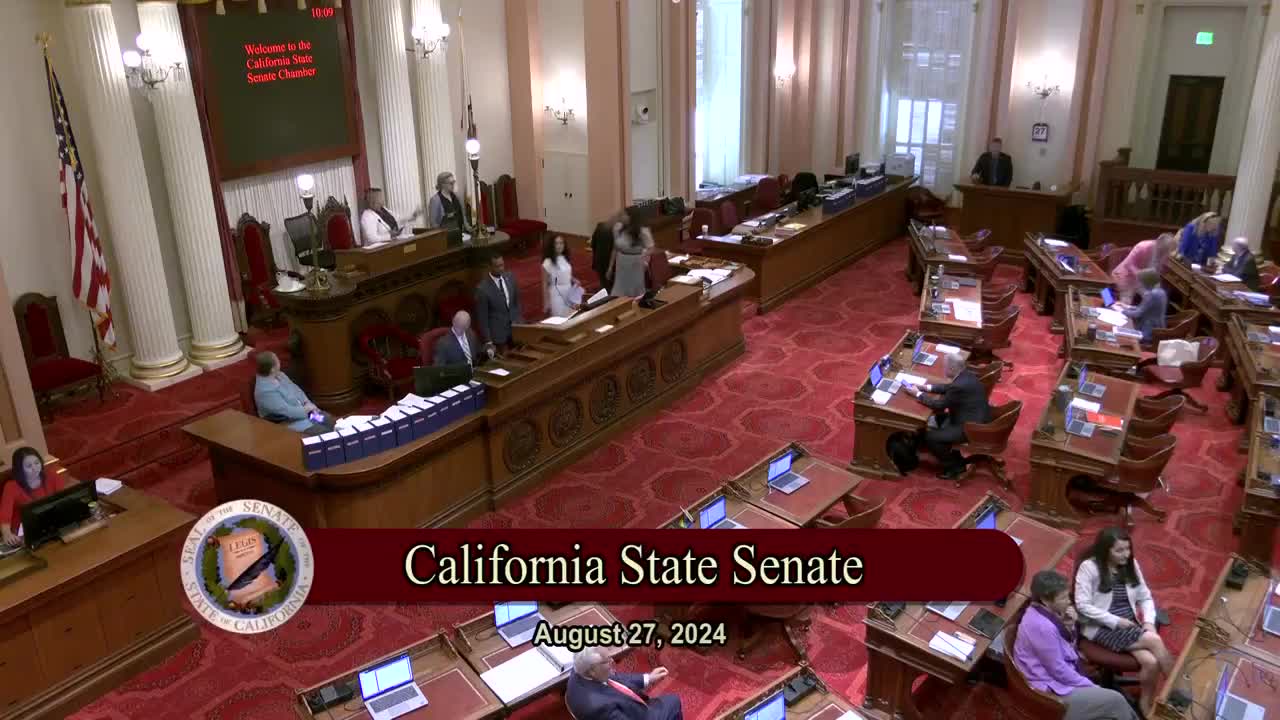 2MIN
Senate Floor
 2MIN
Senate Standing Committee on Public Safety
 1MIN
Assembly Floor
 2MIN
Assembly Standing Committee on Public Safety
Bill Author

Bill Co-Author(s):
