AB 1896: Secure youth treatment facilities.
- Session Year: 2023-2024
- House: Assembly
- Latest Version Date: 2024-03-06
Current Status:
Failed
(2024-04-30: From committee: Without further action pursuant to Joint Rule 62(a).)
Introduced
In Committee
First Chamber
In Committee
Second Chamber
Enacted
What does this bill do?
The bill bars later findings that a youth committed additional offenses from making that youth ineligible to remain in a secure youth treatment facility or from increasing the youth’s current baseline length of confinement (the initial length of stay). Before filing a criminal charge for in‑custody behavior, prosecutors may weigh the youth’s rehabilitation needs, whether the conduct stems from those needs or the facility environment, and how charges could affect six‑month review release chances. It also requires progress review and transfer hearings to proceed as quickly as possible if the youth requests it.
The summary is provided by generative AI which can make mistakes. For original language, please view the details in the table below.
(1)Existing law authorizes a court to order a ward who is 14 years of age or older to be committed to a secure youth treatment facility, operated by the county of commitment, for a period of confinement if the ward is adjudicated and found to be a ward based on the commitment of a specified serious offense committed when the juvenile was 14 years or older, that adjudication is the most recent offense for which the ward has been adjudicated, and the court has made a finding on the record that a less restrictive, alternative disposition for the ward is unsuitable. Existing law requires the baseline term of confinement to be determined according to offense-based classifications, as specified.
This bill would prohibit a youth, following a youths commitment to a secure youth facility, from being found ineligible for continued commitment to a secure youth treatment facility as a result of subsequent adjudicated petitions. The bill would prohibit a court from increasing a youths current baseline term of confinement based on subsequent adjudications. Prior to filing a criminal charge based on in-custody conduct, the bill would authorize the prosecution to consider the interests of the rehabilitation of the ward, including, among other things, the extent to which the conduct is a manifestation of the needs for which the ward is receiving programming, treatment, and education pursuant to an individual rehabilitation plan and the impact on a potential baseline term reduction at a 6-month review hearing, as specified.
(2)Existing law requires a court to schedule and hold a progress review hearing for a ward not less frequently than once every 6 months to evaluate the wards progress in relation to the rehabilitation plan, as specified. Upon a motion from the probation department or the ward, existing law authorizes a court to order that the ward be transferred from a secure youth treatment facility to a less restrictive program, as specified.
This bill would, upon request of the minor, require a hearing under these provisions to be conducted as expeditiously as possible once commenced.
Existing law authorizes a court to order a ward who is 14 years of age or older to be committed to a secure youth treatment facility, operated by the county of commitment, for a period of confinement if the ward is adjudicated and found to be a ward based on the commitment of a specified serious offense committed when the juvenile was 14 years or older, that adjudication is the most recent offense for which the ward has been adjudicated, and the court has made a finding on the record that a less restrictive, alternative disposition for the ward is unsuitable. Existing law requires the baseline term of confinement to be determined according to offense-based classifications, as specified.
This bill would prohibit a youth, following a youths commitment to a secure youth facility, from being found ineligible for continued commitment to a secure youth treatment facility as a result of subsequent adjudicated petitions. The bill would prohibit a court from increasing a youths current baseline term of confinement based on subsequent adjudications.
(a)In addition to the types of treatment specified in Sections 727 and 730, commencing July 1, 2021, the court may order that a ward who is 14 years of age or older be committed to a secure youth treatment facility for a period of confinement described in subdivision (b) if the ward meets all of the following criteria:
(1)The juvenile is adjudicated and found to be a ward of the court based on an offense listed in subdivision (b) of Section 707 that was committed when the juvenile was 14 years of age or older.
(2)The adjudication described in paragraph (1) is the most recent offense for which the juvenile has been adjudicated.
(3)The court has made a finding on the record that a less restrictive, alternative disposition for the ward is unsuitable. In determining this, the court shall consider all relevant and material evidence, including the recommendations of counsel, the probation department, and any other agency or individual designated by the court to advise on the appropriate disposition of the case. The court shall additionally make its determination based on all of the following criteria:
(A)The severity of the offense or offenses for which the ward has been most recently adjudicated, including the wards role in the offense, the wards behavior, and harm done to victims.
(B)The wards previous delinquent history, including the adequacy and success of previous attempts by the juvenile court to rehabilitate the ward.
(C)Whether the programming, treatment, and education offered and provided in a secure youth treatment facility is appropriate to meet the treatment and security needs of the ward.
(D)Whether the goals of rehabilitation and community safety can be met by assigning the ward to an alternative, less restrictive disposition that is available to the court.
(E)The wards age, developmental maturity, mental and emotional health, sexual orientation, gender identity and expression, and any disabilities or special needs affecting the safety or suitability of committing the ward to a term of confinement in a secure youth treatment facility.
(b)(1)In making its order of commitment for a ward, the court shall set a baseline term of confinement for the ward that is based on the most serious recent offense for which the ward has been adjudicated. The baseline term of confinement shall represent the time in custody necessary to meet the developmental and treatment needs of the ward and to prepare the ward for discharge to a period of probation supervision in the community. The baseline term of confinement for the ward shall be determined according to offense-based classifications that are approved by the Judicial Council, as described in subdivision (h). Pending the development and adoption of offense-based classifications by the Judicial Council, the court shall set a baseline term of confinement for the ward utilizing the discharge consideration date guidelines applied by the Department of Corrections and Rehabilitation, Division of Juvenile Justice prior to its closure and as set forth in Sections 30807 to 30813, inclusive, of Title 9 of the California Code of Regulations. These guidelines shall be used only to determine a baseline confinement time for the ward and shall not be used or relied on to modify the wards confinement time in any manner other than as provided in this section. The court may, pending the adoption of Judicial Council guidelines, modify the initial baseline term with a deviation of plus or minus six months. The baseline term shall also be subject to modification in progress review hearings as described in subdivision (e).
(2)For youth transferred from the Division of Juvenile Justice and committed to a secure youth treatment facility, the baseline term of confinement shall not exceed a youths projected juvenile parole board date as defined in paragraph (12) of Section 30800 of Title 9 of the California Code of Regulations, at the time of their transfer from the Division of Juvenile Justice. Youth shall receive credit against their secure youth treatment facility baseline term for all programs completed or substantially completed at the Division of Juvenile Justice, as reflected in the transition report completed by the Division of Juvenile Justice.
(3)Notwithstanding paragraph (2) of subdivision (a), following a youths commitment to a secure youth treatment facility, subsequent adjudicated petitions shall not render a youth ineligible for continued commitment to a secure youth treatment facility. Subsequent adjudications shall not be a basis for increasing a youths current baseline term of confinement set pursuant to this subdivision. Prior to filing a criminal charge based on in-custody conduct, the prosecution may consider the interests of the rehabilitation of the ward, including all of the following:
(A)The extent to which the conduct is a manifestation of the needs for which the ward is receiving programming, treatment, and education pursuant to the individual rehabilitation plan described in subdivision (d).
(B)The extent to which the conduct is related to the nature of the in-custody environment and can be addressed by alternative means, which may include graduated disciplinary sanctions adopted by the operator of a secure youth treatment facility.
(C)The impact on a potential baseline term reduction at a six-month review hearing.
(D)Modifications to the wards individual rehabilitation plan that can address the underlying conduct.
(E)Returning the youth to a secure youth treatment facility from a less restrictive program.
(c)(1)In making its order of commitment, the court shall additionally set a maximum term of confinement for the ward based upon the facts and circumstances of the matter or matters that brought or continued the ward under the jurisdiction of the court and as deemed appropriate to achieve rehabilitation. The maximum term of confinement shall represent the longest term of confinement in a facility that the ward may serve subject to the following:
(A)A ward committed to a secure youth treatment facility under this section shall not be held in secure confinement beyond 23 years of age, or two years from the date of the commitment, whichever occurs later. However, if the ward has been committed to a secure youth treatment facility based on adjudication for an offense or offenses for which the ward, if convicted in adult criminal court, would face an aggregate sentence of seven or more years, the ward shall not be held in secure confinement beyond 25 years of age, or two years from the date of commitment, whichever occurs later.
(B)The maximum term of confinement shall not exceed the middle term of imprisonment that can be imposed upon an adult convicted of the same offense or offenses. If the court elects to aggregate the period of physical confinement on multiple counts or multiple petitions, including previously sustained petitions adjudging the minor a ward within Section 602, the maximum term of confinement shall be the aggregate term of imprisonment specified in subdivision (a) of Section 1170.1 of the Penal Code, which includes any additional term imposed pursuant to Section 667, 667.5, 667.6, or 12022.1 of the Penal Code, and Section 11370.2 of the Health and Safety Code.
(C)Precommitment credits for time served must be applied against the maximum term of confinement as set pursuant to this subdivision.
(2)For purposes of this section, maximum term of confinement has the same meaning as maximum term of imprisonment, as defined in paragraph (2) of subdivision (d) of Section 726.
(d)(1)Within 30 judicial days of making an order of commitment to a secure youth treatment facility, the court shall receive, review, and approve an individual rehabilitation plan that meets the requirements of paragraph (2) for the ward that has been submitted to the court by the probation department and any other agencies or individuals the court deems necessary for the development of the plan. The plan may be developed in consultation with a multidisciplinary team of youth service, mental and behavioral health, education, and other treatment providers who are convened to advise the court for this purpose. The prosecutor and the counsel for the ward may provide input in the development of the rehabilitation plan prior to the courts approval of the plan. The plan may be modified by the court based on all of the information provided.
(2)An individual rehabilitation plan shall do all of the following:
(A)Identify the wards needs in relation to treatment, education, and development, including any special needs the ward may have in relation to health, mental or emotional health, disabilities, or gender-related or other special needs.
(B)Describe the programming, treatment, and education to be provided to the ward in relation to the identified needs during the commitment period.
(C)Reflect, and be consistent with, the principles of trauma-informed, evidence-based, and culturally responsive care.
(D)The ward and their family shall be given the opportunity to provide input regarding the needs of the ward during the identification process stated in subparagraph (A), and the opinions of the ward and the wards family shall be included in the rehabilitation plan report to the court.
(e)(1)(A)The court shall, during the term of commitment, including any term spent in a less restrictive program pursuant to subdivision (f), schedule and hold a progress review hearing for the ward not less frequently than once every six months. In the review hearing, the court shall evaluate the wards progress in relation to the rehabilitation plan and shall determine whether the baseline term of confinement is to be modified. The court shall consider the recommendations of counsel, the probation department and any behavioral, educational, or other specialists having information relevant to the wards progress. At the conclusion of each review hearing, upon making a finding on the record, the court may order that the ward remain in custody for the remainder of the baseline term or may order that the wards baseline term or previously modified baseline term be modified downward by a reduction of confinement time not to exceed six months for each review hearing. The court may additionally order that the ward be assigned to a less restrictive program, as provided in subdivision (f). The determination of whether the baseline term will be modified, or whether a youth will be assigned to a less restrictive program, is a judicial decision and the juvenile courts discretion may not be limited by stipulation of the parties at any time.
(B)If the ward is already assigned to a less restrictive program, the court may, based on the wards progress, order a reduction in the length of time the ward is to remain in the less restrictive program prior to a probation discharge hearing. If the court determines that ward has failed materially to comply with the court-ordered conditions of placement in the less restrictive program, the court may modify the order of placement in the less restrictive program as provided in paragraph (2) of subdivision (f).
(2)The wards confinement time, including time spent in a less restrictive program described in subdivision (f), shall not be extended beyond the baseline confinement term, or beyond a modified baseline term, for disciplinary infractions or other in-custody behaviors. Any infractions or behaviors shall be addressed by alternative means, which may include a system of graduated sanctions for disciplinary infractions adopted by the operator of a secure youth treatment facility and subject to any relevant state standards or regulations that apply to juvenile facilities generally.
(3)The court shall, at the conclusion of the baseline confinement term, including any modified baseline term, hold a probation discharge hearing for the ward. For a ward who has been placed in a less restrictive program described in subdivision (f), the probation discharge hearing shall occur at the end of the period, or modified period, of placement that has been ordered by the court. At the discharge hearing, the court shall review the wards progress toward meeting the goals of the individual rehabilitation plan and the recommendations of counsel, the probation department, and any other agencies or individuals having information the court deems necessary. At the conclusion of the hearing, the court shall order that the ward be discharged to a period of probation supervision in the community under conditions approved by the court, unless the court finds that the ward constitutes a substantial risk of imminent harm to others in the community if released from custody. If the court so finds, the ward may be retained in custody in a secure youth treatment facility for up to one additional year of confinement, subject to the review hearing and probation discharge hearing provisions of this subdivision and subject to the maximum confinement provisions of subdivision (c).
(4)If the ward is discharged to probation supervision, the court shall determine the reasonable conditions of probation that are suitable to meet the developmental needs and circumstances of the ward and to facilitate the wards successful reentry into the community. The court shall periodically review the wards progress under probation supervision and shall make any additional orders deemed necessary to modify the program of supervision in order to facilitate the provision of services or to otherwise support the wards successful reentry into the community. If the court finds that the ward has failed materially to comply with the reasonable orders of probation imposed by the court, the court may order that the ward be returned to a juvenile facility or to a placement described in subdivision (f) for a period not to exceed either the remainder of the baseline term, including any court-ordered modifications, or six months, whichever is longer, and in any case not to exceed the maximum confinement limits of subdivision (c).
(5)A progress review hearing under this subdivision shall, upon request of the minor, be conducted as expeditiously as possible once commenced.
(f)(1)Upon a motion from the probation department or the ward, the court may order that the ward be transferred from a secure youth treatment facility to less restrictive program, such as a halfway house, a camp or ranch, or a community residential or nonresidential service program. The purpose of a less restrictive program is to facilitate the safe and successful reintegration of the ward into the community. The court shall consider the transfer request at the next scheduled treatment review hearing or at a separately scheduled hearing. The court shall consider the recommendations of the probation department on the proposed change in placement. Approval of the request for a less restrictive program shall be made only upon the courts determination that the ward has made substantial progress toward the goals of the individual rehabilitation plan described in subdivision (d) and that placement is consistent with the goals of youth rehabilitation and community safety. In making its determination, the court shall consider both of the following factors:
(A)The wards overall progress in relation to the rehabilitation plan during the period of confinement in a secure youth treatment facility.
(B)The programming and community transition services to be provided, or coordinated by the less restrictive program, including, but not limited to, any educational, vocational, counseling, housing, or other services made available through the program.
(2)In any order transferring the ward from a secure youth treatment facility to a less restrictive program, the court may require the ward to observe any conditions of performance or compliance with the program that are reasonable and appropriate in the individual case and that are within the capacity of the ward to perform. The court shall set the length of time the ward is to remain in a less restrictive program, not to exceed the remainder of the baseline or modified baseline term, prior to a probation discharge hearing described in subdivision (e). If, after placement in a less restrictive program, the court determines that the ward has materially failed to comply with the court-ordered conditions of placement in the program, the court may modify the terms and conditions of placement in the program or may order the ward to be returned to a secure youth treatment facility for the remainder of the baseline term, or modified baseline term, and subject to further periodic review hearings, as provided in subdivision (e) and to the maximum confinement provisions of subdivision (c). If the ward is returned to the secure youth treatment facility under the provisions of this paragraph, the wards baseline or modified baseline term shall be adjusted to include credit for the time served by the ward in the less restrictive program.
(3)A hearing on a motion to transfer a youth from a secure youth treatment facility to a less restrictive program pursuant to this subdivision, or an application to modify or set aside an order of commitment pursuant to Section 779.5, shall, upon request of the minor, be conducted as expeditiously as possible once commenced.
(g)A secure youth treatment facility, as described in this section, shall meet the following criteria:
(1)The facility shall be a secure facility that is operated, utilized, or accessed by the county of commitment to provide appropriate programming, treatment, and education for wards having been adjudicated for the offenses specified in subdivision (a).
(2)The facility may be a stand-alone facility, such as a probation camp or other facility operated under contract with the county, or with another county, or may be a unit or portion of an existing county juvenile facility, including a juvenile hall or probation camp, that is configured and programmed to serve the population described in subdivision (a) and is in compliance with the standards described in paragraph (3).
(3)The Board of State and Community Corrections shall by July 1, 2023, review existing juvenile facility standards and modify or add standards for the establishment, design, security, programming and education, and staffing of any facility that is utilized or accessed by the court as a secure youth treatment facility under the provisions of this section. The standards shall be developed by the board with the coordination and concurrence of the Office of Youth and Community Restoration established by Section 2200. The standards shall specify how the facility may be used to serve or to separate juveniles, other than juveniles described in subdivision (a) serving baseline confinement terms, who may also be detained in or committed to the facility or to some portion of the facility. Pending the final adoption of these modified standards, a secure youth treatment facility shall comply with applicable minimum standards for juvenile facilities in Title 15 and Title 24 of the California Code of Regulations.
(4)A county proposing to establish a secure youth treatment facility for wards described in subdivision (a) shall notify the Board of State and Community Corrections of the operation of the facility and shall submit a description of the facility to the board in a format designated by the board. Commencing July 1, 2022, the Board of State and Community Corrections shall conduct a biennial inspection in accordance with Section 209 of each secure youth treatment facility that was used for the confinement of juveniles placed pursuant to subdivision (a) during the preceding calendar year. To the extent new standards are not yet in place, the board shall utilize the standards in existing regulations.
(5)In lieu of establishing its own secure youth treatment facility, a county may contract with another county having a secure youth treatment facility to accept commitments of wards described in subdivision (a).
(6)A county may establish a secure youth treatment facility to serve as a regional center for commitment of juveniles by one or more other counties on a contract payment basis.
(h)(1)By July 1, 2023, the Judicial Council shall develop and adopt a matrix of offense-based classifications to be applied by the juvenile courts in all counties in setting the baseline confinement terms described in subdivision (b). Each classification level or category shall specify a set of offenses within the level or category that is linked to a standard baseline term of years to be assigned to youth, based on their most serious recent adjudicated offense, who are committed to a secure youth treatment facility as provided in this section. The individual baseline term of years to be assigned in each case may be derived from a standard range of years for each offense level or category as designated by the Judicial Council. The classification matrix may provide for upward or downward deviations from the baseline term and may also provide for a system of positive incentives or credits for time served. In developing the matrix, the Judicial Council shall be advised by a working group of stakeholders, which shall include representatives from prosecution, defense, probation, behavioral health, youth service providers, youth formerly incarcerated in the Division of Juvenile Justice, and youth advocacy and other stakeholders and organizations having relevant expertise or information on dispositions and sentencing of youth in the juvenile justice system. In the development process, the Judicial Council shall also examine and take into account youth sentencing and length-of-stay guidelines or practices adopted by other states or recommended by organizations, academic institutions, or individuals having expertise or having conducted relevant research on dispositions and sentencing of youth in the juvenile justice system.
(2)Upon final adoption by the Judicial Council, the matrix of offense-based classifications shall be applied in a standardized manner by juvenile courts in each county in cases where the court is required to set a baseline confinement term under subdivision (b) for wards who are committed to a secure youth treatment facility. The discharge consideration date guidelines of the Division of Juvenile Justice that were applied on an interim basis, as provided in subdivision (b), shall not thereafter be utilized to determine baseline confinement terms for wards who are committed to a secure youth treatment facility under the provisions of this section.
(i)A court shall not commit a juvenile to any juvenile facility, including a secure youth treatment facility as defined in this section, for a period that exceeds the middle term of imprisonment that could be imposed upon an adult convicted of the same offense or offenses.
(j)A person who is 25 years of age or older shall not be committed to or detained in a county juvenile facility, unless the court finds that such a commitment or detention is in the best interest of that person and does not find that it would create a risk to the other youth in the juvenile facility. A juvenile court exercising jurisdiction over a person who is 25 years of age or older may order commitment or detention of the person into an adult facility, including a jail or other facility established for the confinement of adults, or into a less restrictive program, as defined in subdivision (f), if the person is otherwise eligible for that program.
(k)Upon return to local custody, a person who was, prior to July 1, 2023, sentenced to state prison and was found to be a ward of the court and committed to the Division of Juvenile Justice, shall not be committed or detained in a juvenile facility, unless the juvenile court with jurisdiction over that person finds it is in the persons best interest and does not find that it would create a risk to the other youth in the juvenile facility. A juvenile court exercising jurisdiction over the commitment or detention of a person described in this subdivision may order the person into an adult facility, including a jail or other facility established for the confinement of adults, a less restrictive program, as defined in section (f), if the person is otherwise eligible for that program, or returned to the Department of Corrections and Rehabilitation pursuant to subdivision (f) of Section 1732.9.
(a)In addition to the types of treatment specified in Sections 727 and 730, commencing July 1, 2021, the court may order that a ward who is 14 years of age or older be committed to a secure youth treatment facility for a period of confinement described in subdivision (b) if the ward meets all of the following criteria:
(1)The juvenile is adjudicated and found to be a ward of the court based on an offense listed in subdivision (b) of Section 707 that was committed when the juvenile was 14 years of age or older.
(2)The adjudication described in paragraph (1) is the most recent offense for which the juvenile has been adjudicated.
(3)The court has made a finding on the record that a less restrictive, alternative disposition for the ward is unsuitable. In determining this, the court shall consider all relevant and material evidence, including the recommendations of counsel, the probation department, and any other agency or individual designated by the court to advise on the appropriate disposition of the case. The court shall additionally make its determination based on all of the following criteria:
(A)The severity of the offense or offenses for which the ward has been most recently adjudicated, including the wards role in the offense, the wards behavior, and harm done to victims.
(B)The wards previous delinquent history, including the adequacy and success of previous attempts by the juvenile court to rehabilitate the ward.
(C)Whether the programming, treatment, and education offered and provided in a secure youth treatment facility is appropriate to meet the treatment and security needs of the ward.
(D)Whether the goals of rehabilitation and community safety can be met by assigning the ward to an alternative, less restrictive disposition that is available to the court.
(E)The wards age, developmental maturity, mental and emotional health, sexual orientation, gender identity and expression, and any disabilities or special needs affecting the safety or suitability of committing the ward to a term of confinement in a secure youth treatment facility.
(b)(1)In making its order of commitment for a ward, the court shall set a baseline term of confinement for the ward that is based on the most serious recent offense for which the ward has been adjudicated. The baseline term of confinement shall represent the time in custody necessary to meet the developmental and treatment needs of the ward and to prepare the ward for discharge to a period of probation supervision in the community. The baseline term of confinement for the ward shall be determined according to offense-based classifications that are approved by the Judicial Council, as described in subdivision (h). Pending the development and adoption of offense-based classifications by the Judicial Council, the court shall set a baseline term of confinement for the ward utilizing the discharge consideration date guidelines applied by the Department of Corrections and Rehabilitation, Division of Juvenile Justice prior to its closure and as set forth in Sections 30807 to 30813, inclusive, of Title 9 of the California Code of Regulations. These guidelines shall be used only to determine a baseline confinement time for the ward and shall not be used or relied on to modify the wards confinement time in any manner other than as provided in this section. The court may, pending the adoption of Judicial Council guidelines, modify the initial baseline term with a deviation of plus or minus six months. The baseline term shall also be subject to modification in progress review hearings as described in subdivision (e).
(2)For youth transferred from the Division of Juvenile Justice and committed to a secure youth treatment facility, the baseline term of confinement shall not exceed a youths projected juvenile parole board date as defined in paragraph (12) of Section 30800 of Title 9 of the California Code of Regulations, at the time of their transfer from the Division of Juvenile Justice. Youth shall receive credit against their secure youth treatment facility baseline term for all programs completed or substantially completed at the Division of Juvenile Justice, as reflected in the transition report completed by the Division of Juvenile Justice.
(3)Notwithstanding paragraph (2) of subdivision (a), following a youths commitment to a secure youth treatment facility, subsequent adjudicated petitions shall not render a youth ineligible for continued commitment to a secure youth treatment facility. Subsequent adjudications shall not be a basis for increasing a youths current baseline term of confinement set pursuant to this subdivision.
(c)(1)In making its order of commitment, the court shall additionally set a maximum term of confinement for the ward based upon the facts and circumstances of the matter or matters that brought or continued the ward under the jurisdiction of the court and as deemed appropriate to achieve rehabilitation. The maximum term of confinement shall represent the longest term of confinement in a facility that the ward may serve subject to the following:
(A)A ward committed to a secure youth treatment facility under this section shall not be held in secure confinement beyond 23 years of age, or two years from the date of the commitment, whichever occurs later. However, if the ward has been committed to a secure youth treatment facility based on adjudication for an offense or offenses for which the ward, if convicted in adult criminal court, would face an aggregate sentence of seven or more years, the ward shall not be held in secure confinement beyond 25 years of age, or two years from the date of commitment, whichever occurs later.
(B)The maximum term of confinement shall not exceed the middle term of imprisonment that can be imposed upon an adult convicted of the same offense or offenses. If the court elects to aggregate the period of physical confinement on multiple counts or multiple petitions, including previously sustained petitions adjudging the minor a ward within Section 602, the maximum term of confinement shall be the aggregate term of imprisonment specified in subdivision (a) of Section 1170.1 of the Penal Code, which includes any additional term imposed pursuant to Section 667, 667.5, 667.6, or 12022.1 of the Penal Code, and Section 11370.2 of the Health and Safety Code.
(C)Precommitment credits for time served must be applied against the maximum term of confinement as set pursuant to this subdivision.
(2)For purposes of this section, maximum term of confinement has the same meaning as maximum term of imprisonment, as defined in paragraph (2) of subdivision (d) of Section 726.
(d)(1)Within 30 judicial days of making an order of commitment to a secure youth treatment facility, the court shall receive, review, and approve an individual rehabilitation plan that meets the requirements of paragraph (2) for the ward that has been submitted to the court by the probation department and any other agencies or individuals the court deems necessary for the development of the plan. The plan may be developed in consultation with a multidisciplinary team of youth service, mental and behavioral health, education, and other treatment providers who are convened to advise the court for this purpose. The prosecutor and the counsel for the ward may provide input in the development of the rehabilitation plan prior to the courts approval of the plan. The plan may be modified by the court based on all of the information provided.
(2)An individual rehabilitation plan shall do all of the following:
(A)Identify the wards needs in relation to treatment, education, and development, including any special needs the ward may have in relation to health, mental or emotional health, disabilities, or gender-related or other special needs.
(B)Describe the programming, treatment, and education to be provided to the ward in relation to the identified needs during the commitment period.
(C)Reflect, and be consistent with, the principles of trauma-informed, evidence-based, and culturally responsive care.
(D)The ward and their family shall be given the opportunity to provide input regarding the needs of the ward during the identification process stated in subparagraph (A), and the opinions of the ward and the wards family shall be included in the rehabilitation plan report to the court.
(e)(1)(A)The court shall, during the term of commitment, including any term spent in a less restrictive program pursuant to subdivision (f), schedule and hold a progress review hearing for the ward not less frequently than once every six months. In the review hearing, the court shall evaluate the wards progress in relation to the rehabilitation plan and shall determine whether the baseline term of confinement is to be modified. The court shall consider the recommendations of counsel, the probation department and any behavioral, educational, or other specialists having information relevant to the wards progress. At the conclusion of each review hearing, upon making a finding on the record, the court may order that the ward remain in custody for the remainder of the baseline term or may order that the wards baseline term or previously modified baseline term be modified downward by a reduction of confinement time not to exceed six months for each review hearing. The court may additionally order that the ward be assigned to a less restrictive program, as provided in subdivision (f). The determination of whether the baseline term will be modified, or whether a youth will be assigned to a less restrictive program, is a judicial decision and the juvenile courts discretion may not be limited by stipulation of the parties at any time.
(B)If the ward is already assigned to a less restrictive program, the court may, based on the wards progress, order a reduction in the length of time the ward is to remain in the less restrictive program prior to a probation discharge hearing. If the court determines that ward has failed materially to comply with the court-ordered conditions of placement in the less restrictive program, the court may modify the order of placement in the less restrictive program as provided in paragraph (2) of subdivision (f).
(2)The wards confinement time, including time spent in a less restrictive program described in subdivision (f), shall not be extended beyond the baseline confinement term, or beyond a modified baseline term, for disciplinary infractions or other in-custody behaviors. Any infractions or behaviors shall be addressed by alternative means, which may include a system of graduated sanctions for disciplinary infractions adopted by the operator of a secure youth treatment facility and subject to any relevant state standards or regulations that apply to juvenile facilities generally.
(3)The court shall, at the conclusion of the baseline confinement term, including any modified baseline term, hold a probation discharge hearing for the ward. For a ward who has been placed in a less restrictive program described in subdivision (f), the probation discharge hearing shall occur at the end of the period, or modified period, of placement that has been ordered by the court. At the discharge hearing, the court shall review the wards progress toward meeting the goals of the individual rehabilitation plan and the recommendations of counsel, the probation department, and any other agencies or individuals having information the court deems necessary. At the conclusion of the hearing, the court shall order that the ward be discharged to a period of probation supervision in the community under conditions approved by the court, unless the court finds that the ward constitutes a substantial risk of imminent harm to others in the community if released from custody. If the court so finds, the ward may be retained in custody in a secure youth treatment facility for up to one additional year of confinement, subject to the review hearing and probation discharge hearing provisions of this subdivision and subject to the maximum confinement provisions of subdivision (c).
(4)If the ward is discharged to probation supervision, the court shall determine the reasonable conditions of probation that are suitable to meet the developmental needs and circumstances of the ward and to facilitate the wards successful reentry into the community. The court shall periodically review the wards progress under probation supervision and shall make any additional orders deemed necessary to modify the program of supervision in order to facilitate the provision of services or to otherwise support the wards successful reentry into the community. If the court finds that the ward has failed materially to comply with the reasonable orders of probation imposed by the court, the court may order that the ward be returned to a juvenile facility or to a placement described in subdivision (f) for a period not to exceed either the remainder of the baseline term, including any court-ordered modifications, or six months, whichever is longer, and in any case not to exceed the maximum confinement limits of subdivision (c).
(f)(1)Upon a motion from the probation department or the ward, the court may order that the ward be transferred from a secure youth treatment facility to less restrictive program, such as a halfway house, a camp or ranch, or a community residential or nonresidential service program. The purpose of a less restrictive program is to facilitate the safe and successful reintegration of the ward into the community. The court shall consider the transfer request at the next scheduled treatment review hearing or at a separately scheduled hearing. The court shall consider the recommendations of the probation department on the proposed change in placement. Approval of the request for a less restrictive program shall be made only upon the courts determination that the ward has made substantial progress toward the goals of the individual rehabilitation plan described in subdivision (d) and that placement is consistent with the goals of youth rehabilitation and community safety. In making its determination, the court shall consider both of the following factors:
(A)The wards overall progress in relation to the rehabilitation plan during the period of confinement in a secure youth treatment facility.
(B)The programming and community transition services to be provided, or coordinated by the less restrictive program, including, but not limited to, any educational, vocational, counseling, housing, or other services made available through the program.
(2)In any order transferring the ward from a secure youth treatment facility to a less restrictive program, the court may require the ward to observe any conditions of performance or compliance with the program that are reasonable and appropriate in the individual case and that are within the capacity of the ward to perform. The court shall set the length of time the ward is to remain in a less restrictive program, not to exceed the remainder of the baseline or modified baseline term, prior to a probation discharge hearing described in subdivision (e). If, after placement in a less restrictive program, the court determines that the ward has materially failed to comply with the court-ordered conditions of placement in the program, the court may modify the terms and conditions of placement in the program or may order the ward to be returned to a secure youth treatment facility for the remainder of the baseline term, or modified baseline term, and subject to further periodic review hearings, as provided in subdivision (e) and to the maximum confinement provisions of subdivision (c). If the ward is returned to the secure youth treatment facility under the provisions of this paragraph, the wards baseline or modified baseline term shall be adjusted to include credit for the time served by the ward in the less restrictive program.
(g)A secure youth treatment facility, as described in this section, shall meet the following criteria:
(1)The facility shall be a secure facility that is operated, utilized, or accessed by the county of commitment to provide appropriate programming, treatment, and education for wards having been adjudicated for the offenses specified in subdivision (a).
(2)The facility may be a stand-alone facility, such as a probation camp or other facility operated under contract with the county, or with another county, or may be a unit or portion of an existing county juvenile facility, including a juvenile hall or probation camp, that is configured and programmed to serve the population described in subdivision (a) and is in compliance with the standards described in paragraph (3).
(3)The Board of State and Community Corrections shall by July 1, 2023, review existing juvenile facility standards and modify or add standards for the establishment, design, security, programming and education, and staffing of any facility that is utilized or accessed by the court as a secure youth treatment facility under the provisions of this section. The standards shall be developed by the board with the coordination and concurrence of the Office of Youth and Community Restoration established by Section 2200. The standards shall specify how the facility may be used to serve or to separate juveniles, other than juveniles described in subdivision (a) serving baseline confinement terms, who may also be detained in or committed to the facility or to some portion of the facility. Pending the final adoption of these modified standards, a secure youth treatment facility shall comply with applicable minimum standards for juvenile facilities in Title 15 and Title 24 of the California Code of Regulations.
(4)A county proposing to establish a secure youth treatment facility for wards described in subdivision (a) shall notify the Board of State and Community Corrections of the operation of the facility and shall submit a description of the facility to the board in a format designated by the board. Commencing July 1, 2022, the Board of State and Community Corrections shall conduct a biennial inspection in accordance with Section 209 of each secure youth treatment facility that was used for the confinement of juveniles placed pursuant to subdivision (a) during the preceding calendar year. To the extent new standards are not yet in place, the board shall utilize the standards in existing regulations.
(5)In lieu of establishing its own secure youth treatment facility, a county may contract with another county having a secure youth treatment facility to accept commitments of wards described in subdivision (a).
(6)A county may establish a secure youth treatment facility to serve as a regional center for commitment of juveniles by one or more other counties on a contract payment basis.
(h)(1)By July 1, 2023, the Judicial Council shall develop and adopt a matrix of offense-based classifications to be applied by the juvenile courts in all counties in setting the baseline confinement terms described in subdivision (b). Each classification level or category shall specify a set of offenses within the level or category that is linked to a standard baseline term of years to be assigned to youth, based on their most serious recent adjudicated offense, who are committed to a secure youth treatment facility as provided in this section. The individual baseline term of years to be assigned in each case may be derived from a standard range of years for each offense level or category as designated by the Judicial Council. The classification matrix may provide for upward or downward deviations from the baseline term and may also provide for a system of positive incentives or credits for time served. In developing the matrix, the Judicial Council shall be advised by a working group of stakeholders, which shall include representatives from prosecution, defense, probation, behavioral health, youth service providers, youth formerly incarcerated in the Division of Juvenile Justice, and youth advocacy and other stakeholders and organizations having relevant expertise or information on dispositions and sentencing of youth in the juvenile justice system. In the development process, the Judicial Council shall also examine and take into account youth sentencing and length-of-stay guidelines or practices adopted by other states or recommended by organizations, academic institutions, or individuals having expertise or having conducted relevant research on dispositions and sentencing of youth in the juvenile justice system.
(2)Upon final adoption by the Judicial Council, the matrix of offense-based classifications shall be applied in a standardized manner by juvenile courts in each county in cases where the court is required to set a baseline confinement term under subdivision (b) for wards who are committed to a secure youth treatment facility. The discharge consideration date guidelines of the Division of Juvenile Justice that were applied on an interim basis, as provided in subdivision (b), shall not thereafter be utilized to determine baseline confinement terms for wards who are committed to a secure youth treatment facility under the provisions of this section.
(i)A court shall not commit a juvenile to any juvenile facility, including a secure youth treatment facility as defined in this section, for a period that exceeds the middle term of imprisonment that could be imposed upon an adult convicted of the same offense or offenses.
(j)A person who is 25 years of age or older shall not be committed to or detained in a county juvenile facility, unless the court finds that such a commitment or detention is in the best interest of that person and does not find that it would create a risk to the other youth in the juvenile facility. A juvenile court exercising jurisdiction over a person who is 25 years of age or older may order commitment or detention of the person into an adult facility, including a jail or other facility established for the confinement of adults, or into a less restrictive program, as defined in subdivision (f), if the person is otherwise eligible for that program.
(k)Upon return to local custody, a person who was, prior to July 1, 2023, sentenced to state prison and was found to be a ward of the court and committed to the Division of Juvenile Justice, shall not be committed or detained in a juvenile facility, unless the juvenile court with jurisdiction over that person finds it is in the persons best interest and does not find that it would create a risk to the other youth in the juvenile facility. A juvenile court exercising jurisdiction over the commitment or detention of a person described in this subdivision may order the person into an adult facility, including a jail or other facility established for the confinement of adults, a less restrictive program, as defined in section (f), if the person is otherwise eligible for that program, or returned to the Department of Corrections and Rehabilitation pursuant to subdivision (f) of Section 1732.9.
|
Date
|
Status
|
|---|---|
| Apr 30, 2024 | From committee: Without further action pursuant to Joint Rule 62(a). |
| Apr 2, 2024 | In committee: Reconsideration refused. |
| Apr 2, 2024 | In committee: Set, final hearing. Failed passage. |
| Mar 13, 2024 | In committee: Set, second hearing. Hearing canceled at the request of author. |
| Mar 12, 2024 | In committee: Set, first hearing. Hearing canceled at the request of author. |
| Mar 7, 2024 | Re-referred to Com. on PUB. S. |
| Mar 6, 2024 | From committee chair, with author's amendments: Amend, and re-refer to Com. on PUB. S. Read second time and amended. |
| Feb 5, 2024 | Referred to Com. on PUB. S. |
| Jan 24, 2024 | From printer. May be heard in committee February 23. |
| Jan 23, 2024 | Read first time. To print. |
|
Date
|
Description
|
Location
|
Votes
|
|
|---|---|---|---|---|
| Apr 2, 2024 | Reconsideration. | Assembly Standing Committee on Public Safety |
Failed |
|
| Apr 2, 2024 | Do pass. | Assembly Standing Committee on Public Safety |
Failed |
This list shows positions taken on this bill by organizations on the date displayed, which is linked to the original source.
Positions by individuals are not included.
|
Organization
|
Position
|
Date
|
|---|---|---|
| Aclu California Action | * Against | Apr 2, 2024 |
| All of Us or None | * Against | Apr 2, 2024 |
| California Alliance for Youth and Community Justice | ** Against | |
| California Attorneys For Criminal Justice | * Against | Apr 2, 2024 |
| California District Attorney's Association | * Support | Apr 2, 2024 |
| California Public Defender's Association | * Against | Apr 2, 2024 |
| California United for Responsible Budget | * Against | Apr 2, 2024 |
| Center on Juvenile and Criminal Justice | * Against | Apr 2, 2024 |
| Communities United for Restorative Youth Justice | ** Against | |
| Ella Baker Center For Human Rights | * Against | Apr 2, 2024 |
| Felony Murder Elimination Project | ** Against | |
| Initiate Justice | * Against | Apr 2, 2024 |
| LA Defensa | ** Against | |
| LSPC | * Against | Apr 2, 2024 |
| National Center for Youth Law | * Against | Apr 2, 2024 |
| Orange County District Attorney Office | * Support | Apr 2, 2024 |
| Pacific Juvenile Defender Center | ** Against | |
| Prison from the Inside Out | * Against | Apr 2, 2024 |
| San Francisco Public Defender's Office | * Against | Apr 2, 2024 |
| Silicon Valley De-Bug | * Against | Apr 2, 2024 |
| Young Women's Freedom Center | ** Against |
Date of Hearing:
Chief Counsel: Sandy Uribe
ASSEMBLY COMMITTEE ON PUBLIC SAFETY
Kevin McCarty, Chair
ABPCA Bill Id:AB 1896
Author:(Dixon) – As Amended Ver:March 6, 2024
SUMMARY:
Authorizes a youth’s continued commitment to a secure youth treatment facility (SYTF) as a result of subsequent offenses that would not otherwise allow commitment to a SYTF. Specifically, this bill:
- Eliminates the requirement that a minor can only be committed to a STYF if the last offense adjudicated on a juvenile petition is a serious or violent offense enumerated in Welfare and Institutions Code section 707, subdivision (b) (hereinafter “707(b) offense”).
- Allows a prosecutor to file non-707(b) offense charges against a youth who is committed to a SYTF and continue the SYTF commitment, but prohibits a court from increasing the youth’s current baseline term of confinement based on those subsequent adjudications.
- States that before filing a criminal charge based on in-custody conduct, the prosecution may consider the interests of the rehabilitation of the ward, including:
- The extent to which the conduct is a manifestation of the needs for which the ward is receiving programming, treatment, and education;
- The extent to which the conduct is related to the nature of the in-custody environment and can be addressed by alternative means;
- The impact on a potential baseline term reduction at a six-month review hearing;
- Modifications to the ward’s individual rehabilitation plan that can address the underlying conduct; and,
- Returning the youth to a SYTF from a less restrictive program.
- The extent to which the conduct is a manifestation of the needs for which the ward is receiving programming, treatment, and education;
- Requires that six-month progress review hearings, at which the juvenile court is to determine whether the baseline term of confinement should be modified and whether the ward should be assigned to a less restrictive program, be conducted as expeditiously as possible once commenced, if the minor so requests.
- Requires a hearing on whether a minor should be removed from a SYTF to a less restrictive placement be conducted as expeditiously as possible once commenced, if the minor so requests.
EXISTING LAW:
- Provides that a juvenile court ward who meets any of the following conditions shall not be committed to the California Department of Corrections and Rehabilitation (CDCR), Division of Juvenile Justice (DJJ):
- The ward is less than 11 years old;
- The ward is suffering from a contagious, infectious, or other disease that would probably endanger the lives or health of the other minors in the facility; or,
- The ward’s most recent offense is not one a 707(b) offense. (Welf. & Inst. Code, § 733.)
- The ward is less than 11 years old;
- States that the DJJ shall close on June 30, 2023. (Welf. & Inst. Code, § 736.5, subd. (e).)
- Defines “secure youth treatment facility” as a secure facility that is operated, utilized, or accessed by the county of commitment to provide appropriate programming, treatment, and education for wards having been adjudicated for specified offenses. (Welf. & Inst. Code, § 875, subd. (g)(1).)
- Provides that, commencing July 1, 2021, the court may order that a ward who is 14 years of age or older be committed to a SYTF if the ward meets all of the following criteria:
- The juvenile is adjudicated and found to be a ward of the court based on a 707(b) offense that was committed when the ward was 14 years of age or older;
- The 707(b) offense is the most recent offense for which the juvenile has been adjudicated; and,
- The court has made a finding on the record that a less restrictive alternative disposition for the ward is unsuitable. (Welf. & Inst. Code, § 875, subd. (a).)
- The juvenile is adjudicated and found to be a ward of the court based on a 707(b) offense that was committed when the ward was 14 years of age or older;
- Requires the court, in making its order of commitment, to set a baseline term of confinement for the ward that is based on the most serious recent offense for which the ward has been adjudicated. (Welf. & Inst. Code, § 875, subd. (b)(1).)
- Specifies that the baseline term of confinement shall represent the time in custody necessary to meet the developmental and treatment needs of the ward and to prepare the ward for discharge to a period of probation supervision in the community and is to be determined according to offense-based classifications that are approved by the Judicial Council, as specified. (Welf. & Inst. Code, § 875, subd. (b)(1).)
- Provides that for youth transferred from the Division of Juvenile Justice (DJJ) and committed to a SYTF, the baseline term of confinement shall not exceed a youth’s projected juvenile parole board date, as defined. (Welf. & Inst. Code, § 875, subd. (b)(2).)
- Requires the court, in making its order of commitment, to additionally set a maximum term of confinement for the ward based upon the facts and circumstances of the matter or matters that brought or continued the ward under the jurisdiction of the court and as deemed appropriate to achieve rehabilitation. (Welf. & Inst. Code, § 875, subd. (c).)
- Provides that during the term of commitment, the court must schedule and hold a progress review hearing for the ward not less frequently than once every six months. (Welf. & Inst. Code, § 875, subd. (e)(1)(A).)
- Allows the court, at the conclusion of each review hearing, to order that the ward remain in custody for the remainder of the baseline term or order that the ward’s baseline term or previously modified baseline term be modified downward by a reduction of confinement time not to exceed six months for each review hearing. The court may additionally order that the ward be assigned to a less restrictive program, as provided. (Welf. & Inst. Code, § 875, subd. (e)(1)(A).)
- Prohibits the ward’s confinement time, including time spent in a less restrictive program, to be extended beyond the baseline confinement term, or beyond a modified baseline term, for disciplinary infractions or other in-custody behaviors. (Welf. & Inst. Code, § 875, subd. (e)(2).)
- Mandates that any infractions or behaviors be addressed by alternative means, which may include a system of graduated sanctions for disciplinary infractions adopted by the operator of a SYTF and subject to any relevant state standards or regulations that apply to juvenile facilities generally. (Welf. & Inst. Code, § 875, subd. (e)(2).)
- Enumerates 30 serious and violent offenses which permit a juvenile to be transferred to adult court, or be admitted to a SYTF, and previously to DJJ. These include: murder, arson, robbery, specified sex crimes committed by force, specified forms of kidnapping, attempted murder, carjacking, aggravated mayhem, voluntary manslaughter, a felony offense in which the minor personally used a weapon, and others. (Welf. & Inst. Code, § 707, subd. (b).)
FISCAL EFFECT:
Unknown
COMMENTS:
- Author's Statement: According to the author, “There are a series of criteria that must be met in order for a juvenile to be committed to a Secure Youth Treatment Facility (SYTF). Existing law does not allow for a minor to be adjudicated of subsequent violations of the law while committed to a SYTF. AB 1896 is needed to correct this inaccuracy. The addition of §875(b)(3) will not result in an increased number of individuals being committed to SYTF, rather, it will comport with the overall intent of SB 823 fostering positive youth development, promoting public and community safety, and offering fair and flexible terms of commitment.”
- Juvenile Justice Realignment in California: Historically CDCR’s DJJ housed the majority of the state’s juvenile offenders with the number of juveniles housed in these facilities exceeding 15,000 in the 1990’s. In 2003, plaintiffs filed a lawsuit, Farrell v. Hickman (originally Farrell v. Harper), alleging that CDCR was providing inadequate care for minors housed in its facilities. In January 2005, the state and plaintiffs entered into an agreement which committed reforming the state’s juvenile justice system to a rehabilitative model.
In 2007, the Legislature passed SB 81 (Committee on Budget), Chapter 175, Statutes of 2007, known as juvenile justice realignment. The premise was that local authorities were better able than the State to provide rehabilitation for many juvenile offenders. Under this legislation, juvenile courts were prohibited from committing juveniles adjudicated after September 1, 2007, to DJJ unless the adjudication was for certain serious, violent, or sexual offenses.[1] Non-violent offenders housed at DJJ were transferred back to the counties. And in return, counties were provided with funding.
The Governor’s January Budget in 2020 proposed to transfer DJJ to a newly created independent department within the Health and Human Services Agency on July 1, 2020. That approach was intended to align the rehabilitative mission of the state’s juvenile justice system with trauma-informed and developmentally appropriate services supported by programs overseen by the state’s Health and Human Services Agency. The unprecedented impact of COVID-19 resulted in the withdrawal of this proposal. Subsequently, the May Revision of the Budget proposed to expand on previous efforts to reform the state’s juvenile justice system by transferring the responsibility for managing all youthful offenders to local jurisdictions.
SB 823 (Committee on Budget), Chapter 337, Statutes of 2020, included intent language to establish a SYTF as a commitment option for youth adjudicated for DJJ eligible offenses by March 1, 2021. SB 823 closed DJJ intake on July 1, 2021.
Effective July 1, 2023, all DJJ facilities have closed. (https://www.cdcr.ca.gov/juvenile-justice/#:~:text=All%20Division%20of%20Juvenile%20Justice,%2C%202023%2C%20per%20SB%20823.&text=The%20Board%20of%20Juvenile%20Hearings,are%20no%20longer%20being%20accepted)
- Secure Youth Treatment Facilities (SYTFs): SYTFs were created as local custodial options for the custody and care of juveniles who would have previously been sent to DJJ but can longer be committed there because of its closure. A minor can only be committed to an SYTF upon adjudication for a 707(b) offense committed at age 14 or older. As under prior long-established law with regards to DJJ commitments, the 707(b) offense must be the most recent offense for which the minor has been adjudicated. (See Welf. & Inst, Code, §§ 875, subd. (a)(2) & 733.)
This bill would prohibit a youth who is already committed to an SYTF from being found ineligible for continued commitment to an SYTF as a result of subsequently adjudicated petitions. Presumably, this is directed at non-707(b) offenses since a subsequent 707(b) adjudication does not render a youth ineligible for an SYTF commitment.
According to the author’s background sheet, “Crimes which predate the commitment but are not discovered or ‘solved’ prior to the commitment cannot be meaningfully adjudicated. For instance, a youth commits a series of burglaries which remain unsolved until after the commitment to SYTF has been made. The adjudication of the burglaries would necessarily be last in time thereby conflicting with current law and would result in the youth being expelled from the SYTF. Simply adjudicating a non-707(b) offense should not result in the otherwise needs based commitment to SYTF.”
Importantly, the creation of SYTFs did not create a new loophole in the law disallowing undiscovered or unsolved crimes from being adjudicated, as the requirement that the most recent offense be a 707(b) offense in order to commit a minor to the most secure placement is not a new concept. It has been the law since 2007.
Requiring that the most recent adjudication was for a 707(b) offense is also consistent with the intent of juvenile justice realignment. SB 823 (Committee on Budget and Fiscal Review) Chapter 337, Statutes of 2020 stated, among other things, that the intent of the Legislature and the administration is to “ensure that dispositions are in the least restrictive appropriate environment, … and reduce the use of confinement in the juvenile justice system by utilizing community-based responses and interventions.”
On the other hand, allowing the subsequent adjudication of non-707(b) offenses for youth already committed to an SYTF raises concerns that it would encourage prosecution of less serious, or even minor offenses that are better dealt with via the internal disciplinary process. In particular, as outlined by the Legislature in Welfare and Institutions Code section 875, subdivision (e)(2), this process prohibits extending the baseline confinement time for disciplinary infractions or other in-custody behaviors. “Any infractions or behaviors shall be addressed by alternative means, which may include a system of graduated sanctions for disciplinary infractions adopted by the operator of a [SYTF] and subject to any relevant state standards or regulations that apply to juvenile facilities generally.” (Ibid.)
Further, under current law, the SYTF baseline term is subject to change at six-month review hearings, when the court may order either that the ward remain in custody for the remainder of the baseline term, modify the term downward, or order that the ward be assigned to a less restrictive program. (Welf. & Inst. Code, § 875, subd. (e)(1).) At the conclusion of the baseline confinement term, the court is required to hold a probation discharge hearing, at which the court reviews the ward's progress toward meeting their rehabilitation goals. The court “shall order that the ward be discharged to a period of probation supervision . . ., unless the court finds that the ward constitutes a substantial risk of imminent harm to others in the community if released,” … [in which case] “the ward may be retained in custody in a secure youth treatment facility for up to one additional year of confinement.” (Welf. & Inst. Code, § 875, subd. (e)(3) [emphasis added].)
In other words, there is already a process in place to address in-custody violations of law that amount to criminal conduct but which are not 707(b) offenses. - Baseline Term of Confinement: In committing a ward to a SYTF, the court must set a baseline term of confinement “based on the most serious recent offense for which the ward has been adjudicated. The baseline term of confinement shall represent the time in custody necessary to meet the developmental and treatment needs of the ward and to prepare the ward for discharge to a period of probation supervision in the community.” (Welf. & Inst, Code, § 875, subd. (b)(1).) For youth transferred from DJJ and committed to a SYTF, the baseline term of confinement cannot exceed the youth’s projected juvenile parole board date. (Welf. & Inst, Code, § 875, subd. (b)(2).) In making the SYTF commitment, the court must also “set a maximum term of confinement …based upon the facts and circumstances of the matter or matters that brought or continued the ward under the jurisdiction of the court and as deemed appropriate to achieve rehabilitation.” (Welf. & Inst, Code, § 875, subd. (c).) The maximum term of confinement is the longest term a ward may serve, as specified. (Ibid.)
This bill provides that notwithstanding the ability to file new petitions on non-707(b) offenses, a court is prohibited from increasing the youth’s current baseline term of confinement based on these subsequently adjudicated petitions. So other than using court resources by allowing additional offenses to be adjudicated against a youth already committed to an SYTF for a significant amount of time, it is hard to see what this bill would actually accomplish as it does not increase public safety or promote the youth’s rehabilation. - Argument in Support: According to the Orange County District Attorney, the sponsor of this bill, “With the passage of SB 823 (2020), and the resulting closure of the Division of Juvenile Justice, the criteria by which courts could commit youth to a SYTF were borrowed from the existing code sections applicable to DJJ commitments. These criteria were intended to be a procedural mechanism crafted to prevent youth who were otherwise amenable to less restrictive dispositions from exposure to more intense forms of supervision. However, one specific criterion, if not addressed by the addition of §875(b)(3), interferes with the meaningful adjudication and rehabilitation of SYTF eligible youth.
“Specifically, §875(a)(2) stipulates that a youth offender can only be sentenced to a SYTF if their most recent offense is a 707(b) offense, so any offense adjudicated after a commitment has been made cannot be adjudicated without interfering with the minors existing commitment. As a result, a minor offender who commits an offense following their original SYTF commitment, cannot be prosecuted for any of those offenses in order to preserve their original commitment to a SYTF. Additionally, crimes which predate the commitment, but are not discovered or ‘solved’ prior to the commitment, cannot be meaningfully adjudicated. For instance, a youth who had committed a series of burglaries, which remained unsolved until after their commitment to SYTF had been made, would be expelled from the SYTF as those offenses would not be ‘last in time.’
“AB 1896 is needed to correct this inaccuracy. The addition of §875(b)(3) will not result in an increased number of individuals being committed to SYTF, rather, it will comport with the overall intent of SB 823 to foster positive youth development, promote public and community safety, and offer fair and flexible terms of commitment.”
- Argument in Opposition: According to Initiate Justice, “AB 1896 will permit the filing of charges against SYTF-committed youth under age 18 without those charges causing a disruption to the youth’s SYTF commitment. We have been informed that the sponsors’ primary issue of concern is that prosecutors currently refrain from filing charges against SYTF-committed youth for non-§707(b) conduct because they believe to do so would interrupt the youth’s commitment to SYTF based on the last-adjudicated-offense rule specified in WIC §875(a)(2).
“Current law, Welfare and Institutions Code section 875(e)(2), enacted by SB 823, foresaw
concerns that allowing new charges to be filed against committed youth for minor offenses
would return to the problematic days when DJJ would impose ‘time add-ons’ to prolong youths’ commitment terms. Section 875(a)(2) therefore explicitly provided that low-level problematic behaviors by youth committed to SYTF be handled within the SYTF disciplinary system and the six-month review process.
“The ward’s confinement time, including time spent in a less restrictive program described
in subdivision (f), shall not be extended beyond the baseline confinement
term, or beyond a modified baseline term, for disciplinary infractions or other in custody
behaviors. Any infractions or behaviors shall be addressed by alternative means, which may include a system of graduated sanctions for disciplinary infractions adopted by the operator of a secure youth treatment facility and subject to any relevant state standards or regulations that apply to juvenile facilities generally.
“(Welf. & Inst. Code, §875, subd. (e)(2).) In addition to this clear and recent expression of legislative intent, the six-month review process codified in section 875(e)(1) and rule 5.807(c) of the California Rules of Court also provides robust, regular opportunities for the juvenile court to evaluate a youth’s in- custody behavior and to deny reductions of the baseline term if the youth has been involved in problematic behaviors while at SYTF, including non-§707(b) criminal behaviors such as getting into a fight. This amendment has the potential to instead encourage the formal prosecution of such behavior.
“Although AB 1896 (unlike its former iteration in AB 1582) would not entirely abolish the
requirement that a commitment to SYTF be based on the most recent adjudicated petition, it
would allow the prosecution to file charges that are not 707(b) offenses while youth are serving a commitment to SYTF, and also allow for the filing of misdemeanors and low-level felonies that occurred prior to an SYTF commitment.
Initiate Justice believes the filing of charges against SYTF-committed youth for low-level
behaviors should be exceptionally rare. We believe that the filing of charges against youth at
SYTF for less serious (e.g., non-§707(b)) in-custody behaviors is inconsistent with the goals of the Legislature’s comprehensive scheme for the commitment and housing of youth adjudicated for serious offenses. AB 1896 has great potential for causing harm by encouraging the filing of new charges in lieu of alternative methods of resolving low-level in-custody behaviors.”
- Related Legislation: AB 2840 (Lackey) prohibits a ward from being held in an SYTF beyond 25 years of age. AB 2540 is pending hearing in this committee.
- Prior Legislation:
- AB 1582 (Dixon), of the 2023-2024 Legislative Session, was substantially similar to this bill. AB 1582 failed passage in this committee.
- SB 92 (Committee on Budget and Fiscal Review), Chapter 18, Statutes of 2021, closed DJJ on June 30, 2023, and allowed counties to establish SYTFs for certain youth who are 14 years of age or older and found to be a ward of the court based on an offense that would have resulted in a commitment to DJJ.
- SB 823 (Committee on Budget and Fiscal Review), Chapter 337, Statutes of 2020, transferred the responsibility for managing all youthful offenders to local jurisdictions and closed DJJ intake on July 1, 2021, subject to certain exceptions. SB 823 also stated legislative intent to establish a separate, long-term local dispositional track for higher-need youth.
- SB 439 (Mitchell), Chapter 1006, Statutes of 2018, prohibited the prosecution of children under the age of 12 years in the juvenile court, except when a minor is alleged to have committed murder or specified sex offenses.
- SB 1021 (Committee on Budget and Fiscal Review), Chapter 41, Statutes of 2012, prohibited the extension of a ward’s parole consideration date and authorized CDCR to promulgate regulations establishing a process for granting wards who have successfully responded to disciplinary sanctions a reduction of any time acquired for disciplinary matters.
- SB 81 (Committee on Budget and Fiscal Review), Chapter 175, Statutes of 2007, known as juvenile justice realignment, limited the juvenile offenders who could be committed to state youth correctional facilities.
- AB 1582 (Dixon), of the 2023-2024 Legislative Session, was substantially similar to this bill. AB 1582 failed passage in this committee.
REGISTERED SUPPORT / OPPOSITION:
Support
Orange County District Attorney (Sponsor)
California District Attorneys Association
Opposition
ACLU California Action
California Alliance for Youth and Community Justice
California Attorneys for Criminal Justice
California Public Defenders Association
Center on Juvenile and Criminal Justice
Communities United for Restorative Youth Justice (CURYJ)
Ella Baker Center for Human Rights
Felony Murder Elimination Project
Initiate Justice
Initiate Justice Action
LA Defensa
Legal Services for Prisoners With Children
Pacific Juvenile Defender Center
Young Women's Freedom Center
Analysis Prepared by:
Sandy Uribe / PUB. S. / (916) 319-3744
These offenses are referred to as 707(b) offenses because that is the statute in which they are listed. ↑
Discussed in Hearing
 33MIN
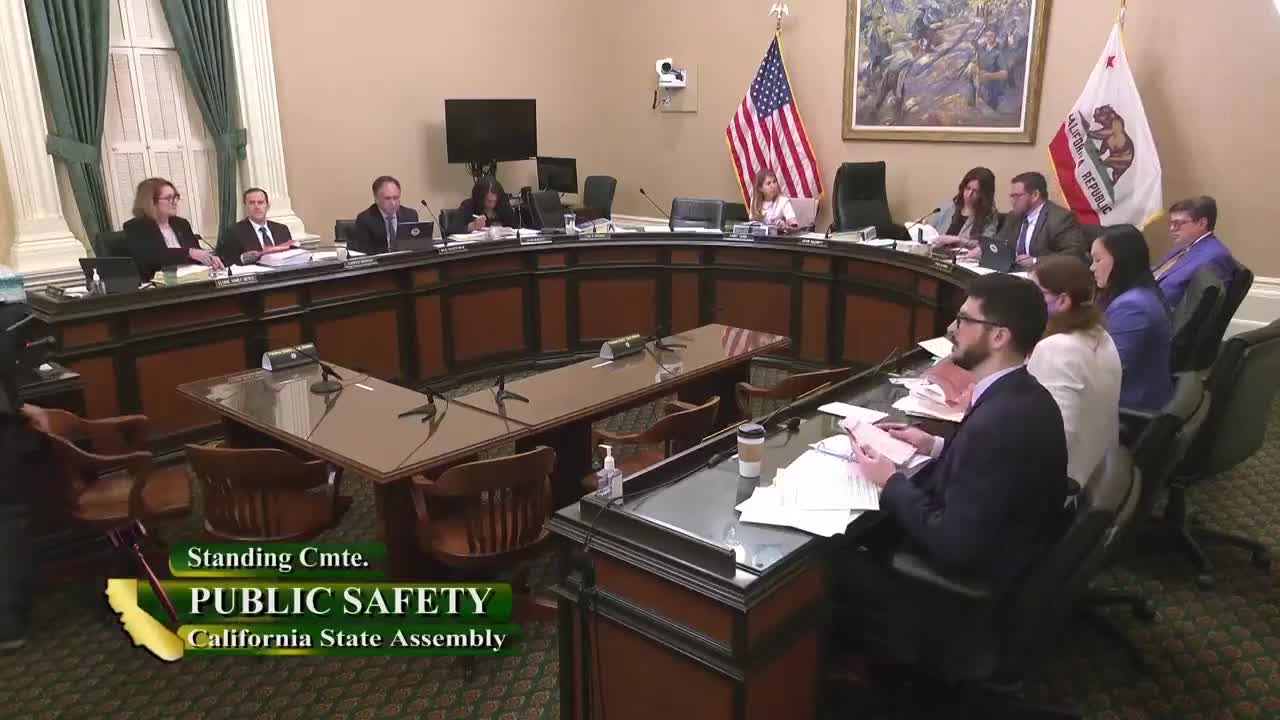
Assembly Standing Committee on Public Safety
Bill Author

Bill Co-Author(s):