AB 1912: Electricity and natural gas: legislation imposing mandated programs and requirements: third-party review.
- Session Year: 2023-2024
- House: Assembly
- Latest Version Date: 2024-07-03
Current Status:
Failed
(2024-08-15: In committee: Held under submission.)
Introduced
In Committee
First Chamber
In Committee
Second Chamber
Enacted
Existing law regulates public utilities, including electrical and gas corporations. The California Council on Science and Technology is organized as a nonprofit corporation in response to an Assembly Concurrent Resolution in 1988. The Public Advocates Office of the Public Utilities Commission is established as an independent office within the Public Utilities Commission to represent and advocate on behalf of the interests of public utility customers and subscribers within the jurisdiction of the commission.
This bill would request the council office to establish establish, by January 1, 2026, a program to, upon request of the Legislature, assess analyze legislation that would establish a mandated requirement or program or otherwise affect electrical or gas ratepayers, as specified. The bill would request the council office to develop and implement conflict-of-interest provisions that would prohibit a person from participating in an assessment analysis for which the person knows or has reasons to know that the person has a financial interest. The bill would request the council to annually inform the Public Utilities Commission of the projected amount necessary to fund the work of the council pursuant to the bill, not to exceed $2,000,000 annually. The bill would require the commission, on June 15 of each year, to assess an annual fee on all large electrical and gas corporations, as defined, their proportionate share of the amount reported by the council, as provided. The bill would require the large electrical corporations to pay their proportionate shares no later than August 1 of each year. The bill would require the moneys collected to be deposited into the Electric Programs Benefit Fund, which would be established by the bill. to fund the projected costs incurred by the office in implementing the bill, not to exceed $2,000,000 annually, divided evenly among each large electrical and gas corporation, as specified, for deposit into the Energy Programs Benefit Fund, which would be established by the bill. The bill would continuously appropriate the moneys in the fund to the council office to support the work of the council office in providing assessments analyses under the bill. The bill would repeal these provisions on January 1, 2030.
This bill would include a change in state statute that would result in a taxpayer paying a higher tax within the meaning of Section 3 of Article XIIIA of the California Constitution, and thus would require for passage the approval of 2/3 of the membership of each house of the Legislature.
Existing law regulates public utilities, including electrical corporations. The California Council on Science and Technology is organized as a nonprofit corporation in response to an Assembly Concurrent Resolution in 1988.
This bill would request the council to establish establish by January 1, 2026, a program to, upon request of the Legislature, assess legislation that would establish a mandated requirement or program or otherwise affect electrical ratepayers, as specified. The bill would request the council to develop and implement conflict-of-interest provisions that would prohibit a person from participating in an assessment for which the person knows or has reasons to know that the person has a financial interest. The bill would request the council to annually inform the Public Utilities Commission of the projected amount necessary to fund the work of the council pursuant to the bill, not to exceed $2,000,000 annually. The bill would require the commission, on June 15 of each year, to assess large electrical corporations, as defined, their proportionate share of the amount reported by the council, as provided. The bill would require the large electrical corporations to pay their proportionate shares to the California Department of Tax and Fee Administration, as provided, shares no later than August 1 of each year. The bill would authorize the department to deduct its costs incurred in collecting the allocation and would require the department to deposit the remaining moneys collected to be deposited into the Electric Programs Benefit Fund, which would be established by the bill. The bill would continuously appropriate the moneys in the fund to the council to support the work of the council in providing assessments under the bill. The bill would repeal these provisions on January 1, 2030.
This bill would include a change in state statute that would result in a taxpayer paying a higher tax within the meaning of Section 3 of Article XIIIA of the California Constitution, and thus would require for passage the approval of 2/3 of the membership of each house of the Legislature.
Existing law regulates public utilities, including electrical corporations. The California Council on Science and Technology is organized as a nonprofit corporation in response to an Assembly Concurrent Resolution in 1988.
This bill would request the council to establish a program to, upon request of the Legislature, assess legislation that would establish a mandated requirement or program or otherwise affect electrical ratepayers, as specified. The bill would request the council to develop and implement conflict-of-interest provisions that would prohibit a person from participating in an analysis assessment for which the person knows or has reasons to know that the person has a financial interest. The bill would request the council to annually inform the Public Utilities Commission of the projected amount necessary to fund the work of the council pursuant to the bill, not to exceed $2,000,000. $2,000,000 annually. The bill would require the commission, on June 15 of each year, to assess large electrical corporations, as defined, their proportionate share of the amount reported by the council, as provided. The bill would require the large electrical corporations to pay their proportionate shares to the California Department of Tax and Fee Administration, as provided, no later than August 1 of each year. The bill would authorize the department to deduct its costs incurred in collecting the allocation and would require the department to deposit the remaining moneys collected to be deposited into the Electric Programs Benefit Fund, which would be established by the bill. The bill would continuously appropriate the moneys in the fund to the council to support the work of the council in providing analyses assessments under the bill. The bill would repeal these provisions on January 1, 2030.
This bill would include a change in state statute that would result in a taxpayer paying a higher tax within the meaning of Section 3 of Article XIIIA of the California Constitution, and thus would require for passage the approval of 2/3 of the membership of each house of the Legislature.
Existing law regulates public utilities, including electrical corporations. The California Council on Science and Technology is organized as a nonprofit corporation in response to an Assembly Concurrent Resolution in 1988.
This bill would request the council to establish a program to, upon request of the Legislature, assess legislation that would establish a mandated requirement or program or otherwise affect electrical ratepayers, as specified. The bill would request the council to develop and implement conflict-of-interest provisions that would prohibit a person from participating in an analysis for which the person knows or has reasons to know that the person has a financial interest. The bill would request the council to annually inform the State Controller Public Utilities Commission of the amount necessary to fund the work of the council pursuant to the bill, not to exceed $2,000,000. The bill would require the State Controller, commission, on June 15 of each year, to assess large electrical corporations, as defined, their proportionate share of the amount reported by the council, as provided. The bill would require the large electrical corporations to pay their proportionate shares no later than August 1 of each year. The bill would require the moneys collected to be deposited into the Electric Programs Benefit Fund, which would be created established by the bill. The bill would continuously appropriate the moneys in the fund to the council to support the work of the council in providing analyses under this the bill. The bill would repeal these provisions on January 1, 2030.
This bill would include a change in state statute that would result in a taxpayer paying a higher tax within the meaning of Section 3 of Article XIIIA of the California Constitution, and thus would require for passage the approval of 2/3 of the membership of each house of the Legislature.
Existing law regulates public utilities, including electrical corporations. The California Council on Science and Technology is organized as a nonprofit corporation in response to an Assembly Concurrent Resolution in 1988.
This bill would require, before holding a committee hearing on a measure, as defined, affecting electrical corporations, that a request be made to the University of California, Berkeley, to prepare a written analysis of the measure, request the council to establish a program to, upon request of the Legislature, assess legislation that would establish a mandated requirement or program or otherwise affect electrical ratepayers, as specified. The bill would request the University of California, Berkeley, council to develop and implement conflict-of-interest provisions that would prohibit a person from participating in an analysis in for which the person knows or has reasons to know that the person has a financial interest. The bill would request the Regents of the University of California council to annually inform the State Controller of the amount necessary to fund the work of the University of California, Berkeley, council pursuant to the bill, not to exceed $2,000,000. The bill would require the State Controller, on June 15 of each year, to assess large electrical corporations, as defined, their proportionate share of the amount reported by the Regents of the University of California, council, as provided. The bill would require the large electrical corporations to pay their proportionate shares no later than August 1 of each year. The bill would require the moneys collected to be deposited into the Electric Programs Benefit Fund, which would be created by the bill. The bill would continuously appropriate the moneys in the fund to the Regents of the University of California council to support the work of the University of California, Berkeley, council in providing analyses under this bill. The bill would repeal these provisions on January 1, 2030.
This bill would include a change in state statute that would result in a taxpayer paying a higher tax within the meaning of Section 3 of Article XIIIA of the California Constitution, and thus would require for passage the approval of 2/3 of the membership of each house of the Legislature.
Existing law regulates public utilities, including electrical corporations.
This bill would require, before holding a committee hearing on a measure, as defined, affecting electrical corporations, that a request be made to the University of California, Berkeley, to prepare a written analysis of the measure, as specified. The bill would request the University of California, Berkeley, to develop and implement conflict-of-interest provisions that would prohibit a person from participating in an analysis in which the person knows or has reasons to know that the person has a financial interest. The bill would request the Regents of the University of California to annually inform the State Controller of the amount necessary to fund the work of the University of California, Berkeley, pursuant to the bill, not to exceed $2,000,000. The bill would require the State Controller, on June 15 of each year, to assess large electrical corporations, as defined, their proportionate share of the amount reported by the Regents of the University of California, as provided. The bill would require the large electrical corporations to pay their proportionate shares no later than August 1 of each year. The bill would require the moneys collected to be deposited into the Electric Programs Benefit Fund, which would be created by the bill. The bill would continuously appropriate the moneys in the fund to the Regents of the University of California to support the work of the University of California, Berkeley, in providing analyses under this bill. The bill would repeal these provisions on January 1, 2030.
This bill would include a change in state statute that would result in a taxpayer paying a higher tax within the meaning of Section 3 of Article XIIIA of the California Constitution, and thus would require for passage the approval of 2/3 of the membership of each house of the Legislature.
Existing law regulates public utilities, including electrical corporations.
This bill would require, before holding a committee hearing on a measure, as defined, affecting electrical corporations, that a request be made to the University of California, Berkeley, to prepare a written analysis of the measure, as specified. The bill would request the University of California, Berkeley, to develop and implement conflict-of-interest provisions that would prohibit a person from participating in an analysis in which the person knows or has reasons to know that the person has a financial interest.
(a)The Legislature finds and declares all of the following:
(1)There are an increasing number of proposals that mandate certain programs be paid by ratepayers of electrical and gas corporations.
(2)Many of the proposals would potentially result in positive outcomes that would be in the public interest.
(3)Those proposals providing benefits may also contribute to the cost and affordability of electricity. electricity and natural gas service.
(b)It is the intent of the Legislature to do all of the following:
(1)Promote affordable electricity and natural gas utility rates while also addressing the critical climate issues of the time, including the requirements for renewable and zero-carbon electricity and economywide decarbonization in law.
(2)Preemptively address the issue that electricity and natural gas utility rates are increasing.
(3)Analyze the estimated costs and efficacy of a new program or requirement imposed under proposed legislation that would be paid for by ratepayers of electrical and gas corporations to ensure the cost impact and potential benefits may be fully weighed and carefully considered before enacting the legislation.
(c)It is further the intent of the Legislature that the California Council on Science and Technology Public Advocates Office of the Public Utilities Commission conduct a systematic review of proposed programs or requirements imposed under proposed legislation that would be paid for by ratepayers of electrical and gas corporations to assist the Legislature in determining whether mandating a particular program or requirement is in the ratepayers interest, and for the California Council on Science and Technology Public Advocates Office of the Public Utilities Commission to publish a written analysis of the estimated cost and efficacy of each legislative proposal, including expert data.
SEC. 2.Section 3261 is added to the Public Utilities Code, to read:3261.(a)For purposes of this section, the following definitions apply:
(1)Annual fee means the amount determined by the council to fund the projected costs incurred by the council in implementing this section, not to exceed two million dollars ($2,000,000) annually.(2)Annual fee allocation means the annual fee multiplied by a large electrical corporations percentage of the statewide load served by all large electrical corporations.(3)Council means the California Council on Science and Technology.(4)(1)Large electrical or gas corporation means an electrical corporation, as defined in Section 218 of the Public Utilities Code, 218, or a gas corporation, as defined in Section 222, with more than 100,000 service connections.
(5)(2)Mandated program or requirement means any of the following:
(A)A new requirement imposed on an electrical or gas corporation.
(B)A new program that would be paid for by the ratepayers of an electrical or gas corporation.
(C)A revision to an existing requirement imposed on an electrical or gas corporation or an existing program paid for by the ratepayers of an electrical or gas corporation.
(3)Office means the Public Advocates Office of the Public Utilities Commission established pursuant to Section 309.5.
(b)(1)The Legislature hereby requests that the council office establish, by January 1, 2026, a program to, upon request of the Legislature and in a manner and pursuant to a timeline agreed to by the Legislature and the council, assess office, analyze legislation that would establish a mandated program or requirement or otherwise affect electrical or gas ratepayers, including relevant data on the following:
(A)Whether the legislation will increase electricity or natural gas utility rates, and, if so, the analysis shall assess the potential costs to all categories of ratepayers.
(B)The potential benefits to all categories of ratepayers resulting from the legislation, with a specific focus on tangible benefits related to the safe, reliable delivery of electricity, electricity or natural gas including whether the legislation is directly related to, or necessary for, the delivery of safe, reliable electricity. electricity and natural gas utility service.
(C)Similar mandated programs or requirements applicable at the time of the analysis, the costs associated with those mandated programs or requirements, and if those mandated programs or requirements are consistent with the states climate change policy requirements, including, but not limited to, reducing the emissions of greenhouse gases, the carbon neutrality targets set forth in Section 454.53 of this code or Section 38562.2 of the Health and Safety Code, and the California Renewables Portfolio Standard Program (Article 16 (commencing with Section 399.11) of Chapter 2.3 of Part 1).
(D)All existing legislatively mandated programs applicable at the time of the analysis that are paid for by the ratepayers of electrical and gas corporations.
(E)The impacts of the legislation on jobs, the economy, and communities that are identified as disadvantaged communities under Section 39711 of the Health and Safety Code or low-income communities as defined in Section 39713 of the Health and Safety Code.
(F)Whether the legislation is the most cost-effective and appropriate means to achieve the desired outcomes, including costs and benefits beyond the electricity or natural gas market and nonmonetary benefits, such as improvements in environmental quality, public health, and climate stability. If nonmonetary societal benefits are noted, the written analysis shall clearly indicate how all Californians would benefit.
(G)Whether other funding sources besides ratepayers of electrical or gas corporations, such as the General Fund, environmental funds, or other low-income programs, such as CalFresh, could be more appropriately used for the mandated programs or requirements.
(2)The request may be made by the chairperson of the appropriate policy or fiscal committee or their staff, the Speaker of the Assembly, or the President pro Tempore of the Senate, and the legislation shall be provided to the council office for assessment. analysis.
(3)The council office shall conduct each assessment analysis based on the best available data at the time of the assessment. analysis. The state shall indemnify, defend, and hold harmless the council office and its officers, directors, employees, subcontractors, agents, and expert partners for any claim arising out of the assessment. analysis.
(c)To avoid conflicts of interests, the council office is requested to develop and implement conflict-of-interest provisions to prohibit a person from participating in conducting an assessment analysis described in this section for which the person knows or has reasons to know that the person has a material financial interest, including, but not limited to, a person who has a consulting or other agreement with another person or organization that would be affected by the legislation.
(d)To effectively support the council office for its work under this section, there is hereby established in the State Treasury, the Electric Energy Programs Benefit Fund. Notwithstanding Section 13340 of the Government Code, moneys in the fund are hereby continuously appropriated to the council office to support the work of the council office in providing analyses under this section.
(e)(1)On or before June 15, 2025, and on June 15 of each year thereafter, the commission shall assess the applicable an annual fee allocation on each all large electrical corporation. and gas corporations to fund the projected costs incurred by the office in implementing this section, not to exceed two million dollars ($2,000,000) annually, that shall be divided evenly among each large electrical and gas corporation so that the same amount is collected from each, for deposit into the Energy Programs Benefit Fund.
(2)The council is requested to inform the commission of the annual fee each year within a sufficient amount of time for the commission to notify large electrical corporations of their annual fee allocations.(3)(A)Each large electrical corporation shall pay its annual fee allocation no later than August 1 of each year. Moneys collected pursuant to this subparagraph shall be deposited into the Electric Programs Benefit Fund.(B)(2)The large electrical or gas corporation shall not recover its share of the annual fee allocation from its ratepayers.
(f)This section shall remain in effect only until January 1, 2030, and as of that date is repealed.
(a)The Legislature finds and declares all of the following:
(1)There are an increasing number of proposals that mandate certain programs be paid by ratepayers of electrical corporations.
(2)Many of the proposals would potentially result in positive outcomes that would be in the public interest.
(3)Those proposals providing benefits may also contribute to the cost and affordability of electricity.
(b)It is the intent of the Legislature to do all of the following:
(1)Promote affordable electricity rates while also addressing the critical climate issues of the time, including the requirements for renewable and zero-carbon electricity and economywide decarbonization in law.
(2)Preemptively address the issue that electricity rates are increasing.
(3)Analyze the estimated costs and efficacy of a new program or requirement imposed under proposed legislation that would be paid for by ratepayers of electrical corporations to ensure the cost impact and potential benefits may be fully weighed and carefully considered before enacting the legislation.
(c)It is further the intent of the Legislature that the California Council on Science and Technology conduct a systematic review of proposed programs or requirements imposed under proposed legislation that would be paid for by ratepayers of electrical corporations to assist the Legislature in determining whether mandating a particular program or requirement is in the ratepayers interest, and for the California Council on Science and Technology to publish a written analysis of the estimated cost and efficacy of each legislative proposal, including expert data.
SEC. 2.Section 3261 is added to the Public Utilities Code, to read:3261.(a)For purposes of this section, the following definitions apply:
(1)Annual fee means the amount determined by the council to fund the projected costs incurred by the council in implementing this section, not to exceed two million dollars ($2,000,000) annually.
(2)Annual fee allocation means the annual fee multiplied by a large electrical corporations percentage of the statewide load served by all large electrical corporations.
(3)Council means the California Council on Science and Technology.
(4)Department means the California Department of Tax and Fee Administration.(5)(4)Large electrical corporation means an electrical corporation, as defined in Section 218 of the Public Utilities Code, with more than 100,000 service connections.
(6)(5)Mandated program or requirement means any of the following:
(A)A new requirement imposed on an electrical corporation.
(B)A new program that would be paid for by the ratepayers of an electrical corporation.
(C)A revision to an existing requirement imposed on an electrical corporation or an existing program paid for by the ratepayers of an electrical corporation.
(b)(1)The Legislature hereby requests that the council establish establish, by January 1, 2026, a program to, upon request of the Legislature and in a manner and pursuant to a timeline agreed to by the Legislature and the council, assess legislation that would establish a mandated program or requirement or otherwise affect electrical ratepayers, including relevant data on the following:
(A)Whether the legislation will increase electricity rates, and, if so, the analysis shall assess the potential costs to all categories of ratepayers.
(B)The potential benefits to all categories of ratepayers resulting from the legislation, with a specific focus on tangible benefits related to the safe, reliable delivery of electricity, including whether the legislation is directly related to, or necessary for, the delivery of safe, reliable electricity.
(C)Similar mandated programs or requirements applicable at the time of the analysis, the costs associated with those mandated programs or requirements, and if those mandated programs or requirements are consistent with the states climate change policy requirements, including, but not limited to, reducing the emissions of greenhouse gases, the carbon neutrality targets set forth in Section 454.53 of this code or Section 38562.2 of the Health and Safety Code, and the California Renewables Portfolio Standard Program (Article 16 (commencing with Section 399.11) of Chapter 2.3 of Part 1).
(D)All existing legislatively mandated programs applicable at the time of the analysis that are paid for by the ratepayers of electrical corporations.
(E)The impacts of the legislation on jobs, the economy, and communities that are identified as disadvantaged communities under Section 39711 of the Health and Safety Code or low-income communities as defined in Section 39713 of the Health and Safety Code.
(F)Whether the legislation is the most cost-effective and appropriate means to achieve the desired outcomes, including costs and benefits beyond the electricity market and nonmonetary benefits, such as improvements in environmental quality, public health, and climate stability. If nonmonetary societal benefits are noted, the written analysis shall clearly indicate how all Californians would benefit.
(G)Whether other funding sources besides ratepayers of electrical corporations, such as the General Fund, environmental funds, or other low-income programs, such as CalFresh, could be more appropriately used for the mandated programs or requirements.
(2)The request may be made by the chairperson of the appropriate policy or fiscal committee or their staff, the Speaker of the Assembly, or the President pro Tempore of the Senate, and the legislation shall be provided to the council for assessment.
(3)On and after January 1, 2026, the program established by the council pursuant to paragraph (1) shall assess legislation that would establish a mandated program or requirement.(4)(3)The council shall conduct each assessment based on the best available data at the time of the assessment. The state shall indemnify, defend, and hold harmless the council and its officers, directors, employees, subcontractors, agents, and expert partners for any claim arising out of the assessment.
(c)To avoid conflicts of interests, the council is requested to develop and implement conflict-of-interest provisions to prohibit a person from participating in conducting an assessment described in this section for which the person knows or has reasons to know that the person has a material financial interest, including, but not limited to, a person who has a consulting or other agreement with another person or organization that would be affected by the legislation.
(d)To effectively support the council for its work under this section, there is hereby established in the State Treasury, the Electric Programs Benefit Fund. Notwithstanding Section 13340 of the Government Code, moneys in the fund are hereby continuously appropriated to the council to support the work of the council in providing analyses under this section.
(e)(1)On or before June 15, 2025, and on June 15 of each year thereafter, the commission, in consultation with the council and department, shall determine the annual fee allocation and the commission shall notify the department of that determination. commission shall assess the applicable annual fee allocation on each large electrical corporation.
(2)The council is requested to inform the commission of the annual fee each year within a sufficient amount of time for the commission to notify the department and for the department to notify large electrical corporations of their annual fee allocations.
(3)(A)(i)Each large electrical corporation shall pay the its annual fee allocation no later than August 1 of each year. The annual fee allocation shall be collected by the department in accordance with the Fee Collection Procedures Law (Part 30 (commencing with Section 55001) of Division 2 of the Revenue and Taxation Code). After deducting its costs incurred in collecting the allocation, the department shall deposit the remaining moneys Moneys collected pursuant to this clause subparagraph shall be deposited into the Electric Programs Benefit Fund.
(ii)Notwithstanding the appeal provisions in the Fee Collection Procedures Law, a determination by the commission of the annual fee allocation is not subject to a petition for redetermination by the department.(iii)(I)Notwithstanding the refund provision in the Fee Collection Procedures Law, the department shall not accept any claim for refund that is based on the assertion that a determination by the commission improperly or erroneously calculated the annual fee allocation.(II)Subclause (I) does not prevent, and is not to be construed to prevent, the department from accepting a claim for refund for an annual fee or taking action on its own to correct a mistake or clerical error regarding the annual fee allocation.(B)The large electrical corporation shall not recover its annual fee allocation from its ratepayers.
(f)This section shall remain in effect only until January 1, 2030, and as of that date is repealed.
(a)The Legislature finds and declares all of the following:
(1)There are an increasing number of proposals that mandate certain programs be paid by ratepayers of electrical corporations.
(2)Many of the proposals would potentially result in positive outcomes that would be in the public interest.
(3)Those proposals providing benefits may also contribute to the cost and affordability of electricity.
(b)It is the intent of the Legislature to do all of the following:
(1)Promote affordable electricity rates while also addressing the critical climate issues of the time, including the requirements for renewable and zero-carbon electricity and economywide decarbonization in law.
(2)Preemptively address the issue that electricity rates are increasing.
(3)Analyze the estimated costs and efficacy of a new program or requirement imposed under proposed legislation that would be paid for by ratepayers of electrical corporations to ensure the cost impact and potential benefits may be fully weighed and carefully considered before enacting the legislation.
(c)It is further the intent of the Legislature that the California Council on Science and Technology conduct a systematic review of proposed programs or requirements imposed under proposed legislation that would be paid for by ratepayers of electrical corporations to assist the Legislature in determining whether mandating a particular program or requirement is in the ratepayers interest, and for the California Council on Science and Technology to publish a written analysis of the estimated cost and efficacy of each legislative proposal, including expert data.
SEC. 2.Section 3261 is added to the Public Utilities Code, to read:3261.(a)For purposes of this section, the following definitions apply:
(1)Annual fee means the amount determined by the council to fund the actual and necessary expenses projected costs incurred by the council in implementing this section, not to exceed two million dollars ($2,000,000). ($2,000,000) annually.
(2)Annual fee allocation means the annual fee multiplied by a large electrical corporations percentage of the statewide load served by all large electrical corporations.
(3)Council means the California Council on Science and Technology.
(4)Department means the California Department of Tax and Fee Administration.
(4)(5)Large electrical corporation means an electrical corporation, as defined in Section 218 of the Public Utilities Code, with more than 100,000 service connections.
(5)(6)Mandated program or requirement means any of the following:
(A)A new requirement imposed on an electrical corporation.
(B)A new program that would be paid for by the ratepayers of an electrical corporation.
(C)A revision to an existing requirement imposed on an electrical corporation or an existing program paid for by the ratepayers of an electrical corporation.
(b)(1)The Legislature hereby requests that the council establish a program to, upon request of the Legislature and in a manner and pursuant to a timeline agreed to by the Legislature and the council, assess legislation that would establish a mandated program or requirement or otherwise affect electrical ratepayers, including relevant data on the following:
(A)Whether the legislation will increase electricity rates, and, if so, the analysis shall assess the potential costs to all categories of ratepayers.
(B)The potential benefits to all categories of ratepayers resulting from the legislation, with a specific focus on tangible benefits related to the safe, reliable delivery of electricity, including whether the legislation is directly related to, or necessary for, the delivery of safe, reliable electricity.
(C)Similar mandated programs or requirements applicable at the time of the analysis, the costs associated with those mandated programs or requirements, and if those mandated programs or requirements are consistent with the states climate change policy requirements, including, but not limited to, reducing the emissions of greenhouse gases, the carbon neutrality targets set forth in Section 454.53 of this code or Section 38562.2 of the Health and Safety Code, and the California Renewables Portfolio Standard Program (Article 16 (commencing with Section 399.11) of Chapter 2.3 of Part 1).
(D)All existing legislatively mandated programs applicable at the time of the analysis that are paid for by the ratepayers of electrical corporations.
(E)The impacts of the legislation on jobs, the economy, and communities that are identified as disadvantaged communities under Section 39711 of the Health and Safety Code or low-income communities as defined in Section 39713 of the Health and Safety Code.
(F)Whether the legislation is the most cost-effective and appropriate means to achieve the desired outcomes, including costs and benefits beyond the electricity market and nonmonetary benefits, such as improvements in environmental quality, public health, and climate stability. If nonmonetary societal benefits are noted, the written analysis shall clearly indicate how all Californians would benefit.
(G)Whether other funding sources besides ratepayers of electrical corporations, such as the General Fund, environmental funds, or other low-income programs, such as CalFresh, could be more appropriately used for the mandated programs or requirements.
(2)The request may be made by the chairperson of the appropriate policy or fiscal committee or their staff, the Speaker of the Assembly, or the President pro Tempore of the Senate, and the legislation shall be provided to the council for assessment.
(3)On and after January 1, 2026, the program established by the council pursuant to paragraph (1) shall assess legislation that would establish a mandated program or requirement.
(4)The council shall conduct each assessment based on the best available data at the time of the assessment. The state shall indemnify, defend, and hold harmless the council and its officers, directors, employees, subcontractors, agents, and expert partners for any claim arising out of the assessment.
(c)To avoid conflicts of interests, the council is requested to develop and implement conflict-of-interest provisions to prohibit a person from participating in conducting an analysis assessment described in this section for which the person knows or has reasons to know that the person has a material financial interest, including, but not limited to, a person who has a consulting or other agreement with another person or organization that would be affected by the legislation.
(d)To effectively support the council for its work under this section, there is hereby established in the State Treasury, the Electric Programs Benefit Fund. Notwithstanding Section 13340 of the Government Code, moneys in the fund are hereby appropriated to the council to support the work of the council in providing analyses under this section.
(e)(1)On or before June 15, 2025, and on June 15 of each year thereafter, the commission shall assess the applicable annual fee allocation on each large electrical corporation. commission, in consultation with the council and department, shall determine the annual fee allocation and the commission shall notify the department of that determination.
(2)The council is requested to inform the commission of the annual fee each year within a sufficient amount of time for the commission to notify the department and for the department to notify large electrical corporations of their annual fee allocations.
(3)(A)(i)Each large electrical corporation shall pay its the annual fee allocation no later than August 1 of each year. Moneys The annual fee allocation shall be collected by the department in accordance with the Fee Collection Procedures Law (Part 30 (commencing with Section 55001) of Division 2 of the Revenue and Taxation Code). After deducting its costs incurred in collecting the allocation, the department shall deposit the remaining moneys collected pursuant to this subparagraph shall be deposited clause into the Electric Programs Benefit Fund.
(ii)Notwithstanding the appeal provisions in the Fee Collection Procedures Law, a determination by the commission of the annual fee allocation is not subject to a petition for redetermination by the department.
(iii)(I)Notwithstanding the refund provision in the Fee Collection Procedures Law, the department shall not accept any claim for refund that is based on the assertion that a determination by the commission improperly or erroneously calculated the annual fee allocation.
(II)Subclause (I) does not prevent, and is not to be construed to prevent, the department from accepting a claim for refund for an annual fee or taking action on its own to correct a mistake or clerical error regarding the annual fee allocation.
(B)The large electrical corporation shall not recover its annual fee allocation from its ratepayers.
(f)This section shall remain in effect only until January 1, 2030, and as of that date is repealed.
(a)The Legislature finds and declares all of the following:
(1)There are an increasing number of proposals that mandate certain programs be paid by ratepayers of electrical corporations.
(2)Many of the proposals would potentially result in positive outcomes that would be in the public interest.
(3)Those proposals providing benefits may also contribute to the cost and affordability of electricity.
(b)It is the intent of the Legislature to do all of the following:
(1)Promote affordable electricity rates while also addressing the critical climate issues of the time, including the requirements for renewable and zero-carbon electricity and economywide decarbonization in law.
(2)Preemptively address the issue that electricity rates are increasing.
(3)Analyze the estimated costs and efficacy of a new program or requirement imposed under proposed legislation that would be paid for by ratepayers of electrical corporations to ensure the cost impact and potential benefits may be fully weighed and carefully considered before enacting the legislation.
(c)It is further the intent of the Legislature that the California Council on Science and Technology conduct a systematic review of proposed programs or requirements imposed under proposed legislation that would be paid for by ratepayers of electrical corporations to assist the Legislature in determining whether mandating a particular program or requirement is in the ratepayers interest, and for the California Council on Science and Technology to publish a written analysis of the estimated cost and efficacy of each legislative proposal, including expert data.
SEC. 2.Section 3261 is added to the Public Utilities Code, to read:3261.(a)For purposes of this section, the following definitions apply:
(1)Annual fee means the amount determined by the council to fund the actual and necessary expenses incurred by the council in implementing this section, not to exceed two million dollars ($2,000,000).
(2)Annual fee allocation means the annual fee multiplied by a large electrical corporations percentage of the statewide load served by all large electrical corporations.
(3)Council means the California Council on Science and Technology.
(4)Large electrical corporation means an electrical corporation, as defined in Section 218 of the Public Utilities Code, with more than 100,000 service connections.
(5)Mandated program or requirement means any of the following:
(A)A new requirement imposed on an electrical corporation.
(B)A new program that would be paid for by the ratepayers of an electrical corporation.
(C)A revision to an existing requirement imposed on an electrical corporation or an existing program paid for by the ratepayers of an electrical corporation.
(b)(1)The Legislature hereby requests that the council establish a program to, upon request of the Legislature and in a manner and pursuant to a timeline agreed to by the Legislature and the council, assess legislation that would establish a mandated program or requirement or otherwise affect electrical ratepayers, including relevant data on the following:
(A)Whether the legislation will increase electricity rates, and, if so, the analysis shall assess the potential costs to all categories of ratepayers.
(B)The potential benefits to all categories of ratepayers resulting from the legislation, with a specific focus on tangible benefits related to the safe, reliable delivery of electricity, including whether the legislation is directly related to, or necessary for, the delivery of safe, reliable electricity.
(C)Similar mandated programs or requirements applicable at the time of the analysis, the costs associated with those mandated programs or requirements, and if those mandated programs or requirements are consistent with the states climate change policy requirements, including, but not limited to, reducing the emissions of greenhouse gases, the carbon neutrality targets set forth in Section 454.53 of this code or Section 38562.2 of the Health and Safety Code, and the California Renewables Portfolio Standard Program (Article 16 (commencing with Section 399.11) of Chapter 2.3 of Part 1).
(D)All existing legislatively mandated programs applicable at the time of the analysis that are paid for by the ratepayers of electrical corporations.
(E)The impacts of the legislation on jobs, the economy, and communities that are identified as disadvantaged communities under Section 39711 of the Health and Safety Code or low-income communities as defined in Section 39713 of the Health and Safety Code.
(F)Whether the legislation is the most cost-effective and appropriate means to achieve the desired outcomes, including costs and benefits beyond the electricity market and nonmonetary benefits, such as improvements in environmental quality, public health, and climate stability. If nonmonetary societal benefits are noted, the written analysis shall clearly indicate how all Californians would benefit.
(G)Whether other funding sources besides ratepayers of electrical corporations, such as the General Fund, environmental funds, or other low-income programs, such as CalFresh, could be more appropriately used for the mandated programs or requirements.
(2)The request may be made by the chairperson of the appropriate policy or fiscal committee or their staff, the Speaker of the Assembly, or the President pro Tempore of the Senate, and the legislation shall be provided to the council for assessment.
(c)To avoid conflicts of interests, the council is requested to develop and implement conflict-of-interest provisions to prohibit a person from participating in conducting an analysis described in this section for which the person knows or has reasons to know that the person has a material financial interest, including, but not limited to, a person who has a consulting or other agreement with another person or organization that would be affected by the legislation.
(d)To effectively support the council for its work under this section, there is hereby established in the State Treasury, the Electric Programs Benefit Fund. Notwithstanding Section 13340 of the Government Code, moneys in the fund are hereby appropriated to the council to support the work of the council in providing analyses under this section.
(e)(1)On or before June 15, 2025, and on June 15 of each year thereafter, the State Controller commission shall assess the applicable annual fee allocation on each large electrical corporation.
(2)The council is requested to inform the State Controller commission of the annual fee each year within a sufficient amount of time for the State Controller commission to notify the large electrical corporations of their annual fee allocations.
(3)(A)Each large electrical corporation shall pay its annual fee allocation no later than August 1 of each year. Moneys collected pursuant to this subparagraph shall be deposited into the Electric Programs Benefit Fund.
(B)The large electrical corporation shall not recover its annual fee allocation from its ratepayers.
(f)This section shall remain in effect only until January 1, 2030, and as of that date is repealed.
(a)The Legislature finds and declares all of the following:
(1)There are an increasing number of proposals that mandate certain programs be paid by ratepayers of electrical corporations.
(2)Many of the proposals would potentially result in positive outcomes that would be in the public interest.
(3)Those proposals providing benefits may also contribute to the cost and affordability of electricity.
(b)It is the intent of the Legislature to do all of the following:
(1)Promote affordable electricity rates while also addressing the critical climate issues of the time. time, including the requirements for renewable and zero-carbon electricity and economywide decarbonization in law.
(2)Preemptively address the issue that electricity rates are increasing due, in part, to the increasing costs of programs administered by electrical corporations or third parties funded by ratepayers of electrical corporations that are mandated by statute or by the Public Utilities Commission to reduce consumption of electricity or to provide environmental, health, or other benefits that accrue to all taxpayers. increasing.
(3)Analyze the estimated costs and efficacy of a new program or requirement imposed under proposed legislation that would be paid for by ratepayers of electrical corporations to ensure the cost impact and potential benefits have been may be fully weighed and carefully considered before enacting the legislation.
(c)It is further the intent of the Legislature that the University of California, Berkeley, California Council on Science and Technology conduct a systematic review of proposed programs or requirements imposed under proposed legislation that would be paid for by ratepayers of electrical corporations to assist the Legislature in determining whether mandating a particular program or requirement is in the ratepayers interest, and for the University of California, Berkeley, California Council on Science and Technology to publish the a written analysis of the estimated cost and efficacy of each legislative proposal, including expert data.
SEC. 2.Section 3261 is added to the Public Utilities Code, to read:3261.(a)For purposes of this section, the following definitions apply:
(1)Annual Fee fee means the amount determined by the Regents of the University of California council to fund the actual and necessary expenses incurred by the University of California, Berkeley, council in implementing this section, not to exceed two million dollars ($2,000,000).
(2)Annual fee allocation means the annual fee multiplied by a large electrical corporations percentage of the statewide load served by all large electrical corporations.
(3)Council means the California Council on Science and Technology.
(3)(4)Large electrical corporation means an electrical corporation, as defined in Section 218 of the Public Utilities Code, with more than 100,000 service connections.
(4)(5)Mandated program or requirement means any of the following:
(A)A new requirement imposed on an electrical corporation.
(B)A new program that would be paid for by the ratepayers of an electrical corporation.
(C)A revision to an existing requirement imposed on an electrical corporation or an existing program paid for by the ratepayers of an electrical corporation.
(5)Measure means proposed legislation that would impose a mandated program or requirement.(b)(1)Before holding a policy committee hearing on a measure, a request shall be made to the University of California, Berkeley, to analyze and prepare a written analysis containing relevant data on the measure and that includes all of the following:(b)(1)The Legislature hereby requests that the council establish a program to, upon request of the Legislature and in a manner and pursuant to a timeline agreed to by the Legislature and the council, assess legislation that would establish a mandated program or requirement or otherwise affect electrical ratepayers, including relevant data on the following:
(A)Whether the measure legislation will increase electricity rates, and, if so, the analysis shall assess the potential costs to all categories of ratepayers.
(B)The potential benefits to all categories of ratepayers resulting from the measure legislation, with a specific focus on tangible benefits related to the safe, reliable delivery of electricity, including whether the measure legislation is directly related to, or necessary for, the delivery of safe, reliable electricity.
(C)Similar mandated programs or requirements applicable at the time of the analysis, the costs associated with those mandated programs or requirements, and if those mandated programs or requirements are consistent with the states climate change policy goals, requirements, including, but not limited to, reducing the emissions of greenhouse gases, the carbon neutrality targets set forth in Section 454.53 of this code or Section 38562.2 of the Health and Safety Code, and the California Renewables Portfolio Standard Program (Article 16 (commencing with Section 399.11) of Chapter 2.3 of Part 1).
(D)All existing legislatively mandated programs applicable at the time of the analysis that are paid for by the ratepayers of electrical corporations.
(E)The impacts of the measure legislation on jobs, the economy, and communities that are identified as disadvantaged communities under Section 39711 of the Health and Safety Code or low-income communities as defined in Section 39713 of the Health and Safety Code.
(F)Whether the measure legislation is the most cost-effective and appropriate means to achieve the desired outcomes, including costs and benefits beyond the electricity market and nonmonetary benefits, such as improvements in environmental quality, public health, and climate stability. If nonmonetary societal benefits are noted, the written analysis shall clearly indicate how all Californians would benefit and opine on whether ratepayers of electrical corporations are the appropriate funding source for the mandated programs or requirements or if it is more appropriate for all taxpayers to fund the mandated programs or requirements. benefit.
(G)Whether other funding sources besides ratepayers of electrical corporations, such as the General Fund, environmental funds, or other low-income programs, such as CalFresh, would could be more appropriately used for the mandated programs or requirements.
(2)The request may be made by the chairperson of the appropriate policy or fiscal committee or their staff, the Speaker of the Assembly, or the President pro Tempore of the Senate, and the measure legislation shall be provided to the University of California, Berkeley, council for assessment.
(c)To avoid conflicts of interests, the Regents of the University of California are council is requested to develop and implement conflict-of-interest provisions to prohibit a person from participating in conducting an analysis described in this section in for which the person knows or has reasons to know that the person has a material financial interest, including, but not limited to, a person who has a consulting or other agreement with another person or organization that would be affected by the measure legislation.
(d)The Legislature shall consider not moving ahead with the measure if the written analysis described in subdivision (b) makes any of the following determinations:(1)The measure would unreasonably raise electrical corporation ratepayers bills.(2)The estimated effectiveness of the measure is questionable or arguably not worth the estimated cost, or both.(3)The measure is duplicative of mandated programs or requirements that are applicable at the time of consideration.(4)If funding sources other than ratepayers would be appropriately used to achieve the goals of the measure.(e)If the written analysis described in subdivision (b) indicates that a mandated program or requirement applicable at the time of the analysis is similar to those imposed by the measure, the Legislature shall consider expanding the applicable mandated program or requirement instead of enacting the measure to create a new duplicative mandated program or requirement, or repealing the applicable mandated program or requirement in addition to enacting the measure.(f)(d)To effectively support the University of California, Berkeley, council for its work under this section, there is hereby established in the State Treasury, the Electric Programs Benefit Fund. Notwithstanding Section 13340 of the Government Code, moneys in the fund are hereby appropriated to the Regents of the University of California council to support the work of the University of California, Berkeley, council in providing analyses under this section.
(g)(e)(1)On or before June 15, 2025, and on June 15 of each year thereafter, the State Controller shall assess the applicable annual fee allocation on each large electrical corporation.
(2)The Regents of the University of California are council is requested to inform the State Controller of the annual fee each year within a sufficient amount of time for the State Controller to notify the large electrical corporations of their annual fee allocations.
(3)(A)Each large electrical corporation shall pay its annual fee allocation no later than August 1 of each year. Moneys collected pursuant to this subparagraph shall be deposited into the Electric Programs Benefit Fund.
(B)The large electrical corporation shall not recover its annual fee allocation from its ratepayers.
(h)(f)This section shall remain in effect only until January 1, 2030, and as of that date is repealed.
(a)The Legislature finds and declares all of the following:
(1)There are an increasing number of proposals that mandate certain programs be paid by ratepayers of electrical corporations.
(2)Many of the proposals would potentially result in positive outcomes that would be in the public interest.
(3)Those proposals providing benefits may also contribute to the cost and affordability of electricity.
(b)It is the intent of the Legislature to do all of the following:
(1)Promote affordable electric electricity rates while also addressing the critical climate issues of the time.
(2)Preemptively address the issue that electricity rates are increasing due, in part, to the increasing costs of programs administered by electrical corporations or third parties funded by ratepayers of electrical corporations that are mandated by statute or by the Public Utilities Commission to reduce consumption of electricity or to provide environmental, health, or other benefits that accrue to all taxpayers.
(3)Analyze the estimated costs and efficacy of a new program or requirement imposed under proposed legislation that would be paid for by ratepayers of electrical corporations to ensure the cost impact and potential benefits have been fully weighed and carefully considered before enacting the legislation.
(c)It is further the intent of the Legislature that the University of California, Berkeley, conduct a systematic review of proposed programs or requirements imposed under proposed legislation that would be paid for by ratepayers of electrical corporations to assist the Legislature in determining whether mandating a particular program or requirement is in the ratepayers interest, and for the University of California, Berkeley, to publish the written analysis of the estimated cost and efficacy of each legislative proposal, including expert data.
SEC. 2.Section 3261 is added to the Public Utilities Code, to read:3261.(a)For purposes of this section, the following definitions apply:
(1)Annual Fee means the amount determined by the Regents of the University of California to fund the actual and necessary expenses incurred by the University of California, Berkeley, in implementing this section, not to exceed two million dollars ($2,000,000).
(2)Annual fee allocation means the annual fee multiplied by a large electrical corporations percentage of the statewide load served by all large electrical corporations.
(3)Large electrical corporation means an electrical corporation, as defined in Section 218 of the Public Utilities Code, with more than 100,000 service connections.
(1)(4)Mandated program or requirement means any of the following:
(A)A new requirement imposed on an electrical corporation.
(B)A new program that would be paid for by the ratepayers of an electrical corporation.
(C)A revision to an existing requirement imposed on an electrical corporation or an existing program paid for by the ratepayers of an electrical corporation.
(2)(5)Measure means proposed legislation that would impose a mandated program or requirement.
(b)(1)Before holding a policy committee hearing on a measure, a request shall be made to the University of California, Berkeley, to analyze and prepare a written analysis containing relevant data on the measure and that includes all of the following:
(A)Whether the measure will increase electricity rates, and, if so, the analysis shall assess the potential costs to all categories of ratepayers.
(B)The potential benefits to all categories of ratepayers resulting from the measure with a specific focus on tangible benefits related to the safe, reliable delivery of electricity, including whether the measure is directly related to, or necessary for, the delivery of safe, reliable electricity.
(C)Similar mandated programs or requirements applicable at the time of analysis, the costs associated with those mandated programs or requirements, and if those mandated programs or requirements are consistent with the states climate change policy goals, including, but not limited to, reducing the emissions of greenhouse gases, the carbon neutrality targets set forth in Section 454.53 of this code or Section 38562.2 of the Health and Safety Code, and the California Renewables Portfolio Standard Program (Article 16 (commencing with Section 399.11) of Chapter 2.3 of Part 1).
(D)All existing legislatively mandated programs applicable at the time of the analysis that are paid for by the ratepayers of electrical corporations.
(E)The impacts of the measure on jobs, the economy, and communities that are identified as disadvantaged communities under Section 39711 of the Health and Safety Code or low-income communities as defined in Section 39713 of the Health and Safety Code.
(F)Whether the measure is the most cost-effective and appropriate means to achieve the desired outcomes, including costs and benefits beyond the electricity market and nonmonetary benefits, such as improvements in environmental quality, public health, and climate stability. If nonmonetary societal benefits are noted, the written analysis shall clearly indicate how all Californians would benefit and opine on whether ratepayers of electrical corporations are the appropriate funding source for the mandated programs or requirements or if it is more appropriate for all taxpayers to fund the mandated programs or requirements.
(G)Whether other funding sources besides ratepayers of electrical corporations, such as the General Fund, environmental funds, or other low-income programs, such as CalFresh, would be more appropriately used for the mandated programs or requirements.
(2)The request may be made by the chairperson of the appropriate policy or fiscal committee or their staff, the Speaker of the Assembly, or the President pro Tempore of the Senate, and the measure shall be provided to the University of California, Berkeley, for assessment.
(c)To avoid conflicts of interests, the Regents of the University of California are requested to develop and implement conflict-of-interest provisions to prohibit a person from participating in conducting an analysis described in this section in which the person knows or has reasons to know that the person has a material financial interest, including, but not limited to, a person who has a consulting or other agreement with another person or organization that would be affected by the measure.
(d)The Legislature shall consider not moving ahead with the measure if the written analysis described in subdivision (b) makes any of the following determinations:
(1)The measure would unreasonably raise electrical corporation ratepayers bills.
(2)The estimated effectiveness of the measure is questionable or arguably not worth the estimated cost, or both.
(3)The measure is duplicative of mandated programs or requirements that are applicable at the time of consideration.
(4)If funding sources other than ratepayers would be appropriately used to achieve the goals of the measure.
(e)If the written analysis described in subdivision (b) indicates that a mandated program or requirement applicable at the time of the analysis is similar to the those imposed by the measure, the Legislature shall consider expanding the applicable mandated program or requirement instead of enacting the measure to create a new duplicative mandated program or requirement, or repealing the applicable mandated program or requirement in addition to enacting the measure.
(f)To effectively support the University of California, Berkeley, for its work under this section, there is hereby established in the State Treasury, the Electric Programs Benefit Fund. Notwithstanding Section 13340 of the Government Code, moneys in the fund are hereby appropriated to the Regents of the University of California to support the work of the University of California, Berkeley, in providing analyses under this section.
(g)(1)On or before June 15, 2025, and on June 15 of each year thereafter, the State Controller shall assess the applicable annual fee allocation on each large electrical corporation.
(2)The Regents of the University of California are requested to inform the State Controller of the annual fee each year within a sufficient amount of time for the State Controller to notify the large electrical corporations of their annual fee allocations.
(3)(A)Each large electrical corporation shall pay its annual fee allocation no later than August 1 of each year. Moneys collected pursuant to this subparagraph shall be deposited into the Electric Programs Benefit Fund.
(B)The large electrical corporation shall not recover its annual fee allocation from its ratepayers.
(h)This section shall remain in effect only until January 1, 2030, and as of that date is repealed.
(a)The Legislature finds and declares all of the following:
(1)There are an increasing number of proposals that mandate certain programs be paid by ratepayers of electrical corporations.
(2)Many of the proposals would potentially result in positive outcomes that would be in the public interest.
(3)Those proposals providing benefits may also contribute to the cost and affordability of electricity.
(b)It is the intent of the Legislature to do all of the following:
(1)Promote affordable electric rates while also addressing the critical climate issues of the time.
(2)Preemptively address the issue that electricity rates are increasing due, in part, to the increasing costs of programs administered by electrical corporations or third parties funded by ratepayers of electrical corporations that are mandated by statute or by the Public Utilities Commission to reduce consumption of electricity or to provide environmental, health, or other benefits that accrue to all taxpayers.
(3)Analyze the estimated costs and efficacy of a new program or requirement imposed under proposed legislation that would be paid for by ratepayers of electrical corporations to ensure the cost impact and potential benefits have been fully weighed and carefully considered before enacting the legislation.
(c)It is further the intent of the Legislature that the University of California, Berkeley, conduct a systematic review of proposed programs or requirements imposed under proposed legislation that would be paid for by ratepayers of electrical corporations to assist the Legislature in determining whether mandating a particular program or requirement is in the ratepayers interest, and for the University of California, Berkeley, to publish the written analysis of the estimated cost and efficacy of each legislative proposal, including expert data.
SEC. 2.Section 3261 is added to the Public Utilities Code, to read:3261.(a)For purposes of this section, the following definitions apply:
(1)Mandated program or requirement means any of the following:
(A)A new requirement imposed on an electrical corporation.
(B)A new program that would be paid for by the ratepayers of an electrical corporation.
(C)A revision to an existing requirement imposed on an electrical corporation or an existing program paid for by the ratepayers of an electrical corporation.
(2)Measure means proposed legislation that would impose a mandated program or requirement.
(b)(1)Before holding a policy committee hearing on a measure, a request shall be made to the University of California, Berkeley, to analyze and prepare a written analysis containing relevant data on the measure and that includes all of the following:
(A)Whether the measure will increase electricity rates, and, if so, the analysis shall assess the potential costs to all categories of ratepayers.
(B)The potential benefits to all categories of ratepayers resulting from the measure with a specific focus on tangible benefits related to the safe, reliable delivery of electricity, including whether the measure is directly related to, or necessary for, the delivery of safe, reliable electricity.
(C)Similar mandated programs or requirements applicable at the time of analysis, the costs associated with those mandated programs or requirements, and if those mandated programs or requirements are consistent with the states climate change policy goals, including, but not limited to, reducing the emissions of greenhouse gases, the carbon neutrality targets set forth in Section 454.53 of this code or Section 38562.2 of the Health and Safety Code, and the California Renewables Portfolio Standard Program (Article 16 (commencing with Section 399.11) of Chapter 2.3 of Part 1).
(D)All existing legislatively mandated programs applicable at the time of the analysis that are paid for by the ratepayers of electrical corporations.
(E)The impacts of the measure on jobs, the economy, and communities that are identified as disadvantaged communities under Section 39711 of the Health and Safety Code or low-income communities as defined in Section 39713 of the Health and Safety Code.
(F)Whether the measure is the most cost-effective and appropriate means to achieve the desired outcomes, including costs and benefits beyond the electricity market and nonmonetary benefits, such as improvements in environmental quality, public health, and climate stability. If nonmonetary societal benefits are noted, the written analysis shall clearly indicate how all Californians would benefit and opine on whether ratepayers of electrical corporations are the appropriate funding source for the mandated programs or requirements or if it is more appropriate for all taxpayers to fund the mandated programs or requirements.
(G)Whether other funding sources besides ratepayers of electrical corporations, such as the General Fund, environmental funds, or other low-income programs, such as CalFresh, would be more appropriately used for the mandated programs or requirements.
(2)The request may be made by the chairperson of the appropriate policy or fiscal committee or their staff, the Speaker of the Assembly, or the President pro Tempore of the Senate, and the measure shall be provided to the University of California, Berkeley, for assessment.
(c)To avoid conflicts of interests, the Regents of the University of California are requested to develop and implement conflict-of-interest provisions to prohibit a person from participating in conducting an analysis described in this section in which the person knows or has reasons to know that the person has a material financial interest, including, but not limited to, a person who has a consulting or other agreement with another person or organization that would be affected by the measure.
(d)The Legislature shall consider not moving ahead with the measure if the written analysis described in subdivision (b) makes any of the following determinations:
(1)The measure would unreasonably raise electrical corporation ratepayers bills.
(2)The estimated effectiveness of the measure is questionable or arguably not worth the estimated cost, or both.
(3)The measure is duplicative of mandated programs or requirements that are applicable at the time of consideration.
(4)If funding sources other than ratepayers would be appropriately used to achieve the goals of the measure.
(e)If the written analysis described in subdivision (b) indicates that a mandated program or requirement applicable at the time of the analysis is similar to the those imposed by the measure, the Legislature shall consider expanding the applicable mandated program or requirement instead of enacting the measure to create a new duplicative mandated program or requirement, or repealing the applicable mandated program or requirement in addition to enacting the measure.
|
Date
|
Status
|
|---|---|
| Aug 15, 2024 | In committee: Held under submission. |
| Aug 5, 2024 | In committee: Referred to APPR suspense file. |
| Jul 3, 2024 | Read second time and amended. Re-referred to Com. on APPR. |
| Jul 3, 2024 | From committee: Amend, and do pass as amended and re-refer to Com. on APPR. (Ayes 15. Noes 1.) (July 2). |
| Jun 13, 2024 | From committee chair, with author's amendments: Amend, and re-refer to committee. Read second time, amended, and re-referred to Com. on E., U. & C. |
| Jun 10, 2024 | From committee chair, with author's amendments: Amend, and re-refer to committee. Read second time, amended, and re-referred to Com. on E., U. & C. |
| Jun 5, 2024 | Referred to Com. on E., U. & C. |
| May 23, 2024 | In Senate. Read first time. To Com. on RLS. for assignment. |
| May 22, 2024 | Read third time. Passed. Ordered to the Senate. (Ayes 65. Noes 1. Page 5559.) |
| May 20, 2024 | Read second time. Ordered to third reading. |
| May 16, 2024 | Read second time and amended. Ordered returned to second reading. |
| May 16, 2024 | From committee: Amend, and do pass as amended. (Ayes 11. Noes 1.) (May 16). |
| May 16, 2024 | Assembly Rule 63 suspended. |
| May 1, 2024 | In committee: Set, first hearing. Referred to APPR. suspense file. |
| Mar 19, 2024 | Re-referred to Com. on APPR. |
| Mar 18, 2024 | Read second time and amended. |
| Mar 14, 2024 | From committee: Amend, and do pass as amended and re-refer to Com. on APPR. (Ayes 14. Noes 0.) (March 13). |
| Feb 22, 2024 | Re-referred to Com. on U. & E. |
| Feb 21, 2024 | From committee chair, with author's amendments: Amend, and re-refer to Com. on U. & E. Read second time and amended. |
| Feb 5, 2024 | Referred to Com. on U. & E. |
| Jan 25, 2024 | From printer. May be heard in committee February 24. |
| Jan 24, 2024 | Read first time. To print. |
|
Date
|
Description
|
Location
|
Votes
|
|
|---|---|---|---|---|
| Aug 5, 2024 | Placed on suspense file | Senate Standing Committee on Appropriations |
Passed |
|
| Jul 2, 2024 | Do pass as amended, but first amend, and re-refer to the Committee on [Appropriations] | Senate Standing Committee on Energy, Utilities and Communications |
Passed |
|
| May 22, 2024 | AB 1912 Pacheco Assembly Third Reading | Assembly Floor |
Passed |
|
| May 16, 2024 | Do pass as amended. | Assembly Standing Committee on Appropriations |
Passed |
|
| Mar 13, 2024 | Do pass as amended and be re-referred to the Committee on [Appropriations] | Assembly Standing Committee on Utilities and Energy |
Passed |
This list shows positions taken on this bill by organizations on the date displayed, which is linked to the original source.
Positions by individuals are not included.
|
Organization
|
Position
|
Date
|
|---|---|---|
| San Diego Gas & Electric | * Support | Jul 2, 2024 |
| San Gabriel Valley Council Of Governments | ** Support |
SENATE COMMITTEE ON
Senator Anna Caballero, Chair
2023 - 2024 Regular Session
AB 1912 (Pacheco) - Electricity and natural gas: legislation imposing mandated programs and requirements: third-party review
Version: | Policy Vote: |
Urgency: | Mandate: |
Hearing Date: | Consultant: |
Bill Summary:
This bill would authorize a third-party review, upon request, of pending legislation that could affect energy ratepayers, which would be funded by a fee on all large electrical and gas corporations, thereby creating a tax.
Fiscal Impact:
- The Public Advocate’s Office (PAO) estimates ongoing costs of more than $2.9 million annually (Electric Programs Benefit Fund (EPBF) and ratepayer funds) to perform a number of analytical tasks such as analyzing costs and benefits beyond utility matters, estimating economic impacts of legislation, determining how legislation may affect disadvantaged communities, and analyzing the state budget for the purpose of proposing ways to restructure it, among other things.(Up to $2 million from EPBF and the fee on large electrical and gas corporations established by this bill, and any costs in excess of $2 million incurred by ratepayer funds.)
- To the extent costs of performing activities required by this bill exceed $2 million, unknown but likely minor costs to the state as an energy utility ratepayer. (See staff comments for details.)
Background:
Californians generally enjoyed lower energy bills when compared to the rest of the country, largely due to milder weather and investments in energy efficiency, even as electric rates have been higher than many other states. However, in more recent years, these trends have been changing as California’s higher energy rates are also resulting in higher energy utility bills, both electricity and natural gas. As such, there are growing concerns about the affordability of utility bills on household budgets and commercial and industrial entities’ balance sheets.
The Legislature and Governor have helped alleviate these concerns by appropriating over $2 billion in funding to address energy utility bill arrearages and another $1 billion to address water utility bill arrearages. Nonetheless, the growing costs for goods and services due to inflation and supply shortages is also affecting the cost of utility bills and the ability for Californians to manage their household budgets.
On the electric side of the equation, a number of drivers are increasing costs. According to the CPUC’s 2022 annual SB 695 Report, since 2013, bundled residential average rates have increased at an annual average rate of about seven percent for Pacific Gas & Electric (PG&E), five percent for Southern California Edison (SCE), and 10 percent for San Diego Gas & Electric (SDG&E). The primary drivers include wildfire mitigation investments, and transmission and distribution costs. Pushing electrification policies and practices will likely place further pressure on electric costs for distribution, transmission, and generation. On the natural gas side of the equation, Californians have seen a rise in natural gas utility costs, partly associated with safety improvements in response to the tragic and deadly explosion in San Bruno in 2008. Additionally, just last winter, Californians experienced significant price spikes compared to most parts of the country as the commodity price of natural gas increased significantly, most acutely in California and other West Coast states.
Utility bill affordability concerns are exacerbated by the interest to adopt policies to reduce the state’s greenhouse gas (GHG) emissions by shifting away from fossil fuels towards alternatives, including electrification in the transportation and building sectors. Such a transition relies on changing customer behaviors, in addition to policies. However, Californians may be reluctant to switch fuels if utility costs are unaffordable, thereby potentially slowing progress towards the state’s climate goals.
State Auditor’s Report. In August 2023, the State Auditor released an audit report, Electricity and Natural Gas Rates: The California Public Utilities Commission and Cal Advocates [PAO] Can Better Ensure That Rate Increases Are Necessary. The audit focused on electricity and natural gas rate increases of four large utilities – PG&E, SDG&E, SCE, and Southern California Gas Company (SoCal Gas) – and the oversight conducted by the CPUC and the PAO. The report noted several factors have contributed to increases in electricity and natural gas rates for the four utilities, including:
- Utilities’ operating costs have been increasing, though the largest category of increases vary by utility: distribution costs for PG&E, administrative costs for SCE, and higher property and non-income taxes for SDG&E.
- Wildfire costs, including insurance, has also been a key factor in increased utility expenses.
- Decreasing electricity sales due to installation of solar power systems has required utilities to raise rates to recover fixed costs.
- Market forces have contributed to rising natural gas rates.
Proposed Law:
This bill would authorize a third-party review of pending legislation that could affect electric and gas utility rates as well as a fee assessed on large energy corporations to pay for these analyses. Specifically, this bill would:
- Authorize the PAO within the California Public Utilities Commission (CPUC) to establish, by January 1, 2026, a program to, upon request of the Legislature, analyze legislation that would establish a mandated requirement or program or otherwise affect electrical or gas ratepayers.
- Request the PAO develop and implement conflict-of-interest provisions that would prohibit a person from participating in an analysis for which the person knows or has reasons to know that the person has a financial interest.
- Require the CPUC, on June 15 of each year, to assess an annual fee on all large electrical and gas corporations, as defined, to fund the projected costs incurred by the PAO in implementing the bill, not to exceed $2,000,000 annually, divided evenly among each large electrical and gas corporation, as specified.
- Require the moneys collected to be deposited into the Electric Programs Benefit Fund, which would be established by this bill.
- Continuously appropriate the moneys in the fund to the PAO to support the work of the office in providing analyses under this bill.
- Repeal these provisions on January 1, 2030.
- Include a change in state statute that would result in a taxpayer paying a higher tax within the meaning of Section 3 of Article XIII A of the California Constitution, and thus would require for passage the approval of 2/3 of the membership of each house of the Legislature.
Related Legislation:
AB 2462 (Calderon, 2024) would require additional information in the SB 695 annual report regarding costs of electricity and natural gas utility bills, including recommendations for reducing utility bills.
SB 1083 (Burke, Chapter 818, Statutes of 2019) requested the CCST, if they determine they have sufficient funds, to undertake and complete an analysis of the effects of legislation proposing to mandate procurement of electricity products, upon request.
SB 695 (Kehoe, Chapter 337, Statutes of 2009) required the CPUC to annually report on recommendations for actions that can be undertaken during the succeeding 12 months to limit utility cost and rate increases, consistent with the state’s energy and environmental goals.
AB 67 (Levine, Chapter 562, Statutes of 2005) required the CPUC to annually report on the costs of programs and activities conducted by an electrical corporation or gas corporation that have more than 1,000,000 and 500,000 retail customers, respectively, in California, including activities conducted to comply with their duty to serve.
Staff Comments:
The State of California is a natural gas and electrical customer, purchasing roughly one percent of the state’s electricity and four percent of its natural gas. As such, the state incurs costs when rates or surcharges increase. An unknown but likely minor potential impact on the state as a natural gas and electric utility ratepayer could be possible under this bill.
According to the PAO, this bill would require it to develop expertise and perform analyses beyond its current capabilities, likely driving costs above the $2 million utility shareholder-funded budget specified in the bill. Other factors, such as the scope of required analyses and other related activities, could cause costs to easily exceed this cap. According to PAO, there were 125 energy-related bills introduced in 2024. Moreover, PAO notes this bill would not limit analyses to introduced bills and could include bill concepts. PAO’s budget is funded through a surcharge on utility bills, any costs incurred above the $2 million utility shareholder-funded budget would, by default, be paid by ratepayers. Actual costs of $2.9 million annually—the estimate provided by PAO—could cost the state tens of thousands of dollars.
-- END --
SENATE COMMITTEE ON ENERGY, UTILITIES AND COMMUNICATIONS
Senator Steven Bradford, Chair
2023 - 2024 Regular
Bill No: AB 1912 Hearing Date: 7/2/2024
Author: | Pacheco | ||
Version: | 6/13/2024 Amended | ||
Urgency: | No | Fiscal: | Yes |
Consultant: | Nidia Bautista | ||
SUBJECT: Electricity: legislation imposing mandated programs and requirements: third-party review
DIGEST: This bill would authorize a third-party review of pending legislation, upon request, that could affect electric utility rates. This bill would require collection of funds from the shareholders of electric investor-owned utilities (IOUs) to pay for the assessments, thereby creating a tax.
ANALYSIS:
Existing law:
- Establishes and vests the California Public Utilities Commission (CPUC) with regulatory authority over public utilities, including electrical corporations and gas corporations. (Article XII of the California Constitution)
- Authorizes the CPUC to fix the rates and charges for every public utility, including electrical and gas corporations, and requires that those rates and charges be just and reasonable. (Public Utilities Code §451)
- Requires the CPUC, in establishing residential electric and natural gas utility rates, to ensure that the rates are sufficient to enable the electric or natural gas corporation to recover a just and reasonable amount of revenue. (Public Utilities Code §739)
- Requires the CPUC to prepare a written report on the costs of programs and activities conducted by the four major electric and gas companies regulated by the CPUC. (Public Utilities Code §913.1)
- Requires electric, gas, water, and telephone corporations to notify affected customers of proposed revenue changes that will impact their utility bill, by displaying rate impacts of the proposed revenue change in dollars and percentage degree of change. (Public Utilities Code §454)
- Requires the CPUC to require each electrical corporation to identify a separate rate component to collect the revenues used to fund certain programs. (Public Utilities Code §381)
- Establishes a natural gas surcharge to fund cost-effective energy efficiency and other public purpose programs. (Public Utilities Code §890-900)
- Establishes that it is the policy of the state that eligible renewable energy resources and zero-carbon resources supply 100 percent of all retail sales of electricity to California end-use customers and 100 percent of electricity procured to serve all state agencies by December 31, 2045. (Public Utilities Code §454.53)
This bill:
- Requests the California Council on Science and Technology (CCST) establish by January 1, 2026, a program to, upon request of the Legislature, assess legislation that would establish a mandated requirement or program or otherwise affect electrical ratepayers.
- Requests the CCST to develop and implement conflict-of-interest provisions that would prohibit a person from participating in an assessment for which the person knows or has reasons to know that the person has a financial interest.
- Requests the CCST to annually inform the CPUC of the projected amount necessary to fund the work of the CCST pursuant to this bill, not to exceed $2,000,000 annually.
- Requires the CPUC, on June 15 of each year, to assess large electrical corporations, as defined, their proportionate share of the amount reported by the CCST, as provided. Requires the large electrical corporations to pay their proportionate shares no later than August 1st of each year.
- Requires the moneys collected to be deposited into the Electric Programs Benefit Fund, which would be established by this bill.
- Continuously appropriates the moneys in the fund to the CCST to support the work of the CCST in providing assessments under this bill.
- Repeals these provisions on January 1, 2030.
- Includes a change in state statute that would result in a taxpayer paying a higher tax within the meaning of Section 3 of Article XIII A of the California Constitution, and thus would require for passage the approval of 2/3 of the membership of each house of the Legislature.
Background
Energy utility costs rising. Californians generally enjoyed lower energy bills when compared to the rest of the country, largely due to milder weather and investments in energy efficiency, even as electric rates have been higher than many other states. However, in more recent years, these trends have been changing as California’s higher energy rates are also resulting in higher energy utility bills, both electricity and natural gas. As such, there are growing concerns about the affordability of utility bills on household budgets and commercial and industrial entities’ balance sheets. Many Californians have also struggled to overcome economic challenges, including impacts from the COVID-19 pandemic. Low-income and fixed-income residents have fallen behind on paying their bills, including the utility debt accumulated over the time of the pandemic. The Legislature and Governor have helped alleviate these concerns by appropriating over $2 billion in funding to address energy utility bill arrearages and another $1 billion to address water utility bill arrearages. Nonetheless, the growing costs for goods and services due to inflation and supply shortages is also affecting the cost of utility bills and the ability for Californians to manage their household budgets. Utility bill affordability has been a topic of two hearings by this committee within the past two years, and continues to be an area of concern.
On electric side of the equation, a number of drivers are increasing costs. According to the CPUC’s 2022 annual SB 695 Report, since 2013, bundled residential average rates have increased at an annual average rate of about seven percent for Pacific Gas & Electric (PG&E), five percent for Southern California Edison (SCE), and 10 percent for San Diego Gas & Electric (SDG&E). The primary drivers include wildfire mitigation investments, and transmission and distribution costs. Pushing electrification policies and practices will likely place further pressure on electric costs for distribution, transmission, and generation. On the natural gas side of the equation, Californians have seen a rise in natural gas utility costs, partly associated with safety improvements in response to the tragic and deadly explosion in San Bruno in 2008. Additionally, just last winter, Californians experienced significant price spikes compared to most parts of the country as the commodity price of natural gas increased significantly, most acutely in California and other West Coast states.
Utility bill affordability concerns are exacerbated by the interest to adopt policies to reduce the state’s greenhouse gas (GHG) emissions by shifting away from fossil fuels towards alternatives, including electrification in the transportation and building sectors. Such a transition relies on changing customer behaviors, in addition to policies. However, Californians may be reluctant to switch fuels if utility costs are unaffordable, thereby potentially slowing progress towards the state’s climate goals.
The following bar chart is provided by the Public Advocate’s Office (PAO) in 2023 based on CPUC and electric IOU data regarding the categories of costs in electric rates. Important to note that within each category there are a myriad of policies, programs, projects, and decisions.
State Auditor’s Report. In August 2023, the State Auditor released an audit report, Electricity and Natural Gas Rates: The California Public Utilities Commission and Cal Advocates [PAO] Can Better Ensure That Rate Increases Are Necessary. The audit focused on electricity and natural gas rate increases of four large utilities – PG&E, SDG&E, SCE, and Southern California Gas Company (SoCal Gas) – and the oversight conducted by the CPUC and the PAO. The report noted several factors have contributed to increases in electricity and natural gas rates for the four utilities. These include:
- Utilities’ operating costs have been increasing, though the largest category of increases vary by utility: distribution costs for PG&E, administrative costs for SCE, and higher property and non-income taxes for SDG&E.
- Wildfire costs, including insurance, has also been a key factor in increased utility expenses.
- Decreasing electricity sales due to installation of solar power systems has required utilities to raise rates to recover fixed costs.
- Market forces have contributed to rising natural gas rates.
California Council on Science and Technology (CCST). CCST is operated as a 501(c)(3) nonprofit governed by a Board of Directors composed of representatives from academic institutions, the corporate and business community, and the philanthropic community. CCST convenes experts from California's academic and research institutions to provide impartial advice and analysis in response to requests from the Governor, Legislature and other state entities on policy issues affecting the State of California relating to science and technology. Its core funding is provided by higher-educational institutions, research centers, and national laboratories.
Comments
Need for this bill. SDG&E contends that in 2024, about 23 percent of SDG&E’s system average rates can be attributed to legislatively mandated costs – five percent of that is associated with the public purpose programs. They argue that part of the increase on utility bills is that they include the cost of well-intentioned policies that have been passed and implemented over the past decade. SDG&E believes that programs embedded in utility bills “to support customers are more important than ever, but that when the Legislature considers proposing new programs and requirements, it should also look for ways to reduce the rate impacts of some of these existing policies, consider what programs already exist before proposing new programs, and consider how new programs may leverage existing programs rather than duplicating them.”
Modeled after the California Health Benefits Review Program (CHBRP). This bill is modeled after the CHBRP which was established in 2002 and responds to requests from the Legislature to provide independent analysis of the medical, financial, and public health impacts of proposed health insurance benefit mandates and repeals. AB 1996 (Thomson), Chapter 795 Statutes of 2002).
Funding Source. This bill would be funded by the shareholders of large electric IOUs and not ratepayers. As such, it is a tax; as any new charge on individuals or businesses that does not fall under one of specified exemptions in the California Constitution (Section 3 of Article XIII A - Tax Limitation) is legally considered a new tax. The money collected from the IOUs, not to exceed $2 million annually, will be deposited into the Electric Programs Benefit Fund established in the State Treasury to support the work of this legislation.
Amendments. The author and committee may wish to amend the bill to:
- Authorize the Public Advocate’s Office to conduct the assessment given their expertise on rate-making, in lieu of CCST.
- Expand the assessments to include impacts to natural gas utility bills.
- Delete provisions that require a tax of shareholders of the utilities to instead require the activities upon appropriation by the legislature.
Prior/Related Legislation
AB 2462 (Calderon, 2024) requires additional information in the SB 695 annual report regarding costs of electricity and natural gas utility bills, including recommendations for reducing utility bills. The bill is pending in the Senate Committee on Appropriations.
SB 1083 (Burke, Chapter 818, Statutes of 2019) requested the CCST, if they determine they have sufficient funds, to undertake and complete an analysis of the effects of legislation proposing to mandate procurement of electricity products, upon request.
SB 695 (Kehoe, Chapter 337, Statutes of 2009) required the CPUC to annually report on recommendations for actions that can be undertaken during the succeeding 12 months to limit utility cost and rate increases, consistent with the state’s energy and environmental goals.
AB 67 (Levine, Chapter 562, Statutes of 2005) required the CPUC to annually report on the costs of programs and activities conducted by an electrical corporation or gas corporation that have more than 1,000,000 and 500,000 retail customers, respectively, in California, including activities conducted to comply with their duty to serve.
FISCAL EFFECT: Appropriation: Yes Fiscal Com.: Yes Local: No
SUPPORT:
San Diego Gas and Electric Company, Sponsor
San Gabriel Valley Council of Governments
OPPOSITION:
None received
ARGUMENTS IN SUPPORT: San Diego Gas & Electric (SDG&E) states:
The energy space is technical, complicated, and underscored with an urgency that addressing climate change is one of the biggest, if not the biggest existential problem of this modern age. At the same time, the expense of meeting climate change goals contributes to high electric bills. The legislative calendar simply does not offer enough time for legislators in their respective committees to dive deep into multiple perspectives of energy policy and its associated cost within a short, and sometimes rushed time frame. Without the luxury of time, we end up saturating utility bills with the cost of well-intentioned policies.
The legislature cannot continue to piecemeal programs to meet climate goals. This approach is costly and burdensome to ratepayers, for example, the current cost shift for the Net Energy Metering (NEM) program in San Diego is at $450/year for non-solar customers. Statewide, as the Public Advocates Office notes, the estimated cost shift for NEM was roughly $6.8 billion. This is only one example of the many policies that have been stacking up over the past decade and burdening ratepayers with high energy bills. While any individual bill may add a fraction of a penny in rates, over time those programs have resulted in 23% of SDG&E rate impacts.
-- END --
ASSEMBLY THIRD READING
ATR Bill Id:AB 1912
Author:(Pacheco)
As Amended Ver:May 16, 2024
2/3 vote
SUMMARY
Authorizes the Legislature to direct the California Council on Science and Technology (CCST) to assess legislation that would establish a mandated program or requirement that would affect the ratepayers of electrical investor-owned utilities (IOUs).
Major Provisions
- Specifies topics upon which CCST's assessment is to provide data, including whether the proposed legislation will increase electricity rates for different categories of ratepayers; the costs and benefits of the proposed legislation to ratepayers; mandated programs or requirements similar to the proposed legislation among others.
- Establishes an annual tax on the state's large electrical IOUs to fund the work of the CCST, and prohibits the utilities from recovering the cost of the tax from their ratepayers.
- Directs the California Public Utilities Commission (CPUC), by June 2025, of each year, to asses an annual fee allocation on each electrical IOU, based on the amount CCST annually determines it will need to implement the requirements of this bill.
COMMENTS
California Electric Bills. The CPUC regulates the rates charged by the state's IOUs for each unit of electricity the IOUs sell to their customers. While the rates charged by California's electric IOUs have been higher than the average rates charged by electric utilities nationwide, the average bill paid by a customer of a California electric IOU was historically lower than the national average. However, many Californians have experienced record high electric and natural gas bills over the past decade. About 2.4 million customers of California's three largest utilities are behind on their bills, accounting for approximately $1.8 billion in energy debt. Unfortunately, these trends show no indication of slowing down. The higher cost of electricity, and the jump in monthly electric bills, has led to concerns over affordability and about the ability of the state to meet its climate goals.
Primary Drivers for High Electric Rates. The independent Public Advocates Office (PAO) has reported that the primary drivers for utility cost increases in recent years are due to wildfire mitigation, distribution and transmission infrastructure investments, and rooftop solar incentives, though the PAO also notes higher bills often coincide with increased electricity use, such as greater reliance on air conditioning. Other reported cost drivers are legislative mandates, such as the requirement that IOUs procure greater amounts of renewable energy (though the cost to procure electricity generated by renewable resources is now oftentimes comparable to that of electricity produced by air-polluting resources).
California Council on Science and Technology (CCST). CCST is operated as a 501(c)(3) nonprofit governed by a Board of Directors composed of representatives from academic institutions, the corporate and business community, and the philanthropic community. CCST convenes experts from California's academic and research institutions to provide impartial advice and analysis in response to requests from the Governor, Legislature and other State entities on policy issues affecting the State of California relating to science and technology. Its core funding is provided by higher-educational institutions, research centers, and national laboratories.
Funding Source. This bill would be funded by the shareholders of large IOUs and not ratepayers. As such, it is a tax; as any new charge on individuals or businesses that does not fall under one of specified exemptions in the California Constitution (Section 3 of Article XIII A - Tax Limitation) is legally considered a new tax. The money collected from the IOUs will be deposited into the Electric Programs Benefit Fund established in the State Treasury to support the work of this legislation.
Diverse Customers. However, not all California ratepayers are bundled customers that are fully served by IOUs. Some receive unbundled service from a community choice aggregator (CCA) or electric service provider that is transmitted over the network of, and billed to the customer by, an IOU. Others are customers of publicly owned utilities. Nevertheless, this bill would create a mechanism to provide the Legislature with analysis on the costs of prospective legislation for all ratepayers — beyond simply those of the IOUs whose shareholders would be funding this analysis.
According to the Author
According to the author, "Californians are struggling with the rising costs of goods and services. The monthly strain created by utility, energy and water bills, is more pronounced than ever. Part of the increase in utility bills is that they include the cost of well-intentioned policies that have been passed over the past decade. The generation and distribution of energy is technical and complicated, and the Legislature must understand the impact of legislative mandates and programs that are passed on to ratepayers already struggling with rising costs. Unfortunately, the legislative calendar does not offer enough time for Legislators to study the multiple perspectives of each bill. AB 1912 requests that CCST prepare a written analysis with relevant data on the efficacy and cost impact of each legislative proposal that mandates or requires electric services or programs prior to a committee hearing, assisting legislators in crafting energy policies that balance climate goals with affordable electric rates."
Arguments in Support
This bill is supported by SDG&E which affirms, "Obtaining this detailed third-party academic data about legislation that would impact electric rates prior to committee hearing would help inform and shape energy policy that both accelerates the state toward meeting its policy goals and keeps electric rates affordable."
Arguments in Opposition
No opposition on file.
FISCAL COMMENTS
According to the Assembly Appropriations Committee, costs of an unknown, but potentially significant amount, to the CPUC will be incurred to establish and collect the fee required by this bill.
VOTES
ASM UTILITIES AND ENERGY: 14-0-2
YES: Petrie-Norris, Calderon, Chen, Connolly, Friedman, Holden, Joe Patterson, Reyes, Santiago, Schiavo, Ting, Wallis, Wood, Zbur
ABS, ABST OR NV: Jim Patterson, Bauer-Kahan
ASM APPROPRIATIONS: 11-1-3
YES: Wicks, Arambula, Bryan, Calderon, Wendy Carrillo, Mike Fong, Grayson, Haney, Hart, Pellerin, Villapudua
NO: Dixon
ABS, ABST OR NV: Sanchez, Jim Patterson, Ta
UPDATED
VERSION: May 16, 2024
CONSULTANT: Lina V. Malova / U. & E. / (916) 319-2083 FN: 0003320
Date of Hearing: May 1, 2024
ASSEMBLY COMMITTEE ON APPROPRIATIONS
Buffy Wicks, Chair
ABPCA Bill Id:AB 1912
Author:(Pacheco) – As Amended Ver:March 18, 2024
Policy Committee: | Utilities and Energy | Vote: | 14 - 0 |
|
| ||
|
|
Urgency: No State Mandated Local Program: No Reimbursable: No
SUMMARY:
This bill creates a process by which the Legislature may request the California Council on Science and Technology (CCST) assess legislation that would establish a mandated program or requirement that would affect the ratepayers of electrical utilities. The bill establishes an annual tax on the state’s large privately owned electrical utilities (also known as investor-owned utilities or IOUs) to fund the work of the CCST, and prohibits the utilities from recovering the cost of the tax from their ratepayers.
Specifically, this bill requests the CCST to establish a program by which the Legislature—through the chairperson of the appropriate policy committee or fiscal committee or their staff, the Speaker of the Assembly or the President pro Tempore of the Senate—may request the CCST assess legislation that would establish a mandated program or requirement or otherwise affect electrical ratepayers. The bill specifies topics upon which CCST’s assessment is to provide data, including whether the proposed legislation will increase electricity rates for different categories of ratepayers; the costs and benefits of the proposed legislation to ratepayers; mandated programs or requirements similar to the proposed legislation; the effect of the proposed legislation on jobs, the economy and disadvantaged communities; whether the proposed legislation is the most cost-effective and “appropriate” way to achieve the desired outcomes and whether funding sources besides electrical IOU ratepayers could be more appropriately used.
The bill directs the State Controller, by June 2025, of each year, to asses an annual fee allocation on each electrical IOU, based on the amount CCST annually determines it will need to implement the requirements of this bill, and directs the proceeds to the newly established Electric Program Benefit Fund in the State Treasury, to be continuously appropriated to the CCST to fund its work. The bill prohibits the electrical IOUs from passing the cost of this tax on to their ratepayers.
The requirements of this bill expire as of January 1, 2030.
FISCAL EFFECT:
Costs of a significant amount to the State Controller, presumably in the hundreds of thousands of dollars, at least, to establish the new fee collection authority as required by this bill (General Fund), though the State Controller could not provide a more precise estimate of its costs at this time.
COMMENTS:
The California Public Utilities Commission (CPUC) regulates the rates charged by the state’s IOUs for each unit of electricity the IOUs sell to their customers. Traditionally, the rates charged by California’s electric IOUs have been higher than the average rates charged by electric utilities nationally; however, the average bill paid by a customer of a California electric IOU has been lower than the national average. Nonetheless, rates have increased considerably over the past decade. According the Public Advocates Office (PAO) at the CPUC, the rates for electricity charged by Pacific Gas and Electric, Southern California Edison (SCE) and San Diego Gas and Electric (SDG&E) have increased over the past ten years by 127%, 91% and 72%, respectively. Similarly, many IOU customers have seen their electric utility bills increase, in some cases dramatically from month to month.
Electric bill increases are, in part, an effect of electric rate increases, which the PAO attributes, in part, to wildfire mitigation, transmission and distribution investments and rooftop solar incentives, though the PAO also notes higher bills often coincide with increased electricity use, such as greater reliance on air conditioning. In any case, the higher cost of electricity, and the jump in monthly electric bills, has led to concerns over affordability and about the ability of the state to meet its climate goals through widespread electrification (electric vehicle adoption and installation of heat pumps, for example). Some of the principal cost drivers of rate increases are legislative mandates, such as the requirement that IOUs procure greater amounts of renewable energy (though the cost to procure electricity generated by renewable resources is now oftentimes comparable to that of electricity produced by air-polluting resources).
The author acknowledges the potential for legislative directives to increase the cost of electricity and intends this bill to help the Legislature “understand the impact of legislative mandates and programs that are passed on to ratepayers already struggling with rising costs.” To achieve this goal, the bill tasks the CCST—upon request by the Legislature, as specified in the bill—with assessing legislation that would establish a mandated program or requirement or otherwise affect electrical ratepayers.
Established in legislation, the CCST describes itself as:
Provid[ing] objective advice from California's scientists and research institutions, we respond to the Governor, the Legislature, and other state entities who request independent assessment of public policy issues affecting the State of California relating to science and technology.
The CCST seems well qualified to conduct the assessments on ratepayers the author envisions. However, the Legislature has tried this approach before. In 2019, the Legislature approved a measure (AB 1083 (Burke), Chapter 818, Statutes of 2019) to authorize CCST, upon request by the Legislature, to complete an analysis of the impacts of legislation related to procurement of electricity, electricity and gas products, energy storage, electrical or gas infrastructure by an electrical corporation and community choice aggregation. However, the CCST never received funding to complete this work and so, it never did so, and the legislative authorization expired on January 1, 2023.
In contrast, this bill directs the State Controller to asses an annual fee allocation on each electrical IOU, based on the amount CCST annually determines it will need to implement the requirements of this bill. In effect, the bill funds the work of the CCST to implement this bill with a new tax on the shareholders of the electric IOUs.
Analysis Prepared by: Jay Dickenson / APPR. / (916) 319-2081
Date of Hearing: March 13, 2024
ASSEMBLY COMMITTEE ON UTILITIES AND ENERGY
Cottie Petrie-Norris, Chair
ABPCA Bill Id:AB 1912 (
Author:Pacheco) – As Amended Ver:February 21, 2024
SUBJECT: Electricity: measures imposing mandated programs and requirements: third-party review
SUMMARY: Authorizes the University of California, Berkeley, to prepare a written analysis for a measure affecting electrical corporations before the measure is heard before a committee. Specifically, this bill:
- Requests the University of California, Berkeley, to develop and implement conflict-of-interest provisions that would prohibit a person from participating in an analysis in which the person knows or has reasons to know that the person has a financial interest.
- Requests the Regents of the University of California to annually inform the State Controller of the amount necessary to fund the work of the University of California, Berkeley, on condition that the costs of the work not exceed $2,000,000.
- Requires the State Controller to assess large electrical corporations, proportionate share of the amount reported by the Regents of the University of California every June 15 of each year. This bill would require the large electrical corporations to pay their proportionate shares no later than August 1 of each year.
- Requires the moneys collected to be deposited into the Electric Programs Benefit Fund, which would be created by the bill. Additionally, the bill would continuously appropriate the moneys in the fund to the Regents of the University of California to support the work of the University of California, Berkeley, in providing analyses under provisions of this bill.
- Includes a change in state statute that would result in a taxpayer paying a higher tax within the meaning of Section 3 of Article XIII A of the California Constitution, and as such would require for passage the approval of 2/3 of the membership of each house of the Legislature.
EXISTING LAW:
- Authorizes the California Public Utilities Commission (CPUC) to fix the rates and charges for every public utility, including electrical and gas corporations, and requires that those rates and charges be just and reasonable. (Public Utilities Code §451)
2) Requires the CPUC, in establishing residential electric and gas rates, to ensure that the rates are sufficient to enable the electric or gas corporation to recover a just and reasonable amount of revenue. (Public Utilities Code §739(d)(2))
3) Requires the CPUC to prepare a written report on the costs of programs and activities conducted by the four major electric and gas companies regulated by the CPUC. (Public Utilities Code § 913.1)
4) Requires electric, gas, water, and telephone corporations to notify affected customers of proposed revenue changes that will impact their utility bill, by displaying rate impacts of the proposed revenue change in dollars and degree of change (percentage). (Public Utilities Code §454)
- Requires the CPUC to require each electrical corporation to identify a separate rate component to collect the revenues used to fund certain programs. (Public Utilities Code § 381)
- Establishes a natural gas surcharge to fund cost-effective energy efficiency and other public purpose programs. (Public Utilities Code § 890-900)
- Establishes that it is the policy of the state that eligible renewable energy resources and zero-carbon resources supply 100% of all retail sales of electricity to California end-use customers and 100% of electricity procured to serve all state agencies by December 31, 2045. (Public Utilities Code § 454.53)
- Urges the President of the University of California in collaboration with the Presidents’ of the University of Southern California, the California Institute of Technology, Stanford University, and the Chancellor of the California State University to establish the California Council on Science and Technology (CCST). CCST reports to the presidents and chancellor and responds appropriately to the Governor and Legislature on public policy issues significantly related to science and technology. Membership of CCST is comprised of academia, experts, scientists and engineers from California. Assembly Concurrent Resolution 162, (Farr, 1988)
- Provides independent analysis of legislation proposing to mandate a benefit or healthcare related service through the California Health Benefits Review Program and a National Advisory Council. (Health and Safety Code § 127660-127665)
FISCAL EFFECT: Unknown. This bill is keyed fiscal and will be referred to the Committee on Appropriations for its review.
BACKGROUND:
California Rates are Awfully High. In recent years, many Californians have experienced record high electric and natural gas bills. According to a 2023 report by the California State Auditor, California has the seventh-highest average electricity rates and the 10th-highest average residential natural gas prices in the nation.[1] While a utility rate is not the same as a customer bill, and electricity usage rates are lower in California than in some other states, usage and rates inform the amount on a customer’s bill. While rates are high, the actual electric bill the average California residential and industrial customer pays are below the national average.[2] Despite information disclosure requirements and opportunities for public participation in utility ratemaking, as a practical matter, most of these bill increases come unexpectedly — distressing many Californians already struggling with inflation, rising housing and transportation costs, economic volatility and climate related disasters. About 2.4 million customers of California’s three largest utilities are behind on their bills, accounting for approximately $1.8 billion in energy debt.[3] Sadly, these trends show no indication of slowing down.
What Determines a Utility Rate? Costs of operating and maintaining the utility system and the allocation of those costs that investor-owned utilities (IOUs) can forecast with reasonable accuracy are examined and approved by the CPUC in general rate case (GRC) proceedings.[4] The CPUC’s core function as a rate regulator is to test IOU cost proposals against the “just and reasonable” standard of review. The GRCs are separated into two phases. Phase I of a GRC determines the total amount the utility is authorized to collect, while Phase II determines the share of the cost each customer class is responsible for and the rate schedules for each class. In these GRC proceedings, which run on a four-year cycle, the CPUC determines the total amount the utility is authorized to collect (the “revenue requirement”). Approximately 63% of the utilities’ electric revenue requirements are set in GRCs at the CPUC and Federal Energy Regulatory Commission (FERC);[5] the remaining 37% consists of pass-through of the costs of power procurement, DWR bond charges, nuclear decommissioning trusts, Public Purpose Programs (PPP), fees, and regulatory expenses approved by the CPUC.[6]
Primary Drivers for High Electric Rates. The independent Public Advocates Office has reported that the primary drivers for utility cost increases in recent years are due to wildfire mitigation, distribution and transmission infrastructure investments, and rooftop solar incentives provided to some customers through net energy metering.[7] Additionally, a recent report by the State Auditor concurs with those findings.[8] Wildfire costs, including insurance, was noted as a key factor in increased utility expenses. Further, the audit found increases in IOU operating costs, which may be inclusive of these other categories, as contributing to increased rates; specifically distribution costs for PG&E, administrative costs for Southern California Edison (SCE), and higher property and non-income taxes for SDG&E.[9] SDG&E’s average rates have been above the Consumer Price Index since 2009. While many of these costs are related to core utility functions (e.g. distribution costs) or the result of utility decisions in performing its core function (e.g. wildfire costs), other costs are more ancillary in nature, if not in size (e.g. PPPs, solar incentives).
Components of an Electric Bill. In Figure 1, as shared by the Public Advocates Office, a typical residential electric bill is comprised of three components:[10]
- Procurement Costs – the costs to purchase electricity.
- Transmission & Distribution (T&D) – the costs to move the electricity to homes and businesses; some of these costs are approved by the CPUC (distribution costs), while others by the Federal Energy Regulatory Commission (FERC) (transmission costs).
- Public Purpose Surcharge & Other – costs for policies and programs paid by electric ratepayers, such as the California Alternate Rates for Energy Program (CARE) that provides a bill reduction for qualified low-income customers, and various energy efficiency and research programs, among others.
Specifically, Figure 1 illustrates the combined revenue requirement (PG&E, SCE, SDG&E) in 2020 vs. 2023, in which costs increased by category: 43% for distribution, 35% for transmission, 110% for PPPs, and only 4% for generation costs.
Annual CPUC Report. AB 67 (Levine, Chapter 562, Statutes of 2005) requires the CPUC to prepare a written report on the costs of programs and activities being undertaken by the four IOUs: PG&E, SCE, SDG&E, and Southern California Gas Company (SoCalGas). This legislation was enacted in part to determine the outcome of numerous legislative and administrative mandates, and to provide more transparency into the drivers of electric and gas rates. The report is to be submitted to the Governor and the Legislature by April 1st of each year and is required to include the following:
- Each program mandated by statute and its annual cost to ratepayers.
- Each program mandated by the CPUC and its annual cost to ratepayers.
- Energy purchase contract costs and bond-related costs (commonly known as Department of Water Resources (DWR) related costs).
- All other accumulated categories of costs currently recovered in retail rates as determined by the CPUC.
2022 Costs of Legislative Programs. The California Legislature has mandated a number of public policy programs that IOUs operate. Table 1[11] includes a partial list. Many of these programs aim to provide the state with clean energy, while some programs provide subsidies to various customer groups. Some bonds and regulatory fees may also be mandated by the State.
Table 1 shows the 2022 electric revenue requirement for some programs required by state law with varying purposes ($000).
Program | Legislation | PG&E | SCE | SDG&E | Total |
Renewable Portfolio Standard | SB 1078, SB 350, SB 100 | 1,994,448 | 2,435,502 | 538,418 | 4,968,369 |
Wildfire Fund Non-Bypassable Charge | AB 1054 | 457,007 | 446,976 | 92,132 | 996,116 |
Energy Efficiency | AB 32, SB 350, AB 1330, AB 802, AB 1890, AB 841 | 236, 204 | 318,470 | 39,571 | 549, 245 |
Energy Savings Assistance Program/California Alternate Rates for Energy (CARE) Program Administrative Expense | Public Utilities Code § 2790, §382, SB 580, SB 691, AB 327, AB 793, AB 2140, AB 2857 | 236,429 | 69,653 | 178,924 | 485,006 |
School Energy Efficiency Stimulus Program | AB 841 | 67,062 | 88,094 | 62,899 | 218,055 |
Self-Generation Incentive Program | SB 700, AB 970, AB 1144 | 59,819 | 56,626 | 20,069 | 136,514 |
Total | 3,050,969 | 3,415,321 | 932,013 | 7,353,305 |
Dollars in Thousands ($000)
Each of these illustrative programs above, and others reported on in the CPUC’s annual AB 67 report, has a purpose(s) that prompted the Legislature and the Governor at the time to create them. This ranges from increasing renewable energy resources, increasing energy efficiency programs, supporting low-income households, incentivizing the use of distributed energy resources (DERs), and others. Each program has a purpose, and a cost to match.
What’s old is new again. AB 1083 Chapter 818, Statutes of 2019, authorized the California Council on Science and Technology (CCST), upon request by the chairperson of a fiscal committee or certain policy committees of either the Assembly or Senate, the Speaker of the Assembly, or the President pro Tempore of the Senate, to complete an analysis of the impacts of legislation related to any of the following: procurement of electricity, electricity and gas products, energy storage, electrical or gas infrastructure by an electrical corporation, and community choice aggregation. The analysis must be completed within 60 days. However, use of this program was contingent upon CCST having funds to do the work required to complete this analysis — which it never received. This program sunset on January 1, 2023.
Examples nearer at hand. The California Health Benefits Review Program (CHBRP) was established in 2002 to provide independent analysis of the medical, financial, and public health impacts of proposed health insurance benefit mandates. A team of analytic staff (5 people) at UC Berkeley works with a task force (7 members, 21 contributors) of faculty from several UC campuses, as well as actuarial consultants, to complete each analysis in a 60-day period to better inform the Legislature. A National Advisory Council (12 members), designed to provide balanced representation among groups with an interest in health insurance benefit mandates, reviews draft studies to assure their quality. This requires additional time and advance planning on the part of all Members wishing to author legislation that will be subject to review by CHBRP, consistent with the rules and practices of the relevant legislative committees. Each report summarizes scientific evidence but does not make recommendations, deferring policy decision-making to the Legislature. The work is funded through an annual assessment of health plans and insurers in California. Over the last decade, CHBRP analyzed between 8-20 bills per year. The number of bills sent to CHBRP varies from year to year. For instance, last year the California Assembly and California Senate sent 20 bills to CHBRP and 10 bills were sent for analysis in 2024.
COMMENTS:
- Author’s Statement. According to the author, “Californians are struggling with the rising costs of goods and services. The monthly strain created by utility, energy and water bills, is more pronounced than ever. Part of the increase in utility bills is that they include the cost of well-intentioned policies that have been passed over the past decade. The generation and distribution of energy is technical and complicated, and the Legislature must understand the impact of legislative mandates and programs that are passed on to ratepayers already struggling with rising costs. Unfortunately, the legislative calendar does not offer enough time for Legislators to study the multiple perspectives of each bill. AB 1912 requests that UC Berkeley prepare a written analysis with relevant data on the efficacy and cost impact of each legislative proposal that mandates or requires electric services or programs prior to a committee hearing, assisting legislators in crafting energy policies that balance climate goals with affordable electric rates.”
- Purpose of the Bill. This bill is based on two contentions: first, that utility rates are high and growing ever higher; second, that state policy can influence utility rates. Hence, this bill proposes a process to produce greater information on prospective policies on bills. There is broad consensus that rate increases will continue as California utilities continue to adapt to the changing society they serve, including the effects of climate change, as well as policies intended to respond to climate change. For electricity in particular, it is uncertain how fast electrification, which broadens the base of ratepayers and their use of electricity, will mitigate the accelerating costs of serving customers. In the face of this challenge, creating new programs to meet climate and energy goals that are funded through rates is becoming increasingly burdensome to ratepayers. Over the last few years, many mandated programs have added significant additional costs to rates. These include wildfire mitigation, wildfire response, electric grid hardening, transmission costs, transportation electrification, and decarbonization efforts, among others. In this regard, it is increasingly important for the Legislature to know and understand proactively the cost impact of legislative proposals that come before its respective committees. However, with tight legislative timelines, it remains difficult for committees to do more detailed estimates of cost impact of these legislative proposals on ratepayers. As such, creating a third-party review process that can provide cost estimates of policies that would impact rates for legislators has merit.
- Who Should Conduct the Legislative Analysis? This bill authorizes the University of California, Berkeley, to prepare a written analysis for a measure affecting electrical corporations before the measure is heard before a committee. The author of the bill specifically selected UC Berkeley because of its affiliation with California Health Benefits Review Program (CHBRP), which evaluates the medical effectiveness, cost impact, and health impact of legislative proposals related to health insurance benefits for the Legislature.
While this reason seems to be logical, selecting only one UC specific campus may limit the perspectives of the intended outcomes of this legislation. It is also unclear if UC Berkeley, or an entity within the University of California system like the Energy Institute at the Berkeley Haas School of Business, is willing and able to take on this work. Expanding the jurisdiction of the research entity to make it UC-wide encourages diversity through inclusion of other UC campuses. The University of California Energy Institute is a multi-campus research unit of the University of California, based at the UC Berkeley Haas School of Business. Established in 1994 and housed on Berkley campus, the Energy Institute is a UC-wide institution that educates policymakers on energy issues that are crucial to the future of California. The Institute is known around the world for its contributions to questions related to environmental and energy economics.
Alternatively, the Committee could revisit the framework originally created by AB 1083 (Chapter 818, Statutes of 2019) that authorized the California Council on Science and Technology (CCST) to complete an analysis of the impacts of legislation on specified topics related to energy. CCST convenes experts from California’s academic and research institutions to provide impartial advice and analysis in response to requests from the Governor, Legislature and other State entities on policy issues affecting the State of California relating to science and technology.[12] CCST is operated as a 501(c)(3) nonprofit governed by a Board of Directors composed of representatives from academic institutions, the corporate and business community, as well as from the philanthropic community. Its core funding is provided by higher-educational institutions, research centers and national laboratories. While CCST was unable to produce analysis under the prior, now sunset, process created by AB 1083 due to a lack of funding, this bill would provide funding from the shareholders of IOUs, thus solving that prior problem. As such, the author and committee may wish to consider striking the provision in the bill authorizing the CCST as the designated research entity for legislative analysis and instead transfer the designated responsibilities of this bill to the CCST.
- Funding Source. As currently drafted, this bill would be funded by the shareholders of large IOUs and not ratepayers. However, any new charge on individuals or businesses that does not fall under one of specified exemptions in the California Constitution (Section 3 of Article XIII A - Tax Limitation) is legally considered a new tax. In that regard, this bill imposes a new tax requiring approval by 2/3 of each house of the Legislature. The money collected from the IOUs will be deposited into a new account at the Regents of the University to support the work of this legislation.
However, not all California ratepayers are bundled customers that are fully served by IOUs. Some receive unbundled service from a community choice aggregator (CCA) or electric service provider that is transmitted over the network of, and billed to the customer by, an IOU. Others are customers of publicly owned utilities. Nevertheless, this bill would create a mechanism to provide the Legislature with analysis on the costs of prospective legislation for all ratepayers — beyond simply those of the IOUs whose shareholders would be funding this analysis.
- Clarifying Roles. The intent of this bill is that the designated entity will provide expert analysis and data that will assist lawmakers in determining whether mandating a particular program or requirement is or is not in the ratepayer’s interest. While such analyses would produce scientific data and evidence, policy decision-making remains the responsibility of the Legislature. Therefore, the author and committee may wish to consider striking references to the designated entity opining on the appropriateness of policies, making it clear that such policymaking decisions are reserved for the Legislature.
Similarly, the bill as currently drafted, appears to try to bind the actions of a future composition of the Legislature. The analysis of these bills is meant for informational purposes only and not to dictate how the Legislature acts on a proposal. For this reason, the committee may wish to consider striking references to how a future Legislature may or may not act based on the analyses this bill would provide.
- Prior Legislation
AB 2765 (Santiago, 2022) would have eliminated from electric IOU rates the costs of various programs, including utility bill discount programs for low-income customers, and instead establishes a Public Utilities Public Purpose Programs Fund in the State Treasury to fund the programs. Status: Held under submission in the Assembly Committee on Appropriations.
AB 205 (Committee on Budget) among its many provisions, provided an additional $1.2 billion to cover outstanding energy utility arrears accrued during the COVID-19 pandemic, and made other programmatic changes. Status: Chapter 61, Statutes of 2022.
SB 1203 (Becker, 2022) declares the intent of the Legislature that state agencies aim to achieve zero net emissions of GHGs resulting from their operations no later than January 1, 2035; requires each state agency to develop and publish a plan that describes its current GHG inventory, its planned actions for achieving net zero emissions, and an estimate of the costs associated with the planned actions, as specified. Status: Chapter 61, Statutes of 2022.
AB 135 (Committee on Budget) provided over $2 billion in relief for customer energy debt accrued during the pandemic. Status: Chapter 85, Statutes of 2021.
AB 1083 (Burke) requested the California Council on Science and Technology, if the Council determines it has sufficient funds, to undertake and complete an analysis of the effects of legislation proposing to mandate procurement of electricity products, upon request. Status: Chapter 818, Statutes of 2019.
AB 67 (Levine) requires the CPUC to prepare a written report on the costs of programs and activities conducted by the four major electric and gas companies regulated by the CPUC. Status: Chapter 562, Statutes of 2005
AB 1996 (Thomson) requested the University of California to prepare a written analysis with relevant data on the medical, economic, and public health impacts of such proposed legislation, which then became the California Health Benefits Review Program (CHBRP). Status: Chapter 795, Statutes of 2002.
REGISTERED SUPPORT / OPPOSITION:
Support
San Diego Gas and Electric
Opposition
None on file.
Analysis Prepared by: Lina V. Malova / U. & E. / (916) 319-2083
Pg. 7, California State Auditor; Electricity and Natural Gas Rates; Report 2022-115; August 2023. ↑
Data from the U.S. Energy Information Administration EIA-861 schedules 4A-D, EIA-861S and EIA-861U; https://www.eia.gov/electricity/sales_revenue_price/pdf/table5_a.pdf and https://www.eia.gov/electricity/sales_revenue_price/pdf/table5_c.pdf ↑
November 2023 Disconnection Settlement Monthly Reports of PG&E, Southern California Edison, and SDG&E (R.18-07-005). ↑
CPUC, “What is a General Rate Case (GRC)?” https://www.cpuc.ca.gov/generalratecase ↑
FERC sets the revenue requirement for transmission assets. ↑
Pg. 15, CPUC, 2021 California Electric and Gas Utility Costs Report: AB 67 Annual Report to the Governor and Legislature, published April 2022. ↑
Slide 6, PAO slidedeck “Q4 2023 Electric Rates Report;” January 19, 2024;
https://www.publicadvocates.cpuc.ca.gov/-/media/cal-advocates-website/files/press-room/reports-and-
analyses/240119-caladvocates-q4-2023-quarterly-rate-report.pdf ↑
State Auditor, 2023; Ibid. ↑
Pg. 1; State Auditor, 2023; Ibid. ↑
While this basic categorization of costs reflects major areas of utility operations, it is also used to determine what portions of utility costs should be paid by different types of customers. For instance, some customers do not receive full or bundled service from the utility and may generate their own electricity on site or buy electricity from a non-utility source (e.g., an Electric Service Provider (ESP), or a CCA). Customers who receive electricity from a CCA or ESP do not typically pay generation costs but do pay transmission and distribution costs. However, these customers are also required to pay non-bypassable charges for generation procured on their behalf before they departed from bundled service. Additionally, some larger customers receive service at transmission voltage levels and are not charged for use of the utility distribution system. ↑
Pg. 60-61, “2022 AB 67 Annual Report to the Governor and Legislature Report”; April 2023. ↑
CCST, “About CCST”; https://ccst.us/about-ccst/ Accessed March 2024 ↑
Discussed in Hearing
 45SEC
Senate Standing Committee on Appropriations
 8MIN
Senate Standing Committee on Energy, Utilities and Communications
 1MIN
Assembly Floor
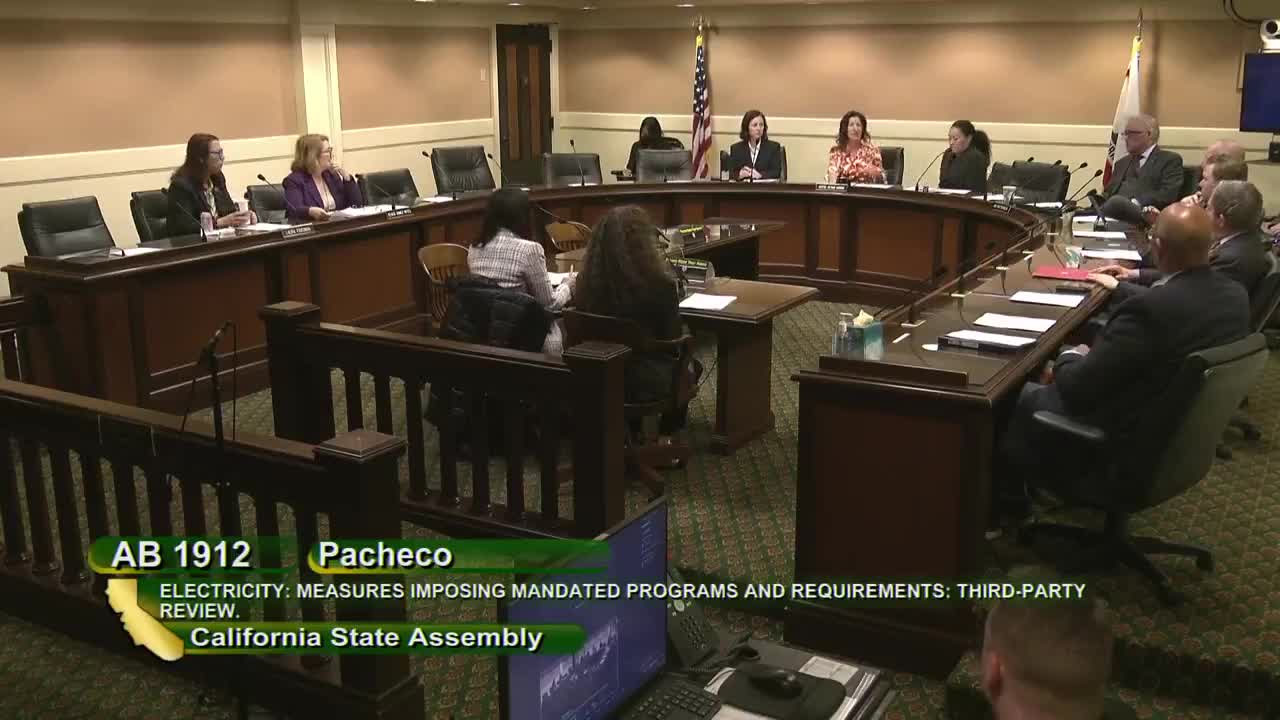 46MIN
Assembly Standing Committee on Utilities and Energy
Bill Author



