AB 1946: Horse racing: out-of-state thoroughbred races: Whitney Stakes.
- Session Year: 2023-2024
- House: Assembly
- Latest Version Date: 2024-09-22
Current Status:
Passed
(2024-09-22: Chaptered by Secretary of State - Chapter 366, Statutes of 2024.)
Introduced
In Committee
First Chamber
In Committee
Second Chamber
Enacted
The Horse Racing Law authorizes a thoroughbred racing association or fair to distribute the audiovisual signal and accept wagers on the results of out-of-state thoroughbred races conducted in the United States during the calendar period the association or fair is conducting a race meeting, including days on which there is no live racing being conducted by the association or fair, without the consent of the organization that represents horsemen and horsewomen participating in the race meeting and without regard to the amount of purses. Under that law, the total number of thoroughbred races imported by associations or fairs on a statewide basis under these provisions are required to not exceed 50 per day on days when live thoroughbred or fair racing is being conducted in the state, with the exception of specified races.
This bill would exempt from the 50 imported race per day limitation, races imported that are part of the race card of the Whitney Stakes.
The Horse Racing Law authorizes a thoroughbred racing association or fair to distribute the audiovisual signal and accept wagers on the results of out-of-state thoroughbred races conducted in the United States during the calendar period the association or fair is conducting a race meeting, including days on which there is no live racing being conducted by the association or fair, without the consent of the organization that represents horsemen and horsewomen participating in the race meeting and without regard to the amount of purses. Under that law, the total number of thoroughbred races imported by associations or fairs on a statewide basis under these provisions are required to not exceed 50 per day on days when live thoroughbred or fair racing is being conducted in the state, with the exception of specified races.
This bill would exempt from the 50 imported race per day limitation, races imported that are part of the race card of the Stephen Foster Whitney Stakes.
The Horse Racing Law authorizes a thoroughbred racing association or fair to distribute the audiovisual signal and accept wagers on the results of out-of-state thoroughbred races conducted in the United States during the calendar period the association or fair is conducting a race meeting, including days on which there is no live racing being conducted by the association or fair, without the consent of the organization that represents horsemen and horsewomen participating in the race meeting and without regard to the amount of purses. Under that law, the total number of thoroughbred races imported by associations or fairs on a statewide basis under these provisions are required to not exceed 50 per day on days when live thoroughbred or fair racing is being conducted in the state, with the exception of specified races.
This bill would exempt from the 50 imported race per day limitation, races imported that are part of the race card of the Stephen Foster Stakes.
(a)Notwithstanding any other law and except as provided in Section 19596.4, a thoroughbred racing association or fair may distribute the audiovisual signal and accept wagers on the results of out-of-state thoroughbred races conducted in the United States during the calendar period the association or fair is conducting a race meeting, including days on which there is no live racing being conducted by the association or fair, without the consent of the organization that represents horsemen and horsewomen participating in the race meeting and without regard to the amount of purses. Further, the total number of thoroughbred races imported by associations or fairs on a statewide basis under this section shall not exceed 50 per day on days when live thoroughbred or fair racing is being conducted in the state. The limitation of 50 imported races per day does not apply to any of the following:
(1)Races imported for wagering purposes pursuant to subdivision (c).
(2)Races imported that are part of the race card of the Kentucky Derby, the Kentucky Oaks, the Preakness Stakes, the Belmont Stakes, the Jockey Club Gold Cup, the Travers Stakes, the Arlington Million, the Breeders Cup, the Dubai World Cup, the Arkansas Derby, the Apple Blossom Handicap, the Blue Grass Stakes, the Whitney Stakes, or the Haskell Invitational.
(3)Races imported into the northern zone when there is no live thoroughbred or fair racing being conducted in the northern zone.
(4)Races imported into the combined central and southern zones when there is no live thoroughbred or fair racing being conducted in the combined central and southern zones.
(b)Any thoroughbred association or fair accepting wagers pursuant to subdivision (a) shall conduct the wagering in accordance with the applicable provisions of Sections 19601, 19616, 19616.1, and 19616.2.
(c)A thoroughbred association or fair shall not accept wagers pursuant to this section on out-of-state races commencing after 7 p.m., Pacific standard time, without the consent of the harness or quarter horse racing association that is then conducting a live racing meeting in the County of Orange or the County of Sacramento.
(a)Notwithstanding any other law and except as provided in Section 19596.4, a thoroughbred racing association or fair may distribute the audiovisual signal and accept wagers on the results of out-of-state thoroughbred races conducted in the United States during the calendar period the association or fair is conducting a race meeting, including days on which there is no live racing being conducted by the association or fair, without the consent of the organization that represents horsemen and horsewomen participating in the race meeting and without regard to the amount of purses. Further, the total number of thoroughbred races imported by associations or fairs on a statewide basis under this section shall not exceed 50 per day on days when live thoroughbred or fair racing is being conducted in the state. The limitation of 50 imported races per day does not apply to any of the following:
(1)Races imported for wagering purposes pursuant to subdivision (c).
(2)Races imported that are part of the race card of the Kentucky Derby, the Kentucky Oaks, the Preakness Stakes, the Belmont Stakes, the Jockey Club Gold Cup, the Travers Stakes, the Arlington Million, the Breeders Cup, the Dubai World Cup, the Arkansas Derby, the Apple Blossom Handicap, the Blue Grass Stakes, the Stephen Foster Whitney Stakes, or the Haskell Invitational.
(3)Races imported into the northern zone when there is no live thoroughbred or fair racing being conducted in the northern zone.
(4)Races imported into the combined central and southern zones when there is no live thoroughbred or fair racing being conducted in the combined central and southern zones.
(b)Any thoroughbred association or fair accepting wagers pursuant to subdivision (a) shall conduct the wagering in accordance with the applicable provisions of Sections 19601, 19616, 19616.1, and 19616.2.
(c)A thoroughbred association or fair shall not accept wagers pursuant to this section on out-of-state races commencing after 7 p.m., Pacific standard time, without the consent of the harness or quarter horse racing association that is then conducting a live racing meeting in the County of Orange or the County of Sacramento.
(a)Notwithstanding any other law and except as provided in Section 19596.4, a thoroughbred racing association or fair may distribute the audiovisual signal and accept wagers on the results of out-of-state thoroughbred races conducted in the United States during the calendar period the association or fair is conducting a race meeting, including days on which there is no live racing being conducted by the association or fair, without the consent of the organization that represents horsemen and horsewomen participating in the race meeting and without regard to the amount of purses. Further, the total number of thoroughbred races imported by associations or fairs on a statewide basis under this section shall not exceed 50 per day on days when live thoroughbred or fair racing is being conducted in the state. The limitation of 50 imported races per day does not apply to any of the following:
(1)Races imported for wagering purposes pursuant to subdivision (c).
(2)Races imported that are part of the race card of the Kentucky Derby, the Kentucky Oaks, the Preakness Stakes, the Belmont Stakes, the Jockey Club Gold Cup, the Travers Stakes, the Arlington Million, the Breeders Cup, the Dubai World Cup, the Arkansas Derby, the Apple Blossom Handicap, the Blue Grass Stakes, the Stephen Foster Stakes, or the Haskell Invitational.
(3)Races imported into the northern zone when there is no live thoroughbred or fair racing being conducted in the northern zone.
(4)Races imported into the combined central and southern zones when there is no live thoroughbred or fair racing being conducted in the combined central and southern zones.
(b)Any thoroughbred association or fair accepting wagers pursuant to subdivision (a) shall conduct the wagering in accordance with the applicable provisions of Sections 19601, 19616, 19616.1, and 19616.2.
(c)No A thoroughbred association or fair may shall not accept wagers pursuant to this section on out-of-state races commencing after 7 p.m., Pacific standard time, without the consent of the harness or quarter horse racing association that is then conducting a live racing meeting in the Counties County of Orange or the County of Sacramento.
|
Date
|
Status
|
|---|---|
| Sep 22, 2024 | Chaptered by Secretary of State - Chapter 366, Statutes of 2024. |
| Sep 22, 2024 | Approved by the Governor. |
| Sep 5, 2024 | Enrolled and presented to the Governor at 4 p.m. |
| Aug 27, 2024 | Senate amendments concurred in. To Engrossing and Enrolling. (Ayes 77. Noes 0.). |
| Aug 27, 2024 | Assembly Rule 77 suspended. |
| Aug 26, 2024 | In Assembly. Concurrence in Senate amendments pending. May be considered on or after August 28 pursuant to Assembly Rule 77. |
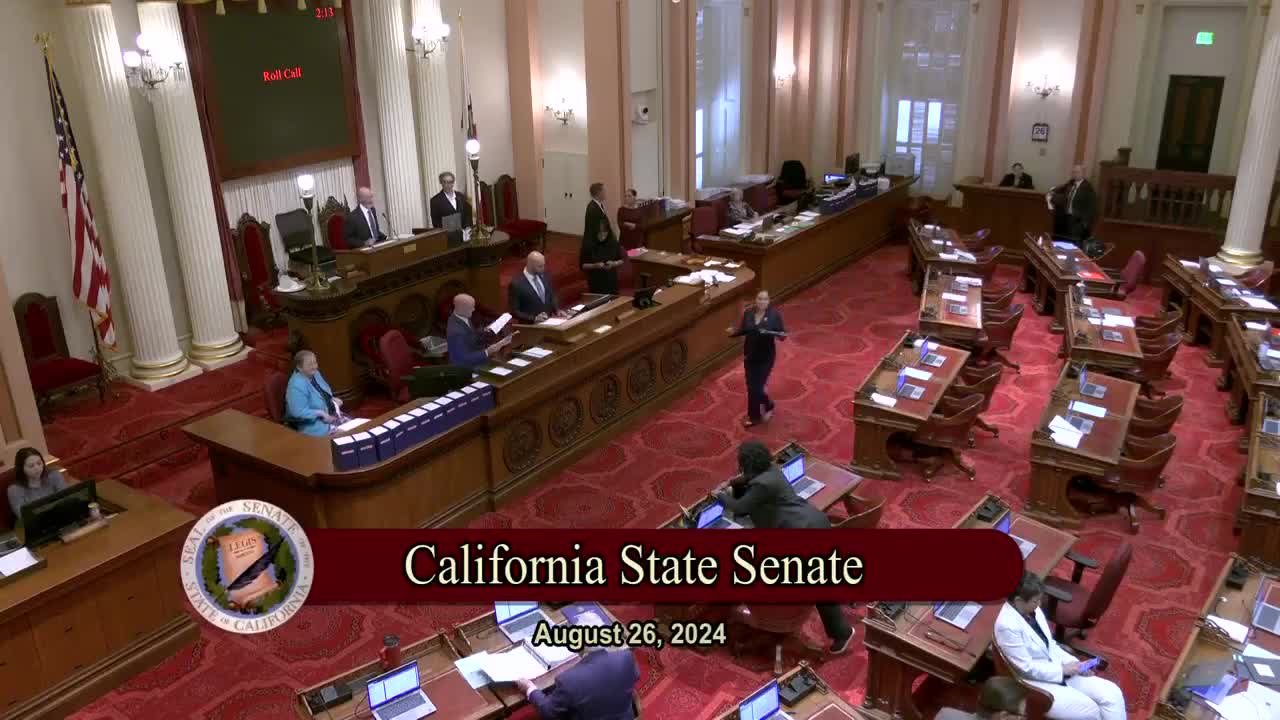
| Aug 26, 2024 | Read third time. Passed. Ordered to the Assembly. (Ayes 39. Noes 0.). |
| May 30, 2024 | Ordered to third reading. |
| May 30, 2024 | From Consent Calendar. |
| May 29, 2024 | Read second time. Ordered to Consent Calendar. |
| May 28, 2024 | From committee: Do pass. To Consent Calendar. (Ayes 12. Noes 0.) (May 28). |
| May 20, 2024 | From committee chair, with author's amendments: Amend, and re-refer to committee. Read second time, amended, and re-referred to Com. on G.O. |
| May 1, 2024 | Referred to Com. on G.O. |
| Apr 15, 2024 | In Senate. Read first time. To Com. on RLS. for assignment. |
| Apr 15, 2024 | Read third time. Passed. Ordered to the Senate. (Ayes 75. Noes 0. Page 4781.) |
| Apr 11, 2024 | From Consent Calendar by request of Assembly Member Essayli. To Third Reading. |
| Apr 8, 2024 | Read second time. Ordered to Consent Calendar. |
| Apr 4, 2024 | From committee: Do pass. To Consent Calendar. (Ayes 21. Noes 0.) (April 3). |
| Feb 12, 2024 | Referred to Com. on G.O. |
| Jan 30, 2024 | From printer. May be heard in committee February 29. |
| Jan 29, 2024 | Read first time. To print. |
|
Date
|
Description
|
Location
|
Votes
|
|
|---|---|---|---|---|
| Aug 27, 2024 | AB 1946 Alanis Concurrence in Senate Amendments | Assembly Floor |
Passed |
|
| Aug 26, 2024 | Assembly 3rd Reading AB1946 Alanis By Dodd | Senate Floor |
Passed |
|
| May 28, 2024 | Do pass and be ordered to the Consent Calendar | Senate Standing Committee on Governmental Organization |
Passed |
|
| Apr 15, 2024 | AB 1946 Alanis Assembly Third Reading | Assembly Floor |
Passed |
|
| Apr 3, 2024 | Do pass. To Consent Calendar. | Assembly Standing Committee on Governmental Organization |
Passed |
This list shows positions taken on this bill by organizations on the date displayed, which is linked to the original source.
Positions by individuals are not included.
|
Organization
|
Position
|
Date
|
|---|---|---|
| California Authority Of Racing Fairs | ** Support |
CONCURRENCE IN SENATE AMENDMENTS
CSA1 Bill Id:AB 1946
Author:(Alanis)
As Amended Ver:May 20, 2024
Majority vote
SUMMARY
This bill would add the Whitney Stakes to the group of races which are exempt from the 50-race per day limit on imported races in California.
Senate Amendments
1) Adds the Whitney Stakes to the group of out-of-state horse races that are exempt from the 50 races-per-day limit on imported races into California by a racing association or fair when operating a live race meet.
EXISTING LAW:
1) Article IV, Section 19(b) of the Constitution of the State of California provides that the Legislature may provide for the regulation of horse races and horse race meetings and wagering on the results.
2) Grants the California Horse Racing Board (CHRB) the authority to regulate the various forms of horse racing authorized in this state.
3) Authorizes thoroughbred racing associations or fairs to distribute the audiovisual signal and accept wagers on the results of out-of-state and international thoroughbred races during the calendar period the association or fair is conducting live racing, including days on which there is no live racing being conducted by the association or fair.
4) Limits the number of races that may be imported by associations and fairs to no more than 50 races per day on days when live thoroughbred or fair racing is being conducted in this state, with specified exceptions. (California Business and Professions Code Section 19596.2)
5) Exempts from that 50-race per day limit races imported that are part of the race card of certain prominent races, including the Kentucky Derby, the Kentucky Oaks, the Preakness Stakes, the Belmont Stakes, the Jockey Club Gold Cup, the Travers Stakes, the Arlington Million, the Breeders' Cup, the Dubai World Cup, the Arkansas Derby, the Apple Blossom Handicap, the Blue Grass Stakes, or the Haskell Invitational. (California Business and Professions Code Section 19596.2)
COMMENTS
Background.
The Whitney Stakes. The Whitney Stakes (run as the Whitney Handicap through 2013 and still sometimes referred to as such) is an American Grade 1 stakes race for Thoroughbred racehorses four years of age and older run at a distance of 1 1/8 miles. The current purse is $1,000,000.
Named after the family that for generations has had so much to do with racing in New York, the Whitney handicap was first run in 1928. The Whitney family's involvement with thoroughbreds began when William Collins Whitney, one of the founders of The Jockey Club, began campaigning racehorses in 1898, bearing the familiar Eton blue-and-brown silks.
The Whitney Stakes, one of North America's premier races for older horses on the dirt, and is the marquee race on the blockbuster day of racing that includes five stakes. Some of the greatest horses in American racing history have won the Whitney Stakes, including Easy Goer, Tom Fool, Dr. Fager, Slew o'Gold, Ancient Title, War Admiral, and Kelso. The race also produced one of the most dramatic upsets in racing history when Secretariat finished second in 1973 to Onion.
Satellite wagering. Satellite wagering via off-track betting has been legal in California since the 1980s, when California racetracks were beginning to experience declining attendance and handle figures. The industry believed that making the product easier to access would not only expose and market horse racing to potential customers, but it would also make it more convenient for existing patrons to wager more often.
Simulcasting. Simulcasting is the process of transmitting the audio and video signal of a live racing performance from one facility to a satellite for re-transmission to other locations or venues where pari-mutuel wagering is permitted. Simulcasting provides racetracks with the opportunity to increase revenues by exporting their live racing content to as many wagering locations as possible. This includes other racetracks, fair satellite facilities, and Indian casinos. Revenues are increased because simulcasting provides racetracks that export their real-time content to additional customers in multiple locations who would not have otherwise been able to place wagers on the live racing event.
Racetrack attendance. Over the past 30 years, the horse racing industry has witnessed a general decline in the number of people attending and wagering at live tracks in California because of several factors, including increased competition from other forms of gaming, the unwillingness of customers to travel a significant distance to racetracks, and the availability of off-track wagering. The declining attendance at live horse racing events has prompted racetracks to rely on revenues from in-state and out-of-state satellite wagering and account wagering.
According to the Author
According to the author's office, "expanding races from the prestigious Whitney Stakes stands to invigorate the state's racing fairs and satellite facilities, promising an increase in betting revenues, heightened exposure, and wider interest in horse racing. This strategic move could jump start significant economic benefits, including increased sales for local businesses and the creation of more job opportunities. Moreover, it would reinforce the horse racing industry by offering more competitive opportunities for local talent and encouraging investments in horse breeding and training. Additionally, leveraging these high-profile races can further enhance California's already strong appeal as a premier destination for horse racing enthusiasts, driving tourism and reinforcing the state's brand on a national and international stage. This comprehensive approach not only promises to expand horse racing and generate substantial revenue but also to enrich the cultural and economic fabric of California's communities."
Arguments in Support
In support of this bill, the California Authority of Racing Fairs writes that this bill "exempts the Whitney Stakes from the 50 imported races per day limitation. The Whitney Stakes is a Grade 1 Thorough race run annually at Saratoga Race Course in New York. Allowing these races to be imported into California beyond the current limitation will generate revenues for California's racing fairs and satellite facilities."
Arguments in Opposition
None received.
FISCAL COMMENTS
VOTES:
ASM GOVERNMENTAL ORGANIZATION: 21-0-1
YES: Blanca Rubio, Lackey, Addis, Bains, Bryan, Davies, Dixon, Gabriel, Gipson, Haney, Jones-Sawyer, Low, McKinnor, Pacheco, Papan, Jim Patterson, Ramos, Soria, Waldron, Valencia, Wallis
ABS, ABST OR NV: Cervantes
ASSEMBLY FLOOR: 75-0-5
YES: Addis, Aguiar-Curry, Alanis, Alvarez, Arambula, Bains, Bauer-Kahan, Bennett, Berman, Boerner, Bonta, Bryan, Calderon, Juan Carrillo, Cervantes, Chen, Connolly, Davies, Dixon, Flora, Mike Fong, Vince Fong, Friedman, Gabriel, Gallagher, Garcia, Gipson, Grayson, Haney, Hart, Holden, Hoover, Irwin, Jackson, Jones-Sawyer, Kalra, Lackey, Lee, Lowenthal, Maienschein, McCarty, McKinnor, Muratsuchi, Stephanie Nguyen, Ortega, Pacheco, Papan, Jim Patterson, Joe Patterson, Pellerin, Petrie-Norris, Quirk-Silva, Ramos, Rendon, Reyes, Luz Rivas, Rodriguez, Blanca Rubio, Sanchez, Santiago, Schiavo, Soria, Ta, Ting, Valencia, Villapudua, Waldron, Wallis, Ward, Weber, Wicks, Wilson, Wood, Zbur, Robert Rivas
ABS, ABST OR NV: Wendy Carrillo, Megan Dahle, Essayli, Low, Mathis
SENATE FLOOR: 40-0-0
YES: Allen, Alvarado-Gil, Archuleta, Ashby, Atkins, Becker, Blakespear, Bradford, Caballero, Cortese, Dahle, Dodd, Durazo, Eggman, Glazer, Gonzalez, Grove, Hurtado, Jones, Laird, Limón, McGuire, Menjivar, Min, Newman, Nguyen, Niello, Ochoa Bogh, Padilla, Portantino, Roth, Rubio, Seyarto, Skinner, Smallwood-Cuevas, Stern, Umberg, Wahab, Wiener, Wilk
UPDATED
VERSION: May 20, 2024
CONSULTANT: Eric Johnson / G.O. / (916) 319-2531 FN: 0004682
CONCURRENCE IN SENATE AMENDMENTS
CSA1 Bill Id:AB 1946
Author:(Alanis)
As Amended Ver:May 20, 2024
Majority vote
SUMMARY
This bill would add the Whitney Stakes to the group of races which are exempt from the 50-race per day limit on imported races in California.
Senate Amendments
1) Adds the Whitney Stakes to the group of out-of-state horse races that are exempt from the 50 races-per-day limit on imported races into California by a racing association or fair when operating a live race meet.
EXISTING LAW:
1) Article IV, Section 19(b) of the Constitution of the State of California provides that the Legislature may provide for the regulation of horse races and horse race meetings and wagering on the results.
2) Grants the California Horse Racing Board (CHRB) the authority to regulate the various forms of horse racing authorized in this state.
3) Authorizes thoroughbred racing associations or fairs to distribute the audiovisual signal and accept wagers on the results of out-of-state and international thoroughbred races during the calendar period the association or fair is conducting live racing, including days on which there is no live racing being conducted by the association or fair.
4) Limits the number of races that may be imported by associations and fairs to no more than 50 races per day on days when live thoroughbred or fair racing is being conducted in this state, with specified exceptions. (California Business and Professions Code Section 19596.2)
5) Exempts from that 50-race per day limit races imported that are part of the race card of certain prominent races, including the Kentucky Derby, the Kentucky Oaks, the Preakness Stakes, the Belmont Stakes, the Jockey Club Gold Cup, the Travers Stakes, the Arlington Million, the Breeders' Cup, the Dubai World Cup, the Arkansas Derby, the Apple Blossom Handicap, the Blue Grass Stakes, or the Haskell Invitational. (California Business and Professions Code Section 19596.2)
COMMENTS
Background.
The Whitney Stakes. The Whitney Stakes (run as the Whitney Handicap through 2013 and still sometimes referred to as such) is an American Grade 1 stakes race for Thoroughbred racehorses four years of age and older run at a distance of 1 1/8 miles. The current purse is $1,000,000.
Named after the family that for generations has had so much to do with racing in New York, the Whitney handicap was first run in 1928. The Whitney family's involvement with thoroughbreds began when William Collins Whitney, one of the founders of The Jockey Club, began campaigning racehorses in 1898, bearing the familiar Eton blue-and-brown silks.
The Whitney Stakes, one of North America's premier races for older horses on the dirt, and is the marquee race on the blockbuster day of racing that includes five stakes. Some of the greatest horses in American racing history have won the Whitney Stakes, including Easy Goer, Tom Fool, Dr. Fager, Slew o'Gold, Ancient Title, War Admiral, and Kelso. The race also produced one of the most dramatic upsets in racing history when Secretariat finished second in 1973 to Onion.
Satellite wagering. Satellite wagering via off-track betting has been legal in California since the 1980s, when California racetracks were beginning to experience declining attendance and handle figures. The industry believed that making the product easier to access would not only expose and market horse racing to potential customers, but it would also make it more convenient for existing patrons to wager more often.
Simulcasting. Simulcasting is the process of transmitting the audio and video signal of a live racing performance from one facility to a satellite for re-transmission to other locations or venues where pari-mutuel wagering is permitted. Simulcasting provides racetracks with the opportunity to increase revenues by exporting their live racing content to as many wagering locations as possible. This includes other racetracks, fair satellite facilities, and Indian casinos. Revenues are increased because simulcasting provides racetracks that export their real-time content to additional customers in multiple locations who would not have otherwise been able to place wagers on the live racing event.
Racetrack attendance. Over the past 30 years, the horse racing industry has witnessed a general decline in the number of people attending and wagering at live tracks in California because of several factors, including increased competition from other forms of gaming, the unwillingness of customers to travel a significant distance to racetracks, and the availability of off-track wagering. The declining attendance at live horse racing events has prompted racetracks to rely on revenues from in-state and out-of-state satellite wagering and account wagering.
According to the Author
According to the author's office, "expanding races from the prestigious Whitney Stakes stands to invigorate the state's racing fairs and satellite facilities, promising an increase in betting revenues, heightened exposure, and wider interest in horse racing. This strategic move could jump start significant economic benefits, including increased sales for local businesses and the creation of more job opportunities. Moreover, it would reinforce the horse racing industry by offering more competitive opportunities for local talent and encouraging investments in horse breeding and training. Additionally, leveraging these high-profile races can further enhance California's already strong appeal as a premier destination for horse racing enthusiasts, driving tourism and reinforcing the state's brand on a national and international stage. This comprehensive approach not only promises to expand horse racing and generate substantial revenue but also to enrich the cultural and economic fabric of California's communities."
Arguments in Support
In support of this bill, the California Authority of Racing Fairs writes that this bill "exempts the Whitney Stakes from the 50 imported races per day limitation. The Whitney Stakes is a Grade 1 Thorough race run annually at Saratoga Race Course in New York. Allowing these races to be imported into California beyond the current limitation will generate revenues for California's racing fairs and satellite facilities."
Arguments in Opposition
None received.
FISCAL COMMENTS
VOTES:
ASM GOVERNMENTAL ORGANIZATION: 21-0-1
YES: Blanca Rubio, Lackey, Addis, Bains, Bryan, Davies, Dixon, Gabriel, Gipson, Haney, Jones-Sawyer, Low, McKinnor, Pacheco, Papan, Jim Patterson, Ramos, Soria, Waldron, Valencia, Wallis
ABS, ABST OR NV: Cervantes
ASSEMBLY FLOOR: 75-0-5
YES: Addis, Aguiar-Curry, Alanis, Alvarez, Arambula, Bains, Bauer-Kahan, Bennett, Berman, Boerner, Bonta, Bryan, Calderon, Juan Carrillo, Cervantes, Chen, Connolly, Davies, Dixon, Flora, Mike Fong, Vince Fong, Friedman, Gabriel, Gallagher, Garcia, Gipson, Grayson, Haney, Hart, Holden, Hoover, Irwin, Jackson, Jones-Sawyer, Kalra, Lackey, Lee, Lowenthal, Maienschein, McCarty, McKinnor, Muratsuchi, Stephanie Nguyen, Ortega, Pacheco, Papan, Jim Patterson, Joe Patterson, Pellerin, Petrie-Norris, Quirk-Silva, Ramos, Rendon, Reyes, Luz Rivas, Rodriguez, Blanca Rubio, Sanchez, Santiago, Schiavo, Soria, Ta, Ting, Valencia, Villapudua, Waldron, Wallis, Ward, Weber, Wicks, Wilson, Wood, Zbur, Robert Rivas
ABS, ABST OR NV: Wendy Carrillo, Megan Dahle, Essayli, Low, Mathis
UPDATED
VERSION: May 20, 2024
CONSULTANT: Eric Johnson / G.O. / (916) 319-2531 FN: 0004682
SENATE RULES COMMITTEE Office of Senate Floor Analyses (916) 651-1520 Fax: (916) 327-4478 | AB 1946 |
THIRD READING
Bill No: AB 1946
Author: Alanis (R)
Amended: 5/20/24 in Senate
Vote: 21
SENATE GOVERNMENTAL ORG. COMMITTEE: 12-0, 5/28/24
AYES: Dodd, Wilk, Alvarado-Gil, Archuleta, Glazer, Jones, Nguyen, Padilla, Portantino, Roth, Seyarto, Smallwood-Cuevas
NO VOTE RECORDED: Ashby, Bradford, Ochoa Bogh, Rubio
ASSEMBLY FLOOR: 75-0, 4/15/24 - See last page for vote
SUBJECT: Horse racing: out-of-state thoroughbred races: Whitney Stakes
SOURCE: California Authority of Racing Fairs
DIGEST:
This bill adds the Whitney Stakes to the group of out-of-state horseraces that are exempt from the 50 races-per-day limit on imported races into California.
ANALYSIS:
Existing law:
- Authorizes, through Article IV, Section 19(b) of the Constitution of the State of California, the Legislature to provide for the regulation of horse races and grants the California Horse Racing Board (CHRB) the authority to regulate the various forms of horse racing authorized in this state.
- Authorizes thoroughbred racing associations or fairs to distribute the audiovisual signal and accept wagers on the results of out-of-state and international thoroughbred races during the calendar period the association or fair is conducting live racing, including days on which there is no live racing being conducted by the association or fair.
- Limits the number of races that may be imported by associations and fairs to no more than 50 races-per-day on days when live thoroughbred or fair racing is being conducted in this state, with specified exceptions.
- Exempts from that 50 races-per-day limit any imported horse races that are part of the race card of the Kentucky Derby, the Kentucky Oaks, the Preakness Stakes, the Belmont Stakes, the Jockey Club Gold Cup, the Travers Stakes, the Arlington Million, the Breeders’ Cup, the Dubai World Cup, the Arkansas Derby, the Apple Blossom Handicap, the Blue Grass Stakes, and the Haskell Invitational.
This bill adds the Whitney Stakes to the group of out-of-state horseraces that are exempt from the 50 races-per-day limit on imported races into California.
Background
- Author Statement. According to the author’s office, “expanding races from the prestigious Whitney Stakes stands to invigorate the state's racing fairs and satellite facilities, promising an increase in betting revenues, heightened exposure, and wider interest in horse racing. This strategic move could jump start significant economic benefits, including increased sales for local businesses and the creation of more job opportunities. Moreover, it would reinforce the horse racing industry by offering more competitive opportunities for local talent and encouraging investments in horse breeding and training. Additionally, leveraging these high-profile races can further enhance California's already strong appeal as a premier destination for horse racing enthusiasts, driving tourism and reinforcing the state's brand on a national and international stage. This comprehensive approach not only promises to expand horse racing and generate substantial revenue but also to enrich the cultural and economic fabric of California's communities.”
- Satellite Wagering. Satellite wagering via an off-track facility has been legal in California since the 1980s when California racetracks were beginning to experience declining attendance and handle figures. The industry believed that making the product easier to access not only would expose and market horse racing to potential customers, but also would make it more convenient for the existing patrons to wager more often.
- Simulcasting. Simulcasting is the process of transmitting the audio and video signal of a live racing performance from one facility to a satellite for re-transmission to other locations or venues where pari-mutuel wagering is permitted. Simulcasting provides racetracks with the opportunity to increase revenues by exporting their live racing content to as many wagering locations as possible, such as other racetracks, fair satellite facilities, and Indian casinos. Revenues increase because simulcasting provides racetracks that export their live content with additional customers in multiple locations who would not have otherwise been able to place wagers on the live racing event.
- Racetrack Attendance. Prior to the COVID-19 Pandemic, and closure of non-essential businesses in California, the horse racing industry had been witnessing a general decline in the number of people attending and wagering at live tracks in California for more than three decades due to a number of factors including; increased competition from other forms of gaming, unwillingness of customers to travel a significant distance to racetracks, and the availability of off-track wagering.
The 2024 edition of the Kentucky Derby set a record for commingled wagering and was up 10% over the record betting last year. Total betting, including the multi-race bets ending in the Derby, was $198.3 million, and was easily a record for any race ever run in North America. For the entire 14-race card on Saturday, May 4th, total betting was a record $306.9 million and a total of 155 horses ran on this year’s card, while 143 horses ran in the 14 races last year. Attendance at the racetrack was 156,710, the highest number since 2018. The declining attendance at live horse racing events in California has prompted racetracks to rely on revenues from in-state and out-of-state satellite wagering and account wagering.
- Distribution of Audiovisual Signals and Wagering. Thoroughbred racing associations and fairs in California can distribute the audiovisual signal and accept wagers on the results of out-of-state thoroughbred races during their own race meetings. This is allowed even on days when no live races are being held at their venues. There is a limit on the number of out-of-state races that can be imported into California for betting purposes. On days when there is live thoroughbred or fair racing happening in California, the total number of races imported from out-of-state must not exceed 50 races-per-day.
However, there are exemptions to this limit. Races that are part of specific major events like the Kentucky Derby, Breeder’s Cup, and other specified races can be imported without falling under the 50 race-per-day limit. Additional exceptions are made for importing races into certain geographical zones of California when no local live racing is occurring. Any wagering on these out-of-state races must comply with specific provisions of California’s Horse Racing Law that govern how betting should be conducted. Wagers on out-of-state races are not allowed after 7 p.m. Pacific Standard Time unless there is consent from the local harness or quarter horse racing associations conducting live racing in certain counties.
- The Whitney Stakes. The Whitney Stakes (run as the Whitney Handicap through 2013 and still sometimes referred to as such) is an American Grade 1 stakes race for Thoroughbred racehorses four years of age and older run at a distance of 1 1/8 miles. The current purse is $1,000,000.
Named after the family that for generations has had so much to do with racing in New York, the Whitney handicap was first run in 1928. The Whitney family’s involvement with thoroughbreds began when William Collins Whitney, one of the founders of The Jockey Club, began campaigning racehorses in 1898, bearing the familiar Eton blue-and-brown silks.
The Whitney Stakes, one of North America’s premier races for older horses on the dirt, and is the marquee race on the blockbuster day of racing that includes five stakes. Some of the greatest horses in American racing history have won the Whitney Stakes, including Easy Goer, Tom Fool, Dr. Fager, Slew o’Gold, Ancient Title, War Admiral, and Kelso. The race also produced one of the most dramatic upsets in racing history when Secretariat finished second in 1973 to Onion.
Related/Prior Legislation
AB 3261 (Fong, 2024) increases the limit, from 50 per-day to 75 per-day, on the number of thoroughbred races an association or fair may import on days when live thoroughbred or fair racing is being conducted in the state and prohibits the acceptance of a wager on an additional imported race beginning after 5:30 p.m. without the consent of specified associations in the counties of Orange and Sacramento, as specified. (Pending in the Senate Rules Committee)
AB 1074 (Alanis, Chapter 275, Statutes of 2023) provided if the CHRB does not license a thoroughbred race meet at a racetrack (Golden Gate Fields) located in the cities of Berkeley and Albany after July 1, 2024, and no live horse racing is being conducted in the northern zone, this bill deems a thoroughbred racing association or racing fair in the southern or central zone, as specified, to be operating in the northern zone for the purpose of conducting all permissible forms of wagering in the northern zone and making and receiving required distributions from those wagers.
SB 536 (Rubio, 2023) adds the Delaware Handicap to the group of out-of-state horseraces that are exempt from the 50 races-per-day limit on imported races into California. (Pending at the Assembly Desk)
AB 1768 (Committee on Governmental Organization, 2023) adds the Pegasus World Cup to the group of out-of-state horseraces that are exempt from the 50 races-per-day limit on imported races into California. (Pending on the Senate Inactive File)
AB 2969 (Committee on Governmental Organization, Chapter 503, Statutes of 2022) added the Blue Grass Stakes to the group of out-of-state horseraces that are exempt from the 50 races-per-day limit on imported races into California.
FISCAL EFFECT: Appropriation: No Fiscal Com.: No Local: No
SUPPORT: (Verified 5/28/24)
California Authority of Racing Fairs (source)
OPPOSITION: (Verified 5/28/24)
None received
ARGUMENTS IN SUPPORT: In support of this bill, the California Authority of Racing Fairs writes that this bill “exempts the Whitney Stakes from the 50 imported races per day limitation. The Whitney Stakes is a Grade 1 Thorough race run annually at Saratoga Race Course in New York. Allowing these races to be imported into California beyond the current limitation will generate revenues for California’s racing fairs and satellite facilities.”
ASSEMBLY FLOOR: 75-0, 4/15/24
AYES: Addis, Aguiar-Curry, Alanis, Alvarez, Arambula, Bains, Bauer-Kahan, Bennett, Berman, Boerner, Bonta, Bryan, Calderon, Juan Carrillo, Cervantes, Chen, Connolly, Davies, Dixon, Flora, Mike Fong, Vince Fong, Friedman, Gabriel, Gallagher, Garcia, Gipson, Grayson, Haney, Hart, Holden, Hoover, Irwin, Jackson, Jones-Sawyer, Kalra, Lackey, Lee, Lowenthal, Maienschein, McCarty, McKinnor, Muratsuchi, Stephanie Nguyen, Ortega, Pacheco, Papan, Jim Patterson, Joe Patterson, Pellerin, Petrie-Norris, Quirk-Silva, Ramos, Rendon, Reyes, Luz Rivas, Rodriguez, Blanca Rubio, Sanchez, Santiago, Schiavo, Soria, Ta, Ting, Valencia, Villapudua, Waldron, Wallis, Ward, Weber, Wicks, Wilson, Wood, Zbur, Robert Rivas
NO VOTE RECORDED: Wendy Carrillo, Megan Dahle, Essayli, Low, Mathis
Prepared by: Brian Duke / G.O. / (916) 651-1530
5/31/24 10:05:36
**** END ****
SENATE COMMITTEE ON GOVERNMENTAL ORGANIZATION
Senator Bill Dodd
Chair
2023 - 2024 Regular
Bill No: AB Hearing Date: 5/28/2024
Author: | Alanis | ||
Version: | Amended | ||
Urgency: | Fiscal: | ||
Consultant: | |||
SUBJECT:
DIGEST: This bill adds the Whitney Stakes to the group of out-of-state horseraces that are exempt from the 50 races-per-day limit on imported races into California.
ANALYSIS:
Existing law:
- Article IV, Section 19(b) of the Constitution of the State of California authorizes the Legislature to provide for the regulation of horse races and grants the California Horse Racing Board (CHRB) the authority to regulate the various forms of horse racing authorized in this state.
- Authorizes thoroughbred racing associations or fairs to distribute the audiovisual signal and accept wagers on the results of out-of-state and international thoroughbred races during the calendar period the association or fair is conducting live racing, including days on which there is no live racing being conducted by the association or fair.
- Limits the number of races that may be imported by associations and fairs to no more than 50 races-per-day on days when live thoroughbred or fair racing is being conducted in this state, with specified exceptions.
- Exempts from that 50 races-per-day limit any imported horse races that are part of the race card of the Kentucky Derby, the Kentucky Oaks, the Preakness Stakes, the Belmont Stakes, the Jockey Club Gold Cup, the Travers Stakes, the Arlington Million, the Breeders’ Cup, the Dubai World Cup, the Arkansas Derby, the Apple Blossom Handicap, the Blue Grass Stakes, and the Haskell Invitational.
This bill adds the Whitney Stakes to the group of out-of-state horseraces that are exempt from the 50 races-per-day limit on imported races into California.
Background
Author Statement. According to the author’s office, “expanding races from the prestigious Whitney Stakes stands to invigorate the state's racing fairs and satellite facilities, promising an increase in betting revenues, heightened exposure, and wider interest in horse racing. This strategic move could jump start significant economic benefits, including increased sales for local businesses and the creation of more job opportunities. Moreover, it would reinforce the horse racing industry by offering more competitive opportunities for local talent and encouraging investments in horse breeding and training. Additionally, leveraging these high-profile races can further enhance California's already strong appeal as a premier destination for horse racing enthusiasts, driving tourism and reinforcing the state's brand on a national and international stage. This comprehensive approach not only promises to expand horse racing and generate substantial revenue but also to enrich the cultural and economic fabric of California's communities.”
Satellite Wagering. Satellite wagering via an off-track facility has been legal in California since the 1980s when California racetracks were beginning to experience declining attendance and handle figures. The industry believed that making the product easier to access not only would expose and market horse racing to potential customers, but also would make it more convenient for the existing patrons to wager more often.
Simulcasting. Simulcasting is the process of transmitting the audio and video signal of a live racing performance from one facility to a satellite for re-transmission to other locations or venues where pari-mutuel wagering is permitted. Simulcasting provides racetracks with the opportunity to increase revenues by exporting their live racing content to as many wagering locations as possible, such as other racetracks, fair satellite facilities, and Indian casinos. Revenues increase because simulcasting provides racetracks that export their live content with additional customers in multiple locations who would not have otherwise been able to place wagers on the live racing event.
Racetrack Attendance. Prior to the COVID-19 Pandemic, and closure of non-essential businesses in California, the horse racing industry had been witnessing a general decline in the number of people attending and wagering at live tracks in California for more than three decades due to a number of factors including; increased competition from other forms of gaming, unwillingness of customers to travel a significant distance to racetracks, and the availability of off-track wagering.
The 2024 edition of the Kentucky Derby set a record for commingled wagering and was up 10% over the record betting last year. Total betting, including the multi-race bets ending in the Derby, was $198.3 million, and was easily a record for any race ever run in North America. For the entire 14-race card on Saturday, May 4th, total betting was a record $306.9 million and a total of 155 horses ran on this year’s card, while 143 horses ran in the 14 races last year. Attendance at the racetrack was 156,710, the highest number since 2018. The declining attendance at live horse racing events in California has prompted racetracks to rely on revenues from in-state and out-of-state satellite wagering and account wagering.
Distribution of Audiovisual Signals and Wagering. Thoroughbred racing associations and fairs in California can distribute the audiovisual signal and accept wagers on the results of out-of-state thoroughbred races during their own race meetings. This is allowed even on days when no live races are being held at their venues. There is a limit on the number of out-of-state races that can be imported into California for betting purposes. On days when there is live thoroughbred or fair racing happening in California, the total number of races imported from out-of-state must not exceed 50 races-per-day.
However, there are exemptions to this limit. Races that are part of specific major events like the Kentucky Derby, Breeder’s Cup, and other specified races can be imported without falling under the 50 race-per-day limit. Additional exceptions are made for importing races into certain geographical zones of California when no local live racing is occurring. Any wagering on these out-of-state races must comply with specific provisions of California’s Horse Racing Law that govern how betting should be conducted. Wagers on out-of-state races are not allowed after 7 p.m. Pacific Standard Time unless there is consent from the local harness or quarter horse racing associations conducting live racing in certain counties.
The Whitney Stakes. The Whitney Stakes (run as the Whitney Handicap through 2013 and still sometimes referred to as such) is an American Grade 1 stakes race for Thoroughbred racehorses four years of age and older run at a distance of 1 1/8 miles. The current purse is $1,000,000.
Named after the family that for generations has had so much to do with racing in New York, the Whitney handicap was first run in 1928. The Whitney family’s involvement with thoroughbreds began when William Collins Whitney, one of the founders of The Jockey Club, began campaigning racehorses in 1898, bearing the familiar Eton blue-and-brown silks.
The Whitney Stakes, one of North America’s premier races for older horses on the dirt, and is the marquee race on the blockbuster day of racing that includes five stakes. Some of the greatest horses in American racing history have won the Whitney Stakes, including Easy Goer, Tom Fool, Dr. Fager, Slew o’Gold, Ancient Title, War Admiral, and Kelso. The race also produced one of the most dramatic upsets in racing history when Secretariat finished second in 1973 to Onion.
Prior/Related Legislation
AB 3261 (Fong, 2024) increases the limit, from 50 per-day to 75 per-day, on the number of thoroughbred races an association or fair may import on days when live thoroughbred or fair racing is being conducted in the state and prohibits the acceptance of a wager on an additional imported race beginning after 5:30 p.m. without the consent of specified associations in the counties of Orange and Sacramento, as specified. (Pending on the Assembly Floor)
SB 536 (Rubio, 2023) adds the Delaware Handicap to the group of out-of-state horseraces that are exempt from the 50 races-per-day limit on imported races into California. (Pending at the Assembly Desk)
AB 1074 (Alanis, Chapter 275, Statutes of 2023) provided if the CHRB does not license a thoroughbred race meet at a racetrack (Golden Gate Fields) located in the cities of Berkeley and Albany after July 1, 2024, and no live horse racing is being conducted in the northern zone, this bill deems a thoroughbred racing association or racing fair in the southern or central zone, as specified, to be operating in the northern zone for the purpose of conducting all permissible forms of wagering in the northern zone and making and receiving required distributions from those wagers.
AB 1768 (Committee on Governmental Organization, 2023) adds the Pegasus World Cup to the group of out-of-state horseraces that are exempt from the 50 races-per-day limit on imported races into California. (Pending on the Senate Inactive File)
AB 2969 (Committee on Governmental Organization, Chapter 503, Statutes of 2022) added the Blue Grass Stakes to the group of out-of-state horseraces that are exempt from the 50 races-per-day limit on imported races into California.
FISCAL EFFECT: Appropriation: No Fiscal Com.: No Local: No
SUPPORT:
California Authority of Racing Fairs (Source)
OPPOSITION:
None received
ARGUMENTS IN SUPPORT: In support of the bill, the California Authority of Racing Fairs writes that this bill “exempts the Whitney Stakes from the 50 imported races per day limitation. The Whitney Stakes is a Grade 1 Thorough race run annually at Saratoga Race Course in New York. Allowing these races to be imported into California beyond the current limitation will generate revenues for California’s racing fairs and satellite facilities.”
ASSEMBLY THIRD READING
ATR Bill Id:AB 1946
Author:(Alanis)
As Introduced Ver:January 29, 2024
Majority vote
SUMMARY
This bill adds the Stephen Foster Stakes to the group of races which are exempt from the 50-race per day limit on imported races in California.
Major Provisions
- Adds the "Stephen Foster Stakes" to the group of stake races which are exempt from the 50-race per day limit on imported races in California.
- Makes non-substantive technical changes.
COMMENTS
Background.
Stephen Foster Stakes. The Stephen Foster Stakes is a Grade I Thoroughbred race held on dirt over a distance of 1 1/8 miles (9 furlongs) for horses three years of age and up. Since 1982, the race has been conducted yearly at Kentucky's world-renowned Churchill Downs. This year, the race is planned for June 29 and carries a purse of $1 million.
The race attracts some of the country's top older horses. Black Tie Affair (1991), Saint Liam (2005), Curlin (2008), and Gun Runner (2017) all added wins in the race during their respective Horse of the Year campaigns. As part of the Breeder's Cup Challenge, since 2015 the winner of the Stephen Foster Stakes receives automatic entry into the prestigious Breeder's Cup Classic.
Satellite wagering. Satellite wagering via off-track betting has been legal in California since the 1980s, when California racetracks were beginning to experience declining attendance and handle figures. The industry believed that making the product easier to access would not only expose and market horse racing to potential customers, but it would also make it more convenient for existing patrons to wager more often.
Simulcasting. Simulcasting is the process of transmitting the audio and video signal of a live racing performance from one facility to a satellite for re-transmission to other locations or venues where pari-mutuel wagering is permitted. Simulcasting provides racetracks with the opportunity to increase revenues by exporting their live racing content to as many wagering locations as possible. This includes other racetracks, fair satellite facilities, and Indian casinos. Revenues are increased because simulcasting provides racetracks that export their real-time content to additional customers in multiple locations who would not have otherwise been able to place wagers on the live racing event.
Racetrack attendance. Over the past 30 years, the horse racing industry has witnessed a general decline in the number of people attending and wagering at live tracks in California because of several factors, including increased competition from other forms of gaming, the unwillingness of customers to travel a significant distance to racetracks, and the availability of off-track wagering. The declining attendance at live horse racing events has prompted racetracks to rely on revenues from in-state and out-of-state satellite wagering and account wagering.
Related legislation. AB 1768 (Committee on Governmental Organization) of 2023. This bill would add the Pegasus World Cup to the group of races which are exempt from the 50-race per day limit on imported races in California. (Senate Floor Inactive File)
AB 3261 (M. Fong) of the current legislative session. Would repeal restrictions in current law relating to the number of races (50) that a Thoroughbred racing association or fair can import each day from out-of-state AB 1946 Page 3 locations when operating a live race meet in the state, as specified. (Assembly Committee on Governmental Organization)
According to the Author
Purpose of the bill. According to the author's office, "this bill provides that all races imported by a Thoroughbred association or fair that are part of the race card of the overall Stephen Foster Stakes day would be exempted from the 50-race per day limit as defined in current law. Over the years, the law has been amended to allow imports of specific well-known stake races outside of this cap for promotional and financial reasons. The author points out that the passage of this legislation will help increase the wagering handle on this specific day (Stephen Foster Stakes) which will lead to increased purses, racetrack revenue, and breeders' awards in California. Purses are important to California's racing industry because they provide revenue to horse owners for their racing operations and to breeders through an increase in the value of their breeding stock."
Arguments in Support
According to the California Authority of Racing Fairs, "Allowing these races to be imported into California beyond the current limitation will generate revenues for California's racing fairs and satellite facilities."
Arguments in Opposition
None on file.
FISCAL COMMENTS
This bill is keyed non-fiscal by Legislative Counsel.
VOTES
ASM GOVERNMENTAL ORGANIZATION: 21-0-1
YES: Blanca Rubio, Lackey, Addis, Bains, Bryan, Davies, Dixon, Gabriel, Gipson, Haney, Jones-Sawyer, Low, McKinnor, Pacheco, Papan, Jim Patterson, Ramos, Soria, Waldron, Valencia, Wallis
ABS, ABST OR NV: Cervantes
UPDATED
VERSION: January 29, 2024
CONSULTANT: Eric Johnson / G.O. / (916) 319-2531 FN: 0002735
Date of Hearing: April 3, 2024
ASSEMBLY COMMITTEE ON GOVERNMENTAL ORGANIZATION
Blanca Rubio, Chair
ABPCA Bill Id:AB 1946 (
Author:Alanis) – As Introduced Ver:January 29, 2024
SUBJECT: Horse racing: out-of-state thoroughbred races: Stephen Foster Stakes
SUMMARY: This bill adds the Stephen Foster Stakes to the group of races which are exempt from the 50-race per day limit on imported races in California. Specifically, this bill:
1) Adds the "Stephen Foster Stakes” to the group of stake races which are exempt from the 50-race per day limit on imported races in California.
2) Makes non-substantive technical changes.
EXISTING LAW:
1) Article IV, Section 19(b) of the Constitution of the State of California provides that the Legislature may provide for the regulation of horse races and horse race meetings and wagering on the results.
2) Grants the California Horse Racing Board (CHRB) the authority to regulate the various forms of horse racing authorized in this state.
3) Authorizes thoroughbred racing associations or fairs to distribute the audiovisual signal and accept wagers on the results of out-of-state and international thoroughbred races during the calendar period the association or fair is conducting live racing, including days on which there is no live racing being conducted by the association or fair.
4) Limits the number of races that may be imported by associations and fairs to no more than 50 races per day on days when live thoroughbred or fair racing is being conducted in this state, with specified exceptions. (California Business and Professions Code § 19596.2)
5) Exempts from that 50-race per day limit races imported that are part of the race card of certain prominent races, including the Kentucky Derby, the Kentucky Oaks, the Preakness Stakes, the Belmont Stakes, the Jockey Club Gold Cup, the Travers Stakes, the Arlington Million, the Breeders’ Cup, the Dubai World Cup, the Arkansas Derby, the Apple Blossom Handicap, the Blue Grass Stakes, or the Haskell Invitational. (California Business and Professions Code § 19596.2)
FISCAL EFFECT: This bill is keyed non-fiscal by Legislative Counsel.
COMMENTS:
Purpose of the bill. According to the author’s office, “this bill provides that all races imported by a Thoroughbred association or fair that are part of the race card of the overall Stephen Foster Stakes day would be exempted from the 50-race per day limit as defined in current law. Over the years, the law has been amended to allow imports of specific well-known stake races outside of this cap for promotional and financial reasons. The author points out that the passage of this legislation will help increase the wagering handle on this specific day (Stephen Foster Stakes) which will lead to increased purses, racetrack revenue, and breeders' awards in California. Purses are important to California's racing industry because they provide revenue to horse owners for their racing operations and to breeders through an increase in the value of their breeding stock.”
Background.
Stephen Foster Stakes. The Stephen Foster Stakes is a Grade I Thoroughbred race held on dirt over a distance of 1 1/8 miles (9 furlongs) for horses three years of age and up. Since 1982, the race has been conducted yearly at Kentucky's world-renowned Churchill Downs. This year, the race is planned for June 29 and carries a purse of $1 million.
The race attracts some of the country's top older horses. Black Tie Affair (1991), Saint Liam (2005), Curlin (2008), and Gun Runner (2017) all added wins in the race during their respective Horse of the Year campaigns. As part of the Breeder's Cup Challenge, since 2015 the winner of the Stephen Foster Stakes receives automatic entry into the prestigious Breeder's Cup Classic.
The race is named in honor of Stephen Foster, known as the "father of American music" and composer of such standards as "Oh! Susanna," "Camptown Races," and "My Old Kentucky Home" (which is played when the horses come on the track for the Kentucky Derby).
Satellite wagering. Satellite wagering via off-track betting has been legal in California since the 1980s, when California racetracks were beginning to experience declining attendance and handle figures. The industry believed that making the product easier to access would not only expose and market horse racing to potential customers, but it would also make it more convenient for existing patrons to wager more often.
Simulcasting. Simulcasting is the process of transmitting the audio and video signal of a live racing performance from one facility to a satellite for re-transmission to other locations or venues where pari-mutuel wagering is permitted. Simulcasting provides racetracks with the opportunity to increase revenues by exporting their live racing content to as many wagering locations as possible. This includes other racetracks, fair satellite facilities, and Indian casinos. Revenues are increased because simulcasting provides racetracks that export their real-time content to additional customers in multiple locations who would not have otherwise been able to place wagers on the live racing event.
Racetrack attendance. Over the past 30 years, the horse racing industry has witnessed a general decline in the number of people attending and wagering at live tracks in California because of several factors, including increased competition from other forms of gaming, the unwillingness of customers to travel a significant distance to racetracks, and the availability of off-track wagering. The declining attendance at live horse racing events has prompted racetracks to rely on revenues from in-state and out-of-state satellite wagering and account wagering.
Related legislation. AB 1768 (Committee on Governmental Organization) of 2023. This bill would add the Pegasus World Cup to the group of races which are exempt from the 50-race per day limit on imported races in California. (Senate Floor Inactive File)
AB 3261 (M. Fong) of 2024. Would repeal restrictions in current law relating to the number of races (50) that a Thoroughbred racing association or fair can import each day from out-of-state locations when operating a live race meet in the state, as specified. (Assembly Committee on Governmental Organization)
Prior legislation. AB 1074 (Alanis), Chapter 275, Statutes of 2023. Provided if the CHRB does not license a thoroughbred race meet at a racetrack (Golden Gate Fields) located in the cities of Berkeley and Albany after July 1, 2024, and no live horse racing is being conducted in the northern zone, this bill would deem a thoroughbred racing association or racing fair in the southern or central zone, as specified, to be operating in the northern zone for the purpose of conducting all permissible forms of wagering in the northern zone and making and receiving required distributions from those wagers
AB 2968 (Committee on Governmental Organization), Chapter 503, Statutes of 2022. Added the Blue Grass Stakes to the group of out-of-state horseraces that are exempt from the 50-race per day limit on imported races in California.
REGISTERED SUPPORT / OPPOSITION:
Support
California Authority of Racing Fairs
Opposition
None on file
Analysis Prepared by: Eric Johnson / G.O. / (916) 319-2531
Discussed in Hearing
View Older Hearings
Bill Author

Bill Co-Author(s):