AB 1954: Sexually violent predators.
- Session Year: 2023-2024
- House: Assembly
- Latest Version Date: 2024-09-28
Current Status:
Passed
(2024-09-28: Chaptered by Secretary of State - Chapter 816, Statutes of 2024.)
Introduced
In Committee
First Chamber
In Committee
Second Chamber
Enacted
Existing law provides for the civil commitment of a person who is determined to be a sexually violent predator. Existing law establishes a procedure by which a person committed as a sexually violent predator may petition for conditional release. Existing law requires the counsel for the committed individual, the sheriff or the chief of police of the locality for placement, and the county counsel and the district attorney of the county of domicile, or the designees of each of those entities, to provide assistance and consultation in the State Department of State Hospitals process of locating and securing housing within the county and requires those individuals to provide appropriate contact information for their respective office to the department. Existing law also requires the department to convene a committee of those individuals. Existing law generally requires the committed individual to be placed in their county of domicile before their incarceration, but authorizes consideration of, and placement in, an alternative placement county in extraordinary circumstances. When the department makes a recommendation for conditional release or community outpatient treatment, existing law requires the department to notify specified persons of its recommendation and include specified information.
This bill would additionally require the sheriff or the chief of police of an alternative placement locality and the county counsel and the district attorney of an alternative placement county, as specified, to provide assistance and consultation in the departments process of locating and securing housing for a sexually violent predator and to provide appropriate contact information for their office to the department. The bill would include these individuals in the committee meeting the department is required to convene and would also authorize those committee meetings to be held by teleconference. The bill would require the above-described notice to be sent electronically and by certified mail.
By imposing a higher level of service on local government, the bill would impose a state-mandated local program.
The California Constitution requires the state to reimburse local agencies and school districts for certain costs mandated by the state. Statutory provisions establish procedures for making that reimbursement.
This bill would provide that, if the Commission on State Mandates determines that the bill contains costs mandated by the state, reimbursement for those costs shall be made pursuant to the statutory provisions noted above.
Existing law provides for the civil commitment of a person who is determined to be a sexually violent predator. Existing law establishes a procedure by which a person committed as a sexually violent predator may petition for conditional release. Existing law requires the counsel for the committed individual, the sheriff or the chief of police of the locality for placement, and the county counsel and the district attorney of the county of domicile, or their designees, the designees of each of those entities, to provide assistance and consultation in the State Department of State Hospitals process of locating and securing housing within the county. county and requires those individuals to provide appropriate contact information for their respective office to the department. Existing law also requires the department to convene a committee of those individuals. Existing law generally requires the committed individual to be placed in their county of domicile before their incarceration, but authorizes consideration of, and placement in, an alternative placement county in extraordinary circumstances. When the department makes a recommendation for conditional release or community outpatient treatment, existing law requires the department to notify specified persons of its recommendation and include specified information.
This bill would additionally require the sheriff or the chief of police of an alternative placement locality and the county counsel and the district attorney of an alternative placement county, as specified, to provide assistance and consultation in the departments process of locating and securing housing for a sexually violent predator. predator and to provide appropriate contact information for their office to the department. The bill would include these individuals in the committee meeting the department is required to convene and would also authorize those committee meetings to be held by teleconference. The bill would require the above-described notice to be sent electronically and by certified mail.
By imposing a higher level of service on local government, the bill would impose a state-mandated local program.
The California Constitution requires the state to reimburse local agencies and school districts for certain costs mandated by the state. Statutory provisions establish procedures for making that reimbursement.
This bill would provide that, if the Commission on State Mandates determines that the bill contains costs mandated by the state, reimbursement for those costs shall be made pursuant to the statutory provisions noted above.
Existing law provides for the civil commitment of a person who is determined to be a sexually violent predator. Existing law establishes a procedure by which a person committed as a sexually violent predator may petition for conditional release. Existing law requires the counsel for the committed individual, the sheriff or the chief of police of the locality for placement, and the county counsel and the district attorney of the county of domicile, or their designees, to provide assistance and consultation in the State Department of State Hospitals process of locating and securing housing within the county. Existing law generally requires the committed individual to be placed in their county of domicile before their incarceration, but authorizes consideration of, and placement in, an alternative placement county in extraordinary circumstances. When the department makes a recommendation for conditional release or community outpatient treatment, existing law requires the department to notify specified persons of its recommendation and include specified information.
This bill would additionally require the sheriff or the chief of police of an alternative placement locality and the county counsel and the district attorney of an alternative placement county county, as specified, to provide assistance and consultation in the departments process of locating and securing housing for a sexually violent predator. The bill would require the above-described notice to be sent electronically and by certified mail.
By imposing a higher level of service on local government, the bill would impose a state-mandated local program.
The California Constitution requires the state to reimburse local agencies and school districts for certain costs mandated by the state. Statutory provisions establish procedures for making that reimbursement.
This bill would provide that, if the Commission on State Mandates determines that the bill contains costs mandated by the state, reimbursement for those costs shall be made pursuant to the statutory provisions noted above.
Existing law provides for the civil commitment of a person who is determined to be a sexually violent predator. Existing law establishes a procedure by which a person committed as a sexually violent predator may petition for conditional release. Existing law requires the counsel for the committed individual, the sheriff or the chief of police of the locality for placement, and the county counsel and the district attorney of the county of domicile, or their designees, to provide assistance and consultation in the State Department of State Hospitals process of locating and securing housing within the county. Existing law generally requires the committed individual to be placed in their county of domicile before their incarceration, but authorizes consideration of, and placement in, an alternative placement county in extraordinary circumstances. When the department makes a recommendation for conditional release or community outpatient treatment, existing law requires the department to notify specified persons of its recommendation and include specified information.
This bill would additionally require the sheriff or the chief of police of an alternative placement locality and the county counsel and the district attorney of an alternative placement county to provide assistance and consultation in the departments process of locating and securing housing for a sexually violent predator. The bill would require the above-described notice to be sent electronically and by certified mail.
By imposing a higher level of service on local government, the bill would impose a state-mandated local program.
The California Constitution requires the state to reimburse local agencies and school districts for certain costs mandated by the state. Statutory provisions establish procedures for making that reimbursement.
This bill would provide that, if the Commission on State Mandates determines that the bill contains costs mandated by the state, reimbursement for those costs shall be made pursuant to the statutory provisions noted above.
Existing law creates the Office of the State Fire Marshal, which is administered by the State Fire Marshal. Existing law, the California Fire Service Training and Education Program Act, requires the Division of Apprenticeship Standards, which is within the Department of Industrial Relations, in collaboration with the California Firefighter Joint Apprenticeship Committee, to develop a statewide firefighter preapprenticeship program designed to recruit candidates from underrepresented groups.This bill would require the Office of the State Fire Marshal to create a plan to attract, recruit, and retain more female firefighters, and would provide the goals for that plan, including closing the gap between the number of male and female firefighters in the state.Existing law creates the Office of the State Fire Marshal, which is administered by the State Fire Marshal. Existing law, the California Fire Service Training and Education Program Act, requires the Division of Apprenticeship Standards, which is within the Department of Industrial Relations, in collaboration with the California Firefighter Joint Apprenticeship Committee, to develop a statewide firefighter preapprenticeship program designed to recruit candidates from underrepresented groups.
This bill would require the Office of the State Fire Marshal to create a plan to attract, recruit, and retain more female firefighters, and would provide the goals for that plan, including closing the gap between the number of male and female firefighters in the state.
(a)After a judicial determination that a person would not be a danger to the health and safety of others in that it is not likely that the person will engage in sexually violent criminal behavior due to the persons diagnosed mental disorder while under supervision and treatment in the community, a person who is conditionally released pursuant to this article shall be placed in the county of domicile of the person prior to the persons incarceration, unless both of the following conditions are satisfied:
(1)The court finds that extraordinary circumstances require placement outside the county of domicile as set forth in Section 6608.6.
(2)The designated county of placement was given prior notice and an opportunity to comment on the proposed placement of the committed person in the county, according to procedures set forth in Section 6609.1.
(b)(1)For the purposes of this section, county of domicile means the county where the person has their true, fixed, and permanent home and principal residence and to which the person has manifested the intention of returning whenever the person is absent. For the purposes of determining the county of domicile, the court shall consider information found on a California drivers license, California identification card, recent rent or utility receipt, printed personalized checks or other recent banking documents showing that persons name and address, or information contained in an arrest record, probation officers report, trial transcript, or other court document. If no information can be identified or verified, the county of domicile of the individual shall be considered to be the county in which the person was arrested for the crime for which the person was last incarcerated in the state prison or from which the person was last returned from parole.
(2)In a case where the person committed a crime while being held for treatment in a state hospital, or while being confined in a state prison or local jail facility, the county wherein that facility was located shall not be considered the county of domicile unless the person resided in that county prior to being housed in the hospital, prison, or jail.
(c)For the purposes of this section, extraordinary circumstances means circumstances that would inordinately limit the departments ability to effect conditional release of the person in the county of domicile in accordance with Section 6608 or any other provision of this article, and the procedures described in Sections 1605 to 1610, inclusive, of the Penal Code.
(d)(1)The counsel for the committed individual; the sheriff or the chief of police of the locality for placement, the county counsel, and the district attorney from the county of domicile; and the sheriff or the chief of police of, and the county counsel and the district attorney of, an alternative placement locality where a potential placement location has been identified and is being considered by the department for potential recommendation to the court for placement of the individual; or their designees, shall provide assistance and consultation in the departments process of locating and securing housing within the county for persons committed as sexually violent predators who are about to be conditionally released under Section 6608. Upon notification by the department of a persons potential or expected conditional release under Section 6608, the counsel for the committed individual; the sheriff or the chief of police of the locality for placement, the county counsel, and the district attorney of the county of domicile; and the sheriff or chief of police of, and the county counsel and district attorney of, an alternative placement locality; or their designees, shall provide appropriate contact information for their respective office to the department, at least 60 days before the date of the potential or expected release.
(2)The department shall convene a committee with the participants listed in paragraph (1) for the purpose of obtaining relevant assistance and consultation information in order to secure suitable housing for the person to be conditionally released. Notwithstanding the Bagley-Keene Open Meeting Act (Article 9 (commencing with Section 11120) of Chapter 1 of Part 1 of Division 3 of Title 2 of the Government Code), these committee meetings may be held by teleconference as long as the public is afforded teleconference access to the public portion of the committee meetings.
(3)The court may order a status conference to evaluate the departments progress in locating and securing housing and in obtaining relevant assistance and consultation information from the participants listed in paragraph (1). The court may sanction any of the participants listed in paragraph (1) for failure to appear at the status conference unless the participant shows good cause for their failure to appear.
(4)This subdivision does not require the participants listed in paragraph (1) to perform a housing site assessment.
(e)In recommending a specific placement for community outpatient treatment, the department or its designee shall consider all of the following:
(1)The concerns and proximity of the victim or the victims next of kin.
(2)The age and profile of the victim or victims in the sexually violent offenses committed by the person subject to placement. For purposes of this subdivision, the profile of a victim includes, but is not limited to, gender, physical appearance, economic background, profession, and other social or personal characteristics.
(f)Notwithstanding any other law, a person released under this section shall not be placed within one-quarter mile of any public or private school providing instruction in kindergarten or any of grades 1 to 12, inclusive, if either of the following conditions exist:
(1)The person has previously been convicted of a violation of Section 288.5 of, or subdivision (a) or (b), or paragraph (1) of subdivision (c) of Section 288 of, the Penal Code.
(2)The court finds that the person has a history of improper sexual conduct with children.
(g)(1)Except as provided in paragraph (2), if the committed person is ordered to be conditionally released in a county other than the county of commitment due to extraordinary circumstances pursuant to Section 6608.6, the court shall order that jurisdiction of the person and all records related to the case be transferred to the court of the county of placement. Upon transfer of jurisdiction to the county of placement, the designated attorney of the county of placement shall represent the state in all further proceedings.
(2)The designated attorney of the county of commitment shall serve written notice upon the designated attorney for the county of placement within 15 court days of an order to place a committed person in the county of placement. The designated attorney of the county of placement may file an affidavit with the court in the county of commitment objecting to the transfer of jurisdiction within 15 court days after receiving the notice. If the affidavit objecting to the transfer of jurisdiction is timely filed, the court shall not transfer jurisdiction. If an affidavit objecting to the transfer of jurisdiction is not timely filed, paragraph (1) shall apply.
(3)For the purpose of this section, county of placement means the county where the court orders the committed person to be placed for conditional release.
(4)For the purpose of this section, designated attorney of the county of placement means the attorney designated in subdivision (l) of Section 6601 in the county of placement.
(5)This section shall not be construed to negate or in any way affect the decision of the court of the county of commitment to conditionally release the committed person in the county of placement.
SEC. 2.Section 6609.1 of the Welfare and Institutions Code is amended to read:6609.1.(a)(1)When the State Department of State Hospitals makes a recommendation to the court for community outpatient treatment for any person committed as a sexually violent predator, or when a person who is committed as a sexually violent predator pursuant to this article has petitioned a court pursuant to Section 6608 for conditional release under supervision and treatment in the community pursuant to a conditional release program, or has petitioned a court pursuant to Section 6608 for subsequent unconditional discharge, and the department is notified, or is aware, of the filing of the petition, and when a community placement location is recommended or proposed, the department shall notify the sheriff or chief of police, or both, the district attorney, or the countys designated counsel, that have jurisdiction over the following locations:
(A)The community in which the person may be released for community outpatient treatment.
(B)The community in which the person maintained their last legal residence as defined by Section 3003 of the Penal Code.
(C)The county that filed for the persons civil commitment pursuant to this article.
(2)The department shall also notify the Sexually Violent Predator Parole Coordinator of the Department of Corrections and Rehabilitation, if the person is otherwise subject to parole pursuant to Article 1 (commencing with Section 3000) of Chapter 8 of Title 1 of Part 3 of the Penal Code. The department shall also notify the Department of Justice.
(3)The notice shall be given when the department or its designee makes a recommendation under subdivision (e) of Section 6608 or proposes a placement location without making a recommendation, or when any other person proposes a placement location to the court and the department or its designee is made aware of the proposal.
(4)The notice shall be given at least 30 days prior to the departments submission of its recommendation to the court in those cases in which the department recommended community outpatient treatment under Section 6607, or in which the department or its designee is recommending or proposing a placement location, or in the case of a petition or placement proposal by someone other than the department or its designee, within 48 hours after becoming aware of the petition or placement proposal.
(5)The notice shall state that it is being made under this section and include all of the following information concerning each person committed as a sexually violent predator who is proposed or is petitioning to receive outpatient care in a conditional release program in that city or county:
(A)The name, proposed placement address, date of commitment, county from which committed, proposed date of placement in the conditional release program, fingerprints, and a glossy photograph no smaller than 31/8 by 31/8 inches in size, or clear copies of the fingerprints and photograph.
(B)The date, place, and time of the court hearing at which the location of placement is to be considered and a proof of service attesting to the notices mailing in accordance with this subdivision.
(C)A list of agencies that are being provided this notice and the addresses to which the notices are being sent.
(6)The notice shall be sent electronically and by certified mail. The timeframe for notice provisions under this section begins when the notice is sent.
(b)Those agencies receiving the notice referred to in paragraphs (1) and (2) of subdivision (a) may provide written comment to the department and the court regarding the impending release, placement, location, and conditions of release. All community agency comments shall be combined and consolidated. The written comment shall be filed with the court at the time that the comment is provided to the department. The written comment shall identify differences between the comment filed with the court and that provided to the department, if any. In addition, a single agency in the community of the specific proposed or recommended placement address may suggest appropriate, alternative locations for placement within that community. A copy of the suggested alternative placement location shall be filed with the court at the time that the suggested placement location is provided to the department. The State Department of State Hospitals shall issue a written statement to the commenting agencies and to the court within 10 days of receiving the written comments with a determination as to whether to adjust the release location or general terms and conditions, and explaining the basis for its decision. In lieu of responding to the individual community agencies or individuals, the departments statement responding to the community comment shall be in the form of a public statement.
(c)The agencies comments and departments statements shall be considered by the court which shall, based on those comments and statements, approve, modify, or reject the departments recommendation or proposal regarding the community or specific address to which the person is scheduled to be released or the conditions that shall apply to the release if the court finds that the departments recommendation or proposal is not appropriate.
(d)(1)When the State Department of State Hospitals makes a recommendation to pursue recommitment, makes a recommendation not to pursue recommitment, or seeks a judicial review of commitment status pursuant to subdivision (f) of Section 6605, of any person committed as a sexually violent predator, it shall provide written notice of that action to the sheriff or chief of police, or both, and to the district attorney, that have jurisdiction over the following locations:
(A)The community in which the person maintained their last legal residence as defined by Section 3003 of the Penal Code.
(B)The community in which the person will probably be released, if recommending not to pursue recommitment.
(C)The county that filed for the persons civil commitment pursuant to this article.
(2)The State Department of State Hospitals shall also notify the Sexually Violent Predator Parole Coordinator of the Department of Corrections and Rehabilitation, if the person is otherwise subject to parole pursuant to Article 1 (commencing with Section 3000) of Chapter 8 of Title 1 of Part 3 of the Penal Code. The State Department of State Hospitals shall also notify the Department of Justice. The notice shall be made at least 15 days prior to the departments submission of its recommendation to the court.
(3)Those agencies receiving the notice referred to in this subdivision shall have 15 days from receipt of the notice to provide written comment to the department regarding the impending release. At the time that the written comment is made to the department, a copy of the written comment shall be filed with the court by the agency or agencies making the comment. Those comments shall be considered by the department, which may modify its decision regarding the community in which the person is scheduled to be released, based on those comments.
(e)(1)If the court orders the release of a sexually violent predator, the court shall notify the Sexually Violent Predator Parole Coordinator of the Department of Corrections and Rehabilitation. The Department of Corrections and Rehabilitation shall notify the Department of Justice, the State Department of State Hospitals, the sheriff or chief of police, or both, and the district attorney, that have jurisdiction over the following locations:
(A)The community in which the person is to be released.
(B)The community in which the person maintained their last legal residence as defined in Section 3003 of the Penal Code.
(2)The Department of Corrections and Rehabilitation shall make the notifications required by this subdivision regardless of whether the person released will be serving a term of parole after release by the court.
(f)If the person is otherwise subject to parole pursuant to Article 1 (commencing with Section 3000) of Chapter 8 of Title 1 of Part 3 of the Penal Code, to allow adequate time for the Department of Corrections and Rehabilitation to make appropriate parole arrangements upon release of the person, the person shall remain in physical custody for a period not to exceed 72 hours or until parole arrangements are made by the Sexually Violent Predator Parole Coordinator of the Department of Corrections and Rehabilitation, whichever is sooner. To facilitate timely parole arrangements, notification to the Sexually Violent Predator Parole Coordinator of the Department of Corrections and Rehabilitation of the pending release shall be made by telephone or facsimile and, to the extent possible, notice of the possible release shall be made in advance of the proceeding or decision determining whether to release the person.
(g)The notice required by this section shall be made whether or not a request has been made pursuant to Section 6609.
(h)The time limits imposed by this section are not applicable when the release date of a sexually violent predator has been advanced by a judicial or administrative process or procedure that could not have reasonably been anticipated by the State Department of State Hospitals and where, as the result of the time adjustments, there is less than 30 days remaining on the commitment before the inmates release, but notice shall be given as soon as practicable.
(i)In the case of any subsequent community placement or change of community placement of a conditionally released sexually violent predator, notice required by this section shall be given under the same terms and standards as apply to the initial placement, except in the case of an emergency where the sexually violent predator must be moved to protect the public safety or the safety of the sexually violent predator. In the case of an emergency, the notice shall be given as soon as practicable, and the affected communities may comment on the placement as described in subdivision (b).
(j)The provisions of this section are severable. If any provision of this section or its application is held invalid, that invalidity shall not affect other provisions or applications that can be given effect without the invalid provision or application.
SEC. 3.If the Commission on State Mandates determines that this act contains costs mandated by the state, reimbursement to local agencies and school districts for those costs shall be made pursuant to Part 7 (commencing with Section 17500) of Division 4 of Title 2 of the Government Code.
(a)After a judicial determination that a person would not be a danger to the health and safety of others in that it is not likely that the person will engage in sexually violent criminal behavior due to the persons diagnosed mental disorder while under supervision and treatment in the community, a person who is conditionally released pursuant to this article shall be placed in the county of domicile of the person prior to the persons incarceration, unless both of the following conditions are satisfied:
(1)The court finds that extraordinary circumstances require placement outside the county of domicile as set forth in Section 6608.6.
(2)The designated county of placement was given prior notice and an opportunity to comment on the proposed placement of the committed person in the county, according to procedures set forth in Section 6609.1.
(b)(1)For the purposes of this section, county of domicile means the county where the person has their true, fixed, and permanent home and principal residence and to which the person has manifested the intention of returning whenever the person is absent. For the purposes of determining the county of domicile, the court shall consider information found on a California drivers license, California identification card, recent rent or utility receipt, printed personalized checks or other recent banking documents showing that persons name and address, or information contained in an arrest record, probation officers report, trial transcript, or other court document. If no information can be identified or verified, the county of domicile of the individual shall be considered to be the county in which the person was arrested for the crime for which the person was last incarcerated in the state prison or from which the person was last returned from parole.
(2)In a case where the person committed a crime while being held for treatment in a state hospital, or while being confined in a state prison or local jail facility, the county wherein that facility was located shall not be considered the county of domicile unless the person resided in that county prior to being housed in the hospital, prison, or jail.
(c)For the purposes of this section, extraordinary circumstances means circumstances that would inordinately limit the departments ability to effect conditional release of the person in the county of domicile in accordance with Section 6608 or any other provision of this article, and the procedures described in Sections 1605 to 1610, inclusive, of the Penal Code.
(d)(1)The counsel for the committed individual, individual; the sheriff or the chief of police of the locality for placement, the county counsel counsel, and the district attorney of from the county of domicile, domicile; and the sheriff or the chief of police of of, and the county counsel and the district attorney of, an alternative placement locality where a potential placement location has been identified and is being considered by the department for potential recommendation to the court for placement of the individual, and the county counsel and the district attorney of an alternative placement county where a potential placement location has been identified and is being considered by the department for potential recommendation to the court for placement of the individual, individual; or their designees, shall provide assistance and consultation in the departments process of locating and securing housing within the county for persons committed as sexually violent predators who are about to be conditionally released under Section 6608. Upon notification by the department of a persons potential or expected conditional release under Section 6608, the counsel for the committed individual, individual; the sheriff or the chief of police of the locality for placement, and the county counsel counsel, and the district attorney of the county of domicile, domicile; and the sheriff or chief of police of, and the county counsel and district attorney of, an alternative placement locality; or their designees, shall provide appropriate contact information for their respective office to the department, at least 60 days before the date of the potential or expected release.
(2)The department shall convene a committee with the participants listed in paragraph (1) for the purpose of obtaining relevant assistance and consultation information in order to secure suitable housing for the person to be conditionally released. Notwithstanding the Bagley-Keene Open Meeting Act (Article 9 (commencing with Section 11120) of Chapter 1 of Part 1 of Division 3 of Title 2 of the Government Code), these committee meetings may be held by teleconference as long as the public is afforded teleconference access to the public portion of the committee meetings.
(3)The court may order a status conference to evaluate the departments progress in locating and securing housing and in obtaining relevant assistance and consultation information from the participants listed in paragraph (1). The court may sanction any of the participants listed in paragraph (1) for failure to appear at the status conference unless the participant shows good cause for their failure to appear.
(4)This subdivision does not require the participants listed in paragraph (1) to perform a housing site assessment.
(e)In recommending a specific placement for community outpatient treatment, the department or its designee shall consider all of the following:
(1)The concerns and proximity of the victim or the victims next of kin.
(2)The age and profile of the victim or victims in the sexually violent offenses committed by the person subject to placement. For purposes of this subdivision, the profile of a victim includes, but is not limited to, gender, physical appearance, economic background, profession, and other social or personal characteristics.
(f)Notwithstanding any other law, a person released under this section shall not be placed within one-quarter mile of any public or private school providing instruction in kindergarten or any of grades 1 to 12, inclusive, if either of the following conditions exist:
(1)The person has previously been convicted of a violation of Section 288.5 of, or subdivision (a) or (b), or paragraph (1) of subdivision (c) of Section 288 of, the Penal Code.
(2)The court finds that the person has a history of improper sexual conduct with children.
(g)(1)Except as provided in paragraph (2), if the committed person is ordered to be conditionally released in a county other than the county of commitment due to extraordinary circumstances pursuant to Section 6608.6, the court shall order that jurisdiction of the person and all records related to the case be transferred to the court of the county of placement. Upon transfer of jurisdiction to the county of placement, the designated attorney of the county of placement shall represent the state in all further proceedings.
(2)The designated attorney of the county of commitment shall serve written notice upon the designated attorney for the county of placement within 15 court days of an order to place a committed person in the county of placement. The designated attorney of the county of placement may file an affidavit with the court in the county of commitment objecting to the transfer of jurisdiction within 15 court days after receiving the notice. If the affidavit objecting to the transfer of jurisdiction is timely filed, the court shall not transfer jurisdiction. If an affidavit objecting to the transfer of jurisdiction is not timely filed, paragraph (1) shall apply.
(3)For the purpose of this section, county of placement means the county where the court orders the committed person to be placed for conditional release.
(4)For the purpose of this section, designated attorney of the county of placement means the attorney designated in subdivision (l) of Section 6601 in the county of placement.
(5)This section shall not be construed to negate or in any way affect the decision of the court of the county of commitment to conditionally release the committed person in the county of placement.
SEC. 2.Section 6609.1 of the Welfare and Institutions Code is amended to read:6609.1.(a)(1)When the State Department of State Hospitals makes a recommendation to the court for community outpatient treatment for any person committed as a sexually violent predator, or when a person who is committed as a sexually violent predator pursuant to this article has petitioned a court pursuant to Section 6608 for conditional release under supervision and treatment in the community pursuant to a conditional release program, or has petitioned a court pursuant to Section 6608 for subsequent unconditional discharge, and the department is notified, or is aware, of the filing of the petition, and when a community placement location is recommended or proposed, the department shall notify the sheriff or chief of police, or both, the district attorney, or the countys designated counsel, that have jurisdiction over the following locations:
(A)The community in which the person may be released for community outpatient treatment.
(B)The community in which the person maintained their last legal residence as defined by Section 3003 of the Penal Code.
(C)The county that filed for the persons civil commitment pursuant to this article.
(2)The department shall also notify the Sexually Violent Predator Parole Coordinator of the Department of Corrections and Rehabilitation, if the person is otherwise subject to parole pursuant to Article 1 (commencing with Section 3000) of Chapter 8 of Title 1 of Part 3 of the Penal Code. The department shall also notify the Department of Justice.
(3)The notice shall be given when the department or its designee makes a recommendation under subdivision (e) of Section 6608 or proposes a placement location without making a recommendation, or when any other person proposes a placement location to the court and the department or its designee is made aware of the proposal.
(4)The notice shall be given at least 30 days prior to the departments submission of its recommendation to the court in those cases in which the department recommended community outpatient treatment under Section 6607, or in which the department or its designee is recommending or proposing a placement location, or in the case of a petition or placement proposal by someone other than the department or its designee, within 48 hours after becoming aware of the petition or placement proposal.
(5)The notice shall state that it is being made under this section and include all of the following information concerning each person committed as a sexually violent predator who is proposed or is petitioning to receive outpatient care in a conditional release program in that city or county:
(A)The name, proposed placement address, date of commitment, county from which committed, proposed date of placement in the conditional release program, fingerprints, and a glossy photograph no smaller than 31/8 by 31/8 inches in size, or clear copies of the fingerprints and photograph.
(B)The date, place, and time of the court hearing at which the location of placement is to be considered and a proof of service attesting to the notices mailing in accordance with this subdivision.
(C)A list of agencies that are being provided this notice and the addresses to which the notices are being sent.
(6)The notice shall be sent electronically and by certified mail. The timeframe for notice provisions under this section begins when the notice is sent.
(b)Those agencies receiving the notice referred to in paragraphs (1) and (2) of subdivision (a) may provide written comment to the department and the court regarding the impending release, placement, location, and conditions of release. All community agency comments shall be combined and consolidated. The written comment shall be filed with the court at the time that the comment is provided to the department. The written comment shall identify differences between the comment filed with the court and that provided to the department, if any. In addition, a single agency in the community of the specific proposed or recommended placement address may suggest appropriate, alternative locations for placement within that community. A copy of the suggested alternative placement location shall be filed with the court at the time that the suggested placement location is provided to the department. The State Department of State Hospitals shall issue a written statement to the commenting agencies and to the court within 10 days of receiving the written comments with a determination as to whether to adjust the release location or general terms and conditions, and explaining the basis for its decision. In lieu of responding to the individual community agencies or individuals, the departments statement responding to the community comment shall be in the form of a public statement.
(c)The agencies comments and departments statements shall be considered by the court which shall, based on those comments and statements, approve, modify, or reject the departments recommendation or proposal regarding the community or specific address to which the person is scheduled to be released or the conditions that shall apply to the release if the court finds that the departments recommendation or proposal is not appropriate.
(d)(1)When the State Department of State Hospitals makes a recommendation to pursue recommitment, makes a recommendation not to pursue recommitment, or seeks a judicial review of commitment status pursuant to subdivision (f) of Section 6605, of any person committed as a sexually violent predator, it shall provide written notice of that action to the sheriff or chief of police, or both, and to the district attorney, that have jurisdiction over the following locations:
(A)The community in which the person maintained their last legal residence as defined by Section 3003 of the Penal Code.
(B)The community in which the person will probably be released, if recommending not to pursue recommitment.
(C)The county that filed for the persons civil commitment pursuant to this article.
(2)The State Department of State Hospitals shall also notify the Sexually Violent Predator Parole Coordinator of the Department of Corrections and Rehabilitation, if the person is otherwise subject to parole pursuant to Article 1 (commencing with Section 3000) of Chapter 8 of Title 1 of Part 3 of the Penal Code. The State Department of State Hospitals shall also notify the Department of Justice. The notice shall be made at least 15 days prior to the departments submission of its recommendation to the court.
(3)Those agencies receiving the notice referred to in this subdivision shall have 15 days from receipt of the notice to provide written comment to the department regarding the impending release. At the time that the written comment is made to the department, a copy of the written comment shall be filed with the court by the agency or agencies making the comment. Those comments shall be considered by the department, which may modify its decision regarding the community in which the person is scheduled to be released, based on those comments.
(e)(1)If the court orders the release of a sexually violent predator, the court shall notify the Sexually Violent Predator Parole Coordinator of the Department of Corrections and Rehabilitation. The Department of Corrections and Rehabilitation shall notify the Department of Justice, the State Department of State Hospitals, the sheriff or chief of police, or both, and the district attorney, that have jurisdiction over the following locations:
(A)The community in which the person is to be released.
(B)The community in which the person maintained their last legal residence as defined in Section 3003 of the Penal Code.
(2)The Department of Corrections and Rehabilitation shall make the notifications required by this subdivision regardless of whether the person released will be serving a term of parole after release by the court.
(f)If the person is otherwise subject to parole pursuant to Article 1 (commencing with Section 3000) of Chapter 8 of Title 1 of Part 3 of the Penal Code, to allow adequate time for the Department of Corrections and Rehabilitation to make appropriate parole arrangements upon release of the person, the person shall remain in physical custody for a period not to exceed 72 hours or until parole arrangements are made by the Sexually Violent Predator Parole Coordinator of the Department of Corrections and Rehabilitation, whichever is sooner. To facilitate timely parole arrangements, notification to the Sexually Violent Predator Parole Coordinator of the Department of Corrections and Rehabilitation of the pending release shall be made by telephone or facsimile and, to the extent possible, notice of the possible release shall be made in advance of the proceeding or decision determining whether to release the person.
(g)The notice required by this section shall be made whether or not a request has been made pursuant to Section 6609.
(h)The time limits imposed by this section are not applicable when the release date of a sexually violent predator has been advanced by a judicial or administrative process or procedure that could not have reasonably been anticipated by the State Department of State Hospitals and where, as the result of the time adjustments, there is less than 30 days remaining on the commitment before the inmates release, but notice shall be given as soon as practicable.
(i)In the case of any subsequent community placement or change of community placement of a conditionally released sexually violent predator, notice required by this section shall be given under the same terms and standards as apply to the initial placement, except in the case of an emergency where the sexually violent predator must be moved to protect the public safety or the safety of the sexually violent predator. In the case of an emergency, the notice shall be given as soon as practicable, and the affected communities may comment on the placement as described in subdivision (b).
(j)The provisions of this section are severable. If any provision of this section or its application is held invalid, that invalidity shall not affect other provisions or applications that can be given effect without the invalid provision or application.
SEC. 3.If the Commission on State Mandates determines that this act contains costs mandated by the state, reimbursement to local agencies and school districts for those costs shall be made pursuant to Part 7 (commencing with Section 17500) of Division 4 of Title 2 of the Government Code.
(a)After a judicial determination that a person would not be a danger to the health and safety of others in that it is not likely that the person will engage in sexually violent criminal behavior due to the persons diagnosed mental disorder while under supervision and treatment in the community, a person who is conditionally released pursuant to this article shall be placed in the county of domicile of the person prior to the persons incarceration, unless both of the following conditions are satisfied:
(1)The court finds that extraordinary circumstances require placement outside the county of domicile as set forth in Section 6608.6.
(2)The designated county of placement was given prior notice and an opportunity to comment on the proposed placement of the committed person in the county, according to procedures set forth in Section 6609.1.
(b)(1)For the purposes of this section, county of domicile means the county where the person has their true, fixed, and permanent home and principal residence and to which the person has manifested the intention of returning whenever the person is absent. For the purposes of determining the county of domicile, the court shall consider information found on a California drivers license, California identification card, recent rent or utility receipt, printed personalized checks or other recent banking documents showing that persons name and address, or information contained in an arrest record, probation officers report, trial transcript, or other court document. If no information can be identified or verified, the county of domicile of the individual shall be considered to be the county in which the person was arrested for the crime for which the person was last incarcerated in the state prison or from which the person was last returned from parole.
(2)In a case where the person committed a crime while being held for treatment in a state hospital, or while being confined in a state prison or local jail facility, the county wherein that facility was located shall not be considered the county of domicile unless the person resided in that county prior to being housed in the hospital, prison, or jail.
(c)For the purposes of this section, extraordinary circumstances means circumstances that would inordinately limit the departments ability to effect conditional release of the person in the county of domicile in accordance with Section 6608 or any other provision of this article, and the procedures described in Sections 1605 to 1610, inclusive, of the Penal Code.
(d)(1)The counsel for the committed individual, the sheriff or the chief of police of the locality for placement, the county counsel and the district attorney of the county of domicile, the sheriff or the chief of police of an alternative placement locality, locality where a potential placement location has been identified and is being considered by the department for potential recommendation to the court for placement of the individual, and the county counsel and the district attorney of an alternative placement county, county where a potential placement location has been identified and is being considered by the department for potential recommendation to the court for placement of the individual, or their designees, shall provide assistance and consultation in the departments process of locating and securing housing within the county for persons committed as sexually violent predators who are about to be conditionally released under Section 6608. Upon notification by the department of a persons potential or expected conditional release under Section 6608, the counsel for the committed individual, the sheriff or the chief of police of the locality for placement, and the county counsel and the district attorney of the county of domicile, or their designees, shall provide appropriate contact information for their respective office to the department, at least 60 days before the date of the potential or expected release.
(2)The department shall convene a committee with the participants listed in paragraph (1) for the purpose of obtaining relevant assistance and consultation information in order to secure suitable housing for the person to be conditionally released.
(3)The court may order a status conference to evaluate the departments progress in locating and securing housing and in obtaining relevant assistance and consultation information from the participants listed in paragraph (1). The court may sanction any of the participants listed in paragraph (1) for failure to appear at the status conference unless the participant shows good cause for their failure to appear.
(4)This subdivision does not require the participants listed in paragraph (1) to perform a housing site assessment.
(e)In recommending a specific placement for community outpatient treatment, the department or its designee shall consider all of the following:
(1)The concerns and proximity of the victim or the victims next of kin.
(2)The age and profile of the victim or victims in the sexually violent offenses committed by the person subject to placement. For purposes of this subdivision, the profile of a victim includes, but is not limited to, gender, physical appearance, economic background, profession, and other social or personal characteristics.
(f)Notwithstanding any other law, a person released under this section shall not be placed within one-quarter mile of any public or private school providing instruction in kindergarten or any of grades 1 to 12, inclusive, if either of the following conditions exist:
(1)The person has previously been convicted of a violation of Section 288.5 of, or subdivision (a) or (b), or paragraph (1) of subdivision (c) of Section 288 of, the Penal Code.
(2)The court finds that the person has a history of improper sexual conduct with children.
(g)(1)Except as provided in paragraph (2), if the committed person is ordered to be conditionally released in a county other than the county of commitment due to an extraordinary circumstances pursuant to Section 6608.6, the court shall order that jurisdiction of the person and all records related to the case be transferred to the court of the county of placement. Upon transfer of jurisdiction to the county of placement, the designated attorney of the county of placement shall represent the state in all further proceedings.
(2)The designated attorney of the county of commitment shall serve written notice upon the designated attorney for the county of placement within 15 court days of an order to place a committed person in the county of placement. The designated attorney of the county of placement may file an affidavit with the court in the county of commitment objecting to the transfer of jurisdiction within 15 court days after receiving the notice. If the affidavit objecting to the transfer of jurisdiction is timely filed, the court shall not transfer jurisdiction. If an affidavit objecting to the transfer of jurisdiction is not timely filed, paragraph (1) shall apply.
(3)For the purpose of this section, county of placement means the county where the court orders the committed person to be placed for conditional release.
(4)For the purpose of this section, designated attorney of the county of placement means the attorney designated in subdivision (l) of Section 6601 in the county of placement.
(5)This section shall not be construed to negate or in any way affect the decision of the court of the county of commitment to conditionally release the committed person in the county of placement.
SEC. 2.Section 6609.1 of the Welfare and Institutions Code is amended to read:6609.1.(a)(1)When the State Department of State Hospitals makes a recommendation to the court for community outpatient treatment for any person committed as a sexually violent predator, or when a person who is committed as a sexually violent predator pursuant to this article has petitioned a court pursuant to Section 6608 for conditional release under supervision and treatment in the community pursuant to a conditional release program, or has petitioned a court pursuant to Section 6608 for subsequent unconditional discharge, and the department is notified, or is aware, of the filing of the petition, and when a community placement location is recommended or proposed, the department shall notify the sheriff or chief of police, or both, the district attorney, or the countys designated counsel, that have jurisdiction over the following locations:
(A)The community in which the person may be released for community outpatient treatment.
(B)The community in which the person maintained their last legal residence as defined by Section 3003 of the Penal Code.
(C)The county that filed for the persons civil commitment pursuant to this article.
(2)The department shall also notify the Sexually Violent Predator Parole Coordinator of the Department of Corrections and Rehabilitation, if the person is otherwise subject to parole pursuant to Article 1 (commencing with Section 3000) of Chapter 8 of Title 1 of Part 3 of the Penal Code. The department shall also notify the Department of Justice.
(3)The notice shall be given when the department or its designee makes a recommendation under subdivision (e) of Section 6608 or proposes a placement location without making a recommendation, or when any other person proposes a placement location to the court and the department or its designee is made aware of the proposal.
(4)The notice shall be given at least 30 days prior to the departments submission of its recommendation to the court in those cases in which the department recommended community outpatient treatment under Section 6607, or in which the department or its designee is recommending or proposing a placement location, or in the case of a petition or placement proposal by someone other than the department or its designee, within 48 hours after becoming aware of the petition or placement proposal.
(5)The notice shall state that it is being made under this section and include all of the following information concerning each person committed as a sexually violent predator who is proposed or is petitioning to receive outpatient care in a conditional release program in that city or county:
(A)The name, proposed placement address, date of commitment, county from which committed, proposed date of placement in the conditional release program, fingerprints, and a glossy photograph no smaller than 31/8 by 31/8 inches in size, or clear copies of the fingerprints and photograph.
(B)The date, place, and time of the court hearing at which the location of placement is to be considered and a proof of service attesting to the notices mailing in accordance with this subdivision.
(C)A list of agencies that are being provided this notice and the addresses to which the notices are being sent.
(6)The notice shall be sent electronically and by certified mail. The timeframe for notice provisions under this section begins when the notice is sent.
(b)Those agencies receiving the notice referred to in paragraphs (1) and (2) of subdivision (a) may provide written comment to the department and the court regarding the impending release, placement, location, and conditions of release. All community agency comments shall be combined and consolidated. The written comment shall be filed with the court at the time that the comment is provided to the department. The written comment shall identify differences between the comment filed with the court and that provided to the department, if any. In addition, a single agency in the community of the specific proposed or recommended placement address may suggest appropriate, alternative locations for placement within that community. A copy of the suggested alternative placement location shall be filed with the court at the time that the suggested placement location is provided to the department. The State Department of State Hospitals shall issue a written statement to the commenting agencies and to the court within 10 days of receiving the written comments with a determination as to whether to adjust the release location or general terms and conditions, and explaining the basis for its decision. In lieu of responding to the individual community agencies or individuals, the departments statement responding to the community comment shall be in the form of a public statement.
(c)The agencies comments and departments statements shall be considered by the court which shall, based on those comments and statements, approve, modify, or reject the departments recommendation or proposal regarding the community or specific address to which the person is scheduled to be released or the conditions that shall apply to the release if the court finds that the departments recommendation or proposal is not appropriate.
(d)(1)When the State Department of State Hospitals makes a recommendation to pursue recommitment, makes a recommendation not to pursue recommitment, or seeks a judicial review of commitment status pursuant to subdivision (f) of Section 6605, of any person committed as a sexually violent predator, it shall provide written notice of that action to the sheriff or chief of police, or both, and to the district attorney, that have jurisdiction over the following locations:
(A)The community in which the person maintained their last legal residence as defined by Section 3003 of the Penal Code.
(B)The community in which the person will probably be released, if recommending not to pursue recommitment.
(C)The county that filed for the persons civil commitment pursuant to this article.
(2)The State Department of State Hospitals shall also notify the Sexually Violent Predator Parole Coordinator of the Department of Corrections and Rehabilitation, if the person is otherwise subject to parole pursuant to Article 1 (commencing with Section 3000) of Chapter 8 of Title 1 of Part 3 of the Penal Code. The State Department of State Hospitals shall also notify the Department of Justice. The notice shall be made at least 15 days prior to the departments submission of its recommendation to the court.
(3)Those agencies receiving the notice referred to in this subdivision shall have 15 days from receipt of the notice to provide written comment to the department regarding the impending release. At the time that the written comment is made to the department, a copy of the written comment shall be filed with the court by the agency or agencies making the comment. Those comments shall be considered by the department, which may modify its decision regarding the community in which the person is scheduled to be released, based on those comments.
(e)(1)If the court orders the release of a sexually violent predator, the court shall notify the Sexually Violent Predator Parole Coordinator of the Department of Corrections and Rehabilitation. The Department of Corrections and Rehabilitation shall notify the Department of Justice, the State Department of State Hospitals, the sheriff or chief of police police, or both, and the district attorney, that have jurisdiction over the following locations:
(A)The community in which the person is to be released.
(B)The community in which the person maintained their last legal residence as defined in Section 3003 of the Penal Code.
(2)The Department of Corrections and Rehabilitation shall make the notifications required by this subdivision regardless of whether the person released will be serving a term of parole after release by the court.
(f)If the person is otherwise subject to parole pursuant to Article 1 (commencing with Section 3000) of Chapter 8 of Title 1 of Part 3 of the Penal Code, to allow adequate time for the Department of Corrections and Rehabilitation to make appropriate parole arrangements upon release of the person, the person shall remain in physical custody for a period not to exceed 72 hours or until parole arrangements are made by the Sexually Violent Predator Parole Coordinator of the Department of Corrections and Rehabilitation, whichever is sooner. To facilitate timely parole arrangements, notification to the Sexually Violent Predator Parole Coordinator of the Department of Corrections and Rehabilitation of the pending release shall be made by telephone or facsimile and, to the extent possible, notice of the possible release shall be made in advance of the proceeding or decision determining whether to release the person.
(g)The notice required by this section shall be made whether or not a request has been made pursuant to Section 6609.
(h)The time limits imposed by this section are not applicable when the release date of a sexually violent predator has been advanced by a judicial or administrative process or procedure that could not have reasonably been anticipated by the State Department of State Hospitals and where, as the result of the time adjustments, there is less than 30 days remaining on the commitment before the inmates release, but notice shall be given as soon as practicable.
(i)In the case of any subsequent community placement or change of community placement of a conditionally released sexually violent predator, notice required by this section shall be given under the same terms and standards as apply to the initial placement, except in the case of an emergency where the sexually violent predator must be moved to protect the public safety or the safety of the sexually violent predator. In the case of an emergency, the notice shall be given as soon as practicable, and the affected communities may comment on the placement as described in subdivision (b).
(j)The provisions of this section are severable. If any provision of this section or its application is held invalid, that invalidity shall not affect other provisions or applications that can be given effect without the invalid provision or application.
SEC. 3.If the Commission on State Mandates determines that this act contains costs mandated by the state, reimbursement to local agencies and school districts for those costs shall be made pursuant to Part 7 (commencing with Section 17500) of Division 4 of Title 2 of the Government Code.
(a)After a judicial determination that a person would not be a danger to the health and safety of others in that it is not likely that the person will engage in sexually violent criminal behavior due to the persons diagnosed mental disorder while under supervision and treatment in the community, a person who is conditionally released pursuant to this article shall be placed in the county of domicile of the person prior to the persons incarceration, unless both of the following conditions are satisfied:
(1)The court finds that extraordinary circumstances require placement outside the county of domicile as set forth in Section 6608.6.
(2)The designated county of placement was given prior notice and an opportunity to comment on the proposed placement of the committed person in the county, according to procedures set forth in Section 6609.1.
(b)(1)For the purposes of this section, county of domicile means the county where the person has their true, fixed, and permanent home and principal residence and to which the person has manifested the intention of returning whenever the person is absent. For the purposes of determining the county of domicile, the court shall consider information found on a California drivers license, California identification card, recent rent or utility receipt, printed personalized checks or other recent banking documents showing that persons name and address, or information contained in an arrest record, probation officers report, trial transcript, or other court document. If no information can be identified or verified, the county of domicile of the individual shall be considered to be the county in which the person was arrested for the crime for which the person was last incarcerated in the state prison or from which the person was last returned from parole.
(2)In a case where the person committed a crime while being held for treatment in a state hospital, or while being confined in a state prison or local jail facility, the county wherein that facility was located shall not be considered the county of domicile unless the person resided in that county prior to being housed in the hospital, prison, or jail.
(c)For the purposes of this section, extraordinary circumstances means circumstances that would inordinately limit the departments ability to effect conditional release of the person in the county of domicile in accordance with Section 6608 or any other provision of this article, and the procedures described in Sections 1605 to 1610, inclusive, of the Penal Code.
(d)(1)The counsel for the committed individual, the sheriff or the chief of police of the locality for placement, and the county counsel and the district attorney of the county of domicile, the sheriff or the chief of police of an alternative placement locality, and the county counsel and the district attorney of an alternative placement county, or their designees, shall provide assistance and consultation in the departments process of locating and securing housing within the county for persons committed as sexually violent predators who are about to be conditionally released under Section 6608. Upon notification by the department of a persons potential or expected conditional release under Section 6608, the counsel for the committed individual, the sheriff or the chief of police of the locality for placement, and the county counsel and the district attorney of the county of domicile, or their designees, shall provide appropriate contact information for their respective office to the department, at least 60 days before the date of the potential or expected release.
(2)The department shall convene a committee with the participants listed in paragraph (1) for the purpose of obtaining relevant assistance and consultation information in order to secure suitable housing for the person to be conditionally released.
(3)The court may order a status conference to evaluate the departments progress in locating and securing housing and in obtaining relevant assistance and consultation information from the participants listed in paragraph (1). The court may sanction any of the participants listed in paragraph (1) for failure to appear at the status conference unless the participant shows good cause for their failure to appear.
(4)This subdivision does not require the participants listed in paragraph (1) to perform a housing site assessment.
(e)In recommending a specific placement for community outpatient treatment, the department or its designee shall consider all of the following:
(1)The concerns and proximity of the victim or the victims next of kin.
(2)The age and profile of the victim or victims in the sexually violent offenses committed by the person subject to placement. For purposes of this subdivision, the profile of a victim includes, but is not limited to, gender, physical appearance, economic background, profession, and other social or personal characteristics.
(f)Notwithstanding any other law, a person released under this section shall not be placed within one-quarter mile of any public or private school providing instruction in kindergarten or any of grades 1 to 12, inclusive, if either of the following conditions exist:
(1)The person has previously been convicted of a violation of Section 288.5 of, or subdivision (a) or (b), or paragraph (1) of subdivision (c) of Section 288 of, the Penal Code.
(2)The court finds that the person has a history of improper sexual conduct with children.
(g)(1)Except as provided in paragraph (2), if the committed person is ordered to be conditionally released in a county other than the county of commitment due to an extraordinary circumstances pursuant to Section 6608.6, the court shall order that jurisdiction of the person and all records related to the case be transferred to the court of the county of placement. Upon transfer of jurisdiction to the county of placement, the designated attorney of the county of placement shall represent the state in all further proceedings.
(2)The designated attorney of the county of commitment shall serve written notice upon the designated attorney for the county of placement within 15 court days of an order to place a committed person in the county of placement. The designated attorney of the county of placement may file an affidavit with the court in the county of commitment objecting to the transfer of jurisdiction within 15 court days after receiving the notice. If the affidavit objecting to the transfer of jurisdiction is timely filed, the court shall not transfer jurisdiction. If an affidavit objecting to the transfer of jurisdiction is not timely filed, paragraph (1) shall apply.
(3)For the purpose of this section, county of placement means the county where the court orders the committed person to be placed for conditional release.
(4)For the purpose of this section, designated attorney of the county of placement means the attorney designated in subdivision (l) of Section 6601 in the county of placement.
(5)This section shall not be construed to negate or in any way affect the decision of the court of the county of commitment to conditionally release the committed person in the county of placement.
SEC. 2.Section 6609.1 of the Welfare and Institutions Code is amended to read:6609.1.(a)(1)When the State Department of State Hospitals makes a recommendation to the court for community outpatient treatment for any person committed as a sexually violent predator, or when a person who is committed as a sexually violent predator pursuant to this article has petitioned a court pursuant to Section 6608 for conditional release under supervision and treatment in the community pursuant to a conditional release program, or has petitioned a court pursuant to Section 6608 for subsequent unconditional discharge, and the department is notified, or is aware, of the filing of the petition, and when a community placement location is recommended or proposed, the department shall notify the sheriff or chief of police, or both, the district attorney, or the countys designated counsel, that have jurisdiction over the following locations:
(A)The community in which the person may be released for community outpatient treatment.
(B)The community in which the person maintained their last legal residence as defined by Section 3003 of the Penal Code.
(C)The county that filed for the persons civil commitment pursuant to this article.
(2)The department shall also notify the Sexually Violent Predator Parole Coordinator of the Department of Corrections and Rehabilitation, if the person is otherwise subject to parole pursuant to Article 1 (commencing with Section 3000) of Chapter 8 of Title 1 of Part 3 of the Penal Code. The department shall also notify the Department of Justice.
(3)The notice shall be given when the department or its designee makes a recommendation under subdivision (e) of Section 6608 or proposes a placement location without making a recommendation, or when any other person proposes a placement location to the court and the department or its designee is made aware of the proposal.
(4)The notice shall be given at least 30 days prior to the departments submission of its recommendation to the court in those cases in which the department recommended community outpatient treatment under Section 6607, or in which the department or its designee is recommending or proposing a placement location, or in the case of a petition or placement proposal by someone other than the department or its designee, within 48 hours after becoming aware of the petition or placement proposal.
(5)The notice shall state that it is being made under this section and include all of the following information concerning each person committed as a sexually violent predator who is proposed or is petitioning to receive outpatient care in a conditional release program in that city or county:
(A)The name, proposed placement address, date of commitment, county from which committed, proposed date of placement in the conditional release program, fingerprints, and a glossy photograph no smaller than 31/8 by 31/8 inches in size, or clear copies of the fingerprints and photograph.
(B)The date, place, and time of the court hearing at which the location of placement is to be considered and a proof of service attesting to the notices mailing in accordance with this subdivision.
(C)A list of agencies that are being provided this notice and the addresses to which the notices are being sent.
(6)The notice shall be sent electronically and by certified mail.
(b)Those agencies receiving the notice referred to in paragraphs (1) and (2) of subdivision (a) may provide written comment to the department and the court regarding the impending release, placement, location, and conditions of release. All community agency comments shall be combined and consolidated. The written comment shall be filed with the court at the time that the comment is provided to the department. The written comment shall identify differences between the comment filed with the court and that provided to the department, if any. In addition, a single agency in the community of the specific proposed or recommended placement address may suggest appropriate, alternative locations for placement within that community. A copy of the suggested alternative placement location shall be filed with the court at the time that the suggested placement location is provided to the department. The State Department of State Hospitals shall issue a written statement to the commenting agencies and to the court within 10 days of receiving the written comments with a determination as to whether to adjust the release location or general terms and conditions, and explaining the basis for its decision. In lieu of responding to the individual community agencies or individuals, the departments statement responding to the community comment shall be in the form of a public statement.
(c)The agencies comments and departments statements shall be considered by the court which shall, based on those comments and statements, approve, modify, or reject the departments recommendation or proposal regarding the community or specific address to which the person is scheduled to be released or the conditions that shall apply to the release if the court finds that the departments recommendation or proposal is not appropriate.
(d)(1)When the State Department of State Hospitals makes a recommendation to pursue recommitment, makes a recommendation not to pursue recommitment, or seeks a judicial review of commitment status pursuant to subdivision (f) of Section 6605, of any person committed as a sexually violent predator, it shall provide written notice of that action to the sheriff or chief of police, or both, and to the district attorney, that have jurisdiction over the following locations:
(A)The community in which the person maintained their last legal residence as defined by Section 3003 of the Penal Code.
(B)The community in which the person will probably be released, if recommending not to pursue recommitment.
(C)The county that filed for the persons civil commitment pursuant to this article.
(2)The State Department of State Hospitals shall also notify the Sexually Violent Predator Parole Coordinator of the Department of Corrections and Rehabilitation, if the person is otherwise subject to parole pursuant to Article 1 (commencing with Section 3000) of Chapter 8 of Title 1 of Part 3 of the Penal Code. The State Department of State Hospitals shall also notify the Department of Justice. The notice shall be made at least 15 days prior to the departments submission of its recommendation to the court.
(3)Those agencies receiving the notice referred to in this subdivision shall have 15 days from receipt of the notice to provide written comment to the department regarding the impending release. At the time that the written comment is made to the department, a copy of the written comment shall be filed with the court by the agency or agencies making the comment. Those comments shall be considered by the department, which may modify its decision regarding the community in which the person is scheduled to be released, based on those comments.
(e)(1)If the court orders the release of a sexually violent predator, the court shall notify the Sexually Violent Predator Parole Coordinator of the Department of Corrections and Rehabilitation. The Department of Corrections and Rehabilitation shall notify the Department of Justice, the State Department of State Hospitals, the sheriff or chief of police or both, and the district attorney, that have jurisdiction over the following locations:
(A)The community in which the person is to be released.
(B)The community in which the person maintained their last legal residence as defined in Section 3003 of the Penal Code.
(2)The Department of Corrections and Rehabilitation shall make the notifications required by this subdivision regardless of whether the person released will be serving a term of parole after release by the court.
(f)If the person is otherwise subject to parole pursuant to Article 1 (commencing with Section 3000) of Chapter 8 of Title 1 of Part 3 of the Penal Code, to allow adequate time for the Department of Corrections and Rehabilitation to make appropriate parole arrangements upon release of the person, the person shall remain in physical custody for a period not to exceed 72 hours or until parole arrangements are made by the Sexually Violent Predator Parole Coordinator of the Department of Corrections and Rehabilitation, whichever is sooner. To facilitate timely parole arrangements, notification to the Sexually Violent Predator Parole Coordinator of the Department of Corrections and Rehabilitation of the pending release shall be made by telephone or facsimile and, to the extent possible, notice of the possible release shall be made in advance of the proceeding or decision determining whether to release the person.
(g)The notice required by this section shall be made whether or not a request has been made pursuant to Section 6609.
(h)The time limits imposed by this section are not applicable when the release date of a sexually violent predator has been advanced by a judicial or administrative process or procedure that could not have reasonably been anticipated by the State Department of State Hospitals and where, as the result of the time adjustments, there is less than 30 days remaining on the commitment before the inmates release, but notice shall be given as soon as practicable.
(i)In the case of any subsequent community placement or change of community placement of a conditionally released sexually violent predator, notice required by this section shall be given under the same terms and standards as apply to the initial placement, except in the case of an emergency where the sexually violent predator must be moved to protect the public safety or the safety of the sexually violent predator. In the case of an emergency, the notice shall be given as soon as practicable, and the affected communities may comment on the placement as described in subdivision (b).
(j)The provisions of this section are severable. If any provision of this section or its application is held invalid, that invalidity shall not affect other provisions or applications that can be given effect without the invalid provision or application.
SEC. 3.If the Commission on State Mandates determines that this act contains costs mandated by the state, reimbursement to local agencies and school districts for those costs shall be made pursuant to Part 7 (commencing with Section 17500) of Division 4 of Title 2 of the Government Code.
SECTION 1.Section 13159.17 is added to the Health and Safety Code, to read:13159.17.The Office of the State Fire Marshal, to the extent permissible under state and federal equal protection laws, shall create a plan to attract, recruit, and retain more female firefighters. The goals of the plan are as follows:(a)Close the gap between the number of male and female firefighters in this state.(b)Increase the overall number of firefighters in this state.The Office of the State Fire Marshal, to the extent permissible under state and federal equal protection laws, shall create a plan to attract, recruit, and retain more female firefighters. The goals of the plan are as follows:
(a)Close the gap between the number of male and female firefighters in this state.
(b)Increase the overall number of firefighters in this state.
|
Date
|
Status
|
|---|---|
| Sep 28, 2024 | Chaptered by Secretary of State - Chapter 816, Statutes of 2024. |
| Sep 28, 2024 | Approved by the Governor. |
| Sep 11, 2024 | Enrolled and presented to the Governor at 4 p.m. |
| Aug 30, 2024 | Senate amendments concurred in. To Engrossing and Enrolling. (Ayes 75. Noes 0.). |
| Aug 30, 2024 | In Assembly. Concurrence in Senate amendments pending. |
| Aug 29, 2024 | Read third time. Passed. Ordered to the Assembly. (Ayes 40. Noes 0.). |
| Aug 12, 2024 | Read second time. Ordered to third reading. |
| Aug 8, 2024 | Read third time and amended. Ordered to second reading. |
| Jun 27, 2024 | Ordered to third reading. |
| Jun 27, 2024 | From Consent Calendar. |
| Jun 25, 2024 | Read second time. Ordered to Consent Calendar. |
| Jun 24, 2024 | From committee: Be ordered to second reading file pursuant to Senate Rule 28.8 and ordered to Consent Calendar. |
| Jun 11, 2024 | From committee: Do pass and re-refer to Com. on APPR with recommendation: To Consent Calendar. (Ayes 5. Noes 0.) (June 11). Re-referred to Com. on APPR. |
| May 30, 2024 | From committee chair, with author's amendments: Amend, and re-refer to committee. Read second time, amended, and re-referred to Com. on PUB S. |
| May 15, 2024 | Referred to Com. on PUB S. |
| May 2, 2024 | In Senate. Read first time. To Com. on RLS. for assignment. |
| May 2, 2024 | Read third time. Passed. Ordered to the Senate. (Ayes 73. Noes 0. Page 5087.) |
| Apr 25, 2024 | Read second time. Ordered to Consent Calendar. |
| Apr 24, 2024 | From committee: Do pass. To Consent Calendar. (Ayes 14. Noes 0.) (April 24). |
| Apr 17, 2024 | From committee: Do pass and re-refer to Com. on APPR. with recommendation: To Consent Calendar. (Ayes 8. Noes 0.) (April 16). Re-referred to Com. on APPR. |
| Mar 18, 2024 | Re-referred to Com. on PUB. S. pursuant to Assembly Rule 96. |
| Mar 13, 2024 | Re-referred to Com. on E.M. |
| Mar 12, 2024 | From committee chair, with author's amendments: Amend, and re-refer to Com. on E.M. Read second time and amended. |
| Feb 12, 2024 | Referred to Com. on E.M. |
| Jan 30, 2024 | From printer. May be heard in committee February 29. |
| Jan 29, 2024 | Read first time. To print. |
|
Date
|
Description
|
Location
|
Votes
|
|
|---|---|---|---|---|
| Aug 30, 2024 | AB 1954 Alanis Concurrence in Senate Amendments | Assembly Floor |
Passed |
|
| Aug 29, 2024 | Assembly 3rd Reading AB1954 Alanis et al. By Grove | Senate Floor |
Passed |
|
| Jun 11, 2024 | Do pass, but first be re-referred to the Committee on [Appropriations] with the recommendation: To Consent Calendar | Senate Standing Committee on Public Safety |
Passed |
|
| May 2, 2024 | AB 1954 Alanis Consent Calendar Second Day Regular Session | Assembly Floor |
Passed |
|
| Apr 24, 2024 | Do pass. To Consent Calendar. | Assembly Standing Committee on Appropriations |
Passed |
|
| Apr 16, 2024 | Do pass and be re-referred to the Committee on [Appropriations] with recommendation: To Consent Calendar | Assembly Standing Committee on Public Safety |
Passed |
This list shows positions taken on this bill by organizations on the date displayed, which is linked to the original source.
Positions by individuals are not included.
|
Organization
|
Position
|
Date
|
|---|---|---|
| Arcadia Police Officers' Association | ** Support | |
| Burbank Police Officers' Association | ** Support | |
| California Coalition of School Safety Professionals | ** Support | |
| California Narcotic Officers' Association | ** Support | |
| California Reserve Peace Officers Association | ** Support | |
| CLAREMONT POLICE OFFICERS ASSOCIATION | ** Support | |
| Corona Police Officers Association | ** Support | |
| Culver City Police Officers' Association | ** Support | |
| Deputy Sheriffs Association of Monterey County | ** Support | |
| Fullerton Police Officers' Association | ** Support | |
| Los Angeles County District Attorney'S Office | ** Support | |
| Los Angeles School Police Management Association | ** Support | |
| los angeles school police officers association | ** Support | |
| Murrieta Police Officers' Association | ** Support | |
| Newport Beach Police Association | ** Support | |
| Novato Police Officers Association | ** Support | |
| Palos Verdes Police Officers Association | ** Support | |
| Peace Officers Research Association Of California | ** Support | |
| PLACER COUNTY DEPUTY SHERIFFS ASSOCIATION | ** Support | |
| Pomona Police Officers' Association | ** Support | |
| RIVERSIDE POLICE OFFICERS ASSOCIATION | ** Support | |
| Riverside Sheriffs' Association | ** Support | |
| Santa Ana Police Officers Association | ** Support | |
| Upland Police Officers Association | ** Support |
CONCURRENCE IN SENATE AMENDMENTS
CSA1 Bill Id:AB 1954
Author:(Alanis)
As Amended Ver:August 8, 2024
Majority vote
SUMMARY
Requires a county sheriff or police chief, district attorney, and county counsel of any alternative locality or county, as specified, to provide consultation and assistance in the Department of State Hospitals’ (“DSH”) process of locating housing for a conditionally released sexually violent predator (“SVP”).
Senate Amendments
- Clarifies the alternative locality or county means where a potential placement location has been identified and is being considered by DSH for potential recommendation to the court for placement of the individual.
- Specifies the timeframe triggered by the notice provisions in this bill begin when the notice is sent to the locality or county for placement.
- Specifies that the sheriff or chief of police of, and the county counsel and district attorney of, an alternative placement locality shall provide appropriate contact information for their respective office to DSH at least 60 days before the date of the potential or expected release date.
- Provides, notwithstanding the Bagley-Keene Open Meeting Act, the committee meetings may be held by teleconference as long as the public is afforded teleconference access to the public portion of the committee meetings.
COMMENTS
As passed by the Assembly, this bill:
- Mandated, when determining a conditionally released SVP’s “county of domicile,” and subsequent placement, that a sheriff or chief police chief, the county counsel, and the district attorney of a proposed alternative placement county or locality to provide assistance and consultation in DSH’s process of locating and securing housing for a sexually violent predator.
- Required notice to the police chief or sheriff, district attorney, or county’s designated counsel of a SVP’s conditional or unconditional release into the community, as specified, be made via electronic means and certified mail.
According to the Author
“After extensive conversations with the Department of State Hospitals in 2024, following a high profile case involving the placement of a sexually violent predator in the Central Valley, it was determined that current state law omits critical parties necessary to ensure both the safety of the public and sufficient housing and treatment of the SVP. It was also discovered that the only form of required notification from the state to local parties that are required for placement, was an electronic mail application. AB 1954 requires a higher level of engagement from critical parties with knowledge of the communities being considered and a better form of notification in that process. These changes help ensure that the counties considered for placement of the SVP have the necessary input and notification to prepare for placement of the SVP and are able to offer them sufficient housing and treatment.”
Arguments in Support
According to the Peace Officers Research Association of California: AB 1954 requires the sheriff or the chief of police of an alternative placement locality and the county counsel and the district attorney of an alternative placement county to provide assistance and consultation in the department’s process of locating and securing housing for a sexually violent predator. Again, PORAC supports AB 1954.
Arguments in Opposition
None submitted.
FISCAL COMMENTS
According to the Assembly Appropriations Committee, “Likely reimbursable costs (local funds, General Fund) to sheriffs’ offices, police departments, district attorney’s offices, and offices of county counsel to participate when DSH is considering placing an SVP in an alternative placement location. Actual costs will depend on the number of such SVP placements that must be made each year. In the aggregate, costs to the above-named entities statewide may be in the tens of thousands of dollars annually in additional workload. General Fund costs will depend on whether the duties imposed by this bill constitute a reimbursable state mandate, as determined by the Commission on State Mandates.”
VOTES:
ASM PUBLIC SAFETY: 8-0-0
YES: McCarty, Alanis, Lackey, Stephanie Nguyen, Reyes, Ting, Wilson, Zbur
ASM APPROPRIATIONS: 14-0-1
YES: Wicks, Sanchez, Arambula, Bryan, Calderon, Wendy Carrillo, Dixon, Mike Fong, Grayson, Haney, Hart, Jim Patterson, Pellerin, Ta
ABS, ABST OR NV: Villapudua
ASSEMBLY FLOOR: 73-0-7
YES: Addis, Aguiar-Curry, Alanis, Alvarez, Arambula, Bains, Bauer-Kahan, Bennett, Berman, Boerner, Bonta, Bryan, Juan Carrillo, Wendy Carrillo, Cervantes, Chen, Connolly, Davies, Dixon, Essayli, Mike Fong, Vince Fong, Friedman, Gabriel, Gallagher, Garcia, Gipson, Grayson, Haney, Hart, Holden, Hoover, Irwin, Jackson, Jones-Sawyer, Kalra, Lackey, Lee, Lowenthal, Maienschein, McCarty, McKinnor, Muratsuchi, Stephanie Nguyen, Ortega, Pacheco, Papan, Jim Patterson, Joe Patterson, Pellerin, Petrie-Norris, Quirk-Silva, Ramos, Rendon, Reyes, Luz Rivas, Rodriguez, Blanca Rubio, Sanchez, Santiago, Schiavo, Soria, Ta, Ting, Valencia, Villapudua, Waldron, Wallis, Ward, Wicks, Wilson, Wood, Zbur
ABS, ABST OR NV: Calderon, Megan Dahle, Flora, Low, Mathis, Weber, Robert Rivas
SENATE FLOOR: 40-0-0
YES: Allen, Alvarado-Gil, Archuleta, Ashby, Atkins, Becker, Blakespear, Bradford, Caballero, Cortese, Dahle, Dodd, Durazo, Eggman, Glazer, Gonzalez, Grove, Hurtado, Jones, Laird, Limón, McGuire, Menjivar, Min, Newman, Nguyen, Niello, Ochoa Bogh, Padilla, Portantino, Roth, Rubio, Seyarto, Skinner, Smallwood-Cuevas, Stern, Umberg, Wahab, Wiener, Wilk
UPDATED
VERSION: August 8, 2024
CONSULTANT: Kimberly Horiuchi / PUB. S. / (916) 319-3744 FN: 0005015
SENATE RULES COMMITTEE Office of Senate Floor Analyses (916) 651-1520 Fax: (916) 327-4478 | AB 1954 |
THIRD READING
Bill No: AB 1954
Author: Alanis (R), et al.
Amended: 8/8/24 in Senate
Vote: 21
SENATE PUBLIC SAFETY COMMITTEE: 5-0, 6/11/24
AYES: Wahab, Seyarto, Bradford, Skinner, Wiener
SENATE APPROPRIATIONS COMMITTEE: Senate Rule 28.8
ASSEMBLY FLOOR: 73-0, 5/2/24 (Consent) - See last page for vote
SUBJECT: Sexually violent predators
SOURCE: Author
DIGEST:
This bill requires a county sheriff or police chief, district attorney, and county counsel of any alternative county, as specified, to provide consultation and assistance in the Department of State Hospitals’ (DSH) process of locating housing for a conditionally released sexually violent predator (SVP).
Senate Floor Amendments of 8/8/24 clarify that the required notification is to a county that has been identified as a potential placement; clarify that the timeframe for the notice provisions begins when the notice is sent, and; clarify that the meeting of the listed participants to discuss suitable housing can be held by teleconference provided that the public has access to the public portions of the meetings.
ANALYSIS:
Existing law:
- Permits a person committed as an SVP to be held for an indeterminate term upon commitment. (Welf. & Inst. Code, §§ 6604 & 6604.1)
- Requires that a person found to have been an SVP and committed to the DSH have a current examination on their mental condition made at least yearly. The report shall include consideration of whether conditional release to a less restrictive alternative or an unconditional release is in the best interest of the person and also what conditions can be imposed to adequately protect the community. (Welf. & Inst. Code, § 6604.9, subds. (a)(b))
- Provides that when DSH determines that the person's condition has so changed that he or she is not likely to commit acts of predatory sexual violence while under community treatment and supervision, then the DSH Director shall forward a report and recommendation for conditional release to the court, the prosecuting agency, and the attorney of record for the committed person. (Welf. & Inst. Code, § 6607)
- Establishes a process whereby a person committed as an SVP can petition for conditional release or an unconditional discharge any time after one year of commitment, notwithstanding the lack of recommendation or concurrence by the Director of DSH. (Welf. & Inst. Code, § 6608 (a)(f)(m))
- Provides that if the petition is made without the consent of the director of the treatment facility, no action may be taken on the petition without first obtaining the written recommendation of the director of the treatment facility. (Welf. & Inst. Code, § 6608 (e))
- Prohibits the court from holding a hearing on a petition for conditional release until the community program director designated by DHS submits a report to the court that makes a recommendation as to the appropriateness of placing the inmate in a state-operated forensic conditional release program. (Welf. & Inst. Code, § 6608, (f); Penal Code, § 1605 (a))
- Requires the court to place the committed person in a forensic conditional release program operated by the state for one year if it finds that the person is not a danger to others due to their mental disorder diagnosis while under treatment and supervision in the community. Specifies that the program must include outpatient care. (Welf. & Inst. Code, § 6608 (g))
- Provides that before actually placing a person on conditional release, the community program director designated by DSH must recommend the program most appropriate for supervising and treating the person. (Welf. & Inst. Code, § 6608, (h))
- Prohibits a conditionally-released person from being placed within a quarter-mile of any kindergarten through twelfth grade school if the court finds that the person has “a history of improper sex conduct with children” or has previously been convicted of specified sex offenses. (Welf. & Inst. Code, § 6608.5 (f))
- States that the county of domicile shall designate a county agency or program that will provide assistance and consultation in the process of locating and securing housing within the county for persons committed as SVPs who are about to be conditionally released. (Welf. & Inst. Code, § 6608.5 (d))
- Specifies that in recommending a specific placement for community outpatient treatment, DSH or its designee shall consider all of the following:
- The concerns and proximity of the victim or the victim’s next of kin; and
- The age and profile of the victim or victims in the sexually violent offenses committed by the person subject to placement. The “profile” of a victim includes, but is not limited to, gender, physical appearance, economic background, profession, and other social or personal characteristics. (Welf. & Inst. Code, § 6608.5 (e)(1)-(2))
- States that if the court determines that placement of a person in the county of his or her domicile is not appropriate, the court shall consider the following circumstances in designating his or her placement in a county for conditional release: a) If and how long the person has previously resided or been employed in the county; and b) If the person has next of kin in the county. (Welf. & Inst. Code, § 6608.5, (g)(1)- (2)
- Specifies that when DSH makes a recommendation to the court for community outpatient treatment for any person committed as a SVP, or possibilities of community placement exist, DSH must notify the sheriff or chief of police, or both, the district attorney, or the county’s designated counsel, that have jurisdiction over the following locations: a) The community in which the person may be released for community outpatient treatment; b) The community in which the person maintained his or her last legal residence; and, c) The county that filed for the person’s civil commitment. (Welf. and Inst. Code, § 6609.1 (a)(1)(A)-(C)) 16)
- Requires notice be given at least 30 days prior to DSH’s submission of its recommendation to the court in those cases in which DSH recommended community outpatient treatment, or in which DSH is recommending or proposing a placement location, or in the case of a petition or placement proposal by someone other than DSH, within 48 hours after becoming aware of the petition or placement proposal. (Welf. & Inst. Code, 6609.1, subd. (a)(4)) 17) Specifies that agencies receiving the notice may provide written comment to the DSH and the court regarding the impending release, placement, location, and conditions of release. All community agency comments shall be combined and consolidated. (Welf. &Inst. Code, 6609.1, subd. (b))
- Requires that the agencies’ comments and DSH’s statements be considered by the court which shall, based on those comments and statements, approve, modify, or reject the DSH’s recommendation or proposal regarding the community or specific address to which the person is scheduled to be released or the conditions that shall apply to the release if the court finds that DSH’s recommendation or proposal is not appropriate. (Welf. &Inst. Code, 6609.1, subd. (c))
This bill:
- Mandates, when determining a conditionally released SVP’s “county of domicile,” and subsequent placement, that a sheriff or chief police chief, the county counsel, and the district attorney of an alternative placement county where a potential placement has been identified and is being considered by DSH to provide assistance and consultation in DSH’s process of locating and securing housing for a sexually violent predator.
- Requires that notice to the police chief or sheriff, district attorney, or county’s designated counsel of a SVP’s conditional or unconditional release into the community, as specified, be made via electronic means and certified mail.
Comments
According to the author:
After extensive conversations with the Department of State Hospitals in 2024, following a high profile case involving the placement of a sexually violent predator in the Central Valley, it was determined that current state law omits critical parties necessary to ensure both the safety of the public and sufficient housing and treatment of the SVP It was also discovered that the only form of required notification from the state to local parties that are required for placement, was an electronic mail application. AB 1954 requires a higher level of engagement from critical parties with knowledge of the communities being considered and a better form of notification in that process. These changes help ensure that the counties considered for placement of the SVP have the necessary input and notification to prepare for placement of the SVP and are able to offer them sufficient housing and treatment.
FISCAL EFFECT: Appropriation: No Fiscal Com.: Yes Local: Yes
SUPPORT: (Verified 8/8/24)
Arcadia Police Officers' Association
Burbank Police Officers' Association
California Coalition of School Safety Professionals
California Narcotic Officers' Association
California Reserve Peace Officers Association
Claremont Police Officers Association
Corona Police Officers Association
Culver City Police Officers' Association
Deputy Sheriffs' Association of Monterey County
Fullerton Police Officers' Association
Los Angeles County District Attorney's Office
Los Angeles School Police Management Association
Los Angeles School Police Officers Association
Murrieta Police Officers' Association
Newport Beach Police Association
Novato Police Officers Association
Palos Verdes Police Officers Association
Peace Officers Research Association of California
Placer County Deputy Sheriffs' Association
Pomona Police Officers' Association
Riverside Police Officers Association
Riverside Sheriffs' Association
Santa Ana Police Officers Association
Upland Police Officers Association
OPPOSITION: (Verified 8/8/24)
ASSEMBLY FLOOR: 73-0, 5/2/24
AYES: Addis, Aguiar-Curry, Alanis, Alvarez, Arambula, Bains, Bauer-Kahan, Bennett, Berman, Boerner, Bonta, Bryan, Juan Carrillo, Wendy Carrillo, Cervantes, Chen, Connolly, Davies, Dixon, Essayli, Mike Fong, Vince Fong, Friedman, Gabriel, Gallagher, Garcia, Gipson, Grayson, Haney, Hart, Holden, Hoover, Irwin, Jackson, Jones-Sawyer, Kalra, Lackey, Lee, Lowenthal, Maienschein, McCarty, McKinnor, Muratsuchi, Stephanie Nguyen, Ortega, Pacheco, Papan, Jim Patterson, Joe Patterson, Pellerin, Petrie-Norris, Quirk-Silva, Ramos, Rendon, Reyes, Luz Rivas, Rodriguez, Blanca Rubio, Sanchez, Santiago, Schiavo, Soria, Ta, Ting, Valencia, Villapudua, Waldron, Wallis, Ward, Wicks, Wilson, Wood, Zbur
NO VOTE RECORDED: Calderon, Megan Dahle, Flora, Low, Mathis, Weber, Robert Rivas
Prepared by: Mary Kennedy / PUB. S. /
8/14/24 15:49:25
**** END ****
SENATE RULES COMMITTEE Office of Senate Floor Analyses (916) 651-1520 Fax: (916) 327-4478 | AB 1954 |
THIRD READING
Bill No: AB 1954
Author: Alanis (R), et al.
Amended: 8/8/24 in Senate
Vote: 21
SENATE PUBLIC SAFETY COMMITTEE: 5-0, 6/11/24
AYES: Wahab, Seyarto, Bradford, Skinner, Wiener
SENATE APPROPRIATIONS COMMITTEE: Senate Rule 28.8
ASSEMBLY FLOOR: 73-0, 5/2/24 (Consent) - See last page for vote
SUBJECT: Sexually violent predators
SOURCE: Author
DIGEST:
This bill requires a county sheriff or police chief, district attorney, and county counsel of any alternative county, as specified, to provide consultation and assistance in the Department of State Hospitals’ (DSH) process of locating housing for a conditionally released sexually violent predator (SVP).
Senate Floor Amendments of 8/8/24 clarify that the required notification is to a county that has been identified as a potential placement; clarify that the timeframe for the notice provisions begins when the notice is sent, and; clarify that the meeting of the listed participants to discuss suitable housing can be held by teleconference provided that the public has access to the public portions of the meetings.
ANALYSIS:
Existing law:
- Permits a person committed as an SVP to be held for an indeterminate term upon commitment. (Welf. & Inst. Code, §§ 6604 & 6604.1)
- Requires that a person found to have been an SVP and committed to the DSH have a current examination on their mental condition made at least yearly. The report shall include consideration of whether conditional release to a less restrictive alternative or an unconditional release is in the best interest of the person and also what conditions can be imposed to adequately protect the community. (Welf. & Inst. Code, § 6604.9, subds. (a)(b))
- Provides that when DSH determines that the person's condition has so changed that he or she is not likely to commit acts of predatory sexual violence while under community treatment and supervision, then the DSH Director shall forward a report and recommendation for conditional release to the court, the prosecuting agency, and the attorney of record for the committed person. (Welf. & Inst. Code, § 6607)
- Establishes a process whereby a person committed as an SVP can petition for conditional release or an unconditional discharge any time after one year of commitment, notwithstanding the lack of recommendation or concurrence by the Director of DSH. (Welf. & Inst. Code, § 6608 (a)(f)(m))
- Provides that if the petition is made without the consent of the director of the treatment facility, no action may be taken on the petition without first obtaining the written recommendation of the director of the treatment facility. (Welf. & Inst. Code, § 6608 (e))
- Prohibits the court from holding a hearing on a petition for conditional release until the community program director designated by DHS submits a report to the court that makes a recommendation as to the appropriateness of placing the inmate in a state-operated forensic conditional release program. (Welf. & Inst. Code, § 6608, (f); Penal Code, § 1605 (a))
- Requires the court to place the committed person in a forensic conditional release program operated by the state for one year if it finds that the person is not a danger to others due to their mental disorder diagnosis while under treatment and supervision in the community. Specifies that the program must include outpatient care. (Welf. & Inst. Code, § 6608 (g))
- Provides that before actually placing a person on conditional release, the community program director designated by DSH must recommend the program most appropriate for supervising and treating the person. (Welf. & Inst. Code, § 6608, (h))
- Prohibits a conditionally-released person from being placed within a quarter-mile of any kindergarten through twelfth grade school if the court finds that the person has “a history of improper sex conduct with children” or has previously been convicted of specified sex offenses. (Welf. & Inst. Code, § 6608.5 (f))
- States that the county of domicile shall designate a county agency or program that will provide assistance and consultation in the process of locating and securing housing within the county for persons committed as SVPs who are about to be conditionally released. (Welf. & Inst. Code, § 6608.5 (d))
- Specifies that in recommending a specific placement for community outpatient treatment, DSH or its designee shall consider all of the following:
- The concerns and proximity of the victim or the victim’s next of kin; and
- The age and profile of the victim or victims in the sexually violent offenses committed by the person subject to placement. The “profile” of a victim includes, but is not limited to, gender, physical appearance, economic background, profession, and other social or personal characteristics. (Welf. & Inst. Code, § 6608.5 (e)(1)-(2))
- States that if the court determines that placement of a person in the county of his or her domicile is not appropriate, the court shall consider the following circumstances in designating his or her placement in a county for conditional release: a) If and how long the person has previously resided or been employed in the county; and b) If the person has next of kin in the county. (Welf. & Inst. Code, § 6608.5, (g)(1)- (2)
- Specifies that when DSH makes a recommendation to the court for community outpatient treatment for any person committed as a SVP, or possibilities of community placement exist, DSH must notify the sheriff or chief of police, or both, the district attorney, or the county’s designated counsel, that have jurisdiction over the following locations: a) The community in which the person may be released for community outpatient treatment; b) The community in which the person maintained his or her last legal residence; and, c) The county that filed for the person’s civil commitment. (Welf. and Inst. Code, § 6609.1 (a)(1)(A)-(C)) 16)
- Requires notice be given at least 30 days prior to DSH’s submission of its recommendation to the court in those cases in which DSH recommended community outpatient treatment, or in which DSH is recommending or proposing a placement location, or in the case of a petition or placement proposal by someone other than DSH, within 48 hours after becoming aware of the petition or placement proposal. (Welf. & Inst. Code, 6609.1, subd. (a)(4)) 17) Specifies that agencies receiving the notice may provide written comment to the DSH and the court regarding the impending release, placement, location, and conditions of release. All community agency comments shall be combined and consolidated. (Welf. &Inst. Code, 6609.1, subd. (b))
- Requires that the agencies’ comments and DSH’s statements be considered by the court which shall, based on those comments and statements, approve, modify, or reject the DSH’s recommendation or proposal regarding the community or specific address to which the person is scheduled to be released or the conditions that shall apply to the release if the court finds that DSH’s recommendation or proposal is not appropriate. (Welf. &Inst. Code, 6609.1, subd. (c))
This bill:
- Mandates, when determining a conditionally released SVP’s “county of domicile,” and subsequent placement, that a sheriff or chief police chief, the county counsel, and the district attorney of an alternative placement county where a potential placement has been identified and is being considered by DSH to provide assistance and consultation in DSH’s process of locating and securing housing for a sexually violent predator.
- Requires that notice to the police chief or sheriff, district attorney, or county’s designated counsel of a SVP’s conditional or unconditional release into the community, as specified, be made via electronic means and certified mail.
Comments
According to the author:
After extensive conversations with the Department of State Hospitals in 2024, following a high profile case involving the placement of a sexually violent predator in the Central Valley, it was determined that current state law omits critical parties necessary to ensure both the safety of the public and sufficient housing and treatment of the SVP It was also discovered that the only form of required notification from the state to local parties that are required for placement, was an electronic mail application. AB 1954 requires a higher level of engagement from critical parties with knowledge of the communities being considered and a better form of notification in that process. These changes help ensure that the counties considered for placement of the SVP have the necessary input and notification to prepare for placement of the SVP and are able to offer them sufficient housing and treatment.
FISCAL EFFECT: Appropriation: No Fiscal Com.: Yes Local: Yes
SUPPORT: (Verified 8/8/24)
Arcadia Police Officers' Association
Burbank Police Officers' Association
California Coalition of School Safety Professionals
California Narcotic Officers' Association
California Reserve Peace Officers Association
Claremont Police Officers Association
Corona Police Officers Association
Culver City Police Officers' Association
Deputy Sheriffs' Association of Monterey County
Fullerton Police Officers' Association
Los Angeles County District Attorney's Office
Los Angeles School Police Management Association
Los Angeles School Police Officers Association
Murrieta Police Officers' Association
Newport Beach Police Association
Novato Police Officers Association
Palos Verdes Police Officers Association
Peace Officers Research Association of California
Placer County Deputy Sheriffs' Association
Pomona Police Officers' Association
Riverside Police Officers Association
Riverside Sheriffs' Association
Santa Ana Police Officers Association
Upland Police Officers Association
OPPOSITION: (Verified 8/8/24)
ASSEMBLY FLOOR: 73-0, 5/2/24
AYES: Addis, Aguiar-Curry, Alanis, Alvarez, Arambula, Bains, Bauer-Kahan, Bennett, Berman, Boerner, Bonta, Bryan, Juan Carrillo, Wendy Carrillo, Cervantes, Chen, Connolly, Davies, Dixon, Essayli, Mike Fong, Vince Fong, Friedman, Gabriel, Gallagher, Garcia, Gipson, Grayson, Haney, Hart, Holden, Hoover, Irwin, Jackson, Jones-Sawyer, Kalra, Lackey, Lee, Lowenthal, Maienschein, McCarty, McKinnor, Muratsuchi, Stephanie Nguyen, Ortega, Pacheco, Papan, Jim Patterson, Joe Patterson, Pellerin, Petrie-Norris, Quirk-Silva, Ramos, Rendon, Reyes, Luz Rivas, Rodriguez, Blanca Rubio, Sanchez, Santiago, Schiavo, Soria, Ta, Ting, Valencia, Villapudua, Waldron, Wallis, Ward, Wicks, Wilson, Wood, Zbur
NO VOTE RECORDED: Calderon, Megan Dahle, Flora, Low, Mathis, Weber, Robert Rivas
Prepared by: Mary Kennedy / PUB. S. /
8/13/24 16:17:21
**** END ****
SENATE RULES COMMITTEE Office of Senate Floor Analyses (916) 651-1520 Fax: (916) 327-4478 | AB 1954 |
THIRD READING
Bill No: AB 1954
Author: Alanis (R), et al.
Amended: 5/30/24 in Senate
Vote: 21
SENATE PUBLIC SAFETY COMMITTEE: 5-0, 6/11/24
AYES: Wahab, Seyarto, Bradford, Skinner, Wiener
SENATE APPROPRIATIONS COMMITTEE: Senate Rule 28.8
ASSEMBLY FLOOR: 73-0, 5/2/24 (Consent) - See last page for vote
SUBJECT: Sexually violent predators
SOURCE: Author
DIGEST:
This bill requires a county sheriff or police chief, district attorney, and county counsel of any alternative county, as specified, to provide consultation and assistance in the Department of State Hospitals’ (DSH) process of locating housing for a conditionally released sexually violent predator (SVP).
ANALYSIS:
Existing law:
- Permits a person committed as an SVP to be held for an indeterminate term upon commitment. (Welf. & Inst. Code, §§ 6604 & 6604.1)
- Requires that a person found to have been an SVP and committed to the DSH have a current examination on their mental condition made at least yearly. The report shall include consideration of whether conditional release to a less restrictive alternative or an unconditional release is in the best interest of the person and also what conditions can be imposed to adequately protect the community. (Welf. & Inst. Code, § 6604.9, subds. (a)(b))
- Provides that when DSH determines that the person's condition has so changed that he or she is not likely to commit acts of predatory sexual violence while under community treatment and supervision, then the DSH Director shall forward a report and recommendation for conditional release to the court, the prosecuting agency, and the attorney of record for the committed person. (Welf. & Inst. Code, § 6607)
- Establishes a process whereby a person committed as an SVP can petition for conditional release or an unconditional discharge any time after one year of commitment, notwithstanding the lack of recommendation or concurrence by the Director of DSH. (Welf. & Inst. Code, § 6608 (a)(f)(m))
- Provides that if the petition is made without the consent of the director of the treatment facility, no action may be taken on the petition without first obtaining the written recommendation of the director of the treatment facility. (Welf. & Inst. Code, § 6608 (e))
- Prohibits the court from holding a hearing on a petition for conditional release until the community program director designated by DHS submits a report to the court that makes a recommendation as to the appropriateness of placing the inmate in a state-operated forensic conditional release program. (Welf. & Inst. Code, § 6608, (f); Pen. Code, § 1605 (a))
- Requires the court to place the committed person in a forensic conditional release program operated by the state for one year if it finds that the person is not a danger to others due to their mental disorder diagnosis while under treatment and supervision in the community. Specifies that the program must include outpatient care. (Welf. & Inst. Code, § 6608 (g))
- Provides that before actually placing a person on conditional release, the community program director designated by DSH must recommend the program most appropriate for supervising and treating the person. (Welf. & Inst. Code, § 6608, (h))
- Prohibits a conditionally-released person from being placed within a quarter-mile of any kindergarten through twelfth grade school if the court finds that the person has “a history of improper sex conduct with children” or has previously been convicted of specified sex offenses. (Welf. & Inst. Code, § 6608.5 (f))
- States that the county of domicile shall designate a county agency or program that will provide assistance and consultation in the process of locating and securing housing within the county for persons committed as SVPs who are about to be conditionally released. (Welf. & Inst. Code, § 6608.5 (d))
- Specifies that in recommending a specific placement for community outpatient treatment, DSH or its designee shall consider all of the following:
- The concerns and proximity of the victim or the victim’s next of kin; and
- The age and profile of the victim or victims in the sexually violent offenses committed by the person subject to placement. The “profile” of a victim includes, but is not limited to, gender, physical appearance, economic background, profession, and other social or personal characteristics. (Welf. & Inst. Code, § 6608.5 (e)(1)-(2))
- States that if the court determines that placement of a person in the county of his or her domicile is not appropriate, the court shall consider the following circumstances in designating his or her placement in a county for conditional release: a) If and how long the person has previously resided or been employed in the county; and b) If the person has next of kin in the county. (Welf. & Inst. Code, § 6608.5, (g)(1)- (2)
- Specifies that when DSH makes a recommendation to the court for community outpatient treatment for any person committed as a SVP, or possibilities of community placement exist, DSH must notify the sheriff or chief of police, or both, the district attorney, or the county’s designated counsel, that have jurisdiction over the following locations: a) The community in which the person may be released for community outpatient treatment; b) The community in which the person maintained his or her last legal residence; and, c) The county that filed for the person’s civil commitment. (Welf. and Inst. Code, § 6609.1 (a)(1)(A)-(C)) 16)
- Requires notice be given at least 30 days prior to DSH’s submission of its recommendation to the court in those cases in which DSH recommended community outpatient treatment, or in which DSH is recommending or proposing a placement location, or in the case of a petition or placement proposal by someone other than DSH, within 48 hours after becoming aware of the petition or placement proposal. (Welf. & Inst. Code, 6609.1, subd. (a)(4)) 17) Specifies that agencies receiving the notice may provide written comment to the DSH and the court regarding the impending release, placement, location, and conditions of release. All community agency comments shall be combined and consolidated. (Welf. &Inst. Code, 6609.1, subd. (b))
- Requires that the agencies’ comments and DSH’s statements be considered by the court which shall, based on those comments and statements, approve, modify, or reject the DSH’s recommendation or proposal regarding the community or specific address to which the person is scheduled to be released or the conditions that shall apply to the release if the court finds that DSH’s recommendation or proposal is not appropriate. (Welf. &Inst. Code, 6609.1, subd. (c))
This bill:
- Mandates, when determining a conditionally released SVP’s “county of domicile,” and subsequent placement, that a sheriff or chief police chief, the county counsel, and the district attorney of an alternative placement county where a potential placement has been identified and is being considered by DSH to provide assistance and consultation in DSH’s process of locating and securing housing for a sexually violent predator.
- Requires that notice to the police chief or sheriff, district attorney, or county’s designated counsel of a SVP’s conditional or unconditional release into the community, as specified, be made via electronic means and certified mail.
Comments
According to the author:
After extensive conversations with the Department of State Hospitals in 2024, following a high profile case involving the placement of a sexually violent predator in the Central Valley, it was determined that current state law omits critical parties necessary to ensure both the safety of the public and sufficient housing and treatment of the SVP It was also discovered that the only form of required notification from the state to local parties that are required for placement, was an electronic mail application. AB 1954 requires a higher level of engagement from critical parties with knowledge of the communities being considered and a better form of notification in that process. These changes help ensure that the counties considered for placement of the SVP have the necessary input and notification to prepare for placement of the SVP and are able to offer them sufficient housing and treatment.
FISCAL EFFECT: Appropriation: No Fiscal Com.: Yes Local: Yes
SUPPORT: (Verified 6/21/24)
Arcadia Police Officers' Association
Burbank Police Officers' Association
California Coalition of School Safety Professionals
California Narcotic Officers' Association
California Reserve Peace Officers Association
Claremont Police Officers Association
Corona Police Officers Association
Culver City Police Officers' Association
Deputy Sheriffs' Association of Monterey County
Fullerton Police Officers' Association
Los Angeles County District Attorney's Office
Los Angeles School Police Management Association
Los Angeles School Police Officers Association
Murrieta Police Officers' Association
Newport Beach Police Association
Novato Police Officers Association
Palos Verdes Police Officers Association
Peace Officers Research Association of California
Placer County Deputy Sheriffs' Association
Pomona Police Officers' Association
Riverside Police Officers Association
Riverside Sheriffs' Association
Santa Ana Police Officers Association
Upland Police Officers Association
OPPOSITION: (Verified 6/21/24)
ASSEMBLY FLOOR: 73-0, 5/2/24
AYES: Addis, Aguiar-Curry, Alanis, Alvarez, Arambula, Bains, Bauer-Kahan, Bennett, Berman, Boerner, Bonta, Bryan, Juan Carrillo, Wendy Carrillo, Cervantes, Chen, Connolly, Davies, Dixon, Essayli, Mike Fong, Vince Fong, Friedman, Gabriel, Gallagher, Garcia, Gipson, Grayson, Haney, Hart, Holden, Hoover, Irwin, Jackson, Jones-Sawyer, Kalra, Lackey, Lee, Lowenthal, Maienschein, McCarty, McKinnor, Muratsuchi, Stephanie Nguyen, Ortega, Pacheco, Papan, Jim Patterson, Joe Patterson, Pellerin, Petrie-Norris, Quirk-Silva, Ramos, Rendon, Reyes, Luz Rivas, Rodriguez, Blanca Rubio, Sanchez, Santiago, Schiavo, Soria, Ta, Ting, Valencia, Villapudua, Waldron, Wallis, Ward, Wicks, Wilson, Wood, Zbur
NO VOTE RECORDED: Calderon, Megan Dahle, Flora, Low, Mathis, Weber, Robert Rivas
Prepared by: Mary Kennedy / PUB. S. /
6/27/24 15:38:49
**** END ****
SENATE RULES COMMITTEE Office of Senate Floor Analyses (916) 651-1520 Fax: (916) 327-4478 | AB 1954 |
CONSENT
Bill No: AB 1954
Author: Alanis (R), et al.
Amended: 5/30/24 in Senate
Vote: 21
SENATE PUBLIC SAFETY COMMITTEE: 5-0, 6/11/24
AYES: Wahab, Seyarto, Bradford, Skinner, Wiener
SENATE APPROPRIATIONS COMMITTEE: Senate Rule 28.8
ASSEMBLY FLOOR: 73-0, 5/2/24 (Consent) - See last page for vote
SUBJECT: Sexually violent predators
SOURCE: Author
DIGEST:
This bill requires a county sheriff or police chief, district attorney, and county counsel of any alternative county, as specified, to provide consultation and assistance in the Department of State Hospitals’ (“DSH”) process of locating housing for a conditionally released sexually violent predator (“SVP”).
ANALYSIS:
Existing law:
- Permits a person committed as an SVP to be held for an indeterminate term upon commitment. (Welf. & Inst. Code, §§ 6604 & 6604.1.)
- Requires that a person found to have been an SVP and committed to the Department of State Hospitals (DSH) have a current examination on their mental condition made at least yearly. The report shall include consideration of whether conditional release to a less restrictive alternative or an unconditional release is in the best interest of the person and also what conditions can be imposed to adequately protect the community. (Welf. & Inst. Code, § 6604.9, subds. (a) & (b).)
- Provides that when DSH determines that the person's condition has so changed that he or she is not likely to commit acts of predatory sexual violence while under community treatment and supervision, then the DSH Director shall forward a report and recommendation for conditional release to the court, the prosecuting agency, and the attorney of record for the committed person. (Welf. & Inst. Code, § 6607.)
- Establishes a process whereby a person committed as an SVP can petition for conditional release or an unconditional discharge any time after one year of commitment, notwithstanding the lack of recommendation or concurrence by the Director of DSH. (Welf. & Inst. Code, § 6608, (a), (f) & (m).)
- Provides that if the petition is made without the consent of the director of the treatment facility, no action may be taken on the petition without first obtaining the written recommendation of the director of the treatment facility. (Welf. & Inst. Code, § 6608, (e).)
- Prohibits the court from holding a hearing on a petition for conditional release until the community program director designated by DHS submits a report to the court that makes a recommendation as to the appropriateness of placing the inmate in a state-operated forensic conditional release program. (Welf. & Inst. Code, § 6608, (f); Pen. Code, § 1605, (a).)
- Requires the court to place the committed person in a forensic conditional release program operated by the state for one year if it finds that the person is not a danger to others due to their mental disorder diagnosis while under treatment and supervision in the community. Specifies that the program must include outpatient care. (Welf. & Inst. Code, § 6608, (g).)
- Provides that before actually placing a person on conditional release, the community program director designated by DSH must recommend the program most appropriate for supervising and treating the person. (Welf. & Inst. Code, § 6608, (h).)
- Prohibits a conditionally-released person from being placed within a quarter-mile of any kindergarten through twelfth grade school if the court finds that the person has “a history of improper sex conduct with children” or has previously been convicted of specified sex offenses. (Welf. & Inst. Code, § 6608.5, (f).)
- States that the county of domicile shall designate a county agency or program that will provide assistance and consultation in the process of locating and securing housing within the county for persons committed as SVPs who are about to be conditionally released. (Welf. & Inst. Code, § 6608.5, (d).)
- Specifies that in recommending a specific placement for community outpatient treatment, DSH or its designee shall consider all of the following:
- The concerns and proximity of the victim or the victim’s next of kin; and
- The age and profile of the victim or victims in the sexually violent offenses committed by the person subject to placement. The “profile” of a victim includes, but is not limited to, gender, physical appearance, economic background, profession, and other social or personal characteristics. (Welf. & Inst. Code, § 6608.5, (e)(1)-(2).)
- States that if the court determines that placement of a person in the county of his or her domicile is not appropriate, the court shall consider the following circumstances in designating his or her placement in a county for conditional release: a) If and how long the person has previously resided or been employed in the county; and b) If the person has next of kin in the county. (Welf. & Inst. Code, § 6608.5, (g)(1)- (2)
- Specifies that when DSH makes a recommendation to the court for community outpatient treatment for any person committed as a SVP, or possibilities of community placement exist, DSH must notify the sheriff or chief of police, or both, the district attorney, or the county’s designated counsel, that have jurisdiction over the following locations: a) The community in which the person may be released for community outpatient treatment; b) The community in which the person maintained his or her last legal residence; and, c) The county that filed for the person’s civil commitment. (Welf. and Inst. Code, § 6609.1 (a)(1)(A)-(C).) 16)
- Requires notice be given at least 30 days prior to DSH’s submission of its recommendation to the court in those cases in which DSH recommended community outpatient treatment, or in which DSH is recommending or proposing a placement location, or in the case of a petition or placement proposal by someone other than DSH, within 48 hours after becoming aware of the petition or placement proposal. (Welf. & Inst. Code, 6609.1, subd. (a)(4).) 17) Specifies that agencies receiving the notice may provide written comment to the DSH and the court regarding the impending release, placement, location, and conditions of release. All community agency comments shall be combined and consolidated. (Welf. &Inst. Code, 6609.1, subd. (b).)
- Requires that the agencies’ comments and DSH’s statements be considered by the court which shall, based on those comments and statements, approve, modify, or reject the DSH’s recommendation or proposal regarding the community or specific address to which the person is scheduled to be released or the conditions that shall apply to the release if the court finds that DSH’s recommendation or proposal is not appropriate. (Welf. &Inst. Code, 6609.1, subd. (c).)
This bill:
- Mandates, when determining a conditionally released SVP’s “county of domicile,” and subsequent placement, that a sheriff or chief police chief, the county counsel, and the district attorney of an alternative placement county where a potential placement has been identified and is being considered by DSH to provide assistance and consultation in DSH’s process of locating and securing housing for a sexually violent predator.
- Requires that notice to the police chief or sheriff, district attorney, or county’s designated counsel of a SVP’s conditional or unconditional release into the community, as specified, be made via electronic means and certified mail.
Background
According to the author:
After extensive conversations with the Department of State Hospitals in 2024, following a high profile case involving the placement of a sexually violent predator in the Central Valley, it was determined that current state law omits critical parties necessary to ensure both the safety of the public and sufficient housing and treatment of the SVP It was also discovered that the only form of required notification from the state to local parties that are required for placement, was an electronic mail application. AB 1954 requires a higher level of engagement from critical parties with knowledge of the communities being considered and a better form of notification in that process. These changes help ensure that the counties considered for placement of the SVP have the necessary input and notification to prepare for placement of the SVP and are able to offer them sufficient housing and treatment.
FISCAL EFFECT: Appropriation: No Fiscal Com.: Yes Local: Yes
SUPPORT: (Verified 6/21/24)
Arcadia Police Officers' Association
Burbank Police Officers' Association
California Coalition of School Safety Professionals
California Narcotic Officers' Association
California Reserve Peace Officers Association
Claremont Police Officers Association
Corona Police Officers Association
Culver City Police Officers' Association
Deputy Sheriffs' Association of Monterey County
Fullerton Police Officers' Association
Los Angeles County District Attorney's Office
Los Angeles School Police Management Association
Los Angeles School Police Officers Association
Murrieta Police Officers' Association
Newport Beach Police Association
Novato Police Officers Association
Palos Verdes Police Officers Association
Peace Officers Research Association of California
Placer County Deputy Sheriffs' Association
Pomona Police Officers' Association
Riverside Police Officers Association
Riverside Sheriffs' Association
Santa Ana Police Officers Association
Upland Police Officers Association
OPPOSITION: (Verified 6/21/24)
ASSEMBLY FLOOR: 73-0, 5/2/24
AYES: Addis, Aguiar-Curry, Alanis, Alvarez, Arambula, Bains, Bauer-Kahan, Bennett, Berman, Boerner, Bonta, Bryan, Juan Carrillo, Wendy Carrillo, Cervantes, Chen, Connolly, Davies, Dixon, Essayli, Mike Fong, Vince Fong, Friedman, Gabriel, Gallagher, Garcia, Gipson, Grayson, Haney, Hart, Holden, Hoover, Irwin, Jackson, Jones-Sawyer, Kalra, Lackey, Lee, Lowenthal, Maienschein, McCarty, McKinnor, Muratsuchi, Stephanie Nguyen, Ortega, Pacheco, Papan, Jim Patterson, Joe Patterson, Pellerin, Petrie-Norris, Quirk-Silva, Ramos, Rendon, Reyes, Luz Rivas, Rodriguez, Blanca Rubio, Sanchez, Santiago, Schiavo, Soria, Ta, Ting, Valencia, Villapudua, Waldron, Wallis, Ward, Wicks, Wilson, Wood, Zbur
NO VOTE RECORDED: Calderon, Megan Dahle, Flora, Low, Mathis, Weber, Robert Rivas
Prepared by: Mary Kennedy / PUB. S. /
6/26/24 14:28:14
**** END ****
SENATE COMMITTEE ON PUBLIC SAFETY
Senator Aisha Wahab, Chair
2023 - 2024 Regular
Bill No: AB 1954 Hearing Date: June 11, 2024
Author: | Alanis | ||
Version: | May 30, 2024 | ||
Urgency: | No | Fiscal: | Yes |
Consultant: | MK | ||
Subject: Sexually violent predators
HISTORY
Source: Author
Prior Legislation: SB 1074 (Jones) currently in the Assembly
AB 763 (Davies) 2023-2024 not heard
SB 832 (Jones) failed Senate Public Safety 2023
SB 841 (Jones) failed Senate Public Safety 2022
SB 1034 (Atkins) Ch. 880, Stats. 2022
AB 1650 (Cooper) Not heard in Assembly 2022
SB 248 (Bates) Ch. 383, Stats. 2020
SB 1023 (Bates) failed Senate Public Safety 2020
AB 1983 (Gallagher) not heard Assembly Public Safety
AB 303 (Cervantes) Ch. 606, Stats. 2019
AB 2661 (Arambula) Ch. 821, Stats. 2018
AB 1909 (Melendez) Ch. 878, Stats. 2016
SB 507 (Pavley) Ch. 576, Stats. 2015
AB 1607 (Fox) Ch. 877, Stats. 2014
SB 295 (Emmerson) – Ch. 182, Stats. 2013
SB 760 (Alquist) Ch. 790, Stats. 2012
Proposition 83, November 2006 General Election
SB 1128 (Alquist) Ch. 337, Stats. 2006
AB 893 (Horton) Ch. 162, Stats. 2005
AB 2450 (Canciamilla) Ch. 425, Stats. 2004
AB 493 (Salinas) Ch. 222, Stats. 2004
SB 659 (Correa) Ch. 248, Stats. 2001
AB 1142 (Runner) Ch. 323, Stats. 2001
SB 2018 (Schiff) Ch. 420, Stats. 2000
SB 451 (Schiff) Ch. 41, Stats. 2000
AB 2849 (Havice) Ch. 643, Stats. 2000
SB 746 (Schiff) Ch. 995, Stats. 1999
SB 11 (Schiff) Ch. 136, Stats. 1999
SB 1976 (Mountjoy) Ch. 961, Stats. 1998
AB 888 (Rogan) – Ch. 763, Stats. 1995
SB 1143 (Mountjoy) Ch. 764, Stats. 1995
AB 888 (Rogan) Ch. 763, Stats. 1995
SB 1143 (Mountjoy) Ch. 764, Stats. 1995
Support: Arcadia Police Officers' Association; Burbank Police Officers' Association; California Coalition of School Safety Professionals; California Narcotic Officers' Association; California Reserve Peace Officers Association; Claremont Police Officers Association; Corona Police Officers Association; Culver City Police Officers' Association; Deputy Sheriffs' Association of Monterey County; Fullerton Police Officers' Association; Los Angeles School Police Management Association; Los Angeles School Police Officers Association; Murrieta Police Officers' Association; Newport Beach Police Association; Novato Police Officers Association
Palos Verdes Police Officers Association; Peace Officers Research Association of California (PORAC); Placer County Deputy Sheriffs' Association; Pomona Police Officers' Association; Riverside Police Officers Association; Riverside Sheriffs' Association; Santa Ana Police Officers Association; Upland Police Officers Association
Opposition: None known
Assembly Floor Vote: 73 - 0
PURPOSE
This bill requires a county sheriff or police chief, district attorney, and county counsel of any alternative county, as specified, to provide consultation and assistance in the Department of State Hospitals’ (“DSH”) process of locating housing for a conditionally released sexually violent predator (“SVP”).
Existing law permits a person committed as an SVP to be held for an indeterminate term upon commitment. (Welf. & Inst. Code, §§ 6604 & 6604.1.)
Existing law requires that a person found to have been an SVP and committed to the Department of State Hospitals (DSH) have a current examination on their mental condition made at least yearly. The report shall include consideration of whether conditional release to a less restrictive alternative or an unconditional release is in the best interest of the person and also what conditions can be imposed to adequately protect the community. (Welf. & Inst. Code, § 6604.9, subds. (a) & (b).)
Existing law provides that when DSH determines that the person's condition has so changed that he or she is not likely to commit acts of predatory sexual violence while under community treatment and supervision, then the DSH Director shall forward a report and recommendation for conditional release to the court, the prosecuting agency, and the attorney of record for the committed person. (Welf. & Inst. Code, § 6607.)
Existing law establishes a process whereby a person committed as an SVP can petition for conditional release or an unconditional discharge any time after one year of commitment, notwithstanding the lack of recommendation or concurrence by the Director of DSH. (Welf. & Inst. Code, § 6608, (a), (f) & (m).)
Existing law provides that if the petition is made without the consent of the director of the treatment facility, no action may be taken on the petition without first obtaining the written recommendation of the director of the treatment facility. (Welf. & Inst. Code, § 6608, (e).)
Existing law prohibits the court from holding a hearing on a petition for conditional release until the community program director designated by DHS submits a report to the court that makes a recommendation as to the appropriateness of placing the inmate in a state-operated forensic conditional release program. (Welf. & Inst. Code, § 6608, (f); Pen. Code, § 1605, (a).)
Existing law requires the court to place the committed person in a forensic conditional release program operated by the state for one year if it finds that the person is not a danger to others due to their mental disorder diagnosis while under treatment and supervision in the community. Specifies that the program must include outpatient care. (Welf. & Inst. Code, § 6608, (g).)
Existing law provides that before actually placing a person on conditional release, the community program director designated by DSH must recommend the program most appropriate for supervising and treating the person. (Welf. & Inst. Code, § 6608, (h).)
Existing law prohibits a conditionally-released person from being placed within a quarter-mile of any kindergarten through twelfth grade school if the court finds that the person has “a history of improper sex conduct with children” or has previously been convicted of specified sex offenses. (Welf. & Inst. Code, § 6608.5, (f).)
Existing law states that the county of domicile shall designate a county agency or program that will provide assistance and consultation in the process of locating and securing housing within the county for persons committed as SVPs who are about to be conditionally released. (Welf. & Inst. Code, § 6608.5, (d).)
Existing law specifies that in recommending a specific placement for community outpatient treatment, DSH or its designee shall consider all of the following: a) The concerns and proximity of the victim or the victim’s next of kin; and b) The age and profile of the victim or victims in the sexually violent offenses committed by the person subject to placement. The “profile” of a victim includes, but is not limited to, gender, physical appearance, economic background, profession, and other social or personal characteristics. (Welf. & Inst. Code, § 6608.5, (e)(1)-(2).)
Existing law states that if the court determines that placement of a person in the county of his or her domicile is not appropriate, the court shall consider the following circumstances in designating his or her placement in a county for conditional release: a) If and how long the person has previously resided or been employed in the county; and b) If the person has next of kin in the county. (Welf. & Inst. Code, § 6608.5, (g)(1)- (2)
Existing law specifies that when DSH makes a recommendation to the court for community outpatient treatment for any person committed as a SVP, or possibilities of community placement exist, DSH must notify the sheriff or chief of police, or both, the district attorney, or the county’s designated counsel, that have jurisdiction over the following locations: a) The community in which the person may be released for community outpatient treatment; b) The community in which the person maintained his or her last legal residence; and, c) The county that filed for the person’s civil commitment. (Welf. and Inst. Code, § 6609.1 (a)(1)(A)-(C).) 16)
Existing law requires notice be given at least 30 days prior to DSH’s submission of its recommendation to the court in those cases in which DSH recommended community outpatient treatment, or in which DSH is recommending or proposing a placement location, or in the case of a petition or placement proposal by someone other than DSH, within 48 hours after becoming aware of the petition or placement proposal. (Welf. & Inst. Code, 6609.1, subd. (a)(4).) 17) Specifies that agencies receiving the notice may provide written comment to the DSH and the court regarding the impending release, placement, location, and conditions of release. All community agency comments shall be combined and consolidated. (Welf. &Inst. Code, 6609.1, subd. (b).)
Existing law requires that the agencies’ comments and DSH’s statements be considered by the court which shall, based on those comments and statements, approve, modify, or reject the DSH’s recommendation or proposal regarding the community or specific address to which the
person is scheduled to be released or the conditions that shall apply to the release if the court finds that DSH’s recommendation or proposal is not appropriate. (Welf. &Inst. Code, 6609.1, subd. (c).)
This bill mandates, when determining a conditionally released SVP’s “county of domicile,” and subsequent placement, that a sheriff or chief police chief, the county counsel, and the district attorney of an alternative placement county where a potential placement has been identified and is being considered by DSH t provide assistance and consultation in DSH’s process of locating and securing housing for a sexually violent predator.
This bill requires that notice to the police chief or sheriff, district attorney, or county’s designated counsel of a SVP’s conditional or unconditional release into the community, as specified, be made via electronic means and certified mail.
COMMENTS
1. Need for This Bill
According to the author:
After extensive conversations with the Department of State Hospitals in 2024, following a high profile case involving the placement of a sexually violent predator in the Central Valley, it was determined that current state law omits critical parties necessary to ensure both the safety of the public and sufficient housing and treatment of the SVP It was also discovered that the only form of required notification from the state to local parties that are required for placement, was an electronic mail application. AB 1954 requires a higher level of engagement from critical parties with knowledge of the communities being considered and a better form of notification in that process. These changes help ensure that the counties considered for placement of the SVP have the necessary input and notification to prepare for placement of the SVP and are able to offer them sufficient housing and treatment.
2. SVP Law Generally
The Sexually Violent Predator Act (SVPA) establishes an extended civil commitment scheme for sex offenders who are about to be released from prison, but are referred to the DSH for treatment in a state hospital, because they have suffered from a mental illness which causes them to be a danger to the safety of others.
The DSH uses specified criteria to determine whether an individual qualifies for treatment as a SVP. Under existing law, a person may be deemed a SVP if: (a) the defendant has committed specified sex offenses against two or more victims; (b) the defendant has a diagnosable mental disorder that makes the person a danger to the health and safety of others in that it is likely that he or she will engage in sexually-violent criminal behavior; and, (3) two licensed psychiatrists or psychologists concur in the diagnosis. If both clinical evaluators find that the person meets the criteria, the case is referred to the county district attorney who may file a petition for civil commitment.
Once a petition has been filed, a judge holds a probable cause hearing; and if probable cause if found, the case proceeds to a trial at which the prosecutor must prove to a jury beyond a reasonable doubt that the offender meets the statutory criteria. The state must prove "[1] a person who has been convicted of a sexually violent offense against [at least one] victim[] and [2] who has a diagnosed mental disorder that [3] makes the person a danger to the health and safety of others in that it is likely that he or she will engage in [predatory] sexually violent criminal behavior." (Cooley v. Superior Court (Martinez) (2002) 29 Cal.4th 228, 246.)
If the prosecutor meets this burden, the person then can be civilly committed to a DSH facility for treatment.
The DSH must conduct a yearly examination of a SVP's mental condition and submit an annual report to the court. This annual review includes an examination by a qualified expert. (Welf. & Inst. Code, § 6604.9.) In addition, DSH has an obligation to seek judicial review any time it believes a person committed as a SVP no longer meets the criteria, not just annually. (Welf. & Inst. Code, § 6607.)
The SVPA was substantially amended by Proposition 83 ("Jessica's Law"), which became operative on November 7, 2006. Originally, a SVP commitment was for two years; but now, under Jessica's Law, a person committed as a SVP may be held for an indeterminate term upon commitment or until it is shown that the defendant no longer poses a danger to others. (See People v. McKee (2010) 47 Cal.4th 1172, 1185-87.) Jessica's Law also amended the SVPA to make it more difficult for SVPs to petition for less restrictive alternatives to commitment. These changes have survived due process, ex post facto, and, more recently, equal protection challenges. (See People v. McKee, supra, 47 Cal.4th 1172 and People v. McKee (2012) 207 Cal.App.4th 1325.)
3. Obtaining Release from Commitment
A person committed as a SVP may petition the court for conditional release or unconditional discharge after one year of commitment. (Welf. & Inst. Code, § 6608, subd. (a).) The petition can be filed with, or without, the concurrence of the Director of State Hospitals. The Director's concurrence or lack thereof makes a difference in the process used.
A SVP can, with the concurrence of the Director of State Hospitals, petition for unconditional discharge if the patient "no longer meets the definition of a SVP," or for conditional release. (Welf. & Inst. Code, § 6604.9, subd. (d).) If an evaluator determines that the person no longer qualifies as a SVP or that conditional release is in the person's best interest and conditions can be imposed to adequately protect the community, but the Director of State Hospitals disagrees with the recommendation, the Director must nevertheless authorize the petition. (People v. Landau (2011) 199 Cal.App.4th 31, 37-39.) When the petition is filed with the concurrence of the DSH, the court orders a show-cause hearing. (Welf. & Inst. Code, § 6604.9, subd. (f).) If probable cause is found, the patient thereafter has a right to a jury trial and is entitled to relief unless the district attorney proves "beyond a reasonable doubt that the committed person's diagnosed mental disorder remains such that he or she is a danger to the health and safety of others and is likely to engage in sexually violent behavior if discharged." (Welf. & Inst. Code, § 6605.)
A committed person may also petition for conditional release or unconditional discharge notwithstanding the lack of recommendation or concurrence by the Director of State Hospitals. (Welf. & Inst. Code, § 6608, subd. (a).) Upon receipt of this type of petition, the court "shall endeavor whenever possible to review the petition and determine if it is based upon frivolous grounds and, if so, shall deny the petition without a hearing." (Welf. & Inst. Code, § 6608, subd. (a).)[1] If the petition is not found to be frivolous, the court is required to hold a hearing. (People v. Smith (2013) 216 Cal.App.4th 947.)
The SVPA does not define the term "frivolous." The courts have applied the definition of "frivolous" found in Code of Civil Procedure section 128.5, subdivision (b)(2): "totally and completely without merit" or "for the sole purpose of harassing an opposing party." (People v. Reynolds (2010) 181 Cal.App.4th 1402, 1411; see also People v. McKee, supra, 47 Cal.4th 1172; People v. Collins (2003) 110 Cal.App.4th 340, 349.) Additionally, in Reynolds, supra, 181 Cal.App.4th at p. 1407, the court interpreted Welfare and Institutions Code section 6608 to require the petitioner to allege facts in the petition that will show he or she is not likely to engage in sexually-violent criminal behavior due to a diagnosed mental disorder, without supervision and treatment in the community, since that is the relief requested.
Once the court sets the hearing on the petition, then the petitioner is entitled to both the assistance of counsel, and the appointment of an expert. (People v. McKee, supra, 47 Cal.4th 1172, 1193.) At the hearing, the person petitioning for release has the burden of proof by a preponderance of the evidence. (Welf. & Inst. Code, § 6608, subd. (i); People v. Rasmuson (2006) 145 Cal.App.4th 1487, 1503.) If the petition is denied, the SVP may not file a subsequent petition until one year from the date of the denial. (Welf. & Inst. Code, § 6608, subd. (h).)
4. County of Domicile
An SVP conditionally released for outpatient supervision and treatment must be placed in the county of domicile prior to the person’s incarceration, unless the court finds that extraordinary circumstances require placement outside the county of domicile. (Welf. & Inst. Code, § 6608.5, subd. (a)(1).) The county of domicile is the county where the person has their true, fixed, and permanent home and principal residence and to which they have manifested the intention of returning whenever they are absent. (Id.)
For purposes of determining the county of domicile, the court may consider information found on a California’s driver’s license, California identification card, recent rent or utilities receipt, printed personalized checks or other recent banking documents, or any arrest record. If no information can be verified, the county of domicile shall be considered the county in which the person was arrested and convicted or last returned on parole. (Welf. & Inst. Code, § 6608.5, subd. (b)(1).) If that county is not suitable, the court, DSH, and CDCR may choose alternative county for placement.
Based on input from local law enforcement, a court may approve, modify, or reject the recommended or proposed specific address within that community or proposed specific address within that community. A court could approve a specific city but reject a specific address in that city. Therefore, simply having a verified address is not sufficient to satisfy the terms of a conditional release. The city and the address must be approved by the court. (See Welf. & Inst. Code, 6609.1, subd. (a)(5)A).) Furthermore, agencies receiving notice of an SVP’s placement in a specific county may comment on the placement or location of release, and may suggest alternative locations for placement within a community. (Welf. & Inst. Code, § 6609.1, subd. (a)(5)(A) and (b).)
Based on the all the evidence, the court determines whether approve, reject, or modify the terms of conditional release. Welfare and Institutions Code section 6609.1 requires a community be given 30 days’ notice if an SVP is pending conditional release in that community. (Welf. & Inst. Code, § 6609.1, subd. (a)(4).) Notice includes the name and proposed placement address before an SVP is released into the community.
Identifying the county of domicile for an SVP is challenging because in many cases, these individuals have been incarcerated for years – first in state prison and then on civil commitment. There may be no evidence of county of domicile. The SVPA was enacted in 1996 – and used very heavily in the last 15 or 20 years. If a SVP was originally from Hancock Park in Los Angeles in the 1990s – returning to Los Angeles may not be an option because a SVP cannot live near a school or park, or be anywhere children regularly congregate. There may also be additional stay away orders in place that prevent placement in certain areas.
A finding that a person is eligible for conditional release really eliminates the legal grounds for holding the person in custody. Again, civil commitment is not a prison sentence wherein a grant of parole may be determined by examining the offender and the nature of the offense.
It is a mental health diagnosis wherein the goal of commitment is to treat the mental illness so the person may ultimately be released into the community. (Hubbart v. Superior Court (1999) 19 Cal.4th 1138, 1171 [“Here, for instance, the Legislature disavowed any ‘punitive purpose [],’ and declared its intent to establish ‘civil commitment’ proceedings in order to provide ‘treatment’ to mentally disordered individuals who cannot control sexually violent criminal behavior. The Legislature also made clear that, despite their criminal record, persons eligible for commitment and treatment as SVP's are to be viewed ‘not as criminals, but as sick persons.’ Consistent with these remarks, the SVPA was placed in the Welfare and Institutions Code, surrounded on each side by other schemes concerned with the care and treatment of various mentally ill and disabled groups.”].)
Also, conditional release requires weekly individual contact with the SVP, group treatment, and weekly drug screening. It may also include polygraph examinations, anti-androgen therapy, GPS tracking, increased supervision through random visits, and community notification. Furthermore, there are very few SVPs placed on conditional release. The Sex Offender Management Board (“SOMB”) reports in 2022 Year-End Report that between 1998 and 2021, a total of 900 people were committed as SVPs and 21 people are currently in the SVP conditional release program.
This bill provides that when an alternative locality is chosen for potential placement, the sheriff or chief of police, district attorney and county counsel shall provide assistance and consultation to the Department in choosing a location. Under existing law those parties in the county of domicile shall provide such assistance but there is no requirement when placement is in an alternative county.
This bill also requires notice to the county where a SVP will be placed to be by both email and certified mail to assure notice to all the relevant parties.
-- END –
Recently, in People v. McCloud (2013) 213 Cal.App.4th 1076, the Court of Appeal recognized that the provision in Welfare and Institutions Code section 6608, subdivision (a) allowing for dismissal of a frivolous petition for release without a hearing, may violate the equal protection clause. The petitioner's equal protection claim was based on the fact that "[n]o other commitment scheme allows the judge to deem the petition 'frivolous' and thereby deny the petitioner a hearing." (Id. at p. 1087.) The court found there might well be actual disparate treatment of similarly situated persons—and if there was disparate treatment, the State might or might not be justified in so distinguishing between persons. The court remanded the case for further proceedings on the equal protection claim. (Id. at p. 1088.) ↑
Date of Hearing: April 24, 2024
ASSEMBLY COMMITTEE ON APPROPRIATIONS
Buffy Wicks, Chair
ABPCA Bill Id:AB 1954
Author:(Alanis) – As Amended Ver:March 12, 2024
Policy Committee: | Public Safety | Vote: | 8 - 0 |
|
| ||
|
|
Urgency: No State Mandated Local Program: Yes Reimbursable: Yes
SUMMARY:
This bill requires specified representatives from an alternative placement location to provide consultation during the Department of State Hospital’s (DSH) process to locate housing for a conditionally released sexually violent predator (SVP).
FISCAL EFFECT:
Likely reimbursable costs (local funds, General Fund) to sheriffs’ offices, police departments, district attorney’s offices, and offices of county counsel to participate when DSH is considering placing an SVP in an alternative placement location. Actual costs will depend on the number of such SVP placements that must be made each year. In the aggregate, costs to the above-named entities statewide may be in the tens of thousands of dollars annually in additional workload. General Fund costs will depend on whether the duties imposed by this bill constitute a reimbursable state mandate, as determined by the Commission on State Mandates.
COMMENTS:
- Purpose. According to the author:
After extensive conversations with the Department of State Hospitals in 2024, following a high profile case involving the placement of a sexually violent predator in the Central Valley, it was determined that current state law omits critical parties necessary to ensure both the safety of the public and sufficient housing and treatment of the SVP. It was also discovered that the only form of required notification from the state to local parties that are required for placement, was an electronic mail application. AB 1954 requires a higher level of engagement from critical parties with knowledge of the communities being considered and a better form of notification in that process. These changes help ensure that the counties considered for placement of the SVP have the necessary input and notification to prepare for placement of the SVP and are able to offer them sufficient housing and treatment.
- Background. An SVP is a person who, after incarceration in state prison, must serve a civil commitment in DSH because a court has determined the person is likely to engage in sexually violent criminal behavior upon their release. Generally, once a person is deemed an SVP, they must remain in a state hospital for treatment and confinement until they can show that their condition has changed sufficiently that they no longer pose a significant risk to society. After a judicial review process, if a court determines that an SVP would not be a danger to the health and safety of others, they will be placed in their pre-incarceration county of domicile, unless the court finds that extraordinary circumstances require placement outside the county domicile. Extraordinary circumstances is defined as any circumstances that would inordinately limit the DSH’s ability to effect SVP’s conditional release in their county of domicile.
Under existing law, representatives from the SVP’s county of domicile are required to participate in DSH’s process for locating and securing housing for the SVP. This bill additionally requires representatives from an alternative placement county – specifically, the sheriff or chief of police of the alternative placement locality and the county counsel and district attorney of the alternative placement county – to participate in DSH’s housing process. According to 2022 data from the California Sex Offender Management Board (CASOMB), there have been 1,000 people committed as SVPs since 1996 when the SVP law was enacted, and only 54 of those have been granted conditional release. Although these housing placements are challenging, the additional workload to counties and municipalities from this bill will likely be relatively minor, given the small number of conditional releases.
Finally, it appears that this bill may help implement recent recommendations made by the CASOMB. In a 2023 report on the conditional release program housing and community placement barriers, the board stated:
True collaborative efforts from the state and county agencies (i.e., DSH, District Attorney, county counsel, county agencies, elected officials), and housing designee, will improve efficiency in finding suitable housing and enhance public safety…County agencies, including the district attorney’s office, law enforcement, and SVP counsel should be routinely required to collaborate with [the conditional release program] to find housing. County agencies and state parole regularly find housing for individuals registered for sex offending per Penal Code 290, and these county agencies should be required to assist in identifying placement locations for SVP individuals.
Analysis Prepared by: Annika Carlson / APPR. / (916) 319-2081
Date of Hearing: April 16, 2024
Counsel: Kimberly Horiuchi
ASSEMBLY COMMITTEE ON
Kevin McCarty, Chair
ABPCA Bill Id:
Author:() – As Ver:
SUMMARY:
Requires a county sheriff or police chief, district attorney, and county counsel of any alternative county, as specified, to provide consultation and assistance in the Department of State Hospitals’ (“DSH”) process of locating housing for a conditionally released sexually violent predator (“SVP”). Specifically, this bill:
- Mandates, when determining a conditionally released SVP’s “county of domicile,” and subsequent placement, that a sheriff or chief police chief, the county counsel, and the district attorney of a proposed alternative placement locality to provide assistance and consultation in DSH’s process of locating and securing housing for a sexually violent predator.
- Requires that notice to the police chief or sheriff, district attorney, or county’s designated counsel of a SVP’s conditional or unconditional release into the community, as specified, be made via electronic means and certified mail.
EXISTING LAW:
- Provides for the civil commitment for psychiatric and psychological treatment of a prison inmate found to be an SVP after the person has served their prison commitment. This is known as the Sexually Violent Predator Act (“SVPA”). (Welf. & Inst. Code, § 6600, et seq.)
- Defines a “sexually violent predator” as “a person who has been convicted of a sexually violent offense against at least one victim, and who has a diagnosed mental disorder that makes the person a danger to the health and safety of others in that it is likely that he or she will engage in sexually violent criminal behavior.” (Welf. & Inst. Code, § 6600, subd. (a)(1).)
- Permits a person committed as an SVP to be held for an indeterminate term upon commitment. (Welf. & Inst. Code, §§ 6604 & 6604.1.)
- Establishes a process whereby a person committed as an SVP can petition for conditional release or an unconditional discharge any time after one year of commitment, notwithstanding the lack of recommendation or concurrence by the Director of DSH. (Welf. & Inst. Code, § 6608, subds. (a), (f) & (m).)
- Provides that if the petition is made without the consent of the director of the treatment facility, no action may be taken on the petition without first obtaining the written recommendation of the director of the treatment facility. (Welf. & Inst. Code, § 6608, subd. (e).)
- Provides that before actually placing a person on conditional release, the community program director designated by the DSH must recommend the program most appropriate for supervising and treating the person. (Welf. & Inst. Code, § 6608, subd. (h).)
- Provides that a person who is conditionally released shall be placed in the county of domicile of the person prior to the person’s incarceration, unless both of the following conditions are satisfied:
- The court finds that extraordinary circumstances require placement outside the county of domicile; and,
- The designated county of placement was given prior notice and an opportunity to comment on the proposed placement of the committed person in the county. (Welf. & Inst. Code, 6608.5, subd. (a).)
- The court finds that extraordinary circumstances require placement outside the county of domicile; and,
- States that the county of domicile shall designate a county agency or program that will provide assistance and consultation in the process of locating and securing housing within the county for persons committed as SVPs who are about to be conditionally released. (Welf. & Inst. Code, § 6608.5, subd. (d).)
- Specifies that in recommending a specific placement for community outpatient treatment, the DSH or its designee shall consider all of the following:
- The concerns and proximity of the victim or the victim’s next of kin; and,
- The age and profile of the victim or victims in the sexually violent offenses committed by the person subject to placement. The “profile” of a victim includes, but is not limited to, gender, physical appearance, economic background, profession, and other social or personal characteristics. (Welf. & Inst. Code, § 6608.5, subd. (e)(1)-(2).)
- The concerns and proximity of the victim or the victim’s next of kin; and,
- States that if the court determines that placement of a person in the county of their domicile is not appropriate, the court shall consider the following circumstances in designating his or her placement in a county for conditional release:
- If and how long the person has previously resided or been employed in the county; and,
- If the person has next of kin in the county. (Welf. & Inst. Code, § 6608.5, subd. (g)(1)- (2).)
- If and how long the person has previously resided or been employed in the county; and,
FISCAL EFFECT:
Unknown
COMMENTS:
- Author’s Statement: According to the author: “After extensive conversations with the Department of State Hospitals in 2024, following a high profile case involving the placement of a sexually violent predator in the Central Valley, it was determined that current state law omits critical parties necessary to ensure both the safety of the public and sufficient housing and treatment of the SVP. It was also discovered that the only form of required notification from the state to local parties that are required for placement, was an electronic mail application. AB 1954 requires a higher level of engagement from critical parties with knowledge of the communities being considered and a better form of notification in that process. These changes help ensure that the counties considered for placement of the SVP have the necessary input and notification to prepare for placement of the SVP and are able to offer them sufficient housing and treatment.”
- Need for the Bill: This bill is aimed at providing more input from a proposed alternative county when a court or DSH considers placement of a conditionally released SVP in a county other than the county of domicile.
According to information provided by the author: “In situations where a judge determines extraordinary circumstances on the placement of an SVP in a county that is not the individuals county of domicile, current law requires the department to convene a committee consisting of the counsel for the committed individual, the sheriff or the chief of police of the locality for placement, and the county counsel and the district attorney of the county of domicile, or their designees, to provide assistance and consultation to the department in locating and securing housing.
“However, while critical parties to these cases like the district attorney of the county of domicile is included in the process, the DA’s of alternative counties are not despite their knowledge of the community and impacts of said placement in their county at the ruling of the court. By requiring equal engagement from both counties of domicile and alternative counties, we can ensure that the SVP and receiving county has all necessary information to offer sufficient housing and the best chance for successful treatment.
“Additionally, the Department of State Hospitals only provides notification to required parties through electronic format and confirmation of receipt through the email client/application confirmation pop-up window. By requiring DSH to also send notification by way of certified mail, we can ensure that public safety officials and critical parties to these cases are properly and sufficiently notified.
- SVP Law: This bill requires that, if a SVP is conditionally released and may not, for legal or practical reasons, be returned to the county of domicile, DSH must seek assistance from the district attorney, local law enforcement, and county counsel for the alternative county before placing the SVP in the community. According to the author, there is insufficient communication between DSH and the alternative county before the SVP is released – leaving the alternative county with no mechanism to assist DSH in placing the SVP in that community.
Enacted in 1996, the SVPA authorizes an involuntary civil commitment of any person “who has been convicted of a sexually violent offense … and who has a diagnosed mental disorder that makes the person a danger to the health and safety of others in that it is likely that he or she will engage in sexually violent criminal behavior.” (Emphasis added.) (Welf. & Inst. Code, § 6601, subd. (a).) “The SVPA was designed to accomplish the dual goals of protecting the public, by confining violent sexual predators likely to reoffend, and providing treatment to those offenders. Those committed pursuant to the SVPA are to be treated not as criminals, but as sick persons. They are to receive treatment for their disorders and must be released when they no longer constitute a threat to society.” (People v. Superior Court (Karsai) (2013) 213 Cal.App.4th 774, 783, citing Welf. & Inst. Code, § 6250.)
Civil commitment is not a prison sentence. Once a person has been deemed no longer a threat to public safety, they must, as a matter of law, be released from custody. Originally, the SVP laws provided for an initial commitment of two years and then a review every two years thereafter. However, effective September 20, 2006, the law now provides for indeterminate commitments for persons found to be sexually violent predators. (Welf. & Inst. Code § 6604.)
Process of SVP designation:
When the Department of Corrections and Rehabilitation (“CDCR”) determines that an inmate “may be a sexually violent predator,” the CDCR Secretary refers the inmate to the DSH for a thorough evaluation. (Hubbart v. Superior Court (1999) 19 Cal.4th 1138, 1145; Welf. & Inst., § 6601, subd. (b).)
An evaluation “must be conducted by at least two practicing psychiatrists or psychologists in accordance with a standardized assessment protocol[.]” (Welf. & Inst. Code, § 6601, subd. (c)-(d).) If the two evaluators agree the inmate is likely to reoffend without treatment or custody due to their mental disorder, the Director of DSH must request a petition for commitment pursuant to the Welfare and Institutions Code section 6602 to the county in which the inmate was last convicted. (Welf. & Inst. Code, § 6601, subd. (d).) Thereafter, the county district attorney will file a petition for civil commitment. Due process requires any deprivation of liberty by the state requires notice and a meaningful opportunity to be heard.
Accordingly, a court then reviews the petition and determines whether there is probable cause to believe the inmate “is likely to engage in sexually violent predatory criminal behavior upon their release. If the court or jury determines that the person is a sexually violent predator, the person [is] committed for an indeterminate term” to a state mental hospital “for appropriate treatment and confinement.” (Welf. & Inst. Code, § 6604.)
The burden then shifts to the “offender seeking his or her release from an SVPA commitment” to prove he or she is no longer a significant risk to society. (Ashley Felando (2012) California’s Sexually Violent Predator Act and the Dangerous Patient Exception, 40 W. St. U.L. Rev. 73, 76; Note (2014) Examining the Conditions of Confinement for Civil Detainees under California's Sexually Violent Predators Act, 68 Hastings L.J. 1441, 1444-1446.)
If the Director of DSH determines that the inmate’s diagnosed mental disorder has so changed that the inmate is not likely to commit acts of predatory sexual violence while under supervision and treatment in the community, the Director will forward a report and recommendation for conditional release. If the court at the hearing determines that the SVP would not be a danger to others due to his or her diagnosed mental disorder while under supervision and treatment in the community, the court will order the person placed with an appropriate forensic conditional release program operated by the state for one year, a substantial portion of which is required to include outpatient supervision and treatment. (Welf. & Inst. Code § 6608, subd. (f).)
After a judicial determination that a person would not be a danger to the health and safety of others (i.e., in that it is not likely that the person will engage in sexually violent criminal behavior due to the person’s diagnosed mental disorder while under supervision and treatment in the community), they will be placed in their pre-incarceration county of domicile, unless the court finds that extraordinary circumstances require placement outside the county domicile. (Welf. & Inst. Code § 6608.5(a); see Welf. & Inst. Code § 6608.5, subd. (b).)
Restrictions on Conditionally Released SVPs
A conditionally released SVP is deemed by DSH and the courts to no longer pose a danger to the community and may be treated in the community rather than confinement in the state hospital. However, a conditionally released SVP is tightly monitored and supervised in the community. A person released as an SVP may not be released to any residence that is within one-quarter mile of any public or private school providing instruction in kindergarten or any grades 1 through 12, inclusive, if the person has been previously convicted of child molestation or continuous sexual abuse of a child or the court finds the person has a history of improperly sexual conduct with children. (Welf. & Inst. Code, § 6608.5, subd. (f)(1-2).) Additionally, a conditionally released SVP must be monitored by a global positioning system (“GPS”) until they are unconditionally released. (Welf. & Inst. Code, § 6608.1.)
- “County of Domicile”: An SVP conditionally released for outpatient supervision and treatment must be placed in the county of domicile prior to the person’s incarceration, unless the court finds that extraordinary circumstances require placement outside the county of domicile. (Welf. & Inst. Code, § 6608.5, subd. (a)(1).) The county of domicile is the county where the person has their true, fixed, and permanent home and principal residence and to which they have manifested the intention of returning whenever they are absent. (Id.)
For purposes of determining the county of domicile, the court may consider information found on a California’s driver’s license, California identification card, recent rent or utilities receipt, printed personalized checks or other recent banking documents, or any arrest record. If no information can be verified, the county of domicile shall be considered the county in which the person was arrested and convicted or last returned on parole. (Welf. & Inst. Code, § 6608.5, subd. (b)(1).) If that county is not suitable, the court, DSH, and CDCR may choose alternative county for placement.
Based on input from local law enforcement, a court may approve, modify, or reject the recommended or proposed specific address within that community or proposed specific address within that community. A court could approve a specific city but reject a specific address in that city. Therefore, simply having a verified address is not sufficient to satisfy the terms of a conditional release. The city and the address must be approved by the court. (See Welf. & Inst. Code, 6609.1, subd. (a)(5)A).) Furthermore, agencies receiving notice of an SVP’s placement in a specific county may comment on the placement or location of release, and may suggest alternative locations for placement within a community. (Welf. & Inst. Code, § 6609.1, subd. (a)(5)(A) and (b).)
Based on the all the evidence, the court determines whether approve, reject, or modify the terms of conditional release. Welfare and Institutions Code section 6609.1 requires a community be given 30 days’ notice if an SVP is pending conditional release in that community. (Welf. & Inst. Code, § 6609.1, subd. (a)(4).) Notice includes the name and proposed placement address before an SVP is released into the community.
Identifying the county of domicile for an SVP is challenging because in many cases, these individuals have been incarcerated for years – first in state prison and then on civil commitment. There may be no evidence of county of domicile. The SVPA was enacted in 1996 – and used very heavily in the last 15 or 20 years. If a SVP was originally from Hancock Park in Los Angeles in the 1990s – returning to Los Angeles may not be an option because a SVP cannot live near a school or park, or be anywhere children regularly congregate. There may also be additional stay away orders in place that prevent placement in certain areas.
A finding that a person is eligible for conditional release really eliminates the legal grounds for holding the person in custody. Again, civil commitment is not a prison sentence wherein a grant of parole may be determined by examining the offender and the nature of the offense.
It is a mental health diagnosis wherein the goal of commitment is to treat the mental illness so the person may ultimately be released into the community. (Hubbart v. Superior Court (1999) 19 Cal.4th 1138, 1171 [“Here, for instance, the Legislature disavowed any ‘punitive purpose [],’ and declared its intent to establish ‘civil commitment’ proceedings in order to provide ‘treatment’ to mentally disordered individuals who cannot control sexually violent criminal behavior. The Legislature also made clear that, despite their criminal record, persons eligible for commitment and treatment as SVP's are to be viewed ‘not as criminals, but as sick persons.’ Consistent with these remarks, the SVPA was placed in the Welfare and Institutions Code, surrounded on each side by other schemes concerned with the care and treatment of various mentally ill and disabled groups.”].)
Also, conditional release requires weekly individual contact with the SVP, group treatment, and weekly drug screening. It may also include polygraph examinations, anti-androgen therapy, GPS tracking, increased supervision through random visits, and community notification. Furthermore, there are very few SVPs placed on conditional release. The Sex Offender Management Board (“SOMB”) reports in 2022 Year-End Report that between 1998 and 2021, a total of 900 people were committed as SVPs and 21 people are currently in the SVP conditional release program.
- Arguments in Support: According to the Peace Officers Research Association of California: AB 1954 requires the sheriff or the chief of police of an alternative placement locality and the county counsel and the district attorney of an alternative placement county to provide assistance and consultation in the department’s process of locating and securing housing for a sexually violent predator. Again, PORAC supports AB 1954.
- Argument in Opposition: None submitted.
- Related Legislation:
- AB 1456 (Patterson) was substantially similar was gut and amended at the end of the 2023 legislative year and is substantially similar to this bill but was never referred to this committee.
- AB 2036 (Patterson) states the intent of the Legislature to enact legislation that would require DSH to notify the victims of a person who has been committed as a SVP of that person’s release date and placement location. AB 2036 is pending hearing in this committee today.
- AB 1456 (Patterson) was substantially similar was gut and amended at the end of the 2023 legislative year and is substantially similar to this bill but was never referred to this committee.
- Prior Legislation:
- AB 763 (Davies), of the 2023-24 Legislative Session, prohibits placing an SVP released on conditional release within 1/4 mile of a home school. AB 763 was referred to this committee, but never heard.
- SB 841 (Jones), of the 2021-22 Legislative Session, would have enacted the Sexually Violent Predator Accountability, Fairness, and Enforcement Act, that would have required the DSH to take specified actions regarding the placement of SVPs in communities, including notifying the county’s executive officer of the placement location, as specified. SB 841 failed passage in the Senate Public Safety Committee.
REGISTERED SUPPORT / OPPOSITION:
Support
Peace Officers Research Association of California (PORAC)
Opposition
None
Analysis Prepared by:
Discussed in Hearing
View Older Hearings
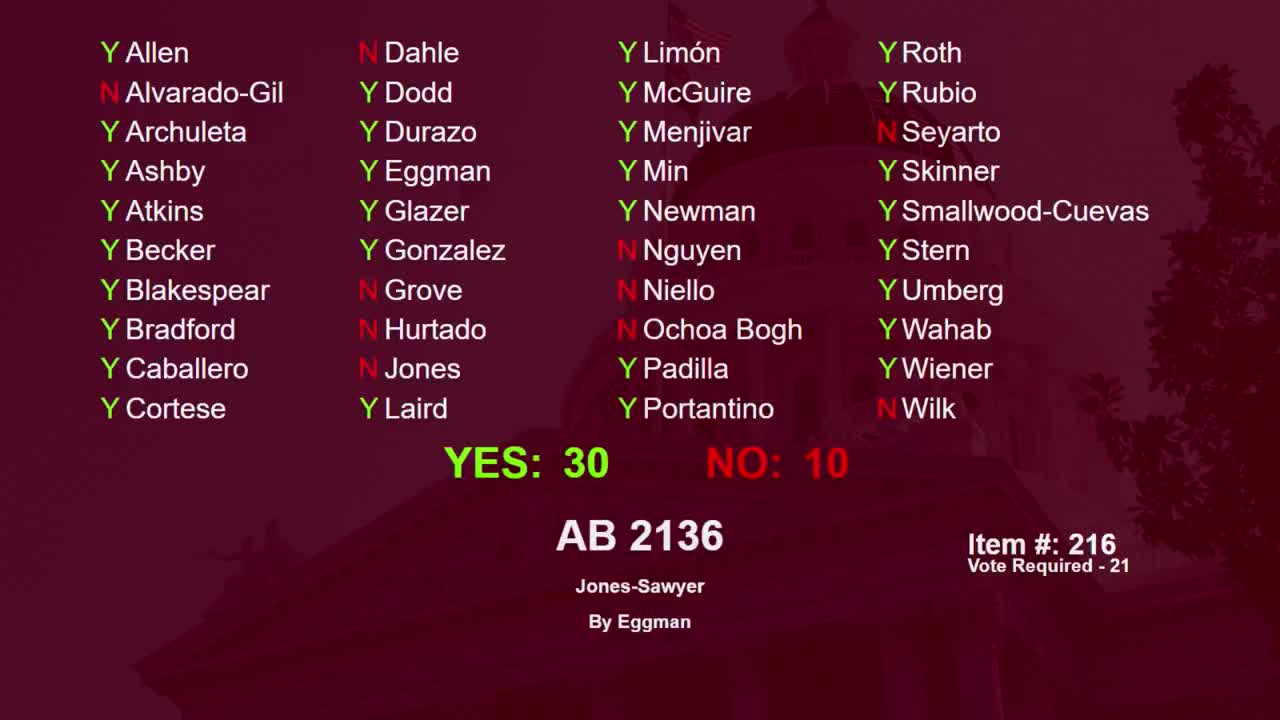
Bill Author

Bill Co-Author(s):