AB 1986: State prisons: banned books.
- Session Year: 2023-2024
- House: Assembly
- Latest Version Date: 2024-09-26
Current Status:
Passed
(2024-09-26: Chaptered by Secretary of State - Chapter 620, Statutes of 2024.)
Introduced
In Committee
First Chamber
In Committee
Second Chamber
Enacted
What does this bill do?
The bill requires the prison inspector's office to post the state's list of banned newspapers, magazines, and books on its website and include basic details for each item (title, author, publisher, year, and the stated rule violated). The Department of Corrections and Rehabilitation must notify the inspector's office whenever the list changes, and the inspector may review a listed publication if asked by an incarcerated person, publisher, or other affected person. If the inspector disagrees with a ban, it must notify the department and include a summary of those reviews and the department's responses in its yearly report to the Governor and Legislature.
The summary is provided by generative AI which can make mistakes. For original language, please view the details in the table below.
Existing law grants a person sentenced to imprisonment the right to purchase, receive, and read any and all newspapers, periodicals, and books, as specified, subject to restrictions reasonably related to legitimate penological interests. Existing law authorizes the Department of Corrections and Rehabilitation to prescribe and amend rules and regulations for the administration of state prisons, including determining which materials are a threat to legitimate penological interests. Existing law creates the Office of the Inspector General and grants the Inspector General responsibility for oversight of the department, as specified.
This bill would require the Office of the Inspector General to post the Centralized List of Disapproved Publications maintained by the department on the offices internet website and would require the department to notify the office each time a change is made to that list. The bill would authorize the office, upon request, to review publications on the list to determine if it concurs with the departments determination that the publication violates department regulations. The bill would require the office to notify the department if it does not concur with the departments determination. The bill would also require the office to include information relating to those notifications in an annual report the Inspector General provides to the Governor and Legislature.
Existing law grants a person sentenced to imprisonment the right to purchase, receive, and read any and all newspapers, periodicals, and books, as specified, subject to restrictions reasonably related to legitimate penological interests. Existing law authorizes the Department of Corrections and Rehabilitation to prescribe and amend rules and regulations for the administration of state prisons, including determining which materials are a threat to legitimate penological interests. Existing law creates the Office of the Inspector General and grants the Inspector General responsibility for oversight of the department, as specified.
This bill would require the Office of the Inspector General to post the Centralized List of Disapproved Publications maintained by the department on the offices internet website. website and would require the department to notify the office each time a change is made to that list. The bill would authorize the Inspector General, office, upon request, to review publications on the list to determine whether there is a legitimate penological interest for the publication being on the list and, if not, would require the department to remove that material from the departments list of disapproved publications. if it concurs with the departments determination that the publication violates department regulations. The bill would require the office to notify the department if it does not concur with the departments determination. The bill would also require the office to include information relating to those notifications in an annual report the Inspector General provides to the Governor and Legislature.
Existing law grants a person sentenced to imprisonment the right to purchase, receive, and read any and all newspapers, periodicals, and books, as specified, subject to restrictions reasonably related to legitimate penological interests. Existing law authorizes the Department of Corrections and Rehabilitation to prescribe and amend rules and regulations for the administration of state prisons, including determining which materials are a threat to legitimate penological interests. Existing law creates the Office of the Inspector General and grants the Inspector General responsibility for oversight of the department, as specified.
This bill would require the Inspector General to post the Centralized List of Disapproved Publications maintained by the department on the offices internet website. The bill would authorize the Inspector General, upon request, to review publications on the list to determine whether there is a legitimate penological interest for the publication being on the list and, if not, would require the department to remove that material from the departments list of disapproved publications.
Existing law grants a person sentenced to imprisonment the right to purchase, receive, and read any and all newspapers, periodicals, and books, as specified, subject to restrictions reasonably related to legitimate penological interests. Existing law authorizes the Department of Corrections and Rehabilitation to prescribe and amend rules and regulations for the administration of state prisons, including determining which materials are a threat to legitimate penological interests. Existing law creates the Office of the Inspector General and grants the Inspector General responsibility for oversight of the department, as specified.
This bill would require the Inspector General to post the list of materials that have been banned Centralized List of Disapproved Publications maintained by the department on the offices internet website. The bill would authorize the Inspector General General, upon request, to review materials publications on the list to determine whether there is a legitimate penological interest for the publication being on the banned materials list, list and, if not, would authorize the Inspector General to require the department to remove that material from the departments banned materials list. list of disapproved publications.
Existing law grants a person sentenced to imprisonment the right to purchase, receive, and read any and all newspapers, periodicals, and books, as specified, subject to restrictions reasonably related to legitimate penological interests. Existing law authorizes the Department of Corrections and Rehabilitation to prescribe and amend rules and regulations for the administration of state prisons, including determining which materials are a threat to legitimate penological interests. Existing law creates the Office of the Inspector General and grants the Inspector General responsibility for oversight of the department, as specified.
This bill would require the Inspector General to post the list of materials that have been banned by the department on the offices internet website. The bill would authorize the Inspector General to review materials to determine whether there is a legitimate penological interest for being on the banned materials list, and, if not, would authorize the Inspector General to require the department to remove that material from the departments banned materials list.
(a)(1)The Office of the Inspector General shall post the Centralized List of Disapproved Publications maintained by the Department of Corrections and Rehabilitation on its internet website. The Department of Corrections and Rehabilitation shall notify the Office of the Inspector General each time a change is made to the Centralized List of Disapproved Publications.
(2)The Centralized List of Disapproved Publications shall include, but not be limited to, all of the following information about each prohibited publication on the list:
(A)The title.
(B)The author.
(C)The publisher.
(D)The year of publication, to the extent available.
(E)The stated violation of department regulations that caused the publication to be prohibited.
(b)Upon a request by an incarcerated person, publisher, or other affected person, the Office of the Inspector General may review a publication on the Centralized List of Disapproved Publications to determine if the office concurs with the departments determination that the publication is in violation of department regulations. The office shall notify the department if the office does not concur with the departments determination that a publication that the office has reviewed pursuant to this subdivision is in violation of the departments regulations.
(c)For purposes of this section, publication means any newspaper, periodical, magazine, or book that can be mailed through the United States Postal Service.
SEC. 2.Section 6132 of the Penal Code is amended to read:6132.(a)(1)Notwithstanding Section 10231.5 of the Government Code, the Inspector General shall report annually to the Governor and the Legislature a summary of its reports. The summary shall be posted on the offices internet website and otherwise made available to the public upon its release to the Governor and the Legislature. The summary shall include, but not be limited to, significant problems discovered by the office, and whether recommendations the office has made have been implemented.
(2)The report shall also include a summary of the determinations that the Office of the Inspector General made regarding each publication the office reviewed pursuant to Section 6130 and the Department of Corrections and Rehabilitations response to each notification that the office issued indicating that the office did not concur with the departments determination that a publication is in violation of the departments regulations.
(b)A report pursuant to subdivision (a) shall be submitted in compliance with Section 9795 of the Government Code.
(a)(1)The Office of the Inspector General shall post the Centralized List of Disapproved Publications maintained by the Department of Corrections and Rehabilitation on its internet website. The Department of Corrections and Rehabilitation shall notify the Office of the Inspector General each time a change is made to the Centralized List of Disapproved Publications.
(2)The Centralized List of Disapproved Publications shall include, but not be limited to, all of the following information about each prohibited publication on the list:
(A)The title.
(B)The author.
(C)The publisher.
(D)The year of publication. publication, to the extent available.
(E)The stated legitimate penological interest for banning the publication. violation of department regulations that caused the publication to be prohibited.
(b)(1)Upon a request by an incarcerated person, publisher, or other affected person, the Office of the Inspector General may review a publication on the Centralized List of Disapproved Publications to determine if the reason for prohibiting the publication is reasonably related to a legitimate penological interest. the office concurs with the departments determination that the publication is in violation of department regulations. The office shall notify the department if the office does not concur with the departments determination that a publication that the office has reviewed pursuant to this subdivision is in violation of the departments regulations.
(2)If the Inspector General determines that the departments reason for including a publication on the Centralized List of Disapproved Publications is not reasonably related to a legitimate penological interest, the department shall remove the publication from the Centralized List of Disapproved Publications.(c)For purposes of this section, publication means any newspaper, periodical, magazine, or book that can be mailed through the United States Postal Service.
SEC. 2.Section 6132 of the Penal Code is amended to read:6132.(a)(1)Notwithstanding Section 10231.5 of the Government Code, the Inspector General shall report annually to the Governor and the Legislature a summary of its reports. The summary shall be posted on the offices Internet Web site internet website and otherwise made available to the public upon its release to the Governor and the Legislature. The summary shall include, but not be limited to, significant problems discovered by the office, and whether recommendations the office has made have been implemented.
(2)The report shall also include a summary of the determinations that the Office of the Inspector General made regarding each publication the office reviewed pursuant to Section 6130 and the Department of Corrections and Rehabilitations response to each notification that the office issued indicating that the office did not concur with the departments determination that a publication is in violation of the departments regulations.
(b)A report pursuant to subdivision (a) shall be submitted in compliance with Section 9795 of the Government Code.
(a)(1)The Office of the Inspector General shall post the Centralized List of Disapproved Publications maintained by the Department of Corrections and Rehabilitation on its internet website.
(2)The Centralized List of Disapproved Publications shall include, but not be limited to, all of the following information about each prohibited publication on the list:
(A)The title.
(B)The author.
(C)The publisher.
(D)The year of publication.
(E)The stated legitimate penological interest for banning the publication.
(b)(1)Upon a request by an incarcerated person, publisher, or other affected person, the Inspector General may review any a publication on the Centralized List of Disapproved Publications to determine if the reason for prohibiting the publication is reasonably related to a legitimate penological interest.
(2)If the Inspector General determines that the departments reason for including a publication on the Centralized List of Disapproved Publications is not reasonably related to a legitimate penological interest, the department shall remove the publication from the Centralized List of Disapproved Publications.
(c)For purposes of this section, publication means any newspaper, periodical, magazine, or book that can be mailed through the United States Postal Service.
(a)(1)The Office of the Inspector General shall post the Centralized List of Disapproved Publications maintained by the Department of Corrections and Rehabilitation on its internet website.
(2)The Centralized List of Disapproved Publications shall include, but not be limited to, all of the following information about each prohibited publication on the list:
(A)The title.
(B)The author.
(C)The publisher.
(D)The year of publication.
(E)The stated legitimate penological interest for banning the publication.
(b)(1)Upon a request by an incarcerated person, publisher, or other affected person, the Inspector General may review a any publication on the Centralized List of Disapproved Publications to determine if the reason for prohibiting the publication is reasonably related to a legitimate penological interest.
(2)If the Inspector General determines that the departments reason for including a publication on the Centralized List of Disapproved Publications is not reasonably related to a legitimate penological interest, the department shall remove the publication from the Centralized List of Disapproved Publications.
(c)For purposes of this section, publication means any newspaper, periodical, magazine, or book that can be mailed through the United States Postal Service.
(a)(1)The Office of the Inspector General shall post the list of banned materials Centralized List of Disapproved Publications maintained by the Department of Corrections and Rehabilitation on its internet website.
(2)The list Centralized List of Disapproved Publications shall include, but not be limited to, all of the following information about the banned material: each prohibited publication on the list:
(A)The title.
(B)The author.
(C)The publisher.
(D)The year of publication.
(E)The stated legitimate penological interest for banning the material. publication.
(b)(1)The Inspector General may review material on the banned materials list to determine if the reason for banning the material is reasonably related to a legitimate penological interest.(2)If the Inspector General determines that there is not sufficient justification for banning the material, the Inspector General may require that the department remove the material from the list of banned materials.(b)(1)Upon a request by an incarcerated person, publisher, or other affected person, the Inspector General may review a publication on the Centralized List of Disapproved Publications to determine if the reason for prohibiting the publication is reasonably related to a legitimate penological interest.
(2)If the Inspector General determines that the departments reason for including a publication on the Centralized List of Disapproved Publications is not reasonably related to a legitimate penological interest, the department shall remove the publication from the Centralized List of Disapproved Publications.
(c)For purposes of this section, material publication means any newspaper, periodical, magazine, or book that can be mailed through the United States Postal Service.
(a)(1)The Office of the Inspector General shall post the list of banned materials maintained by the Department of Corrections and Rehabilitation on its internet website.
(2)The list shall include, but not be limited to, all of the following information about the banned material:
(A)The title.
(B)The author.
(C)The publisher.
(D)The year of publication.
(E)The stated legitimate penological interest for banning the material.
(b)(1)The Inspector General may review material on the banned materials list to determine if the reason for banning the material is reasonably related to a legitimate penological interest.
(2)If the Inspector General determines that there is not sufficient justification for banning the material, the Inspector General may require that the department remove the material from the list of banned materials.
(c)For purposes of this section, material means any newspaper, periodical, magazine, or book that can be mailed through the United States Postal Service.
|
Date
|
Status
|
|---|---|
| Sep 26, 2024 | Chaptered by Secretary of State - Chapter 620, Statutes of 2024. |
| Sep 26, 2024 | Approved by the Governor. |
| Sep 10, 2024 | Enrolled and presented to the Governor at 4:30 p.m. |
| Aug 28, 2024 | Senate amendments concurred in. To Engrossing and Enrolling. (Ayes 75. Noes 0.). |
| Aug 28, 2024 | In Assembly. Concurrence in Senate amendments pending. May be considered on or after August 30 pursuant to Assembly Rule 77. |
| Aug 28, 2024 | Assembly Rule 77 suspended. |
| Aug 27, 2024 | Read third time. Passed. Ordered to the Assembly. (Ayes 40. Noes 0.). |
| Aug 26, 2024 | Read second time. Ordered to third reading. |
| Aug 23, 2024 | Read third time and amended. Ordered to second reading. |
| Aug 7, 2024 | Read second time. Ordered to third reading. |
| Aug 6, 2024 | Read third time and amended. Ordered to second reading. |
| Jun 13, 2024 | Ordered to third reading. |
| Jun 13, 2024 | From Consent Calendar. |
| Jun 11, 2024 | Read second time. Ordered to Consent Calendar. |
| Jun 10, 2024 | From committee: Be ordered to second reading file pursuant to Senate Rule 28.8 and ordered to Consent Calendar. |
| Jun 4, 2024 | From committee chair, with author's amendments: Amend, and re-refer to committee. Read second time, amended, and re-referred to Com. on APPR. |
| May 28, 2024 | From committee: Do pass and re-refer to Com. on APPR with recommendation: To Consent Calendar. (Ayes 4. Noes 0.) (May 28). Re-referred to Com. on APPR. |
| May 1, 2024 | Referred to Com. on PUB S. |
| Apr 15, 2024 | In Senate. Read first time. To Com. on RLS. for assignment. |
| Apr 15, 2024 | Read third time. Passed. Ordered to the Senate. (Ayes 71. Noes 0. Page 4796.) |
| Apr 11, 2024 | Read second time. Ordered to third reading. |
| Apr 10, 2024 | From committee: Do pass. (Ayes 14. Noes 0.) (April 10). |
| Mar 12, 2024 | From committee: Do pass and re-refer to Com. on APPR. (Ayes 8. Noes 0.) (March 12). Re-referred to Com. on APPR. |
| Mar 11, 2024 | Re-referred to Com. on PUB. S. |
| Mar 7, 2024 | From committee chair, with author's amendments: Amend, and re-refer to Com. on PUB. S. Read second time and amended. |
| Feb 12, 2024 | Referred to Com. on PUB. S. |
| Jan 31, 2024 | From printer. May be heard in committee March 1. |
| Jan 30, 2024 | Read first time. To print. |
|
Date
|
Description
|
Location
|
Votes
|
|
|---|---|---|---|---|
| Aug 28, 2024 | AB 1986 Bryan Concurrence in Senate Amendments | Assembly Floor |
Passed |
|
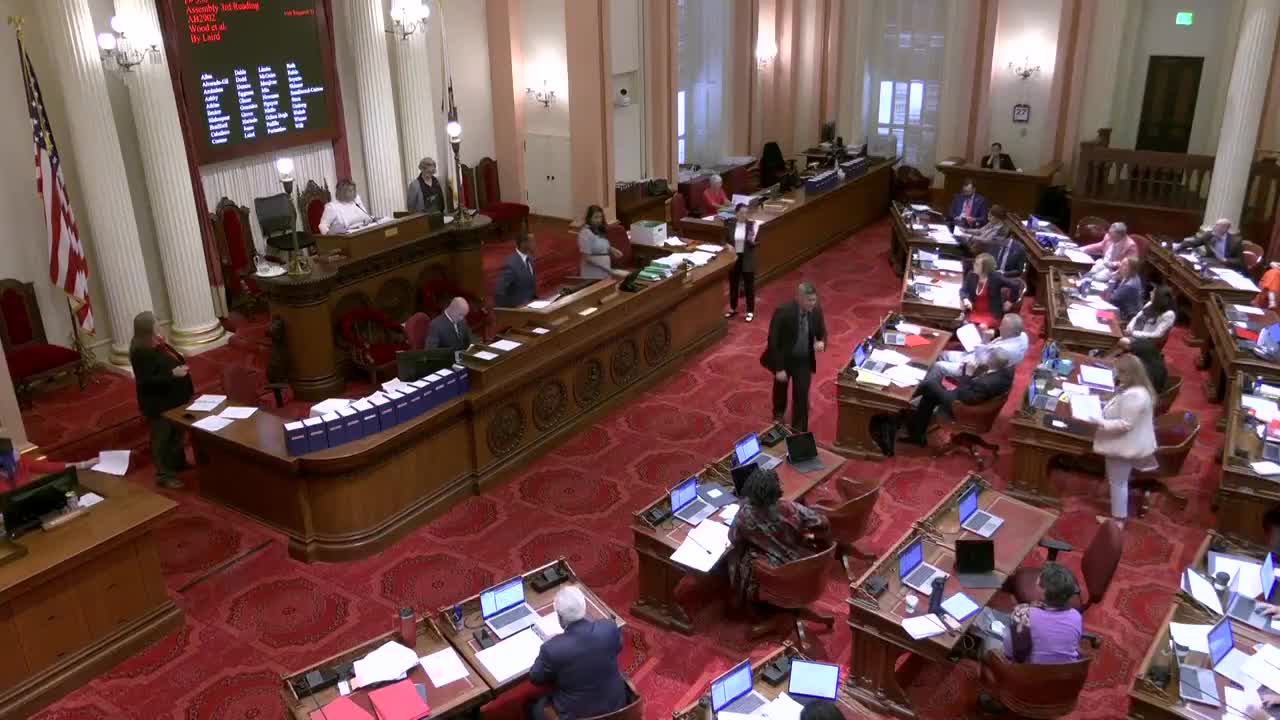
| Aug 27, 2024 | Assembly 3rd Reading AB1986 Bryan et al. By Smallwood-Cuevas | Senate Floor |
Passed |
|
| May 28, 2024 | Do pass, but first be re-referred to the Committee on [Appropriations] with the recommendation: To Consent Calendar | Senate Standing Committee on Public Safety |
Passed |
|
| Apr 15, 2024 | AB 1986 Bryan Assembly Third Reading | Assembly Floor |
Passed |
|
| Apr 10, 2024 | Do pass. | Assembly Standing Committee on Appropriations |
Passed |
|
| Mar 12, 2024 | Do pass and be re-referred to the Committee on [Appropriations] | Assembly Standing Committee on Public Safety |
Passed |
This list shows positions taken on this bill by organizations on the date displayed, which is linked to the original source.
Positions by individuals are not included.
|
Organization
|
Position
|
Date
|
|---|---|---|
| A New Way of Life Reentry Project | ** Support | |
| A.B.O. Comix | ** Support | |
| Aclu California Action | ** Support | |
| Alliance for Boys and Men of Color | ** Support | |
| Alliance for Reparations, Reconciliation, and Truth | ** Support | |
| Asian Americans Advancing Justice Southern California | ** Support | |
| Black Equity Collective | ** Support | |
| Black Women Organized for Political Action | ** Support | |
| Books Beyond Bars At Ucla | ** Support | |
| Boundless Freedom Project | ** Support | |
| California Alliance for Youth and Community Justice | ** Support | |
| California Black Power Network | ** Support | |
| California Community Foundation | ** Support | |
| California Democratic Party | ** Support | |
| California Faculty Association | ** Support | |
| California Immigrant Policy Center | ** Support | |
| California Public Defenders Association | ** Support | |
| California Reparations Task Force Members Dr. Cheryl Grills, Lisa Holder, and Don Tamaki | ** Support | |
| California-Hawaii State Conference Of The Naacp | ** Support | |
| Californians for Safety and Justice | ** Support | |
| Californians United for a Responsible Budget | ** Support | |
| Catalyst California | ** Support | |
| Chicago Books to Women in Prison | ** Support | |
| Children's Defense Fund - CA | ** Support | |
| City and County of San Francisco | ** Support | |
| Communities United for Restorative Youth Justice | ** Support | |
| County of Los Angeles Board of Supervisors | ** Support | |
| Courage California | ** Support | |
| Culver City Democratic Club | ** Support | |
| Defy Ventures | ** Support | |
| Democrats for Israel - CA | ** Support | |
| Democrats for Israel Los Angeles | ** Support | |
| Ella Baker Center For Human Rights | ** Support | |
| Equal Justice Society | ** Support | |
| ETTA | ** Support | |
| Fair Chance Project | ** Support | |
| Felony Murder Elimination Project | ** Support | |
| Friends Committee On Legislation Of California | ** Support | |
| Grip Training Institute | ** Support | |
| Hadassah | ** Support | |
| Holocaust Museum LA | ** Support | |
| ikar | ** Support | |
| Initiate Justice | ** Support | |
| Initiate Justice Action | ** Support | |
| JCRC Bay Area | ** Support | |
| Jewish Center for Justice | ** Support | |
| Jewish Democratic Club of Marin | ** Support | |
| Jewish Democratic Club of Solano County | ** Support | |
| Jewish Democratic Coalition of the Bay Area | ** Support | |
| Jewish Family and Children's Services of San Francisco, the Peninsula, Marin and Sonoma Counties | ** Support | |
| Jewish Family and Children’s Service of Long Beach and Orange County | ** Support | |
| Jewish Family Service of Los Angeles | ** Support | |
| Jewish Family Services of Silicon Valley | ** Support | |
| Jewish Federation Of Greater Los Angeles The | ** Support | |
| Jewish Federation of The Greater San Gabriel and Pomona Valleys | ** Support | |
| Jewish Free Loan Association | ** Support | |
| Jewish Long Beach | ** Support | |
| Jewish Public Affairs Committee | ** Support | |
| Jewish Silicon Valley | ** Support | |
| LA Defensa | ** Support | |
| Lawyers Committee For Civil Rights Of The San Francisco Bay Area | * Support | Mar 12, 2024 |
| Lawyers' Committee for Civil Rights of the San Francisco Bay Area | ** Support | |
| Legal Services for Prisoners with Children | ** Support | |
| Livefree California | ** Support | |
| Los Angeles County Democratic Party | ** Support | |
| Los Angeles Regional Reentry Partnership | ** Support | |
| Michelson Center For Public Policy | ** Support | |
| Milpa Collective | ** Support | |
| Multi-faith Action Coalition | ** Support | |
| Oakland Privacy | ** Support | |
| Pen America | ** Support | |
| Prison Ftio | ** Support | |
| Prison Yoga Project | ** Support | |
| Progressive Zionists of California | ** Support | |
| Root & Rebound | ** Support | |
| Rubicon Programs | ** Support | |
| Safe Return Project | ** Support | |
| San Francisco Public Defender | ** Support | |
| Santa Cruz Barrios Unidos | ** Support | |
| Santa Monica Democratic Club | ** Support | |
| Secure Justice | ** Support | |
| Showing Up for Racial Justice Bay Area Chapter | * Support | Mar 12, 2024 |
| Sister Warriors Freedom Coalition | ** Support | |
| Smart Justice California, a project of Tides Advocacy | ** Support | |
| The Amelia Ann Adams Whole Life Center | ** Support | |
| the Peninsula, Marin and Sonoma Counties | ** Support | |
| The Transformative In-prison Workgroup | ** Support | |
| Transformative Programming Works | ** Support | |
| UC Berkeley's Underground Scholars Initiative | ** Support | |
| UC Berkeley's Underground Scholars Initiative (USI) | ** Support | |
| Uncommon Law | ** Support | |
| Universidad Popular | ** Support | |
| White People 4 Black Lives | ** Support | |
| Young Women's Freedom Center | ** Support |
CONCURRENCE IN SENATE AMENDMENTS
CSA1 Bill Id:AB 1986
Author:(Bryan, et al.)
As Amended Ver:August 23, 2024
Majority vote
SUMMARY
Requires the Office of the Inspector General (OIG) to post the Department of Corrections and Rehabilitation's (CDCR) Centralized List of Disapproved Publications (Centralized List) on its website.
Senate Amendments
- Require CDCR to notify the OIG each time a change is made to the Centralized List.
- Clarify that the Centralized List must include the stated violation of CDCR regulations that caused a publication to be prohibited.
- Clarify that the OIG, upon request by specified parties, may review a publication on the Centralized List to determine if it concurs with CDCR's determination that a publication is in violation of CDCR regulations.
- Requires the OIG to notify CDCR if the office does not concur with CDCR's determination that a publication that the office has reviewed, as specified, is in violation of CDCR's regulations.
- Requires the OIG's annual summary of reports to include a summary of the determinations that the Office of the Inspector General made regarding each publication the office reviewed, as specified, and CDCR's response to each notification that the office issued indicating that the office did not concur with CDCR's determination that a publication is in violation of CDCR's regulations.
- Make technical, non-substantive changes.
COMMENTS
As passed by the Assembly, this bill:
- Provided that the OIG is required to post on its website the Centralized List of publications prohibited by CDCR as listed on CDCR's Centralized List.
- Defined "publication" as any newspaper, periodical, magazine, or book that can be mailed through the United States Postal Service (USPS).
- Required the Centralized List to include the title, author, publisher, year of publication, and the stated legitimate penological interest for banning the publication.
- Authorized the OIG to review a publication on the Centralized List, upon request, to determine if the reason for prohibiting the publication is reasonably related to a legitimate penological interest.
- Required CDCR remove a publication from the Centralized List if it is determined that there is not a legitimate penological interest to prohibit the publication.
According to the Author
"Access to knowledge is essential for rehabilitation and it helps people reintegrate into society. Within our state prisons, however, the books currently banned seem to be disproportionately written by Black authors and other authors of Color. AB 1986 will bring accountability and increased transparency to the California Department of Corrections and Rehabilitation (CDCR) book banning process.
"AB 1986 will require the Office of Inspector General (OIG), who is an independent agency tasked with oversight, to post the CDCR list of banned books. Most importantly, AB 1986 empowers the OIG to remove books from the list if they find that there is insufficient evidence to ban the book in the first place. Books are more than just sources of information; they are tools for empowerment and transformation with an incalculable value for all people."
Arguments in Support
According to Oakland Privacy, "The State of California has always maintained that the rehabilitation of prisoners and their eventual re-integration into society is the primary goal of the Department of Corrections and Rehabilitation (CDCR). […]
"While up to date statistics seem to be difficult to find, both the Prison Policy Institute and the Department of Justice agree that at least 25% of state prison inmates have no high school degree at all, and more than 50% have no more than a General Educational Development (GED), which in many cases is a GED acquired in a prison facility. In addition to practical rehabilitative concerns about access to jobs that pay a living wage post-prison, what this statistic reveals is that many if not most of inmates have not been exposed to the general canon of literature, to advanced history beyond elementary school stereotypes, to inspiring biographies and autobiographies about people like them who went on to different kinds of life post-prison, and to knowledge and skills building texts. All of us who have had the privilege of higher education, and even those who have not but had the freedom and initiative to read widely, can point to a book or books that changed our lives and changed our perspectives. Those texts are different for every individual, but the experience is a common one.
"The practice of banning books, for this reason, is one that must be exercised with the greatest of care. Depriving human beings, especially human beings deprived of their liberty, of access to thought, to ideas and to the experiences of other people, is contradictory to the entire idea of education as well as rehabilitation. To ban books whimsically, carelessly, in response to racial and ethnic stereotypes, or punitively is to double down on enhancing damage to already damaged people.
"The above stated principles are not new, unique or even politically radical. As early as the 1800's, French author Victor Hugo was declaring "he who opens a school door, closes a prison", partially because of the frequency with which is own books were banned by the Catholic Church during his lifetime. In the 1940's, California prison librarian Herman Spector developed the term "bibliotherapy" which held that incarcerated people could be reformed by reading widely. And at times, parole boards in California considered prison library records during parole deliberations.
"Due to a federal law, the Prison Litigation Reform Act (PLRA), which was designed to reduce inmate lawsuits against prisons, it is extremely difficult for prisoners to contest unfair book ban decisions. This has led to some egregious incidents, including an attempt to ban Michelle Alexander's The New Jim Crow by the New Jersey Department of Corrections, which was batted back by the ACLU. Among the key recommendations in the PEN-America report is exactly what AB 1986 proposes to do: implement periodic review of the banned books list by a third party, in this case the Inspector General, and end arbitrary and over-broad book bannings that cannot be connected to a specific security threat.
"As a privacy group, our concerns are often expressed as too much access to information and not too little, but civil rights concerns about information access cut both ways. The ability to seek out information and artistic expression is an important a component of the constitutional right to privacy as the ability to protect our data from spying eyes. Barring a direct threat to the safety and security of others, reading and thinking is our own, no matter what bad things we have done. Making sure that our prison system is not inappropriately constraining access to books is a worthy goal and one we wholeheartedly support."
Arguments in Opposition
None Submitted.
FISCAL COMMENTS
According to the Assembly Appropriations Committee, "Likely minor and absorbable costs to CDCR and the OIG. CDCR reports no fiscal impact resulting from the bill. The OIG reports it may incur some workload in responding to review requests and obtaining publications for review, but anticipates those costs will be absorbable within current resources."
VOTES:
ASM PUBLIC SAFETY: 8-0-0
YES: McCarty, Alanis, Lackey, Stephanie Nguyen, Reyes, Ting, Wilson, Zbur
ASM APPROPRIATIONS: 14-0-1
YES: Wicks, Sanchez, Arambula, Bryan, Calderon, Dixon, Mike Fong, Grayson, Haney, Hart, Jim Patterson, Pellerin, Ta, Villapudua
ABS, ABST OR NV: Wendy Carrillo
ASSEMBLY FLOOR: 71-0-9
YES: Addis, Aguiar-Curry, Alanis, Arambula, Bains, Bauer-Kahan, Berman, Boerner, Bonta, Bryan, Calderon, Juan Carrillo, Cervantes, Chen, Connolly, Davies, Dixon, Mike Fong, Vince Fong, Friedman, Gabriel, Garcia, Gipson, Grayson, Haney, Hart, Holden, Hoover, Irwin, Jackson, Jones-Sawyer, Kalra, Lackey, Lee, Lowenthal, Maienschein, McCarty, McKinnor, Muratsuchi, Stephanie Nguyen, Ortega, Pacheco, Papan, Jim Patterson, Joe Patterson, Pellerin, Petrie-Norris, Quirk-Silva, Ramos, Rendon, Reyes, Luz Rivas, Rodriguez, Blanca Rubio, Sanchez, Santiago, Schiavo, Soria, Ta, Ting, Valencia, Villapudua, Waldron, Wallis, Ward, Weber, Wicks, Wilson, Wood, Zbur, Robert Rivas
ABS, ABST OR NV: Alvarez, Bennett, Wendy Carrillo, Megan Dahle, Essayli, Flora, Gallagher, Low, Mathis
SENATE FLOOR: 40-0-0
YES: Allen, Alvarado-Gil, Archuleta, Ashby, Atkins, Becker, Blakespear, Bradford, Caballero, Cortese, Dahle, Dodd, Durazo, Eggman, Glazer, Gonzalez, Grove, Hurtado, Jones, Laird, Limón, McGuire, Menjivar, Min, Newman, Nguyen, Niello, Ochoa Bogh, Padilla, Portantino, Roth, Rubio, Seyarto, Skinner, Smallwood-Cuevas, Stern, Umberg, Wahab, Wiener, Wilk
UPDATED
VERSION: August 23, 2024
CONSULTANT: Andrew Ironside / PUB. S. / (916) 319-3744 FN: 0004857
SENATE RULES COMMITTEE Office of Senate Floor Analyses (916) 651-1520 Fax: (916) 327-4478 | AB 1986 |
THIRD READING
Bill No: AB 1986
Author: Bryan (D), Bonta (D), Gipson (D), Holden (D), Jackson (D), Jones-Sawyer (D), McCarty (D), McKinnor (D), Weber (D) and Wilson (D), et al.
Amended: 8/23/24 in Senate
Vote: 21
SENATE PUBLIC SAFETY COMMITTEE: 4-0, 5/28/24
AYES: Wahab, Seyarto, Skinner, Wiener
NO VOTE RECORDED: Bradford
SENATE APPROPRIATIONS COMMITTEE: Senate Rule 28.8
ASSEMBLY FLOOR: 71-0, 4/15/24 - See last page for vote
SUBJECT: State prisons: banned books
SOURCE: Initiate Justice
DIGEST:
This bill requires the Office of The Inspector General (OIG) to add to its website a “Centralized List of Disapproved Publications” as maintained by the California Department of Corrections and Rehabilitations (CDCR). This bill allows for the OIG to review each publication and determine whether it should remain disapproved or be allowed for use by incarcerated persons.
Senate Floor Amendments of 8/23/24, revise the purview of the OIG to only notify CDCR as to whether a book should remain or be removed from their banned book list, rather than set mandates for CDCR. They also require OIG to include a summary of their determinations in their annual report to the Legislature.
ANALYSIS:
Existing law:
- Provides that Congress shall make no law abridging the freedom of speech. (U.S. Constitution (Const.) 1st amendment (amend.)
- Provides that no State shall deprive any person of life, liberty, or property, without due process of law. (U.S. Const. 14th amend.)
- Provides that a law may not restrain or abridge liberty of speech or press. (California Constitution article 1 § 2)
- Establishes CDCR and creates the Division of Adult Institutions (DAI) within CDCR. (Gov. Code, §§ 1238, 1238.1)
- Vests the authority to supervise, manage and control state prisons in the Secretary of CDCR. (Pen. Code § 5054)
- Vests the authority to prescribe and amend rules and regulations for the administration of the prisons to the Secretary of CDCR. (Pen. Code § 5058)
- Establishes the independent OIG and provides that the office shall not be a subdivision of any other governmental entity. (Pen. Code § 6125)
- Provides that the OIG shall be responsible for contemporaneous oversight of internal affairs investigations and the disciplinary process of CDCR under policies to be developed by the Inspector General. (Pen. Code § 6126)
- Provides that the OIG shall be responsible for contemporaneous oversight of grievances that fall within CDCR’s process for reviewing and investigating inmate allegations of staff misconduct and other grievances, examining compliance with regulations, CDCR policy, and best practices. (Pen. Code § 6126, subd. (i))
- Requires the OIG to issue regular reports to the Governor and Legislature summarizing its recommendations concerning oversight of CDCR and require the reports to be posted on the OIG’s website and otherwise made available to the public. (Pen. Code § 6133)
- Provides that a person sentenced to imprisonment in a state prison may only be deprived of rights as is responsibly related to penological interest. (Pen. Code § 2600)
- Provides that persons sentenced to imprisonment in a state prison have the specified civil rights, including among others, the right to own personal property and the right to purchase, receive, and read any and all newspapers, periodicals, and books accepted for distribution by the USPS. (Pen. Code § 2601, subds. (a) & (c))
- Allows prison authorities to ban any of the following material:
- Obscene publications or writings;
- Any matter of a character tending to incite murder, arson, riot, violent racism, or any other form of violence; and,
- Any matter concerning gambling or a lottery. (Pen. Code § 2601, subd. (c))
- States that prison officials can establish reasonable restrictions as to the number of newspapers, magazines, and books that an incarcerated person may have in their cell or elsewhere in the prison at one time. (Pen. Code § 2601, subd. (c))
This bill:
- Requires the OIG to post on its website a “Centralized List of Disapproved Publications” as maintained by CDCR.
- Requires CDCR to notify the OIG each time a change is made to the Centralized List of Disapproved Publications.
- Requires the following additional information to be included on the OIG’s website:
- The title;
- The author;
- The publisher;
- The year of publication, to the extent available; and,
- The stated violation of department regulations which caused the publication to be prohibited.
- Requires OIG to review a publication to determine if it concurs with the department’s determination that the publication is in violation of department regulations upon a request by an incarcerated person, publisher, or other affected person.
- Requires the Inspector General to notify CDCR if, after review, it does not concur with CDCR’s determination that the reviewed publication is in violation of department regulations.
- Defines “publication” as any newspaper, periodical, magazine, or book that can be mailed through the United States Postal Service.
- Requires the Inspector General to report annually to the Governor and the Legislature a summary of its reports, including but not limited to significant problems discovered by the office, whether recommendations the office has made have been implemented, and a summary of the determinations the office made regarding each publication it reviewed and CDCR’s responses. This report shall also be posted to the OIG website.
Background
- Incarcerated Persons’ Right to Own Books. Publishers “have a First Amendment right to communicate with prisoners by mail, and inmates have a First Amendment right to receive this mail.” (Prison Legal News v. Lehman (9th Cir. 2005) 397 F.3d 692, 699.) The scope and potency of these rights are, however, “subject to substantial limitations and restrictions in order to allow prison officials to achieve legitimate correctional goals and maintain institutional security.” (Walker v. Sumner (9th Cir. 1990). 917 F.2d 382, 38.) To determine whether a correctional institution’s regulation that “impinges on inmates’ constitutional rights” is valid, the regulation must be “reasonably related to legitimate penological interests.” (Turner v. Safley (1997) 482 U.S. 78, 89)
Under existing law, incarcerated persons are guaranteed specified civil rights and may only be deprived of these rights as is responsibly related to penological interest. (Pen. Code § 2600) These rights include, among others, the right to own personal property (such as books) and the right to purchase, receive, and read any and all newspapers, periodicals, and books accepted for distribution by the USPS. (Pen. Code § 2601, subds. (a) & (c).)
Prison authorities are allowed to ban obscene publications or writings, publications that contain matter that tends to “incite murder, arson, riot, violent racism, or any other form of violence” and, publications that contain matter concerning gambling (Pen. Code § 2601, subd. (c).). Additionally, prison officials can establish reasonable restrictions as to the number of newspapers, magazines, and books that an incarcerated person may have in their cell or elsewhere in the prison at one time. (Pen. Code § 2601, subd. (c))
An incarcerated person’s ability to possess personal property is also subject to CDCR’s regulations. Incarcerated persons are prohibited from possessing any writing which describes the making of any dangerous weapons or destructive devices, any matter that may incite murder, arson, riots, or violence, blackmail, anything that would assist in escape, coded messages, maps depicting any area within a 10-mile radius of a facility, gambling or a lottery, and obscene material. (Cal. Code Regs., tit. 15 § 3006) Further, CDCR’s regulations require that each prison contain a library. This material is also prohibited from prison libraries. (Cal. Code Regs., tit. 15 § 3120)
The regulations specify that incarcerated persons are permitted to purchase or subscribe to books, newspapers, magazines and periodicals. However, subscriptions or books that are purchased for the incarcerated person by a third party or donated must be mailed directly from a book store, book distributor, or publisher. Personal correspondents cannot mail books, periodicals, or other publications directly to inmates. (Cal. Code Regs., tit. 15 § 3134.1) Title 15 Regulations provide that disagreement with the sender’s or receiver’s morals, values, attitudes, veracity, or choice of words will not be cause for correctional staff to disallow mail. “Correctional staff shall not challenge or confront the sender or receiver with such value judgments.” (Cal. Code Regs., tit. 15 § 3135) Unless otherwise prohibited, incarcerated persons are allowed to possess all publications, including books and subscriptions to periodicals. There are no “Approved Vendor Lists” for publications and incarcerated persons may receive publications from any publisher, book store or book distributor that does mail order business. (Cal. Code Regs., tit. 15 § 3190)
- CDCR’s Centralized List of Disapproved Publications. CDCR’s Division of Adult Institutions (DAI) is required to distribute to each institution a Centralized List of Disapproved Publications (Centralized List) that are prohibited as contraband. Examples of publications that would be included on the Centralized List include, but are not limited to, publications that contain, obscene material, sexually explicit images that depict frontal nudity, warfare or weaponry, and bomb making instructions. Publications that are enumerated on the Centralized List are not allowed in any CDCR institution. (Cal. Code Regs., tit. 15 § 3134.1) When a publication is placed on the Centralized List, DAI sends a letter to the publisher explaining why the publication is prohibited. At a minimum, the letter must include the reason why the publication is prohibited, the applicable regulation that the publication violates, and a notice to the publisher of its right to appeal. (Cal. Code Regs., tit. 15 § 3134.1)
Individual local institutions cannot add items to the Centralized List. When incoming books, magazines, or publications to an incarcerated person may be withheld or disallowed on a temporary basis by the institution pending approval from DAI. The institution must request that DAI affirm or deny the withholding of the temporarily disallowed publication. DAI must provide a decision within 30 calendar days of receiving the request. If DAI affirms the withholding of the publication, disallowance of the publication becomes permanent. If DAI denies the withholding of the publication, the institution must deliver the publication to the incarcerated persons within 15 days. (Cal. Code Regs., tit. 15 § 3134.1)
Concurrently, a letter is sent by the institution to the publisher explaining why the item was denied. At a minimum the letter must include the reason why the publication was denied, the names and CDCR number for all incarcerated persons, the applicable regulation that the publication violates, and a notice to the publisher of their right to appeal. At the same time, the institution must also notify the person who sent the publication via CDCR Form 1819 Notification of Disapproval-Mail/Packages/Publications. The CDCR Form 1819 includes the reason, disposition, name of official disallowing the publication, and the name of the official to whom a grievance can be directed. (Cal. Code Regs., tit. 15 § 3134.1)
The most recent Centralized List includes over one thousand publications. For some of these, it is obvious based on the title of the publication alone, that there is a legitimate penological reason for prohibiting the publication in a prison environment. However, other publications on the Centralized List, such as “Color For Painters: A Guide to Traditions and Practice, Drawing Made Easy, the Concise Atlas of the World, Fifth Edition and Health-The Basics, 11th Edition, and many others may deserve further consideration of the reason for the censorship and whether their ban actually supports any legitimate penological objective.
- Practical Considerations. This bill would require CDCR to provide its Centralized List to OIG, and then would require OIG to post the list on its website. It is unclear whether CDCR is required to provide the Centralized List to OIG periodically, or each time it is updated. For efficiency purposes, the Legislature should consider whether CDCR should, instead be required to post the Centralized List as it is updated on its website.
In addition, this bill would require the Centralized List posted online to include information about the publisher, the publication date, and the reason for the prohibition. Currently, the Centralized List includes over 1,000 publications and could date back several decades. The list does not include information such as the publisher, year of publication, and reason for the denial. It only includes the name of the publication, the author, and the pages that violate the regulations. However, CDCR is required to maintain a copy of the notification letter to the publisher regarding the reason why the publication was prohibited, and supporting documents for a minimum of seven years, pursuant to department regulation. (Cal. Code Regs., tit. 3134.1., subd. (d).) Accordingly, CDCR could maintain more information on the Centralized List going forward, it may be unduly burdensome for CDCR and the OIG to obtain information on publications that were prohibited more than seven years ago.
Requiring CDCR and the OIG to track down and purchase a copy of the publication when a request for review is submitted may constitute an additional burden. It may be worth considering to require the requesting party to provide a copy of the publication so as to not burden CDCR or the OIG to track down and purchase a copy of the publication for review. Understandably, an incarcerated person may not have the means to provide a copy of the publication for review, therefore this consideration may only be suitable for other affected persons and publishers as mentioned by this bill.
Also, under current law, CDCR has the authority to manage and control state prisons and to prescribe its rules and regulations. (Pen. Code, §§ 5054 & 5058) As a separate independent agency, the OIG is not a subdivision of CDCR, and it is authorized to review and investigate allegations of staff misconduct and examine compliance with regulations, CDCR policy, and best practices. (Pen. Code, §§ 6125 & 6126) The OIG issues regular reports to the Governor and Legislature summarizing its recommendations concerning oversight of CDCR and the law requires the reports to be posted on the OIG’s website and made available to the public. (Pen. Code, § 6133) This bill requires the OIG to review publications to “determine if the reason for prohibiting the publication is reasonably related to a legitimate penological interest” which could exceed the authority of the OIG. The Legislature could consider amendments that clarify that OIG may review CDCR’s decision include a publication on the Centralized List and to assess whether that decision complies with CDCR’s regulations and policy. Similarly, the OIG, as an independent agency has oversight over CDCR but, cannot require CDCR to act. While this bill does not authorize OIG to require CDCR to remove a book from the Centralized List, it does require CDCR to remove a book from the Centralized List upon a determination by OIG that the book should not be included on the list. A colorable argument exists that exceeds the authority of the OIG. Changes could be made to this bill to instead allow OIG recommend that CDCR remove a publication from the Centralized List and to issue a public report regarding its findings and recommendations. Such a provision would promote the author’s goal of increasing transparency and ensure that this bill is not interpreted as OIG usurping CDCR’s authority.
FISCAL EFFECT: Appropriation: No Fiscal Com.: Yes Local: No
SUPPORT: (Verified 8/23/24)
Initiate Justice (source)
A New Way of Life Reentry Project
A.B.O. Comix
ACLU California Action
Alliance for Boys and Men of Color
Alliance for Reparations, Reconciliation, and Truth
Asian Americans Advancing Justice Southern California
Black Equity Collective
Black Women Organized for Political Action (BWOPA)
Books Beyond Bars At UCLA
Boundless Freedom Project
California Alliance for Youth and Community Justice
California Community Foundation
California Democratic Party
California Faculty Association
California Immigrant Policy Center
California Public Defenders Association
California Reparations Task Force Members Dr. Cheryl Grills, Lisa Holder, and Don Tamaki
California-Hawaii State Conference of The NAACP
Californians for Safety and Justice
Californians United for A Responsible Budget
Catalyst California
Chicago Books to Women in Prison
Children's Defense Fund - CA
City and County of San Francisco
Communities United for Restorative Youth Justice (CURYJ)
County of Los Angeles Board of Supervisors
Courage California
Culver City Democratic Club
Defy Ventures
Democrats for Israel - CA
Democrats for Israel Los Angeles
Ella Baker Center for Human Rights
Equal Justice Society
Etta
Fair Chance Project
Felony Murder Elimination Project
Friends Committee on Legislation of California
Grip Training Institute
Hadassah
Holocaust Museum LA
IKAR
Initiate Justice (UNREG)
Initiate Justice Action
JCRC Bay Area
Jewish Center for Justice
Jewish Democratic Club of Marin
Jewish Democratic Club of Solano County
Jewish Democratic Coalition of The Bay Area
Jewish Family and Children's Service of Long Beach and Orange County
Jewish Family and Children's Services of San Francisco, the Peninsula, Marin and Sonoma Counties
Jewish Family Service of Los Angeles
Jewish Family Services of Silicon Valley
Jewish Federation of Greater Los Angeles, the
Jewish Federation of The Greater San Gabriel and Pomona Valleys
Jewish Free Loan Association
Jewish Long Beach
Jewish Public Affairs Committee
Jewish Silicon Valley
LA Defensa
Lawyers' Committee for Civil Rights of The San Francisco Bay Area
Legal Services for Prisoner With Children
Livefree California
Los Angeles County Democratic Party
Los Angeles Regional Reentry Partnership (LARRP)
Michelson Center for Public Policy
MILPA Collective
Multi-faith Action Coalition
Oakland Privacy
Pen America
Prison FTIO
Prison Yoga Project
Progressive Zionists of California
Root & Rebound
Rubicon Programs
Safe Return Project
San Francisco Public Defender
Santa Cruz Barrios Unidos
Santa Monica Democratic Club
Secure Justice
Sister Warriors Freedom Coalition
Smart Justice California, a Project of Tides Advocacy
The Amelia Ann Adams Whole Life Center
Transformative Programming Works (TPW)
UC Berkeley's Underground Scholars Initiative (USI)
Uncommon Law
Universidad Popular
White People 4 Black Lives
Young Women's Freedom Center
OPPOSITION: (Verified 8/23/24)
None received
ARGUMENTS IN SUPPORT: According to Initiate Justice:
In the last couple of years, the movement to ban books has spread across the country. This is true in prisons as well. Carceral censorship is the most pervasive form of censorship in the United States. Prisons use book bans as a tool to limit access to education and impact nearly 2 million people in prisons and jails on any given day, nationally. In California, CDCR bans books they deem not to be in the penological interest of the state - and with great inconsistency. CDCR’s process of what books, articles, and other pieces of information it bans is not public and they are not required to publicly post a list of their banned books.
The list of banned books in CDCR includes more than 1,600 disapproved publications. Notably, CDCR does not ban Mein Kampf but does ban The Kite Runner, The Hand Maid’s Tale, Lady Gaga: Born to Be Free, and Prison Ramen, to name a few examples. The books currently banned seem to be disproportionately written by Black authors, Latino artists, and activists. There are also educational books that include visual dictionaries and multiple atlases that are banned.
Prison censorship is often invisible to the public, yet the impact remains significant. Books are more than just sources of information and entertainment; they are bridges to other cultures and tools for empowerment and transformation that can assist with rehabilitation. Access to knowledge is essential to rehabilitation and it helps people reintegrate into society since more than 95% of incarcerated people eventually return home.
By requiring the Office of the Inspector General to post the CDCR list of banned books, there will be increased transparency about what’s necessary to be banned and will allow for the removal of books that should not be banned in the first place. AB 1986 (Bryan) is a Black Caucus Reparations priority.
ASSEMBLY FLOOR: 71-0, 4/15/24
AYES: Addis, Aguiar-Curry, Alanis, Arambula, Bains, Bauer-Kahan, Berman, Boerner, Bonta, Bryan, Calderon, Juan Carrillo, Cervantes, Chen, Connolly, Davies, Dixon, Mike Fong, Vince Fong, Friedman, Gabriel, Garcia, Gipson, Grayson, Haney, Hart, Holden, Hoover, Irwin, Jackson, Jones-Sawyer, Kalra, Lackey, Lee, Lowenthal, Maienschein, McCarty, McKinnor, Muratsuchi, Stephanie Nguyen, Ortega, Pacheco, Papan, Jim Patterson, Joe Patterson, Pellerin, Petrie-Norris, Quirk-Silva, Ramos, Rendon, Reyes, Luz Rivas, Rodriguez, Blanca Rubio, Sanchez, Santiago, Schiavo, Soria, Ta, Ting, Valencia, Villapudua, Waldron, Wallis, Ward, Weber, Wicks, Wilson, Wood, Zbur, Robert Rivas
NO VOTE RECORDED: Alvarez, Bennett, Wendy Carrillo, Megan Dahle, Essayli, Flora, Gallagher, Low, Mathis
Prepared by: John Duncan / PUB. S. /
8/25/24 12:49:31
**** END ****
SENATE RULES COMMITTEE Office of Senate Floor Analyses (916) 651-1520 Fax: (916) 327-4478 | AB 1986 |
THIRD READING
Bill No: AB 1986
Author: Bryan (D), Bonta (D), Gipson (D), Holden (D), Jackson (D), Jones-Sawyer (D), McCarty (D), McKinnor (D), Weber (D) and Wilson (D), et al.
Amended: 8/6/24 in Senate
Vote: 21
SENATE PUBLIC SAFETY COMMITTEE: 4-0, 5/28/24
AYES: Wahab, Seyarto, Skinner, Wiener
NO VOTE RECORDED: Bradford
SENATE APPROPRIATIONS COMMITTEE: Senate Rule 28.8
ASSEMBLY FLOOR: 71-0, 4/15/24 - See last page for vote
SUBJECT: State prisons: banned books
SOURCE: Initiate Justice
DIGEST:
This bill requires the Office of The Inspector General (OIG) to add to its website a “Centralized List of Disapproved Publications” as maintained by the California Department of Corrections and Rehabilitations (CDCR). This bill allows for the OIG to review each publication and determine whether it should remain disapproved or be allowed for use by incarcerated persons.
ANALYSIS:
Senate Floor Amendments of 8/6/24, move the bill’s provisions to a new code section to avoid a conflict with another bill, also made a technical change.
Existing law:
- Provides that Congress shall make no law abridging the freedom of speech. (U.S. Constitution (Const.) 1st amendment (amend.)
- Provides that no State shall deprive any person of life, liberty, or property, without due process of law. (U.S. Const. 14th amend.)
- Provides that a law may not restrain or abridge liberty of speech or press. (California Constitution article 1 § 2)
- Establishes CDCR and creates the Division of Adult Institutions (DAI) within CDCR. (Gov. Code, §§ 1238, 1238.1)
- Vests the authority to supervise, manage and control state prisons in the Secretary of CDCR. (Pen. Code § 5054)
- Vests the authority to prescribe and amend rules and regulations for the administration of the prisons to the Secretary of CDCR. (Pen. Code § 5058)
- Establishes the independent OIG and provides that the office shall not be a subdivision of any other governmental entity. (Pen. Code § 6125)
- Provides that the OIG shall be responsible for contemporaneous oversight of internal affairs investigations and the disciplinary process of CDCR under policies to be developed by the Inspector General. (Pen. Code § 6126)
- Provides that the OIG shall be responsible for contemporaneous oversight of grievances that fall within CDCR’s process for reviewing and investigating inmate allegations of staff misconduct and other grievances, examining compliance with regulations, CDCR policy, and best practices. (Pen. Code § 6126, subd. (i))
- Requires the OIG to issue regular reports to the Governor and Legislature summarizing its recommendations concerning oversight of CDCR and require the reports to be posted on the OIG’s website and otherwise made available to the public. (Pen. Code § 6133)
- Provides that a person sentenced to imprisonment in a state prison may only be deprived of rights as is responsibly related to penological interest. (Pen. Code § 2600)
- Provides that persons sentenced to imprisonment in a state prison have the specified civil rights, including among others, the right to own personal property and the right to purchase, receive, and read any and all newspapers, periodicals, and books accepted for distribution by the USPS. (Pen. Code § 2601, subds. (a) & (c))
- Allows prison authorities to ban any of the following material:
- Obscene publications or writings;
- Any matter of a character tending to incite murder, arson, riot, violent racism, or any other form of violence; and,
- Any matter concerning gambling or a lottery. (Pen. Code § 2601, subd. (c))
- States that prison officials can establish reasonable restrictions as to the number of newspapers, magazines, and books that an incarcerated person may have in their cell or elsewhere in the prison at one time. (Pen. Code § 2601, subd. (c))
This bill:
- Requires the OIG to post on its website a “Centralized List of Disapproved Publications” as maintained by CDCR.
- Requires the following additional information to be included on the OIG’s website:
- The title;
- The author;
- The publisher;
- The year of publication; and,
- The stated legitimate penological interest for banning the publication.
- Allows an incarcerated person to request a review of a publication on the list to determine the penological reasoning as to why it was originally added. Upon review, the OIG may remove the publication if there is no legitimate penological interest for it to remain disapproved.
- Defines “publication” as any newspaper, periodical, magazine, or book that can be mailed through the United States Postal Service.
Background
- Incarcerated Persons’ Right to Own Books. Publishers “have a First Amendment right to communicate with prisoners by mail, and inmates have a First Amendment right to receive this mail.” (Prison Legal News v. Lehman (9th Cir. 2005) 397 F.3d 692, 699.) The scope and potency of these rights are, however, “subject to substantial limitations and restrictions in order to allow prison officials to achieve legitimate correctional goals and maintain institutional security.” (Walker v. Sumner (9th Cir. 1990). 917 F.2d 382, 38.) To determine whether a correctional institution’s regulation that “impinges on inmates’ constitutional rights” is valid, the regulation must be “reasonably related to legitimate penological interests.” (Turner v. Safley (1997) 482 U.S. 78, 89)
Under existing law, incarcerated persons are guaranteed specified civil rights and may only be deprived of these rights as is responsibly related to penological interest. (Pen. Code § 2600) These rights include, among others, the right to own personal property (such as books) and the right to purchase, receive, and read any and all newspapers, periodicals, and books accepted for distribution by the USPS. (Pen. Code § 2601, subds. (a) & (c).)
Prison authorities are allowed to ban obscene publications or writings, publications that contain matter that tends to “incite murder, arson, riot, violent racism, or any other form of violence” and, publications that contain matter concerning gambling (Pen. Code § 2601, subd. (c).). Additionally, prison officials can establish reasonable restrictions as to the number of newspapers, magazines, and books that an incarcerated person may have in their cell or elsewhere in the prison at one time. (Pen. Code § 2601, subd. (c))
An incarcerated person’s ability to possess personal property is also subject to CDCR’s regulations. Incarcerated persons are prohibited from possessing any writing which describes the making of any dangerous weapons or destructive devices, any matter that may incite murder, arson, riots, or violence, blackmail, anything that would assist in escape, coded messages, maps depicting any area within a 10-mile radius of a facility, gambling or a lottery, and obscene material. (Cal. Code Regs., tit. 15 § 3006) Further, CDCR’s regulations require that each prison contain a library. This material is also prohibited from prison libraries. (Cal. Code Regs., tit. 15 § 3120)
The regulations specify that incarcerated persons are permitted to purchase or subscribe to books, newspapers, magazines and periodicals. However, subscriptions or books that are purchased for the incarcerated person by a third party or donated must be mailed directly from a book store, book distributor, or publisher. Personal correspondents cannot mail books, periodicals, or other publications directly to inmates. (Cal. Code Regs., tit. 15 § 3134.1) Title 15 Regulations provide that disagreement with the sender’s or receiver’s morals, values, attitudes, veracity, or choice of words will not be cause for correctional staff to disallow mail. “Correctional staff shall not challenge or confront the sender or receiver with such value judgments.” (Cal. Code Regs., tit. 15 § 3135) Unless otherwise prohibited, incarcerated persons are allowed to possess all publications, including books and subscriptions to periodicals. There are no “Approved Vendor Lists” for publications and incarcerated persons may receive publications from any publisher, book store or book distributor that does mail order business. (Cal. Code Regs., tit. 15 § 3190)
- CDCR’s Centralized List of Disapproved Publications. CDCR’s Division of Adult Institutions (DAI) is required to distribute to each institution a Centralized List of Disapproved Publications (Centralized List) that are prohibited as contraband. Examples of publications that would be included on the Centralized List include, but are not limited to, publications that contain, obscene material, sexually explicit images that depict frontal nudity, warfare or weaponry, and bomb making instructions. Publications that are enumerated on the Centralized List are not allowed in any CDCR institution. (Cal. Code Regs., tit. 15 § 3134.1) When a publication is placed on the Centralized List, DAI sends a letter to the publisher explaining why the publication is prohibited. At a minimum, the letter must include the reason why the publication is prohibited, the applicable regulation that the publication violates, and a notice to the publisher of its right to appeal. (Cal. Code Regs., tit. 15 § 3134.1)
Individual local institutions cannot add items to the Centralized List. When incoming books, magazines, or publications to an incarcerated person may be withheld or disallowed on a temporary basis by the institution pending approval from DAI. The institution must request that DAI affirm or deny the withholding of the temporarily disallowed publication. DAI must provide a decision within 30 calendar days of receiving the request. If DAI affirms the withholding of the publication, disallowance of the publication becomes permanent. If DAI denies the withholding of the publication, the institution must deliver the publication to the incarcerated persons within 15 days. (Cal. Code Regs., tit. 15 § 3134.1)
Concurrently, a letter is sent by the institution to the publisher explaining why the item was denied. At a minimum the letter must include the reason why the publication was denied, the names and CDCR number for all incarcerated persons, the applicable regulation that the publication violates, and a notice to the publisher of their right to appeal. At the same time, the institution must also notify the person who sent the publication via CDCR Form 1819 Notification of Disapproval-Mail/Packages/Publications. The CDCR Form 1819 includes the reason, disposition, name of official disallowing the publication, and the name of the official to whom a grievance can be directed. (Cal. Code Regs., tit. 15 § 3134.1)
The most recent Centralized List includes over one thousand publications. For some of these, it is obvious based on the title of the publication alone, that there is a legitimate penological reason for prohibiting the publication in a prison environment. However, other publications on the Centralized List, such as “Color For Painters: A Guide to Traditions and Practice, Drawing Made Easy, the Concise Atlas of the World, Fifth Edition and Health-The Basics, 11th Edition, and many others may deserve further consideration of the reason for the censorship and whether their ban actually supports any legitimate penological objective.
- Practical Considerations. This bill would require CDCR to provide its Centralized List to OIG, and then would require OIG to post the list on its website. It is unclear whether CDCR is required to provide the Centralized List to OIG periodically, or each time it is updated. For efficiency purposes, the Legislature should consider whether CDCR should, instead be required to post the Centralized List as it is updated on its website.
In addition, this bill would require the Centralized List posted online to include information about the publisher, the publication date, and the reason for the prohibition. Currently, the Centralized List includes over 1,000 publications and could date back several decades. The list does not include information such as the publisher, year of publication, and reason for the denial. It only includes the name of the publication, the author, and the pages that violate the regulations. However, CDCR is required to maintain a copy of the notification letter to the publisher regarding the reason why the publication was prohibited, and supporting documents for a minimum of seven years, pursuant to department regulation. (Cal. Code Regs., tit. 3134.1., subd. (d).) Accordingly, CDCR could maintain more information on the Centralized List going forward, it may be unduly burdensome for CDCR and the OIG to obtain information on publications that were prohibited more than seven years ago.
Requiring CDCR and the OIG to track down and purchase a copy of the publication when a request for review is submitted may constitute an additional burden. It may be worth considering to require the requesting party to provide a copy of the publication so as to not burden CDCR or the OIG to track down and purchase a copy of the publication for review. Understandably, an incarcerated person may not have the means to provide a copy of the publication for review, therefore this consideration may only be suitable for other affected persons and publishers as mentioned by this bill.
Also, under current law, CDCR has the authority to manage and control state prisons and to prescribe its rules and regulations. (Pen. Code, §§ 5054 & 5058) As a separate independent agency, the OIG is not a subdivision of CDCR, and it is authorized to review and investigate allegations of staff misconduct and examine compliance with regulations, CDCR policy, and best practices. (Pen. Code, §§ 6125 & 6126) The OIG issues regular reports to the Governor and Legislature summarizing its recommendations concerning oversight of CDCR and the law requires the reports to be posted on the OIG’s website and made available to the public. (Pen. Code, § 6133) This bill requires the OIG to review publications to “determine if the reason for prohibiting the publication is reasonably related to a legitimate penological interest” which could exceed the authority of the OIG. The Legislature could consider amendments that clarify that OIG may review CDCR’s decision include a publication on the Centralized List and to assess whether that decision complies with CDCR’s regulations and policy. Similarly, the OIG, as an independent agency has oversight over CDCR but, cannot require CDCR to act. While this bill does not authorize OIG to require CDCR to remove a book from the Centralized List, it does require CDCR to remove a book from the Centralized List upon a determination by OIG that the book should not be included on the list. A colorable argument exists that exceeds the authority of the OIG. Changes could be made to this bill to instead allow OIG recommend that CDCR remove a publication from the Centralized List and to issue a public report regarding its findings and recommendations. Such a provision would promote the author’s goal of increasing transparency and ensure that this bill is not interpreted as OIG usurping CDCR’s authority.
FISCAL EFFECT: Appropriation: No Fiscal Com.: Yes Local: No
SUPPORT: (Verified 8/2/24)
Initiate Justice (source)
A New Way of Life Reentry Project
A.B.O. Comix
ACLU California Action
Alliance for Boys and Men of Color
Alliance for Reparations, Reconciliation, and Truth
Asian Americans Advancing Justice Southern California
Black Equity Collective
Black Women Organized for Political Action (BWOPA)
Books Beyond Bars At UCLA
Boundless Freedom Project
California Alliance for Youth and Community Justice
California Community Foundation
California Democratic Party
California Faculty Association
California Immigrant Policy Center
California Public Defenders Association
California Reparations Task Force Members Dr. Cheryl Grills, Lisa Holder, and Don Tamaki
California-Hawaii State Conference of The NAACP
Californians for Safety and Justice
Californians United for A Responsible Budget
Catalyst California
Chicago Books to Women in Prison
Children's Defense Fund - CA
City and County of San Francisco
Communities United for Restorative Youth Justice (CURYJ)
County of Los Angeles Board of Supervisors
Courage California
Culver City Democratic Club
Defy Ventures
Democrats for Israel - CA
Democrats for Israel Los Angeles
Ella Baker Center for Human Rights
Equal Justice Society
Etta
Fair Chance Project
Felony Murder Elimination Project
Friends Committee on Legislation of California
Grip Training Institute
Hadassah
Holocaust Museum LA
IKAR
Initiate Justice (UNREG)
Initiate Justice Action
JCRC Bay Area
Jewish Center for Justice
Jewish Democratic Club of Marin
Jewish Democratic Club of Solano County
Jewish Democratic Coalition of The Bay Area
Jewish Family and Children's Service of Long Beach and Orange County
Jewish Family and Children's Services of San Francisco, the Peninsula, Marin and Sonoma Counties
Jewish Family Service of Los Angeles
Jewish Family Services of Silicon Valley
Jewish Federation of Greater Los Angeles, the
Jewish Federation of The Greater San Gabriel and Pomona Valleys
Jewish Free Loan Association
Jewish Long Beach
Jewish Public Affairs Committee
Jewish Silicon Valley
LA Defensa
Lawyers' Committee for Civil Rights of The San Francisco Bay Area
Legal Services for Prisoner With Children
Livefree California
Los Angeles County Democratic Party
Los Angeles Regional Reentry Partnership (LARRP)
Michelson Center for Public Policy
MILPA Collective
Multi-faith Action Coalition
Oakland Privacy
Pen America
Prison FTIO
Prison Yoga Project
Progressive Zionists of California
Root & Rebound
Rubicon Programs
Safe Return Project
San Francisco Public Defender
Santa Cruz Barrios Unidos
Santa Monica Democratic Club
Secure Justice
Sister Warriors Freedom Coalition
Smart Justice California, a Project of Tides Advocacy
The Amelia Ann Adams Whole Life Center
Transformative Programming Works (TPW)
UC Berkeley's Underground Scholars Initiative (USI)
Uncommon Law
Universidad Popular
White People 4 Black Lives
Young Women's Freedom Center
OPPOSITION: (Verified 8/2/24)
None received
ARGUMENTS IN SUPPORT: According to Initiate Justice:
In the last couple of years, the movement to ban books has spread across the country. This is true in prisons as well. Carceral censorship is the most pervasive form of censorship in the United States. Prisons use book bans as a tool to limit access to education and impact nearly 2 million people in prisons and jails on any given day, nationally. In California, CDCR bans books they deem not to be in the penological interest of the state - and with great inconsistency. CDCR’s process of what books, articles, and other pieces of information it bans is not public and they are not required to publicly post a list of their banned books.
The list of banned books in CDCR includes more than 1,600 disapproved publications. Notably, CDCR does not ban Mein Kampf but does ban The Kite Runner, The Hand Maid’s Tale, Lady Gaga: Born to Be Free, and Prison Ramen, to name a few examples. The books currently banned seem to be disproportionately written by Black authors, Latino artists, and activists. There are also educational books that include visual dictionaries and multiple atlases that are banned.
Prison censorship is often invisible to the public, yet the impact remains significant. Books are more than just sources of information and entertainment; they are bridges to other cultures and tools for empowerment and transformation that can assist with rehabilitation. Access to knowledge is essential to rehabilitation and it helps people reintegrate into society since more than 95% of incarcerated people eventually return home.
By requiring the Office of the Inspector General to post the CDCR list of banned books, there will be increased transparency about what’s necessary to be banned and will allow for the removal of books that should not be banned in the first place. AB 1986 (Bryan) is a Black Caucus Reparations priority.
ASSEMBLY FLOOR: 71-0, 4/15/24
AYES: Addis, Aguiar-Curry, Alanis, Arambula, Bains, Bauer-Kahan, Berman, Boerner, Bonta, Bryan, Calderon, Juan Carrillo, Cervantes, Chen, Connolly, Davies, Dixon, Mike Fong, Vince Fong, Friedman, Gabriel, Garcia, Gipson, Grayson, Haney, Hart, Holden, Hoover, Irwin, Jackson, Jones-Sawyer, Kalra, Lackey, Lee, Lowenthal, Maienschein, McCarty, McKinnor, Muratsuchi, Stephanie Nguyen, Ortega, Pacheco, Papan, Jim Patterson, Joe Patterson, Pellerin, Petrie-Norris, Quirk-Silva, Ramos, Rendon, Reyes, Luz Rivas, Rodriguez, Blanca Rubio, Sanchez, Santiago, Schiavo, Soria, Ta, Ting, Valencia, Villapudua, Waldron, Wallis, Ward, Weber, Wicks, Wilson, Wood, Zbur, Robert Rivas
NO VOTE RECORDED: Alvarez, Bennett, Wendy Carrillo, Megan Dahle, Essayli, Flora, Gallagher, Low, Mathis
Prepared by: John Duncan / PUB. S. /
8/7/24 17:51:15
**** END ****
SENATE RULES COMMITTEE Office of Senate Floor Analyses (916) 651-1520 Fax: (916) 327-4478 | AB 1986 |
THIRD READING
Bill No: AB 1986
Author: Bryan (D), Bonta (D), Gipson (D), Holden (D), Jackson (D), Jones-Sawyer (D), McCarty (D), McKinnor (D), Weber (D) and Wilson (D), et al.
Amended: 6/4/24 in Senate
Vote: 21
SENATE PUBLIC SAFETY COMMITTEE: 4-0, 5/28/24
AYES: Wahab, Seyarto, Skinner, Wiener
NO VOTE RECORDED: Bradford
SENATE APPROPRIATIONS COMMITTEE: Senate Rule 28.8
ASSEMBLY FLOOR: 71-0, 4/15/24 - See last page for vote
SUBJECT: State prisons: banned books
SOURCE: Initiate Justice
DIGEST:
This bill requires the Office of The Inspector General (OIG) to add to its website a “Centralized List of Disapproved Publications” as maintained by the California Department of Corrections and Rehabilitations (CDCR). This bill allows for the OIG to review each publication and determine whether it should remain disapproved or be allowed for use by incarcerated persons.
ANALYSIS:
Existing law:
- Provides that Congress shall make no law abridging the freedom of speech. (U.S. Constitution (Const.) 1st amendment (amend.)
- Provides that no State shall deprive any person of life, liberty, or property, without due process of law. (U.S. Const. 14th amend.)
- Provides that a law may not restrain or abridge liberty of speech or press. (California Constitution article 1 § 2)
- Establishes CDCR and creates the Division of Adult Institutions (DAI) within CDCR. (Gov. Code, §§ 1238, 1238.1)
- Vests the authority to supervise, manage and control state prisons in the Secretary of CDCR. (Pen. Code § 5054)
- Vests the authority to prescribe and amend rules and regulations for the administration of the prisons to the Secretary of CDCR. (Pen. Code § 5058)
- Establishes the independent OIG and provides that the office shall not be a subdivision of any other governmental entity. (Pen. Code § 6125)
- Provides that the OIG shall be responsible for contemporaneous oversight of internal affairs investigations and the disciplinary process of CDCR under policies to be developed by the Inspector General. (Pen. Code § 6126)
- Provides that the OIG shall be responsible for contemporaneous oversight of grievances that fall within CDCR’s process for reviewing and investigating inmate allegations of staff misconduct and other grievances, examining compliance with regulations, CDCR policy, and best practices. (Pen. Code § 6126, subd. (i))
- Requires the OIG to issue regular reports to the Governor and Legislature summarizing its recommendations concerning oversight of CDCR and require the reports to be posted on the OIG’s website and otherwise made available to the public. (Pen. Code § 6133)
- Provides that a person sentenced to imprisonment in a state prison may only be deprived of rights as is responsibly related to penological interest. (Pen. Code § 2600)
- Provides that persons sentenced to imprisonment in a state prison have the specified civil rights, including among others, the right to own personal property and the right to purchase, receive, and read any and all newspapers, periodicals, and books accepted for distribution by the USPS. (Pen. Code § 2601, subds. (a) & (c))
- Allows prison authorities to ban any of the following material:
- Obscene publications or writings;
- Any matter of a character tending to incite murder, arson, riot, violent racism, or any other form of violence; and,
- Any matter concerning gambling or a lottery. (Pen. Code § 2601, subd. (c))
- States that prison officials can establish reasonable restrictions as to the number of newspapers, magazines, and books that an incarcerated person may have in their cell or elsewhere in the prison at one time. (Pen. Code § 2601, subd. (c))
This bill:
- Requires the OIG to post on its website a “Centralized List of Disapproved Publications” as maintained by CDCR.
- Requires the following additional information to be included on the OIG’s website:
- The title;
- The author;
- The publisher;
- The year of publication; and,
- The stated legitimate penological interest for banning the publication.
- Allows an incarcerated person to request a review of a publication on the list to determine the penological reasoning as to why it was originally added. Upon review, the OIG may remove the publication if there is no legitimate penological interest for it to remain disapproved.
- Defines “publication” as any newspaper, periodical, magazine, or book that can be mailed through the United States Postal Service.
Background
- Incarcerated Persons’ Right to Own Books. Publishers “have a First Amendment right to communicate with prisoners by mail, and inmates have a First Amendment right to receive this mail.” (Prison Legal News v. Lehman (9th Cir. 2005) 397 F.3d 692, 699.) The scope and potency of these rights are, however, “subject to substantial limitations and restrictions in order to allow prison officials to achieve legitimate correctional goals and maintain institutional security.” (Walker v. Sumner (9th Cir. 1990). 917 F.2d 382, 38.) To determine whether a correctional institution’s regulation that “impinges on inmates’ constitutional rights” is valid, the regulation must be “reasonably related to legitimate penological interests.” (Turner v. Safley (1997) 482 U.S. 78, 89)
Under existing law, incarcerated persons are guaranteed specified civil rights and may only be deprived of these rights as is responsibly related to penological interest. (Pen. Code § 2600) These rights include, among others, the right to own personal property (such as books) and the right to purchase, receive, and read any and all newspapers, periodicals, and books accepted for distribution by the USPS. (Pen. Code § 2601, subds. (a) & (c).)
Prison authorities are allowed to ban obscene publications or writings, publications that contain matter that tends to “incite murder, arson, riot, violent racism, or any other form of violence” and, publications that contain matter concerning gambling (Pen. Code § 2601, subd. (c).). Additionally, prison officials can establish reasonable restrictions as to the number of newspapers, magazines, and books that an incarcerated person may have in their cell or elsewhere in the prison at one time. (Pen. Code § 2601, subd. (c))
An incarcerated person’s ability to possess personal property is also subject to CDCR’s regulations. Incarcerated persons are prohibited from possessing any writing which describes the making of any dangerous weapons or destructive devices, any matter that may incite murder, arson, riots, or violence, blackmail, anything that would assist in escape, coded messages, maps depicting any area within a 10-mile radius of a facility, gambling or a lottery, and obscene material. (Cal. Code Regs., tit. 15 § 3006) Further, CDCR’s regulations require that each prison contain a library. This material is also prohibited from prison libraries. (Cal. Code Regs., tit. 15 § 3120)
The regulations specify that incarcerated persons are permitted to purchase or subscribe to books, newspapers, magazines and periodicals. However, subscriptions or books that are purchased for the incarcerated person by a third party or donated must be mailed directly from a book store, book distributor, or publisher. Personal correspondents cannot mail books, periodicals, or other publications directly to inmates. (Cal. Code Regs., tit. 15 § 3134.1) Title 15 Regulations provide that disagreement with the sender’s or receiver’s morals, values, attitudes, veracity, or choice of words will not be cause for correctional staff to disallow mail. “Correctional staff shall not challenge or confront the sender or receiver with such value judgments.” (Cal. Code Regs., tit. 15 § 3135) Unless otherwise prohibited, incarcerated persons are allowed to possess all publications, including books and subscriptions to periodicals. There are no “Approved Vendor Lists” for publications and incarcerated persons may receive publications from any publisher, book store or book distributor that does mail order business. (Cal. Code Regs., tit. 15 § 3190)
- CDCR’s Centralized List of Disapproved Publications. CDCR’s Division of Adult Institutions (DAI) is required to distribute to each institution a Centralized List of Disapproved Publications (Centralized List) that are prohibited as contraband. Examples of publications that would be included on the Centralized List include, but are not limited to, publications that contain, obscene material, sexually explicit images that depict frontal nudity, warfare or weaponry, and bomb making instructions. Publications that are enumerated on the Centralized List are not allowed in any CDCR institution. (Cal. Code Regs., tit. 15 § 3134.1) When a publication is placed on the Centralized List, DAI sends a letter to the publisher explaining why the publication is prohibited. At a minimum, the letter must include the reason why the publication is prohibited, the applicable regulation that the publication violates, and a notice to the publisher of its right to appeal. (Cal. Code Regs., tit. 15 § 3134.1)
Individual local institutions cannot add items to the Centralized List. When incoming books, magazines, or publications to an incarcerated person may be withheld or disallowed on a temporary basis by the institution pending approval from DAI. The institution must request that DAI affirm or deny the withholding of the temporarily disallowed publication. DAI must provide a decision within 30 calendar days of receiving the request. If DAI affirms the withholding of the publication, disallowance of the publication becomes permanent. If DAI denies the withholding of the publication, the institution must deliver the publication to the incarcerated persons within 15 days. (Cal. Code Regs., tit. 15 § 3134.1)
Concurrently, a letter is sent by the institution to the publisher explaining why the item was denied. At a minimum the letter must include the reason why the publication was denied, the names and CDCR number for all incarcerated persons, the applicable regulation that the publication violates, and a notice to the publisher of their right to appeal. At the same time, the institution must also notify the person who sent the publication via CDCR Form 1819 Notification of Disapproval-Mail/Packages/Publications. The CDCR Form 1819 includes the reason, disposition, name of official disallowing the publication, and the name of the official to whom a grievance can be directed. (Cal. Code Regs., tit. 15 § 3134.1)
The most recent Centralized List includes over one thousand publications. For some of these, it is obvious based on the title of the publication alone, that there is a legitimate penological reason for prohibiting the publication in a prison environment. However, other publications on the Centralized List, such as “Color For Painters: A Guide to Traditions and Practice, Drawing Made Easy, the Concise Atlas of the World, Fifth Edition and Health-The Basics, 11th Edition, and many others may deserve further consideration of the reason for the censorship and whether their ban actually supports any legitimate penological objective.
- Practical Considerations. This bill would require CDCR to provide its Centralized List to OIG, and then would require OIG to post the list on its website. It is unclear whether CDCR is required to provide the Centralized List to OIG periodically, or each time it is updated. For efficiency purposes, the Legislature should consider whether CDCR should, instead be required to post the Centralized List as it is updated on its website.
In addition, this bill would require the Centralized List posted online to include information about the publisher, the publication date, and the reason for the prohibition. Currently, the Centralized List includes over 1,000 publications and could date back several decades. The list does not include information such as the publisher, year of publication, and reason for the denial. It only includes the name of the publication, the author, and the pages that violate the regulations. However, CDCR is required to maintain a copy of the notification letter to the publisher regarding the reason why the publication was prohibited, and supporting documents for a minimum of seven years, pursuant to department regulation. (Cal. Code Regs., tit. 3134.1., subd. (d).) Accordingly, CDCR could maintain more information on the Centralized List going forward, it may be unduly burdensome for CDCR and the OIG to obtain information on publications that were prohibited more than seven years ago.
Requiring CDCR and the OIG to track down and purchase a copy of the publication when a request for review is submitted may constitute an additional burden. It may be worth considering to require the requesting party to provide a copy of the publication so as to not burden CDCR or the OIG to track down and purchase a copy of the publication for review. Understandably, an incarcerated person may not have the means to provide a copy of the publication for review, therefore this consideration may only be suitable for other affected persons and publishers as mentioned by this bill.
Also, under current law, CDCR has the authority to manage and control state prisons and to prescribe its rules and regulations. (Pen. Code, §§ 5054 & 5058) As a separate independent agency, the OIG is not a subdivision of CDCR, and it is authorized to review and investigate allegations of staff misconduct and examine compliance with regulations, CDCR policy, and best practices. (Pen. Code, §§ 6125 & 6126) The OIG issues regular reports to the Governor and Legislature summarizing its recommendations concerning oversight of CDCR and the law requires the reports to be posted on the OIG’s website and made available to the public. (Pen. Code, § 6133) This bill requires the OIG to review publications to “determine if the reason for prohibiting the publication is reasonably related to a legitimate penological interest” which could exceed the authority of the OIG. The Legislature could consider amendments that clarify that OIG may review CDCR’s decision include a publication on the Centralized List and to assess whether that decision complies with CDCR’s regulations and policy. Similarly, the OIG, as an independent agency has oversight over CDCR but, cannot require CDCR to act. While this bill does not authorize OIG to require CDCR to remove a book from the Centralized List, it does require CDCR to remove a book from the Centralized List upon a determination by OIG that the book should not be included on the list. A colorable argument exists that exceeds the authority of the OIG. Changes could be made to this bill to instead allow OIG recommend that CDCR remove a publication from the Centralized List and to issue a public report regarding its findings and recommendations. Such a provision would promote the author’s goal of increasing transparency and ensure that this bill is not interpreted as OIG usurping CDCR’s authority.
FISCAL EFFECT: Appropriation: No Fiscal Com.: Yes Local: No
SUPPORT: (Verified 6/10/24)
Initiate Justice (source)
A New Way of Life Reentry Project
A.B.O. Comix
ACLU California Action
Alliance for Boys and Men of Color
Alliance for Reparations, Reconciliation, and Truth
Asian Americans Advancing Justice Southern California
Black Equity Collective
Black Women Organized for Political Action
Books Beyond Bars At UCLA
Boundless Freedom Project
California Alliance for Youth and Community Justice
California Democratic Party
California Faculty Association
California Immigrant Policy Center
California Public Defenders Association
California Reparations Task Force Members Dr. Cheryl Grills, Lisa Holder, and Don Tamaki
California-Hawaii State Conference of The NAACP
Californians for Safety and Justice
Californians United for A Responsible Budget
Catalyst California
Chicago Books to Women in Prison
Children's Defense Fund - CA
City and County of San Francisco
Communities United for Restorative Youth Justice
Courage California
Culver City Democratic Club
Defy Ventures
Democrats for Israel - CA
Democrats for Israel Los Angeles
Ella Baker Center for Human Rights
Equal Justice Society
Etta
Fair Chance Project
Felony Murder Elimination Project
Friends Committee on Legislation of California
Grip Training Institute
Hadassah
Holocaust Museum LA
IKAR
Initiate Justice
Initiate Justice Action
JCRC Bay Area
Jewish Center for Justice
Jewish Democratic Club of Marin
Jewish Democratic Club of Solano County
Jewish Democratic Coalition of The Bay Area
Jewish Family and Children's Service of Long Beach and Orange County
Jewish Family and Children's Services of San Francisco, the Peninsula, Marin and Sonoma Counties
Jewish Family Service of Los Angeles
Jewish Family Services of Silicon Valley
Jewish Federation of Greater Los Angeles, the
Jewish Federation of The Greater San Gabriel and Pomona Valleys
Jewish Free Loan Association
Jewish Long Beach
Jewish Public Affairs Committee
Jewish Silicon Valley
LA Defensa
Lawyers' Committee for Civil Rights of The San Francisco Bay Area
Legal Services for Prisoner With Children
Livefree California
Los Angeles County Democratic Party
Los Angeles Regional Reentry Partnership
Michelson Center for Public Policy
MILPA Collective
Multi-faith Action Coalition
Oakland Privacy
Pen America
Prison FTIO
Prison Yoga Project
Progressive Zionists of California
Root & Rebound
Rubicon Programs
Safe Return Project
San Francisco Public Defender
Santa Cruz Barrios Unidos
Santa Monica Democratic Club
Sister Warriors Freedom Coalition
Smart Justice California, a Project of Tides Advocacy
The Amelia Ann Adams Whole Life Center
Transformative Programming Works
UC Berkeley's Underground Scholars Initiative
Uncommon Law
Universidad Popular
White People 4 Black Lives
Young Women's Freedom Center
OPPOSITION: (Verified 6/10/24)
None received
ARGUMENTS IN SUPPORT:
According to Initiate Justice:
In the last couple of years, the movement to ban books has spread across the country. This is true in prisons as well. Carceral censorship is the most pervasive form of censorship in the United States. Prisons use book bans as a tool to limit access to education and impact nearly 2 million people in prisons and jails on any given day, nationally. In California, CDCR bans books they deem not to be in the penological interest of the state - and with great inconsistency. CDCR’s process of what books, articles, and other pieces of information it bans is not public and they are not required to publicly post a list of their banned books.
The list of banned books in CDCR includes more than 1,600 disapproved publications. Notably, CDCR does not ban Mein Kampf but does ban The Kite Runner, The Hand Maid’s Tale, Lady Gaga: Born to Be Free, and Prison Ramen, to name a few examples. The books currently banned seem to be disproportionately written by Black authors, Latino artists, and activists. There are also educational books that include visual dictionaries and multiple atlases that are banned.
Prison censorship is often invisible to the public, yet the impact remains significant. Books are more than just sources of information and entertainment; they are bridges to other cultures and tools for empowerment and transformation that can assist with rehabilitation. Access to knowledge is essential to rehabilitation and it helps people reintegrate into society since more than 95% of incarcerated people eventually return home.
By requiring the Office of the Inspector General to post the CDCR list of banned books, there will be increased transparency about what’s necessary to be banned and will allow for the removal of books that should not be banned in the first place. AB 1986 (Bryan) is a Black Caucus Reparations priority.
ASSEMBLY FLOOR: 71-0, 4/15/24
AYES: Addis, Aguiar-Curry, Alanis, Arambula, Bains, Bauer-Kahan, Berman, Boerner, Bonta, Bryan, Calderon, Juan Carrillo, Cervantes, Chen, Connolly, Davies, Dixon, Mike Fong, Vince Fong, Friedman, Gabriel, Garcia, Gipson, Grayson, Haney, Hart, Holden, Hoover, Irwin, Jackson, Jones-Sawyer, Kalra, Lackey, Lee, Lowenthal, Maienschein, McCarty, McKinnor, Muratsuchi, Stephanie Nguyen, Ortega, Pacheco, Papan, Jim Patterson, Joe Patterson, Pellerin, Petrie-Norris, Quirk-Silva, Ramos, Rendon, Reyes, Luz Rivas, Rodriguez, Blanca Rubio, Sanchez, Santiago, Schiavo, Soria, Ta, Ting, Valencia, Villapudua, Waldron, Wallis, Ward, Weber, Wicks, Wilson, Wood, Zbur, Robert Rivas
NO VOTE RECORDED: Alvarez, Bennett, Wendy Carrillo, Megan Dahle, Essayli, Flora, Gallagher, Low, Mathis
Prepared by: John Duncan / PUB. S. /
6/14/24 11:11:36
**** END ****
SENATE RULES COMMITTEE Office of Senate Floor Analyses (916) 651-1520 Fax: (916) 327-4478 | AB 1986 |
CONSENT
Bill No: AB 1986
Author: Bryan (D), Bonta (D), Gipson (D), Holden (D), Jackson (D), Jones-Sawyer (D), McCarty (D), McKinnor (D), Weber (D) and Wilson (D), et al.
Amended: 6/4/24 in Senate
Vote: 21
SENATE PUBLIC SAFETY COMMITTEE: 4-0, 5/28/24
AYES: Wahab, Seyarto, Skinner, Wiener
NO VOTE RECORDED: Bradford
SENATE APPROPRIATIONS COMMITTEE: Senate Rule 28.8
ASSEMBLY FLOOR: 71-0, 4/15/24 - See last page for vote
SUBJECT: State prisons: banned books
SOURCE: Initiate Justice
DIGEST:
This bill requires the Office of The Inspector General (OIG) to add to its website a “Centralized List of Disapproved Publications” as maintained by the California Department of Corrections and Rehabilitations (CDCR). This bill also allows for the OIG to review each publication and determine whether it should remain disapproved or be allowed for use by incarcerated persons.
ANALYSIS:
Existing law:
- Provides that Congress shall make no law abridging the freedom of speech. (U.S. Constitution (Const.) 1st amendment (amend.)
- Provides that no State shall deprive any person of life, liberty, or property, without due process of law. (U.S. Const. 14th amend.)
- Provides that a law may not restrain or abridge liberty of speech or press. (California Constitution article 1 § 2)
- Establishes CDCR and creates the Division of Adult Institutions (DAI) within CDCR. (Gov. Code, §§ 1238, 1238.1)
- Vests the authority to supervise, manage and control state prisons in the Secretary of CDCR. (Pen. Code § 5054)
- Vests the authority to prescribe and amend rules and regulations for the administration of the prisons to the Secretary of CDCR. (Pen. Code § 5058)
- Establishes the independent OIG and provides that the office shall not be a subdivision of any other governmental entity. (Pen. Code § 6125)
- Provides that the OIG shall be responsible for contemporaneous oversight of internal affairs investigations and the disciplinary process of CDCR under policies to be developed by the Inspector General. (Pen. Code § 6126)
- Provides that the OIG shall be responsible for contemporaneous oversight of grievances that fall within CDCR’s process for reviewing and investigating inmate allegations of staff misconduct and other grievances, examining compliance with regulations, CDCR policy, and best practices. (Pen. Code § 6126, subd. (i))
- Requires the OIG to issue regular reports to the Governor and Legislature summarizing its recommendations concerning oversight of CDCR and require the reports to be posted on the OIG’s website and otherwise made available to the public. (Pen. Code § 6133)
- Provides that a person sentenced to imprisonment in a state prison may only be deprived of rights as is responsibly related to penological interest. (Pen. Code § 2600)
- Provides that persons sentenced to imprisonment in a state prison have the specified civil rights, including among others, the right to own personal property and the right to purchase, receive, and read any and all newspapers, periodicals, and books accepted for distribution by the USPS. (Pen. Code § 2601, subds. (a) & (c))
- Allows prison authorities to ban any of the following material:
- Obscene publications or writings;
- Any matter of a character tending to incite murder, arson, riot, violent racism, or any other form of violence; and,
- Any matter concerning gambling or a lottery. (Pen. Code § 2601, subd. (c))
- States that prison officials can establish reasonable restrictions as to the number of newspapers, magazines, and books that an incarcerated person may have in their cell or elsewhere in the prison at one time. (Pen. Code § 2601, subd. (c))
This bill:
- Requires the OIG to post on its website a “Centralized List of Disapproved Publications” as maintained by CDCR.
- Requires the following additional information to be included on the OIG’s website:
- The title;
- The author;
- The publisher;
- The year of publication; and,
- The stated legitimate penological interest for banning the publication.
- Allows an incarcerated person to request a review of a publication on the list to determine the penological reasoning as to why it was originally added. Upon review, the OIG may remove the publication if there is no legitimate penological interest for it to remain disapproved.
- Defines “publication” as any newspaper, periodical, magazine, or book that can be mailed through the United States Postal Service.
Background
- Incarcerated Persons’ Right to Own Books. Publishers “have a First Amendment right to communicate with prisoners by mail, and inmates have a First Amendment right to receive this mail.” (Prison Legal News v. Lehman (9th Cir. 2005) 397 F.3d 692, 699.) The scope and potency of these rights are, however, “subject to substantial limitations and restrictions in order to allow prison officials to achieve legitimate correctional goals and maintain institutional security.” (Walker v. Sumner (9th Cir. 1990). 917 F.2d 382, 38.) To determine whether a correctional institution’s regulation that “impinges on inmates’ constitutional rights” is valid, the regulation must be “reasonably related to legitimate penological interests.” (Turner v. Safley (1997) 482 U.S. 78, 89.)
Under existing law, incarcerated persons are guaranteed specified civil rights and may only be deprived of these rights as is responsibly related to penological interest. (Pen. Code § 2600) These rights include, among others, the right to own personal property (such as books) and the right to purchase, receive, and read any and all newspapers, periodicals, and books accepted for distribution by the USPS. (Pen. Code § 2601, subds. (a) & (c).)
Prison authorities are allowed to ban obscene publications or writings, publications that contain matter that tends to “incite murder, arson, riot, violent racism, or any other form of violence” and, publications that contain matter concerning gambling (Pen. Code § 2601, subd. (c).). Additionally, prison officials can establish reasonable restrictions as to the number of newspapers, magazines, and books that an incarcerated person may have in their cell or elsewhere in the prison at one time. (Pen. Code § 2601, subd. (c))
An incarcerated person’s ability to possess personal property is also subject to CDCR’s regulations. Incarcerated persons are prohibited from possessing any writing which describes the making of any dangerous weapons or destructive devices, any matter that may incite murder, arson, riots, or violence, blackmail, anything that would assist in escape, coded messages, maps depicting any area within a 10-mile radius of a facility, gambling or a lottery, and obscene material. (Cal. Code Regs., tit. 15 § 3006) Further, CDCR’s regulations require that each prison contain a library. This material is also prohibited from prison libraries. (Cal. Code Regs., tit. 15 § 3120)
The regulations specify that incarcerated persons are permitted to purchase or subscribe to books, newspapers, magazines and periodicals. However, subscriptions or books that are purchased for the incarcerated person by a third party or donated must be mailed directly from a book store, book distributor, or publisher. Personal correspondents cannot mail books, periodicals, or other publications directly to inmates. (Cal. Code Regs., tit. 15 § 3134.1) Title 15 Regulations provide that disagreement with the sender’s or receiver’s morals, values, attitudes, veracity, or choice of words will not be cause for correctional staff to disallow mail. “Correctional staff shall not challenge or confront the sender or receiver with such value judgments.” (Cal. Code Regs., tit. 15 § 3135) Unless otherwise prohibited, incarcerated persons are allowed to possess all publications, including books and subscriptions to periodicals. There are no “Approved Vendor Lists” for publications and incarcerated persons may receive publications from any publisher, book store or book distributor that does mail order business. (Cal. Code Regs., tit. 15 § 3190)
- CDCR’s Centralized List of Disapproved Publications. CDCR’s Division of Adult Institutions (DAI) is required to distribute to each institution a Centralized List of Disapproved Publications (Centralized List) that are prohibited as contraband. Examples of publications that would be included on the Centralized List include, but are not limited to, publications that contain, obscene material, sexually explicit images that depict frontal nudity, warfare or weaponry, and bomb making instructions. Publications that are enumerated on the Centralized List are not allowed in any CDCR institution. (Cal. Code Regs., tit. 15 § 3134.1) When a publication is placed on the Centralized List, DAI sends a letter to the publisher explaining why the publication is prohibited. At a minimum, the letter must include the reason why the publication is prohibited, the applicable regulation that the publication violates, and a notice to the publisher of its right to appeal. (Cal. Code Regs., tit. 15 § 3134.1)
Individual local institutions cannot add items to the Centralized List. When incoming books, magazines, or publications to an incarcerated person may be withheld or disallowed on a temporary basis by the institution pending approval from DAI. The institution must request that DAI affirm or deny the withholding of the temporarily disallowed publication. DAI must provide a decision within 30 calendar days of receiving the request. If DAI affirms the withholding of the publication, disallowance of the publication becomes permanent. If DAI denies the withholding of the publication, the institution must deliver the publication to the incarcerated persons within 15 days. (Cal. Code Regs., tit. 15 § 3134.1)
Concurrently, a letter is sent by the institution to the publisher explaining why the item was denied. At a minimum the letter must include the reason why the publication was denied, the names and CDCR number for all incarcerated persons, the applicable regulation that the publication violates, and a notice to the publisher of their right to appeal. At the same time, the institution must also notify the person who sent the publication via CDCR Form 1819 Notification of Disapproval-Mail/Packages/Publications. The CDCR Form 1819 includes the reason, disposition, name of official disallowing the publication, and the name of the official to whom a grievance can be directed. (Cal. Code Regs., tit. 15 § 3134.1)
The most recent Centralized List includes over one thousand publications. For some of these, it is obvious based on the title of the publication alone, that there is a legitimate penological reason for prohibiting the publication in a prison environment. However, other publications on the Centralized List, such as “Color For Painters: A Guide to Traditions and Practice, Drawing Made Easy, the Concise Atlas of the World, Fifth Edition and Health-The Basics, 11th Edition, and many others may deserve further consideration of the reason for the censorship and whether their ban actually supports any legitimate penological objective.
- Practical Considerations. This bill would require CDCR to provide its Centralized List to OIG, and then would require OIG to post the list on its website. It is unclear whether CDCR is required to provide the Centralized List to OIG periodically, or each time it is updated. For efficiency purposes, the Legislature should consider whether CDCR should, instead be required to post the Centralized List as it is updated on its website.
In addition, this bill would require the Centralized List posted online to include information about the publisher, the publication date, and the reason for the prohibition. Currently, the Centralized List includes over 1,000 publications and could date back several decades. The list does not include information such as the publisher, year of publication, and reason for the denial. It only includes the name of the publication, the author, and the pages that violate the regulations. However, CDCR is required to maintain a copy of the notification letter to the publisher regarding the reason why the publication was prohibited, and supporting documents for a minimum of seven years, pursuant to department regulation. (Cal. Code Regs., tit. 3134.1., subd. (d).) Accordingly, CDCR could maintain more information on the Centralized List going forward, it may be unduly burdensome for CDCR and the OIG to obtain information on publications that were prohibited more than seven years ago.
Requiring CDCR and the OIG to track down and purchase a copy of the publication when a request for review is submitted may constitute an additional burden. It may be worth considering to require the requesting party to provide a copy of the publication so as to not burden CDCR or the OIG to track down and purchase a copy of the publication for review. Understandably, an incarcerated person may not have the means to provide a copy of the publication for review, therefore this consideration may only be suitable for other affected persons and publishers as mentioned by this bill.
Also, under current law, CDCR has the authority to manage and control state prisons and to prescribe its rules and regulations. (Pen. Code, §§ 5054 & 5058) As a separate independent agency, the OIG is not a subdivision of CDCR, and it is authorized to review and investigate allegations of staff misconduct and examine compliance with regulations, CDCR policy, and best practices. (Pen. Code, §§ 6125 & 6126) The OIG issues regular reports to the Governor and Legislature summarizing its recommendations concerning oversight of CDCR and the law requires the reports to be posted on the OIG’s website and made available to the public. (Pen. Code, § 6133) This bill requires the OIG to review publications to “determine if the reason for prohibiting the publication is reasonably related to a legitimate penological interest” which could exceed the authority of the OIG. The Legislature could consider amendments that clarify that OIG may review CDCR’s decision include a publication on the Centralized List and to assess whether that decision complies with CDCR’s regulations and policy. Similarly, the OIG, as an independent agency has oversight over CDCR but, cannot require CDCR to act. While this bill does not authorize OIG to require CDCR to remove a book from the Centralized List, it does require CDCR to remove a book from the Centralized List upon a determination by OIG that the book should not be included on the list. A colorable argument exists that exceeds the authority of the OIG. Changes could be made to this bill to instead allow OIG recommend that CDCR remove a publication from the Centralized List and to issue a public report regarding its findings and recommendations. Such a provision would promote the author’s goal of increasing transparency and ensure that this bill is not interpreted as OIG usurping CDCR’s authority.
FISCAL EFFECT: Appropriation: No Fiscal Com.: Yes Local: No
SUPPORT: (Verified 6/10/24)
Initiate Justice (source)
A New Way of Life Reentry Project
A.B.O. Comix
ACLU California Action
Alliance for Boys and Men of Color
Alliance for Reparations, Reconciliation, and Truth
Asian Americans Advancing Justice Southern California
Black Equity Collective
Black Women Organized for Political Action
Books Beyond Bars At UCLA
Boundless Freedom Project
California Alliance for Youth and Community Justice
California Democratic Party
California Faculty Association
California Immigrant Policy Center
California Public Defenders Association
California Reparations Task Force Members Dr. Cheryl Grills, Lisa Holder, and Don Tamaki
California-Hawaii State Conference of The NAACP
Californians for Safety and Justice
Californians United for A Responsible Budget
Catalyst California
Chicago Books to Women in Prison
Children's Defense Fund - CA
City and County of San Francisco
Communities United for Restorative Youth Justice
Courage California
Culver City Democratic Club
Defy Ventures
Democrats for Israel - CA
Democrats for Israel Los Angeles
Ella Baker Center for Human Rights
Equal Justice Society
Etta
Fair Chance Project
Felony Murder Elimination Project
Friends Committee on Legislation of California
Grip Training Institute
Hadassah
Holocaust Museum LA
IKAR
Initiate Justice
Initiate Justice Action
JCRC Bay Area
Jewish Center for Justice
Jewish Democratic Club of Marin
Jewish Democratic Club of Solano County
Jewish Democratic Coalition of The Bay Area
Jewish Family and Children's Service of Long Beach and Orange County
Jewish Family and Children's Services of San Francisco, the Peninsula, Marin and Sonoma Counties
Jewish Family Service of Los Angeles
Jewish Family Services of Silicon Valley
Jewish Federation of Greater Los Angeles, the
Jewish Federation of The Greater San Gabriel and Pomona Valleys
Jewish Free Loan Association
Jewish Long Beach
Jewish Public Affairs Committee
Jewish Silicon Valley
LA Defensa
Lawyers' Committee for Civil Rights of The San Francisco Bay Area
Legal Services for Prisoner With Children
Livefree California
Los Angeles County Democratic Party
Los Angeles Regional Reentry Partnership
Michelson Center for Public Policy
MILPA Collective
Multi-faith Action Coalition
Oakland Privacy
Pen America
Prison FTIO
Prison Yoga Project
Progressive Zionists of California
Root & Rebound
Rubicon Programs
Safe Return Project
San Francisco Public Defender
Santa Cruz Barrios Unidos
Santa Monica Democratic Club
Sister Warriors Freedom Coalition
Smart Justice California, a Project of Tides Advocacy
The Amelia Ann Adams Whole Life Center
Transformative Programming Works
UC Berkeley's Underground Scholars Initiative
Uncommon Law
Universidad Popular
White People 4 Black Lives
Young Women's Freedom Center
OPPOSITION: (Verified 6/10/24)
None received
ARGUMENTS IN SUPPORT:
According to Initiate Justice:
In the last couple of years, the movement to ban books has spread across the country. This is true in prisons as well. Carceral censorship is the most pervasive form of censorship in the United States. Prisons use book bans as a tool to limit access to education and impact nearly 2 million people in prisons and jails on any given day, nationally. In California, CDCR bans books they deem not to be in the penological interest of the state - and with great inconsistency. CDCR’s process of what books, articles, and other pieces of information it bans is not public and they are not required to publicly post a list of their banned books.
The list of banned books in CDCR includes more than 1,600 disapproved publications. Notably, CDCR does not ban Mein Kampf but does ban The Kite Runner, The Hand Maid’s Tale, Lady Gaga: Born to Be Free, and Prison Ramen, to name a few examples. The books currently banned seem to be disproportionately written by Black authors, Latino artists, and activists. There are also educational books that include visual dictionaries and multiple atlases that are banned.
Prison censorship is often invisible to the public, yet the impact remains significant. Books are more than just sources of information and entertainment; they are bridges to other cultures and tools for empowerment and transformation that can assist with rehabilitation. Access to knowledge is essential to rehabilitation and it helps people reintegrate into society since more than 95% of incarcerated people eventually return home.
By requiring the Office of the Inspector General to post the CDCR list of banned books, there will be increased transparency about what’s necessary to be banned and will allow for the removal of books that should not be banned in the first place. AB 1986 (Bryan) is a Black Caucus Reparations priority.
ASSEMBLY FLOOR: 71-0, 4/15/24
AYES: Addis, Aguiar-Curry, Alanis, Arambula, Bains, Bauer-Kahan, Berman, Boerner, Bonta, Bryan, Calderon, Juan Carrillo, Cervantes, Chen, Connolly, Davies, Dixon, Mike Fong, Vince Fong, Friedman, Gabriel, Garcia, Gipson, Grayson, Haney, Hart, Holden, Hoover, Irwin, Jackson, Jones-Sawyer, Kalra, Lackey, Lee, Lowenthal, Maienschein, McCarty, McKinnor, Muratsuchi, Stephanie Nguyen, Ortega, Pacheco, Papan, Jim Patterson, Joe Patterson, Pellerin, Petrie-Norris, Quirk-Silva, Ramos, Rendon, Reyes, Luz Rivas, Rodriguez, Blanca Rubio, Sanchez, Santiago, Schiavo, Soria, Ta, Ting, Valencia, Villapudua, Waldron, Wallis, Ward, Weber, Wicks, Wilson, Wood, Zbur, Robert Rivas
NO VOTE RECORDED: Alvarez, Bennett, Wendy Carrillo, Megan Dahle, Essayli, Flora, Gallagher, Low, Mathis
Prepared by: John Duncan / PUB. S. /
6/11/24 9:53:54
**** END ****
SENATE COMMITTEE ON PUBLIC SAFETY
Senator Aisha Wahab, Chair
2023 - 2024 Regular
Bill No: AB 1986 Hearing Date: May 28, 2024
Author: | Bryan | ||
Version: | March 7, 2024 | ||
Urgency: | No | Fiscal: | Yes |
Consultant: | JD | ||
Subject: State prisons: banned books
HISTORY
Source: Initiate Justice
Prior Legislation: None
Support: A New Way of Life Reentry Project; A.B.O. Comix; ACLU California Action; Alliance for Boys and Men of Color; Asian Americans Advancing Justice Southern California; Black Equity Collective; Black Women Organized for Political Action (BWOPA); Books Beyond Bars At UCLA; Boundless Freedom Project; California Alliance for Youth and Community Justice; California Black Power Network; California Faculty Association; California Immigrant Policy Center; California Public Defenders Association; California-Hawaii State Conference of The NAACP; California Reparations Task Force Members Dr. Cheryl Grills, Lisa Holder, and Don Tamaki; Californians for Safety and Justice; Californians United for A Responsible Budget; Chicago Books to Women in Prison; Children's Defense Fund – CA; Communities United for Restorative Youth Justice (CURYJ); Courage California; Culver City Democratic Club; Defy Ventures; Democrats for Israel – CA; Democrats for Israel Los Angeles; Ella Baker Center for Human Rights; Equal justice Society; Etta; Fair Chance Project; Felony Murder Elimination Project; Friends Committee on Legislation of California; Grip Training Institute; Hadassah; Holocaust Museum LA; IKAR; Initiate Justice; Initiate Justice (UNREG); Initiate Justice Action; JCRC Bay Area; Jewish Center for Justice; Jewish Democratic Club of Marin; Jewish Democratic Club of Solano County; Jewish Democratic Coalition of The Bay Area; Jewish Family and Children's Service of Long Beach and Orange County; Jewish Family and Children's Services of San Francisco; the Peninsula, Marin and Sonoma Counties; Jewish Family Service of Los Angeles; Jewish Family Services of Silicon Valley; Jewish Federation of Greater Los Angeles; Jewish Federation of The Greater San Gabriel and Pomona Valleys; Jewish Free Loan Association; Jewish Long Beach; Jewish Public Affairs Committee; Jewish Silicon Valley; LA Defensa; Lawyers' Committee for Civil Rights of The San Francisco Bay Area; Legal Services for Prisoner With Children; Los Angeles County Democratic Party; Los Angeles Regional Reentry Partnership (LARRP); Michelson Center for Public Policy; MILPA Collective; Multi-faith Action Coalition; Oakland Privacy; Pen America; Prison FTIO; Prison Yoga Project; Progressive Zionists of California; Root & Rebound; Rubicon Programs; Safe Return Project; San Francisco Public Defender; Santa Cruz Barrios Unidos; Sister Warriors Freedom Coalition; Smart Justice California; The Amelia Ann Adams Whole Life Center; The Transformative In-prison Workgroup; Transformative Programming Works; UC Berkeley's Underground Scholars Initiative (USI); UnCommon Law; White People 4 Black Lives; Young Women's Freedom Center
Opposition: None known
Assembly Floor Vote: 71 - 0
PURPOSE
The purpose of this bill is to require the Office of The Inspector General (OIG) to add to its website a “Centralized List of Disapproved Publications” as maintained by the California Department of Corrections and Rehabilitations (CDCR). The bill also allows for the OIG to review each publication and determine whether it should remain disapproved or be allowed for use by incarcerated persons.
Existing law provides that Congress shall make no law abridging the freedom of speech. (U.S. Const. 1st amend.)
Existing law provides that no State shall deprive any person of life, liberty, or property, without due process of law. (U.S. Const. 14th amend.)
Existing law provides that a law may not restrain or abridge liberty of speech or press. (Cal. Const. art. 1, § 2.)
Existing law establishes CDCR and creates the Division of Adult Institutions (DAI) within CDCR. (Gov. Code, §§ 1238, 1238.1.)
Existing law vests the authority to supervise, manage and control state prisons in the Secretary of CDCR. (Pen. Code, § 5054.)
Existing law vests the authority to prescribe and amend rules and regulations for the administration of the prisons to the Secretary of CDCR. (Pen. Code, § 5058.)
Existing law establishes the independent OIG and provides that the office shall not be a subdivision of any other governmental entity. (Pen. Code, § 6125.)
Existing law provides that the OIG shall be responsible for contemporaneous oversight of internal affairs investigations and the disciplinary process of CDCR under policies to be developed by the Inspector General. (Pen. Code, § 6126.)
Existing law provides that the OIG shall be responsible for contemporaneous oversight of grievances that fall within CDCR’s process for reviewing and investigating inmate allegations of staff misconduct and other grievances, examining compliance with regulations, CDCR policy, and best practices. (Pen. Code, § 6126, subd. (i).)
Existing law requires the OIG to issue regular reports to the Governor and Legislature summarizing its recommendations concerning oversight of CDCR and require the reports to be posted on the OIG’s website and otherwise made available to the public. (Pen. Code, § 6133.)
Existing law provides that a person sentenced to imprisonment in a state prison may only be deprived of rights as is responsibly related to penological interest. (Pen. Code, § 2600.)
Existing law provides that persons sentenced to imprisonment in a state prison have the specified civil rights, including among others, the right to own personal property and the right to purchase, receive, and read any and all newspapers, periodicals, and books accepted for distribution by the USPS. (Pen. Code, § 2601, subds. (a) & (c).)
Existing law allows prison authorities to ban any of the following material:
- Obscene publications or writings;
- Any matter of a character tending to incite murder, arson, riot, violent racism, or any other form of violence; and,
- Any matter concerning gambling or a lottery. (Pen. Code, § 2601, subd. (c).)
Existing law states that prison officials can establish reasonable restrictions as to the number of newspapers, magazines, and books that an incarcerated person may have in their cell or elsewhere in the prison at one time. (Pen. Code, § 2601, subd. (c).)
This bill requires the OIG to post on its website a “Centralized List of Disapproved Publications” as maintained by CDCR.
This bill requires the following additional information to be included on the OIG’s website:
- The title;
- The author;
- The publisher;
- The year of publication; and,
- The stated legitimate penological interest for banning the publication.
This bill allows an incarcerated person to request a review of a publication on the list to determine the penological reasoning as to why it was originally added. Upon review, the OIG may remove the publication if there is no legitimate penological interest for it to remain disapproved.
This bill defines “publication” as any newspaper, periodical, magazine, or book that can be mailed through the United States Postal Service.
COMMENTS
- Need for This Bill
According to the Author:
Access to knowledge is essential for rehabilitation and it helps people reintegrate into society. Within our state prisons, however, the books currently banned seem to be disproportionately written by Black authors and other authors of Color. AB 1986 will bring accountability and increased transparency to the California Department of Corrections and Rehabilitation (CDCR) book banning process.
AB 1986 will require the Office of Inspector General (OIG), who is an independent agency tasked with oversight, to post the CDCR list of banned books. Most importantly, AB 1986 empowers the OIG to remove books from the list if they find that there is insufficient evidence to ban the book in the first place. Books are more than just sources of information; they are tools for empowerment and transformation with an incalculable value for all people.
- Incarcerated Persons’ Right to Own Books
Publishers “have a First Amendment right to communicate with prisoners by mail, and inmates have a First Amendment right to receive this mail.” (Prison Legal News v. Lehman (9th Cir. 2005) 397 F.3d 692, 699.) The scope and potency of these rights are, however, “subject to substantial limitations and restrictions in order to allow prison officials to achieve legitimate correctional goals and maintain institutional security.” (Walker v. Sumner (9th Cir. 1990). 917 F.2d 382, 38.) To determine whether a correctional institution’s regulation that “impinges on inmates’ constitutional rights” is valid, the regulation must be “reasonably related to legitimate penological interests.” (Turner v. Safley (1997) 482 U.S. 78, 89.)
Under existing law, incarcerated persons are guaranteed specified civil rights and may only be deprived of these rights as is responsibly related to penological interest. (Pen. Code, § 2600.) These rights include, among others, the right to own personal property (such as books) and the right to purchase, receive, and read any and all newspapers, periodicals, and books accepted for distribution by the USPS. (Pen. Code, § 2601, subds. (a) & (c).)
Prison authorities are allowed to ban obscene publications or writings, publications that contain matter that tends to “incite murder, arson, riot, violent racism, or any other form of violence” and, publications that contain matter concerning gambling. (Pen. Code, § 2601, subd. (c).) Additionally, prison officials can establish reasonable restrictions as to the number of newspapers, magazines, and books that an incarcerated person may have in their cell or elsewhere in the prison at one time. (Pen. Code, § 2601, subd. (c).)
An incarcerated person’s ability to possess personal property is also subject to CDCR’s regulations. Incarcerated persons are prohibited from possessing any writing which describes the making of any dangerous weapons or destructive devices, any matter that may incite murder, arson, riots, or violence, blackmail, anything that would assist in escape, coded messages, maps depicting any area within a 10-mile radius of a facility, gambling or a lottery, and obscene material. (Cal. Code Regs., tit. 15 § 3006.) Further, CDCR’s regulations require that each prison contain a library. This material is also prohibited from prison libraries. (Cal. Code Regs., tit. 15 § 3120.)
The regulations specify that incarcerated persons are permitted to purchase or subscribe to books, newspapers, magazines and periodicals. However, subscriptions or books that are purchased for the incarcerated person by a third party or donated must be mailed directly from a book store, book distributor, or publisher. Personal correspondents cannot mail books, periodicals, or other publications directly to inmates. (Cal. Code Regs., tit. 15 § 3134.1.) Title 15 Regulations provide that disagreement with the sender’s or receiver’s morals, values, attitudes, veracity, or choice of words will not be cause for correctional staff to disallow mail. “Correctional staff shall not challenge or confront the sender or receiver with such value judgments.” (Cal. Code Regs., tit. 15 § 3135.) Unless otherwise prohibited, incarcerated persons are allowed to possess all publications, including books and subscriptions to periodicals. There are no “Approved Vendor Lists” for publications and incarcerated persons may receive publications from any publisher, book store or book distributor that does mail order business. (Cal. Code Regs., tit. 15 § 3190.)
- CDCR’s Centralized List of Disapproved Publications
CDCR’s Division of Adult Institutions (DAI) is required to distribute to each institution a Centralized List of Disapproved Publications (Centralized List) that are prohibited as contraband. Examples of publications that would be included on the Centralized List include, but are not limited to, publications that contain, obscene material, sexually explicit images that depict frontal nudity, warfare or weaponry, and bomb making instructions. Publications that are enumerated on the Centralized List are not allowed in any CDCR institution. (Cal. Code Regs., tit. 15 § 3134.1.) When a publication is placed on the Centralized List, DAI sends a letter to the publisher explaining why the publication is prohibited. At a minimum, the letter must include the reason why the publication is prohibited, the applicable regulation that the publication violates, and a notice to the publisher of its right to appeal. (Cal. Code Regs., tit. 15 § 3134.1.)
Individual local institutions cannot add items to the Centralized List. When incoming books, magazines, or publications to an incarcerated person may be withheld or disallowed on a temporary basis by the institution pending approval from DAI. The institution must request that DAI affirm or deny the withholding of the temporarily disallowed publication. DAI must provide a decision within 30 calendar days of receiving the request. If DAI affirms the withholding of the publication, disallowance of the publication becomes permanent. If DAI denies the withholding of the publication, the institution must deliver the publication to the incarcerated persons within 15 days. (Cal. Code Regs., tit. 15 § 3134.1.)
Concurrently, a letter is sent by the institution to the publisher explaining why the item was denied. At a minimum the letter must include the reason why the publication was denied, the names and CDCR number for all incarcerated persons, the applicable regulation that the publication violates, and a notice to the publisher of their right to appeal. At the same time, the institution must also notify the person who sent the publication via CDCR Form 1819 Notification of Disapproval-Mail/Packages/Publications. The CDCR Form 1819 includes the reason, disposition, name of official disallowing the publication, and the name of the official to whom a grievance can be directed. (Cal. Code Regs., tit. 15 § 3134.1.)
For periodicals, DAI may include a periodical on the Centralized List, provided that all issues of the publication for twelve consecutive months violate departmental regulation or policy. However, an institution may disallow individual issues of a periodical. The disallowance of individual issues of a periodical shall become permanent, as to those issues only, if DAI affirms an institution’s decision to temporarily withhold or disallow the individual issues. If the DAI denies the institution’s decision to temporarily withhold individual issues of a periodical, the institutional shall deliver those issues to the incarcerated person within 15 days. (Cal. Code Regs., tit. 15 § 3134.1.)
The most recent Centralized List includes over one thousand publications. For some of these, it is obvious based on the title of the publication alone, that there is a legitimate penological reason for prohibiting the publication in a prison environment. However, other publications on the Centralized List, such as “Color For Painters: A Guide to Traditions and Practice, Drawing Made Easy, the Concise Atlas of the World, Fifth Edition and Health-The Basics, 11th Edition, and many others may deserve further consideration of the reason for the censorship and whether their ban actually supports any legitimate penological objective.
- Practical Considerations
This bill would require CDCR to provide its Centralized List to OIG, and then would require OIG to post the list on its website. It is unclear whether CDCR is required to provide the Centralized List to OIG periodically, or each time it is updated. For efficiency purposes, the Legislature should consider whether CDCR should, instead be required to post the Centralized List as it is updated on its website.
In addition, this bill would require the Centralized List posted online to include information about the publisher, the publication date, and the reason for the prohibition. Currently, the Centralized List includes over 1,000 publications and could date back several decades. The list does not include information such as the publisher, year of publication, and reason for the denial. It only includes the name of the publication, the author, and the pages that violate the regulations. However, CDCR is required to maintain a copy of the notification letter to the publisher regarding the reason why the publication was prohibited, and supporting documents for a minimum of seven years, pursuant to department regulation. (Cal. Code Regs., tit. 3134.1., subd. (d).) Accordingly, CDCR could maintain more information on the Centralized List going forward, it may be unduly burdensome for CDCR and the OIG to obtain information on publications that were prohibited more than 7 years ago.
Requiring CDCR and the OIG to track down and purchase a copy of the publication when a request for review is submitted may constitute an additional burden. It may be worth considering to require the requesting party to provide a copy of the publication so as to not burden CDCR or the OIG to track down and purchase a copy of the publication for review. Understandably, an incarcerated person may not have the means to provide a copy of the publication for review, therefore this consideration may only be suitable for other affected persons and publishers as mentioned by this bill.
Also, under current law, CDCR has the authority to manage and control state prisons and to prescribe its rules and regulations. (Pen. Code, §§ 5054 & 5058.) As a separate independent agency, the OIG is not a subdivision of CDCR, and it is authorized to review and investigate allegations of staff misconduct and examine compliance with regulations, CDCR policy, and best practices. (Pen. Code, §§ 6125 & 6126.) The OIG issues regular reports to the Governor and Legislature summarizing its recommendations concerning oversight of CDCR and the law requires the reports to be posted on the OIG’s website and made available to the public. (Pen. Code, § 6133.) This bill would require the OIG to review publications to “determine if the reason for prohibiting the publication is reasonably related to a legitimate penological interest” which could exceed the authority of the OIG. The Legislature could consider amendments that clarify that OIG may review CDCR’s decision include a publication on the Centralized List and to assess whether that decision complies with CDCR’s regulations and policy. Similarly, the OIG, as an independent agency has oversight over CDCR but, cannot require CDCR to act. While this bill does not authorize OIG to require CDCR to remove a book from the Centralized List, it does require CDCR to remove a book from the Centralized List upon a determination by OIG that the book should not be included on the list. A colorable argument exists that exceeds the authority of the OIG. Changes could be made to the bill to instead allow OIG recommend that CDCR remove a publication from the Centralized List and to issue a public report regarding its findings and recommendations. Such a provision would promote the author’s goal of increasing transparency and ensure that the bill is not interpreted as OIG usurping CDCR’s authority.
- Argument in Support
According to Initiate Justice:
In the last couple of years, the movement to ban books has spread across the country. This is true in prisons as well. Carceral censorship is the most pervasive form of censorship in the United States. Prisons use book bans as a tool to limit access to education and impact nearly 2 million people in prisons and jails on any given day, nationally. In California, CDCR bans books they deem not to be in the penological interest of the state - and with great inconsistency. CDCR’s process of what books, articles, and other pieces of information it bans is not public and they are not required to publicly post a list of their banned books.
The list of banned books in CDCR includes more than 1,600 disapproved publications. Notably, CDCR does not ban Mein Kampf but does ban The Kite Runner, The Hand Maid’s Tale, Lady Gaga: Born to Be Free, and Prison Ramen, to name a few examples. The books currently banned seem to be disproportionately written by Black authors, Latino artists, and activists. There are also educational books that include visual dictionaries and multiple atlases that are banned.
Prison censorship is often invisible to the public, yet the impact remains significant. Books are more than just sources of information and entertainment; they are bridges to other cultures and tools for empowerment and transformation that can assist with rehabilitation. Access to knowledge is essential to rehabilitation and it helps people reintegrate into society since more than 95% of incarcerated people eventually return home.
By requiring the Office of the Inspector General to post the CDCR list of banned books, there will be increased transparency about what’s necessary to be banned and will allow for the removal of books that should not be banned in the first place. AB 1986 (Bryan) is a Black Caucus Reparations priority.
-- END –
ASSEMBLY THIRD READING
ATR Bill Id:AB 1986
Author:(Bryan)
As Amended Ver:March 7, 2024
Majority vote
SUMMARY
Requires the Office of the Inspector General (OIG) to post the Department of Corrections and Rehabilitation's (CDCR) Centralized List of Disapproved Publications (Centralized List) on its website.
Major Provisions
- Provides that the OIG is required to post on its website the Centralized List of publications prohibited by CDCR as listed on CDCR's Centralized List.
- Defines "publication" as any newspaper, periodical, magazine, or book that can be mailed through the United States Postal Service (USPS).
- Requires the Centralized List to include the title, author, publisher, year of publication, and the stated legitimate penological interest for banning the publication.
- Authorizes the OIG to review a publication on the Centralized List, upon request, to determine if the reason for prohibiting the publication is reasonably related to a legitimate penological interest.
- Requires CDCR remove a publication from the Centralized List if it is determined that there is not a legitimate penological interest to prohibit the publication.
COMMENTS
According to the Author
"Access to knowledge is essential for rehabilitation and it helps people reintegrate into society. Within our state prisons, however, the books currently banned seem to be disproportionately written by Black authors and other authors of Color. AB 1986 will bring accountability and increased transparency to the California Department of Corrections and Rehabilitation (CDCR) book banning process.
"AB 1986 will require the Office of Inspector General (OIG), who is an independent agency tasked with oversight, to post the CDCR list of banned books. Most importantly, AB 1986 empowers the OIG to remove books from the list if they find that there is insufficient evidence to ban the book in the first place. Books are more than just sources of information; they are tools for empowerment and transformation with an incalculable value for all people."
Arguments in Support
According to Oakland Privacy, "The State of California has always maintained that the rehabilitation of prisoners and their eventual re-integration into society is the primary goal of the Department of Corrections and Rehabilitation (CDCR). […]
"While up to date statistics seem to be difficult to find, both the Prison Policy Institute and the Department of Justice agree that at least 25% of state prison inmates have no high school degree at all, and more than 50% have no more than a General Educational Development (GED), which in many cases is a GED acquired in a prison facility. In addition to practical rehabilitative concerns about access to jobs that pay a living wage post-prison, what this statistic reveals is that many if not most of inmates have not been exposed to the general canon of literature, to advanced history beyond elementary school stereotypes, to inspiring biographies and autobiographies about people like them who went on to different kinds of life post-prison, and to knowledge and skills building texts. All of us who have had the privilege of higher education, and even those who have not but had the freedom and initiative to read widely, can point to a book or books that changed our lives and changed our perspectives. Those texts are different for every individual, but the experience is a common one.
"The practice of banning books, for this reason, is one that must be exercised with the greatest of care. Depriving human beings, especially human beings deprived of their liberty, of access to thought, to ideas and to the experiences of other people, is contradictory to the entire idea of education as well as rehabilitation. To ban books whimsically, carelessly, in response to racial and ethnic stereotypes, or punitively is to double down on enhancing damage to already damaged people.
"The above stated principles are not new, unique or even politically radical. As early as the 1800's, French author Victor Hugo was declaring "he who opens a school door, closes a prison", partially because of the frequency with which is own books were banned by the Catholic Church during his lifetime. In the 1940's, California prison librarian Herman Spector developed the term "bibliotherapy" which held that incarcerated people could be reformed by reading widely. And at times, parole boards in California considered prison library records during parole deliberations.
"Due to a federal law, the Prison Litigation Reform Act (PLRA), which was designed to reduce inmate lawsuits against prisons, it is extremely difficult for prisoners to contest unfair book ban decisions. This has led to some egregious incidents, including an attempt to ban Michelle Alexander's The New Jim Crow by the New Jersey Department of Corrections, which was batted back by the ACLU. Among the key recommendations in the PEN-America report is exactly what AB 1986 proposes to do: implement periodic review of the banned books list by a third party, in this case the Inspector General, and end arbitrary and over-broad book bannings that cannot be connected to a specific security threat.
"As a privacy group, our concerns are often expressed as too much access to information and not too little, but civil rights concerns about information access cut both ways. The ability to seek out information and artistic expression is an important a component of the constitutional right to privacy as the ability to protect our data from spying eyes. Barring a direct threat to the safety and security of others, reading and thinking is our own, no matter what bad things we have done. Making sure that our prison system is not inappropriately constraining access to books is a worthy goal and one we wholeheartedly support."
Arguments in Opposition
None submitted.
FISCAL COMMENTS
According to the Assembly Appropriations Committee, "Likely minor and absorbable costs to CDCR and the OIG. CDCR reports no fiscal impact resulting from the bill. The OIG reports it may incur some workload in responding to review requests and obtaining publications for review, but anticipates those costs will be absorbable within current resources."
VOTES
ASM PUBLIC SAFETY: 8-0-0
YES: McCarty, Alanis, Lackey, Stephanie Nguyen, Reyes, Ting, Wilson, Zbur
ASM APPROPRIATIONS: 14-0-1
YES: Wicks, Sanchez, Arambula, Bryan, Calderon, Dixon, Mike Fong, Grayson, Haney, Hart, Jim Patterson, Pellerin, Ta, Villapudua
ABS, ABST OR NV: Wendy Carrillo
UPDATED
VERSION: March 7, 2024
CONSULTANT: Liah Burnley / PUB. S. / (916) 319-3744 FN: 0002713
Date of Hearing: April 10, 2024
ASSEMBLY COMMITTEE ON APPROPRIATIONS
Buffy Wicks, Chair
ABPCA Bill Id:AB 1986
Author:(Bryan) – As Amended Ver:March 7, 2024
Policy Committee: | Public Safety | Vote: | 8 - 0 |
|
| ||
|
|
Urgency: No State Mandated Local Program: No Reimbursable: No
SUMMARY:
This bill gives the Office of the Inspector General (OIG) authority to review publications on California Department of Corrections and Rehabilitation’s (CDCR) Centralized List of Disapproved Publications (Centralized List) that are deemed contraband within state prisons.
Specifically, this bill:
- Requires the OIG to post the Centralized List on its website.
- Authorizes, upon request, the OIG to review a publication on the Centralized List to determine if the reason for prohibiting the publication is reasonably related to a legitimate penological interest.
- Requires CDCR to remove a publication from the Centralized list if the OIG determines CDCR’s reason for prohibiting the publication is not reasonably related to a legitimate penological interest.
FISCAL EFFECT:
Likely minor and absorbable costs to CDCR and the OIG. CDCR reports no fiscal impact resulting from the bill. The OIG reports it may incur some workload in responding to review requests and obtaining publications for review, but anticipates those costs will be absorbable within current resources.
COMMENTS:
- Purpose. According to the author:
Access to knowledge is essential for rehabilitation and it helps people reintegrate into society. Within our state prisons, however, the books currently banned seem to be disproportionately written by Black authors and other authors of Color. AB 1986 will bring accountability and increased transparency to the California Department of Corrections and Rehabilitation (CDCR) book banning process.
- Background. Under existing law, an incarcerated person has a First Amendment right to receive published materials. The California Penal Code also grants an incarcerated person the right to possess personal property and receive and read publications through the mail. However, the law also allows a correctional institution to infringe on these rights if the infringement is reasonably related to legitimate penological interests, like the need to maintain institutional security. The Penal Code expressly authorizes CDCR to restrict access to publications that contain matter that is obscene, pertains to gambling, or tends to incite violence. To that end, CDCR maintains a Centralized List of publications that are prohibited as contraband within state prisons. The process for adding materials to the Centralized List is governed by CDCR regulations and is discussed in more detail in the analysis of this bill by the Assembly Committee on Public Safety. The Centralized List is not currently published online but is available from CDCR by request under the Public Records Act.
The OIG is an independent agency responsible for providing oversight over and transparency in the state prisons. It conducts ongoing monitoring of conditions within CDCR facilities and regularly reviews CDCR’s policies, practices, and procedures. The OIG is responsible for oversight over internal affairs investigations, use-of-force reviews, and allegations of staff misconduct, among many other aspects of CDCR’s operations, and regularly makes policy recommendations on these topics to the Governor and the Legislature.
This bill requires the OIG to publish the Centralized List on its website and authorizes the OIG to review, upon request from an incarcerated person, publisher, or other affected person, a publication on CDCR’s Centralized List to determine whether restriction of the publication is reasonably related to a legitimate penological interest. If the OIG determines that a publication it reviews does not meet this standard, CDCR must remove the publication from the Centralized List.
Analysis Prepared by: Annika Carlson / APPR. / (916) 319-2081
Date of Hearing: March 12, 2024
Counsel: Liah Burnley
ASSEMBLY COMMITTEE ON
Kevin McCarty, Chair
ABPCA Bill Id:
Author:() – As Ver:
SUMMARY:
Requires the Office of the Inspector General (OIG) to post the Department of Corrections and Rehabilitation’s (CDCR) Centralized List of Disapproved Publications (Centralized List) on its website. Specifically, this bill:
- Provides that the OIG is required to post on its website the Centralized List of publications prohibited by CDCR as listed on CDCR’s Centralized List.
- Defines “publication” as any newspaper, periodical, magazine, or book that can be mailed through the United States Postal Service (USPS).
- Requires the Centralized List to include the title, author, publisher, year of publication, and the stated legitimate penological interest for banning the publication.
- Authorizes the OIG to review a publication on the Centralized List, upon request, to determine if the reason for prohibiting the publication is reasonably related to a legitimate penological interest.
- Requires CDCR remove a publication from the Centralized List if it is determined that there is not a legitimate penological interest to prohibit the publication.
EXISTING LAW:
- Provides that Congress shall make no law abridging the freedom of speech. (U.S. Const. 1st amend.)
- Provides that no State shall deprive any person of life, liberty, or property, without due process of law. (U.S. Const. 14th amend.)
- Provides that a law may not restrain or abridge liberty of speech or press. (Cal. Const. art. 1, § 2.)
- Establishes CDCR and creates the Division of Adult Institutions (DAI) within CDCR. (Gov. Code, §§ 1238, 1238.1.)
- Vests the authority to supervise, manage and control state prisons in the Secretary of CDCR. (Pen. Code, § 5054.)
- Vests the authority to prescribe and amend rules and regulations for the administration of the prisons to the Secretary of CDCR. (Pen. Code, § 5058.)
- Establishes the independent OIG and provides that the office shall not be a subdivision of any other governmental entity. (Pen. Code, § 6125.)
- Provides that the OIG shall be responsible for contemporaneous oversight of internal affairs investigations and the disciplinary process of CDCR under policies to be developed by the Inspector General. (Pen. Code, § 6126.)
- Provides that the OIG shall be responsible for contemporaneous oversight of grievances that fall within CDCR’s process for reviewing and investigating inmate allegations of staff misconduct and other grievances, examining compliance with regulations, CDCR policy, and best practices. (Pen. Code, § 6126, subd. (i).)
- Requires the OIG to issue regular reports to the Governor and Legislature summarizing its recommendations concerning oversight of CDCR and require the reports to be posted on the OIG’s website and otherwise made available to the public. (Pen. Code, § 6133.)
- Provides that a person sentenced to imprisonment in a state prison may only be deprived of rights as is responsibly related to penological interest. (Pen. Code, § 2600.)
- Provides that persons sentenced to imprisonment in a state prison have the specified civil rights, including among others, the right to own personal property and the right to purchase, receive, and read any and all newspapers, periodicals, and books accepted for distribution by the USPS. (Pen. Code, § 2601, subds. (a) & (c).)
- Allows prison authorities to ban any of the following material:
- Obscene publications or writings;
- Any matter of a character tending to incite murder, arson, riot, violent racism, or any other form of violence; and,
- Any matter concerning gambling or a lottery. (Pen. Code, § 2601, subd. (c).)
- Obscene publications or writings;
- States that prison officials can establish reasonable restrictions as to the number of newspapers, magazines, and books that an incarcerated person may have in their cell or elsewhere in the prison at one time. (Pen. Code, § 2601, subd. (c).)
FISCAL EFFECT:
Unknown
COMMENTS:
- Author's Statement: According to the author, “Access to knowledge is essential for rehabilitation and it helps people reintegrate into society. Within our state prisons, however, the books currently banned seem to be disproportionately written by Black authors and other authors of Color. AB 1986 will bring accountability and increased transparency to the California Department of Corrections and Rehabilitation (CDCR) book banning process.
“AB 1986 will require the Office of Inspector General (OIG), who is an independent agency tasked with oversight, to post the CDCR list of banned books. Most importantly, AB 1986 empowers the OIG to remove books from the list if they find that there is insufficient evidence to ban the book in the first place. Books are more than just sources of information; they are tools for empowerment and transformation with an incalculable value for all people.”
- Incarcerated Persons’ Right to Own Books: Publishers “have a First Amendment right to communicate with prisoners by mail, and inmates have a First Amendment right to receive this mail.” (Prison Legal News v. Lehman (9th Cir. 2005) 397 F.3d 692, 699.) The scope and potency of these rights are, however, “subject to substantial limitations and restrictions in order to allow prison officials to achieve legitimate correctional goals and maintain institutional security.” (Walker v. Sumner (9th Cir. 1990). 917 F.2d 382, 38.) To determine whether a correctional institution’s regulation that “impinges on inmates’ constitutional rights” is valid, the regulation must be “reasonably related to legitimate penological interests.” (Turner v. Safley (1997) 482 U.S. 78, 89.)
Under existing law, incarcerated persons are guaranteed specified civil rights and may only be deprived of these rights as is responsibly related to penological interest. (Pen. Code, § 2600.) These rights include, among others, the right to own personal property (such as books) and the right to purchase, receive, and read any and all newspapers, periodicals, and books accepted for distribution by the USPS. (Pen. Code, § 2601, subds. (a) & (c).)
Prison authorities are allowed to ban obscene publications or writings, publications that contain matter that tends to “incite murder, arson, riot, violent racism, or any other form of violence” and, publications that contain matter concerning gambling. (Pen. Code, § 2601, subd. (c).) Additionally, prison officials can establish reasonable restrictions as to the number of newspapers, magazines, and books that an incarcerated person may have in their cell or elsewhere in the prison at one time. (Pen. Code, § 2601, subd. (c).)
An incarcerated person’s ability to possess personal property is also subject to CDCR’s regulations. Incarcerated persons are prohibited from possessing any writing which describes the making of any dangerous weapons or destructive devices, any matter that may incite murder, arson, riots, or violence, blackmail, anything that would assist in escape, coded messages, maps depicting any area within a 10-mile radius of a facility, gambling or a lottery, and obscene material. (Cal. Code Regs., tit. 15 § 3006.) Further, CDCR’s regulations require that each prison contain a library. This material is also prohibited from prison libraries. (Cal. Code Regs., tit. 15 § 3120.)
The regulations specify that incarcerated persons are permitted to purchase or subscribe to books, newspapers, magazines and periodicals. However, subscriptions or books that are purchased for the incarcerated person by a third party or donated must be mailed directly from a book store, book distributor, or publisher. Personal correspondents cannot mail books, periodicals, or other publications directly to inmates. (Cal. Code Regs., tit. 15 § 3134.1.) Title 15 Regulations provide that disagreement with the sender’s or receiver’s morals, values, attitudes, veracity, or choice of words will not be cause for correctional staff to disallow mail. “Correctional staff shall not challenge or confront the sender or receiver with such value judgments.” (Cal. Code Regs., tit. 15 § 3135.) Unless otherwise prohibited, incarcerated persons are allowed to possess all publications, including books and subscriptions to periodicals. There are no “Approved Vendor Lists” for publications and incarcerated persons may receive publications from any publisher, book store or book distributor that does mail order business. (Cal. Code Regs., tit. 15 § 3190.) - CDCR’s Centralized List of Disapproved Publications[1]: CDCR’s Division of Adult Institutions (DAI) is required to distribute to each institution a Centralized List of Disapproved Publications (Centralized List) that are prohibited as contraband. Examples of publications that would be included on the Centralized List include, but are not limited to, publications that contain, obscene material, sexually explicit images that depict frontal nudity, warfare or weaponry, and bomb making instructions. Publications that are enumerated on the Centralized List are not allowed in any CDCR institution. (Cal. Code Regs., tit. 15 § 3134.1.) When a publication is placed on the Centralized List, DAI sends a letter to the publisher explaining why the publication is prohibited. At a minimum, the letter must include the reason why the publication is prohibited, the applicable regulation that the publication violates, and a notice to the publisher of its right to appeal. (Cal. Code Regs., tit. 15 § 3134.1.)
Individual local institutions cannot add items to the Centralized List. When incoming books, magazines, or publications to an incarcerated person may be withheld or disallowed on a temporary basis by the institution pending approval from DAI. The institution must request that DAI affirm or deny the withholding of the temporarily disallowed publication. DAI must provide a decision within 30 calendar days of receiving the request. If DAI affirms the withholding of the publication, disallowance of the publication becomes permanent. If DAI denies the withholding of the publication, the institution must deliver the publication to the incarcerated persons within 15 days. (Cal. Code Regs., tit. 15 § 3134.1.)
Concurrently, a letter is sent by the institution to the publisher explaining why the item was denied. At a minimum the letter must include the reason why the publication was denied, the names and CDCR number for all incarcerated persons, the applicable regulation that the publication violates, and a notice to the publisher of their right to appeal. At the same time, the institution must also notify the person who sent the publication via CDCR Form 1819 Notification of Disapproval-Mail/Packages/Publications. The CDCR Form 1819 includes the reason, disposition, name of official disallowing the publication, and the name of the official to whom a grievance can be directed. (Cal. Code Regs., tit. 15 § 3134.1.)
For periodicals, DAI may include a periodical on the Centralized List, provided that all issues of the publication for twelve consecutive months violate departmental regulation or policy. However, an institution may disallow individual issues of a periodical. The disallowance of individual issues of a periodical shall become permanent, as to those issues only, if DAI affirms an institution’s decision to temporarily withhold or disallow the individual issues. If the DAI denies the institution’s decision to temporarily withhold individual issues of a periodical, the institutional shall deliver those issues to the incarcerated person within 15 days. (Cal. Code Regs., tit. 15 § 3134.1.)
The most recent Centralized List includes over one thousand publications. For some of these, it is obvious based on the title of the publication alone, that there is a legitimate penological reason for prohibiting the publication in a prison environment. However, other publications on the Centralized List, such as “Color For Painters: A Guide to Traditions and Practice, Drawing Made Easy, the Concise Atlas of the World, Fifth Edition and Health-The Basics, 11th Edition, and many others may deserve further consideration of the reason for the censorship and whether their ban actually supports any legitimate penological objective.
- Effect of This Bill: This bill would not restrict or change the ability of prison officials to ban or restrict publications or writings pursuant to current CDCR regulations.
This bill would require CDCR to provide the Centralized List to OIG and would require OIG to post the list on its website. The Centralized List would be required to include the title, author, publisher, year of publication, and stated legitimate penological interest for prohibiting the publication. According to the background materials provided by the author, “there is no transparency and accountability with CDCR’s process to ban books.” Currently, CDCR’s Central List is only available via a public records request. The purpose of this provision is to increase transparency.
This bill would further authorize, but not require, the OIG to review, upon request, a publication on the Centralized List to determine if the reason for prohibiting the publication is reasonably related to a legitimate penological interests. This bill would also require CDCR remove a publication from the Centralized List if it is determined by the OIG that the reasons for disapproving a publication is not reasonably related to a legitimate penological interest. - Practical Considerations: This bill would require CDCR to provide its Centralized List to OIG, and then would require OIG to post the list on its website. It is unclear whether CDCR is required to provide the Centralized List to OIG periodically, or each time it is updated. For efficiency purposes, the Legislature should consider whether CDCR should, instead be required to post the Centralized List as it is updated on its website.
In addition, this bill would require the Centralized List posted online to include information about the publisher, the publication date, and the reason for the prohibition. Currently, the Centralized List includes over 1,000 publications and could date back several decades. The list does not include information such as the publisher, year of publication, and reason for the denial. It only includes the name of the publication, the author, and the pages that violate the regulations. However, CDCR is required to maintain a copy of the notification letter to the publisher regarding the reason why the publication was prohibited, and supporting documents for a minimum of seven years, pursuant to department regulation. (Cal. Code Regs., tit. 3134.1., subd. (d).) Accordingly, CDCR could maintain more information on the Centralized List going forward, it may be unduly burdensome for CDCR and the OIG to obtain information on publications that were prohibited more than 7 years ago.
Also, under currently law CDCR has the authority to manage and control state prisons and to prescribe its rules and regulations. (Pen. Code, §§ 5054 & 5058.) As a separate independent agency, the OIG is not a subdivision of CDCR, and it is authorized to review and investigate allegations of staff misconduct and examine compliance with regulations, CDCR policy, and best practices. (Pen. Code, §§ 6125 & 6126.) The OIG issues regular reports to the Governor and Legislature summarizing its recommendations concerning oversight of CDCR and the law requires the reports to be posted on the OIG’s website and made available to the public. (Pen. Code, § 6133.) This bill would require the OIG to review publications to “determine if the reason for prohibiting the publication is reasonably related to a legitimate penological interest” which could exceed the authority of the OIG. The Legislature could consider amendments that clarify that OIG may review CDCR’s decision include a publication on the Centralized List and to assess whether that decision complies with CDCR’s regulations and policy. Similarly, the OIG, as an independent agency has oversight over CDCR but, cannot require CDCR to act. While this bill does not authorize OIG to require CDCR to remove a book from the Centralized List, it does require CDCR to remove a book from the Centralized List upon a determination by OIG that the book should not be included on the list. A colorable argument exists that exceeds the authority of the OIG. Changes could be made to the bill to instead allow OIG recommend that CDCR remove a publication from the Centralized List and to issue a public report regarding its findings and recommendations. Such a provision would promote the author’s goal of increasing transparency and ensure that the bill is not interpreted as OIG usurping CDCR’s authority.
- Argument in Support: According to Oakland Privacy, “The State of California has always maintained that the rehabilitation of prisoners and their eventual re-integration into society is the primary goal of the Department of Corrections and Rehabilitation (CDCR). […]
“While up to date statistics seem to be difficult to find, both the Prison Policy Institute and the Department of Justice agree that at least 25% of state prison inmates have no high school degree at all, and more than 50% have no more than a GED, which in many cases is a GED acquired in a prison facility. In addition to practical rehabilitative concerns about access to jobs that pay a living wage post-prison, what this statistic reveals is that many if not most of inmates have not been exposed to the general canon of literature, to advanced history beyond elementary school stereotypes, to inspiring biographies and autobiographies about people like them who went on to different kinds of life post-prison, and to knowledge and skills building texts. All of us who have had the privilege of higher education, and even those who have not but had the freedom and initiative to read widely, can point to a book or books that changed our lives and changed our perspectives. Those texts are different for every individual, but the experience is a common one.
“The practice of banning books, for this reason, is one that must be exercised with the greatest of care. Depriving human beings, especially human beings deprived of their liberty, of access to thought, to ideas and to the experiences of other people, is contradictory to the entire idea of education as well as rehabilitation. To ban books whimsically, carelessly, in response to racial and ethnic stereotypes, or punitively is to double down on enhancing damage to already damaged people.
“The above stated principles are not new, unique or even politically radical. As early as the 1800’s, French author Victor Hugo was declaring “he who opens a school door, closes a prison”, partially because of the frequency with which is own books were banned by the Catholic Church during his lifetime. In the 1940’s, California prison librarian Herman Spector developed the term “bibliotherapy” which held that incarcerated people could be reformed by reading widely. And at times, parole boards in California considered prison library records during parole deliberations.
“Due to a federal law, the Prison Litigation Reform Act (PLRA), which was designed to reduce inmate lawsuits against prisons, it is extremely difficult for prisoners to contest unfair book ban decisions. This has led to some egregious incidents, including an attempt to ban Michelle Alexander’s The New Jim Crow by the New Jersey Department of Corrections, which was batted back by the ACLU. Among the key recommendations in the PEN-America report is exactly what AB 1986 proposes to do: implement periodic review of the banned books list by a third party, in this case the Inspector General, and end arbitrary and over-broad book bannings that cannot be connected to a specific security threat.
“As a privacy group, our concerns are often expressed as too much access to information and not too little, but civil rights concerns about information access cut both ways. The ability to seek out information and artistic expression is an important a component of the constitutional right to privacy as the ability to protect our data from spying eyes. Barring a direct threat to the safety and security of others, reading and thinking is our own, no matter what bad things we have done. Making sure that our prison system is not inappropriately constraining access to books is a worthy goal and one we wholeheartedly support.” - Related Legislation: AB 1825 (Muratsuchi) declares the intent of the Legislature to enact legislation that would prevent public libraries from banning books for partisan or political reasons or in a manner that is motivated by animus based on race, gender, sexuality, religion, disability, or socioeconomic status. AB 1825 is pending referral.
REGISTERED SUPPORT / OPPOSITION:
Support
ACLU California Action
Asian Americans Advancing Justice Southern California
Books Beyond Bars At Ucla
Boundless Freedom Project
California Alliance for Youth and Community Justice
California Immigrant Policy Center
California Public Defenders Association
Californians for Safety and Justice
Californians United for A Responsible Budget
Chicago Books to Women in Prison
Children's Defense Fund - CA
Communities United for Restorative Youth Justice (CURYJ)
Courage California
Ella Baker Center for Human Rights
Fair Chance Project
Felony Murder Elimination Project
Friends Committee on Legislation of California
Grip Training Institute
Initiate Justice (UNREG)
Initiate Justice Action
LA Defensa
Lawyers' Committee for Civil Rights of The San Francisco Bay Area
Legal Services for Prisoner With Children
Los Angeles Regional Reentry Partnership (LARRP)
Michelson Center for Public Policy
Milpa Collective
Oakland Privacy
Pen America
Prison Ftio
Root & Rebound
Rubicon Programs
San Francisco Public Defender
Santa Cruz Barrios Unidos
Sister Warriors Freedom Coalition
The Transformative In-prison Workgroup
UC Berkeley's Underground Scholars Initiative (USI)
Uncommon Law
Young Women's Freedom Center
Opposition
None submitted.
Analysis Prepared by:
The most recent Centralized List dated July 6, 2023 maintained by DAI is attached to this analysis. ↑