AB 2037: Weights and measures: electric vehicle chargers.
- Session Year: 2023-2024
- House: Assembly
- Latest Version Date: 2024-09-27
Current Status:
Passed
(2024-09-27: Chaptered by Secretary of State - Chapter 692, Statutes of 2024.)
Introduced
In Committee
First Chamber
In Committee
Second Chamber
Enacted
What does this bill do?
The bill lets county sealers (local weights-and-measures officials) inspect and verify electric vehicle chargers that a public agency makes available to the public, and requires chargers found inaccurate to be tagged “out of order” and repaired or retested. Counties may charge an annual registration fee and sealers can fine an agency or its contractor for removing tags, while chargers owned by local publicly owned electric utilities are exempt if the utility performs NIST-equivalent testing at least every six months, keeps records, labels chargers, and notifies the county sealer.
The summary is provided by generative AI which can make mistakes. For original language, please view the details in the table below.
Existing law regulates advertising that indicates the price of motor vehicle fuel, including electricity sold as a motor vehicle fuel. Existing law requires a county sealer to enforce the advertising requirements. Existing law makes a violation of these provisions a crime.
Existing law defines correct, for purposes of testing and verifying the accuracy of a weighing or measuring device, as a weight or measure or a weighing, measuring, or counting instrument that meets certain tolerance and specification requirements.
This bill would, beginning January 1, 2026, authorize a county sealer to test and verify as correct any electric vehicle charger operated by a public agency, as defined, that is located in the county in which the sealer has jurisdiction. The bill would require a county sealer, upon testing and finding that an electric vehicle charger operated by a public agency is incorrect, as defined, to cause it to be marked with the words out of order and require the charger to be repaired or corrected, as specified. The bill would authorize a county board of supervisors to charge an annual registration fee for the cost of inspecting and testing an electric vehicle charger operated by a public agency, as specified. The bill would authorize a county sealer to levy a civil penalty against a public agency, or a vendor or entity contracted by the public agency to provide and maintain electric vehicle charger services on behalf of the public agency, that removes or obliterates a tag or device placed on an electric vehicle charger operated by a public agency, as specified. The bill would exempt an electric vehicle charger from testing and verification by a county sealer if it is owned by a local publicly owned electric utility, as defined, and if certain requirements are met.
By expanding the scope of a crime, and to the extent it would impose additional duties on a county sealer, this bill would impose a state-mandated local program.
The California Constitution requires the state to reimburse local agencies and school districts for certain costs mandated by the state. Statutory provisions establish procedures for making that reimbursement.
This bill would provide that with regard to certain mandates no reimbursement is required by this act for a specified reason.
With regard to any other mandates, this bill would provide that, if the Commission on State Mandates determines that the bill contains costs so mandated by the state, reimbursement for those costs shall be made pursuant to the statutory provisions noted above.
Existing law regulates advertising that indicates the price of motor vehicle fuel, including electricity sold as a motor vehicle fuel. Existing law requires a county sealer to enforce the advertising requirements. Existing law makes a violation of these provisions a crime.
Existing law defines correct, for purposes of testing and verifying the accuracy of a weighing or measuring device, as a weight or measure or a weighing, measuring, or counting instrument that meets certain tolerance and specification requirements.
This bill would would, beginning January 1, 2026, authorize a county sealer to test and verify as correct any electric vehicle charger operated by a public agency, as defined, that is located in the county in which the sealer has jurisdiction. The bill would require a county sealer, upon testing and finding that an electric vehicle charger operated by a public agency is incorrect, as defined, to cause it to be marked with the words out of order and require the charger to be repaired or corrected, as specified. The bill would authorize a county board of supervisors to charge an annual registration fee for the cost of inspecting and testing an electric vehicle charger operated by a public agency, as specified. The bill would authorize a county sealer to levy a civil penalty against a public agency, or a vendor or entity contracted by the public agency to provide and maintain electric vehicle charger services on behalf of the public agency, that removes or obliterates a tag or device placed on an electric vehicle charger operated by a public agency, as specified. The bill would exempt an electric vehicle charger from testing and verification by a county sealer if it is owned by a local publicly owned electric utility, as defined, and if certain requirements are met.
By expanding the scope of a crime, and to the extent it would impose additional duties on a county sealer, this bill would impose a state-mandated local program.
The California Constitution requires the state to reimburse local agencies and school districts for certain costs mandated by the state. Statutory provisions establish procedures for making that reimbursement.
This bill would provide that with regard to certain mandates no reimbursement is required by this act for a specified reason.
With regard to any other mandates, this bill would provide that, if the Commission on State Mandates determines that the bill contains costs so mandated by the state, reimbursement for those costs shall be made pursuant to the statutory provisions noted above.
Existing law regulates advertising that indicates the price of motor vehicle fuel, including electricity sold as a motor vehicle fuel. Existing law requires a county sealer to enforce the advertising requirements. Existing law makes a violation of these provisions a crime.
Existing law defines correct, for purposes of testing and verifying the accuracy of a weighing or measuring device, as a weight or measure or a weighing, measuring, or counting instrument that meets certain tolerance and specification requirements.
This bill would authorize a county sealer to test and verify as correct any electric vehicle charger operated by a public agency, as defined, that is located in the county in which the sealer has jurisdiction. The bill would require a county sealer, upon testing and finding that an electric vehicle charger operated by a public agency is incorrect, as defined, to cause it to be marked with the words out of order and require the charger to be repaired or corrected, as specified. The bill would authorize a county board of supervisors to charge an annual registration fee for the cost of inspecting and testing an electric vehicle charger operated by a public agency, as specified. The bill would authorize a county sealer to levy a civil penalty against a public agency, or a vendor or entity contracted by the public agency to provide and maintain electric vehicle charger services on behalf of the public agency, that removes or obliterates a tag or device placed on an electric vehicle charger operated by a public agency, as specified. The bill would exempt an electric vehicle charger from testing and verification by a county sealer if it is owned by a local publicly owned electric utility, as defined, and if certain requirements are met.
By expanding the scope of a crime, and to the extent it would impose additional duties on a county sealer, this bill would impose a state-mandated local program.
The California Constitution requires the state to reimburse local agencies and school districts for certain costs mandated by the state. Statutory provisions establish procedures for making that reimbursement.
This bill would provide that with regard to certain mandates no reimbursement is required by this act for a specified reason.
With regard to any other mandates, this bill would provide that, if the Commission on State Mandates determines that the bill contains costs so mandated by the state, reimbursement for those costs shall be made pursuant to the statutory provisions noted above.
Existing law regulates advertising that indicates the price of motor vehicle fuel, including electricity sold as a motor vehicle fuel. Existing law requires a county sealer to enforce the advertising requirements. Existing law makes a violation of these provisions a crime.
Existing law defines correct, for purposes of testing and verifying the accuracy of a weighing or measuring device, as a weight or measure or a weighing, measuring, or counting instrument that meets certain tolerance and specification requirements.
This bill would authorize a county sealer to test and verify as correct any electric vehicle charger operated by a public agency, as defined, that is located in the county in which the sealer has jurisdiction. The bill would require a county sealer to condemn and seize, or cause to be marked with a tag or other device with the words out of order, an incorrect, as defined, electronic vehicle charger operated by a public agency, as specified. The bill would require a county sealer, upon testing and finding that an electric vehicle charger operated by a public agency is incorrect, as defined, to cause it to be marked with the words out of order and require the charger to be repaired or corrected, as specified. The bill would authorize a county board of supervisors to charge an annual registration fee for the cost of inspecting and testing an electric vehicle charger operated by a public agency, as specified. The bill would authorize a county sealer to levy a civil penalty against a public agency, or an employee or agent thereof, a vendor or entity contracted by the public agency to provide and maintain electric vehicle charger services on behalf of the public agency, that removes or obliterates a tag or device placed on an electric vehicle charger operated by a public agency, as specified.
By expanding the scope of a crime, and to the extent it would impose additional duties on a county sealer, this bill would impose a state-mandated local program.
The California Constitution requires the state to reimburse local agencies and school districts for certain costs mandated by the state. Statutory provisions establish procedures for making that reimbursement.
This bill would provide that with regard to certain mandates no reimbursement is required by this act for a specified reason.
With regard to any other mandates, this bill would provide that, if the Commission on State Mandates determines that the bill contains costs so mandated by the state, reimbursement for those costs shall be made pursuant to the statutory provisions noted above.
Existing law regulates advertising that indicates the price of motor vehicle fuel, including electricity sold as a motor vehicle fuel. Existing law requires a county sealer to enforce the advertising requirements. Existing law makes a violation of these provisions a crime.
Existing law defines correct, for purposes of testing and verifying the accuracy of a weighing or measuring device, as a weight or measure or a weighing, measuring, or counting instrument that meets certain tolerance and specification requirements.
This bill would authorize a county sealer to test and verify as correct any electric vehicle charger operated by a public agency, as defined, that is located in the county in which the sealer has jurisdiction, except as specified. The bill would authorize a county sealer to place an incorrect vehicle charger out of order, as specified. jurisdiction. The bill would require a county sealer to condemn and seize, or cause to be marked with a tag or other device with the words out of order, an incorrect, as defined, electronic vehicle charger operated by a public agency, as specified. The bill would authorize a county board of supervisors to charge an annual registration fee for the cost of inspecting and testing an electric vehicle charger, charger operated by a public agency, as specified. The bill would prohibit a public agency, or an employee or agent thereof, from using an electric vehicle charger placed out of order by a sealer, as specified. The bill would authorize a county sealer to levy a civil penalty against a public agency, or an employee or agent thereof, that removes or obliterates a tag or device placed on an electric vehicle charger operated by a public agency, as specified.
By expanding the scope of a crime, and to the extent it would require impose additional duties of on a county sealer, this bill would impose a state-mandated local program.
The California Constitution requires the state to reimburse local agencies and school districts for certain costs mandated by the state. Statutory provisions establish procedures for making that reimbursement.
This bill would provide that with regard to certain mandates no reimbursement is required by this act for a specified reason.
With regard to any other mandates, this bill would provide that, if the Commission on State Mandates determines that the bill contains costs so mandated by the state, reimbursement for those costs shall be made pursuant to the statutory provisions noted above.
Existing law regulates advertising that indicates the price of motor vehicle fuel, including electricity sold as a motor vehicle fuel. Existing law requires a county sealer to enforce the advertising requirements. Existing law makes a violation of these provisions a crime.
Existing law defines correct, for purposes of testing and verifying the accuracy of a weighing or measuring device, as a weight or measure or a weighing, measuring, or counting instrument that meets certain tolerance and specification requirements.
This bill would authorize a county sealer to test and certify the accuracy of verify as correct any electric vehicle charger operated by a public agency, as defined, that is located in the county in which the sealer has jurisdiction, including, but not limited to, an electric vehicle charger owned or operated by a city, county, or a city and county, jurisdiction, except as specified. The bill would authorize a county sealer to close an inaccurate vehicle charger, place an incorrect vehicle charger out of order, as specified. The bill would authorize a county board of supervisors to charge an annual registration fee for the cost of inspecting and testing an electric vehicle charger, as specified. The bill would prohibit a public agency, or an employee or agent thereof, from using an electric vehicle charger placed out of order by a sealer, as specified.
By expanding the scope of a crime and, crime, and to the extent it would require additional duties of a county sealer, this bill would impose a state-mandated local program.
The California Constitution requires the state to reimburse local agencies and school districts for certain costs mandated by the state. Statutory provisions establish procedures for making that reimbursement.
This bill would provide that with regard to certain mandates no reimbursement is required by this act for a specified reason.
With regard to any other mandates, this bill would provide that, if the Commission on State Mandates determines that the bill contains costs so mandated by the state, reimbursement for those costs shall be made pursuant to the statutory provisions noted above.
Existing law regulates advertising that indicates the price of motor vehicle fuel, including electricity sold as a motor vehicle fuel. Existing law requires a county sealer to enforce the advertising requirements. Existing law makes a violation of these provisions a crime.
This bill would authorize a county sealer to test and certify the accuracy of any electric vehicle charger located in the county in which the sealer has jurisdiction, including, but not limited to, an electric vehicle charger owned or operated by a city, county, or a city and county, except as specified. The bill would authorize a county sealer to close an inaccurate vehicle charger, as specified.
By expanding the scope of a crime and, to the extent it would require additional duties of a county sealer, this bill would impose a state-mandated local program.
The California Constitution requires the state to reimburse local agencies and school districts for certain costs mandated by the state. Statutory provisions establish procedures for making that reimbursement.
This bill would provide that with regard to certain mandates no reimbursement is required by this act for a specified reason.
With regard to any other mandates, this bill would provide that, if the Commission on State Mandates determines that the bill contains costs so mandated by the state, reimbursement for those costs shall be made pursuant to the statutory provisions noted above.
(a)For purposes of this section, the following definitions apply:
(1)Correct has the same meaning as defined in Section 12500.
(2)Electric vehicle charger operated by a public agency means an electric vehicle charger that is available for commercial use by the public and that is either owned by a public agency or for which the public agency has entered into an agreement to have the electric vehicle charger installed, maintained, or serviced, to have the revenues from the electric vehicle charger collected, or to otherwise have electric vehicle charging services performed on behalf of the public agency.
(3)Incorrect has the same meaning as defined in Section 12500.
(4)Local publicly owned electric utility has the same meaning as defined in Section 224.3 of the Public Utilities Code.
(5)Public agency means any city, county, city and county, district, or other local authority or public body of, or within, this state.
(b)Except as provided in subdivision (g), a county sealer may test and verify as correct any electric vehicle charger operated by a public agency that is located in the county in which the sealer has jurisdiction.
(c)Except as provided in subdivision (g), a county sealer, upon testing and finding that an electric vehicle charger operated by a public agency is incorrect, shall cause it to be marked with a tag or other suitable device with the words out of order and require the charger to be repaired or corrected within 30 days, subject to retesting and verification by the county sealer.
(d)Except as provided in subdivision (g), a county sealer may levy a civil penalty, pursuant to Section 12015.3, against a public agency, or a vendor or entity contracted by a public agency to provide and maintain electric vehicle charger services on behalf of a public agency, that removes or obliterates any tag or device placed, or caused to be placed, by a sealer on an electric vehicle charger operated by the public agency. For purposes of levying a civil penalty under this subdivision, a person described in Section 12015.3 includes a public agency and any contracted vendor or entity.
(e)Pursuant to Section 12240, a county board of supervisors may, by ordinance, charge an annual registration fee for the cost of inspecting and testing an electric vehicle charger, as authorized by this section.
(f)If a public agency owns an electric vehicle charger and leases the electric vehicle charger to another entity that operates the electric vehicle charger commercially, the entity that operates the electric vehicle charger commercially shall be the entity responsible for compliance with this section regarding that electric vehicle charger.
(g)(1)Subdivisions (b), (c), and (d) do not apply to an electric vehicle charger operated by a local publicly owned electric utility if the local publicly owned electric utility does all of the following:
(A)Is responsible for conducting field testing to validate the compliance with specification and user requirements and measurement and transactional accuracy of its commercial electric vehicle chargers that are available for public use.
(B)Uses field inspection and testing practices equivalent to the National Institute of Standards and Technologys (NIST) Handbook 44 Specifications, Tolerances, and other Technical Requirements for Weighing and Measuring Devices inspection and test procedures for electric vehicle fueling systems and uses testing standards and equipment that are traceable to standards approved and maintained by the NIST or, in the absence of a standard approved and maintained by the NIST, a calibration laboratory accredited under the International Organization for Standardization (ISO) 17025 standard.
(C)Tests and conducts a field inspection for each electric vehicle charger at least once every six months in accordance with subparagraph (B).
(D)Documents the results of a test and field inspection described in subparagraph (C) and any action taken to address a failed test or field inspection, retains that documentation for at least two years, and makes that documentation available to any person or entity that submits a request for it pursuant to the California Public Records Act (Division 10 (commencing with Section 7920.000) of Title 1 of the Government Code).
(E)Conspicuously affixes a clear and legible identification notification on each electric vehicle charger that includes all of the following:
(i)The name and logo of the local publicly owned electric utility.
(ii)A statement that the electric vehicle charger is operated by the local publicly owned electric utility.
(iii)The local publicly owned electric utilitys customer service contact information for consumer comments, complaints, and questions.
(F)Sends a notice to the applicable county sealer indicating the local publicly owned electric utilitys intent to comply with this paragraph.
(2)If the county sealer finds that a local publicly owned electric utility is not in compliance with paragraph (1), the county sealer shall notify the utility director of the local publicly owned electric utility that is not in compliance and describe the areas of noncompliance. Within 30 days of receiving that notice, the local publicly owned electric utility shall respond to the county sealer and explain the actions taken by the local publicly owned electric utility to comply. If the local publicly owned electric utility fails to provide a response, the governing board of the local publicly owned electric utility shall discuss the notice of noncompliance at its next publicly noticed regular meeting.
(h)This section shall become operative on January 1, 2026.
SEC. 2.No reimbursement is required by this act pursuant to Section 6 of Article XIIIB of the California Constitution for certain costs that may be incurred by a local agency or school district because, in that regard, this act creates a new crime or infraction, eliminates a crime or infraction, or changes the penalty for a crime or infraction, within the meaning of Section 17556 of the Government Code, or changes the definition of a crime within the meaning of Section 6 of Article XIIIB of the California Constitution.
However, if the Commission on State Mandates determines that this act contains other costs mandated by the state, reimbursement to local agencies and school districts for those costs shall be made pursuant to Part 7 (commencing with Section 17500) of Division 4 of Title 2 of the Government Code.
(a)For purposes of this section, the following definitions apply:
(1)Correct has the same meaning as defined in Section 12500.
(2)Electric vehicle charger operated by a public agency means an electric vehicle charger that is available for commercial use by the public and that is either owned by a public agency or for which the public agency has entered into an agreement to have the electric vehicle charger installed, maintained, or serviced, to have the revenues from the electric vehicle charger collected, or to otherwise have electric vehicle charging services performed on behalf of the public agency.
(3)Incorrect has the same meaning as defined in Section 12500.
(4)Local publicly owned electric utility has the same meaning as defined in Section 224.3 of the Public Utilities Code.
(5)Public agency means any city, county, city and county, district, or other local authority or public body of, or within, this state.
(b)Except as provided in subdivision (g), a county sealer may test and verify as correct any electric vehicle charger operated by a public agency that is located in the county in which the sealer has jurisdiction.
(c)Except as provided in subdivision (g), a county sealer, upon testing and finding that an electric vehicle charger operated by a public agency is incorrect, shall cause it to be marked with a tag or other suitable device with the words out of order and require the charger to be repaired or corrected within 30 days, subject to retesting and verification by the county sealer.
(d)Except as provided in subdivision (g), a county sealer may levy a civil penalty, pursuant to Section 12015.3, against a public agency, or a vendor or entity contracted by a public agency to provide and maintain electric vehicle charger services on behalf of a public agency, that removes or obliterates any tag or device placed, or caused to be placed, by a sealer on an electric vehicle charger operated by the public agency. For purposes of levying a civil penalty under this subdivision, a person described in Section 12015.3 includes a public agency and any contracted vendor or entity.
(e)Pursuant to Section 12240, a county board of supervisors may, by ordinance, charge an annual registration fee for the cost of inspecting and testing an electric vehicle charger, as authorized by this section.
(f)If a public agency owns an electric vehicle charger and leases the electric vehicle charger to another entity that operates the electric vehicle charger commercially, the entity that operates the electric vehicle charger commercially shall be the entity responsible for compliance with this section regarding that electric vehicle charger.
(g)(1)Subdivisions (b), (c), and (d) do not apply to an electric vehicle charger operated by a local publicly owned electric utility if the local publicly owned electric utility does all of the following:
(A)Is responsible for conducting field testing to validate the compliance with specification and user requirements and measurement and transactional accuracy of its commercial electric vehicle chargers that are available for public use.
(B)Uses field inspection and testing practices equivalent to the National Institute of Standards and Technologys (NIST) Handbook 44 Specifications, Tolerances, and other Technical Requirements for Weighing and Measuring Devices inspection and test procedures for electric vehicle fueling systems and uses testing standards and equipment that are traceable to standards approved and maintained by the National Institute of Standards and Technology. NIST or, in the absence of a standard approved and maintained by the NIST, a calibration laboratory accredited under the International Organization for Standardization (ISO) 17025 standard.
(C)Tests and conducts a field inspection for each electric vehicle charger at least once every six months in accordance with subparagraph (B).
(D)Documents the results of a test and field inspection described in subparagraph (C) and any action taken to address a failed test or field inspection, retains that documentation for at least two years, and makes that documentation available to any person or entity that submits a request for it pursuant to the California Public Records Act (Division 10 (commencing with Section 7920.000) of Title 1 of the Government Code).
(E)Conspicuously affixes a clear and legible identification notification on each electric vehicle charger that includes all of the following:
(i)The name and logo of the local publicly owned electric utility.
(ii)A statement that the electric vehicle charger is operated by the local publicly owned electric utility.
(iii)The local publicly owned electric utilitys customer service contact information for consumer comments, complaints, and questions.
(F)Sends a notice to the applicable county sealer indicating the local publicly owned electric utilitys intent to comply with this paragraph.
(2)If the county sealer finds that a local publicly owned electric utility is not in compliance with paragraph (1), the county sealer shall notify the utility director of the local publicly owned electric utility that is not in compliance and describe the areas of noncompliance. Within 30 days of receiving that notice, the local publicly owned electric utility shall respond to the county sealer and explain the actions taken by the local publicly owned electric utility to comply. If the local publicly owned electric utility fails to provide a response, the governing board of the local publicly owned electric utility shall discuss the notice of noncompliance at its next publicly noticed regular meeting.
(h)This section shall become operative on January 1, 2026.
SEC. 2.No reimbursement is required by this act pursuant to Section 6 of Article XIIIB of the California Constitution for certain costs that may be incurred by a local agency or school district because, in that regard, this act creates a new crime or infraction, eliminates a crime or infraction, or changes the penalty for a crime or infraction, within the meaning of Section 17556 of the Government Code, or changes the definition of a crime within the meaning of Section 6 of Article XIIIB of the California Constitution.
However, if the Commission on State Mandates determines that this act contains other costs mandated by the state, reimbursement to local agencies and school districts for those costs shall be made pursuant to Part 7 (commencing with Section 17500) of Division 4 of Title 2 of the Government Code.
(a)For purposes of this section, the following definitions apply:
(1)Correct has the same meaning as defined in Section 12500.
(2)Electric vehicle charger operated by a public agency means an electric vehicle charger that is available for commercial use by the public and that is either owned by a public agency or for which the public agency has entered into an agreement to have the electric vehicle charger installed, maintained, or serviced, to have the revenues from the electric vehicle charger collected, or to otherwise have electric vehicle charging services performed on behalf of the public agency.
(3)Incorrect has the same meaning as defined in Section 12500.
(4)Local publicly owned electric utility has the same meaning as defined in Section 224.3 of the Public Utilities Code.
(4)(5)Public agency means any city, county, city and county, district, or other local authority or public body of, or within, this state.
(b)A Except as provided in subdivision (g), a county sealer may test and verify as correct any electric vehicle charger operated by a public agency that is located in the county in which the sealer has jurisdiction.
(c)A Except as provided in subdivision (g), a county sealer, upon testing and finding that an electric vehicle charger operated by a public agency is incorrect, shall cause it to be marked with a tag or other suitable device with the words out of order and require the charger to be repaired or corrected within 30 days, subject to retesting and verification by the county sealer.
(d)A Except as provided in subdivision (g), a county sealer may levy a civil penalty, pursuant to Section 12015.3, against a public agency, or a vendor or entity contracted by a public agency to provide and maintain electric vehicle charger services on behalf of the a public agency, that removes or obliterates any tag or device placed, or caused to be placed, by a sealer on an electric vehicle charger operated by the public agency. For purposes of levying a civil penalty under this subdivision, a person described in Section 12015.3 includes a public agency and any contracted vendor or entity.
(e)Pursuant to Section 12240, a county board of supervisors may, by ordinance, charge an annual registration fee for the cost of inspecting and testing an electric vehicle charger, as authorized by this section.
(f)If a public agency owns an electric vehicle charger and leases the electric vehicle charger to another entity that operates the electric vehicle charger commercially, the entity that operates the electric vehicle charger commercially shall be the entity responsible for compliance with this section regarding that electric vehicle charger.
(g)(1)Subdivisions (b), (c), and (d) do not apply to an electric vehicle charger operated by a local publicly owned electric utility if the local publicly owned electric utility does all of the following:
(A)Is responsible for conducting field testing to validate the compliance with specification and user requirements and measurement and transactional accuracy of its commercial electric vehicle chargers that are available for public use.
(B)Uses field inspection and testing practices equivalent to the National Institute of Standards and Technologys Handbook 44 inspection and test procedures for electric vehicle fueling systems and uses testing standards and equipment that are traceable to standards approved and maintained by the National Institute of Standards and Technology.
(C)Tests and conducts a field inspection for each electric vehicle charger at least once every six months in accordance with subparagraph (B).
(D)Documents the results of a test and field inspection described in subparagraph (C) and any action taken to address a failed test or field inspection, retains that documentation for at least two years, and makes that documentation available to any person or entity that submits a request for it pursuant to the California Public Records Act (Division 10 (commencing with Section 7920.000) of Title 1 of the Government Code).
(E)Conspicuously affixes a clear and legible identification notification on each electric vehicle charger that includes all of the following:
(i)The name and logo of the local publicly owned electric utility.
(ii)A statement that the electric vehicle charger is operated by the local publicly owned electric utility.
(iii)The local publicly owned electric utilitys customer service contact information for consumer comments, complaints, and questions.
(F)Sends a notice to the applicable county sealer indicating the local publicly owned electric utilitys intent to comply with this paragraph.
(2)If the county sealer finds that a local publicly owned electric utility is not in compliance with paragraph (1), the county sealer shall notify the utility director of the local publicly owned electric utility that is not in compliance and describe the areas of noncompliance. Within 30 days of receiving that notice, the local publicly owned electric utility shall respond to the county sealer and explain the actions taken by the local publicly owned electric utility to comply. If the local publicly owned electric utility fails to provide a response, the governing board of the local publicly owned electric utility shall discuss the notice of noncompliance at its next publicly noticed regular meeting.
SEC. 2.No reimbursement is required by this act pursuant to Section 6 of Article XIIIB of the California Constitution for certain costs that may be incurred by a local agency or school district because, in that regard, this act creates a new crime or infraction, eliminates a crime or infraction, or changes the penalty for a crime or infraction, within the meaning of Section 17556 of the Government Code, or changes the definition of a crime within the meaning of Section 6 of Article XIIIB of the California Constitution.
However, if the Commission on State Mandates determines that this act contains other costs mandated by the state, reimbursement to local agencies and school districts for those costs shall be made pursuant to Part 7 (commencing with Section 17500) of Division 4 of Title 2 of the Government Code.
(a)For purposes of this section, the following definitions apply:
(1)Correct has the same meaning as defined in Section 12500.
(2)Electric vehicle charger operated by a public agency means an electric vehicle charger that is available for commercial use by the public and that is either owned by a public agency or for which the public agency has entered into an agreement to have the electric vehicle charger installed, maintained, or serviced, to have the revenues from the electric vehicle charger collected, or to otherwise have electric vehicle charging services performed on behalf of the public agency.
(3)Incorrect has the same meaning as defined in Section 12500.
(4)Public agency means any city, county, city and county, district, or other local authority or public body of, or within, this state.
(b)A county sealer may test and verify as correct any electric vehicle charger operated by a public agency that is located in the county in which the sealer has jurisdiction.
(c)A county sealer shall condemn and seize an incorrect electric vehicle charger operated by a public agency if, in the judgment of the sealer, it is not susceptible to repair. If, in the judgment of the sealer, the incorrect electric vehicle charger operated by a public agency is susceptible to repair, then the sealer shall cause it to be marked with a tag or other suitable device with the words out of order.(c)A county sealer, upon testing and finding that an electric vehicle charger operated by a public agency is incorrect, shall cause it to be marked with a tag or other suitable device with the words out of order and require the charger to be repaired or corrected within 30 days, subject to retesting and verification by the county sealer.
(d)A county sealer may levy a civil penalty, pursuant to Section 12015.3, against a public agency, or an employee or agent a vendor or entity contracted by a public agency to provide and maintain electric vehicle charger services on behalf of a the public agency, that removes or obliterates any tag or device placed, or caused to be placed, by a sealer on an electric vehicle charger operated by a the public agency. For purposes of levying a civil penalty under this subdivision, a person described in Section 12015.3 includes a public agency. agency and any contracted vendor or entity.
(e)Pursuant to Section 12240, a county board of supervisors may, by ordinance, charge an annual registration fee for the cost of inspecting and testing an electric vehicle charger, as authorized by this section.
SEC. 2.No reimbursement is required by this act pursuant to Section 6 of Article XIIIB of the California Constitution for certain costs that may be incurred by a local agency or school district because, in that regard, this act creates a new crime or infraction, eliminates a crime or infraction, or changes the penalty for a crime or infraction, within the meaning of Section 17556 of the Government Code, or changes the definition of a crime within the meaning of Section 6 of Article XIIIB of the California Constitution.
However, if the Commission on State Mandates determines that this act contains other costs mandated by the state, reimbursement to local agencies and school districts for those costs shall be made pursuant to Part 7 (commencing with Section 17500) of Division 4 of Title 2 of the Government Code.
(a)For purposes of this section, the following definitions apply:
(1)Correct has the same meaning as defined in Section 12500.
(2)Electric vehicle charger operated by a public agency means an electric vehicle charger that is available for commercial use by the public and that is either owned by a public agency or for which the public agency has entered into an agreement to have the electric vehicle charger installed, maintained, or serviced, to have the revenues from the electric vehicle charger collected, or to otherwise have electric vehicle charging services performed, performed on behalf of the public agency.
(3)Incorrect has the same meaning as defined in Section 12500.
(4)Out of order has the same meaning as described in Section 12506.(5)(4)Public agency means any city, county, city and county, district, or other local authority or public body of, or within, this state.
(b)A county sealer may test and verify as correct any electric vehicle charger operated by a public agency that is located in the county in which the sealer has jurisdiction.
(c)If the county sealer determines that a specific electric vehicle charger is incorrect, then the sealer shall notify the owner or operator of the electric vehicle charger, may immediately place the charger out of order, and any person may park a vehicle free of charge in the parking space to which the inaccurate charger corresponds until the owner or operator replaces or repairs the inaccurate electric vehicle charger.(d)A public agency, or an employee or an agent of a public agency, shall not remove an out-of-order tag or a device placed by a county sealer or commercially use an electric vehicle charger placed out of order until it is repaired, recalibrated, or returned to a correct condition, and then verified correct by a county sealer.(c)A county sealer shall condemn and seize an incorrect electric vehicle charger operated by a public agency if, in the judgment of the sealer, it is not susceptible to repair. If, in the judgment of the sealer, the incorrect electric vehicle charger operated by a public agency is susceptible to repair, then the sealer shall cause it to be marked with a tag or other suitable device with the words out of order.
(d)A county sealer may levy a civil penalty, pursuant to Section 12015.3, against a public agency, or an employee or agent of a public agency, that removes or obliterates any tag or device placed, or caused to be placed, by a sealer on an electric vehicle charger operated by a public agency. For purposes of levying a civil penalty under this subdivision, a person described in Section 12015.3 includes a public agency.
(e)A Pursuant to Section 12240, a county board of supervisors may, by ordinance, charge an annual registration fee for the cost of inspecting and testing an electric vehicle charger, as authorized by this section. The charge shall not exceed the countys total cost of inspecting and testing an electric vehicle charger.
(f)This section does not apply to an electric vehicle charger for which no payment is required to charge an electric vehicle.SEC. 2.No reimbursement is required by this act pursuant to Section 6 of Article XIIIB of the California Constitution for certain costs that may be incurred by a local agency or school district because, in that regard, this act creates a new crime or infraction, eliminates a crime or infraction, or changes the penalty for a crime or infraction, within the meaning of Section 17556 of the Government Code, or changes the definition of a crime within the meaning of Section 6 of Article XIIIB of the California Constitution.
However, if the Commission on State Mandates determines that this act contains other costs mandated by the state, reimbursement to local agencies and school districts for those costs shall be made pursuant to Part 7 (commencing with Section 17500) of Division 4 of Title 2 of the Government Code.
(a)A For purposes of this section, the following definitions apply:
(1)Correct has the same meaning as defined in Section 12500.
(2)Electric vehicle charger operated by a public agency means an electric vehicle charger that is either owned by a public agency or for which the public agency has entered into an agreement to have the electric vehicle charger installed, maintained, or serviced, to have the revenues from the electric vehicle charger collected, or to otherwise have electric vehicle charging services performed, on behalf of the public agency.
(3)Incorrect has the same meaning as defined in Section 12500.
(4)Out of order has the same meaning as described in Section 12506.
(5)Public agency means any city, county, city and county, district, or other local authority or public body of, or within, this state.
(b)A county sealer may test and certify the accuracy of verify as correct any electric vehicle charger operated by a public agency that is located in the county in which the sealer has jurisdiction, including, but not limited to, an electric vehicle charger owned or operated by a city, county, or a city and county. jurisdiction.
(b)(c)If the county sealer determines that a specific electric vehicle charger is an inaccurate electric vehicle charger, incorrect, then the sealer shall notify the owner or operator of the electric vehicle charger, may immediately close the charger, place the charger out of order, and any person may park a vehicle free of charge in the parking space to which the inaccurate charger corresponds until the owner or operator replaces or repairs the inaccurate electric vehicle charger.
(c)For purposes of this section, an inaccurate electric vehicle charger means an electric vehicle charger that provides less electricity for a price than what it advertises it provides for that price.(d)A public agency, or an employee or an agent of a public agency, shall not remove an out-of-order tag or a device placed by a county sealer or commercially use an electric vehicle charger placed out of order until it is repaired, recalibrated, or returned to a correct condition, and then verified correct by a county sealer.
(e)A county board of supervisors may, by ordinance, charge an annual registration fee for the cost of inspecting and testing an electric vehicle charger, as authorized by this section. The charge shall not exceed the countys total cost of inspecting and testing an electric vehicle charger.
(d)(f)This section does not apply to an electric vehicle charger for which no payment is required to charge an electric vehicle.
SEC. 2.No reimbursement is required by this act pursuant to Section 6 of Article XIIIB of the California Constitution for certain costs that may be incurred by a local agency or school district because, in that regard, this act creates a new crime or infraction, eliminates a crime or infraction, or changes the penalty for a crime or infraction, within the meaning of Section 17556 of the Government Code, or changes the definition of a crime within the meaning of Section 6 of Article XIIIB of the California Constitution.
However, if the Commission on State Mandates determines that this act contains other costs mandated by the state, reimbursement to local agencies and school districts for those costs shall be made pursuant to Part 7 (commencing with Section 17500) of Division 4 of Title 2 of the Government Code.
(a)A county sealer may test and certify the accuracy of any electric vehicle charger located in the county in which the sealer has jurisdiction, including, but not limited to, an electric vehicle charger owned or operated by a city, county, or a city and county.
(b)If the county sealer determines that a specific electric vehicle charger is an inaccurate electric vehicle charger, then the sealer shall notify the owner or operator of the electric vehicle charger, may immediately close the charger, and any person may park a vehicle free of charge in the parking space to which the inaccurate charger corresponds until the owner or operator replaces or repairs the inaccurate electric vehicle charger.
(c)For purposes of this section, an inaccurate electric vehicle charger means an electric vehicle charger that provides less electricity for a price than what it advertises it provides for that price.
(d)This section does not apply to an electric vehicle charger for which no payment is required to charge an electric vehicle.
SEC. 2.No reimbursement is required by this act pursuant to Section 6 of Article XIIIB of the California Constitution for certain costs that may be incurred by a local agency or school district because, in that regard, this act creates a new crime or infraction, eliminates a crime or infraction, or changes the penalty for a crime or infraction, within the meaning of Section 17556 of the Government Code, or changes the definition of a crime within the meaning of Section 6 of Article XIIIB of the California Constitution.
However, if the Commission on State Mandates determines that this act contains other costs mandated by the state, reimbursement to local agencies and school districts for those costs shall be made pursuant to Part 7 (commencing with Section 17500) of Division 4 of Title 2 of the Government Code.
|
Date
|
Status
|
|---|---|
| Sep 27, 2024 | Chaptered by Secretary of State - Chapter 692, Statutes of 2024. |
| Sep 27, 2024 | Approved by the Governor. |
| Sep 5, 2024 | Enrolled and presented to the Governor at 4 p.m. |
| Aug 27, 2024 | Senate amendments concurred in. To Engrossing and Enrolling. (Ayes 76. Noes 0.). |
| Aug 27, 2024 | Assembly Rule 77 suspended. |
| Aug 26, 2024 | In Assembly. Concurrence in Senate amendments pending. May be considered on or after August 28 pursuant to Assembly Rule 77. |
| Aug 26, 2024 | Read third time. Passed. Ordered to the Assembly. (Ayes 36. Noes 0.). |
| Aug 21, 2024 | Read second time. Ordered to third reading. |
| Aug 20, 2024 | Read third time and amended. Ordered to second reading. |
| Aug 6, 2024 | Read second time. Ordered to third reading. |
| Aug 5, 2024 | From committee: Be ordered to second reading pursuant to Senate Rule 28.8. |
| Jul 3, 2024 | From committee: Do pass and re-refer to Com. on APPR. (Ayes 11. Noes 0.) (July 2). Re-referred to Com. on APPR. |
| Jun 26, 2024 | From committee chair, with author's amendments: Amend, and re-refer to committee. Read second time, amended, and re-referred to Com. on JUD. |
| Jun 18, 2024 | In committee: Set, first hearing. Hearing canceled at the request of author. |
| Jun 10, 2024 | From committee: Do pass and re-refer to Com. on JUD. (Ayes 9. Noes 0.) (June 10). Re-referred to Com. on JUD. |
| Jun 4, 2024 | From committee chair, with author's amendments: Amend, and re-refer to committee. Read second time, amended, and re-referred to Com. on B., P. & E. D. |
| May 8, 2024 | Referred to Coms. on B., P. & E. D. and JUD. |
| Apr 29, 2024 | In Senate. Read first time. To Com. on RLS. for assignment. |
| Apr 29, 2024 | Read third time. Passed. Ordered to the Senate. (Ayes 73. Noes 0. Page 5031.) |
| Apr 11, 2024 | Read second time. Ordered to third reading. |
| Apr 10, 2024 | From committee: Do pass. (Ayes 14. Noes 0.) (April 10). |
| Mar 18, 2024 | Re-referred to Com. on APPR. |
| Mar 14, 2024 | Read second time and amended. |
| Mar 13, 2024 | From committee: Amend, and do pass as amended and re-refer to Com. on APPR. (Ayes 10. Noes 0.) (March 12). |
| Mar 7, 2024 | Re-referred to Com. on P. & C.P. |
| Mar 6, 2024 | From committee chair, with author's amendments: Amend, and re-refer to Com. on P. & C.P. Read second time and amended. |
| Feb 12, 2024 | Referred to Com. on P. & C.P. |
| Feb 2, 2024 | From printer. May be heard in committee March 3. |
| Feb 1, 2024 | Read first time. To print. |
|
Date
|
Description
|
Location
|
Votes
|
|
|---|---|---|---|---|
| Aug 27, 2024 | AB 2037 Papan Concurrence in Senate Amendments | Assembly Floor |
Passed |
|
| Aug 26, 2024 | Assembly 3rd Reading AB2037 Papan et al. By Becker | Senate Floor |
Passed |
|
| Jul 2, 2024 | Do pass, but first be re-referred to the Committee on [Appropriations] | Senate Standing Committee on Judiciary |
Passed |
|
| Jun 10, 2024 | Do pass, but first be re-referred to the Committee on [Judiciary] | Senate Standing Committee on Business, Professions and Economic Development |
Passed |
|
| Apr 29, 2024 | AB 2037 Papan Assembly Third Reading | Assembly Floor |
Passed |
|
| Apr 10, 2024 | Do pass. | Assembly Standing Committee on Appropriations |
Passed |
|
| Mar 12, 2024 | Do pass as amended and be re-referred to the Committee on [Appropriations] | Assembly Standing Committee on Privacy and Consumer Protection |
Passed |
This list shows positions taken on this bill by organizations on the date displayed, which is linked to the original source.
Positions by individuals are not included.
|
Organization
|
Position
|
Date
|
|---|---|---|
| Burbank Water and Power | ** Against | |
| Burbank/Burbank Redevelopment Agency | ** Against | |
| California Agricultural Commissioners & Sealers Association | ** Support | |
| California Municipal Utilities Association | ** Against | |
| County Of Placer | ** Support | |
| county of sacramento | ** Support | |
| County of San Bernardino | ** Support | |
| County of Santa Clara | ** Support | |
| EV Charging Association | * Neutral | Mar 12, 2024 |
| Northern California Power Agency | ** Against | |
| San Bernardino County | ** Support | |
| Santa Clara County Board of Supervisors | * Indeterminate | Jul 2, 2024 |
| Southern California Public Power Authority | * Against | Jul 2, 2024 |
CONCURRENCE IN SENATE AMENDMENTS
CSA1 Bill Id:AB 2037
Author:(Papan)
As Amended Ver:August 20, 2024
Majority vote
SUMMARY
Expands the jurisdiction of county sealers to include publicly-operated electric vehicle (EV) chargers, except chargers that are operated by local publicly owned electric utilities.
Senate Amendments:
- Delete provision requiring a county sealer to condemn and seize an incorrect EV charger operated by a public agency if the charger cannot be repaired.
- Specify that if a public agency owns an electric vehicle charger and leases the electric vehicle charger to another entity that operates the electric vehicle charger commercially, the lessee shall be responsible for compliance with this section.
- Exempt EV chargers operated by local publicly owned electric utilities if the utility does all of the following:
- Is responsible conducting specified field testing.
- Uses appropriate field inspecting and testing practices, as specified.
- Tests and conducts a field inspection for each EV charger at least once every six months.
- Documents the results of a test and field inspection and retains the documentation for at least two years. Documentation is subject to the California Public Records Act.
- Labels EV chargers with specified information.
- Sends notice to the applicable county sealer indicating the utility’s intent to comply with this paragraph.
- Require that, if a county sealer finds that a local publicly owned electric utility is noncompliant with their requirements under this bill, the sealer shall notify the utility director of the local publicly owned electric utility. The utility shall then respond to the sealer. If they fail to respond, the governing board of the utility shall discuss the notice of noncompliance at its next regular meeting.
- Delays the bill’s operative data until January 1, 2026.
COMMENTS
Background. This bill would allow county sealers to test electrical vehicle (EV) chargers operated by public agencies, except as specified. County sealers are responsible for ensuring that all commercial scaling and volumetric measuring devices used in a county provide accurate readings, and are not installed and used to facilitate fraud. Statutory authorization for the office of the county sealer is more than a century old; the oldest authorizing statute uncovered by Committee staff was enacted in 1913.
The county sealer's seal is affixed to many measuring devices encountered in the course of daily life in California. County sealers guarantee that if the readout at the gas station says that seven gallons of gasoline have been pumped, then the pump in question has actually dispensed seven gallons; that if the scale at the supermarket says a steak weighs two pounds, then the scale accurately measured two pounds; and that if a natural gas submeter in an apartment says that 2,000 cubic feet of natural gas were used last month, then 2,000 cubic feet of gas were actually provided.
Just as internal combustion engine vehicles rely on gas stations to accurately dispense gas, EVs depend on EV chargers to accurately dispense electricity. County sealers verify that gas pumps are accurate, and as Californians continue to purchase EVs, those same sealers are expected to verify the accuracy of EV chargers. However, their jurisdiction extends only to privately-operated chargers. A 1977 Attorney General (AG) opinion restricted the jurisdiction of county sealers by excluding cities from the definition of "person" presented in Business & Professions Code Section12011. This has never been a problem for gas stations, of which the vast majority are privately-operated. However, many EV chargers are operated by public agencies. As a result county sealers lack jurisdiction over these devices.
This bill has precedent: County sealers were granted narrow jurisdiction over government-operated weighing and measuring devices in 2000 when an exception for city-operated parking meters was written into code. This bill seeks to create a similar exception for EV chargers operated by public agencies.
What this bill would do. This bill would extend the jurisdiction of county sealers to include EV chargers operated by public agencies.
Analysis. The goal of this bill is to allow county sealers to inspect and seal publicly-operated EV chargers. As EV ownership continues to expand, Californians have become increasingly frustrated by the number of inaccurate and nonfunctional publicly-operated chargers present in the state. Allowing county sealers to test and verify these devices could help alleviate this problem.
This bill defines "public agency" to include any city, county, city and county, district, or other local authority or public body of, or within, this state.
The language of this bill is mostly aligned with existing statute, which sets standards and creates oversight for commercial weighing and measuring devices operated by private entities. There is one exception: existing statute provides that the removal or destruction of an "out-of-order" tag by any person results in a misdemeanor if the tagged device is operated privately, while this bill provides that the same action may result in a civil penalty levied against a public agency or their agent if the tagged device is operated publicly.
There is no physical difference between a charger operated by a private entity and a charger operated by a city or county, but county sealers have jurisdiction over one and not the other. This distinction is irrelevant to EV owners, who care only that their vehicle is successfully charged at the advertised rate. Given the arguments presented, it appears reasonable to expand the jurisdiction of county sealers to include publicly-operated EV chargers.
According to the Author
County sealers ensure a fair marketplace by testing weights, scales, and pumps so consumers can be confident that they "get what they pay for," and allows for fair competition in the marketplace. Allowing for the most basic and fundamental principle of the marketplace to function unrestricted.
AB 2027 extends these invaluable protections to those customers utilizing municipally-owned EV chargers. It is imperative that these commercial weighing and measuring devices are registered, tested and sealed in the same manner as all other devices, including gasoline pumps and private sector EV chargers.
Arguments in Support
The California Agricultural Commissioners and Sealers Association writes in support:
Prior to recent years, the universe of municipally owned and operated weighing and measuring devices was uncommon. However, this nuance has become a larger issue with the proliferation of electric charging devices (EV) used for passenger vehicles that are owned and operated by municipalities. To ensure that EV charger users will benefit from the consumer protection provided by the commercial weighing and measuring device registration program, we urge support for AB 2037.
Arguments in Opposition
The California Municipal Utilities Association writes:
We appreciate the author's amendments on June 26, allowing POUs to opt-in to conduct these tests if POUs meet certain conditions. We believe these amendments are a step in the right direction to address our concerns. POUs, as public agencies, have the public’s best interests at heart and want to ensure that their EV chargers are working properly and are being adequately tested. However, the frequency with which POUs must test their EV chargers goes well above and beyond what the county sealers are required to do and will make it cost-prohibitive and administratively difficult for POUs to conduct.
Under current state regulations, county sealers are only required to inspect public EV chargers once every two years1. However, in the current version of AB 2037, if a POU would like to opt-in to testing their owned and operated EV chargers, they would need to test at least once every six months. We respectfully request that amendments be taken to allow POUs to conduct this EV charger testing at least once a year instead of at least once every six months. We believe that this is reasonable and would still go well above and beyond what is currently required by county sealers.
FISCAL COMMENTS
According to the Assembly Appropriations Committee:
No significant state costs. Costs to county sealers are likely offset by the fees and penalties they collect.
VOTES:
ASM PRIVACY AND CONSUMER PROTECTION: 10-0-1
YES: Bauer-Kahan, Joe Patterson, Bryan, Dixon, Hoover, Lowenthal, Ortega, Ward, Wicks, Wilson
ABS, ABST OR NV: Irwin
ASM APPROPRIATIONS: 14-0-1
YES: Wicks, Sanchez, Arambula, Bryan, Calderon, Dixon, Mike Fong, Grayson, Haney, Hart, Jim Patterson, Pellerin, Ta, Villapudua
ABS, ABST OR NV: Wendy Carrillo
ASSEMBLY FLOOR: 73-0-7
YES: Addis, Aguiar-Curry, Alanis, Arambula, Bains, Bauer-Kahan, Bennett, Berman, Boerner, Bonta, Bryan, Calderon, Juan Carrillo, Wendy Carrillo, Cervantes, Chen, Connolly, Davies, Dixon, Flora, Mike Fong, Vince Fong, Friedman, Gabriel, Gallagher, Garcia, Gipson, Grayson, Haney, Hart, Holden, Hoover, Irwin, Jackson, Jones-Sawyer, Kalra, Lackey, Lee, Low, Lowenthal, Maienschein, McCarty, McKinnor, Muratsuchi, Stephanie Nguyen, Ortega, Pacheco, Papan, Jim Patterson, Joe Patterson, Pellerin, Petrie-Norris, Quirk-Silva, Ramos, Reyes, Luz Rivas, Rodriguez, Santiago, Schiavo, Soria, Ta, Ting, Valencia, Villapudua, Waldron, Wallis, Ward, Weber, Wicks, Wilson, Wood, Zbur, Robert Rivas
ABS, ABST OR NV: Alvarez, Megan Dahle, Essayli, Mathis, Rendon, Blanca Rubio, Sanchez
SENATE FLOOR: 38-0-2
YES: Allen, Alvarado-Gil, Ashby, Atkins, Becker, Blakespear, Bradford, Caballero, Cortese, Dahle, Dodd, Durazo, Eggman, Gonzalez, Grove, Hurtado, Jones, Laird, Limón, McGuire, Menjivar, Min, Newman, Nguyen, Niello, Ochoa Bogh, Padilla, Portantino, Roth, Rubio, Seyarto, Skinner, Smallwood-Cuevas, Stern, Umberg, Wahab, Wiener, Wilk
ABS, ABST OR NV: Archuleta, Glazer
UPDATED
VERSION: August 20, 2024
CONSULTANT: Slater Sharp / P. & C.P. / (916) 319-2200 FN: 0004760
SENATE RULES COMMITTEE Office of Senate Floor Analyses (916) 651-1520 Fax: (916) 327-4478 | AB 2037 |
THIRD READING
Bill No: AB 2037
Author: Papan (D), et al.
Amended: 8/20/24 in Senate
Vote: 21
SENATE BUS., PROF. & ECON. DEV. COMMITTEE: 9-0, 6/10/24
AYES: Ashby, Nguyen, Archuleta, Becker, Dodd, Eggman, Menjivar, Niello, Wilk
NO VOTE RECORDED: Alvarado-Gil, Glazer, Roth, Smallwood-Cuevas
SENATE JUDICIARY COMMITTEE: 11-0, 7/2/24
AYES: Umberg, Wilk, Allen, Ashby, Caballero, Durazo, Laird, Niello, Roth, Stern, Wahab
SENATE APPROPRIATIONS COMMITTEE: Senate Rule 28.8
ASSEMBLY FLOOR: 73-0, 4/29/24 - See last page for vote
SUBJECT: Weights and measures: electric vehicle chargers
SOURCE: California Agricultural Commissioners & Sealers Association
DIGEST:
This bill, effective January 1, 2026, (1) authorizes a county sealer to test and verify any electric vehicle charger operated by a public agency located in a county in which the sealer has jurisdiction, unless exempt; (2) authorizes a county sealer to place a deficient vehicle charger out of order; and, (3) establishes penalties for anyone who removes or destroys a tag noting deficiencies in the tolerances and specifications and other technical requirements for commercial weighing and measuring deficiencies on an electric vehicle charger placed by the county sealer.
Senate Floor Amendments of 8/20/24 delay implementation by one year and clarify the testing, practice and equipment standards for electric vehicle chargers.
ANALYSIS:
Existing law:
- Provides for Department of Food and Agriculture (DFA) general enforcement of the laws relating to weights and measures and measuring devices, and provides for the enforcement of those laws and the inspection and testing of measuring devices in each county by the county sealer. (Business and Professions Code (BPC) § 12100, 12105)
- Requires the Secretary of the DFA to adopt necessary regulations governing the inspection frequency of all commercially used weights, measures, and weighing and measuring apparatus in the state. (BPC § 12212(b))
- Establishes in each county, an office of the county sealer of weights and measures. The county sealer is appointed by the board of supervisors except in charter counties, and the term of office is four years, as specified. (BPC § 12200)
- Requires each sealer within his or her county to inspect, try and test all weights, scales, beams, measures of any kind, instruments or mechanical devices for weighing and measuring, and tools, appliances and accessories connected with any or all such instruments or measures, sold or used by any proprietor, agent, lessee or employee for commercial purposes, as defined. (BPC § 12210(a))
- Authorizes the county board of supervisors, by ordinance, to charge an annual registration fee, not to exceed the county’s total cost of actually inspecting or testing the devices as currently required, to recover the costs of inspecting or testing weighing and measuring devices, as specified. (BPC § 12210.5)
- Defines “correct” for purposes of weighing and measuring devices to mean any weight or measure or weighing or measuring, or counting instrument that meet all of the tolerance and specification requirements established by the secretary of the DFA pursuant to the secretary’s requirement to establish tolerances and specifications and other technical requirements for commercial weighing and measuring. (BPC § 12500(c))
- Defines “incorrect” to mean any instrument that fails to meet all of the requirements pursuant to the secretary’s requirement to establish tolerances and specifications and other technical requirements for commercial weighing and measuring. (BPC § 12500(d))
This bill:
- Defines the following for purposes of this bill:
- Defines “electric vehicle charger operated by a public agency” to mean an electric vehicle charger that is available for commercial use by the public and that is either owned by a public agency or for which the public agency has entered into an agreement to have the electric vehicle charger installed, maintained, or serviced, to have the revenues from the electric vehicle charger collected, or to otherwise have electric vehicle charging services performed on behalf of the public agency.
- Defines“public agency” to mean any city, county, city and county, district, or other local authority or public body of, or within this state.
- Authorizes, unless exempt in 6) below, a county sealer to test and verify as correct, any electric vehicle charger operated by a public agency that is located in the county in which the sealer has jurisdiction, effective January 1, 2026.
- Requires a county sealer, unless exempt in 6) below, upon testing and finding that an electric vehicle charger operated by a public agency is incorrect to mark it with a tag or other suitable device with the words “out of order” and require the charger to be repaired or corrected within 30 days, subject to retesting and verification by a county sealer.
- Authorizes a county sealer, unless exempt in 6) below, to levy a civil penalty, pursuant to existing law, against a public agency, or a vendor or entity to contracted by a public agency to provide and maintain electric vehicle charger services on behalf of the public agency, that removes or obliterates any tag or device places, or caused to be placed, by a sealer on an electric vehicle charger operated by the public agency, as specified.
- Authorizes a county board of supervisors, by ordinance, to charge an annual registration fee for the cost of inspecting and testing an electric vehicle charger.
- States that 2), 3), and 4) above do not apply to an electric vehicle charger operated by a local publicly owned electric utility (POU) if the POU does all of the following:
- Is responsible for conducting field testing to validate the compliance with specification and user requirements and measurement and transactional accuracy of its commercial electric vehicle chargers that are available for public use;
- Uses field inspection and testing practices equivalent to the National Institute of Standards and Technology’s (NIST) Handbook 44 Specifications, Tolerances, and other Technical Requirements for Weighing and Measuring Devices inspection and test procedures for electric vehicle fueling systems and uses testing standards and equipment that are traceable to standards approved and maintained by the NIST or, in the absence of a standard approved and maintained by the NIST, a calibration laboratory accredited under the International Organization for Standardization 17025 standard;
- Test and conducts a field inspection for each electric vehicle charger at least once every six months;
- Documents the results of a test and field inspection and any action taken to address a failed test for or field inspection, retains that documentation for at least two years and make that documentation available to any person or entity that submits a request for it, pursuant to the California Public Records Act;
- Conspicuously affixes a clear and legible identification notification on each electric vehicle charger that includes all of the following:
- The name and logo of the local publicly owned electric utility;
- A statement that the electric vehicle charger is operated by the local publicly owned electric utility; and,
- The local publicly owned electric utility’s customer service contact information for consumer comments, complaints, and questions.
- The name and logo of the local publicly owned electric utility;
- Sends a notice to the applicable county sealer indicating the local publicly owned electric utility’s intent to comply with the above-requirements.
- Is responsible for conducting field testing to validate the compliance with specification and user requirements and measurement and transactional accuracy of its commercial electric vehicle chargers that are available for public use;
- Requires a county sealer who finds a POU not in compliance with the exemption requirements, to notify the utility director of the POU that is not incompliance and describe the areas of non-compliance; and further requires the POU to respond to the county sealer within 30 days and explain the corrective actions of the POU, as specified.
- Requires a public agency that owns an electric vehicle charger and leases the electric vehicle charger to another entity that operates the electric vehicle charger commercially to be the entity responsible for compliance with the provisions of this bill.
Background
Enforcement of California's weights and measures laws and regulations is the responsibility of the Division of Measurement Standards (DMS) under the DFA. The DMS works with county sealers of weights and measures who, under the supervision and direction of the Secretary of DFA, carry out many of the weights and measures inspection and enforcement activities at the local level. County weights and measures officials inspect and test packaged commodities and all commercially used devices. Weights and measures officials have the authority to issue citations for misdemeanor and infraction violations involving weights and measures laws. DFA is required to adopt necessary regulations governing the inspection frequency of all commercially used weights, measures, and weighing apparatus in the state.
County sealers of weights and measures, are appointed by their respective county boards of supervisors, and are responsible for ensuring that all commercial scaling and volumetric measuring devices are providing accurate readings, to ensure that customers pay the correct amount for the product they are purchasing. County sealers regulate a significant number of weighing devices including petroleum fuel meters, utility submeters, odometers, taximeters, LPG meters, and all grocery, butchery, jewelry, postal, vehicle, luggage and shipping scales. Weighing devices are tested for accuracy and inspected to determine if they are appropriate for their intended use and provide accurate readings. A scale or other type of weighing device that is not operating correctly can result in overpayment by consumers or consumers receiving less of the item for which they paid. Once the accuracy is determined, the inspector certifies the device by affixing a paper seal to it. If a device is inaccurate, the county sealer requires the device be removed from use until serviced, repaired, and recalibrated.
Current law specifies the timeframe in which certain devices are to be tested. In addition, current law also authorizes a county board of supervisors to charge a fee to inspect or test the weighing devices in order to recoup the costs of administering the program. The fees are set in statute and depend on the device tested. However, there is not currently a fee in statute for electric vehicle charging devices, but the sponsor notes that fees are likely to be assessed similar to the general fee assessed for unspecified commercial weighing devices, which is currently $26.
POUs are not-for-profit public agencies, which supply power to local communities and are governed by local elected officials. There are approximately 40 POUs in the state of California, with the Los Angeles Department of Water and Power as the largest in California. As currently drafted, this bill would include POUs under the jurisdiction of the county sealers to test, verify accuracy, and place the charger out of service if deemed to be “incorrect” in operations. This bill applies to all public agencies that operate electric vehicle chargers, including those electric vehicle chargers operated by publicly owned utilities (POUs). However, this bill provides an exemption for those POUs that meet specified requirements including (1) testing the equipment at least once every six months; (2) use field inspection and testing practices equivalent to the National Institute of Standards and Technology’s Handbook 44 inspection and testing procedures; and (3) retain the testing and inspection records, along with adhering a label indicating the responsibility of the POU for the electric vehicle charger. If a county sealer finds that a POU does not comply with the requirements for an exemption, this bill provides a process for potential corrective action.
FISCAL EFFECT: Appropriation: No Fiscal Com.: Yes Local: Yes
SUPPORT: (Verified 8/19/24)
California Agricultural Commissioners & Sealers Association (source)
County of Placer
County of Santa Clara
County of Sacramento
County of San Bernardino
OPPOSITION: (Verified 8/19/24)
Burbank/Burbank Redevelopment Agency
California Municipal Utilities Association
Northern California Power Agency
ARGUMENTS IN SUPPORT: Supporters note generally that this bill will help provide consumer protection for users of electric vehicle chargers.
ARGUMENTS IN OPPOSITION: Opponents note generally that POUs already maintain and test their equipment and therefore should be exempt from the provisions of this bill.
ASSEMBLY FLOOR: 73-0, 4/29/24
AYES: Addis, Aguiar-Curry, Alanis, Arambula, Bains, Bauer-Kahan, Bennett, Berman, Boerner, Bonta, Bryan, Calderon, Juan Carrillo, Wendy Carrillo, Cervantes, Chen, Connolly, Davies, Dixon, Flora, Mike Fong, Vince Fong, Friedman, Gabriel, Gallagher, Garcia, Gipson, Grayson, Haney, Hart, Holden, Hoover, Irwin, Jackson, Jones-Sawyer, Kalra, Lackey, Lee, Low, Lowenthal, Maienschein, McCarty, McKinnor, Muratsuchi, Stephanie Nguyen, Ortega, Pacheco, Papan, Jim Patterson, Joe Patterson, Pellerin, Petrie-Norris, Quirk-Silva, Ramos, Reyes, Luz Rivas, Rodriguez, Santiago, Schiavo, Soria, Ta, Ting, Valencia, Villapudua, Waldron, Wallis, Ward, Weber, Wicks, Wilson, Wood, Zbur, Robert Rivas
NO VOTE RECORDED: Alvarez, Megan Dahle, Essayli, Mathis, Rendon, Blanca Rubio, Sanchez
Prepared by: Elissa Silva / B., P. & E.D. / 916-651-4104
8/21/24 16:12:26
**** END ****
SENATE RULES COMMITTEE Office of Senate Floor Analyses (916) 651-1520 Fax: (916) 327-4478 | AB 2037 |
THIRD READING
Bill No: AB 2037
Author: Papan (D), et al.
Amended: 6/26/24 in Senate
Vote: 21
SENATE BUS., PROF. & ECON. DEV. COMMITTEE: 9-0, 6/10/24
AYES: Ashby, Nguyen, Archuleta, Becker, Dodd, Eggman, Menjivar, Niello, Wilk
NO VOTE RECORDED: Alvarado-Gil, Glazer, Roth, Smallwood-Cuevas
SENATE JUDICIARY COMMITTEE: 11-0, 7/2/24
AYES: Umberg, Wilk, Allen, Ashby, Caballero, Durazo, Laird, Niello, Roth, Stern, Wahab
SENATE APPROPRIATIONS COMMITTEE: Senate Rule 28.8
ASSEMBLY FLOOR: 73-0, 4/29/24 - See last page for vote
SUBJECT: Weights and measures: electric vehicle chargers
SOURCE: California Agricultural Commissioners & Sealers Association
DIGEST:
This bill (1) authorizes a county sealer to test and verify any electric vehicle charger operated by a public agency located in a county in which the sealer has jurisdiction, unless exempt; (2) authorizes a county sealer to place a deficient vehicle charger out of order; and, (3) establishes penalties for anyone who removes or destroys a tag noting deficiencies in the tolerances and specifications and other technical requirements for commercial weighing and measuring deficiencies on an electric vehicle charger placed by the county sealer.
ANALYSIS:
Existing law:
- Provides for Department of Food and Agriculture (DFA) general enforcement of the laws relating to weights and measures and measuring devices, and provides for the enforcement of those laws and the inspection and testing of measuring devices in each county by the county sealer. (Business and Professions Code (BPC) § 12100, 12105)
- Requires the Secretary of the DFA to adopt necessary regulations governing the inspection frequency of all commercially used weights, measures, and weighing and measuring apparatus in the state. (BPC § 12212(b))
- Establishes in each county, an office of the county sealer of weights and measures. The county sealer is appointed by the board of supervisors except in charter counties, and the term of office is four years, as specified. (BPC § 12200)
- Requires each sealer within his or her county to inspect, try and test all weights, scales, beams, measures of any kind, instruments or mechanical devices for weighing and measuring, and tools, appliances and accessories connected with any or all such instruments or measures, sold or used by any proprietor, agent, lessee or employee for commercial purposes, as defined. (BPC § 12210(a))
- Authorizes the county board of supervisors, by ordinance, to charge an annual registration fee, not to exceed the county’s total cost of actually inspecting or testing the devices as currently required, to recover the costs of inspecting or testing weighing and measuring devices, as specified. (BPC § 12210.5)
- Defines “correct” for purposes of weighing and measuring devices to mean any weight or measure or weighing or measuring, or counting instrument that meet all of the tolerance and specification requirements established by the secretary of the DFA pursuant to the secretary’s requirement to establish tolerances and specifications and other technical requirements for commercial weighing and measuring. (BPC § 12500(c))
- Defines “incorrect” to mean any instrument that fails to meet all of the requirements pursuant to the secretary’s requirement to establish tolerances and specifications and other technical requirements for commercial weighing and measuring. (BPC § 12500(d))
This bill:
- Defines the following for purposes of this bill:
- “electric vehicle charger operated by a public agency” to mean an electric vehicle charger that is available for commercial use by the public and that is either owned by a public agency or for which the public agency has entered into an agreement to have the electric vehicle charger installed, maintained, or serviced, to have the revenues from the electric vehicle charger collected, or to otherwise have electric vehicle charging services performed on behalf of the public agency.
- “public agency” to mean any city, county, city and county, district, or other local authority or public body of, or within this state.
- Authorizes, unless exempt in 6) below, a county sealer to test and verify as correct, any electric vehicle charger operated by a public agency that is located in the county in which the sealer has jurisdiction.
- Requires a county sealer, unless exempt in 6) below, upon testing and finding that an electric vehicle charger operated by a public agency is incorrect to mark it with a tag or other suitable device with the words “out of order” and require the charger to be repaired or corrected within 30 days, subject to retesting and verification by a county sealer.
- Authorizes a county sealer, unless exempt in 6) below, to levy a civil penalty, pursuant to existing law, against a public agency, or a vendor or entity to contracted by a public agency to provide and maintain electric vehicle charger services on behalf of the public agency, that removes or obliterates any tag or device places, or caused to be placed, by a sealer on an electric vehicle charger operated by the public agency, as specified.
- Authorizes a county board of supervisors, by ordinance, to charge an annual registration fee for the cost of inspecting and testing an electric vehicle charger.
- States that 2), 3), and 4) above do not apply to an electric vehicle charger operated by a local publicly owned electric utility (POU) if the POU does all of the following:
- Is responsible for conducting field testing to validate the compliance with specification and user requirements and measurement and transactional accuracy of its commercial electric vehicle chargers that are available for public use;
- Uses field inspection and testing practices equivalent to the National Institute of Standards and Technology’s Handbook 44 inspection and test procedures for electric vehicle fueling systems and uses testing standards and equipment that are traceable to standards approved an maintained by the National Institute of Standards and Technology;
- Test and conducts a field inspection for each electric vehicle charger at least once every six months;
- Documents the results of a test and field inspection and any action taken to address a failed test for or field inspection, retains that documentation for at least two years and make that documentation available to any person or entity that submits a request for it, pursuant to the California Public Records Act;
- Conspicuously affixes a clear and legible identification notification on each electric vehicle charger that includes all of the following:
- The name and logo of the local publicly owned electric utility;
- A statement that the electric vehicle charger is operated by the local publicly owned electric utility; and,
- The local publicly owned electric utility’s customer service contact information for consumer comments, complaints, and questions.
- The name and logo of the local publicly owned electric utility;
- Sends a notice to the applicable county sealer indicating the local publicly owned electric utility’s intent to comply with the above-requirements.
- Is responsible for conducting field testing to validate the compliance with specification and user requirements and measurement and transactional accuracy of its commercial electric vehicle chargers that are available for public use;
- Requires a county sealer who finds a POU not in compliance with the exemption requirements, to notify the utility director of the POU that is not incompliance and describe the areas of non-compliance; and further requires the POU to respond to the county sealer within 30 days and explain the corrective actions of the POU, as specified.
- Requires a public agency that owns an electric vehicle charger and leases the electric vehicle charger to another entity that operates the electric vehicle charger commercially to be the entity responsible for compliance with the provisions of this bill.
Background
Enforcement of California's weights and measures laws and regulations is the responsibility of the Division of Measurement Standards (DMS) under the DFA. The DMS works with county sealers of weights and measures who, under the supervision and direction of the Secretary of DFA, carry out many of the weights and measures inspection and enforcement activities at the local level. County weights and measures officials inspect and test packaged commodities and all commercially used devices. Weights and measures officials have the authority to issue citations for misdemeanor and infraction violations involving weights and measures laws. DFA is required to adopt necessary regulations governing the inspection frequency of all commercially used weights, measures, and weighing apparatus in the state.
County sealers of weights and measures, are appointed by their respective county boards of supervisors, and are responsible for ensuring that all commercial scaling and volumetric measuring devices are providing accurate readings, to ensure that customers pay the correct amount for the product they are purchasing. County sealers regulate a significant number of weighing devices including petroleum fuel meters, utility submeters, odometers, taximeters, LPG meters, and all grocery, butchery, jewelry, postal, vehicle, luggage and shipping scales. Weighing devices are tested for accuracy and inspected to determine if they are appropriate for their intended use and provide accurate readings. A scale or other type of weighing device that is not operating correctly can result in overpayment by consumers or consumers receiving less of the item for which they paid. Once the accuracy is determined, the inspector certifies the device by affixing a paper seal to it. If a device is inaccurate, the county sealer requires the device be removed from use until serviced, repaired, and recalibrated.
Current law specifies the timeframe in which certain devices are to be tested. In addition, current law also authorizes a county board of supervisors to charge a fee to inspect or test the weighing devices in order to recoup the costs of administering the program. The fees are set in statute and depend on the device tested. However, there is not currently a fee in statute for electric vehicle charging devices, but the sponsor notes that fees are likely to be assessed similar to the general fee assessed for unspecified commercial weighing devices, which is currently $26.
POUs are not-for-profit public agencies, which supply power to local communities and are governed by local elected officials. There are approximately 40 POUs in the state of California, with the Los Angeles Department of Water and Power as the largest in California. As currently drafted, this bill would include POUs under the jurisdiction of the county sealers to test, verify accuracy, and place the charger out of service if deemed to be “incorrect” in operations. This bill applies to all public agencies that operate electric vehicle chargers, including those electric vehicle chargers operated by publicly owned utilities (POUs). However, this bill provides an exemption for those POUs that meet specified requirements including (1) testing the equipment at least once every six months; (2) use field inspection and testing practices equivalent to the National Institute of Standards and Technology’s Handbook 44 inspection and testing procedures; and (3) retain the testing and inspection records, along with adhering a label indicating the responsibility of the POU for the electric vehicle charger. If a county sealer finds that a POU does not comply with the requirements for an exemption, this bill provides a process for potential corrective action.
FISCAL EFFECT: Appropriation: No Fiscal Com.: Yes Local: Yes
SUPPORT: (Verified 8/5/24)
California Agricultural Commissioners & Sealers Association (source)
County of Placer
County of Santa Clara
County of Sacramento
County of San Bernardino
OPPOSITION: (Verified 8/5/24)
Burbank/Burbank Redevelopment Agency
California Municipal Utilities Association
Northern California Power Agency
ARGUMENTS IN SUPPORT: Supporters note generally that this bill will help provide consumer protection for users of electric vehicle chargers.
ARGUMENTS IN OPPOSITION: Opponents note generally that POUs already maintain and test their equipment and therefore should be exempt from the provisions of this bill.
ASSEMBLY FLOOR: 73-0, 4/29/24
AYES: Addis, Aguiar-Curry, Alanis, Arambula, Bains, Bauer-Kahan, Bennett, Berman, Boerner, Bonta, Bryan, Calderon, Juan Carrillo, Wendy Carrillo, Cervantes, Chen, Connolly, Davies, Dixon, Flora, Mike Fong, Vince Fong, Friedman, Gabriel, Gallagher, Garcia, Gipson, Grayson, Haney, Hart, Holden, Hoover, Irwin, Jackson, Jones-Sawyer, Kalra, Lackey, Lee, Low, Lowenthal, Maienschein, McCarty, McKinnor, Muratsuchi, Stephanie Nguyen, Ortega, Pacheco, Papan, Jim Patterson, Joe Patterson, Pellerin, Petrie-Norris, Quirk-Silva, Ramos, Reyes, Luz Rivas, Rodriguez, Santiago, Schiavo, Soria, Ta, Ting, Valencia, Villapudua, Waldron, Wallis, Ward, Weber, Wicks, Wilson, Wood, Zbur, Robert Rivas
NO VOTE RECORDED: Alvarez, Megan Dahle, Essayli, Mathis, Rendon, Blanca Rubio, Sanchez
Prepared by: Elissa Silva / B., P. & E.D. / 916-651-4104
8/7/24 13:38:08
**** END ****
Senator Thomas Umberg, Chair
2023-2024 Regular Session
Bill No: AB 2037 (Author:Papan)
Version: June 26, 2024
Hearing Date: July 2, 2024
Fiscal: Yes
Urgency: No
Consultant: AM
SUBJECT
Weights and measures: electric vehicle chargers
DIGEST
This bill authorizes county sealers to test and verify as correct electrical vehicle (EV) chargers operated by a public agency that is located in the county in which the sealer has jurisdiction. If the EV charger is found to be incorrect, the bill requires the county sealer to mark it with a tag and require the charger to be repaired or corrected, as specified. The bill authorizes a county sealer to assess a civil penalty against a public agency, or contractor of the public agency, that removes or obliterates any tag or device placed, or caused to be placed, by a sealer on an electric vehicle charger operated by the public agency, except as provided.
EXECUTIVE SUMMARY
County sealers are responsible for confirming that all commercial scaling and volumetric measuring devices used in a county provide accurate readings, and are not used to facilitate fraud upon consumers. Privately owned and operated EV chargers are subject to testing and verifying by county sealers, but a 1997 Attorney General Opinion stated that a county sealer was not authorized to test city owned property because a city was not included in the definition of person under the statute. This bill seeks to have EV chargers owned and operated by a public agency be treated in the same manner for purposes of the statutes governing county sealers. The bill is sponsored by the California Agricultural Commissioners and Sealers Association and supported by several counties. The bill is opposed by several publically owned utilities. The bill passed the Senate Business, Professions and Economic Development Committee on a vote of 9 to 0.
PROPOSED CHANGES TO THE LAW
Existing law:
- Establishes in each county the office of county sealer of weights and measures. (Bus. & Prof. Code § 12200.)[1]
- Provides the jurisdiction of a county sealer is the entire territorial limits of their county. (§ 12206.)
- Requires a county sealer to test all weighing or measurement instruments and accessories used for commercial purposes within their jurisdiction. (§ 12210.)
- Requires every person who deploys a weighing or measuring device for commercial purposes to first have that device sealed by a county sealer, unless they were sealed prior to sale. (§ 12501.1.)
- Requires a sealer to mark an incorrect weight or measuring instrument “out-of-order” if they judge the instrument to be reparable. (Bus. & Prof. Code § 12506.)
- Authorizes a sealer to levy a civil penalty against a person violating any provision related to county sealers of not more than $1,000 for each violation.
- Any civil penalty is to be cumulative to civil remedies or penalties imposed under any other law. (Bus. & Prof. Code § 12015.3.)
- Requires a written notice of the proposed action including the nature of the violation and the amount of the proposed penalty to be provided to the person charged with the violation before a civil penalty is levied.
- The person charged has the right to request a hearing within 20 days after receiving notice. If a hearing is not timely requested, the sealer may take the action proposed without a hearing.
- If a hearing is requested, notice of the time and place of the hearing is to be given at least 10 days before the date set for the hearing.
- Requires the person to be given an opportunity to review the sealer’s evidence and to present evidence on their own behalf at the hearing. Id. at (a)-(b).)
- Authorizes an appeal of the county sealer’s decision to the Secretary of Food and Agriculture (Secretary) and specifies the procedures required at the appeal, including, among others:
- The appeal must be in writing and signed by the appellant or their authorized agent, state the grounds for the appeal, and include a copy of the sealer’s decision. The appellant is required to file a copy of the appeal with the sealer at the same time it is filed with the Secretary.
- The Secretary may grant oral arguments upon application made at the time written arguments are filed.
- The Secretary must decide the appeal on the record of the hearing, and if the Secretary finds substantial evidence in the record to support the sealer’s decision, the Secretary is to affirm the decision.
- Specifies for review of the Secretary’s decision pursuant to a writ of mandamus under Section 10094.5 of the Code of Civil Procedure. (Id. at (d).)
- Defines “person” to include a person, firm, corporation, or association. (§ 12011.)
This bill:
- Authorizes county sealers to test and verify as correct EV chargers operated by a public agency that is located in the county in which the sealer has jurisdiction.
- A county sealer, upon testing and finding that an EV charger operated by a public agency is incorrect, must mark with a tag or other suitable device the words “out of order” and require the charger to be repaired or corrected within 30 days, subject to retesting and verification by the county sealer.
- Authorizes a county sealer to assess a civil penalty, pursuant to the civil penalty provision described above, against a public agency, or a vendor or entity contracted by a public agency to provide and maintain electric vehicle charger services on behalf of the public agency, that removes or obliterates any tag or device placed, or caused to be placed, by a sealer on an electric vehicle charger operated by the public agency.
- Specifies that for purposes of levying a civil penalty a person includes a public agency and any contracted vendor or entity.
- Provides that if a public agency owns an electric vehicle charger and leases the electric vehicle charger commercially, the entity that operates the electric vehicle charge commercially must be the entity for compliance with these provisions.
- Specifies that 1) and 2), above, does not apply to an electric vehicle charger operated by a local publicly owned electric utility if the local publicly owned utility does all of the following:
- is responsible for conduction field testing to validate the compliance with specification and user requirements and measurement and transactional accuracy;
- uses filed inspection and testing practices equivalent to the National Institute of Standards and Technology’s Handbook 44 inspection and test procedures for electric vehicle fueling systems;
- tests and conducts a field inspection for each electric vehicle charger at least once every six months;
- documents the results of a test and field inspection and any action taken to address a failed test or field inspection, retains that documentation, and makes it available to any person requesting it; and
- conspicuously affixes a clear and legible identification notification on each electric vehicle charger, as specified.
- Authorizes a county board of supervisors, by ordinance, to charge an annual registration fee for the cost of inspecting and testing an electric vehicle charger, as provided.
- Defines “public agency” as any city, county, city and county, district, or other local authority or public body of, or within, this state.
COMMENTS
- Stated need for the bill
The author writes:
County Sealers ensure a fair marketplace by testing weights, scales, and pumps so consumers can be confident that they “get what they pay for,” and allows for fair competition in the marketplace. This is the most basic and fundamental principle of the marketplace that dates back to the earliest civilizations.
AB 2037 extends these invaluable protections to those customers utilizing municipally-owned EV chargers. It is imperative that these commercial weighing and measuring devices are registered, tested and sealed in the same manner as all other devices, including gasoline pumps and private sector EV chargers.
- This bill seeks to allows county sealers the authority to test and verify as correct electrical vehicle (EV) chargers operated by a public agency
There is a 1997 Attorney General Opinion that opined that “person” under the statutes that apply to county sealers does not include a city and, therefore, a county sealer is not authorized to test city owned devices. (60 Ops. Cal. Atty Gen 361 (1997).) The California Agricultural Commissioners and Sealers Association, the sponsors of the bill, note that “the universe of municipally-owned and operated weighing and measuring devices was uncommon” until recently and state that the fact that the county sealer statutes do not apply to cities “has become a larger issue with the proliferation of electric charging devices (EV) used for passenger vehicles that are owned and operated by municipalities.”
This bill seeks to address this by specifically allowing county sealers the authority to test and verify EV chargers owned by public agencies so public EV chargers are verified in the same manner as all other EV chargers. This bill provides that a person, for purposes of levying a civil penalty, includes a public agency and any contracted vendor or entity. All of the procedures described in the Existing Law section, above, that apply when a civil penalty is assessed by a county sealer would apply to any public agency assessed a civil penalty by a county sealer.
Recent amendments to the bill have been made to attempt to address the concerns of publically owned utilities who wish to be exempted from the bill. The bill specifies that the above provisions would not apply to a public agency if the local publicly owned utility does all of the following:
- Is responsible for conduction field testing to validate the compliance with specification and user requirements and measurement and transactional accuracy,
- Uses filed inspection and testing practices equivalent to the National Institute of Standards and Technology’s Handbook 44 inspection and test procedures for electric vehicle fueling systems.
- Tests and conducts a field inspection for each electric vehicle charger at least once every six months.
- Documents the results of a test and field inspection and any action taken to address a failed test or field inspection, retains that documentation, and makes it available to any person requesting it.
- Conspicuously affixes a clear and legible identification notification on each electric vehicle charger, as specified.
The bill also provides that if a county sealer finds a locally owned public utility is not in compliance with the above, the county sealer is to notify the utility director. The locally owned public utility is to respond within 30 days of receiving the notice and explain actions taken to comply. If the local publicly owned electric utility fails to provide a response, the governing board of the local publicly owned electric utility is required to discuss the notice of noncompliance at its next publicly noticed regular meeting.
The opposition has told Committee staff that, while they appreciate the attempts of the author to address their concerns, they still remain in opposition even with the recent amendments. They believe this bill unnecessarily requires POUs to inspect their EV chargers more frequently than county sealers, which will increase inspection costs.
- Statements in support
The County of Santa Clara writes in support stating:
County Sealers of Weights and Measures oversee the inspection and testing of weight and measurement devices to ensure fairness in the marketplace and that consumers reliably get what they paid for. A Sealers’ jurisdiction generally covers devices used for commercial purposes, such as scales in grocery stores and gas pumps. With the exception of parking meters, other publicly owned devices do not fall under their purview. A County Sealer has the authority to test publicly owned parking meters and if charging inaccurately, the Sealer can require that meter to be disabled.
Currently, there is no entity in charge of verifying the accuracy of publicly owned EV chargers and these chargers are becoming increasingly unreliable. Consumers may be unaware they are getting less than what they are paying for and have no option for recourse.
AB 2037 will grant County Sealers clear authority to inspect, test, register, and seal municipally owned EV chargers, and will ensure confidence, impartiality, and consumer protection, in these transactions.
- Statements in opposition
The Northern California Power Agency and Southern California Public Power Authority write in opposition unless amended stating:
The applicability of AB 2037 is of major concern to POUs [publically owned utilities]. POUs and their skilled electric utility workers have the direct responsibility to maintain their infrastructure to provide reliable and affordable electricity to their communities. They are the most appropriate and qualified entity to inspect and manage their infrastructure – including EV chargers – to protect their customers. As public agencies governed by public officials directly accountable to their communities, POUs are also more closely connected to their customers to address their needs. It would be inappropriate to give broad authority to an outside non-electric utility employee to make unilateral decisions on whether POU infrastructure is working properly and, if not, whether it can be repaired – especially when this authority could lead to condemning POU property and issuing fines against POU employees.
We are also concerned with the duplicative costs AB 2037 would impose on POU customers. Currently, the average retail price of electricity in California is approximately double the national average. There are several market and policy factors that are placing additional pressure to increase electricity costs on ratepayers. As mentioned above, any POU costs associated with inspecting and maintaining EV chargers are already being paid by POU customers. By allowing county sealers to impose its own inspection costs on POUs, AB 2037 would add additional costs to POU customers without any commensurate benefit.
We have provided language to the bill’s sponsor (attached) that would recognize the unique responsibilities of a POU in providing EV chargers within its service area. These amendments would recognize the POU’s role in operating its EV chargers and avoid unnecessary costs to POU customers. For the aforementioned reasons, we must oppose AB 2037 unless these amendments are made to the bill.
SUPPORT
California Agricultural Commissioners and Sealers Association (sponsor)
County of Placer
County of Sacramento
County of Santa Clara
San Bernardino County
OPPOSITION
Burbank Water and Power
Northern California Power Agency
Southern California Public Power Authority
RELATED LEGISLATION
Pending Legislation: AB 2453 (Villapudua, 2023) prohibits, until January 1, 2028, requiring electric vehicle supply equipment (EVSE) to be retested or placed in service by a service agent or sealer if the EVSE has previously been placed in service by a service agent or sealer before the EVSE is used after receiving routine repairs, as defined. AB 2453 was currently pending in the Senate Business, Professions and Economic Development Committee at the time this analysis was released.
Prior Legislation:
AB 1304 (Papan, Ch. 575, Stats. 2023), increased the permissible fees that County Sealers can charge in order to fund their inspection and verification programs.
AB 694 (Privacy and Consumer Protection, Ch. 525, Stats. 2021), among other things, extended the authority of county boards of supervisors to charge fees to recover the costs of the County Sealer to perform specified duties until January 1, 2027.
PRIOR VOTES
Senate Business, Professions and Economic Development Committee (9 Ayes, 0 Noes)
Assembly Floor (Ayes 73, Noes 0)
Assembly Appropriations Committee (Ayes 14, Noes 0)
Assembly Privacy and Consumer Protection Committee (Ayes 10, Noes 0)
**************
All further references are to the Business and Professions Code, unless specified otherwise. ↑
Senator Thomas Umberg, Chair
2023-2024 Regular Session
Bill No: AB 2037 (Author:Papan)
Version: June 4, 2024
Hearing Date: June 18, 2024
Fiscal: Yes
Urgency: No
Consultant: AM
SUBJECT
Weights and measures: electric vehicle chargers
DIGEST
This bill authorizes county sealers to test and verify as correct electrical vehicle (EV) chargers operated by a public agency that is located in the county in which the sealer has jurisdiction. If the EV charger is found to be incorrect, the bill requires the county sealer to mark it with a tag and require the charger to be repaired or corrected, as specified. The bill authorizes a county sealer to assess a civil penalty against a public agency, or contractor of the public agency, that removes or obliterates any tag or device placed, or caused to be placed, by a sealer on an electric vehicle charger operated by the public agency.
EXECUTIVE SUMMARY
County sealers are responsible for confirming that all commercial scaling and volumetric measuring devices used in a county provide accurate readings, and are not used to facilitate fraud upon consumers. Privately owned and operated EV chargers are subject to testing and verifying by county sealers, but a 1997 Attorney General Opinion stated that a county sealer was not authorized to test city owned property because a city was not included in the definition of person under the statute. This bill seeks to have EV chargers owned and operated by a public agency be treated in the same manner for purposes of the statutes governing county sealers. The bill is sponsored by the California Agricultural Commissioners and Sealers Association and supported by several counties. The bill is opposed by several publically owned utilities. The bill passed the Senate Business, Professions and Economic Development Committee on a vote of 9 to 0.
PROPOSED CHANGES TO THE LAW
Existing law:
- Establishes in each county the office of county sealer of weights and measures. (Bus. & Prof. Code § 12200.)[1]
- Provides the jurisdiction of a county sealer is the entire territorial limits of their county. (§ 12206.)
- Requires a county sealer to test all weighing or measurement instruments and accessories used for commercial purposes within their jurisdiction. (§ 12210.)
- Requires every person who deploys a weighing or measuring device for commercial purposes to first have that device sealed by a county sealer, unless they were sealed prior to sale. (§ 12501.1.)
- Requires a sealer to mark an incorrect weight or measuring instrument “out-of-order” if they judge the instrument to be reparable. (Bus. & Prof. Code § 12506.)
- Authorizes a sealer to levy a civil penalty against a person violating any provision related to county sealers of not more than $1,000 for each violation.
- Any civil penalty is to be cumulative to civil remedies or penalties imposed under any other law. (Bus. & Prof. Code § 12015.3.)
- Requires a written notice of the proposed action including the nature of the violation and the amount of the proposed penalty to be provided to the person charged with the violation before a civil penalty is levied.
- The person charged has the right to request a hearing within 20 days after receiving notice. If a hearing is not timely requested, the sealer may take the action proposed without a hearing.
- If a hearing is requested, notice of the time and place of the hearing is to be given at least 10 days before the date set for the hearing.
- Requires the person to be given an opportunity to review the sealer’s evidence and to present evidence on their own behalf at the hearing. Id. at (a)-(b).)
- Authorizes an appeal of the county sealer’s decision to the Secretary of Food and Agriculture (Secretary) and specifies the procedures required at the appeal, including, among others:
- The appeal must be in writing and signed by the appellant or their authorized agent, state the grounds for the appeal, and include a copy of the sealer’s decision. The appellant is required to file a copy of the appeal with the sealer at the same time it is filed with the Secretary.
- The Secretary may grant oral arguments upon application made at the time written arguments are filed.
- The Secretary must decide the appeal on the record of the hearing, and if the Secretary finds substantial evidence in the record to support the sealer’s decision, the Secretary is to affirm the decision.
- Specifies for review of the Secretary’s decision pursuant to a writ of mandamus under Section 10094.5 of the Code of Civil Procedure. (Id. at (d).)
- Defines “person” to include a person, firm, corporation, or association. (§ 12011.)
This bill:
- Authorizes county sealers to test and verify as correct EV chargers operated by a public agency that is located in the county in which the sealer has jurisdiction.
- A county sealer, upon testing and finding that an EV charger operated by a public agency is incorrect, must mark with a tag or other suitable device the words “out of order” and require the charger to be repaired or corrected within 30 days, subject to retesting and verification by the county sealer.
- Authorizes a county sealer to assess a civil penalty, pursuant to the civil penalty provision described above, against a public agency, or a vendor or entity contracted by a public agency to provide and maintain electric vehicle charger services on behalf of the public agency, that removes or obliterates any tag or device placed, or caused to be placed, by a sealer on an electric vehicle charger operated by the public agency.
- Specifies that for purposes of levying a civil penalty a person includes a public agency and any contracted vendor or entity.
- Authorizes a county board of supervisors, by ordinance, to charge an annual registration fee for the cost of inspecting and testing an electric vehicle charger, as provided.
- Defines “public agency” as any city, county, city and county, district, or other local authority or public body of, or within, this state.
COMMENTS
- Stated need for the bill
The author writes:
County Sealers ensure a fair marketplace by testing weights, scales, and pumps so consumers can be confident that they “get what they pay for,” and allows for fair competition in the marketplace. This is the most basic and fundamental principle of the marketplace that dates back to the earliest civilizations.
AB 2037 extends these invaluable protections to those customers utilizing municipally-owned EV chargers. It is imperative that these commercial weighing and measuring devices are registered, tested and sealed in the same manner as all other devices, including gasoline pumps and private sector EV chargers.
- This bill seeks to allows county sealers the authority to test and verify as correct electrical vehicle (EV) chargers operated by a public agency
There is a 1997 Attorney General Opinion that opined that “person” under the statutes that apply to county sealers does not include a city and, therefore, a county sealer is not authorized to test city owned devices. (60 Ops. Cal. Atty Gen 361 (1997).) The California Agricultural Commissioners and Sealers Association, the sponsors of the bill, note that “the universe of municipally-owned and operated weighing and measuring devices was uncommon” until recently and state that the fact that the county sealer statutes do not apply to cities “has become a larger issue with the proliferation of electric charging devices (EV) used for passenger vehicles that are owned and operated by municipalities.”
This bill seeks to address this by specifically allowing county sealers the authority to test and verify EV chargers owned by public agencies so public EV chargers are verified in the same manner as all other EV chargers. This bill provides that a person, for purposes of levying a civil penalty, includes a public agency and any contracted vendor or entity. All of the procedures described in the Existing Law section, above, that apply when a civil penalty is assessed by a county sealer would apply to any public agency assessed a civil penalty by a county sealer.
- Statements in support
The County of Santa Clara writes in support stating:
County Sealers of Weights and Measures oversee the inspection and testing of weight and measurement devices to ensure fairness in the marketplace and that consumers reliably get what they paid for. A Sealers’ jurisdiction generally covers devices used for commercial purposes, such as scales in grocery stores and gas pumps. With the exception of parking meters, other publicly owned devices do not fall under their purview. A County Sealer has the authority to test publicly owned parking meters and if charging inaccurately, the Sealer can require that meter to be disabled.
Currently, there is no entity in charge of verifying the accuracy of publicly owned EV chargers and these chargers are becoming increasingly unreliable. Consumers may be unaware they are getting less than what they are paying for and have no option for recourse.
AB 2037 will grant County Sealers clear authority to inspect, test, register, and seal municipally owned EV chargers, and will ensure confidence, impartiality, and consumer protection, in these transactions.
- Statements in opposition
The Northern California Power Agency and Southern California Public Power Authority write in opposition unless amended stating:
The applicability of AB 2037 is of major concern to POUs [publically owned utilities]. POUs and their skilled electric utility workers have the direct responsibility to maintain their infrastructure to provide reliable and affordable electricity to their communities. They are the most appropriate and qualified entity to inspect and manage their infrastructure – including EV chargers – to protect their customers. As public agencies governed by public officials directly accountable to their communities, POUs are also more closely connected to their customers to address their needs. It would be inappropriate to give broad authority to an outside non-electric utility employee to make unilateral decisions on whether POU infrastructure is working properly and, if not, whether it can be repaired – especially when this authority could lead to condemning POU property and issuing fines against POU employees.
We are also concerned with the duplicative costs AB 2037 would impose on POU customers. Currently, the average retail price of electricity in California is approximately double the national average. There are several market and policy factors that are placing additional pressure to increase electricity costs on ratepayers. As mentioned above, any POU costs associated with inspecting and maintaining EV chargers are already being paid by POU customers. By allowing county sealers to impose its own inspection costs on POUs, AB 2037 would add additional costs to POU customers without any commensurate benefit.
We have provided language to the bill’s sponsor (attached) that would recognize the unique responsibilities of a POU in providing EV chargers within its service area. These amendments would recognize the POU’s role in operating its EV chargers and avoid unnecessary costs to POU customers. For the aforementioned reasons, we must oppose AB 2037 unless these amendments are made to the bill.
SUPPORT
California Agricultural Commissioners and Sealers Association (sponsor)
County of Placer
County of Sacramento
County of Santa Clara
OPPOSITION
Burbank Water and Power
Northern California Power Agency
Southern California Public Power Authority
RELATED LEGISLATION
Pending Legislation: AB 2453 (Villapudua, 2023) prohibits, until January 1, 2028, requiring electric vehicle supply equipment (EVSE) to be retested or placed in service by a service agent or sealer if he EVSE has previously been placed in service by a service agent or sealer before the EVSE is used after receiving routine repairs, as defined. AB 2453 is currently pending in the Senate Business, Professions and Economic Development Committee.
Prior Legislation:
AB 1304 (Papan, Ch. 575, Stats. 2023), increased the permissible fees that County Sealers can charge in order to fund their inspection and verification programs.
AB 694 (Privacy and Consumer Protection, Ch. 525, Stats. 2021), among other things, extended the authority of county boards of supervisors to charge fees to recover the costs of the County Sealer to perform specified duties until January 1, 2027.
PRIOR VOTES
Senate Business, Professions and Economic Development Committee (9 Ayes, 0 Noes)
Assembly Floor (Ayes 73, Noes 0)
Assembly Appropriations Committee (Ayes 14, Noes 0)
Assembly Privacy and Consumer Protection Committee (Ayes 10, Noes 0)
**************
All further references are to the Business and Professions Code, unless specified otherwise. ↑
SENATE COMMITTEE ON
BUSINESS, PROFESSIONS AND ECONOMIC DEVELOPMENT
Senator Angelique Ashby, Chair
2023 - 2024 Regular
Bill No: AB 2037 Hearing Date: June 10, 2024
Author: | Papan | ||
Version: |
| ||
Urgency: | Fiscal: | ||
Consultant: | |||
Subject: Weights and measures: electric vehicle chargers
SUMMARY:
Authorizes a county sealer to test and verify any electric vehicle charger operated by a public agency located in a county in which the sealer has jurisdiction; authorizes a county sealer to place a deficient vehicle charger out of order; and, establishes penalties for anyone who removes or destroys a tag noting deficiencies in the tolerances and specifications and other technical requirements for commercial weighing and measuring deficiencies on an electric vehicle charger placed by the county sealer.
NOTE: This measure is double-referred to the Senate Committee on Judiciary, second.
Existing law:
- Provides for Department of Food and Agriculture (DFA) general enforcement supervision of the laws relating to weights and measures and measuring devices, and provides for the enforcement of those laws and the inspection and testing of measuring devices in each county by the county sealer. (Business and Professions Code (BPC § 12100, 12105)
- Requires the DFA to investigate conditions in the various counties and cities in respect to weights and measures, and to the sale of goods, wares and merchandise, commodities, and foodstuffs in containers. (BPC § 12101)
- Requires the Secretary of the DFA to adopt necessary regulations governing the inspection frequency of all commercially used weights, measures, and weighing and measuring apparatus in the state. (BPC § 12212(b))
- Establishes in each county, an office of county sealer of weights and measures. The county sealer is appointed by the board of supervisors except in charter counties, and the term of office is four years, as specified. (BPC § 12200)
- Authorizes a county sealer, with the consent of the appointing authority, to appoint deputies or inspectors when necessary or expedient to carry out the duties of the office, and serve at the pleasure of the county sealer. (BPC § 12200)
- Requires each sealer within his or her county to inspect, try and test all weights, scales, beams, measures of any kind, instruments or mechanical devices for weighing and measuring, and tools, appliances and accessories connected with any or all such instruments or measures, sold or used by any proprietor, agent, lessee or employee for commercial purposes, as defined. (BPC § 12210(a))
- Authorizes a county sealer to test and certify the accuracy of all parking meters located in the county, which the sealer has jurisdiction, including, but not limited to, parking meters owned or operated by a city, county, or city and county. (BPC § 12209.6(a))
- Authorizes the county board of supervisors, by ordinance, to charge an annual registration fee, not to exceed the county’s total cost of actually inspecting or testing the devices as currently required, to recover the costs of inspecting or testing weighing and measuring devices, as specified. (BPC § 12210.5)
- Requires a county sealer who receives information or evidence indicating that any weighing or measuring device, parking meter, or other installation under the county sealer’s jurisdiction has been altered in such a way as to facilitate any type of fraud to coordinate with the appropriate law enforcement authorities as needed in investigating and prosecuting the fraudulent activity. (BPC § 12215)
- Defines “correct” for purposes of weighing and measuring devices to mean any weight or measure or weighing or measuring, or counting instrument that meet all of the tolerance and specification requirements established by the secretary of the DFA pursuant to the secretary’s requirement to establish tolerances and specifications and other technical requirements for commercial weighing and measuring. (BPC § 12500(c))
- Defines “incorrect” to mean any instrument that fails to meet all of the requirements pursuant to the secretary’s requirement to establish tolerances and specifications and other technical requirements for commercial weighing and measuring. (BPC § 12500(d))
- Authorizes a sealer to levy a civil penalty against a person who violates the laws pertaining to weights and measures in the BPC, of not more than $1,000 for each violation, as specified, and requires before the civil penalty is levied, the person charged with the violation be given a written notice of the proposed action including the nature of the violation and the amount of the proposed penalty and that the cited person has the right to request a hearing, as specified. (BPC § 12015.3(a)(b))
This bill:
- Defines the following for purposes of this bill:
- “electric vehicle charger operated by a public agency” to mean an electric vehicle charger that is available for commercial use by the public and that is either owned by a public agency or for which the public agency has entered into an agreement to have the electric vehicle charger installed, maintained, or serviced, to have the revenues from the electric vehicle charger collected, or to otherwise have electric vehicle charging services performed on behalf of the public agency.
- “public agency” to mean any city, county, city and county, district, or other local authority or public body of, or within this state.
- Authorizes a county sealer to test and verify as correct, any electric vehicle charger operated by a public agency that is located in the county in which the sealer has jurisdiction.
- Requires a county sealer, upon testing and finding that an electric vehicle charger operate by a public agency is incorrect to mark it with a tag or other suitable device with the words “out of order” and require the charger to be repaired or corrected within 30 days, subject to retesting and verification by a county sealer.
- Authorizes a county sealer to levy a civil penalty, pursuant to existing law, against a public agency, or a vendor or entity to contracted by a public agency to provide and maintain electric vehicle charger services on behalf of the public agency, that removes or obliterates any tag or device places, or caused to be placed, by a sealer on an electric vehicle charger operated by the public agency, as specified.
- Authorizes a county board of supervisors, by ordinance, to charge an annual registration fee for the cost of inspecting and testing an electric vehicle charger.
FISCAL EFFECT:
According to the Assembly Committee on Appropriations analysis, the bill will not result in significant costs, as costs to county sealers are likely offset by the fees and penalties they collect.
COMMENTS:
- Purpose. The CA Agricultural Commissioners and Sealers Association is the sponsor of this bill. According to the author, “County Sealers and Weights and Measures register and ‘seal’ all commercially-used weighing and measuring devices in the marketplace. County sealers regularly inspect any device used to calculate the price of an item for sale derived from a unit of measure to ensure that the device is accurate. Then includes all devices owned by a person, defined as a ‘person, firm, corporation, or association’.
However, there is a 1977 Attorney General Opinion that opined that, for the purposes of Division 5 of the Business and Professions Code, “person” does not include a city or municipally owned weighing and measuring device. This opinion potentially removes devices owned and operated by cities and governmental entities from the jurisdiction and regulatory oversight of county sealers of weights and measures and the consumer protection and accountability that county sealers provide.
Prior to recent years, the universe of municipally-owned and operated weighing and measuring devices was uncommon. However, this nuance has become a larger issue with the proliferation of electric charging devices (EV) used for passenger vehicles that are owned and operated by municipalities.”
- Background.
Weights and measures. Enforcement of California's weights and measures laws and regulations is the responsibility of the Division of Measurement Standards (DMS) under the DFA. The DMS works with county sealers of weights and measures who, under the supervision and direction of the Secretary of DFA, carry out many of the weights and measures inspection and enforcement activities at the local level. County weights and measures officials inspect and test packaged commodities and all commercially used devices. Weights and measures officials have the authority to issue citations for misdemeanor and infraction violations involving weights and measures laws. DFA is required to adopt necessary regulations governing the inspection frequency of all commercially used weights, measures, and weighing apparatus in the state.
County Sealers. County sealers of weights and measures, are appointed by their respective county boards of supervisors, and are responsible for ensuring that all commercial scaling and volumetric measuring devices are providing accurate readings, to ensure that customers pay the correct amount for the product they are purchasing. County sealers regulate a significant number of weighing devices including petroleum fuel meters, utility submeters, odometers, taximeters, LPG meters, and all grocery, butchery, jewelry, postal, vehicle, luggage and shipping scales. These weighing devices are tested for accuracy and inspected to determine if they are appropriate for their intended use, and provide accurate readings. When consumers purchase gasoline from a gas pump, or vegetables are weighed at the supermarket, the role of county sealers is to ensure that the price paid is accurate for the product purchased. Consumers rely on the accuracy of a grocery scale to ensure they are paying the appropriate price. A scale or other type of weighing device that is not operating correctly can result in overpayment by consumers or consumers receiving less of the item for which they paid. Once the accuracy is determined, the inspector certifies the device by affixing a paper seal to it. If a device is inaccurate, the county sealer requires the device be removed from use until serviced, repaired and recalibrated.
A 1977 Attorney General Opinion that opined that, for the purposes of Division 5 of the BPC, “person” does not include a city or municipally owned weighing and measuring device. The opinion potentially removes devices owned and operated by cities and governmental entities from the jurisdiction and regulatory oversight of county sealers of weights and measures and the consumer protection and accountability that county sealers provide. However, county sealers were granted narrow jurisdiction over government-operated weighing and measuring devices in 2000 when an exception for city-operated parking meters was included under their jurisdiction. This bill seeks to create a similar exception for EV chargers operated by public agencies. As currently proposed under the provisions of this bill, a county sealer would be required to mark or tag as out of order an electric vehicle charger that is “incorrect” and require the device to be repaired within 30 days.
In order to help pay for the cost of the inspection and testing program, legislation was passed in 1982 to authorize county boards of supervisors to establish fees for business locations to partially fund local weights and measures enforcement programs. That program and the related fee authorization have been amended many times since then to add new devices to the registration program and adjust the schedule of maximum fees in statute. The program now applies to virtually all weighing and measuring devices used commercially.
Current law specifies the timeframe in which certain devices are to be tested. In addition, current law also authorizes a county board of supervisors to charge a fee to inspect or test the weighing devices in order to recoup the costs of administering the program. The fees are set in statute and depend on the device tested. However, there is not currently a fee in statute for electric charging devices, but the sponsor notes that fees are likely to be assessed similar to the general fee assessed for unspecified commercial weighing devices, which is currently $26.
Electric Vehicle Charging Stations and Emerging Technologies. There are three commonly referenced types of charging for electric vehicles: Level 1, Level 2, and Level 3. Level 1 chargers are those typically found in residential homes and utilize the home energy system and typically result in a slower charge. Level 2 systems are found in both residential and at third party operated charging stations. Level 2 chargers offer a faster charge than Level 1, but are slower than the Level 3. Level 3 are typically referred to as DCFA or DC chargers. These are considered “fast” chargers. Publicly owned charging stations and privately owned Level 2 and 3 charger station operators may charge consumers for use.
According to information from the [California Energy Commission (2023). Electric Vehicle Chargers in California. Data last updated [insert date last updated]. Retrieved [May 21, 2024] from https://www.energy.ca.gov/zevstats], there are 105,012 public and private electric vehicle chargers across California (Level 2 and Level 3). Of that, 41, 344 are public and 61,668 are shared private. This bill is only applicable to those publicly owned chargers, as the county sealers have jurisdiction over the privately owned electric vehicle charging stations.
Publicly Owned Utility Districts (POUs). This bill would apply to all public agencies that operate electric vehicle chargers, including those electric vehicle chargers operated by publicly owned utilities (POUs). Publicly owned utilities are not-for-profit public agencies, which supply power to local communities and are governed by local elected officials. There are approximately 40 POUs in the state of California, with the Los Angeles Department of Water and Power as the largest in California. As currently drafted, this bill would include POUs under the jurisdiction of the county sealers to test, verify accuracy, and place the charger out of service if deemed to be “incorrect” in operations. Some POUs note concerns with being included under the jurisdiction of the county sealers, because they already have processes and procedures in place to test and verify their electric vehicle chargers, which they are operating. Because the POUs maintain their own devices, they note concerns with duplicative costs and oversight. As a result, POUs have requested to be exempted from the provisions of this bill, which would permit a county sealer to test and verify as correct any electric vehicle charger operated by that POU.
- Related Legislation. AB 2453 (Villapudua of 2024) would, until January 1, 2028, allow “electric vehicle supply equipment” (EVSE) to be used commercially after undergoing routine repairs that do not affect the EVSE being correct, without requiring the EVSE to first be placed into service by a county sealer or RSA. (Status: This bill is currently pending in this committee)
AB 1304 (Papan, Chapter 575, Statutes of 2023) increased the fees that a County Board of Supervisors may charge to fund the operations of the County Sealer of Weights and Measures, as specified, and extend the sunset date of that fee authority by two years, until January 1, 2029.
AB 694 (Privacy and Consumer Protection, Chapter of 525, Statutes. 2021), among other things, extended the authority of county boards of supervisors to charge fees to recover the costs of the County Sealer to perform specified duties until January 1, 2027.
AB 347 (Chau, Chapter 521, Statutes of 2018), among other things, extended the authority of county boards of supervisors to charge fees to recover the costs of the County Sealer to perform specified duties until January 1, 2022.
AB 296 (Dodd, Chapter 133, Statutes of 2015) extended the authority of county boards of supervisors to charge fees to recover the costs of the County Sealer to perform specified duties until January 1, 2019.
AB 2451 (Daly, Chapter 539, Statutes of 2014) authorized the installation of a water submeter that was inspected, tested, and sealed by a sealer of another county; authorized a county to establish and collect fees to cover the actual costs of inspecting, testing, and certifying water submeters; required a sealer to mark a water submeter that is found to be incorrect, with the words “Out of Order;” and allows the submeter to be returned to the manufacturer under certain conditions.
AB 1623 (Yamada, Chapter 234, Statutes of 2012) extended the authority of county boards of supervisors to charge fees to recover the costs of the County Sealer to perform specified duties until January 1, 2016, and established and/or revised various device fee caps.
AB 2361 (Ruskin, Chapter 260, Statutes of 2010) extended the authority of county boards of supervisors to charge fees to recover the costs of the County Sealer to perform specified duties until January 1, 2013.
AB 889 (Ruskin, Chapter 529, Statutes of 2005) extended the authority of county boards of supervisors to charge fees to recover the costs of the County Sealer to perform specified duties until January 1, 2011. The bill also established a two-tiered fee schedule that provided both a location fee and a device fee, in order to more effectively capture the cost of the initial device inspection.
AB 1481 (Granlund, Chapter 511, Statutes of 2000) allowed County Sealers to test and certify the accuracy of all parking meters located in a county, including those owned and operated by a city, county, or a city and county.
- Arguments in Support. The CA Agricultural Commissioners and Sealers Association and the Placer County Board of Supervisors writes in support, “Prior to recent years, the universe of municipally owned and operated weighing and measuring devices was uncommon. However, this nuance has become a larger issue with the proliferation of electric charging devices (EV) used for passenger vehicles that are owned and operated by municipalities. To ensure that EV charger users will benefit from the consumer protection provided by the commercial weighing and measuring device registration program, we urge support for AB 2037.”
The County of Santa Clara writes in support and notes, “Currently, there is no entity in charge of verifying the accuracy of publicly owned EV chargers and these chargers are becoming increasingly unreliable. Consumers may be unaware they are getting less than what they are paying for and have no option for recourse. AB 2037 will grant County Sealers clear authority to inspect, test, register, and seal municipally owned EV chargers, and will ensure confidence, impartiality, and consumer protection, in these transactions.”
The County of Sacramento notes, “Sacramento County supports AB 2037 to ensure that EV charger users will benefit from the consumer protection provided by the commercial weighing and measuring device registration program.”
- Arguments in Opposition. Burbank Water and Power is oppose unless amended and notes, “We have several concerns about the proposed legislation. First, this bill would allow County Weights and Measurement to ‘seize and condemn’ non-working units. In Burbank, we take great care to sustain our electric vehicle (EV) infrastructure. Our reliability reports show that our public chargers have uptime of 99.01% since October 2022. Next, this legislation would compel Burbank Water and Power to pay an annual fee for a service that the utility provides. Publicly owned utilities (POU) are run for community’s benefit.”
Northern California Power Agency and Southern California Public Power Authority are opposed unless amended and note, “The applicability of AB 2037 is of major concern to POUs. POUs and their skilled electric utility workers have the direct responsibility to maintain their infrastructure to provide reliable and affordable electricity to their communities. They are the most appropriate and qualified entity to inspect and manage their infrastructure – including EV chargers – to protect their customers. As public agencies governed by public officials directly accountable to their communities, POUs are also more closely connected to their customers to address their needs. It would be inappropriate to give broad authority to an outside non-electric utility employee to make unilateral decisions on whether POU infrastructure is working properly and, if not, whether it can be repaired – especially when this authority could lead to condemning POU property and issuing fines against POU employees.”
- Policy Issues for Consideration.
Sunset Date. Should this bill contain a sunset date for the authority of county sealers to inspect publicly owned electrical vehicle charging equipment? A sunset date would allow an opportunity for the Legislature to consider whether or not the testing of publicly operated electric vehicle chargers should continue under the jurisdiction of the county sealers’ authority.
Fee Authority. As currently drafted, this bill would authorize the county sealers, by ordinance, to charge an annual registration fee for the cost of inspecting an electric vehicle charger. Given the number of currently publicly operated chargers in California and the desire to add more, the author should work with stakeholders to ensure that the fees are not excessive.
SUPPORT AND OPPOSITION:
Support:
California Agricultural Commissioners & Sealers Association
County of Placer
County of Sacramento
County of Santa Clara
Opposition:
City of Burbank/Burbank Redevelopment Agency
Northern California Power Agency
-- END --
ASSEMBLY THIRD READING
ATR Bill Id:AB 2037
Author:(Papan)
As Amended Ver:March 14, 2024
Majority vote
SUMMARY
Expands the jurisdiction of county sealers to include publicly-operated EV chargers.
Major Provisions
- Allows county sealers to test any commercial electric vehicle (EV) charger operated by a public agency in the county in which the sealer has jurisdiction.
- "Public agency" is defined as a city, county, city and county, district, or any other local authority or public body of, or within, the state.
- If a sealer finds an EV charger to be incorrect, they must mark the charger "out-of-order."
- A sealer may levy a civil penalty against a public agency, or an agent of a public agency, that removes or destroys such an "out-of-order" tag.
- Permits a county board of supervisors to charge an annual registration fee for the cost of inspecting and testing an EV charger. The fee shall not exceed the county's total cost of inspecting and testing an electric vehicle charger.
COMMENTS
Background. This bill would allow county sealers to test electrical vehicle (EV) chargers operated by public agencies. County sealers are responsible for ensuring that all commercial scaling and volumetric measuring devices used in a county provide accurate readings, and are not installed and used to facilitate fraud. Statutory authorization for the office of the county sealer is more than a century old; the oldest authorizing statute uncovered by Committee staff was enacted in 1913.
The county sealer's seal is affixed to many measuring devices encountered in the course of daily life in California. County sealers guarantee that if the readout at the gas station says that seven gallons of gasoline have been pumped, then the pump in question has actually dispensed seven gallons; that if the scale at the supermarket says a steak weighs two pounds, then the scale accurately measured two pounds; and that if a natural gas submeter in an apartment says that 2,000 cubic feet of natural gas were used last month, then 2,000 cubic feet of gas were actually provided.
Just as internal combustion engine vehicles rely on gas stations to accurately dispense gas, EVs depend on EV chargers to accurately dispense electricity. County sealers verify that gas pumps are accurate, and as Californians continue to purchase EVs, those same sealers are expected to verify the accuracy of EV chargers. However, their jurisdiction extends only to privately-operated chargers. A 1977 Attorney General (AG) opinion restricted the jurisdiction of county sealers by excluding cities from the definition of "person" presented in Business & Professions Code Section12011. This has never been a problem for gas stations, of which the vast majority are privately-operated. However, many EV chargers are operated by public agencies. As a result county sealers lack jurisdiction over these devices.
This bill has precedent: County sealers were granted narrow jurisdiction over government-operated weighing and measuring devices in 2000 when an exception for city-operated parking meters was written into code. This bill seeks to create a similar exception for EV chargers operated by public agencies.
What this bill would do. This bill would extend the jurisdiction of county sealers to include EV chargers operated by public agencies.
Analysis. The goal of this bill is to allow county sealers to inspect and seal publicly-operated EV chargers. As EV ownership continues to expand, Californians have become increasingly frustrated by the number of inaccurate and nonfunctional publicly-operated chargers present in the state. Allowing county sealers to test and verify these devices could help alleviate this problem.
This bill defines "public agency" to include any city, county, city and county, district, or other local authority or public body of, or within, this state.
The language of this bill is mostly aligned with existing statute, which sets standards and creates oversight for commercial weighing and measuring devices operated by private entities. There is one exception: existing statute provides that the removal or destruction of an "out-of-order" tag by any person results in a misdemeanor if the tagged device is operated privately, while this bill provides that the same action may result in a civil penalty levied against a public agency or their agent if the tagged device is operated publicly.
There is no physical difference between a charger operated by a private entity and a charger operated by a city or county, but county sealers have jurisdiction over one and not the other. This distinction is irrelevant to EV owners, who care only that their vehicle is successfully charged at the advertised rate. Given the arguments presented, it appears reasonable to expand the jurisdiction of county sealers to include publicly-operated EV chargers.
According to the Author
County sealers ensure a fair marketplace by testing weights, scales, and pumps so consumers can be confident that they "get what they pay for," and allows for fair competition in the marketplace. Allowing for the most basic and fundamental principle of the marketplace to function unrestricted.
[This bill] extends these invaluable protections to those customers utilizing municipally-owned EV chargers. It is imperative that these commercial weighing and measuring devices are registered, tested and sealed in the same manner as all other devices, including gasoline pumps and private sector EV chargers.
Arguments in Support
The California Agricultural Commissioners and Sealers Association writes:
California Weights and Measures professionals ensure a fair marketplace by verifying products are sold by accurate weights, measures, and prices. This is the most fundamental principle of the marketplace that dates back to the earliest civilizations . . . However, there is a 1977 Attorney General Opinion that opined that, for the purposes of Division 5 of the Business and Professions Code, "person" does not include a city or municipally owned weighing and measuring device. This opinion potentially removes devices owned and operated by cities and governmental entities from the jurisdiction and regulatory oversight of county sealers of weights and measures and the consumer protection and accountability that county sealers provide.
The County of Santa Clara writes:
Currently, there is no entity in charge of verifying the accuracy of publicly owned EV chargers and these chargers are becoming increasingly unreliable. Consumers may be unaware they are getting less than what they are paying for and have no option for recourse. [This bill] will grant County Sealers clear authority to inspect, test, register and seal municipally owned EV chargers, and will ensure confidence, impartiality, and consumer protection, in these transactions. It is for these reasons the County of Santa Clara supports [this bill]…
Arguments in Opposition
None on file.
FISCAL COMMENTS
According to the Assembly Appropriations Committee:
No significant state costs. Costs to county sealers are likely offset by the fees and penalties they collect.
VOTES
ASM PRIVACY AND CONSUMER PROTECTION: 10-0-1
YES: Bauer-Kahan, Joe Patterson, Bryan, Dixon, Hoover, Lowenthal, Ortega, Ward, Wicks, Wilson
ABS, ABST OR NV: Irwin
ASM APPROPRIATIONS: 14-0-1
YES: Wicks, Sanchez, Arambula, Bryan, Calderon, Dixon, Mike Fong, Grayson, Haney, Hart, Jim Patterson, Pellerin, Ta, Villapudua
ABS, ABST OR NV: Wendy Carrillo
UPDATED
VERSION: March 14, 2024
CONSULTANT: Slater Sharp / P. & C.P. / (916) 319-2200 FN: 0002715
Date of Hearing: April 10, 2024
ASSEMBLY COMMITTEE ON APPROPRIATIONS
Buffy Wicks, Chair
ABPCA Bill Id:AB 2037
Author:(Papan) – As Amended Ver:March 14, 2024
Policy Committee: | Privacy and Consumer Protection | Vote: | 10 - 0 |
|
| ||
|
|
Urgency: No State Mandated Local Program: Yes Reimbursable: Yes
SUMMARY:
This bill grants a county sealer authority to test and verify as correct an electric vehicle (EV) charger operated by a public agency, seize or mark an incorrect charger operated by a public agency, as specified, and levy a civil penalty against a public agency that removes or obliterates a tag or device placed on a charger by a sealer.
FISCAL EFFECT:
No significant state costs. Costs to county sealers are likely offset by the fees and penalties they collect.
COMMENTS:
- Purpose. According to the author:
County sealers ensure a fair marketplace by testing weights, scales, and pumps so consumers can be confident that they “get what they pay for,” and allows for fair competition in the marketplace. Allowing for the most basic and fundamental principle of the marketplace to function unrestricted.
AB 2037 extends these invaluable protections to those customers utilizing municipally-owned EV chargers. It is imperative that these commercial weighing and measuring devices are registered, tested and sealed in the same manner as all other devices, including gasoline pumps and private sector EV chargers.
Background. A county sealer is responsible for inspecting and testing commercial scaling and volumetric measuring devices to ensure the devices provide accurate readings and are appropriate for their intended use. If a device passes the sealer’s inspection, the sealer affixes a seal to the device to certify its accuracy to the public. Devices like gasoline dispensers, pharmacy and deli counter scales, and odometers on ambulances are certified by county sealers.
Existing law allows a county sealer to inspect and verify the accuracy of privately-owned EV chargers that are available for commercial use by the public. This bill extends a county sealer’s inspection authority to include EV chargers operated by a public agency for commercial use by the public. This bill allows a county sealer to inspect such chargers, seize incorrect chargers that are not susceptible to repair, and tag incorrect chargers that are susceptible to repair as “out of order.” If a public agency or its employee removes a tag affixed by a sealer, this bill allows the sealer to levy a civil penalty against the agency or employee. County sealers’ jurisdiction has largely been restricted to privately-owned devices due to a 1977 Attorney General opinion on the topic, although previous legislation granted an exception for parking meters operated by cities. As government-operated EV chargers become more ubiquitous, this bill provides county sealers with the authority to inspect them and ensure their quality.
Analysis Prepared by: Annika Carlson / APPR. / (916) 319-2081
Date of Hearing: March 12, 2024
ASSEMBLY COMMITTEE ON PRIVACY AND CONSUMER PROTECTION
Rebecca Bauer-Kahan, Chair
ABPCA Bill Id:AB 2037 (
Author:Papan) – As Amended Ver:March 6, 2024
SUBJECT: Weights and measures: electric vehicle chargers
SYNOPSIS
This bill would grant county sealers jurisdiction over publicly-operated electric vehicle (EV) chargers. Existing law requires county sealers to test all weighing and measuring devices used for commercial purposes in the counties in which they have jurisdiction. This includes privately-operated EV chargers. However, a 1977 Attorney General (AG) opinion limited the jurisdiction of county sealers by excluding publicly-owned weighing and measuring devices. This did not present an issue until recently, when cities and counties began owning and operating many commercial EV chargers.
County sealers protect both consumers and retailers. Consumers are protected against fraud, and save money, if they can trust the measurements they are provided when purchasing goods and paying for utilities. County sealers also protect honest businesses from dishonest ones: a business that is able to reap extra revenue by cheating its customers ever-so-slightly on many transactions is one that gains an unfair advantage over law-abiding competitors that provide their customers with accurate measurements.
California’s EV owners are increasingly frustrated by the number of inaccurate and nonfunctional EV chargers in the state. Granting county sealers jurisdiction over these devices would help alleviate this problem, while also ensuring consistency between publicly- and privately-operated chargers.
The bill is sponsored by the California Agricultural Commissioners and Sealers Association, and supported by the County of Santa Clara. The measure has no opposition on file.
SUMMARY: Expands the jurisdiction of county sealers to include publicly-operated EV chargers. Specifically, this bill:
- Allows county sealers to test any commercial electric vehicle (EV) charger operated by a public agency in the county in which the sealer has jurisdiction.
- “Public agency” is defined as a city, county, city and county, district, or any other local authority or public body of, or within, the state.
- If an EV charger is found to be incorrect, a county sealer must notify the owner or operator of the charger. The county sealer may immediately designate the charger as “out-of-order.”
- Any person may park a vehicle for free in the parking space of the out-of-order charger until the charger is repaired or replaced by the owner or operator.
- A public agency and its agents may not remove an out-of-order tag or device, or commercially use an out-of-order charger, until it has been corrected and verified by a county sealer.
- Permits a county board of supervisors to charge an annual registration fee for the cost of inspecting and testing an EV charger. The fee shall not exceed the county’s total cost of inspecting and testing an electric vehicle charger.
EXISTING LAW:
- Defines “person” [EMPHASIS ADDED] to include a person, firm, corporation, or association. (Bus. & Prof. Code § 12011.)
- Details how a sealer may levy a civil penalty against a person [EMPHASIS ADDED] who violates provisions of the Weights and Measures code. (Bus. & Prof. Code § 12015.3.)
- Establishes in each county the office of county sealer of weights and measures. (Bus. & Prof. Code § 12200.)
- Extends the jurisdiction of a county sealer to the entire territorial limits of their county. (Bus. & Prof. Code § 12206.)
- Requires a county sealer to test all weighing or measurement instruments and accessories used for commercial purposes within their jurisdiction. (Bus. & Prof. Code § 12210.)
- Provides common definitions for “correct” and “incorrect.” (Bus. & Prof. Code § 12500.)
- Requires every person [EMPHASIS ADDED] who deploys a weighing or measuring device for commercial purposes to first have that device sealed by a county sealer, unless they were sealed prior to sale. (Bus. & Prof. Code § 12501.1.)
- Requires a sealer to mark an incorrect weight or measuring instrument “out-of-order” if they judge the instrument to be reparable. (Bus. & Prof. Code § 12506.)
- Requires owners or users of weight and measuring instruments to correct them within 30 days of being marked out-of-order. (Bus. & Prof. Code § 12507.)
- States that any person [EMPHASIS ADDED] who removes or obliterates any tag or device placed by a county sealer is guilty of a misdemeanor. (Bus. & Prof. Code § 12508.)
- Outlines various actions that, if taken by a person [EMPHASIS ADDED], would make that person guilty of a misdemeanor. (Bus. & Prof. Code § 12510.)
- Sets limits on how much county sealers can charge for their services. (Bus & Prof. Code § 12240.)
FISCAL EFFECT: As currently in print this bill is keyed fiscal.
COMMENTS:
- Background. This bill would allow county sealers to test electrical vehicle (EV) chargers operated by public agencies. County sealers are responsible for ensuring that all commercial scaling and volumetric measuring devices used in a county provide accurate readings, and are not installed and used to facilitate fraud. Statutory authorization for the office of the county sealer is more than a century old; the oldest authorizing statute uncovered by Committee staff was enacted in 1913.
The county sealer’s seal is affixed to many measuring devices encountered in the course of daily life in California. County sealers guarantee that if the readout at the gas station says that seven gallons of gasoline have been pumped, then the pump in question has actually dispensed seven gallons; that if the scale at the supermarket says a steak weighs two pounds, then the scale accurately measured two pounds; and that if a natural gas submeter in an apartment says that 2,000 cubic feet of natural gas were used last month, then 2,000 cubic feet of gas were actually provided.
EV owners in California are frustrated by the number inaccurate and nonfunctional EV chargers in the state, as described in a recent LA Times article:
Ask around and many EV owners will agree, public chargers have a bad reputation. Those operated by companies including ChargePoint, Electrify America, Blink, and EVgo don’t work 20% to 30% of the time, according to studies from UC Berkeley and data firm J.D. Power.[1]
Just as internal combustion engine vehicles rely on gas stations to accurately dispense gas, EVs depend on EV chargers to accurately dispense electricity. County sealers verify that gas pumps are accurate, and as Californians continue to purchase EVs, those same sealers are expected to verify the accuracy of EV chargers.[2] However, their jurisdiction extends only to privately-operated chargers. A 1977 AG opinion restricted the jurisdiction of county sealers by excluding cities from the definition of “person” presented in Bus. & Prof. Code § 12011.[3] This has never been a problem for gas stations, of which the vast majority are privately-operated. However, many EV chargers are operated by public agencies.[4] As a result county sealers lack jurisdiction over these devices.
This bill has precedent: County sealers were granted narrow jurisdiction over government-operated weighing and measuring devices in 2000 when an exception for city-operated parking meters was written into code. This bill seeks to create a similar exception for EV chargers operated by public agencies.
- Author’s statement. According to the author:
County sealers ensure a fair marketplace by testing weights, scales, and pumps so consumers can be confident that they “get what they pay for,” and allows for fair competition in the marketplace. Allowing for the most basic and fundamental principle of the marketplace to function unrestricted.
AB 2037 extends these invaluable protections to those customers utilizing municipally-owned EV chargers. It is imperative that these commercial weighing and measuring devices are registered, tested and sealed in the same manner as all other devices, including gasoline pumps and private sector EV chargers.
- What this bill would do. This bill would extend the jurisdiction of county sealers to include EV chargers operated by public agencies. The bill has six components:
- County sealers’ jurisdiction is expanded to include EV chargers operated by a public agency within a sealer’s county of operation.
- Definitions:
- Public agencies are defined to include “cities, counties, cities and counties, or any other local authority or public body of, or within, this state.”
- “Electric vehicle charger operated by a public agency” is defined as “an electric vehicle charger that is either owned by a public agency or for which the public agency has entered into an agreement to have the electric vehicle charger installed, maintained, or serviced, to have the revenues from the electric vehicle charger collected, or to otherwise have electric vehicle charging services performed, on behalf of the public agency.”
- “Correct,” “incorrect,” and “out-of-order” are defined elsewhere in code.
- If a charger is found to be incorrect, the sealer is required to immediately notify the owner or operator and may immediately place the charger out-of-order.
- Any person may park a vehicle for free in the charger’s corresponding parking space until the charger is repaired or replaced.
- Neither a public agency nor its agents may remove an out-of-order tag that has been placed by a county sealer, or commercially use an out-of-order charger until it has been verified correct by a sealer.
- A county board of supervisors may charge an annual registration fee to cover the cost of inspecting and testing EV chargers, which is not to exceed the total cost incurred as a result of inspecting and testing these chargers.
- The bill does not apply EV chargers that dispense electricity for free.
- Analysis. The goal of this bill is to allow county sealers to inspect and seal publicly-operated EV chargers. As EV ownership continues to expand, Californians have become increasingly frustrated by the number of inaccurate and nonfunctional publicly-operated chargers present in the state. Allowing county sealers to test and verify these devices could help alleviate this problem.
With respect to point #1 above, this statutory update expands the jurisdiction of a county sealer to include publicly-operated chargers: “a county sealer may test and verify as correct any electric vehicle charger operated by a public agency that is located in the county in which the sealer has jurisdiction.” This is the most significant piece of this bill.
Point #2, above, provides the definitions for the bill. Defining “public agencies” at the top of the bill allows the bill’s scope to be easily modified, should future legislatures wish to alter the list of affected government entities. However, this bill points to Bus. & Prof. Code § 12506 for the definition of “out-of-order,” but the referenced section does not actually define the term. The proposed Committee amendments will modify the current bill language as follows:
(2) “Electric vehicle charger operated by a public agency” means an electric vehicle charger that is either owned by a public agency or for which the public agency has entered into an agreement to have the electric vehicle charger installed, maintained, or serviced, to have the revenues from the electric vehicle charger collected, or to otherwise have electric vehicle charging services performed, on behalf of the public agency for commercial use by the public.
(4) “Out of order” has the same meaning as described in Section 12506.
(5) (4) “Public agency” means any city, county, city and county, district, or other local authority or public body of, or within, this state.
Having had their jurisdiction expanded, point #3 details how sealers should go about testing EV chargers. This is no longer necessary, as sealers’ responsibilities within their jurisdictions are covered by existing code.
Point #4 requires out-of-order EV chargers to be made available as free parking spots until the chargers are repaired or replaced. This provision appears to have been inspired by a previous exception to the 1977 AG opinion, which allowed county sealers to test and certify the accuracy of parking meters located in a county (including those owned and operated by a city.) This provision makes less sense for EV chargers than it does for parking meters, as allowing vehicles to park in front of out-of-order chargers can interfere with efforts to repair these chargers. Furthermore, the bill does not preclude gas-powered vehicles from parking in these spots. Designating certain parking spots “EV only” as described in Veh. Code § 22511 incentivizes the adoption of EVs; allowing gas-powered vehicles to park in these spots is counterproductive to this goal. As a final remark, enforcing “free parking” may become confusing under certain circumstances. For example: if an out-of-order, publicly-operated charger exists in a paid parking lot, is that lot required to allow a vehicle to park for free? In order to address points #3 and #4, the proposed Committee amendments will modify the current bill language as follows:
(c) If the county sealer determines that a specific electric vehicle charger is incorrect, then the sealer shall notify the owner or operator of the electric vehicle charger, may immediately place the charger out of order, and any person may park a vehicle free of charge in the parking space to which the inaccurate charger corresponds until the owner or operator replaces or repairs the inaccurate electric vehicle charger.
(c) A county sealer shall condemn and seize and may destroy an incorrect electric vehicle charger operated by a public agency, which in the best judgment of the sealer is not susceptible of repair, but any which the sealer finds susceptible of repair, they shall cause to be marked with a tag or other suitable device with the words “Out of order.”
With respect to point #5, Bus. & Prof. Code § 12508 states that “any person [EMPHASIS ADDED] who removes or obliterates any tag or device placed upon any weight, measure, or weighing or measuring instrument by a sealer is guilty of a misdemeanor.” Note that as written, “person” does not include public agencies due to the aforementioned 1977 AG opinion. The bill addresses this by explicitly preventing public agencies and their agents from removing out-of-order tags that have been placed by county sealers. The proposed committee amendments replace the criminal penalty with a civil penalty, as outlined below.Though Section 12015.3 occasionally uses the word “person,” it should be understood that its provisions are meant to apply to public agencies, or employees or agents of a public agency, in the context of this bill.
(d) A public agency, or an employee or an agent of a public agency, shall not remove an out-of-order tag or a device placed by a county sealer or commercially use an electric vehicle charger placed out of order until it is repaired, recalibrated, or returned to a correct condition, and then verified correct by a county sealer.
(d) Except as provided in Section 12509, any public agency, or employee or agent of a public agency, who removes or obliterates any tag or device placed upon an electric vehicle charger by a sealer may have a civil penalty levied against them as provided in Section 12015.3.
Point #6 allows county sealers to fund their operations by charging annual registration fees to the operators of tested EV chargers. Existing law authorizes counties to charge fees to recover the costs incurred by county sealers when they perform required inspections. This is a reasonable approach and consistent with the existing statutes related to county sealers. By appropriately and adequately funding county sealers, the Legislature can both ensure that sealers perform inspections with the frequency required under law and prevent counties from operating at a deficit in order to fund sealers’ operations. The proposed Committee amendments will modify the current bill language as follows:
(e) A county board of supervisors may, by ordinance, charge an annual registration fee for the cost of inspecting and testing an electric vehicle charger, as authorized by this section. The charge shall not exceed the county’s total cost of inspecting and testing an electric vehicle charger pursuant to Section 12240.
Finally, point #7 clarifies that this bill only applies to commercial EV chargers. This is unnecessary, as Bus. & Prof. Code § 12210 already specifies that county sealers are only required to inspect weighing and measuring devices used for commercial purposes. The proposed Committee amendments will modify the current bill language as follows:
(f) This section does not apply to an electric vehicle charger for which no payment is required to charge an electric vehicle.
There is no physical difference between a charger operated by a private entity and a charger operated by a city or county, but county sealers have jurisdiction over one and not the other. This distinction is irrelevant to EV owners, who care only that their vehicle is successfully charged at the advertised rate. Given the arguments presented, it appears reasonable for the Committee to approve expanding the jurisdiction of county sealers to include publicly-operated EV chargers.
5) Related legislation. AB 1304 (Papan, Chap. 575, Stats. 2023), increased the permissible fees that County Sealers can charge in order to fund their inspection and verification programs.
AB 694 (Privacy and Consumer Protection, Chap. 525, Stats. 2021), among other things, extended the authority of county boards of supervisors to charge fees to recover the costs of the County Sealer to perform specified duties until January 1, 2027.
AB 347 (Chau, Chap. 521, Stats. 2018), among other things, extended the authority of county boards of supervisors to charge fees to recover the costs of the County Sealer to perform specified duties until January 1, 2022.
AB 296 (Dodd, Chap. 133, Stats. 2015) extended the authority of county boards of supervisors to charge fees to recover the costs of the County Sealer to perform specified duties until January 1, 2019.
AB 1623 (Yamada, Chap. 234, Stats. 2012) extended the authority of county boards of supervisors to charge fees to recover the costs of the County Sealer to perform specified duties until January 1, 2016, and established and/or revised various device fee caps.
AB 2361 (Ruskin, Chap. 260, Stats. 2010) extended the authority of county boards of supervisors to charge fees to recover the costs of the County Sealer to perform specified duties until January 1, 2013.
AB 889 (Ruskin, Chap. 529, Stats. 2005) extended the authority of county boards of supervisors to charge fees to recover the costs of the County Sealer to perform specified duties until January 1, 2011. The bill also established a two-tiered fee schedule that provided both a location fee and a device fee, in order to more effectively capture the cost of the initial device inspection.
AB 1481 (Granuland, Chap. 511, Stats. 2000) allowed County Sealers to test and certify the accuracy of all parking meters located in a county, including those owned and operated by a city, county, or a city and county.
ARGUMENTS IN SUPPORT: The County of Santa Clara writes in support:
Currently, there is no entity in charge of verifying the accuracy of publicly-owned EV chargers and these chargers are becoming increasingly unreliable. Consumers may be unaware they are getting less than what they are paying for and have no option for recourse. AB 2037 will grant County Sealers clear authority to inspect, test, register and seal municipally owned EV chargers, and will ensure confidence, impartiality, and consumer protection, in these transactions.
REGISTERED SUPPORT / OPPOSITION:
Support
California Agricultural Commissioners & Sealers Association (sponsor)
County of Santa Clara
Opposition
None on file with this committee
Analysis Prepared by: Slater Sharp / P. & C.P. / (916) 319-2200
Russ Mitchell, “Broken chargers, lax oversight: How California’s troubled EV charging stations threaten emission goals,” LA Times, January 24, 2024, https://www.latimes.com/environment/story/2024-01-24/california-ev-charging-stations-broken. ↑
Melissa Alejandro, Mickey Francis and Melissa Lynes, “California leads the United States in electric vehicles and charging locations,” U.S. Energy Information Administration, December 14, 2023, available at https://www.eia.gov/todayinenergy/detail.php?id=61082. ↑
60 Ops. Cal. Atty. Gen. 361 (1977). ↑
Los Angeles Department of Water & Power, “LADWP to Build and Operate EV Fast-Charging Stations in L.A.’s Underserved Communities, Offer $4,000 Used EV Rebate to Provide Working Class Angelenos a Clean Energy Future ‘Powered by Equity,’” LADWP News, November 16, 2023, https://www.ladwpnews.com/ladwp-to-build-and-operate-ev-fast-charging-stations-in-l-a-s-underserved-communities-offer-4000-used-ev-rebate-to-provide-working-class-angelenos-a-clean-energy-future-powered-by/. ↑
Date of Hearing: March 12, 2024
ASSEMBLY COMMITTEE ON PRIVACY AND CONSUMER PROTECTION
Rebecca Bauer-Kahan, Chair
ABPCA Bill Id:AB 2037 (
Author:Papan) – As Amended Ver:March 6, 2024
SUBJECT: Weights and measures: electric vehicle chargers
SYNOPSIS
This bill would grant county sealers jurisdiction over publicly-operated electric vehicle (EV) chargers. Existing law requires county sealers to test all weighing and measuring devices used for commercial purposes in the counties in which they have jurisdiction. This includes privately-operated EV chargers. However, a 1977 Attorney General (AG) opinion limited the jurisdiction of county sealers by excluding publicly-owned weighing and measuring devices. This did not present an issue until recently, when cities and counties began owning and operating many commercial EV chargers.
County sealers protect both consumers and retailers. Consumers are protected against fraud, and save money, if they can trust the measurements they are provided when purchasing goods and paying for utilities. County sealers also protect honest businesses from dishonest ones: a business that is able to reap extra revenue by cheating its customers ever-so-slightly on many transactions is one that gains an unfair advantage over law-abiding competitors that provide their customers with accurate measurements.
California’s EV owners are increasingly frustrated by the number of inaccurate and nonfunctional EV chargers in the state. Granting county sealers jurisdiction over these devices would help alleviate this problem, while also ensuring consistency between publicly- and privately-operated chargers.
The bill is sponsored by the California Agricultural Commissioners and Sealers Association, and supported by the County of Santa Clara. The measure has no opposition on file.
SUMMARY: Expands the jurisdiction of county sealers to include publicly-operated EV chargers. Specifically, this bill:
- Allows county sealers to test any commercial electric vehicle (EV) charger operated by a public agency in the county in which the sealer has jurisdiction.
- “Public agency” is defined as a city, county, city and county, district, or any other local authority or public body of, or within, the state.
- If an EV charger is found to be incorrect, a county sealer must notify the owner or operator of the charger. The county sealer may immediately designate the charger as “out-of-order.”
- Any person may park a vehicle for free in the parking space of the out-of-order charger until the charger is repaired or replaced by the owner or operator.
- A public agency and its agents may not remove an out-of-order tag or device, or commercially use an out-of-order charger, until it has been corrected and verified by a county sealer.
- Permits a county board of supervisors to charge an annual registration fee for the cost of inspecting and testing an EV charger. The fee shall not exceed the county’s total cost of inspecting and testing an electric vehicle charger.
EXISTING LAW:
- Defines “person” [EMPHASIS ADDED] to include a person, firm, corporation, or association. (Bus. & Prof. Code § 12011.)
- Establishes in each county the office of county sealer of weights and measures. (Bus. & Prof. Code § 12200.)
- Extends the jurisdiction of a county sealer to the entire territorial limits of their county. (Bus. & Prof. Code § 12206.)
- Requires a county sealer to test all weighing or measurement instruments and accessories used for commercial purposes within their jurisdiction. (Bus. & Prof. Code § 12210.)
- Provides common definitions for “correct” and “incorrect.” (Bus. & Prof. Code § 12500.)
- Requires every person [EMPHASIS ADDED] who deploys a weighing or measuring device for commercial purposes to first have that device sealed by a county sealer, unless they were sealed prior to sale. (Bus. & Prof. Code § 12501.1.)
- Requires a sealer to mark an incorrect weight or measuring instrument “out-of-order” if they judge the instrument to be reparable. (Bus. & Prof. Code § 12506.)
- Requires owners or users of weight and measuring instruments to correct them within 30 days of being marked out-of-order. (Bus. & Prof. Code § 12507.)
- States that any person [EMPHASIS ADDED] who removes or obliterates any tag or device placed by a county sealer is guilty of a misdemeanor. (Bus. & Prof. Code § 12508.)
- Outlines various actions that, if taken by a person [EMPHASIS ADDED], would make that person guilty of a misdemeanor. (Bus. & Prof. Code § 12510.)
- Sets limits on how much county sealers can charge for their services. (Bus & Prof. Code § 12240.)
FISCAL EFFECT: As currently in print this bill is keyed fiscal.
COMMENTS:
- Background. This bill would allow county sealers to test electrical vehicle (EV) chargers operated by public agencies. County sealers are responsible for ensuring that all commercial scaling and volumetric measuring devices used in a county provide accurate readings, and are not installed and used to facilitate fraud. Statutory authorization for the office of the county sealer is more than a century old; the oldest authorizing statute uncovered by Committee staff was enacted in 1913.
The county sealer’s seal is affixed to many measuring devices encountered in the course of daily life in California. County sealers guarantee that if the readout at the gas station says that seven gallons of gasoline have been pumped, then the pump in question has actually dispensed seven gallons; that if the scale at the supermarket says a steak weighs two pounds, then the scale accurately measured two pounds; and that if a natural gas submeter in an apartment says that 2,000 cubic feet of natural gas were used last month, then 2,000 cubic feet of gas were actually provided.
EV owners in California are frustrated by the number inaccurate and nonfunctional EV chargers in the state, as described in a recent LA Times article:
Ask around and many EV owners will agree, public chargers have a bad reputation. Those operated by companies including ChargePoint, Electrify America, Blink, and EVgo don’t work 20% to 30% of the time, according to studies from UC Berkeley and data firm J.D. Power.[1]
Just as internal combustion engine vehicles rely on gas stations to accurately dispense gas, EVs depend on EV chargers to accurately dispense electricity. County sealers verify that gas pumps are accurate, and as Californians continue to purchase EVs, those same sealers are expected to verify the accuracy of EV chargers.[2] However, their jurisdiction extends only to privately-operated chargers. A 1977 AG opinion restricted the jurisdiction of county sealers by excluding cities from the definition of “person” presented in Bus. & Prof. Code § 12011.[3] This has never been a problem for gas stations, of which the vast majority are privately-operated. However, many EV chargers are operated by public agencies.[4] As a result county sealers lack jurisdiction over these devices.
This bill has precedent: County sealers were granted narrow jurisdiction over government-operated weighing and measuring devices in 2000 when an exception for city-operated parking meters was written into code. This bill seeks to create a similar exception for EV chargers operated by public agencies.
- Author’s statement. According to the author:
County sealers ensure a fair marketplace by testing weights, scales, and pumps so consumers can be confident that they “get what they pay for,” and allows for fair competition in the marketplace. Allowing for the most basic and fundamental principle of the marketplace to function unrestricted.
AB 2037 extends these invaluable protections to those customers utilizing municipally-owned EV chargers. It is imperative that these commercial weighing and measuring devices are registered, tested and sealed in the same manner as all other devices, including gasoline pumps and private sector EV chargers.
- What this bill would do. This bill would extend the jurisdiction of county sealers to include EV chargers operated by public agencies. The bill has six components:
- County sealers’ jurisdiction is expanded to include EV chargers operated by a public agency within a sealer’s county of operation.
- Definitions:
- Public agencies are defined to include “cities, counties, cities and counties, or any other local authority or public body of, or within, this state.”
- “Electric vehicle charger operated by a public agency” is defined as “an electric vehicle charger that is either owned by a public agency or for which the public agency has entered into an agreement to have the electric vehicle charger installed, maintained, or serviced, to have the revenues from the electric vehicle charger collected, or to otherwise have electric vehicle charging services performed, on behalf of the public agency.”
- “Correct,” “incorrect,” and “out-of-order” are defined elsewhere in code.
- If a charger is found to be incorrect, the sealer is required to immediately notify the owner or operator and may immediately place the charger out-of-order.
- Any person may park a vehicle for free in the charger’s corresponding parking space until the charger is repaired or replaced.
- Neither a public agency nor its agents may remove an out-of-order tag that has been placed by a county sealer, or commercially use an out-of-order charger until it has been verified correct by a sealer.
- A county board of supervisors may charge an annual registration fee to cover the cost of inspecting and testing EV chargers, which is not to exceed the total cost incurred as a result of inspecting and testing these chargers.
- The bill does not apply EV chargers that dispense electricity for free.
- Analysis. The goal of this bill is to allow county sealers to inspect and seal publicly-operated EV chargers. As EV ownership continues to expand, Californians have become increasingly frustrated by the number of inaccurate and nonfunctional publicly-operated chargers present in the state. Allowing county sealers to test and verify these devices could help alleviate this problem.
With respect to point #1 above, this statutory update expands the jurisdiction of a county sealer to include publicly-operated chargers: “a county sealer may test and verify as correct any electric vehicle charger operated by a public agency that is located in the county in which the sealer has jurisdiction.” This is the most significant piece of this bill.
Point #2, above, provides the definitions for the bill. Defining “public agencies” at the top of the bill allows the bill’s scope to be easily modified, should future legislatures wish to alter the list of affected government entities. However, this bill points to Bus. & Prof. Code § 12506 for the definition of “out-of-order,” but the referenced section does not actually define the term. The proposed Committee amendments will modify the current bill language as follows:
(2) “Electric vehicle charger operated by a public agency” means an electric vehicle charger that is either owned by a public agency or for which the public agency has entered into an agreement to have the electric vehicle charger installed, maintained, or serviced, to have the revenues from the electric vehicle charger collected, or to otherwise have electric vehicle charging services performed, on behalf of the public agency for commercial use by the public.
(4) “Out of order” has the same meaning as described in Section 12506.
(5) (4) “Public agency” means any city, county, city and county, district, or other local authority or public body of, or within, this state.
Having had their jurisdiction expanded, point #3 outlines how sealers should test EV chargers. This is no longer necessary. Having had their jurisdiction expanded in point #2, sealers’ responsibility with respect to publicly-owned EV chargers would be covered by existing code.
Point #4 requires out-of-order EV chargers to be made available as free parking spots until the chargers are repaired or replaced. This provision appears to have been inspired by a previous exception to the 1977 AG opinion, which allowed county sealers to test and certify the accuracy of parking meters located in a county (including those owned and operated by a city.) This provision makes less sense for EV chargers than it does for parking meters, as allowing vehicles to park in front of out-of-order chargers can interfere with efforts to repair these chargers. Furthermore, the bill does not preclude gas-powered vehicles from parking in these spots. Designating certain parking spots “EV only” as described in Veh. Code § 22511 incentivizes the adoption of EVs; allowing gas-powered vehicles to park in these spots is counterproductive to this goal. As a final remark, enforcing “free parking” may become confusing under certain circumstances. For example: if an out-of-order, publicly-operated charger exists in a paid parking lot, is that lot required to allow a vehicle to park for free? In order to address points #3 and #4, the proposed Committee amendments will modify the current bill language as follows:
(c) If the county sealer determines that a specific electric vehicle charger is incorrect, then the sealer shall notify the owner or operator of the electric vehicle charger, may immediately place the charger out of order, and any person may park a vehicle free of charge in the parking space to which the inaccurate charger corresponds until the owner or operator replaces or repairs the inaccurate electric vehicle charger.
(c) A county sealer shall condemn and seize and may destroy an incorrect electric vehicle charger operated by a public agency, which in the best judgment of the sealer is not susceptible of repair, but any which the sealer finds susceptible of repair, they shall cause to be marked with a tag or other suitable device with the words “Out of order.”
With respect to point #5, Bus. & Prof. Code § 12508 states that “any person [EMPHASIS ADDED] who removes or obliterates any tag or device placed upon any weight, measure, or weighing or measuring instrument by a sealer is guilty of a misdemeanor.” Note that as written, “person” does not include public agencies due to the aforementioned 1977 AG opinion. The bill addresses this by explicitly preventing public agencies and their agents from removing out-of-order tags that have been placed by county sealers. However, this bill does not directly adopt the language of Bus. & Prof. Code § 12508, and therefore does not specifically require that violators of this provision are “guilty of a misdemeanor” despite Section 2 of the bill suggesting that it does, in fact, create a new crime or infraction. The proposed Committee amendments will modify the current bill language as follows:
(d) A public agency, or an employee or an agent of a public agency, shall not remove an out-of-order tag or a device placed by a county sealer or commercially use an electric vehicle charger placed out of order until it is repaired, recalibrated, or returned to a correct condition, and then verified correct by a county sealer.
(d) Except as provided in Section 12509, any public agency, or employee or agent of a public agency, who removes or obliterates any tag or device placed upon an electric vehicle charger by a sealer is guilty of a misdemeanor.
Point #6 allows county sealers to fund their operations by charging annual registration fees to the operators of tested EV chargers. Existing law authorizes counties to charge fees to recover the costs incurred by county sealers when they perform required inspections. This is a reasonable approach and consistent with the existing statutes related to county sealers. By appropriately and adequately funding county sealers, the Legislature can both ensure that sealers perform inspections with the frequency required under law and prevent counties from operating at a deficit in order to fund sealers’ operations. The proposed Committee amendments will modify the current bill language as follows:
(e) A county board of supervisors may, by ordinance, charge an annual registration fee for the cost of inspecting and testing an electric vehicle charger, as authorized by this section. The charge shall not exceed the county’s total cost of inspecting and testing an electric vehicle charger pursuant to Section 12240.
Finally, point #7 clarifies that this bill only applies to commercial EV chargers. This is unnecessary, as Bus. & Prof. Code § 12210 already specifies that county sealers are only required to inspect weighing and measuring devices used for commercial purposes. The proposed Committee amendments will modify the current bill language as follows:
(f) This section does not apply to an electric vehicle charger for which no payment is required to charge an electric vehicle.
There is no physical difference between a charger operated by a private entity and a charger operated by a city or county, but county sealers have jurisdiction over one and not the other. This distinction is irrelevant to EV owners, who care only that their vehicle is successfully charged at the advertised rate. Given the arguments presented, it appears reasonable for the Committee to approve expanding the jurisdiction of county sealers to include publicly-operated EV chargers.
5) Related legislation. AB 1304 (Papan, Chap. 575, Stats. 2023), increased the permissible fees that County Sealers can charge in order to fund their inspection and verification programs.
AB 694 (Privacy and Consumer Protection, Chap. 525, Stats. 2021), among other things, extended the authority of county boards of supervisors to charge fees to recover the costs of the County Sealer to perform specified duties until January 1, 2027.
AB 347 (Chau, Chap. 521, Stats. 2018), among other things, extended the authority of county boards of supervisors to charge fees to recover the costs of the County Sealer to perform specified duties until January 1, 2022.
AB 296 (Dodd, Chap. 133, Stats. 2015) extended the authority of county boards of supervisors to charge fees to recover the costs of the County Sealer to perform specified duties until January 1, 2019.
AB 1623 (Yamada, Chap. 234, Stats. 2012) extended the authority of county boards of supervisors to charge fees to recover the costs of the County Sealer to perform specified duties until January 1, 2016, and established and/or revised various device fee caps.
AB 2361 (Ruskin, Chap. 260, Stats. 2010) extended the authority of county boards of supervisors to charge fees to recover the costs of the County Sealer to perform specified duties until January 1, 2013.
AB 889 (Ruskin, Chap. 529, Stats. 2005) extended the authority of county boards of supervisors to charge fees to recover the costs of the County Sealer to perform specified duties until January 1, 2011. The bill also established a two-tiered fee schedule that provided both a location fee and a device fee, in order to more effectively capture the cost of the initial device inspection.
AB 1481 (Granuland, Chap. 511, Stats. 2000) allowed County Sealers to test and certify the accuracy of all parking meters located in a county, including those owned and operated by a city, county, or a city and county.
ARGUMENTS IN SUPPORT: The County of Santa Clara writes in support:
Currently, there is no entity in charge of verifying the accuracy of publicly-owned EV chargers and these chargers are becoming increasingly unreliable. Consumers may be unaware they are getting less than what they are paying for and have no option for recourse. AB 2037 will grant County Sealers clear authority to inspect, test, register and seal municipally owned EV chargers, and will ensure confidence, impartiality, and consumer protection, in these transactions.
REGISTERED SUPPORT / OPPOSITION:
Support
California Agricultural Commissioners & Sealers Association (sponsor)
County of Santa Clara
Opposition
None on file with this committee
Analysis Prepared by: Slater Sharp / P. & C.P. / (916) 319-2200
Russ Mitchell, “Broken chargers, lax oversight: How California’s troubled EV charging stations threaten emission goals,” LA Times, January 24, 2024, https://www.latimes.com/environment/story/2024-01-24/california-ev-charging-stations-broken. ↑
Melissa Alejandro, Mickey Francis and Melissa Lynes, “California leads the United States in electric vehicles and charging locations,” U.S. Energy Information Administration, December 14, 2023, available at https://www.eia.gov/todayinenergy/detail.php?id=61082. ↑
60 Ops. Cal. Atty. Gen. 361 (1977). ↑
Los Angeles Department of Water & Power, “LADWP to Build and Operate EV Fast-Charging Stations in L.A.’s Underserved Communities, Offer $4,000 Used EV Rebate to Provide Working Class Angelenos a Clean Energy Future ‘Powered by Equity,’” LADWP News, November 16, 2023, https://www.ladwpnews.com/ladwp-to-build-and-operate-ev-fast-charging-stations-in-l-a-s-underserved-communities-offer-4000-used-ev-rebate-to-provide-working-class-angelenos-a-clean-energy-future-powered-by/. ↑
Discussed in Hearing
 1MIN
Assembly Floor
 2MIN
Senate Floor
 15MIN
Senate Standing Committee on Judiciary
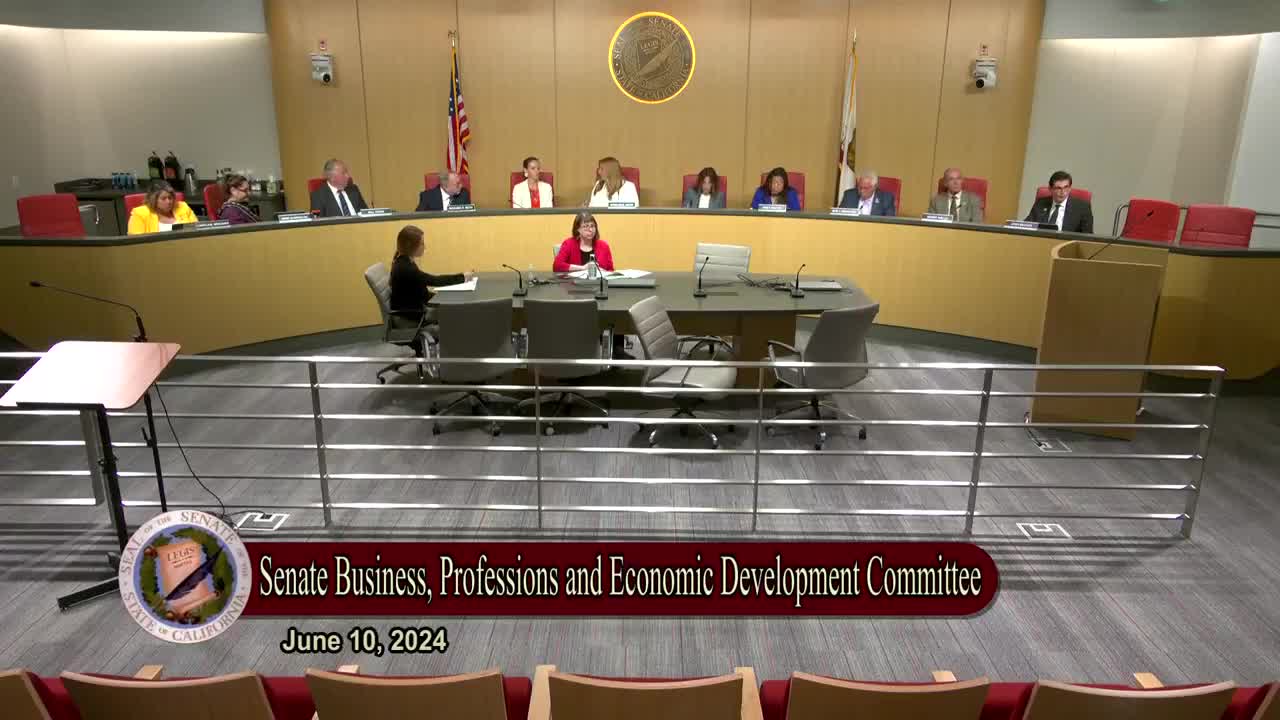 21MIN
Senate Standing Committee on Business, Professions and Economic Development
 1MIN
Assembly Floor
 2MIN
Assembly Standing Committee on Appropriations
 4MIN
Assembly Standing Committee on Privacy and Consumer Protection
Bill Author
Bill Co-Author(s):
