AB 2070: Trustees of the California State University: faculty appointees.
- Session Year: 2023-2024
- House: Assembly
- Latest Version Date: 2024-02-05
Current Status:
Failed
(2024-05-22: Ordered to inactive file at the request of Assembly Member Cervantes.)
Introduced
In Committee
First Chamber
In Committee
Second Chamber
Enacted
Existing law establishes the California State University, under the administration of the Board of Trustees of the California State University, as one of the 3 segments of public postsecondary education in the state. Existing law provides for the membership of the board of trustees to include 5 specified ex officio members, 16 appointive members appointed by the Governor and subject to confirmation by the Senate, one representative of the alumni associations, 2 student members appointed by the Governor, and a faculty member appointed by the Governor from a list of names of at least 2 persons furnished by the Academic Senate of the California State University.
This bill would require the board of trustees to include an additional faculty member appointed by the Governor. The bill would also require each faculty member appointee to be appointed from a list of names of at least 4 persons, instead of at least 2 persons, furnished by the Academic Senate of the California State University.
(a)The board shall be composed of the following five ex officio members: the Governor, the Lieutenant Governor, the Superintendent of Public Instruction, the Speaker of the Assembly, and the person named by the trustees to serve as the Chancellor of the California State University; a representative of the alumni associations of the state university, selected for a two-year term by the alumni council, California State University, which representative shall not be an employee of the California State University during the two-year term; and 16 17 appointive members appointed by the Governor and subject to confirmation by two-thirds of the membership of the Senate.
(b)(1)Two students from the California State University, who shall have at least sophomore year standing at the institutions they attend, and who remain in good standing as students during their respective terms, shall also be appointed by the Governor to serve on the board for two-year terms.
(2)In selecting students as members of the board, the Governor shall appoint the students from lists of names of at least two, but not more than five, persons furnished by the governing board of any statewide student organization that represents the students of the California State University and the student body organizations of the campuses of the California State University. Any appointment to fill a vacancy of a student member shall be effective only for the remainder of the term of the student members office that became vacated.
(3)The term of office of one student member of the board shall commence on July 1 of an even-numbered year and expire on June 30 two years thereafter. The term of office of the other student member of the board shall commence on July 1 of an odd-numbered year and expire on June 30 two years thereafter. Notwithstanding paragraph (1), a student member who graduates from the student members college or university on or after January 1 of the second year of the student members term of office may serve the remainder of the term. If the Governor has not appointed a successor pursuant to this subdivision, a student member whose term of office expires on June 30 of any year may remain in office until January 1 of the following year, or until a successor is appointed by the Governor, whichever occurs first.
(4)A student member shall have the student members tuition fee waived for the duration of the student members term of office.
(c)(1)A Two faculty member members from the California State University, who each of whom shall be tenured at the California State University campus at which the faculty member teaches, shall also be appointed by the Governor to serve on the board for a two-year term. terms. In the selection of a faculty member selecting faculty members as a member members of the board, the Governor shall appoint the each faculty member from a list of names of at least two four persons furnished by the Academic Senate of the California State University.
(2)The faculty member members of the board appointed by the Governor pursuant to this subdivision shall not participate on any subcommittee of the board responsible for collective bargaining negotiations.
(3)The two-year term terms of office of the faculty member members of the board shall commence on July 1, and, if the Governor has not appointed a successor under paragraph (1), the a faculty member may remain in office after the term expires for one additional year, or until a successor is appointed by the Governor, whichever occurs first.
REVISIONS: HeadingLine 1.|
Date
|
Status
|
|---|---|
| May 22, 2024 | Ordered to inactive file at the request of Assembly Member Cervantes. |
| Apr 18, 2024 | Read second time. Ordered to third reading. |
| Apr 17, 2024 | From committee: Do pass. (Ayes 11. Noes 3.) (April 17). |
| Apr 3, 2024 | Coauthors revised. |
| Apr 3, 2024 | From committee: Do pass and re-refer to Com. on APPR. (Ayes 9. Noes 1.) (April 2). Re-referred to Com. on APPR. |
| Feb 20, 2024 | Referred to Com. on HIGHER ED. |
| Feb 6, 2024 | From printer. May be heard in committee March 7. |
| Feb 5, 2024 | Read first time. To print. |
|
Date
|
Description
|
Location
|
Votes
|
|
|---|---|---|---|---|
| Apr 17, 2024 | Do pass. | Assembly Standing Committee on Appropriations |
Passed |
|
| Apr 2, 2024 | Do pass and be re-referred to the Committee on [Appropriations] | Assembly Standing Committee on Higher Education |
Passed |
This list shows positions taken on this bill by organizations on the date displayed, which is linked to the original source.
Positions by individuals are not included.
|
Organization
|
Position
|
Date
|
|---|---|---|
| California Faculty Association | ** Support | |
| California State University Office of the Chancellor | ** Against |
ASSEMBLY THIRD READING
ATR Bill Id:AB 2070
Author:(Cervantes and Santiago)
As Introduced Ver:February 5, 2024
Majority vote
SUMMARY
Require the board of trustees (BOT) of the California State University (CSU) to include a second faculty member appointed by the Governor. Additionally requires each faculty member appointee to be appointed from a list of names of at least four persons, instead of at least two persons, furnished by the Academic Senate of the CSU.
Major Provisions
- Increases the membership of the CSU BOT from 16 to 17 appointive members appointed by the Governor and subject to confirmation by two-thirds of the membership of the Senate.
- Specifies that two faculty members from the CSU, each of whom must be tenured at the CSU campus at which the faculty member teaches, will also be appointed by the Governor to serve on the board for two-year terms. In selecting faculty members as members of the board, the Governor must appoint each faculty member from a list of names constituting at least four persons furnished by the Academic Senate of the CSU.
- Requires that the faculty members of the BOT appointed by the Governor, as specified, are prohibited from participating on any subcommittee of the board responsible for collective bargaining negotiations.
- The two-year terms of office for the two faculty members of the board shall commence on July 1, and, if the Governor has not appointed a successor, as specified, a faculty member may remain in office after the term expires for one additional year, or until a successor is appointed by the Governor, whichever occurs first.
COMMENTS
California State University and the Board of Trustees. Originally established in 1875 as a college for teachers in San Francisco, the CSU has since expanded to include 23 campuses who enroll over 450,000 students. The CSU provides nearly half of the bachelor degrees in the state and has an alumni base of over three million students and counting. To oversee the nation's largest four year public university, the State established the BOT.
The BOT is endowed with the authority to adopt regulations and policies pertaining to the overall operations of the CSU including educational policy decisions, budgeting, and campus planning. The membership of the board is comprised of 25 members each with term limits and voting privileges, who are selected and appointed through various manners. To note - the faculty members appointed to the BOT would not participate on any subcommittee of the board responsible for collective bargaining negotiations.
According to the Author
According to the author, "Thanks to the hard work of advocates across the state and the California Faculty Association, the initiation of what would have been an historic, system-wide faculty strike at the California State University was averted earlier this year. Even the possibility of a disruption of educational services for the nearly 500,000 CSU students at the largest public university system in the United States could have been avoided had the [BOT] acted more quickly to prioritize pay equity, make workloads more manageable, and expand paid family leave policies for the hardworking and dedicated faculty members at their system. AB 2070 will help the CSU avoid future faculty strikes in the future by increasing the number of faculty representatives on the [BOT] from one to two voting members. This will help uplift and amplify faculty voices, which is necessary given their direct experience in working with students and their firsthand understanding of the educational environment at CSU."
Arguments in Support
The California Faculty Association wrote that "currently, the CSU [BOT] includes one faculty member appointed by the Governor from a list provided by the Academic Senate of the CSU. This bill proposes an essential change: increasing the number of faculty members on the board from one to two and requiring that each faculty member be appointed from a list of at least four nominees. This amendment is a significant step towards ensuring that faculty, who are at the heart of our educational endeavors, have adequate representation and a stronger voice in the governance of the CSU system.
"The involvement of faculty in the decision-making processes of the university is crucial for several reasons. Faculty members bring a unique and necessary perspective to the table, grounded in their direct interaction with students and firsthand understanding of the educational environment. Their insight is invaluable in shaping policies and decisions that affect the academic integrity, educational quality, and student success within the CSU system."
Arguments in Opposition
The CSU wrote in opposition, noting that "The CSU recognizes the value of our faculty and the central role that faculty plays across our 23 universities. Further, the CSU shares the author's goal of ensuring that faculty have an opportunity to have a voice on the CSU [BOT]. The [Board] currently has a voting member who represents faculty. The faculty trustee is nominated by the Academic Senate and appointed by the Governor. The faculty trustee sits on four influential committees: the Committee on Education Policy; the Committee on Audit; the Committee on Finance; and the Committee on Campus Planning, Buildings and Grounds. Through participation on these committees, the views of faculty are consistently elevated and provide an authentic and meaningful perspective as part of the [BOT]."
"Additionally, a recent national review of other higher education system governing boards and best practices showed that the CSU is one of the few systems that has a voting faculty member on their governing board. No bachelor's and master's granting university system board has two voting faculty members. In comparison, the University of California Board of Regents faculty representatives are non-voting positions."
"To ensure that faculty are part of each board meeting, the Academic Senate of the California State University, which is the official voice of faculty in matters of system wide concern, has a standing report at each Board of Trustees meeting. Beyond the Academic Senate's standing report, faculty also present directly to the full Board on policy matters. Faculty also routinely participate in Board of Trustee meetings via written, in-person and virtual public comment. The CSU Board of Trustees encourages and welcomes input from faculty and staff, and strongly believes that their viewpoints are consistently present and heard by the full board."
FISCAL COMMENTS
According to the Assembly Committee on Appropriations:
Minor General Fund costs to appoint another person to the CSU board of trustees.
According to CSU, the total cost for an additional trustee is between $8,000 and $10,000 per year. This amount includes travel, lodging, meals, per diem and other expenses associated with attending and participating in six in-person board meetings per year. In addition, the campus that employs the faculty member trustee may incur additional costs, to the extent the campus need to find a replacement during the faculty member's engagement with the board.
VOTES
ASM HIGHER EDUCATION: 9-1-1
YES: Mike Fong, Arambula, Boerner, Chen, Irwin, Jackson, Low, Muratsuchi, Quirk-Silva
NO: Ta
ABS, ABST OR NV: Essayli
ASM APPROPRIATIONS: 11-3-1
YES: Wicks, Arambula, Bryan, Calderon, Wendy Carrillo, Mike Fong, Grayson, Haney, Hart, Pellerin, Villapudua
NO: Sanchez, Dixon, Ta
ABS, ABST OR NV: Jim Patterson
UPDATED
VERSION: February 5, 2024
CONSULTANT: Kevin J. Powers / HIGHER ED. / (916) 319-3960 FN: 0002744
Date of Hearing: April 17, 2024
ASSEMBLY COMMITTEE ON APPROPRIATIONS
Buffy Wicks, Chair
ABPCA Bill Id:AB 2070
Author:(Cervantes) – As Introduced Ver:February 5, 2024
Policy Committee: | Higher Education | Vote: | 9 - 1 |
|
| ||
|
|
Urgency: No State Mandated Local Program: No Reimbursable: No
SUMMARY:
This bill requires the California State University (CSU) board of trustees to include an additional faculty member appointed by the Governor. The bill also requires each faculty member appointee be appointed from a list of names of at least four persons, instead of at least two persons, furnished by the Academic Senate of the CSU.
FISCAL EFFECT:
Minor General Fund costs to appoint another person to the CSU board of trustees.
According to CSU, the total cost for an additional trustee is between $8,000 and $10,000 per year. This amount includes travel, lodging, meals, per diem and other expenses associated with attending and participating in six in-person board meetings per year. In addition, the campus that employs the faculty member trustee may incur additional costs, to the extent the campus need to find a replacement during the faculty member’s engagement with the board.
COMMENTS:
- Purpose. According to the author:
AB 2070 will help the CSU avoid future faculty strikes in the future by increasing the number of faculty representatives on the board of trustees from one to two voting members. This will help uplift and amplify faculty voices, which is necessary given their direct experience in working with students and their firsthand understanding of the educational environment at CSU.
- Background. The CSU board of trustees oversees the CSU. The board of trustees holds the authority to adopt regulations and policies pertaining to the overall operations of the CSU, including educational policy decisions, budgeting, and campus planning. The board consists of 25 voting members. Of these, current law requires the board of trustees to consist of 16 appointive members appointed by the Governor and subject to confirmation by two-thirds of the membership of the state Senate. Current law requires the Governor to appoint a tenured CSU faculty member to the board to serve a two-year term. The Governor is required to appoint the faculty member from a list of names of at least two persons furnished by the Academic Senate of the CSU.
This bill requires two faculty members be appointed, thereby increasing appointive members from 16 to 17, and increases the number of names on the list from which the Governor must choose faculty members, from two to four persons.
- Support and Opposition. This bill is supported by the California Faculty Association, who argues the CSU board of trustees needs another faculty voice because additional faculty “insight is invaluable in shaping policies and decisions that affect the academic integrity, educational quality, and student success within the CSU system.”
The bill is opposed by the CSU, who argue another faculty member is not necessary, because “the CSU board of trustees encourages and welcomes input from faculty and staff, and [CSU] strongly believes that their viewpoints are consistently present and heard by the full board.”
- Related Legislation. AB 2516 (Santiago) adds a bargaining unit representative selected for a two-year term by the California State University Labor Council to the CSU board of trustees. The bill is pending in this committee.
AB 2275 (Mike Fong) specifies that the membership of the CSU board of trustees, to the greatest extent possible, be inclusive and representative of the many demographic groups found in California, among other requirements. The bill is pending in this committee.
Analysis Prepared by: Natasha Collins / APPR. / (916) 319-2081
Date of Hearing: April 2, 2024
ASSEMBLY COMMITTEE ON HIGHER EDUCATION
Mike Fong, Chair
ABPCA Bill Id:AB 2070 (
Author:Cervantes) – As Introduced Ver:February 5, 2024
SUBJECT: Trustees of the California State University: faculty appointees
SUMMARY: Require the board of trustees (BOT) of the California State University (CSU) to include a second faculty member appointed by the Governor. Additionally requires each faculty member appointee to be appointed from a list of names of at least four persons, instead of at least two persons, furnished by the Academic Senate of the CSU. Specifically, this bill:
- Increases the membership of the CSU BOT from 16 to 17 appointive members appointed by the Governor and subject to confirmation by two-thirds of the membership of the Senate.
- Specifies that two faculty members from the CSU, each of whom must be tenured at the CSU campus at which the faculty member teaches, will also be appointed by the Governor to serve on the board for two-year terms. In selecting faculty members as members of the board, the Governor must appoint each faculty member from a list of names constituting at least four persons furnished by the Academic Senate of the CSU.
- Requires that the faculty members of the BOT appointed by the Governor, as specified, are prohibited from participating on any subcommittee of the board responsible for collective bargaining negotiations.
- The two-year terms of office for the two faculty members of the board shall commence on July 1, and, if the Governor has not appointed a successor, as specified, a faculty member may remain in office after the term expires for one additional year, or until a successor is appointed by the Governor, whichever occurs first.
EXISTING LAW:
- Establishes the CSU system, comprised of 23 campuses, and bestows upon the CSU Trustees, through the BOT, the power, duties, and functions with respect to the management, administration, and control of the CSU system (Education Code (EDC) Sections 66606 and 89000 et. seq.).
- Establishes the membership of the BOT to include 25 voting members as follows:
- Five ex-officio members including the Governor, the Lieutenant Governor, the Superintendent of Public Instruction, the Speaker of the Assembly, and the person named by the trustees to serve as the Chancellor of the CSU;
- A representative of the CSU alumni associations, who is appointed to serve a two-year term by the alumni council and is not employed by the CSU while on the board;
- Sixteen members of the public, who are appointed by the Governor and confirmed by two-thirds of the California State Senate for an eight-year term;
- Two students, who are at least sophomores and attend a campus of the CSU, are appointed by the Governor from a list of two to five names provided by the California State Student Association (CSSA); and,
- One student representative is appointed for a two-year term beginning on July 1 of an even number year and ending on June 30 two years later. The second student representative is appointed to a two-year term beginning on July 1 of an odd number year and ending on June 30 two years later; and,
- Students appointed will have their tuition fee waived for the duration of their term of office on the BOT.
- One tenured faculty member from the CSU is appointed by the Governor to serve on the board for two years. The Governor selects the faculty member from a list of names provided by the systemwide Academic Senate of the CSU.
- The faculty member is not permitted to participate on any subcommittee of the BOT which is responsible for collective bargaining negotiations; and,
- The appointed faculty member will begin their two year term on July 1 and if the Governor has not appointed a successor by the end of the term, the faculty member may remain on the BOT for one additional year or until the Governor appoints a successor; whichever occurs first. (EDC Section 66602)
FISCAL EFFECT: Unknown
COMMENTS: Purpose. According to the author, “Thanks to the hard work of advocates across the state and the California Faculty Association, the initiation of what would have been an historic, system-wide faculty strike at the California State University was averted earlier this year. Even the possibility of a disruption of educational services for the nearly 500,000 CSU students at the largest public university system in the United States could have been avoided had the [BOT] acted more quickly to prioritize pay equity, make workloads more manageable, and expand paid family leave policies for the hardworking and dedicated faculty members at their system. AB 2070 will help the CSU avoid future faculty strikes in the future by increasing the number of faculty representatives on the [BOT] from one to two voting members. This will help uplift and amplify faculty voices, which is necessary given their direct experience in working with students and their firsthand understanding of the educational environment at CSU.”
California State University and the Board of Trustees. Originally established in 1875 as a college for teachers in San Francisco, the CSU has since expanded to include 23 campuses who enroll over 450,000 students. The CSU provides nearly half of the bachelor degrees in the state and has an alumni base of over three million students and counting. To oversee the nation’s largest four year public university, the State established the BOT.
The BOT is endowed with the authority to adopt regulations and policies pertaining to the overall operations of the CSU including educational policy decisions, budgeting, and campus planning. The membership of the board is comprised of 25 members each with term limits and voting privileges, who are selected and appointed through various manners.
Member | Term Limit | How the Trustee is chosen to serve: |
Five ex officio members (Governor, Lieutenant Governor, Superintendent of Public Instruction, Speaker of the Assembly, and Chancellor of the CSU) | Term of their elected or appointed office. | The Governor, Lieutenant Governor, and Superintendent of Public Instruction, are elected in a statewide election and are immediately appointed to the Board. The Speaker of the Assembly is an elected official in the California State Assembly who is selected by their peers to lead the State Assembly. The Chancellor of the CSU is appointed by the BOT after an exhaustive nationwide search and is immediately appointed as a member of the BOT. |
Two student members who attend a CSU campus and are at least in their sophomore year (or have taken at least 30 units). | Each are appointed for two-year terms that are staggered so that one student begins their term on July 1 in an odd numbered year and the other student’s term begins the following year (even numbered year) on July 1. Both students’ terms end on June 30 after two years (one in an odd numbered year and one in an even numbered year). | Appointed by the Governor from list of at least two to five students provided by CSSA. |
16 members of the public | One eight–year term | When their term expires, the Governor will appoint a member of the public to replace the outgoing member of the board and the new appointee is approved by 2/3 of the Senate. |
One tenured faculty member | One two – year term. The faculty trustee is permitted to remain on the BOT past the expiration of their term for one year if the Governor has not appointed a replacement. | Appointed by the Governor from a list of faculty provided by the systemwide CSU Academic Senate. |
An alumni of the CSU system | One two–year term. | Appointed by the Alumni Council of CSU and the appointee may not be employed by the CSU during their tenure on the board. |
Arguments in support. The California Faculty Association wrote that “currently, the CSU [BOT] includes one faculty member appointed by the Governor from a list provided by the Academic Senate of the CSU. This bill proposes an essential change: increasing the number of faculty members on the board from one to two and requiring that each faculty member be appointed from a list of at least four nominees. This amendment is a significant step towards ensuring that faculty, who are at the heart of our educational endeavors, have adequate representation and a stronger voice in the governance of the CSU system.”
“The involvement of faculty in the decision-making processes of the university is crucial for several reasons. Faculty members bring a unique and necessary perspective to the table, grounded in their direct interaction with students and firsthand understanding of the educational environment. Their insight is invaluable in shaping policies and decisions that affect the academic integrity, educational quality, and student success within the CSU system.”
Arguments in opposition. The CSU wrote in opposition, noting that “The CSU recognizes the value of our faculty and the central role that faculty plays across our 23 universities. Further, the CSU shares the author’s goal of ensuring that faculty have an opportunity to have a voice on the CSU [BOT]. The [Board] currently has a voting member who represents faculty. The faculty trustee is nominated by the Academic Senate and appointed by the Governor. The faculty trustee sits on four influential committees: the Committee on Education Policy; the Committee on Audit; the Committee on Finance; and the Committee on Campus Planning, Buildings and Grounds. Through participation on these committees, the views of faculty are consistently elevated and provide an authentic and meaningful perspective as part of the [BOT].”
“Additionally, a recent national review of other higher education system governing boards and best practices showed that the CSU is one of the few systems that has a voting faculty member on their governing board. No bachelor’s and master’s granting university system board has two voting faculty members. In comparison, the University of California Board of Regents faculty representatives are non-voting positions.”
“To ensure that faculty are part of each board meeting, the Academic Senate of the California State University, which is the official voice of faculty in matters of systemwide concern, has a standing report at each Board of Trustees meeting. Beyond the Academic Senate’s standing report, faculty also present directly to the full Board on policy matters. Faculty also routinely participate in Board of Trustee meetings via written, in-person and virtual public comment. The CSU Board of Trustees encourages and welcomes input from faculty and staff, and strongly believes that their viewpoints are consistently present and heard by the full board.”
Committee Staff notes that, consistent with current law, the faculty members appointed to the BOT would not participate on any subcommittee of the board responsible for collective bargaining negotiations.
The Committee may wish to consider the implications of a continued expansion of the BOT. AB 2516 (Santiago), also pending a hearing in this Committee, would add a bargaining unit representative selected for a 2-year term by the California State University Labor Council to the CSU BOT. With 25 appointed and ex-officio members already on the BOT, could the addition of additional positions dilute the voices of the current membership?
Related legislation. AB 2516 (Santiago) would add a bargaining unit representative selected for a 2-year term by the California State University Labor Council to the CSU BOT.
Prior legislation. AB 1625 (Medina) Chapter 103, Statutes of 2022, authorizes a student who was appointed to the CSU BOT, whose term expires on June 30, to remain as a member of the BOT until either January 1 of the following year or until the Governor has appointed the student’s replacement; whichever occurs first.
AB 1062 (Levine) Chapter 524, Statutes of 2018, originally increased faculty representation and the voting rights of the student members of the BOT. The bill was amended, removing the content and instead expanded existing reporting requirements for the BOT related to key performance data on online courses.
AB 2386 (Williams, 2016), vetoed, would have revised the membership of the BOT by requiring the Governor to appoint a permanent non-faculty CSU employee for a two-year term.
SB 325 (Block) Chapter 175, Statutes of 2013, waived the tuition fee for student members of the BOT for the duration of their term and permitted sophomores to be appointed as student members of the BOT.
AB 213 (Romero), Chapter 251, Statues of 1999, increased the size of the BOT from 24 members to 25 by establishing an additional student representative to the board.
AB 514 (Medina), Chapter 61, Statutes of 2019, allows all student members of the BOT to vote throughout the duration of their term on the BOT.
AB 1062 (Levine) Chapter 524, Statutes of 2018, originally increased faculty representation and the voting rights of the student members of the BOT. The bill was amended, removing the content and instead expanded existing reporting requirements for the BOT related to key performance data on online courses.
AB 2386 (Williams, 2016), vetoed, would have revised the membership of the BOT by requiring the Governor to appoint a permanent non-faculty CSU employee for a two-year term.
SB 325 (Block) Chapter 175, Statutes of 2013, waived the tuition fee for student members of the BOT for the duration of their term and permitted sophomores to be appointed as student members of the BOT.
SB 1515 (Yee, 2012) would have changed the CSU BOT composition, increasing the number of faculty, students and represented staff. This measure was held in the Senate Appropriations Committee.
AB 2849 (Lowenthal, 2004) would have added one non-faculty member of CSU. This bill was vetoed by Governor Schwarzenegger. The veto read, “I find no compelling reason for increasing the membership of the CSU BOT specifically to appoint a non-faculty union employee. Under current law, the Governor is authorized to appoint 16 at-large members to the Board, one of whom may be a non-faculty employee. Therefore, the bill is unnecessary.”
SB 644 (Burton, Chapter 860, Statutes of 2003) designated one of the 13 gubernatorial appointments to the California Community Colleges (CCC) Board of Trustees (BOG) as a classified employee, with the appointment made from a list of at least three persons furnished by the exclusive representatives of classified employees of the CCC.
AB 307 (Pavley, 2001) would have added one non-faculty member to the CSU Trustees. This bill was ultimately amended to a different subject matter.
SB 1604 (O'Connell, 2000) would have added one non-faculty member to the CSU Trustees. This bill was held at the Senate Desk.
AB 213 (Romero), Chapter 251, Statues of 1999, increased the size of the BOT from 24 members to 25 by establishing an additional student representative to the board.
REGISTERED SUPPORT / OPPOSITION:
Support
California Faculty Association
Opposition
California State University Office of the Chancellor
Analysis Prepared by: Kevin J. Powers / HIGHER ED. / (916) 319-3960
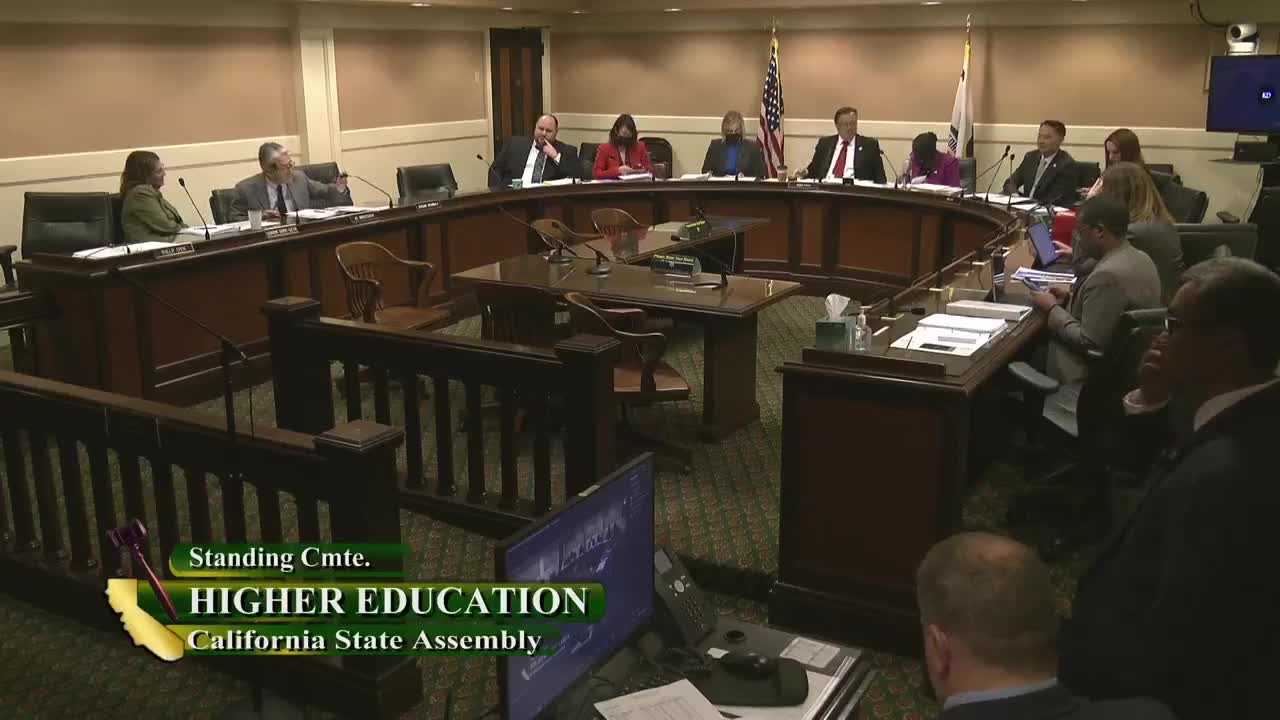
Discussed in Hearing
 13MIN
Assembly Standing Committee on Higher Education


Bill Co-Author(s):