AB 2251: Graduation requirements: local requirements: exemptions.
- Session Year: 2023-2024
- House: Assembly
- Latest Version Date: 2024-09-25
Current Status:
Passed
(2024-09-25: Chaptered by Secretary of State - Chapter 560, Statutes of 2024.)
Introduced
In Committee
First Chamber
In Committee
Second Chamber
Enacted
Existing law requires a pupil to complete designated coursework while in grades 9 to 12, inclusive, in order to receive a diploma of graduation from high school. These graduation requirements include, among others, the completion of 3 years of courses in English, 2 years of courses in mathematics, 2 years of courses in science, and 3 years of courses in social studies, as specified. Existing law authorizes the governing board of a school district to also adopt its own additional coursework requirements.
This bill would clarify that the governing board of a school district is expressly authorized, at its discretion, to adopt a policy to exempt pupils from its additional coursework requirements, as provided.
Existing law requires a pupil to complete designated coursework while in grades 9 to 12, inclusive, in order to receive a diploma of graduation from high school. These graduation requirements include, among others, the completion of 3 years of courses in English, 2 years of courses in mathematics, 2 years of courses in science, and 3 years of courses in social studies, as specified. Existing law authorizes the governing board of a school district to also adopt its own additional coursework requirements.
This bill would clarify that the governing board of a school district, in district is expressly authorized, at its discretion, is expressly authorized to adopt a policy to exempt pupils from its additional coursework requirements, as provided.
Existing law requires a pupil to complete designated coursework while in grades 9 to 12, inclusive, in order to receive a diploma of graduation from high school. These graduation requirements include, among others, the completion of 3 years of courses in English, 2 years of courses in mathematics, 2 years of courses in science, and 3 years of courses in social studies, as specified. Existing law authorizes the governing board of a school district to also adopt its own additional coursework requirements.
This bill would clarify that the governing board of a school district, in its discretion, is expressly authorized to exempt pupils from its additional coursework requirements, as provided.
(a)A pupil shall complete all of the following while in grades 9 to 12, inclusive, in order to receive a diploma of graduation from high school:
(1)At least the following numbers of courses in the subjects specified, each course having a duration of one year, unless otherwise specified:
(A)Three courses in English.
(B)Two courses in mathematics. If the governing board of a school district requires more than two courses in mathematics for graduation, the governing board of the school district may award a pupil up to one mathematics course credit pursuant to Section 51225.35.
(C)Two courses in science, including biological and physical sciences.
(D)Three courses in social studies, including United States history and geography; world history, culture, and geography; a one-semester course in American government and civics; and a one-semester course in economics.
(E)One course in visual or performing arts, world language, or, commencing with the 201213 school year, career technical education.
(i)For purposes of satisfying the requirement specified in this subparagraph, a course in American Sign Language shall be deemed a course in world language.
(ii)For purposes of this subparagraph, a course in career technical education means a course in a district-operated career technical education program that is aligned to the career technical model curriculum standards and framework adopted by the state board, including courses through a regional occupational center or program operated by a county superintendent of schools or pursuant to a joint powers agreement.
(iii)This subparagraph does not require a school or school district that currently does not offer career technical education courses to start new career technical education programs for purposes of this section.
(iv)If a school district or county office of education elects to allow a career technical education course to satisfy the requirement imposed by this subparagraph, the governing board of the school district or county office of education, before offering that alternative to pupils, shall notify parents, teachers, pupils, and the public at a regularly scheduled meeting of the governing board of all of the following:
(I)The intent to offer career technical education courses to fulfill the graduation requirement specified in this subparagraph.
(II)The impact that offering career technical education courses, pursuant to this subparagraph, will have on the availability of courses that meet the eligibility requirements for admission to the California State University and the University of California, and whether the career technical education courses to be offered pursuant to this subparagraph are approved to satisfy those eligibility requirements. If a school district elects to allow a career technical education course to satisfy the requirement imposed by this subparagraph, the school district shall comply with subdivision (l) of Section 48980.
(III)The distinction, if any, between the high school graduation requirements of the school district or county office of education, and the eligibility requirements for admission to the California State University and the University of California.
(F)Two courses in physical education, unless the pupil has been exempted pursuant to this code.
(G)(i)Commencing with pupils graduating in the 202930 school year, including for pupils enrolled in a charter school, a one-semester course in ethnic studies. A local educational agency, including a charter school, may require a full-year course in ethnic studies at its discretion. Commencing with the 202526 school year, a local educational agency, including a charter school, with pupils in grades 9 to 12, inclusive, shall offer at least a one-semester course in ethnic studies.
(ii)Subject to the course offerings of a local educational agency, including a charter school, a pupil may fulfill the requirement of clause (i) through the completion of any of the following types of courses:
(I)A course based on the model curriculum developed pursuant to Section 51226.7.
(II)An existing ethnic studies course.
(III)An ethnic studies course taught as part of a course that has been approved as meeting the AG requirements of the University of California and the California State University.
(IV)A locally developed ethnic studies course approved by the governing board of the school district or the governing body of the charter school. The proposed course shall first be presented at a public meeting of the governing board of the school district or the governing body of the charter school, and shall not be approved until a subsequent public meeting of the governing board or governing body at which the public has had the opportunity to express its views on the proposed course.
(iii)A course that does not use ethnic studies content as the primary content through which the subject is taught shall not be used to satisfy the requirement of clause (i).
(iv)A pupil completing a course described in clause (ii) shall also accrue credit for coursework in the subject that the course is offered, including, if applicable, credit towards satisfying a course required for a diploma of graduation from high school pursuant to this section.
(v)Curriculum, instruction, and instructional materials for a course described in clause (ii) shall meet all of the following requirements:
(I)Be appropriate for use with pupils of all races, religions, nationalities, genders, sexual orientations, and diverse ethnic and cultural backgrounds, pupils with disabilities, and English learners.
(II)Not reflect or promote, directly or indirectly, any bias, bigotry, or discrimination against any person or group of persons on the basis of any category protected by Section 220.
(III)Not teach or promote religious doctrine.
(vi)It is the intent of the Legislature that local educational agencies, including charter schools, consider that, pursuant to Section 51226.7, the Instructional Quality Commission undertook a lengthy, thorough, deliberative, and inclusive process before submitting a model curriculum in ethnic studies to the state board. To the extent that local educational agencies, including charter schools, choose to locally develop an ethnic studies program for approval by their governing board or governing body, it is the intent of the Legislature that local educational agencies not use the portions of the draft model curriculum that were not adopted by the Instructional Quality Commission due to concerns related to bias, bigotry, and discrimination.
(vii)The amendments made to this section by Section 1 of Chapter 661 of the Statutes of 2021 shall not be construed to alter any other requirement of this section for pupils enrolled in a charter school.
(H)(i)Commencing with pupils graduating in the 203031 school year, including for pupils enrolled in a charter school, a separate, stand-alone one-semester course in personal finance, that shall not be combined with any other course.
(ii)Commencing with pupils graduating in the 203031 school year, a pupil who completes a separate, stand-alone one-semester course in personal finance, that is not combined with any other course, may elect to be exempt from the requirement to complete a one-semester course in economics pursuant to subparagraph (D).
(iii)(I)A local educational agency may elect to eliminate one or more locally required courses established pursuant to paragraph (2) in order to accommodate the requirement that pupils, commencing with pupils graduating in the 203031 school year, complete a separate, stand-alone one-semester course in personal finance.
(II)This clause does not constitute a change in, but is declaratory of, existing law.
(iv)Commencing with the 202728 school year, a local educational agency, including a charter school, with pupils in grades 9 to 12, inclusive, shall offer in all of its high schools at least a separate, stand-alone one-semester course in personal finance, that is not combined with any other course.
(v)To satisfy the requirement of this subparagraph, a separate, stand-alone one-semester course in personal finance shall include information for pupils in grades 9 to 12, inclusive, on all of, and only, the topics listed in paragraphs (1) to (13), inclusive, of subdivision (a) of Section 51284.5.
(2)(A)Other coursework requirements adopted by the governing board of the school district.
(B)The governing board of a school district may, at its discretion, adopt a policy to exempt pupils from any coursework requirements adopted pursuant to subparagraph (A). It is the intent of the Legislature that the policy include a consultation with the pupil and the educational rights holder for the pupil regarding any impact of not fulfilling locally required coursework on the pupils ability to gain admission to an institution of higher education.
(C)This paragraph does not affect a pupils rights pursuant to Section 51225.1 or 51225.31.
(b)The governing board, with the active involvement of parents, administrators, teachers, and pupils, shall adopt alternative means for pupils to complete the prescribed course of study that may include practical demonstration of skills and competencies, supervised work experience or other outside school experience, career technical education classes offered in high schools, courses offered by regional occupational centers or programs, interdisciplinary study, independent study, and credit earned at a postsecondary educational institution. Requirements for graduation and specified alternative modes for completing the prescribed course of study shall be made available to pupils, parents, and the public.
(c)On or before July 1, 2017, the department shall submit a comprehensive report to the appropriate policy committees of the Legislature on the addition of career technical education courses to satisfy the requirement specified in subparagraph (E) of paragraph (1) of subdivision (a), including, but not limited to, the following information:
(1)A comparison of the pupil enrollment in career technical education courses, world language courses, and visual and performing arts courses for the 200506 to 201112 school years, inclusive, to the pupil enrollment in career technical education courses, world language courses, and visual and performing arts courses for the 201213 to 201617 school years, inclusive.
(2)The reasons, reported by school districts, that pupils give for choosing to enroll in a career technical education course to satisfy the requirement specified in subparagraph (E) of paragraph (1) of subdivision (a).
(3)The type and number of career technical education courses that were conducted for the 200506 to 201112 school years, inclusive, compared to the type and number of career technical education courses that were conducted for the 201213 to 201617 school years, inclusive.
(4)The number of career technical education courses that satisfied the subject matter requirements for admission to the University of California or the California State University.
(5)The extent to which the career technical education courses chosen by pupils are aligned with the California Career Technical Education Model Curriculum Standards, and prepare pupils for employment, advanced training, and postsecondary education.
(6)The number of career technical education courses that also satisfy the visual and performing arts requirement, and the number of career technical education courses that also satisfy the world language requirement.
(7)Annual pupil dropout and graduation rates for the 201112 to 201415 school years, inclusive.
(d)For purposes of completing the report described in subdivision (c), the Superintendent may use existing state resources and federal funds. If state or federal funds are not available or sufficient, the Superintendent may apply for and accept grants, and receive donations and other financial support from public or private sources for purposes of this section.
(e)For purposes of completing the report described in subdivision (c), the Superintendent may accept support, including, but not limited to, financial and technical support, from high school reform advocates, teachers, chamber organizations, industry representatives, research centers, parents, and pupils.
(f)The amendments made to this section by Section 1 of Chapter 661 of the Statutes of 2021 shall become operative only upon an appropriation of funds by the Legislature for purposes of these amendments in the annual Budget Act or another statute.
(g)This section shall become inoperative on the earlier of the following two dates:
(1)On July 1, immediately following the first fiscal year after the enactment of Chapter 621 of the Statutes of 2011 in which the number of career technical education courses that, as determined by the department, satisfy the world language requirement for admission to the California State University and the University of California is at least twice the number of career technical education courses that meet these admission requirements as of January 1, 2012. This section shall be repealed on the following January 1, unless a later enacted statute, that becomes operative on or before that date, deletes or extends the dates on which it becomes inoperative and is repealed. It is the intent of the Legislature that new career technical education courses that satisfy the world language requirement for admission to the California State University and the University of California focus on world languages aligned with career preparation, emphasizing real-world application and technical content in related career and technical education courses.
(2)On July 1, 2027, and, as of January 1, 2028, is repealed.
SEC. 2.Section 51225.3 of the Education Code, as amended by Section 3 of Chapter 37 of the Statutes of 2024, is amended to read:51225.3.(a)A pupil shall complete all of the following while in grades 9 to 12, inclusive, in order to receive a diploma of graduation from high school:
(1)At least the following numbers of courses in the subjects specified, each course having a duration of one year, unless otherwise specified:
(A)Three courses in English.
(B)Two courses in mathematics. If the governing board of a school district requires more than two courses in mathematics for graduation, the governing board of the school district may award a pupil up to one mathematics course credit pursuant to Section 51225.35.
(C)Two courses in science, including biological and physical sciences.
(D)Three courses in social studies, including United States history and geography; world history, culture, and geography; a one-semester course in American government and civics; and a one-semester course in economics.
(E)One course in visual or performing arts or world language. For purposes of satisfying the requirement specified in this subparagraph, a course in American Sign Language shall be deemed a course in world language.
(F)Two courses in physical education, unless the pupil has been exempted pursuant to this code.
(G)(i)Commencing with pupils graduating in the 202930 school year, including for pupils enrolled in a charter school, a one-semester course in ethnic studies. A local educational agency, including a charter school, may require a full-year course in ethnic studies at its discretion. Commencing with the 202526 school year, a local educational agency, including a charter school, with pupils in grades 9 to 12, inclusive, shall offer at least a one-semester course in ethnic studies.
(ii)Subject to the course offerings of a local educational agency, including a charter school, a pupil may fulfill the requirement of clause (i) through the completion of any of the following types of courses:
(I)A course based on the model curriculum developed pursuant to Section 51226.7.
(II)An existing ethnic studies course.
(III)An ethnic studies course taught as part of a course that has been approved as meeting the AG requirements of the University of California and the California State University.
(IV)A locally developed ethnic studies course approved by the governing board of the school district or the governing body of the charter school. The proposed course shall first be presented at a public meeting of the governing board of the school district or the governing body of the charter school, and shall not be approved until a subsequent public meeting of the governing board or governing body at which the public has had the opportunity to express its views on the proposed course.
(iii)A course that does not use ethnic studies content as the primary content through which the subject is taught shall not be used to satisfy the requirement of clause (i).
(iv)A pupil completing a course described in clause (ii) shall also accrue credit for coursework in the subject that the course is offered, including, if applicable, credit towards satisfying a course required for a diploma of graduation from high school pursuant to this section.
(v)Curriculum, instruction, and instructional materials for a course described in clause (ii) shall meet all of the following requirements:
(I)Be appropriate for use with pupils of all races, religions, nationalities, genders, sexual orientations, and diverse ethnic and cultural backgrounds, pupils with disabilities, and English learners.
(II)Not reflect or promote, directly or indirectly, any bias, bigotry, or discrimination against any person or group of persons on the basis of any category protected by Section 220.
(III)Not teach or promote religious doctrine.
(vi)It is the intent of the Legislature that local educational agencies, including charter schools, consider that, pursuant to Section 51226.7, the Instructional Quality Commission undertook a lengthy, thorough, deliberative, and inclusive process before submitting a model curriculum in ethnic studies to the state board. To the extent that local educational agencies, including charter schools, choose to locally develop an ethnic studies program for approval by their governing board or governing body, it is the intent of the Legislature that local educational agencies not use the portions of the draft model curriculum that were not adopted by the Instructional Quality Commission due to concerns related to bias, bigotry, and discrimination.
(vii)The amendments made to this section by Section 2 of Chapter 661 of the Statutes of 2021 shall not be construed to alter any other requirement of this section for pupils enrolled in a charter school.
(H)(i)Commencing with pupils graduating in the 203031 school year, including for pupils enrolled in a charter school, a separate, stand-alone one-semester course in personal finance, that shall not be combined with any other course.
(ii)Commencing with pupils graduating in the 203031 school year, a pupil who completes a separate, stand-alone one-semester course in personal finance, that is not combined with any other course, may elect to be exempt from the requirement to complete a one-semester course in economics pursuant to subparagraph (D).
(iii)(I)A local educational agency may elect to eliminate one or more locally required courses established pursuant to paragraph (2) in order to accommodate the requirement that pupils, commencing with pupils graduating in the 203031 school year, complete a separate, stand-alone one-semester course in personal finance.
(II)This clause does not constitute a change in, but is declaratory of, existing law.
(iv)Commencing with the 202728 school year, a local educational agency, including a charter school, with pupils in grades 9 to 12, inclusive, shall offer in all of its high schools at least a separate, stand-alone one-semester course in personal finance, that is not combined with any other course.
(v)To satisfy the requirement of this subparagraph, a separate, stand-alone one-semester course in personal finance shall include information for pupils in grades 9 to 12, inclusive, on all of, and only, the topics listed in paragraphs (1) to (13), inclusive, of subdivision (a) of Section 51284.5.
(2)(A)Other coursework requirements adopted by the governing board of the school district.
(B)The governing board of a school district may, at its discretion, adopt a policy to exempt pupils from any coursework requirements adopted pursuant to subparagraph (A). It is the intent of the Legislature that the policy include a consultation with the pupil and the educational rights holder for the pupil regarding any impact of not fulfilling locally required coursework on the pupils ability to gain admission to an institution of higher education.
(C)This paragraph does not affect a pupils rights pursuant to Section 51225.1 or 51225.31.
(b)The governing board, with the active involvement of parents, administrators, teachers, and pupils, shall adopt alternative means for pupils to complete the prescribed course of study that may include practical demonstration of skills and competencies, supervised work experience or other outside school experience, career technical education classes offered in high schools, courses offered by regional occupational centers or programs, interdisciplinary study, independent study, and credit earned at a postsecondary educational institution. Requirements for graduation and specified alternative modes for completing the prescribed course of study shall be made available to pupils, parents, and the public.
(c)If a pupil completed a career technical education course that met the requirements of subparagraph (E) of paragraph (1) of subdivision (a) of Section 51225.3, as amended by Section 3 of Chapter 621 of the Statutes of 2011, before the inoperative date of that section, that course shall be deemed to fulfill the requirements of subparagraph (E) of paragraph (1) of subdivision (a) of this section.
(d)The amendments made to this section by Section 2 of Chapter 661 of the Statutes of 2021 shall become operative only upon an appropriation of funds by the Legislature for purposes of these amendments in the annual Budget Act or another statute.
(e)This section shall become operative upon the date that Section 51225.3, as amended by Section 35 of Chapter 571 of the Statutes of 2022, becomes inoperative.
SEC. 3.The amendment of Section 51225.3 of the Education Code by Sections 1 and 2 of this act does not constitute a change in, but is declaratory of, existing law.
(a)A pupil shall complete all of the following while in grades 9 to 12, inclusive, in order to receive a diploma of graduation from high school:
(1)At least the following numbers of courses in the subjects specified, each course having a duration of one year, unless otherwise specified:
(A)Three courses in English.
(B)Two courses in mathematics. If the governing board of a school district requires more than two courses in mathematics for graduation, the governing board of the school district may award a pupil up to one mathematics course credit pursuant to Section 51225.35.
(C)Two courses in science, including biological and physical sciences.
(D)Three courses in social studies, including United States history and geography; world history, culture, and geography; a one-semester course in American government and civics; and a one-semester course in economics.
(E)One course in visual or performing arts, world language, or, commencing with the 201213 school year, career technical education.
(i)For purposes of satisfying the requirement specified in this subparagraph, a course in American Sign Language shall be deemed a course in world language.
(ii)For purposes of this subparagraph, a course in career technical education means a course in a district-operated career technical education program that is aligned to the career technical model curriculum standards and framework adopted by the state board, including courses through a regional occupational center or program operated by a county superintendent of schools or pursuant to a joint powers agreement.
(iii)This subparagraph does not require a school or school district that currently does not offer career technical education courses to start new career technical education programs for purposes of this section.
(iv)If a school district or county office of education elects to allow a career technical education course to satisfy the requirement imposed by this subparagraph, the governing board of the school district or county office of education, before offering that alternative to pupils, shall notify parents, teachers, pupils, and the public at a regularly scheduled meeting of the governing board of all of the following:
(I)The intent to offer career technical education courses to fulfill the graduation requirement specified in this subparagraph.
(II)The impact that offering career technical education courses, pursuant to this subparagraph, will have on the availability of courses that meet the eligibility requirements for admission to the California State University and the University of California, and whether the career technical education courses to be offered pursuant to this subparagraph are approved to satisfy those eligibility requirements. If a school district elects to allow a career technical education course to satisfy the requirement imposed by this subparagraph, the school district shall comply with subdivision (l) of Section 48980.
(III)The distinction, if any, between the high school graduation requirements of the school district or county office of education, and the eligibility requirements for admission to the California State University and the University of California.
(F)Two courses in physical education, unless the pupil has been exempted pursuant to this code.
(G)(i)Commencing with pupils graduating in the 202930 school year, including for pupils enrolled in a charter school, a one-semester course in ethnic studies. A local educational agency, including a charter school, may require a full-year course in ethnic studies at its discretion. Commencing with the 202526 school year, a local educational agency, including a charter school, with pupils in grades 9 to 12, inclusive, shall offer at least a one-semester course in ethnic studies.
(ii)Subject to the course offerings of a local educational agency, including a charter school, a pupil may fulfill the requirement of clause (i) through the completion of any of the following types of courses:
(I)A course based on the model curriculum developed pursuant to Section 51226.7.
(II)An existing ethnic studies course.
(III)An ethnic studies course taught as part of a course that has been approved as meeting the AG requirements of the University of California and the California State University.
(IV)A locally developed ethnic studies course approved by the governing board of the school district or the governing body of the charter school. The proposed course shall first be presented at a public meeting of the governing board of the school district or the governing body of the charter school, and shall not be approved until a subsequent public meeting of the governing board or governing body at which the public has had the opportunity to express its views on the proposed course.
(iii)A course that does not use ethnic studies content as the primary content through which the subject is taught shall not be used to satisfy the requirement of clause (i).
(iv)A pupil completing a course described in clause (ii) shall also accrue credit for coursework in the subject that the course is offered, including, if applicable, credit towards satisfying a course required for a diploma of graduation from high school pursuant to this section.
(v)Curriculum, instruction, and instructional materials for a course described in clause (ii) shall meet all of the following requirements:
(I)Be appropriate for use with pupils of all races, religions, nationalities, genders, sexual orientations, and diverse ethnic and cultural backgrounds, pupils with disabilities, and English learners.
(II)Not reflect or promote, directly or indirectly, any bias, bigotry, or discrimination against any person or group of persons on the basis of any category protected by Section 220.
(III)Not teach or promote religious doctrine.
(vi)It is the intent of the Legislature that local educational agencies, including charter schools, consider that, pursuant to Section 51226.7, the Instructional Quality Commission undertook a lengthy, thorough, deliberative, and inclusive process before submitting a model curriculum in ethnic studies to the state board. To the extent that local educational agencies, including charter schools, choose to locally develop an ethnic studies program for approval by their governing board or governing body, it is the intent of the Legislature that local educational agencies not use the portions of the draft model curriculum that were not adopted by the Instructional Quality Commission due to concerns related to bias, bigotry, and discrimination.
(vii)The amendments made to this section by Section 1 of Chapter 661 of the Statutes of 2021 shall not be construed to alter any other requirement of this section for pupils enrolled in a charter school.
(H)(i)Commencing with pupils graduating in the 203031 school year, including for pupils enrolled in a charter school, a separate, stand-alone one-semester course in personal finance, that shall not be combined with any other course.
(ii)Commencing with pupils graduating in the 203031 school year, a pupil who completes a separate, stand-alone one-semester course in personal finance, that is not combined with any other course, may elect to be exempt from the requirement to complete a one-semester course in economics pursuant to subparagraph (D).
(iii)(I)A local educational agency may elect to eliminate one or more locally required courses established pursuant to paragraph (2) in order to accommodate the requirement that pupils, commencing with pupils graduating in the 203031 school year, complete a separate, stand-alone one-semester course in personal finance.
(II)This clause does not constitute a change in, but is declaratory of, existing law.
(iv)Commencing with the 202728 school year, a local educational agency, including a charter school, with pupils in grades 9 to 12, inclusive, shall offer in all of its high schools at least a separate, stand-alone one-semester course in personal finance, that is not combined with any other course.
(v)To satisfy the requirement of this subparagraph, a separate, stand-alone one-semester course in personal finance shall include information for pupils in grades 9 to 12, inclusive, on all of, and only, the topics listed in paragraphs (1) to (13), inclusive, of subdivision (a) of Section 51284.5.
(2)(A)Other coursework requirements adopted by the governing board of the school district.
(B)The governing board of a school district may, at its discretion, adopt a policy to exempt pupils from any coursework requirements adopted pursuant to subparagraph (A). It is the intent of the Legislature that the policy include a consultation with the pupil and the educational rights holder for the pupil regarding any impact of not fulfilling locally required coursework on the pupils ability to gain admission to an institution of higher education.
(C)This paragraph does not affect a pupils rights pursuant to Section 51225.1 or 51225.31.
(b)The governing board, with the active involvement of parents, administrators, teachers, and pupils, shall adopt alternative means for pupils to complete the prescribed course of study that may include practical demonstration of skills and competencies, supervised work experience or other outside school experience, career technical education classes offered in high schools, courses offered by regional occupational centers or programs, interdisciplinary study, independent study, and credit earned at a postsecondary educational institution. Requirements for graduation and specified alternative modes for completing the prescribed course of study shall be made available to pupils, parents, and the public.
(c)On or before July 1, 2017, the department shall submit a comprehensive report to the appropriate policy committees of the Legislature on the addition of career technical education courses to satisfy the requirement specified in subparagraph (E) of paragraph (1) of subdivision (a), including, but not limited to, the following information:
(1)A comparison of the pupil enrollment in career technical education courses, world language courses, and visual and performing arts courses for the 200506 to 201112 school years, inclusive, to the pupil enrollment in career technical education courses, world language courses, and visual and performing arts courses for the 201213 to 201617 school years, inclusive.
(2)The reasons, reported by school districts, that pupils give for choosing to enroll in a career technical education course to satisfy the requirement specified in subparagraph (E) of paragraph (1) of subdivision (a).
(3)The type and number of career technical education courses that were conducted for the 200506 to 201112 school years, inclusive, compared to the type and number of career technical education courses that were conducted for the 201213 to 201617 school years, inclusive.
(4)The number of career technical education courses that satisfied the subject matter requirements for admission to the University of California or the California State University.
(5)The extent to which the career technical education courses chosen by pupils are aligned with the California Career Technical Education Model Curriculum Standards, and prepare pupils for employment, advanced training, and postsecondary education.
(6)The number of career technical education courses that also satisfy the visual and performing arts requirement, and the number of career technical education courses that also satisfy the world language requirement.
(7)Annual pupil dropout and graduation rates for the 201112 to 201415 school years, inclusive.
(d)For purposes of completing the report described in subdivision (c), the Superintendent may use existing state resources and federal funds. If state or federal funds are not available or sufficient, the Superintendent may apply for and accept grants, and receive donations and other financial support from public or private sources for purposes of this section.
(e)For purposes of completing the report described in subdivision (c), the Superintendent may accept support, including, but not limited to, financial and technical support, from high school reform advocates, teachers, chamber organizations, industry representatives, research centers, parents, and pupils.
(f)The amendments made to this section by Section 1 of Chapter 661 of the Statutes of 2021 shall become operative only upon an appropriation of funds by the Legislature for purposes of these amendments in the annual Budget Act or another statute.
(g)This section shall become inoperative on the earlier of the following two dates:
(1)On July 1, immediately following the first fiscal year after the enactment of Chapter 621 of the Statutes of 2011 in which the number of career technical education courses that, as determined by the department, satisfy the world language requirement for admission to the California State University and the University of California is at least twice the number of career technical education courses that meet these admission requirements as of January 1, 2012. This section shall be repealed on the following January 1, unless a later enacted statute, that becomes operative on or before that date, deletes or extends the dates on which it becomes inoperative and is repealed. It is the intent of the Legislature that new career technical education courses that satisfy the world language requirement for admission to the California State University and the University of California focus on world languages aligned with career preparation, emphasizing real-world application and technical content in related career and technical education courses.
(2)On July 1, 2027, and, as of January 1, 2028, is repealed.
SEC. 2.Section 51225.3 of the Education Code, as amended by Section 3 of Chapter 37 of the Statutes of 2024, is amended to read:51225.3.(a)A pupil shall complete all of the following while in grades 9 to 12, inclusive, in order to receive a diploma of graduation from high school:
(1)At least the following numbers of courses in the subjects specified, each course having a duration of one year, unless otherwise specified:
(A)Three courses in English.
(B)Two courses in mathematics. If the governing board of a school district requires more than two courses in mathematics for graduation, the governing board of the school district may award a pupil up to one mathematics course credit pursuant to Section 51225.35.
(C)Two courses in science, including biological and physical sciences.
(D)Three courses in social studies, including United States history and geography; world history, culture, and geography; a one-semester course in American government and civics; and a one-semester course in economics.
(E)One course in visual or performing arts or world language. For purposes of satisfying the requirement specified in this subparagraph, a course in American Sign Language shall be deemed a course in world language.
(F)Two courses in physical education, unless the pupil has been exempted pursuant to this code.
(G)(i)Commencing with pupils graduating in the 202930 school year, including for pupils enrolled in a charter school, a one-semester course in ethnic studies. A local educational agency, including a charter school, may require a full-year course in ethnic studies at its discretion. Commencing with the 202526 school year, a local educational agency, including a charter school, with pupils in grades 9 to 12, inclusive, shall offer at least a one-semester course in ethnic studies.
(ii)Subject to the course offerings of a local educational agency, including a charter school, a pupil may fulfill the requirement of clause (i) through the completion of any of the following types of courses:
(I)A course based on the model curriculum developed pursuant to Section 51226.7.
(II)An existing ethnic studies course.
(III)An ethnic studies course taught as part of a course that has been approved as meeting the AG requirements of the University of California and the California State University.
(IV)A locally developed ethnic studies course approved by the governing board of the school district or the governing body of the charter school. The proposed course shall first be presented at a public meeting of the governing board of the school district or the governing body of the charter school, and shall not be approved until a subsequent public meeting of the governing board or governing body at which the public has had the opportunity to express its views on the proposed course.
(iii)A course that does not use ethnic studies content as the primary content through which the subject is taught shall not be used to satisfy the requirement of clause (i).
(iv)A pupil completing a course described in clause (ii) shall also accrue credit for coursework in the subject that the course is offered, including, if applicable, credit towards satisfying a course required for a diploma of graduation from high school pursuant to this section.
(v)Curriculum, instruction, and instructional materials for a course described in clause (ii) shall meet all of the following requirements:
(I)Be appropriate for use with pupils of all races, religions, nationalities, genders, sexual orientations, and diverse ethnic and cultural backgrounds, pupils with disabilities, and English learners.
(II)Not reflect or promote, directly or indirectly, any bias, bigotry, or discrimination against any person or group of persons on the basis of any category protected by Section 220.
(III)Not teach or promote religious doctrine.
(vi)It is the intent of the Legislature that local educational agencies, including charter schools, consider that, pursuant to Section 51226.7, the Instructional Quality Commission undertook a lengthy, thorough, deliberative, and inclusive process before submitting a model curriculum in ethnic studies to the state board. To the extent that local educational agencies, including charter schools, choose to locally develop an ethnic studies program for approval by their governing board or governing body, it is the intent of the Legislature that local educational agencies not use the portions of the draft model curriculum that were not adopted by the Instructional Quality Commission due to concerns related to bias, bigotry, and discrimination.
(vii)The amendments made to this section by Section 2 of Chapter 661 of the Statutes of 2021 shall not be construed to alter any other requirement of this section for pupils enrolled in a charter school.
(H)(i)Commencing with pupils graduating in the 203031 school year, including for pupils enrolled in a charter school, a separate, stand-alone one-semester course in personal finance, that shall not be combined with any other course.
(ii)Commencing with pupils graduating in the 203031 school year, a pupil who completes a separate, stand-alone one-semester course in personal finance, that is not combined with any other course, may elect to be exempt from the requirement to complete a one-semester course in economics pursuant to subparagraph (D).
(iii)(I)A local educational agency may elect to eliminate one or more locally required courses established pursuant to paragraph (2) in order to accommodate the requirement that pupils, commencing with pupils graduating in the 203031 school year, complete a separate, stand-alone one-semester course in personal finance.
(II)This clause does not constitute a change in, but is declaratory of, existing law.
(iv)Commencing with the 202728 school year, a local educational agency, including a charter school, with pupils in grades 9 to 12, inclusive, shall offer in all of its high schools at least a separate, stand-alone one-semester course in personal finance, that is not combined with any other course.
(v)To satisfy the requirement of this subparagraph, a separate, stand-alone one-semester course in personal finance shall include information for pupils in grades 9 to 12, inclusive, on all of, and only, the topics listed in paragraphs (1) to (13), inclusive, of subdivision (a) of Section 51284.5.
(2)(A)Other coursework requirements adopted by the governing board of the school district.
(B)The governing board of a school district may, at its discretion, adopt a policy to exempt pupils from any coursework requirements adopted pursuant to subparagraph (A). It is the intent of the Legislature that the policy include a consultation with the pupil and the educational rights holder for the pupil regarding any impact of not fulfilling locally required coursework on the pupils ability to gain admission to an institution of higher education.
(C)This paragraph does not affect a pupils rights pursuant to Section 51225.1 or 51225.31.
(b)The governing board, with the active involvement of parents, administrators, teachers, and pupils, shall adopt alternative means for pupils to complete the prescribed course of study that may include practical demonstration of skills and competencies, supervised work experience or other outside school experience, career technical education classes offered in high schools, courses offered by regional occupational centers or programs, interdisciplinary study, independent study, and credit earned at a postsecondary educational institution. Requirements for graduation and specified alternative modes for completing the prescribed course of study shall be made available to pupils, parents, and the public.
(c)If a pupil completed a career technical education course that met the requirements of subparagraph (E) of paragraph (1) of subdivision (a) of Section 51225.3, as amended by Section 3 of Chapter 621 of the Statutes of 2011, before the inoperative date of that section, that course shall be deemed to fulfill the requirements of subparagraph (E) of paragraph (1) of subdivision (a) of this section.
(d)The amendments made to this section by Section 2 of Chapter 661 of the Statutes of 2021 shall become operative only upon an appropriation of funds by the Legislature for purposes of these amendments in the annual Budget Act or another statute.
(e)This section shall become operative upon the date that Section 51225.3, as amended by Section 35 of Assembly Bill 185 of the 202122 Regular Session, Chapter 571 of the Statutes of 2022, becomes inoperative.
SEC. 3.The amendment of Section 51225.3 of the Education Code by Sections 1 and 2 of this act does not constitute a change in, but is declaratory of, existing law.
All matter omitted in this version of the bill appears in the bill as amended in the Assembly, April 1, 2024. (JR11)(a)A pupil shall complete all of the following while in grades 9 to 12, inclusive, in order to receive a diploma of graduation from high school:
(1)At least the following numbers of courses in the subjects specified, each course having a duration of one year, unless otherwise specified:
(A)Three courses in English.
(B)Two courses in mathematics. If the governing board of a school district requires more than two courses in mathematics for graduation, the governing board of the school district may award a pupil up to one mathematics course credit pursuant to Section 51225.35.
(C)Two courses in science, including biological and physical sciences.
(D)Three courses in social studies, including United States history and geography; world history, culture, and geography; a one-semester course in American government and civics; and a one-semester course in economics.
(E)One course in visual or performing arts, world language, or, commencing with the 201213 school year, career technical education.
(i)For purposes of satisfying the requirement specified in this subparagraph, a course in American Sign Language shall be deemed a course in world language.
(ii)For purposes of this subparagraph, a course in career technical education means a course in a district-operated career technical education program that is aligned to the career technical model curriculum standards and framework adopted by the state board, including courses through a regional occupational center or program operated by a county superintendent of schools or pursuant to a joint powers agreement.
(iii)This subparagraph does not require a school or school district that currently does not offer career technical education courses to start new career technical education programs for purposes of this section.
(iv)If a school district or county office of education elects to allow a career technical education course to satisfy the requirement imposed by this subparagraph, the governing board of the school district or county office of education, before offering that alternative to pupils, shall notify parents, teachers, pupils, and the public at a regularly scheduled meeting of the governing board of all of the following:
(I)The intent to offer career technical education courses to fulfill the graduation requirement specified in this subparagraph.
(II)The impact that offering career technical education courses, pursuant to this subparagraph, will have on the availability of courses that meet the eligibility requirements for admission to the California State University and the University of California, and whether the career technical education courses to be offered pursuant to this subparagraph are approved to satisfy those eligibility requirements. If a school district elects to allow a career technical education course to satisfy the requirement imposed by this subparagraph, the school district shall comply with subdivision (l) of Section 48980.
(III)The distinction, if any, between the high school graduation requirements of the school district or county office of education, and the eligibility requirements for admission to the California State University and the University of California.
(F)Two courses in physical education, unless the pupil has been exempted pursuant to this code.
(G)(i)Commencing with pupils graduating in the 202930 school year, including for pupils enrolled in a charter school, a one-semester course in ethnic studies. A local educational agency, including a charter school, may require a full-year course in ethnic studies at its discretion. Commencing with the 202526 school year, a local educational agency, including a charter school, with pupils in grades 9 to 12, inclusive, shall offer at least a one-semester course in ethnic studies.
(ii)Subject to the course offerings of a local educational agency, including a charter school, a pupil may fulfill the requirement of clause (i) through the completion of any of the following types of courses:
(I)A course based on the model curriculum developed pursuant to Section 51226.7.
(II)An existing ethnic studies course.
(III)An ethnic studies course taught as part of a course that has been approved as meeting the AG requirements of the University of California and the California State University.
(IV)A locally developed ethnic studies course approved by the governing board of the school district or the governing body of the charter school. The proposed course shall first be presented at a public meeting of the governing board of the school district or the governing body of the charter school, and shall not be approved until a subsequent public meeting of the governing board or governing body at which the public has had the opportunity to express its views on the proposed course.
(iii)A course that does not use ethnic studies content as the primary content through which the subject is taught shall not be used to satisfy the requirement of clause (i).
(iv)A pupil completing a course described in clause (ii) shall also accrue credit for coursework in the subject that the course is offered, including, if applicable, credit towards satisfying a course required for a diploma of graduation from high school pursuant to this section.
(v)Curriculum, instruction, and instructional materials for a course described in clause (ii) shall meet all of the following requirements:
(I)Be appropriate for use with pupils of all races, religions, nationalities, genders, sexual orientations, and diverse ethnic and cultural backgrounds, pupils with disabilities, and English learners.
(II)Not reflect or promote, directly or indirectly, any bias, bigotry, or discrimination against any person or group of persons on the basis of any category protected by Section 220.
(III)Not teach or promote religious doctrine.
(vi)It is the intent of the Legislature that local educational agencies, including charter schools, consider that, pursuant to Section 51226.7, the Instructional Quality Commission undertook a lengthy, thorough, deliberative, and inclusive process before submitting a model curriculum in ethnic studies to the state board. To the extent that local educational agencies, including charter schools, choose to locally develop an ethnic studies program for approval by their governing board or governing body, it is the intent of the Legislature that local educational agencies not use the portions of the draft model curriculum that were not adopted by the Instructional Quality Commission due to concerns related to bias, bigotry, and discrimination.
(vii)The amendments made to this section by Section 1 of Chapter 661 of the Statutes of 2021 shall not be construed to alter any other requirement of this section for pupils enrolled in a charter school.
(2)(A)Other coursework requirements adopted by the governing board of the school district.
(B)The governing board of a school district may, in at its discretion, adopt a policy to exempt pupils from any coursework requirements adopted pursuant to subparagraph (A). It is the intent of the Legislature that the policy include a consultation with the pupil and the educational rights holder for the pupil regarding any impact of not fulfilling locally required coursework on the pupils ability to gain admission to an institution of higher education.
(C)This paragraph does not affect a pupils rights pursuant to Section 51225.1. 51225.1 or 51225.31.
(b)The governing board, with the active involvement of parents, administrators, teachers, and pupils, shall adopt alternative means for pupils to complete the prescribed course of study that may include practical demonstration of skills and competencies, supervised work experience or other outside school experience, career technical education classes offered in high schools, courses offered by regional occupational centers or programs, interdisciplinary study, independent study, and credit earned at a postsecondary educational institution. Requirements for graduation and specified alternative modes for completing the prescribed course of study shall be made available to pupils, parents, and the public.
(c)On or before July 1, 2017, the department shall submit a comprehensive report to the appropriate policy committees of the Legislature on the addition of career technical education courses to satisfy the requirement specified in subparagraph (E) of paragraph (1) of subdivision (a), including, but not limited to, the following information:
(1)A comparison of the pupil enrollment in career technical education courses, world language courses, and visual and performing arts courses for the 200506 to 201112 school years, inclusive, to the pupil enrollment in career technical education courses, world language courses, and visual and performing arts courses for the 201213 to 201617 school years, inclusive.
(2)The reasons, reported by school districts, that pupils give for choosing to enroll in a career technical education course to satisfy the requirement specified in subparagraph (E) of paragraph (1) of subdivision (a).
(3)The type and number of career technical education courses that were conducted for the 200506 to 201112 school years, inclusive, compared to the type and number of career technical education courses that were conducted for the 201213 to 201617 school years, inclusive.
(4)The number of career technical education courses that satisfied the subject matter requirements for admission to the University of California or the California State University.
(5)The extent to which the career technical education courses chosen by pupils are aligned with the California Career Technical Education Model Curriculum Standards, and prepare pupils for employment, advanced training, and postsecondary education.
(6)The number of career technical education courses that also satisfy the visual and performing arts requirement, and the number of career technical education courses that also satisfy the world language requirement.
(7)Annual pupil dropout and graduation rates for the 201112 to 201415 school years, inclusive.
(d)For purposes of completing the report described in subdivision (c), the Superintendent may use existing state resources and federal funds. If state or federal funds are not available or sufficient, the Superintendent may apply for and accept grants, and receive donations and other financial support from public or private sources for purposes of this section.
(e)For purposes of completing the report described in subdivision (c), the Superintendent may accept support, including, but not limited to, financial and technical support, from high school reform advocates, teachers, chamber organizations, industry representatives, research centers, parents, and pupils.
(f)The amendments made to this section by Section 1 of Chapter 661 of the Statutes of 2021 shall become operative only upon an appropriation of funds by the Legislature for purposes of these amendments in the annual Budget Act or another statute.
(g)This section shall become inoperative on the earlier of the following two dates:
(1)On July 1, immediately following the first fiscal year after the enactment of Chapter 621 of the Statutes of 2011 in which the number of career technical education courses that, as determined by the department, satisfy the world language requirement for admission to the California State University and the University of California is at least twice the number of career technical education courses that meet these admission requirements as of January 1, 2012. This section shall be repealed on the following January 1, unless a later enacted statute, that becomes operative on or before that date, deletes or extends the dates on which it becomes inoperative and is repealed. It is the intent of the Legislature that new career technical education courses that satisfy the world language requirement for admission to the California State University and the University of California focus on world languages aligned with career preparation, emphasizing real-world application and technical content in related career and technical education courses.
(2)On July 1, 2027, and, as of January 1, 2028, is repealed.
SEC. 2.Section 51225.3 of the Education Code, as amended by Section 36 of Chapter 571 of the Statutes of 2022, is amended to read:51225.3.(a)A pupil shall complete all of the following while in grades 9 to 12, inclusive, in order to receive a diploma of graduation from high school:
(1)At least the following numbers of courses in the subjects specified, each course having a duration of one year, unless otherwise specified:
(A)Three courses in English.
(B)Two courses in mathematics. If the governing board of a school district requires more than two courses in mathematics for graduation, the governing board of the school district may award a pupil up to one mathematics course credit pursuant to Section 51225.35.
(C)Two courses in science, including biological and physical sciences.
(D)Three courses in social studies, including United States history and geography; world history, culture, and geography; a one-semester course in American government and civics; and a one-semester course in economics.
(E)One course in visual or performing arts or world language. For purposes of satisfying the requirement specified in this subparagraph, a course in American Sign Language shall be deemed a course in world language.
(F)Two courses in physical education, unless the pupil has been exempted pursuant to this code.
(G)(i)Commencing with pupils graduating in the 202930 school year, including for pupils enrolled in a charter school, a one-semester course in ethnic studies. A local educational agency, including a charter school, may require a full-year course in ethnic studies at its discretion. Commencing with the 202526 school year, a local educational agency, including a charter school, with pupils in grades 9 to 12, inclusive, shall offer at least a one-semester course in ethnic studies.
(ii)Subject to the course offerings of a local educational agency, including a charter school, a pupil may fulfill the requirement of clause (i) through the completion of any of the following types of courses:
(I)A course based on the model curriculum developed pursuant to Section 51226.7.
(II)An existing ethnic studies course.
(III)An ethnic studies course taught as part of a course that has been approved as meeting the AG requirements of the University of California and the California State University.
(IV)A locally developed ethnic studies course approved by the governing board of the school district or the governing body of the charter school. The proposed course shall first be presented at a public meeting of the governing board of the school district or the governing body of the charter school, and shall not be approved until a subsequent public meeting of the governing board or governing body at which the public has had the opportunity to express its views on the proposed course.
(iii)A course that does not use ethnic studies content as the primary content through which the subject is taught shall not be used to satisfy the requirement of clause (i).
(iv)A pupil completing a course described in clause (ii) shall also accrue credit for coursework in the subject that the course is offered, including, if applicable, credit towards satisfying a course required for a diploma of graduation from high school pursuant to this section.
(v)Curriculum, instruction, and instructional materials for a course described in clause (ii) shall meet all of the following requirements:
(I)Be appropriate for use with pupils of all races, religions, nationalities, genders, sexual orientations, and diverse ethnic and cultural backgrounds, pupils with disabilities, and English learners.
(II)Not reflect or promote, directly or indirectly, any bias, bigotry, or discrimination against any person or group of persons on the basis of any category protected by Section 220.
(III)Not teach or promote religious doctrine.
(vi)It is the intent of the Legislature that local educational agencies, including charter schools, consider that, pursuant to Section 51226.7, the Instructional Quality Commission undertook a lengthy, thorough, deliberative, and inclusive process before submitting a model curriculum in ethnic studies to the state board. To the extent that local educational agencies, including charter schools, choose to locally develop an ethnic studies program for approval by their governing board or governing body, it is the intent of the Legislature that local educational agencies not use the portions of the draft model curriculum that were not adopted by the Instructional Quality Commission due to concerns related to bias, bigotry, and discrimination.
(vii)The amendments made to this section by Section 2 of Chapter 661 of the Statutes of 2021 shall not be construed to alter any other requirement of this section for pupils enrolled in a charter school.
(2)(A)Other coursework requirements adopted by the governing board of the school district.
(B)The governing board of a school district may, in at its discretion, adopt a policy to exempt pupils from any coursework requirements adopted pursuant to subparagraph (A). It is the intent of the Legislature that the policy include a consultation with the pupil and the educational rights holder for the pupil regarding any impact of not fulfilling locally required coursework on the pupils ability to gain admission to an institution of higher education.
(C)This paragraph does not affect a pupils rights pursuant to Section 51225.1. 51225.1 or 51225.31.
(b)The governing board, with the active involvement of parents, administrators, teachers, and pupils, shall adopt alternative means for pupils to complete the prescribed course of study that may include practical demonstration of skills and competencies, supervised work experience or other outside school experience, career technical education classes offered in high schools, courses offered by regional occupational centers or programs, interdisciplinary study, independent study, and credit earned at a postsecondary educational institution. Requirements for graduation and specified alternative modes for completing the prescribed course of study shall be made available to pupils, parents, and the public.
(c)If a pupil completed a career technical education course that met the requirements of subparagraph (E) of paragraph (1) of subdivision (a) of Section 51225.3, as amended by Section 3 of Chapter 621 of the Statutes of 2011, before the inoperative date of that section, that course shall be deemed to fulfill the requirements of subparagraph (E) of paragraph (1) of subdivision (a) of this section.
(d)The amendments made to this section by Section 2 of Chapter 661 of the Statutes of 2021 shall become operative only upon an appropriation of funds by the Legislature for purposes of these amendments in the annual Budget Act or another statute.
(e)This section shall become operative upon the date that Section 51225.3, as amended by Section 35 of Assembly Bill 185 of the 202122 Regular Session, becomes inoperative.
(a)A pupil shall complete all of the following while in grades 9 to 12, inclusive, in order to receive a diploma of graduation from high school:
(1)At least the following numbers of courses in the subjects specified, each course having a duration of one year, unless otherwise specified:
(A)Three courses in English.
(B)Two courses in mathematics. If the governing board of a school district requires more than two courses in mathematics for graduation, the governing board of the school district may award a pupil up to one mathematics course credit pursuant to Section 51225.35.
(C)Two courses in science, including biological and physical sciences.
(D)Three courses in social studies, including United States history and geography; world history, culture, and geography; a one-semester course in American government and civics; and a one-semester course in economics.
(E)One course in visual or performing arts, world language, or, commencing with the 201213 school year, career technical education.
(i)For purposes of satisfying the requirement specified in this subparagraph, a course in American Sign Language shall be deemed a course in world language.
(ii)For purposes of this subparagraph, a course in career technical education means a course in a district-operated career technical education program that is aligned to the career technical model curriculum standards and framework adopted by the state board, including courses through a regional occupational center or program operated by a county superintendent of schools or pursuant to a joint powers agreement.
(iii)This subparagraph does not require a school or school district that currently does not offer career technical education courses to start new career technical education programs for purposes of this section.
(iv)If a school district or county office of education elects to allow a career technical education course to satisfy the requirement imposed by this subparagraph, the governing board of the school district or county office of education, before offering that alternative to pupils, shall notify parents, teachers, pupils, and the public at a regularly scheduled meeting of the governing board of all of the following:
(I)The intent to offer career technical education courses to fulfill the graduation requirement specified in this subparagraph.
(II)The impact that offering career technical education courses, pursuant to this subparagraph, will have on the availability of courses that meet the eligibility requirements for admission to the California State University and the University of California, and whether the career technical education courses to be offered pursuant to this subparagraph are approved to satisfy those eligibility requirements. If a school district elects to allow a career technical education course to satisfy the requirement imposed by this subparagraph, the school district shall comply with subdivision (l) of Section 48980.
(III)The distinction, if any, between the high school graduation requirements of the school district or county office of education, and the eligibility requirements for admission to the California State University and the University of California.
(F)Two courses in physical education, unless the pupil has been exempted pursuant to this code.
(G)(i)Commencing with pupils graduating in the 202930 school year, including for pupils enrolled in a charter school, a one-semester course in ethnic studies. A local educational agency, including a charter school, may require a full-year course in ethnic studies at its discretion. Commencing with the 202526 school year, a local educational agency, including a charter school, with pupils in grades 9 to 12, inclusive, shall offer at least a one-semester course in ethnic studies.
(ii)Subject to the course offerings of a local educational agency, including a charter school, a pupil may fulfill the requirement of clause (i) through the completion of any of the following types of courses:
(I)A course based on the model curriculum developed pursuant to Section 51226.7.
(II)An existing ethnic studies course.
(III)An ethnic studies course taught as part of a course that has been approved as meeting the AG requirements of the University of California and the California State University.
(IV)A locally developed ethnic studies course approved by the governing board of the school district or the governing body of the charter school. The proposed course shall first be presented at a public meeting of the governing board of the school district or the governing body of the charter school, and shall not be approved until a subsequent public meeting of the governing board or governing body at which the public has had the opportunity to express its views on the proposed course.
(iii)A course that does not use ethnic studies content as the primary content through which the subject is taught shall not be used to satisfy the requirement of clause (i).
(iv)A pupil completing a course described in clause (ii) shall also accrue credit for coursework in the subject that the course is offered, including, if applicable, credit towards satisfying a course required for a diploma of graduation from high school pursuant to this section.
(v)Curriculum, instruction, and instructional materials for a course described in clause (ii) shall meet all of the following requirements:
(I)Be appropriate for use with pupils of all races, religions, nationalities, genders, sexual orientations, and diverse ethnic and cultural backgrounds, pupils with disabilities, and English learners.
(II)Not reflect or promote, directly or indirectly, any bias, bigotry, or discrimination against any person or group of persons on the basis of any category protected by Section 220.
(III)Not teach or promote religious doctrine.
(vi)It is the intent of the Legislature that local educational agencies, including charter schools, consider that, pursuant to Section 51226.7, the Instructional Quality Commission undertook a lengthy, thorough, deliberative, and inclusive process before submitting a model curriculum in ethnic studies to the state board. To the extent that local educational agencies, including charter schools, choose to locally develop an ethnic studies program for approval by their governing board or governing body, it is the intent of the Legislature that local educational agencies not use the portions of the draft model curriculum that were not adopted by the Instructional Quality Commission due to concerns related to bias, bigotry, and discrimination.
(vii)The amendments made to this section by Section 1 of Chapter 661 of the Statutes of 2021 shall not be construed to alter any other requirement of this section for pupils enrolled in a charter school.
(2)(A)Other coursework requirements adopted by the governing board of the school district.
(B)The governing board of a school district may, in its discretion, exempt pupils from any coursework requirements adopted pursuant to subparagraph (A).
(C)This paragraph does not affect a pupils rights pursuant to Section 51225.1.
(b)The governing board, with the active involvement of parents, administrators, teachers, and pupils, shall adopt alternative means for pupils to complete the prescribed course of study that may include practical demonstration of skills and competencies, supervised work experience or other outside school experience, career technical education classes offered in high schools, courses offered by regional occupational centers or programs, interdisciplinary study, independent study, and credit earned at a postsecondary educational institution. Requirements for graduation and specified alternative modes for completing the prescribed course of study shall be made available to pupils, parents, and the public.
(c)On or before July 1, 2017, the department shall submit a comprehensive report to the appropriate policy committees of the Legislature on the addition of career technical education courses to satisfy the requirement specified in subparagraph (E) of paragraph (1) of subdivision (a), including, but not limited to, the following information:
(1)A comparison of the pupil enrollment in career technical education courses, world language courses, and visual and performing arts courses for the 200506 to 201112 school years, inclusive, to the pupil enrollment in career technical education courses, world language courses, and visual and performing arts courses for the 201213 to 201617 school years, inclusive.
(2)The reasons, reported by school districts, that pupils give for choosing to enroll in a career technical education course to satisfy the requirement specified in subparagraph (E) of paragraph (1) of subdivision (a).
(3)The type and number of career technical education courses that were conducted for the 200506 to 201112 school years, inclusive, compared to the type and number of career technical education courses that were conducted for the 201213 to 201617 school years, inclusive.
(4)The number of career technical education courses that satisfied the subject matter requirements for admission to the University of California or the California State University.
(5)The extent to which the career technical education courses chosen by pupils are aligned with the California Career Technical Education Model Curriculum Standards, and prepare pupils for employment, advanced training, and postsecondary education.
(6)The number of career technical education courses that also satisfy the visual and performing arts requirement, and the number of career technical education courses that also satisfy the world language requirement.
(7)Annual pupil dropout and graduation rates for the 201112 to 201415 school years, inclusive.
(d)For purposes of completing the report described in subdivision (c), the Superintendent may use existing state resources and federal funds. If state or federal funds are not available or sufficient, the Superintendent may apply for and accept grants, and receive donations and other financial support from public or private sources for purposes of this section.
(e)For purposes of completing the report described in subdivision (c), the Superintendent may accept support, including, but not limited to, financial and technical support, from high school reform advocates, teachers, chamber organizations, industry representatives, research centers, parents, and pupils.
(f)The amendments made to this section by Section 1 of Chapter 661 of the Statutes of 2021 shall become operative only upon an appropriation of funds by the Legislature for purposes of these amendments in the annual Budget Act or another statute.
(g)This section shall become inoperative on the earlier of the following two dates:
(1)On July 1, immediately following the first fiscal year after the enactment of Chapter 621 of the Statutes of 2011 in which the number of career technical education courses that, as determined by the department, satisfy the world language requirement for admission to the California State University and the University of California is at least twice the number of career technical education courses that meet these admission requirements as of January 1, 2012. This section shall be repealed on the following January 1, unless a later enacted statute, that becomes operative on or before that date, deletes or extends the dates on which it becomes inoperative and is repealed. It is the intent of the Legislature that new career technical education courses that satisfy the world language requirement for admission to the California State University and the University of California focus on world languages aligned with career preparation, emphasizing real-world application and technical content in related career and technical education courses.
(2)On July 1, 2027, and, as of January 1, 2028, is repealed.
SEC. 2.Section 51225.3 of the Education Code, as amended by Section 36 of Chapter 571 of the Statutes of 2022, is amended to read:51225.3.(a)A pupil shall complete all of the following while in grades 9 to 12, inclusive, in order to receive a diploma of graduation from high school:
(1)At least the following numbers of courses in the subjects specified, each course having a duration of one year, unless otherwise specified:
(A)Three courses in English.
(B)Two courses in mathematics. If the governing board of a school district requires more than two courses in mathematics for graduation, the governing board of the school district may award a pupil up to one mathematics course credit pursuant to Section 51225.35.
(C)Two courses in science, including biological and physical sciences.
(D)Three courses in social studies, including United States history and geography; world history, culture, and geography; a one-semester course in American government and civics; and a one-semester course in economics.
(E)One course in visual or performing arts or world language. For purposes of satisfying the requirement specified in this subparagraph, a course in American Sign Language shall be deemed a course in world language.
(F)Two courses in physical education, unless the pupil has been exempted pursuant to this code.
(G)(i)Commencing with pupils graduating in the 202930 school year, including for pupils enrolled in a charter school, a one-semester course in ethnic studies. A local educational agency, including a charter school, may require a full-year course in ethnic studies at its discretion. Commencing with the 202526 school year, a local educational agency, including a charter school, with pupils in grades 9 to 12, inclusive, shall offer at least a one-semester course in ethnic studies.
(ii)Subject to the course offerings of a local educational agency, including a charter school, a pupil may fulfill the requirement of clause (i) through the completion of any of the following types of courses:
(I)A course based on the model curriculum developed pursuant to Section 51226.7.
(II)An existing ethnic studies course.
(III)An ethnic studies course taught as part of a course that has been approved as meeting the AG requirements of the University of California and the California State University.
(IV)A locally developed ethnic studies course approved by the governing board of the school district or the governing body of the charter school. The proposed course shall first be presented at a public meeting of the governing board of the school district or the governing body of the charter school, and shall not be approved until a subsequent public meeting of the governing board or governing body at which the public has had the opportunity to express its views on the proposed course.
(iii)A course that does not use ethnic studies content as the primary content through which the subject is taught shall not be used to satisfy the requirement of clause (i).
(iv)A pupil completing a course described in clause (ii) shall also accrue credit for coursework in the subject that the course is offered, including, if applicable, credit towards satisfying a course required for a diploma of graduation from high school pursuant to this section.
(v)Curriculum, instruction, and instructional materials for a course described in clause (ii) shall meet all of the following requirements:
(I)Be appropriate for use with pupils of all races, religions, nationalities, genders, sexual orientations, and diverse ethnic and cultural backgrounds, pupils with disabilities, and English learners.
(II)Not reflect or promote, directly or indirectly, any bias, bigotry, or discrimination against any person or group of persons on the basis of any category protected by Section 220.
(III)Not teach or promote religious doctrine.
(vi)It is the intent of the Legislature that local educational agencies, including charter schools, consider that, pursuant to Section 51226.7, the Instructional Quality Commission undertook a lengthy, thorough, deliberative, and inclusive process before submitting a model curriculum in ethnic studies to the state board. To the extent that local educational agencies, including charter schools, choose to locally develop an ethnic studies program for approval by their governing board or governing body, it is the intent of the Legislature that local educational agencies not use the portions of the draft model curriculum that were not adopted by the Instructional Quality Commission due to concerns related to bias, bigotry, and discrimination.
(vii)The amendments made to this section by Section 2 of Chapter 661 of the Statutes of 2021 shall not be construed to alter any other requirement of this section for pupils enrolled in a charter school.
(2)(A)Other coursework requirements adopted by the governing board of the school district.
(B)The governing board of a school district may, in its discretion, exempt pupils from any coursework requirements adopted pursuant to subparagraph (A).
(C)This paragraph does not affect a pupils rights pursuant to Section 51225.1.
(b)The governing board, with the active involvement of parents, administrators, teachers, and pupils, shall adopt alternative means for pupils to complete the prescribed course of study that may include practical demonstration of skills and competencies, supervised work experience or other outside school experience, career technical education classes offered in high schools, courses offered by regional occupational centers or programs, interdisciplinary study, independent study, and credit earned at a postsecondary educational institution. Requirements for graduation and specified alternative modes for completing the prescribed course of study shall be made available to pupils, parents, and the public.
(c)If a pupil completed a career technical education course that met the requirements of subparagraph (E) of paragraph (1) of subdivision (a) of Section 51225.3, as amended by Section 3 of Chapter 621 of the Statutes of 2011, before the inoperative date of that section, that course shall be deemed to fulfill the requirements of subparagraph (E) of paragraph (1) of subdivision (a) of this section.
(d)The amendments made to this section by Section 2 of Chapter 661 of the Statutes of 2021 shall become operative only upon an appropriation of funds by the Legislature for purposes of these amendments in the annual Budget Act or another statute.
(e)This section shall become operative upon the date that Section 51225.3, as amended by Section 35 of Assembly Bill 185 of the 202122 Regular Session, becomes inoperative.
|
Date
|
Status
|
|---|---|
| Sep 25, 2024 | Chaptered by Secretary of State - Chapter 560, Statutes of 2024. |
| Sep 25, 2024 | Approved by the Governor. |
| Sep 3, 2024 | Enrolled and presented to the Governor at 3:30 p.m. |
| Aug 26, 2024 | Senate amendments concurred in. To Engrossing and Enrolling. (Ayes 77. Noes 0. Page 6566.). |
| Aug 21, 2024 | In Assembly. Concurrence in Senate amendments pending. May be considered on or after August 23 pursuant to Assembly Rule 77. |
| Aug 21, 2024 | Read third time. Passed. Ordered to the Assembly. (Ayes 33. Noes 0. Page 5273.). |
| Aug 15, 2024 | Read second time. Ordered to third reading. |
| Aug 14, 2024 | Read third time and amended. Ordered to second reading. |
| Jun 13, 2024 | Ordered to third reading. |
| Jun 13, 2024 | From Consent Calendar. |
| Jun 6, 2024 | Read second time. Ordered to Consent Calendar. |
| Jun 5, 2024 | From committee: Do pass. To Consent Calendar. (Ayes 7. Noes 0.) (June 5). |
| May 1, 2024 | Referred to Com. on ED. |
| Apr 8, 2024 | In Senate. Read first time. To Com. on RLS. for assignment. |
| Apr 8, 2024 | Read third time. Passed. Ordered to the Senate. (Ayes 74. Noes 0. Page 4661.) |
| Apr 2, 2024 | Read second time. Ordered to Consent Calendar. |
| Apr 1, 2024 | Read second time and amended. Ordered returned to second reading. |
| Mar 21, 2024 | From committee: Amend, and do pass as amended. To Consent Calendar. (Ayes 7. Noes 0.) (March 20). |
| Feb 26, 2024 | Referred to Com. on ED. |
| Feb 9, 2024 | From printer. May be heard in committee March 10. |
| Feb 8, 2024 | Read first time. To print. |
|
Date
|
Description
|
Location
|
Votes
|
|
|---|---|---|---|---|
| Aug 26, 2024 | AB 2251 Connolly Concurrence in Senate Amendments | Assembly Floor |
Passed |
|
| Aug 21, 2024 | Assembly 3rd Reading AB2251 Connolly By Stern | Senate Floor |
Passed |
|
| Jun 5, 2024 | Do pass and be ordered to the Consent Calendar | Senate Standing Committee on Education |
Passed |
|
| Apr 8, 2024 | AB 2251 Connolly Consent Calendar Second Day | Assembly Floor |
Passed |
|
| Mar 20, 2024 | Do pass as amended. To Consent Calendar. | Assembly Standing Committee on Education |
Passed |
This list shows positions taken on this bill by organizations on the date displayed, which is linked to the original source.
Positions by individuals are not included.
|
Organization
|
Position
|
Date
|
|---|---|---|
| Los Angeles County Of Education | ** Support |
CONCURRENCE IN SENATE AMENDMENTS
CSA1 Bill Id:AB 2251
Author:(Connolly)
As Amended Ver:August 14, 2024
Majority vote
SUMMARY
Authorizes the governing board of a school district to adopt a policy to exempt pupils from any local graduation requirements.
Senate Amendments
- Recast the provisions of the bill to avoid chaptering out recently enacted legislation.
- State that the provision of the bill are declaratory of existing law.
COMMENTS
School districts can raise and lower graduation requirements above the state minimum course requirements. Current law establishes requirements students must fulfill to earn a diploma of graduation from high school. As noted below, the state does not maintain information about these local graduation requirements, but data collected by the Public Policy Institute of California (PPIC) suggests that it is relatively common for local education agencies (LEAs) to impose additional coursework requirements.
School districts can exempt students from local graduation requirements at their discretion. The Education Code is permissive, and since nothing in the law prohibits or prescribes whether or how students may be exempted from local graduation requirements (with the exception of the provisions specifically for highly mobile students and some students with disabilities), school districts have the authority to determine whether, and how, to exempt students from their local graduation requirements. In spite of this, some school districts have been hesitant to exempt students without explicit authorization in the law.
Certain groups of highly mobile students are granted exemptions from local graduation requirements. Current law requires school districts to exempt students in foster care, those who are homeless, students who transfer from juvenile court schools, students from military families, migrant students, and newcomer students, who transfer between schools any time after the completion of the students' second year of high school, from all coursework and other requirements that are in addition to state graduation requirements, unless a school district makes a finding that a student is reasonably able to complete the school district's graduation requirements in time to graduate from high school by the end of the student's fourth year of high school.
According to the Author
"Students struggling with their mental or physical health should not be penalized for unavoidable lapses in attendance, and these students should be afforded a manageable pathway to graduate high school with their peers. While it is important for students to reach their school district's mandated benchmarks for graduation, we should not delay their life milestones because of circumstances outside their control."
Arguments in Support
The Los Angeles County Office of Education writes, "This bill clarifies that governing boards of school districts have the discretion to exempt students from additional coursework requirements beyond the state-mandated ones. This flexibility is essential as it enables LEAs to tailor their educational programs to better meet the needs and circumstances of their students. By allowing exemptions, districts can consider individual situations and ensure that students are not unfairly penalized due to factors beyond their control.
Moreover, supporting this bill promotes equity in education by preventing unnecessary barriers to graduation that may disproportionately affect certain groups of students, such as those from disadvantaged backgrounds or with special needs. It reaffirms the principle of local control by empowering LEAs to make decisions based on their unique circumstances and priorities, promoting a more equitable and inclusive educational system."
Arguments in Opposition
None on file.
FISCAL COMMENTS
According to the Senate Appropriations Committee, pursuant to Senate Rule 28.8, negligible state costs.
VOTES:
ASM EDUCATION: 7-0-0
YES: Muratsuchi, Addis, Alvarez, Bonta, Flora, Hoover, McCarty
ASSEMBLY FLOOR: 74-0-6
YES: Addis, Aguiar-Curry, Alanis, Alvarez, Arambula, Bains, Bennett, Berman, Boerner, Bonta, Bryan, Calderon, Juan Carrillo, Wendy Carrillo, Cervantes, Chen, Connolly, Davies, Dixon, Essayli, Flora, Mike Fong, Vince Fong, Friedman, Gabriel, Gallagher, Garcia, Grayson, Haney, Hart, Holden, Hoover, Irwin, Jackson, Kalra, Lackey, Lee, Low, Lowenthal, Maienschein, McKinnor, Muratsuchi, Stephanie Nguyen, Ortega, Pacheco, Papan, Jim Patterson, Joe Patterson, Pellerin, Petrie-Norris, Quirk-Silva, Ramos, Rendon, Reyes, Luz Rivas, Rodriguez, Blanca Rubio, Sanchez, Santiago, Schiavo, Soria, Ta, Ting, Valencia, Villapudua, Waldron, Wallis, Ward, Weber, Wicks, Wilson, Wood, Zbur, Robert Rivas
ABS, ABST OR NV: Bauer-Kahan, Megan Dahle, Gipson, Jones-Sawyer, Mathis, McCarty
SENATE FLOOR: 33-0-7
YES: Allen, Alvarado-Gil, Archuleta, Ashby, Blakespear, Caballero, Cortese, Dahle, Dodd, Durazo, Eggman, Glazer, Gonzalez, Grove, Hurtado, Jones, Laird, Limón, McGuire, Min, Newman, Nguyen, Niello, Ochoa Bogh, Padilla, Portantino, Roth, Rubio, Seyarto, Stern, Umberg, Wiener, Wilk
ABS, ABST OR NV: Atkins, Becker, Bradford, Menjivar, Skinner, Smallwood-Cuevas, Wahab
UPDATED
VERSION: August 14, 2024
CONSULTANT: Tanya Lieberman / ED. / (916) 319-2087 FN: 0004358
SENATE RULES COMMITTEE Office of Senate Floor Analyses (916) 651-1520 Fax: (916) 327-4478 | AB 2251 |
THIRD READING
Bill No: AB 2251
Author: Connolly (D)
Amended: 8/14/24 in Senate
Vote: 21
SENATE EDUCATION COMMITTEE: 7-0, 6/5/24
AYES: Newman, Jones, Cortese, Glazer, Gonzalez, Smallwood-Cuevas, Wilk
ASSEMBLY FLOOR: 74-0, 4/8/24 (Consent) - See last page for vote
SUBJECT: Graduation requirements: local requirements: exemptions
SOURCE: Author
DIGEST:
This bill clarifies that the governing board of a school district may, at its discretion, adopt a policy to exempt pupils from any coursework requirements established by the governing board, as specified.
Senate Floor Amendments of 8/14/2024 updates the provisions of AB 2251 (Connolly) to reflect recent changes to Education Code 51225.3 made by AB 2927 (McCarty, Chapter 37, Statutes of 2024) and makes other technical changes.
ANALYSIS:
Existing Law:
Education Code (EC)
- Authorizes the governing board of a school district to adopt coursework requirements adopted in excess of the coursework requirements of the state. (EC § 51225.3 (a)(2))
- Specifies coursework requirements for graduation from high school, including three courses in English, two courses in mathematics, two courses in science, three courses in social studies, one course in visual or performing arts or world languages or career technical education (CTE), two courses in physical education, and, commencing with students graduating in the 2029-30 academic year, subject to an appropriation, a one-semester course in ethnic studies. (EC 51225.3(a)(1))
- Establishes statewide high school graduation requirements, which include, among other requirements, three courses in English and three courses in social studies, and authorizes school districts to establish additional requirements for graduation. (EC § 51225.3)
- Requires local educational agencies (LEAs) and charter schools to exempt students in foster care, those who are homeless, students who transfer from juvenile court schools, students from military families, migrant students, and newcomer students who transfer between schools any time after the completion of the student’s second year of high school from all coursework and other requirements that are in addition to state graduation requirements, unless a school district makes a finding that a student is reasonably able to complete the school district’s graduation requirements in time to graduate from high school by the end of the student’s fourth year of high school. (EC § 51225.1)
- Requires that LEAs, charter schools, and the State Special Schools for the Deaf and the Blind exempt an individual with exceptional needs whose individualized education program (IEP) team has deemed the student eligible to take the state alternate assessments and who is required to complete state standards aligned coursework to meet the statewide course requirements for graduation from high school, to from all courses and other requirements adopted by the governing board or governing body of the LEA that are additional to the statewide course requirements and award the student a diploma of graduation from high school. (EC § 51225.31)
This bill:
- Clarifies that the governing board of a school district may, at its discretion, adopt a policy to exempt pupils from any additional coursework requirements established by the governing board in excess of the state graduation requirement.
- States that it is the intent of the Legislature that they policy include a consultation with the pupil and the educational rights holder for the pupil regarding any impact of not fulfilling locally required coursework on the pupil’s ability to gain admission to an institution of higher education.
- States that this authorization does not affect the rights of foster youth, students experiencing homelessness, and other highly mobile student populations to be exempted from local graduation requirements, as specified under existing law.
Comments
- Need for the bill. According to the author, “Students struggling with their mental or physical health should not be penalized for unavoidable lapses in attendance, and these students should be afforded a manageable pathway to graduate high school with their peers. While it is important for students to reach their school district’s mandated benchmarks for graduation, we should not delay their life milestones because of circumstances outside their control.”
- High School Graduation Requirements. Beginning in the 1986–87 school year, California Education Code Section 51225.3 has specified a minimum set of courses to meet state requirements to graduate from high school and receive a diploma.
- Statute states that all pupils receiving a diploma of graduation from a California high school must have completed all of the following courses, while in grades nine to twelve:
- Three courses in English.
- Two courses in mathematics, including one year of Algebra I.
- Two courses in science, including biological and physical sciences.
- Three courses in social studies, including United States history and geography; world history, culture, and geography; a one-semester course in American government and civics, and a one-semester course in economics.
- One course in visual or performing arts, world language, or career technical education.
- Two courses in physical education, unless the pupil has been exempted.
- One semester of Ethnic Studies, commencing with pupils graduating in the 2029–30 school year.
- Local High School Graduation Requirements. School districts can establish additional graduation requirements for students to earn their high school diploma. The law does not specify whether or how students can be exempted from these requirements, except for specific provisions for highly mobile students and some students with disabilities.
This bill does not affect the rights of foster youth, students experiencing homelessness, and other highly mobile student populations to be exempted from local graduation requirements. As a result, school districts can decide whether and how to exempt students from their local graduation requirements. Despite this, some school districts have hesitated to exempt students without explicit authorization from the law.
This bill clarifies that high schools can adopt a policy to exempt pupils from any additional coursework requirements established by the governing board in excess of the state graduation requirement and ensure that the pupil and their educational rights holder receive a consultation on the potential impacts of fulfilling locally required coursework on the pupil’s ability to gain admission to an institution of higher education.
- Some Districts Choose To Adopt Additional Graduation Requirements Aligned with the California State University (CSU) and University of California’s (UC) A-G Requirements. The A-G course pathway is designed around the minimum course requirements students must have to enter a UC or CSU school. While UC and CSU, only require the A-G courses require similar classes for admission (see the A-G requirements below):
- Two years of history/social science (including one year of U.S. history or one-half year of United States history and one-half year of civics or American government, and one year of world history, cultures, and geography).
- Four years of approved English courses.
- Three years (recommended four years) are of college-preparatory Mathematics (Including the topics covered in elementary and advanced algebra and two- and three-dimensional geometry; a fourth year of math is strongly recommended. A geometry course or an integrated math course with a sufficient amount of geometry content must be completed.)
- Two years (three years recommended) of college-preparatory science, in two of these three subjects: biology, chemistry, or physics. One year of approved interdisciplinary or earth and space sciences coursework can meet one year of the requirement.
- Two years (three years recommended) in the same language other than English.
- One year visual and performing art.
- One year of a college preparatory elective.
A-G requires a minimum 15-unit pattern of courses for admission as a first-time freshman to the UC and CSU systems. A grade of C or higher is required for the course to count as an admission requirement to a UC or CSU school. In a 2017 survey of school districts conducted by the Public Policy Institute of California (PPIC), 51 percent—including some of the state’s largest districts—required students to complete the A–G requirements by adopting local graduation requirements that align with the A-G sequence. Districts with large shares of “high-need” students (e.g., economically disadvantaged and English Learner students) and unified districts are more likely to require A–G completion, with most of those districts requiring a C or better in each course (72 percent).
FISCAL EFFECT: Appropriation: No Fiscal Com.: No Local: No
SUPPORT: (Verified 8/15/24)
Los Angeles County of Education
OPPOSITION: (Verified 8/15/24)
None received
ARGUMENTS IN SUPPORT: According to the Los Angeles County Office of Education, “Existing law mandates specific coursework requirements for high school graduation, including coursework in English, mathematics, science, and social studies. However, it also allows governing boards of school districts to adopt additional coursework requirements. While these additional requirements can enhance the educational experience for some students, they may pose challenges for others, particularly those with unique needs or circumstances. This bill clarifies that governing boards of school districts have the discretion to exempt students from additional coursework requirements beyond the state mandated ones. This flexibility is essential as it enables LEAs to tailor their educational programs to better meet the needs and circumstances of their students. By allowing exemptions, districts can consider individual situations and ensure that students are not unfairly penalized due to factors beyond their control. Moreover, supporting this bill promotes equity in education by preventing unnecessary barriers to graduation that may disproportionately affect certain groups of students, such as those from disadvantaged backgrounds or with special needs. It reaffirms the principle of local control by empowering LEAs to make decisions based on their unique circumstances and priorities, promoting a more equitable and inclusive educational system. AB 2251 provides flexibility to LEAs in establishing additional coursework requirements for high school graduation.”
ASSEMBLY FLOOR: 74-0, 4/8/24
AYES: Addis, Aguiar-Curry, Alanis, Alvarez, Arambula, Bains, Bennett, Berman, Boerner, Bonta, Bryan, Calderon, Juan Carrillo, Wendy Carrillo, Cervantes, Chen, Connolly, Davies, Dixon, Essayli, Flora, Mike Fong, Vince Fong, Friedman, Gabriel, Gallagher, Garcia, Grayson, Haney, Hart, Holden, Hoover, Irwin, Jackson, Kalra, Lackey, Lee, Low, Lowenthal, Maienschein, McKinnor, Muratsuchi, Stephanie Nguyen, Ortega, Pacheco, Papan, Jim Patterson, Joe Patterson, Pellerin, Petrie-Norris, Quirk-Silva, Ramos, Rendon, Reyes, Luz Rivas, Rodriguez, Blanca Rubio, Sanchez, Santiago, Schiavo, Soria, Ta, Ting, Valencia, Villapudua, Waldron, Wallis, Ward, Weber, Wicks, Wilson, Wood, Zbur, Robert Rivas
NO VOTE RECORDED: Bauer-Kahan, Megan Dahle, Gipson, Jones-Sawyer, Mathis, McCarty
Prepared by: Kordell Hampton / ED. / (916) 651-4105
8/16/24 13:18:23
**** END ****
SENATE RULES COMMITTEE Office of Senate Floor Analyses (916) 651-1520 Fax: (916) 327-4478 | AB 2251 |
THIRD READING
Bill No: AB 2251
Author: Connolly (D)
Amended: 4/1/24 in Assembly
Vote: 21
SENATE EDUCATION COMMITTEE: 7-0, 6/5/24
AYES: Newman, Jones, Cortese, Glazer, Gonzalez, Smallwood-Cuevas, Wilk
ASSEMBLY FLOOR: 74-0, 4/8/24 (Consent) - See last page for vote
SUBJECT: Graduation requirements: local requirements: exemptions
SOURCE: Author
DIGEST:
This bill clarifies that the governing board of a school district may, at its discretion, adopt a policy to exempt pupils from any coursework requirements established by the governing board, as specified.
ANALYSIS:
Existing Law:
Education Code (EC)
- Authorizes the governing board of a school district to adopt coursework requirements adopted in excess of the coursework requirements of the state. (EC § 51225.3 (a)(2))
- Specifies coursework requirements for graduation from high school, including three courses in English, two courses in mathematics, two courses in science, three courses in social studies, one course in visual or performing arts or world languages or career technical education (CTE), two courses in physical education, and, commencing with students graduating in the 2029-30 academic year, subject to an appropriation, a one-semester course in ethnic studies. (EC 51225.3(a)(1))
- Establishes statewide high school graduation requirements, which include, among other requirements, three courses in English and three courses in social studies, and authorizes school districts to establish additional requirements for graduation. (EC § 51225.3)
- Requires local educational agencies (LEAs) and charter schools to exempt students in foster care, those who are homeless, students who transfer from juvenile court schools, students from military families, migrant students, and newcomer students who transfer between schools any time after the completion of the student’s second year of high school from all coursework and other requirements that are in addition to state graduation requirements, unless a school district makes a finding that a student is reasonably able to complete the school district’s graduation requirements in time to graduate from high school by the end of the student’s fourth year of high school. (EC § 51225.1)
- Requires that LEAs, charter schools, and the State Special Schools for the Deaf and the Blind exempt an individual with exceptional needs whose individualized education program (IEP) team has deemed the student eligible to take the state alternate assessments and who is required to complete state standards aligned coursework to meet the statewide course requirements for graduation from high school, to from all courses and other requirements adopted by the governing board or governing body of the LEA that are additional to the statewide course requirements and award the student a diploma of graduation from high school. (EC § 51225.31)
This bill:
- Clarifies that the governing board of a school district may, at its discretion, adopt a policy to exempt pupils from any additional coursework requirements established by the governing board in excess of the state graduation requirement.
- States that it is the intent of the Legislature that they policy include a consultation with the pupil and the educational rights holder for the pupil regarding any impact of not fulfilling locally required coursework on the pupil’s ability to gain admission to an institution of higher education.
- States that this authorization does not affect the rights of foster youth, students experiencing homelessness, and other highly mobile student populations to be exempted from local graduation requirements, as specified under existing law.
Comments
- Need for the bill. According to the author, “Students struggling with their mental or physical health should not be penalized for unavoidable lapses in attendance, and these students should be afforded a manageable pathway to graduate high school with their peers. While it is important for students to reach their school district’s mandated benchmarks for graduation, we should not delay their life milestones because of circumstances outside their control.”
- High School Graduation Requirements. Beginning in the 1986–87 school year, California Education Code Section 51225.3 has specified a minimum set of courses to meet state requirements to graduate from high school and receive a diploma.
- Statute states that all pupils receiving a diploma of graduation from a California high school must have completed all of the following courses, while in grades nine to twelve:
- Three courses in English.
- Two courses in mathematics, including one year of Algebra I.
- Two courses in science, including biological and physical sciences.
- Three courses in social studies, including United States history and geography; world history, culture, and geography; a one-semester course in American government and civics, and a one-semester course in economics.
- One course in visual or performing arts, world language, or career technical education.
- Two courses in physical education, unless the pupil has been exempted.
- One semester of Ethnic Studies, commencing with pupils graduating in the 2029–30 school year.
- Local High School Graduation Requirements. School districts can establish additional graduation requirements for students to earn their high school diploma. The law does not specify whether or how students can be exempted from these requirements, except for specific provisions for highly mobile students and some students with disabilities.
This bill does not affect the rights of foster youth, students experiencing homelessness, and other highly mobile student populations to be exempted from local graduation requirements. As a result, school districts can decide whether and how to exempt students from their local graduation requirements. Despite this, some school districts have hesitated to exempt students without explicit authorization from the law.
This bill clarifies that high schools can adopt a policy to exempt pupils from any additional coursework requirements established by the governing board in excess of the state graduation requirement and ensure that the pupil and their educational rights holder receive a consultation on the potential impacts of fulfilling locally required coursework on the pupil’s ability to gain admission to an institution of higher education.
- Some Districts Choose To Adopt Additional Graduation Requirements Aligned with the California State University (CSU) and University of California’s (UC) A-G Requirements. The A-G course pathway is designed around the minimum course requirements students must have to enter a UC or CSU school. While UC and CSU, only require the A-G courses require similar classes for admission (see the A-G requirements below):
- Two years of history/social science (including one year of U.S. history or one-half year of United States history and one-half year of civics or American government, and one year of world history, cultures, and geography).
- Four years of approved English courses.
- Three years (recommended four years) are of college-preparatory Mathematics (Including the topics covered in elementary and advanced algebra and two- and three-dimensional geometry; a fourth year of math is strongly recommended. A geometry course or an integrated math course with a sufficient amount of geometry content must be completed.)
- Two years (three years recommended) of college-preparatory science, in two of these three subjects: biology, chemistry, or physics. One year of approved interdisciplinary or earth and space sciences coursework can meet one year of the requirement.
- Two years (three years recommended) in the same language other than English.
- One year visual and performing art.
- One year of a college preparatory elective.
A-G requires a minimum 15-unit pattern of courses for admission as a first-time freshman to the UC and CSU systems. A grade of C or higher is required for the course to count as an admission requirement to a UC or CSU school. In a 2017 survey of school districts conducted by the Public Policy Institute of California (PPIC), 51 percent—including some of the state’s largest districts—required students to complete the A–G requirements by adopting local graduation requirements that align with the A-G sequence. Districts with large shares of “high-need” students (e.g., economically disadvantaged and English Learner students) and unified districts are more likely to require A–G completion, with most of those districts requiring a C or better in each course (72 percent).
Related/Prior Legislation
AB 104 (Gonzalez, Chapter 41, Statutes of 2021), as an urgency measure, requires LEAs, upon receiving a request, to offer the parent a consultation regarding whether a student, excluding a student in grade 12, should be retained; created a process for parents to request that students receive a “pass” or “no pass” instead of a letter grade in the 2020-21 academic year and requires that specified institutions of higher education accept a “pass” for credit for admissions purposes; and required that students who were in their third or fourth year of high school in the 2020-21 and not on track to graduate in the 2020–21 or 2021–22 school years be exempted from local graduation requirements and be given the opportunity to complete the coursework required for graduation.
FISCAL EFFECT: Appropriation: No Fiscal Com.: No Local: No
SUPPORT: (Verified 6/5/24)
Los Angeles County of Education
OPPOSITION: (Verified 6/5/24)
None received
ARGUMENTS IN SUPPORT: According to the Los Angeles County Office of Education, “Existing law mandates specific coursework requirements for high school graduation, including coursework in English, mathematics, science, and social studies. However, it also allows governing boards of school districts to adopt additional coursework requirements. While these additional requirements can enhance the educational experience for some students, they may pose challenges for others, particularly those with unique needs or circumstances. This bill clarifies that governing boards of school districts have the discretion to exempt students from additional coursework requirements beyond the state mandated ones. This flexibility is essential as it enables LEAs to tailor their educational programs to better meet the needs and circumstances of their students. By allowing exemptions, districts can consider individual situations and ensure that students are not unfairly penalized due to factors beyond their control. Moreover, supporting this bill promotes equity in education by preventing unnecessary barriers to graduation that may disproportionately affect certain groups of students, such as those from disadvantaged backgrounds or with special needs. It reaffirms the principle of local control by empowering LEAs to make decisions based on their unique circumstances and priorities, promoting a more equitable and inclusive educational system. AB 2251 provides flexibility to LEAs in establishing additional coursework requirements for high school graduation.”
ASSEMBLY FLOOR: 74-0, 4/8/24
AYES: Addis, Aguiar-Curry, Alanis, Alvarez, Arambula, Bains, Bennett, Berman, Boerner, Bonta, Bryan, Calderon, Juan Carrillo, Wendy Carrillo, Cervantes, Chen, Connolly, Davies, Dixon, Essayli, Flora, Mike Fong, Vince Fong, Friedman, Gabriel, Gallagher, Garcia, Grayson, Haney, Hart, Holden, Hoover, Irwin, Jackson, Kalra, Lackey, Lee, Low, Lowenthal, Maienschein, McKinnor, Muratsuchi, Stephanie Nguyen, Ortega, Pacheco, Papan, Jim Patterson, Joe Patterson, Pellerin, Petrie-Norris, Quirk-Silva, Ramos, Rendon, Reyes, Luz Rivas, Rodriguez, Blanca Rubio, Sanchez, Santiago, Schiavo, Soria, Ta, Ting, Valencia, Villapudua, Waldron, Wallis, Ward, Weber, Wicks, Wilson, Wood, Zbur, Robert Rivas
NO VOTE RECORDED: Bauer-Kahan, Megan Dahle, Gipson, Jones-Sawyer, Mathis, McCarty
Prepared by: Kordell Hampton / ED. / (916) 651-4105
6/14/24 10:27:22
**** END ****
SENATE RULES COMMITTEE Office of Senate Floor Analyses (916) 651-1520 Fax: (916) 327-4478 | AB 2251 |
CONSENT
Bill No: AB 2251
Author: Connolly (D)
Amended: 4/1/24 in Assembly
Vote: 21
SENATE EDUCATION COMMITTEE: 7-0, 6/5/24
AYES: Newman, Jones, Cortese, Glazer, Gonzalez, Smallwood-Cuevas, Wilk
ASSEMBLY FLOOR: 74-0, 4/8/24 (Consent) - See last page for vote
SUBJECT: Graduation requirements: local requirements: exemptions
SOURCE: Author
DIGEST:
This bill clarifies that the governing board of a school district may, at its discretion, adopt a policy to exempt pupils from any coursework requirements established by the governing board, as specified.
ANALYSIS:
Existing Law:
Education Code (EC)
- Authorizes the governing board of a school district to adopt coursework requirements adopted in excess of the coursework requirements of the state. (EC § 51225.3 (a)(2))
- Specifies coursework requirements for graduation from high school, including three courses in English, two courses in mathematics, two courses in science, three courses in social studies, one course in visual or performing arts or world languages or career technical education (CTE), two courses in physical education, and, commencing with students graduating in the 2029-30 academic year, subject to an appropriation, a one-semester course in ethnic studies. (EC 51225.3(a)(1))
- Establishes statewide high school graduation requirements, which include, among other requirements, three courses in English and three courses in social studies, and authorizes school districts to establish additional requirements for graduation. (EC § 51225.3)
- Requires local educational agencies (LEAs) and charter schools to exempt students in foster care, those who are homeless, students who transfer from juvenile court schools, students from military families, migrant students, and newcomer students who transfer between schools any time after the completion of the student’s second year of high school from all coursework and other requirements that are in addition to state graduation requirements, unless a school district makes a finding that a student is reasonably able to complete the school district’s graduation requirements in time to graduate from high school by the end of the student’s fourth year of high school. (EC § 51225.1)
- Requires that LEAs, charter schools, and the State Special Schools for the Deaf and the Blind exempt an individual with exceptional needs whose individualized education program (IEP) team has deemed the student eligible to take the state alternate assessments and who is required to complete state standards aligned coursework to meet the statewide course requirements for graduation from high school, to from all courses and other requirements adopted by the governing board or governing body of the LEA that are additional to the statewide course requirements and award the student a diploma of graduation from high school. (EC § 51225.31)
This bill:
- Clarifies that the governing board of a school district may, at its discretion, adopt a policy to exempt pupils from any additional coursework requirements established by the governing board in excess of the state graduation requirement.
- States that it is the intent of the Legislature that they policy include a consultation with the pupil and the educational rights holder for the pupil regarding any impact of not fulfilling locally required coursework on the pupil’s ability to gain admission to an institution of higher education.
- States that this authorization does not affect the rights of foster youth, students experiencing homelessness, and other highly mobile student populations to be exempted from local graduation requirements, as specified under existing law.
Comments
- Need for the bill. According to the author, “Students struggling with their mental or physical health should not be penalized for unavoidable lapses in attendance, and these students should be afforded a manageable pathway to graduate high school with their peers. While it is important for students to reach their school district’s mandated benchmarks for graduation, we should not delay their life milestones because of circumstances outside their control.”
- High School Graduation Requirements. Beginning in the 1986–87 school year, California Education Code Section 51225.3 has specified a minimum set of courses to meet state requirements to graduate from high school and receive a diploma.
- Statute states that all pupils receiving a diploma of graduation from a California high school must have completed all of the following courses, while in grades nine to twelve:
- Three courses in English.
- Two courses in mathematics, including one year of Algebra I.
- Two courses in science, including biological and physical sciences.
- Three courses in social studies, including United States history and geography; world history, culture, and geography; a one-semester course in American government and civics, and a one-semester course in economics.
- One course in visual or performing arts, world language, or career technical education.
- Two courses in physical education, unless the pupil has been exempted.
- One semester of Ethnic Studies, commencing with pupils graduating in the 2029–30 school year.
- Local High School Graduation Requirements. School districts can establish additional graduation requirements for students to earn their high school diploma. The law does not specify whether or how students can be exempted from these requirements, except for specific provisions for highly mobile students and some students with disabilities.
This bill does not affect the rights of foster youth, students experiencing homelessness, and other highly mobile student populations to be exempted from local graduation requirements. As a result, school districts can decide whether and how to exempt students from their local graduation requirements. Despite this, some school districts have hesitated to exempt students without explicit authorization from the law.
This bill clarifies that high schools can adopt a policy to exempt pupils from any additional coursework requirements established by the governing board in excess of the state graduation requirement and ensure that the pupil and their educational rights holder receive a consultation on the potential impacts of fulfilling locally required coursework on the pupil’s ability to gain admission to an institution of higher education.
- Some Districts Choose To Adopt Additional Graduation Requirements Aligned with the California State University (CSU) and University of California’s (UC) A-G Requirements. The A-G course pathway is designed around the minimum course requirements students must have to enter a UC or CSU school. While UC and CSU, only require the A-G courses require similar classes for admission (see the A-G requirements below):
- Two years of history/social science (including one year of U.S. history or one-half year of United States history and one-half year of civics or American government, and one year of world history, cultures, and geography).
- Four years of approved English courses.
- Three years (recommended four years) are of college-preparatory Mathematics (Including the topics covered in elementary and advanced algebra and two- and three-dimensional geometry; a fourth year of math is strongly recommended. A geometry course or an integrated math course with a sufficient amount of geometry content must be completed.)
- Two years (three years recommended) of college-preparatory science, in two of these three subjects: biology, chemistry, or physics. One year of approved interdisciplinary or earth and space sciences coursework can meet one year of the requirement.
- Two years (three years recommended) in the same language other than English.
- One year visual and performing art.
- One year of a college preparatory elective.
A-G requires a minimum 15-unit pattern of courses for admission as a first-time freshman to the UC and CSU systems. A grade of C or higher is required for the course to count as an admission requirement to a UC or CSU school. In a 2017 survey of school districts conducted by the Public Policy Institute of California (PPIC), 51 percent—including some of the state’s largest districts—required students to complete the A–G requirements by adopting local graduation requirements that align with the A-G sequence. Districts with large shares of “high-need” students (e.g., economically disadvantaged and English Learner students) and unified districts are more likely to require A–G completion, with most of those districts requiring a C or better in each course (72 percent).
Related/Prior Legislation
AB 104 (Gonzalez, Chapter 41, Statutes of 2021), as an urgency measure, requires LEAs, upon receiving a request, to offer the parent a consultation regarding whether a student, excluding a student in grade 12, should be retained; created a process for parents to request that students receive a “pass” or “no pass” instead of a letter grade in the 2020-21 academic year and requires that specified institutions of higher education accept a “pass” for credit for admissions purposes; and required that students who were in their third or fourth year of high school in the 2020-21 and not on track to graduate in the 2020–21 or 2021–22 school years be exempted from local graduation requirements and be given the opportunity to complete the coursework required for graduation.
FISCAL EFFECT: Appropriation: No Fiscal Com.: No Local: No
SUPPORT: (Verified 6/5/24)
Los Angeles County of Education
OPPOSITION: (Verified 6/5/24)
None received
ARGUMENTS IN SUPPORT: According to the Los Angeles County Office of Education, “Existing law mandates specific coursework requirements for high school graduation, including coursework in English, mathematics, science, and social studies. However, it also allows governing boards of school districts to adopt additional coursework requirements. While these additional requirements can enhance the educational experience for some students, they may pose challenges for others, particularly those with unique needs or circumstances. This bill clarifies that governing boards of school districts have the discretion to exempt students from additional coursework requirements beyond the state mandated ones. This flexibility is essential as it enables LEAs to tailor their educational programs to better meet the needs and circumstances of their students. By allowing exemptions, districts can consider individual situations and ensure that students are not unfairly penalized due to factors beyond their control. Moreover, supporting this bill promotes equity in education by preventing unnecessary barriers to graduation that may disproportionately affect certain groups of students, such as those from disadvantaged backgrounds or with special needs. It reaffirms the principle of local control by empowering LEAs to make decisions based on their unique circumstances and priorities, promoting a more equitable and inclusive educational system. AB 2251 provides flexibility to LEAs in establishing additional coursework requirements for high school graduation.”
ASSEMBLY FLOOR: 74-0, 4/8/24
AYES: Addis, Aguiar-Curry, Alanis, Alvarez, Arambula, Bains, Bennett, Berman, Boerner, Bonta, Bryan, Calderon, Juan Carrillo, Wendy Carrillo, Cervantes, Chen, Connolly, Davies, Dixon, Essayli, Flora, Mike Fong, Vince Fong, Friedman, Gabriel, Gallagher, Garcia, Grayson, Haney, Hart, Holden, Hoover, Irwin, Jackson, Kalra, Lackey, Lee, Low, Lowenthal, Maienschein, McKinnor, Muratsuchi, Stephanie Nguyen, Ortega, Pacheco, Papan, Jim Patterson, Joe Patterson, Pellerin, Petrie-Norris, Quirk-Silva, Ramos, Rendon, Reyes, Luz Rivas, Rodriguez, Blanca Rubio, Sanchez, Santiago, Schiavo, Soria, Ta, Ting, Valencia, Villapudua, Waldron, Wallis, Ward, Weber, Wicks, Wilson, Wood, Zbur, Robert Rivas
NO VOTE RECORDED: Bauer-Kahan, Megan Dahle, Gipson, Jones-Sawyer, Mathis, McCarty
Prepared by: Kordell Hampton / ED. / (916) 651-4105
6/6/24 11:49:24
**** END ****
SENATE COMMITTEE ON EDUCATION
Senator Josh Newman, Chair
2023 - 2024 Regular
Bill No: Hearing Date: June 5, 2024
Author: | Connolly | ||
Version: |
| ||
Urgency: | Fiscal: | ||
Consultant: | |||
Subject: .
SUMMARY
This bill clarifies that the governing board of a school district may, at its discretion, adopt a policy to exempt pupils from any coursework requirements established by the governing board, as specified.
BACKGROUND
Existing Law:
Education Code (EC)
- Authorizes the governing board of a school district to adopt coursework requirements adopted in excess of the coursework requirements of the state. (EC § 51225.3 (a)(2))
- Specifies coursework requirements for graduation from high school, including three courses in English, two courses in mathematics, two courses in science, three courses in social studies, one course in visual or performing arts or world languages or career technical education (CTE), two courses in physical education, and, commencing with students graduating in the 2029-30 academic year, subject to an appropriation, a one-semester course in ethnic studies. (EC 51225.3(a)(1))
- Establishes statewide high school graduation requirements, which include, among other requirements, three courses in English and three courses in social studies, and authorizes school districts to establish additional requirements for graduation. (EC § 51225.3)
- Requires local educational agencies (LEAs) and charter schools to exempt students in foster care, those who are homeless, students who transfer from juvenile court schools, students from military families, migrant students, and newcomer students who transfer between schools any time after the completion of the student’s second year of high school from all coursework and other requirements that are in addition to state graduation requirements, unless a school district makes a finding that a student is reasonably able to complete the school district’s graduation requirements in time to graduate from high school by the end of the student’s fourth year of high school. (EC § 51225.1)
- Requires that LEAs, charter schools, and the State Special Schools for the Deaf and the Blind exempt an individual with exceptional needs whose individualized education program (IEP) team has deemed the student eligible to take the state alternate assessments and who is required to complete state standards aligned coursework to meet the statewide course requirements for graduation from high school, to from all courses and other requirements adopted by the governing board or governing body of the LEA that are additional to the statewide course requirements and award the student a diploma of graduation from high school. (EC § 51225.31)
ANALYSIS
This bill:
- Clarifies that the governing board of a school district may, at its discretion, adopt a policy to exempt pupils from any additional coursework requirements established by the governing board in excess of the state graduation requirement.
- State that it is the intent of the Legislature that they policy include a consultation with the pupil and the educational rights holder for the pupil regarding any impact of not fulfilling locally required coursework on the pupil’s ability to gain admission to an institution of higher education.
- States that this authorization does not affect the rights of foster youth, students experiencing homelessness, and other highly mobile student populations to be exempted from local graduation requirements, as specified under existing law.
STAFF COMMENTS
- Need for the bill. According to the author, “Students struggling with their mental or physical health should not be penalized for unavoidable lapses in attendance, and these students should be afforded a manageable pathway to graduate high school with their peers. While it is important for students to reach their school district’s mandated benchmarks for graduation, we should not delay their life milestones because of circumstances outside their control.”
- High School Graduation Requirements. Beginning in the 1986–87 school year, California Education Code Section 51225.3 has specified a minimum set of courses to meet state requirements to graduate from high school and receive a diploma.
Statute states that all pupils receiving a diploma of graduation from a California high school must have completed all of the following courses, while in grades nine to twelve:
- Three courses in English.
- Two courses in mathematics, including one year of Algebra I.
- Two courses in science, including biological and physical sciences.
- Three courses in social studies, including United States history and geography; world history, culture, and geography; a one-semester course in American government and civics, and a one-semester course in economics.
- One course in visual or performing arts, world language, or career technical education.
- Two courses in physical education, unless the pupil has been exempted.
- One semester of Ethnic Studies, commencing with pupils graduating in the 2029–30 school year.
- Local High School Graduation Requirements. School districts can establish additional graduation requirements for students to earn their high school diploma. The law does not specify whether or how students can be exempted from these requirements, except for specific provisions for highly mobile students and some students with disabilities.
This bill does not affect the rights of foster youth, students experiencing homelessness, and other highly mobile student populations to be exempted from local graduation requirements.
As a result, school districts can decide whether and how to exempt students from their local graduation requirements. Despite this, some school districts have hesitated to exempt students without explicit authorization from the law.
This bill clarifies that high schools can adopt a policy to exempt pupils from any additional coursework requirements established by the governing board in excess of the state graduation requirement and ensure that the pupil and their educational rights holder receive a consultation on the potential impacts of fulfilling locally required coursework on the pupil’s ability to gain admission to an institution of higher education.
Some Districts Choose To Adopt Additional Graduation Requirements Aligned with the California State University (CSU) and University of California’s (UC) A-G Requirements. The A-G course pathway is designed around the minimum course requirements students must have to enter a UC or CSU school. While UC and CSU, only require the A-G courses require similar classes for admission (see the A-G requirements below):
- Two years of history/social science (including one year of U.S. history or one-half year of United States history and one-half year of civics or American government, and one year of world history, cultures, and geography).
- Four years of approved English courses.
- Three years (recommended four years) are of college-preparatory Mathematics (Including the topics covered in elementary and advanced algebra and two- and three-dimensional geometry; a fourth year of math is strongly recommended. A geometry course or an integrated math course with a sufficient amount of geometry content must be completed.)
- Two years (three years recommended) of college-preparatory science, in two of these three subjects: biology, chemistry, or physics. One year of approved interdisciplinary or earth and space sciences coursework can meet one year of the requirement.
- Two years (three years recommended) in the same language other than English.
- One year visual and performing art.
- One year of a college preparatory elective.
A-G requires a minimum 15-unit pattern of courses for admission as a first-time freshman to the UC and CSU systems. A grade of C or higher is required for the course to count as an admission requirement to a UC or CSU school. In a 2017 survey of school districts conducted by the Public Policy Institute of California (PPIC), 51 percent—including some of the state’s largest districts—required students to complete the A–G requirements by adopting local graduation requirements that align with the A-G sequence. Districts with large shares of “high-need” students (e.g., economically disadvantaged and English Learner students) and unified districts are more likely to require A–G completion, with most of those districts requiring a C or better in each course (72 percent).
- Related Legislation.
AB 104 (Gonzalez, Chapter 41, Statutes of 2021), as an urgency measure, requires LEAs, upon receiving a request, to offer the parent a consultation regarding whether a student, excluding a student in grade 12, should be retained; created a process for parents to request that students receive a “pass” or “no pass” instead of a letter grade in the 2020-21 academic year and requires that specified institutions of higher education accept a “pass” for credit for admissions purposes; and required that students who were in their third or fourth year of high school in the 2020-21 and not on track to graduate in the 2020–21 or 2021–22 school years be exempted from local graduation requirements and be given the opportunity to complete the coursework required for graduation.
SUPPORT
None received
OPPOSITION
None received
-- END --
Date of Hearing: March 20, 2024
ASSEMBLY COMMITTEE ON EDUCATION
Al Muratsuchi, Chair
ABPCA Bill Id:AB 2251 (
Author:Connolly) – As Introduced Ver:February 8, 2024
SUBJECT: Graduation requirements: local requirements: exemptions
SUMMARY: Authorizes the governing board of a school district to, in its discretion, exempt students from any coursework requirements it adopted which are in excess of state graduation requirements. Specifically, this bill:
- Authorizes the governing board of a school district to, in its discretion, exempt students from any coursework requirements it adopted which are in excess of state graduation requirements.
- States that this authorization does not affect the rights of foster youth, students experiencing homelessness, and other highly mobile student populations to be exempted from local graduation requirements, as specified under existing law.
EXISTING LAW:
- Specifies coursework requirements for graduation from high school, including three courses in English, two courses in mathematics, two courses in science, three courses in social studies, one course in visual or performing arts or world languages or career technical education (CTE), two courses in physical education, and, commencing with students graduating in the 2029-30 academic year, subject to an appropriation, a one-semester course in ethnic studies. (Education Code (EC) 51225.3)
- Authorizes the governing board of a school district to adopt coursework requirements adopted in excess of the coursework requirements of the state (EC 51225.3)
- Requires local educational agencies (LEAs) and charter schools to exempt students in foster care, those who are homeless, students who transfer from juvenile court schools, students from military families, migrant students, and newcomer students who transfer between schools any time after the completion of the students’ second year of high school from all coursework and other requirements that are in addition to state graduation requirements, unless a school district makes a finding that a student is reasonably able to complete the school district’s graduation requirements in time to graduate from high school by the end of the student’s fourth year of high school. (EC 51225.1)
- Requires that LEAs, charter schools, and the State Special Schools for the Deaf and the Blind exempt an individual with exceptional needs whose individualized education program (IEP) team has deemed the student eligible to take the state alternate assessments and who is required to complete state standards aligned coursework to meet the statewide course requirements for graduation from high school, to from all courses and other requirements adopted by the governing board or governing body of the LEA that are additional to the statewide course requirements and award the student a diploma of graduation from high school. (EC 51225.31)
FISCAL EFFECT: This bill has been keyed non-fiscal by the Office of Legislative Counsel.
COMMENTS:
Need for the bill. The author states, “Students struggling with their mental or physical health should not be penalized for unavoidable lapses in attendance, and these students should be afforded a manageable pathway to graduate high school with their peers. While it is important for students to reach their school district’s mandated benchmarks for graduation, we should not delay their life milestones because of circumstances outside their control.”
School districts can raise and lower graduation requirements above the state minimum course requirements. Current law establishes requirements students must fulfill to earn a diploma of graduation from high school. As noted below, the state does not maintain information about these local graduation requirements, but data collected by the Public Policy Institute of California (PPIC) suggests that it is relatively common for LEAs to impose additional coursework requirements.
School districts can exempt students from local graduation requirements at their discretion. The Education Code is permissive, and since nothing in the law prohibits or prescribes whether or how students may be exempted from local graduation requirements (with the exception of the provisions specifically for highly mobile students and some students with disabilities), school districts have the authority to determine whether, and how, to exempt students from their local graduation requirements. In spite of this, some school districts have been hesitant to exempt students without explicit authorization in the law.
Certain groups of highly mobile students are granted exemptions from local graduation requirements. Current law requires school districts to exempt students in foster care, those who are homeless, students who transfer from juvenile court schools, students from military families, migrant students, and newcomer students, who transfer between schools any time after the completion of the students’ second year of high school, from all coursework and other requirements that are in addition to state graduation requirements, unless a school district makes a finding that a student is reasonably able to complete the school district’s graduation requirements in time to graduate from high school by the end of the student’s fourth year of high school.
For highly mobile student groups, a consultation on the impact of exemptions on college eligibility is required when they are exempted from local graduation requirements. Current law, as it applies to foster youth and other highly mobile student groups, requires that when exempting a student, LEAs consult with the student, and the person holding the right to make educational decisions for the student, about how remaining in school for a fifth year to complete the LEA’s graduation requirements (which the students is entitled to do) would affect the student’s ability to gain admission to a postsecondary educational institution.
This provision is included in the law because some school districts adopt local graduation requirements to align with the admissions requirements of the UC and CSU, and not completing them would make students ineligible to apply to those institutions directly from high school.
During the COVID-19 pandemic, some students were exempted from local graduation requirements. Amid concerns that significant numbers of students might not be able to graduate from high school due to the COVID-19 school disruptions, the state, through AB 104 (Gonzalez), Chapter 41, Statutes of 2021, exempted some students from local graduation requirements.
AB 104 required LEAs and charter schools to exempt a student who was enrolled in their third or fourth year of high school during the 2020–21 school year and who was not on track to graduate in four years from all local coursework and other requirements that were in addition to the statewide coursework requirements.
The state needs data on local graduation requirements. The California Department of Education (CDE) does not collect data on local graduation requirements, so it is difficult to assess the impact of legislation which exempts students from these requirements. Perhaps more importantly, in the absence of clear information about what students are doing to graduate from high school, the state does not really know what a California high school diploma means.
Anecdotal evidence suggests that a common local graduation requirement is a course in Health, and that some districts, such as the San Diego Unified School District, align their graduation requirements with the A-G admissions requirements of the University of California (UC) and the California State University (CSU).
The Committee may wish to consider that a better picture of local graduation requirements would be useful for both the Legislature’s understanding of what a California high school diploma really signifies, of the impact of higher graduation standards on academic achievement and postsecondary outcomes - particularly on different subgroups of students - and for use in future discussions about changes to California’s graduation requirements.
The only data suggesting a statewide picture comes from a survey and a website scan conducted by the PPIC.
A PPIC report, California’s High School Graduation Requirements (Gao, 2017), found, based on survey data, that:
- During the 2015–16 school year, 63% of unified and high school districts required an additional year of math for high school graduation.
- Districts with more than 20,000 students were somewhat less likely to require an additional year of math.
- Four in ten districts required an additional year of science; unified school districts were more likely than high school districts to do so.
In a more recent PPIC report, Does Raising High School Graduation Requirements Improve Student Outcomes? (Gao, 2021), the PPIC found that:
- 59% of California districts (serving 66% of the student population) supplemented statewide minimum requirements by requiring three or four years of math, and 22% required three or four years of science.
- The prevalence of higher graduation standards did not vary widely across districts according to poverty rates, geographic location, or staffing levels. High-need districts, in which more than 55% of students were low income, English learners, homeless, or foster youth, are just as likely to have higher graduation requirements as other districts. So are low-staffing districts, where student-staffing ratio is at the top quartile. Among districts with higher science standards, 90% also had higher math standards.
- Districts with larger shares of Latinos, African Americans, low-income students, English Learners, and students with non-college educated parents are about as likely to have higher math requirements (three or four years) as are other districts.
- Students in high-poverty schools with higher requirements are 31% more likely to take advanced science courses and 2% more likely to graduate. Outcomes for students in rural schools appear unchanged.
PPIC recommended that the state collect data on local graduation policies so that researchers and policymakers can evaluate their impact and identify areas for improvement, especially when it comes to ensuring such policies benefit Latinos, African Americans, low-income students, English learners, and students with non-college educated parents.
Recommended Committee amendments. Staff recommends that this bill be amended as follows:
- Authorize LEAs to adopt a policy to exempt students from local graduation requirements, so that there is transparency and community input into this process, and to ensure that exemptions are uniformly applied.
- Include a statement of intent that when exempting students from local graduation requirements that this involve a consultation with the student and parent to clarify any impact on postsecondary admissions eligibility.
- Clarify that this authority would not affect students’ rights under statute authorizing exemption from local graduation requirements for certain students with disabilities (EC 51225.31).
Related legislation. AB 104 (Gonzalez), Chapter 41, Statutes of 2021, as an urgency measure, requires LEAs, upon receiving a request, to offer the parent a consultation regarding whether a student, excluding a student in grade 12, should be retained; created a process for parents to request that students receive a “pass” or “no pass” instead of a letter grade in the 2020-21 academic year and requires that specified institutions of higher education accept a “pass” for credit for admissions purposes; and required that students who were in their third or fourth year of high school in the 2020-21 and not on track to graduate in the 2020–21 or 2021–22 school years be exempted from local graduation requirements and be given the opportunity to complete the coursework required for graduation.
AB 181 (Committee on Budget), Chapter 52, Statutes of 2022, authorized an alternate pathway to a high school diploma for students with disabilities who take the state alternate assessment and exempted them from local graduation requirements.
REGISTERED SUPPORT / OPPOSITION:
Support
None on file
Opposition
None on file
Analysis Prepared by: Tanya Lieberman / ED. / (916) 319-2087
Discussed in Hearing
View Older Hearings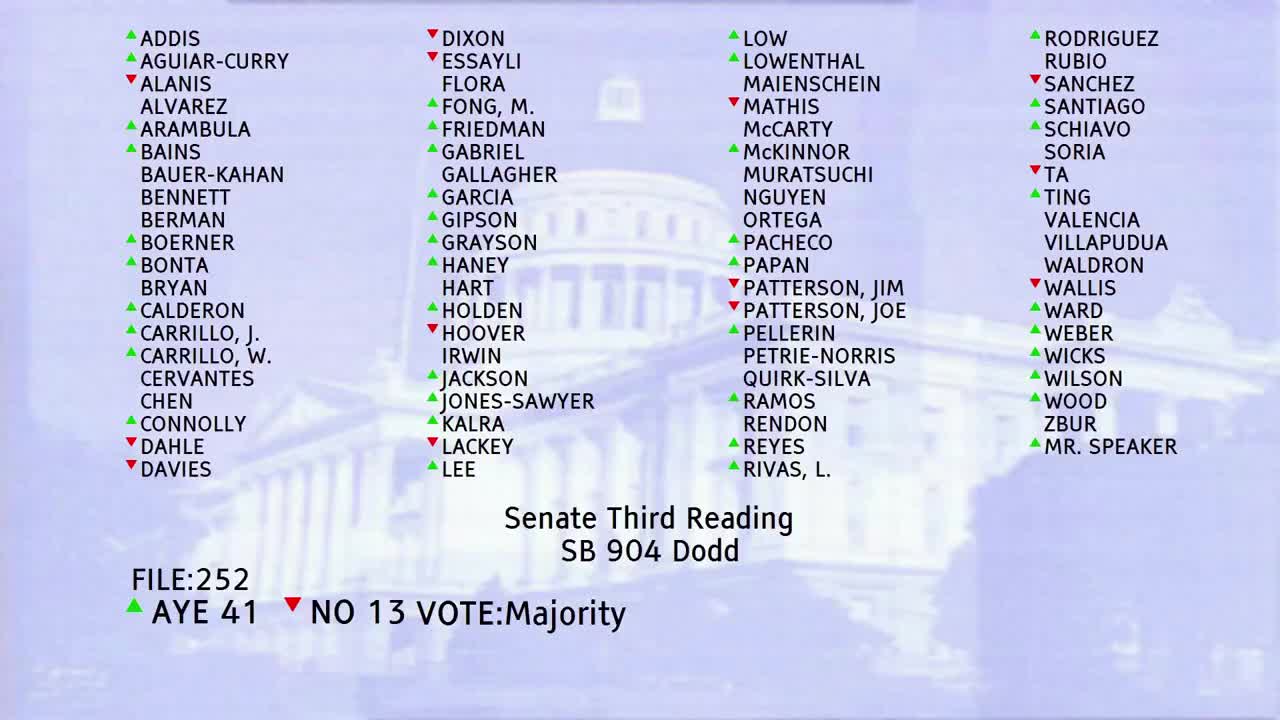
Bill Author

Bill Co-Author(s):