AB 2419: Search warrants: child prostitution.
- Session Year: 2023-2024
- House: Assembly
- Latest Version Date: 2024-06-13
Current Status:
Failed
(2024-07-02: In committee: Set, first hearing. Hearing canceled at the request of author.)
Introduced
In Committee
First Chamber
In Committee
Second Chamber
Enacted
Existing law allows a search warrant to be issued upon probable cause, supported by affidavit, naming or describing the person to be searched or searched for, and particularly describing the property, thing, or things and the place to be searched. Existing law also specifies the grounds upon which a search warrant may be issued, including, among other grounds, when the property or things to be seized constitute evidence showing that a felony has been committed.
This bill would additionally authorize a search warrant to be issued on the grounds that the property or things to be seized consists of evidence that tends to show that communications in furtherance of solicitation of a minor for an act of prostitution evidence in furtherance of sex trafficking of a person under 18 years of age, as specified, has occurred or is occurring.
Existing law allows a search warrant to be issued upon probable cause, supported by affidavit, naming or describing the person to be searched or searched for, and particularly describing the property, thing, or things and the place to be searched. Existing law also specifies the grounds upon which a search warrant may be issued, including, among other grounds, when the property or things to be seized constitute evidence showing that a felony has been committed.
This bill would additionally authorize a search warrant to be issued on the grounds that the property or things to be seized consists of evidence that tends to show that communications in furtherance of solicitation of a minor for an act of prostitution has occurred or is occurring.
(a)A search warrant may be issued upon any of the following grounds:
(1)When the property was stolen or embezzled.
(2)When the property or things were used as the means of committing a felony.
(3)When the property or things are in the possession of any person with the intent to use them as a means of committing a public offense, or in the possession of another to whom that person may have delivered them for the purpose of concealing them or preventing them from being discovered.
(4)When the property or things to be seized consist of an item or constitute evidence that tends to show a felony has been committed, or tends to show that a particular person has committed a felony.
(5)(A)When the property or things to be seized consist of evidence that tends to show that sexual exploitation of a child, in violation of Section 311.3, possession of matter depicting sexual conduct of a person under 18 years of age, in violation of Section 311.11, or communications in furtherance of solicitation of a minor, in violation of paragraph (3) of subdivision (b) of Section 647, evidence in furtherance of sex trafficking of a person under 18 years of age, in violation of subdivision (c) of Section 236.1, has occurred or is occurring.
(B)Information or evidence obtained through the execution of a search warrant seeking communications in furtherance of solicitation of a minor pursuant to subparagraph (A) shall not be used as a basis to charge the minor or child with a crime.(C)The prohibition on the use of information or evidence in subparagraph (B) does not make any evidence gathered pursuant to subparagraph (A) inadmissible.(6)When there is a warrant to arrest a person.
(7)When a provider of electronic communication service or remote computing service has records or evidence, as specified in Section 1524.3, showing that property was stolen or embezzled constituting a misdemeanor, or that property or things are in the possession of any person with the intent to use them as a means of committing a misdemeanor public offense, or in the possession of another to whom that person may have delivered them for the purpose of concealing them or preventing their discovery.
(8)When the property or things to be seized include an item or evidence that tends to show a violation of Section 3700.5 of the Labor Code, or tends to show that a particular person has violated Section 3700.5 of the Labor Code.
(9)When the property or things to be seized include a firearm or other deadly weapon at the scene of, or at the premises occupied or under the control of the person arrested in connection with, a domestic violence incident involving a threat to human life or a physical assault as provided in Section 18250. This section does not affect warrantless seizures otherwise authorized by Section 18250.
(10)When the property or things to be seized include a firearm or other deadly weapon that is owned by, or in the possession of, or in the custody or control of, a person described in subdivision (a) of Section 8102 of the Welfare and Institutions Code.
(11)When the property or things to be seized include a firearm that is owned by, or in the possession of, or in the custody or control of, a person who is subject to the prohibitions regarding firearms pursuant to Section 6389 of the Family Code, if a prohibited firearm is possessed, owned, in the custody of, or controlled by a person against whom a protective order has been issued pursuant to Section 6218 of the Family Code, the person has been lawfully served with that order, and the person has failed to relinquish the firearm as required by law.
(12)When the information to be received from the use of a tracking device constitutes evidence that tends to show that either a felony, a misdemeanor violation of the Fish and Game Code, or a misdemeanor violation of the Public Resources Code has been committed or is being committed, tends to show that a particular person has committed a felony, a misdemeanor violation of the Fish and Game Code, or a misdemeanor violation of the Public Resources Code, or is committing a felony, a misdemeanor violation of the Fish and Game Code, or a misdemeanor violation of the Public Resources Code, or will assist in locating an individual who has committed or is committing a felony, a misdemeanor violation of the Fish and Game Code, or a misdemeanor violation of the Public Resources Code. A tracking device search warrant issued pursuant to this paragraph shall be executed in a manner meeting the requirements specified in subdivision (b) of Section 1534.
(13)When a sample of the blood of a person constitutes evidence that tends to show a violation of Section 23140, 23152, or 23153 of the Vehicle Code and the person from whom the sample is being sought has refused an officers request to submit to, or has failed to complete, a blood test as required by Section 23612 of the Vehicle Code, and the sample will be drawn from the person in a reasonable, medically approved manner. This paragraph is not intended to abrogate a courts mandate to determine the propriety of the issuance of a search warrant on a case-by-case basis.
(14)Beginning January 1, 2016, the property or things to be seized are firearms or ammunition or both that are owned by, in the possession of, or in the custody or control of a person who is the subject of a gun violence restraining order that has been issued pursuant to Division 3.2 (commencing with Section 18100) of Title 2 of Part 6, if a prohibited firearm or ammunition or both is possessed, owned, in the custody of, or controlled by a person against whom a gun violence restraining order has been issued, the person has been lawfully served with that order, and the person has failed to relinquish the firearm as required by law.
(15)Beginning January 1, 2018, the property or things to be seized include a firearm that is owned by, or in the possession of, or in the custody or control of, a person who is subject to the prohibitions regarding firearms pursuant to Section 29800 or 29805, and the court has made a finding pursuant to subdivision (c) of Section 29810 that the person has failed to relinquish the firearm as required by law.
(16)When the property or things to be seized are controlled substances or a device, contrivance, instrument, or paraphernalia used for unlawfully using or administering a controlled substance pursuant to the authority described in Section 11472 of the Health and Safety Code.
(17)(A)When all of the following apply:
(i)A sample of the blood of a person constitutes evidence that tends to show a violation of subdivision (b), (c), (d), (e), or (f) of Section 655 of the Harbors and Navigation Code.
(ii)The person from whom the sample is being sought has refused an officers request to submit to, or has failed to complete, a blood test as required by Section 655.1 of the Harbors and Navigation Code.
(iii)The sample will be drawn from the person in a reasonable, medically approved manner.
(B)This paragraph is not intended to abrogate a courts mandate to determine the propriety of the issuance of a search warrant on a case-by-case basis.
(18)When the property or things to be seized consists of evidence that tends to show that a violation of paragraph (1), (2), or (3) of subdivision (j) of Section 647 has occurred or is occurring.
(19)(A)When the property or things to be seized are data, from a recording device installed by the manufacturer of a motor vehicle, that constitutes evidence that tends to show the commission of a felony or misdemeanor offense involving a motor vehicle, resulting in death or serious bodily injury to any person. The data accessed by a warrant pursuant to this paragraph shall not exceed the scope of the data that is directly related to the offense for which the warrant is issued.
(B)For the purposes of this paragraph, recording device has the same meaning as defined in subdivision (b) of Section 9951 of the Vehicle Code. The scope of the data accessible by a warrant issued pursuant to this paragraph shall be limited to the information described in subdivision (b) of Section 9951 of the Vehicle Code.
(C)For the purposes of this paragraph, serious bodily injury has the same meaning as defined in paragraph (4) of subdivision (f) of Section 243 of the Penal Code.
(20)When the property or things to be seized consists of evidence that tends to show that a violation of Section 647.9 has occurred or is occurring. Evidence to be seized pursuant to this paragraph shall be limited to evidence of a violation of Section 647.9 and shall not include evidence of a violation of a departmental rule or guideline that is not a public offense under California law.
(b)The property, things, person, or persons described in subdivision (a) may be taken on the warrant from any place, or from any person in whose possession the property or things may be.
(c)Notwithstanding subdivision (a) or (b), a search warrant shall not be issued for any documentary evidence in the possession or under the control of any person who is a lawyer as defined in Section 950 of the Evidence Code, a physician as defined in Section 990 of the Evidence Code, a psychotherapist as defined in Section 1010 of the Evidence Code, or a member of the clergy as defined in Section 1030 of the Evidence Code, and who is not reasonably suspected of engaging or having engaged in criminal activity related to the documentary evidence for which a warrant is requested unless the following procedure has been complied with:
(1)At the time of the issuance of the warrant, the court shall appoint a special master in accordance with subdivision (d) to accompany the person who will serve the warrant. Upon service of the warrant, the special master shall inform the party served of the specific items being sought and that the party shall have the opportunity to provide the items requested. If the party, in the judgment of the special master, fails to provide the items requested, the special master shall conduct a search for the items in the areas indicated in the search warrant.
(2)(A)If the party who has been served states that an item or items should not be disclosed, they shall be sealed by the special master and taken to court for a hearing.
(B)At the hearing, the party searched shall be entitled to raise any issues that may be raised pursuant to Section 1538.5 as well as a claim that the item or items are privileged, as provided by law. The hearing shall be held in the superior court. The court shall provide sufficient time for the parties to obtain counsel and make motions or present evidence. The hearing shall be held within three days of the service of the warrant unless the court makes a finding that the expedited hearing is impracticable. In that case, the matter shall be heard at the earliest possible time.
(C)If an item or items are taken to court for a hearing, any limitations of time prescribed in Chapter 2 (commencing with Section 799) of Title 3 of Part 2 shall be tolled from the time of the seizure until the final conclusion of the hearing, including any associated writ or appellate proceedings.
(3)The warrant shall, whenever practicable, be served during normal business hours. In addition, the warrant shall be served upon a party who appears to have possession or control of the items sought. If, after reasonable efforts, the party serving the warrant is unable to locate the person, the special master shall seal and return to the court, for determination by the court, any item that appears to be privileged as provided by law.
(d)(1)As used in this section, a special master is an attorney who is a member in good standing of the California State Bar and who has been selected from a list of qualified attorneys that is maintained by the State Bar particularly for the purposes of conducting the searches described in this section. These attorneys shall serve without compensation. A special master shall be considered a public employee, and the governmental entity that caused the search warrant to be issued shall be considered the employer of the special master and the applicable public entity, for purposes of Division 3.6 (commencing with Section 810) of Title 1 of the Government Code, relating to claims and actions against public entities and public employees. In selecting the special master, the court shall make every reasonable effort to ensure that the person selected has no relationship with any of the parties involved in the pending matter. Information obtained by the special master shall be confidential and may not be divulged except in direct response to inquiry by the court.
(2)In any case in which the magistrate determines that, after reasonable efforts have been made to obtain a special master, a special master is not available and would not be available within a reasonable period of time, the magistrate may direct the party seeking the order to conduct the search in the manner described in this section in lieu of the special master.
(e)Any search conducted pursuant to this section by a special master may be conducted in a manner that permits the party serving the warrant or that partys designee to accompany the special master as the special master conducts the search. However, that party or that partys designee may not participate in the search nor shall they examine any of the items being searched by the special master except upon agreement of the party upon whom the warrant has been served.
(f)As used in this section, documentary evidence includes, but is not limited to, writings, documents, blueprints, drawings, photographs, computer printouts, microfilms, x-rays, files, diagrams, ledgers, books, tapes, audio and video recordings, films, and papers of any type or description.
(g)No warrant shall issue for any item or items described in Section 1070 of the Evidence Code.
(h)No warrant shall issue for any item or items that pertain to an investigation into a prohibited violation, as defined in Section 629.51.
(i)Notwithstanding any other law, no claim of attorney work product as described in Chapter 4 (commencing with Section 2018.010) of Title 4 of Part 4 of the Code of Civil Procedure shall be sustained where there is probable cause to believe that the lawyer is engaging or has engaged in criminal activity related to the documentary evidence for which a warrant is requested unless it is established at the hearing with respect to the documentary evidence seized under the warrant that the services of the lawyer were not sought or obtained to enable or aid anyone to commit or plan to commit a crime or a fraud.
(j)Nothing in this section is intended to limit an attorneys ability to request an in-camera hearing pursuant to the holding of the Supreme Court of California in People v. Superior Court (Laff) (2001) 25 Cal.4th 703.
(k)In addition to any other circumstance permitting a magistrate to issue a warrant for a person or property in another county, when the property or things to be seized consist of any item or constitute evidence that tends to show a violation of Section 530.5, the magistrate may issue a warrant to search a person or property located in another county if the person whose identifying information was taken or used resides in the same county as the issuing court.
(l)This section shall not be construed to create a cause of action against any foreign or California corporation, its officers, employees, agents, or other specified persons for providing location information.
(a)A search warrant may be issued upon any of the following grounds:
(1)When the property was stolen or embezzled.
(2)When the property or things were used as the means of committing a felony.
(3)When the property or things are in the possession of any person with the intent to use them as a means of committing a public offense, or in the possession of another to whom that person may have delivered them for the purpose of concealing them or preventing them from being discovered.
(4)When the property or things to be seized consist of an item or constitute evidence that tends to show a felony has been committed, or tends to show that a particular person has committed a felony.
(5)(A)When the property or things to be seized consist of evidence that tends to show that sexual exploitation of a child, in violation of Section 311.3, possession of matter depicting sexual conduct of a person under 18 years of age, in violation of Section 311.11, or communications in furtherance of solicitation of a minor, in violation of paragraph (3) of subdivision (b) of Section 647, has occurred or is occurring.
(B)Information or evidence obtained through the execution of a search warrant seeking communications in furtherance of solicitation of a minor pursuant to subparagraph (A) shall not be used as a basis to charge the minor or child with a crime.
(C)The prohibition on the use of information or evidence in subparagraph (B) does not make any evidence gathered pursuant to subparagraph (A) inadmissible.
(6)When there is a warrant to arrest a person.
(7)When a provider of electronic communication service or remote computing service has records or evidence, as specified in Section 1524.3, showing that property was stolen or embezzled constituting a misdemeanor, or that property or things are in the possession of any person with the intent to use them as a means of committing a misdemeanor public offense, or in the possession of another to whom that person may have delivered them for the purpose of concealing them or preventing their discovery.
(8)When the property or things to be seized include an item or evidence that tends to show a violation of Section 3700.5 of the Labor Code, or tends to show that a particular person has violated Section 3700.5 of the Labor Code.
(9)When the property or things to be seized include a firearm or other deadly weapon at the scene of, or at the premises occupied or under the control of the person arrested in connection with, a domestic violence incident involving a threat to human life or a physical assault as provided in Section 18250. This section does not affect warrantless seizures otherwise authorized by Section 18250.
(10)When the property or things to be seized include a firearm or other deadly weapon that is owned by, or in the possession of, or in the custody or control of, a person described in subdivision (a) of Section 8102 of the Welfare and Institutions Code.
(11)When the property or things to be seized include a firearm that is owned by, or in the possession of, or in the custody or control of, a person who is subject to the prohibitions regarding firearms pursuant to Section 6389 of the Family Code, if a prohibited firearm is possessed, owned, in the custody of, or controlled by a person against whom a protective order has been issued pursuant to Section 6218 of the Family Code, the person has been lawfully served with that order, and the person has failed to relinquish the firearm as required by law.
(12)When the information to be received from the use of a tracking device constitutes evidence that tends to show that either a felony, a misdemeanor violation of the Fish and Game Code, or a misdemeanor violation of the Public Resources Code has been committed or is being committed, tends to show that a particular person has committed a felony, a misdemeanor violation of the Fish and Game Code, or a misdemeanor violation of the Public Resources Code, or is committing a felony, a misdemeanor violation of the Fish and Game Code, or a misdemeanor violation of the Public Resources Code, or will assist in locating an individual who has committed or is committing a felony, a misdemeanor violation of the Fish and Game Code, or a misdemeanor violation of the Public Resources Code. A tracking device search warrant issued pursuant to this paragraph shall be executed in a manner meeting the requirements specified in subdivision (b) of Section 1534.
(13)When a sample of the blood of a person constitutes evidence that tends to show a violation of Section 23140, 23152, or 23153 of the Vehicle Code and the person from whom the sample is being sought has refused an officers request to submit to, or has failed to complete, a blood test as required by Section 23612 of the Vehicle Code, and the sample will be drawn from the person in a reasonable, medically approved manner. This paragraph is not intended to abrogate a courts mandate to determine the propriety of the issuance of a search warrant on a case-by-case basis.
(14)Beginning January 1, 2016, the property or things to be seized are firearms or ammunition or both that are owned by, in the possession of, or in the custody or control of a person who is the subject of a gun violence restraining order that has been issued pursuant to Division 3.2 (commencing with Section 18100) of Title 2 of Part 6, if a prohibited firearm or ammunition or both is possessed, owned, in the custody of, or controlled by a person against whom a gun violence restraining order has been issued, the person has been lawfully served with that order, and the person has failed to relinquish the firearm as required by law.
(15)Beginning January 1, 2018, the property or things to be seized include a firearm that is owned by, or in the possession of, or in the custody or control of, a person who is subject to the prohibitions regarding firearms pursuant to Section 29800 or 29805, and the court has made a finding pursuant to subdivision (c) of Section 29810 that the person has failed to relinquish the firearm as required by law.
(16)When the property or things to be seized are controlled substances or a device, contrivance, instrument, or paraphernalia used for unlawfully using or administering a controlled substance pursuant to the authority described in Section 11472 of the Health and Safety Code.
(17)(A)When all of the following apply:
(i)A sample of the blood of a person constitutes evidence that tends to show a violation of subdivision (b), (c), (d), (e), or (f) of Section 655 of the Harbors and Navigation Code.
(ii)The person from whom the sample is being sought has refused an officers request to submit to, or has failed to complete, a blood test as required by Section 655.1 of the Harbors and Navigation Code.
(iii)The sample will be drawn from the person in a reasonable, medically approved manner.
(B)This paragraph is not intended to abrogate a courts mandate to determine the propriety of the issuance of a search warrant on a case-by-case basis.
(18)When the property or things to be seized consists of evidence that tends to show that a violation of paragraph (1), (2), or (3) of subdivision (j) of Section 647 has occurred or is occurring.
(19)(A)When the property or things to be seized are data, from a recording device installed by the manufacturer of a motor vehicle, that constitutes evidence that tends to show the commission of a felony or misdemeanor offense involving a motor vehicle, resulting in death or serious bodily injury to any person. The data accessed by a warrant pursuant to this paragraph shall not exceed the scope of the data that is directly related to the offense for which the warrant is issued.
(B)For the purposes of this paragraph, recording device has the same meaning as defined in subdivision (b) of Section 9951 of the Vehicle Code. The scope of the data accessible by a warrant issued pursuant to this paragraph shall be limited to the information described in subdivision (b) of Section 9951 of the Vehicle Code.
(C)For the purposes of this paragraph, serious bodily injury has the same meaning as defined in paragraph (4) of subdivision (f) of Section 243 of the Penal Code.
(20)When the property or things to be seized consists of evidence that tends to show that a violation of Section 647.9 has occurred or is occurring. Evidence to be seized pursuant to this paragraph shall be limited to evidence of a violation of Section 647.9 and shall not include evidence of a violation of a departmental rule or guideline that is not a public offense under California law.
(b)The property, things, person, or persons described in subdivision (a) may be taken on the warrant from any place, or from any person in whose possession the property or things may be.
(c)Notwithstanding subdivision (a) or (b), a search warrant shall not be issued for any documentary evidence in the possession or under the control of any person who is a lawyer as defined in Section 950 of the Evidence Code, a physician as defined in Section 990 of the Evidence Code, a psychotherapist as defined in Section 1010 of the Evidence Code, or a member of the clergy as defined in Section 1030 of the Evidence Code, and who is not reasonably suspected of engaging or having engaged in criminal activity related to the documentary evidence for which a warrant is requested unless the following procedure has been complied with:
(1)At the time of the issuance of the warrant, the court shall appoint a special master in accordance with subdivision (d) to accompany the person who will serve the warrant. Upon service of the warrant, the special master shall inform the party served of the specific items being sought and that the party shall have the opportunity to provide the items requested. If the party, in the judgment of the special master, fails to provide the items requested, the special master shall conduct a search for the items in the areas indicated in the search warrant.
(2)(A)If the party who has been served states that an item or items should not be disclosed, they shall be sealed by the special master and taken to court for a hearing.
(B)At the hearing, the party searched shall be entitled to raise any issues that may be raised pursuant to Section 1538.5 as well as a claim that the item or items are privileged, as provided by law. The hearing shall be held in the superior court. The court shall provide sufficient time for the parties to obtain counsel and make motions or present evidence. The hearing shall be held within three days of the service of the warrant unless the court makes a finding that the expedited hearing is impracticable. In that case, the matter shall be heard at the earliest possible time.
(C)If an item or items are taken to court for a hearing, any limitations of time prescribed in Chapter 2 (commencing with Section 799) of Title 3 of Part 2 shall be tolled from the time of the seizure until the final conclusion of the hearing, including any associated writ or appellate proceedings.
(3)The warrant shall, whenever practicable, be served during normal business hours. In addition, the warrant shall be served upon a party who appears to have possession or control of the items sought. If, after reasonable efforts, the party serving the warrant is unable to locate the person, the special master shall seal and return to the court, for determination by the court, any item that appears to be privileged as provided by law.
(d)(1)As used in this section, a special master is an attorney who is a member in good standing of the California State Bar and who has been selected from a list of qualified attorneys that is maintained by the State Bar particularly for the purposes of conducting the searches described in this section. These attorneys shall serve without compensation. A special master shall be considered a public employee, and the governmental entity that caused the search warrant to be issued shall be considered the employer of the special master and the applicable public entity, for purposes of Division 3.6 (commencing with Section 810) of Title 1 of the Government Code, relating to claims and actions against public entities and public employees. In selecting the special master, the court shall make every reasonable effort to ensure that the person selected has no relationship with any of the parties involved in the pending matter. Information obtained by the special master shall be confidential and may not be divulged except in direct response to inquiry by the court.
(2)In any case in which the magistrate determines that, after reasonable efforts have been made to obtain a special master, a special master is not available and would not be available within a reasonable period of time, the magistrate may direct the party seeking the order to conduct the search in the manner described in this section in lieu of the special master.
(e)Any search conducted pursuant to this section by a special master may be conducted in a manner that permits the party serving the warrant or that partys designee to accompany the special master as the special master conducts the search. However, that party or that partys designee may not participate in the search nor shall they examine any of the items being searched by the special master except upon agreement of the party upon whom the warrant has been served.
(f)As used in this section, documentary evidence includes, but is not limited to, writings, documents, blueprints, drawings, photographs, computer printouts, microfilms, x-rays, files, diagrams, ledgers, books, tapes, audio and video recordings, films, and papers of any type or description.
(g)No warrant shall issue for any item or items described in Section 1070 of the Evidence Code.
(h)No warrant shall issue for any item or items that pertain to an investigation into a prohibited violation, as defined in Section 629.51.
(i)Notwithstanding any other law, no claim of attorney work product as described in Chapter 4 (commencing with Section 2018.010) of Title 4 of Part 4 of the Code of Civil Procedure shall be sustained where there is probable cause to believe that the lawyer is engaging or has engaged in criminal activity related to the documentary evidence for which a warrant is requested unless it is established at the hearing with respect to the documentary evidence seized under the warrant that the services of the lawyer were not sought or obtained to enable or aid anyone to commit or plan to commit a crime or a fraud.
(j)Nothing in this section is intended to limit an attorneys ability to request an in-camera hearing pursuant to the holding of the Supreme Court of California in People v. Superior Court (Laff) (2001) 25 Cal.4th 703.
(k)In addition to any other circumstance permitting a magistrate to issue a warrant for a person or property in another county, when the property or things to be seized consist of any item or constitute evidence that tends to show a violation of Section 530.5, the magistrate may issue a warrant to search a person or property located in another county if the person whose identifying information was taken or used resides in the same county as the issuing court.
(l)This section shall not be construed to create a cause of action against any foreign or California corporation, its officers, employees, agents, or other specified persons for providing location information.
(a)A search warrant may be issued upon any of the following grounds:
(1)When the property was stolen or embezzled.
(2)When the property or things were used as the means of committing a felony.
(3)When the property or things are in the possession of any person with the intent to use them as a means of committing a public offense, or in the possession of another to whom that person may have delivered them for the purpose of concealing them or preventing them from being discovered.
(4)When the property or things to be seized consist of an item or constitute evidence that tends to show a felony has been committed, or tends to show that a particular person has committed a felony.
(5)When the property or things to be seized consist of evidence that tends to show that sexual exploitation of a child, in violation of Section 311.3, or possession of matter depicting sexual conduct of a person under 18 years of age, in violation of Section 311.11, or communications in furtherance of solicitation of a minor, in violation of paragraph (3) of subdivision (b) of Section 647, has occurred or is occurring.
(6)When there is a warrant to arrest a person.
(7)When a provider of electronic communication service or remote computing service has records or evidence, as specified in Section 1524.3, showing that property was stolen or embezzled constituting a misdemeanor, or that property or things are in the possession of any person with the intent to use them as a means of committing a misdemeanor public offense, or in the possession of another to whom that person may have delivered them for the purpose of concealing them or preventing their discovery.
(8)When the property or things to be seized include an item or evidence that tends to show a violation of Section 3700.5 of the Labor Code, or tends to show that a particular person has violated Section 3700.5 of the Labor Code.
(9)When the property or things to be seized include a firearm or other deadly weapon at the scene of, or at the premises occupied or under the control of the person arrested in connection with, a domestic violence incident involving a threat to human life or a physical assault as provided in Section 18250. This section does not affect warrantless seizures otherwise authorized by Section 18250.
(10)When the property or things to be seized include a firearm or other deadly weapon that is owned by, or in the possession of, or in the custody or control of, a person described in subdivision (a) of Section 8102 of the Welfare and Institutions Code.
(11)When the property or things to be seized include a firearm that is owned by, or in the possession of, or in the custody or control of, a person who is subject to the prohibitions regarding firearms pursuant to Section 6389 of the Family Code, if a prohibited firearm is possessed, owned, in the custody of, or controlled by a person against whom a protective order has been issued pursuant to Section 6218 of the Family Code, the person has been lawfully served with that order, and the person has failed to relinquish the firearm as required by law.
(12)When the information to be received from the use of a tracking device constitutes evidence that tends to show that either a felony, a misdemeanor violation of the Fish and Game Code, or a misdemeanor violation of the Public Resources Code has been committed or is being committed, tends to show that a particular person has committed a felony, a misdemeanor violation of the Fish and Game Code, or a misdemeanor violation of the Public Resources Code, or is committing a felony, a misdemeanor violation of the Fish and Game Code, or a misdemeanor violation of the Public Resources Code, or will assist in locating an individual who has committed or is committing a felony, a misdemeanor violation of the Fish and Game Code, or a misdemeanor violation of the Public Resources Code. A tracking device search warrant issued pursuant to this paragraph shall be executed in a manner meeting the requirements specified in subdivision (b) of Section 1534.
(13)When a sample of the blood of a person constitutes evidence that tends to show a violation of Section 23140, 23152, or 23153 of the Vehicle Code and the person from whom the sample is being sought has refused an officers request to submit to, or has failed to complete, a blood test as required by Section 23612 of the Vehicle Code, and the sample will be drawn from the person in a reasonable, medically approved manner. This paragraph is not intended to abrogate a courts mandate to determine the propriety of the issuance of a search warrant on a case-by-case basis.
(14)Beginning January 1, 2016, the property or things to be seized are firearms or ammunition or both that are owned by, in the possession of, or in the custody or control of a person who is the subject of a gun violence restraining order that has been issued pursuant to Division 3.2 (commencing with Section 18100) of Title 2 of Part 6, if a prohibited firearm or ammunition or both is possessed, owned, in the custody of, or controlled by a person against whom a gun violence restraining order has been issued, the person has been lawfully served with that order, and the person has failed to relinquish the firearm as required by law.
(15)Beginning January 1, 2018, the property or things to be seized include a firearm that is owned by, or in the possession of, or in the custody or control of, a person who is subject to the prohibitions regarding firearms pursuant to Section 29800 or 29805, and the court has made a finding pursuant to subdivision (c) of Section 29810 that the person has failed to relinquish the firearm as required by law.
(16)When the property or things to be seized are controlled substances or a device, contrivance, instrument, or paraphernalia used for unlawfully using or administering a controlled substance pursuant to the authority described in Section 11472 of the Health and Safety Code.
(17)(A)When all of the following apply:
(i)A sample of the blood of a person constitutes evidence that tends to show a violation of subdivision (b), (c), (d), (e), or (f) of Section 655 of the Harbors and Navigation Code.
(ii)The person from whom the sample is being sought has refused an officers request to submit to, or has failed to complete, a blood test as required by Section 655.1 of the Harbors and Navigation Code.
(iii)The sample will be drawn from the person in a reasonable, medically approved manner.
(B)This paragraph is not intended to abrogate a courts mandate to determine the propriety of the issuance of a search warrant on a case-by-case basis.
(18)When the property or things to be seized consists of evidence that tends to show that a violation of paragraph (1), (2), or (3) of subdivision (j) of Section 647 has occurred or is occurring.
(19)(A)When the property or things to be seized are data, from a recording device installed by the manufacturer of a motor vehicle, that constitutes evidence that tends to show the commission of a felony or misdemeanor offense involving a motor vehicle, resulting in death or serious bodily injury to any person. The data accessed by a warrant pursuant to this paragraph shall not exceed the scope of the data that is directly related to the offense for which the warrant is issued.
(B)For the purposes of this paragraph, recording device has the same meaning as defined in subdivision (b) of Section 9951 of the Vehicle Code. The scope of the data accessible by a warrant issued pursuant to this paragraph shall be limited to the information described in subdivision (b) of Section 9951 of the Vehicle Code.
(C)For the purposes of this paragraph, serious bodily injury has the same meaning as defined in paragraph (4) of subdivision (f) of Section 243 of the Penal Code.
(20)When the property or things to be seized consists of evidence that tends to show that a violation of Section 647.9 has occurred or is occurring. Evidence to be seized pursuant to this paragraph shall be limited to evidence of a violation of Section 647.9 and shall not include evidence of a violation of a departmental rule or guideline that is not a public offense under California law.
(b)The property, things, person, or persons described in subdivision (a) may be taken on the warrant from any place, or from any person in whose possession the property or things may be.
(c)Notwithstanding subdivision (a) or (b), a search warrant shall not be issued for any documentary evidence in the possession or under the control of any person who is a lawyer as defined in Section 950 of the Evidence Code, a physician as defined in Section 990 of the Evidence Code, a psychotherapist as defined in Section 1010 of the Evidence Code, or a member of the clergy as defined in Section 1030 of the Evidence Code, and who is not reasonably suspected of engaging or having engaged in criminal activity related to the documentary evidence for which a warrant is requested unless the following procedure has been complied with:
(1)At the time of the issuance of the warrant, the court shall appoint a special master in accordance with subdivision (d) to accompany the person who will serve the warrant. Upon service of the warrant, the special master shall inform the party served of the specific items being sought and that the party shall have the opportunity to provide the items requested. If the party, in the judgment of the special master, fails to provide the items requested, the special master shall conduct a search for the items in the areas indicated in the search warrant.
(2)(A)If the party who has been served states that an item or items should not be disclosed, they shall be sealed by the special master and taken to court for a hearing.
(B)At the hearing, the party searched shall be entitled to raise any issues that may be raised pursuant to Section 1538.5 as well as a claim that the item or items are privileged, as provided by law. The hearing shall be held in the superior court. The court shall provide sufficient time for the parties to obtain counsel and make motions or present evidence. The hearing shall be held within three days of the service of the warrant unless the court makes a finding that the expedited hearing is impracticable. In that case, the matter shall be heard at the earliest possible time.
(C)If an item or items are taken to court for a hearing, any limitations of time prescribed in Chapter 2 (commencing with Section 799) of Title 3 of Part 2 shall be tolled from the time of the seizure until the final conclusion of the hearing, including any associated writ or appellate proceedings.
(3)The warrant shall, whenever practicable, be served during normal business hours. In addition, the warrant shall be served upon a party who appears to have possession or control of the items sought. If, after reasonable efforts, the party serving the warrant is unable to locate the person, the special master shall seal and return to the court, for determination by the court, any item that appears to be privileged as provided by law.
(d)(1)As used in this section, a special master is an attorney who is a member in good standing of the California State Bar and who has been selected from a list of qualified attorneys that is maintained by the State Bar particularly for the purposes of conducting the searches described in this section. These attorneys shall serve without compensation. A special master shall be considered a public employee, and the governmental entity that caused the search warrant to be issued shall be considered the employer of the special master and the applicable public entity, for purposes of Division 3.6 (commencing with Section 810) of Title 1 of the Government Code, relating to claims and actions against public entities and public employees. In selecting the special master, the court shall make every reasonable effort to ensure that the person selected has no relationship with any of the parties involved in the pending matter. Information obtained by the special master shall be confidential and may not be divulged except in direct response to inquiry by the court.
(2)In any case in which the magistrate determines that, after reasonable efforts have been made to obtain a special master, a special master is not available and would not be available within a reasonable period of time, the magistrate may direct the party seeking the order to conduct the search in the manner described in this section in lieu of the special master.
(e)Any search conducted pursuant to this section by a special master may be conducted in a manner that permits the party serving the warrant or that partys designee to accompany the special master as the special master conducts the search. However, that party or that partys designee may not participate in the search nor shall they examine any of the items being searched by the special master except upon agreement of the party upon whom the warrant has been served.
(f)As used in this section, documentary evidence includes, but is not limited to, writings, documents, blueprints, drawings, photographs, computer printouts, microfilms, x-rays, files, diagrams, ledgers, books, tapes, audio and video recordings, films, and papers of any type or description.
(g)No warrant shall issue for any item or items described in Section 1070 of the Evidence Code.
(h)No warrant shall issue for any item or items that pertain to an investigation into a prohibited violation, as defined in Section 629.51.
(i)Notwithstanding any other law, no claim of attorney work product as described in Chapter 4 (commencing with Section 2018.010) of Title 4 of Part 4 of the Code of Civil Procedure shall be sustained where there is probable cause to believe that the lawyer is engaging or has engaged in criminal activity related to the documentary evidence for which a warrant is requested unless it is established at the hearing with respect to the documentary evidence seized under the warrant that the services of the lawyer were not sought or obtained to enable or aid anyone to commit or plan to commit a crime or a fraud.
(j)Nothing in this section is intended to limit an attorneys ability to request an in-camera hearing pursuant to the holding of the Supreme Court of California in People v. Superior Court (Laff) (2001) 25 Cal.4th 703.
(k)In addition to any other circumstance permitting a magistrate to issue a warrant for a person or property in another county, when the property or things to be seized consist of any item or constitute evidence that tends to show a violation of Section 530.5, the magistrate may issue a warrant to search a person or property located in another county if the person whose identifying information was taken or used resides in the same county as the issuing court.
(l)This section shall not be construed to create a cause of action against any foreign or California corporation, its officers, employees, agents, or other specified persons for providing location information.
|
Date
|
Status
|
|---|---|
| Jul 2, 2024 | In committee: Set, first hearing. Hearing canceled at the request of author. |
| Jun 13, 2024 | From committee chair, with author's amendments: Amend, and re-refer to committee. Read second time, amended, and re-referred to Com. on PUB S. |
| Jun 5, 2024 | Referred to Com. on PUB S. |
| May 24, 2024 | In Senate. Read first time. To Com. on RLS. for assignment. |
| May 23, 2024 | Read third time. Passed. Ordered to the Senate. (Ayes 57. Noes 0. Page 5647.) |
| May 21, 2024 | Assembly Rule 69(b)(1) suspended. (Page 5362.) |
| May 21, 2024 | Read third time and amended. Ordered to third reading. (Page 5362.) |
| Apr 4, 2024 | Read second time. Ordered to third reading. |
| Apr 3, 2024 | From committee: Do pass. (Ayes 7. Noes 1.) (April 2). |
| Mar 12, 2024 | In committee: Set, first hearing. Hearing canceled at the request of author. |
| Feb 26, 2024 | Referred to Com. on PUB. S. |
| Feb 14, 2024 | From printer. May be heard in committee March 15. |
| Feb 13, 2024 | Read first time. To print. |
|
Date
|
Description
|
Location
|
Votes
|
|
|---|---|---|---|---|
| May 23, 2024 | AB 2419 Gipson Assembly Third Reading | Assembly Floor |
Passed |
|
| Apr 2, 2024 | Do pass. | Assembly Standing Committee on Public Safety |
Passed |
This list shows positions taken on this bill by organizations on the date displayed, which is linked to the original source.
Positions by individuals are not included.
|
Organization
|
Position
|
Date
|
|---|---|---|
| Aclu California Action | * Against | Apr 2, 2024 |
| All of Us or None Los Angeles | ** Against | |
| Arcadia Police Officers Association | * Support | Apr 2, 2024 |
| Brentwood Community Council – West Los Angeles | ** Support | |
| Burbank Police Officers' Association | * Support | Apr 2, 2024 |
| California Attorneys For Criminal Justice | ** Against | |
| California Coalition of School Safety Professionals | ** Support | |
| California Narcotic Officers' Association | * Support | Apr 2, 2024 |
| California Police Chiefs Association | ** Support | |
| California Public Defenders Association | * Against | Apr 2, 2024 |
| California Reserve Peace Officers Association | * Support | Apr 2, 2024 |
| California State Sheriff's Association | * Support | Apr 2, 2024 |
| Californians United for a Responsible Budget | ** Against | |
| City Of Los Angeles | * Support | Apr 2, 2024 |
| Claremont Police Officers' Association | * Support | Apr 2, 2024 |
| Corona Police Officers Association | * Support | Apr 2, 2024 |
| Culver City Police Officers' Association | * Support | Apr 2, 2024 |
| Deputy Sheriffs Association of Monterey County | * Support | Apr 2, 2024 |
| Deputy Sheriffs' Association of Placer County | * Support | Apr 2, 2024 |
| Fullerton Police Officers Association | * Support | Apr 2, 2024 |
| Legal Services for Prisoners with Children | ** Against | |
| Los Angeles City Attorney | * Support | Apr 2, 2024 |
| Los Angeles City Attorney's Office | * Support | Apr 2, 2024 |
| Los Angeles School Police Management Association | ** Support | |
| los angeles school police officers association | ** Support | |
| Murrieta Police Officers Association | * Support | Apr 2, 2024 |
| Nevada Police Officers Association | * Support | Apr 2, 2024 |
| Newport Beach Police Officers Association | * Support | Apr 2, 2024 |
| Novato Police Officers Association | ** Support | |
| Palos Verdes Police Officers Association | * Support | Apr 2, 2024 |
| Peace Officers Research Association Of California | ** Support | |
| Pomona Police Officers' Association | * Support | Apr 2, 2024 |
| Riverside Police Officers' Association | * Support | Apr 2, 2024 |
| Riverside Sheriffs' Association | * Support | Apr 2, 2024 |
| Sacramento County Sheriff Jim Cooper | ** Support | |
| San Francisco Public Defender's Office | * Against | Apr 2, 2024 |
| Santa Ana Police Officers Association | * Support | Apr 2, 2024 |
| Upland Police Officers Association | * Support | Apr 2, 2024 |
SENATE COMMITTEE ON PUBLIC SAFETY
Senator Aisha Wahab, Chair
2023 - 2024 Regular
Bill No: AB 2419 Hearing Date: July 2, 2024
Author: | Gipson | ||
Version: | June 13, 2024 | ||
Urgency: | No | Fiscal: | No |
Consultant: | SC | ||
Subject: Search warrants: child prostitution
HISTORY
Source: Author
Prior Legislation: SB 64 (Umberg), held Sen. Approps., 2023
AB 1638 (Obernolte), Ch., Stats. 2019
AB 539 (Acosta), Ch. 342, Stats. 2017
AB 1924 (Low), Ch. 511, Stats. 2016
SB 178 (Leno), Ch. 651, Stats. 2015
AB 929 (Chau), Ch. 204, Stats. 2015
AB 539 (Levine), Ch. 118, Stats. 2015
AB 1104 (Rodriguez), Ch. 124, Stats. 2015
Support: Brentwood Community Council – West Los Angeles; Peace Officers Research Association of California; Sacramento County Sheriff Jim Cooper
Opposition: All of Us or None Los Angeles; Californians United for a Responsible Budget; Legal Services for Prisoners with Children
Assembly Floor Vote: 57 - 0
PURPOSE
The purpose of this bill is to specify that a search warrant may be issued on the grounds that the property or things to be seized consists of evidence in furtherance of sex trafficking of a person under 18 years of age.
Existing law provides, pursuant to the U.S. Constitution, that “the right of the people to be secure in their persons, houses, papers, and effects, against unreasonable searches and seizures, shall not be violated, and no Warrants shall issue, but upon probable cause, supported by Oath or affirmation, and particularly describing the place to be searched an the persons or things to be seized.” (U.S. Const., Fourth Amend; see also Cal. Const. art. 1, Sec. 13.)
Existing law provides, pursuant to the California Constitution, that the right of the people to be secure in their persons, houses, papers, and effects against unreasonable seizures and searches may not be violated; and a warrant may not issue except on probable cause, supported by oath or affirmation, particularly describing the place to be searched and the persons and things to be seized. (Cal. Const., art. I, § 13.)
Existing law governs search warrants, including the grounds upon which a search warrant may be issued. (Pen. Code, § 1523 et seq.)
Existing law defines a “search warrant” as a written order in the name of the people, signed by a magistrate, directed to a peace officer, commanding him or her to search for a person or persons, a thing or things, or personal property, and, in the case of a thing or things or personal property, bring the same before the magistrate. (Pen. Code, § 1523.)
Existing law authorizes a search warrant to be issued upon any of the following grounds:
- When the property was stolen or embezzled.
- When the property or things were used as the means of committing a felony.
- When the property or things are in the possession of any person with the intent to use them as a means of committing a public offense, or in the possession of another to whom he or she may have delivered them for the purpose of concealing them or preventing them from being discovered.
- When the property or things to be seized consist of any item or constitute any evidence that tends to show a felony has been committed, or tends to show that a particular person has committed a felony.
- When the property or things to be seized consist of evidence that tends to show that sexual exploitation of a child, or possession of matter depicting sexual conduct of a person under the age of 18 years, has occurred or is occurring.
- When there is a warrant to arrest a person.
- When a provider of electronic communication service or remote computing service has records or evidence, showing that property was stolen or embezzled constituting a misdemeanor, or that property or things are in the possession of any person with the intent to use them as a means of committing a misdemeanor public offense, or in the possession of another to whom he or she may have delivered them for the purpose of concealing them or preventing their discovery.
- When a provider of electronic communication service or remote computing service has records or evidence showing that property was stolen or embezzled constituting a misdemeanor, or that property or things are in the possession of any person with the intent to use them as a means of committing a misdemeanor public offense, or in the possession of another to whom he or she may have delivered them for the purpose of concealing them or preventing their discovery.
- When the property or things to be seized include an item or any evidence that tends to show a violation of the Labor Code, as specified.
- When the property or things to be seized include a firearm or any other deadly weapon at the scene of, or at the premises occupied or under the control of the person arrested in connection with, a domestic violence incident involving a threat to human life or a physical assault.
- When the property or things to be seized include a firearm or any other deadly weapon that is owned by, or in the possession of, or in the custody or control of, a person described in subdivision (a) of Section 8102 of the Welfare and Institutions Code.
- When the property or things to be seized include a firearm that is owned by, or in the possession of, or in the custody or control of, a person who is subject to the prohibitions regarding firearms under specified provisions of the Family Code.
- When the information to be received from the use of a tracking device constitutes evidence that tends to show that either a felony or a misdemeanor violation of the Fish and Game Code, or a misdemeanor violation of the Public Resources Code.
- When a sample of the blood of a person constitutes evidence that tends to show a violation of misdemeanor driving under the influence and the person from whom the sample is being sought has refused an officer's request to submit to, or has failed to complete, a blood test.
- When the property or things to be seized are firearms or ammunition or both that are owned by, in the possession of, or in the custody or control of a person who is the subject of a gun violence re straining order. This final provision does not go into effect until January 1, 2016;
- When the property or things to be seized are controlled substances or a device, contrivance, instrument or paraphernalia used for unlawfully administering a controlled substance as provided.
- When the warrant is for a blood sample of a person that tends to show a violations related to the operation of a vessel, or manipulating water skis, an aquaplane, or a similar device, while under the influence of alcohol or drugs.
- When the property or things to be seized consist of evidence that tends to show that a violation of the crime of disorderly conduct related to invasion of privacy has occurred or is occurring.
- When the property or things to be seized are data, from a recording device installed by the manufacturer of a motor vehicle, that constitutes evidence that tends to show the commission of a felony or misdemeanor offense involving a motor vehicle, resulting in death or serious bodily injury to any person.
- When the property or things to be seized consists of evidence that tends to show unlawful photographing of a deceased person by a first responder has occurred or is occurring. (Pen. Code, § 1524, subd. (a).)
Existing law provides that a search warrant cannot be issued but upon probable cause, supported by affidavit, naming or describing the person to be searched or searched for, and particularly describing the property, thing, or things and the place to be searched. (Pen. Code, § 1525.)
Existing law requires a magistrate to issue a search warrant if he or she is satisfied of the existence of the grounds of the application or that there is probable cause to believe their existence. (Pen. Code, § 1528, subd. (a).)
Existing law states that a person who causes, induces, or persuades, or attempts to cause, induce, or persuade, a person who is a minor at the time of the commission of the offense to engage in a commercial sex act, with the intent to effect or maintain specified sex crimes is guilty of human trafficking. (Pen. Code, § 236.1, subd. (c).)
This bill authorizes a search warrant to be issued when the property or things to be seized consists of evidence in furtherance of sex trafficking of a person under 18 years of age in violation of Penal Code section 236.1, subd. (c).
COMMENTS
- Need for This Bill
According to the author of this bill:
Search warrants are an essential tool for the reduction of crime and safety of our communities, specifically in the ones I represent. By adding this tool to help locate possible trafficking or solicitation of a minor will create an avenue towards combatting the entire ring of human trafficking. AB 2419 is essential towards combatting human trafficking and establishing safer communities.
- Fourth Amendment and Search Warrant Requirements
Both the United States and the California Constitutions guarantee the right of all persons to be secure from unreasonable searches and seizures. (U.S. Const., amend. IV; Cal. Const., art. 1, sec. 13.) This protection applies to all unreasonable government intrusions into legitimate expectations of privacy. (United States v. Chadwick (1977) 433 U.S. 1, 7, overruled on other grounds by California v. Acevedo (1991) 500 U.S. 565.) In general, a search is not valid unless it is conducted pursuant to a warrant. A search warrant may not be issued without probable cause. "Reasonable and probable cause exists if a man of ordinary care and prudence would be led to conscientiously entertain an honest and strong suspicion that the accused is guilty." (People v. Alvarado (1967) 250 Cal.App.2d 584, 591.) The mere reasonableness of a search, assessed in light of the surrounding circumstances, is not a substitute for the warrant required by the Constitution. (Arkansas v. Sanders (1979) 442 U.S. 753, 758, overruled on other grounds by California v. Acevedo, supra.) There are exceptions to the warrant requirement, but the burden of establishing an exception is on the party seeking one. (Arkansas v. Sanders (1979) 442 U.S. 753, 760, overruled on other grounds by California v. Acevedo, supra.)
Penal Code section 1524 provides the statutory grounds for the issuance of warrants. Under these provisions, a search warrant may be issued for a variety of reasons, some being as broad as "[w]hen property or things were used as the means to commit a felony." (Pen. Code, § 1524, subd. (a)(2).) There are 20 specified grounds upon which a warrant may be issued under that section.
This bill would specify that a search warrant may be issued when the property or things to be searched and seized consists of evidence of sex trafficking of a person under 18 years of age in violation of subdivision (c) of Penal Code section 236.1. This would be added to the existing provision authorizing a search warrant for evidence that tends to show that sexual exploitation of a child, or possession of child pornography, as specified. (Pen. Code, § 1524, subd. (a)(5).) Under existing law, human trafficking is a felony—whether the victim is a minor or not. (Pen. Code, § 236.1.) Additionally, existing law allows a judge to issue an ex parte order for a wiretap if there is probable cause to believe that an individual has committed, is committing, or is going to commit human trafficking. (Pen. Code, § 629.52, subd. (a)(5).)
- Human Trafficking
According to the California Department of Justice:
Human trafficking is among the world's fastest growing criminal enterprises and is estimated to be a $150 billion-a-year global industry. It is a form of modern day slavery that profits from the exploitation of our most vulnerable populations. One common misperception is that human trafficking requires movement across borders. In reality, it involves controlling a person or group through force, fraud, or coercion to exploit the victims for forced labor, sexual exploitation, or both. This can occur entirely within a single country or it can cross borders. Human trafficking strips victims of their freedom and violates our nation's promise that every person in the United States is guaranteed basic human rights. It is also a crime. Attorney General's Office is focused on combating the pervasive issue of human trafficking in California and has made it one of his top priorities.
The International Labor Organization estimates that there are more than 24.9 million human trafficking victims worldwide at any time. This includes 16 million victims of labor exploitation, 4.8 million victims of sexual exploitation, and 4.1 million victims of state imposed forced labor. The victims of human trafficking are often young girls and women. Young girls and women are 57.6% of forced labor victims and 99.4% of sex trafficking victims.
(California Department of Justice, Human Trafficking https://oag.ca.gov/human-trafficking [as of June 24, 2024].)
Data on human trafficking and how it is handled is limited. According to the Public Policy Institute of California (PPIC):
Understanding the extent of human trafficking is challenging for several reasons. Trafficking typically happens through clandestine networks. Individuals, families, and businesses who enslave others often seem legitimate. People who experience trafficking are often among the most socially and economically vulnerable. Even if they have opportunities to report their situation, they may not for fear of retaliation.
The United States operates a national hotline through which people can report suspected trafficking or seek help. The hotline publishes data on human trafficking cases and trafficked people that have been identified from hotline reports.
Hotline data spanning 2015 through 2021 indicate that the reported number of people experiencing trafficking nationwide rose from 12,000 in 2015 to more than 22,200 in 2019 and then fell to 16,700 in 2021. In California, these numbers peaked a year earlier and more modestly, so that California now accounts for smaller shares of trafficking cases and trafficked people. In 2015, 18% of trafficking cases and 15% of trafficked people were in California. By 2021, 13% of both cases and people were in California.
(PPIC Blog Post, Human Trafficking in California (Feb. 2023) https://www.ppic.org/blog/human-trafficking-in-california/ [as of June 24, 2024].)
-- END –
ASSEMBLY THIRD READING
ATR Bill Id:AB 2419
Author:(Gipson)
As Amended Ver:May 21, 2024
Majority vote
SUMMARY
- Expands the grounds upon which a search warrant may be issued to include when the property or things to be seized consist of evidence that tend to show the crime of communications in furtherance of a solicitation of a minor, as specified, has occurred or is occurring.
- Provides that evidence obtained through the execution of a search warrant seeking communications in furtherance of solicitation of a minor to engage in an act of prostitution shall not be used to charge the minor with a crime, and provides that the above prohibition does not make any evidence gathered in the execution of the search warrant inadmissible.
EXISTING FEDERAL LAW: Provides that the right of the people to be secure in their persons, houses, papers, and effects, against unreasonable searches and seizures, shall not be violated, and no warrants shall issue, but upon probable cause, supported by oath or affirmation, and particularly describing the place to be searched, and the persons or things to be seized. (U.S. Const., Amend. IV.)
Major Provisions
COMMENTS
- Effect of the Bill: Under existing law, law enforcement can secure a search warrant when, among other reasons, the property or things to be seized consist of evidence that tends to show that sexual exploitation of a child, or possession of child pornography, as specified. (Penal Code, Section 1524, subdivision (a)(5).) Sexual exploitation of child is a misdemeanor subject to imprisonment in county jail for up to one year, by a fine of up to $2,000, or both; but it is a felony punishable by imprisonment in state prison for 16 months, two years, or three years if the person has a previous child exploitation conviction. (Penal Code, Section 311.3, subdivision (d).) Possession of child pornography, as specified, is punishable either as felony punishable by 16 months, two years, or three years in state prison; or, punishable as a misdemeanor with up to one year in county jail, a fine of up to $2,500, or both. (Penal Code, Section 311.11, subdivision (a).) A person with a previous conviction of possession of child pornography or attempt to commit that offense is punished by two, four, or six years in state prison. (Penal Code, Section 311.11, subdivision (b).)
This bill would add solicitation of a minor to the list of crimes for which a search warrant may be obtained if the property or things to be seized consist of evidence of the crime. Solicitation of a minor is misdemeanor. (Penal Code, Section 647, subdivision (b)(3).) The statute applies not just to an adult soliciting a minor to commit an act of prostitution. A minor violates the statute when they "manifest an acceptance" to engage in an act of prostitution. (Ibid.; see e.g., In re Elizabeth G. (Cal.App.3d 1975) 53 Cal.App.3d 725.) Indeed, the addition of solicitation of a minor into the search warrant statute is likely to lead disproportionately to searches of minors engaged in prostitution by law enforcement.
Trafficking survivors have reported abusive and even violent and dehumanizing encounters with law enforcement. (Int'l Human Rights Clinic, Over-Policing Sex Trafficking: How U.S. Law Enforcement Should Reform Operations," USC (Nov. 15, 2021) < https://humanrightsclinic.usc.edu/2021/11/15/over-policing-sex-trafficking-how-u-s-law-enforcement-should-reform-operations/> [last visited Mar. 27, 2024].) Survivors often do not cooperate with law enforcement in arresting traffickers because they fear arrest, harassment, violence, and even abuse by police. (Id. at p. 6.) Further, one study reported, "When officers use these techniques to deceive and extract information from victims, they often mirror the methods used by traffickers to trick victims into selling sex for the traffickers' monetary gain." (Id. at p. 14.) And there seems to be little dispute that members of the LGBTQ+ community and Black, Indigenous, and people of color are at significantly higher risk of being trafficked. (See Micaela Anderson, Child Trafficking Hits Close to Home, UNICEF USA (Jan. 12, 2021) <https://www.unicefusa.org/stories/child-trafficking-hits-close-home> [Feb. 23, 2024].)
Given these experiences, one might reasonably question whether further expanding the capacity of law enforcement to search minors and their property based on probable cause of "communications in furtherance" of a misdemeanor is warranted.
- Existing Law Already Authorizes Search Warrants for Human Trafficking: According to the author, this bill is about "combatting human trafficking." In support of that effort, this bill would expand the grounds upon which a search warrant may be issued to include when the property or things to be seized consist of evidence that tend to show the crime of communications in furtherance of a solicitation of a minor has occurred or is occurring.
The Fourth Amendment to the U.S. Constitution protects against unreasonable searches and seizures by the government. Subject to limited exceptions, a search is reasonable if it is supported by probable cause. Probable cause sufficient to justify a search generally requires showing that "there is a fair probability that contraband or evidence of a crime will be found in a particular place" to be searched. (Illinois v. Gates (1983) 462 U.S. 213, 238.) Whether justification for a search exists is based on the totality of the circumstances known to law enforcement at the time of submitting an affidavit for a search warrant. (See e.g., Illinois v. Gates, supra, 462 U.S. at 238; U.S. v. Buckner (9th Cir. 1999) 179 F.3d 834, 837.)
Existing law authorizes a search warrant, properly issued, when the property or things to be searched were used in the commission of a felony. (Penal Code, Section 1524, subdivision (a)(2). Under existing law, human trafficking is a felony—whether the victim is a minor or not. (Penal Code, Section 236.1.) Moreover, beyond search warrants, a judge may issue an ex parte order for a wiretap if there is probable cause to believe that an individual has committed, is committing, or is going to commit human trafficking. (Penal Code, Section 629.52, subdivision (a)(5).) That is, law enforcement is not without the tools to conduct searches of people, places, and things that they have probable cause to believe are involved in human trafficking.
According to the Author
"Search warrants are an essential tool for the reduction of crime and safety of our communities, specifically in the ones I represent. By adding this tool to help locate possible trafficking or solicitation of a minor will create an avenue towards combatting the entire ring of human trafficking. AB 2419 is essential towards combatting human trafficking and establishing safer communities."
Arguments in Support
According to the Los Angeles City Attorney, the bill's sponsor, "According to the California Attorney General, 'human trafficking is among the world's fastest growing criminal enterprises and is estimated to be a $150 billion-a-year global industry,' which according to the California Child Welfare Council, involves over 100,000 children in the United States. Within the United States, California consistently ranks number one in the nation in the number of human trafficking cases reported to the National Human Trafficking Hotline and, according to the Federal Bureau of Investigation, Los Angeles ranks near the top of the nation's high intensity child prostitution areas. These statistics highlight the need to do more to protect vulnerable youth and reduce the demand for the sex trafficking of minors.
"Although the law permits a search warrant to be issued when the property or things to be seized constitute evidence showing that a felony has been committed, the law currently deprives law enforcement of that same investigative tool when investigating the solicitation of a minor for an act of prostitution, a misdemeanor violation. This, coupled with the repeal of Penal Code section 653.22 that prohibited loitering with the intent to commit prostitution, has made law enforcement's ability to investigate and deter violations of soliciting a minor for prostitution very difficult.
"The prostitution activity that occurs along the Figueroa Corridor in Los Angeles illustrates this investigative challenge. Over the course of six months, our office led a multi-agency anti-child trafficking task force that resulted in assisting well over 25 minor trafficked victims; nearly three times the number of criminal referrals that our office received involving the solicitation of a minor in the prior three years. This not only demonstrates the prevalence of sex trafficking of minor children, but the difficulty experienced by law enforcement in investigating these crimes.
"AB 2419 recognizes these investigative challenges and provides a critical tool to assist law enforcement in protecting children from prostitution. Expanding the grounds upon which a search warrant may be issued would assist law enforcement in the collection of critical evidence from media devices used by those who solicit prostitution from minors. This will result in more effective prosecutions and help deter the sexual exploitation of children and hold those who prey upon them accountable."
Arguments in Opposition
According to the California Public Defenders Association, "AB 2419 would amend Penal Code section 1524 to expand the circumstances under which a search warrant may issue to include the misdemeanor 647(b) soliciting a minor for prostitution.
While we are sympathetic to the sponsor's stated goal of going after child sex traffickers, AB 2419 does not accomplish that goal. Instead, it would allow police to seize a victim's personal phone and obtain a search warrant to sweep up all their messages, phone calls and emails in a fishing expedition for evidence. Since many minor victims have fled abusive homes or have been disowned for being gay or transexual, these searches could put them at risk of further harm.
If the actual goal of this legislation is to find evidence against sex traffickers, then we ask that it be amended to address that issue.
' …. evidence in furtherance of sex trafficking of a person under 18 years of age.'
AB 2419 is unnecessary. Since sex trafficking is a felony, the police can already seek a search warrant for evidence of sex trafficking.
AB 2419 represents a further erosion of a statute that was narrowly drawn to protect citizens' privacy. The continued amendments to Penal Code section 1524 are an example of how a limiting section, over the years, is continually weakened and expanded beyond its original intent. Not all that long ago, Penal Code section 1524 dealt with warrants issued for felonies and had only [six] categories under subdivision (a) In an example of the observation that if you give law enforcement an inch, they will take a mile (People v. McKay (2002) 27 Cal. 4th 601, 628, concurring and dissenting opinion of Brown, J.) this subdivision now has 20 categories covering many more circumstances. This bill adds yet another category related to misdemeanor conduct.
"AB 2419 is also overbroad, potentially opening up every person's cell phone, computer, or other electronic device to a minute search covering well more than the 'communications' found in the amended statute. 'Communications' is not defined and this broad term has no limitation."
FISCAL COMMENTS
Unknown. This bill is keyed non-fiscal by the Legislative Counsel.
VOTES
ASM PUBLIC SAFETY: 7-1-0
YES: McCarty, Alanis, Lackey, Stephanie Nguyen, Reyes, Ting, Wilson
NO: Zbur
UPDATED
VERSION: May 21, 2024
CONSULTANT: Gregory Pagan / PUB. S. / (916) 319-3744 FN: 0003473
ASSEMBLY THIRD READING
ATR Bill Id:AB 2419
Author:(Gipson)
As Introduced Ver:February 13, 2024
Majority vote
SUMMARY
Expands the grounds upon which a search warrant may be issued to include when the property or things to be seized consist of evidence that tend to show the crime of communications in furtherance of a solicitation of a minor, as specified, has occurred or is occurring.
EXISTING FEDERAL LAW: Provides that the right of the people to be secure in their persons, houses, papers, and effects, against unreasonable searches and seizures, shall not be violated, and no warrants shall issue, but upon probable cause, supported by oath or affirmation, and particularly describing the place to be searched, and the persons or things to be seized. (U.S. Const., Amend. IV.)
Major Provisions
COMMENTS
- Effect of the Bill: Under existing law, law enforcement can secure a search warrant when, among other reasons, the property or things to be seized consist of evidence that tends to show that sexual exploitation of a child, or possession of child pornography, as specified. (Pen. Code, Section 1524, subd. (a)(5).) Sexual exploitation of child is a misdemeanor subject to imprisonment in county jail for up to one year, by a fine of up to $2,000, or both; but it is a felony punishable by imprisonment in state prison for 16 months, two years, or three years if the person has a previous child exploitation conviction. (Pen. Code, Section 311.3, subd. (d).) Possession of child pornography, as specified, is punishable either as felony punishable by 16 months, two years, or three years in state prison; or, punishable as a misdemeanor with up to one year in county jail, a fine of up to $2,500, or both. (Pen. Code, Section 311.11, subd. (a).) A person with a previous conviction of possession of child pornography or attempt to commit that offense is punished by two, four, or six years in state prison. (Pen. Code, Section 311.11, subd. (b).)
This bill would add solicitation of a minor to the list of crimes for which a search warrant may be obtained if the property or things to be seized consist of evidence of the crime. Solicitation of a minor is misdemeanor. (Pen. Code, Section 647, subd. (b)(3).) The statute applies not just to an adult soliciting a minor to commit an act of prostitution. A minor violates the statute when they "manifest an acceptance" to engage in an act of prostitution. (Ibid.; see e.g., In re Elizabeth G. (Cal.App.3d 1975) 53 Cal.App.3d 725.) Indeed, the addition of solicitation of a minor into the search warrant statute is likely to lead disproportionately to searches of minors engaged in prostitution by law enforcement.
Trafficking survivors have reported abusive and even violent and dehumanizing encounters with law enforcement. (Int'l Human Rights Clinic, Over-Policing Sex Trafficking: How U.S. Law Enforcement Should Reform Operations," USC (Nov. 15, 2021) < https://humanrightsclinic.usc.edu/2021/11/15/over-policing-sex-trafficking-how-u-s-law-enforcement-should-reform-operations/> [last visited Mar. 27, 2024].) Survivors often do not cooperate with law enforcement in arresting traffickers because they fear arrest, harassment, violence, and even abuse by police. (Id. at p. 6.) Further, one study reported, "When officers use these techniques to deceive and extract information from victims, they often mirror the methods used by traffickers to trick victims into selling sex for the traffickers' monetary gain." (Id. at p. 14.) And there seems to be little dispute that members of the LGBTQ+ community and Black, Indigenous, and people of color are at significantly higher risk of being trafficked. (See Micaela Anderson, Child Trafficking Hits Close to Home, UNICEF USA (Jan. 12, 2021) <https://www.unicefusa.org/stories/child-trafficking-hits-close-home> [Feb. 23, 2024].)
Given these experiences, one might reasonably question whether further expanding the capacity of law enforcement to search minors and their property based on probable cause of "communications in furtherance" of a misdemeanor is warranted.
- Existing Law Already Authorizes Search Warrants for Human Trafficking: According to the author, this bill is about "combatting human trafficking." In support of that effort, this bill would expand the grounds upon which a search warrant may be issued to include when the property or things to be seized consist of evidence that tend to show the crime of communications in furtherance of a solicitation of a minor has occurred or is occurring.
The Fourth Amendment to the U.S. Constitution protects against unreasonable searches and seizures by the government. Subject to limited exceptions, a search is reasonable if it is supported by probable cause. Probable cause sufficient to justify a search generally requires showing that "there is a fair probability that contraband or evidence of a crime will be found in a particular place" to be searched. (Illinois v. Gates (1983) 462 U.S. 213, 238.) Whether justification for a search exists is based on the totality of the circumstances known to law enforcement at the time of submitting an affidavit for a search warrant. (See e.g., Illinois v. Gates, supra, 462 U.S. at 238; U.S. v. Buckner (9th Cir. 1999) 179 F.3d 834, 837.)
Existing law authorizes a search warrant, properly issued, when the property or things to be searched were used in the commission of a felony. (Pen. Code, Section 1524, subd. (a)(2). Under existing law, human trafficking is a felony—whether the victim is a minor or not. (Pen. Code, Section 236.1.) Moreover, beyond search warrants, a judge may issue an ex parte order for a wiretap if there is probable cause to believe that an individual has committed, is committing, or is going to commit human trafficking. (Pen. Code, Section 629.52, subd. (a)(5).) That is, law enforcement is not without the tools to conduct searches of people, places, and things that they have probable cause to believe are involved in human trafficking.
According to the Author
"Search warrants are an essential tool for the reduction of crime and safety of our communities, specifically in the ones I represent. By adding this tool to help locate possible trafficking or solicitation of a minor will create an avenue towards combatting the entire ring of human trafficking. AB 2419 is essential towards combatting human trafficking and establishing safer communities."
Arguments in Support
According to the Los Angeles City Attorney, the bill's sponsor, "According to the California Attorney General, 'human trafficking is among the world's fastest growing criminal enterprises and is estimated to be a $150 billion-a-year global industry,' which according to the California Child Welfare Council, involves over 100,000 children in the United States. Within the United States, California consistently ranks number one in the nation in the number of human trafficking cases reported to the National Human Trafficking Hotline and, according to the Federal Bureau of Investigation, Los Angeles ranks near the top of the nation's high intensity child prostitution areas. These statistics highlight the need to do more to protect vulnerable youth and reduce the demand for the sex trafficking of minors.
"Although the law permits a search warrant to be issued when the property or things to be seized constitute evidence showing that a felony has been committed, the law currently deprives law enforcement of that same investigative tool when investigating the solicitation of a minor for an act of prostitution, a misdemeanor violation. This, coupled with the repeal of Penal Code section 653.22 that prohibited loitering with the intent to commit prostitution, has made law enforcement's ability to investigate and deter violations of soliciting a minor for prostitution very difficult.
"The prostitution activity that occurs along the Figueroa Corridor in Los Angeles illustrates this investigative challenge. Over the course of six months, our office led a multi-agency anti-child trafficking task force that resulted in assisting well over 25 minor trafficked victims; nearly three times the number of criminal referrals that our office received involving the solicitation of a minor in the prior three years. This not only demonstrates the prevalence of sex trafficking of minor children, but the difficulty experienced by law enforcement in investigating these crimes.
"AB 2419 recognizes these investigative challenges and provides a critical tool to assist law enforcement in protecting children from prostitution. Expanding the grounds upon which a search warrant may be issued would assist law enforcement in the collection of critical evidence from media devices used by those who solicit prostitution from minors. This will result in more effective prosecutions and help deter the sexual exploitation of children and hold those who prey upon them accountable."
Arguments in Opposition
According to the California Public Defenders Association, "AB 2419 would amend Penal Code section 1524 to expand the circumstances under which a search warrant may issue to include the misdemeanor 647(b) soliciting a minor for prostitution.
While we are sympathetic to the sponsor's stated goal of going after child sex traffickers, AB 2419 does not accomplish that goal. Instead, it would allow police to seize a victim's personal phone and obtain a search warrant to sweep up all their messages, phone calls and emails in a fishing expedition for evidence. Since many minor victims have fled abusive homes or have been disowned for being gay or transexual, these searches could put them at risk of further harm.
If the actual goal of this legislation is to find evidence against sex traffickers, then we ask that it be amended to address that issue.
' …. evidence in furtherance of sex trafficking of a person under 18 years of age.'
AB 2419 is unnecessary. Since sex trafficking is a felony, the police can already seek a search warrant for evidence of sex trafficking.
AB 2419 represents a further erosion of a statute that was narrowly drawn to protect citizens' privacy. The continued amendments to Penal Code section 1524 are an example of how a limiting section, over the years, is continually weakened and expanded beyond its original intent. Not all that long ago, Penal Code section 1524 dealt with warrants issued for felonies and had only [six] categories under subdivision (a) In an example of the observation that if you give law enforcement an inch, they will take a mile (People v. McKay (2002) 27 Cal. 4th 601, 628, concurring and dissenting opinion of Brown, J.) this subdivision now has 20 categories covering many more circumstances. This bill adds yet another category related to misdemeanor conduct.
"AB 2419 is also overbroad, potentially opening up every person's cell phone, computer, or other electronic device to a minute search covering well more than the 'communications' found in the amended statute. 'Communications' is not defined and this broad term has no limitation."
FISCAL COMMENTS
Unknown. This bill is keyed non-fiscal by the Legislative Counsel.
VOTES
ASM PUBLIC SAFETY: 7-1-0
YES: McCarty, Alanis, Lackey, Stephanie Nguyen, Reyes, Ting, Wilson
NO: Zbur
UPDATED
VERSION: February 13, 2024
CONSULTANT: Andrew Ironside / PUB. S. / (916) 319-3744 FN: 0002695
Date of Hearing: April 2, 2024
Counsel: Andrew Ironside
ASSEMBLY COMMITTEE ON
Kevin McCarty, Chair
ABPCA Bill Id:
Author:() – As Ver:
SUMMARY:
Expands the grounds upon which a search warrant may be issued to include when the property or things to be seized consist of evidence that tend to show the crime of communications in furtherance of a solicitation of a minor, as specified, has occurred or is occurring.
EXISTING FEDERAL LAW: Provides that the right of the people to be secure in their persons, houses, papers, and effects, against unreasonable searches and seizures, shall not be violated, and no warrants shall issue, but upon probable cause, supported by oath or affirmation, and particularly describing the place to be searched, and the persons or things to be seized. (U.S. Const., Amend. IV.)
EXISTING STATE LAW:
- Provides that all people have an inalienable right to privacy. (Cal. Const., art. I, § 1.)
- Provides that the right of the people to be secure in their persons, houses, papers, and effects against unreasonable seizures and searches may not be violated; and a warrant may not issue except on probable cause, supported by oath or affirmation, particularly describing the place to be searched and the persons and things to be seized. (Cal. Const., art. I, § 13.)
- Provides that a search warrant is an order in writing, in the name of the people, signed by a magistrate, directed to a peace officer, commanding him or her to search for a person or persons, a thing or things, or personal property, and, in the case of a thing or things or personal property, bring the same before the magistrate. (Pen. Code, § 1523.)
- Provides that a search warrant cannot be issued but upon probable cause, supported by affidavit, naming or describing the person to be searched or searched for, and particularly describing the property, thing, or things and the place to be searched. (Pen. Code, § 1525.)
- Provides that a search warrant may be issued when, among other reasons, the property or things to be seized consist of evidence that tends to show that sexual exploitation of a child, or possession of matter depicting sexual conduct of a person under 18 years of age, as specified. (Pen. Code, § 1524, subd. (a)(5).)
- Provides that it is a misdemeanor for an individual who solicits, or who agrees to engage in, or who engages in, any act of prostitution with another person who is a minor in exchange for the individual providing compensation, money, or anything of value to the minor. An individual agrees to engage in an act of prostitution when, with specific intent to so engage, the individual manifests an acceptance of an offer or solicitation by someone who is a minor to so engage, regardless of whether the offer or solicitation was made by a minor who also possessed the specific intent to engage in an act of prostitution. (Pen. Code, § 647, subd. (b)(3).)
- Provides that a person is guilty of sexual exploitation of a child if they knowingly develop, duplicate, print, or exchange any representation of information, data, or image, including, but not limited to, any film, filmstrip, photograph, negative, slide, photocopy, videotape, video laser disc, computer hardware, computer software, computer floppy disc, data storage media, CD-ROM, or computer-generated equipment or any other computer-generated image that contains or incorporates in any manner, any film or filmstrip that depicts a person under the age of 18 years engaged in an act of sexual exploitation. (Pen. Code, § 311.3, subd (a).)
- Provides that the punishment for child exploitation is a fine of not more than $2,000 or by imprisonment in county jail for not more than one year, or both, except that a person with a previous conviction for child exploitation shall be punished by imprisonment of 16 months, 2 years, or 3 years in state prison. (Pen. Code, § 311.3, subd (b).)
- Provides that a person who knowingly possesses or controls any matter, representation of information, data, or image, including, but not limited to, any film, filmstrip, photograph, negative, slide, photocopy, videotape, video laser disc, computer hardward, computer software, computer floppy disc, data storage media, CD-ROM, or computer-generated equipment or any other computer-generated image that contains or incorporates in any manger, any film or filmstrip, the production of which involves the use of a person under 18 years of age, knowing that the matter depicts a person under 18 years of age personally engaging in or simulating sexual conduct, as defined, shall be punished by 16 months, 2 years, or 3 years in state prison, by up to one year in county jail, or by a fine up to $2,500, or by both a fine and imprisonment. (Pen. Code, § 311.11, subd (a).)
- Provides that a person with a previous conviction of possession or control of child pornography, as specified, shall be punished by imprisonment in state prison for two, four, or six years and shall be required to register as a sex offender. (Pen. Code, § 311.11, subd (b).)
FISCAL EFFECT:
Unknown
COMMENTS:
- Author's Statement: According to the author, “Search warrants are an essential tool for the reduction of crime and safety of our communities, specifically in the ones I represent. By adding this tool to help locate possible trafficking or solicitation of a minor will create an avenue towards combatting the entire ring of human trafficking. AB 2419 is essential towards combatting human trafficking and establishing safer communities.”
- Effect of the Bill: Under existing law, law enforcement can secure a search warrant when, among other reasons, the property or things to be seized consist of evidence that tends to show that sexual exploitation of a child, or possession of child pornography, as specified. (Pen. Code, § 1524, subd. (a)(5).) Sexual exploitation of child is a misdemeanor subject to imprisonment in county jail for up to one year, by a fine of up to $2,000, or both; but it is a felony punishable by imprisonment in state prison for 16 months, 2 years, or 3 years if the person has a previous child exploitation conviction. (Pen. Code, § 311.3, subd. (d).) Possession of child pornography, as specified, is punishable either as felony punishable by 16 months, 2 years, or 3 years in state prison; or, punishable as a misdemeanor with up to one year in county jail, a fine of up to $2,500, or both. (Pen. Code, § 311.11, subd. (a).) A person with a previous conviction of possession of child pornography or attempt to commit that offense is punished by 2, 4, 6 or six years in state prison. (Pen. Code, § 311.11, subd. (b).)
This bill would add solicitation of a minor to the list of crimes for which a search warrant may be obtained if the property or things to be seized consist of evidence of the crime. Solicitation of a minor is misdemeanor. (Pen. Code, § 647, subd. (b)(3).) The statute applies not just to an adult soliciting a minor to commit an act of prostitution. A minor violates the statute when they “manifest an acceptance” to engage in an act of prostitution. (Ibid.; see e.g., In re Elizabeth G. (Cal.App.3d 1975) 53 Cal.App.3d 725.) Indeed, the addition of solicitation of a minor into the search warrant statute is likely to lead disproportionately to searches of minors engaged in prostitution by law enforcement.
Trafficking survivors have reported abusive and even violent and dehumanizing encounters with law enforcement. (Int’l Human Rights Clinic, Over-Policing Sex Trafficking: How U.S. Law Enforcement Should Reform Operations,” USC (Nov. 15, 2021) < https://humanrightsclinic.usc.edu/2021/11/15/over-policing-sex-trafficking-how-u-s-law-enforcement-should-reform-operations/> [last visited Mar. 27, 2024].) Survivors often do not cooperate with law enforcement in arresting traffickers because they fear arrest, harassment, violence, and even abuse by police. (Id. at p. 6.) Further, one study reported, “When officers use these techniques to deceive and extract information from victims, they often mirror the methods used by traffickers to trick victims into selling sex for the traffickers’ monetary gain.” (Id. at p. 14.) And there seems to be little dispute that members of the LGBTQ+ community and Black, Indigenous, and people of color are at significantly higher risk of being trafficked. (See Micaela Anderson, Child Trafficking Hits Close to Home, UNICEF USA (Jan. 12, 2021) <https://www.unicefusa.org/stories/child-trafficking-hits-close-home> [Feb. 23, 2024].)
Given these experiences, one might reasonably question whether further expanding the capacity of law enforcement to search minors and their property based on probable cause of “communications in furtherance” of a misdemeanor is warranted. - Existing Law Already Authorizes Search Warrants for Human Trafficking: According to the author, this bill is about “combatting human trafficking.” In support of that effort, this bill would expand the grounds upon which a search warrant may issue to include when the property or things to be seized consist of evidence that tend to show the crime of communications in furtherance of a solicitation of a minor has occurred or is occurring.
The Fourth Amendment to the U.S. Constitution protects against unreasonable searches and seizures by the government. Subject to limited exceptions, a search is reasonable if it is supported by probable cause. Probable cause sufficient to justify a search generally requires showing that “there is a fair probability that contraband or evidence of a crime will be found in a particular place” to be searched. (Illinois v. Gates (1983) 462 U.S. 213, 238.) Whether justification for a search exists is based on the totality of the circumstances known to law enforcement at the time of submitting an affidavit for a search warrant. (See e.g., Illinois v. Gates, supra, 462 U.S. at 238; U.S. v. Buckner (9th Cir. 1999) 179 F.3d 834, 837.)
Existing law authorizes a search warrant, properly issued, when the property or things to be searched were used in the commission of a felony. (Pen. Code, § 1524, subd. (a)(2). Under existing law, human trafficking is a felony—whether the victim is a minor or not. (Pen. Code, § 236.1.) Moreover, beyond search warrants, a judge may issue an ex parte order for a wiretap if there is probable cause to believe that an individual has committed, is committing, or is going to commit human trafficking. (Pen. Code, § 629.52, subd. (a)(5).) That is, law enforcement is not without tools to conduct search people, places, and things that they have probable cause to believe are involved in human trafficking. - Immigration Consequences: A conviction for any crime where the penalty following conviction is a year or more and specified crimes “of moral turpitude” will likely bar a person from receiving lawful permanent residence status and may result in deportation. (Dadhania, Deporting Undesirable Women (2018) 9 U.C. Irvine L.Rev. 53, 56.) Federal law states any person “directly or indirectly procures or attempts to procure, or (within 10 years of the date of application for a visa, admission, or adjustment of status) procured or attempted to procure or to import, prostitutes or persons for the purpose of prostitution” may be denied admission, re-admission, or LPR status. (8 U.S.C. § 1182, subd. (a)(2)(D); see generally, Argot v. Superior Court of San Bernardino County [People of State of California] (June 8, 2022, No. E075674) ___Cal.App.5th___ [2022 Cal. App. Unpub. LEXIS 3535, at *6-7].)
Congress passed the Victims of Trafficking Violence and Protection Act (VTVPA) in 2000. This law was enacted in the wake of increased awareness of human trafficking, particularly commercial sex trafficking. The VTVPA was multi-faceted legislation targeting human trafficking. It created T and U nonimmigrant statuses for victims of severe forms of human trafficking to allow them to remain in the United States to assist in law enforcement efforts against their traffickers and for victims of serious crimes including human trafficking, respectively. (Dadhania, 9 U.C. Irvine L. Rev., at 73.)
However, U and T visas are frequently denied to trafficking victims unless they participate in a law enforcement investigation – which may risk their lives or even their families’ lives. If a trafficking victim makes the decision to protect their family rather than speak to the police, the VTVPA may not provide any remedy. Hence, undocumented Californians may potentially be uniquely penalized because an arrest or conviction for a prostitution-related crime may result in deportation or other serious immigration consequences.
Additionally, if a person is unlawful at entry, they will likely be immediately deported in summary proceedings. According to the American Immigration Council in August of 2021:
Tens of thousands of migrants and asylum seekers are subjected to criminal prosecution for these crimes every year. Prosecutions for entry-related offenses reached an all-time high of 106,312 in Fiscal Year (FY) 2019, near the end of the Trump administration, before falling to 47,730 in FY 2020 after the government began rapidly expelling most people crossing the border in March 2020 rather than referring them for prosecution. (See Fact Sheet, Prosecuting People for Coming to the United States, American Immigration Council, located at https://www.americanimmigrationcouncil.org/research/immigration-prosecutions.)
Any time an undocumented person interacts with law enforcement, the risk of incarceration and deportation is significant. (Cf. San Ramon, Orange County Sheriff’s cooperation with ICE sees spike in inmate transfers, L.A. Times (Mar. 26, 2024) <https://www.latimes.com/socal/daily-pilot/entertainment/story/2024-03-26/orange-county-sheriffs-cooperation-with-ice-sees-spike-in-inmate-transfers> [last visited Mar. 29, 2024].) If the goal is protecting against human trafficking, it may make sense to increase the number of asylum visas and provide more trauma-informed serves to people in the sex trade. (See 8 U.S.C. § 1325(a); United States v. Corrales-Vazquez, (9th Cir. 2019) 931 F.3d 944, 950.)
- Argument in Support: According to the Los Angeles City Attorney, the bill’s sponsor, “According to the California Attorney General, ‘human trafficking is among the world’s fastest growing criminal enterprises and is estimated to be a $150 billion-a-year global industry,’ which according to the California Child Welfare Council, involves over 100,000 children in the United States. Within the United States, California consistently ranks number one in the nation in the number of human trafficking cases reported to the National Human Trafficking Hotline and, according to the Federal Bureau of Investigation, Los Angeles ranks near the top of the nation’s high intensity child prostitution areas. These statistics highlight the need to do more to protect vulnerable youth and reduce the demand for the sex trafficking of minors.
“Although the law permits a search warrant to be issued when the property or things to be seized constitute evidence showing that a felony has been committed, the law currently deprives law enforcement of that same investigative tool when investigating the solicitation of a minor for an act of prostitution, a misdemeanor violation. This, coupled with the repeal of Penal Code section 653.22 that prohibited loitering with the intent to commit prostitution, has made law enforcement’s ability to investigate and deter violations of soliciting a minor for prostitution very difficult.
“The prostitution activity that occurs along the Figueroa Corridor in Los Angeles illustrates this investigative challenge. Over the course of six months, our office led a multi-agency anti-child trafficking task force that resulted in assisting well over 25 minor trafficked victims; nearly three times the number of criminal referrals that our office received involving the solicitation of a minor in the prior three years. This not only demonstrates the prevalence of sex trafficking of minor children, but the difficulty experienced by law enforcement in investigating these crimes.
“AB 2419 recognizes these investigative challenges and provides a critical tool to assist law enforcement in protecting children from prostitution. Expanding the grounds upon which a search warrant may be issued would assist law enforcement in the collection of critical evidence from media devices used by those who solicit prostitution from minors. This will result in more effective prosecutions and help deter the sexual exploitation of children and hold those who prey upon them accountable.” - Argument in Opposition: According to the California Public Defenders Association, “AB 2419 would amend Penal Code section 1524 to expand the circumstances under which a search warrant may issue to include the misdemeanor 647(b) soliciting a minor for prostitution.
“While we are sympathetic to the sponsor’s stated goal of going after child sex traffickers, AB 2419 does not accomplish that goal. Instead, it would allow police to seize a victim’s personal phone and obtain a search warrant to sweep up all their messages, phone calls and emails in a fishing expedition for evidence. Since many minor victims have fled abusive homes or have been disowned for being gay or transexual, these searches could put them at risk of further harm.
“If the actual goal of this legislation is to find evidence against sex traffickers, then we ask that it be amended to address that issue.
‘ …. evidence in furtherance of sex trafficking of a person under 18 years of age.’
“AB 2419 is unnecessary. Since sex trafficking is a felony, the police can already seek a search warrant for evidence of sex trafficking.
“AB 2419 represents a further erosion of a statute that was narrowly drawn to protect citizens’ privacy. The continued amendments to Penal Code section 1524 are an example of how a limiting section, over the years, is continually weakened and expanded beyond its original intent. Not all that long ago, Penal Code section 1524 dealt with warrants issued for felonies and had only 6 categories under subdivision (a) In an example of the observation that if you give law enforcement an inch, they will take a mile (People v. McKay (2002) 27 Cal. 4th 601, 628, concurring and dissenting opinion of Brown, J.) this subdivision now has 20 categories covering many more circumstances. This bill adds yet another category related to misdemeanor conduct.
“AB 2419 is also overbroad, potentially opening up every person’s cell phone, computer, or other electronic device to a minute search covering well more than the ‘communications’ found in the amended statute. ‘Communications’ is not defined and this broad term has no limitation.” - Related Legislation:
- AB 2034 (Rodriguez), would re-enact, with some changes, the crime of loitering for the purpose of engaging in a prostitution offense which, before it was repealed, criminalized standing or loitering in public in order to engage in sex for compensation. AB 2034 is pending hearing in this committee.
- AB 2309 (Muratsuchi), would authorize the city attorney of any general law city or chartered city to prosecute any misdemeanor committed within the city arising out of violation of state law, without consent of the district attorney. AB 2309 is currently pending hearing in this committee.
- AB 2382 (B. Rubio), would increase the punishment for a second or subsequent conviction for soliciting a minor to engage in prostitution from a misdemeanor to a felony punishable in county jail for 16 months, 2 years, or 3 years. AB 2382 is currently pending hearing in this committee.
- AB 2603 (Low), would authorize issuance of a search warrant on the grounds that the property or things to be seized consists of evidence that tends to show that certain misdemeanor hate crimes have occurred. AB 2603 is pending hearing in this committee.
- AB 2646 (Ta), is substantially similar to AB 2034 above. AB 2646 is pending hearing in this committee.
- SB 1219 (Seyarto), would make it a misdemeanor for an individual to operate a motor vehicle in any public place and repeatedly beckon to, contact, or attempt to contact or stop pedestrians or other motorists, or impede traffic, with the intent to solicit prostitution. SB 1219 will be heard today in the Senate Public Safety Committee.
- SB 1414 (Grove), would, among other things, increase the penalty for soliciting a minor for the purposes of engaging in a prostitution offense from a misdemeanor to a felony punishable in state prison for up to 4 years and by a fine of up to $25,000. SB 1414 is scheduled to be heard on April 14 in the Senate Public Safety Committee.
- AB 2034 (Rodriguez), would re-enact, with some changes, the crime of loitering for the purpose of engaging in a prostitution offense which, before it was repealed, criminalized standing or loitering in public in order to engage in sex for compensation. AB 2034 is pending hearing in this committee.
- Prior Legislation:
- AB 1602 (Alvarez), of the 2023-2024 Legislative Session, would have created a new misdemeanor of operating a motor vehicle in a public place with the intent to solicit prostitution. The hearing on AB 1602 was canceled at the request of the author.
- SB 357 (Wiener), Chapter 86, Statutes of 2022, decriminalized loitering with the intent to solicit prostitution.
- AB 1970 (Boerner), of the 2021-2022 Legislative Session, would have increased the penalty for misdemeanor solicitation of a minor, making it alternatively punishable as a felony by 16 months, two, or three years in the state prison regardless of whether the defendant knew or should have known the person was a minor. AB 1970 was not heard in this Committee.
- AB 2828 (Rodriguez), of the 2021- 2022 Legislative Session, would have made it a felony to solicit an act of prostitution in exchange for compensation when the person soliciting the prostitute has been convicted of soliciting, agreeing to engage in, or engaging in prostitution on two prior occasions. AB 2828 was not heard in this Committee at the request of the author.
- AB 892 (Choi), of the 2021-2022 Legislative Session, would have required a person convicted of misdemeanor solicitation of a minor for prostitution to register as a sex offender if the defendant knew or should have known that the person who was solicited was a minor at the time of the offense. AB 892 failed passage in this Committee.
- AB 1193 (B. Rubio), of the 2021-2022 Legislative Session, would have increased the penalty for misdemeanor solicitation of a minor, making it alternatively punishable as a felony by 16 months, two, or three years in the state prison regardless of whether the defendant knew or should have known the person was a minor. AB 1193 was not heard in this Committee at the request of the author.
- AB 2862 (B. Rubio), of the 2019-2020 Legislative Session, was substantially similar to AB 1193. AB 2862 was not heard in this Committee.
- AB 663 (Cunningham), of the 2019-2020 Legislative Session, would have made the solicitation of, agreement to engage in, or engagement in, an act of prostitution with a minor in exchange for the individual providing compensation, money, or anything of value to the minor, except when the defendant knew or should have known that the person solicited was a minor at the time of the offense, punishable by incarceration in the county jail for up to 6 months, a base fine of up to $2,000, or both the incarceration and fine. AB 663 was held on the Senate Appropriations Committee suspense file.
- SB 303 (Morrell), of the 2017-2018 Legislative Session, would have made the penalty for solicitation of a minor a wobbler with a penalty of six months to one year in the county jail and/or by a fine not exceeding $15,000, or by imprisonment in the county fail for 2, 3 or 4 years. SB 303 was not heard in the Senate Public Safety Committee at the request of the author.
- SB 1332 (Mitchell), Chapter 654, Statutes of 2016, decriminalized prostitution and solicitation for individuals under 18 years of age.
- AB 1602 (Alvarez), of the 2023-2024 Legislative Session, would have created a new misdemeanor of operating a motor vehicle in a public place with the intent to solicit prostitution. The hearing on AB 1602 was canceled at the request of the author.
REGISTERED SUPPORT / OPPOSITION:
Support
Arcadia Police Officers' Association
Burbank Police Officers' Association
California Coalition of School Safety Professionals
California Narcotic Officers' Association
California Police Chiefs Association
California Reserve Peace Officers Association
California State Sheriffs' Association
Claremont Police Officers Association
Corona Police Officers Association
Culver City Police Officers' Association
Deputy Sheriffs' Association of Monterey County
Fullerton Police Officers' Association
Los Angeles City Attorney's Office
Los Angeles City Council
Los Angeles School Police Management Association
Los Angeles School Police Officers Association
Murrieta Police Officers' Association
Newport Beach Police Association
Novato Police Officers Association
Palos Verdes Police Officers Association
Peace Officers Research Association of California (PORAC)
Placer County Deputy Sheriffs' Assocation
Pomona Police Officers' Association
Riverside Police Officers Association
Riverside Sheriffs' Association
Santa Ana Police Officers Association
Upland Police Officers Association
Opposition
ACLU California Action
California Attorneys for Criminal Justice
California Public Defenders Association
Analysis Prepared by:
Discussed in Hearing
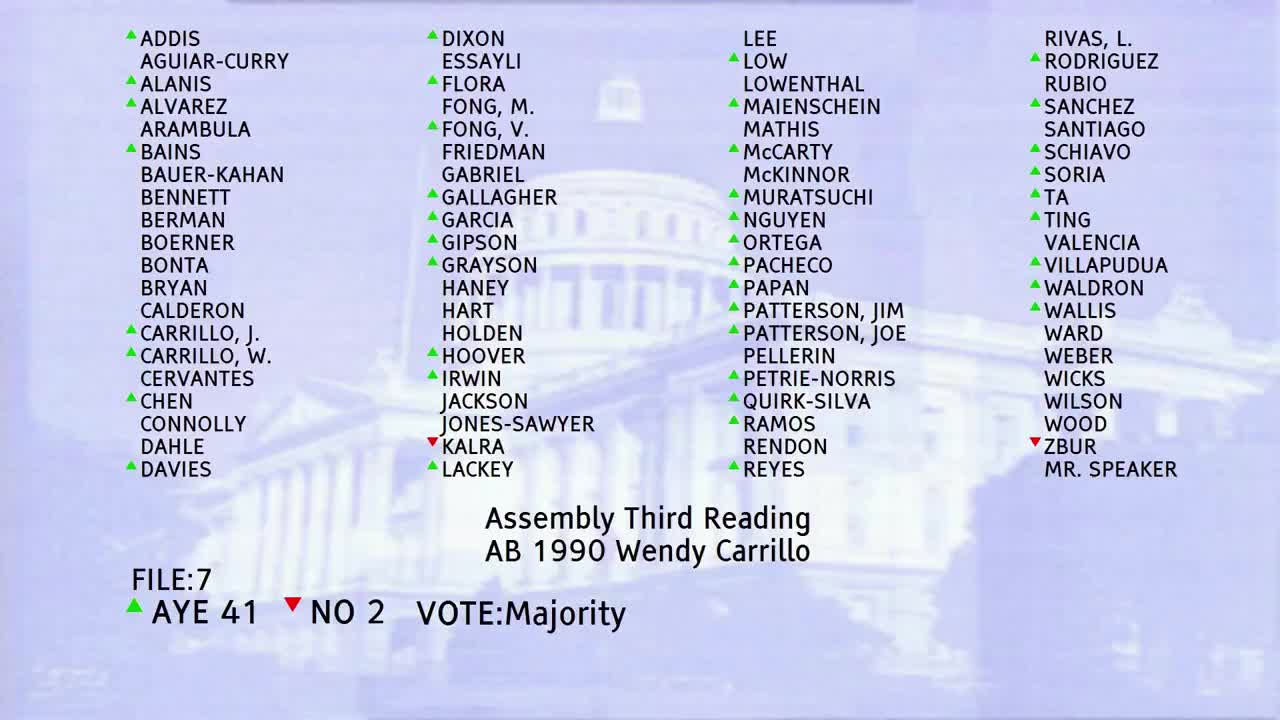 6MIN
Assembly Floor
 1MIN
Assembly Floor
 48MIN
Assembly Standing Committee on Public Safety
Bill Author

Bill Co-Author(s):