AB 2630: Pupil health: oral health assessment.
- Session Year: 2023-2024
- House: Assembly
- Latest Version Date: 2024-09-28
Current Status:
Passed
(2024-09-28: Chaptered by Secretary of State - Chapter 838, Statutes of 2024.)
Introduced
In Committee
First Chamber
In Committee
Second Chamber
Enacted
Existing law requires a pupil, while enrolled in kindergarten in a public school, or while enrolled in first grade in a public school if the pupil was not previously enrolled in kindergarten in a public school, to present proof of having received an oral health assessment by a licensed dentist, or other licensed or registered dental health professional operating within the professionals scope of practice, that was performed no earlier than 12 months before the date of the initial enrollment of the pupil, as provided.
This bill would define kindergarten for these purposes as including both transitional kindergarten and kindergarten, and would require the above-described proof only once during a 2-year kindergarten program. To the extent the bill would impose additional duties on public schools, the bill would impose a state-mandated local program.
The California Constitution requires the state to reimburse local agencies and school districts for certain costs mandated by the state. Statutory provisions establish procedures for making that reimbursement.
This bill would provide that, if the Commission on State Mandates determines that the bill contains costs mandated by the state, reimbursement for those costs shall be made pursuant to the statutory provisions noted above.
Existing law requires a pupil, while enrolled in kindergarten in a public school, or while enrolled in first grade in a public school if the pupil was not previously enrolled in kindergarten in a public school, to present proof of having received an oral health assessment by a licensed dentist or other licensed or registered dental health professional operating within the professionals scope of practice that was performed no earlier than 12 months prior to the date of the initial enrollment of the pupil, as provided.
This bill would define kindergarten for these purposes as including both transitional kindergarten and kindergarten, and would require the above-described proof only once during a two-year kindergarten program. To the extent the bill would impose additional duties on public schools, the bill would impose a state-mandated local program.
The California Constitution requires the state to reimburse local agencies and school districts for certain costs mandated by the state. Statutory provisions establish procedures for making that reimbursement.
This bill would provide that, if the Commission on State Mandates determines that the bill contains costs mandated by the state, reimbursement for those costs shall be made pursuant to the statutory provisions noted above.
(a)(1)A pupil, while enrolled in kindergarten in a public school, or while enrolled in first grade in a public school if the pupil was not previously enrolled in kindergarten in a public school, no later than May 31 of the school year, shall present proof of having received an oral health assessment by a licensed dentist, or other licensed or registered dental health professional operating within the professionals scope of practice, that was performed no earlier than 12 months before the date of the initial enrollment of the pupil.
(2)For purposes of this section, kindergarten includes both transitional kindergarten and kindergarten. The proof described in subdivision (a) shall be required only once during a two-year kindergarten program.
(b)The parent or legal guardian of a pupil may be excused from complying with subdivision (a) by indicating on the form described in subdivision (d) that the oral health assessment could not be completed because of one or more of the reasons provided in subparagraphs (A) to (C), inclusive, of paragraph (2) of subdivision (d).
(c)A public school shall notify the parent or legal guardian of a pupil described in subdivision (a) concerning the assessment requirement. The notification, at a minimum, shall consist of a letter that includes all of the following:
(1)An explanation of the administrative requirements of this section.
(2)Information on the importance of primary teeth.
(3)Information on the importance of oral health to overall health and to learning.
(4)A toll-free telephone number to request an application for Medi-Cal or other government-subsidized health insurance programs.
(5)Contact information for county public health departments.
(6)A statement of privacy applicable under state and federal laws and regulations.
(d)In order to ensure uniform data collection, the department, in consultation with the state dental director and interested persons, shall develop, revise as necessary, and make available on the internet website of the department, a standardized notification form as specified in subdivision (c) that shall be used by each school district. The standardized form shall include all of the following:
(1)A section to be used by the licensed dentist or other licensed or registered dental health professional performing the assessment to record information that is consistent with the information collected on the oral health assessment form developed by the Association of State and Territorial Dental Directors.
(2)A section in which the parent or legal guardian of a pupil can indicate the reason why an assessment could not be completed by marking the box next to the appropriate reason. The reasons for not completing an assessment shall include all of the following:
(A)Completion of an assessment poses an undue financial burden on the parent or legal guardian.
(B)Lack of access by the parent or legal guardian to a licensed dentist or other licensed or registered dental health professional.
(C)The parent or legal guardian does not consent to an assessment.
(3)(A)A section stating that, if a school or school district hosts a free oral health assessment event at which licensed dentists or other licensed or registered dental health professionals perform schoolsite assessments of pupils enrolled in the school, a pupil shall be given an oral health assessment unless the parent or legal guardian of the pupil has opted out of the schoolsite assessment pursuant to subparagraph (B).
(B)A section in which the parent or legal guardian of a pupil can indicate that the parent or legal guardian does not consent to the pupil receiving the oral health assessment described in subparagraph (A). A failure to opt out of the pupil oral health assessment pursuant to this subparagraph shall not be deemed to be consent for dental treatment of any kind.
(C)A section informing the parent or legal guardian that a pupil shall not receive dental treatment of any kind as part of the schoolsite assessment described in subparagraph (A) unless the pupils parent or legal guardian has provided informed consent for the treatment.
(e)Upon receiving completed assessments, all school districts, by July 1 of each year, shall submit a report to a system designated by the state dental director for the collection of those reports or the county office of education of the county in which the school district is located, or both. The report shall include all of the following:
(1)The total number of pupils in the school district, by school, who are subject to the requirement to present proof of having received an oral health assessment pursuant to subdivision (a).
(2)The total number of pupils described in paragraph (1) who present proof of an assessment.
(3)The total number of pupils described in paragraph (1) who could not complete an assessment due to financial burden.
(4)The total number of pupils described in paragraph (1) who could not complete an assessment due to lack of access to a licensed dentist or other licensed or registered dental health professional.
(5)The total number of pupils described in paragraph (1) who could not complete an assessment because their parents or legal guardians did not consent to their child receiving the assessment.
(6)The total number of pupils described in paragraph (1) who are assessed and found to have had caries experience.
(7)The total number of pupils described in paragraph (1) who are assessed and found to have untreated decay.
(8)The total number of pupils described in paragraph (1) who did not return either the assessment form or the waiver request to the school.
(f)All school districts that have fulfilled the report requirement described in subdivision (e) by submitting a report to the county office of education and all county offices of education are encouraged to submit the report described in subdivision (e) to a system designated by the state dental director for the collection of those reports.
(g)Each county office of education shall maintain the data described in subdivision (e) in a manner that allows the county office of education to release it upon request.
(h)This section does not prohibit any of the following:
(1)County offices of education from sharing aggregate data collected pursuant to this section with other governmental agencies, philanthropic organizations, or other nonprofit organizations for the purpose of data analysis.
(2)Use of assessment data that is compliant with the federal Health Insurance Portability and Accountability Act of 1996 (Public Law 104-191) for purposes of conducting research and analysis on the oral health status of public school pupils in California.
(i)This section does not preclude a school district or county office of education from developing a schoolsite-based oral health assessment program to meet the requirements of this section.
(j)The Office of Oral Health of the Chronic Disease Control Branch of the State Department of Public Health shall conduct or provide for the conducting of periodic evaluations of the requirements imposed by this section. The Office of Oral Health may receive private funds and contract with the University of California to fulfill the duties described in this subdivision.
(k)Funds appropriated in the annual Budget Act for the activities required by this section shall first be used to offset reimbursement provided to local educational agencies pursuant to Part 7 (commencing with Section 17500) of Division 4 of Title 2 of the Government Code for state-mandated costs imposed by this section.
SEC. 2.If the Commission on State Mandates determines that this act contains costs mandated by the state, reimbursement to local agencies and school districts for those costs shall be made pursuant to Part 7 (commencing with Section 17500) of Division 4 of Title 2 of the Government Code.
(a)(1)A pupil, while enrolled in kindergarten in a public school, or while enrolled in first grade in a public school if the pupil was not previously enrolled in kindergarten in a public school, no later than May 31 of the school year, shall present proof of having received an oral health assessment by a licensed dentist, or other licensed or registered dental health professional operating within his or her the professionals scope of practice, that was performed no earlier than 12 months before the date of the initial enrollment of the pupil.
(2)For purposes of this section, kindergarten includes both transitional kindergarten and kindergarten. The proof described in subdivision (a) shall be required only once during a two-year kindergarten program.
(b)The parent or legal guardian of a pupil may be excused from complying with subdivision (a) by indicating on the form described in subdivision (d) that the oral health assessment could not be completed because of one or more of the reasons provided in subparagraphs (A) to (C), inclusive, of paragraph (2) of subdivision (d).
(c)A public school shall notify the parent or legal guardian of a pupil described in subdivision (a) concerning the assessment requirement. The notification, at a minimum, shall consist of a letter that includes all of the following:
(1)An explanation of the administrative requirements of this section.
(2)Information on the importance of primary teeth.
(3)Information on the importance of oral health to overall health and to learning.
(4)A toll-free telephone number to request an application for Medi-Cal or other government-subsidized health insurance programs.
(5)Contact information for county public health departments.
(6)A statement of privacy applicable under state and federal laws and regulations.
(d)In order to ensure uniform data collection, the department, in consultation with the state dental director and interested persons, shall develop, revise as necessary, and make available on the Internet Web site internet website of the department, a standardized notification form as specified in subdivision (c) that shall be used by each school district. The standardized form shall include all of the following:
(1)A section to be used by the licensed dentist or other licensed or registered dental health professional performing the assessment to record information that is consistent with the information collected on the oral health assessment form developed by the Association of State and Territorial Dental Directors.
(2)A section in which the parent or legal guardian of a pupil can indicate the reason why an assessment could not be completed by marking the box next to the appropriate reason. The reasons for not completing an assessment shall include all of the following:
(A)Completion of an assessment poses an undue financial burden on the parent or legal guardian.
(B)Lack of access by the parent or legal guardian to a licensed dentist or other licensed or registered dental health professional.
(C)The parent or legal guardian does not consent to an assessment.
(3)(A)A section stating that, if a school or school district hosts a free oral health assessment event at which licensed dentists or other licensed or registered dental health professionals perform schoolsite assessments of pupils enrolled in the school, a pupil shall be given an oral health assessment unless the parent or legal guardian of the pupil has opted out of the schoolsite assessment pursuant to subparagraph (B).
(B)A section in which the parent or legal guardian of a pupil can indicate that the parent or legal guardian does not consent to the pupil receiving the oral health assessment described in subparagraph (A). A failure to opt out of the pupil oral health assessment pursuant to this subparagraph shall not be deemed to be consent for dental treatment of any kind.
(C)A section informing the parent or legal guardian that a pupil shall not receive dental treatment of any kind as part of the schoolsite assessment described in subparagraph (A) unless the pupils parent or legal guardian has provided informed consent for the treatment.
(e)Upon receiving completed assessments, all school districts, by July 1 of each year, shall submit a report to a system designated by the state dental director for the collection of those reports or the county office of education of the county in which the school district is located, or both. The report shall include all of the following:
(1)The total number of pupils in the school district, by school, who are subject to the requirement to present proof of having received an oral health assessment pursuant to subdivision (a).
(2)The total number of pupils described in paragraph (1) who present proof of an assessment.
(3)The total number of pupils described in paragraph (1) who could not complete an assessment due to financial burden.
(4)The total number of pupils described in paragraph (1) who could not complete an assessment due to lack of access to a licensed dentist or other licensed or registered dental health professional.
(5)The total number of pupils described in paragraph (1) who could not complete an assessment because their parents or legal guardians did not consent to their child receiving the assessment.
(6)The total number of pupils described in paragraph (1) who are assessed and found to have had caries experience.
(7)The total number of pupils described in paragraph (1) who are assessed and found to have untreated decay.
(8)The total number of pupils described in paragraph (1) who did not return either the assessment form or the waiver request to the school.
(f)All school districts that have fulfilled the report requirement described in subdivision (e) by submitting a report to the county office of education and all county offices of education are encouraged to submit the report described in subdivision (e) to a system designated by the state dental director for the collection of those reports.
(g)Each county office of education shall maintain the data described in subdivision (e) in a manner that allows the county office of education to release it upon request.
(h)This section does not prohibit any of the following:
(1)County offices of education from sharing aggregate data collected pursuant to this section with other governmental agencies, philanthropic organizations, or other nonprofit organizations for the purpose of data analysis.
(2)Use of assessment data that is compliant with the federal Health Insurance Portability and Accountability Act of 1996 (Public Law 104-191) for purposes of conducting research and analysis on the oral health status of public school pupils in California.
(i)This section does not preclude a school district or county office of education from developing a schoolsite-based oral health assessment program to meet the requirements of this section.
(j)The Office of Oral Health of the Chronic Disease Control Branch of the State Department of Public Health shall conduct or provide for the conducting of periodic evaluations of the requirements imposed by this section. The Office of Oral Health may receive private funds and contract with the University of California to fulfill the duties described in this subdivision.
(k)Funds appropriated in the annual Budget Act for the activities required by this section shall first be used to offset reimbursement provided to local educational agencies pursuant to Part 7 (commencing with Section 17500) of Division 4 of Title 2 of the Government Code for state-mandated costs imposed by this section.
SEC. 2.If the Commission on State Mandates determines that this act contains costs mandated by the state, reimbursement to local agencies and school districts for those costs shall be made pursuant to Part 7 (commencing with Section 17500) of Division 4 of Title 2 of the Government Code.
|
Date
|
Status
|
|---|---|
| Sep 28, 2024 | Chaptered by Secretary of State - Chapter 838, Statutes of 2024. |
| Sep 28, 2024 | Approved by the Governor. |
| Aug 27, 2024 | Enrolled and presented to the Governor at 12 p.m. |
| Aug 21, 2024 | In Assembly. Ordered to Engrossing and Enrolling. |
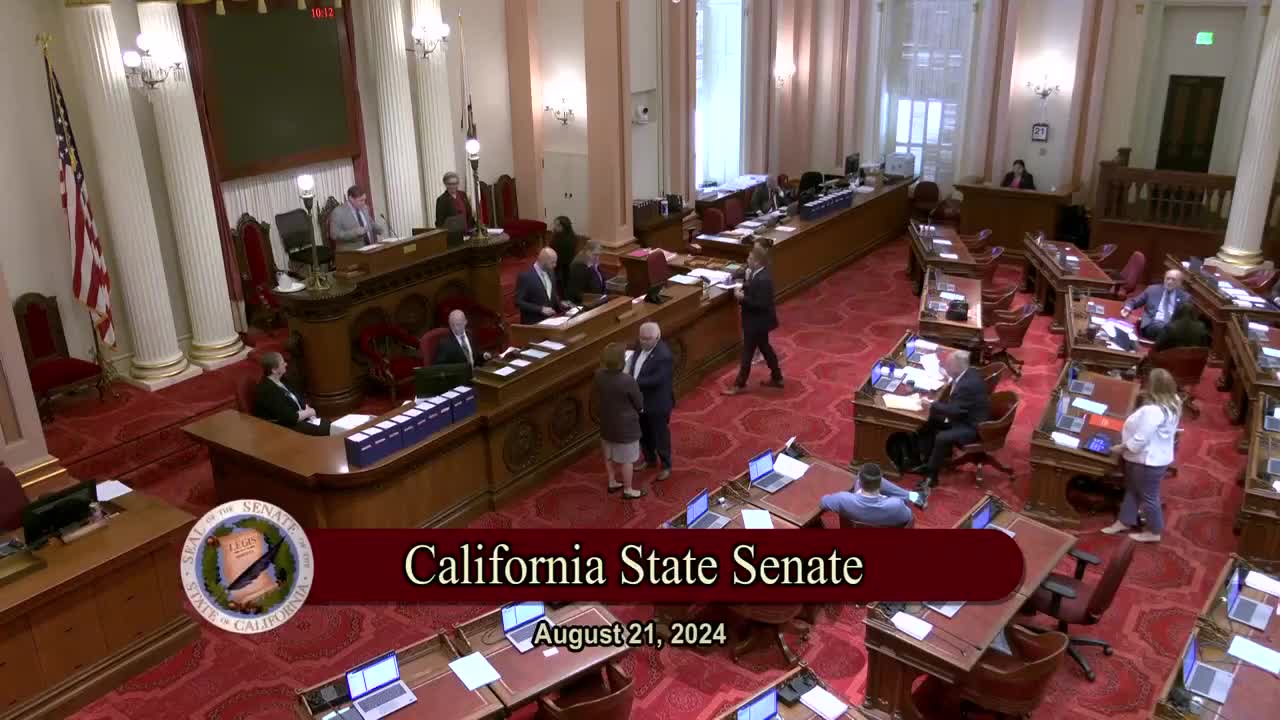
| Aug 21, 2024 | Read third time. Passed. Ordered to the Assembly. (Ayes 33. Noes 0. Page 5266.). |
| Jun 25, 2024 | Read second time. Ordered to third reading. |
| Jun 24, 2024 | From committee: Be ordered to second reading pursuant to Senate Rule 28.8. |
| Jun 13, 2024 | From committee: Do pass and re-refer to Com. on APPR with recommendation: To Consent Calendar. (Ayes 10. Noes 0.) (June 12). Re-referred to Com. on APPR. |
| May 29, 2024 | From committee: Do pass and re-refer to Com. on HEALTH with recommendation: To Consent Calendar. (Ayes 7. Noes 0.) (May 29). Re-referred to Com. on HEALTH. |
| May 1, 2024 | Referred to Coms. on ED. and HEALTH. |
| Apr 18, 2024 | In Senate. Read first time. To Com. on RLS. for assignment. |
| Apr 18, 2024 | Read third time. Passed. Ordered to the Senate. (Ayes 72. Noes 0.) |
| Apr 11, 2024 | Read second time. Ordered to Consent Calendar. |
| Apr 10, 2024 | From committee: Do pass. To Consent Calendar. (Ayes 14. Noes 0.) (April 10). |
| Mar 21, 2024 | From committee: Do pass and re-refer to Com. on APPR. with recommendation: To Consent Calendar. (Ayes 7. Noes 0.) (March 20). Re-referred to Com. on APPR. |
| Mar 4, 2024 | Referred to Com. on ED. |
| Feb 15, 2024 | From printer. May be heard in committee March 16. |
| Feb 14, 2024 | Read first time. To print. |
|
Date
|
Description
|
Location
|
Votes
|
|
|---|---|---|---|---|
| Aug 21, 2024 | Assembly 3rd Reading AB2630 Bonta By Rubio | Senate Floor |
Passed |
|
| Jun 12, 2024 | Do pass, but first be re-referred to the Committee on [Appropriations] with the recommendation: To Consent Calendar | Senate Standing Committee on Health |
Passed |
|
| May 29, 2024 | Do pass, but first be re-referred to the Committee on [Health] with the recommendation: To Consent Calendar | Senate Standing Committee on Education |
Passed |
|
| Apr 18, 2024 | AB 2630 Bonta Consent Calendar Second Day Regular Session | Assembly Floor |
Passed |
|
| Apr 10, 2024 | Do pass. To Consent Calendar. | Assembly Standing Committee on Appropriations |
Passed |
|
| Mar 20, 2024 | Do pass and be re-referred to the Committee on [Appropriations] with recommendation: To Consent Calendar | Assembly Standing Committee on Education |
Passed |
This list shows positions taken on this bill by organizations on the date displayed, which is linked to the original source.
Positions by individuals are not included.
SENATE RULES COMMITTEE Office of Senate Floor Analyses (916) 651-1520 Fax: (916) 327-4478 | AB 2630 |
THIRD READING
Bill No: AB 2630
Author: Bonta (D)
Introduced: 2/14/24
Vote: 21
SENATE EDUCATION COMMITTEE: 7-0, 5/29/24
AYES: Newman, Ochoa Bogh, Cortese, Glazer, Gonzalez, Smallwood-Cuevas, Wilk
SENATE HEALTH COMMITTEE: 10-0, 6/12/24
AYES: Roth, Nguyen, Glazer, Gonzalez, Grove, Hurtado, Limón, Menjivar, Rubio, Wiener
NO VOTE RECORDED: Smallwood-Cuevas
SENATE APPROPRIATIONS COMMITTEE: Senate Rule 28.8
ASSEMBLY FLOOR: 72-0, 4/18/24 (Consent) - See last page for vote
SUBJECT: Pupil health: oral health assessment
SOURCE: Children Now
DIGEST:
This bill expands the definition of “kindergarten” to include transitional kindergarten (TK) and requires proof of a student’s oral health assessment upon first enrollment only once during a two-year kindergarten program.
ANALYSIS:
Existing law:
- Requires a pupil, while enrolled in kindergarten in a public school, or while enrolled in first grade in a public school, to present proof, by May 31 of the school year, of having received an oral health assessment by a licensed dentist, or other licensed or registered dental health professional, that was performed no earlier than 12 months before the date of the initial enrollment of the pupil. (EC § 49452.8 (a))
- Allows a parent or legal guardian of a pupil to be excused if the oral health assessment could not be completed for the following reasons: completion of an assessment poses undue financial burden; lack of access to a licensed dentist or other licensed or registered dental health professional; or the parent or legal guardian does not consent to an assessment. (EC § 49452.8 (b))
- Requires a public school to notify a parent or legal guardian of a pupil concerning the oral health assessment requirement by letter that includes such information as the importance of primary teeth, the importance of oral health to overall health and learning, a toll-free number to request an application for Medi-Cal or other government-subsidized health insurance program, contact information for county public health departments, and a privacy statement. (EC § 49452.8 (c))
- Requires the California Department of Education (CDE), in consultation with the state dental director and interested persons, to develop and make available on its website a standardized notification form to be used by each school district, and including a section for the dental health professional performing the assessment to record specified information, and a section for a parent or legal guardian to indicate a reason why an assessment could not be completed. (EC § 49452.8 (d))
- Requires all school districts, upon receiving completed assessments, by July 1 of each year, to submit a report to the County Office of Education (COE) of the county in which the school district is located that includes information on the total number of pupils in the district who:
- Are subject to the assessment requirement;
- Present proof of an assessment;
- Could not complete an assessment due to an undue financial burden;
- Could not complete an assessment due to a lack of access to a dental health professional;
- Could not complete an assessment because their parent or guardians did not consent to their child receiving the assessment;
- Are assessed and found to have untreated decay; and
- Do not return either the assessment form or the waiver request to the school. (EC § 49452.8 (e))
This bill:
- Defines “Kindergarten” for the purposes of this bill to include both TK and kindergarten.
- Clarifies that the requirement for proof of a student’s oral health assessment upon first enrollment, must only once during the two-year kindergarten program.
Comments
- Need for the bill. According to the author, “The Kindergarten Oral Health Assessment (KOHA) was originally passed in 2006 to apply to students entering the public school system as kindergarteners (and in some cases 1st graders). Confusion about whether KOHA applies to students in transitional kindergarten is common among local educational agencies (LEAs) and local oral health programs working to collect KOHA forms and report KOHA data to the State Office of Oral Health. Given transitional kindergarten is becoming a primary entry point for students, clarity is needed about how to apply the KOHA requirement. Oral health issues, including dental decay, is the top reason for absenteeism. You can’t focus when your mouth is throbbing. AB 2630 will both clarify the current requirement and encourage earlier screening and intervention when a child is enrolled in TK, leading to fewer dental problems and less absenteeism related to these problems.”
- Oral Health: Gum Disease and Cavities. The American Academy of Pediatrics (AAP) recommends dental screening as soon as teeth erupt and every year, or more, for young children through age 6. A growing body of evidence has linked oral health, particularly periodontal or gum disease, to several chronic diseases, including diabetes, heart disease, and stroke.
- Gum Disease. According to the Mayo Clinic, gum disease (also known as periodontitis) is a serious gum infection that damages the soft tissue around teeth. In most cases, the development of gum disease starts with plaque when starches and sugars in food interact with bacteria commonly found in your mouth. Plaque can harden under your gumline into tartar if it stays on your teeth. Plaque can cause gingivitis, the mildest form of gum disease, ongoing gum irritation and swelling, called inflammation, can cause gum disease and tooth loss.
- Periodontitis. Periodontitis is common but can usually be prevented. The best way to prevent periodontitis is to get into the habit of taking good care of your mouth and teeth with good oral care, including brushing one’s teeth for two minutes at least twice a day and flossing, and regular dental visits every 6 to 12 months.
- Cavities Cavities (also known as caries or tooth decay) are areas on the hard surface of your teeth that are damaged. These areas of tooth decay become tiny openings or holes that can lead to a serious toothache, infection, and tooth loss. There are several causes of cavities, including bacteria in your mouth, snacking a lot, sipping sugary drinks and not cleaning your teeth well. According to the Center for Disease Control and Prevention:
- More than half of children aged 6 to 8 have had a cavity in at least one of their baby (primary) teeth
- More than half of adolescents aged 12 to 19 have had a cavity in at least one of their permanent teeth
- Children aged 5 to 19 years from low-income families are twice as likely (25%) to have cavities, compared with children from higher-income households (11%).
Oral health is integral to general health. Fluoride varnish can prevent about one-third (33%) of cavities in the primary teeth. Children living in communities with fluoridated tap water have fewer cavities than children whose water is not fluoridated. Similarly, children who brush daily with fluoride toothpaste will have fewer cavities.
- Kindergarten Oral Health Assessment (KOHA). KOHA is another way schools can help reduce dental disease in children through connecting children to a source of dental care, reduce chronic absenteeism, and improve school readiness.
Background
In 2006, the Legislature passed AB 1433 (Emmerson, Chapter 413, Statutes of 2006), required a pupil attending a public school while in kindergarten or first grade to present proof of having received an oral health assessment by a licensed dentist no earlier than 12 months prior to the date of the initial enrollment.
SB 379 (Atkins, Chapter 772, Statutes of 2017), provided school districts additional flexibility, by allowing districts to provide onsite screening and fulfill KOHA with consent, such that parents/guardians of students would need to notify the school that they do not want their child screened.
This bill clarifies that the requirement for proof of a student’s oral health assessment upon first enrollment must occur once during the two-year kindergarten program.
Related/Prior Legislation
SB 379 (Atkins, Chapter 772, Statutes of 2017) modified oral health assessment requirements for pupils in public schools, including authorizing schools or school districts who host a free oral health assessment to provide an oral health assessment unless the parent or legal guardian opts out.
AB 1433 (Emmerson, Chapter 413, Statutes of 2006) required a pupil attending a public school while in kindergarten or first grade to present proof, by May 31 of each year, of having received an oral health assessment by a licensed dentist no earlier than 12 months prior to the date of the initial enrollment, and requires public schools to send a notification of the assessment requirement to the parent of the pupil and to send a report, as specified, to the public health department of the county in which the school is located.
FISCAL EFFECT: Appropriation: No Fiscal Com.: Yes Local: Yes
SUPPORT: (Verified 6/23/24)
Children Now (source)
California Dental Association
California Primary Care Association Advocates
California Teachers Association
CleanEarth4Kids
Dental Board of California
Dientes Community Dental Care
Los Angeles County Office of Education
Oral Health Access Santa Cruz County
San Francisco Unified School District
The Los Angeles Trust for Children's Health
OPPOSITION: (Verified 6/23/24)
None received
ARGUMENTS IN SUPPORT: According to Children Now “In our recently released 2024 California Children’s Report Card, Oral Health received a “C” grade reflective of data that shows not enough children are receiving regular dental check-ups and that the state continues to suffer from “dental deserts,” contributing to the state’s 3 rd worst ranking in the country with children who have cavities. Further, the 2018-19 California Smile Survey found that 61% of third grade children in California have had tooth decay. Research shows that children with poor oral health status were nearly 3 times more likely than other students to miss school because of dental pain and were more likely to perform poorly in school. AB 2630 would expand current law so that children enrolling in transitional kindergarten use KOHA to be screened for dental health. Compliance with KOHA will help inform local health departments and local educational agencies about the oral health status of young students, including those who might require additional treatment for untreated cavities. In addition, the aggregate data provided to the State Office of Oral Health will provide much needed information to determine the prevalence of untreated tooth decay at the state level and could result in additional resources provided to local jurisdictions to promote community clinical linkages between school sites and dental providers. For all of these reasons, we are proud to sponsor and support AB 2630.”
ASSEMBLY FLOOR: 72-0, 4/18/24
AYES: Addis, Aguiar-Curry, Alanis, Alvarez, Bains, Bauer-Kahan, Bennett, Berman, Calderon, Juan Carrillo, Wendy Carrillo, Chen, Connolly, Davies, Dixon, Flora, Mike Fong, Vince Fong, Friedman, Gabriel, Gallagher, Garcia, Gipson, Grayson, Haney, Hart, Holden, Hoover, Irwin, Jackson, Jones-Sawyer, Kalra, Lackey, Lee, Low, Lowenthal, Maienschein, McCarty, McKinnor, Muratsuchi, Stephanie Nguyen, Ortega, Pacheco, Papan, Jim Patterson, Joe Patterson, Pellerin, Petrie-Norris, Quirk-Silva, Ramos, Rendon, Reyes, Luz Rivas, Rodriguez, Blanca Rubio, Sanchez, Santiago, Schiavo, Soria, Ta, Ting, Valencia, Villapudua, Waldron, Wallis, Ward, Weber, Wicks, Wilson, Wood, Zbur, Robert Rivas
NO VOTE RECORDED: Arambula, Boerner, Bonta, Bryan, Cervantes, Megan Dahle, Essayli, Mathis
Prepared by: Kordell Hampton / ED. / (916) 651-4105
6/25/24 13:08:32
**** END ****
SENATE COMMITTEE ON HEALTH
Senator Richard Roth, Chair
BILL NO: AB 2630
AUTHOR: | Bonta | ||
VERSION: | February 14, 2024 | ||
HEARING DATE: | June 12, 2024 | ||
CONSULTANT: | Reyes Diaz | ||
SUBJECT: Pupil health: oral health assessment
SUMMARY:
Clarifies that transitional kindergarten is within the definition of “kindergarten” for purposes of requiring pupils to provide proof of having received an oral health assessment.
Existing law:
- Requires the governing board of any school district to make rules for the examination of the pupils in the public schools under its jurisdiction that will insure proper care of the pupils and proper secrecy in connection with any defect noted by the supervisor of health or his assistant and may tend to the correction of the physical defect. [EDC §49450]
- Requires a pupil (while enrolled in kindergarten in a public school, or while enrolled in first grade in a public school if the pupil was not previously enrolled in kindergarten in a public school), no later than May 31 of the school year, to present proof of having received an oral health assessment by a licensed dentist, or other licensed or registered dental health professional operating within his or her scope of practice, that was performed no earlier than 12 months before the date of the initial enrollment of the pupil. [EDC §49452.8]
- Requires a public school to notify the parent or legal guardian of a pupil concerning the oral health assessment requirement through a letter that includes all of the following:
- An explanation of the administrative requirements of the oral health assessment requirement;
- Information on the importance of primary teeth;
- Information on the importance of oral health to overall health and to learning;
- A toll-free phone number to request an application for Medi-Cal or other government-subsidized health insurance programs;
- Contact information for county public health departments; and,
- A statement of privacy applicable under state and federal laws and regulations. [EDC §49452.8]
This bill:
- Clarifies that transitional kindergarten (TK) is within the definition of “kindergarten” for purposes of requiring pupils to provide proof of having received an oral health assessment.
- Requires that the proof of having received an oral health assessment be required only once during a two-year kindergarten program.
FISCAL EFFECT:
According to the Assembly Appropriations Committee, minor and absorbable Proposition 98 General Fund costs to public schools operating TK or kindergarten classes to change processes to collect proof of oral health assessments from students enrolled in TK and to update parent notifications on the oral health assessment requirement to clarify this change. If the Commission on State Mandates determines the bill’s requirements to be a reimbursable state mandate, the state would need to reimburse these costs to local educational agencies (LEAs) or provide funding through the K-12 Mandate Block Grant.
PRIOR VOTES:
Senate Education Committee: | 7 - 0 |
Assembly Floor: | 72 - 0 |
Assembly Appropriations Committee: | 14 - 0 |
Assembly Education Committee: | 7 - 0 |
COMMENTS:
- Author’s statement. According to the author, the Kindergarten Oral Health Assessment (KOHA) was originally passed in 2006 to apply to students entering the public school system as kindergarteners (and in some cases 1st graders). Confusion about whether KOHA applies to students in TK is common among LEAs and local oral health programs working to collect KOHA forms and report KOHA data to the state Office of Oral Health. Given TK is becoming a primary entry point for students, clarity is needed about how to apply the KOHA requirement. Oral health issues, including dental decay, is the top reason for absenteeism. You can’t focus when your mouth is throbbing. This bill will both clarify the current requirement and encourage earlier screening and intervention when a child is enrolled in TK, leading to fewer dental problems and less absenteeism related to these problems.
- Oral health: gum disease and cavities. Oral health is integral to general health. The American Academy of Pediatrics (AAP) recommends dental screening as soon as teeth erupt and every year, or more, for young children through age six. A growing body of evidence has linked oral health, particularly periodontal or gum disease, to several chronic diseases, including diabetes, heart disease, and stroke. According to the Mayo Clinic, gum disease (also known as periodontitis) is a serious gum infection that damages the soft tissue around teeth. In most cases, the development of gum disease starts with plaque when starches and sugars in food interact with bacteria commonly found in the mouth. Plaque can cause gingivitis, the mildest form of gum disease, ongoing gum irritation, and swelling. Periodontitis is common but can usually be prevented by taking good care of the mouth and teeth with good oral care, including brushing for two minutes at least twice a day and flossing, and regular dental visits every six to 12 months. Fluoride varnish can prevent about one-third of cavities in the primary teeth. Children living in communities with fluoridated tap water have fewer cavities than children whose water is not fluoridated. Similarly, children who brush daily with fluoride toothpaste will have fewer cavities. Cavities (also known as caries or tooth decay) are areas on the hard surface of the teeth that are damaged. These areas of tooth decay become tiny openings or holes that can lead to a serious toothache, infection, and tooth loss. There are several causes of cavities, including bacteria in the mouth, snacking a lot, sipping sugary drinks, and not cleaning the teeth well. According to the Center for Disease Control and Prevention:
- More than half of children aged six to eight have had a cavity in at least one of their baby (primary) teeth;
- More than half of adolescents aged 12 to 19 have had a cavity in at least one of their permanent teeth; and,
- Children aged five to 19 years from low-income families are twice as likely (25%) to have cavities, compared with children from higher-income households (11%).
- KOHA and the System for California Oral Health Reporting (SCOHR). KOHA requires specific data be collected by school staff annually and submitted to the County Office of Education. The database developed for KOHA data is known as SCOHR. According to the University of California, San Francisco website for SCOHR, the system was developed by the San Joaquin County Office of Education’s Center for Educational Development and Research, in collaboration with the Association of California School Administrators, the California Dental Association, and the California County Superintendents Educational Services Association to provide a centralized online method of all required student oral health assessment data. The website notes that schools in participating districts have access to input, manage, and track electronic Oral Health Assessment/Waiver Request Forms and all oral health assessment data, bulk upload data to pre-fill the forms, print pre-filled forms (individually or in-bulk), and export all data into a standardized format. SCOHR tracks the status of all Oral Health Assessment/Waiver Request Forms. SCOHR also includes a Report Generator utility to run ad-hoc, custom lists and aggregate reports at the school, district, county, and/or state levels.
- Double referral. This bill was heard in the Senate Education Committee on May 29, 2024, and passed with a 7-0 vote.
- Prior legislation. SB 379 (Atkins, Chapter 772, Statutes of 2017) made changes to the oral health assessment requirement for pupils in public school, as specified, including requiring the California Department of Education to consult with the state Dental Director; adding requirements to reports submitted by school districts; and, encouraging all school districts to report to a system designated by the Dental Director for collection of the required reports.
AB 1433 (Emmerson, Chapter 413, Statute of 2006) implemented the requirement that pupils provide proof of having received an oral health assessment, known as KOHA.
- Support. Children Now, the sponsor of this bill, state that in their recently released 2024 California Children’s Report Card, oral health received a “C” grade reflective of data that shows not enough children are receiving regular dental check-ups and that the state continues to suffer from dental deserts, contributing to the state’s third worst ranking in the country with children who have cavities. Further, the 2018-19 California Smile Survey found that 61% of third-grade children in California have had tooth decay. Supporters of this bill argue research shows that children with poor oral health status were nearly three times more likely than other students to miss school because of dental pain and were more likely to perform poorly in school. This bill would expand current law so that children enrolling in transitional kindergarten use KOHA to be screened for dental health. Compliance with KOHA will help inform local health departments and local educational agencies about the oral health status of young students, including those who might require additional treatment for untreated cavities. In addition, the aggregate data provided to the California Department of Public Health’s Office of Oral Health will provide much-needed information to determine the prevalence of untreated tooth decay at the state level and could result in additional resources provided to local jurisdictions to promote community clinical linkages between school sites and dental providers.
SUPPORT AND OPPOSITION:
Support: Children Now (sponsor)
California Dental Association
California Dental Hygienists’ Association
California Primary Care Association Advocates
California School-Based Health Alliance
California Society of Pediatric Dentistry
California Teachers Association
Cleanearth4kids.org
Dental Board of California
Dientes Community Dental Care
Los Angeles County Office of Education
Los Angeles Trust for Children’s Health
Oral Health Access Santa Cruz County
San Francisco Unified School District
Oppose: None received
-- END --
SENATE COMMITTEE ON EDUCATION
Senator Josh Newman, Chair
2023 - 2024 Regular
Bill No: AB 2630 Hearing Date: May 29, 2024
Author: | |||
Version: | February 14, 2024 | ||
Urgency: | No | Fiscal: | Yes |
Consultant: | Kordell Hampton | ||
Subject: Pupil health: oral health assessment.
NOTE: This bill has been referred to the Committees on Education and Health. A "do pass" motion should include referral to the Committee on Health.
SUMMARY
This bill expands the definition of “kindergarten” to include transitional kindergarten (TK) and requires proof of a student’s oral health assessment upon first enrollment only once during a two-year kindergarten program.
BACKGROUND
Existing Law:
Education Code (EC)
- Requires a pupil, while enrolled in kindergarten in a public school, or while enrolled in first grade in a public school, to present proof, by May 31 of the school year, of having received an oral health assessment by a licensed dentist, or other licensed or registered dental health professional, that was performed no earlier than 12 months before the date of the initial enrollment of the pupil. (EC § 49452.8 (a))
- Allows a parent or legal guardian of a pupil to be excused if the oral health assessment could not be completed for the following reasons: completion of an assessment poses undue financial burden; lack of access to a licensed dentist or other licensed or registered dental health professional; or the parent or legal guardian does not consent to an assessment. (EC § 49452.8 (b))
- Requires a public school to notify a parent or legal guardian of a pupil concerning the oral health assessment requirement by letter that includes such information as the importance of primary teeth, the importance of oral health to overall health and learning, a toll-free number to request an application for Medi-Cal or other government-subsidized health insurance program, contact information for county public health departments, and a privacy statement. (EC § 49452.8 (c))
- Requires the California Department of Education (CDE), in consultation with the state dental director and interested persons, to develop and make available on its website a standardized notification form to be used by each school district, and including a section for the dental health professional performing the assessment to record specified information, and a section for a parent or legal guardian to indicate a reason why an assessment could not be completed. (EC § 49452.8 (d))
- Requires all school districts, upon receiving completed assessments, by July 1 of each year, to submit a report to the County Office of Education (COE) of the county in which the school district is located that includes information on the total number of pupils in the district who:
- Are subject to the assessment requirement;
- Present proof of an assessment;
- Could not complete an assessment due to an undue financial burden;
- Could not complete an assessment due to a lack of access to a dental health professional;
- Could not complete an assessment because their parent or guardians did not consent to their child receiving the assessment;
- Are assessed and found to have untreated decay; and
- Do not return either the assessment form or the waiver request to the school. (EC § 49452.8 (e))
ANALYSIS
This bill:
- Defines “Kindergarten” for the purposes of this bill to include both TK and kindergarten.
- Clarifies that the requirement for proof of a student’s oral health assessment upon first enrollment, must only once during the two-year kindergarten program.
STAFF COMMENTS
- Need for the bill. According to the author, “The Kindergarten Oral Health Assessment (KOHA) was originally passed in 2006 to apply to students entering the public school system as kindergarteners (and in some cases 1st graders). Confusion about whether KOHA applies to students in transitional kindergarten is common among local educational agencies (LEAs) and local oral health programs working to collect KOHA forms and report KOHA data to the State Office of Oral Health. Given transitional kindergarten is becoming a primary entry point for students, clarity is needed about how to apply the KOHA requirement. Oral health issues, including dental decay, is the top reason for absenteeism. You can’t focus when your mouth is throbbing. AB 2630 will both clarify the current requirement and encourage earlier screening and intervention when a child is enrolled in TK, leading to fewer dental problems and less absenteeism related to these problems.”
- Oral Health: Gum Disease and Cavities. The American Academy of Pediatrics (AAP) recommends dental screening as soon as teeth erupt and every year, or more, for young children through age 6. A growing body of evidence has linked oral health, particularly periodontal or gum disease, to several chronic diseases, including diabetes, heart disease, and stroke.
Gum Disease
According to the Mayo Clinic, gum disease (also known as periodontitis) is a serious gum infection that damages the soft tissue around teeth. In most cases, the development of gum disease starts with plaque when starches and sugars in food interact with bacteria commonly found in your mouth. Plaque can harden under your gumline into tartar if it stays on your teeth. Plaque can cause gingivitis, the mildest form of gum disease, ongoing gum irritation and swelling, called inflammation, can cause gum disease and tooth loss.
Periodontitis is common but can usually be prevented. The best way to prevent periodontitis is to get into the habit of taking good care of your mouth and teeth with good oral care, including brushing one’s teeth for two minutes at least twice a day and flossing, and regular dental visits every 6 to 12 months.
Cavities
Cavities (also known as caries or tooth decay) are areas on the hard surface of your teeth that are damaged. These areas of tooth decay become tiny openings or holes that can lead to a serious toothache, infection, and tooth loss. There are several causes of cavities, including bacteria in your mouth, snacking a lot, sipping sugary drinks and not cleaning your teeth well. According to the Center for Disease Control and Prevention:
- More than half of children aged 6 to 8 have had a cavity in at least one of their baby (primary) teeth
- More than half of adolescents aged 12 to 19 have had a cavity in at least one of their permanent teeth
- Children aged 5 to 19 years from low-income families are twice as likely (25%) to have cavities, compared with children from higher-income households (11%).
Oral health is integral to general health. Fluoride varnish can prevent about one-third (33%) of cavities in the primary teeth. Children living in communities with fluoridated tap water have fewer cavities than children whose water is not fluoridated. Similarly, children who brush daily with fluoride toothpaste will have fewer cavities.
- Kindergarten Oral Health Assessment (KOHA). KOHA is another way schools can help reduce dental disease in children through connecting children to a source of dental care, reduce chronic absenteeism, and improve school readiness.
In 2006, the Legislature passed AB 1433 (Emmerson, Chapter 413, Statutes of 2006), which requires a pupil attending a public school while in kindergarten or first grade to present proof of having received an oral health assessment by a licensed dentist no earlier than 12 months prior to the date of the initial enrollment.
SB 379 (Atkins, Chapter 772, Statutes of 2017), provided school districts additional flexibility, by allowing districts to provide onsite screening and fulfill KOHA with consent, such that parents/guardians of students would need to notify the school that they do not want their child screened.
This bill clarifies that the requirement for proof of a student’s oral health assessment upon first enrollment must occur once during the two-year kindergarten program.
- Related Legislation.
SB 379 (Atkins, Chapter 772, Statutes of 2017) modifies oral health assessment requirements for pupils in public schools, including authorizing schools or school districts who host a free oral health assessment to provide an oral health assessment unless the parent or legal guardian opts out.
AB 1433 (Emmerson, Chapter 413, Statutes of 2006) requires a pupil attending a public school while in kindergarten or first grade to present proof, by May 31 of each year, of having received an oral health assessment by a licensed dentist no earlier than 12 months prior to the date of the initial enrollment, and requires public schools to send a notification of the assessment requirement to the parent of the pupil and to send a report, as specified, to the public health department of the county in which the school is located.
SUPPORT
Children Now (Sponsor)
California Dental Association
California Primary Care Association Advocates
California Teachers Association
Dientes Community Dental Care
Los Angeles County Office of Education
Oral Health Access Santa Cruz County
San Francisco Unified School District
The Los Angeles Trust for Children's Health
OPPOSITION
None received
-- END --
Date of Hearing: April 10, 2024
ASSEMBLY COMMITTEE ON APPROPRIATIONS
Buffy Wicks, Chair
ABPCA Bill Id:AB 2630
Author:(Bonta) – As Introduced Ver:February 14, 2024
Policy Committee: | Education | Vote: | 7 - 0 |
|
| ||
|
|
Urgency: No State Mandated Local Program: Yes Reimbursable: Yes
SUMMARY:
This bill requires a student enrolled in transitional kindergarten to submit, no later than May 31 of the school year, proof of having received an oral health assessment. The bill clarifies a student need not submit an additional proof of assessment in kindergarten.
FISCAL EFFECT:
Minor and absorbable Proposition 98 General Fund costs to public schools operating transitional or kindergarten classes to change processes to collect proof of oral health assessments from students enrolled in transitional kindergarten and to update parent notifications on the oral health assessment requirement to clarify this change.
If the Commission on State Mandates determines the bill’s requirements to be a reimbursable state mandate, the state would need to reimburse these costs to LEAs or provide funding through the K-12 Mandate Block Grant.
COMMENTS:
- Purpose. According to the author:
Confusion about whether KOHA applies to students in transitional kindergarten is common among local educational agencies (LEAs) and local oral health programs working to collect KOHA forms and report KOHA data to the State Office of Oral Health. Given transitional kindergarten is becoming a primary entry point for students, clarity is needed about how to apply the KOHA requirement…AB 2630 will both clarify the current [Kindergarten Oral Health Assessment] requirement and encourage earlier screening and intervention when a child is enrolled in transitional kindergarten, leading to fewer dental problems and less absenteeism related to these problems.
- Background. Current law requires a student attending a public school while in kindergarten, or first grade if not previously enrolled in kindergarten, to present proof, by May 31 of each year, of having received an oral health assessment by a licensed dentist no earlier than 12 months prior to the date of the initial enrollment, and requires public schools to send a notification of the assessment requirement to the parent or legal guardian of the student and to send a report, as specified, to the public health department of the county in which the school is located.
This bill requires a student who has enrolled in transitional kindergarten to submit an oral health assessment by no later than May 31 of the school year. In cases where children do not attend transitional kindergarten, they must submit the form in kindergarten or in first grade, if they do not attend kindergarten, as required in current law.
Analysis Prepared by: Natasha Collins / APPR. / (916) 319-2081
Date of Hearing: March 20, 2024
ASSEMBLY COMMITTEE ON EDUCATION
Al Muratsuchi, Chair
ABPCA Bill Id:AB 2630 (
Author:Bonta) – As Introduced Ver:February 14, 2024
SUBJECT: Pupil health: oral health assessment
SUMMARY: Requires proof of a student’s oral health assessment upon first enrollment only once during the two-year kindergarten program. Specifically, this bill:
- Requires proof of a student’s oral health assessment upon first enrollment only once during the two-year kindergarten program.
- Defines “kindergarten” for purposes of this section to include both transitional kindergarten and kindergarten.
- Makes other technical and conforming changes.
EXISTING LAW:
- Requires a pupil, while enrolled in kindergarten in a public school, or while enrolled in first grade in a public school, to present proof, by May 31 of the school year, of having received an oral health assessment by a licensed dentist, or other licensed or registered dental health professional, that was performed no earlier than 12 months before the date of the initial enrollment of the pupil. (Education Code (EC) 49452.8)
- Allows a parent or legal guardian of a pupil to be excused from the requirement in 1) above, if the oral health assessment could not be completed for the following reasons: completion of an assessment poses undue financial burden; lack of access to a licensed dentist or other licensed or registered dental health professional; or the parent or legal guardian does not consent to an assessment. (EC 49452.8)
- Requires a public school to notify a parent or legal guardian of a pupil concerning the oral health assessment requirement by letter that includes such information as the importance of primary teeth, the importance of oral health to overall health and learning, a toll-free number to request an application for Medi-Cal or other government-subsidized health insurance program, contact information for county public health departments, and a privacy statement. (EC 49452.8)
- Requires the California Department of Education (CDE), in consultation with the state dental director and interested persons, to develop and make available on its website a standardized notification form to be used by each school district, and including a section for the dental health professional performing the assessment to record specified information, and a section for a parent or legal guardian to indicate a reason why an assessment could not be completed. (EC 49452.8)
- Requires all school districts, upon receiving completed assessments, by December 31 of each year, to submit a report to the county office of education (COE) of the county in which the school district is located that includes information on the total number of pupils in the district who:
- Are subject to the assessment requirement;
- Present proof of an assessment;
- Could not complete an assessment due to an undue financial burden;
- Could not complete an assessment due to a lack of access to a dental health professional;
- Could not complete an assessment because their parent or guardians did not consent to their child receiving the assessment;
- Are assessed and found to have untreated decay; and
- Do not return either the assessment form or the waiver request to the school. (EC 49452.8)
- Authorizes, but does not require, a school district or COE to develop a schoolsite-based oral health assessment program to meet the requirements of the oral health assessment. (EC 49452.8)
- Requires the California Department of Public Health’s (CDPH) Office of Oral Health to conduct periodic evaluations of the oral health assessment. (EC 49452.8)
FISCAL EFFECT: The Office of Legislative Counsel has keyed this bill as a possible state-mandated local program.
COMMENTS:
Need for the bill. According to the author, “The Kindergarten Oral Health Assessment (KOHA) was originally passed in 2006 to apply to students entering the public school system as kindergarteners (and in some cases 1st graders). Confusion about whether KOHA applies to students in transitional kindergarten is common among local educational agencies (LEAs) and local oral health programs working to collect KOHA forms and report KOHA data to the State Office of Oral Health. Given transitional kindergarten is becoming a primary entry point for students, clarity is needed about how to apply the KOHA requirement. Oral health issues, including dental decay is the top reason for absenteeism. You can’t focus when your mouth is throbbing. AB 2630 will both clarify the current requirement and encourage earlier screening and intervention when a child is enrolled in TK, leading to fewer dental problems and less absenteeism related to these problems.”
Kindergarten Oral Health Assessment requirement. The KOHA was originally passed in 2006 to apply to students entering the public school system as kindergarteners (and in some cases 1st graders). Confusion about whether the KOHA applies to students in TK is common among LEAs and local oral health programs working to collect KOHA forms and report KOHA data to the State Office of Oral Health. Given TK is expected to become a primary entry point for students, clarity is needed about how to apply the KOHA requirement. In addition, the lack of data about the prevalence of tooth decay and whether these students need dental care is detrimental to a student’s overall health and could contribute to chronic absenteeism and lower academic success.
Importance of dental health in children. The American Academy of Pediatrics (AAP) recommends dental screening as soon as teeth erupt and every year, or more, for young children through age 6. AAP recommends pediatricians assess whether the child has a dental home beginning at 6 months of age. If no dental home is identified, pediatricians are advised to perform a risk assessment and refer to a dental home.
According to the federal Office of Disease Prevention and Health Promotion, oral diseases ranging from dental caries to oral cancers cause pain and disability for millions of Americans. The American Dental Association defines dental caries as both the disease process and the lesion (noncavitated or cavitated) that is formed as a result of the disease process and which can culminate in localized destruction of hard dental tissues.
Tooth decay remains one of the most common chronic, yet preventable childhood conditions. Left untreated, tooth decay can lead to many difficulties including eating, sleeping, and learning. Every year, thousands of children miss school due to dental problems, contributing to chronic absenteeism and lost average daily attendance funding for schools.
A growing body of evidence has linked oral health, particularly periodontal or gum disease, to several chronic diseases, including diabetes, heart disease, and stroke. Oral health is integral to general health. Children with dental pain may be irritable, withdrawn, or unable to concentrate at school, which can affect school attendance and test performance.
California ranks 3rd worst among all states for children with tooth decay or cavities. 14.8% of children 1-17 years old had tooth decay or cavities within the past 12 months in the 2020-21 year, compared to the national average of 12.2% (CDHCS, 2023). Children Now’s 2024 California Children’s Report Card gives California a grade of C for Oral Health Care and notes that there are many “dental deserts” in California where there are no or too few dentists to serve the Medi-Cal population, and too few dentists are trained and willing to serve children. 45% of California’s 58 counties have no pediatric dentists accepting Medi-Cal, and only 45% of 1-5 year olds enrolled in Medi-Cal have annual dental visits.
California’s Oral Health Plan. The CDPH’s Oral Health Plan 2018-2028 notes that national reports consistently rank California in the lower quartile among states with respect to children’s oral health status and receipt of preventive dental services. The plan includes the following recommendations:
- Identify, maintain, and expand evidence-based programs and best practice approaches that promote oral health: Encourage compliance with current oral health-related guidelines, laws and regulations such as school entrance dental assessment, water fluoridation programs, dental-related requirements for Health Licensed Facilities, and infection control guidelines for safe dental practices;
- Increase the proportion of children who had a preventive dental visit in the past year; and
- Increase the number of Medi-Cal beneficiaries under six years of age receiving in any 12-month period a dental disease prevention protocol by primary care medical providers that includes an oral health assessment, fluoride varnish application, and dental referral or assurance the patient has received examination by a dentist in the last 12 months.
This bill would provide for earlier screening and referral of children, which could reduce the incidence of cavities in kindergarten and improve compliance with KOHA, in alignment with the State’s oral health plan.
Arguments in support. Children Now, the sponsor of the bill, writes:
“In our recently released 2024 California Children’s Report Card, Oral Health received a “C” grade reflective of data that shows not enough children are receiving regular dental check-ups and that the state continues to suffer from “dental deserts,” contributing to the state’s 3rd worst ranking in the country with children who have cavities. Further, the 2018-19 California Smile Survey found that 61% of third grade children in California have had tooth decay. Research shows that children with poor oral health status were nearly 3 times more likely than other students to miss school as a result of dental pain and were more likely to perform poorly in school.
Compliance with the Kindergarten Oral Health Assessment (KOHA) will help inform local health departments and LEAs about the oral health status of young students, including those who might require additional treatment for untreated cavities. In addition, the aggregate data provided to the State Office of Oral Health will provide much needed information to determine the prevalence of untreated tooth decay at the state level and could result in additional resources provided to local jurisdictions to promote community clinical linkages between school sites and dental providers.”
Related legislation. SB 379 (Atkins) Chapter 772, Statutes of 2017, modifies oral health assessment requirements for pupils in public schools, including authorizing schools or school districts who host a free oral health assessment to provide an oral health assessment unless the parent or legal guardian opts out.
AB 1433 (Emmerson), Chapter 413, Statutes of 2006, requires a pupil attending a public school while in kindergarten or first grade to present proof, by May 31 of each year, of having received an oral health assessment by a licensed dentist no earlier than 12 months prior to the date of the initial enrollment, and requires public schools to send a notification of the assessment requirement to the parent of the pupil and to send a report, as specified, to the public health department of the county in which the school is located.
REGISTERED SUPPORT / OPPOSITION:
Support
Children Now (Sponsor)
Opposition
None on file
Analysis Prepared by: Debbie Look / ED. / (916) 319-2087
Bill Author

Bill Co-Author(s):