AB 2639: Forestry: timber operations: maintenance of timberlands for fuels reduction.
- Session Year: 2023-2024
- House: Assembly
- Latest Version Date: 2024-04-11
Current Status:
Failed
(2024-05-16: In committee: Held under submission.)
Introduced
In Committee
First Chamber
In Committee
Second Chamber
Enacted
The Zberg-Nejedly Forest Practice Act of 1973 prohibits a person from conducting timber operations unless a timber harvesting plan prepared by a registered professional forester has been submitted to, and approved by, the Department of Forestry and Fire Protection. Existing law defines timber operations for purposes of the act. The act provides that any person who willfully violates any provision of the act or rule or regulation of the State Board of Forestry and Fire Protection is guilty of a misdemeanor.
The California Environmental Quality Act (CEQA) requires a lead agency, as defined, to prepare, or cause to be prepared, and certify the completion of an environmental impact report on a project that it proposes to carry out or approve that may have a significant effect on the environment or to adopt a negative declaration if it finds that the project will not have that effect. CEQA also requires a lead agency to prepare a mitigated negative declaration for a project that may have a significant effect on the environment if revisions in the project would avoid or mitigate that effect and there is no substantial evidence that the project, as revised, would have a significant effect on the environment.
This bill would expand the definition of timber operations to include the maintenance of timberlands for fuels reduction, through fuels reduction paid in part or in whole with public funds. By expanding the scope of a crime, the bill would create a state-mandated local program. The bill would provide that timber operations for the maintenance of timberland, paid in part or in whole with public funds, may may, as an alternative to obtaining an approved timber harvesting plan, comply with the requirements of CEQA in lieu of preparing a timber harvesting plan. CEQA.
The California Constitution requires the state to reimburse local agencies and school districts for certain costs mandated by the state. Statutory provisions establish procedures for making that reimbursement.
This bill would provide that no reimbursement is required by this act for a specified reason.
The Zberg-Nejedly Forest Practice Act of 1973 prohibits a person from conducting timber operations unless a timber harvesting plan prepared by a registered professional forester has been submitted to, and approved by, the Department of Forestry and Fire Protection. Existing law defines timber operations for purposes of the act. The act provides that any person who willfully violates any provision of the act or rule or regulation of the State Board of Forestry and Fire Protection is guilty of a misdemeanor.
The California Environmental Quality Act (CEQA) requires a lead agency, as defined, to prepare, or cause to be prepared, and certify the completion of an environmental impact report on a project that it proposes to carry out or approve that may have a significant effect on the environment or to adopt a negative declaration if it finds that the project will not have that effect. CEQA also requires a lead agency to prepare a mitigated negative declaration for a project that may have a significant effect on the environment if revisions in the project would avoid or mitigate that effect and there is no substantial evidence that the project, as revised, would have a significant effect on the environment.
This bill would expand the definition of timber operations to include the maintenance of timberlands for fuels reduction, paid in part or in whole with public funds. By expanding the scope of a crime, the bill would create a state-mandated local program. The bill would provide that timber operations for the maintenance of timberland, paid in part or in whole with public funds, may comply with the requirements of CEQA in lieu of preparing a timber harvesting plan.
The California Constitution requires the state to reimburse local agencies and school districts for certain costs mandated by the state. Statutory provisions establish procedures for making that reimbursement.
This bill would provide that no reimbursement is required by this act for a specified reason.
The California Environmental Quality Act (CEQA) requires a lead agency, as defined, to prepare, or cause to be prepared, and certify the completion of an environmental impact report on a project that it proposes to carry out or approve that may have a significant effect on the environment or to adopt a negative declaration if it finds that the project will not have that effect. CEQA also requires a lead agency to prepare a mitigated negative declaration for a project that may have a significant effect on the environment if revisions in the project would avoid or mitigate that effect and there is no substantial evidence that the project, as revised, would have a significant effect on the environment.CEQA makes various legislative findings and declarations regarding the maintenance of a quality environment for the people of this state and states the intent of the Legislature for state agencies to regulate activities so that major consideration is given to preventing environmental damage.This bill would make nonsubstantive changes to those findings and declarations, and to the statement of intent.The California Environmental Quality Act (CEQA) requires a lead agency, as defined, to prepare, or cause to be prepared, and certify the completion of an environmental impact report on a project that it proposes to carry out or approve that may have a significant effect on the environment or to adopt a negative declaration if it finds that the project will not have that effect. CEQA also requires a lead agency to prepare a mitigated negative declaration for a project that may have a significant effect on the environment if revisions in the project would avoid or mitigate that effect and there is no substantial evidence that the project, as revised, would have a significant effect on the environment.
CEQA makes various legislative findings and declarations regarding the maintenance of a quality environment for the people of this state and states the intent of the Legislature for state agencies to regulate activities so that major consideration is given to preventing environmental damage.
This bill would make nonsubstantive changes to those findings and declarations, and to the statement of intent.
(a)(1)Timber operations means the cutting or removal, or both, of timber or other solid wood forest products, including Christmas trees, from timberlands for commercial purposes, or the noncommercial maintenance of timberlands for fuels reduction, through fuels reduction paid in part or in whole with public funds, together with all the incidental work, including, but not limited to, construction and maintenance of roads, fuelbreaks, firebreaks, stream crossings, landings, skid trails, and beds for the falling of trees, fire hazard abatement, and site preparation that involves disturbance of soil or burning of vegetation, slash, or woody debris following timber harvesting activities or maintenance of timberland, harvesting, but excluding preparatory work such as treemarking, surveying, or roadflagging.
(2)Commercial purposes includes (A) the cutting or removal of trees that are processed into logs, lumber, or other wood products and offered for sale, barter, exchange, or trade, or (B) the cutting or removal of trees or other forest products during the conversion of timberlands to land uses other than the growing of timber that are subject to Section 4621, including, but not limited to, residential or commercial developments, production of other agricultural crops, recreational developments, ski developments, water development projects, and transportation projects.
(b)For purposes of this section, the removal of trees less than 16 inches in diameter at breast height from a firebreak or fuelbreak does not constitute timber operations if the removal meets all of the following criteria:
(1)It is located within 500 feet of the boundary of an urban wildland interface community at high risk of wildfire, as defined in pages 751 to 776, inclusive, of Volume 66 of the Federal Register (66 FR 751-02), as that definition may be amended from time to time. For purposes of this paragraph, urban wildland interface community at high risk of wildfire means an area having one or more structures for every five acres.
(2)It is part of a community wildfire protection plan approved by the department or part of a department fire plan.
(3)The trees to be removed will not be processed into logs or lumber, unless the work is being conducted by, or in partnership with, a public agency or a nonprofit organization that has received a grant from the department for vegetation management or fuel reduction, in which case the logs or lumber may be sold.
(4)The work to be conducted is under a firebreak or fuelbreak project that has been subject to a project-based review pursuant to a negative declaration, mitigated negative declaration, or environmental impact report in compliance with the California Environmental Quality Act (Division 13 (commencing with Section 21000)). For projects to be conducted on forested landscapes, as defined in Section 754, the project and the project-based review shall be prepared by or in consultation with a registered professional forester.
(5)The removal of surface and ladder fuels is consistent with former paragraph (9) of subdivision (j) of Section 4584, as that section read on December 31, 2018.
SEC. 2.Section 4581 of the Public Resources Code is amended to read:4581.No person shall conduct timber operations unless a timber harvesting plan prepared by a registered professional forester has been submitted for those operations to the department pursuant to this article. The plan shall be required in addition to the license required in Section 4571. Timber operations for the maintenance of timberland, paid in part or in while whole with public funds, may may, as an alternative to obtaining an approved timber harvesting plan pursuant to this section, comply with Division 13 (commencing with Section 21000) in lieu of preparing a timber harvesting plan. 21000).
SEC. 3.No reimbursement is required by this act pursuant to Section 6 of Article XIIIB of the California Constitution because the only costs that may be incurred by a local agency or school district will be incurred because this act creates a new crime or infraction, eliminates a crime or infraction, or changes the penalty for a crime or infraction, within the meaning of Section 17556 of the Government Code, or changes the definition of a crime within the meaning of Section 6 of Article XIIIB of the California Constitution.
(a)(1)Timber operations means the cutting or removal, or both, of timber or other solid wood forest products, including Christmas trees, from timberlands for commercial purposes, or the maintenance of timberlands for fuels reduction, paid in part or in whole with public funds, together with all the incidental work, including, but not limited to, construction and maintenance of roads, fuelbreaks, firebreaks, stream crossings, landings, skid trails, and beds for the falling of trees, fire hazard abatement, and site preparation that involves disturbance of soil or burning of vegetation vegetation, slash, or woody debris following timber harvesting activities, activities or maintenance of timberland, but excluding preparatory work such as treemarking, surveying, or roadflagging.
(2)Commercial purposes includes (A) the cutting or removal of trees that are processed into logs, lumber, or other wood products and offered for sale, barter, exchange, or trade, or (B) the cutting or removal of trees or other forest products during the conversion of timberlands to land uses other than the growing of timber that are subject to Section 4621, including, but not limited to, residential or commercial developments, production of other agricultural crops, recreational developments, ski developments, water development projects, and transportation projects.
(b)For purposes of this section, the removal of trees less than 16 inches in diameter at breast height from a firebreak or fuelbreak does not constitute timber operations if the removal meets all of the following criteria:
(1)It is located within 500 feet of the boundary of an urban wildland interface community at high risk of wildfire, as defined in pages 751 to 776, inclusive, of Volume 66 of the Federal Register (66 FR 751-02), as that definition may be amended from time to time. For purposes of this paragraph, urban wildland interface community at high risk of wildfire means an area having one or more structures for every five acres.
(2)It is part of a community wildfire protection plan approved by the department or part of a department fire plan.
(3)The trees to be removed will not be processed into logs or lumber, unless the work is being conducted by, or in partnership with, a public agency or a nonprofit organization that has received a grant from the department for vegetation management or fuel reduction, in which case the logs or lumber may be sold.
(4)The work to be conducted is under a firebreak or fuelbreak project that has been subject to a project-based review pursuant to a negative declaration, mitigated negative declaration, or environmental impact report in compliance with the California Environmental Quality Act (Division 13 (commencing with Section 21000)). For projects to be conducted on forested landscapes, as defined in Section 754, the project and the project-based review shall be prepared by or in consultation with a registered professional forester.
(5)The removal of surface and ladder fuels is consistent with former paragraph (9) of subdivision (j) of Section 4584, as that section read on December 31, 2018.
SEC. 2.Section 4581 of the Public Resources Code is amended to read:4581.No person shall conduct timber operations unless a timber harvesting plan prepared by a registered professional forester has been submitted for such those operations to the department pursuant to this article. Such The plan shall be required in addition to the license required in Section 4571. Timber operations for the maintenance of timberland, paid in part or in while with public funds, may comply with Division 13 (commencing with Section 21000) in lieu of preparing a timber harvesting plan.
SEC. 3.No reimbursement is required by this act pursuant to Section 6 of Article XIIIB of the California Constitution because the only costs that may be incurred by a local agency or school district will be incurred because this act creates a new crime or infraction, eliminates a crime or infraction, or changes the penalty for a crime or infraction, within the meaning of Section 17556 of the Government Code, or changes the definition of a crime within the meaning of Section 6 of Article XIIIB of the California Constitution.
SECTION 1.Section 21000 of the Public Resources Code is amended to read:21000.The Legislature finds and declares as follows:(a)The maintenance of a quality environment for the people of this state now and in the future is a matter of statewide concern.(b)It is necessary to provide a high-quality environment that at all times is healthful and pleasing to the senses and intellect of people.(c)There is a need to understand the relationship between the maintenance of high-quality ecological systems and the general welfare of the people of the state, including their enjoyment of the natural resources of the state.(d)The capacity of the environment is limited, and it is the intent of the Legislature that the government of the state take immediate steps to identify critical thresholds for the health and safety of the people of the state and take all coordinated actions necessary to prevent those thresholds being reached.(e)Every citizen has a responsibility to contribute to the preservation and enhancement of the environment.(f)The interrelationship of policies and practices in the management of natural resources and waste disposal requires systematic and concerted efforts by public and private interests to enhance environmental quality and to control environmental pollution.(g)It is the intent of the Legislature that all agencies of the state government that regulate activities of private individuals, corporations, and public agencies that are found to affect the quality of the environment shall regulate those activities so that major consideration is given to preventing environmental damage, while providing a decent home and satisfying living environment for all Californians.The Legislature finds and declares as follows:
(a)The maintenance of a quality environment for the people of this state now and in the future is a matter of statewide concern.
(b)It is necessary to provide a high-quality environment that at all times is healthful and pleasing to the senses and intellect of man. people.
(c)There is a need to understand the relationship between the maintenance of high-quality ecological systems and the general welfare of the people of the state, including their enjoyment of the natural resources of the state.
(d)The capacity of the environment is limited, and it is the intent of the Legislature that the government of the state take immediate steps to identify any critical thresholds for the health and safety of the people of the state and take all coordinated actions necessary to prevent such those thresholds being reached.
(e)Every citizen has a responsibility to contribute to the preservation and enhancement of the environment.
(f)The interrelationship of policies and practices in the management of natural resources and waste disposal requires systematic and concerted efforts by public and private interests to enhance environmental quality and to control environmental pollution.
(g)It is the intent of the Legislature that all agencies of the state government which that regulate activities of private individuals, corporations, and public agencies which that are found to affect the quality of the environment, environment shall regulate such those activities so that major consideration is given to preventing environmental damage, while providing a decent home and satisfying living environment for every Californian. all Californians.
|
Date
|
Status
|
|---|---|
| May 16, 2024 | In committee: Held under submission. |
| May 8, 2024 | In committee: Set, first hearing. Referred to APPR. suspense file. |
| Apr 15, 2024 | Re-referred to Com. on APPR. |
| Apr 11, 2024 | Read second time and amended. |
| Apr 10, 2024 | From committee: Amend, and do pass as amended and re-refer to Com. on APPR. (Ayes 11. Noes 0.) (April 8). |
| Mar 19, 2024 | Re-referred to Com. on NAT. RES. |
| Mar 18, 2024 | From committee chair, with author's amendments: Amend, and re-refer to Com. on NAT. RES. Read second time and amended. |
| Mar 18, 2024 | Referred to Com. on NAT. RES. |
| Feb 15, 2024 | From printer. May be heard in committee March 16. |
| Feb 14, 2024 | Read first time. To print. |
|
Date
|
Description
|
Location
|
Votes
|
|
|---|---|---|---|---|
| Apr 8, 2024 | Do pass as amended and be re-referred to the Committee on [Appropriations] | Assembly Standing Committee on Natural Resources |
Passed |
This list shows positions taken on this bill by organizations on the date displayed, which is linked to the original source.
Positions by individuals are not included.
|
Organization
|
Position
|
Date
|
|---|---|---|
| Placer County Water Agency | * Support | Apr 8, 2024 |
Date of Hearing: May 8, 2024
ASSEMBLY COMMITTEE ON APPROPRIATIONS
Buffy Wicks, Chair
ABPCA Bill Id:AB 2639
Author:(Joe Patterson) – As Amended Ver:April 11, 2024
Policy Committee: | Natural Resources | Vote: | 11 - 0 |
|
| ||
|
|
Urgency: No State Mandated Local Program: Yes Reimbursable: No
SUMMARY:
This bill expands the definition of “timber operations” to include the noncommercial maintenance of timberlands through fuels reduction paid in part or in whole with public funds. This bill also provides that timber operations for the maintenance of timberland, paid in part or in whole with public funds, may, as an alternative to obtaining an approved timber harvesting plan (THP), comply with the requirements of the California Environmental Quality Act (CEQA).
FISCAL EFFECT:
CAL FIRE estimates costs of approximately $11.3 million in year one, $12.8 million in year two, and $12.3 million in year three and ongoing (General Fund) for 50 new staff, 34 new vehicles, and specialized forestry equipment to implement the requirements of this bill. According to the Legislative Analyst’s Office, the General Fund faces a structural deficit in the tens of billions of dollars over the next several fiscal years.
This bill, by expanding the definition of timber operations, significantly expands the number and scope of projects that would be considered allowable under the Forest Practice Act and Rules, thereby increasing CAL FIRE’s workload. The department would require, among other positions, additional foresters (and vehicles to facilitate their travel) for each of its units that have commercial timber harvesting activities to oversee fuel reduction activities to ensure compliance with the Forest Practice Act and Rules. Tasks include inspecting sites, issuing violations where necessary, and following up with enforcement actions where warranted.
COMMENTS:
1) Purpose. According to the author:
Over the past decade we have seen the magnitude of mega fires continue to grow. In order to stop this we need to focus on prevention which includes cutting red tape to help public agencies responsibly manage their assets. In my district, a local irrigation district submitted a 500 page mitigated negative declaration after an 18 month study period so it could simply manage approximately 500 acres. Assembly Bill 2639 leaves in place CEQA compliance but also offers a limited alternative option for agencies to manage their land.
2) Background.
CAL FIRE’s regulatory authority under the Forest Practice Act applies to the cutting or removal of trees or other wood products from timberland for commercial purposes. If a landowner wishes to harvest trees from timberland, CAL FIRE ensures all harvesting activities conform to the rules of the Board of Forestry and Fire Protection (Board) and the Forest Practice Act.
According to CAL FIRE, the primary goals of the Forest Practice Act are the regulation of timber operations to assure the restoration, enhancement, and maintenance of non-federal timberlands of the state, while ensuring a continuous supply of forest products. To that end, existing law requires a landowner to prepare a THP prior to harvesting. The THP serves as a functional equivalent of an environmental impact report (EIR) under CEQA. Recognizing that some projects, if implemented correctly, would not result in significant adverse impacts to the environment, existing law includes a list of specific exemptions that allow harvesting without the preparation of a THP, if allowed by the Board.
The state has goals in place to expand the use of beneficial fire to improve forest management and wildfire mitigation. According to the Placer County Water Agency (PCWA), the sponsor of this bill, one of the reasons the state is only halfway to achieving its goal of treating one million forested acres annually by 2025 is that the “current process under CEQA for publicly funded [forest health] projects can take an exceptionally long time, most often well more than a year.” This bill allows for the use of the Forest Practice Act and Rules as an expedited alternative to review under CEQA for publicly funded noncommercial forest health projects. The author contends the environmental review timeline under the Forest Practice Act and Rules is on the order of weeks or months, rather than years, but with functionally equivalent environmental protections.
Analysis Prepared by: Nikita Koraddi / APPR. / (916) 319-2081
Date of Hearing: April 8, 2024
ASSEMBLY COMMITTEE ON NATURAL RESOURCES
Isaac G. Bryan, Chair
ABPCA Bill Id:AB 2639 (
Author:Joe Patterson) – As Amended Ver:March 18, 2024
SUBJECT: Forestry: timber operations: maintenance of timberlands for fuels reduction
SUMMARY: Expands the definition of “timber operations” to include the maintenance of timberlands for fuels reduction, and provides that timber operations for the maintenance of timberland, paid in part or in whole with public funds, may comply with the requirements of the California Environmental Quality Act (CEQA) in lieu of preparing a timber harvesting plan (THP).
EXISTING LAW:
Pursuant to CEQA (Public Resources Code (PRC) 21000-21189.70.10):
- Requires a lead agency, as defined, to prepare, or cause to be prepared, and certify the completion of an environmental impact report (EIR) on a project that it proposes to carry out or approve that may have a significant effect on the environment or to adopt a negative declaration if it finds that the project will not have that effect.
- Requires a lead agency to prepare a mitigated negative declaration for a project that may have a significant effect on the environment if revisions in the project would avoid or mitigate that effect and there is no substantial evidence that the project, as revised, would have a significant effect on the environment.
- Defines “project” as an activity that may cause either a direct physical change in the environment, or a reasonably foreseeable indirect physical change in the environment, and that is any of the following:
- An activity directly undertaken by any public agency;
- An activity undertaken by a person that is supported, in whole or in part, through contracts, grants, subsidies, loans, or other forms of assistance from one or more public agencies; and,
- An activity that involves the issuance to a person of a lease, permit, license, certificate, or other entitlement for use by one or more public agencies.
Pursuant to the Z'berg-Nejedly Forest Practices Act (PRC 4511-4630):
- Prohibits a person from conducting timber operations unless a THP prepared by a registered professional forester has been submitted to the Department of Forestry and Fire Protection (CAL FIRE).
- Authorizes a THP prepared by a registered professional forester to rely upon a Program Timberland Environmental Impact Report (PTEIR) for CEQA compliance. Requires the THP to be within the scope of the PTEIR, the rules of the Board of Forestry, and other applicable state laws.
THIS BILL:
- Amends the definition of “timber operations” to additionally include the maintenance of timberlands for fuels reduction, paid in part or in whole with public funds, and site preparation that involves disturbance of soil or burning of vegetation, slash, or woody debris following timber harvesting activities or maintenance of timberland.
- Authorizes timber operations for the maintenance of timberland, paid in part or in whole with public funds, to comply with CEQA in lieu of preparing a THP.
- Provides that no reimbursement is required by this bill.
FISCAL EFFECT: Unknown
COMMENTS:
- Author’s statement:
Wildfires are continually providing challenges to the state of California. Over the past decade we have seen the magnitude of mega fires continue to grow. In order to stop this we need to focus on prevention which includes cutting red tape to help public agencies responsibly manage their assets. In my district, a local irrigation district submitted a 500 page mitigated negative declaration after an 18 month study period so it could simply manage approximately 500 acres. Assembly Bill 2639 leaves in place CEQA compliance but also offers a limited alternative option for agencies to manage their land.
- California forests. California possesses vast and valuable forest resources. It has a wide range of climates, topographies, habitats, geological features, vegetation conditions, and is home to thousands of species of trees, plants, fish, and wildlife, all making the state’s forest resources incredibly diverse, ecologically rich, and important to protect and manage carefully.
Almost a third of California is forest. More than 47% of these lands are administered by the federal government, 39% are under private ownership, and approximately 13% managed by the state and include commercial timberland, the urban-rural interface, parks, wilderness, chaparral, and oak woodland.
- Forest management. The state’s Forest Practice Act requires preparation of a THP for any timber subject to commercial harvesting in the state, regeneration of forest resources, old growth timber protection, fire control protocols, logging stipulations, and more. THPs are CEQA functional equivalent environmental documents and operational plans that detail how timber operations (e.g., felling and harvest of trees, related road construction and maintenance, and preparing ground for planting of seedlings) are to occur. Under those Forest Practice Rules, a modified THP specifically for fuel load reduction may be submitted for a project area that meets specified conditions, including acreage limits, maintenance of at least 40% of the existing overstory tree canopy, no listed species will be directly or indirectly adversely impacted by the fuel load reduction, among more prescriptive conditions.
CAL FIRE enforces the Forest Practice Rules for timber landowners on non-federal, state, and private lands through a variety of THPs and ministerial notices submitted by Registered Professional Foresters, timberland owners, and Licensed Timber Operators. All harvesting documents specify the method of harvesting and measures to avoid and minimize the potential for adverse environmental impacts. Approval is dependent on conformance with the Forest Practice Rules. THP approval also includes an extensive multi-agency and public review process.
- CEQA. CEQA generally requires state and local government agencies to inform decision makers and the public about the potential environmental impacts of proposed projects, and to reduce those environmental impacts to the extent feasible.
The process is intended to: (1) inform government decision-makers and the public about the potential environmental effects of proposed activities; (2) identify the ways that environmental damage can be avoided or significantly reduced; (3) prevent significant, avoidable environmental damage by requiring changes in projects, either by the adoption of alternatives or imposition of mitigation measures; and, (4) disclose to the public why a project was approved if that project has significant environmental impacts that cannot be mitigated to a less than significant level.
In approving projects, public agencies typically rely on the project specific analyses and mitigation measures found in the environmental document for each individual project. However, when a public agency is considering the approval of numerous, similar projects, the project-by-project analysis and mitigation measure development can become repetitive and inefficient. The state’s CEQA Guidelines provide the opportunity for public agencies to prepare program EIRs that analyze programmatically the potential impacts of a series of actions that can be characterized as one large, ongoing project. Program EIRs are frequently prepared for development projects with multiple phases, ongoing programs (i.e., CAL FIRE’s Vegetation Management Program) or implementing long-term management plans (i.e., State Forest Management Plans).
In 1996, the Board of Forestry adopted regulations that provided for the programmatic review and tiering of timber harvesting activities. The rules authorized the director of CAL FIRE to approve Program Timberland Harvesting Plans (PTHP) where a PTEIR had been certified for the ownership (or multiple ownerships). PTHPs undergo a more limited and expedited review and approval process, tiering to the analysis and mitigations found in the PTEIR, as compared with the review of a typical THP.
PTEIRs and PTHPs were originally envisioned as a means to efficiently comply with the environmental analysis required under the Forest Practice Act, primarily for timber management purposes. PTEIRs are developed under the direction of CAL FIRE and must be certified by the director. Draft PTEIRs are carefully reviewed and analyzed by CAL FIRE prior to release for public review in order to ensure such documents reflect CAL FIRE’s independent judgment.
- This bill. This bill would modify the definition of “timber operations” to additionally cover the burning of slash or woody debris following timber harvesting activities or maintenance of timberland paid for, in part or in whole, with public funds. These amendments are intended to cover non-commercial activities under the definition of timber harvesting.
Secondly, the bill would authorize maintenance of timberland, paid in part or in whole with public funds, to comply with CEQA in lieu of preparing a THP. That is confusing because certified regulatory programs like the THP process are, as mentioned, a way to comply with Division 13 (CEQA). According to the author, the purpose is to allow an entity that has a CEQA EIR or PTEIR to do routine, non-commercial timber harvesting activities without having to complete a full THP. The change to the definition removes the commercial nexus, facilitating use of CEQA compliance to be applied in lieu of a THP.
For example, a Land Trust, which is a local entity dedicated to conserving natural resources, may work with a public agency to certify a project under the California Vegetation Treatment Program (CalVTP), a statewide program by which public agencies perform or analyze vegetation treatment activities for the purposes of wildfire prevention. That Land Trust can use the Final Program Environmental Impact Report (FPEIR) prepared pursuant to CEQA by the Board of Forestry. The FPEIR is intended to provide one pathway for broad CEQA coverage for individual projects consistent with the analysis and mitigation strategies set forth in the program EIR. Other pathways may include the preparation of an EIR, a Negative Declaration, a Mitigated Negative Declaration, or filing a Categorical Exemption, if appropriate. This bill would allow a project proponent to rely upon a THP to comply with CEQA under the standards of functional equivalency for certain publicly funded fuels reduction work conducted upon timberland, but also preclude the additional work to complete the THP if the Land Trust is using and complying with the FPEIR or other CEQA pathways.
- Public funds. The author’s intent is to allow forest health projects that will be funded by local agencies, like the Placer County Water Agency (sponsor of the bill) using public money to advance those projects with CEQA in lieu of a THP.
Reference to ‘public funds,’ however, is quite broad; it could mean a project funded in part or in whole with local, state, or federal funds; conservancy funds, resource conservation district funds, or other local agency funds; or, any of those funds that have been filtered through an NGO or other fund administering entity. The amendments to “timber operations” in the bill would impact the 850 other times “timber operations” are referenced across the Forest Practice Act and Forest Practice Rules. Therefore, the reference to use of public funds needs to be refined to prevent any unintended consequences for the rest of the Forest Practice Act.
- Committee amendments. The committee may wish to consider amending the bill to narrow the scope of which funds can be used to fund, in part or in whole, of a covered project, and tailor the applicability of activities in the bill that would be covered by the regulatory streamlining.
REGISTERED SUPPORT / OPPOSITION:
Support
Placer County Water Agency
Opposition
None on file
Analysis Prepared by: Paige Brokaw / NAT. RES. /
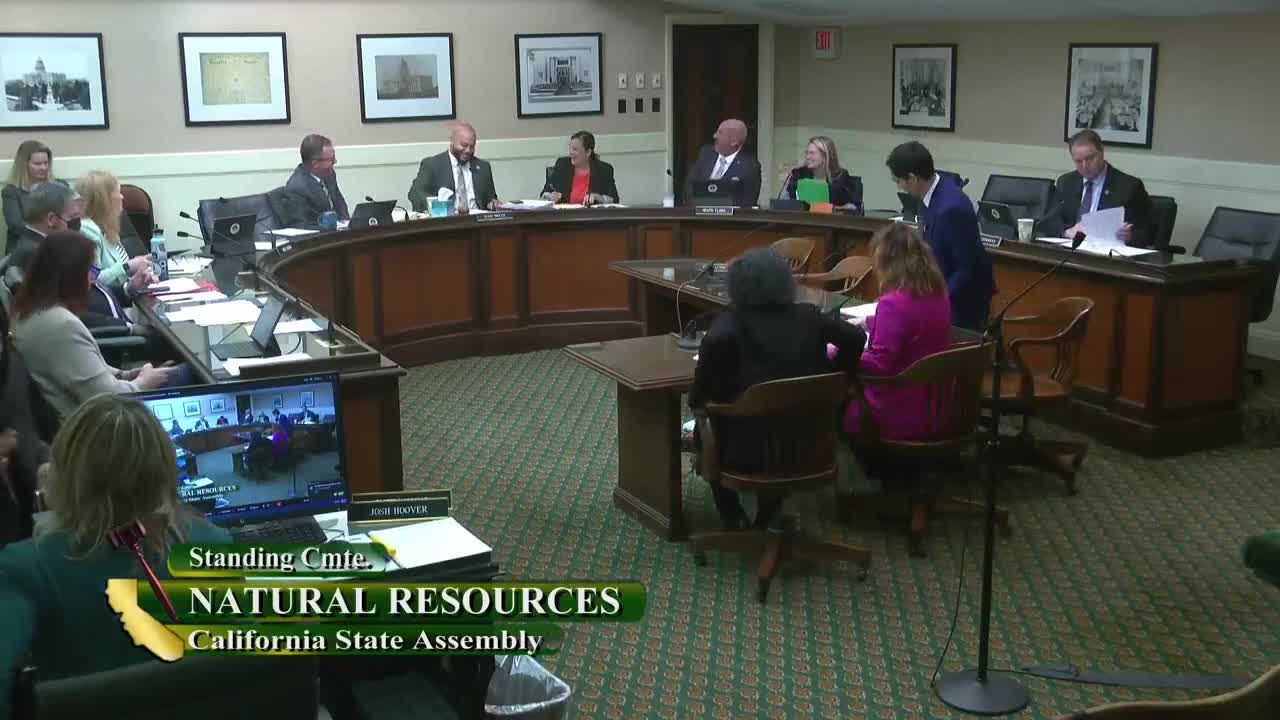
Discussed in Hearing
 6MIN
Assembly Standing Committee on Natural Resources
Bill Author

Bill Co-Author(s):