AB 2650: Licensed adult residential facilities and residential care facilities for the elderly: data collection.
- Session Year: 2023-2024
- House: Assembly
- Latest Version Date: 2024-03-18
Current Status:
Failed
(2024-05-16: In committee: Held under submission.)
Introduced
In Committee
First Chamber
In Committee
Second Chamber
Enacted
The California Community Care Facilities Act provides for the licensure and regulation of community care facilities by the State Department of Social Services, including various adult residential facilities, as described. The act includes legislative findings and declarations that there is an urgent need to establish a coordinated and comprehensive statewide service of quality community care for persons with a mental illness, persons with developmental and physical disabilities, and children and adults who require care or services. A person who violates the California Community Care Facilities Act is guilty of a misdemeanor. Existing law, the California Residential Care Facilities for the Elderly Act, provides for the licensure and regulation of residential care facilities for the elderly, as defined, by the department and expresses the intent of the Legislature to require that those facilities be licensed as a separate category within the existing licensing structure of the department.
Existing law requires the department to collect information and send a report to each countys department of mental health or behavioral health, beginning May 1, 2021, and annually thereafter, of all licensed adult residential facilities and residential care facilities for the elderly, as described, that accept a specified federal rate and accept residents with a serious mental disorder, as defined, and the number of licensed beds at each facility.
This bill would require the department, beginning May 1, 2026, and annually thereafter until January 1, 2029, to collect information and send a report to each countys department of mental health or behavioral health of all licensed adult residential facilities and residential care facilities for the elderly, as described, that accept the above-described specified federal rate and accept residents with a serious mental disorder, as defined, and the number of licensed beds at each facility. The bill would also require the department to collect additional information, including the total number of residents occupying beds at licensed adult residential facilities and residential care facilities for the elderly who are a public benefits recipient, as defined, or a person diagnosed with a serious mental illness, as defined, who is currently receiving regional center funding or who has a previous history of homelessness, incarceration, or institutionalization. The bill would require the department to post the report on its internet website. Because a violation of the California Community Care Facilities Act is crime, the bill would create new crimes, thereby imposing a state-mandated local program.
The California Constitution requires the state to reimburse local agencies and school districts for certain costs mandated by the state. Statutory provisions establish procedures for making that reimbursement.
This bill would provide that no reimbursement is required by this act for a specified reason.
Existing law establishes various public social services programs, including, among others, the California Work Opportunity and Responsibility to Kids (CalWORKs) program and CalFresh. Existing law states that the purpose of its provisions relating to public social services is to provide protection, care, and assistance to the people of the state in need of them, and to promote the welfare and happiness of all of the people of the state by providing appropriate aid and services to those who are needy and distressed.This bill would make technical, nonsubstantive changes to that provision.Existing law establishes various public social services programs, including, among others, the California Work Opportunity and Responsibility to Kids (CalWORKs) program and CalFresh. Existing law states that the purpose of its provisions relating to public social services is to provide protection, care, and assistance to the people of the state in need of them, and to promote the welfare and happiness of all of the people of the state by providing appropriate aid and services to those who are needy and distressed.
This bill would make technical, nonsubstantive changes to that provision.
(a)Beginning May 1, 2026, and annually thereafter, the department shall collect information and send a report to each countys department of mental health or behavioral health containing all of the following:
(1)Information gathered and reported under subdivision (a) of Section 1507.4.
(2)Total number of licensed adult residential care facilities that exclusively accept public benefits recipients or residents diagnosed with a serious mental illness.
(3)Total number of licensed adult residential care facilities that serve public benefits recipients or residents diagnosed with a serious mental illness and that have exclusive use contracts with other public agencies.
(4)The total number of residents occupying beds in licensed adult residential facilities who are any of the following:
(A)A public benefits recipient or a person diagnosed with a serious mental illness.
(B)A person described in subparagraph (A) who is receiving regional center funding.
(C)A person described in subparagraph (A) who has a previous history of homelessness, incarceration, or institutionalization.
(b)For purposes of this section, the following terms have the following meanings:
(1)Public benefits recipient means an individual who qualifies for the federal supplemental security rate.
(2)Serious mental illness means a serious mental disorder, as defined in Section 5600.3 of the Welfare and Institutions Code.
(c)The department shall post the report required by this section on its internet website.
(d)This section shall remain in effect only until January 1, 2029, and as of that date is repealed.
SEC. 2.Section 1569.4a is added to the Health and Safety Code, to read:1569.4a.(a)Beginning May 1, 2026, and annually thereafter, the department shall collect information and send a report to each countys department of mental health or behavioral health containing all of the following:
(1)Total number of licensed residential care facilities for the elderly that exclusively accept public benefits recipients or residents diagnosed with a serious mental illness.
(2)Information gathered and reported under subdivision (a) of Section 1569.4.
(3)Total number of licensed residential care facilities for the elderly that serve public benefits recipients or residents diagnosed with a serious mental illness and that have exclusive use contracts with other public agencies.
(4)The total number of residents occupying beds in licensed residential care facilities for the elderly who are any of the following:
(A)A public benefits recipient or a person diagnosed with a serious mental illness.
(B)A person described in subparagraph (A) who is receiving regional center funding.
(C)A person described in subparagraph (A) who has a previous history of homelessness, incarceration, or institutionalization.
(b)For purposes of this section, the following terms have the following meanings:
(1)Public benefits recipient means an individual who qualifies for the federal supplemental security rate.
(2)Serious mental illness means a serious mental disorder, as defined in Section 5600.3 of the Welfare and Institutions Code.
(c)The department shall post the report required by this section on its internet website.
(d)This section shall remain in effect only until January 1, 2029, and as of that date is repealed.
SEC. 3.No reimbursement is required by this act pursuant to Section 6 of Article XIIIB of the California Constitution because the only costs that may be incurred by a local agency or school district will be incurred because this act creates a new crime or infraction, eliminates a crime or infraction, or changes the penalty for a crime or infraction, within the meaning of Section 17556 of the Government Code, or changes the definition of a crime within the meaning of Section 6 of Article XIIIB of the California Constitution.
SECTION 1.Section 10000 of the Welfare and Institutions Code is amended to read:10000.The purpose of this division is to provide protection, care, and assistance to the people of the state in need of them, and to promote the welfare and happiness of all of the people of the state by providing appropriate aid and services to all of the people of the state who are needy and distressed. It is the intent of the Legislature that aid shall be administered and services provided promptly and humanely, with due regard for the preservation of family life, and without discrimination based on ancestry, marital status, political affiliation, or any characteristic listed or defined in Section 11135 of the Government Code. That aid shall be administered, and services provided, in that manner to the extent not in conflict with federal law, in order to encourage self-respect, self-reliance, and the desire to be a good citizen, useful to society.The purpose of this division is to provide for protection, care, and assistance to the people of the state in need thereof, of them, and to promote the welfare and happiness of all of the people of the state by providing appropriate aid and services to all of its the people of the state who are needy and distressed. It is the legislative intent intent of the Legislature that aid shall be administered and services provided promptly and humanely, with due regard for the preservation of family life, and without discrimination on account of based on ancestry, marital status, political affiliation, or any characteristic listed or defined in Section 11135 of the Government Code. That aid shall be so administered and services so provided, administered, and services provided, in that manner to the extent not in conflict with federal law, as in order to encourage self-respect, self-reliance, and the desire to be a good citizen, useful to society.
|
Date
|
Status
|
|---|---|
| May 16, 2024 | In committee: Held under submission. |
| May 1, 2024 | In committee: Set, first hearing. Referred to APPR. suspense file. |
| Apr 17, 2024 | From committee: Do pass and re-refer to Com. on APPR. with recommendation: To Consent Calendar. (Ayes 16. Noes 0.) (April 16). Re-referred to Com. on APPR. |
| Apr 10, 2024 | From committee: Do pass and re-refer to Com. on HEALTH. (Ayes 6. Noes 0.) (April 9). Re-referred to Com. on HEALTH. |
| Mar 19, 2024 | Re-referred to Com. on HUM. S. |
| Mar 18, 2024 | From committee chair, with author's amendments: Amend, and re-refer to Com. on HUM. S. Read second time and amended. |
| Mar 18, 2024 | Referred to Coms. on HUM. S. and HEALTH. |
| Feb 15, 2024 | From printer. May be heard in committee March 16. |
| Feb 14, 2024 | Read first time. To print. |
|
Date
|
Description
|
Location
|
Votes
|
|
|---|---|---|---|---|
| Apr 16, 2024 | Do pass and be re-referred to the Committee on [Appropriations] with recommendation: To Consent Calendar | Assembly Standing Committee on Health |
Passed |
|
| Apr 9, 2024 | Do pass and be re-referred to the Committee on [Health] | Assembly Standing Committee on Human Services |
Passed |
This list shows positions taken on this bill by organizations on the date displayed, which is linked to the original source.
Positions by individuals are not included.
|
Organization
|
Position
|
Date
|
|---|---|---|
| Licensed Adult Residential Care Association | ** Support | |
| Licensed Adult Residential Care Association | * Support | Apr 9, 2024 |
| Mental Health Hookup | * Support | Apr 9, 2024 |
Date of Hearing: May 1, 2024
ASSEMBLY COMMITTEE ON APPROPRIATIONS
Buffy Wicks, Chair
ABPCA Bill Id:AB 2650
Author:(Zbur) – As Amended Ver:March 18, 2024
Policy Committee: | Human Services | Vote: | 6 - 0 |
Health | 16 - 0 | ||
|
|
Urgency: No State Mandated Local Program: Yes Reimbursable: No
SUMMARY:
This bill requires the California Department of Social Services (CDSS) to collect demographic information, as specified, from licensed residential care facilities for the elderly (RCFEs) and licensed adult residential care facilities (ARFs), and to provide the information to each county mental health or behavioral health department.
Specifically, this bill:
- Requires DSS, beginning May 1, 2026, and annually thereafter, to collect information and report to each county’s department of mental health or behavioral health all of the following:
- Total number of licensed RCFEs and licensed ARFs that exclusively accept public benefits recipients or residents diagnosed with a serious mental illness (SMI).
- Total number of licensed RCFEs and licensed ARFs that serve public benefits recipients or residents diagnosed with an SMI and that have exclusive use contracts with other public agencies.
- The total number of residents occupying beds in licensed RCFEs and ARFs who are any of the following:
- A public benefits recipient or a person diagnosed with an SMI.
- A person described in item i, above who is receiving regional center funding.
- A person described in item i, above with a previous history of homelessness, incarceration, or institutionalization.
- Requires CDSS to post the report required by this section on its internet website.
FISCAL EFFECT:
Estimated ongoing General Fund costs likely in the high-hundreds of thousands to low millions of dollars to CDSS for approximately six staff positions allocated between its licensing and IT divisions to collect and compile the date and to post the report.
COMMENTS:
- Purpose. Concerned by the closure rate of adult residential facilities, the author seeks to better inform decision makers in order to prevent further closures of these facilities. According to the author:
Licensed [ARFs and RCFEs] are integral to California's housing response, offering essential services like housing, meals, medication management, and support to vulnerable populations, including those on public benefits and individuals with SMI. Despite their significant contribution to our communities, many of these facilities are closing due to funding constraints, placing the residents at risk of becoming unhoused, incarcerated, or institutionalized. This bill will require CDSS to collect and publicly report specific data, including details regarding bed counts, information regarding the number of residents who rely on public benefits, and more. This information will help policymakers and local health officials understand the populations these facilities serve and will inform future decisions and prevent further closures of these essential facilities.
- Background. In 2020, the Legislature passed AB 1766 (Bloom), Chapter 139, Statutes of 2020, which requires CDSS to collect and report quarterly data on RCFEs and ARFs that close permanently, and requires CDSS to notify the county mental or behavioral health department within three days upon receiving notice that a facility intends to close permanently. AB 1766 also requires CDSS to collect data on the number of facilities that accept residents with an SMI or are on public benefits. The Los Angeles Times reported on the 2023 data, citing that 142 facilities closed and a total of 3,057 beds were lost statewide.
This bill expands existing data collection and reporting required by CDSS, pursuant to AB 1766, to include detailed data that was struck from AB 1766 prior to its final passage. This bill adds back the collection of this data to specifically provide detailed insights on the implications of facility closure for populations with an SMI or receiving public benefits.
RCFEs, also known as assisted living facilities, are nonmedical facilities that provide care and housing to persons 60 years of age or older who require assistance with activities of daily living, such as housekeeping, medication assistance, and personal and hygiene care, but do not need 24-hour nursing care. California’s RCFEs include small homes with up to six residents to larger facilities that can house over 100 residents. There are three levels of care permitted in an RCFE, which range from basic care when a resident still can retain some independence, to high-level of care for someone who needs extensive care with daily living activities and may have chronic health problems.
ARFs are residential facilities that offer 24-hour nonmedical care and supervision for persons who are 18 years to 59 years of age, or 60 years of age or older under specified requirements, who need personal services, supervision, or assistance essential for sustaining the activities of daily living or for the protection of the individual. These clients may have a mental, physical, or developmental disability. Like RCFEs, ARFs are for people who are unable to live by themselves, but who do not need 24-hour nursing care.
Analysis Prepared by: Jennifer Swenson / APPR. / (916) 319-2081
Date of Hearing: April 16, 2024
ASSEMBLY COMMITTEE ON HEALTH
Mia Bonta, Chair
ABPCA Bill Id:AB 2650
Author:((Zbur) – As Amended Ver:March 18, 2024
SUBJECT: Licensed adult residential facilities and residential care facilities for the elderly: data collection.
SUMMARY: Requires the California Department of Social Services (DSS) to collect demographic information, as specified, from licensed residential care facilities for the elderly (RCFEs) and licensed adult residential care facilities (ARFs). Specifically, this bill:
- Requires DSS, beginning May 1, 2026 and annually thereafter, to collect information and report to each county’s department of mental health or behavioral health the:
- Total number of licensed RCFEs and licensed ARFs that exclusively accept public benefits recipients or residents diagnosed with a serious mental illness (SMI);
- Total number of licensed RCFEs and licensed ARFs that serve public benefits recipients or residents diagnosed with a SMI and that have exclusive use contracts with other public agencies; and,
- The total number of residents occupying beds in licensed RCFEs and ARFs who are any of the following:
- A public benefits recipient or a person diagnosed with a serious mental illness;
- A person described in i) above who is receiving regional center funding; or,
- A person described in i) above has a previous history of homelessness, incarceration, or institutionalization.
- Requires DSS to post the report required by this section on its internet website.
- Sunsets the provisions of this bill on January 1, 2029.
EXISTING LAW:
- Establishes the “California Community Care Facilities Act” to provide for the licensure and regulation of community care facilities. [Health and Safety Code (HSC) §1500, et seq.]
- Defines “community care facility” to mean any facility, place, or building that is maintained and operated to provide nonmedical residential care, day treatment, adult day care, or foster family agency services for children, adults, or children and adults, including, but not limited to, individuals with physical disabilities or mental impairments and abused or neglected children. Includes within this definition, among a number of other facilities: adult day programs, foster family homes, small family homes, full-service adoption agencies, short-term residential therapeutic programs, and crisis nurseries. [HSC §1502]
- Defines “residential facility” to mean any family home, group care facility, or similar facility determined by DSS, for 24-hour nonmedical care of persons in need of personal services, supervision, or assistance essential for sustaining the activities of daily living for the protection of the individual. [HSC §1502]
- Establishes the “California Residential Care Facilities for the Elderly Act” to provide for the licensure and regulation of RCFEs as a separate category within the existing licensing structure of DSS. Defines RCFE to mean a housing arrangement chosen voluntarily by individuals ages 60 and older, or their authorized representative, where varying levels and intensities of care and supervision, protective supervision, personal care, or health-related services are provided, based upon their varying needs, as determined in order to be admitted and to remain in the facility. [HSC §1569, et seq.]
- Defines ARF to mean any facility of any capacity that provides 24-hour-a-day nonmedical care and supervision to persons 18-59 years of age. [22 California Code of Regulations §80001(a)(5)]
- Requires DSS to annually collect information and send a report to each county’s department of mental health or behavioral health of all licensed ARFs and RCFEs in the county that accept the federal supplemental security rate and accept residents with a serious mental disorder, and the number of licensed beds at each facility. [HSC §1507 and §1569.4]
- Requires DSS to quarterly send to each county’s department of mental health or behavioral health the report of licensed ARFs and RCFEs that closed permanently in the prior quarter, by county, and must include the number of licensed beds of each facility and the reason for closing. [HSC §1507.4 and 1569.4]
- Establishes the State Supplementary Payment (SSP) for people who are aged, blind, or disabled, which is intended to supplement federal Supplemental Security Income (SSI) and provide persons whose needs result from age, blindness, or disability with assistance and services that help them meet basic needs and maintain or increase independence. Further provides that eligibility requirements for SSP match federal SSI criteria, and requires a minimum level of SSP benefits to be provided in order to maintain federal Medicaid funding, as specified. [Welfare and Institutions Code (WIC) §12000, et seq.]
- Defines “serious mental disorder” as a mental disorder that is severe in degree and persistent in duration, which may cause behavioral functioning which interferes substantially with the primary activities of daily living, and which may result in an inability to maintain stable adjustment and independent functioning without treatment, support, and rehabilitation for a long or indefinite period of time. [WIC §5600.3]
FISCAL EFFECT: Unknown. This bill has not yet been analyzed by a fiscal committee.
COMMENTS:
- PURPOSE OF THIS BILL. According to the author, licensed ARFs and RCFEs are integral to California's housing response, offering essential services like housing, meals, medication management, and support to vulnerable populations, including those on public benefits and individuals with SMIs. The author continues that despite their significant contribution to our communities, many of these facilities are closing due to funding constraints, placing the residents at risk of becoming unhoused, incarcerated, or institutionalized. The author argues that to equip us to respond to this challenge, this bill requires DSS to collect and publicly report data, including details regarding bed counts, information regarding the number of residents who rely on public benefits, and more. The author concludes that this information will help policymakers and local health officials understand the populations that these facilities serve and will inform future decisions and prevent further closures of these essential facilities.
- BACKGROUND. RCFEs are nonmedical facilities that house and care for the aging population that do not need 24 hour nursing care, but need basic daily help for services such as housekeeping, medication assistance, personal and hygiene care, and eating. There are three levels of care permitted in an RCFE which range from basic care when a resident still can retain some independence, to nonmedical care when a resident needs help with personal daily living activities, and the highest level of care is reserved for someone who needs extensive care with daily living activities and may have chronic health problems.
ARFs are residential facilities that offer 24-hour nonmedical care and supervision for persons in need of personal services, supervision, or assistance essential for sustaining the activities of daily living or for the protection of the individual. ARFs may serve persons who are 18-59 years of age or those who are 60 years of age or older under specified requirements. These clients may have a mental, physical or developmental disabilities. Like RCFEs, ARFs are for people who are unable to live by themselves but who do not need 24 hour nursing care.
- Statewide Facility Shortages. The California Behavioral Health Planning Council (CBHPC) published a report in 2018 titled “Highlighting the critical need for adult residential facilities for adults with serious mental illness in California.” The report details that a combination of facility closures and a lack of new facilities or other adequate supportive housing options are leaving individuals with SMI without sustainable housing options that meet their care needs after discharge from a treatment program, hospital or correctional institution. The CBHPC report notes that this results in a “revolving door scenario” where people are discharged or released from one of the above and then are unable to find appropriate residential care or housing. Thus, another mental health crisis ensues, resulting in a return to high-level crisis programs, facilities, hospitals, jails/prisons or homelessness.
In 2020 the Legislature passed AB 1766 (Bloom), Chapter 139, Statutes of 2020, which requires DSS to collect and report quarterly data on RCFEs and ARFs that close permanently, and requires DSS to notify the county mental or behavioral health department within three days upon receiving notice that a facility intends to close permanently. AB 1766 also required DSS to collect data on the number of facilities that accept residents with a SMI or are on public benefits. The Los Angeles Times reported on the 2023 data, citing that 142 facilities closed and a total of 3,057 beds were lost statewide. This bill aims to build upon existing reporting required by DSS to provide more detailed insights on the implications of this facility closure crisis for populations with a SMI or receiving public benefits.
- SUPPORT. The Licensed Adult Residential Care Association (LARCA) is the sponsor of this bill, stating that the behavioral health and housing systems for our most vulnerable populations are severely overwhelmed and struggle to provide adequate care and the problem is especially pronounced for those living with serious mental illness and receiving public benefits. LARCA continues that this bill is a crucial step in better understanding the scope of ARFs and RCFEs and the challenges they face by fixing a data shortfall in the collection of information related to how many residents diagnosed with serious mental illness or receiving public benefits actually occupy beds in facilities. LARCA concludes that this is crucial to better understand and stabilize this housing and behavioral health solution that keeps low-income individuals and those experiencing serious mental illness in housing and off the streets.
- RELATED LEGISLATION. SB 1017 (Eggman) requires the State Department of Health Care Services (DHCS), in consultation with the State Department of Public Health (DPH) and DSS, to develop a solution to collect, aggregate, and display information about beds to identify the availability of inpatient and residential mental health or substance use disorder (SUD) treatment for specified types of facilities.
- PREVIOUS LEGISLATION.
- SB 363 (Eggman) of 2023 would have required DHCS, in consultation with DPH, DSS, and specified stakeholders, to develop a real-time, internet-based database to collect, aggregate, and display information about beds in specified facilities to identify the availability of inpatient and residential mental health or SUD treatment. SB 363 was held on the Assembly Appropriations Committee suspense file.
- SB 648 (Hurtado) of 2021 would have established the Enriched Care Adult Residential Facility pilot program for the purpose of promoting the sustainability of essential residential care facilities that serve recipients who receive SSI/SSP benefits. Specifically, SB 648 would have established a monthly stipend of $1,000 per SSI/SSP recipient residing in qualifying licensed adult residential facilities and RCFEs. The stipend would have been capped at $4,000 per month. SB 648 was placed on the Senate inactive file.
- AB 1766 requires DSS to collect information and send a report to each county’s department of mental health or behavioral health of all licensed ARFs and RCFEs in the county that accept the federal supplemental security rate and accept residents with a serious mental disorder, as defined, and the number of licensed beds at each facility. Requires DSS to send to each county’s department of mental health or behavioral health the report of licensed ARFs and RCFEs that closed permanently in the prior quarter, by county, the number of licensed beds of each facility, and the reason for closing, as specified.
- SB 1259 (Hurtado) of 2020 would have required DSS to establish a task force for the purpose of issuing a report that would have included recommendations on how to meet the housing and care needs of low-income individuals who are blind, disabled, or over 65 years of age and receiving SSI/SSP. SB 1259 would also have required DSS to provide updates on its progress in developing the report to specified committees. SB 1259 was held on the Assembly Appropriations Committee suspense file.
- DOUBLE REFERRAL. This bill is double referred, it passed the Assembly Committee on Human Services with a 6-0 vote on April 9, 2024.
REGISTERED SUPPORT / OPPOSITION:
Support
Licensed Adult Residential Care Association (sponsor)
Opposition
None on file.
Analysis Prepared by: Riana King / HEALTH / (916) 319-2097
Date of Hearing: April 9, 2024
ASSEMBLY COMMITTEE ON HUMAN SERVICES
Alex Lee, Chair
ABPCA Bill Id:AB 2650 (
Author:Zbur) – As Amended Ver:March 18, 2024
SUBJECT: Licensed adult residential facilities and residential care facilities for the elderly: data collection
SUMMARY: Requires the California Department of Social Services (CDSS) to collect specified information from licensed residential care facilities for the elderly (RCFEs) and licensed adult residential care facilities (ARFs). Specifically, this bill:
- Beginning May 1, 2026, and annually thereafter, CDSS must collect information and send a report to each county’s department of mental health or behavioral health containing all of the following:
- Information gathered and reported as described in 7) and 8) below.
- Total number of licensed RCFEs and licensed ARFs that exclusively accept public benefits recipients or residents diagnosed with a serious mental illness.
- Total number of licensed RCFEs and licensed ARFs that serve public benefits recipients or residents diagnosed with a serious mental illness and that have exclusive use contracts with other public agencies.
- The total number of residents occupying beds in licensed RCFEs and ARFs who are any of the following:
- A public benefits recipient or a person diagnosed with a serious mental illness.
- A person described in i) who is receiving regional center funding.
- A person described in i) has a previous history of homelessness, incarceration, or institutionalization.
- Defines the following terms for the purposes of this bill:
- “Public benefits recipient” means an individual who qualifies for the federal supplemental security rate.
- “Serious mental illness” means a serious mental disorder, as defined in Welfare and Institutions Code § 5600.3.
- Requires CDSS to post the report required by this section on its internet website.
- Sunsets the provisions of this bill on January 1, 2029.
EXISTING LAW:
- Establishes the “California Community Care Facilities Act” to provide for the licensure and regulation of community care facilities. (Health and Safety Code [HSC] § 1500 et seq.)
- Defines “community care facility” to mean any facility, place, or building that is maintained and operated to provide nonmedical residential care, day treatment, adult day care, or foster family agency services for children, adults, or children and adults, including, but not limited to, individuals with physical disabilities or mental impairments and abused or neglected children. Includes within this definition, among a number of other facilities: adult day programs, foster family homes, small family homes, full-service adoption agencies, short-term residential therapeutic programs, and crisis nurseries. (HSC § 1502(a))
- Defines “residential facility” to mean any family home, group care facility, or similar facility determined by CDSS, for 24-hour nonmedical care of persons in need of personal services, supervision, or assistance essential for sustaining the activities of daily living for the protection of the individual. (HSC § 1502(a)(1))
- Establishes the “California Residential Care Facilities for the Elderly Act” to provide for the licensure and regulation of RCFEs as a separate category within the existing licensing structure of CDSS. (HSC 1569 § et seq.)
- Defines RCFE to mean a housing arrangement chosen voluntarily by individuals ages 60 and older, or their authorized representative, where varying levels and intensities of care and supervision, protective supervision, personal care, or health-related services are provided, based upon their varying needs, as determined in order to be admitted and to remain in the facility. (HSC § 1569.2(p)(1))
- Defines ARF to mean any facility of any capacity that provides 24-hour-a-day nonmedical care and supervision to persons 18-59 years of age. (22 CCR § 80001(a)(5))
- Requires CDSS to annually collect information and send a report to each county’s department of mental health or behavioral health of all licensed ARFs and RCFEs in the county that accept the federal supplemental security rate and accept residents with a serious mental disorder, and the number of licensed beds at each facility. (HSC § 1507.4(a); HSC § 1569.4(a) )
- Requires CDSS to quarterly send to each county’s department of mental health or behavioral health the report of licensed ARFs and RCFEs that closed permanently in the prior quarter, by county, and shall include the number of licensed beds of each facility and the reason for closing. (HSC § 1507.4(b)- 1569.4(b))
- Establishes the State Supplementary Payment (SSP) for people who are aged, blind, or disabled, which is intended to supplement federal Supplemental Security Income (SSI) and provide persons whose needs result from age, blindness, or disability with assistance and services that help them meet basic needs and maintain or increase independence. Further provides that eligibility requirements for SSP match federal SSI criteria, and requires a minimum level of SSP benefits to be provided in order to maintain federal Medicaid funding, as specified. (WIC § 12000 et seq.)
- Establishes the California Community Care Facilities Act, which provides regulatory structure for coordinated and comprehensive statewide system of care for the mentally ill, developmentally and physically disabled, and children and adults who require care or services provided by licensed community care facilities. (HSC § 1500 et seq.)
- ) Defines “serious mental disorder” to mean a mental disorder that is severe in degree and persistent in duration, which may cause behavioral functioning which interferes substantially with the primary activities of daily living, and which may result in an inability to maintain stable adjustment and independent functioning without treatment, support, and rehabilitation for a long or indefinite period of time. Serious mental disorders include, but are not limited to, schizophrenia, bipolar disorder, post-traumatic stress disorder, as well as major affective disorders or other severely disabling mental disorders. This section shall not be construed to exclude persons with a serious mental disorder and a diagnosis of substance abuse, developmental disability, or other physical or mental disorder. (WIC § 5600.3)
FISCAL EFFECT: Unknown, this bill has not been analyzed by a fiscal committee.
COMMENTS:
Background: Residential Care Facilities for The Elderly are non-medical facilities that house and care for the aging population that have minimal health needs, but need basic daily help for services such as housekeeping, medication assistance, personal and hygiene care, and eating. There are three levels of care permitted in an RCFE which range from basic care when a resident still can retain some independence, to nonmedical care when a resident needs help with personal daily living activities, and the highest level of care is reserved for someone who needs extensive care with daily living activities and may have chronic health problems.
California’s network of RCFEs consists of small homes serving a handful of residents to larger RCFEs that can house over 100 residents in communities across the state. Facilities provide a special combination of housing, personalized supportive services, and 24-hour staff designed to respond to the individual needs of those who require help with activities of daily living. This level of care and supervision is for people who are unable to live by themselves but who do not need 24-hour nursing care. They are considered non-medical facilities and are not required to have nurses, certified nursing assistants, or doctors on staff. Facilities usually centrally store and distribute medications for residents to self-administer.
Costs of RCFEs vary widely. RCFEs in California cost an average of $4,500 per month. However, monthly fees can exceed $10,000. According to CDSS’ website, there are 7,473 licensed RCFEs total and 5,790 RCFEs that serve six or fewer persons.
Adult Residential Facilities are residential facilities that offer 24-hour nonmedical care and supervision for persons in need of personal services, supervision, or assistance essential for sustaining the activities of daily living or for the protection of the individual. ARFs may serve persons who are 18-59 years of age or those who are 60 years of age or older under specified requirements. These clients may have a mental, physical or developmental disabilities. Like RCFEs, ARFs are for people who are unable to live by themselves but who do not need 24 hour nursing care. They are considered non-medical facilities and are not required to have nurses, certified nursing assistants or doctors on staff.
The cost of living in a board and care home depends largely on location and services provided. Because the homes are private residences, cost is also tied to real estate value. A board and care home could cost anywhere from $3,500 to $4,500 a month. In more expensive regions of California, the monthly cost might be as much as $10,000.
Supplemental Security Income/State Supplementary Payment (SSI/SSP). SSI/SSP provides a monthly cash benefit to qualified low-income individuals and couples in order to help them pay for basic living expenses, such as food, clothing, and shelter. To be eligible for SSI/SSP, a person must be at least 65 years old, blind, or disabled and meet certain income and resource requirements. A qualified SSI recipient is automatically eligible for SSP. SSI is a federally funded benefit. The SSP benefit is funded with the state’s General Fund and California sets its own SSP rates.
SSI/SSP grant amounts vary based on several factors, including whether a recipient is aged, blind, or living with disabilities; the individual's or couple's living arrangements; a recipient's marital status; and, whether or not a recipient is a minor. In the past ten years, the monthly SSI/SSP payment for individuals has increased by just $124.32 to $954.72. CDSS data shows the current SSI/SSP caseload at about 1.25 million individuals.
Some residents of ARFs and RCFEs are SSI/SSP recipients who receive the Non-Medical Out of Home Care (NMOHC) monthly rate of $1,575.07. Of this amount, $683.07 is for room and board, $715 for care and supervision, and $177 is retained by the SSI/SSP recipient. Facilities are not permitted to charge individuals receiving SSI/SSP above the state-mandated rate unless they are receiving additional income such as a pension and then they can charge an additional $20. Thus, licensed ARFs and RCFEs receive a government-set SSI/SSP payment that amounts to about $53 a day to pay for housing, 24-hour care, and three daily meals. Facility business owners report that because of this set rate, coupled with high cost of care and increasing costs of doing business, it has become somewhat difficult to sustain the operation of ARFs and RCFEs that accept SSI/SSP recipients. However, they are an essential component of addressing California’s increasing homeless population, as they serve a particularly vulnerable population that requires 24-hour assistance and are living at or near the poverty level.
Population Aging and Rising Homelessness Rates. Population aging refers to the increase of people over the age of 65, while at the same time, a decrease in people age under the age of 15. Population aging has become a distinctive demographic feature in developing countries which currently have the largest proportion of people over the age of 65 in the world. Population aging can be attributed to increasing longevity and declining fertility. Data indicate that global life expectancy increased from 34 years in 1913 to 72 years in 2022 and is expected to continue on that trajectory.
According to the U.S. Census Bureau, 15.8% of California's population is over the age of 65 which is the largest number of older residents in the country, and estimates that about 22% of California's population will be over the age of 60 by the year 2030. The California Department of Finance projects that about one in four (23.1%) Californians will be over the age of 65 by 2040.
Author’s Statement: According to the Author, “Licensed adult residential care facilities are integral to California's housing response, offering essential services like housing, meals, medication management, and support to vulnerable populations, including those on public benefits and individuals with serious mental illnesses. Despite their significant contribution to our communities, many of these facilities are closing due to funding constraints, placing the residents at risk of becoming unhoused, incarcerated, or institutionalized. To equip us to respond to this challenge, this bill will require the California Department of Social Services to collect and publicly report specific data, including details regarding bed counts, information regarding the number of residents who rely on public benefits, and more. This information will help policymakers and local health officials understand the populations that these facilities serve and will inform future decisions and prevent further closures of these essential facilities.”
Equity Implications: RCFEs and ARFs play a critical role in housing adults who need supervision or care. The growing number of aging adults facing homelessness puts a particular pressure on examining housing and care options for low-income individuals. AB 1766 (Bloom), Chapter 139, Statues of 2020, helped get the ball rolling on collecting information to have a better understanding of the universe of ARFs and RCFEs. This bill builds upon that effort to understand the demographics of those residing in ARFs and RCFEs.
Double Referral: Should this bill pass out of this committee, it will be referred to the Assembly Committee on Health.
RELATED AND PRIOR LEGISLATION:
SB 648 (Hurtado) of 2021, would have established the Enriched Care Adult Residential Facility pilot program for the purpose of promoting the sustainability of essential residential care facilities that serve recipients who receive SSI/SSP benefits. Specifically, SB 648 would have established a monthly stipend of $1,000 per SSI/SSP recipient residing in qualifying licensed adult residential facilities and RCFEs. The stipend would have been capped at $4,000 per month. SB 648 was placed on the inactive file by the author.
AB 1766 (Bloom), Chapter 139, Statutes of 2020, required CDSS to collect information and send a report to each county’s department of mental health or behavioral health of all licensed ARFs and RCFEs in the county that accept the federal supplemental security rate and accept residents with a serious mental disorder, as defined, and the number of licensed beds at each facility. Further required CDSS to send to each county’s department of mental health or behavioral health the report of licensed ARFs and RCFEs that closed permanently in the prior quarter, by county, and shall include the number of licensed beds of each facility and the reason for closing, as specified and among other things.
SB 1259 (Hurtado) of 2020, would have required CDSS to establish a task force for the purpose of issuing a report that would have included recommendations on how to meet the housing and care needs of low-income individuals who are blind, disabled, or over 65 years of age and receiving SSI/SSP, as specified. SB 1259 would also have required CDSS to provide updates on its progress in developing the report to specified committees. SB 1259 was held on the Assembly Appropriations Committee suspense file.
REGISTERED SUPPORT / OPPOSITION:
Support
Licensed Adult Residential Care Association (LARCA) (Sponsor)
Opposition
None on file.
Analysis Prepared by: Alexandria Smith / HUM. S. / (916) 319-2089
Discussed in Hearing
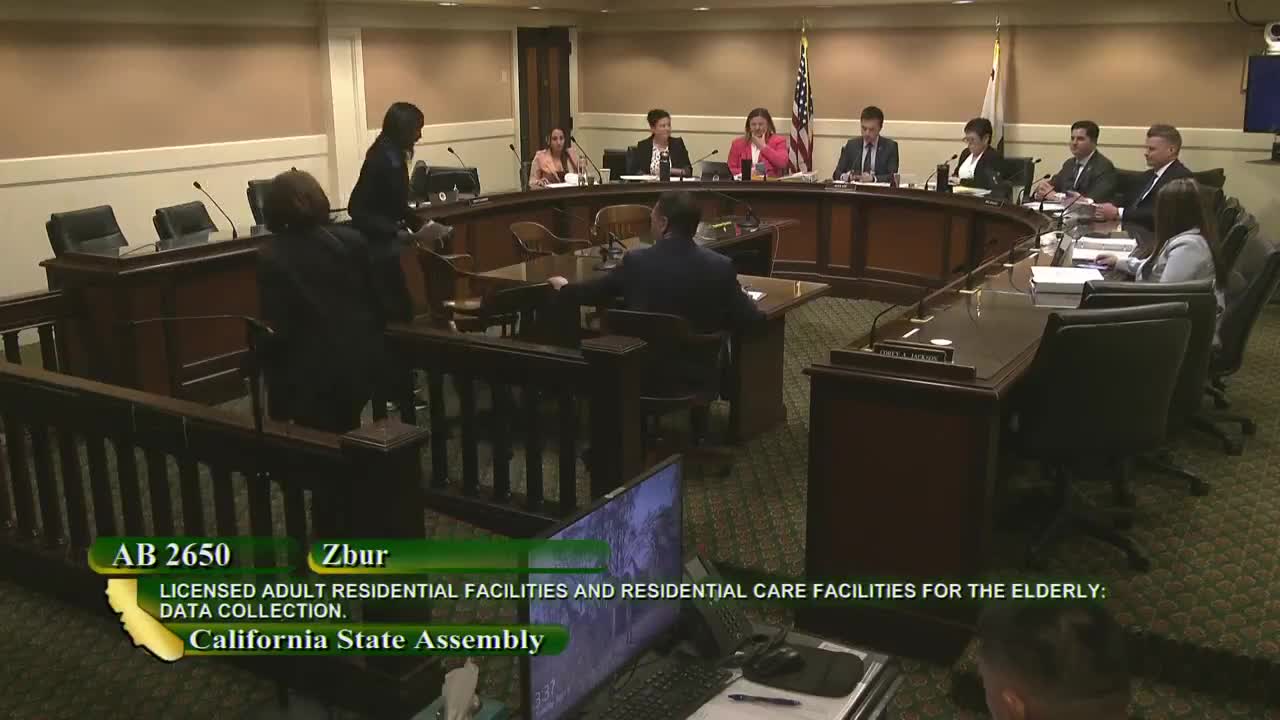 9MIN
Assembly Standing Committee on Human Services
Bill Author

Bill Co-Author(s):