AB 2723: The California Cradle-to-Career Data System Act.
- Session Year: 2023-2024
- House: Assembly
- Latest Version Date: 2024-09-27
Current Status:
Passed
(2024-09-27: Chaptered by Secretary of State - Chapter 736, Statutes of 2024.)
Introduced
In Committee
First Chamber
In Committee
Second Chamber
Enacted
Under existing law, the California Cradle-to-Career Data System is established to be a source for actionable data and research on education, economic, and health outcomes for individuals, families, and communities, and is established to provide for expanded access to tools and services that support the navigation of the education-to-employment pipeline. Under existing law, the California Cradle-to-Career Data System Workgroup is established to assess and recommend data system structural components, processes, and options for expansion and enhancement of data system functionality and to advise ongoing efforts to develop, administer, and enhance the data system. Under existing law, a governing board is established to govern the data system.
This bill would dissolve the workgroup.
Existing law defines a data set to be adopted by the governing board and approximates the size of that data set to be 160 data points.
This bill would remove that approximation.
Existing law designates all institutions represented on the governing board as data providers, with the exception of the Association of Independent California Colleges and Universities and the members of the public appointed by the Legislature.
This bill would specifically identify which institutions and persons represented on the governing board are designated as data providers, and which are not. The bill would add the Senate and Assembly representatives and the Chief Operations Officer of California School Information Services to the list of institutions and persons represented on the board not designated as data providers.
Existing law, the Information Practices Act of 1977, gives to an individual certain rights with respect to personal information, as defined, about that individual that is maintained by certain state public entities.
This bill would, among other things, prohibit individuals from having the right to inquire about, to be notified about, to inspect, or to request to amend personal information in records maintained in the data system, as specified.
Existing constitutional provisions require that a statute that limits the right of access to the meetings of public bodies or the writings of public officials and agencies be adopted with findings demonstrating the interest protected by the limitation and the need for protecting that interest.
This bill would make legislative findings to that effect.
This bill would declare that it is to take effect immediately as an urgency statute.
Under existing law, the California Cradle-to-Career Data System is established to be a source for actionable data and research on education, economic, and health outcomes for individuals, families, and communities, and is established to provide for expanded access to tools and services that support the navigation of the education-to-employment pipeline. Under existing law, the California Cradle-to-Career Data System Workgroup is established to assess and recommend data system structural components, processes, and options for expansion and enhancement of data system functionality and to advise ongoing efforts to develop, administer, and enhance the data system. Under existing law, a governing board is established to govern the data system.
This bill would dissolve the workgroup.
Existing law defines a data set to be adopted by the governing board and approximates the size of that data set to be 160 data points.
This bill would remove that approximation.
Existing law designates all institutions represented on the governing board as data providers, with the exception of the Association of Independent California Colleges and Universities and the members of the public appointed by the Legislature.
This bill would specifically identify which institutions and persons represented on the governing board are designated as data providers, and which are not. The bill would add the Senate and Assembly representatives and the Chief Operations Officer of California School Information Services to the list of institutions and persons represented on the board not designated as data providers.
Existing law, the Information Practices Act of 1977, gives to an individual certain rights with respect to personal information, as defined, about that individual that is maintained by certain state public entities.
This bill would, among other things, prohibit individuals from having the right to inquire about, to be notified about, to inspect, or to request to amend personal information in records maintained in the data system, as specified.
Existing constitutional provisions require that a statute that limits the right of access to the meetings of public bodies or the writings of public officials and agencies be adopted with findings demonstrating the interest protected by the limitation and the need for protecting that interest.
This bill would make legislative findings to that effect.
Under existing law, the California Cradle-to-Career Data System is established to be a source for actionable data and research on education, economic, and health outcomes for individuals, families, and communities, and is established to provide for expanded access to tools and services that support the navigation of the education-to-employment pipeline. Under existing law, the California Cradle-to-Career Data System Workgroup is established to assess and recommend data system structural components, processes, and options for expansion and enhancement of data system functionality and to advise ongoing efforts to develop, administer, and enhance the data system. Under existing law, a governing board is established to govern the data system.
This bill would dissolve the workgroup upon the first meeting of the governing board. workgroup.
Existing law defines a data set to be adopted by the governing board and approximates the size of that data set to be 160 data points.
This bill would remove that approximation.
Existing law designates all institutions represented on the governing board as data providers, with the exception of the Association of Independent California Colleges and Universities and the members of the public appointed by the Legislature.
This bill would specifically identify which institutions and persons represented on the governing board are designated as data providers, and which are not. The bill would add the Senate and Assembly representatives and the Chief Operations Officer of California School Information Services to the list of institutions and persons represented on the board not designated as data providers.
Under existing law, the California Cradle-to-Career Data System is established to be a source for actionable data and research on education, economic, and health outcomes for individuals, families, and communities, and is established to provide for expanded access to tools and services that support the navigation of the education-to-employment pipeline. Under existing law, the California Cradle-to-Career Data System Workgroup is established to assess and recommend data system structural components, processes, and options for expansion and enhancement of data system functionality and to advise ongoing efforts to develop, administer, and enhance the data system. Under existing law, a governing board is established to govern the data system.
This bill would dissolve the workgroup upon the first meeting of the governing board.
Existing law defines a data set to be adopted by the governing board and approximates the size of that data set to be 160 data points.
This bill would remove that approximation.
Existing law designates all institutions represented on the governing board as data providers, with the exception of the Association of Independent California Colleges and Universities and the members of the public appointed by the Legislature.
This bill would add California School Information Services to the list of institutions represented on the board not designated as data providers.
Under existing law, the California Cradle-to-Career Data System is established to be a source for actionable data and research on education, economic, and health outcomes for individuals, families, and communities, and is established to provide for expanded access to tools and services that support the navigation of the education-to-employment pipeline.This bill would state the intent of the Legislature to enact subsequent legislation relating to the California Cradle-to-Career Data System.Under existing law, the California Cradle-to-Career Data System is established to be a source for actionable data and research on education, economic, and health outcomes for individuals, families, and communities, and is established to provide for expanded access to tools and services that support the navigation of the education-to-employment pipeline.
This bill would state the intent of the Legislature to enact subsequent legislation relating to the California Cradle-to-Career Data System.
This chapter shall be known, and may be cited, as the California Cradle-to-Career Data System Act.
10851.The California Cradle-to-Career Data System Workgroup created pursuant to former Section 10853, as it read on January 1, 2024, is hereby dissolved.
SEC. 3.Section 10860 of the Education Code is amended to read:10860.(a)There is hereby established in state government the California Cradle-to-Career Data System for the purpose of connecting individuals and organizations to trusted information and resources. The data system shall be considered a source for actionable data and research on education, economic, and health outcomes for individuals, families, and communities, and provide for expanded access to tools and services that support the navigation of the education-to-employment pipeline.
(b)(1)The data system shall be used to provide access to data and information necessary to provide insights into critical milestones in the education-to-employment pipeline, including insight regarding early learning and care to grade 12, inclusive, and into higher education, skills training opportunities, and employment to better enable individuals to maximize their educational and career opportunities, and to foster evidence-based decisionmaking to help the state build a more equitable future.
(2)The information contained in the data system shall be used to accomplish all of the following:
(A)Address disparities in opportunities and outcomes.
(B)Support student guidance.
(C)Foster continuous improvement.
(D)Address the needs of researchers.
(c)The data system shall do all of the following:
(1)Enable the linkage, management, and monitoring of information on student progress through education, workforce training, employment, health, and social services.
(2)Ensure that information contained, and available through, the data system is kept secure and that individual privacy is protected.
(3)Provide for access to actionable data on education, economic, and health outcomes for use by individuals, students, families, and communities to, among other things, illustrate inequities in opportunities and outcomes.
(4)Provide support for professional development opportunities to further policy making and to improve the functionality of the system by end users, including state agencies, schools, colleges and universities, social service providers, and students and families.
(5)Provide support for opportunities to enhance the states system of public education, educational programs, and educational services.
(6)Advance academic, nonprofit, and governmental research to enhance the development of policies focused on birth through career.
(7)Support the creation of user-facing tools and services, and access to information necessary to do all of the following:
(A)Provide tailored supports to students, educators, parents, and advisors, and better enable students to navigate the education-to-employment pipeline.
(B)Enable the streamlining and administration of college application processes and student financial aid programs.
(C)Allow researchers and policymakers to explore policy problems and solutions.
(d)At all times, the data system shall act in furtherance of the public good and shall be held accountable thereto.
(e)The planning of the data system shall be subject to the Project Approval Lifecycle of the Department of Technology, pursuant to Section 4819.35 of the State Administrative Manual and all other relevant sections. The development and implementation of the data system shall be subject to the reporting and oversight requirements of the Department of Technology, pursuant to Section 4819.36 of the State Administrative Manual and all other relevant sections. The planning, development, and implementation of any additions to, or revisions of, the data system shall also be subject to these requirements.
(f)At all times, the data system shall comply with federal and state laws to protect individual privacy, including, but not necessarily limited to, all of the following:
(1)The federal Family Education Rights and Privacy Act of 1974 (Public Law 93-280, as amended).
(2)The federal Health Insurance Portability and Accountability Act of 1996 (Public Law 104-191, as amended).
(3)The federal Higher Education Act of 1965 (Public Law 89-329, as amended).
(4)The federal Privacy Act of 1974 (Public Law 93-579, as amended).
(g)Any data maintained under this article that meets the definition of personal information, as defined in Section 1798.3 of the Civil Code, shall not be used or disclosed except for purposes consistent with this article. Whether or not it is protected under applicable federal or state law, personal information managed under this article shall be deidentified before being released to the public.
(h)(1)All of the following rights in the Information Practices Act of 1977 (Chapter 1 (commencing with Section 1798) of Title 1.8 of Part 4 of Division 3 of the Civil Code) do not apply to records or source data from the P20W data set that are maintained under this article:
(A)The individual right to inquire and be notified as to whether the data system maintains a record about that individual, as provided in Section 1798.32 of the Civil Code.
(B)The individual right to inspect personal information in any record maintained in the data system, as provided in Section 1798.34 of the Civil Code.
(C)The individual right to request to amend any record maintained in the data system, as provided in Section 1798.35 of the Civil Code.
(2)In the event of a security incident, as defined in the participation agreement, the managing entity shall comply with the requirements of Section 1798.29 of the Civil Code.
(3)This subdivision does not affect an individuals right to request to amend a record maintained by a data provider of record. To assist individuals who wish to exercise such rights, as applicable, the managing entity shall include on its internet website, a link to the contact information of a data providers privacy officer and, when applicable, a link to the relevant privacy web form maintained by the data provider.
SEC. 4.Section 10861 of the Education Code is amended to read:10861.For purposes of this article, the following definitions apply:
(a)Advisory boards means the advisory boards established pursuant to Section 10865.
(b)AG coursework means the 15-unit pattern of courses across seven subject areas that pupils must complete during high school to meet minimum eligibility requirements for admission to the California State University or the University of California.
(c)Analytical tools means the resources that provide for access to information for research and evaluation purposes such as dashboards, a query builder, summaries of key student and employment outcomes, and a research library, including, but not limited to, the P20W data set.
(d)California College Guidance Initiative (CCGI) means the public-nonprofit partnership of Student Friendly Services, established pursuant to Item 6100-172-0001 of the annual Budget Act, authorized by Section 60900.5, and administered by the Foundation for California Community Colleges established pursuant to Section 72670.5, or a successor agent.
(e)Data providers means entities that submit the individual, educational, academic, training, employment, social service, health, and other information used to create the data system.
(f)Data requests in the public interest means those requests that enable parents, educators, health and human services providers, researchers, and policymakers to provide appropriate interventions and supports to address disparities in opportunities and improve outcomes for all students.
(g)Data system means the Cradle-to-Career Data System established pursuant to this chapter.
(h)eTranscript California means an electronic transcript service administered by the California Community Colleges, or a successor agent.
(i)Governing board means the governing board established pursuant to Section 10864 that is subject to Sections 10865 and 10866.
(j)Managing entity means the office created in Section 10862 that is responsible for Section 10867.
(k)Operational tools means the publicly supported educator-, student-, and parent-facing tools that use student-specific data to support college planning and education transitions, including, but not limited to, the CCGI and eTranscript California. All tools under this definition shall comply with the student privacy provisions of Section 49073.1. Pursuant to subdivision (d) of Section 10870, a local educational agency shall not be required to enter into a contract with a provider of publicly supported operational tools as defined in this subdivision.
(l)Participation agreement means the legal framework used by the state to establish the conditions under which data may be shared and used, and may include the use of a master data exchange agreement or other agreements between partner entities, data providers, and the managing entity.
(m)P20W data set means the data set adopted by the governing board and requested from the data providers, including, but not limited to, the data points described in the report to the Department of Finance and the Legislature required by subdivision (a) of former Section 10856, as it read on January 1, 2024, and as adjusted by the governing board. The governing board may add or remove requested data points based on changes in the usage of the element. As required by the Information Practices Act of 1977 (Chapter 1 (commencing with Section 1798) of Title 1.8 of Part 4 of Division 3 of the Civil Code) and the federal Family Educational Rights and Privacy Act (20 U.S.C. Sec. 1232g), data providers shall retain sole control over their source data and may reject, add, or remove data elements contributed to the P20W data set, as reflected in its participation agreement with the managing entity.
SEC. 5.Section 10863 of the Education Code is amended to read:10863.In fulfilling their roles, all governing board members, advisory board members, and managing entity employees shall do all of the following:
(a)Prioritize the needs of students and families.
(b)Comply with federal and state laws to protect individual privacy, including, but not necessarily limited to, all of the following:
(1)The federal Family Educational Rights and Privacy Act of 1974 (Public Law 93-280, as amended).
(2)The federal Health Insurance Portability and Accountability Act of 1996 (Public Law 104-191, as amended).
(3)The federal Higher Education Act of 1965 (Public Law 89-329, as amended).
(4)The federal Privacy Act of 1974 (Public Law 93-579, as amended).
(c)Consider and respond to stakeholder input.
(d)Promote and foster an environment and culture of collaboration and cooperation.
(e)Promote a culture of data-informed decisionmaking by consulting with data experts and intended data users, including members of the public, when developing data use priorities.
SEC. 6.Section 10864 of the Education Code is amended to read:10864.(a)The data system shall be governed by a governing board composed of the following 21 members:
(1)The Superintendent of Public Instruction or the Superintendents designee.
(2)The Chancellor of the California Community Colleges or the chancellors designee.
(3)The Chancellor of the California State University or the chancellors designee.
(4)The President of the University of California or the presidents designee.
(5)The President of the Association of Independent California Colleges and Universities or the presidents designee.
(6)The Chief of the Bureau for Private Postsecondary Education or the chiefs designee.
(7)The Executive Director of the Student Aid Commission or the executive directors designee.
(8)The Executive Director of the Commission on Teacher Credentialing or the executive directors designee.
(9)The Secretary of California Health and Human Services or the secretarys designee.
(10)The Secretary of Labor and Workforce Development or the secretarys designee.
(11)Four public members, to be appointed by the Governor, as follows:
(A)Two elementary and secondary education practitioners to serve as a representative of elementary and secondary educators, counselors, and administrators.
(B)Two members of the public who meet the requirements of paragraph (1) of subdivision (c).
(12)Four members of the public, to be appointed by the Legislature, as follows:
(A)Two members of the public to be appointed by the Speaker of the Assembly.
(B)Two members of the public to be appointed by the President Pro Tempore of the Senate.
(13)One Senator appointed by the President Pro Tempore of the Senate, or the Senators designee.
(14)One Assembly Member appointed by the Speaker of the Assembly or the Assembly Members designee.
(15)The Chief Operations Officer of California School Information Services.
(b)A designee serving at the pleasure of a governing board described in paragraphs (1) to (10), inclusive, of subdivision (a) shall be qualified and authorized to make decisions on behalf of the appointed member.
(c)All of the following shall apply to the public member appointments made pursuant to paragraphs (11) and (12) of subdivision (a):
(1)It is the intent of the Legislature that, in appointing members, the appointing authority shall make every effort to ensure the membership of the governing board is reflective of the cultural, racial, geographical, economic, and social diversity of California, taking into consideration factors including, but not limited to, diversity in data user experience, diversity in expertise with educational data, diversity in professional experience, and representation from different geographical and socioeconomic backgrounds.
(2)The public members shall represent the public beneficiaries of the data system, including, but not limited to, practitioners, families, students, adult learners and workers, community organizations, research organizations, or advocates.
(3)A public member shall serve a term of no more than three years, and shall not serve more than two consecutive terms or more than six years.
(4)The public members shall have staggered terms.
(5)For the first appointment of public members to the governing board only, to create staggered terms, the terms of those members shall be as follows:
(A)The terms of the public members appointed pursuant to subparagraph (A) of paragraph (11) of subdivision (a) shall be for three years.
(B)The terms of the public members appointed pursuant to subparagraph (B) of paragraph (11) of subdivision (a) shall be for one year.
(C)The terms of the public members appointed pursuant to paragraph (12) of subdivision (a) shall be for two years.
(d)Notwithstanding subdivisions (b) and (c), the governing board may expand membership on the governing board to include new data contributors and ex officio governing board members.
(e)(1)Institutions and persons represented on the governing board pursuant to paragraphs (1) to (4), inclusive, and paragraphs (6) to (10), inclusive, of subdivision (a) shall be data providers.
(2)Institutions and persons on the governing board described in paragraphs (5) and (11) to (15), inclusive, of subdivision (a) are not data providers.
(f)The governing board shall be subject to the Bagley-Keene Open Meeting Act (Article 9 (commencing with Section 11120) of Chapter 1 of Part 1 of Division 3 of Title 2 of the Government Code).
SEC. 7.Section 10866 of the Education Code is amended to read:10866.(a)The governing board shall appoint an executive officer to oversee the managing entity. The executive officer shall be exempt from civil service consistent with subdivision (e) of Section 4 of Article VII of the California Constitution, including setting the terms of employment, and annual compensation shall be commensurate with other like positions in state government. The executive officer shall employ such other employees as they deem necessary for the effective conduct of the work of the managing entity.
(b)The governing board shall be responsible for, in consultation with the advisory boards, the strategic direction and implementation of the data system, including, but not limited to, all of the following:
(1)Adopting a timeline for phasing in the data system, including a timeline for the development of analytical tools, operational tools, and offering professional development and technical assistance.
(2)Ensuring that the data system is serving its intended purposes by submitting recommendations to the Governor and the Legislature to adjust the data systems vision, mission, and strategic objectives, particularly recommendations related to improving educational outcomes and reducing opportunity gaps.
(3)Adopting and adjusting as necessary a data dictionary, data standards, and security protocols to ensure interoperability between the data system, the source data, and other state data systems using the same source data.
(4)Expanding the maintained data set, beyond the P20W data set, by doing both of the following:
(A)Approving additional data providers.
(B)Requesting additional data points from data providers, in the context of data quality, legal concerns, costs, and preserving the neutrality of the data system. The governing board shall not require a data provider to collect data that the data provider is not legally allowed, under other applicable laws, to collect.
(5)Creating new analytical and operational tools that would help the public interact with the data.
(6)Creating, and revising from time to time, in consultation with the advisory boards, a data request process for use by researchers, policymakers, education systems, schoolsites, and college campuses for information that is all of the following:
(A)In compliance with federal and state laws to protect individual privacy.
(B)Not otherwise available via the public query tools maintained by the managing entity.
(C)Allows for expedited access to summary data that has been properly deidentified.
(D)Allows for data providers to approve data requests in the public interest, as defined pursuant to Section 10861.
(c)(1)The governing board shall be responsible for adopting best practice policies related to privacy and security, including creating policies, in accordance with federal and state law, governing the collection and use of personally identifiable information from data providers, which may include the creation of an opt out policy for students and families.
(2)This section does not hinder the use of personally identifiable information for educator- and student-facing college guidance and planning tools, defined as operational tools in Section 10861.
(d)The governing board shall provide oversight of the data system and operational direction to the managing entity to ensure the data system is serving its intended purpose. This may include, but is not limited to, all of the following activities:
(1)Adopting an annual strategic plan and reviewing and revising that plan as needed.
(2)Approving budget requests for inclusion in the governing boards annual budget request.
(3)Ensuring continued use of a user-centered design approach by the managing entity.
(4)Reviewing and approving all of the following:
(A)End user professional development, and technical assistance and communications plans, as developed by the managing entity.
(B)An operational tools implementation plan, as developed by the managing entity.
(C)Recommendations for topics to be included in reports to provide a neutral summary of information available in the data system.
(D)Significant content changes to the analytical tools, such as dashboard visualizations and query builder data points.
(5)Conducting data quality audits.
(6)Providing for other audits and evaluations.
(7)Adopting rules and exercising authority to promulgate regulations, including emergency regulations.
(8)Any other activities necessary to further the intent of this chapter.
(9)Providing regular reports to the Legislature and Governor related to the implementation of this chapter. The reports to the Legislature shall be submitted in compliance with Section 9795 of the Government Code.
(e)For purposes of compliance with the federal Family Educational Rights and Privacy Act of 1974 (Public Law 93-380, as amended), the governing board shall be designated as a state educational authority for purposes of ensuring privacy and effective use of the data system consistent with the purposes of this chapter.
(f)The governing board may create any other policies and procedures necessary to further the intent of this chapter.
SEC. 8.Section 10870 of the Education Code is amended to read:10870.(a)This section is intended to reduce redundancy, improve efficiency and transparency, and provide students, parents, and counselors with an easy to use, and simple to understand, one-stop automated process to provide all of the following:
(1)Clear, concise, and consistent messaging and tools to increase and monitor student readiness for college admission and attendance.
(2)A single point of entry to submit California college and university applications and applications for student financial aid, including the Free Application for Student Financial Aid and the California Dream Act Application.
(3)Other technological efficiencies that shift the burden away from students and families and to the institutions serving them.
(b)Operational tools, as defined by Section 10861, shall be provided by the data system for use by both of the following:
(1)Public schools offering any of grades 6 to 12, inclusive, to facilitate college readiness and transition.
(2)Institutions of higher education in the state, to facilitate streamlined application, admissions, assessments, and placements.
(c)The requirements of subdivision (a) shall be phased in by July 27, 2026, based on a timeline to be developed by the governing board pursuant to subdivision (d) of Section 10866.
(d)Notwithstanding Section 49073.1, a local educational agency shall not be required to issue a formal contract with a provider of operational tools, as defined in Section 10861.
SEC. 9.The Legislature finds and declares that Section 3 of this act, which amends Section 10860 of the Education Code, imposes a limitation on the publics right of access to the meetings of public bodies or the writings of public officials and agencies within the meaning of Section 3 of Article I of the California Constitution. Pursuant to that constitutional provision, the Legislature makes the following findings to demonstrate the interest protected by this limitation and the need for protecting that interest:
Given the alternate mechanism for amending records in paragraph (3) of subdivision (h) of Section 10860 of the Education Code, as provided in Section 3 of this act, and given the privacy interests in the information to be maintained in this database, the limitations on public access to information provided in paragraph (1) of subdivision (h) of Section 10860 of the Education Code, as provided in Section 3 of this act, are de minimus and serve the valuable purposes of avoiding undue expenditure of public resources to create duplicative channels for accessing and amending personal information and of protecting private personal information.
SEC. 10.This act is an urgency statute necessary for the immediate preservation of the public peace, health, or safety within the meaning of Article IV of the California Constitution and shall go into immediate effect. The facts constituting the necessity are:
To ensure that the California Cradle-to-Career Data System is a source for actionable data and research on education, economic, and health outcomes for individuals, families, and communities, and provides for expanded access to tools and services that support the navigation of the education-to-employment pipeline, it is necessary for this act to take effect immediately.
This chapter shall be known, and may be cited, as the California Cradle-to-Career Data System Act.
10851.The California Cradle-to-Career Data System Workgroup created pursuant to former Section 10853, as it read on January 1, 2024, is hereby dissolved.
SEC. 3.Section 10860 of the Education Code is amended to read:10860.(a)There is hereby established in state government the California Cradle-to-Career Data System for the purpose of connecting individuals and organizations to trusted information and resources. The data system shall be considered a source for actionable data and research on education, economic, and health outcomes for individuals, families, and communities, and provide for expanded access to tools and services that support the navigation of the education-to-employment pipeline.
(b)(1)The data system shall be used to provide access to data and information necessary to provide insights into critical milestones in the education-to-employment pipeline, including insight regarding early learning and care to grade 12, inclusive, and into higher education, skills training opportunities, and employment to better enable individuals to maximize their educational and career opportunities, and to foster evidence-based decisionmaking to help the state build a more equitable future.
(2)The information contained in the data system shall be used to accomplish all of the following:
(A)Address disparities in opportunities and outcomes.
(B)Support student guidance.
(C)Foster continuous improvement.
(D)Address the needs of researchers.
(c)The data system shall do all of the following:
(1)Enable the linkage, management, and monitoring of information on student progress through education, workforce training, employment, health, and social services.
(2)Ensure that information contained, and available through, the data system is kept secure and that individual privacy is protected.
(3)Provide for access to actionable data on education, economic, and health outcomes for use by individuals, students, families, and communities to, among other things, illustrate inequities in opportunities and outcomes.
(4)Provide support for professional development opportunities to further policy making and to improve the functionality of the system by end users, including state agencies, schools, colleges and universities, social service providers, and students and families.
(5)Provide support for opportunities to enhance the states system of public education, educational programs, and educational services.
(6)Advance academic, nonprofit, and governmental research to enhance the development of policies focused on birth through career.
(7)Support the creation of user-facing tools and services, and access to information necessary to do all of the following:
(A)Provide tailored supports to students, educators, parents, and advisors, and better enable students to navigate the education-to-employment pipeline.
(B)Enable the streamlining and administration of college application processes and student financial aid programs.
(C)Allow researchers and policymakers to explore policy problems and solutions.
(d)At all times, the data system shall act in furtherance of the public good and shall be held accountable thereto.
(e)The planning of the data system shall be subject to the Project Approval Lifecycle of the Department of Technology, pursuant to Section 4819.35 of the State Administrative Manual and all other relevant sections. The development and implementation of the data system shall be subject to the reporting and oversight requirements of the Department of Technology, pursuant to Section 4819.36 of the State Administrative Manual and all other relevant sections. The planning, development, and implementation of any additions to, or revisions of, the data system shall also be subject to these requirements.
(f)At all times, the data system shall comply with federal and state laws to protect individual privacy, including, but not necessarily limited to, all of the following:
(1)The federal Family Education Rights and Privacy Act of 1974 (Public Law 93-280, as amended).
(2)The federal Health Insurance Portability and Accountability Act of 1996 (Public Law 104-191, as amended).
(3)The federal Higher Education Act of 1965 (Public Law 89-329, as amended).
(4)The federal Privacy Act of 1974 (Public Law 93-579, as amended).
(g)Any data maintained under this article that meets the definition of personal information, as defined in Section 1798.3 of the Civil Code, shall not be used or disclosed except for purposes consistent with this article. Whether or not it is protected under applicable federal or state law, personal information managed under this article shall be deidentified before being released to the public.
(h)(1)All of the following rights in the Information Practices Act of 1977 (Chapter 1 (commencing with Section 1798) of Title 1.8 of Part 4 of Division 3 of the Civil Code) do not apply to records or source data from the P20W data set that are maintained under this article:
(A)The individual right to inquire and be notified as to whether the data system maintains a record about that individual, as provided in Section 1798.32 of the Civil Code.
(B)The individual right to inspect personal information in any record maintained in the data system, as provided in Section 1798.34 of the Civil Code.
(C)The individual right to request to amend any record maintained in the data system, as provided in Section 1798.35 of the Civil Code.
(2)In the event of a security incident, as defined in the participation agreement, the managing entity shall comply with the requirements of Section 1798.29 of the Civil Code.
(3)This subdivision does not affect an individuals right to request to amend a record maintained by a data provider of record. To assist individuals who wish to exercise such rights, as applicable, the managing entity shall include on its internet website, a notice to contact the data provider and a link to the data provider. a link to the contact information of a data provider's privacy officer and, when applicable, a link to the relevant privacy web form maintained by the data provider.
SEC. 4.Section 10861 of the Education Code is amended to read:10861.For purposes of this article, the following definitions apply:
(a)Advisory boards means the advisory boards established pursuant to Section 10865.
(b)AG coursework means the 15-unit pattern of courses across seven subject areas that pupils must complete during high school to meet minimum eligibility requirements for admission to the California State University or the University of California.
(c)Analytical tools means the resources that provide for access to information for research and evaluation purposes such as dashboards, a query builder, summaries of key student and employment outcomes, and a research library, including, but not limited to, the P20W data set.
(d)California College Guidance Initiative (CCGI) means the public-nonprofit partnership of Student Friendly Services, established pursuant to Item 6100-172-0001 of the annual Budget Act, authorized by Section 60900.5, and administered by the Foundation for California Community Colleges established pursuant to Section 72670.5, or a successor agent.
(e)Data providers means entities that submit the individual, educational, academic, training, employment, social service, health, and other information used to create the data system.
(f)Data requests in the public interest means those requests that enable parents, educators, health and human services providers, researchers, and policymakers to provide appropriate interventions and supports to address disparities in opportunities and improve outcomes for all students.
(g)Data system means the Cradle-to-Career Data System established pursuant to this chapter.
(h)eTranscript California means an electronic transcript service administered by the California Community Colleges, or a successor agent.
(i)Governing board means the governing board established pursuant to Section 10864 that is subject to Sections 10865 and 10866.
(j)Managing entity means the office created in Section 10862 that is responsible for Section 10867.
(k)Operational tools means the publicly supported educator-, student-, and parent-facing tools that use student-specific data to support college planning and education transitions, including, but not limited to, the CCGI and eTranscript California. All tools under this definition shall comply with the student privacy provisions of Section 49073.1. Pursuant to subdivision (d) of Section 10870, a local educational agency shall not be required to enter into a contract with a provider of publicly supported operational tools as defined in this subdivision.
(l)Participation agreement means the legal framework used by the state to establish the conditions under which data may be shared and used, and may include the use of a master data exchange agreement or other agreements between partner entities, data providers, and the managing entity.
(m)P20W data set means the data set adopted by the governing board and requested from the data providers, including, but not limited to, the data points described in the report to the Department of Finance and the Legislature required by subdivision (a) of former Section 10856, as it read on January 1, 2024, and as adjusted by the governing board. The governing board may add or remove requested data points based on changes in the usage of the element. As required by the Information Practices Act of 1977 (Chapter 1 (commencing with Section 1798) of Title 1.8 of Part 4 of Division 3 of the Civil Code) and the federal Family Educational Rights and Privacy Act (20 U.S.C. Sec. 1232g), data providers shall retain sole control over their source data and may reject, add, or remove data elements contributed to the P20W data set, as reflected in its participation agreement with the managing entity.
SEC. 5.Section 10863 of the Education Code is amended to read:10863.In fulfilling their roles, all governing board members, advisory board members, and managing entity employees shall do all of the following:
(a)Prioritize the needs of students and families.
(b)Comply with federal and state laws to protect individual privacy, including, but not necessarily limited to, all of the following:
(1)The federal Family Educational Rights and Privacy Act of 1974 (Public Law 93-280, as amended).
(2)The federal Health Insurance Portability and Accountability Act of 1996 (Public Law 104-191, as amended).
(3)The federal Higher Education Act of 1965 (Public Law 89-329, as amended).
(4)The federal Privacy Act of 1974 (Public Law 93-579, as amended).
(c)Consider and respond to stakeholder input.
(d)Promote and foster an environment and culture of collaboration and cooperation.
(e)Promote a culture of data-informed decisionmaking by consulting with data experts and intended data users, including members of the public, when developing data use priorities.
SEC. 6.Section 10864 of the Education Code is amended to read:10864.(a)The data system shall be governed by a governing board composed of the following 21 members:
(1)The Superintendent of Public Instruction or the Superintendents designee.
(2)The Chancellor of the California Community Colleges or the chancellors designee.
(3)The Chancellor of the California State University or the chancellors designee.
(4)The President of the University of California or the presidents designee.
(5)The President of the Association of Independent California Colleges and Universities or the presidents designee.
(6)The Chief of the Bureau for Private Postsecondary Education or the chiefs designee.
(7)The Executive Director of the Student Aid Commission or the executive directors designee.
(8)The Executive Director of the Commission on Teacher Credentialing or the executive directors designee.
(9)The Secretary of California Health and Human Services or the secretarys designee.
(10)The Secretary of Labor and Workforce Development or the secretarys designee.
(11)Four public members, to be appointed by the Governor, as follows:
(A)Two elementary and secondary education practitioners to serve as a representative of elementary and secondary educators, counselors, and administrators.
(B)Two members of the public who meet the requirements of paragraph (1) of subdivision (c).
(12)Four members of the public, to be appointed by the Legislature, as follows:
(A)Two members of the public to be appointed by the Speaker of the Assembly.
(B)Two members of the public to be appointed by the President Pro Tempore of the Senate.
(13)One Senator appointed by the President Pro Tempore of the Senate, or the Senators designee.
(14)One Assembly Member appointed by the Speaker of the Assembly or the Assembly Members designee.
(15)The Chief Operations Officer of California School Information Services.
(b)A designee serving at the pleasure of a governing board described in paragraphs (1) to (10), inclusive, of subdivision (a) shall be qualified and authorized to make decisions on behalf of the appointed member.
(c)All of the following shall apply to the public member appointments made pursuant to paragraphs (11) and (12) of subdivision (a):
(1)It is the intent of the Legislature that, in appointing members, the appointing authority shall make every effort to ensure the membership of the governing board is reflective of the cultural, racial, geographical, economic, and social diversity of California, taking into consideration factors including, but not limited to, diversity in data user experience, diversity in expertise with educational data, diversity in professional experience, and representation from different geographical and socioeconomic backgrounds.
(2)The public members shall represent the public beneficiaries of the data system, including, but not limited to, practitioners, families, students, adult learners and workers, community organizations, research organizations, or advocates.
(3)A public member shall serve a term of no more than three years, and shall not serve more than two consecutive terms or more than six years.
(4)The public members shall have staggered terms.
(5)For the first appointment of public members to the governing board only, to create staggered terms, the terms of those members shall be as follows:
(A)The terms of the public members appointed pursuant to subparagraph (A) of paragraph (11) of subdivision (a) shall be for three years.
(B)The terms of the public members appointed pursuant to subparagraph (B) of paragraph (11) of subdivision (a) shall be for one year.
(C)The terms of the public members appointed pursuant to paragraph (12) of subdivision (a) shall be for two years.
(d)Notwithstanding subdivisions (b) and (c), the governing board may expand membership on the governing board to include new data contributors and ex officio governing board members.
(e)(1)Institutions and persons represented on the governing board pursuant to paragraphs (1) to (4), inclusive, and paragraphs (6) to (10), inclusive, of subdivision (a) shall be data providers.
(2)Institutions and persons on the governing board described in paragraphs (5) and (11) to (15), inclusive, of subdivision (a) are not data providers.
(f)The governing board shall be subject to the Bagley-Keene Open Meeting Act (Article 9 (commencing with Section 11120) of Chapter 1 of Part 1 of Division 3 of Title 2 of the Government Code).
SEC. 7.Section 10866 of the Education Code is amended to read:10866.(a)The governing board shall appoint an executive officer to oversee the managing entity. The executive officer shall be exempt from civil service consistent with subdivision (e) of Section 4 of Article VII of the California Constitution, including setting the terms of employment, and annual compensation shall be commensurate with other like positions in state government. The executive officer shall employ such other employees as they deem necessary for the effective conduct of the work of the managing entity.
(b)The governing board shall be responsible for, in consultation with the advisory boards, the strategic direction and implementation of the data system, including, but not limited to, all of the following:
(1)Adopting a timeline for phasing in the data system, including a timeline for the development of analytical tools, operational tools, and offering professional development and technical assistance.
(2)Ensuring that the data system is serving its intended purposes by submitting recommendations to the Governor and the Legislature to adjust the data systems vision, mission, and strategic objectives, particularly recommendations related to improving educational outcomes and reducing opportunity gaps.
(3)Adopting and adjusting as necessary a data dictionary, data standards, and security protocols to ensure interoperability between the data system, the source data, and other state data systems using the same source data.
(4)Expanding the maintained data set, beyond the P20W data set, by doing both of the following:
(A)Approving additional data providers.
(B)Requesting additional data points from data providers, in the context of data quality, legal concerns, costs, and preserving the neutrality of the data system. The governing board shall not require a data provider to collect data that the data provider is not legally allowed, under other applicable laws, to collect.
(5)Creating new analytical and operational tools that would help the public interact with the data.
(6)Creating, and revising from time to time, in consultation with the advisory boards, a data request process for use by researchers, policymakers, education systems, schoolsites, and college campuses for information that is all of the following:
(A)In compliance with federal and state laws to protect individual privacy.
(B)Not otherwise available via the public query tools maintained by the managing entity.
(C)Allows for expedited access to summary data that has been properly deidentified.
(D)Allows for data providers to approve data requests in the public interest, as defined pursuant to Section 10861.
(c)(1)The governing board shall be responsible for adopting best practice policies related to privacy and security, including creating policies, in accordance with federal and state law, governing the collection and use of personally identifiable information from data providers, which may include the creation of an opt out policy for students and families.
(2)This section does not hinder the use of personally identifiable information for educator- and student-facing college guidance and planning tools, defined as operational tools in Section 10861.
(d)The governing board shall provide oversight of the data system and operational direction to the managing entity to ensure the data system is serving its intended purpose. This may include, but is not limited to, all of the following activities:
(1)Adopting an annual strategic plan and reviewing and revising that plan as needed.
(2)Approving budget requests for inclusion in the governing boards annual budget request.
(3)Ensuring continued use of a user-centered design approach by the managing entity.
(4)Reviewing and approving all of the following:
(A)End user professional development, and technical assistance and communications plans, as developed by the managing entity.
(B)An operational tools implementation plan, as developed by the managing entity.
(C)Recommendations for topics to be included in reports to provide a neutral summary of information available in the data system.
(D)Significant content changes to the analytical tools, such as dashboard visualizations and query builder data points.
(5)Conducting data quality audits.
(6)Providing for other audits and evaluations.
(7)Adopting rules and exercising authority to promulgate regulations, including emergency regulations.
(8)Any other activities necessary to further the intent of this chapter.
(9)Providing regular reports to the Legislature and Governor related to the implementation of this chapter. The reports to the Legislature shall be submitted in compliance with Section 9795 of the Government Code.
(e)For purposes of compliance with the federal Family Educational Rights and Privacy Act of 1974 (Public Law 93-380, as amended), the governing board shall be designated as a state educational authority for purposes of ensuring privacy and effective use of the data system consistent with the purposes of this chapter.
(f)The governing board may create any other policies and procedures necessary to further the intent of this chapter.
SEC. 8.Section 10870 of the Education Code is amended to read:10870.(a)This section is intended to reduce redundancy, improve efficiency and transparency, and provide students, parents, and counselors with an easy to use, and simple to understand, one-stop automated process to provide all of the following:
(1)Clear, concise, and consistent messaging and tools to increase and monitor student readiness for college admission and attendance.
(2)A single point of entry to submit California college and university applications and applications for student financial aid, including the Free Application for Student Financial Aid and the California Dream Act Application.
(3)Other technological efficiencies that shift the burden away from students and families and to the institutions serving them.
(b)Operational tools, as defined by Section 10861, shall be provided by the data system for use by both of the following:
(1)Public schools offering any of grades 6 to 12, inclusive, to facilitate college readiness and transition.
(2)Institutions of higher education in the state, to facilitate streamlined application, admissions, assessments, and placements.
(c)The requirements of subdivision (a) shall be phased in by July 27, 2026, based on a timeline to be developed by the governing board pursuant to subdivision (d) of Section 10866.
(d)Notwithstanding Section 49073.1, a local educational agency shall not be required to issue a formal contract with a provider of operational tools, as defined in Section 10861.
SEC. 9.The Legislature finds and declares that Section 3 of this act, which amends Section 10860 of the Education Code, imposes a limitation on the publics right of access to the meetings of public bodies or the writings of public officials and agencies within the meaning of Section 3 of Article I of the California Constitution. Pursuant to that constitutional provision, the Legislature makes the following findings to demonstrate the interest protected by this limitation and the need for protecting that interest:
Given the alternate mechanism for amending records in paragraph (3) of subdivision (h) of Section 10860 of the Education Code, as provided in Section 3 of this act, and given the privacy interests in the information to be maintained in this database, the limitations on public access to information provided in paragraph (1) of subdivision (h) of Section 10860 of the Education Code, as provided in Section 3 of this act, are de minimus and serve the valuable purposes of avoiding undue expenditure of public resources to create duplicative channels for accessing and amending personal information and of protecting private personal information.
SEC. 10.This act is an urgency statute necessary for the immediate preservation of the public peace, health, or safety within the meaning of Article IV of the California Constitution and shall go into immediate effect. The facts constituting the necessity are:
To ensure that the California Cradle-to-Career Data System is a source for actionable data and research on education, economic, and health outcomes for individuals, families, and communities, and provides for expanded access to tools and services that support the navigation of the education-to-employment pipeline, it is necessary for this act to take effect immediately.
This chapter shall be known, and may be cited, as the California Cradle-to-Career Data System Act.
10851.The California Cradle-to-Career Data System Workgroup created pursuant to former Section 10853, as it read on January 1, 2024, is hereby dissolved.
SEC. 3.Section 10860 of the Education Code is amended to read:10860.(a)There is hereby established in state government the California Cradle-to-Career Data System for the purpose of connecting individuals and organizations to trusted information and resources. The data system shall be considered a source for actionable data and research on education, economic, and health outcomes for individuals, families, and communities, and provide for expanded access to tools and services that support the navigation of the education-to-employment pipeline.
(b)(1)The data system shall be used to provide access to data and information necessary to provide insights into critical milestones in the education-to-employment pipeline, including insight regarding early learning and care to grade 12, inclusive, and into higher education, skills training opportunities, and employment to better enable individuals to maximize their educational and career opportunities, and to foster evidence-based decisionmaking to help the state build a more equitable future.
(2)The information contained in the data system shall be used to accomplish all of the following:
(A)Address disparities in opportunities and outcomes.
(B)Support student guidance.
(C)Foster continuous improvement.
(D)Address the needs of researchers.
(c)The data system shall do all of the following:
(1)Enable the linkage, management, and monitoring of information on student progress through education, workforce training, employment, health, and social services.
(2)Ensure that information contained, and available through, the data system is kept secure and that individual privacy is protected.
(3)Provide for access to actionable data on education, economic, and health outcomes for use by individuals, students, families, and communities to, among other things, illustrate inequities in opportunities and outcomes.
(4)Provide support for professional development opportunities to further policy making and to improve the functionality of the system by end users, including state agencies, schools, colleges and universities, social service providers, and students and families.
(5)Provide support for opportunities to enhance the states system of public education, educational programs, and educational services.
(6)Advance academic, nonprofit, and governmental research to enhance the development of policies focused on birth through career.
(7)Support the creation of user-facing tools and services, and access to information necessary to do all of the following:
(A)Provide tailored supports to students, educators, parents, and advisors, and better enable students to navigate the education-to-employment pipeline.
(B)Enable the streamlining and administration of college application processes and student financial aid programs.
(C)Allow researchers and policymakers to explore policy problems and solutions.
(d)At all times, the data system shall act in furtherance of the public good and shall be held accountable thereto.
(e)The planning of the data system shall be subject to the Project Approval Lifecycle of the Department of Technology, pursuant to Section 4819.35 of the State Administrative Manual and all other relevant sections. The development and implementation of the data system shall be subject to the reporting and oversight requirements of the Department of Technology, pursuant to Section 4819.36 of the State Administrative Manual and all other relevant sections. The planning, development, and implementation of any additions to, or revisions of, the data system shall also be subject to these requirements.
(f)At all times, the data system shall comply with federal and state laws to protect individual privacy, including, but not necessarily limited to, all of the following:
(1)The federal Family Education Rights and Privacy Act of 1974 (Public Law 93-280, as amended).
(2)The federal Health Insurance Portability and Accountability Act of 1996 (Public Law 104-191, as amended).
(3)The federal Higher Education Act of 1965 (Public Law 89-329, as amended).
(4)The federal Privacy Act of 1974 (Public Law 93-579, as amended).
(g)Any data maintained under this article that meets the definition of personal information, as defined in Section 1798.3 of the Civil Code, shall not be used or disclosed except for purposes consistent with this article. Whether or not it is protected under applicable federal or state law, personal information managed under this article shall be deidentified before being released to the public.
(h)(1)All of the following rights in the Information Practices Act of 1977 (Chapter 1 (commencing with Section 1798) of Title 1.8 of Part 4 of Division 3 of the Civil Code) do not apply to records or source data from the P20W data set that are maintained under this article:
(A)The individual right to inquire and be notified as to whether the data system maintains a record about that individual, as provided in Section 1798.32 of the Civil Code.
(B)The individual right to inspect personal information in any record maintained in the data system, as provided in Section 1798.34 of the Civil Code.
(C)The individual right to request to amend any record maintained in the data system, as provided in Section 1798.35 of the Civil Code.
(2)In the event of a security incident, as defined in the participation agreement, the managing entity shall comply with the requirements of Section 1798.29 of the Civil Code.
(3)This subdivision does not affect an individuals right to request to amend a record maintained by a data provider of record. To assist individuals who wish to exercise such rights, as applicable, the managing entity shall include on its internet website, a notice to contact the data provider and a link to the data provider.
SEC. 4.Section 10861 of the Education Code is amended to read:10861.For purposes of this article, the following definitions apply:
(a)Advisory boards means the advisory boards established pursuant to Section 10865.
(b)AG coursework means the 15-unit pattern of courses across seven subject areas that pupils must complete during high school to meet minimum eligibility requirements for admission to the California State University or the University of California.
(c)Analytical tools means the resources that provide for access to information for research and evaluation purposes such as dashboards, a query builder, summaries of key student and employment outcomes, and a research library, including, but not limited to, the P20W data set.
(d)California College Guidance Initiative (CCGI) means the public-nonprofit partnership of Student Friendly Services, established pursuant to Item 6100-172-0001 of the annual Budget Act, authorized by Section 60900.5, and administered by the Foundation for California Community Colleges established pursuant to Section 72670.5, or a successor agent.
(e)Data providers means entities that submit the individual, educational, academic, training, employment, social service, health, and other information used to create the data system.
(f)Data requests in the public interest means those requests that enable parents, educators, health and human services providers, researchers, and policymakers to provide appropriate interventions and supports to address disparities in opportunities and improve outcomes for all students.
(g)Data system means the Cradle-to-Career Data System established pursuant to this chapter.
(h)eTranscript California means an electronic transcript service administered by the California Community Colleges, or a successor agent.
(i)Governing board means the governing board established pursuant to Section 10864 that is subject to Sections 10865 and 10866.
(j)Managing entity means the office created in Section 10862 that is responsible for Section 10867.
(k)Operational tools means the publicly supported educator-, student-, and parent-facing tools that use student-specific data to support college planning and education transitions, including, but not limited to, the CCGI and eTranscript California. All tools under this definition shall comply with the student privacy provisions of Section 49073.1. Pursuant to subdivision (d) of Section 10870, a local educational agency shall not be required to enter into a contract with a provider of publicly supported operational tools as defined in this subdivision.
(l)Participation agreement means the legal framework used by the state to establish the conditions under which data may be shared and used, and may include the use of a master data exchange agreement or other agreements between partner entities, data providers, and the managing entity.
(m)P20W data set means the data set adopted by the governing board and requested from the data providers, including, but not limited to, the data points described in the report to the Department of Finance and the Legislature required by subdivision (a) of former Section 10856, as it read on January 1, 2024, and as adjusted by the governing board. The governing board may add or remove requested data points based on changes in the usage of the element. As required by the Information Practices Act of 1977 (Chapter 1 (commencing with Section 1798) of Title 1.8 of Part 4 of Division 3 of the Civil Code) and the federal Family Educational Rights and Privacy Act (20 U.S.C. Sec. 1232g), data providers shall retain sole control over their source data and may reject, add, or remove data elements contributed to the P20W data set, as reflected in its participation agreement with the managing entity.
SEC. 5.Section 10863 of the Education Code is amended to read:10863.In fulfilling their roles, all governing board members, advisory board members, and managing entity employees shall do all of the following:
(a)Prioritize the needs of students and families.
(b)Comply with federal and state laws to protect individual privacy, including, but not necessarily limited to, all of the following:
(1)The federal Family Educational Rights and Privacy Act of 1974 (Public Law 93-280, as amended).
(2)The federal Health Insurance Portability and Accountability Act of 1996 (Public Law 104-191, as amended).
(3)The federal Higher Education Act of 1965 (Public Law 89-329, as amended).
(4)The federal Privacy Act of 1974 (Public Law 93-579, as amended).
(c)Consider and respond to stakeholder input.
(d)Promote and foster an environment and culture of collaboration and cooperation.
(e)Promote a culture of data-informed decisionmaking by consulting with data experts and intended data users, including members of the public, when developing data use priorities.
SEC. 6.Section 10864 of the Education Code is amended to read:10864.(a)The data system shall be governed by a governing board composed of the following 21 members:
(1)The Superintendent of Public Instruction or the Superintendents designee.
(2)The Chancellor of the California Community Colleges or the chancellors designee.
(3)The Chancellor of the California State University or the chancellors designee.
(4)The President of the University of California or the presidents designee.
(5)The President of the Association of Independent California Colleges and Universities or the presidents designee.
(6)The Chief of the Bureau for Private Postsecondary Education or the chiefs designee.
(7)The Executive Director of the Student Aid Commission or the executive directors designee.
(8)The Executive Director of the Commission on Teacher Credentialing or the executive directors designee.
(9)The Secretary of California Health and Human Services or the secretarys designee.
(10)The Secretary of Labor and Workforce Development or the secretarys designee.
(11)Four public members, to be appointed by the Governor, as follows:
(A)Two elementary and secondary education practitioners to serve as a representative of elementary and secondary educators, counselors, and administrators.
(B)Two members of the public who meet the requirements of paragraph (1) of subdivision (c).
(12)Four members of the public, to be appointed by the Legislature, as follows:
(A)Two members of the public to be appointed by the Speaker of the Assembly.
(B)Two members of the public to be appointed by the President Pro Tempore of the Senate.
(13)One Senator appointed by the President Pro Tempore of the Senate, or the Senators designee.
(14)One Assembly Member appointed by the Speaker of the Assembly or the Assembly Members designee.
(15)The Chief Operations Officer of California School Information Services.
(b)A designee serving at the pleasure of a governing board described in paragraphs (1) to (10), inclusive, of subdivision (a) shall be qualified and authorized to make decisions on behalf of the appointed member.
(c)All of the following shall apply to the public member appointments made pursuant to paragraphs (11) and (12) of subdivision (a):
(1)It is the intent of the Legislature that, in appointing members, the appointing authority shall make every effort to ensure the membership of the governing board is reflective of the cultural, racial, geographical, economic, and social diversity of California, taking into consideration factors including, but not limited to, diversity in data user experience, diversity in expertise with educational data, diversity in professional experience, and representation from different geographical and socioeconomic backgrounds.
(2)The public members shall represent the public beneficiaries of the data system, including, but not limited to, practitioners, families, students, adult learners and workers, community organizations, research organizations, or advocates.
(3)A public member shall serve a term of no more than three years, and shall not serve more than two consecutive terms or more than six years.
(4)The public members shall have staggered terms.
(5)For the first appointment of public members to the governing board only, to create staggered terms, the terms of those members shall be as follows:
(A)The terms of the public members appointed pursuant to subparagraph (A) of paragraph (11) of subdivision (a) shall be for three years.
(B)The terms of the public members appointed pursuant to subparagraph (B) of paragraph (11) of subdivision (a) shall be for one year.
(C)The terms of the public members appointed pursuant to paragraph (12) of subdivision (a) shall be for two years.
(d)Notwithstanding subdivisions (b) and (c), the governing board may expand membership on the governing board to include new data contributors and ex officio governing board members.
(e)(1)Institutions and persons represented on the governing board pursuant to paragraphs (1) to (4), inclusive, and paragraphs (6) to (10), inclusive, of subdivision (a) shall be data providers.
(2)Institutions and persons on the governing board described in paragraphs (5) and (11) to (15), inclusive, of subdivision (a) are not data providers.
(f)The governing board shall be subject to the Bagley-Keene Open Meeting Act (Article 9 (commencing with Section 11120) of Chapter 1 of Part 1 of Division 3 of Title 2 of the Government Code).
SEC. 7.Section 10866 of the Education Code is amended to read:10866.(a)The governing board shall appoint an executive officer to oversee the managing entity. The executive officer shall be exempt from civil service consistent with subdivision (e) of Section 4 of Article VII of the California Constitution, including setting the terms of employment, and annual compensation shall be commensurate with other like positions in state government. The executive officer shall employ such other employees as they deem necessary for the effective conduct of the work of the managing entity.
(b)The governing board shall be responsible for, in consultation with the advisory boards, the strategic direction and implementation of the data system, including, but not limited to, all of the following:
(1)Adopting a timeline for phasing in the data system, including a timeline for the development of analytical tools, operational tools, and offering professional development and technical assistance.
(2)Ensuring that the data system is serving its intended purposes by submitting recommendations to the Governor and the Legislature to adjust the data systems vision, mission, and strategic objectives, particularly recommendations related to improving educational outcomes and reducing opportunity gaps.
(3)Adopting and adjusting as necessary a data dictionary, data standards, and security protocols to ensure interoperability between the data system, the source data, and other state data systems using the same source data.
(4)Expanding the maintained data set, beyond the P20W data set, by doing both of the following:
(A)Approving additional data providers.
(B)Requesting additional data points from data providers, in the context of data quality, legal concerns, costs, and preserving the neutrality of the data system. The governing board shall not require a data provider to collect data that the data provider is not legally allowed, under other applicable laws, to collect.
(5)Creating new analytical and operational tools that would help the public interact with the data.
(6)Creating, and revising from time to time, in consultation with the advisory boards, a data request process for use by researchers, policymakers, education systems, schoolsites, and college campuses for information that is all of the following:
(A)In compliance with federal and state laws to protect individual privacy.
(B)Not otherwise available via the public query tools maintained by the managing entity.
(C)Allows for expedited access to summary data that has been properly deidentified.
(D)Allows for data providers to approve data requests in the public interest, as defined pursuant to Section 10861.
(c)(1)The governing board shall be responsible for adopting best practice policies related to privacy and security, including creating policies, in accordance with federal and state law, governing the collection and use of personally identifiable information from data providers, which may include the creation of an opt out policy for students and families.
(2)This section does not hinder the use of personally identifiable information for educator- and student-facing college guidance and planning tools, defined as operational tools in Section 10861.
(d)The governing board shall provide oversight of the data system and operational direction to the managing entity to ensure the data system is serving its intended purpose. This may include, but is not limited to, all of the following activities:
(1)Adopting an annual strategic plan and reviewing and revising that plan as needed.
(2)Approving budget requests for inclusion in the governing boards annual budget request.
(3)Ensuring continued use of a user-centered design approach by the managing entity.
(4)Reviewing and approving all of the following:
(A)End user professional development, and technical assistance and communications plans, as developed by the managing entity.
(B)An operational tools implementation plan, as developed by the managing entity.
(C)Recommendations for topics to be included in reports to provide a neutral summary of information available in the data system.
(D)Significant content changes to the analytical tools, such as dashboard visualizations and query builder data points.
(5)Conducting data quality audits.
(6)Providing for other audits and evaluations.
(7)Adopting rules and exercising authority to promulgate regulations, including emergency regulations.
(8)Any other activities necessary to further the intent of this chapter.
(9)Providing regular reports to the Legislature and Governor related to the implementation of this chapter. The reports to the Legislature shall be submitted in compliance with Section 9795 of the Government Code.
(e)For purposes of compliance with the federal Family Educational Rights and Privacy Act of 1974 (Public Law 93-380, as amended), the governing board shall be designated as a state educational authority for purposes of ensuring privacy and effective use of the data system consistent with the purposes of this chapter.
(e)(f)The governing board may create any other policies and procedures necessary to further the intent of this chapter.
SEC. 8.Section 10870 of the Education Code is amended to read:10870.(a)This section is intended to reduce redundancy, improve efficiency and transparency, and provide students, parents, and counselors with an easy to use, and simple to understand, one-stop automated process to provide all of the following:
(1)Clear, concise, and consistent messaging and tools to increase and monitor student readiness for college admission and attendance.
(2)A single point of entry to submit California college and university applications and applications for student financial aid, including the Free Application for Student Financial Aid and the California Dream Act Application.
(3)Other technological efficiencies that shift the burden away from students and families and to the institutions serving them.
(b)Operational tools, as defined by Section 10861, shall be provided by the data system for use by both of the following:
(1)Public schools offering any of grades 6 to 12, inclusive, to facilitate college readiness and transition.
(2)Institutions of higher education in the state, to facilitate streamlined application, admissions, assessments, and placements.
(c)The requirements of subdivision (a) shall be phased in by July 27, 2026, based on a timeline to be developed by the governing board pursuant to subdivision (d) of Section 10866.
(d)Notwithstanding Section 49073.1, a local educational agency shall not be required to issue a formal contract with a provider of operational tools, as defined in Section 10861.
SEC. 9.The Legislature finds and declares that Section 3 of this act, which amends Section 10860 of the Education Code, imposes a limitation on the publics right of access to the meetings of public bodies or the writings of public officials and agencies within the meaning of Section 3 of Article I of the California Constitution. Pursuant to that constitutional provision, the Legislature makes the following findings to demonstrate the interest protected by this limitation and the need for protecting that interest:
Given the alternate mechanism for amending records in paragraph (3) of subdivision (h) of Section 10860 of the Education Code, as provided in Section 3 of this act, and given the privacy interests in the information to be maintained in this database, the limitations on public access to information provided in paragraph (1) of subdivision (h) of Section 10860 of the Education Code, as provided in Section 3 of this act, are de minimus and serve the valuable purposes of avoiding undue expenditure of public resources to create duplicative channels for accessing and amending personal information and of protecting private personal information.
SEC. 10.This act is an urgency statute necessary for the immediate preservation of the public peace, health, or safety within the meaning of Article IV of the California Constitution and shall go into immediate effect. The facts constituting the necessity are:
To ensure that the California Cradle-to-Career Data System is a source for actionable data and research on education, economic, and health outcomes for individuals, families, and communities, and provides for expanded access to tools and services that support the navigation of the education-to-employment pipeline, it is necessary for this act to take effect immediately.
This chapter shall be known, and may be cited, as the California Cradle-to-Career Data System Act.
10851.The California Cradle-to-Career Data System Workgroup created pursuant to former Section 10853, as it read on January 1, 2024, is hereby dissolved.
SEC. 3.Section 10860 of the Education Code is amended to read:10860.(a)There is hereby established in state government the California Cradle-to-Career Data System for the purpose of connecting individuals and organizations to trusted information and resources. The data system shall be considered a source for actionable data and research on education, economic, and health outcomes for individuals, families, and communities, and provide for expanded access to tools and services that support the navigation of the education-to-employment pipeline.
(b)(1)The data system shall be used to provide access to data and information necessary to provide insights into critical milestones in the education-to-employment pipeline, including insight regarding early learning and care to grade 12, inclusive, and into higher education, skills training opportunities, and employment to better enable individuals to maximize their educational and career opportunities, and to foster evidence-based decisionmaking to help the state build a more equitable future.
(2)The information contained in the data system shall be used to accomplish all of the following:
(A)Address disparities in opportunities and outcomes.
(B)Support student guidance.
(C)Foster continuous improvement.
(D)Address the needs of researchers.
(c)The data system shall do all of the following:
(1)Enable the linkage, management, and monitoring of information on student progress through education, workforce training, employment, health, and social services.
(2)Ensure that information contained, and available through, the data system is kept secure and that individual privacy is protected.
(3)Provide for access to actionable data on education, economic, and health outcomes for use by individuals, students, families, and communities to, among other things, illustrate inequities in opportunities and outcomes.
(4)Provide support for professional development opportunities to further policy making and to improve the functionality of the system by end users, including state agencies, schools, colleges and universities, social service providers, and students and families.
(5)Provide support for opportunities to enhance the states system of public education, educational programs, and educational services.
(6)Advance academic, nonprofit, and governmental research to enhance the development of policies focused on birth through career.
(7)Support the creation of user-facing tools and services, and access to information necessary to do all of the following:
(A)Provide tailored supports to students, educators, parents, and advisors, and better enable students to navigate the education-to-employment pipeline.
(B)Enable the streamlining and administration of college application processes and student financial aid programs.
(C)Allow researchers and policymakers to explore policy problems and solutions.
(d)At all times, the data system shall act in furtherance of the public good and shall be held accountable thereto.
(e)The planning of the data system shall be subject to the Project Approval Lifecycle of the Department of Technology, pursuant to Section 4819.35 of the State Administrative Manual and all other relevant sections. The development and implementation of the data system shall be subject to the reporting and oversight requirements of the Department of Technology, pursuant to Section 4819.36 of the State Administrative Manual and all other relevant sections. The planning, development, and implementation of any additions to, or revisions of, the data system shall also be subject to these requirements.
(f)At all times, the data system shall comply with federal and state laws to protect individual privacy, including, but not necessarily limited to, all of the following:
(1)The federal Family Education Rights and Privacy Act of 1974 (Public Law 93-280, as amended).
(2)The federal Health Insurance Portability and Accountability Act of 1996 (Public Law 104-191, as amended).
(3)The federal Higher Education Act of 1965 (Public Law 89-329, as amended).
(4)The federal Privacy Act of 1974 (Public Law 93-579, as amended).
(g)Any data managed maintained under this article that meets the definition of personal information, as defined in Section 1798.3 of the Civil Code, shall not be used or disclosed except for purposes consistent with this article. Whether or not it is protected under applicable federal or state law, personal information managed under this article shall be deidentified before being released to the public.
(h)(1)All of the following rights in the Information Practices Act of 1977 (Chapter 1 (commencing with Section 1798) of Title 1.8 of Part 4 of Division 3 of the Civil Code) do not apply to records or source data from the P20W data set that are maintained under this article:
(A)The individual right to inquire and be notified as to whether the data system maintains a record about that individual, as provided in Section 1798.32 of the Civil Code.
(B)The individual right to inspect personal information in any record maintained in the data system, as provided in Section 1798.34 of the Civil Code.
(C)The individual right to request to amend any record maintained in the data system, as provided in Section 1798.35 of the Civil Code.
(2)In the event of a security incident, as defined in the participation agreement, the managing entity shall comply with the requirements of Section 1798.29 of the Civil Code.
(3)This subdivision does not affect an individuals right to request to amend a record maintained by a data provider of record. To assist individuals who wish to exercise such rights, as applicable, the managing entity shall include on its internet website, a notice to contact the data provider and a link to the data provider.
SEC. 3.SEC. 4.Section 10861 of the Education Code is amended to read:10861.For purposes of this article, the following definitions apply:
(a)Advisory boards means the advisory boards established pursuant to Section 10865.
(b)AG coursework means the 15-unit pattern of courses across seven subject areas that pupils must complete during high school to meet minimum eligibility requirements for admission to the California State University or the University of California.
(c)Analytical tools means the resources that provide for access to information for research and evaluation purposes such as dashboards, a query builder, summaries of key student and employment outcomes, and a research library, including, but not limited to, the P20W data set.
(d)California College Guidance Initiative (CCGI) means the public-nonprofit partnership of Student Friendly Services, established pursuant to Item 6100-172-0001 of the annual Budget Act, authorized by Section 60900.5, and administered by the Foundation for California Community Colleges established pursuant to Section 72670.5, or a successor agent.
(e)Data providers means entities that submit the individual, educational, academic, training, employment, social service, health, and other information used to create the data system.
(f)Data requests in the public interest means those requests that enable parents, educators, health and human services providers, researchers, and policymakers to provide appropriate interventions and supports to address disparities in opportunities and improve outcomes for all students.
(g)Data system means the Cradle-to-Career Data System established pursuant to this chapter.
(h)eTranscript California means an electronic transcript service administered by the California Community Colleges, or a successor agent.
(i)Governing board means the governing board established pursuant to Section 10864 that is subject to Sections 10865 and 10866.
(j)Managing entity means the office created in Section 10862 that is responsible for Section 10867.
(k)Operational tools means the publicly supported educator-, student-, and parent-facing tools that use student-specific data to support college planning and education transitions, including, but not limited to, the CCGI and eTranscript California. All tools under this definition shall comply with the student privacy provisions of Section 49073.1. Pursuant to subdivision (d) of Section 10870, a local educational agency shall not be required to enter into a contract with a provider of publicly supported operational tools as defined in this subdivision.
(l)Participation agreement means the legal framework used by the state to establish the conditions under which data may be shared and used, and may include the use of a master data exchange agreement or other agreements between partner entities, data providers, and the managing entity.
(m)P20W data set means the data set adopted by the governing board and requested from the data providers, including, but not limited to, the data points described in the report to the Department of Finance and the Legislature required by subdivision (a) of former Section 10856, as it read on January 1, 2024, and as adjusted by the governing board. The governing board may add or remove requested data points based on changes in the usage of the element. As required by the Information Practices Act of 1977 (Chapter 1 (commencing with Section 1798) of Title 1.8 of Part 4 of Division 3 of the Civil Code) and the federal Family Educational Rights and Privacy Act (20 U.S.C. Sec. 1232g), data providers shall retain sole control over their source data and may reject, add, or remove data elements contributed to the P20W data set, as reflected in its participation agreement with the managing entity.
SEC. 5.Section 10863 of the Education Code is amended to read:10863.In fulfilling their roles, all governing board members, advisory board members, and managing entity employees shall do all of the following:
(a)Prioritize the needs of students and families.
(b)Comply with federal and state laws to protect individual privacy, including, but not necessarily limited to, all of the following:
(1)The federal Family Educational Rights and Privacy Act of 1974 (Public Law 93-280, as amended).
(2)The federal Health Insurance Portability and Accountability Act of 1996 (Public Law 104-191, as amended).
(3)The federal Higher Education Act of 1965 (Public Law 89-329, as amended).
(4)The federal Privacy Act of 1974 (Public Law 93-579, as amended).
(c)Any data collected pursuant to this article shall be treated as personal information, as defined in Section 1798.3 of the Civil Code, and shall be deidentified unless otherwise specified in this article.(d)(c)Consider and respond to stakeholder input.
(e)(d)Promote and foster an environment and culture of collaboration and cooperation.
(f)(e)Promote a culture of data-informed decisionmaking by consulting with data experts and intended data users, including members of the public, when developing data use priorities.
SEC. 4.SEC. 6.Section 10864 of the Education Code is amended to read:10864.(a)The data system shall be governed by a governing board composed of the following 21 members:
(1)The Superintendent of Public Instruction or the Superintendents designee.
(2)The Chancellor of the California Community Colleges or the chancellors designee.
(3)The Chancellor of the California State University or the chancellors designee.
(4)The President of the University of California or the presidents designee.
(5)The President of the Association of Independent California Colleges and Universities or the presidents designee.
(6)The Chief of the Bureau for Private Postsecondary Education or the chiefs designee.
(7)The Executive Director of the Student Aid Commission or the executive directors designee.
(8)The Executive Director of the Commission on Teacher Credentialing or the executive directors designee.
(9)The Secretary of California Health and Human Services or the secretarys designee.
(10)The Secretary of Labor and Workforce Development or the secretarys designee.
(11)Four public members, to be appointed by the Governor, as follows:
(A)Two elementary and secondary education practitioners to serve as a representative of elementary and secondary educators, counselors, and administrators.
(B)Two members of the public who meet the requirements of paragraph (1) of subdivision (c).
(12)Four members of the public, to be appointed by the Legislature, as follows:
(A)Two members of the public to be appointed by the Speaker of the Assembly.
(B)Two members of the public to be appointed by the President Pro Tempore of the Senate.
(13)One Senator appointed by the President Pro Tempore of the Senate, or the Senators designee.
(14)One Assembly Member appointed by the Speaker of the Assembly or the Assembly Members designee.
(15)The Chief Operations Officer of California School Information Services.
(b)A designee serving at the pleasure of a governing board described in paragraphs (1) to (10), inclusive, of subdivision (a) shall be qualified and authorized to make decisions on behalf of the appointed member.
(c)All of the following shall apply to the public member appointments made pursuant to paragraphs (11) and (12) of subdivision (a):
(1)It is the intent of the Legislature that, in appointing members, the appointing authority shall make every effort to ensure the membership of the governing board is reflective of the cultural, racial, geographical, economic, and social diversity of California, taking into consideration factors including, but not limited to, diversity in data user experience, diversity in expertise with educational data, diversity in professional experience, and representation from different geographical and socioeconomic backgrounds.
(2)The public members shall represent the public beneficiaries of the data system, including, but not limited to, practitioners, families, students, adult learners and workers, community organizations, research organizations, or advocates.
(3)A public member shall serve a term of no more than three years, and shall not serve more than two consecutive terms or more than six years.
(4)The public members shall have staggered terms.
(5)For the first appointment of public members to the governing board only, to create staggered terms, the terms of those members shall be as follows:
(A)The terms of the public members appointed pursuant to subparagraph (A) of paragraph (11) of subdivision (a) shall be for three years.
(B)The terms of the public members appointed pursuant to subparagraph (B) of paragraph (11) of subdivision (a) shall be for one year.
(C)The terms of the public members appointed pursuant to paragraph (12) of subdivision (a) shall be for two years.
(d)Notwithstanding subdivisions (b) and (c), the governing board may expand membership on the governing board to include new data contributors and ex officio governing board members.
(e)(1)Institutions and persons represented on the governing board pursuant to paragraphs (1) to (4), inclusive, and paragraphs (6) to (10), inclusive, of subdivision (a) shall be data providers.
(2)Institutions and persons on the governing board described in paragraphs (5) and (11) to (15), inclusive, of subdivision (a) are not data providers.
(f)The governing board shall be subject to the Bagley-Keene Open Meeting Act (Article 9 (commencing with Section 11120) of Chapter 1 of Part 1 of Division 3 of Title 2 of the Government Code).
SEC. 5.SEC. 7.Section 10866 of the Education Code is amended to read:10866.(a)The governing board shall appoint an executive officer to oversee the managing entity. The executive officer shall be exempt from civil service consistent with subdivision (e) of Section 4 of Article VII of the California Constitution, including setting the terms of employment, and annual compensation shall be commensurate with other like positions in state government. The executive officer shall employ such other employees as they deem necessary for the effective conduct of the work of the managing entity.
(b)The governing board shall be responsible for, in consultation with the advisory boards, the strategic direction and implementation of the data system, including, but not limited to, all of the following:
(1)Adopting a timeline for phasing in the data system, including a timeline for the development of analytical tools, operational tools, and offering professional development and technical assistance.
(2)Ensuring that the data system is serving its intended purposes by submitting recommendations to the Governor and the Legislature to adjust the data systems vision, mission, and strategic objectives, particularly recommendations related to improving educational outcomes and reducing opportunity gaps.
(3)Adopting and adjusting as necessary a data dictionary, data standards, and security protocols to ensure interoperability between the data system, the source data, and other state data systems using the same source data.
(4)Expanding the collected maintained data set, beyond the P20W data set, by doing both of the following:
(A)Approving additional data providers.
(B)Requesting additional data points from data providers, in the context of data quality, legal concerns, costs, and preserving the neutrality of the data system. The governing board shall not require a data provider to collect data that the data provider is not legally allowed, under other applicable laws, to collect.
(5)Creating new analytical and operational tools that would help the public interact with the data.
(6)Creating, and revising from time to time, in consultation with the advisory boards, a data request process for use by researchers, policymakers, education systems, schoolsites, and college campuses for information that is all of the following:
(A)In compliance with federal and state laws to protect individual privacy.
(B)Not otherwise available via the public query tools maintained by the managing entity.
(C)Allows for expedited access to summary data that has been properly deidentified.
(D)Allows for data providers to approve data requests in the public interest, as defined pursuant to Section 10861.
(c)(1)The governing board shall be responsible for adopting best practice policies related to privacy and security, including creating policies, in accordance with federal and state law, governing the collection and use of personally identifiable information from data providers, which may include the creation of an opt out policy for students and families.
(2)This section does not hinder the use of personally identifiable information for educator- and student-facing college guidance and planning tools, defined as operational tools in Section 10861.
(d)The governing board shall provide oversight of the data system and operational direction to the managing entity to ensure the data system is serving its intended purpose. This may include, but is not limited to, all of the following activities:
(1)Adopting an annual strategic plan and reviewing and revising that plan as needed.
(2)Approving budget requests for inclusion in the governing boards annual budget request.
(3)Ensuring continued use of a user-centered design approach by the managing entity.
(4)Reviewing and approving all of the following:
(A)End user professional development, and technical assistance and communications plans, as developed by the managing entity.
(B)An operational tools implementation plan, as developed by the managing entity.
(C)Recommendations for topics to be included in reports to provide a neutral summary of information available in the data system.
(D)Significant content changes to the analytical tools, such as dashboard visualizations and query builder data points.
(5)Conducting data quality audits.
(6)Providing for other audits and evaluations.
(7)Adopting rules and exercising authority to promulgate regulations, including emergency regulations.
(8)Any other activities necessary to further the intent of this chapter.
(9)Providing regular reports to the Legislature and Governor related to the implementation of this chapter. The reports to the Legislature shall be submitted in compliance with Section 9795 of the Government Code.
(e)The governing board may create any other policies and procedures necessary to further the intent of this chapter.
SEC. 6.SEC. 8.Section 10870 of the Education Code is amended to read:10870.(a)This section is intended to reduce redundancy, improve efficiency and transparency, and provide students, parents, and counselors with an easy to use, and simple to understand, one-stop automated process to provide all of the following:
(1)Clear, concise, and consistent messaging and tools to increase and monitor student readiness for college admission and attendance.
(2)A single point of entry to submit California college and university applications and applications for student financial aid, including the Free Application for Student Financial Aid and the California Dream Act Application.
(3)Other technological efficiencies that shift the burden away from students and families and to the institutions serving them.
(b)Operational tools, as defined by Section 10861, shall be provided by the data system for use by both of the following:
(1)Public schools offering any of grades 6 to 12, inclusive, to facilitate college readiness and transition.
(2)Institutions of higher education in the state, to facilitate streamlined application, admissions, assessments, and placements.
(c)The requirements of subdivision (a) shall be phased in by July 27, 2026, based on a timeline to be developed by the governing board pursuant to subdivision (d) of Section 10866.
(d)Notwithstanding Section 49073.1, a local educational agency shall not be required to issue a formal contract with a provider of operational tools, as defined in Section 10861.
SEC. 9.The Legislature finds and declares that Section 3 of this act, which amends Section 10860 of the Education Code, imposes a limitation on the publics right of access to the meetings of public bodies or the writings of public officials and agencies within the meaning of Section 3 of Article I of the California Constitution. Pursuant to that constitutional provision, the Legislature makes the following findings to demonstrate the interest protected by this limitation and the need for protecting that interest:
Given the alternate mechanism for amending records in paragraph (3) of subdivision (h) of Section 10860 of the Education Code, as provided in Section 3 of this act, and given the privacy interests in the information to be maintained in this database, the limitations on public access to information provided in paragraph (1) of subdivision (h) of Section 10860 of the Education Code, as provided in Section 3 of this act, are de minimus and serve the valuable purposes of avoiding undue expenditure of public resources to create duplicative channels for accessing and amending personal information and of protecting private personal information.
This chapter shall be known, and may be cited, as the California Cradle-to-Career Data System Act.
10851.The California Cradle-to-Career Data System Workgroup created pursuant to former Section 10853, as it read on January 1, 2024, is hereby dissolved.
SECTION 1.Section 10853 of the Education Code is amended to read:10853.(a)The California Cradle-to-Career Data System Workgroup is hereby established to do both of the following:(1)Assess and recommend data system structural components, processes, and options for expansion and enhancement of data system functionality, to be outlined in the reports required pursuant to Sections 10856 and 10857.(2)Advise ongoing efforts to develop, administer, and enhance the data system.(b)Meetings of the workgroup are subject to the Bagley-Keene Open Meeting Act (Article 9 (commencing with Section 11120) of Chapter 1 of Part 1 of Division 3 of Title 2 of the Government Code).(c)The workgroup shall remain operative only until the first meeting of the governing board described in Section 10864.SEC. 2.Section 10859.5 is added to the Education Code, to read:10859.5.This article shall be repealed on the January 1 immediately following the first meeting of the governing board described in Section 10864.SEC. 3.Section 10861 of the Education Code is amended to read:10861.For purposes of this article, the following definitions apply:
(a)Advisory boards means the advisory boards established pursuant to Section 10865.
(b)AG coursework means the 15-unit pattern of courses across seven subject areas that pupils must complete during high school to meet minimum eligibility requirements for admission to the California State University or the University of California.
(c)Analytical tools means the resources that provide for access to information for research and evaluation purposes such as dashboards, a query builder, summaries of key student and employment outcomes, and a research library, including, but not limited to, the P20W data set.
(d)California College Guidance Initiative (CCGI) means the public-nonprofit partnership of Student Friendly Services, established pursuant to Item 6100-172-0001 of the annual Budget Act, authorized by Section 60900.5, and administered by the Foundation for California Community Colleges established pursuant to Section 72670.5, or a successor agent.
(e)Data providers means entities that submit the individual, educational, academic, training, employment, social service, health, and other information used to create the data system.
(f)Data requests in the public interest means those requests that enable parents, educators, health and human services providers, researchers, and policymakers to provide appropriate interventions and supports to address disparities in opportunities and improve outcomes for all students.
(g)Data system means the Cradle-to-Career Data System established pursuant to this chapter.
(h)eTranscript California means an electronic transcript service administered by the California Community Colleges, or a successor agent.
(i)Governing board means the governing board established pursuant to Section 10864 that is subject to Sections 10865 and 10866.
(j)Managing entity means the office created in Section 10862 that is responsible for Section 10867.
(k)Operational tools means the publicly supported educator-, student-, and parent-facing tools that use student-specific data to support college planning and education transitions, including, but not limited to, the CCGI and eTranscript California. All tools under this definition shall comply with the student privacy provisions of Section 49073.1. Pursuant to subdivision (d) of Section 10870, a local educational agency shall not be required to enter into a contract with a provider of publicly supported operational tools as defined in this subdivision.
(l)Participation agreement means the legal framework used by the state to establish the conditions under which data may be shared and used, and may include the use of a master data exchange agreement or other agreements between partner entities, data providers, and the managing entity.
(m)P20W data set means the data set adopted by the governing board and requested from the data providers, including, but not limited to, the data points described in the report to the Department of Finance and the Legislature required by subdivision (a) of former Section 10856 10856, as it read on January 1, 2024, and as adjusted by the governing board. The governing board may add or remove requested data points based on changes in the usage of the element. As required by the Information Practices Act of 1977 (Chapter 1 (commencing with Section 1798) of Title 1.8 of Part 4 of Division 3 of the Civil Code) and the federal Family Educational Rights and Privacy Act (20 U.S.C. Sec. 1232g), data providers shall retain sole control over their source data and may reject, add, or remove data elements contributed to the P20W data set, as reflected in its participation agreement with the managing entity.
SEC. 4.Section 10864 of the Education Code is amended to read:10864.(a)The data system shall be governed by a governing board composed of the following 21 members:
(1)The Superintendent of Public Instruction or the Superintendents designee.
(2)The Chancellor of the California Community Colleges or the chancellors designee.
(3)The Chancellor of the California State University or the chancellors designee.
(4)The President of the University of California or the presidents designee.
(5)The President of the Association of Independent California Colleges and Universities or the presidents designee.
(6)The Chief of the Bureau for Private Postsecondary Education or the chiefs designee.
(7)The Executive Director of the Student Aid Commission or the executive directors designee.
(8)The Executive Director of the Commission on Teacher Credentialing or the executive directors designee.
(9)The Secretary of California Health and Human Services or the secretarys designee.
(10)The Secretary of Labor and Workforce Development or the secretarys designee.
(11)Four public members, to be appointed by the Governor, as follows:
(A)Two elementary and secondary education practitioners to serve as a representative of elementary and secondary educators, counselors, and administrators.
(B)Two members of the public who meet the requirements of paragraph (1) of subdivision (c).
(12)Four members of the public, to be appointed by the Legislature, as follows:
(A)Two members of the public to be appointed by the Speaker of the Assembly.
(B)Two members of the public to be appointed by the President Pro Tempore of the Senate.
(13)One Senator appointed by the President Pro Tempore of the Senate, or the Senators designee.
(14)One Assembly Member appointed by the Speaker of the Assembly or the Assembly Members designee.
(15)The Chief Operations Officer of California School Information Services.
(b)A designee serving at the pleasure of a governing board described in paragraphs (1) to (10), inclusive, of subdivision (a) shall be qualified and authorized to make decisions on behalf of the appointed member.
(c)All of the following shall apply to the public member appointments made pursuant to paragraphs (11) and (12) of subdivision (a):
(1)It is the intent of the Legislature that, in appointing members, the appointing authority shall make every effort to ensure the membership of the governing board is reflective of the cultural, racial, geographical, economic, and social diversity of California, taking into consideration factors including, but not limited to, diversity in data user experience, diversity in expertise with educational data, diversity in professional experience, and representation from different geographical and socioeconomic backgrounds.
(2)The public members shall represent the public beneficiaries of the data system, including, but not limited to, practitioners, families, students, adult learners and workers, community organizations, research organizations, or advocates.
(3)A public member shall serve a term of no more than three years, and shall not serve more than two consecutive terms or more than six years.
(4)The public members shall have staggered terms.
(5)For the first appointment of public members to the governing board only, to create staggered terms, the terms of those members shall be as follows:
(A)The terms of the public members appointed pursuant to subparagraph (A) of paragraph (11) of subdivision (a) shall be for three years.
(B)The terms of the public members appointed pursuant to subparagraph (B) of paragraph (11) of subdivision (a) shall be for one year.
(C)The terms of the public members appointed pursuant to paragraph (12) of subdivision (a) shall be for two years.
(d)Notwithstanding subdivisions (b) and (c), the governing board may expand membership on the governing board to include new data contributors and ex officio governing board members.
(e)Institutions represented on the governing board, with the exception of those institutions represented pursuant to paragraphs (5), (11), (12), and (15) of subdivision (a), shall be data providers.(e)(1)Institutions and persons represented on the governing board pursuant to paragraphs (1) to (4), inclusive, and paragraphs (6) to (10), inclusive, of subdivision (a) shall be data providers.
(2)Institutions and persons on the governing board described in paragraphs (5) and (11) to (15), inclusive, of subdivision (a) are not data providers.
(f)The governing board shall be subject to the Bagley-Keene Open Meeting Act (Article 9 (commencing with Section 11120) of Chapter 1 of Part 1 of Division 3 of Title 2 of the Government Code).
SEC. 5.Section 10866 of the Education Code is amended to read:10866.(a)The governing board shall appoint an executive officer to oversee the managing entity. The executive officer shall be exempt from civil service consistent with subdivision (e) of Section 4 of Article VII of the California Constitution, including setting the terms of employment, and annual compensation shall be commensurate with other like positions in state government. The executive officer shall employ such other employees as they deem necessary for the effective conduct of the work of the managing entity.
(b)The governing board shall be responsible for, in consultation with the advisory boards, the strategic direction and implementation of the data system, including, but not limited to, all of the following:
(1)Adopting a timeline for phasing in the data system, including a timeline for the development of analytical tools, operational tools, and offering professional development and technical assistance.
(2)Ensuring that the data system is serving its intended purposes by submitting recommendations to the Governor and the Legislature to adjust the data systems vision, mission, and strategic objectives, particularly recommendations related to improving educational outcomes and reducing opportunity gaps.
(3)Adopting and adjusting as necessary a data dictionary, data standards, and security protocols to ensure interoperability between the data system, the source data, and other state data systems using the same source data.
(4)Expanding the collected data set, beyond the P20W data set, by doing both of the following:
(A)Approving additional data providers.
(B)Requesting additional data points from data providers, in the context of data quality, legal concerns, costs, and preserving the neutrality of the data system. The governing board shall not require a data provider to collect data that the data provider is not legally allowed, under other applicable laws, to collect.
(5)Creating new analytical and operational tools that would help the public interact with the data.
(6)Creating, and revising from time to time, in consultation with the advisory boards, a data request process for use by researchers, policymakers, education systems, schoolsites, and college campuses for information that is all of the following:
(A)In compliance with federal and state laws to protect individual privacy.
(B)Not otherwise available via the public query tools maintained by the managing entity.
(C)Allows for expedited access to summary data that has been properly deidentified.
(D)Allows for data providers to approve data requests in the public interest, as defined pursuant to Section 10861.
(c)(1)The governing board shall be responsible for adopting best practice policies related to privacy and security, including creating policies, in accordance with federal and state law, governing the collection and use of personally identifiable information from data providers, which may include the creation of an opt out policy for students and families.
(2)This section does not hinder the use of personally identifiable information for educator- and student-facing college guidance and planning tools, defined as operational tools in Section 10861.
(d)The governing board shall provide oversight of the data system and operational direction to the managing entity to ensure the data system is serving its intended purpose. This may include, but is not limited to, all of the following activities:
(1)Adopting an annual strategic plan and reviewing and revising that plan as needed.
(2)Approving budget requests for inclusion in the governing boards annual budget request.
(3)Ensuring continued use of a user-centered design approach by the managing entity.
(4)Reviewing and approving all of the following:
(A)End user professional development, and technical assistance and communications plans, as developed by the managing entity.
(B)An operational tools implementation plan, as developed by the managing entity.
(C)Recommendations for topics to be included in reports to provide a neutral summary of information available in the data system.
(D)Significant content changes to the analytical tools, such as dashboard visualizations and query builder data points.
(5)Conducting data quality audits.
(6)Providing for other audits and evaluations.
(7)Adopting rules and exercising authority to promulgate regulations, including emergency regulations.
(8)Any other activities necessary to further the intent of this chapter.
(9)Providing regular reports to the Legislature and Governor related to the implementation of this chapter. The reports to the Legislature shall be submitted in compliance with Section 9795 of the Government Code.
(e)The governing board may create any other policies and procedures necessary to further the intent of this chapter.
SEC. 6.Section 10870 of the Education Code is amended to read:10870.(a)This section is intended to reduce redundancy, improve efficiency and transparency, and provide students, parents, and counselors with an easy to use, and simple to understand, one-stop automated process to provide all of the following:
(1)Clear, concise, and consistent messaging and tools to increase and monitor student readiness for college admission and attendance.
(2)A single point of entry to submit California college and university applications and applications for student financial aid, including the Free Application for Student Financial Aid and the California Dream Act Application.
(3)Other technological efficiencies that shift the burden away from students and families and to the institutions serving them.
(b)Operational tools, as defined by Section 10861, shall be provided by the data system for use by both of the following:
(1)Public schools offering any of grades 6 to 12, inclusive, to facilitate college readiness and transition.
(2)Institutions of higher education in the state, to facilitate streamlined application, admissions, assessments, and placements.
(c)The requirements of subdivision (a) shall be phased in by July 27, 2026, based on a timeline to be developed by the governing board pursuant to subdivision (d) of Section 10866.
(d)Notwithstanding Section 49073.1, a local educational agency shall not be required to issue a formal contract with a provider of operational tools, as defined in Section 10861.
(a)The California Cradle-to-Career Data System Workgroup is hereby established to do both of the following:
(1)Assess and recommend data system structural components, processes, and options for expansion and enhancement of data system functionality, to be outlined in the reports required pursuant to Sections 10856 and 10857.
(2)Advise ongoing efforts to develop, administer, and enhance the data system.
(b)Meetings of the workgroup are subject to the Bagley-Keene Open Meeting Act (Article 9 (commencing with Section 11120) of Chapter 1 of Part 1 of Division 3 of Title 2 of the Government Code).
(c)The workgroup shall remain operative only until the first meeting of the governing board described in Section 10864.
SEC. 2.Section 10859.5 is added to the Education Code, to read:10859.5.This article shall be repealed on the January 1 immediately following the first meeting of the governing board described in Section 10864.
SEC. 3.Section 10861 of the Education Code is amended to read:10861.For purposes of this article, the following definitions apply:
(a)Advisory boards means the advisory boards established pursuant to Section 10865.
(b)AG coursework means the 15-unit pattern of courses across seven subject areas that pupils must complete during high school to meet minimum eligibility requirements for admission to the California State University or the University of California.
(c)Analytical tools means the resources that provide for access to information for research and evaluation purposes such as dashboards, a query builder, summaries of key student and employment outcomes, and a research library, including, but not limited to, the P20W data set.
(d)California College Guidance Initiative (CCGI) means the public-nonprofit partnership of Student Friendly Services, established pursuant to Item 6100-172-0001 of the annual Budget Act, authorized by Section 60900.5, and administered by the Foundation for California Community Colleges established pursuant to Section 72670.5, or a successor agent.
(e)Data providers means entities that submit the individual, educational, academic, training, employment, social service, health, and other information used to create the data system.
(f)Data requests in the public interest means those requests that enable parents, educators, health and human services providers, researchers, and policymakers to provide appropriate interventions and supports to address disparities in opportunities and improve outcomes for all students.
(g)Data system means the Cradle-to-Career Data System established pursuant to this chapter.
(h)eTranscript California means an electronic transcript service administered by the California Community Colleges, or a successor agent.
(i)Governing board means the governing board established pursuant to Section 10864 that is subject to Sections 10865 and 10866.
(j)Managing entity means the office created in Section 10862 that is responsible for Section 10867.
(k)Operational tools means the publicly supported educator-, student-, and parent-facing tools that use student-specific data to support college planning and education transitions, including, but not limited to, the CCGI and eTranscript California. All tools under this definition shall comply with the student privacy provisions of Section 49073.1. Pursuant to subdivision (d) of Section 10870, a local educational agency shall not be required to enter into a contract with a provider of publicly supported operational tools as defined in this subdivision.
(l)Participation agreement means the legal framework used by the state to establish the conditions under which data may be shared and used, and may include the use of a master data exchange agreement or other agreements between partner entities, data providers, and the managing entity.
(m)P20W data set means the data set adopted by the governing board and requested from the data providers, including, but not limited to, the approximately 160 data points described in the report to the Department of Finance and the Legislature required by subdivision (a) of Section 10856 and as adjusted by the governing board. The governing board may add or remove requested data points based on changes in the usage of the element. As required by the Information Practices Act of 1977 (Chapter 1 (commencing with Section 1798) of Title 1.8 of Part 4 of Division 3 of the Civil Code) and the federal Family Educational Rights and Privacy Act (20 U.S.C. Sec. 1232g), data providers shall retain sole control over their source data and may reject, add, or remove data elements contributed to the P20W data set, as reflected in its participation agreement with the managing entity.
SEC. 4.Section 10864 of the Education Code is amended to read:10864.(a)The data system shall be governed by a governing board composed of the following 21 members:
(1)The Superintendent of Public Instruction or the Superintendents designee.
(2)The Chancellor of the California Community Colleges or the chancellors designee.
(3)The Chancellor of the California State University or the chancellors designee.
(4)The President of the University of California or the presidents designee.
(5)The President of the Association of Independent California Colleges and Universities or the presidents designee.
(6)The Chief of the Bureau for Private Postsecondary Education or the chiefs designee.
(7)The Executive Director of the Student Aid Commission or the executive directors designee.
(8)The Executive Director of the Commission on Teacher Credentialing or the executive directors designee.
(9)The Secretary of California Health and Human Services or the secretarys designee.
(10)The Secretary of Labor and Workforce Development or the secretarys designee.
(11)Four public members, to be appointed by the Governor, as follows:
(A)Two elementary and secondary education practitioners to serve as a representative of elementary and secondary educators, counselors, and administrators.
(B)Two members of the public who meet the requirements of paragraph (1) of subdivision (c).
(12)Four members of the public, to be appointed by the Legislature, as follows:
(A)Two members of the public to be appointed by the Speaker of the Assembly.
(B)Two members of the public to be appointed by the President Pro Tempore of the Senate.
(13)One Senator appointed by the President Pro Tempore of the Senate, or the Senators designee.
(14)One Assembly Member appointed by the Speaker of the Assembly or the Assembly Members designee.
(15)The Chief Operations Officer of California School Information Services.
(b)A designee serving at the pleasure of a governing board described in paragraphs (1) to (10), inclusive, of subdivision (a) shall be qualified and authorized to make decisions on behalf of the appointed member.
(c)All of the following shall apply to the public member appointments made pursuant to paragraphs (11) and (12) of subdivision (a):
(1)It is the intent of the Legislature that, in appointing members, the appointing authority shall make every effort to ensure the membership of the governing board is reflective of the cultural, racial, geographical, economic, and social diversity of California, taking into consideration factors including, but not limited to, diversity in data user experience, diversity in expertise with educational data, diversity in professional experience, and representation from different geographical and socioeconomic backgrounds.
(2)The public members shall represent the public beneficiaries of the data system, including, but not limited to, practitioners, families, students, adult learners and workers, community organizations, research organizations, or advocates.
(3)A public member shall serve a term of no more than three years, and shall not serve more than two consecutive terms or more than six years.
(4)The public members shall have staggered terms.
(5)For the first appointment of public members to the governing board only, to create staggered terms, the terms of those members shall be as follows:
(A)The terms of the public members appointed pursuant to subparagraph (A) of paragraph (11) of subdivision (a) shall be for three years.
(B)The terms of the public members appointed pursuant to subparagraph (B) of paragraph (11) of subdivision (a) shall be for one year.
(C)The terms of the public members appointed pursuant to paragraph (12) of subdivision (a) shall be for two years.
(d)Notwithstanding subdivisions (b) and (c), the governing board may expand membership on the governing board to include new data contributors and ex officio governing board members.
(e)Notwithstanding Institutions represented on the governing board representatives designated in board, with the exception of those institutions represented pursuant to paragraphs (5), (11), and (12) (12), and (15) of subdivision (a), all other institutions represented on the governing board shall be data providers.
(f)The governing board shall be subject to the Bagley-Keene Open Meeting Act (Article 9 (commencing with Section 11120) of Chapter 1 of Part 1 of Division 3 of Title 2 of the Government Code).
SEC. 5.Section 10866 of the Education Code is amended to read:10866.(a)The governing board shall appoint an executive officer to oversee the managing entity. The executive officer shall be exempt from civil service consistent with subdivision (e) of Section 4 of Article VII of the California Constitution, including setting the terms of employment, and annual compensation shall be commensurate with other like positions in state government. The executive officer shall employ such other employees as they deem necessary for the effective conduct of the work of the managing entity.
(b)The governing board shall be responsible for, in consultation with the advisory boards, the strategic direction and implementation of the data system, including, but not limited to, all of the following:
(1)Adopting a timeline for phasing in the data system, including a timeline for the development of analytical tools, operational tools, and offering professional development and technical assistance.
(2)Ensuring that the data system is serving its intended purposes by submitting recommendations to the Governor and the Legislature to adjust the data systems vision, mission, and strategic objectives, particularly recommendations related to improving educational outcomes and reducing opportunity gaps.
(3)Adopting and adjusting as necessary a data dictionary, data standards, and security protocols to ensure interoperability between the data system, the source data, and other state data systems using the same source data.
(4)Expanding the collected data set, beyond the P20W data set, by doing both of the following:
(A)Approving additional data providers.
(B)Requesting additional data points from data providers, in the context of data quality, legal concerns, costs, and preserving the neutrality of the data system. The governing board shall not require a data provider to collect data that the data provider is not legally allowed, under other applicable laws, to collect.
(5)Creating new analytical and operational tools that would help the public interact with the data.
(6)Creating, and revising from time to time, in consultation with the advisory boards, a data request process for use by researchers, policymakers, education systems, schoolsites, and college campuses for information that is all of the following:
(A)In compliance with federal and state laws to protect individual privacy.
(B)Not otherwise available via the public query tools maintained by the managing entity.
(C)Allows for expedited access to summary data that has been properly deidentified.
(D)Allows for data providers to approve data requests in the public interest, as defined pursuant to Section 10861.
(c)(1)The governing board shall be responsible for adopting best practice policies related to privacy and security, including creating policies, in accordance with federal and state law, governing the collection and use of personally identifiable information from data providers, which may include the creation of an opt out policy for students and families.
(2)This section does not hinder the use of personally identifiable information for educator- and student-facing college guidance and planning tools, defined as operational tools in Section 10851. 10861.
(d)The governing board shall provide oversight of the data system and operational direction to the managing entity to ensure the data system is serving its intended purpose. This may include, but is not limited to, all of the following activities:
(1)Adopting an annual strategic plan and reviewing and revising that plan as needed.
(2)Approving budget requests for inclusion in the governing boards annual budget request.
(3)Ensuring continued use of a user-centered design approach by the managing entity.
(4)Reviewing and approving all of the following:
(A)End user professional development, and technical assistance and communications plans, as developed by the managing entity.
(B)An operational tools implementation plan, as developed by the managing entity.
(C)Recommendations for topics to be included in reports to provide a neutral summary of information available in the data system.
(D)Significant content changes to the analytical tools, such as dashboard visualizations and query builder data points.
(5)Conducting data quality audits.
(6)Providing for other audits and evaluations.
(7)Adopting rules and exercising authority to promulgate regulations, including emergency regulations.
(8)Any other activities necessary to further the intent of this chapter.
(9)Providing regular reports to the Legislature and Governor related to the implementation of this chapter. The reports to the Legislature shall be submitted in compliance with Section 9795 of the Government Code.
(e)The governing board may create any other policies and procedures necessary to further the intent of this chapter.
SEC. 6.Section 10870 of the Education Code is amended to read:10870.(a)This section is intended to reduce redundancy, improve efficiency and transparency, and provide students, parents, and counselors with an easy to use, and simple to understand, one-stop automated process to provide all of the following:
(1)Clear, concise, and consistent messaging and tools to increase and monitor student readiness for college admission and attendance.
(2)A single point of entry to submit California college and university applications and applications for student financial aid, including the Free Application for Student Financial Aid and the California Dream Act Application.
(3)Other technological efficiencies that shift the burden away from students and families and to the institutions serving them.
(b)Operational tools, as defined by Section 10861, shall be provided by the data system for use by both of the following:
(1)Public schools offering any of grades 6 to 12, inclusive, to facilitate college readiness and transition.
(2)Institutions of higher education in the state, to facilitate streamlined application, admissions, assessments, and placements.
(c)The requirements of subdivision (a) shall be phased in within five years of the enactment of Article 1 (commencing with Section 10850), by July 27, 2026, based on a timeline to be developed by the governing board pursuant to subdivision (d) of Section 10866.
(d)Notwithstanding Section 49073.1, a local educational agency shall not be required to issue a formal contract with a provider of operational tools, as defined in Section 10861.
SECTION 1.It is the intent of the Legislature to enact subsequent legislation relating to the California Cradle-to-Career Data System established pursuant to Chapter 8.5 (commencing with Section 10850) of Part 7 of Division 1 of Title 1 of the Education Code.It is the intent of the Legislature to enact subsequent legislation relating to the California Cradle-to-Career Data System established pursuant to Chapter 8.5 (commencing with Section 10850) of Part 7 of Division 1 of Title 1 of the Education Code.
|
Date
|
Status
|
|---|---|
| Sep 27, 2024 | Chaptered by Secretary of State - Chapter 736, Statutes of 2024. |
| Sep 27, 2024 | Approved by the Governor. |
| Sep 3, 2024 | Enrolled and presented to the Governor at 3:30 p.m. |
| Aug 26, 2024 | Urgency clause adopted. Senate amendments concurred in. To Engrossing and Enrolling. (Ayes 77. Noes 0. Page 6561.). |
| Aug 20, 2024 | In Assembly. Concurrence in Senate amendments pending. May be considered on or after August 22 pursuant to Assembly Rule 77. |
| Aug 20, 2024 | Read third time. Urgency clause adopted. Passed. Ordered to the Assembly. (Ayes 39. Noes 1. Page 5234.). |
| Aug 6, 2024 | Read second time. Ordered to third reading. |
| Aug 5, 2024 | From committee: Be ordered to second reading pursuant to Senate Rule 28.8. |
| Jul 3, 2024 | Read second time and amended. Re-referred to Com. on APPR. |
| Jul 3, 2024 | From committee: Amend, and do pass as amended and re-refer to Com. on APPR. (Ayes 10. Noes 0.) (July 2). |
| Jun 24, 2024 | From committee chair, with author's amendments: Amend, and re-refer to committee. Read second time, amended, and re-referred to Com. on JUD. |
| Jun 19, 2024 | From committee: Do pass and re-refer to Com. on JUD. (Ayes 6. Noes 0.) (June 19). Re-referred to Com. on JUD. |
| Jun 10, 2024 | In committee: Hearing postponed by committee. |
| May 29, 2024 | Referred to Coms. on ED. and JUD. |
| May 22, 2024 | In Senate. Read first time. To Com. on RLS. for assignment. |
| May 21, 2024 | Read third time. Passed. Ordered to the Senate. (Ayes 71. Noes 0. Page 5445.) |
| May 16, 2024 | Read second time. Ordered to Consent Calendar. |
| May 15, 2024 | From committee: Do pass. To Consent Calendar. (Ayes 15. Noes 0.) (May 15). |
| May 1, 2024 | Re-referred to Com. on APPR. |
| Apr 30, 2024 | Read second time and amended. |
| Apr 29, 2024 | From committee: Amend, and do pass as amended and re-refer to Com. on APPR. (Ayes 7. Noes 0.) (April 24). |
| Apr 15, 2024 | Re-referred to Com. on ED. |
| Apr 11, 2024 | Read second time and amended. |
| Apr 10, 2024 | From committee: Amend, and do pass as amended and re-refer to Com. on ED. (Ayes 11. Noes 0.) (April 9). |
| Apr 1, 2024 | Re-referred to Com. on HIGHER ED. |
| Mar 21, 2024 | Referred to Coms. on HIGHER ED. and ED. |
| Mar 21, 2024 | From committee chair, with author's amendments: Amend, and re-refer to Com. on HIGHER ED. Read second time and amended. |
| Feb 15, 2024 | From printer. May be heard in committee March 16. |
| Feb 14, 2024 | Read first time. To print. |
|
Date
|
Description
|
Location
|
Votes
|
|
|---|---|---|---|---|
| Aug 26, 2024 | AB 2723 Irwin Concurrence - Urgency Added | Assembly Floor |
Passed |
|
| Aug 20, 2024 | Assembly 3rd Reading AB2723 Irwin By Laird Urgency Clause | Senate Floor |
Passed |
|
| Jul 2, 2024 | Do pass as amended, but first amend, and re-refer to the Committee on [Appropriations] | Senate Standing Committee on Judiciary |
Passed |
|
| Jun 19, 2024 | Do pass, but first be re-referred to the Committee on [Judiciary] | Senate Standing Committee on Education |
Passed |
|
| May 21, 2024 | AB 2723 Irwin Consent Calendar Second Day Regular Session | Assembly Floor |
Passed |
|
| May 15, 2024 | Do pass. To Consent Calendar. | Assembly Standing Committee on Appropriations |
Passed |
|
| Apr 24, 2024 | Do pass as amended and be re-referred to the Committee on [Appropriations] | Assembly Standing Committee on Education |
Passed |
|
| Apr 9, 2024 | Do pass as amended and be re-referred to the Committee on [Education] | Assembly Standing Committee on Higher Education |
Passed |
This list shows positions taken on this bill by organizations on the date displayed, which is linked to the original source.
Positions by individuals are not included.
|
Organization
|
Position
|
Date
|
|---|---|---|
| A Voice for Choice Advocacy | * Against Unless Amend | Jul 2, 2024 |
| Alliance for Children's Rights | ** Support | |
| Bay Area Council | ** Support | |
| California Association For Bilingual Education | ** Support | |
| California Chamber Of Commerce | ** Support | |
| California Competes: Higher Education for a Strong Economy | ** Support | |
| California Cradle-to-Career Data System | * Support | Jul 2, 2024 |
| California EDGE Coalition | ** Support | |
| Californians Together | ** Support | |
| Campaign For College Opportunity | ** Support | |
| Career Ladders Project | ** Support | |
| Children Now | ** Support | |
| Children's Defense Fund-California | ** Support | |
| Go Public Schools | ** Support | |
| Growing Inland Achievement | ** Support | |
| Los Angeles County Office Of Education | ** Support | |
| Loyola Marymount University - The Center for Equity for English Learners | ** Support | |
| Northern California College Promise Coalition | ** Support | |
| Oakland Privacy | ** Against | |
| parent organization network | ** Support | |
| Parent Organizing Network | ** Support | |
| Partnership for Children & Youth | ** Support | |
| Public Advocates | ** Support | |
| Simi Valley Chamber of Commerce | ** Support | |
| Sobrato Early Academic Language | ** Support | |
| Teach Plus - Calfornia | ** Support | |
| The Education Trust - West | ** Support | |
| The Institute for College Access & Success | ** Support | |
| uAspire | ** Support | |
| Unite-LA | ** Support |
CONCURRENCE IN SENATE AMENDMENTS
CSA1 Bill Id:AB 2723
Author:(Irwin)
As Amended Ver:July 3, 2024
2/3 vote
SUMMARY
Makes various technical and clarifying changes to the statutes pertaining to the Cradle-to-Career Data System (C2C).
Senate Amendments
- Clarifies the C2C is to include on its website a link to the contact information of a data providers privacy officer, and when applicable a link to the relevant privacy web form maintained by the data provider;
- Clarifies for purpose of the federal Family Education Rights Act of 1974, the governing board is designated as a state educational authority for purposes of providing privacy and effective use of the data system, as defined; and,
- Adds an urgency clause.
COMMENTS
What is the C2C? The C2C is a statewide longitudinal database that incorporates and links data across multiple agencies, who interact with Californians at every stage of their educational journey, from preschool to career. Once operational, the C2C will accept data from 12 data providers, link the data from the 12 data agencies, aggregate and de-identify the data. Once this occurs, the C2C will place the data into publicly consumable dashboards and query tables, and will provide data sets upon request and approval to researchers. Once fully operational, the C2C will maintain deidentified data from 15 education, social service, and workforce entities and will have data on student's progress from preschool through college and employment. The data system will help policy makers and researchers access the data to "foster evidence-based decision-making to help California build a more equitable future," as outlined by the Vision Statement for the C2C. As stated on the C2C's website, "the Office of C2C does not collect new data from students of families. It links and enables the public to gain insight from data that has already been collected and validated by the [C2C's] data partners."
What technical changes does this bill make?
- Repeals the portion of the Education Code related to the C2C working group as the group is dissolved and leaves a clarifying notation for historical reference to the working group;
- Clarifies the portions of the Information Practice Act of 1977 that do not apply to the records or source data from the P20W data set that are maintained by the C2C data system;
- Removes the specific reference to the number of data points that are referred to as the P20W data set;
- Stipulates the C2C must comply with the federal Privacy Act of 1974 (Public Law 93-579, as amended);
- Addresses a clerical error and correctly refers to the code section for operational tools;
- Clarifies which members of the governing board are data provider and those who are not;
- Addresses an error in drafting that the C2C maintains data sets and does not collect the data;
- Clarifies for purposes of the federal Family Privacy Act of 1974, the governing board is designated as a state educational authority for purposes of providing privacy and effective use of the data system;
- Adds a specific date (July 27, 2026) for when the student-facing tools are to be operational for students, parents, and counselors to help provide a one-stop automated process for purposes of monitoring and increasing college readiness;
- Adds an urgency clause; and,
- Makes findings and declarations as to limitation of public access to information as established by the measure, as de minimus and serve the valuable purpose of avoiding undue expenditure of public resource to create duplicative channels for accessing and amending personal information and of protecting private personal information.
According to the Author
As enumerated by the author, "As the Cradle to Career Data System continues to build out its capabilities, it is important to clean up its related code sections. We have come a long way from the first meeting of the workgroup to envision the Data System, with the first ingestion of data from data providers last fall, and analytical dashboards slated for release in the coming months. As Californians continue to watch and participate in the development of this Data System, it is important that feedback is directed to the Office and Governing Board."
As mentioned by the author, AB 2723 (Irwin) is a technical clean-up bill of language that was adopted in the Postsecondary Education Budget Trailer Bill in 2021. The Cradle-to-Career Data System was created in 2021, with the passing of AB 132 (Committee on Budget), Chapter 144, Statutes of 2021, after a collaborative 18-month planning process by state agencies, community members, data experts, the Legislature, and the Governor. AB 2723 (Irwin) seeks to clean-up mistakes made during the drafting process, declare obsolete sections inoperative, and to clarify the due dates for certain requirements of the C2C. The below table provides the proposed amendments to the code sections and the purpose of the "clean-up or technical change:"
Arguments in Support
As denoted by the Education Trust West, "AB 2723 ensures that the public can interact with their data in a way that responds to public inquiries effectively while ensuring the security of the data system. AB 2723 redirects public Information Practices Act (IPA) requests to data providers rather than the data system itself. The bill does not remove any rights of individuals under the IPA but rather ensures that those rights are exercised at the point of data collection/origination, where data providers can verify a person's identity. Because C2C does not collect data but rather aggregates existing, validated state-level education and workforce data, C2C cannot safely verify an individual's identity. As such, an IPA request could create a security breach by releasing public data to an individual that does not match the requestor. Similarly, C2C does not have the statutory authority to amend any records and does not have the legal authority to do so with respect to an IPA request. All of these requests can be made at the data provider level, and any changes will "overwrite" C2C's existing record with the new submission. The bill also corrects a drafting error that currently denotes "all" data within the data system as Personally Identifiable Information (PII). AB 2723 corrects this by making C2C's definition of PII the same as existing state law, which protects data including names, unique identifiers (such as social security numbers), phone numbers, addresses, and employment history. This change is critical to the data system's functionality. If "all" data is PII, then C2C cannot fulfill its statutory obligation to put forth public dashboards that display de-identified, disaggregated data. Even using the public coordinates of a college or university to create a map might count as PII under the current definition. This change would ensure that C2C still follows existing state laws and protocols to keep personal information safe while producing useful tools and data dashboards for the public."
Arguments in Opposition
As denoted by Oakland Privacy, "the basic rights provided under the Information Practices Act were broadly intended to touch all aspects of state operations and operationalize the privacy protection clause in the California Constitution with all of the activities of the State. We appreciate the desire for advanced data science and analysis in the educational system and in no way seek to impede the operations of the C2C. But it is a massive warehousing of Californian's personal information under the auspices of a 21-person governing board and housed in the state governmental operations office and that is exactly what the IPA was and is intended to address. The attempt to wriggle out of this uncontestable fact by referring to the operations of C2C as "data maintainers", not "data collectors" is incorrect. The CTCDS will be utilizing the data for analysis and evaluation, and sharing it with policymakers, advocates and researchers per their own website. That is owning and using the data, not simply maintaining it in a data icebox. The C2C is collecting student information from LEAS, aggregating it, presenting it for consumption in various forms, and making it available to researchers. This use by the state of locally-collected educational data falls under the Information Practices Act and California students and parents have the rights granted to them under law, common practice and the California Constitution. These include the rights of notice, consent, inspection and correction when the State acquires their information from their LEA and deposits it in the C2C. We do not want to end this letter without acknowledging the administrative burdens of privacy rights. We have been hearing about them from private businesses since 2018 when the Legislature enacted them for the private sector, and we are still hearing about them. While government is not the same as the private sector, the answer is the same. It is the right and necessary thing to do. We think a simple notice/consent form at the time of student enrollment in any licensed educational institution is manageable and the CTCDS can have a privacy form for any correction requests that can be forwarded to the collecting LEA. If businesses can do it, then so can the state."
FISCAL COMMENTS
The Senate Committee on Appropriations determined that AB 2633 does not contain significant fiscal impact and, pursuant to Senate Rule 28.8, sent the bill directly to the Senate Floor.
VOTES:
ASM HIGHER EDUCATION: 11-0-0
YES: Mike Fong, Ta, Arambula, Boerner, Chen, Essayli, Irwin, Jackson, Low, Muratsuchi, Quirk-Silva
ASM EDUCATION: 7-0-0
YES: Muratsuchi, Addis, Alvarez, Bonta, Flora, Hoover, McCarty
ASM APPROPRIATIONS: 15-0-0
YES: Wicks, Sanchez, Arambula, Bryan, Calderon, Wendy Carrillo, Dixon, Mike Fong, Grayson, Haney, Hart, Jim Patterson, Pellerin, Ta, Villapudua
ASSEMBLY FLOOR: 71-0-9
YES: Addis, Aguiar-Curry, Alanis, Alvarez, Arambula, Bains, Bauer-Kahan, Bennett, Berman, Boerner, Bonta, Bryan, Juan Carrillo, Wendy Carrillo, Chen, Connolly, Davies, Dixon, Essayli, Flora, Mike Fong, Vince Fong, Gallagher, Garcia, Gipson, Grayson, Haney, Hart, Hoover, Irwin, Jackson, Jones-Sawyer, Kalra, Lackey, Lee, Low, Lowenthal, Maienschein, McCarty, McKinnor, Muratsuchi, Stephanie Nguyen, Ortega, Pacheco, Jim Patterson, Joe Patterson, Pellerin, Petrie-Norris, Quirk-Silva, Ramos, Rendon, Reyes, Rodriguez, Blanca Rubio, Sanchez, Santiago, Schiavo, Soria, Ta, Ting, Valencia, Villapudua, Waldron, Wallis, Ward, Weber, Wicks, Wilson, Wood, Zbur, Robert Rivas
ABS, ABST OR NV: Calderon, Cervantes, Megan Dahle, Friedman, Gabriel, Holden, Mathis, Papan, Luz Rivas
SENATE FLOOR: 39-1-0
YES: Allen, Alvarado-Gil, Archuleta, Ashby, Atkins, Becker, Blakespear, Bradford, Caballero, Cortese, Dahle, Dodd, Durazo, Eggman, Glazer, Gonzalez, Grove, Hurtado, Jones, Laird, Limón, McGuire, Menjivar, Min, Newman, Nguyen, Niello, Ochoa Bogh, Padilla, Portantino, Roth, Rubio, Seyarto, Skinner, Smallwood-Cuevas, Stern, Umberg, Wiener, Wilk
NO: Wahab
UPDATED
VERSION: July 3, 2024
CONSULTANT: Ellen Cesaretti-Monroy / HIGHER ED. / (916) 319-3960 FN: 0004353
SENATE RULES COMMITTEE Office of Senate Floor Analyses (916) 651-1520 Fax: (916) 327-4478 | AB 2723 |
THIRD READING
Bill No: AB 2723
Author: Irwin (D)
Amended: 7/3/24 in Senate
Vote: 27 - Urgency
SENATE EDUCATION COMMITTEE: 6-0, 6/19/24
AYES: Newman, Ochoa Bogh, Cortese, Glazer, Gonzalez, Wilk
NO VOTE RECORDED: Smallwood-Cuevas
SENATE JUDICIARY COMMITTEE: 10-0, 7/2/24
AYES: Umberg, Wilk, Allen, Ashby, Caballero, Durazo, Laird, Niello, Roth, Stern
NO VOTE RECORDED: Wahab
SENATE APPROPRIATIONS COMMITTEE: Senate Rule 28.8
ASSEMBLY FLOOR: 71-0, 5/21/24 (Consent) - See last page for vote
SUBJECT: The California Cradle-to-Career Data System Act
SOURCE: Author
DIGEST:
This bill makes several changes and updates to The California Cradle-to-Career (C2C) Data System Act.
ANALYSIS:
Existing law:
- Establishes The C2C Data System Act in order to do all of the following:
- Build a data system to enable partner entities to share information in a manner that promotes data privacy and security;
- Design a data system that minimizes the need for new infrastructure, is adaptable, and is flexible to meet future needs;
- Serve students and families by doing all of the following:
- Identifying and tracking predictive indicators to enable parents, teachers, health and human services providers, and policymakers to provide appropriate interventions and supports to address disparities in opportunities and improve outcomes for all students;
- Creating direct support tools for teachers, parents, advisors, and students;
- Enabling agencies to plan for and optimize educational, workforce, and health and human services programs;
- Enabling and streamlining the administration of student financial aid; and
- Advancing academic and governmental research on improving policies from birth through career.
- Improve the quality and reliability of data reported, and ensure consistency of key data definitions; and
- Identify additional data points and metrics that can be developed and integrated into the data system to support the goals of The California C2C Data System. (Education Code (EC) 10850 and 10852)
- Establishes The California C2C Data System for the purpose of connecting individuals and organizations to trusted information and resources. Requires the data system to be considered a source for actionable data and research on education, economic, and health outcomes for individuals, families, and communities, and provide for expanded access to tools and services that support the navigation of the education-to-employment pipeline. Requires the data system to be used to provide access to data and information necessary to provide insights into critical milestones in the education-to-employment pipeline, including insight regarding early learning and care to grade 12, inclusive, and into higher education, skills training opportunities, and employment to better enable individuals to maximize their educational and career opportunities, and to foster evidence-based decision-making to help the state build a more equitable future. (EC 10861)
- Provides that each individual have the right to inquire and be notified as to whether the agency maintains a record about himself or herself and that agencies must take reasonable steps to assist individuals in making their requests sufficiently specific. (Civil Code (CIV) 1798.32)
- Requires any agency to permit an individual to request in writing an amendment of a record and, shall within 30 days of the date of receipt of such request, as specified. (CIV 1798.35)
This bill:
- Requires all the following rights in the Information Practices Act of 1977 does not apply to records or source data from the P20W data set that are maintained under the C2C Career:
- The individual right to inquire and be notified as to whether the data system maintains a record about that individual, as provided in Section 1798.32 of the Civil Code.
- The individual right to inspect personal information in any record maintained in the data system, as provided in Section 1798.34 of the Civil Code.
- The individual right to request to amend any record maintained in the data system, as provided in Section 1798.35 of the Civil Code.
- In the event of a “security incident,” as defined in the participation agreement, the managing entity shall comply with the requirements of Section 1798.29 of the Civil Code.
- Clarifies that an individual’s right to request to amend a record maintained by a data provider of record and for the C2C to assist individuals who wish to exercise such rights, as applicable, the managing entity shall include on its internet website, a link to the contact information of a data provider's privacy officer and, when applicable, a link to the relevant privacy web form maintained by the data provider.
- Specifies that the Superintendent of Public Instruction or the Superintendent’s designee, the Chancellor of the California Community Colleges or the chancellor’s designee, the Chancellor of the California State University or the chancellor’s designee, the President of the University of California or the president’s designee are data provides while the President of the Association of Independent California Colleges and Universities or the president’s designee, the four public members appointed by the governor, the four public members appointed by the Assembly and the Senate, two public members appointed by the President Pro Tempore of the Senate and the Speaker of the Assembly, and the Chief Operations Officer of California School Information Services are not data provides.
- Dissolves the C2C Data System Workgroup by January 1, 2024.
- Requires, in fulfilling their roles, all governing board members, advisory board members, and managing entity employees to comply with the Federal Privacy Act of 1974.
- Clarifies that the data system maintains, rather than manages, personal information personal information.
- Makes findings and declarations related to the need to impose limitations on the public’s right of access to the meetings of public bodies or the writings of public officials and agencies.
Comments
- Need for the bill. According to the author, “The Cradle to Career Data System celebrated its first round of data submissions from Data Providers last fall, and anticipates making its first analytical tools – data dashboards – available later this year. As with any maturing State Entity, there are aspects of its governing statute that benefit from refinement, and that is what this bill seeks to provide for this year. These additions include clarifying the role C2C holds in relation to the data they maintain on behalf of the data providers, and reinforce how C2C works within the Information Practices Act.”
- California Cradle-to-Career Data System. The C2C Data System is a statewide longitudinal data system that helps students achieve their goals and provides information on education and workforce outcomes. Before its creation in 2019, California was one of nine states without a longitudinal data system. SB 75 (Committee on Budget and Fiscal Review, Chapter 51, Statutes of 2019), mandated establishing a statewide, longitudinal data system for California. Over 200 people from 15 state agencies, educational institutions, research and policy organizations, and community groups collaborated to design a blueprint for the data system.
The planning process involved multiple subcommittees considering various aspects of data system development, such as technology and security, legal frameworks, data definitions, and community engagement. AB 132 (Committee on Budget, Chapter 144, Statutes of 2021), provided funding for the California C2C Data System housed within and implemented by the GovOps.
The planning phase concluded with establishing regular governing board meetings and appointing an executive officer. The governing board adopted a five-year implementation plan based on the planning process's recommendations. The data system's creation includes a three-pronged approach: community engagement, tools to support college planning and transition, and an analytical data set on education, well-being, and job outcomes.
Once fully implemented, the data system will provide public access to a comprehensive state longitudinal data system, linking existing education, workforce, financial aid, and social service information to address disparities in opportunities and improve outcomes for all communities throughout California. The data system will be a suite of resources focused on early learning through K-12 and higher education, providing financial aid and social services to help students achieve their goals. The C2C Data System is a statewide longitudinal data system that allows students to achieve their goals and provides information on education and workforce outcomes. Before its creation in 2019, California was one of nine states without a longitudinal data system. SB 75 mandated establishing a statewide, longitudinal data system for California. Over 200 people from 15 state agencies, educational institutions, research and policy organizations, and community groups collaborated to design a blueprint for the data system.
Once fully implemented, the data system will provide public access to a comprehensive state longitudinal data system, linking existing education, workforce, financial aid, and social service information to address disparities in opportunities and improve outcomes for all communities throughout California. The data system will be a suite of resources focused on early learning through K-12 and higher education, providing financial aid and social services to help students achieve their goals.
- The Information Practices Act (IPA). The IPA of 1977 (Civil Code Section 1798, et seq.), modeled after the Federal Privacy Act of 1974, is the primary privacy scheme governing state agencies' collection, maintenance, and disclosure of personal information. Generally, the IPA places several conditions and restrictions on the collection, maintenance, and disclosure of the personal information (PI) of Californians held by state agencies, including a prohibition on the disclosure of an individual's PI without the individual's consent except under one of several specified circumstances, and a requirement that along with any form requesting PI from an individual, an agency must provide notice of information about the individual's rights concerning their PI, the principal purpose or purposes for which the information is to be used, and any foreseeable disclosures of that PI. The IPA also gives individuals certain rights to be informed of what PI an agency holds relating to that individual, to access and inspect that PI, and to request corrections to that PI, subject to specified exceptions. In addition, when state agencies contract with private entities for services, the contractors are typically governed by the IPA, with few additional privacy protections generally stipulated in the contracts themselves.
C2C “Maintains” Data, but Does Not Collect and Manage That Data.
The data shared with the Office of C2C Data (Office) is used for a secondary purpose, not a primary one. Therefore, obtaining consent, providing notice, or allowing the opportunity to review or modify personal information in the data system is not required. Additionally, the records and source data in the P20W dataset consist of information collected and managed by various data providers. As a result, because the Office "maintains" the P20W dataset, they cannot modify the data. To clarify, proposed amendments exempt the IPA provisions that mandate consent, notice for inspection, or modification of personal information in the data system from applying to records or source data in the P20W datasets.
Individuals must contact the record provider to make changes to the P20W data set. However, it is not stated clearly that individuals need to contact the record provider to request amendments. The proposed changes require a notification and a link so parents, guardians, and students know which organization to contact.
FISCAL EFFECT: Appropriation: No Fiscal Com.: Yes Local: No
SUPPORT: (Verified 8/5/24)
Alliance for Children's Rights
Bay Area Council
California Association for Bilingual Education
California Chamber of Commerce
California Competes: Higher Education for a Strong Economy
California Edge Coalition
Californians Together
Campaign for College Opportunity
Career Ladders Project
Children Now
Children's Defense Fund-California
Go Public Schools
Growing Inland Achievement
Los Angeles County Office of Education
Loyola Marymount University - the Center for Equity for English Learners
Northern California College Promise Coalition
Parent Organization Network
Parent Organizing Network
Partnership for Children & Youth
Public Advocates
Sobrato Early Academic Language
Teach Plus - California
The Education Trust - West
The Institute for College Access & Success
uAspire
Unite-LA
OPPOSITION: (Verified 8/5/24)
Oakland Privacy
ARGUMENTS IN SUPPORT: According to Children Now, “AB 2723 redirects public Information Practices Act (IPA) requests to data providers rather than the data system itself. The bill does not remove any rights of individuals under the IPA but rather ensures that those rights are exercised at the point of data collection/origination, where data providers can verify a person’s identity. Because C2C does not collect data but rather aggregates existing, validated state-level education and workforce data, C2C cannot safely verify an individual’s identity. As such, an IPA request could create a security breach by releasing public data to an individual that does not match the requestor. Similarly, C2C does not have the statutory authority to amend any records and does not have the legal authority to do so with respect to an IPA request. All of these requests can be made at the data provider level, and any changes will “overwrite” C2C’s existing record with the new submission. The bill also corrects a drafting error that currently denotes “all” data within the data system as Personally Identifiable Information (PII). AB 2723 corrects this by making C2C’s definition of PII the same as existing state law, which protects data including names, unique identifiers (such as social security numbers), phone numbers, addresses, and employment history. This change is critical to the data system's functionality.”
ARGUMENTS IN OPPOSITION: According to Oakland Privacy, “California’s Cradle to Career data system is a longitudinal educational database intended to synthesize student information collected from all over the state to enable comprehensive research and analysis on a state-wide basis. The amendments taken in the Assembly Education committee release the Cradle to Career data system from several rights and responsibilities assigned to all state agencies under the Information Practices Act of 1977. These include the right for subjects whose information is kept in the data system to receive notice their data is in the system, to consent or more meaningfully to withhold consent, and to request correction of erroneous information. The Information Practices Act applies broadly to all state agencies and entities, but does not apply to local agencies as defined in Section 7920.510 of the Government Code, which would exempt the local educational agencies (LEA’s) that are the original collectors of the student data and who would be providing it to the Cradle to Career Data System (CTCDS). The unparalleled exemption being proposed (we are unaware of any like it) appears to be based on a legal error. We understand that amendment whiplash is undesirable, but in this case we must insist that the proposed amendments are simply wrong and must be removed. We have no objections otherwise to the content of the bill. The premise provided for exempting the data that is ported from LEAS to the CTCDS is that the student data thus collected is a secondary use, not a principal use, of the data as laid out in the IPA. This is clearly incorrect. 1 - A secondary use under law is a use by the original collecting agency, the LEA. Exporting to a different data system that is operated by the State under a 21-member governing board is in no way a secondary use by the collecting agency. The IPA has terminology for the sharing of personal information with another agency for a compatible purpose. The IPA calls that a known and forseeable disclosure under 1798.24(e). of the IPA as described in 1798.17(g). 2 - Since LEA’s are not subject to the IPA in the first place, the rights granted to subjects under the IPA would, under the proposed model, never be available to California students and their parents as the IPA could only kick in when the data is provided to the state entity i.e. the CTCDS.”
ASSEMBLY FLOOR: 71-0, 5/21/24
AYES: Addis, Aguiar-Curry, Alanis, Alvarez, Arambula, Bains, Bauer-Kahan, Bennett, Berman, Boerner, Bonta, Bryan, Juan Carrillo, Wendy Carrillo, Chen, Connolly, Davies, Dixon, Essayli, Flora, Mike Fong, Vince Fong, Gallagher, Garcia, Gipson, Grayson, Haney, Hart, Hoover, Irwin, Jackson, Jones-Sawyer, Kalra, Lackey, Lee, Low, Lowenthal, Maienschein, McCarty, McKinnor, Muratsuchi, Stephanie Nguyen, Ortega, Pacheco, Jim Patterson, Joe Patterson, Pellerin, Petrie-Norris, Quirk-Silva, Ramos, Rendon, Reyes, Rodriguez, Blanca Rubio, Sanchez, Santiago, Schiavo, Soria, Ta, Ting, Valencia, Villapudua, Waldron, Wallis, Ward, Weber, Wicks, Wilson, Wood, Zbur, Robert Rivas
NO VOTE RECORDED: Calderon, Cervantes, Megan Dahle, Friedman, Gabriel, Holden, Mathis, Papan, Luz Rivas
Prepared by: Kordell Hampton / ED. / (916) 651-4105
8/7/24 13:38:36
**** END ****
Senator Thomas Umberg, Chair
2023-2024 Regular Session
Bill No: AB 2723 (Author:Irwin)
Version: June 24, 2024
Hearing Date: July 2, 2024
Fiscal: Yes
Urgency: Yes
Consultant: CK
SUBJECT
The California Cradle-to-Career Data System Act
DIGEST
This bill exempts the Cradle-to-Career Data System (C2C) from key provisions of the Information Practices Act of 1977 (IPA) and deletes certain privacy protections. The bill reworks various other provisions of the C2C law.
EXECUTIVE SUMMARY
The Cradle-to-Career Data System is a statewide longitudinal data system that helps students achieve their goals and provides information on education and workforce outcomes. It receives and manages information supplied by provider agencies with all relevant federal and state privacy laws in effect.
This bill removes some of the protections on that data and eliminates certain rights held by Californians with respect to that data. This bill exempts data maintained in the C2C system from key provisions of the IPA.
Namely, Californians will no longer have the right to inquire and be notified as to whether the system includes personal information about them and to inspect those records. The bill also removes the right to amend incorrect information within those records. It also removes the requirement that data collected be treated as personal information and be deidentified unless otherwise specified.
This bill is supported by various educational and children’s organizations, including the Education Trust – West and the California Chamber of Commerce. It is opposed by Oakland Privacy and A Voice for Choice Advocacy. This bill passed out of the Senate Education Committee on a 6 to 0 vote.
PROPOSED CHANGES TO THE LAW
Existing law:
- Provides, pursuant to the California Constitution, that all people have inalienable rights, including the right to pursue and obtain privacy. (Cal. Const., art. I, Sec. 1.)
- Establishes the C2C Data System for the purpose of connecting individuals and organizations to trusted information and resources. The data system shall be considered a source for actionable data and research on education, economic, and health outcomes for individuals, families, and communities, and provide for expanded access to tools and services that support the navigation of the education-to-employment pipeline. (Educ. Code § 10860(a).)
- Requires the C2C system to comply with federal and state laws to protect individual privacy, including, but not necessarily limited to, all of the following:
- The federal Family Educational Rights and Privacy Act of 1974 (FERPA).
- The federal Health Insurance Portability and Accountability Act of 1996 (HIPAA).
- The federal Higher Education Act of 1965 (HEA).
- The federal Privacy Act of 1974. (Educ. Code § 10860(f).)
- Provides that any data managed by C2C that meets the definition of personal information, as defined in Section 1798.3 of the Civil Code, shall not be used or disclosed except for purposes consistent with the law. Whether or not it is protected under applicable federal or state law, personal information shall be deidentified before being released to the public. (Educ. Code § 10860(g).)
- Requires the C2C governing board members, advisory board members, and managing entity employees to comply with FERPA, HIPAA, and the HEA. (Educ. Code § 10863(b).)
- Requires any data collected pursuant to the C2C law to be treated as personal information, as defined, and to be deidentified unless otherwise specified. (Educ. Code § 10863(c).)
- Establishes the Information Practices Act of 1977 (IPA), which declares that the right to privacy is a personal and fundamental right protected by Section 1 of Article I of the Constitution of California and by the United States Constitution and that all individuals have a right of privacy in information pertaining to them. It further states the following legislative findings:
- the right to privacy is being threatened by the indiscriminate collection, maintenance, and dissemination of personal information and the lack of effective laws and legal remedies;
- the increasing use of computers and other sophisticated information technology has greatly magnified the potential risk to individual privacy that can occur from the maintenance of personal information; and
- in order to protect the privacy of individuals, it is necessary that the maintenance and dissemination of personal information be subject to strict limits. (Civ. Code § 1798 et seq.)
- Defines “personal information” for purposes of the IPA as any information that is maintained by an agency that identifies or describes an individual, including, but not limited to, the individual’s name, social security number, physical description, home address, home telephone number, education, financial matters, and medical or employment history. It includes statements made by, or attributed to, the individual. (Civ. Code § 1798.3(a).)
- Defines “agency” to include every state office, officer, department, division, bureau, board, commission, or other state agency. “Agency” explicitly excludes:
- the California Legislature;
- any agency established under Article VI of the California Constitution;
- the State Compensation Insurance Fund, except as to any records that contain personal information about the employees of the State Compensation Insurance Fund; or
- a local agency, as defined. (Civ. Code § 1798.3(b).)
- Requires an agency that collects PI to maintain the source of that information, except as specified; and specifies that each agency shall collect PI to the greatest extent practicable directly from the individual who is the subject of the PI. (Civ. Code §§ 1798.15, 1798.16.)
- Provides each individual the right to inquire and be notified as to whether the agency maintains a record about the individual. Agencies shall take reasonable steps to assist individuals in making their requests sufficiently specific. Any notice sent to an individual which in any way indicates that the agency maintains any record concerning that individual shall include the title and business address of the agency official responsible for maintaining the records, the procedures to be followed to gain access to the records, and the procedures to be followed for an individual to contest the contents of these records unless the individual has received this notice from the agency during the past year. In implementing the right conferred by this section, an agency may specify in its rules or regulations reasonable times, places, and requirements for identifying an individual who requests access to a record, and for disclosing the contents of a record. (Civ. Code § 1798.32.)
- Requires each agency to permit any individual upon request and proper identification to inspect all the personal information in any record containing their personal information and have an exact copy made of all or any portion thereof within 15 days of the inspection. The agency shall present the information in the record in a form reasonably comprehensible to the general public. (Civ. Code § 1798.34.)
- Provides that whenever an agency is unable to access a record by reference to name only, or when access by name only would impose an unreasonable administrative burden, it may require the individual to submit such other identifying information as will facilitate access to the record. (Civ. Code § 1798.34.)
- Requires each agency to permit an individual to request in writing an amendment of a record and, shall within 30 days of the date of receipt of such request:
- Make each correction in accordance with the individual’s request of any portion of a record which the individual believes is not accurate, relevant, timely, or complete and inform the individual of the corrections made in accordance with their request; or
- Inform the individual of its refusal to amend the record in accordance with such individuals’ request, the reason for the refusal, the procedures established by the agency for the individual to request a review by the head of the agency or an official specifically designated by the head of the agency of the refusal to amend, and the name, title, and business address of the reviewing official. (Civ. Code § 1798.35.)
- Prohibits an agency from disclosing any PI in a manner that would link the information disclosed to the individual to whom it pertains unless the information is disclosed under specified conditions. (Civ. Code § 1798.24.)
- Establishes the California Consumer Privacy Act (CCPA), which grants consumers certain rights with regard to their personal information, including enhanced notice, access, and disclosure; the right to deletion; the right to restrict the sale of information; and protection from discrimination for exercising these rights. It places attendant obligations on businesses to respect those rights. It does not apply to government entities. (Civ. Code § 1798.100 et seq.)
This bill:
- Provides that the following rights in the IPA do not apply to records or source data from the P20W data set that are maintained under the C2C system:
- The individual right to inquire and be notified as to whether the data system maintains a record about that individual, as provided in Section 1798.32 of the Civil Code.
- The individual right to inspect personal information in any record maintained in the data system, as provided in Section 1798.34 of the Civil Code.
- The individual right to request to amend any record maintained in the data system, as provided in Section 1798.35 of the Civil Code.
- Makes explicit that in the event of a “security incident,” as defined in the participation agreement, the managing entity shall comply with the requirements of Section 1798.29 of the Civil Code.
- Clarifies that it does not affect an individual’s right to request to amend a record maintained by a data provider of record. To assist individuals who wish to exercise such rights, as applicable, the managing entity shall include on its internet website, a notice to contact the data provider and a link to the data provider.
- Deletes the requirement that any data collected by the C2C law shall be treated as personal information and be deidentified unless otherwise specified.
- Provides that the governing board shall be designated as a state educational authority for purposes of ensuring privacy and effective use of the data system consistent with the purpose thereof.
- Makes other modifications to the C2C law.
- Includes an urgency clause.
COMMENTS
- The IPA and Californians’ privacy
Article I, Section 1 of the California Constitution provides: “All people are by nature free and independent and have inalienable rights. Among these are enjoying and defending life and liberty, acquiring, possessing, and protecting property, and pursuing and obtaining safety, happiness, and privacy.” Privacy is therefore not just a policy goal, it is a constitutional right of every Californian. However, it has been under increasing assault.
The phrase “and privacy” was added to the California Constitution as a result of Proposition 11 in 1972; it was known as the “Privacy Initiative.” The arguments in favor of the amendment were written by Assemblymember Kenneth Cory and Senator George Moscone. The ballot pamphlet stated in relevant part:
At present there are no effective restraints on the information activities of government and business. This amendment creates a legal and enforceable right of privacy for every Californian. The right of privacy . . . prevents government and business interests from collecting and stockpiling unnecessary information about us and from misusing information gathered for one purpose in order to serve other purposes or to embarrass us. . . . The proliferation of government and business records over which we have no control limits our ability to control our personal lives. . . . Even more dangerous is the loss of control over the accuracy of government and business records on individuals. . . . Even if the existence of this information is known, few government agencies or private businesses permit individuals to review their files and correct errors. . . . Each time we apply for a credit card or a life insurance policy, file a tax return, interview for a job[,] or get a drivers' license, a dossier is opened and an informational profile is sketched.[1]
In 1977, the Legislature reaffirmed through the IPA that the right of privacy is a “personal and fundamental right” and that “all individuals have a right of privacy in information pertaining to them.”[2] The Legislature further stated the following findings:
- “The right to privacy is being threatened by the indiscriminate collection, maintenance, and dissemination of personal information and the lack of effective laws and legal remedies.”
- “The increasing use of computers and other sophisticated information technology has greatly magnified the potential risk to individual privacy that can occur from the maintenance of personal information.”
- “In order to protect the privacy of individuals, it is necessary that the maintenance and dissemination of personal information be subject to strict limits.”
Modeled after the Federal Privacy Act of 1974, the IPA governs the collection, maintenance, and disclosure of personal information by state agencies, specifically excluding local agencies. The IPA places guidelines and restrictions on the collection, maintenance, and disclosure of Californians’ PI, including a prohibition on the disclosure of an individual’s PI that can be used to identify them without the individual’s consent except under one of a list of specified circumstances. State agencies are required to provide notice to individuals of their rights with respect to their PI, the purposes for which the PI will be used, and any foreseeable disclosures of that PI.
The IPA also provides individuals with certain rights to be informed of what PI an agency holds relating to that individual, to access and inspect that PI, and to request corrections to that PI, subject to specified exceptions. In addition, when state agencies contract with private entities for services, the contractors are typically governed by the IPA.
- C2C Data System
The C2C Data System is housed in the Government Operations Agency and was established for the purpose of connecting individuals and organizations to trusted information and resources. The data system is intended to be a source for actionable data and research on education, economic, and health outcomes for individuals, families, and communities, and provide for expanded access to tools and services that support the navigation of the education-to-employment pipeline, including providing insights into critical milestones, early learning and care to grade 12, and into higher education, skills training opportunities, and employment to better enable individuals to maximize their educational and career opportunities, and to foster evidence-based decisionmaking to help the state build a more equitable future.
- Curtailing protections covering personal information in the C2C program
According to the author:
The Cradle to Career Data System celebrated its first round of data submissions from Data Providers last fall, and anticipates making its first analytical tools – data dashboards – available later this year. As with any maturing State Entity, there are aspects of its governing statute that benefit from refinement, and that is what this bill seeks to provide for this year. These additions include clarifying the role C2C holds in relation to the data they maintain on behalf of the data providers, and reinforce how C2C works within the Information Practices Act.
This bill makes a number of changes to the C2C law, including eliminating an obsolete workgroup, recasting the role played as “maintainers” rather than “managers” of the C2C data. The C2C law currently provides: “Any data collected pursuant to this article shall be treated as personal information, as defined in Section 1798.3 of the Civil Code, and shall be deidentified unless otherwise specified in this article.” This bill deletes this protection.
In addition, the bill modifies the application of the main privacy law applying to state agencies, the IPA, to C2C by removing several key rights of Californians with respect to the records and source data that is held by the C2C program. It eliminates the following rights:
- The individual right to inquire and be notified as to whether the data system maintains a record about that individual.
- The individual right to inspect personal information in any record maintained in the data system.
- The individual right to request to amend any record maintained in the data system.
The author states: “The IPA governs how state entities, including C2C, approach data management. By aligning terminology between the C2C statute and the IPA, as well as delineating responsibilities between data providers and the managing entity, the requirements of the IPA can be effectively honored.” The assertion is that C2C has no way to determine which records belong to any particular person and argue the resources necessary to effectuate such rights is not worth the attendant benefit.
Writing in support, the Campaign for College Opportunity states: “AB 2723 will streamline the Cradle-to-Career Data System and improve its efficiency with the long-term goal of ensuring the state has access to data to better inform policy and ultimately improve equitable college access and success.”
- Concerns regarding the bill
Several groups in opposition have highlighted concerns with the rollback of provisions of the IPA.
A Voice for Choice Advocacy writes in opposition:
California prides itself on being an advocate of consumer privacy. The California Consumer Privacy Act is one of the strictest privacy acts in the country. Last year this act was strengthened by this legislature through the DELETE act, which requires those who oversee consumer databases to fully delete customer data if requested. These consumer privacy laws do not currently apply to government databases, and AB 2723 diametrically opposes the huge strides California has made in this area, by making the Cradle to Career (C2C) database completely inaccessible and permanent to the consumers whose data is included in it. AVFCA believes these California’s strict privacy laws and the ability to opt out and delete personal identifying data should be applied to databases overseen by local and state agencies, when that data is not directly needed for the benefit of the individual or the state.
Writing in opposition, Oakland Privacy argues:
The basic rights provided under the Information Practices Act were broadly intended to touch all aspects of state operations and operationalize the privacy protection clause in the California Constitution with all of the activities of the State. We appreciate the desire for advanced data science and analysis in the educational system and in no way seek to impede the operations of the [C2C]. But it is a massive warehousing of Californian’s personal information under the auspices of a 21-person governing board and housing in the state governmental operations office and that is exactly what the IPA was and is intended to address.
The attempt to wriggle out of this uncontestable fact by referring to the operations of [C2C] as “data maintainers”, not “data collectors” is incorrect. The [C2C] will be utilizing the data for analysis and evaluation, and sharing it with policymakers, advocates and researchers per their own website. That is owning and using the data, not simply maintaining it in a data icebox. The [C2C] is collecting student information from [local educational agencies (LEA)], aggregating it, presenting it for consumption in various forms, and making it available to researchers. This use by the state of locally-collected educational data falls under the Information Practices Act and California students and parents have the rights granted to them under law, common practice and the California Constitution. These include the rights of notice, consent, inspection and correction when the State acquires their information from their LEA and deposits it in the CTCDS.
The author responds by stating that the information does not come from LEAs but rather the data is provided by LEAs to CALPADS and then provided to C2C. Supporters highlight that the bill states that it does not affect an individual’s right to request to amend a record maintained by a data provider of record. The bill further states that C2C must post on its website “a notice to contact the data provider and a link to the data provider.”
It is arguably a far cry from existing rights to be redirected to a list of agencies that may have information about what records C2C has that contain an individual’s personal information. For instance, the C2C website currently lists the California Department of Education (CDE) as a data provider. The author counters opposition by stating: “AB 2723’s IPA provisions would direct K-12 students and parents to CDE to assert their IPA rights as it relates to their information stored in CALPADS.” However, without a specific point of contact, telephone number, or email address, it is hard to understand how one would exercise this right with such a large institution. Illustrating this point, CDE’s website states in its FAQs:
How do I obtain copies of my student records?
The California Department of Education does not collect and/or store student transcripts, records, or cumulative files for students in California public schools.[3]
Turning to the CALPADs program mentioned above as the source of C2C information, their FAQs provide:
A parent or legal guardian desiring to inspect his/her child’s CALPADS data should first contact the LEA or independently-reporting charter school where the student is enrolled to initiate this procedure, and then the LEA will make the data available to the parent or guardian.[4]
To mitigate the impact of losing these rights, the author has agreed to an amendment that further requires the managing entity to include on its website links to the contact information for a data provider's privacy officer, and a link to the relevant privacy web form maintained by the data provider.
SUPPORT
Alliance for Children's Rights
California Association for Bilingual Education
California Chamber of Commerce
California Competes: Higher Education for a Strong Economy
California Edge Coalition
Californians Together
Campaign for College Opportunity
Children's Defense Fund-California
Go Public Schools
Growing Inland Achievement
Northern California College Promise Coalition
Public Advocates
Simi Valley Chamber of Commerce
Sobrato Early Academic Language (SEAL)
Teach Plus - California
The Education Trust - West
The Institute for College Access & Success
UAspire
UNITE-LA
OPPOSITION
Oakland Privacy
A Voice for Choice Advocacy
RELATED LEGISLATION
Pending Legislation: AB 2388 (Joe Patterson, 2024) amends the IPA by expanding the definition of “personal information” and bolstering protections against agencies distributing, selling, or renting the personal information of Californians for financial gain. This bill is currently in the Senate Appropriations Committee.
Prior Legislation: AB 2677 (Gabriel, 2022) would have amended the IPA by updating definitions, bolstering existing protections, applying data minimization principles, limiting disclosure, and increasing accountability. The bill was vetoed by Governor Newsom, who stated: “I am concerned this bill is overly prescriptive and could conflict with the State's goal to provide person-centered, data driven, and integrated services. Additionally, this bill would cost tens of millions of dollars to implement across multiple state agencies that were not accounted for in the budget.”
PRIOR VOTES:
Senate Education Committee (Ayes 6, Noes 0)
Assembly Floor (Ayes 71, Noes 0)
Assembly Appropriations Committee (Ayes 15, Noes 0)
Assembly Education Committee (Ayes 7, Noes 0)
Assembly Higher Education Committee (Ayes 11, Noes 0)
**************
Hill v. National Collegiate Athletic Assn. (1994) 7 Cal.4th 1, 17, quoting the official ballot pamphlet for the Privacy Initiative. ↑
Civ. Code § 1798.1. ↑
California Department of Education FAQ, CDE, https://www.cde.ca.gov/re/di/fq/#Records. All internet citations are current as of June 21, 2024. ↑
CALPADS Frequently Asked Questions, CDE, https://www.cde.ca.gov/ds/sp/cl/calpadsfaqs.asp. ↑
SENATE COMMITTEE ON EDUCATION
Senator Josh Newman, Chair
2023 - 2024 Regular
Bill No: Hearing Date: June 19, 2024
Author: | |||
Version: |
| ||
Urgency: | Fiscal: | ||
Consultant: | |||
Subject: .
NOTE: This bill has been referred to the Committees on Education and Judiciary. A "do pass" motion should include referral to the Committee on Judiciary.
SUMMARY
Makes several changes and updates to The California Cradle-to-Career (C2C) Data System Act.
BACKGROUND
Existing Federal Law
- Allow individuals to determine what records pertaining to them are collected, maintained, used, or disseminated by an agency; require agencies to procure consent before records pertaining to an individual collected for one purpose could be used for other incompatible purposes; afford individuals a right of access to records pertaining to them and to have them corrected if inaccurate; and require agencies to collect such records only for lawful and authorized purposes and safeguard them appropriately. (Public Law 93-579)
Existing State Law
Education Code (EC)
- Creates the Office of C2C Data within the California Government Operations Agency (GovOps), as the managing entity. (EC 10862)
- Establishes The(C2C) Data System Act in order to do all of the following:
- Build a data system to enable partner entities to share information in a manner that promotes data privacy and security;
- Design a data system that minimizes the need for new infrastructure, is adaptable, and is flexible to meet future needs;
- Serve students and families by doing all of the following:
- Identifying and tracking predictive indicators to enable parents, teachers, health and human services providers, and policymakers to provide appropriate interventions and supports to address disparities in opportunities and improve outcomes for all students;
- Creating direct support tools for teachers, parents, advisors, and students;
- Enabling agencies to plan for and optimize educational, workforce, and health and human services programs;
- Enabling and streamlining the administration of student financial aid; and
- Advancing academic and governmental research on improving policies from birth through career.
- Improve the quality and reliability of data reported, and ensure consistency of key data definitions; and
- Identify additional data points and metrics that can be developed and integrated into the data system to support the goals of The California Cradle-to-Career Data System. (EC 10850 and 10852)
- Establishes The California Cradle-to-Career Data System for the purpose of connecting individuals and organizations to trusted information and resources. Requires the data system to be considered a source for actionable data and research on education, economic, and health outcomes for individuals, families, and communities, and provide for expanded access to tools and services that support the navigation of the education-to-employment pipeline. Requires the data system to be used to provide access to data and information necessary to provide insights into critical milestones in the education-to-employment pipeline, including insight regarding early learning and care to grade 12, inclusive, and into higher education, skills training opportunities, and employment to better enable individuals to maximize their educational and career opportunities, and to foster evidence-based decision-making to help the state build a more equitable future. (EC 10861)
- Requires data providers, as defined in Section 10861, to contribute to the data system, at least annually, the data points contained in the P20W data set that each data provider agrees to contribute under the terms of its participation agreement with the managing entity. (EC 10871)
Civil Code (CIV)
- Provides that each individual have the right to inquire and be notified as to whether the agency maintains a record about himself or herself and that agencies must take reasonable steps to assist individuals in making their requests sufficiently specific. (CIV 1798.32)
- Requires each agency to permit any individual upon request and proper identification to inspect all the personal information in any record containing personal information and maintained by reference to an identifying particular assigned to the individual within 30 days of the agency’s receipt of the request for active records, and within 60 days of the agency’s receipt of the request for records that are geographically dispersed or which are inactive and in central storage. Failure to respond within these time limits shall be deemed denial. (CIV 1798.34)
- Requires any agency to permit an individual to request in writing an amendment of a record and, shall within 30 days of the date of receipt of such request:
- Make each correction in accordance with the individual’s request of any portion of a record which the individual believes is not accurate, relevant, timely, or complete and inform the individual of the corrections made in accordance with their request; or
- Inform the individual of its refusal to amend the record in accordance with such individual’s request, the reason for the refusal, the procedures established by the agency for the individual to request a review by the head of the agency or an official specifically designated by the head of the agency of the refusal to amend, and the name, title, and business address of the reviewing official. (CIV 1798.35)
ANALYSIS
This bill:
Exempts C2C from the Information Practices Act of 1977
- Requires all the following rights in the Information Practices Act of 1977 does not apply to records or source data from the P20W data set that are maintained under the C2C Career:
- The individual right to inquire and be notified as to whether the data system maintains a record about that individual, as provided in Section 1798.32 of the Civil Code.
- The individual right to inspect personal information in any record maintained in the data system, as provided in Section 1798.34 of the Civil Code.
- The individual right to request to amend any record maintained in the data system, as provided in Section 1798.35 of the Civil Code.
- In the event of a “security incident,” as defined in the participation agreement, the managing entity shall comply with the requirements of Section 1798.29 of the Civil Code.
- Clarifies that an individual’s right to request to amend a record maintained by a data provider of record and for the C2C assist individuals who wish to exercise such rights, as applicable, the managing entity shall include on its internet website, a notice to contact the data provider and a link to the data provider.
Specifies Who Are Data Providers
- Specifies that that The Superintendent of Public Instruction or the Superintendent’s designee, the Chancellor of the California Community Colleges or the chancellor’s designee, the Chancellor of the California State University or the chancellor’s designee, the President of the University of California or the president’s designee are data provides while the President of the Association of Independent California Colleges and Universities or the president’s designee, the four public members appointed by the governor, the four public members appointed by the Assembly and the Senate, two public members appointed by the President Pro Tempore of the Senate and the Speaker of the Assembly, and the Chief Operations Officer of California School Information Services are not data provides.
General Provisions
- Dissolves the C2C Data System Workgroup by January 1, 2024
- Require, in fulfilling their roles, all governing board members, advisory board members, and managing entity employees to comply with the Federal Privacy Act of 1974.
- Clarify that the data system maintains, rather than manages, personal information personal information.
- Makes findings and declarations related to the need to impose limitations on the public’s right of access to the meetings of public bodies or the writings of public officials and agencies
STAFF COMMENTS
- Need for the bill. According to the author, “The Cradle to Career Data System celebrated its first round of data submissions from Data Providers last fall, and anticipates making its first analytical tools – data dashboards – available later this year. As with any maturing State Entity, there are aspects of its governing statute that benefit from refinement, and that is what this bill seeks to provide for this year. These additions include clarifying the role C2C holds in relation to the data they maintain on behalf of the data providers, and reinforce how C2C works within the Information Practices Act.”
- California Cradle-to-Career Data System. The Cradle-to-Career Data System is a statewide longitudinal data system that helps students achieve their goals and provides information on education and workforce outcomes. Before its creation in 2019, California was one of nine states without a longitudinal data system. SB 75 (Committee on Budget and Fiscal Review), Chapter 51, Statutes of 2019, mandated establishing a statewide, longitudinal data system for California. Over 200 people from 15 state agencies, educational institutions, research and policy organizations, and community groups collaborated to design a blueprint for the data system.
The planning process involved multiple subcommittees considering various aspects of data system development, such as technology and security, legal frameworks, data definitions, and community engagement. AB 132 (Committee on Budget), Chapter 144, Statutes of 2021, provided funding for the California Cradle-to-Career Data System housed within and implemented by the GovOps.
The planning phase concluded with establishing regular governing board meetings and appointing an executive officer. The governing board adopted a five-year implementation plan based on the planning process's recommendations. The data system's creation includes a three-pronged approach: community engagement, tools to support college planning and transition, and an analytical data set on education, well-being, and job outcomes.
Once fully implemented, the data system will provide public access to a comprehensive state longitudinal data system, linking existing education, workforce, financial aid, and social service information to address disparities in opportunities and improve outcomes for all communities throughout California. The data system will be a suite of resources focused on early learning through K-12 and higher education, providing financial aid and social services to help students achieve their goals. The Cradle-to-Career Data System is a statewide longitudinal data system that allows students to achieve their goals and provides information on education and workforce outcomes. Before its creation in 2019, California was one of nine states without a longitudinal data system. SB 75 (Committee on Budget and Fiscal Review), Chapter 51, Statutes of 2019, mandated establishing a statewide, longitudinal data system for California. Over 200 people from 15 state agencies, educational institutions, research and policy organizations, and community groups collaborated to design a blueprint for the data system.
The planning process involved multiple subcommittees considering various aspects of data system development, such as technology and security, legal frameworks, data definitions, and community engagement. AB 132 (Committee on Budget), Chapter 144, Statutes of 2021, provided funding for the California Cradle-to-Career Data System housed within and implemented by the GovOps.
The planning phase concluded with establishing regular governing board meetings and appointing an executive officer. The governing board adopted a five-year implementation plan based on the planning process's recommendations. The data system's creation includes a three-pronged approach: community engagement, tools to support college planning and transition, and an analytical data set on education, well-being, and job outcomes.
Once fully implemented, the data system will provide public access to a comprehensive state longitudinal data system, linking existing education, workforce, financial aid, and social service information to address disparities in opportunities and improve outcomes for all communities throughout California. The data system will be a suite of resources focused on early learning through K-12 and higher education, providing financial aid and social services to help students achieve their goals.
- Conditions and Restrictions on the Collection, Maintenance, and Disclosure of the Personal Information of Californians Held By State Agencies – The Information Practices Act (IPA). The IPA of 1977 (Civil Code Section 1798, et seq.), modeled after the Federal Privacy Act of 1974, is the primary privacy scheme governing state agencies' collection, maintenance, and disclosure of personal information. Generally, the IPA places several conditions and restrictions on the collection, maintenance, and disclosure of the personal information (PI) of Californians held by state agencies, including a prohibition on the disclosure of an individual's PI without the individual's consent except under one of several specified circumstances, and a requirement that along with any form requesting PI from an individual, an agency must provide notice of information about the individual's rights concerning their PI, the principal purpose or purposes for which the information is to be used, and any foreseeable disclosures of that PI. The IPA also gives individuals certain rights to be informed of what PI an agency holds relating to that individual, to access and inspect that PI, and to request corrections to that PI, subject to specified exceptions. In addition, when state agencies contract with private entities for services, the contractors are typically governed by the IPA, with few additional privacy protections generally stipulated in the contracts themselves.
C2C “Maintains” Data, but Does Not Collect and Manage That Data.
The data shared with the Office of Cradle-to-Career Data (Office) is used for a secondary purpose, not a primary one. Therefore, obtaining consent, providing notice, or allowing the opportunity to review or modify personal information in the data system is not required. Additionally, the records and source data in the P20W dataset consist of information collected and managed by various data providers. As a result, because the Office "maintains" the P20W dataset, they cannot modify the data. To clarify, proposed amendments exempt the IPA provisions that mandate consent, notice for inspection, or modification of personal information in the data system from applying to records or source data in the P20W datasets.
Individuals must contact the record provider to make changes to the P20W data set. However, it is not stated clearly that individuals need to contact the record provider to request amendments. The proposed changes require a notification and a link so parents, guardians, and students know which organization to contact. Further discussions are necessary to determine the most effective way to provide the notification and instructions for amending P20W records and source data.
- Related Legislation.
AB 132 (Committee on Budget, Chapter 144, Statutes of 2021) established and authorized funding for the California Cradle-to-Career Data System. This bill established the governing board and advisory boards.
SB 169 (Committee on Budget and Fiscal Review, Chapter 262 of 2021) requires any data managed under the Cradle-to-Career Data System that meets the definition of personal information not to be used or disclosed except for purposes consistent with the act and would require all data to be deidentified before being released to the public.
SB 75 (Committee on Budget and Fiscal Review, Chapter 51, Statutes of 2019) established the workgroup, composed of representatives of specified entities, to provide assessment, recommendations, and advice about statewide data infrastructure that integrates data from state entities responsible for elementary and secondary education data, entities responsible for early learning data, segments of public higher education, private colleges and universities, state entities responsible for student financial aid, childcare providers, state labor and workforce development agencies, and state departments administering health and human services programs. This bill appropriated $10 million to the Office of Planning and Research for these purposes.
SUPPORT
California Chamber of Commerce
California Competes: Higher Education for a Strong Economy
Campaign for College Opportunity
Unite-LA
OPPOSITION
Oakland Privacy
-- END --
Date of Hearing: May 15, 2024
ASSEMBLY COMMITTEE ON APPROPRIATIONS
Buffy Wicks, Chair
ABPCA Bill Id:AB 2723
Author:(Irwin) – As Amended Ver:April 30, 2024
Policy Committee: | Higher Education | Vote: | 11 - 0 |
Education | 7 - 0 | ||
|
|
Urgency: No State Mandated Local Program: No Reimbursable: No
SUMMARY:
This bill makes several clarifying changes to the statutes governing the development of California’s statewide longitudinal data system, known as the Cradle-to-Career data system.
Specifically, this bill requires the California Cradle-to-Career Data System Workgroup to remain operative only until the first meeting of the California Cradle-to-Career Data System Governing Board. The bill also deletes a reference to a set amount of data points the system is to include and clarifies which governing board members are to provide data. The bill also clarifies that several of the activities required of the data system in current law are to be implemented by July 27, 2026.
FISCAL EFFECT:
Minor and absorbable costs.
COMMENTS:
- Purpose. According to the author:
As the Cradle to Career Data System continues to build out its capabilities, it is important to clean up its related code sections. We have come a long way from the first meeting of the workgroup to envision the Data System, with the first ingestion of data from data providers last fall, and analytical dashboards slated for release in the coming months. As Californians continue to watch and participate in the development of this Data System, it is important that feedback is directed to the Office and Governing Board.
- Background. SB 75 (Committee on Budget and Fiscal Review), Chapter 51, Statutes of 2019, called for the establishment of a statewide, longitudinal data system for California students. Once fully implemented, the data system is to provide public access to a comprehensive state longitudinal data system, linking existing education, workforce, financial aid, and social service information to address disparities in opportunities and to improve outcomes for communities. The 2019‑20 budget act provided $10 million non‑Proposition 98 General Fund to the Office of Planning and Research for initial planning activities, including forming a multiagency work group tasked with making recommendations on key components of the data system. The work group was to transmit its recommendations to the Legislature through three statutorily required reports
AB 132 (Committee on Budget), Chapter 144, Statutes of 2021, created the Office of Cradle-to-Career Data within the Government Operations Agency, established a governing board for the system, and required the governing board to adopt a timeline for phasing in the data system. The 2021 budget act also included $15 million non-Proposition 98 General Fund ($11.5 million ongoing, $3.5 million one-time) to the Government Operations Agency.
The 2022 budget act increased authorized Office of Cradle-to-Career Data staff to 16, and the 2023 budget act provided 10 additional positions.
This bill proposes to update several provisions of the California Cradle-to-Career Data System Act, including removing the requirement for the workgroup now that the governing board is in place, expanding the definition of the data set to include additional data points, and clarifying which members of the governing board are required to be data providers.
In addition, current law requires certain activities related to developing a “one-stop automated process” for high school students, parents, and counselors, related to college applications and other tools be “phased in within five year of enactment” of the section of code which established the Cradle-to-Career Data System based on a timeline to be developed by the data system’s governing board. The enactment of the section was in 2019. This bill establishes a deadline of July 27, 2026, for these activities. Apparently, all entities have been operating and budgeting on a deadline of five years from the enactment of the governing board, which was in 2021, not the enactment of the Cradle-to-Career Data System Act in 2019.
Analysis Prepared by: Natasha Collins / APPR. / (916) 319-2081
Date of Hearing: April 24, 2024
ASSEMBLY COMMITTEE ON EDUCATION
Al Muratsuchi, Chair
ABPCA Bill Id:AB 2723 (
Author:Irwin) – As Amended Ver:April 11, 2024
[Note: This bill was double referred to the Assembly Committee on Higher Education and was heard by that Committee as it relates to issues under its jurisdiction.]
SUBJECT: The California Cradle-to-Career Data System Act
SUMMARY: Makes several changes and updates to The California Cradle-to-Career Data System Act. Specifically, this bill:
- Requires The California Cradle-to-Career Data System Workgroup (workgroup) to remain operative only until the first meeting of The California Cradle-to-Career Data System Governing Board (governing board). Repeals the requirement for the workgroup on the January 1st immediately following the first meeting of the governing board.
- Defines “P20W data set” to mean the data set adopted by the governing board and requested from the data providers, including, but not limited to, the data points described in the report to the Department of Finance (DOF) and the Legislature, as specified, and as adjusted by the governing board. Authorizes the governing board to add or remove requested data points based on changes in the usage of the element. Requires, as required by the Information Practices Act of 1977 and the federal Family Educational Rights and Privacy Act (FERPA), data providers to retain sole control over their source data and authorizes data providers to reject, add, or remove data elements contributed to the P20W data set, as reflected in its participation agreement with the managing entity.
- Requires institutions represented on the governing board to be data providers, with the exception of:
- The President of the Association of Independent California Colleges and Universities or the president’s designee;
- Four public members, to be appointed by the Governor (two elementary and secondary education practitioners to serve as a representative of elementary and secondary educators, counselors, and administrators, and two members of the public, as specified);
- Four members of the public, to be appointed by the Legislature (two members of the public to be appointed by the Speaker of the Assembly, and two members of the public to be appointed by the President Pro Tempore of the Senate, as specified);
- One Senator appointed by the President Prop Tempore of the Senate, or the Senator’s designee;
- One Assembly Member appointed by the Speaker of the Assembly, or the Assembly Member’s designee; and
- The Chief Operations Officer of California School Information Services.
- States that The California Cradle-to-Career Data System (data system) is intended to reduce redundancy, improve efficiency and transparency, and provide students, parents, and counselors with an easy to use, and simple to understand, one-stop automated process to provide all of the following by July 27, 2026:
- Clear, concise, and consistent messaging and tools to increase and monitor student readiness for college admission and attendance;
- A single point of entry to submit California college and university applications and applications for student financial aid, including the Free Application for Student Financial Aid (FAFSA) and the California Dream Act Application (CDAA);
- Other technological efficiencies that shift the burden away from students and families and to the institutions serving them; and
- Requires operational tools, as specified, to be provided by the data system for use by both of the following:
- Public schools offering any of grades 6 to 12, inclusive, to facilitate college readiness and transition; and
- Institutions of higher education in the state, to facilitate streamlined application, admissions, assessments, and placements.
EXISTING LAW:
- Establishes The California Cradle-to-Career Data System Act in order to do all of the following:
- Build a data system to enable partner entities to share information in a manner that promotes data privacy and security;
- Design a data system that minimizes the need for new infrastructure, is adaptable, and is flexible to meet future needs;
- Serve students and families by doing all of the following:
- Identifying and tracking predictive indicators to enable parents, teachers, health and human services providers, and policymakers to provide appropriate interventions and supports to address disparities in opportunities and improve outcomes for all students;
- Creating direct support tools for teachers, parents, advisors, and students;
- Enabling agencies to plan for and optimize educational, workforce, and health and human services programs;
- Enabling and streamlining the administration of student financial aid; and
- Advancing academic and governmental research on improving policies from birth through career.
- Improve the quality and reliability of data reported, and ensure consistency of key data definitions; and
- Identify additional data points and metrics that can be developed and integrated into the data system to support the goals of The California Cradle-to-Career Data System. (Education Code (EC) 10850 and 10852)
- Establishes the workgroup to assess and recommend data system structural components, processes, and options for expansion and enhancement of data system functionality, and advise ongoing efforts to develop, administer, and enhance the data system. Requires meetings of the workgroup to be subject to the Bagley-Keene Open Meeting Act. (EC 10853)
- Establishes The California Cradle-to-Career Data System for the purpose of connecting individuals and organizations to trusted information and resources. Requires the data system to be considered a source for actionable data and research on education, economic, and health outcomes for individuals, families, and communities, and provide for expanded access to tools and services that support the navigation of the education-to-employment pipeline. Requires the data system to be used to provide access to data and information necessary to provide insights into critical milestones in the education-to-employment pipeline, including insight regarding early learning and care to grade 12, inclusive, and into higher education, skills training opportunities, and employment to better enable individuals to maximize their educational and career opportunities, and to foster evidence-based decision-making to help the state build a more equitable future. (EC 10861)
- Requires the data system comply with applicable federal and state laws to protect individual privacy at all times. (EC 10861)
- Creates the Office of Cradle-to-Career Data (Office) within the California Government Operations Agency (GovOps), as the managing entity. (EC 10862)
- Requires the data system to be governed by a governing board composed of 21 specified members. (EC 10864)
- Requires the governing board to appoint an executive offer to oversee the managing entity. (EC 10866)
- States that the data system is intended to reduce redundancy, improve efficiency and transparency, and provide students, parents, and counselors with an easy to use, and simple to understand, one-stop automated process to provide all of the following within five years of enactment:
- Clear, concise, and consistent messaging and tools to increase and monitor student readiness for college admission and attendance;
- A single point of entry to submit California college and university applications and applications for student financial aid, including the FAFSA and the CDAA;
- Other technological efficiencies that shift the burden away from students and families and to the institutions serving them; and
- Operational tools, as specified, to be provided by the data system for use by both of the following:
- Public schools offering any of grades 6 to 12, inclusive, to facilitate college readiness and transition; and
- Institutions of higher education in the state, to facilitate streamlined application, admissions, assessments, and placements. (EC 10870)
- Requires data providers, as defined in Section 10861, to contribute to the data system, at least annually, the data points contained in the P20W data set that each data provider agrees to contribute under the terms of its participation agreement with the managing entity. (EC 10871)
- Defines the following:
- “Data providers” to mean entities that submit the individual, educational, academic, training, employment, social service, health, and other information used to create the data system;” and
- “P20W data set” to mean the data set adopted by the governing board and requested from the data providers, including, but not limited to, the approximately 160 data points described in the report to the DOF and the Legislature required, as specified, and as adjusted by the governing board. Authorizes the governing board to add or remove requested data points based on changes in the usage of the element. Requires, as required by the Information Practices Act (IPA) of 1977 and the federal FERPA, data providers to retain sole control over their source data and may reject, add, or remove data elements contributed to the P20W data set, as reflected in its participation agreement with the managing entity. (EC 10861)
- Requires, under the Information Practices Act (IPA) of 1977, that any agency, as defined, that owns or licenses computerized data that includes personal information, as defined, to disclose any breach of the security of the system following discovery or notification of the breach in the security of the data to any resident of California (a) whose unencrypted personal information was, or is reasonably believed to have been, acquired by an unauthorized person, or (b) whose encrypted personal information was, or is reasonably believed to have been, acquired by an unauthorized person and the encryption key or security credential was, or is reasonably believed to have been, acquired by an unauthorized person and the agency that owns or licenses the encrypted information has a reasonable belief that the encryption key or security credential could render that personal information readable or usable. Sets forth how the notice is to be provided. (Civil Code 1798.29)
- Protects the privacy of student education records in federal law with the FERPA. The law applies to all schools that receive funds under an applicable program of the U.S. Department of Education. FERPA gives parents certain rights with respect to their children's education records. These rights transfer to the student when he or she reaches the age of 18 or attends a school beyond the high school level. (20 U.S.C. 1232g; 34 CFR Part 99)
FISCAL EFFECT: Unknown
COMMENTS:
Need for the bill. According to the author, “As the Cradle to Career Data System continues to build out its capabilities, it is important to clean up its related code sections. We have come a long way from the first meeting of the workgroup to envision the Data System, with the first ingestion of data from data providers last fall, and analytical dashboards slated for release in the coming months. As Californians continue to watch and participate in the development of this Data System, it is important that feedback is directed to the Office and Governing Board.”
Key provisions of the bill. This bill proposes to update several provisions of the original California Cradle-to-Career Data System Act in order to reflect the needs of the data system going forward including removing the requirement for the workgroup now that the governing board is in place, expand the definition of the P20W data set to include additional data points, clarify which members of the governing board are required to be data providers, and establish a deadline for many of the required activities in creating the data system of July 27, 2026. As a current member representing the Assembly of the governing board, the author is working with the California Cradle-to-Career Data System on the content of this bill.
The California Cradle-to-Career Data System. According to the Cradle-to-Career Data System, the data system is a statewide longitudinal data system that provides tools to help students reach their goals and delivers information on education and workforce outcomes.
Prior to the creation of the data system in 2019, according to an Education Commission of the States fact sheet, 50-State Comparison Statewide Longitudinal Data System, California was one of nine states that did not have a longitudinal data system in 2019. SB 75 (Committee on Budget and Fiscal Review), Chapter 51, Statutes of 2019, called for the establishment of a statewide, longitudinal data system for California. Over the course of 2020 and the first half of 2021, more than 200 people from 15 state agencies and many educational institutions, research and policy organizations, and community groups worked together to design a blueprint for the data system.
The planning included multiple subcommittees that considered various aspects of data system development, including technology and security, legal frameworks, data definitions, and community engagement. A workgroup composed of entities that will provide information and state agencies with expertise in data considered the findings of these subcommittees and advice from two advisory groups made up of community members. AB 132 (Committee on Budget), Chapter 144, Statutes of 2021, authorized funding for the California Cradle-to-Career Data System. The data system is housed within and is implemented by the GovOps.
The planning phase concluded by phasing in regular meetings of the governing board, and appointment of an executive officer. The governing board adopted a five-year implementation plan, see figure to the right, based on the recommendations of the planning process.
The creation of the data system includes a three-pronged approach of 1) community engagement to inform development, interpretation, and awareness building about available information, 2) tools to support college planning and transition, and 3) an analytical data set on education, well-being, and job outcomes.
Once fully implemented, the data system will provide public access to a comprehensive state longitudinal data system, linking existing education, workforce, financial aid, and social service information to address disparities in opportunities and improve outcomes for all communities throughout California. The data system will be a suite of resources focused on early learning through K-12 and higher education and providing financial aid and social services to help students reach their goals.
Since its inception, the C2C has accomplished several major milestones:
- 2021: Governing board selected executive director
- 2022: Legal agreements signed between Cradle-to-Career and 15 data providers to make data available to the public through the data system.
- 2023: Over 1 billion data points were transmitted from data providers to the data system for integration.
- 2024: The first data dashboard is planned to be available to the public.
Information Practices Act. According to the Assembly Committee on Privacy and Consumer Protection, “The IPA of 1977 (Civil Code Section 1798, et seq.), modeled after the Federal Privacy Act of 1974, is the primary privacy scheme governing the collection, maintenance, and disclosure of personal information by state agencies. Generally, the IPA places several conditions and restrictions on the collection, maintenance, and disclosure of the personal information (PI) of Californians held by state agencies, including a prohibition on the disclosure of an individual's PI without the individual's consent except under one of several specified circumstances, and a requirement that along with any form requesting PI from an individual, an agency must provide notice of information pertaining to the individual's rights with respect to their PI, the principal purpose or purposes for which the information is to be used, and any foreseeable disclosures of that PI. The IPA also provides individuals with certain rights to be informed of what PI an agency holds relating to that individual, to access and inspect that PI, and to request corrections to that PI, subject to specified exceptions. In addition, when state agencies contract with private entities for services, the contractors are typically governed by the IPA, with few additional privacy protections generally stipulated in the contracts themselves.”
Data minimization. According to the Assembly Committee on Privacy and Consumer Protection, “Existing law provides that each agency shall maintain in its records only PI that is relevant and necessary to accomplish a purpose of the agency required or authorized by the California Constitution or statute or mandated by the federal government. While these provisions provide some information to Californians with respect to permissible government uses for their information, they are neither abundantly clear nor particularly limiting. So long as the principal purpose for which the PI will be used is disclosed to the individual, that information can be used for any number of secondary purposes that may fall within the agency's authority but are wholly unrelated to the reason that information was initially collected.
The information shared with the Office of Cradle-to-Career Data (Office) falls under a secondary rather than primary purpose, which means there is no requirement for consent, notice to inspect, or amend personal information in the data system. Additionally, the records or source data from the P20W data set is comprised of information collected and managed by various data providers. As a result, since the Office "maintains" the P20W data set, they are unable to make changes to the data. To clarify this role, proposed amendments exempt the IPA provisions that require consent, notice to inspect, or amend personal information in the data system from applying to records or source data from the P20W data sets.”
Amending data. According to the Assembly Committee on Privacy and Consumer Protection, “To exercise the right to amend data held within the P20W data set, a person must reach out to the provider of record. However, there is no information explaining that a person will need to reach out to the provider of record. The proposed amendments require this notice and a link so parents, guardians, and students know which entity to contact. Additional discussions are needed to determine how best to provide the notice and instructions on how to amend P20W records and source data.”
Data breach. According to the Assembly Committee on Privacy and Consumer Protection, “The IPA requires a state agency to notify California residents whose encrypted or unencrypted personal information was acquired, or reasonably believed to have been acquired, by an unauthorized person. The amendments clarify that the Office is subject to the data breach provisions of the IPA.”
Recommended Committee Amendments. Staff recommends that the bill be amended as follows:
- Clarify that the data system maintains personal information, rather than manages personal information. The Office states that these changes are needed to clarify that the data system only maintains information supplied by data providers in the P20W data set.
- Clarify that the following provisions in the Information Practices Act of 1977 do not apply to records or source data from the P20W data set, that are maintained by the data system:
- The individual right to inquire and be notified as to whether the data system maintains a record about that individual;
- The individual right to inspect personal information in any record maintained in the data system; and
- The individual right to amend any record maintained in the data system.
In the case of students enrolled in K-12 public schools, the responsibilities above in the bulleted list belong to local educational agencies in their role as data providers via the California Department of Education.
- Require, in the event of a “security incident,” as defined in the participation agreement, the managing entity to comply with the requirements of the IPA (Civil Code Section 1798.29).
- Clarify that these requirements do not affect an individual’s right to amend a record maintained by a data provider of record. Require, to assist individuals who wish to exercise such rights, the managing entity to include on its website, a notice to contact the data provider and a link to the data provider, as applicable.
- Require, in fulfilling their roles, all governing board members, advisory board members, and managing entity employees to comply with the Federal Privacy Act of 1974 (Public Law 93-579, as amended).
- Remove a requirement that any data collected pursuant to the data system be treated as personal information, as defined in section 2798.3 of the Civil Code, and be deidentified unless otherwise specified. The Office is requesting this amendment alongside the amendment to clarify that the data system maintains rather than manages personal information.
Related legislation. AB 132 (Committee on Budget), Chapter 144, Statutes of 2021, established and authorized funding for the California Cradle-to-Career Data System. This bill established the governing board and advisory boards.
SB 169 (Committee on Budget and Fiscal Review), Chapter 262 of 2021, requires any data managed under the Cradle-to-Career Data System that meets the definition of personal information not to be used or disclosed except for purposes consistent with the act and would require all data to be deidentified before being released to the public.
SB 75 (Committee on Budget and Fiscal Review), Chapter 51, Statutes of 2019, established the workgroup, composed of representatives of specified entities, to provide assessment, recommendations, and advice about statewide data infrastructure that integrates data from state entities responsible for elementary and secondary education data, entities responsible for early learning data, segments of public higher education, private colleges and universities, state entities responsible for student financial aid, childcare providers, state labor and workforce development agencies, and state departments administering health and human services programs. This bill appropriated $10 million to the Office of Planning and Research for these purposes.
Arguments in support. The California Chamber of Commerce writes, “The California Chamber of Commerce is pleased to SUPPORT AB 2723 (Irwin) as amended April 11, 2024, because it would continue California’s implementation of our Cradle-to-Career data system in important ways. First, it would delete outdated provisions related to the Cradle-to-Career Data System Workgroup, which are no longer relevant. Second, it clarifies who among the governing board members will be considered “data providers” for purposes of the system. Though these changes are minor – they are important in the state’s ongoing effort to gather data surrounding (and eventually improve) the pipeline for our students into their careers.”
REGISTERED SUPPORT / OPPOSITION:
Support
California Chamber of Commerce
Opposition
None on file
Analysis Prepared by: Marguerite Ries / ED. / (916) 319-2087
Date of Hearing: April 9, 2024
ASSEMBLY COMMITTEE ON HIGHER EDUCATION
Mike Fong, Chair
ABPCA Bill Id:AB 2723 (
Author:Irwin) – As Amended Ver:March 21, 2024
[Note: This bill is double referred to the Assembly Education Committee and will be heard by that Committee as it relates to issues under its jurisdiction.]
SUBJECT: The California Cradle-to-Career Data System Act
SUMMARY: Makes various technical and clarifying changes to the statutes pertaining to the Cradle-to-Career Data System (C2C). Specifically, this bill:
- Limits the operation of the C2C working group until the first meeting of the C2C governing board.
- Repeals the C2C working group from the Education Code beginning on January 1, following the first meeting of the C2C governing board.
- Removes the specific reference to the number of data points in the P20W data set.
- Adds the California School Information Services to the list of institutions who are represented on the C2C governing board but are not considered data providers.
- Corrects a typo for the Education Code reference for the definition of operational tools in the section of the C2C language regarding the responsibilities of the C2C governing board.
- Clarifies the specific date, July 27, 2026 for the phase in of the one-stop automated process for the following:
- Messaging and tools to increase and monitor student readiness for college admission and attendance; and,
- Single point of entry to submit California college and university applications and applications for student financial aid.
EXISTING LAW:
- Establishes the C2C Act. Declares it is the intent of the Legislature to build a data system to enable partner entities to share information reliably in a manner that promotes data privacy and security, and to design a data system that minimizes the need for new infrastructure that will serve families and students, as specified. Establishes the Cradle-to-Career data system’s Workgroup (workgroup), comprised of data providers, to: assess and recommend data system structural components, processes and options for expansion and enhancement of data system functionality, to be outlined in two legislative reports; and advise ongoing efforts to develop administer, and enhance the data system. The partner entities are required, and the UC is requested to enter into memoranda of understanding for data sharing purposes. Includes the appropriation of funding for the purposes of the working group of $10 million (Education Code (EDC) Section 10850 – 10859).
- Establishes the C2C for the purpose of connecting individuals and organizations with data from various state agencies and higher education institutions. The data system be a source of actionable data on student progress through education, workforce training, employment, health, and social services. The data system will allow the public to interact with state-level disaggregated deidentified data through operational tools and analytical tools and will adhere to the federal and state privacy laws (EDC Section 10860).
- Contains an array of definitions for the C2C including, but not limited to:
- “P20W data set” means the data set adopted by the governing board and requested from the data providers, including, but not limited to the approximately 160 data points described in the report to the Department of Finance and the Legislature during the planning phase of the C2C and as adjusted by the governing board. The governing board may add or remove requested data points based on changes in the usage of the element. Data providers retain sole control over their source data and may reject, add, or remove data elements contributed to the P20 data set, as reflected in its participation agreement with the managing entity (EDC Section 10861).
- Establishes the governing board of the C2C to be comprised of 21 members as follows:
- The Superintendent of Public Instruction (or their designee);
- The Chancellor of the California Community Colleges (CCC) (or their designee);
- The Chancellor of the California State University (CSU) (or their designee);
- The President of the University of California (UC) (or their designee);
- The President of the Association of Independent California Colleges and Universities (AICCU) (or their designee);
- The Chief of the Bureau for Private Postsecondary Education (or their designee);
- The Executive Director of the Commission on Teacher Credentialing (or their designee);
- The Secretary of Labor and Workforce Development (or their designee);
- Four public members appointed by the Governor, two of whom are elementary and secondary practitioners and two are members of the public who represent beneficiaries of the system and have experience with educational data;
- Four members of the public appointed by the Legislature, of which two are appointed by the Speaker of the Assembly and two are appointed by the President Pro Tempore of the Senate;
- One Senator appointed by the President Pro Tempore (or their designee);
- One Assembly member appointed by the Speaker of the Assembly (or their designee); and,
- The Chief Operations Officer of the California School Information Services.
Stipulates the following board members are not data providers: the AICCU, the members of the public appointed by the Governor, and the members of the public appointed by the Legislature and subjects the meetings of the governing board to Bagley-Keene Open Meeting Act (EDC Section 10864).
- Authorizes the C2C governing board to appoint an executive officer to oversee the office of the C2C. Sets the responsibilities for the governing board including, but not limited to: adopting best practices related to privacy and security, which may include the creation of an opt out policy for students and families. Clarifies this section does not hinder the use of personally identifiable data information for educator and student facing college guidance and planning tools, defined as operational tools in Section 10851 (EDC 10866 subdivision (c) (1)-(2).
FISCAL EFFECT: Unknown
COMMENTS: Need for the measure. As enumerated by the author, “As the Cradle to Career Data System continues to build out its capabilities, it is important to clean up its related code sections. We have come a long way from the first meeting of the workgroup to envision the Data System, with the first ingestion of data from data providers last fall, and analytical dashboards slated for release in the coming months. As Californians continue to watch and participate in the development of this Data System, it is important that feedback is directed to the Office and Governing Board.”
As mentioned by the author, AB 2723 (Irwin) is a technical clean-up bill of language that was adopted in the Postsecondary Education Budget Trailer Bill in 2021. The Cradle-to-Career Data System was created in 2021, with the passing of AB 132 (Committee on Budget), Chapter 144, Statutes of 2021, after a collaborative 18-month planning process by state agencies, community members, data experts, the Legislature, and the Governor. AB 2723 (Irwin) seeks to clean-up mistakes made during the drafting process, declare obsolete sections inoperative, and to clarify the due dates for certain requirements of the C2C. The below table provides the proposed amendments to the code sections and the purpose of the “clean-up or technical change:”
Proposed Clean Up or Technical Change | Purpose |
Amends EDC Section 10853 – To render the C2C working group inoperative once the first meeting of the governing board transpires. | The first meeting of the governing board has already transpired; therefore the language would be inoperative but remain in code for posterity and historical reasons. |
Amends EDC Section 108459.5 – Repeals the article of code referencing the working group after the first meeting of the governing board. | The first meeting of the governing board has already transpired and therefore the article hosting the language would for the working group would be repealed. Committee Staff note the first section of code would be repealed by the second section of code within this measure. |
Amends EDC Section 10861 – Removes the specific reference to a number of data points that are referred to as the P20W data set. | After the language was adopted, more than 160 data points were confirmed and approved for transmission by the data providers to the C2C. Removing the specific number would provide more flexibility for the data system and the data providers with the definition of what is the P20W data set without having to reference a specific number of data points. |
Amends EDC Section 10866 – Fixes the code section reference for operational tools. | The incorrect code section was referenced for the definition of operational tools. The current definition for operational tools refers to EDC Section 10851, which contains definitions for the working group and does not reference operational tools. The amendments would update the reference to EDC Section 10861 which does contain the definition for operational tools. |
Amends EDC Section 10864 – Clarifies which members of the governing board are data providers and which are not. | This section would update the governing board members who are not data providers to include members of the public and the Chief Operations Officers of California School Information Services (as this entity does not provide data to the system). |
Amends EDC Section 10870 – Provides clarity as to the date when specific tools should be phased into the C2C database. | To be clear, the “date” was always in code it referenced to a sequence of events that would need to occur before a specified phase in date could be established. The sequence of events has transpired and therefore the phase in date is now July 27, 2026. |
What is the C2C? The C2C is a statewide longitudinal database that incorporates and links data across multiple agencies, who interact with Californians at every stage of their educational journey, from preschool to career. Once operational, the C2C will accept data from 12 data providers, link the data from the 12 data agencies, aggregate and de-identify the data. Once this occurs, the C2C will place the data into publicly consumable dashboards and query tables, and will provide data sets upon request and approval to researchers. Once fully operational, the C2C will maintain deidentified data from 15 education, social service, and workforce entities and will have data on student’s progress from preschool through college and employment. The data system will help policy makers and researchers access the data to “foster evidence-based decision-making to help California build a more equitable future,” as outlined by the Vision Statement for the C2C. As stated on the C2C’s website, “the Office of C2C does not collect new data from students of families. It links and enables the public to gain insight from data that has already been collected and validated by the [C2C’s] data partners.”
Committee Staff note that while the C2C does not collect new data, various operational tools that could eventually be phased into the C2C do collect data directly from students. Furthermore, the C2C is tasked in code to develop a one-stop application for financial aid and enrollment to the public college and universities in California. Therefore, one would assume the C2C will eventually collect data from students even if it is passing it along to the various data providers.
Creation of the C2C. Prior to the creation of the C2C, according to the Education Commission of the States, 50-State Comparison Statewide Longitudinal Data System, California was one of nine states that did not have a longitudinal data system in 2019. Without an intricate system in place, researchers and policy makers are often left to establish data sharing agreements or memorandums of understanding between entities in order to answer intricate policy questions. Memorandums used to exchange data, even between state agencies, can take years to negotiate, due to privacy implications and concerns over how the data will be used. Even with concerns regarding privacy and the use of data, the need for data to help decision makers make informed decisions based on empirical data and not on biases is imperative to providing equitable educational, health, and human services structures throughout California.
To address the ongoing concern from practitioners, policymakers, and researchers on the need for a statewide data platform, Governor Newsom, in collaboration with the Legislature, passed SB 75 (Committee on Budget and Fiscal Review), Chapter 51, Statues of 2019, and established the C2C workgroup. The workgroup was comprised of 16 agencies representing: higher education, early education, K-12, workforce, and human service agencies. The workgroup was tasked with providing recommendations to the Governor’s Office about the development of the data system through three planning reports. The working group spent 18 months speaking with the public, legislative staff, and data experts to create the blueprint of the C2C which would become the foundation for the trailer bill that codified the data system. AB 132 (2021) established the C2C data system, the governing structure, and the mission of the data system.
Present day – C2C governance and operational status. The C2C is in its third operational year and is part of the Government Operations Agency. The day to day function of the C2C is managed by the executive director, Mary Ann Bates, and the managing entity, the Office of the C2C. The governing board is comprised of data providers, members of the public, and representatives from State Legislature. Currently, Assemblymember Irwin and Senator Baird represent the Legislature on the C2C Governing Board. Since its inception, the C2C has accomplished several major milestones, as depicted below:
At the time of the publication of this analysis, the first dashboard with data has not been published by the C2C, but should be by the end of 2024.
Committee comments. As previously mentioned, the C2C was created through a budget trailer bill in 2021. Originally, to provide alternative language to the Governor’s trailer bill language and to ensure the creation of a longitudinal data base was not authorized without a policy discussion, AB 99 (Irwin) of 2021, was heard in the Assembly Education and Higher Education Committee. While AB 99 (Irwin) was significantly amended in the Senate, some of the language around privacy and the membership of the governing board from AB 99 (Irwin) were incorporated into the final language which govern the C2C.
Since the fall of 2023, Assembly Legislative Staff and representatives from the C2C have been engaging in conversations on amending the various provision of the C2C. Specifically the conversations have centered around two concepts:
- Whether the C2C manages, collects, or maintains data; and,
- Whether the C2C should excluded from some of the California Information Practices Act requirements since they do not collect nor control the data in the data system.
The language was not finalized in time for this Committee to review and amend the bill; however, AB 2723 (Irwin) has offered the measure as a vehicle once negotiated language is finalized.
Should the language of this measure be amended to include either of the above proposed concepts, Committee Staff believe the bill would include language within the jurisdiction of the Assembly Privacy and Consumer Protection Committee and who should be given an opportunity to review the bill.
The proposed language of AB 2723 (Irwin) contains several technical errors which occurred during drafting of the measure.
To ameliorate the intent of the Author and the C2C, Committee Staff suggests and the Author has accepted, the following amendments:
- The first proposed amendment accomplishes the Author’s intent of keeping a record of the working group for prosperity by not repealing the article, but rather rendering it inoperative.
Section 2 of the bill, EDC Section 10895.5 is amended to read as follows:
This article shall remain operative only until the first meeting of the governing board described in Section 10864. be repealed on the January 1 immediately following the first meeting of the governing board described in Section 10864.
- The second proposed amendment accomplishes the Author’s intent of correctly listing which governing members are not data providers, by updating the section to include ALL the governing members that do not provide data to the C2C. The amendment adds the Assemblymember and Senator who reside on the board to the list of non-data providers
Section 4 of the bill, EDC Section 10864, subdivision (e) is amended to read as follows:
(e) Institutions represented on the governing board shall all be data providers with the exception of those governing board members represented pursuant to paragraphs (5), (11), (12), (13), (14), and (15) of subdivision (a). Institutions represented on the governing board, with the exception of those institutions represented pursuant to paragraphs (5), (11), (12), and (15) of subdivision (a), shall be data providers.
REGISTERED SUPPORT / OPPOSITION:
Support
None on file.
Opposition
None on file.
Analysis Prepared by: Ellen Cesaretti-Monroy / HIGHER ED. / (916) 319-3960
Discussed in Hearing
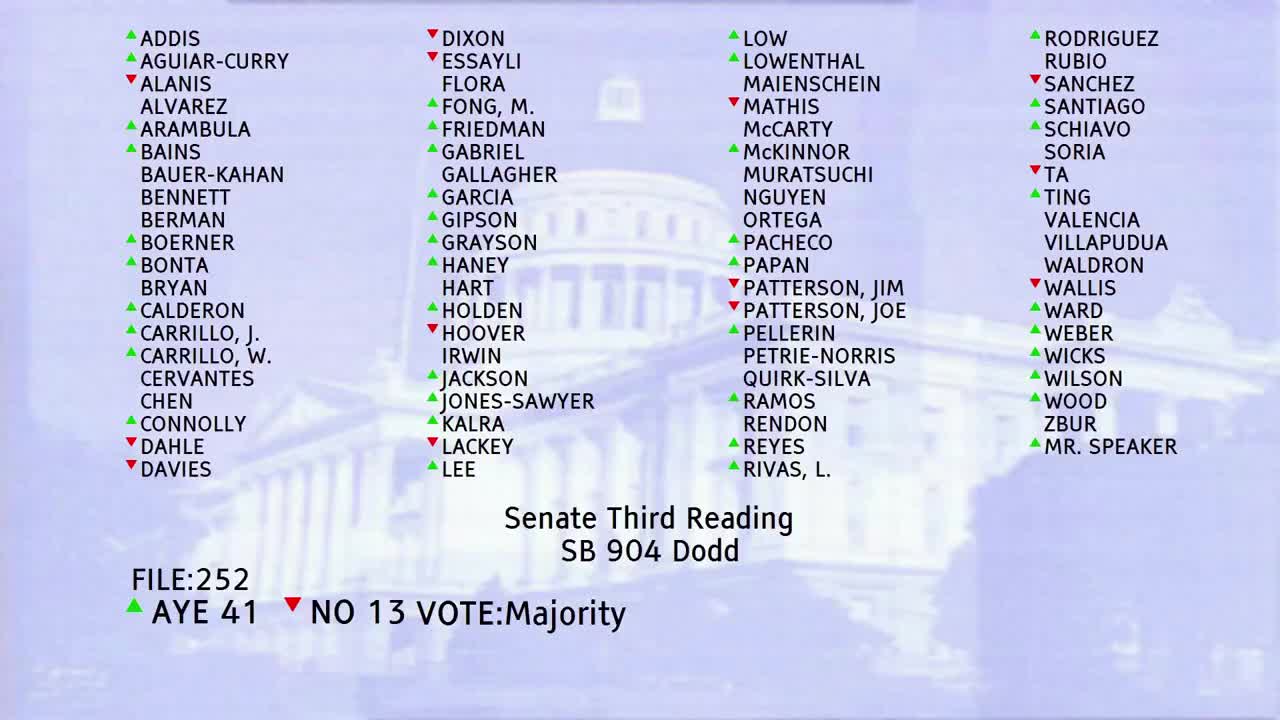 49SEC
Assembly Floor
 3MIN
Senate Floor
 10MIN
Senate Standing Committee on Judiciary
 6MIN
Senate Standing Committee on Education
 5MIN
Assembly Standing Committee on Education
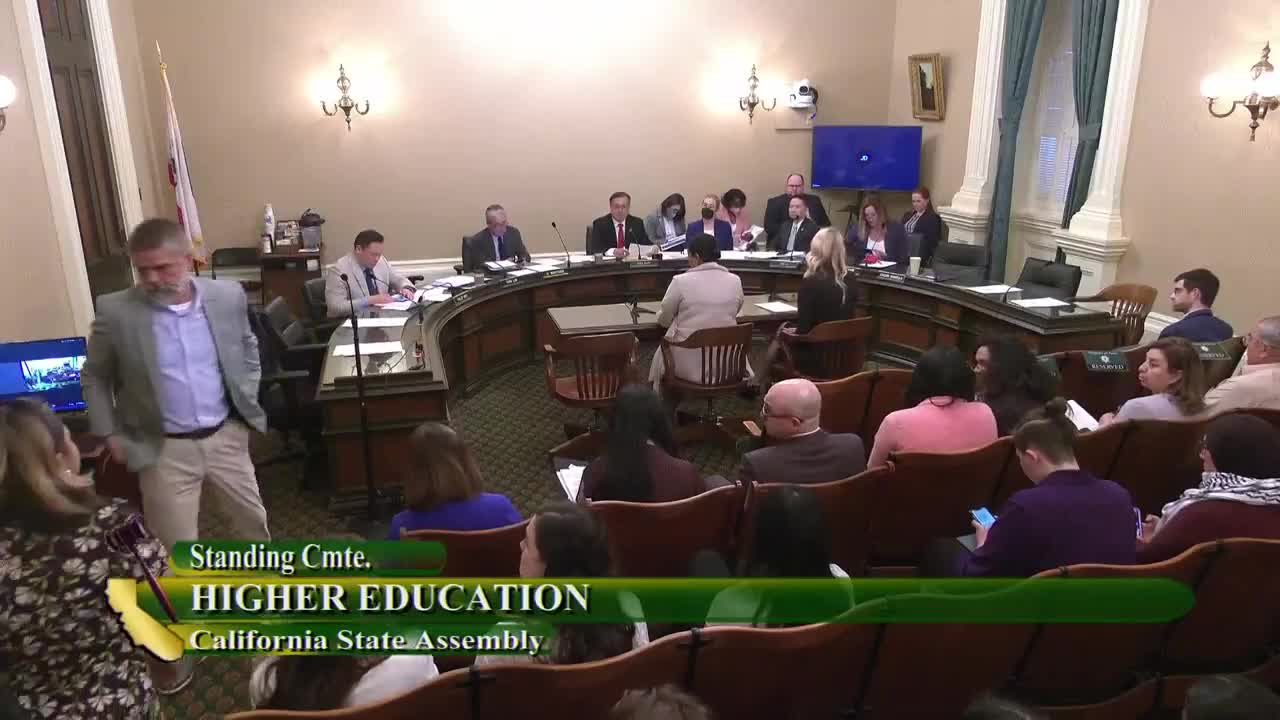 3MIN
Assembly Standing Committee on Higher Education
Bill Author

Bill Co-Author(s):