AB 2814: Crimes: unlawful entry: intent to commit package theft.
- Session Year: 2023-2024
- House: Assembly
- Latest Version Date: 2024-02-15
Current Status:
Failed
(2024-05-16: In committee: Held under submission.)
Introduced
In Committee
First Chamber
In Committee
Second Chamber
Enacted
What does this bill do?
Makes it a crime for someone to enter the area immediately around a home with the intent to steal a package delivered by mail or a public or private carrier, affecting people who take packages and homeowners whose deliveries are targeted. The bill makes that conduct punishable by jail time and defines the area around the home (curtilage) to include places like a porch, doorstep, patio, driveway, hallway, or enclosed yard.
The summary is provided by generative AI which can make mistakes. For original language, please view the details in the table below.
Under existing law, a person who enters a house, room, apartment, or other specified structure, with intent to commit larceny or any felony, is guilty of burglary in the first or 2nd degree, as specified. Burglary in the first degree is punishable by imprisonment in the state prison for 2, 4, or 6 years, and burglary in the 2nd degree is punishable as a misdemeanor by imprisonment in a county jail not exceeding one year, or as a felony by imprisonment in a county jail for 16 months, or 2 or 3 years.
This bill would prohibit a person from entering the curtilage of a home, as defined, with the intent to commit theft of a package shipped through the mail or delivered by a public or private carrier. The bill would make a violation of that prohibition punishable as either a misdemeanor or a felony, as specified. By creating a new crime, the bill would impose a state-mandated local program.
The California Constitution requires the state to reimburse local agencies and school districts for certain costs mandated by the state. Statutory provisions establish procedures for making that reimbursement.
The bill would provide that no reimbursement is required by this act for a specified reason.
(a)A person shall not enter the curtilage of a home with the intent to commit theft of a package shipped through the mail or delivered by a public or private carrier.
(b)A violation of subdivision (a) is punishable by imprisonment in the county jail not exceeding one year or pursuant to subdivision (h) of Section 1170.
(c)For purposes of this section, curtilage means an area adjacent to or in the immediate area of the home, and to which the activity of home life extends, including, but not limited to, a porch, doorstep, patio, stoop, driveway, hallway, or enclosed yard.
SEC. 2.No reimbursement is required by this act pursuant to Section 6 of Article XIIIB of the California Constitution because the only costs that may be incurred by a local agency or school district will be incurred because this act creates a new crime or infraction, eliminates a crime or infraction, or changes the penalty for a crime or infraction, within the meaning of Section 17556 of the Government Code, or changes the definition of a crime within the meaning of Section 6 of Article XIIIB of the California Constitution.
REVISIONS: HeadingLine 2.|
Date
|
Status
|
|---|---|
| May 16, 2024 | In committee: Held under submission. |
| Apr 17, 2024 | In committee: Set, first hearing. Referred to APPR. suspense file. |
| Apr 10, 2024 | Coauthors revised. |
| Apr 10, 2024 | From committee: Do pass and re-refer to Com. on APPR. (Ayes 8. Noes 0.) (April 9). Re-referred to Com. on APPR. |
| Mar 4, 2024 | Referred to Com. on PUB. S. |
| Feb 16, 2024 | From printer. May be heard in committee March 17. |
| Feb 15, 2024 | Read first time. To print. |
|
Date
|
Description
|
Location
|
Votes
|
|
|---|---|---|---|---|
| Apr 9, 2024 | Do pass and be re-referred to the Committee on [Appropriations] | Assembly Standing Committee on Public Safety |
Passed |
This list shows positions taken on this bill by organizations on the date displayed, which is linked to the original source.
Positions by individuals are not included.
|
Organization
|
Position
|
Date
|
|---|---|---|
| Aclu California Action | * Against | Apr 9, 2024 |
| ACLU of Northern California | * Against | Apr 9, 2024 |
| All of Us or None | * Against | Apr 9, 2024 |
| Arcadia Police Officers' Association | ** Support | |
| Burbank Police Officers' Association | ** Support | |
| California Association Of Highway Patrolmen | ** Support | |
| California Business Roundtable | * Support | Apr 9, 2024 |
| California District Attorneys Association | * Support | Apr 9, 2024 |
| California Police Chiefs Association | ** Support | |
| California Public Defenders Association | * Against | Apr 9, 2024 |
| California Reserve Peace Officers Association | ** Support | |
| California Retailers Association | * Support | Apr 9, 2024 |
| California State Sheriff's Association | * Support | Apr 9, 2024 |
| Californians for Safety and Justice | * Against | Apr 9, 2024 |
| Californians United for a Responsible Budget | ** Against | |
| City of San Jose | * Support | Apr 9, 2024 |
| Corona Police Officers Association | ** Support | |
| Culver City Police Officers' Association | ** Support | |
| Deputy Sheriffs Association of Monterey County | ** Support | |
| District Attorney of Santa Clara County | * Support | Apr 9, 2024 |
| Ella Baker Center | * Against | Apr 9, 2024 |
| Fullerton Police Officers' Association | ** Support | |
| Initiate Justice Action | * Against | Apr 9, 2024 |
| League Of California Cities | * Support | Apr 9, 2024 |
| Legal Services for Prisoners with Children | * Against | Apr 9, 2024 |
| Los Angeles County Professional Peace Officers Association | ** Support | |
| Murrieta Police Officers' Association | ** Support | |
| Newport Beach Police Association | ** Support | |
| Novato Police Officers Association | ** Support | |
| Oakland Privacy | ** Against | |
| Palos Verdes Police Officers Association | ** Support | |
| Peace Officers Research Association Of California | ** Support | |
| PLACER COUNTY DEPUTY SHERIFFS ASSOCIATION | ** Support | |
| Pomona Police Officers' Association | ** Support | |
| RIVERSIDE POLICE OFFICERS ASSOCIATION | ** Support | |
| Riverside Sheriffs' Association | ** Support | |
| San Francisco Public Defender's Office | * Against | Apr 9, 2024 |
| Santa Ana Police Officers Association | ** Support | |
| SEIU California | * Against | Apr 9, 2024 |
| Smart Justice California | * Against | Apr 9, 2024 |
| Upland Police Officers Association | ** Support |
Date of Hearing: April 17, 2024
ASSEMBLY COMMITTEE ON APPROPRIATIONS
Buffy Wicks, Chair
ABPCA Bill Id:AB 2814
Author:(Low) – As Introduced Ver:February 15, 2024
Policy Committee: | Public Safety | Vote: | 8 - 0 |
|
| ||
|
|
Urgency: No State Mandated Local Program: Yes Reimbursable: No
SUMMARY:
This bill creates a new crime making it unlawful to enter the curtilage of a dwelling with the intent to steal a package, punishable as an alternate misdemeanor-felony (“wobbler”).
FISCAL EFFECT:
- Cost pressures (Trial Court Trust Fund, General Fund) of an unknown but potentially significant amount to the courts to adjudicate violations of the wobbler created by this bill. A defendant charged with a misdemeanor or felony is entitled to no-cost legal representation and a jury trial. Actual court costs will depend on the number of violations, prosecutorial discretion, and the amount of court time needed to adjudicate each case. It generally costs approximately $1,000 to operate a courtroom for one hour. If 200 cases are filed statewide and each case takes three hours of court time to adjudicate, workload costs to the court would be approximately $600,000. Costs will be higher if more cases proceed to trial. Although courts are not funded on the basis of workload, increased pressure on the Trial Court Trust Fund may create a need for increased funding for courts from the General Fund. The Governor’s 2024-25 budget proposes $83.1 million ongoing from the General Fund to backfill declining revenue to the Trial Court Trust Fund.
- Costs (local funds, General Fund) to the counties to incarcerate people convicted of this crime in county jail. Actual incarceration costs will depend on the number of convictions and the length of each sentence. The average annual cost to incarcerate one person in county jail is approximately $29,000. If 50 people are convicted and must each serve two years in jail, total incarceration costs would be $2.9 million over two years. Although county incarceration costs are generally not considered reimbursable state mandates pursuant to Proposition 30 (2012), overcrowding in county jails creates cost pressure on the General Fund because the state has historically granted new funding to counties to offset overcrowding resulting from 2011 public safety realignment.
According to the Legislative Analyst’s Office, the General Fund faces a structural deficit in the tens of billions of dollars over the next several fiscal years.
COMMENTS:
- Purpose. According to the author:
The scourge that is package theft has hit every neighborhood and community in this state for far too long. It’s time we send a clear message to porch pirates in California: under AB 2814 you will be prosecuted for these serious and invasive crimes.
- Background. This bill creates a new crime that applies when a person enters the curtilage of a residential dwelling with the intent to commit theft of a package shipped through the mail or delivered by a public or private carrier. “Curtilage” is defined as “an area adjacent to or in the immediate area of the residential dwelling, and to which the activity of residential life extends, including, but not limited to, a porch, doorstep, patio, stoop, driveway, hallway, or enclosed yard.” The person does not have to actually steal a package; if a person enters the curtilage of a residence with the intent to steal a package, they may be convicted. This new crime is a wobbler, meaning it may be charged either as a misdemeanor or felony, at the discretion of a prosecutor. A misdemeanor conviction is punishable by up to one year in county jail. A felony conviction is punishable by 16 months, two years, or three years in county jail.
As detailed in the analysis of this bill by the Assembly Committee on Public Safety, there are several existing provisions of the Penal Code under which package theft is currently prosecuted, including petty theft, grand theft, and, depending on the facts of the case, burglary. Nevertheless, if, as supporters of this measure contend, this bill will make it much easier for a prosecutor to obtain a conviction for residential package theft, it will result in workload cost pressures to the courts to adjudicate the resulting criminal cases and significant county incarceration costs.
Analysis Prepared by: Annika Carlson / APPR. / (916) 319-2081
Date of Hearing:
Chief Counsel: Sandy Uribe
ASSEMBLY COMMITTEE ON PUBLIC SAFETY
Kevin McCarty, Chair
ABPCA Bill Id:AB 2814
Author:(Low) – As Introduced Ver:February 15, 2024
SUMMARY:
Creates a new crime making it unlawful to enter the curtilage of a dwelling with the intent to steal a package. Specifically, this bill:
- Makes it a crime to enter the curtilage of a home with the intent to commit theft of a package shipped through the mail or delivered by a public or private carrier.
- Punishes this crime as an alternate felony/misdemeanor (a “wobbler”), punishable by imprisonment in the county jail not exceeding one year, or by 16 months, two, or three years in the county jail.
- Defines “curtilage” as “an area adjacent to or in the immediate area of the home, and to which the activity of home life extends, including, but not limited to, a porch, doorstep, patio, stoop, driveway, hallway, or enclosed yard.”
EXISTING LAW:
- Defines the criminal offense of theft and divides the offense into two degrees: grand theft and petty theft. (Pen. Code, §§ 484; 486.)
- Provides that grand theft occurs when the money, labor, or real or personal property taken is of a value exceeding $950. (Pen. Code § 487, subd. (a).)
- Provides that other cases of theft are petty theft. (Pen. Code, § 488.)
- Punishes grand theft as a state prison felony when the item taken is a firearm, and as an alternate felony/misdemeanor (a “wobbler”) in all other cases. (Pen. Code, § 489.)
- Punishes petty theft as a misdemeanor. (Pen. Code, § 490.)
- Specifies that a burglary of an inhabited dwelling or vessel which is inhabited and designed for habitation, floating home, or trailer coach, or the inhabited portion of any other building, is burglary of the first degree. (Pen. Code, § 460, subd. (a).)
- Provides that all other types of burglary is burglary in the second degree. (Pen. Code, § 460, subd. (b).)
- Provides the following penalties for burglary:
- Burglary in the first degree is punishable by imprisonment in the state prison for 2, 4 or 6 years; and,
- Burglary in the second degree is punishable as an alternate felony/misdemeanor by imprisonment in the county jail not exceeding one year or imprisonment in county jail for 18 months, 2 or 3 years. (Pen. Code, § 461.)
- Burglary in the first degree is punishable by imprisonment in the state prison for 2, 4 or 6 years; and,
- States that every person who commits mail theft, as defined, is guilty of a crime, and shall be punished by a fine, by imprisonment in a county jail not to exceed one year, or by both a fine and imprisonment. (Pen. Code, § 530.5, subd. (e).)
- Defines mail theft as follows:
- Whoever steals, takes, or obtains by fraud or deception, or attempts so to obtain, from or out of any mail, post office, or station thereof, letter box, mail receptacle, or any mail route or other authorized depository for mail matter, or from a letter or mail carrier, any letter, postal card, package, bag, or mail, or abstracts or removes from any such letter, package, bag, or mail, any article or thing contained therein, or secretes, embezzles, or destroys any such letter, postal card, package, bag, or mail, or any article or thing contained therein;
- Whoever steals, takes, or by fraud or deception obtains any letter, postal card, package, bag, or mail, or any article or thing contained therein which has been left for collection upon or adjacent to a collection box or other authorized depository of mail matter; or,
- Whoever buys, receives, or conceals, or unlawfully has in his possession, any letter, postal card, package, bag, or mail, or any article or thing contained therein, which has been so stolen, taken, embezzled, as described above, knowing the same to have been stolen, taken, or embezzled. (Pen. Code, § 530.5, subd. (e), cross referencing 18 U.S.C, § 1708).)
- Whoever steals, takes, or obtains by fraud or deception, or attempts so to obtain, from or out of any mail, post office, or station thereof, letter box, mail receptacle, or any mail route or other authorized depository for mail matter, or from a letter or mail carrier, any letter, postal card, package, bag, or mail, or abstracts or removes from any such letter, package, bag, or mail, any article or thing contained therein, or secretes, embezzles, or destroys any such letter, postal card, package, bag, or mail, or any article or thing contained therein;
FISCAL EFFECT:
Unknown
COMMENTS:
- Author's Statement: According to the author, ““The scourge that is package theft has hit every neighborhood and community in this state for far too long. It’s time we send a clear message to porch pirates in California: under AB 2814 you will be prosecuted for these serious and invasive crimes.”
- Existing Possible Penalties for Package Theft: Existing law separates theft into two degrees: petty theft and grand theft. Unless otherwise specified, grand theft is committed when the money, labor, or real or personal property taken is of a value exceeding $950. (Pen. Code, § 487.) All other theft is petty theft. (Pen. Code, § 488.)
The current threshold amount to constitute grand theft requires a taking or loss in excess of $950 which was established through legislation in 2010. (AB 2373 (Ammiano) Chapter 693, Statutes of 2010.) Prior to that change in the law, the amount was $400 or more which was established in the 1982-1983 Legislative Session. (Chapter 375, Statutes of 1982.) The previous amount of $200 was established in 1923; up to that time, the threshold amount was $50.
Grand theft is punishable as a “wobbler,” meaning that it may be punished as either a felony or misdemeanor. (Pen. Code, § 489, subd. (c).) Petty theft is punishable as a misdemeanor. (Pen. Code, § 490.) Thus, under existing law, a person may be charged with a felony for stealing packages if the value of items taken exceeds $950.
This bill creates a new crime of entering “an area adjacent to or in the immediate area of the dwelling, and to which the activity of home life extends” such as, but not limited to “a porch, doorstep, patio, stoop, driveway, hallway, or enclosed yard” with intent to steal a package, regardless of the value of the items taken. This conduct would be punishable as either a felony or a misdemeanor, regardless of the value of the package. Additionally, the bill does not require that a theft actually occurred; rather a person would be guilty of the offense if there were some showing of an intent to steal the package. In this regard, the crime is akin to a burglary.
Burglary of an inhabited dwelling house or structure is first degree burglary and punishable as a felony. (Pen. Code, § 461.) An inhabited dwelling house has been interpreted by case law to mean “. . . a structure where people ordinarily live and which is currently being used for dwelling purposes. A place is an inhabited dwelling if a person with possessory rights uses the place as sleeping quarters intending to continue doing so in the future. There may be more than one dwelling under the same roof. Apartments and hotel rooms may be the dwelling house of persons living in them.” (People v. Fleetwood (1985) 171 Cal.App.3d. 982, 987-988.) Inhabited houses and apartments are included in this definition.
Courts have broadly interpreted the term “inhabited dwelling house” to include a variety of structures and places in order to effect the legislative purpose of the burglary statutes—to protect the peaceful occupation of one's residence against intrusion and violence. In determining whether a structure is part of an inhabited dwelling, the essential inquiry is whether the structure is functionally interconnected with and immediately contiguous to other portions of the house. “Functionally interconnected” means used in related or complementary ways. “Contiguous” means adjacent, adjoining, nearby, or close.” (People v. Thorn (2009) 176 Cal.App.4th 255, 261-262.) Courts have also included in certain cases garages, carports, and balconies as a dwelling structure for purposes of residential burglary. (People v. Gilbert (1961) 188 Cal.App.2d 723; People v. Thorn, supra, 176 Cal.App.4th 255; People v. Yarborough (2012) 54 Cal.4th 889.)
The burglary laws are primarily designed, not to deter trespass and the intended crime, which are prohibited by other laws, but rather to protect against dangerous situations to personal safety created by a violation of the occupant’s possessory interest in the building. (People v. Thorn, supra, 176 Cal.App.4th at 264.)
This bill creates a new crime for a person to enter the curtilage of a residential dwelling with the intent to commit theft of a package shipped through the mail or delivered by a public or private carrier. “Curtilage” is defined as “an area adjacent to or in the immediate area of the residential dwelling, and to which the activity of residential life extends, including, but not limited to, a porch, doorstep, patio, stoop, driveway, hallway, or enclosed yard.” Depending on the facts of the case, a person who violates the provisions in this bill could be charged with burglary of a residential building or structure, which is already punishable as a felony.
- Mail Theft: California also criminalizes the theft of mail. The California crime is based on the federal statute prohibiting the theft of mail, and specifically cross references the federal statute to establish the elements of mail theft. Mail theft is an offense which involves the theft of items sent through the United States Postal Service (USPS), a federal agency. “Mail” constitutes the items that are sent through and entrusted to that governmental agency. In order for mail theft to occur, the theft must occur while the items are physically or constructively within the control and ambit of the USPS.
Courts have noted the crime of mail theft is based on the importance of the USPS as government agency providing service to the citizens of the United States. “The United States Postal Service has served as the keystone of the American communications system since its founding by Benjamin Franklin in 1775. In recognition of the indispensable role the Postal Service plays in the private and commercial life of the nation, Congress has provided criminal penalties for activities that interfere with the Postal Service's mandate to deliver the mail.” (United States v. Lavin (3d Cir. 1977), 567 F.2d 579, 580.)
This bill seeks to punish “theft of a package shipped through the mail or delivered by a public or private carrier.” (Emphasis added.) Given that mail theft was specifically constructed as a crime involving the government, it is not clear that including private actors within what is essentially mail theft is consistent with the nature of the crime. This bill does not define “a public or private carrier.” As such, it is not clear whether it would apply to private entities that are in the shipping and delivery business, such as Fed Ex and United Parcel Service, or whether it would also apply to retailers who also happen to deliver their own packages, such as Amazon. In either case, it is not clear that a “private mail carrier” performs a role and function that is coextensive with that of the USPS to appropriately be included in the crime defined by the elements of the federal crime of mail theft.
- Argument in Support: According to the California State Sheriffs’ Association, “As retail entities see their customers’ transition from shopping at brick-and-mortar stores to shopping online, retailers are delivering more of their products directly to their customers’ residences. Increasingly, criminals have been stealing packages delivered at the doorsteps of homes. Because these package contents are often valued under the $950 grand theft threshold or the offender may not actually enter the dwelling to complete the act, individuals engaging in this criminal activity are generally not subject to significant punishment that could deter them from engaging in this activity.”
- Argument in Opposition: According to Californians for Safety and Justice, “This bill is an invitation to racial profiling. Completely lawful activity - walking up to the front door of a home - is made criminal by this bill based solely on the witness or officer’s belief that the person “intends” to steal. Innocent behavior such as a volunteer canvassing for a political campaign or a Girl Scout selling cookies to her neighbor could easily be misinterpreted under this bill. History shows us that this misinterpretation will be infected with racial bias and fall heavily on Black, Latino and Native American people.”
- Prior Legislation:
- AB 1698 (Maienschein), of the 2021-2022 Legislative Session, would have created the criminal offense of package theft, punishable as a misdemeanor. AB 1698 was held on the Appropriation Committee’s suspense file.
- AB 1699 (Maienschein), of the 2021-2022 Legislative Session, would have counted a conviction for package theft as a point against a driver’s record if the crime involved the use or acquisition of a vehicle. AB 1699 was never heard in the Assembly Transportation Committee at the request of the author.
- SB 358 (Jones), of the 2021-2022 Legislative Session, was substantially similar to this bill. SB 358 was held in the Assembly Appropriations Committee.
- AB 1210 (Low), of the 2019-2020 Legislative Session, would have made it a crime to enter the curtilage of a dwelling with the intent to steal a package and would have specified that a violation committed by a person acting in concert with one or more persons, on two or more separate occasions within a 12-month period, for which the value of the property stolen exceeds $950 . AB 1210 was held on the Appropriation Committee’s suspense file.
- AB 1698 (Maienschein), of the 2021-2022 Legislative Session, would have created the criminal offense of package theft, punishable as a misdemeanor. AB 1698 was held on the Appropriation Committee’s suspense file.
REGISTERED SUPPORT / OPPOSITION:
Support
Arcadia Police Officers' Association
Burbank Police Officers' Association
California Association of Highway Patrolmen
California District Attorneys Association
California Police Chiefs Association
California Reserve Peace Officers Association
California State Sheriffs' Association
Corona Police Officers Association
Culver City Police Officers' Association
Deputy Sheriffs' Association of Monterey County
Fullerton Police Officers' Association
League of California Cities
Los Angeles County Professional Peace Officers Association
Murrieta Police Officers' Association
Newport Beach Police Association
Novato Police Officers Association
Palos Verdes Police Officers Association
Peace Officers Research Association of California (PORAC)
Placer County Deputy Sheriffs' Association
Pomona Police Officers' Association
Riverside Police Officers Association
Riverside Sheriffs' Association
Santa Ana Police Officers Association
Upland Police Officers Association
Opposition
Californians for Safety and Justice
Californians United for a Responsible Budget
Ella Baker Center for Human Rights
Initiate Justice Action
Oakland Privacy
Analysis Prepared by:
Sandy Uribe / PUB. S. / (916) 319-3744
Discussed in Hearing
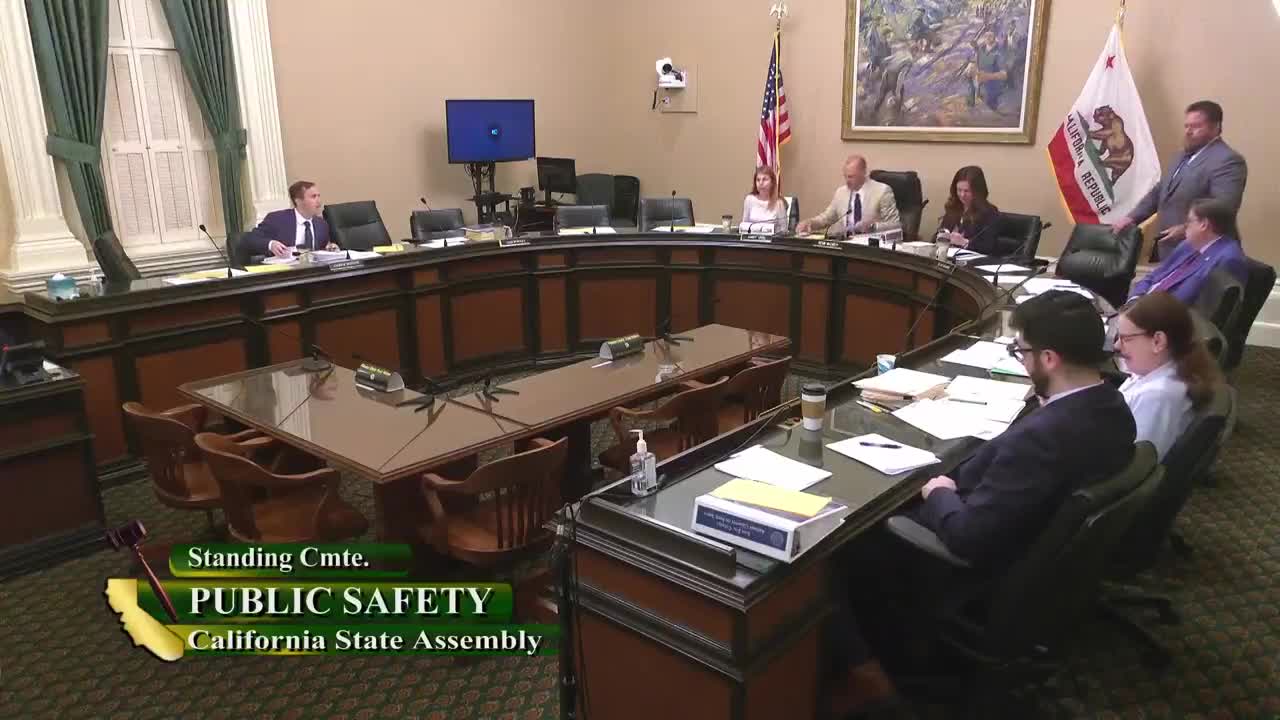 17MIN
Assembly Standing Committee on Public Safety
Bill Author


