AB 2815: Clean Transportation Program: electric vehicle chargers.
- Session Year: 2023-2024
- House: Assembly
- Latest Version Date: 2024-07-02
Current Status:
Failed
(2024-08-15: In committee: Held under submission.)
Introduced
In Committee
First Chamber
In Committee
Second Chamber
Enacted
Existing law establishes the Clean Transportation Program, administered by the State Energy Resources Conservation and Development Commission, to provide funding to certain entities to develop and deploy innovative technologies that transform Californias fuel and vehicle types to help attain the states climate change policies. Existing law limits funding under the program to specified categories of programs and projects. Existing law creates the Alternative and Renewable Fuel and Vehicle Technology Fund, to be administered by the commission, and requires the moneys in the fund, upon appropriation by the Legislature, to be expended by the commission to implement the program.
This bill would add to the categories of programs and projects eligible for funding under the Clean Transportation Program a program to repair or replace nonoperational electric vehicle chargers that are at least 5 years old and that are located in a publicly available parking space, as provided. The bill would require the commission to allocate at least 50% of the funding allocated for the repair or replacement program to low-income communities and disadvantaged communities. The bill would prohibit the commission from expending more than 20% of the amount appropriated for purposes of the Clean Transportation Program in any particular fiscal year on the repair or replacement program.
Existing law establishes the Clean Transportation Program, administered by the State Energy Resources Conservation and Development Commission, to provide funding to certain entities to develop and deploy innovative technologies that transform Californias fuel and vehicle types to help attain the states climate change policies. Existing law limits funding under the program to specified categories of programs and projects. Existing law creates the Alternative and Renewable Fuel and Vehicle Technology Fund, to be administered by the commission, and requires the moneys in the fund, upon appropriation by the Legislature, to be expended by the commission to implement the program.
This bill would require the commission, on or before January 1, 2026, to provide funding through a new or existing program under the Clean Transportation Program for repair or replacement of add to the categories of programs and projects eligible for funding under the Clean Transportation Program a program to repair or replace nonoperational electric vehicle charging stations chargers that are at least 5 years old, that were installed before January 1, 2024, old and that are located in a publicly available parking space, as provided. The bill would require the commission to allocate at least 50% of that the funding allocated for the repair or replacement program to low-income communities and disadvantaged communities. The bill would repeal these provisions on January 1, 2036. prohibit the commission from expending more than 20% of the amount appropriated for purposes of the Clean Transportation Program in any particular fiscal year on the repair or replacement program.
Existing law establishes the Clean Transportation Program, administered by the State Energy Resources Conservation and Development Commission, to provide funding to certain entities to develop and deploy innovative technologies that transform Californias fuel and vehicle types to help attain the states climate change policies. Existing law creates the Alternative and Renewable Fuel and Vehicle Technology Fund, to be administered by the commission, and requires the moneys in the fund, upon appropriation by the Legislature, to be expended by the commission to implement the program.
This bill would require the commission to establish, commission, on or before January 1, 2026, a program to provide funding through a new or existing program under the Clean Transportation Program to provide grants for repairs to for repair or replacement of nonoperational electric vehicle charging infrastructure that has been in operation for at least 5 years stations that are at least 5 years old, that were installed before January 1, 2024, and that is are located in a publicly available parking space, as provided. The bill would authorize grant funding to be used for, among other things, the cost to repair, upgrade, or replace an electric vehicle charging port or supporting infrastructure and the cost of operations, maintenance, and warranties for repaired, upgraded, or replaced electric vehicle charging ports and supporting infrastructure. The bill would require the commission to allocate at least 50% of grant that funding to low-income communities and disadvantaged communities. The bill would repeal these provisions on January 1, 2036.
Existing law establishes the Clean Transportation Program, administered by the State Energy Resources Conservation and Development Commission, to provide funding to certain entities to develop and deploy innovative technologies that transform Californias fuel and vehicle types to help attain the states climate change policies. Existing law creates the Alternative and Renewable Fuel and Vehicle Technology Fund, to be administered by the commission, and requires the moneys in the fund, upon appropriation by the Legislature, to be expended by the commission to implement the program.
This bill would require the commission to establish, on or before January 1, 2026, a program under the Clean Transportation Program to provide grants for repairs to electric vehicle charging infrastructure that has been in operation for at least 5 years and that is located in a publicly available parking space, as provided. The bill would authorize grant funding to be used for, among other things, the cost to repair, upgrade, or replace an electric vehicle charging port or supporting infrastructure and the cost of operations, maintenance, and warranties for repaired, upgraded, or replaced electric vehicle charging ports and supporting infrastructure. The bill would require the commission to allocate at least 50% of grant funding to low-income communities and disadvantaged communities. The bill would repeal these provisions on January 1, 2036.
(a)The Clean Transportation Program is hereby created. The program shall be administered by the commission. The commission shall implement the program by regulation pursuant to the requirements of the Administrative Procedure Act (Chapter 3.5 (commencing with Section 11340) of Part 1 of Division 3 of Title 2 of the Government Code). The program shall provide, upon appropriation by the Legislature, competitive grants, revolving loans, loan guarantees, loans, or other appropriate funding measures to public agencies, California Native American tribes, tribal organizations, vehicle and technology entities, businesses and projects, public-private partnerships, workforce training partnerships and collaboratives, fleet owners, consumers, recreational boaters, and academic institutions to develop and deploy innovative technologies that transform Californias fuel and vehicle types to help attain the states climate change policies. The emphasis of this program shall be to develop and deploy zero-emission technology and fuels in the marketplace where feasible and near-zero-emission technology and fuels elsewhere.
(b)The goals of the program shall be to advance the states clean transportation, equity, air quality, and climate emission policies, including, but not limited to, any of the following:
(1)Section 39719.2.
(2)Section 39730.5.
(3)Section 43024.2.
(4)Section 44124.5.
(5)Section 44391.2.
(6)Section 25229 of the Public Resources Code.
(7)Section 25327 of the Public Resources Code.
(8)Section 14517 of the Government Code.
(c)On or after January 1, 2025, when developing the investment plan pursuant to Section 44272.5, the commission shall prioritize program investments into the following:
(1)Deployment of infrastructure and other projects that advance or support the deployment of medium- and heavy-duty vehicles to meet the clean transportation, equity, air quality, and climate emission goals described in subdivision (b).
(2)Deployment of light-duty vehicle infrastructure technology to fill deployment gaps identified pursuant to Sections 25229 and 25231 of the Public Resources Code and advance the goals identified in Executive Order No. N-79-20.
(d)On and after January 1, 2025, no less than 50 percent of investments expended pursuant to subdivision (a) shall be expended in accordance with Section 44272.1.
(e)A project that receives more than seventy-five thousand dollars ($75,000) in funds from the commission shall be approved at a noticed public meeting of the commission and shall be consistent with the priorities established by the investment plan adopted pursuant to Section 44272.5. Under this article, the commission may delegate to the commissions executive director, or the executive directors designee, the authority to approve either of the following:
(1)A contract, grant, loan, or other agreement or award that receives seventy-five thousand dollars ($75,000) or less in funds from the commission.
(2)Amendments to a contract, grant, loan, or other agreement or award if the amendments do not increase the amount of the award, change the scope of the project, or modify the purpose of the agreement.
(f)The commission shall provide preferences to those projects that maximize the goals of the Clean Transportation Program, based on the following criteria, as applicable:
(1)The projects consistency with existing and future state climate change policy and low-carbon fuel standards.
(2)The projects ability to reduce greenhouse gas emissions, criteria air pollutants, and air toxics, and reduce or avoid multimedia environmental impacts.
(3)The project does not adversely impact the sustainability of the states natural resources, especially state and federal lands.
(4)The project provides nonstate matching funds. Costs incurred from the date a proposed award is noticed may be counted as nonstate matching funds. The commission may adopt further requirements for purposes of this paragraph. The commission is not liable for costs incurred pursuant to this paragraph if the commission does not give final approval for the project or the proposed recipient does not meet requirements adopted by the commission pursuant to this paragraph.
(5)The project provides economic benefits for California by promoting California-based technology firms, jobs, and businesses.
(6)The project uses existing or proposed fueling infrastructure to maximize the outcome of the project.
(7)The project drives new technology advancement for vehicles, vessels, engines, and other equipment, and promotes the deployment of that technology in the marketplace.
(8)The projects ability to transition workers to, or promote employment in, zero-emission fuel and vehicle technology where feasible and near-zero-emission fuel and vehicle technology elsewhere.
(9)The project is in a nonattainment area pursuant to the federal Clean Air Act (42 U.S.C. Sec. 7401 et seq.), and, if applicable, preference shall be given to projects in the highest designation of nonattainment.
(10)The project advances the comprehensive strategy for vehicles pursuant to Section 43024.2.
(g)The commission shall rank applications for projects proposed for funding awards based on solicitation criteria developed in accordance with subdivision (f), and shall give additional preference to funding those projects with higher benefit-cost scores.
(h)Only the following shall be eligible for funding:
(1)Zero-emission fuel projects where feasible and near-zero-emission fuel projects elsewhere to develop and improve zero-emission and near-zero-emission fuels, including electricity, renewable diesel, hydrogen, and biomethane, among others, and their feedstocks that have high potential for long-term or short-term commercialization, including projects that lead to sustainable feedstocks.
(2)Demonstration and deployment projects that optimize zero-emission fuels and infrastructure where feasible and near-zero-emission fuels and infrastructure elsewhere for existing and developing technologies.
(3)Projects to produce alternative and renewable low-carbon fuels in California.
(4)Projects to decrease the overall impact of an alternative and renewable fuels life-cycle carbon footprint and increase sustainability.
(5)Zero-emission fuel infrastructure, fueling stations, and equipment where feasible and near-zero-emission fuel infrastructure, fueling stations, and equipment elsewhere.
(6)Projects to develop and improve light-, medium-, and heavy-duty vehicle technologies that provide for better fuel efficiency and lower greenhouse gas emissions, alternative fuel usage and storage, or emission reductions, including propulsion systems, lightweight materials, intelligent transportation systems, energy storage, control systems and system integration, physical measurement and metering systems and software, development of design standards and testing and certification protocols, battery recycling and reuse, engine and fuel optimization electronic and electrified components, hybrid technology, plug-in hybrid technology, battery electric vehicle technology, fuel cell technology, and conversions of hybrid technology to plug-in technology through the installation of safety certified supplemental battery modules.
(7)Programs and projects that accelerate the commercialization of zero-emission vehicles, fuels, and infrastructure where feasible and near-zero-emission vehicles, fuels, and infrastructure elsewhere, including buy-down programs through near-market and market-path deployments, advanced technology warranty or replacement insurance, development of market niches, supply-chain development, and research related to the pedestrian safety impacts of vehicle technologies and alternative and renewable fuels.
(8)Programs and projects to retrofit medium- and heavy-duty on-road and nonroad vehicle fleets with zero-emission technologies where feasible and near-zero-emission technologies elsewhere that create higher fuel efficiencies, including alternative and renewable fuel vehicles and technologies, idle management technology, and aerodynamic retrofits that decrease fuel consumption.
(9)Infrastructure projects that promote zero-emission infrastructure development where feasible and near-zero-emission fuel infrastructure development elsewhere connected with existing fleets, public transit, and existing transportation corridors, including physical measurement or metering equipment and truck stop electrification.
(10)Workforce training programs related to the development and deployment of technologies that transform Californias fuel and vehicle types and assist the state in implementing its climate change policies, including, but not limited to, zero-emission vehicles, technologies, fuels, and infrastructure where feasible and near-zero-emission vehicles, technologies, fuels, and infrastructure elsewhere; automotive computer systems; mass transit fleet conversion, servicing, and maintenance; and other sectors or occupations related to the purposes of this chapter, including training programs to transition dislocated workers affected by the states greenhouse gas emission policies, including those from fossil fuel sectors, or training programs for low-skilled workers to enter or continue in a career pathway that leads to middle skill, industry-recognized credentials or state-approved apprenticeship opportunities in occupations related to the purposes of this chapter.
(11)Block grants or incentive programs administered by public entities or not-for-profit technology entities for multiple projects, education and program promotion within California, and development of zero-emission fuel and vehicle technology centers. The commission may adopt guidelines for implementing the block grant or incentive program, which shall be approved at a noticed public meeting of the commission.
(12)Life-cycle and multimedia analyses, sustainability and environmental impact evaluations, and market, financial, and technology assessments performed by a state agency to determine the impacts of increasing the use of zero-emission transportation fuels and technologies, and to assist in the preparation of the investment plan and program implementation.
(13)A program to provide funding for homeowners who purchase a plug-in electric vehicle to offset costs associated with modifying electrical sources to include a residential plug-in electric vehicle charging station. In establishing this program, the commission shall consider funding criteria to maximize the public benefit of the program.
(14)(A)A program to repair or replace nonoperational electric vehicle chargers.
(B)Eligibility for the program described in subparagraph (A) shall be limited to electric vehicle chargers that are at least five years old and that are located in a publicly available parking space. Charging stations that are owned and operated by a charging network provider are not eligible for funding under the program described in subparagraph (A) if the charging network provider that owns the charging station received an incentive from a state agency or an incentive through a charge on ratepayers for that charging station. The commission shall require an applicant to provide matching funds or in-kind contributions as a condition of receiving funding. For funding allocated to low-income communities and disadvantaged communities, the commission shall reduce the amount of matching funds or in-kind contributions the applicant is required to provide. At least 50 percent of the funding allocated for the program described in subparagraph (A) shall be allocated to low-income communities and disadvantaged communities. Electric vehicle chargers repaired or replaced pursuant to subparagraph (A) shall meet the requirements developed by the commission pursuant to Section 25231.5 of the Public Resources Code. The commission shall not expend more than 20 percent of the amount appropriated for purposes of the Clean Transportation Program in any particular fiscal year on the program described in subparagraph (A).
(C)Nothing in this paragraph prevents a property owner from replacing an electric vehicle charger with an electric vehicle charger of the property owners choice.
(i)(1)The commission shall require the following data to be reported to the commission, consistent with paragraph (2), as a condition of accepting a grant issued pursuant to this section:
(A)For a hydrogen-refueling station grant recipient, the availability of operational fueling nozzles, whether hydrogen is available for refueling at that station, the volume of hydrogen-dispensed basis, the number of vehicles fueled by a station, and any other data deemed necessary by the commission to monitor reliability and accessibility of the refueling infrastructure.
(B)For an electric vehicle charging station grant recipient, the availability of operational charging plugs, whether the station was energized, the volume of electricity in kilowatthours used to charge by vehicles, the number of vehicles charged by the station, and any other data deemed necessary by the commission to monitor reliability and accessibility of the charging infrastructure.
(2)The commission shall require this data to be measured no less frequently than on a daily basis and reported electronically to the commission no less frequently than quarterly.
(j)(1)The commission may make a single source or sole source award pursuant to this section to either of the following:
(A)A public or nonpublic entity that manages a United States Department of Energy national laboratory.
(B)A public or nonpublic entity for an applied research project.
(2)The same requirements set forth in Section 25620.5 of the Public Resources Code shall apply to awards made on a single source basis or a sole source basis.
(k)(1)For purposes only of any hydrogen application scoring pursuant to this section, the commission shall provide preference to applicants with the least carbon-intensive proposed fuel, measured well-to-gate, consistent with the clean hydrogen federal tax credit created by Section 45V of Title 26 of the United States Code using the order of tiers created by the regulations adopted pursuant to that section to score hydrogen grant applications, upon the effective date of regulations issued by the United States Department of the Treasury for that tax credit.
(2)This scoring preference does not establish a new hydrogen standard and shall only be used to score applications submitted to the program established pursuant to this section.
(l)The commission shall require the awardees of funding pursuant to this section for any hydrogen-fueling infrastructure to provide to the commission the source and carbon intensity of the hydrogen produced for, or dispensed by, hydrogen-fueling stations, as measured by the methodology in the Low Carbon Fuel Standard regulation (Subarticle 7 (commencing with Section 95480) of Article 4 of Subchapter 10 of Chapter 1 of Division 3 of Title 17 of the California Code of Regulations).
(m)The commission shall require the awardees of funding pursuant to this section for any electric vehicle charging infrastructure to report to the commission the source and greenhouse gas emissions intensity, on an annual basis, of the electricity used and dispensed by electric vehicle charging stations at the meter, consistent with the disclosure methodology set forth in Article 14 (commencing with Section 398.1) of Chapter 2.3 of Part 1 of Division 1 of the Public Utilities Code.
(n)The commission may do all of the following:
(1)Contract with the Treasurer to expend funds through programs implemented by the Treasurer, if the expenditure is consistent with all of the requirements of this article and Article 1 (commencing with Section 44270).
(2)Contract with small business financial development corporations established by the Governors Office of Business and Economic Development to expend funds through the Small Business Loan Guarantee Program if the expenditure is consistent with all of the requirements of this article and Article 1 (commencing with Section 44270).
(3)Advance funds, pursuant to an agreement with the commission, to any of the following:
(A)A public entity.
(B)A nonpublic entity managing a United States Department of Energy national laboratory.
(C)A recipient to enable it to make advance payments to a public entity that is a subrecipient of the funds and under a binding and enforceable subagreement with the recipient.
(D)An administrator of a block grant program.
(o)The commission shall collaborate with entities that have expertise in workforce development to implement the workforce development components of this section, including, but not limited to, the California Workforce Development Board, the Employment Training Panel, the Employment Development Department, and the Division of Apprenticeship Standards.
(a)The Clean Transportation Program is hereby created. The program shall be administered by the commission. The commission shall implement the program by regulation pursuant to the requirements of the Administrative Procedure Act (Chapter 3.5 (commencing with Section 11340) of Part 1 of Division 3 of Title 2 of the Government Code). The program shall provide, upon appropriation by the Legislature, competitive grants, revolving loans, loan guarantees, loans, or other appropriate funding measures to public agencies, California Native American tribes, tribal organizations, vehicle and technology entities, businesses and projects, public-private partnerships, workforce training partnerships and collaboratives, fleet owners, consumers, recreational boaters, and academic institutions to develop and deploy innovative technologies that transform Californias fuel and vehicle types to help attain the states climate change policies. The emphasis of this program shall be to develop and deploy zero-emission technology and fuels in the marketplace where feasible and near-zero-emission technology and fuels elsewhere.
(b)The goals of the program shall be to advance the states clean transportation, equity, air quality, and climate emission policies, including, but not limited to, any of the following:
(1)Section 39719.2.
(2)Section 39730.5.
(3)Section 43024.2.
(4)Section 44124.5.
(5)Section 44391.2.
(6)Section 25229 of the Public Resources Code.
(7)Section 25327 of the Public Resources Code.
(8)Section 14517 of the Government Code.
(c)On or after January 1, 2025, when developing the investment plan pursuant to Section 44272.5, the commission shall prioritize program investments into the following:
(1)Deployment of infrastructure and other projects that advance or support the deployment of medium- and heavy-duty vehicles to meet the clean transportation, equity, air quality, and climate emission goals described in subdivision (b).
(2)Deployment of light-duty vehicle infrastructure technology to fill deployment gaps identified pursuant to Sections 25229 and 25231 of the Public Resources Code and advance the goals identified in Executive Order No. N-79-20.
(d)On and after January 1, 2025, no less than 50 percent of investments expended pursuant to subdivision (a) shall be expended in accordance with Section 44272.1.
(e)A project that receives more than seventy-five thousand dollars ($75,000) in funds from the commission shall be approved at a noticed public meeting of the commission and shall be consistent with the priorities established by the investment plan adopted pursuant to Section 44272.5. Under this article, the commission may delegate to the commissions executive director, or the executive directors designee, the authority to approve either of the following:
(1)A contract, grant, loan, or other agreement or award that receives seventy-five thousand dollars ($75,000) or less in funds from the commission.
(2)Amendments to a contract, grant, loan, or other agreement or award if the amendments do not increase the amount of the award, change the scope of the project, or modify the purpose of the agreement.
(f)The commission shall provide preferences to those projects that maximize the goals of the Clean Transportation Program, based on the following criteria, as applicable:
(1)The projects consistency with existing and future state climate change policy and low-carbon fuel standards.
(2)The projects ability to reduce greenhouse gas emissions, criteria air pollutants, and air toxics, and reduce or avoid multimedia environmental impacts.
(3)The project does not adversely impact the sustainability of the states natural resources, especially state and federal lands.
(4)The project provides nonstate matching funds. Costs incurred from the date a proposed award is noticed may be counted as nonstate matching funds. The commission may adopt further requirements for purposes of this paragraph. The commission is not liable for costs incurred pursuant to this paragraph if the commission does not give final approval for the project or the proposed recipient does not meet requirements adopted by the commission pursuant to this paragraph.
(5)The project provides economic benefits for California by promoting California-based technology firms, jobs, and businesses.
(6)The project uses existing or proposed fueling infrastructure to maximize the outcome of the project.
(7)The project drives new technology advancement for vehicles, vessels, engines, and other equipment, and promotes the deployment of that technology in the marketplace.
(8)The projects ability to transition workers to, or promote employment in, zero-emission fuel and vehicle technology where feasible and near-zero-emission fuel and vehicle technology elsewhere.
(9)The project is in a nonattainment area pursuant to the federal Clean Air Act (42 U.S.C. Sec. 7401 et seq.), and, if applicable, preference shall be given to projects in the highest designation of nonattainment.
(10)The project advances the comprehensive strategy for vehicles pursuant to Section 43024.2.
(g)The commission shall rank applications for projects proposed for funding awards based on solicitation criteria developed in accordance with subdivision (f), and shall give additional preference to funding those projects with higher benefit-cost scores.
(h)Only the following shall be eligible for funding:
(1)Zero-emission fuel projects where feasible and near-zero-emission fuel projects elsewhere to develop and improve zero-emission and near-zero-emission fuels, including electricity, renewable diesel, hydrogen, and biomethane, among others, and their feedstocks that have high potential for long-term or short-term commercialization, including projects that lead to sustainable feedstocks.
(2)Demonstration and deployment projects that optimize zero-emission fuels and infrastructure where feasible and near-zero-emission fuels and infrastructure elsewhere for existing and developing technologies.
(3)Projects to produce alternative and renewable low-carbon fuels in California.
(4)Projects to decrease the overall impact of an alternative and renewable fuels life-cycle carbon footprint and increase sustainability.
(5)Zero-emission fuel infrastructure, fueling stations, and equipment where feasible and near-zero-emission fuel infrastructure, fueling stations, and equipment elsewhere.
(6)Projects to develop and improve light-, medium-, and heavy-duty vehicle technologies that provide for better fuel efficiency and lower greenhouse gas emissions, alternative fuel usage and storage, or emission reductions, including propulsion systems, lightweight materials, intelligent transportation systems, energy storage, control systems and system integration, physical measurement and metering systems and software, development of design standards and testing and certification protocols, battery recycling and reuse, engine and fuel optimization electronic and electrified components, hybrid technology, plug-in hybrid technology, battery electric vehicle technology, fuel cell technology, and conversions of hybrid technology to plug-in technology through the installation of safety certified supplemental battery modules.
(7)Programs and projects that accelerate the commercialization of zero-emission vehicles, fuels, and infrastructure where feasible and near-zero-emission vehicles, fuels, and infrastructure elsewhere, including buy-down programs through near-market and market-path deployments, advanced technology warranty or replacement insurance, development of market niches, supply-chain development, and research related to the pedestrian safety impacts of vehicle technologies and alternative and renewable fuels.
(8)Programs and projects to retrofit medium- and heavy-duty on-road and nonroad vehicle fleets with zero-emission technologies where feasible and near-zero-emission technologies elsewhere that create higher fuel efficiencies, including alternative and renewable fuel vehicles and technologies, idle management technology, and aerodynamic retrofits that decrease fuel consumption.
(9)Infrastructure projects that promote zero-emission infrastructure development where feasible and near-zero-emission fuel infrastructure development elsewhere connected with existing fleets, public transit, and existing transportation corridors, including physical measurement or metering equipment and truck stop electrification.
(10)Workforce training programs related to the development and deployment of technologies that transform Californias fuel and vehicle types and assist the state in implementing its climate change policies, including, but not limited to, zero-emission vehicles, technologies, fuels, and infrastructure where feasible and near-zero-emission vehicles, technologies, fuels, and infrastructure elsewhere; automotive computer systems; mass transit fleet conversion, servicing, and maintenance; and other sectors or occupations related to the purposes of this chapter, including training programs to transition dislocated workers affected by the states greenhouse gas emission policies, including those from fossil fuel sectors, or training programs for low-skilled workers to enter or continue in a career pathway that leads to middle skill, industry-recognized credentials or state-approved apprenticeship opportunities in occupations related to the purposes of this chapter.
(11)Block grants or incentive programs administered by public entities or not-for-profit technology entities for multiple projects, education and program promotion within California, and development of zero-emission fuel and vehicle technology centers. The commission may adopt guidelines for implementing the block grant or incentive program, which shall be approved at a noticed public meeting of the commission.
(12)Life-cycle and multimedia analyses, sustainability and environmental impact evaluations, and market, financial, and technology assessments performed by a state agency to determine the impacts of increasing the use of zero-emission transportation fuels and technologies, and to assist in the preparation of the investment plan and program implementation.
(13)A program to provide funding for homeowners who purchase a plug-in electric vehicle to offset costs associated with modifying electrical sources to include a residential plug-in electric vehicle charging station. In establishing this program, the commission shall consider funding criteria to maximize the public benefit of the program.
(14)(A)A program to repair or replace nonoperational electric vehicle chargers.
(B)Eligibility for the program described in subparagraph (A) shall be limited to electric vehicle chargers that are at least five years old and that are located in a publicly available parking space. Charging stations that are owned and operated by a charging network provider are not eligible for funding under the program described in subparagraph (A) if the charging network provider that owns the charging station received an incentive from a state agency or an incentive through a charge on ratepayers for that charging station. The commission shall require an applicant to provide matching funds or in-kind contributions as a condition of receiving funding. For funding allocated to low-income communities and disadvantaged communities, the commission shall reduce the amount of matching funds or in-kind contributions the applicant is required to provide. At least 50 percent of the funding allocated for the program described in subparagraph (A) shall be allocated to low-income communities or and disadvantaged communities. Electric vehicle chargers repaired or replaced pursuant to subparagraph (A) shall meet the requirements developed by the commission pursuant to Section 25231.5 of the Public Resources Code. The commission shall not expend more than 20 percent of the amount appropriated for purposes of the Clean Transportation Program in any particular fiscal year on the program described in subparagraph (A).
(i)(1)The commission shall require the following data to be reported to the commission, consistent with paragraph (2), as a condition of accepting a grant issued pursuant to this section:
(A)For a hydrogen-refueling station grant recipient, the availability of operational fueling nozzles, whether hydrogen is available for refueling at that station, the volume of hydrogen-dispensed basis, the number of vehicles fueled by a station, and any other data deemed necessary by the commission to monitor reliability and accessibility of the refueling infrastructure.
(B)For an electric vehicle charging station grant recipient, the availability of operational charging plugs, whether the station was energized, the volume of electricity in kilowatt-hours kilowatthours used to charge by vehicles, the number of vehicles charged by the station, and any other data deemed necessary by the commission to monitor reliability and accessibility of the charging infrastructure.
(2)The commission shall require this data to be measured no less frequently than on a daily basis and reported electronically to the commission no less frequently than quarterly.
(j)(1)The commission may make a single source or sole source award pursuant to this section to either of the following:
(A)A public or nonpublic entity that manages a United States Department of Energy national laboratory.
(B)A public or nonpublic entity for an applied research project.
(2)The same requirements set forth in Section 25620.5 of the Public Resources Code shall apply to awards made on a single source basis or a sole source basis.
(k)(1)For purposes only of any hydrogen application scoring pursuant to this section, the commission shall provide preference to applicants with the least carbon-intensive proposed fuel, measured well-to-gate, consistent with the clean hydrogen federal tax credit created by Section 45V of Title 26 of the United States Code using the order of tiers created by the regulations adopted pursuant to that section to score hydrogen grant applications, upon the effective date of regulations issued by the United States Department of the Treasury for that tax credit.
(2)This scoring preference does not establish a new hydrogen standard and shall only be used to score applications submitted to the program established pursuant to this section.
(l)The commission shall require the awardees of funding pursuant to this section for any hydrogen-fueling infrastructure to provide to the commission the source and carbon intensity of the hydrogen produced for, or dispensed by, hydrogen-fueling stations, as measured by the methodology in the Low Carbon Fuel Standard regulation (Subarticle 7 (commencing with Section 95480) of Article 4 of Subchapter 10 of Chapter 1 of Division 3 of Title 17 of the California Code of Regulations).
(m)The commission shall require the awardees of funding pursuant to this section for any electric vehicle charging infrastructure to report to the commission the source and greenhouse gas emissions intensity, on an annual basis, of the electricity used and dispensed by electric vehicle charging stations at the meter, consistent with the disclosure methodology set forth in Article 14 (commencing with Section 398.1) of Chapter 2.3 of Part 1 of Division 1 of the Public Utilities Code.
(n)The commission may do all of the following:
(1)Contract with the Treasurer to expend funds through programs implemented by the Treasurer, if the expenditure is consistent with all of the requirements of this article and Article 1 (commencing with Section 44270).
(2)Contract with small business financial development corporations established by the Governors Office of Business and Economic Development to expend funds through the Small Business Loan Guarantee Program if the expenditure is consistent with all of the requirements of this article and Article 1 (commencing with Section 44270).
(3)Advance funds, pursuant to an agreement with the commission, to any of the following:
(A)A public entity.
(B)A nonpublic entity managing a United States Department of Energy national laboratory.
(C)A recipient to enable it to make advance payments to a public entity that is a subrecipient of the funds and under a binding and enforceable subagreement with the recipient.
(D)An administrator of a block grant program.
(o)The commission shall collaborate with entities that have expertise in workforce development to implement the workforce development components of this section, including, but not limited to, the California Workforce Development Board, the Employment Training Panel, the Employment Development Department, and the Division of Apprenticeship Standards.
(a)The Clean Transportation Program is hereby created. The program shall be administered by the commission. The commission shall implement the program by regulation pursuant to the requirements of the Administrative Procedure Act (Chapter 3.5 (commencing with Section 11340) of Part 1 of Division 3 of Title 2 of the Government Code). The program shall provide, upon appropriation by the Legislature, competitive grants, revolving loans, loan guarantees, loans, or other appropriate funding measures to public agencies, California Native American tribes, tribal organizations, vehicle and technology entities, businesses and projects, public-private partnerships, workforce training partnerships and collaboratives, fleet owners, consumers, recreational boaters, and academic institutions to develop and deploy innovative technologies that transform Californias fuel and vehicle types to help attain the states climate change policies. The emphasis of this program shall be to develop and deploy zero-emission technology and fuels in the marketplace where feasible and near-zero-emission technology and fuels elsewhere.
(b)The goals of the program shall be to advance the states clean transportation, equity, air quality, and climate emission policies, including, but not limited to, any of the following:
(1)Section 39719.2.
(2)Section 39730.5.
(3)Section 43024.2.
(4)Section 44124.5.
(5)Section 44391.2.
(6)Section 25229 of the Public Resources Code.
(7)Section 25327 of the Public Resources Code.
(8)Section 14517 of the Government Code.
(c)On or after January 1, 2025, when developing the investment plan pursuant to Section 44272.5, the commission shall prioritize program investments into the following:
(1)Deployment of infrastructure and other projects that advance or support the deployment of medium- and heavy-duty vehicles to meet the clean transportation, equity, air quality, and climate emission goals described in subdivision (b).
(2)Deployment of light-duty vehicle infrastructure technology to fill deployment gaps identified pursuant to Sections 25229 and 25231 of the Public Resources Code and advance the goals identified in Executive Order No. N-79-20.
(d)On and after January 1, 2025, no less than 50 percent of investments expended pursuant to subdivision (a) shall be expended in accordance with Section 44272.1.
(e)A project that receives more than seventy-five thousand dollars ($75,000) in funds from the commission shall be approved at a noticed public meeting of the commission and shall be consistent with the priorities established by the investment plan adopted pursuant to Section 44272.5. Under this article, the commission may delegate to the commissions executive director, or the executive directors designee, the authority to approve either of the following:
(1)A contract, grant, loan, or other agreement or award that receives seventy-five thousand dollars ($75,000) or less in funds from the commission.
(2)Amendments to a contract, grant, loan, or other agreement or award as long as if the amendments do not increase the amount of the award, change the scope of the project, or modify the purpose of the agreement.
(f)The commission shall provide preferences to those projects that maximize the goals of the Clean Transportation Program, based on the following criteria, as applicable:
(1)The projects consistency with existing and future state climate change policy and low-carbon fuel standards.
(2)The projects ability to reduce greenhouse gas emissions, criteria air pollutants, and air toxics, and reduce or avoid multimedia environmental impacts.
(3)The project does not adversely impact the sustainability of the states natural resources, especially state and federal lands.
(4)The project provides nonstate matching funds. Costs incurred from the date a proposed award is noticed may be counted as nonstate matching funds. The commission may adopt further requirements for the purposes of this paragraph. The commission is not liable for costs incurred pursuant to this paragraph if the commission does not give final approval for the project or the proposed recipient does not meet requirements adopted by the commission pursuant to this paragraph.
(5)The project provides economic benefits for California by promoting California-based technology firms, jobs, and businesses.
(6)The project uses existing or proposed fueling infrastructure to maximize the outcome of the project.
(7)The project drives new technology advancement for vehicles, vessels, engines, and other equipment, and promotes the deployment of that technology in the marketplace.
(8)The projects ability to transition workers to, or promote employment in, zero-emission fuel and vehicle technology where feasible and near-zero-emission fuel and vehicle technology elsewhere.
(9)The project is in a nonattainment area pursuant to the federal Clean Air Act (42 U.S.C. Sec. 7401 et seq.), and, if applicable, preference shall be given to projects in the highest designation of nonattainment.
(10)The project advances the comprehensive strategy for vehicles pursuant to Section 43024.2.
(g)The commission shall rank applications for projects proposed for funding awards based on solicitation criteria developed in accordance with subdivision (f), and shall give additional preference to funding those projects with higher benefit-cost scores.
(h)Only the following shall be eligible for funding:
(1)Zero-emission fuel projects where feasible and near-zero-emission fuel projects elsewhere to develop and improve zero-emission and near-zero-emission fuels, including electricity, renewable diesel, hydrogen, and biomethane, among others, and their feedstocks that have high potential for long-term or short-term commercialization, including projects that lead to sustainable feedstocks.
(2)Demonstration and deployment projects that optimize zero-emission fuels and infrastructure where feasible and near-zero-emission fuels and infrastructure elsewhere for existing and developing technologies.
(3)Projects to produce alternative and renewable low-carbon fuels in California.
(4)Projects to decrease the overall impact of an alternative and renewable fuels life-cycle carbon footprint and increase sustainability.
(5)Zero-emission fuel infrastructure, fueling stations, and equipment where feasible and near-zero-emission fuel infrastructure, fueling stations, and equipment elsewhere.
(6)Projects to develop and improve light-, medium-, and heavy-duty vehicle technologies that provide for better fuel efficiency and lower greenhouse gas emissions, alternative fuel usage and storage, or emission reductions, including propulsion systems, lightweight materials, intelligent transportation systems, energy storage, control systems and system integration, physical measurement and metering systems and software, development of design standards and testing and certification protocols, battery recycling and reuse, engine and fuel optimization electronic and electrified components, hybrid technology, plug-in hybrid technology, battery electric vehicle technology, fuel cell technology, and conversions of hybrid technology to plug-in technology through the installation of safety certified supplemental battery modules.
(7)Programs and projects that accelerate the commercialization of zero-emission vehicles, fuels, and infrastructure where feasible and near-zero-emission vehicles, fuels, and infrastructure elsewhere, including buy-down programs through near-market and market-path deployments, advanced technology warranty or replacement insurance, development of market niches, supply-chain development, and research related to the pedestrian safety impacts of vehicle technologies and alternative and renewable fuels.
(8)Programs and projects to retrofit medium- and heavy-duty on-road and nonroad vehicle fleets with zero-emission technologies where feasible and near-zero-emission technologies elsewhere that create higher fuel efficiencies, including alternative and renewable fuel vehicles and technologies, idle management technology, and aerodynamic retrofits that decrease fuel consumption.
(9)Infrastructure projects that promote zero-emission infrastructure development where feasible and near-zero-emission fuel infrastructure development elsewhere connected with existing fleets, public transit, and existing transportation corridors, including physical measurement or metering equipment and truck stop electrification.
(10)Workforce training programs related to the development and deployment of technologies that transform Californias fuel and vehicle types and assist the state in implementing its climate change policies, including, but not limited to, zero-emission vehicles, technologies, fuels, and infrastructure where feasible and near-zero-emission vehicles, technologies, fuels, and infrastructure elsewhere; automotive computer systems; mass transit fleet conversion, servicing, and maintenance; and other sectors or occupations related to the purposes of this chapter, including training programs to transition dislocated workers affected by the states greenhouse gas emission policies, including those from fossil fuel sectors, or training programs for low-skilled workers to enter or continue in a career pathway that leads to middle skill, industry-recognized credentials or state-approved apprenticeship opportunities in occupations related to the purposes of this chapter.
(11)Block grants or incentive programs administered by public entities or not-for-profit technology entities for multiple projects, education and program promotion within California, and development of zero-emission fuel and vehicle technology centers. The commission may adopt guidelines for implementing the block grant or incentive program, which shall be approved at a noticed public meeting of the commission.
(12)Life-cycle and multimedia analyses, sustainability and environmental impact evaluations, and market, financial, and technology assessments performed by a state agency to determine the impacts of increasing the use of zero-emission transportation fuels and technologies, and to assist in the preparation of the investment plan and program implementation.
(13)A program to provide funding for homeowners who purchase a plug-in electric vehicle to offset costs associated with modifying electrical sources to include a residential plug-in electric vehicle charging station. In establishing this program, the commission shall consider funding criteria to maximize the public benefit of the program.
(14)(A)A program to repair or replace nonoperational electric vehicle chargers.
(B)Eligibility for the program described in subparagraph (A) shall be limited to electric vehicle chargers that are at least five years old and that are located in a publicly available parking space. The commission shall require an applicant to provide matching funds or in-kind contributions as a condition of receiving funding. For funding allocated to low-income communities and disadvantaged communities, the commission shall reduce the amount of matching funds or in-kind contributions the applicant is required to provide. At least 50 percent of the funding allocated for the program described in subparagraph (A) shall be allocated to low-income communities or disadvantaged communities. Electric vehicle chargers repaired or replaced pursuant to subparagraph (A) shall meet the requirements developed by the commission pursuant to Section 25231.5 of the Public Resources Code. The commission shall not expend more than 20 percent of the amount appropriated for purposes of the Clean Transportation Program in any particular fiscal year on the program described in subparagraph (A).
(i)(1)The commission shall require the following data to be reported to the commission, consistent with paragraph (2), as a condition of accepting a grant issued pursuant to this section:
(A)For a hydrogen-refueling station grant recipient, the availability of operational fueling nozzles, whether hydrogen is available for refueling at that station, the volume of hydrogen-dispensed basis, the number of vehicles fueled by a station, and any other data deemed necessary by the commission to monitor reliability and accessibility of the refueling infrastructure.
(B)For an electric vehicle charging station grant recipient, the availability of operational charging plugs, whether the station was energized, the volume of electricity in kilowatt-hours used to charge by vehicles, the number of vehicles charged by a the station, and any other data deemed necessary by the commission to monitor reliability and accessibility of the charging infrastructure.
(2)The commission shall require this data to be measured no less frequently than on a daily basis and reported electronically to the commission no less frequently than quarterly.
(j)(1)The commission may make a single source or sole source award pursuant to this section to either of the following:
(A)A public or nonpublic entity that manages a United States Department of Energy national laboratory.
(B)A public or nonpublic entity for an applied research project.
(2)The same requirements set forth in Section 25620.5 of the Public Resources Code shall apply to awards made on a single source basis or a sole source basis.
(k)(1)For purposes only of any hydrogen application scoring pursuant to this section, the commission shall provide preference to applicants with the least carbon-intensive proposed fuel, measured well-to-gate, consistent with the clean hydrogen federal tax credit created by Section 45V of Title 26 of the United States Code using the order of tiers created by the regulations adopted pursuant to that section to score hydrogen grant applications, upon the effective date of regulations issued by the United States Department of the Treasury for that tax credit.
(2)This scoring preference does not establish a new hydrogen standard and shall only be used to score applications submitted to the program established pursuant to this section.
(l)The commission shall require the awardees of funding pursuant to this section for any hydrogen-fueling infrastructure to provide to the commission the source and carbon intensity of the hydrogen produced for, or dispensed by, hydrogen-fueling stations, as measured by the methodology in the Low Carbon Fuel Standard regulation (Subarticle 7 (commencing with Section 95480) of Article 4 of Subchapter 10 of Chapter 1 of Division 3 of Title 17 of the California Code of Regulations).
(m)The commission shall require the awardees of funding pursuant to this section for any electric vehicle charging infrastructure to report to the commission the source and greenhouse gas emissions intensity, on an annual basis, of the electricity used and dispensed by electric vehicle charging stations at the meter, consistent with the disclosure methodology set forth in Article 14 (commencing with Section 398.1) of Chapter 2.3 of Part 1 of Division 1 of the Public Utilities Code.
(n)The commission may do all of the following:
(1)Contract with the Treasurer to expend funds through programs implemented by the Treasurer, if the expenditure is consistent with all of the requirements of this article and Article 1 (commencing with Section 44270).
(2)Contract with small business financial development corporations established by the Governors Office of Business and Economic Development to expend funds through the Small Business Loan Guarantee Program if the expenditure is consistent with all of the requirements of this article and Article 1 (commencing with Section 44270).
(3)Advance funds, pursuant to an agreement with the commission, to any of the following:
(A)A public entity.
(B)A nonpublic entity managing a United States Department of Energy national laboratory.
(C)A recipient to enable it to make advance payments to a public entity that is a subrecipient of the funds and under a binding and enforceable subagreement with the recipient.
(D)An administrator of a block grant program.
(o)The commission shall collaborate with entities that have expertise in workforce development to implement the workforce development components of this section, including, but not limited to, the California Workforce Development Board, the Employment Training Panel, the Employment Development Department, and the Division of Apprenticeship Standards.
SECTION 1.Section 44272.4 is added to the Health and Safety Code, to read:44272.4.(a)On or before January 1, 2026, the commission shall provide funding pursuant to this article for the repair or replacement of nonoperational electric vehicle charging stations through a new or existing program pursuant to this section.(b)Eligibility for funding pursuant to this section shall be limited to owners and operators of an electric vehicle charging station that is at least five years old, that was installed before January 1, 2024, and that is located in a publicly available parking space, as defined in Section 44268.(c)Funding provided pursuant to this section shall be used only for the cost to repair or replace an electric vehicle charging station.(d)(1)At least 50 percent of funding pursuant to this section shall be allocated to low-income communities, as defined in Section 39713, and disadvantaged communities identified pursuant to Section 39711.(2)The commission shall require an applicant to provide matching funds or in-kind contributions as a condition of receiving funding pursuant to this section. For funding allocated to low-income communities and disadvantaged communities, the commission shall reduce the amount of matching funds or in-kind contributions the applicant is required to provide.(e)(1)An electric vehicle charging station that is repaired or replaced pursuant to this section shall meet the requirements adopted by the commission pursuant to Section 25231.5 of the Public Resources Code. (2)To the extent feasible, the commission shall consider aligning eligibility, funding, technical standards, and other requirements for electric vehicle charging stations that receive funding pursuant to this section with existing incentive programs.(f)This section shall remain in effect only until January 1, 2036, and as of that date is repealed.(a)On or before January 1, 2026, the commission shall establish a program pursuant this article to provide grants for repairs to electric vehicle charging infrastructure provide funding pursuant to this article for the repair or replacement of nonoperational electric vehicle charging stations through a new or existing program pursuant to this section.
(b)Eligibility for grant funding pursuant to this section shall be limited to owners and operators of an electric vehicle charging infrastructure that has been in operation for at least five years station that is at least five years old, that was installed before January 1, 2024, and that is located in a publicly available parking space, as defined in Section 44268.
(c)Permissible uses of grant funding pursuant to this section include, but are not limited to, both of the following:(1)The cost to repair, upgrade, or replace an electric vehicle charging port or any supporting infrastructure necessary to keep the electric vehicle charging port operational.(2)The cost of operations, maintenance, and warranties for repaired, upgraded, or replaced electric vehicle charging ports and any supporting infrastructure.(c)Funding provided pursuant to this section shall be used only for the cost to repair or replace an electric vehicle charging station.
(d)(1)At least 50 percent of grant funding pursuant to this section shall be allocated to low-income communities, as defined in Section 39713, and disadvantaged communities identified pursuant to Section 39711.
(2)The commission shall require an applicant to provide matching funds or in-kind contributions as a condition of receiving funding pursuant to this section. For projects funding allocated to low-income communities and disadvantaged communities, the commission shall reduce the amount of matching funds or in-kind contributions the applicant is required to provide.
(e)(1)Electric vehicle charging ports repaired, upgraded, An electric vehicle charging station that is repaired or replaced pursuant to this program section shall meet the requirements adopted by the commission pursuant to Section 25231.5 of the Public Resources Code.
(2)To the extent feasible, the commission shall align technical standards consider aligning eligibility, funding, technical standards, and other requirements for electric vehicle charging infrastructure stations that receive funding pursuant to this section with existing incentive programs.
(f)This section shall remain in effect only until January 1, 2036, and as of that date is repealed.
(a)On or before January 1, 2026, the commission shall establish a program pursuant this article to provide grants for repairs to electric vehicle charging infrastructure pursuant to this section.
(b)Eligibility for grant funding pursuant to this section shall be limited to owners and operators of electric vehicle charging infrastructure that has been in operation for at least five years and that is located in a publicly available parking space, as defined in Section 44268.
(c)Permissible uses of grant funding pursuant to this section include, but are not limited to, both of the following:
(1)The cost to repair, upgrade, or replace an electric vehicle charging port or any supporting infrastructure necessary to keep the electric vehicle charging port operational.
(2)The cost of operations, maintenance, and warranties for repaired, upgraded, or replaced electric vehicle charging ports and any supporting infrastructure.
(d)(1)At least 50 percent of grant funding pursuant to this section shall be allocated to low-income communities, as defined in Section 39713, and disadvantaged communities identified pursuant to Section 39711.
(2)The commission shall require an applicant to provide matching funds or in-kind contributions as a condition of receiving funding pursuant to this section. For projects allocated to low-income communities and disadvantaged communities, the commission shall reduce the amount of matching funds or in-kind contributions the applicant is required to provide.
(e)(1)Electric vehicle charging ports repaired, upgraded, or replaced pursuant to this program shall meet the requirements adopted by the commission pursuant to Section 25231.5 of the Public Resources Code.
(2)To the extent feasible, the commission shall align technical standards and other requirements for electric vehicle charging infrastructure that receive funding pursuant to this section with existing incentive programs.
(f)This section shall remain in effect only until January 1, 2036, and as of that date is repealed.
|
Date
|
Status
|
|---|---|
| Aug 15, 2024 | In committee: Held under submission. |
| Aug 5, 2024 | In committee: Referred to APPR suspense file. |
| Jul 2, 2024 | Read second time and amended. Re-referred to Com. on APPR. |
| Jul 1, 2024 | From committee: Amend, and do pass as amended and re-refer to Com. on APPR. (Ayes 17. Noes 0.) (June 24). |
| Jun 12, 2024 | From committee: Do pass and re-refer to Com. on E., U. & C. with recommendation: To Consent Calendar. (Ayes 15. Noes 0.) (June 11). Re-referred to Com. on E., U. & C. |
| Jun 4, 2024 | From committee chair, with author's amendments: Amend, and re-refer to committee. Read second time, amended, and re-referred to Com. on TRANS. |
| May 29, 2024 | Referred to Coms. on TRANS. and E., U. & C. |
| May 22, 2024 | In Senate. Read first time. To Com. on RLS. for assignment. |
| May 21, 2024 | Read third time. Passed. Ordered to the Senate. (Ayes 73. Noes 0. Page 5379.) |
| May 20, 2024 | Read second time. Ordered to third reading. |
| May 16, 2024 | Read second time and amended. Ordered returned to second reading. |
| May 16, 2024 | From committee: Amend, and do pass as amended. (Ayes 11. Noes 0.) (May 16). |
| May 16, 2024 | Assembly Rule 63 suspended. |
| May 8, 2024 | In committee: Set, first hearing. Referred to APPR. suspense file. |
| Apr 23, 2024 | From committee: Do pass and re-refer to Com. on APPR. with recommendation: To Consent Calendar. (Ayes 11. Noes 0.) (April 22). Re-referred to Com. on APPR. |
| Apr 16, 2024 | From committee: Do pass and re-refer to Com. on NAT. RES. (Ayes 15. Noes 0.) (April 15). Re-referred to Com. on NAT. RES. |
| Apr 4, 2024 | Re-referred to Com. on TRANS. |
| Apr 3, 2024 | From committee chair, with author's amendments: Amend, and re-refer to Com. on TRANS. Read second time and amended. |
| Mar 11, 2024 | Referred to Coms. on TRANS. and NAT. RES. |
| Feb 16, 2024 | From printer. May be heard in committee March 17. |
| Feb 15, 2024 | Read first time. To print. |
|
Date
|
Description
|
Location
|
Votes
|
|
|---|---|---|---|---|
| Aug 5, 2024 | Placed on suspense file | Senate Standing Committee on Appropriations |
Passed |
|
| Jun 24, 2024 | Do pass as amended, but first amend, and re-refer to the Committee on [Appropriations] | Senate Standing Committee on Energy, Utilities and Communications |
Passed |
|
| Jun 11, 2024 | Do pass, but first be re-referred to the Committee on [Energy, Utilities and Communications] with the recommendation: To Consent Calendar | Senate Standing Committee on Transportation |
Passed |
|
| May 21, 2024 | AB 2815 Petrie-Norris Assembly Third Reading | Assembly Floor |
Passed |
|
| May 16, 2024 | Do pass as amended. | Assembly Standing Committee on Appropriations |
Passed |
|
| Apr 22, 2024 | Do pass and be re-referred to the Committee on [Appropriations] with recommendation: To Consent Calendar | Assembly Standing Committee on Natural Resources |
Passed |
|
| Apr 15, 2024 | Do pass and be re-referred to the Committee on [Natural Resources] | Assembly Standing Committee on Transportation |
Passed |
This list shows positions taken on this bill by organizations on the date displayed, which is linked to the original source.
Positions by individuals are not included.
|
Organization
|
Position
|
Date
|
|---|---|---|
| Advanced Energy United | * Support | Jun 24, 2024 |
| California Electric Transportation Coalition | * Support | Jun 24, 2024 |
| California Municipal Utilities Association | * Support | Jun 25, 2024 |
| California New Car Dealers Association | ** Support | |
| Chargepoint | * Support | Jun 24, 2024 |
| Electric Vehicle Charging Association | * Support | Jun 25, 2024 |
| FreeWire Technologies | ** Support | |
| Orange County | ** Support | |
| Peninsula Clean Energy | * Support | Jun 24, 2024 |
| Union Of Concerned Scientists | * Support | Jun 24, 2024 |
SENATE COMMITTEE ON APPROPRIATIONS
Senator Anna Caballero, Chair
2023 - 2024 Regular Session
AB 2815 (Petrie-Norris) - Clean Transportation Program: electric vehicle chargers
Version: July 2, 2024 | Policy Vote: TRANS. 15 - 0, E., U. & C. 17 - 0 |
Urgency: No | Mandate: No |
Hearing Date: August 5, 2024 | Consultant: Mark McKenzie |
Bill Summary:
AB 2815 would expand the types of projects funded by the Clean Transportation Program (CTP) to include a program to repair or replace non-operational electric vehicle (EV) chargers, as specified.
Fiscal Impact:
- Unknown significant cost pressures, potentially in the low tens of millions annually, related to the expansion of eligible projects under the CTP to include a program to repair or replace non-operational EV chargers, to the extent funding for these projects displaces allocations for other eligible purposes. See Staff Comments. (Alternative and Renewable Fuel and Vehicle Technology Fund - ARFVT Fund)
- The California Energy Commission (CEC) estimates ongoing costs of approximately $274,000 annually for 2.0 PY to conduct market monitoring to assess costs and benefits of the options to repair, replace, or install new EV chargers, and to manage new agreements with grant recipients. Costs to update regulations to develop guidance for a new CTP funding category, coordinate with stakeholders, and to review applications for program funding would be absorbable. (ARFVT Fund)
Background:
Existing law establishes the CTP, administered by the CEC, to provide competitive grants, revolving loans, loan guarantees, and other financial assistance to specified eligible entities to develop and deploy innovative technologies that transform California’s fuel and vehicle types to help attain the state’s climate change policies. The CTP aims to: 1) expedite development of conveniently located fueling and charging infrastructure for zero-emission vehicles; 2) accelerate advancements and adoption of alternative fuel and advanced technology vehicles, including low-and zero-emission medium- and heavy-duty vehicles; 3) expand in-state production of alternative low carbon renewable fuel from low-carbon pathways; and 4) support manufacturing and workforce training to translate clean technology investments into sustained employment opportunities. The program is funded by money collected from vehicle and vessel registration, vehicle identification plates, and smog abatement fees, raising about $110 million each year until January 1, 2035.
Existing law restricts CTP funding to 13 specified eligible categories, including zero-emission fuel infrastructure, fueling stations, and equipment where feasible. Existing law requires EV charging station grant recipients to record on a daily basis the availability of operational charging plugs, whether the station was energized, the volume of electricity in kilowatt-hours used to charge by vehicles, the number of vehicles charged by a station, and any other data deemed necessary to monitor reliability and accessibility of the charging infrastructure, and to report this information electronically to the CEC at least quarterly.
According to the 2023-2024 Investment Plan Update for the CTP, the CEC has awarded more than $412 million for installation of new EV chargers over the program’s lifetime. An additional $1.9 billion in state expenditures are expected over the next four years to build out the EV charging network, including $657.6 million for light-duty EV charging infrastructure. The CEC report indicates that California is expected to meet the 2025 goal of deploying 250,000 EV chargers through the CTP and other major funding programs tracked by the CEC. By 2030, however, the state will need an additional 1.1 million public and shared EV chargers to support a projected 7.1 million light-duty EVs, and a total of 2.11 million public and shared chargers will be needed to support a projected 15.2 million light-duty EVs by 2035.
Proposed Law:
AB 2815 would expand the categories of programs and projects eligible for funding under the CTP to include a program to repair or replace non-operational EV chargers, subject to the following limitations and requirements:
- Eligibility is limited to EV chargers that are at least five years old and located in a publicly available parking space.
- Charging stations owned and operated by a charging network provider are not eligible for repair or replacement funding if the provider received an incentive from a state agency or through a charge on ratepayers for that charging station.
- An applicant for repair or replacement funding must provide matching funds or in-kind contributions as a funding condition. The CEC must reduce the matching requirement for funding allocated to low-income and disadvantaged communities.
- At least 50 percent of funding allocated for EV charger repair or replacement must be allocated to low-income and disadvantaged communities.
- EV chargers repaired or replaced through this program must comply with CEC’s reliability requirements, as specified.
- No more than 20 percent of amounts appropriated for the CTP program in a given year may be allocated for EV charger repair or replacement.
- A property owner receiving funding under this program may replace an EV charger with an EV charger of their choosing.
Related Legislation:
AB 126 (Reyes), Chap. 319/2023, modified and extended the operation of the CTP, and extended the vehicle fees supporting the program, until January 1, 2035. The bill also required the CEC to set standards by January 1, 2025, regarding how EV charging stations receiving CTP or ratepayer funds will notify customers about the availability and accessibility of chargers.
AB 2061 (Ting), Chap. 345/2022, required the CEC to define uptime for EV chargers, set uptime recordkeeping and reporting, and assess EV charger uptime every two years.
AB 2127 (Ting), Chap. 365/2018, required the CEC to conduct a statewide assessment every two years of EV charging infrastructure needed to support the levels of EV adoption required for the state to meet its goals of putting at least five million ZEVs on California roads by 2030, and of reducing emissions of GHG to 40 percent below 1990 levels by 2030.
Staff Comments:
By making EV charger repair or replacement as an eligible project expenditure under the CTP, this bill creates significant cost pressures, to the extent funding for these purposes displaces allocations to other eligible projects, including allocations for deploying additional EV charging infrastructure. The bill limits the amount of CTP funding that can be allocated for EV charger repair and replacement to no more than 20 percent of the total appropriated in a given year for the CTP, which could be as high as $20 million annually. Staff notes that current programs funded through the CTP have historically been oversubscribed, and additional General Fund and Greenhouse Gas Reduction Fund revenues have been allocated to the CTP for EV charging infrastructure in recent state Budget Acts. This bill could also create pressures to allocate additional General Fund resources to support the CTP in the future in order to meet the demand for both new EV charging infrastructure and EV charger repair or replacement.
The CEC is currently in the process of establishing a new grant funding opportunity for charger repair and replacement under the federally-funded Electric Vehicle Charger Reliability and Accessibility Accelerator program. This effort will help streamline workload associated with establishing a new program for EV charger repair and replacement under the CTP, but the CEC estimates the need for 2.0 PY of new staff to develop and maintain this new CTP subprogram, and to manage the funding awards.
-- END --
SENATE COMMITTEE ON ENERGY, UTILITIES AND COMMUNICATIONS
Senator Steven Bradford, Chair
2023 - 2024 Regular
Bill No: Hearing Date: 6/24/2024
Author: | |||
Version: | Amended | ||
Urgency: | Fiscal: | ||
Consultant: | |||
SUBJECT:
DIGEST: This bill makes electric vehicle (EV) charger repairs or replacements eligible for funding from the Clean Transportation Program (CTP), subject to specified requirements.
ANALYSIS:
Existing law:
- Establishes the CTP, which is administered by the California Energy Commission (CEC) to fund the development of zero-emission vehicle (ZEV) technologies and fuels, including the deployment of EV chargers. The CTP provides approximately $100 million annually in funding for specified clean transportation technology development and deployment. (Health and Safety Code §44272 et. seq.)
- Requires the CEC to conduct a statewide assessment every two years of EV charging infrastructure needed to support the levels of EV adoption required for the state to meet its goals of putting at least five million ZEVs on California roads by 2030, and of reducing emissions of greenhouse gases (GHG) to 40 percent below 1990 levels by 2030. (Public Resources Code §25229)
- Requires the CEC to define “uptime” for the purposes of calculating the time when an EV charger is functioning and available for use and requires the CEC to develop uptime recordkeeping and reporting standards for EV chargers and charging stations by January 1, 2024. These recordkeeping and reporting requirements may only apply to EV chargers and stations installed on or after January 1, 2024, and they must apply for a minimum of six years unless the CEC specifies a longer time span is necessary. (Public Resources Code §25231.5)
- Requires the CEC to assess the uptime of charging station infrastructure every two years, starting on January 1, 2025. (Public Resources Code §25231.5)
- Requires the CEC to set standards by January 1, 2025, to establish requirements for how EV charging stations that receive CTP grants or ratepayer funds will notify customers about the availability and accessibility of publicly available charging infrastructure. Existing law specifies that this requirement does not impact the CEC’s existing authority to include reporting or reliability requirements as a condition of obtaining grant funds. (Public Resources Code §25231.5)
This bill makes a program to repair or replace nonoperational EV chargers eligible for CTP funding, subject to the following conditions:
- The charger is at least five years old and located in a publicly available parking space.
- Charging stations owned and operated by a charging network provider that has received state agency or ratepayer incentive are not eligible for repair or replacement funds under this bill.
- The CEC must require an applicant for these funds to provide matching or in-kind contributions as a condition of receiving funds under this bill. The CEC must reduce this matching or in-kind requirement for funding allocated to repairs and replacements in low-income and disadvantaged communities.
- At least 50 percent of the CTP moneys allocated for repairs or replacement under this bill must be allocated to low-income and disadvantaged communities.
- No more than 20 percent of the CTP’s fiscal year funding may be allocated for charger repairs or replacements.
- Chargers that receive funding under this bill must comply with the CEC’s reliability requirements.
Background
EV charger repair and replacement is a less explored issue associated with charger reliability. Several recent bills have addressed the issue of EV charger reliability. Many of these bills have focused on reliability issues associated with maintenance and software issues within the scope of EV charger networks’ control. However, the CEC has acknowledged the extent to which damage requiring repair or replacement may impact consumers’ charging experience and may be outside the scope of network’s control to prevent. The CEC’s Second Draft Staff Report Tracking and Improving Reliability of California’s Electric Vehicle Chargers states:
EV chargers are typically uncovered and unprotected from the elements. Connectors can be bent or run over by vehicles. Cables can be cut as acts of vandalism or stolen for copper. EV chargers frequently incorporate screens that are necessary for operation, but screens can fade in sunlight, break, or be smashed. Because EV chargers are typically unattended, broken hardware that the charger cannot detect itself will often be noted only by the charging network provider if a customer reports it.
The CEC is in the process of adopting standards to assess the reliability of existing EV chargers. The CEC has proposed standards that account for a charger downtime associated with unanticipated vandalism or damage and create incentives for networks to ensure that chargers are repaired or replaced. However, some charger owners may not have funding on hand to repair or replace nonfunctioning chargers.
This bill makes EV charger repairs and replacements eligible for CTP funding and sets restrictions on which chargers are eligible for these funds. This bill requires chargers that receive repair and replacement moneys under this bill to comply with the CEC’s forthcoming charger reliability standards. This bill would prohibit an EV charger network operator that has received a state or ratepayer incentive from obtaining CTP funds for repairs and replacements under this bill. This bill would also limit eligibility for repair and replacement funding to those chargers that are at least five years old. These restrictions may limit the extent to which EV charger network operators can use this bill to fund service and maintenance operations that would otherwise have been funded by EV charger network operators.
Bill implies that a certain percentage of the CTP should be allocated for charger repair or replacement. While this bill does not expressly require the CEC to set aside a certain percentage of the CTP for EV charger repairs or replacements, this bill caps CTP allocations for these repairs and replacements at no more than 20 percent of the program’s fiscal year allocation. This bill also specifies that at least 50 percent of funding allocated for these repairs and replacements must be reserved for low-income and disadvantaged communities. These requirements imply that the CEC must develop an annual allocation of CTP moneys for charger repairs and replacements as part the CTP investment plan.
Need for Amendments. While this bill includes a number of requirements intended to prevent EV charger networks from abusing the ability to draw down repair or replacement moneys from the CTP, this bill does not prohibit EV charging networks from obtaining funds under this bill. The author and committee may wish to amend this bill to clarify that regardless of who obtains a grant under this bill, property owners have a right to replace nonfunctioning chargers with the charger of their choice on their premises.
Dual referral: This bill passed out of the Senate Committee on Transportation by a vote of 15-0 on June 11, 2024.
Prior/Related Legislation
AB 2697 (Irwin, 2024) specifies that the CEC may apply roaming standards for EV charging networks to only major EV charging networks that operate a certain amount of publicly available chargers. The bill is currently pending in the Senate Committee on Transportation.
AB 1349 (Irwin, 2023) requires EV charger owners and operators that accept state grants to provide certain data about their chargers and charging network to third-party software developers for free, as specified. The bill is currently in the Senate Committee on Energy, Utilities and Communications.
AB 126 (Reyes, Chapter 319, Statutes of 2023) modified and extended the operation of the CTP until January 1, 2035. The bill also required the CEC to set standards by January 1, 2025, regarding how EV charging stations receiving CTP or ratepayer funds will notify customers about the availability and accessibility of chargers.
SB 123 (Committee on Budget and Fiscal Review, Chapter 52, Statutes of 2023) made various changes to law regarding energy resources. The bill also reassigned duties to implement and enforce EV payment and billing standards from California Air Resources Board to the CEC.
AB 2061 (Ting, Chapter 345, Statutes of 2022) required the CEC to define uptime for EV chargers, set uptime recordkeeping and reporting, and assess EV charger uptime every two years.
AB 2127 (Ting, Chapter 365, Statutes of 2018) required the CEC to conduct a statewide assessment every two years of EV charging infrastructure needed to support the levels of EV adoption required for the state to meet its goals of putting at least five million ZEVs on California roads by 2030, and of reducing emissions of GHG to 40 percent below 1990 levels by 2030.
FISCAL EFFECT: Appropriation: Fiscal Com.: Local:
SUPPORT:
Electric Vehicle Charging Association, Sponsor
Advanced Energy United
California Electric Transportation Coalition
California New Car Dealers Association
Center for Sustainable Energy
ChargePoint
CleanEarth4kids.org
County of Orange
FreeWire Technologies
Peninsula Clean Energy Authority
SanDiego350
Union of Concerned Scientists
OPPOSITION:
None received
ARGUMENTS IN SUPPORT: According to the author:
California is a leader in the transition to zero-emission vehicles so to meet our climate goals, it is essential that we have a reliable and fully operational public charging network. AB 2815, the EV Charging Modernization Act, will modernize legacy chargers to meet today’s standards by making funding existing funding available to repair or upgrade chargers if it is cost effective to do so.
-- END --
SENATE COMMITTEE ON TRANSPORTATION
Senator Dave Cortese, Chair
2023 - 2024 Regular
Bill No: AB 2815 Hearing Date: 6/11/2024
Author: | Petrie-Norris | ||
Version: | 6/4/2024 Amended | ||
Urgency: | No | Fiscal: | Yes |
Consultant: | Benjamin O'Brien-Hokanson | ||
SUBJECT: Clean Transportation Program: electric vehicle chargers
DIGEST: This bill adds to the categories of programs and projects eligible for funding under the Clean Transportation Program (CTP) a program to repair or replace non-operational electric vehicle (EV) chargers that are at least 5 years old and that are located in a publicly available parking space. The bill would prohibit expending more than 20% of the amount appropriated for purposes of the CTP in any particular fiscal year on the repair and replacement program.
ANALYSIS:
Existing law:
- Establishes the Clean Transportation Program (CTP), administered by California Energy Commission (CEC), with funding from vehicle and vessel registration, vehicle identification plates, and smog-abatement fees that provide up to $100 million annually for grants, revolving loans, loan guarantees, and other financial assistance to accelerate the development and deployment of clean, efficient, low carbon alternative fuels and technologies. (Health and Safety Code (HSC) 44272)
- Restricts funding to certain eligible categories, including zero-emission fuel infrastructure, fueling stations, and equipment where feasible and near-zero-emission fuel infrastructure, fueling stations, and equipment elsewhere. (HSC 44272 (h)(1)-(13))
- Requires EV charging station grant recipients to record on a daily basis the availability of operational charging plugs, whether the station was energized, the volume of electricity in kilowatt-hours used to charge by vehicles, the number of vehicles charged by a station, and any other data deemed necessary by the commission to monitor reliability and accessibility of the charging infrastructure, and to report this information electronically to the commission at least quarterly. (HSC 44272(i)(1)-(2))
- Requires the CEC, the California Air Resources Board (CARB) and the Public Utilities Commission (PUC) to prepare a biennial assessment of the EV charging infrastructure needed to support the levels of EV adoption required for the state to meet its goals of putting at least five million zero-emission vehicles (ZEVs) on California roads by 2030, and of reducing emissions of greenhouse gases to 40% below 1990 levels by 2030. Requires the assessment to expand on the CEC’s EV infrastructure projections to consider all necessary charging infrastructure and other programs to accelerate the adoption of EVs to meet the stated goals. (PRC 25229)
- Requires CEC, in consultation with CARB to assess whether charging station infrastructure is disproportionately deployed and to use CTP funding to more proportionately deploy new charging station infrastructure, unless CEC makes a finding that the disproportionate deployment is reasonable and furthers state energy or environmental policy. (PRC 25231)
- Requires the CEC, in consultation with the PUC, to develop uptime recordkeeping and reporting standards for EV chargers and charging stations by January 1, 2024, applicable only to EV chargers and charging stations that were installed on or after January 1, 2024, that received an incentive from a state agency or through a charge on ratepayers, for a minimum of 6 years. (PRC 25231.5)
This bill:
- Permits CEC to add to the categories of programs and projects eligible for funding under the CTP to include a program to repair and replace nonoperational EV chargers.
- Limits eligibility for funding to owners and operators of EV charging stations that have been in operation for at least five years and that are located in a publicly available parking space.
- Excludes funding eligibility under this program for charging stations that are owned and operated by a charging station network provider if the charging network provider that owns the station received an incentive from a state agency or an incentive through a charge on ratepayers for that charging station.
- Requires at least 50% of funding be allocated to low-income and disadvantaged communities.
- Requires the CEC to require an applicant for funding to provide matching funds or in-kind contributions as a condition of receiving funding, and for these required matching funds or in-kind contributions to be reduced for funding received by low-income communities and disadvantaged communities.
- Requires an EV charging station repaired or replaced under this section to meet requirements adopted by the CEC, including uptime, recordkeeping, and reporting standards.
- Requires that the CEC not expend more than 20% of the amount appropriated for the purposes of the CTP in any particular fiscal year on the repair and replace program described.
COMMENTS:
- Purpose of the bill. According to the author, “"California is a leader in the transition to zero-emission vehicles. To help meet our climate goals, it is essential that we have a reliable and fully operational public charging network. AB 2815, the EV Charging Modernization Act, will modernize legacy chargers to meet today's standards by making existing funding available to repair or upgrade chargers if it is cost effective to do so."
- CTP and the ZEV transition. A key aspect of California’s strategy to tackle climate change is the transition of the state’s transportation sector from burning traditional fossil fuels to using zero-emission technologies. As part of the transition, the state has provided an array of incentives to promote adoption of ZEVs and installation of charging infrastructure to support it.
In 2007, the Legislature established the CTP to accelerate deployment of infrastructure for ZEVs, including EV charging stations. The CTP is currently extended through July 1, 2035. By the CEC’s count, California has over 1.6 million EVs on the road, and approximately 105,000 EV chargers in the ground. In 2020, Gov. Newsom issued Executive Order N-79-20, which requires 100% of in-state passenger car and truck sales to be ZEV by 2035. The CEC projects that, a decade from now, the state will need 2.11 million chargers (including 83,000 direct-current (DC) fast chargers) to support the 15.2 million light-duty EVs expected on the road.
According to the 2023-2024 Investment Plan Update for CTP, the CEC has awarded more than $412 million for installation of new EV chargers over the program’s lifetime. The state has further committed $1.9 billion dollars over the next four years to build out EV chargers, including $657.6 million for light-duty EV charging infrastructure. Combined with previous investment plans, funding from the federal governments, utilities and other programs, the state expects to reach 250,000 chargers in a few years.
To date, the CEC has not dedicated CTP funds for repair or replacement of broken chargers. However, in early 2024, the U.S. Joint Office of Energy and Transportation awarded California $63 million under the EV Charging Reliability and Accessibility Accelerator (EVC-RAA) to replace broken charging stations and install additional chargers meeting new federal standards for public charging infrastructure. The CEC and the California Department of Transportation (Caltrans) are jointly implementing EVC-RAA funds in California, and expect to start soliciting applications later this year. Caltrans estimates that the federal moneys will allow for full replacement of 1,000 chargers at 300 sites statewide. However, this number constitutes a small fraction of existing chargers (1% of 100,000 EV chargers) and funds are restricted to chargers acknowledged by the DOE as temporarily unavailable in September 2023.
- Charging reliability and the need for repair or replacement. Across the EV industry, there is wide agreement that network reliability is essential as EV adoption increases. News organizations report that current EV drivers are frustrated by the limited availability and poor reliability of existing EV charging infrastructure, while potential EV owners are hesitant to buy electric for the same reasons. In a January 24, 2024 article, the L.A. Times profiled a consumer who was set to buy an electric car, but changed his mind because he “couldn’t count on finding a charger that’s functional or that doesn’t have a line of cars waiting because only one of four chargers is working.”
Currently, the state does not have a clear grasp on how many EV chargers are broken, what the most common points of charger failure are, and who should be held accountable for reporting and fixing these broken chargers. These questions are made more difficult due to a lack of agreement between federal and state sources on the number of total EV chargers in the state and how many are operational. According to the CEC, the state has 105,000 chargers. Studies from UC Berkeley and data firm J.D. Power note that EV chargers operated by companies including ChargePoint, Electrify America, Blink and EVgo don’t work 20% to 30% of the time. In contrast, the U.S. Department of Energy (DOE) has estimated there are about 44,500 EV charging ports active in California, and about 15% are broken (based on stations listed as unavailable between September and October 2023).
EV chargers are complex pieces of technology. Non-operational chargers may be broken due to any one of many hardware, software, network, payment system, and other failures—including warped or vandalized connectors, faulty payment readers, or network connectivity issues. To collect a more useful set of data, starting in summer 2024, the CEC is partnering with UC Davis to assess the reliability of California's charging network and quantify the number of broken chargers, using an open-source EV charger test protocol and performing field tests of 3,600 EV chargers in the next three years.
- Charger defect reporting, maintenance responsibility, and uptime requirements. Historically, confusion and disagreement have been common in discussions about who is responsible for reporting broken chargers as well as requesting or performing charger maintenance. There are many parties involved with installation, maintenance and operation of a typical EV charging station—such as the charger manufacturer, charging network provider, charging station operator, or site hosts. Site hosts that operate chargers and do not have maintenance contracts with third parties may not have previously understood that they are responsible for maintaining the chargers or lacked the resources or expertise to do so. To ensure a responsible party is contracted for maintenance moving forward, the committee and/or author may wish to consider requiring procurement of maintenance contracts and warranties as a condition for receiving funds under this program or some other mechanism to ensure chargers repaired or replaced under this program continue to meet performance standards.
In an effort to improve charging uniformity, the Legislature passed AB 2061 (Ting, Chapter 345, Statutes of 2022). Which required the CEC to impose uptime performance standards, recordkeeping, and reporting on all chargers that are installed on or after January 1, 2024, and that receive funds from state agencies or charges on ratepayers. This bill would require any EV charger repaired or replaced under the proposed program meet the uptime performance standards, recordkeeping, and reporting requirements established by AB 2061 in order to receive funds. In order to comply with this, it is likely that the only option for some eligible older chargers, should they receive funding from this program, is replacement. A repair alone would likely not be sufficient due to a lack of technological capability in these older chargers. The committee may wish to amend the bill to clarify that if a charger installed prior to January 1, 2018 is repaired but not replaced it does not need to meet the uptime performance standards, recordkeeping and reporting requirements called for.
- Who is eligible for funds? This bill would provide funding for repair or replacement of an EV charging station that is at least five years old and that is located in a publically available parking space. Funding eligibility would exclude charging stations that are owned and operated by a charging network provider if the charging network provider that owns the station received an incentive from a state agency or an incentive through a charge on ratepayers for that charging station. This specific exclusion is included in the bill in order to prevent double dipping by for profit charging network companies who already received funding for the installation of the charging station.
Chargers located in multifamily units or buildings where the parking spaces are not public are also excluded in this bill. Proponents of the bill note that some instances may exist where funding would be appropriate including public-private partnerships and state funded housing properties. But they also highlight that the goal of the proposed program is to improve charging stations that are accessible to everyone not stations that are only accessible to those living in a particular dwelling with access to them.
- Cost effectiveness. Should this bill be passed and implemented, the CEC will need to consider the cost effectiveness of repairing broken chargers as compared to replacing the charger altogether with a new charger of the same type, or upgrading the charger type. As noted above, depending on the age of the charger, in order to comply with uptime performance standards required in this bill, replacement may be the only option for certain eligible chargers. Allowing repairs to older chargers that make them functional but not in compliance with new standards may allow for a broader dispersal of funds affecting more charging stations. However, it would also incentivize a continuation of the current non-standardized charging environment. The EVC-RAA cost estimate for replacement of a Level Two charger is $5,000 while the estimate for replacement of a DC fast charger varies from $50,000 - $125,000. The cost of repairs will be difficult to estimate, given the range of all possible charger failures. Higher expected costs for replacement of a charging station could be worthwhile if it extends the life of the charger substantially more than a quicker, cheaper repair would. Similarly, replacement of a Level Two charger with an upgraded DC fast charger could be cost effective if it facilitated higher flow of charging traffic.
The state faces a daunting task of growing the statewide network of EV chargers to over two million by 2035, and will need to dedicate a sizeable amount of money and effort to reach this goal. Current EV chargers will make up only 5% of the state's total EV charging network in 2035, but will be critical to bridge the charging gap until the next 100,000 EV chargers are built. Further, many of these existing chargers have been placed in locations of need and maintaining the functionality of chargers in these locations will help further the state’s ZEV adoption goals.
Related Legislation:
AB 126 (Reyes, Chapter 319, Statutes of 2023) - Requires the CEC, by January 1, 2025, to set standards for how EV charging stations notify customers about the availability and accessibility of publicly available charging infrastructure, and requires the CEC to adopt tools to increase charging station uptime.
AB 2061 (Ting, Chapter 345, Statutes of 2022) - Requires the CEC, in consultation with the PUC, to develop uptime recordkeeping and reporting standards for EV chargers and charging stations by January 1, 2024, applicable only to EV chargers and charging stations that were installed on or after January 1, 2024, that received an incentive from a state agency or through a charge on ratepayers, for a minimum of six years. AB 2061 further authorizes the CEC and PUC to adopt tools to increase charging station uptime.
SB 1000 (Lara, Chapter 368, Statutes of 2018) - Requires the CEC, in consultation with CARB and to use CTP funding to more proportionately deploy new charging station infrastructure, unless CEC makes a finding that the disproportionate deployment is reasonable and furthers state energy or environmental policy.
AB 2127 (Ting, Chapter 365, Statutes of 2018) - Requires the CEC, CARB and the PUC to prepare and biennially update a statewide assessment of the EV charging infrastructure needed to support the levels of EV adoption required for the state to meet its goals of putting at least 5 million zero-emission vehicles on California roads by 2030 and of reducing emissions of greenhouse gases to 40% below 1990 levels by 2030.
FISCAL EFFECT: Appropriation: Fiscal Com.: Local:
According to the Assembly Appropriations Committee:
The CEC estimates it will need three permanent staff positions, at a total annual cost of $451,521… including one person working in the classification of Energy Commission Specialist I at an annual cost of $158,669 to support the creation of a repair and replace program (Alternative and Renewable Fuel and Vehicle Technology Fund (ARFVTP)); one person working in the classification of Energy Analyst at an annual cost of $114,976 to develop and manage program awards (ARFVTP) and one person working in the classification of Associate Governmental Program Analyst at an annual cost of $141,876 per year to assist with grant distribution Energy Resources Programs Account. The CEC asserts it typically takes twelve to eighteen months to establish a new funding program; presumably, the commission will not need the Energy Commission Specialist I position after the commission has established the new funding program.
More significantly, the bill creates cost pressure, presumably in the millions of dollars annually, to provide monies for EV charging station repair or replacement (ARFVTP, General Fund, federal funds or other funding source)."
POSITIONS: (Communicated to the committee before noon on Wednesday, June 5, 2024.)
SUPPORT:
Electric Vehicle Charging Association (sponsor)
Advanced Energy United
California Electric Transportation Coalition
California Municipal Utilities Association
California New Car Dealers Association
Chargepoint, INC
Cleanearth4kids.org
Freewire Technologies
Junior Philanthropists Foundation
Orange; County of
Peninsula Clean Energy
Sandiego350
Union of Concerned Scientists
OPPOSITION:
None received
-- END --
ASSEMBLY THIRD READING
ATR Bill Id:AB 2815
Author:(Petrie-Norris)
As Amended Ver:May 16, 2024
Majority vote
SUMMARY
Adds a program for repair or replacement of non-operational electric vehicle (EV) chargers to categories of programs and projects eligible for funding under the Clean Transportation Program (CTP), and limits expenditures by the California Energy Commission (CEC) for the repair/replacement program to no more than 20% of the total amount appropriated for the CTP in a given fiscal year.
Major Provisions
- Limits eligibility for funding to EV chargers that are at least five years old and that are located in a publicly available parking space.
- Requires at least 50% of funding allocated to the repair/replacement program be allocated to low-income and disadvantaged communities.
- Requires the CEC to require an applicant for funding to provide matching funds or in-kind contributions as a condition of receiving funding, and, for funding allocated to low-income communities and disadvantaged communities to reduce the amount of matching funds or in-kind contributions the applicant is required to provide.
- Requires an EV charger repaired or replaced under this section to meet requirements adopted by the CEC, including uptime recordkeeping and reporting standards.
COMMENTS
A key aspect of California's strategy to tackle climate change is the transition of the state's transportation sector from burning traditional fossil fuels to using zero-emission technologies. As part of the transition, the state has provided an array of incentives to promote adoption of EVs and installation of charging infrastructure to support it.
In 2007, the Legislature established the CTP to accelerate deployment of infrastructure for zero-emission vehicles (ZEVs), including EV charging stations. The CTP is currently extended through July 1, 2035. By the CEC's count, California has over 1.6 million EVs on the road, and approximately 105,000 EV chargers in the ground. In 2020, Gov. Newsom issued Executive Order N-79-20, which requires 100% of in-state passenger car and truck sales to be ZEV by 2035. The CEC projects that, a decade from now, the state will need 2.11 million chargers (including 83,000 direct-current (DC) fast chargers) to support 15.2 million light-duty EVs.
According to 2023-2024 Investment Plan Update for CTP, the CEC has awarded more than $412 million for installation of new EV chargers over the program's lifetime. The state has further committed $1.9 billion dollars over the next four years to build out EV chargers, including $657.6 million for light-duty EV charging infrastructure. Combined with previous investment plans, funding from the federal government, utilities and other programs, the state expects to reach 250,000 chargers in a few years.
Across the EV industry, there is wide agreement that network reliability is essential as EV adoption increases. News organizations report that current EV drivers are frustrated by the limited availability and poor reliability of existing EV charging infrastructure, while potential EV owners are hesitant to buy electric for the same reasons.
The state does not have a clear grasp on how many EV chargers are broken in the state, what the most common points of charger failure are, and who should be held accountable for reporting and fixing these broken chargers. For one, California lacks an accurate count of EV chargers in the state, and even less information on the operational status of the chargers. According to the CEC, the state has 105,000 chargers. According to studies from UC Berkeley and data firm J.D. Power, EV chargers operated by companies including ChargePoint, Electrify America, Blink and EVgo don’t work 20% to 30% of the time. In contrast, the U.S. Department of Energy (DOE) has estimated there are about 44,500 EV charging ports active in California, and about 15% are broken (based on stations listed as unavailable between September and October 2023).
Secondly, the breadth and nature of broken chargers is not well-characterized, as EV chargers are complex pieces of technology. Non-operational chargers may be broken due to any one of many hardware, software, network, payment system, and other failures—including warped or vandalized connectors, faulty payment readers, or network connectivity issues. Starting in summer 2024, the CEC is partnering with UC Davis to assess the reliability of California's charging network and quantify the number of broken chargers, using an open-source EV charger test protocol and performing field tests of 3,600 EV chargers in the next three years.
Historically, confusion and disagreement have been common in discussions about who is responsible for reporting broken chargers as well as requesting or performing charger maintenance. There are many parties involved with installation, maintenance and operation of a typical EV charging station—such as the charger manufacturer, charging network provider, charging station operator, or site hosts. Site hosts that operate chargers and do not have maintenance contracts with third parties may not have previously understood that they are responsible for maintaining the chargers or lacked the resources or expertise to do so.
The Legislature passed AB 2061 (Ting), Chapter 345, Statutes of 2022, requiring the CEC to impose uptime performance standards, recordkeeping and reporting on all chargers that are installed on or after January 1, 2024, and that receive funds from state agencies or charges on ratepayers. Existing chargers are not subject to these standards, but many lack the technological capability of complying with performance metrics and reporting requirements. Although the EV industry is now converging on common standards, EV charging technology has advanced very quickly—the hardware and software is not consistent across all chargers.
To date, the CEC has not dedicated CTP funds for repair or replacement of broken chargers. However, in early 2024, the U.S. Joint Office of Energy and Transportation awarded California $63 million under the EV Charging Reliability and Accessibility Accelerator (EVC-RAA) to replace broken charging stations and install additional chargers meeting new federal standards for public charging infrastructure. The CEC and the California Department of Transportation (Caltrans) are jointly implementing EVC-RAA funds in California, and expect to start soliciting applications later this year. Caltrans estimates that the federal moneys will allow for full replacement of 1,000 chargers at 300 sites statewide. However, this number constitutes a small fraction of existing chargers (1% of 100,000 EV chargers) and funds are restricted to chargers acknowledged by the DOE as temporarily unavailable in September 2023.
Committee comments: This bill adds a program for repair or replacement of an EV chargers that are least five years old and installed in a publicly available parking space to a list of program categories eligible for funding under CTP, with an expenditure cap of 20% of total CTP monies appropriated in any particular fiscal year. Any EV charging stations repaired or replaced using these funds would be required to comply with CEC requirements for performance (e.g. uptime). In Assembly Natural Resources Committee, conceptual amendments were discussed, but not taken, to ensure the chargers owned by charging network providers cannot receive funding under this bill if they previously received public funding for the original installation. The author may wish to consider including clarification about which specific entities would be prohibited from receiving funding under this bill.
Given the large discrepancy in EV charger counts between the CEC and DOE, any state-funded repair-or-replace program will need to consider a larger body of potential chargers as well as specific state charging needs in prioritizing funding and maintaining chargers to support existing EVs. The state may wish to require a higher matching contribution from applicants (e.g., 50% vs. 20% matching), require procurement of maintenance contracts and warranties as a condition for receiving funds, or require compliance with technical standards (e.g., 97% uptime for five years) as a condition for receiving the full incentive.
The CEC should consider the cost effectiveness of repairing broken chargers as compared to replacing the charger altogether with a new charger of the same type, or even upgrading the charger type. The table below shows the EVC-RAA cost estimates for replacement of Level Two and DC fast chargers. The cost of repairs will be difficult to estimate, given the range of all possible charger failures. Higher expected costs for replacement of a charging station could be worthwhile if it extends the life of the charger substantially more than a quicker, cheaper repair would. Similarly, replacement of a Level Two charger with an upgraded DC fast charger could be cost effective if it facilitated higher flow of charging traffic.

Source: "Electric Vehicle Charger Reliability and Accessibility Accelerator" Notice of Funding Opportunity Number 693JJ324NF0001, September 13, 2023.
The state faces a daunting task of growing the statewide network of EV chargers to over two million by 2035, and will need to dedicate a sizeable amount of money and effort to reach this goal. EV chargers from today will make up only 5% of the state's total EV charging network in 2035, but will be critical to bridge the charging gap until the next 100,000 EV chargers are built.
According to the Author
"California is a leader in the transition to zero-emission vehicles. To help meet our climate goals, it is essential that we have a reliable and fully operational public charging network. AB 2815, the EV Charging Modernization Act, will modernize legacy chargers to meet today's standards by making existing funding available to repair or upgrade chargers if it is cost effective to do so."
Arguments in Support
Electric Vehicle Charging Association (sponsor), Advanced Energy United, Chargepoint, California Electric Transportation Coalition, and FreeWire Technologies state: "California has seen a swift surge in EV sales underscoring the necessity of investing in the maintenance and upgrading of older charging infrastructure…AB 2815 seeks to address this challenge by requiring the California Energy Commission (CEC) to establish a new or existing program to upgrade inoperable charging stations that were installed before January 1, 2024 and have been operational for more than 5 years. The bill requires that at least 50% of funds used for repairs are allocated to chargers located in disadvantaged or low-income communities."
Arguments in Opposition
None on file.
FISCAL COMMENTS
According to the Assembly Appropriations Committee, the CEC "estimates it will need three permanent staff positions, at a total annual cost of $451,521… includ[ing] one person working in the classification of Energy Commission Specialist I at an annual cost of $158,669 to support the creation of a repair and replace program (Alternative and Renewable Fuel and Vehicle Technology Fund (ARFVTP)); one person working in the classification of Energy Analyst at an annual cost of $114,976 to develop and manage program awards (ARFVTP) and one person working in the classification of Associate Governmental Program Analyst at an annual cost of $141,876 per year to assist with grant distribution Energy Resources Programs Account. The [CEC] asserts it typically takes twelve to eighteen months to establish a new funding program; presumably, the commission will not need the Energy Commission Specialist I position after the commission has established the new funding program."
The Assembly Appropriations Committee notes that "[m]ore significantly, the bill creates cost pressure, presumably in the millions of dollars annually, to provide monies for EV charging station repair or replacement (ARFVTP, General Fund, federal funds or other funding source)."
VOTES
ASM TRANSPORTATION: 15-0-0
YES: Wilson, Davies, Aguiar-Curry, Berman, Juan Carrillo, Hart, Hoover, Jackson, Lowenthal, Papan, Sanchez, Ting, Wallis, Ward, Wicks
ASM NATURAL RESOURCES: 11-0-0
YES: Bryan, Flora, Bauer-Kahan, Friedman, Hoover, Kalra, Joe Patterson, Muratsuchi, Pellerin, Wicks, Wood
ASM APPROPRIATIONS: 11-0-4
YES: Wicks, Arambula, Bryan, Calderon, Wendy Carrillo, Mike Fong, Grayson, Haney, Hart, Pellerin, Villapudua
ABS, ABST OR NV: Sanchez, Dixon, Jim Patterson, Ta
UPDATED
VERSION: May 16, 2024
CONSULTANT: Stephanie Choing / TRANS. / (916) 319-2093 FN: 0003353
Date of Hearing: May 8, 2024
ASSEMBLY COMMITTEE ON APPROPRIATIONS
Buffy Wicks, Chair
ABPCA Bill Id:AB 2815
Author:(Petrie-Norris) – As Amended Ver:April 3, 2024
Policy Committee: | Transportation | Vote: | 15 - 0 |
Natural Resources | 11 - 0 | ||
|
|
Urgency: No State Mandated Local Program: No Reimbursable: No
SUMMARY:
This bill requires the California Energy Commission to provide funding for the repair or replacement of nonoperational electric vehicle (EV) charging stations.
The bill limits eligibility for funding to owners and operators of an EV charging station that is at least five years old, that was installed before January 1, 2024, and that is located in a publicly available parking space, and limits use of funding to the cost to repair or replace the EV charging station.
The bill further requires at least 50% of funding be allocated to low-income communities and disadvantaged communities, as those communities are defined in existing law, and directs the Energy Commission to require an applicant to provide matching funds or in-kind contributions as a condition of receiving funding, with the commission reducing the amount of matching or in-kind funding that must be provided for funding allocated to a low-income community or a disadvantaged communities.
FISCAL EFFECT:
The funding obligation created by this bill will entail work and resources on the part of the Energy Commission. The Energy Commission estimates it will need three permanent staff positions, at a total annual cost of $451,521 until the bill’s sunset of January 1, 2036.
These positions include one person working in the classification of Energy Commission Specialist I at an annual cost of $158,669 to support the creation of a repair and replace program (Alternative and Renewable Fuel and Vehicle Technology Fund (ARFVTP)); one person working in the classification of Energy Analyst at an annual cost of $114,976 to develop and manage program awards (ARFVTP) and one person working in the classification of Associate Governmental Program Analyst at an annual cost of $141,876 per year to assist with grant distribution (Energy Resources Programs Account (ERPA)). The Energy Commission asserts it typically takes twelve to eighteen months to establish a new funding program; presumably, the commission will not need the Energy Commission Specialist I position after the commission has established the new funding program.
More significantly, the bill creates cost pressure, presumably in the millions of dollars to tens of millions of dollars annually, to provide monies for EV charging station repair or replacement (ARFVTP, General Fund, federal funds or other funding source).
COMMENTS:
- Purpose. The author intends this bill to provide funding to ensure public EV chargers work, in order to advance the state’s clean energy goals. According to the author:
To help meet our climate goals, it is essential that we have a reliable and fully operational public charging network. AB 2815, the EV Charging Modernization Act, will modernize legacy chargers to meet today’s standards by making existing funding available to repair or upgrade chargers if it is cost effective to do so.
- Background. The state has ambitious zero-emission vehicle (ZEV) deployment goals. The Governor issued Executive Order B-48-18, which calls for the installation of 250,000 EV chargers by 2025 to support 5 million ZEVs on California’s roads by 2030, and Executive Order N-79-20, which sets the goal of 100% of new passenger vehicle sales in California being ZEVs by the year 2035.
Statute directs the Energy Commission, working with the Air Resources Board and the California Public Utilities Commission (CPUC), to prepare a statewide assessment of the EV charging infrastructure needed to support at least five million ZEVs on California roads by 2030 and to reduce emissions of greenhouse gases (GHG) to 40% below 1990 levels by 2030. The latest assessment projects over 700,000 public and shared private chargers are needed to support five million ZEVs, and nearly 1.2 million such chargers are needed to support about eight million ZEVs. An additional 157,000 chargers are needed to support 180,000 medium- and heavy-duty ZEVs anticipated for 2030.
The state needs more public EV chargers, and it needs functioning public EV chargers, and lots of them. Anecdotal evidence and recent media reports indicate public dissatisfaction with the number of public EV chargers, as well as the performance of those that exist.
According to the Energy Commission, its Clean Transportation Program has awarded more than $412 million for installation of new EV chargers, and the state plans to provide $1.9 billion dollars over the next four years to build out EV chargers, including $657.6 million for light-duty EV charging infrastructure. This bill directs the Energy Commission to provide funding for the repair or replacement of nonfunctioning public EV chargers, but the bill does not specify what monies the Energy Commission is to use to do so. To the extent the Clean Transportation Program dedicates funding to the repair or replacement of nonfunctioning public EV chargers, it will not provide funding for the installation of additional public EV chargers.
That said, the state has monies for public EV charger repair and replacement. In January of this year, the U.S. Department of Transportation awarded the state Department of Transportation $63 million in federal funds from the Electric Vehicle Charger Reliability and Accessibility Accelerator grant program – part of the Infrastructure Investment and Jobs Act.
Analysis Prepared by: Jay Dickenson / APPR. / (916) 319-2081
Date of Hearing: April 22, 2024
ASSEMBLY COMMITTEE ON NATURAL RESOURCES
Isaac G. Bryan, Chair
ABPCA Bill Id:AB 2815 (
Author:Petrie-Norris) – As Amended Ver:April 3, 2024
SUBJECT: Clean Transportation Program: electric vehicle charging stations
SUMMARY: Requires the State Energy Resources Conservation and Development Commission (CEC), on or before January 1, 2026, to provide funding through a new or existing program under the Clean Transportation Program for repair or replacement of nonoperational electric vehicle (EV) charging stations that meet specified criteria.
EXISTING LAW:
- Establishes the Charge Ahead California Initiative that, among other things, includes the goal of placing at least one million zero emission vehicles (ZEV) and near-zero emission vehicles into service by January 1, 2023, and increasing access to these vehicles for disadvantaged, low-income, and moderate income communities and consumers. (Health & Safety Code (HSC) 22458)
- Establishes the goal of the state that 100% of in-state sales of new passenger cars and trucks will be zero-emission by 2035. (Executive Order (EO) No. N-79-20)
- Establishes the California Alternative and Renewable Fuel, Vehicle Technology, Clean Air, and Carbon Reduction Act of 2007 (now known as the Clean Transportation Program) and stablishes the Alternative and Renewable Fuel and Vehicle Technology Fund to provide the funding for implementation of the Act. (HSC 43018.9)
- Requires the CEC, in consultation with the Public Utilities Commission, to develop uptime recordkeeping and reporting standards for EV chargers and charging stations by January 1, 2024. (Public Resources Code 25231.5)
THIS BILL:
- Requires, on or before January 1, 2026, the CEC to provide funding for the repair or replacement of nonoperational EV charging stations through a new or existing program.
- Requires eligibility for funding to be limited to owners and operators of an EV charging station that is at least five years old, that was installed before January 1, 2024, and that is located in a publicly available parking space.
- Requires funding to be used only for the cost to repair or replace an EV charging station.
- Requires at least 50% of funding to be allocated to low-income communities and disadvantaged communities.
- Requires the CEC to require an applicant to provide matching funds or in-kind contributions as a condition of receiving funding. For funding allocated to low-income communities and disadvantaged communities, the CEC is required to reduce the amount of matching funds or in-kind contributions the applicant is required to provide.
- Requires an EV charging station that is repaired or replaced pursuant to this bill to meet the requirements adopted by the CEC.
- Requires the CEC, to the extent feasible, to consider aligning eligibility, funding, technical standards, and other requirements for EV charging stations that receive funding pursuant to this section with existing incentive programs.
- Sunsets this bill on January 1, 2036.
FISCAL EFFECT: Unknown
COMMENTS:
- Author’s statement:
California is a leader in the transition to zero-emission vehicles. To help meet our climate goals, it is essential that we have a reliable and fully operational public charging network. AB 2815, the EV Charging Modernization Act, will modernize legacy chargers to meet today’s standards by making existing funding available to repair or upgrade chargers if it is cost effective to do so.
- ZEV goals. California has some of the most ambitious greenhouse gas (GHG) reduction goals in the nation, which include goals to reduce petroleum use in California up to 50% from 2015 levels by 2030, phase out passenger combustion-engine cars by 2035, and reduce GHG emissions 85% below 1990 levels by 2045. The transportation sector represents about 40% of California's total GHG emissions portfolio, and replacing traditional gas-powered cars with ZEVs is a significant part of California's effort to reduce climate emissions. Governor Newsom’s ZEV Executive Order N-79-20 set the following ZEV targets for California: 100% of in-state sales of new passenger cars and light-duty trucks will be zero emission by 2035; 100% zero-emission medium and heavy-duty vehicles in the state by 2045, where feasible, and by 2035 for drayage trucks; and, 100% zero-emission off-road vehicles and equipment operations by 2035, where feasible.
As of today, more than 1.6 million ZEVs are on Californians roads – two years ahead of schedule – and 1 out of every 4 cars sold in California is zero emission.
- EV charging stations. To charge electric cars, EV charging stations need to be readily available and accessible for California drivers. The CEC estimates that by 2030, California will require about 1.01 million public and shared private EV charging stations to accommodate the EVs to support the state’s ZEV goals.
According to the CEC’s EV charging station dashboard, there are just more than 105,000 public and shared private EV charging stations across the state, which includes more than 10,000 direct current (DC) fast chargers.
Like all technologies, EV charging stations need ongoing maintenance and repair. The CEC has included reliability requirements in EV charging grants since 2021, which set 97% uptime standards, recordkeeping, and reporting requirements, and maintenance requirements. However, the lack of repair amongst some charging stations has prevented many EV drivers from conveniently charging their vehicles. EV charging stations operated by companies including ChargePoint, Electrify America, Blink, and EVgo don’t work 20% to 30% of the time, according to studies from the University of California, Berkeley and data firm J.D. Power. Complicating the situation is a lack of data. While AB 2601 (Ting), Chapter 345, Statutes of 2022, directs the CEC to develop charger uptime recordkeeping standards and deliver biennial infrastructure reliability assessments starting in 2025, the CEC currently “lacks sufficient data on EV charging reliability to assess the reliability of the state’s charging network,” according to a September 2023 report, Tracking and Improving Reliability of California’s Electric Vehicle Chargers.
Increasing consumer confidence in EVs depends on access to reliable EV chargers, and the state must understand whether publicly or ratepayer-funded EV chargers (or both) are reliable.
In 2023, CEC staff began to work closely with the Contractors State License Board (CSLB) to better understand licensing and the occupations associated with EV infrastructure construction, installation, and maintenance. The CEC acknowledges that of the 38,000 licensed electricians in the state, an understanding of the existing knowledge, skills, and preparedness required for EV charger work will be part of the necessary collaboration with CSLB, electricians, and electrical contractors.
- Clean Transportation Program. The Clean Transportation Program was established at the CEC to provide grants, loans, and other financial support mechanisms to public and private entities to develop and deploy innovative technologies that transform California’s fuel and vehicle types to help attain the state’s climate change policies. To-date, CEC has awarded more than $412 million in Clean Transportation Program funding for EV charging infrastructure.
The National Electric Vehicle Infrastructure Formula Program established under the federal Infrastructure Investment and Jobs Act is expected to provide $384 million over five years to expand California’s network of charging stations. The CEC is collaborating with the California Department of Transportation to administer the funds.
As required by AB 126 (Reyes), Chapter 319, Statutes of 2023, which reauthorized the Clean Transportation Program to July 1, 2035, 50% of hydrogen and EV charging stations funded by the CEC must be located in or benefit low-income and disadvantaged communities by 2025.
- This bill. AB 2815 requires the CEC to provide funding for the repair or replacement of nonoperational EV charging stations, and requires eligibility for funding to be limited to owners and operators of an EV charging station that is at least five years old, that was installed before January 1, 2024, and that is located in a publicly available parking space. Consistent with current law, the bill also requires at least 50% of the funding to be allocated to low-income communities and disadvantaged communities.
- Double referral. This bill was heard in the Assembly Transportation Committee on April 15 and approved by a vote of 15-0. Conceptual amendments were discussed, but not taken, in that committee to ensure the chargers owned by charging network providers cannot receive funding under this bill if they previously received public funding for the original installation. The author may wish to consider including clarification about which specific entities would be prohibited from receiving funding under this bill.
REGISTERED SUPPORT / OPPOSITION:
Support
Advanced Energy United
California Electric Transportation Coalition
California New Car Dealers Association
Chargepoint, Inc.
Electric Vehicle Charging Association
Freewire Technologies
Orange County
Peninsula Clean Energy
Union of Concerned Scientists
Opposition
None on file
Analysis Prepared by: Paige Brokaw / NAT. RES. /
Date of Hearing: April 15, 2024
ASSEMBLY COMMITTEE ON TRANSPORTATION
Lori D. Wilson, Chair
ABPCA Bill Id:AB 2815 (
Author:Petrie-Norris) – As Amended Ver:April 3, 2024
SUBJECT: Clean Transportation Program: electric vehicle charging stations
SUMMARY: Requires the California Energy Commission (CEC) to provide funding for repair or replacement of a non-operational electric vehicle (EV) charging station through a new or existing program under the Clean Transportation Program (CTP). Specifically, this bill:
- Requires the CEC, on or before January 1, 2026, to provide funding for repair or replacement of a non-operational EV charging station through a new or existing program under the CTP.
- Limits eligibility for funding under to owners and operators of an EV charging station that has been in operation for at least five years, was installed prior to January 1, 2024, and that is located in a publicly available parking space.
- Permits use of funding for the cost to repair or replace an EV charging station.
- Requires at least 50% of funding be allocated to low-income and disadvantaged communities.
- Requires the CEC to require an applicant for funding to provide matching funds or in-kind contributions as a condition of receiving funding, and, for funding allocated to low-income communities and disadvantaged communities to reduce the amount of matching funds or in-kind contributions the applicant is required to provide.
- Requires an EV charging station repaired or replaced under this section to meet requirements adopted by the CEC, including uptime recordkeeping and reporting standards.
- Requires the CEC to consider aligning eligibility, funding, technical standards and other requirements for EV charging stations that receive funding under this section with existing incentive programs.
- Is repealed as of January 1, 2036.
EXISTING LAW:
- Establishes the Clean Transportation Program (CTP), administered by CEC, with funding from vehicle and vessel registration, vehicle identification plates, and smog-abatement fees that provide up to $100 million annually for grants, revolving loans, loan guarantees, and other financial assistance to accelerate the development and deployment of clean, efficient, low carbon alternative fuels and technologies. (Health and Safety Code (HSC) 44272)
- Restricts funding certain eligible categories, including zero-emission fuel infrastructure, fueling stations, and equipment where feasible and near-zero-emission fuel infrastructure, fueling stations, and equipment elsewhere. (HSC 44272 (h)(1)-(13))
- Requires EV charging station grant recipients to record on a daily basis at minimum the availability of operational charging plugs, whether the station was energized, the volume of electricity in kilowatt-hours used to charge by vehicles, the number of vehicles charged by a station, and any other data deemed necessary by the commission to monitor reliability and accessibility of the charging infrastructure, and to report this information electronically to the commission at least quarterly. (HSC 44272(i)(1)-(2))
- Requires the CEC, the California Air Resources Board (CARB) and the Public Utilities Commission (PUC) to prepare a biennial assessment of the EV charging infrastructure needed to support the levels of EV adoption required for the state to meet its goals of putting at least five million zero-emission vehicles on California roads by 2030, and of reducing emissions of greenhouse gases to 40% below 1990 levels by 2030, and, in the assessment, expand on the CEC’s EV infrastructure projections to consider all necessary charging infrastructure and other programs to accelerate the adoption of EVs to meet the stated goals. (PRC 25229)
- Requires CEC, in consultation with CARB, as part of the development of the CTP investment plan, to assess whether charging station infrastructure is disproportionately deployed, and, to use CTP funding to more proportionately deploy new charging station infrastructure, unless CEC makes a finding that the disproportionate deployment is reasonable and furthers state energy or environmental policy. (PRC 25231)
- Requires the CEC, in consultation with the PUC, to develop uptime recordkeeping and reporting standards for EV chargers and charging stations by January 1, 2024, applicable only to EV chargers and charging stations that were installed on or after January 1, 2024, that received an incentive from a state agency or through a charge on ratepayers, for a minimum of 6 years. (PRC 25231.5)
FISCAL EFFECT: Unknown
COMMENTS: A key aspect of California’s strategy to tackle climate change is the transition of the state’s transportation sector from burning traditional fossil fuels to using zero-emission technologies. As part of the transition, the state has provided an array of incentives to promote adoption of EVs and installation of charging infrastructure to support it.
In 2007, the Legislature established the CTP to accelerate deployment of infrastructure for zero-emission vehicles (ZEVs), including EV charging stations. The CTP is currently extended through July 1, 2035. By the CEC’s count, California has over 1.6 million EVs on the road, and approximately 105,000 EV chargers in the ground. In 2020, Gov. Newsom issued Executive Order N-79-20, which requires 100% of in-state passenger car and truck sales to be ZEV by 2035. The CEC projects that, a decade from now, the state will need 2.11 million chargers (including 83,000 direct-current (DC) fast chargers) to support the 15.2 million light-duty EVs expected on the road.
According to 2023-2024 Investment Plan Update for CTP, the CEC has awarded more than $412 million for installation of new EV chargers over the program’s lifetime. The state has further committed $1.9 billion dollars over the next four years to build out EV chargers, including $657.6 million for light-duty EV charging infrastructure. Combined with previous investment plans, funding from the federal government, utilities and other programs, the state expects to reach 250,000 chargers in a few years.
Across the EV industry, there is wide agreement that network reliability is essential as EV adoption increases. News organizations report that current EV drivers are frustrated by the limited availability and poor reliability of existing EV charging infrastructure, while potential EV owners are hesitant to buy electric for the same reasons. In a January 24, 2024, article, the L.A. Times profiled a consumer who was set to buy an electric car, but changed his mind because he “couldn’t count on finding a charger that’s functional or that doesn’t have a line of cars waiting because only one of four chargers is working.”
The state does not have a clear grasp on how many EV chargers are broken in the state, what the most common points of charger failure are, and who should be held accountable for reporting and fixing these broken chargers. For one, California lacks an accurate count of EV chargers in the state, and even less information on the operational status of the chargers. According to the CEC, the state has 105,000 chargers. According to studies from UC Berkeley and data firm J.D. Power, EV chargers operated by companies including ChargePoint, Electrify America, Blink and EVgo don’t work 20% to 30% of the time. In contrast, the U.S. Department of Energy (DOE) has estimated there are about 44,500 EV charging ports active in California, and about 15% are broken (based on stations listed as temporarily unavailable between September and October 2023). The DOE relies on voluntary reporting of station locations whereas the CEC uses a combination of publicly available data, tallies of chargers installed through state agency and utility programs, and voluntary surveys of charging networks and fleets.
Secondly, the breadth and nature of broken chargers is not well-characterized, as EV chargers are complex pieces of technology. Non-operational chargers may be broken due to any one of many hardware, software, network, payment system, and other failures—including warped or vandalized connectors, faulty payment readers, or network connectivity issues. Starting in summer 2024, the CEC is partnering with UC Davis to assess the reliability of California’s charging network and quantify the number of broken chargers, using an open-source EV charger test protocol and performing field tests of 3,600 EV chargers in the next three years.
Historically, confusion and disagreement have been common in discussions about who is responsible for reporting broken chargers as well as requesting or performing charger maintenance. There are many parties involved with installation, maintenance and operation of a typical EV charging station—such as the charger manufacturer, charging network provider, charging station operator, or site hosts. Site hosts that operate chargers and do not have maintenance contracts with third parties may not have previously understood that they are responsible for maintaining the chargers or lacked the resources or expertise to do so.
In a move to combat reliability issues going forward, the Legislature passed AB 2061 (Ting), Chapter 345, Statutes of 2022), requiring the CEC to impose uptime performance standards, recordkeeping and reporting on all chargers that are installed on or after January 1, 2024, and that receive funds from state agencies or charges on ratepayers. Existing chargers are not subject to these standards, but many lack the technological capability of complying with performance metrics and reporting requirements. Although the EV industry is now converging on common standards, EV charging technology has advanced very quickly—the hardware and software is not consistent across all chargers. Even for a single EV charger manufacturer, legacy EV chargers can range in age from a few months old to over a decade old, and often comprise a hodge-podge of different parts, communications software, and more.
To date, the CEC has not dedicated CTP funds for repair or replacement of broken chargers. However, in early 2024, the U.S. Joint Office of Energy and Transportation awarded California $63 million under the EV Charging Reliability and Accessibility Accelerator (EVC-RAA) to replace broken charging stations and install additional chargers meeting new federal standards for public charging infrastructure. The CEC and the California Department of Transportation (Caltrans) are jointly implementing EVC-RAA funds in California, and expect to start soliciting applications later this year. Caltrans estimates that the federal moneys will allow for full replacement of 1,000 chargers at 300 sites statewide. However, this number constitutes a small fraction of existing chargers (1% of 100,000 EV chargers) and funds are restricted to chargers acknowledged by the DOE as temporarily unavailable in September 2023.
According to the author, “California is a leader in the transition to zero-emission vehicles. To help meet our climate goals, it is essential that we have a reliable and fully operational public charging network. AB 2815, the EV Charging Modernization Act, will modernize legacy chargers to meet today’s standards by making existing funding available to repair or upgrade chargers if it is cost effective to do so.”
Writing in support, the Electric Vehicle Charging Association (sponsor), Advanced Energy United, Chargepoint, California Electric Transportation Coalition, and FreeWire Technologies state: “California has seen a swift surge in EV sales underscoring the necessity of investing in the maintenance and upgrading of older charging infrastructure…AB 2815 seeks to address this challenge by requiring the California Energy Commission (CEC) to establish a new or existing program to upgrade inoperable charging stations that were installed before January 1, 2024 and have been operational for more than 5 years. The bill requires that at least 50% of funds used for repairs are allocated to chargers located in disadvantaged or low-income communities.”
Committee comments: This bill requires the CEC, starting in 2026, to provide funding through a new or existing program under the CTP for repair or replacement of an EV charging station that is at least five years old, was installed before January 1, 2024, and received funds from a state agency or charges on ratepayers. Any EV charging stations repaired or replaced using these funds would be required to comply with CEC requirements for performance (e.g. uptime).
This bill also requires the CEC to consider aligning certain eligibility, funding and technical standards to existing incentive programs, such as EVC-RAA, but does not require exact duplication of requirements. Given the large discrepancy in EV charger counts between the CEC and DOE, any state-funded repair-or-replace program will need to consider a larger body of potential chargers as well as specific state charging needs in prioritizing funding and maintaining chargers to support existing EVs. For example, the state may wish to require a higher matching contribution from applicants (e.g., 50% vs. 20% matching), require procurement of maintenance contracts and warranties as a condition for receiving funds, or require compliance with technical standards (e.g., 97% uptime for five years) as a condition for receiving the full incentive.
As California continues to pump state dollars into building out its EV charging infrastructure, the CEC should consider the cost effectiveness of repairing broken chargers as compared to replacing the charger altogether with a new charger of the same type, or even upgrading the charger type. The table below shows the EVC-RAA cost estimates for replacement of Level 2 and DC fast chargers. The cost of repairs will be difficult to estimate, given the range of all possible charger failures. Higher expected costs for replacement of a charging station could be worthwhile if it extends the life of the charger substantially more than a quicker, cheaper repair would. Similarly, replacement of a Level 2 charger with an upgraded DC fast charger could be cost effective if it facilitated higher flow of charging traffic.
Source: “Electric Vehicle Charger Reliability and Accessibility Accelerator” Notice of Funding Opportunity Number 693JJ324NF0001, September 13, 2023.
The extent to which California should fund the repair and replacement of legacy chargers, versus new state-of-the-art chargers, is not clear. The state faces a daunting task of growing the statewide network of EV chargers to over two million by 2035, and will need to dedicate a sizeable amount of money and effort to reach this goal. EV chargers from today will make up only 5% of the state’s total EV charging network in 2035, but will be critical to bridge the charging gap until the next 100,000 EV chargers are built.
Related Legislation: AB 126 (Reyes), Chapter 319, Statutes of 2023 requires the CEC, by January 1, 2025, to set standards for how EV charging stations notify customers about the availability and accessibility of publicly available charging infrastructure, and requires, rather than authorizes, the CEC to adopt tools to increase charging station uptime.
AB 2061 (Ting), Chapter 345, Statutes of 2022 requires the CEC, in consultation with the PUC, to develop uptime recordkeeping and reporting standards for EV chargers and charging stations by January 1, 2024, applicable only to EV chargers and charging stations that were installed on or after January 1, 2024, that received an incentive from a state agency or through a charge on ratepayers, for a minimum of six years. AB 2061 further authorizes the CEC and PUC to adopt tools to increase charging station uptime.
SB 1000 (Lara), Chapter 368, Statutes of 2018 requires the CEC, in consultation with CARB, as part of the development of the CTP investment plan, to assess whether charging station infrastructure is disproportionately deployed by income level, population density, or geographical area, and, to use CTP funding to more proportionately deploy new charging station infrastructure, unless CEC makes a finding that the disproportionate deployment is reasonable and furthers state energy or environmental policy.
AB 2127 (Ting), Chapter 365, Statutes of 2018 requires the CEC, CARB and the PUC to prepare and biennially update a statewide assessment of the EV charging infrastructure needed to support the levels of EV adoption required for the state to meet its goals of putting at least 5 million zero-emission vehicles on California roads by 2030 and of reducing emissions of greenhouse gases to 40% below 1990 levels by 2030.
REGISTERED SUPPORT / OPPOSITION:
Support
Electric Vehicle Charging Association (sponsor)
Advanced Energy United
California Electric Transportation Coalition
California New Car Dealers Association
Chargepoint
Freewire Technologies
Union of Concerned Scientists
Opposition
None on file
Analysis Prepared by: Stephanie Choing / TRANS. / (916) 319-2093
Discussed in Hearing
 55SEC
Senate Standing Committee on Appropriations
 10MIN
Senate Standing Committee on Energy, Utilities and Communications
 1MIN
Assembly Floor
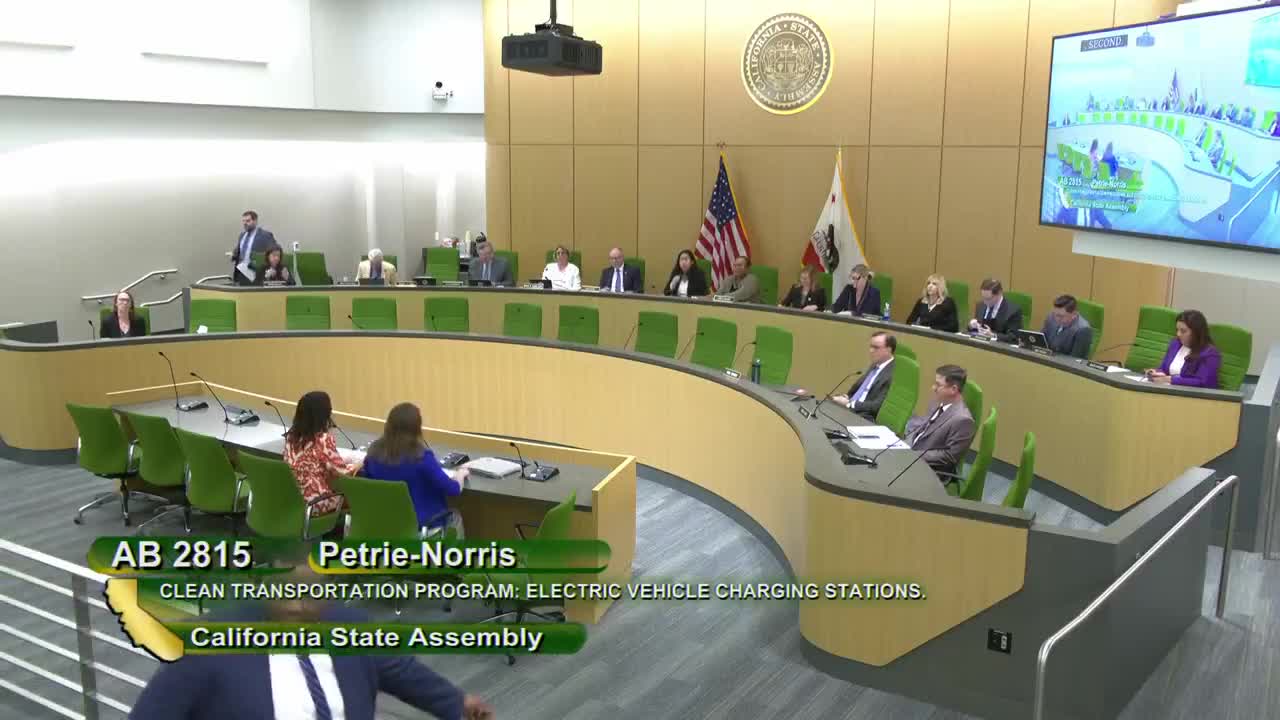 6MIN
Assembly Standing Committee on Transportation
Bill Author

Bill Co-Author(s):