AB 286: Broadband infrastructure: mapping.
- Session Year: 2023-2024
- House: Assembly
- Latest Version Date: 2023-10-10
Current Status:
Passed
(2023-10-10: Chaptered by Secretary of State - Chapter 645, Statutes of 2023.)
Introduced
In Committee
First Chamber
In Committee
Second Chamber
Enacted
Existing law requires the Public Utilities Commission, in collaboration with relevant state agencies and stakeholders, to maintain and update a statewide, publicly accessible, and interactive map showing the accessibility of broadband service in the state. Existing law authorizes the commission to collect information from providers of broadband services at the address level and prohibits the commission from disclosing certain protected residential subscriber information.
This bill would require that the map identify, for each address in the state, each provider of broadband services that offers service at the address and the maximum speed of broadband services offered by each provider of broadband services at the address.
The bill would additionally require that map to include certain features to receive self-reported data, including, among others, a feature that allows individuals to refute the broadband speed or technology, or both, that an internet service provider claims to offer at an address. The bill would require that map to include a feature for users to submit a verified speed test, as defined, at their location. The bill would make this self-reported data publicly available by address and would require the commission to obtain consent from an individual before publicly disclosing information that the individual submits, as provided. The bill would prohibit the commission from accepting certain self-reported information collected by the commission as evidence in a commission proceeding unless the commission validates the accuracy of that self-reported information.
Existing law requires the Public Utilities Commission, in collaboration with relevant state agencies and stakeholders, to maintain and update a statewide, publicly accessible, and interactive map showing the accessibility of broadband service in the state. Existing law authorizes the commission to collect information from providers of broadband services at the address level and prohibits the commission from disclosing certain protected residential subscriber information.
This bill would require that the map identify, for each address in the state, each provider of broadband services that offers service at the address and the maximum speed of broadband services offered by each provider of broadband services at the address.
The bill would additionally require that map to include certain features to receive self-reported data, including, among others, a feature that allows individuals to refute the broadband speed or technology, or both, that an internet service provider claims to offer at an address. The bill would require that map to include a feature for users to submit a verified speed test, as defined, at their location. The bill would make this self-reported data publicly available by address and would require the commission to make individuals aware that this information will be made publicly available by address, obtain consent from an individual before publicly disclosing information that the individual submits, as provided. The bill would prohibit the commission from accepting certain self-reported information collected by the commission as evidence in a commission proceeding unless the commission validates the accuracy of that self-reported information.
Existing law requires the Public Utilities Commission, in collaboration with relevant state agencies and stakeholders, to maintain and update a statewide, publicly accessible, and interactive map showing the accessibility of broadband service in the state. Existing law authorizes the commission to collect information from providers of broadband services at the address level and prohibits the commission from disclosing certain protected residential subscriber information.
This bill would require that the map identify, for each address in the state, each provider of broadband services that offers service at the address and the maximum speed of broadband services offered by each provider of broadband services at the address.
The bill would additionally require that map to include certain features to receive self-reported data, including, among others, a feature that allows individuals to refute the broadband speed or technology, or both, that an internet service provider claims to provide offer at an address. The bill would make this self-reported data publicly available by address and would require the commission to make individuals aware that this information will be made publicly available by address, as provided.
Existing law requires the Public Utilities Commission, in collaboration with relevant state agencies and stakeholders, to maintain and update a statewide, publicly accessible, and interactive map showing the accessibility of broadband service in the state. Existing law authorizes the commission to collect information from providers of broadband services at the address level and prohibits the commission from disclosing certain protected residential subscriber information.
This bill would require that the map identify, for each address in the state, each provider of broadband services that offers service at the address and the maximum speed of broadband services offered by each provider of broadband services at the address.
The bill would additionally require that map to include certain features to receive self-reported data, including, among others, a feature that allows individuals to refute the broadband speed or technology, or both, that an internet service provider claims to provide at an address. The bill would make this self-reported data publicly available by address and would require the commission to make individuals aware that this information will be made publicly available by address, as provided.
(a)The commission, in collaboration with relevant state agencies and stakeholders, shall maintain and update a statewide, publicly accessible, and interactive map showing the accessibility of broadband service in the state, including, but not limited to, information identifying the percentage of each census block that has broadband service meeting federal and state standards. The map shall identify, for each address in the state, each provider of broadband services that offers service at the address and the maximum speed of broadband services offered by each provider of broadband services at the address.
(b)The map required pursuant to subdivision (a) shall also include all of the following features to receive self-reported data:
(1)A feature for users to disclose how much they pay for stand-alone or bundled broadband service.
(2)A feature for users to identify the internet service provider to which they subscribe for broadband service.
(3)A feature for users to disclose the maximum speed for broadband service to which they subscribe.
(4)A feature that allows individuals to refute the broadband speed or technology, or both, that an internet service provider claims to offer at an address.
(5)A feature that allows individuals to identify barriers to broadband access.
(c)The features and self-reported data required pursuant to subdivisions (b) and (h) shall be made publicly available and expressed at the address for which the data was submitted. The commission shall obtain consent from an individual before publicly disclosing information that the individual submits pursuant to subdivision (b) or (h).
(d)The commission may collect from providers of broadband services information necessary to establish and update the map required pursuant to this section.
(e)The commission shall also create a notification feature on the map for individuals. Using this feature, an individual may sign up to be notified when updates are made to the map.
(f)The commission may collect information from providers of broadband services at the address level.
(g)The commission shall not, pursuant to subdivision (a), (d), or (e), disclose residential subscriber information protected by Section 2891.
(h)The map required pursuant to subdivision (a) shall include a feature for users to submit a verified speed test at their location.
(i)The commission shall not accept information collected by the commission pursuant to subdivisions (b) and (c) as evidence in a commission proceeding unless the commission validates the accuracy of the self-reported information.
(j)For purposes of this section, the following definitions apply:
(1)Broadband has the same meaning as defined in Section 5830.
(2)Verified speed test means a broadband speed performance test result that was measured and verified using a reputable application specified by the commission for that purpose.
(a)The commission, in collaboration with relevant state agencies and stakeholders, shall maintain and update a statewide, publicly accessible, and interactive map showing the accessibility of broadband service in the state, including, but not limited to, information identifying the percentage of each census block that has broadband service meeting federal and state standards. The map shall identify, for each address in the state, each provider of broadband services that offers service at the address and the maximum speed of broadband services offered by each provider of broadband services at the address.
(b)The map required pursuant to subdivision (a) shall also include all of the following features to receive self-reported data:
(1)A feature for users to submit a qualified broadband speed test at their location.(2)(1)A feature for users to disclose how much they pay for standalone stand-alone or bundled broadband service.
(3)(2)A feature for users to identify the internet service provider to which they subscribe for broadband service and rate their satisfaction with their current provider. service.
(4)(3)A feature for users to disclose the maximum speed for broadband service to which they subscribe.
(5)(4)A feature that allows individuals to refute the broadband speed or technology, or both, that an internet service provider claims to offer at an address.
(6)(5)A feature that allows individuals to identify barriers to broadband access.
(c)The features and self-reported data required pursuant to subdivision subdivisions (b) and (h) shall be made publicly available and expressed at the address for which the data was submitted. The commission shall make individuals aware that all information they provide obtain consent from an individual before publicly disclosing information that the individual submits pursuant to subdivision (b) will be made publicly available at the address level. or (h).
(d)The commission may collect from providers of broadband services information necessary to establish and update the map required pursuant to this section.
(e)The commission shall also create a notification feature on the map for individuals. Using this feature, an individual may sign up to be notified when updates are made to the map.
(f)The commission may collect information from providers of broadband services at the address level.
(g)The commission shall not, pursuant to subdivision (a), (d), or (e), disclose residential subscriber information protected by Section 2891.
(h)The map required pursuant to subdivision (a) shall include a feature for users to submit a verified speed test at their location.
(i)The commission shall not accept information collected by the commission pursuant to subdivisions (b) and (c) as evidence in a commission proceeding unless the commission validates the accuracy of the self-reported information.
(h)(j)For purposes of this section, the following definitions apply:
(1)Broadband has the same meaning as defined in Section 5830.
(2)Qualified broadband Verified speed test means a broadband speed performance test result that was measured and verified using a reputable or verifiable application intended specified by the commission for that purpose.
(a)The commission, in collaboration with relevant state agencies and stakeholders, shall maintain and update a statewide, publicly accessible, and interactive map showing the accessibility of broadband service in the state, including, but not limited to, information identifying the percentage of each census block that has broadband service meeting federal and state standards. The map shall identify, for each address in the state, each provider of broadband services that offers service at the address and the maximum speed of broadband services offered by each provider of broadband services at the address.
(b)The map required pursuant to subdivision (a) shall also include all of the following features to receive self-reported data:
(1)A feature for users to submit a qualified broadband speed test at their location.
(2)A feature for users to disclose how much they pay for standalone or bundled broadband service.
(3)A feature for users to identify the internet service provider to which they subscribe for broadband service and rate their satisfaction with their current provider.
(4)A feature for users to disclose the maximum speed for broadband service to which they subscribe.
(5)A feature that allows individuals to refute the broadband speed or technology, or both, that an internet service provider claims to provide offer at an address.
(6)A feature that allows individuals to identify barriers to broadband access.
(c)The features and self-reported data required pursuant to subdivision (b) shall be made publicly available and expressed at the address for which the data was submitted. The commission shall make individuals aware that all information they provide pursuant to subdivision (b) will be made publicly available at the address level.
(d)The commission may collect from providers of broadband services information necessary to establish and update the map required pursuant to this section.
(e)The commission shall also create a notification feature on the map for individuals. Using this feature, an individual may sign up to be notified when updates are made to the map.
(f)The commission may collect information from providers of broadband services at the address level.
(g)The commission shall not, pursuant to subdivision (a), disclose residential subscriber information protected by Section 2891.
(h)For purposes of this section, broadband the following definitions apply:
(1)Broadband has the same meaning as defined in Section 5830.
(2)Qualified broadband speed test means a broadband speed performance test result that was measured using a reputable or verifiable application intended for that purpose.
(a)The commission, in collaboration with relevant state agencies and stakeholders, shall maintain and update a statewide, publicly accessible, and interactive map showing the accessibility of broadband service in the state, including, but not limited to, information identifying the percentage of each census block that has broadband service meeting federal and state standards. The map shall identify, for each address in the state, each provider of broadband services that offers service at the address and the maximum speed of broadband services offered by each provider of broadband services at the address.
(b)The map required pursuant to subdivision (a) shall also include all of the following features to receive self-reported data:
(1)A feature for users to submit a broadband speed test at their location.
(2)A feature for users to disclose how much they pay for broadband service.
(3)A feature for users to identify the internet service provider to which they subscribe for broadband service and rate their satisfaction with their current provider.
(4)A feature for users to disclose the maximum speed for broadband service to which they subscribe.
(5)A feature that allows individuals to refute the broadband speed or technology, or both, that an internet service provider claims to provide at an address.
(6)A feature that allows individuals to identify barriers to broadband access.
(c)The features and self-reported data required pursuant to subdivision (b) shall be made publicly available and expressed at the address for which the data was submitted. The commission shall make individuals aware that all information they provide pursuant to subdivision (b) will be made publicly available at the address level.
(b)(d)The commission may collect from providers of broadband services information necessary to establish and update the map required pursuant to this section.
(c)(e)The commission shall also create a notification feature on the map for individuals. Using this feature, an individual may sign up to be notified when updates are made to the map.
(d)(f)The commission may collect information from providers of broadband services at the address level.
(e)(g)The commission shall not not, pursuant to subdivision (a), disclose residential subscriber information protected by Section 2891.
(f)(h)For the purposes of this section, broadband has the same meaning as defined in Section 5830.
|
Date
|
Status
|
|---|---|
| Oct 10, 2023 | Chaptered by Secretary of State - Chapter 645, Statutes of 2023. |
| Oct 10, 2023 | Approved by the Governor. |
| Sep 20, 2023 | Enrolled and presented to the Governor at 4 p.m. |
| Sep 13, 2023 | Senate amendments concurred in. To Engrossing and Enrolling. (Ayes 74. Noes 0. Page 3438.). |
| Sep 12, 2023 | In Assembly. Concurrence in Senate amendments pending. |
| Sep 12, 2023 | Read third time. Passed. Ordered to the Assembly. (Ayes 39. Noes 0. Page 2685.). |
| Sep 8, 2023 | Ordered to special consent calendar. |
| Sep 5, 2023 | Read second time. Ordered to third reading. |
| Sep 1, 2023 | From committee: Do pass. (Ayes 7. Noes 0.) (September 1). |
| Aug 14, 2023 | In committee: Referred to APPR suspense file. |
| Jun 29, 2023 | Read second time and amended. Re-referred to Com. on APPR. |
| Jun 28, 2023 | From committee: Amend, and do pass as amended and re-refer to Com. on APPR. (Ayes 18. Noes 0.) (June 20). |
| May 31, 2023 | Referred to Com. on E., U. & C. |
| May 23, 2023 | In Senate. Read first time. To Com. on RLS. for assignment. |
| May 22, 2023 | Read third time. Passed. Ordered to the Senate. (Ayes 63. Noes 0. Page 1692.) |
| May 11, 2023 | Read second time. Ordered to third reading. |
| May 10, 2023 | From committee: Do pass. (Ayes 12. Noes 0.) (May 10). |
| May 3, 2023 | In committee: Hearing postponed by committee. |
| Apr 26, 2023 | In committee: Hearing postponed by committee. |
| Apr 12, 2023 | Re-referred to Com. on APPR. |
| Apr 11, 2023 | Read second time and amended. |
| Apr 10, 2023 | From committee: Amend, and do pass as amended and re-refer to Com. on APPR. (Ayes 10. Noes 0.) (March 29). |
| Feb 2, 2023 | Referred to Com. on C. & C. |
| Jan 25, 2023 | From printer. May be heard in committee February 24. |
| Jan 24, 2023 | Read first time. To print. |
|
Date
|
Description
|
Location
|
Votes
|
|
|---|---|---|---|---|
| Sep 13, 2023 | AB 286 Wood Concurrence in Senate Amendments | Assembly Floor |
Passed |
|
| Sep 12, 2023 | Special Consent AB286 Wood By Caballero | Senate Floor |
Passed |
|
| Sep 1, 2023 | Do pass | Senate Standing Committee on Appropriations |
Passed |
|
| Aug 14, 2023 | Placed on suspense file | Senate Standing Committee on Appropriations |
Passed |
|
| Jun 20, 2023 | Do pass as amended, but first amend, and re-refer to the Committee on [Appropriations] | Senate Standing Committee on Energy, Utilities and Communications |
Passed |
|
| May 22, 2023 | AB 286 Wood Assembly Third Reading | Assembly Floor |
Passed |
|
| May 10, 2023 | Do pass. | Assembly Standing Committee on Appropriations |
Passed |
|
| Mar 29, 2023 | Do pass as amended and be re-referred to the Committee on [Appropriations] | Assembly Standing Committee on Communications and Conveyance |
Passed |
This list shows positions taken on this bill by organizations on the date displayed, which is linked to the original source.
Positions by individuals are not included.
|
Organization
|
Position
|
Date
|
|---|---|---|
| #OaklandUndivided | ** Support | |
| Alliance for A Better Community | ** Support | |
| Association of California Healthcare Districts | * Support | Mar 29, 2023 |
| Cal broadband | * Against Unless Amend | Jun 20, 2023 |
| Cal-Broadband | * Against Unless Amend | May 10, 2023 |
| California Alliance for Digital Equity | * Support | Mar 29, 2023 |
| California Community Foundation | ** Support | |
| California Community Foundation Digital Equity Initiative | ** Support | |
| California School Boards Association | * Support | Jun 20, 2023 |
| California State Association Of Counties | ** Support | |
| California Telehealth Policy Coalition | ** Support | |
| Common Sense Media | ** Support | |
| Communications Workers Of America | * Support | May 10, 2023 |
| Communities in Schools of Los Angeles | ** Support | |
| Destination Crenshaw | ** Support | |
| Electronic Frontier Foundation | ** Support | |
| EveryoneOn | ** Support | |
| Healing and Justice Center | ** Support | |
| Innovate Public Schools | ** Support | |
| LeadingAge California | ** Support | |
| Los Angeles Unified School District | ** Support | |
| Media Alliance | ** Support | |
| Mediajustice | ** Support | |
| MediaJustice & the MediaJustice Network | ** Support | |
| Michelson Center For Public Policy | ** Support | |
| NextGen California | ** Support | |
| Para Los Niños | ** Support | |
| Rural County Representatives of California | ** Support | |
| San Diego County | * Support | Aug 14, 2023 |
| The Children's Partnership | ** Support | |
| The Utility Reform Network (TURN) | * Support | May 10, 2023 |
| United Parents and Students | ** Support | |
| Wire California | * Support | Jun 20, 2023 |
| YMCA of Metropolitan Los Angeles | ** Support |
CONCURRENCE IN SENATE AMENDMENTS
CSA1 Bill Id:AB 286
Author:(Wood)
As Amended Ver:June 29, 2023
Majority vote
SUMMARY
This bill expands the fields of data included on the California Interactive Broadband Map maintained by the the California Public Utilities Commission's (CPUC). Specifically, this bill would allow users to submit specified self-reported data and requires the CPUC to validate self-reported data before using that data as evidence in a proceeding.
Senate Amendments
Revises and recasts a requirement for the map to include a feature for users to submit an internet speed test at their location.
COMMENTS
- California's Interactive Broadband Map. The CPUC maintains a publicly accessible interactive broadband map, known as the California Interactive Broadband Map ("broadband map"). The broadband map includes a variety of information about broadband projects and service availability in California. For example, the broadband map includes information at the census block and address level pertaining to broadband service availability. The CPUC has maintained the broadband map for various years as part of administering the California Advanced Services Fund (CASF) program, by displaying areas that are unserved by broadband service and therefore eligible for program grant funds. Recent legislation, also authored by Assemblymember Wood, has required the CPUC to make various updates to the map and explicitly authorized the CPUC to collect broadband availability data at the address level.
- Address level broadband data. Pursuant to existing state and federal law, the CPUC collects address level data from providers of broadband services, also known as internet service providers (ISPs). The CPUC's data collection covers a broad range of broadband information, including both deployment and subscriber information such as serviceable locations, offered speeds, and subscriber addresses. Until recently, limited address level information has been publicly available. However, due to shifting approaches to broadband data collection and mapping efforts at the federal and state level, more address-level information has been made available to the public. For example, the Federal Communications Commission (FCC) has recently published an unprecedented federal broadband map displaying granular data. Additionally, the CPUC has published more recent state broadband that also display address level data. To the extent that this bill would require the CPUC to display address level broadband availability information to the public, this bill is consistent with existing practice of the state and federal governments.
- Policy considerations for user-generated data on state broadband mapping efforts. This bill would require the CPUC's broadband map to include specified features to receive self-reported data that is generated by users. User-generated, or self-reported data, are typically referred to as "crowdsourced" data. Crowdsourced datasets create an alternative source of information to ISP-generated data. For example, individuals across an area may run their own internet speed tests or self-report their monthly service charges at their address. Under this bill, the CPUC could compile all the user-generated data to create a crowdsourced dataset that could be used to verify or supplement the datasets that are submitted to the CPUC by the ISPs. In that manner, crowdsourced data may serve to strengthen the accuracy of the state's broadband data overall. In the past, the CPUC has undertaken to crowdsourcing broadband data, particularly through the CalSPEED program.
Although there are benefits to crowdsourced data, there are also potential drawbacks that concern the integrity of the user-generated data. For example, when measuring the speed of a broadband connection there are various tools that could be used to measure the results that may report varying results. CalSPEED for example, used an open-source testing engine with transparent results. To address concerns about the integrity of crowdsourced data, the amendments adopted in the Communications & Conveyance Committee and revised in the Senate explicitly require a speed to be verified before being used in a rulemaking.
According to the Author
"AB 286 incorporates and updates feedback gathered by the California Public Utilities Commission (CPUC) regarding broadband access at the address level. The maps currently produced by the CPUC gather feedback, but do not make that information publicly available. As a result, communities statewide are often overlooked when their actual broadband experience is not represented on public maps. California needs more detailed metrics to understand the challenges to broadband access statewide—broad definitions of served versus unserved are not enough. Data points like speed, price, and reliability at the address level home in on what barriers are holding communities back. Incorporating such feedback will ensure that public and private investment better target those households that still struggle with the digital divide. Maps that do not incorporate public feedback will continue to miss the mark for our most vulnerable and marginalized communities."
Arguments in Support
Supporters argue that AB 286 would empower households to refute speeds or technology that ISPs claim to provide to their address, as well as submit their own verified data on internet service speeds, pricing, access to providers, and more. These changes would improve the CPUC's statewide broadband map by increasing transparency, granularity, and accuracy for household broadband service data.
Arguments in Opposition
None on file.
FISCAL COMMENTS
According to the Assembly Appropriations Committee, the CPUC expects no costs to implement the requirements of this bill. This is because the CPUC reports it has an interagency agreement with California State University, Chico, for work related to the California Interactive Broadband Map and the work required by this bill falls within the existing scope of that agreement.
VOTES:
ASM COMMUNICATIONS AND CONVEYANCE: 10-0-3
YES: Boerner Horvath, Bonta, Garcia, Holden, Low, Maienschein, Papan, Luz Rivas, Rodriguez, Weber
ABS, ABST OR NV: Jim Patterson, Davies, Hoover
ASM APPROPRIATIONS: 12-0-4
YES: Holden, Bryan, Calderon, Wendy Carrillo, Mike Fong, Addis, Lowenthal, Papan, Pellerin, Robert Rivas, Weber, Wilson
ABS, ABST OR NV: Megan Dahle, Dixon, Mathis, Sanchez
ASSEMBLY FLOOR: 63-0-17
YES: Addis, Aguiar-Curry, Alanis, Alvarez, Arambula, Bains, Bauer-Kahan, Bennett, Berman, Boerner, Bonta, Bryan, Calderon, Wendy Carrillo, Cervantes, Connolly, Megan Dahle, Mike Fong, Friedman, Gabriel, Garcia, Gipson, Grayson, Haney, Hart, Holden, Irwin, Jackson, Jones‑Sawyer, Kalra, Lee, Low, Lowenthal, Maienschein, Mathis, McCarty, McKinnor, Muratsuchi, Stephanie Nguyen, Ortega, Pacheco, Papan, Pellerin, Petrie-Norris, Ramos, Reyes, Luz Rivas, Robert Rivas, Rodriguez, Blanca Rubio, Santiago, Schiavo, Ting, Valencia, Villapudua, Waldron, Ward, Weber, Wicks, Wilson, Wood, Zbur, Rendon
ABS, ABST OR NV: Juan Carrillo, Chen, Davies, Dixon, Essayli, Flora, Vince Fong, Gallagher, Hoover, Lackey, Jim Patterson, Joe Patterson, Quirk-Silva, Sanchez, Soria, Ta, Wallis
UPDATED
VERSION: June 29, 2023
CONSULTANT: Emilio Perez / C. & C. / (916) 319-2637 FN: 0002204
SENATE RULES COMMITTEE Office of Senate Floor Analyses (916) 651-1520 Fax: (916) 327-4478 | AB 286 |
THIRD READING
Bill No: AB 286
Author: Wood (D)
Amended: 6/29/23 in Senate
Vote: 21
SENATE ENERGY, U. & C. COMMITTEE: 18-0, 6/20/23
AYES: Bradford, Dahle, Ashby, Becker, Caballero, Dodd, Durazo, Eggman, Gonzalez, Grove, McGuire, Min, Newman, Rubio, Seyarto, Skinner, Stern, Wilk
SENATE APPROPRIATIONS COMMITTEE: 7-0, 9/1/23
AYES: Portantino, Jones, Ashby, Bradford, Seyarto, Wahab, Wiener
ASSEMBLY FLOOR: 63-0, 5/22/23 - See last page for vote
SUBJECT: Broadband infrastructure: mapping
SOURCE: Author
DIGEST:
This bill expands the types of data included in the California Public Utilities Commission’s (CPUC) interactive broadband map to allow users to submit specified self-reported data. This bill requires the CPUC to validate self-reported data before using that data as evidence in a proceeding.
ANALYSIS:
Existing law:
- Defines broadband as any service meeting the most recent definition of broadband adopted by the Federal Communications Commission (FCC) pursuant to the Telecommunications Act of 1996. (Public Utilities Code §5830)
- Establishes a telecommunications customer right of privacy by requiring telephone and telegraph corporations to first obtain written consent from a residential subscriber before disclosing information about that residential subscriber, including information about the broadband services purchased from a telephone corporation or an internet service provider (ISP) that uses the telephone corporation’s lines to provide services to the consumer. (Public Utilities Code §2891)
- Requires the CPUC to maintain and update a publicly accessible, statewide, interactive map showing the availability of broadband service in the state. Existing law specifies that this map must identify the percentage of each census block that has broadband service meeting federal and state standards. Existing law specifies that for the purposes of establishing and updating this map, the following applies:
- The CPUC may collect information necessary to update the map from broadband providers.
- The CPUC must create a feature enabling a user to sign up for updates about the map.
- The CPUC may collect information from broadband providers at the address level.
- The CPUC may not disclose residential subscriber information protected by existing telecommunications consumer privacy rights.
This bill:
- Requires the CPUC to update a publicly accessible, interactive map to include a list of each broadband provider that serves each address in the state and the maximum speed of broadband services offered by each of those providers at each address.
- Requires the CPUC to update the publicly accessible, interactive broadband map to enable users to self-report any of the following:
- The identity of the user’s broadband provider.
- The amount the user pays for standalone or bundled broadband service.
- The maximum speed of the user’s broadband service.
- Information from the user refuting the speed or technology that an ISP claims to offer at any address.
- Information from users on barriers to broadband access.
- Requires the CPUC to ensure that the interactive broadband map enables users to submit a verified speed test for their locations, and defines a verified speed test as a broadband speed performance test measured and verified using an application specified by the CPUC.
- Specifies that the CPUC must obtain consent from an individual before publicly disclosing self-reported data and must map the self-reported data at the address level.
- Prohibits the CPUC from using self-reported data as evidence in a CPUC proceeding unless the CPUC validates the self-reported data.
Background
Data, data everywhere…but to what end? This bill requires the CPUC to expand an existing broadband map to allow individual consumers to self-report specified data, including information that identifies the consumer’s broadband provider, the maximum speed of broadband services, and prices paid by the consumer for broadband services. This bill specifies that self-reported information may be publicly mapped at the address level.
While consumer-reported data may help identify larger trends in the broadband marketplace, it may be impossible to draw conclusions from discrepancies between data reported by ISP and data reported by consumers unless self-reported data is subsequently verified. This bill clarifies that the CPUC may not use any self-reported information as evidence in a CPUC proceeding without first verifying that data.
Bill codifies existing CPUC broadband speed test mapping practices. The CPUC currently maintains a mobile app, CalSPEED, which uses both sample data and self-reported crowdsourced data to measure broadband speeds. This data is currently included in the statewide, interactive broadband map. The map also allows users to self-report feedback for a specific address, including advertised and real-time broadband speeds. This bill codifies the requirement for the CPUC’s interactive broadband map to include this speed test. This bill also allows users to use the map to refute speeds advertised or reported by ISPs for a specific address.
Bill may expand the CPUC’s ability to publicly disclose certain data. This bill’s data reporting requirements also differ from those currently employed by the statewide, interactive broadband map. While the CPUC is currently authorized to collect data on an address level, the CPUC does not publicly report data on an address level. Generally, residential broadband data on the statewide, interactive broadband map is aggregated into at least a census block. This aggregation prevents the disclosure of confidential and personal consumer information.
Both federal and state law establish consumer privacy rights for telecommunications customers. These rights generally prohibit telecommunications providers from providing certain consumer information without the consumer’s express consent. Under existing state law, these privacy rights prevent certain telecommunications providers from disclosing the services to which a consumer has subscribed. Public disclosure of information about service subscriptions, prices paid for services, and other consumer-specific data may enable entities to infer certain personal information about a consumer. For example, the disclosure of a consumer’s address, services provided at that address, and prices paid for those services may be used to infer the income of a consumer at that address and the extent to which the consumer participates in any low-income broadband rate support programs. Information about bundled subscription services at an address can be used to infer consumer preferences based on the types of products and channels to which the consumer has subscribed. This bill prohibits the CPUC from publicly disclosing residential subscriber information protected by existing privacy requirements and requires the CPUC to obtain consent from an individual before publicly disclosing self-reported data.
Related/Prior Legislation
AB 2752 (Wood, Chapter 801, Statutes of 2022) clarified that the CPUC can collect data from broadband providers at the address level for the purposes of mapping access to broadband services and prohibited the CPUC from disclosing personal consumer information protected by existing telecommunications consumer privacy laws.
SB 28 (Caballero, Chapter 673, Statutes of 2021) required the CPUC to adopt customer service requirements for cable franchises and collect granular data on actual location served by a cable franchise. The bill prohibited the CPUC from disclosing personally identifiable information collected pursuant to the bill.
AB 41 (Wood, Chapter 659, Statutes of 2021), among other provisions, required the CPUC to maintain and update a statewide, publicly accessible, and interactive map showing the accessibility of broadband service in the state, including, but not limited to, information identifying the percentage of each census block that has broadband service meeting federal and state standards. Under the bill, the interactive must include a function allowing individuals to receive notifications when the CPUC updates the map.
FISCAL EFFECT: Appropriation: No Fiscal Com.: Yes Local: No
According to the Senate Appropriations Committee, the CPUC estimates ongoing costs of $1.2 million annually (ratepayer funds) for three positions to implement and assess map features, develop and update verified speed test software, manage contract work, analyze and report on data, and create and update informational materials for the public, among other things. In addition, the CPUC estimates one-time costs of $438,000 over three years (ratepayer funds) for equipment, training, and limited-term staff support.
SUPPORT: (Verified 9/1/23)
#OaklandUndivided
California Community Foundation
California State Association of Counties
California Telehealth Policy Coalition
Common Sense Media
Communities in Schools of Los Angeles
Destination Crenshaw
Electronic Frontier Foundation
EveryoneOn
Innovate Public Schools
LeadingAge California
Los Angeles Unified School District
Media Alliance
MediaJustice & the MediaJustice Network
Michelson Center for Public Policy
NextGen California
Para Los Niños
Rural County Representatives of California
The Children's Partnership
United Parents and Students
YMCA of Metropolitan Los Angeles
OPPOSITION: (Verified 9/1/23)
None received
ARGUMENTS IN SUPPORT: According to the author:
AB 286 incorporates and updates feedback gathered by the California Public Utilities Commission (CPUC) regarding broadband access at the address level. The maps currently produced by the CPUC gather feedback, but do not make that information publicly available. As a result, communities statewide are often overlooked when their actual broadband experience is not represented on public maps. California needs more detailed metrics to understand the challenges to broadband access statewide—broad definitions of served versus unserved are not enough. Data points like speed, price, and reliability at the address level home in on what barriers are holding communities back. Incorporating such feedback will ensure that public and private investment better target those households that still struggle with the digital divide. Maps that do not incorporate public feedback will continue to miss the mark for our most vulnerable and marginalized communities.
ASSEMBLY FLOOR: 63-0, 5/22/23
AYES: Addis, Aguiar-Curry, Alanis, Alvarez, Arambula, Bains, Bauer-Kahan, Bennett, Berman, Boerner, Bonta, Bryan, Calderon, Wendy Carrillo, Cervantes, Connolly, Megan Dahle, Mike Fong, Friedman, Gabriel, Garcia, Gipson, Grayson, Haney, Hart, Holden, Irwin, Jackson, Jones-Sawyer, Kalra, Lee, Low, Lowenthal, Maienschein, Mathis, McCarty, McKinnor, Muratsuchi, Stephanie Nguyen, Ortega, Pacheco, Papan, Pellerin, Petrie-Norris, Ramos, Reyes, Luz Rivas, Robert Rivas, Rodriguez, Blanca Rubio, Santiago, Schiavo, Ting, Valencia, Villapudua, Waldron, Ward, Weber, Wicks, Wilson, Wood, Zbur, Rendon
NO VOTE RECORDED: Juan Carrillo, Chen, Davies, Dixon, Essayli, Flora, Vince Fong, Gallagher, Hoover, Lackey, Jim Patterson, Joe Patterson, Quirk-Silva, Sanchez, Soria, Ta, Wallis
Prepared by: Sarah Smith / E., U. & C. / (916) 651-4107
9/2/23 14:58:35
**** END ****
SENATE COMMITTEE ON
Senator Anthony Portantino, Chair
2023 - 2024 Regular Session
AB 286 (Wood) - Broadband infrastructure: mapping
Version: | Policy Vote: |
Urgency: | Mandate: |
Hearing Date: | Consultant: |
Bill Summary:
This bill would require the California Public Utilities Commission (CPUC) to update its public, interactive broadband map to include specified information, including certain information self-reported by consumers about their personal broadband services, as well as to publicly release the feedback data received and to obtain consent from the individuals prior to release.
Fiscal Impact:
- The CPUC estimates ongoing costs of $1.2 million annually (ratepayer funds) for three positions to implement and assess map features, develop and update verified speed test software, manage contract work, analyze and report on data, and create and update informational materials for the public, among other things. In addition, the CPUC estimates one-time costs of $438,000 over three years (ratepayer funds) for equipment, training, and limited-term staff support.
Background:
The CPUC has long maintained a publicly accessible map, which the CPUC calls the California Interactive Broadband Map, to display broadband service in areas of the state. Recently enacted statute directed the CPUC to include in the map information regarding broadband service availability at both the census block level and the street address level, and to update the map yearly. The map can be found here: http://www.broadbandmap.ca.gov/.
The CPUC bases the broadband map, mainly, on data it collects yearly from ISPs. In addition, the CPUC’s map allows users to submit feedback on the map and the data it displays.
Despite this feedback, many find the accuracy and usefulness of the CPUC’s broadband map lacking. For example, the Electronic Frontier Foundation (EFF), writing in support of this bill, describes the CPUC’s current broadband map as inaccurate because of “consistent misrepresentation of service” and that “the inaccuracy of service availability and undercounting of serviceable locations across California’s cities and counties severely harms our ability to deliver broadband access.”
Under existing law, the CPUC is authorized to collect data regarding broadband service at the address level for the purposes of mapping broadband accessibility. Existing law also establishes a telecommunications customer right of privacy and prohibits the CPUC from disclosing residential subscriber information protected by these privacy rights when developing the statewide, interactive broadband map.
Proposed Law:
This bill would require the CPUC to update its public, interactive broadband map to include specified information, including certain information self-reported by consumers about their personal broadband services, as well as to publicly release the feedback data received and to obtain consent from the individuals prior to release. Specifically, this bill would:
- Require the CPUC to update a publicly accessible, interactive map to include a list of each broadband provider that serves each address in the state and the maximum speed of broadband services offered by each of those providers at each address.
- Require the CPUC to update the publicly accessible, interactive broadband map to enable users to self-report any of the following:
- The amount the user pays for stand-alone or bundled broadband serve.
- The maximum speed of the user’s broadband service.
- The identity of the user’s broadband provider.
- Information from the user refuting the speed or technology that an ISP claims to offer at any address.
- Information from users on barriers to broadband access.
- Specify that the CPUC must make any of the self-reported data collected pursuant to this bill public and obtain consent from the individuals prior to its release.
- Require the map to include a feature for users to submit a verified speed test, as defined, at their location.
- Require the CPUC to validate any public feedback data received before using it as evidence in proceedings.
Related Legislation:
AB 2752 (Wood, Chapter 801, Statutes of 2022) clarified that the CPUC can collect data from broadband providers at the address level for the purposes of mapping access to broadband services and prohibited the CPUC from disclosing personal consumer information protected by existing telecommunications consumer privacy laws.
SB 28 (Caballero, Chapter 673, Statutes of 2021) required the CPUC to adopt customer service requirements for cable franchises and collect granular data on actual location served by a cable franchise. The bill prohibited the CPUC from disclosing personally identifiable information collected pursuant to the bill.
AB 41 (Wood, Chapter 659, Statutes of 2021) among other provisions, required the CPUC to maintain and update a statewide, publicly accessible, and interactive map showing the accessibility of broadband service in the state, including, but not limited to, information identifying the percentage of each census block that has broadband service meeting federal and state standards. Under the bill, the interactive must include a function allowing individuals to receive notifications when the CPUC updates the map.
Staff Comments:
The CPUC notes that it is difficult to accurately and fully estimate the fiscal impact of the new work this bill would require as it would be impacted by the scope of validation required to assess accuracy of the self-reported data. It would also depend on the amount of public feedback received and whether any fieldwork is necessary for validation. The CPUC estimate provided for this analysis reflects expectations of moderately-high volume of work needs.
-- END --
SENATE COMMITTEE ON ENERGY, UTILITIES AND COMMUNICATIONS
Senator Steven Bradford, Chair
2023 - 2024 Regular
Bill No: AB 286 Hearing Date: 6/20/2023
Author: | Wood | ||
Version: | 4/11/2023 Amended | ||
Urgency: | No | Fiscal: | Yes |
Consultant: | Sarah Smith | ||
SUBJECT: Broadband infrastructure: mapping
DIGEST: This bill requires the California Public Utilities Commission (CPUC) to update its public, interactive broadband map to include specified information, including certain information self-reported by consumers about their personal broadband services. This bill also exempts certain broadband consumer data from existing public disclosure restrictions.
ANALYSIS:
Existing law:
- Defines broadband as any service meeting the most recent definition of broadband adopted by the Federal Communications Commission (FCC) pursuant to the Telecommunications Act of 1996. (Public Utilities Code §5830)
- Establishes a telecommunications customer right of privacy by requiring telephone and telegraph corporations to first obtain written consent from a residential subscriber before disclosing information about that residential subscriber, including information about the broadband services purchased from a telephone corporation or an internet service provider (ISP) that uses the telephone corporation’s lines to provide services to the consumer. (Public Utilities Code §2891)
- Requires the CPUC to maintain and update a publicly accessible, statewide, interactive map showing the availability of broadband service in the state. Existing law specifies that this map must identify the percentage of each census block that has broadband service meeting federal and state standards. Existing law specifies that for the purposes of establishing and updating this map, the following applies:
- The CPUC may collect information necessary to update the map from broadband providers.
- The CPUC must create a feature enabling a user to sign up for updates about the map.
- The CPUC may collect information from broadband providers at the address level.
- The CPUC may not disclose residential subscriber information protected by existing telecommunications consumer privacy rights.
This bill:
- Requires the CPUC to update a publicly accessible, interactive map to include a list of each broadband provider that serves each address in the state and the maximum speed of broadband services offered by each of those providers at each address.
- Requires the CPUC to update the publicly accessible, interactive broadband map to enable users to self-report any of the following:
- A qualified speed test for the user’s location.
- The amount the user pays for standalone or bundled broadband serve.
- The maximum speed of the user’s broadband service.
- The identity of the user’s broadband provider and a consumer satisfaction rating from the consumer for their provider.
- Information from the user refuting the speed or technology that an ISP claims to offer at any address.
- Information from users on barriers to broadband access.
- Defines a “qualified broadband speed test” as a broadband speed performance test result that was measured using a reputable or verifiable application intended for that purpose.
- Specifies that the CPUC must make any of the self-reported data collected pursuant to this bill public and disclose to users that any information they provide will be made public at the address level.
- Exempts self-reported information and address-level data collected from ISPs from existing telecommunications consumer privacy requirements.
Background
Data, data everywhere…but to what end? This bill requires the CPUC to expand an existing broadband map to allow individual consumers to self-report specified data, including information that identifies the consumer’s broadband provider, the maximum speed of broadband services, and prices paid by the consumer for broadband services. This bill specifies that self-reported information may be publicly mapped at the address level.
This bill does not specify how self-reported information will be used; however, this bill implies that the self-data may be used to refute broadband providers’ advertised speeds, services, and coverage. Specifically, this bill requires the CPUC to update the statewide, interactive broadband map to allow consumers to refute the speed or technology that an ISP indicates is available at an address and allow the consumer to rate the consumer’s broadband provider.
While consumer-reported data may help identify larger trends in the broadband marketplace, this bill’s information does not require the CPUC to verify this consumer data or require the CPUC to provide greater specificity to compare consumer data with information reported by ISPs before making consumer data public. As a result, it may be impossible to draw conclusions from discrepancies between data reported by ISP and data reported by consumers unless self-reported data is subsequently verified. Additionally, false or misleading formation may also be submitted. Multiple websites exist to collect consumer ratings and complaints about consumer goods, services, and products. In some cases, websites (such as that of the Better Business Bureau) can help guide consumers to more reliable products and services and help encourage businesses to resolve complaints. Many factors influence consumer ratings, including factors beyond a service provider’s control. However, this bill does not affect the CPUC’s authority to resolve consumer complaints about broadband services or require the CPUC to take any action to address discrepancies between self-reported data and data collected by the CPUC from ISPs.
Is your speed test reputable or verifiable? The CPUC currently maintains a mobile app, CalSPEED, which uses both sample data and self-reported crowdsourced data to measure broadband speeds. This data is currently included in the statewide, interactive broadband map. The map also allows users to self-report feedback for a specific address, including advertised and real-time broadband speeds. This bill requires the CPUC to modify the statewide map to enable users to submit a “qualified” speed test, which this bill defines as a broadband speed performance test measured using a reputable or verifiable application. However this bill does not define which speed testing applications are reputable or verifiable. The CPUC currently requires users to download a specific application to deploy the CalSPEED test. This bill does not specify if CalSPEED’s existing speed testing application will meet this bill’s requirements.
This bill’s data reporting requirements also differ from those currently employed by the statewide, interactive broadband map. While the CPUC is currently authorized to collect data on an address level, the CPUC does not publicly report data on an address level. Generally, residential broadband data on the statewide, interactive broadband map is aggregated into at least a census block. This aggregation prevents the disclosure of confidential and personal consumer information.
Bill may expand the CPUC’s ability to publicly disclose consumer data. Under existing law, the CPUC is authorized to collect data regarding broadband service at the address level for the purposes of mapping broadband accessibility. Existing law also establishes a telecommunications customer right of privacy and prohibits the CPUC from disclosing residential subscriber information protected by these privacy rights when developing the statewide, interactive broadband map. This bill modifies that consumer privacy protections that apply to consumer’s broadband subscription data in a manner that may allow the CPUC to publicly disclose this data as part of updating the statewide, interactive broadband map.
Both federal and state law establish consumer privacy rights for telecommunications customers. These rights generally prohibit telecommunications providers from providing certain consumer information without the consumer’s express consent. Under existing state law, these privacy rights prevent certain telecommunications providers from disclosing the services to which a consumer has subscribed. Public disclosure of information about service subscriptions, prices paid for services, and other consumer-specific data may enable entities to infer certain personal information about a consumer. For example, the disclosure of a consumer’s address, services provided at that address, and prices paid for those services may be used to infer the income of a consumer at that address and the extent to which the consumer participates in any low-income broadband rate support programs. Information about bundled subscription services at an address can be used to infer consumer preferences based on the types of products and channels to which the consumer has subscribed.
Need for amendments: As currently drafted, this bill may interpreted to allow the CPUC to publicly disclose a variety of data collected from ISPs about consumers’ telecommunications subscriptions without obtaining consent from those consumers. This bill also requires a verifiable or reputable speed test without specifying whether existing tests meet this bill’s definition. This bill further requires the CPUC to enable consumers to rate their ISPs on the interactive broadband map in a manner that may be duplicative with other consumer rating websites. This bill also requires the CPUC to publicly post information that may not be verified without specifying how such information may be subsequently used before the CPUC in related proceedings. As a result, the author and committee may wish to amend this bill to do the following:
- Clarify that consumer privacy exemptions do not apply to data collected from broadband providers.
- Clarify that speed tests must be complete using a reputable and verifiable application specified by the CPUC.
- Delete the requirement that the CPUC must enable consumers to rate their ISP on the interactive broadband map.
- Clarify that self-reported information may not be used as evidence in subsequent CPUC rulemakings or enforcement proceedings unless the CPUC verifies the validity of the self-reported information.
Prior/Related Legislation
AB 2752 (Wood, Chapter 801, Statutes of 2022) clarified that the CPUC can collect data from broadband providers at the address level for the purposes of mapping access to broadband services and prohibited the CPUC from disclosing personal consumer information protected by existing telecommunications consumer privacy laws.
SB 28 (Caballero, Chapter 673, Statutes of 2021) required the CPUC to adopt customer service requirements for cable franchises and collect granular data on actual location served by a cable franchise. The bill prohibited the CPUC from disclosing personally identifiable information collected pursuant to the bill.
AB 41 (Wood, Chapter 659, Statutes of 2021) among other provisions, required the CPUC to maintain and update a statewide, publicly accessible, and interactive map showing the accessibility of broadband service in the state, including, but not limited to, information identifying the percentage of each census block that has broadband service meeting federal and state standards. Under the bill, the interactive must include a function allowing individuals to receive notifications when the CPUC updates the map.
FISCAL EFFECT: Appropriation: No Fiscal Com.: Yes Local: No
SUPPORT:
#OaklandUndivided
California Community Foundation
California State Association of Counties
California Telehealth Policy Coalition
Common Sense Media
Communities in Schools of Los Angeles
Destination Crenshaw
Electronic Frontier Foundation
EveryoneOn
Innovate Public Schools
LeadingAge California
Los Angeles Unified School District
Media Alliance
MediaJustice & the MediaJustice Network
Michelson Center for Public Policy
NextGen California
Para Los Niños
Rural County Representatives of California
The Children's Partnership
United Parents and Students
YMCA of Metropolitan Los Angeles
OPPOSITION:
California Broadband & Video Association, unless amended
ARGUMENTS IN SUPPORT: According to the author:
AB 286 incorporates and updates feedback gathered by the California Public Utilities Commission (CPUC) regarding broadband access at the address level. The maps currently produced by the CPUC gather feedback, but do not make that information publicly available. As a result, communities statewide are often overlooked when their actual broadband experience is not represented on public maps. California needs more detailed metrics to understand the challenges to broadband access statewide—broad definitions of served versus unserved are not enough. Data points like speed, price, and reliability at the address level home in on what barriers are holding communities back. Incorporating such feedback will ensure that public and private investment better target those households that still struggle with the digital divide. Maps that do not incorporate public feedback will continue to miss the mark for our most vulnerable and marginalized communities.
ARGUMENTS IN OPPOSITION: The California Broadband and Video Association (CalBroadband) is opposed to this bill unless it is amended to limit the CPUC’s ability to use self-reported data in CPUC proceedings unless the CPUC first validates that self-reported information. In opposition, CalBroadband states:
…without a challenge or verification process, the data’s value will be minimal, creating unverified anecdotes rather than useful data to ensure accurate maps. Thus, if this bill moves forward, CalBroadband is requesting the addition of language requiring the CPUC to validate the data gathered by consumers prior to utilizing such data in any rulemaking or investigatory proceeding.
-- END --
ASSEMBLY THIRD READING
ATR Bill Id:AB 286
Author:(Wood)
As Amended Ver:April 11, 2023
Majority vote
SUMMARY
This bill specifies additional information and user-features that must be included on the interactive broadband map ("broadband map") that is published and maintained by the California Public Utilities Commission (CPUC).
Major Provisions
- Specifies that the broadband map shall identify each of provider of broadband services that offers service and corresponding information for each address in the state.
- Specifies that the broadband map shall also include various specified features to receive self-reported data from users.
- Specifies that the features and self-reported data on the map shall be made publicly available, and that the CPUC shall inform individuals that their self-reported data will be made publicly available at the address level.
- Requires a broadband speed test submitted by a user to be measured using a reputable or verifiable application intended for that purpose.
COMMENTS
- California's Interactive Broadband Map. The CPUC maintains a publicly accessible interactive broadband map, known as the California Interactive Broadband Map ("broadband map"). The broadband map includes a variety of information about broadband projects and service availability in California. For example, the broadband map includes information at the census block and address level pertaining to broadband service availability. The CPUC has maintained the broadband map for various years as part of administering the California Advanced Services Fund (CASF) program, by displaying areas that are unserved by broadband service and therefore eligible for program grant funds. Recent legislation, also by Assemblymember Wood, has required the CPUC to make various updates to the map and explicitly authorized the CPUC to collect broadband availability data at the address level.
- Address level broadband data. Pursuant to existing state and federal law, the CPUC collects address level data from providers of broadband services, also known as internet service providers (ISPs). The CPUC's data collection covers a broad range of broadband information, including both deployment and subscriber information such as serviceable locations, offered speeds, and subscriber addresses. Until recently, limited address level information has been publicly available. However, due to shifting approaches to broadband data collection and mapping efforts at the federal and state level, more address-level information has been made available to the public. For example, the Federal Communications Commission (FCC) has recently published an unprecedented federal broadband map displaying granular data. Additionally, the CPUC has published more recent state broadband that also display address level data. To the extent that this bill would require the CPUC to display address level broadband availability information to the public, the bill is consistent with existing practice of the state and federal governments.
- Considerations for user-generated data on state broadband mapping efforts. This bill would require the CPUC's broadband map to include specified features to receive self-reported data that is generated by users. User-generated, or self-reported data, are typically referred to as "crowdsourced" data. Crowdsourced datasets create an alternative source of information to ISP-generated data. For example, individuals across an area may run their own internet speed tests or self-report their monthly service charges at their address. Under this bill, the CPUC could compile all the user-generated data to create a crowdsourced dataset that could be used to verify or supplement the datasets that are submitted to the CPUC by the ISPs. In that manner, crowdsourced data may serve to strengthen the accuracy of the state's broadband data overall. In the past, the CPUC has undertaken to crowdsourcing broadband data, particularly through the CalSPEED program.
Although there are benefits to crowdsourced data, there are also potential drawbacks that concern the integrity of the user-generated data. For example, when measuring the speed of a broadband connection there are various tools that could be used to measure the results that may report varying results. CalSPEED for example, used an open-source testing engine with transparent results. To address concerns about the integrity of crowdsourced data, the amendments adopted in the Communications & Conveyance Committee explicitly require a speed test to be from a reputable or verifiable application.
According to the Author
According to the author, "AB 286 incorporates and updates feedback gathered by the California Public Utilities Commission (CPUC) regarding broadband access at the address level. The maps currently produced by the CPUC gather feedback, but do not make that information publicly available. As a result, communities statewide are often overlooked when their actual broadband experience is not represented on public maps. California needs more detailed metrics to understand the challenges to broadband access statewide—broad definitions of served versus unserved are not enough. Data points like speed, price, and reliability at the address level home in on what barriers are holding communities back. Incorporating such feedback will ensure that public and private investment better target those households that still struggle with the digital divide. Maps that do not incorporate public feedback will continue to miss the mark for our most vulnerable and marginalized communities."
Arguments in Support
The supporters argue that AB 286 would empower households to refute speeds or technology that internet service providers claim to provide to their address, as well as submit their own data on internet service speeds, pricing, access to providers, and more. The supporters believe that better data will ensure state agencies have a better understanding of internet service offerings for unserved and underserved communities.
Arguments in Opposition
The California Broadband & Video Association (CalBroadband) believes that some of the requirements proposed by AB 286 are duplicative of the FCC Broadband Data Map, which would lead to inefficiency in the CPUC's processes. Additionally, argues that without a challenge or verification process to review crowdsourced data, the data's value will be minimal, creating unverified anecdotes rather than useful data to ensure accurate maps.
FISCAL COMMENTS
The Assembly Appropriations Committee estimates no cost to implement this bill because the CPUC has existing contracts for work that fit within the scope of this bill.
VOTES
ASM COMMUNICATIONS AND CONVEYANCE: 10-0-3
YES: Boerner Horvath, Bonta, Garcia, Holden, Low, Maienschein, Papan, Luz Rivas, Rodriguez, Weber
ABS, ABST OR NV: Jim Patterson, Davies, Hoover
ASM APPROPRIATIONS: 12-0-4
YES: Holden, Bryan, Calderon, Wendy Carrillo, Mike Fong, Addis, Lowenthal, Papan, Pellerin, Robert Rivas, Weber, Wilson
ABS, ABST OR NV: Megan Dahle, Dixon, Mathis, Sanchez
UPDATED
VERSION: April 11, 2023
CONSULTANT: Emilio Perez / C. & C. / (916) 319-2637 FN: 0000365
Date of Hearing: May 10, 2023
ASSEMBLY COMMITTEE ON APPROPRIATIONS
Chris Holden, Chair
ABPCA Bill Id:AB 286
Author:(Wood) – As Amended Ver:April 11, 2023
Policy Committee: | Communications and Conveyance | Vote: | 10 - 0 |
|
| ||
|
|
Urgency: No State Mandated Local Program: No Reimbursable: No
SUMMARY:
This bill expands the information to be included in, and the features of, the interactive broadband service map current law requires the California Public Utilities Commission (CPUC) maintain and update.
Specifically, this bill:
- Requires the map identify, for each address in the state, each provider of broadband services that offers service at the address and the maximum speed of broadband services offered by each provider of broadband services at the address.
- Requires the map include features that allow users to do all of the following: (a) submit a qualified broadband speed test at their location, which the bill defines as “a broadband speed performance test result that was measured using a reputable or verifiable application intended for that purpose;” (b) disclose how much they pay for standalone or bundled broadband service; (c) identify the internet service provider (ISP) to which they subscribe for broadband service and rate their satisfaction with their current provider; and (d) disclose the maximum speed for broadband service to which they subscribe.
- Requires the map to also allow individuals to (a) refute the broadband speed or technology, or both, that an ISP claims to offer at an address and (b) identify barriers to broadband access.
- Makes the data provided, as described above, publicly available and expressed at the address for which the data was submitted.
- Directs the CPUC to make individuals aware that all information they provide will be made publicly available at the address level.
FISCAL EFFECT:
The CPUC expects no costs to implement the requirements of this bill. This is because the CPUC reports it has an interagency agreement with California State University, Chico, for work related to the California Interactive Broadband Map and the work required by this bill falls within the existing scope of that agreement.
COMMENTS:
- Purpose. The author describes this bill as incorporating and updating feedback gathered by the CPUC regarding broadband access at the address level, which, the author contends, “will ensure that public and private investment better target those households that still struggle with the digital divide.”
- Background. The CPUC has long maintained a publicly accessible map, which the CPUC calls the California Interactive Broadband Map, to display broadband service in areas of the state. Recently enacted statute directed the CPUC to include in the map information regarding broadband service availability at both the census block level and the street address level, and to update the map yearly. The map can be found here: http://www.broadbandmap.ca.gov/.
The CPUC bases the broadband map, mainly, on data it collects yearly from ISPs. In addition, the CPUC’s map allows users to submit feedback on the map and the data it displays.
Despite this feedback, many find the accuracy and usefulness of the CPUC’s broadband map lacking. For example, the Electronic Frontier Foundation (EFF), writing in support of this bill, describes the CPUC’s current broadband map as inaccurate because of “consistent misrepresentation of service” and that “the inaccuracy of service availability and undercounting of serviceable locations across California’s cities and counties severely harms our ability to deliver broadband access.” EFF contends that this bill, by allowing households to directly submit data to the CPUC and to refute ISP data, will empower efforts deliver broadband access to areas that lack sufficient service through what some bill supporters call “crowdsourced data correction.”
- Prior Legislation.
- AB 2752 (Wood), Chapter 801, Statutes of 2022, specifies the data the CPUC must collect for mapping broadband access and explicitly states the CPUC may collect from ISPs information at the address level.
- AB 41 (Wood), Chapter 659, Statutes of 2021, requires, among other things, the CPUC to update its broadband map to include information about local broadband service.
Analysis Prepared by: Jay Dickenson / APPR. / (916) 319-2081
Date of Hearing: March 29, 2023
ASSEMBLY COMMITTEE ON COMMUNICATIONS AND CONVEYANCE
Tasha Boerner Horvath, Chair
ABPCA Bill Id:AB 286 (
Author:Wood) – As Introduced Ver:January 24, 2023
SUBJECT: Broadband infrastructure: mapping
SUMMARY: This bill specifies additional information and user-features that must be included on the interactive broadband map (“broadband map”) that is published and maintained by the California Public Utilities Commission (CPUC). Specifically, this bill:
- Specifies that the broadband map shall identify, for each address in the state, each of provider of broadband services that offers service and corresponding information.
- Specifies that the broadband map shall also include various specified features to receive self-reported data from users.
- Specifies that the features and self-reported data on the map shall be made publicly available, and that the CPUC shall inform individuals that their self-reported data will be made publicly available at the address level.
EXISTING LAW:
- Requires the CPUC, in collaboration with relevant state agencies, to maintain and update a publicly available interactive map showing the accessibility of broadband service in the state, as specified. [Public Utilities Code § 281.6(a)]
- Authorizes the CPUC to collect from providers of broadband service, information necessary to establish and update the state interactive broadband map, including at the address level. [Public Utilities Code § 281.6(b)]
- Authorizes the CPUC to collect information at the address level from providers of broadband service. [Public Utilities Code § 281.6(d)]
FISCAL EFFECT: Unknown.
COMMENTS:
- Author’s Statement. “AB 286 incorporates and updates feedback gathered by the California Public Utilities Commission (CPUC) regarding broadband access at the address level. The maps currently produced by the CPUC gather feedback, but do not make that information publicly available. As a result, communities statewide are often overlooked when their actual broadband experience is not represented on public maps. California needs more detailed metrics to understand the challenges to broadband access statewide—broad definitions of served versus unserved are not enough. Data points like speed, price, and reliability at the address level home in on what barriers are holding communities back. Incorporating such feedback will ensure that public and private investment better target those households that still struggle with the digital divide. Maps that do not incorporate public feedback will continue to miss the mark for our most vulnerable and marginalized communities.”
- California’s Interactive Broadband Map. The CPUC maintains a publicly accessible interactive broadband map, known as the California Interactive Broadband Map ("broadband map"). The broadband map includes a variety of information about broadband projects and service availability in California. For example, the broadband map includes information at the census block and address level pertaining to broadband service availability. The CPUC has maintained the broadband map for various years as part of administering the California Advanced Services Fund (CASF) program, by displaying areas that are unserved by broadband service and therefore eligible for program grant funds. Recent legislation, also by Assemblymember Wood, has required the CPUC to make various updates to the map and explicitly authorized the CPUC to collect broadband availability data at the address level.
- Address level broadband data. Pursuant to existing state and federal law, the CPUC collects address level data from providers of broadband services, also known as internet service providers (ISPs). The CPUC’s data collection covers a broad range of broadband information, including both deployment and subscriber information such as serviceable locations, offered speeds, and subscriber addresses. Until recently, limited address level information has been publicly available. However, due to shifting approaches to broadband data collection and mapping efforts at the federal and state level, more address-level information has been made available to the public. For example, the Federal Communications Commission (FCC) has recently published an unprecedented federal broadband map displaying granular data. The federal broadband map displays address level broadband information and the option for the public to challenge the displayed information, which is based on data collected from ISPs. Additionally, the CPUC has published more recent state broadband that also display address level data. To the extent that this bill would require the CPUC to display address level broadband availability information to the public, the bill is consistent with existing practice of the state and federal governments.
- Considerations for user-generated data on state broadband mapping efforts. This bill would require the CPUC’s broadband map to include specified features to receive self-reported data that is generated by users. User-generated, or self-reported data, are typically referred to as “crowdsourced” data. Crowdsourcing is a form of data collection wherein individual users submit their personal data or self-collected data into a larger databases where other users are also submitting their own data. Crowdsourced datasets create an alternative source of information to ISP-generated data. For example, individuals across an area may run their own internet speed tests or self-report their monthly service charges at their address. Under this bill, the CPUC could compile all the user-generated data to create a crowdsourced dataset that could be used to verify or supplement the datasets that are submitted to the CPUC by the ISPs. In that manner, crowdsourced data may serve to strengthen the accuracy of the state’s broadband data overall. In the past, the CPUC has undertaken to crowdsourcing broadband data, particularly through the CalSPEED program. The CalSPEED Mobile project relied partially on crowdsourced data to measure various mobile broadband metrics (ie; latency, download speed, upload speed, and other indicia of service quality) from the point of view of the consumer experience. That data has been used for various regulatory purposes including most recently to validate federal broadband data and measure network performance of mobile broadband service providers.
Although there are benefits to crowdsourced data, there are also potential drawbacks that concern the integrity of the user-generated data. For example, when measuring the speed of a broadband connection there are various tools that could be used to measure the results that may report varying results. CalSPEED for example, used an open-source testing engine with transparent results. There are other reputable and publicly available testing tools available as well, however the bill does not specify any particular source(s) for submitting crowdsourced data. To the extent that users may upload data that is not able to be independently validated, the accuracy of such crowdsourced data could be called into question. In turn, any regulatory decisions or actions that are undertaken using that data may also be called into question. Nonetheless, given the benefits of crowdsourcing data to validate other types of data, there is clearly a beneficial use of crowdsourced data.
- Committee Amendments. The Chair recommends the following amendments:
- Given the potential concerns of data integrity raised in this analysis, the Chair recommends amending the bill to ensure users submit data from a verifiable or reputable source.
- To accurately capture the cost of broadband service, the Chair recommends a clarifying amendment as to whether the price paid is for standalone or bundled broadband service.
- The Chair recommends a minor drafting amendment to change the word “provide” to “offer” in the interest of using consistent language.
- Related/prior legislation.
- AB 41 (Wood, Chapter 659, Statutes of 2021) requires the CPUC to update an existing broadband map to include specified information about local broadband service and it requires the California Department of Transportation (Caltrans) to install conduit for fiber communications as part of its construction of a state-owned middle-mile broadband network.
- AB 2752 (Wood, Chapter 801, Statutes of 2022) clarifies the data that the CPUC must collect for mapping broadband access, explicitly specifying that the information may be at the address level.
REGISTERED SUPPORT / OPPOSITION:
Support
#oaklandundivided Coalition
Alliance for A Better Community
California Community Foundation Digital Equity Initiative
California State Association of Counties
Common Sense Media
Communities in Schools of Los Angeles (CISLA)
Destination Crenshaw
Electronic Frontier Foundation
Healing and Justice Center
Innovate Public Schools
Media Alliance
Mediajustice
Michelson Center for Public Policy
Nextgen California
Para Los Ninos
Rural County Representatives of California
The Children's Partnership
United Parents and Students
YMCA of Metropolitan Los Angeles
Opposition
California Broadband & Video Association
Analysis Prepared by: Emilio Perez / C. & C. / (916) 319-2637
Discussed in Hearing
 1MIN
Senate Standing Committee on Appropriations
 15MIN
Senate Standing Committee on Energy, Utilities and Communications
 57SEC
Assembly Floor
 2MIN
Assembly Standing Committee on Appropriations
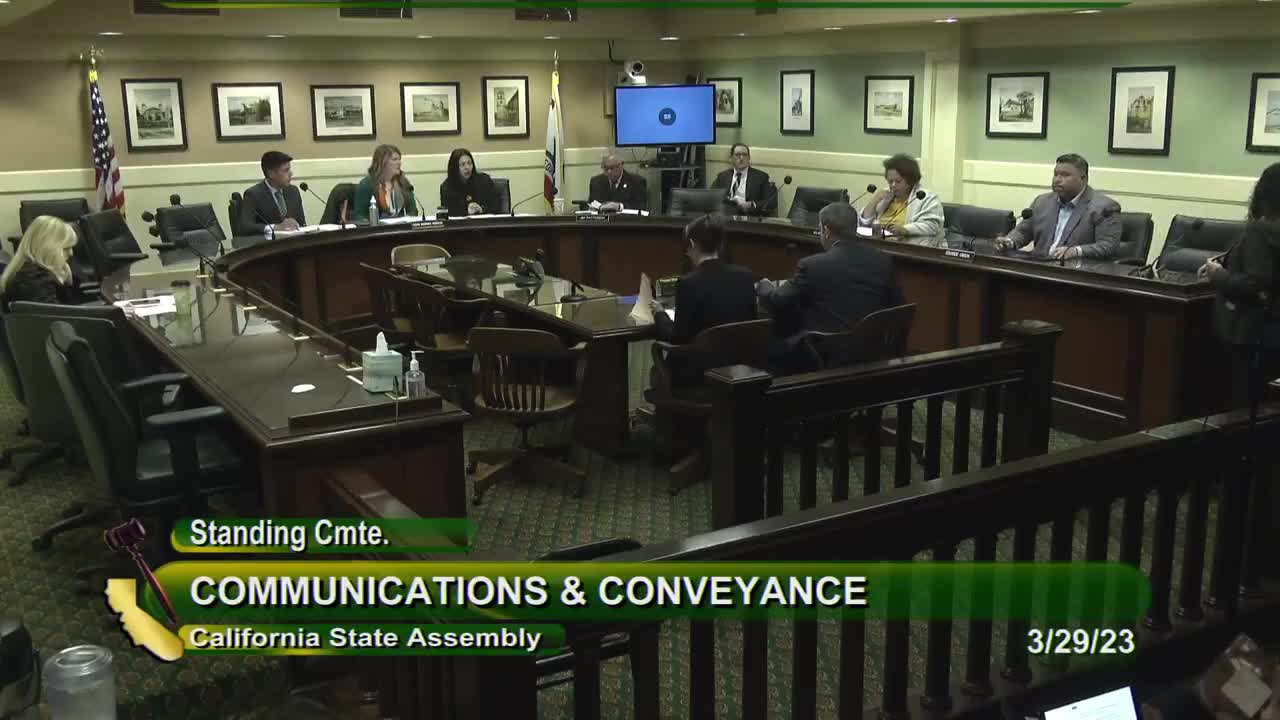 10MIN
Assembly Standing Committee on Communications and Conveyance
Bill Author

Bill Co-Author(s):