AB 2923: Peace officers: public complaints.
- Session Year: 2023-2024
- House: Assembly
- Latest Version Date: 2024-04-17
Current Status:
Failed
(2024-04-23: In committee: Set, second hearing. Hearing canceled at the request of author.)
Introduced
In Committee
First Chamber
In Committee
Second Chamber
Enacted
Existing law requires each department or agency that employs peace officer to establish a procedure to investigate complaints by members of the public against the personnel of the department or agency.
This bill would require a form used during the complaint process to include a provision inquiring whether the complaint includes an allegation of racial or identify profiling and a space to describe the allegation. The bill would define complaint for these purposes to mean a report, given either in writing or verbally, that brings to the attention of a department or agency an incident during which the complainant perceives that a department or agency employee engaged in misconduct, as specified.
The bill would require a department or agency to develop a process whereby a member of the public may submit a concern that a policy of the department could result in harm to an individual, as specified, and if the department or agency discovers conduct that could be a basis for a complaint, to report the conduct to a supervisor, as specified. By increasing duties on local law enforcement entities, this bill would impose a state-mandated local program.
Existing law makes it a misdemeanor for a person to file an allegation of misconduct against a peace officer knowing the allegation to be false. Existing law requires a law enforcement agency accepting an allegation of misconduct against a peace officer to require the complainant to read and sign a prescribed advisory.
This bill would instead make it a misdemeanor to file an allegation if the person knowingly and intentionally makes a false statement that is material and is made with the intent that the false statement will be used as a basis to punish a peace officer, and would exempt statements that are in dispute from prosecution. to the allegation of misconduct by the officer and is made in bad faith and with the intent that the false statement will be used as a wrongful basis to investigate a peace officer or to harass or otherwise harm the officer. The bill would make conforming changes in the prescribed advisory.
The California Constitution requires the state to reimburse local agencies and school districts for certain costs mandated by the state. Statutory provisions establish procedures for making that reimbursement.
This bill would provide that, if the Commission on State Mandates determines that the bill contains costs mandated by the state, reimbursement for those costs shall be made pursuant to the statutory provisions noted above.
Existing law requires each department or agency that employs peace officer to establish a procedure to investigate complaints by members of the public against the personnel of the department or agency.
This bill would require a form used during the complaint process to include a provision inquiring whether the complaint includes an allegation of racial or identify profiling and a space to describe the allegation. The bill would define complaint for these purposes to mean a report, given either in writing or verbally, that brings to the attention of a department or agency an incident during which the complainant perceives that a department or agency employee engaged in misconduct, as specified.
The bill would require a department or agency to develop a process whereby a member of the public may submit a concern that a policy of the department could result in harm to an individual, as specified, and if the department or agency discovers conduct that could be a basis for a complaint, to report the conduct to a supervisor, as specified. By increasing duties on local law enforcement entities, this bill would impose a state-mandated local program.
Existing law makes it a misdemeanor for a person to file an allegation of misconduct against a peace officer knowing the allegation to be false. Existing law requires a law enforcement agency accepting an allegation of misconduct against a peace officer to require the complainant to read and sign a prescribed advisory.
This bill would instead make it a misdemeanor to file an allegation if the person knowingly and intentionally makes a false statement that is material and is made with the intent that the false statement will be used as a basis to punish a peace officer, and would exempt statements that are in dispute from prosecution. The bill would make conforming changes in the prescribed advisory.
The California Constitution requires the state to reimburse local agencies and school districts for certain costs mandated by the state. Statutory provisions establish procedures for making that reimbursement.
This bill would provide that, if the Commission on State Mandates determines that the bill contains costs mandated by the state, reimbursement for those costs shall be made pursuant to the statutory provisions noted above.
(a)(1)A person who files any allegation of misconduct against a peace officer, as defined in Chapter 4.5 (commencing with Section 830) of Title 3 of Part 2, who knowingly and intentionally makes a false statement that is material and is made with the intent that the false statement will be used as a basis to punish a peace to the allegation of misconduct by the officer and is made in bad faith and with the intent that the false statement will be used as a wrongful basis to investigate a peace officer or to harass or otherwise harm the officer, is guilty of a misdemeanor. Statements that are in dispute shall not be the basis for a prosecution.
(2)A law enforcement agency accepting an allegation of misconduct against a peace officer shall require the complainant to read and sign the following advisory, all in boldface type:
YOU HAVE THE RIGHT TO MAKE A COMPLAINT AGAINST A POLICE OFFICER FOR ANY IMPROPER POLICE CONDUCT. CALIFORNIA LAW REQUIRES THIS AGENCY TO HAVE A PROCEDURE TO INVESTIGATE CIVILIANS COMPLAINTS. YOU HAVE A RIGHT TO A WRITTEN DESCRIPTION OF THIS PROCEDURE. THIS AGENCY MAY FIND AFTER INVESTIGATION THAT THERE IS SUFFICIENT EVIDENCE SUPPORTING THE COMPLAINT AND THE DEPARTMENT IS REQUIRED TO TAKE ACTION AND PROVIDE YOU NOTICE OF THEIR DECISION. IN THE EVENT THE INVESTIGATION DETERMINES THAT THERE IS NOT ENOUGH EVIDENCE TO WARRANT ACTION ON YOUR COMPLAINT, YOU HAVE THE RIGHT TO MAKE THE COMPLAINT AND HAVE IT INVESTIGATED IF YOU BELIEVE AN OFFICER BEHAVED IMPROPERLY. YOU WILL NOT BE PUNISHED OR PENALIZED FOR MAKING A COMPLAINT. CIVILIAN COMPLAINTS AND ANY REPORTS OR FINDINGS RELATING TO COMPLAINTS MUST BE RETAINED BY THIS AGENCY FOR AT LEAST FIVE YEARS.
HOWEVER, IT IS AGAINST THE LAW TO MAKE A COMPLAINT THAT CONTAINS MATERIAL FALSE STATEMENTS MATERIAL TO THE ALLEGATION OF MISCONDUCT BY THE OFFICER IF YOU KNOW THE STATEMENTS TO BE FALSE AND INTENTIONALLY MAKE THE FALSE STATEMENTS WITH THE INTENT THAT THE STATEMENTS WILL BE USED TO IMPROPERLY TAKE ACTION AGAINST THE PEACE OFFICER. THIS DOES NOT INCLUDE A STATEMENT OF FACTS THAT YOU IN GOOD FAITH BELIEVE TO BE TRUE BUT ARE DISPUTED BY THE OFFICER. OFFICER OR TO HARASS OR OTHERWISE HARM THE OFFICER. IF YOU MAKE A COMPLAINT AGAINST AN OFFICER KNOWING THAT IT IS FALSE, YOU CAN BE PROSECUTED ON A MISDEMEANOR CHARGE.
I have read and understood the above statement. | |
Complainant |
(3)The advisory shall be available in multiple languages.
(b)Every person who files a civil claim against a peace officer or a lien against their property, knowing the claim or lien to be false and with the intent to harass or dissuade the officer from carrying out their official duties, is guilty of a misdemeanor. This section applies only to claims pertaining to actions that arise in the course and scope of the peace officers duties.
SEC. 2.Section 832.5 of the Penal Code is amended to read:832.5.(a)(1)(A)Each department or agency in this state that employs peace officers shall establish a procedure to investigate complaints by members of the public against the personnel of these departments or agencies, and shall make a written description of the procedure available to the public public, including, but not limited to, complaints described in Section 148.6. A form used during the complaint process to receive information shall include a provision inquiring whether the complaint includes an allegation of racial or identify identity profiling and a space to describe the allegation.
(B)Each department or agency shall develop a process whereby a member of the public may submit a concern about a specific policy, procedure, or practice of the department department, including, but not limited to, that the policy or procedure may violate a legal right of an individual, or may result in harm to an individual. If the department or agency investigating the policy or procedure discovers conduct that could be a basis for the complaint process in subparagraph (A), the investigator shall report this conduct to a supervisor, and the issue shall be tracked and separately investigated. Concerns submitted pursuant to this subdivision are not complaints for purposes of this section.
(2)Each department or agency that employs custodial officers, as defined in Section 831.5, may establish a procedure to investigate complaints by members of the public against those custodial officers employed by these departments or agencies, provided, however, that any procedure so established shall comply with the provisions of this section and with the provisions of Section 832.7.
(b)Complaints and any reports or findings relating to these complaints, including all complaints and any reports currently in the possession of the department or agency, shall be retained for a period of no less than 5 years for records where there was not a sustained finding of misconduct and for not less than 15 years where there was a sustained finding of misconduct. A record shall not be destroyed while a request related to that record is being processed or any process or litigation to determine whether the record is subject to release is ongoing. All complaints retained pursuant to this subdivision may be maintained either in the peace or custodial officers general personnel file or in a separate file designated by the department or agency as provided by department or agency policy, in accordance with all applicable requirements of law. However, prior to any official determination regarding promotion, transfer, or disciplinary action by an officers employing department or agency, the complaints described by subdivision (c) shall be removed from the officers general personnel file and placed in a separate file designated by the department or agency, in accordance with all applicable requirements of law.
(c)Complaints by members of the public that are determined by the peace or custodial officers employing agency to be frivolous, as defined in Section 128.5 of the Code of Civil Procedure, or unfounded or exonerated, or any portion of a complaint that is determined to be frivolous, unfounded, or exonerated, shall not be maintained in that officers general personnel file. However, these complaints shall be retained in other, separate files that shall be deemed personnel records for purposes of the California Public Records Act (Division 10 (commencing with Section 7920.000) of Title 1 of the Government Code) and Section 1043 of the Evidence Code.
(1)Management of the peace or custodial officers employing agency shall have access to the files described in this subdivision.
(2)Management of the peace or custodial officers employing agency shall not use the complaints contained in these separate files for punitive or promotional purposes except as permitted by subdivision (f) of Section 3304 of the Government Code.
(3)Management of the peace or custodial officers employing agency may identify any officer who is subject to the complaints maintained in these files which require counseling or additional training. However, if a complaint is removed from the officers personnel file, any reference in the personnel file to the complaint or to a separate file shall be deleted.
(d)As used in this section, the following definitions apply:
(1)Complaint means a report, given either in writing or verbally, that brings to the attention of a department or agency an incident during which the complainant perceives that a department or agency employee engaged in criminal conduct, abusive or discriminatory behavior, inappropriate or discourteous conduct, or a violation of any law, rule, policy, or regulation of the department or agency.
(2)Exonerated means that the investigation clearly established that the actions of the peace or custodial officer that formed the basis for the complaint are not violations of law or department policy.
(3)General personnel file means the file maintained by the agency containing the primary records specific to each peace or custodial officers employment, including evaluations, assignments, status changes, and imposed discipline.
(4)Unfounded means that the investigation clearly established that the allegation is not true.
SEC. 3.If the Commission on State Mandates determines that this act contains costs mandated by the state, reimbursement to local agencies and school districts for those costs shall be made pursuant to Part 7 (commencing with Section 17500) of Division 4 of Title 2 of the Government Code.
(a)(1)Every A person who files any allegation of misconduct against any a peace officer, as defined in Chapter 4.5 (commencing with Section 830) of Title 3 of Part 2, knowing the allegation to be false, who knowingly and intentionally makes a false statement that is material and is made with the intent that the false statement will be used as a basis to punish a peace officer, is guilty of a misdemeanor. Statements that are in dispute shall not be the basis for a prosecution.
(2)A law enforcement agency accepting an allegation of misconduct against a peace officer shall require the complainant to read and sign the following advisory, all in boldface type:
YOU HAVE THE RIGHT TO MAKE A COMPLAINT AGAINST A POLICE OFFICER FOR ANY IMPROPER POLICE CONDUCT. CALIFORNIA LAW REQUIRES THIS AGENCY TO HAVE A PROCEDURE TO INVESTIGATE CIVILIANS COMPLAINTS. YOU HAVE A RIGHT TO A WRITTEN DESCRIPTION OF THIS PROCEDURE. THIS AGENCY MAY FIND AFTER INVESTIGATION THAT THERE IS NOT ENOUGH EVIDENCE TO WARRANT ACTION ON YOUR COMPLAINT; EVEN IF THAT IS THE CASE, YOU HAVE THE RIGHT TO MAKE THE COMPLAINT AND HAVE IT INVESTIGATED IF YOU BELIEVE AN OFFICER BEHAVED IMPROPERLY. SUFFICIENT EVIDENCE SUPPORTING THE COMPLAINT AND THE DEPARTMENT IS REQUIRED TO TAKE ACTION AND PROVIDE YOU NOTICE OF THEIR DECISION. IN THE EVENT THE INVESTIGATION DETERMINES THAT THERE IS NOT ENOUGH EVIDENCE TO WARRANT ACTION ON YOUR COMPLAINT, YOU HAVE THE RIGHT TO MAKE THE COMPLAINT AND HAVE IT INVESTIGATED IF YOU BELIEVE AN OFFICER BEHAVED IMPROPERLY. YOU WILL NOT BE PUNISHED OR PENALIZED FOR MAKING A COMPLAINT. CIVILIAN COMPLAINTS AND ANY REPORTS OR FINDINGS RELATING TO COMPLAINTS MUST BE RETAINED BY THIS AGENCY FOR AT LEAST FIVE YEARS.
IT IS AGAINST THE LAW TO MAKE A COMPLAINT THAT YOU KNOW TO BE FALSE. HOWEVER, IT IS AGAINST THE LAW TO MAKE A COMPLAINT THAT CONTAINS MATERIAL FALSE STATEMENTS IF YOU KNOW THE STATEMENTS TO BE FALSE AND INTENTIONALLY MAKE THE FALSE STATEMENTS WITH THE INTENT TO IMPROPERLY TAKE ACTION AGAINST THE PEACE OFFICER. THIS DOES NOT INCLUDE A STATEMENT OF FACTS THAT YOU IN GOOD FAITH BELIEVE TO BE TRUE BUT ARE DISPUTED BY THE OFFICER. IF YOU MAKE A COMPLAINT AGAINST AN OFFICER KNOWING THAT IT IS FALSE, YOU CAN BE PROSECUTED ON A MISDEMEANOR CHARGE.
I have read and understood the above statement. | |
Complainant |
(3)The advisory shall be available in multiple languages.
(b)Every person who files a civil claim against a peace officer or a lien against his or her their property, knowing the claim or lien to be false and with the intent to harass or dissuade the officer from carrying out his or her their official duties, is guilty of a misdemeanor. This section applies only to claims pertaining to actions that arise in the course and scope of the peace officers duties.
SEC. 2.Section 832.5 of the Penal Code is amended to read:832.5.(a)(1)(A)Each department or agency in this state that employs peace officers shall establish a procedure to investigate complaints by members of the public against the personnel of these departments or agencies, and shall make a written description of the procedure available to the public. public including, but not limited to, complaints described in Section 148.6. A form used during the complaint process to receive information shall include a provision inquiring whether the complaint includes an allegation of racial or identify profiling and a space to describe the allegation.
(B)Each department or agency shall develop a process whereby a member of the public may submit a concern about a specific policy, procedure, or practice of the department including, but not limited to, that the policy or procedure may violate a legal right of an individual, or may result in harm to an individual. If the department or agency investigating the policy or procedure discovers conduct that could be a basis for the complaint process in subparagraph (A), the investigator shall report this conduct to a supervisor, and the issue shall be tracked and separately investigated. Concerns submitted pursuant to this subdivision are not complaints for purposes of this section.
(2)Each department or agency that employs custodial officers, as defined in Section 831.5, may establish a procedure to investigate complaints by members of the public against those custodial officers employed by these departments or agencies, provided, however, that any procedure so established shall comply with the provisions of this section and with the provisions of Section 832.7.
(b)Complaints and any reports or findings relating to these complaints, including all complaints and any reports currently in the possession of the department or agency, shall be retained for a period of no less than 5 years for records where there was not a sustained finding of misconduct and for not less than 15 years where there was a sustained finding of misconduct. A record shall not be destroyed while a request related to that record is being processed or any process or litigation to determine whether the record is subject to release is ongoing. All complaints retained pursuant to this subdivision may be maintained either in the peace or custodial officers general personnel file or in a separate file designated by the department or agency as provided by department or agency policy, in accordance with all applicable requirements of law. However, prior to any official determination regarding promotion, transfer, or disciplinary action by an officers employing department or agency, the complaints described by subdivision (c) shall be removed from the officers general personnel file and placed in a separate file designated by the department or agency, in accordance with all applicable requirements of law.
(c)Complaints by members of the public that are determined by the peace or custodial officers employing agency to be frivolous, as defined in Section 128.5 of the Code of Civil Procedure, or unfounded or exonerated, or any portion of a complaint that is determined to be frivolous, unfounded, or exonerated, shall not be maintained in that officers general personnel file. However, these complaints shall be retained in other, separate files that shall be deemed personnel records for purposes of the California Public Records Act (Division 10 (commencing with Section 7920.000) of Title 1 of the Government Code) and Section 1043 of the Evidence Code.
(1)Management of the peace or custodial officers employing agency shall have access to the files described in this subdivision.
(2)Management of the peace or custodial officers employing agency shall not use the complaints contained in these separate files for punitive or promotional purposes except as permitted by subdivision (f) of Section 3304 of the Government Code.
(3)Management of the peace or custodial officers employing agency may identify any officer who is subject to the complaints maintained in these files which require counseling or additional training. However, if a complaint is removed from the officers personnel file, any reference in the personnel file to the complaint or to a separate file shall be deleted.
(d)As used in this section, the following definitions apply:
(1)Complaint means a report, given either in writing or verbally, that brings to the attention of a department or agency an incident during which the complainant perceives that a department or agency employee engaged in criminal conduct, abusive or discriminatory behavior, inappropriate or discourteous conduct, or a violation of any law, rule, policy, or regulation of the department or agency.
(2)Exonerated means that the investigation clearly established that the actions of the peace or custodial officer that formed the basis for the complaint are not violations of law or department policy.
(1)(3)General personnel file means the file maintained by the agency containing the primary records specific to each peace or custodial officers employment, including evaluations, assignments, status changes, and imposed discipline.
(2)(4)Unfounded means that the investigation clearly established that the allegation is not true.
(3)Exonerated means that the investigation clearly established that the actions of the peace or custodial officer that formed the basis for the complaint are not violations of law or department policy.SEC. 3.If the Commission on State Mandates determines that this act contains costs mandated by the state, reimbursement to local agencies and school districts for those costs shall be made pursuant to Part 7 (commencing with Section 17500) of Division 4 of Title 2 of the Government Code.
|
Date
|
Status
|
|---|---|
| Apr 23, 2024 | In committee: Set, second hearing. Hearing canceled at the request of author. |
| Apr 18, 2024 | Re-referred to Com. on PUB. S. |
| Apr 17, 2024 | From committee chair, with author's amendments: Amend, and re-refer to Com. on PUB. S. Read second time and amended. |
| Apr 2, 2024 | In committee: Set, first hearing. Failed passage. Reconsideration granted. |
| Mar 4, 2024 | Referred to Com. on PUB. S. |
| Feb 16, 2024 | From printer. May be heard in committee March 17. |
| Feb 15, 2024 | Read first time. To print. |
|
Date
|
Description
|
Location
|
Votes
|
|
|---|---|---|---|---|
| Apr 2, 2024 | Reconsideration. | Assembly Standing Committee on Public Safety |
Passed |
|
| Apr 2, 2024 | Do pass and be re-referred to the Committee on [Appropriations] | Assembly Standing Committee on Public Safety |
Failed |
This list shows positions taken on this bill by organizations on the date displayed, which is linked to the original source.
Positions by individuals are not included.
|
Organization
|
Position
|
Date
|
|---|---|---|
| Arcadia Police Officers' Association | ** Against | |
| Burbank Police Officers' Association | ** Against | |
| California Attorneys For Criminal Justice | ** Support | |
| California Coalition of School Safety Professionals | ** Against | |
| California Narcotic Officers' Association | ** Against | |
| California Police Chiefs Association | ** Against | |
| California Public Defenders Association | ** Support | |
| California Reserve Peace Officers Association | ** Against | |
| Center for Policing Equity | ** Support | |
| CLAREMONT POLICE OFFICERS ASSOCIATION | ** Against | |
| Corona Police Officers Association | ** Against | |
| Culver City Police Officers' Association | ** Against | |
| Deputy Sheriffs Association of Monterey County | ** Against | |
| Fullerton Police Officers' Association | ** Against | |
| Los Angeles County Professional Peace Officers Association | ** Against | |
| Los Angeles School Police Management Association | ** Against | |
| los angeles school police officers association | ** Against | |
| Murrieta Police Officers' Association | ** Against | |
| Newport Beach Police Association | ** Against | |
| Novato Police Officers Association | ** Against | |
| Oakland Privacy | ** Support | |
| Palos Verdes Police Officers Association | ** Against | |
| Peace Officers Research Association Of California | ** Against | |
| Placer County Deputy Sheriffs' Assocation | ** Against | |
| Pomona Police Officers' Association | ** Against | |
| RIVERSIDE POLICE OFFICERS ASSOCIATION | ** Against | |
| Riverside Sheriffs' Association | ** Against | |
| Santa Ana Police Officers Association | ** Against | |
| Upland Police Officers Association | ** Against |
Date of Hearing:
Counsel: Ilan Zur
ASSEMBLY COMMITTEE ON PUBLIC SAFETY
Kevin McCarty, Chair
ABPCA Bill Id:AB 2923
Author:(Jones-Sawyer) – As Amended Ver:April 17, 2024
VOTE ONLY
SUMMARY:
Raises the standard under which a person who files an allegation of misconduct against a peace officer can be charged for a misdemeanor for making false statements, and amends peace officer complaint forms to inquire whether the complaint includes an allegation of racial or identity profiling. Specifically, this bill:
- Provides that a person who files an allegation of misconduct against a peace officer, who knowingly and intentionally makes a false statement that is material to the allegation of misconduct by the officer and is made in bad faith and with the intent that the false statement will be used as a wrongful basis to investigate a peace officer or to harass or otherwise harm the officer, is guilty of a misdemeanor.
- Modifies the written advisory that must be provided to complainants by law enforcement agencies receiving an allegation of misconduct against peace officers as follows:
- States that the law enforcement agency may find, after investigation, that there is sufficient evidence supporting the complaint and the department is required to take action and provide the complainant with notice of their decision.
- States that the complainant will not be punished or penalized for making a complaint.
- States that it is against the law to make a complaint that contains false statements material to the allegation of misconduct by the officer if the person knows the statements to be false and intentionally makes the false statements with the intent with that the statements will be used to improperly take action against the peace officer or to harass or otherwise harm the officer.
- States that the law enforcement agency may find, after investigation, that there is sufficient evidence supporting the complaint and the department is required to take action and provide the complainant with notice of their decision.
- Requires peace officer complaint forms to include a provision inquiring whether the complaint includes an allegation of racial or identity profiling and a space to describe the allegation.
- Requires each department or agency to develop a process whereby a member of the public may submit a concern about a policy, procedure, or practice of the department including, but not limited to, that the policy or procedure may violate a legal right of an individual, or may result in harm to an individual.
- Specifies that if the department or agency investigating the policy or procedure discovers conduct that could be a basis for a complaint by a member of the public against a peace officer employed by such department, the investigator shall report this conduct to a supervisor, and the issue shall be tracked and separately investigated. Concerns submitted pursuant to this process are not “complaints”.
- Defines a “complaint” to mean “a report, given either in writing or verbally, that brings to the attention of a department or agency an incident during which the complainant perceives that a department or agency employee engaged in criminal conduct, abusive or discriminatory behavior, inappropriate or discourteous conduct, or a violation of any law, rule, policy, or regulation of the department or agency.”
EXISTING LAW:
- Prohibits peace officers from engaging in racial or identity profiling. (Pen. Code, § 13519.4, subd. (f).)
- Defines “racial or identity profiling” as the consideration of, or reliance on, to any degree, actual or perceived race, color, ethnicity, national origin, age, religion, gender identity or expression, sexual orientation, or mental or physical disability in deciding which persons to subject to a stop or in deciding upon the scope or substance of law enforcement activities following a stop, except that an officer may consider or rely on characteristics listed in a specific suspect description. (Pen. Code, § 13519.4., subd. (e).)
- Provides that a person who files an allegation of misconduct against any peace officer, knowing the allegation to be false, is guilty of a misdemeanor. (Pen. Code, § 148.6, subd. (a)(1).)
- Provides that a law enforcement agency accepting an allegation of misconduct against a peace officer shall require the complainant to read and sign an advisory that states the following:
“You have the right to make a complaint against a police officer for any improper police conduct. California law requires this agency to have a procedure to investigate civilians’ complaints. You have a right to a written description of this procedure. This agency may find after investigation that there is not enough evidence to warrant action on your complaint; even if that is the case, you have the right to make the complaint and have it investigated if you believe an officer behaved improperly. Civilian complaints and any reports or findings relating to complaints must be retained by this agency for at least five years.
It is against the law to make a complaint that you know to be false. If you make a complaint against an officer knowing that it is false, you can be prosecuted on a misdemeanor charge.
I have read and understood the above statement.” (Pen. Code, § 148.6, subd. (a)(2).)
- Requires the above advisory to be available in multiple languages. (Pen. Code, § 148.6, subd. (a)(3).)
- Provides that person who files a civil claim against a peace officer or a lien against their property based on actions arising in the course and scope of the officer’s duties, knowing it to be false and with the intent to harass or dissuade the officer from carrying out their official duties, is guilty of a misdemeanor. (Pen. Code, § 148.6, subd. (b.)
- Requires a department or agency employing peace officers or custodial officers to establish a procedure to investigate complaints by members of the public against the personnel of these departments or agencies, and shall make a written description of the procedure available to the public. (Pen. Code, § 832.5, subd. (a).)
- Mandates a department or agency to release to the complaining party a copy of the complaining party’s own statements at the time the complaint is filed. (Pen. Code, § 832.7, subd. (c).)
- Requires the law enforcement agency to provide written notification to the complaining party of the disposition of the complaint within 30 days of the disposition. (Pen. Code, § 832.7, subd. (f)(1).)
- Requires the complaints and any reports or findings relating to these complaints to be retained for a period of at least five years for records where there was not a sustained finding of misconduct and for at least 15 years where there was a sustained finding of misconduct. (Pen. Code, § 832.5, subd. (b).)
- Provides all complaints may be maintained either in the peace or custodial officer’s general personnel file or in a separate file designated by the department or agency, as specified. (Pen. Code, § 832.5, subd. (b).)
- States that a record of a civilian complaint, or the investigations, findings, or dispositions of that complaint, shall not be released if the complaint is frivolous or the complaint is unfounded. (Pen. Code, § 832.7, subd. (b)(9).)
- Provides that complaints by members of the public that are determined by the peace or custodial officer’s employing agency to be frivolous, as defined, or unfounded or exonerated, or any portion of a complaint that is determined to be frivolous, unfounded, or exonerated, shall not be maintained in that officer’s general personnel file. However, these complaints shall be retained in other, separate files that shall be deemed personnel records for purposes of the CPRA. (Pen. Code, § 832.5, subd. (c).)
- States that except as specified, peace officer or custodial officer personnel records and records maintained by any state or local agency pursuant to citizens' complaints against personnel are confidential and shall not be disclosed in any criminal or civil proceeding except by discovery. This shall not apply to investigations or proceedings concerning the conduct of peace officers or custodial officers, or any agency or department that employ these officers, conducted by a grand jury, a district attorney's office, or the Attorney General's office. (Pen. Code, § 832.7, subd. (a).)
- Provides that the following peace officer or custodial officer personnel records maintained by a state or local agency are not confidential and shall be made available for public inspection pursuant to the California Public Records Act (CPRA):
- Records relating to the report, investigation, or findings of any of the following:
- An incident involving the discharge of a firearm at a person by a peace officer or custodial officer.
- An incident involving the use of force against a person by a peace officer or custodial officer that resulted in death or in great bodily injury.
- A sustained finding involving a complaint that alleges unreasonable or excessive force.
- A sustained finding that an officer failed to intervene against another officer using force that is clearly unreasonable or excessive.
- Any record relating to an incident in which a sustained finding was made by any law enforcement agency or oversight agency:
- That a peace officer or custodial officer engaged in sexual assault of a member of the public.
- Involving dishonesty by a peace officer or custodial officer directly relating to the reporting, investigation, or prosecution of a crime;
- That a peace officer or custodial officer engaged in conduct including, but not limited to, verbal statements, writings, online posts, recordings, and gestures, involving prejudice or discrimination against a person on the basis of race, religious creed, color, national origin, ancestry, physical disability, mental disability, medical condition, genetic information, marital status, sex, gender, gender identity, gender expression, age, sexual orientation, or military and veteran status.
- That the peace officer made an unlawful arrest or conducted an unlawful search. . (Pen. Code, § 832.7, subd. (b).)
- Records relating to the report, investigation, or findings of any of the following:
- Defines “unfounded” to mean that the investigation clearly established that the allegation is not true. (Pen. Code, § 832.5, subd. (d)(2).)
- Defines “exonerated” to mean that the investigation clearly established that the actions of the peace or custodial officer that formed the basis for the complaint are not violations of law or department policy. (Pen. Code, § 832.5, subd. (d)(3).)
FISCAL EFFECT:
Unknown
COMMENTS:
- Author's Statement: According to the author, "The civilian complaint process is meant to serve as a tool for law enforcement accountability. Under current law, this complaint form includes an advisory describing the potential of retaliation or other adverse action against a member of the public for filing a complaint. Rather than serving as a mechanism for accountability, this form may trigger fear in people and serve as a deterrent for reports against police officers. In order to ensure a procedurally fair complaint process, AB 2923 updates state law to make clear that a person will not be prosecuted for filing a false complaint unless the false statement is material to the underlying incident, and the individual intended to falsely accuse a law enforcement officer.”
- Racial Profiling: Although racial profiling is prohibited, studies show that racial profiling by law enforcement does occur. According to the Public Policy Institute of California (PPIC), the first wave of RIPA data reflects that Black individuals are “notably overrepresented in police stops.” (https://www.ppic.org/blog/african-americans-are-notably-overrepresented-in-police-stops/ [as of March 22, 2022].) In this first wave of data, eight agencies reported regarding stops between July 1, and December 31, 2018. The PPIC analyzed the RIPA data and found “[w]hile African Americans make up roughly 6% of the population in the [reported] jurisdictions, they made up slightly more than 15% of all stops. Those perceived to be Middle Eastern or South Asian make up about 1.8% of the population but represented 4.4% of all stops. In contrast, the state’s two largest racial/ethnic groups—Latinos and whites— were slightly underrepresented, as they make up about 41% and 35% of the population, respectively, but around 40% and 33% of all stops. Asian Americans were even more underrepresented: they are roughly 12% of the population, but made up about 5.5% of all stops.” (Ibid.) For African Americans, the racial inequities were the greatest, and existed among all eight of the agencies reporting. (Ibid.)
- The Racial and Identity Profiling Act (RIPA): AB 953 (Weber), Chapter 466, Statutes of 2015, enacted RIPA. Among other things, RIPA requires law enforcement agencies employing peace officers to report their stop data annually to the Attorney General. RIPA guidelines define a “stop” as “any detention by a peace officer of a person or any peace officer interaction with a person in which the officer conducts a search. (Cal. Code Regs., tit. 11, § 999.224., subd. (a)(20).) The data elements are outlined by the regulations underlying RIPA and require officers to record their perception of the identity characteristics pertaining to each stopped person including their perceived race or ethnicity, gender, lesbian, gay bisexual or transgender (LGBT) status, age, English fluency, disability, and unhoused status, among other data requirements. (Cal. Code Regs., tit. 11, § 999.226.) Officers are prohibited from asking the person stopped to self-identify these characteristics (Ibid.)
- Civilian Complaints: “RIPA agencies reported 10,088 complaints in total, and 10,490 complaints reached a disposition in the 2021 calendar year. (RIPA Board, Annual Report 2023), at p. 19. Available at: https://oag.ca.gov/system/files/media/ripa-board-report-2023.pdf [as of March 27, 2024].) Of the complaints that reached a disposition, 992 (9.5%) were sustained, 1,076 (10.3%) were not sustained, 3,496 (33.3%) were exonerated, and 4,926 (47%) were unfounded. (Ibid.) RIPA agencies reported 1,426 complaints alleging an element or elements of racial or identity profiling, constituting 14.1 percent of the total complaints reported by RIPA agencies in 2021. (Ibid.) Within those 1,426 complaints, there were 1,647 allegations of identity profiling. (Ibid.) This is because some civilians alleged more than one type of identity profiling, such as profiling based on both their nationality and religion. Complaints alleging race and ethnicity profiling constituted approximately 77 percent of the 1,647 allegations of identity profiling.” (Ibid.)
- Effect of this Bill: Among other things, AB 2923 strengthens the standard under which a person who files an allegation of misconduct against a peace officer can be charged for a misdemeanor for making false statements. Under existing law, and as noted on the advisory, complainants must read when alleging peace office misconduct, a person is guilty of a misdemeanor if they “know[] the allegation to be false” (Pen. Code, § 148.6, subd. (a)(1).) AB 2923 clarifies that a person must not only know that the allegation is false but must also intentionally makes a false statement that is material to the allegation of misconduct by the officer and is made in bad faith and with the intent that the false statement will be used as a wrongful basis to investigate a peace officer or to harass or otherwise harm the officer. The additional intent language added by this bill is consistent with separate Penal Code provisions addressing false claims against peace officers. (See (Pen. Code, § 148.6, subd. (b.) [providing a person who files a civil claim against a peace officer or a lien against their property based on actions arising in the course and scope of the officer’s duties, knowing it to be false and with the intent to harass or dissuade the officer from carrying out their official duties, is guilty of a misdemeanor] (emphasis added).)
Further, this bill requires agencies employing peace officers, to include, as part of their complaint process against peace officers, a form inquiring whether the complaint includes an allegation of racial or identity profiling and a space to describe the allegation. By clarifying to potential complainants that instances of such profiling are a legitimate basis for a complaint, AB 2923 may encourage legitimate complaints from persons who have experienced racial or identity profiling from police officers, as prohibited by Penal Code Section 13519.4.
Opposition has expressed concerns that opening the complaint process to include allegations of racial bias could lead to an increase in frivolous complaints. As noted above, clarifying that racial and identity profiling is a legitimate basis for a complaint may in fact increase the number of complaints against peace officers. This being said, the Penal Code already establishes a clear process for addressing, and shielding officers, from frivolous complaints. (See Pen. Code, § 832.7, subd. (b)(9) [providing records of civilian complaints shall not be released if the complaint is frivolous or unfounded]; Pen. Code, § 832.5, subd. (c) [providing that frivolous complaints shall not be maintained in an officers personnel file.].) Given that racial profiling by peace officers is prohibited, but well-documented, by encouraging legitimate complaints pertaining to racial profiling this bill may improve police practices by deterring such behavior.
The author may wish to reference definitions provided in other Penal Code sections for clarity purposes. Specifically, the use of the term “racial or identi[t]y” profiling in Section 2 of the bill is currently undefined, although the term is defined elsewhere in the Penal Code (See Pen. Code, § 13519.4., subd. (e) [defining racial or identity profiling” as the consideration of, or reliance on, to any degree, actual or perceived race, color, ethnicity, national origin, age, religion, gender identity or expression, sexual orientation, or mental or physical disability in deciding which persons to subject to a stop or in deciding upon the scope or substance of law enforcement activities following a stop, except that an officer may consider or rely on characteristics listed in a specific suspect description.].) Additionally, the author may wish to clarify what it means for a law enforcement department to “take action” where there is sufficient evidence supporting a complaint.
- Argument in Support: According to The Center for Policing Equity “AB 2923 proposes critical amendments to Penal Code section 148.6 concerning the offense of filing a false civilian complaint against law enforcement. The current statute, with its broad scope, has the potential to discourage community members from lodging genuine complaints for fear of prosecution due to misunderstandings or minor inaccuracies. AB 2923 wisely aligns the standard for prosecuting false civilian complaints with that used for peace officers, focusing on material falsehoods made with the intent to accuse an officer wrongfully. This more rigorous standard will protect individuals from unwarranted legal action when raising legitimate concerns.
Additionally, AB 2923 enhances police accountability by providing a structured means for civilians to voice concerns about specific law enforcement policies or practices. The requirements for a supervisor to review such complaints and to furnish a direct response serve to bridge the gap between law enforcement agencies and the public, facilitating constructive dialogue and potentially expediting reformative measures.
AB 2923 is an effort to reform the process of filing civilian complaints against police officers, thus promoting transparency, and fostering trust between law enforcement and the communities they serve. These bills make specific changes to preexisting statutes, which have significant implications for how civilian complaints are processed and addressed, and they also impact policies and practices within law enforcement agencies.”
- Argument in Opposition: According to the Peace Officers Research Association “PORAC strongly supports the right of civilians to file complaints against peace officers for improper conduct. At the same time, such complaints must not contain knowingly false statements about the incident or peace officer. While AB 2923 retains this basic requirement, it adds numerous specific intent provisions that would permit complainants to make false statements against peace officers without violating Penal Code section 148.6. For example, AB 2923 states that the false statement must be “made with the intent that the false statement will be used as a basis to punish the peace officer,” which would seemingly permit a complainant to make a knowingly false statement with the intent to impugn the peace officer’s credibility in an effort to escape prosecution for their own criminal misconduct.
AB 2923 also appears to impose new requirements regarding the procedures used to investigate civilian complaints. In vague terms, the bill suggests that departments are always required to “take action” against a peace officer whenever there is “sufficient evidence” supporting the complaint, and then report the department’s decision to the complainant, even if that information is not otherwise disclosable under existing law. While the bill does not define the type of “action” that must be taken, any effort to statutorily force agencies to take action against their employees likely violates the “home rule” doctrine. Local agencies have the right to determine for themselves whether to take disciplinary action against their peace officer employees, not the Legislature. The state is limited to talking action on a peace officer’s certification pursuant to Penal Code section 13510.8.”
- Related Legislation: None.
- Prior Legislation:
- SB 16 (Skinner), Chapter 402, Statutes of 2021, expands the categories of police personnel records that are subject to disclosure under the CPRA and modifies existing provisions regarding the release of records subject to disclosure.
- SB 776 (Skinner), of the 2019-2020 Legislative Session, sought to expands the categories of police personnel records that are subject to disclosure under the CPRA. SB 776 died on the Senate inactive file.
- AB 1428 (Low), of the 2017-2018 Legislature Session, would have required specified information to be posted by district attorneys’ offices and law enforcement agencies related to serious use of force by peace officers, as specified, and would require an agency to provide complaint status notifications, as specified. AB 1428 was held in the Senate Appropriations Committee.
- AB 2040 (Diaz), Chapter 391, Statutes of 2002, authorizes agencies and departments employing custodial officers to establish a procedure for the investigation of complaints by the public against those custodial officers.
- AB 2133 (Polanco), Chapter 289, Statutes of 2000, requires the advisory statement informing citizens that filing a false complaint against a peace officer is a misdemeanor to be available in multiple languages.
- AB 2637 (Bowler), Chapter 586, Statutes of 1996, makes it a misdemeanor to file a civil action against any peace officer or a lien against their property, knowing the claim or lien to be false and with the intent to harass or dissuade the officer from carrying out their official duties.
REGISTERED SUPPORT / OPPOSITION:
Support
Center for Policing Equity (Sponsor)
California Attorneys for Criminal Justice
California Public Defenders Association
Oakland Privacy
Oppose
Arcadia Police Officers' Association
Burbank Police Officers' Association
California Coalition of School Safety Professionals
California Narcotic Officers' Association
California Police Chiefs Association
California Reserve Peace Officers Association
Claremont Police Officers Association
Corona Police Officers Association
Culver City Police Officers' Association
Deputy Sheriffs' Association of Monterey County
Fullerton Police Officers' Association
Los Angeles County Professional Peace Officers Association
Los Angeles School Police Management Association
Los Angeles School Police Officers Association
Murrieta Police Officers' Association
Newport Beach Police Association
Novato Police Officers Association
Palos Verdes Police Officers Association
Peace Officers Research Association of California (PORAC)
Placer County Deputy Sheriffs' Assocation
Pomona Police Officers' Association
Riverside Police Officers Association
Riverside Sheriffs' Association
Santa Ana Police Officers Association
Upland Police Officers Association
Analysis Prepared by:
Ilan Zur / PUB. S. / (916) 319-3744
Date of Hearing:
Counsel: Ilan Zur
ASSEMBLY COMMITTEE ON PUBLIC SAFETY
Kevin McCarty, Chair
ABPCA Bill Id:AB 2923
Author:(Jones-Sawyer) – As Introduced Ver:February 15, 2024
SUMMARY:
Raises the standard under which a person who files an allegation of misconduct against a peace officer can be charged for a misdemeanor for making false statements, and amends peace officer complaint forms to inquire whether the complaint includes an allegation of racial or identity profiling. Specifically, this bill:
- Provides that a person who files an allegation of misconduct against a peace officer, who knowingly and intentionally makes a false statement that is material and is made with the intent that the false statement will be used as a basis to punish a peace officer, is guilty of a misdemeanor.
- Provides that statements made by a person filing an allegation of misconduct against a peace officer that are in dispute shall not be the basis for prosecution.
- Modifies the written advisory that must be provided to complainants by law enforcement agencies receiving an allegation of misconduct against peace officers as follows:
- States that the law enforcement agency may find, after investigation, that there is sufficient evidence supporting the complaint and the department is required to take action and provide the complainant with notice of their decision.
- States that the complainant will not be punished or penalized for making a complaint.
- States that it is against the law to make a complaint that contains material false statements if the person knows the statements to be false and intentionally makes the false statements with the intent to improperly take action against the peace officer.
- Provides that the prohibition against making false statements does not include a statement of facts that the complainant, in good faith believed to be true, but is disputed by the officer.
- States that the law enforcement agency may find, after investigation, that there is sufficient evidence supporting the complaint and the department is required to take action and provide the complainant with notice of their decision.
- Requires peace officer complaint forms to include a provision inquiring whether the complaint includes an allegation of racial or identity profiling and a space to describe the allegation.
- Requires each department or agency to develop a process whereby a member of the public may submit a concern about a policy, procedure, or practice of the department including, but not limited to, that the policy or procedure may violate a legal right of an individual, or may result in harm to an individual.
- Specifies that if the department or agency investigating the policy or procedure discovers conduct that could be a basis for a complaint by a member of the public against a peace officer employed by such department, the investigator shall report this conduct to a supervisor, and the issue shall be tracked and separately investigated. Concerns submitted pursuant to this process are not “complaints”.
- Defines a “complaint” to mean “a report, given either in writing or verbally, that brings to the attention of a department or agency an incident during which the complainant perceives that a department or agency employee engaged in criminal conduct, abusive or discriminatory behavior, inappropriate or discourteous conduct, or a violation of any law, rule, policy, or regulation of the department or agency.”
EXISTING LAW:
- Prohibits peace officers from engaging in racial or identity profiling. (Pen. Code, § 13519.4, subd. (f).)
- Defines “racial or identity profiling” as the consideration of, or reliance on, to any degree, actual or perceived race, color, ethnicity, national origin, age, religion, gender identity or expression, sexual orientation, or mental or physical disability in deciding which persons to subject to a stop or in deciding upon the scope or substance of law enforcement activities following a stop, except that an officer may consider or rely on characteristics listed in a specific suspect description. (Pen. Code, § 13519.4., subd. (e).)
- Provides that a person who files an allegation of misconduct against any peace officer, knowing the allegation to be false, is guilty of a misdemeanor. (Pen. Code, § 148.6, subd. (a)(1).)
- Provides that a law enforcement agency accepting an allegation of misconduct against a peace officer shall require the complainant to read and sign an advisory that states the following:
“You have the right to make a complaint against a police officer for any improper police conduct. California law requires this agency to have a procedure to investigate civilians’ complaints. You have a right to a written description of this procedure. This agency may find after investigation that there is not enough evidence to warrant action on your complaint; even if that is the case, you have the right to make the complaint and have it investigated if you believe an officer behaved improperly. Civilian complaints and any reports or findings relating to complaints must be retained by this agency for at least five years.
It is against the law to make a complaint that you know to be false. If you make a complaint against an officer knowing that it is false, you can be prosecuted on a misdemeanor charge.
I have read and understood the above statement.” (Pen. Code, § 148.6, subd. (a)(2).)
- Requires the above advisory to be available in multiple languages. (Pen. Code, § 148.6, subd. (a)(3).)
- Provides that person who files a civil claim against a peace officer or a lien against their property based on actions arising in the course and scope of the officer’s duties, knowing it to be false and with the intent to harass or dissuade the officer from carrying out their official duties, is guilty of a misdemeanor. (Pen. Code, § 148.6, subd. (b.)
- Requires a department or agency employing peace officers or custodial officers to establish a procedure to investigate complaints by members of the public against the personnel of these departments or agencies, and shall make a written description of the procedure available to the public. (Pen. Code, § 832.5, subd. (a).)
- Mandates a department or agency to release to the complaining party a copy of the complaining party’s own statements at the time the complaint is filed. (Pen. Code, § 832.7, subd. (c).)
- Requires the law enforcement agency to provide written notification to the complaining party of the disposition of the complaint within 30 days of the disposition. (Pen. Code, § 832.7, subd. (f)(1).)
- Requires the complaints and any reports or findings relating to these complaints to be retained for a period of at least five years for records where there was not a sustained finding of misconduct and for at least 15 years where there was a sustained finding of misconduct. (Pen. Code, § 832.5, subd. (b).)
- Provides all complaints may be maintained either in the peace or custodial officer’s general personnel file or in a separate file designated by the department or agency, as specified. (Pen. Code, § 832.5, subd. (b).)
- States that a record of a civilian complaint, or the investigations, findings, or dispositions of that complaint, shall not be released if the complaint is frivolous or the complaint is unfounded. (Pen. Code, § 832.7, subd. (b)(9).)
- Provides that complaints by members of the public that are determined by the peace or custodial officer’s employing agency to be frivolous, as defined, or unfounded or exonerated, or any portion of a complaint that is determined to be frivolous, unfounded, or exonerated, shall not be maintained in that officer’s general personnel file. However, these complaints shall be retained in other, separate files that shall be deemed personnel records for purposes of the CPRA. (Pen. Code, § 832.5, subd. (c).)
- States that except as specified, peace officer or custodial officer personnel records and records maintained by any state or local agency pursuant to citizens' complaints against personnel are confidential and shall not be disclosed in any criminal or civil proceeding except by discovery. This shall not apply to investigations or proceedings concerning the conduct of peace officers or custodial officers, or any agency or department that employ these officers, conducted by a grand jury, a district attorney's office, or the Attorney General's office. (Pen. Code, § 832.7, subd. (a).)
- Provides that the following peace officer or custodial officer personnel records maintained by a state or local agency are not confidential and shall be made available for public inspection pursuant to the California Public Records Act (CPRA):
- Records relating to the report, investigation, or findings of any of the following:
- An incident involving the discharge of a firearm at a person by a peace officer or custodial officer.
- An incident involving the use of force against a person by a peace officer or custodial officer that resulted in death or in great bodily injury.
- A sustained finding involving a complaint that alleges unreasonable or excessive force.
- A sustained finding that an officer failed to intervene against another officer using force that is clearly unreasonable or excessive.
- Any record relating to an incident in which a sustained finding was made by any law enforcement agency or oversight agency:
- That a peace officer or custodial officer engaged in sexual assault of a member of the public.
- Involving dishonesty by a peace officer or custodial officer directly relating to the reporting, investigation, or prosecution of a crime;
- That a peace officer or custodial officer engaged in conduct including, but not limited to, verbal statements, writings, online posts, recordings, and gestures, involving prejudice or discrimination against a person on the basis of race, religious creed, color, national origin, ancestry, physical disability, mental disability, medical condition, genetic information, marital status, sex, gender, gender identity, gender expression, age, sexual orientation, or military and veteran status.
- That the peace officer made an unlawful arrest or conducted an unlawful search. . (Pen. Code, § 832.7, subd. (b).)
- Records relating to the report, investigation, or findings of any of the following:
- Defines “unfounded” to mean that the investigation clearly established that the allegation is not true. (Pen. Code, § 832.5, subd. (d)(2).)
- Defines “exonerated” to mean that the investigation clearly established that the actions of the peace or custodial officer that formed the basis for the complaint are not violations of law or department policy. (Pen. Code, § 832.5, subd. (d)(3).)
FISCAL EFFECT:
Unknown
COMMENTS:
- Author's Statement: According to the author, "The civilian complaint process is meant to serve as a tool for law enforcement accountability. Under current law, this complaint form includes an advisory describing the potential of retaliation or other adverse action against a member of the public for filing a complaint. Rather than serving as a mechanism for accountability, this form may trigger fear in people and serve as a deterrent for reports against police officers. In order to ensure a procedurally fair complaint process, AB 2923 updates state law to make clear that a person will not be prosecuted for filing a false complaint unless the false statement is material to the underlying incident, and the individual intended to falsely accuse a law enforcement officer.”
- Racial Profiling: Although racial profiling is prohibited, studies show that racial profiling by law enforcement does occur. According to the Public Policy Institute of California (PPIC), the first wave of RIPA data reflects that Black individuals are “notably overrepresented in police stops.” (https://www.ppic.org/blog/african-americans-are-notably-overrepresented-in-police-stops/ [as of March 22, 2022].) In this first wave of data, eight agencies reported regarding stops between July 1, and December 31, 2018. The PPIC analyzed the RIPA data and found “[w]hile African Americans make up roughly 6% of the population in the [reported] jurisdictions, they made up slightly more than 15% of all stops. Those perceived to be Middle Eastern or South Asian make up about 1.8% of the population but represented 4.4% of all stops. In contrast, the state’s two largest racial/ethnic groups—Latinos and whites— were slightly underrepresented, as they make up about 41% and 35% of the population, respectively, but around 40% and 33% of all stops. Asian Americans were even more underrepresented: they are roughly 12% of the population, but made up about 5.5% of all stops.” (Ibid.) For African Americans, the racial inequities were the greatest, and existed among all eight of the agencies reporting. (Ibid.)
- The Racial and Identity Profiling Act (RIPA): AB 953 (Weber), Chapter 466, Statutes of 2015, enacted RIPA. Among other things, RIPA requires law enforcement agencies employing peace officers to report their stop data annually to the Attorney General. RIPA guidelines define a “stop” as “any detention by a peace officer of a person or any peace officer interaction with a person in which the officer conducts a search. (Cal. Code Regs., tit. 11, § 999.224., subd. (a)(20).) The data elements are outlined by the regulations underlying RIPA and require officers to record their perception of the identity characteristics pertaining to each stopped person including their perceived race or ethnicity, gender, lesbian, gay bisexual or transgender (LGBT) status, age, English fluency, disability, and unhoused status, among other data requirements. (Cal. Code Regs., tit. 11, § 999.226.) Officers are prohibited from asking the person stopped to self-identify these characteristics (Ibid.)
- Civilian Complaints: “RIPA agencies reported 10,088 complaints in total, and 10,490 complaints reached a disposition in the 2021 calendar year. (RIPA Board, Annual Report 2023), at p. 19. Available at: https://oag.ca.gov/system/files/media/ripa-board-report-2023.pdf [as of March 27, 2024].) Of the complaints that reached a disposition, 992 (9.5%) were sustained, 1,076 (10.3%) were not sustained, 3,496 (33.3%) were exonerated, and 4,926 (47%) were unfounded. (Ibid.) RIPA agencies reported 1,426 complaints alleging an element or elements of racial or identity profiling, constituting 14.1 percent of the total complaints reported by RIPA agencies in 2021. (Ibid.) Within those 1,426 complaints, there were 1,647 allegations of identity profiling. (Ibid.) This is because some civilians alleged more than one type of identity profiling, such as profiling based on both their nationality and religion. Complaints alleging race and ethnicity profiling constituted approximately 77 percent of the 1,647 allegations of identity profiling.” (Ibid.)
- Effect of this Bill: Among other things, AB 2923 strengthens the standard under which a person who files an allegation of misconduct against a peace officer can be charged for a misdemeanor for making false statements. The bill would change the standard by requiring that the false statement be material and requiring intent that the false statement be used to punish the officer. Under existing law, and as noted on the advisory, complainants must read when alleging peace office misconduct, a person is guilty of a misdemeanor if they “know[] the allegation to be false” (Pen. Code, § 148.6, subd. (a)(1).) AB 2923 clarifies that a person must not only know that the allegation is false but that they intentionally make a false statement that is material and is made with the intent that the false statement will be used as a basis to punish a peace officer, is guilty of a misdemeanor.
The additional intent language added by this bill is consistent with separate Penal Code provisions addressing false claims against peace officers. (See (Pen. Code, § 148.6, subd. (b.) [providing a person who files a civil claim against a peace officer or a lien against their property based on actions arising in the course and scope of the officer’s duties, knowing it to be false and with the intent to harass or dissuade the officer from carrying out their official duties, is guilty of a misdemeanor] (emphasis added).) AB 2923 creates clarity surrounding when a person can be charged with a misdemeanor for making a false claim. Considering the bill’s additional clarification that statements in dispute are not a basis for prosecution, AB 2923 may encourage legitimate claims against peace officer misconduct from persons who are otherwise concerned that their disagreement with law enforcement’s account of an incident could result in retaliation or criminal consequences.
Further, this bill requires agencies employing peace officers, to include, as part of their complaint process against peace officers, a form inquiring whether the complaint includes an allegation of racial or identity profiling and a space to describe the allegation. By clarifying to potential complainants that instances of such profiling are a legitimate basis for a complaint, AB 2923 will encourage legitimate complaints from persons who have experienced racial or identity profiling from police officers, as prohibited by Penal Code Section 13519.4.
The Los Angeles County Professional Peace Officers Association has expressed concerns that opening the complaint process to include allegations of racial bias could lead to an increase in frivolous complaints that could strain resources and “undermine the morale of officers who may feel unfairly targeted.” As identified above, clarifying that racial and identity profiling is a legitimate basis for a complaint may increase the number of complaints against peace officers. This being said, the Penal Code already establishes a clear process for addressing, and shielding officers, from frivolous complaints. (See Pen. Code, § 832.7, subd. (b)(9) [providing records of civilian complaints shall not be released if the complaint is frivolous or unfounded]; Pen. Code, § 832.5, subd. (c) [providing that frivolous complaints shall not be maintained in an officers personnel file.].) Given that racial profiling by peace officers is prohibited, but well-documented, this bill can reasonably be expected to encourage legitimate complaints of racial and identity profiling, which may improve police practices by deterring such behavior.
The author may wish to reference definitions provided in other Penal Code sections for clarity purposes. Specifically, the use of the term “racial or identi[t]y” profiling in Section 2 of the bill is currently undefined, although the term is defined elsewhere in the Penal Code (See Pen. Code, § 13519.4., subd. (e) [defining racial or identity profiling” as the consideration of, or reliance on, to any degree, actual or perceived race, color, ethnicity, national origin, age, religion, gender identity or expression, sexual orientation, or mental or physical disability in deciding which persons to subject to a stop or in deciding upon the scope or substance of law enforcement activities following a stop, except that an officer may consider or rely on characteristics listed in a specific suspect description.].) Second, the author should consider replacing the references to “identify profiling” with “identity profiling.”
The bill also provides helpful clarity surrounding the definition of a “complaint” for purposes of Penal Code provisions addressing complaints of peace office misconduct.
- Argument in Support: According to Oakland Privacy “AB 2923 refines the misdemeanor charge for filing a false complaint against a law enforcement agency to ensure that such charges can only be filed against a complainant when the report is knowingly and intentionally false and not when the facts are simply in dispute. We have seen many accounts of incidents when, for example, law enforcement claims that a weapon was present or was raised or pointed, while victims and witnesses claim that nothing of the kind occurred, and no factual adjudication has yet occurred. No one should ever be subject to a misdemeanor charge just because they disagree with an official law enforcement account of an incident. The integrity of any complaint process depends on a complainant being able to freely, without fear or favor, detail their account of an incident without worrying about criminal consequences if their account turns out to be partially mistaken. In the court system, we penalize, plaintiffs when their lawsuit complaints are frivolous, not when they are wrong. The law enforcement complaint process should use the same standards.
Members of the public often conclude that filing complaints against the police is useless, even as complaints continue to pour in. These sentiments are highly prevalent among the Black and Brown communities that have suffered the brunt of mass incarceration policies. Refining complaint procedures to try to make them work more effectively is a worthwhile effort and is consistent with the state’s efforts to remove bad police officers and to make reparations to the descendants of chattel slavery.”
- Argument in Opposition: According to the Los Angeles Professional Peace Officers Association “Law enforcement agencies already accept public complaints and are required by law to document detailed information about, and investigate as appropriate, public complaints. Opening the formal process for public complaints to include allegations of racial profiling could lead to a flood of frivolous or malicious complaints against law enforcement officers. This could not only strain resources but also undermine the morale of officers who may feel unfairly targeted.”
- Related Legislation: None.
- Prior Legislation:
- SB 16 (Skinner), Chapter 402, Statutes of 2021, expands the categories of police personnel records that are subject to disclosure under the CPRA and modifies existing provisions regarding the release of records subject to disclosure.
- SB 776 (Skinner), of the 2019-2020 Legislative Session, sought to expands the categories of police personnel records that are subject to disclosure under the CPRA. SB 776 died on the Senate inactive file.
- AB 1428 (Low), of the 2017-2018 Legislature Session, would have required specified information to be posted by district attorneys’ offices and law enforcement agencies related to serious use of force by peace officers, as specified, and would require an agency to provide complaint status notifications, as specified. AB 1428 was held in the Senate Appropriations Committee.
- AB 2040 (Diaz), Chapter 391, Statutes of 2002, authorizes agencies and departments employing custodial officers to establish a procedure for the investigation of complaints by the public against those custodial officers.
- AB 2133 (Polanco), Chapter 289, Statutes of 2000, requires the advisory statement informing citizens that filing a false complaint against a peace officer is a misdemeanor to be available in multiple languages.
- AB 2637 (Bowler), Chapter 586, Statutes of 1996, makes it a misdemeanor to file a civil action against any peace officer or a lien against their property, knowing the claim or lien to be false and with the intent to harass or dissuade the officer from carrying out their official duties.
REGISTERED SUPPORT / OPPOSITION:
Support
Center for Policing Equity (Sponsor)
California Attorneys for Criminal Justice
California Public Defenders Association
Oakland Privacy
Oppose
Arcadia Police Officers' Association
Burbank Police Officers' Association
California Coalition of School Safety Professionals
California Narcotic Officers' Association
California Police Chiefs Association
California Reserve Peace Officers Association
Claremont Police Officers Association
Corona Police Officers Association
Culver City Police Officers' Association
Deputy Sheriffs' Association of Monterey County
Fullerton Police Officers' Association
Los Angeles County Professional Peace Officers Association
Los Angeles School Police Management Association
Los Angeles School Police Officers Association
Murrieta Police Officers' Association
Newport Beach Police Association
Novato Police Officers Association
Palos Verdes Police Officers Association
Placer County Deputy Sheriffs' Association
Pomona Police Officers' Association
Riverside Police Officers Association
Riverside Sheriffs' Association
Santa Ana Police Officers Association
Upland Police Officers Association
Analysis Prepared by:
Ilan Zur / PUB. S. / (916) 319-3744
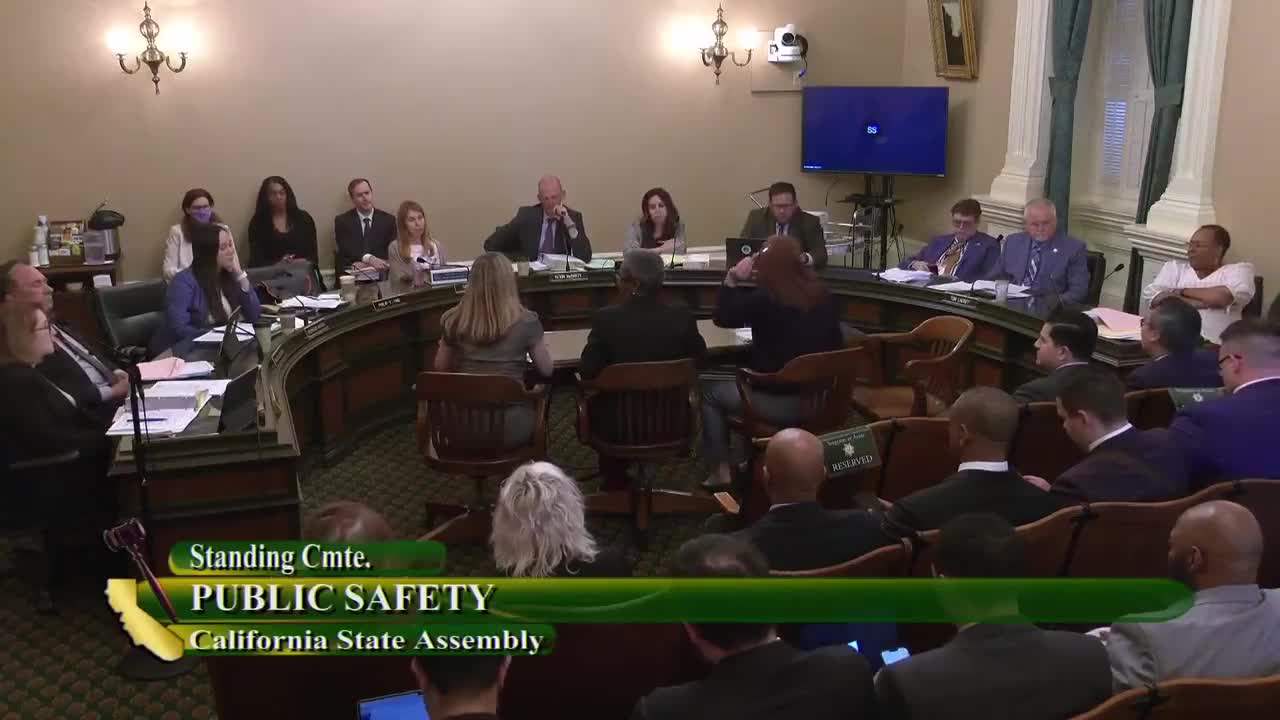
Discussed in Hearing
 22MIN
Assembly Standing Committee on Public Safety
Bill Author

Bill Co-Author(s):