AB 3171: Controlled substances: fentanyl.
- Session Year: 2023-2024
- House: Assembly
- Latest Version Date: 2024-04-23
Current Status:
Failed
(2024-05-16: In committee: Held under submission.)
Introduced
In Committee
First Chamber
In Committee
Second Chamber
Enacted
What does this bill do?
The bill raises prison terms for people who possess for sale, transport, sell, or import more than 28.35 grams (about one ounce) of fentanyl or a fentanyl analog. Possession-for-sale penalties increase to 4–6 years, most sale/transport/import penalties increase to 7–9 years, and transporting that amount to a noncontiguous county can bring 7, 10, or 13 years in prison. It also requires that the person knew the substance was fentanyl.
The summary is provided by generative AI which can make mistakes. For original language, please view the details in the table below.
Existing law classifies controlled substances into 5 schedules and places the greatest restrictions and penalties on the use of those substances placed in Schedule I. Existing law classifies the drug fentanyl in Schedule II. Existing law makes possession of a controlled substance for the purposes of sale of the substance punishable by imprisonment in a county jail for a period of 2, 3, or 4 years. Existing law makes transportation and sales of a controlled substances punishable by imprisonment in a county jail for a period of 3, 4, or 5 years and transportation to a noncontiguous county within the state punishable by imprisonment in a county jail for a period of 3, 6, or 9 years.
This bill would increase the above-described penalties, as specified, if the controlled substance involved was more than more than 28.35 grams of fentanyl, more than 28.35 grams of an analog of fentanyl, a substance containing more than 28.35 grams of fentanyl, or a substance containing more than 28.35 grams of an analog of fentanyl. fentanyl and the individual knew that the specific controlled substance was fentanyl. By increasing the penalty for a crime, this bill would impose a state-mandated local program.
The California Constitution requires the state to reimburse local agencies and school districts for certain costs mandated by the state. Statutory provisions establish procedures for making that reimbursement.
This bill would provide that no reimbursement is required by this act for a specified reason.
Existing law classifies controlled substances into 5 schedules and places the greatest restrictions and penalties on the use of those substances placed in Schedule I. Existing law classifies the drug fentanyl in Schedule II. Existing law makes possession of a controlled substance for the purposes of sale of the substance punishable by imprisonment in a county jail for a period of 2, 3, or 4 years. Existing law makes transportation and sales of a controlled substances punishable by imprisonment in a county jail for a period of 3, 4, or 5 years and transportation to a noncontiguous county within the state punishable by imprisonment in a county jail for a period of 3, 6, or 9 years.
This bill would increase the above-described penalties, as specified, if the controlled substance involved was more than more than 28.35 grams of fentanyl, more than 28.35 grams of an analog of fentanyl, a substance containing more than 28.35 grams of fentanyl, or a substance containing more than 28.35 grams of an analog of fentanyl. By increasing the penalty for a crime, this bill would impose a state-mandated local program.
The California Constitution requires the state to reimburse local agencies and school districts for certain costs mandated by the state. Statutory provisions establish procedures for making that reimbursement.
This bill would provide that no reimbursement is required by this act for a specified reason.
(a)Except as provided in subdivision (b) and as otherwise provided in this division, a person who possesses for sale or purchases for purposes of sale (1) any controlled substance specified in subdivision (b), (c), or (e) of Section 11054, specified in paragraph (14), (15), or (20) of subdivision (d) of Section 11054, or specified in subdivision (b) or (c) of Section 11055, or specified in subdivision (h) of Section 11056, or (2) any controlled substance classified in Schedule III, IV, or V which is a narcotic drug, shall be punished by imprisonment pursuant to subdivision (h) of Section 1170 of the Penal Code for two, three, or four years.
(b)(1)Notwithstanding subdivision (a), a person who possesses for sale or purchases for purposes of sale more than 28.35 grams of fentanyl, more than 28.35 grams of an analog of fentanyl, a substance containing more than 28.35 grams of fentanyl, or a substance containing more than 28.35 grams of an analog of fentanyl shall be punished by imprisonment pursuant to subdivision (h) of Section 1170 of the Penal Code for four, five, or six years.
(2)For the purpose of this subdivision, the person must have knowledge that the specific controlled substance possessed is fentanyl.
SEC. 2.Section 11352 of the Health and Safety Code is amended to read:11352.(a)Except as provided in subdivision (c) and as otherwise provided in this division, a person who transports, imports into this state, sells, furnishes, administers, or gives away, or offers to transport, import into this state, sell, furnish, administer, or give away, or attempts to import into this state or transport (1) any controlled substance specified in subdivision (b), (c), or (e), or paragraph (1) of subdivision (f) of Section 11054, specified in paragraph (14), (15), or (20) of subdivision (d) of Section 11054, or specified in subdivision (b) or (c) of Section 11055, or specified in subdivision (h) of Section 11056, or (2) any controlled substance classified in Schedule III, IV, or V which is a narcotic drug, unless upon the written prescription of a physician, dentist, podiatrist, or veterinarian licensed to practice in this state, shall be punished by imprisonment pursuant to subdivision (h) of Section 1170 of the Penal Code for three, four, or five years.
(b)Notwithstanding the penalty provisions of subdivision (a) and except as provided in paragraph (2) of subdivision (c), a person who transports any controlled substances specified in subdivision (a) within this state from one county to another noncontiguous county shall be punished by imprisonment pursuant to subdivision (h) of Section 1170 of the Penal Code for three, six, or nine years.
(c)(1)Notwithstanding subdivision (a), a person who transports, imports into this state, sells, furnishes, administers, or gives away, or offers to transport, import into this state, sell, furnish, administer, or give away, or attempts to import into this state or transport more than 28.35 grams of fentanyl, more than 28.35 grams of an analog of fentanyl, a substance containing more than 28.35 grams of fentanyl, or a substance containing more than 28.35 grams of an analog of fentanyl shall be punished by imprisonment pursuant to subdivision (h) of Section 1170 of the Penal Code for seven, eight, or nine years.
(2)Notwithstanding subdivision (b), a person who transports more than 28.35 grams of fentanyl, more than 28.35 grams of an analog of fentanyl, a substance containing more than 28.35 grams of fentanyl, or a substance containing more than 28.35 grams of an analog of fentanyl within this state from one county to another noncontiguous county shall be punished by imprisonment pursuant to subdivision (h) of Section 1170 of the Penal Code for 7, 10, or 13 years.
(3)For the purpose of this subdivision, the person must have knowledge that the specific controlled substance possessed is fentanyl.
(d)For purposes of this section, transports means to transport for sale.
(e)This section does not preclude or limit the prosecution of an individual for aiding and abetting the commission of, or conspiring to commit, or acting as an accessory to, any act prohibited by this section.
SEC. 3.No reimbursement is required by this act pursuant to Section 6 of Article XIIIB of the California Constitution because the only costs that may be incurred by a local agency or school district will be incurred because this act creates a new crime or infraction, eliminates a crime or infraction, or changes the penalty for a crime or infraction, within the meaning of Section 17556 of the Government Code, or changes the definition of a crime within the meaning of Section 6 of Article XIIIB of the California Constitution.
(a)Except as provided in subdivision (b) and as otherwise provided in this division, every a person who possesses for sale or purchases for purposes of sale (1) any controlled substance specified in subdivision (b), (c), or (e) of Section 11054, specified in paragraph (14), (15), or (20) of subdivision (d) of Section 11054, or specified in subdivision (b) or (c) of Section 11055, or specified in subdivision (h) of Section 11056, or (2) any controlled substance classified in Schedule III, IV, or V which is a narcotic drug, shall be punished by imprisonment pursuant to subdivision (h) of Section 1170 of the Penal Code for two, three, or four years.
(b)Notwithstanding subdivision (a), a person who possesses for sale or purchases for purposes of sale more than 28.35 grams of fentanyl, more than 28.35 grams of an analog of fentanyl, a substance containing more than 28.35 grams of fentanyl, or a substance containing more than 28.35 grams of an analog of fentanyl shall be punished by imprisonment pursuant to subdivision (h) of Section 1170 of the Penal Code for four, five, or six years.
SEC. 2.Section 11352 of the Health and Safety Code is amended to read:11352.(a)Except as provided in subdivision (c) and as otherwise provided in this division, every a person who transports, imports into this state, sells, furnishes, administers, or gives away, or offers to transport, import into this state, sell, furnish, administer, or give away, or attempts to import into this state or transport (1) any controlled substance specified in subdivision (b), (c), or (e), or paragraph (1) of subdivision (f) of Section 11054, specified in paragraph (14), (15), or (20) of subdivision (d) of Section 11054, or specified in subdivision (b) or (c) of Section 11055, or specified in subdivision (h) of Section 11056, or (2) any controlled substance classified in Schedule III, IV, or V which is a narcotic drug, unless upon the written prescription of a physician, dentist, podiatrist, or veterinarian licensed to practice in this state, shall be punished by imprisonment pursuant to subdivision (h) of Section 1170 of the Penal Code for three, four, or five years.
(b)Notwithstanding the penalty provisions of subdivision (a), any (a) and except as provided in paragraph (2) of subdivision (c), a person who transports any controlled substances specified in subdivision (a) within this state from one county to another noncontiguous county shall be punished by imprisonment pursuant to subdivision (h) of Section 1170 of the Penal Code for three, six, or nine years.
(c)(1)Notwithstanding subdivision (a), a person who transports, imports into this state, sells, furnishes, administers, or gives away, or offers to transport, import into this state, sell, furnish, administer, or give away, or attempts to import into this state or transport more than 28.35 grams of fentanyl, more than 28.35 grams of an analog of fentanyl, a substance containing more than 28.35 grams of fentanyl, or a substance containing more than 28.35 grams of an analog of fentanyl shall be punished by imprisonment pursuant to subdivision (h) of Section 1170 of the Penal Code for seven, eight, or nine years.
(2)Notwithstanding subdivision (b), a person who transports more than 28.35 grams of fentanyl, more than 28.35 grams of an analog of fentanyl, a substance containing more than 28.35 grams of fentanyl, or a substance containing more than 28.35 grams of an analog of fentanyl within this state from one county to another noncontiguous county shall be punished by imprisonment pursuant to subdivision (h) of Section 1170 of the Penal Code for 7, 10, or 13 years.
(c)(d)For purposes of this section, transports means to transport for sale.
(d)(e)This section does not preclude or limit the prosecution of an individual for aiding and abetting the commission of, or conspiring to commit, or acting as an accessory to, any act prohibited by this section.
SEC. 3.No reimbursement is required by this act pursuant to Section 6 of Article XIIIB of the California Constitution because the only costs that may be incurred by a local agency or school district will be incurred because this act creates a new crime or infraction, eliminates a crime or infraction, or changes the penalty for a crime or infraction, within the meaning of Section 17556 of the Government Code, or changes the definition of a crime within the meaning of Section 6 of Article XIIIB of the California Constitution.
|
Date
|
Status
|
|---|---|
| May 16, 2024 | In committee: Held under submission. |
| May 1, 2024 | In committee: Set, first hearing. Referred to APPR. suspense file. |
| Apr 24, 2024 | Re-referred to Com. on APPR. |
| Apr 23, 2024 | Read second time and amended. |
| Apr 22, 2024 | From committee: Amend, and do pass as amended and re-refer to Com. on APPR. (Ayes 8. Noes 0.) (April 16). |
| Mar 11, 2024 | Referred to Com. on PUB. S. |
| Feb 17, 2024 | From printer. May be heard in committee March 18. |
| Feb 16, 2024 | Read first time. To print. |
|
Date
|
Description
|
Location
|
Votes
|
|
|---|---|---|---|---|
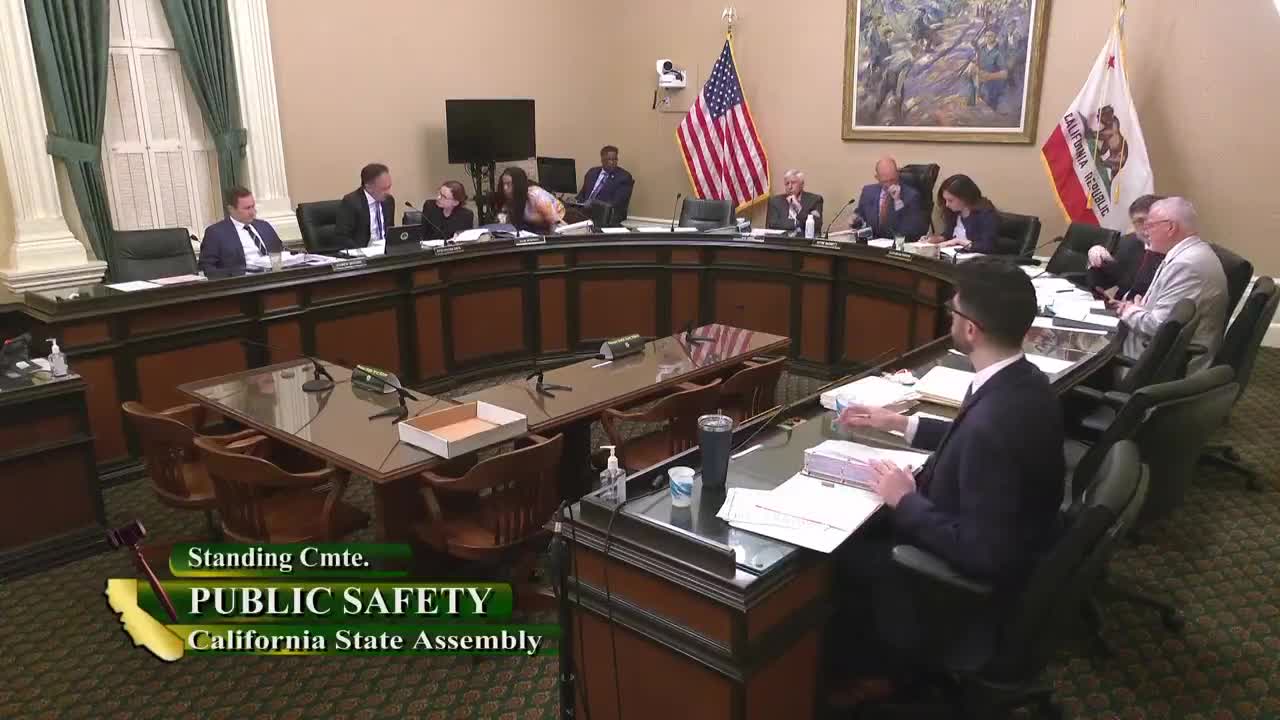
| Apr 16, 2024 | Do pass as amended and be re-referred to the Committee on [Appropriations] | Assembly Standing Committee on Public Safety |
Passed |
This list shows positions taken on this bill by organizations on the date displayed, which is linked to the original source.
Positions by individuals are not included.
|
Organization
|
Position
|
Date
|
|---|---|---|
| Aaron Read and Associates | * Support | Apr 16, 2024 |
| Aclu California Action | * Against | Apr 16, 2024 |
| California Association Of Highway Patrolmen | ** Support | |
| California District Attorneys Association | * Support | Apr 16, 2024 |
| California Public Defenders Association | * Against | Apr 16, 2024 |
| California State Sheriffs' Association | * Support | Apr 16, 2024 |
| Californians for Safety and Justice | * Against | Apr 16, 2024 |
| City of Santa Clarita | ** Support | |
| City of Vista | ** Support | |
| Drug Policy Alliance | * Against | Apr 16, 2024 |
| Ella Baker Center | * Against | Apr 16, 2024 |
| Empowering Women Impacted by Incarceration | * Against | Apr 16, 2024 |
| Felony Murder Elimination Project | ** Against | |
| Friends Committee On Legislation Of California | ** Against | |
| Initiate Justice Action | * Against | Apr 16, 2024 |
| League Of California Cities | * Support | Apr 16, 2024 |
| Legal Services for Prisoners with Children | * Against | Apr 16, 2024 |
| Peace Officers Research Association Of California | ** Support | |
| Riverside Sheriffs' Association | * Support | Apr 16, 2024 |
| San Francisco Public Defender's Office | * Against | Apr 16, 2024 |
| Santa Clarita City Of | ** Support | |
| Sister Warriors Freedom Coalition | * Against | Apr 16, 2024 |
| Smart Justice California, a project of Tides Advocacy | ** Against | |
| Uncommon Law | ** Against | |
| Underground Scholars Initiative - UC Berkeley | ** Against | |
| Vera Institute Of Justice | ** Against |
Date of Hearing: May 1, 2024
ASSEMBLY COMMITTEE ON APPROPRIATIONS
Buffy Wicks, Chair
ABPCA Bill Id:AB 3171
Author:(Soria) – As Amended Ver:April 23, 2024
Policy Committee: | Public Safety | Vote: | 8 - 0 |
|
| ||
|
|
Urgency: No State Mandated Local Program: Yes Reimbursable: No
SUMMARY:
This bill increases the criminal penalties for selling, distributing, and transporting a substance containing fentanyl or an analog of fentanyl if the substance contains more than 28.35 grams of fentanyl or fentanyl analog and the defendant knew the substance in question contained fentanyl or fentanyl analog.
Specifically, this bill:
- Increases the punishment for possession or purchasing for purposes of sale the above-described substances from two, three, or four years of imprisonment in county jail to four, five, or six years in county jail.
- Increases the punishment for transporting, importing into the state, selling, or furnishing the above-described substances, or attempting to do so, from three, six, or nine years of imprisonment in county jail to seven, eight, or nine years in county jail.
- Increases the punishment for transporting the above-described substances within this state from one county to another noncontiguous county from three, six, or nine years of imprisonment in county jail to seven, 10, or 13 years in county jail.
- Specifies the penalty increases imposed by this bill apply only when the defendant has knowledge that the specific controlled substances in question contain fentanyl or fentanyl analog.
FISCAL EFFECT:
Costs (local funds, General Fund) to the counties and the Department of Corrections and Rehabilitation to incarcerate people convicted of the fentanyl offenses included in this bill, likely in the millions to tens of millions of dollars annually. Actual incarceration costs will depend on the number of convictions, the length of each sentence, and whether each sentence must be served in county jail or state prison. The average annual cost to incarcerate one person in county jail is approximately $29,000. The Legislative Analyst’s Office (LAO) estimates the average annual cost to incarcerate one person in state prison is $133,000. Although county incarceration costs are generally not considered reimbursable state mandates pursuant to Proposition 30 (2012), overcrowding in county jails creates cost pressure on the General Fund because the state has historically granted new funding to counties to offset overcrowding resulting from 2011 public safety realignment.
According to the LAO, the General Fund faces a structural deficit in the tens of billions of dollars over the next several fiscal years.
COMMENTS:
- Purpose. According to the author:
Fentanyl poisoning is the #1 killer for individuals ages 18-45. Nationwide, over 150 people die every day from fentanyl overdoses and poisonings. In the three counties I represent, Fresno, Madera and Merced, there have been over 130 deaths linked to fentanyl in 2021 alone. Assembly Bill (AB) 3171 cracks down on drug trafficking of fentanyl by holding drug dealers accountable for fentanyl overdoses, poisonings and for harming our communities.
- Background. Under existing law, selling, distributing, and transporting a substance containing fentanyl or an analog of fentanyl is punishable by a term in county jail ranging from two to nine years, depending on the seriousness of the offense. If a defendant has certain prior convictions, these offenses are punishable by a term in state prison. This bill increases the penalties for each of the above-listed offenses if the defendant was in possession of more than 28.35 grams of fentanyl or fentanyl analog, provided the defendant knew the substance contained fentanyl or fentanyl analog. As noted above, these are significant increases that will likely result in significant additional incarceration costs to the counties and CDCR.
Research shows that lengthy criminal sentences, which are costly to state and local governments, do not effectively deter crime. In general, the certainty that someone will be punished for an offense plays a larger role in deterring their criminal activity, rather than the length of their potential punishment.
Analysis Prepared by: Annika Carlson / APPR. / (916) 319-2081
Date of Hearing: April 16, 2024
Counsel: Andrew Ironside
ASSEMBLY COMMITTEE ON
Kevin McCarty, Chair
ABPCA Bill Id:
Author:() – As Ver:
As Proposed to be Amended in Committee
SUMMARY:
Increases the penalties for selling, distributing, or transporting fentanyl, an analog of fentanyl, or a substance containing fentanyl or an analog of fentanyl, if the amount of fentanyl weighs more than 28.35 grams. Specifically, this bill:
- Increases the punishment for a person who possess or purchases for purposes of sale more than 28.35 grams of fentanyl or analog of fentanyl, or a substance containing more than 28.35 grams of fentanyl or an analog of fentanyl, from two, three, or four years imprisonment in county jail to four, five, or six years.
- Increases the punishment for a person who transports, imports into this state, sells, furnishes, administers, or gives away, or who offers or attempts to transport, import into this state, sell, furnish, administer or give away, more than 28.35 grams of fentanyl or analog of fentanyl, or substance containing more than 28.35 grams of fentanyl or an analog of fentanyl from three, six, or nine years imprisonment in county jail to seven, eight, or nine years.
- Increases the punishment for a person who transports more than 28.35 grams of fentanyl or an analog of fentanyl, or a substance containing more than 28.35 grams of fentanyl or an analog of fentanyl, within this state from one county to another noncontiguous county from 3, 6, or 9 years imprisonment in county jail to 7, 10, or 13 years.
- States the penalty increases imposed by this bill apply only when the person has knowledge that the specific controlled substances possessed is fentanyl.
EXISTING LAW:
-
- Provides the following penalties for trafficking of cocaine, cocaine base, heroin and specified opiates, including fentanyl:
- Possession for sale is punishable by imprisonment for two, three, or four years in the county jail (Health & Saf. Code, § 11351);
- Sale is punishable by imprisonment for three, four, or five years in county jail. Sale includes any transfer or distribution (Health & Saf. Code, § 11352.); and,
- Transportation of fentanyl, to a noncontiguous county, for purposes of sale is punishable by imprisonment for three, six, or nine years in the county jail (Health & Saf. Code, § 11352.).
- Possession for sale is punishable by imprisonment for two, three, or four years in the county jail (Health & Saf. Code, § 11351);
- Provides that, except as specified, the term "controlled substance analog" means either of the following:
- A substance the chemical structure of which is substantially similar to the chemical structure of specified controlled substances; or,
- A substance which has, is represented as having, or is intended to have a stimulant, depressant, or hallucinogenic effect on the central nervous system that is substantially similar to, or greater than, the stimulant, depressant, or hallucinogenic effect on the central nervous system of specified controlled substances. (Health & Saf. Code, § 11401, subd. (b)(1) & (2).)
- A substance the chemical structure of which is substantially similar to the chemical structure of specified controlled substances; or,
- Specifies that the term "controlled substance analog" does not mean “any substance for which there is an approved new drug application as specified under the federal Food, Drug, and Cosmetic Act or which is generally recognized as safe and effective as specified by the federal Food, Drug, and Cosmetic Act.” (Health & Saf. Code, § 11401, subd. (c)(1).)
- Provides the following additional sentencing enhancements based on the weight of a substance containing heroin, cocaine base, cocaine, or fentanyl possessed for sale or sold.
- 1 kilogram = 3 years
- 4 kilograms = 5 years
- 10 kilograms = 10 years
- 20 kilograms = 15 years
- 40 kilograms = 20 years
- 80 kilograms = 25 years. (Health and Saf. Code, § 11370.4, subd. (a).)
- 1 kilogram = 3 years
- States that in addition to the term of imprisonment provided by law for persons convicted of violating specified drug trafficking crimes, the trial court may impose a fine not exceeding $20,000 for each offense. (Health & Saf. Code, § 11372, subd. (a).)
- Specifies that a person receiving an additional prison term for trafficking more than a kilogram of a substance containing heroin, cocaine base, cocaine, or fentanyl may, in addition, be fined by an amount not exceeding $1,000,000 for each offense. (Health & Saf. Code, § 11372, subd. (b).)
- Provides that a person receiving an additional prison term for trafficking more than four kilograms of a substance containing heroin, cocaine base, cocaine fentanyl may, in addition, be fined by an amount not to exceed $4,000,000 for each offense. (Health & Saf. Code, § 11372, subd. (c).)
- Provides that a person receiving an additional prison term for trafficking more than 10 kilograms of a substance containing heroin, cocaine base, cocaine fentanyl may, in addition, be fined by an amount not to exceed $4,000,000 for each offense. (Health & Saf. Code, § 11372, subd. (c).)
FISCAL EFFECT:
Unknown
COMMENTS:
- Author's Statement: According to the author, “Fentanyl poisoning is the #1 killer for individuals ages 18-45.
“Nationwide, over 150 people die every day from fentanyl overdoses and poisonings.
“In the three counties I represent, Fresno, Madera and Merced, there have been over 130 deaths linked to fentanyl in 2021 alone.
“Assembly Bill (AB) 3171 cracks down on drug trafficking of fentanyl by holding drug dealers accountable for fentanyl overdoses, poisonings and for harming our communities.
“The increased penalties reflect Governor Newsom’s call to hold the “poison peddlers accountable” for the spike in fentanyl overdoses, poisonings and deaths.
“Under the bill, fentanyl drug dealers face increased jail sentences ranging from 4 to 13 years.” - AB 2782 (Jim Patterson), of the 2023-2024 Legislative Session: Under existing law, a person convicted of possession for sale of a substance containing fentanyl may be incarcerated for up to four years. (Health & Saf. Code, § 11351.) AB 2782 (Jim Patterson) would lower the amount of a substance containing fentanyl required for weight enhancements that increase the penalty and fine for trafficking fentanyl, beginning at 28.35 grams. This bill would increase the penalties for possessing for sale 28.35 grams or more of a substance containing to incarceration of up to six years.
As such, if both this bill and the enhancements under AB 2782 were to become law, the term of incarceration for possessing for sale 28.35 grams or more of a substance containing fentanyl would increase from up to four years to up to nine years. Similarly, a conviction for transporting, importing, or giving away 28.35 grams or more of a substance containing fentanyl would increase from up to 5 years to as many as 12 years; and a conviction for transportation to a noncontiguous county for purposes of sale would increase from up to nine years to 16 years.
Further, the enhancement proposed by AB 2782 would increase as the amount possessed increases. For example, if both this bill and the enhancements under AB 2872 were to become law, the term of incarceration for possessing for sale 100 grams or more of a substance containing fentanyl would increase from up to four years to up to 11 years; a conviction for transporting, importing, or giving away 100 grams or more of a substance containing fentanyl would increase from up to 5 years to as many as 14 years; and a conviction for transportation to a noncontiguous county for purposes of sale would increase from up to nine years to 18 years.
The annual cost to incarcerate a person in state prison is roughly $140,000. As noted above, this bill and AB 2782 together would considerably increase penalties for possessing and/or transporting 28.35 grams or more fentanyl. If 1,000 defendants are sentenced to the increases proposed by these bills, the additional CDCR costs will quickly increase by hundreds of millions, if not several billion, dollars.
- Harsher Sentences for Drug Trafficking Unlikely to Reduce Drug Use or Deter Criminal Conduct: The number of deaths involving opioids, and fentanyl in particular, has increased significantly over the course of the last decade. In California, between 2019 and 2022, the number of opioid-related deaths in the state increased by 121 percent. (Ibarra et al., California’s opioid deaths increased 121% in 3 years. What’s driving the crisis?, CalMatters.org (July 25, 2023) <https://calmatters.org/explainers/california-opioid-crisis/> [last visited Feb. 21, 2024].) In 2022, the year for which the most recent data is available, there were 21,316 emergency room visits resulting from an opioid overdose, 7,385 opioid-related overdose deaths, and 6,473 overdose deaths from fentanyl. (CDPH, Overdose Surveillance Dashboard <https://skylab.cdph.ca.gov/ODdash/?tab=Home> [last visited Feb. 21, 2024].)
This bill attempts to reduce the number of people dying of overdoses involving fentanyl by deterring people who traffic fentanyl with a sentencing enhancement ranging from three to 13 years based on the amount. However, ample research on the impact of increasing penalties for drug offenses on criminal behavior has called into question the effectiveness of such measures. In a report examining the relationship between prison terms and drug misuse, PEW Charitable Trusts found “[n]o relationship between drug imprisonment rates and states’ drug problems,” finding that “high rates of drug imprisonment did not translate into lower rates of drug use, arrests, or overdose deaths.” (PEW, More Imprisonment Does Not Reduce State Drug Problems (Mar. 2018) p. 5 <https://www.pewtrusts.org/-/media/assets/2018/03/pspp_more_imprisonment_does_not_reduce_state_drug_problems.pdf> [last viewed Feb. 6, 2023]; see generally, Przybylski, Correctional and Sentencing Reform for Drug Offenders (Sept. 2009) < http://www.ccjrc.org/wp-content/uploads/2016/02/Correctional_and_Sentencing_Reform_for_Drug_Offenders.pdf> [last visited Mar. 20, 2023].) Put differently, imprisoning more people for longer periods of time for drug trafficking offenses is unlikely to reduce the risk of illicit drugs in our communities.
Unduly long sentences are counterproductive for public safety and contribute to the dynamic of diminishing returns as the incarcerated population expands. (Long-Term Sentences: Time to Reconsider the Scale of Punishment, 87 UMKC L.Rev. 1 (Nov. 5, 2018).) According to the U.S. Department of Justice, “Laws and policies designed to deter crime by focusing mainly on increasing the severity of punishment are ineffective partly because criminals know little about the sanctions for specific crimes. More severe punishments do not ‘chasten’ individuals convicted of crimes, and prisons may exacerbate recidivism.” (National Institute of Justice, U.S. Department of Justice, Five Things About Deterrence (June 5, 2016) <https://nij.ojp.gov/topics/articles/five-things-about-deterrence> [last visited Feb. 2, 2023.]) Increasingly punitive sentences add little to the deterrent effect of the criminal justice system; and mass incarceration diverts resources from program and policy initiatives that hold the potential for greater impact on public safety. (Long-Term Sentence, supra.)
The Council on Criminal Justice reviewed the evidence on the effect of harsher punishments on criminal behavior and came to the same conclusion. It reported:
The empirical evidence on selective incapacitation suggests that long sentences may produce short- and long-term public safety benefits for individuals engaged in violent offending, but may produce the opposite effect for those engaged in drug-related offending…where an incarcerated individual is quickly replaced by a new recruit. This “replacement effect” occurs—and undermines the overall crime-reducing effects of incapacitation—when there is “demand” for a particular criminal activity. The illicit drug business offers the most obvious example: when someone who plays a role in a drug trafficking organization is incarcerated, someone else must take his or her place…
Additional analyses further indicate that incarcerating people for drug trafficking may result in increased crimes rates in general and increased rates of violent crime, specifically, because of organizational destabilization and the need for new recruits to prove themselves.
(Long Sentences Task Force, Council on Criminal Justice, The Impact of Long Sentences on Public Safety: A Complex Relationship (Nov. 2022) p. 8 https://counciloncj.org/wp-content/uploads/2022/11/Impact-of-Long-Sentences-on-Public-Safety.pdf [last visited Apr. 24, 2023] [internal citations omitted] [emphasis added].)
Additionally, as the Council on Criminal Justice’s report notes, the harsher punishments for drug offenses may actually do harm. For example, they may push persons selling and using drugs to engage in riskier behaviors. (See Friedman et al., Relationships of deterrence and law enforcement to drug-related harms among drug injectors in US metropolitan areas (2006) AIDS Vol 20 No 1.)
According to PEW, “[A] large body of prior research…cast[s] doubt on the theory that stiffer prison terms deter drug misuse, distribution, and other drug-law violations.” (PEW, supra.) PEW concludes:
Putting more drug-law violators behind bars for longer periods of time has generated enormous costs for taxpayers, but it has not yielded a convincing public safety return on those investments. Instead, more imprisonment for drug offenders has meant limited funds are siphoned away from programs, practices, and policies that have been proved to reduce drug use and crime. (Ibid.)
Based on this research, one might reasonably question whether increasing the penalties for drug trafficking fentanyl would meaningfully impact the drug’s availability or the number of deaths resulting from its illicit fentanyl use.
- People Who Deal Drugs Are Often People Who Use Drugs: Persons who participate in the drug trade often are themselves people who use drugs. According to the National Research Council: “Facing limited opportunities in legal labor markets and already in contact with drug-selling networks, users provide a ready low-wage labor pool for illegal markets.” (https://nap.nationalacademies.org/read/12976/chapter/4 - 24). According to a Bureau of Justice Statistics report, 70% of persons serving time in state prison for drug trafficking offenses used drugs in the month before the offense, and 42.3% of those persons had been using drugs at the time of their offense. (Bureau of Justice Statistics, Special Report: Drug Use and Dependence, State and Federal Prisoners, 2004 (Oct. 2006) a p. 5 <https://bjs.ojp.gov/content/pub/pdf/dudsfp04.pdf> [last visited Mar. 20, 2023].) According to one study, “[Street-involved youth implicated in the drug trade] appear to be motivated by drug dependence,” finding: “Among participants who reported drug dealing, 263 (85.6%) individuals stated that the main reason that they sold drugs was to pay for their personal drug use.” (Werb et al., Risks surrounding drug trade involvement among street-involved youth, Am. J. Drug Alcohol Abuse (2008) < https://pubmed.ncbi.nlm.nih.gov/19016187/> [last visited Feb. 2, 2023].) Still another found that “White youths who misused prescription drugs were three times more likely to sell drugs, compared to White youths who did not misuse prescription drugs.” (Floyd et al., Adolescent Drug Dealing and Race/Ethnicity: A Population-Based study of the Differential Impact on Substance Use on Involvement in Drug Trade, Amer. J. of Drug & Alcohol Abuse, Vol. 36, No. 2 (Mar. 2010) <https://www.ncbi.nlm.nih.gov/pmc/articles/PMC2871399/ - R7> [last visited Mar. 17, 2022].)
Will the threat of a longer term of incarceration deter people already at a relatively high risk of death from illicit drug use? - Argument in Support: According to the League of California Cities, “A study by the Centers for Disease Control and Protection names fentanyl the deadliest drug in the United States. Fentanyl is often disguised as other synthetic opioids or drugs, then sold to users who are unaware that fentanyl is a key ingredient. Users who unknowingly ingest these substances believing they are taking a less powerful drug are much more susceptible to overdose or even death. In fact, the Drug Enforcement Administration (DEA) recently released a warning on the sharp increase in fake prescription drugs containing fentanyl.
“Under current law, fentanyl is listed as a controlled substance under California’s Uniform Controlled Substances Act which has five schedules. Schedule 1 substances are considered to have a high potential for abuse and no accepted medical use, while Schedules 2 through 5 have potential for abuse but are recognized for their medical benefits. Fentanyl is currently listed as a Schedule II controlled substance. Under current law, possession of controlled substances for sale is punishable by imprisonment for 2, 3, and 4 years, while transportation and sale of those substances results in incarceration term of 3, 4, or 5 years.
“This bill would increase sentences for those convicted of possession with intent to sell of more than 28.35 grams of fentanyl or fentanyl analog to 4, 5, or 6 years of state prison. Further, this bill would further target those who traffic fentanyl by increasing sentences for transporting both into the state or within the state with the intent to sell or facilitate a sale of more than 28.35 grams of fentanyl or fentanyl analog to 7, 10, or 13 years of incarceration.
“One of Cal Cities top priorities in 2024 is to address the fentanyl crisis which includes additional penalties, diversion and other treatment needs.” - Argument in Opposition: According to Ella Baker Center for Human Rights, “Specifically, AB 3171 would amend Health & Safety Codes 11351 and 11352 to increase the number of years a person would be incarcerated should they be convicted of possession for sale of fentanyl (HSC 11351) or sale, transportation, furnishing, administering, or giving away fentanyl, if the weight was more than 28.35 grams (HSC 11352). The upper penalty for violation of HSC 11351 would be six years, and the upper penalty for HSC 11352 would be 13 years if fentanyl were transported from one county to another noncontiguous county.
We are in the midst of a tragic increase in drug overdose deaths. Thousands of lives are lost in California every year – each one leaving an irreparable rift in the hearts and lives of their families and friends. To prevent future deaths and suffering, California should implement evidence-based solutions to prevent avoidable deaths. California needs to invest more in substance use disorder treatment and harm reduction rather than pursuing expensive and unproductive incarceration policies.
“What health benefit do the people of California get from punishing people with many more years of incarceration? Research has established that persons leaving prisons are far, are more likely to die of a drug overdose than the general population.2 And there is no research that we are aware of that shows that long sentences reduce the availability of drugs or reduce drug harm. On the contrary, available research finds that long sentences have negligible public safety benefits 3, and measurable negative effects on families and communities.4
“Furthermore, our state and local budgets are not unlimited – we should not lock them up in failed policies. The approximate per capita cost of a year in a California state prison is now over $132,860, a sum greater than the tuition at California’s most expensive university.5 The approximate cost of a year of methadone treatment for an opioid-dependent person is $6,552. The approximate cost of buprenorphine treatment is less than $6,000.6 It would be healthier, safer, and better for public safety to send an additional 20 people to methadone treatment or 22 people to buprenorphine treatment than to incarcerate one person for even a year, much less 10, 15, or 20 years. In terms of saving lives, widely expanding the availability of low-barrier medically assisted drug treatment and harm reduction programs would be a much more intelligent investment of public dollars.
“The war on drugs failed us, failed families, and failed communities. While incarcerating millions of Americans, drugs became more widely available, stronger, and cheaper than ever before. It seems completely irrational to expand on that failed policy.” - Related Legislation:
- AB 2782 (Jim Patterson), would impose an additional enhancement when a person is convicted of specified drug offenses involving fentanyl, including sale, possession for sale, and transportation, when the substance containing fentanyl exceeds a specified weight. AB 2782 will be heard today in this committee.
- AB 1848 (Davies), would expand an existing one year sentencing enhancement for any person over the age of 18 who induces a minor to transport, carry, sell, give away, prepare for sale, or sell heroin, cocaine, or cocaine base on any church, synagogue, youth center, day care, or public swimming pool grounds to include the transport, carry, sell, give away, prepare for sale, or sell heroin, cocaine, cocaine base, and fentanyl either on the grounds of, or within 1000 feet from a church, synagogue, youth center, day care, or public swimming pool. The hearing on AB 1848 was canceled at the request of the author.
- AB 2045 (Hoover), would add fentanyl to the list of controlled substance for which a defendant may be sentenced to an additional period of incarceration for using, inducing, or employing a minor to transport or possess specified controlled substances. AB 2045 is pending hearing in the Assembly Appropriations Committee.
- AB 2782 (Jim Patterson), would impose an additional enhancement when a person is convicted of specified drug offenses involving fentanyl, including sale, possession for sale, and transportation, when the substance containing fentanyl exceeds a specified weight. AB 2782 will be heard today in this committee.
- Prior Legislation:
- AB 701 (Villapudua), Chapter 540, Statutes of 2023, applied the existing weight enhancements that increase the penalty and fine for trafficking controlled substances containing heroin, cocaine base, and cocaine to fentanyl.
- AB 955 (Petrie-Norris), of the 2023-2024 Legislative Session, would provide that a person who sells fentanyl on a social media platform in California shall be punished by imprisonment for a period of three, six, or nine years in county jail. This committee retained AB 955 of interim study.
- AB 1058 (Jim Patterson), of the 2023-2024 Legislative Session, was identical to this bill. AB 1058 failed passage in this committee.
- SB 62 (Nguyen), of the 2023-2024 Legislative Session, was substantially similar to AB 701 above. SB 62 failed passage in the Senate Public Safety Committee.
- SB 237 (Grove), of the 2023-2024 Legislative Session, was identical to this bill. SB 237 failed passage in the Senate Public Safety Committee.
- AB 1955 (Nguyen), of the 2021-2022 Legislative Session, was substantially similar to AB 701 above. AB 1955 failed passage in this committee.
- AB 1351 (Petrie-Norris), of the 2021-2022 Legislative Session, was substantially similar to AB 701 above. The hearing on AB 1351 was canceled at the request of the author.
- AB 2975 (Petrie-Norris), of the 2019-2020 Legislative Session, was substantially similar to AB 701 above. AB 2975 was not heard in this committee.
- AB 2467 (Jim Patterson), of the 2017-2018 Legislative Session, was identical to this bill. SB 2467 failed passage in this committee.
- SB 1103 (Bates), of the 2017-2018 Legislative Session, was substantially similar to AB 701 above. SB 1103 failed passage in the Senate Public Safety Committee.
- SB 1323 (Bates), of the 2015-2016 Legislative Session, was substantially similar to AB 701 above. SB 1323 was held on the Assembly Appropriations Committee Suspense File.
- AB 701 (Villapudua), Chapter 540, Statutes of 2023, applied the existing weight enhancements that increase the penalty and fine for trafficking controlled substances containing heroin, cocaine base, and cocaine to fentanyl.
REGISTERED SUPPORT / OPPOSITION:
Support
California Association of Highway Patrolmen
California State Sheriffs' Association
City of Santa Clarita
City of Vista
League of California Cities
Peace Officers Research Association of California (PORAC)
Santa Clarita; City of
Opposition
ACLU California Action
California Public Defenders Association
Californians for Safety and Justice
Ella Baker Center for Human Rights
Felony Murder Elimination Project
Friends Committee on Legislation of California
Initiate Justice
Initiate Justice Action
Legal Services for Prisoner With Children
San Francisco Public Defender
Smart Justice California, a Project of Tides Advocacy
Uncommon Law
Underground Scholars Initiative UC Berkeley
Vera Institute of Justice
Analysis Prepared by:
Discussed in Hearing
 24MIN