AB 3290: Public postsecondary education.
- Session Year: 2023-2024
- House: Assembly
- Latest Version Date: 2024-09-22
Current Status:
Passed
(2024-09-22: Chaptered by Secretary of State - Chapter 440, Statutes of 2024.)
Introduced
In Committee
First Chamber
In Committee
Second Chamber
Enacted
(1)Existing law establishes the California Community Colleges, under the administration of the Board of Governors of the California Community Colleges, the California State University, under the administration of the Trustees of the California State University, and the University of California, under the administration of the Regents of the University of California, as the 3 segments of public postsecondary education in the state.
Existing law establishes uniform residency requirements for purposes of ascertaining the amount of tuition and fees to be paid by students of public postsecondary education institutions. Existing law entitles a student to resident classification only for the purpose of determining tuition and fees if the student is a member of the Armed Forces of the United States stationed in the state, except a member of the Armed Forces that is assigned for educational purposes to a state-supported institution of higher education.
This bill would delete that exception from resident classification, thereby extending resident classification to any student who is a member of the Armed Forces of the United States stationed in the state, regardless of whether the student is assigned for educational purposes to a state-supported institution of higher education. To the extent the bill would require community college districts to exempt more students from nonresident tuition, the bill would impose a state-mandated local program.
(2)Existing law requires the California Community Colleges, on or before July 1, 2024, to adopt a common course numbering system for all general education requirement courses and transfer pathway courses, and requires each community college campus, on or before July 1, 2024, to incorporate common course numbers from the adopted system into its course catalog.
This bill would extend those dates by 3 years, thereby extending the deadline by which the California Community Colleges is required to adopt that common course numbering system, and the deadline by which each community college campus is required to incorporate common course numbers from the adopted system into its course catalog, to on or before July 1, 2027.
(3)The California Constitution requires the state to reimburse local agencies and school districts for certain costs mandated by the state. Statutory provisions establish procedures for making that reimbursement.
This bill would provide that, if the Commission on State Mandates determines that the bill contains costs mandated by the state, reimbursement for those costs shall be made pursuant to the statutory provisions noted above.
(1)Existing law establishes the California Community Colleges, under the administration of the Board of Governors of the California Community Colleges, the California State University, under the administration of the Trustees of the California State University, and the University of California, under the administration of the Regents of the University of California, as the 3 segments of public postsecondary education in the state.
Existing law establishes uniform residency requirements for purposes of ascertaining the amount of tuition and fees to be paid by students of public postsecondary education institutions. Existing law entitles a student to resident classification only for the purpose of determining tuition and fees if the student is a member of the Armed Forces of the United States stationed in the state, except a member of the Armed Forces that is assigned for educational purposes to a state-supported institution of higher education.
This bill would delete that exception from resident classification, thereby extending resident classification to any student who is a member of the Armed Forces of the United States stationed in the state, regardless of whether the student is assigned for educational purposes to a state-supported institution of higher education. To the extent the bill would require community college districts to exempt more students from nonresident tuition, the bill would impose a state-mandated local program.
(2)Existing law requires the California Community Colleges, on or before July 1, 2024, to adopt a common course numbering system for all general education requirement courses and transfer pathway courses, and requires each community college campus, on or before July 1, 2024, to incorporate common course numbers from the adopted system into its course catalog.
This bill would extend those dates by 3 years, thereby extending the deadline by which the California Community Colleges is required to adopt that common course numbering system, and the deadline by which each community college campus is required to incorporate common course numbers from the adopted system into its course catalog, to on or before July 1, 2027.
The(3)The California Constitution requires the state to reimburse local agencies and school districts for certain costs mandated by the state. Statutory provisions establish procedures for making that reimbursement.
This bill would provide that, if the Commission on State Mandates determines that the bill contains costs mandated by the state, reimbursement for those costs shall be made pursuant to the statutory provisions noted above.
Existing law establishes the California Community Colleges, under the administration of the Board of Governors of the California Community Colleges, the California State University, under the administration of the Trustees of the California State University, and the University of California, under the administration of the Regents of the University of California, as the 3 segments of public postsecondary education in the state.
Existing law establishes uniform residency requirements for purposes of ascertaining the amount of tuition and fees to be paid by students of public postsecondary education institutions. Existing law entitles a student to resident classification only for the purpose of determining tuition and fees if the student is a member of the Armed Forces of the United States stationed in the state, except a member of the Armed Forces that is assigned for educational purposes to a state-supported institution of higher education.
This bill would delete that exception from resident classification, thereby extending resident classification to any student who is a member of the Armed Forces of the United States stationed in the state, regardless of whether the student is assigned for educational purposes to a state-supported institution of higher education. To the extent the bill would require community college districts to exempt more students from nonresident tuition, the bill would impose a state-mandated local program.
The California Constitution requires the state to reimburse local agencies and school districts for certain costs mandated by the state. Statutory provisions establish procedures for making that reimbursement.
This bill would provide that, if the Commission on State Mandates determines that the bill contains costs mandated by the state, reimbursement for those costs shall be made pursuant to the statutory provisions noted above.
(a)(1)To streamline transfer from two- to four-year postsecondary educational institutions and reduce excess credit accumulation, on or before July 1, 2027, both of the following shall occur:
(A)The California Community Colleges shall adopt a common course numbering system for all general education requirement courses and transfer pathway courses.
(B)Each community college campus shall incorporate common course numbers from the adopted common course numbering system in its catalog.
(2)The common course numbering system shall be student facing, based on the work of the workgroup established in Item 6870-101-0001 of Section 2.00 of the Budget Act of 2021, and ensure that comparable courses across all community colleges have the same course number.
(3)To support the development and implementation of a common course numbering system for the California Community College system, the workgroup established in Item 6870-101-0001 of Section 2.00 of the Budget Act of 2021 shall consider starting with courses included in the Course Identification Numbering System (C-ID) and expanding to general education requirements and transfer pathway courses pursuant to subdivision (b).
(b)The common course numbering system may have the same alphabetical identifier and same numerical identifier for each course that shares the same C-ID course description, pursuant to both of the following:
(1)For all courses included in the C-ID, the California Community Colleges may adopt the alphabetical and numerical identifier of the C-ID course descriptor as the same common course number at all community colleges.
(2)For all general education requirements and transfer pathway courses that are not included in the C-ID, intersegmental discipline faculty through the C-ID process may develop a C-ID course descriptor for each of these community college courses. Once a C-ID course descriptor is developed, the California Community Colleges may adopt the alphabetical and numerical identifier of the C-ID course descriptor as the same common course number at all community colleges.
SEC. 2.Section 68075 of the Education Code is amended to read:68075.(a)For purposes of this section, Armed Forces of the United States means the Air Force, Army, Coast Guard, Marine Corps, Navy, Space Force, and the reserve components of each of those forces, the California National Guard, the California State Guard, and the California Naval Militia.
(b)A student who is a member of the Armed Forces of the United States stationed in this state is entitled to resident classification only for the purpose of determining the amount of tuition and fees.
(c)If that member of the Armed Forces of the United States who is in attendance at an institution is thereafter transferred on military orders to a place outside this state where the member continues to serve in the Armed Forces of the United States, the member shall not lose the members resident classification so long as the member remains continuously enrolled at that institution.
SEC. 3.If the Commission on State Mandates determines that this act contains costs mandated by the state, reimbursement to local agencies and school districts for those costs shall be made pursuant to Part 7 (commencing with Section 17500) of Division 4 of Title 2 of the Government Code.
(a)(1)To streamline transfer from two- to four-year postsecondary educational institutions and reduce excess credit accumulation, on or before July 1, 2024, 2027, both of the following shall occur:
(A)The California Community Colleges shall adopt a common course numbering system for all general education requirement courses and transfer pathway courses.
(B)Each community college campus shall incorporate common course numbers from the adopted common course numbering system in its catalog.
(2)The common course numbering system shall be student facing, based on the work of the workgroup established in Item 6870-101-0001 of Section 2.00 of the Budget Act of 2021, and ensure that comparable courses across all community colleges have the same course number.
(3)To support the development and implementation of a common course numbering system for the California Community College system, the workgroup established in Item 6870-101-0001 of Section 2.00 of the Budget Act of 2021 shall consider starting with courses included in the Course Identification Numbering System (C-ID) and expanding to general education requirements and transfer pathway courses pursuant to subdivision (b).
(b)The common course numbering system may have the same alphabetical identifier and same numerical identifier for each course that shares the same C-ID course description, pursuant to both of the following:
(1)For all courses included in the C-ID, the California Community Colleges may adopt the alphabetical and numerical identifier of the C-ID course descriptor as the same common course number at all community colleges.
(2)For all general education requirements and transfer pathway courses that are not included in the C-ID, intersegmental discipline faculty through the C-ID process may develop a C-ID course descriptor for each of these community college courses. Once a C-ID course descriptor is developed, the California Community Colleges may adopt the alphabetical and numerical identifier of the C-ID course descriptor as the same common course number at all community colleges.
SECTION 1.SEC. 2.Section 68075 of the Education Code is amended to read:68075.(a)For purposes of this section, Armed Forces of the United States means the Air Force, Army, Coast Guard, Marine Corps, Navy, Space Force, and the reserve components of each of those forces, the California National Guard, the California State Guard, and the California Naval Militia.
(b)A student who is a member of the Armed Forces of the United States stationed in this state is entitled to resident classification only for the purpose of determining the amount of tuition and fees.
(c)If that member of the Armed Forces of the United States who is in attendance at an institution is thereafter transferred on military orders to a place outside this state where the member continues to serve in the Armed Forces of the United States, the member shall not lose the members resident classification so long as the member remains continuously enrolled at that institution.
SEC. 2.SEC. 3.If the Commission on State Mandates determines that this act contains costs mandated by the state, reimbursement to local agencies and school districts for those costs shall be made pursuant to Part 7 (commencing with Section 17500) of Division 4 of Title 2 of the Government Code.
(a)For purposes of this section, Armed Forces of the United States means the Air Force, Army, Coast Guard, Marine Corps, Navy, Space Force, and the reserve components of each of those forces, the California National Guard, the California State Guard, and the California Naval Militia.
(b)A student who is a member of the Armed Forces of the United States stationed in this state, except a member of the Armed Forces assigned for educational purposes to a state-supported institution of higher education, state is entitled to resident classification only for the purpose of determining the amount of tuition and fees.
(c)If that member of the Armed Forces of the United States who is in attendance at an institution is thereafter transferred on military orders to a place outside this state where the member continues to serve in the Armed Forces of the United States, the member shall not lose the members resident classification so long as the member remains continuously enrolled at that institution.
SEC. 2.If the Commission on State Mandates determines that this act contains costs mandated by the state, reimbursement to local agencies and school districts for those costs shall be made pursuant to Part 7 (commencing with Section 17500) of Division 4 of Title 2 of the Government Code.
|
Date
|
Status
|
|---|---|
| Sep 22, 2024 | Chaptered by Secretary of State - Chapter 440, Statutes of 2024. |
| Sep 22, 2024 | Approved by the Governor. |
| Aug 26, 2024 | Enrolled and presented to the Governor at 4 p.m. |
| Aug 19, 2024 | Senate amendments concurred in. To Engrossing and Enrolling. (Ayes 77. Noes 0. Page 6363.). |
| Aug 12, 2024 | In Assembly. Concurrence in Senate amendments pending. May be considered on or after August 14 pursuant to Assembly Rule 77. |
| Aug 12, 2024 | Read third time. Passed. Ordered to the Assembly. (Ayes 38. Noes 0. Page 5046.). |
| Aug 6, 2024 | Read second time. Ordered to Consent Calendar. |
| Aug 5, 2024 | From committee: Be ordered to second reading file pursuant to Senate Rule 28.8 and ordered to Consent Calendar. |
| Jul 2, 2024 | From committee chair, with author's amendments: Amend, and re-refer to committee. Read second time, amended, and re-referred to Com. on APPR. |
| Jun 25, 2024 | From committee: Do pass and re-refer to Com. on APPR with recommendation: To Consent Calendar. (Ayes 5. Noes 0.) (June 24). Re-referred to Com. on APPR. |
| Jun 5, 2024 | From committee: Do pass and re-refer to Com. on M. & V.A. with recommendation: To Consent Calendar. (Ayes 7. Noes 0.) (June 5). Re-referred to Com. on M. & V.A. |
| May 29, 2024 | Referred to Coms. on ED. and M. & V.A. |
| May 16, 2024 | In Senate. Read first time. To Com. on RLS. for assignment. |
| May 16, 2024 | Read third time. Passed. Ordered to the Senate. (Ayes 71. Noes 0.) |
| May 9, 2024 | Read second time. Ordered to Consent Calendar. |
| May 8, 2024 | From committee: Do pass. To Consent Calendar. (Ayes 15. Noes 0.) (May 8). |
| Apr 24, 2024 | From committee: Do pass and re-refer to Com. on APPR. with recommendation: To Consent Calendar. (Ayes 10. Noes 0.) (April 23). Re-referred to Com. on APPR. |
| Apr 1, 2024 | Referred to Com. on HIGHER ED. |
| Mar 21, 2024 | From printer. May be heard in committee April 20. |
| Mar 20, 2024 | Read first time. To print. |
|
Date
|
Description
|
Location
|
Votes
|
|
|---|---|---|---|---|
| Aug 19, 2024 | AB 3290 Higher Education Concurrence in Senate Amendments By FONG, M. | Assembly Floor |
Passed |
|
| Aug 12, 2024 | Consent Calendar 2nd AB3290 HIGHER ED. (Mike Fong) | Senate Floor |
Passed |
|
| Jun 24, 2024 | Do pass, but first be re-referred to the Committee on [Appropriations] with the recommendation: To Consent Calendar | Senate Standing Committee on Military and Veterans Affairs |
Passed |
|
| Jun 5, 2024 | Do pass, but first be re-referred to the Committee on [Military and Veterans Affairs] with the recommendation: To Consent Calendar | Senate Standing Committee on Education |
Passed |
|
| May 16, 2024 | AB 3290 Higher Education Consent Calendar Second Day Regular Session | Assembly Floor |
Passed |
|
| May 8, 2024 | Do pass. To Consent Calendar. | Assembly Standing Committee on Appropriations |
Passed |
|
| Apr 23, 2024 | Do pass and be re-referred to the Committee on [Appropriations] with recommendation: To Consent Calendar | Assembly Standing Committee on Higher Education |
Passed |
This list shows positions taken on this bill by organizations on the date displayed, which is linked to the original source.
Positions by individuals are not included.
CONCURRENCE IN SENATE AMENDMENTS
CSA1 Bill Id:AB 3290
Author:(Committee on Higher Education)
As Amended Ver:July 2, 2024
Majority vote
SUMMARY
Makes non-controversial, technical, and conforming changes to various provisions of the Education Code (EDC).
Senate Amendments
Extends the implementation deadline by which the California Community Colleges (CCC) are required to adopt common course numbering systems and the deadline by which each CCC campus is required to incorporate common course numbers from the adopted system into its course catalog by three years from 2024 to 2027.
COMMENTS
Rationale for inclusion in the omnibus bill. This omnibus measure makes changes to the EDC, and below is the rationale for that change:
- The omnibus creates parity on the fees paid by servicemembers in California by extending resident classification to any student who is a member of the Armed Forces of the United States, as specified, stationed in the state, regardless of whether the student is assigned for educational purposes to a state-supported institution of higher education. The population of students that provision will extend to is very small, and it is difficult to actually identify servicemembers that fall into this narrow category. This small change will treat these servicemembers the same way that every other servicemember in California and their dependents are treated under state law.
- Since the passage of AB 1111 (Berman, Chapter 568, Statutes of 2021), the CCC Chancellor's Office has worked with consultants and critical stakeholders to identify common course numbering best practices, assess implementation needs, and develop implementation plans, through conducting a national and statewide landscape scan and orming the statewide AB 1111 Common Course Numbering Task Force.
Research and progress has revealed that common course numbering implementation with intentionality and integrity requires engaging 116 CCCs in renumbering over 40,000 general education and transfer pathway courses. It also demands a student-centered approach that eliminates confusion and outcome variations regarding how renumbered courses will count across institutions and higher education systems. Extending the implementation date for common course numbering from 2024 to 2027 would allow for continuous progress to be achieved through applying the new common course numbering system to groups of courses in a scheduled cycle, commencing in 2024.
According to the Author
"This bill is the annual higher education omnibus clean-up bill and proposes technical, non-controversial amendments to existing law."
Arguments in Support
None on file.
Arguments in Opposition
None on file.
FISCAL COMMENTS
The Senate Committee on Appropriations determined that AB 3290 does not contain significant fiscal impact and, pursuant to Senate Rule 28.8, sent the bill directly to the Senate Floor.
VOTES:
ASM HIGHER EDUCATION: 10-0-1
YES: Mike Fong, Ta, Arambula, Boerner, Chen, Essayli, Irwin, Jackson, Low, Muratsuchi
ABS, ABST OR NV: Quirk-Silva
ASM APPROPRIATIONS: 15-0-0
YES: Wicks, Sanchez, Arambula, Bryan, Calderon, Wendy Carrillo, Dixon, Mike Fong, Friedman, Haney, Hart, Jim Patterson, Pellerin, Ta, Villapudua
ASSEMBLY FLOOR: 71-0-9
YES: Aguiar-Curry, Alanis, Arambula, Bains, Bauer-Kahan, Bennett, Berman, Boerner, Bonta, Bryan, Calderon, Juan Carrillo, Wendy Carrillo, Chen, Connolly, Davies, Dixon, Essayli, Mike Fong, Friedman, Gabriel, Gallagher, Garcia, Grayson, Haney, Hart, Holden, Hoover, Jackson, Jones-Sawyer, Kalra, Lackey, Lee, Low, Lowenthal, Maienschein, McCarty, McKinnor, Muratsuchi, Stephanie Nguyen, Ortega, Pacheco, Papan, Jim Patterson, Joe Patterson, Pellerin, Petrie-Norris, Quirk-Silva, Ramos, Rendon, Reyes, Luz Rivas, Rodriguez, Blanca Rubio, Sanchez, Santiago, Schiavo, Soria, Ta, Ting, Valencia, Villapudua, Waldron, Wallis, Ward, Weber, Wicks, Wilson, Wood, Zbur, Robert Rivas
ABS, ABST OR NV: Addis, Alvarez, Cervantes, Megan Dahle, Flora, Vince Fong, Gipson, Irwin, Mathis
SENATE FLOOR: 38-0-2
YES: Alvarado-Gil, Archuleta, Ashby, Atkins, Becker, Blakespear, Bradford, Caballero, Cortese, Dahle, Dodd, Durazo, Eggman, Glazer, Gonzalez, Grove, Hurtado, Jones, Laird, Limón, McGuire, Menjivar, Min, Newman, Nguyen, Niello, Ochoa Bogh, Padilla, Portantino, Roth, Rubio, Seyarto, Skinner, Smallwood-Cuevas, Stern, Wahab, Wiener, Wilk
ABS, ABST OR NV: Allen, Umberg
UPDATED
VERSION: July 2, 2024
CONSULTANT: Kevin J. Powers / HIGHER ED. / (916) 319-3960 FN: 0003870
SENATE RULES COMMITTEE Office of Senate Floor Analyses (916) 651-1520 Fax: (916) 327-4478 | AB 3290 |
CONSENT
Bill No: AB 3290
Author: Committee on Higher Education
Amended: 7/2/24 in Senate
Vote: 21
SENATE EDUCATION COMMITTEE: 7-0, 6/5/24
AYES: Newman, Jones, Cortese, Glazer, Gonzalez, Smallwood-Cuevas, Wilk
SENATE MILITARY & VETERANS COMMITTEE: 5-0, 6/24/24
AYES: Archuleta, Grove, Alvarado-Gil, Menjivar, Umberg
SENATE APPROPRIATIONS COMMITTEE: Senate Rule 28.8
ASSEMBLY FLOOR: 71-0, 5/16/24 (Consent) - See last page for vote
SUBJECT: Public postsecondary education
SOURCE: Author
DIGEST:
This bill, the Higher Education Omnibus Bill, 1) extends resident classification for purposes of determining tuition fees at California’s public colleges and universities to a student who is a member of the Armed Forces of the United States, stationed in the state for educational purposes, and 2) extends the implementation deadline by which the California Community Colleges (CCC) are required to adopt common course numbering systems and the deadline by which each CCC campus is required to incorporate common course numbers from the adopted system into its course catalog by three years from 2024 to 2027.
ANALYSIS:
Existing law:
- Establishes the University of California (UC) as a public trust to be administered by the Regents of the UC; and, grants the Regents full powers of organization and government, subject only to such legislative control as may be necessary to insure security of its funds, compliance with the terms of its endowments, statutory requirements around competitive bidding and contracts, sales of property and the purchase of materials, goods and services. (Article IX, Section (9)(a) of the California Constitution)
- Establishes the Donahoe Higher Education Act, setting forth the mission of the UC, California State University (CSU), and CCC. (Education Code (EC) § 66010, et seq.)
- Confers upon the CSU Trustees the powers, duties, and functions with respect to the management, administration, control of the CSU system and provides that the Trustees are responsible for the rule of government of their appointees and employees. (EC § 66606 and 89500, et seq.)
- Establishes the CCC under the administration of the Board of Governors of the CCC, as one of the segments of public postsecondary education in this state. It provides that CCC system be comprised of community college districts. (EC § 70900)
- Establishes uniform residency requirements for purposes of ascertaining the amount of tuition and fees to be paid by students of public postsecondary education institutions. (EC § 68000, et seq.)
- Deems a student to have resident classification only for the purpose of determining tuition and fees if the student is a member of the Armed Forces of the United States stationed in the state, except a member of the Armed Forces that is assigned for educational purposes to a state-supported institution of higher education. (EC § 68075)
- Requires, by July 1, 2024, the CCC adopt, at all community colleges and for each community college campus catalog, a common course numbering system (C-ID). It further requires the common course numbering system to be student-facing and ensure that comparable courses across all CCCs have the same course number. (EC § 66725.5)
This bill, the higher education omnibus bill, 1) extends resident classification for purposes of determining tuition fees at California’s public colleges and universities to a student who is a member of the Armed Forces of the United States, stationed in the state for educational purposes, and 2) extends the implementation deadline by which the CCCs are required to adopt common course numbering systems and the deadline by which each CCC campus is required to incorporate common course numbers from the adopted system into its course catalog by three years from 2024 to 2027.
Comments
- Omnibus bill. This is the annual higher education omnibus clean-up bill and proposes, non-controversial amendments to existing law. By tradition, if any affected agency stakeholder group, the Department of Finance, or any of the four legislative caucuses objects to a provision in this bill or that is being considered, that particular provision cannot be included.
- Rationale for inclusion in the omnibus bill. This omnibus measure makes changes to the EC, below is the rationale for each change:
- Members of the Armed Forces of the United States student fees. Current law does not exempt a servicemember stationed in this state who is assigned for educational purposes to a state-supported higher education institution from paying nonresident tuition. However, any other servicemember stationed in this state can benefit from the nonresident tuition exemption. This bill seeks to create parity on the fees paid by servicemembers in California by extending resident classification for purposes of paying tuition to any student who is a member of the Armed Forces of the United States stationed in the state, regardless of whether the student is assigned for educational purposes to a state-supported institution of higher education. The population of students that the provision will extend to is very small, and it is difficult to actually identify servicemembers that fall into this narrow category.
- Common course numbering. Since the passage of AB 1111 (Berman, Chapter 568, Statutes of 2021), the Chancellor’s Office has worked with consultants and critical stakeholders to identify common course numbering best practices, assess implementation needs, and develop implementation plans, through conducting a national and statewide landscape scan and forming the statewide AB 1111 Common Course Numbering Task Force. Research and progress has revealed that common course numbering implementation with intentionality and integrity requires engaging 116 CCCs in renumbering over 40,000 general education and transfer pathway courses. It also demands a student-centered approach that eliminates confusion and outcome variations regarding how renumbered courses will count across institutions and higher education systems. Extending the implementation date for common course numbering from 2024 to 2027 would allow for continuous progress to be achieved through applying the new common course numbering system to groups of courses in a scheduled cycle, commencing in 2024.
FISCAL EFFECT: Appropriation: No Fiscal Com.: Yes Local: Yes
SUPPORT: (Verified 8/5/24)
None received
OPPOSITION: (Verified 8/5/24)
None received
ASSEMBLY FLOOR: 71-0, 5/16/24
AYES: Aguiar-Curry, Alanis, Arambula, Bains, Bauer-Kahan, Bennett, Berman, Boerner, Bonta, Bryan, Calderon, Juan Carrillo, Wendy Carrillo, Chen, Connolly, Davies, Dixon, Essayli, Mike Fong, Friedman, Gabriel, Gallagher, Garcia, Grayson, Haney, Hart, Holden, Hoover, Jackson, Jones-Sawyer, Kalra, Lackey, Lee, Low, Lowenthal, Maienschein, McCarty, McKinnor, Muratsuchi, Stephanie Nguyen, Ortega, Pacheco, Papan, Jim Patterson, Joe Patterson, Pellerin, Petrie-Norris, Quirk-Silva, Ramos, Rendon, Reyes, Luz Rivas, Rodriguez, Blanca Rubio, Sanchez, Santiago, Schiavo, Soria, Ta, Ting, Valencia, Villapudua, Waldron, Wallis, Ward, Weber, Wicks, Wilson, Wood, Zbur, Robert Rivas
NO VOTE RECORDED: Addis, Alvarez, Cervantes, Megan Dahle, Flora, Vince Fong, Gipson, Irwin, Mathis
Prepared by: Olgalilia Ramirez / ED. / (916) 651-4105
8/7/24 13:38:57
**** END ****
SENATE COMMITTEE ON MILITARY AND VETERANS AFFAIRS
Senator Bob Archuleta, Chair
2023 - 2024 Regular
Bill No: AB 3290 Hearing Date: 6/24/24
Author: | Committee on Higher Education | ||
Version: | 3/20/24 Introduced | ||
Urgency: | No | Fiscal: | Yes |
Consultant: | Jenny Callison | ||
Subject: Public postsecondary education: tuition and fees: members of the Armed Services
DESCRIPTION
Summary:
Extends resident classification for purposes of determining tuition fees at California’s public colleges and universities to a student who is a member of the Armed Forces of the United States, stationed in the state for educational purposes.
Existing law:
- Establishes the University of California (UC) as a public trust to be administered by the Regents of the UC; and, grants the Regents full powers of organization and government, subject only to such legislative control as may be necessary to insure security of its funds, compliance with the terms of its endowments, statutory requirements around competitive bidding and contracts, sales of property and the purchase of materials, goods and services. (Article IX, Section (9)(a) of the California Constitution)
- Establishes the Donahoe Higher Education Act, setting forth the mission of the UC, California State University (CSU), and California Community Colleges (CCC). (Education Code (EC) § 66010, et seq.)
- Confers upon the CSU Trustees the powers, duties, and functions with respect to the management, administration, control of the CSU system and provides that the Trustees are responsible for the rule of government of their appointees and employees. (EC § 66606 and 89500, et seq.)
- Establishes the CCC under the administration of the Board of Governors of the CCC, as one of the segments of public postsecondary education in this state. It provides that CCC system be comprised of community college districts. (EC § 70900)
- Establishes uniform residency requirements for purposes of ascertaining the amount of tuition and fees to be paid by students of public postsecondary education institutions. (EC § 68000, et seq.)
- Deems a student to have resident classification only for the purpose of determining tuition and fees if the student is a member of the Armed Forces of the United States stationed in the state, except a member of the Armed Forces that is assigned for educational purposes to a state-supported institution of higher education. (EC § 68075)
This bill:
Extends resident classification for purposes of determining tuition fees at California’s public colleges and universities to a student who is a member of the Armed Forces of the United States, stationed in the state for educational purposes.
BACKGROUND
This is the annual higher education omnibus clean-up bill and proposes non-controversial amendments to existing law. By tradition, if any affected agency stakeholder group, the Department of Finance, or any of the four legislative caucuses objects to a provision in this bill or that is being considered, that particular provision cannot be included.
COMMENT
Current law does not exempt a servicemember stationed in this state who is assigned for educational purposes to a state-supported higher education institution from paying nonresident tuition. However, any other servicemember stationed in this state can benefit from the nonresident tuition exemption.
This bill seeks to create parity on the fees paid by servicemembers in California by extending resident classification for purposes of paying tuition to any student who is a member of the Armed Forces of the United States stationed in the state, regardless of whether the student is assigned for educational purposes to a state-supported institution of higher education. The population of students that the provision will extend to is very small, and it is difficult to actually identify servicemembers that fall into this narrow category.
POSITIONS
Sponsor: Author.
Support: None on File.
Oppose: None on File.
-- END --
SENATE COMMITTEE ON EDUCATION
Senator Josh Newman, Chair
2023 - 2024 Regular
Bill No: AB 3290 Hearing Date: June 5, 2024
Author: | |||
Version: | March 20, 2024 | ||
Urgency: | No | Fiscal: | Yes |
Consultant: | Olgalilia Ramirez | ||
Subject: Public postsecondary education: tuition and fees: members of the Armed Services.
NOTE: This bill has been referred to the Committees on Education and Military and Veterans Affairs. A "do pass" motion should include referral to the Committee on Military and Veterans Affairs.
SUMMARY
This bill, the Higher Education Omnibus Bill, extends resident classification for purposes of determining tuition fees at California’s public colleges and universities to a student who is a member of the Armed Forces of the United States, stationed in the state for educational purposes.
BACKGROUND
Existing law:
- Establishes the University of California (UC) as a public trust to be administered by the Regents of the UC; and, grants the Regents full powers of organization and government, subject only to such legislative control as may be necessary to insure security of its funds, compliance with the terms of its endowments, statutory requirements around competitive bidding and contracts, sales of property and the purchase of materials, goods and services. (Article IX, Section (9)(a) of the California Constitution)
- Establishes the Donahoe Higher Education Act, setting forth the mission of the UC, California State University (CSU), and California Community Colleges (CCC). (Education Code (EC) § 66010, et seq.)
- Confers upon the CSU Trustees the powers, duties, and functions with respect to the management, administration, control of the CSU system and provides that the Trustees are responsible for the rule of government of their appointees and employees. (EC § 66606 and 89500, et seq.)
- Establishes the CCC under the administration of the Board of Governors of the CCC, as one of the segments of public postsecondary education in this state. It provides that CCC system be comprised of community college districts. (EC § 70900)
- Establishes uniform residency requirements for purposes of ascertaining the amount of tuition and fees to be paid by students of public postsecondary education institutions. (EC § 68000, et seq.)
- Deems a student to have resident classification only for the purpose of determining tuition and fees if the student is a member of the Armed Forces of the United States stationed in the state, except a member of the Armed Forces that is assigned for educational purposes to a state-supported institution of higher education. (EC § 68075)
ANALYSIS
- This bill, the higher education omnibus bill, extends resident classification for purposes of determining tuition fees at California’s public colleges and universities to a student who is a member of the Armed Forces of the United States, stationed in the state for educational purposes.
STAFF COMMENTS
- Omnibus bill. This is the annual higher education omnibus clean-up bill and proposes, non-controversial amendments to existing law. By tradition, if any affected agency stakeholder group, the Department of Finance, or any of the four legislative caucuses objects to a provision in this bill or that is being considered, that particular provision cannot be included.
- Rationale for inclusion in the omnibus bill. Current law does not exempt a servicemember stationed in this state who is assigned for educational purposes to a state-supported higher education institution from paying nonresident tuition. However, any other servicemember stationed in this state can benefit from the nonresident tuition exemption. This bill seeks to create parity on the fees paid by servicemembers in California by extending resident classification for purposes of paying tuition to any student who is a member of the Armed Forces of the United States stationed in the state, regardless of whether the student is assigned for educational purposes to a state-supported institution of higher education. The population of students that the provision will extend to is very small, and it is difficult to actually identify servicemembers that fall into this narrow category.
SUPPORT
None received
OPPOSITION
None received
-- END --
Date of Hearing: May 8, 2024
ASSEMBLY COMMITTEE ON APPROPRIATIONS
Buffy Wicks, Chair
ABPCA Bill Id:AB 3290
Author:(Committee on Higher Education) – As Introduced Ver:March 20, 2024
Policy Committee: | Higher Education | Vote: | 10 - 0 |
|
| ||
|
|
Urgency: No State Mandated Local Program: Yes Reimbursable: Yes
SUMMARY:
This bill extends resident classification at California’s public colleges and universities to any student who is a member of the Armed Forces of the United States, stationed in the state. This classification is most commonly used to determine whether a student pays resident or nonresident tuition.
FISCAL EFFECT:
Unknown, though likely absorbable General Fund costs to the University of California (UC) and California State University (CSU) and absorbable Proposition 98 General Fund costs to the California Community Colleges (CCC).
The vast majority, if not all, servicemembers residing in the state are already provided with resident classification for tuition purposes under current law. This bill modifies a section of code to ensure all servicememembers residing in the state are provided with resident classification.
If the Commission on State Mandates determines the bill’s requirements to be a reimbursable state mandate, the state would need to reimburse these costs to CCCs.
COMMENTS:
Background. This bill is the annual higher education omnibus clean-up bill and proposes technical, non-controversial amendments to existing law. By tradition, if any affected agency, stakeholder group, the Department of Finance, or any of the four legislative caucuses objects to a provision in this bill or one that is being considered, that particular provision cannot be included.
Analysis Prepared by: Natasha Collins / APPR. / (916) 319-2081
Date of Hearing: April 23, 2024
ASSEMBLY COMMITTEE ON HIGHER EDUCATION
Mike Fong, Chair
ABPCA Bill Id:AB 3290 (
Author:Committee on Higher Education) – As Introduced Ver:March 20, 2024
SUBJECT: Public postsecondary education: tuition and fees: members of the Armed Services
SUMMARY: Makes non-controversial, technical, and conforming changes to various provisions of the Education Code. Specifically, this bill:
- Extends resident classification to any student who is a member of the Armed Forces of the United States, as specified, stationed in the state, regardless of whether the student is assigned for educational purposes to a state-supported institution of higher education.
EXISTING LAW:
- Establishes the UC as a public trust to be administered by the Regents of the UC; and, grants the Regents full powers of organization and government, subject only to such legislative control as may be necessary to insure security of its funds, compliance with the terms of its endowments, statutory requirements around competitive bidding and contracts, sales of property and the purchase of materials, goods and services. (Article IX, Section (9)(a) of the California Constitution)
- Establishes the Donahoe Higher Education Act, setting forth the mission of the UC, CSU, and CCC. (Education Code (EDC) Section 66010, et seq.)
- Confers upon the CSU Trustees the powers, duties, and functions with respect to the management, administration, control of the CSU system and provides that the Trustees are responsible for the rule of government of their appointees and employees. (EDC Sections 66606 and 89500, et seq.)
- Establishes the CCC under the administration of the Board of Governors of the CCC, as one of the segments of public postsecondary education in this state. The CCC shall be comprised of community college districts. (EDC Section 70900)
- Existing law establishes uniform residency requirements for purposes of ascertaining the amount of tuition and fees to be paid by students of public postsecondary education institutions. (EDC Section 68000, et seq.)
- Existing law entitles a student to resident classification only for the purpose of determining tuition and fees if the student is a member of the Armed Forces of the United States stationed in the state, except a member of the Armed Forces that is assigned for educational purposes to a state-supported institution of higher education. (EDC Section 68075)
FISCAL EFFECT: Unknown
COMMENTS: This bill is the annual higher education omnibus clean-up bill and proposes technical, non-controversial amendments to existing law. By tradition, if any affected agency, stakeholder group, the Department of Finance, or any of the four legislative caucuses objects to a provision in this bill or one that is being considered, that particular provision cannot be included.
Rationale for inclusion in the omnibus bill. This omnibus measure makes changes to the EDC, and below is the rationale for that change:
- The omnibus creates parity on the fees paid by servicemembers in California by extending resident classification to any student who is a member of the Armed Forces of the United States, as specified, stationed in the state, regardless of whether the student is assigned for educational purposes to a state-supported institution of higher education. The population of students that provision will extend to is very small, and it is difficult to actually identify servicemembers that fall into this narrow category. This small change will treat these servicemembers the same way that every other servicemember in California and their dependents are treated under state law.
REGISTERED SUPPORT / OPPOSITION:
Support
None on file
Opposition
None on file
Analysis Prepared by: Kevin J. Powers / HIGHER ED. / (916) 319-3960
Discussed in Hearing
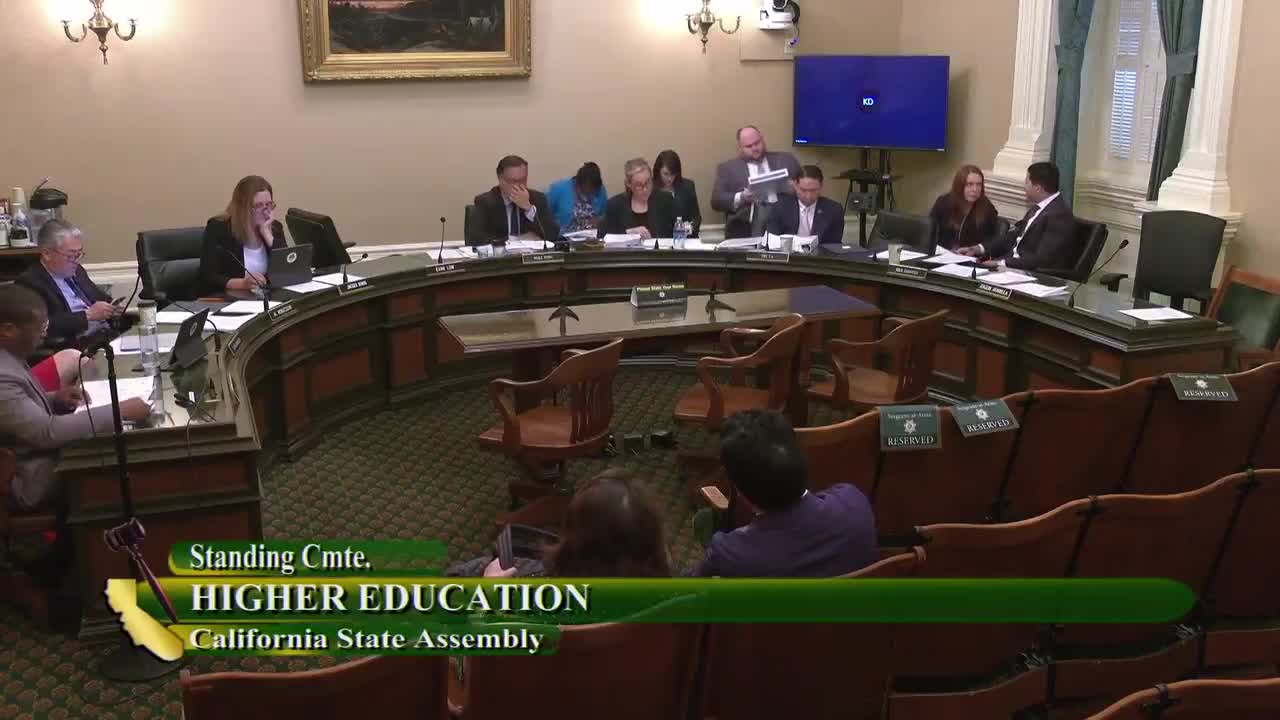 25SEC
Assembly Standing Committee on Higher Education
Bill Author
Bill Co-Author(s):