AB 362: Real property taxation: land value taxation study.
- Session Year: 2023-2024
- House: Assembly
- Latest Version Date: 2023-02-01
Current Status:
Failed
(2024-02-01: From committee: Filed with the Chief Clerk pursuant to Joint Rule 56.)
Introduced
In Committee
First Chamber
In Committee
Second Chamber
Enacted
What does this bill do?
This bill requires the California Department of Tax and Fee Administration to study whether a statewide land value tax — a tax on land value only, not buildings or improvements — could replace the state’s current methods for valuing real property for taxation. The department may hire outside experts and subcontractors to do the study and must report the findings to the Legislature.
The summary is provided by generative AI which can make mistakes. For original language, please view the details in the table below.
The California Constitution provides that all property is taxable, and requires that it be assessed at the same percentage of fair market value, unless otherwise provided by the California Constitution or federal law. Existing law governs the methods and procedures for assessing real property.
This bill would require the California Department of Tax and Fee Administration to conduct or commission a study on the efficacy of a statewide land value taxation system as an alternative to the current appraisal methods utilized for real property taxation. The bill would require the study to be provided to the Legislature by January 1, 2025. The bill would make related findings and declarations.
The Legislature finds and declares all of the following:
(a)A land value tax is a levy on the value of land without regard to buildings, property, or other improvements.
(b)Establishing a land value tax removes financial incentives to hold unused land solely for price appreciation, thereby making more land available for productive uses.
(c)The state considered Proposition 19 during the 1918 elections, which would have required all public revenues to be raised by a taxation on land values, irrespective of any improvements on the land.
(d)Land value tax was founded by American political economist and journalist Henry George in his 1879 work Progress and Poverty. His ideology later became known as Georgism and sparked several reform movements of the Progressive Era.
(e)In 1904, Lizzie Magie created a board game called The Landlords Game to demonstrate Henry Georges theories. This was later turned into the popular board game Monopoly.
(f)Land value taxation is currently implemented throughout the world in Denmark, Estonia, Lithuania, Russia, Singapore, and Taiwan. It has also been applied to lesser extents in parts of Australia, Mexico, and in Allentown, Pennsylvania, of the United States.
(g)After Allentown, Pennsylvania, adopted a land value tax through a split-rate system in 1996, the number of building permits increased by 32 percent.
SEC. 2.Section 169.5 is added to the Revenue and Taxation Code, to read:169.5.(a)The California Department of Tax and Fee Administration shall conduct a study on the efficacy of a statewide land value taxation system as an alternative to the current appraisal methods for real property taxation.
(b)The department may commission the study required by subdivision (a) to an appropriate third party.
(c)The author of the study required by subdivision (a) may subcontract with other entities as appropriate to obtain any necessary data.
(d)The department shall provide to the Legislature, in accordance with Section 9795 of the Government Code, the findings of the study by January 1, 2025.
|
Date
|
Status
|
|---|---|
| Feb 1, 2024 | From committee: Filed with the Chief Clerk pursuant to Joint Rule 56. |
| Jan 31, 2024 | Died pursuant to Art. IV, Sec. 10(c) of the Constitution. |
| Jan 10, 2024 | In committee: Set, second hearing. Hearing canceled at the request of author. |
| Apr 11, 2023 | In committee: Hearing for testimony only. |
| Mar 28, 2023 | In committee: Set, first hearing. Hearing canceled at the request of author. |
| Feb 9, 2023 | Referred to Com. on REV. & TAX. |
| Feb 2, 2023 | From printer. May be heard in committee March 4. |
| Feb 1, 2023 | Read first time. To print. |
This list shows positions taken on this bill by organizations on the date displayed, which is linked to the original source.
Positions by individuals are not included.
|
Organization
|
Position
|
Date
|
|---|---|---|
| Acclamation Insurance Management Services | ** Against | |
| Allied Managed Care | ** Against | |
| California Alliance Of Taxpayer Advocates | ** Against | |
| California Apartment Association | ** Against | |
| California Association Of Realtors | * Against | Apr 10, 2023 |
| California Building Industry Association | ** Against | |
| California Fuels And Convenience Alliance | * Against | Apr 10, 2023 |
| California School Employees Association | ** Support | |
| California Taxpayers Association | ** Against | |
| Coalition of Small and Disabled Veteran Businesses | ** Against | |
| Common Ground California | ** Support | |
| Common Ground Oregon/Washington | ** Support | |
| Davis College Democrats | ** Support | |
| East Bay for Everyone | ** Support | |
| East Bay YIMBY | ** Support | |
| Escrow Institute Of California | ** Against | |
| evolve california | ** Support | |
| Family Business Association of California | ** Against | |
| Flasher Barricade Association | ** Against | |
| Greater San Fernando Valley Chamber of Commerce | ** Against | |
| Grow the Richmond | ** Support | |
| House Sacramento | * Support | Apr 10, 2023 |
| How to ADU | ** Support | |
| Just Economics, LLC | ** Support | |
| Livable Communities Initiative | ** Support | |
| Los Angeles New Liberals | ** Support | |
| Mountain View YIMBY | ** Support | |
| Napa-Solano for Everyone | ** Support | |
| Northern Neighbors Sf | ** Support | |
| Orange County Business Council | ** Against | |
| Orange County Taxpayers Association | ** Against | |
| Pallet Shelter | ** Support | |
| Peninsula for Everyone | ** Support | |
| People For Housing Orange County | ** Support | |
| Progress and Poverty | ** Support | |
| Progress Noe Valley | ** Support | |
| San Francisco Taxpayer Association | ** Against | |
| San Francisco Yimby | ** Support | |
| San Gabriel Valley Economic Partnership | ** Against | |
| Santa Rosa Yimby | ** Support | |
| Solano County Taxpayers Association | ** Against | |
| Southside Forward | ** Support | |
| Tri-County Chamber Alliance | ** Against | |
| Urban Environmentalists | ** Support | |
| Ventura County YIMBY | ** Support | |
| West Coast Lumber And Building Material Association | ** Against | |
| West Ventura County Business Alliance | ** Against | |
| Yimby Action | ** Support |
Date of Hearing: April 10, 2023
ASSEMBLY COMMITTEE ON REVENUE AND TAXATION
Jacqui Irwin, Chair
ABPCA Bill Id:AB 362 (
Author:Lee) – As Introduced Ver:February 1, 2023
FOR TESTIMONY ONLY
Majority vote. Fiscal committee.
SUBJECT: Real property taxation: land value taxation study
SUMMARY: Directs the California Department of Tax and Fee Administration (CDTFA) to conduct a study on the efficacy of a statewide land value taxation system. Specifically, this bill:
- Requires the CDTFA to conduct a study on the efficacy of a statewide land value taxation system as an alternative to the current appraisal methods for real property taxation and to submit the study to the Legislature by January 1, 2025, in accordance with existing law.
- Authorizes the CDTFA to commission this study to an appropriate third party, which may in turn subcontract with other entities as appropriate to obtain any necessary data.
- Finds and declares:
- A land value tax is a levy on the value of land without regard to buildings, property, or other improvements;
- Establishing a land value tax removes financial incentives to hold unused land solely for price appreciation, thereby making more land available for productive uses;
- The state considered Proposition 19 during the 1918 elections, which would have required all public revenues to be raised by a taxation on land values, irrespective of any improvements on the land;
- Land value tax was founded by American political economist and journalist Henry George in his 1879 work "Progress and Poverty." His ideology later became known as Georgism and sparked several reform movements of the Progressive Era;
- In 1904, Lizzie Magie created a board game called "The Landlord's Game" to demonstrate Henry George's theories. This was later turned into the popular board Game "Monopoly";
- Land value taxation is currently implemented throughout the world in Denmark, Estonia, Lithuania, Russia, Singapore, and Taiwan. It has been applied to lesser extents in parts of Australia, Mexico, and Allentown, Pennsylvania, of the United States; and,
- After Allentown, Pennsylvania, adopted a land value tax through a split-rate system in 1996, the number of building permits increased by 32%.
EXISTING LAW:
- Provides that all property is taxable, shall be assessed at the same percentage of fair market value, and shall be taxed in proportion to its full value, unless otherwise provided by the state Constitution or federal law. (California Constitution, Article XIII, Section 1.)
- Limits any ad valorem tax on real property to 1% of the full cash value of the property, subject to certain increases related to voter-approved general obligation bonds or other indebtedness. (California Constitution, Article XIIIA, Sections 1 and 2.)
- Stipulates that "real property" includes improvements, which are defined as all buildings, structures, fixtures, and fences erected on or affixed to the land. (Revenue and Taxation Code Section 105.)
FISCAL EFFECT: Unknown, but no change to state revenues.
COMMENTS:
- The author has provided the following statement in support of this bill:
The concept of a Land Value Tax is not new and there are a number of jurisdictions that employ this tax system around the world. The founder of the land value tax, American political economist Henry George, argued that taxing land value is the most logical source of public revenue because the supply of land is fixed.
Under our current property tax system, taxes are calculated by the value of the property. This is a regressive tax, as it disincentivizes a property owner from building or improving their property, as they could see a drastic increase in their taxes. A landowner may then decide not to develop a vacant lot or parking lot they own in order to keep their taxes low.
Alternatively, a land value tax could incentivize property owners to develop their land as their taxes would remain the same, regardless of their actions. Having a vacant lot would no longer be financially viable, and this could spur the development of more housing, which California is in desperate need of.
This bill is a first step toward studying the efficacy of a statewide land value taxation system as a potential alternative to our current taxation system.
- A coalition mainly comprised of housing advocates writing in support of this bill state, in part:
The current property tax system results in higher taxes for improvements to the value of the property, effectively providing a disincentive to improve the property or add more housing to a lot of land. Alternatively, a land value tax system would disincentivize properties that are left idle, creating an incentive for landowners to improve and maximize the use of their land. There are a number of jurisdictions that employ land value tax systems or a variation of it around the world including Allentown, Pennsylvania, which adopted a land value tax in 1996. This new tax system resulted in 70% of residential parcels receiving a tax decrease and the City experienced a 32% increase in building permits. By studying an alternative to our current taxation system, we can explore new ways to encourage property development to better address our housing needs.
- A coalition of taxpayer, housing, and business associations, writing in opposition to this bill, state, in part:
Proponents of a land value tax claim that property taxes for Californians would decrease after the adoption of the new tax system. This is unlikely, as property owners would no longer be protected by Proposition 13's assessment limitations, tax rate, or annual assessed valuation increases, and local governments would oppose any efforts to reduce their revenue. Advocates of the land tax opine that the system would increase taxes on business property owners so much that homeowners could get a reduction without impacting local governments' net revenue, but the more likely result is that the large property tax hike on businesses would lead employers to relocate to less expensive states – leaving homeowners to bear more of the burden of paying for local government – or increase consumer prices to cover the cost increase. Either way, Californians would see their costs increase and job opportunities decrease.
- Committee Staff Comments:
- Henry George: The author of Progress and Poverty (1879), which sold millions of copies worldwide, was an American journalist, economist, and candidate for multiple political offices in the late 19th Century. George is best known for popularizing the argument that the economic rent derived from land, including from all natural resources, the commons, and urban locations, should belong equally to all members of society. George further argued that this could be accomplished by the state levying a single tax, the "land value tax".
In economics, "economic rent" is any payment to the owner of a factor of production in excess of the cost needed to bring that factor into production. In the case of property, this would be the difference between the price at which an owner is willing to sell their property and the price a purchaser is willing to pay. It should be noted that, in microeconomic theory, it is assumed that the owner selling their property has already accounted for any costs and factored them into the offer price to still realize a return. In other words, economic rent is distinct from profit, and is a return above that which would be expected in a perfectly competitive market.
George argued that because the supply of land is essentially inelastic, the burden of a land value tax would be entirely levied on the owner of the land. George proposed that all forms of taxation could be replaced by the land value tax as a tax on the inelastic supply of land would create no deadweight loss, the difference in production and consumption of a given good or service.
- Which way is up? As this bill is currently drafted, there are no metrics by which the CDTFA is directed to evaluate the efficacy of a land value taxation system. The author and supporters contend that a land value taxation system would remove disincentives to develop land. Theoretically, the greatest potential for increasing development as a result of a land value tax would be parcels in vacant urban areas. However, a report issued in April 2022 by the Terner Center for Housing Innovation at UC Berkeley, "The Landscape of Middle-Income Housing Affordability in California", notes "[the Department of Housing and Community Development] estimates that the state needs to build more than 2.5 million homes by 2030," and "while very-low and low-income categories are the most underbuilt – in part due to the scarcity of subsidies – statewide, only 40 percent of units targeted at those earning 80 to 120 percent [area median income] have been built." There is already a significant lack of housing development for income categories that desperately need homes. Incentivizing more development, without prioritizing the type of housing actually needed in the state, may exacerbate the very problem the author and supporters hope to address.
Opponents to this bill state that this bill could jeopardize the protections enshrined in Proposition 13. However, there is no direction in this bill to prevent a carryover of the protections in Proposition 13. The value of the land could be the only component assessed for taxation and, similar to existing property tax law, that value could go without reassessment until a change of ownership occurs on the property. Additionally, opponents claim that this system would create greater revenue volatility for local governments. However, a split-rate system, where land is taxed at a higher percentage than improvements, combined with holding assessed values at a base year could potentially stabilize revenues and ensure that a land value taxation system remains revenue neutral. Ultimately, the outcome would depend entirely upon the construction of the system of taxation, a determination about which cannot be readily made without direction as to how the CDTFA should measure an efficacious system.
Claims made regarding the impact of potential recommendations resulting from this bill's study are difficult to evaluate given the lack of identifiable parameters that the CDTFA may reference to establish what an efficacious land value taxation system would be. The author may wish to consider amending this bill to provide greater direction to the CDTFA, and reduce confusion amongst potentially impacted stakeholders.
- Who's who? This bill currently assigns the CDTFA as the responsible agency for conducting this study. However, the CDTFA is not the responsible state agency overseeing property taxation; rather, the Board of Equalization (BOE) is the responsible entity. While this bill does authorize the CDTFA to contract with a third party to complete the study, the CDTFA may lack the experience to review the study and validate its findings. The author may wish to amend this bill to assign the BOE as the responsible entity for conducting this bill's study.
- Other jurisdictions: While land value taxation has been considered in a number of jurisdictions within the nation, Pennsylvania has experienced the greatest number of municipalities that have adopted some form of a land value tax. Since 1913, Pennsylvania has had 33 municipalities consider a land value tax. Of these, 16 have split rates; 5 have rescinded split rates; and 12 have considered, but never implemented, split rates. One such municipality, Pittsburgh, was the subject of an analysis of its split-rate system. Authored by Wallace E. Oates and Robert M. Schwab and published in the National Tax Journal, the report found that the average annual value of building permits increased dramatically, suggesting a significant increase in building activity. However, this boom was largely focused in the urban area itself, and did not extend to the wider metropolitan area. Commercial development was the most significant contributor to the increased development, with residential construction experiencing only a modest increase. However, Oates and Schwab also note that this construction boom was in the context of a wider revitalization of the city after the steady deterioration of the manufacturing sector as the predominant sector of employment. Thus, they find:
The point here is that if land taxation were neutral, we would expect it to have no effect on any decisions. This is its very appeal: it does not distort economic choices. Thus, the responses of those interviewed are fully consistent with the traditional view of the neutrality of land taxation. Land taxation should not, and apparently did not, in itself hasten development[1].
As Oates and Schwab note, the underlying rationale behind a land value tax is the lack of distortionary effect such a system imposes on the wider economy. Thus, the land value tax alone should not impact the rate of development, both theoretically and in practice, as exemplified by this case study.
REGISTERED SUPPORT / OPPOSITION:
Support
California School Employees Association
Common Ground California
Common Ground Oregon/Washington
Davis College Democrats
East Bay for Everyone
East Bay YIMBY
Evolve California
Grow the Richmond
How to ADU
Just Economics, LLC
Livable Communities Initiative
Los Angeles New Liberals
Mountain View YIMBY
Napa-Solano for Everyone
Northern Neighbors, SF
Pallet Shelter
Peninsula for Everyone
People for Housing – Orange County
Progress and Poverty
Progress Noe Valley
San Francisco YIMBY
Santa Rosa YIMBY
Southside Forward
Urban Environmentalists
Ventura County YIMBY
YIMBY Action
Opposition
Acclamation Insurance Management Services
Allied Managed Care
California Alliance of Taxpayer Advocates
California Apartment Association
California Association of Realtors
California Building Industry Association
California Fuels and Convenience Alliance
California Taxpayers Association
Coalition of Small and Disabled Veteran Businesses
Escrow Institute of California
Family Business Association of California
Flasher Barricade Association
Greater San Fernando Valley Chamber of Commerce
Orange County Business Council
Orange County Taxpayers Association
San Francisco Taxpayer Association
San Gabriel Valley Economic Partnership
Solano County Taxpayers Association
Tri-County Chamber Alliance
West Coast Lumber and Building Material Association
West Ventura County Business Alliance
Analysis Prepared by: Harrison Bowlby / REV. & TAX. / (916) 319-2098
Oates, Wallace E. and Robert M. Schwab, "The Impact of Urban Land Taxation: The Pittsburgh Experience," National Tax Journal (March 1997, Volume 50, Number 1), 18. ↑
Date of Hearing: March 27, 2023
ASSEMBLY COMMITTEE ON REVENUE AND TAXATION
Jacqui Irwin, Chair
ABPCA Bill Id:AB 362 (
Author:Lee) – As Introduced Ver:February 1, 2023
Majority vote. Fiscal committee.
SUBJECT: Real property taxation: land value taxation study
SUMMARY: Directs the California Department of Tax and Fee Administration (CDTFA) to conduct a study on the efficacy of a statewide land value taxation system. Specifically, this bill:
- Requires the CDTFA to conduct a study on the efficacy of a statewide land value taxation system as an alternative to the current appraisal methods for real property taxation and to submit the study to the Legislature by January 1, 2025, in accordance with existing law.
- Authorizes the CDTFA to commission this study to an appropriate third party, which may in turn subcontract with other entities as appropriate to obtain any necessary data.
- Finds and declares:
- A land value tax is a levy on the value of land without regard to buildings, property, or other improvements;
- Establishing a land value tax removes financial incentives to hold unused land solely for price appreciation, thereby making more land available for productive uses;
- The state considered Proposition 19 during the 1918 elections, which would have required all public revenues to be raised by a taxation on land values, irrespective of any improvements on the land;
- Land value tax was founded by American political economist and journalist Henry George in his 1879 work "Progress and Poverty." His ideology later became known as Georgism and sparked several reform movements of the Progressive Era;
- In 1904, Lizzie Magie created a board game called "The Landlord's Game" to demonstrate Henry George's theories. This was later turned into the popular board Game "Monopoly";
- Land value taxation is currently implemented throughout the world in Denmark, Estonia, Lithuania, Russia, Singapore, and Taiwan. It has been applied to lesser extents in parts of Australia, Mexico, and Allentown, Pennsylvania, of the United States; and,
- After Allentown, Pennsylvania, adopted a land value tax through a split-rate system in 1996, the number of building permits increased by 32%.
EXISTING LAW:
- Provides that all property is taxable, shall be assessed at the same percentage of fair market value, and shall be taxed in proportion to its full value, unless otherwise provided by the state Constitution or federal law. (California Constitution, Article XIII, Section 1.)
- Limits any ad valorem tax on real property to 1% of the full cash value of the property, subject to certain increases related to voter-approved general obligation bonds or other indebtedness. (California Constitution, Article XIIIA, Sections 1 and 2.)
- Stipulates that "real property" includes improvements, which are defined as all buildings, structures, fixtures, and fences erected on or affixed to the land. (Revenue and Taxation Code Section 105.)
FISCAL EFFECT: Unknown, but no change to state revenues.
COMMENTS:
- The author has provided the following statement in support of this bill:
The concept of a Land Value Tax is not new and there are a number of jurisdictions that employ this tax system around the world. The founder of the land value tax, American political economist Henry George, argued that taxing land value is the most logical source of public revenue because the supply of land is fixed.
Under our current property tax system, taxes are calculated by the value of the property. This is a regressive tax, as it disincentivizes a property owner from building or improving their property, as they could see a drastic increase in their taxes. A landowner may then decide not to develop a vacant lot or parking lot they own in order to keep their taxes low.
Alternatively, a land value tax could incentivize property owners to develop their land as their taxes would remain the same, regardless of their actions. Having a vacant lot would no longer be financially viable, and this could spur the development of more housing, which California is in desperate need of.
This bill is a first step toward studying the efficacy of a statewide land value taxation system as a potential alternative to our current taxation system.
- A coalition mainly comprised of housing advocates writing in support of this bill state, in part:
The current property tax system results in higher taxes for improvements to the value of the property, effectively providing a disincentive to improve the property or add more housing to a lot of land. Alternatively, a land value tax system would disincentivize properties that are left idle, creating an incentive for landowners to improve and maximize the use of their land. There are a number of jurisdictions that employ land value tax systems or a variation of it around the world including Allentown, Pennsylvania, which adopted a land value tax in 1996. This new tax system resulted in 70% of residential parcels receiving a tax decrease and the City experienced a 32% increase in building permits. By studying an alternative to our current taxation system, we can explore new ways to encourage property development to better address our housing needs.
- A coalition of taxpayer, housing, and business associations, writing in opposition to this bill, state, in part:
Proponents of a land value tax claim that property taxes for Californians would decrease after the adoption of the new tax system. This is unlikely, as property owners would no longer be protected by Proposition 13's assessment limitations, tax rate, or annual assessed valuation increases, and local governments would oppose any efforts to reduce their revenue. Advocates of the land tax opine that the system would increase taxes on business property owners so much that homeowners could get a reduction without impacting local governments' net revenue, but the more likely result is that the large property tax hike on businesses would lead employers to relocate to less expensive states – leaving homeowners to bear more of the burden of paying for local government – or increase consumer prices to cover the cost increase. Either way, Californians would see their costs increase and job opportunities decrease.
- Committee Staff Comments:
- Henry George: The author of Progress and Poverty (1879), which sold millions of copies worldwide, was an American journalist, economist, and candidate for multiple political offices in the late 19th Century. George is best known for popularizing the argument that the economic rent derived from land, including from all natural resources, the commons, and urban locations, should belong equally to all members of society. George further argued that this could be accomplished by the state levying a single tax, the "land value tax".
In economics, "economic rent" is any payment to the owner of a factor of production in excess of the cost needed to bring that factor into production. In the case of property, this would be the difference between the price at which an owner is willing to sell their property and the price a purchaser is willing to pay. It should be noted that, in microeconomic theory, it is assumed that the owner selling their property has already accounted for any costs and factored them into the offer price to still realize a return. In other words, economic rent is distinct from profit, and is a return above that which would be expected in a perfectly competitive market.
George argued that because the supply of land is essentially inelastic, the burden of a land value tax would be entirely levied on the owner of the land. George proposed that all forms of taxation could be replaced by the land value tax as a tax on the inelastic supply of land would create no deadweight loss, the difference in production and consumption of a given good or service.
- Which way is up? As this bill is currently drafted, there are no metrics by which the CDTFA is directed to evaluate the efficacy of a land value taxation system. The author and supporters contend that a land value taxation system would remove disincentives to develop land. Theoretically, the greatest potential for increasing development as a result of a land value tax would be parcels in vacant urban areas. However, a report issued in April 2022 by the Terner Center for Housing Innovation at UC Berkeley, "The Landscape of Middle-Income Housing Affordability in California", notes "[the Department of Housing and Community Development] estimates that the state needs to build more than 2.5 million homes by 2030," and "while very-low and low-income categories are the most underbuilt – in part due to the scarcity of subsidies – statewide, only 40 percent of units targeted at those earning 80 to 120 percent [area median income] have been built." There is already a significant lack of housing development for income categories that desperately need homes. Incentivizing more development, without prioritizing the type of housing actually needed in the state, may exacerbate the very problem the author and supporters hope to address.
Opponents to this bill state that this bill could jeopardize the protections enshrined in Proposition 13. However, there is no direction in this bill to prevent a carryover of the protections in Proposition 13. The value of the land could be the only component assessed for taxation and, similar to existing property tax law, that value could go without reassessment until a change of ownership occurs on the property. Additionally, opponents claim that this system would create greater revenue volatility for local governments. However, a split-rate system, where land is taxed at a higher percentage than improvements, combined with holding assessed values at a base year could potentially stabilize revenues and ensure that a land value taxation system remains revenue neutral. Ultimately, the outcome would depend entirely upon the construction of the system of taxation, a determination about which cannot be readily made without direction as to how the CDTFA should measure an efficacious system.
Claims made regarding the impact of potential recommendations resulting from this bill's study are difficult to evaluate given the lack of identifiable parameters that the CDTFA may reference to establish what an efficacious land value taxation system would be. The author may wish to consider amending this bill to provide greater direction to the CDTFA, and reduce confusion amongst potentially impacted stakeholders.
- Who's who? This bill currently assigns the CDTFA as the responsible agency for conducting this study. However, the CDTFA is not the responsible state agency overseeing property taxation; rather, the Board of Equalization (BOE) is the responsible entity. While this bill does authorize the CDTFA to contract with a third party to complete the study, the CDTFA may lack the experience to review the study and validate its findings. The author may wish to amend this bill to assign the BOE as the responsible entity for conducting this bill's study.
- Other jurisdictions: While land value taxation has been considered in a number of jurisdictions within the nation, Pennsylvania has experienced the greatest number of municipalities that have adopted some form of a land value tax. Since 1913, Pennsylvania has had 33 municipalities consider a land value tax. Of these, 16 have split rates; 5 have rescinded split rates; and 12 have considered, but never implemented, split rates. One such municipality, Pittsburgh, was the subject of an analysis of its split-rate system. Authored by Wallace E. Oates and Robert M. Schwab and published in the National Tax Journal, the report found that the average annual value of building permits increased dramatically, suggesting a significant increase in building activity. However, this boom was largely focused in the urban area itself, and did not extend to the wider metropolitan area. Commercial development was the most significant contributor to the increased development, with residential construction experiencing only a modest increase. However, Oates and Schwab also note that this construction boom was in the context of a wider revitalization of the city after the steady deterioration of the manufacturing sector as the predominant sector of employment. Thus, they find:
The point here is that if land taxation were neutral, we would expect it to have no effect on any decisions. This is its very appeal: it does not distort economic choices. Thus, the responses of those interviewed are fully consistent with the traditional view of the neutrality of land taxation. Land taxation should not, and apparently did not, in itself hasten development[1].
As Oates and Schwab note, the underlying rationale behind a land value tax is the lack of distortionary effect such a system imposes on the wider economy. Thus, the land value tax alone should not impact the rate of development, both theoretically and in practice, as exemplified by this case study.
- Amendments: The author has agreed to amend this bill to assign the Board of Equalization (BOE) as the responsible agency to conduct this study, rather than the CDTFA, and to include the following factors for the BOE to consider when evaluating the efficacy of a land value taxation system:
- The ratio of tax burden on residential homeowners relative to business property owners;
- Potential for tax avoidance;
- Estimated revenue projections; and,
- Any barriers to development of vacant and underutilized land resulting from property taxation under existing law and the extent to which a land value tax would remove those barriers.
- Amendments: The author has agreed to amend this bill to assign the Board of Equalization (BOE) as the responsible agency to conduct this study, rather than the CDTFA, and to include the following factors for the BOE to consider when evaluating the efficacy of a land value taxation system:
REGISTERED SUPPORT / OPPOSITION:
Support
California School Employees Association
Common Ground California
Common Ground Oregon/Washington
Davis College Democrats
East Bay for Everyone
East Bay YIMBY
Evolve California
Grow the Richmond
How to ADU
Just Economics, LLC
Livable Communities Initiative
Los Angeles New Liberals
Mountain View YIMBY
Napa-Solano for Everyone
Northern Neighbors, SF
Pallet Shelter
Peninsula for Everyone
People for Housing – Orange County
Progress and Poverty
Progress Noe Valley
San Francisco YIMBY
Santa Rosa YIMBY
Southside Forward
Urban Environmentalists
Ventura County YIMBY
YIMBY Action
Opposition
Acclamation Insurance Management Services
Allied Managed Care
California Apartment Association
California Association of Realtors
California Building Industry Association
California Fuels and Convenience Alliance
California Taxpayers Association
Coalition of Small and Disabled Veteran Businesses
Escrow Institute of California
Family Business Association of California
Flasher Barricade Association
Greater San Fernando Valley Chamber of Commerce
Orange County Business Council
Orange County Taxpayers Association
San Gabriel Valley Economic Partnership
Solano County Taxpayers Association
Tri-County Chamber Alliance
West Coast Lumber and Building Material Association
West Ventura County Business Alliance
Analysis Prepared by: Harrison Bowlby / REV. & TAX. / (916) 319-2098
Oates, Wallace E. and Robert M. Schwab, "The Impact of Urban Land Taxation: The Pittsburgh Experience," National Tax Journal (March 1997, Volume 50, Number 1), 18. ↑
Discussed in Hearing
 12MIN
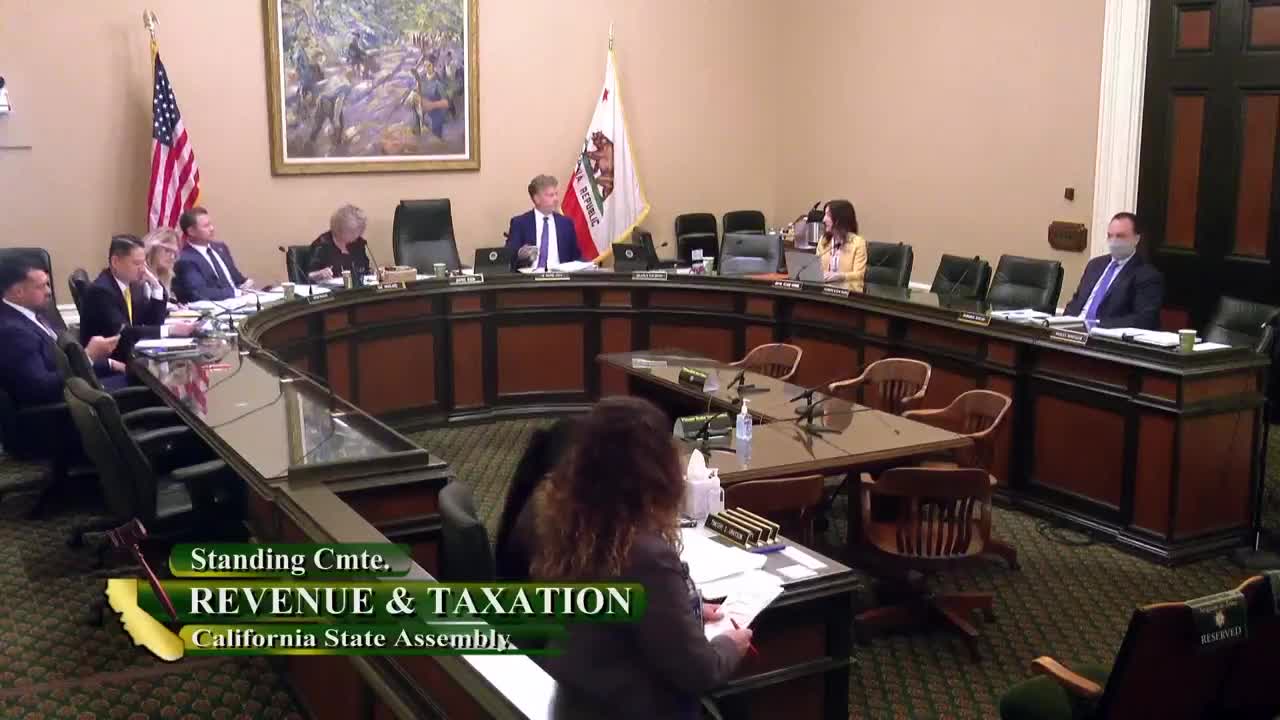
Assembly Standing Committee on Revenue and Taxation
Bill Author

Bill Co-Author(s):