AB 406: Agriculture: Healthy Soils Program: organic production.
- Session Year: 2023-2024
- House: Assembly
- Latest Version Date: 2023-03-09
Current Status:
Failed
(2024-02-01: From committee: Filed with the Chief Clerk pursuant to Joint Rule 56.)
Introduced
In Committee
First Chamber
In Committee
Second Chamber
Enacted
The Cannella Environmental Farming Act of 1995 requires the Department of Food and Agriculture, in consultation with the Scientific Advisory Panel on Environmental Farming, to establish and oversee a Healthy Soils Program to seek to optimize climate benefits while supporting the economic viability of California agriculture by providing incentives, including loans, grants, research, and technical assistance, and educational materials and outreach to farmers whose management practices contribute to healthy soils and result in net long-term on-farm greenhouse gas benefits. Existing law authorizes the Healthy Soils Program to also include the funding of on-farm demonstration projects that further the goals of the program. Existing law requires the department, if it elects to fund those on-farm demonstration projects, to establish a technical advisory committee to review those applications for scientific validity and the proposed projects potential to achieve greenhouse gas benefits.
This bill would additionally authorize the Healthy Soils Program to include the funding of organic farming projects that further the goals of the program and require the department to establish the technical advisory committee if it elects to fund those projects, as specified. The bill would require the department to support and incentivize organic production by providing grants of up to 5 years to certified organic farmers and ranchers, as defined, and during farmers or ranchers 3-year organic transition period, as described, and to prioritize applicants who propose to implement multiple healthy soils practices and certified organic farmer or rancher applicants. The bill would require the department to provide grants of up to 5 years for on-farm demonstration projects. The bill would require the department, on or before January 1, 2026, to submit a report to the Legislature on how the program incentivizes farmers and ranchers to implement multiple healthy soils practices, including incentivizing farmers and ranchers to transition to organic production.
Existing law establishes the California Farmland Conservancy Program in the Department of Conservation, and authorizes the program to offer financial assistance, including grants or contracts, for projects and activities on agricultural lands that support agricultural conservation and sustainable land management, including the acquisition of agricultural conservation easements or fee title to protect the lands agricultural use or capacity, improvements to land protected by a conservation easement, deed restriction, or similar long-term agreement, plans to protect and conserve agricultural lands, plans to protect, conserve, restore, or enhance resources or values located on, or adjacent to, agricultural lands or that were historically present on agricultural lands, technical assistance to develop projects, prepare applications, and implement projects, administrative costs incurred by the department to administer the program, and any other purposes approved by the Legislature in a funding appropriation for the program. Existing law creates the California Farmland Conservancy Program Fund and continuously appropriates moneys in the fund from federal grants and gifts and donations for purposes of the California Farmland Conservancy Program.This bill would provide that the California Farmland Conservancy Programs authorization to offer financial assistance for projects and activities on agricultural lands that support agricultural conservation and sustainable land management also includes obtaining organic certification. By expanding the purposes for which continuously appropriated moneys may be used, the bill would make an appropriation.The Cannella Environmental Farming Act of 1995 requires the Department of Food and Agriculture, in consultation with the Scientific Advisory Panel on Environmental Farming, to establish and oversee a Healthy Soils Program to seek to optimize climate benefits while supporting the economic viability of California agriculture by providing incentives, including loans, grants, research, and technical assistance, and educational materials and outreach to farmers whose management practices contribute to healthy soils and result in net long-term on-farm greenhouse gas benefits. Existing law authorizes the Healthy Soils Program to also include the funding of on-farm demonstration projects that further the goals of the program. Existing law requires the department, if it elects to fund those on-farm demonstration projects, to establish a technical advisory committee to review those applications for scientific validity and the proposed projects potential to achieve greenhouse gas benefits.
This bill would additionally authorize the Healthy Soils Program to include the funding of organic farming projects that further the goals of the program and require the department to establish the technical advisory committee if it elects to fund those projects, as specified.
Existing law establishes the California Farmland Conservancy Program in the Department of Conservation, and authorizes the program to offer financial assistance, including grants or contracts, for projects and activities on agricultural lands that support agricultural conservation and sustainable land management, including the acquisition of agricultural conservation easements or fee title to protect the lands agricultural use or capacity, improvements to land protected by a conservation easement, deed restriction, or similar long-term agreement, plans to protect and conserve agricultural lands, plans to protect, conserve, restore, or enhance resources or values located on, or adjacent to, agricultural lands or that were historically present on agricultural lands, technical assistance to develop projects, prepare applications, and implement projects, administrative costs incurred by the department to administer the program, and any other purposes approved by the Legislature in a funding appropriation for the program. Existing law creates the California Farmland Conservancy Program Fund and continuously appropriates moneys in the fund from federal grants and gifts and donations for purposes of the California Farmland Conservancy Program.
This bill would provide that the California Farmland Conservancy Programs authorization to offer financial assistance for projects and activities on agricultural lands that support agricultural conservation and sustainable land management also includes obtaining organic certification. By expanding the purposes for which continuously appropriated moneys may be used, the bill would make an appropriation.
(a)(1)The department, in consultation with the panel, shall establish and oversee a Healthy Soils Program. The program shall seek to optimize climate benefits while supporting the economic viability of California agriculture by providing incentives, including, but not limited to, loans, grants, research, and technical assistance, and educational materials and outreach, to farmers whose management practices contribute to healthy soils and result in net long-term on-farm greenhouse gas benefits. The program may also include the funding of on-farm demonstration projects, and organic farming projects, that further the goals of the program.
(2)The department, in consultation with the panel, may determine priorities for the program and give priority to projects that occur in and benefit disadvantaged communities identified pursuant to Section 39711 of the Health and Safety Code, show promise of being replicable in other parts of the state, or provide environmental and agronomic cobenefits, such as improved air and water quality, improved crop yield, and reduced soil erosion.
(3)The panel shall also advise the department on scientific findings, program framework, guidelines, grower incentives, and providing technical assistance.
(4)The department shall support and incentivize organic production by providing grants of up to five years to certified organic farmers and ranchers, and during farmers or ranchers three-year organic transition period described in Section 205.202 of Title 7 of the Code of Federal Regulations. The department shall prioritize applicants who propose to implement multiple healthy soils practices and certified organic farmer or rancher applicants.
(4)(5)If the department elects to fund on-farm demonstration projects or organic farming projects described in paragraph (1), the department, in consultation with the panel, shall establish a technical advisory committee to review on-farm demonstration project or organic farming project applications for scientific validity and the proposed projects potential to achieve greenhouse gas benefits.
(6)The department shall provide grants of up to five years for on-farm demonstration projects.
(b)The department shall implement the program and quantify greenhouse gas emissions reductions in accordance with the funding guidelines developed by the State Air Resources Board pursuant to Section 39715 of the Health and Safety Code and the quantification methods developed by the State Air Resources Board pursuant to Section 16428.9 of the Government Code.
(c)(1)The department may pursue public and private sources to support the Healthy Soils Program.
(2)To the extent funds are available, the department may provide support to the program, including, but not limited to, technical assistance, education, and outreach.
(d)For purposes of this section, panel means the Scientific Advisory Panel on Environmental Farming.
(e)For purposes of the Healthy Soils Program, the following terms have the following meanings:
(1)Certified organic farmer or rancher means a farmer or rancher certified organic pursuant to the federal Organic Foods Production Act of 1990 (7 U.S.C. Sec. 6501 et seq.).
(1)(2)Greenhouse gas benefits means greenhouse gas emissions source reduction or carbon sequestration.
(2)(3)Healthy soils means soils that enhance their continuing capacity to function as a biological system, increase soil organic matter, improve soil structure and water- and nutrient-holding capacity, and result in net long-term greenhouse gas benefits.
(3)(4)On-farm demonstration projects means projects that incorporate farm management practices that result in greenhouse gas benefits across all farming types with the intent to establish or promote healthy soils.
SEC. 2.Section 10230.2 of the Public Resources Code is amended to read:10230.2.(a)The California Farmland Conservancy Program is hereby established in the department.(b)The program may offer financial assistance, including grants or contracts, for projects and activities on agricultural lands that support agricultural conservation and sustainable land management, including, but not limited to, any of the following:(1)Acquisition of agricultural conservation easements or fee title to protect the lands agricultural use or capacity that meets the following requirements:(A)The primary purpose for which the easement or fee title is being sought is consistent with continuing agricultural use of the property.(B)The easement or fee title does not, and will not, substantially prevent agricultural uses on the property.(C)Any nonagricultural qualities that will be protected by the easement or fee title, if applicable, are inherent to the property.(2)Improvements to land protected by a conservation easement, deed restriction, or similar long-term agreement as determined by the director.(3)Plans to protect and conserve agricultural lands and plans to protect, conserve, restore, or enhance resources or values located on, or adjacent to, agricultural lands or that were historically present on agricultural lands. These may include, but are not limited to, either of the following:(A)An agricultural land component or element of a general plan developed pursuant to Section 65565 of the Government Code.(B)Land conservation strategies and plans to identify and develop potential projects.(4)Obtaining organic certification.(5)Technical assistance to develop projects, prepare applications, and implement projects.(6)Administrative costs incurred by the department to administer the program.(7)Any other purposes approved by the Legislature in a funding appropriation for the program.SEC. 2.Section 569.1 is added to the Food and Agricultural Code, to read:569.1.(a)On or before January 1, 2026, the department shall submit a report to the Legislature on how the Healthy Soils Program incentivizes farmers and ranchers to implement multiple healthy soils practices, including incentivizing farmers and ranchers to transition to organic production.
(b)(1)A report to be submitted pursuant to subdivision (a) shall be submitted in compliance with Section 9795 of the Government Code.
(2)Pursuant to Section 10231.5 of the Government Code, this section is repealed on January 1, 2030.
(a)(1)The department, in consultation with the panel, shall establish and oversee a Healthy Soils Program. The program shall seek to optimize climate benefits while supporting the economic viability of California agriculture by providing incentives, including, but not limited to, loans, grants, research, and technical assistance, and educational materials and outreach, to farmers whose management practices contribute to healthy soils and result in net long-term on-farm greenhouse gas benefits. The program may also include the funding of on-farm demonstration projects projects, and organic farming projects, that further the goals of the program.
(2)The department, in consultation with the panel, may determine priorities for the program and give priority to projects that occur in and benefit disadvantaged communities identified pursuant to Section 39711 of the Health and Safety Code, show promise of being replicable in other parts of the state, or provide environmental and agronomic cobenefits, such as improved air and water quality, improved crop yield, and reduced soil erosion.
(3)The panel shall also advise the department on scientific findings, program framework, guidelines, grower incentives, and providing technical assistance.
(4)If the department elects to fund on-farm demonstration projects or organic farming projects described in paragraph (1), the department, in consultation with the panel, shall establish a technical advisory committee to review on-farm demonstration project or organic farming project applications for scientific validity and the proposed projects potential to achieve greenhouse gas benefits.
(b)The department shall implement the program and quantify greenhouse gas emissions reductions in accordance with the funding guidelines developed by the State Air Resources Board pursuant to Section 39715 of the Health and Safety Code and the quantification methods developed by the State Air Resources Board pursuant to Section 16428.9 of the Government Code.
(c)(1)The department may pursue public and private sources to support the Healthy Soils Program.
(2)To the extent funds are available, the department may provide support to the program, including, but not limited to, technical assistance, education, and outreach.
(d)For purposes of this section, panel means the Scientific Advisory Panel on Environmental Farming.
(e)For purposes of the Healthy Soils Program, the following terms have the following meanings:
(1)Greenhouse gas benefits means greenhouse gas emissions source reduction or carbon sequestration.
(2)Healthy soils means soils that enhance their continuing capacity to function as a biological system, increase soil organic matter, improve soil structure and water- and nutrient-holding capacity, and result in net long-term greenhouse gas benefits.
(3)On-farm demonstration projects means projects that incorporate farm management practices that result in greenhouse gas benefits across all farming types with the intent to establish or promote healthy soils.
SEC. 2.Section 10230.2 of the Public Resources Code is amended to read:10230.2.(a)The California Farmland Conservancy Program is hereby established in the department.
(b)The program may offer financial assistance, including grants or contracts, for projects and activities on agricultural lands that support agricultural conservation and sustainable land management, including, but not limited to, any of the following:
(1)Acquisition of agricultural conservation easements or fee title to protect the lands agricultural use or capacity that meets the following requirements:
(A)The primary purpose for which the easement or fee title is being sought is consistent with continuing agricultural use of the property.
(B)The easement or fee title does not, and will not, substantially prevent agricultural uses on the property.
(C)Any nonagricultural qualities that will be protected by the easement or fee title, if applicable, are inherent to the property.
(2)Improvements to land protected by a conservation easement, deed restriction, or similar long-term agreement as determined by the director.
(3)Plans to protect and conserve agricultural lands and plans to protect, conserve, restore, or enhance resources or values located on, or adjacent to, agricultural lands or that were historically present on agricultural lands. These may include, but are not limited to, either of the following:
(A)An agricultural land component or element of a general plan developed pursuant to Section 65565 of the Government Code.
(B)Land conservation strategies and plans to identify and develop potential projects.
(4)Obtaining organic certification.
(4)(5)Technical assistance to develop projects, prepare applications, and implement projects.
(5)(6)Administrative costs incurred by the department to administer the program.
(6)(7)Any other purposes approved by the Legislature in a funding appropriation for the program.
|
Date
|
Status
|
|---|---|
| Feb 1, 2024 | From committee: Filed with the Chief Clerk pursuant to Joint Rule 56. |
| Jan 31, 2024 | Died pursuant to Art. IV, Sec. 10(c) of the Constitution. |
| May 18, 2023 | In committee: Hearing postponed by committee. |
| Mar 29, 2023 | In committee: Set, first hearing. Referred to APPR. suspense file. |
| Mar 16, 2023 | From committee: Do pass and re-refer to Com. on APPR. (Ayes 6. Noes 1.) (March 15). Re-referred to Com. on APPR. |
| Mar 13, 2023 | Re-referred to Com. on AGRI. |
| Mar 9, 2023 | From committee chair, with author's amendments: Amend, and re-refer to Com. on AGRI. Read second time and amended. |
| Feb 9, 2023 | Referred to Com. on AGRI. |
| Feb 3, 2023 | From printer. May be heard in committee March 5. |
| Feb 2, 2023 | Read first time. To print. |
|
Date
|
Description
|
Location
|
Votes
|
|
|---|---|---|---|---|
| Mar 15, 2023 | Do pass and be re-referred to the Committee on [Appropriations] | Assembly Standing Committee on Agriculture |
Passed |
This list shows positions taken on this bill by organizations on the date displayed, which is linked to the original source.
Positions by individuals are not included.
|
Organization
|
Position
|
Date
|
|---|---|---|
| Agricultural Institute of Marin | * Support | Mar 15, 2023 |
| All STAR Organics | ** Support | |
| All Star Organics | * Support | Mar 15, 2023 |
| California Certified Organic Farmers Ccof | * Support | Mar 15, 2023 |
| California Compost Coalition | * Support | Mar 15, 2023 |
| Cardoza & Cardoza Farming Co. | ** Support | |
| Center For Food Safety | * Support | Mar 15, 2023 |
| Health Care Without Harm | ** Support | |
| Lucero Organic Farms | ** Support | |
| Mandela Partners | ** Support | |
| Pesticide Action Network North America | ** Support | |
| Sunblaze Ranch | ** Support |
Date of Hearing: March 29, 2023
ASSEMBLY COMMITTEE ON APPROPRIATIONS
Chris Holden, Chair
ABPCA Bill Id:AB 406
Author:(Connolly) – As Amended Ver:March 9, 2023
Policy Committee: | Agriculture | Vote: | 6 - 1 |
|
| ||
|
|
Urgency: No State Mandated Local Program: No Reimbursable: No
SUMMARY:
This bill modifies the Healthy Soils Program (HSP) at the California Department of Food and Agriculture (CDFA) to support and incentivize organic production and the implementation of multiple healthy soils practices.
Specifically, this bill, among other things:
- Allows HSP to include the funding of organic farming projects.
- Requires CDFA to support and incentivize organic production by providing grants of up to five years to certified organic farmers and ranchers, and during farmers’ or ranchers’ three-year organic transition period, as defined.
- Requires CDFA to prioritize applicants who propose to implement multiple healthy soils practices and certified organic farmer or rancher applicants.
- Requires CDFA, if it elects to fund organic farming projects, to establish a technical advisory committee to review organic farming project applications for scientific validity and the proposed project’s potential to achieve greenhouse gas (GHG) benefits.
- Requires CDFA to provide grants of up to five years for on-farm demonstration projects.
- Requires CDFA, on or before January 1, 2026, to submit a report to the Legislature on how HSP incentivizes farmers and ranchers to implement multiple healthy soils practices, including incentivizing farmers and ranchers to transition to organic production.
FISCAL EFFECT:
CDFA estimates ongoing annual costs of approximately $552,000 for three new positions (General Fund) to implement the requirements of this bill. See the comments section below for additional details.
COMMENTS:
1) Purpose. According to the author:
While organic farmers are included in the Healthy Soils Program, only 17% of all grants within the Program go to organic farmers. Organic farmers have some of the healthiest soils in terms of carbon sequestration, and should be awarded for their efforts accordingly. This bill will fund farmers to develop their organic systems plans—a critical component to becoming certified organic—in conjunction with implementing healthy soils practices.
2) Healthy Soils Program (HSP). HSP stems from the California Healthy Soils Initiative, a collaboration of state agencies and departments to promote the development of healthy soils on California's farmlands and ranchlands. HSP has two components: the HSP Incentives Program and the HSP Demonstration Projects. The HSP Incentives Program provides financial assistance for implementation of conservation management practices that improve soil health, sequester carbon, and reduce GHG emissions. The HSP Demonstration Projects showcase California farmers and ranchers’ implementation of HSP practices. Soil management practices that are eligible for funding include cover cropping, no-till, reduced-till, mulching, compost application, and conservation plantings.
3) Funding for HSP. HSP does not receive ongoing funding from the state; rather, the program has historically received one-time funding from the General Fund, Greenhouse Gas Reduction Fund, and Proposition 68. HSP has received approximately $195.5 million since 2016-17. CDFA has expended the majority of this funding.
4) Funding to Support Organic Transition. The state and federal governments have made notable investments in organic agriculture in recent years. For example, the state’s fiscal year (FY) 2022-23 budget approved $5 million to create an organic transition program at CDFA. The draft Request for Grant Applications is scheduled to open for public comment this month. The FY 2022-23 budget also approved $6 million for organic planning in the new Conservation Agriculture Planning Grants Program. CDFA announced grant awards in February 2023. The department received applications totaling $1.16 million for organic transition plans and awarded approximately $658,000 in grants. Projects will begin in June 2023. In 2022, USDA announced a $300 million investment to support organic and transitioning farmers and address organic market challenges, although it is not clear how much of this funding California will receive.
5) Additional Workload Created by Bill. CDFA notes this bill will create additional workload for and additional staff time to support its Technical Advisory Committee (TAC) to review organic farming project applications. Increased demands on the TAC, which is staffed by volunteers from other state agencies, could necessitate CDFA to contract the TAC’s work out to review organic farming projects resulting in additional costs. Additionally, CDFA notes the bill’s requirement’s for HSP to provide grants of up to five years to support and incentivize organic production and the three-year organic transition period, as well as grants of up to five years for on-farm demonstration projects, conflicts with the department’s current program structure, which uses grant term lengths of three years. CDFA notes this will result in additional workload for HSP staff. CDFA is allowed to use 5% of each one-time appropriation of funding for HSP for administration of the program. The department notes this allowance has been insufficient to cover the program’s needs for the current grant terms, and extending the grant period will likely increase the stress on the program’s administrative budget.
6) Support. A coalition of organizations writing in support of the bill state:
Currently, HSP falls short of its full potential to maximize the number of healthy soils practices implemented throughout the state. In 2020, 61% of HSP projects funded a single practice with the majority of projects funding compost application. Between 2017 and 2020, 79% of HSP incentive dollars went to conventional farms while organic operations received 17%. Farms that implement multiple healthy soils practices, including organic farms, have greater climate benefits; however, HSP is not structured to maximize these benefits.
AB 406 prioritizes HSP applicants who propose to implement multiple healthy soils practices, including organic farmers. It extends the grant term for organic farmers to five years to further support organic farmers as they implement multiple healthy soils practices. This bill advances the state’s climate strategy and deepens the impact of HSP.
Analysis Prepared by: Nikita Koraddi / APPR. / (916) 319-2081
Date of Hearing: March 15, 2023
ASSEMBLY COMMITTEE ON AGRICULTURE
Robert Rivas, Chair
ABPCA Bill Id:AB 406
Author:Connolly – As Amended Ver:March 9, 2023
SUBJECT: Agriculture: Healthy Soils Program: organic production
SUMMARY: This bill expands the Healthy Soils Program (HSP) to include the funding of organic farming projects and provide grant to incentivize organic production, including transition to organic projects as specified. Specifically, this bill:
- Allows CDFA to expand HSP’s farm demonstration project to include organic farming projects.
- Requires CDFA to support and incentivize organic production by providing grants of up to five years to certified organic farmers and ranchers, and during farmers’ or ranchers’ three-year organic transition period.
- Requires CDFA prioritize applicants who propose to implement multiple healthy soils practices and certified organic farmer or rancher applicants.
- Requires CDFA, if it includes organic farming project, to include technical assistance to the project.
- Requires CDFA, if it includes organic farming project, to establish a technical advisory committee to review organic farming project applications for scientific validity, as specified.
- Requires CDFA to provide grants of up to five years for on-farm demonstration projects.
- Defines “certified organic farmer or rancher” to mean a farmer or rancher certified organic pursuant to the federal Organic Foods Production Act of 1990 (7 U.S.C. Sec. 6501 et seq.).
- Requires CDFA, on or before January 1, 2026, to submit a report to the Legislature on how the HSP incentivizes farmers and ranchers to implement multiple healthy soils practices, including incentivizing farmers and ranchers to transition to organic production.
- Repeals the report requirement on January 1, 2030.
EXISTING LAW:
- Establishes the Cannella Environmental Farming Act of 1995 which requires CDFA to oversee HSP to seek to optimize management practices contribute to healthy soils and result in net long-term on-farm greenhouse gas benefits. Food and Ag Code (FAC) 560 - 570
- Authorizes HSP to also include the funding of on-farm demonstration projects that further the goals of the program. FAC 569
- Requires the CDFA, if it elects to fund those on-farm demonstration projects, to establish a technical advisory committee to review those applications for scientific validity and the proposed projects potential to achieve greenhouse gas benefits. FAC 569
FISCAL EFFECT: Unknown
COMMENTS: The HSP stems from the California Healthy Soils Initiative, a collaboration of state agencies and departments to promote the development of healthy soils on California's farmlands and ranchlands. The HSP has two components: the HSP Incentives Program and the HSP Demonstration Projects. The HSP Incentives Program provides financial assistance for implementation of conservation management that improve soil health, sequester carbon and reduce greenhouse gas (GHG) emissions. The HSP Demonstration Projects showcase California farmers and rancher's implementation of HSP practices. The HSP offers grants that include but are not limited to, on farm management practices that include but are not limited to: cover cropping, no-till, reduced-till, mulching, compost application, and conservation plantings. HSP has awarded 940 projects for 2021, totaling $66,311,937.32.
According to California Certified Organic Farmers, healthy soils are critical to climate change mitigation with the world’s soils capturing up to 25 percent of annual fossil fuel emissions. Certified organic production is the only farming system where federal law requires farmers to maintain or improve soil health. Healthy soils are indicated by high levels of soil organic matter (SOM), a component of soil where living microbes break down plant and animal materials into plant foods and stored nutrients, including carbon. Long-term comparison trials across the United States show that organic farming significantly increases SOM. One of the largest studies comparing organic and conventional soils in 48 states found that organic farms have 13 percent higher SOM than conventional farms. Significantly higher SOM allows organic soils to store more carbon than non-organic soils and provides numerous other climate benefits.
This bill will include organic farmers under HSP, which will make them eligible to receive grants and incentives through it. It will also help farmers who wish to become certified organic. Produce can be called organic if it is certified to have grown on soil that had no prohibited substances applied for three years prior to harvest. Prohibited substances include most synthetic fertilizers and pesticides. In instances when a grower has to use a synthetic substance to achieve a specific purpose, the substance must first be approved according to criteria that examine its effects on human health and the environment. Moving from conventional to organic farming can be expensive and that is a barrier to many farmers, including socially disadvantages farmers, low resource farmers and other marginalized groups. This bill can offer assistance to farmers by helping cover the cost of the organic certification process.
REGISTERED SUPPORT / OPPOSITION:
Support
Agricultural Institute of Marin
All STAR Organics
California Certified Organic Farmers (CCOF)
Cardoza & Cardoza Farming Co.
Center for Food Safety; the
Health Care Without Harm
Lucero Organic Farms
Mandela Partners
Pesticide Action Network North America
Sunblaze Ranch
Opposition
None on file
Analysis Prepared by: Victor Francovich / AGRI. / (916) 319-2084
Discussed in Hearing
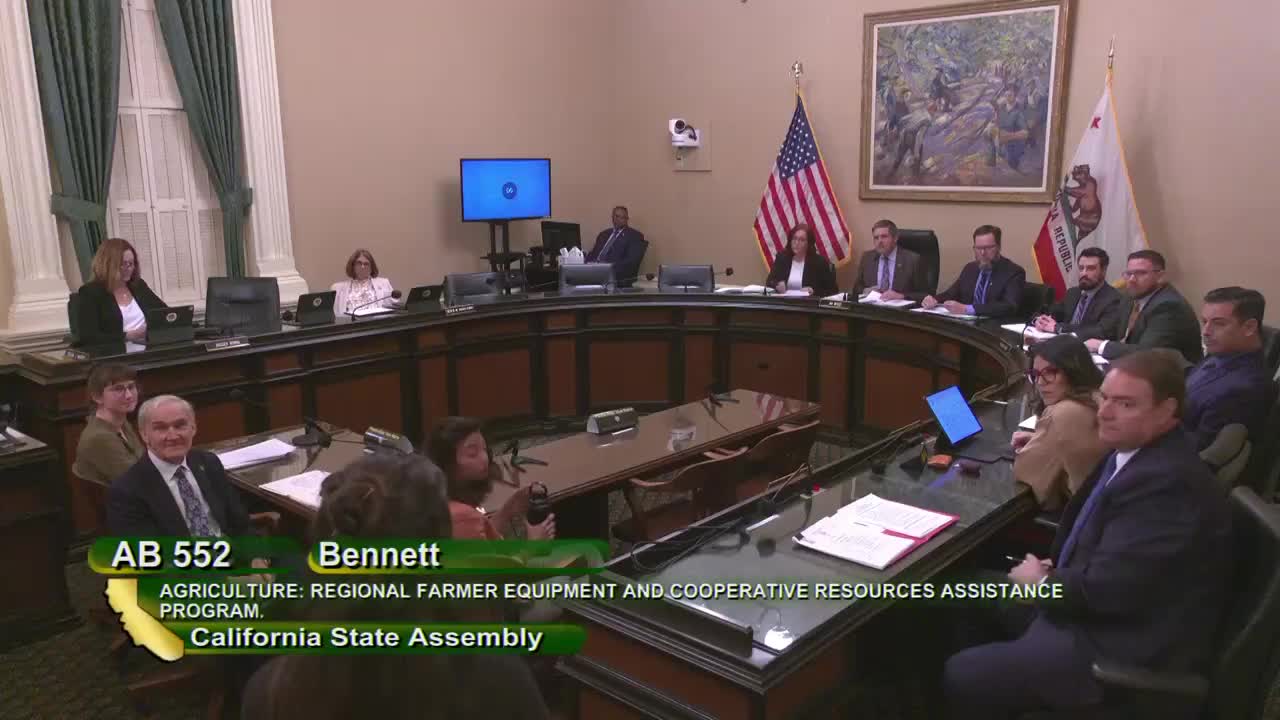 11MIN
Assembly Standing Committee on Agriculture
Bill Author

Bill Co-Author(s):