AB 509: Personal income taxes: gross income: exclusion: student loan assistance.
- Session Year: 2023-2024
- House: Assembly
- Latest Version Date: 2023-04-05
Current Status:
Failed
(2024-02-01: From committee: Filed with the Chief Clerk pursuant to Joint Rule 56.)
Introduced
In Committee
First Chamber
In Committee
Second Chamber
Enacted
The Personal Income Tax Law excludes from the gross income of an employee amounts paid or incurred by an employer for educational assistance to the employee, as specified, up to $5,250 during a calendar year.
This bill would include in the definition of educational assistance a payment made by an employer on or after January 1, 2024, and before January 1, 2034, 2026, paid or incurred by the employer, whether paid to the employee or to a lender, of principal or interest on a qualified education loan, as defined, relating to interest on education loans, incurred by the employee for education of the employee. The bill would also make various technical changes to these provisions and delete obsolete language relating to graduate level educational assistance.
Existing law requires any bill authorizing a new tax expenditure to contain, among other things, specific goals, purposes, and objectives that the tax expenditure will achieve, detailed performance indicators, and data collection requirements.
The bill would make specified findings detailing the goals, purposes, and objectives of the above-described exclusion, and the performance indicators for determining whether the exclusion meets those goals, purposes, and objectives.
This bill would take effect immediately as a tax levy.
The Personal Income Tax Law excludes from the gross income of an employee amounts paid or incurred by an employer for educational assistance to the employee, as specified, up to $5,250 during a calendar year.
This bill would include in the definition of educational assistance a payment made by an employer on or after January 1, 2024, and before January 1, 2034, paid or incurred by the employer, whether paid to the employee or to a lender, of principal or interest on a qualified education loan, as defined, relating to interest on education loans, incurred by the employee for education of the employee. The bill would also make various technical changes to these provisions and delete obsolete language relating to graduate level educational assistance.
Existing law requires any bill authorizing a new tax expenditure to contain, among other things, specific goals, purposes, and objectives that the tax expenditure will achieve, detailed performance indicators, and data collection requirements.
The bill would make specified findings detailing the goals, purposes, and objectives of the above-described exclusion, and the performance indicators for determining whether the exclusion meets those goals, purposes, and objectives.
This bill would take effect immediately as a tax levy.
(a)Gross income of an employee does not include any amounts, not exceeding an aggregate amount of five thousand two hundred fifty dollars ($5,250) per calendar year, that are paid or incurred by the employer for educational assistance to the employee pursuant to an educational assistance program.
(b)For purposes of this section:
(1)(A)Educational assistance means the payment by an employer of expenses incurred by, or on behalf of, an employee for the employees education, and includes, but is not limited to, payments for books, supplies, equipment, tuition, and fees, and similar payments.
(B)Educational assistance includes the provision by an employer of courses of instruction for an employee, including the provision of books, supplies, and equipment.
(C)Educational assistance includes a payment made by an employer on or after January 1, 2024, and before January 1, 2034, 2026, paid or incurred by the employer, whether paid to the employee or to a lender, of principal or interest on a qualified education loan, as defined by Section 221 of the Internal Revenue Code, relating to interest on education loans, incurred by the employee for education of the employee.
(D)Educational assistance does not include a payment for, or the provision of, any of the following:
(i)Any tools or supplies that may be retained by the employee after completion of a course of instruction.
(ii)Any meals, lodging, or transportation.
(iii)Any course or education involving sports, games, or hobbies.
(iv)A payment on a qualified education loan, as defined by Section 221 of the Internal Revenue Code, relating to interest on education loans, incurred by the employee for education of their spouse or dependent.
(2)Educational assistance program means a separate written plan of an employer for the exclusive benefit of their employees to provide those employees with educational assistance. The program shall meet the following requirements:
(A)The program benefits employees who qualify under a classification established by the employer and found by the Franchise Tax Board not to be discriminatory in favor of employees who are highly compensated employees, as defined by Section 414(q) of the Internal Revenue Code, relating to highly compensated employee, or their dependents. For purposes of this subparagraph, there shall be excluded from consideration employees who are not included in the program and who are included in a unit of employees covered by an agreement that the Franchise Tax Board finds to be a collective bargaining agreement between employee representatives and one or more employers, if there is evidence that educational assistance benefits were the subject of good faith bargaining between the employee representatives and the employer or employers.
(B)Not more than 5 percent of the amounts paid or incurred by the employer for educational assistance during the year may be provided for the class of individuals who are owners, or their spouses or dependents, each of whom, on any day of the year, owns more than 5 percent of the capital or profits interest in the employer.
(C)The program does not provide eligible employees with a choice between educational assistance and other remuneration includable in gross income. For purposes of this section, the business practices of the employer, as well as the written program, shall be taken into account.
(D)The program need not be funded.
(E)Reasonable notification of the availability and terms of the program is provided to eligible employees.
(3)Employee includes self-employed individuals within the meaning of Section 401(c)(1) of the Internal Revenue Code, relating to self-employed individuals treated as employees.
(c)For purposes of this section:
(1)Any individual who owns the entire interest in an unincorporated trade or business shall be treated as their own employee.
(2)A partnership shall be treated as the employer of each partner who is an employee within the meaning of paragraph (3) of subdivision (b).
(3)(A)An educational assistance program shall not be considered to fail to meet any of the requirements of paragraph (2) of subdivision (b) on the sole basis of either of the following:
(i)Different utilization rates for the different types of educational assistance made available under the program.
(ii)Successful completion or attainment of a particular course grade is required for or considered in determining reimbursement under the program.
(B)This section shall not be construed to affect the deduction or inclusion in income of amounts that are paid or incurred or received as reimbursement for educational expenses under Section 117, 162, or 212 of the Internal Revenue Code.
(d)A deduction or credit shall not be allowed to the employee with respect to any amount that the employee excludes from income pursuant to this section.
(e)Section 127 of the Internal Revenue Code, relating to educational assistance programs, shall not apply.
(f)It is the intent of the Legislature to apply the requirements of Section 41 to this act.
(1)The Legislature finds and declares that the goal of this exclusion is to ensure California addresses the student debt crisis that many people in the state face. Towards this end, this exclusion will help many Californians receive a tax incentive on student loan repayment plans that was provided on behalf of the student by the employer.
(2)The effectiveness of the exclusion shall be measured by the decrease in student loan defaults, and increase in timely repayment of student loans, by Californians.
(g)This section shall apply with respect to expenses relating to courses beginning after June 30, 1996.
SEC. 2.This act provides for a tax levy within the meaning of Article IV of the California Constitution and shall go into immediate effect.
(a)Gross income of an employee does not include any amounts, not exceeding an aggregate amount of five thousand two hundred fifty dollars ($5,250) per calendar year, that is are paid or incurred by the employer for educational assistance to the employee pursuant to an educational assistance program.
(b)For purposes of this section, the following definitions shall apply: section:
(1)(A)Educational assistance means the payment by an employer of expenses incurred by by, or on behalf of of, an employee for the employees education, and includes, but is not limited to, payments for books, supplies, equipment, tuition, and fees, and similar payments. Educational assistance includes the provision by an employer of courses of instruction for an employee, including the provision of books, supplies, and equipment. Educational assistance does not include any payment for, or the provision of, any of the following:
(B)Educational assistance includes the provision by an employer of courses of instruction for an employee, including the provision of books, supplies, and equipment.
(C)Educational assistance includes a payment made by an employer on or after January 1, 2024, and before January 1, 2034, paid or incurred by the employer, whether paid to the employee or to a lender, of principal or interest on a qualified education loan, as defined by Section 221 of the Internal Revenue Code, relating to interest on education loans, incurred by the employee for education of the employee.
(D)Educational assistance does not include a payment for, or the provision of, any of the following:
(A)(i)Any tools or supplies that may be retained by the employee after completion of a course of instruction.
(B)(ii)Any meals, lodging, or transportation.
(C)(iii)Any course or education involving sports, games, or hobbies.
(D)Any course or education taken at the graduate level of a kind normally taken by an individual pursuing a program leading to a law, business, medical, or other advanced academic or professional degree. This subparagraph applies only to any course or education taken at the graduate level beginning after June 30, 1996, and before January 1, 2000.(iv)A payment on a qualified education loan, as defined by Section 221 of the Internal Revenue Code, relating to interest on education loans, incurred by the employee for education of their spouse or dependent.
(2)Educational assistance program means a separate written plan of an employer for the exclusive benefit of his or her their employees to provide those employees with educational assistance. The program shall meet the following requirements:
(A)The program benefits employees who qualify under a classification established by the employer and found by the Franchise Tax Board not to be discriminatory in favor of employees who are highly compensated employees (within the meaning of employees, as defined by Section 414(q) of the Internal Revenue Code) Code, relating to highly compensated employee, or their dependents. For purposes of this subparagraph, there shall be excluded from consideration employees who are not included in the program and who are included in a unit of employees covered by an agreement that the Franchise Tax Board finds to be a collective bargaining agreement between employee representatives and one or more employers, if there is evidence that educational assistance benefits were the subject of good faith bargaining between the employee representatives and the employer or employers.
(B)Not more than 5 percent of the amounts paid or incurred by the employer for educational assistance during the year may be provided for the class of individuals who are owners (or owners, or their spouses or dependents), dependents, each of whom, on any day of the year, owns more than 5 percent of the capital or profits interest in the employer.
(C)The program does not provide eligible employees with a choice between educational assistance and other remuneration includable in gross income. For purposes of this section, the business practices of the employer, as well as the written program, shall be taken into account.
(D)The program need not be funded.
(E)Reasonable notification of the availability and terms of the program is provided to eligible employees.
(3)Employee includes self-employed individuals within the meaning of Section 401(c)(1) of the Internal Revenue Code. Code, relating to self-employed individuals treated as employees.
(c)For purposes of this section:
(1)Any individual who owns the entire interest in an unincorporated trade or business shall be treated as his or her their own employee.
(2)A partnership shall be treated as the employer of each partner who is an employee within the meaning of paragraph (3) of subdivision (b).
(3)(A)An educational assistance program shall not be considered to fail to meet any of the requirements of paragraph (2) of subdivision (b) on the sole basis of either of the following:
(i)Different utilization rates for the different types of educational assistance made available under the program.
(ii)Successful completion or attainment of a particular course grade is required for or considered in determining reimbursement under the program.
(B)This section shall not be construed to affect the deduction or inclusion in income of amounts that are paid or incurred or received as reimbursement for educational expenses under Section 117, 162, or 212 of the Internal Revenue Code.
(d)No A deduction or credit shall not be allowed to the employee with respect to any amount that the employee excludes from income pursuant to this section.
(e)Section 127 of the Internal Revenue Code Code, relating to educational assistance programs, shall not apply.
(f)It is the intent of the Legislature to apply the requirements of Section 41 to this act.
(1)The Legislature finds and declares that the goal of this exclusion is to ensure California addresses the student debt crisis that many people in the state face. Towards this end, this exclusion will help many Californians receive a tax incentive on student loan repayment plans that was provided on behalf of the student by the employer.
(2)The effectiveness of the exclusion shall be measured by the decrease in student loan defaults, and increase in timely repayment of student loans, by Californians.
(f)(g)This section shall apply with respect to expenses relating to courses beginning after June 30, 1996.
SEC. 2.This act provides for a tax levy within the meaning of Article IV of the California Constitution and shall go into immediate effect.
|
Date
|
Status
|
|---|---|
| Feb 1, 2024 | From committee: Filed with the Chief Clerk pursuant to Joint Rule 56. |
| Jan 31, 2024 | Died pursuant to Art. IV, Sec. 10(c) of the Constitution. |
| May 18, 2023 | In committee: Held under submission. |
| May 18, 2023 | Joint Rule 62(a), file notice suspended. (Page 1580.) |
| May 17, 2023 | In committee: Set, first hearing. Referred to APPR. suspense file. |
| May 2, 2023 | From committee: Do pass and re-refer to Com. on APPR. (Ayes 11. Noes 0.) (May 1). Re-referred to Com. on APPR. |
| Apr 6, 2023 | Re-referred to Com. on REV. & TAX. |
| Apr 5, 2023 | From committee chair, with author's amendments: Amend, and re-refer to Com. on REV. & TAX. Read second time and amended. |
| Mar 21, 2023 | In committee: Set, second hearing. Referred to REV. & TAX. suspense file. |
| Mar 14, 2023 | In committee: Set, first hearing. Hearing canceled at the request of author. |
| Feb 17, 2023 | Referred to Com. on REV. & TAX. |
| Feb 8, 2023 | From printer. May be heard in committee March 10. |
| Feb 7, 2023 | Read first time. To print. |
|
Date
|
Description
|
Location
|
Votes
|
|
|---|---|---|---|---|
| May 1, 2023 | Do pass and be re-referred to the Committee on [Appropriations] | Assembly Standing Committee on Revenue and Taxation |
Passed |
This list shows positions taken on this bill by organizations on the date displayed, which is linked to the original source.
Positions by individuals are not included.
|
Organization
|
Position
|
Date
|
|---|---|---|
| California Builders Alliance | ** Support | |
| California Chamber Of Commerce | * Support | Mar 20, 2023 |
| California State Council of SHRM | ** Support | |
| City Of San Diego | * Support | Mar 20, 2023 |
| Howard Jarvis Taxpayers Association | ** Support | |
| Sacramento Regional Builders Exchange | ** Support |
Date of Hearing: May 17, 2023
ASSEMBLY COMMITTEE ON APPROPRIATIONS
Chris Holden, Chair
ABPCA Bill Id:AB 509
Author:(Vince Fong) – As Amended Ver:April 5, 2023
Policy Committee: | Revenue and Taxation | Vote: | 11 - 0 |
|
| ||
|
|
Urgency: No State Mandated Local Program: No Reimbursable: No
SUMMARY:
This bill expands the definition of “educational assistance,” excluded from gross income of an employee under the Personal Income Tax Law, to include a payment made by an employer on or after January 1, 2024, and before January 1, 2026, to cover interest on education loans incurred by the employee for their own education.
This bill declares the goal of the expanded exclusion and how the exclusion’s effectiveness must be measured.
FISCAL EFFECT:
- General Fund (GF) revenue loss of approximately $90 million in fiscal year (FY) 2023-24, $160 million in FY 2024-25, and $70 million in FY 2025-26.
- GF costs of an unknown, but potentially absorbable, amount to the Franchise Tax Board to administer the expanded exclusion.
COMMENTS:
- Purpose. The author notes “Student loan debt is on the rise and continues to climb as residents struggle to endure California’s worsening affordability crisis.” The author asserts exempting employer student loan assistance from an employee’s taxable state income “will boost the economy, increase consumer spending, and help more Californians plan for their financial future.”
- Support and Opposition. This bill is sponsored by the California State Council of Society for Human Resource Management, which argues this bill “provides a workable solution to enlist employers to help discharge their employee’s existing student loan debt” that “could be implemented immediately” with “no questions about its legality.” This bill is also supported by the Howard Jarvis Taxpayers Association and business associations.
This bill is opposed by the California Tax Reform Association, which argues “in all likelihood the individuals who are able to obtain jobs with employers capable of making these repayments are likely to be those already receiving higher incomes than their counterparts who do not have access to the same educational opportunities.”
- Educational Assistance Exclusion. Existing federal law provides a gross income exclusion of up to $5,250 per year for “educational assistance” provided by an employer to an employee. In December 2020, the federal definition of educational assistance was expanded to include payments by an employer, made before January 1, 2026, of principal or interest on any qualified education loan incurred by the employee for their own education. California law does not automatically conform to federal law, but a standalone law provides a similar exclusion for employer-provided education benefits. However, existing state law’s definition of “educational assistance” does not include student loan payments made by an employer.
This bill conforms to federal law in that regard for employer-funded student loan payments made beginning 2024 through 2026, thus providing a tax benefit to those employer’s employees. Although federal conformity eases tax administration for both the government and taxpayer, expanding the income exclusion would also provide a tax benefit to Californians with an employer willing to help cover their student loan debt, at the expense of other Californians without such jobs.
- Prior Legislation. AB 1729 (Voepel), of the 2021-22 Legislative Session, was virtually identical to this bill. AB 1729 was held on this committee’s suspense file.
AB 152 (Voepel), of the 2019-20 Legislative Session, was substantially similar to this bill, except AB 152 would have allowed a direct gross income exclusion and was not limited to loan payments for an employee’s own education. AB 152 was held on this committee’s suspense file.
AB 2478 (Voepel), of the 2017-18 Legislative Session, was substantially similar to AB 152. AB 2478 was held on this committee’s suspense file.
Analysis Prepared by: Irene Ho / APPR. / (916) 319-2081
Date of Hearing: May 1, 2023
ASSEMBLY COMMITTEE ON REVENUE AND TAXATION
Jacqui Irwin, Chair
ABPCA Bill Id:AB 509 (
Author:Vince Fong) – As Amended Ver:April 5, 2023
SUSPENSE
Majority vote. Tax levy. Fiscal committee.
SUBJECT: Personal income taxes: gross income: exclusion: student loan assistance
SUMMARY: Excludes from gross income for a period of two years under the Personal Income Tax (PIT) Law, payments made by an employer on the principal or interest of an employee's student loan, subject to an annual limitation. Specifically, this bill:
- Includes in the definition of "educational assistance," under the PIT Law, amounts paid or incurred by an employer to service the principal or interest of an employee's student loan, as defined, for taxable years beginning on or after January 1, 2024, and before January 1, 2026, whether made to the employee or to the lender on behalf of the employee.
- Prohibits exclusion of loan payment amounts for loans incurred for education of the employee's spouse or dependent.
- States its intent to apply the requirements of Revenue and Taxation Code (R&TC) Section 41 to this bill's provisions.
- Finds and declares that the goal of this exclusion is to ensure California addresses the student debt crisis that many people in the state face by helping many Californians receive a tax incentive on student loan repayment plans provided on behalf of the student by the employer. The effectiveness of the exclusion shall be measured by the decrease in student loan defaults, and increase in timely repayment of student loans by Californians.
- Takes effect immediately as a tax levy.
EXISTING FEDERAL LAW:
- Provides that all income from whatever source derived is taxable, unless otherwise excluded. (Internal Revenue Code (IRC) Section 61.)
- Excludes from a taxpayer's gross income up to $5,250 per year in payments received from an employer for tuition, fees, books, supplies, and equipment under the employer's educational assistance program. Includes in this exclusion amounts paid by an employer before January 1, 2026 towards the principal or interest of an employee's educational loan. (IRC Section 127.)
- Allows a deduction in computing adjusted gross income for interest paid during the taxable year on a qualified education loan, with a maximum of $2,500 in eligible payments and reducing gradually as the taxpayer's modified adjusted gross income increases (IRC Section 221.)
EXISTING STATE LAW:
- Conforms to the IRC, with certain modifications, as of January 1, 2015.
- Generally conforms to the existing federal deduction of interest paid on a qualified education loan, with a maximum deduction of $2,500.
- Authorizes a stand-alone exclusion from gross income, mirrored on the federal exclusion, for amounts received by an employee from an employer for tuition, fees, books, supplies, and equipment under the employer's educational assistance program, up to $5,250 (R&TC Section 17151).
FISCAL EFFECT: The Franchise Tax Board estimates a revenue loss of $90 million in fiscal year (FY) 2023-24, $160 million in FY 2024-25, and $70 million in FY 2025-26.
COMMENTS:
- The author has submitted the following statement in support of this bill:
Student loan debt is on the rise and continues to climb as residents struggle to endure California's worsening affordability crisis. Student loan debt leaves less money in the pockets of Californians that have pursued higher education.
By exempting employer student loan assistance from an employee's taxable state income, AB 509 will boost the economy, increase consumer spending, and help more Californians plan for their financial future.
- The California Builders Alliance, writing in support of this bill, states, in part:
The California Builder's Alliance is pleased to support Assembly Bill 509. AB 509 would include in the definition of "educational assistance" a payment made by an employer of principal or interest on a qualified education loan, relating to interest on education loans, incurred by the employee for education of the employee. The bill would also make various technical changes to these provisions and delete obsolete language relating to graduate level educational assistance. The bill would also make specified findings detailing the goals, purposes, and objectives of the above-described exclusion for student loan assistance, and the performance indicators for determining whether the exclusion meets those goals, purposes, and objectives.
- Committee Staff Comments:
- Tuition and student debt data: Tuition has risen in the past decade. According to data published by the College Board, a non-profit organization that develops and administers standardized tests and curricula used by elementary, secondary, and post-secondary institutions of education, published tuition and fee costs have increased by more than 18% for private, non-profit, four-year universities, and by about 14% for public, four-year universities[1]. This bill seeks to alleviate the burden of those costs by excluding certain employer payment amounts on the principal and interest of an employee's student loan from the employee's gross income.
The amount of student loan debt incurred by Californians is significant. The Education Data Initiative notes that 9.7% of Californians have $141.8 billion in student loan debt, equating to approximately 3.8 million Californians, with an average debt of $37,084[2].
- What does this bill do? This bill would exclude from gross income payments on the interest and principal of a qualified education loan made on behalf of an employee by their employer. This exclusion would be subject to the aggregate $5,250 cap on the existing employer assistance program gross income exclusion, which translates to a maximum payment of $437.50 per month. Theoretically, employers already pay for an employee's student loans to the extent that the employee's salary is used to service a student loan. This bill could effectively provide an employee with a raise equal to taxes owed on those payments. Existing statute prohibits an educational assistance program from offering a choice to employees between educational assistance and other remuneration. However, could an employer offer a position at a reduced salary with the understanding that the corresponding payment of eligible student loans may attract candidates for employment, yet still not include this substitution as a condition of the employer assistance program?
Moreover, eligible employees in higher tax brackets would see a larger benefit than those at a lower tax bracket, corresponding to the progressivity of California's tax structure, and employees who effectively pay no taxes in California would likely see no benefit at all. While this bill does not address the rising cost of higher education, it could help relieve the burden faced by those with large amounts of student loan debt.
- Tax benefits are a form of financial aid to students: According to a report published by the Legislative Analyst's Office (LAO) in 2017, tax benefits are one of three main types of financial aid for students in California.[3] The other two types of financial aid are "loans" and "gift aid." This bill provides financial aid to certain taxpayers with student loans in the form of a tax benefit.
- Conformity: The author and sponsors note that this bill is intended to conform to federal provisions enacted in 2019 by the Further Consolidate Appropriations Act of 2020 (Act). The Act expanded the definition of education assistance under the federal gross income exclusion for amounts paid by an employer on the principal or interest of an employee's student loan for payments made before January 1, 2026. This bill would authorize this exclusion under California law for taxable years beginning on or after January 1, 2024, and before January 1, 2026, thereby conforming to federal law.
- What is a "tax expenditure"? Existing law provides various credits, deductions, exclusions, and exemptions for particular taxpayer groups. In the late 1960s, United States Treasury officials began arguing that these features of the tax law should be referred to as "expenditures" since they are generally enacted to accomplish some governmental purpose and there is a determinable cost associated with each of them, in the form of forgone revenues. This bill would expand the definition of educational assistance for the gross income exclusion of employer payments for an employee's education expenses.
- Committee's tax expenditure policy: SB 1335 (Leno), Chapter 845, Statutes of 2014, added R&TC Section 41, which recognized that the Legislature should apply the same level of review used for government spending programs to tax credits introduced on or after January 1, 2015. AB 263 (Burke), Chapter 743, Statutes of 2019, extended the requirements in R&TC Section 41 to all tax expenditure measures under the PIT Law, the Corporation Tax Law, and the Sales and Use Tax Law introduced on or after January 1, 2020. A tax expenditure proposal must outline specific goals, purposes, and objectives that the tax expenditure will achieve, along with detailed performance indicators for the Legislature to use when measuring whether the tax expenditure meets those stated goals, purposes, and objectives. In addition to the R&TC Section 41 requirements, this Committee's policy also requires that all tax expenditure proposals contain an appropriate sunset provision to be eligible for a vote[4]. Sunsets are required because eliminating a tax expenditure generally requires a two-thirds vote. These requirements must be satisfied before a bill can receive a vote in this Committee. This bill complies with R&TC Section 41, and provides a two-year sunset in conformity with federal law.
- Related legislation:
- AB 26 (Mike Fong) would exclude from a taxpayer's gross income qualified forgiven student loan debt for taxable years beginning on or after January 1, 2023, and before January 1, 2028. AB 26 is on this Committee's Suspense File today.
- AB 35 (Committee on Budget) would exclude from a taxpayer's gross income forgiven amounts of certain student loan debt, after December 31, 2020, and before January 1, 2026. AB 35 is pending hearing by the Assembly Budget Committee.
- SB 1 (Glazer, et al.) would, for taxable years beginning on or after January 1, 2022, and before January 1, 2026, exclude from gross income any amount of student loan debt waived, canceled, or otherwise forgiven by the United States Department of Education, as specified. SB 1 is pending hearing by the Senate Committee on Appropriations.
- Prior legislation:
- AB 1729 (Voepel), of the 2021-22 Legislative Session, was substantially similar to this bill. AB 1729 was held on the Assembly Appropriations Committee's Suspense File.
- AB 116 (Voepel), of the 2021-22 Legislative Session, was substantially similar to this bill. AB 116 was held on the Assembly Appropriations Committee's Suspense File.
- AB 152 (Voepel), of the 2019-20 Legislative Session, was substantially similar to this bill. AB 152 was held on the Assembly Appropriations Committee's Suspense File.
- AB 2478 (Voepel), of the 2017-18 Legislative Session, was substantially similar to this bill. AB 2478 was held on the Assembly Appropriations Committee's Suspense File.
- AB 511 (Alquist), Chapter 107, Statutes of 2000, added, on or after January 1, 2000, amounts paid or incurred by an employer for an employee to attend graduate level courses as payments that may be excluded from the employee's gross income, up to $5,250 per calendar year, among other provisions.
REGISTERED SUPPORT / OPPOSITION:
Support
California Builders Alliance
Sacramento Regional Builders Exchange
Opposition
None on file
Analysis Prepared by: Harrison Bowlby / REV. & TAX. / (916) 319-2098
Trends in College Pricing and Student Aid (2020) The College Board https://research.collegeboard.org/media/pdf/trends-college-pricing-student-aid-2020.pdf accessed March 2023. ↑
Student Loan Debt by State (2022) Education Data Initiative <https://educationdata.org/student-loan-debt-by-state#california> accessed March, 2023. ↑
Overview of Student Loans, LAO (2017), <https://lao.ca.gov/handouts/education/2017
/Student-Loans-Overview-082917.pdf>, accessed March, 2023. ↑An "appropriate sunset provision" shall mean five years, except in the case of a tax expenditure measure providing relief to California veterans, in which case "appropriate sunset provision" shall mean 10 years. ↑
Date of Hearing: March 20, 2023
ASSEMBLY COMMITTEE ON REVENUE AND TAXATION
Jacqui Irwin, Chair
ABPCA Bill Id:AB 509 (
Author:Vince Fong) – As Introduced Ver:February 7, 2023
Majority vote. Tax levy. Fiscal committee.
SUBJECT: Personal income taxes: gross income: exclusion: student loan assistance
SUMMARY: Excludes from gross income for a period of 10 years under the Personal Income Tax (PIT) Law, payments made by an employer on the principal or interest of an employee's student loan, subject to an annual limitation. Specifically, this bill:
- Includes in the definition of "educational assistance," under the PIT Law, amounts paid or incurred by an employer to service the principal or interest of an employee's student loan, as defined, for taxable years beginning on or after January 1, 2024, and before January 1, 2034, whether made to the employee or to the lender on behalf of the employee.
- Prohibits exclusion of loan payment amounts for loans incurred for education of the employee's spouse or dependent.
- States its intent to apply the requirements of Revenue and Taxation Code (R&TC) Section 41 to this bill's provisions.
- Finds and declares that the goal of this exclusion is to ensure California addresses the student debt crisis that many people in the state face by helping many Californians receive a tax incentive on student loan repayment plans provided on behalf of the student by the employer. The effectiveness of the exclusion shall be measured by the decrease in student loan defaults, and increase in timely repayment of student loans by Californians.
- Takes effect immediately as a tax levy.
EXISTING FEDERAL LAW:
- Provides that all income from whatever source derived is taxable, unless otherwise excluded.
- Excludes from a taxpayer's gross income up to $5,250 per year in payments received from an employer for tuition, fees, books, supplies, and equipment under the employer's educational assistance program. Includes in this exclusion amounts paid by an employer before January 1, 2026 towards the principal or interest of an employee's educational loan, (Internal Revenue Code (IRC) Section 127).
- Allows a deduction in computing adjusted gross income for interest paid during the taxable year on a qualified education loan, with a maximum of $2,500 in eligible payments and reducing gradually as the taxpayer's modified adjusted gross income increases (IRC Section 221).
EXISTING STATE LAW:
- Conforms to the IRC, with certain modifications, as of January 1, 2015.
- Generally, conforms to the existing federal deduction of interest paid on a qualified education loan, with a maximum deduction of $2,500.
- Authorizes a stand-alone exclusion from gross income, mirrored on the federal exclusion, for amounts received by an employee from an employer for tuition, fees, books, supplies, and equipment under the employer's educational assistance program, up to $5,250 (R&TC Section 17151).
FISCAL EFFECT: The Franchise Tax Board estimates a revenue loss of $90 million in fiscal year (FY) 2023-24, $160 million in FY 2024-25, and $180 million in FY 2025-26.
COMMENTS:
- The author has submitted the following statement in support of this bill:
Student loan debt is on the rise and continues to climb as residents struggle to endure California's worsening affordability crisis. Student loan debt leaves less money in the pockets of Californians that have pursued higher education.
By exempting employer student loan assistance from an employee's taxable state income, AB 509 will boost the economy, increase consumer spending, and help more Californians plan for their financial future.
- The California State Council of the Society for Human Resource Management, as sponsor of this bill, states, in part:
Student loan repayment assistance is a timely topic, made clear by currently pending efforts at the federal and state level to address this issue. However, while President Biden's Executive Order is presently facing legal challenges and other California bills (ex. AB 35) are predicated entirely upon that Order, AB 509 (Fong) provides a workable solution to enlist employers to help discharge their employee's existing student loan debt. Moreover, since AB 509 is predicated upon an already popular federal law (that passed with overwhelming bipartisan support) there are no questions about its legality and it could be implemented immediately to help bring immediate relief to millions of California workers.
- Committee Staff Comments:
- Tuition and student debt data: Tuition has risen in the past decade. According to data published by the College Board, a non-profit organization that develops and administers standardized tests and curricula used by elementary, secondary, and post-secondary institutions of education, published tuition and fee costs have increased by more than 18% for private, non-profit, four-year universities, and by about 14% for public, four-year universities[1]. This bill seeks to alleviate the burden of those costs by excluding certain employer payment amounts on the principal and interest of an employee's student loan from the employee's gross income.
The amount of student loan debt incurred by Californians is significant. The Education Data Initiative notes that 9.7% of Californians have $141.8 billion in student loan debt, equating to approximately 3.8 million Californians, with an average debt of $37,084[2].
- What does this bill do: This bill would exclude from gross income payments on the interest and principal of a qualified education loan made on behalf of an employee by their employer. This exclusion would be subject to the aggregate $5,250 cap on the existing employer assistance program gross income exclusion, which translates to a maximum payment of $437.50 per month. Theoretically, employers already pay for an employee's student loans to the extent that the employee's salary is used to service a student loan. This bill could effectively provide an employee with a raise equal to taxes owed on those payments. Existing statute prohibits an educational assistance program from offering a choice to employees between educational assistance and other remuneration. However, could an employer offer a position at a reduced salary with the understanding that the corresponding payment of eligible student loans may attract candidates for employment, yet still not include this substitution as a condition of the employer assistance program?
Moreover, eligible employees in higher tax brackets would see a larger benefit than those at a lower tax bracket, corresponding to the progressivity of California's tax structure, and employees who effectively pay no taxes in California would likely see no benefit at all. While this bill does not address the rising cost of higher education, it could help relieve the burden faced by those with large amounts of student loan debt.
- Tax benefits are a form of financial aid to students: According to a report published by the Legislative Analyst's Office (LAO) in 2017, tax benefits are one of three main types of financial aid for students in California.[3] The other two types of financial aid are "loans" and "gift aid." This bill provides financial aid to certain taxpayers with student loans in the form of a tax benefit.
- Conformity? The author and sponsors note that this bill is intended to conform to federal provisions enacted in 2019 by the Further Consolidate Appropriations Act of 2020 (Act). The Act expanded the definition of education assistance under the federal gross income exclusion for amounts paid by an employer on the principal or interest of an employee's student loan for payments made before January 1, 2026. This bill would authorize this exclusion under California law for taxable years beginning on or after January 1, 2024, and before January 1, 2034. Thus, this bill provides for modified conformity to federal statute. If this is not the intent, the author and Committee may wish to amend this bill to align with the federal exclusion.
- What is a "tax expenditure"? Existing law provides various credits, deductions, exclusions, and exemptions for particular taxpayer groups. In the late 1960s, United States Treasury officials began arguing that these features of the tax law should be referred to as "expenditures" since they are generally enacted to accomplish some governmental purpose and there is a determinable cost associated with each of them, in the form of forgone revenues. This bill would expand the definition of educational assistance for the gross income exclusion of employer payments for an employee's education expenses.
- Committee's tax expenditure policy: SB 1335 (Leno), Chapter 845, Statutes of 2014, added R&TC Section 41, which recognized that the Legislature should apply the same level of review used for government spending programs to tax credits introduced on or after January 1, 2015. AB 263 (Burke), Chapter 743, Statutes of 2019, extended the requirements in R&TC Section 41 to all tax expenditure measures under the PIT Law, the Corporation Tax Law, and the Sales and Use Tax Law introduced on or after January 1, 2020. A tax expenditure proposal must outline specific goals, purposes, and objectives that the tax expenditure will achieve, along with detailed performance indicators for the Legislature to use when measuring whether the tax expenditure meets those stated goals, purposes, and objectives. In addition to the R&TC Section 41 requirements, this Committee's policy also requires that all tax expenditure proposals contain an appropriate sunset provision to be eligible for a vote[4]. Sunsets are required because eliminating a tax expenditure generally requires a two-thirds vote. These requirements must be satisfied before a bill can receive a vote in this Committee. This bill complies with R&TC Section 41, but makes its provisions operative for 10 years, rather than five, in violation of Committee Policy.
- Related legislation:
- AB 26 (M. Fong) would exclude from a taxpayer's gross income qualified forgiven student loan debt for taxable years beginning on or after January 1, 2022. AB 26 is pending hearing by this Committee.
- AB 35 (Committee on Budget) would exclude from a taxpayer's gross income forgiven amounts of certain student loan debt, after December 31, 2020, and before January 1, 2026. AB 35 is pending hearing by the Assembly Budget Committee.
- SB 1 (Glazer, et al.) would, for taxable years beginning on or after January 1, 2022, and before January 1, 2026, exclude from gross income any amount of student loan debt waived, canceled, or otherwise forgiven by the United States Department of Education, as specified. SB 1 is pending hearing by the Senate Governance and Finance Committee.
- Prior legislation:
- AB 1729 (Voepel) of the 2021-22 Legislative Session was substantially similar to this bill. AB 1729 was held on the Assembly Appropriations Committee's Suspense File.
- AB 116 (Voepel) of the 2021-22 Legislative Session was substantially similar to this bill. AB 116 was held on the Assembly Appropriations Committee's Suspense File.
- AB 152 (Voepel) of the 2019-20 Legislative Session was substantially similar to this bill. AB 152 was held on the Assembly Appropriations Committee's Suspense File.
- AB 2478 (Voepel) of the 2017-18 Legislative Session was substantially similar to this bill. AB 2478 was held on the Assembly Appropriations Committee's Suspense File.
- AB 511 (Alquist), Chapter 107, Statutes of 2000, added, on or after January 1, 2000, amounts paid or incurred by an employer for an employee to attend graduate level courses as payments that may be excluded from the employee's gross income, up to $5,250 per calendar year, among other provisions.
REGISTERED SUPPORT / OPPOSITION:
Support
California State Council of SHRM (Sponsor)
California Chamber of Commerce
Howard Jarvis Taxpayers Association
Opposition
None on file
Analysis Prepared by: Harrison Bowlby / REV. & TAX. / (916) 319-2098
Trends in College Pricing and Student Aid (2020) The College Board https://research.collegeboard.org/media/pdf/trends-college-pricing-student-aid-2020.pdf accessed March 2023. ↑
Student Loan Debt by State (2022) Education Data Initiative <https://educationdata.org/student-loan-debt-by-state#california> accessed March, 2023. ↑
Overview of Student Loans, LAO (2017), <https://lao.ca.gov/handouts/education/2017
/Student-Loans-Overview-082917.pdf>, accessed March, 2023. ↑An "appropriate sunset provision" shall mean five years, except in the case of a tax expenditure measure providing relief to California veterans, in which case "appropriate sunset provision" shall mean 10 years. ↑
Discussed in Hearing
 9MIN
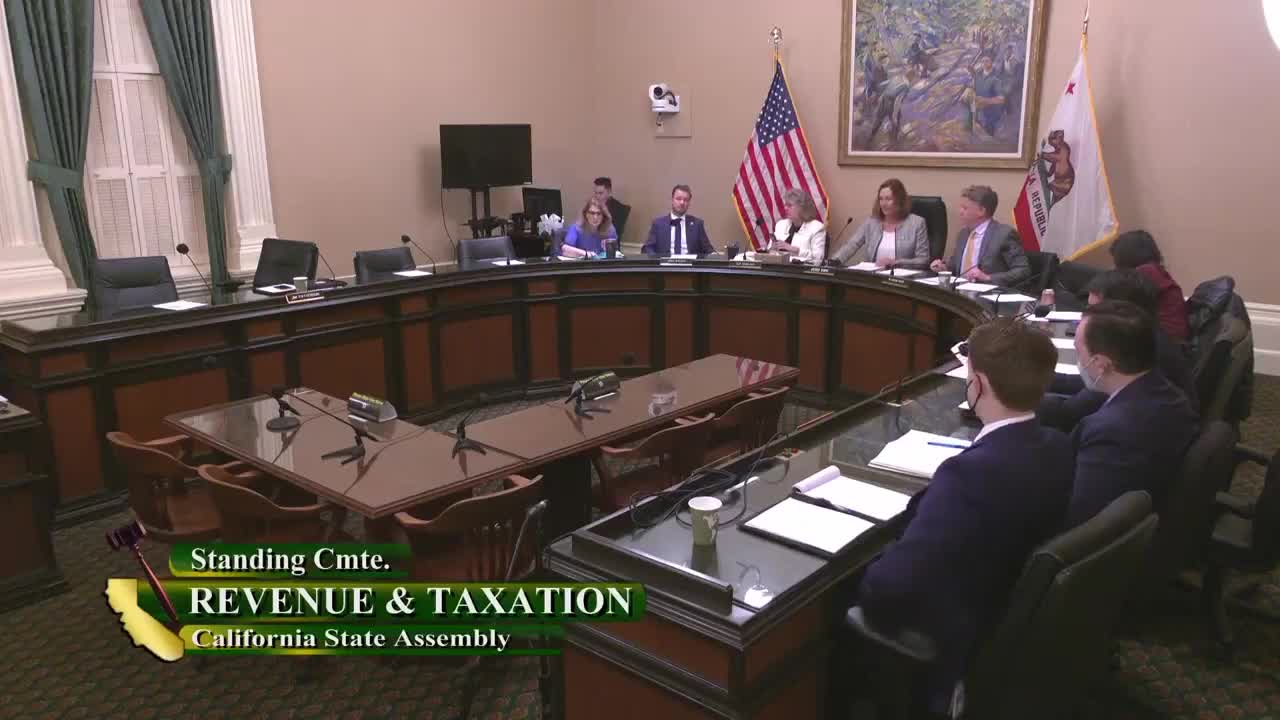
Assembly Standing Committee on Revenue and Taxation
Bill Author

Bill Co-Author(s):