AB 603: Public postsecondary education: diversity: report.
- Session Year: 2023-2024
- House: Assembly
- Latest Version Date: 2023-09-12
Current Status:
Failed
(2024-01-25: Consideration of Governor's veto stricken from file.)
Introduced
In Committee
First Chamber
In Committee
Second Chamber
Enacted
What does this bill do?
The bill requires the governing boards of California Community Colleges and California State University, and asks the University of California Regents, to publish an annual report on the diversity of their student body and their governing board. The reports must include race and ethnicity to show how representative the board is of students, be posted on each segment’s website, and be sent to the Legislature.
The summary is provided by generative AI which can make mistakes. For original language, please view the details in the table below.
Existing law establishes the California Community Colleges, under the administration of the Board of Governors of the California Community Colleges, the California State University, under the administration of the Trustees of the California State University, and the University of California, under the administration of the Regents of the University of California, as the segments of public postsecondary education in the state.
This bill would require the board of governors and the trustees, and request the regents, on or before July 1 each year, to publish a report on the diversity of the student body and the governing board of their respective segments, as specified, for purposes of determining how representative the governing board is of the student body. The bill would also require those reports to be submitted to the Legislature.
Existing law establishes the California Community Colleges, under the administration of the Board of Governors of the California Community Colleges, the California State University, under the administration of the Trustees of the California State University, and the University of California, under the administration of the Regents of the University of California, as the segments of public postsecondary education in the state.
This bill would require the board of governors and the trustees, and request the regents, to publish a report on the diversity of the student body and the governing board of their respective segments, as specified, for purposes of determining how representative the governing board is of the student body. The bill would also require those reports to be submitted to the Legislature.
Existing law establishes the California Community Colleges, the California State University, the University of California, independent institutions of higher education, and private postsecondary educational institutions as the segments of postsecondary education in the state. The missions and functions of these segments are set forth in the Donahoe Higher Education Act.This bill would make nonsubstantive changes in a provision that, for purposes of the Donahoe Higher Education Act, designates the segments of public postsecondary education as the California Community Colleges, the California State University, and the University of California, as specified, and defines independent institutions of higher education for these purposes.Existing law establishes the California Community Colleges, the California State University, the University of California, independent institutions of higher education, and private postsecondary educational institutions as the segments of postsecondary education in the state. The missions and functions of these segments are set forth in the Donahoe Higher Education Act.
This bill would make nonsubstantive changes in a provision that, for purposes of the Donahoe Higher Education Act, designates the segments of public postsecondary education as the California Community Colleges, the California State University, and the University of California, as specified, and defines independent institutions of higher education for these purposes.
(a)On or before July 1 of each year, the Board of Governors of the California Community Colleges and the Trustees of the California State University shall, and the Regents of the University of California are requested to, publish a report on the diversity of the student body and the governing board of their respective segments. The report shall include, but not be limited to, the race and ethnicity of the student body and the governing board, for purposes of determining how representative the governing board is of the student body. The report shall be posted on the internet website of the respective segment.
(b)The reports published pursuant to subdivision (a) shall be submitted to the Legislature, in compliance with Section 9795 of the Government Code.
SECTION 1.Section 66010 of the Education Code is amended to read:66010.(a)Public higher education consists of all of the following: (1) the California Community Colleges; (2) the California State University, and each campus, branch, and function thereof; and (3) each campus, branch, and function of the University of California.(b)As used in this part, independent institutions of higher education are those nonpublic higher education institutions that grant undergraduate degrees, graduate degrees, or both, and that are formed as nonprofit corporations in this state and are accredited by an agency recognized by the United States Department of Education.(c)This part is not intended to regulate, subsidize, or intrude upon private education, including, but not necessarily limited to, independent educational institutions and religious schools, nor to vary existing state law or state constitutional provisions relating to private education.(a)Public higher education consists of all of the following: (1) the California Community Colleges, Colleges; (2) the California State University, and each campus, branch, and function thereof, thereof; and (3) each campus, branch, and function of the University of California.
(b)As used in this part, independent institutions of higher education are those nonpublic higher education institutions that grant undergraduate degrees, graduate degrees, or both, and that are formed as nonprofit corporations in this state and are accredited by an agency recognized by the United States Department of Education.
(c)No provision of this This part is not intended to regulate, subsidize, or intrude upon private education, including, but not necessarily limited to, independent educational institutions and religious schools, nor to vary existing state law or state constitutional provisions relating to private education.
|
Date
|
Status
|
|---|---|
| Jan 25, 2024 | Consideration of Governor's veto stricken from file. |
| Jan 3, 2024 | Consideration of Governor's veto pending. |
| Oct 8, 2023 | Vetoed by Governor. |
| Sep 15, 2023 | Enrolled and presented to the Governor at 4 p.m. |
| Sep 11, 2023 | In Assembly. Ordered to Engrossing and Enrolling. |
| Sep 11, 2023 | Read third time. Passed. Ordered to the Assembly. (Ayes 39. Noes 0. Page 2548.). |
| Jul 11, 2023 | Read second time. Ordered to third reading. |
| Jul 10, 2023 | From committee: Be ordered to second reading pursuant to Senate Rule 28.8. |
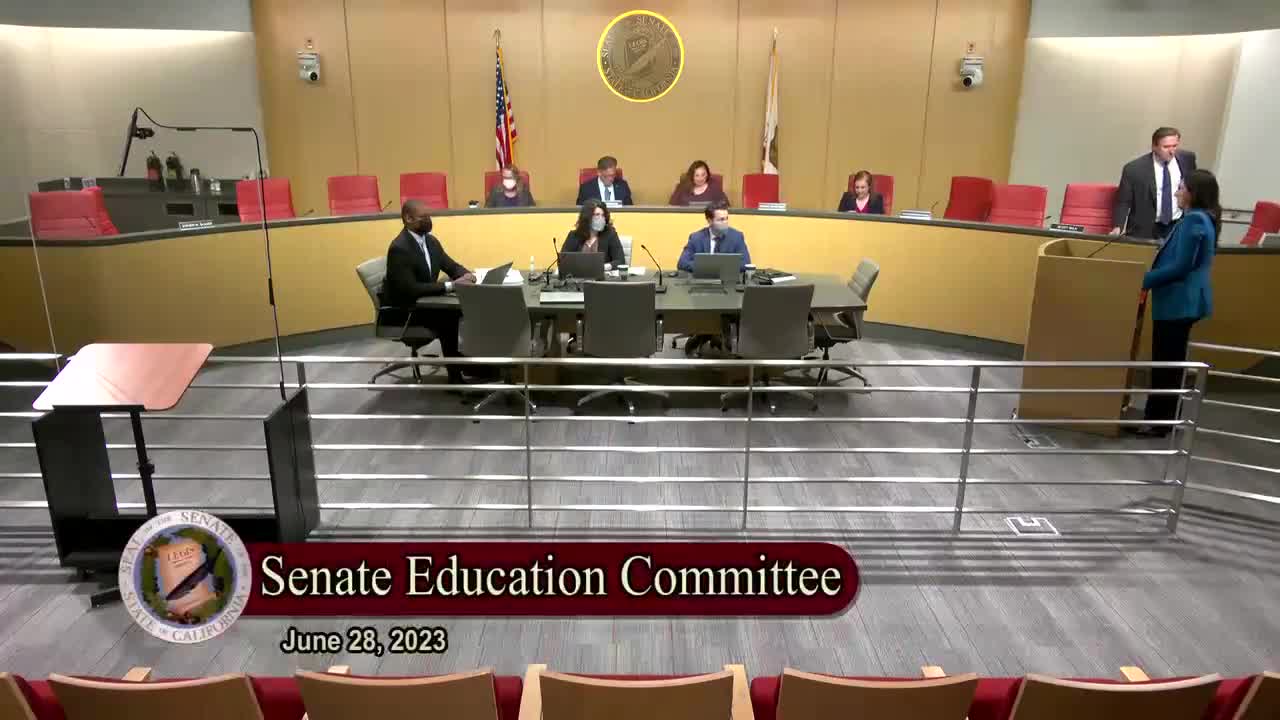
| Jun 28, 2023 | From committee: Do pass and re-refer to Com. on APPR. (Ayes 7. Noes 0.) (June 28). Re-referred to Com. on APPR. |
| Jun 14, 2023 | Referred to Com. on ED. |
| Jun 1, 2023 | In Senate. Read first time. To Com. on RLS. for assignment. |
| May 31, 2023 | Read third time. Passed. Ordered to the Senate. (Ayes 77. Noes 0. Page 2060.) |
| May 18, 2023 | Read second time. Ordered to third reading. |
| May 18, 2023 | From committee: Do pass. (Ayes 15. Noes 0.) (May 18). |
| May 3, 2023 | In committee: Set, first hearing. Referred to APPR. suspense file. |
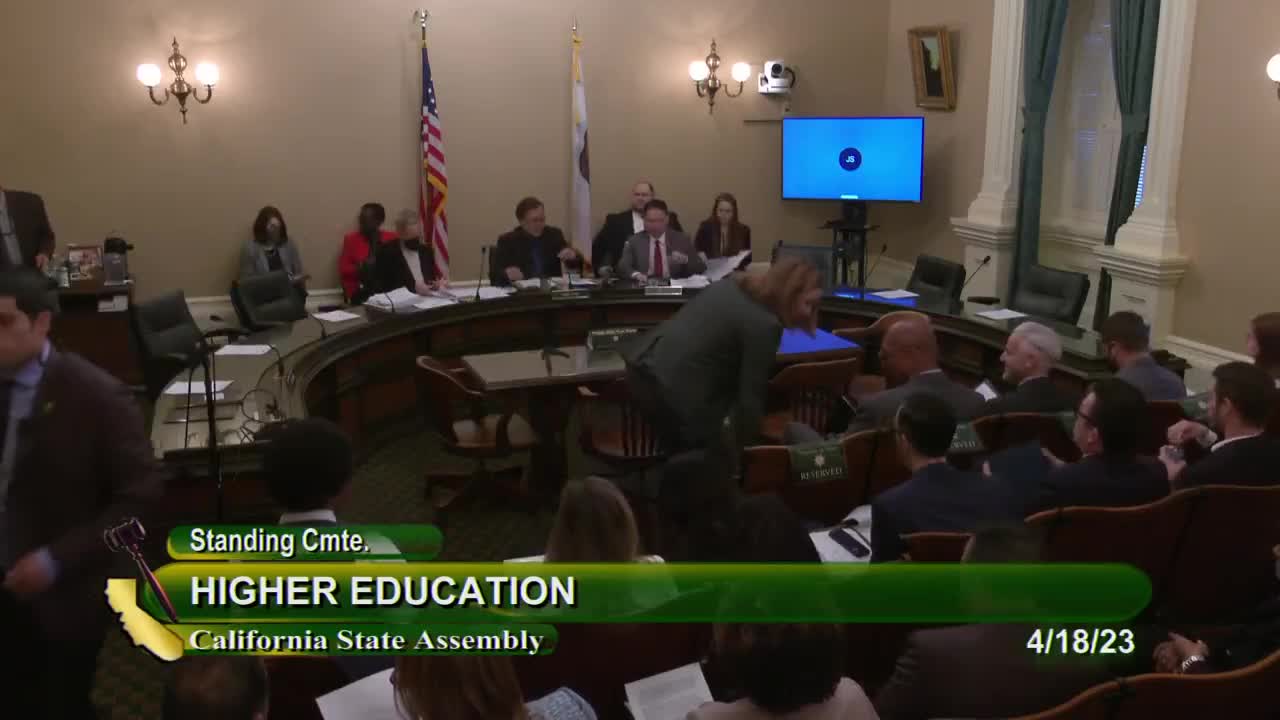
| Apr 19, 2023 | From committee: Do pass and re-refer to Com. on APPR. (Ayes 11. Noes 0.) (April 18). Re-referred to Com. on APPR. |
| Mar 6, 2023 | Re-referred to Com. on HIGHER ED. |
| Mar 2, 2023 | Referred to Com. on HIGHER ED. |
| Mar 2, 2023 | From committee chair, with author's amendments: Amend, and re-refer to Com. on HIGHER ED. Read second time and amended. |
| Feb 10, 2023 | From printer. May be heard in committee March 12. |
| Feb 9, 2023 | Read first time. To print. |
|
Date
|
Description
|
Location
|
Votes
|
|
|---|---|---|---|---|
| Sep 11, 2023 | Assembly 3rd Reading AB603 Cervantes By Smallwood-Cuevas | Senate Floor |
Passed |
|
| Jun 28, 2023 | Do pass, but first be re-referred to the Committee on [Appropriations] | Senate Standing Committee on Education |
Passed |
|
| May 31, 2023 | AB 603 Cervantes Assembly Third Reading | Assembly Floor |
Passed |
|
| May 18, 2023 | Do pass. | Assembly Standing Committee on Appropriations |
Passed |
|
| Apr 18, 2023 | Do pass and be re-referred to the Committee on [Appropriations] | Assembly Standing Committee on Higher Education |
Passed |
This list shows positions taken on this bill by organizations on the date displayed, which is linked to the original source.
Positions by individuals are not included.
|
Organization
|
Position
|
Date
|
|---|---|---|
| Campaign For College Opportunity | ** Support | |
| Hispanas Organized for Political Equality | * Support | Jun 28, 2023 |
GOVERNOR'S VETO
GV Bill Id:AB 603
Author:(Cervantes)
As Enrolled Ver:September 12, 2023
2/3 vote
SUMMARY
Requires by July 1 of each year, for the Board of Governors of the California Community Colleges (CCC), and the Board of Trustees of the California State University (CSU), and requests the Board of Regents of the University of California (UC) to publish a report on the diversity of the student body and the governing board of their respective segments.
Major Provisions
- Requires by July 1 of each year, for the Board of Governors of the CCC, and the Board of Trustees of the CSU, and requests the Board of Regents of the UC to publish a report on the diversity of the student body and the governing board of their respective segments. The report will include, but is not limited to information on the race and ethnicity of the student body and the governing board. The purpose of the report is to determine how representative the governing board is of the student body.
- Requires the report specified in 1), above, to be posted on an internet website of the respective segment and submitted to the Legislature, as specified.
Governor's Veto Message
This bill would require the Board of Governors of the California Community Colleges and the California State University Trustees, and requests the University of California Regents, to publish a report on the diversity of the student body and the governing board of their respective segments, on or before July 1 of each year.
I share the author's commitment to, and take great pride in, the diversity of California's public higher education systems. My Administration has demonstrated this commitment by making appointments at every level of government, including at the three segments, that reflect both California's diversity and the diversity of the student body. While I understand the author's
goal, the demographic information regarding the governing board members is optional and self-reported. Additionally, all three segments provide demographic information on their student bodies and biographies of their governing board members, which are easily accessible on their websites.
COMMENTS
Governing boards of public postsecondary institutions. The CCC system is the largest institution of higher education institution in the United States. The CCC is governed by both a statewide Board of Governors and a locally elected board of trustees who govern geographical areas known as a district, which are often comprised of one or more community colleges. According to the Community College League of California Trustees' Handbook, the Board of Governors was created in 1967 and was delegated the following responsibilities of governance: establishing policy and regulations, interacting with the Legislature and federal and state organizations, and selecting a Chancellor for the system. The Board of Governors is comprised of 18 voting members, 17 of whom are appointed by the Governor and the eighteenth member is the Lieutenant Governor. Education Code Section 71002 makes clear that when the Governor selects the members of the Board of Governors, they should consider the diversity of California to ensure the Board of Governors is reflective of the diversity of California and, to the extent possible, should include disabled persons and veterans.
Established in 1875 as a college for teachers in San Francisco, the CSU has since expanded to include 23 campuses that currently enroll 486,000 students. The CSU provides nearly half of the bachelor's degrees in the state and has an alumni base of over three million students and counting. To oversee the nation's largest four-year public university, the State established the CSU Board of Trustees. The 23 campuses of CSU are governed by campus presidents and a 25-member Board of Trustees. While the campus presidents oversee the day-to-day operations of their campus, the Board of Trustees is endowed with the authority to adopt regulations and policies pertaining to the overall operations of the CSU including: educational policy decisions, budgeting, and campus planning. The 25 members of the Board of Trustees is comprised of 19 members who are appointed by the Governor, one member who is appointed by the CSU alumni association, and five ex-officio trustees including the Governor of California, the Lieutenant Governor of California, the Speaker of the Assembly, the State Superintendent of Public Instruction, and either the Interim or the Current Chancellor of the CSU as appointed by the Board of Trustees.
Adopted in 1879, Article IX Education Section 9, established the UC as a public trust university to be administered by the Board of Regents of the UC with full powers of organization and government. As the only constitutionally independent public university system, the governance structure of the UC is enumerated in the constitution and limits the oversight and operational control of the Legislature in the day-to-day activities of operating the university system. The UC is a system of 10 campuses, five medical centers, and three affiliated national laboratories; which are overseen and governed by the UC Board of Regents. Similar to the CSU Board of Trustees, the UC Board of Regents is a 25-member board, with seven ex-officio members and 18 members appointed by the Governor. The seven ex-officio members include the Governor, the Lieutenant Governor, the Speaker of the Assembly, the Superintendent of Public Instruction, the President and Vice President of the UC alumni association, and the President of the UC, as appointed by the Board of Regents. The California Constitution authorizes the UC Regents to appoint to the board a student attending a UC campus and a member of the faculty to represent the faculty and student voices respectively. Furthermore, the State Constitution enumerates that the Regents will be persons who broadly reflect the economic, cultural, and social diversity of the state, including ethnic minorities and women: however, this distinction is not intended to create formulas or rations to be applied in the selection of the Regents.
Population demographics of public postsecondary institutions. Each of the governing boards of the CCC, CSU, and UC oversee the operations of campuses that provide education to students and jobs to thousands of academic professors and staff. As delineated in the Master Plan for Higher Education of 1960, the CCC is an open-access community college and therefore accepts 100% of its applicants. In determining admission, Education Code 66205 states it is the intention of the Legislature for the CSU and the UC to attempt to enroll a student body that meets the high academic standards and reflects the cultural, geographic, economic, and social diversity of California.
Each of the three segments collects data on the diversity of their population aggregated by gender and ethnicity/race. The ethnic diversity of the student population of the three public higher education institutions for the fall of 2022 was as follows:
Segment Population | Campus Population Demographics |
California Community Colleges Total Student Population: 1,285,731 |
|
California State University: Total Student Population: 474,601
|
|
University of California: Total Student Population: 294, 309 |
|
Source: The CCC Data Mart, CSU enrollment dashboard, and the UC Data Center.
As previously mentioned, a campus population is not solely comprised of students, and when examining the diversity of a college campus, one must examine the employees of the campus as well. In the last decade, the State has made significant financial investments to increase faculty diversity at public higher education institutions. In the 2022-2023 budget, the Governor and the Legislature invested $12.7 million to assist with equal employment opportunities at the CCC. In 2021, 24.6% of UC faculty identified as a race other than white. In 2021, 51% of CSU faculty identified as a race other than white. In fall 2022, 28% of the CCC faculty identified as a race other than white. Nonacademic staff population employed by the public higher education segments identified in higher percentages than their academic counterparts as a race other than white. In 2022, 59% of the CCC nonacademic staff identified as a race other than white. In 2021, 52% of the CSU nonacademic staff identified as a race other than white, and 52.4% of the UC nonacademic staff identified as a race other than white.
Please see the committee analysis for a full discussion of this bill.
According to the Author
As expressed by the author, "California's public higher education system is the largest and among the most diverse in the entire nation. Seventy-eight percent of California's public college students are racially and ethnically diverse, with forty-five percent of students identifying as Latino, five percent identifying as Black, seventeen percent identifying as Asian American, Native Hawaiian, and Pacific Islander, seven percent identifying as Native Indian and Alaska Native, and four percent identifying with two or more races. Unfortunately, the diversity in race, ethnicity, gender, and sexual orientation and gender expression in the student bodies are not fully reflected in the decision-making bodies of the Board of Regents of the University of California, the Board of Trustees of the California State University, and the Board of Governors of the California Community Colleges. Assembly Bill 603 would require the CCC Board of Governors and CSU Board of Trustees, and request the UC Board of Regents, to provide the Legislature with an annual report on the diversity of their governing boards and how they compare to the diversity of the student bodies that they serve. This will provide the public and the Legislature with more transparency on the diversity of each of the governing boards of each of the segments of California's public higher education system and its student bodies."
Arguments in Support
As explained by the Campaign for College Opportunity, "addressing disparities in racial and ethnic diversity on these decision-making bodies and ensuring that these entities are representative of the student populations that they serve cannot be fully achieved without the ability for new appointments to be informed by timely and accurate data on the diversity of our student populations and their corresponding governing board. Data transparency and timely reporting as required by AB 603 would help address this issue and help us understand how representative the governing board is of its student body, ultimately promoting greater leadership diversity and inclusion across our state's public higher education system."
Arguments in Opposition
None on file.
FISCAL COMMENTS
According to the Assembly Appropriations Committee:
- Ongoing General Fund costs to the Board of Governors of the CCC of a maximum cost of about $57,000 annually to compile the report.
- Minor and absorbable ongoing General Fund costs to the Trustees of the CSU to compile the report.
- Minor and absorbable ongoing General Fund costs to the Regents of the UC to compile the report.
However, since the primary purpose of this bill is to create a report, this bill is eligible for this committee's suspense file.
VOTES
ASM HIGHER EDUCATION: 11-0-1
YES: Mike Fong, Ta, Addis, Arambula, Gabriel, Irwin, Ortega, Sanchez, Santiago, Wallis, Weber
ABS, ABST OR NV: Low
ASM APPROPRIATIONS: 15-0-1
YES: Holden, Megan Dahle, Bryan, Calderon, Wendy Carrillo, Dixon, Mike Fong, Hart, Lowenthal, Mathis, Papan, Pellerin, Sanchez, Weber, Ortega
ABS, ABST OR NV: Robert Rivas
ASSEMBLY FLOOR: 77-0-3
YES: Addis, Aguiar-Curry, Alanis, Alvarez, Arambula, Bains, Bauer-Kahan, Bennett, Berman, Boerner, Bonta, Bryan, Calderon, Juan Carrillo, Wendy Carrillo, Cervantes, Chen, Connolly, Megan Dahle, Davies, Flora, Mike Fong, Vince Fong, Friedman, Gabriel, Garcia, Gipson, Grayson, Haney, Hart, Holden, Hoover, Irwin, Jackson, Jones-Sawyer, Kalra, Lackey, Lee, Low, Lowenthal, Maienschein, Mathis, McCarty, McKinnor, Muratsuchi, Stephanie Nguyen, Ortega, Pacheco, Papan, Jim Patterson, Joe Patterson, Pellerin, Petrie-Norris, Quirk-Silva, Ramos, Reyes, Luz Rivas, Robert Rivas, Rodriguez, Blanca Rubio, Sanchez, Santiago, Schiavo, Soria, Ta, Ting, Valencia, Villapudua, Waldron, Wallis, Ward, Weber, Wicks, Wilson, Wood, Zbur, Rendon
ABS, ABST OR NV: Dixon, Essayli, Gallagher
SENATE FLOOR: 39-0-1
YES: Allen, Alvarado-Gil, Archuleta, Ashby, Atkins, Becker, Blakespear, Bradford, Cortese, Dahle, Dodd, Durazo, Eggman, Glazer, Gonzalez, Grove, Hurtado, Jones, Laird, Limón, McGuire, Menjivar, Min, Newman, Nguyen, Niello, Ochoa Bogh, Padilla, Portantino, Roth, Rubio, Seyarto, Skinner, Smallwood-Cuevas, Stern, Umberg, Wahab, Wiener, Wilk
ABS, ABST OR NV: Caballero
UPDATED
VERSION: September 12, 2023
CONSULTANT: Ellen Cesaretti-Monroy / HIGHER ED. / (916) 319-3960 FN: 0002483
SENATE RULES COMMITTEE Office of Senate Floor Analyses (916) 651-1520 Fax: (916) 327-4478 | AB 603 |
THIRD READING
Bill No: AB 603
Author: Cervantes (D)
Amended: 3/2/23 in Assembly
Vote: 21
SENATE EDUCATION COMMITTEE: 7-0, 6/28/23
AYES: Newman, Ochoa Bogh, Cortese, Glazer, McGuire, Smallwood-Cuevas, Wilk
SENATE APPROPRIATIONS COMMITTEE: Senate Rule 28.8
ASSEMBLY FLOOR: 77-0, 5/31/23 - See last page for vote
SUBJECT: Public postsecondary education: diversity: report
SOURCE: Author
DIGEST:
This bill requires, on or before July 1 of each year, the Board of Governors of the California Community Colleges (CCC) and the California State University (CSU) Trustees, and requests the University of California (UC) Regents publish a report on the diversity of the student body and the governing board of their respective segments.
ANALYSIS:
Existing law:
- Establishes the UC as a public trust to be administered by the Regents and grants the Regents full powers of organization and governance subject only to legislative control as necessary to ensure the security of funds, compliance with terms of its endowments, and the statutory requirements around competitive bidding and contracts, sales of property, and the purchase of materials, goods, and services. (Article IX, Section (9) (a) of the California Constitution)
- Stipulates no provision of the Donahue Higher Education Act shall apply to the UC unless the UC Regents adopts the provision. (Education Code (EC) § 67400)
- Establishes the CSU system, made of 23 campuses, and bestows upon the CSU Trustees, through the Board of Trustees, the power, duties, and functions with respect to the management, administration, and control of the CSU system. (EC § 66606 and 89030 et. seq.)
- Establishes the CCC under the administration of the Board of Governors of the CCC, as one of the segments of public postsecondary education in this state. The CCC shall be comprised of community college districts. (EC § 70900)
This bill:
- Requires, on or before July 1 of each year, the CCC Board of Governors and the CSU Trustees, and requests the UC Regents publish a report on the diversity of the student body and the governing board of their respective segments.
- Requires that the report include the race and ethnicity of the student body and the governing board for purposes of determining how representative the governing board is of the student body.
- Requires that the report be posted on the internet website of the respective segment.
- Requires that the published report be submitted to the Legislature, as prescribed.
Comments
- Need for the bill. According to the author, “California’s public higher education system is the largest and among the most diverse in the entire nation. Seventy-eight percent of California’s public college students are racially and ethnically diverse, with forty-five percent of students identifying as Latino, five percent identifying as Black, seventeen percent identifying as Asian American, Native Hawaiian, and Pacific Islander, seven percent identifying as Native Indian and Alaska Native, and four percent identifying with two or more races. Unfortunately, the diversity in race, ethnicity, gender, and sexual orientation and gender expression in the student bodies are not fully reflected in the decision-making bodies of the Board of Regents of the University of California, the Board of Trustees of the California State University, and the Board of Governors of the California Community Colleges.
“Assembly Bill 603 would require the CCC Board of Governors and CSU Board of Trustees, and request the UC Board of Regents, to provide the Legislature with an annual report on the diversity of their governing boards and how they compare to the diversity of the student bodies that they serve. Let me be clear that this bill will not take any concrete steps to change the makeup of these governing boards, or impose appointment requirements on the Governor. AB 603 would simply provide the public and the Legislature with more transparency on the diversity of each of the governing boards of each of the segments of California’s public higher education system and its student bodies.”
- Governing board membership. All three governing bodies have information about each of their members posted on their respective websites:
- CSU Board of Trustees: Existing law requires 25 trustees for the CSU, all of whom are full voting members. There are five ex officio members: the Governor, Lieutenant Governor, Speaker of the Assembly, State Superintendent of Public Instruction, and the CSU Chancellor. 16 trustees are appointed by the Governor, confirmed by the State Senate, and serve eight-year terms. Trustees confirmed by the Senate remain on the Board until a replacement is named or 60 days after their term expires, whichever comes first. https://www.calstate.edu/csu-system/board-of-trustees/meet-the-board-of-trustees
- CCC Board of Governors: Current law requires 18 voting members for the CCC Board of Governors. 12 members are appointed by the Governor, confirmed by the State Senate, and serve six-year terms. Two of the 12 members are required to be current or former elected members of local community college district governing boards. Current law also requires that of the 18 members, two be students, two be faculty members, one be a classified employee, and the Lieutenant Governor. https://www.cccco.edu/About-Us/Board-of-Governors/Members
- UC Board of Regents: Current law, requires 26 Regents for the UC, all of whom have a vote. Eighteen are appointed by the governor, confirmed by the State Senate, and serve 12 year terms. One member is a student appointed by the Regents, and there are seven ex officio members: the Governor, Lieutenant Governor, Speaker of the Assembly, Superintendent of Public Instruction, president and vice president of the Alumni Associations of UC, and the UC president. In addition, two faculty members sit on the board as non-voting members. https://regents.universityofcalifornia.edu/about/members-and-advisors/
It is unclear how the race or ethnicity of individual board members can be reported on if it is not disclosed voluntarily or whether privacy concerns would surface given the size of each board.
- Student diversity data. Each of the three segments collects data on the diversity of their population aggregated by gender and ethnicity/race. This information is also accessible on each systems website. The ethnic diversity of the student population of the three public higher education institutions for the fall of 2022 was as follows:
Segment Population | Campus Population Demographics |
California Community Colleges Total Student Population: 1,285,731 |
|
California State University: Total Student Population: 474,601
|
|
University of California: Total Student Population: 294, 309 |
|
Source: The CCC Data Mart, CSU enrollment dashboard, and the UC Data Center.
FISCAL EFFECT: Appropriation: No Fiscal Com.: Yes Local: No
SUPPORT: (Verified 7/10/23)
Campaign for College Opportunity
OPPOSITION: (Verified 7/10/23)
None received
ASSEMBLY FLOOR: 77-0, 5/31/23
AYES: Addis, Aguiar-Curry, Alanis, Alvarez, Arambula, Bains, Bauer-Kahan, Bennett, Berman, Boerner, Bonta, Bryan, Calderon, Juan Carrillo, Wendy Carrillo, Cervantes, Chen, Connolly, Megan Dahle, Davies, Flora, Mike Fong, Vince Fong, Friedman, Gabriel, Garcia, Gipson, Grayson, Haney, Hart, Holden, Hoover, Irwin, Jackson, Jones-Sawyer, Kalra, Lackey, Lee, Low, Lowenthal, Maienschein, Mathis, McCarty, McKinnor, Muratsuchi, Stephanie Nguyen, Ortega, Pacheco, Papan, Jim Patterson, Joe Patterson, Pellerin, Petrie-Norris, Quirk-Silva, Ramos, Reyes, Luz Rivas, Robert Rivas, Rodriguez, Blanca Rubio, Sanchez, Santiago, Schiavo, Soria, Ta, Ting, Valencia, Villapudua, Waldron, Wallis, Ward, Weber, Wicks, Wilson, Wood, Zbur, Rendon
NO VOTE RECORDED: Dixon, Essayli, Gallagher
Prepared by: Olgalilia Ramirez / ED. / (916) 651-4105
7/12/23 16:00:36
SENATE COMMITTEE ON EDUCATION
Senator Josh Newman, Chair
2023 - 2024 Regular
Bill No: AB 603 Hearing Date: June 28, 2023
Author: | |||
Version: | March 2, 2023 | ||
Urgency: | No | Fiscal: | Yes |
Consultant: | Olgalilia Ramirez | ||
Subject: Public postsecondary education: diversity: report.
SUMMARY
This bill requires, on or before July 1 of each year, the Board of Governors of the California Community Colleges (CCC) and the California State University (CSU) Trustees, and requests the University of California (UC) Regents publish a report on the diversity of the student body and the governing board of their respective segments.
BACKGROUND
Existing law:
1) Establishes the UC as a public trust to be administered by the Regents and grants the Regents full powers of organization and governance subject only to legislative control as necessary to ensure the security of funds, compliance with terms of its endowments, and the statutory requirements around competitive bidding and contracts, sales of property, and the purchase of materials, goods, and services. (Article IX, Section (9) (a) of the California Constitution)
2) Stipulates no provision of the Donahue Higher Education Act shall apply to the
UC unless the UC Regents adopts the provision. (EC § 67400)
3) Establishes the CSU system, made of 23 campuses, and bestows upon the CSU Trustees, through the Board of Trustees, the power, duties, and functions with respect to the management, administration, and control of the CSU system. (EC § 66606 and 89030 et. seq.)
4) Establishes the CCC under the administration of the Board of Governors of the CCC, as one of the segments of public postsecondary education in this state. The CCC shall be comprised of community college districts. (EC § 70900)
ANALYSIS
This bill:
- Requires, on or before July 1 of each year, the CCC Board of Governors and the CSU trustees, and requests the UC Regents publish a report on the diversity of the student body and the governing board of their respective segments.
- Requires that the report include the race and ethnicity of the student body and the governing board for purposes of determining how representative the governing board is of the student body.
- Requires that the report be posted on the internet website of the respective segment.
- Requires that the published report be submitted to the Legislature, as prescribed.
STAFF COMMENTS
- Need for the bill. According to the author, ““California’s public higher education system is the largest and among the most diverse in the entire nation. Seventy-eight percent of California’s public college students are racially and ethnically diverse, with forty-five percent of students identifying as Latino, five percent identifying as Black, seventeen percent identifying as Asian American, Native Hawaiian, and Pacific Islander, seven percent identifying as Native Indian and Alaska Native, and four percent identifying with two or more races. Unfortunately, the diversity in race, ethnicity, gender, and sexual orientation and gender expression in the student bodies are not fully reflected in the decision-making bodies of the Board of Regents of the University of California, the Board of Trustees of the California State University, and the Board of Governors of the California Community Colleges.
Assembly Bill 603 would require the CCC Board of Governors and CSU Board of Trustees, and request the UC Board of Regents, to provide the Legislature with an annual report on the diversity of their governing boards and how they compare to the diversity of the student bodies that they serve. Let me be clear that this bill will not take any concrete steps to change the makeup of these governing boards, or impose appointment requirements on the Governor. AB 603 would simply provide the public and the Legislature with more transparency on the diversity of each of the governing boards of each of the segments of California’s public higher education system and its student bodies.”
- Governing board membership is public information. The websites of all three governing bodies list and provide information on their members:
CSU Board of Trustees: Existing law requires 25 trustees for the CSU, all of whom are full voting members. There are five ex officio members: the Governor, Lieutenant Governor, Speaker of the Assembly, State Superintendent of Public Instruction, and the Chancellor. Sixteen trustees are appointed by the governor, confirmed by the State Senate, and serve eight-year terms. Trustees confirmed by the Senate remain on the Board until a replacement is named or 60 days after their term expires, whichever comes first. https://www.calstate.edu/csu-system/board-of-trustees/meet-the-board-of-trustees.
Community College Board of Governors: Current law requires 18 voting members for the CCC Board of Governors. Twelve members are appointed by the Governor, confirmed by the State Senate, and serve six-year terms. Two of the twelve members are required to be current or former elected members of local community college district governing boards. Current law also requires that of the 18 members, two be students, two be faculty members, one be a classified employee, and the Lieutenant Governor. https://www.cccco.edu/About-Us/Board-of-Governors/Members.
UC Board of Regents: Current law, requires 26 Regents for the UC, all of whom have a vote. Eighteen are appointed by the governor, confirmed by the State Senate, and serve 12 year terms. One member is student appointed by the Regents, and there are seven ex officio members: the Governor, Lieutenant Governor, Speaker of the Assembly, Superintendent of Public Instruction, president and vice president of the Alumni Associations of UC, and the UC president. In addition, two faculty members sit on the board as non-voting members. https://regents.universityofcalifornia.edu/about/members-and-advisors/).
It is unclear how the race or ethnicity of individual board members can be reported on if it is not disclosed voluntarily or whether privacy concerns would surface given the size of each board.
- Student diversity data. Each of the three segments collects data on the diversity of their population aggregated by gender and ethnicity/race. This information is also accessible on each systems website. The ethnic diversity of the student population of the three public higher education institutions for the fall of 2022 was as follows:
Segment Population | Campus Population Demographics |
California Community Colleges Total Student Population: 1,285,731 |
|
California State University: Total Student Population: 474,601
|
|
University of California: Total Student Population: 294, 309 |
|
Source: The CCC Data Mart, CSU enrollment dashboard, and the UC Data Center.
SUPPORT
Campaign for College Opportunity
OPPOSITION
None received
-- END --
ASSEMBLY THIRD READING
ATR Bill Id:AB 603
Author:(Cervantes)
As Amended Ver:March 2, 2023
Majority vote
SUMMARY
Requires by July 1 of each year, for the Board of Governors of the California Community Colleges (CCC), and the Board of Trustees of the California State University (CSU), and requests the Board of Regents of the University of California (UC) to publish a report on the diversity of the student body and the governing board of their respective segments.
Major Provisions
- Requires by July 1 of each year, for the Board of Governors of the CCC, and the Board of Trustees of the CSU, and requests the Board of Regents of the UC to publish a report on the diversity of the student body and the governing board of their respective segments. The report will include, but is not limited to information on the race and ethnicity of the student body and the governing board. The purpose of the report is to determine how representative the governing board is of the student body.
- Requires the report specified in (1) to be posted on an internet website of the respective segment and submitted to the Legislature, as specified.
COMMENTS
Governing boards of public postsecondary institutions. The CCC system is the largest institution of higher education institution in the United States. The CCC is governed by both a statewide Board of Governors and a locally elected board of trustees who govern geographical areas known as a district, which are often comprised of one or more community colleges. According to the Community College League of California Trustees' Handbook, the Board of Governors was created in 1967 and was delegated the following responsibilities of governance: establishing policy and regulations, interacting with the Legislature and federal and state organizations, and selecting a Chancellor for the system. The Board of Governors is comprised of 18 voting members, 17 of whom are appointed by the Governor and the eighteenth member is the Lieutenant Governor. Education Code Section 71002 makes clear that when the Governor selects the members of the Board of Governors, they should consider the diversity of California to ensure the Board of Governors is reflective of the diversity of California and, to the extent possible, should include disabled persons and veterans.
Established in 1875 as a college for teachers in San Francisco, the CSU has since expanded to include 23 campuses that currently enroll 486,000 students. The CSU provides nearly half of the bachelor's degrees in the state and has an alumni base of over 3 million students and counting. To oversee the nation's largest four-year public university, the State established the CSU Board of Trustees. The 23 campuses of CSU are governed by campus presidents and a 25-member Board of Trustees. While the campus presidents oversee the day-to-day operations of their campus, the Board of Trustees is endowed with the authority to adopt regulations and policies pertaining to the overall operations of the CSU including: educational policy decisions, budgeting, and campus planning. The 25 members of the Board of Trustees is comprised of 19 members who are appointed by the Governor, one member who is appointed by the CSU alumni association, and five ex-officio trustees including the Governor of California, the Lieutenant Governor of California, the Speaker of the Assembly, the State Superintendent of Public Instruction, and either the Interim or the Current Chancellor of the CSU as appointed by the Board of Trustees.
Adopted in 1879, Article IX Education Section 9, established the UC as a public trust university to be administered by the Board of Regents of the UC with full powers of organization and government. As the only constitutionally independent public university system, the governance structure of the UC is enumerated in the constitution and limits the oversight and operational control of the Legislature in the day-to-day activities of operating the university system. The UC is a system of 10 campuses, five medical centers, and three affiliated national laboratories; which are overseen and governed by the UC Board of Regents. Similar to the CSU Board of Trustees, the UC Board of Regents is a 25-member board, with seven ex-officio members and 18 members appointed by the Governor. The seven ex-officio members include the Governor, the Lieutenant Governor, the Speaker of the Assembly, the Superintendent of Public Instruction, the President and Vice President of the UC alumni association, and the President of the UC, as appointed by the Board of Regents. The California Constitution authorizes the UC Regents to appoint to the board a student attending a UC campus and a member of the faculty to represent the faculty and student voices respectively. Furthermore, the State Constitution enumerates that the Regents will be persons who broadly reflect the economic, cultural, and social diversity of the state, including ethnic minorities and women: however, this distinction is not intended to create formulas or rations to be applied in the selection of the Regents.
Population demographics of public postsecondary institutions. Each of the governing boards of the CCC, CSU, and UC oversee the operations of campuses that provide education to students and jobs to thousands of academic professors and staff. As delineated in the Master Plan for Higher Education of 1960, the CCC is an open-access community college and therefore accepts 100% of its applicants. In determining admission, Education Code 66205 states it is the intention of the Legislature for the CSU and the UC to attempt to enroll a student body that meets the high academic standards and reflects the cultural, geographic, economic, and social diversity of California.
Each of the three segments collects data on the diversity of their population aggregated by gender and ethnicity/race. The ethnic diversity of the student population of the three public higher education institutions for the fall of 2022 was as follows:
Segment Population | Campus Population Demographics |
California Community Colleges Total Student Population: 1,285,731 |
|
California State University: Total Student Population: 474,601
|
|
University of California: Total Student Population: 294, 309 |
|
Source: The CCC Data Mart, CSU enrollment dashboard, and the UC Data Center.
As previously mentioned, a campus population is not solely comprised of students, and when examining the diversity of a college campus, one must examine the employees of the campus as well. In the last decade, the State has made significant financial investments to increase faculty diversity at public higher education institutions. In the 2022-2023 budget, the Governor and the Legislature invested $12.7 million to assist with equal employment opportunities at the CCC. In 2021, 24.6% of UC faculty identified as a race other than white. In 2021, 51% of CSU faculty identified as a race other than white. In fall 2022, 28% of the CCC faculty identified as a race other than white. Nonacademic staff population employed by the public higher education segments identified in higher percentages than their academic counterparts as a race other than white. In 2022, 59% of the CCC nonacademic staff identified as a race other than white. In 2021, 52% of the CSU nonacademic staff identified as a race other than white, and 52.4% of the UC nonacademic staff identified as a race other than white.
Please see the committee analysis for a full discussion of this bill.
According to the Author
As expressed by the author, "California's public higher education system is the largest and among the most diverse in the entire nation. Seventy-eight percent of California's public college students are racially and ethnically diverse, with forty-five percent of students identifying as Latino, five percent identifying as Black, seventeen percent identifying as Asian American, Native Hawaiian, and Pacific Islander, seven percent identifying as Native Indian and Alaska Native, and four percent identifying with two or more races. Unfortunately, the diversity in race, ethnicity, gender, and sexual orientation and gender expression in the student bodies are not fully reflected in the decision-making bodies of the Board of Regents of the University of California, the Board of Trustees of the California State University, and the Board of Governors of the California Community Colleges. Assembly Bill 603 would require the CCC Board of Governors and CSU Board of Trustees, and request the UC Board of Regents, to provide the Legislature with an annual report on the diversity of their governing boards and how they compare to the diversity of the student bodies that they serve. This will provide the public and the Legislature with more transparency on the diversity of each of the governing boards of each of the segments of California's public higher education system and its student bodies."
Arguments in Support
As explained by the Campaign for College Opportunity, "addressing disparities in racial and ethnic diversity on these decision-making bodies and ensuring that these entities are representative of the student populations that they serve cannot be fully achieved without the ability for new appointments to be informed by timely and accurate data on the diversity of our student populations and their corresponding governing board. Data transparency and timely reporting as required by AB 603 would help address this issue and help us understand how representative the governing board is of its student body, ultimately promoting greater leadership diversity and inclusion across our state's public higher education system."
Arguments in Opposition
None on file.
FISCAL COMMENTS
According to the Assembly Committee on Appropriations:
- Ongoing General Fund costs to the Board of Governors of the CCC of a maximum cost of about $57,000 annually to compile the report.
- Minor and absorbable ongoing General Fund costs to the Trustees of the CSU to compile the report.
- Minor and absorbable ongoing General Fund costs to the Regents of the UC to compile the report.
However, since the primary purpose of this bill is to create a report, this bill is eligible for this committee's suspense file.
VOTES
ASM HIGHER EDUCATION: 11-0-1
YES: Mike Fong, Ta, Addis, Arambula, Gabriel, Irwin, Ortega, Sanchez, Santiago, Wallis, Weber
ABS, ABST OR NV: Low
ASM APPROPRIATIONS: 15-0-1
YES: Holden, Megan Dahle, Bryan, Calderon, Wendy Carrillo, Dixon, Mike Fong, Hart, Lowenthal, Mathis, Papan, Pellerin, Sanchez, Weber, Ortega
ABS, ABST OR NV: Robert Rivas
UPDATED
VERSION: March 2, 2023
CONSULTANT: Ellen Cesaretti-Monroy / HIGHER ED. / (916) 319-3960 FN: 0000788
Date of Hearing: May 3, 2023
ASSEMBLY COMMITTEE ON APPROPRIATIONS
Chris Holden, Chair
ABPCA Bill Id:AB 603
Author:(Cervantes) – As Amended Ver:March 2, 2023
Policy Committee: | Higher Education | Vote: | 11 - 0 |
|
| ||
|
|
Urgency: No State Mandated Local Program: No Reimbursable: No
SUMMARY:
This bill requires the Board of Governors of the California Community Colleges (CCC) and the Trustees of the California State University (CSU), and requests the Regents of the University of California (UC), to annually post on its website a report on the diversity of the student body and the governing board of their respective segments. The report is to include the race and ethnicity of the student body and the governing board for purposes of determining how representative the governing board is of the student body.
FISCAL EFFECT:
- Ongoing General Fund costs to the Board of Governors of the CCC of a maximum cost of about $57,000 annually to compile the report.
- Minor and absorbable ongoing General Fund costs to the Trustees of the CSU to compile the report.
- Minor and absorbable ongoing General Fund costs to the Regents of the UC to compile the report.
However, since the primary purpose of this bill is to create a report, this bill is eligible for this committee’s suspense file.
COMMENTS:
Purpose. According to the author:
Unfortunately, the diversity in race, ethnicity, gender, and sexual orientation and gender expression in the student bodies are not fully reflected in the decision-making bodies of the Board of Regents of the University of California, the Board of Trustees of the California State University, and the Board of Governors of the California Community Colleges. Assembly Bill 603…will provide the public and the Legislature with more transparency on the diversity of each of the governing boards of each of the segments of California’s public higher education system and its student bodies.
Analysis Prepared by: Natasha Collins / APPR. / (916) 319-2081
Date of Hearing: April 18, 2023
ASSEMBLY COMMITTEE ON HIGHER EDUCATION
Mike Fong, Chair
ABPCA Bill Id:AB 603 (
Author:Cervantes) – As Amended Ver:March 2, 2023
SUBJECT: Public postsecondary education: diversity: report
SUMMARY: Requires by July 1 of each year, for the Board of Governors of the California Community Colleges (CCC), and the Board of Trustees of the California State University (CSU), and requests the Board of Regents of the University of California (UC) to publish a report on the diversity of the student body and the governing board of their respective segments. Specifically, this bill:
- Requires by July 1 of each year, for the Board of Governors of the CCC, and the Board of Trustees of the CSU, and requests the Board of Regents of the UC to publish a report on the diversity of the student body and the governing board of their respective segments.
- Clarifies the report specified in (1) will contain, but is not limited to, information on the race and ethnicity of the student body and the governing board. The purpose of the report is to determine how representative the governing board is of the student body.
- Requires the report specified in (1) to be posted on an internet website of the respective segment and submitted to the Legislature, as specified.
EXISTING LAW:
- Establishes the UC as a public trust to be administered by the Regents and grants the Regents full powers of organization and governance subject only to legislative control as necessary to ensure the security of funds, compliance with terms of its endowments, and the statutory requirements around competitive bidding and contracts, sales of property, and the purchase of materials, goods, and services (Article IX, Section (9) (a) of the California Constitution).
- Stipulates no provision of the Donahue Higher Education Act shall apply to the UC unless the UC Regents adopts the provision (Education Code (EDC) Section 67400).
- Establishes the CSU system, made of 23 campuses, and bestows upon the CSU Trustees, through the Board of Trustees, the power, duties, and functions with respect to the management, administration, and control of the CSU system (EDC Section 66606 and 89030 et. seq.).
- Establishes the CCC under the administration of the Board of Governors of the CCC, as one of the segments of public postsecondary education in this state. The CCC shall be comprised of community college districts (EDC Section 70900).
FISCAL EFFECT: Unknown
COMMENTS: Purpose of the measure. As expressed by the author, “California’s public higher education system is the largest and among the most diverse in the entire nation. Seventy-eight percent of California’s public college students are racially and ethnically diverse, with forty-five percent of students identifying as Latino, five percent identifying as Black, seventeen percent identifying as Asian American, Native Hawaiian, and Pacific Islander, seven percent identifying as Native Indian and Alaska Native, and four percent identifying with two or more races. Unfortunately, the diversity in race, ethnicity, gender, and sexual orientation and gender expression in the student bodies are not fully reflected in the decision-making bodies of the Board of Regents of the University of California, the Board of Trustees of the California State University, and the Board of Governors of the California Community Colleges. Assembly Bill 603 would require the CCC Board of Governors and CSU Board of Trustees, and request the UC Board of Regents, to provide the Legislature with an annual report on the diversity of their governing boards and how they compare to the diversity of the student bodies that they serve. This will provide the public and the Legislature with more transparency on the diversity of each of the governing boards of each of the segments of California’s public higher education system and its student bodies.”
Governing boards of public postsecondary institutions. The CCC system is the largest institution of higher education institution in the United States. The CCC serves 1.8 million students, who attend 116 community colleges throughout the state. The CCC is governed by both a statewide Board of Governors and a locally elected board of trustees who govern geographical areas known as a district, which are often comprised of one or more community colleges. According to the Community College League of California Trustees’ Handbook, the Board of Governors was created in 1967 and was delegated the following responsibilities of governance: establishing policy and regulations, interacting with the Legislature and federal and state organizations, and selecting a Chancellor for the system. The Board of Governors is comprised of 18 voting members, 17 of whom are appointed by the Governor and the eighteenth member is the Lieutenant Governor. The other 17 members include two student representatives, two faculty members, one classified staff, two members who were previously elected to local governing boards, and 10 members of the public. Education Code Section 71002 makes clear that when the Governor selects the members of the Board of Governors, they should consider the diversity of California to ensure the Board of Governors is reflective of the diversity of California and, to the extent possible, should include disabled persons and veterans.
Established in 1875 as a college for teachers in San Francisco, the CSU has since expanded to include 23 campuses that currently enroll 486,000 students. The CSU provides nearly half of the bachelor’s degrees in the state and has an alumni base of over 3 million students and counting. To oversee the nation’s largest four-year public university, the State established the CSU Board of Trustees. The 23 campuses of CSU are governed by campus presidents and a 25-member Board of Trustees. While the campus presidents oversee the day-to-day operations of their campus, the Board of Trustees is endowed with the authority to adopt regulations and policies pertaining to the overall operations of the CSU including: educational policy decisions, budgeting, and campus planning. The 25 members of the Board of Trustees is comprised of 19 members who are appointed by the Governor, one member who is appointed by the CSU alumni association, and five ex-officio trustees including the Governor of California, the Lieutenant Governor of California, the Speaker of the Assembly, the State Superintendent of Public Instruction, and either the Interim or the Current Chancellor of the CSU as appointed by the Board of Trustees. The 19 members appointed by the Governor include two students attending a CSU campus, one tenured faculty, and 16 members of the public.
Adopted in 1879, Article IX Education Section 9, established the UC as a public trust university to be administered by the Board of Regents of the UC with full powers of organization and government. As the only constitutionally independent public university system, the governance structure of the UC is enumerated in the constitution and limits the oversight and operational control of the Legislature in the day-to-day activities of operating the university system. The UC is a system of 10 campuses, five medical centers, and three affiliated national laboratories; which are overseen and governed by the UC Board of Regents. Similar to the CSU Board of Trustees, the UC Board of Regents is a 25-member board, with seven ex-officio members and 18 members appointed by the Governor. The seven ex-officio members include the Governor, the Lieutenant Governor, the Speaker of the Assembly, the Superintendent of Public Instruction, the President and Vice President of the UC alumni association, and the President of the UC, as appointed by the Board of Regents. The California Constitution authorizes the UC Regents to appoint to the board a student attending a UC campus and a member of the faculty to represent the faculty and student voices respectively. Furthermore, the State Constitution enumerates that the Regents will be persons who broadly reflect the economic, cultural, and social diversity of the state, including ethnic minorities and women: however, this distinction is not intended to create formulas or rations to be applied in the selection of the Regents.
Population demographics of public postsecondary institutions. Each of the governing boards of the CCC, CSU, and UC oversee the operations of campuses that provide education to students and jobs to thousands of academic professors and staff. As delineated in the Master Plan for Higher Education of 1960, the CCC is an open-access community college and therefore accepts 100% of its applicants. In determining admission, Education Code 66205 states it is the intention of the Legislature for the CSU and the UC to attempt to enroll a student body that meets the high academic standards and reflects the cultural, geographic, economic, and social diversity of California.
Each of the three segments collects data on the diversity of their population aggregated by gender and ethnicity/race. The ethnic diversity of the student population of the three public higher education institutions for the fall of 2022 was as follows:
Segment Population | Campus Population Demographics |
California Community Colleges Total Student Population: 1,285,731 |
|
California State University: Total Student Population: 474,601
|
|
University of California: Total Student Population: 294, 309 |
|
Source: The CCC Data Mart, CSU enrollment dashboard, and the UC Data Center.
As previously mentioned, a campus population is not solely comprised of students, and when examining the diversity of a college campus, one must examine the employees of the campus as well. In the last decade, the State has made significant financial investments to increase faculty diversity at public higher education institutions. In the 2022-2023 budget, the Governor and the Legislature invested $12.7 million to assist with equal employment opportunities at the CCC. In 2021, 24.6% of UC faculty identified as a race other than white. In 2021, 51% of CSU faculty identified as a race other than white. In fall 2022, 28% of the CCC faculty identified as a race other than white. Nonacademic staff population employed by the public higher education segments identified in higher percentages than their academic counterparts as a race other than white. In 2022, 59% of the CCC nonacademic staff identified as a race other than white. In 2021, 52% of the CSU nonacademic staff identified as a race other than white, and 52.4% of the UC nonacademic staff identified as a race other than white.
Arguments in support. As explained by the Campaign for College Opportunity, “addressing disparities in racial and ethnic diversity on these decision-making bodies and ensuring that these entities are representative of the student populations that they serve cannot be fully achieved without the ability for new appointments to be informed by timely and accurate data on the diversity of our student populations and their corresponding governing board. Data transparency and timely reporting as required by AB 603 would help address this issue and help us understand how representative the governing board is of its student body, ultimately promoting greater leadership diversity and inclusion across our state's public higher education system.”
Committee comments. AB 603 (Cervantes) seeks to acquire diversity information on student populations and the governing boards to compare the diversity of the governing boards with the diversity of the institutions’ student populations. The oversight and governance of the CCC, CSU, and UC governing boards do not chiefly extend to issues or matters that impact the student population. The governing boards have jurisdiction over the entire population of the campus and make decisions where faculty and staff voices are heard along with students.
Therefore if the author’s intentions are to ensure the diversity of boards matches the population of those they govern, the author may wish to extend the report to include the diversity breakdowns of staff and faculty populations.
Furthermore, the Committee may wish to examine what will transpire after the data is collected. Unlike faculty diversity, where the Legislature can establish financial incentives to provide equal employment opportunities for academic staff, the governing boards are appointed by the Governor and approved by the California State Senate. Therefore, to increase diversity, the decision truly falls to one individual. Legislative intervention would be discouraged as previous iterations of diversity inclusion on boards have been struck down by the judicial system. SB 826 (Jackson) Chapter 954, Statute of 2018, sought to increase the membership of women on corporate boards by requiring boards to have at least one or more women members depending on the number of seats on the board. While well intended and applauded as a step towards increasing the diversity in representation on corporate boards, SB 826 (Jackson) was ruled to be in violation of the equal protection clause of the California Constitution by the Superior Court for the County of Los Angeles. The ruling was issued in May of 2022 and is recorded in Crest v. Padilla (2022), Cal. Supr. Ct. L.A.
AB 979 (Holden) Chapter 316, Statutes of 2020, sought to increase diversity on corporate boards by requiring the boards to have at least one or more members from an underrepresented community depending upon the size of the board. AB 979 (Holden), was also ruled as unconstitutional as it violated the equal protection clause of the California Constitution. The ruling was issued in April of 2022 and was recorded in Crest v. Padilla (2022), Cal. Supr. Ct. L.A. Furthermore, Proposition 209 eliminated state and local government’s ability to provide preferential treatment on the bases of race, sex, color, ethnicity, or national origin.
Should the report authorized by AB 603 (Cervantes) lead to changes in the structure or composition of the board, it is likely those changes would be seen as a violation of Proposition 209. However, AB 603 (Cervantes) only wishes for data to be collected and does not actually address how the data will be used in the future with regard to the composition of the governing boards of the CCC, CSU, and UC.
REGISTERED SUPPORT / OPPOSITION:
Support
Campaign for College Opportunity
Opposition
None on file.
Analysis Prepared by: Ellen Cesaretti-Monroy / HIGHER ED. / (916) 319-3960
Discussed in Hearing
 1MIN
Senate Floor
 4MIN
Senate Standing Committee on Education
 3MIN
Assembly Standing Committee on Higher Education
Bill Author

Bill Co-Author(s):