AB 656: California State University: doctoral programs.
- Session Year: 2023-2024
- House: Assembly
- Latest Version Date: 2023-10-10
Current Status:
Passed
(2023-10-10: Chaptered by Secretary of State - Chapter 663, Statutes of 2023.)
Introduced
In Committee
First Chamber
In Committee
Second Chamber
Enacted
Existing law establishes the California State University, under the administration of the Trustees of the California State University, and the University of California, under the administration of the Regents of the University of California, as 2 of the segments of public postsecondary education in this state. Existing law provides for the missions and functions of these segments, and states that the University of California has the sole authority in public higher education to award doctoral degrees in all fields of learning, except that it may agree with the California State University to award joint doctoral degrees in selected fields. However, existing law authorizes the California State University to offer doctoral programs in education, audiology, physical therapy, occupational therapy, and public health without that agreement.
This bill would authorize the California State University to award professional or applied doctoral degrees statewide that do not duplicate University of California doctoral degrees and satisfy certain requirements. The bill would require a California State University campus seeking authorization to offer a professional or applied doctoral degree program pursuant to the bill to submit specified information on the proposed doctoral degree for review by the office of the Chancellor of the California State University, and approval by the trustees, as provided. The bill would authorize professional or applied doctoral degree programs that are approved for implementation by the trustees pursuant to the bill to be implemented at any California State University campus, but would limit the number of doctoral degree programs that may be offered at a California State University campus. The bill would prohibit the trustees from approving more than 10 new doctoral degree disciplines pursuant to the bill per academic year. The bill would require the Legislative Analysts Office to conduct a systemwide evaluation of doctoral degree programs established pursuant to the bill and report the results of the evaluation to the Legislature and the Governor on or before December 31, 2028.
Existing law establishes the California State University, under the administration of the Trustees of the California State University, and the University of California, under the administration of the Regents of the University of California, as 2 of the segments of public postsecondary education in this state. Existing law provides for the missions and functions of these segments, and states that the University of California has the sole authority in public higher education to award doctoral degrees in all fields of learning, except that it may agree with the California State University to award joint doctoral degrees in selected fields. However, existing law authorizes the California State University to offer doctoral programs in education, audiology, physical therapy, occupational therapy, and public health without that agreement.
This bill would authorize the California State University to award professional or applied doctoral degrees statewide that do not duplicate University of California doctoral degrees and satisfy certain requirements. The bill would require a California State University campus seeking authorization to offer a professional or applied doctoral degree program pursuant to the bill to submit specified information on the proposed doctoral degree for review by the office of the Chancellor of the California State University, and approval by the trustees, as provided. The bill would authorize a proposed doctoral degree that is professional or applied doctoral degree programs that are approved for implementation by the trustees pursuant to the bill to be implemented at the any California State University systemwide. campus, but would limit the number of doctoral degree programs that may be offered at a California State University campus. The bill would prohibit the trustees from approving more than 10 new doctoral degree disciplines pursuant to the bill per academic year. The bill would require the Legislative Analysts Office to conduct a systemwide evaluation of doctoral degree programs established pursuant to the bill and report the results of the evaluation to the Legislature and the Governor on or before December 31, 2028.
Existing law establishes the California State University, under the administration of the Trustees of the California State University, and the University of California, under the administration of the Regents of the University of California, as 2 of the segments of public postsecondary education in this state. Existing law provides for the missions and functions of these segments, and states that the University of California has the sole authority in public higher education to award doctoral degrees in all fields of learning, except that it may agree with the California State University to award joint doctoral degrees in selected fields. However, existing law authorizes the California State University to offer certain doctoral programs in education, audiology, physical therapy, occupational therapy, and public health without that agreement.
This bill would state the intent of the Legislature to enact subsequent legislation that authorizes the California State University to offer expanded doctoral programs that do not duplicate doctoral programs at the University of California.This bill would authorize the California State University to award doctoral degrees statewide that do not duplicate University of California doctoral degrees and satisfy certain requirements. The bill would require a California State University campus seeking authorization to offer a doctoral degree pursuant to the bill to submit specified information on the proposed doctoral degree for review by the office of the Chancellor of the California State University, and approval by the trustees, as provided. The bill would authorize a proposed doctoral degree that is approved for implementation by the trustees pursuant to the bill to be implemented at the California State University systemwide.
Existing law establishes the California State University, under the administration of the Trustees of the California State University, and the University of California, under the administration of the Regents of the University of California, as 2 of the segments of public postsecondary education in this state. Existing law provides for the missions and functions of these segments, and states that the University of California has the sole authority in public higher education to award doctoral degrees in all fields of learning, except that it may agree with the California State University to award joint doctoral degrees in selected fields. However, existing law authorizes the California State University to offer certain doctoral programs without that agreement.
This bill would state the intent of the Legislature to enact subsequent legislation that authorizes the California State University to offer expanded doctoral programs that do not duplicate doctoral programs at the University of California.
As used in this article, the following definitions apply:
(a)Chancellor means the Chancellor of the CSU.
(b)Chancellors office means the office of the chancellor.
(c)CSU means the California State University.
(d)President means the President of the UC.
(e)Presidents office means the office of the president.
(f)Proposed doctoral program means a proposed doctoral degree program at the CSU pursuant to this article.
(g)Trustees means the Trustees of the CSU.
(h)UC means the University of California.
66046.1.(a)The Legislature finds and declares all of the following:
(1)Since its adoption in 1960, the Master Plan for Higher Education has served to create the largest and most distinguished higher education system in the nation. A key component of the Master Plan for Higher Education is the differentiation of mission and function of each public higher education sector to increase access and educational opportunity for Californians. The Master Plan has a provision that allows the CSU to offer doctoral education in joint doctoral programs with the UC and independent California colleges and universities.
(2)More recently, the CSU has received legislative authority to offer independent professional or applied doctoral degrees in areas where there is an identified workforce or accreditation need that may not be fulfilled through existing education opportunities in California.
(3)The State of California is granting the CSU authority to offer professional or applied doctoral degrees statewide that do not duplicate UC doctoral degrees as an exception to the differentiation of function in graduate education that assigns sole authority among the California higher education segments to UC for awarding doctoral degrees independently. This exception to the Master Plan for Higher Education recognizes the distinctive strengths and respective missions of the CSU and the UC.
(b)Consistent with subdivision (a), and notwithstanding Section 66010.4, the CSU, in consultation with the presidents office, may award professional or applied doctoral degrees statewide that do not duplicate UC doctoral degrees. In implementing this article, the CSU shall comply with all of the following requirements:
(1)Enrollment in CSU professional or applied doctoral degree programs established pursuant to this article shall not diminish enrollment in CSU undergraduate programs.
(2)CSU professional or applied doctoral degree programs established pursuant to this article shall not duplicate UC doctoral degree programs that are offered or under review by the UC. A professional or applied doctoral degree program established pursuant to this article shall be distinguished from doctoral degree programs offered by the UC.
(3)The CSU shall establish fees for professional or applied doctoral degree programs established pursuant to this article that shall be comparable to, but no higher than, those fees charged for UC doctoral degree programs.
(4)The CSU shall provide any startup and operational funding needed for professional or applied doctoral degree programs established pursuant to this article from within existing budgets for academic program support without diminishing the quality of program support offered for CSU undergraduate programs. Funding of professional or applied doctoral degree programs established pursuant to this article shall not result in reduced CSU undergraduate enrollment.
66046.2A professional or applied doctoral degree program established pursuant to this article shall comply with all of the following limitations:
(a)A CSU campus seeking authorization to offer a doctoral degree program pursuant to this article shall submit all of the following for review by the chancellors office, and approval by the trustees:
(1)Documentation verifying that the proposed doctoral program does not duplicate a UC doctoral degree program that is offered or under review by the UC. The CSU shall, in consultation with the Academic Senate of the CSU, and the UC is requested to, in consultation with the Academic Senate of the UC, develop and agree on criteria for assessing duplication. This criteria shall include both of the following:
(A)Curricular and academic elements of the proposed doctoral program.
(B)Postgraduate professional job objectives for recipients of the proposed doctoral degree.
(2)Enrollment projections for the proposed doctoral program.
(3)An administrative plan for the proposed doctoral program, including, but not limited to, the funding plan for the program.
(4)Statewide workforce data relevant to the proposed doctoral program.
(b)The chancellor shall ensure all of the following for a CSU campus seeking to offer a proposed doctoral program:
(1)The chancellor notifies, in writing, and sends relevant materials on the proposed doctoral program to the presidents office and the President of the Association of Independent California Colleges and Universities to allow for consultation on issues of duplication. Proposed doctoral programs shall be submitted for consultation once per year pursuant to a timeline that is mutually agreed upon by the CSU and the UC.
(2)The trustees shall not approve for implementation a proposed doctoral program if the presidents office has, within 120 days of being notified and receiving materials for the proposed doctoral program pursuant to paragraph (1), provided written objections on the basis of duplication.
(3)A proposed doctoral program that receives written objections from the presidents office in compliance with paragraph (1) shall not be approved for implementation by the trustees unless and until a letter indicating a resolution of the written objections and a mutual agreement, signed by both the chancellor and the president, in support of the CSU offering the proposed doctoral program is submitted to the Assembly Committee on Higher Education and the Senate Committee on Education.
(c)(1)Doctoral degree programs that are approved for implementation by the trustees pursuant to this article may be implemented at any CSU campus.
(2)The trustees shall not approve more than 10 new doctoral degree disciplines pursuant to this article per academic year.
(3)The total number of professional or applied doctoral degree programs offered by a CSU campus pursuant to this article shall not, at any time, exceed 25 percent of the total number of undergraduate, graduate through the masters degree, and professional and teacher education programs offered by the CSU campus.
66046.3.(a)The Legislative Analysts Office shall conduct a statewide evaluation of the doctoral degree programs authorized pursuant to this article.
(b)On or before December 31, 2028, the Legislative Analysts Office shall submit a report, pursuant to Section 9795 of the Government Code, to the Legislature and the Governor on the results of the evaluation.
(c)(1)The evaluation and report shall include, but are not limited to, all of the following information on the doctoral degree programs authorized pursuant to this article:
(A)The number of CSU campuses that proposed doctoral degree programs.
(B)The types of doctoral degree programs proposed by CSU campuses.
(C)The number of doctoral degree programs approved by the trustees.
(D)The number of doctoral degree programs implemented.
(E)The number of doctoral degree program proposals that received objections from UC, what the objections were, and how the objections were resolved.
(F)Enrollment and completion information on implemented doctoral degree programs.
(G)The impact of expanded doctoral degrees at the CSU pursuant to this article on the accessibility, quality, and affordability of higher education in California.
(2)The report described in paragraph (1) shall include information on the impact of expanded professional doctoral education at CSU on the accessibility, quality, and affordability of higher education in California.
(d)Pursuant to Section 10231.5 of the Government Code, this section shall become inoperative on December 31, 2030, and as of January 1, 2031, is repealed.
As used in this article, the following definition definitions apply:
(a)Chancellor means the Chancellor of the CSU.
(b)Chancellors office means the office of the chancellor.
(c)CSU means the California State University.
(d)President means the President of the UC.
(e)Presidents office means the office of the president.
(f)Proposed doctoral program means a proposed doctoral degree program at the CSU pursuant to this article.
(g)Trustees means the Trustees of the CSU.
(h)UC means the University of California.
66046.1.(a)The Legislature finds and declares all of the following:
(1)Since its adoption in 1960, the Master Plan for Higher Education has served to create the largest and most distinguished higher education system in the nation. A key component of the Master Plan for Higher Education is the differentiation of mission and function of each public higher education sector to increase access and educational opportunity for Californians. The Master Plan has a provision that allows the CSU to offer doctoral education in joint doctoral programs with the UC and independent California colleges and universities.
(2)More recently, the CSU has received legislative authority to offer independent professional or applied doctoral degrees in areas where there is an identified workforce or accreditation need that may not be fulfilled through existing education opportunities in California.
(3)The State of California is granting the CSU authority to offer professional or applied doctoral degrees statewide that do not duplicate UC doctoral degrees as an exception to the differentiation of function in graduate education that assigns sole authority among the California higher education segments to UC for awarding doctoral degrees independently. This exception to the Master Plan for Higher Education recognizes the distinctive strengths and respective missions of the CSU and the UC.
(b)Consistent with subdivision (a), and notwithstanding Section 66010.4, the CSU, in consultation with the presidents office, may award professional or applied doctoral degrees statewide that do not duplicate UC doctoral degrees. In implementing this article, the CSU shall comply with all of the following requirements:
(1)Enrollment in CSU professional or applied doctoral degree programs established pursuant to this article shall not diminish enrollment in CSU undergraduate programs.
(2)CSU professional or applied doctoral degree programs established pursuant to this article shall not duplicate UC doctoral degree programs that are offered or under systemwide review by the presidents office. UC. A professional or applied doctoral degree program established pursuant to this article shall be distinguished from doctoral degree programs offered by the UC.
(3)The CSU shall establish fees for professional or applied doctoral degree programs established pursuant to this article that shall be comparable to, but no higher than, those fees charged for UC doctoral degree programs.
(4)The CSU shall provide any startup and operational funding needed for professional or applied doctoral degree programs established pursuant to this article from within existing budgets for academic program support without diminishing the quality of program support offered for CSU undergraduate programs. Funding of professional or applied doctoral degree programs established pursuant to this article shall not result in reduced CSU undergraduate enrollment.
66046.2A CSU professional or applied doctoral degree program established pursuant to this article shall comply with all of the following limitations:
(a)A CSU campus seeking authorization to offer a doctoral degree program pursuant to this article shall submit all of the following for review by the chancellors office, and approval by the trustees:
(1)Documentation verifying that the proposed doctoral program does not duplicate a UC doctoral degree program that is offered or under systemwide review by the presidents office. UC. The CSU shall, in consultation with the Academic Senate of the CSU, and the UC is requested to, in consultation with the Academic Senate of the UC, develop and agree on criteria for assessing duplication. This criteria shall include both of the following:
(A)Curricular and academic elements of the proposed doctoral program.
(B)Postgraduate professional job objectives for recipients of the proposed doctoral degree.
(2)Enrollment projections for the proposed doctoral program.
(3)An administrative plan for the proposed doctoral program, including, but not limited to, the funding plan for the program.
(4)Statewide workforce data relevant to the proposed doctoral program.
(b)The chancellor shall ensure all of the following for a CSU campus seeking to offer a proposed doctoral program:
(1)The chancellor notifies, in writing, and sends relevant materials on the proposed doctoral program to the presidents office and the President of the Association of Independent California Colleges and Universities to allow for consultation on issues of duplication. Proposed doctoral programs shall be submitted for consultation once per year pursuant to a timeline that is mutually agreed upon by the CSU and the UC.
(2)The trustees shall not approve for implementation a proposed doctoral program if the presidents office has, within 60 120 days of being notified and receiving materials for the proposed doctoral program pursuant to paragraph (1), provided written objections on the basis of duplication.
(3)A proposed doctoral program that receives written objections from the presidents office in compliance with paragraph (1) shall not be approved for implementation by the trustees unless and until a letter indicating a resolution of the written objections and a mutual agreement, signed by both the chancellor and the president, in support of the CSU offering the proposed doctoral program is submitted to the Assembly Committee on Higher Education and the Senate Committee on Education.
(c)A proposed doctoral program that is (1)Doctoral degree programs that are approved for implementation by the trustees pursuant to this article may be implemented at the CSU systemwide. any CSU campus.
(2)The trustees shall not approve more than 10 new doctoral degree disciplines pursuant to this article per academic year.
(3)The total number of professional or applied doctoral degree programs offered by a CSU campus pursuant to this article shall not, at any time, exceed 25 percent of the total number of undergraduate, graduate through the masters degree, and professional and teacher education programs offered by the CSU campus.
66046.3.(a)The Legislative Analysts Office shall conduct a statewide evaluation of the doctoral degree programs authorized pursuant to this article.
(b)On or before December 31, 2028, the Legislative Analysts Office shall submit a report, pursuant to Section 9795 of the Government Code, to the Legislature and the Governor on the results of the evaluation.
(c)(1)The evaluation and report shall include, but are not limited to, all of the following information on the doctoral degree programs authorized pursuant to this article:
(A)The number of CSU campuses that proposed doctoral degree programs.
(B)The types of doctoral degree programs proposed by CSU campuses.
(C)The number of doctoral degree programs approved by the trustees.
(D)The number of doctoral degree programs implemented.
(E)The number of doctoral degree program proposals that received objections from UC, what the objections were, and how the objections were resolved.
(F)Enrollment and completion information on implemented doctoral degree programs.
(G)The impact of expanded doctoral degrees at the CSU pursuant to this article on the accessibility, quality, and affordability of higher education in California.
(2)The report described in paragraph (1) shall include information on the impact of expanded professional doctoral education at CSU on the accessibility, quality, and affordability of higher education in California.
(d)Pursuant to Section 10231.5 of the Government Code, this section shall become inoperative on December 31, 2030, and as of January 1, 2031, is repealed.
As used in this article, the following definition apply:
(a)Chancellor means the Chancellor of the CSU.
(b)Chancellors office means the office of the chancellor.
(c)CSU means the California State University.
(d)President means the President of the UC.
(e)Presidents office means the office of the president.
(f)Proposed doctoral program means a proposed doctoral degree program at the CSU pursuant to this article.
(g)Trustees means the Trustees of the CSU.
(h)UC means the University of California.
66046.1.(a)The Legislature finds and declares all of the following:
(1)Since its adoption in 1960, the Master Plan for Higher Education has served to create the largest and most distinguished higher education system in the nation. A key component of the Master Plan for Higher Education is the differentiation of mission and function of each public higher education sector to increase access and educational opportunity for Californians. The Master Plan has a provision that allows the CSU to offer doctoral education in joint doctoral programs with the UC and independent California colleges and universities.
(2)More recently, the CSU has received legislative authority to offer independent professional doctoral degrees in areas where there is an identified workforce or accreditation need that may not be fulfilled through existing education opportunities in California.
(3)The State of California is granting the CSU authority to offer doctoral degrees statewide that do not duplicate UC doctoral degrees as an exception to the differentiation of function in graduate education that assigns sole authority among the California higher education segments to UC for awarding doctoral degrees independently. This exception to the Master Plan for Higher Education recognizes the distinctive strengths and respective missions of the CSU and the UC.
(b)Consistent with subdivision (a), and notwithstanding Section 66010.4, the CSU, in consultation with the presidents office, may award doctoral degrees statewide that do not duplicate UC doctoral degrees. In implementing this article, the CSU shall comply with all of the following requirements:
(1)Enrollment in CSU doctoral degree programs established pursuant to this article shall not diminish enrollment in CSU undergraduate programs.
(2)CSU doctoral degree programs established pursuant to this article shall not duplicate UC doctoral degree programs that are offered or under systemwide review by the presidents office.
(3)The CSU shall establish fees for doctoral degree programs established pursuant to this article that shall be comparable to, but no higher than, those fees charged for UC doctoral degree programs.
(4)The CSU shall provide any startup and operational funding needed for doctoral degree programs established pursuant to this article from within existing budgets for academic program support without diminishing the quality of program support offered for CSU undergraduate programs. Funding of doctoral degree programs established pursuant to this article shall not result in reduced CSU undergraduate enrollment.
66046.2A CSU doctoral degree program established pursuant to this article shall comply with all of the following limitations:
(a)A CSU campus seeking authorization to offer a doctoral degree program pursuant to this article shall submit all of the following for review by the chancellors office, and approval by the trustees:
(1)Documentation verifying that the proposed doctoral program does not duplicate a UC doctoral degree program that is offered or under systemwide review by the presidents office.
(2)Enrollment projections for the proposed doctoral program.
(3)An administrative plan for the proposed doctoral program, including, but not limited to, the funding plan for the program.
(4)Statewide workforce data relevant to the proposed doctoral program.
(b)The chancellor shall ensure all of the following for a CSU campus seeking to offer a proposed doctoral program:
(1)The chancellor notifies, in writing, and sends relevant materials on the proposed doctoral program to the presidents office and the President of the Association of Independent California Colleges and Universities to allow for consultation on issues of duplication.
(2)The trustees shall not approve for implementation a proposed doctoral program if the presidents office has, within 60 days of being notified and receiving materials for the proposed doctoral program pursuant to paragraph (1), provided written objections on the basis of duplication.
(3)A proposed doctoral program that receives written objections from the presidents office in compliance with paragraph (1) shall not be approved for implementation by the trustees unless and until a letter indicating a resolution of the written objections and a mutual agreement, signed by both the chancellor and the president, in support of the CSU offering the proposed doctoral program is submitted to the Assembly Committee on Higher Education and the Senate Committee on Education.
(c)A proposed doctoral program that is approved for implementation by the trustees pursuant to this article may be implemented at the CSU systemwide.
SECTION 1.It is the intent of the Legislature to enact subsequent legislation that, notwithstanding Section 66010.4 of the Education Code, and in order to meet specific workforce needs in California, authorizes the California State University to offer expanded doctoral programs that do not duplicate doctoral programs at the University of California and ensures that the doctoral programs at the California State University are distinguished from doctoral programs at the University of California. REVISIONS: HeadingLines 3 and 4.It is the intent of the Legislature to enact subsequent legislation that, notwithstanding Section 66010.4 of the Education Code, and in order to meet specific workforce needs in California, authorizes the California State University to offer expanded doctoral programs that do not duplicate doctoral programs at the University of California and ensures that the doctoral programs at the California State University are distinguished from doctoral programs at the University of California.
|
Date
|
Status
|
|---|---|
| Oct 10, 2023 | Chaptered by Secretary of State - Chapter 663, Statutes of 2023. |
| Oct 10, 2023 | Approved by the Governor. |
| Sep 19, 2023 | Enrolled and presented to the Governor at 4 p.m. |
| Sep 12, 2023 | Senate amendments concurred in. To Engrossing and Enrolling. (Ayes 80. Noes 0. Page 3236.). |
| Sep 12, 2023 | Assembly Rule 77 suspended. (Page 3228.) |
| Sep 11, 2023 | In Assembly. Concurrence in Senate amendments pending. May be considered on or after September 13 pursuant to Assembly Rule 77. |
| Sep 11, 2023 | Read third time. Passed. Ordered to the Assembly. (Ayes 39. Noes 0. Page 2553.). |
| Sep 5, 2023 | Read second time. Ordered to third reading. |
| Sep 1, 2023 | From committee: Do pass. (Ayes 7. Noes 0.) (September 1). |
| Aug 14, 2023 | In committee: Referred to APPR suspense file. |
| Jul 13, 2023 | Read second time and amended. Re-referred to Com. on APPR. |
| Jul 13, 2023 | From committee: Amend, and do pass as amended and re-refer to Com. on APPR. (Ayes 7. Noes 0.) (July 12). |
| Jul 5, 2023 | In committee: Hearing postponed by committee. |
| Jun 14, 2023 | Referred to Com. on ED. |
| Jun 1, 2023 | In Senate. Read first time. To Com. on RLS. for assignment. |
| Jun 1, 2023 | Read third time. Passed. Ordered to the Senate. (Ayes 79. Noes 0. Page 2124.) |
| May 18, 2023 | Read second time. Ordered to third reading. |
| May 18, 2023 | From committee: Do pass. (Ayes 15. Noes 0.) (May 18). |
| May 18, 2023 | Coauthors revised. |
| May 10, 2023 | In committee: Set, first hearing. Referred to APPR. suspense file. |
| Apr 26, 2023 | From committee: Do pass and re-refer to Com. on APPR. (Ayes 12. Noes 0.) (April 25). Re-referred to Com. on APPR. |
| Apr 26, 2023 | Coauthors revised. |
| Mar 20, 2023 | Re-referred to Com. on HIGHER ED. |
| Mar 16, 2023 | Referred to Com. on HIGHER ED. |
| Mar 16, 2023 | From committee chair, with author's amendments: Amend, and re-refer to Com. on HIGHER ED. Read second time and amended. |
| Feb 10, 2023 | From printer. May be heard in committee March 12. |
| Feb 9, 2023 | Read first time. To print. |
|
Date
|
Description
|
Location
|
Votes
|
|
|---|---|---|---|---|
| Sep 12, 2023 | AB 656 McCarty Concurrence in Senate Amendments | Assembly Floor |
Passed |
|
| Sep 11, 2023 | Assembly 3rd Reading AB656 McCarty et al. By Limón | Senate Floor |
Passed |
|
| Sep 1, 2023 | Do pass | Senate Standing Committee on Appropriations |
Passed |
|
| Aug 14, 2023 | Placed on suspense file | Senate Standing Committee on Appropriations |
Passed |
|
| Jul 12, 2023 | Do pass as amended, but first amend, and re-refer to the Committee on [Appropriations] | Senate Standing Committee on Education |
Passed |
|
| Jun 1, 2023 | AB 656 McCarty Assembly Third Reading | Assembly Floor |
Passed |
|
| May 18, 2023 | Do pass. | Assembly Standing Committee on Appropriations |
Passed |
|
| Apr 25, 2023 | Do pass and be re-referred to the Committee on [Appropriations] | Assembly Standing Committee on Higher Education |
Passed |
This list shows positions taken on this bill by organizations on the date displayed, which is linked to the original source.
Positions by individuals are not included.
|
Organization
|
Position
|
Date
|
|---|---|---|
| American Translators Association | ** Support | |
| ASML San Diego | ** Support | |
| Association of Independent California Colleges Universities | * Neutral | Apr 25, 2023 |
| Bakersfield, California State University | ** Support | |
| Biocom California | ** Support | |
| Black Small Business Association of California | ** Support | |
| Cal State Student Association | ** Support | |
| California African American Chamber Of Commerce | ** Support | |
| California Asian Pacific Chamber Of Commerce | * Support | Jul 12, 2023 |
| California Association Of School Psychologists | ** Support | |
| California Center For Civic Participation | ** Support | |
| california hawaii state conference of the naacp | ** Support | |
| California League of United Latin American Citizens | ** Support | |
| California Polytechnic State University | ** Support | |
| California State Polytechnic University, Humboldt | ** Support | |
| California State Polytechnic University, Pomona | ** Support | |
| California State Univeristy System | * Support | Jul 12, 2023 |
| California State University Chancellor's Office | ** Support | |
| California State University, Bakersfield | ** Support | |
| California State University, Channel Islands | ** Support | |
| California State University, Chico | ** Support | |
| California State University, Dominguez Hills | ** Support | |
| California State University, East Bay | ** Support | |
| California State University, Fresno | ** Support | |
| California State University, Fullerton | ** Support | |
| California State University, Long Beach | ** Support | |
| California State University, Los Angeles | ** Support | |
| California State University, Monterey Bay | ** Support | |
| California State University, Northridge | ** Support | |
| California State University, Sacramento | ** Support | |
| California State University, San Bernardino | ** Support | |
| California State University, San Marcos | ** Support | |
| California State University, Stanislaus | ** Support | |
| Campbell Union School District | ** Support | |
| Dominguez Hills, California State University | ** Support | |
| East Bay, California State University | ** Support | |
| East Side Union High School District | ** Support | |
| Families In Schools | ** Support | |
| Great Minds in STEM | ** Support | |
| Greater Sacramento Economic Council | ** Support | |
| Greater Sacramento Urban League | ** Support | |
| Hamilton Lane Advisors | ** Support | |
| Hamilton Lane Advisors, L.L.C. | ** Support | |
| Independent Indivisible | ** Support | |
| Individual | ** Support | |
| Los Angeles Area Chamber Of Commerce | ** Support | |
| Los Angeles County Economic Development Corporation | ** Support | |
| Los Angeles, California State University | ** Support | |
| Milpitas Unified School District | ** Support | |
| Monterey Bay, California State University | ** Support | |
| Mount Pleasant School District | ** Support | |
| North County Equity and Justice Coalition | * Support | Jul 12, 2023 |
| North Orange County Chamber of Commerce | ** Support | |
| Oak Grove School District | ** Support | |
| Orange County Business Council | ** Support | |
| Parent Institute for Quality Education | ** Support | |
| Sacramento Metropolitan Chamber of Commerce | ** Support | |
| Sacramento, California State University | ** Support | |
| San Diego Gas & Electric | ** Support | |
| San Diego State University | ** Support | |
| San Francisco State University | ** Support | |
| San Gabriel Valley Economic Partnership | ** Support | |
| San Jose City College | ** Support | |
| San José State University | ** Support | |
| Santa Clara County Office Of Education | ** Support | |
| Scripps Health | ** Support | |
| Sharp Healthcare | ** Support | |
| Sonoma State University | ** Support | |
| Univeristy of California | * Neutral | Jul 12, 2023 |
| Valley Children's Healthcare | ** Support | |
| West Valley Mission Community College District | ** Support |
CONCURRENCE IN SENATE AMENDMENTS
CSA1 Bill Id:AB 656
Author:(McCarty)
As Amended Ver:July 13, 2023
Majority vote
SUMMARY
Authorizes the California State University (CSU) to award professional or applied doctoral degrees statewide that do not duplicate University of California (UC) doctoral degrees and satisfy certain requirements. Requires a CSU campus seeking authorization to offer a professional or applied doctoral degree to submit specified information on the proposed doctoral degree for review by the office of the Chancellor of the CSU, and approval by the CSU Board of Trustees (BOT), as provided. Authorizes a proposed doctoral degree that is approved for implementation by the BOT to be implemented at the CSU systemwide, but would limit the number of doctoral degree programs that may be offered at a California State University campus.
Senate Amendments
- Clarifies that the doctoral programs CSU may offer are either professional or applied degrees.
- Specifies that a professional or applied doctoral degree program established as specified will be distinguished from doctoral degree programs offered by the UC.
- Prohibits the BOT from approving more than 10 new doctoral degree disciplines, as specified, per academic year.
- Specifies that the CSU will, in consultation with the Academic Senate of the CSU, and requests that the UC, in consultation with the Academic Senate of the UC, develop and agree on criteria for assessing duplication. This criteria shall include both of the following:
- Curricular and academic elements of the proposed doctoral program; and,
- Postgraduate professional job objectives for recipients of the proposed doctoral degree.
- Specifies that the CSU BOT will not approve more than 10 new doctoral degree disciplines pursuant to this article per academic year, and that the total number of professional or applied doctoral degree programs offered by a CSU campus pursuant to this article will not, at any time, exceed 25% of the total number of undergraduate, graduate through the master's degree, and professional and teacher education programs offered by the CSU campus.
- Requires the Legislative Analyst's Office, on or before December 31, 2028, to conduct a statewide evaluation of the doctoral degree programs, as specified, to include:
- The number of CSU campuses that proposed doctoral degree programs;
- The types of doctoral degree programs proposed by CSU campuses;
- The number of doctoral degree programs approved by the trustees;
- The number of doctoral degree programs implemented;
- The number of doctoral degree program proposals that received objections from UC, what the objections were, and how the objections were resolved;
- Enrollment and completion information on implemented doctoral degree programs; and,
- The impact of expanded doctoral degrees at the CSU pursuant to this article on the accessibility, quality, and affordability of higher education in California.
COMMENTS
Master Plan for Higher Education. As outlined in the Master Plan for Higher Education and by state statute, the primary mission of the CSU is undergraduate and graduate instruction through the master's degree. The UC was granted the sole authority to independently offer doctoral degrees.
Notwithstanding the differentiation of the mission envisioned by the Master Plan, as and outlined in statute, the Legislature has authorized the CSU to go beyond its original mission to offer six professional doctoral degrees which include the Au.D, Ed.D, D.P.T., DNP, OTD, and Dr.PH. Each program was individually approved through legislation. Fees were capped at the rate charged at the UC, no additional funding was provided by the state, and these programs were to be implemented without diminishing or reducing enrollment in undergraduate programs. Additionally, the CSU programs that offer applied doctorates are not duplicative of degrees offered by UC.
Parallel expansion. SB 850 (Block), Chapter 747, Statutes of 2014, authorized the CCC BOG, in consultation with the CSU and the UC, to establish a baccalaureate degree pilot program. The pilot program allowed up to 15 participating community college districts to offer one baccalaureate degree program each to meet local workforce needs as long as it was not duplicating a baccalaureate degree program already offered by the CSU or the UC. The Legislative Analyst's Office (LAO) conducted interim and final evaluations of the pilot program. This pilot program was expanded and authorized indefinitely by AB 927 (Medina), Chapter 565, Statutes of 2021.
AB 656 (McCarty) borrows several conceptual elements from provisions of AB 927 (Medina), including the review of proposed programs by the UC and AICCU, a requirement that CSU doctoral degree programs established, as specified, will not duplicate UC doctoral degree programs that are offered, and the requirement that a written agreement must be in place for programs with objections to move forward.
According to the Author
According to the author, "the mission of CSUs is to extend knowledge and opportunity to diverse communities throughout our state. AB 656 allows the CSUs to reasonably expand doctoral programs. Doing so will lead to more equitable access to practical doctoral degrees, greater diversity in academia, and the ability to meet California's changing workforce demands."
Arguments in Support
The CSU, the sponsor of AB 656 (McCarty), writes that, "since 2005, the CSU has worked strategically with the Legislature and the UC to secure approval on legislative proposals to authorize the CSU to offer doctoral degrees in Education, Audiology, Physical Therapy, Nursing Practice, Occupational Therapy, and Public Health. The CSU currently awards more than 600 doctoral degrees each year in these disciplines. However, pursuing legislation on each degree program is a lengthy process which can delay academic program development and leave workforce demands unmet."
The Cal State Student Association also wrote in support, noting that, "over 60% of CSU students stay in California after graduation and become an integral part of the state's economy. Nearly the 4th largest global economy, California is home to over 10% of the most valuable technology companies in the world, and has thriving industries in the areas of finance, business services, government, health, trade, agriculture, and manufacturing. However, many of these sectors have reported advanced degree workforce gaps in areas not addressed by any UC campus. CSU campuses already have robust graduate programs and faculty in many of these areas, who are primed to meet this workforce need, but for whom no interested UC or private partner exists. CSU campuses average 40% underrepresented minority students and more than 60% of its student body are of low economic means. CSU is known to be a leader in access and affordability, making it one of the top 10 conduits for economic and social mobility for underserved students in the nation. By increasing the number and types of doctoral programs that are available at the CSU, countless students who previously may not have had access to a doctoral degree may obtain one."
Arguments in Opposition
None on file.
FISCAL COMMENTS
According to the Senate Appropriations Committee ,this bill could result in additional General Fund cost pressures for the CSU system to develop new doctoral programs which would be optional for interested campuses. The bill specifies that the CSU shall provide any startup and operational funding needed for doctoral programs from existing budgets for academic program support without diminishing the quality of program support offered for CSU undergraduate programs. Further, the CSU indicates that any additional costs in long-term, such as the hiring of more instructors, purchasing equipment, and providing additional facilities for the programs, would be fulfilled as part of the regular campus planning process and paid for by enrollment and increases in student tuition and fees.
VOTES:
ASM HIGHER EDUCATION: 12-0-0
YES: Mike Fong, Ta, Addis, Arambula, Gabriel, Irwin, Low, Ortega, Sanchez, Santiago, Wallis, Weber
ASM APPROPRIATIONS: 15-0-1
YES: Holden, Megan Dahle, Bryan, Calderon, Wendy Carrillo, Dixon, Mike Fong, Hart, Lowenthal, Mathis, Papan, Pellerin, Sanchez, Weber, Ortega
ABS, ABST OR NV: Robert Rivas
ASSEMBLY FLOOR: 79-0-1
YES: Addis, Aguiar-Curry, Alanis, Alvarez, Arambula, Bains, Bauer-Kahan, Bennett, Berman, Boerner, Bonta, Bryan, Calderon, Juan Carrillo, Wendy Carrillo, Cervantes, Chen, Connolly, Megan Dahle, Davies, Dixon, Essayli, Flora, Mike Fong, Vince Fong, Friedman, Gallagher, Garcia, Gipson, Grayson, Haney, Hart, Holden, Hoover, Irwin, Jackson, Jones-Sawyer, Kalra, Lackey, Lee, Low, Lowenthal, Maienschein, Mathis, McCarty, McKinnor, Muratsuchi, Stephanie Nguyen, Ortega, Pacheco, Papan, Jim Patterson, Joe Patterson, Pellerin, Petrie-Norris, Quirk-Silva, Ramos, Reyes, Luz Rivas, Robert Rivas, Rodriguez, Blanca Rubio, Sanchez, Santiago, Schiavo, Soria, Ta, Ting, Valencia, Villapudua, Waldron, Wallis, Ward, Weber, Wicks, Wilson, Wood, Zbur, Rendon
ABS, ABST OR NV: Gabriel
SENATE FLOOR: 39-0-1
YES: Allen, Alvarado-Gil, Archuleta, Ashby, Atkins, Becker, Blakespear, Bradford, Cortese, Dahle, Dodd, Durazo, Eggman, Glazer, Gonzalez, Grove, Hurtado, Jones, Laird, Limón, McGuire, Menjivar, Min, Newman, Nguyen, Niello, Ochoa Bogh, Padilla, Portantino, Roth, Rubio, Seyarto, Skinner, Smallwood-Cuevas, Stern, Umberg, Wahab, Wiener, Wilk
ABS, ABST OR NV: Caballero
UPDATED
VERSION: July 13, 2023
CONSULTANT: Kevin Powers / HIGHER ED. / (916) 319-3960 FN: 0002349
SENATE RULES COMMITTEE Office of Senate Floor Analyses (916) 651-1520 Fax: (916) 327-4478 | AB 656 |
THIRD READING
Bill No: AB 656
Author: McCarty (D), et al.
Amended: 7/13/23 in Senate
Vote: 21
SENATE EDUCATION COMMITTEE: 7-0, 7/12/23
AYES: Newman, Ochoa Bogh, Cortese, Glazer, McGuire, Smallwood-Cuevas, Wilk
SENATE APPROPRIATIONS COMMITTEE: 7-0, 9/1/23
AYES: Portantino, Jones, Ashby, Bradford, Seyarto, Wahab, Wiener
ASSEMBLY FLOOR: 79-0, 6/1/23 - See last page for vote
SUBJECT: California State University: doctoral programs
SOURCE: California State University Chancellor’s Office
DIGEST:
This bill authorizes the California State University (CSU) to award professional or applied doctoral degrees statewide that do not duplicate University of California (UC) doctoral degrees and satisfy certain requirements. This bill requires a CSU campus seeking authorization to offer a professional or applied doctoral degree to submit specified information on the proposed doctoral degree for review by the CSU Chancellor’s office, and approval by the CSU Trustees, as provided. Authorizes a proposed professional or applied doctoral degree that is approved for implementation by the CSU Trustees to be implemented at the CSU systemwide. Further, this bill requires the Legislative Analyst’s Office (LAO) to conduct a statewide evaluation of the doctoral degree programs authorized by this bill.
ANALYSIS:
Existing law:
1) Provides that the primary mission of the CSU is undergraduate and graduate instruction through the master's degree, but authorizes the CSU to offer joint doctoral degrees with the UC, or with one or more independent institutions of higher education, only as specified. Specifies that, in setting forth the missions and functions of California’s public and independent institutions of higher education that, among other things, the UC has the sole authority in public higher education to award the doctoral degree in all fields of learning, except that it may agree with the CSU to award joint doctoral degrees in selected fields. (Education Code (EC) § 66010.4)
2) Authorizes the CSU to independently award the Doctor of Education (Ed.D.) degree focused solely on preparing administrative leaders for California public elementary and secondary schools and community colleges and on the knowledge and skills needed by administrators to be effective leaders in California public schools and community colleges. (EC § 66040, et seq.)
3) Authorizes the CSU to offer the Doctor of Audiology (Au.D) degree; and, specifies that the Au.D degree programs at the CSU will focus on preparing audiologists to provide health care services and shall be consistent with the standards for accreditation set forth by the Council on Academic Accreditation in Audiology and Speech-Language Pathology. (EC § 66041, et seq.)
4) Authorizes the CSU to offer the Doctor of Physical Therapy (D.P.T.) degree, and specifies that the D.P.T. degree programs at the CSU will focus on preparing physical therapists to provide health care services, and be consistent with meeting the requirements of the Commission on Accreditation in Physical Therapy Education. (EC § 66042, et seq.)
5) Authorizes CSU to offer the Doctor of Nursing Practice (DNP) degree programs, and specifies that the DNP offered by the CSU will focus on the preparation of nursing faculty to teach in postsecondary nursing education programs and may also train nurses for advanced nursing practice or nurse leadership. (EC § 89280, et seq.)
6) Authorizes CSU to offer the Doctor of Occupational Therapy (OTD) degree, and specifies that OTD degree programs offered by the CSU will focus on preparing occupational therapists to provide health care services and to be consistent with the standards for accreditation set forth by the appropriate accrediting body. (EC § 66043, et seq.)
7) Authorizes CSU to offer the Doctor of Public Health (Dr.PH) degree, and specifies that Dr.PH degree programs offered by the CSU will focus on health and scientific knowledge translation and transformative community leadership, and will be designed to address the community public health workforce needs of California and prepare qualified professionals to be leaders and experienced practitioners who apply their advanced knowledge in service to California’s diverse communities in areas such as community health administration, health education and promotion, and public health advocacy. (EC § 66044, et seq.)
8) Authorizes the Board of Governors (BOG) of the California Community Colleges (CCC) to establish permanent district baccalaureate degree programs, and provided that only 15 baccalaureate degree programs are approved during each application period allowing for a total of 30 baccalaureate degree programs per academic year. Additionally, existing law:
a) Requires the Chancellor of the CCC to consult with and seek feedback from the Chancellor of the CSU, the President of the UC, and the President of the Association of Independent California Colleges and Universities (AICCU) on proposed baccalaureate degree programs, as specified, and establishes a mechanism for the assessment, consultation, and approval of programs where duplication is identified, as specified;
b) Requires a community college district (CCD) to continue to offer an associate degree program in the same academic subject for which a baccalaureate degree program has been approved, unless the CCD has received approval from the Chancellor to eliminate the associate degree program, as specified; and,
c) Specifies that the total number of baccalaureate degree programs offered by a CCD, at any time, does not exceed 25% of the total number of associate degree programs offered by the CCD, including associate degrees for transfer. (EC § 78040 et seq.)
This bill:
- Authorizes the CSU, in consultation with the UC President to award professional or applied doctoral degrees statewide that do not duplicate UC doctoral degrees and requires CSU in implementing this authority to comply with all for the following requirements:
- That enrollment in CSU professional or applied doctoral degree programs not diminish enrollment in CSU undergraduate programs.
- That CSU professional or applied doctoral degree programs not duplicate UC doctoral degree programs that are offered or under review by the UC. Requires a professional or applied doctoral degree program to be distinguished from doctoral degree programs offered by UC.
- That the CSU establish fees for professional or applied doctoral degree programs that are comparable to, but no higher than, those fees charged for UC doctoral degree programs.
- That the CSU provide any startup and operational funding needed for professional or applied doctoral degree programs from within existing budgets for academic program support without diminishing the quality of program support offered for CSU undergraduate programs and provides that funding of professional or applied doctoral degree programs not result in reduced CSU undergraduate enrollment.
- Requires that a CSU professional or applied doctoral programs established pursuant to the provisions in this bill comply with all of the following limitations:
- Documentation verifying that the proposed doctoral program does not duplicate a UC doctoral degree program that is offered or under review by the UC, and requires the CSU, in consultation with the Academic Senate of the CSU, and requests UC in consultation with the Academic Senate of the UC, to develop and agree on criteria for assessing duplication. Requires this criteria to include both of the following:
- Curricular and academic elements of the proposed doctoral program.
- Postgraduate professional job objectives for recipients of the proposed doctoral degree.
- Enrollment projections for the proposed doctoral program.
- An administrative plan for the proposed doctoral program, including, but not limited to, the funding plan for the program.
- Statewide workforce data relevant to the proposed doctoral program.
- Documentation verifying that the proposed doctoral program does not duplicate a UC doctoral degree program that is offered or under review by the UC, and requires the CSU, in consultation with the Academic Senate of the CSU, and requests UC in consultation with the Academic Senate of the UC, to develop and agree on criteria for assessing duplication. Requires this criteria to include both of the following:
- Requires that the CSU Chancellor ensure all of the following for a CSU campus seeking to offer a proposed doctoral program:
- The CSU Chancellor notifies, in writing, and sends relevant materials on the proposed doctoral program to the UC President’s office and the President of the AICCU to allow for consultation on issues of duplication. Requires proposed doctoral programs to be submitted for consultation once per year pursuant to a timeline that is mutually agreed upon by the CSU and the UC.
- That the CSU Trustees not approve for implementation a proposed doctoral program if the president’s office has, within 120 days of being notified and receiving materials for the proposed doctoral program provided written objections on the basis of duplication.
- That a proposed doctoral program that receives written objections from the UC President’s Office not be approved for implementation by the trustees unless and until a letter indicating a resolution of the written objections and a mutual agreement, signed by both the CSU Chancellor and the UC President, in support of the CSU offering the proposed doctoral program is submitted to the Assembly Committee on Higher Education and the Senate Committee on Education.
- Allows doctoral programs that are approved for implementation by the trustees to be implemented at any CSU campus.
- Prohibits the Trustees from approving more than 10 new doctoral degree disciplines per academic year.
- Prohibits the total number of professional or applied doctoral degree programs offered by a CSU campus from, at any time, exceed 25 percent of the total number of undergraduate, graduate through the master’s degree, and professional and teacher education programs offered by the CSU campus.
- Requires the LAO to conduct a statewide evaluation of the doctoral degree programs authorized by this bill. Requires the LAO submit a report to the Legislature and Governor on the results of the evaluation by December 31, 2028. Requires the evaluation and report to include, but are not limited to, all of the following information on the doctoral degree programs:
- The number of CSU campuses that proposed doctoral degree programs.
- The types of doctoral degree programs proposed by CSU campuses.
- The number of doctoral degree programs approved by the Trustees.
- The number of doctoral degree programs implemented.
- The number of doctoral degree program proposals that received objections from UC, what the objections were, and how the objections were resolved.
- Enrollment and completion information on implemented doctoral degree programs.
- The impact of expanded doctoral degrees at the CSU on the accessibility, quality, and affordability of higher education in California.
- Requires the report to include information on the impact of expanded professional doctoral education at CSU on the accessibility, quality, and affordability of higher education in California.
- States various legislative findings and declarations relating to the Master Plan for Higher Education, the differentiation of mission and function of each public higher education segment established by the Master Plan and around the granting of CSU authority to offer professional or applied doctoral degrees stateside that do not duplicate UC doctoral degrees as an exception to the differentiation of function in graduate education that is assigned to UC.
- Defines various terms for purposes of the bill.
Comments
Need for the bill. According to the author, “California’s Master Plan of Higher Education, adopted in 1960, created three segments of public higher education with different functions among UC, CSU, and California Community Colleges (CCC). UC was given exclusive authority to offer doctoral degrees, while CSU may do so only if UC or a private university agrees to partner on a joint doctoral program.
“Consequently, each time the CSU seeks an exception to offer a doctoral degree to address workforce or accreditation needs, separate legislation must be adopted. For example, since 2005, individual legislation has been necessary to grant the CSU authorization to offer doctoral degrees in Education, Audiology, Physical Therapy, Nursing Practice, Occupational Therapy, and Public Health. CSU currently awards more than 600 doctoral degrees each year in these disciplines.
“It makes little sense to continue to require legislative action one professional degree at a time. Over 60% of CSU students stay in California after graduation and become an integral part of the state’s economy. By increasing the number and types of doctoral programs that are available at the CSU, countless students who previously may not have had access to a doctoral degree may obtain one.”
FISCAL EFFECT: Appropriation: No Fiscal Com.: Yes Local: No
According to the Senate Appropriations Committee, “[t]his bill could result in additional General Fund cost pressures for the CSU system to develop new doctoral programs which would be optional for interested campuses. The bill specifies that the CSU shall provide any startup and operational funding needed for doctoral programs from existing budgets for academic program support without diminishing the quality of program support offered for CSU undergraduate programs. Further, the CSU indicates that any additional costs in long-term, such as the hiring of more instructors, purchasing equipment, and providing additional facilities for the programs, would be fulfilled as part of the regular campus planning process and paid for by enrollment and increases in student tuition and fees.”
SUPPORT: (Verified 9/1/23)
California State University Chancellor’s Office (source)
American Translators Association
ASML San Diego
Biocom California
Black Small Business Association of California
Cal State Student Association
California African American Chamber of Commerce
California Association of School Psychologists
California Center for Civic Participation
California Hawaii State Conference of the NAACP
California League of United Latin American Citizens
California Polytechnic State University
California State Polytechnic University, Humboldt
California State Polytechnic University, Pomona
California State University, Bakersfield
California State University, Channel Islands
California State University, Chico
California State University, Dominguez Hills
California State University, East Bay
California State University, Fresno
California State University, Fullerton
California State University, Long Beach
California State University, Los Angeles
California State University, Monterey Bay
California State University, Northridge
California State University, Sacramento
California State University, San Bernardino
California State University, San Marcos
California State University, Stanislaus
Campbell Union School District
East Side Union High School District
Families in Schools
Great Minds in STEM
Greater Sacramento Economic Council
Greater Sacramento Urban League
Hamilton Lane Advisors
Los Angeles Area Chamber of Commerce
Los Angeles County Economic Development Corporation
Milpitas Unified School District
Mount Pleasant School District
North Orange County Chamber of Commerce
Oak Grove School District
Orange County Business Council
Parent Institute for Quality Education
San Diego Gas & Electric
San Diego State University
San Francisco State University
San Gabriel Valley Economic Partnership
San Jose City College
San José State University
Santa Clara County Office of Education
Scripps Health
Sharp Healthcare
Sonoma State University
Valley Children's Healthcare
West Valley-Mission Community College District
OPPOSITION: (Verified 9/1/23)
None received
ASSEMBLY FLOOR: 79-0, 6/1/23
AYES: Addis, Aguiar-Curry, Alanis, Alvarez, Arambula, Bains, Bauer-Kahan, Bennett, Berman, Boerner, Bonta, Bryan, Calderon, Juan Carrillo, Wendy Carrillo, Cervantes, Chen, Connolly, Megan Dahle, Davies, Dixon, Essayli, Flora, Mike Fong, Vince Fong, Friedman, Gallagher, Garcia, Gipson, Grayson, Haney, Hart, Holden, Hoover, Irwin, Jackson, Jones-Sawyer, Kalra, Lackey, Lee, Low, Lowenthal, Maienschein, Mathis, McCarty, McKinnor, Muratsuchi, Stephanie Nguyen, Ortega, Pacheco, Papan, Jim Patterson, Joe Patterson, Pellerin, Petrie-Norris, Quirk-Silva, Ramos, Reyes, Luz Rivas, Robert Rivas, Rodriguez, Blanca Rubio, Sanchez, Santiago, Schiavo, Soria, Ta, Ting, Valencia, Villapudua, Waldron, Wallis, Ward, Weber, Wicks, Wilson, Wood, Zbur, Rendon
NO VOTE RECORDED: Gabriel
Prepared by: Olgalilia Ramirez / ED. / (916) 651-4105
9/2/23 14:07:39
SENATE COMMITTEE ON APPROPRIATIONS
Senator Anthony Portantino, Chair
2023 - 2024 Regular Session
AB 656 (McCarty) - California State University: doctoral programs
Version: July 13, 2023 | Policy Vote: ED. 7 - 0 |
Urgency: No | Mandate: No |
Hearing Date: August 14, 2023 | Consultant: Lenin Del Castillo |
Bill Summary:
This bill authorizes the California State University (CSU) to award professional or applied doctoral degrees that do not duplicate University of California (UC) doctoral degrees, as specified.
Fiscal Impact:
This bill could result in additional General Fund cost pressures for the CSU system to develop new doctoral programs which would be optional for interested campuses. The bill specifies that the CSU shall provide any startup and operational funding needed for doctoral programs from existing budgets for academic program support without diminishing the quality of program support offered for CSU undergraduate programs. Further, the CSU indicates that any additional costs in long-term, such as the hiring of more instructors, purchasing equipment, and providing additional facilities for the programs, would be fulfilled as part of the regular campus planning process and paid for by enrollment and increases in student tuition and fees.
Background:
As outlined in the Master Plan for Higher Education and by state statute, the primary mission of the CSU is undergraduate and graduate instruction through the master’s degree. The UC was granted the sole authority to offer doctoral degrees and California Community Colleges are designated to have an open admission policy and bear the most extensive responsibility for lower-division undergraduate instruction. However, the CSU has been authorized in statute to go beyond its original mission and offer five professional doctoral degrees—the Doctor of Public Health degree, Doctor of Education, Doctor of Physical Therapy, Doctor of Audiology, Doctor of Occupational Therapy and Doctor of Nursing.
Proposed Law:
This bill authorizes the CSU, in consultation with the UC President to award applied or professional doctoral degrees statewide that do not duplicate UC doctoral degrees and requires CSU in implementing this authority to comply with all for the following requirements:
- That enrollment in CSU professional or applied doctoral degree programs not diminish enrollment in CSU undergraduate programs.
- That CSU professional or applied doctoral degree programs not duplicate UC doctoral degree programs that are offered or under systemwide review by the president’s office.
- That the CSU establish fees for professional or applied doctoral degree programs that are comparable to, but no higher than, those fees charged for UC doctoral degree programs.
- That the CSU provide any startup and operational funding needed for doctoral degree programs from within existing budgets for academic program support without diminishing the quality of program support offered for CSU undergraduate programs and provides that funding of doctoral degree programs not result in reduced CSU undergraduate enrollment.
This bill requires that the CSU doctoral programs established pursuant to this bill comply with all of the following:
- Documentation verifying that the proposed doctoral program does not duplicate a UC doctoral degree program that is offered or under systemwide review by the president’s office. The CSU shall, in consultation with the Academic Senate of the CSU, and the UC is requested to, in consultation with the Academic Senate of the UC, develop and agree on criteria for assessing duplication, as specified.
- Enrollment projections for the proposed doctoral program.
- An administrative plan for the proposed doctoral program, including, but not limited to, the funding plan for the program.
- Statewide workforce data relevant to the proposed doctoral program.
This bill requires that the CSU Chancellor ensure all of the following for a CSU campus seeking to offer a proposed doctoral program:
- The CSU Chancellor notifies, in writing, and sends relevant materials on the proposed doctoral program to the UC President’s office and the President of the AICCU to allow for consultation on issues of duplication.
- That the CSU Trustees not approve for implementation a proposed doctoral program if the president’s office has, within 60 days of being notified and receiving materials for the proposed doctoral program provided written objections on the basis of duplication.
- That a proposed doctoral program that receives written objections from the UC President’s Office not be approved for implementation by the trustees unless and until a letter indicating a resolution of the written objections and a mutual agreement, signed by both the CSU Chancellor and the UC President, in support of the CSU offering the proposed doctoral program is submitted to the Assembly Committee on Higher Education and the Senate Committee on Education.
This bill allows a proposed doctoral program that is approved for implementation by the trustees to be implemented at the CSU systemwide, but the CSU Trustees shall not approve more than 10 new doctoral degree disciplines pursuant to the measure per academic year. Additionally, the total number of professional or applied doctoral degree programs offered by a CSU campus shall not, at any time, exceed 25 percent of the total number of undergraduate, graduate through the master’s degree, and professional and teacher education programs offered by the CSU campus.
This bill requires the Legislative Analyst Office to the conduct a statewide evaluation of the doctoral degree programs authorized pursuant to this article, as specified, and submit a report to the Legislature and the Governor on the results of the evaluation on or before December 31, 2008. The report shall include information on the impact of expanded profession doctoral education at CSU on the accessibility, quality, and affordability of higher education in California.
Related Legislation:
SB 684 (Hueso, Chapter 936, Statutes of 2022) authorized CSU to offer the Doctor of Public Health degree, and specified that Doctor of Public Health degree programs offered by the CSU will focus on health and scientific knowledge translation and transformative community leadership. SB 684 when it left the Senate, related to the establishment of a California Border Commission. It was substantively amended in the Assembly to recast its provisions its enacted form and it was never heard by this committee.
AB 829 (Bloom, Chapter 183, Statutes of 2019) authorized CSU to offer the Doctor of Occupational Therapy (OTD) degree, and specifies that Doctor of OTD degree programs offered by the CSU will focus on preparing occupational therapists to provide health care services and to be consistent with the standards for accreditation set forth by the appropriate accrediting body
AB 422 (Arambula Chapter 702, Statutes of 2017) authorized CSU to offer the Doctor of Nursing Practice (DNP) degree programs, and specified that the DNP offered by the CSU shall focus on the preparation of nursing faculty to teach in postsecondary nursing education programs and may also train nurses for advanced nursing practice or nurse leadership.
AB 2317 (Mullin Chapter 267, Statutes of 2016) authorized the CSU to offer the Doctor of Audiology (Au.D) degree, and specifies that the Au.D degree programs at the CSU shall be focused on preparing audiologists to provide health care services and shall be consistent with the standards for accreditation set forth by the Council on Academic Accreditation in Audiology and Speech-Language Pathology.
Staff Comments:
The bill requires the CSU to provide any startup and operation funding needed for the degree programs from within existing budgets for academic program support, without diminishing the equality of program support offered to the CSU undergraduate programs. Additionally, the CSU indicates that as with any new degree program proposed by a campus, it is a local campus decision to seek approval from the CSU Chancellor’s Office. Program costs would likely vary by campus and would be funded mostly by doctoral tuition fees plus varying levels of state and university general purpose funding, similar to the other doctoral programs.
-- END --
SENATE COMMITTEE ON EDUCATION
Senator Josh Newman, Chair
2023 - 2024 Regular
Bill No: 656 Hearing Date: July 12, 2023
Author: | |||
Version: | March 16, 2023 | ||
Urgency: | No | Fiscal: | Yes |
Consultant: | Olgalilia Ramirez | ||
Subject: California State University: doctoral programs.
SUMMARY
This bill authorizes the California State University (CSU) to award doctoral degrees statewide that do not duplicate University of California (UC) doctoral degrees and satisfy certain requirements. Requires a CSU campus seeking authorization to offer a doctoral degree to submit specified information on the proposed doctoral degree for review by the CSU Chancellor’s office, and approval by the CSU Trustees, as provided. Authorizes a proposed doctoral degree that is approved for implementation by the CSU Trustees to be implemented at the CSU systemwide.
BACKGROUND
Existing law:
1) Provides that the primary mission of the CSU is undergraduate and graduate instruction through the master's degree, but authorizes the CSU to offer joint doctoral degrees with the UC, or with one or more independent institutions of higher education, only as specified. Specifies that, in setting forth the missions and functions of California’s public and independent institutions of higher education that, among other things, the UC has the sole authority in public higher education to award the doctoral degree in all fields of learning, except that it may agree with the CSU to award joint doctoral degrees in selected fields. (Education Code (EC) § 66010.4)
2) Authorizes the CSU to independently award the Doctor of Education (Ed.D.) degree focused solely on preparing administrative leaders for California public elementary and secondary schools and community colleges and on the knowledge and skills needed by administrators to be effective leaders in California public schools and community colleges. (EC § 66040, et seq.)
3) Authorizes the CSU to offer the Doctor of Audiology (Au.D) degree; and, specifies that the Au.D degree programs at the CSU will focus on preparing audiologists to provide health care services and shall be consistent with the standards for accreditation set forth by the Council on Academic Accreditation in Audiology and Speech-Language Pathology. (EC § 66041, et seq.)
4) Authorizes the CSU to offer the Doctor of Physical Therapy (D.P.T.) degree, and specifies that the D.P.T. degree programs at the CSU will focus on preparing physical therapists to provide health care services, and be consistent with meeting the requirements of the Commission on Accreditation in Physical Therapy Education. (EC § 66042, et seq.)
5) Authorizes CSU to offer the Doctor of Nursing Practice (DNP) degree programs, and specifies that the DNP offered by the CSU will focus on the preparation of nursing faculty to teach in postsecondary nursing education programs and may also train nurses for advanced nursing practice or nurse leadership. (EC § 89280, et seq.)
6) Authorizes CSU to offer the Doctor of Occupational Therapy (OTD) degree, and specifies that OTD degree programs offered by the CSU will focus on preparing occupational therapists to provide health care services and to be consistent with the standards for accreditation set forth by the appropriate accrediting body. (EC § 66043, et seq.)
7) Authorizes CSU to offer the Doctor of Public Health (Dr.PH) degree, and specifies that Dr.PH degree programs offered by the CSU will focus on health and scientific knowledge translation and transformative community leadership, and will be designed to address the community public health workforce needs of California and prepare qualified professionals to be leaders and experienced practitioners who apply their advanced knowledge in service to California’s diverse communities in areas such as community health administration, health education and promotion, and public health advocacy. (EC § 66044, et seq.)
8) Authorizes the Board of Governors (BOG) of the California Community Colleges (CCC) to establish permanent district baccalaureate degree programs, and provided that only 15 baccalaureate degree programs are approved during each application period allowing for a total of 30 baccalaureate degree programs per academic year. Additionally, existing law:
a) Requires the Chancellor of the CCC to consult with and seek feedback from the Chancellor of the CSU, the President of the UC, and the President of the Association of Independent California Colleges and Universities (AICCU) on proposed baccalaureate degree programs, as specified, and establishes a mechanism for the assessment, consultation, and approval of programs where duplication is identified, as specified;
b) Requires a community college district (CCD) to continue to offer an associate degree program in the same academic subject for which a baccalaureate degree program has been approved, unless the (CCD) has receive approval from the chancellor to eliminate the associate degree program, as specified; and,
c) Specifies that the total number of baccalaureate degree programs offered by a CCD, at any time, does not exceed 25% of the total number of associate degree programs offered by the CCD, including associate degrees for transfer. (EC § 78040 et seq.)
ANALYSIS
This bill:
- Authorizes the CSU, in consultation with the UC President to award doctoral degrees statewide that do not duplicate UC doctoral degrees and requires CSU in implementing this authority to comply with all for the following requirements:
- That enrollment in CSU doctoral degree programs not diminish enrollment
in CSU undergraduate programs.
- That CSU doctoral degree programs not duplicate UC doctoral degree
programs that are offered or under systemwide review by the president’s office.
- That the CSU establish fees for doctoral degree programs that are
comparable to, but no higher than, those fees charged for UC doctoral degree programs.
- That the CSU provide any startup and operational funding needed for
doctoral degree programs from within existing budgets for academic program support without diminishing the quality of program support offered for CSU undergraduate programs and provides that funding of doctoral degree programs not result in reduced CSU undergraduate enrollment.
- Requires that a CSU doctoral programs established pursuant to the provisions in this bill comply with all of the following limitations:
- Documentation verifying that the proposed doctoral program does not
duplicate a UC doctoral degree program that is offered or under systemwide review by the president’s office.
- Enrollment projections for the proposed doctoral program.
- An administrative plan for the proposed doctoral program, including, but
not limited to, the funding plan for the program.
- Statewide workforce data relevant to the proposed doctoral program.
- Requires that the CSU Chancellor ensure all of the following for a CSU campus seeking to offer a proposed doctoral program:
- The CSU Chancellor notifies, in writing, and sends relevant materials on
the proposed doctoral program to the UC President’s office and the President of the AICCU to allow for consultation on issues of duplication.
- That the CSU Trustees not approve for implementation a proposed
doctoral program if the president’s office has, within 60 days of being notified and receiving materials for the proposed doctoral program provided written objections on the basis of duplication.
- That a proposed doctoral program that receives written objections from
the UC President’s Office not be approved for implementation by the trustees unless and until a letter indicating a resolution of the written objections and a mutual agreement, signed by both the CSU Chancellor and the UC President, in support of the CSU offering the proposed doctoral program is submitted to the Assembly Committee on Higher Education and the Senate Committee on Education.
- Allows a proposed doctoral program that is approved for implementation by the trustees to be implemented at the CSU systemwide.
- States various legislative findings and declarations relating to the Master Plan for Higher Education, the differentiation of mission and function of each public higher education segment established by the Master Plan and around the granting of CSU authority to offer doctoral degrees stateside that do not duplicate UC doctoral degrees as an exception to the differentiation of function in graduate education that is assigned to UC.
- Defines various terms for purposes of the bill.
STAFF COMMENTS
- Need for the bill. According to the author, “California’s Master Plan of Higher Education, adopted in 1960, created three segments of public higher education with different functions among UC, CSU, and California Community Colleges (CCC). UC was given exclusive authority to offer doctoral degrees, while CSU may do so only if UC or a private university agrees to partner on a joint doctoral program.
Consequently, each time the CSU seeks an exception to offer a doctoral degree to address workforce or accreditation needs, separate legislation must be adopted. For example, since 2005, individual legislation has been necessary to grant the CSU authorization to offer doctoral degrees in Education, Audiology, Physical Therapy, Nursing Practice, Occupational Therapy, and Public Health. CSU currently awards more than 600 doctoral degrees each year in these disciplines.
It makes little sense to continue to require legislative action one professional degree at a time. Over 60% of CSU students stay in California after graduation and become an integral part of the state’s economy. By increasing the number and types of doctoral programs that are available at the CSU, countless students who previously may not have had access to a doctoral degree may obtain one.”
- Benefits to California. According to CSU Chancellor’s office, this bill has many benefits to Californians, including the following:
- Affordable access to students: The CSU’s 23 campuses are committed to serving California’s diverse population and first-generation students with an affordable public postsecondary education. AB 656 will provide more opportunities for students to seek reasonably priced post-graduate programs. These opportunities will enable them to receive advanced training in their career, earn promotions, and increase their social mobility at a CSU.
- Addressing workforce need: AB 656 will provide flexibility to address workforce gaps in California to keep our economy growing. Examples of potential CSU doctoral programs not offered by the UC that could be offered include Business Administration, Business Management Information Systems, Cyber Physical Systems, Advanced Manufacturing Engineering, and Counselor Education.
- Pathways to faculty diversity: The CSU educates the most ethnically, economically and academically diverse student body in the nation. More than half of CSU undergraduate students are members of underrepresented groups and approximately 60% of CSU graduate students identify as Latino/Hispanic, Asian, Black / African American, or mixed race. CSU students who continue with their education to earn a doctoral degree have the potential to not only advance their careers in industry, but to also qualify for tenure-track faculty positions at the CSU or other universities.
- Master Plan for Higher Education. As outlined in the Master Plan for Higher Education and by state statute, the primary mission of the CSU is undergraduate and graduate instruction through the master’s degree. The UC was granted the sole authority to offer doctoral degrees and CCCs are designated to have an open admission policy and bear the most extensive responsibility for lower-division undergraduate instruction.
Notwithstanding the differentiation of the mission envisioned by the Master Plan and outlined in statute, the Legislature has authorized the CSU to go beyond its original mission to offer five professional doctoral degrees which include the Doctor of Public Health degree, Doctor of Education, Doctor of Physical Therapy, Doctor of Audiology, Doctor of Occupational Therapy and Doctor of Nursing. Similar to this proposal, fees were capped at the rate charged at the UC, no additional funding was provided by the state, and these programs were to be implemented without diminishing or reducing enrollment in undergraduate programs. Additionally, the CSU programs offer applied doctorates and are generally not duplicative of degrees offered by UC. These authorities were more limited than that proposed by this bill. This bill provides a blanket authorization to CSU to, in consultation with UC, award an unrestricted number of doctoral degrees that do not duplicate UC doctoral programs. This bill would allow an approved program to be offered systemwide.
- Why not establish joint degrees? Current law also authorizes CSU to offer joint degrees with either the UC or private higher education institutions. Arguably, under this authority, the need to offer the Doctoral programs could be met by expanding or developing partnerships between UC and CSU such as the, partnership between UC San Diego and San Diego State University (SDSU) to offer a joint Ph.D in Public Health. Rather than authorizing CSU to offer its own Doctoral degrees, would it make more sense to encourage CSU and UC to build their partnership and establish joint degrees before CSU offers its own program?
Could this bill undermine any incentives for similar collaborations across the public segments to address regional workforce needs? To the extent that existing collaborative efforts cannot meet demand or need, the committee may wish to consider:
• Can the process for developing collaborative efforts to address workforce needs be modified to facilitate greater proliferation of these programs?
• Should a CSU be required to demonstrate that existing avenues for partnership with other institutions are not possible or viable before seeking authorization to offer doctoral degrees?
- CCC BA authorization. Similar to this bill, the legislature recently granted systemwide authorization for community colleges to offer a restricted number of baccalaureate degrees and deviate from their original mission. The implementation of this authorization has resulted in intersegmental conflict regarding the duplication of baccalaureate degrees and the process of approving such programs. Given these issues, should legislation be enacted prior to the establishment of an entity or process aimed at resolving conflicts arising from overlapping missions within higher education?
- Need for a Higher Education Coordinating Body. The Master Plan for Higher Education outlines the missions of the CCC, CSU, and UC. However, in recent years, the Legislature has pushed those boundaries by allowing CCCs to offer baccalaureate programs and several doctoral programs at CSU. The CSU doctoral degree authorization proposed in this bill represents a significant departure from the system’s original mission and into a space traditionally reserved for the UC. However, it seems likely that the Legislature will see other proposals in future years to expand the institutional mission, to mandate the offering of specific programs of study, or intervene in matters to resolve intersegmental conflict resulting from overlapping missions. These types of programmatic changes are being taken up in a piecemeal way and with no comprehensive plan for future growth for higher education in California; if this trend persists, it could result in an uncoordinated and fragmented system of higher education. Prior to its demise, the role of the California Postsecondary Education Commission (CPEC) included program review to coordinate the long-range planning of the state’s public higher education systems as a means to ensure that the segments were working together to carry out their individual missions while serving the state’s long-range workforce and economic needs. In the wake of CPEC’s closure, the LAO cautioned in its 2012 higher education oversight report that no office or committee has the resources to devote to reviewing degree programs to identify long-term costs, alignment with state needs and institutional missions, duplication, and priority relative to other demands. The committee may wish to consider whether establishing a higher education coordinating entity is necessary to coordinate and guide the state’s higher education agenda. A CPEC-like entity could facilitate the review of new degree programs, make recommendations on proposals that push mission boundaries, monitor student access, improve coordination among the public segments, and ensure alignment of degrees and credentials with economic and workforce development needs.
- Amendments. In order to clarify the type of doctoral degrees CSU is authorized to offer, limit the number of degrees approved by the board of trustees, and improve the review process, the author wishes and staff agrees that the bill be amended as follows:
- Clarify that CSU doctoral degrees must be “applied or professional.”
- Cap the number of degree titles (i.e., disciplines or types) to 10 per year.
- Extend UC review time from 60 to 120 days.
- Clarify the review process including making considerations for programs already under review, developing criteria for duplication in consultation with faculty senates, and providing for a mutually agreed upon single review calendar process.
- Require a LAO report with an evaluation of the program due in 2028.
Additionally, staff recommends that the bill be amended to implement a cap on the total number of independent professional or applied doctoral degree programs offered by a CSU campus pursuant to the bill, at any time, not exceed 25% of the total number of undergraduate, graduate through the master’s degree, and professional and teacher education programs offered by a CSU campus.
- Arguments in support. The CSU, the sponsor of this bill, writes in their letter of support submitted to committee, that, “since 2005, the CSU has worked strategically with the Legislature and the UC to secure approval on legislative proposals to authorize the CSU to offer doctoral degrees in Education, Audiology, Physical Therapy, Nursing Practice, Occupational Therapy, and Public Health. The CSU currently awards more than 600 doctoral degrees each year in these disciplines. However, pursuing legislation on each degree program is a lengthy process which can delay academic program development and leave workforce demands unmet.”
The CSU continues that they are, “…absolutely committed to not duplicating doctoral degrees offered by the UC, and language in AB 656 clearly prohibits duplication. Specifically, a participating campus must provide evidence of non-duplication with UC programs, workforce need, enrollment demand, and an administrative plan. Participating campuses are required to make their programs financially self-sufficient, so no additional state funds are needed. A consultation process with the UC system is clearly spelled out in the bill, including language to ensure that any disagreement on duplication is resolved in a written document submitted to the Legislature before a program can be approved.”
- Prior Legislation
SB 684 (Hueso, Chapter 936, Statutes of 2022) authorized CSU to offer the Doctor of Public Health degree, and specified that Doctor of Public Health degree programs offered by the CSU will focus on health and scientific knowledge translation and transformative community leadership. SB 684 when it left the Senate, related to the establishment of a California Border Commission. It was substantively amended in the Assembly to recast its provisions its enacted form and it was never heard by this committee.
AB 829 (Bloom, Chapter 183, Statutes of 2019) authorized CSU to offer the Doctor of Occupational Therapy (OTD) degree, and specifies that Doctor of OTD degree programs offered by the CSU will focus on preparing occupational therapists to provide health care services and to be consistent with the standards for accreditation set forth by the appropriate accrediting body
AB 422 (Arambula Chapter 702, Statutes of 2017) authorized CSU to offer the Doctor of Nursing Practice (DNP) degree programs, and specified that the DNP offered by the CSU shall focus on the preparation of nursing faculty to teach in postsecondary nursing education programs and may also train nurses for advanced nursing practice or nurse leadership.
AB 2317 (Mullin Chapter 267, Statutes of 2016) authorized the CSU to offer the Doctor of Audiology (Au.D) degree, and specifies that the Au.D degree programs at the CSU shall be focused on preparing audiologists to provide health care services and shall be consistent with the standards for accreditation set forth by the Council on Academic Accreditation in Audiology and Speech-Language Pathology.
AB 2382 (Blumenfield Chapter 425, Statutes of 2010) authorized the CSU to offer the Doctor of Physical Therapy (D.P.T) degree, and specified that the D.P.T degree programs at the CSU shall be focused on preparing physical therapists to provide health care services, and shall be consistent with meeting the requirements of the Commission on Accreditation in Physical Therapy Education.
SB 724 (Scott, Chapter 269, Statutes of 2005) established the authority and conditions under which the CSU could offer the Doctor of Education (Ed.D) degree. The authority and conditions established in this bill are almost identical to those established for purposes of the awarding of the Ed.D degree.
SUPPORT
American Translators Association
ASML San Diego
Biocom California
Black Small Business Association of California
Cal State Student Association
California African American Chamber of Commerce
California Association of School Psychologists
California Center for Civic Participation
California Hawaii State Conference of the NAACP
California Polytechnic State University
California State Polytechnic University, Humboldt
California State Polytechnic University, Pomona
California State University, Bakersfield
California State University, Channel Islands
California State University, Chico
California State University, Dominguez Hills
California State University, East Bay
California State University, Fresno
California State University, Fullerton
California State University, Long Beach
California State University, Los Angeles
California State University, Monterey Bay
California State University, Northridge
California State University, Sacramento
California State University, San Bernardino
California State University, San Marcos
California State University, Stanislaus
Campbell Union School District
East Side Union High School District
Families in Schools
Great Minds in STEM
Greater Sacramento Economic Council
Greater Sacramento Urban League
Hamilton Lane Advisors
Los Angeles County Economic Development Corporation
Milpitas Unified School District
Mount Pleasant School District
North Orange County Chamber of Commerce
Oak Grove School District
Orange County Business Council
Parent Institute for Quality Education
San Diego Gas & Electric
San Diego State University
San Francisco State University
San Gabriel Valley Economic Partnership
San Jose City College
San José State University
Santa Clara County Office of Education
Scripps Health
Sharp Healthcare
Sonoma State University
Valley Children's Healthcare
West Valley-Mission Community College District
OPPOSITION
None received
-- END --
SENATE COMMITTEE ON EDUCATION
Senator Josh Newman, Chair
2023 - 2024 Regular
Bill No: Hearing Date: July 5, 2023
Author: | McCarty | ||
Version: |
| ||
Urgency: | Fiscal: | ||
Consultant: | |||
Subject: .
SUMMARY
This bill authorizes the California State University (CSU) to award doctoral degrees statewide that do not duplicate University of California (UC) doctoral degrees and satisfy certain requirements. Requires a CSU campus seeking authorization to offer a doctoral degree to submit specified information on the proposed doctoral degree for review by the CSU Chancellor’s office, and approval by the CSU Trustees, as provided. Authorizes a proposed doctoral degree that is approved for implementation by the CSU Trustees to be implemented at the CSU systemwide.
BACKGROUND
Existing law:
1) Provides that the primary mission of the CSU is undergraduate and graduate instruction through the master's degree, but authorizes the CSU to offer joint doctoral degrees with the UC, or with one or more independent institutions of higher education, only as specified. Specifies that, in setting forth the missions and functions of California’s public and independent institutions of higher education that, among other things, the UC has the sole authority in public higher education to award the doctoral degree in all fields of learning, except that it may agree with the CSU to award joint doctoral degrees in selected fields. (Education Code (EC) § 66010.4)
2) Authorizes the CSU to independently award the Doctor of Education (Ed.D.) degree focused solely on preparing administrative leaders for California public elementary and secondary schools and community colleges and on the knowledge and skills needed by administrators to be effective leaders in California public schools and community colleges. (EC § 66040, et seq.)
3) Authorizes the CSU to offer the Doctor of Audiology (Au.D) degree; and, specifies that the Au.D degree programs at the CSU will focus on preparing audiologists to provide health care services and shall be consistent with the standards for accreditation set forth by the Council on Academic Accreditation in Audiology and Speech-Language Pathology. (EC § 66041, et seq.)
4) Authorizes the CSU to offer the Doctor of Physical Therapy (D.P.T.) degree, and specifies that the D.P.T. degree programs at the CSU will focus on preparing physical therapists to provide health care services, and be consistent with meeting the requirements of the Commission on Accreditation in Physical Therapy Education. (EC § 66042, et seq.)
5) Authorizes CSU to offer the Doctor of Nursing Practice (DNP) degree programs, and specifies that the DNP offered by the CSU will focus on the preparation of nursing faculty to teach in postsecondary nursing education programs and may also train nurses for advanced nursing practice or nurse leadership. (EC § 89280, et seq.)
6) Authorizes CSU to offer the Doctor of Occupational Therapy (OTD) degree, and specifies that OTD degree programs offered by the CSU will focus on preparing occupational therapists to provide health care services and to be consistent with the standards for accreditation set forth by the appropriate accrediting body. (EC § 66043, et seq.)
7) Authorizes CSU to offer the Doctor of Public Health (Dr.PH) degree, and specifies that Dr.PH degree programs offered by the CSU will focus on health and scientific knowledge translation and transformative community leadership, and will be designed to address the community public health workforce needs of California and prepare qualified professionals to be leaders and experienced practitioners who apply their advanced knowledge in service to California’s diverse communities in areas such as community health administration, health education and promotion, and public health advocacy. (EC § 66044, et seq.)
8) Authorizes the Board of Governors (BOG) of the California Community Colleges (CCC) to establish permanent district baccalaureate degree programs, and provided that only 15 baccalaureate degree programs are approved during each application period allowing for a total of 30 baccalaureate degree programs per academic year. Additionally, existing law:
a) Requires the Chancellor of the CCC to consult with and seek feedback from the Chancellor of the CSU, the President of the UC, and the President of the Association of Independent California Colleges and Universities (AICCU) on proposed baccalaureate degree programs, as specified, and establishes a mechanism for the assessment, consultation, and approval of programs where duplication is identified, as specified;
b) Requires a community college district (CCD) to continue to offer an associate degree program in the same academic subject for which a baccalaureate degree program has been approved, unless the (CCD) has receive approval from the chancellor to eliminate the associate degree program, as specified; and,
c) Specifies that the total number of baccalaureate degree programs offered by a CCD, at any time, does not exceed 25% of the total number of associate degree programs offered by the CCD, including associate degrees for transfer. (EC § 78040 et seq.)
ANALYSIS
This bill:
- Authorizes the CSU, in consultation with the UC President to award doctoral degrees statewide that do not duplicate UC doctoral degrees and requires CSU in implementing this authority to comply with all for the following requirements:
- That enrollment in CSU doctoral degree programs not diminish enrollment
in CSU undergraduate programs.
- That CSU doctoral degree programs not duplicate UC doctoral degree
programs that are offered or under systemwide review by the president’s office.
- That the CSU establish fees for doctoral degree programs that are
comparable to, but no higher than, those fees charged for UC doctoral degree programs.
- That the CSU provide any startup and operational funding needed for
doctoral degree programs from within existing budgets for academic program support without diminishing the quality of program support offered for CSU undergraduate programs and provides that funding of doctoral degree programs not result in reduced CSU undergraduate enrollment.
- Requires that a CSU doctoral programs established pursuant to the provisions in this bill comply with all of the following limitations:
- Documentation verifying that the proposed doctoral program does not
duplicate a UC doctoral degree program that is offered or under systemwide review by the president’s office.
- Enrollment projections for the proposed doctoral program.
- An administrative plan for the proposed doctoral program, including, but
not limited to, the funding plan for the program.
- Statewide workforce data relevant to the proposed doctoral program.
- Requires that the CSU Chancellor ensure all of the following for a CSU campus seeking to offer a proposed doctoral program:
- The CSU Chancellor notifies, in writing, and sends relevant materials on
the proposed doctoral program to the UC President’s office and the President of the AICCU to allow for consultation on issues of duplication.
- That the CSU Trustees not approve for implementation a proposed
doctoral program if the president’s office has, within 60 days of being notified and receiving materials for the proposed doctoral program provided written objections on the basis of duplication.
- That a proposed doctoral program that receives written objections from
the UC President’s Office not be approved for implementation by the trustees unless and until a letter indicating a resolution of the written objections and a mutual agreement, signed by both the CSU Chancellor and the UC President, in support of the CSU offering the proposed doctoral program is submitted to the Assembly Committee on Higher Education and the Senate Committee on Education.
- Allows a proposed doctoral program that is approved for implementation by the trustees to be implemented at the CSU systemwide.
- States various legislative findings and declarations relating to the Master Plan for Higher Education, the differentiation of mission and function of each public higher education segment established by the Master Plan and around the granting of CSU authority to offer doctoral degrees stateside that do not duplicate UC doctoral degrees as an exception to the differentiation of function in graduate education that is assigned to UC.
- Defines various terms for purposes of the bill.
STAFF COMMENTS
- Need for the bill. According to the author, “California’s Master Plan of Higher Education, adopted in 1960, created three segments of public higher education with different functions among UC, CSU, and California Community Colleges (CCC). UC was given exclusive authority to offer doctoral degrees, while CSU may do so only if UC or a private university agrees to partner on a joint doctoral program.
Consequently, each time the CSU seeks an exception to offer a doctoral degree to address workforce or accreditation needs, separate legislation must be adopted. For example, since 2005, individual legislation has been necessary to grant the CSU authorization to offer doctoral degrees in Education, Audiology, Physical Therapy, Nursing Practice, Occupational Therapy, and Public Health. CSU currently awards more than 600 doctoral degrees each year in these disciplines.
It makes little sense to continue to require legislative action one professional degree at a time. Over 60% of CSU students stay in California after graduation and become an integral part of the state’s economy. By increasing the number and types of doctoral programs that are available at the CSU, countless students who previously may not have had access to a doctoral degree may obtain one.”
- Benefits to California. According to CSU Chancellor’s office, this bill has many benefits to Californians, including the following:
- Affordable access to students: The CSU’s 23 campuses are committed to serving California’s diverse population and first-generation students with an affordable public postsecondary education. AB 656 will provide more opportunities for students to seek reasonably priced post-graduate programs. These opportunities will enable them to receive advanced training in their career, earn promotions, and increase their social mobility at a CSU.
- Addressing workforce need: AB 656 will provide flexibility to address workforce gaps in California to keep our economy growing. Examples of potential CSU doctoral programs not offered by the UC that could be offered include Business Administration, Business Management Information Systems, Cyber Physical Systems, Advanced Manufacturing Engineering, and Counselor Education.
- Pathways to faculty diversity: The CSU educates the most ethnically, economically and academically diverse student body in the nation. More than half of CSU undergraduate students are members of underrepresented groups and approximately 60% of CSU graduate students identify as Latino/Hispanic, Asian, Black / African American, or mixed race. CSU students who continue with their education to earn a doctoral degree have the potential to not only advance their careers in industry, but to also qualify for tenure-track faculty positions at the CSU or other universities.
- Master Plan for Higher Education. As outlined in the Master Plan for Higher Education and by state statute, the primary mission of the CSU is undergraduate and graduate instruction through the master’s degree. The UC was granted the sole authority to offer doctoral degrees and CCCs are designated to have an open admission policy and bear the most extensive responsibility for lower-division undergraduate instruction.
Notwithstanding the differentiation of the mission envisioned by the Master Plan and outlined in statute, the Legislature has authorized the CSU to go beyond its original mission to offer five professional doctoral degrees which include the Doctor of Public Health degree, Doctor of Education, Doctor of Physical Therapy, Doctor of Audiology, Doctor of Occupational Therapy and Doctor of Nursing. Similar to this proposal, fees were capped at the rate charged at the UC, no additional funding was provided by the state, and these programs were to be implemented without diminishing or reducing enrollment in undergraduate programs. Additionally, the CSU programs offer applied doctorates and are generally not duplicative of degrees offered by UC. These authorities were more limited than that proposed by this bill. This bill provides a blanket authorization to CSU to, in consultation with UC, award an unrestricted number of doctoral degrees that do not duplicate UC doctoral programs. This bill would allow an approved program to be offered systemwide.
- Why not establish joint degrees? Current law also authorizes CSU to offer joint degrees with either the UC or private higher education institutions. Arguably, under this authority, the need to offer the Doctoral programs could be met by expanding or developing partnerships between UC and CSU such as the, partnership between UC San Diego and San Diego State University (SDSU) to offer a joint Ph.D in Public Health. Rather than authorizing CSU to offer its own Doctoral degrees, would it make more sense to encourage CSU and UC to build their partnership and establish joint degrees before CSU offers its own program?
Could this bill undermine any incentives for similar collaborations across the public segments to address regional workforce needs? To the extent that existing collaborative efforts cannot meet demand or need, the committee may wish to consider:
• Can the process for developing collaborative efforts to address workforce needs be modified to facilitate greater proliferation of these programs?
• Should a CSU be required to demonstrate that existing avenues for partnership with other institutions are not possible or viable before seeking authorization to offer doctoral degrees?
- CCC BA authorization. Similar to this bill, the legislature recently granted systemwide authorization for community colleges to offer a restricted number of baccalaureate degrees and deviate from their original mission. The implementation of this authorization has resulted in intersegmental conflict regarding the duplication of baccalaureate degrees and the process of approving such programs. Given these issues, should legislation be enacted prior to the establishment of an entity or process aimed at resolving conflicts arising from overlapping missions within higher education?
- Need for a Higher Education Coordinating Body. The Master Plan for Higher Education outlines the missions of the CCC, CSU, and UC. However, in recent years, the Legislature has pushed those boundaries by allowing CCCs to offer baccalaureate programs and several doctoral programs at CSU. The CSU doctoral degree authorization proposed in this bill represents a significant departure from the system’s original mission and into a space traditionally reserved for the UC. However, it seems likely that the Legislature will see other proposals in future years to expand the institutional mission, to mandate the offering of specific programs of study, or intervene in matters to resolve intersegmental conflict resulting from overlapping missions. These types of programmatic changes are being taken up in a piecemeal way and with no comprehensive plan for future growth for higher education in California; if this trend persists, it could result in an uncoordinated and fragmented system of higher education. Prior to its demise, the role of the California Postsecondary Education Commission (CPEC) included program review to coordinate the long-range planning of the state’s public higher education systems as a means to ensure that the segments were working together to carry out their individual missions while serving the state’s long-range workforce and economic needs. In the wake of CPEC’s closure, the LAO cautioned in its 2012 higher education oversight report that no office or committee has the resources to devote to reviewing degree programs to identify long-term costs, alignment with state needs and institutional missions, duplication, and priority relative to other demands. The committee may wish to consider whether establishing a higher education coordinating entity is necessary to coordinate and guide the state’s higher education agenda. A CPEC-like entity could facilitate the review of new degree programs, make recommendations on proposals that push mission boundaries, monitor student access, improve coordination among the public segments, and ensure alignment of degrees and credentials with economic and workforce development needs.
- Amendments. In order to clarify the type of doctoral degrees CSU is authorized to offer, limit the number of degrees approved by the board of trustees, and improve the review process, the author wishes and staff agrees that the bill be amended as follows:
- Clarify that CSU doctoral degrees must be “applied or professional.”
- Cap the number of degree titles (i.e., disciplines or types) to 10 per year.
- Extend UC review time from 60 to 120 days.
- Clarify the review process including making considerations for programs already under review, developing criteria for duplication in consultation with faculty senates, and providing for a mutually agreed upon single review calendar process.
- Require a LAO report with an evaluation of the program due in 2028.
Additionally, staff recommends that the bill be amended to implement a cap on the total number of independent professional or applied doctoral degree programs offered by a CSU campus pursuant to the bill, at any time, not exceed 25% of the total number of undergraduate, graduate through the master’s degree, and professional and teacher education programs offered by a CSU campus.
- Arguments in support. The CSU, the sponsor of this bill, writes in their letter of support submitted to committee, that, “since 2005, the CSU has worked strategically with the Legislature and the UC to secure approval on legislative proposals to authorize the CSU to offer doctoral degrees in Education, Audiology, Physical Therapy, Nursing Practice, Occupational Therapy, and Public Health. The CSU currently awards more than 600 doctoral degrees each year in these disciplines. However, pursuing legislation on each degree program is a lengthy process which can delay academic program development and leave workforce demands unmet.”
The CSU continues that they are, “…absolutely committed to not duplicating doctoral degrees offered by the UC, and language in AB 656 clearly prohibits duplication. Specifically, a participating campus must provide evidence of non-duplication with UC programs, workforce need, enrollment demand, and an administrative plan. Participating campuses are required to make their programs financially self-sufficient, so no additional state funds are needed. A consultation process with the UC system is clearly spelled out in the bill, including language to ensure that any disagreement on duplication is resolved in a written document submitted to the Legislature before a program can be approved.”
- Prior Legislation
SB 684 (Hueso, Chapter 936, Statutes of 2022) authorized CSU to offer the Doctor of Public Health degree, and specified that Doctor of Public Health degree programs offered by the CSU will focus on health and scientific knowledge translation and transformative community leadership. SB 684 when it left the Senate, related to the establishment of a California Border Commission. It was substantively amended in the Assembly to recast its provisions its enacted form and it was never heard by this committee.
AB 829 (Bloom, Chapter 183, Statutes of 2019) authorized CSU to offer the Doctor of Occupational Therapy (OTD) degree, and specifies that Doctor of OTD degree programs offered by the CSU will focus on preparing occupational therapists to provide health care services and to be consistent with the standards for accreditation set forth by the appropriate accrediting body
AB 422 (Arambula, Chapter 702, Statutes of 2017) authorized CSU to offer the Doctor of Nursing Practice (DNP) degree programs, and specified that the DNP offered by the CSU shall focus on the preparation of nursing faculty to teach in postsecondary nursing education programs and may also train nurses for advanced nursing practice or nurse leadership.
AB 2317 (Mullin, Chapter 267, Statutes of 2016) authorized the CSU to offer the Doctor of Audiology (Au.D) degree, and specifies that the Au.D degree programs at the CSU shall be focused on preparing audiologists to provide health care services and shall be consistent with the standards for accreditation set forth by the Council on Academic Accreditation in Audiology and Speech-Language Pathology.
AB 2382 (Blumenfield, Chapter 425, Statutes of 2010) authorized the CSU to offer the Doctor of Physical Therapy (D.P.T) degree, and specified that the D.P.T degree programs at the CSU shall be focused on preparing physical therapists to provide health care services, and shall be consistent with meeting the requirements of the Commission on Accreditation in Physical Therapy Education.
SB 724 (Scott, Chapter 269, Statutes of 2005) established the authority and conditions under which the CSU could offer the Doctor of Education (Ed.D) degree. The authority and conditions established in this bill are almost identical to those established for purposes of the awarding of the Ed.D degree.
SUPPORT
American Translators Association
ASML San Diego
Biocom California
Black Small Business Association of California
Cal State Student Association
California African American Chamber of Commerce
California Association of School Psychologists
California Center for Civic Participation
California Hawaii State Conference of the NAACP
California Polytechnic State University
California State Polytechnic University, Humboldt
California State Polytechnic University, Pomona
California State University, Bakersfield
California State University, Channel Islands
California State University, Chico
California State University, Dominguez Hills
California State University, East Bay
California State University, Fresno
California State University, Fullerton
California State University, Long Beach
California State University, Los Angeles
California State University, Monterey Bay
California State University, Northridge
California State University, Sacramento
California State University, San Bernardino
California State University, San Marcos
California State University, Stanislaus
Campbell Union School District
East Side Union High School District
Families in Schools
Greater Sacramento Economic Council
Greater Sacramento Urban League
Hamilton Lane Advisors
Los Angeles County Economic Development Corporation
Milpitas Unified School District
Mount Pleasant School District
North Orange County Chamber of Commerce
Oak Grove School District
Orange County Business Council
San Diego Gas & Electric
San Diego State University
San Francisco State University
San Gabriel Valley Economic Partnership
San Jose City College
San José State University
Santa Clara County Office of Education
Scripps Health
Sharp Healthcare
Sonoma State University
Valley Children's Healthcare
West Valley-mission Community College District
OPPOSITION
None received
-- END --
ASSEMBLY THIRD READING
ATR Bill Id:AB 656
Author:(McCarty)
As Amended Ver:March 16, 2023
Majority vote
SUMMARY
Authorizes the California State University (CSU) to award doctoral degrees statewide that do not duplicate University of California (UC) doctoral degrees and satisfy certain requirements. Requires a CSU campus seeking authorization to offer a doctoral degree to submit specified information on the proposed doctoral degree for review by the office of the Chancellor of the CSU, and approval by the CSU Board of Trustees (BOT), as provided. Authorizes a proposed doctoral degree that is approved for implementation by the BOT to be implemented at the CSU systemwide.
Major Provisions
- Authorizes the CSU, in consultation with the UC President's Office, to award doctoral degrees statewide that do not duplicate UC doctoral degrees. In implementing these provisions, the CSU must comply with all of the following requirements:
- Enrollment in CSU doctoral degree programs as specified must not diminish enrollment in CSU undergraduate programs;
- CSU doctoral degree programs established as specified will not duplicate UC doctoral degree programs that are offered or under systemwide review by the President's Office.
- The CSU will establish fees for doctoral degree programs established pursuant to this article that shall be comparable to, but no higher than, those fees charged for UC doctoral degree programs; and,
- The CSU must provide any startup and operational funding needed for doctoral degree programs established from within existing budgets for academic program support without diminishing the quality of program support offered for CSU undergraduate programs. Funding of doctoral degree programs established must not result in reduced CSU undergraduate enrollment.
- Specifies that a CSU doctoral degree program established as specified must comply with all of the following limitations:
- A CSU campus seeking authorization to offer a doctoral degree program must submit all of the following for review by the CSU chancellor's office, and approval by the CSU trustees:
- Documentation verifying that the proposed doctoral program does not duplicate a UC doctoral degree program that is offered or under systemwide review by the President's Office.
- Enrollment projections for the proposed doctoral program.
- An administrative plan for the proposed doctoral program, including, but not limited to, the funding plan for the program.
- Statewide workforce data relevant to the proposed doctoral program.
- The CSU Chancellor will ensure all of the following for a CSU campus seeking to offer a proposed doctoral program:
- The CSU Chancellor notifies, in writing, and sends relevant materials on the proposed doctoral program to the UC President's Office and the President of the Association of Independent California Colleges and Universities (AICCU) to allow for consultation on issues of duplication.
- The trustees must not approve for implementation a proposed doctoral program if the UC President's Office has, within 60 days of being notified and receiving materials for the proposed doctoral program as specified, provided written objections on the basis of duplication.
- A proposed doctoral program that receives written objections from the UC President's office as specified will not be approved for implementation by the CSU Board of Trustees unless and until a letter indicating a resolution of the written objections and a mutual agreement, signed by both the CSU chancellor and the UC president, in support of the CSU offering the proposed doctoral program is submitted to the Assembly Committee on Higher Education and the Senate Committee on Education.
- A CSU campus seeking authorization to offer a doctoral degree program must submit all of the following for review by the CSU chancellor's office, and approval by the CSU trustees:
- Specifies that a proposed doctoral program that is approved for implementation by the CSU Board of Trustees may be implemented at the CSU systemwide.
- Establishes various definitions, as specified.
- Makes various legislature findings and declarations:
COMMENTS
Master Plan for Higher Education. As outlined in the Master Plan for Higher Education and by state statute, the primary mission of the CSU is undergraduate and graduate instruction through the master's degree. The UC was granted the sole authority to independently offer doctoral degrees.
Notwithstanding the differentiation of the mission envisioned by the Master Plan, as and outlined in statute, the Legislature has authorized the CSU to go beyond its original mission to offer six professional doctoral degrees which include the Au.D, Ed.D, D.P.T., DNP, OTD, and Dr.PH. Each program was individually approved through legislation. Fees were capped at the rate charged at the UC, no additional funding was provided by the state, and these programs were to be implemented without diminishing or reducing enrollment in undergraduate programs. Additionally, the CSU programs that offer applied doctorates are not duplicative of degrees offered by UC.
Parallel expansion. SB 850 (Block), Chapter 747, Statutes of 2014, authorized the CCC BOG, in consultation with the CSU and the UC, to establish a baccalaureate degree pilot program. The pilot program allowed up to 15 participating community college districts to offer one baccalaureate degree program each to meet local workforce needs as long as it was not duplicating a baccalaureate degree program already offered by the CSU or the UC. The Legislative Analyst's Office (LAO) conducted interim and final evaluations of the pilot program. This pilot program was expanded and authorized indefinitely by AB 927 (Medina), Chapter 565, Statutes of 2021.
AB 656 (McCarty) borrows several conceptual elements from provisions of AB 927 (Medina), including the review of proposed programs by the UC and AICCU, a requirement that CSU doctoral degree programs established, as specified, will not duplicate UC doctoral degree programs that are offered, and the requirement that a written agreement must be in place for programs with objections to move forward.
According to the Author
According to the author, "the mission of CSUs is to extend knowledge and opportunity to diverse communities throughout our state. AB 656 allows the CSUs to reasonably expand doctoral programs. Doing so will lead to more equitable access to practical doctoral degrees, greater diversity in academia, and the ability to meet California's changing workforce demands."
Arguments in Support
The CSU, the sponsor of AB 656 (McCarty), writes that, "since 2005, the CSU has worked strategically with the Legislature and the UC to secure approval on legislative proposals to authorize the CSU to offer doctoral degrees in Education, Audiology, Physical Therapy, Nursing Practice, Occupational Therapy, and Public Health. The CSU currently awards more than 600 doctoral degrees each year in these disciplines. However, pursuing legislation on each degree program is a lengthy process which can delay academic program development and leave workforce demands unmet."
The CSU continues that they are, "…absolutely committed to not duplicating doctoral degrees offered by the UC, and language in AB 656 clearly prohibits duplication. Specifically, a participating campus must provide evidence of non-duplication with UC programs, workforce need, enrollment demand, and an administrative plan. Participating campuses are required to make their programs financially self-sufficient, so no additional state funds are needed. A consultation process with the UC system is clearly spelled out in the bill, including language to ensure that any disagreement on duplication is resolved in a written document submitted to the Legislature before a program can be approved."
The Cal State Student Association also wrote in support, noting that, "over 60% of CSU students stay in California after graduation and become an integral part of the state's economy. Nearly the 4th largest global economy, California is home to over 10% of the most valuable technology companies in the world, and has thriving industries in the areas of finance, business services, government, health, trade, agriculture, and manufacturing. However, many of these sectors have reported advanced degree workforce gaps in areas not addressed by any UC campus. CSU campuses already have robust graduate programs and faculty in many of these areas, who are primed to meet this workforce need, but for whom no interested UC or private partner exists. CSU campuses average 40% underrepresented minority students and more than 60% of its student body are of low economic means. CSU is known to be a leader in access and affordability, making it one of the top 10 conduits for economic and social mobility for underserved students in the nation. By increasing the number and types of doctoral programs that are available at the CSU, countless students who previously may not have had access to a doctoral degree may obtain one."
Arguments in Opposition
None on file.
FISCAL COMMENTS
According to the Assembly Committee on Appropriations:
- Ongoing General Fund costs to CSU campuses to submit application materials to establish professional doctoral programs to the CSU Chancellor's office, and for the chancellor's office to review and approve or deny programs, to the extent CSU campuses apply.
- Short-term General Fund cost pressures to CSU campuses to develop professional doctoral degree programs. In the longer term, costs could include hiring additional staff, buying additional equipment and providing additional facilities for the programs. As required by this bill, CSU indicates it is prepared to absorb any additional costs in its existing budgets for academic program support.
VOTES
ASM HIGHER EDUCATION: 12-0-0
YES: Mike Fong, Ta, Addis, Arambula, Gabriel, Irwin, Low, Ortega, Sanchez, Santiago, Wallis, Weber
ASM APPROPRIATIONS: 15-0-1
YES: Holden, Megan Dahle, Bryan, Calderon, Wendy Carrillo, Dixon, Mike Fong, Hart, Lowenthal, Mathis, Papan, Pellerin, Sanchez, Weber, Ortega
ABS, ABST OR NV: Robert Rivas
UPDATED
VERSION: March 16, 2023
CONSULTANT: Kevin J. Powers / HIGHER ED. / (916) 319-3960 FN: 0000572
Date of Hearing: May 10, 2023
ASSEMBLY COMMITTEE ON APPROPRIATIONS
Chris Holden, Chair
ABPCA Bill Id:AB 656
Author:(McCarty) – As Amended Ver:March 16, 2023
Policy Committee: | Higher Education | Vote: | 12 - 0 |
|
| ||
|
|
Urgency: No State Mandated Local Program: No Reimbursable: No
SUMMARY:
This bill allows the California State University (CSU), in consultation with the University of California (UC) Office of the President, to award professional doctoral degrees statewide that do not duplicate UC doctoral degrees. The bill specifies a process for approval of a CSU professional doctoral degree.
The bill specifies CSU is to provide any startup and operational funding needed for the professional doctoral degree programs from within existing budgets for academic program support without diminishing the quality of program support offered for CSU undergraduate programs.
FISCAL EFFECT:
- Ongoing General Fund costs to CSU campuses to submit application materials to establish professional doctoral programs to the CSU Chancellor’s office, and for the chancellor’s office to review and approve or deny programs, to the extent CSU campuses apply.
- Short-term General Fund cost pressures to CSU campuses to develop professional doctoral degree programs. In the longer term, costs could include hiring additional staff, buying additional equipment and providing additional facilities for the programs. As required by this bill, CSU indicates it is prepared to absorb any additional costs in its existing budgets for academic program support.
COMMENTS:
- Purpose. According to the author, “AB 656 allows the CSUs to reasonably expand doctoral programs. Doing so will lead to more equitable access to practical doctoral degrees, greater diversity in academia, and the ability to meet California’s changing workforce demands.”
- Background. California’s “Master Plan for Higher Education” designates the University of California (UC) as the only California public postsecondary education segment authorized to award a doctoral degree. However, the Legislature has authorized CSU to offer certain professional doctoral degrees not typically offered by the UC to fulfill specific unmet state needs. Current law authorizes CSU to independently award six professional doctoral degrees: Doctor of Public Health, Doctor of Education, Doctor of Physical Therapy, Doctor of Audiology, Doctor of Nursing and Doctor of Occupational Therapy. CSU currently awards more than 600 doctoral degrees each year in these disciplines.
According to the author, “pursuing legislation on each degree program is a lengthy process which can delay academic program development and leave workforce demands unmet.” This bill instead allows CSU to award professional doctoral degrees statewide in any field that goes through the approval process specified in the bill.
Analysis Prepared by: Natasha Collins / APPR. / (916) 319-2081
Date of Hearing: April 25, 2023
ASSEMBLY COMMITTEE ON HIGHER EDUCATION
Mike Fong, Chair
ABPCA Bill Id:AB 656 (
Author:McCarty) – As Amended Ver:March 16, 2023
SUBJECT: California State University: doctoral programs
SUMMARY: Authorizes the California State University (CSU) to award doctoral degrees statewide that do not duplicate University of California (UC) doctoral degrees and satisfy certain requirements. Requires a CSU campus seeking authorization to offer a doctoral degree to submit specified information on the proposed doctoral degree for review by the office of the Chancellor of the CSU, and approval by the CSU Board of Trustees (BOT), as provided. Authorizes a proposed doctoral degree that is approved for implementation by the BOT to be implemented at the CSU systemwide. Specifically, this bill:
- Authorizes the CSU, in consultation with the UC President’s Office, to award doctoral degrees statewide that do not duplicate UC doctoral degrees. In implementing these provisions, the CSU must comply with all of the following requirements:
- Enrollment in CSU doctoral degree programs as specified must not diminish enrollment in CSU undergraduate programs;
- CSU doctoral degree programs established as specified will not duplicate UC doctoral degree programs that are offered or under systemwide review by the President’s Office.
- The CSU will establish fees for doctoral degree programs established pursuant to this article that shall be comparable to, but no higher than, those fees charged for UC doctoral degree programs; and,
- The CSU must provide any startup and operational funding needed for doctoral degree programs established from within existing budgets for academic program support without diminishing the quality of program support offered for CSU undergraduate programs. Funding of doctoral degree programs established must not result in reduced CSU undergraduate enrollment.
- Specifies that a CSU doctoral degree program established as specified must comply with all of the following limitations:
- A CSU campus seeking authorization to offer a doctoral degree program must submit all of the following for review by the CSU chancellor’s office, and approval by the CSU trustees:
- Documentation verifying that the proposed doctoral program does not duplicate a UC doctoral degree program that is offered or under systemwide review by the President’s Office.
- Enrollment projections for the proposed doctoral program.
- An administrative plan for the proposed doctoral program, including, but not limited to, the funding plan for the program.
- Statewide workforce data relevant to the proposed doctoral program.
- The CSU Chancellor will ensure all of the following for a CSU campus seeking to offer a proposed doctoral program:
- The CSU Chancellor notifies, in writing, and sends relevant materials on the proposed doctoral program to the UC President’s Office and the President of the Association of Independent California Colleges and Universities (AICCU) to allow for consultation on issues of duplication.
- The trustees must not approve for implementation a proposed doctoral program if the UC President’s Office has, within 60 days of being notified and receiving materials for the proposed doctoral program as specified, provided written objections on the basis of duplication.
- A proposed doctoral program that receives written objections from the UC President’s office as specified will not be approved for implementation by the CSU Board of Trustees unless and until a letter indicating a resolution of the written objections and a mutual agreement, signed by both the CSU chancellor and the UC president, in support of the CSU offering the proposed doctoral program is submitted to the Assembly Committee on Higher Education and the Senate Committee on Education.
- A CSU campus seeking authorization to offer a doctoral degree program must submit all of the following for review by the CSU chancellor’s office, and approval by the CSU trustees:
- Specifies that a proposed doctoral program that is approved for implementation by the CSU Board of Trustees may be implemented at the CSU systemwide.
- Establishes various definitions, as specified.
- Makes the following legislature findings and declarations:
- Since its adoption in 1960, the Master Plan for Higher Education has served to create the largest and most distinguished higher education system in the nation. A key component of the Master Plan for Higher Education is the differentiation of mission and function of each public higher education sector to increase access and educational opportunity for Californians. The Master Plan has a provision that allows the CSU to offer doctoral education in joint doctoral programs with the UC and independent California colleges and universities;
- More recently, the CSU has received legislative authority to offer independent professional doctoral degrees in areas where there is an identified workforce or accreditation need that may not be fulfilled through existing education opportunities in California; and,
- The State of California is granting the CSU authority to offer doctoral degrees statewide that do not duplicate UC doctoral degrees as an exception to the differentiation of function in graduate education that assigns sole authority among the California higher education segments to UC for awarding doctoral degrees independently. This exception to the Master Plan for Higher Education recognizes the distinctive strengths and respective missions of the CSU and the UC.
EXISTING LAW:
- Provides that the primary mission of the CSU is undergraduate and graduate instruction through the master's degree, but authorizes the CSU to offer joint doctoral degrees with the UC, or with one or more independent institutions of higher education, only as specified. Specifies that, in setting forth the missions and functions of California’s public and independent institutions of higher education that, among other things, the UC has the sole authority in public higher education to award the doctoral degree in all fields of learning, except that it may agree with the CSU to award joint doctoral degrees in selected fields. (Education Code (EDC) Section 66010.4)
- Authorizes the CSU to independently award the Doctor of Education (Ed.D.) degree focused solely on preparing administrative leaders for California public elementary and secondary schools and community colleges and on the knowledge and skills needed by administrators to be effective leaders in California public schools and community colleges.. (EDC Section 66040, et seq.)
- Authorizes the CSU to offer the Doctor of Audiology (Au.D) degree; and, specifies that the Au.D degree programs at the CSU will focus on preparing audiologists to provide health care services and shall be consistent with the standards for accreditation set forth by the Council on Academic Accreditation in Audiology and Speech-Language Pathology. (EDC Section 66041, et seq.)
- Authorizes the CSU to offer the Doctor of Physical Therapy (D.P.T.) degree, and specifies that the D.P.T. degree programs at the CSU will focus on preparing physical therapists to provide health care services, and be consistent with meeting the requirements of the Commission on Accreditation in Physical Therapy Education. (EDC Section 66042, et seq.)
- Authorizes CSU to offer the Doctor of Nursing Practice (DNP) degree programs, and specifies that the DNP offered by the CSU will focus on the preparation of nursing faculty to teach in postsecondary nursing education programs and may also train nurses for advanced nursing practice or nurse leadership. (EDC Section 89280, et seq.)
- Authorizes CSU to offer the Doctor of Occupational Therapy (OTD) degree, and specifies that OTD degree programs offered by the CSU will focus on preparing occupational therapists to provide health care services and to be consistent with the standards for accreditation set forth by the appropriate accrediting body. (EDC Section 66043, et seq.)
- Authorizes CSU to offer the Doctor of Public Health (Dr.PH) degree, and specifies that DrPH degree programs offered by the CSU will focus on health and scientific knowledge translation and transformative community leadership, and will be designed to address the community public health workforce needs of California and prepare qualified professionals to be leaders and experienced practitioners who apply their advanced knowledge in service to California’s diverse communities in areas such as community health administration, health education and promotion, and public health advocacy. (EDC Section 66044, et seq.)
- Authorizes the Board of Governors (BOG) of the California Community Colleges (CCC) to establish permanent district baccalaureate degree programs, and provided that only 15 baccalaureate degree programs are approved during each application period allowing for a total of 30 baccalaureate degree programs per academic year. Additionally, existing law:
- Requires the Chancellor of the CCC to consult with and seek feedback from the Chancellor of the California State University (CSU), the President of the University of California (UC), and the President of the Association of Independent California Colleges and Universities (AICCU) on proposed baccalaureate degree programs, as specified, and establishes a mechanism for the assessment, consultation, and approval of programs where duplication is identified, as specified;
- Requires a CCD to continue to offer an associate degree program in the same academic subject for which a baccalaureate degree program has been approved, unless the community college district has receive approval from the chancellor to eliminate the associate degree program, as specified; and,
- Specifies that the total number of baccalaureate degree programs offered by a CCD, at any time, does not exceed 25% of the total number of associate degree programs offered by the CCD, including associate degrees for transfer. (EDC Section 78040 et seq.)
FISCAL EFFECT: Unknown
COMMENTS: Purpose. According to the author, “the mission of CSUs is to extend knowledge and opportunity to diverse communities throughout our state. AB 656 allows the CSUs to reasonably expand doctoral programs. Doing so will lead to more equitable access to practical doctoral degrees, greater diversity in academia, and the ability to meet California’s changing workforce demands.”
Master Plan for Higher Education. As outlined in the Master Plan for Higher Education and by state statute, the primary mission of the CSU is undergraduate and graduate instruction through the master’s degree. The UC was granted the sole authority to independently offer doctoral degrees.
Notwithstanding the differentiation of the mission envisioned by the Master Plan, as and outlined in statute, the Legislature has authorized the CSU to go beyond its original mission to offer six professional doctoral degrees which include the Au.D, Ed.D, D.P.T., DNP, OTD, and Dr.PH. Each program was individually approved through legislation. Fees were capped at the rate charged at the UC, no additional funding was provided by the state, and these programs were to be implemented without diminishing or reducing enrollment in undergraduate programs. Additionally, the CSU programs that offer applied doctorates are not duplicative of degrees offered by UC.
Parallel expansion. SB 850 (Block), Chapter 747, Statutes of 2014, authorized the CCC BOG, in consultation with the CSU and the UC, to establish a baccalaureate degree pilot program. The pilot program allowed up to 15 participating community college districts to offer one baccalaureate degree program each to meet local workforce needs as long as it was not duplicating a baccalaureate degree program already offered by the CSU or the UC. The Legislative Analyst's Office (LAO) conducted interim and final evaluations of the pilot program. This pilot program was expanded and authorized indefinitely by AB 927 (Medina), Chapter 565, Statutes of 2021.
AB 656 (McCarty) borrows several conceptual elements from provisions of AB 927 (Medina), including the review of proposed programs by the UC and AICCU, a requirement that CSU doctoral degree programs established, as specified, will not duplicate UC doctoral degree programs that are offered, and the requirement that a written agreement must be in place for programs with objections to move forward.
Committee staff notes that, specifically, the duplication requirement in AB 656 (McCarty) also captures programs that are offered by UC, and under systemwide review, a program approval process can take multiple years in the lead up to a campus offering a new program. This is an expansion of the requirements in AB 927 (Medina), Chapter 565, Statutes of 2021.
Committee staff notes that the written agreement provision in AB 656 (McCarty) is significantly more detailed than what is provided for in current law for community colleges. Current law requires that, upon receipt of written objections, the Chancellor of the CCC will have 30 working days to convene with the applicant and the segment, or segments, which raised an objection to collaborate, and establish a written agreement before the program is approved. This measure instead requires that a proposed doctoral program that receives written objections from the UC President’s office will not be approved for implementation by the CSU Board of Trustees unless, and until, a letter indicating a resolution of the written objections and a mutual agreement, signed by both the CSU Chancellor and the UC President, in support of the CSU offering the proposed doctoral program is submitted to the Assembly Committee on Higher Education and the Senate Committee on Education.
Arguments in support. The CSU, the sponsor of AB 656 (McCarty), writes that, “since 2005, the CSU has worked strategically with the Legislature and the UC to secure approval on legislative proposals to authorize the CSU to offer doctoral degrees in Education, Audiology, Physical Therapy, Nursing Practice, Occupational Therapy, and Public Health. The CSU currently awards more than 600 doctoral degrees each year in these disciplines. However, pursuing legislation on each degree program is a lengthy process which can delay academic program development and leave workforce demands unmet.”
The CSU continues that they are, “…absolutely committed to not duplicating doctoral degrees offered by the UC, and language in AB 656 clearly prohibits duplication. Specifically, a participating campus must provide evidence of non-duplication with UC programs, workforce need, enrollment demand, and an administrative plan. Participating campuses are required to make their programs financially self-sufficient, so no additional state funds are needed. A consultation process with the UC system is clearly spelled out in the bill, including language to ensure that any disagreement on duplication is resolved in a written document submitted to the Legislature before a program can be approved.”
The Cal State Student Association also wrote in support, noting that, “over 60% of CSU students stay in California after graduation and become an integral part of the state’s economy. Nearly the 4th largest global economy, California is home to over 10% of the most valuable technology companies in the world, and has thriving industries in the areas of finance, business services, government, health, trade, agriculture, and manufacturing. However, many of these sectors have reported advanced degree workforce gaps in areas not addressed by any UC campus. CSU campuses already have robust graduate programs and faculty in many of these areas, who are primed to meet this workforce need, but for whom no interested UC or private partner exists. CSU campuses average 40% underrepresented minority students and more than 60% of its student body are of low economic means. CSU is known to be a leader in access and affordability, making it one of the top 10 conduits for economic and social mobility for underserved students in the nation. By increasing the number and types of doctoral programs that are available at the CSU, countless students who previously may not have had access to a doctoral degree may obtain one.”
Other options? Notwithstanding successful expansions of CSU doctoral authority via prior legislation, the CSU currently has the authority to offer joint doctoral degrees with the UC, or with one or more independent institutions of higher education. The author noted in background documents that “…there are several instances in recent years in which the potential UC campus has lacked the time, resources, or desire to collaborate on the doctoral program proposed by the CSU.”
While AB 656 (McCarty) looks to offer doctoral degrees not currently offered by the UC, the broader question of intersegmental coordination and partnership should be considered. The Master Plan created specific missions for each of the segments of higher education. While both the expansion of CCC and CSU authority to offer advanced degrees is predicated on moving to meet the needs of students, the committee may wish to consider the ways that CCC, CSU, and UC can work together in a joint manner to offer programs that meet students ongoing educational needs.
The Committee may also wish to consider if the continued expansion of independent degree granting authority will further move the segments into silos, instead of encouraging collaboration and collegial cooperation.
Unrestrained growth? AB 656 (McCarty) lacks some growth caps that are currently built into the CCC baccalaureate degree program, specifically a limit on the amount programs that can be created in a current year and an overall cap on doctoral programs as compared to the overall programs offered by a community college district.
Moving forward, the author may wish to consider working with stakeholders to:
- Establish an annual and overall cap on doctoral programs offered at CSU campuses; and
- Require reporting by the Legislative Analyst’s Office or other appropriate body to assess the first several years of doctoral expansion.
Prior legislation. SB 684 (Hueso), Chapter 936, Statutes of 2022, authorized CSU to offer the DrPH degree, and specified that DrPH degree programs offered by the CSU will focus on health and scientific knowledge translation and transformative community leadership.
AB 927 (Medina), Chapter 565, Statutes of 2021, expanded and indefinitely authorized the CCC Baccalaureate Degree Pilot Program.
AB 829 (Bloom), Chapter 183, Statutes of 2019, authorized CSU to offer the OTD degree, and specifies that OTD degree programs offered by the CSU will focus on preparing occupational therapists to provide health care services and to be consistent with the standards for accreditation set forth by the appropriate accrediting body
AB 422 (Arambula), Chapter 702, Statutes of 2017, authorized CSU to offer the DNP degree programs, and specified that the DNP offered by the CSU shall focus on the preparation of nursing faculty to teach in postsecondary nursing education programs and may also train nurses for advanced nursing practice or nurse leadership.
AB 2317 (Mullin), Chapter 267, Statutes of 2016, authorized the CSU to offer the Au.D degree, and specifies that the Au.D degree programs at the CSU shall be focused on preparing audiologists to provide health care services and shall be consistent with the standards for accreditation set forth by the Council on Academic Accreditation in Audiology and Speech-Language Pathology.
SB 850 (Block), Chapter 747, Statutes of 2014, authorized the CCC BOG, in consultation with the CSU and the UC, to establish a baccalaureate degree pilot program. The pilot program allows up to 15 participating community college districts to offer one baccalaureate degree program each to meet local workforce needs as long as it does not duplicate a baccalaureate degree program already offered by the CSU or the UC.
AB 2382 (Blumenfield), Chapter 425, Statutes of 2010, authorized the CSU to offer the D.P.T. degree, and specified that the D.P.T. degree programs at the CSU shall be focused on preparing physical therapists to provide health care services, and shall be consistent with meeting the requirements of the Commission on Accreditation in Physical Therapy Education.
SB 724 (Scott), Chapter 269, Statutes of 2005, authorized the CSU to independently award the Ed.D degree focused solely on preparing administrative leaders for California public K-14 schools
REGISTERED SUPPORT / OPPOSITION:
Support
ASML San Diego
Bakersfield, California State University
Biocom California
Cal State Student Association
California Polytechnic State University, San Luis Obispo
California State Polytechnic University, Humboldt
California State Polytechnic University, Pomona
California State University, Office of the Chancellor
Channel Islands, California State University
Dominguez Hills, California State University
East Bay, California State University
Fresno, California State University
Fullerton, California State University
Greater Sacramento Economic Council
Hamilton Lane Advisors, L.l.c.
I Am
I Am an Individual
Independent Indivisible
Individual
Individual Letter
Long Beach, California State University
Los Angeles, California State University
Monterey Bay, California State University
North Orange County Chamber
Northridge, California State University
Orange County Business Council
Sacramento Metropolitan Chamber of Commerce
Sacramento, California State University
San Bernardino, California State University
San Diego Gas and Electric Company
San Diego State University
San Francisco State University
San José State University
San Marcos, California State University
Scripps Health
Sharp Healthcare
Sonoma State University
Stanislaus, California State University
Valley Children's Healthcare
Opposition
None on file.
Analysis Prepared by: Kevin J. Powers / HIGHER ED. / (916) 319-3960
Discussed in Hearing
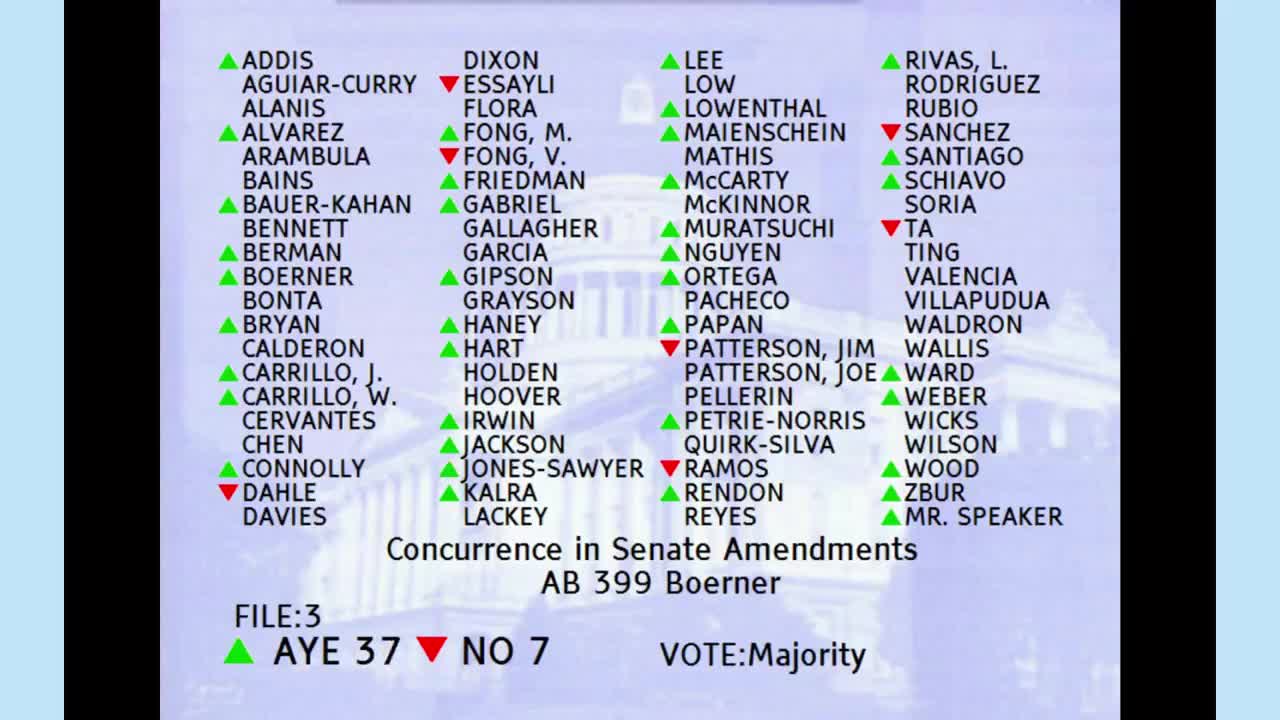 1MIN
Assembly Floor
 40SEC
Senate Floor
 34SEC
Senate Standing Committee on Appropriations
 6MIN
Senate Standing Committee on Education
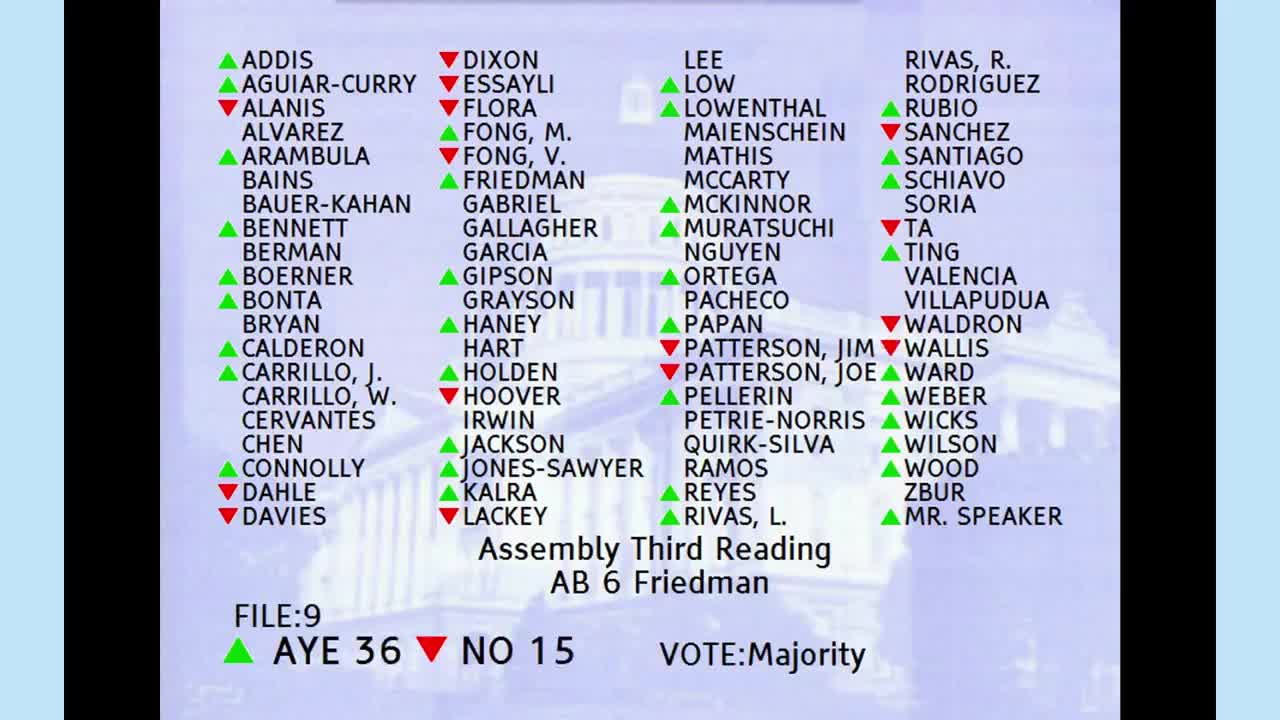 1MIN
Assembly Floor
 16MIN
Assembly Standing Committee on Higher Education
Bill Author